1. Introduction
Against the industry backdrop of global low-carbon energy transition and the widespread implementation of carbon neutrality concepts, building a safe, efficient, and low-carbon new power system has become a core task in the energy sector [
1,
2,
3]. Long-duration and large-scale energy storage technologies serve as critical support for smoothing the output fluctuations of new energy. They also help ensure the stable operation of power grids. Therefore, these technologies are embracing unprecedented development opportunities. CAES has become one of the internationally recognized promising energy storage routes due to its remarkable advantages such as large storage capacity, long service life, high cost-effectiveness, and environmental friendliness [
4,
5,
6]. As an ideal medium for underground storage, salt rocks possess geomechanical and petrophysical properties including extremely low permeability, favorable plastic deformation ability, significant creep characteristics, and damage self-healing effects, which provide a natural guarantee of the long-term stable sealing of underground spaces [
7,
8,
9,
10].
Different from the widely distributed thick salt-dome salt rocks abroad, China’s salt rock resources are dominated by lacustrine-deposited bedded salt rocks, featuring thin salt layers, high impurity content, and well-developed mudstone and gypsum interlayers [
11,
12]. As geological and stratigraphic characteristics vary from region to region, the construction of energy storage caverns within bedded salt rocks is confronted with a range of distinctive technical issues. The existence of interlayers not only alters the overall strength and deformation characteristics of salt rocks but may also act as preferential pathways for gas leakage [
13]. Meanwhile, thin salt layers impose higher requirements on cavity shape design, stability control, and space utilization efficiency [
14]. At present, a great number of salt cavern gas storage and CAES demonstration projects have been completed across the world, laying a solid foundation of mature engineering practices for the industry [
15,
16,
17]. However, systematic research on the physical and mechanical behaviors of bedded salt rocks under multi-scale and multi-field coupling and their impacts on the long-term safety of storage facilities remains insufficient.
Regarding the current research status, scholars at home and abroad have carried out extensive studies on the macro-mechanical and physical properties of salt rocks, such as strength, creep characteristics, and permeability [
18,
19,
20,
21]. Nevertheless, most existing studies rely on the homogeneous salt rock assumption. They pay insufficient attention to the widely developed interlayers, interfaces and structural heterogeneity of bedded salt rocks in China. Meanwhile, current studies mainly focus on single-scale experiments or numerical simulations. They lack cross-scale correlation analysis from microscopic characteristics to macroscopic mechanical responses. Specifically, micro indicators include grain morphology, mineral composition and pore characteristics, while macro performances cover rock strength, deformation and permeability. In terms of engineering application, there remains an urgent unsolved problem. It refers to how to effectively apply laboratory-derived core characteristic parameters to practical engineering work. These practical applications include the stability evaluation, airtightness design and long-term operational risk assessment of on-site salt cavern storage facilities.
Taking typical bedded salt rock deposits in Southwest China as the research object, this study aims to thoroughly reveal the geomechanical and petrophysical properties of bedded salt rocks through systematic core sampling and multi-dimensional laboratory tests. Specifically, mechanical tests, including direct shear and uniaxial and triaxial compression, will be conducted to quantify the strength and deformation characteristics of salt rocks and interlayers. Measurements such as permeability, porosity, MIP, and specific surface area analysis will be performed to characterize their pore structure and seepage characteristics. Combined with micro-analysis methods such as scanning electron microscopy (SEM) and X-ray diffraction (XRD), the intrinsic mechanisms of macro-mechanical behaviors will be explained from the perspectives of mineral composition and micro-structure. On this basis, the influence of the laws of interlayer content and distribution on the mechanical properties of salt rocks will be vigorously discussed.
The research results will provide key basic data and a scientific basis for the site selection, cavity design, stability evaluation, and safe operation of salt cavern gas storage and CAES plants in China’s bedded salt rock areas. This work has significant theoretical implications and engineering application value. It can drive the technological innovation and iteration of salt cavern energy storage, support its widespread implementation worldwide, and strengthen the safety and stability of regional energy systems.
2. Geological Characteristics
Kunming Salt Mine is located in the northeast of the Anning Basin, central Yunnan Province [
22]. The Anning Basin is a typical circular structural basin controlled by Indosinian tectonic movement. The salt-bearing strata in the basin are mainly distributed in the Upper Jurassic Anning Formation, which can be divided into three members (J
3an
1, J
3an
2, and J
3an
3) from bottom to top. The lithological associations are successively gypsum–glauberite, glauberite–halite, and glauberite–mudstone interbeds, forming multiple stable salt ore belts. At present, the mining exploration is mainly concentrated in the middle member of the Anning Formation, below the Guogaishan Formation, where four main ore bodies can be identified. The lithological association is dominated by interbeds of salt rocks, glauberite, and glauberitic mudstone, with interlayers mostly being salt-bearing mudstone and glauberitic mudstone. The latest drilling reveals that the total thickness of salt layers in the middle member of the Anning Formation reaches 350.49 m, dominated by interbeds of glauberite and salt rocks with a small amount of mudstone, and the average NaCl grade of the salt layers is about 60%.
The middle member of the Anning Formation has the advantages of moderate burial depth, large thickness, continuous distribution, stable interlayers, and high grade, making it an ideal occurrence horizon for constructing large-scale salt cavern energy storage facilities and providing a solid geological foundation for well layout design and cavity construction.
3. Mechanical Properties
3.1. Core Sampling and Processing
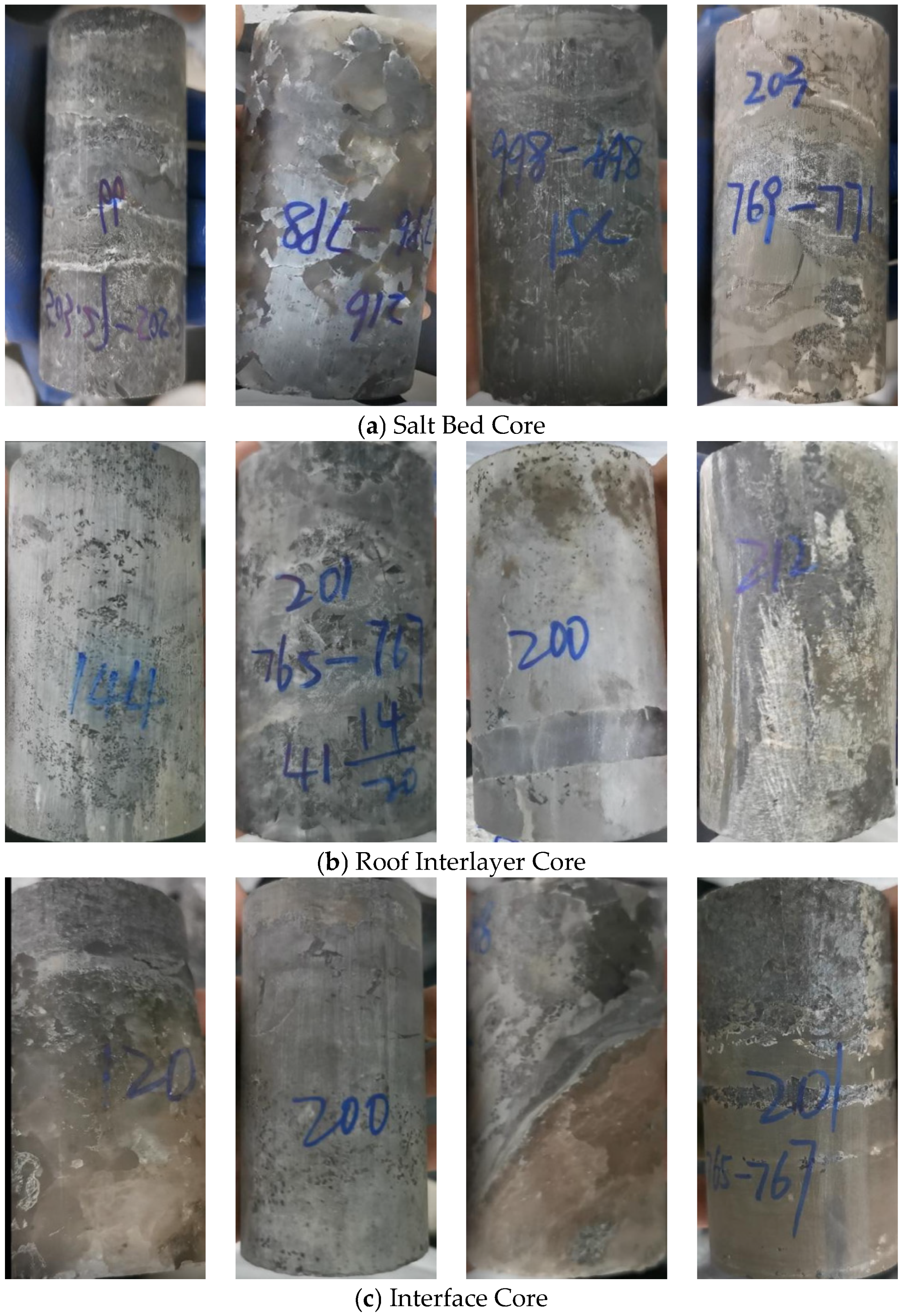
The samples were collected from Well An23 in the working area of the proposed compressed air energy storage demonstration project in Kunming Salt Mine, which is located on the northwest side of the brine extraction workshop of Kunming Salt Mine. The strata penetrated by Well An23 are as follows: (1) Quaternary (Q): 0–33 m, composed of yellowish-brown and gray sand, gravel layers, and clay layers. (2) Tertiary (N): 33–108 m, grayish-white gravel, conglomerate, sandstone, and yellow claystone in the upper part, with coal streaks in the middle. (3) Guogaishan Formation (K2g): 108–251 m, consisting of two parts: sandstone in the lower part, occasionally intercalated with mudstone and siltstone lenses; brownish-red siltstone and silty mudstone in the upper part. (4) Taohuacun Formation (K2t): 251–370 m, divided into upper and lower members. The lower member is dominated by coarse to fine clastic rocks, and the upper member is mainly clastic rocks with a small amount of anhydrite nodules. (5) Third member of Anning Formation (J3an3): 370–464 m, dominated by bluish-gray and grayish-white glauberite, gypsum, and gray mudstone, interbedded with a small amount of purplish-red and grayish-purple mudstone and silty mudstone. (6) Second member of Anning Formation (J3an2): 464–886 m, dominated by white and bluish-gray halite, glauberitic halite, and bluish-gray glauberite, interbedded with a small amount of gray mudstone and purplish-red silty mudstone.
Well An23 coring depth ranges from 381 m to 886 m, with a total coring footage of 505.80 m, a total core length of 504.42 m, and a total recovery rate of 99.73%. A total of 53 coring runs were completed, with an average single-tube footage of 9.54 m. The core lithologies include halite, salt-mudstone interface, interlayers (upper roof, lower floor), and mudstone, as shown in
Figure 1. After the field geologists completed core collection and logging, the cores were immediately wrapped with plastic film, packed in boxes, and transported to the laboratory. Considering that salt rock is soluble in water, all specimens were prepared by wire cutting. The loading scheme followed the recommendations of the International Society for Rock Mechanics (ISRM) and remained consistent across all tests. Data processing complied with relevant specifications, and the obtained results fully meet the standards of the ISRM.
3.2. Test Results and Analysis
All mechanical tests were conducted in accordance with the ‘Standard for soil test methods’ (GB/T 50123-2019) [
23].
3.2.1. Direct Shear Test
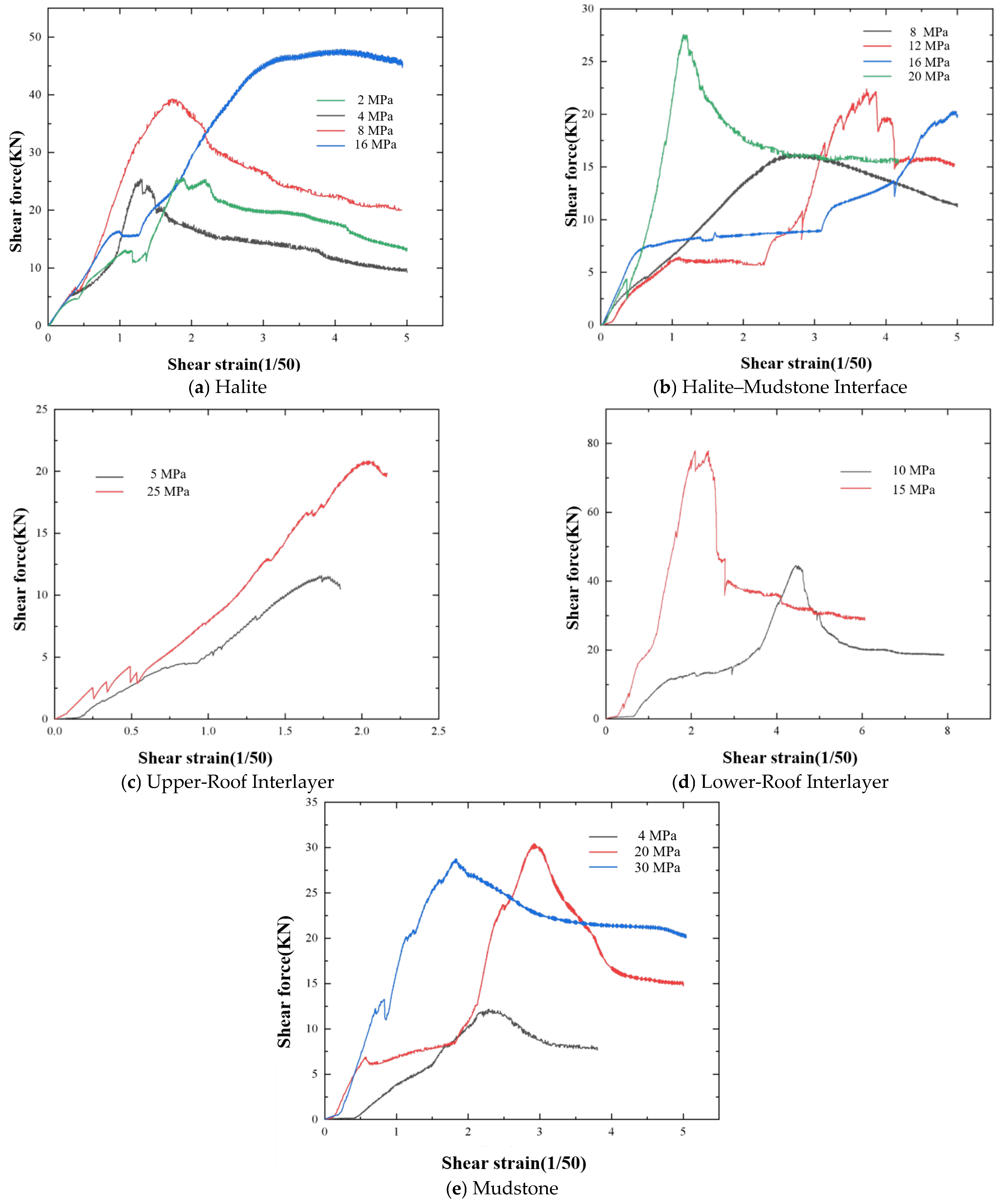
The standard sample for direct shear test is a cube with a side length of 150 mm. However, limited by the core size, the cores collected from Kunming Anning Salt Mine were processed into cylindrical samples with a diameter of 50 mm and a height of 100 mm according to the actual situation. The direct shear tests were carried out at room temperature (25 °C) under displacement control, with a loading rate of 0.02 mm/min. Direct shear tests were carried out on samples of halite, salt-mudstone interface, interlayers (upper roof and lower floor), and mudstone respectively. The direct shear test data are shown in
Table 1.
The direct shear test generates the shear force–shear strain curve. Shear stress rises slowly at first and then nearly linearly before plastic deformation occurs. Upon reaching peak shear strength, the stress decreases gradually and stabilizes, corresponding to the full process of soil compaction, elastic deformation, plastic development, shear failure and final residual strength. As
Figure 2 indicates, the peak shear stress of most lithologies increases with an increase in normal stress, conforming to the Mohr–Coulomb shear strength criterion. There are differences in the shear resistance of different lithological samples, and the characteristics are summarized as follows: Halite (13.07–24.53 MPa) shows significant plastic deformation and is suitable for high-stress environments. The salt–mudstone interface ranges from 16.21 to 27.55 MPa. It has obvious slip characteristics and low shear resistance. Shear failure weak zones tend to form here. The upper roof interlayer is between 11.58 and 20.85 MPa. It has weak shear resistance and is prone to instability. The lower floor interlayer measures 22.64 to 39.60 MPa. Its performance is better than the upper-roof interlayer, yet failure may still take place. Mudstone has a strength of 12.16 to 30.46 MPa. It features prominent brittle failure and the lowest shear strength. Therefore, it cannot adapt to environments with high shear force.
3.2.2. Uniaxial Compression Test
The uniaxial tests were conducted at room temperature (25 °C) with displacement control throughout the loading process, and the loading rate was set at 0.02 mm/min.
Table 2 shows uniaxial compression test results of cores with different lithologies, which indicates that the elastic modulus of the salt rock tested in this study is lower than that of salt rocks abroad, representing a distinct property of bedded salt rocks in China. A high impurity content impairs the deformation resistance of Chinese bedded salt formations, while salt rocks from other countries generally have higher purity and better resistance to deformation. It is therefore understandable that their elastic moduli are higher. This study investigates the elastic moduli of Chinese bedded salt rocks [
24,
25], and the results are listed as follows: 4.36 MPa (Tai’an, China), 7.71 MPa (Pingdingshan, China), 5.05 MPa (Huai’an, China), 11.4 MPa (Yingcheng, China), 4.50 MPa (Zhangshu, China).
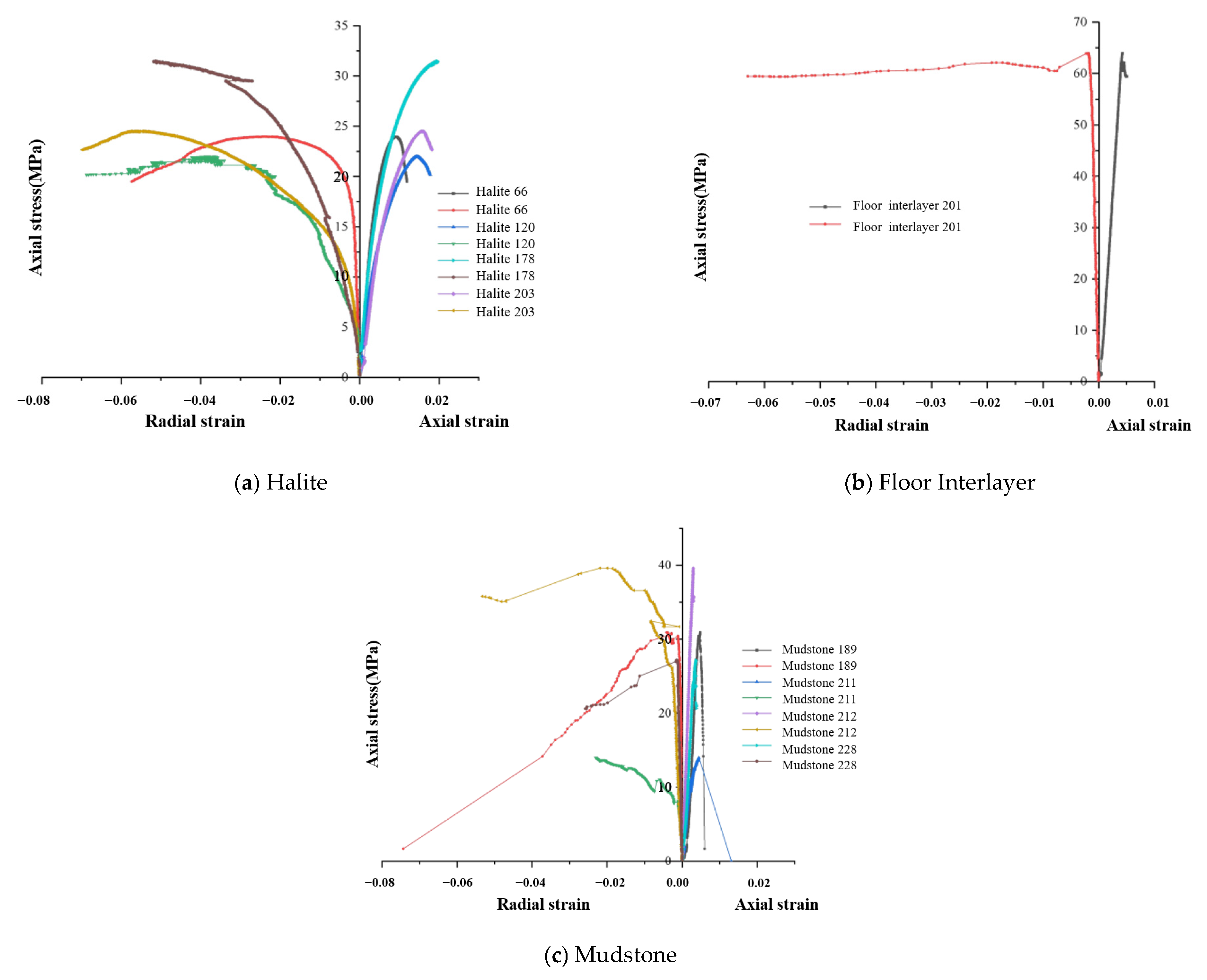
The uniaxial compression test specimens of cores with different lithologies are shown in
Figure 3.
As shown in
Figure 3, the test results indicate that there are differences in the compressive capacity and deformation characteristics of different lithologies. The specific mechanical properties of each lithology are analyzed as follows.
First, halite shows strong plastic deformation ability. It does not undergo immediate brittle failure after compression. Instead, it presents certain ductility.
Second, the peak stress of the lower-floor interlayer is much higher than that of halite and mudstone. It shows strong compressive capacity and high stiffness. It can remain stable under high-stress environments with good bearing capacity. Thus, it is suitable as a bearing rock layer or structural support layer.
Third, mudstone shows strong brittle characteristics as a whole. It is prone to sudden failure under high stress.
The stress-strain curve of halite samples does not show immediate shear failure after reaching peak stress, but a slow trend of decline; the curve of the lower-floor interlayer samples shows sudden brittle failure after reaching peak stress, without a buffer process; mudstone samples undergo instability failure, showing large lateral deformation ability.
3.2.3. Triaxial Compression Test
The triaxial compression test is also a conventional laboratory test method to determine rock mechanical parameters [
26,
27,
28], which can better simulate formation pressure conditions, and the obtained parameters are more in line with the actual situation.
During the entire test, the confining pressure was applied via hydraulic loading, which is a conventional approach for triaxial tests. The cylindrical specimen was loaded using aviation hydraulic oil, so the second principal stress was equal to the third principal stress. According to the definitions in elasticity mechanics, the principal stresses follow the relationship (
). Given the stress condition in this test (
), the deviatoric stress can be determined accordingly, as expressed by the equation below:
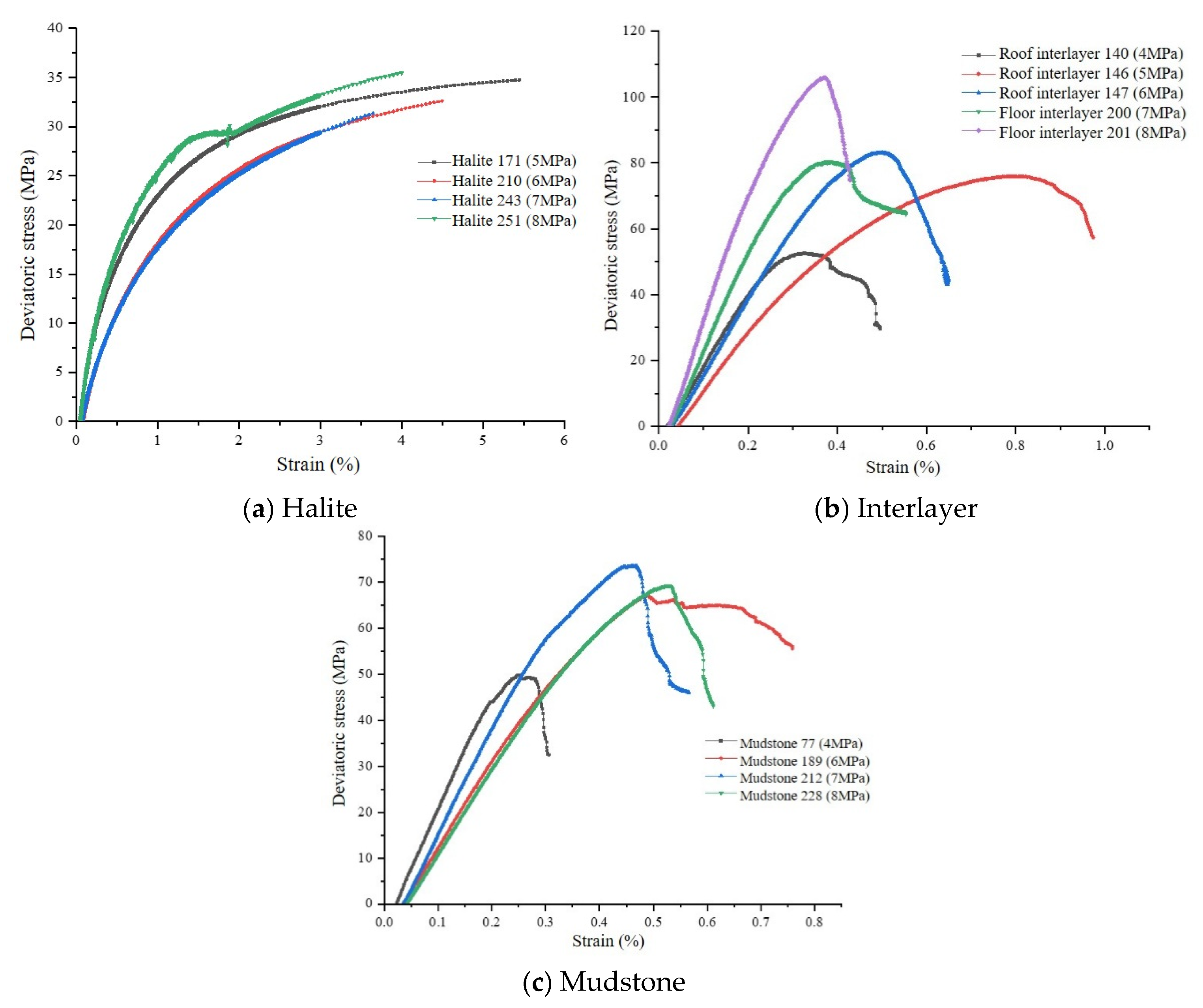
Triaxial compression tests were carried out on the roof, floor, mudstone, and salt rocks of the salt cavern gas storage in Kunming Salt Mine under various confining pressures (ranging from 4 to 8 MPa) at 36 °C in order to study the strength and deformation laws of samples under three-dimensional stress states. The test data are listed in
Table 3.
As
Figure 4 shows, the test results show that there are differences in the compressive capacity and deformation characteristics of different lithologies. The specific mechanical properties of each lithology are analyzed as follows.
First, halite shows obvious plastic characteristics. Its curves are smooth without sharp drops, and no brittle fracture occurs during sample failure.
Second, the deviatoric stress–strain curves of upper and lower floor interlayers under different confining pressures all show typical brittle failure characteristics. Stress drops rapidly after the peak, and no obvious plastic rheology platform appears. This indicates that the interlayers are dominated by structural plane shear fracture during loading and have strong strain-softening characteristics.
Third, the deviatoric stress–strain curves of mudstone samples under different confining pressures all show typical brittle failure characteristics. Stress attenuates rapidly after the peak, and no obvious plastic rheology platform is formed. This indicates that the failure process is accompanied by structural-plane splitting and shear-zone development.
Therefore, mudstone is a typical strain-softening material. In terms of elastic modulus, interlayers are generally higher than halite and mudstone, indicating that interlayers have strong anti-deformation ability and denser structure in the initial loading stage.
The cohesive force and internal friction angle are obtained by linear fitting based on the Mohr strength theory. The Mohr strength theory is a widely adopted strength criterion. The Mohr–Coulomb criterion can be expressed as
where
f is the yield function,
represents the shear stress,
is the normal stress on the failure plane,
c is the cohesion, and
is the internal friction angle. All the above parameters were determined by triaxial compression tests.
The relevant values can be calculated using the above equations. The final results are as follows: halite cohesive force c = 11.28 MPa; internal friction angle φ = 14.07°; interlayer c = 1.88 MPa, φ = 57.91°; and mudstone c = 6.13 MPa, φ = 46.93°.
4. Petrophysical Properties
4.1. Permeability, Porosity and Density Measurement
To systematically grasp the storage and seepage performance of multi-lithology cores such as salt rocks, interlayers and mudstones, the CLKS-II multi-size high-temperature and high-pressure porosity-permeability combined measurement system was used to carry out permeability and porosity tests. It mainly measures porosity using the gas expansion method (Boyle’s Law). First, the core is evacuated, then the gas expands between the reference chamber and the core holder to balance the pressure, allowing the effective pore volume of the core to be calculated. Porosity is obtained by combining this value with the total bulk volume of the core. For permeability testing, steady-state and unsteady-state pulse decay methods are applied according to the core permeability range. For medium-to-high permeability cores, permeability is directly calculated using Darcy’s law based on the stable flow rate and pressure difference. For low-permeability cores, permeability is back-calculated from the pressure decay curve after applying an upstream pressure pulse. The entire system enables combined measurement of porosity and permeability for multi-size core samples under simulated reservoir high-temperature and high-pressure conditions.
The CLKS-II system has the functions of variable temperature and variable pressure, and permeability and porosity tests were carried out on some core samples under laboratory conditions. Meanwhile, for deep-core samples, a series of loading tests under variable confining pressure, variable temperature and variable seepage pressure were supplemented to simulate seepage behavior under complex formation conditions and improve the engineering adaptability of test data.
The core permeability and porosity data are summarized in
Table 4. All measurements were conducted at room temperature. The current test results mainly present the following characteristics:
Permeability varies widely, ranging from 10−20 m2 to 10−17 m2, spanning three to four orders of magnitude. The correlation between porosity and permeability is weakened, and the pore structure type has a strong control effect on seepage performance. The coring direction has a significant impact on seepage performance, with large differences between vertical and horizontal permeability. Confining pressure has a great influence on permeability.
To better characterize gas migration, we prepared core samples along horizontal and vertical directions. In salt cavern gas storage reservoirs, gas mainly migrates horizontally along interlayers. This testing aims to explore directional gas migration laws of the same rock core, providing technical support for reservoir construction. For instance, Sample 140 shows little difference in permeability between horizontal and vertical directions, while Sample 142 presents a notable discrepancy, which may be attributed to damage generated during coring. Overall, the rock cores have low permeability, basically meeting the preliminary sealing requirements.
Meanwhile, as shown in
Table 5, supplementary tests were further conducted on deep-segment samples of the purplish-red mudstone series. This series includes purplish-red saline mudstone, purplish-red salt-bearing mudstone, purplish-red saline silty mudstone, and purplish-red saline and calcine-bearing glauberite mudstone. The test conditions were set to simulate the actual underground reservoir environment. The obtained data will provide key parameter support for establishing a more realistically constrained underground reservoir evaluation model.
This supplementary test is summarized and analyzed for three dimensions: confining pressure effect, osmotic pressure difference, and lithology characteristics.
Increasing confining pressure generally reduces permeability, indicating the compaction effect of rock mass. For Sample 200, when the confining pressure rose from 9 MPa to 9.5 MPa, the permeability decreased from 5.455 × 10⁻¹⁹ to 6.269 × 10⁻²⁰ m2.
Variation of osmotic pressure difference exerts a slight influence on permeability. The results show that permeability presents no obvious regular changes under different upstream pressures.
The permeability of salt rock is generally lower than that of other rock types. However, the permeability of some interlayers reaches the order of 10−17 m2. Such interlayers are key weak zones that require special attention during salt cavern operation.
4.2. SEM and XRD Analysis
4.2.1. Micro-Structure Analysis by SEM
Rock samples were taken from the specimens without uniaxial compression tests for SEM to observe and analyze the micro-structure of the specimens in detail. For non-conductive rocks, a conductive metal or carbon layer with a thickness of 5–10 nm needs to be sprayed on the surface of the samples before the test.
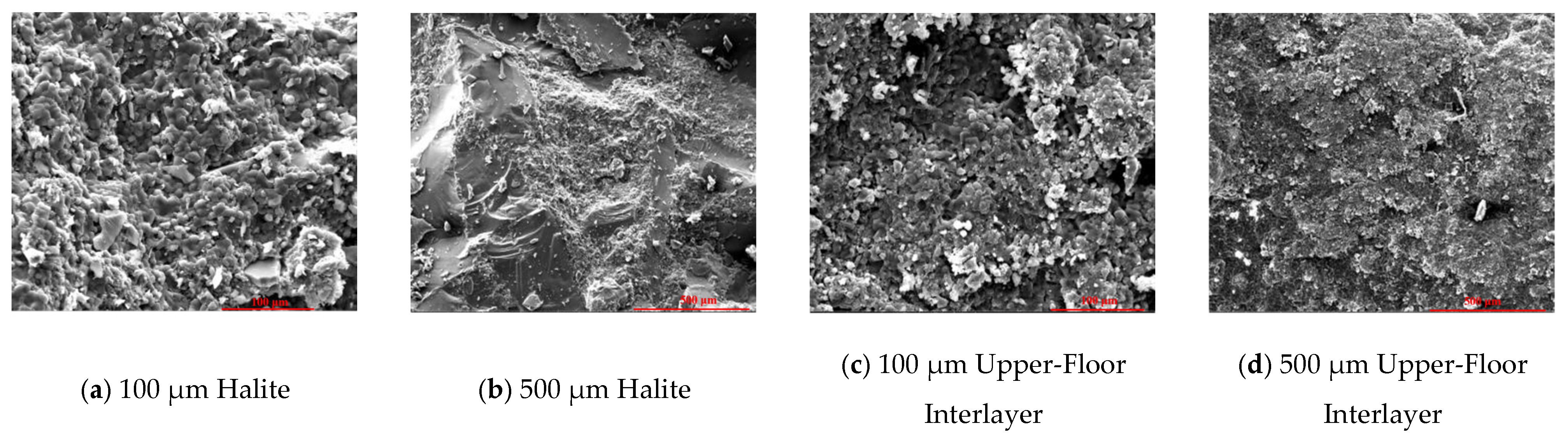
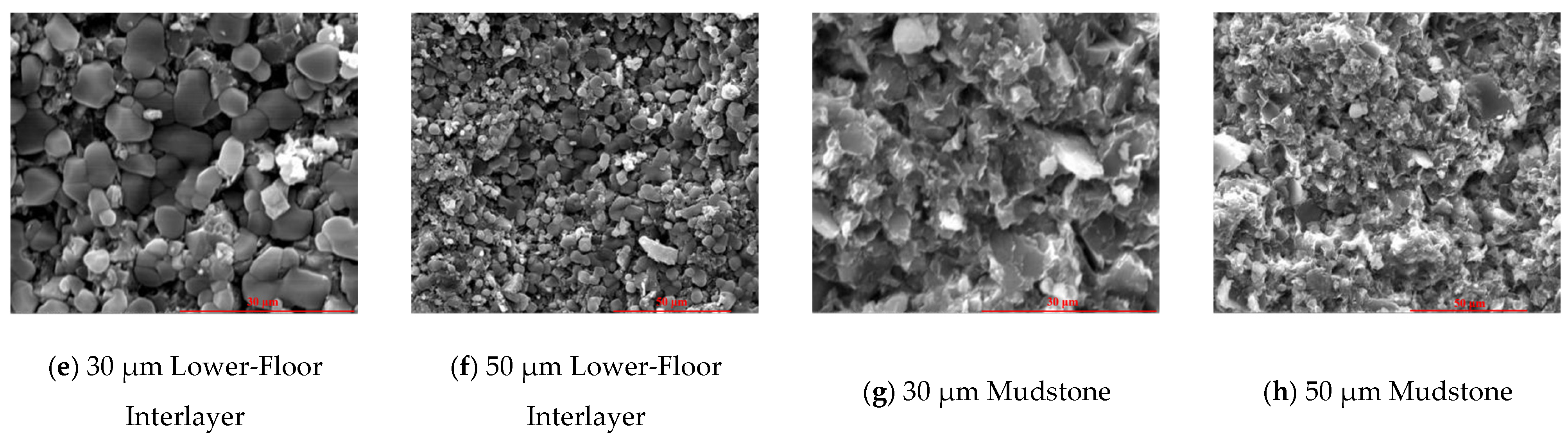
SEM analyses were carried out on four types of core samples—halite, upper-roof interlayer, lower-floor interlayer and mudstone—to systematically analyze their micro-structure characteristics (
Figure 5).
It can be seen from the images that the micro-structure of halite samples is mainly granular and massive (accounting for about 85%), with local lamellar superposition structure (accounting for about 15%). The micro-particles of the granular and massive structure are cube-like or irregular granular. In addition, there are only a small amount of inter-crystalline micro-pores and tiny cracks locally. Therefore, the overall structure is dense; the particles of lamellar superposition structure are mainly massive and irregular, but the structural plane is accompanied by micro-cracks and small holes, with slightly poor compactness.
The micro-structure of upper-roof interlayer samples is mainly fine-grained cluster structure (accounting for about 90%), with local powdery loose structure (accounting for about 10%). The micro-particles of fine-grained cluster structure are mainly fine-grained and cluster-like, with many micro-pores and aggregates, and the overall structure is loose and porous; the particles of powdery loose structure are fine-grained, with almost no close connection between particles, well-developed pores and micro-cracks, and extremely poor structural compactness.
The micro-structure of lower-floor interlayer samples is mainly regular granular structure (accounting for about 60%) and fine-grained disordered structure (accounting for about 40%). The particles of regular granular structure are hexagonal-like or sub-cubic, with only a small number of tiny pores locally, and the structure is relatively dense; the particles of fine-grained disordered structure are fine-grained, with a significant increase in the number of aggregates and micro-pores, and a significantly higher degree of structural looseness.
The micro-structure of mudstone samples is mainly flaky and scaly structure (accounting for about 55%) and clastic loose structure (accounting for about 45%). The particles of flaky and scaly structure are flaky and scaly, arranged orderly and closely stacked, without obvious large holes, and the structure is dense; the particles of clastic loose structure are fine, flaky and clastic, with loose combination between particles, well-developed pores and micro-cracks, rough structural plane, and poor compactness.
SEM is adopted in this study to observe microscale pore channels and preliminarily evaluate the sealing performance. The results reveal pore development within interlayers, which will not impair the overall tightness of the rock mass. The rock cores possess favorable sealing capacity, demonstrating that the Anning salt cavern is geologically viable for gas storage construction.
4.2.2. XRD Phase Analysis
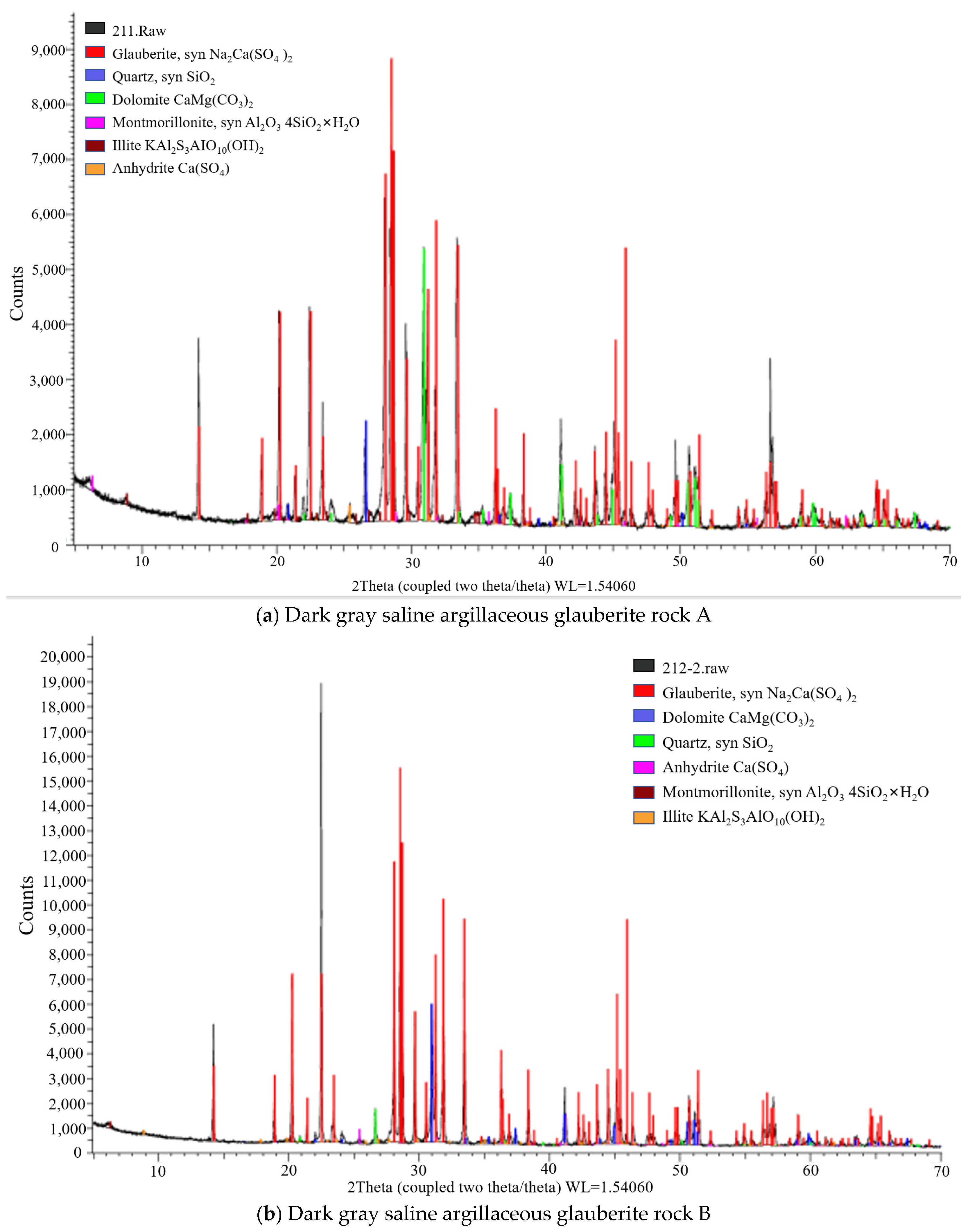
D8 Advance X-ray diffractometer (XRD) manufactured by Bruker AXS GmbH, Karlsruhe, Germany, was used for phase analysis, which is mainly used for phase retrieval, quantitative phase analysis, grain size determination, micro-stress (lattice distortion) analysis and line shape analysis.
Halite Samples
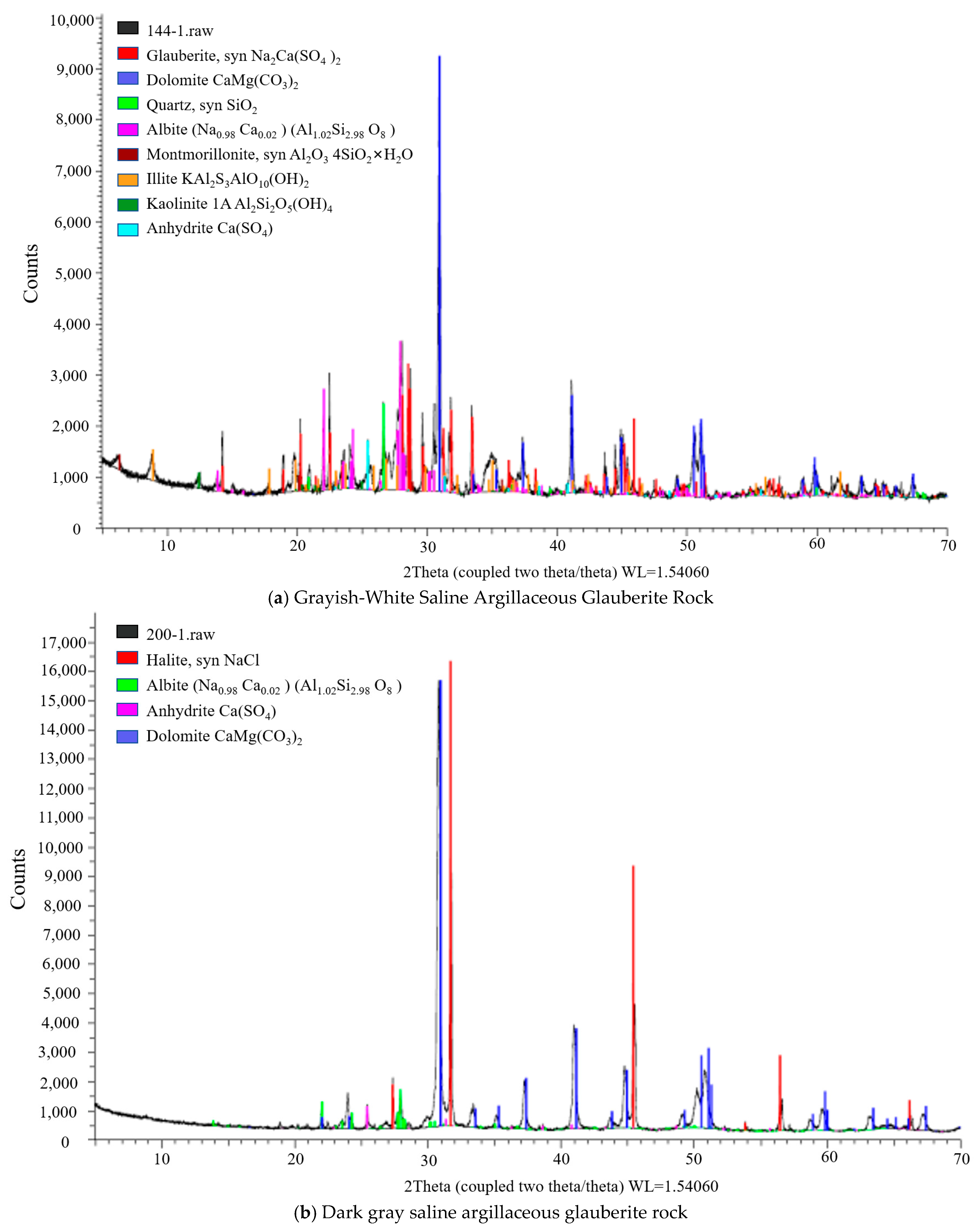
As
Figure 6 shows, the mineral analysis results of halite samples show that halite samples are dominated by NaCl, with extensive associated Na
2Ca(SO
4)
2 (glauberite) and (Na
0.98Ca
0.02)(Al
1.02Si
2.98O
8) and other sodium–calcium plagioclase aluminosilicate minerals, as well as a small amount of CaMg(CO
3)
2 (dolomite) and SiO
2 (quartz). The mineral spectral peaks are concentrated, and the composition is clear, which shows good compactness and structural stability. Furthermore, it has excellent sealing performance. Therefore, it serves as a key lithological basis for constructing the main structure of salt caverns.
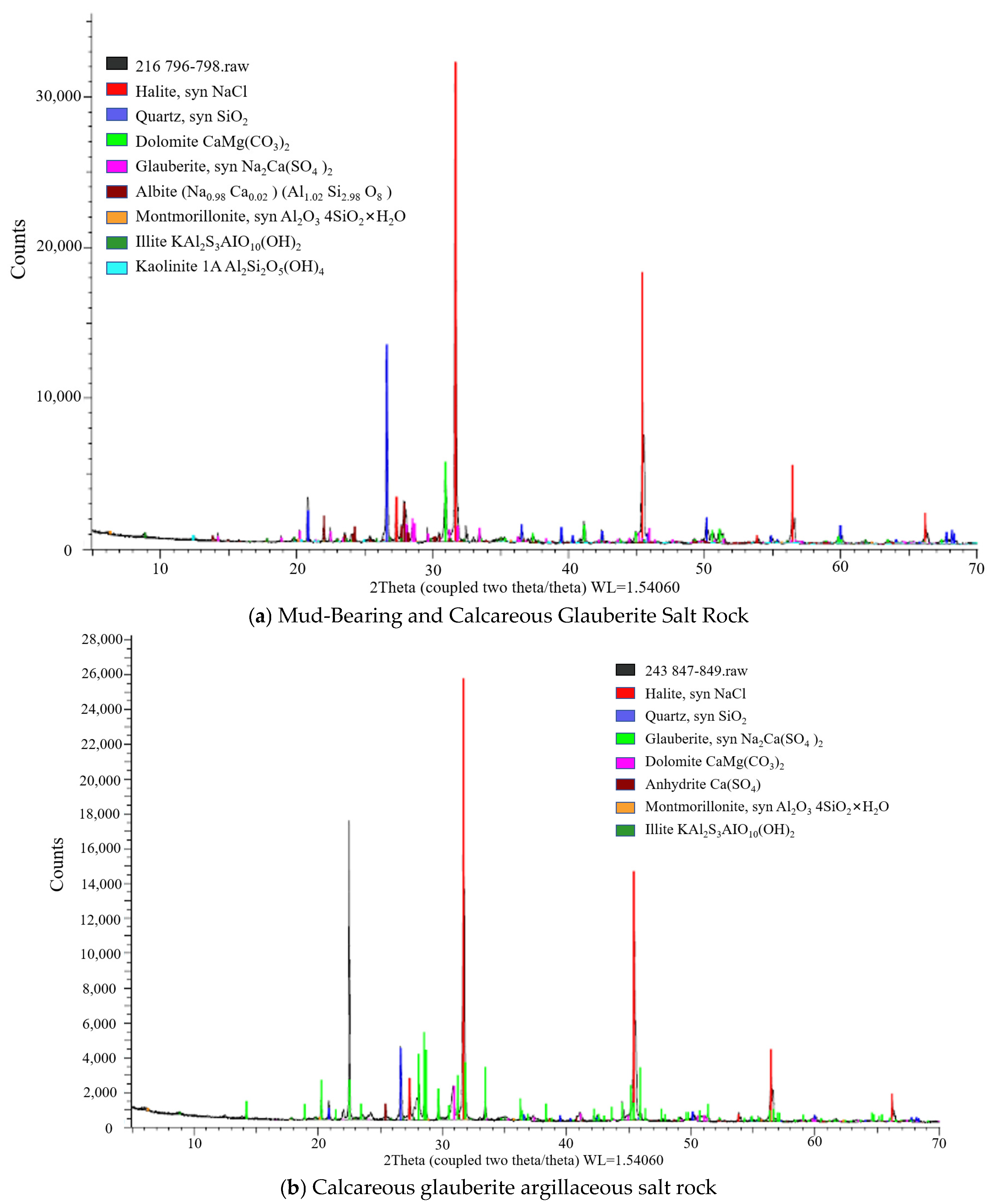
Interlayer Samples
As
Figure 7 shows, the spectral peaks of interlayer samples are widely distributed. In addition to NaCl, Na
2Ca(SO
4)
2 and (Na
0.98Ca
0.02)(Al
1.02Si
2.98O
8), a variety of clay minerals and carbonate minerals such as KAl
2(Si
3Al)O
10(OH)
2 (illite), Al
2Si
2O
5(OH)
4 (kaolinite), CaMg(CO
3)
2 (dolomite), CaCO
3 (calcite), CaSO
4 (anhydrite) and SiO
2 (quartz) are also detected. The mineral composition is diverse and the structure is complex, reflecting a typical salt–mud mixed sedimentary environment. This lithology has strong stability in micro-structure, and is suitable for constructing the top cap layer or bottom sealing zone of salt cavern energy storage system, with micro-adjustment and sealing functions.
Mudstone Samples
As
Figure 8 shows, mudstone samples are mainly composed of Na
2Ca(SO
4)
2 (glauberite) and CaMg(CO
3)
2 (dolomite), with low NaCl content. A small amount of clay minerals (such as illite and kaolinite) and SiO
2 (quartz) are detected in local samples. The mineral spectral peaks are gentle. The composition is stable. The impurity degree is low. It shows excellent compactness and dissolution resistance. This type of rock is suitable as peripheral sealing layer or bottom buffer layer material. It has good sealing and structural stability. It can effectively improve the long-term safety of underground energy storage systems.
4.3. Mercury Intrusion Porosimetry (MIP)
Mercury intrusion porosimetry is a test method used to determine the pore structure of rocks [
29]. The internal pore and micro-crack characteristics of rocks directly determine their airtightness, which is the main index for evaluating the sealing performance of salt layers. Carrying out MIP tests to obtain the pore structure parameters of salt rocks is of important reference significance for the sealing evaluation of salt layers in gas storage. The AutoPore V 9600 automatic mercury porosimeter (Micromeritics Instrument Corporation, Norcross, GA, USA) was used in this test. Based on the principle of mercury intrusion, the pore size that mercury can enter is inversely proportional to the applied pressure; the higher the pressure, the smaller the pore size that mercury can penetrate.
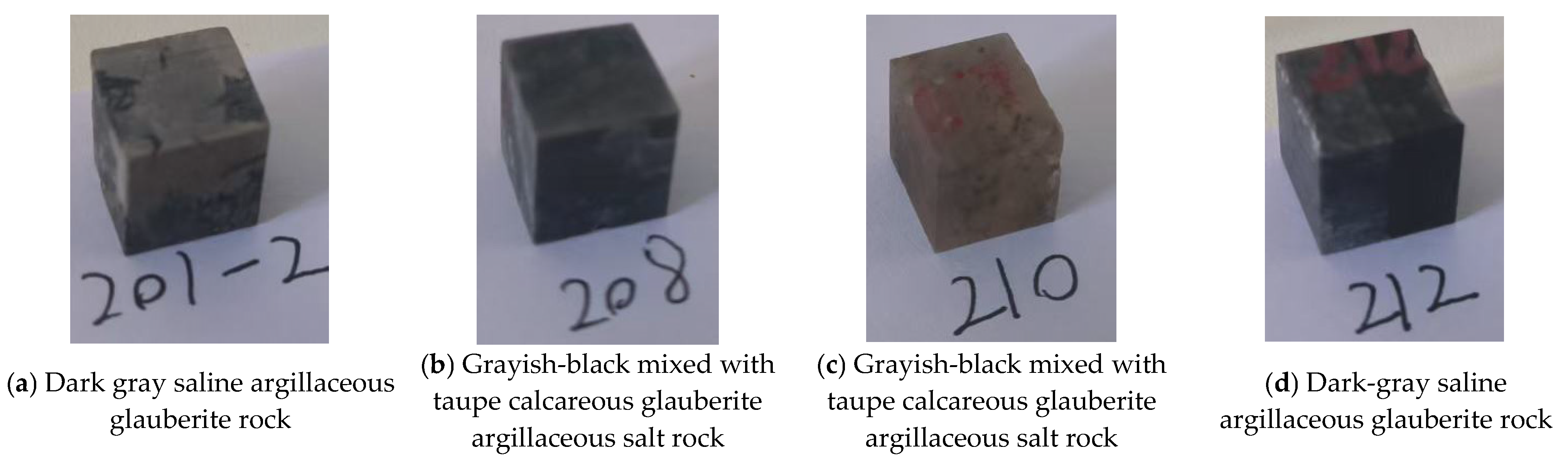
The test samples were taken from rock strata at different depths and processed into cubes of 10 × 10 × 10 mm. Mercury intrusion test samples of cores with different lithologies are shown in
Figure 9.
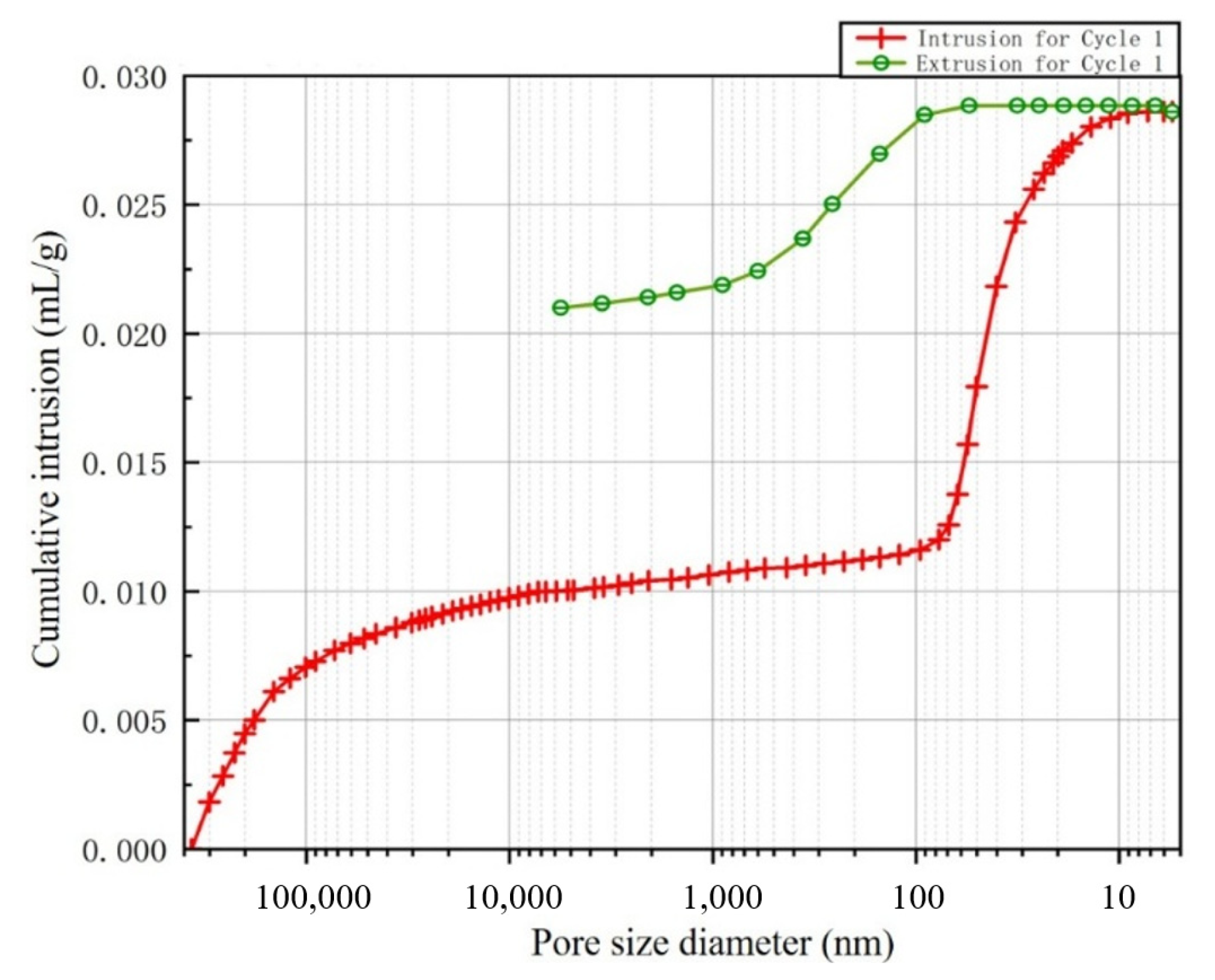
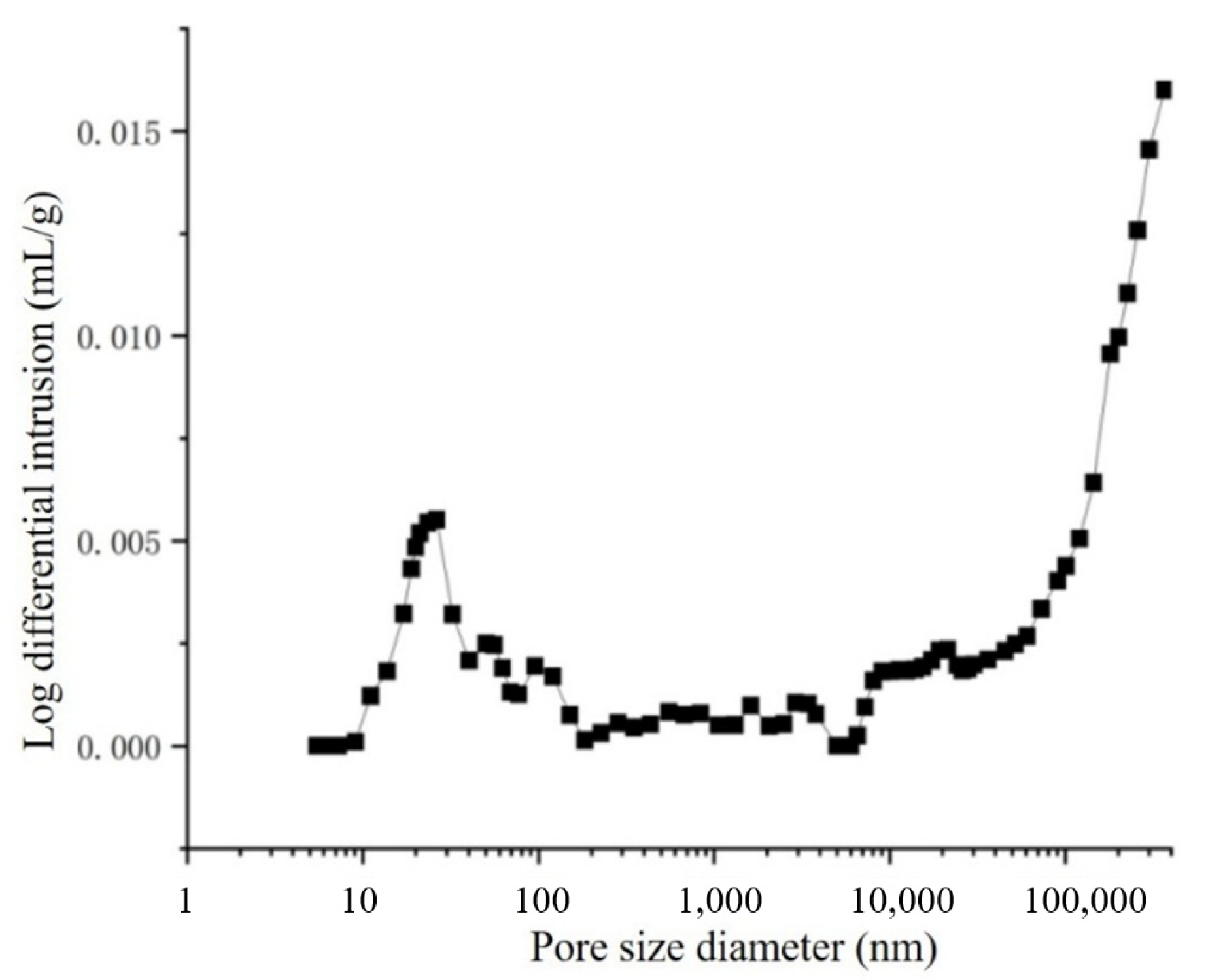
The mercury intrusion and extrusion curves of core samples with different lithologies are shown in
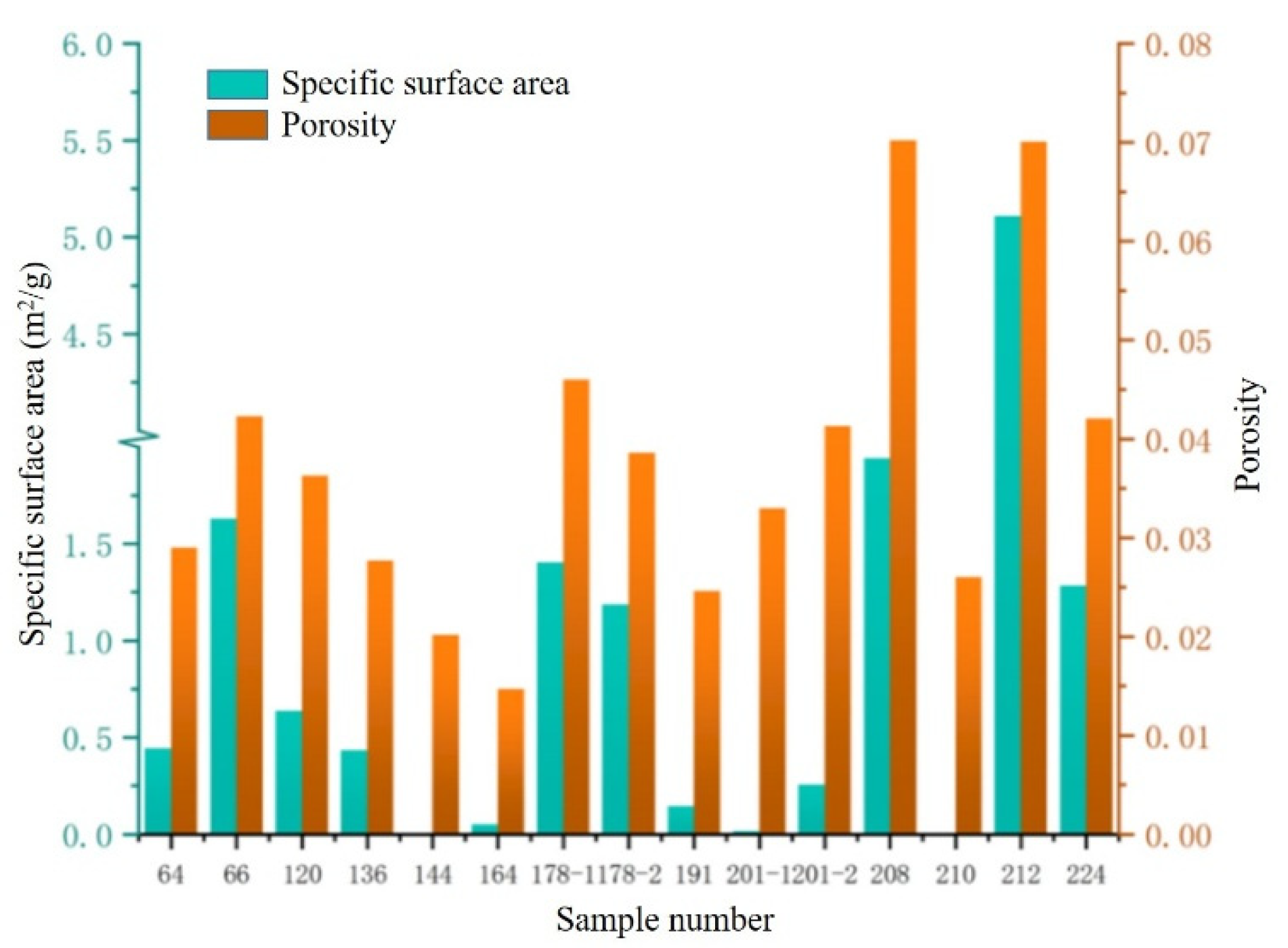
Figure 10. In the intrusion–extrusion curve of the sample, the abscissa represents the pore size. As the pressure gradually increases, the intrudable pore size becomes smaller and smaller. The ordinate represents the cumulative mercury intrusion volume during the pressure increase. The red line is the intrusion curve, and the green line is the extrusion curve; mercury cannot be completely extruded during extrusion. Thus, the specific surface area, porosity and their relationship to the samples were measured (
Table 6 and
Figure 11). In addition, the main pore structure information of the samples can be obtained from the intrusion–extrusion curve, and the pore size distribution of the samples is shown in
Figure 12.
The specific surface area of most samples is less than 1 m2/g, indicating that the rocks are relatively dense with low surface area. The porosity of the samples is generally lower than 5%, the pore volume accounts for a small proportion, and the overall permeability of the rocks is low. The average pore size is mainly concentrated between 100 nm and 500 nm. The pore structure of the samples is dominated by mesopores. The pore size of individual samples is relatively large due to well-developed fractures.
5. Conclusions
This paper takes typical bedded salt rock deposits in Southwest China as the research object. It systematically carries out core sampling and multi-dimensional laboratory tests. These tests deeply reveal the geomechanical and petrophysical properties of bedded salt rocks. The study provides an evaluation basis and paradigm for the construction of salt cavern compressed-air energy-storage plants.
To better illustrate the geomechanical and petrophysical properties of bedded salt rocks for salt cavern gas storage in this work, we have summarized and sorted out the key mechanical and physical parameters of the tested rock samples, and concluded the major experimental findings, as shown in
Table 7.
The specific conclusions are as follows:
(1) Halite samples show good plasticity, high shear strength and favorable plastic deformation ability. They are suitable for high-stress underground energy storage environments. The salt–mudstone interface exhibits slip behavior. It should be monitored as an engineering weak part. The shear strength of interlayer samples (upper roof and lower floor) is significantly controlled by structural planes. However, they have strong compressive capacity and elastic modulus. They are high-quality rock layers suitable for supporting or stabilizing boundaries. Mudstone has poor shear resistance. It is not suitable for key structural areas bearing high shear loads.
(2) Halite shows obvious plastic characteristics under triaxial stress conditions. The curve is smooth overall without sharp drops. The failure process is non-sudden. This indicates good ductility and stability. The elastic modulus is generally low. It reflects limited deformation resistance. Interlayer rocks show strain-softening curve characteristics. Their elastic modulus is much higher than that of halite and mudstone. This reflects good initial bearing capacity and energy storage–release characteristics. Mudstone is an obvious strain-softening material. It is prone to fracture under high-stress environments. Its overall compressive capacity is between halite and interlayers.
(3) The basic porosity-permeability parameters of halite, interlayers, mudstone and other lithologies under formation confining pressure are generally at the magnitude of 10−20 m2. They have low permeability and good sealing performance. Most samples have low surface area. They show dense structure and limited pores. They are suitable as sealing layers or surrounding rock reinforcing materials. In terms of micro-structure, the samples are generally dense. They have good crystal-to-crystal engagement and low porosity.
(4) Halite samples have a single structure and strong tightness; interlayer samples have complex compositions and moderate sealing performance; mudstone samples have concentrated minerals and excellent sealing function. All lithologies can undertake differentiated structural roles in salt cavern energy storage engineering according to their mineral characteristics.
Further research can focus on the long-term mechanical and permeability evolution of bedded salt rocks under multi-field coupling and cyclic loading conditions. Combined with numerical simulation and in situ monitoring, a more accurate evaluation system for the stability and tightness of salt cavern energy storage can be established, which will provide a solid theoretical basis for engineering design and safe operation.
Author Contributions
Conceptualization: H.K., H.M. and Y.H.; data curation: W.L., Z.M. and L.R.; writing—original draft preparation: H.K. and H.M.; supervision: X.L., J.Y. and Y.Y. All authors have read and agreed to the published version of the manuscript.
Funding
This research received no external funding.
Institutional Review Board Statement
Not applicable.
Informed Consent Statement
Not applicable.
Data Availability Statement
The data used to support the findings of this study are available from the corresponding author upon reasonable request.
Conflicts of Interest
Authors H.K., Y.H., W.L., Z.M., L.R., X.L., J.Y., and Y.Y. were employed by the company China Energy Engineering Group Yunnan Electric Power Design Institute Co., Ltd. The remaining authors declare that the research was conducted in the absence of any commercial or financial relationships that could be construed as a potential conflict of interest.
References
- Feng, W.; Yang, F.; Liu, J. Water Environment Pollution and Control in the Dual-Carbon Background. Water 2023, 15, 4. [Google Scholar] [CrossRef] [Scilit]
- Chen, S. Exploring Effective Ways to Achieve the “Dual-Carbon” Goals. Highlights Bus. Econ. Manag. 2024, 29, 1–6. [Google Scholar] [CrossRef] [Scilit]
- Chang, K.; Wang, S. Impact of dual-carbon attention competition from local government on regional carbon emissions in China. J. Environ. Manag. 2025, 374, 124064. [Google Scholar] [CrossRef] [Scilit] [PubMed]
- Zhang, Y.; Yuan, G.; Xia, Y.; Chang, Z.; Li, X.; Ban, F. Steady-State Thermodynamic Analysis for Compressed Air Energy Storage in Salt Caverns. J. Energy Eng. 2026, 152, 04025087. [Google Scholar] [CrossRef] [Scilit]
- Bi, T.; Zhang, B.; Chen, W.; Li, J.; Yang, Z.; Wang, Y.; Zhang, X.; Xue, X. Study on the applicability of a horizontal well in compressed air energy storage in aquifer. Energy 2025, 329, 136778. [Google Scholar] [CrossRef] [Scilit]
- Guo, C.; Li, C.; Zhang, K.; Cai, Z.; Ma, T.; Maggi, F.; Gan, Y.; El-Zein, A.; Pan, Z.; Shen, L. The promise and challenges of utility-scale compressed air energy storage in aquifers. Appl. Energy 2021, 286, 116513. [Google Scholar] [CrossRef] [Scilit]
- Zhang, D.; Skoczylas, F.; Agostini, F.; Jeannin, L. Experimental Investigation of Gas Transfer Properties and Stress Coupling Effects of Salt Rocks. Rock Mech. Rock Eng. 2020, 53, 4015–4029. [Google Scholar] [CrossRef] [Scilit]
- Zhang, S.; Liang, W.; Xu, S.; Xiao, N.; Li, J. Experimental Study on Creep Properties of Deep Impurity Salt Rocks. Rock Mech. Rock Eng. 2025, 58, 787–806. [Google Scholar] [CrossRef] [Scilit]
- Falcon-Suarez, I.H.; Dale, M.; Marin-Moreno, H. Experimental study of geophysical and transport properties of salt rocks in the context of underground energy storage. Geophys. Prospect. 2024, 72, 2032–2048. [Google Scholar] [CrossRef] [Scilit]
- Li, Z.; Yang, Z.; Fan, J.; Fourmeau, M.; Jiang, D.; Nelias, D. Fatigue mechanical properties of salt rocks under high stress plateaus: The interaction between creep and fatigue. Rock Mech. Rock Eng. 2022, 55, 6627–6642. [Google Scholar] [CrossRef] [Scilit]
- Wang, T.T.; Yan, X.Z.; Yang, X.J.; Cao, X.W.; Huang, H.D. Geo Mechanical Analysis of Casing Failure in Bedded Rock Salt Formation. Res. J. Appl. Sci. Eng. Technol. 2012, 4, 3069–3077. [Google Scholar]
- Li, D.; Liu, W.; Liu, R.; Wang, S.; Xiong, Y.; Wu, L.; Liu, W. Control mechanism and effect evaluation of salt cavern energy storage construction with recycled light brine and gas blanket: A clean practice for salt mining and energy storage. J. Energy Storage 2026, 148, 120294. [Google Scholar] [CrossRef] [Scilit]
- Song, R.; Song, Y.; Liu, J.; Yang, C. Multiscale experimental and numerical study on hydrogen diffusivity in salt rocks and interlayers of salt cavern hydrogen storage. Int. J. Hydrogen Energy 2024, 79, 319–334. [Google Scholar] [CrossRef] [Scilit]
- Liang, W.; Yang, D.; Bian, H.; Li, P. Airtightness evaluation of rubber sealing layers for compressed air energy storage cavern using the solution-diffusion model. Energy 2025, 334, 137879. [Google Scholar] [CrossRef] [Scilit]
- Wang, T.; Yang, C.; Ma, H.; Li, Y.; Shi, X.; Li, J.; Daemen, J.J.K. Safety evaluation of salt cavern gas storage close to an old cavern. Int. J. Rock Mech. Min. Sci. 2016, 83, 95–106. [Google Scholar] [CrossRef] [Scilit]
- Zhu, W.; Wang, F.; Gao, F.; Zhang, C.; Wang, F.; Meng, X. Long-term safety analysis and evaluation on the horizontal salt cavern gas storage. J. Energy Storage 2026, 147, 120279. [Google Scholar] [CrossRef] [Scilit]
- Kang, Y.; Yuan, G.; Guan, Y.; Fu, P.; Yuan, Y.; Tian, S. Optimization Design of Gas Injection and Brine Discharge Process Parameters in Salt Cavern Gas Storage. Int. J. Thermofluids 2025, 27, 101128. [Google Scholar] [CrossRef] [Scilit]
- Asanov, V.A.; Pankov, I.L.; Kuzminyh, V.S.; Morozov, I.A. The methodical aspects of strength, deformation and energy characteristic determination of salt rocks under direct tensile loading of rock specimens in laboratory conditions. PNRPU Mech. Bull. 2018, 4, 58–68. [Google Scholar] [CrossRef] [Scilit]
- Ding, W.; Huang, G. Experimental Study on the Uniaxial Creep Mechanical Properties of Salt Rocks. Chin. J. Undergr. Space Eng. 2025, 21, 2017–2025. [Google Scholar] [CrossRef]
- Fourmeau, M.; Liu, W.; Li, Z.; Nelias, D.; Fan, J.; Tian, H.; Liu, W. Research status of creep–fatigue characteristics of salt rocks and stability of compressed air storage in salt caverns. Earth Energy Sci. 2025, 1, 98–116. [Google Scholar] [CrossRef] [Scilit]
- Guo, W.; Li, J.; Wang, T.; He, T.; Xie, D.; Liao, Y.; Liu, C. Experimental Study on the Evolution Law of Permeability Characteristics of Salt Rocks Under Different Temperatures and Different Pore Pressures. Rock Mech. Rock Eng. 2025, 58, 4091–4113. [Google Scholar] [CrossRef] [Scilit]
- Wang, G.; Xing, W.; Liu, J.; Hou, Z.; Were, P. Influence of water-insoluble content on the short-term strength of bedded rock salt from three locations in China. Environ. Earth Sci. 2015, 73, 6951–6963. [Google Scholar] [CrossRef] [Scilit]
- GB/T 50123-2019; Standard for Geotechnical Testing Method. China Planning Publishing House: Beijing, China, 2019.
- Chen, D.; Ma, H.; Wang, X.; Liang, W.; Fu, L.; Li, S.; Liu, J.; Xu, R.; Sun, X. Ensuring stability of compressed air energy storage salt caverns: A NURBS methodology with engineering case study. J. Energy Storage 2026, 164, 122203. [Google Scholar] [CrossRef] [Scilit]
- Wang, X.; Ma, H.; Zeng, Z.; Li, H.; Liang, W.; Liang, X.; Fang, J.; Zhao, K. Determination of operating parameters for W-shaped salt caverns. Energy 2025, 322, 135204. [Google Scholar] [CrossRef] [Scilit]
- Guo, Y.; Yang, C.; Mao, H. Mechanical properties of Jintan mine rock salt under complex stress paths. Int. J. Rock Mech. Min. Sci. 2012, 56, 54–61. [Google Scholar] [CrossRef] [Scilit]
- Yang, C.; Daemen, J.J.K.; Yin, J.H. Experimental investigation of creep behavior of salt rock. Int. J. Rock Mech. Min. Sci. 1999, 36, 233–242. [Google Scholar] [CrossRef] [Scilit]
- Yang, C.; Wang, T.; Li, Y.; Yang, H.; Li, J.; Qu, D.; Xu, B.; Yang, Y.; Daemen, J.J.K. Feasibility analysis of using abandoned salt caverns for large-scale underground energy storage in China. Appl. Energy 2015, 137, 467–481. [Google Scholar] [CrossRef] [Scilit]
- Liu, F.; Huang, S.; Liu, G.; Yu, S. Estimation of unfrozen water content of saturated sandstones using nuclear magnetic resonance, mercury intrusion porosimetry, and ultrasonic tests. J. Rock Mech. Geotech. Eng. 2024, 16, 20. [Google Scholar] [CrossRef] [Scilit]
Figure 1.
Photographs of core samples.
Figure 1.
Photographs of core samples.
Figure 2.
Shear force–shear strain curves of different samples under different normal stress.
Figure 2.
Shear force–shear strain curves of different samples under different normal stress.
Figure 3.
Uniaxial test curves of core samples (partial).
Figure 3.
Uniaxial test curves of core samples (partial).
Figure 4.
Curves of core triaxial tests.
Figure 4.
Curves of core triaxial tests.
Figure 5.
SEM images of cores with different lithologies.
Figure 5.
SEM images of cores with different lithologies.
Figure 6.
Mineral analysis results of halite samples.
Figure 6.
Mineral analysis results of halite samples.
Figure 7.
Mineral analysis results of interlayer samples.
Figure 7.
Mineral analysis results of interlayer samples.
Figure 8.
Mineral analysis results of mudstone samples.
Figure 8.
Mineral analysis results of mudstone samples.
Figure 9.
Mercury intrusion test samples of cores with different properties (selected samples).
Figure 9.
Mercury intrusion test samples of cores with different properties (selected samples).
Figure 10.
Mercury intrusion and extrusion curves by mercury intrusion test (sample number: 210).
Figure 10.
Mercury intrusion and extrusion curves by mercury intrusion test (sample number: 210).
Figure 11.
Relationship between specific surface area and porosity.
Figure 11.
Relationship between specific surface area and porosity.
Figure 12.
Typical pore size distribution (sample number: 64).
Figure 12.
Typical pore size distribution (sample number: 64).
Table 1.
Direct shear test results of cores with different lithologies.
Table 1.
Direct shear test results of cores with different lithologies.
| Lithology | Sample Number | Normal Load (kN) | Normal Stress (MPa) | Maximum Shear Force (kN) | Peak Shear Stress (MPa) |
|---|
| Halite | 66 | 3.925 | 2 | 25.66 | 13.07 |
| 203 | 7.85 | 4 | 25.47 | 12.98 |
| 216 | 15.716 | 8 | 39.25 | 19.98 |
| 251 | 31.24 | 16 | 47.9 | 24.53 |
| Salt–mudstone interface | 120 | 15.72 | 8 | 31.86 | 16.21 |
| 200-1 | 23.685 | 12 | 44.2 | 22.39 |
| 243 | 31.391 | 16 | 39.82 | 20.3 |
| 201-2 | 39.31 | 20 | 54.15 | 27.55 |
| Roof interlayer | 144-1 | 9.44 | 5 | 22.55 | 11.58 |
| 144-2 | 48.735 | 25 | 40.64 | 20.85 |
| Floor interlayer | 201-1 | 19.66 | 10 | 44.52 | 22.64 |
| 200-2 | 29.53 | 15 | 77.97 | 39.6 |
| Mudstone | 211 | 7.86 | 4 | 23.92 | 12.16 |
| 212-1 | 39.6 | 20 | 60.31 | 30.46 |
| 212-2 | 57.35 | 30 | 55 | 28.77 |
Table 2.
Uniaxial compression test results of cores with different lithologies.
Table 2.
Uniaxial compression test results of cores with different lithologies.
| Lithology | Sample Number | Maximum
Axial Force (KN) | Peak Stress (MPa) | Elastic Modulus (GPa) | Poisson’s Ratio |
|---|
| Halite | 66 | 188.30 | 23.98 | 4.38 | 0.265 |
| 120 | 172.73 | 21.99 | 2.08 | 0.234 |
| 178 | 247.43 | 31.50 | 2.65 | 0.400 |
| 203 | 192.42 | 24.50 | 2.4 | 0.203 |
| 209 | 227.59 | 28.98 | 3.38 | 0.277 |
| 216 | 264.67 | 33.70 | 4.31 | 0.281 |
| 221 | 244.15 | 31.09 | 11.49 | 0.18 |
| 230 | 240.79 | 30.66 | 2.488 | 0.249 |
| 243 | 225.76 | 28.74 | 1.57 | 0.295 |
| 244 | 194.33 | 24.74 | 1.82 | 0.395 |
| Lower-floor interlayer | 201 | 502.03 | 63.92 | 17.13 | 0.227 |
| Mudstone | 189 | 242.77 | 30.91 | 11.47 | 0.238 |
| 211 | 110.02 | 14.01 | 5.22 | 0.309 |
| 212 | 310.98 | 39.60 | 15.14 | 0.267 |
| 228 | 213.48 | 27.18 | 8.872 | 0.242 |
Table 3.
Triaxial compression test results of cores with different lithologies.
Table 3.
Triaxial compression test results of cores with different lithologies.
| Lithology | Sample
Number | Confining Pressure (MPa) | Peak Stress (MPa) | Deviatoric Stress at x % Strain (MPa) | Elastic Modulus (GPa) |
|---|
| Halite | 79 | 4 | 35.51 | 11.25 (0.2%) | 7.53 |
| 171 | 5 | 39.74 | 29.24 (2%) | 4.96 |
| 178 | 5 | 36.11 | 27.25 (2%) | 4.04 |
| 210 | 6 | 38.59 | 25.60 (2%) | 3.10 |
| 243 | 7 | 38.35 | 25.24 (2%) | 2.98 |
| 251 | 8 | 43.48 | 29.61 (2%) | 5.00 |
Upper-floor
interlayer | 140 | 4 | 56.66 | 39.74 (0.2%) | 22.96 |
| 146 | 5 | 81.01 | 28.43 (0.2%) | 18.88 |
| 147 | 6 | 89.10 | 39.11 (0.2%) | 22.96 |
Lower-floor
interlayer | 200 | 7 | 87.39 | 52.37 (0.2%) | 30.98 |
| 201 | 8 | 113.91 | 69.78 (0.2%) | 44.61 |
| Mudstone | 77 | 4 | 53.86 | 43.91 (0.2%) | 26.34 |
| 189 | 6 | 73.11 | 31.05 (0.2%) | 18.50 |
| 212 | 7 | 80.54 | 38.27 (0.2%) | 23.98 |
| 228 | 8 | 77.29 | 29.13 (0.2%) | 18.51 |
Table 4.
Core permeability and porosity data (partial).
Table 4.
Core permeability and porosity data (partial).
| Sample Number | Lithology | Depth (m) | Confining Pressure (MPa) | Porosity (%) | Pulse
Permeability (m2) |
|---|
| 120–1 | Halite | 609.24–611.19 | 10 | 3.024 | 4.696 × 10⁻¹⁹ |
| 244–1 | 850.51–852.24 | 9.5 | 0.500 | 3.783 × 10⁻²⁰ |
| 144–1 | Upper-roof interlayer | 655.07–656.91 | 10 | 1.847 | 8.169 × 10⁻²⁰ |
| 144–3 | 9.5 | 2.819 | 6.283 × 10⁻¹⁹ |
| 200–1 | Lower-roof interlayer | 763.74–765.64 | 9 | 0.720 | 5.455 × 10⁻¹⁹ |
| 200–2 | 9.5 | 0.850 | 6.269 × 10⁻²⁰ |
| 211–1 | Mudstone | 785.15–787.22 | 9.5 | 1.585 | 1.258 × 10⁻¹⁹ |
| 212–1 | 787.22–789.11 | 11 | 2.996 | 7.017 × 10⁻¹⁸ |
| 140 vertical | Upper-roof interlayer | 648.62–649.62 | 9.5 | 1.389 | 8.759 × 10⁻¹⁹ |
| 140 horizontal | 9.5 | 1.739 | 8.822 × 10⁻¹⁹ |
| 142 vertical | 652.31–653.17 | 16.6 | 7.764 | 5.134 × 10⁻²⁰ |
| 142 horizontal | 16.6 | 0.768 | 1.128 × 10⁻¹⁷ |
| 147 horizontal | 9.5 | 0.100 | 7.730 × 10⁻¹⁸ |
Table 5.
Permeability and porosity data of deep cores (partial).
Table 5.
Permeability and porosity data of deep cores (partial).
| Sample Number | Depth (m) | Temperature (℃) | Confining
Pressure (MPa) | Upstream
Pressure (MPa) | Porosity (%) | Pulse Permeability (m2) |
|---|
| 146–1 | 658.95–659.93 | 40 | 9.5 | 7.5 | 1.653 | 5.165 × 10⁻¹⁸ |
| 146–2 | 50 | 0.300 | 6.208 × 10⁻²⁰ |
| 142–1 | 652.07–654.93 | 40 | 4 | 3 | 2.986 | Without results |
| 142–2 | 50 | 8 | 7 | 1.298 | 1.407 × 10⁻¹⁹ |
| 199–1 | 761.92–763.74 | 40 | 4 | 3 | 0.100 | 1.860 × 10⁻¹⁹ |
| 200–1 | 763.74–765.64 | 60 | 12 | 11 | 0.100 | 5.622 × 10⁻¹⁸ |
| 71 | 514.38–515.34 | 40 | 4 | 3 | 0.100 | 1.871 × 10⁻¹⁸ |
| 68 | 508.42–510.42 | 40 | 4 | 3 | 0.233 | 1.943 × 10⁻¹⁹ |
| 252 | 866.58–867.7 | 40 | 6.5 | 4.5 | 0.857 | 5.749 × 10⁻¹⁷ |
| 255 | 872.29–873.41 | 50 | 12.5 | 10.5 | 0.100 | 8.692 × 10⁻²⁰ |
Table 6.
Specific surface area and porosity data.
Table 6.
Specific surface area and porosity data.
| Sample Number | Lithology | Specific Surface Area (m2/g) | Porosity |
|---|
| 64 | Dark-gray saline argillaceous glauberite rock | 0.443 | 2.90% |
| 66 | Grayish-black mixed with dark gray salt rock | 1.63 | 4.23% |
| 120 | Grayish-black mud-bearing calcareous glauberite salt rock | 0.638 | 3.63% |
| 136 | Grayish-black mud-bearing calcareous glauberite salt rock | 0.435 | 2.77% |
| 144 | Grayish-white saline argillaceous glauberite rock | 0.002 | 2.02% |
| 164 | Taupe and grayish-black mud-bearing calcareous glauberite salt rock | 0.051 | 1.47% |
| 178-1 | Taupe mixed with grayish-black calcareous glauberite argillaceous salt rock | 1.404 | 4.60% |
| 178-2 | Taupe mixed with grayish black calcareous glauberite argillaceous salt rock | 1.187 | 3.86% |
| 191 | Taupe saline calcareous glauberite salt rock | 0.146 | 2.46% |
| 201-1 | Dark-gray saline argillaceous glauberite rock | 0.016 | 3.30% |
| 201-2 | Dark-gray saline argillaceous glauberite rock | 0.258 | 4.13% |
| 208 | Grayish-black mixed with taupe calcareous glauberite argillaceous salt rock | 1.943 | 7.02% |
| 210 | Grayish-black mixed with taupe calcareous glauberite argillaceous salt rock | 0.002 | 2.60% |
| 212 | Dark-gray saline argillaceous glauberite rock | 5.11 | 7.01% |
| 224 | Grayish-white saline argillaceous glauberite rock | 1.284 | 4.21% |
Table 7.
Geomechanical and petrophysical properties of bedded salt rocks for salt cavern gas storage in this work.
Table 7.
Geomechanical and petrophysical properties of bedded salt rocks for salt cavern gas storage in this work.
| Parameter Type | Evaluation Index | Lithology | Mean Value | Standard Deviation | Index Range |
|---|
| Direct shear mechanical parameter | Peak shear stress/MPa | Halite | 17.64 | 5.64 | 12.98~24.53 |
| Halite-mudstone interface | 21.61 | 4.72 | 16.21~27.55 |
| Upper-roof interlayer | 16.22 | 6.55 | 11.58~20.85 |
| Lower-roof interlayer | 31.12 | 11.99 | 22.64~39.60 |
| Mudstone | 23.8 | 10.11 | 12.16~30.46 |
| Uniaxial mechanical parameters | Peak compressive strength/MPa | Halite | 27.99 | 3.92 | 21.99~33.70 |
| Lower-roof interlayer | 63.92 | — | One single sample |
| Mudstone | 27.93 | 10.64 | 14.01~39.60 |
| Elastic modulus/GPa | Halite | 3.66 | 2.92 | 1.57~11.49 |
| Mudstone | 10.18 | 4.19 | 5.22~15.14 |
| Triaxial mechanical parameter | Peak stress/MPa | Halite | 38.63 | 2.81 | 35.51~43.48 |
| Upper-roof interlayer | 75.59 | 16.31 | 56.66~89.10 |
| Lower-roof interlayer | 100.65 | 18.78 | 87.39~113.91 |
| Mudstone | 71.1 | 11.57 | 53.86~80.54 |
| Strength criterion parameters | Cohesion/MPa | Halite | 11.28 | — | Fixed value |
| Whole interlayer | 1.88 | — | Fixed value |
| Mudstone | 6.13 | — | Fixed value |
| Internal friction angle/° | Halite | 14.07 | — | Fixed value |
| Whole interlayer | 57.91 | — | Fixed value |
| Mudstone | 46.93 | — | Fixed value |
| Physical property parameters | Porosity/% | Overall rock mass | 2.95 | 1.86 | 0.10~7.76 |
| Permeability/(m2) | Overall rock mass | — | — | 10−20~10−17 |
| Disclaimer/Publisher’s Note: The statements, opinions and data contained in all publications are solely those of the individual author(s) and contributor(s) and not of MDPI and/or the editor(s). MDPI and/or the editor(s) disclaim responsibility for any injury to people or property resulting from any ideas, methods, instructions or products referred to in the content. |




 ,
,