GA-GBDT: A Spatio-Temporal Graph-Augmented Gradient Boosting Framework for GNSS Network–Based Landslide Event Warning in Mining Areas

 , ,
, ,  ,
, 
Abstract
1. Introduction
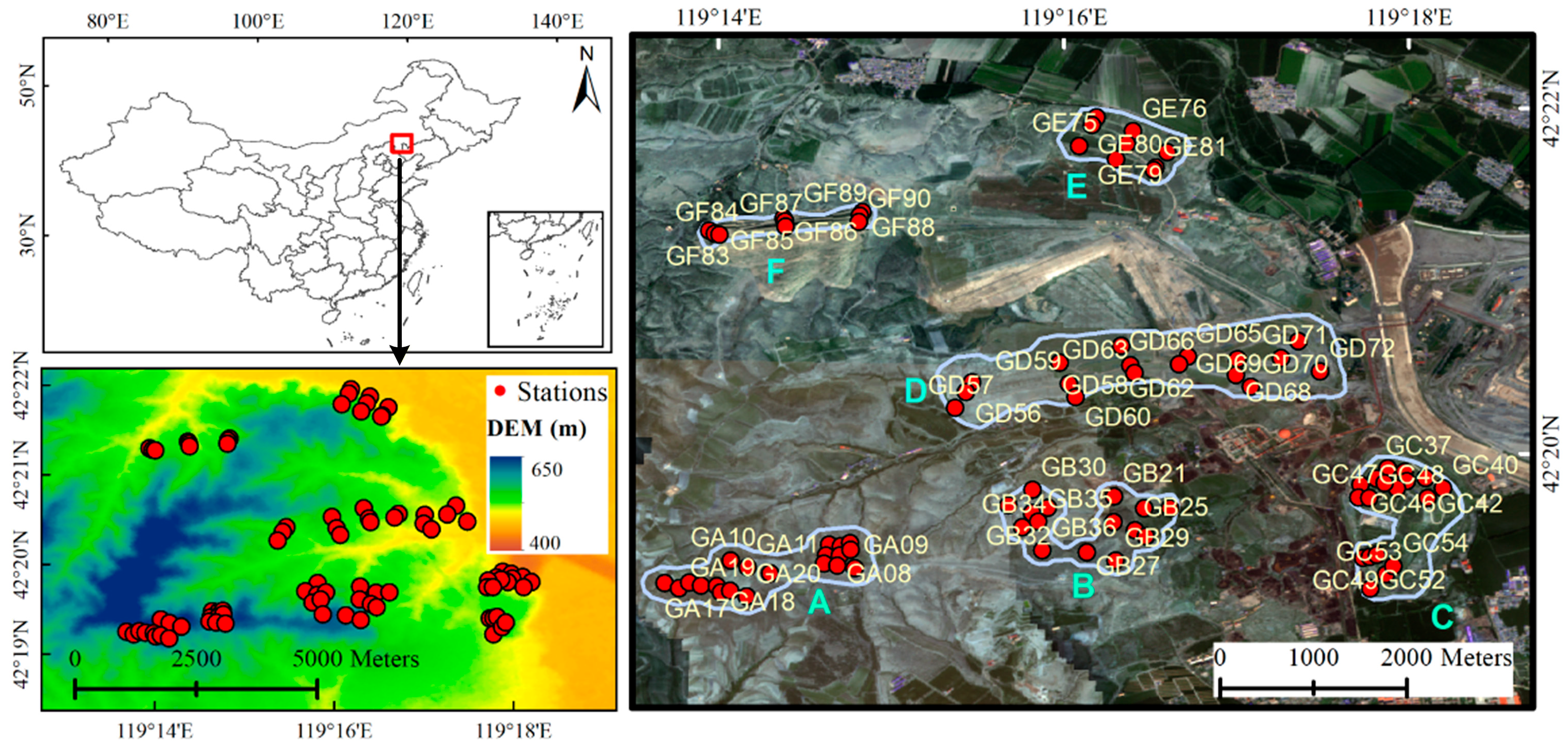
2. Study Area and Data Processing
3. Methods
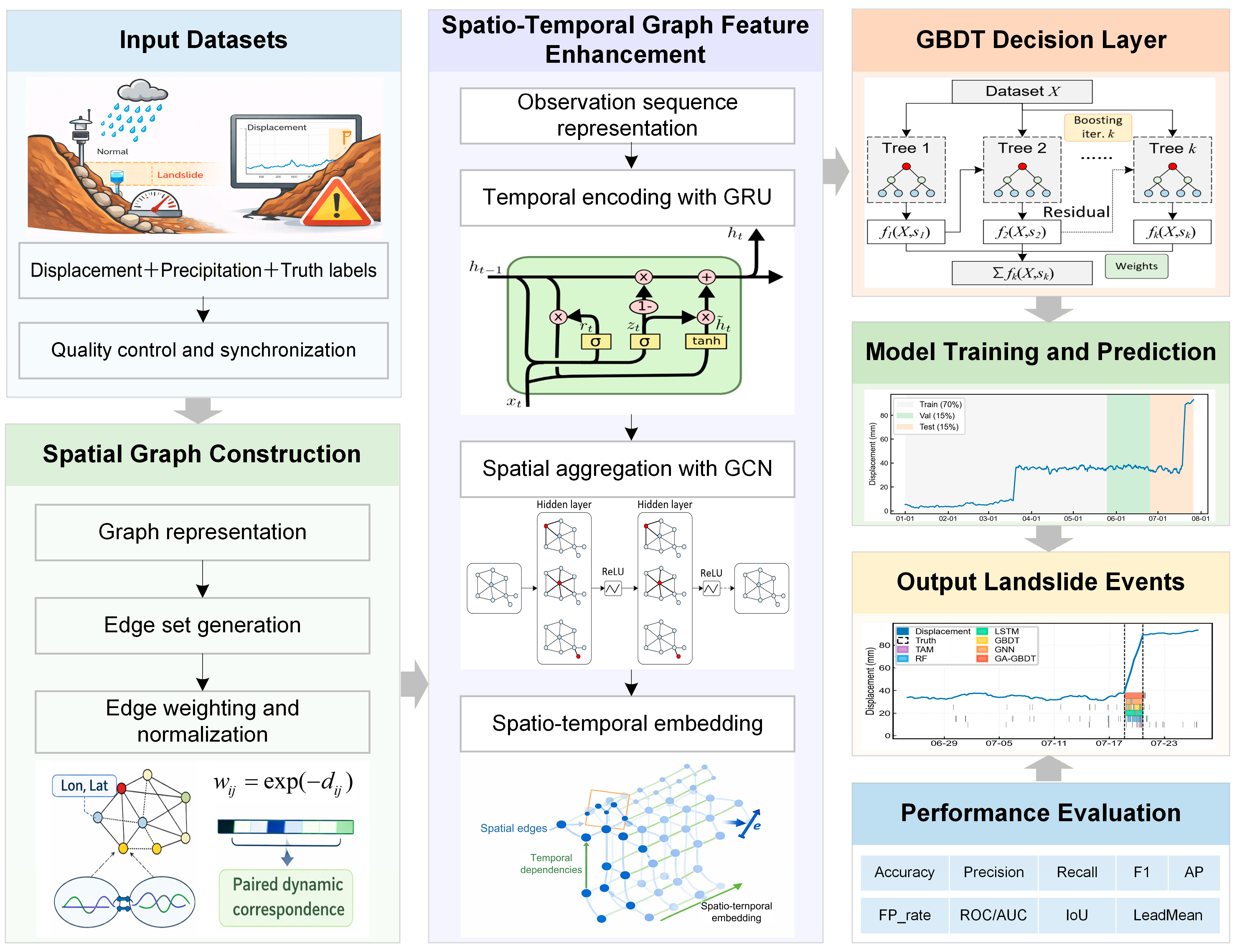
3.1. Spatial Graph Construction
3.1.1. Graph Representation
3.1.2. Edge Set Generation
3.1.3. Edge Weighting and Normalization
3.2. Spatio-Temporal Graph Feature Enhancement
3.2.1. Observation Sequence Representation
3.2.2. Temporal Encoding with GRU
3.2.3. Spatial Aggregation with GCN
3.2.4. Spatio-Temporal Embedding
3.3. GBDT Decision Layer
3.4. Model Training and Prediction
3.5. Evaluation Metrics
3.5.1. Sample-Level Metrics
3.5.2. Event-Level Metrics
4. Results
4.1. Hyperparameter Configuration and Model Robustness
4.1.1. Hyperparameter Settings
4.1.2. Preprocessing Ablation Analysis
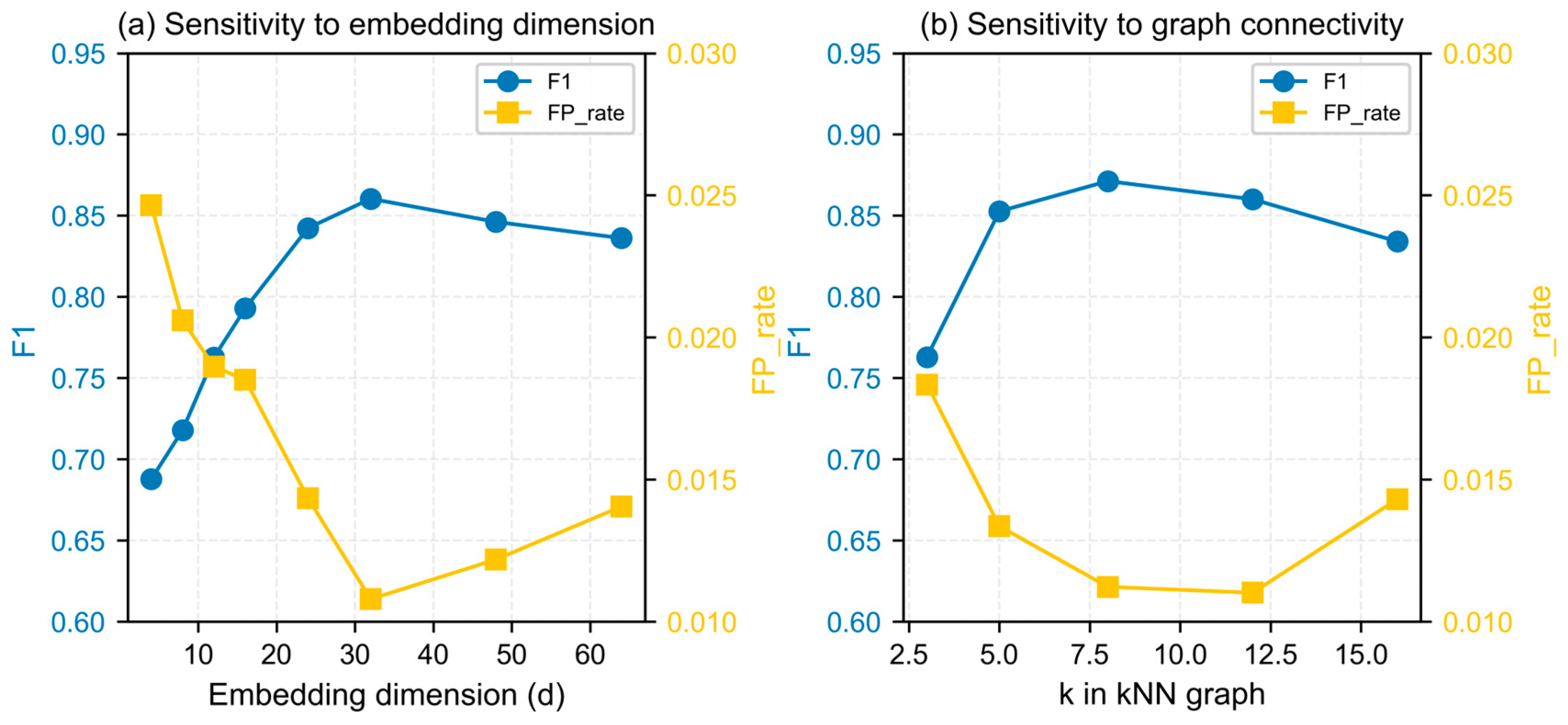
4.1.3. Sensitivity Analysis of Hyperparameters
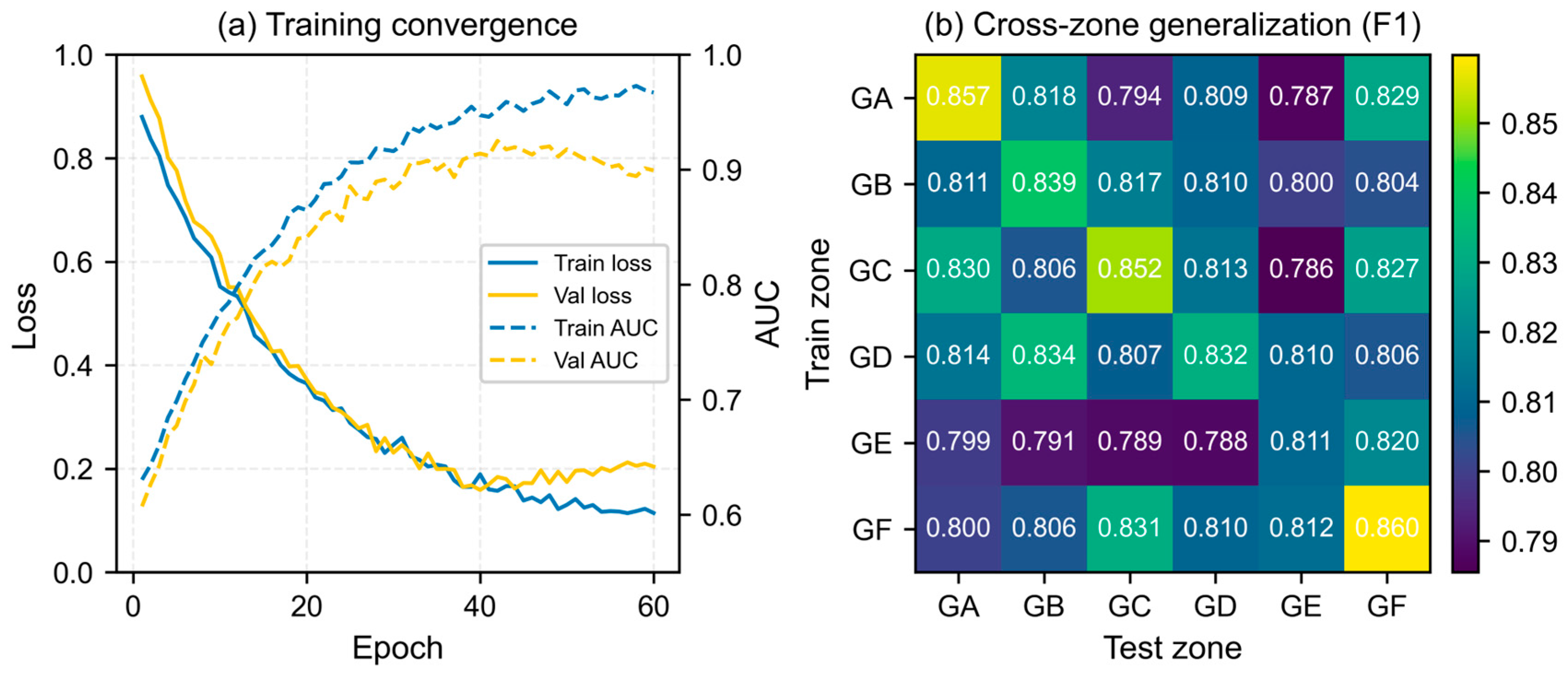
4.1.4. Training Stability and Cross-Zone Generalization
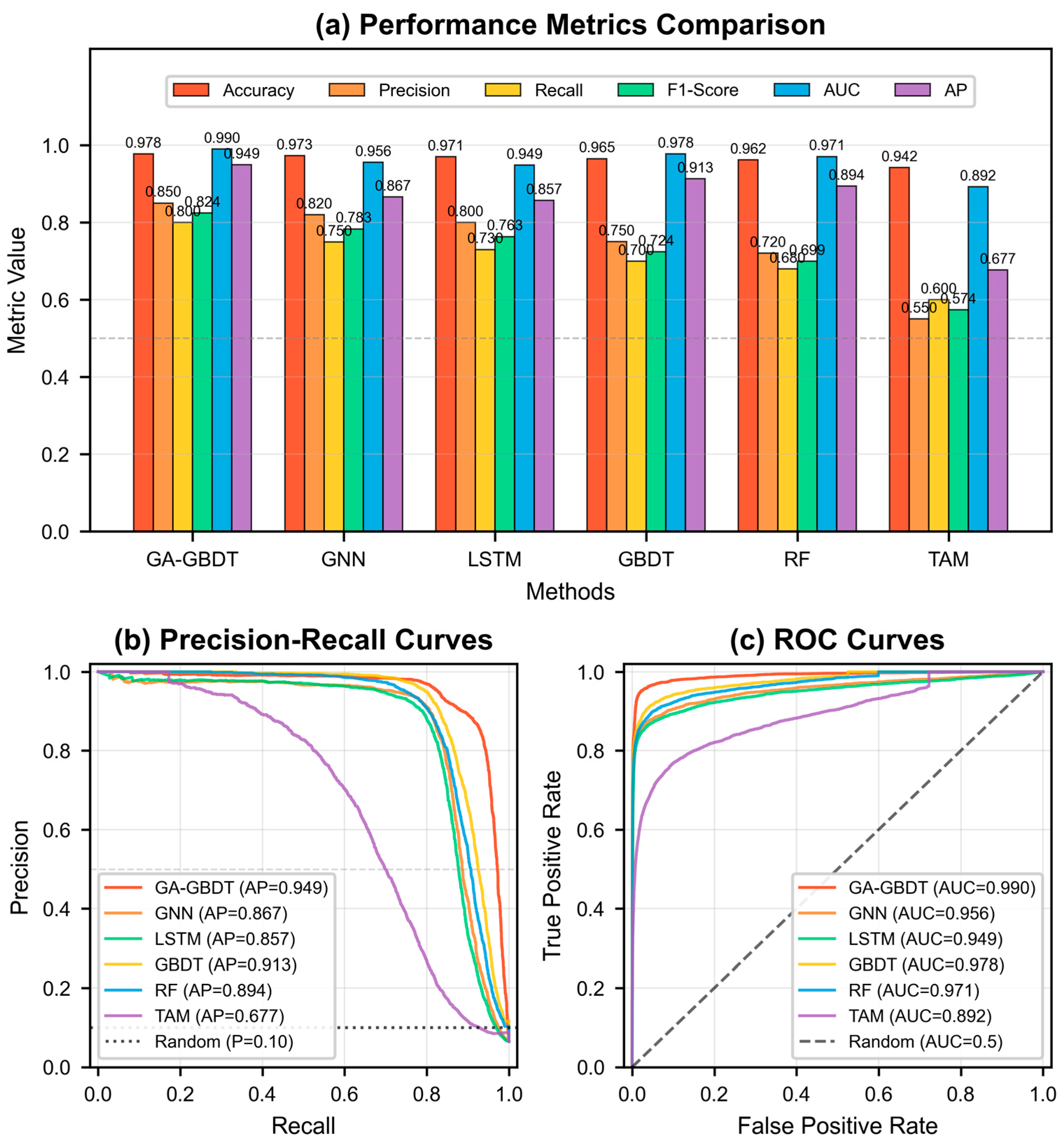
4.2. Sample-Level Event Warning Performance Comparison
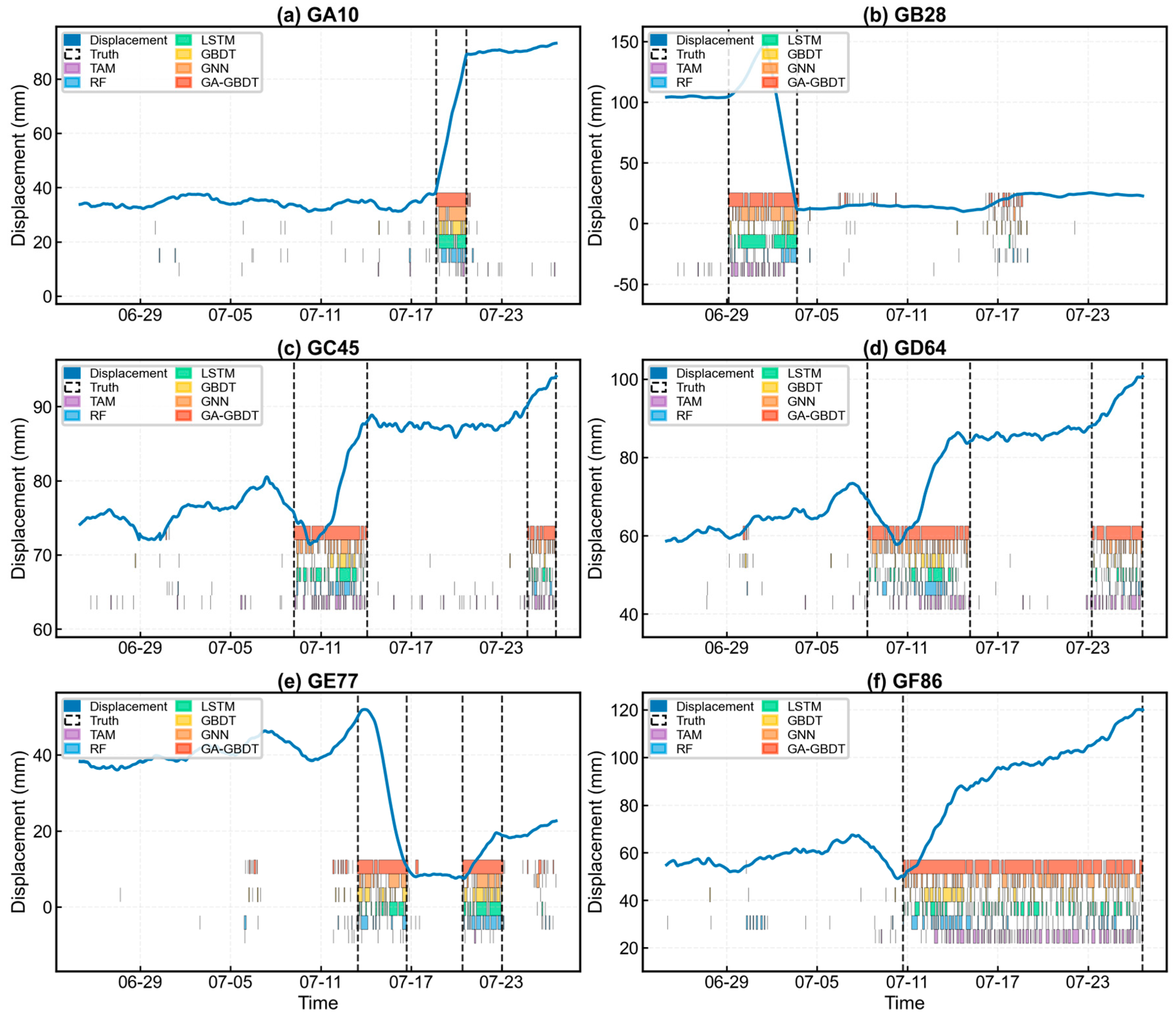
4.3. Analysis of Landslide Event Recognition Results at Representative Stations
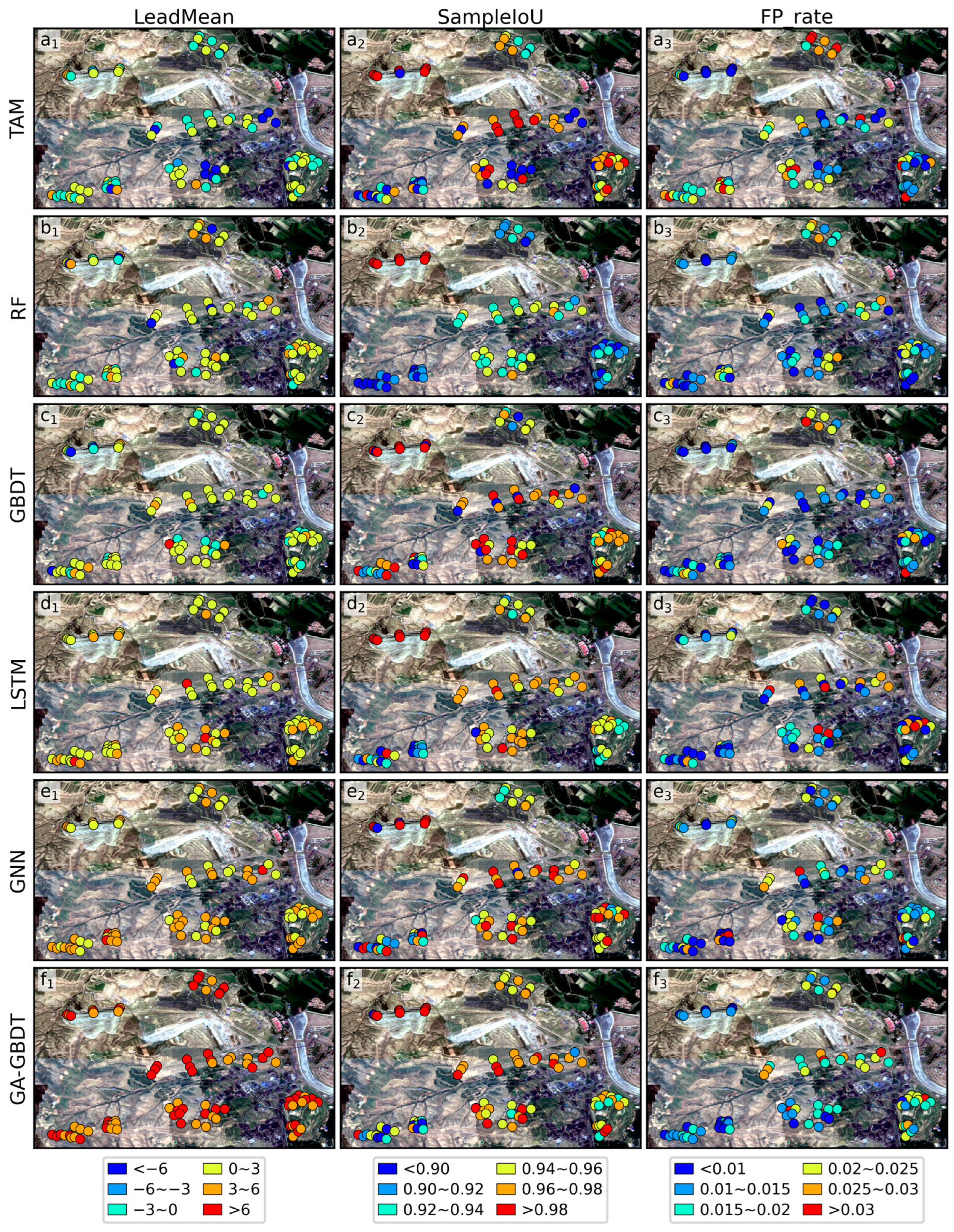
4.4. Spatial Patterns of Warning Metrics
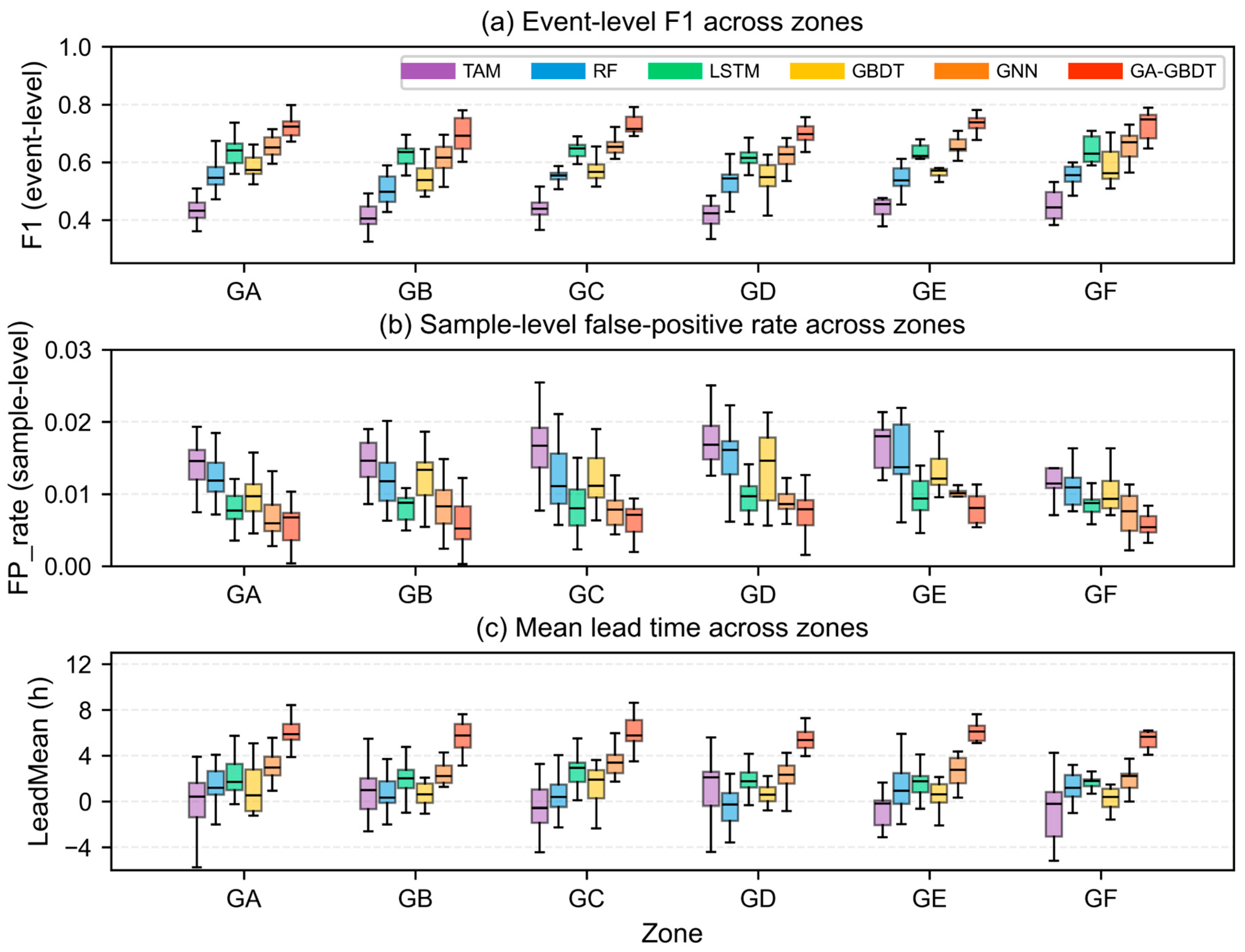
4.5. Zone-Wise Spatial Heterogeneity and Robustness
5. Discussion
5.1. Performance Advantages of the Proposed Framework
5.2. Limitations and Prospect
6. Conclusions
- (1)
- GA-GBDT attains the highest overall warning accuracy and ranking quality, achieving near-saturated sample-level metrics (F1 = 0.824, AUC = 0.990, AP = 0.947) with a balanced Precision/Recall (0.850/0.800), indicating strong discrimination under class imbalance and a favorable balance between missed events and false alarms.
- (2)
- Event-level results remain consistently strong across all zones, with the median event-level F1 maintained within approximately 0.69–0.75, demonstrating stable performance under spatial heterogeneity.
- (3)
- Cross-zone transfer experiments demonstrate robust generalization, as the average F1 decreases by only about 0.026 under zone-to-zone training–testing shifts, indicating that warning capability is largely preserved under spatial distribution changes.
- (4)
- Timeliness improves without compromising specificity, yielding a stable multi-hour lead time (LeadMean ≈ 5.4–6.1 h) while maintaining a low overall false-alarm rate (FP_rate ≈ 0.005–0.008).
Author Contributions
Funding
Institutional Review Board Statement
Informed Consent Statement
Data Availability Statement
Conflicts of Interest
Abbreviations
| GNSS | Global Navigation Satellite System |
| GA-GBDT | Graph-Augmented Gradient Boosting Decision Trees |
| GBDT | Gradient Boosting Decision Trees |
| XGBoost | eXtreme Gradient Boosting |
| GRU | Gated Recurrent Unit |
| GCN | Graph Convolutional Network |
| GNN | Graph Neural Network |
| LSTM | Long Short-Term Memory |
| RF | Random Forest |
| TAM | Tangent Angle Method |
| MLP | Multilayer Perceptron |
| SSA | Singular Spectrum Analysis |
| kNN | k-nearest neighbor |
| AUC | Area Under the Receiver Operating Characteristic Curve |
| AP | Average Precision |
| ROC | Receiver Operating Characteristic |
| PR | Precision–Recall |
| TP | True Positive |
| FP | False Positive |
| TN | True Negative |
| FN | False Negative |
| FP_rate | False-positive rate |
| SampleIoU | Sample-level Intersection over Union |
| LeadMean | Mean lead time of matched warning events |
| BCE | Binary Cross-Entropy |
References
- Froude, M.J.; Petley, D.N. Global fatal landslide occurrence from 2004 to 2016. Nat. Hazards Earth Syst. Sci. 2018, 18, 2161–2181. [Google Scholar] [CrossRef]
- Duan, Y.; Ding, M.; He, Y.; Chen, H.; Zheng, H.; Fuchs, S.; Sokratov, S.; Dourado, F. Projections of global road risk exposed to landslides under climate change. Commun. Earth Environ. 2025, 7, 57. [Google Scholar] [CrossRef]
- Werthmann, C.; Sapena, M.; Kühnl, M.; Singer, J.; Garcia, C.; Breuninger, T.; Gamperl, M.; Menschik, B.; Schäfer, H.; Schröck, S. Insights into the development of a landslide early warning system prototype in an informal settlement: The case of Bello Oriente in Medellín, Colombia. Nat. Hazards Earth Syst. Sci. 2024, 24, 1843–1870. [Google Scholar] [CrossRef]
- Calvello, M. Early warning strategies to cope with landslide risk. Riv. Ital. Di Geotec. 2017, 2, 63–91. [Google Scholar]
- Casagli, N.; Intrieri, E.; Tofani, V.; Gigli, G.; Raspini, F. Landslide detection, monitoring and prediction with remote-sensing techniques. Nat. Rev. Earth Environ. 2023, 4, 51–64. [Google Scholar] [CrossRef]
- Huang, G.; Du, S.; Wang, D. GNSS techniques for real-time monitoring of landslides: A review. Satell. Navig. 2023, 4, 5. [Google Scholar] [CrossRef]
- Chen, Z.; Huang, G.; Xie, W.; Zhang, Y.; Wang, L. GNSS real-time warning technology for expansive soil Landslide—A case in ningming demonstration area. Remote Sens. 2023, 15, 2772. [Google Scholar] [CrossRef]
- Michoud, C.; Bazin, S.; Blikra, L.H.; Derron, M.-H.; Jaboyedoff, M. Experiences from site-specific landslide early warning systems. Nat. Hazards Earth Syst. Sci. 2013, 13, 2659–2673. [Google Scholar] [CrossRef]
- Wang, D.; Huang, G.; Zhang, Q.; Gao, Y.; Du, Y.; Liu, X. A multi-source landslide early warning model based on dynamic monitoring data and the SAAHP-FCE method. Geomat. Nat. Hazards Risk 2025, 16, 2513536. [Google Scholar] [CrossRef]
- Dai, K.; Li, Z.; Xu, Q.; Bürgmann, R.; Milledge, D.G.; Tomas, R.; Fan, X.; Zhao, C.; Liu, X.; Peng, J. Entering the era of earth observation-based landslide warning systems: A novel and exciting framework. IEEE Geosci. Remote Sens. Mag. 2020, 8, 136–153. [Google Scholar] [CrossRef]
- Lu, Y.; Jin, C.; Wang, Q.; Li, G.; Han, T. Deformation and failure characteristic of open-pit slope subjected to combined effects of mining blasting and rainfall infiltration. Eng. Geol. 2024, 331, 107437. [Google Scholar] [CrossRef]
- Dong, X.; Li, S.; Ma, R.; Tian, W.; Zhao, K.; Xiang, H.; Zhu, J.; Qiu, Y. Cloud-based slope risk monitoring and early warning system for open-pit coal mines: A case study of Zhonglian Runshi. Sci. Rep. 2025, 15, 44396. [Google Scholar] [CrossRef]
- Li, J.; Qin, J.; Kang, K.; Liang, M.; Liu, K.; Ding, X. Enhanced Spatiotemporal Landslide Displacement Prediction Using Dynamic Graph-Optimized GNSS Monitoring. Sensors 2025, 25, 4754. [Google Scholar] [CrossRef]
- Strnad, D.; Mongus, D.; Horvat, Š.; Šegina, E. A multi-task deep learning approach for landslide displacement prediction with applications in early warning systems. Sci. Rep. 2025, 16, 196. [Google Scholar] [CrossRef] [PubMed]
- Ding, Q.; Guo, C.; Fan, X.a.; Liu, X.; Gong, X.; Zhou, W.; Ma, G. Multi-source monitoring data helps revealing and quantifying the excavation-induced deterioration of rock mass. Eng. Geol. 2023, 325, 107281. [Google Scholar] [CrossRef]
- Shu, B.; He, Y.; Wang, L.; Zhang, Q.; Li, X.; Qu, X.; Huang, G.; Qu, W. Real-time high-precision landslide displacement monitoring based on a GNSS CORS network. Measurement 2023, 217, 113056. [Google Scholar] [CrossRef]
- Du, Y.; Ning, L.; Chicas, S.D.; Xie, M. A new early warning Criterion for assessing landslide risk. Nat. Hazards 2023, 116, 537–549. [Google Scholar] [CrossRef]
- Liu, X.; Du, Y.; Huang, G.; Wang, D.; Zhang, Q. Mitigating GNSS multipath in landslide areas: A novel approach considering mutation points at different stages. Landslides 2023, 20, 2497–2510. [Google Scholar] [CrossRef]
- Segoni, S.; Piciullo, L.; Gariano, S.L. A review of the recent literature on rainfall thresholds for landslide occurrence. Landslides 2018, 15, 1483–1501. [Google Scholar] [CrossRef]
- Kang, J.; Wan, B.; Gao, Z.; Zhou, S.; Chen, H.; Shen, H. Research on machine learning forecasting and early warning model for rainfall-induced landslides in Yunnan province. Sci. Rep. 2024, 14, 14049. [Google Scholar] [CrossRef]
- Segoni, S.; Battistini, A.; Rossi, G.; Rosi, A.; Lagomarsino, D.; Catani, F.; Moretti, S.; Casagli, N. An operational landslide early warning system at regional scale based on space–time-variable rainfall thresholds. Nat. Hazards Earth Syst. Sci. 2015, 15, 853–861. [Google Scholar] [CrossRef]
- Chinkulkijniwat, A.; Salee, R.; Horpibulsuk, S.; Arulrajah, A.; Hoy, M. Landslide rainfall threshold for landslide warning in Northern Thailand. Geomat. Nat. Hazards Risk 2022, 13, 2425–2441. [Google Scholar] [CrossRef]
- Chen, Q.; Huang, W.; Li, J. Landslide early warning based on improved tangential angle and displacement rate: A case study of the Leijiashan landslide in Shimen County, Hunan Province. Chin. J. Geol. Hazard Control 2024, 35, 133. [Google Scholar]
- Halter, T.; Lehmann, P.; Bast, A.; Aaron, J.; Stähli, M. In situ soil moisture data improve precipitation-based shallow landslide early warning through innovative machine learning methods: In situ soil moisture data improve shallow landslide. Landslides 2025, 22, 3599–3614. [Google Scholar]
- Ma, Z.; Mei, G.; Piccialli, F. Machine learning for landslides prevention: A survey. Neural Comput. Appl. 2021, 33, 10881–10907. [Google Scholar] [CrossRef]
- Mondini, A.C.; Guzzetti, F.; Melillo, M. Deep learning forecast of rainfall-induced shallow landslides. Nat. Commun. 2023, 14, 2466. [Google Scholar] [CrossRef] [PubMed]
- Park, S.; Kim, J. Landslide susceptibility mapping based on random forest and boosted regression tree models, and a comparison of their performance. Appl. Sci. 2019, 9, 942. [Google Scholar] [CrossRef]
- Zheng, Z.; Zhang, K.; Wang, N.; Zhu, M.; He, Z. Machine learning–based systems for early warning of rainfall-induced landslide. Nat. Hazards Rev. 2024, 25, 04024027. [Google Scholar]
- Zeng, Z.; Tan, S.; Li, A.; Ling, Y.; Zhou, W. Landslide Hazard Zonation Driven by Multi-Rainfall Scenarios Based on the Optimal XGBoost Model—A Case Study of Yongren County, Yunnan Province, China. Sustainability 2025, 17, 11307. [Google Scholar] [CrossRef]
- Marjanović, M.; Krautblatter, M.; Abolmasov, B.; Đurić, U.; Sandić, C.; Nikolić, V. The rainfall-induced landsliding in Western Serbia: A temporal prediction approach using Decision Tree technique. Eng. Geol. 2018, 232, 147–159. [Google Scholar] [CrossRef]
- Gidon, J.S.; Borah, J.; Sahoo, S.; Majumdar, S.; Fujita, M. Bidirectional LSTM model for accurate and real-time landslide detection: A case study in Mawiongrim, Meghalaya, India. IEEE Internet Things J. 2023, 11, 3792–3800. [Google Scholar] [CrossRef]
- Li, C.; Wang, Y.; Zhang, F.; Zhang, H. Edge-Aware Superpixel Dual-Graph GCN for Topographically Heterogeneous Landslide Susceptibility Assessment. IEEE J. Sel. Top. Appl. Earth Obs. Remote Sens. 2026, 19, 5634–5648. [Google Scholar] [CrossRef]
- Kuang, P.; Li, R.; Huang, Y.; Wu, J.; Luo, X.; Zhou, F. Landslide displacement prediction via attentive graph neural network. Remote Sens. 2022, 14, 1919. [Google Scholar] [CrossRef]
- Zhang, Y.; He, Y.; Gao, F.; Huo, T.; Zhang, Q.; Lu, J.; Zhang, L. A spatiotemporal displacement prediction method for InSAR-detected landslides using a graph neural network coupling spatial and temporal features. Geomat. Nat. Hazards Risk 2025, 16, 2596362. [Google Scholar] [CrossRef]
- Zhang, S.; Jia, H.; Wang, C.; Wang, X.; He, S.; Jiang, P. Deep-learning-based landslide early warning method for loose deposits slope coupled with groundwater and rainfall monitoring. Comput. Geotech. 2024, 165, 105924. [Google Scholar] [CrossRef]
- Gupta, K.; Satyam, N. Integrating real-time sensor data for improved hydrogeotechnical modelling in landslide early warning in Western Himalaya. Eng. Geol. 2024, 338, 107630. [Google Scholar] [CrossRef]
- Zeng, T.; Gong, Q.; Wu, L.; Zhu, Y.; Yin, K.; Peduto, D. Double-index rainfall warning and probabilistic physically based model for fast-moving landslide hazard analysis in subtropical-typhoon area. Landslides 2024, 21, 753–773. [Google Scholar] [CrossRef]
- Li, H.; Zhu, Y.; Xu, Q.; Tang, R.; Pu, C.; He, Y. Condition monitoring of heterogeneous landslide deformation in spatio-temporal domain using advanced graph attention network. Geomat. Nat. Hazards Risk 2025, 16, 2519429. [Google Scholar] [CrossRef]
- Li, Y.; Chen, T.; Lv, L.; Niu, R.; Plaza, A. IED-GCN: An Internal and External Decoupled Graph Convolutional Network for Landslide Susceptibility Assessment. IEEE Trans. Geosci. Remote Sens. 2025, 63, 4414717. [Google Scholar] [CrossRef]
- Piciullo, L.; Calvello, M.; Cepeda, J.M. Territorial early warning systems for rainfall-induced landslides. Earth-Sci. Rev. 2018, 179, 228–247. [Google Scholar] [CrossRef]
- Huang, F.; Yang, Y.; Ma, G.; Rezania, M.; Chang, Z.; Catani, F.; Jiang, B.; Chen, X.; Guo, F. Real-time early warning of landslide disaster risks on major highways in Ganzhou City, China. J. Rock. Mech. Geotech. Eng. 2026, in press. [Google Scholar] [CrossRef]
- Nocentini, N.; Rosi, A.; Segoni, S.; Fanti, R. Towards landslide space-time forecasting through machine learning: The influence of rainfall parameters and model setting. Front. Earth Sci. 2023, 11, 1152130. [Google Scholar] [CrossRef]
- Zeng, H.; Zhu, Q.; Ding, Y.; Hu, H.; Chen, L.; Xie, X.; Chen, M.; Yao, Y. Graph neural networks with constraints of environmental consistency for landslide susceptibility evaluation. Int. J. Geogr. Inf. Sci. 2022, 36, 2270–2295. [Google Scholar] [CrossRef]
- Lin, G.-W.; Hung, C.; Chang Chien, Y.-F.; Chu, C.-R.; Liu, C.-H.; Chang, C.-H.; Chen, H. Towards automatic landslide-quake identification using a random forest classifier. Appl. Sci. 2020, 10, 3670. [Google Scholar] [CrossRef]
- Miao, F.; Zhao, F.; Wu, Y.; Li, L.; Török, Á. Landslide susceptibility mapping in Three Gorges Reservoir area based on GIS and boosting decision tree model. Stoch. Environ. Res. Risk Assess. 2023, 37, 2283–2303. [Google Scholar] [CrossRef]
- Park, J.-Y.; Lee, S.-R.; Lee, D.-H.; Kim, Y.-T.; Lee, J.-S. A regional-scale landslide early warning methodology applying statistical and physically based approaches in sequence. Eng. Geol. 2019, 260, 105193. [Google Scholar] [CrossRef]
- Pham, K.; Kim, D.; Le, C.V.; Choi, H. Dual tree-boosting framework for estimating warning levels of rainfall-induced landslides. Landslides 2022, 19, 2249–2262. [Google Scholar]
- Wang, J.; Wang, Z.; Peng, L.; Qian, C. Landslide Recognition Based on Machine Learning Considering Terrain Feature Fusion. ISPRS Int. J. Geo-Inf. 2024, 13, 306. [Google Scholar]
- China Weather Network. Climate Background of Chifeng. Available online: https://www.weather.com.cn/cityintro/101080601.shtml (accessed on 11 May 2026).
- Ji, K.; Shen, Y.; Chen, Q.; Wang, F. Extended singular spectrum analysis for processing incomplete heterogeneous geodetic time series. J. Geod. 2023, 97, 74. [Google Scholar] [CrossRef]
- Ji, K.; Shen, Y.; Wang, F.; Chen, Q. An efficient improved singular spectrum analysis for processing GNSS position time series with missing data. Geophys. J. Int. 2025, 240, 189–200. [Google Scholar] [CrossRef]
- Peterson, L.E. K-nearest neighbor. Scholarpedia 2009, 4, 1883. [Google Scholar] [CrossRef]
- Zhang, W.; Li, H.; Tang, L.; Gu, X.; Wang, L.; Wang, L. Displacement prediction of Jiuxianping landslide using gated recurrent unit (GRU) networks. Acta Geotech. 2022, 17, 1367–1382. [Google Scholar] [CrossRef]
- Dey, R.; Salem, F.M. Gate-variants of gated recurrent unit (GRU) neural networks. In Proceedings of the 2017 IEEE 60th International Midwest Symposium on Circuits and Systems (MWSCAS), Boston, MA, USA, 6–9 August 2017; pp. 1597–1600. [Google Scholar]
- Zhang, S.; Tong, H.; Xu, J.; Maciejewski, R. Graph convolutional networks: A comprehensive review. Comput. Soc. Netw. 2019, 6, 1–23. [Google Scholar] [CrossRef]
- Chen, T.; Guestrin, C. XGBoost: A Scalable Tree Boosting System. In Proceedings of the 22nd ACM SIGKDD International Conference on Knowledge Discovery and Data Mining, San Francisco, CA, USA, 13–17 August 2016; Association for Computing Machinery: New York, NY, USA, 2016; pp. 785–794. [Google Scholar]
- Chen, T.; He, T.; Benesty, M.; Khotilovich, V.; Tang, Y.; Cho, H.; Chen, K.; Mitchell, R.; Cano, I.; Zhou, T. Xgboost: Extreme Gradient Boosting; R package version 0.4-2. 2015. Available online: https://www.rdocumentation.org/packages/xgboost/versions/0.4-2 (accessed on 11 May 2026).
- Ramraj, S.; Uzir, N.; Sunil, R.; Banerjee, S. Experimenting XGBoost algorithm for prediction and classification of different datasets. Int. J. Control Theory Appl. 2016, 9, 651–662. [Google Scholar]
- Palau, R.M.; Berenguer, M.; Hürlimann, M.; Sempere-Torres, D. Application of a fuzzy verification framework for the evaluation of a regional-scale landslide early warning system during the January 2020 Gloria storm in Catalonia (NE Spain). Landslides 2022, 19, 1599–1616. [Google Scholar] [CrossRef]
- Piciullo, L.; Tiranti, D.; Pecoraro, G.; Cepeda, J.M.; Calvello, M. Standards for the performance assessment of territorial landslide early warning systems. Landslides 2020, 17, 2533–2546. [Google Scholar] [CrossRef]
- Barnes, L.R.; Schultz, D.M.; Gruntfest, E.C.; Hayden, M.H.; Benight, C.C. Corrigendum: False alarm rate or false alarm ratio? Weather Forecast 2009, 24, 1452–1454. [Google Scholar] [CrossRef]
- Zhu, M. Recall, Precision and Average Precision; Department of Statistics Actuarial Science, University of Waterloo: Waterloo, ON, Canada, 2004; Volume 2, p. 6. [Google Scholar]
- Rezatofighi, H.; Tsoi, N.; Gwak, J.; Sadeghian, A.; Reid, I.; Savarese, S. Generalized intersection over union: A metric and a loss for bounding box regression. In Proceedings of the IEEE/CVF Conference on Computer Vision and Pattern Recognition; IEEE Computer Society: Washington, DC, USA, 2019; pp. 658–666. [Google Scholar]
- Li, G.K.; Moon, S. Topographic stress control on bedrock landslide size. Nat. Geosci. 2021, 14, 307–313. [Google Scholar] [CrossRef]
- Li, Y.; Wang, X.; Mao, H. Influence of human activity on landslide susceptibility development in the Three Gorges area. Nat. Hazards 2020, 104, 2115–2151. [Google Scholar] [CrossRef]



| Zone | Station Count | Total Samples | Positive Samples | Negative Samples | Positive Percentage | Negative Percentage |
|---|---|---|---|---|---|---|
| GA | 20 | 99,680 | 7155 | 92,525 | 7.18% | 92.82% |
| GB | 16 | 79,708 | 2868 | 76,840 | 3.60% | 96.40% |
| GC | 18 | 89,712 | 2216 | 87,496 | 2.47% | 97.53% |
| GD | 18 | 89,712 | 4870 | 84,842 | 5.43% | 94.57% |
| GE | 9 | 44,856 | 2087 | 42,769 | 4.65% | 95.35% |
| GF | 9 | 44,856 | 3271 | 41,585 | 7.29% | 92.71% |
| Model | Main Configuration | Symbol Glossary |
|---|---|---|
| TAM | trigger rule: TanAngle_deg ≥ 85° for ≥2 consecutive points (hourly sampling) | TanAngle_deg: tangent angle (degree) computed from the displacement curve. |
| RF | n_estimators = 500; max_depth = 12; min_samples_split = 2; min_samples_leaf = 1; max_features = sqrt; class_weight = balanced; random_state = fixed. | n_estimators: number of trees. max_depth: maximum tree depth. min_samples_split/leaf: minimum samples to split/in a leaf. max_features: features considered at each split. class_weight: class reweighting. |
| LSTM | Input window length = 32 h; layers = 2; hidden_size = 64; dropout = 0.2; batch_size = 256; optimizer = Adam (lr = 1 × 10⁻³); epochs = 60; early stopping patience = 10; loss = weighted BCE (positive weight set by class imbalance). | h: hours (sampling window). hidden_size: hidden-state dimension. dropout: dropout rate. batch_size: mini-batch size. lr: learning rate. BCE: binary cross-entropy. |
| GBDT | booster = gbtree; objective = binary:logistic; max_depth = 6; eta = 0.05; n_estimators = 600; subsample = 0.8; colsample_bytree = 0.8; min_child_weight = 1; gamma = 0; reg_lambda = 1.0; reg_alpha = 0.0; scale_pos_weight = imbalance ratio; early_stopping_rounds = 50. | eta: learning rate. subsample/colsample_bytree: row/feature sampling ratio per tree. min_child_weight: minimum sum of instance weight in a child. gamma: minimum loss reduction for a split. reg_lambda/reg_alpha: L2/L1 regularization. scale_pos_weight: positive-class weight. |
| GNN | Graph: kNN with k = 8; backbone: GCN; layers = 2; hidden_dim = 64; dropout = 0.2; node-wise MLP classifier head (1–2 layers); training: epochs = 60; optimizer = Adam (lr = 1 × 10⁻³); loss = weighted BCE. | kNN: k-nearest neighbor graph. k: number of neighbors per node. GCN: graph convolutional network. hidden_dim: node embedding hidden dimension. MLP: multilayer perceptron. |
| GA-GBDT | Graph construction: kNN with k = 8 (distance-based); correlation pruning: ρ ≥ 0.3 with a 72 h correlation window. Spatio-temporal encoder: spatial aggregation = GCN (layers = 1), embedding dimension d = 32; temporal module = GRU (layers = 1), hidden_size = 32; dropout = 0.2. Decision layer: XGBoost (max_depth = 6, eta = 0.05, n_estimators = 600, subsample = 0.8, colsample_bytree = 0.8, early_stopping_rounds = 50, scale_pos_weight set by imbalance). | ρ: correlation threshold for pruning edges. d: embedding dimension (graph encoder output). GRU: gated recurrent unit. 72 h: correlation computation window length. |
| Preprocessing Setting | SSA Reconstruction | UKF Smoothing | Outlier Removal | Precision | Recall | F1-Score | AUC | AP | FP_Rate |
|---|---|---|---|---|---|---|---|---|---|
| Minimal QC only | No | No | No | 0.781 | 0.742 | 0.761 | 0.972 | 0.879 | 0.0138 |
| Without SSA reconstruction | No | Yes | Yes | 0.829 | 0.758 | 0.792 | 0.983 | 0.918 | 0.0086 |
| Without UKF smoothing | Yes | No | Yes | 0.817 | 0.789 | 0.803 | 0.986 | 0.928 | 0.0097 |
| Without outlier removal | Yes | Yes | No | 0.806 | 0.793 | 0.799 | 0.984 | 0.922 | 0.0104 |
| Full preprocessing pipeline | Yes | Yes | Yes | 0.850 | 0.800 | 0.824 | 0.990 | 0.947 | 0.0068 |
| Method | Accuracy | Precision | Recall | F1 | FP_rate | IoU |
|---|---|---|---|---|---|---|
| TAM | 0.833 ± 0.075 | 0.736 ± 0.185 | 0.453 ± 0.154 | 0.461 ± 0.184 | 0.0215 ± 0.0173 | 0.461 ± 0.158 |
| RF | 0.833 ± 0.113 | 0.791 ± 0.108 | 0.558 ± 0.161 | 0.558 ± 0.093 | 0.0226 ± 0.0102 | 0.554 ± 0.169 |
| LSTM | 0.893 ± 0.100 | 0.952 ± 0.028 | 0.660 ± 0.202 | 0.773 ± 0.141 | 0.0124 ± 0.0038 | 0.658 ± 0.206 |
| GBDT | 0.833 ± 0.112 | 0.803 ± 0.128 | 0.650 ± 0.208 | 0.751 ± 0.152 | 0.0186 ± 0.0088 | 0.539 ± 0.212 |
| GNN | 0.898 ± 0.079 | 0.945 ± 0.073 | 0.670 ± 0.153 | 0.776 ± 0.096 | 0.0164 ± 0.0103 | 0.667 ± 0.157 |
| GA-GBDT | 0.939 ± 0.029 | 0.957 ± 0.144 | 0.932 ± 0.033 | 0.906 ± 0.078 | 0.0185 ± 0.0236 | 0.940 ± 0.033 |
| Method | LeadMean (h) | SampleIoU | FP_Rate |
|---|---|---|---|
| TAM | −3.72 ± 10.12 | 0.792 ± 0.346 | 0.0183 ± 0.0091 |
| RF | −0.99 ± 8.56 | 0.824 ± 0.210 | 0.0187 ± 0.0067 |
| GBDT | −0.22 ± 6.33 | 0.895 ± 0.279 | 0.0186 ± 0.0076 |
| LSTM | 2.17 ± 1.47 | 0.899 ± 0.243 | 0.0187 ± 0.0099 |
| GNN | 3.04 ± 1.24 | 0.921 ± 0.144 | 0.0175 ± 0.0079 |
| GA-GBDT | 5.85 ± 1.13 | 0.933 ± 0.084 | 0.0172 ± 0.0068 |
Disclaimer/Publisher’s Note: The statements, opinions and data contained in all publications are solely those of the individual author(s) and contributor(s) and not of MDPI and/or the editor(s). MDPI and/or the editor(s) disclaim responsibility for any injury to people or property resulting from any ideas, methods, instructions or products referred to in the content. |
© 2026 by the authors. Licensee MDPI, Basel, Switzerland. This article is an open access article distributed under the terms and conditions of the Creative Commons Attribution (CC BY) license.
Share and Cite
Wu, J.; Fei, L.; Dong, W.; Cao, C.; Zhang, B.; Han, X.; Chan, T.O.; Wang, Y.; Awange, J. GA-GBDT: A Spatio-Temporal Graph-Augmented Gradient Boosting Framework for GNSS Network–Based Landslide Event Warning in Mining Areas. Appl. Sci. 2026, 16, 5569. https://doi.org/10.3390/app16115569
Wu J, Fei L, Dong W, Cao C, Zhang B, Han X, Chan TO, Wang Y, Awange J. GA-GBDT: A Spatio-Temporal Graph-Augmented Gradient Boosting Framework for GNSS Network–Based Landslide Event Warning in Mining Areas. Applied Sciences. 2026; 16(11):5569. https://doi.org/10.3390/app16115569
Chicago/Turabian StyleWu, Jinhua, Liang Fei, Wei Dong, Chengdu Cao, Bo Zhang, Xiangyang Han, Ting On Chan, Yuli Wang, and Joseph Awange. 2026. "GA-GBDT: A Spatio-Temporal Graph-Augmented Gradient Boosting Framework for GNSS Network–Based Landslide Event Warning in Mining Areas" Applied Sciences 16, no. 11: 5569. https://doi.org/10.3390/app16115569
APA StyleWu, J., Fei, L., Dong, W., Cao, C., Zhang, B., Han, X., Chan, T. O., Wang, Y., & Awange, J. (2026). GA-GBDT: A Spatio-Temporal Graph-Augmented Gradient Boosting Framework for GNSS Network–Based Landslide Event Warning in Mining Areas. Applied Sciences, 16(11), 5569. https://doi.org/10.3390/app16115569