Assessment and Ranking of Criteria for Engineering Firm Performance Using RII, Entropy Weight Method, and TOPSIS
 ,
,  , , and
Abstract
1. Introduction
2. Theoretical Background and Research Gap
2.1. Criteria’s Impact on Engineering Firm Performance
2.2. Assessment Tools for Performance Criteria
2.3. Research Gap
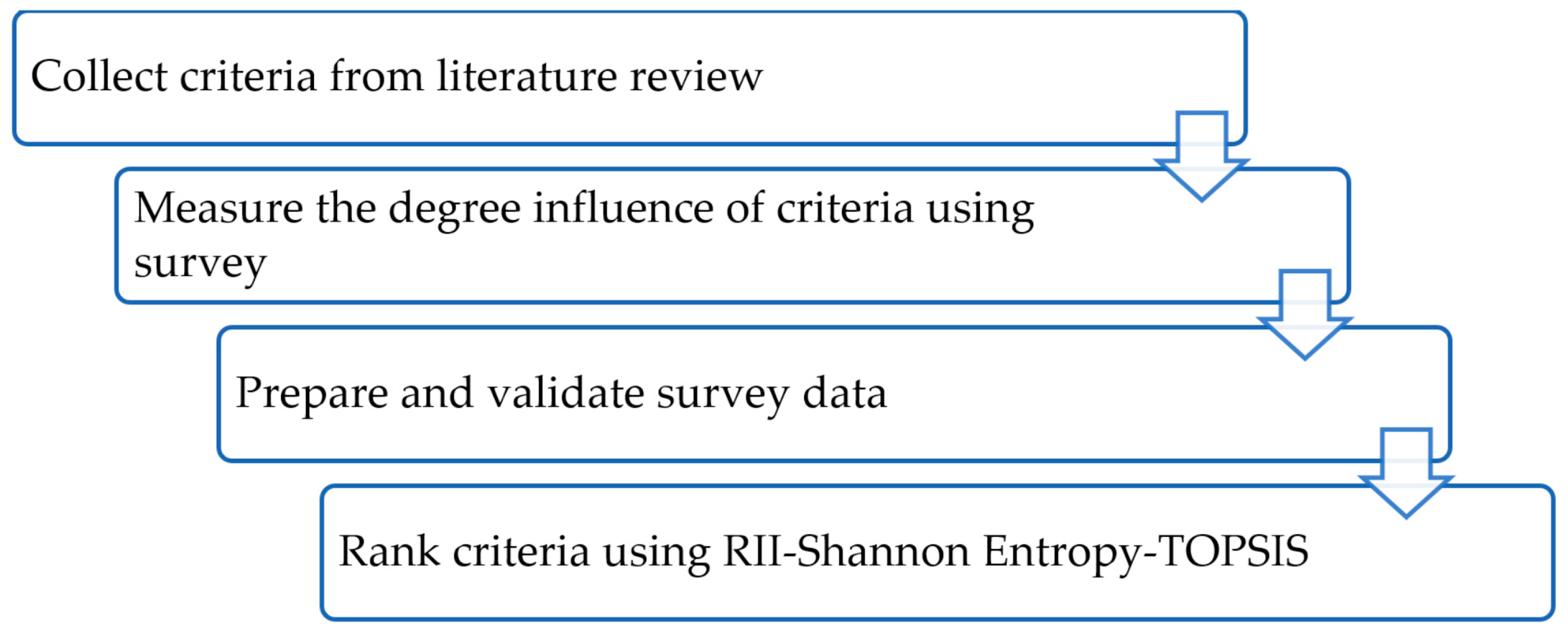
3. Research Methodology
3.1. Collect Criteria from Literature Review
3.2. Measure the Degree of Influence of the Criteria Using a Survey
3.3. Prepare and Validate Data in Terms of Sample Size and Reliability Data
3.3.1. Variable Coding
3.3.2. Missing Data Treatment
Assessment of Imputation Effects on Entropy Weighting
3.3.3. Validate the Sample Size
3.3.4. Validate Data Reliability
3.4. Assess and Rank Criteria Using RII–Shannon Entropy–TOPSIS
3.4.1. Compute RII for Each Criterion
3.4.2. Perform Shannon Entropy Weighting
- Proportion Matrix was calculated as: Each column was summed (). Then, each element of the decision matrix (xᵢ) is normalized by Σᵢ xᵢⱼ as shown in Equation (3) and obtain a proportion matrix
- 2.
- Entropy value (Eⱼ) can be computed for each column (criterion) in Equation (4), the constant (1/ln m) ensures 0 ≤ Eⱼ ≤ 1. If = 0, then = 0.
- 3.
- The degree of divergence of each column (dj) can be computed in Equation (5)
- 4.
- Entropy weight of each column () is calculated by normalizing the divergence values to obtain the criterion weight as shown in Equation (6).
3.4.3. Compute Composite Weight Derivation
3.4.4. Perform TOPSIS Multi-Criteria Ranking
4. Results and Discussion
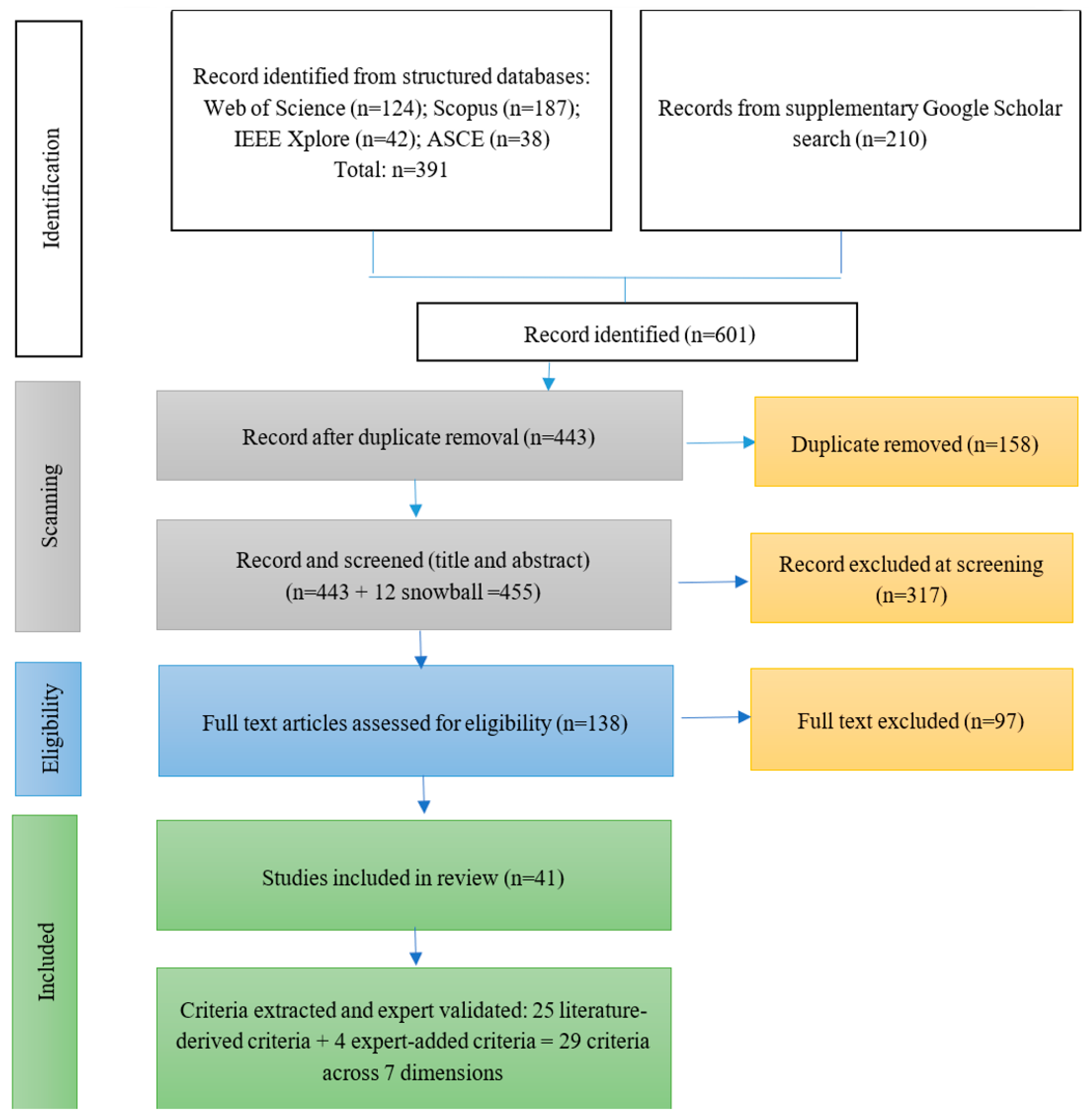
4.1. Literature Review Results (RQ1)
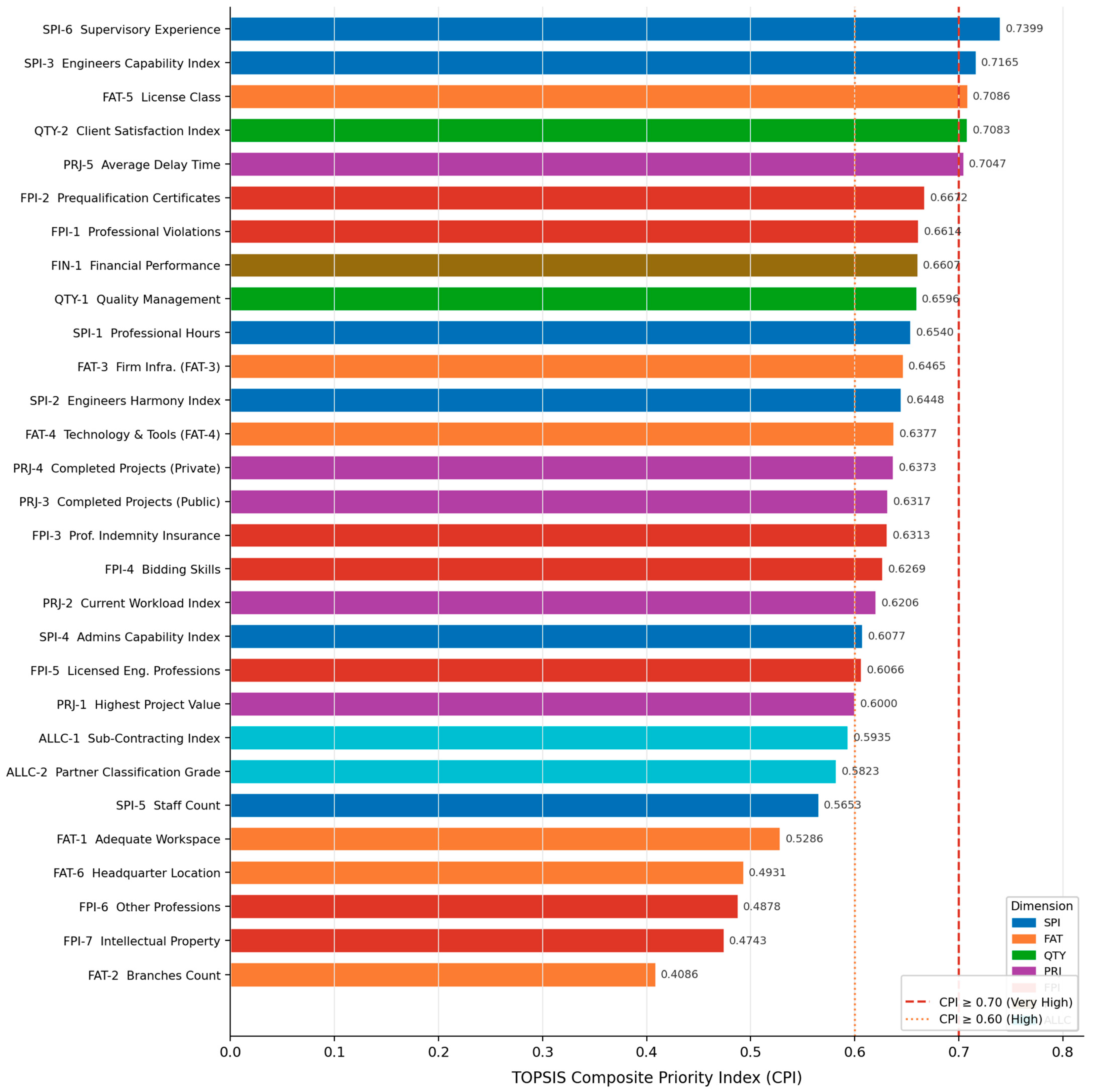
4.2. Overall CPI Ranking of Performance Criteria
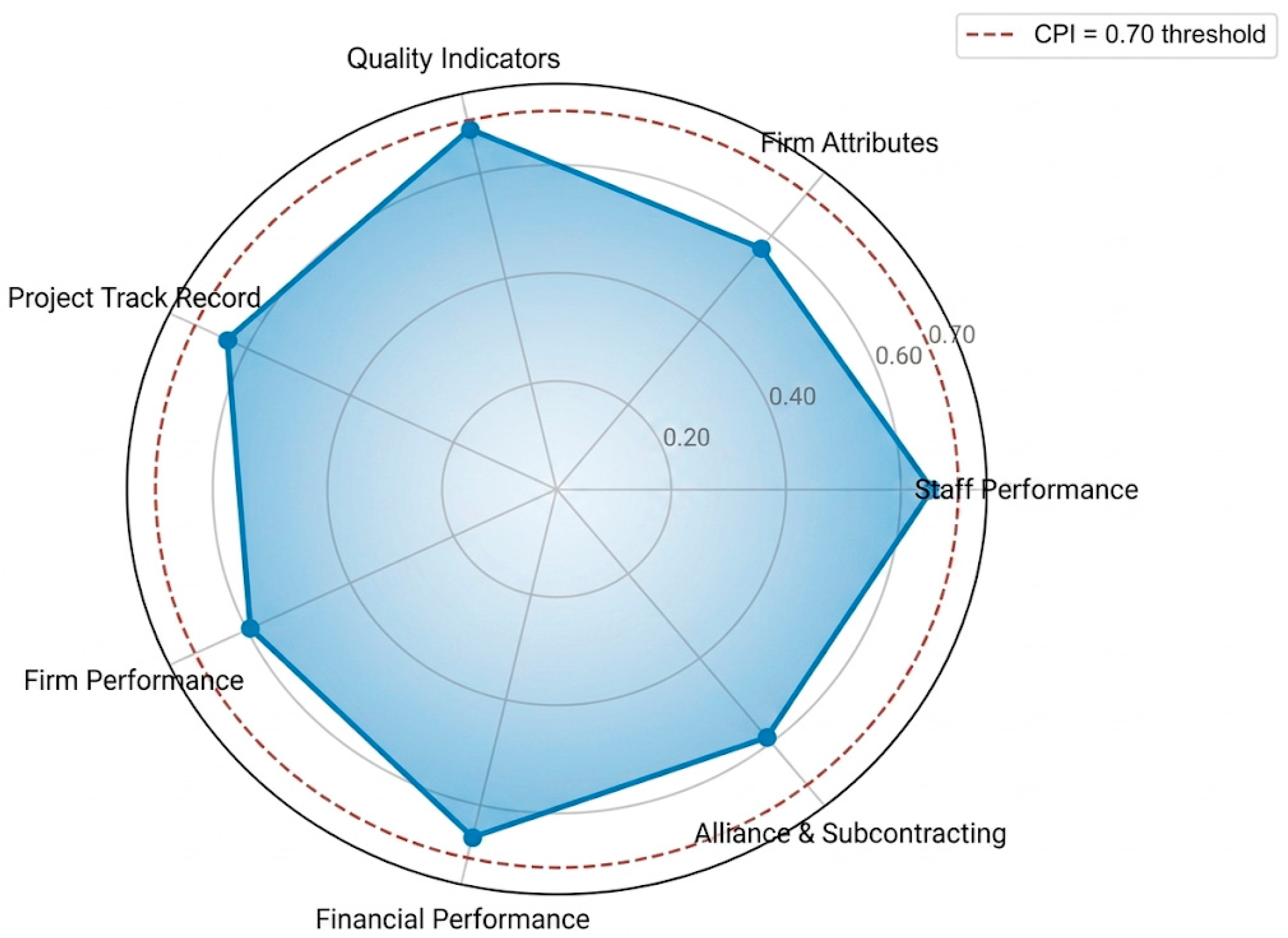
4.3. Dimension-Level Analysis
4.3.1. Staff Performance Indicators (SPI)
4.3.2. Firm Attributes (FAT)
4.3.3. Quality Indicators (QTY)
4.3.4. Project Track Record (PRJ)
4.3.5. Firm Performance Indicators (FPI)
4.3.6. Financial Performance (FIN) and Alliance Indicators (ALLC)
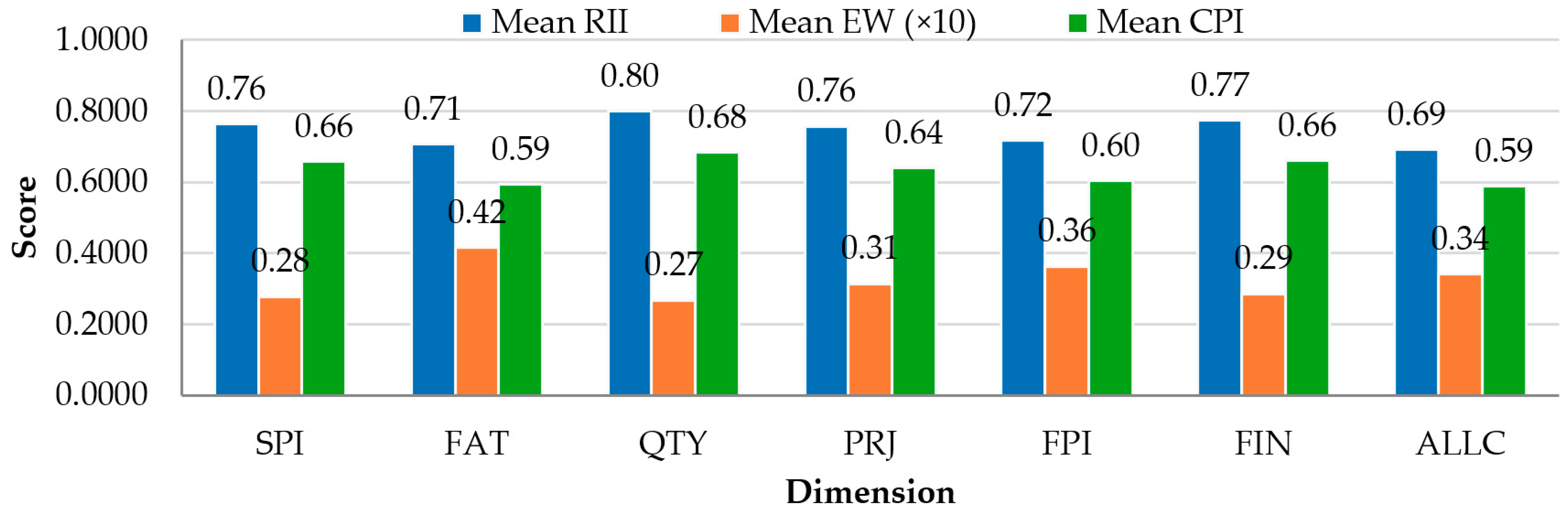
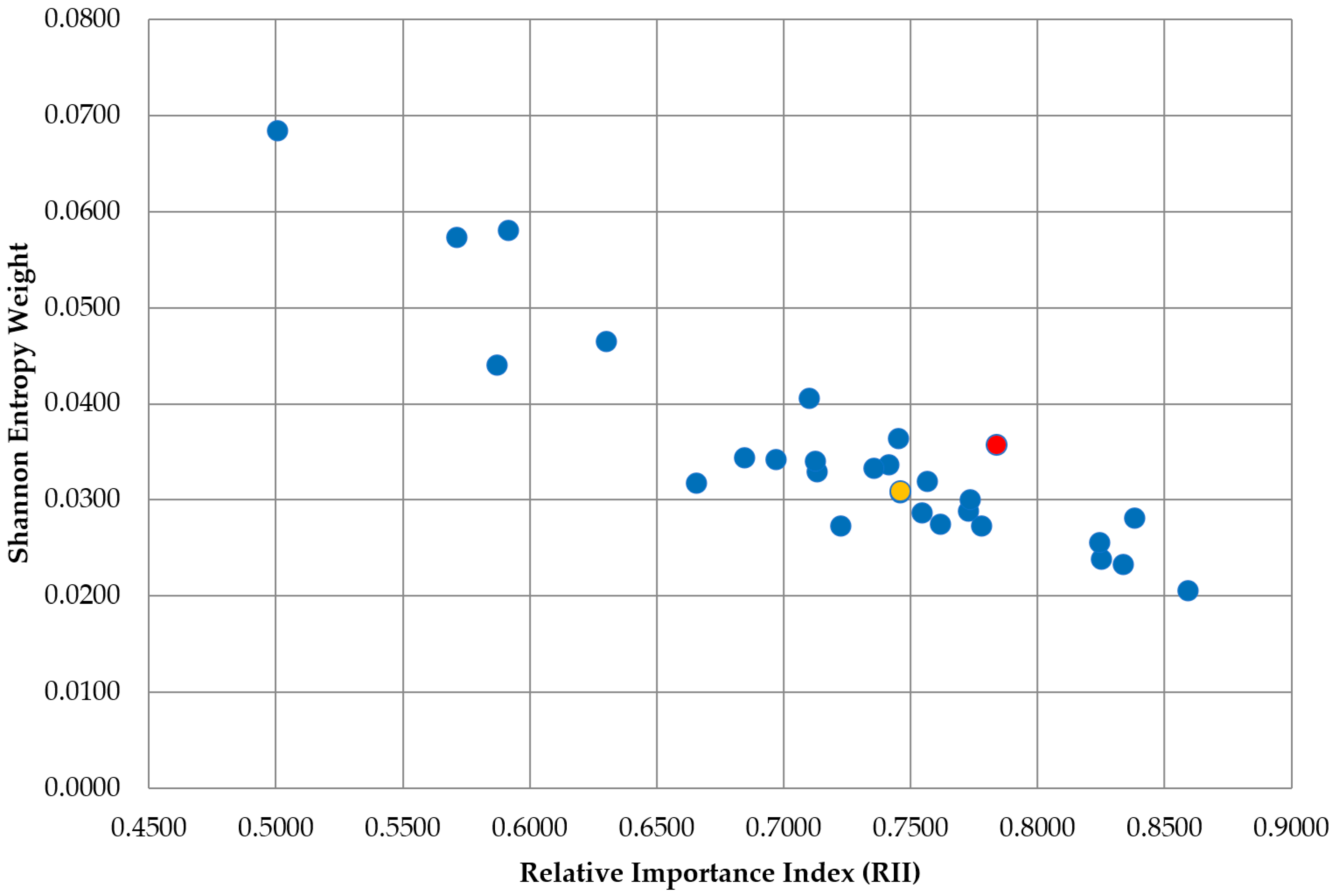
4.4. RII–Entropy Trade-Off Analysis
5. Conclusions
Supplementary Materials
Author Contributions
Funding
Data Availability Statement
Acknowledgments
Conflicts of Interest
References
- Al Hadri, F.; Hidayat, B.; Istijono, B. Interrelation of Design Performance to Construction Performance. CIVED (J. Civ. Eng. Vocat. Educ.) 2024, 11, 480–494. [Google Scholar] [CrossRef]
- Druzhynin, M.; Ivanyna, O.; Kolomiiets, V.; Bubon, S. Functional coordination of the activities of consulting and engineering companies with the main stakeholders of a construction development project. Ways Improv. Constr. Effic. 2025, 1, 217–229. [Google Scholar] [CrossRef]
- Chatterjee, P.K.; Chatterjee, P.P. Engineering Consultant’s Contractual Obligations. In Marketing of Engineering Consultancy Services: A Global Perspective; ASME Press: New York, NY, USA, 2019. [Google Scholar] [CrossRef]
- Kabirifar, K.; Mojtahedi, M. The impact of Engineering, Procurement and Construction (EPC) Phases on Project Performance: A Case of Large-scale Residential Construction Project. Buildings 2019, 9, 15. [Google Scholar] [CrossRef]
- Alsugair, A.; Abuthnain, M. Assessment of Government Contractor Classification System in Saudi Arabia. Adv. Mater. Res. 2011, 250, 345–355. [Google Scholar] [CrossRef]
- Almutairi, S.; Kashiwagi, D.; Kashiwagi, J.; Algahtany, M.; Sullivan, K. Procedures and Issues within the Contractors Classification System in Saudi Arabia. J. Adv. Perform. Inf. Value 2020, 9, 79–85. [Google Scholar] [CrossRef]
- Assaf, S.A.; Al-Hejji, S. Causes of delay in large construction projects. Int. J. Proj. Manag. 2006, 24, 349–357. [Google Scholar] [CrossRef]
- Chen, P. Effects of the entropy weight on TOPSIS. Expert Syst. Appl. 2020, 168, 114186. [Google Scholar] [CrossRef]
- Moradi, S.; Ansari, R.; Taherkhani, R. A systematic analysis of construction performance management. Iran. J. Sci. Technol. Trans. Civ. Eng. 2022, 46, 15–31. [Google Scholar] [CrossRef]
- Mathar, H.; Assaf, S.; Hassanain, M.; Abdallah, A.; Sayed, A. Critical success factors for construction projects. Built Environ. Proj. Asset Manag. 2020, 10, 349–367. [Google Scholar] [CrossRef]
- Kapote, M.M.; Wagh, A.A.; Pimplikar, S.S. Contractor Selection Approaches and Pre-Qualification Criteria on Construction Projects: A Review. In Proceedings of the National Conference on Advances in Construction Materials and Management; Springer: Singapore, 2022; pp. 27–40. [Google Scholar]
- Wang, Q.; Zuo, W.; Li, Q. Engineering harmony under constraints. J. Civ. Eng. Manag. 2020, 26, 131–146. [Google Scholar] [CrossRef]
- Acheamfour, V.K.; Adjei-Kumi, T.; Kissi, E. Contractor selection: A review of qualification and pre-qualification systems. Int. J. Constr. Manag. 2023, 23, 338–348. [Google Scholar] [CrossRef]
- Patyal, V.S.; Koilakuntla, M. The Impact of Quality Management Practices on Performance: An Empirical Study. Benchmarking Int. J. 2017, 24, 511–535. [Google Scholar] [CrossRef]
- Alshamrani, O.S.D.; Saleem, M.; AlYousif, I.K.; Alluqmani, A. Development of a pre-qualification and selection framework for construction projects’ contractors in Saudi Arabia. J. Asian Archit. Build. Eng. 2023, 22, 1545–1563. [Google Scholar] [CrossRef]
- Saudi Council of Engineers. SCE Detects 10 Major Companies Operating with Expired Engineering Accreditation. 2026. Available online: https://www.saudieng.sa/English/MediaCenter/News/Pages/sce-detects-10-major-companies-operating-with-expired-engineering-accreditation.aspx (accessed on 5 April 2024).
- Saudi Council of Engineers (SCE). Rules of Control and Inspection on the Engineering Professions Law; Saudi Council of Engineers (SCE): Riyadh, Saudi Arabia, 2019; Available online: https://www.saudieng.sa/Admin/NPDepartmentsDocs/Rules%20of%20Control%20and%20Inspection%20on%20the%20Engineering.pdf (accessed on 1 April 2024).
- International Federation of Consulting Engineers (FIDIC). Selection of Consultants Guide; International Federation of Consulting Engineers (FIDIC): Geneva, Switzerland, 2023; Available online: https://fidic.org/sites/default/files/2023%20selection%20of%20consultants%20guide_2023.pdf (accessed on 5 April 2024).
- Iftikhar, A.; Purvis, L.; Giannoccaro, I. Firm resilience: A meta-analysis. J. Bus. Res. 2021, 135, 408–425. [Google Scholar] [CrossRef]
- Cheung, F.K.T.; Kuen, J.L.F.; Skitmore, M. Multi-criteria evaluation model for the selection of architectural consultants. Constr. Manag. Econ. 2002, 20, 569–580. [Google Scholar] [CrossRef]
- Zhao, N.; Ying, F.J.; Tookey, J. Construction Procurement Selection Criteria: A Review and Research Agenda. Sustainability 2022, 14, 15242. [Google Scholar] [CrossRef]
- Egemen, M. Building Construction Clients’ Design Consultant and Contractor Selection Criteria Versus Post-Occupancy Satisfaction Levels. Sage Open 2022, 12. [Google Scholar] [CrossRef]
- Nazari, A.; Vandadian, S.; Abdirad, H. Fuzzy AHP Model for Prequalification of Engineering Consultants in the Iranian Public Procurement System. J. Manag. Eng. 2017, 33. [Google Scholar] [CrossRef]
- Gurgun, A.P.; Koc, K. Contractor prequalification for green buildings—Evidence from Turkey. Eng. Constr. Archit. Manag. 2020, 27, 1377–1400. [Google Scholar] [CrossRef]
- Hwang, C.L.; Yoon, K. Multiple Attribute Decision Making: Methods and Applications; Springer: Berlin/Heidelberg, Germany, 1981. [Google Scholar]
- Uzun, B.; Taiwo, M.; Syidanova, A.; Ozsahin, D.U. The Technique for Order of Preference by Similarity to Ideal Solution (TOPSIS). In Application of Multi-Criteria Decision Analysis in Environmental and Civil Engineering; Professional Practice in Earth Sciences; Ozsahin, D.U., Gökçekuş, H., Uzun, B., LaMoreaux, J.W., Eds.; Springer: Cham, Switzerland, 2021; pp. 65–80. [Google Scholar] [CrossRef]
- Moher, D.; Liberati, A.; Tetzlaff, J.; Altman, D.G. Preferred reporting items for systematic reviews and meta-analyses: The PRISMA statement. BMJ 2009, 339, b2535. [Google Scholar] [CrossRef]
- Page, M.J.; McKenzie, J.E.; Bossuyt, P.M.; Boutron, I.; Hoffmann, T.C.; Mulrow, C.D.; Shamseer, L.; Tetzlaff, J.M.; Akl, E.A.; Brennan, S.E.; et al. The PRISMA 2020 statement: An updated guideline for reporting systematic reviews. BMJ Publ. Group 2021, 372, 71. [Google Scholar] [CrossRef]
- Mogashoa, M.M.; Selebi, O. Innovation capacity: A perspective on innovation capabilities of consulting engineering firms. South. Afr. J. Entrep. Small Bus. Manag. 2021, 13, 10. [Google Scholar] [CrossRef]
- Al-Omari, K.; Okasheh, H. The Influence of Work Environment on Job Performance: A Case Study of Engineering Company in Jordan. Int. J. Appl. Eng. Res. 2017, 12, 15544–15550. [Google Scholar]
- Al-Besher, M.F. A Conceptual Model for Consultant Selection in Saudi Arabia. Master’s Thesis, King Fahd University of Petroleum & Minerals, Dhahran, Saudi Arabia, 1998. [Google Scholar]
- Rajabi, M.S.; Radzi, A.R.; Rezaeiashtiani, M.; Famili, A.; Rashidi, M.E.; Rahman, R.A. Key Assessment Criteria for Organizational BIM Capabilities: A Cross-Regional Study. Buildings 2022, 12, 1013. [Google Scholar] [CrossRef]
- Mahmoodjanloo, M. Designing an algorithm for winner selection of upstream consultants in full field reservoir study projects. Int. J. Mechatron. Electr. Comput. Technol. (IJMEC) 2017. Available online: https://scholar.google.com/scholar?hl=en&as_sdt=0%2C5&q=Designing+an+algorithm+for+winner+selection+of+upstream+consultants+in+full+field+reservoir+study+projects.&btnG= (accessed on 21 May 2026).
- Razi, P.Z.; Ramli, N.I.; Ali, M.I.; Ramadhansyah, P.J. Selection of Best Consultant by using Analytical Hierarchy Process (AHP). IOP Conf. Ser. Mater. Sci. Eng. 2020, 712, 012016. [Google Scholar] [CrossRef]
- Sun, C.H.; Yau, N.J. Performance evaluation mechanism for engineering consultants—Cases study on Taipei rapid transit systems. In Proceedings of the International Association for Automation and Robotics in Construction (IAARC); Sun, C.H., Yau, N.J., Eds.; IAARC: Seoul, Republic of Korea, 2011; pp. 941–946. [Google Scholar]
- Eltahan, A.; Al Hattab, M.; Hammad, A. Impact of Architect/Engineer (A/E) Consultant Qualifications on Project Outcomes. Can. J. Civ. Eng. 2021, 49, 1855–1869. [Google Scholar] [CrossRef]
- Mitelman, A.; Giat, Y. Transition to a Competitive Consultant Selection Method: A Case Study of a Public Agency in Israel. Interdiscip. J. Inf. Knowl. Manag. 2021, 16, 491–503. [Google Scholar] [CrossRef]
- Alfalah, G.; Aldajani, S.; Elshaboury, N.; Al-Sakkaf, A.; Alshamrani, O. Development of a Performance Assessment Model for Contractors in Saudi Arabian Construction Projects. Adv. Civ. Eng. 2024, 2024, 8780539. [Google Scholar] [CrossRef]
- Alkaabi, S.A.M.; Mahjoob, A.M.R. Identifying the selection criteria of design consultant for Iraqi construction projects. J. Mech. Behav. Mater. 2022, 31, 290–297. [Google Scholar] [CrossRef]
- Department of Public Expenditure and Reform. Prequalification of Consultants Using Minimum Standards for Suitability Criteria; Department of Public Expenditure and Reform: Dublin, Ireland, 2022. Available online: https://media.cwmf.gov.ie/media/documents/GN_1.6.3_Prequalification_v1.0_09-02-2022.pdf (accessed on 5 April 2024).
- Shash, A.A.; Ajairi, F.S. An A/E Pre-Qualification Model Based on the Quality Function Deployment Method. Int. Res. J. Adv. Eng. Sci. 2021, 6, 237–247. [Google Scholar]
- Ministry of Municipalities and Housing (MOMAH). Mechanism for the Classification of Engineering Consultancy Firms and Offices; Ministry of Municipalities and Housing (MOMAH): Riyadh, Saudi Arabia, 2022. [Google Scholar]
- Assaf, S.; Hassanain, M.A.; Hadidi, L.; Amman, A. A Systematic Approach for the Selection of the Architect/Engineer Professional in Construction Projects. Arch. Civ. Eng. Environ. 2017, 10, 5–14. [Google Scholar] [CrossRef]
- AbouRizk, S.; Hammad, A.; El Hattab, M.; Wu, L.; Eltahan, A.; Nomir, M. Impact of Qualifications-Based Selection of Engineering Services on Project Outcomes: Executive Summary Reports; University of Alberta: Edmonton, AB, Canada, 2021. [Google Scholar]
- Almohassen, A.S.; Alfozan, M.; Alshamrani, O.S.; Shaawat, M.E. Evaluating construction contractors in the pre-tendering stage through an integrated based model. Alex. Eng. J. 2023, 82, 437–445. [Google Scholar] [CrossRef]
- Construction Industry Council (CIC). Reference Materials on the Selection of Consultants; Construction Industry Council (CIC): Hong Kong, China, 2014; Available online: https://www.hkcic.org (accessed on 5 April 2024).
- Lee, K.; Simpson, J.A.; White, I.R.; Carpenter, J.R. Framework for the Treatment and Reporting of Missing Data in Observational Studies: The Treatment and Reporting of Missing Data in Observational Studies Framework. J. Clin. Epidemiol. 2021, 134, 79–88. [Google Scholar] [CrossRef]
- Dong, Y.; Peng, C.-Y.J. Principled missing data methods for researchers. SpringerPlus 2013, 2, 222. [Google Scholar] [CrossRef]
- Schafer, J.L. Multiple imputation: A primer. Stat. Methods Med. Res. 1999, 8, 3–15. [Google Scholar] [CrossRef] [PubMed]
- NIST/SEMATECH. 7.2.4.2. Sample Sizes Required. In e-Handbook of Statistical Methods; National Institute of Standards and Technology: Gaithersburg, MD, USA, 2002. Available online: https://www.itl.nist.gov/div898/handbook/prc/section2/prc242.htm (accessed on 12 May 2026).
- Nunnally, J.C. Psychometric Theory, 2nd ed.; McGraw-Hill: New York, NY, USA, 1978. [Google Scholar]
- George, D.; Mallery, P. SPSS for Windows Step by Step: A Simple Guide and Reference, 4th ed.; Allyn & Bacon: Boston, MA, USA, 2003. [Google Scholar]
- Al Khatib, B.; Poh, Y.S.; El-Shafie, A. Delay factors management and ranking for reconstruction and rehabilitation projects based on the Relative Importance Index (RII). Sustainability 2020, 12, 6171. [Google Scholar] [CrossRef]
- Boakye, M.K.; Adanu, S.K.; Adu-Gyamfi, C.; Asare, R.K.; Asantewaa-Tannor, P.; Ayimah, J.C.; Agbosu, W.K. A Relative Importance Index Approach to On-Site Building Construction Workers’ Perception of Occupational Hazards Assessment. Med. Lav. 2023, 114, e2023024. [Google Scholar] [CrossRef]
- Dixit, S.; Mandal, S.N.; Thanikal, J.V.; Saurabh, K. Study of Significant Factors Affecting Construction Productivity Using Relative Importance Index in Indian Construction Industry. In E3S Web of Conferences; EDP Sciences: Les Ulis, France, 2019. [Google Scholar] [CrossRef]
- Rioul, O. This is IT: A Primer on Shannon’s Entropy and Information. In Information Theory; Springer: Cham, Switzerland, 2021; pp. 27–59. [Google Scholar] [CrossRef]
- Yazdani, M.; Torkayesh, A.E.; Santibanez-Gonzalez, E.D.R.; Otaghsara, S.K. Evaluation of Renewable Energy Resources Using Integrated Shannon Entropy–EDAS Model. Sustain. Oper. Comput. 2020, 1, 35–42. [Google Scholar] [CrossRef]
- Lotfi, F.H.; Fallahnejad, R. Imprecise Shannon’s Entropy and Multi-Attribute Decision Making. Entropy 2010, 12, 53–62. [Google Scholar] [CrossRef]
- Kacprzak, D. A novel extension of the technique for order preference by similarity to ideal solution method with objective criteria weights for group decision making with interval numbers. Entropy 2021, 23, 1460. [Google Scholar] [CrossRef]
- Moradi, A.; Rahmani, K.; Jaafaripooyan, E.; Yarahmadi, R. Prioritization of Key Qualification Indicators related to Operational-Level Managers based on Multiple Criteria Decision Making, Fuzzy TOPSIS in Tehran University of Medical Sciences. J. Hosp. 2018, 17, 53–64. [Google Scholar]
- Lourenzutti, R.; Krohling, R.A. A generalized TOPSIS method for group decision making with heterogeneous information in a dynamic environment. Inf. Sci. 2016, 330, 1–18. [Google Scholar] [CrossRef]
- Salihu, H.M.; Salinas-Miranda, A.A.; Wang, W.; Turner, D.; Berry, E.L.; Zoorob, R. Community Priority Index: Utility, Applicability and Validation for Priority Setting in Community-Based Participatory Research. J. Public Health Res. 2015, 4, 443. [Google Scholar] [CrossRef]
- Opricovic, S.; Tzeng, G.H. Compromise solution by MCDM methods: A comparative analysis of VIKOR and TOPSIS. Eur. J. Oper. Res. 2004, 156, 445–455. [Google Scholar] [CrossRef]
- Ngoy, K.S.; Chisumbe, S.; Petere, G.; Mwiya, B.; Mwanaumo, E. Factors Influencing Professional Indemnity Insurance Use in Construction Risk Management. Balt. J. Real Estate Econ. Constr. Manag. 2023, 11, 199–220. [Google Scholar] [CrossRef]
- Almutairi, F.S. Contractor-subcontractor relationships in Saudi Arabia. Open J. Bus. Manag. 2022, 10, 3500–3530. [Google Scholar] [CrossRef]
- Chan, A.P.C.; Chan, A.P.L. Key performance indicators for measuring construction success. Benchmarking 2004, 11, 203–221. [Google Scholar] [CrossRef]
- Alzara, M.; Algahtany, M.; Kashiwagi, J.S.; Al-Tassan, A.; Kashiwagi, D. Improving the Current Procurement System in Saudi Arabia: A University Case Study. J. Adv. Perform. Inf. 2020, 9, 63–75. [Google Scholar] [CrossRef]
- Prayag, G.; Chowdhury, M.; Spector, S.; Orchiston, C. Organizational resilience and performance. Ann. Tour. Res. 2018, 73, 193–196. [Google Scholar] [CrossRef]




| No. | Dimension | Criterion | Index | Reference |
|---|---|---|---|---|
| 1 | Staff Performance Indicators (SPI) | Professional hours | SPI-1 | Expert |
| 2 | Engineers harmony index | SPI-2 | Expert | |
| 3 | Engineer’s capability index | SPI-3 | [29] | |
| 4 | Admins capability index | SPI-4 | [23] | |
| 5 | Staff count | SPI-5 | [24] | |
| 6 | Supervisory experience | SPI-6 | [18] | |
| 7 | Firm Attributes (FAT) | Adequate workspace | FAT-1 | [30] |
| 8 | Branches count | FAT-2 | [31] | |
| 9 | Firm infrastructure | FAT-3 | [32] | |
| 10 | Technology and tools | FAT-4 | [33] | |
| 11 | License class | FAT-5 | Expert | |
| 12 | Headquarter location | FAT-6 | [21] | |
| 13 | Quality Indicators (QTY) | Quality management | QTY-1 | [34] |
| 14 | Client satisfaction index | QTY-2 | [35] | |
| 15 | Project Track Record (PRJ) | Highest project value | PRJ-1 | [20] |
| 16 | Current workload index | PRJ-2 | [36] | |
| 17 | Completed projects—public sector | PRJ-3 | [37] | |
| 18 | Completed projects—private sector | PRJ-4 | [22] | |
| 19 | Average delay time | PRJ-5 | [38,39] | |
| 20 | Firm Performance Indicators (FPI) | Professional violations | FPI-1 | Expert |
| 21 | Prequalification certificates | FPI-2 | [40] | |
| 22 | Professional indemnity insurance | FPI-3 | [18] | |
| 23 | Bidding skills | FPI-4 | [41] | |
| 24 | Licensed engineering professions | FPI-5 | [42] | |
| 25 | Other professions | FPI-6 | [43] | |
| 26 | Intellectual property | FPI-7 | [21] | |
| 27 | Financial Performance (FIN) | Financial performance | FIN-1 | [44] |
| 28 | Alliance Indicators (ALLC) | Subcontracting index | ALLC-1 | [45] |
| 29 | Partner classification grade | ALLC-2 | [46] |
| Demographic Variable | Category | Frequency | Percentage (%) |
|---|---|---|---|
| Job Title | Engineer | 45 | 15.6% |
| Project Manager | 106 | 36.8% | |
| Site Engineer | 32 | 11.1% | |
| Director | 77 | 26.7% | |
| Consultant | 28 | 9.7% | |
| Employer Type | Government | 92 | 31.9% |
| Semi-Government | 48 | 16.7% | |
| Private | 109 | 37.8% | |
| Mixed | 23 | 8.0% | |
| Other | 16 | 5.6% |
| Dimension/Scale | No. Items | Cronbach’s α | Interpretation |
|---|---|---|---|
| SPI—Staff Performance Index | 6 | 0.834 | Good |
| FPI—Firm Profile Index | 7 | 0.801 | Good |
| PRJ—Project History Index | 5 | 0.773 | Acceptable |
| FAT—Facilities and Assets Index | 6 | 0.750 | Acceptable |
| QTY—Quality Index | 2 | 0.753 | Acceptable |
| ALLC—Alliance Index | 2 | 0.718 | Acceptable |
| Overall Instrument (all 29 items) | 28 | 0.936 | Excellent |
| CPI Rank | Criterion Name | CPI | |||
|---|---|---|---|---|---|
| 1 | Supervisory Experience | 0.0408 | 0.0203 | 0.0306 | 0.7399 |
| 2 | Engineers Capability Index | 0.0396 | 0.0231 | 0.0314 | 0.7165 |
| 3 | License Class | 0.0398 | 0.0279 | 0.0338 | 0.7086 |
| 4 | Client Satisfaction Index | 0.0392 | 0.0237 | 0.0314 | 0.7083 |
| 5 | Average Delay Time | 0.0391 | 0.0253 | 0.0322 | 0.7047 |
| 6 | Prequalification Certificates | 0.0369 | 0.0270 | 0.0320 | 0.6672 |
| 7 | Professional Violations | 0.0372 | 0.0355 | 0.0364 | 0.6614 |
| 8 | Financial Performance | 0.0367 | 0.0286 | 0.0327 | 0.6607 |
| 9 | Quality Management | 0.0367 | 0.0298 | 0.0333 | 0.6596 |
| 10 | Professional Hours | 0.0362 | 0.0273 | 0.0317 | 0.6540 |
| 11 | Firm Infrastructure (FAT6) | 0.0358 | 0.0284 | 0.0321 | 0.6465 |
| 12 | Engineers Harmony Index | 0.0359 | 0.0317 | 0.0338 | 0.6448 |
| 13 | Firm Infrastructure (FAT4) | 0.0354 | 0.0307 | 0.0331 | 0.6377 |
| 14 | Completed Projects (Private Sector) | 0.0354 | 0.0306 | 0.0330 | 0.6373 |
| 15 | Completed Projects (Public Sector) | 0.0352 | 0.0334 | 0.0343 | 0.6317 |
| 16 | Professional Indemnity Insurance | 0.0354 | 0.0363 | 0.0359 | 0.6313 |
| 17 | Bidding Skills | 0.0349 | 0.0331 | 0.0340 | 0.6269 |
| 18 | Current Workload Index | 0.0343 | 0.0271 | 0.0307 | 0.6206 |
| 19 | Admins Capability Index | 0.0339 | 0.0328 | 0.0333 | 0.6077 |
| 20 | Licensed Engineering Professions | 0.0338 | 0.0338 | 0.0338 | 0.6066 |
| 21 | Highest Project Value | 0.0337 | 0.0404 | 0.0371 | 0.6000 |
| 22 | Sub-Contracting Index | 0.0331 | 0.0340 | 0.0335 | 0.5935 |
| 23 | Partner Classification Grade | 0.0325 | 0.0342 | 0.0334 | 0.5823 |
| 24 | Staff Count | 0.0316 | 0.0316 | 0.0316 | 0.5653 |
| 25 | Adequate Workspace | 0.0299 | 0.0462 | 0.0380 | 0.5286 |
| 26 | Headquarter Location | 0.0281 | 0.0579 | 0.0430 | 0.4931 |
| 27 | Other Professions | 0.0279 | 0.0439 | 0.0359 | 0.4878 |
| 28 | Intellectual Property | 0.0271 | 0.0572 | 0.0422 | 0.4743 |
| 29 | Branches Count | 0.0238 | 0.0682 | 0.0460 | 0.4086 |
| ∑ | 1.000 | 1.000 | 1.000 | ||
Disclaimer/Publisher’s Note: The statements, opinions and data contained in all publications are solely those of the individual author(s) and contributor(s) and not of MDPI and/or the editor(s). MDPI and/or the editor(s) disclaim responsibility for any injury to people or property resulting from any ideas, methods, instructions or products referred to in the content. |
© 2026 by the authors. Licensee MDPI, Basel, Switzerland. This article is an open access article distributed under the terms and conditions of the Creative Commons Attribution (CC BY) license.
Share and Cite
Alanazi, A.H.; Al-Gahtani, K.S.; Alsugair, A.M.; Bin Mahmoud, A.A.; Alsanabani, N.M. Assessment and Ranking of Criteria for Engineering Firm Performance Using RII, Entropy Weight Method, and TOPSIS. Appl. Sci. 2026, 16, 5556. https://doi.org/10.3390/app16115556
Alanazi AH, Al-Gahtani KS, Alsugair AM, Bin Mahmoud AA, Alsanabani NM. Assessment and Ranking of Criteria for Engineering Firm Performance Using RII, Entropy Weight Method, and TOPSIS. Applied Sciences. 2026; 16(11):5556. https://doi.org/10.3390/app16115556
Chicago/Turabian StyleAlanazi, Abdulkareem H., Khalid S. Al-Gahtani, Abdullah M. Alsugair, Abdulrahman A. Bin Mahmoud, and Naif M. Alsanabani. 2026. "Assessment and Ranking of Criteria for Engineering Firm Performance Using RII, Entropy Weight Method, and TOPSIS" Applied Sciences 16, no. 11: 5556. https://doi.org/10.3390/app16115556
APA StyleAlanazi, A. H., Al-Gahtani, K. S., Alsugair, A. M., Bin Mahmoud, A. A., & Alsanabani, N. M. (2026). Assessment and Ranking of Criteria for Engineering Firm Performance Using RII, Entropy Weight Method, and TOPSIS. Applied Sciences, 16(11), 5556. https://doi.org/10.3390/app16115556