Article

Assessment and Ranking of Criteria for Engineering Firm Performance Using RII, Entropy Weight Method, and TOPSIS

by
Abdulkareem H. Alanazi
*,
Khalid S. Al-Gahtani
,
Abdullah M. Alsugair
,
Abdulrahman A. Bin Mahmoud
and
Naif M. Alsanabani
Nesma and Partners’ Chair for Construction Research and Building Technologies, Department of Civil Engineering, College of Engineering, King Saud University, P.O. Box 2454, Riyadh 11451, Saudi Arabia
*
Author to whom correspondence should be addressed.
Appl. Sci. 2026, 16(11), 5556; https://doi.org/10.3390/app16115556
Submission received: 29 April 2026 / Revised: 19 May 2026 / Accepted: 22 May 2026 / Published: 2 June 2026

Abstract

Engineering consultants and design firms are central to the success of construction projects. However, the systematic evaluation of their performance in the Saudi Arabian context remains methodologically fragmented and empirically underdeveloped. Existing prequalification frameworks rely predominantly on administrative criteria and single-method ranking approaches that cannot adequately differentiate between high- and low-performing firms. To address this gap, the study proceeds in two distinct parts. Part I—Literature Review: A PRISMA-compliant systematic literature review across five major academic databases was conducted to map the existing evidence base, identify three substantive gaps in the Saudi and GCC engineering firm evaluation literature, and derive a consensus-based set of 29 performance criteria grouped into seven dimensions. This review constitutes an independent contribution: it establishes the gap that motivates the empirical work and provides the criterion framework on which that work is built. Part II—Practical Application: A structured questionnaire was administered to 288 construction professionals in Saudi Arabia (Cronbach’s α = 0.936), and the collected data were analyzed through a hybrid RII–Shannon Entropy Weighting (EWM)–TOPSIS pipeline that produced a Composite Priority Index (CPI) for each criterion, enabling a stable and discriminating ranking that integrates subjective expert consensus with objective distributional information. The main finding revealed that five criteria attained Very High Priority status (CPI > 0.70): Supervisory Experience (CPI = 0.740), Engineers’ Capability Index (CPI = 0.717), License Class (CPI = 0.709), Client Satisfaction Index (CPI = 0.708), and Average Delay Time (CPI = 0.705). These top-ranked criteria collectively center on technical leadership, regulatory standing, client-reported outcomes, and schedule reliability, indicating that procurement decisions should prioritize demonstrable competence over structural size or geographic footprint. The consistently lower importance of physical branch networks and headquarters location further suggests that remote management capabilities and digital coordination tools are reshaping performance expectations under Saudi Vision 2030. The Quality Indicators dimension achieved the highest mean CPI across all seven dimensions. The findings provide actionable evidence for procurement authorities, regulatory bodies, and engineering firms seeking to strengthen performance-evaluation practices in the Saudi construction sector.

1. Introduction

Engineering consultants and design firms play a critical role in the success of construction projects by managing conceptualization, ensuring design integrity and regulatory compliance, and providing technical supervision throughout the project lifecycle. Their involvement helps translate client needs into detailed designs and implementation plans, which significantly influence construction performance; studies show that design quality affects up to 97% of construction outcomes [1]. Effective coordination between consulting engineers and other stakeholders minimizes costs, shortens timelines, and enhances project quality and competitiveness [2]. The consultants’ competencies, ethical standards, and ability to manage conflicts of interest are essential for impartial advice and adherence to contractual obligations, thereby directly impacting on-time, within-budget project delivery [3]. Overall, engineering consultants are foundational to achieving project goals related to cost control, schedule adherence, quality assurance, and innovation in construction projects [4].
Despite this central importance, the systematic assessment and ranking of engineering firm performance criteria remain underdeveloped, particularly in the Saudi Arabian regulatory context. Existing prequalification and evaluation frameworks in the region have been criticized for relying on fragmented, dimension-specific criterion sets that lack empirical validation against a representative professional sample [5]. The Saudi Contractor Classification System (CCS), for instance, has been shown to inadequately capture actual firm capabilities due to the absence of performance feedback mechanisms and the over-reliance on static administrative criteria [6]. Beyond the criterion set itself, studies on engineering firm evaluation in the Saudi and GCC context have predominantly applied single-method ranking approaches, which are vulnerable to ceiling effects and cannot integrate objective distributional information with subjective expert judgement [7]. As a result, no study to date has simultaneously evaluated all relevant performance dimensions of engineering firms within a single unified, methodologically rigorous framework applied to a large, professionally diverse sample of Saudi construction practitioners. This gap undermines the ability of procurement authorities, regulatory bodies, and engineering firms themselves to make defensible, evidence-based decisions in firm selection and performance monitoring.
These dual gaps, the absence of a literature-grounded criterion framework, and the lack of an empirically validated ranking method for the Saudi context, motivate two research questions that guide this study: (RQ1) What performance criteria and dimensions can be systematically identified from the literature to evaluate engineering firms in Saudi Arabian construction projects? (RQ2) How can those criteria be empirically weighted and ranked to support evidence-based procurement decisions? The remainder of this paper is structured to answer each question in turn.
The present study addresses these gaps through a structured, four-stage research design. First, a PRISMA-compliant systematic literature review across five major academic databases yielded a consensus-based set of 29 performance criteria grouped under seven principal dimensions: Staff Performance Indicators (SPI), Firm Attributes (FAT), Quality Indicators (QTY), Project Track Record (PRJ), Firm Performance Indicators (FPI), Alliance and Sub-Contracting Indicators (ALLC), and Financial Performance (FIN). Second, a structured questionnaire was administered to 288 construction professionals in Saudi Arabia, spanning five job titles and five employer types across both the public and private sectors, providing a robust, representative empirical foundation. Third, a hybrid analytical pipeline integrating the Relative Importance Index (RII), Shannon Entropy Weighting (EWM), and the Technique for Order of Preference by Similarity to Ideal Solution (TOPSIS) was applied to compute a Composite Priority Index (CPI) for each criterion, combining subjective expert consensus with objective distributional information to produce a ranking that, as demonstrated by Chen [8], integrates complementary sources of information to resolve criterion differentiation that single-method approaches cannot achieve. The outcome is a comprehensive, context-sensitive, and methodologically rigorous framework for assessing and prioritizing engineering firm performance criteria, directly applicable to procurement practice, regulatory policy, and organizational self-assessment in Saudi Arabian construction projects.

2. Theoretical Background and Research Gap

This section provides the conceptual and theoretical foundation for the study. It is distinct from the procedural systematic literature review reported in Section 3.1: whereas Section 3.1 describes the PRISMA-compliant search, screening, and data extraction process that produced the 29-criterion framework, the present section critically synthesizes the substantive evidence on what drives engineering firm performance (Section 2.1), which analytical tools have been applied to evaluate it (Section 2.2), and where the gaps in that body of knowledge lie (Section 2.3). Together, these subsections provide the theoretical justification for both the criterion framework and the hybrid analytical pipeline adopted in this study.

2.1. Criteria’s Impact on Engineering Firm Performance

Engineering firm performance in construction projects is recognized as a multi-dimensional construct, encompassing technical competence, organizational capacity, quality management, financial robustness, regulatory compliance, and project track record [9]. Human capital consistently emerges as the most influential dimension: Mathar [10] identified supervisory experience and engineers’ capability as primary critical success factors in Saudi Arabian construction, and Kapote [11] confirmed that personnel quality outweighs headcount as a prequalification criterion across international frameworks. Wang [12] further demonstrated that workforce harmony under multi-constraint objectives directly enhances project delivery efficiency, while Acheamfour [13] established through a systematic review that contractor selection prioritizes qualitative staff attributes over quantitative measures.
Beyond human capital, firm-level organizational attributes exert a significant influence on performance outcomes. In Saudi Arabia, license classification under the Contractor Classification System (CCS) is a binding prequalification criterion in public-sector procurement; Almutairi [6] documented systemic limitations in its ability to reflect actual contractor classification. Quality management and client satisfaction have been established as primary performance differentiators by Patyal [14]. While schedule delay performance is a persistent challenge in Saudi construction [7], it remains a central evaluation criterion in prequalification frameworks [15]. Compliance indicators, including professional violation history, are formally monitored by the Saudi Council of Engineers (SCE) [16,17]; however, they have not been explicitly used as selection or classification criteria in the literature. In addition, professional indemnity insurance is required under the International Federation of Consulting Engineers selection guidelines [18]. Financial soundness has been linked to organizational resilience and the sustained capacity to deliver contracts [19].
A substantial body of literature has addressed the evaluation of contractors and consultants in construction. However, coverage of engineering firm performance in the Saudi and GCC context remains notably thin. Systematic and structured reviews in the broader contractor prequalification domain—such as those by Cheung et al. [20]—reveal that selection criteria and analytical methods across international markets predominantly cover Western and East Asian construction environments. Within the Saudi and GCC context, individual empirical studies have examined specific evaluation dimensions in isolation: Assaf and Al-Hejji [7] focused on schedule delay factors; Almutairi et al. [6] critically reviewed the Contractor Classification System; and Alshamrani et al. [15] addressed prequalification frameworks for public-sector contracts, noting the underrepresentation of Saudi-specific empirical studies. Kapote et al. [11] reviewed contractor prequalification criteria across 45 studies, concluding that technical capability and financial stability dominate selection frameworks internationally; Acheamfour et al. [13] conducted a systematic review of 62 contractor selection studies, identifying personnel quality as the most frequently cited criterion; Zhao et al. [21] reviewed construction procurement selection criteria across 89 sources, emphasizing quality management and past performance; and Moradi et al. [9] performed a systematic analysis of construction performance management, focusing on performance measurement systems rather than prequalification. Egemen [22] synthesized design consultant selection criteria with emphasis on post-occupancy satisfaction; and Nazari et al. [23] and Gurgun & Koc [24] provided regional reviews of engineering consultant prequalification for Iran and Turkey. Collectively, these findings confirm that no single criterion or dimension can adequately capture engineering firm performance, necessitating an integrated multi-dimensional evaluation approach.

2.2. Assessment Tools for Performance Criteria

The Relative Importance Index (RII) is among the most widely adopted methods for quantifying practitioner-perceived importance of performance criteria in construction management research, offering transparency and direct interpretability from Likert-scale survey data [7,9]. However, RII does not account for distributional heterogeneity across respondents, limiting its discriminatory power when multiple criteria receive uniformly high ratings. Shannon Entropy Weighting (EWM) addresses this limitation by deriving objective criterion weights from the informational variability of observed response distributions: criteria with more dispersed ratings across respondents receive higher entropy weights, reflecting greater discriminatory power [8]. The complementary integration of RII and EWM through a composite weighting scheme therefore balances subjective expert consensus with objective, data-driven differentiation.
TOPSIS (Technique for Order of Preference by Similarity to Ideal Solution), originally proposed by Hwang [25], ranks criteria by their simultaneous geometric proximity to a positive ideal solution and distance from a negative ideal solution, yielding a scalar Composite Priority Index (CPI) that integrates both the level and consistency of importance ratings across the full respondent sample. Uzun [26] confirmed its suitability for survey-based, multi-criteria problems with heterogeneous respondent profiles, while Chen [8] demonstrated that entropy-based weighting substantially enhances TOPSIS ranking stability. The hybrid RII–EWM–TOPSIS framework adopted in the present study is therefore grounded in a well-established methodological rationale: RII captures the direction of expert opinion, EWM captures informational variability, and TOPSIS synthesizes these inputs into a dimensionally integrated ranking robust to the common survey artifacts of ceiling effects and response homogeneity.

2.3. Research Gap

Despite the breadth of literature on contractor prequalification and engineering firm evaluation, three substantive gaps remain. First, few studies have developed an empirically validated performance criteria framework tailored specifically to the Saudi Arabian regulatory context. Second, performance evaluation studies in the Saudi and GCC context have predominantly relied on single-method approaches, most commonly RII or simple mean-score rankings [7,15], which do not integrate objective distributional information. The application of a hybrid RII–EWM–TOPSIS framework to the assessment of engineering firm performance criteria in this context has not been previously reported, constituting a clear methodological gap.
Third, existing frameworks predominantly assess criteria as a flat, undifferentiated list without simultaneously evaluating all relevant performance dimensions within a single unified instrument, or examining criterion importance across diverse professional groups and employer types. The present study addresses all three gaps across two clearly delineated parts. Part I (Section 2 and Section 3.1) constitutes the literature review contribution: it develops a seven-dimension, 29-criterion framework grounded in a PRISMA-compliant systematic literature review targeting the Saudi and GCC context. It explicitly identifies the methodological and empirical gaps that the empirical phase is designed to fill. Part II (Section 3.2, Section 3.3 and Section 3.4 and Section 4) constitutes the practical application: it applies a hybrid RII–Shannon Entropy–TOPSIS analytical pipeline to data from 288 Saudi construction professionals, integrating subjective and objective weighting to produce a context-sensitive priority ranking directly applicable to Saudi Arabian construction procurement practice.

3. Research Methodology

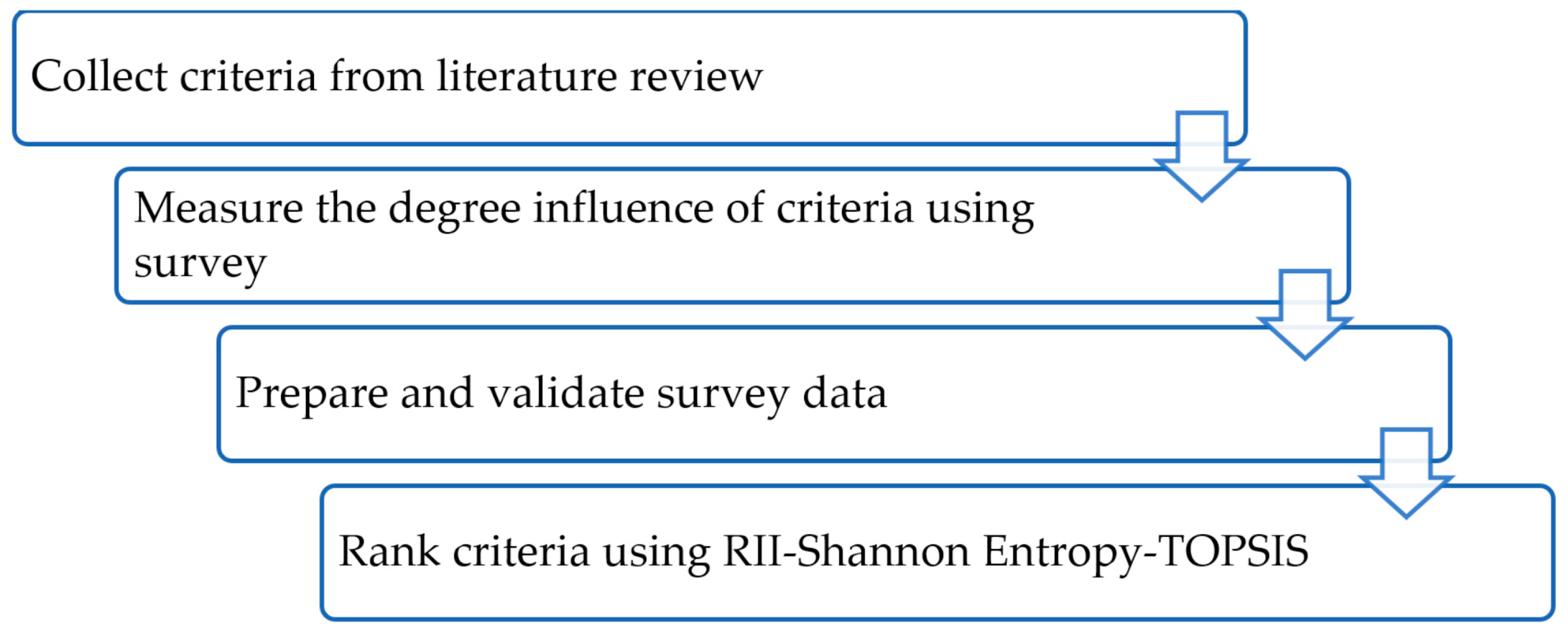
This section presents the research methodology adopted to systematically identify, quantify, and prioritize the criteria affecting the performance of engineering offices and firms in Saudi Arabian construction projects. The methodology is organized into two sequential parts that mirror the study’s two-part structure. Part I—Literature Review (Section 3.1) describes the PRISMA-compliant systematic literature review PRISMA flowchart used to derive the 29-criterion, seven-dimension framework from the extant evidence base; this part constitutes a stand-alone methodological contribution that establishes both the criterion set and the research gap addressed in the empirical phase. Part II—Practical Application (Section 3.2, Section 3.3 and Section 3.4) presents the survey design, data validation, and hybrid RII–Shannon Entropy Weighting–TOPSIS analytical pipeline applied to quantify and rank each criterion based on 288 practitioner responses. The complete four-stage sequence is illustrated in Figure 1.

3.1. Collect Criteria from Literature Review

The identification of performance criteria was conducted through a structured and reproducible systematic literature review (SLR). To structure the screening and selection process, this study adopted the PRISMA flowchart as introduced by Moher et al. [27] and updated by Page et al. [28], a four-phase diagram (Identification, Screening, Eligibility, and Included) that transparently documents the flow of records through the review. It should be noted that the full 27-item PRISMA reporting checklist was not applied, as its scope extends to clinical and epidemiological systematic reviews; only the flowchart was employed here as a procedural transparency tool appropriate for the construction management context. The search was executed across five major academic databases and research engines: (i) Web of Science (WoS), providing access to peer-reviewed journals across science and engineering disciplines; (ii) Scopus, an abstract and citation database owned by Elsevier but distinct from its ScienceDirect full-text platform, selected for its broad multidisciplinary coverage of peer-reviewed literature; (iii) Google Scholar, used to supplement database searches and capture grey literature, conference proceedings, and institutional reports; (iv) IEEE Xplore, consulted for technical standards and engineering management research; and (v) ASCE Library (American Society of Civil Engineers), providing specialist content on construction engineering and project management. The search was conducted from January 2000 to December 2023 to ensure the currency and comprehensiveness of the evidence base. Although the systematic database search was completed in December 2023, the authors have continuously monitored the literature for seminal works published up to the time of manuscript submission (2025) and confirm that no subsequent study has altered the core seven-dimension, 29-criterion framework identified in the review.
The primary search string was applied to Title, Abstract, and Keywords (TAK) fields in Web of Science, Scopus, IEEE Xplore, and ASCE Library, as these databases support structured field-specific queries. The search string was: (“engineering firm” OR “engineering office” OR “design consultant”) AND (“performance” OR “evaluation” OR “assessment” OR “prequalification”) AND (“construction project” OR “building project” OR “infrastructure”) AND (“criteria” OR “factors” OR “indicators” OR “attributes”). Context-specific terms (“Saudi Arabia”, “GCC construction”, “contractor classification”, “engineering consultancy performance”) were incorporated into the same Boolean string as additional AND-linked qualifiers rather than as separate searches, ensuring consistency across databases. The search was not deviated from this string across any of the four structured databases.
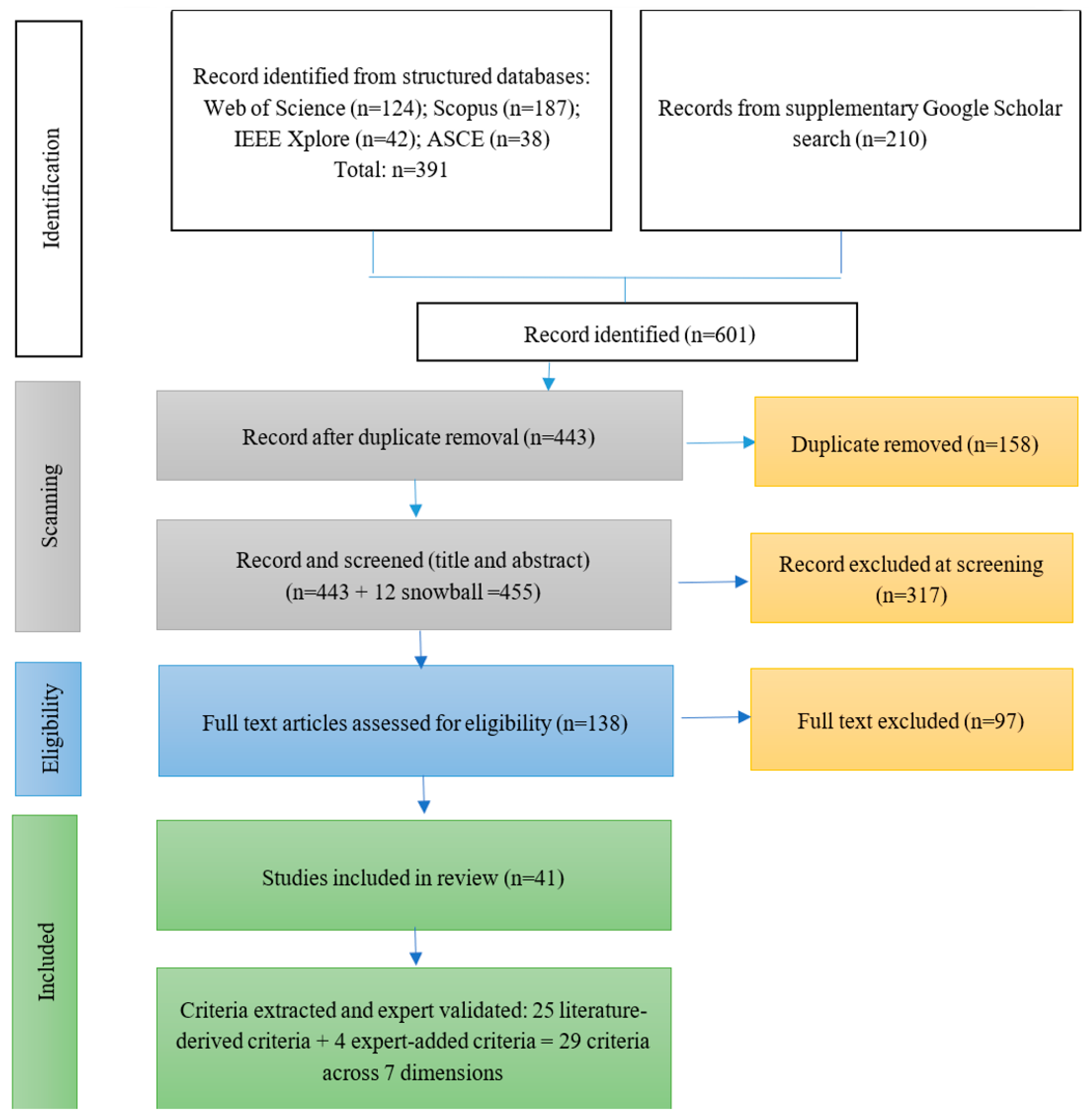
Google Scholar does not support field-level (TAK) queries or Boolean syntax in the same structured manner. It was therefore used exclusively as a supplementary source to identify grey literature, institutional reports, and conference proceedings not indexed in the four primary databases, not as a primary source for peer-reviewed articles. Searches in Google Scholar were conducted using plain-language variations of the same keyword clusters, and only records satisfying all inclusion criteria during full-text screening were retained. According to Figure 2, the initial database searches yielded the following record counts before any filtering: Web of Science (n = 124), Scopus (n = 187), IEEE Xplore (n = 42), ASCE Library (n = 38), and Google Scholar supplementary search (n = 210), for a total of 601 records identified. After removal of 158 duplicates, 443 unique records proceeded to title and abstract screening. These figures are reported transparently in the PRISMA flowchart accompanying this section. Forward and backward citation tracking (snowballing) was applied to high-relevance retained articles to identify any further eligible sources not captured by the database searches, yielding 12 additional records.
To ensure methodological rigor and reproducibility, explicit inclusion and exclusion criteria were established a priori before commencing the review. Inclusion criteria were defined as follows: studies published in peer-reviewed journals, conference proceedings, or official technical reports; studies published in the English language; studies published between January 2000 and December 2023; studies that explicitly identify, measure, or evaluate performance criteria, success factors, or evaluation indicators for engineering firms, design consultants, or contractors operating in the construction industry; studies employing primary data collection through surveys, interviews, or case studies, or secondary data analysis through systematic reviews or meta-analyses; and studies focusing on construction projects in developing or emerging economies, the Middle East, the Gulf Cooperation Council (GCC) region, or studies with transferable findings to these contexts.
Exclusion criteria were applied as follows: studies published before January 2000, as the construction industry regulatory environment and engineering firm evaluation practices have evolved substantially since that period; studies written in languages other than English, due to translation reliability constraints; studies focused exclusively on residential or small-scale construction projects with no relevance to engineering firm evaluation; studies addressing contractor performance in manufacturing, oil and gas, or non-construction industrial sectors with no transferable construction-management implications; editorial commentaries, opinion pieces, book reviews, and non-peer-reviewed publications lacking empirical data; duplicate publications and studies where full text could not be retrieved; and studies that discuss project performance or client satisfaction exclusively from the owner or end-user perspective, without reference to the engineering firm or consultant as an evaluated entity.
The filtering procedure followed the four phases of the PRISMA flowchart: Identification, Screening, Eligibility, and Inclusion. In the Identification phase, all records retrieved from the five sources were compiled and deduplicated. In the Screening phase, titles and abstracts of all unique records were independently assessed against the inclusion and exclusion criteria; records clearly outside the scope were excluded at this stage. In the Eligibility phase, the full text of all remaining records was retrieved and reviewed in detail against all criteria; records failing any criterion were excluded with a documented reason. In the Inclusion phase, data extraction was performed on all eligible studies: performance criteria cited in each retained study were systematically extracted, cataloged, and mapped to the seven principal dimensions. Criteria appearing in three or more independent studies were retained for the questionnaire instrument, yielding 25 literature-derived criteria. These were subsequently reviewed by nine engineering consulting experts (each with at least 10 years of experience), whose input identified four additional criteria not captured by the database search, bringing the total to 29. Specifically, extracted criteria were first listed verbatim, then semantically grouped by thematic similarity, and finally labeled under seven dimensions through consensus among the research team. Criteria were retained only when they appeared in at least one independent study. The resulting framework, presented in Table 1, represents the primary output of Part I and simultaneously defines the scope of the empirical instrument in Part II.
A total of 29 performance criteria, grouped under seven principal dimensions, were identified from the extant literature on engineering firm evaluation, contractor prequalification, and construction project performance, as shown in Table 1. The dimensions are: (i) Staff Performance Indicators (SPI), capturing human-resource-related attributes such as supervisory experience, engineers’ capability, and staff harmony; (ii) Firm Performance Indicators (FPI), encompassing organizational attributes including licensing, indemnity insurance, and bidding competence; (iii) Project Track Record (PRJ), reflecting historical project delivery performance; (iv) Firm Attributes (FAT), covering physical and infrastructure factors; (v) Quality Indicators (QTY), measuring quality management and client satisfaction; (vi) Alliance and Sub-Contracting Indicators (ALLC), capturing partnership and sub-contracting arrangements; and (vii) Financial Performance (FIN). These criteria were operationalized as closed-ended items on a five-point Likert scale (1 = Not important; 2 = Slightly important; 3 = Moderately important; 4 = Important; 5 = Very important), consistent with established practice in construction management research.

3.2. Measure the Degree of Influence of the Criteria Using a Survey

The questionnaire instrument was developed in two stages. First, a pilot study involving nine subject-matter experts in Saudi construction project management was conducted to validate content validity and clarity of item wording. Second, the refined instrument was distributed to a target sample of professionals with direct experience in evaluating, managing, or supervising engineering offices and firms in the Kingdom of Saudi Arabia. The questionnaire consisted of two parts. The first part contains the participant’s demographic information. The second part was to assess the importance of the 29 factors that may influence an engineering firm’s performance. The final dataset comprised n = 288 complete and valid responses after data cleaning and treatment of missing values. Respondents represented a range of job roles and employer types, encompassing both public-sector clients and private-sector engineering firms, with experience levels spanning project management, bidding, and general practice. A total of 288 valid responses were collected. Respondents are categorized across three demographic variables: job title (5 categories), employer type (5 categories), and years of experience (continuous, ranging from 0 to 44 years; mean ≈ 20 years). The purpose of Table 2 is to provide a transparent profile of the survey sample, demonstrating that the 288 respondents represent a balanced cross-section of job roles (from site engineers to directors) and employer types (government, semi-government, private, mixed, and other). This demographic diversity is essential for ensuring that the subsequent RII–Entropy–TOPSIS ranking reflects a broad spectrum of practitioner perspectives rather than a single stakeholder group.
As shown in Table 2, project managers (36.8%) and directors (26.7%) constitute the majority of respondents, indicating that the dataset captures input from senior decision-makers directly involved in engineering firm evaluation and procurement. The near-equal distribution between government (31.9%) and private (37.8%) sector respondents further ensures that the resulting criterion weightings are not biased toward either client or contractor perspectives. To support transparency and reproducibility, the research ethics approval form and the questionnaire instrument used for data collection are provided as Supplementary Material (File S1).

3.3. Prepare and Validate Data in Terms of Sample Size and Reliability Data

3.3.1. Variable Coding

Before analysis, all collected questionnaire responses were systematically coded into a structured numerical dataset to facilitate reliable computation and reproducibility. Each of the 29 performance criteria was assigned a unique alphanumeric code corresponding to its dimensional group and sequential position within that group (e.g., SPI-1 through SPI-6 for Staff Performance Indicators; FAT-1 through FAT-6 for Firm Attributes; PRJ-1 through PRJ-5 for Project Track Record; FPI-1 through FPI-7 for Firm Performance Indicators; QTY-1 and QTY-2 for Quality Indicators; ALN-1 and ALN-2 for Alliance and Sub-Contracting Indicators; and FIN-1 for Financial Performance). Likert-scale responses were retained in their original ordinal form (1 = Not important; 2 = Slightly important; 3 = Moderately important; 4 = Important; 5 = Very important) without further transformation. Categorical demographic variables were coded as nominal integers: job title (1 = Engineer; 2 = Project Manager; 3 = Site Engineer; 4 = Director; 5 = Consultant) and employer type (1 = Government; 2 = Semi-Government; 3 = Private; 4 = Mixed; 5 = Other). All coded data were entered into SPSS v.26 and cross-validated in Microsoft Excel before analysis.

3.3.2. Missing Data Treatment

An initial screening of the raw dataset identified incomplete responses that required systematic treatment before proceeding with reliability assessment and multi-criteria analysis. A three-stage approach was adopted, consistent with recommended practice in construction management survey research [47]. In the first stage, questionnaires exhibiting more than 20% item non-response (i.e., six or more criteria left unanswered) were classified as substantially incomplete and excluded from all analyses via listwise deletion, ensuring that the analytical dataset was free from severely underpopulated response records. In the second stage, questionnaires exhibiting sporadic item non-response (fewer than six missing values distributed across different dimensional groups) were treated using within-dimension mean imputation. Each missing item was replaced with the mean Likert-scale score of all valid items within the same dimensional sub-scale for that respondent, thereby preserving the within-respondent response profile while minimizing distortion of the aggregate distribution. In the third stage, isolated single-item non-responses that could not be attributed to a specific dimensional cluster were replaced with the column-wise grand mean of the corresponding criterion across all valid respondents as a conservative neutral substitute. After applying these three stages, 17 questionnaires were excluded due to substantial incompleteness, and 12 isolated missing values were imputed using dimension-level means, yielding a clean dataset of n = 288 complete and valid responses used in all subsequent analyses.
Assessment of Imputation Effects on Entropy Weighting
Missing-data imputation can affect entropy-weight calculations, as imputed values may artificially reduce response variability, leading to systematically lower entropy weights for criteria with higher rates of missingness [48]. To assess this concern, three diagnostic checks were conducted.
Only 12 isolated missing values were imputed out of 8352 possible responses (29 criteria × 288 respondents), yielding a missingness rate of 0.14%—well below the 5% threshold considered acceptable for mean imputation [49]. The 12 imputed values were distributed across nine criteria, with no single criterion accounting for more than two imputed values. Within-dimension mean imputation was chosen specifically to preserve within-respondent variability, replacing missing values with the respondent’s mean score across other items in the same dimensional sub-scale. This approach avoids the artificial compression of variability that would result from column-mean imputation. Based on these diagnostics, the missing-data treatment introduced no material bias into the entropy weighting or the subsequent TOPSIS ranking.

3.3.3. Validate the Sample Size

Determining the minimum required sample size for survey-based research depends primarily on the statistical parameter of interest. In this study, the fundamental analytical unit is the mean Likert-scale rating for each criterion, which serves as the basis for calculating the RII. The RII is derived using the relationship RII = mean/5.
The sample size requirement for mean estimation is governed by the Central Limit Theorem (CLT). The CLT asserts that for a sufficiently large sample (typically n ≥ 30), the sampling distribution of the mean will approximate a normal distribution, regardless of the underlying population’s distribution. To achieve a specific margin of error around the estimated mean at a designated confidence level, the minimum sample size ( n 0 ) is determined by Equation (1) [50].
n 0 = Z × σ d 2
where n0 is the minimum sample size, Z is the standard normal deviate corresponding to the chosen confidence level, σ is the estimated population standard deviation, and d is the acceptable margin of error. Based on the pilot study data (n = 15), the standard deviation of ratings across all 29 criteria ranges from 0.99 to 1.23, with a conservative upper bound of σ = 1.3 . Setting d = 0.15, smaller than the minimum meaningful difference of 0.20 scale points reported in construction management research, the n 0 . It is about 288. Thus, the achieved sample size of n = 288 is precisely the calculated requirement for a 95% confidence interval half-width of 0.15 scale points.

3.3.4. Validate Data Reliability

Internal consistency was assessed using Cronbach’s alpha (α) for each dimensional sub-scale and for the full 29-item instrument. Values above 0.70 are considered acceptable for exploratory research, above 0.80 are good, and above 0.90 are excellent [51,52]. Table 3 reports the results. All six sub-scales exceed the 0.70 acceptability threshold. The overall Cronbach’s alpha of 0.936 for the full 29-item instrument confirms excellent internal consistency across the entire questionnaire. These results should be reported in the paper’s methodology section to substantiate instrument quality. It should be noted that the finance (FIN) dimension had only one factor, and Cronbach’s alpha cannot be computed for this dimension.
As shown in Table 3, all six dimensional sub-scales exceed the acceptable threshold of α = 0.70, with the Staff Performance Indicators (SPI) and Firm Performance Indicators (FPI) dimensions achieving “good” reliability (α = 0.834 and 0.801, respectively). The overall instrument Cronbach’s α of 0.936, which is classified as “excellent,” confirms that the 29 criteria collectively form a cohesive measurement instrument. These values justify the aggregation of individual criterion ratings into the composite analytical pipeline (RII–Entropy–TOPSIS) reported in Section 3.4. The Finance (FIN) dimension, consisting of a single criterion (Financial Performance), is excluded from Cronbach’s alpha calculation because internal consistency requires at least two items

3.4. Assess and Rank Criteria Using RII–Shannon Entropy–TOPSIS

The fourth and final step of the methodology concerns the quantitative assessment and prioritization of the 29 identified performance criteria. A three-stage hybrid analytical pipeline is applied: (i) the Relative Importance Index (RII) is first computed to capture the subjective expert-perceived importance of each criterion based on the aggregated Likert-scale responses; (ii) Shannon Entropy Weighting is subsequently applied to derive objective, distribution-based criterion weights that reflect the informational discriminatory power of the observed response patterns; and (iii) the composite RII-Entropy weights are then used to perform a TOPSIS (Technique for Order of Preference by Similarity to Ideal Solution) multi-criteria ranking, yielding a final Composite Priority Index (CPI) that integrates both dimensions of importance. This hybrid approach is justified on methodological grounds, as Chen [8] has demonstrated that combining subjective expert judgment with objective statistical weighting is effective to produce rankings with greater inter-criterion differentiation and reduced sensitivity to ceiling effects than either approach applied in isolation. The following sub-sections describe each stage of the pipeline in detail.

3.4.1. Compute RII for Each Criterion

The RII is computed using the standard formula shown in Equation (2), as widely applied in construction management research by Al Khatib et al. [53], Boakye et al. [54], and Dixit et al. [55]. The RII provides a normalized score in the range [0, 1] for each criterion, where a value approaching 1 indicates that a criterion was consistently rated as “Very important” by all respondents, and a value approaching 0 indicates uniform assignment of the lowest importance rating. This index has been widely adopted in research on construction management and engineering consultancy performance as a straightforward, transparent, and easily interpretable measure of respondents’ rated importance. In the present study, each of the 29 criteria is assigned an RII value computed from the full sample of n = 288 valid responses. The resulting RII scores form the subjective importance component of the subsequent composite weight calculation described in Section 3.4.3.
R I I = w . n ¯ A · N
where w is the weighting (1–5), n ¯ is the frequency of each response, A is the highest weight (5), and N is the total number of respondents (288).

3.4.2. Perform Shannon Entropy Weighting

Shannon entropy was originally developed in information theory [56] and subsequently adapted for MCDM applications [57,58]. It provides an objective mechanism for deriving criterion weights directly from the observed response distribution, independent of decision-maker subjectivity. A criterion whose responses are widely dispersed across the Likert scale conveys greater informational differentiation and thus receives a higher entropy weight. In the context of the present study, this property is particularly valuable because it counterbalances potential “ceiling effects” in the RII scores—criteria that are rated uniformly high by all respondents (low variability, high entropy value) carry less discriminatory power and therefore receive a lower entropy-derived weight. In comparison, criteria with greater inter-respondent variability receive a correspondingly higher weight. This ensures that the analytical framework is sensitive not only to mean importance ratings but also to the distributional structure of those ratings across the sample of 288 professionals.
Let the decision matrix be X = [xij] of dimension (m × n), where m = 288 respondents and n = 29 criteria, the subscript I always refers to the respondent (i = 1, 2, 3,…, m) and the subscript j always refers to the criterion (j = 1, 2, 3, …, n). The entropy-based weighting procedure comprises four sub-steps:
  • Proportion Matrix was calculated as: Each column was summed ( i = 1 m x i j ). Then, each element of the decision matrix (xᵢ) is normalized by Σᵢ xᵢⱼ as shown in Equation (3) and obtain a proportion matrix
P i j = x i j i = 1 m x i j
2.
Entropy value (Eⱼ) can be computed for each column (criterion) in Equation (4), the constant (1/ln m) ensures 0 ≤ Eⱼ ≤ 1. If p i j = 0, then p i j × L n   p i j = 0.
E j = 1 l n   m × i = 1 m p i j × l n   p i j
3.
The degree of divergence of each column (dj) can be computed in Equation (5)
d j = 1 E j
4.
Entropy weight of each column ( w j e ) is calculated by normalizing the divergence values to obtain the criterion weight as shown in Equation (6).
w j e = d j j = 1 n d j
Entropy weights are inversely related to a criterion’s entropy: when respondents systematically agree on a criterion’s importance (low dispersion, high entropy), the criterion carries less discriminatory power and hence receives a lower entropy weight, whereas a criterion with high response heterogeneity receives a higher weight [58].

3.4.3. Compute Composite Weight Derivation

To integrate both the subjective expert-perceived importance (captured by RII) and the objective distributional information content (captured by Entropy), a composite weight is derived for each criterion through equal-proportion linear aggregation, as shown in Equation (7). This composite weighting strategy is grounded in the recognition that neither the RII nor the Entropy weight alone provides a complete picture of criterion importance: the RII reflects the consensus of expert opinion but may be susceptible to social desirability bias and uniform rating tendencies, whereas the Entropy weight captures the heterogeneity of responses but is blind to the direction or magnitude of perceived importance. Their linear combination at equal proportions (0.5 each) therefore provides a balanced, methodologically transparent synthesis of both perspectives. The equal-weighting coefficient (0.5) reflects a deliberate epistemic stance of equal trust in subjective and objective information sources. The composite weights w j c thus computed are subsequently used as inputs to the TOPSIS procedure described in Section 3.4.4.
w j c = 0.5 × R I I j j = 1 n R I I j + 0.5 × w j e
where R I I ¯ j is the normalized RII value of criterion j and can be computed as ( R I I ¯ j = RIIj/ j = 1 n R I I j ). The equal-weighting coefficient (α = 0.5) is not an arbitrary default but reflects a principled application of the principle of insufficient reason: since RII and Entropy Weight are incommensurable, quantifying the direction of expert consensus and the informational variability of responses respectively, no empirical basis exists for privileging one over the other, and any unequal split would introduce a stronger subjective assumption than equal weighting itself.

3.4.4. Perform TOPSIS Multi-Criteria Ranking

In its classical formulation, TOPSIS ranks alternatives against a fixed set of weighted criteria. However, a well-established methodological extension—demonstrated by Kacprzak [59], who explicitly transforms decision matrices into criteria matrices within a TOPSIS–Entropy GDM framework—supported by analogous criterion-ranking applications in qualification assessment [60] and heterogeneous group decision making [61], repositions criteria themselves as the alternatives to be ranked, with respondents providing the evaluative dimension. In the present study, this transposed configuration is adopted: the decision matrix is formed with 288 respondents as rows and 29 criteria as columns, so that each criterion’s importance rating profile across all respondents constitutes its performance vector. TOPSIS then ranks each criterion by its geometric proximity to the positive ideal solution, a uniformly “Very important” rating across all respondents, and its distance from the negative ideal, yielding the Composite Priority Index (CPI) reported in Figure 2. This application is methodologically legitimate, structurally well-defined, and directly supported by published precedent in the MCDM literature [59,60,61]. Unlike simpler ranking methods, TOPSIS simultaneously accounts for proximity to the best achievable rating pattern and distance from the worst, thereby producing a single scalar index (the Composite Priority Index, CPI) that encodes both the level and consistency of perceived importance across all respondents [62]. This renders the TOPSIS-based ranking particularly appropriate for contexts in which criteria must be compared across multiple decision-maker profiles, since the geometric distance measures are robust to heterogeneous response distributions. All six sub-steps of the TOPSIS procedure as applied here are detailed below.
The decision matrix was normalized as shown in Equation (8)
r i j = x i j i = 1 m x i j 2
The weighted normalized matrix was computed using wⱼᶜ as shown in Equation (9).
v i j = w j c × r i j
By considering all criteria as benefits, the positive and negative ideal solutions were computed in Equations (10) and (11), respectively.
A + = m a x j   ν i j ,               j       P o s i t i v e   I d e a l   S o l u t i o n
A = m i n j   ν i j ,               j       N e g a t i v e   I d e a l   S o l u t i o n
Separation measures (Sⱼ+), (Sⱼ) are computed using Equations (12) and (13).
S j + = i = 1 m V i j A i + 2
S j = i = 1 m V i j A i 2
The composite priority index (TOPSIS closeness coefficient) can be computed using the Equation (14).
C P I j = S j S j + + S j
CPI values range from 0 to 1, with higher values indicating criteria that are more important and more consistent with the positive ideal response pattern. Criteria are subsequently ranked in descending order of CPI to produce the final prioritized list [63].

4. Results and Discussion

This section presents the results of the study’s practical application (Part II). The 29 criteria and seven-dimensional structure reported here were derived from the literature review (Part I, Section 2 and Section 3.1); the analysis that follows quantifies and ranks those criteria using data collected from 288 Saudi construction professionals through the hybrid RII–EWM–TOPSIS pipeline described in Section 3.2, Section 3.3 and Section 3.4. Results are reported first at the overall criterion level (Section 4.1), then at the dimension level (Section 4.2), and finally through a methodological trade-off analysis (Section 4.3) that validates the integration of both study parts.

4.1. Literature Review Results (RQ1)

The PRISMA-compliant systematic literature review, conducted across five databases and yielding 601 records before filtering, produced a consensus-based framework of 29 performance criteria distributed across seven dimensions (Table 1). This framework directly answers RQ1 and represents a standalone contribution of Part I: it is the first empirically grounded, multidimensional criterion set tailored to the evaluation context of Saudi Arabian engineering firms, derived through a reproducible, transparent review PRISMA flowchart. Three substantive gaps were identified from this review and are carried forward as the motivating rationale for Part II: (i) the absence of a Saudi-specific validated criterion framework; (ii) the exclusive reliance on single-method ranking approaches in the existing literature; and (iii) the failure of prior studies to evaluate all relevant performance dimensions within a single unified instrument. The empirical results reported in Section 4.2, Section 4.3 and Section 4.4 directly address these gaps.

4.2. Overall CPI Ranking of Performance Criteria

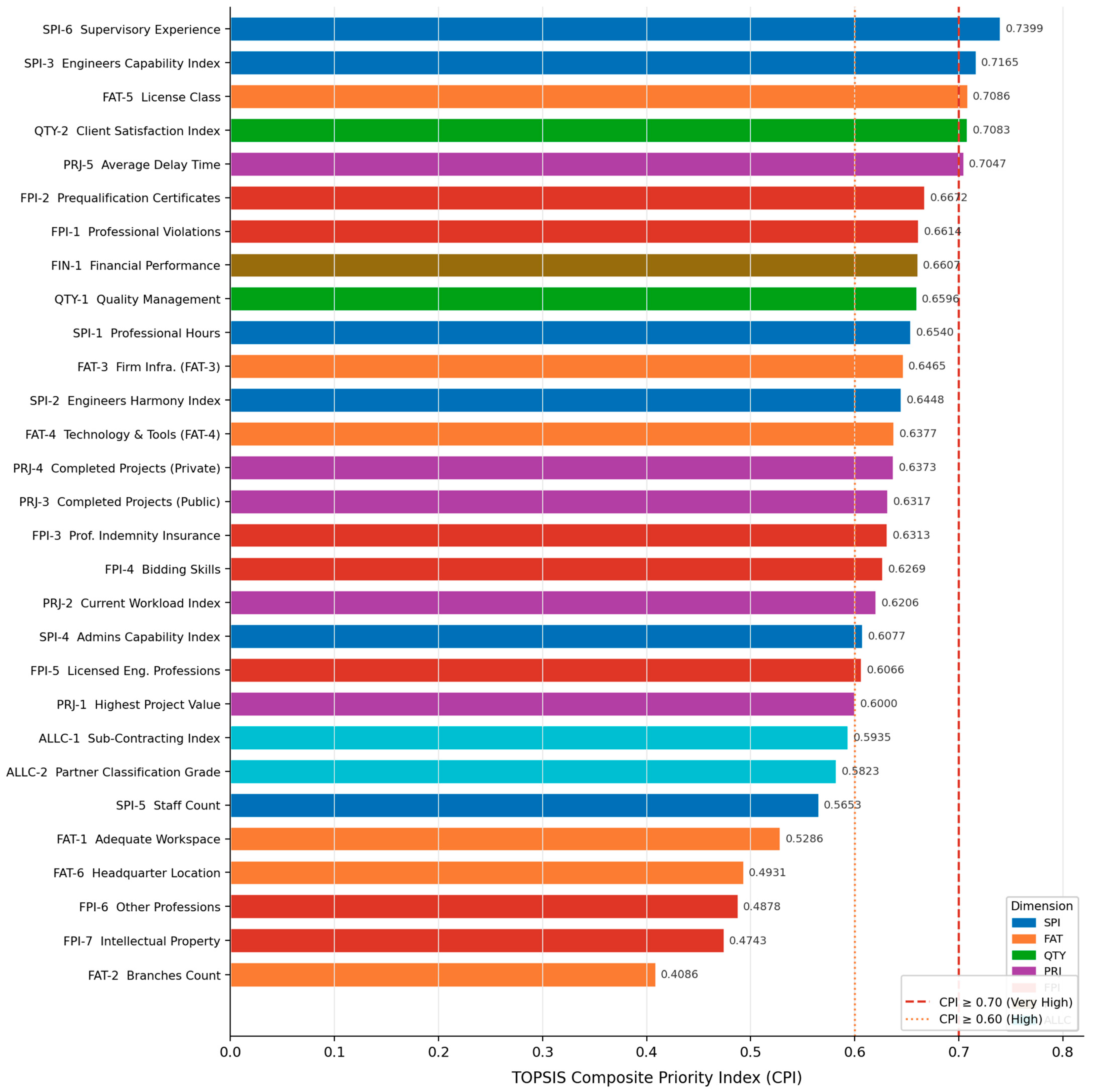
Figure 3 presents the complete CPI ranking of all 29 performance criteria in descending order, color-coded by dimension. The CPI scores range from 0.7399 (Supervisory Experience, rank 1) to 0.4086 (Branches Count, rank 29), spanning approximately 0.33 units, indicating meaningful and statistically defensible differentiation across the criterion set [25,58]. Five criteria achieved, with their CPI more than 0.70, and are classified as Very High Priority: Supervisory Experience (SPI-6, CPI = 0.7399), Engineers Capability Index (SPI-3, CPI = 0.7165), License Class (FAT-5, CPI = 0.7086), Client Satisfaction Index (QTY-2, CPI = 0.7083), and Average Delay Time (PRJ-5, CPI = 0.7047). A further 16 criteria cluster in the CPI range from 0.60 to 0.70, constituting a High Priority group that collectively defines the core competency profile expected of engineering firms in Saudi construction projects. Eight criteria fall below CPI of 0.60, indicating moderate-to-low differentiation in the eyes of practitioners. Table displays R I I ¯ ,   w e ,   w c , and CPI for the 29 criteria. The criteria were ranked based on CPI. In addition, the summation of R I I ¯ ,   w e ,   and   w c is equal to the unit, as shown in Table 4.
Figure 2 reveals that the five Very High Priority criteria (CPI > 0.70) span four different dimensions, SPI, FAT, QTY, and PRJ, indicating that no single dimension monopolizes top performance importance; rather, procurement evaluation systems must draw from multiple domains simultaneously. The concentration of 16 criteria in the narrow High Priority band (0.60–0.70) further suggests that practitioners perceive a broad core of competencies as similarly important, with genuine discriminatory power concentrated at the extremes of the ranking. This distributional pattern validates the choice of a composite analytical method capable of differentiating within densely clustered score ranges, which a single-method approach, such as RII alone, would fail to resolve.

4.3. Dimension-Level Analysis

4.3.1. Staff Performance Indicators (SPI)

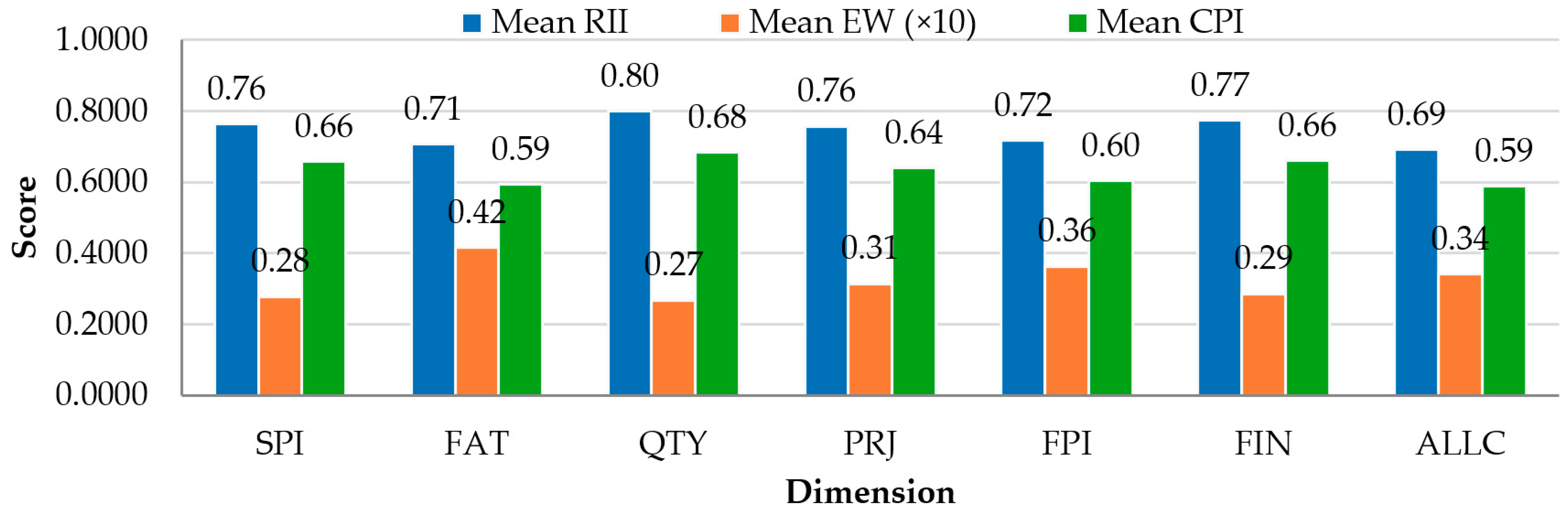
The SPI dimension had the highest mean CPI among multi-item dimensions (0.667), as shown in Figure 3 and Figure 4. Within the SPI dimension, Supervisory Experience (SPI-6) ranked first overall (CPI = 0.7399, RII = 0.860), confirming that experienced site supervision is perceived as the single most critical differentiating attribute of an engineering firm. Engineers Capability Index (SPI-3) ranked second (CPI = 0.7165, RII = 0.835). Personnel capability and supervisory leadership are recognized as critical success factors (CSFs) for engineering consultants in Saudi Arabia’s construction industry. Competency and capability of key personnel, including consultants, rank highly among factors influencing project success, emphasizing the importance of skilled human resources in project delivery [10,64]. The relatively lower rankings of Staff Count (SPI-5, rank 24, CPI = 0.565) and Admins Capability (SPI-4, rank 19, CPI = 0.608) suggest that practitioners attach greater importance to the quality of staff (supervisory experience and engineering competence) than to headcount. This finding aligns with Acheamfour’s [13] systematic review, which highlights that contractor selection emphasizes personnel quality rather than quantity.

4.3.2. Firm Attributes (FAT)

The FAT dimension showed the widest internal dispersion of any dimension, with CPI scores ranging from 0.709 (License Class, rank 3) to 0.409 (Branches Count, rank 29). License Class (FAT-5) ranked third overall, reflecting the regulatory importance of engineering firm classification in Saudi Arabia’s Contractor Classification System administered by the Ministry of Municipal and Rural Affairs. This high ranking underscores the legal importance of engineering firm classification as a binding prequalification criterion in public-sector contracts [5]. However, studies reveal that current CCSs do not accurately reflect contractors’ actual capabilities and performance, with issues such as a lack of performance feedback, system complexity, and high resource demands limiting their effectiveness [65]. By contrast, Branches Count (FAT-2) ranked last of all 29 criteria (CPI = 0.409), and Headquarter Location (FAT-6, rank 26, CPI = 0.493) also registered below-average importance. These results suggest that practitioners in the contemporary Saudi construction market prioritize regulatory standing and technological capability over physical geographic footprint, possibly reflecting the increased adoption of remote project management tools and the spatial integration of the Saudi construction market under Vision 2030 infrastructure programs.

4.3.3. Quality Indicators (QTY)

Both quality criteria achieved Very High or near-Very High Priority: Client Satisfaction Index (QTY-2) ranked fourth (CPI = 0.7083), and Quality Management (QTY-1) ranked ninth (CPI = 0.660). The high CPI scores for the QTY dimension (mean CPI = 0.684, the highest of all dimensions) are consistent with the growing emphasis on quality assurance frameworks in Saudi construction projects following large-scale infrastructure investments. Chan et al. [66] and Cheung et al. [20] identified client satisfaction and quality management systems as primary performance differentiators in construction firm evaluation, and the present study confirms their continued salience in the Saudi context. The finding that QTY-2 outranks QTY-1 implies that practitioners weigh the outcome of quality practices—client satisfaction—above the process of quality management systems, a nuance that procurement authorities should factor into engineering firm evaluation rubrics.

4.3.4. Project Track Record (PRJ)

Within the PRJ dimension, Average Delay Time (PRJ-5) ranked fifth overall (CPI = 0.705), the only PRJ criterion to breach the Very High Priority threshold. This reflects the persistent concern with schedule performance in Saudi construction projects, as documented extensively in the literature [7]. Completed Projects (Private Sector) ranked 14th (CPI = 0.637) and Completed Projects (Public Sector) ranked 15th (CPI = 0.632), suggesting that demonstrated experience in both sectors is valued approximately equally. Highest Project Value (PRJ-1) ranked 21st (CPI = 0.600), indicating that the sheer financial scale of previous projects is considered less diagnostic of future performance than delivery consistency and delay management. This contrasts with Alshamrani’s [15] findings, which reported that project value has historically been used as a primary prequalification filter in Saudi public works contracting. However, recent studies on procurement practices in Saudi Arabia suggest a potential shift toward more performance-oriented evaluation approaches [67].

4.3.5. Firm Performance Indicators (FPI)

The FPI dimension contains the widest range of CPI scores across its seven criteria: from Prequalification Certificates (FPI-2, rank 6, CPI = 0.667) to Intellectual Property (FPI-7, rank 28, CPI = 0.474). Professional Violations (FPI-1) ranked seventh (CPI = 0.661) and Prequalification Certificates (FPI-2) ranked sixth (CPI = 0.667), together forming the compliance and regulatory compliance cluster within FPI. The high relative importance of professional violation history aligns with the Saudi Council of Engineers’ enforcement framework, which conditions firm practicing and licensing levels on a clean disciplinary record [16,17]. Professional Indemnity Insurance (FPI-3, rank 16, CPI = 0.631) and Bidding Skills (FPI-4, rank 17, CPI = 0.627) clustered in the upper-middle range, consistent with findings [64]. The low ranking of Other Professions (FPI-6, rank 27, CPI = 0.488) and Intellectual Property (FPI-7, rank 28, CPI = 0.474) suggests that the breadth of professional disciplines and IP portfolios are not primary discriminators in the Saudi engineering firm evaluation context, likely reflecting the project-specific, specialist nature of most Saudi construction contracts.

4.3.6. Financial Performance (FIN) and Alliance Indicators (ALLC)

Financial Performance (FIN-1) ranked eighth overall (CPI = 0.661), reflecting the continued importance of financial soundness as a proxy for organizational resilience and contract delivery capacity. This is consistent with Iftikhar and Prayag [19,68]. The ALLC dimension, which comprises Sub-Contracting Index (rank 22, CPI = 0.594) and Partner Classification Grade (rank 23, CPI = 0.582), ranked below the median, indicating that sub-contracting capacity and partnership arrangements, while relevant, are not primary performance differentiators from the perspective of Saudi construction professionals. This aligns with the prevalence of single-prime contracts in Saudi public-sector procurement and the limited use of formal alliance frameworks compared to more advanced markets. Research shows that contractor–subcontractor relationships in Saudi Arabia tend to be adversarial, characterized by low trust and limited information sharing, which may hinder deeper partnerships [65].
Figure 4 reveals an important divergence between RII and Entropy Weight at the dimension level: dimensions with the highest mean RII scores, notably SPI and QTY, do not always carry the highest entropy weights, reflecting that practitioners converge strongly in their importance ratings for these dimensions, leaving limited informational variability for the entropy mechanism to capture. By contrast, dimensions such as FPI and PRJ, despite moderate mean RII scores, exhibit relatively higher entropy weights, indicating greater inter-respondent disagreement about their importance—a distributional signal that the RII alone would suppress. The CPI, integrating both signals, produces a more balanced and stable dimension-level ordering than either measure in isolation, with QTY emerging as the highest-ranked dimension precisely because it sustains both high perceived importance and meaningful response variability.
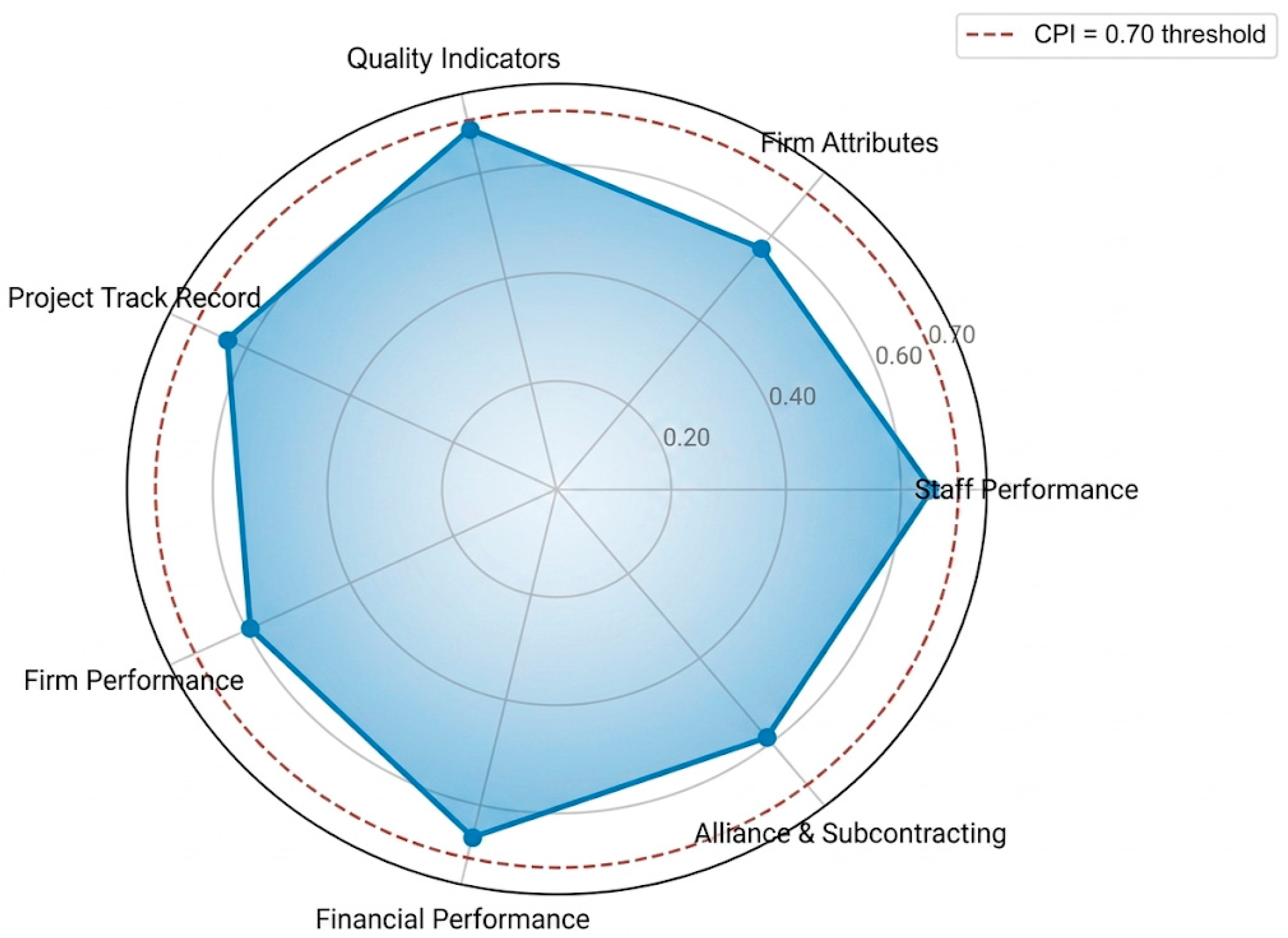
Figure 5 illustrates the mean CPI scores across all seven dimensions relative to the Very High Priority threshold (CPI = 0.70, dashed red circle). Quality indicators and staff performance approach or reach this threshold, confirming their dominant importance. Firm Attributes and Firm Performance occupy the mid-range. At the same time, Financial Performance, Project Track Record, and Alliance and Subcontracting fall notably below the threshold, reflecting their comparatively lower collective priority among Saudi construction professionals.
Figure 4 makes visually explicit what the numerical rankings confirm: the performance profile of Saudi engineering firms as perceived by practitioners is asymmetric, with human capital and quality outcomes forming a dominant apex, and physical infrastructure, alliance capacity, and financial indicators constituting a secondary tier of meaningful but less discriminating attributes. Notably, no dimension as a whole crosses the Very High Priority threshold—individual criteria within SPI, FAT, QTY, and PRJ do so, but at the dimension level, all mean CPIs remain below 0.70. This finding cautions against dimension-level aggregation in procurement scoring systems, as it would obscure the highly differentiated importance of individual criteria within each dimension, particularly within FAT—the dimension with the widest internal CPI dispersion (0.409 to 0.709).

4.4. RII–Entropy Trade-Off Analysis

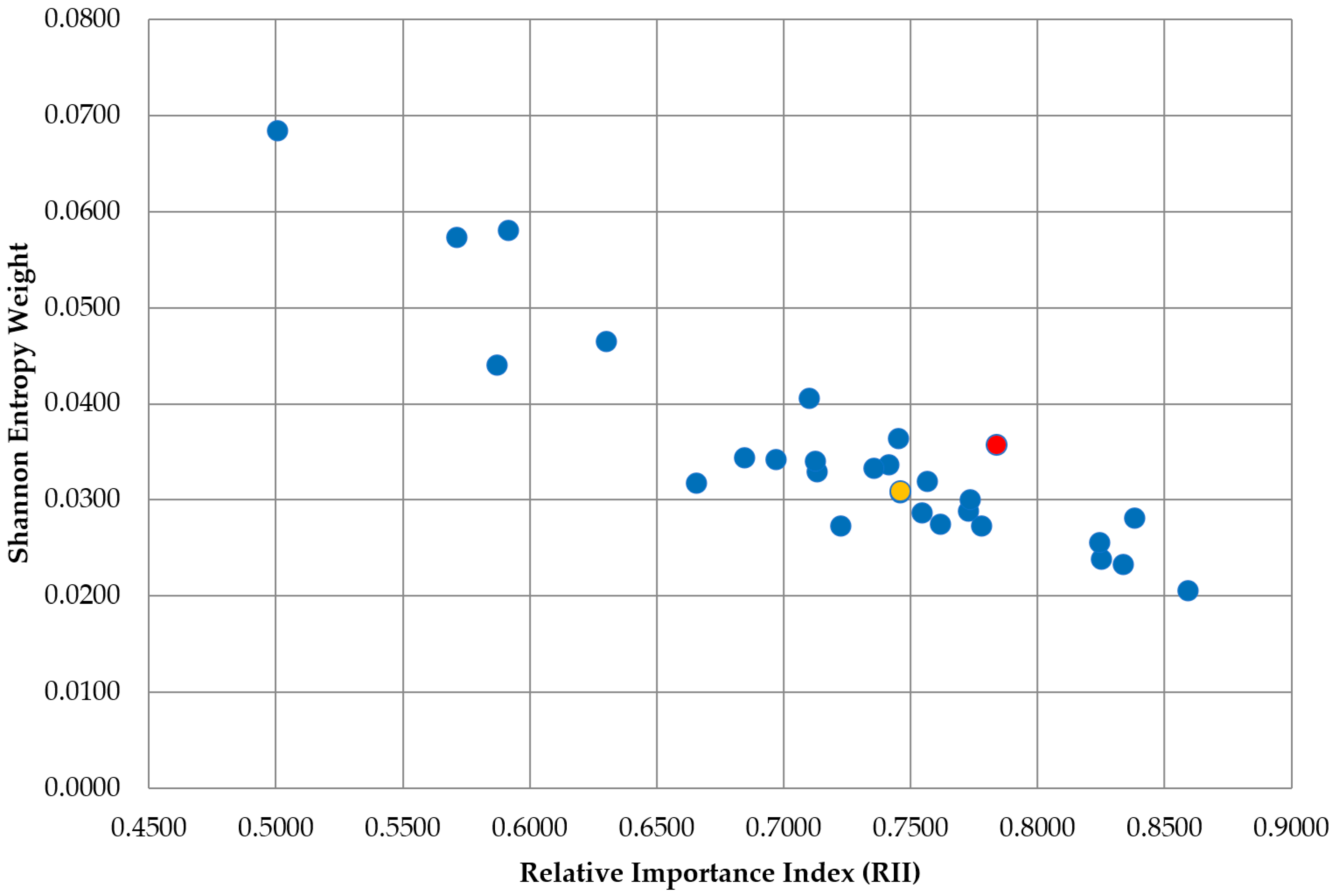
Figure 6 presents a bubble chart plotting RII against Entropy Weight for all 29 criteria, with bubble size proportional to CPI. This visualization reveals an analytically important trade-off that is obscured when only mean scores are reported. Criteria in the upper-right quadrant (high RII, high Entropy Weight) exert the greatest combined influence on the final CPI ranking, because they are both perceived as highly important and generate substantial inter-respondent disagreement, thereby carrying high informational content in the entropy computation. Professional Violations (FPI-1: RII = 0.785, EW = 0.0355; shown red circle shown in Figure 6) and Professional Indemnity Insurance (FPI-3: RII = 0.746, EW = 0.0363; shown orange circle in Figure 6) occupy this quadrant, suggesting that while practitioners broadly agree these criteria are important, there is meaningful variation in how important they are perceived to be—a distributional signature indicating genuine practitioner disagreement that RII alone would mask.
The lower-right quadrant (high RII, low Entropy Weight) contains the top-ranked criteria such as Supervisory Experience, Engineers’ Capability, and Client Satisfaction. The entropy-weight method assigns weights based on attribute data diversity, so attributes with low variability (low entropy) receive lower weights despite high importance ratings. This can cause decision-making methods like TOPSIS to place greater weight on attributes with higher data diversity, potentially skewing results if not adjusted [8]. The entropy component of the composite weight appropriately down-weights these criteria relative to pure RII ranking, preventing the final CPI from being driven entirely by consensus on obvious criteria. The lower-left quadrant (low RII, low Entropy Weight) contains Branches Count (FAT-2) and Headquarter Location (FAT-6), both rated as unimportant and eliciting near-consensus in their low ratings, resulting in the lowest CPI scores in the dataset. This quadrant identifies candidates for removal from future versions of the questionnaire instrument, as they add minimal discriminatory power. These observations collectively validate the methodological choice of combining RII with Shannon Entropy.

5. Conclusions

This study set out to address a well-documented but persistent gap in the engineering firm performance evaluation literature through a two-part design. Part I, the literature review, established that no prior study has simultaneously evaluated all relevant performance dimensions of engineering firms within a single empirically validated framework tailored to the Saudi Arabian context, applying a hybrid multi-criteria analytical approach. Through a PRISMA-compliant review of five databases, this part produced a consensus-based 29-criterion framework across seven dimensions, which itself constitutes a substantive contribution by making the gap explicit and providing the structured instrument for the empirical phase. The literature review results, a seven-dimension, 29-criterion framework derived from 601 screened records and validated by nine domain experts, thus constitute an independently reportable finding that answers RQ1 and would retain scholarly value independently of the empirical ranking that follows. Part II, the practical application, addressed that gap by administering a structured questionnaire to 288 Saudi construction professionals and applying a hybrid RII–Shannon Entropy Weighting–TOPSIS pipeline to produce a Composite Priority Index (CPI) for each criterion, yielding a stable, discriminating, and context-sensitive priority ranking directly applicable to procurement and regulatory practice in Saudi Arabian construction.
The results reveal a clear and defensible hierarchy of engineering firm performance criteria. Five criteria emerged as dominant, led by supervisory experience and engineers’ capability. A further 16 criteria clustered in the High Priority range (0.60 ≤ CPI < 0.70), collectively defining the core competency profile expected of engineering firms in Saudi construction projects. At the dimension level, the Quality Indicators dimension recorded the highest mean CPI (0.684), followed closely by the Staff Performance Indicators dimension (mean CPI = 0.667), underscoring the primacy of outcome-focused quality outcomes and human capital quality as the most critical organizational attributes. Conversely, physical geographic indicators—notably Branches Count (CPI = 0.409, rank 29) and Headquarter Location (CPI = 0.493, rank 26)—ranked lowest across all dimensions, indicating that contemporary practitioners prioritize regulatory standing and technical capability over spatial footprint, a finding consistent with the growing digitization of project management practices under Saudi Vision 2030.
The RII–Entropy trade-off analysis further validated the hybrid methodological approach. Criteria characterized by high expert-perceived importance but high response consensus—such as Supervisory Experience and Engineers’ Capability—received appropriately moderated composite weights through the entropy component, preventing the final ranking from being driven entirely by ceiling-effect criteria. Conversely, criteria exhibiting greater inter-respondent variability, such as Professional Violations and Professional Indemnity Insurance, received elevated entropy weights that captured the genuine practitioner disagreement masked by their RII scores alone. This trade-off pattern empirically confirms that neither RII nor entropy weighting alone provides a complete analytical picture, and that their integration within TOPSIS yields a priority ranking with demonstrably greater inter-criterion differentiation than either the RII or Entropy Weight baseline, as confirmed by the Spearman rank correlation analysis reported in Section 4.3 and consistent with prior evidence from Chen [8].
The practical implications of these findings are threefold. First, for procurement authorities and public-sector clients, the CPI-based ranking provides an evidence-based reference for redesigning engineering firm prequalification rubrics, with supervisory experience, technical capability, license class, and client satisfaction warranting the highest discriminatory weighting in any evaluation system. Second, for regulatory bodies such as the Saudi Council of Engineers and the Ministry of Municipal and Rural Affairs, the findings highlight the need to strengthen the Contractor Classification System by incorporating performance feedback mechanisms anchored to the highest-ranked criteria, rather than relying solely on static administrative documentation. Third, for engineering firms themselves, the seven-dimension CPI framework provides a structured self-assessment tool to benchmark strengths and prioritize capability development investments.
Notwithstanding its contributions, the study is subject to several limitations that point towards productive directions for future research. The sample, while large and professionally diverse, was drawn exclusively from Saudi Arabian construction professionals, which constrains the direct transferability of the CPI rankings to other national or regional contexts. Future studies should replicate the RII–EWM–TOPSIS framework across other GCC member states and broader developing-economy construction markets to test the cross-contextual stability of the identified priority hierarchy. Additionally, the present framework treats all seven dimensions at the same analytical level; future work could explore hierarchical or network-based MCDM models—such as the Analytic Hierarchy Process (AHP) or the Decision-Making Trial and Evaluation Laboratory (DEMATEL)—to capture inter-dimensional dependencies and feedback relationships. Longitudinal studies tracking shifts in criterion importance across different phases of Saudi Arabia’s Vision 2030 program would further enrich the evidence base and support the development of adaptive, time-sensitive evaluation frameworks.

Supplementary Materials

The following supporting information can be downloaded at: https://www.mdpi.com/article/10.3390/app16115556/s1. File S1: Research Ethics Committee approval form and questionnaire instrument used for data collection.

Author Contributions

Conceptualization, A.H.A.; Methodology, A.H.A. and N.M.A.; Software, A.H.A. and N.M.A.; Validation, K.S.A.-G. and A.A.B.M.; Formal analysis, A.H.A. and K.S.A.-G.; Investigation, A.H.A., K.S.A.-G., A.M.A. and A.A.B.M.; Resources, K.S.A.-G., A.M.A. and A.A.B.M.; Data curation, A.H.A. and K.S.A.-G.; Writing—original draft, A.H.A.; Writing—review and editing, A.H.A., K.S.A.-G., A.M.A., A.A.B.M. and N.M.A.; Visualization, A.H.A. and N.M.A.; Supervision, K.S.A.-G., A.M.A. and A.A.B.M.; Project administration, K.S.A.-G.; Funding acquisition, K.S.A.-G., A.M.A. and A.A.B.M. All authors have read and agreed to the published version of the manuscript.

Funding

The authors extend their appreciation to the Nesma and Partners’ Chair for Construction Research and Building Technologies for funding this research work.

Data Availability Statement

The data in this paper were taken from other studies, as this is a review paper. The raw data supporting the findings of this paper are available on request from the corresponding author.

Acknowledgments

The authors extend their appreciation to the Nesma and Partners’ Chair for Construction Research and Building Technologies for funding this research work. During the preparation of this manuscript, the authors used ChatGPT 5 (Core model) to assist with English language refinement. The authors have reviewed and edited the output and take full responsibility for the content of this publication.

Conflicts of Interest

The authors declare no conflicts of interest, financial or otherwise.

References

  1. Al Hadri, F.; Hidayat, B.; Istijono, B. Interrelation of Design Performance to Construction Performance. CIVED (J. Civ. Eng. Vocat. Educ.) 2024, 11, 480–494. [Google Scholar] [CrossRef]
  2. Druzhynin, M.; Ivanyna, O.; Kolomiiets, V.; Bubon, S. Functional coordination of the activities of consulting and engineering companies with the main stakeholders of a construction development project. Ways Improv. Constr. Effic. 2025, 1, 217–229. [Google Scholar] [CrossRef]
  3. Chatterjee, P.K.; Chatterjee, P.P. Engineering Consultant’s Contractual Obligations. In Marketing of Engineering Consultancy Services: A Global Perspective; ASME Press: New York, NY, USA, 2019. [Google Scholar] [CrossRef]
  4. Kabirifar, K.; Mojtahedi, M. The impact of Engineering, Procurement and Construction (EPC) Phases on Project Performance: A Case of Large-scale Residential Construction Project. Buildings 2019, 9, 15. [Google Scholar] [CrossRef]
  5. Alsugair, A.; Abuthnain, M. Assessment of Government Contractor Classification System in Saudi Arabia. Adv. Mater. Res. 2011, 250, 345–355. [Google Scholar] [CrossRef]
  6. Almutairi, S.; Kashiwagi, D.; Kashiwagi, J.; Algahtany, M.; Sullivan, K. Procedures and Issues within the Contractors Classification System in Saudi Arabia. J. Adv. Perform. Inf. Value 2020, 9, 79–85. [Google Scholar] [CrossRef]
  7. Assaf, S.A.; Al-Hejji, S. Causes of delay in large construction projects. Int. J. Proj. Manag. 2006, 24, 349–357. [Google Scholar] [CrossRef]
  8. Chen, P. Effects of the entropy weight on TOPSIS. Expert Syst. Appl. 2020, 168, 114186. [Google Scholar] [CrossRef]
  9. Moradi, S.; Ansari, R.; Taherkhani, R. A systematic analysis of construction performance management. Iran. J. Sci. Technol. Trans. Civ. Eng. 2022, 46, 15–31. [Google Scholar] [CrossRef]
  10. Mathar, H.; Assaf, S.; Hassanain, M.; Abdallah, A.; Sayed, A. Critical success factors for construction projects. Built Environ. Proj. Asset Manag. 2020, 10, 349–367. [Google Scholar] [CrossRef]
  11. Kapote, M.M.; Wagh, A.A.; Pimplikar, S.S. Contractor Selection Approaches and Pre-Qualification Criteria on Construction Projects: A Review. In Proceedings of the National Conference on Advances in Construction Materials and Management; Springer: Singapore, 2022; pp. 27–40. [Google Scholar]
  12. Wang, Q.; Zuo, W.; Li, Q. Engineering harmony under constraints. J. Civ. Eng. Manag. 2020, 26, 131–146. [Google Scholar] [CrossRef]
  13. Acheamfour, V.K.; Adjei-Kumi, T.; Kissi, E. Contractor selection: A review of qualification and pre-qualification systems. Int. J. Constr. Manag. 2023, 23, 338–348. [Google Scholar] [CrossRef]
  14. Patyal, V.S.; Koilakuntla, M. The Impact of Quality Management Practices on Performance: An Empirical Study. Benchmarking Int. J. 2017, 24, 511–535. [Google Scholar] [CrossRef]
  15. Alshamrani, O.S.D.; Saleem, M.; AlYousif, I.K.; Alluqmani, A. Development of a pre-qualification and selection framework for construction projects’ contractors in Saudi Arabia. J. Asian Archit. Build. Eng. 2023, 22, 1545–1563. [Google Scholar] [CrossRef]
  16. Saudi Council of Engineers. SCE Detects 10 Major Companies Operating with Expired Engineering Accreditation. 2026. Available online: https://www.saudieng.sa/English/MediaCenter/News/Pages/sce-detects-10-major-companies-operating-with-expired-engineering-accreditation.aspx (accessed on 5 April 2024).
  17. Saudi Council of Engineers (SCE). Rules of Control and Inspection on the Engineering Professions Law; Saudi Council of Engineers (SCE): Riyadh, Saudi Arabia, 2019; Available online: https://www.saudieng.sa/Admin/NPDepartmentsDocs/Rules%20of%20Control%20and%20Inspection%20on%20the%20Engineering.pdf (accessed on 1 April 2024).
  18. International Federation of Consulting Engineers (FIDIC). Selection of Consultants Guide; International Federation of Consulting Engineers (FIDIC): Geneva, Switzerland, 2023; Available online: https://fidic.org/sites/default/files/2023%20selection%20of%20consultants%20guide_2023.pdf (accessed on 5 April 2024).
  19. Iftikhar, A.; Purvis, L.; Giannoccaro, I. Firm resilience: A meta-analysis. J. Bus. Res. 2021, 135, 408–425. [Google Scholar] [CrossRef]
  20. Cheung, F.K.T.; Kuen, J.L.F.; Skitmore, M. Multi-criteria evaluation model for the selection of architectural consultants. Constr. Manag. Econ. 2002, 20, 569–580. [Google Scholar] [CrossRef]
  21. Zhao, N.; Ying, F.J.; Tookey, J. Construction Procurement Selection Criteria: A Review and Research Agenda. Sustainability 2022, 14, 15242. [Google Scholar] [CrossRef]
  22. Egemen, M. Building Construction Clients’ Design Consultant and Contractor Selection Criteria Versus Post-Occupancy Satisfaction Levels. Sage Open 2022, 12. [Google Scholar] [CrossRef]
  23. Nazari, A.; Vandadian, S.; Abdirad, H. Fuzzy AHP Model for Prequalification of Engineering Consultants in the Iranian Public Procurement System. J. Manag. Eng. 2017, 33. [Google Scholar] [CrossRef]
  24. Gurgun, A.P.; Koc, K. Contractor prequalification for green buildings—Evidence from Turkey. Eng. Constr. Archit. Manag. 2020, 27, 1377–1400. [Google Scholar] [CrossRef]
  25. Hwang, C.L.; Yoon, K. Multiple Attribute Decision Making: Methods and Applications; Springer: Berlin/Heidelberg, Germany, 1981. [Google Scholar]
  26. Uzun, B.; Taiwo, M.; Syidanova, A.; Ozsahin, D.U. The Technique for Order of Preference by Similarity to Ideal Solution (TOPSIS). In Application of Multi-Criteria Decision Analysis in Environmental and Civil Engineering; Professional Practice in Earth Sciences; Ozsahin, D.U., Gökçekuş, H., Uzun, B., LaMoreaux, J.W., Eds.; Springer: Cham, Switzerland, 2021; pp. 65–80. [Google Scholar] [CrossRef]
  27. Moher, D.; Liberati, A.; Tetzlaff, J.; Altman, D.G. Preferred reporting items for systematic reviews and meta-analyses: The PRISMA statement. BMJ 2009, 339, b2535. [Google Scholar] [CrossRef]
  28. Page, M.J.; McKenzie, J.E.; Bossuyt, P.M.; Boutron, I.; Hoffmann, T.C.; Mulrow, C.D.; Shamseer, L.; Tetzlaff, J.M.; Akl, E.A.; Brennan, S.E.; et al. The PRISMA 2020 statement: An updated guideline for reporting systematic reviews. BMJ Publ. Group 2021, 372, 71. [Google Scholar] [CrossRef]
  29. Mogashoa, M.M.; Selebi, O. Innovation capacity: A perspective on innovation capabilities of consulting engineering firms. South. Afr. J. Entrep. Small Bus. Manag. 2021, 13, 10. [Google Scholar] [CrossRef]
  30. Al-Omari, K.; Okasheh, H. The Influence of Work Environment on Job Performance: A Case Study of Engineering Company in Jordan. Int. J. Appl. Eng. Res. 2017, 12, 15544–15550. [Google Scholar]
  31. Al-Besher, M.F. A Conceptual Model for Consultant Selection in Saudi Arabia. Master’s Thesis, King Fahd University of Petroleum & Minerals, Dhahran, Saudi Arabia, 1998. [Google Scholar]
  32. Rajabi, M.S.; Radzi, A.R.; Rezaeiashtiani, M.; Famili, A.; Rashidi, M.E.; Rahman, R.A. Key Assessment Criteria for Organizational BIM Capabilities: A Cross-Regional Study. Buildings 2022, 12, 1013. [Google Scholar] [CrossRef]
  33. Mahmoodjanloo, M. Designing an algorithm for winner selection of upstream consultants in full field reservoir study projects. Int. J. Mechatron. Electr. Comput. Technol. (IJMEC) 2017. Available online: https://scholar.google.com/scholar?hl=en&as_sdt=0%2C5&q=Designing+an+algorithm+for+winner+selection+of+upstream+consultants+in+full+field+reservoir+study+projects.&btnG= (accessed on 21 May 2026).
  34. Razi, P.Z.; Ramli, N.I.; Ali, M.I.; Ramadhansyah, P.J. Selection of Best Consultant by using Analytical Hierarchy Process (AHP). IOP Conf. Ser. Mater. Sci. Eng. 2020, 712, 012016. [Google Scholar] [CrossRef]
  35. Sun, C.H.; Yau, N.J. Performance evaluation mechanism for engineering consultants—Cases study on Taipei rapid transit systems. In Proceedings of the International Association for Automation and Robotics in Construction (IAARC); Sun, C.H., Yau, N.J., Eds.; IAARC: Seoul, Republic of Korea, 2011; pp. 941–946. [Google Scholar]
  36. Eltahan, A.; Al Hattab, M.; Hammad, A. Impact of Architect/Engineer (A/E) Consultant Qualifications on Project Outcomes. Can. J. Civ. Eng. 2021, 49, 1855–1869. [Google Scholar] [CrossRef]
  37. Mitelman, A.; Giat, Y. Transition to a Competitive Consultant Selection Method: A Case Study of a Public Agency in Israel. Interdiscip. J. Inf. Knowl. Manag. 2021, 16, 491–503. [Google Scholar] [CrossRef]
  38. Alfalah, G.; Aldajani, S.; Elshaboury, N.; Al-Sakkaf, A.; Alshamrani, O. Development of a Performance Assessment Model for Contractors in Saudi Arabian Construction Projects. Adv. Civ. Eng. 2024, 2024, 8780539. [Google Scholar] [CrossRef]
  39. Alkaabi, S.A.M.; Mahjoob, A.M.R. Identifying the selection criteria of design consultant for Iraqi construction projects. J. Mech. Behav. Mater. 2022, 31, 290–297. [Google Scholar] [CrossRef]
  40. Department of Public Expenditure and Reform. Prequalification of Consultants Using Minimum Standards for Suitability Criteria; Department of Public Expenditure and Reform: Dublin, Ireland, 2022. Available online: https://media.cwmf.gov.ie/media/documents/GN_1.6.3_Prequalification_v1.0_09-02-2022.pdf (accessed on 5 April 2024).
  41. Shash, A.A.; Ajairi, F.S. An A/E Pre-Qualification Model Based on the Quality Function Deployment Method. Int. Res. J. Adv. Eng. Sci. 2021, 6, 237–247. [Google Scholar]
  42. Ministry of Municipalities and Housing (MOMAH). Mechanism for the Classification of Engineering Consultancy Firms and Offices; Ministry of Municipalities and Housing (MOMAH): Riyadh, Saudi Arabia, 2022. [Google Scholar]
  43. Assaf, S.; Hassanain, M.A.; Hadidi, L.; Amman, A. A Systematic Approach for the Selection of the Architect/Engineer Professional in Construction Projects. Arch. Civ. Eng. Environ. 2017, 10, 5–14. [Google Scholar] [CrossRef]
  44. AbouRizk, S.; Hammad, A.; El Hattab, M.; Wu, L.; Eltahan, A.; Nomir, M. Impact of Qualifications-Based Selection of Engineering Services on Project Outcomes: Executive Summary Reports; University of Alberta: Edmonton, AB, Canada, 2021. [Google Scholar]
  45. Almohassen, A.S.; Alfozan, M.; Alshamrani, O.S.; Shaawat, M.E. Evaluating construction contractors in the pre-tendering stage through an integrated based model. Alex. Eng. J. 2023, 82, 437–445. [Google Scholar] [CrossRef]
  46. Construction Industry Council (CIC). Reference Materials on the Selection of Consultants; Construction Industry Council (CIC): Hong Kong, China, 2014; Available online: https://www.hkcic.org (accessed on 5 April 2024).
  47. Lee, K.; Simpson, J.A.; White, I.R.; Carpenter, J.R. Framework for the Treatment and Reporting of Missing Data in Observational Studies: The Treatment and Reporting of Missing Data in Observational Studies Framework. J. Clin. Epidemiol. 2021, 134, 79–88. [Google Scholar] [CrossRef]
  48. Dong, Y.; Peng, C.-Y.J. Principled missing data methods for researchers. SpringerPlus 2013, 2, 222. [Google Scholar] [CrossRef]
  49. Schafer, J.L. Multiple imputation: A primer. Stat. Methods Med. Res. 1999, 8, 3–15. [Google Scholar] [CrossRef] [PubMed]
  50. NIST/SEMATECH. 7.2.4.2. Sample Sizes Required. In e-Handbook of Statistical Methods; National Institute of Standards and Technology: Gaithersburg, MD, USA, 2002. Available online: https://www.itl.nist.gov/div898/handbook/prc/section2/prc242.htm (accessed on 12 May 2026).
  51. Nunnally, J.C. Psychometric Theory, 2nd ed.; McGraw-Hill: New York, NY, USA, 1978. [Google Scholar]
  52. George, D.; Mallery, P. SPSS for Windows Step by Step: A Simple Guide and Reference, 4th ed.; Allyn & Bacon: Boston, MA, USA, 2003. [Google Scholar]
  53. Al Khatib, B.; Poh, Y.S.; El-Shafie, A. Delay factors management and ranking for reconstruction and rehabilitation projects based on the Relative Importance Index (RII). Sustainability 2020, 12, 6171. [Google Scholar] [CrossRef]
  54. Boakye, M.K.; Adanu, S.K.; Adu-Gyamfi, C.; Asare, R.K.; Asantewaa-Tannor, P.; Ayimah, J.C.; Agbosu, W.K. A Relative Importance Index Approach to On-Site Building Construction Workers’ Perception of Occupational Hazards Assessment. Med. Lav. 2023, 114, e2023024. [Google Scholar] [CrossRef]
  55. Dixit, S.; Mandal, S.N.; Thanikal, J.V.; Saurabh, K. Study of Significant Factors Affecting Construction Productivity Using Relative Importance Index in Indian Construction Industry. In E3S Web of Conferences; EDP Sciences: Les Ulis, France, 2019. [Google Scholar] [CrossRef]
  56. Rioul, O. This is IT: A Primer on Shannon’s Entropy and Information. In Information Theory; Springer: Cham, Switzerland, 2021; pp. 27–59. [Google Scholar] [CrossRef]
  57. Yazdani, M.; Torkayesh, A.E.; Santibanez-Gonzalez, E.D.R.; Otaghsara, S.K. Evaluation of Renewable Energy Resources Using Integrated Shannon Entropy–EDAS Model. Sustain. Oper. Comput. 2020, 1, 35–42. [Google Scholar] [CrossRef]
  58. Lotfi, F.H.; Fallahnejad, R. Imprecise Shannon’s Entropy and Multi-Attribute Decision Making. Entropy 2010, 12, 53–62. [Google Scholar] [CrossRef]
  59. Kacprzak, D. A novel extension of the technique for order preference by similarity to ideal solution method with objective criteria weights for group decision making with interval numbers. Entropy 2021, 23, 1460. [Google Scholar] [CrossRef]
  60. Moradi, A.; Rahmani, K.; Jaafaripooyan, E.; Yarahmadi, R. Prioritization of Key Qualification Indicators related to Operational-Level Managers based on Multiple Criteria Decision Making, Fuzzy TOPSIS in Tehran University of Medical Sciences. J. Hosp. 2018, 17, 53–64. [Google Scholar]
  61. Lourenzutti, R.; Krohling, R.A. A generalized TOPSIS method for group decision making with heterogeneous information in a dynamic environment. Inf. Sci. 2016, 330, 1–18. [Google Scholar] [CrossRef]
  62. Salihu, H.M.; Salinas-Miranda, A.A.; Wang, W.; Turner, D.; Berry, E.L.; Zoorob, R. Community Priority Index: Utility, Applicability and Validation for Priority Setting in Community-Based Participatory Research. J. Public Health Res. 2015, 4, 443. [Google Scholar] [CrossRef]
  63. Opricovic, S.; Tzeng, G.H. Compromise solution by MCDM methods: A comparative analysis of VIKOR and TOPSIS. Eur. J. Oper. Res. 2004, 156, 445–455. [Google Scholar] [CrossRef]
  64. Ngoy, K.S.; Chisumbe, S.; Petere, G.; Mwiya, B.; Mwanaumo, E. Factors Influencing Professional Indemnity Insurance Use in Construction Risk Management. Balt. J. Real Estate Econ. Constr. Manag. 2023, 11, 199–220. [Google Scholar] [CrossRef]
  65. Almutairi, F.S. Contractor-subcontractor relationships in Saudi Arabia. Open J. Bus. Manag. 2022, 10, 3500–3530. [Google Scholar] [CrossRef]
  66. Chan, A.P.C.; Chan, A.P.L. Key performance indicators for measuring construction success. Benchmarking 2004, 11, 203–221. [Google Scholar] [CrossRef]
  67. Alzara, M.; Algahtany, M.; Kashiwagi, J.S.; Al-Tassan, A.; Kashiwagi, D. Improving the Current Procurement System in Saudi Arabia: A University Case Study. J. Adv. Perform. Inf. 2020, 9, 63–75. [Google Scholar] [CrossRef]
  68. Prayag, G.; Chowdhury, M.; Spector, S.; Orchiston, C. Organizational resilience and performance. Ann. Tour. Res. 2018, 73, 193–196. [Google Scholar] [CrossRef]
Figure 1. Overview of the four-step research methodology.
Applsci 16 05556 g001
Figure 2. PRISMA flow diagram showing the systematic literature review process.
Applsci 16 05556 g002
Figure 3. CPI ranking of all 29 engineering firm performance criteria (n = 288).
Applsci 16 05556 g003
Figure 4. Dimension-level mean RII, Entropy Weight (×10 for comparability), and CPI scores across the seven analytical dimensions (n = 288).
Applsci 16 05556 g004
Figure 5. Radar chart of mean CPI scores by dimension. The dashed red circle marks the CPI = 0.70 threshold.
Applsci 16 05556 g005
Figure 6. RII vs. Shannon entropy weight bubble chart for all 29 criteria.
Applsci 16 05556 g006
Table 1. Criteria collected from the literature review.
No.DimensionCriterionIndexReference
1Staff Performance Indicators (SPI)Professional hoursSPI-1Expert
2Engineers harmony indexSPI-2Expert
3Engineer’s capability indexSPI-3[29]
4Admins capability indexSPI-4[23]
5Staff countSPI-5[24]
6Supervisory experienceSPI-6[18]
7Firm Attributes (FAT)Adequate workspaceFAT-1[30]
8Branches countFAT-2[31]
9Firm infrastructureFAT-3[32]
10Technology and toolsFAT-4[33]
11License classFAT-5Expert
12Headquarter locationFAT-6[21]
13Quality Indicators (QTY)Quality managementQTY-1[34]
14Client satisfaction indexQTY-2[35]
15Project Track Record (PRJ)Highest project valuePRJ-1[20]
16Current workload indexPRJ-2[36]
17Completed projects—public sectorPRJ-3[37]
18Completed projects—private sectorPRJ-4[22]
19Average delay timePRJ-5[38,39]
20Firm Performance Indicators (FPI)Professional violationsFPI-1Expert
21Prequalification certificatesFPI-2[40]
22Professional indemnity insuranceFPI-3[18]
23Bidding skillsFPI-4[41]
24Licensed engineering professionsFPI-5[42]
25Other professionsFPI-6[43]
26Intellectual propertyFPI-7[21]
27Financial Performance (FIN)Financial performanceFIN-1[44]
28Alliance Indicators (ALLC)Subcontracting indexALLC-1[45]
29Partner classification gradeALLC-2[46]
Table 2. Respondent profile (n = 288).
Demographic VariableCategoryFrequencyPercentage (%)
Job TitleEngineer 4515.6%
Project Manager 10636.8%
Site Engineer 3211.1%
Director 7726.7%
Consultant 289.7%
Employer TypeGovernment 9231.9%
Semi-Government 4816.7%
Private 10937.8%
Mixed 238.0%
Other 165.6%
Table 3. Internal consistency—Cronbach’s Alpha per dimension.
Dimension/ScaleNo. ItemsCronbach’s αInterpretation
SPI—Staff Performance Index60.834Good
FPI—Firm Profile Index70.801Good
PRJ—Project History Index50.773Acceptable
FAT—Facilities and Assets Index60.750Acceptable
QTY—Quality Index20.753Acceptable
ALLC—Alliance Index20.718Acceptable
Overall Instrument (all 29 items)280.936Excellent
Table 4. Values of R I I ¯ ,   w e ,   w c , and CPI for the 29 criteria.
CPI
Rank
Criterion Name R I I ¯ w e w c CPI
1Supervisory Experience0.04080.02030.03060.7399
2Engineers Capability Index0.03960.02310.03140.7165
3License Class0.03980.02790.03380.7086
4Client Satisfaction Index0.03920.02370.03140.7083
5Average Delay Time0.03910.02530.03220.7047
6Prequalification Certificates0.03690.02700.03200.6672
7Professional Violations0.03720.03550.03640.6614
8Financial Performance0.03670.02860.03270.6607
9Quality Management0.03670.02980.03330.6596
10Professional Hours0.03620.02730.03170.6540
11Firm Infrastructure (FAT6)0.03580.02840.03210.6465
12Engineers Harmony Index0.03590.03170.03380.6448
13Firm Infrastructure (FAT4)0.03540.03070.03310.6377
14Completed Projects (Private Sector)0.03540.03060.03300.6373
15Completed Projects (Public Sector)0.03520.03340.03430.6317
16Professional Indemnity Insurance0.03540.03630.03590.6313
17Bidding Skills0.03490.03310.03400.6269
18Current Workload Index0.03430.02710.03070.6206
19Admins Capability Index0.03390.03280.03330.6077
20Licensed Engineering Professions0.03380.03380.03380.6066
21Highest Project Value0.03370.04040.03710.6000
22Sub-Contracting Index0.03310.03400.03350.5935
23Partner Classification Grade0.03250.03420.03340.5823
24Staff Count0.03160.03160.03160.5653
25Adequate Workspace0.02990.04620.03800.5286
26Headquarter Location0.02810.05790.04300.4931
27Other Professions0.02790.04390.03590.4878
28Intellectual Property0.02710.05720.04220.4743
29Branches Count0.02380.06820.04600.4086
1.0001.0001.000
Disclaimer/Publisher’s Note: The statements, opinions and data contained in all publications are solely those of the individual author(s) and contributor(s) and not of MDPI and/or the editor(s). MDPI and/or the editor(s) disclaim responsibility for any injury to people or property resulting from any ideas, methods, instructions or products referred to in the content.