Article

Determination of a Ball Bearing’s Strength at the Lower L10 Life Limit and Its 1, 2 and 3 Sigma Percentiles


by
Osvaldo Monclova-Quintana
1,*,
Manuel Román Piña-Monarrez
2,
María Magdalena Hernández-Ramos
2 and
Baldomero Villa-Covarrubias
2
1
School of Engineering and Sciences, Tecnologico de Monterrey, Ciudad Juarez Campus, Ciudad Juarez 32470, Chihuahua, Mexico
2
Engineering and Technological Institute, Universidad Autonoma de Ciudad Juarez, Ciudad Juarez 32540, Chihuahua, Mexico
*
Author to whom correspondence should be addressed.
Appl. Sci. 2026, 16(11), 5523; https://doi.org/10.3390/app16115523
Submission received: 18 April 2026 / Revised: 27 May 2026 / Accepted: 28 May 2026 / Published: 2 June 2026

Abstract

In this paper, based on the Hertzian contact analysis, we determine the minimum dynamic load of a ball bearing using a Weibull probabilistic approach. The lower L10 life limit was determined considering a confidence interval, the sample size that corresponds to the L10 life (90% reliability), and the standard deviation of the related Weibull scale parameter η. Then, we determine a functional relationship between the normal and the Weibull distributions to determine the corresponding 1 σ , 2 σ , and 3 σ Six Sigma indices of the ball-bearing life. Finally, a standard method was established to determine the minimum dynamic load rating required for a ball bearing in such a way that it achieves 90% reliability at the lower bound of its L 10 life. In the case study, the SKF 6009 ball bearing was initially selected, with a dynamic load rating of 22.1 kN, exhibiting a lower bound reliability of 0.86 under a nominal Weibull scale parameter of strength of 910 MPa. After applying the proposed analysis, it was replaced with the SKF 71909 ball bearing, which provides a nominal Weibull scale parameter strength of 1174.54 MPa, which ensures 90% reliability at the lower bound of its L10 life. Its reliability indices at the 1 σ , 2 σ , and 3 σ Six Sigma levels were R t = 0.9174 , R t = 0.8880 , and R t = 0.8534 , respectively.

1. Introduction

Ball bearings constitute essentials elements on machinery rotative systems, since they allow movement transmission with low friction while they are subject to axial and radial loads. Its performance directly determines the reliability, safety and operative availability of aeronautical, automotive, and railroad systems [1,2,3]. Therefore, the failure of a ball bearings is principally by contact fatigue, which is the mechanism associated with the generation of subsurface stress fields derived from Hertzian contact [4,5], and because it causes the initiation and propagation of cracks, then it is considered the dominant failure mode in this kind of component [6].
The fatigue life of bearings inherently has a statistical nature, resulting from microstructural vibrations, geometric tolerances, lubrication conditions, and loading scenarios [7,8,9]. Because of this dispersion, the traditional deterministic values in designing its L10 life, as defined by the standard ISO 281 [10], may not reflect properly the real behavior of a bearing in the lower limit of its life distribution [11]. Although the L10 value is widely used as a design reference in the current methodology, it only represents a nominal statistical estimate corresponding to 90% survival under ideal conditions [12]. For this reason, recent research emphasizes the importance of adopting probabilistic approaches, where critical reliability requirements must be guaranteed in the most adverse conditions (lower reliability limit) [13]. This shows the evidence of establishing a lower strength limit of design or a minimum strength that guarantees the compliance of the 90% nominal life at the lower limit even in unfavorable conditions.
Among the probabilistic models used in fatigue life analysis, the Weibull distribution has been the most used to describe the statistical variability of bearing life [14,15,16]. Several studies have applied Weibull models to characterize life distribution, estimate parameters using robust statistical techniques, and evaluate reliability at different percentiles, as it is the lower limit [17,18,19]. Likewise, some studies have explored statistical approaches aimed at quantifying variability in distribution parameters to obtain more consistent estimates of fatigue life [20,21,22]. However, none of them let us determine the minimum strength associated with the lower limit of the L10 life.
In this context, we propose a detailed probabilistic methodology for determining the minimum design strength associated with the specified lower L10 reliability limit for a ball bearing. Doing this, first, the fatigue life generated by the Hertz contact analysis is described by the Weibull distribution. Second, the standard deviation of the Weibull scale parameter η, associated with the expected failures that correspond to 90% reliability, is determined. Then, the lower limit of the L10 life was obtained by incorporating the desired reliability confidence level CL (we used CL = 0.75 ). Third, we set the nominal value of η that corresponds to 90% reliability as the lower limit defined by the specified CL value. Consequently, the adjusted value of η at the CL value guarantees that the reliability at this lower limit will be at least 90%. Additionally, a functional relationship between the Weibull and the normal distributions that allows estimating the percentiles corresponding to 1 σ , 2 σ , and 3 σ Six Sigma indices were formulated.
The methodology was applied to the second shaft of a speed reducer connected to the electric motor published in [23]. In this analysis, the SKF 6009 ball bearing was selected. And, from the Hertzian analysis, it was subjected to principal stresses σ x = 741522665.686 Pa, σ y = 384772372.51 Pa, and σ z = 2152276334.65 Pa. With these stress values, the corresponding Weibull parameters were η = 910 MPa and β = 1.28 . Consequently, for R ( t ) = 0.9 , the standard deviation of η was 243.75 . And consequently, by using the standard deviation value with the used CL = 0.75 value, we set the lower limit of the L 10 life as 910 MPa. Similarly, for the confidence intervals 1 σ , 2 σ and 3 σ , the reliability limits at the lower limit were 1 σ R t = 0.9174 , 2 σ R t = 0.8880 , and 3 σ R t = 0.8534 .
This paper is organized as follows. In Section 2, we present the theorical background of bearing fatigue, the Hertz contact stress analysis, and the generalities of the Weibull distribution. In Section 3, we describe in detail the formulation of the proposed methodology. In Section 4, we develop the application case. Finally, in Section 5, we present the general conclusions.

2. General Background

The fatigue phenomenon in ball bearings is not easy to be adequately characterized by using a completely deterministic approach due to the stochastic nature of contact damage. Therefore, it is important to integrate probabilistic models that allow the life of bearings to be characterized. This section establishes the theorical foundations of ball bearings, discusses the use of the L10 life model, presents the concepts of the Weibull distribution, and determines the Fisher matrix, which is essential for the analysis.

2.1. Ball Bearing

The ball bearings are widely used because they are highly versatile for mechanical components. They reduce friction and are designed to keep low noise and low vibration levels, allow high rotation speed, and can support radial and axial loads in both directions [24]. Despite its efficiency, ball bearings are subject to a fatigue process derived by the cyclic loads.

2.2. L10 Life Model

The nominal life of ball bearings is evaluated by the L10 life parameter, which constitutes the international reference criterion for the fatigue life prediction in ball bearings. This life parameter is defined as the service life that can be expected to be reached or exceeded by 90% of a representative group of identical bearings before surface material fatigue occurs [25]. However, due to the statistical nature of the fatigue phenomenon, the remaining 10% of bearings may fail before reaching this nominal life.
The basic L10 life of a bearing is calculated using the following equation:
L 10 = C P d k
where C is the dynamic capacity load, P d is the equivalent applied load, and k is the exponent of the service life, which is 3 for ball bearings and 10 / 3 for roller bearings.
Although Equation (1) is the base of classic bearing design, studies have shown that actual service life also depends on other operating factors such as lubrication conditions, contamination, misalignment, surface roughness, and the metallurgical properties of the material [10].

2.3. Hertzian Contact

The theory of elastic contact, which was created by Hertz, is the basis for studying the contact between rolling components and bearing races. This theory explains how deformations and stresses are distributed when two curved surfaces are under normal load. In the case of ball bearings, the interaction between the ball and the bearing raceway results in an almost elliptical contact area because of the local elastic deformation of the surfaces [26].
According to the Hertzian theory, the contact area is fundamentally determined by the applied load, the radio of curvature on the contact surfaces, and the elastic characteristics of the materials, especially the Poisson ratio and the elasticity modulus. In the contact area, the pressure is not uniformly distributed and reaches its highest point at the center of the ellipse [27].
An essential property of Hertzian contact in bearings is that the highest shear stress is not found in the contact zone. This circumstance promotes the appearance of subsurface cracks, which have the potential to spread to the surface through repeated load cycles, ultimately causing surface spalling and material loss [28].
This phenomenon is the essential mechanism linked to rolling contact fatigue (RCF), which has been extensively examined in the literature due to its importance in the reliability of rotating mechanism systems. In industrial applications, it is essential to predict the generated stress based on Hertzian contact to determine the structural integrity of bearings and calculate their service life under cyclic loading conditions [29].

2.4. Weibull Distribution

The Weibull distribution is extensively applied in reliability engineering [30]. Originally introduced by Waloddi Weibull [31], this statistical model is characterized by the following probability density function f(t):
f t = β η t η β 1 exp t η β
the associated expressions for reliability R(t) and cumulative failure distributions F(t) are:
R t = exp t η β
F t = 1 exp t η β
where, t is time, β is the shape parameter and η is the scale parameter.

2.5. Fisher Matrix

The variance and covariance elements of the estimated parameters are derived from the inverse of the Fisher information matrix, which is constructed from the second partials derivatives of the related likelihood function [32]. The Fisher information matrix is given below:
F = 2 Λ β 2 2 Λ β η 2 Λ η β 2 Λ η 2
inverting the matrix, we obtain the local estimate of the covariance matrix as shown below:
[ Var β Cov β , η Cov β , η Var η   ] = 2 Λ β 2 2 Λ β η 2 Λ η β 2 Λ η 2 1
The elements on the diagonal of this inverse matrix are the variances of the estimated parameters. Therefore, the square root of the diagonal components of the covariance matrix is the standard deviation of each estimated parameter.

3. Methodology

The current process for mechanical design and ball bearing selection has been in use for decades as shown in the SKF manual created in Gothenburg, Sweden since 1907 by Sven Wingquist, and is thoroughly documented in standards and mechanical design books. To select a ball bearing, you need to determine the loads it will support. This requires a static analysis to find the equivalent load, and based on it, we follow the next step to select the ball bearing.

3.1. Steps for Selecting the Ball Bearing from the Manufacturer Catalog

Step 1. Determine the design load. This load is calculated using a rotation factor: v = 1 if the inner ring is spinning and v = 1.2 if the outer ring is spinning. Therefore, the design load is given by the following:
P d = V P q
Step 2. Select the ball bearing. Choose the ball bearing from the manufacturer’s catalog based on the design load and design diameter.
Step 3. Determine the L 10 life. Using the manufacturer data, calculate the L 10 life using Equation (1).

3.2. Steps to Calculate the Hertz Contact Beneath the Surface

When the ball and outer race contact occurs, stresses are generated beneath the surface. Hertz’s theory is used to calculate these stresses. To find the principal stresses, follow the next steps.
Step 4. Calculate the total curvature of the ball bearing. To find the curvature, it is necessary to consider the geometry data for the chosen ball bearing. The curvature is defined by
1 R = 1 R x + 1 R y
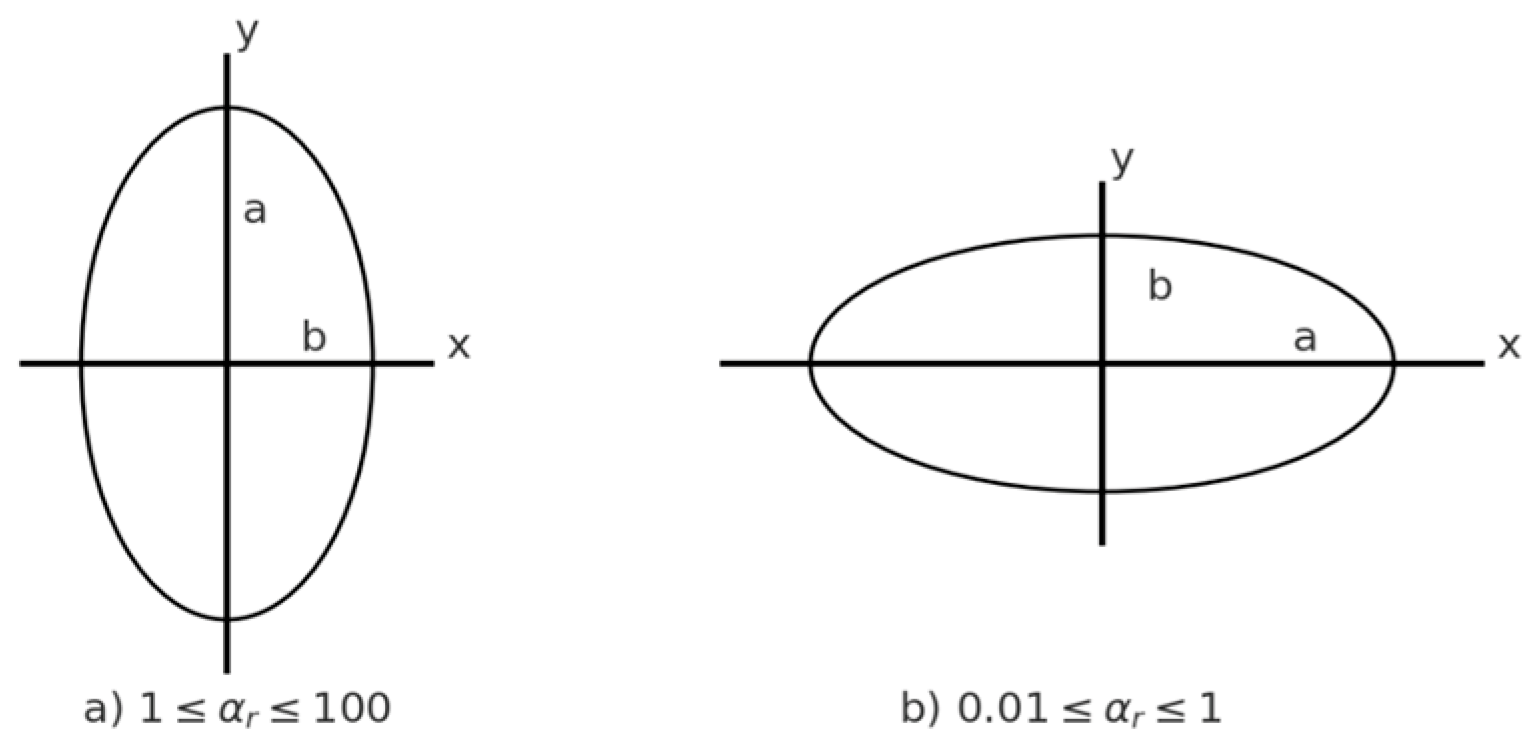
Step 5. Determine the curvature ratio α r . The curvature ratio indicates the proportion of R y and R x . It is used to define the ellipse orientation resulting from the contact between the ball and the outer race, see Figure 1. This curvature ratio is calculated by
α r = R y R x
Step 6. Select the elliptic parameter ( k e ) and elliptic equations. Based on the curvature ratio (see Figure 1), select the elliptic equations to describe the contact, and then calculate the ellipticity parameter by [33]
k e = α r 2 / π
Step 7. Determine the effective modulus of elasticity ( E ). This parameter is determined by the material properties, such as the modulus of elasticity and Poisson’s ratio. The manufacturer provides these values. The effective modulus of elasticity is expressed as [33]
E = 2 1 v a 2 E a + 1 v b 2 E b
where v a is the Poisson ratio for the ball, and v b is the Poisson ratio for the outer race. Similarly, E a is the modulus of elasticity for the ball, and E b is the modulus of elasticity for the outer race.
Step 8. Determine the semi-axis lengths of the generated ellipse contact. The values of a and b are determined by the half of the y ( D y ) axis and x ( D x ) axis of the ellipse [33]. Therefore, a represents the higher dimension; if D y > D x , then a = D y / 2 . On the contrary, if D x > D y , then b = D y / 2 .
D y = 2 6 k e 2 ε P d R π E 1 / 3
D x = 2 6 ε P d R π k e E 1 / 3
Step 9. Determine the principal stresses ( σ x ,   σ y   y   σ z ). These stresses happen below the contact surface. The equations to find the principal stresses are [34]
σ x = M Ω x + v Ω x b
σ y = M Ω y + v Ω y b
σ z = M 2 1 n n b

3.3. Steps to Determine the True Reliability of the Ball Bearing

Now that we have the principal stresses, it is necessary to assess the reliability of the chosen ball bearing. To calculate this, follow the next steps.
Step 10. Determine the stress matrix. The principal stress matrix is formed in the plane, and it is based on the most representative components in the contact analysis. The stress matrix is
σ 1 0 0 σ 2
where σ 1 and σ 2 correspond to the principal stresses (upper and lower) beneath the contact surface.
Step 11. Determine the Weibull shape and scale parameters. Based on the stress matrix, determine the scale parameter [35] as in Equation (18) and the shape parameter as in Equation (19).
η use = σ 1 σ 2
β use = 4 μ y 0.995 ln σ 1 σ 2
Step 12. Determine the L 10 life according to the Weibull parameters calculated in step 11. The equation is given by
L 10 use = ln R t 1 / β · η
Step 13. Calculate the L 10 life from the catalog according to the design load and dynamic load using Equation (1).
Step 14. Determine the η in cycles. Using the Weibull distribution function and the L 10 life, the η in cycles is given by the following equation:
η cycles = exp ln L 10 ln ln 0.9 β
Step 15. Calculate the fatigue coefficients. Using the S-N curve of the material, the coefficients are derived from the Basquin equation based on the material’s mechanical properties. To obtain the fatigue coefficients ( b s and C ), it is necessary to calculate the S l and S e parameters where
S l = 0.75 S u
S e = 0.45 S u
Then, the slope b s is provided by
b s = 1 3 log S l S e
and the intercept C is given as
C = log S l 2 S e
Step 16. Convert the cycles scale parameter η cycles to a strength scale parameter η strength as
η strenght = 10 C η cycles b s
Step 17. Calculate the true reliability of the ball bearing.
R t = exp L 10 use η strenght β

3.4. Steps to Determine the Minimum Strength Material Value That Meets a Specified Minimum Reliability

Step 18. Determine the sample size that corresponds to the desired reliability.
n = 1 ln R t
Step 19. Determine the median ranks values Y i that correspond to the sample size given in Equation (30).
Y i = ln ln 1 i 0.3 n + 0.4
Step 20. Using the known β value, predict the failure times as
t i = exp Y i β · η
Step 21. Using the predicted data, calculate the Weibull parameters with the maximum likelihood method and determine the standard deviation of η from the Fisher matrix.
σ η = Var η
Step 22. Determine the time that corresponds to the desirable reliability through as
t = η n 1 / β
Step 23. Determine the desired confidence CL level ( CL > 0.632121 ), and calculate its corresponding sample size n 2 as
n 2 = ln 1 CL ln R t
Step 24. Calculate the upper η U and lower η L values using the following equations:
η U = n 2 1 / β · t
η L = η 2 η U
Step 25. Set in Equation (35) η U as η , and η as η L and calculate the corresponding η U value.
Step 26. Determine the corresponding Z value of the normal distribution ( k α ) as in Equation (36) and the probability that this k α value represents.
k α = ln η L η U 1 / 2 η σ η
Step 27. Determine the upper and lower CL values that correspond to a desired percentile of the normal distribution. In this case, we use the percentiles corresponding to 1 σ (68.27%), 2 σ (95.45%), and 3 σ (99.73%).

4. Case Study

To apply this methodology, an intermediate shaft of a velocity reducer was selected, and an appropriate ball bearing [34] was chosen. The specifications of the selected ball bearing are as follows: bearing type; single-row deep groover ball bearing with cover, inner diameter (d) 45 mm, outer diameter (D) 75 mm, width (B) 16 mm, dynamic load (C) 22,100 N, static load (Co) 14,600 N, maximum speed 10,000 rpm, maximum inner ring diameter ( U i ) 67.8 mm, minimum outer ring diameter ( U o ) 54.7 mm, chamfer radius (r) 1 mm, number of balls 13, ball diameter ( d b ) 8.731 mm, material 52,100 chromium steel with a tensile ultimate strength ( S ut ) of 2400 MPa and a hardness of 62 HRC (Rockwell C hardness) [2]. It reduces the speed of an electric motor from 1800 rpm to 450 rpm, which is coupled with a fan in a grain-drying process. The transmitted power is 12 hp.
This analysis is explicitly centered on shaft 2, which reduces velocity while maintaining the same power. This shaft, manufactured from AISI 1020 steel, with a density of 7.87 g/cc, ultimate tensile strength of 420 MPa, tensile strength yield of 350 MPa, modulus of elasticity of 186 GPa and Poisson ratio of 0.29, has a 45 mm diameter and operates at a constant velocity of 900 rpm. The gear system consists of gear B with a diameter of 5 inches, and gear C with a pitch diameter of 3 inches, which both have a pressure angle of 20. In this case, the principal stresses are determined, and the current reliability is evaluated under real operating conditions.

4.1. Ball Bearing Selection from Manufacturer’s Catalog

Step 1. Using Equation (7), the design load P d with a rotation factor of V = 1 is P d = 2406.13 N.
Step 2. From the manufacturer’s catalog, the selected ball bearing is 6009 with a 45 mm diameter.
Step 3. Using the parameters from the ball bearing 6009 data, the L 10 life is 774.85 × 10 6   rev .

4.2. Hertz Contact Stresses Beneath the Surface

Step 4. From Equation (8), the total bearing curvature is R = 4.77 × 10 3 m.
Step 5. Using the total bearing curvature value and Equation (9), the curvature radius is α r = 22.7 .
Step 6. Using the curvature radius, select the elliptic equations, and using Equation (10), the ellipticity parameter is k e = 7.3 .
Step 7. Using the mechanical properties of the material in Equation (11), the effective modulus of elasticity is E = 219780.21   MPa .
Step 8. Using the elliptic equations selected from step 6, the dimensions (a and b) of the ellipse generated at the contact point from Equations (12) and (13) are a = 1.76   mm and b = 0.24 mm .
Step 9. The value of the principal stresses is σ x = 741.52   MPa , σ y = 384.77   MPa , and σ z = 2152.27   MPa .

4.3. Ball Bearing Real Reliability

Step 10. Using the principal stresses calculated in step 9, the stress matrix is
2152.27 0 0 384.77 MPa
Step 11. Using the principal stresses in Equations (18) and (19), the Weibull parameters are η use = 910   MPa and β = 1.28 .
Step 12. Based on the Weibull family calculated in step 11, L 10 use = 156.86   MPa .
Step 13. We use the L 10 life from step 3.
Step 14. The η value in cycles is n cycles = 4495.23 × 10 9 cycles.
Step 15. The fatigue coefficients of the AISI 1020 steel are b s = 0.0739 and C = 3.4771 .
Step 16. Using Equation (26), to convert η cycles to η strenght is η strenght = 579.83 .
Step 17. The estimated reliability of the ball bearing is R t = 0.8289 .

4.4. Improvement of Reliability

The following steps ensure that the ball bearing complies with a reliability of 0.9 at the lower confidence level.
Step 18. The sample size according to the established reliability for the analysis is n = 9.49 .
Step 19. The media rank values are in Table 1.
Step 20. The failure times are presented in Table 2.
Step 21. From the ML estimation process, the Fisher matrix is
Var β = 0.1096    Cov η β = 12.5345     Cov η β = 12.5345 Var η = 58847
Therefore, the standard deviation is σ η = 243.75 .
Step 22. The required time for the desired reliability is t = 156.86 Hrs.
Step 23. The sample size corresponding to the desired confidence level is n 2 = 13.15 .
Step 24. Using Equations (34) and (35), the upper and lower limits of eta are η U = 1174.54   MPa and η L = 705.04   MPa .
Step 25. The upper and lower limits of η are set as η = 1174.54   MPa and η L = 910   MPa . Therefore, the new upper limit is η U = 1515.97   MPa .
Step 26. Using Equation (36), the Z value for the normal distribution of the Weibull family is κ α = 1.2355 .
Step 27. The η limits for the 1 σ , 2 σ and 3 σ percentiles are presented in Table 3.
Steps 18 to 25 of the methodology allow us to determine the corresponding family to a reliability in the lower limit of R t = 0.9 . Subsequently, in steps 26 and 27, the procedure is extended to evaluate the reliability of an element with distinct percentiles of the normal distribution. In this paper, 1 σ , 2 σ , and 3 σ levels were considered as reference.
To show evidence of the improvement of the reliability and to determine the new ball bearing, it is necessary to recalculate the dynamic capacity load by following the next steps.
Step 1. Determine η cycles as
η cycles = η strength 10 C 1 / b = 1174.54   MPa 10 3.47 1 / 0.074 = 324031.675 cycles
Step 2. Determine the corresponding L 10 life as
L 10 = η cycles ln 0.9 1 / β = 55853992 cycles
Step 3. Calculate the dynamic load capacity C as
C = P d L 10 10 6 1 / 3 = 2406.13 N 558539592 10 6 1 / 3 = 9.19 kN
Therefore, given the dynamic load capacity of 9.19 kN with an inner diameter of 45 mm, SNK SKF 71909 is the recommended ball bearing.

5. Discussion

Since the determination of reliability requires a time-dependent analysis, and it is performed based on lifetime data of a sample size; then, uncertainty is always present. And to handle uncertainty, a confidence interval is needed. Thus, in the ball bearing reliability analysis, determining its lower reliability confidence interval is critical. This is because the fatigue phenomenon that causes its failure is a random variable. Therefore, since a confidence interval depends on the unknown reliability’s variance, we used the sample size n 2 defined in Equation (33) as a tool to introduce the expected reliability variance that corresponds to the desired lower reliability index. This lower reliability index is represented by the lower eta ( η ) value defined in Equation (35). Thus, the used reliability interval of CL = 0.75 has the objective of determining the upper and lower eta ( η ) values which completely define the lower reliability interval. And of course, if from historical data, we know the real lower interval of reliability, and/or the real variance of the reliability, then by using its value in Equations (34) and (35), we can easily determine the corresponding n 2 and CL values that in this paper, we used to estimate the unknown reliability variance. Thus, due to the used CL value, let us to estimate the unknown reliability variance, then the proposed method can efficiently determine the lower reliability index at which it is expected for the ball bearing to fails. And to ensure that the minimum reliability will not be lower than expected. the proposed method allows us to determine the minimum strength for which, the minimum reliability will be R ( t ) = 0.90 . Finally, the proposed method allows us to determine the corresponding confidence interval ( k α ) of the normal distribution in efficient form through Equation (36). This occurs because once σ η is known, a unique relationship between k α and the Weibull scale parameter exists. And since k α is determined as a function of η U and η L which from Equation (33) were shown to be a function of CL, then clearly a unique relationship between k α and CL also exists, but because this relationship it is not evident, more research must be undertaken.

6. Conclusions

  • The developed methodology allows us to determine the minimum design strength at the lower limit of a ball bearing subjected to fatigue with a reliability of 90%, using the Weibull distribution, Fisher’s matrix, and percentile analysis.
  • In the case study, the initial SKF 6009 ball bearing presented a reliability of 0.8289, which is lower than the required 0.9. Thus, by applying the methodology, we found that the ball bearing that fulfills the reliability requirement of 0.90 is the SKF 71909 ball bearing.
  • The estimated standard deviation of the eta parameter by using the maximum likelihood method allowed us to determine the upper and lower percentiles and generalize the method to determine the normal 1 σ , 2 σ , 3 σ Six Sigma percentiles.
  • The most significant result is that by applying the methodological procedure and by adjusting the lower limits, it is possible to ensure that at η L = 910   MPa , the reliability at the lower limit is R t = 0.90 .

Author Contributions

Conceptualization, O.M.-Q., M.R.P.-M. and M.M.H.-R.; methodology, O.M.-Q., M.R.P.-M. and B.V.-C.; formal analysis, O.M.-Q., M.R.P.-M. and B.V.-C.; writing—original draft preparation, O.M.-Q. and M.R.P.-M.; writing—review and editing, O.M.-Q., M.R.P.-M. and M.M.H.-R.; supervision, M.R.P.-M. and B.V.-C.; funding acquisition, O.M.-Q. All authors have read and agreed to the published version of the manuscript.

Funding

This research received no external funding.

Institutional Review Board Statement

Not applicable.

Informed Consent Statement

Not applicable.

Data Availability Statement

The original contributions presented in this paper are included in the article. Further inquiries can be directed to the corresponding author.

Acknowledgments

We appreciate the support of the Autonomous University of Ciudad Juarez (UACJ) provided in this research.

Conflicts of Interest

The authors declare no conflicts of interest.

References

  1. Harris, T.A.; Kotzalas, M.N. Rolling Bearing Analysis, 5th ed.; CRC Press: Boca Raton, FL, USA, 2007. [Google Scholar]
  2. Saruhan, H.; Sarıdemir, S.; Çiçek, A. Vibration Analysis of Rolling Element Bearings Defects. J. Appl. Res. Technol. 2014, 12, 384–395. Available online: https://www.scielo.org.mx/scielo.php?script=sci_arttext&pid=S1665-64232014000300005 (accessed on 11 January 2026). [CrossRef]
  3. Xu, M.; Feng, G.; He, Q.; Gu, F.; Ball, A. Vibration characteristics of rolling element bearings with different radial clearances for condition monitoring of wind turbine. Appl. Sci. 2020, 10, 4731. [Google Scholar] [CrossRef]
  4. Ma, L.; Liu, J.; Guo, F.; Li, X.; Zhang, X. Research on Rolling Contact Fatigue Failure of the Bearing Used in High-Speed Electric Multiple Units’ Axle Box Based on a Damage-Coupled Elastic–Plastic Constitutive Model. Lubricants 2023, 11, 330. [Google Scholar] [CrossRef]
  5. Behnke, K.; Menck, O. Rolling contact fatigue tests on pre-damaged slewing bearings. Proc. Inst. Mech. Eng. Part J J. Eng. Tribol. 2025. [Google Scholar] [CrossRef]
  6. Holagh, A.G.; Kaklar, J.A. The effect of material defect orientation on rolling contact fatigue of a ball bearing. Sci. Rep. 2023, 13, 15352. [Google Scholar] [CrossRef]
  7. Wang, X.; Zhang, T. Plastic deformation-based rolling bearing reliability and sensitivity analysis under incomplete probability information. Adv. Mech. Eng. 2022, 14, 168781322211429. [Google Scholar] [CrossRef]
  8. Yu, A.; Huang, H.Z.; Li, Y.F.; Li, H.; Zeng, Y. Fatigue Life Prediction of Rolling Bearings Based on Modified SWT Mean Stress Correction. Chin. J. Mech. Eng. Engl. Ed. 2021, 34, 110. [Google Scholar] [CrossRef]
  9. Yu, A.; Huang, H.Z.; Li, H.; Li, Y.F.; Bai, S. Reliability analysis of rolling bearings considering internal clearance. J. Mech. Sci. Technol. 2020, 34, 3963–3971. [Google Scholar] [CrossRef]
  10. ISO 281:2007; Rolling Bearings—Dynamic Load Ratings and Rating Life. International Organization for Standardization: Geneva, Switzerland, 2007.
  11. Shiyuan, E.; Wang, Y.; Xie, B.; Lu, F. A Reliability-Based Robust Design Optimization Method for Rolling Bearing Fatigue under Cyclic Load Spectrum. Mathematics 2023, 11, 2843. [Google Scholar] [CrossRef]
  12. Zaretsky, E.V. Rolling Bearing Life Prediction, Theory, and Application. 2016. Available online: http://www.sti.nasa.gov (accessed on 28 December 2025).
  13. Yao, Q.; Dai, L.; Tang, J.; Wu, H.; Liu, T. High-speed rolling bearing lubrication reliability analysis based on probability box model. Probabilistic Eng. Mech. 2024, 76, 103612. [Google Scholar] [CrossRef]
  14. Barraza-Contreras, J.M.; Piña-Monarrez, M.R.; Molina, A. Fatigue-life prediction of mechanical element by using the Weibull distribution. Appl. Sci. 2020, 10, 6384. [Google Scholar] [CrossRef]
  15. Barraza-Contreras, J.M.; Piña-Monarrez, M.R.; Torres-Villaseñor, R.C. Reliability by Using Weibull Distribution Based on Vibration Fatigue Damage. Appl. Sci. 2023, 13, 10291. [Google Scholar] [CrossRef]
  16. Liu, Z.; Fu, Y.; Zheng, S.; Wei, J. Study on Rolling Bearing Life Based on Weibull Distribution and Correlation Coefficient Optimization and Maximum Likelihood Estimation. J. Phys. Conf. Ser. 2022, 2383, 012124. [Google Scholar] [CrossRef]
  17. Roohanizadeh, Z.; Jamkhaneh, E.B.; Deiri, E. Parameters and reliability estimation for the weibull distribution based on intuitionistic fuzzy lifetime data. Complex Intell. Syst. 2022, 8, 4881–4896. [Google Scholar] [CrossRef]
  18. Jia, X. Reliability analysis for Weibull distribution with homogeneous heavily censored data based on Bayesian and least-squares methods. Appl. Math. Model. 2020, 83, 169–188. [Google Scholar] [CrossRef]
  19. Marks, N.B. Estimation of Weibull parameters from common percentiles. J. Appl. Stat. 2005, 32, 17–24. [Google Scholar] [CrossRef]
  20. Safari, M.A.M.; Masseran, N.; Majid, M.H.A.; Tajuddin, R.R.M. Robust estimation of the three parameter Weibull distribution for addressing outliers in reliability analysis. Sci. Rep. 2025, 15, 11516. [Google Scholar] [CrossRef]
  21. Siddharth, K.S.; Arora, T.; Maity, D. Roy Fatigue life assessment of dissimilar thickness resistance spot welded C-Mn steel using Weibull distribution. Weld. Int. 2022, 36, 193–207. [Google Scholar] [CrossRef]
  22. Bai, N.; Li, H.; Ma, J.; Lan, C.; Spencer, B.F. Fatigue life evaluation model for high-strength steel wire considering different levels of corrosion. Struct. Infrastruct. Eng. 2022, 19, 409–419. [Google Scholar] [CrossRef]
  23. Villa, C.B. Metodología de Confiabilidad Weibull para el Diseño de Rodamientos de Bola en Base a Esfuerzos deHertz. 2021. Available online: https://erecursos.uacj.mx/items/29715420-d474-4441-a9f9-018116ec41ab (accessed on 14 December 2025).
  24. Budynas, R.G.; Nisbett, J.K. Shigley’s Mechanical Engineering Design, 10th ed.; McGraw-Hill Education: Columbus, OH, USA, 2015. [Google Scholar]
  25. SKF Group. Rolling Bearings. In PUB BU/P1 17000/1 EN; SKF: Göteborg, Sweden, 2018; Available online: https://cdn.skfmediahub.skf.com/api/public/0901d196802809de/pdf_preview_medium/0901d196802809de_pdf_preview_medium.pdf (accessed on 12 December 2025).
  26. Johnson, K.L. Contact Mechanics; Cambridge University Press: Cambridge, UK, 1985. [Google Scholar]
  27. Popov, V.L. Contact Mechanics and Friction: Physical Principles and Applications; Springer: Berlin/Heidelberg, Germany, 2010. [Google Scholar] [CrossRef]
  28. Bower, A.F. Applied Mechanics of Solids; CRC Press: Boca Raton, FL, USA, 2010. [Google Scholar]
  29. Morales-Espejel, G.E.; Brizmer, V. Micropitting modelling in rolling–sliding contacts: Application to rolling bearings. Tribol. Trans. 2011, 54, 625–643. [Google Scholar] [CrossRef]
  30. Nelson, W. Applied Life Data Analysis; Wiley: Hoboken, NJ, USA, 2004. [Google Scholar]
  31. Weibull, W. A Statistical Theory of the Strength of Materials; Generalstabens Litografiska Anstalts Förlag: Stockholm, Sweden, 1939. [Google Scholar]
  32. ReliaSoft Corporation. Life Data Analysis Reference; ReliaSoft Corporation: Tucson, AZ, USA, 2000. [Google Scholar]
  33. Schmid, S.R.; Hamrock, B.J.; Schmid, B.O.J.; Jacobson, H. Fundamentals of Machine Elements SI Version, 3rd ed.; CRC Press: Boca Raton, FL, USA, 2014. [Google Scholar]
  34. Villa-Covarrubias, B.; Piña-Monarrez, M.R.; Barraza-Contreras, J.M.; Baro-Tijerina, M. Stress-based weibull method to select a ball bearing and determine its actual reliability. Appl. Sci. 2020, 10, 8100. [Google Scholar] [CrossRef]
  35. Piña-Monarrez, M.R. Weibull stress distribution for static mechanical stress and its stress/strength analysis. Qual. Reliab. Eng. Int. 2018, 34, 229–244. [Google Scholar] [CrossRef]
Figure 1. Orientation of the contact ellipse based on the radius ratio.
Applsci 16 05523 g001
Table 1. Media rank values.
Y i −2.66−1.72−1.20−0.82−0.50−0.230.030.290.590.99
Table 2. Expected failure times.
t113.55236.78354.25355.79611.61760.11933.711149.471447.341976.30
Table 3. Upper and lower limits of η and reliability according to the percentiles.
PercentilesZ η U η η L CLR(t)UR(t)L
1.23551515.971174.53910.000.75000.94670.9000
1 σ 0.68270.47531295.671174.531064.720.67820.93520.9174
2 σ 0.95451.69011665.201174.53828.440.79050.95250.8880
3 σ 0.99732.78212086.491174.53661.170.87580.96420.8534
Disclaimer/Publisher’s Note: The statements, opinions and data contained in all publications are solely those of the individual author(s) and contributor(s) and not of MDPI and/or the editor(s). MDPI and/or the editor(s) disclaim responsibility for any injury to people or property resulting from any ideas, methods, instructions or products referred to in the content.