Article

Optimizing Powerlifting Bench Press Technique Using Contextual Interference via Antagonist Task Selection


1
Department of Medicine and Aging Sciences, Università degli Studi “G. d’Annunzio” Chieti-Pescara, 66100 Chieti, Italy
2
Department of Neurosciences, Biomedicine and Movement, University of Verona, 37134 Verona, Italy
3
College of Medicine and Health, Bangor University, Bangor LL57 2UW, UK
*
Author to whom correspondence should be addressed.
Appl. Sci. 2026, 16(11), 5511; https://doi.org/10.3390/app16115511
Submission received: 19 March 2026 / Revised: 26 May 2026 / Accepted: 28 May 2026 / Published: 2 June 2026

Featured Application

Integrating contextual interference strategies, such as alternating primary tasks with antagonist overload exercises, offers a practical method within resistance training programs to optimize motor skill acquisition. For example, in the bench press exercise, powerlifters and coaches can directly apply this approach to enhance the overall technical execution of the bench press, while fully maintaining maximal strength gains throughout the training cycle.

Abstract

Background: Contextual interference (CI), defined as interleaved practice, improves motor skill learning in powerlifters. However, previous protocols lacked ecological validity. This study evaluated an alternative, highly specific CI exercise (the seal row) to provide a more practical approach for powerlifting routines. Methods: Fifteen powerlifters (10 males and 5 females, age: 23 ± 2 years, 1RM: 78 ± 32 kg) were randomized in a high CI group (HCI) and low CI group (LCI) undergoing a 6-week training intervention. Powerlifters were tested on their bench press exercise strength and technical execution. Technical execution was assessed using a 13-item Likert scale. Results: Strength significantly increased in both groups (F (3.32, 46.5) = 9.553, p < 0.05, pes = 0.42). Global technique analysis showed a group × time interaction (F (4, 952) = 2.547, p = 0.038). A significant group × time interaction occurred for scapular adduction/retraction (F (4, 52) = 3.753, p = 0.009), with the HCI group showing greater improvement. Conclusions: Alternating a primary task (bench press) with antagonist overloads (seal row) improves technical execution over six weeks without hindering strength gains. These findings support practical CI strategies in resistance training to optimize skill acquisition.

1. Introduction

Practice organization refers to the structured arrangement of exercises within one or more training sessions. This encompasses the execution of multiple motor programs as well as variations in the performance of a single motor skill [1]. In the realm of motor skill acquisition and sports training, practice organization is pivotal for the development and refinement of technical motor skills [1]. A particularly significant concept in this field is contextual interference (CI), a cognitive and motor phenomenon that describes the impact of variability in the sequencing of exercises during motor skill acquisition. Specifically, CI refers to the difficulty level induced by alternating different motor tasks within the same training session [2,3,4]. Contextual interference arises primarily through two forms of practice organization: blocked practice, where a specific skill is repeated multiple times before moving on to the next, and random practice, which involves performing different exercises in either a predetermined or unpredictable sequence. While blocked practice can facilitate the initial learning phases through constant repetition, random practice (characterized by a high degree of CI) enhances adaptability and skill retention, ultimately improving the transfer of acquired competencies to competitive environments [3,5,6]. Several studies have shown that increasing CI, although initially more challenging for the athlete, leads to more effective and long-lasting learning [2,3,4,7]. This is attributed to the engagement of more complex cognitive processes during random practice, resulting in improved adaptability to the dynamic conditions of competition [7]. Research across various sports has demonstrated that practice variability and its organization can enhance long-term learning when CI is promoted [3,7]. However, this effect has not always been consistently confirmed through experimental research [8]. Naimo et al. [5] investigated the effect of CI in powerlifting, specifically focusing on the bench press exercise. Powerlifting is a strength discipline where execution technique, alongside conditional capacities, plays a crucial role. The learning–teaching process is fundamental for developing proper lifting techniques, and current theoretical knowledge suggests various organizational strategies for training sessions and cycles to optimize skill acquisition [3]. To our knowledge, this remains the only study on CI in powerlifting. The researchers found that participants in the high-CI group showed significantly greater improvements in both one-repetition maximum (1RM) strength and execution technique compared to those in the low-CI group. Notably, participants engaged in dart throwing to induce CI. Overall, Naimo et al. [5] provided the first experimental evidence supporting the relevance of CI principles for the acquisition of bench press skill and strength. Building on this contribution, the present study sought to improve the ecological applicability of this approach by replacing the unrelated interference task, dart throwing, with a resistance-training task more closely related to powerlifting practice [8].
Resistance training is characterized by a high degree of flexibility in combining training session elements, such as the exercise sequence, number of repetitions and sets, and execution speed. Some training modalities specifically incorporate the alternation of antagonist muscle groups between sets [9]. This approach is often used to enhance recovery between sets by applying a lower load on the antagonist muscle group than on the primary muscle being trained based on the premise that this may activate reciprocal inhibition reflexes. While alternating antagonist muscle groups is a well-established empirical practice for training efficiency and hypertrophy, often referred to in classical bodybuilding as “supersets”, its potential as a specific cognitive and proprioceptive tool remains unexplored [10,11]. Based on this theoretical foundation, we aimed to address the applicability issue raised by Naimo et al. [5] by inducing CI through a resistance-training task that was more closely related to the primary exercise than dart throwing. In the present study, CI was operationalized as the alternation of the primary task, the bench press, with a different but biomechanically related antagonist task, the seal row, within the same training session. Thus, the specificity of the interference task was not based only on the use of antagonist musculature but also on its technical relationship with the bench press setup. The seal row was selected because its horizontal pulling pattern is mechanically opposite but technically related to the bench press. In particular, it emphasizes scapular adduction/retraction, which contributes to upper-back stability during the bench press setup. Therefore, in this protocol, the seal row was not intended merely as a method for active recovery or as a traditional superset strategy. Rather, it was used as an ecologically valid interference task intended to disrupt simple repetition of the primary task, promote repeated reconstruction of the bench press motor action plan, and increase proprioceptive awareness of scapular positioning.
Transitioning between different tasks induces a condition of high CI, which could positively impact the acquisition of technical motor skills. Therefore, the aim of the current study was to evaluate the effectiveness of introducing an antagonist exercise (the seal row) to induce contextual interference during a six-week powerlifting training program and to compare its impact on lifting technique between a high-contextual-interference group (HCI) and a low-contextual-interference group (LCI). We hypothesized that the HCI group would achieve greater improvements in technique retention compared to the LCI group.

2. Materials and Methods

2.1. Participants

A priori sample size calculation based on 1RM (2way mixed ANOVA) effect-size found in Naimo et al. [5] was equal to 0.19, and setting alpha to 0.05 and power to 0.90 returned a sample size of 12 subjects, which we increased by 20% to account for drop out, leading to a final figure of 15 subjects. Fifteen participants (10 males and 5 females) aged 20–30 years (mean age 23 ± 2 years) were enrolled in the study. They were informed that their participation was voluntary and that they could withdraw from the study at any time without providing a reason. Participants were also notified that the study complied with the Declaration of Helsinki and the European General Data Protection Regulation (GDPR). After being fully informed, participants were asked to sign an informed consent form to confirm their participation. The inclusion criteria for this study were i. active participation in recreational powerlifting (non-competitive level), with a minimum of 2 years of continuous resistance training experience and familiarity with performing the main lifts (bench press, deadlift, and squat) at high intensities; ii. absence of injuries that could compromise participation; and iii. sufficient physical conditioning to complete the designed training program. The exclusion criteria were i. lack of experience in powerlifting movements (bench press, deadlift, and squat), ii. presence of injuries, and iii. insufficient physical conditioning to complete the designed training program.

2.2. Procedure

To test our research hypothesis, we employed a randomized controlled longitudinal trial design. Participants were randomly assigned to one of two groups: LCI group (n = 7; 5 males, 2 females) and HCI group (n = 8; 5 males, 3 females). Participants attended the laboratory at the University of Chieti-Pescara in the afternoon, ensuring they had rested for at least 48 h prior to testing. During the initial assessment session, participants performed a 1RM test on the bench press, which was the primary exercise under investigation. The training sessions commenced the following week and continued for six weeks, with three sessions per week.

2.3. Training Protocol

The training program was structured into two phases: an initial adaptation phase to acclimate participants to the training volume, followed by an intensification phase that culminated in peak intensity levels during the final stages. A six-week duration was specifically chosen to isolate neural adaptations and motor skill acquisition [12] while minimizing fatigue accumulation, which is more common in longer, eight-week peaking cycles leading up to competition [13]. The regimen adhered to a powerlifting-style strength training protocol, focusing on the three main lifts: barbell bench press, squat, and deadlift. The program was divided into fundamental exercises and technical variations. For instance, the bench press was performed as a fundamental exercise, whereas slow-tempo bench press sets (3 s for the eccentric phase and 3 s for the concentric phase) were considered technical variations. Alternating between these exercise modalities allowed for multiple weekly sessions targeting the same muscle groups while mitigating excessive overload. Fundamental exercises were executed at an intensity of up to 83% of 1RM. Exercises with technical variations were prescribed at different intensities as follows: a maximum of 70% of 1RM for the slow-tempo bench press (due to the increased difficulty requiring a lighter load), up to 89% of 1RM for deficit deadlifts (which are mechanically facilitated). Given that the bench press was the study’s focal point, particular attention was devoted to its integration with the other two lifts. The weekly training schedule was as follows: Monday: squat and bench press; Wednesday: deadlift, bench press (technical variation), and squat; Friday: squat, bench press, and deadlift (technical variation). All exercises were performed in accordance with official powerlifting competition regulations. The bench press technique was standardized for both groups, with three minutes of rest between sets for all participants. For the remaining lifts, rest intervals were self-selected, with participants instructed to ensure full recovery.
To induce CI, the bench press was paired with the seal row. This is a horizontal pulling exercise employing a motor pattern similar to the bench press but targeting the antagonist muscles. The seal row was incorporated into the Monday and Friday sessions and performed with at least three repetitions in reserve (RIR) to maintain moderate intensity. In the HCI group, CI was introduced by performing the seal row during the three-minute rest periods between bench press sets. In contrast, the LCI group executed the seal row after completing all bench press sets, ensuring sufficient rest to minimize muscular fatigue and maintaining an equivalent training volume (Table 1).
Every other Friday, a maximum velocity lift (MVL) test was conducted on the bench press without any contextual interference. At the conclusion of the six-week training period, a follow-up test was administered two weeks after the final training session to further evaluate the effects of the intervention (Figure 1).

2.4. Maximal Repetition and MVL Testing

To estimate the 1RM, we used a conversion table that relates the number of repetitions to the percentage of 1RM [14]. The 1RM test was preceded by a general warm-up, joint mobilization exercises, and technical drills with an unloaded barbell. Progressive loading was then implemented using an incremental strategy to approach the estimated maximal load, with a maximum of five sets. As the load increased, the number of repetitions decreased until only single repetitions were performed. Video recordings were captured during all 1RM attempts until all potential attempts for each participant were exhausted. A total of 34 recordings were obtained, all employing three-quarter angle shots to ensure adherence to international powerlifting criteria and to assess technical proficiency. During a separate session, a similar procedure was used for evaluating the MVLs. Maximum velocity lift, also known in Italian strength training as the “Miglior Alzata Veloce”, refers to the highest weight lifted at the highest maximal execution velocity, provided that the lifting technique remains unaltered. For each attempt, participants were informed of the prescribed load percentage relative to their initial 1RM (e.g., 80% of 1RM). If a rapid lifting execution attempt was successful, the load was progressively increased. If the lift failed, participants had a total of three attempts for a given load. The best MVL attempt, evaluated in terms of both technical execution and total lifted weight, was selected for analysis. The reliability of the 1RM and MVL testing protocols is supported by existing literature reporting excellent test–retest reliability for upper-body 1RM assessments (ICC = 0.64–0.99, median ICC = 0.98) [15] and was further confirmed using Intraclass Correlation Coefficient [ICC(3,1)].

2.5. Technical Evaluation and RPE Scale

Sport-specific technique and regulatory compliance were assessed using a scoring table (Table 2) designed to quantify the quality and validity of each bench press repetition based on the criteria established by Naimo et al. [5]. In the present study, this scoring table was used as a research instrument to assess sport-specific bench press technical execution. It was not intended to reproduce or replace formal competition judging but rather to provide an ecologically valid assessment of technical criteria relevant to powerlifting performance.
The 1RM and each MVL were evaluated by two independent powerlifting competition judges, who were external to the study and free from potential biases. The involvement of powerlifting judges was intended to ensure that the assessment was grounded in criteria that are meaningful within the discipline rather than to determine an official competition outcome. Each judge meticulously analyzed every recorded lift and assigned a score based on a Likert scale [16,17] ranging from 1 (very poor) to 4 (excellent). The two judges independently evaluated all video recordings in separate locations, with no interaction between them or with the research team during the evaluation process. Inter-rater reliability was assessed using the ICC(3,1), as described in Section 2.6. The content validity of the scoring instrument was supported by its derivation from Naimo et al. [5], whose criteria were developed based on official USAPL/IPF competition regulations, and by the involvement of two certified IPF/USAPL competition judges as evaluators. Additionally, subjective effort perception was recorded for each training session using the CR10 scale modified by [18] to obtain the Rating of Perceived Exertion (RPE). Foster’s method was then applied to calculate, for each session, the session RPE (sRPE), a standardized subjective estimate of perceived internal training load, using the following formula:
sRPE = RPE × session duration (min).
Specifically for the seal row exercise, participants in both groups were instructed to maintain RIR 3 to limit excessive perceived exertion and avoid training to failure; the rest of the training protocol remained standard across all participants, as described in Section 2.3.

2.6. Statistical Analysis

All data were analyzed using R software in RStudio (version 2024.12.0+467). Assumptions for ANOVA were verified: data normality was tested for all variables using Shapiro–Wilk test (p > 0.05), and a Greenhouse–Geisser correction was applied to address any violations of sphericity. Baseline differences were assessed using independent t-tests. A Two-Way Repeated Measure ANOVA (TWRM ANOVA) was conducted to analyze the interaction between a within-subject factor of time (with five levels: 1RM [t0], MVL1 [t1], MVL2 [t2], MVL3 [t3], MVL4 [t4]) and a between-subject factor of group (with two levels: LCI, HCI). Additionally, a 4 × 2 TWRM ANOVA [time (MVL1, MVL2, MVL3, MVL4) × group] was performed to evaluate the significance of values normalized as a percentage of their initial 1RM. In cases where a significant main effect of time was found, a Wilcoxon post hoc test with Bonferroni correction was used to identify differences between groups. Intraclass correlation coefficients [ICC(3,1)] were computed for the 1RM and MVL protocols [15] and for the inter-rater reliability of the technical evaluation, as recommended by Koo and Li [19]. For the technical evaluation, ICC(3,1) was computed for the global technical score (sum of 13 items) at each assessment time point (1RM and MVL1–MVL4) and separately for each of the 13 individual evaluation criteria pooled across time points. Since both judges independently assigned identical scores, the ICC was calculated using the two-way mixed-effects mean squares formula directly. All analyses were performed on the total sample and separately for each group (LCI and HCI). Reliability was interpreted as follows: values < 0.50 = poor, 0.50–0.75 = moderate, 0.75–0.90 = good, >0.90 = excellent [19]. Technical execution was evaluated using non-parametric Aligned Rank Transform Test [16,17]. When a significant interaction was detected, post hoc pairwise comparisons were conducted on the interaction contrasts using a Bonferroni correction to adjust for multiple testing. For these non-parametric post hoc comparisons, the effect size was quantified using the Wilcoxon r coefficient. To ensure the robustness of these estimates, 95% confidence intervals (CIs) for the effect sizes were calculated using a non-parametric bootstrapping procedure.
The alpha level was set at 0.05 for all analyses, including those involving Likert scale points [16].

3. Results

3.1. Participant Characteristics

Table 3 presents the general characteristics of the sample, shown as mean ± standard deviation. There were no significant differences in age, weight, and BMI, nor were there differences in performance capacity, as assessed by 1RM (kg).

3.2. Strength Capacity

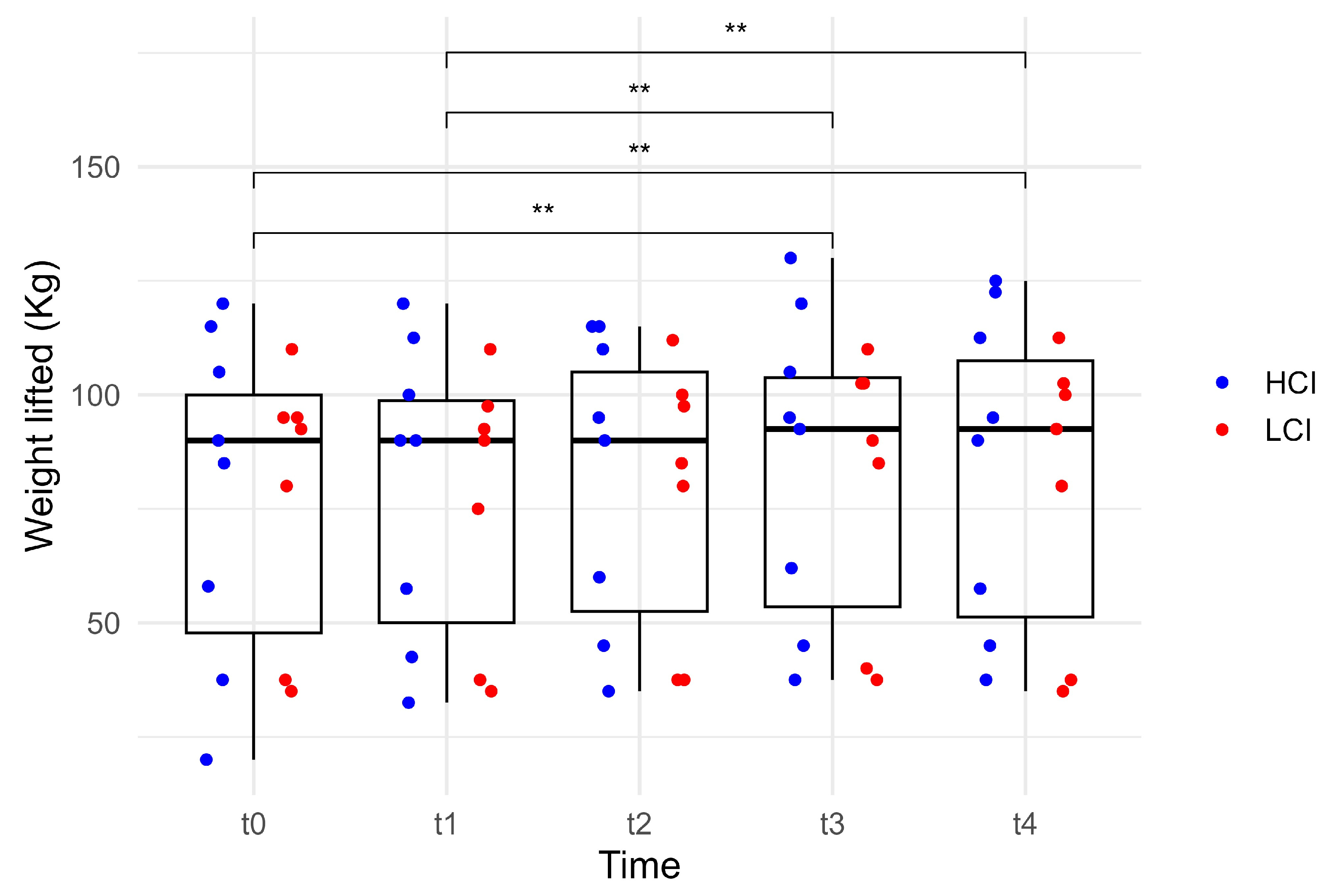
No baseline differences were observed between the two groups in 1RM, as detected with a Two Sample t-Test (p = 0.9571). There was no group × time interaction (F (3.48, 45.28) = 1.407, p = 0.250) or a main effect of group in strength capacity (F (1, 13) = 0.057, p = 0.816). However, there was a statistically significant main effect of time with the Greenhouse–Geisser correction (F (3.32, 46.5) = 9.553, p < 0.05, pes = 0.420). Strength significantly increased in both groups without significant between-group differences, although post hoc analyses revealed that the increase was not always statistically significant across all measurement points. Specifically, a Wilcoxon Test with Bonferroni corrections showed significant comparisons at t0–t3 (p = 0.025), t0–t4 (p = 0.047), t1–t3 (p = 0.015), and t1–t4 (p = 0.035) (Figure 2). Reliability was excellent for both the 1RM (total: ICC = 0.99; LCI: ICC = 0.996; HCI: ICC = 0.988) and MVL (total: ICC = 0.99; LCI: ICC = 0.993; HCI: ICC = 0.990) testing protocols [15]. A 2-way mixed ANOVA on session RPE scores confirmed that there were no significant interactions or main effects between the experimental groups regarding perceived internal training load.

3.3. Scores of the Technical Components Checklist

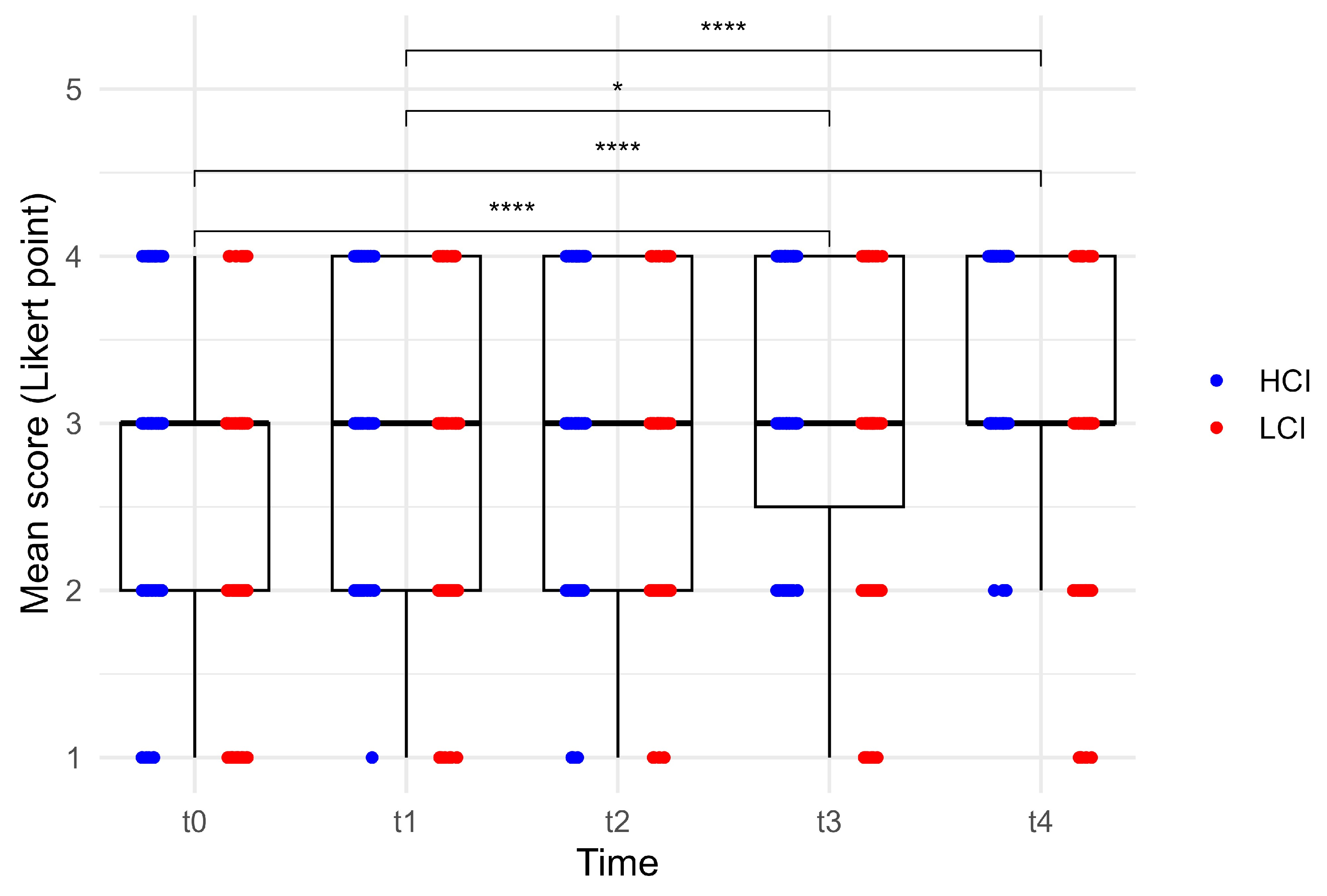
No baseline differences were observed between the two groups in all 13 technical elements, as detected with a Two Sample t-Test (p > 0.05). Inter-rater reliability was excellent for the global technical score across all assessment time points and for each of the 13 individual evaluation criteria, both in the total sample and within each group (LCI and HCI: ICC(3,1) = 1.00 for all), indicating perfect agreement between the two independent certified judges. Global technique analysis of all 13 items showed an interaction effect between group and time (F (4, 952) = 2.547, p = 0.038) and no main effect of group (F (1, 13) = 4.518, p = 0.053) (Figure 3). Moreover, there was a statistically significant main effect for time (F (4, 952) = 19.961, p < 0.001). The post hoc analysis with Bonferroni correction showed widespread significant changes in the HCI group. Specifically, significant differences were found between t1 vs. t4 (p < 0.0001, r = 0.366, 95% CI [0.277, 0.443]), t2 vs. t4 (p < 0.0001, r = 0.400, 95% CI [0.325, 0.462]), and t3 vs. t4 (p = 0.0005, r = 0.318, 95% CI [0.227, 0.392]). Significant differences were also observed for t0 vs. t1 (p = 0.015, r = 0.281, 95% CI [0.209, 0.350]) and t0 vs. t3 (p < 0.0001, r = 0.325, 95% CI [0.242, 0.404]). The most important change in this group was recorded between t0 and t4 (p < 0.0001, r = 0.467, 95% CI [0.399, 0.525]). Conversely, the LCI group showed significant changes only towards the final time point: t0 vs. t2 (p = 0.003, r = 0.269, 95% CI [0.168, 0.338]), t3 vs. t0 (p = 0.013, r = 0.212, 95% CI [0.068, 0.329]), and t0 vs. t4 (p = 0.002, r = 0.227, 95% CI [0.090, 0.340]).
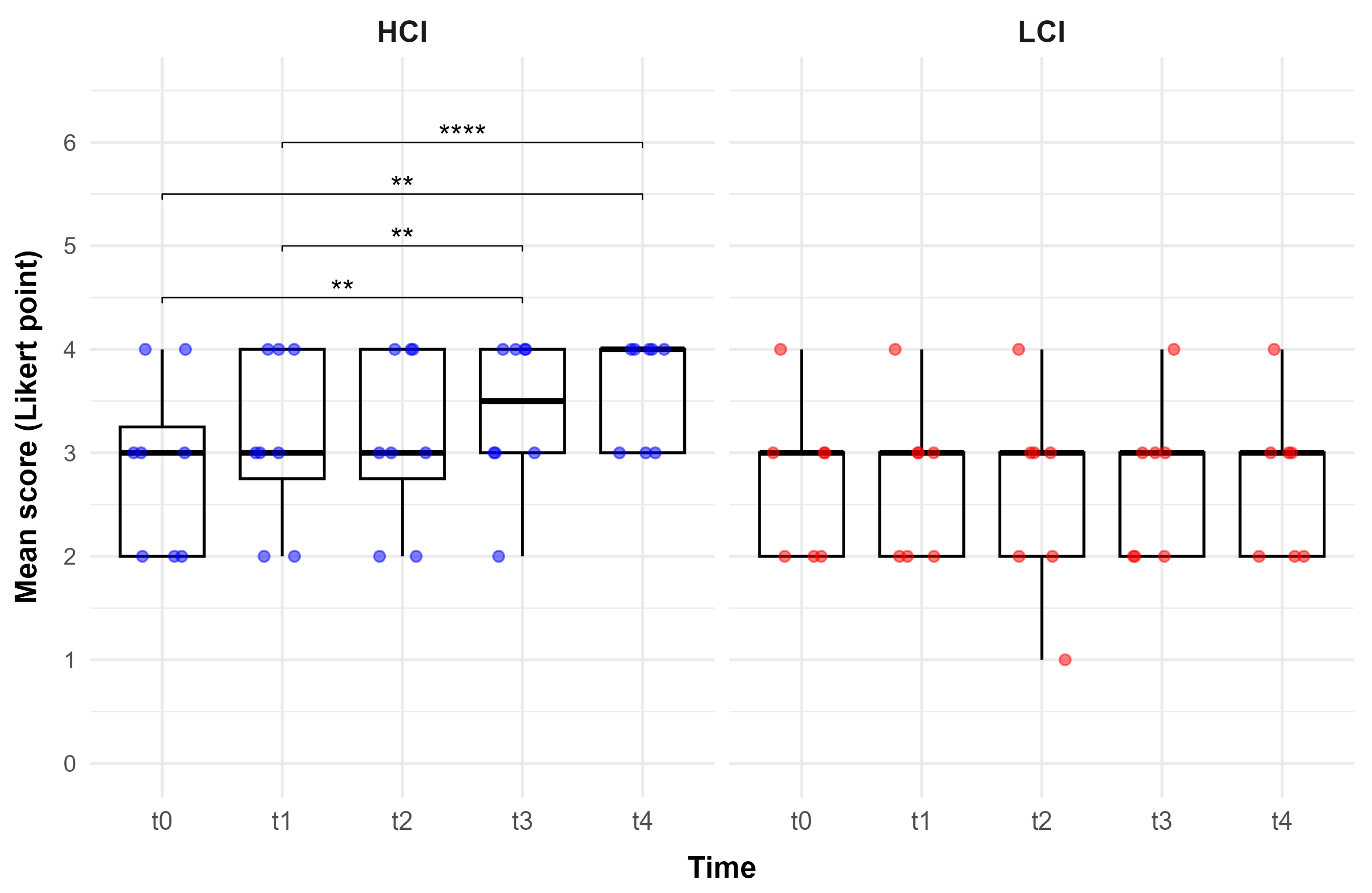
Analyzing the individual technical components, seven out of thirteen showed a significant time effect and four of the groups. The only significant group × time interaction effect was found for Item 2 (scapular adduction/retraction) (F (4, 52) = 3.753, p = 0.009) (Figure 4), with participants in the HCI group showing greater improvement over time. The post hoc analysis with Bonferroni correction showed that significant improvements in scapular adduction/retraction were exclusive to the HCI group.
Specifically, significant differences were found for t1 vs. t4 (p = 0.007, r = 0.450, 95% CI [0.000, 0.638]) and t2 vs. t4 (p = 0.007, r = 0.450, 95% CI [0.000, 0.638]). A significant difference was also observed for t0 vs. t3 (p = 0.007, r = 0.450, 95% CI [0.000, 0.638]). The most important improvement was recorded between t0 and t4, showing a highly significant difference (p < 0.0001) with a large effect size (r = 0.583, 95% CI [0.450, 0.687]). Conversely, the LCI group showed no significant changes in technical scores across any of the time points (p = 1.000).
Item 2 had also a significant main effect of time (F (4, 52) = 4.164, p = 0.005).

4. Discussion

The results of our study showed that the HCI powerlifter group improved technical execution, with the same maximal force improvement as recorded in the LCI group. The effectiveness of high CI in the acquisition of technical skills is well established in the literature [2,4,7,8]. Although there is overall consensus about the positive effect of alternating motor programs on long-term learning, a recent study investigating the effectiveness of alternating practice (through serial practice) in learning a complex task did not find an advantage of CI over blocked practice [6]. Specifically, while blocked practice reduced the number of errors in the short term, serial practice led to an increase in errors during the initial sessions. In the medium term, however, error frequency was comparable between the two conditions. This study suggests that when motor tasks are particularly complex, alternating practice may initially lead to greater execution difficulties. Over time, the gap between the two groups closed, indicating that these difficulties can be overcome in the long term. Due to the complexity of the task, the authors divided it into multiple parts (five) before integrating global practice [6]. Furthermore, the alternation was achieved by switching between the right and left sides rather than a true alternation of motor programs [6].
The motor task selected in our study was relatively simple (i.e., bench press), yet it was not devoid of technical elements. In fact, we used a 13-item movement component checklist adapted from Naimo et al. [5], which was originally developed to assess specific components of bench press technique from video recordings and includes technical components commonly used by powerlifters to optimize bench press performance in accordance with USAPL/IPF rules. Thus, the checklist was used as a research tool to quantify sport-specific bench press execution rather than as a substitute for official competition judging. The technical elements evaluated play a key role in the execution of the bench press exercise. However, they should not all be interpreted in the same way. Many of them have a primarily educational or regulatory role (e.g., gluteal contact, shoulder contact, head contact, feet placement, chest pause, adherence to commands, and correct placement of the little fingers on the barbell), while other items represent variables that can be improved through training and have a central role in motor execution (e.g., scapular adduction/retraction [item 2]). Correct placement, also known as setting, during the bench press exercise requires active scapular adduction/retraction. This component should be distinguished from the dorsal or sternal arch, which is more directly influenced by spinal extension, anthropometry, and individual flexibility. Rather than a passive anatomical consequence, voluntarily maintaining scapular adduction/retraction against the bench represents a trainable motor skill that contributes to upper-back stability, safe shoulder positioning, and a stable pressing trajectory [20]. Based on the statistical analysis results, we observed an overall improvement in technical execution and, in particular, in scapular adduction/retraction in the HCI group. This enhancement could be related to the exercise used to create CI, the seal row. In the seal row exercise, the subject lies prone on a raised bench with a barbell positioned beneath it, performing a horizontal pull that primarily emphasizes scapular adduction/retraction. Given the critical involvement of scapular control in both the bench press and the seal row, the latter was selected as the CI exercise within the protocol. It is interesting to note that this technical aspect gradually improved over time, reaching significance after 6 weeks. This suggests that CI interventions may need time to induce an effect and that this effect may then be maintained [2].
Motor adaptations induced by CI are generally characterized by an initial phase of transient performance perturbation, followed by a subsequent recovery [21]. However, the optimal timing for assessing transfer and retention effects remains a topic of ongoing debate. For example, a controlled laboratory study on motor control demonstrated that although random practice in a force field task required a longer adaptation period, it resulted in superior short-term retention and transfer compared to blocked practice. Notably, these advantages diminished after 24 h [22]. Our study may have benefited from a build-up of retention and transfer over time.
Our hypothesis suggested that using an antagonist exercise could have increased conscious processing and the reconstruction of action plans by participants, thereby increasing cognitive load and, in the long term, learning. Furthermore, from a biomechanical perspective, actively engaging the scapular retractors during the seal row likely increased the participants’ proprioceptive awareness of scapular adduction/retraction. This heightened activation during the rest intervals facilitated a more stable setup in the subsequent bench press sets, directly contributing to the significant improvements observed in this specific technical parameter. Moreover, from an empirical perspective, motor schemes involving antagonist muscles are often used to enhance recovery between sets. The underlying idea of this method is reciprocal inhibition, which facilitates the relaxation of the agonist when the antagonist is engaged in a task [9]. In addition to the level of experience, attentional focus may also influence weightlifting performance. It has been shown that adopting an external focus of attention enhances the muscular efficiency of weightlifters [23]. A noteworthy link between CI and external focus was identified in a study on golf motor learning, where the most effective strategy combined external focus of attention, CI, distributed practice, and exercises aimed at reducing the number of errors [24]. In our study, no particular instructions were given regarding attention focus.
This study introduces novel insights into contextual interference research. Firstly, only one previous study in the literature has investigated contextual interference in powerlifting. Indeed, Naimo et al. [5] used a completely unrelated interference task (e.g., target shooting), producing positive effects. Secondly, our study examined two tasks belonging to the same family of exercises, thereby adopting a more ecologically valid design compared to previous research. However, given the small sample size and the fact that the a priori power analysis was based on a potentially inflated effect size from the only available prior literature Naimo et al. [5], this research study could be considered a pilot study when attempting to generalize these findings to the broader powerlifting population. Additionally, regarding the inclusion of both sexes, although combining male and female participants resulted in larger standard deviations for absolute baseline strength, the sex distribution was meticulously balanced across the experimental groups (5 males per group). Because the primary focus of the intervention was motor skill acquisition and because a within-subject repeated-measure design was used, this approach reduced the influence of inter-individual variability. Nevertheless, the small sample size and the inclusion of both male and female participants should be considered when interpreting the findings, particularly for technical components that may be influenced by anthropometry or flexibility. Future studies with larger samples should examine whether sex-related anthropometric and flexibility differences affect the magnitude of technical adaptations on the bench press. At the same time, motor skill acquisition relies on neuro-motor learning processes that are generally considered to be present across sexes, which supports the rationale for analyzing technical changes in a mixed-sex sample when group allocation is balanced [25,26]. Future studies could also focus on the effect of CI on other aspects of powerlifting, such as squat and deadlift. Moreover, as a combined strategy of CI and external focus may lead to more evident improvements, this should be researched further.

5. Conclusions

In conclusion, alternating exercises with antagonist overloads (e.g., seal row) relative to the primary task (bench press) may enhance technical execution in recreational powerlifters over a six-week period. Our findings specifically demonstrate that this high contextual interference approach may lead to significant global technique improvements, driven particularly by enhanced scapular adduction/retraction, a key factor for bench press stability, while simultaneously maintaining maximal strength gains. These findings suggest that introducing technical disruption via antagonist pairing may help refine complex motor patterns without hindering the physiological adaptations required for force production. Consequently, these results highlight the practical value of integrating contextual interference strategies into resistance training programs to optimize technical skill acquisition.
Further research should investigate the application of this approach to other fundamental powerlifting movements, such as the squat and deadlift, to determine if similar technical benefits occur across different kinetic chains. Additionally, future studies involving larger and more diverse athlete populations are necessary to confirm these findings and explore the long-term retention of technical improvements.

Author Contributions

Conceptualization, S.M. and P.I.; methodology, S.M., P.I., and F.S.; formal analysis, S.M., P.I., and F.S.; investigation, S.M.; resources, A.F.; data curation, S.M.; writing—original draft preparation, S.M.; writing—review and editing, S.M., I.P., S.S., P.I., A.F., and F.S.; visualization, S.M. and F.S.; supervision, P.I., A.F., and F.S.; project administration, P.I. All authors have read and agreed to the published version of the manuscript.

Funding

S.M.’s Ph.D. scholarship is funded by the European Union-Next Generation EU, Mission 4 Component1, CUP B31I24000520006.

Institutional Review Board Statement

The study was conducted in accordance with the Declaration of Helsinki and was approved on the (21 June 2024) by the Institutional Review Board of the Department of Human Sciences, and Health of the University of Cassino and Lazio Meridionale (approval Number 16259).

Informed Consent Statement

Informed consent was obtained from all subjects involved in the study. Written informed consent has been obtained from the participants to publish this paper.

Data Availability Statement

Data can be reached only upon request to the corresponding author and exclusively for the purpose specified in the objectives of the study.

Conflicts of Interest

The authors declare that the research was conducted in the absence of any commercial or financial relationships that could be construed as a potential conflict of interest.

Abbreviations

The following abbreviations are used in this manuscript:
CIContextual Interference
1RMOne Repetition Maximum
HCIHigh Contextual Interference
LCILow Contextual Interference
GDPRGeneral Data Protection Regulation
RIR
MVL
Repetitions In Reserve
Maximum Velocity Lift
RPERating of Perceived Exertion
sRPEsession Rating of Perceived Exertion
TWRMTwo Way Repeated Measure
BMI Body Mass Index

References

  1. Bortoli, L.; Robazza, C.; Durigon, V.; Carra, C. Effects of Contextual Interference on Learning Technical Sports Skills. Percept. Mot. Ski. 1992, 75, 555–562. [Google Scholar] [CrossRef]
  2. Czyż, S.H.; Wójcik, A.M.; Solarská, P. The Effect of Contextual Interference on Transfer in Motor Learning—A Systematic Review and Meta-Analysis. Front. Psychol. 2024, 15, 1377122. [Google Scholar] [CrossRef]
  3. Czyż, S.H.; Wójcik, A.M.; Solarská, P.; Kiper, P. High Contextual Interference Improves Retention in Motor Learning: Systematic Review and Meta-Analysis. Sci. Rep. 2024, 14, 15974. [Google Scholar] [CrossRef] [PubMed]
  4. Magill, R.A.; Hall, K.G. A Review of the Contextual Interference Effect in Motor Skill Acquisition. Hum. Mov. Sci. 1990, 9, 241–289. [Google Scholar] [CrossRef]
  5. Naimo, M.A.; Zourdos, M.C.; Wilson, J.M.; Kim, J.-S.; Ward, E.G.; Eccles, D.W.; Panton, L.B. Contextual Interference Effects on the Acquisition of Skill and Strength of the Bench Press. Hum. Mov. Sci. 2013, 32, 472–484. [Google Scholar] [CrossRef]
  6. Smith, P.J.K.; Gregory, S.K.; Davies, M. Alternating versus Blocked Practice in Learning a Cartwheel. Percept. Mot. Ski. 2003, 96, 1255–1264. [Google Scholar] [CrossRef]
  7. Farrow, D.; Buszard, T. Exploring the Applicability of the Contextual Interference Effect in Sports Practice. In Progress in Brain Research; Elsevier: Amsterdam, The Netherlands, 2017; Volume 234, pp. 69–83. ISBN 978-0-12-811825-2. [Google Scholar]
  8. Brady, F. Contextual Interference: A Meta-Analytic Study. Percept. Mot. Ski. 2004, 99, 116–126. [Google Scholar] [CrossRef]
  9. Robbins, D.W.; Young, W.B.; Behm, D.G.; Payne, W.R. Agonist-Antagonist Paired Set Resistance Training: A Brief Review. J. Strength Cond. Res. 2010, 24, 2873–2882. [Google Scholar] [CrossRef]
  10. American College of Sports Medicine. American College of Sports Medicine position stand. Progression Models in Resistance Training for Healthy Adults. Med. Sci. Sports Exerc. 2009, 41, 687–708. [Google Scholar] [CrossRef] [PubMed]
  11. Robbins, D.W.; Young, W.B.; Behm, D.G. The Effect of an Upper-Body Agonist-Antagonist Resistance Training Protocol on Volume Load and Efficiency. J. Strength Cond. Res. 2010, 24, 2632–2640. [Google Scholar] [CrossRef] [PubMed]
  12. Gabriel, D.A.; Kamen, G.; Frost, G. Neural Adaptations to Resistive Exercise: Mechanisms and Recommendations for Training Practices. Sports Med. 2006, 36, 133–149. [Google Scholar] [CrossRef]
  13. Bakhshinejad, J.A.; Ramer, J.D.; Dunsmore, K.A.; Pelton, L.M.; Berglund, L. Effects of Intensity and Fatigue on the Kinetics and Kinematics of the Barbell Squat, Bench Press, and Deadlift in Experienced Lifters: A Systematic Review. Sports Med. Open 2025, 11, 115. [Google Scholar] [CrossRef] [PubMed]
  14. Maximum based on REPS. Natl. Strength Cond. Assoc. J. 1984, 6, 60. [CrossRef]
  15. Grgic, J.; Lazinica, B.; Schoenfeld, B.J.; Pedisic, Z. Test–Retest Reliability of the One-Repetition Maximum (1RM) Strength Assessment: A Systematic Review. Sports Med. Open 2020, 6, 31. [Google Scholar] [CrossRef]
  16. Joshi, A.; Kale, S.; Chandel, S.; Pal, D. Likert Scale: Explored and Explained. BJAST 2015, 7, 396–403. [Google Scholar] [CrossRef]
  17. Norman, G. Likert Scales, Levels of Measurement and the “Laws” of Statistics. Adv. Health Sci. Educ. 2010, 15, 625–632. [Google Scholar] [CrossRef]
  18. Foster, C.; Florhaug, J.A.; Franklin, J.; Gottschall, L.; Hrovatin, L.A.; Parker, S.; Doleshal, P.; Dodge, C. A New Approach to Monitoring Exercise Training. J. Strength Cond. Res. 2001, 15, 109–115. [Google Scholar]
  19. Koo, T.K.; Li, M.Y. A Guideline of Selecting and Reporting Intraclass Correlation Coefficients for Reliability Research. J. Chiropr. Med. 2016, 15, 155–163. [Google Scholar] [CrossRef]
  20. Bartolomei, S.; Caroli, E.; Coloretti, V.; Rosaci, G.; Cortesi, M.; Coratella, G. Flat-Back vs. Arched-Back Bench Press: Examining the Different Techniques Performed by Power Athletes. J. Strength Cond. Res. 2024, 38, 1200–1205. [Google Scholar] [CrossRef] [PubMed]
  21. Shadmehr, R. Learning to Predict and Control the Physics of Our Movements. J. Neurosci. 2017, 37, 1663–1671. [Google Scholar] [CrossRef] [PubMed]
  22. Herzog, M.; Focke, A.; Maurus, P.; Thürer, B.; Stein, T. Random Practice Enhances Retention and Spatial Transfer in Force Field Adaptation. Front. Hum. Neurosci. 2022, 16, 816197. [Google Scholar] [CrossRef]
  23. Neumann, D.L. A Systematic Review of Attentional Focus Strategies in Weightlifting. Front. Sports Act. Living 2019, 1, 7. [Google Scholar] [CrossRef]
  24. Barzyk, P.; Gruber, M. Motor Learning in Golf—A Systematic Review. Front. Sports Act. Living 2024, 6, 1324615. [Google Scholar] [CrossRef] [PubMed]
  25. Moreno-Briseño, P.; Díaz, R.; Campos-Romo, A.; Fernandez-Ruiz, J. Sex-Related Differences in Motor Learning and Performance. Behav. Brain Funct. 2010, 6, 74. [Google Scholar] [CrossRef] [PubMed]
  26. Roberts, B.M.; Nuckols, G.; Krieger, J.W. Sex Differences in Resistance Training: A Systematic Review and Meta-Analysis. J. Strength Cond. Res. 2020, 34, 1448–1460. [Google Scholar] [CrossRef] [PubMed]
Figure 1. Study flow diagram. 1RM = one repetition maximum; sRPE = session rating of perceived exertion; MVL = maximum velocity lift.
Applsci 16 05511 g001
Figure 2. Comparisons between time conditions in bench press MVLs with significant differences. HCI = high-contextual-interference group, LCI = low-contextual-interference group; t0 = 1RM, t1 = MVL1, t2 = MVL2, t3 = MVL3 and t4 = MVL4; ** p < 0.01.
Applsci 16 05511 g002
Figure 3. Group × time interaction for global technique during bench press. HCI = high-contextual-interference group, LCI = low-contextual-interference group; t0 = 1RM, t1 = MVL1, t2 = MVL2, t3 = MVL3, and t4 = MVL4. * p < 0.05, **** p < 0.0001.
Applsci 16 05511 g003
Figure 4. Group × time interaction for Item 2 (scapular adduction/retraction) during bench press. HCI = high-contextual-interference group, LCI = low-contextual-interference group; t0 = 1RM, t1 = MVL1, t2 = MVL2, t3 = MVL3 and t4 = MVL4. ** p < 0.01, **** p < 0.0001.
Applsci 16 05511 g004
Table 1. Weekly training schedule and contextual interference (CI) intervention.
DayExercisesLCI Group ProtocolHCI Group Protocol
MondaySquat
Bench press
Seal row performed after completing all bench press sets.Seal row performed during the 3 min rest intervals between bench press sets.
WednesdayDeadlift
Bench press (slow tempo)
Squat
No seal row prescribed.No seal row prescribed.
FridaySquat
Bench press
Deadlift (deficit)
Seal row performed after completing all bench press sets.Seal row performed during the 3 min rest intervals between bench press sets.
Table 2. Evaluation criteria for bench press exercise.
Bench Press Technical Execution Criteria
Dorsal arch
Scapular retraction
Gluteal contact
Shoulder contact
Head contact
Feet placement
Leg drive
Chest pause
Elbow lockout
Symmetrical arm extension
Pressing trajectory
Adherence to commands
Correct placement of the little finger on the barbell
Table 3. Participant characteristics.
VariableLCI (n = 7)HCI (n = 8)
Males/Females5/25/3
BMI22.9 ± 3.224.5 ± 4.2
Age22.4 ± 2.922.6 ± 1.8
1RM (Kg)77.8 ± 29.778.8 ± 36.7
All the data are presented as mean ± standard deviation. LCI = low-contextual-interference group, HCI = high-contextual-interference group.
Disclaimer/Publisher’s Note: The statements, opinions and data contained in all publications are solely those of the individual author(s) and contributor(s) and not of MDPI and/or the editor(s). MDPI and/or the editor(s) disclaim responsibility for any injury to people or property resulting from any ideas, methods, instructions or products referred to in the content.