Article

Magma Petrogenesis and Evolution of Ultramafic Rocks in the Daaobaogou Ni-Cu Sulfide Deposit, Dunhuang Block, Gansu Province, China: Constraints from Major and Trace Elements and Sr-Nd-Pb Isotopes


1
School of Earth Sciences and Resources, China University of Geosciences, Beijing 100083, China
2
MNR Key Laboratory of Metallogeny and Mineral Assessment, Institute of Mineral Resources, Chinese Academy of Geological Sciences, Beijing 100037, China
3
The Fourth Institute of Geological and Mineral Exploration of Gansu Provincial Bureau of Geology and Mineral Resources, Jiuquan 735000, China
*
Author to whom correspondence should be addressed.
Appl. Sci. 2026, 16(11), 5508; https://doi.org/10.3390/app16115508
Submission received: 26 April 2026 / Revised: 27 May 2026 / Accepted: 27 May 2026 / Published: 1 June 2026
(This article belongs to the Special Issue Current Approaches in Applied Geochemistry)

Abstract

This paper presents systematic petrological, whole-rock geochemical, and Sr-Nd-Pb isotopic studies on the mafic–ultramafic rocks of the Daaobaogou Ni-Cu sulfide deposit in the Dunhuang Block, Gansu Province. This study aims to reveal the nature of its source region, parent magma composition, and magma evolution processes. The results indicate that the parent magma of the ore-bearing intrusion in Daaobaogou originated from an enriched lithospheric mantle metasomatized by Paleozoic subduction processes. It exhibits high-magnesium characteristics and represents the product of a certain degree of evolution from a primitive magma. The magma evolution underwent significant fractional crystallization, with olivine beginning to crystallize at 1328 °C, following the crystallization sequence: olivine, clinopyroxene, plagioclase, and orthopyroxene. Sr-Nd-Pb isotopes and trace elements indicate that the magma experienced intense crustal contamination (approximately 10–20% upper crust) during its ascent.

1. Introduction

Gansu Province is one of China’s most important regions enriched in magmatic Ni-Cu sulfide deposit. Its distinctive geological setting and favorable metallogenic conditions have given rise to a series of economically significant Cu-Ni sulfide deposits, establishing the province as a crucial base for copper and nickel mineral resources in China [1]. The Dunhuang Block, a major tectonic unit in western Gansu, has in recent years yielded widespread Paleozoic magmatic records that reveal a complex evolutionary history involving subduction, collision, and post-collisional extension [2,3]. Previous research on the Dunhuang Block has predominantly focused on Early Paleozoic high-pressure metamorphic rocks [4] and the regionally extensive granitoids [5], whereas relatively little attention has been paid to the mafic–ultramafic rocks associated with Cu-Ni mineralization. Mafic–ultramafic rocks are mainly distributed in the Keziletage, Yanlongshan, and Xiaoduobagou areas. The Yanlongshan hornblendite has an age of 273.6 ± 4.8 Ma, with εNd(t) values ranging from −7.8 to −4.6. It is enriched in Pb and Cs and depleted in Ba, Sr, Zr, Hf, Nb, and Ta, indicating crustal contamination or subduction-related fluid metasomatism. Large-scale subduction and collision occurred in the region during the Early Paleozoic [6]. The Xiaoduobagou ultramafic rocks are characterized by high MgO (37.87–39.59%), high m/f ratios (9.63–11.34%), low Al2O3 (0.14–0.79%), low TiO2 (0.003–0.03%), and low Na2O + K2O (0.03–0.24%). They represent high-degree basaltic melt residues and were formed in an active continental margin back-arc rift or island-arc setting, recording magmatic activity during the closure of the Proto-Altun Ocean [7]. As the Gansu Bureau of Geology and Mineral Resources has advanced exploration for Ni-Cu sulfide deposit in the Beishan, Altyn Tagh, and Qilian Mountain regions, the Daaobaogou deposit was identified as the first magmatic Ni–Cu sulfide occurrence discovered within the Dunhuang Block [8]. Building on this discovery, Kang et al. [9] has provided relatively systematic whole-rock major and trace element, Sr-Nd-Hf isotopic, platinum-group element (PGE), and zircon geochronological data, indicating that the emplacement age of the Daaobaogou intrusion is 331.7 ± 7.3 Ma (zircon U-Pb); the parental magmas were derived from an enriched mantle source and underwent crustal contamination. Nevertheless, the precise geochemical attributes of the principal ore-hosting lithologies—olivine pyroxenite and pyroxenite—remain poorly constrained. In particular, the nature of the mantle source and the detailed magma evolution processes are still unclear, which substantially limits our understanding of the petrogenesis of mafic–ultramafic rocks within the Dunhuang Block and hampers further mineral exploration efforts. In light of this, this study presents newly collected samples of olivine pyroxenite from drill hole ZKE0704 and surface outcrops in the Daaobaogou area. Petrographic investigations, whole-rock major and trace element analyses, electron microprobe analyses, and Sr-Nd-Pb isotopic measurements have been carried out. Integrated with previously published data, this study aims to precisely constrain the extent of crustal contamination, identify the characteristics of the mantle source, and elucidate the magmatic evolution history.
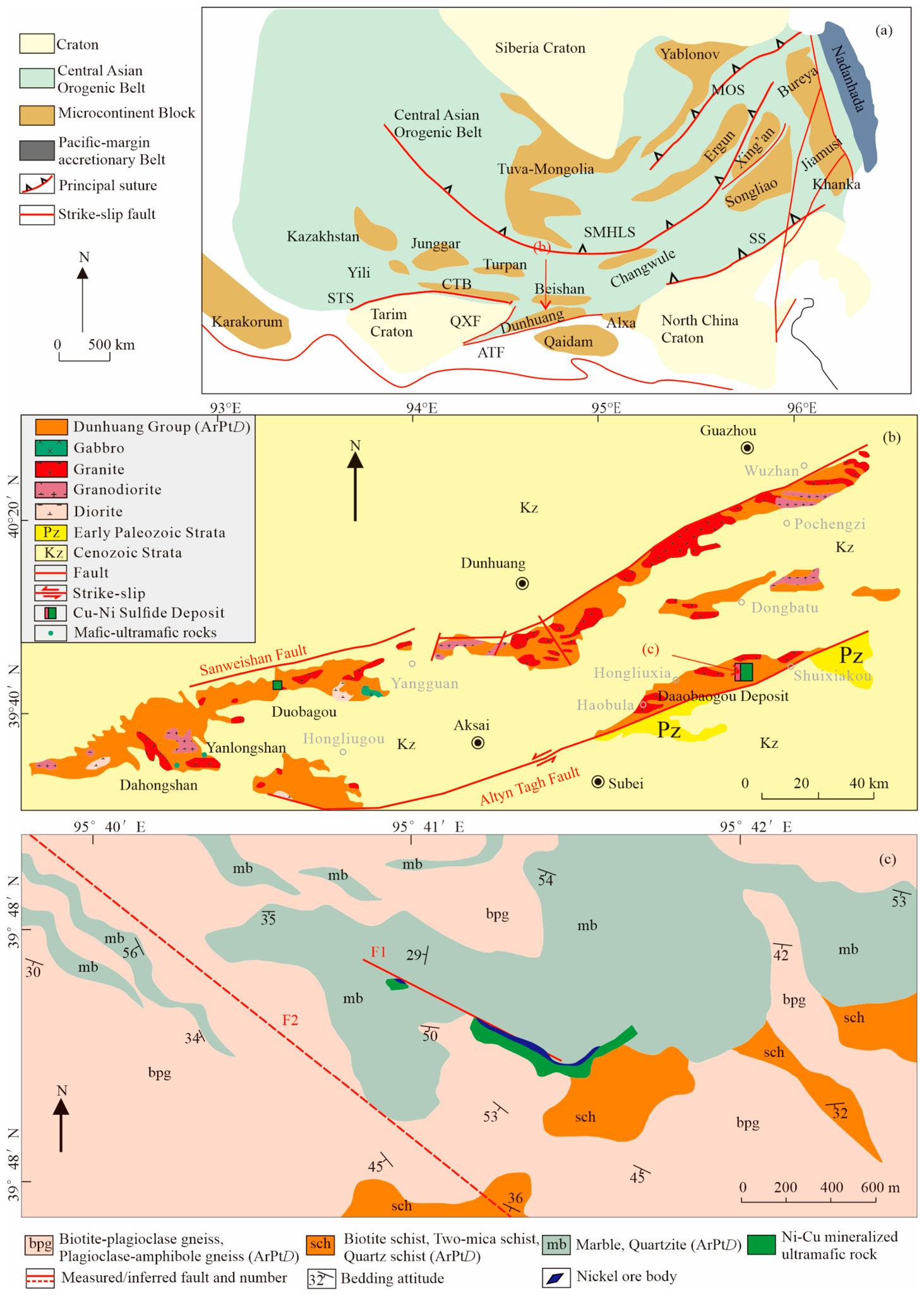
The Daaobaogou deposit is located within the Dunhuang Block on the southeastern margin of the Tarim Plate. This region also constitutes a significant component of the southernmost Central Asian Orogenic Belt (Figure 1a). It is bounded to the south by the main Altyn Tagh Fault, which separates it from the North Qilian Orogenic Belt; to the north by the Liuyuan–Daqishan Fault, which juxtaposes it against the Beishan Orogenic Belt; to the west by the Qiemo–Xingxingxia Fault, which marks the boundary with the Tarim Craton; and to the east by the Alxa Block. The overall structural trend of the region is NEE-SWW (Figure 1b).
The dominant structural feature in the region is the Altyn Tagh Fault, which strikes NEE and is renowned globally for its enormous left-lateral strike-slip displacement and prominent linear geomorphic expression [10]. The Sanweishan Fault, which shares the same NEE strike and lies less than 100 km from the main Altyn Tagh Fault, is considered an integral part of the Altyn Tagh fault system [11]. Secondary faults are well developed and exhibit polyphase, multistage deformation histories [12]. The region is dominated by supracrustal rock sequences ranging in age from Late Paleoproterozoic to Early Paleozoic [13,14], collectively referred to as the Dunhuang Group [15]. Major rock types include muscovite quartz schist, garnet-bearing mica quartz schist, biotite plagioclase gneiss, garnet-bearing biotite plagioclase gneiss, diopside quartzite, and marble, which are interpreted to have formed in a littoral–neritic environment along an active continental margin [16,17].
In recent years, widespread Paleozoic magmatic and metamorphic rocks have been increasingly recognized within the Dunhuang region. These rocks primarily include Early Paleozoic intermediate-felsic volcanic rocks [18], I- and S-type granites [5,19]; Late Paleozoic calc-alkaline granites [2,3] and volcaniclastic rocks [20]; and a minor amount of Mesozoic mafic dykes [21]. Furthermore, a number of Paleozoic metamorphic rocks (predominantly mafic granulites, amphibolites, and eclogites) record clockwise P-T paths characterized by near-isothermal decompression, indicating that the Dunhuang Block was undergoing collisional orogenesis during this period [4], possibly associated with the northward subduction of the Paleo-Tethys Ocean [22].
Figure 1. Geological map of the Central Asian Orogenic Belt, the Dunhuang Block, and the Daaobaogou area. (a) Schematic tectonic map highlighting the main subdivisions of central and eastern Asia and the location of the study areas (modified after [23]). MOS: Mongolia–Okhotsk Suture; SMHLS: South Mongolia–Hinggan League Suture; STS: South Tianshan Suture; CTB: Central Tianshan Block; QXF: Qiemo–Xingxingxia Fault; ATF: Altyn Tagh Fault; SS: Solonker Suture. (b) Geological map of the Dunhuang Block (modified after [24]); (c) ArPtD: Dunuhang Group. Geological sketch of the mafic–ultramafic rocks in the Daaobaogou deposit (modified after [9]).
Applsci 16 05508 g001

2. Daaobaogou Mafic–Ultramafic Rock Body Characteristics

The ore-bearing mafic–ultramafic rock body in Daaobaogou occurs as a dyke, with an exposed length of approximately 1200 m, a width of about 50 m, and an area of roughly 0.06 km2 (Figure 1c). Based on its strike, it can be divided into eastern and western segments. The eastern segment of the dyke extends approximately 400 m along a surface strike of NE 60°, with its southern boundary intrusively contacting the Dunhuang Group [25]. The contact plane dips north at an angle of about 70°, while its northern boundary contacts marble. The western segment of the dyke is mainly exposed along the F1 fault for about 800 m, with a general strike of 300°, dipping southwest at angles between 50° and 70°. To the south, it is concealed beneath the Dunhuang Group [9].
A total of 14 nickel ore bodies have been delineated within the Daaobaogou mafic–ultramafic rocks. These ore bodies exhibit stratoid or lenticular forms, with dip angles ranging from 30° to 60°. The average thickness of the ore bodies varies from 1.41 to 12.79 m, and their lengths range from 80 to 920 m. The nickel grade ranges from 0.23% to 1.18%, copper grade from 0.04% to 0.40%, and associated cobalt from 0.01% to 0.04%. Preliminary estimates indicate copper–nickel ore resources of 1.3311 million tons, with nickel metal content of 5909 tons (average nickel grade 0.44%) and copper metal content of 1986 tons (average copper grade 0.15%) [9].

3. Sample Collection and Analytical Methods

To precisely constrain the composition of the parental magma, we specifically collected fresh olivine pyroxenite samples containing the most primitive olivine (SB25D02-04, SB25D02-05, SB25D02-06, SB25D02-07, SB25D02-08) and one olivine pyroxenite from drill hole ZKE0704 (associated with Cu-Ni mineralization). Among these, whole-rock geochemical analyses and Sr-Nd-Pb isotopic composition analyses were conducted on the olivine pyroxenite from surface outcrops. Electron microprobe analyses of olivine were performed on both the mineralization-related olivine pyroxenite and selected olivine pyroxenite samples from surface outcrops. In addition, previously published whole-rock data and Sr-Nd isotopic data for gabbro, pyroxenite, and olivine pyroxenite from the Daaobaogou Ni–Cu sulfide deposit were compiled from the literature [8,9].
Major elements were conducted at the Institute of Mineral Resources, Chinese Academy of Geological Sciences, using X-ray fluorescence spectrometry (XRF). Approximately 0.5 g of sample was placed in a crucible, mixed with an appropriate amount of boric acid, and fused at high temperature to form a glass disk. Oxide contents were then measured using an X-ray fluorescence spectrometer (Malvern Panalytical, PANalytical Zetium, Almelo, The Netherlands) with an external standard method. The relative error for major oxide analysis was less than 2%. Trace elements were determined using Inductively Coupled Plasma Mass Spectrometry (Thermo Fisher Scientific, ICAP RQ ICP-MS, Bremen, Germany). Approximately 40 mg of sample was dissolved using an acid digestion method to prepare a solution, which was then analyzed by ICP-MS. The relative analytical error was between 5% and 10% [26].
Petrographic analysis was conducted at the School of Geosciences and Resources, China University of Geosciences. Polished thin sections (approximately 0.03 mm thick) were prepared from representative samples of gabbro, olivine pyroxenite, and pyroxenite. Petrographic observations were carried out using a polarizing microscope (Olympus, BX53, Tokyo, Japan). Mineral assemblages, textures, and alteration features were described under transmitted and reflected light. Selected mineral compositions were further verified by electron probe microanalysis (EPMA).
The electron probe microanalysis of olivine was conducted at the Institute of Mineral Resources, Chinese Academy of Geological Sciences, using an electron probe microanalyzer (JEOL, JXA-8230, Tokyo, Japan). The analytical conditions were as follows: accelerating voltage of 15 kV, beam current of 20 nA, beam diameter of 5 μm, and counting time of 20 s.
Sr, Nd, and Pb isotopes were conducted at the Analytical Testing Research Center, Beijing Research Institute of Uranium Geology, using a Thermal Ionization Mass Spectrometer (Isotopx, IsoProbe-T, Middlewich, UK) and a Phoenix Thermal Ionization Mass Spectrometer (Isotopx, Phoenix, Middlewich, UK), under conditions of 21 °C temperature and 28% humidity. Rock samples were decomposed using hydrofluoric acid and perchloric acid. Lead was separated using anion exchange resin in a hydrobromic acid system. The effluent was dried and used for the separation of Sr and total rare earth elements (REE). Sr and total REE were separated using 0.168 mm–0.084 mm cation exchange resin. Nd was separated using 0.084 mm–0.042 mm cation exchange resin with α-hydroxyisobutyric acid as eluent. Isotopic ratios of Sr, Nd, and Pb were determined using the mass spectrometers.

4. Analytical Results

4.1. Petrographic Characteristics

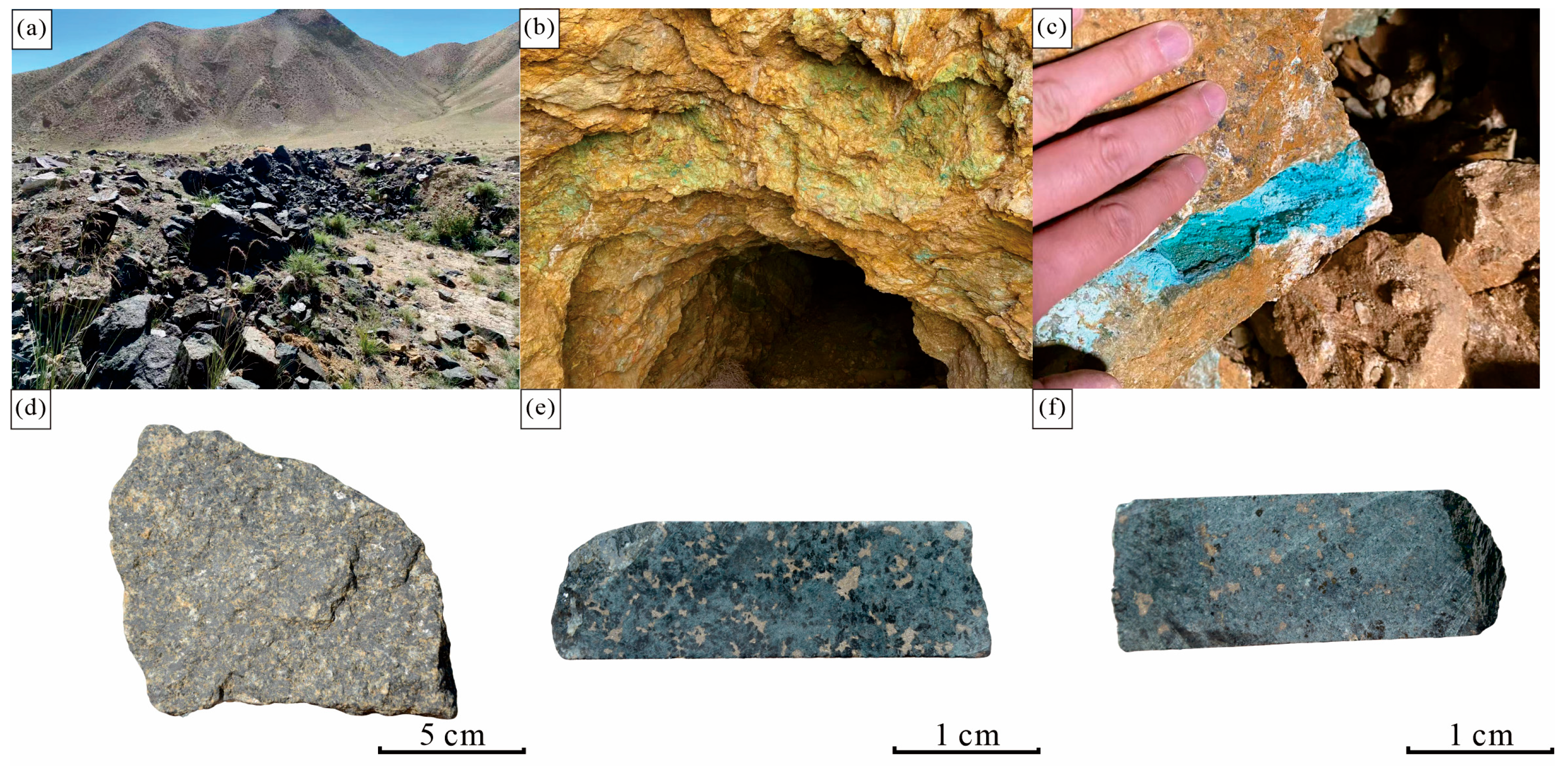
The Daaobaogou mafic–ultramafic rocks consist of gabbro, pyroxenite, and olivine pyroxenite. These rock types are distributed both on the surface and at depth, with the copper–nickel ore bodies mainly hosted in the olivine pyroxenite facies and pyroxenite facies (Figure 2 and Figure 3a). Affected by intense weathering and alteration, the surface of the rock mass is mostly covered by slope deposits. The alteration within the rock is primarily manifested as serpentinization, tremolitization, and steatitization. Malachite and annabergite have appeared on the surface, serving as direct indicators for mineral exploration (Figure 3b,c).
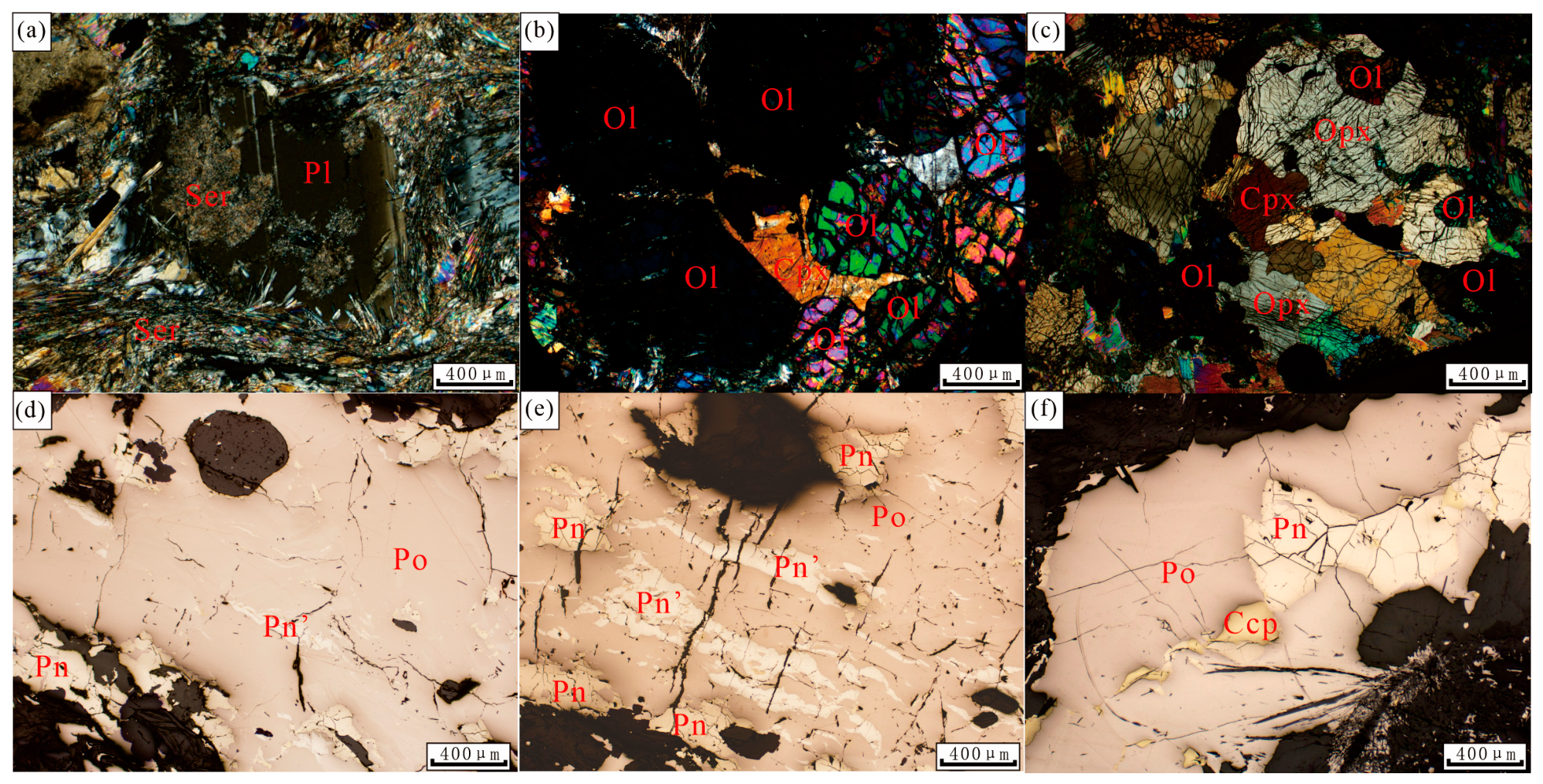
Gabbro exhibits a medium-grained structure and massive structure, primarily composed of mafic plagioclase and pyroxene (augite, minor enstatite), with minor scattered ore minerals (Figure 3d). Plagioclase occurs as subhedral granular crystals, ranging from 0.1 to 1 mm in size, displaying Carlsbad-albite compound twinning with indistinct zoning. It is generally altered to sericite and chlorite, with rare preserved tabular relic crystals (Figure 4a). Pyroxene (augite, minor enstatite) is mostly euhedral short prismatic, typically 0.5–3 mm in size, with well-developed cleavage.
Olivine pyroxenite displays a medium-to coarse-grained structure and massive structure, mainly composed of olivine, pyroxene (clinopyroxene and orthopyroxene), and a certain amount of ore minerals (Figure 3e). Olivine is mostly subhedral rounded granular, predominantly 2–10 mm in size, with some grains ranging from 0.5 to 2 mm. Pyroxene (clinopyroxene and orthopyroxene) is mainly subhedral short prismatic, typically 1–10 mm in size, with some grains less than 1 mm; olivine inclusions are visible within a few crystals (Figure 4b).
Pyroxenite exhibits a medium to coarse-grained structure and massive structure, mainly composed of pyroxene and a certain amount of ore minerals (Figure 3f). Pyroxene (clinopyroxene and orthopyroxene) occurs as subhedral short prismatic to fragmented grains, with sizes mainly ranging from 2 to 4.5 mm, and some from 0.2 to 2 mm. The minerals are generally altered to varying degrees of chloritization, with chlorite occurring as fine scaly aggregates distributed between pyroxene grains (Figure 4c).
The primary sulfides are mainly pyrrhotite and pentlandite, followed by chalcopyrite. Pyrrhotite is reddish-brown, distributed as subhedral-euhedral grains, and also occurs as massive or veinlet disseminations within gangue minerals, typically ranging from 0.05 to 2 mm in size, often associated with pentlandite and chalcopyrite. Pentlandite is pale yellow, distributed as euhedral-subhedral grains, often developed at the margins of pyrrhotite, frequently with fractures, typically ranging from 0.05 to 1.5 mm in size; some pentlandite exhibits “flame-like” exsolution textures within pyrrhotite (Figure 4d,e). Chalcopyrite is brass-yellow, distributed as subhedral-euhedral grains, and also occurs as massive or veinlet disseminations within gangue minerals. It is less abundant compared to the former two, often associated with pyrrhotite and pentlandite, typically with grain sizes below 0.1 mm (Figure 4f).

4.2. Whole-Rock Major and Trace Elements

4.2.1. Major Element Characteristics

The whole-rock major element compositions of the mafic–ultramafic rocks from the Daaobaogou area exhibit distinct mafic characteristics (Table 1). The olivine gabbro samples have SiO2 contents ranging from 44.8% to 46.8%, with MgO contents as high as 27–29%, coupled with low Al2O3 (3.3–4.7%) and TiO2 (0.23–0.27%) contents, demonstrating a pronounced high-Mg and low-Ti signature. Total alkali contents (Na2O + K2O) are generally low in all samples, mostly below 1 wt.%. The Mg# values are all greater than 82, and the m/f ratios range from 4.543 to 4.783, classifying these rocks as ferruginous ultramafic rocks. Additionally, the samples exhibit relatively high concentrations of transition elements such as Cr2O3 and V2O5.

4.2.2. Trace Element Characteristics

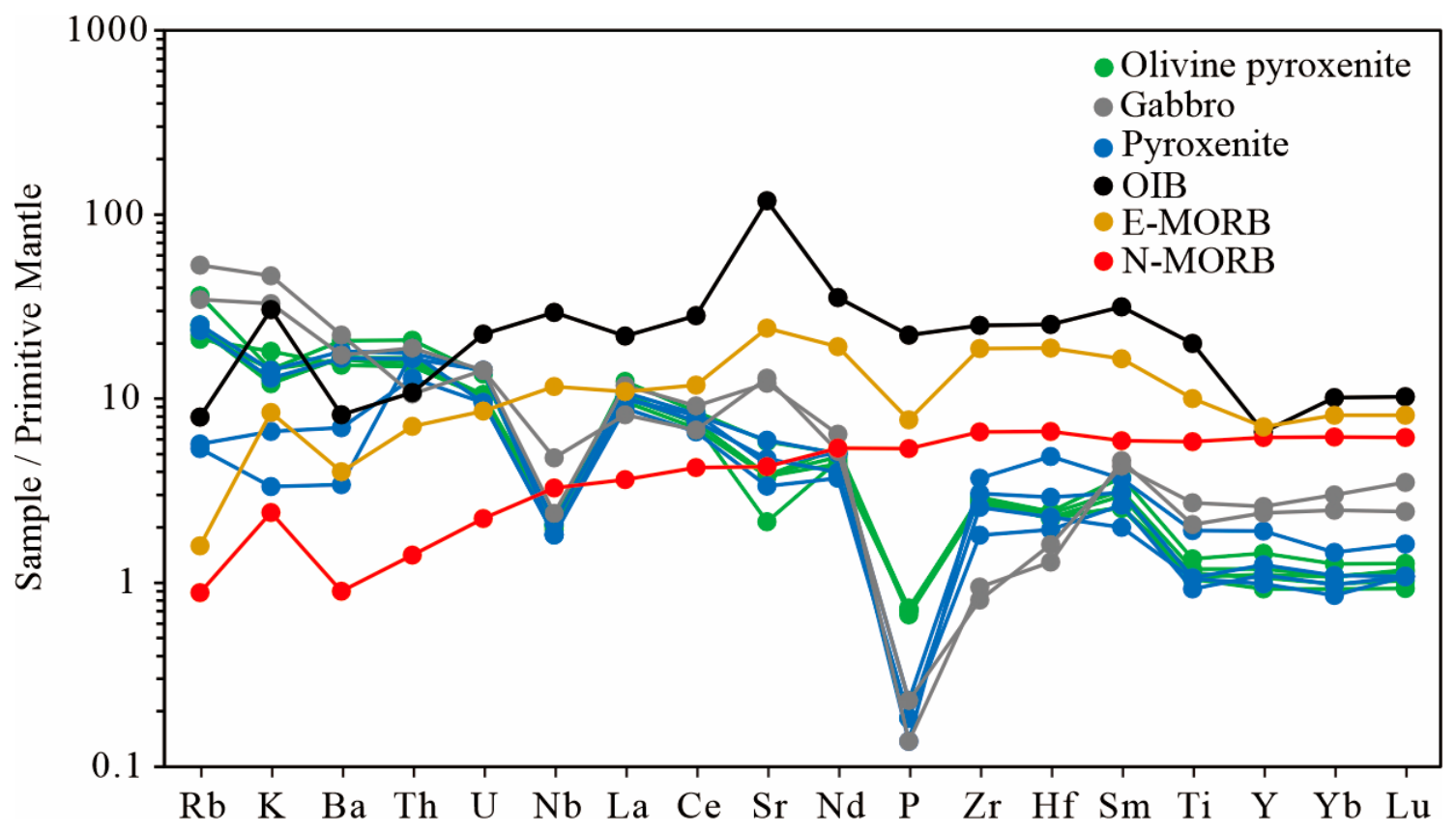
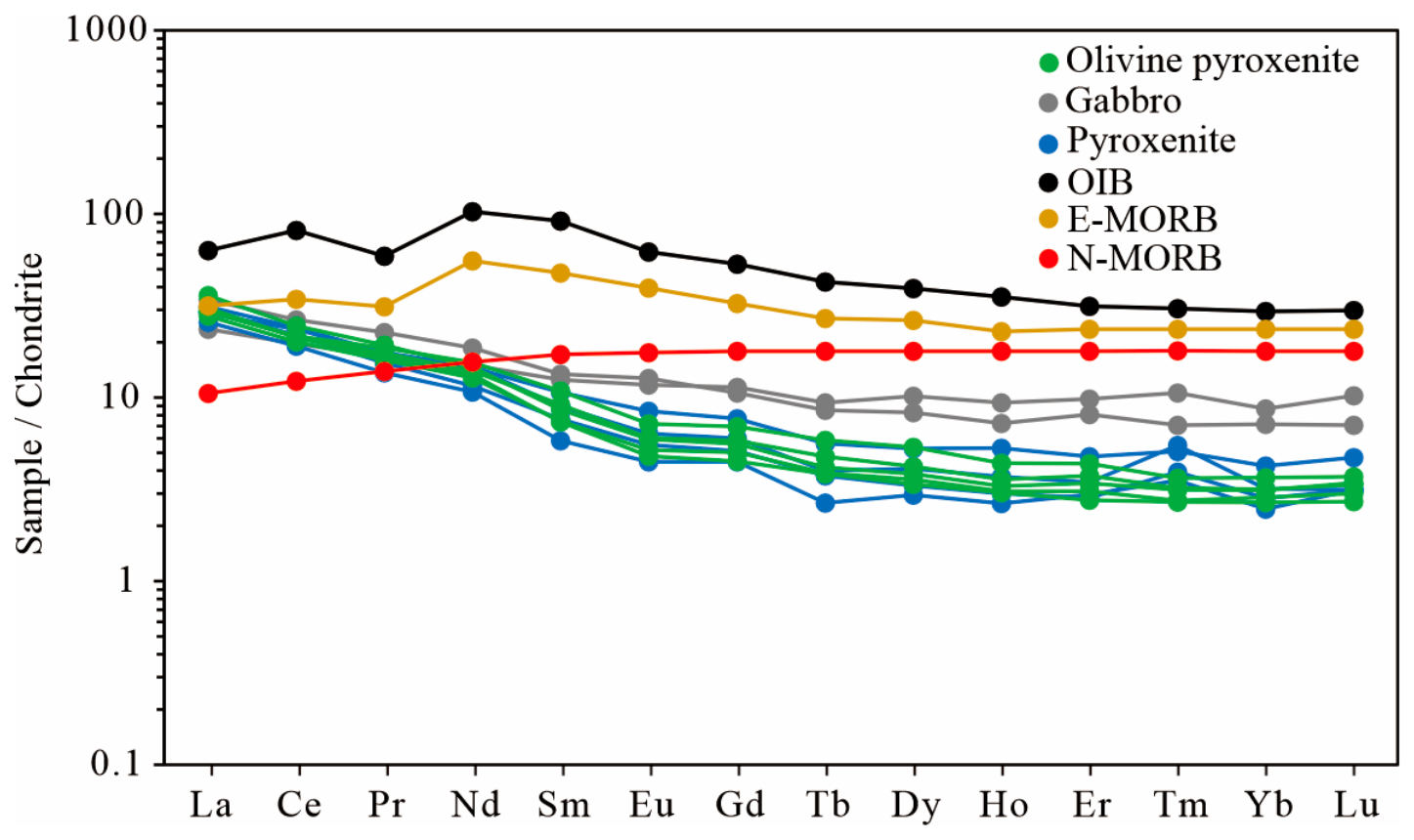
The whole-rock trace element compositions of the mafic–ultramafic rocks from Daaobaogou exhibit relatively consistent geochemical characteristics (Table 2). The samples generally have high contents of transition elements such as Cr, Ni, Co, V, and Sc. Among these, Ni and Cr are significantly enriched, reflecting the pronounced mafic affinity of the magmatic system and indicating that the parent magma originated from mantle-derived materials. Most samples have δEu ≈ 1, showing no significant Eu anomaly, which suggests that plagioclase fractionation crystallization was not significant. Zr and Hf show no significant anomalies, indicating that the magma source region was not notably affected by zircon saturation. The samples are characterized by relative enrichment of large ion lithophile elements (LILE) such as Rb, Th, and U, and relative depletion of high field strength elements (HFSE) such as Nb, Ta, and Ti, suggesting possible crustal contamination during magma evolution (Figure 5). Regarding rare earth elements, the samples generally have moderate to low total REE contents, with light rare earth elements (LREE) relatively enriched compared to heavy rare earth elements (HREE), displaying a clear right-inclining pattern (Figure 6). Samples are enriched relative to N-MORB but are distinct from OIB, consistent with a subduction-modified mantle source.

4.3. Electron Probe Microanalysis of Olivine

Olivine major element compositions were determined by electron probe microanalysis, and representative results are presented in Table 3. The analyzed olivine grains exhibit relatively uniform compositions with forsterite (Fo) contents ranging from 80.8 to 84.9 (Fo = 100 × Mg/(Mg + Fe2+) in mole), classifying them as olivine. The Fo values show a positive correlation with NiO (0.15–0.18 wt%) and a negative correlation with MnO (0.17–0.33 wt%), consistent with a mantle-derived or magmatic origin. Calcium contents are uniformly low (CaO ≤ 0.02 wt%), indicating no significant post-magmatic alteration or exsolution. The low TiO2 and Cr2O3 concentrations (<0.07 wt%) further support crystallization from a primitive basaltic magma. The analytical totals are close to 100 wt% (99.2–101.3 wt%), confirming the reliability of the acquired data. These compositional characteristics suggest that the olivine crystals are likely early-formed cumulus phases that recorded limited fractional crystallization.

4.4. Sr-Nd-Pb Isotopes

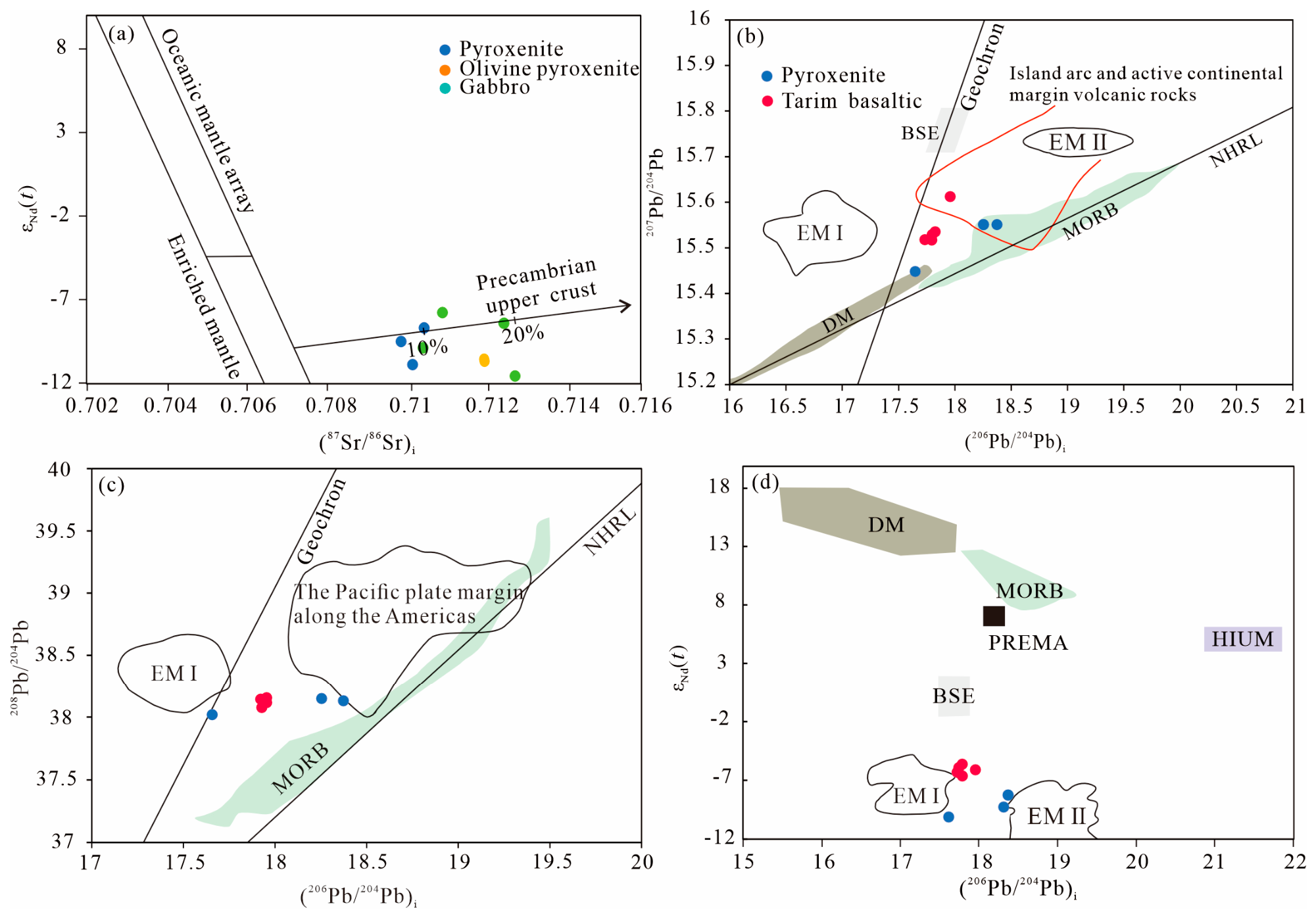
The whole-rock Sr-Nd-Pb isotopic compositions of the mafic–ultramafic rocks from Daaobaogou exhibit a relatively concentrated overall range (Table 4 and Table 5), showing clear mantle-derived characteristics. The initial 87Sr/86Sr ratios of the samples are generally high, and the εNd(t) values are negative. The Pb isotopic compositions display relatively limited variation ranges for 206Pb/204Pb, 207Pb/204Pb, and 208Pb/204Pb, and overall plot near the mantle evolution trend line, without showing high μ (HIMU) or enriched crustal end-member characteristics. This further indicates that the magmatic system in the study area is primarily of mantle origin.

5. Discussion

5.1. Nature of the Magma Source Region

The nature of the magma source region is a fundamental prerequisite for understanding its metallogenetic potential. The Sr-Nd-Pb isotopic data obtained in this study provide key constraints for revealing the source characteristics of the Daaobaogou intrusion. The samples exhibit high initial (87Sr/86Sr)i ratios (0.70979–0.71036) and significantly negative εNd(t) values (−8.66 to −10.86) (Table 4), clearly indicating that their source region was not primitive or depleted mantle. On the εNd(t)-(87Sr/86Sr)i diagram (Figure 7a) and related Pb isotope diagrams (Figure 7b–d), the data points all fall between the enriched mantle end-members (EM I and EM II) and are biased towards the island arc/active continental margin field, showing similarities with the Tarim flood basalts [28]. This characteristic suggests that the magma source region was a lithospheric mantle that experienced long-term evolution and possessed a “composite enriched” attribute.
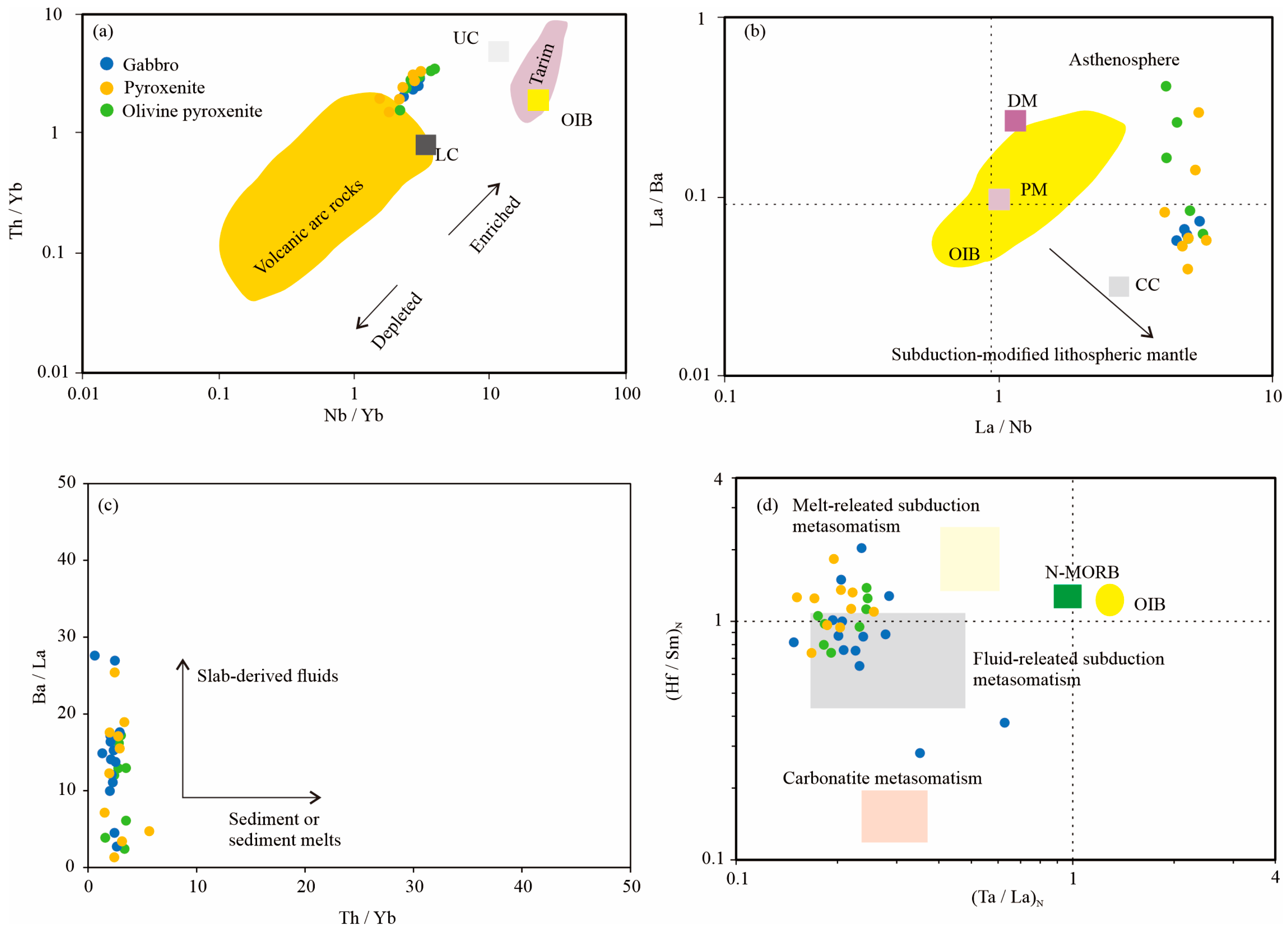
Based on trace element characteristics, such as the samples plotting near arc volcanic rocks in the Nb/Yb-Th/Yb diagram (Figure 8a) and the subduction-related metasomatic signals indicated by the La/Nb-La/Ba diagram (Figure 8b), the Th/Yb-Ba/La diagram, combined with the (Ta/La)N-(Hf/Sm)N ratios (Figure 8c,d), indicates that the magma source region was primarily metasomatized by subduction-related fluids, with only minor involvement of sediments. It can be further inferred that this enrichment attribute likely originated from extensive metasomatism of the lithospheric mantle beneath the Dunhuang Block by fluids or melts released from oceanic sediments or altered oceanic crust during the southward subduction of the Paleo-Asian Ocean in the Paleozoic era [37]. This subduction-related metasomatism not only introduced abundant incompatible elements and radiogenic Sr and Pb but also led to sulfur pre-enrichment in the mantle source [38], laying a crucial material foundation for subsequent mineralization. Therefore, the parental magma of the Daaobaogou intrusion originated from an ancient, enriched lithospheric mantle that had undergone subduction-related metasomatism. This source characteristic determined that its primary magma inherently possessed the potential for relative enrichment in ore-forming elements (such as Cu, Ni, and S) and provided a specific starting point for subsequent magmatic evolution.

5.2. Parental Magma Inversion

The composition of the parental magma is crucial for understanding magmatic evolution. The estimation of MgO content is typically based on the olivine–liquid equilibrium principle. Previous studies, through experimental petrology and petrogeochemistry, have extensively investigated the relationship between the Fe2+/Mg ratios of the magma melt and olivine in equilibrium [42,43]. Under fractional crystallization conditions (relatively low-pressure conditions), the Mg-Fe partition coefficient is shown [40].
Kd = (XFe/XMg)Ol/(XFe/XMg)melt = 0.30 ± 0.03
where XFeOl, XMgOl are the molar fractions of Fe and Mg in olivine, and XFemelt, XMgmelt are the molar fractions of Fe and Mg in the melt.
Fo = XMgOl/(XMgOl + XFeOl)
It follows that, given the composition (Fo value) of olivine crystallizing in equilibrium with the melt, the ratio line of MgO to FeO in the primary magma can be obtained. That is, by combining Equations (1) and (2), and converting molar fractions to mass fractions (XFemelt = wFeO/71.84, XMgmelt = wMgO/40.3044), we obtain
wFeO/wMgO = (1 − Fo)/(Fo × Kd) × 71.84/40.3044
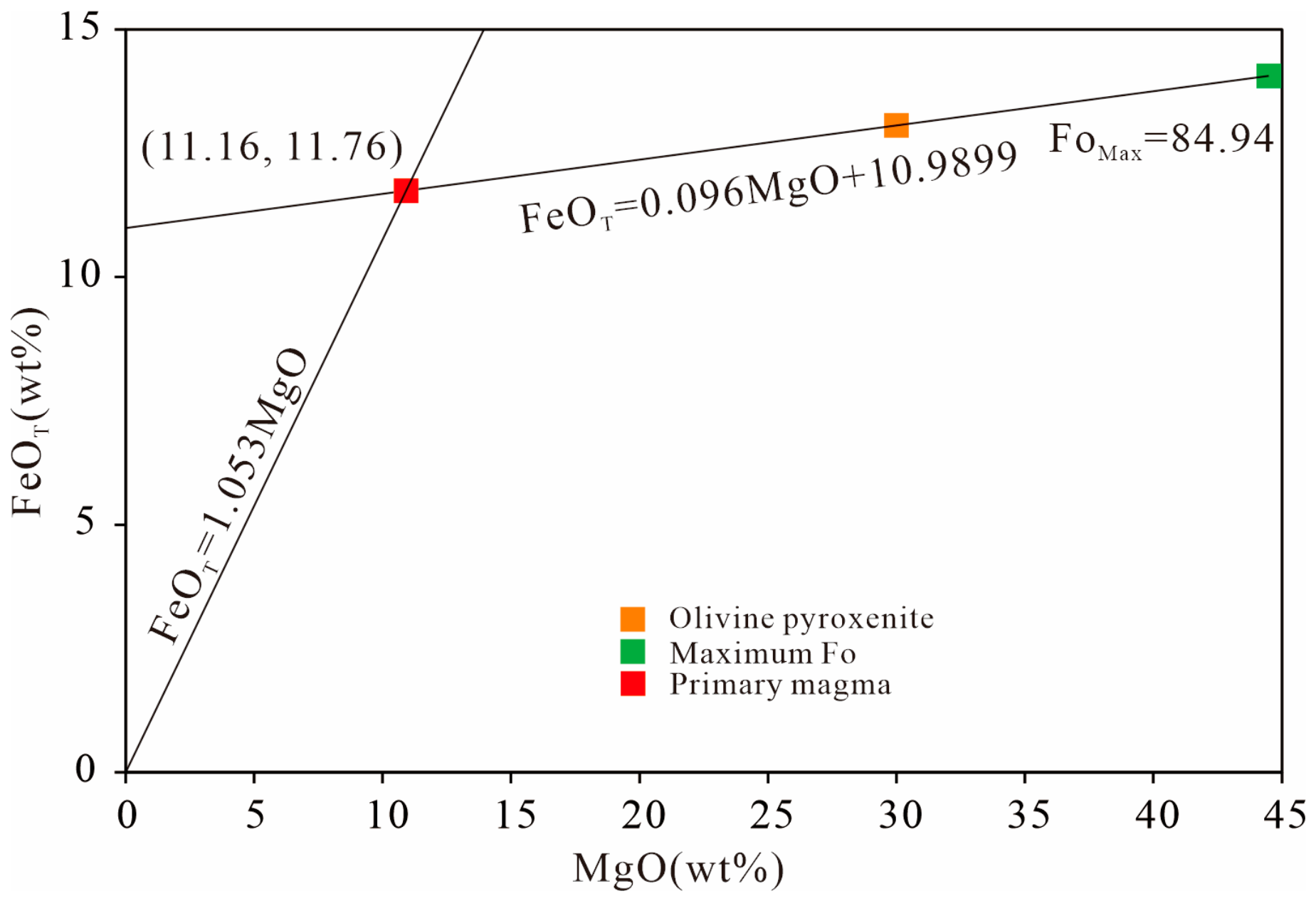
In this paper, for estimating the MgO content of the parental magma of the Daaobaogou intrusion, we adopt a further refinement of the method by [44], which uses the highest Fo value of olivine in cumulate rocks and representative whole-rock compositions to derive the MgO and FeO contents in the parental magma. The cumulate rock samples are considered as mixtures of early crystallized phases and the late-stage liquid of magmatic evolution, assuming olivine was the earliest liquidus mineral. Firstly, fresh olivine with the highest Mg# value in the cumulates was selected (Fo = 84.94). This Fo value is assumed to approximate the FeO/MgO ratio of the parental magma at the time of initial olivine crystallization. Based on the principle of mass balance, the wFeO/wMgO ratio in the equilibrium parental magma was determined. Simultaneously, setting Kd to 0.30 [42] and substituting into Equation (3) yields a ratio of approximately 1.053. Secondly, a sample with the highest degree of mafic composition, containing olivine cumulates and minimal pyroxene crystallization, was selected to best approximate the composition of the olivine–melt mixture during the early stage of olivine crystallization. Here, an olivine pyroxenite sample (DAG07: wFeOT = 12.19, wMgO = 29.1) was chosen as the mineral–melt mixture end-member at crystallization equilibrium. The olivine with the highest Fo value (wMgO = 44.492, wFeOT = 14.06) was selected as the early mineral phase end-member of the parental magma evolution. This establishes the functional relationship between FeO and MgO in the parental magma. As shown in Figure 9, the intersection point of the parental magma FeOT-MgO function with the FeOT-MgO parental magma ratio line from initial olivine crystallization yields the FeOT and MgO contents of the parental magma. Calculations yield wMgO = 11.16% and wFeOT = 11.76%, respectively, classifying it as a high-Mg basaltic magma.
Based on the previously selected sample range, two samples (DA15, DA13) with fresh cumulate olivine, relatively high MgO content, relatively low CaO content, and minimal pyroxene were further selected. Their whole-rock average values were used, combined with the Fe-Mg partition coefficient between olivine and melt to determine the crystallization proportion of olivine, thereby calculating the other major element compositions of the parental magma [44]. The calculated parental magma compositions are presented in Table 6.
The simulation calculation of the rare earth element composition of the parent magma can be performed using the processing model proposed by scholar Li et al. [45]:
REEimelt = REEirock/(1 − f + kiOl − melt × f)
REEimelt refers to the content of rare earth elements in the parent magma.
REEirock refers to the content of rare earth elements in the rock.
kiOl refers to the partition coefficient of rare earth element i between olivine and melt (after [46]).
f refers to the weight percentage of olivine in the mixed system. The author used GeokitPro (build20250208) [47] to calculate that the average proportion of olivine in the whole-rock data of olivine pyroxenite is 47.4%. The calculation results are shown in Table 7.

5.3. Magma Evolution

5.3.1. Fractional Crystallization

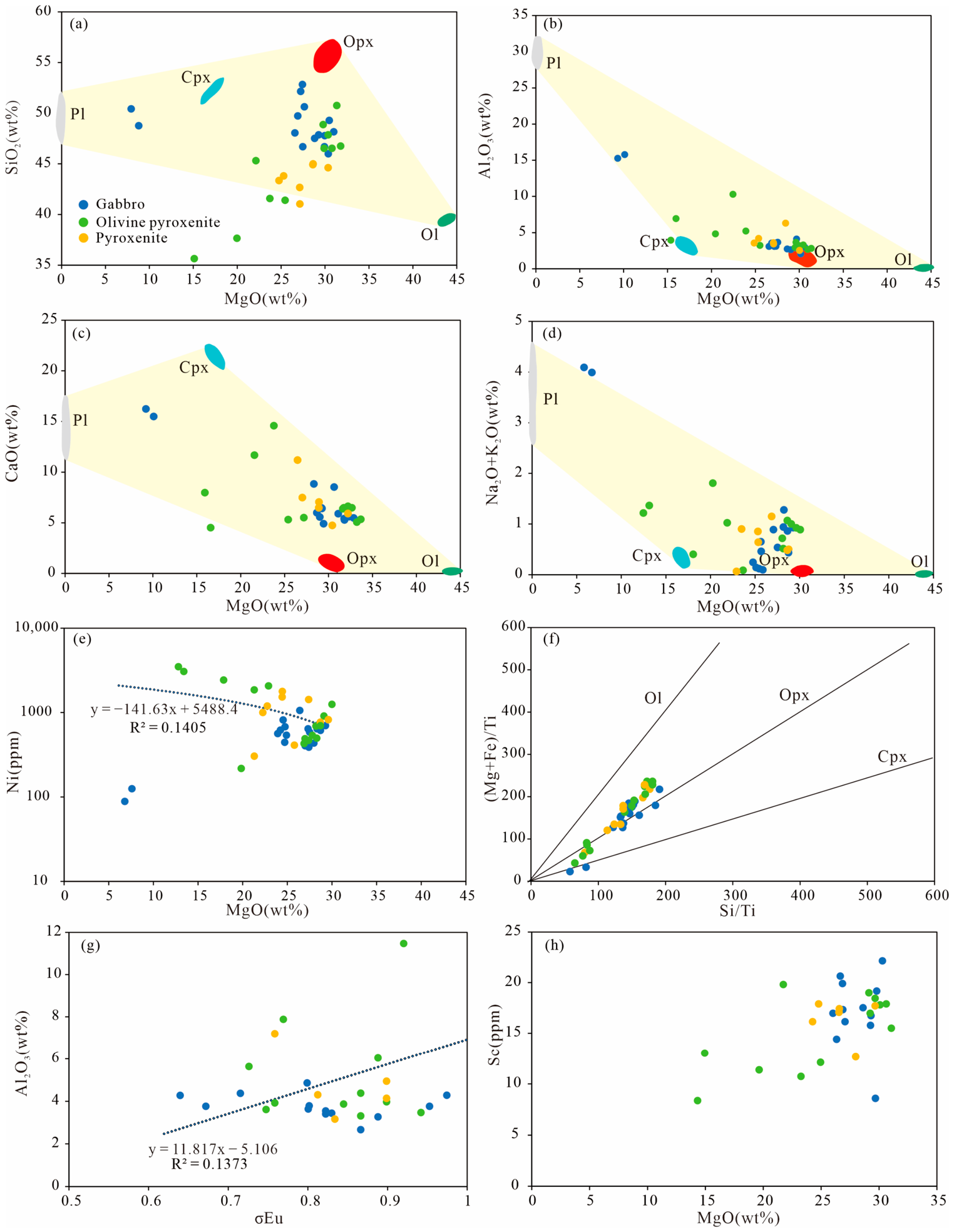
The fractional crystallization discrimination diagrams [Figure 10a–f] show that MgO is significantly negatively correlated with SiO2, Al2O3, CaO, total alkalis (Na2O + K2O), and Ni, suggesting fractional crystallization of plagioclase, pyroxene, and olivine, accompanied by sulfide liquid immiscibility. The Si/Ti-(Mg + Fe)/Ti diagram indicates fractional crystallization of olivine and orthopyroxene during magma evolution.
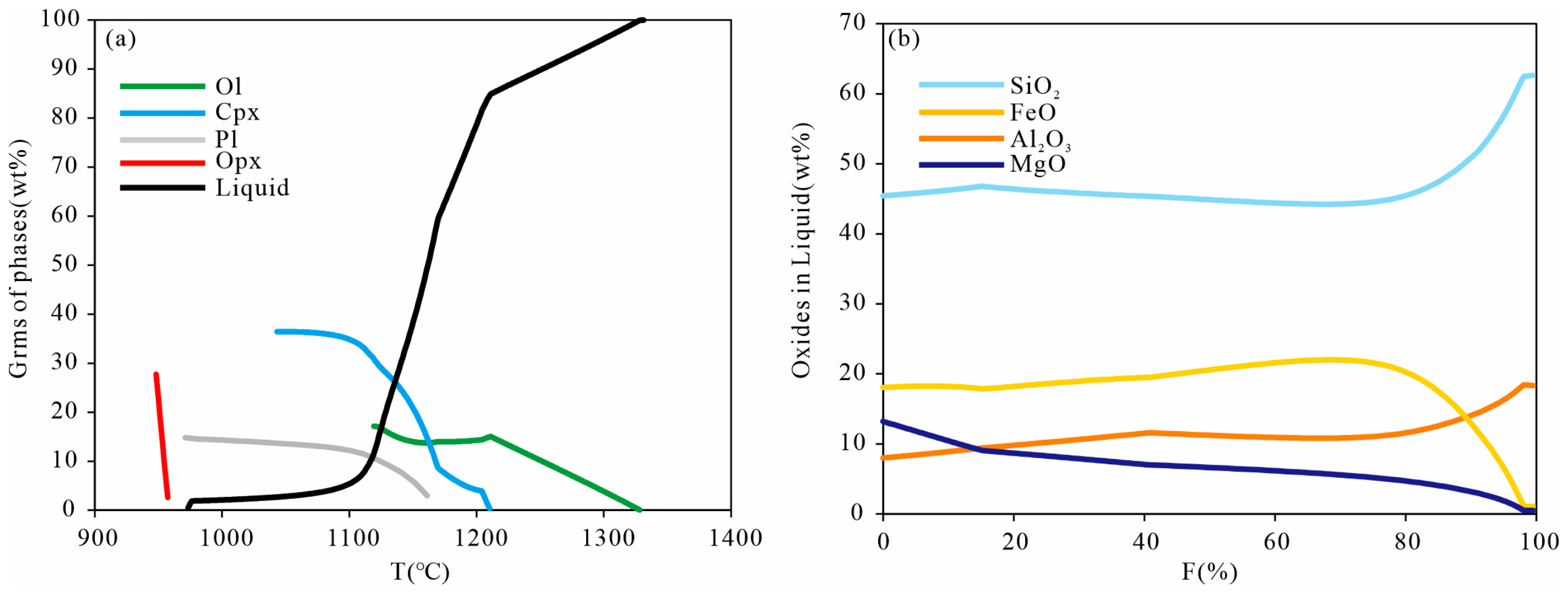
This study utilizes the estimated parent magma composition of Daaobaogou, assuming fractional crystallization at a pressure of 1 kb and an oxygen fugacity at the QFM buffer, to simulate the parent magma evolution process using the thermodynamic software “Melts (v. 1.2.0)” [48]. The simulation indicates that under these conditions, the system remains as a melt phase until 1328 °C (Figure 11a). At 1328 °C, olivine begins to crystallize, with a Fo value of 83.74 at this onset, slightly lower than the maximum Fo value measured in olivine. At 1210 °C, clinopyroxene starts to crystallize, at which point olivine has crystallized by 15%. At 1169 °C, feldspar begins to crystallize. Upon reaching 1119 °C, olivine ceases crystallization after approximately 17% fractionation. Clinopyroxene stops crystallizing at 971 °C, and orthopyroxene begins crystallizing at 951 °C. Feldspar crystallization ends at 921 °C. Orthopyroxene ceases crystallization at 691 °C. In summary, the simulated crystallization sequence of the rocks is olivine, clinopyroxene, feldspar, orthopyroxene. The changes in mafic components during magma evolution are shown in Figure 11b. Initially, with the crystallization of olivine, the MgO content in the magma decreases, while the FeO content shows little change. When clinopyroxene begins to crystallize, FeO decreases rapidly. As crystallization proceeds, the magma evolves into an iron- and magnesium-depleted, silicon- and aluminum-enriched magma.

5.3.2. Crustal Contamination

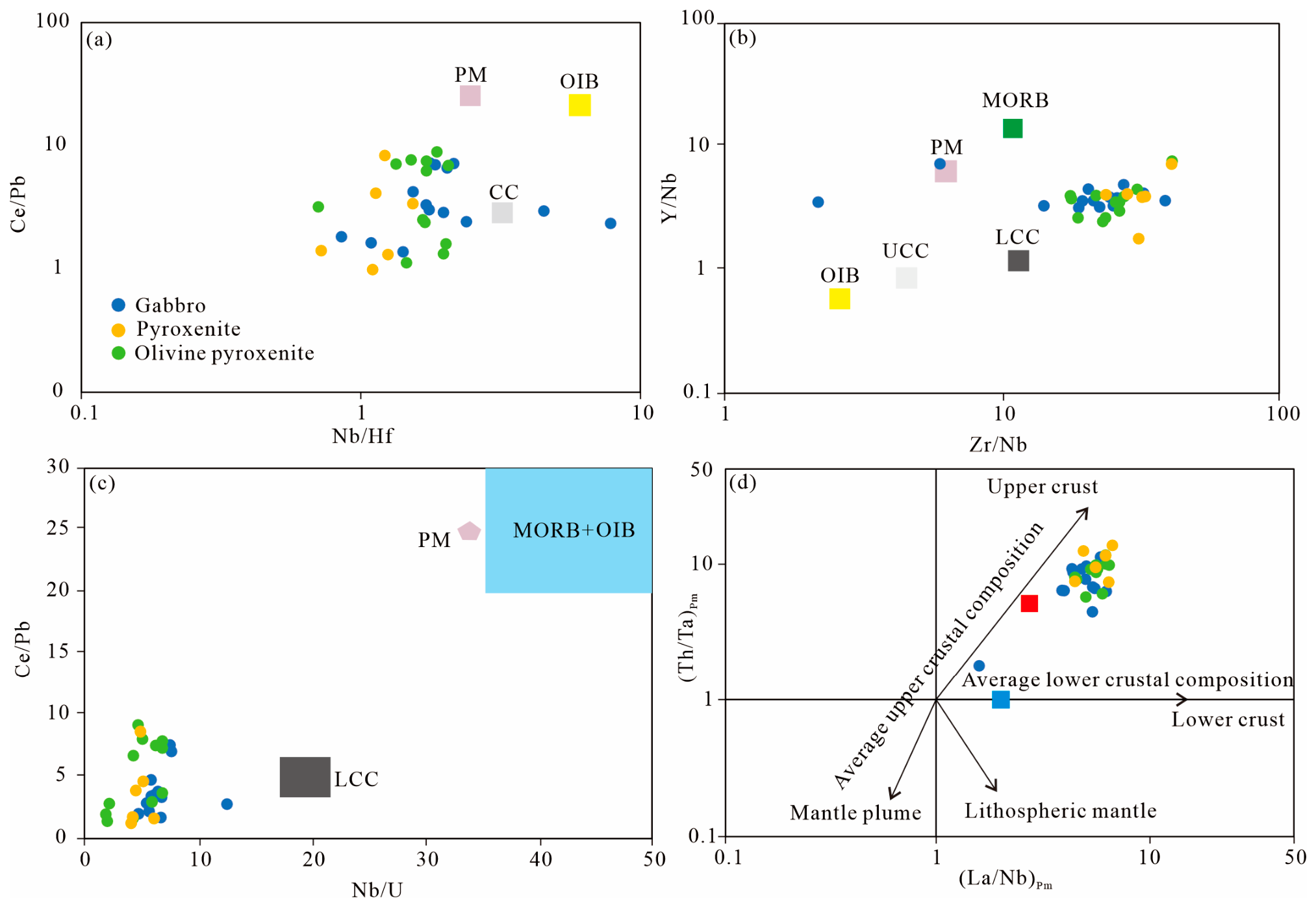
The geochemical characteristics of the rocks indicate that after the magma experienced crustal contamination, the abundances of SiO2, K2O, and Al2O3 in the magma increased, along with elevated contents of Rb, Ba, Zr, Hf, Th, and Cs; conversely, the abundances of P2O5, TiO2, and MgO decreased, accompanied by reduced Cr and Ni contents. Elements such as Nb/U, La/Nb, Th/U, Th/Ta, and Ce/Pb, which are not affected by fractional crystallization and partial melting, can effectively indicate assimilation contamination [49]. It can be seen from the relevant diagrams (Figure 12a–c) that the Daaobaogou samples are close to crustal compositions. The diagrams of (La/Nb)Pm-(Th/Ta)Pm values (Figure 12d) show that different rock samples have all experienced contamination by both upper and lower crustal materials. Using enriched mantle as the end-member for simulation calculations, it is indicated that the Daaobaogou intrusion may have experienced approximately 10–20% contamination by upper crustal materials (Figure 7a).

6. Conclusions

The parental magma of the Daaobaogou mafic–ultramafic intrusion is high-Mg basaltic, with MgO = 13.21 wt%, FeO = 18.07 wt%, and SiO2 = 45.44 wt%. It was derived from an enriched lithospheric mantle source that had been metasomatized by subduction-related fluids, as evidenced by high initial (87Sr/86Sr)i (0.7098–0.7104), negative εNd(t) values (−8.7 to −10.9), and enrichment in LILE and LREE coupled with depletion in HFSE (Nb, Ta, Ti).
The magma evolved dominantly by fractional crystallization, as demonstrated by MELTS simulations (P = 1 kbar, QFM buffer). The crystallization sequence is olivine (onset at 1328 °C) → clinopyroxene (1210 °C) → plagioclase (1169 °C) → orthopyroxene (951 °C). This sequence is strongly supported by petrographic observations, including cumulate textures (olivine as cumulus phase, pyroxene and plagioclase as intercumulus phases) and poikilitic textures (clinopyroxene and orthopyroxene enclosing rounded olivine grains; Figure 4b,c). This sequence is consistent with petrographic observations and the negative correlations of MgO with Al2O3, CaO, and Ni.
Sr–Nd isotope mixing models indicate that the parent magma underwent 10–20% contamination by upper crustal materials during ascent. This contamination, together with olivine fractional crystallization, triggered sulfide liquid immiscibility, leading to the formation of Ni–Cu sulfide ores.

Author Contributions

X.W.: Writing—Review and Editing, Writing—Original Draft, Methodology, Investigation, Data Curation, Conceptualization. B.J.: Writing—Original Draft, Supervision, Visualization, Project Administration, Funding Acquisition. H.C.: Writing—Review and Editing, Visualization, Project Administration. Z.G.: Writing—Review and Editing, Resources, Investigation. All authors have read and agreed to the published version of the manuscript.

Funding

This study was financed by Research on Metallogenesis and Prospecting Prediction of Copper-Nickel Sulfide Deposits in Western Gansu (Grant No. 24ZYQF001) and Priority selection of Yangliuping–Jinbaoshan nickel–cobalt and other urgently needed mineral blocks (Grant No. DD202602109204).

Institutional Review Board Statement

Not applicable.

Informed Consent Statement

Not applicable.

Data Availability Statement

The authors will make the raw data supporting this article’s conclusions available upon request.

Acknowledgments

We sincerely thank the anonymous reviewers and editors for their valuable comments and suggestions, which have greatly helped improve the quality of this manuscript.

Conflicts of Interest

The authors declare no conflicts of interest.

References

  1. Zhang, X.; Huang, Z.; Chen, S.; Si, H.; Xu, X.; Wang, Y.; Li, W.; Liu, Z.; Hu, Y.; Gong, Z. Spatiotemporal distribution of basic-ultrabasic rocks and resource potential of copper-nickel sulfide deposits in Gansu Province. Northwest Geol. 2025, 58, 69–86, (In Chinese with English abstract). [Google Scholar]
  2. Feng, L.; Lin, S.; Davis, D.; Song, C.; Li, J.; Ren, S.; Han, X.; Ge, Y.; Lu, K. Constraints on the tectonic evolution of the southern central Asian orogenic belt from early Permian–middle Triassic granitoids from the central Dunhuang orogenic belt, NW China. J. Asian Earth Sci. 2020, 194, 104283. [Google Scholar] [CrossRef]
  3. Gan, B.; Tang, J.; Safonova, L.; Qin, L.; Diwu, C. Devonian continental arc magmatism in the southern Central Asian Orogenic Belt: Evidence from the Dunhuang Block, NW China. Geosci. Front. 2023, 14, 101643. [Google Scholar] [CrossRef]
  4. Soldner, J.; Yuan, C.; Schulmann, K.; Jiang, Y.; Štípská, P.; Zhang, Y.; Huang, Z.; Wang, X. Early Paleozoic Cascadia-type active-margin evolution of the Dunhuang block (NW China): Geochemical and geochronological constraints. Geol. Soc. Am. Bull. 2022, 134, 2503–2530. [Google Scholar] [CrossRef]
  5. Wang, N.; Wu, C.; Ma, C.; Lei, M.; Guo, W.; Zhang, X.; Chen, H. Geochemistry, zircon U-Pb dating and Hf isotopic characteristics of Paleozoic granites in the southern Dunhuang Block. Acta Petrol. Sin. 2016, 32, 3753–3780, (In Chinese with English abstract). [Google Scholar]
  6. Wan, Y. The Study on Tectonic-Magmatism Evolution and Mineralization in Southern Margin of Dunhuang Block, Western China. Doctoral Thesis, Lanzhou University, Lanzhou, China, 2018. (In Chinese with English abstract). [Google Scholar]
  7. Zhao, Q.; Wang, H.; Yang, C.; Wang, Y.; Li, X.; Zhang, Y. Zircon U-Pb dating, geochemistry and geological significance of the Duobagou granite pluton from the southern margin of the Dunhuang block. Gansu Geol. 2020, 29, 23–30, (In Chinese with English abstract). [Google Scholar]
  8. Feng, Y.; Kang, H.; Zhou, C.; Wang, Z.; Yu, F.; Yu, M.; Kong, L.; Niu, G.; Wang, D. Petrogeochemical characteristics of the Daaobaogou copper-nickel deposit in the southeastern margin of the Tarim Plate and their geological significance. J. Lanzhou Univ. (Nat. Sci.) 2015, 51, 496–502+507, (In Chinese with English abstract). [Google Scholar]
  9. Kang, H.; Su, X.; Wang, Y.; Zhou, C.; Zhang, Z.; Jing, S.; Ning, N.; Zeng, J.; Wang, D.; Yan, Y. Geochronology and petrogeochemistry of the Daaobaogou copper-nickel mineralized mafic-ultramafic intrusion in the Dunhuang Block, southeastern margin of the Tarim Plate. Bull. Mineral. Petrol. Geochem. 2024, 43, 1239–1254, (In Chinese with English abstract). [Google Scholar]
  10. Xu, Z.; Cui, J.; Yang, J.; Zhang, J.; Jiang, M.; Li, H. Comparison of Tectonic Units on Both Sides of the Altyn Tagh Fault and the Mechanism of Lithospheric Shearing. Acta Geol. Sin. 1999, 73, 193–205, (In Chinese with English abstract). [Google Scholar]
  11. Zhang, Y.; Liu, T. The Sanweishan Fault, Dunhuang: A Quaternary Active Fault Without Strong Earthquakes. Earthq. Res. 1989, 5, 39–50, (In Chinese with English abstract). [Google Scholar]
  12. Cunningham, D.; Zhang, J.; Li, Y. Late Cenozoic transpressional mountain building directly north of the Altyn Tagh Fault in the Sanweishan and Nanjieshan, North Tibetan Foreland, China. Tectonophysics 2016, 687, 111–128. [Google Scholar] [CrossRef]
  13. Wang, Z.; Han, C.; Su, B.; Sakyi, P.; Malaviarachchi, S.; Ao, S.; Wang, L. The metasedimentary rocks from the eastern margin of the Tarim Craton: Petrology, geochemistry, zircon U–Pb dating, Hf isotopes and tectonic implications. Lithos 2013, 179, 120–136. [Google Scholar] [CrossRef]
  14. Liu, X. The Protolith Deposition Ages, Source Provenance and Tectonic Significance of Metasedimentary Rocks from the Dunhuang Block. Master’s Thesis, Northwest University, Xi’an, China, 2019. (In Chinese with English abstract). [Google Scholar]
  15. Gansu Bureau of Geology. Regional Geology of Gansu Province; Geological Publishing House: Beijing, China, 1989; pp. 1–692. [Google Scholar]
  16. Mei, H.; Zuo, G. Preliminary framework of Early Precambrian rock associations and structure in Dunhuang-Beishan area, Gansu. North China Geol. 1997, 20, 47–54, (In Chinese with English abstract). [Google Scholar]
  17. Mei, H.; Zuo, Y. Archean tonalite in the Dunhuang area, Gansu Province: Single-grain zircon U-Pb age and Nd isotopes. North China Geol. 1998, 21, 41–45, (In Chinese with English abstract). [Google Scholar]
  18. Zhao, Y.; Sun, Y.; Diwu, C.; Guo, A.; Ao, W.; Zhu, T. The Dunhuang block is a Paleozoic orogenic belt and part of the Central Asian Orogenic Belt (CAOB), NW China. Gondwana Res. 2016, 30, 207–223. [Google Scholar] [CrossRef]
  19. Zhao, Y.; Sun, Y.; Diwu, C.; Ao, W.; Zhu, T.; Zhang, H.; Yan, J. Paleozoic intrusive rocks from the Dunhuang tectonic belt, NW China: Constraints on the tectonic evolution of the southernmost Central Asian Orogenic Belt. J. Asian Earth Sci. 2017, 138, 562–587. [Google Scholar] [CrossRef]
  20. Shi, M.; Hou, Q.; Wu, C.; Yan, Q.; Cheng, N. Paleozoic Sanweishan arc in the northern Dunhuang region, NW China: The Dunhuang block is a Phanerozoic orogen, not a Precambrian block. J. Asian Earth Sci. 2020, 194, 103954. [Google Scholar] [CrossRef]
  21. Feng, Z.; Zhang, Z.; Li, J.; Guo, Z. Cretaceous OIB-Type Mafic Dykes in the Sanweishan Area, Dunhuang: Characteristics and Geological Implications. Acta Petrol. Sin. 2010, 26, 607–616, (In Chinese with English abstract). [Google Scholar]
  22. Wang, H.; Xiao, W.; Windley, B.; Zhang, Q.; Tan, Z.; Wu, C.; Shi, M. Diverse P-T-t Paths Reveal High-Grade Metamorphosed Forearc Complexes in NW China. J. Geophys. Res. 2022, 127, e2022JB024309. [Google Scholar] [CrossRef]
  23. Gan, B.; Li, Z.; Song, Z.; Li, J. Middle Cambrian granites in the Dunhuang Block (NW China) mark the early subduction of the southernmost Paleo-Asian Ocean. Lithos 2020, 372–373, 105654. [Google Scholar] [CrossRef]
  24. Lei, Z.; Zhao, J.; Chen, J.; Zhou, D.; Yang, Z.; Li, S.; Fang, C.; Huang, B.; Liu, L. Geochronology, geochemical characteristics and geological significance of the Haobula intrusion on the southern margin of the Dunhuang Block. Acta Petrol. Mineral. 2025, 44, 1409–1422, (In Chinese with English abstract). [Google Scholar]
  25. Gong, Z.; Chen, H.; Li, S.; Yang, Z.; Hu, X. Exploration progress and peripheral potential evaluation of the Daaobaogou copper-nickel deposit in Subei County, Gansu Province. In Proceedings of the 3rd National Mineral Exploration Conference, Nanchang, China, 17 September 2025. (In Chinese) [Google Scholar]
  26. Liu, Y.; Liu, H.; Li, X. Simultaneous and precise determination of more than 40 trace elements in rock samples by ICP-MS. Geochimica 1996, 25, 552–558, (In Chinese with English abstract). [Google Scholar]
  27. Sun, S.S.; McDonough, W.F. Chemical and Isotopic Systematics of Oceanic Basalts: Implications for Mantle Composition and Processes; The Geological Society of London: London, UK, 1989; pp. 313–345. [Google Scholar]
  28. Zhou, M.; Zhao, J.; Jiang, C.; Gao, J.; Wang, W.; Yang, S. OIB-like, heterogeneous mantle sources of Permian basaltic magmatism in the western Tarim Basin, NW China: Implications for a possible Permian large igneous province. Lithos 2009, 113, 583–594. [Google Scholar] [CrossRef]
  29. Zhang, Z.; Tang, Q.; Li, C.; Wang, Y.; Ripley, E. Sr-Nd-Os-S isotope and PGE geochemistry of the Xiarihamu magmatic sulfide deposit in the Qinghai–Tibet plateau, China. Miner. Depos. 2017, 52, 51–68. [Google Scholar] [CrossRef]
  30. Xu, G. Study on the Mineralization of the Heishan Copper-Nickel Sulfide Deposit in the Beishan Area. Ph.D. Thesis, Chang’an University, Xi’an, China, 2013. (In Chinese with English abstract). [Google Scholar]
  31. Zindler, A.; Hart, S. Chemical Geodynamics. Annu. Rev. Earth Planet. Sci. 1986, 14, 493–571. [Google Scholar] [CrossRef]
  32. Cole, R.; Basu, A. Nd-Sr isotopic geochemistry and tectonics of ridge subduction and middle Cenozoic volcanism in western California. Geol. Soc. Am. Bull. 1995, 107, 167–179. [Google Scholar] [CrossRef]
  33. Miller, J.; Glazner, A.; Farmer, G.; Suayah, I.; Keith, L. A Sr, Nd, and Pb isotopic study of mantle domains and crustal structure from Miocene volcanic rocks in the Mojave Desert, California. Geol. Soc. Am. Bull. 2000, 112, 1264–1279. [Google Scholar] [CrossRef]
  34. Stern, C.; Kilian, R. Role of the subducted slab, mantle wedge and continental crust in the generation of adakites from the Andean Austral Volcanic Zone. Contrib. Mineral. Petrol. 1996, 123, 263–281. [Google Scholar] [CrossRef]
  35. D’Orazio, M.; Innocenti, F.; Manetti, P.; Tamponi, M.; Tonarini, S.; González-Ferrán, O.; Lahsen, A.; Omarini, R. The Quaternary calc-alkaline volcanism of the Patagonian Andes close to the Chile triple junction: Geochemistry and petrogenesis of volcanic rocks from the Cay and Maca volcanoes (∼45°S, Chile). J. S. Am. Earth Sci. 2003, 16, 219–242. [Google Scholar] [CrossRef]
  36. Gorring, M.; Singer, B.; Gowers, J.; Kay, S. Plio-Pleistocene basalts from the Meseta del Lago Buenos Aires, Argentina: Evidence for asthenosphere-lithosphere interactions during slab window magmatism. Chem. Geol. 2003, 193, 215–235. [Google Scholar] [CrossRef]
  37. Zhu, T.; Wang, H.; Xu, X.; Chen, J.; Ma, Z.; Li, Z.; Zhu, X.; Li, P. Discovery of adakitic rocks in south margin of Dunhuang block and its geological significance. Acta Petrol. Sin. 2014, 30, 491–502, (In Chinese with English abstract). [Google Scholar]
  38. Tang, Z.; Xu, G.; Wang, Y.; Qiu, G.; Dai, J. New exploration in magmatic mineralization: Small intrusion mineralization and geological prospecting breakthrough. Northwest. Geol. 2012, 45, 1–16, (In Chinese with English abstract). [Google Scholar]
  39. Pearce, J.; Peate, D. Tectonic Implications of the Composition of Volcanic ARC Magmas. Annu. Rev. Earth Planet. Sci. 1995, 23, 251–285. [Google Scholar] [CrossRef]
  40. Woodhead, J.; Hergt, J.; Davidson, J.; Eggins, S. Hafnium isotope evidence for ‘conservative’ element mobility during subduction zone processes. Earth Planet. Sci. Lett. 2001, 192, 331–346. [Google Scholar] [CrossRef]
  41. La Flèche, M.; Camiré, G.; Jenner, G. Geochemistry of post-Acadian, Carboniferous continental intraplate basalts from the Maritimes Basin, Magdalen Islands, Québec, Canada. Chem. Geol. 1998, 148, 115–136. [Google Scholar] [CrossRef]
  42. Roeder, P.; Emslie, R. Olivine-liquid equilibrium. Contrib. Mineral. Petrol. 1970, 29, 275–289. [Google Scholar] [CrossRef]
  43. Hanson, G.; Langmuir, C. Modelling of major elements in mantle-melt systems using trace element approaches. Geochim. Cosmochim. Acta 1978, 42, 725–741. [Google Scholar] [CrossRef]
  44. Li, C.; Ripley, E. The relative effects of composition and temperature on olivine-liquid Ni partitioning: Statistical deconvolution and implications for petrologic modeling. Chem. Geol. 2010, 275, 99–104. [Google Scholar] [CrossRef]
  45. Li, C. Trace Elements and Their Application in Petrology; University of Geosciences Press: Wuhan, China, 1992; pp. 1–195. (In Chinese) [Google Scholar]
  46. Bédard, J. Petrogenesis of Boninites from the Betts Cove Ophiolite, Newfoundland, Canada: Identification of Subducted Source Components. J. Petrol. 1999, 40, 1853–1889. [Google Scholar] [CrossRef]
  47. Lu, Y.; Li, W. CIPW norm calculation method and program design. South China Geol. 2021, 37, 348–360, (In Chinese with English abstract). [Google Scholar]
  48. Ghiorso, M.; Sack, R. Chemical mass transfer in magmatic processes IV. A revised and internally consistent thermodynamic model for the interpolation and extrapolation of liquid-solid equilibria in magmatic systems at elevated temperatures and pressures. Contrib. Mineral. Petrol. 1995, 119, 197–212. [Google Scholar] [CrossRef]
  49. Campbell, I.; Griffiths, R. The evolution of the mantle’s chemical structure. Lithos 1993, 30, 389–399. [Google Scholar] [CrossRef]
  50. Neal, C.; Mahoney, J.; Chazey, W. Mantle Sources and the Highly Variable Role of Continental Lithosphere in Basalt Petrogenesis of the Kerguelen Plateau and Broken Ridge LIP: Results from ODP Leg 183. J. Petrol. 2002, 43, 1177–1205. [Google Scholar] [CrossRef]
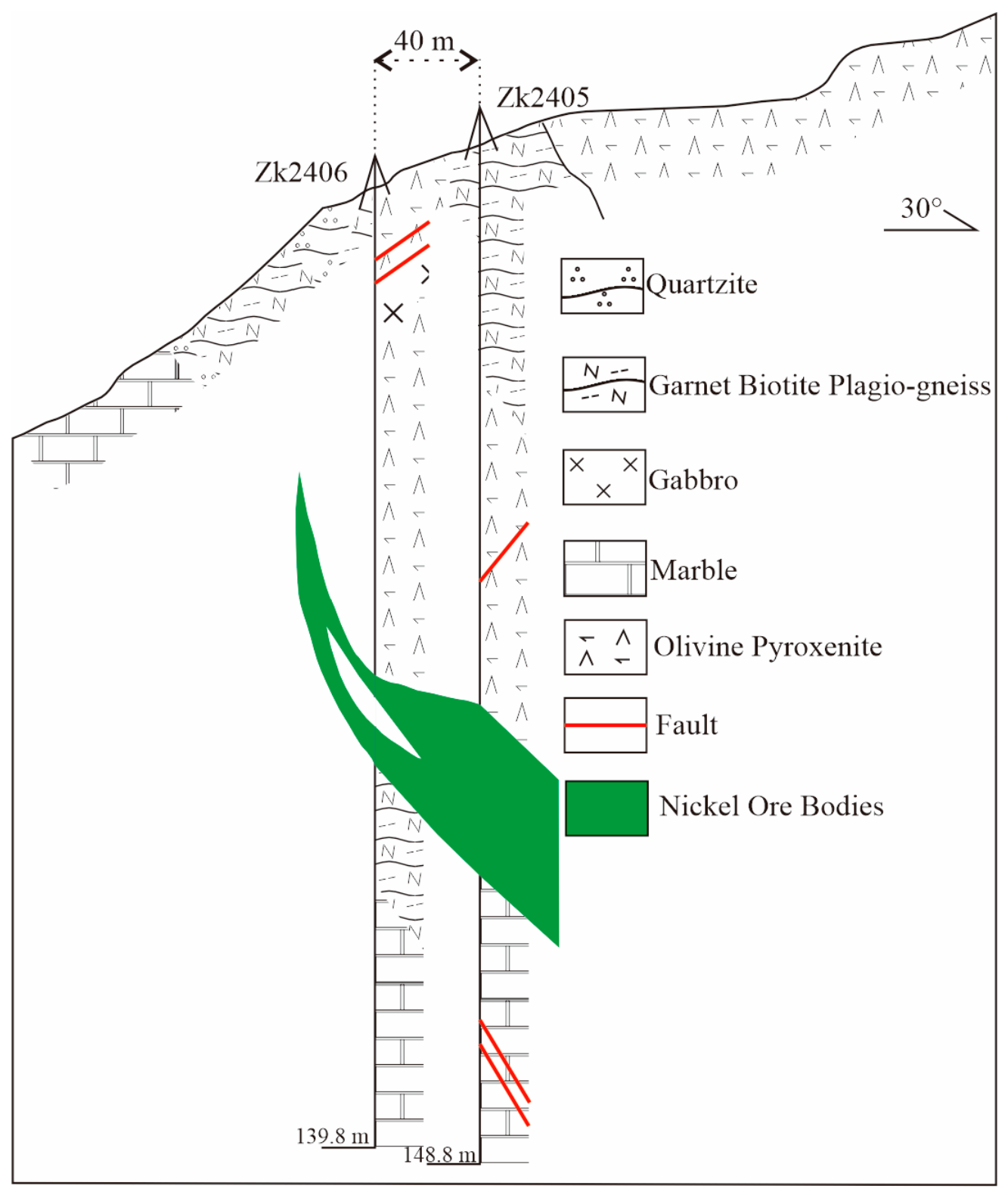
Figure 2. Cross-section of exploration line 24 of the Daaobaogou copper–nickel deposit (modified after [25]).
Applsci 16 05508 g002
Figure 3. Surface outcrops and rock characteristics of the Daaobaogou deposit. (a) Outcrop of Daaobaogou gabbro in the field. (b) Nickel bloom developed on the mine tunnel wall. (c) Malachite mineralization visible on the surface. (d) Gabbro displaying a medium- to fine-grained structure, dark gray color, massive structure, with minor olivine. (e) Olivine pyroxenite displaying a medium- to coarse-grained structure, greenish-black color, massive structure, with disseminated copper-nickel mineralization. (f) Pyroxenite displaying a medium- to coarse-grained structure, greenish-black color, massive structure, with disseminated copper–nickel mineralization.
Applsci 16 05508 g003
Figure 4. Microscopic characteristics of samples of the Daaobaogou deposit. (a) Sericitization of plagioclase (cross-polarized light). (b) Poikilitic structure composed of olivine and clinopyroxene (cross-polarized light). (c) Poikilitic structure composed of olivine and orthopyroxene (cross-polarized light). (d) Light-colored flame-like pentlandite developed within pyrrhotite, and dark-colored pentlandite developed at the margins of pyrrhotite (plane-polarized light). (e) Light-colored flame-like pentlandite developed as bands within pyrrhotite, and dark-colored pentlandite developed along fractures (plane-polarized light). (f) Chalcopyrite developed between pyrrhotite and pentlandite (plane-polarized light). Ol: olivine; Opx: orthopyroxene; Cpx: clinopyroxene; Pl: plagioclase; Ser: sericite; Po: pyrrhotite; Pn: pentlandite; Pn’: flame-like pentlandite; Ccp: chalcopyrite.
Applsci 16 05508 g004
Figure 5. Primitive mantle-normalized trace element spider diagram for the Daaobaogou deposit. OIB, E-MORB, N-MORB, Primitive mantle values after [27]. Data for gabbro and pyroxenite after [8]. OIB: Ocean Island Basalt; E-MORB: Enriched Mid-Ocean Ridge Basalt; N-MORB: Normal Mid-Ocean Ridge Basalt.
Applsci 16 05508 g005
Figure 6. Chondrite-normalized REE pattern for the Daaobaogou deposit. OIB, E-MORB, N-MORB, Chondrite values after [27]. Data for gabbro and pyroxenite after [8]. OIB: Ocean Island Basalt; E-MORB: Enriched Mid-Ocean Ridge Basalt; N-MORB: Normal Mid-Ocean Ridge Basalt.
Applsci 16 05508 g006
Figure 7. Sr-Nd-Pb isotope diagrams for the rocks of the Daaobaogou deposit. (a) Correlation diagram of (87Sr/86Sr)iNd(t). Data for gabbro, pyroxenite and some olivine pyroxenite after [7]. Upper crust parameters: 27 ppm Nd, 320 ppm Sr, εNd(t) = −6, (87Sr/86Sr)i = 0.715; mantle magma parameters: 9.8 ppm Nd, 97 ppm Sr, εNd(t) = −1.8, (87Sr/86Sr)i = 0.705 after [29]. Correlation diagram of (b) (206Pb/204Pb)i-207Pb/204Pb, (c) (206Pb/204Pb)i-208Pb/204Pb, (d) (206Pb/204Pb)i εNd(t) after [30]. Data for Tarim basalts after [28]. EM I and EM II enriched mantle data after [31]. Data for the Pacific plate margin along the Americas after [32,33,34,35,36]. t = 331.7 Ma after [9]. EM: enriched mantle; MORB: Mid-Ocean Ridge Basalt; BSE: Bulk Silicate Earth; DM: depleted mantle; NHRL: Northern Hemisphere Reference Line; PREMA: Prevalent Mantle; HIUM: High μ.
Applsci 16 05508 g007
Figure 8. Diagrams of Nb/Yb-Th/Yb, La/Nb-La/Ba, Th/Yb-Ba/La, and (Ta/La)N-(Hf/Sm)N for rocks from the Daaobaogou deposit. (a) Correlation diagram of Nb/Yb-Th/Yb modified after [30]. (b) Correlation diagram of La/Nb-La/Ba modified after [39]. (c) Correlation diagram of Th/Yb-Ba/La modified after [40]. (d) Correlation diagram of (Ta/La)N-(Hf/Sm)N modified after [41]. Subscript N stands for primitive mantle normalized. Primitive mantle values after [27]. Data of gabbros, partial olivine pyroxenite and pyroxenite after [8,9]. UC: Upper Crust; LC: Lower Crust; OIB: Ocean Island Basalt; CC: Continental Crust; PM: Primitive Mantle; N-MORB: Normal Mid-Ocean Ridge Basalt.
Applsci 16 05508 g008
Figure 9. Calculation of the parental magma composition of the Daaobaogou intrusion using the MgO-FeOT extrapolation. method. Olivine pyroxenite data after [8].
Applsci 16 05508 g009
Figure 10. Fractional crystallization discrimination diagrams. (a) Correlation diagram of MgO-SiO2; (b) MgO-Al2O3; (c) MgO-CaO; (d) MgO-Na2O + K2O; (e) MgO-Ni; (f) Si/Ti-(Mg + Fe)/Ti end-member data for Pl, Cpx, Opx, and Ol after [30]. (g) σEu-Al2O3; (h) MgO-Sc. Data gabbros, partial olivine pyroxenite and pyroxenite after [8,9]. Ol: olivine; Opx: orthopyroxene; Cpx: clinopyroxene; Pl: plagioclase.
Applsci 16 05508 g010
Figure 11. Simulated magmatic crystallization and differentiation evolution process of Daaobaogou. (a) Rock-forming mineral variations; (b) Major oxide variations. Ol: olivine; Opx: orthopyroxene; Cpx: clinopyroxene; Pl: plagioclase; Liq: liquid.
Applsci 16 05508 g011
Figure 12. Correlation diagram of trace element ratios for the Daaobaogou rock mass. (ac) Diagrams of Nb/Hf-Ce/Pb, Zr/Nb-Y/Nb, Nb/U-Ce/Pb after [30]. (d) Diagrams of (La/Nb)Pm-(Th/Ta)Pm after [50]. Data of gabbros, partial olivine pyroxenite and pyroxenite after [8,9]. PM: Primitive Mantle; OIB: Ocean Island Basalt; CC: Continental Crust; MORB: Mid-Ocean Ridge Basalt; LCC: Lower Continental Crust; UCC: Upper Continental Crust.
Applsci 16 05508 g012
Table 1. Major element results of the Daaobaogou deposit (wt%).
Sample NoSB25D02-04SB25D02-05SB25D02-06SB25D02-07
LithologyOlivine PyroxeniteOlivine PyroxeniteOlivine PyroxeniteOlivine Pyroxenite
Na2O0.4310.6320.4280.441
MgO29.28528.36828.72228.323
Al2O33.5694.6823.3943.490
SiO246.76046.42144.80745.438
P2O50.1540.1590.1460.154
SO30.1300.1200.1640.128
K2O0.4340.5430.3780.435
CaO3.1122.9453.9143.052
TiO20.2530.2410.2430.233
V2O50.0120.0110.0130.014
Cr2O30.1450.1510.1310.142
MnO0.1570.1490.1550.152
FeOT10.778 10.592 11.136 10.821
loi3.402 2.617 3.4433.409
Sum99.989 98.968 98.475 97.596
m/f4.7834.7174.5434.610
Mg#82.887 82.682 82.135 82.350
Note: Mg# = 100 w(Mg)/w(FeT + Mg); m/f = w(Mg2+ + Ni2+)/(Fe2+ + Fe3+ + Mn2+).
Table 2. Trace element results of the Daaobaogou deposit (ppm).
Sample NoSB25D02-04SB25D02-05SB25D02-06SB25D02-07
LithologyOlivine PyroxeniteOlivine PyroxeniteOlivine PyroxeniteOlivine Pyroxenite
Li8.231 7.990 12.308 7.983
Be0.249 0.241 0.272 0.244
Sc23.440 17.538 8.666 16.508
Ti1752.259 1539.333 1395.945 1465.790
V 113.927 92.061 69.055 83.090
Cr1085.605 990.220 1017.416 1039.162
Mn1186.424 1252.812 1144.818 1217.206
Co96.708 100.401 92.323 93.609
Ni701.865 707.234 613.973 641.292
Cu79.690 66.995 48.433 68.199
Zn88.389 93.402 88.320 93.938
Ga5.951 5.597 6.247 5.829
Ge1.659 1.605 1.426 1.555
As0.562 0.560 0.541 1.990
Rb14.022 13.375 15.941 15.199
Sr80.618 81.816 123.291 79.658
Y 6.590 5.406 5.025 4.827
Zr32.621 31.605 30.101 31.186
Nb1.435 1.457 1.568 1.476
Mo0.209 0.350 0.333 0.605
In0.436 0.161 0.469 0.135
Cd0.272 0.159 0.289 0.147
Sn3.068 3.203 2.966 3.112
Sb3.164 0.932 0.318 0.338
Cs0.564 1.075 2.073 2.183
Ba114.403 106.092 116.941 116.172
La6.988 6.958 8.511 6.599
Ce13.249 13.140 15.079 12.296
Pr1.771 1.656 1.832 1.523
Nd7.263 6.543 6.844 5.976
Sm1.663 1.404 1.317 1.144
Eu0.418 0.351 0.344 0.300
Gd1.429 1.196 1.149 1.032
Tb0.219 0.179 0.156 0.145
Dy1.365 1.074 0.974 0.907
Ho0.248 0.203 0.186 0.175
Er0.724 0.622 0.565 0.511
Tm0.093 0.082 0.080 0.070
Yb0.623 0.538 0.530 0.486
Lu0.094 0.085 0.087 0.076
Hf0.753 0.737 0.696 0.687
Ta0.097 0.094 0.106 0.094
W 15.820 7.914 5.133 3.918
Tl0.073 0.070 0.082 0.077
Pb1.997 2.033 2.291 2.003
Bi0.037 0.028 0.037 0.031
Th1.279 1.269 1.341 1.420
U0.217 0.215 0.222 0.206
ΣREE (ppm)42.8740.2644.4937.01
LREE/HREE2.953.063.403.15
δEu0.820.840.850.85
δCe0.940.950.940.95
Table 3. Electron microprobe analysis results of olivine for the Daaobaogou deposit (wt%).
Sample No LithologyNa2OAl2OSiO2K2O TiO2BaOFeOMnOCr2O3FMgO CaONiOTotalFo
SB25D02-08Olivine pyroxenite00.02240.2390.0100.00114.060.1740.0670.00344.4920.0180.15299.23884.942
SB25D02-08Olivine pyroxenite0.012040.0010.0010017.8570.2030042.0880.0080.157100.32780.775
ZKE0704-03Olivine pyroxenite0.003040.4770.0050.0120.01317.320.3250.018042.96700.178101.31881.558
Table 4. Sr-Nd isotopic analytical results for the Daaobaogou deposit.
Sample NoLithology87Sr/86Sr143Nd/144Nd147Sm/144NdRb
ppm
Sr
ppm
Sm
ppm
Nd
ppm
(87Sr/86Sr)iεNd(t)
SB25D02-07Olivine pyroxenite0.7110.5120.11515.19979.6581.1445.9760.710−8.656
SB25D02-06Olivine pyroxenite0.7100.5120.11715.941123.2911.3176.8440.710−9.477
SB25D02-05Olivine pyroxenite0.7100.5120.12913.37581.8161.4046.5430.710−10.857
Note: t = 331.7 Ma after [9].
Table 5. Pb isotopic analytical results for the Daaobaogou deposit.
Sample NoLithologyU
ppm
Th
ppm
Pb
ppm
208Pb/304Pb207Pb/204Pb206Pb/204Pb(208Pb/204Pb)i(207Pb/204Pb)i(206Pb/204Pb)i
SB25D02-07Olivine pyroxenite0.2061.4202.00338.13015.55118.37338.13015.55118.256
SB25D02-06Olivine pyroxenite0.2221.3412.29138.14815.55118.25438.14815.55118.157
SB25D02-05Olivine pyroxenite0.2151.2692.03338.02015.44617.65738.02015.44617.554
Table 6. Parent magma major element compositions of the Daaobaogou deposit.
Element Content (wt%)SiO2TiO2Al2O3FeOMnOMgOCaONa2OK2OP2O5Cr2O3Fe2O3NiOTotal
Average of DA15 and DA13 a39.00 0.29 4.61 16.28 0.16 21.83 5.85 0.10 0.16 0.07 0.10 0.66 89.09
Olivine Max 40.24 0.00 0.02 14.06 0.17 44.49 0.02 0.00 0.01 0.07 0.15 99.23
MgO in parental magma 11.17
Olivine crystallization ratio F (%) F = (w(MgO)Rock − w(MgO)Melt)/(w(MgO)Ol − w(MgO)Melt)
F 0.32
1 − F 0.68
Parental magma38.42 0.42 6.77 17.32 0.15 11.17 8.59 0.15 0.23 0.10 0.11 0.90 84.32
Normalization45.44 0.50 8.01 18.07 0.18 13.21 10.16 0.18 0.27 0.12 0.13 2.69 1.06 100.00
Note: a After [9].
Table 7. REE composition of the parent magma of the Daaobaogou deposit (ppm).
ElementLaCePrNdSmEuGd
Statistical mean of samples9.961 18.738 2.245 8.864 1.626 0.426 1.449
Partition coefficient (olivine/melt)0.0003 0.0003 0.0003 0.0002 0.000180.00020.00025
Parental magma18.934 35.616 4.267 16.849 3.091 0.810 2.754
ElementTbDyHoErTmYbLu
Statistical mean of samples0.223 1.273 0.241 0.704 0.119 0.723 0.106
Partition coefficient (olivine/melt)0.000475 0.0007 0.00122 0.00174 0.00384 0.00522 0.00852
Parental magma0.423 2.418 0.458 1.336 0.225 1.367 0.200
Note: Partition coefficient (olivine/melt) after [46].
Disclaimer/Publisher’s Note: The statements, opinions and data contained in all publications are solely those of the individual author(s) and contributor(s) and not of MDPI and/or the editor(s). MDPI and/or the editor(s) disclaim responsibility for any injury to people or property resulting from any ideas, methods, instructions or products referred to in the content.