Article

Comparison of Shear Bond Strength and Interfacial Failure Patterns of Glass Hybrid Ionomer, Resin-Modified Glass Ionomer, and Nanofilled Composite to Dentin: An In Vitro Study

Department of Restorative Dentistry, Faculty of Dentistry, King Abdulaziz University, Jeddah 21589, Saudi Arabia
*
Author to whom correspondence should be addressed.
Appl. Sci. 2026, 16(11), 5493; https://doi.org/10.3390/app16115493
Submission received: 20 April 2026 / Revised: 20 May 2026 / Accepted: 25 May 2026 / Published: 1 June 2026
(This article belongs to the Special Issue State-of-the-Art Operative Dentistry)

Abstract

This in vitro study evaluated and compared the shear bond strength (SBS) of three restorative materials bonded to dentin: a glass hybrid ionomer (EQUIA Forte HT), a resin-modified glass ionomer (RIVA Light Cure), and a nanofilled composite resin (Filtek Z350 XT). Additionally, their modes of failure were assessed. Thirty extracted human teeth were prepared and randomly assigned to three groups (n = 10) by restorative material: Group 1: Filtek Z350 XT; Group 2: EQUIA Forte HT; Group 3: RIVA Light Cure. All materials were applied following manufacturer instructions. SBS testing used a universal testing machine, applying a load at the tooth–restoration interface at 1 mm/min until failure. SBS values were recorded in megapascals (MPa). Failure modes were examined under a stereomicroscope at 40× magnification. A one-way ANOVA compared mean SBS among groups, with post hoc tests for pairwise group comparisons. Results: Filtek Z350 XT had the highest mean SBS (21 MPa), followed by RIVA Light Cure (7.5 MPa) and EQUIA Forte HT (7.2 MPa). One-way ANOVA indicated a statistically significant difference in SBS (p < 0.05). Post hoc analysis showed Filtek Z350 XT had significantly higher SBS than the glass ionomer-based materials, while EQUIA Forte HT and RIVA Light Cure did not differ significantly. Conclusions: Filtek Z350 XT demonstrated significantly higher shear bond strength to dentin than the glass ionomer-based materials. No significant SBS difference was found between the resin-modified and hybrid glass ionomers.

1. Introduction

Tooth-colored restorative materials are considered part of the integral armamentaria of modern dental practice [1]. These restorative materials can be categorized into several groups based on their composition, curing methods, and bioactivity [2]. Regarding bioactivity, tooth-colored restorations can be classified as bioactive materials, such as conventional glass ionomer (CGIC), which is suitable for both permanent and long-term temporary dental restorations [3]. It offers benefits such as low toxicity, adherence to dental tissue, fluoride release, and biocompatibility [4]. However, CGIC has certain disadvantages, including initial sensitivity to humidity, fragility, and potential solubility and sorption issues [4]. These challenges may result in fractures and marginal infiltration, thereby diminishing the material’s effectiveness over time [4]. In response to these limitations, researchers have developed a more stable and robust formulation that retains its bioactivity [5]. One notable advancement was the modification of CGIC, which involved incorporating a new methacrylate monomer alongside a free-radical monomer [6]. This innovation led to the development of resin-reinforced glass ionomer cement (RMGIC) [6]. The modified material is capable of undergoing both chemical and light-activated polymerization [6]. Moreover, RMGIC demonstrates enhanced wear resistance, improved adhesion to tooth structure, extended working life, and shorter setting times compared with CGIC [7]. Nonetheless, clinical studies indicate that RMGIC has a limited success rate as a permanent tooth-restoration material [8]. This limitation can be attributed to its lower strength, durability, and aesthetic appeal compared with resin-based composites [9]. A more recent modification to the CGIC was the addition of high-reactive silica glass filler, leading to the development of a material category known as High-viscosity GIC (HVGIC). It is a restorative material introduced to the market in recent years owing to its improved mechanical and physical properties, for example, EQUIA Forte (EQ) (GC International Corp., Tokyo, Japan), a glass-hybrid CGIC [10]. The manufacturer claims that the glass particles in EQUIA Forte powder are evenly distributed, ultra-fine, and highly reactive, and that increasing the molecular weight of polyacrylic acid strengthens the material’s mechanical properties [11]. The material was designed to compensate for the mechanical deficiencies of CGICs by providing enhanced physical and chemical properties, including improved flexural, compressive, and tensile strengths [12].
EQUIA-based restorative systems have been extensively studied for their mechanical and physicochemical performance in both primary and permanent dentition [4,12]. Laboratory and clinical investigations have consistently demonstrated their effectiveness as durable restorative materials [1,10]. Moshaverinia et al. reported that EQUIA Forte exhibited the highest surface hardness among various glass ionomer cements, including Fuji IX GP (GC International Corp, Tokyo, Japan) and ChemFil Rock (Dentsply, Guxhaven, Germany) [13]. Similarly, Abuzinadah et al. found that EQUIA Forte demonstrated significantly greater compressive strength than conventional GICs. In addition to mechanical properties, the water sorption behavior of EQUIA materials has also been a focus of research [14]. Aydın et al. observed significantly lower water absorption in EQUIA Forte than in all tested RMGICs, with no difference in solubility, and RMGICs generally exhibited higher absorption rates [15]. Building on these favorable properties, the third-generation system, EQUIA Forte HT (GC International Corp., Tokyo, Japan), introduced in 2019, was developed as a highly durable, biocompatible bulk-fill restorative material. Its formulation includes highly reactive glass particles that promote enhanced crosslinking, resulting in superior mechanical strength [5]. The system also incorporates EQUIA Forte Coat, designed to protect the EQUIA Forte HT from moisture during its initial setting phase while sealing surface microcracks and porosities [5]. According to the manufacturer, this coating enhances the restoration’s wear resistance, toughness, and marginal adaptation, while also improving its translucency and overall longevity [16].
On the other hand, most current resin-based composites are considered non-bioactive materials [1]. Composite resin has superior mechanical properties but is prone to microleakage due to polymerization shrinkage [13]. In general, selecting the best restorative dental materials is pivotal to the longevity and functionality of restorations [14]. Although previous studies on EQUIA-based materials have explored their mechanical and physical properties, limited data exist on their comparative adhesive performance, particularly regarding shear bond strength (SBS) to dentin [5,15,17]. Given that SBS is a critical parameter influencing the clinical retention and longevity of restorations, further investigation is warranted.
Therefore, this in vitro investigation aims to assess and contrast the shear bond strength and failure modes of the bioactive restorative material EQUIA Forte HT with a resin-modified glass ionomer cement (RMGIC) RIVA LC (SDI, Victoria, Australia) and a resin-based composite. The null hypothesis (H0) speculates that there is no statistically significant variation in dentin shear bond strength among EQUIA Forte HT, RMGIC, and the resin-based composite.

2. Materials and Methods

This in vitro study was conducted in accordance with protocols approved by the Ethics Committee of King Abdulaziz University in Jeddah, Saudi Arabia, under protocol number 210-12-24, with an approval date of 18 March 2025. The study included the bioactive hybrid glass restorative material EQUIA Forte HT, Filtek Z350 XT (3M ESPE, Seefeld, Germany), and the resin-modified glass ionomer RIVA LC. The composition of the restorative material and adhesive used in this study is presented in Table 1.

2.1. Specimens and Sampling Technique

Thirty-three teeth were collected for this study, including premolars extracted for orthodontic treatment and third molars removed due to periodontal issues. These teeth were obtained from oral surgery clinics affiliated with King Abdulaziz University in Jeddah, Saudi Arabia. Ethical approval was secured, and informed consent was obtained in accordance with institutional guidelines (protocol number 210-12-24). After extraction, all specimens were thoroughly cleaned with an ultrasonic scaler and stored in distilled water until further examination. The selection process adhered to specific inclusion and exclusion standards, detailed below.
  • Inclusion criteria include premolar and molar teeth with sound, caries-free dentin.
  • Exclusion criteria include anterior teeth, teeth with endodontic involvement, and severely decayed teeth.
G*Power 3.1.9.7 statistical software was used to calculate the required sample size. Effect size f was set to 0.4 at a significance level of α = 0.05 and a power of 0.8, with 3 test groups. The computed total sample size was 30 specimens, which requires 10 specimens/group. The samples were randomly split into three groups using a simple random sampling technique as follows:
  • Filtek Z350 XT composite.
  • Equia Forte HT.
  • Resin-modified glass ionomer (RIVA LC).

2.2. Specimen Preparation

Each root was cut 1 mm below the cementoenamel junction using a low-speed diamond saw (Allied Techcut Low-Speed Diamond Saw, Rancho Dominguez, CA, USA) [18]. Next, the crowns were embedded in fast-setting acrylic resin (Idofast, Unidesa Odi, Madrid, Spain) to make handling easier during testing [18]. The prepared samples were promptly placed in water at 23 ± 2 °C to prevent them from drying out. The occlusal surface of each crown was trimmed 1.5 mm from the cusp tip and polished with 200, 400, and 600 grit silicon carbide papers at 250 RPM under water cooling (MetaServ 250 Grinder-Polisher, Buehler, IL, USA) [19]. Polishing continued until the dentin surface appeared flat and smooth when viewed under 2.5× magnification. Finally, the specimens were cleaned in distilled water using an ultrasonic cleaner for 10 min [18].

2.3. Bonding Restorative Materials to Dentin

All specimens were thoroughly dried and prepared according to the protocols described below for each material. To ensure uniformity, a split-putty mold with a central cylindrical opening (2 mm in diameter and 4 mm in height) was placed on the occlusal surface to form a consistent cylindrical specimen [18]. The mold was secured with a rubber band to confine the material to the intended area. After the material had set, the mold was carefully removed. Each specimen was then examined under 2.5× magnification loupes, and any excess material was precisely trimmed with a sharp scalpel. Finally, all specimens were stored in distilled water at 37 °C for 24 h to ensure complete polymerization prior to testing.
1.
EQUIA Forte HT and EQUIA Forte Coat (GC Corporation, Tokyo, Japan)
  • EQUIA Forte Fil capsules were shaken to loosen the powder and activated with the plunger as directed.
  • Each capsule was then placed in the applicator, clicked once, and mixed in an auto-mixer for 10 s at 4000 rpm.
  • The material was dispensed into molds and gently adapted to achieve a smooth, uniform surface.
  • After setting for 10 min at room temperature, EQUIA Forte Coat was applied with a microbrush, rubbed for 20 s, and light-cured for 20 s using an LED curing unit.
2.
RIVA LC (SDI, Bayswater, Australia)
  • RIVA LC capsules were activated by pressing them against a stable surface.
  • The capsules were mixed in an amalgamator for 10 s.
  • The material was dispensed with a capsule applicator.
  • The material was placed in the deepest portion of the mold to minimize void formation.
  • The material was gently adapted to the mold to ensure complete filling.
  • The material was light-cured for 20 s with an LED curing unit.
3.
Filtek Z350 XT with Adper Single Bond 2 (3M ESPE, Seefeld, Germany)
A.
Bonding procedure (Adper Single Bond 2):
  • The substrate surface was etched with phosphoric acid for 15 s.
  • The surface was thoroughly rinsed with water for 10 s.
  • Excess moisture was removed by gentle blot-drying, leaving a moist surface.
  • Two to three consecutive coats of adhesive were applied with gentle agitation for 15 s.
  • The adhesive was gently air-thinned for 5 s to allow solvent evaporation.
  • The adhesive layer was cured with light for 10 s at an intensity of 1200 mW/cm2 using an LED curing unit.
B.
Composite placement (Filtek Z350 XT):
  • The composite resin was placed using a plastic filling instrument in 2 mm increments.
  • Each layer was carefully adapted to ensure uniform thickness and a smooth surface.
  • All layers were light-cured for 20 s from the top with the same LED curing unit.
  • After removing the specimen from the mold, an additional curing step in the middle was performed to ensure complete polymerization.

2.4. Shear Bond Strength Test

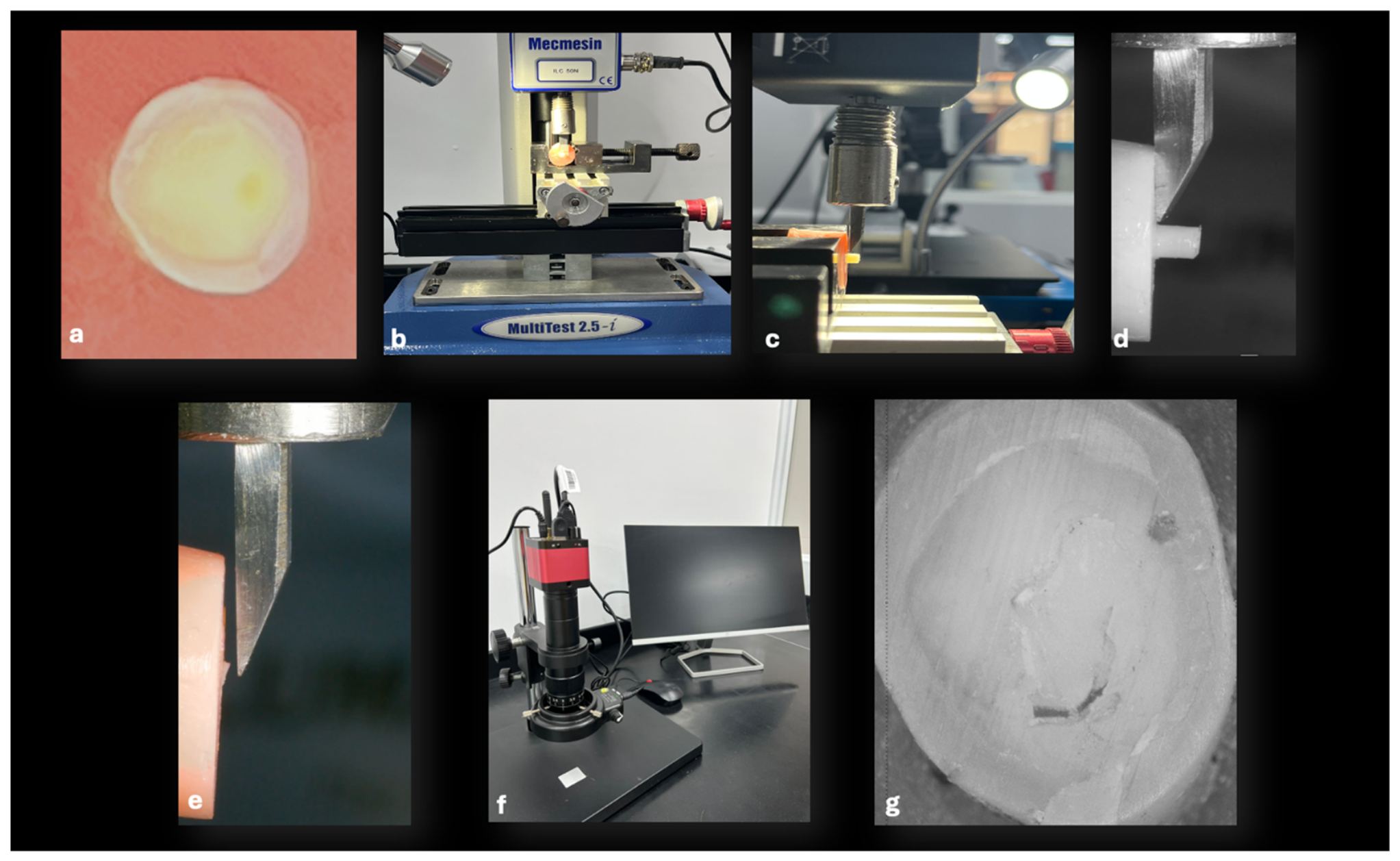
Shear bond strength (SBS) of the samples was determined with a universal testing machine (Mecmesin 2.5-I; Slinfold, UK). The restoration–tooth interface was subjected to a 1 mm/min crosshead speed load until failure, and the stress–strain curve was analyzed with the machine’s software. Two trained operators assessed failure modes using a digital camera stereomicroscope (RaySmart Technology Co., Ltd., Shenzhen, China) at ×40 magnification and categorized them as follows:
  • Adhesive failure occurring at the material–dentin interface.
  • Mixed failure, involving both the interface (adhesive) and within the material (cohesive).
  • Cohesive failure within the restorative material.
  • Cohesive failure occurring inside the dentin.
A diagram illustrating the overall study design for all the restorative materials is shown in Figure 1.

2.5. Statistical Analysis

Statistical analyses were conducted using JASP Team (2025, Version 0.19.3). A one-way analysis of variance (ANOVA) was used to compare mean SBS across all restorative materials. If a significant difference was found, a post hoc test was used to conduct pairwise comparisons among the restorative groups. Results were considered significant at p < 0.05.

3. Results

3.1. Shear Bond Strength

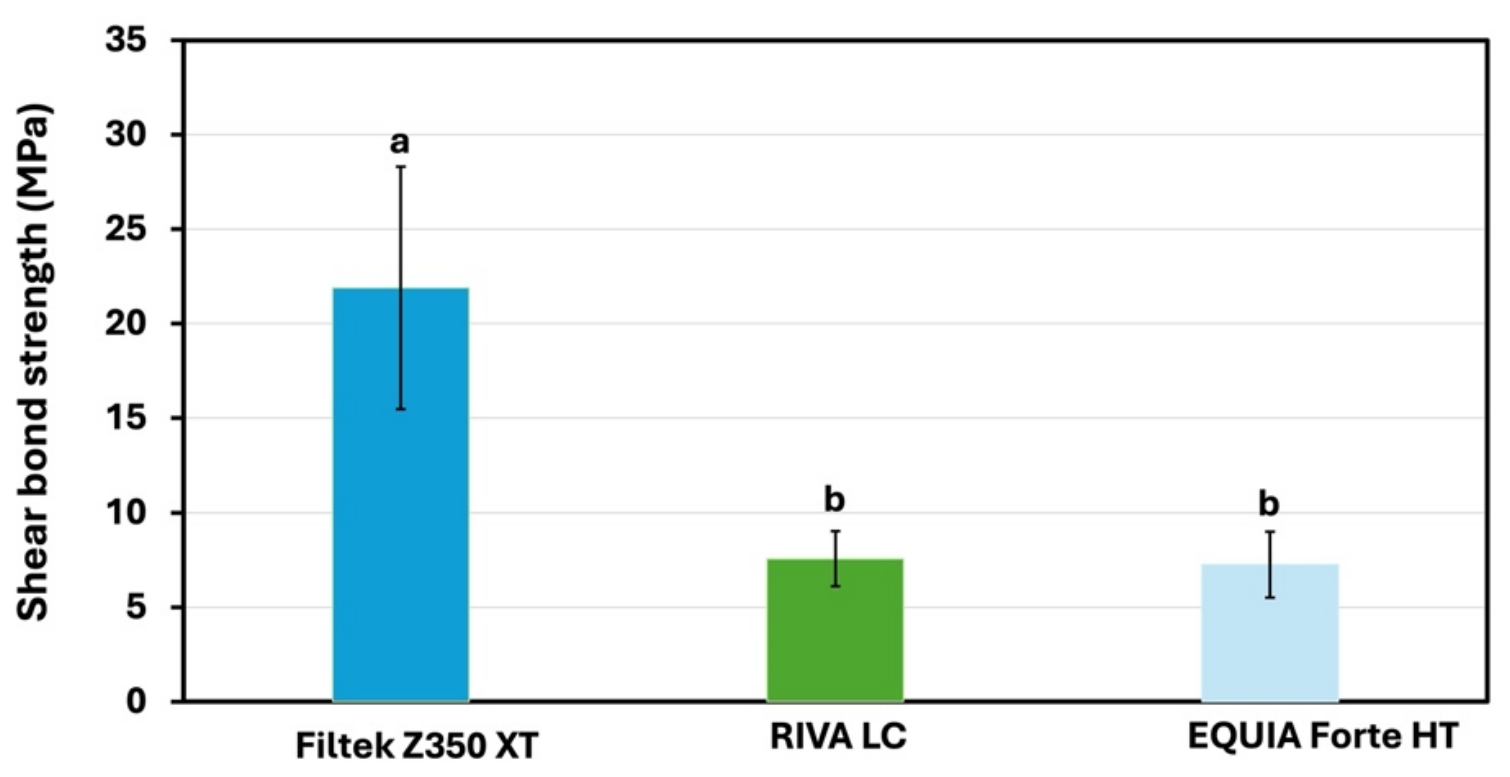
The shear bond strength values of the three restorative materials are summarized in Table 2 and Figure 2. One-way ANOVA indicated statistically significant differences among the groups (p < 0.001). Filtek Z350 XT demonstrated the highest mean shear bond strength (21.9 MPa), which was significantly greater than that of EQUIA Forte HT (mean: 7.2 MPa; mean difference: 19.46 MPa, p < 0.001) and RIVA LC (mean: 7.5 MPa; mean difference: 19.28 MPa, p < 0.001). Tukey’s HSD post hoc analysis corroborated these results. In contrast, no statistically significant difference was detected between EQUIA Forte HT and RIVA LC (mean difference: 0.18 MPa, p = 0.993). Therefore, the null hypothesis is partially rejected, as significant differences were detected among the materials, except between RIVA LC and EQUIA Forte HT.

3.2. Failure Mode Analysis

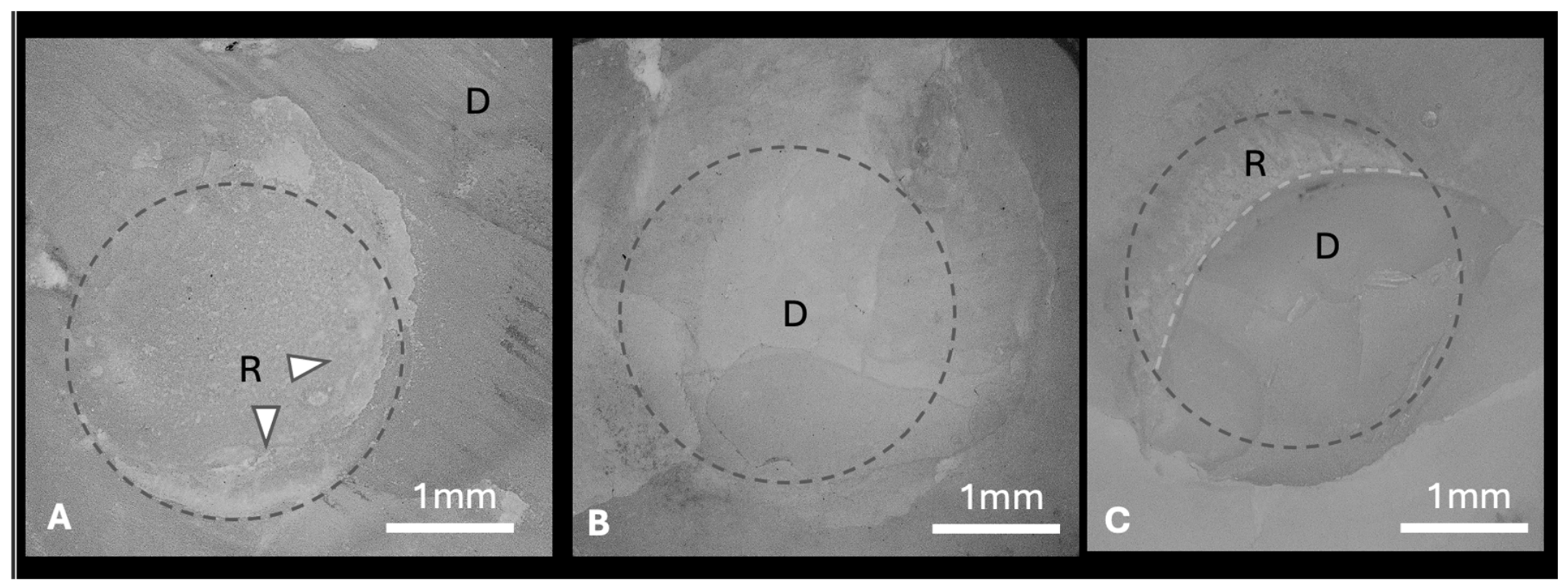
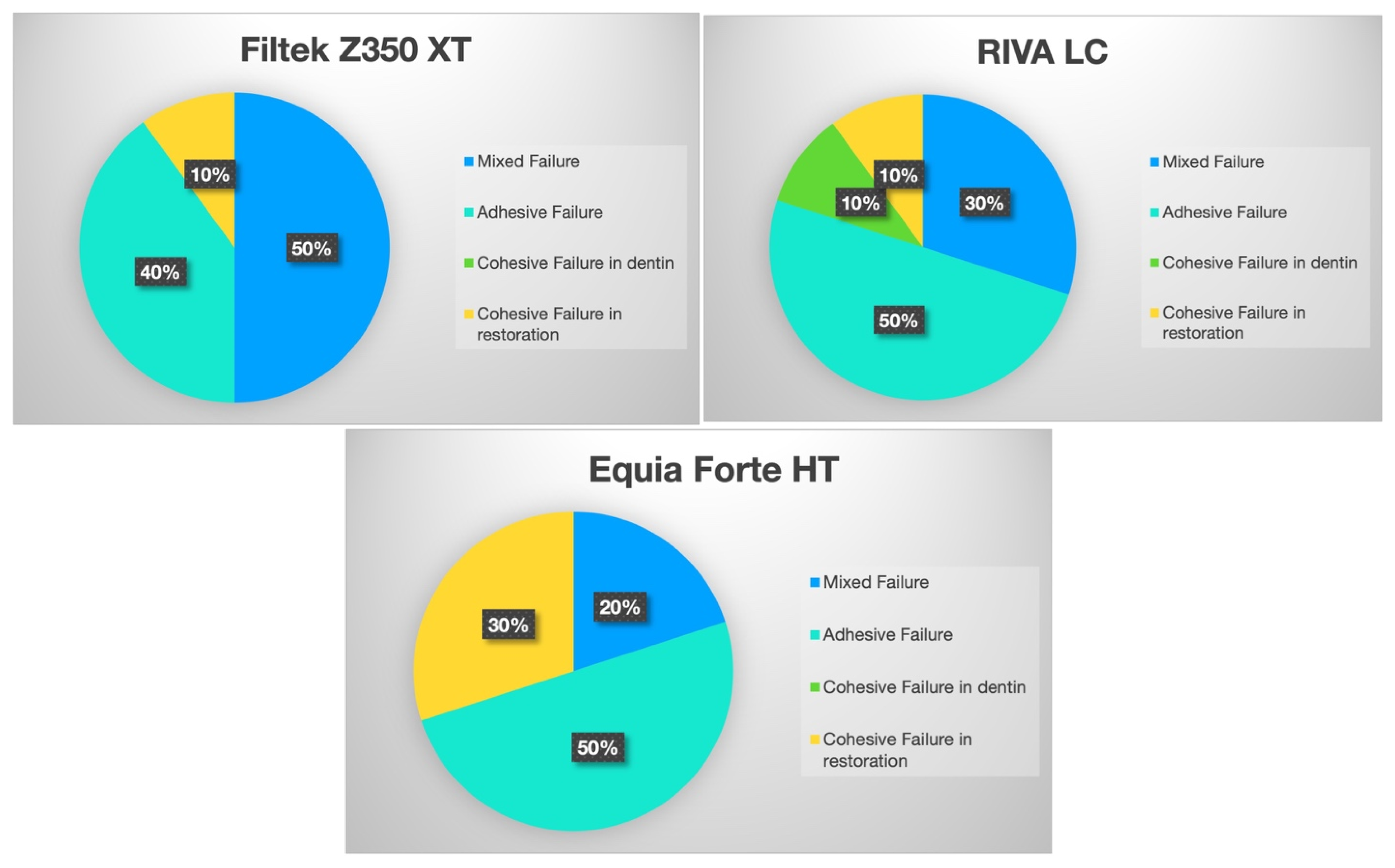
The various failure modes in the restorative materials are illustrated in Figure 3. Image A shows cohesive failure, characterized by a residual restoration layer on the bonded surface. Conversely, Image B demonstrates adhesive failure, involving interfacial bond failure between the restoration and dentin. Image C reveals the presence of more than one substrate on the bonding surface, indicating a mixed failure. Table 3 and Figure 4 summarize the distribution of these failure modes across restorative systems. Filtek Z350 XT mainly exhibited mixed failures (50%), with adhesive failures at 40% and cohesive failures at 10%. For both RIVA LC and EQUIA Forte HT, adhesive failures were most common (50%), while cohesive and mixed failures accounted for 30% and 20%, respectively. These results suggest that Filtek Z350 XT is prone to both mixed and adhesive failures. In comparison, RIVA LC and EQUIA Forte HT more frequently experience adhesive failures, indicating differences in their bonding effectiveness and structural strength.

4. Discussion

The present in vitro study aimed to evaluate and compare SBS and failure modes of three restorative materials: the resin-based composite (Filtek Z350 XT), the bioactive hybrid glass material (EQUIA Forte HT), and the resin-modified glass ionomer cement RIVA LC. The results indicated statistically significant differences among the groups, with the Filtek Z350 XT composite showing superior bond strength compared to both RIVA LC and EQUIA Forte HT. Consequently, the null hypothesis of no difference in bond strength among the materials was partially rejected.
Dentists are increasingly exploring a variety of restorative dental materials [20]. Among these, nano-filled composite resins are engineered to enhance both the long-term durability and the aesthetic appeal of dental restorations [21]. However, these materials typically involve multiple clinical steps and are more costly [20]. By contrast, materials such as resin-modified glass ionomer cements and bioactive self-adhesive restorative systems emphasize clinical durability, chemical adhesion, and ease of application [8]. These characteristics make them particularly suitable for elderly and young patients, who may have limited cooperation and time during dental procedures [4]. In a 12-month clinical trial conducted at Hacettepe University, the performance of alkasite (Cention N; Ivoclar Vivadent, Schaan, Liechtenstein), glass hybrid (Equia Forte HT), and resin composite (Gradia Direct Posterior; GC International Corp., Tokyo, Japan) in Class II cavities was compared [22]. The results showed that all materials performed similarly well, with high retention rates and functional stability over the observation period [22]. Although minor differences in surface gloss, luster, and roughness were noted, they did not affect overall clinical success [22]. Ultimately, the long-term success of restorative materials is largely determined by their adhesion to dentin and base materials, as robust bonding is essential to withstand dislodging forces [23]. Shear bond strength (SBS) testing is commonly used to evaluate these bonding properties, with SBS defined as the maximum shear stress a material can withstand before failure [23]. Therefore, higher SBS values denote superior bonding performance.
The SBS results of our study show that Filtek Z350 XT had the highest average SBS at 21 MPa. This value is significantly higher than those for EQUIA Forte HT (7.2 MPa) and RIVA LC (7.5 MPa). Several studies indicate that resin-based composites bonded with universal adhesive, using either self-etch or total-etch techniques, generally exhibit stronger interfacial bonds than glass ionomer-based systems [24,25]. For example, using the same adhesive technique as in our study (Adper Single Bond 2), Rifai et al. reported SBS values for Filtek Z350 XT nano-filled composites of 18–20 MPa, supporting our findings [24]. The observed bond strength can result from both chemical adhesion and effective micromechanical interlocking, enabled by modern adhesive technologies.
In contrast, both EQUIA Forte HT and RIVA LC exhibited lower SBS values, with no significant difference between them. Our results align with those of Imbery et al., who reported SBS for RIVA LC without adhesive pretreatment ranging from 3 to 6 MPa [26]. Their studies also emphasized that using a total-etch system with Optibond Solo Plus (Kerr Dental, Bioggio, Switzerland) significantly increased bond strength to approximately 15 MPa, comparable to that of resin composites [26]. They further noted that although RIVA LC bonds chemically via ionic interactions between polyacrylic acid and hydroxyapatite, achieving higher micromechanical bonding requires primer and adhesive systems [26]. Their study concluded that RMGIs, such as RIVA LC, behave more like resin materials than traditional glass ionomers and therefore benefit from resin-bonding strategies rather than conventional conditioners [26].
Although EQUIA Forte HT is marketed as a bioactive restorative material, its bond performance in this investigation did not show a significant improvement over that of RIVA LC. A comprehensive review of the literature and electronic databases revealed a limited number of published studies assessing the SBS of EQUIA Forte HT to dentin [27]. Consequently, the findings of the present study cannot be directly compared with a broad spectrum of research, yet they do provide valuable insights into the bond strength of EQUIA Forte to dentin. Notably, recent studies have shed light on the bonding mechanism of EQUIA Forte HT [27]. According to François et al., the material’s optimized polyacid and high-reactivity glass filler enhance internal crosslinking, mechanical performance, and fluoride release; however, these factors do not significantly increase interfacial adherence to dentin unless an adhesive or conditioner is utilized [27]. Their reported shear bond strength was 8 MPa, which closely aligns with our findings [27]. Future research should explore pre-treating the substrate prior to the final restoration. Overall, the lower SBS values of both EQUIA and RIVA LC may reflect their inherent moisture sensitivity during early maturation, and exposure to ambient humidity or desiccation during setting can compromise their interfacial integrity.
The present findings, together with previous literature, demonstrate that shear bond strength values for RIVA LC between 5 and 15 MPa are substantially influenced by dentin substrate conditions and adhesive application [28]. In contrast, resin composites consistently exhibit higher SBS values, typically ranging from 16 to 22 MPa [25,29]. Notably, EQUIA Forte HT demonstrates SBS values similar to those of RMGI, supporting its use in clinical situations where RMGI is indicated, such as in Class V root caries [30]. These results highlight the importance of material selection based on the specific clinical context and underline the relevance of adequate adhesive strategies in optimizing restoration longevity.
In terms of clinical ease of application, we observed that EQUIA Forte HT is more flowable and easier to handle than RIVA LC. This lower viscosity and easier application can be attributed to its advanced formulation and optimized material design. On one hand, the polyacid liquid component of EQUIA Forte HT contains highly reactive polyacrylic acid copolymers, potentially incorporating itaconic or maleic acid, that enhance flow and reactivity with the glass particles. Moreover, the inclusion of tartaric acid helps regulate working and setting times. On the other hand, the fine glass particles in EQUIA Forte HT, with a broader size distribution, improve handling, provide superior mechanical properties, and yield a smoother surface finish. In contrast, RIVA Glass Ionomer employs a more traditional polyacrylic acid formulation with coarser glass particles, resulting in higher viscosity and more challenging manipulation, particularly in small or narrow cavity preparations. Additional tests will be needed to confirm these findings through particle-size characterization and chemical-composition assessment to quantify differences in viscosity and filler morphology between the two materials.
A comparative analysis of failure modes among the three materials revealed distinct patterns that align with their respective bonding mechanisms and shear bond strength values. Filtek Z350 XT exhibited a predominance of mixed failures (50%), with adhesive and cohesive failures observed at 40% and 10%, respectively. This distribution suggests that the bond interface in Filtek Z350 XT is robust, with bond strength often exceeding the material’s cohesive strength [31]. This finding is further corroborated by Chiba et al., who reported a similar failure-mode pattern for Filtek Z350 XT bonded to dentin, attributing it to the effectiveness of resin-based adhesive systems in forming micromechanical interlocking and a hybrid layer, thereby enhancing interfacial stability and stress distribution [31].
In contrast, both RIVA LC and EQUIA Forte HT demonstrated a higher proportion of adhesive failures (50%) and lower incidences of mixed (20%) and cohesive (30%) failures. This pattern reflects a comparatively weaker adhesive interface, likely due to the self-adhesive nature of these glass-ionomer-based materials and the absence of conventional resin bonding agents [8,26,28]. The interfacial bond in these groups relies mainly on ionic interactions between the carboxyl groups of polyacrylic acid and calcium ions in hydroxyapatite, resulting in a more superficial and less durable bond than the hybrid-layer formation seen in composites [32]. Consequently, these materials are more susceptible to stress-induced debonding and display a greater frequency of adhesive failures [33,34]. These observations are consistent with previous literature, which has documented the inferior mechanical and bonding properties of glass ionomer and resin-modified glass ionomer cements compared to resin composites [4,26,28].
This study has several important limitations. First, the small sample size may restrict how broadly the findings can be applied, so larger-scale studies are needed to confirm these results. Additionally, we evaluated only the initial dentin bond strength in controlled laboratory settings. We did not examine factors such as thermocycling, water storage, solvent exposure, mechanical loading, or aging, all of which may affect long-term clinical performance. Also, the long-term stability of the dentin–material interface and the effects of various surface treatments and bonding protocols were outside the scope of this research. Future studies should investigate these variables under conditions that better mimic the oral environment. Further research is also necessary to fully understand EQUIA Forte HT, especially its resistance to degradation, sustained fluoride release in different media, and how these features influence long-term dentin-bond durability.

5. Conclusions

Within the limitations of this in vitro study, both EQUIA Forte HT and RMGI achieved shear bond strengths to dentin of 7 MPa, significantly lower than those of conventional resin composites (21 MPa). Therefore, despite recent chemical modifications to EQUIA Forte HT that may enhance certain material properties, its adhesive performance did not match that of resin-based composites. The predominance of adhesive failures in the glass-ionomer-based groups further supports the conclusion that the adhesive interface is comparatively weaker. Nevertheless, the simplified application procedure, reduced technique sensitivity, and fluoride-releasing capability of EQUIA Forte HT and RMGI may provide important clinical advantages, particularly in pediatric dentistry. Resin-based composites, however, continue to demonstrate superior adhesive performance to dentin.

Author Contributions

Conceptualization, H.F.; methodology, H.F., M.B., K.A.A. and N.A.T.; validation, S.J.A., Y.M.M. and M.B.; formal analysis, H.F.; investigation, H.F., M.B., K.A.A. and N.A.T.; resources, M.S.H. and S.J.A.; data curation, H.F., M.B., K.A.A. and N.A.T.; writing—original draft preparation, H.F.; writing—review and editing, M.B., M.S.H. and S.J.A.; visualization, Y.M.M., H.F., M.B., K.A.A. and N.A.T.; supervision, H.F. and S.J.A.; project administration, H.F. All authors have read and agreed to the published version of the manuscript.

Funding

This research received no external funding.

Institutional Review Board Statement

This study was approved by the Ethics Committee of the Faculty of Dentistry at King Abdulaziz University in Jeddah, Saudi Arabia (Proposal #210-12-24; approval date: 25 January 2025).

Informed Consent Statement

Informed consent was obtained from all subjects involved in the study.

Data Availability Statement

The raw data supporting the conclusions of this article will be made available by the authors upon request.

Conflicts of Interest

The authors declare no conflicts of interest.

References

  1. Bayne, S.C.; Ferracane, J.L.; Marshall, G.W.; Marshall, S.J.; van Noort, R. The Evolution of Dental Materials over the Past Century: Silver and Gold to Tooth Color and Beyond. J. Dent. Res. 2019, 98, 257–265. [Google Scholar] [CrossRef]
  2. Vallittu, P.K.; Boccaccini, A.R.; Hupa, L.; Watts, D.C. Bioactive Dental Materials—Do They Exist and What Does Bioactivity Mean? Dent. Mater. 2018, 34, 693–694. [Google Scholar] [CrossRef]
  3. Wilson, A.D. Glass-Ionomer Cement Origins, Development and Future. Clin. Mater. 1991, 7, 275–282. [Google Scholar] [CrossRef]
  4. Messer-Hannemann, P.; Böttcher, H.; Henning, S.; Schwendicke, F.; Effenberger, S. Concept of a Novel Glass Ionomer Restorative Material with Improved Mechanical Properties. J. Funct. Biomater. 2023, 14, 534. [Google Scholar] [CrossRef] [PubMed]
  5. Fuhrmann, D.; Murchison, D.; Whipple, S.; Vandewalle, K. Properties of New Glass-Ionomer Restorative Systems Marketed for Stress-Bearing Areas. Oper. Dent. 2020, 45, 104–110. [Google Scholar] [CrossRef]
  6. Ge, K.X.; Lam, W.Y.-H.; Chu, C.-H.; Yu, O.Y. Updates on the Clinical Application of Glass Ionomer Cement in Restorative and Preventive Dentistry. J. Dent. Sci. 2024, 19, S1–S9. [Google Scholar] [CrossRef]
  7. Ganeshapooban, D.; Shahid, S.; Stefanova, V.; Todorova, V. Comparison of the Compressive Strength of Conventional and Resin-Modified Glass Ionomer Cements. J. IMAB 2024, 30, 5840–5844. [Google Scholar] [CrossRef]
  8. Sidhu, S.; Nicholson, J. A Review of Glass-Ionomer Cements for Clinical Dentistry. J. Funct. Biomater. 2016, 7, 16. [Google Scholar] [CrossRef] [PubMed]
  9. Almutairi, M.A.; Saad, A.; Mahmoud, E.H.; Abuzenada, B. Cross-Sectional Survey of Resin-Modified Glass Ionomer as Dental Restoration in Saudi Arabia. Saudi J. Oral Sci. 2022, 9, 151–156. [Google Scholar] [CrossRef] [PubMed]
  10. Ozaslan, S.; Celiksoz, O.; Tepe, H.; Tavas, B.; Yaman, B.C. A Comparative Study of the Repair Bond Strength of New Self-Adhesive Restorative Materials with a Resin Composite Material. Cureus 2023, 15, e44309. [Google Scholar] [CrossRef]
  11. Vidal, L.S.B.; Veček, N.N.; Šalinović, I.; Miletić, I.; Klarić, E.; Krmek, S.J. Short-Term Fluoride Release from Ion-Releasing Dental Materials. Acta Stomatol. Croat. 2023, 57, 229–237. [Google Scholar] [CrossRef]
  12. Hirani, R.; Batra, R.; Kapoor, S. Comparative Evaluation of Postoperative Sensitivity in Bulk Fill Restoratives: A Randomized Controlled Trial. J. Int. Soc. Prev. Community Dent. 2018, 8, 534. [Google Scholar] [CrossRef] [PubMed]
  13. Filemban, H.; Bhadila, G.; Wang, X.; Melo, M.A.S.; Oates, T.W.; Weir, M.D.; Sun, J.; Xu, H.H.K. Novel Low-Shrinkage-Stress Bioactive Nanocomposite with Anti-Biofilm and Remineralization Capabilities to Inhibit Caries. J. Dent. Sci. 2022, 17, 811–821. [Google Scholar] [CrossRef]
  14. Demarco, F.F.; Corrêa, M.B.; Cenci, M.S.; Moraes, R.R.; Opdam, N.J.M. Longevity of Posterior Composite Restorations: Not Only a Matter of Materials. Dent. Mater. 2012, 28, 87–101. [Google Scholar] [CrossRef] [PubMed]
  15. Kazak, M.; Koymen, S.; Yurdan, R.; Tekdemir, K.; Donmez, N. Effect of Thermal Aging Procedure on the Microhardness and Surface Roughness of Fluoride Ion Containing Materials. Ann. Med. Res. 2020, 27, 888. [Google Scholar] [CrossRef]
  16. GGC Corporation EQUIA Forte® HT. 2024. Available online: https://www.gc.dental/equia-forte-ht (accessed on 24 May 2026).
  17. Abuzinadah, A.J.; Merdad, Y.M.A.; Aldharrab, R.S.; Almutairi, W.A.; Yeslam, H.E.; Hasanain, F.A. Microhardness and Compressive Strength of Bulk Fill Glass Hybrid Material and Other Direct Restorative Materials. J. Compos. Sci. 2024, 8, 508. [Google Scholar] [CrossRef]
  18. Alzahrani, S.J.; Hajjaj, M.S.; Abu Haimed, T.S.; Alnoury, A.; Khouja, N.; Abuelenain, D.A.; AlNowailaty, Y.; Abu-Nawareg, M.; Abuljadayel, R.; Naguib, G.H. Effect of Dentin Contamination with Hemostatic Agents and Cleaning Techniques on Bonding with Self-Adhesive Resin Cement. Med. Sci. Monit. 2024, 30, e943353. [Google Scholar] [CrossRef] [PubMed]
  19. ISO-TS-11405:2003; Dental Materials—Testing of Adhesion to Tooth Structure. International Organization for Standardization: Geneva, Switzerland, 2003.
  20. Ghodrati, H.; Narimani, A.; Moharami, A.; Namazikhah, M.; Gerayeli, M.; Kermani, F.A.; Karimzadeh, M.; Alizadeh, S. Nanotechnology and Dental Composites: Revolutionizing Dentistry. Nanomed. Res. J. 2025, 10, 1–11. [Google Scholar]
  21. Ferracane, J.L. Resin Composite—State of the Art. Dent. Mater. 2011, 27, 29–38. [Google Scholar] [CrossRef]
  22. Işıklı, K.; Çakır, F.Y.; Gürgan, S.; Vural, U.K. Clinical Performances of 3-Different Restorative Materials in Class-II Cavities. Int. Dent. J. 2024, 74, S131. [Google Scholar] [CrossRef]
  23. Nujella, B.S.; Choudary, M.; Reddy, S.; Kumar, M.K.; Gopal, T. Comparison of Shear Bond Strength of Aesthetic Restorative Materials. Contemp. Clin. Dent. 2012, 3, 22–26. [Google Scholar] [CrossRef]
  24. Rifai, H.; Qasim, S.; Mahdi, S.; Lambert, M.; Zarazir, R.; Amenta, F.; Naim, S.; Mehanna, C. In-Vitro Evaluation of the Shear Bond Strength and Fluoride Release of a New Bioactive Dental Composite Material. J. Clin. Exp. Dent. 2022, e55–e63. [Google Scholar] [CrossRef] [PubMed]
  25. Bin-Shuwaish, M.S. Shear Bond Strength of Bulk-Fill Composites to Resin-Modified Glass Ionomer Evaluated by Different Adhesion Protocols. Clin. Cosmet. Investig. Dent. 2020, 12, 367–375. [Google Scholar] [CrossRef]
  26. Imbery, T.; Namboodiri, A.; Duncan, A.; Amos, R.; Best, A.; Moon, P. Evaluating Dentin Surface Treatments for Resin-Modified Glass Ionomer Restorative Materials. Oper. Dent. 2013, 38, 429–438. [Google Scholar] [CrossRef]
  27. Francois, P.; Vennat, E.; Le Goff, S.; Ruscassier, N.; Attal, J.-P.; Dursun, E. Shear Bond Strength and Interface Analysis between a Resin Composite and a Recent High-Viscous Glass Ionomer Cement Bonded with Various Adhesive Systems. Clin. Oral Investig. 2019, 23, 2599–2608. [Google Scholar] [CrossRef]
  28. El-Askary, F.S.; Nassif, M.S. The Effect of the Pre-Conditioning Step on the Shear Bond Strength of Nano-Filled Resin-Modified Glass-Ionomer to Dentin. Eur. J. Dent. 2011, 5, 150–156. [Google Scholar] [CrossRef]
  29. Ahmadizenouz, G.; Esmaeili, B.; Taghvaei, A.; Jamali, Z.; Jafari, T.; Daneshvar, F.A.; Khafri, S. Effect of Different Surface Treatments on the Shear Bond Strength of Nanofilled Composite Repairs. J. Dent. Res. Dent. Clin. Dent. Prospect. 2016, 10, 9–16. [Google Scholar] [CrossRef]
  30. Sadeghi, M. Microleakage Comparison of Three Types of Adhesive Systems versus GIC-Based Adhesive in Class V Composite Restorations. J. Dent. Mater. Tech. 2016, 5, 86–93. [Google Scholar] [CrossRef]
  31. Chiba, E.K.; Briso, A.L.F.; De Alexandre, R.S.; Moda, M.D.; Dos Santos, P.H.; Fagundes, T.C. Bond Strength to Dentin of Low-Shrinkage Composite Resin Restorations after Thermocycling and Mechanical Loading. Arch. Health Investig. 2020, 9, 641–647. [Google Scholar] [CrossRef]
  32. Atmeh, A.R.; Chong, E.Z.; Richard, G.; Festy, F.; Watson, T.F. Dentin-Cement Interfacial Interaction: Calcium Silicates and Polyalkenoates. J. Dent. Res. 2012, 91, 454–459. [Google Scholar] [CrossRef]
  33. Tay, F.R.; Sidhu, S.K.; Watson, T.F.; Pashley, D.H. Water-Dependent Interfacial Transition Zone in Resin-Modified Glass-Ionomer Cement/Dentin Interfaces. J. Dent. Res. 2004, 83, 644–649. [Google Scholar] [CrossRef]
  34. Sauro, S.; Faus-Matoses, V.; Makeeva, I.; Nuñez Martí, J.M.; Gonzalez Martínez, R.; García Bautista, J.A.; Faus-Llácer, V. Effects of Polyacrylic Acid Pre-Treatment on Bonded-Dentine Interfaces Created with a Modern Bioactive Resin-Modified Glass Ionomer Cement and Subjected to Cycling Mechanical Stress. Materials 2018, 11, 1884. [Google Scholar] [CrossRef]
Figure 1. Schematic diagram of the overall workflow for the proposed method. (a) Sectioning the teeth to expose flat dentin; (bd) SBS samples mounted and ready for testing with the universal testing machine; (e) side view of SBS mounted sample after fracture; (f,g) post-fracture analysis of failure modes using a digital camera stereomicroscope.
Applsci 16 05493 g001
Figure 2. Mean (±SD) of Shear bond strength (MPa) of different restorative materials. Different letters indicate significant differences between groups (p < 0.05; one-way ANOVA, post hoc Tukey’s HSD test).
Applsci 16 05493 g002
Figure 3. Failure mode evaluated under a light stereomicroscope at 40× magnification. (A) Cohesive failure mode presentation. (B) Adhesive failure mode presentation and (C) Mixed failure mode presentation. R (Resin), D (Dentin).
Applsci 16 05493 g003
Figure 4. An illustration of the various failure modes observed in the restorative materials.
Applsci 16 05493 g004
Table 1. Restorative material and adhesive used in this study.
Material, ManufacturerTypeComposition
EQUIA Forte HT
(GC International Corp., Tokyo, Japan)
Bioactive hybrid glassPowder: 95% strontium-fluoro aluminosilicate glass particles, 5% polyacrylic acid
Liquid: 40% aqueous polyacrylic acid
EQUIA Forte Coat
(GC International Corp., Tokyo, Japan)
Low-viscosity nano-filled resin40–50% Methyl methacrylate (MMA), 10–15% colloidal silica, 0.09% camphor quinone, 30–40% Urethane methacrylate (UMA), 1–5% phosphoric ester monomer
RIVA LC Resin Modified (Glass Ionomer, SDI, Australia)Self-Adhesive
RMGI
Ionglass filler, fluoride, strontium ions
photo-initiators, polyacrylic acid, water, and water-soluble methacrylate monomer
Filtek Z350 XT
(3M ESPE, Seefeld, Germany)
Nano-filled composite resinMatrix: Urethane dimethacrylate (UDMA), Bisphenol A glycidyl dimethacrylate (Bis-GMA), Ethoxylated Bisphenol A dimethacrylate (Bis-EMA).
Filler: 8.5 wt%, 63.3 vol%; 20 nm silica, 5–11 nm zirconia nanoparticle, zirconia/Silica nano agglomerates (0.4–0.6 μm)
Adper Single Bond 2
(3M ESPE, Seefeld, Germany)
2—Steps etch and rinse adhesiveDimethacrylate resins, 2-hydroxyethyl methacrylate (HEMA), methacrylate-modified polyalkenoic acid copolymer (Vitrebond Copolymer), filler, ethanol, water, initiators
37% Phosphoric acid (FGM, USA)Water-based gel37% phosphoric acid
Table 2. Shear bond strength (MPa) of the tested restorative materials.
MaterialnShear Bond Strength (MPa)Statistical Grouping
Filtek Z350 XT1021.9 ± 6.4a
RIVA LC107.5 ± 1.4b
EQUIA Forte HT107.2 ± 1.7b
Note: Values are shown as mean ± standard deviation (SD). Different superscript letters indicate significant differences between groups (p < 0.05; one-way ANOVA, post hoc Tukey’s HSD test).
Table 3. Distribution of failure modes for each restorative material (n = 10 per group).
MaterialMixed No. (%)Adhesive No. (%)Cohesive in Dentin
No. (%)
Cohesive in Restoration No. (%)
Filtek Z350 XT5 (50%)4 (40%)01 (10%)
RIVA LC3 (30%)5 (50%)1 (10%)1 (10%)
EQUIA Forte HT2 (20%)5 (50%)03 (30%)
Disclaimer/Publisher’s Note: The statements, opinions and data contained in all publications are solely those of the individual author(s) and contributor(s) and not of MDPI and/or the editor(s). MDPI and/or the editor(s) disclaim responsibility for any injury to people or property resulting from any ideas, methods, instructions or products referred to in the content.