Performance Analysis of an LPG-Fueled Micro Gas Turbine Under Extreme Climate Conditions


Abstract
1. Introduction
2. 1-D Modeling for a Micro Gas Turbine
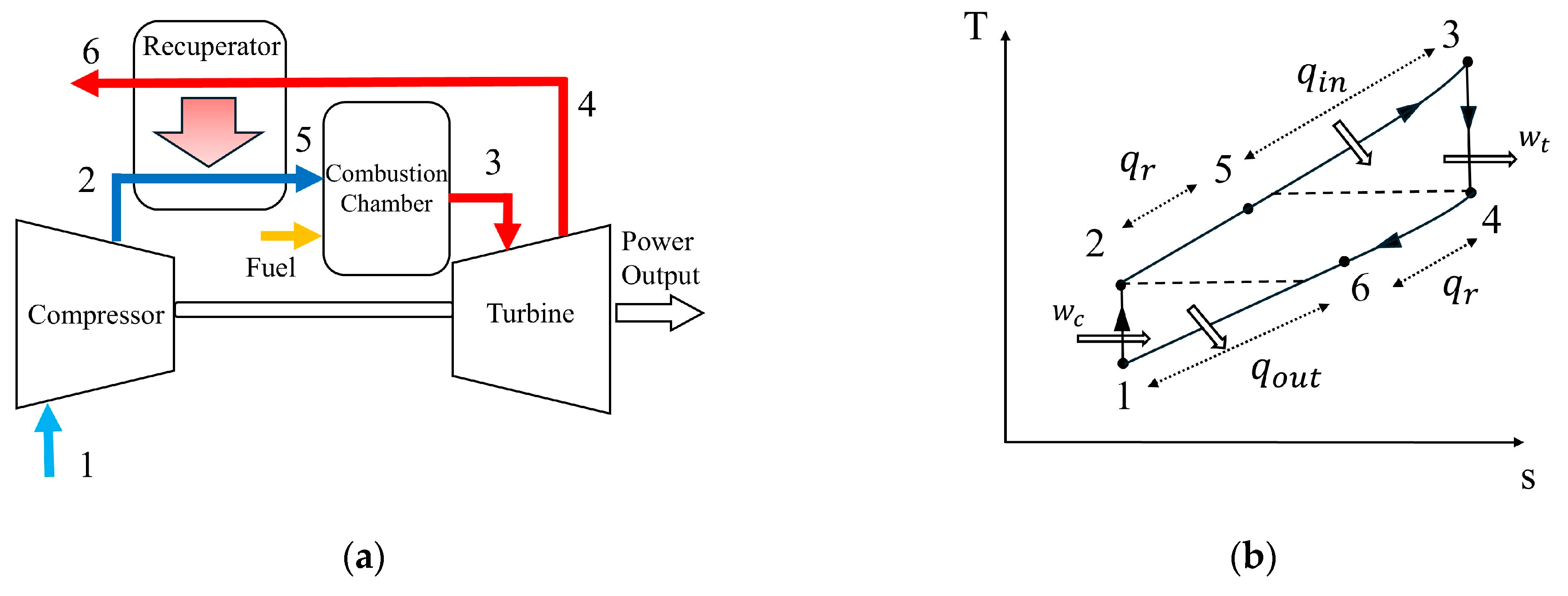
2.1. 1-D Thermodynamic Modeling of the Micro Gas Turbine
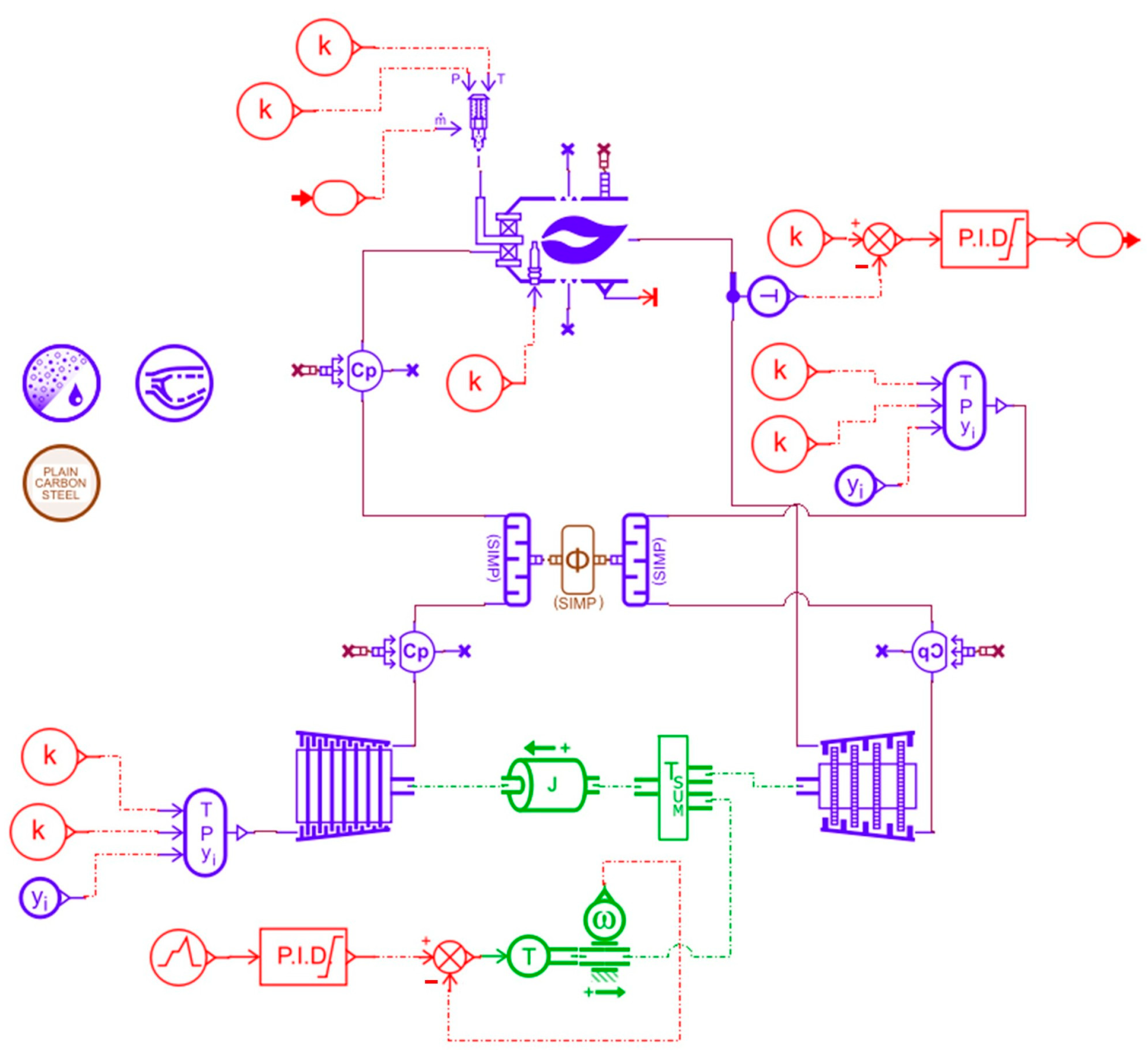
2.2. Modeling of a Regenerative Micro Gas Turbine in the Simcenter Amesim Environment
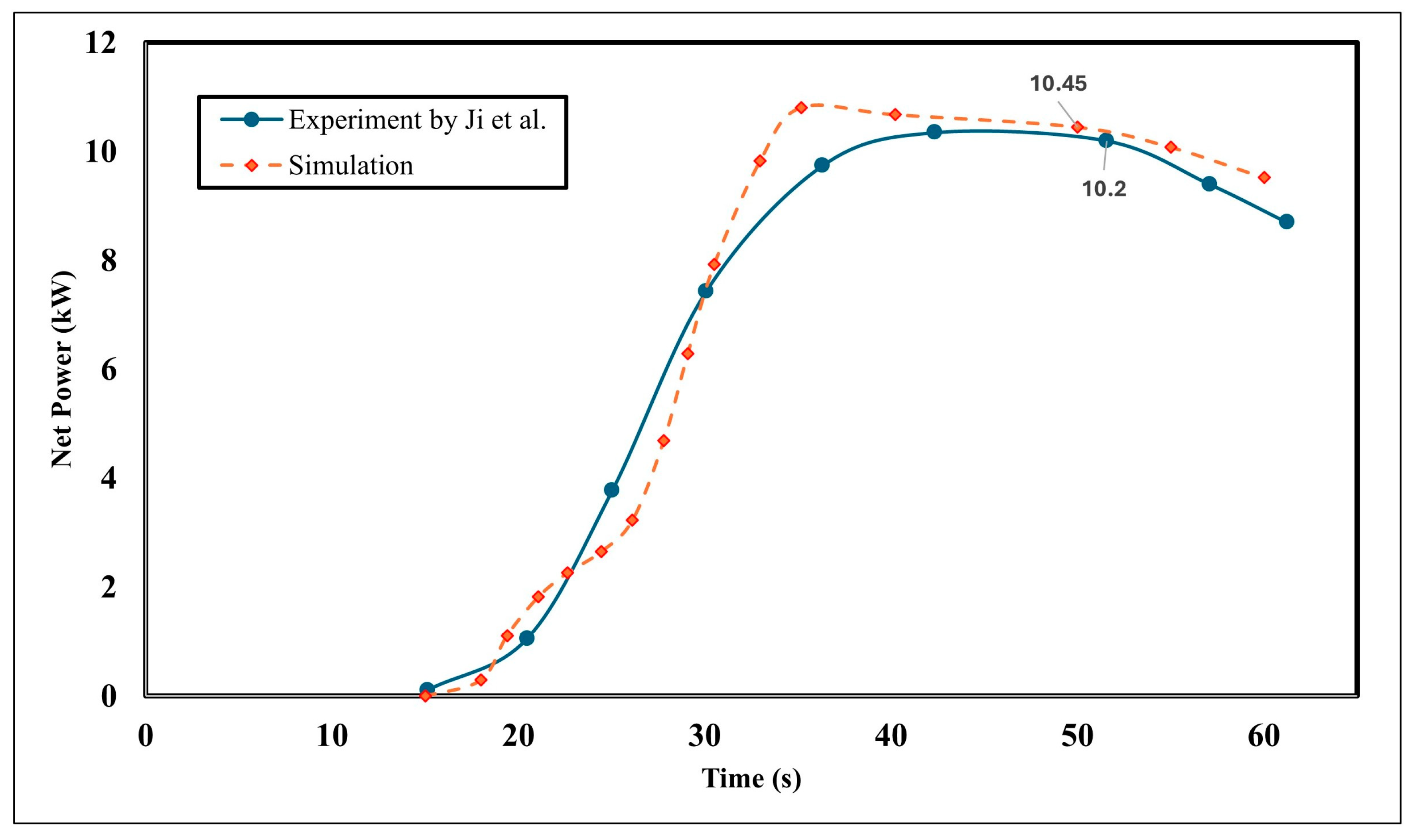
3. Model Validation
4. Results and Discussion
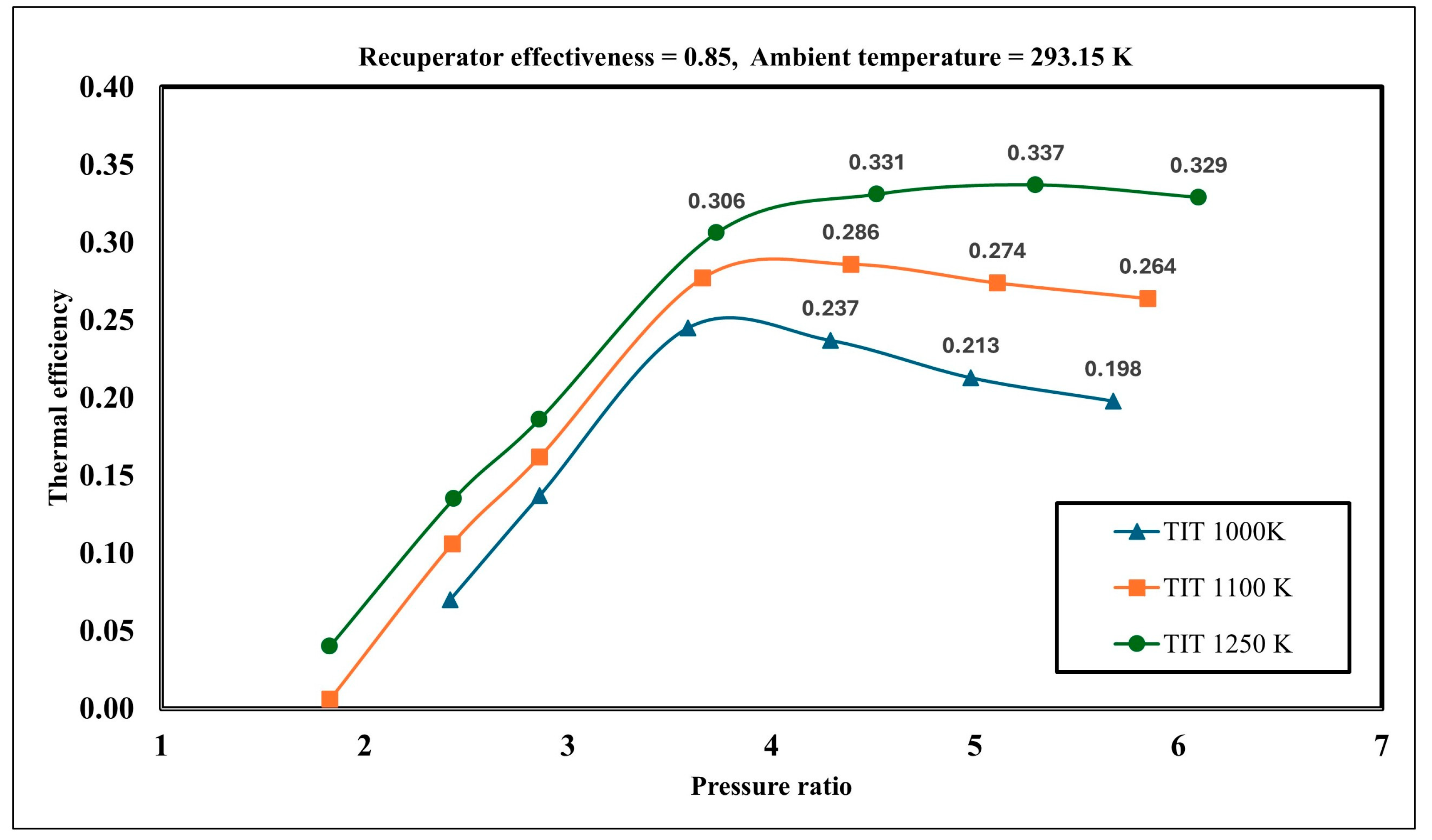
4.1. Thermal Efficiency Characteristics of a Micro Gas Turbine
4.2. The Effect of Recuperator Effectiveness on MGT Performance
4.3. The Effect of Different Climate Conditions on MGT Performance
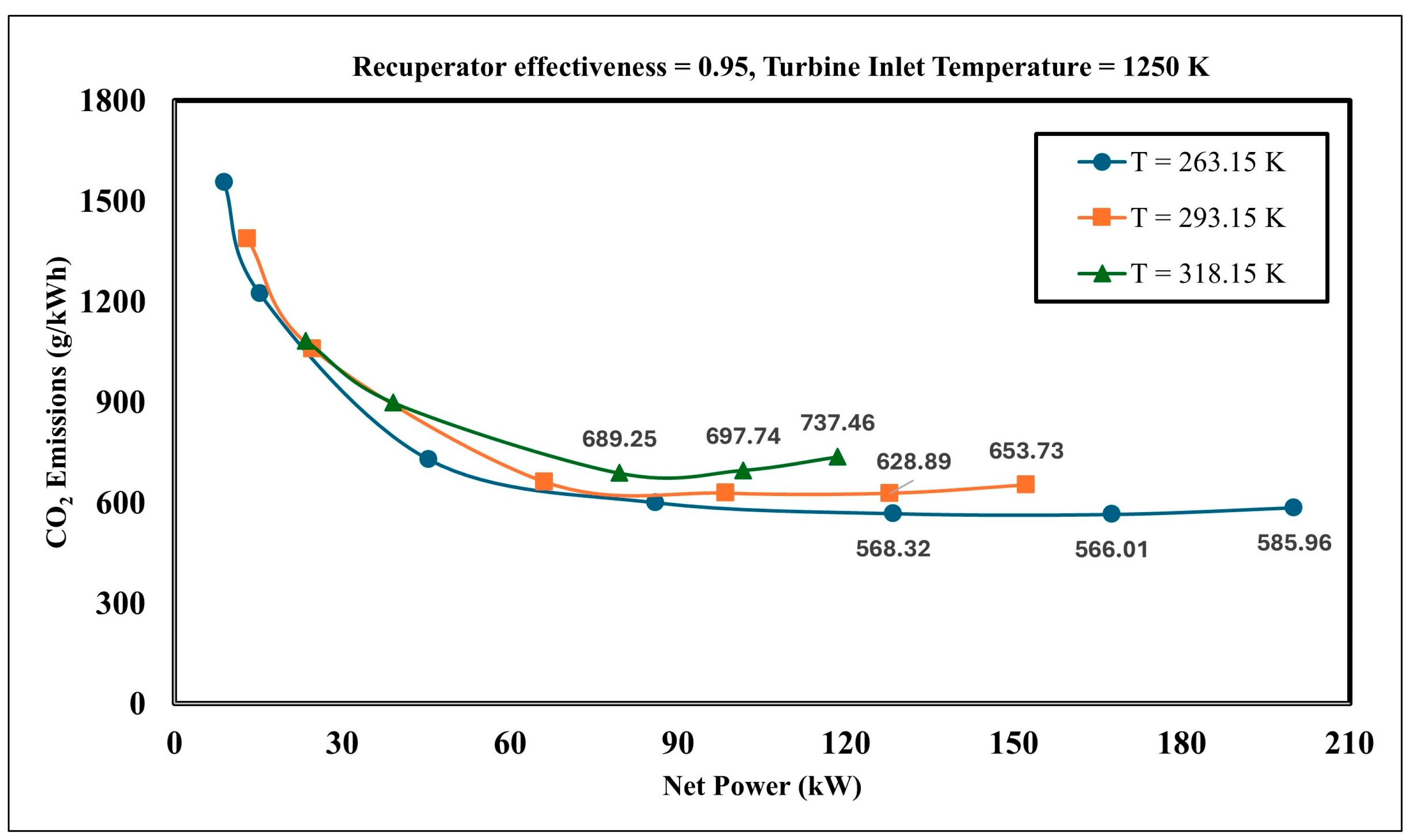
4.4. Environmental Impact, CO2 Emissions, and Waste Heat Recovery (WHR) Potential
5. Conclusions
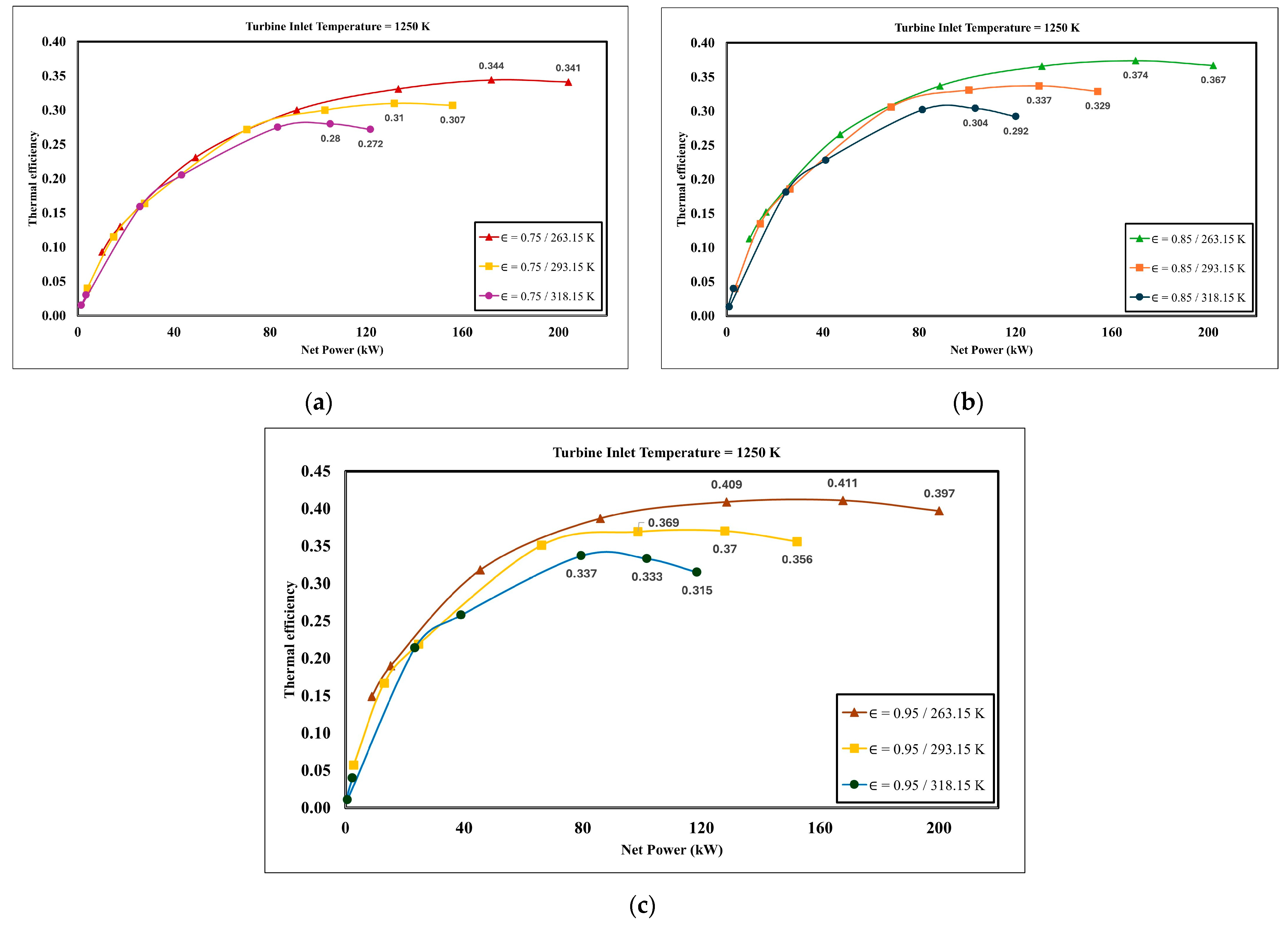
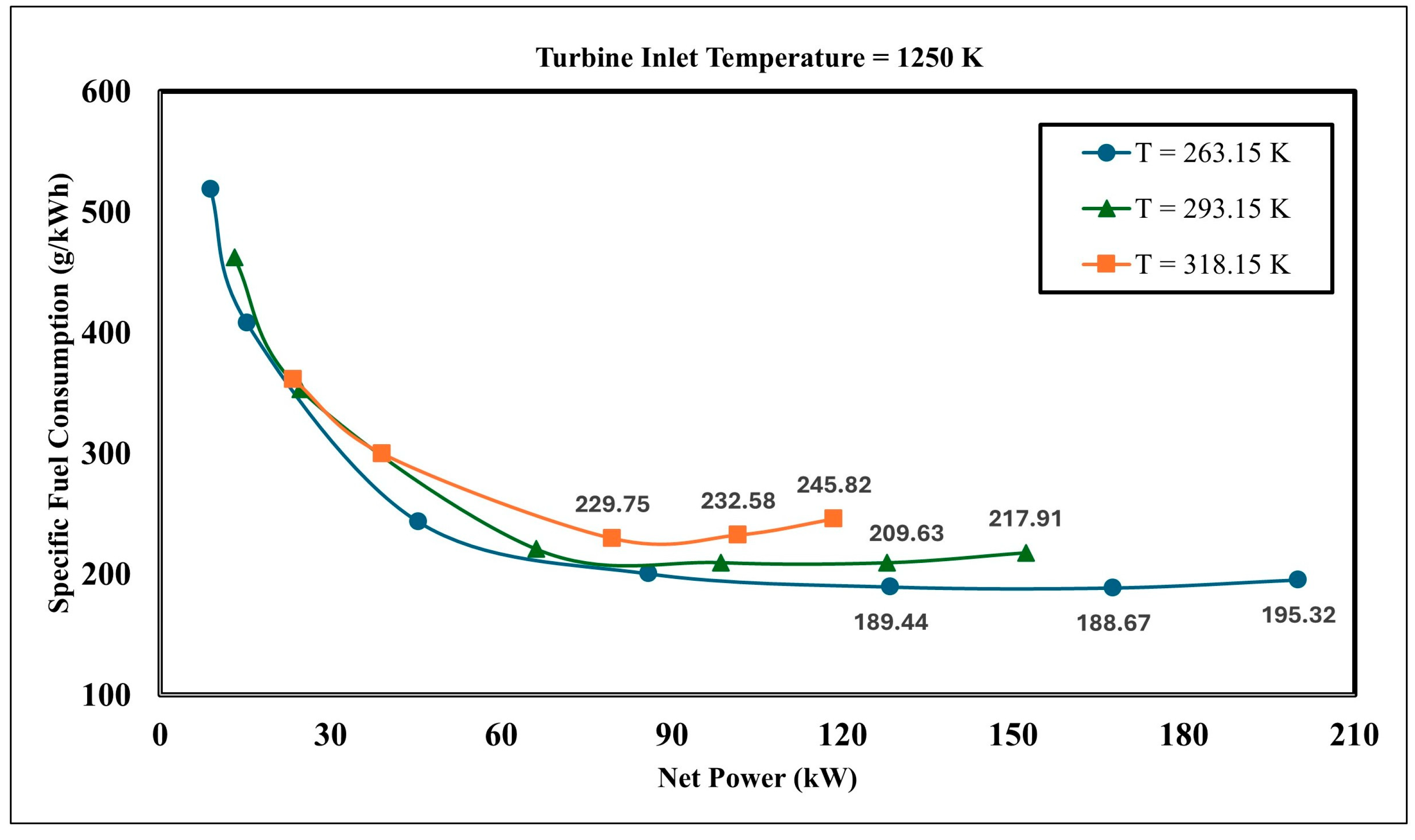
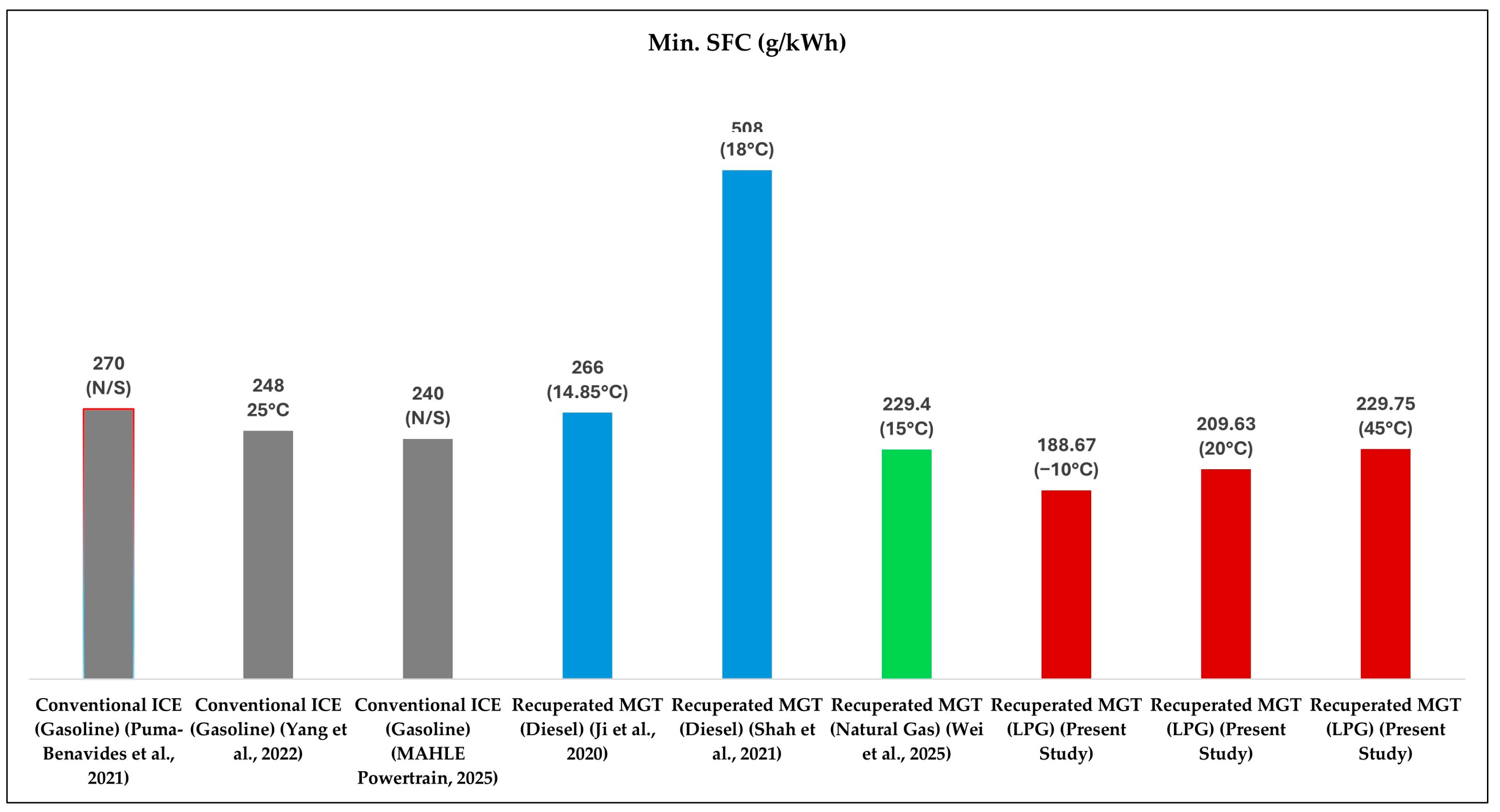
- The MGT system demonstrated its highest performance values in cold environments (−10 °C/263.15 K). In cold climate conditions, increased air density leads to a rise in mass flow rate and a direct decrease in specific compressor work. At the optimal design point (TIT = 1250 K, recuperator effectiveness = 0.95), the system achieved a maximum thermal efficiency of 41.1% and a minimum specific fuel consumption (SFC) of 188.67 g/kWh.
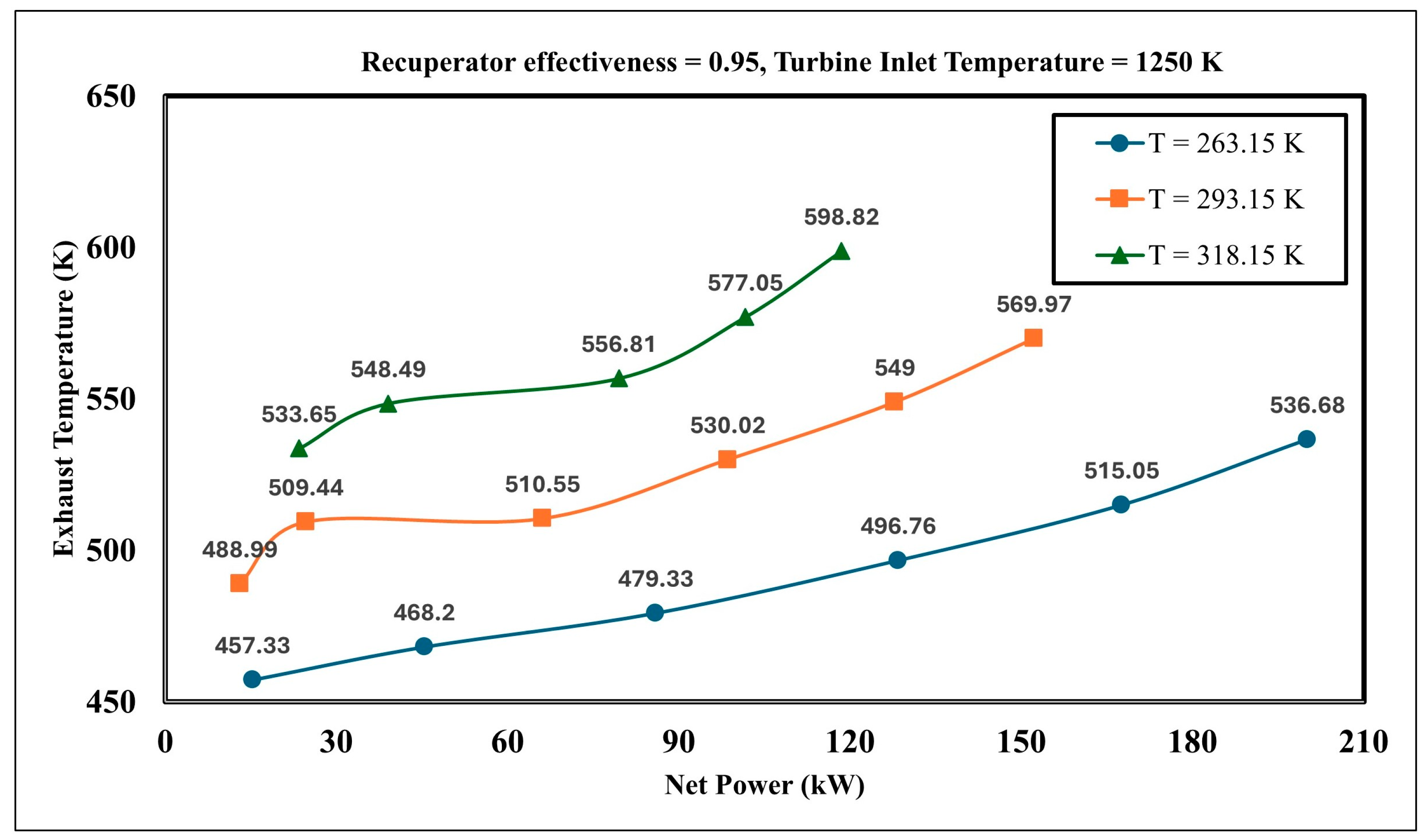
- A high-efficiency LPG-fueled micro gas turbine equipped with a recuperator achieved a low specific CO2 emission value of 566.01 g/kWh at its optimal operating point and under cold climate conditions. On the other hand, under extremely cold climate conditions (−10 °C) at the most efficient design point, the 515.05 K exhaust temperature produced by the micro gas turbine offers a significant advantage for cabin heating and battery thermal management.
Funding
Institutional Review Board Statement
Informed Consent Statement
Data Availability Statement
Acknowledgments
Conflicts of Interest
Abbreviations
| MGT | Micro gas turbine |
| EV | Electric vehicle |
| ICE | Internal combustion engine |
| REEV | Range-extended electric vehicle |
| APU | Auxiliary power unit |
| RE | Range extender |
| NVH | Noise, vibration and harshness |
| SOC | State of charge |
| TIT | Turbine inlet temperature |
| SFC | Specific fuel consumption |
| LPG | Liquefied petroleum gas |
| RPM | Revolutions per minute |
| LHV | Low heating value |
| PID | Proportional integral derivative |
| WHR | Waste heat recovery |
| CHP | Combined heat and power |
References
- Prasad, S.L.; Gudipalli, A. Range-anxiety reduction strategies for extended-range electric vehicle. Int. Trans. Electr. Energy Syst. 2023, 2023, 7246414. [Google Scholar] [CrossRef]
- Yang, Y.; Xu, Y.; Zhang, H.; Yang, F.; Ren, J.; Wang, X. Research on the energy management strategy of extended range electric vehicles based on a hybrid energy storage system. Energy Rep. 2022, 8, 6602–6623. [Google Scholar] [CrossRef]
- Kasar, İ.; Fotouhi, A.; Nabavi, S.A. Performance test of a hydrogen-powered solid oxide fuel cell system and its simulation for vehicle propulsion application. J. Clean. Prod. 2025, 486, 144422. [Google Scholar] [CrossRef]
- Dönmez, M.; Karamangil, M.İ. Artificial neural networks-based multi-objective optimization of immersion cooling battery thermal management system using Hammersley sampling method. Case Stud. Therm. Eng. 2024, 64, 105509. [Google Scholar] [CrossRef]
- Bulut, E.; Albak, E.İ.; Sevilgen, G.; Öztürk, F. Multi-objective optimization of liquid cooling system for a twelve-cell battery module. Heat Transfer Res. 2022, 53, 15–31. [Google Scholar] [CrossRef]
- Zhao, L.; Mohebi, P.; Wang, Z. A model-based EV driving range assessment with genetic-algorithm-optimized motor waste heat recovery strategies. Energy Use 2025, 1, 100005. [Google Scholar] [CrossRef]
- Guo, R.; Li, L.; Sun, Z.; Xue, X. An integrated thermal management strategy for cabin and battery heating in range-extended electric vehicles under low-temperature conditions. Appl. Therm. Eng. 2023, 228, 120502. [Google Scholar] [CrossRef]
- Lan, S.; Stobart, R.; Wang, X. Matching and optimization for a thermoelectric generator applied in an extended-range electric vehicle for waste heat recovery. Appl. Energy 2022, 313, 118783. [Google Scholar] [CrossRef]
- Tran, M.-K.; Bhatti, A.; Vrolyk, R.; Wong, D.; Panchal, S.; Fowler, M.; Fraser, R. A review of range extenders in battery electric vehicles: Current progress and future perspectives. World Electr. Veh. J. 2021, 12, 54. [Google Scholar] [CrossRef]
- Puma-Benavides, D.S.; Izquierdo-Reyes, J.; Calderon-Najera, J.d.D.; Ramirez-Mendoza, R.A. A systematic review of technologies, control methods, and optimization for extended-range electric vehicles. Appl. Sci. 2021, 11, 7095. [Google Scholar] [CrossRef]
- Ribau, J.; Silva, C.; Brito, F.P.; Martins, J. Analysis of four-stroke, Wankel, and microturbine based range extenders for electric vehicles. Energy Convers. Manag. 2012, 58, 120–133. [Google Scholar] [CrossRef]
- Han, L.; Zhou, X.; Yang, N.; Liu, H.; Xiang, C. Hierarchical energy management for extended-range electric vehicles considering range extender dynamic coordination. J. Power Sources 2024, 622, 235349. [Google Scholar] [CrossRef]
- Karvountzis-Kontakiotis, A.; Andwari, A.M.; Pesyridis, A.; Russo, S.; Tuccillo, R.; Esfahanian, V. Application of micro gas turbine in range-extended electric vehicles. Energy 2018, 147, 351–361. [Google Scholar] [CrossRef]
- Li, J.; Li, Y. Micro gas turbine: Developments, applications, and key technologies on components. Propuls. Power Res. 2023, 12, 1–43. [Google Scholar] [CrossRef]
- Tan, F.X.; Chiong, M.S.; Rajoo, S.; Romagnoli, A.; Palenschat, T.; Martinez-Botas, R.F. Analytical and experimental study of micro gas turbine as range extender for electric vehicles in Asian cities. Energy Procedia 2017, 143, 53–60. [Google Scholar] [CrossRef]
- Kim, H.; Nutakor, C.; Singh, S.; Jaatinen-Värri, A.; Nerg, J.; Pyrhönen, J.; Sopanen, J. Design process and simulations for the rotor system of a high-efficiency 22 kW micro-gas-turbine range extender for electric vehicles. Mech. Mach. Theory 2023, 183, 105230. [Google Scholar] [CrossRef]
- Ji, F.; Zhang, X.; Du, F.; Ding, S.; Zhao, Y.; Xu, Z.; Wang, Y.; Zhou, Y. Experimental and numerical investigation on micro gas turbine as a range extender for electric vehicle. Appl. Therm. Eng. 2020, 173, 115236. [Google Scholar] [CrossRef]
- Najib, J.; Nemer, M.; Bouallou, C. Study of a gas turbine cycle to boost the autonomy of electric cars. Energies 2020, 13, 2342. [Google Scholar] [CrossRef]
- Duan, J.; Fan, S.; An, Q.; Sun, L.; Wang, G. A comparison of micro gas turbine operation modes for optimal efficiency based on a nonlinear model. Energy 2017, 134, 400–411. [Google Scholar] [CrossRef]
- Shah, R.M.R.A.; McGordon, A.; Rahman, M.M.; Amor-Segan, M.; Jennings, P. Characterisation of micro turbine generator as a range extender using an automotive drive cycle for series hybrid electric vehicle application. Appl. Therm. Eng. 2021, 184, 116302. [Google Scholar] [CrossRef]
- Wei, Z.; Duan, W.; Gao, H.; Wei, C.; Ren, G.; Gan, X. Preliminary design and key components validation of modular recuperated micro gas turbine for small unmanned systems. Case Stud. Therm. Eng. 2025, 73, 106547. [Google Scholar] [CrossRef]
- Shah, R.M.R.A.; Al Qubeissi, M.; McGordon, A.; Amor-Segan, M.; Jennings, P. Micro Gas Turbine Range Extender Performance Analysis Using Varying Intake Temperature. Automot. Innov. 2020, 3, 356–365. [Google Scholar] [CrossRef]
- Wang, R.; Wang, Y.; Chen, X.; Wang, M.; Wang, Z. Research on performance of micro gas turbine recuperator: A review. Int. Commun. Heat Mass Transf. 2024, 154, 107396. [Google Scholar] [CrossRef]
- Li, M.; Jiang, K. System-level modelling and optimisation of a recuperated micro gas turbine hybrid power system for eVTOL endurance enhancement. Energy 2026, 344, 140162. [Google Scholar] [CrossRef]
- Weerakoon, A.H.S.; Assadi, M. Trends and advances in micro gas turbine technology for sustainable energy solutions: A detailed review. Energy Convers. Manag. X 2023, 20, 100483. [Google Scholar] [CrossRef]
- Saravanamuttoo, H.I.H.; Rogers, G.F.C.; Cohen, H.; Straznicky, P.V.; Nix, A.C. Gas Turbine Theory, 7th ed.; Pearson Education: Harlow, UK, 2017; pp. 45–48. [Google Scholar]
- Kays, W.M.; London, A.L. Compact Heat Exchangers, 3rd ed.; Krieger Publishing Company, Inc.: Malabar, FL, USA, 1998; pp. 16–26. [Google Scholar]
- Çengel, Y.A.; Boles, M.A. Thermodynamics: An Engineering Approach, 7th ed.; McGraw-Hill Companies, Inc.: New York, NY, USA, 2011; pp. 503–513. [Google Scholar]
- Banihabib, R.; Lingstadt, T.; Wersland, M.; Kutne, P.; Assadi, M. Development and testing of a 100 kW fuel-flexible micro gas turbine running on 100% hydrogen. Int. J. Hydrog. Energy 2024, 49, 92–111. [Google Scholar] [CrossRef]
- Wu, X.; Hu, X.; Xiang, X.; Lin, S.; You, J.; Tian, F. An analysis approach for micro gas turbine engine’s performance by experiment and numerical simulation. Case Stud. Therm. Eng. 2023, 49, 103305. [Google Scholar] [CrossRef]
- Li, Q.; Zhang, Q.; Zhang, L.; He, Y. Performance analysis and multi-objective optimization of micro gas turbine running on natural gas and hydrogen blends. Int. J. Hydrog. Energy 2025, 120, 507–520. [Google Scholar] [CrossRef]
- Luo, H.; Wang, Y.; Feng, Y.; Fan, X.; Han, X.; Wang, P. Lithium-ion batteries under low-temperature environment: Challenges and prospects. Materials 2022, 15, 8166. [Google Scholar] [CrossRef] [PubMed]
- Sun, B.; Qi, X.; Song, D.; Ruan, H. Review of low-temperature performance, modeling and heating for lithium-ion batteries. Energies 2023, 16, 7142. [Google Scholar] [CrossRef]
- Jaguemont, J.; Boulon, L.; Dubé, Y. A comprehensive review of lithium-ion batteries used in hybrid and electric vehicles at cold temperatures. Appl. Energy 2016, 164, 99–114. [Google Scholar] [CrossRef]
- MAHLE Powertrain, Range Extender Engine. 2025. Available online: https://www.mahle-powertrain.com/media/mahle-powertrain/news-&-press/flyers/range-extender/mpt-range-extender-engine-25.pdf (accessed on 16 May 2026).
- De Robbio, R. Micro Gas Turbine Role in Distributed Generation with Renewable Energy Sources. Energies 2023, 16, 704. [Google Scholar] [CrossRef]






| Parameter | Value | Unit |
|---|---|---|
| Air flow | 0.85 | kg/s |
| Design point of shaft | 90,000 | rpm |
| Pressure ratio | 5 | - |
| Compressor Isentropic Efficiency | 0.786 | - |
| Turbine Isentropic Efficiency | 0.879 | - |
| Reference Ambient Temperature | 288.15 | K |
| Reference Ambient Pressure ( | 1.013 | barA |
| Recuperator Effectiveness , Turbine Inlet Temperature (TIT) = 1250 K | |||||||||
|---|---|---|---|---|---|---|---|---|---|
| T = 263.15 K | T = 293.15 K | T = 318.15 K | |||||||
| RPM | (kg/s) | (kW) | (kj/kg) | (kg/s) | (kW) | (kj/kg) | (kg/s) | (kW) | (kj/kg) |
| 40,000 | 0.253 | 31.19 | 123.28 | 0.212 | 26.5 | 125.00 | 0.211 | 26.82 | 127.11 |
| 50,000 | 0.321 | 48.26 | 150.34 | 0.316 | 48.87 | 154.65 | 0.266 | 45.78 | 172.11 |
| 60,000 | 0.454 | 74.14 | 163.30 | 0.387 | 68.85 | 177.91 | 0.382 | 68.23 | 178.61 |
| 70,000 | 0.598 | 106.47 | 178.04 | 0.533 | 96.84 | 181.69 | 0.459 | 90.96 | 198.17 |
| 80,000 | 0.749 | 149.61 | 199.75 | 0.667 | 137.29 | 205.83 | 0.613 | 128.7 | 209.95 |
| 90,000 | 0.897 | 199.11 | 221.97 | 0.797 | 182.51 | 229.00 | 0.733 | 171.79 | 234.37 |
| 100,000 | 1.04 | 258.42 | 248.48 | 0.93 | 236.28 | 254.06 | 0.853 | 222.23 | 260.53 |
| Range Extender Type | Fuel Type | Ambient Temperatures (K/°C) | Power (kW) | Thermal Efficiency (%) | Min. SFC (g/kWh) | Reference |
|---|---|---|---|---|---|---|
| Conventional ICE | Gasoline | Not specified | 62 | Not specified | 270 | [11] |
| Conventional ICE | Gasoline | 298.15/25 | 40 | Not specified | 248 | [2] |
| Conventional ICE | Gasoline | Not specified | 30 | Not specified | 240 | [35] |
| Recuperated MGT | Diesel | 288/14.85 | 10 | 32 | 266 | [17] |
| Recuperated MGT | Diesel | 291.15/18 | 6.5 | 25 | 508 | [20] |
| Recuperated MGT | Natural Gas | 288.15/15 | 150 | 37.3 | 229.4 | [21] |
| Recuperated MGT | LPG | 263.15/−10 | 167.57 | 41.1 | 188.67 | [Present Study] |
| Recuperated MGT | LPG | 293.15/20 | 127.82 | 37 | 209.63 | [Present Study] |
| Recuperated MGT | LPG | 318.15/45 | 79.51 | 33.7 | 229.67 | [Present Study] |
| Model | Fuel Type | Power | CO2 Metric | Reported CO2 Value | Reference |
|---|---|---|---|---|---|
| Turbec AE-T100 (MGT) | Natural Gas | 100 kW | Specific Emission | 660 (g/kWh) | [36] |
| Capstone C65 (MGT) | Natural Gas | 65 kW | Specific Emission | 707.14 (g/kWh) | [36] |
| Baseline ICE (4-stroke) | Gasoline | 62 kW | Tank-to-Wheel (NEDC Cycle) | 156.6 (g/km) | [11] |
| Wankel Rotary Engine | Gasoline | 30 kW | Tank-to-Wheel (NEDC Cycle) | 161.4 (g/km) | [11] |
| Diesel ICE | Diesel | 50 kW | Vehicle Level (NEDC Cycle) | 114.2 (g/km) | [13] |
| Capstone Model C30 | Natural Gas | 25 kW | Vehicle Level (NEDC Cycle) | 117.8 (g/km) | [13] |
| PEM Fuel Cell | Hydrogen | Variable | Tailpipe Emission | 0 | [9] |
| Proposed Recuperated MGT | LPG | 167.57 kW | Specific Emission | 566.01 (g/kWh) | Present Study |
Disclaimer/Publisher’s Note: The statements, opinions and data contained in all publications are solely those of the individual author(s) and contributor(s) and not of MDPI and/or the editor(s). MDPI and/or the editor(s) disclaim responsibility for any injury to people or property resulting from any ideas, methods, instructions or products referred to in the content. |
© 2026 by the author. Licensee MDPI, Basel, Switzerland. This article is an open access article distributed under the terms and conditions of the Creative Commons Attribution (CC BY) license.
Share and Cite
Güçlü, H. Performance Analysis of an LPG-Fueled Micro Gas Turbine Under Extreme Climate Conditions. Appl. Sci. 2026, 16, 5372. https://doi.org/10.3390/app16115372
Güçlü H. Performance Analysis of an LPG-Fueled Micro Gas Turbine Under Extreme Climate Conditions. Applied Sciences. 2026; 16(11):5372. https://doi.org/10.3390/app16115372
Chicago/Turabian StyleGüçlü, Harun. 2026. "Performance Analysis of an LPG-Fueled Micro Gas Turbine Under Extreme Climate Conditions" Applied Sciences 16, no. 11: 5372. https://doi.org/10.3390/app16115372
APA StyleGüçlü, H. (2026). Performance Analysis of an LPG-Fueled Micro Gas Turbine Under Extreme Climate Conditions. Applied Sciences, 16(11), 5372. https://doi.org/10.3390/app16115372