1. Introduction
Metals and emerging pollutants such as microplastics are, even at a very low concentration, a risk for the environment and human health. Water pollution caused by those pollutants has become a significant issue, globally. Therefore, there is a growing need to develop efficient and sustainable strategies to remove them from the water environment.
Microplastics (MPs), known as small plastic fragments (≤5 mm), are currently viewed as critical emerging contaminants, primarily because they are highly persistent, complex, ubiquitous in the environment, and very small in size [
1]. Metals also require special attention due to their extensive sources, non-degradability and strong persistence [
2].
MPs have been widely detected in the sea, wetlands, and rivers, as well as mountains, soil and sediments [
3]. There is a large number of studies focused on the ingestion of these contaminants by marine organisms and their associated negative effects [
4]. The principal pathways for microplastic influx into oceanic environments are predominantly land-derived, encompassing landfill leaching, riverine discharge, atmospheric redistribution, and recreational activities in littoral zones [
5].
On the other side, the toxic effects and wide environmental distribution of metals and metalloids are well known [
6]. Metals are discharged in the environment by different natural processes such as spring water, volcanic eruptions, bacterial activity and erosion, and through anthropogenic performances including industrial procedures, agricultural activities, fossil fuel combustion and mining. At certain concentration levels, they cause important damaging effects on the biological functions of the organisms in which they are present [
7].
Both contaminants may coincide in certain aquatic environments, and it should be noted that wastewater treatment plants (WWTPs) are pointed out as one of the main causes of MP and metal contamination of water bodies and soil environments. Effluents and sludges from WWTPs contain MPs and metals which are released into the water systems and agricultural soils, respectively [
8,
9,
10]. The accumulation of MPs and metals in wastewater depends on several factors, such as people’s awareness of the environmental impact by careless disposal of wastes and industry type [
10].
Moreover, MPs have demonstrated the capacity to absorb metals and other chemicals in seawater or in wastewater treatment plants. It has been shown that their adsorption capacity depends on several variables, such as MP specific surface, chemical structure, morphology, size and even the presence of other additives [
11]. Several authors have confirmed that MPs can absorb certain quantities of metals on their surface and act as a vector of metallic pollution, transporting them throughout aquatic environments [
12]. This fact emphasizes the requirement to develop analytical strategies to remove both contaminants from the water environment.
Although the elimination of metals and MPs has been studied separately by several approaches [
13,
14,
15,
16], simultaneous removal of both pollutants from water environments appears as a challenge and needs to be explored, since these contaminants coexist there. Accordingly, the efficient elimination of both pollutants from contaminated water systems was the focus of this work.
Magnetic nano-iron-based adsorbents (Fe
3O
4 NPs) have been applied to remove MPs [
17,
18,
19] and heavy metals [
7,
20,
21] independently from marine environments owing to their remarkable removal efficiency and benign environmental footprint, as these particles can be easily recovered via external magnetic fields, thereby preventing their secondary release into the ecosystem. However, those adsorbents have not been applied, as far as our knowledge, for the removal of metals and MPs simultaneously, considering the potential interactions between those pollutants. In this work, a novel method has been developed and tested for the simultaneous elimination of polyethylene-microplastics (PE-MPs) and lead and arsenic from different water samples using magnetic Fe
3O
4 NPs as an adsorbent.
PE-MPs (125 µm) were selected in this study as a model due to their high contribution to MP pollution in the aquatic environments [
22,
23]. On the other hand, arsenic and lead were chosen since they are some of the most abundant and dangerous trace metals in aquatic environments [
4,
24].
The potential adsorption mechanism among pollutants and the adsorbent was evaluated, as well as the interactions between the pollutants (PE-MPs and metals), in order to identify the most effective and cost-efficient conditions for pollutant removal, particularly in an aquatic environment with multiple contaminants.
The methodology presented in this work achieves 98% removal efficiency of PE-MPs, 80% of Pb(II) and 96% of As(III) in 180 min of contact time, at room temperature and pH 7 using Fe3O4 NPs as the final adsorbent. To the best of our knowledge, there are very few studies where MPs and metals are removed simultaneously from a polluted water system in a fast, efficient, cost-effective, and environmentally friendly procedure. Additionally, this work may provide a standard for large-scale application in practical wastewater treatment systems in the future.
2. Materials and Methods
PE-MPs (125 μm diameter) used as standard were purchased from Sigma-Aldrich (St. Louis, MO, USA).
All dilutions used in this work were made with water from a Millipore system (Millipore, Bedford, MA, USA). The 1000 mg L−1 lead and arsenic standards were obtained by Panreac (Barcelona, Spain). To acidify the solutions, 65% nitric acid from Merck (Darmstadt, Germany) was used. Fisherbrand™ 122 grade multipurpose filter paper was employed to filter the solutions (Thermo Fisher Scientific, Waltham, MA, USA).
The core of all adsorbents utilized in this research consisted of iron oxide (Fe3O4) particles, which were synthesized using FeCl3·6H2O and FeCl2·4H2O sourced from Merck (Darmstadt, Germany). Additionally, concentrated ammonia was acquired from Panreac Química SLU (Barcelona, Spain), while Fluka Chemicals (Buchs, Switzerland) were provided the NaBH4. The lead and arsenic measurements of the aqueous solutions, before and after the adsorption process and exposed to the different experimental parameters studied, were done by an atomic absorption spectrometer model AAnalyst 600 from Perkin-Elmer (Waltham, MA, USA) equipped with an electrothermal atomizer system and transversely heated graphite tubes with integrated platforms. In addition, an ultrasonic bath with temperature control Labbox model ULTR (Barcelona, Spain) was applied to carry out the temperature assessment. Stirring of the solutions was performed by a rotary carousel shaker (model MX-RD-E, TierraTech (Cantabria, Spain)).
The samples were filtered through 25 µm pore size metal filters from Proquilab (Murcia, Spain).
2.1. Preparation of Fe3O4 NPs
A total of 0.2 g of FeCl2·4H2O and 0.56 g of FeCl3·6H2O were weighed and dissolved in 20 mL of ultrapure water previously heated to 80 °C in a thermostatic bath.
A volume of 2 mL of ammonia was introduced dropwise into the solution, producing a brown mixture that was mechanically agitated on an orbital shaker for a 10 min period. Magnetic separation via a neodymium magnet facilitated the extraction of the synthesized Fe
3O
4 nanoparticles and the subsequent removal of the remaining liquid. The obtained magnetic material was consecutively rinsed with minor amounts of water before being dispersed in a 20 mL volume of ultrapure water, following the reaction outlined below [
25]:
2.2. Simultaneous Elimination of PE-MPs, Pb2+ and As3+: General Procedure
A volume of 10 mL of an aqueous solution containing PE-MPs, Pb2+ and As3+ at a concentration of 100 mg L−1 for PE-MPs and 100 µg L−1 for both metals was placed in a glass vessel, and stirred at room temperature for 180 min to enhance the adsorption of lead and arsenic on the PE surface, then 500 µL of Fe3O4 NPs was added. The mixture was shaken for a further 180 min. After that time, a neodymium magnet was approximated to the vessel to remove the magnetic nanoparticles with the PE-MPs (containing the metals adsorbed on it) adsorbed on its surface, and the aqueous solution was decanted totally free of PE-MPs, Pb2+ and As3+. To assess the removal efficiency, the decanted solution was again analyzed by atomic absorption spectrometry to check the lead and arsenic concentration. Additionally, the decanted water sample was filtered with a 25 µm metallic filter to evaluate the potential PE-MPs still present in the treated water. After filtration, the filters were left overnight at 60 °C to be dried and weighted to calculate the remaining quantity of PE-MPs (the filters were previously weighted to make the calculation).
Then, following Equation (1), ϴ is the removal rate of PE-MPs (%), m is the mass of remaining PE-MPs in the water, and M is the mass of total initial added PE-MPs in the sample (M is 1 mg in 10 mL of water sample):
A similar equation is used for Pb
2+ and As
3+(2):
where ϴ is the removal rate of each metal (%), c is the remaining concentration of lead and arsenic in the treated water and C is the initial concentration added into the sample (C is 100 µg mL
−1 of Pb
2+ and As
3+).
It should be noted that, although the adsorption mechanism proceeds sequentially—metals first adsorb onto the PE-MPs, and the resulting metal-loaded microplastics are subsequently removed by Fe3O4 nanoparticles—the overall procedure results in a single magnetic separation step in which PE-MPs, Pb(II), and As(III) are removed together from the aqueous phase.
3. Results
3.1. Characterization of the Adsorbent
3.1.1. Characterization of Fe3O4 NPs Before PE-MPs
Fe
3O
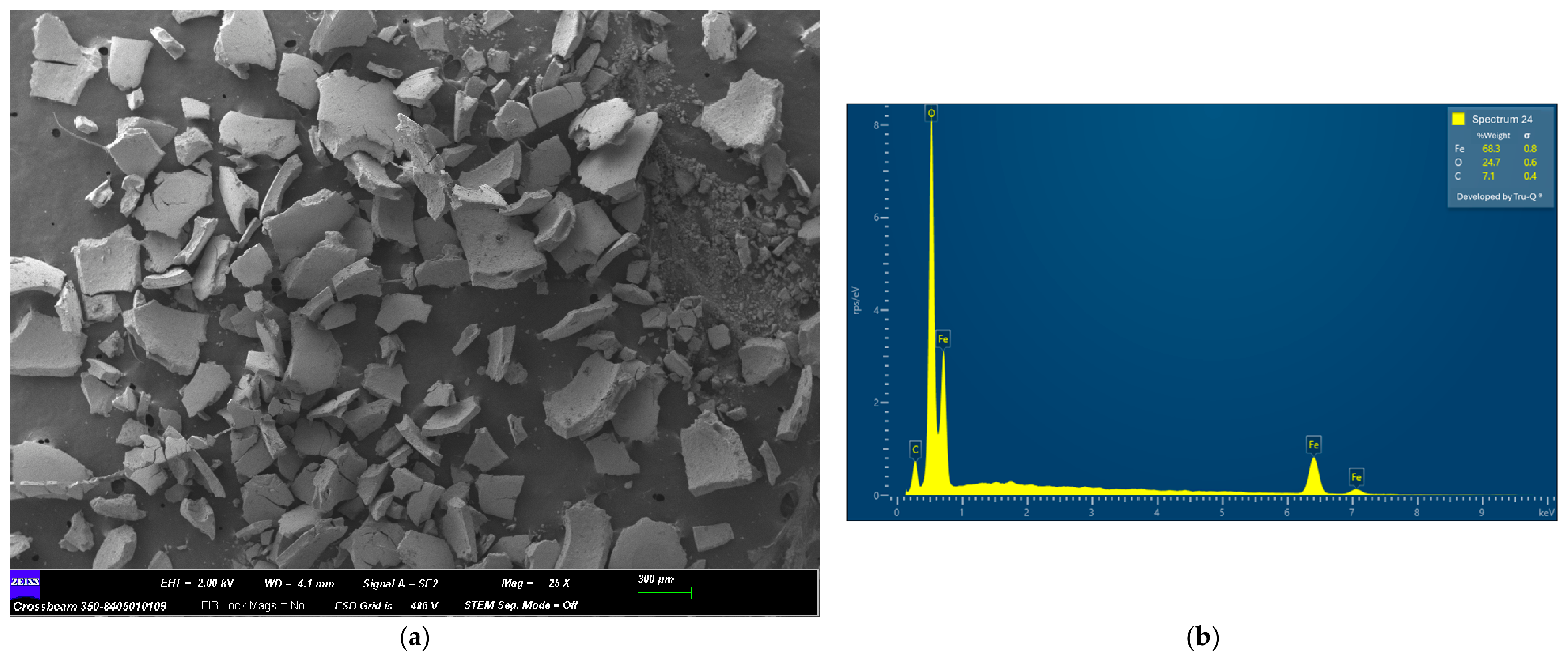
4 NPs were characterized before applying the procedure by field-effect scanning electron microscopy (FESEM).
Figure 1a shows the image of the adsorbent and
Figure 1b the energy-dispersive X-ray (EDX) spectrum associated with the whole area of the image shown in
Figure 1a. As can be seen, Fe and O atoms appear abundantly in the spectrum.
3.1.2. Characterization of PE-MPs After Retention of Pb2+ and As3+
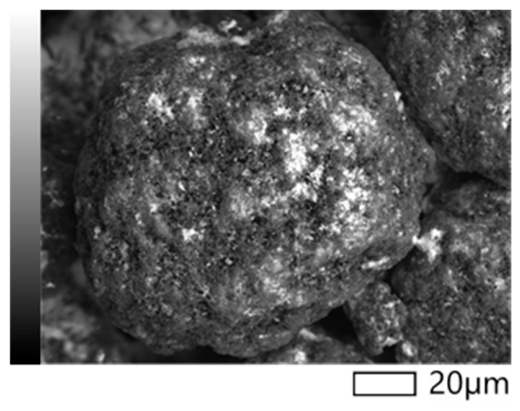
In the removal process described in the previous section, the microplastic spheres are first brought into contact with the solution containing the metals. These microplastics were characterized after the lead and arsenic removal process by scanning electron microscopy (SEM), once the adsorption process of PE-MPs with adsorbed metals on their surface was complete (
Figure 2).
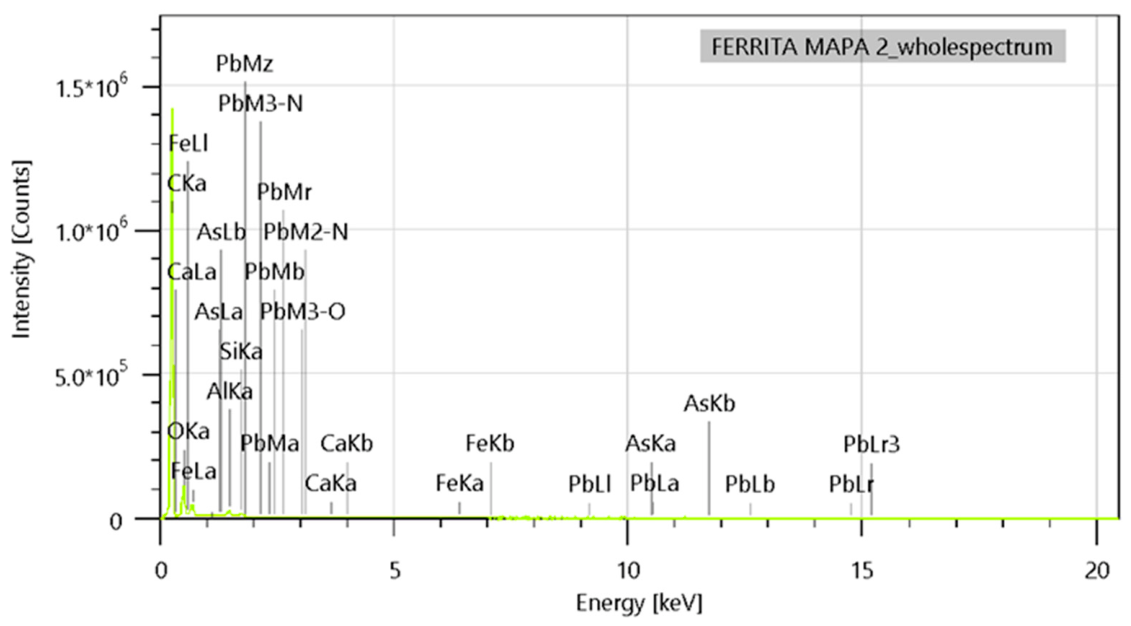
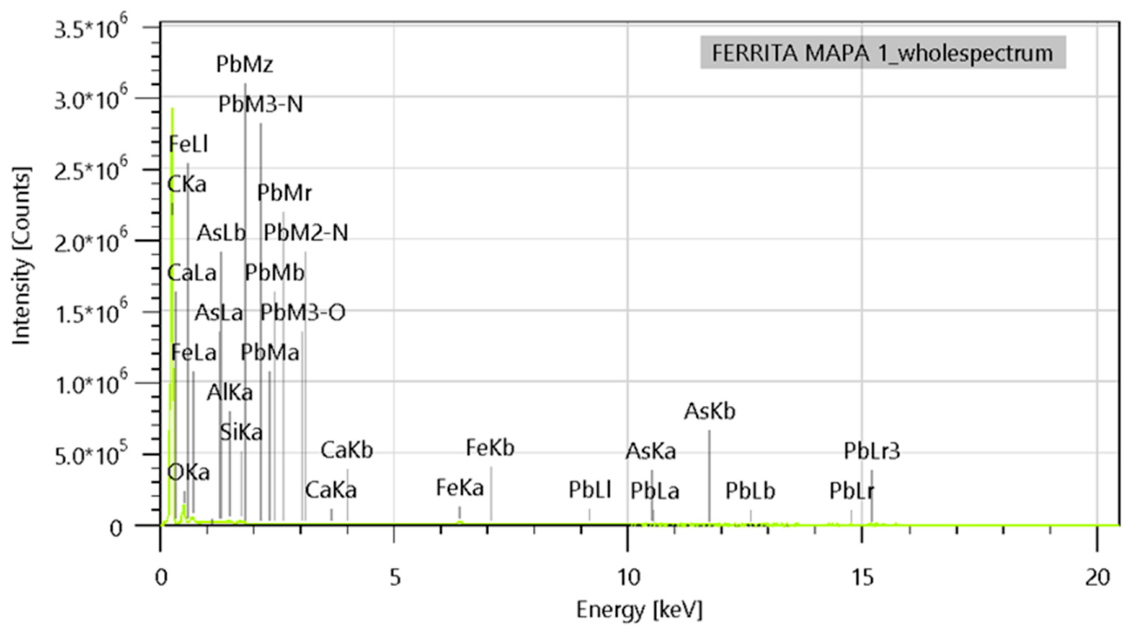
As can be seen in the EDX spectra (
Figure 3) corresponding to the full area of the image shown in
Figure 2, Pb
2+ and As
3+ have been adsorbed on the surface of the plastic.
The above spectrum shows the presence of arsenic and lead, as well as the carbon and oxygen corresponding to the PE-MPs.
Table 1 shows the relative abundance of each species; as expected, carbon from the MPs is the most abundant, followed by oxygen.
3.1.3. Characterization of Fe3O4 NPs After PE-MPs and Metals Removal
As shown in the above experimental procedure, after the time for the metals to be retained on the surface of the microplastic, Fe
3O
4 is added to the solution and PE-MPs with Pb(II) and As(III) were adsorbed on the magnetic material.
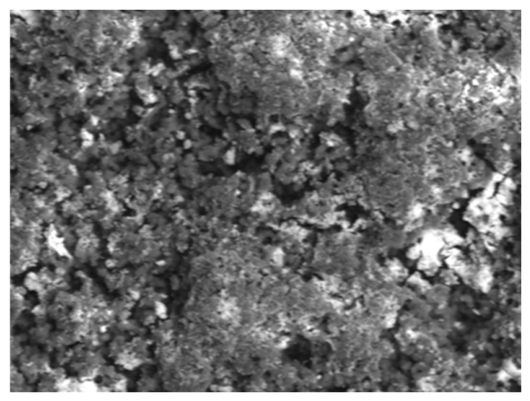
Figure 4 shows the SEM image of Fe
3O
4 once the microplastics and the metals are retained on the surface.
The lighter areas correspond to the metals, since their molecular weight—especially in the case of lead—makes them appear brighter in the image.
Although the carbon corresponding to the PE-MPs is not clearly visible in
Table 2, which indicates the mass and atom percentage, all the species involved in the proposed adsorption process are shown in their corresponding proportions. The very low As and Pb percentages observed in
Table 2 are expected because the SEM–EDX analysis mainly probes the surface of the Fe
3O
4 nanoparticles. Since Pb(II) and As(III) remain adsorbed on the surface of the PE-MPs, their signal becomes strongly diluted by the dominant Fe and O contributions when the microplastics are attached to the magnetic material. This confirms that the metals stay bound to the PE-MPs and are removed together with them during the magnetic separation step.
3.2. Effect of Contact Time on PE-MP Removal by Fe3O4 NPs
The optimum contact time to achieve the maximum adsorption capacity of the microplastic on the adsorbent was studied. The times tested were: 5, 15, 30, 60 and 120 min.
Table 3 shows the results obtained, displaying that, at 30 min of contact time, 98% of the polyethylene has been removed, maintaining this adsorption capacity constant up to 120 min.
3.3. Effect of Adsorbent Dose on PE-MP Removal Efficiency
To determine the optimal amount of adsorbent required for the highest removal of PE-MPs, different volumes (50, 100, 250, 500, and 750 μL) of the Fe
3O
4 nanoparticle suspension were evaluated. These were introduced into a solution containing 50 mg L
−1 of microplastics and agitated for half an hour. As indicated in
Table 4, adding a 500 μL dose resulted in the peak removal efficiency.
3.4. Evaluation of the Effect of pH of the Aqueous Solution Having PE-MPs on the Removal Efficiency
The pH of the medium was studied to establish which was the optimum in terms of PE-MP removal efficiency. For this purpose, the elimination procedure was carried out at pH values 1, 3, 5, 7 and 10.
The results obtained, expressed as a function of the removal efficiency ± standard deviation (in %) at different pH of the medium, are shown in
Table 5.
As can be seen in the table above, the highest removal efficiency is achieved at neutral pH values. This is because, as some studies have indicated, when the pH > 7, the surface of the PE-MPs will be negatively charged as well as the adsorbent (PZ0 Fe
3O
4 = 6.0) [
26], resulting in repulsion and low removal efficiency. When the pH is less than 5, adsorbent and adsorbate will be positively charged and, again, repulsion takes place.
According to previous research, as the pH increases from 5 to 6 towards alkaline conditions, microplastics develop a negative surface charge while Fe
3O
4 nanoparticles remain positively charged, maximizing their electrostatic attraction and achieving a 98% elimination rate [
5,
27,
28]. Furthermore, because this peak efficiency persists at a neutral pH of 7, it implies that additional non-electrostatic forces are also contributing to the optimal removal process.
3.5. Thermodynamic Studies of the Process
Adsorption isotherms characterize the equilibrium relationship between an adsorbate and an adsorbent at a constant temperature. They are typically obtained from experimental data through regression analysis. Standard graphical representations display the equilibrium adsorption capacity, q
e (mg g
−1), as a function of the equilibrium adsorbate concentration, C
e (mg L
−1) [
29]. In this study, isotherm analysis was carried out for PE-MP removal at temperatures of 298, 313, 323, and 343 K, with equilibrium concentrations of C
e set to 50, 100, 250, and 500 mg L
−1. The contact time was fixed at 30 min, and the highest removal efficiency was observed at 323 K, achieving 99.2% at C
e = 500 mg L
−1. Nevertheless, the adsorption remains high and nearly constant for all the temperatures considered in the study at a fixed concentration, with values close to 98%. The adsorption isotherm models evaluated included the Langmuir model, which describes homogeneous monolayer adsorption, and the Freundlich model, which accounts for multilayer adsorption and interactions between adsorption sites [
30]. These two models provided the best fit (adjusted R
2 > 0.95), outperforming other isotherms such as Temkin.
In Equation (3), K
L (L mg
−1) represents the Langmuir adsorption constant, while q
m (mg g
−1) denotes the maximum adsorption capacity. In Equation (4), the values 1/n and K
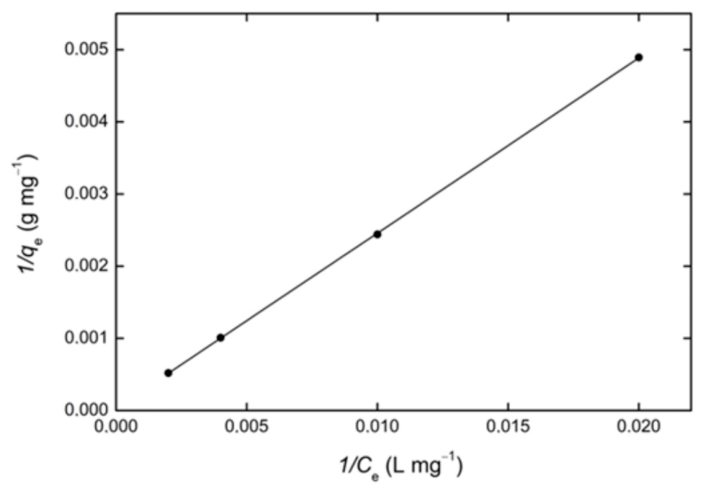
F correspond to the adsorption intensity and the Freundlich adsorption constants, respectively. The Langmuir model provided the best fit for all the temperatures under study in this work, exhibiting the same trend with overlapping curves, so the isotherms are essentially identical, and only the one corresponding to 298 K is displayed here. This fact reveals that the effect of temperature is not significant for the adsorption.
Figure 6 plots the Langmuir-type relationship of 1/q
e vs. 1/C
e for T = 298 K, where the straight lines correspond to the linear fits described by Equation (3).
For the data, the adjusted R2 values are 0.99995 and 0.9877, corresponding to the Langmuir and Freundlich models, respectively. Meanwhile, the reduced χ2 values are 1.97∙10−10 and 3.75∙10−2, respectively. Thus, the Langmuir model provides a better description of the equilibrium adsorption, as evidenced by the adjusted R2 value approaching 1 and the lower reduced χ2 value. To strengthen these results, additional comparison tests were conducted using Origin Pro2025, incorporating both Bayesian and Akaike’s information criteria.
These two statistical approaches corroborate that the Langmuir isotherm is the most suitable model for accurately representing the equilibrium adsorption of PE-MPs onto the Fe
3O
4 nanoparticles. Furthermore, to establish whether this removal mechanism is driven by physisorption, chemisorption, or a mixture of both phenomena, it is necessary to calculate the Gibbs free energy change (∆G
0, in kJ mol
−1) at each studied temperature using the following formula:
where R is the gas constant, T is the absolute temperature, and K
t is the equilibrium thermodynamic constant. To determine K
t for each temperature, it must be derived from the analysis of the equilibrium isotherms, converting the Langmuir constant K
L into the dimensionless quantity K
t using the following equation [
31]:
In this equation, M represents the molecular mass of the adsorbate (in g mol−1), [adsorbate]0 = 1 mol L−1 is the standard concentration of the adsorbate, and γ = 1 correspond to the activity coefficient for the dilute solution.
According to Equation (5), negative values of ∆G
0 indicate spontaneous adsorption. Chemisorption is typically associated with ∆G
0 values in the range of [−400, −80] kJ/mol, while physisorption falls within [−20, 0] kJ/mol. Physicochemical adsorption, which involves physisorption and other phenomena such as complexation, typically falls within the range between these two values [
32]. In this study, the ∆G
0 values range from [−20.51, −25.14] kJ/mol, which reveals that the adsorption process is best characterized as a spontaneous process, at the limit of physisorption.
3.6. Study of the Optimal Experimental Conditions for the Removal of Adsorbed Pb(II) and As(III) on PE-MPs
The simultaneous removal of PE-MPs together with Pb(II) and As(III) was studied by optimizing the experimental conditions that allow the removal of the metals in water using PE-MPs as an adsorbent, whose removal using magnetic nanoparticles has already been explained above. The results obtained are described below.
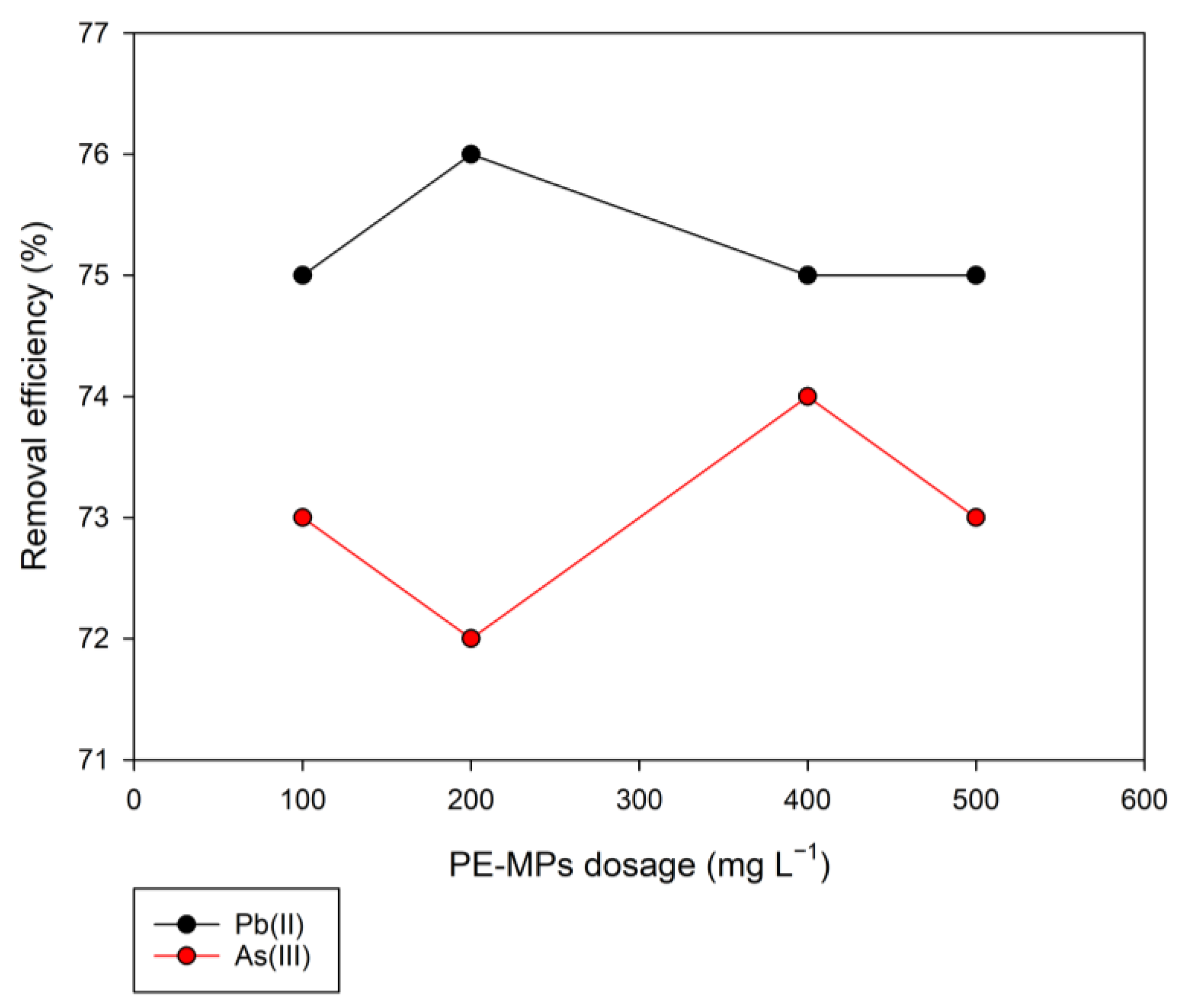
3.6.1. Study of PE-MP Dose Variation for the Removal of Pb(II) and As(III)
To 10 mL of aqueous solution containing 100 µg L
−1 of both Pb(II) and As(III), different doses of PE-MPs, namely 100, 200, 400 and 500 mg L
−1, were added and kept under continuous stirring for 60 min.
Figure 7 shows the results obtained. As can be seen, a PE-MP concentration of 100 mg L
−1 is sufficient to achieve the simultaneous removal of the two species. Afterwards, the removal efficiency remains constant at higher doses.
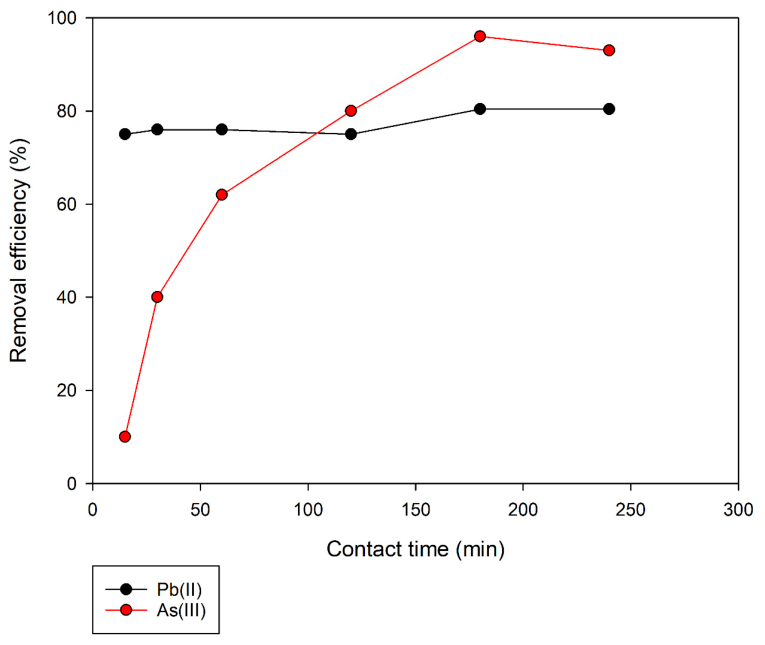
3.6.2. Study of the Variation in Pb(II) and As(III) Removal Efficiency with Contact Time Between Ions and PE-MPs
A total of 10 mL of aqueous solution with a Pb(II) and As(III) concentration of 100 µg L
−1 each, and 100 mg L
−1 of PE-MP, were kept in agitation at different contact times, namely 15, 30, 60, 120, 180 and 240 min.
Figure 8 shows the results obtained. As shown, to achieve maximum efficiency in the simultaneous removal of both species, it was necessary to keep them in agitation for 180 min.
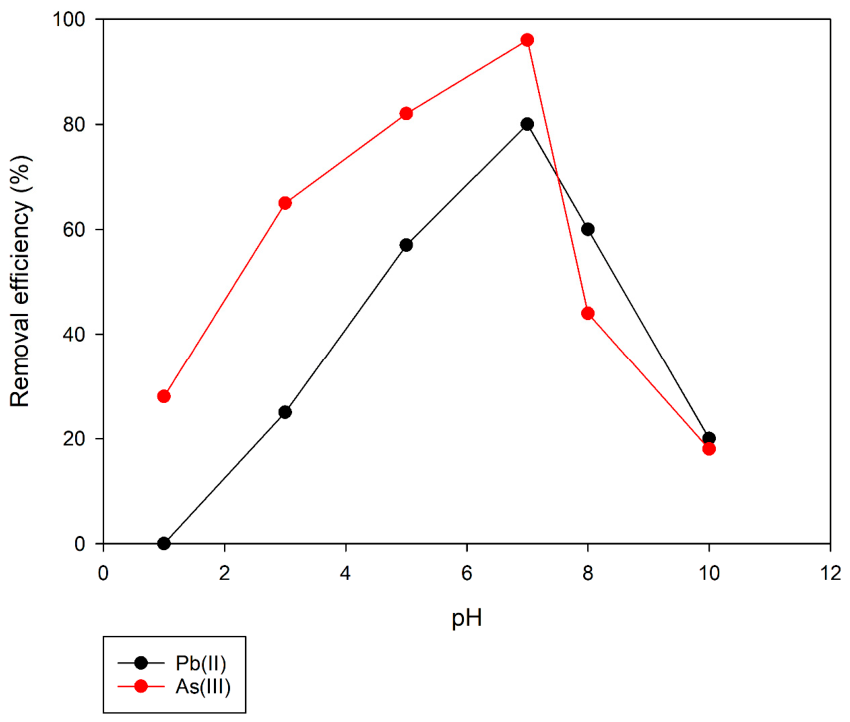
3.6.3. Study of the Variation in Pb(II) and As(III) Removal Efficiency at Different pH Values of the Medium
The 10 mL aqueous solution with concentrations of the ions studied of 100 µg L
−1 with 100 mg L
−1 of PE-MPs was kept in agitation for 180 min at different pH values, namely 1, 3, 5, 7, 8 and 10. As shown in
Figure 9, at neutral pH the maximum removal efficiency for the two ions is achieved.
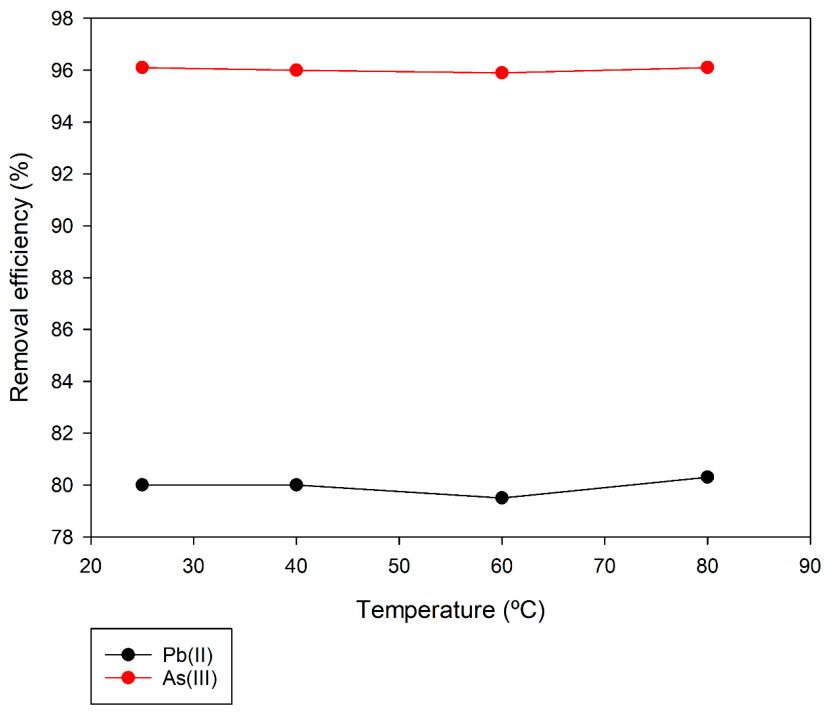
3.6.4. Study the Variation in Pb(II) and As(III) Removal Efficiency at Different Values of Temperature
To study the metal removal efficiency with temperature, the temperature of the aqueous solution (10 mL of water with Pb(II) and As(III) concentrations of 100 µg L−1 and PE-MPs dosage of 100 mg L−1, at pH = 7 and contact time 180 min) was varied between 20 and 80 °C.
As shown in
Figure 10, the temperature barely influences the metal removal process, so room temperature was selected as the optimum temperature.
3.6.5. Evaluation of Component-Specific Contributions to the Removal Process
To further clarify the specific contribution of each component involved in the proposed removal mechanism, a series of independent control experiments was conducted under the same general experimental conditions described above (10 mL aqueous solutions containing 100 mg L
−1 PE-MPs and 100 µg L
−1 of both Pb(II) and As(III), stirred at room temperature and pH 7). These assays were performed by evaluating each component separately and in combination. When PE-MPs were tested alone, they were able to adsorb Pb(II) and As(III), but remained dispersed in the aqueous phase and could not be physically removed. Conversely, Fe
3O
4 nanoparticles alone were efficiently recovered magnetically and were able to remove PE-MPs when present, but showed negligible direct adsorption of Pb(II) and As(III) in the absence of microplastics. The simultaneous and sequential assays confirmed that only the sequential process—first allowing metal adsorption onto PE-MPs, followed by magnetic capture with Fe
3O
4—achieves the combined removal of PE-MPs and both metals. The results, summarized in
Table 6, provide direct experimental evidence supporting the proposed mechanism in which PE-MPs act as metal carriers and Fe
3O
4 nanoparticles function as the magnetic collector enabling final separation.
3.7. Studies of Adsorbent Recycling and Application of Methodology in Real Waters
In order to reuse the magnetic nanoparticles, once these have been removed from the aqueous solution, 1 mL of 0.1 M nitric acid is added, the mixture is stirred for 15 min and then they are separated again by bringing a magnet close to them. The adsorbent is left free of PE-MPs and metals, which remain adhered to the microplastics surface. The adsorbent can be reused without losing its adsorbent properties during almost five cycles. Results can be seen in
Table 7.
Also, the proposed procedure was applied to real water samples, which were doped with the concentrations of PE-MPs, Pb(II) and As(III) indicated in this work. The results are shown in
Table 8.
As can be seen, the method is fully reproducible in drinking and reverse osmosis water and wastewater from a wastewater treatment plant but removal efficiencies drop significantly in seawater. The reduced removal efficiency observed in seawater can be attributed to the high salinity and ionic strength of the marine matrix, which screen electrostatic interactions and reduce the affinity between PE-MPs and Fe3O4 nanoparticles. The presence of multivalent ions and dissolved organic matter may further compete for, or block, adsorption sites. These effects limit the performance of the method in seawater, whereas the procedure remains highly effective in freshwater matrices such as drinking water, tap water, and reclaimed water.
4. Discussion
Water pollution is an issue of current concern to society, and novel methods for the removal of microplastics from water are being developed. However, not much emphasis has been placed on the development of methods that simultaneously remove microplastics and metals that are highly harmful to health and ecosystems. In this work we propose a novel methodology that allows the simultaneous removal of PE-MPs, Pb(II) and As(III) in wastewater by adsorption of the metals on the microplastics and subsequent adsorption of the latter on magnetic nanoparticles, which can be easily removed from the medium by the action of a magnet. The methodology is very simple; high removal efficiencies are achieved for the three pollutants, at room temperature and in 180 min.
The adsorbent materials have been characterized by scanning electron microscopy coupled to energy-dispersive X-ray spectroscopy, before and after the adsorption process. The thermodynamics study reveals a spontaneous process, at the limit of physisorption, barely affected by temperature.
The reuse of the adsorbent and the application of the method in real waters have been successfully optimized. This methodology could be a breakthrough in water purification methods, as several pollutants are removed in a single step. Furthermore, it leaves its possible application to other metals open for the future.




 ,
,