Assessing Urban Vulnerability Through a Multi-Hazard Framework with Independent Events Modelling


Abstract
1. Introduction
2. Case Study Area in Central Lisbon
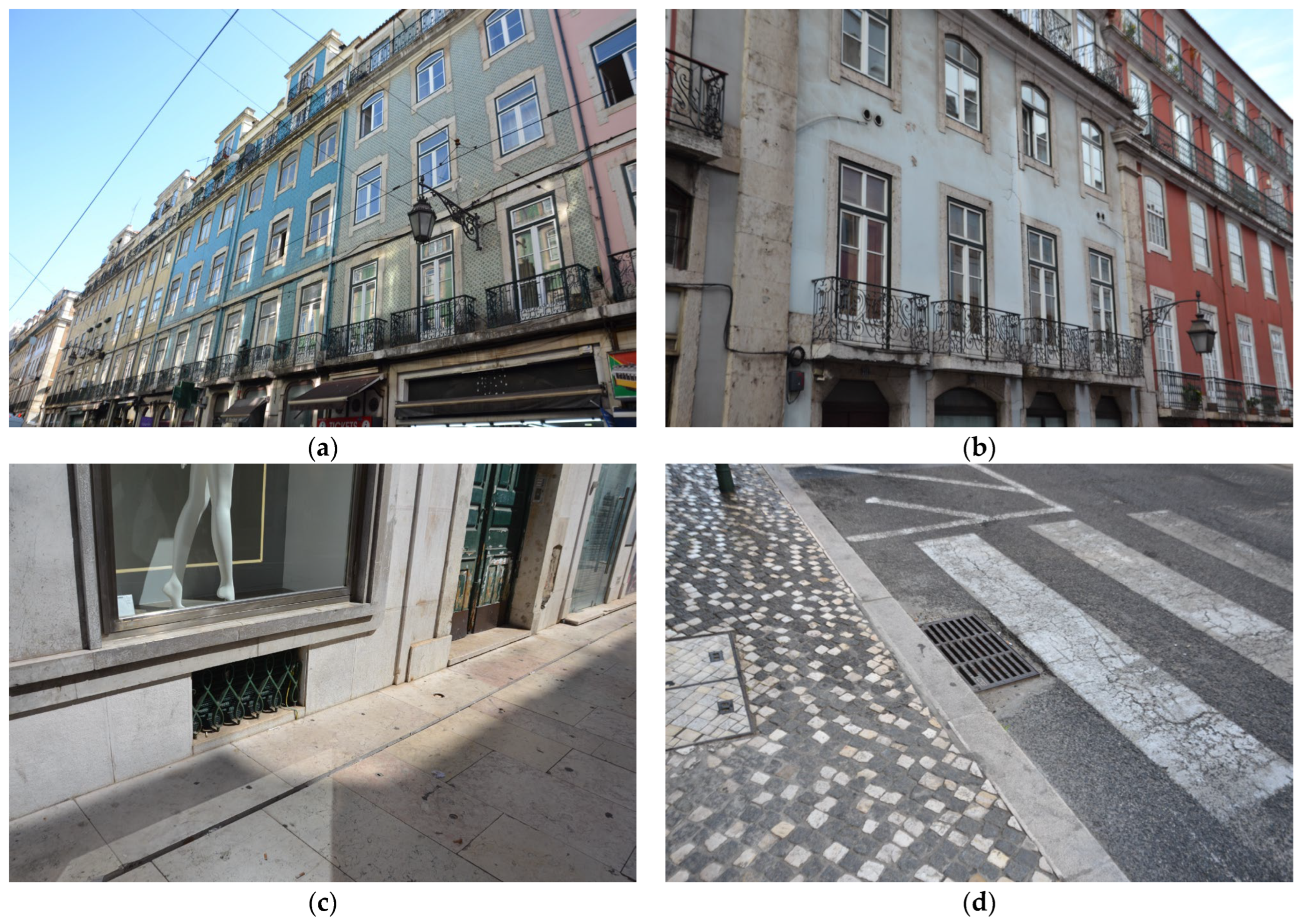
2.1. Exposure
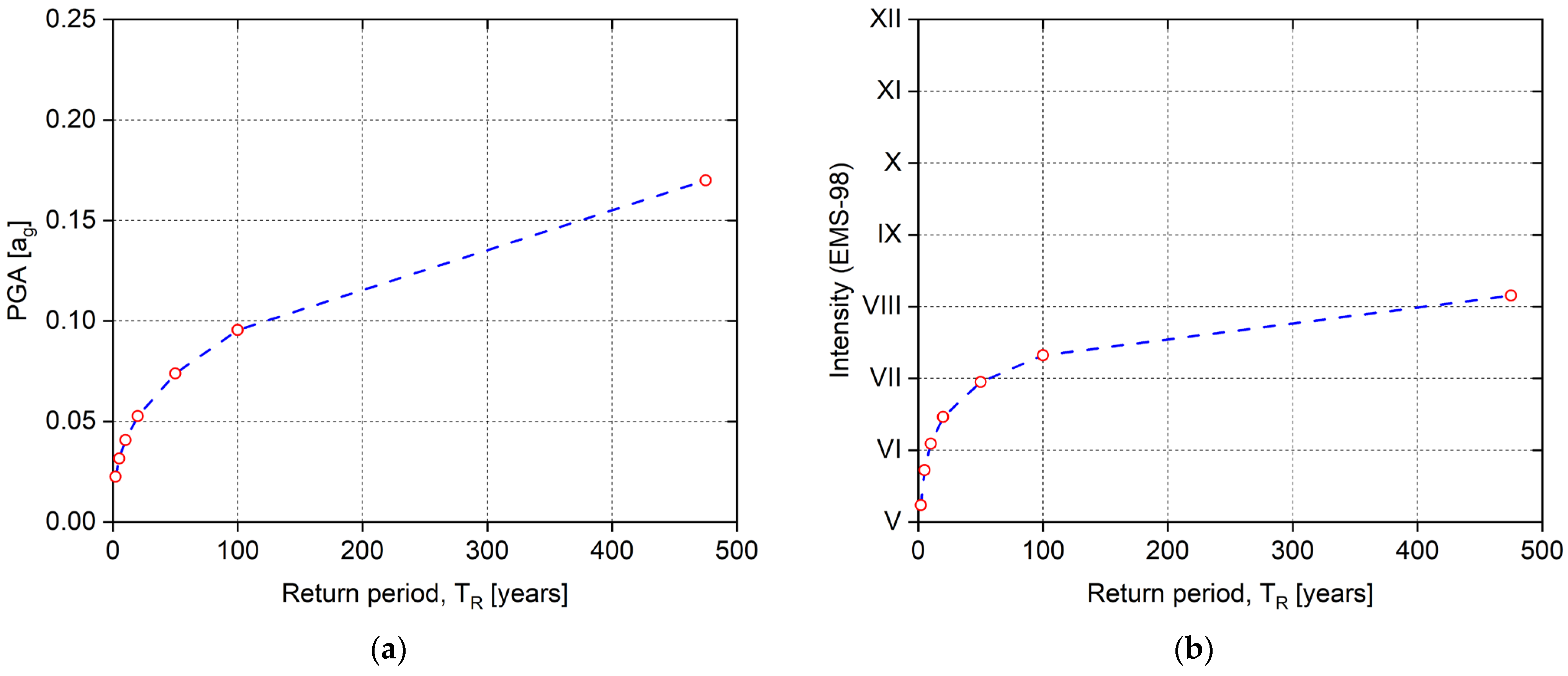
2.2. Hazard Assessment
3. Materials and Methods
3.1. Multi-Hazard Framework
3.1.1. Statistically Concurrent
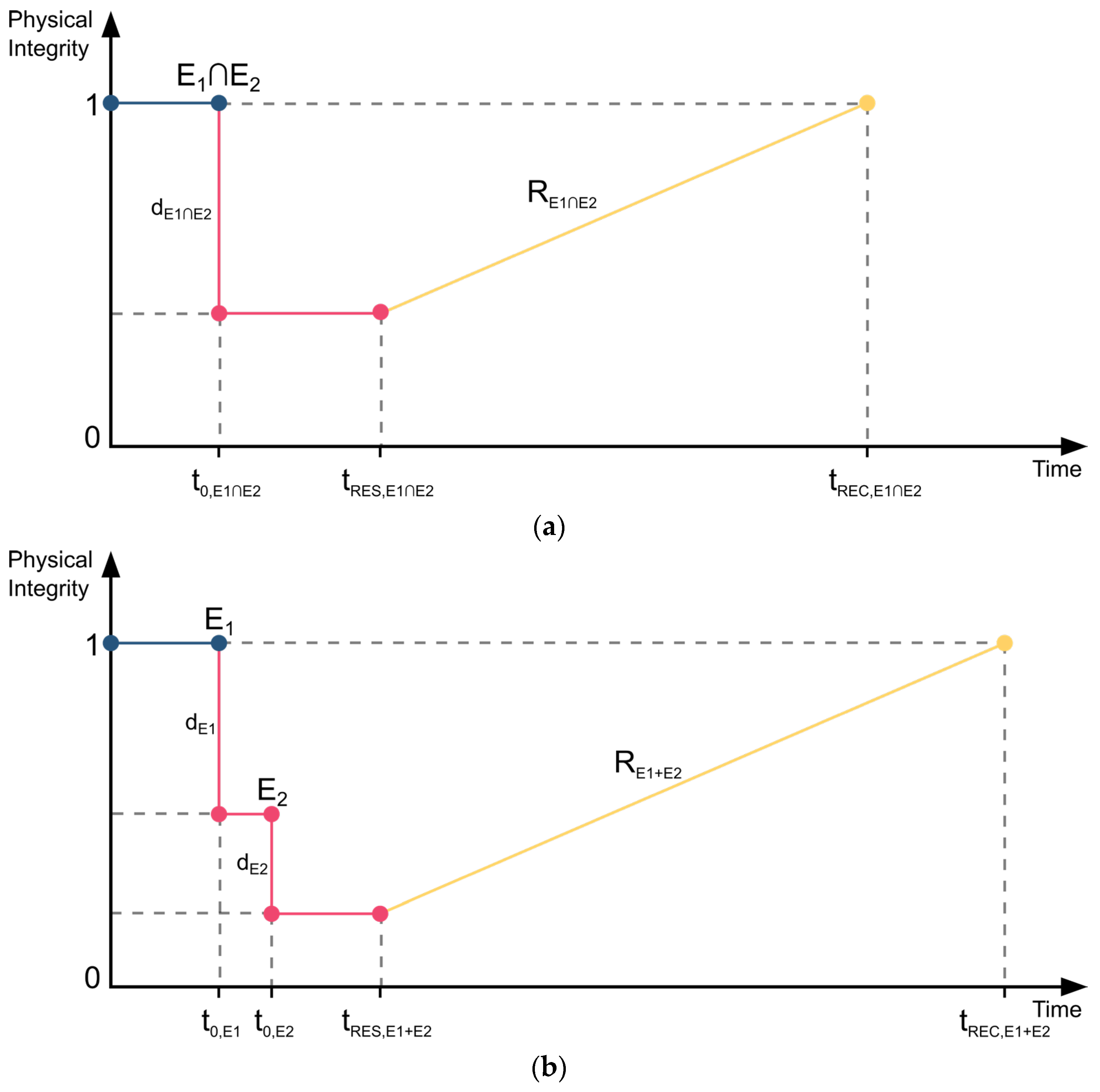
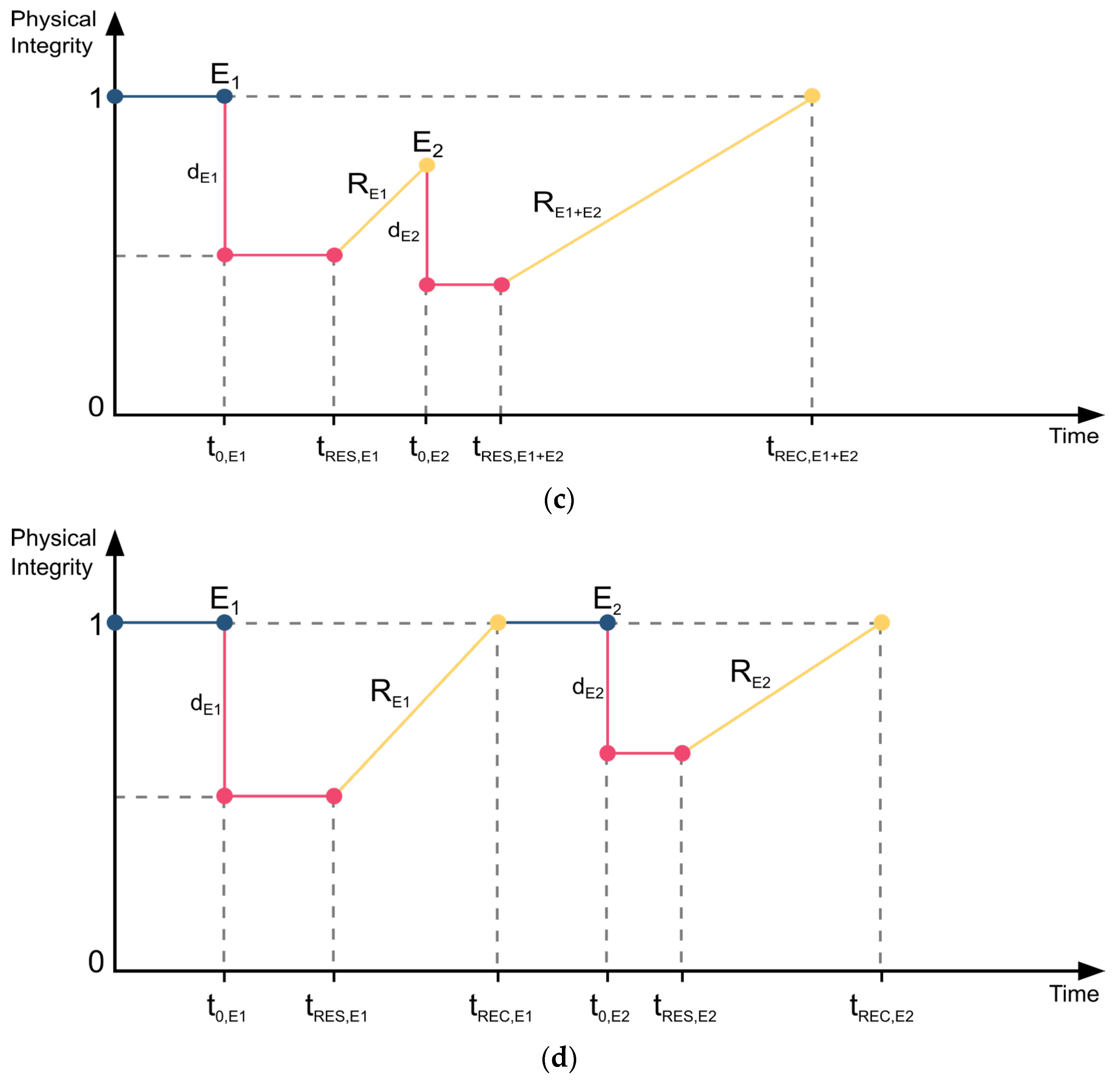
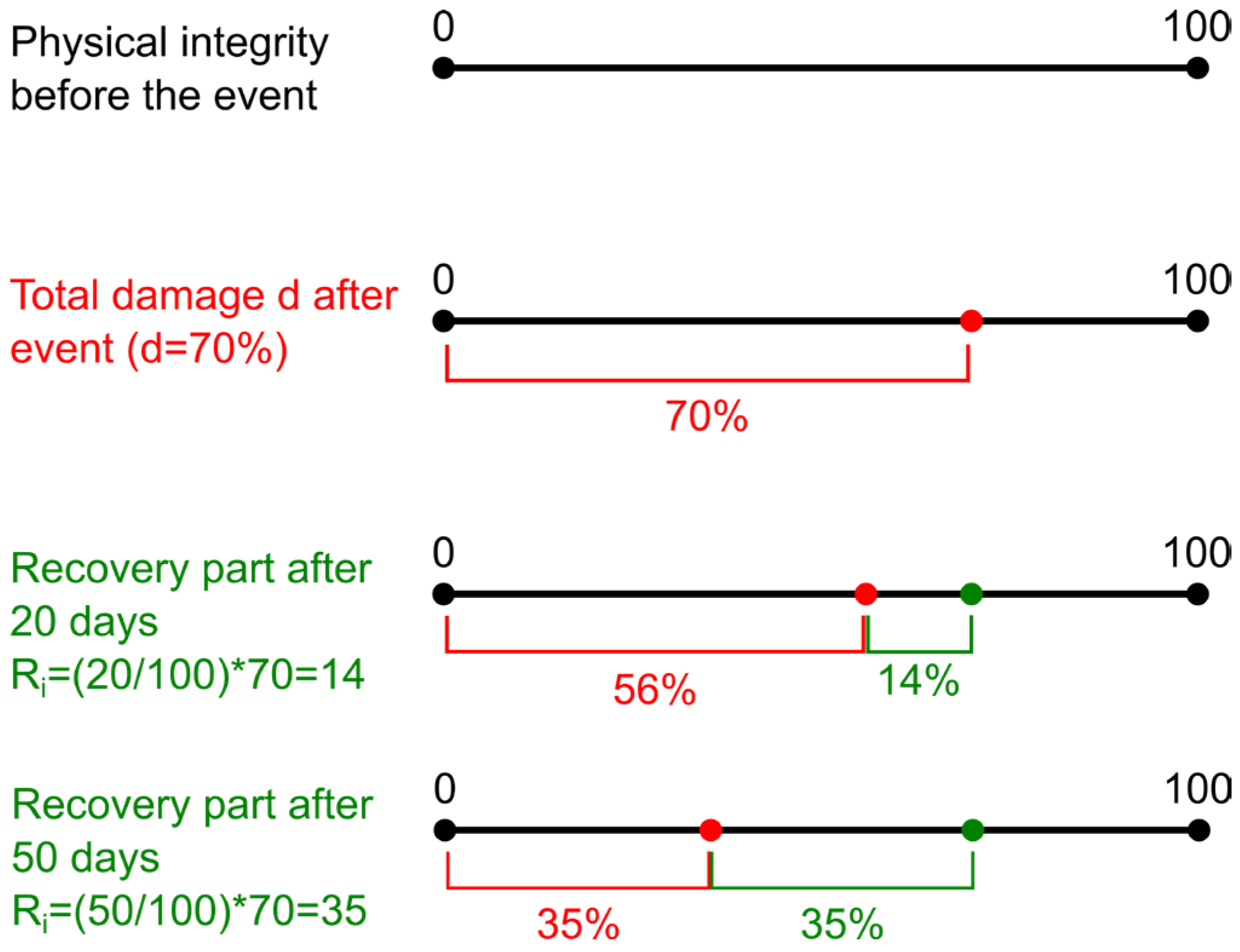
3.1.2. Short-Term and Long-Term Consecutive
3.1.3. Independent
3.2. MCDM Index-Based Method
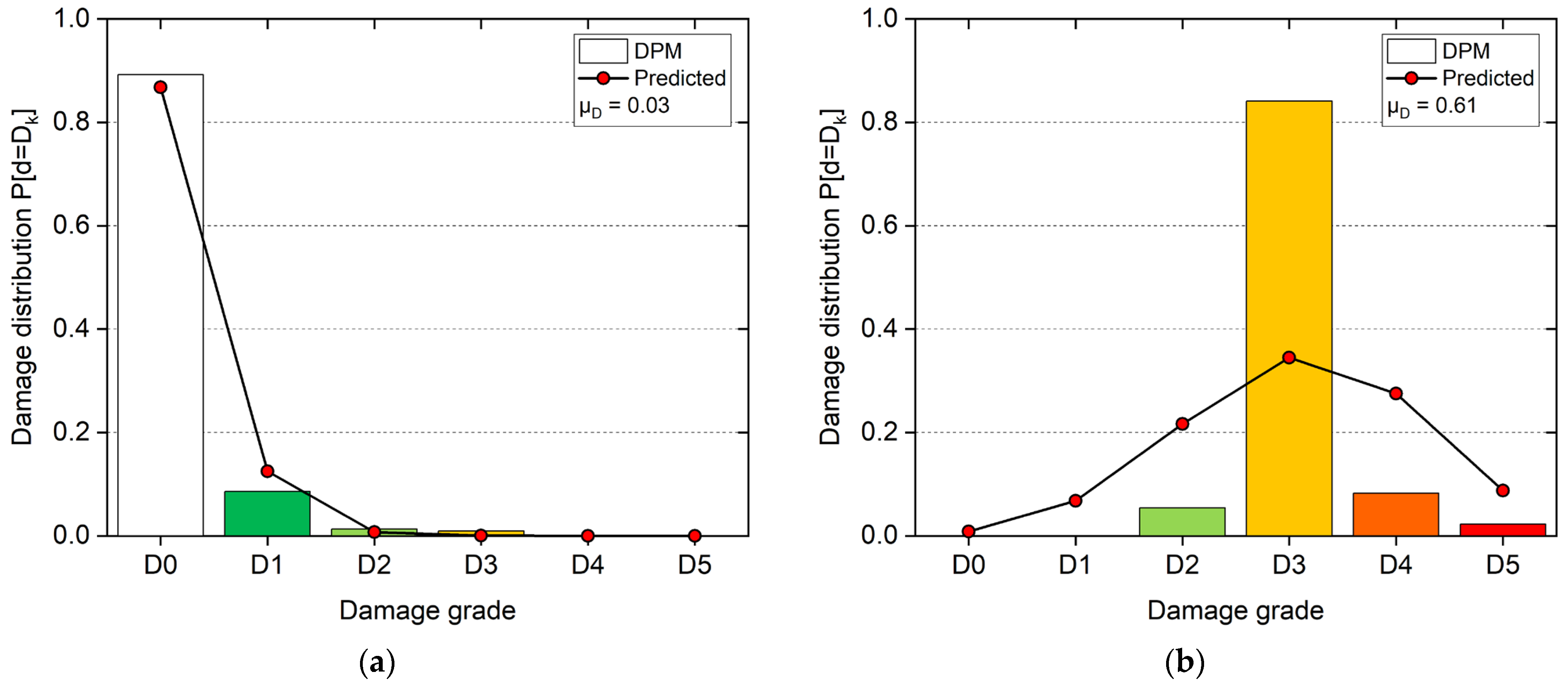
3.3. Seismic Loss Assessment
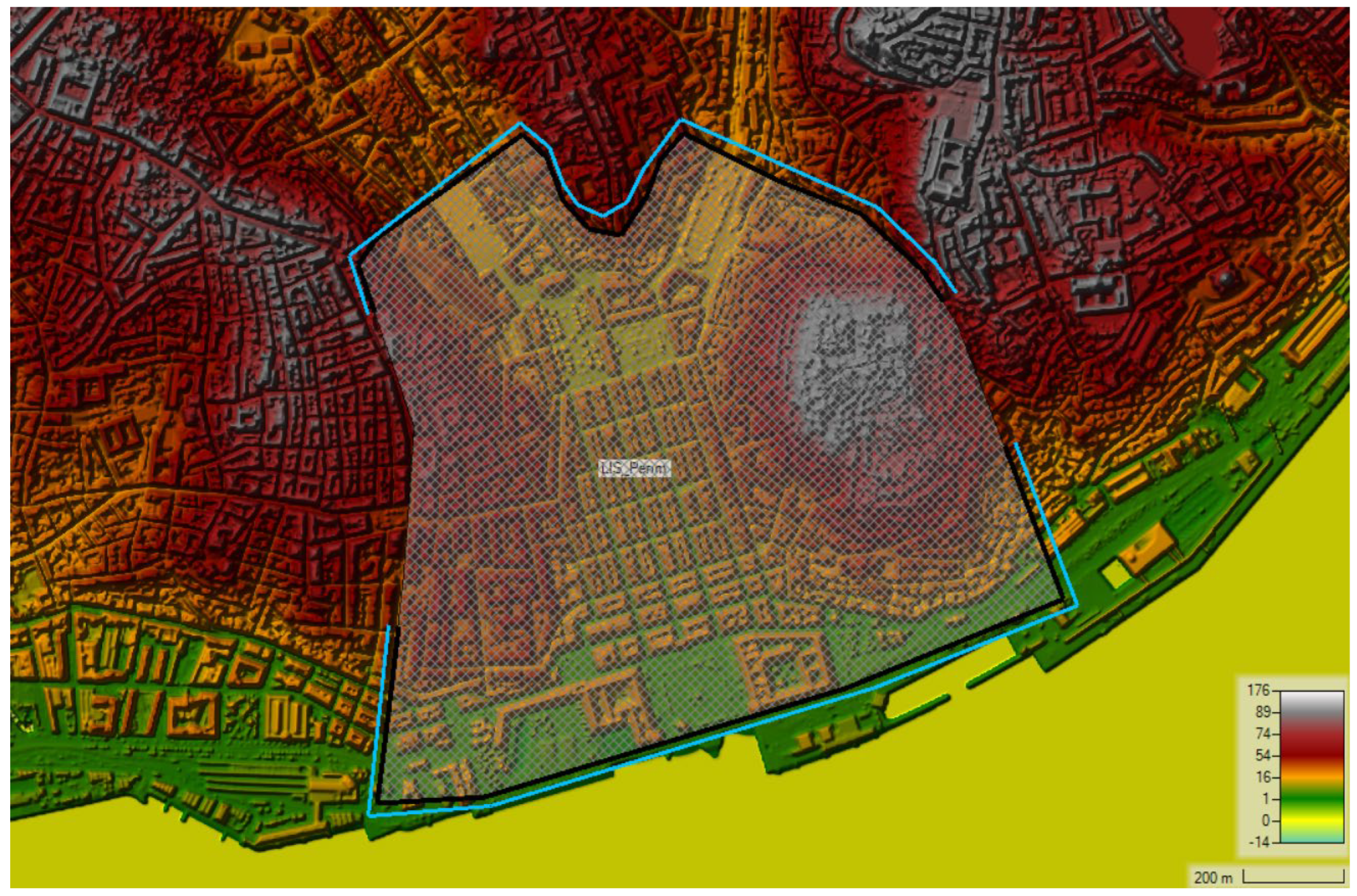
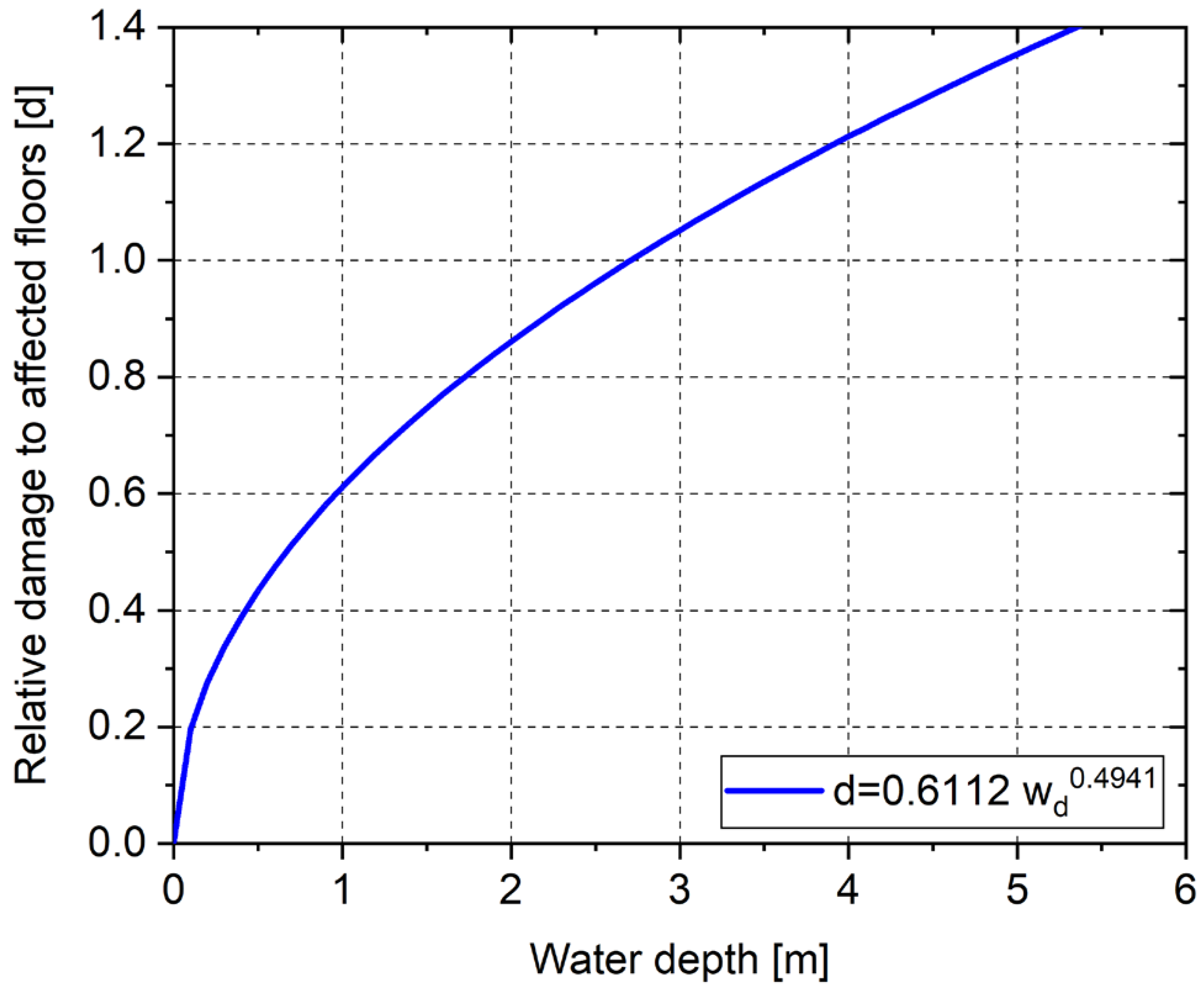
3.4. Flood Loss Assessment
3.5. Probabilities Evaluation
3.6. Statistically Concurrent Losses
4. Results
4.1. Single-Hazard Risk Assessment
4.1.1. Earthquake
4.1.2. Flood
4.2. Probabilities Coefficients
4.3. Multi-Hazard Risk Assessment
4.3.1. Vulnerability
4.3.2. Statistically Concurrent Losses Assessment
4.3.3. Short-Term Consecutive Losses Assessment
5. Discussion
Author Contributions
Funding
Data Availability Statement
Acknowledgments
Conflicts of Interest
References
- Gill, J.C.; Malamud, B.D. Anthropogenic Processes, Natural Hazards, and Interactions in a Multi-Hazard Framework. Earth-Sci. Rev. 2017, 166, 246–269. [Google Scholar] [CrossRef]
- Tilloy, A.; Malamud, B.D.; Winter, H.; Joly-Laugel, A. A Review of Quantification Methodologies for Multi-Hazard Interrelationships. Earth-Sci. Rev. 2019, 196, 102881. [Google Scholar] [CrossRef]
- De Angeli, S.; Malamud, B.D.; Rossi, L.; Taylor, F.E.; Trasforini, E.; Rudari, R. A Multi-Hazard Framework for Spatial-Temporal Impact Analysis. Int. J. Disaster Risk Reduct. 2022, 73, 102829. [Google Scholar] [CrossRef]
- Gallina, V.; Torresan, S.; Critto, A.; Sperotto, A.; Glade, T.; Marcomini, A. A Review of Multi-Risk Methodologies for Natural Hazards: Consequences and Challenges for a Climate Change Impact Assessment. J. Environ. Manag. 2016, 168, 123–132. [Google Scholar] [CrossRef]
- Wang, J.; He, Z.; Weng, W. A Review of the Research into the Relations between Hazards in Multi-Hazard Risk Analysis. Nat. Hazards 2020, 104, 2003–2026. [Google Scholar] [CrossRef]
- Johnson, K.; Depietri, Y.; Breil, M. Multi-Hazard Risk Assessment of Two Hong Kong Districts. Int. J. Disaster Risk Reduct. 2016, 19, 311–323. [Google Scholar] [CrossRef]
- UNISDR. Hyogo Framework for Action 2005–2015: Building the Resilience of Nations and Communities to Disasters. In The United Nations International Strategy for Disaster Reduction, Extract from the Final Report of the World Conference on Disaster Reduction (A/CONF. 206/6); UNISDR: Kobe, Japan, 2005; Volume 380, Available online: https://www.unisdr.org/files/1037_hyogoframeworkforactionenglish.pdf (accessed on 17 July 2025).
- UNISDR. Sendai Framework for Disaster Risk Reduction 2015–2030. In Proceedings of the 3rd United Nations World Conference on DRR, Sendai, Japan, 14–18 March 2015; United Nations Office for Disaster Risk Reduction: Geneva, Switzerland, 2015; Volume 1, Available online: https://www.undrr.org/media/16176/download?startDownload=20250717 (accessed on 17 July 2025).
- Gill, J.C.; Malamud, B.D. Hazard Interactions and Interaction Networks (Cascades) within Multi-Hazard Methodologies. Earth Syst. Dyn. 2016, 7, 659–679. [Google Scholar] [CrossRef]
- Tocchi, G.; Ottonelli, D.; Rebora, N.; Polese, M. Multi-Risk Assessment in the Veneto Region: An Approach to Rank Seismic and Flood Risk. Sustainability 2023, 15, 12458. [Google Scholar] [CrossRef]
- van Westen, C.J.; Greiving, S. Multi-Hazard Risk Assessment and Decision Making. In Environmental Hazards Methodologies for Risk Assessment and Management; Dalezios, N.R., Ed.; IWA Publishing: London, UK, 2017; ISBN 978-1-78040-713-5. [Google Scholar] [CrossRef]
- Arrighi, C.; Tanganelli, M.; Cristofaro, M.T.; Cardinali, V.; Marra, A.; Castelli, F.; De Stefano, M. Multi-Risk Assessment in a Historical City. Nat. Hazards 2023, 119, 1041–1072. [Google Scholar] [CrossRef]
- Mascheri, G.; Chieffo, N.; Arrighi, C.; Del Gaudio, C.; Lourenço, P.B. A Framework for Multi-Risk Assessment in a Historical Area of Lisbon. Int. J. Disaster Risk Reduct. 2024, 108, 104508. [Google Scholar] [CrossRef]
- Argyroudis, S.A.; Mitoulis, S.A. Vulnerability of Bridges to Individual and Multiple Hazards- Floods and Earthquakes. Reliab. Eng. Syst. Saf. 2021, 210, 107564. [Google Scholar] [CrossRef]
- Cavalieri, F.; Franchin, P.; Giovinazzi, S. Earthquake-Altered Flooding Hazard Induced by Damage to Storm Water Systems. Sustain. Resilient Infrastruct. 2016, 1, 14–31. [Google Scholar] [CrossRef]
- Liu, B.; Siu, Y.L.; Mitchell, G. Hazard Interaction Analysis for Multi-Hazard Risk Assessment: A Systematic Classification Based on Hazard-Forming Environment. Nat. Hazards Earth Syst. Sci. 2016, 16, 629–642. [Google Scholar] [CrossRef]
- Ming, X.; Liang, Q.; Dawson, R.; Xia, X.; Hou, J. A Quantitative Multi-Hazard Risk Assessment Framework for Compound Flooding Considering Hazard Inter-Dependencies and Interactions. J. Hydrol. 2022, 607, 127477. [Google Scholar] [CrossRef]
- QGIS.org. QGIS Geographic Information System, Version 3.36.3-Maidenhead; QGIS Association: Grüt, Switzerland, 2024. Available online: http://www.qgis.org (accessed on 20 November 2025).
- OPENGIS.ch. QField, Version 3.3.11-Darién; OPENGIS.ch: Laax, Switzerland, 2024. Available online: https://qfield.org/ (accessed on 30 August 2024).
- Mascheri, G.; Chieffo, N.; Lourenço, P.B. Multi-Attribute-Based Procedure for Seismic Loss Scenario in a Historical Area. Bull. Earthq. Eng. 2024, 22, 7323–7358. [Google Scholar] [CrossRef]
- Milutinovic, Z.V.; Trendafiloski, G.S. Risk-UE An Advanced Approach to Earthquake Risk Scenarios with Applications to Different European Towns. Contract EVK4-CT-2000-00014 WP4 Vulnerability of Current Buildings; European Commission: Brussels, Belgium, 2003; 110p, Available online: http://www.civil.ist.utl.pt/~mlopes/conteudos/DamageStates/Risk%20UE%20WP04_Vulnerability.pdf (accessed on 28 July 2025).
- Barchetta, L.; Petrucci, E.; Xavier, V.; Bento, R. A Simplified Framework for Historic Cities to Define Strategies Aimed at Implementing Resilience Skills: The Case of Lisbon Downtown. Buildings 2023, 13, 130. [Google Scholar] [CrossRef]
- Bernardo, V.; Sousa, R.; Candeias, P.; Costa, A.; Campos Costa, A. Historic Appraisal Review and Geometric Characterization of Old Masonry Buildings in Lisbon for Seismic Risk Assessment. Int. J. Archit. Herit. 2022, 16, 1921–1941. [Google Scholar] [CrossRef]
- Van Westen, C.J. Remote Sensing and GIS for Natural Hazards Assessment and Disaster Risk Management. Treatise Geomorphol. 2013, 3, 259–298. [Google Scholar] [CrossRef]
- INE. Volume de Vendas Médio por m2 de Área de Exposição e Venda (€) nas Unidades Comerciais de Dimensão Relevante por Localização Geográfica (NUTS—2013) e Setor de Atividade Económica; Annual—INE, Inquérito aos Estabelecimentos Comerciais—Unidades Comerciais de Dimensão Relevante. Período de Referência dos Dados: 2023; Instituto Nacional de Estatística: Lisbon, Portugal, 2023; Available online: https://www.ine.pt/xportal/xmain?xpid=INE&xpgid=ine_indicadores&indOcorrCod=0006950&contexto=bd&selTab=tab2 (accessed on 17 April 2025).
- INE. Valor Mediano Das Vendas Por M2 de Alojamentos Familiares Nos Últimos 12 Meses (€) Por Localização Geográfica (NUTS—2013) e Categoria Do Alojamento Familiar; Trimestral—INE, Estatisticas de Preços Da Habitação Ao Nível Local. Período de Referência Dos Dados 4o Trimestre de 2023; Instituto Nacional de Estatística: Lisbon, Portugal, 2023; Available online: https://www.ine.pt/xportal/xmain?xpid=INE&xpgid=ine_indicadores&indOcorrCod=0011364&contexto=bd&selTab=tab2 (accessed on 17 April 2025).
- Leal, M.; Ramos, C.; Pereira, S. Different Types of Flooding Lead to Different Human and Material Damages: The Case of the Lisbon Metropolitan Area. Nat. Hazards 2018, 91, 735–758. [Google Scholar] [CrossRef]
- Lantada, N.; Pujades, L.G.; Barbat, A.H. Earthquake Risk Scenarios in Urban Areas: A Review with Applications to the Ciutat Vella District in Barcelona, Spain. Int. J. Archit. Herit. 2018, 12, 1112–1130. [Google Scholar] [CrossRef]
- NP EN 1998-1:2010; Eurocódigo 8—Projecto de Estruturas para Resistência aos Sismos. Parte 1: Regras Gerais, Acções Sísmicas e Regras para Edifícios. Instituto Português da Qualidade: Caparica, Portugal, 2010.
- Danciu, L.; Nandan, S.; Reyes, C.; Basili, R.; Weatherill, G.; Beauval, C.; Rovida, A.; Vilanova, S.; Şeşetyan, K.; Bard, P.-Y.; et al. The 2020 Update of the European Seismic Hazard Model: Model Overview; EFEHR Technical Report 001; EFEHR: Zurich, Switzerland, 2021. [Google Scholar] [CrossRef]
- APA. Agência Portuguesa do Ambiente. Available online: https://apambiente.pt/ (accessed on 18 April 2025).
- Mascheri, G.; Chieffo, N.; Pugliese, F.; Pinto, C.; Lourenço, P.B. A GIS–MCDM–Based Framework for Flood Risk Scenario in Central Lisbon. Int. J. Archit. Herit. 2026, 1–21. [Google Scholar] [CrossRef]
- Hydrologic Engineering Center. HEC-RAS 2D Modeling User’s Manual; US Army Corps of Engineers: Davis, CA, USA, 2021. [Google Scholar]
- DGT Direção Geral do Território. MDS-2m. Available online: https://cdd.dgterritorio.gov.pt/dgt-fe/mapa?collection=MDS-2m (accessed on 27 October 2025).
- ESRI. Esri|Sentinel-2 10m Land Use/Land Cover Data by Esri and Impact Observatory. Esri Land Cover. Available online: https://livingatlas.arcgis.com/landcover/ (accessed on 4 November 2025).
- Brandão, C.; Rodrigues, R.; Costa, J.P. Análise de Fenómenos Extremos Precipitações Intensas em Portugal Continental; Direcção dos Serviços de Recursos Hídricos, Instituto da Água: Lisbon, Portugal, 2001; Available online: http://www.civil.ist.utl.pt/~mps/HRH/2015_2016%20desactivado/relatorio_prec_intensa.pdf (accessed on 27 October 2025).
- McCuen, R.H. Hydrologic Analysis and Design, 2nd ed.; Prentice Hall: Englewood Cliffs, NJ, USA, 1998. [Google Scholar]
- USDA. SCS Hydrology. In National Engineering Handbook; USDA: Washington, DC, USA, 1993. [Google Scholar]
- Borre, A. Modelling the Dynamic Impacts of Consecutive Natural Hazards: A Framework for Time-Evolving Vulnerability and Recovery Analysis. Doctoral Dissertation, Università degli Studi di Genova, Genoa, Italy, 2025. Available online: https://hdl.handle.net/20.500.14242/295854 (accessed on 10 February 2026).
- Tang, C.; Zhu, J.; Ding, J.; Cui, X.F.; Chen, L.; Zhang, J.S. Catastrophic Debris Flows Triggered by a 14 August 2010 Rainfall at the Epicenter of the Wenchuan Earthquake. Landslides 2011, 8, 485–497. [Google Scholar] [CrossRef]
- Gautam, D.; Dong, Y. Multi-Hazard Vulnerability of Structures and Lifelines Due to the 2015 Gorkha Earth-quake and 2017 Central Nepal Flash Flood. J. Build. Eng. 2018, 17, 196–201. [Google Scholar] [CrossRef]
- Cimellaro, G.P.; Reinhorn, A.M.; Bruneau, M. Framework for Analytical Quantification of Disaster Resilience. Eng. Struct. 2010, 32, 3639–3649. [Google Scholar] [CrossRef]
- Kappes, M.S.; Keiler, M.; von Elverfeldt, K.; Glade, T. Challenges of Analyzing Multi-Hazard Risk: A Review. Nat. Hazards 2012, 64, 1925–1958. [Google Scholar] [CrossRef]
- Luo, H.Y.; Zhang, L.M.; Zhang, L.L.; He, J.; Yin, K.S. Vulnerability of Buildings to Landslides: The State of the Art and Future Needs. Earth-Sci. Rev. 2023, 238, 104329. [Google Scholar] [CrossRef]
- Davis, L.; Larionova, T.; Patel, D.; Tse, D.; Baquedano Juliá, P.; Pinto Santos, P.; Ferreira, T.M. Flood Vulnerability and Risk Assessment of Historic Urban Areas: Vulnerability Evaluation, Derivation of Depth-Damage Curves and Cost–Benefit Analysis of Flood Adaptation Measures Applied to the Historic City Centre of Tomar, Portugal. J. Flood Risk Manag. 2023, 16, e12908. [Google Scholar] [CrossRef]
- Gandini, A.; Garmendia, L.; Prieto, I.; Álvarez, I.; San-José, J.-T. A Holistic and Multi-Stakeholder Methodology for Vulnerability Assessment of Cities to Flooding and Extreme Precipitation Events. Sustain. Cities Soc. 2020, 63, 102437. [Google Scholar] [CrossRef]
- Leal, M.; Reis, E.; Pereira, S.; Santos, P.P. Physical Vulnerability Assessment to Flash Floods Using an Indica-tor-Based Methodology Based on Building Properties and Flow Parameters. J. Flood Risk Manag. 2021, 14, e12712. [Google Scholar] [CrossRef]
- Salazar, L.G.F.; Figueiredo, R.; Romão, X. Flood Vulnerability Assessment of Built Cultural Heritage: Literature Review and Identification of Indicators. Int. J. Disaster Risk Reduct. 2024, 111, 104666. [Google Scholar] [CrossRef]
- Stefanini, S. Il Patrimonio Architettonico Delle Culture Del Maghreb a Rischio Di Scomparsa per Perdita Di Conoscenza Ed Aggressione Ambientale. Valutazione Delle Vulnerabilità e Del Rischio Sismico Della Medina Di Fes in Marocco. Doctoral Dissertation, University of Florence, Florence, Italy, 2020. Available online: https://hdl.handle.net/2158/1190289 (accessed on 22 April 2024).
- Vicente, R. Estratégias e metodologias para intervenções de reabilitação urbana: Avaliação da vulnerabilidade e do risco sísmico do edificado da baixa de Coimbra. Doctoral Dissertation, Universidade de Aveiro, Aveiro, Portugal, 2008. [Google Scholar]
- Formisano, A.; Florio, G.; Landolfo, R.; Mazzolani, F.M. Numerical Calibration of an Easy Method for Seismic Behaviour Assessment on Large Scale of Masonry Building Aggregates. Adv. Eng. Softw. 2015, 80, 116–138. [Google Scholar] [CrossRef]
- de Brito, M.M.; Evers, M.; Almoradie, A.D.S. Participatory Flood Vulnerability Assessment: A Multi-Criteria Approach. Hydrol. Earth Syst. Sci. 2018, 22, 373–390. [Google Scholar] [CrossRef]
- Fontenele, A.; Campos, V.; Matos, A.M.; Mesquita, E. A Vulnerability Index Formulation for Historic Facades Assessment. J. Build. Eng. 2023, 64, 105552. [Google Scholar] [CrossRef]
- Chakraborty, S. TOPSIS and Modified TOPSIS: A Comparative Analysis. Decis. Anal. J. 2022, 2, 100021. [Google Scholar] [CrossRef]
- Pathan, A.I.; Girish Agnihotri, P.; Said, S.; Patel, D. AHP and TOPSIS Based Flood Risk Assessment—A Case Study of the Navsari City, Gujarat, India. Environ. Monit. Assess. 2022, 194, 509. [Google Scholar] [CrossRef]
- Caterino, N. Analisi Decisionale Multicriterio per L’adeguamento Sismico di Edifici in C.A. Doctoral Dissertation, University of Naples Federico II, Naples, Italy, 2007. [Google Scholar] [CrossRef]
- Lagomarsino, S.; Giovinazzi, S. Macroseismic and Mechanical Models for the Vulnerability and Damage Assessment of Current Buildings. Bull. Earthq. Eng. 2006, 4, 415–443. [Google Scholar] [CrossRef]
- Chieffo, N.; Formisano, A.; Lourenço, P.B. Seismic Vulnerability Procedures for Historical Masonry Structural Aggregates: Analysis of the Historical Centre of Castelpoto (South Italy). Structures 2023, 48, 852–866. [Google Scholar] [CrossRef]
- Vicente, R.; Parodi, S.; Lagomarsino, S.; Varum, H.; Mendes Silva, J.A.R. Seismic Vulnerability and Risk Assessment: Case Study of the Historic City Centre of Coimbra, Portugal. Bull. Earthq. Eng. 2011, 9, 1067–1096. [Google Scholar] [CrossRef]
- GNDT. Rischio Sismico Di Edifici Pubblici–Parte I: Aspetti Metodologici; Centro Servizi Quasco: Bologna, Italy, 1993. [Google Scholar]
- Grünthal, G. European Macroseismic Scale 1998; Cahiers du Centre Européen de Géodynamique et de Séismologie; Conseil De l’Europe: Luxembourg, 1998; Volume 15, p. 101. Available online: https://media.gfz.de/gfz/sec26/resources/documents/PDF/EMS-98_Original_englisch.pdf (accessed on 3 February 2026).
- Chieffo, N.; Formisano, A.; Landolfo, R.; Milani, G. A Vulnerability Index Based-Approach for the Historical Centre of the City of Latronico (Potenza, Southern Italy). Eng. Fail. Anal. 2022, 136, 106207. [Google Scholar] [CrossRef]
- Bernardini, A.; Giovinazzi, S.; Lagomarsino, S.; Parodi, S. Vulnerabilità e Previsione Di Danno a Scala Territoriale Secondo Una Metodologia Macrosismica Coerente Con La Scala EMS-98. In Proceedings of the 12th Italian Conference on Earthquake Engineering-ANIDIS, Pisa, Italy, 10–14 June 2007; University of Canterbury, Civil and Natural Resources Engineering: Christchurch, New Zealand, 2007; Available online: http://hdl.handle.net/10092/4060 (accessed on 15 May 2024).
- Kassem, M.M.; Nazri, F.M.; Farsangi, E.N. The Seismic Vulnerability Assessment Method-ologies: A State-of-the-Art Review. Ain Shams Eng. J. 2020, 11, 849–864. [Google Scholar] [CrossRef]
- Nassirpour, A. Performance Based Seismic Assessment of Masonry Infilled Steel Frame Structures. Doctoral Dissertation, UCL University College London, London, UK, 2018. Available online: https://scholar.google.com/scholar?q=Performance%20Based%20Seismic%20Assessment%20of%20Masonry%20Infilled%20Steel%20Frame%20Structures.%20Doctoral%20Dissertation (accessed on 16 December 2025).
- Roca, A.; Goula, X.; Susagna, T.; Chávez, J.; González, M.; Reinoso, E. A Simplified Method for Vulnerability Assessment of Dwelling Buildings and Estimation of Damage Scenarios in Catalonia, Spain. Bull. Earthq. Eng. 2006, 4, 141–158. [Google Scholar] [CrossRef]
- Garrote, J.; Díez-Herrero, A.; Escudero, C.; García, I. A Framework Proposal for Regional-Scale Flood-Risk Assessment of Cultural Heritage Sites and Application to the Castile and León Region (Central Spain). Water 2020, 12, 329. [Google Scholar] [CrossRef]
- Yang, M.; Mohammad Yusoff, W.F.; Mohamed, M.F.; Jiao, S.; Dai, Y. Flood Economic Vulnerability and Risk Assessment at the Urban Mesoscale Based on Land Use: A Case Study in Changsha, China. J. Environ. Manag. 2024, 351, 119798. [Google Scholar] [CrossRef] [PubMed]
- Zanchetta, G.; Sulpizio, R.; Pareschi, M.T.; Leoni, F.M.; Santacroce, R. Characteristics of May 5–6, 1998 Volcaniclastic Debris Flows in the Sarno Area (Campania, Southern Italy): Relationships to Structural Damage and Hazard Zonation. J. Volcanol. Geotherm. Res. 2004, 133, 377–393. [Google Scholar] [CrossRef]
- Arrighi, C.; Mazzanti, B.; Pistone, F.; Castelli, F. Empirical Flash Flood Vulnerability Functions for Residential Buildings. SN Appl. Sci. 2020, 2, 904. [Google Scholar] [CrossRef]
- Carisi, F.; Schröter, K.; Domeneghetti, A.; Kreibich, H.; Castellarin, A. Development and Assessment of Uni- and Multivariable Flood Loss Models for Emilia-Romagna (Italy). Nat. Hazards Earth Syst. Sci. 2018, 18, 2057–2079. [Google Scholar] [CrossRef]
- Maity, R. Basic Concepts of Probability and Statistics. In Statistical Methods in Hydrology and Hydroclimatology; Maity, R., Ed.; Springer: Singapore, 2018; pp. 7–51. ISBN 978-981-10-8779-0. [Google Scholar] [CrossRef]
- Ferrini, M.; Melozzi, A.; Pagliazzi, A.; Scarparolo, S. Rilevamento della Vulnerabilità Sismica degli Edifici in Muratura. Manuale per la Compilazione Della Scheda GNDT/CNR di II livello. Versione Modificata Dalla Regione Toscana; Direzione Generale delle Politiche Territoriale e Ambientali. Settore–Servizio Sismico Regionale: Florence, Italy, 2003; Available online: https://www.abacomurature.it/pdf/01%20Manuale%20compilazione%20schede%20II%20liv_GNDT.pdf (accessed on 30 August 2024).
- Brando, G.; De Matteis, G.; Spacone, E. Predictive Model for the Seismic Vulnerability Assessment of Small Historic Centres: Application to the Inner Abruzzi Region in Italy. Eng. Struct. 2017, 153, 81–96. [Google Scholar] [CrossRef]
- Agliata, R.; Bortone, A.; Mollo, L. Indicator-Based Approach for the Assessment of Intrinsic Physical Vulnerability of the Built Environment to Hydro-Meteorological Hazards: Review of Indicators and Example of Parameters Selection for a Sample Area. Int. J. Disaster Risk Reduct. 2021, 58, 102199. [Google Scholar] [CrossRef]
- Carlier, B.; Puissant, A.; Dujarric, C.; Arnaud-Fassetta, G. Upgrading of an Index-Oriented Methodology for Consequence Analysis of Natural Hazards: Application to the Upper Guil Catchment (Southern French Alps). Nat. Hazards Earth Syst. Sci. 2018, 18, 2221–2239. [Google Scholar] [CrossRef]
- IPMA. Shakemaps Instituto Português do Mar e da Atmosfera, I.P. Available online: https://shakemap.ipma.pt/archive/ (accessed on 30 May 2025).
- IPMA. Lista de Estações Climatológicas de Superfície—Series Longas Instituto Português do Mar e da Atmosfera, I.P. Available online: https://www.ipma.pt/en/oclima/series.longas/list.jsp (accessed on 23 May 2025).
- Velásquez, C.A.; Cardona, O.D.; Mora, M.G.; Yamin, L.E.; Carreño, M.L.; Barbat, A.H. Hybrid Loss Exceedance Curve (HLEC) for Disaster Risk Assessment. Nat. Hazards 2014, 72, 455–479. [Google Scholar] [CrossRef]



| Return Period TR [Years] | PGA [28] | Mean PGA [30] | Variation [%] |
|---|---|---|---|
| 50 | 0.074 g | 0.035 g | −53 |
| 100 | 0.096 g | 0.057 g | −40 |
| 475 | 0.170 g | 0.134 g | −21 |
| Nr. | Parameter | Weight |
|---|---|---|
| PEQ1 | Nature of vertical structures [50] | 0.080 |
| PEQ2 | Conventional strength [49,50,73] | 0.099 |
| PEQ3 | Topographic condition [49,50,73] | 0.034 |
| PEQ4 | Number of floors [50] | 0.045 |
| PEQ5 | Horizontal diaphragms [49,50] | 0.083 |
| PEQ6 | In-plane regularity [73] | 0.062 |
| PEQ7 | Vertical regularity [73] | 0.055 |
| PEQ8 | Wall façade openings and alignments [50] | 0.082 |
| PEQ9 | Presence of adjacent buildings with different height [49,51] | 0.055 |
| PEQ10 | Position of the building in the aggregate [49,51] | 0.077 |
| PEQ11 | Structural or typological heterogeneity among adjacent structural units [49,51] | 0.052 |
| PEQ12 | Percentage difference of opening areas among adjacent façades [51] | 0.049 |
| PEQ13 | Conservation status [50] | 0.178 |
| PEQ14 | Aggregate distance [74] | 0.049 |
| Class | PEQ1 | PEQ2 | PEQ3 | PEQ4 | PEQ5 | PEQ6 | PEQ7 | PEQ8 | PEQ9 | PEQ10 | PEQ11 | PEQ12 | PEQ13 | PEQ14 |
|---|---|---|---|---|---|---|---|---|---|---|---|---|---|---|
| A | 0.070 | 0.074 | 0.066 | 0.073 | 0.054 | 0.073 | 0.069 | 0.065 | 0.081 | 0.090 | 0.089 | 0.108 | 0.060 | 0.089 |
| B | 0.144 | 0.143 | 0.129 | 0.136 | 0.113 | 0.127 | 0.135 | 0.114 | 0.136 | 0.132 | 0.128 | 0.152 | 0.110 | 0.110 |
| C | 0.261 | 0.262 | 0.246 | 0.282 | 0.294 | 0.265 | 0.274 | 0.269 | 0.237 | 0.277 | 0.219 | 0.222 | 0.275 | 0.244 |
| D | 0.525 | 0.521 | 0.559 | 0.509 | 0.539 | 0.535 | 0.521 | 0.552 | 0.546 | 0.502 | 0.563 | 0.518 | 0.555 | 0.557 |
| TR [Years] | Total Losses [M€] |
|---|---|
| 2 | 30 |
| 5 | 56 |
| 10 | 89 |
| 20 | 136 |
| 50 | 232 |
| 100 | 334 |
| 475 | 669 |
| Nr. | Parameter | Weight |
|---|---|---|
| PFL1 | Structural typology [45] | 0.073 |
| PFL2 | Number of floors [47,75] | 0.054 |
| PFL3 | Façade exposure and openings on the ground floor [45,46] | 0.095 |
| PFL4 | Presence of a basement [45] | 0.121 |
| PFL5 | Façade material [45,46] | 0.044 |
| PFL6 | Height thresholds for openings subjected to flooding [45,48] | 0.073 |
| PFL7 | Conservation status [46,48] | 0.054 |
| PFL8 | Surface condition of the nearby area [45] | 0.104 |
| PFL9 | Drainage system condition [46] | 0.146 |
| PFL10 | Ground floor activity [46,76] | 0.115 |
| PFL11 | Population percentage lower than 14 years old and higher than 65 years old [76] | 0.063 |
| PFL12 | Cultural value [48] | 0.058 |
| Class | PFL1 | PFL2 | PFL3 | PFL4 | PFL5 | PFL6 | PFL7 | PFL8 | PFL9 | PFL10 | PFL11 | PFL12 |
|---|---|---|---|---|---|---|---|---|---|---|---|---|
| A | 0.056 | 0.066 | 0.058 | 0.055 | 0.059 | 0.055 | 0.057 | 0.058 | 0.053 | 0.051 | 0.106 | 0.056 |
| B | 0.120 | 0.121 | 0.131 | 0.119 | 0.118 | 0.115 | 0.117 | 0.122 | 0.100 | 0.127 | 0.138 | 0.145 |
| C | 0.251 | 0.262 | 0.262 | 0.283 | 0.289 | 0.279 | 0.267 | 0.271 | 0.249 | 0.335 | 0.258 | 0.282 |
| D | 0.573 | 0.551 | 0.549 | 0.543 | 0.534 | 0.551 | 0.559 | 0.549 | 0.597 | 0.487 | 0.498 | 0.517 |
| TR [Years] | Total Losses [M€] |
|---|---|
| 2 | 122 |
| 5 | 129 |
| 10 | 133 |
| 20 | 138 |
| 50 | 142 |
| 100 | 145 |
| 500 | 154 |
| P(EQ) | P(FL) | P(EQ ∩ FL) | α | β | αN | βN |
|---|---|---|---|---|---|---|
| 7.1% | 39.4% | 2.8% | 2.54 | 14.08 | 0.15 | 0.85 |
| TR [Years] | Total Residual Losses [M€] |
|---|---|
| 2 | 54 |
| 5 | 59 |
| 10 | 63 |
| 20 | 69 |
| 50 | 78 |
| 100 | 87 |
| 475/500 | 116 |
| TR [Years] | Total Losses [M€] |
|---|---|
| 2 | 150 |
| 5 | 182 |
| 10 | 216 |
| 20 | 265 |
| 50 | 357 |
| 100 | 455 |
| 475/500 | 773 |
Disclaimer/Publisher’s Note: The statements, opinions and data contained in all publications are solely those of the individual author(s) and contributor(s) and not of MDPI and/or the editor(s). MDPI and/or the editor(s) disclaim responsibility for any injury to people or property resulting from any ideas, methods, instructions or products referred to in the content. |
© 2026 by the authors. Licensee MDPI, Basel, Switzerland. This article is an open access article distributed under the terms and conditions of the Creative Commons Attribution (CC BY) license.
Share and Cite
Mascheri, G.; Chieffo, N.; Pinto, C.; Lourenço, P.B. Assessing Urban Vulnerability Through a Multi-Hazard Framework with Independent Events Modelling. Appl. Sci. 2026, 16, 5154. https://doi.org/10.3390/app16105154
Mascheri G, Chieffo N, Pinto C, Lourenço PB. Assessing Urban Vulnerability Through a Multi-Hazard Framework with Independent Events Modelling. Applied Sciences. 2026; 16(10):5154. https://doi.org/10.3390/app16105154
Chicago/Turabian StyleMascheri, Glenda, Nicola Chieffo, Cláudia Pinto, and Paulo B. Lourenço. 2026. "Assessing Urban Vulnerability Through a Multi-Hazard Framework with Independent Events Modelling" Applied Sciences 16, no. 10: 5154. https://doi.org/10.3390/app16105154
APA StyleMascheri, G., Chieffo, N., Pinto, C., & Lourenço, P. B. (2026). Assessing Urban Vulnerability Through a Multi-Hazard Framework with Independent Events Modelling. Applied Sciences, 16(10), 5154. https://doi.org/10.3390/app16105154