Article

Aerodynamic Interference Mechanisms and Optimization of Two-Dimensional Tandem Airfoils Based on a Bayesian Optimization Framework


1
College of Civil Aviation, Nanjing University of Aeronautics and Astronautics, Nanjing 211106, China
2
College of Aerospace Engineering, Nanjing University of Aeronautics and Astronautics, Nanjing 210016, China
3
College of General Aviation and Flight, Nanjing University of Aeronautics and Astronautics, Liyang 213300, China
4
State Key Laboratory of Mechanics and Control for Aerospace Structures, Nanjing University of Aeronautics and Astronautics, Nanjing 210016, China
*
Author to whom correspondence should be addressed.
Appl. Sci. 2026, 16(10), 5145; https://doi.org/10.3390/app16105145
Submission received: 3 April 2026 / Revised: 8 May 2026 / Accepted: 19 May 2026 / Published: 21 May 2026
(This article belongs to the Section Aerospace Science and Engineering)

Abstract

The highly nonlinear aerodynamic interference in tandem-airfoil configurations significantly hinders the precise exploitation of their aerodynamic potential. To address this issue, this study establishes a high-fidelity computational fluid dynamics benchmark. A high-quality sample set is constructed using Latin hypercube sampling combined with an intra-layer replacement strategy. Subsequently, a Gaussian process surrogate model and Bayesian optimization are employed to maximize the total system lift coefficient across a four-dimensional design space comprising longitudinal and vertical separations, fore airfoil angle of attack, and angle of attack difference. Global sensitivity analysis indicates that longitudinal separation dominates the interference modes. Optimization reveals a distinct mode switching phenomenon using a longitudinal separation of twice the chord length as the critical threshold. In the close-coupled configuration, a negative optimal angle of attack difference enhances the slot effect and upwash induction, thereby delaying rear airfoil stall and achieving synergistic lift enhancement. Conversely, in the distant-coupled configuration, the system transitions to a decoupled compensation mode, where a positive angle of attack difference compensates for the effective angle of attack loss induced by wake downwash. This research elucidates the competitive mechanisms between inter-airfoil slot flow and wake interference, providing a theoretical reference for the aerodynamic layout optimization of tandem-airfoil aircraft.

1. Introduction

With the rapid development of novel aviation platforms such as low-altitude aircraft, long-endurance unmanned aerial vehicles (UAVs), and electric vertical takeoff and landing (eVTOL) vehicles, the bottlenecks of traditional aircraft layouts regarding lift, payload, and aerodynamic efficiency under limited wingspan constraints have become increasingly prominent. As a typical unconventional aerodynamic layout, tandem-airfoil configurations generate lift synergistically through the longitudinal arrangement of fore and rear airfoils, demonstrating unique advantages in enhancing lift density and achieving structural compactness. However, for footprint-constrained applications such as eVTOLs, this restricted overall wingspan intrinsically leads to high wing-loading conditions. Consequently, extracting sufficient maximum lift to lower the stall speed and maintain a safe transition corridor represents a paramount aerodynamic challenge in the layout design. Their aerodynamic potential has long been corroborated by classical theoretical studies. Specifically, the extended Prandtl biplane theory model indicates that a rational distribution of lift between the fore and rear airfoils can achieve extremely low induced drag [1]. Furthermore, modified lifting-line theory has verified the drag-reduction effect induced by inter-airfoil downwash interference, an effect that is highly sensitive to the longitudinal separation between the airfoils [2,3]. However, early engineering practices have also revealed that under inappropriate designs, it is difficult for both airfoils to simultaneously operate at their optimal aerodynamic states, making the system highly susceptible to performance degradation [4]. In practical eVTOL and UAV operations, such aerodynamic degradation and external wind disturbances are typically mitigated during real-time flight through advanced active control strategies. Recent developments in nonlinear system control, such as state-filtered disturbance rejection control [5] and multilayer neuroadaptive reinforcement learning of disturbed nonlinear systems via actor-critic mechanisms [6], have demonstrated exceptional capabilities in handling dynamic disturbances and maintaining trajectory stability. Nevertheless, the ultimate efficacy of any active flight control system is fundamentally constrained by the inherent lifting capacity of the baseline aircraft geometry. Therefore, before these advanced dynamic controllers can be effectively implemented, it is imperative to thoroughly optimize the static geometric layout to secure a robust aerodynamic baseline.
The core challenge in the design of tandem-airfoil configurations lies in the highly nonlinear characteristics of inter-airfoil interference. Utilizing a six-component balance and planar laser-induced fluorescence (PLIF) techniques, Shah [7] demonstrated the existence of bidirectional aerodynamic coupling between tandem airfoils, noting that the rear airfoil could even exhibit negative drag (thrust) under specific operating conditions. Moreover, Shah and Ahmed [8], along with relevant direct numerical simulation (DNS) studies [9,10], revealed that the fore-airfoil wake and its evolving streamwise vortices can inject energy into the boundary layer of the rear airfoil, thereby delaying the rear airfoil stall and enhancing overall lift. Conversely, a three-dimensional numerical analysis by Xiang et al. [11] indicated that the accelerated airflow over the upper surface of the fore airfoil alters the pressure distribution of the rear airfoil, significantly reducing the effective angle of attack of the rear airfoil. These phenomena demonstrate that accurately capturing and rationally exploiting nonlinear aerodynamic interference is critical for improving the performance of tandem airfoils.
The nature of inter-airfoil interference is highly dependent on the synergistic matching of key geometric parameters, such as longitudinal separation, vertical separation, and the angle of attack difference. Through parametric sweeps, Rhodes and Selberg [12] found that longitudinal separation, vertical separation, and the angle of attack difference directly determine the intensity of the slot effect and the boundary layer separation locations within the flow field, thereby dominating the cruise lift-to-drag ratio. Studies by Broering and Lian [13], Masri and Ismail [14], and Kleinert et al. [15] further elucidated that the relative positions of the fore and rear airfoils not only affect thrust generation but also induce low-frequency load fluctuations from downwash impacts and high-frequency oscillations from vortex impingement. Additionally, Zhang [16] confirmed that the slot effect in a compact layout can significantly suppress flow separation at the trailing edge of the fore airfoil. Jestus [17,18] experimentally quantified multi-wing proximity effects based on gap, stagger, and relative angle of attack. They found that while specific geometric combinations can enhance aerodynamic efficiency, pure tandem zero vertical gap configurations yield the poorest performance due to severe direct interference and induced downwash. Although existing studies have explored the influence patterns of certain parameters, most are confined to local sweeps of a limited number of variables. In fact, the aerodynamic responses of tandem airfoils are exceptionally sensitive to high-dimensional geometric parameters. To comprehensively unveil the parameter coupling mechanisms and obtain a globally optimal layout, systematic optimization within a broader design space is imperative.
However, given the high-dimensional nature of the design space for tandem airfoils, the prohibitive computational cost of directly employing high-fidelity computational fluid dynamics (CFD) for full-space traversal remains a prominent issue. Consequently, data-driven surrogate models, leveraging their capability for highly efficient optimization with small sample sizes, have become a research hotspot in this field. For instance, Figat [19] utilized optimization algorithms to demonstrate that the downwash coupling characteristics of tandem airfoils necessitate an integrated whole-aircraft trim strategy. Cai et al. [20] constructed a multi-fidelity deep neural network (MFDNN) to optimize a configuration involving nine variables, significantly improving aerodynamic efficiency. Nevertheless, current studies on surrogate models still suffer from limitations such as inappropriately defined sample boundaries and low prediction accuracy in complex separation regions. These deficiencies constrain the mechanistic interpretation of optimal aerodynamic configurations and the extraction of robust design principles.
To address the aforementioned research gaps and overcome the high wing-loading bottleneck, this study develops and validates a surrogate-assisted optimization framework integrating numerical verification to achieve an efficient design of tandem airfoils targeting high lift. Centered on Bayesian Optimization (BO), this framework balances the exploitation of optimal solutions and the exploration of unknown regions, thereby drastically reducing the computational expense of high-fidelity CFD [21]. First, a high-fidelity CFD computational method for a single airfoil is established and rigorously verified [22,23]. Second, Latin Hypercube Sampling (LHS) is employed to construct a CFD sample database for the key geometric parameters of the tandem airfoils, subsequently facilitating the construction of a validated Gaussian Process (GP) surrogate model. Finally, through acquisition function optimization and a partitioned search of longitudinal separation, this study reveals the variation patterns of the optimal angle of attack difference under different interference flow states, elucidating the physical mechanism underlying the transition from flow field control via the slot effect to geometric compensation for downwash. The findings of this research can provide theoretical guidance for the aerodynamic layout design of tandem-airfoil configurations in heavy-lift UAVs and eVTOL aircraft.

2. Computational Methodology and Verification

2.1. Computational Domain and Meshing Strategy

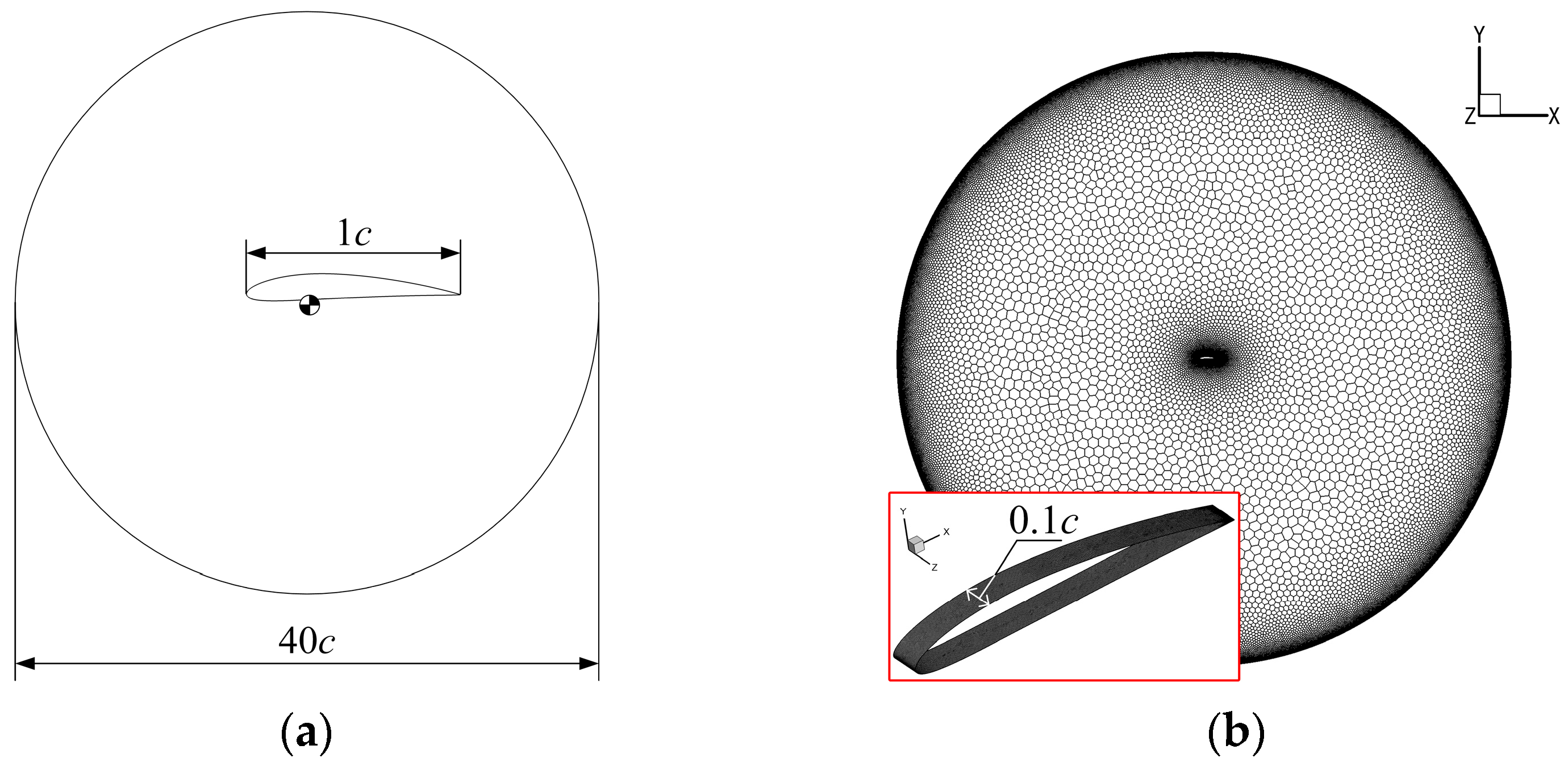
This study initially establishes and validates a high-fidelity numerical simulation scheme for a single airfoil. Considering the real-world environmental conditions of such aircraft in low-altitude flight regimes, the computational Reynolds number is set to 6 × 10⁶, and the computational model is based on the NACA 4412 airfoil with a chord length of c = 1   m . As illustrated in Figure 1, the computational domain is a three-dimensional circular far-field with a diameter of 15 times the chord length. The center of the circle is positioned at the aerodynamic center of the airfoil, which is located at a relative position of (0.246c, −0.051c) from the leading edge, thereby minimizing boundary interference on the flow field surrounding the airfoil. The model is extruded by a thickness of 0.1c in the spanwise direction, with symmetry boundary conditions imposed at both spanwise ends.
The meshing strategy, as depicted in Figure 1b, employs a polyhedral volume mesh topology to ensure high mesh quality and efficient numerical convergence. To accurately capture complex separation flows, wake development, and vortex interactions—which are critical for the subsequent evaluation of tandem-airfoil configurations—localized refinements are strategically applied near the airfoil surface and the trailing-edge region, maintaining a uniform global growth rate of 1.1.
Specifically, the boundary layer is resolved using 20 prismatic layers with a transition ratio of 0.2. The height of the first mesh cell adjacent to the wall is set to 4.5 × 10⁻⁶c, guaranteeing y+ 1 to meet the requirements of the transition model. For the trailing edge, a proximity sizing function is utilized, where the cells per gap parameter is set to 5, 7, and 10 for the coarse, medium, and fine meshes, respectively, to accurately resolve the wake shedding. Furthermore, the computational domain is uniformly extruded into 25, 33, and 50 layers corresponding to the target surface sizes (0.004c, 0.003c, and 0.002c). Consequently, the mesh independence study utilizes three sets of meshes comprising approximately 0.88 million, 1.64 million, and 3.28 million cells, respectively.

2.2. Numerical Setup and Boundary Conditions

This study employs the Unsteady Reynolds-Averaged Navier–Stokes (URANS) equations in integral form as the governing equations for the fluid domain [24].
t V W   d V + S F c F v n d S = 0 ,
where W is the vector of conserved variables, Fc is the convective flux vector, Fv is the viscous flux vector, V represents the volume of the mesh cell, S denotes the boundary of the mesh cell, and n is the outward unit normal vector to the control volume surface.
Turbulence modeling utilizes the γ Re θ transition model proposed by Menter and Langtry [25]. This model couples the k Ω Shear Stress Transport (SST) model with two transport equations: one for the intermittency γ and another for the transition onset momentum thickness Reynolds number ( Re θ t ), as shown in Equations (2) and (3), respectively. The model assumes free shear flows to be fully turbulent and is capable of predicting transition phenomena effectively [26], thereby yielding more accurate aerodynamic coefficients [27]. The specific transport equations for the transition model are formulated as follows:
ρ γ t + ρ U j γ x j = P γ E γ + x j μ + μ t σ γ γ x j ,
ρ R e ˜ θ t t + ρ U j R e ˜ θ t x j = P θ t + x j σ θ t μ + μ t R e ˜ θ t x j ,
The specific parameters in these equations have been explicitly defined by Menter et al. [25]. The transition model interacts with the SST turbulence model by modification of the k—equation.
All numerical simulations in this study were performed utilizing the commercial CFD software ANSYS Fluent 2020 R2. Numerical solutions are obtained using its pressure-based transient solver. The pressure-velocity coupling is addressed via the SIMPLE algorithm, and the flux type is set to Rhie-Chow: momentum based. For spatial discretization, the Least Squares Cell-Based method is adopted for gradient evaluation. A second-order scheme is employed for pressure, while second-order upwind schemes are applied for density, momentum, turbulent kinetic energy, specific dissipation rate, intermittency, momentum thickness Reynolds number, and energy. Temporal discretization is executed using a first-order implicit scheme with a fixed time step of 0.01 s. A total of 500 time steps are computed to ensure that the flow field reaches a stable or periodically stable state.
The fluid medium is defined as air. A compressible flow is assumed by modeling the air as an ideal gas. Although the freestream Mach number is 0.1, which typically characterizes an incompressible regime, this ideal gas assumption is strictly adopted. This approach ensures the accurate resolution of localized density variations and potential weak compressibility effects induced by the highly accelerated airflow within the narrow slot between the tandem airfoils. To match the prescribed operational Reynolds number of 6 × 10⁶, the dynamic viscosity is explicitly set to 6.4827 × 10⁻⁶ kg/(m·s).
Regarding the boundary conditions, the outer boundary of the computational domain is assigned a pressure far-field condition. To provide appropriate freestream conditions, the turbulence quantities at the far-field are explicitly specified with an intermittency of 1, a turbulent intensity of 5%, and a turbulent viscosity ratio of 10. The airfoil surfaces are treated as stationary walls subjected to a no-slip shear condition. A standard roughness model is applied with a roughness height of 0 and a roughness constant of 0.5, assuming aerodynamically smooth surfaces. Thermally, a zero heat flux condition is imposed on all walls. Finally, symmetry boundary conditions are applied to both lateral sides of the fluid domain. The angle of attack ranges from −6° to 20°, with calculations performed at 1° intervals.

2.3. Verification and Experimental Comparison

2.3.1. Mesh Independence Study

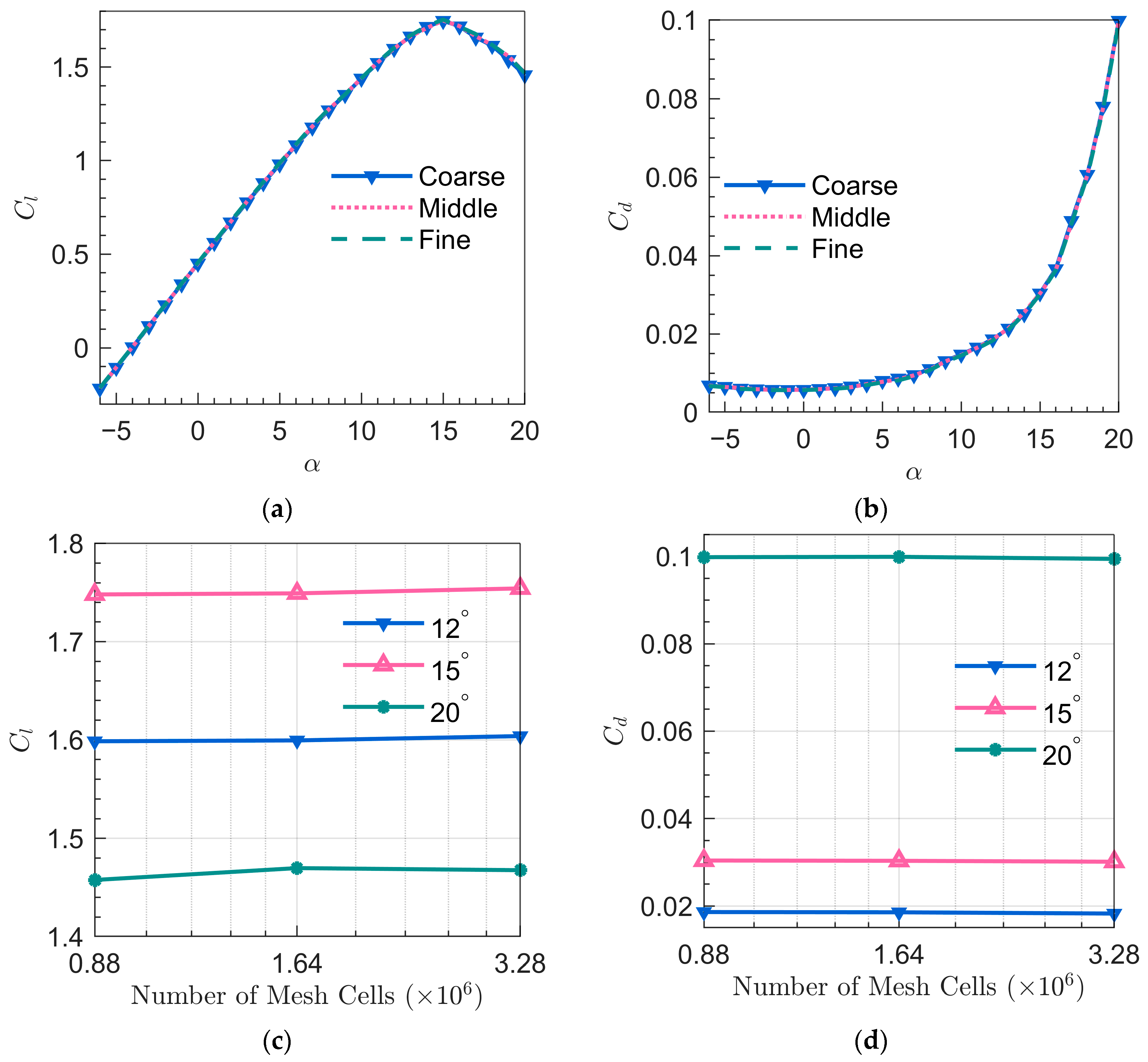
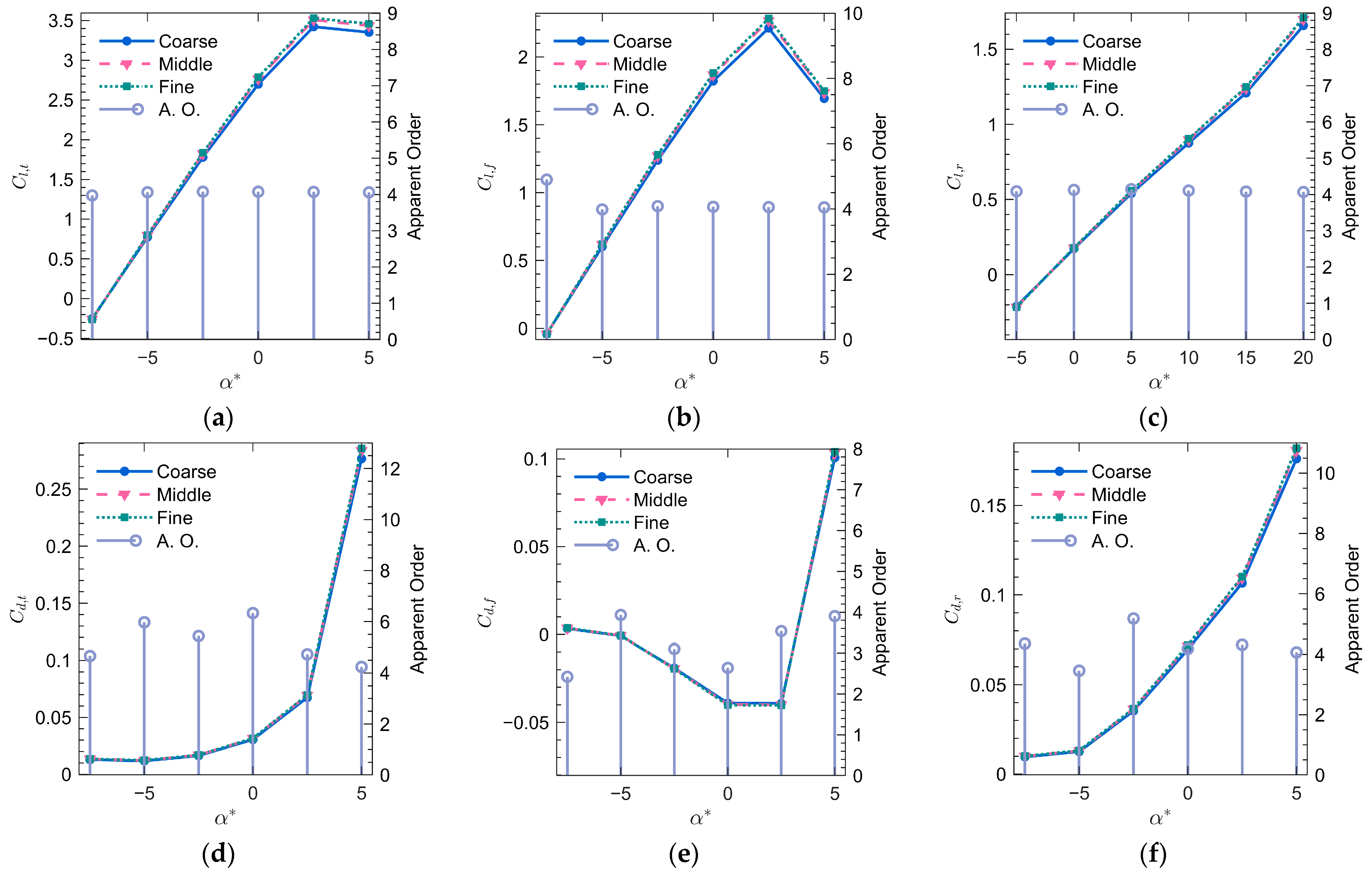
The CFD computational results are inevitably accompanied by numerical errors introduced during the discretization process; therefore, a mesh independence study is required to evaluate their impact [28]. In the mesh independence study presented in Figure 2, the aerodynamic coefficients are determined by time-averaging the monitoring results of the final 100 time steps of the URANS simulation. At low to moderate angles of attack, the flow is highly stable and the temporal fluctuations of the aerodynamic forces are negligible. However, as the angle of attack approaches and exceeds the stall point, the flow exhibits inherent broadband unsteadiness due to massive boundary layer separation. In these high angle-of-attack regimes, the aerodynamic forces oscillate aperiodically around a stable mean value. The oscillation amplitude increases progressively with the angle of attack, reaching a maximum amplitude of approximately ±1.2% of the mean value at the deep stall condition of 20°. Therefore, utilizing the time-averaged values effectively and accurately represents the mean aerodynamic performance under these complex flow states.
Based on these time-averaged values, the computational results for the three sets of meshes are initially presented in Figure 2a,b, demonstrating excellent consistency. While these standard macroscopic plots effectively validate the overall aerodynamic trends, the minute convergence behaviors can be less discernible due to the axis scale. To explicitly illustrate the convergence process, the variations in the lift and drag coefficients with mesh refinement at 12°, 15°, and 20° are further plotted in Figure 2c,d. These specific angles are chosen to represent the flow conditions near the linear limit, at the maximum lift coefficient, and in the deep stall regime, respectively. Furthermore, establishing an exceptionally reliable single-airfoil baseline is paramount in this study. Due to the scarcity of high-fidelity experimental data for complex tandem configurations at extreme angles of attack, the reliability of the numerical framework must be strictly proven on the single airfoil before being extended to tandem simulations. Therefore, to complement the graphical demonstration, a robust quantitative evaluation is integrated. The discrete accuracy achieved by the computational results is quantified utilizing the average apparent order. To determine the accuracy order of the numerical results, a minimum of three mesh sets is required. The representative mesh size h is defined as [23]:
h = ( 1 N i = 1 N V i ) 1 3 ,
where N denotes the total number of mesh cells, and Vi represents the volume of the i-th cell.
Consequently, the mesh refinement factor r for the three mesh sets is defined as:
r = h coarse h middle = h middle h fine ,
Substituting Equation (4) into Equation (5) yields the mesh refinement factor defined by the number of mesh cells:
r = ( N middle N coarse ) 1 3 = ( N fine N middle ) 1 3 ,
Based on empirical guidelines, the ratio hcoarse/hfine should be greater than 1.3. Consequently, the corresponding ratio of cell numbers between adjacent mesh sets should exceed 1.48. In this study, both Nmiddl/Ncoarse and Nfine/Nmiddle are approximately 2, satisfying this criterion. For a specific physical quantity of interest, ϕ , the convergence ratio R is defined as:
R = ϕ coarse ϕ middle ϕ middle ϕ fine ,
For unknown or complex models, the apparent order, ε , can be inversely deduced from the computational results of the refined meshes. The definition of ε is expressed in Equation (8):
ε = 1 ln r 23 ln R + q ( ε ) ,
q ( ε ) = ln ( r m - f ε s r c - m ε s ) ,
s = 1 sgn R ,
where r m - f and r c - m are the refinement factors for the middle-to-fine and coarse-to-middle mesh pairs, respectively. Typically, it is difficult for r m - f and r c - m to be completely identical; hence, they can be simplified to a uniform constant r. Since Equation (9) also contains the term ε , Equation (8) must be solved via fixed-point iteration, with the initial value set to p = ln R / ln r 23 . It is worth noting that the applicability of this evaluation method is not limited to only three refined meshes; it can also be extended to cases with a larger number of meshes. Specifically, any three consecutive meshes with a constant refinement ratio can be adopted for the calculation. This method is applicable not only to the time-averaged quantities employed in the present study but also to the transient flow variables in unsteady simulations, provided a consistent temporal discretization strategy is maintained.
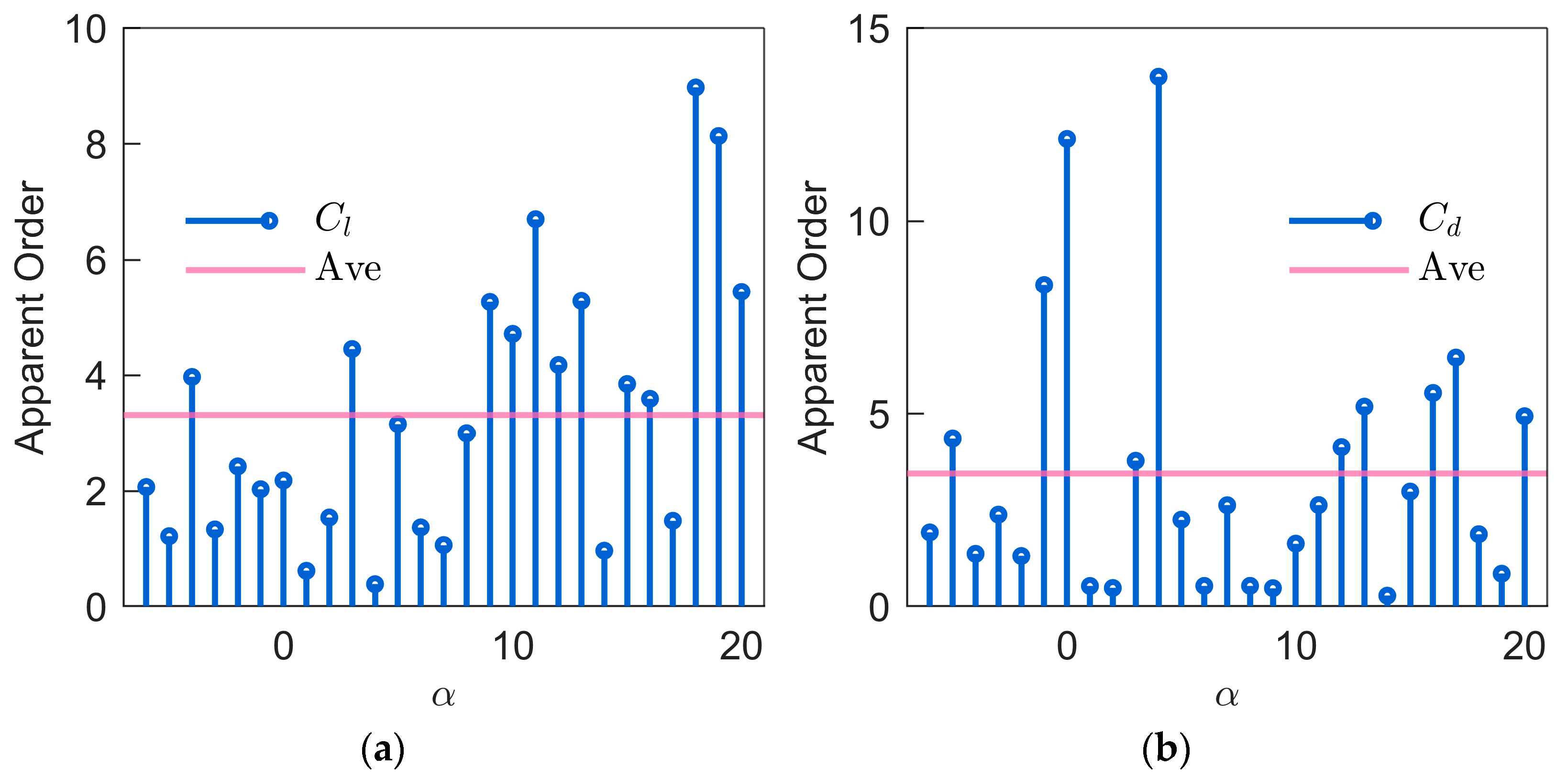
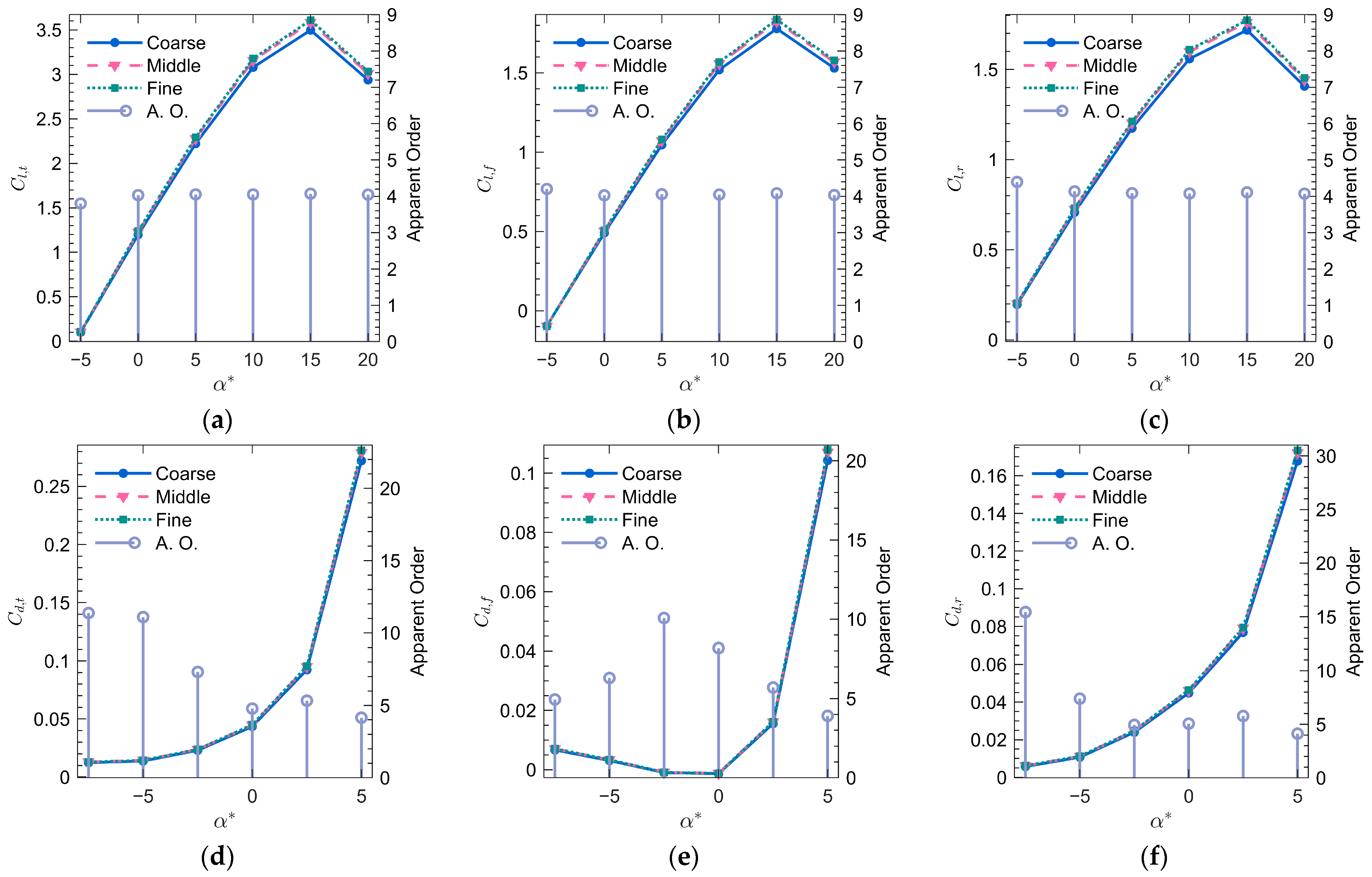
Based on the established methodology, Figure 3 presents the calculated apparent order across the angle-of-attack sweep. It can be visually observed that the local apparent order exhibits significant disparity and oscillatory behavior. As extensively documented in the foundational works by Roache [29,30], this high disparity is a well-known numerical artifact in practical CFD applications, particularly when simulating complex separated flows or employing second-order upwind schemes with flux limiters. As the numerical solutions approach asymptotic convergence, the differences between the fine and medium meshes diminish toward the truncation error level, which consequently causes localized mathematical singularities in the apparent order calculation. Therefore, evaluating the average apparent order is the standard and robust practice to filter out this localized numerical noise. The calculated average apparent order in this study closely aligns with the formal second-order spatial discretization scheme employed in the flow solver. This quantitative consistency firmly verifies the reliability of the computational framework, indicating that the meshes are within the asymptotic range of convergence [31].
In summary, considering the negligible differences among the computational results of the three mesh sets and that the apparent order has reached the theoretical accuracy, it can be concluded that the results from the coarse mesh possess sufficient accuracy. Therefore, to conserve computational resources in the subsequent extensive parametric studies, the coarse mesh topology is ultimately selected for all calculations.

2.3.2. Experimental Comparison

To validate the accuracy of the numerical framework, the computational results of the baseline single airfoil are compared with the classic experimental data compiled by Abbott and von Doenhoff [22]. The reference experiments were conducted in the Langley two-dimensional low-turbulence pressure tunnel, which features a test section of 3 ft by 7.5 ft. The test models had a 2-foot chord and completely spanned the tunnel width to ensure two-dimensional flow conditions. The tests were performed at a Reynolds number of 6 × 10⁶ and a Mach number below 0.17, with an exceptionally low free-stream turbulence level on the order of a few hundredths of one percent. In these experiments, lift was determined by integrating the pressures on the floor and ceiling of the tunnel, while drag was obtained through wake-survey measurements. Although this facility provides a high degree of measurement accuracy for attached flows, the experimental uncertainty inevitably increases under massive boundary layer separation. Specifically, the wake-survey method for drag measurement becomes highly inaccurate in the deep stall regime due to severe flow reversal in the wake. This inherent experimental limitation accounts for the absence of high-angle-of-attack drag data in the reference literature.
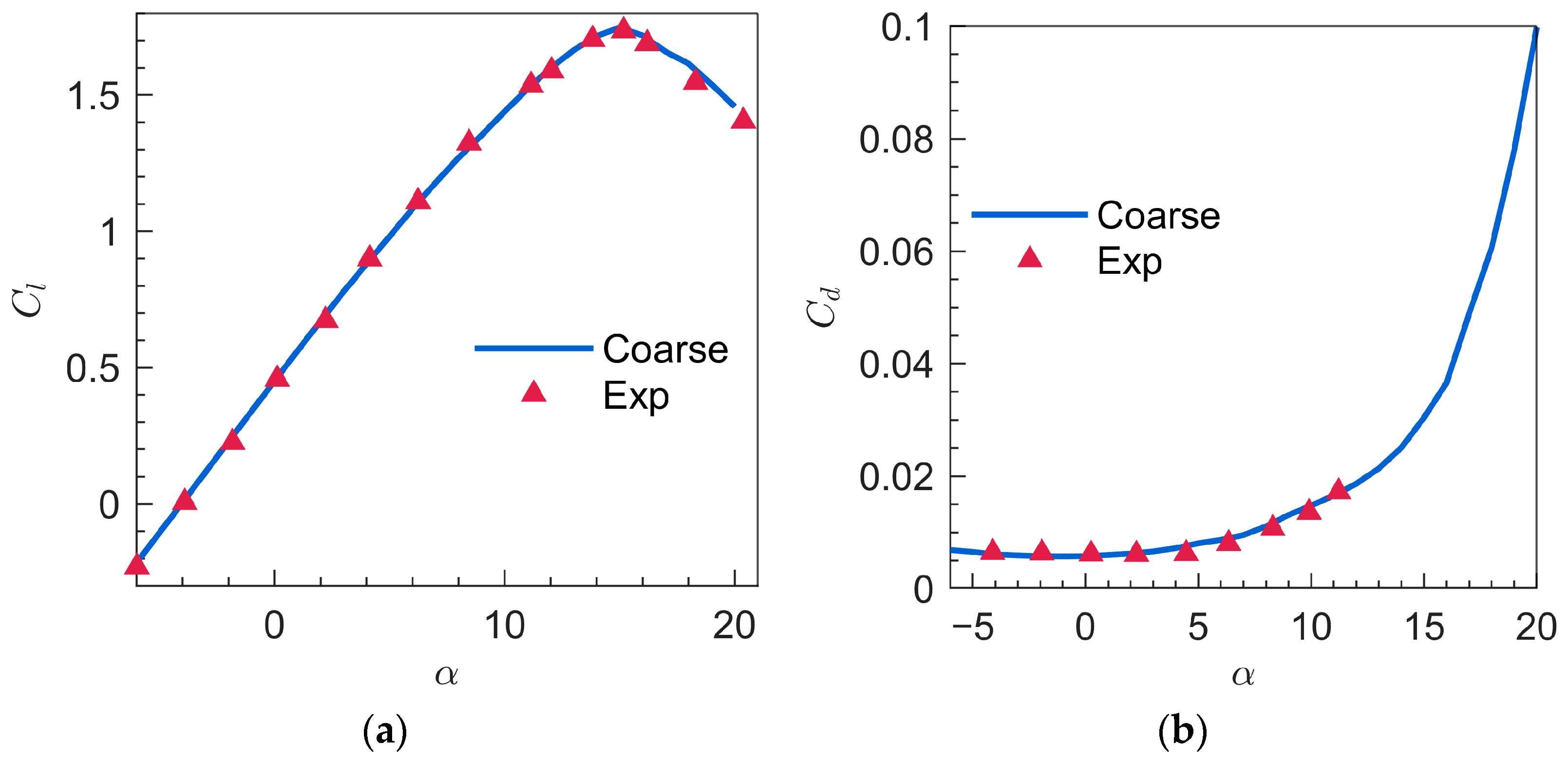
As shown in Figure 4, the predicted aerodynamic coefficients demonstrate excellent agreement with the experimental data in the linear region. More importantly, the numerical framework accurately captures the maximum lift coefficient and the corresponding critical stall angle. A minor deviation is observed in the post-stall regime. This discrepancy is a well-documented limitation of the URANS framework, which tends to over-predict the turbulent viscosity and exhibit excessive dissipation when resolving massive boundary layer separation. However, since the primary objective of this study is to optimize the tandem configuration for maximum lift performance, this post-stall deviation does not compromise the reliability of the overall optimization framework.

3. Surrogate-Assisted Optimization Framework

The aerodynamic design of eVTOL aircraft is strictly dictated by operational footprint constraints, which necessitate a highly compact tandem-wing configuration. This geometrical constraint intrinsically limits the total wing area, forcing the aircraft to operate under a relatively high wing-loading condition. In the critical transition phase between hover and wing-borne flight, high wing loading results in a higher stall speed, which severely narrows the safe transition corridor and imposes tremendous thrust demands on the propulsion system. Therefore, extracting the maximum absolute lift from the lifting surfaces becomes the primary aerodynamic bottleneck. Maximizing the lift capability directly translates to a reduced stall speed, thereby widening the transition corridor and ensuring operational safety. Furthermore, geometric parameter combinations that successfully delay stall and maximize the lift peak typically achieve this by establishing favorable inter-airfoil aerodynamic coupling. This optimized interference inherently shifts the overall lift curve upwards, providing enhanced lifting capabilities not only at the stall boundary but also across the lower angles of attack utilized during conventional flight phases. Consequently, this study directly targets the maximum lift performance as the primary optimization objective.
To effectively navigate the highly nonlinear design space and achieve this aerodynamic objective, the selection of the optimization algorithm is critical. Conventional approaches such as classical design of experiments utilize sampling patterns that are determined before measurements are made, meaning they cannot adapt to complex flow features that appear during the experiment. Similarly, evolutionary algorithms and multi-start derivative-free methods are fundamentally not designed to be sample efficient, as they require evaluating the objective function many times to perform optimization. When coupled with high-fidelity URANS simulations, this massive evaluation requirement becomes computationally prohibitive. Alternatively, Bayesian optimization is a powerful probabilistic framework specifically tailored for the efficient global optimization of expensive black-box functions. It employs a model-based approach coupled with an adaptive sampling strategy to actively minimize the number of required function evaluations [21,32]. This inherently high sample efficiency perfectly suits the aerodynamic design problem, ensuring that the optimal tandem-wing configuration can be successfully identified within a strictly limited evaluation budget.

3.1. Parametric Design Space and Objective Definition

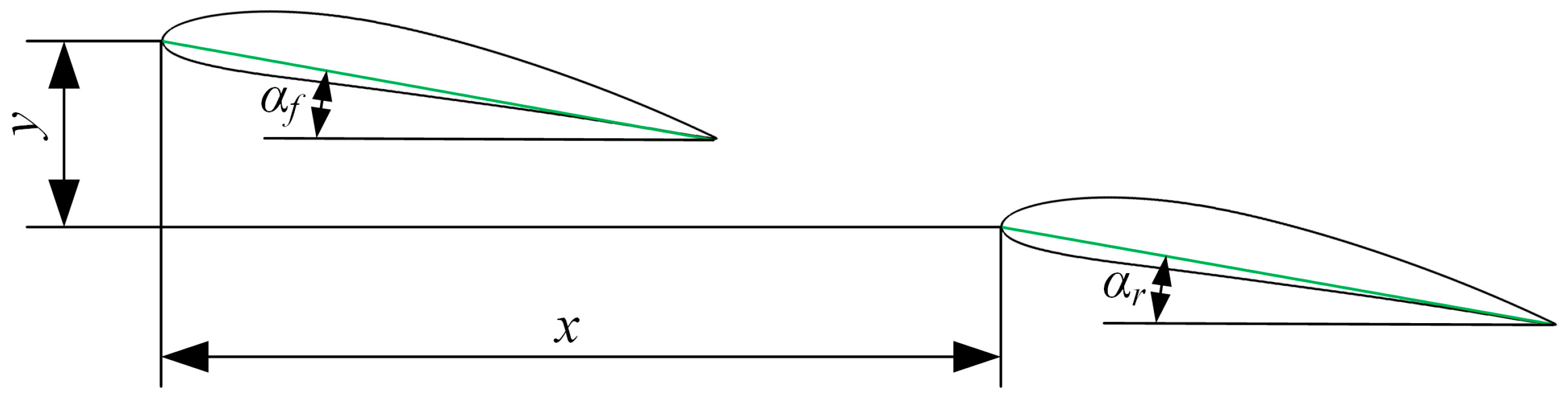
The aerodynamic performance of a tandem-airfoil system is determined by its constituent airfoil geometric layout. Taking into account both the exploration of aerodynamic interference mechanisms and the universality of engineering manufacturing, this study adopts two identical NACA 4412 airfoils with equal chord lengths to establish the baseline configuration, as illustrated in Figure 5. The green lines in the figure represent the chord lines of the airfoils.
Based on this baseline configuration, four design variables are selected to establish a parametric model, with their specific definitions and ranges detailed in Table 1. Design variables for the parametric study of the tandem-airfoil configuration. Specifically, the angle of attack of the rear airfoil is determined by the angle of attack difference between the fore and rear airfoils, denoted as α r = α f + Δ α .
The range of the longitudinal separation Δ x / c is set from 1 to 10, which facilitates the capture of variation characteristics transitioning from close-coupled strong interference to distant-coupled weak interference. The vertical separation Δ y / c is defined within the range of −1 to 1, comprehensively covering typical layout topologies where the rear airfoil is located in the downwash region, coplanar with, or in the upwash region of the fore airfoil. The range of the fore airfoil angle of attack α f , spanning from 14° to 20°, encompasses the stall angle of the isolated single airfoil to ensure coverage of the anticipated overall stall angle of attack for the tandem-airfoil system. Notably, this study introduces the angle of attack difference Δ α as an independent variable parameter within the design space, establishing a broad range of 10°. The establishment of the aforementioned parameter boundaries not only encompasses potential high-performance configurations but also aims to thoroughly elucidate the optimal attitude matching principles between the fore and rear airfoils under various interference flow states.

3.2. Robust Design of Experiments via LHS

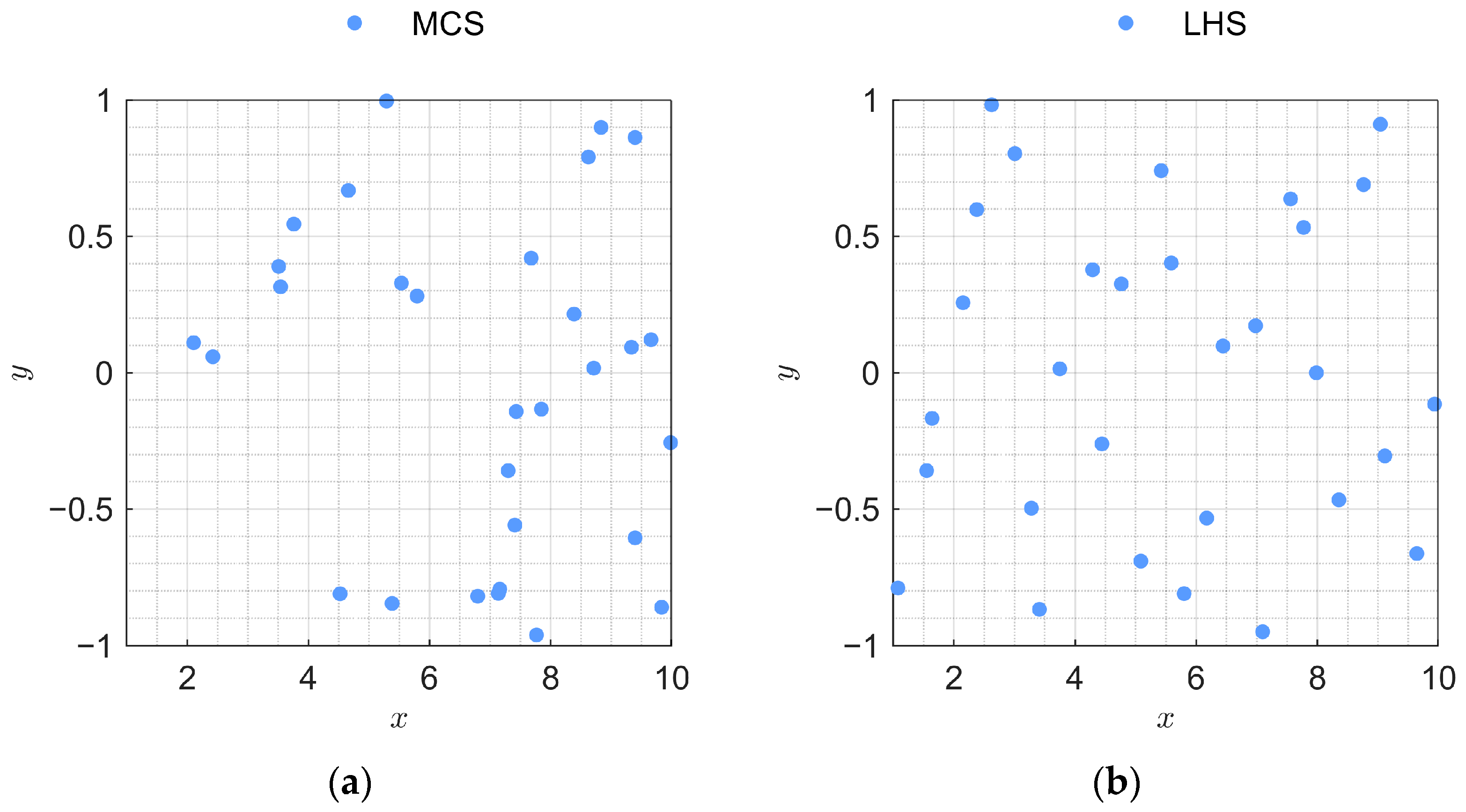
Within the four-dimensional design space defined in Table 1, employing full factorial sampling would generate a massive data sample, significantly increasing computational costs. Consequently, it is imperative to adopt more efficient design of experiments methods, such as random sampling techniques like Monte Carlo simulation (MCS). However, MCS still suffers from uneven sample distribution [33], as illustrated in Figure 6a, which subsequently still necessitates large-scale sampling [34]. To enhance sampling efficiency, this study employs LHS [35] as the foundation for sample generation. Through stratified sampling, LHS can generate more representative sample points for multi-parameter problems, thereby achieving an effective exploration of the design space with a smaller sample size, as depicted in Figure 6b.
LHS initially partitions the search space into equal intervals, and the intervals of each dimension are randomly paired to form sampling regions. Subsequently, each sample is sequentially and randomly generated within the sampling region, which can be expressed as [36]:
x i = 1 n r + i 1 n ,
where r is a random number within [0, 1], and x i denotes the i-th sample in the i-th interval. When the range of design variables does not fall within the [0, 1] interval, it can be easily mapped and transformed, immensely facilitating the realization of a uniform sample distribution.
However, during the CFD evaluations, exactly three out of the initial one hundred sample points were identified as failed cases. The criterion for this failure was the occurrence of numerical divergence or the inability of the residuals to converge below the designated 10−6 threshold. In URANS simulations of complex multi-body interference, such non-convergence is occasionally triggered by localized numerical instabilities or transient flow singularities during the initialization phase, rather than necessarily representing physically extreme configurations.
To maintain the integrity of the dataset without introducing spatial bias, an intra-layer replacement strategy was implemented. By mathematical definition, LHS partitions the probability space of each variable into n equal-probability strata. When a sample fails to converge, this strategy locates the specific narrow strata corresponding to its variable dimensions and randomly regenerates a new sample point strictly within those original bounds. From a mathematical perspective, this localized resampling strictly preserves the fundamental Latin hypercube property, which requires exactly one sample per stratum for each dimension. Consequently, this strategy safely bypasses localized numerical singularities while introducing strictly zero macroscopic distribution bias into the overall design space.
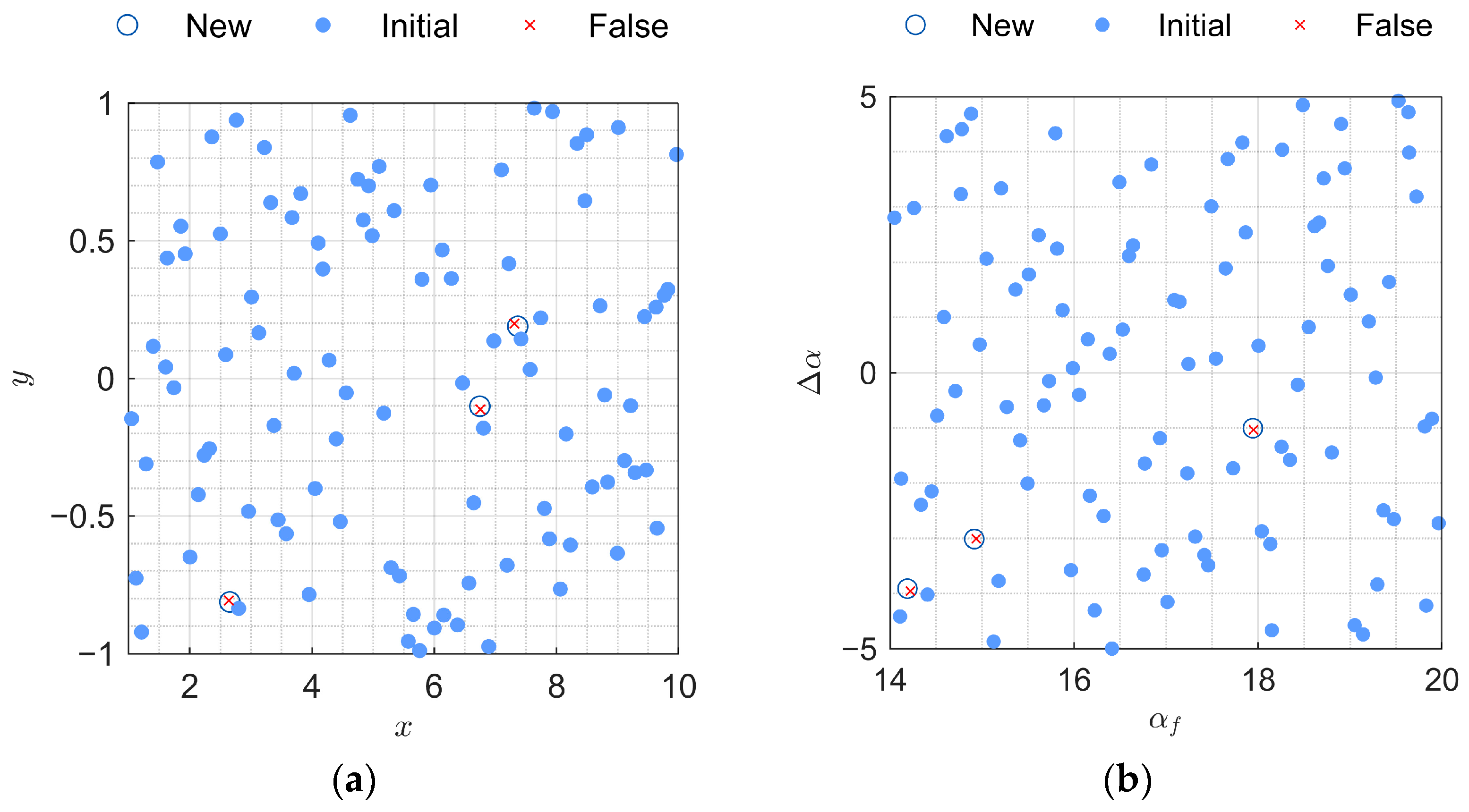
By employing this strategy, a complete and unbiased set of 100 valid high-fidelity sample points was successfully acquired. To address the highly nonlinear aerodynamic responses within the four-dimensional design space, this sample size was rigorously determined to ensure the reliability of the Gaussian Process surrogate model. According to the practical guidelines for computer experiments established by Loeppky et al. [37], a sample size of 10 times the input dimension is generally sufficient to construct reliable Gaussian Process models. Although the tandem-airfoil configuration exhibits highly nonlinear aerodynamic responses, Loeppky et al. demonstrated that physics-based engineering problems typically possess a tractable total sensitivity and effect sparsity within the design space, thereby rendering this sample size baseline effective. Given the four-dimensional design space, the 100 high-fidelity samples generated in this study correspond to 25 times the input dimension. This conservative sample size exceeds the theoretical baseline, aiming to accurately capture highly nonlinear aerodynamic interference mechanisms while maintaining computational efficiency. The final spatial distribution of these samples is illustrated in Figure 7. The figure distinguishes three categories of data points: the initial valid samples, the failed samples that were discarded, and the newly generated replacement samples. This intuitive visualization further confirms that the replacement operation is strictly confined within the local strata, perfectly preserving the global uniformity of the sample set.

3.3. Overview of the Initial CFD Database

Based on the sample points illustrated in Figure 7, the model in Figure 5 is parameterized. All computations employ the identical numerical setups as those utilized in the single airfoil validation to guarantee the consistency of the results. For the tandem-airfoil system, the exact same local refinement rules used for the single airfoil are strictly applied to both the forewing and the rear airfoil. As detailed in Section 4.3, the grid independence study for the tandem configuration uses three scaled mesh densities, with approximately 1.46, 2.79, and 5.61 million cells, respectively. Ultimately, the coarse mesh topology, which is identical to the single-airfoil baseline, is selected for all sample calculations in the optimization database.
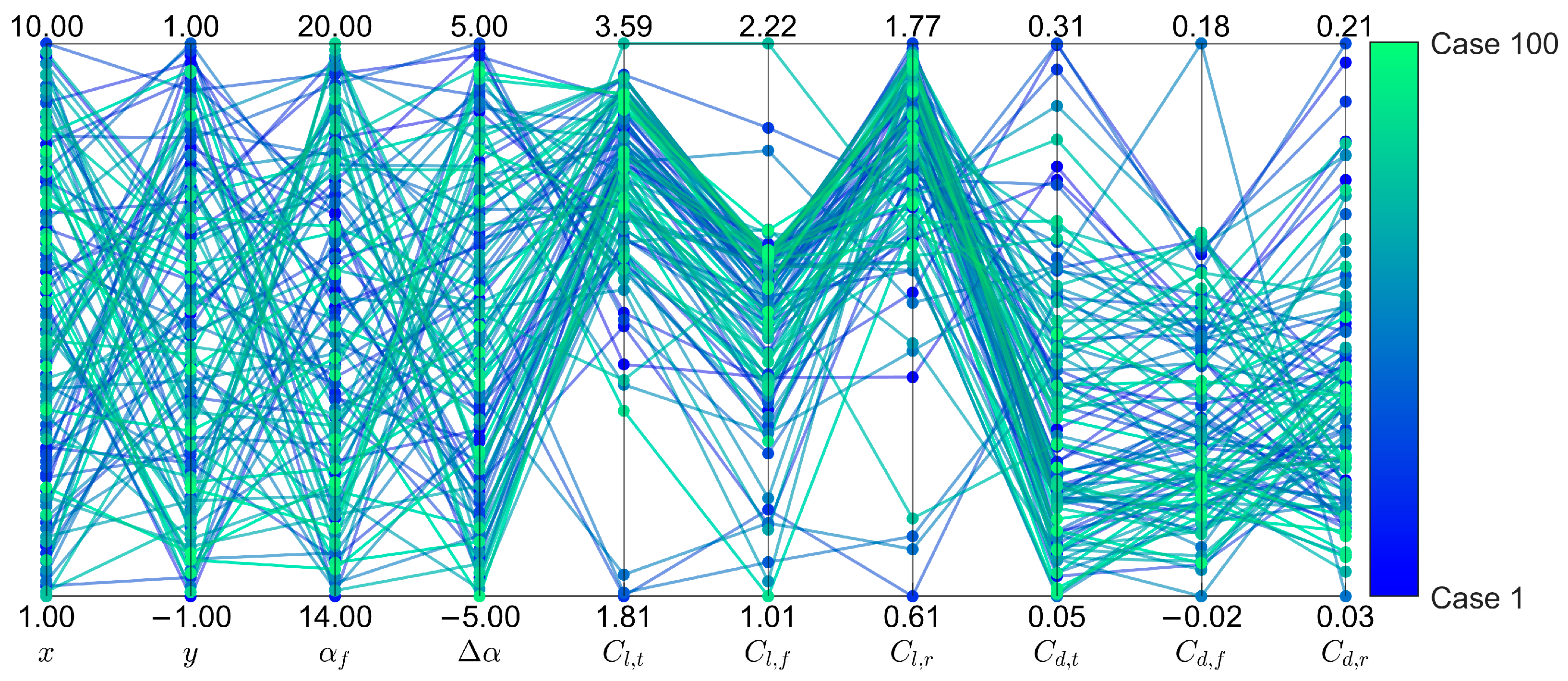
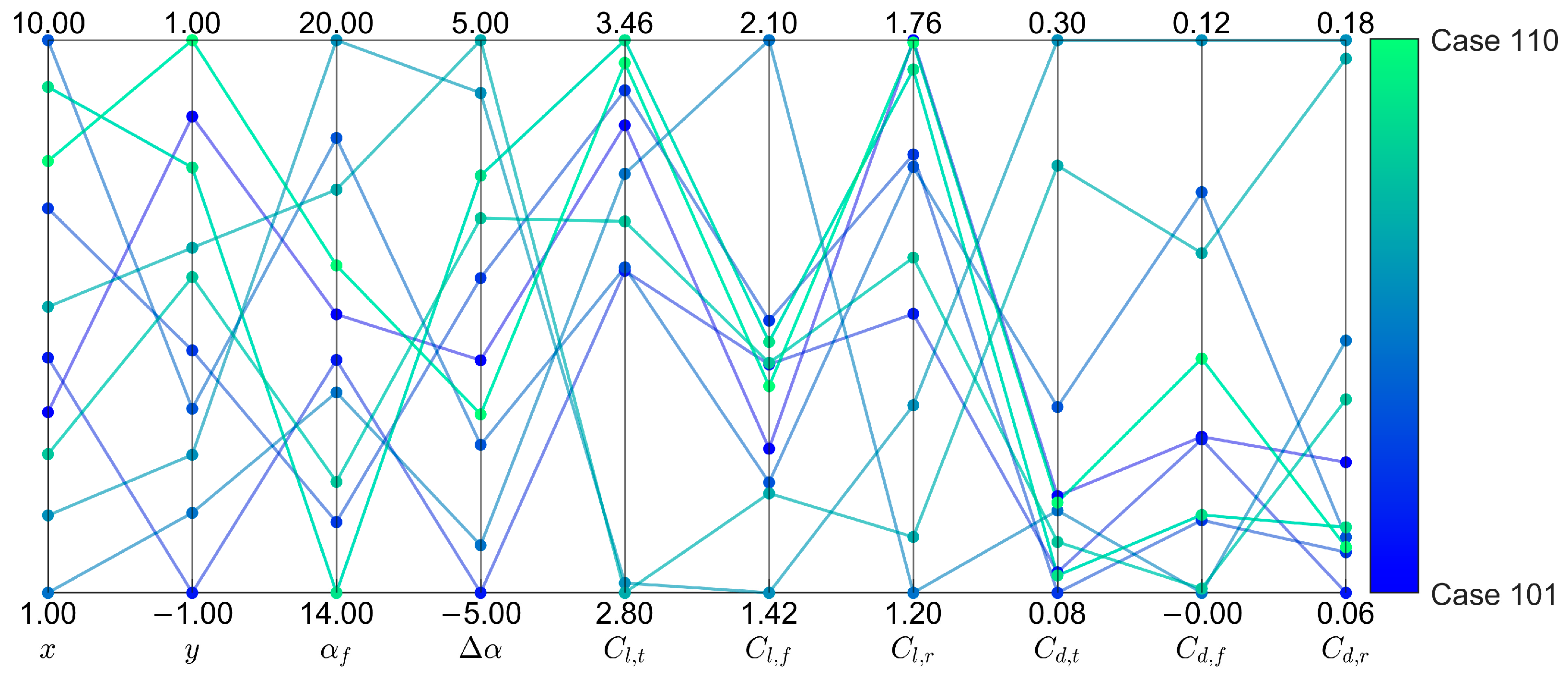
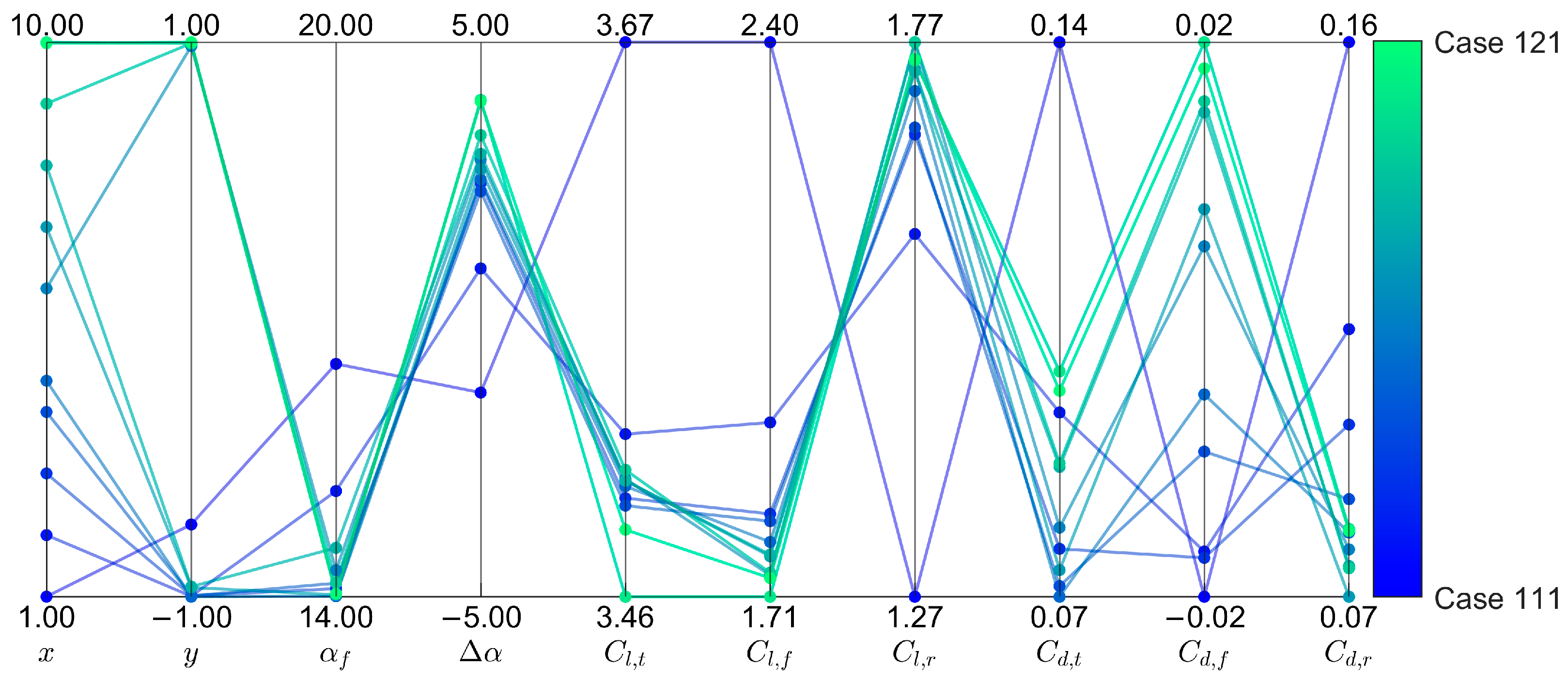
Figure 8 presents the aerodynamic dataset for the individual fore and rear airfoils, as well as for the overall system. In this figure, the first four vertical axes represent the four input design variables defined in Table 1, while the subsequent six axes represent the outputs of the six aerodynamic monitoring results, namely the total lift coefficient C l , t , fore airfoil lift coefficient C l , f , rear airfoil lift coefficient C l , r , total drag coefficient C d , t , fore airfoil drag coefficient C d , f , and rear airfoil drag coefficient C d , r . The reference area for C l , t and C d , t are defined as the area of a single airfoil. It can be observed that a highly nonlinear relationship exists between the layout configuration inputs and the aerodynamic outputs of the tandem-airfoil system.

3.4. Bayesian Optimization Methodology

3.4.1. The Bayesian Optimization Loop

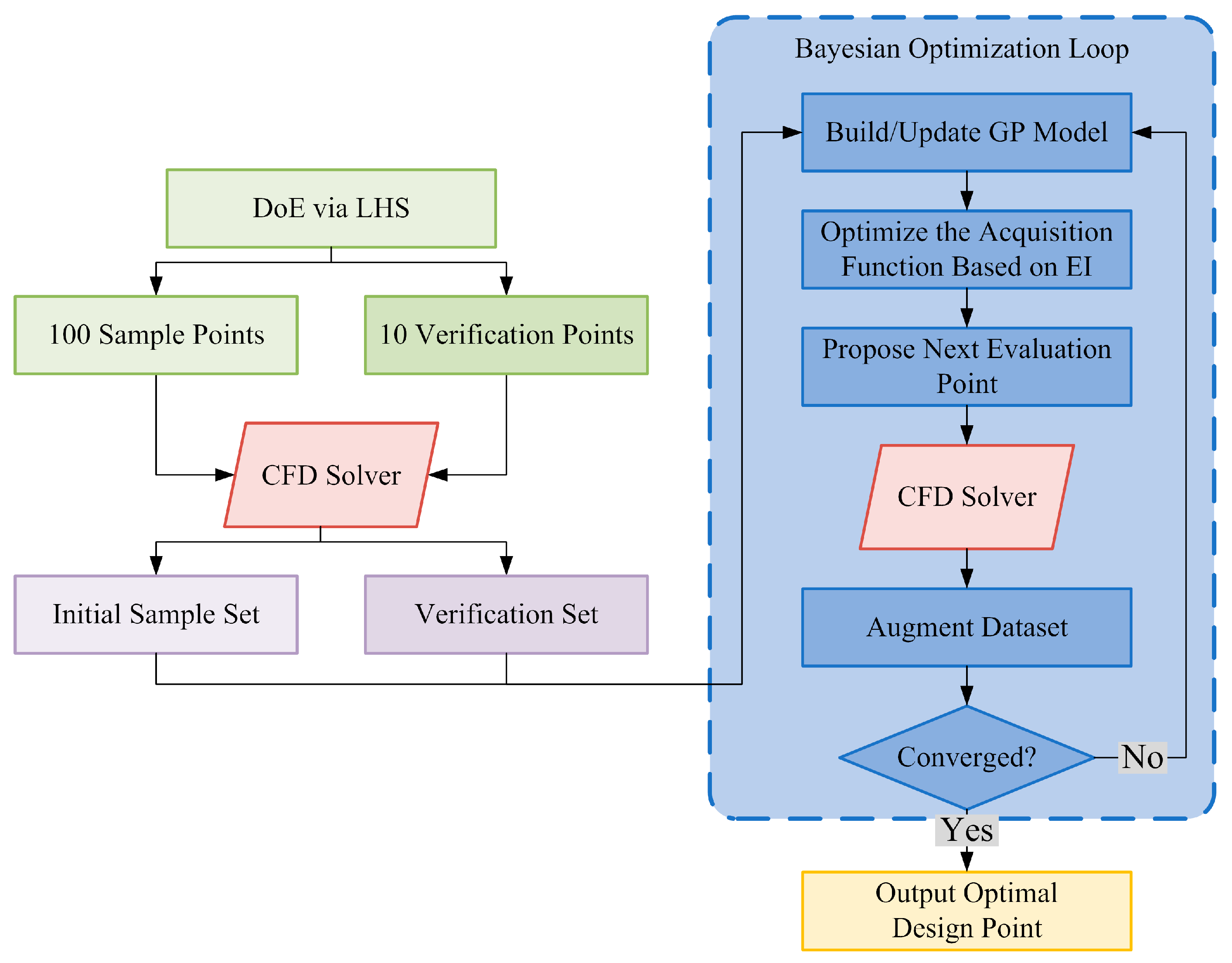
Upon acquiring the sample data via LHS, this study employs the BO framework, as depicted in Figure 9, to resolve the optimal configuration scheme that maximizes the lift coefficient of the tandem airfoils.
Initially, the initial sample points from Figure 8 are utilized to iteratively construct a probabilistic surrogate model, specifically the GP model, and the accuracy of this model is validated using verification points comprising 10% of the sample size. Subsequently, the framework makes decisions guided by a heuristic criterion known as the acquisition function. This criterion effectively prevents the optimization process from being trapped in local optima by delicately balancing local “exploitation” and global “exploration” [21]. The sample points acquired via the acquisition function are evaluated using the CFD solver and subsequently utilized to augment and update the surrogate model until the increment in aerodynamic forces falls below a specified convergence threshold.

3.4.2. Gaussian Process Surrogate Modeling and Accuracy Assessment

GP is a powerful non-parametric Bayesian model. Its essence lies in defining a prior distribution over a function space, which is subsequently updated into a joint Gaussian distribution of function values through observational data. Consequently, it provides not only predictive values but, more crucially, a quantitative estimation of predictive uncertainty [38].
A GP is completely defined by its mean function m ( x ) and covariance function k ( x , x ) . It assumes that the function values f ( x 1 ) , , f ( x n ) corresponding to any set of input points x 1 , , x n follow a joint multivariate Gaussian distribution. The prior distribution of the objective function f ( x ) can be expressed as [21,32]:
f ( x ) G P ( m ( x ) , k ( x , x ) ) ,
where the mean function m ( x ) is typically set to zero or a constant, representing preliminary assumptions regarding the function’s trend. The covariance function k ( x , x ) , conversely, describes characteristics such as the smoothness of the function between any two points x and x . This study adopts the robust Squared Exponential (SE) kernel:
k SE ( x i , x j ) = σ f 2 exp ( 1 2 l 2 x i x j 2 ) ,
where the hyperparameters—the signal variance σ f 2 and the kernel length-scale l —are obtained through training on the CFD sample points. A larger length-scale l implies a smoother objective function.
Given a training dataset D t = { ( x i , y i ) } i = 1 t , the GP model can derive a posterior predictive distribution for the function value f ( x * ) at any new test point x * . This posterior distribution is also a Gaussian distribution:
P ( f ( x * ) D t , x * ) = N ( μ t ( x * ) , σ t 2 ( x * ) ) ,
where the mean μ t ( x * ) and variance σ t 2 ( x * ) are the core outputs of the GP model. The mean μ t ( x * ) represents the optimal point estimate of the objective function value at x * , which tends to select points with superior predicted performance during the exploitation phase of Bayesian optimization. The variance σ t 2 ( x * ) , conversely, quantifies the predictive uncertainty at that point. It is larger in regions far from known data points and approaches zero in regions adjacent to known data points. This variance information serves as the foundation driving the exploration phase of Bayesian optimization, favoring regions with high uncertainty. The acquisition function utilizes the weights of these two quantities, μ t ( x * ) and σ t 2 ( x * ) , to guide the search direction, enabling the optimization process to rapidly approach potential optimal solutions while circumventing premature convergence to local extrema.
To evaluate the prediction accuracy of the surrogate model, a quantitative comparison was conducted between the aerodynamic forces output by the surrogate model and those obtained via CFD computation. Initially, the fitting capability of the GP model on the training set itself was examined, with the relative errors presented in Table 2. The model demonstrates an exceptionally high fitting capability on the training dataset, with the relative errors between the vast majority of output results and CFD data situated at an extremely low level on the order of 10−8. This corroborates that the model has adequately learned the information encapsulated within the training samples.
Furthermore, this study generated an additional 10 independent verification sets that were not involved in model training. These verification points were similarly generated randomly within the design space utilizing the LHS method, and the corresponding CFD results are illustrated in Figure 10.
The prediction errors of the GP model on these 10 verification points are presented in Table 3. Although there is a noticeable increase compared to the prediction errors on the sample set, the mean values of the absolute relative errors all remain at a low level below 3%, and the maximum relative errors are also within an acceptable range. This substantiates that the constructed GP model is reliable and capable of providing accurate predictions for subsequent Bayesian optimization.

3.4.3. Acquisition Function: Expected Improvement

In the BO framework, an acquisition function is required to propose the next data point for evaluation. Commonly choices include Probability of Improvement (PI) [39], Expected Improvement (EI) [21], and Upper Confidence Bound (UCB) [40]. Among these, EI is the most widely used and robust criterion. The acquisition function quantifies the potential value of each point x using the mean prediction μ ( x ) and variance σ 2 ( x ) provided by the GP model. Specifically, the GP provides not only a predictive mean μ ( x ) but also inherent uncertainty quantification (UQ), where the predictive standard deviation σ ( x ) serves as a rigorous error bound, quantifying the epistemic uncertainty in unexplored regions of the design space. In each optimization iteration, the next candidate point x is defined by maximizing the acquisition function.
The core philosophy of EI is to evaluate the expected improvement of f ( x ) over the currently best observed value f ( x + ) . Let f ( x + ) be the best function value among all evaluated points. The improvement I ( x ) at point x can be defined as I ( x ) = max ( 0 , f ( x ) f ( x + ) ) . Since f ( x ) follows the Gaussian distribution N ( μ ( x ) , σ 2 ( x ) ) provided by the GP, the mathematical expectation of this improvement can be calculated. The analytical expression for EI is formulated as [21,32]:
EI ( x ) = ( μ ( x ) f ( x + ) ) Φ ( Z ) + σ ( x ) ϕ ( Z ) σ ( x ) > 0 0 σ ( x ) = 0 ,
where Z = ( μ ( x ) f ( x + ) ) / σ ( x ) , Φ ( Z ) and ϕ ( Z ) are the cumulative distribution function (CDF) and probability density function (PDF) of the standard normal distribution, respectively. The first term of Equation (15), ( μ ( x ) f ( x + ) ) Φ ( Z ) , represents exploitation: when the predicted mean μ ( x ) is significantly higher than the current optimal value f ( x + ) , this term drives the algorithm to refine the search in known high-performance regions. The second term σ ( x ) ϕ ( Z ) represents exploration: when the predictive uncertainty σ ( x ) is large, this term encourages the algorithm to explore under-explored regions to avoid missing potential global optimal solutions.

4. Results and Discussion

4.1. Global Sensitivity Analysis of Design Variables

After constructing and validating the surrogate model, the configuration scheme of the tandem airfoils that yields the maximum lift coefficient is searched based on the Expected Improvement function defined in Equation (15). However, the four design variables exhibit varying weight influences on the aerodynamic coefficients, constituting the complex input-output mapping relationships illustrated in Figure 8. Therefore, prior to optimization, a parameter correlation and sensitivity analysis must be conducted to determine the dominant variables affecting the lift coefficient.
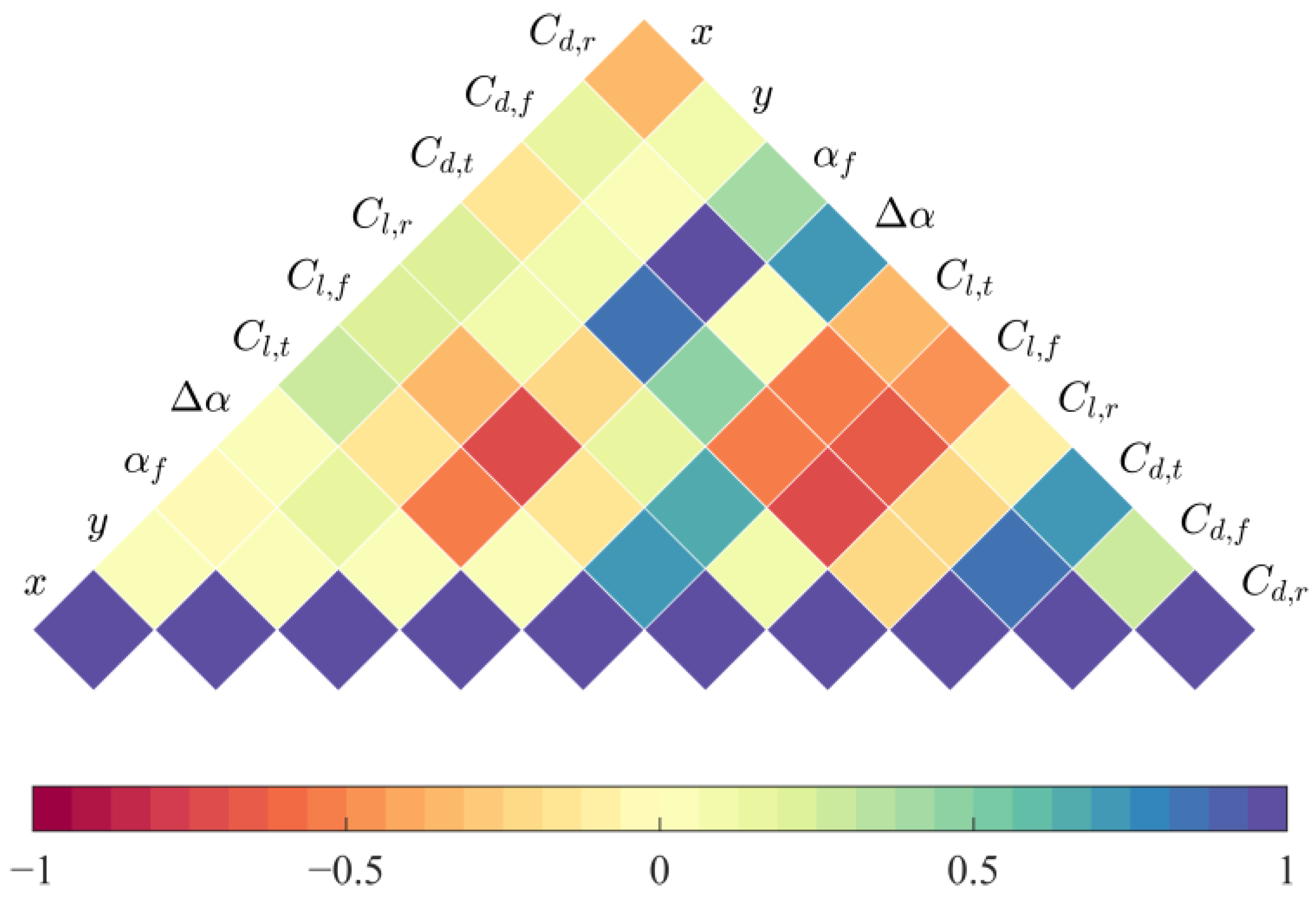
First, to investigate the strength and direction of monotonic relationships among variables, the Spearman rank correlation coefficient matrix for all input and output variables within the CFD samples was calculated, with the results presented as a heatmap in Figure 11. Compared to the Pearson correlation coefficient, the Spearman coefficient is based on data ranks and is more sensitive to nonlinear monotonic relationships. This matrix initially verifies the validity of the design of experiments; the correlation coefficients among the input variables (in the lower right region) are all close to zero. This indicates that the LHS sample set possesses excellent space-filling properties, and no spurious correlations exist among the input variables, providing a guarantee for the reliability of subsequent analyses.
Regarding the input-output relationships, it can be observed that α f exhibits a markedly strong positive correlation with C d , t and a significant negative correlation with C l , f . This indicates that in the tandem-airfoil configuration, when the design variables are situated near the critical angle of attack, the system is approaching or has exceeded the stall point; consequently, further increasing the angle of attack exerts a negative effect on lift. The Δ α is significantly positively correlated with C d , r , indicating that this parameter is the dominant variable regulating the aerodynamic state of the rear airfoil. The longitudinal separation Δ x / c is the design variable demonstrating the strongest positive correlation with C l , t among all input variables, elucidating that increasing the inter-airfoil separation has the effect of enhancing the system’s lift.
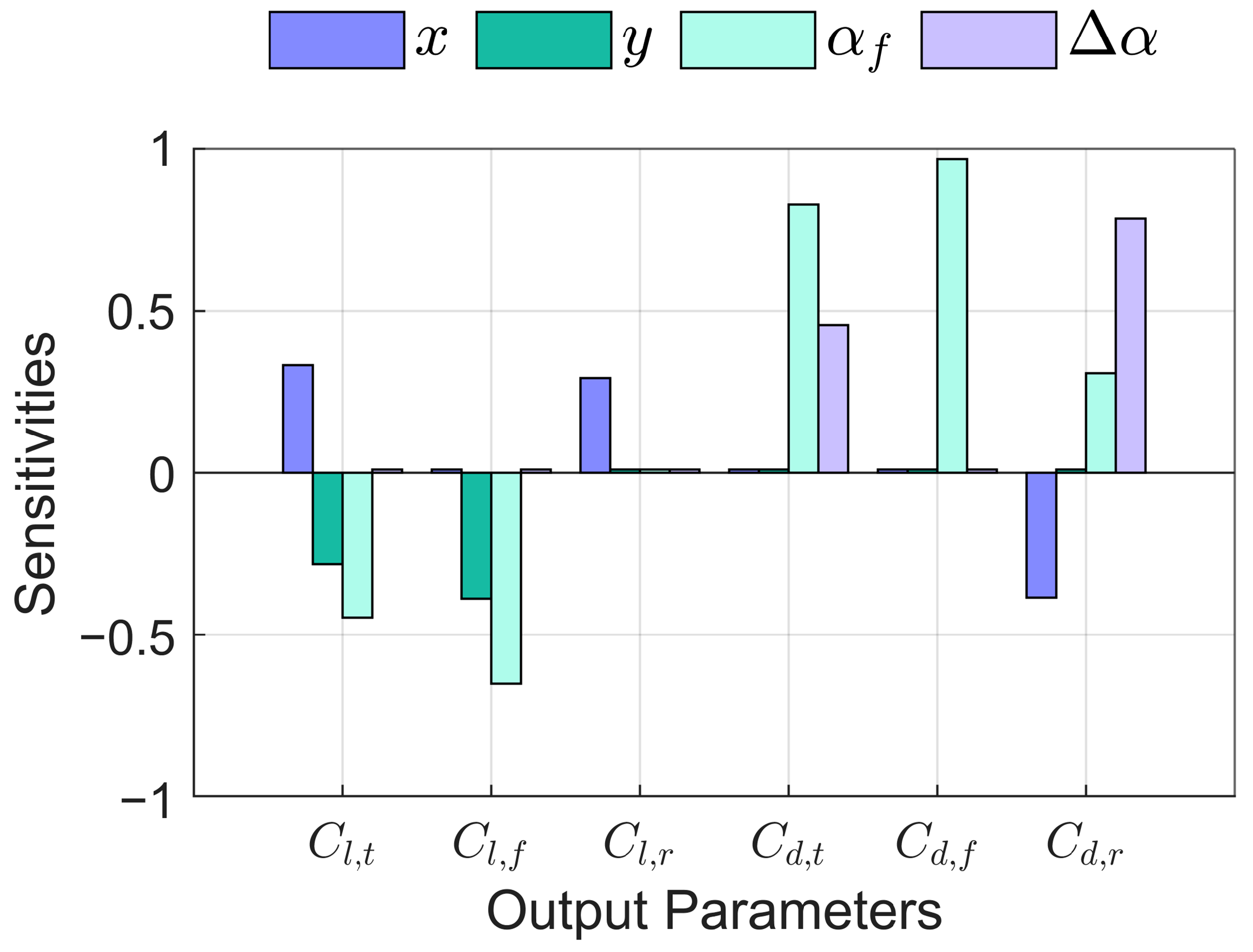
To further decouple and rank the independent impact of each input variable on the output responses, a Global Sensitivity Analysis (GSA) was conducted on the surrogate model, with the results presented in Figure 12. It can be observed that α f has a pronounced impact on all aerodynamic coefficients except C l , r , which is consistent with the common aerodynamic knowledge regarding the response of lift and drag to the angle of attack in single-airfoil scenarios. Therefore, the primary focus should be on observing the contribution levels of the other three design variables to the output parameters. The total lift coefficient is positively correlated with longitudinal separation and negatively correlated with vertical separation, and it is more sensitive to Δ x / c . Consequently, in the subsequent search for the maximum lift coefficient, constraining Δ x / c is adopted as a strategy. The lift coefficient of the fore airfoil is primarily influenced by the vertical separation, whereas the lift coefficient of the rear airfoil is predominantly regulated by the longitudinal separation. Regarding drag characteristics, reducing the angle of attack difference can improve the flow state of the rear airfoil, thereby enhancing the overall drag performance without significantly affecting the lift characteristics. Furthermore, while increasing the longitudinal separation can also reduce the drag of the rear airfoil, it yields no obvious effect in improving the overall drag characteristics of the system.
Based on the analyses of Figure 11 and Figure 12, the impacts of the design variables on system performance exhibit significant differences. The longitudinal separation Δ x / c is the core geometric parameter for regulating the favorable interference between the fore and rear airfoils to achieve lift enhancement. Based on this mechanism, to enable the optimization process to explore the physical mechanisms dominated by different geometric configurations more precisely—rather than merely capturing a single α f , dominating aerodynamic variation—independent optimization searches are conducted within partitioned intervals of 1 chord length. This partitioned search accurately evaluates the maximum lift coefficient boundaries of the system under various coupling distances.

4.2. Optimization Trajectory and Optimal Configurations

To ensure a consistent evaluation benchmark for the subspace search processes across different longitudinal separations, all optimizations are based on the GP surrogate model generated from the 100 computational results shown in Figure 8, rather than employing sequential update optimization. The BO method is employed to update the GP model. The convergence criterion for each subspace is set to a tolerance of C l , t below 10−3 with each search involving no more than 15 CFD evaluations. The final optimization results are presented in Table 4. Cases 111 through 120 represent the stepwise searches with an interval of 1 chord length, while Case 121 represents the global maximum lift coefficient optimization result without constraint on Δ x / c . As demonstrated by these results, the tandem-airfoil system is capable of consistently achieving an exceptionally high lifting capacity, with C l , t exceeding 3.4 across various longitudinal separations under these optimal parameter combinations.
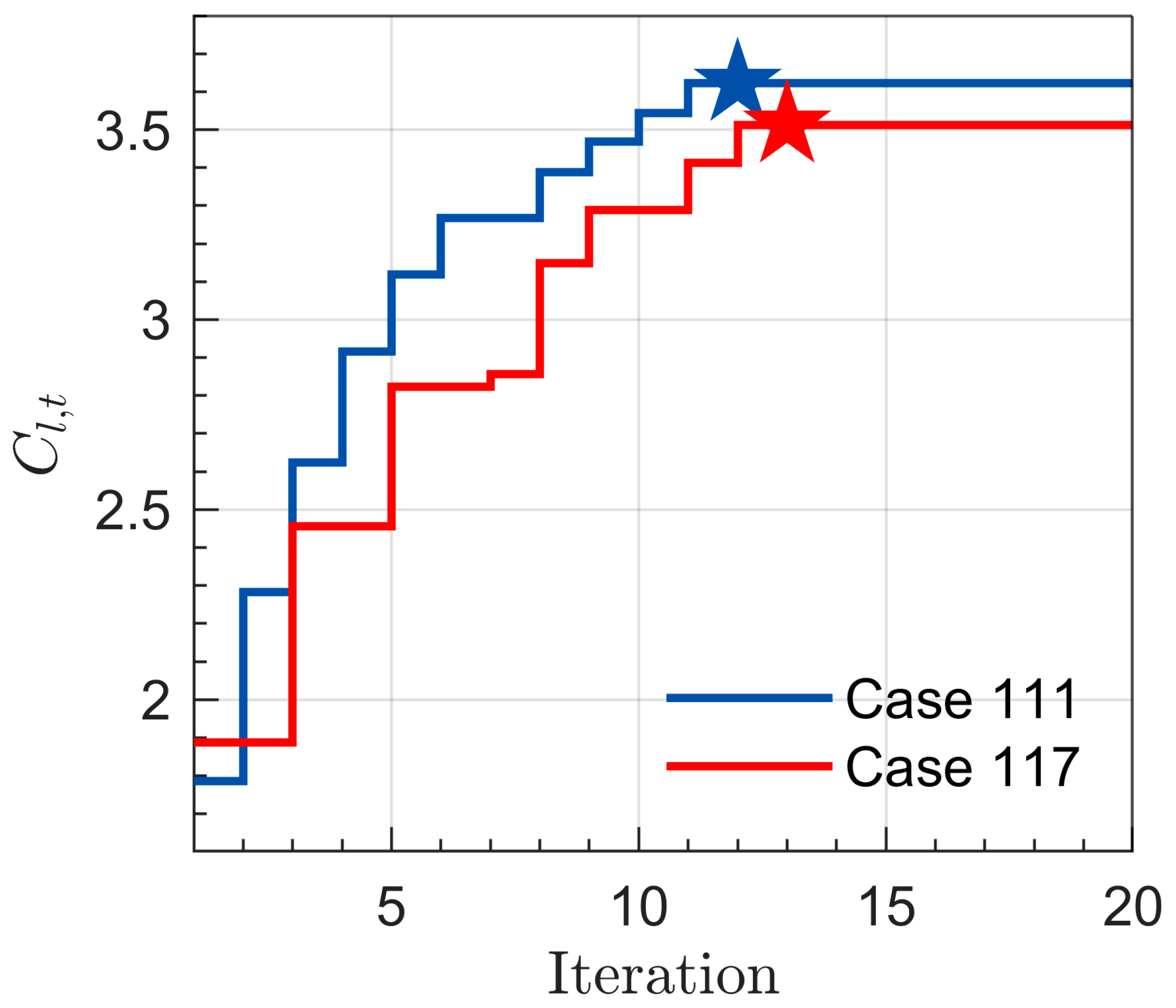
To explicitly demonstrate the algorithmic efficiency and robustness of the employed BO framework, Figure 13 presents the convergence histories for two representative configurations: the close-coupled Case 111 ( x = 1 c ) and the distant-coupled Case 117 ( x = 7 c ). As observed, the BO algorithm demonstrates rapid exploitation capabilities in the early stages. Within the first 4 to 6 iterations following the initial LHS sampling, C l , t experiences a steep ascent, swiftly approaching the optimal neighborhood. This steep gradient visually confirms that the EI acquisition function effectively guides the search toward high-yield regions. Following the initial rapid growth, the trajectories gradually level off and securely reach a stable plateau around the 10th to 12th iteration, indicating that the optimization has converged to the maximum lift limit within the specific spatial subspace. This asymptotic behavior visually validates the exceptional sample efficiency and reliable convergence capability of the framework. It proves that the BO framework achieves substantial aerodynamic performance gains and accurately locates the global optimum with a highly economical computational cost, effectively avoiding a large number of unnecessary high-fidelity evaluations.
Such reliable asymptotic convergence is fundamentally guaranteed by the synergistic combination of the highly accurate surrogate model and the uncertainty-driven exploration mechanism. As indicated by the relative error presented in Table 2 and Table 3, this model effectively controls the prediction error bounds. Consequently, the BO framework can robustly navigate the complex aerodynamic interference space and secure the true physical performance limits.
Regarding the vertical separation Δ y / c , it is observed that, except for Case 111 where Δ x / c is relatively small, the optimal results approach either the upper or lower boundaries of the design space. A similar trend exists for the fore airfoil angle of attack α f ; starting from Case 113, the optimal values are generally close to 14°. As for the angle of attack difference Δ α between the fore and rear airfoils, it exhibits a monotonically increasing trend as Δ x / c increases. However, a notable discrepancy in Δ α emerges using Δ x / c = 2 as a critical threshold: prior to this threshold, Δ α ± 1 , whereas beyond it, Δ α gradually increases from approximately 2.5° to 4°.
CFD computations were performed for the optimal design parameters identified in Table 4, and the results are illustrated in Figure 14. It can be observed that the distributions of the three lift coefficients are relatively dense. When Δ x / c is close to 1, there is a significant gain in the lift coefficients compared to other configurations; nevertheless, the aerodynamic state of the rear airfoil is suboptimal, with the fore airfoil contributing over 65% of the total lift. Regarding the drag coefficients, their distributions are relatively sparse. The C d , r is jointly influenced by the rear airfoil angle of attack and the longitudinal separation, although it remains predominantly dominated by α r .

4.3. Mechanism of Mode-Switching in Aerodynamic Interference

The optimization results in Table 4 reveal a unique “mode switching” phenomenon in the aerodynamic interaction of tandem airfoils. Specifically, as the longitudinal separation Δ x / c increases, the Δ α transitions from a negative value in the close-coupled state ( Δ x / c 1 ) to a positive value in the distant-coupled state ( Δ x / c > 2 ). To elucidate and analyze the physical mechanisms driving this phenomenon, two representative configuration schemes are selected for comparative CFD analysis: Case 122, representing direct wake interference in a close-coupled state, and Case 123, representing a quasi-isolated state where the fore and rear airfoils operate almost independently. Their parameters are based on the optimization results of Case 111 and Case 117, respectively, and have been regularized for engineering practicality, as detailed in Table 5.
The computation of the entire angle of attack sequence is achieved by rotating the initial mesh entirely around the aerodynamic center of the fore airfoil, thereby effectively avoiding discretization errors introduced by mesh reconstruction. Furthermore, considering that an angle of attack difference Δ α exists within the tandem-airfoil system, the actual geometric angles of attack for the fore and rear airfoils are not identical. To intuitively demonstrate the aerodynamic evolution of the entire system, the fore airfoil angle of attack is defined as the nominal angle of attack α * of the system. The aerodynamic data of the rear airfoil and the overall system are mapped to this nominal angle of attack for comparison, while the actual local geometric angle of attack of the rear airfoil is α * + Δ α .

4.3.1. Close-Coupled Configuration ( Δ x / c = 1 )

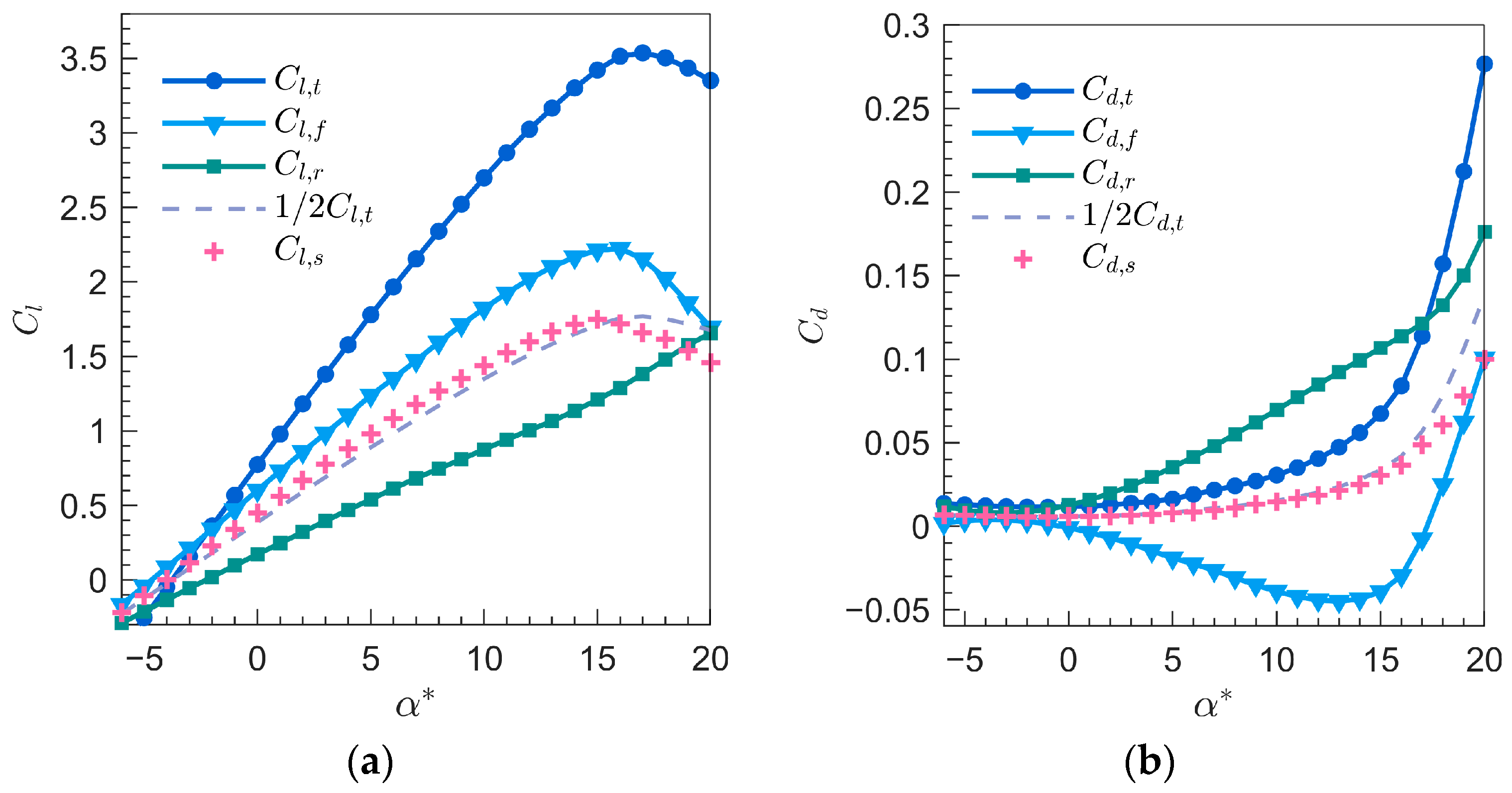
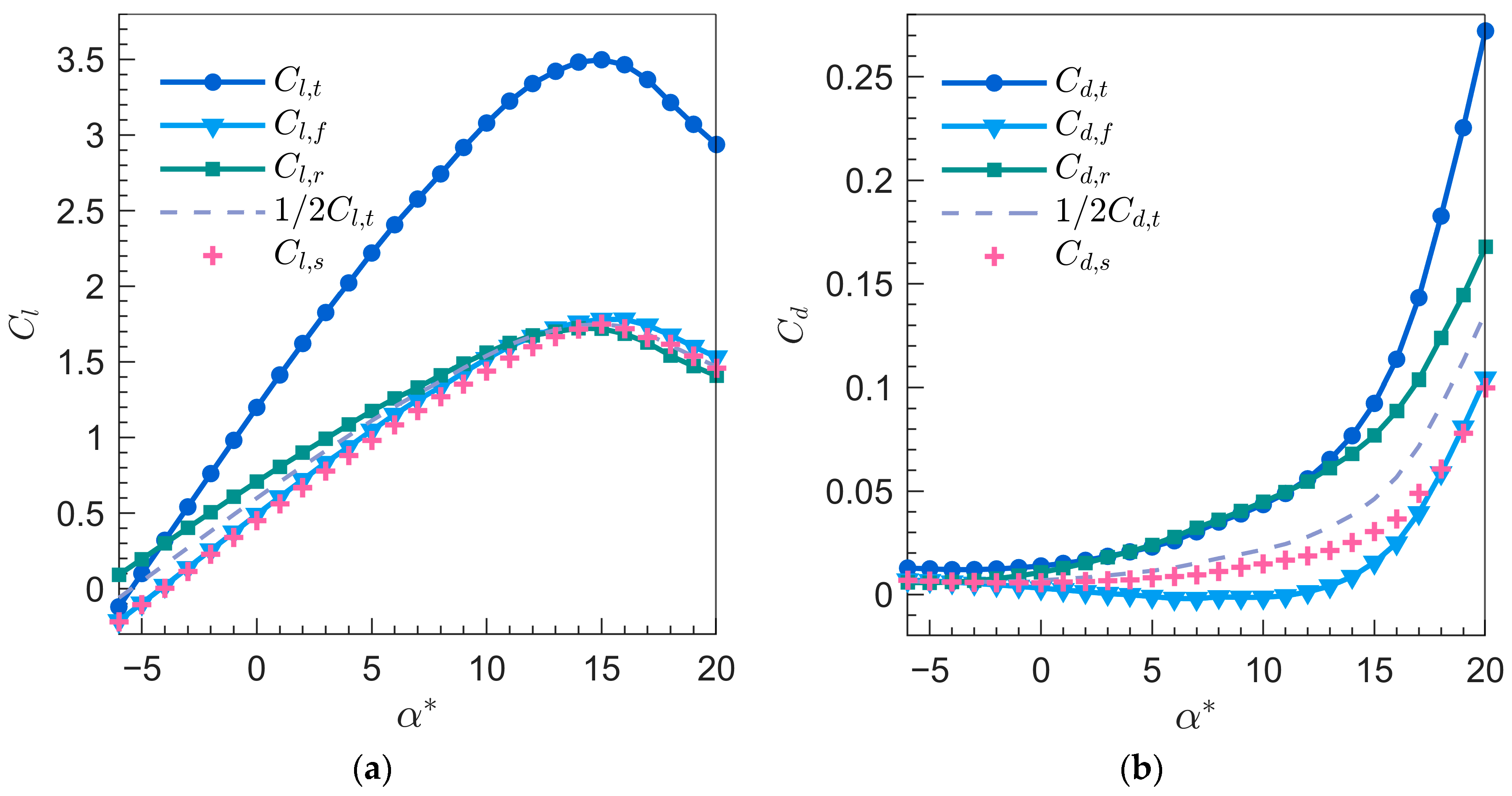
The variation in aerodynamic coefficients for the close-coupled configuration within the nominal angle of attack range of −6° to 20° is presented in Figure 15. Simultaneously, to better quantify the performance gains or losses induced by aerodynamic interference, the computational results of an isolated single airfoil under identical conditions, denoted as C l , s and C d , s , are introduced and represented by pink cross scatter points in the figure. In the linear region, the total lift coefficient C l , t exhibits a trend similar to that of the isolated single airfoil; half of the total lift coefficient, 1 / 2 C l , t , is fundamentally identical to the single airfoil’s C l , s . However, the maximum lift coefficient occurs at a higher angle of attack, and the lift reduction in the stall region is more gradual. A significant disparity exists in the load distribution between the fore and rear airfoils. The slope of the linear region for the fore airfoil lift coefficient C l , f increases substantially, significantly surpassing that of the single airfoil across the entire angle of attack range, thereby making it the primary contributor to the system’s lift. In contrast, both the magnitude and slope of the rear airfoil lift coefficient C l , r are lower than those of the single airfoil, and it remains entirely within the linear region across the current nominal angle of attack range. Considering Δ α , the angle of attack corresponding to its maximum lift coefficient is also evidently delayed.
As shown in Figure 15b, the emergence of negative drag manifesting as thrust on the fore airfoil in the close-coupled configuration is a noteworthy phenomenon. Specifically, within the α * range of 0° to 17°, the fore airfoil drag coefficient C d , f exhibits negative, indicating a forward thrust, while the system’s drag penalty is primarily borne by the rear airfoil. For α * < 15 , half of the total drag coefficient 1 / 2 C d , t of the tandem-airfoil system remains comparable to that of the single airfoil case, with the drag penalty increasing significantly only as the system enters the high-angle-of-attack stall regime.
Although counterintuitive, this phenomenon has been validated in the wind tunnel tests by Shah [7], where tightly arranged tandem systems also exhibited localized negative drag induced by intense pressure interference. From a physical perspective, as reported by Jestus [17,18] in the study of proximity effects, the high-pressure stagnation region of the rear airfoil creates aerodynamic blockage, inducing a strong upwash near the trailing edge of the fore airfoil. This upwash noticeably tilts the resultant aerodynamic force vector of the fore airfoil forward; under optimal geometric matching conditions, the forward-tilted lift component is sufficient to overcome the profile drag, thereby manifesting as a localized thrust effect. The present optimization framework can effectively screen the geometric parameter combinations that maximize this favorable interference effect.
To eliminate potential error factors originating from mesh computation, a mesh independence study was conducted for this state, as shown in Figure 16. The results confirm that the current mesh resolution is capable of accurately resolving this complex interference flow field.
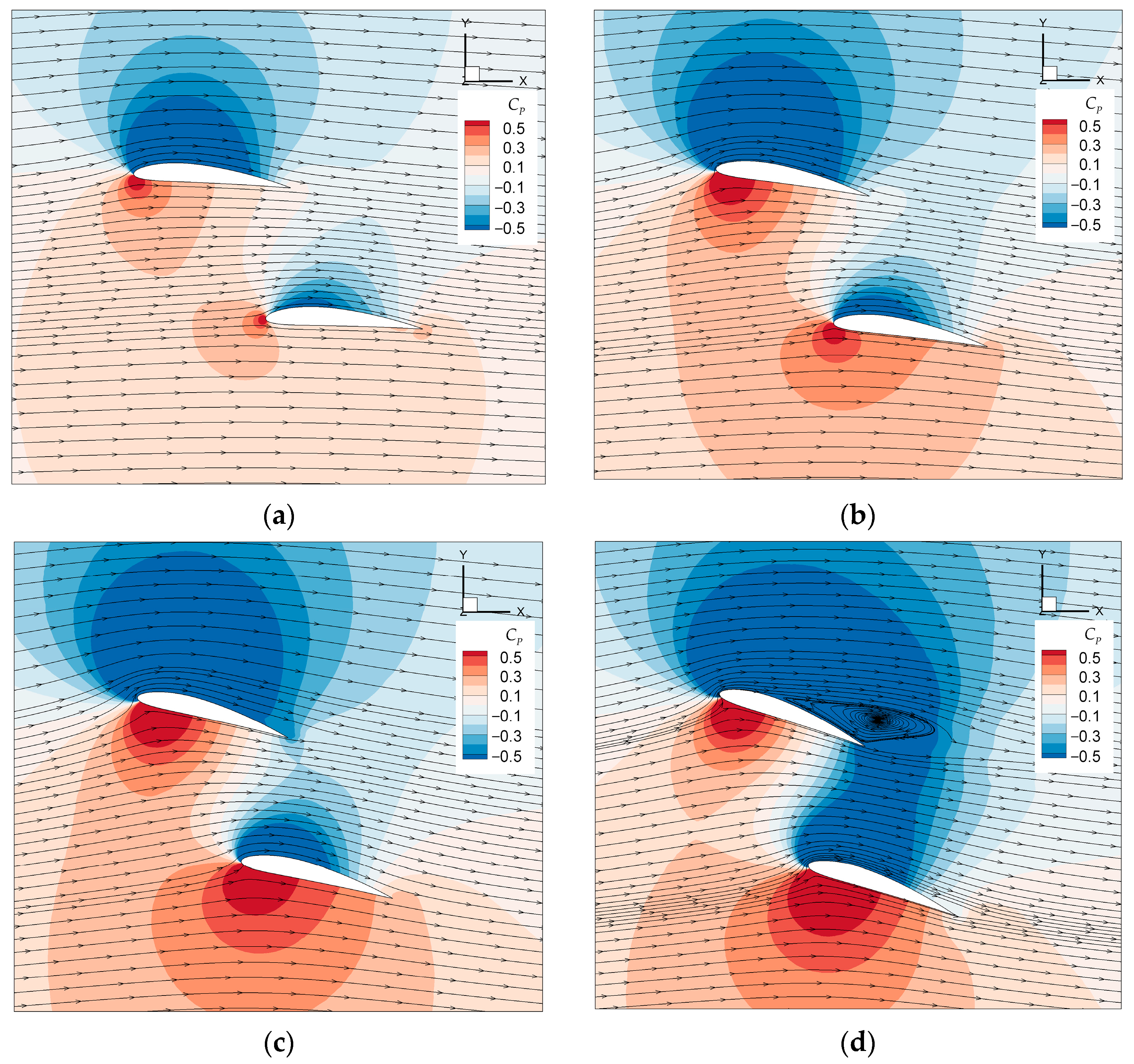
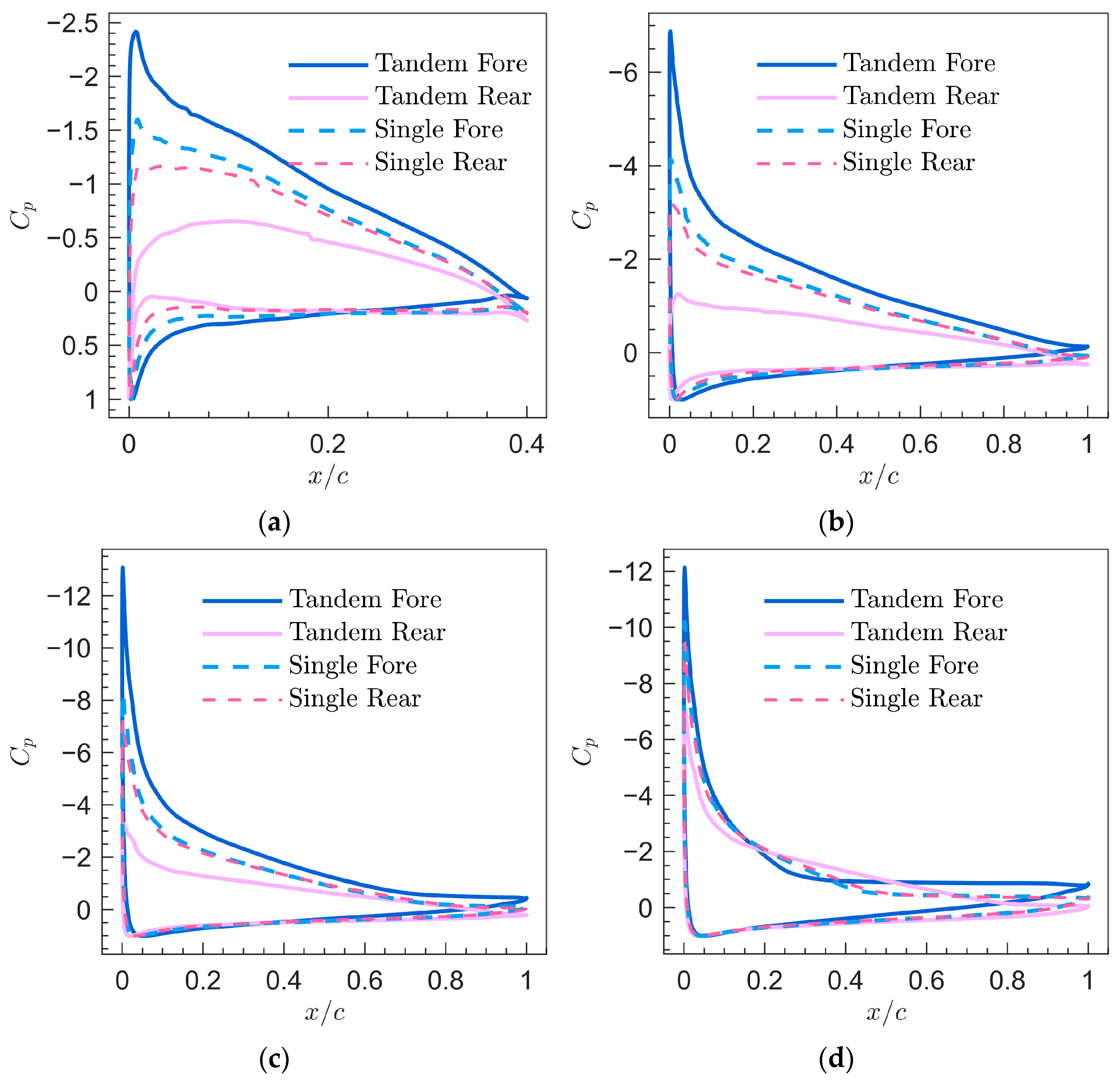
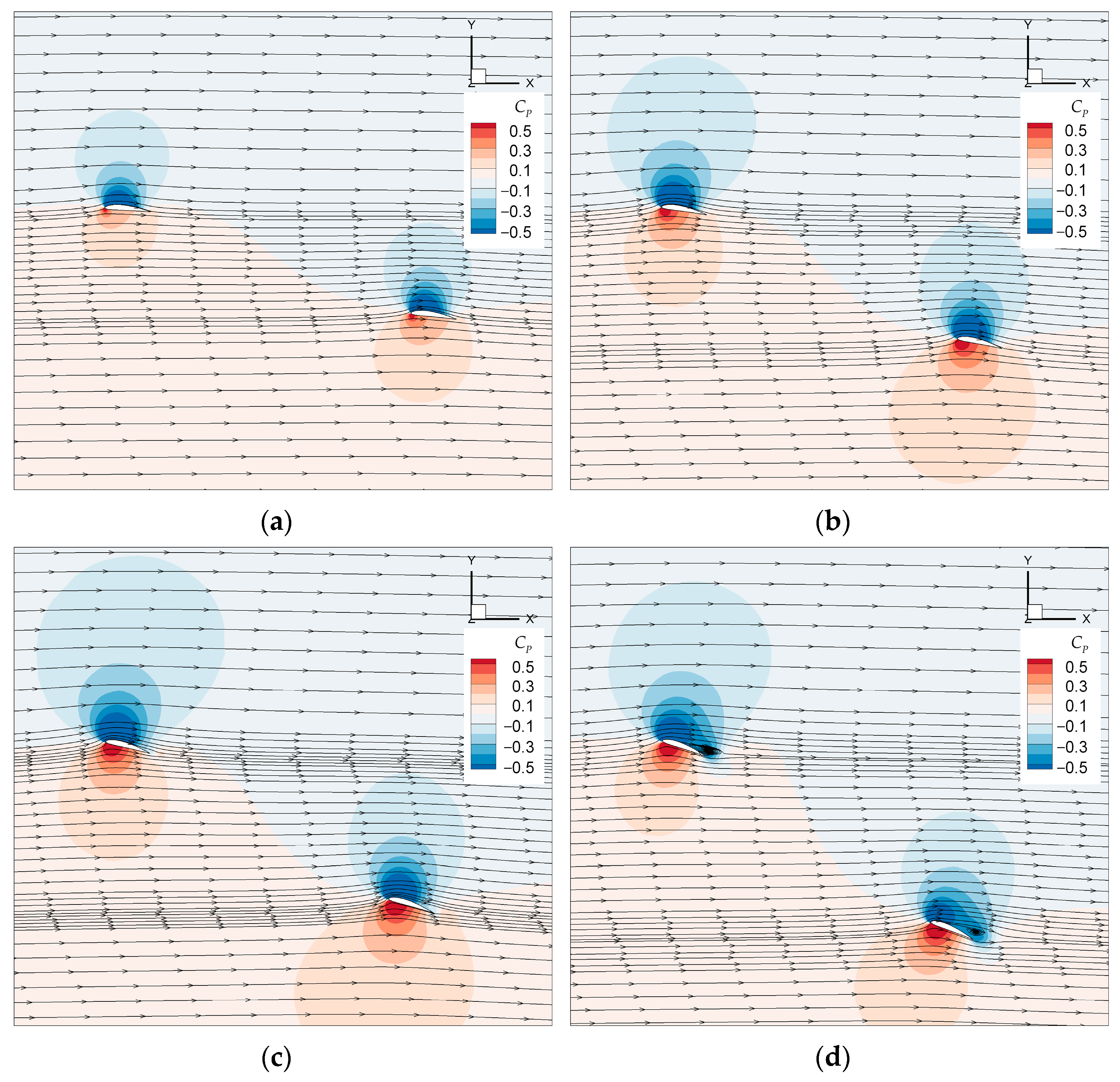
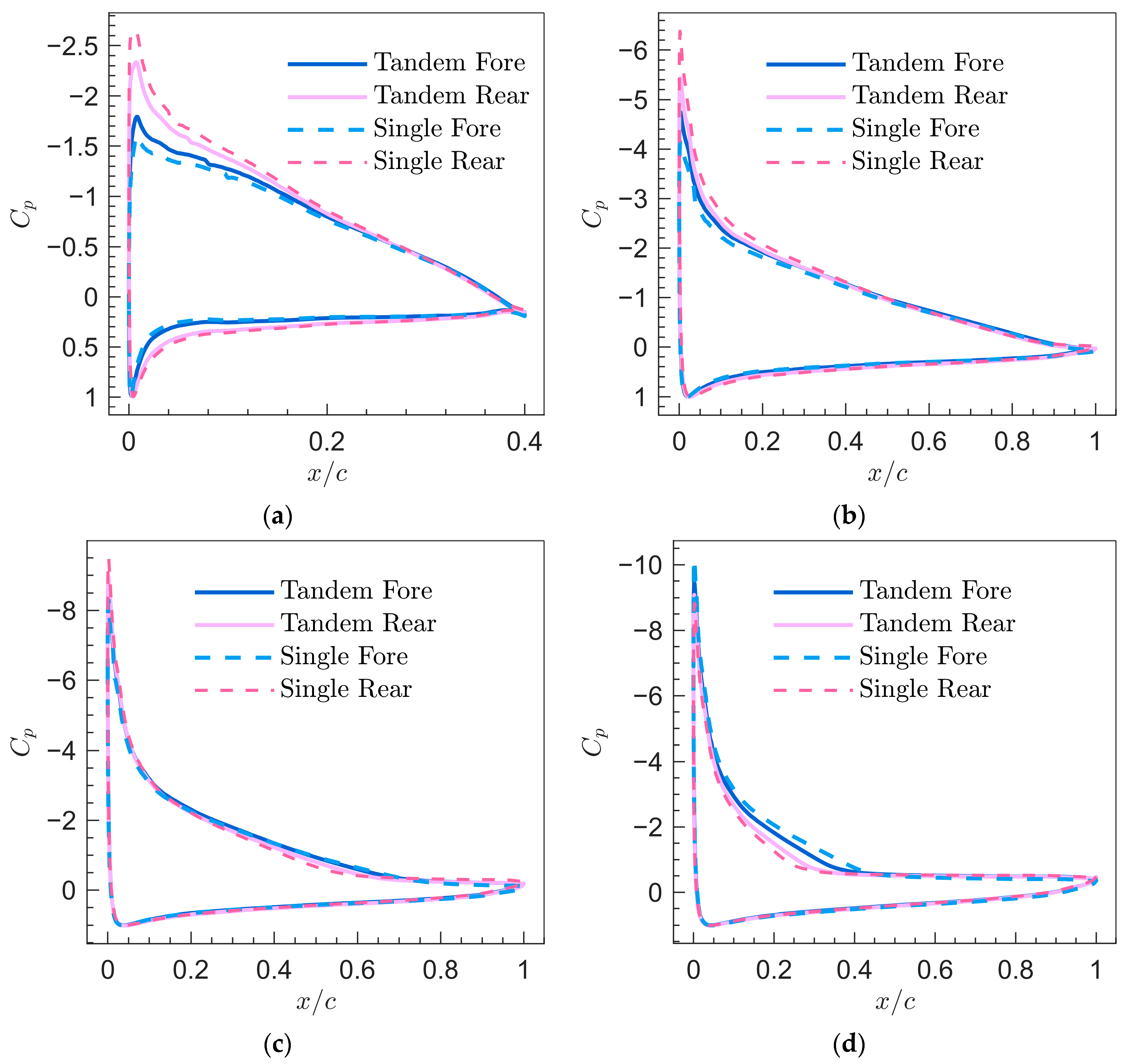
Figure 17 and Figure 18 present the pressure coefficient (Cp) contours overlaid with velocity streamlines, and the quantitative surface C p distributions, respectively, at four specific nominal angles of attack: 5°, 10°, 15°, and 20°. The pressure coefficients for the single airfoil correspond to the actual geometric angles of attack of the fore or rear airfoil. At the low-to-moderate angles of attack shown in Figure 17a,b, the flow field morphology superficially resembles that of two isolated airfoils, with no obvious interference. Nevertheless, the global Cp contours clearly reveal the merging of the high-pressure region of the rear airfoil and the low-pressure wake region of the fore airfoil, indicating a strong aerodynamic coupling. Meanwhile, the C p curves in Figure 18a,b distinctly reveal a strong “mutual induction effect”: compared to the single airfoil, the C p curve of the fore airfoil expands outward, enclosing a larger area, whereas the C p curve of the rear airfoil contracts inward. This occurs because the presence of the rear airfoil exerts a strong upwash effect on the fore airfoil, which is equivalent to increasing the effective angle of attack of the fore airfoil and tilting its aerodynamic force vector forward. This also explains the surge in fore airfoil lift and the generation of negative drag observed in Figure 15. Concurrently, the downwash effect induced by the fore airfoil wake reduces the effective angle of attack of the rear airfoil, resulting in a decrease in its lift. As the angle of attack approaches the maximum lift point, the slot flow between the two airfoils becomes particularly critical. Notably, the airflow decelerates significantly at the slot entrance due to the blockage from the high-pressure stagnation region of the rear airfoil, and is subsequently forced to re-accelerate over the upper surface of the rear airfoil. This flow blockage effect further elevates the pressure on the lower surface of the fore airfoil, causing the C p peak of the fore airfoil in Figure 18c to be exceptionally high, far exceeding the levels of both the single airfoil and the rear airfoil. At the stall angle of attack α * = 20 , a massive low-speed recirculation zone appears on the upper surface of the fore airfoil, and its C p curve exhibits distinct upturning and flattening at the trailing edge, confirming that deep stall separation has occurred on the fore airfoil. However, as illustrated in Figure 17d, due to the strong entrainment effect between the fore airfoil downwash and the rear airfoil leading edge, the accelerated airflow passing through the slot connects with the trailing edge of the fore airfoil, significantly improving the local flow field of the rear airfoil. This is reflected in Figure 18d, where the negative pressure on both the upper and lower surfaces of the fore airfoil is enhanced compared to the single airfoil, and the negative pressure in the mid-section of the rear airfoil’s upper surface is maintained at a higher level than that of the single airfoil. This mechanism elucidates the unique advantage observed in Figure 15a, where the rear airfoil continues to provide sustained lift at high angles of attack.
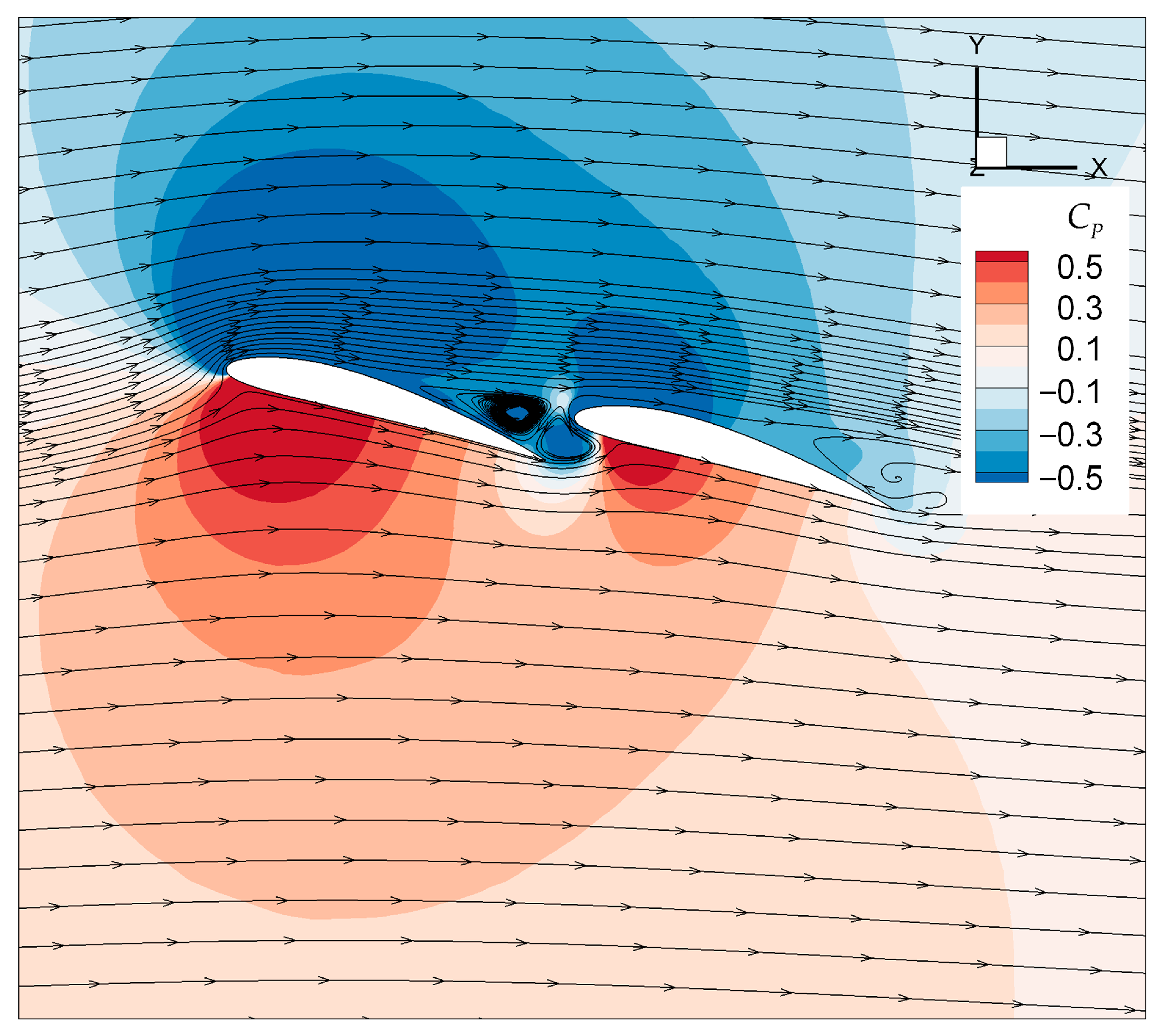
To provide a deeper comparative perspective on the optimization results, a representative poor-performing configuration from the initial LHS sampling, designated as Case 22, is evaluated. Notably, Case 22 possesses a longitudinal separation of x = 1.0476 c , which is almost identical to the optimal close-coupled layout. Its other geometric parameters are y = 0.1465 c and Δ α = 0.0816 . At an angle of attack of α * = 15.9866 , this configuration yields a total lift coefficient of C l , t = 2.5061 , which is drastically lower than the C l , t = 3.5134 achieved by the optimized close-coupled configuration at α * = 16 . Figure 19 illustrates the corresponding Cp contours overlaid with velocity streamlines for this scenario. In stark contrast to the optimized case, the inappropriate combination of vertical separation and angle of attack difference at this tightly coupled position induces a severe “choking” effect. As clearly visualized, the low-pressure wake from the fore airfoil directly impinges on the upper surface of the rear airfoil. This severe adverse interference completely destroys the leading-edge suction peak of the rear airfoil and triggers massive boundary layer separation. This stark comparison at nearly identical longitudinal stations underscores the extreme nonlinearity and parameter sensitivity of tandem-airfoil interference. It visually demonstrates that deviations in geometric parameter matching can lead to substantial aerodynamic degradation, further illustrating the necessity and effectiveness of the proposed BO framework in precisely identifying the narrow corridor of favorable aerodynamic coupling.

4.3.2. Distant-Coupled Configuration ( Δ x / c = 7 )

In contrast to the strong interference observed in the close-coupled configuration, when the longitudinal separation is increased to Δ x / c = 7 , the fore and rear airfoils of the tandem-airfoil system degenerate into a quasi-isolated state of weak interference. As depicted by the aerodynamic coefficients in Figure 20, half of the system’s total lift coefficient 1 / 2 C l , t is nearly identical to that of the isolated single airfoil C l , s , with only a slight elevation in the linear region. Specifically, the fore airfoil lift coefficient C l , f perfectly matches the single airfoil case, indicating that the fore airfoil has completely decoupled from the upwash induction effect of the rear airfoil present in the close-coupled configuration. In contrast, the higher lift coefficient of the rear airfoil C l , r compared to the single airfoil case arises from favorable interaction with the residual upwash field and turbulent kinetic energy in the fore airfoil wake, a phenomenon consistent with the energy-injection mechanisms discussed in existing DNS studies [9,10].
Regarding drag performance in Figure 20b, the total drag of the distant-coupled configuration is higher than that of the optimized close-coupled layout shown in Figure 15b. The drag of the distant-coupled system represents the conventional aerodynamic accumulation of two independent lifting surfaces, while the lower total drag in the close-coupled case is a direct manifestation of the localized thrust on the fore airfoil. As the angle of attack exceeds 17 , the favorable interference mechanisms in the close-coupled configuration break down, causing its total drag to increase sharply and eventually approach the level of the distant-coupled configuration. The corresponding mesh independence study, as shown in Figure 21, further corroborates the reliability of the numerical predictions under this weak interference state.
The Cp contours and streamlines in Figure 22 visually reflect this quasi-isolated characteristic. The high- and low-pressure spatial fields surrounding the two airfoils are completely separated. Across all angles of attack, the flow field distributions surrounding the fore and rear airfoils are largely independent of one another. Because the optimal configuration features a specific vertical separation, the wake generated by the fore airfoil, as it evolves downstream, passes precisely above the rear airfoil, thereby avoiding direct interference with the rear airfoil’s boundary layer.
Combining the pressure coefficient C p distributions in Figure 23 allows for a more refined quantification of this weak interference mechanism. The pressure distribution of the fore airfoil nearly completely overlaps with that of the isolated single airfoil at all angles of attack. In the linear region ( α * = 5 or 10 ), the primary discrepancy is the enhancement of the suction peak on the upper surface, while at the high angle of attack ( α * = 20 ), the negative pressure coefficient becomes smaller (more negative) after moving rearward to the 0.1~0.4c region. Overall, it can be fundamentally concluded that the fore airfoil remains unaffected by the rear airfoil. For the rear airfoil, the overall morphology of its C p curve is similarly consistent with that of the single airfoil; however, a minor drop occurs at the leading-edge suction peak. This marginal suction attenuation in the linear lift region demonstrates that, although the fore airfoil wake does not directly impinge upon the rear airfoil, the far-field downwash generated by the fore airfoil still slightly reduces the local effective angle of attack of the rear airfoil. This also explains the phenomenon observed in the optimization results in Table 5, where the angle of attack difference in the rear airfoil gradually transitions to a positive value and continuously increases as the longitudinal separation between the airfoils expands. This represents an attempt to passively compensate for the effective angle of attack and lift losses caused by the downwash flow by increasing the geometric installation angle of the rear airfoil.
Comprehensively comparing the two configurations, the reversal and increase in the Δ α sign in the optimization results reflect the fundamental transformation of the aerodynamic interference mechanism in tandem airfoils. In the close-coupled region ( Δ x / c = 1 ), the system operates in a “synergistic coupling mode”. Strong upwash induction and flow blockage effects enable the fore airfoil to acquire an additional thrust component, while the slot flow delays the rear airfoil stall. Consequently, a negative angle of attack difference can adapt to this distorted local flow field and maximize the slot acceleration effect. Conversely, as the longitudinal separation increases to Δ x / c = 7 , the system transitions into a “decoupled compensation mode”. The beneficial induction from the fore airfoil to the rear airfoil vanishes, replaced by unidirectional wake downwash interference. This shifts the optimization strategy to passively compensating for the effective angle of attack loss by increasing the rear airfoil’s angle of attack difference. This mechanism transition—from exploiting flow field coupling to compensating for aerodynamic losses—is the fundamental reason how tandem airfoils achieve maximum lift under varying separations.

5. Conclusions

Targeting the tandem-airfoil configuration under typical low-altitude conditions with a high Reynolds number of Re = 6 × 10⁶, this study establishes a highly efficient aerodynamic design framework integrating numerical simulation and Bayesian Optimization. By introducing the γ Re θ t transition model and combining it with an intra-layer replacement LHS strategy, this research leverages a GP surrogate model and BO to successfully and accurately capture the four-dimensional highly nonlinear aerodynamic boundaries—encompassing longitudinal separation, vertical separation, fore airfoil angle of attack, and angle of attack difference—utilizing merely 100 high-fidelity samples. Furthermore, the optimal configuration targeting the maximum total lift coefficient is successfully resolved. The core aerodynamic physical principles derived from this study are summarized as follows:
  • Determination of the Interference Mode Boundary: Global sensitivity analysis and optimization results demonstrate that the longitudinal separation ( Δ x / c ) is the core geometric parameter dictating the aerodynamic interference characteristics of tandem airfoils. Utilizing Δ x / c 2 as the critical threshold, the aerodynamic interference mechanism of the system exhibits a distinct “mode switching” phenomenon.
  • Close-Coupled Synergistic Lift Enhancement Mode: Within the close-coupled regime characterized by small separations, robust mutual induction exists between the fore and rear airfoils. The upwash effect from the rear airfoil significantly increases the effective angle of attack of the fore airfoil and tilts its aerodynamic force vector forward, thereby generating a unique thrust component (manifested as a negative drag coefficient for the fore airfoil). Concurrently, by selecting a negative optimal angle of attack difference, the optimized configuration exploits the slot acceleration effect to inject energy into the boundary layer on the upper surface of the rear airfoil, effectively delaying rear airfoil stall.
  • Distant-Coupled Decoupled Compensation Mode: As the separation increases into the distant-coupled regime, the system degenerates into a unidirectional interference dominated by the fore airfoil wake downwash. The downwash flow field generated by the fore airfoil significantly diminishes the effective angle of attack of the rear airfoil. To sustain the lift contribution, the optimization strategy transitions towards decoupling; specifically, it necessitates the physical increment of the rear airfoil’s installation angle by imposing a larger positive angle of attack difference to passively compensate for the aerodynamic loss in the effective angle of attack.
Ultimately, this study demonstrates the engineering utility of integrating Bayesian optimization with high-fidelity CFD to exploit favorable tandem-wing interference. The proposed framework provides an efficient tool for the preliminary design phase, successfully isolating geometric configurations that yield significant aerodynamic performance gains. Building upon the two-dimensional interactions elucidated in this study, future research will focus on extending this optimization methodology to three-dimensional wing designs across diverse flight envelopes. Furthermore, the extreme pressure interactions and localized thrust effects identified herein establish a theoretical basis for subsequent experimental explorations. Future wind tunnel testing will serve to empirically corroborate these highly nonlinear phenomena. Such follow-up works can lay down systematic design criteria and further support the development of high-performance tandem-wing UAVs.

Author Contributions

Conceptualization, J.L. and T.X.; methodology, J.L. and T.X.; software, J.L.; validation, J.L., T.X. and H.G.; formal analysis, J.L.; investigation, H.G., J.L. and T.X.; resources, H.G., T.X., H.S. and H.D.; data curation, H.G. and J.L.; writing—original draft preparation, J.L.; writing—review and editing, T.X. and H.D.; visualization, J.L.; supervision, T.X. and H.D.; project administration, H.G., T.X., H.S. and H.D.; funding acquisition, T.X. and H.D. All authors have read and agreed to the published version of the manuscript.

Funding

This research was funded by Distinguished Young Scholars of Jiangsu Province, grant number BK20230030. This research was funded by National Natural Science Foundation of China, grant number 52502444. This research was funded by Civil Aircraft Special Project Foundation of Ministry of Industry and Information Technology, grant number MJZ1-8N22.

Institutional Review Board Statement

Not applicable.

Informed Consent Statement

Not applicable.

Data Availability Statement

The raw data supporting the conclusions of this article will be made available by the authors on request.

Acknowledgments

During the preparation of this manuscript, the authors used Gemini-3 for the purposes of grammar and language checking. The authors have reviewed and edited the output and take full responsibility for the content of this publication. This work is partially supported by High Performance Computing Platform of Nanjing University of Aeronautics and Astronautics.

Conflicts of Interest

The authors declare no conflicts of interest.

Abbreviations

The following abbreviations are used in this manuscript:
UAVsUnmanned aerial vehicles
eVTOLElectric vertical takeoff and landing
PLIFPlanar laser-induced fluorescence
DNSDirect numerical simulation
CFDComputational fluid dynamics
MFDNNMulti-fidelity deep neural network
BOBayesian optimization
LHSLatin hypercube sampling
GPGaussian process
URANSUnsteady Reynolds-averaged Navier–Stokes
SSTShear stress transport
MCSMonte Carlo simulation
SESquared exponential
PIProbability of improvement
EIExpected improvement
UCBUpper confidence bound
CDFCumulative distribution function
PDFProbability density function
GSAGlobal sensitivity analysis

References

  1. Laitone, E.V. Prandtl’s Biplane Theory Applied to Canard and Tandem Aircraft. J. Aircr. 1980, 17, 233–237. [Google Scholar] [CrossRef]
  2. Cheng, H.; Wang, H. Prediction of Lift Coefficient for Tandem Wing Configuration or Multiple-Lifting-Surface System Using Prandtl’s Lifting-Line Theory. Int. J. Aerosp. Eng. 2018, 2018, 3104902. [Google Scholar] [CrossRef]
  3. Minardo, A. The Tandem Wing: Theory, Experiments and Practical Realisations; Politecnico di Milano: Milano, Italy, 2014. [Google Scholar]
  4. Brinkworth, B.J. On the Aerodynamics of the Miles Libellula Tandem-Wing Aircraft Concept, 1941–1947. J. Aeronaut. Hist. Pap. 2016, 6, 10–58. [Google Scholar]
  5. Yang, G. State Filtered Disturbance Rejection Control. Nonlinear Dyn. 2025, 113, 6739–6755. [Google Scholar] [CrossRef]
  6. Yang, G. Multilayer Neuroadaptive Reinforcement Learning of Disturbed Nonlinear Systems via Actor-Critic Mechanism. IEEE Trans. Autom. Sci. Eng. 2026, 23, 1372–1381. [Google Scholar] [CrossRef]
  7. Shah, S.H.R. Aerodynamics of Wings in Tandem at Low Reynolds Numbers; Auburn University: Auburn, AL, USA, 2023. [Google Scholar]
  8. Shah, S.H.R.; Ahmed, A. Experimental Investigation of Wings in Tandem. In Proceedings of the AIAA AVIATION 2022 Forum, Chicago, IL, USA, 27 June–1 July 2022; American Institute of Aeronautics and Astronautics: Reston, VA, USA, 2022. [Google Scholar]
  9. Pandi, J.S.S.; Kumar, P. Aerodynamic Characteristics of Flow Past Tandem Wing. Phys. Fluids 2025, 37, 123604. [Google Scholar] [CrossRef]
  10. Zhao, C.; Wang, D.; Yu, T.; Xu, H. Direct Numerical Simulation of Tandem-Wing Aerodynamic Interactions at Low Reynolds Number. AIAA J. 2024, 62, 1–50. [Google Scholar] [CrossRef]
  11. Xiang, B.; Tao, G.; Jin, L.; Zhang, J.; Chen, J. CFD Aerodynamic Analysis of Tandem Tilt-Wing UAVs in Cruise Flight and Tilt Transition Flight. Drones 2025, 9, 522. [Google Scholar] [CrossRef]
  12. Rhodes, M.D.; Selberg, B.P. Benefits of Dual Wings over Single Wings for High-Performance Business Airplanes. J. Aircr. 1984, 21, 116–127. [Google Scholar] [CrossRef]
  13. Broering, T.; Lian, Y. The Effect of Wing Spacing on Tandem Wing Aerodynamics. In Proceedings of the 28th AIAA Applied Aerodynamics Conference, Chicago, IL, USA, 28 June–1 July 2010; American Institute of Aeronautics and Astronautics: Chicago, IL, USA, 2010. [Google Scholar]
  14. Masri, J.; Ismail, M. Numerical Analysis of the Aerodynamic Characteristics of Tandem NACA 4412 Airfoils under Heated Wake Influence. J. Adv. Res. Numer. Heat Trans. 2025, 32, 68–83. [Google Scholar] [CrossRef]
  15. Kleinert, J.; Stober, J.; Lutz, T. Numerical Simulation of Wake Interactions on a Tandem Wing Configuration in High-Speed Stall Conditions. CEAS Aeronaut. J. 2023, 14, 171–186. [Google Scholar] [CrossRef]
  16. Zhang, Q.; Xue, R.; Li, H. Aerodynamic Exploration for Tandem Wings with Smooth or Corrugated Surfaces at Low Reynolds Number. Aerospace 2023, 10, 427. [Google Scholar] [CrossRef]
  17. Jestus, N. Aerodynamic Characterization of Multiple Wing-Wing Interactions for Distributed Lift Applications. Master’s Thesis, University of Dayton, Dayton, OH, USA, 2023. [Google Scholar]
  18. Jestus, N.; Gunasekaran, S.; Mongin, M.P.; Altman, A. Aerodynamic Characterization of Wing-Wing Interactions for Distributed Lift Applications. In Proceedings of the AIAA SCITECH 2023 Forum, National Harbor, MD, USA, 23–27 January 2023; American Institute of Aeronautics and Astronautics: National Harbor, MD, USA, 2023. [Google Scholar]
  19. Figat, M. A Strategy of the Longitudinal Control for the Tandem Wing Configuration Design. Aircr. Eng. Aerosp. Technol. 2022, 95, 155–169. [Google Scholar] [CrossRef]
  20. Cai, Z.; Yu, Z.; Niu, H. Aerodynamic Optimization Design of Tandem-Wing Configurations Based on Multi-Fidelity Deep Neural Networks. Results Eng. 2025, 28, 107300. [Google Scholar] [CrossRef]
  21. Chaitanya, P.; Vellanki, P. Bayesian Optimisation for Low-Noise Aerofoil Design with Aerodynamic Constraints. Int. J. Aeroacoustics 2021, 20, 109–129. [Google Scholar] [CrossRef]
  22. Abbott, I.H.; Doenhoff, A.E.V. Theory of Wing Sections; Dover Publications: Garden City, NY, USA, 1959. [Google Scholar]
  23. Celik, I.B.; Ghia, U.; Roache, P.J.; Freitas, C.J.; Coleman, H.; Raad, P.E. Procedure for Estimation and Reporting of Uncertainty Due to Discretization in CFD Applications. J. Fluids Eng. 2008, 130, 078001. [Google Scholar] [CrossRef]
  24. Blazek, J. Computational Fluid Dynamics: Principles and Applications; Butterworth-Heinemann: Oxford, UK, 2015. [Google Scholar]
  25. Langtry, R.B.; Menter, F.R.; Likki, S.R.; Suzen, Y.B.; Huang, P.G.; Volker, S. A Correlation-Based Transition Model Using Local Variables: Part II: Test Cases and Industrial Applications. J. Turbomach. Trans. ASME 2006, 128, 423–434. [Google Scholar] [CrossRef]
  26. Chen, L.; Guo, Z.; Deng, X.; Hou, Z. Aerodynamic Performance and Transition Prediction of Low-Speed Fixed-Wing Unmanned Aerial Vehicles in Full Configuration Based on Improved γ—Reθ Model. Aerosp. Sci. Technol. 2020, 107, 106281. [Google Scholar] [CrossRef]
  27. Sun, S.; Wang, L.; Wei, G.; Tian, X.; Zhu, H.; Zhou, L.; Ji, L. Application of Compressibility Corrected γ-Reθt Transition Model in Turbomachinery. J. Aerosp. Power 2026, 41, 20240657. [Google Scholar] [CrossRef]
  28. Mani, M.; Dorgan, A.J. A Perspective on the State of Aerospace Computational Fluid Dynamics Technology. Annu. Rev. Fluid Mech. 2023, 55, 431–457. [Google Scholar] [CrossRef]
  29. Roache, P.J. Perspective: A Method for Uniform Reporting of Grid Refinement Studies. J. Fluids Eng. 1994, 116, 405–413. [Google Scholar] [CrossRef]
  30. Roache, P.J. Verification and Validation in Computational Science and Engineering; Hermosa Publishers: Albuquerque, NM, USA, 1998. [Google Scholar]
  31. Wang, N.; Chang, X.; Ma, R.; Zhang, L. Verification and Validation of HyperFLOW Solver for Subsonic and Transonic Turbulent Flow Simulations on Unstructured/Hybrid Grids. Chin. J. Theor. Appl. Mech. 2019, 51, 813–825. [Google Scholar] [CrossRef]
  32. Greenhill, S.; Rana, S.; Gupta, S.; Vellanki, P.; Venkatesh, S. Bayesian Optimization for Adaptive Experimental Design: A Review. IEEE Access 2020, 8, 13937–13948. [Google Scholar] [CrossRef]
  33. Li, Y. CFD Verification and Validation Research Based on Real Flight Data of Civil Aircraft. Doctoral Dissertation, Nanjing University of Aeronautics and Astronautics, Nanjing, China, 2022. [Google Scholar]
  34. Jin, S.-S.; Kim, G.; Kwag, S.; Eem, S. Feasibility Study of Progressive Latin Hypercube Sampling and Quasi-Monte Carlo Simulation for Probabilistic Risk Assessment. Geomat. Nat. Hazards Risk 2024, 15, 2425185. [Google Scholar] [CrossRef]
  35. Mckay, M.D.; Beckman, R.J.; Conover, W.J. A Comparison of Three Methods for Selecting Values of Input Variables in the Analysis of Output from a Computer Code. Technometrics 1979, 42, 55–61. [Google Scholar] [CrossRef]
  36. Zhong, R.; Yu, J.; Zhang, C.; Munetomo, M. SRIME: A Strengthened RIME with Latin Hypercube Sampling and Embedded Distance-Based Selection for Engineering Optimization Problems. Neural Comput. Appl. 2024, 36, 6721–6740. [Google Scholar] [CrossRef]
  37. Loeppky, J.L.; Sacks, J.; Welch, W.J. Choosing the Sample Size of a Computer Experiment: A Practical Guide. Technometrics 2009, 51, 366–376. [Google Scholar] [CrossRef]
  38. Rasmussen, C.E.; Williams, C.K.I. Gaussian Processes for Machine Learning; Adaptive Computation and Machine Learning Series; The MIT Press: Cambridge, MA, USA, 2005. [Google Scholar]
  39. Kushner, H.J. A New Method of Locating the Maximum Point of an Arbitrary Multipeak Curve in the Presence of Noise. J. Basic Eng. 1964, 86, 97–106. [Google Scholar] [CrossRef]
  40. Srinivas, N.; Krause, A.; Kakade, S.M.; Seeger, M.W. Information-Theoretic Regret Bounds for Gaussian Process Optimization in the Bandit Setting. IEEE Trans. Inf. Theory 2012, 58, 3250–3265. [Google Scholar] [CrossRef]
Figure 1. Computational domain and mesh topology for the NACA 4412 airfoil: (a) computational domain; (b) mesh topology.
Applsci 16 05145 g001
Figure 2. Computational results for mesh independence verification: (a) lift coefficient versus angle of attack; (b) drag coefficient versus angle of attack; (c) convergence of lift coefficient with mesh refinement at representative angles of attack; (d) convergence of drag coefficient with mesh refinement at representative angles of attack.
Applsci 16 05145 g002
Figure 3. Apparent order of convergence for the computational results: (a) lift coefficient; (b) drag coefficient.
Applsci 16 05145 g003
Figure 4. Comparison with experimental data [22]: (a) lift coefficient; (b) drag coefficient.
Applsci 16 05145 g004
Figure 5. Design configuration parameters.
Applsci 16 05145 g005
Figure 6. Comparison of 30 sample points generated by different sampling methods: (a) Monte Carlo simulation; (b) Latin hypercube sampling.
Applsci 16 05145 g006
Figure 7. LHS sample generation utilizing the intra-layer replacement strategy: (a) Δ x / c and Δ y / c ; (b) α f and Δ α .
Applsci 16 05145 g007
Figure 8. Computational results of the sample points.
Applsci 16 05145 g008
Figure 9. Bayesian optimization loop.
Applsci 16 05145 g009
Figure 10. Computational results of the verification points.
Applsci 16 05145 g010
Figure 11. Linear correlation matrix.
Applsci 16 05145 g011
Figure 12. Parameter sensitivity analysis.
Applsci 16 05145 g012
Figure 13. Convergence histories of the Bayesian optimization process for representative configurations. The stars indicate the identified convergence points for each case.
Applsci 16 05145 g013
Figure 14. CFD computational results of the optimal configurations.
Applsci 16 05145 g014
Figure 15. CFD computational results of aerodynamic coefficients for the close-coupled configuration: (a) lift coefficient; (b) drag coefficient (where α * denotes the nominal angle of attack).
Applsci 16 05145 g015
Figure 16. Mesh independence study and apparent order of convergence for the close-coupled configuration: (a) C l , t ; (b) C l , f ; (c) C l , r ; (d) C d , t ; (e) C d , f ; (f) C d , r (where α * denotes the nominal angle of attack).
Applsci 16 05145 g016
Figure 17. Cp contours overlaid with velocity streamlines for the close-coupled configuration: (a) α * = 5 ; (b) α * = 10 ; (c) α * = 15 ; (d) α * = 20 .
Applsci 16 05145 g017
Figure 18. Cp distributions for the close-coupled configuration: (a) α * = 5 ; (b) α * = 10 ; (c) α * = 15 ; (d) α * = 20 .
Applsci 16 05145 g018
Figure 19. Cp contours overlaid with velocity streamlines for a representative configuration with adverse aerodynamic interference (Case 22: x = 1.0476 c , y = 0.1465 c , α * = 15.9866 , Δ α = 0.0816 ).
Applsci 16 05145 g019
Figure 20. Computational results of aerodynamic coefficients for the distant-coupled configuration: (a) lift coefficient; (b) drag coefficient (where α * denotes the nominal angle of attack).
Applsci 16 05145 g020
Figure 21. Mesh independence study and apparent order of convergence for the distant-coupled configuration: (a) C l , t ; (b) C l , f ; (c) C l , r ; (d) C d , t ; (e) C d , f ; (f) C d , r (where α * denotes the nominal angle of attack).
Applsci 16 05145 g021
Figure 22. Cp contours overlaid with velocity streamlines for the distant-coupled configuration: (a) α * = 5 ; (b) α * = 10 ; (c) α * = 15 ; (d) α * = 20 .
Applsci 16 05145 g022
Figure 23. Cp distributions for the distant-coupled configuration: (a) α * = 5 ; (b) α * = 10 ; (c) α * = 15 ; (d) α * = 20 .
Applsci 16 05145 g023
Table 1. Design variables for the parametric study of the tandem-airfoil configuration.
ParameterSymbolRange
Longitudinal Separation Δ x / c [1, 10]
Vertical Separation Δ y / c [−1, 1]
Forewing Angle of Attack α f [14°, 20°]
Angle of Attack Difference Δ α [−5°, 5°]
Table 2. Relative errors between the surrogate model outputs and the training set.
Aerodynamic CoefficientMaximumMinimumMeanMean Absolute
C l , t 3.40 × 10⁻⁸−7.39 × 10⁻⁸−5.71 × 10−106.08 × 10⁻⁹
C l , f 2.92 × 10⁻⁸−4.49 × 10⁻⁸−6.19 × 10−106.79 × 10⁻⁹
C l , r 5.11 × 10⁻⁸−1.21 × 10⁻⁷−1.55 × 10−99.47 × 10−9
C d , t 3.14 × 10⁻⁸−6.46 × 10⁻⁸−7.73 × 10−106.82 × 10⁻⁹
C d , f 2.20 × 10⁻⁸−2.14 × 10−73.13 × 10−85.86 × 10⁻⁸
C d , r 5.65 × 10⁻⁸−1.73 × 10⁻⁷−2.01 × 10−99.11 × 10−9
Table 3. Relative errors between the surrogate model outputs and the verification set.
Aerodynamic CoefficientMaximumMinimumMeanMean Absolute
C l , t 5.95 × 10⁻²−3.46 × 10−23.57 × 10−31.81 × 10⁻²
C l , f 3.23 × 10⁻²−5.19 × 10⁻²−2.01 × 10−42.25 × 10−2
C l , r 3.80 × 10⁻²−5.85 × 10⁻²−5.43 × 10−41.82 × 10−2
C d , t 3.02 × 10⁻²−5.66 × 10⁻²−5.91 × 10−32.51 × 10−2
C d , f 3.33 × 10⁻²−4.75 × 10⁻²−5.12 × 10−32.84 × 10−2
C d , r 2.53 × 10⁻²−4.29 × 10⁻²−2.22 × 10−32.64 × 10−2
Table 4. Optimization results.
Case NumberSearch Target Constraint ( Δ x / c ) Δ x / c Δ y / c α f Δ α C l , t
111[1.0, 1.5)1.0017−0.739416.5193−1.31883.6224
112[1.5, 2.5)2.0009−0.998215.14320.92083.4933
113[2.5, 3.5)3.0006−0.996114.08712.46483.6171
114[3.5, 4.5)4.0000−0.997214.14602.30963.5521
115[4.5, 5.5)4.5051−0.999814.00632.52403.5239
116[5.5, 6.5)6.00310.985814.28702.87963.5563
117[6.5, 7.5)6.9991−0.967014.02062.71013.5123
118[7.5, 8.5)7.9994−0.964014.52942.98643.5877
119[8.5, 9.5)9.00140.996314.14993.32373.4668
120[9.5, 10.0]9.99870.995414.03133.95723.4947
Table 5. Design parameters of the representative optimal configurations.
Case TypeParameterOptimal Value (Raw)Regularized Value
Close-Coupled
(Case 122)
Δ x / c 1.00171
Δ y / c −0.7394−0.74
Δ α −1.3188−1.3
Distant-Coupled
(Case 123)
Δ x / c 6.99917
Δ y / c −0.9670−1
Δ α 2.71012.7
Disclaimer/Publisher’s Note: The statements, opinions and data contained in all publications are solely those of the individual author(s) and contributor(s) and not of MDPI and/or the editor(s). MDPI and/or the editor(s) disclaim responsibility for any injury to people or property resulting from any ideas, methods, instructions or products referred to in the content.