1. Introduction
Roller-compacted concrete gravity dams emerged as a dam construction technique in the 1980s. Employing dry-hard concrete for layered filling and vibratory compaction, this method features reduced cementitious material usage and has seen widespread application across numerous regions. However, its construction often involves layered pouring, resulting in a layered structure resembling a mille-feuille pastry. Therefore, the quality of interlayer bonding is a critical control factor affecting the dam’s overall structural integrity, impermeability, and durability, directly impacting the long-term safety and stable operation of the project.
Currently, research on the interlayer bonding quality of roller-compacted concrete has developed in multiple directions both domestically and internationally. Liu [
1] and Kuang Chufeng [
2] enhanced the compactness, strength, and impermeability of roller-compacted concrete dams by incorporating expansive agents and developing mixed grouting slurries tailored for different construction phases. Xia [
3] revealed a linear relationship between aggregate embedding value (EV) and shear strength using parameters such as the “Interlayer Aggregate Embedding Index (IAEI)”. Regarding structural safety, Ramadan [
4] highlighted the detrimental impact of weak interlayers on dam stability, Qin [
5] employed tomography and statistical methods to clarify defect distribution patterns and characteristics, and studies by Shen [
6], Luo [
7], and Azizmohammadi [
8] confirmed that various interlayer treatment including cement grouting, mortar application, and chiseling effectively enhance interlayer shear strength and impermeability. Regarding interlayer bonding quality prediction and evaluation, a quality prediction system based on ultrasonic detection and maturity theory [
9,
10,
11] and a dynamic evaluation model incorporating multiple parameters such as moisture content, compaction degree, and time interval [
12,
13,
14,
15,
16,
17,
18] have gradually emerged. Gao Yuanbo et al. [
19] proposed evaluating interlayer joint conditions in roller-compacted concrete using modified maturity criteria combined with cement slurry treatment to enhance construction efficiency and cost-effectiveness while ensuring impermeability. Li Shengfu [
20] demonstrated that measures such as mix design optimization and interval time control can significantly improve interlayer bond strength and water resistance. These studies provide rich theoretical foundations and methodological support for interlayer quality control. However, a persistent issue in practical engineering applications is the overreliance on laboratory-determined initial and final setting times during joint pouring, without adequately considering environmental temperature, exposure duration, and other factors. This discrepancy between field judgments and laboratory data makes it difficult to guarantee interlayer bonding quality. Therefore, proposing new control methods and countermeasures for interlayer bonding quality during actual construction is a crucial prerequisite for ensuring the quality of roller-compacted concrete dams.
Internationally, roller-compacted concrete (RCC) dam technology has evolved into a standard practice for large gravity dams, as comprehensively documented in authoritative technical guidelines such as the ICOLD Bulletin 177 [
21] and the U.S. Army Corps of Engineers manual EM 1110-2-2006 [
22]. The maturity method, which forms the core of this study, is standardized in ASTM C1074-19e1 [
23]. In arid tropical regions, the Wadi Dayqah Dam in Oman [
24] has employed night-time placement and large-capacity chillers to manage extreme ambient temperatures. In Africa, the Julius Nyerere Hydropower Station in Tanzania—a project constructed by Chinese contractors concurrently with Kafue Gorge—addressed similar climatic challenges through intelligent cooling control during dam-gap diversion [
25]. Brazilian RCC projects provide further tropical references: the hematite aggregate containment dam at Gongo Soco demonstrated the viability of alternative aggregates under tropical conditions [
26], while South America’s first RCC dam, Saco Dam, was redesigned with lean RCC mixes to accommodate heavy rainfall and limited aggregate availability in northeast Brazil [
27]. In the hot arid environment of Saudi Arabia, the Al-Khanaq Dam highlighted the necessity of limiting facing concrete placing temperature to 20 °C to prevent thermal surface cracks [
28]. In Europe, probabilistic thermal analysis frameworks have been developed to account for material uncertainty in temperature field prediction [
29], and in North America, the Gross Reservoir expansion in Colorado represents the largest RCC dam raise project to date [
30]. These international practices collectively highlight both the global relevance of RCC technology and the pressing need for climate-adapted interlayer quality control methods, particularly in tropical environments such as Zambia.
Accordingly, this paper, based on the roller-compacted concrete gravity dam project at the Kafue Gorge Lower Hydropower Station, evaluates interlayer bonding quality using dual indicators: maturity and interlayer exposure time. It proposes differentiated solutions for different types of interlayer joints, thereby safeguarding the overall quality of roller-compacted concrete dams.
2. Project Overview
2.1. Project Features
The Lower Kafue Gorge Hydropower Station is situated on the Kafue River, a primary tributary of the Zambezi River on its left bank within Zambia, Africa. It lies approximately 55 km downstream from the confluence of the Kafue and Zambezi Rivers, about 17.3 km downstream from the dam of the existing Upper Kafue Gorge Hydropower Station, and roughly 5.9 km downstream from the tailwater outlet of the Upper Kafue Gorge powerhouse. The main structures of this power station include left and right bank cofferdams, a riverbed spillway, ecological discharge outlets, a right bank intake system, and the powerhouse. It has a total installed capacity of 5 × 150 MW and a reservoir storage capacity of 83 million m
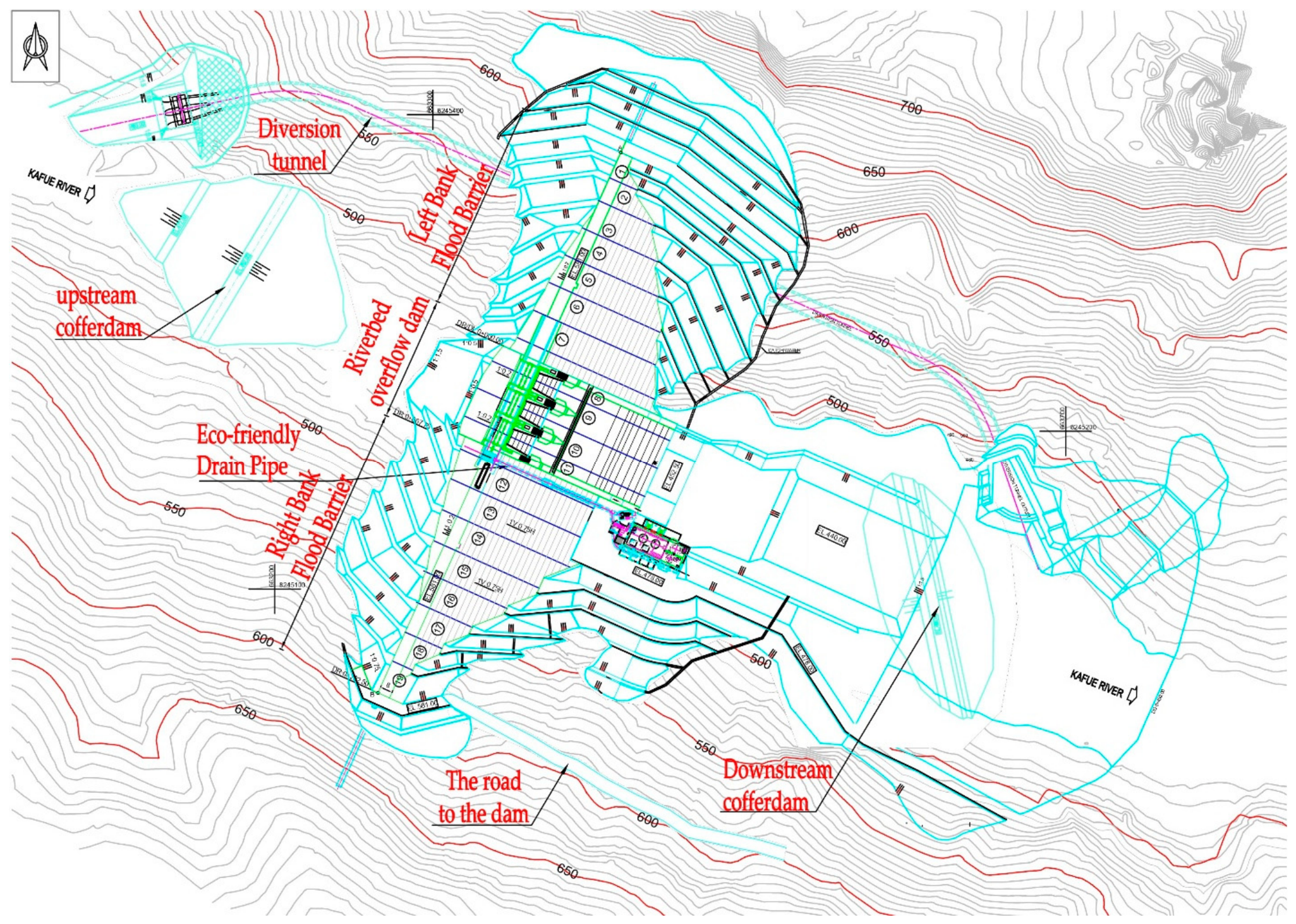
3. The river-blocking dam (comprising the left and right bank cofferdams and the riverbed spillway) is a roller-compacted concrete gravity dam. The crest length is 367.5 m, elevation is 581 m, and maximum height is 139.0 m. It is divided into 19 dam sections from the left to right bank, comprising seven left bank sections, eight right bank sections, and four riverbed spillway sections, with standard section lengths of 20 m. The riverbed spillway features three spillway bays with 15 m-wide and 18 m-high curved gates. Additionally, an ecological discharge outlet is installed in Dam Section 11, with an ecological flow power generation unit mounted downstream of the dam. The plan layout of the power station’s headworks is shown in
Figure 1.
2.2. Engineering Problem
As a typical high-compaction concrete gravity dam, this project features large construction areas, high intensity, and extended construction periods. The complex construction organization and time-consuming single-layer roller-compacted concrete placement often result in prolonged exposure time between concrete layers. This exposure time is susceptible to factors such as construction workflow, equipment efficiency, and weather conditions. Additionally, the project site in Zambia features a tropical savanna climate characterized by high daytime temperatures (typically ranging from 28 °C to 33 °C during the hot season), intense solar radiation, and marked seasonal humidity fluctuations. The monthly average relative humidity varies between approximately 43% in the dry season and 80% in the wet season, resulting in significant variations in surface water evaporation rates from the freshly placed RCC. These climatic factors collectively accelerate the hydration process of cementitious materials and promote rapid moisture loss from the concrete surface. Consequently, the on-site setting behavior of RCC deviates considerably from the initial and final setting times determined under standard laboratory conditions.
The dam construction spanned 23 months, completing the placement of 1.23 million cubic meters of roller-compacted concrete. On 10 November 2020, the diversion tunnel began impoundment, and the first unit successfully connected to the grid on 30 June 2021.
3. Quality Control Theory for Interlayer Compaction of Concrete
The primary quality control indicator for interlayer bonding is the early strength of roller-compacted concrete. The initial and final setting times determined through laboratory testing do not account for external temperature factors. When ambient temperatures are high, the early strength of roller-compacted concrete increases rapidly, resulting in shorter initial and final setting times. Conversely, when ambient temperatures are low, the early strength increases more slowly, leading to longer initial and final setting times. Therefore, the maturity index is employed to predict concrete’s early strength, defining the maturity of interlayer joints as “hot joints,” “warm joints,” or “cold joints”. A “hot joint” indicates that the lower layer has been exposed for a short time and has not yet reached initial setting, with a lower corrected maturity. Such joints require no special treatment and allow for continuous pouring. Second, a “warm joint” indicates that the lower layer has been exposed slightly longer and has initial set but not final set, with a higher corrected maturity value. A “cold joint” indicates that the lower layer has been exposed excessively long and has fully final set, making placement impossible. The quality of interlayer placement is controlled using dual criteria: the allowable maturity value and the allowable exposure time between layers.
The maturity method was applied in accordance with ASTM C1074-19e1 [
23], which specifies the use of the temperature–time factor (also known as the Nurse–Saul function) for estimating in-place concrete strength.
The formula for calculating the maturity of roller-compacted concrete is given in Equation (1):
where
N is the concrete maturity (
);
T is the average temperature of the concrete during time interval
t (°C);
t is the duration during which the temperature is
T.
The permissible values for the above two parameters are determined experimentally. In regions with significant climatic variations where the project is located, the permissible exposure time for roller-compacted concrete during different months must be adjusted based on temperature characteristics.
The calculation formula is given in Equation (2):
where [
Ti] represents the allowable exposure time for the interlayer gap in the
i-th month (excluding the experimental month),
h;
Ttest denotes the exposure time for the interlayer gap corresponding to the experimental month,
h; a
i indicates the conversion coefficient corresponding to the average temperature of the
i-th month (
Table 1).
The calculation formula for calculating the permissible maturity values for different months given in Equation (3):
where [
Fi] represents the allowable maturity value for interlayer joints in the
i-th month (excluding the test month), (
);
Ftest represents the maturity of roller-compacted concrete interlayer joints in the test month, (
); a
i represents the conversion coefficient corresponding to the average temperature in the
i-th month (
Table 1).
4. On-Site Experiments
The experiment employed large-scale physical simulation specimens. Using a controlled variable method, the exposure time and treatment method between each layer were regulated. Subsequently, core drilling and performance testing were conducted.
4.1. Specimen Design and Partitioning
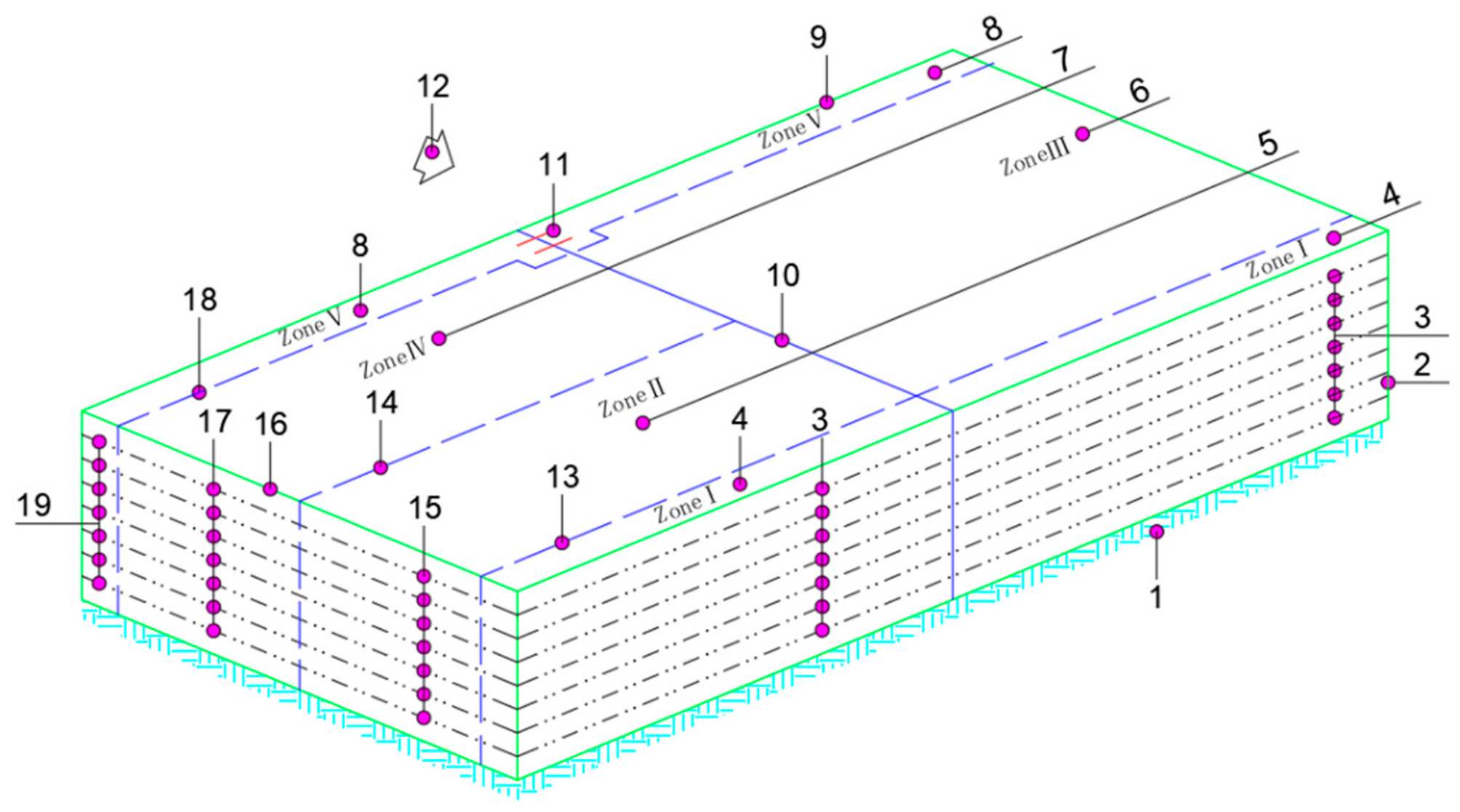
The test utilized a large specimen measuring 40 m (length) × 15 m (width) × 2.4 m (height) (
Figure 2). The roller-compacted concrete was placed and compacted in layers of 30 cm thickness, with a total of eight layers poured, thereby forming seven horizontal interlayer joints.
Zone Design: Test specimens are divided into five typical test zones along the flow direction (lengthwise): Zone I: Downstream GEVR (grout-enriched vibratable RCC) zone (serves as control reference, no interlayer treatment); Zone II: Roller-compacted concrete zone (interlayers treated with mortar); Zone III: Roller-compacted concrete zone (no interlayer treatment, serves as blank control); Zone IV: Roller-compacted concrete zone (interlayer treated with cement slurry). Zone V: Upstream GEVR zone (serving as a comparative baseline, with no interlayer treatment). A structural joint with waterstop was installed at the midpoint of the specimens to simulate the actual dam structure; see
Figure 2.
Figure 2: 1. Foundation; 2. Specimen height boundary line; 3. Downstream GEVR interlayer joint; 4. Downstream GEVR zone—Zone I; 5. Interlayer mortar treatment zone—Zone II; 6. Untreated interlayer zone—Zone III; 7. Interlayer cement slurry treatment zone—Zone IV; 8. Upstream GEVR zone—Zone V; 9. Specimen length boundary line; 10. Specimen structural joint; 11. Joint waterstop; 12. Water flow direction; 13. Downstream partition line; 14. Interlayer comparison partition line; 15. Mortar-treated interlayer joint; 16. Specimen width boundary; 17. Cement grout-treated interlayer joint; 18. Upstream partition line; 19. Upstream GEVR interlayer joint.
4.2. Experimental Variables and Control Methods
- (1)
Interlayer exposure time: preset seven gradients (4 h, 10 h, 16 h, 22 h, 36 h, 48 h, 60 h), covering the entire time span from before initial setting to final setting.
- (2)
Interlayer treatment process: For Layers 1–5 (shorter exposure time): interlayer sand mortar treatment in Zone II; no treatment in Zone III; cement slurry treatment in Zone IV. For Layers 6–8 (longer exposure time): Zone III: interlayer roughening and no roughening; Zone IV: interlayer roughening with cement paste treatment and no roughening with cement paste treatment; Zone II: interlayer roughening with mortar treatment and no roughening with mortar treatment. Zones I and V both undergo comparative tests with and without roughening.
- (3)
Ambient temperature and maturity: To meet the requirements of the above tests, the interlayer exposure time and ambient temperature must be recorded separately during the casting process, and the corresponding maturity must be calculated (see
Table 2). Maturity is determined by multiplying the corrected interlayer temperature by the interlayer joint exposure time, where the corrected interlayer temperature equals the sum of the average interlayer joint exposure temperature and the value 15.
Table 2.
Results of roller-compacted concrete specimens.
Table 2.
Results of roller-compacted concrete specimens.
| Test Block Zone | Interlayer Joint Numbering (Bottom to Top) | Interlayer Gap Exposure Time (h) | Interlayer Gap Exposed Average Temperature (°C) | Revised Maturity (h·°C) | Note |
|---|
Zone I
Zone II
Zone III
Zone IV
Zone V | 1 | 4.5 | 27.4 | 190.8 | |
| 2 | 9.3 | 20.3 | 328.3 | |
| 3 | 16.1 | 24.7 | 639.2 | |
| 4 | 22.1 | 22.3 | 824.3 | |
| 5 | 36.5 | 24.4 | 1438.1 | |
| 6 | 48.0 | 26.9 | 2011.2 | |
| 7 | 62.0 | 21.3 | 2250.6 | |
Table 3.
Core sample test results.
Table 3.
Core sample test results.
| Test Block Zone | Interlayer Joint Numbering (Bottom to Top) | Interlayer Chiseling (Yes/No) | Interlayer Exposure Time (h) | Core Sample Interlayer Gap Appearance Integrity Rate (%) | Average Compressive Strength of Core Samples (Mpa) | Average Tensile Strength of Core Samples (Mpa) |
|---|
Zone I/
Zone II/
Zone III/
Zone IV/
Zone V | 1 | Yes | 4.5 | 100 | 22.4 ± 0.85 | 1.43 ± 0.042 |
| 2 | Yes | 9.3 | 67 | 21.0 ± 0.85 | 1.40 ± 0.057 |
| 3 | Yes | 16.1 | 67 | 22.8 | 1.58 |
| 4 | Yes | 22.1 | 67 | 21.5 ± 2.05 | 1.24 ± 0.141 |
| 5 | No | 36.5 | 67 | 21.1 | 1.19 |
| 6 | No | 48 | 33 | 21.4 ± 0.35 | 1.02 ± 0.071 |
| 7 | No | 62 | 100 | 18.8 ± 0.79 | 1.02 ± 0.124 |
4.3. Test Procedure
After curing the roller-compacted concrete specimens to the design age, drill and extract six core samples from each of the five zones (totaling 30 core samples). From each core sample, prepare seven cylindrical specimens (192 mm diameter, 385 mm length), ensuring each core traverses multiple interlayer joints to represent seven of the eight interlayer joints within the roller-compacted concrete specimen. The specimens were numbered individually, and any fractured specimens were further identified and marked. In the laboratory, tensile tests were conducted on 15 sets of specimens, and compressive tests on another 15 sets. The various test results were recorded, compiled into a summary table (see
Table 3), and analyzed for different comparative experiments.
Table 3 below presents the test results for the drilled specimens from the interlayer cement grout treatment zone (Zone IV).
4.4. Test Instruments and Equipment
The roller-compacted concrete (RCC) tests conducted in this study comprised both laboratory tests (including raw material inspection and mechanical property testing of RCC specimens) and field tests (including measurements of RCC compaction degree, Vebe time, air temperature, RCC temperature, and slurry density). The main instruments and equipment employed in the tests are listed in
Table 4.
5. Analysis of Experimental Results
5.1. The Effect of Interlayer Exposure Time on Bond Strength
Based on the core test data (
Table 3), the bond strength between layers of roller-compacted concrete exhibits significant variation patterns under different exposure durations. As the exposure time increases, the tensile strength of the cores generally shows a decreasing trend. When exposure time was less than 22.1 h, the average tensile strength of the cores exceeded the design value of 1.15 MPa. At 36.5 h of exposure, the tensile strength approached the design value. After exceeding 48 h of exposure, the tensile strength further decreased to approximately 1.02 MPa. This phenomenon indicates that interlayer exposure time is a key factor affecting the bond quality between roller-compacted concrete layers; shorter exposure times result in higher bond strengths. Simultaneously, the integrity rate of core samples exhibited a distinct pattern with exposure time: samples exposed for 4.5 h and 62 h maintained 100% integrity, while those exposed for intermediate durations (9.3–48 h) showed integrity rates ranging from 33% to 67%. This indicates that during the transition phase from initial to final setting of concrete, the interlayer reaches its weakest state and is prone to interlayer failure under stress.
5.2. Effect of Different Processing Methods on Improving Interlayer Bonding Quality
5.2.1. Comparison of Treatment Effects Between Cement Slurry and Mortar
The test established four interlayer treatment conditions: cement slurry treatment, mortar treatment, untreated, and roughening treatment. Analysis of
Table 3 data reveals that under identical exposure times, the tensile strength ranking for different treatments is as follows: cement slurry treatment ≥ mortar treatment > untreated. Taking an exposure time of 22.1 h as an example, the average tensile strength of core samples from the cement slurry-treated zone was 1.24 MPa, while that from the mortar-treated zone was 1.14 MPa. In contrast, the untreated zone recorded only 1.02 MPa.
5.2.2. Enhancement Mechanism of Chiseling Process
For interlayer joints with prolonged exposure times (≥16.1 h), introducing a chiseling process significantly enhances bond strength. A subset of the test data indicates that chiseling treatment increased the interlayer tensile strength by an average of approximately 18% compared with unchiseled specimens, with individual improvements ranging from 12% to 24% and a standard deviation of ±4.5%. The chiseling process mechanically removes the surface laitance from the lower concrete layer, increasing contact surface roughness. This not only enhances the mechanical interlocking force between the concrete layers but also expands the effective bonding area, thereby improving interlayer load transfer performance.
5.3. Classification and Discrimination Criteria for Interlayer Joints Based on Maturity
5.3.1. Establishment of the Maturity Calculation Model
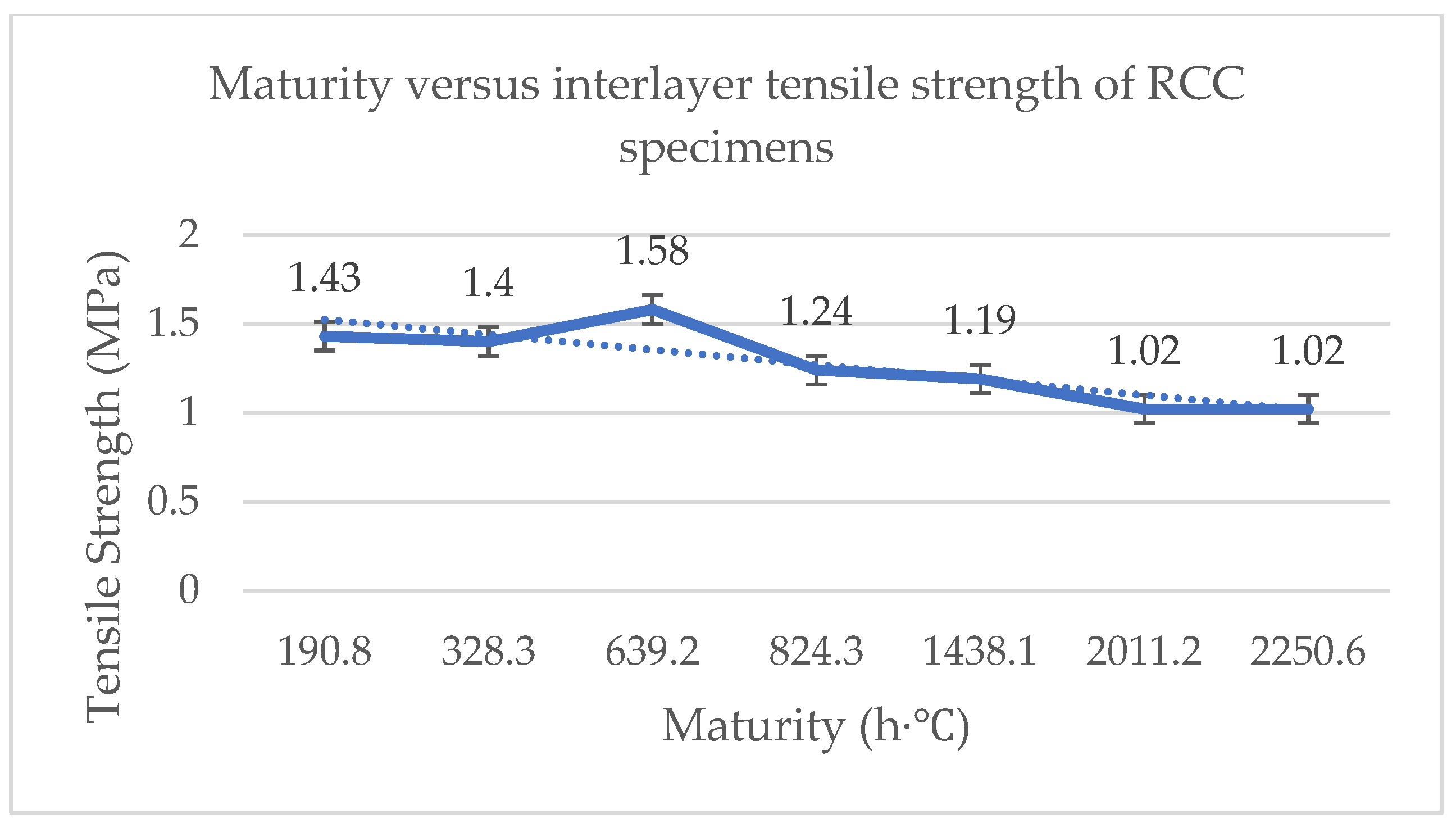
Maturity exhibits a strong correlation with interlayer bond strength. Based on the maturity calculation as represented by Equation (1), maturity values corresponding to different exposure times were calculated (
Table 2). The calculated maturity values and the corresponding interlayer tensile strengths obtained from the core samples are summarized in
Figure 3. A clear inverse relationship can be observed, confirming the suitability of maturity as an indicator for interlayer bond quality.
5.3.2. Quantitative Indicators and Treatment Measures for Hot Joints, Warm Joints, and Cold Joints (Table 5)
Hot Joint: During the August experiment, the interlayer joint exposure time was controlled at 22 h. Referring to
Table 2, the corresponding maturity for the interlayer joint can be controlled at 824 h·°C (rounded down). At this point, the lower layer concrete has not yet reached initial setting, ensuring good interlayer bonding. No special treatment is required, and continuous construction can proceed.
Warm Joint: In August, the interlayer joint exposure time was controlled at 36 h. According to
Table 2, the corresponding maturity for this exposure time is 1438 h·°C (rounded down). Taking a conservative approach at 80% of this value yields 1150 h·°C. The lower layer concrete has initial set but not final set, requiring cement slurry treatment before continuing pour.
Cold Joint: In August, if the interlayer joint exposure exceeds 36 h, the corresponding maturity exceeds 1150 h·°C, and the lower layer has fully set. This should be treated as a construction joint.
Table 5.
Control standards and treatment measures for interlayer joints in roller-compacted concrete at different months.
Table 5.
Control standards and treatment measures for interlayer joints in roller-compacted concrete at different months.
| Month | Hot Joint | Warm Joint | Cold Joint |
|---|
| Exposure Time ≤ (h) | Maturity ≤ (h °C) | Exposure Time (h) | Maturity (h °C) | Exposure Time > (h) | Maturity > (h °C) |
|---|
| 1 | 18 | 708 | 18~30 | 708~989 | 30 | 989 |
| 2 | 18 | 708 | 18~30 | 708~989 | 30 | 989 |
| 3 | 19 | 741 | 19~32 | 741~1035 | 32 | 1035 |
| 4 | 20 | 782 | 20~34 | 782~1092 | 34 | 1092 |
| 5 | 23 | 865 | 23~37 | 865~1207 | 37 | 1207 |
| 6 | 24 | 906 | 24~39 | 906~1265 | 39 | 1265 |
| 7 | 24 | 906 | 24~39 | 906~1265 | 39 | 1265 |
| 8 | 22 | 824 | 22~36 | 824~1150 | 36 | 1150 |
| 9 | 18 | 708 | 18~30 | 708~989 | 30 | 989 |
| 10 | 17 | 650 | 17~28 | 650~908 | 28 | 908 |
| 11 | 18 | 675 | 18~29 | 675~943 | 29 | 943 |
| 12 | 18 | 708 | 18~30 | 708~989 | 30 | 989 |
| Processing Standard | No processing | Spread cement slurry | Treat as a construction joint |
5.3.3. Establishment of a Dynamic Control Model
Statistical analysis of the multi-year average monthly temperatures at the construction project site (see
Table 6) was conducted to calculate the exposure time and curing duration for interlayer joints during construction in other months.
The formula for calculating exposure time is given in Equation (4):
where
Ti is the exposure time of the interlayer gap for the
i-th month (excluding the experimental month),
h;
Ttest is the exposure time of the interlayer gap corresponding to the experimental month,
h; a
i is the conversion coefficient corresponding to the average temperature of the
i-th month.
The maturity calculation formula is given in Equation (5):
where
Fi represents the maturity of the interlayer joints in the
i-th month (excluding the test month), (
);
Ftest represents the maturity of the interlayer joints in the roller-compacted concrete during the test month, (
); a
i denotes the conversion coefficient corresponding to the average temperature in the
i-th month.
5.4. Special Patterns in the Interlayer Properties of GEVR Zones
The performance of the GEVR zone differed from that of the roller-compacted concrete zone during testing. Within a short exposure period (≤22 h), the tensile strength of GEVR decreased with increasing exposure time, with the following order: 4 h ≥ 10 h > 16 h > 22 h. However, after 36 h of exposure, the tensile strength of the specimens remained essentially unchanged. Additionally, different interlayer treatments exerted varying effects on the tensile strength of GEVR zone specimens: roughening produced greater tensile strength than non-roughening.
5.5. International Comparison and Climatic Implications
The maturity-based dynamic adjustment model proposed in this study was validated under the tropical savanna climate of Zambia. Comparisons with international RCC projects across diverse climatic regions further underscore the necessity of such a climate-adapted approach.
In the hot arid environment of Saudi Arabia, thermal surface cracking was mitigated by limiting the placing temperature of facing concrete to 20 °C [
28], while the Wadi Dayqah Dam in Oman relied on night-time placement and chillers to control hydration heat [
24]. Although both strategies address thermal cracking in hot climates, they differ fundamentally from the maturity-based method proposed herein: those strategies control the concrete temperature at the time of placement, whereas the maturity-based approach manages the allowable exposure time after placement, thereby offering a complementary tool that can be directly applied during construction. In tropical Africa, the Julius Nyerere Hydropower Station in Tanzania adopted intelligent cooling control during dam-gap diversion [
25]. While this approach shares the same climatic objective, it depends on active cooling systems that require substantial equipment investment, in contrast to the passive, maturity-based method developed in this study, which requires only temperature monitoring and tabulated decision criteria.
Brazilian RCC projects provide additional tropical references: the hematite aggregate containment dam at Gongo Soco achieved compressive strengths exceeding 10 MPa with a low cement content [
26], and South America’s first RCC dam, Saco Dam, employed lean RCC mixes under heavy rainfall conditions [
27]. Notably, these Brazilian studies focused primarily on mix design adaptation and aggregate substitution, and neither specifically addressed interlayer bonding quality control through maturity indicators. Similarly, European research on probabilistic thermal analysis [
29] offers a sophisticated framework for temperature field prediction but does not translate its outputs into actionable, month-by-month construction guidelines. The Gross Reservoir expansion in Colorado, the largest RCC dam raise in North America [
30], operates within a fundamentally different climatic regime dominated by cold weather placement constraints, further highlighting the distinct nature of the tropical challenge.
This critical comparison demonstrates that, while the international literature presents various strategies for managing RCC construction under challenging climatic conditions, none provide a quantified, temperature-adaptive framework specifically designed for interlayer exposure time management. The method developed in this study fills this gap by integrating maturity thresholds with monthly temperature data to produce a practical, ready-to-use decision-making table for field engineers. The method aligns with international standards [
21,
22] while offering a tool explicitly tailored to the climatic realities of sub-Saharan Africa. Future work should explore the integration of the proposed maturity-based framework with intelligent cooling systems [
25] to provide a comprehensive thermal management solution for RCC dams in tropical regions.
6. Practical Engineering Applications
The dam design features an average storage area of approximately 10,000 m2, with the dam base having a floor area of approximately 4000 m2, the dam crest at around 2500 m2, and a larger floor area in the dam body’s middle section. Specifically, the floor area between EL460 and EL535 exceeds 10,000 m2, while the floor area between EL470 and EL510 ranges from 13,000 to 14,000 m2.
On 6 June 2018, the roller-compacted concrete (RCC) placement for the dam commenced. The dam’s minimum monthly placement volume was 35,000 m3/month, with a maximum of 12,500 m3/month. The RCC placement was completed on 16 April 2020, with a total placement volume of 1.23 million m3. The construction process encountered multiple unforeseen incidents, including conveyor belt failures, batching plant malfunctions, significant temperature fluctuations, and heavy rainstorms. The contractor strictly adhered to the established construction plan, meticulously documenting the roller-compacted concrete placement process using the quality control table for interlayer joints determined through experimentation. Placement quality control was implemented based on the criteria for identifying interlayer joints and corresponding countermeasures.
7. Quality Inspection
Tensile (
Table 7) and compressive (
Table 8) strength tests were conducted on core samples extracted from dam boreholes between December 2020 and January 2021. For tensile strength testing, 16 core samples were selected. The minimum age of the samples was 254 days, the maximum was 767 days, and the average age was 569 days. The minimum tensile strength was 0.57 MPa, the maximum was 1.32 MPa, and the average was 0.97 MPa. Two samples fractured at interlayer joints, while the rest fractured at non-interlayer locations. For the compressive strength tests, 21 core samples were selected. The minimum age of the core samples was 381 days, the maximum was 880 days, and the average age was 607 days. The minimum compressive strength of the core samples was 10.4 MPa, the maximum was 20.1 MPa, and the average was 13.5 MPa.
The roller-compacted concrete used in this dam had an age of 360 days, with a design tensile strength of 0.9 MPa and a design compressive strength of 12 MPa. Therefore, experimental verification confirms that the quality of the roller-compacted concrete meets requirements, further demonstrating that this construction method ensures the quality of roller-compacted concrete.
8. Conclusions
This study, based on the roller-compacted concrete gravity dam at the Lower Kafue Hydropower Station in Zambia, systematically investigated interlayer quality control methods using maturity indicators and interlayer exposure time through field testing and theoretical analysis. The primary conclusions are as follows:
- (1)
A dual-indicator control method based on maturity and interlayer exposure time was proposed, effectively enhancing the controllability of interlayer bonding quality during construction. Through test block experiments, the interlayer tensile and compressive strengths of roller-compacted concrete were systematically tested under exposure times ranging from 4 to 62 h, confirming a negative correlation between exposure time and interlayer bond strength.
- (2)
The enhancement effects of different interlayer treatment processes were clarified, and the classification and treatment standards for interlayer joints were optimized. The experiments compared multiple techniques including cement slurry treatment, mortar treatment, no treatment, and roughening. Based on experimental data, a classification system for “hot joints, warm joints, and cold joints” centered on maturity was established, along with corresponding evaluation criteria and treatment measures.
- (3)
A dynamic control model based on monthly average temperature was developed, enabling adaptive adjustment of interlayer quality control parameters under varying climatic conditions. Considering the local climate characteristics, a conversion formula linking exposure time to maturity based on monthly average temperature was proposed, establishing an interlayer joint quality control table applicable to all months of the year.
Author Contributions
X.H.: Conceptualization, Writing and Editing; C.H.: Conceptualization, Review and Supervision, Resources, Funding acquisition; N.L.: Methodology, Investigation Supervision and Data Curation; J.W.: Review and Editing, Visualization Figures. All authors have read and agreed to the published version of the manuscript.
Funding
We would like to express our gratitude to the anonymous reviewers for their constructive comments. This research was supported by the Open Research Fund Program of the State Key Laboratory of Eco-hydraulics in the Northwest Arid Region (No. 2022KFKT-8).
Institutional Review Board Statement
Not applicable.
Informed Consent Statement
Not applicable.
Data Availability Statement
The data presented in this study are available from the corresponding author upon reasonable request.
Conflicts of Interest
Authors Chunyou Hao and Xin He were employed by the company PowerChina Northwest Engineering Corporation Limited. The remaining authors declare that the research was conducted in the absence of any commercial or financial relationships that could be construed as a potential conflict of interest.
References
- Liu, G.; Lu, W.; Lou, Y.; Pan, W.; Wang, Z. Interlayer shear strength of Roller compacted concrete (RCC) with various interlayer treatments. Constr. Build. Mater. 2018, 166, 647–656. [Google Scholar] [CrossRef]
- Kuang, C.; Han, X.; Fan, Y.; Wang, J.; Li, Y. New Material for Interlayer Joint Treatment of Roller Compacted Concrete Dam. Tech. Superv. Water Resour. 2021, 24–27. [Google Scholar] [CrossRef]
- Xia, X.; Liu, D. Interlayer Aggregates Embeddedness Index and Its Characterization for Interlayer Bonding Quality of Roller-Compacted Concrete. J. Mater. Civ. Eng. 2023, 35, 04023331. [Google Scholar] [CrossRef]
- Ramadan, M.; Jia, J.; Zhao, L.; Li, X.; Wu, Y. Numerical and Fracture Mechanical Evaluation of Safety Monitoring Indexes and Crack Resistance in High RCC Gravity Dams Under Hydraulic Fracture Risk. Materials 2025, 18, 2893. [Google Scholar] [CrossRef]
- Qin, X.; Xu, Q. Statistical analysis of initial defects between concrete layers of dam using X-ray computed tomography. Constr. Build. Mater. 2016, 125, 1101–1113. [Google Scholar] [CrossRef]
- Shen, M.; Zhao, Y.; Bi, J.; Wang, C.; Du, B.; Zhang, K. In situ experimental study on mechanical properties of interlayer in roller compacted concrete (RCC) dam. Constr. Build. Mater. 2023, 379, 131268. [Google Scholar] [CrossRef]
- Luo, D.; Lu, S.; Hu, C.; Xue, Z. Experimental and numerical investigation on interlayer fracture process of roller compacted concrete. Constr. Build. Mater. 2022, 342, 127998. [Google Scholar] [CrossRef]
- Azizmohammadi, M.; Toufigh, V.; Ghaemian, M. Experimental and analytical investigation on the interlayer of roller compacted concrete. J. Mater. Civ. Eng. 2021, 33, 04021090. [Google Scholar] [CrossRef]
- Niu, X.J.; Li, Q.B.; Liu, W.J.; Hu, Y. Effects of ambient temperature, relative humidity and wind speed on interlayer properties of dam concrete. Constr. Build. Mater. 2020, 260, 119791. [Google Scholar] [CrossRef]
- Liu, W.J.; Niu, X.J.; Yang, N.; Tan, Y.-S.; Qiao, Y.; Liu, C.-F.; Wu, K.; Li, Q.-B.; Hu, Y. Prediction model of concrete initial setting time based on stepwise regression analysis. Materials 2021, 14, 3201. [Google Scholar] [CrossRef] [PubMed]
- Zhao, E.; Li, B. Evaluation method for cohesive crack propagation in fragile locations of RCC dam using XFEM. Water 2020, 13, 58. [Google Scholar] [CrossRef]
- Tian, Z.; Liu, J.; Li, R.; Sun, J. A Detection Method of RCC Interlayer Bonding Quality Based on Moisture Rate. Constr. Technol. 2016, 45, 97–100+150. [Google Scholar] [CrossRef]
- Zhong, D.; Yan, Y.; Cui, B.; Wu, B.; Hu, W.; Lyu, P. Dynamic Evaluation of RCC Dam Interlayer Bonding Quality Considering the Influence of Compaction Quality. J. Hydraul. Eng. 2017, 48, 1135–1146. [Google Scholar] [CrossRef]
- Xie, Y.; Yang, H.; Zhao, Y. Control Method for Interlayer Bonding Quality of Roller Compacted Concrete in Nansha Hydropower Station Dam. Guangdong Water Resour. Hydropower 2013, 58–61. [Google Scholar]
- Cheng, S.; Zhong, H. Monitoring and Analysis of Interlayer Combining Seepage Pressure of Roller Compacted Concrete Dam. Hongshui River 2021, 40, 30–34. [Google Scholar] [CrossRef]
- Xing, Y.; Tian, Z.; Du, H. Intelligent Evaluation of Interlayer Bonding Quality of RCC Dam. J. Yangtze River Sci. Res. Inst. 2020, 37, 142–149. [Google Scholar] [CrossRef]
- Geng, S.; Zhang, C.; He, T.; Li, S. Study on the Maturity of Roller Compacted Concrete Layer and the Influence of Different Treatment Methods on Interlayer Performance. Shanxi Water Resour. 2019, 35, 38–41. [Google Scholar]
- Liu, D.; Ma, Z.; Sun, L. Study on Discrete Element Simulation of RCC Layered Compaction and Meso-Mechanism of Construction-Induced Interfaces. J. Hydraul. Eng. 2024, 55, 1033–1044. [Google Scholar] [CrossRef]
- Gao, Y.; Jin, J. Treatment Technology for Layers and Joints of RCC Dam of Kafue Gorge Lower Hydropower Station. Northwest Hydropower 2021, 52–55. [Google Scholar] [CrossRef]
- Li, S.; Tang, H. Influencing Factor and Improvement Measures of Interlayer Bonding Quality for Roller Compacted Concrete. Water Resour. Hydropower Northeast China 2002, 20, 17–18+54–55. [Google Scholar]
- International Commission on Large Dams (ICOLD). Roller-compacted concrete dams. In Bulletin 177; CRC Press: Boca Raton, FL, USA, 2021. [Google Scholar]
- U.S. Army Corps of Engineers. Roller-Compacted Concrete; Engineer Manual EM 1110-2-2006; Department of the Army: Washington, DC, USA, 2000.
- ASTM C1074-19e1; Standard Practice for Estimating Concrete Strength by the Maturity Method. ASTM International: West Conshohocken, PA, USA, 2019.
- Prisk, M.; Richards, M.; Hieatt, M. Delivering Wadi Dayqah, Oman’s tallest dam. Proc. Inst. Civ. Eng.-Civ. Eng. 2009, 162, 42–50. [Google Scholar] [CrossRef]
- Li, M.; Lin, P.; Li, Z.C.; Liu, Y.G.; Zhang, R.; Gao, X.Y. Intelligent cooling control of roller-compacted concrete dam during dam gap diversion. J. Tsinghua Univ. (Sci. Technol.) 2023, 63, 1060–1067. [Google Scholar] [CrossRef]
- Carmo, J.B.M.; Lameiras, F.S.; Marques Filho, J.; de Andrade, W.P. RCC—Roller-compacted concrete with hematite aggregate. REM Int. Eng. J. 2023, 76, 247–254. [Google Scholar] [CrossRef]
- Quin, J.T.; Rezende, S.P.; Schrader, E.K. Saco Dam—South America’s first RCC dam. In Roller Compacted Concrete II: Proceedings of the ASCE Specialty Conference; Hansen, K.D., Guice, L.K., Eds.; American Society of Civil Engineers: Reston, VA, USA, 1988; pp. 268–284. [Google Scholar]
- Bayagoob, K.H.; Bamaga, S.O. Construction of Roller Compacted Concrete Dams in Hot Arid Regions. Materials 2019, 12, 3064. [Google Scholar] [CrossRef]
- Gaspar, A.; Lopez-Caballero, F.; Modaressi-Farahmand-Razavi, A.; Gomes-Correia, A. Methodology for a probabilistic analysis of an RCC gravity dam construction. Modelling of temperature, hydration degree and ageing degree fields. Eng. Struct. 2014, 65, 99–110. [Google Scholar] [CrossRef]
- Denver Water. 2024 Year in Review: Gross Reservoir Expansion Project; Denver Water: Denver, CO, USA, 2025; Available online: https://www.denverwater.org/grossreservoir/news/2024-year-review (accessed on 21 April 2026).
| Disclaimer/Publisher’s Note: The statements, opinions and data contained in all publications are solely those of the individual author(s) and contributor(s) and not of MDPI and/or the editor(s). MDPI and/or the editor(s) disclaim responsibility for any injury to people or property resulting from any ideas, methods, instructions or products referred to in the content. |