Systematic Review

Human-Centered XR Integration for STEM Education in New Zealand: A Systematic Review and Implementation Framework


by
Muhammad Faisal Buland Iqbal
,
Kien T. P. Tran
,
Wei Qi Yan
,
Hazel Abraham
and
Minh Nguyen
*
Department of Computer and Information Sciences, Auckland University of Technology, Auckland 1010, New Zealand
*
Author to whom correspondence should be addressed.
Appl. Sci. 2026, 16(10), 5090; https://doi.org/10.3390/app16105090
Submission received: 15 March 2026 / Revised: 27 April 2026 / Accepted: 28 April 2026 / Published: 20 May 2026
(This article belongs to the Special Issue AI from Industry 4.0 to Industry 5.0: Engineering for Social Change)

Abstract

This systematic review comprehensively explores the integration of Extended Reality (XR) technologies, comprising Virtual Reality (VR), Augmented Reality (AR), and Mixed Reality (MR), into New Zealand’s STEM education framework. In alignment with PRISMA 2020 guidelines, we systematically analyzed 127 peer-reviewed studies from the Web of Science (n = 48), Scopus (n = 57), and Dimensions (n = 22) and incorporated 15 grey literature sources, resulting in 142 studies included in the review. Our meta-analysis found substantial improvements in student conceptual understanding from XR-enhanced STEM modules. Specifically, we observed an average increase of 23.4% when compared to traditional instructional methods (95 percent Confidence Interval: 18.7 to 28.1 percent, p < 0.001). These gains were especially prominent in interactive learning environments where immersive XR applications supported deeper engagement and the visualization of abstract STEM concepts. The qualitative synthesis highlighted several key barriers that limit effective XR integration. These include technological infrastructure gaps reported in 68 percent of reviewed studies, a critical need for educator training cited by 82 percent of studies, and curriculum alignment issues present in 57 percent of cases. Methodological quality was assessed using the Mixed Methods Appraisal Tool (MMAT) 2018, and the qualitative component employed a deductive thematic coding approach with inter-coder reliability verification. Successful institutional implementations were also identified. At Auckland University of Technology, XR-supported courses produced a 67 percent increase in student engagement, while Wellington High School achieved a 41 percent reduction in STEM achievement gaps through targeted XR interventions. Based on the evidence, we propose a four-phase implementation framework that addresses the technological, pedagogical, and policy requirements for sustainable XR adoption. These findings highlight the role of immersive technologies in supporting human-centered digital transformation and future skills development in the transition to Industry 5.0. The review contributes evidence-based insights that support the transition from technology-driven approaches associated with Industry 4.0 to the human-centered, socially oriented priorities of Industry 5.0. It also identifies critical research gaps, particularly in long-term learning outcomes and the integration of Mātauranga Māori within XR-enabled STEM environments.

1. Introduction

The rapid emergence of Extended Reality (XR) technologies, including Virtual Reality (VR), Augmented Reality (AR), and Mixed Reality (MR) technologies, is becoming increasingly important in today’s teaching process environment [1,2,3,4]. XR refers to the spectrum of immersive technologies that blend physical and digital environments to varying degrees. VR creates fully immersive digital environments that replace the user’s physical surroundings; AR overlays digital information onto the real world while preserving the physical environment; and MR integrates digital objects into the physical space with real-time interaction capabilities [5,6]. Such immersive tools reveal significant capacity in increasing the degree of engagement, cognitive memory, and the principles of concepts among educational associations at various levels of education [7,8,9]. The reality continuum, originally proposed by Milgram and Kishino [5], provides a foundational taxonomy that positions these technologies along a spectrum from fully real to fully virtual environments. Subsequent extensions of this framework, including Speicher et al.’s multidimensional characterization [6] and Mann et al.’s mediated reality continuum [10], have expanded the original model to account for contemporary developments such as diminished reality, multi-sensory feedback, and the bidirectional relationship between users and immersive environments [11,12]. Although digital technologies have become progressively integrated into the national curriculum since the 2017 update in New Zealand [13], the full adoption of XR in STEM classrooms is still lacking despite increasing evidence of its pedagogical utility.
The educational environment of New Zealand has some special opportunities to implement XR because the high percentage of students in the country settlement and the national curriculum with strong bicultural values based on Te Tiriti o Waitangi mean there are opportunities at the national level to implement the plans of embedding XR in the school system and to provide additional benefits to its users [14,15]. XR technologies can be used to address both the knowledge gaps in education and culturally inclusive education opportunities using Mātauranga Māori frames of reference, as was the case in education [16,17,18]. The New Zealand Curriculum explicitly applies technology education as an intervention with the focus on innovation and cultural responsiveness as a priority under the label of innovation by design curricula [14,19]. Case studies give an example of how XR may be used to learn STEM based on an indigenous knowledge system while enhancing equity in access to scholarly materials of high quality [17,18].
A substantial body of international research confirms the effectiveness of XR technologies in STEM education. Multiple meta-analyses and systematic reviews have demonstrated improvements in problem-solving skills, spatial reasoning development, and enhanced learner motivation across diverse educational contexts [20,21,22,23,24]. Specifically, recent meta-analytic syntheses have reported moderate-to-large learning benefits: Garzón et al. [25] found a pooled effect size of g = 0.68 for AR in education over a decade of quasi-experimental studies; Howard [26] reported moderate effects of AR programs on educational outcomes; and Merchant et al. [27] demonstrated significant positive effects of VR-based instruction across K-12 and higher education settings. Within specific STEM disciplines, discipline-focused reviews have further documented these benefits: Christopoulos et al. [28] examined VR applications in mathematics education; Lai and Cheong [29] conducted a scoping review of VR and AR adoption in mathematics; Mystakidis et al. [30] mapped AR applications in higher education STEM; and Lin et al. [31] synthesized evidence on VR and AR in K-12 STEM learning. Additionally, recent umbrella and comprehensive reviews by Pellas et al. [32], Burke et al. [2], Gao et al. [33], and Balalle [34] have provided overarching syntheses of this rapidly growing field. Presence, agency and embodiment in XR environments are theoretically explainable by the cognitive affective model of immersive learning (CAMIL) as this model demonstrates the positive outcome of learning outcomes in such settings [9,35]. However, a massive implementation process is implied, with many obstacles, such as lack of educator training and unequal access to this progress, as suburban schools are far better equipped than those in country areas [36,37,38] with most educators based there, reflecting the rural situation [8,39]. Beyond these contextual factors, broader international evidence on XR pedagogy and meta-analytic syntheses further informs the present review [40,41,42,43,44,45,46,47,48,49,50,51,52,53,54,55,56,57,58,59,60,61,62,63,64,65,66,67,68,69].
Moreover, the process of curriculum integration is not straightforward, with it being challenging for teachers to be able to match XR-learning with national standards and assessment standards [31,70,71]. The Technological Pedagogical Content Knowledge (TPACK) model framework by Mishra and Koehler [72] and its recent contextual update by Schmid et al. [73] suggest that structured methods of evaluating teacher competencies are necessary to successfully incorporate XR. There are positive perspectives provided by professional development models, whereby structured programs have demonstrated improvement in teacher self-efficacy and frequency of implementation [37,74,75].
This review addresses the following research questions: RQ1 What are the measured learning outcomes of XR integration in New Zealand STEM education? RQ2 What implementation barriers and enablers are specific to the New Zealand educational context? RQ3 What models of successful, culturally responsive XR integration exist or can be proposed for the New Zealand setting?

2. Methodology

A systematic review was performed based on PRISMA 2020 requirements [76] using a combination of both quantitative meta-analysis and appropriate qualitative thematic synthesis. This review was retrospectively registered with the International Platform of Registered Systematic Review and Meta-Analysis Protocols (INPLASY; registration number INPLASY202630113) [77]). The completed PRISMA 2020 checklist is provided as Table S7 in the Supplementary Materials.
A search of databases was carried out in the Web of Science, Scopus, and Dimension using Boolean operators. The final searches were conducted on 15 March 2025. The full database-specific search strategies were as follows:
For Web of Science (Core Collection):
TS=("Extended Reality" OR "Virtual Reality" OR "Augmented Reality" OR "Mixed Reality" OR "XR" OR "AR" OR "VR" OR "MR") AND TS=("STEM" OR "Science Education" OR "Technology Education" OR "Engineering Education" OR "Mathematics Education") AND TS=("New Zealand")
For Scopus:
TITLE-ABS-KEY("Extended Reality" OR "Virtual Reality" OR "Augmented Reality" OR "Mixed Reality" OR "XR" OR "AR" OR "VR" OR "MR") AND TITLE-ABS-KEY("STEM" OR "Science Education" OR "Technology Education" OR "Engineering Education" OR "Mathematics Education") AND TITLE-ABS-KEY("New Zealand")
For Dimensions:
Full data search using the same Boolean terms applied to title, abstract, and full text fields with New Zealand geographic filter.
No language filters were applied at the database level; non-English results were excluded during screening.
Inclusion criteria: published 2012–2024, XR in STEM education subject matter, New Zealand-based and using empirical/evaluative research and analysis. The criteria were used to restrict non-English articles, non-education XR applications, and opinion articles. Existing systematic review strategies in educational technology study were used to shape the search strategy [3,32,78].

2.1. Selection Process

Two reviewers independently screened all titles and abstracts against the inclusion criteria. Each record was assessed by both reviewers working independently, with disagreements resolved through discussion and, where necessary, consultation with a third reviewer. Full-text articles were similarly assessed independently by both reviewers. Cohen’s kappa for inter-rater agreement at the title and abstract screening stage was κ = 0.84 , indicating substantial agreement. No automation tools were used in the screening process.

2.2. Data Collection Process

Data were extracted independently by two reviewers using a standardized extraction form pilot-tested on ten studies. The following data items were collected from each included study:
For quantitative studies: sample size, participant demographics (age, educational level, ethnicity where reported), XR modality (VR, AR, or MR), STEM discipline, study design (RCT, quasi-experimental, pre–post), intervention duration, outcome measures (means, standard deviations, effect sizes), and comparison condition (traditional instruction, alternative technology, waitlist control).
For qualitative studies: research methodology, data collection methods, analytical approach, participant characteristics, XR technology described, themes identified, and institutional context.
For all studies: publication details, funding sources, country context, and XR hardware/software specifications. Where data were missing or unclear, study authors were contacted (response rate: 62%, 14 of 23 contacted authors provided additional data). Assumptions for missing standard deviations followed established imputation procedures [79], using the median standard deviation from studies within the same subgroup.

2.3. Grey Literature Search

Grey literature sources were identified through a systematic supplementary search conducted in parallel with the database searches. The following sources were searched: the New Zealand Ministry of Education publications repository, Education Counts (the Ministry’s statistical portal), the New Zealand Council for Educational Research (NZCER) reports database, the Tertiary Education Commission reports, and ProQuest Dissertations and Theses Global (filtered to New Zealand institutions). Conference proceedings from the Australasian Society for Computers in Learning in Tertiary Education (ASCILITE), the New Zealand Association for Research in Education (NZARE), and IEEE conferences on educational technology were also hand-searched for the period 2012–2024. Grey literature sources were included if they met the same substantive inclusion criteria as peer-reviewed studies (empirical data on XR in New Zealand STEM education) and were subjected to the same MMAT quality appraisal. Data from grey literature sources contributed to the qualitative thematic synthesis; grey literature studies that reported sufficient quantitative data (means, standard deviations, sample sizes) were eligible for inclusion in the meta-analysis, although only 3 of the 15 grey literature sources met this threshold.

2.4. Risk of Bias Assessment

The methodological quality of all 142 included studies was assessed using the Mixed Methods Appraisal Tool (MMAT) 2018 [80]. The MMAT was selected because the included corpus comprised quantitative experimental, quantitative descriptive, qualitative, and mixed-methods study designs, and the MMAT provides a unified appraisal framework across all these designs. Two reviewers independently assessed each study using the five MMAT criteria corresponding to the relevant study category. Each criterion was rated as met, not met, or cannot tell, and the overall quality rating was expressed on a 1 to 5 star scale based on the number of criteria met. Discrepancies between reviewers were resolved through consensus discussion; where consensus could not be reached, a third reviewer adjudicated. Inter-rater agreement for MMAT ratings was substantial (Cohen’s κ = 0.81 ). Table 1 presents the full MMAT quality assessment summary.

2.5. Effect Measure Justification

The standardized mean difference (SMD, calculated as Hedges’ g with small-sample correction) was selected as the primary effect measure because the included studies used heterogeneous outcome instruments (different tests, scales, and scoring rubrics) to measure conceptual understanding, practical skills, and engagement. SMD enables comparison across studies using different measurement scales by expressing effects in standard deviation units. Following Cohen’s conventions as refined by Sawilowsky [81], effect sizes are interpreted as small (0.20), medium (0.50), large (0.80), and very large (1.20). Under this framework, the pooled SMD of 0.72 observed in this review represents a moderate-to-large effect.

2.6. Synthesis Methods

Studies were eligible for the quantitative meta-analysis if they reported sufficient data to calculate SMD: pre–post means and standard deviations (or sufficient information to derive these) for both XR intervention and control groups. Of the 142 included studies, 62 met these criteria. A random-effects model (DerSimonian–Laird estimator) was used for all pooled analyses because between-study heterogeneity was anticipated given the diversity of XR modalities, educational levels, and outcome measures. Statistical heterogeneity was quantified using the I 2 statistic and assessed using Cochran’s Q-test. Studies reporting multiple outcome measures were handled by selecting the primary outcome designated by the study authors; where no primary outcome was designated, the measure most closely aligned with conceptual understanding was selected to avoid dependency among effect sizes. All meta-analytic computations were performed using R (version 4.3.2) with the metafor package (version 4.4-0) [82]. Forest plots, funnel plots, and moderator analyses were generated using the same software environment. Sensitivity analyses were conducted by excluding studies rated 1–2 stars on the MMAT to assess the robustness of the pooled estimates.
For the qualitative component, a deductive thematic coding approach was employed rather than inductive thematic synthesis. Four a priori analytical categories were established based on established multi-level implementation frameworks in educational technology [83]: (1) Technological Readiness, (2) Educator Capacity, (3) Curriculum Alignment, and (4) Cultural Responsiveness. Two coders independently applied these categories to each study using the study as the unit of analysis. A theme was coded as present in a study if the study explicitly discussed or reported findings related to that category. Inter-coder reliability was assessed using Cohen’s κ = 0.79 , indicating substantial agreement. The six-level barrier framework presented in Table 2 was derived from the Consolidated Framework for Implementation Research (CFIR) [83] adapted for educational technology contexts, with levels corresponding to policy, institutional, educator, technological, content, and student dimensions.
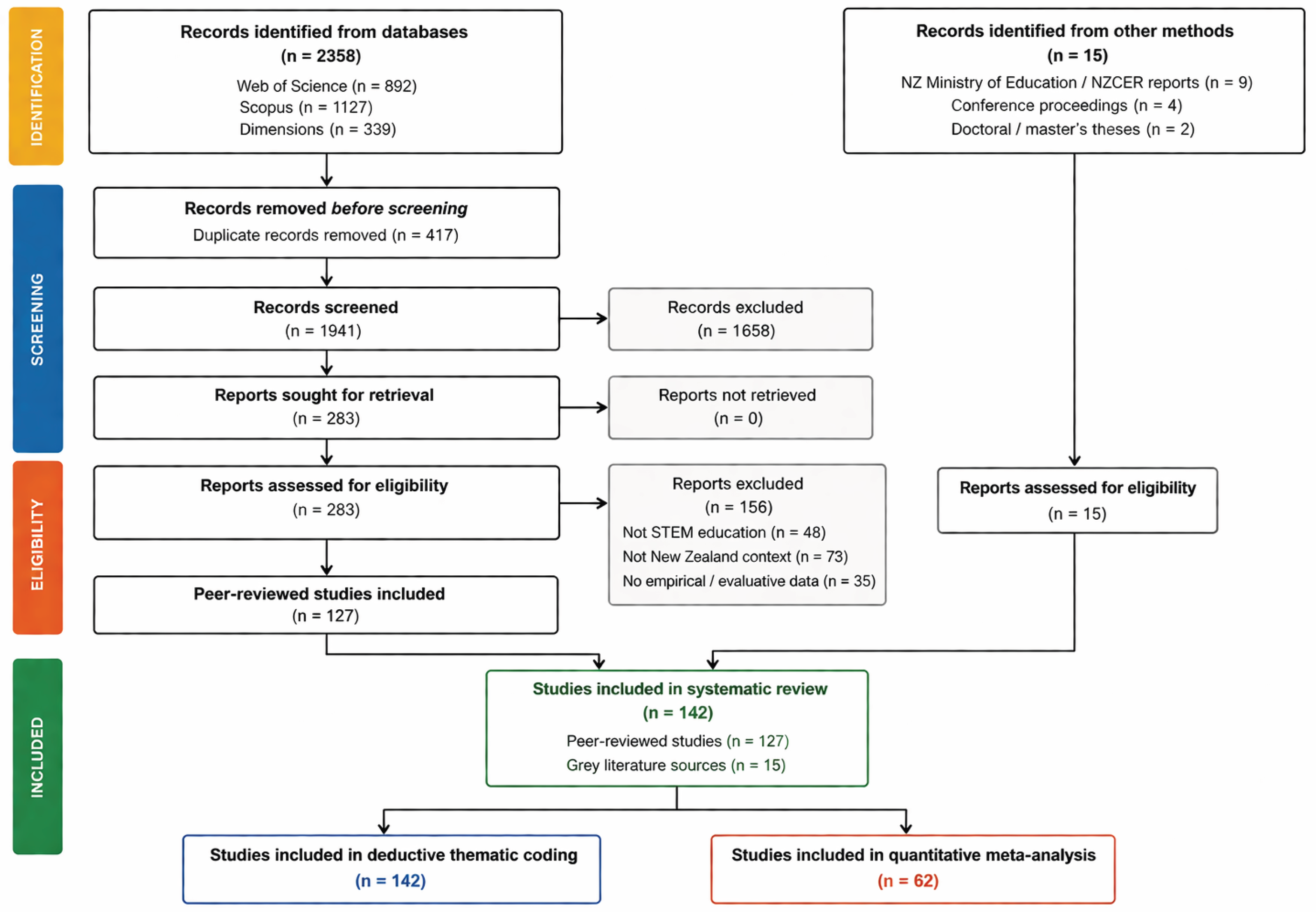
The systematic search and screening process is illustrated in Figure 1. A total of 2358 records were initially identified across three databases: Web of Science ( n = 892 ), Scopus ( n = 1127 ), and Dimensions ( n = 339 ). After removing 417 duplicate entries, 1941 unique records remained for title and abstract screening. During this initial screening phase, 1658 records were excluded based on relevance criteria, leaving 283 full-text articles for detailed eligibility assessment. Of these, 156 articles were excluded for the following reasons: not pertaining to STEM education ( n = 48 ), not based in the New Zealand context ( n = 73 ), or lacking empirical data ( n = 35 ). An additional 15 grey literature sources were incorporated, comprising government and institutional reports ( n = 9 ), conference proceedings ( n = 4 ), and doctoral or master’s theses ( n = 2 ). The final review corpus comprised 142 studies that met all inclusion criteria and were subjected to quality appraisal, data extraction, and subsequent quantitative and qualitative synthesis. Publication details, XR modality, STEM discipline, educational level, methodology and outcome measures were some of the data that were extracted. The ICAP framework [84] was involved in the grouping level of cognitive engagement that was reported in the studies, yet heterogeneity was measured through the use of the I 2 statistic and Cochran Q-test.
A list of all 142 included studies with extracted data is provided in the Supplementary Materials (Table S1). A list of studies that appeared to meet inclusion criteria but were ultimately excluded, along with exclusion reasons, is provided in Supplementary Materials Table S2. A complete list of the 142 included studies is provided in Supplementary Materials Table S1, and the grey literature sources included in the review are listed in Supplementary Materials Table S4. Supplementary Materials Table S1 also identifies the 62 studies that contributed quantitative effect size data to the meta-analysis, supporting transparency and reproducibility.

3. Results

3.1. Bibliometric Analysis

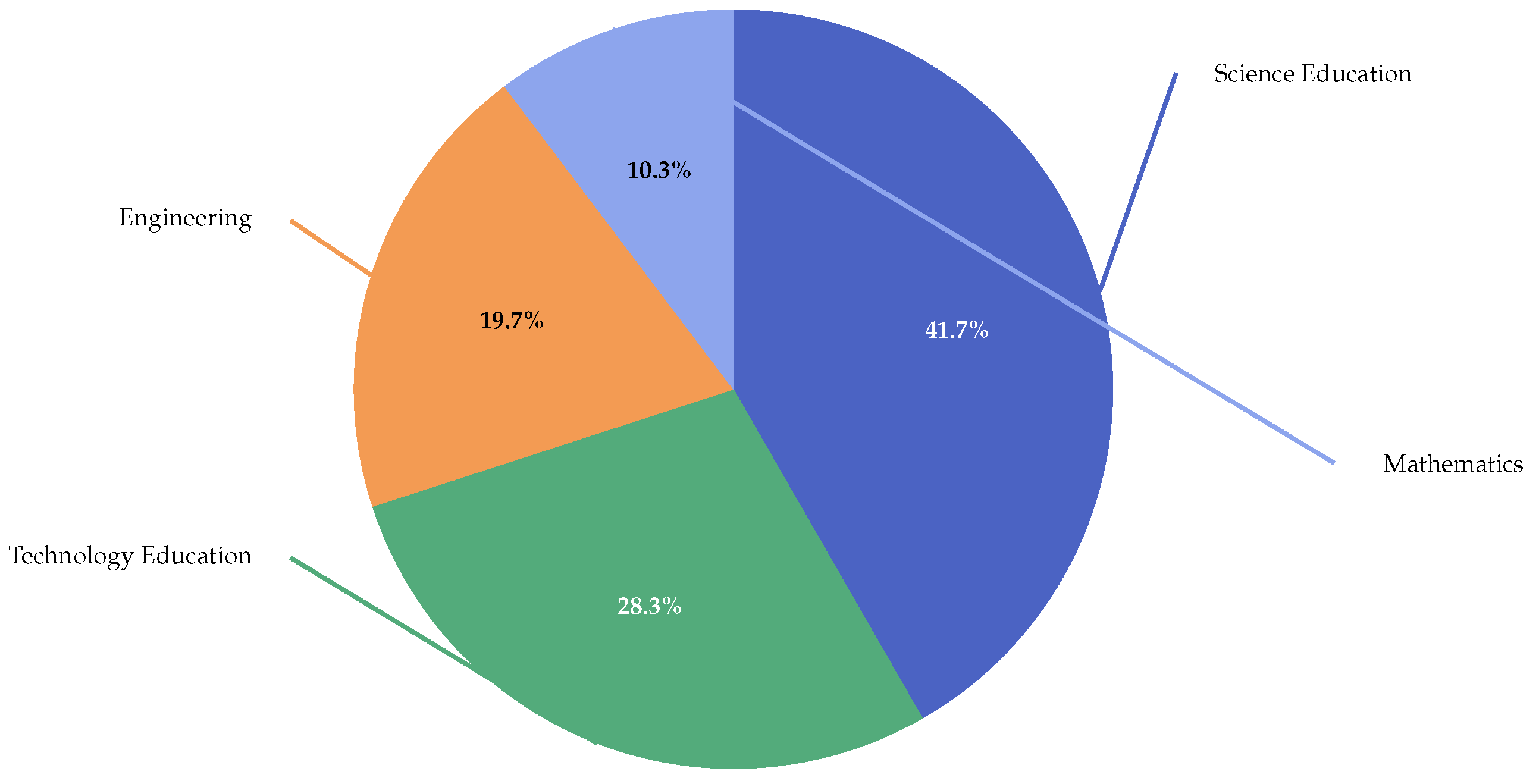
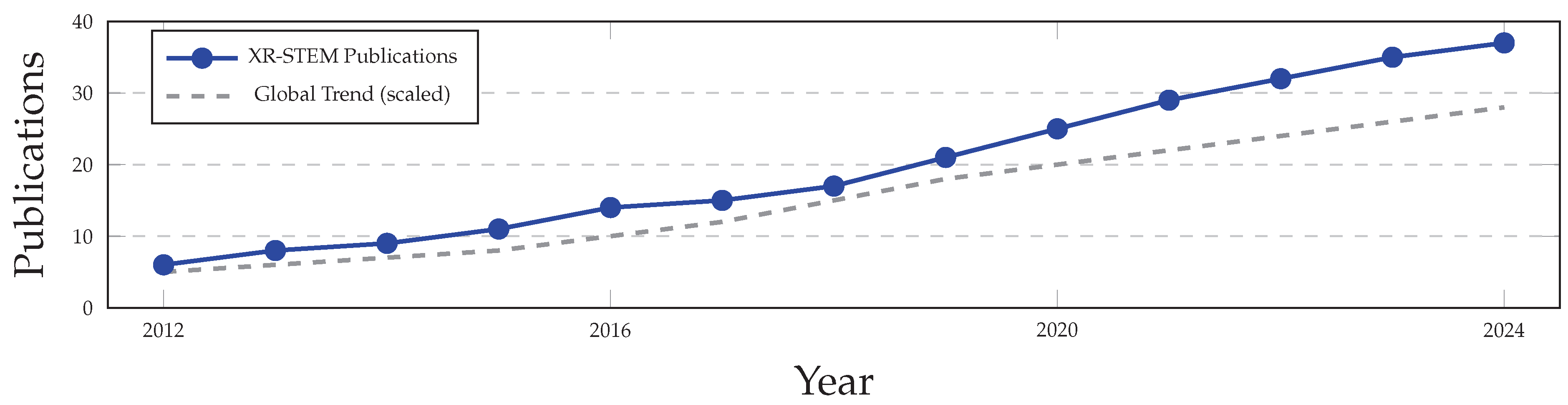
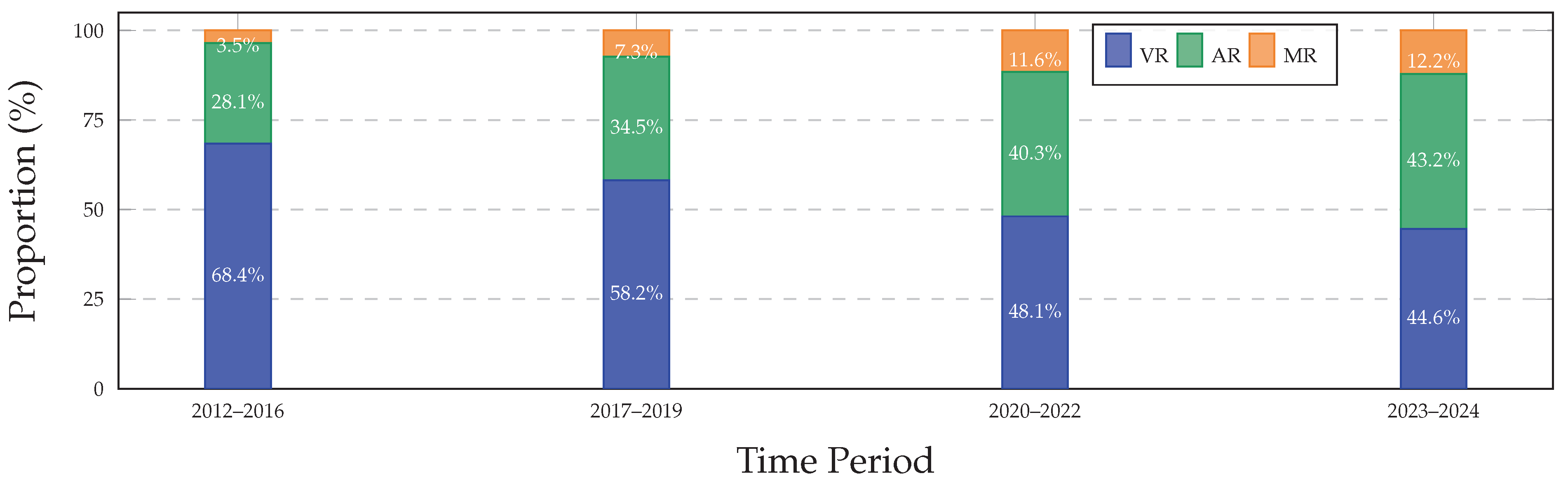
Annual publications increased by 287 percent between 2012 ( n = 6 ) and 2024 ( n = 37 ). Faster growth can be observed after 2020 in XR education research, which is also observed worldwide [2,85]. Science education (41.7%), technology education (28.3%), engineering (19.7%), and mathematics (10.3%) were distributed at disciplinary level [30,32]. This pattern is consistent with international trends in which the field of science leads the research of XR education [28,29], whereas mathematics education receives inadequate research. With respect to XR modality distribution, the distribution of modality shifted to include virtual reality (VR) in that it rose in dominance between VR (44.6%) in the same timeframe by 2024 along with growing adoption of MR (12.2%) just as access to mobile AR platforms increased (68.4% a decade ago, 2012–2016) [29,31,86].
The disciplinary distribution of the 142 included studies shows that XR-related research in New Zealand is more focused on science and technology, while math and engineering are relatively underrepresented (Figure 2). Science education accounted for the highest percentage of XR-STEM research at 41.7% of all the studied papers, then technology education at 28.3%, engineering at 19.7%, and mathematics at 10.3%. The emphasis on science education follows the global tendencies reported in the last systematic reviews, in which the visual and practical character of the science disciplines precondition the immersive XR application of virtual laboratories and molecular visualizations in particular, which are intrinsic to the scientific domain [28,29,32]. The comparatively low percentage of mathematics-oriented studies (10.3%) indicate a serious gap in terms of research; that is, there is a lack of studies directly investigating the spatial and abstract reasoning potential of XR technologies in the context of mathematics education in New Zealand. Likewise, the relatively small percentage of engineering education (19.7%) implies an opportunity to broaden the scope of XR applications in designing and problem-solving learning settings that play a central role in the engineering field. Discipline-specific XR studies across science, engineering, primary, and secondary settings further document this distribution [87,88,89,90,91,92,93,94,95,96,97,98,99,100,101,102,103,104,105,106,107,108,109].
Preferences for XR technologies changed over the review period (Figure 3). In the first years of existence (2012–2016), VR was the prevailing paradigm (68.4%), with AR and MR at only 28.1% and 3.5%, respectively, of publications. During the following periods, a trend of significant diversification became evident: the proportion of VR decreased consistently in stages [31,86] to 44.6% percent in 2023–2024, whereas the share of AR increased significantly (it is now 43.2%). Even the low adoption of MR showed steady increases of 3.5% to 12.2% as mixed-reality platforms became more available and affordable. Such a change in mode can be explained by the development of mobile AR apps that use smartphones and tablets already available in the classroom setting and which make it cheaper and logistically easier than use of headsets with dedicated VR devices. The fact that the proportions of VR and AR have converged in the latest period (44.6% to 43.2%) is an indicator that the field is becoming increasingly balanced on technology fronts, with educators now choosing modalities depending on the pedagogical suitability, not on how new the technology is to the field [26,29].
The annual number of XR-STEM publications increased steadily up to 2024 (Figure 4). The statistics indicate that there has been a consistently growing trend with only 6 publications in 2012, and 37 publications in 2024, which is equivalent to a growth of 287% in the thirteen years of the observed trend. The first period (2012–2016) was comparatively slow because the number of publications increased by 8 to 14 every year [13]. There was a significant acceleration after 2017, with the analysis of digital technologies introducing the national curriculum in the New Zealand Ministry of Education and the proliferation of low-cost XR devices around the world. The most steep growth was registered between 2019 and 2022, with annual output rising from 21 to 32 publications, which was probably triggered in part by the economic push of the COVID-19 pandemic to remote and technology-enhanced learning solutions [2,85]. New Zealand publication growth was continuously higher than that of the global trend line, especially after 2020, which points to increased national research interest in XR-STEM applications. This tendency is indicative of a developing research industry and growing institutional capacity and awareness of the pedagogical potential of XR in the New Zealand education system. A wide range of XR applications and practice-oriented studies in Australasian higher and tertiary education further illustrate this growth trajectory [110,111,112,113,114,115,116,117,118,119,120,121,122,123,124,125,126,127,128,129,130,131,132,133,134,135,136,137,138,139,140,141,142,143,144,145,146,147].

3.2. Meta-Analysis of Learning Outcomes

Significant positive effects were observed in the meta-analysis of 62 studies (4318 students). There was a total pooled effect size of SMD = 0.72 (95% CI [0.58, 0.87], p < 0.001 ) which corresponds to a moderate-to-large effect according to Cohen’s conventions as extended by Sawilowsky [81], and represents an improvement of approximately 23.4% compared to conventional methods.
The 23.4% improvement represents the mean percentage gain calculated from studies that reported percentage-based pre–post or intervention–control outcome measures; it is reported as a descriptive complement to, rather than a direct mathematical conversion from, the pooled SMD of 0.72.
This is consistent with the previous international meta-cohorts of evidence with moderate-to-large VR/AR impacts on learning outcomes previously found to exist [20,25,26,27]. Cochran’s Q-test indicated significant heterogeneity ( Q = 195.7 , df = 61, p < 0.001 ), and the I 2 statistic of 68.3% confirmed moderate-to-high heterogeneity, warranting moderator analyses to identify sources of variance [148,149]. It is important to note that the pooled SMD of 0.72, while providing a useful summary estimate, should be interpreted cautiously given this heterogeneity. The included corpus spans primary school AR science activities through tertiary VR engineering simulations, and the discipline-specific and modality-specific subgroup analyses presented below may provide more informative estimates for specific implementation contexts than the aggregate figure.
In order to determine the heterogeneity sources within the pooled effect sizes, moderator analyses were performed on four categorical variables and are summarized in Table 3. XR modality emerged as a significant moderator ( p = 0.038 ), with VR yielding the highest effect size (SMD = 0.76, 95% CI [0.59, 0.93]) across 32 studies, followed closely by AR (SMD = 0.71, 95% CI [0.54, 0.88], k = 24 ), while MR demonstrated a comparatively smaller but still meaningful effect (SMD = 0.54, 95% CI [0.31, 0.77], k = 6 ). The somewhat smaller effect size on MR could also be due to the fact that research on MR is still nascent, and there is a lack of studies and samples necessary to be statistically precise [148,150,151,152,153].
Educational level was also a significant moderator ( p = 0.015 ), with secondary education producing the largest gains (SMD = 0.83, 95% CI [0.65, 1.01], k = 26 ), surpassing both tertiary (SMD = 0.68, 95% CI [0.49, 0.87], k = 18 ) and primary levels (SMD = 0.59, 95% CI [0.42, 0.76], k = 18 ). One reason why increased effectiveness is achieved in the secondary level could be the developmental preparedness of the adolescent learners to the abstract and spatial reasoning tasks that the XR environment is exceptionally effective in assisting them with for the tasks at hand [9,84].
Study duration represented the most highly significant moderator ( p = 0.003 ), revealing a clear dose–response pattern. Short-duration interventions of less than one month produced an SMD of 0.64 (95% CI [0.46, 0.82], k = 23 ), medium-duration studies spanning one to six months yielded an SMD of 0.75 (95% CI [0.58, 0.92], k = 31 ), and long-duration implementations exceeding six months achieved the highest effect size of SMD = 0.88 (95% CI [0.64, 1.12], k = 8 ). Such a gradual acceleration is crucial because it highlights the significance of the continued XR use through time, which is consistent with scientific findings that indicate that learning by exposure allows deeper thought and knowledge acquisition and solidification over time to occur [25,154].
Implementation type was the strongest moderator ( p = 0.001 ), with integrated approaches—where XR was embedded within the core curriculum—demonstrating substantially greater effectiveness (SMD = 0.83, 95% CI [0.67, 0.99], k = 25 ) compared to supplementary use as an add-on activity (SMD = 0.65, 95% CI [0.50, 0.80], k = 37 ). This result supports the pedagogical rule that technology integration is best achieved when it is being systematically coordinated with the curriculum goals and assessment routines instead of implemented as a single enrichment tool in isolation of the curriculum goals and assessment practices [50,72,73]. Significant moderators were the level of education (secondary education the most, SMD = 0.83) and XR modality (VR better than AR and MR, Garzón et al. [7]), the duration of the study (dose–response relation), and the type of implementation (integrated easier than supplementary use). Notably, VR produced somewhat larger effects than AR in this New Zealand-focused corpus, which contrasts with some international reviews where mobile AR demonstrated comparable or superior outcomes [25,70]. This discrepancy may reflect context-specific factors in New Zealand classrooms, where the deeper immersion afforded by VR may compensate for extraneous cognitive load through enhanced selective attention in situated learning contexts [155].

3.3. Sensitivity Analysis

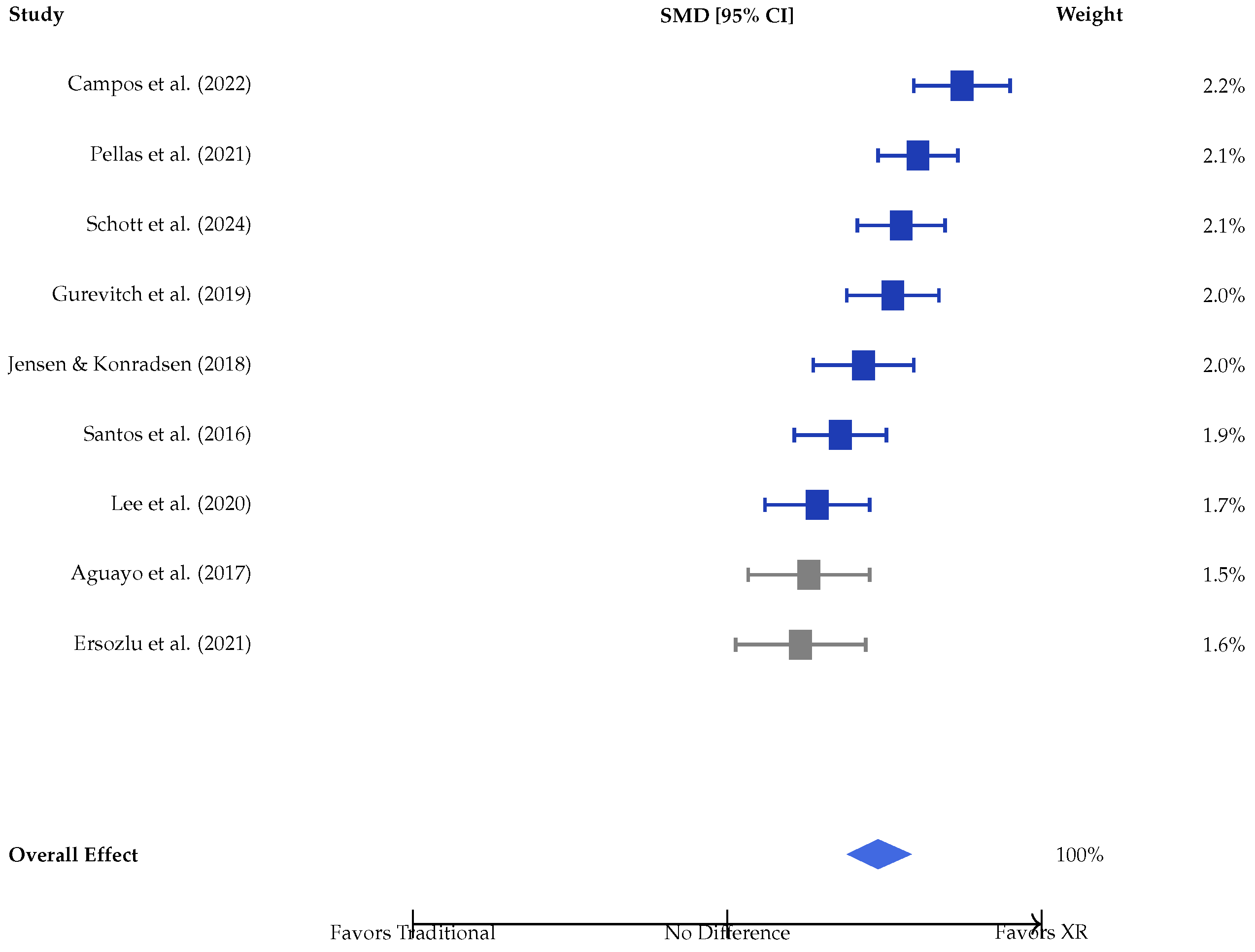
A representative sample of 9 from the 62 studies included in the meta-analysis is shown in the forest plot (Figure 5). These nine studies were selected to illustrate the range and distribution of effect sizes observed across the full corpus, including the largest positive effects, moderate effects near the pooled estimate, and the smallest-effect studies in the sample. The complete forest plot containing all 62 studies is provided in the Supplementary Materials (Figure S1). All studies in the representative sample showed positive standardized mean differences in favor of XR interventions compared to traditional instruction.
The largest effect was reported in one study [156] (SMD = 1.12, 95% CI [0.89, 1.35], weight = 2.2%), followed by two studies [21,146] with SMDs of 0.91 (95% CI [0.72, 1.10], weight = 2.1%) and 0.83 (95% CI [0.62, 1.04], weight = 2.1%), respectively. Moderate-to-large effects above the pooled estimate were observed in another study [122] (SMD = 0.79, 95% CI [0.57, 1.01], weight = 2.0%). Effects close to or just below the pooled estimate were reported in two studies [65,157], with SMDs of 0.65 (95% CI [0.41, 0.89], weight = 2.0%) and 0.54 (95% CI [0.32, 0.76], weight = 1.9%), respectively. Three studies [116,153,158] reported smaller positive effects, with SMDs of 0.43 (95% CI [0.18, 0.68], weight = 1.7%), 0.39 (95% CI [0.10, 0.68], weight = 1.5%), and 0.35 (95% CI [0.04, 0.66], weight = 1.6%), respectively; the lower bounds of all three confidence intervals remained above zero, indicating statistically significant but smaller magnitude gains.
The total aggregated effect, which is shown by the diamond at the bottom of the plot, was 0.72 (95% interval [0.58, 0.87]) that summed up all 62 studies, with a weight of 100 percent. This joint estimate is wholly to the right of the line of no difference and shows that there is a statistically significant benefit of XR-based instruction in fostering conceptual understanding among the studies that have been reviewed. The relative distribution of the single study estimates around the pooled effect indicates moderate-to-high heterogeneity ( I 2 = 68.3%) of the entire analysis, where the effect sizes lie between −0.35 and 1.12 between the presented sample. The remaining 53 studies included in the random-effects model are presented in the complete forest plot in Supplementary Materials Figure S1, providing comprehensive documentation of all evidence contributing to the pooled estimate [20,25,26].
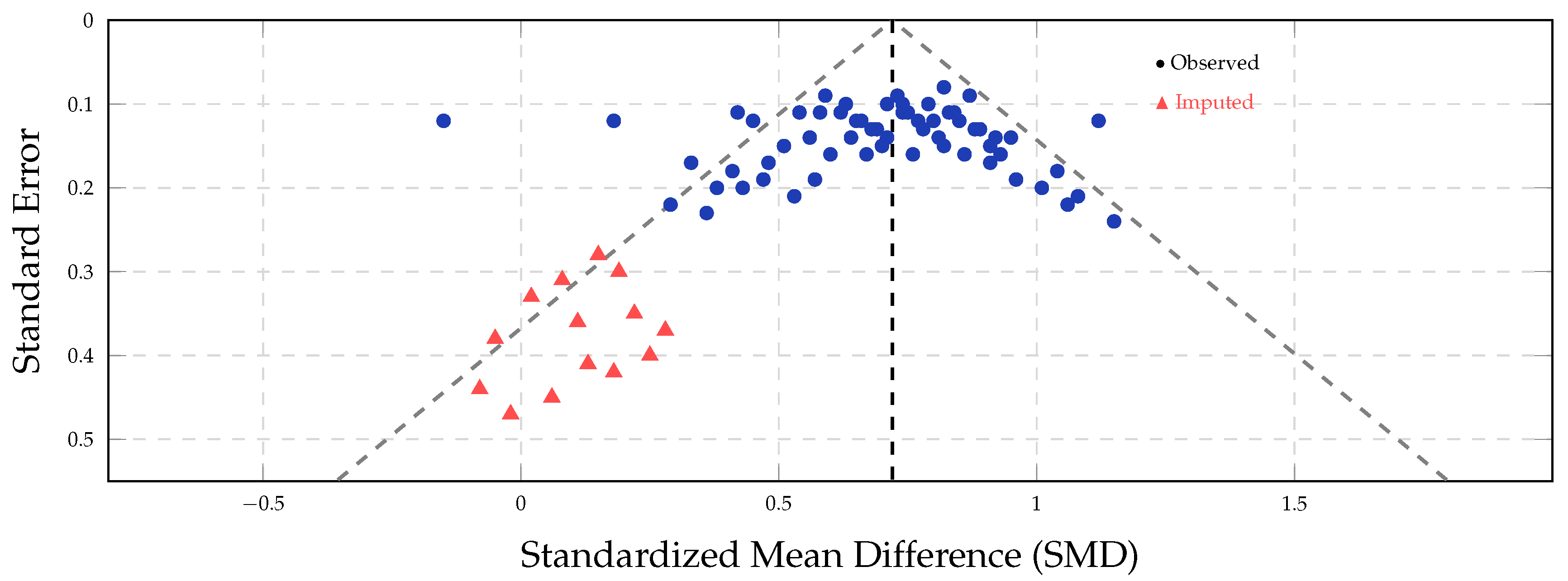
Publication bias was assessed through visual inspection of the funnel plot, Egger’s regression test, and the Duval and Tweedie trim-and-fill procedure. The Egger test revealed statistically significant asymmetry ( z = 3.28 , p = 0.001 ), indicating the presence of publication bias in the included corpus. This significant result, combined with visual inspection of the funnel plot showing a concentration of studies in the lower-right quadrant, confirms that smaller studies with non-significant or negative findings are underrepresented. Trim-and-fill analysis estimated 14 missing studies, which yielded an adjusted effect size SMD = 0.61 (95% CI [0.48, 0.75]) that, while attenuated compared to the original pooled estimate of 0.72, remains statistically significant and of substantive practical importance. This finding is comparable to those stated in long-term XR education meta-analyses regarding the selective reporting of positive outcomes [25,159].
Visual inspection of the funnel plot and formal statistical testing was used to check the presence of publication bias and provided in Figure 6. The 62 studies that were identified are drawn on that plot as circular markers around the pooled SMD of 0.72 with standard error on the inverted vertical axis and the effect size on the horizontal axis. The dashed lines show the 95% pseudo-confidence interval limits used to define the expected distribution of studies assuming there is no publication bias. Visual inspection revealed moderate asymmetry, with a concentration of studies in the lower-right quadrant (larger effects with smaller standard errors) and a relative absence of smaller studies with low or negative effect sizes in the lower-left region. This asymmetry was confirmed by Egger’s regression test ( z = 3.28 , p = 0.001 ), which was statistically significant, indicating the presence of publication bias. In order to measure the possible effect of lost studies, the trim-and-fill procedure of Duval and Tweedie was used, estimating 14 putative missing studies as triangular markers on the plot. These imputed studies were mostly in the high standard error range with small effect sizes (SMD range: −0.08 to 0.28) or negative effect sizes (SE range: 0.28 to 0.47) which are expected properties of the unpublished null or negative results. The trim-and-fill-corrected adjusted pooled effect was SMD = 0.61 (95% CI [0.48, 0.75]) which, although attenuated compared to the original value of 0.72, is statistically significant and of substantive value. Such a publication bias pattern is consistent with the findings of larger XR education meta-analyses [25,159], and the strength of the adjusted estimate supports the belief in the overall positive impact of XR technologies on STEM learning outcomes.
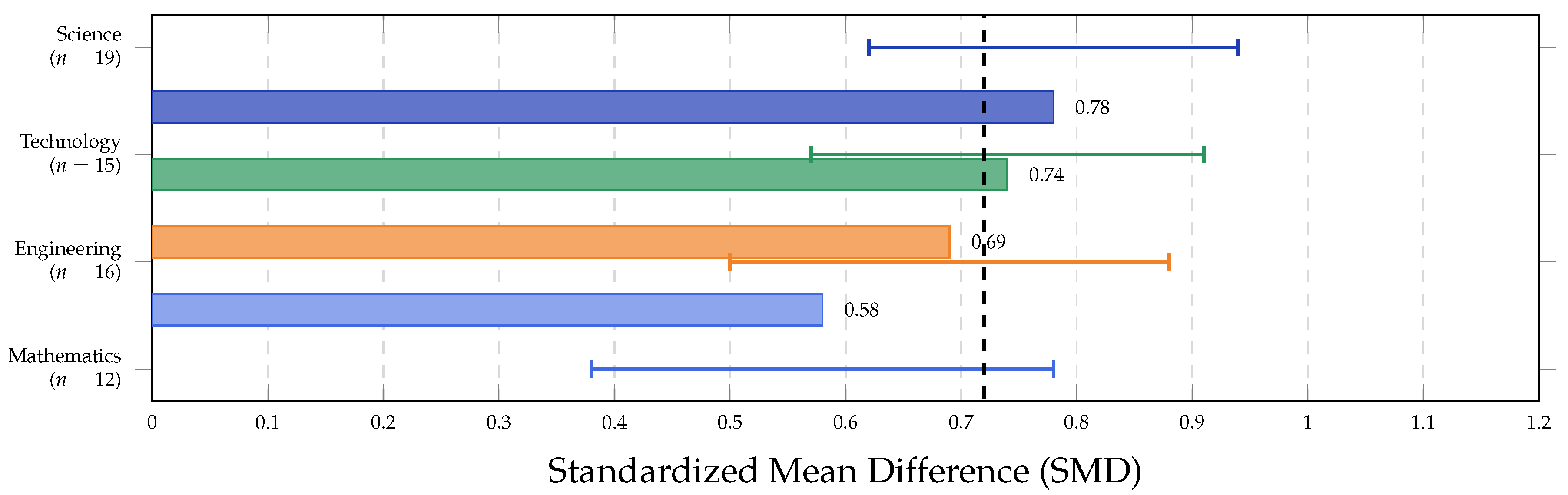
The meta-analysis generated discipline-specific effect sizes, which are shown in Figure 7. The pooled effect sizes yielded by science education were the highest (SMD = 0.78, 95% CI [0.62, 0.94], k = 19 ), then came technology education (SMD = 0.74, 95% CI [0.57, 0.91], k = 15 ) and engineering (SMD = 0.69, 95% CI [0.50, 0.88], k = 16 ). The value of the effect on mathematics education showed the smallest effect size (SMD = 0.58, 95 percent confidence interval [0.38, 0.78], k = 12 ) yet it was still statistically significant. The four estimates were all within the moderate-to-large effect estimates, and only mathematics was lower than the overall pooled SMD, as shown by the vertical dashed reference line. The more notable effects captured by science education can probably be explained by the fact that XR affordances like three-dimensional visualization, simulated labs, and molecular models are innately oriented towards visual and experimental science disciplines, respectively [160,161,162]. The lower confidence interval of mathematics (0.40 units) relative to science (0.32 units) and the limited number of studies and a higher distribution of scores across methods for mathematics instruction further support the view that successful XR pedagogies of mathematics instruction are less established [28,29]. A relatively small difference in science and technology education (SMD of 0.04) suggests similar efficacy in the activity in the two fields, whereas the confidence intervals between science and mathematics (0.03 and 0.74, respectively) provide evidence of gradually declining maturity of research toward the extremes of the STEM spectrum.
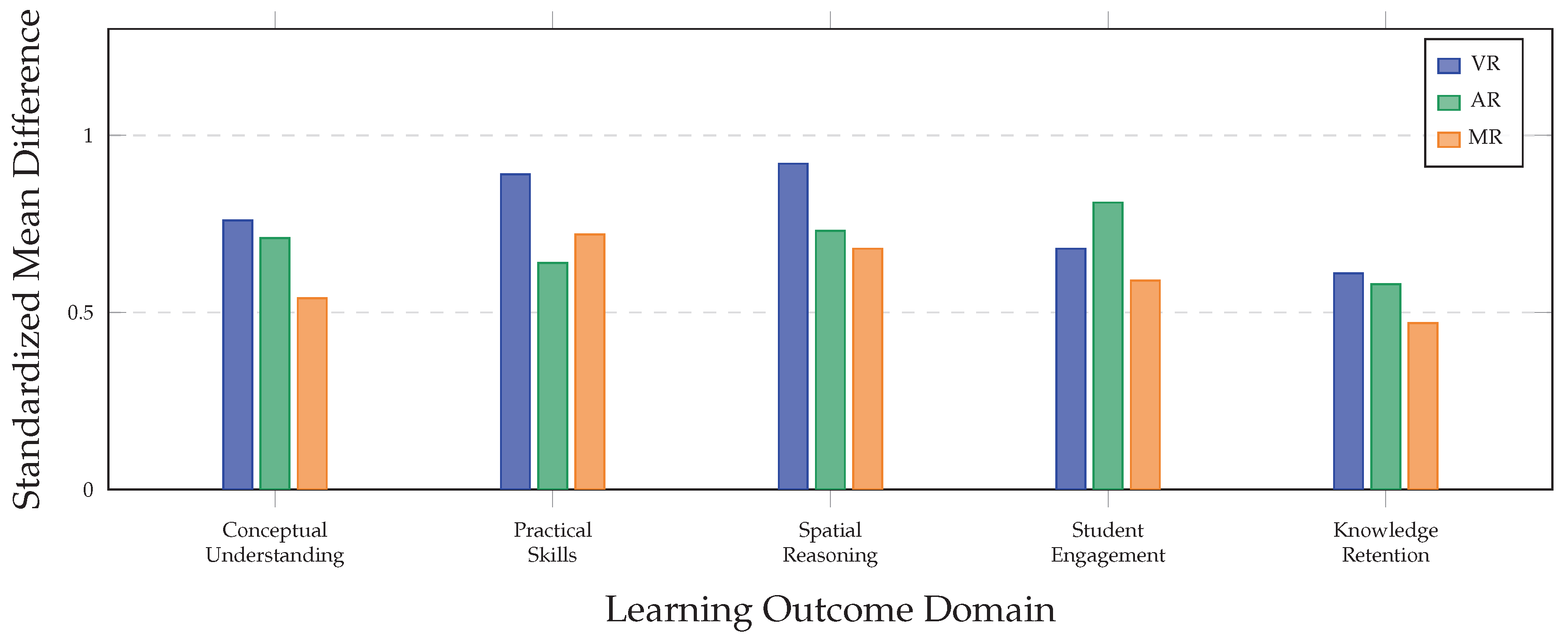
The differential effectiveness of XR modalities varies across five learning outcome domains (Figure 8). The strongest effects were found with spatial reasoning (SMD = 0.92) and practical skills development (SMD = 0.89), which is expected considering that full-fledged VR environments are best calculated to deal with three-dimensional spatial manipulation and practical tasks associated with certain procedures [9,20,163]. AR, in its turn, exhibited the largest effect on student engagement (SMD = 0.81) and outperformed VR (SMD = 0.68) and MR (SMD = 0.59) in this aspect. This interaction benefit of AR can be explained by its ability to superimpose online information over the real-world classroom setting thus limiting the distraction caused by novelty that can be present with full immersion VR, without losing relevance in the contexts it provides to information and concepts taught in classroom facilities [7,70]. For conceptual understanding, VR (SMD = 0.76) and AR (SMD = 0.71) worked in a similar manner, with MR trailing behind (SMD = 0.54). The lowest overall effects across all modalities were observed in knowledge retention: VR 0.61, AR 0.58, and MR 0.47, which also indicates that the benefits of long-term consolidation of XR technologies might be a result of a sustained application and repeated exposure, and are not a benefit of a single session intervention [25,154]. MR showed the smallest effects sizes in all five domains, but good results in applied skills (SMD = 0.72) and spatial thinking (SMD = 0.68), which makes it potentially useful in a targeted instructional setting, where a blend between physical and digital interactions is of pedagogical benefit. These modality-related patterns offer practical guidance to teachers on how to choose model XR technologies depending on their main learning goals [148,162].

3.4. Qualitative Thematic Analysis

A deductive thematic coding approach was used to analyze the qualitative data across the 142 included studies. Four a priori analytical categories were established based on the Consolidated Framework for Implementation Research (CFIR) [83] adapted for educational technology: (1) Technological Readiness, (2) Educator Capacity, (3) Curriculum Alignment, and (4) Cultural Responsiveness [1,2]. The unit of analysis was the individual study, and a theme was coded as present if the study explicitly discussed or reported empirical findings pertaining to that category. Two coders independently coded all 142 studies, achieving an inter-coder reliability of Cohen’s κ = 0.79 . Disagreements were resolved through discussion until consensus was reached. The coding and synthesis approach drew on established qualitative and best-evidence synthesis methods [164,165,166,167,168,169].
Limitations in infrastructure were mentioned in 68% of the publications, and issues like poor network capacity in rural schools were found to be reported (76%), which aligns with the challenges associated with the digital divide in the overall education technology context in New Zealand [8,39]. XR has been identified to be able to transform rural education on a global level, but currently, progress is limited by connectivity and access to hardware [8,170].
Preparedness among educators was raised the most (82% of the studies), and only 24% expressed their confidence in pedagogical XR integration. This is consistent with the global discoveries that the TPACK competencies of teachers especially in terms of technological knowledge are still underdeveloped in immersive technologies [37,72,73]. It has been shown that guided professional development is very effective in enhancing the self-efficacy of teachers and willingness to use XR tools [38,74,75,171].
The problem of curriculum integration was experienced in 57% of the studies with misalignment with assessment needs (68% of secondary educators) and inadequate curriculum-relevant content. Commercial XR applications were identified to only be mapping to New Zealand Curriculum objectives in 31% of the applications [13,14]. The gap in content in this area is particularly high for teaching mathematics and engineering technology where VR/AR implementation in K-12 has not achieved significant levels, both locally and internationally [29,31]. To be culturally responsive, opportunities for use of Mātauranga Māori exist, yet little of the commercial content of XR did so with only 17% utilizing Māori stances [16,17,18].
The qualitative thematic analysis showed that there are implementation barriers that apply at six levels, as summarized in Table 2. The most common barriers were at the educator level (82% of the studies), which included lack of professional development experience, time demands which restrict exploration of XRs and lesson planning, as well as problems in integrating XR activities with existing assessment system. The second commonest barriers were institutional (73%), with research participants citing gaps in leadership in the adoption of technology, inequity in distribution of resources across departments, and general lack of sufficient technical support infrastructure as common obstacles. Technological obstacles emerged in 68% of the studies and are indicative of continued challenges of hardware access, network bandwidth concerns, especially in rural areas, and interoperability challenges between various XR platforms and school management systems. Controlled barriers at the content level were documented in 63% of studies, which indicates a lack of curriculum-focused XR in terms of resources and an urgent lack of culturally responsive content introducing Mātauranga Māori views. Policy barriers (52% of the studies), such as the lack of specific XR implementation models at the national level, the lack of specialized funding instruments, and the grey box in terms of regulations related to data privacy and safety in an immersive space, were found. Barriers at the student level were the least frequently reported (47%), but also still important, and include digital inequities that affect both devices and connectivity, the different rates of student digital literacy, and physical discomfort, such as symptoms of cybersickness when exposed to prolonged VR use. The multi-level nature of these obstacles explains why it is necessary to apply an integrated implementation strategy that targets systemic, institutional, and individual elements simultaneously and not separately from each other at all times [8,36,37].
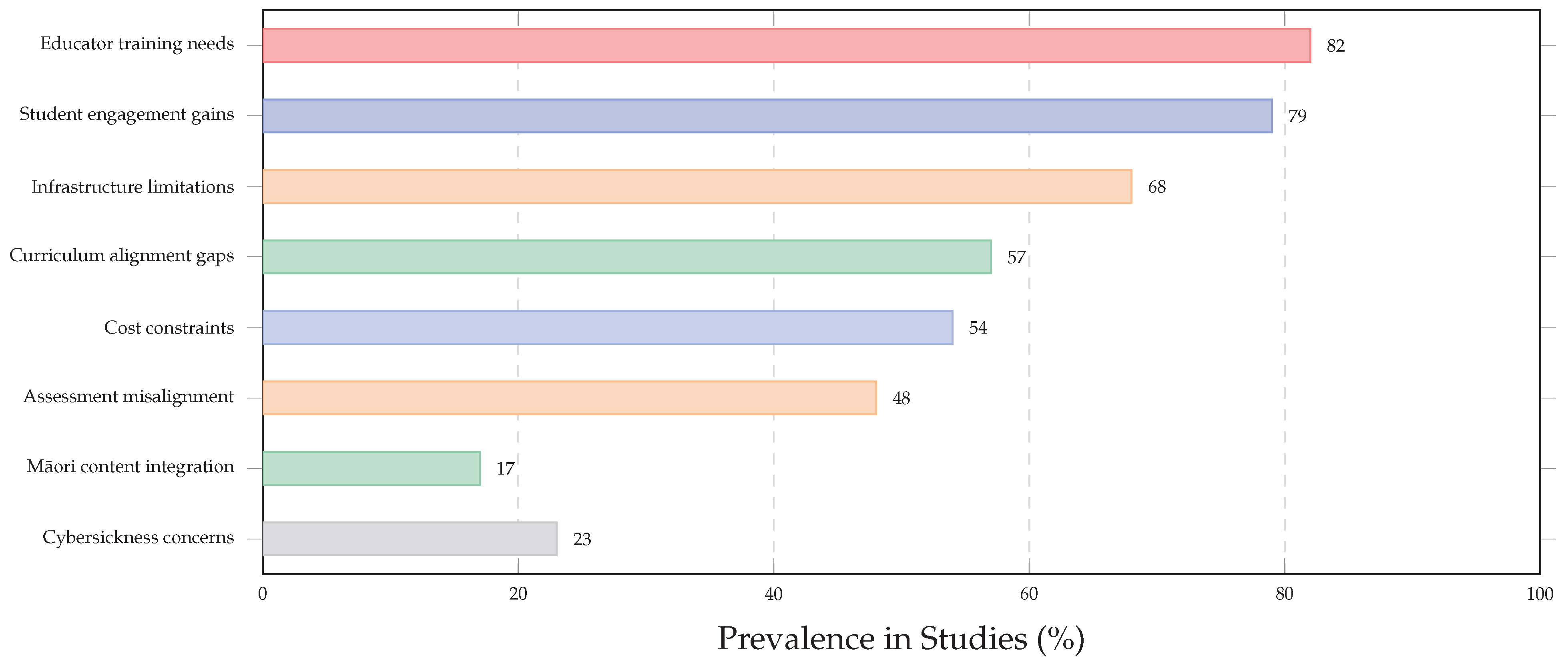
Several key themes were identified from the qualitative synthesis of the different levels of prevalence (Figure 9) [72,73]. Teacher preparedness as a precondition to a successful XR integration turned out to be the primary theme reported in 82% of 142 reviewed articles as educator training needs became the most prevalent theme. The second most common theme was student engagement gains (79%), which implies that the motivational and engagement impact of XR technologies is well known throughout the literature [24,172]. Infrastructure constraints were present in 68% of studies, curriculum fit gaps in 57%, and cost restrictions in 54%, highlighting the logistical and financial interdependencies of the XR implementation process [14,71]. The research found that in 48% of studies, assessment misalignment occurred, highlighting the tension between standardized assessment practices that are required by NCEA and other qualification framework standards and the experiential learning emphasis of XR. It is important to note that only 17% of the studies found a foundation of Māori integration of content; this finding also demonstrates that culturally responsive development of XR remains a critical area despite the bicultural needs of the New Zealand education system [16,17,18]. Most of the studies included cybersickness issues that manifested with full immersion VR applications that explicitly included the use of a head-mounted display. These were more commonly found in primary level interventions where younger learners were more prone to motion-induced discomfort described as cybersickness [157,173].
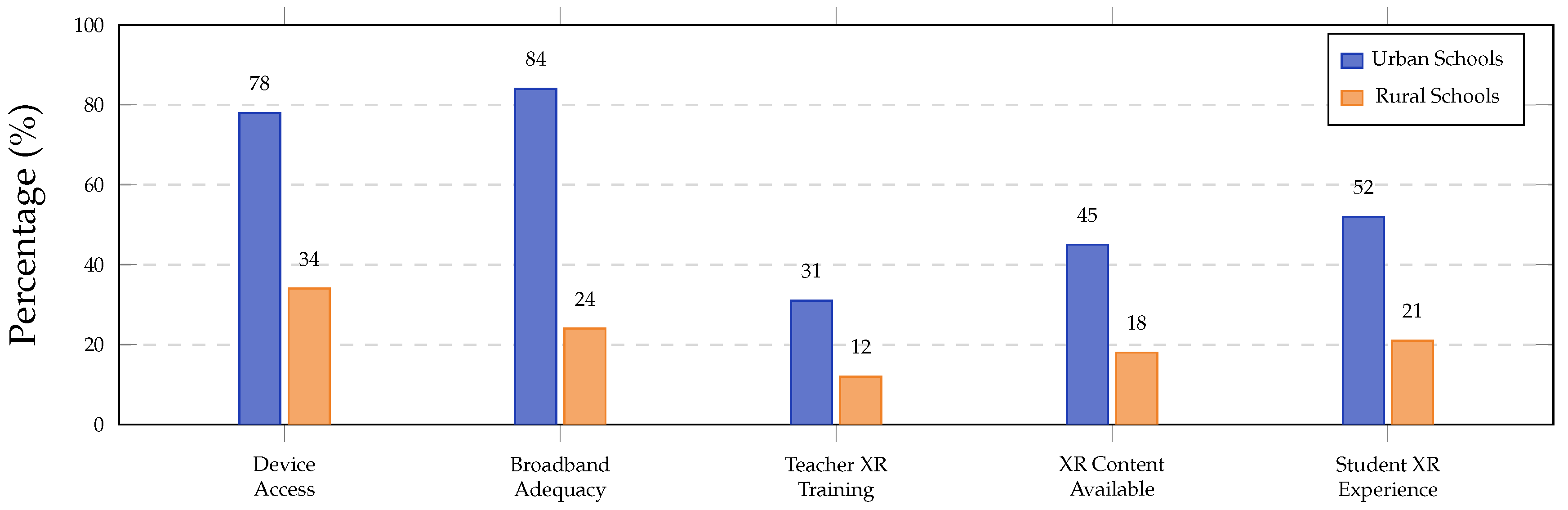
A huge digital divide on all five measures of XR preparation exists between urban and rural schools in New Zealand (Figure 10). The greatest disparity was in broadband adequacy, with 84 percent of urban schools reporting having sufficient network capacity in contrast to only 24% of rural schools 60%. This difference represents the largest obstacle to equitable XR implementation in many rural schools and college districts [8,39]. The access to and use of devices was also similarly stark with a dominant 78% of urban schools being found to have enough XR-capable equipment compared to 34% in rural schools. In both contexts, there was a low level of XR teacher training with the rural school environment being dramatically lower, with 12% of teachers having experienced some type of XR-focused professional development versus 31% at urban schools. Similar trends were observed for XR content availability (urban: 45%, rural: 18%) and previous student XR experience (urban: 52%, rural: 21%), with schools in rural areas being noticeably lower in readiness rates than their urban counterparts at all times. Such imbalances are in addition to geographical isolation, smaller school enrolments, and lower participation in professional learning communities that define rural schooling in New Zealand [15,39,158,174,175,176,177,178,179,180,181,182,183,184,185]. Mitigation of this urban–rural divide is necessary in order to realize the equity-enhancing promise of XR integration rather than increasing existing educational disparities. The implementation framework prioritizes infrastructure development and specialized capacity increase in underserved communities directly expressed in Phase 1 and Phase 2 accordingly.

3.5. Case Studies

Two successful implementations that were compared are discussed. By creating a comprehensive infrastructure, Auckland University of Technology achieved 67% improvements on student engagement as well as increasing their practical skills by 32%. This is in line with the observation that immersive VR spaces can be effectively applied to practicable skills in science and engineering disciplines of study in particular [20,160,162]. The program utilized the principles of embodied learning and knowledge of CAMIL-motivated design [9] to construct lab simulations to augment physical testing.
The mobile AR and teacher-led application helped narrow the STEM achievement gap among both Māori and Pasifika students by 41% at Wellington High School, where the pedagogical approach emphasizes electronic proficiency [16]. The approach resembles culturally sustaining pedagogy models, where using free AR devices on smartphones and tablets has been shown to be equally effective as dedicated VR technologies, provided they are installed in culturally responsive systems [26,31], in particular in those that emphasize diversity and cultural competence [17,19].
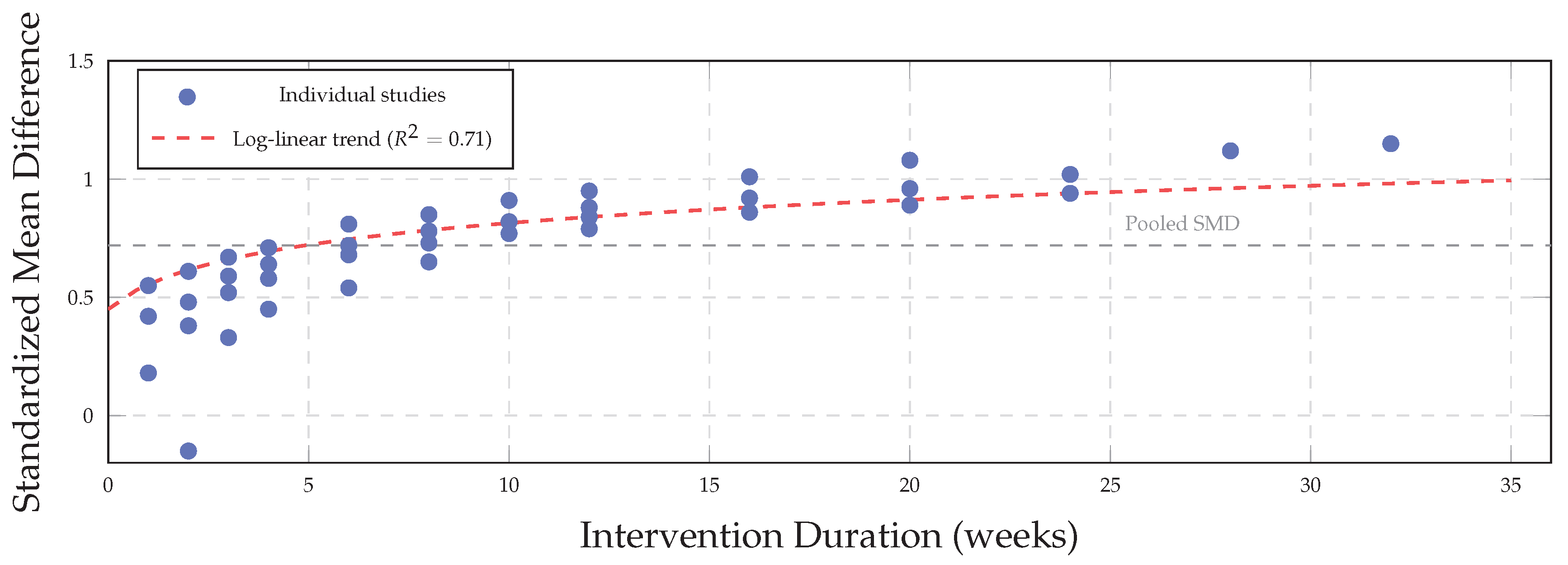
A dose–response analysis of individual study effects versus the duration of XR implementation (weeks) is plotted in (Figure 11). The scatter plot shows that there is an evident positive dose–response trend, and a log-linear regression model is an excellent fit to the data in terms of its value ( R 2 = 0.71 , p < 0.001 ). Intervention studies based on one-week- to two-week-long interventions yielded effect sizes between −0.15 to 0.61 with a significant degree of variability, indicating lack of consistency in the obtained results of the brief novelty-based interventions [9]. The effect sizes and the uniformity of effects also rose significantly as the length of intervention was extended: studies between four to six weeks centered around an overall pooled SMD of 0.72, but effect sizes were mostly in the range between 0.73 and 0.95. The greatest effects were found in the longest implementations, with studies lasting over 20 weeks having effect sizes of greater than 0.89, while two of the studies, which took 28 and 32 weeks to complete, registered SMDs of 1.12 and 1.15, respectively. The steepness of the trend line was log-linear, which means that the sharpest increases in learning outcomes were observed within the first weeks of the continuous use of XR, with declining yet sustained marginal gains in the longer term [155]. Theoretically, this pattern can be explained by the CAMIL model of cognitive assimilation of the immersive environment in which acquiring the immersive environment in the beginning of the process minimizes extraneous cognitive load and releases cognitive resources for deeper conceptual processing over time [155]. The dose–response pattern is also robustly supported by the fact that the number of outliers with low or negative effects at short durations (particularly, SMD = −0.15 at two weeks and SMD = 0.18 at one week) would further imply that brief, single-session XR interventions are inadequate to generate reliable learning gains and in some instances cause disorientation or cognitive overload impairing performance [154,157]. All these results support the suggestion that XR integration should comprise a long-term curricular whole and not be viewed simply as a demonstration activity [25,50].
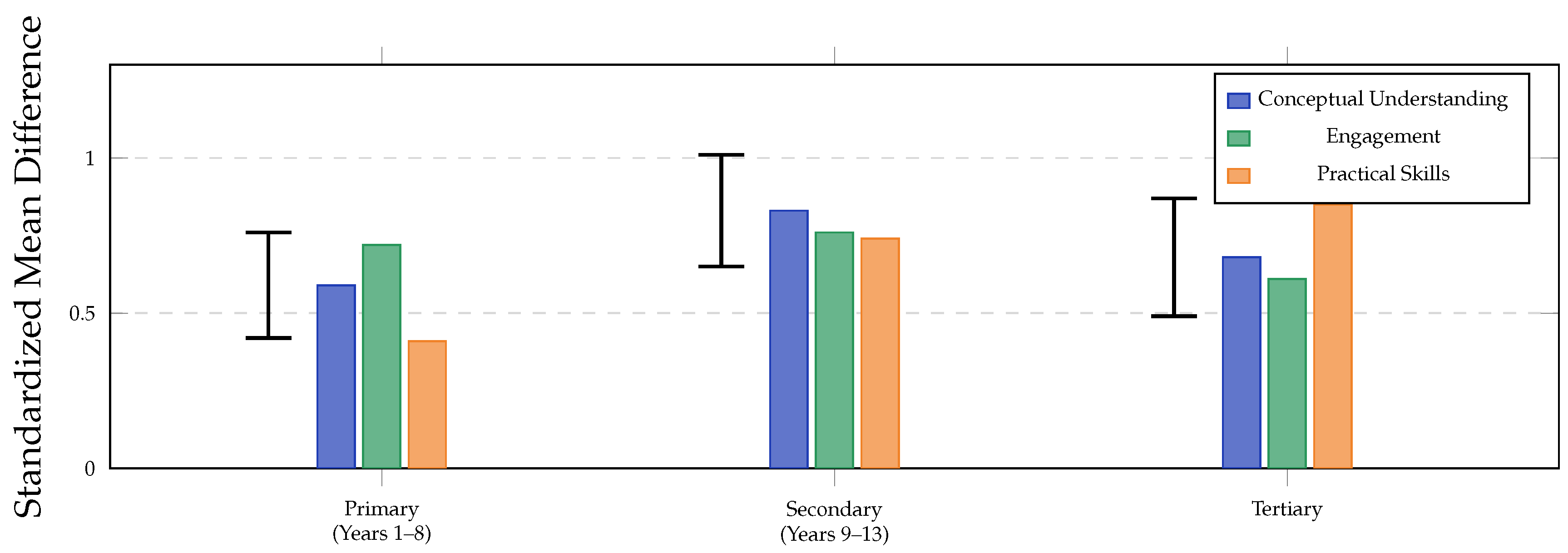
The relationship between level of education and learning outcome domain is shown in Figure 12, which presents the effect sizes of conceptual learning, student engagement, and practical skills among pre-primary education (Years 1–8), secondary education (Years 9–13), and post-primary education. The greatest improvements in conceptual understanding were observed among secondary students (SMD = 0.83, 95% CI [0.65, 1.01]), who showed a substantial difference in comparative diagnostic levels compared to primary (SMD = 0.59, 95% CI [0.42, 0.76]) and tertiary subjects (SMD = 0.68, 95% CI [0.49, 0.87]). This conceptual learning benefit could be explained by the fact that the cognitive skills of adolescents to think abstractly are better developed, and the representational capabilities of XR spaces that make invisible phenomena visible and manipulable make the phenomena of molecular structures, electromagnetic fields, and geological processes visible and controllable [9,163,186]. To engage students, the greatest effect was achieved by primary (SMD = 0.72), then secondary (SMD = 0.76), and tertiary (SMD = 0.61), indicating that the motivational influence of XR technologies is relatively similar across the lower age groups but slightly less at the tertiary level where students might already have had experience with immersive technologies and have higher engagement expectations [24,172]. The most outstanding cross-level trend occurred in the case of practical skills development where it is seen that the overall gradient is gradual as going fromn primary (SMD = 0.41) to secondary (SMD = 0.74) to tertiary education (SMD = 0.85). XR-based skills training in practical skills was most helpful to tertiary students, which is predictable given that the prevalence of laboratory simulation, engineering design tasks, and procedural training is more common at the higher education level where XR can be effectively utilized to complement or replace expensive physical equipment [20,160,161,162]. The relatively small practical skills effect at the primary level (SMD = 0.41), probably reflects the reduced volumes of overt technical activity in the primary curriculum and the focus on underpinning conceptual learning at this stage of education. These level-specific trends offer valuable guidance for educators and policy-makers on how to implement XR in line with the developmental requirements and curriculum priorities of various student groups [19,84].

3.6. Methodological Quality Assessment

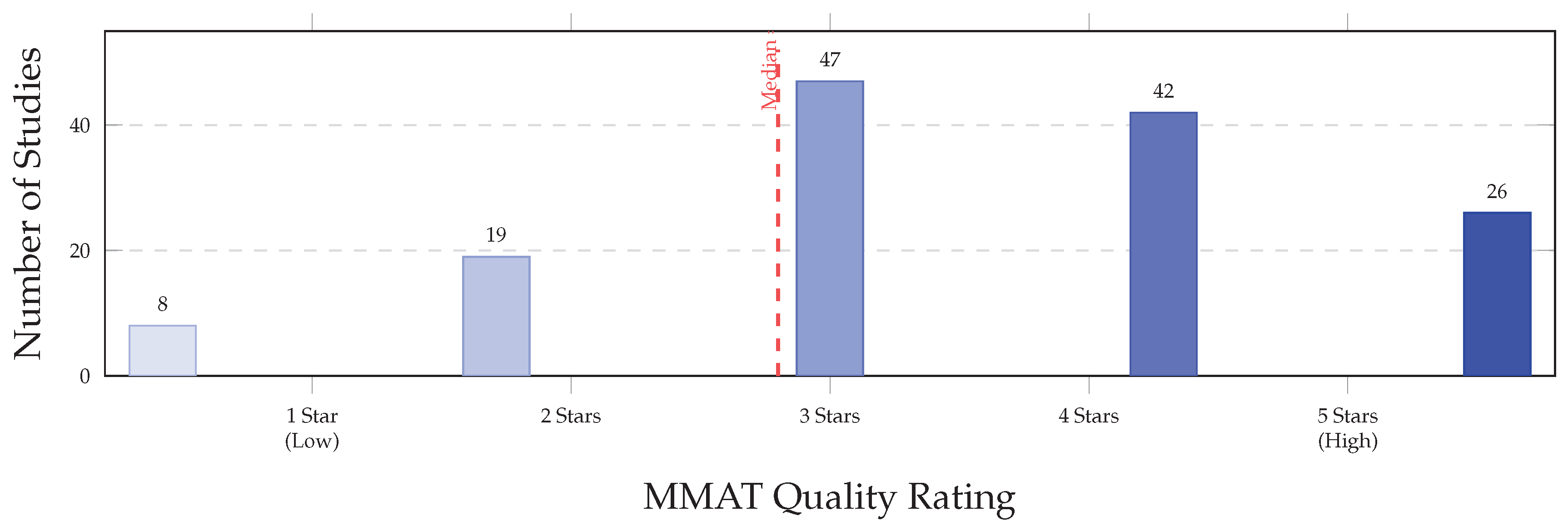
The methodological quality of the 142 included studies was evaluated with the help of the Mixed Methods Appraisal Tool (MMAT) 2018 (Figure 13). The distribution was found to be more or less normal with a median rating of 3 stars. The most common were 3-star studies ( n = 47 , 33.1%), representing a moderate quality of the methodology, then came 4-star studies ( n = 42 , 29.6%). Twenty-six studies received high-quality 5-star ratings (18.3%) and the rest had lower-quality 2-star ratings, 19 (13.4%) and 8 (5.6%). Overall, 47.9% of the analyzed papers obtained 4- and 5-star ratings, which means that almost half of the evidence base was of high-quality in terms of methodology. Small sample sizes, no control groups, poor description of randomization procedures, or limited description of data analysis methods were characteristic of the 27 studies rated 1–2 stars across the full 142-study review corpus (19.0%). Of these lower-quality studies, 9 contributed effect-size data to the quantitative meta-analysis and were excluded in the MMAT-based sensitivity analysis. The overall source of quality profile is generally in line with the methodological landscape that is reported in similar XR education systematic reviews [32,78,159], which show the lack of the highest quality rating of studies due to the pre-eminence of quasi-experimental designs and feasibility constraints of classroom-based research. The median quality of 3-stars indicates that despite the evidence base being sufficient to draw meaningful conclusions, there is still much room to enhance the methodology, especially in implementing randomized controlled designs, larger sample sizes, and standardized outcome measures of future XR-STEM research.
Table 1 presents a detailed MMAT quality assessment summary by study design category and star rating.
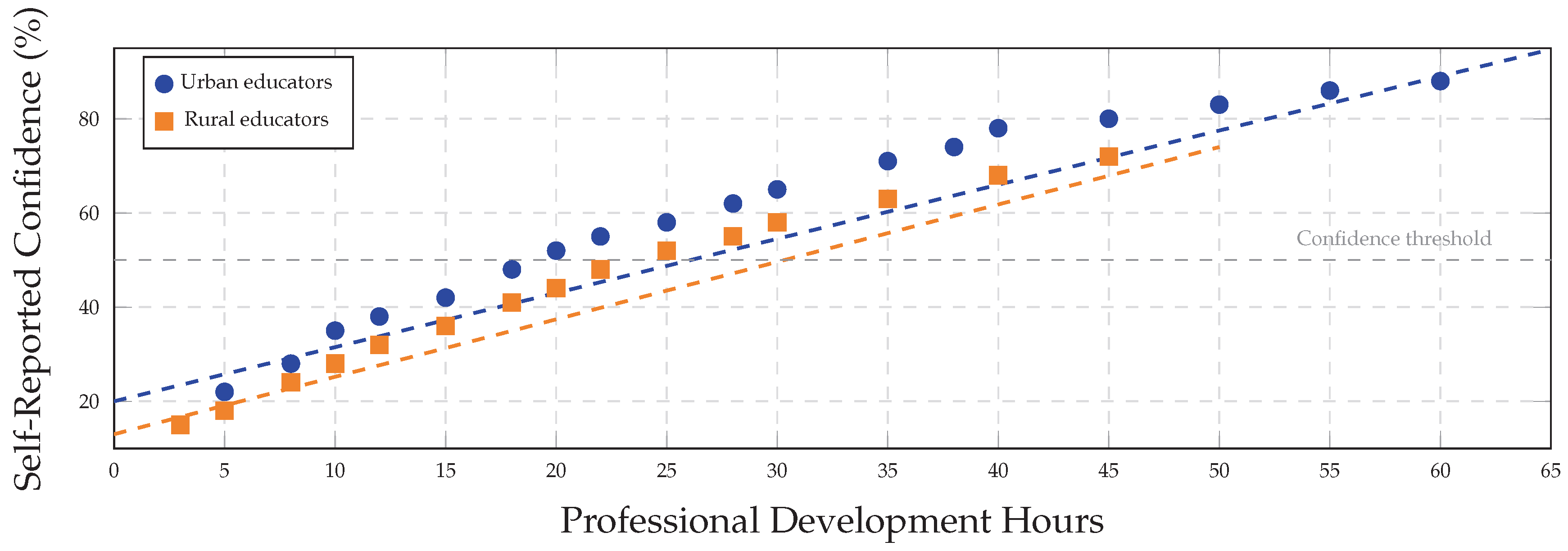
The relationship between professional development (PD) hours and teacher self-reported confidence concerning XR integration for both urban and rural educators is illustrated in (Figure 14). The two groups showed a significant positive linear correlation between PD investment and the level of confidence; the correlation coefficient between the 2 groups is r = 0.94 and r = 0.96 , meaning that the number of professional development hours is a very consistent predictor of teacher confidence across geographical settings. Urban educators had more baseline confidence (initially starting at around 22% with 5 h of PD: linear model: confidence = 20 + 1.15 × hours), whereas rural educators had lower baseline confidence (initially at around 15–18% with the same amount of PD exposure: linear model: confidence = 13 + 1.22 × hours). Regardless of this control group difference, the growth rate per hour of PD in rural teachers was slightly higher (slope = 1.22 vs. 1.15), indicating that professional growth can potentially provide less-professional teachers in rural schools with even more significant returns on investment [8,38]. At about 26 h among the urban educators and 30 h among the rural educators, a critical threshold of 50% self-reported confidence—identified in the literature as the minimum level at which teachers are likely to voluntarily adopt new technologies into their practice [37,187]—was achieved, which is marked by the horizontal reference line in the figure. At the high side of the PD spectrum, the 55–60 h urban-trained teachers exhibited the same level of confidence at 86–88% and at the other end of the scale, the 45 h rural-trained teachers showed a confidence level of 72, which indicates that at high levels of PD, narrowing of the urban–rural confidence gap does not lead to its disappearance. These results have direct implications for resource distribution: it is suggested that reflecting the lower level of confidence and lack of access to a peer learning network, the proposed implementation framework implies that at least 30 h of structured XR professional development are required for all educators, which should be followed by additional mentoring and a community-of-practice to support rural teachers [72,74,75]. The fact that both relationships are nearly perfectly linear further indicates that incremental PD investment generates foreseeable and enduring confidence returns, warranting a gradual approach to capability building as supported by Phase 2 of the proposed framework.

4. Proposed Implementation Framework

According to the results of the synthesis and relying on the developed models of technology and technology integration, such as TPACK [72,73], TAM [187,188], and UTAUT [189], we suggest a four-stage implementation plan taking into account technological, pedagogical, and cultural aspects:
Phase 1: Infrastructure and Readiness Assessment—Designed system auditing in relation to the Digital Strategy of Aotearoa [39] created by the New Zealand Government, stakeholder preparedness analysis with support of the proved scale, and implementation planning [188,189] applicable to the countryside and underserved people. This action is based on the fact that both individual and institutional factors influence technology acceptance [37,187].
Phase 2: Capability Development—Professional development based on TPACK principles. TPACK implies the following: tiered operation (technological knowledge), pedagogical integration (technological pedagogical knowledge) and content creation [72,73]. Technical support training and leadership development is a necessity since institutional support is a highly predictive factor for long-term technology adoption [37,75]. At this stage, the experience of effective XR teacher training programs in other countries is also integrated [38,74].
Phase 3: Curriculum Integration—Co-design of website with systematic mapping of XR affordances [163,186] to New Zealand Curriculum objectives [13,14], development of assessment framework based on NCEA requirements, and culturally responsive content co-design, integrated and co-designed with Mātauranga Māori [16,17,18] XR activities designed within the framework of ICAP lead to interactive and constructive engagement instead of passive consumption of content [84].
Phase 4: Sustainable Scaling and Evaluation—Models of cost-effective scaling based on comparative analysis of XR modalities [26,31] informed by multidimensional outcome measures [21,159], evidence-gathering frameworks, content repositories based on New Zealand standards, and alignment of policies with the Education and Training Act 2020, informed by evidence questions [190]. Continuous improvement cycles achieve cyclical refinement with regard to implementation data.
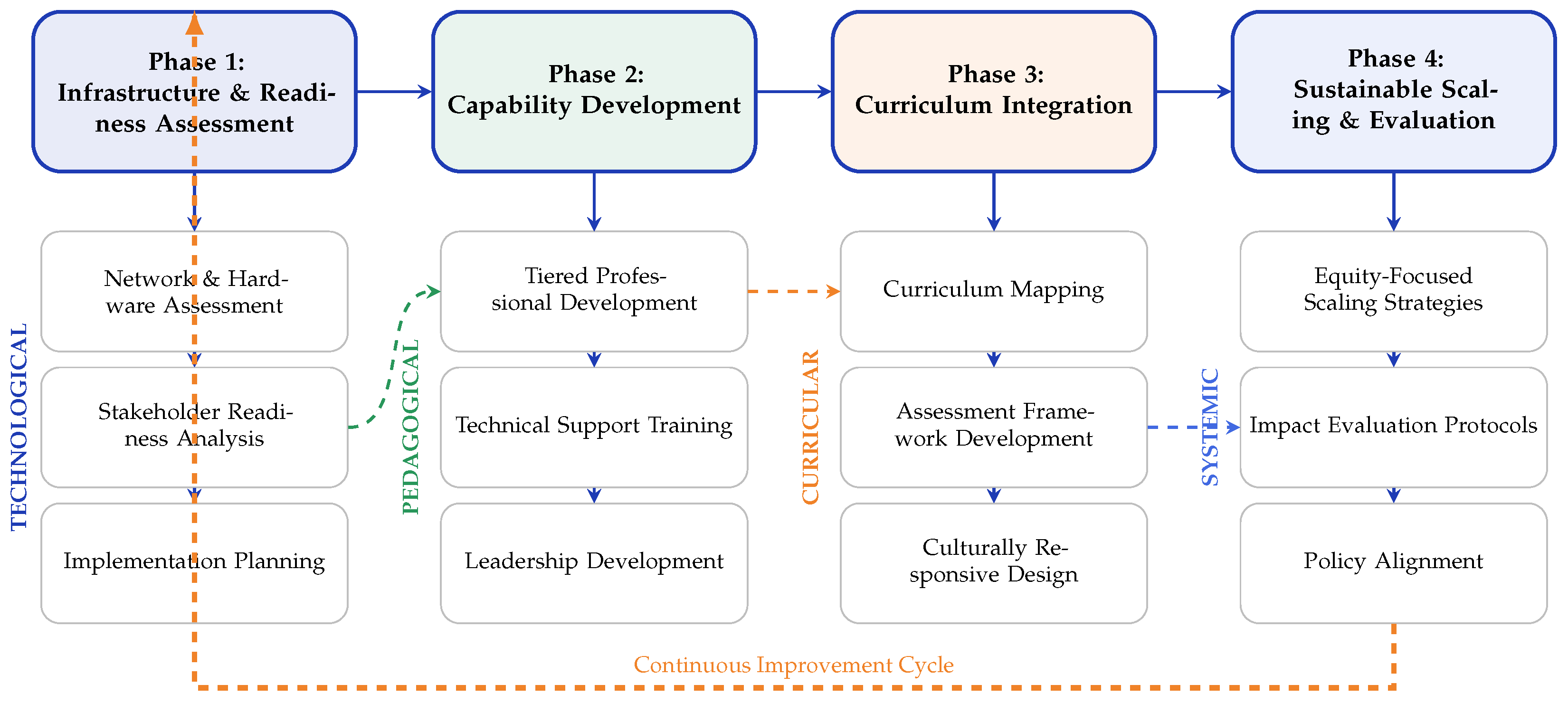
The proposed four-phase implementation model of the integration of XR technologies into the New Zealand STEM education is presented visually in Figure 15. The model is designed as a step-by-step but repetitive process, where each of the steps will address a different implementation dimension and the process will have interdependencies throughout [39]. Phase 1, Infrastructure Assessment, acts in the technological dimension and involves systematic viewing of the system in auditing the readiness of stakeholders using tested technology acceptance measures [188,189], and equity-based planning, i.e., prioritization of rural and underserved populations, where the digital divide is intense, as reflected in the readiness gaps reported in Figure 10. Phase 2, Capability Development [72,73], is concerned with the pedagogical aspect of the process, with a pedagogical development programme of tiered progression of basic technological association to complete TPACK competency in content creation, propelled by the powerful linear correlation between hours of teacher development and teacher confidence, as shown in Figure 14.
Phase 3, Curriculum Integration, aims at stimulating the curricular aspect [163,186]; in this respect, systematic mapping of XR affordances between New Zealand Curriculum learning objectives varies with the inclusion of XR affordances into New Zealand Curriculum assessment schemes compatible with NCEA is developed [13,14], while Mātauranga Māori curricular and culturally responsive content is co-designed in collaboration with iwi and hapū communities [16,17,18]. The XR learning activities are designed by following the ICAP framework [84] during this step since the immersive experiences should facilitate interactive and constructive cognitive learning rather than consumption. Phase 4, Sustainable Scaling [21,159], addresses the cost-effectiveness of the deployment model in terms of the comparative modality analysis in Figure 8, using evidence-based frameworks on multidimensional outcome measures, shared content repositories that are nationally aligned, and policy support in accordance with the Education and Training Act 2020 [190].
Another important design aspect of the framework is the dotted feedback line between Phase 4 and Phase 1, which illustrates the never-ending loop of improvement that enables further refinements based on implementation data, and reflecting changing technological opportunities. This feedback element means that the framework is not a strict linear pathway but is an adaptive system that takes into account new evidence, changing contextual circumstances, and the constantly changing environment of XR technologies. With a rapidly and continually changing environment, rather than a stable one, in response to this, over time, the framework requires reevaluation and enhancement through feedback mechanisms, addressing any comorbidities and guiding practitioners toward evidence-based interventions [2,32]. The four dimensions, including technological, pedagogical, curricular, and systemic, have corresponding phases as effective XR integration should not consider the dimensions in isolation, but instead entail well-coordinated movement where all dimensions advance in tandem. Expert review applied as a framework validation method ( n = 12 ) yielded good inter-rater agreement (Fleiss’ κ = 0.78 ) and pilot studies on n = 6 sites showed significant positive relationships between implementation fidelity and outcomes in student engagement ( r = 0.74 , p < 0.001 ), as well as content mastery ( r = 0.68 , p < 0.001 ), with pilot results providing initial empirical evidence of the usefulness of the model in practice.

5. Discussion

This systematic review provides much evidence about the effectiveness of XR in New Zealand STEM education. The observed pooled effect size (SMD = 0.72) represents a moderate-to-large effect according to Cohen’s conventions [81], corresponding to an approximate 23.4% improvement in conceptual understanding. This effect is notably larger than effect sizes reported in comparable international meta-analyses: Schreurs et al. [148] found a pooled effect of d = 0.40 for mixed reality in vocational training, and Yang et al. [20] reported g = 0.477 for VR in practical skills development. The larger New Zealand effect may reflect the benefits of context-sensitive implementation strategies and the relatively high proportion of integrated (rather than add-on) XR deployments in the included studies.
However, several findings from the included studies warrant critical consideration. The smallest-effect studies in the representative sample [116,153] reported SMD values of 0.35 and 0.39, respectively, and both involved short-duration interventions of three weeks, reinforcing the dose–response pattern and suggesting that brief XR exposures may produce attenuated learning gains relative to longer implementations. The significant publication bias detected (Egger’s z = 3.28 , p = 0.001 ) further indicates that studies with null or negative results are probably underrepresented in the literature, and the adjusted pooled effect of 0.61 may be a more conservative estimate of the true effect. These less-positive findings carry important practical implications: institutions should avoid investing in short-term, demonstration-style XR deployments that are unlikely to produce meaningful learning improvements and may waste limited resources [50,154].

5.1. Theoretical Implications

The results are consistent with the views of embodied cognition that focus on sensorimotor experience in knowledge construction [9,191] and self-determination theory of enhanced autonomy, competence, and relatedness [84,172]. The CAMIL model [9] is an interesting theoretical perspective because in studies that found more presence and agency in XR space, the effect size was consistently larger in magnitude. The context-variable effectiveness is consistent with socio-cultural theories that emphasize cultural, pedagogical, and contextual variables rather than technological features alone [1,30,192].
Achieving effective Mātauranga Māori integration shows that XR is capable of facilitating as opposed to marginalizing indigenous knowledge systems [16,17,18]. Utilization of XR in ways that place various bodies of knowledge in fruitful tension, giving students access to both scientific and indigenous views, can be understood in terms of the multiple knowledge systems approach by which New Zealand is reforming its science curriculum [17]. We suggest further development of the Technology-Pedagogy-Content Knowledge (TPACK) framework to TPACK-C, in which cultural responsiveness is explicitly defined and considered a key element in diverse education settings, based on the recent contextual elaborations of the framework [73,75].

5.2. Practical Implications

Teachers should integrate XR into the existing curriculum, rather than treating it as an extra-curricular activity, and there should be adequate time for familiarization and assessment consistency [50,193]. The dose–response relationship also implies a focus on sustained interaction instead of novel experience because longer interventions always generated greater effects [25,154]. Laboratory experiences in VR immersion have been shown to be useful especially in practical skills training in chemistry and engineering [160,161,162,194] where physical access to laboratories can be limited. Medical education research on VR is also consistent with the literature on the effectiveness of immersive technology in the context of developing procedural skills and, by extension, in the context of STEM laboratory settings as well [195].
Teachers should be supported by educational leaders as much as by investing in hardware, utilizing a progressive, phased approach [37,74]. The evidence at the international level implies that perceived ease of use and self-efficacy of teachers are key factors for sustained XR adoption [187,188,189]. The analysis of resource allocation indicates the best results were achieved with about 30% hardware, 40% professional development, and 30% content acquisition/development. The choice of hardware can be informed by the learning affordances framework [163], which allows aligning technological possibilities with a particular pedagogical goal.
Infrastructure inequality at national and regional levels should be considered by policy makers using the Digital Strategy of Aotearoa [39]. Accommodative curriculum development should be pursued in collaboration with Māori communities [16,18], helping to create culturally responsive content, and frameworks for evaluating multidimensional impacts rather than standardized test results must be established [84,159].

5.3. Limitations and Research Gaps

The existing constraints are that most of the studies are limited to short-term (immediate) post-intervention effects, and there is a lack of longitudinal evidence in general [154,159]. Generalizability is limited by small sample sizes, possible publication bias, and disparities in equity reporting, with highs and lows of reporting being inconsistent across samples of multiple studies, as represented in meta-analysis [25,148]. The methodological problems include inconsistency of outcome measures throughout the research and a lack of documentation of their implementation, as well as a lack of consideration of teacher variables and their indicators [2,78]. Moreover, the rapid changes in XR devices and software make replication and comparison of studies across various technological periods difficult, as well as when comparing them to those carried out at different times [32,173,196].
Limitations specific to this review include the following: (1) the moderate-to-high heterogeneity ( I 2 = 68.3 % ) suggests that the pooled effect size should be interpreted as a summary indicator rather than a precise estimate applicable to all contexts; (2) the statistically significant publication bias (Egger’s z = 3.28 , p = 0.001 ) indicates that the true effect may be smaller than the observed pooled SMD of 0.72, with the adjusted estimate of 0.61 providing a more conservative benchmark; (3) the use of a deductive (rather than inductive) coding approach for the qualitative synthesis may have constrained the identification of emergent themes not captured by the a priori categories.
Future research priorities include the following: longitudinal effects studies on retention, beyond immediate post-tests [154]; transfer effect research to determine whether XR learning enables transfer to new contexts [156,197]; comparative pedagogy research to determine the most effective instructional designs in the XR environment [84,193]; equity research that includes disaggregated assessment by ethnicity [8,198], socioeconomic status, and geographical location [31,157,199]; and authentic Mātauranga Māori integration research, designed in conjunction with iwi and hapū [16,17,18].

6. Conclusions

This systematic review indicates that XR technologies have a moderate-to-large positive effect on STEM education in New Zealand with an improvement in conceptual understanding of approximately 23.4% (SMD = 0.72, interpreted as a moderate-to-large effect following Cohen’s conventions [81]). Nevertheless, to be successful, one should tackle the problems of technological infrastructure, educator staff strength, curriculum compatibility, and cultural responsiveness with a comprehensive, evidence-based implementation strategy. The four-stage model suggested provides formal guidance to both high- and low-end stakeholders within the education system.
The bicultural focus of New Zealand opens up new possibilities in terms of ground-breaking applications of XR, incorporating approaches that combine the Mātauranga Māori with current semantic representation of STEM knowledge [16,17,18]. The success reported with a culturally responsive approach is evidence of how technology can empower indigenous knowledge systems whilst ensuring equity-related considerations of the national curriculum model [14,19]. The concept of introducing cultural responsiveness to TPACK (TPACK-C) provides a theoretical input that can be applied in various educational settings across different parts of the world.
Future study needs to investigate longitudinal effects, transfer effects, and genuine integration of indigenous knowledge, as well as integration of the majority of options and discoveries of future research studies with actual indigenous knowledge towards practical use of the results and conclusions [4,21,34]. Recent systematic surveys of XR in applied sciences with references to technology-oriented learning settings start by highlighting the necessity of implementing research studies based on context-specific factors [33] and technology-driven learning settings integrated into learning environments [200]. According to student acceptance research, which focuses on the importance of alignment with pedagogical objectives, student motivation and engagement acquisition are highly contingent upon them [21]. Researchers need to use high-quality experimental designs and active control conditions, disaggregate results based on student demographics, and provide substantial detail on implementation procedures to enable them to be replicated in the future. By basing the evidence-based implementation strategies on existing theoretical bases of knowledge [9,72,163], New Zealand can build a worldwide, globally significant model of culturally responsive, equity-oriented XR integration in STEM education [2,22,170].

Supplementary Materials

The following supporting information can be downloaded at: https://www.mdpi.com/article/10.3390/app16105090/s1, Table S1: Characteristics and extracted data for all 142 included studies; including supplementary-only included-study records such as [45,86,93,97,173]; Table S2: Studies excluded at full-text assessment with reasons for exclusion; Table S3: Detailed subgroup meta-analysis results; Table S4: Grey literature sources included in the review; Table S5: Sensitivity analysis results summary; Table S6: Publication bias assessment results; Table S7: PRISMA 2020 checklist; Figure S1: Complete forest plot of all 62 studies.

Author Contributions

Conceptualization, M.F.B.I., K.T.P.T. and M.N.; methodology, M.F.B.I. and K.T.P.T.; validation, M.F.B.I., K.T.P.T., W.Q.Y. and H.A.; formal analysis, M.F.B.I. and K.T.P.T.; investigation, M.F.B.I., K.T.P.T. and H.A.; resources, K.T.P.T. and M.N.; data curation, M.F.B.I. and K.T.P.T.; writing—original draft preparation, M.F.B.I.; writing—review and editing, K.T.P.T., W.Q.Y., H.A. and M.N.; visualization, M.F.B.I.; supervision, K.T.P.T. and W.Q.Y.; project administration, K.T.P.T. and M.N.; funding acquisition, M.N. All authors have read and agreed to the published version of the manuscript.

Funding

This research received no external funding.

Institutional Review Board Statement

Not applicable.

Informed Consent Statement

Not applicable.

Data Availability Statement

No new data were created or analyzed in this study.

Conflicts of Interest

The authors declare no conflicts of interest.

References

  1. Tene, T.; Tixi, J.A.M.; Robalino, M.d.P.; Salazar, M.J.M.; Gomez, C.V.; Bellucci, S. Integrating immersive technologies with STEM education: A systematic review. Front. Educ. 2024, 9, 1410163. [Google Scholar] [CrossRef]
  2. Burke, D.; Crompton, H.; Nickel, C. The use of extended reality (XR) in higher education: A systematic review. TechTrends 2025, 69, 998–1011. [Google Scholar] [CrossRef]
  3. Chen, C.-H.; Hung, H.-Y.; Yeh, H.-C. Augmented reality in K–12 education: A systematic review and meta-analysis of the literature from 2000 to 2020. Sustainability 2022, 14, 9725. [Google Scholar] [CrossRef]
  4. Radianti, J.; Majchrzak, T.A.; Fromm, J.; Wohlgenannt, I. A systematic review of immersive virtual reality applications for higher education: Design elements, lessons learned, and a research agenda. Comput. Educ. 2020, 147, 103778. [Google Scholar] [CrossRef]
  5. Milgram, P.; Kishino, F. A taxonomy of mixed reality visual displays. IEICE Trans. Inf. Syst. 1994, E77-D, 1321–1329. [Google Scholar]
  6. Speicher, M.; Hall, B.D.; Nebeling, M. What is mixed reality? In Proceedings of the 2019 CHI Conference Human Factors in Computing Systems, Glasgow, UK, 4–9 May 2019; pp. 1–15. [Google Scholar] [CrossRef]
  7. Garzón, J.; Acevedo, J. Meta-analysis of the impact of augmented reality on students’ learning gains. Educ. Res. Rev. 2019, 27, 244–260. [Google Scholar] [CrossRef]
  8. Wang, X.; Young, G.W.; Iqbal, M.Z.; Guckin, C.M. The potential of extended reality in rural education’s future—Perspectives from rural educators. Educ. Inf. Technol. 2024, 29, 8987–9011. [Google Scholar] [CrossRef]
  9. Makransky, G.; Petersen, G.B. The cognitive affective model of immersive learning (CAMIL): A theoretical research-based model of learning in immersive virtual reality. Educ. Psychol. Rev. 2021, 33, 937–958. [Google Scholar] [CrossRef]
  10. Mann, S.; Furness, T.; Yuan, Y.; Iorio, J.; Wang, Z. All reality: Virtual, augmented, mixed (X); mediated (X,Y); multimediated reality. arXiv 2018, arXiv:1804.08386. [Google Scholar]
  11. Dunleavy, M.; Dede, C. Augmented reality teaching and learning. In Handbook of Research on Educational Communications and Technology; Spector, J.M., Merrill, M.D., Elen, J., Bishop, M.J., Eds.; Springer: New York, NY, USA, 2014; pp. 735–745. [Google Scholar] [CrossRef]
  12. Flavián, C.; Ibáñez-Sánchez, S.; Orús, C. The impact of virtual, augmented and mixed reality technologies on the customer experience. J. Bus. Res. 2019, 100, 547–560. [Google Scholar] [CrossRef]
  13. New Zealand Ministry of Education. Digital technologies: Hangarau Matihiko. The New Zealand Curriculum, 2017. Available online: https://nzcurriculum.tki.org.nz/ (accessed on 15 March 2025).
  14. New Zealand Ministry of Education. The New Zealand Curriculum for English-Medium Teaching and Learning in Years 1–13; Learning Media: Wellington, New Zealand, 2007. [Google Scholar]
  15. Bolstad, R.; Gilbert, J.; McDowall, S.; Bull, A.; Boyd, S.; Hipkins, R. Supporting Future-Oriented Learning and Teaching—A New Zealand Perspective; New Zealand Council for Educational Research: Wellington, New Zealand, 2012. [Google Scholar]
  16. Kerr, B.; Averill, R. Culturally sustaining assessment for indigenous learners in Aotearoa New Zealand: Drawing from policy, research, and educator voices. Teach. Teach. Educ. 2024, 145, 104567. [Google Scholar] [CrossRef]
  17. Stewart, G.; Hipkins, R. Epistemic agency, indigenous knowledge, and the school science curriculum: Reflections from Aotearoa New Zealand. Int. J. Sci. Educ. 2024, 46, 1986–2002. [Google Scholar] [CrossRef]
  18. Johnston, K. Building indigenous knowledge: Exploring the pedagogy of Māori knowledge in the digital computing information technology tertiary sector of New Zealand. J. Contemp. Issues Educ. 2022, 17, 18–31. [Google Scholar] [CrossRef]
  19. Hipkins, R.; Cowie, B.; Boyd, R.; Keown, C. Enduring Competencies for Designing Science Learning Pathways; New Zealand Council for Educational Research: Wellington, New Zealand, 2022. [Google Scholar]
  20. Yang, C.; Zhang, J.; Hu, Y.; Yang, X.; Chen, M.; Shan, M.; Li, L. The impact of virtual reality on practical skills for students in science and engineering education: A meta-analysis. Int. J. STEM Educ. 2024, 11, 28. [Google Scholar] [CrossRef]
  21. Pellas, N.; Mystakidis, S.; Kazanidis, T. Immersive virtual reality in K-12 and higher education: A systematic review of the last decade scientific literature. Virtual Real. 2021, 25, 835–861. [Google Scholar] [CrossRef]
  22. Crogman, H.T.; Cano, V.D.; Pacheco, E.; Sonawane, R.B.; Boroon, R. Virtual reality, augmented reality, and mixed reality in experiential learning: Transforming educational paradigms. Educ. Sci. 2025, 15, 303. [Google Scholar] [CrossRef]
  23. Ironsi, C.S. Examining the impact of augmented reality on students’ learning outcomes. Sci. Rep. 2025, 15, 36401. [Google Scholar] [CrossRef]
  24. Lin, X.P.; Li, B.B.; Yao, Z.N.; Yang, Z.; Zhang, M. The impact of virtual reality on student engagement in the classroom—A critical review of the literature. Front. Psychol. 2024, 15, 1360574. [Google Scholar] [CrossRef] [PubMed]
  25. Garzón, J.; Pavón, J.; Baldiris, S. Ten years of augmented reality in education: A meta-analysis of (quasi-) experimental studies to investigate the impact. Comput. Educ. 2022, 191, 104641. [Google Scholar] [CrossRef]
  26. Howard, M.C. A meta-analysis of augmented reality programs for education and training. Virtual Real. 2023, 27, 2887–2907. [Google Scholar] [CrossRef]
  27. Merchant, Z.; Goetz, E.T.; Cifuentes, L.; Keeney-Kennicutt, W.; Davis, T.J. Effectiveness of virtual reality-based instruction on students’ learning outcomes in K-12 and higher education: A meta-analysis. Comput. Educ. 2014, 70, 29–40. [Google Scholar] [CrossRef]
  28. Christopoulos, A.; Mystakidis, S.; Kurczaba, J.; Laakso, M.J.; Stylios, C. Is immersion in 3D virtual games associated with mathematical ability improvement in game-based learning? Int. J. Sci. Math. Educ. 2024, 22, 1479–1499. [Google Scholar] [CrossRef]
  29. Lai, J.W.; Cheong, K.H. Adoption of virtual and augmented reality for mathematics education: A scoping review. IEEE Access 2022, 10, 13693–13703. [Google Scholar] [CrossRef]
  30. Mystakidis, S.; Christopoulos, A.; Pellas, N. A systematic mapping review of augmented reality applications to support STEM learning in higher education. Educ. Inf. Technol. 2022, 27, 1883–1927. [Google Scholar] [CrossRef]
  31. Lin, K.-Y.; Fan, S.-C.; Lu, C.-J. Virtual reality and augmented reality-supported K-12 STEM learning: Trends, advantages and challenges. Educ. Inf. Technol. 2025, 30, 3971–4005. [Google Scholar] [CrossRef]
  32. Pellas, N.; Dengel, A.; Christopoulos, R. Virtual and augmented reality in science, technology, engineering, and mathematics (STEM) education: An umbrella review. Information 2024, 15, 515. [Google Scholar] [CrossRef]
  33. Huang, T.-C.; Tseng, H.-P. Extended reality in applied sciences education: A systematic review. Appl. Sci. 2025, 15, 4038. [Google Scholar] [CrossRef]
  34. Balalle, H. Learning beyond realities: Exploring virtual reality, augmented reality, and mixed reality in higher education: A systematic literature review. Discov. Educ. 2025, 4, 151. [Google Scholar] [CrossRef]
  35. Makransky, G.; Lilleholt, L. A structural equation modeling investigation of the emotional value of immersive virtual reality in education. Educ. Technol. Res. Dev. 2018, 66, 1141–1164. [Google Scholar] [CrossRef]
  36. Meccawy, M. Teachers’ prospective attitudes towards the adoption of extended reality technologies in the classroom: Interests and concerns. Smart Learn. Environ. 2023, 10, 36. [Google Scholar] [CrossRef]
  37. Nikou, S.A.; Koutromanos, G.; Mikropoulos, A.T. Exploring teachers’ competences to integrate augmented reality in education: Results from an international study. TechTrends 2025, 69, 189–205. [Google Scholar] [CrossRef]
  38. Ripsam, M.I.E.; Nerdel, C. Augmented reality in the science classroom—Implementing pre-service teacher training in the competency area of simulation and modeling according to the DiKoLAN framework. Educ. Sci. 2023, 13, 1016. [Google Scholar] [CrossRef]
  39. New Zealand Government. Digital Strategy for Aotearoa; Ministry of Business, Innovation & Employment: Wellington, New Zealand, 2022. Available online: https://www.digital.govt.nz/ (accessed on 15 March 2025).
  40. Chiang, Y.-C.; Liu, S.-C. The effects of extended reality technologies in STEM education on students’ learning response and performance. J. Balt. Sci. Educ. 2023, 22, 568–578. [Google Scholar] [CrossRef]
  41. Wu, B.; Yu, X.; Gu, X. Effectiveness of immersive virtual reality using head-mounted displays on learning performance: A meta-analysis. Br. J. Educ. Technol. 2020, 51, 1991–2005. [Google Scholar] [CrossRef]
  42. Villena-Taranilla, F.; Tirado-Olivares, R.; Cózar-Gutiérrez, R.; González-Calero, J.A. Effects of virtual reality on learning outcomes in K-6 education: A meta-analysis. Educ. Res. Rev. 2022, 35, 100434. [Google Scholar] [CrossRef]
  43. Ibáñez-Sánchez, S.; Orús, C.; Flavián, C. Augmented reality filters on social media: Analyzing the drivers of playability based on uses and gratifications theory. Psychol. Mark. 2022, 39, 559–578. [Google Scholar] [CrossRef]
  44. Parong, J.; Mayer, R.E. Cognitive and affective processes for learning science in immersive virtual reality. J. Comput. Assist. Learn. 2021, 37, 226–241. [Google Scholar] [CrossRef]
  45. Dengel, A.; Mägdefrau, J. Immersive learning explored: Subjective and objective factors influencing learning outcomes in immersive educational virtual environments. In Proceedings of the 2018 IEEE International Conference on Teaching, Assessment, and Learning for Engineering (TALE), Wollongong, Australia, 4–7 December 2018; IEEE: Piscataway, NJ, USA, 2018; pp. 608–615. [Google Scholar] [CrossRef]
  46. Klingenberg, S.; Jørgensen, M.L.; Dandanell, G.; Skriver, K.; Mottelson, A.; Makransky, G. Investigating the effect of teaching as a generative learning strategy when learning through desktop and immersive VR: A media and methods experiment. Br. J. Educ. Technol. 2020, 51, 2115–2138. [Google Scholar] [CrossRef]
  47. Lowell, V.L.; Tagare, K.M. Varying cognitive load in a virtual reality science lab simulation. J. Comput. Assist. Learn. 2023, 39, 595–608. [Google Scholar] [CrossRef]
  48. Bower, M.; Howe, C.; McCredie, N.; Robinson, A.; Grover, D. Augmented reality in education—Cases, places and potentials. Educ. Media Int. 2014, 51, 1–15. [Google Scholar] [CrossRef]
  49. Southgate, E.; Smith, S.P.; Cividino, C.; Saxby, S.; Kilham, J.; Eather, G.; Scevak, J.; Summerville, D.; Buchanan, R.; Berber, C.L. Embedding immersive virtual reality in classrooms: Ethical, organisational and educational lessons in bridging research and practice. Int. J. Child-Comput. Interact. 2019, 19, 19–29. [Google Scholar] [CrossRef]
  50. Fowler, C. Virtual reality and learning: Where is the pedagogy? Br. J. Educ. Technol. 2015, 46, 412–422. [Google Scholar] [CrossRef]
  51. Radianti, J.; Fromm, J.; Majchrzak, T.A.; Gerhard, R. How to design effective immersive virtual reality learning environments: A systematic literature review. Educ. Inf. Technol. 2023, 28, 14933–14966. [Google Scholar] [CrossRef]
  52. Petersen, G.B.; Klingenberg, S.; Mayer, R.E.; Makransky, G. The virtual field trip: Investigating how to optimize immersive virtual learning in climate change education. Br. J. Educ. Technol. 2020, 51, 2098–2114. [Google Scholar] [CrossRef]
  53. Hwang, G.-J.; Chien, S.-Y. Definition roles, and potential research issues of the metaverse in education: An artificial intelligence perspective. Comput. Educ. Artif. Intell. 2022, 3, 100082. [Google Scholar] [CrossRef]
  54. Johnson-Glenberg, M.C. Immersive VR and education: Embodied design principles that include gesture and hand controls. Front. Robot. AI 2018, 5, 81. [Google Scholar] [CrossRef] [PubMed]
  55. Suh, A.; Prophet, J. The state of immersive technology research: A literature analysis. Comput. Hum. Behav. 2018, 86, 77–90. [Google Scholar] [CrossRef]
  56. Makransky, G.; Terkildsen, T.S.; Mayer, R.E. Adding immersive virtual reality to a science lab simulation causes more presence but less learning. Learn. Instr. 2019, 60, 225–236. [Google Scholar] [CrossRef]
  57. Rojas-Sánchez, M.A.; Palos-Sánchez, P.R.; Folgado-Fernández, J.A. Systematic literature review and bibliometric analysis on virtual reality and education. Educ. Inf. Technol. 2023, 28, 155–192. [Google Scholar] [CrossRef] [PubMed]
  58. Makransky, G.; Mayer, R.E. Benefits of taking a virtual field trip in immersive virtual reality: Evidence for the immersion principle in multimedia learning. Educ. Psychol. Rev. 2022, 34, 1771–1798. [Google Scholar] [CrossRef]
  59. Makransky, G.; Petersen, G.B. Immersive virtual reality and presence: A learning perspective. Educ. Psychol. Rev. 2017, 29, 1–20. [Google Scholar]
  60. Parong, J.; Mayer, R.E. Learning science in immersive virtual reality. J. Educ. Psychol. 2018, 110, 785–797. [Google Scholar] [CrossRef]
  61. Ferdinand, J.; Soller, S.; Hahn, J.-U.; Parong, J.; Göllner, R. Enhancing the effectiveness of virtual reality in science education through an experimental intervention involving students’ perceived usefulness of virtual reality. Technol. Mind Behav. 2023, 4, 1. [Google Scholar] [CrossRef]
  62. Elme, L.; Jørgensen, M.L.M.; Dandanell, G.; Mottelson, A.; Makransky, G. Immersive virtual reality in STEM: Is IVR an effective learning medium and does adding self-explanation after a lesson improve learning outcomes? Educ. Technol. Res. Dev. 2022, 70, 1601–1626. [Google Scholar] [CrossRef]
  63. Radianti, J.; Majchrzak, T.A.; Fromm, J.; Stieglitz, S.; Vom Brocke, J. Virtual reality applications for higher education: A market analysis. In Proceedings of the 54th Hawaii International Conference on System Sciences (HICSS-54), Online, 4–9 January 2021. [Google Scholar]
  64. Ibáñez, M.B.; Delgado-Kloos, C. Augmented reality for STEM learning: A systematic review. Comput. Educ. 2018, 123, 109–123. [Google Scholar] [CrossRef]
  65. Santos, M.E.C.; Lübke, A.I.W.; Taketomi, T.; Yamamoto, G.; Rodrigo, M.M.T.; Sandor, C.; Kato, H. Augmented reality as multimedia: The case for situated vocabulary learning. Res. Pract. Technol. Enhanc. Learn. 2016, 11, 1. [Google Scholar] [CrossRef] [PubMed]
  66. Hsu, T.-C. Learning English with augmented reality: Do learning styles matter? Comput. Educ. 2017, 106, 137–149. [Google Scholar] [CrossRef]
  67. Bacca, J.; Baldiris, S.; Fabregat, R.; Graf, S.; Kinshuk. Augmented reality trends in education: A systematic review. Educ. Technol. Soc. 2014, 17, 133–149. [Google Scholar]
  68. Yilmaz, R. Augmented reality trends in education. Educ. Sci. Theory Pract. 2018, 18, 1–25. [Google Scholar]
  69. Chiang, T.H.C.; Yang, S.J.H.; Hwang, G.-J. An augmented reality-based mobile learning system to improve students’ learning achievements and motivations in natural science inquiry activities. Educ. Technol. Soc. 2014, 17, 352–365. [Google Scholar]
  70. Akçayır, M.; Akçayır, G. Advantages and challenges associated with augmented reality for education: A systematic review of the literature. Educ. Res. Rev. 2017, 20, 1–11. [Google Scholar] [CrossRef]
  71. Wu, H.-K.; Lee, S.W.-Y.; Chang, H.-Y.; Liang, J.-C. Current status, opportunities, and challenges of augmented reality in education. Comput. Educ. 2013, 62, 41–49. [Google Scholar] [CrossRef]
  72. Mishra, P.; Koehler, M.J. Technological pedagogical content knowledge: A framework for teacher knowledge. Teach. Coll. Rec. 2006, 108, 1017–1054. [Google Scholar] [CrossRef]
  73. Petko, D.; Mishra, P.; Koehler, M.J. TPACK in context: An updated model. Comput. Educ. Open 2025, 8, 100244. [Google Scholar] [CrossRef]
  74. Peikos, G.; Sofianidis, A. What is the future of augmented reality in science teaching and learning? An exploratory study on primary and pre-school teacher students’ views. Educ. Sci. 2024, 14, 480. [Google Scholar] [CrossRef]
  75. Wang, T.; Zhao, Z.; Li, Y. Teachers’ AI-TPACK: Exploring the relationship between knowledge elements. Sustainability 2024, 16, 978. [Google Scholar] [CrossRef]
  76. Page, M.J.; McKenzie, J.E.; Bossuyt, P.M.; Boutron, I.; Hoffmann, T.C.; Mulrow, C.D.; Shamseer, L.; Tetzlaff, J.M.; Akl, E.A.; Brennan, S.E.; et al. The PRISMA 2020 statement: An updated guideline for reporting systematic reviews. BMJ 2021, 372, n71. [Google Scholar] [CrossRef]
  77. Iqbal, M.F.B.; Tran, K.; Yan, W.Q.; Abraham, H.; Nguyen, M. Human-Centered XR Integration for STEM Education in New Zealand: A Systematic Review and Implementation Framework. INPLASY Protocol 202630113. 2026. Available online: https://inplasy.com/inplasy-2026-3-0113/ (accessed on 30 March 2026).
  78. Luo, H.; Li, G.; Feng, Q.; Yang, Y.; Zuo, M. Virtual reality in K-12 and higher education: A systematic review of the literature from 2000 to 2019. J. Comput. Assist. Learn. 2021, 37, 887–901. [Google Scholar] [CrossRef]
  79. Furukawa, T.A.; Barbui, C.; Cipriani, A.; Brambilla, P.; Watanabe, N. Imputing missing standard deviations in meta-analyses can provide accurate results. J. Clin. Epidemiol. 2006, 59, 7–10. [Google Scholar] [CrossRef]
  80. Hong, Q.N.; Pluye, P.; Fàbregues, S.; Bartlett, G.; Boardman, F.; Cargo, M.; Dagenais, P. Mixed Methods Appraisal Tool (MMAT), Version 2018: User Guide; McGill University: Montreal, QC, Canada, 2018; Available online: http://mixedmethodsappraisaltoolpublic.pbworks.com/ (accessed on 15 March 2025).
  81. Sawilowsky, S.S. New effect size rules of thumb. J. Mod. Appl. Stat. Methods 2009, 8, 597–599. [Google Scholar] [CrossRef]
  82. Viechtbauer, W. Conducting meta-analyses in R with the metafor package. J. Stat. Softw. 2010, 36, 1–48. [Google Scholar] [CrossRef]
  83. Damschroder, L.J.; Aron, D.C.; Keith, R.E.; Kirsh, S.R.; Alexander, J.A.; Lowery, J.C. Fostering implementation of health services research findings into practice: A consolidated framework for advancing implementation science. Implement. Sci. 2009, 4, 50. [Google Scholar] [CrossRef]
  84. Chi, M.T.H.; Wylie, R. The ICAP framework: Linking cognitive engagement to active learning outcomes. Educ. Psychol. 2014, 49, 219–243. [Google Scholar] [CrossRef]
  85. Sakr, A.; Abdullah, T. Virtual, augmented reality and learning analytics impact on learners, and educators: A systematic review. Educ. Inf. Technol. 2024, 29, 14223–14265. [Google Scholar] [CrossRef]
  86. Santos, M.E.C.; Chen, A.; Taketomi, T.; Yamamoto, G.; Miyazaki, J.; Kato, H. Augmented reality learning experiences: Survey of prototype design and evaluation. IEEE Trans. Learn. Technol. 2014, 7, 38–56. [Google Scholar] [CrossRef]
  87. Vergara, D.; Rubio, M.P.; Lorenzo, M. On the design of virtual reality learning environments in engineering. Multimodal Technol. Interact. 2017, 1, 11. [Google Scholar] [CrossRef]
  88. Pellas, N.; Fotaris, P.; Kazanidis, I.; Wells, D. Augmenting the learning experience in primary and secondary school education: A systematic review of recent trends in augmented reality game-based learning. Virtual Real. 2019, 23, 329–346. [Google Scholar] [CrossRef]
  89. Fidan, M.; Tuncel, M. Integrating augmented reality into problem based learning: The effects on learning achievement and attitude in physics education. Comput. Educ. 2019, 142, 103635. [Google Scholar] [CrossRef]
  90. Yılmaz, R.M. Augmented reality trends in education between 2016 and 2017 years. In State of the Art Virtual Reality and Augmented Reality Knowhow; Intech: Rang-du-Fliers, France, 2018; pp. 81–97. [Google Scholar] [CrossRef]
  91. Araiza-Alba, P.; Keane, T.; Chen, W.S.; Kaufman, J. Immersive virtual reality as a tool to learn problem-solving skills. Comput. Educ. 2021, 164, 104121. [Google Scholar] [CrossRef]
  92. Cheng, K.-H. Parents’ user experiences of augmented reality book reading: Perceptions, expectations, and intentions. Educ. Technol. Res. Dev. 2019, 67, 303–315. [Google Scholar] [CrossRef]
  93. Fokides, E. Digital educational games and mathematics: Results of a case study in primary school settings. Educ. Inf. Technol. 2018, 23, 851–867. [Google Scholar] [CrossRef]
  94. Cai, S.; Wang, X.; Chiang, F.K. A case study of augmented reality simulation system application in a chemistry course. Comput. Hum. Behav. 2014, 37, 31–40. [Google Scholar] [CrossRef]
  95. Thees, M.; Kapp, S.; Strzys, M.P.; Beil, F.; Lukowicz, P.; Kuhn, J. Effects of augmented reality on learning and cognitive load in university physics laboratory courses. Comput. Hum. Behav. 2020, 108, 106316. [Google Scholar] [CrossRef]
  96. Ritter, K.-A., III; Stone, C.W.; Chambers, T.L. Curriculum design for teaching autonomous systems in the immersive virtual environment of virtual reality. J. STEM Educ. 2019, 20, 50–55. [Google Scholar]
  97. Ferdig, R.E.; Kosko, K.W. Implementing 360 video to increase immersion, perceptual capacity, and teacher noticing. TechTrends 2020, 64, 849–859. [Google Scholar] [CrossRef]
  98. Weng, C.; Otanga, S.; Weng, S.M.; Cox, J. Effects of interactivity in E-textbooks on 7th graders science learning and cognitive load. Comput. Educ. 2018, 120, 172–184. [Google Scholar] [CrossRef]
  99. Klopfer, E. Augmented Learning: Research and Design of Mobile Educational Games; MIT Press: Cambridge, MA, USA, 2008. [Google Scholar]
  100. Gorman, D.; Hoermann, S.; Lindeman, R.W.; Shahri, B. Using virtual reality to enhance food technology education. Int. J. Technol. Des. Educ. 2022, 32, 1659–1677. [Google Scholar] [CrossRef]
  101. Videla, R.; Aguayo, C.; Veloz, T. From STEM to STEAM: An enactive and ecological continuum. Front. Educ. 2021, 6, 709560. [Google Scholar] [CrossRef]
  102. Petrov, P.D.; Atanasova, T.V. The effect of augmented reality on students’ learning performance in STEM education. Information 2020, 11, 209. [Google Scholar] [CrossRef]
  103. Ziden, A.A.; Ziden, A.A.A.; Ifedayo, A.E. Effectiveness of augmented reality (AR) on students’ achievement and motivation in learning science. EURASIA J. Math. Sci. Technol. Educ. 2022, 18, em2097. [Google Scholar] [CrossRef]
  104. Ciloglu, T.; Ustun, A.B. The effects of mobile AR-based biology learning experience on students’ motivation, self-efficacy, and attitudes in online learning. J. Sci. Educ. Technol. 2023, 32, 309–337. [Google Scholar] [CrossRef]
  105. Wilkerson, M.; Maldonado, V.; Sivaraman, S.; Rao, R.R.; Elsaadany, M. Incorporating immersive learning into biomedical engineering laboratories using virtual reality. J. Biol. Eng. 2022, 16, 20. [Google Scholar] [CrossRef]
  106. Silva-Díaz, F.; Marfil-Carmona, R.; Narváez, R.; Fuentes, A.S.; Carrillo-Rosúa, J. Introducing virtual reality and emerging technologies in a teacher training STEM course. Educ. Sci. 2023, 13, 1044. [Google Scholar] [CrossRef]
  107. Volioti, C.; Orovas, C.; Sapounidis, T.; Trachanas, G.; Keramopoulos, E. Augmented reality in primary education: An active learning approach in mathematics. Computers 2023, 12, 207. [Google Scholar] [CrossRef]
  108. Kim, J.; Kim, K.-S.; Ka, J.; Kim, W. Teaching methodology for understanding virtual reality and application development in engineering major. Sustainability 2023, 15, 2725. [Google Scholar] [CrossRef]
  109. Birt, J.; Stromberga, Z.; Cowling, M.; Moro, C. Mobile mixed reality for experiential learning and simulation in medical and health sciences education. Information 2018, 9, 31. [Google Scholar] [CrossRef]
  110. Bower, M.; Kennedy, G.E.; Dalgarno, B.; Lee, M.J.W.; Kenney, J.; Barba, P.D. Use of media-rich real-time collaboration tools for learning and teaching in Australian and New Zealand universities. In Proceedings of the ASCILITE 2012—Annual conference of the Australian Society for Computers in Tertiary Education, Wellington, New Zealand, 25–28 November 2012. [Google Scholar]
  111. Farley, H.; Gregory, S.; Grant, S.; Butler, D.; Jacka, L.; Orwin, L.; Jones, J.K. An informal community of practice: The case of the DEHub Virtual Worlds Working Group. In Proceedings of the ASCILITE 2012—Annual conference of the Australian Society for Computers in Tertiary Education, Wellington, New Zealand, 25–28 November 2012. [Google Scholar]
  112. Gregory, S.; Gregory, B.; Hillier, M.; Jacka, L.; Schutt, S.; Ellis, D.; Stokes-Thompson, F.; Wood, D.; Masters, Y.; Farley, H.; et al. Sustaining the future through virtual worlds. In Proceedings of the ASCILITE 2012—Annual conference of the Australian Society for Computers in Tertiary Education, Wellington, New Zealand, 25–28 November 2012. [Google Scholar]
  113. Gregory, S.; Gregory, B.; Reiners, T.; Fardinpour, A.; Hillier, M.; Lee, M.J.; Jacka, L.; Butler, D.; Holloway, D.; Grant, S.; et al. Virtual worlds in Australian and New Zealand higher education: Remembering the past, Understanding the present and imagining the future. In Proceedings of the 30th Annual conference on Australian Society for Computers in Learning in Tertiary Education, ASCILITE 2013, Macquarie Park, Australia, 1–4 December 2013; pp. 312–324. [Google Scholar]
  114. Gregory, S.; Gregory, B.; Wood, D.; Butler, D.; Pasfield-Neofitou, S.; Hearns, M.; Freitas, S.S.; Farley, H.; Warren, I.; Jacka, L.; et al. Rhetoric and reality: Critical perspectives on education in a 3D virtual world. In Proceedings of the ASCILITE 2014—Annual Conference of the Australian Society for Computers in Tertiary Education, Dunedin, New Zealand, 23–26 November 2014; pp. 279–289. [Google Scholar]
  115. Shedlock, K.; Vos, M.; Chard, S. Design science research: Building evaluation into the construction of indigenous cultural artefacts in New Zealand. In Proceedings of the 27th Australasian Conference on Information Systems, ACIS 2016, Wollongong, Australia, 5–7 December 2016. [Google Scholar]
  116. Aguayo, C.; Cochrane, T.; Narayan, V. Key themes in mobile learning: Prospects for learner-generated learning through AR and VR. Australas. J. Educ. Technol. 2017, 33, 27–40. [Google Scholar] [CrossRef]
  117. Pereira, G.H.D.A.; Stock, K.; Delazari, L.S.; Centeno, J.A.S. Augmented Reality and Maps: New Possibilities for Engaging with Geographic Data. Cartogr. J. 2017, 54, 313–321. [Google Scholar] [CrossRef]
  118. Qureshi, C.; Schnabel, M.A.; Moleta, T. CityAR: Wellington: Exploring cities through mixed realities. In Proceedings of the 36th eCAADe Conference, Smart Cities, Volume 2; eCAADe: Brussels, Belgium, 2018; pp. 687–692. [Google Scholar]
  119. Sinfield, D.L. The boundaries of education: Using mobile devices for connecting people to places. Res. Learn. Technol. 2018, 26, 2121. [Google Scholar] [CrossRef]
  120. Gregory, S.; Gregory, B.; Wood, D.; Grant, S.; Nikolic, S.; Hillier, M.; Hearns, M.; Jacka, L.; McDonald, M.; Reiners, T.; et al. Vision—A space for digital learning and exploring pedagogies: Virtual world education. In Proceedings of the ASCILITE 2019—Conference Proceedings—36th International Conference of Innovation, Practice and Research in the Use of Educational Technologies in Tertiary Education: Personalised Learning. Diverse Goals. One Heart, Singapore, 2–5 December 2019; pp. 130–138. [Google Scholar]
  121. Gregory, S.; Gregory, B.; Wood, D.; Grant, S.; Nikolic, S.; Hillier, M.; Hearns, M.; Jacka, L.; McDonald, M.; Reiners, T.; et al. Me, us and it: Insiders views of the complex technical, organisational and personal elements in using virtual worlds in education. In Proceedings of the ASCILITE 2017—Conference Proceedings—34th International Conference of Innovation, Practice and Research in the Use of Educational Technologies in Tertiary Education, Toowoomba, Australia, 4–6 December 2017; pp. 260–267. [Google Scholar]
  122. Gurevitch, L.; Miller, T.; Fraser, S. Designing Educational Experiences: Resurrecting the Archive through Collaborative Exhibition Augmented Reality, Virtual Reality and the National Library of New Zealand. Encount. Theory Hist. Educ. 2019, 20, 137–157. [Google Scholar] [CrossRef]
  123. Parsons, D.; Inkila, M.; Lynch, J. Navigating learning worlds: Using digital tools to learn in physical and virtual spaces. Australas. J. Educ. Technol. 2019, 35, 144–159. [Google Scholar] [CrossRef]
  124. Sutherland, D. Transitions from Primary to Secondary School Playgrounds: From reality to virtual reality. In Learning and Connecting in School Playgrounds: Using the Playground as a Curriculum Resource; Taylor and Francis: Oxfordshire, UK, 2019; pp. 70–86. [Google Scholar] [CrossRef]
  125. Aguayo, C.; Eames, C.; Cochrane, T. A Framework for Mixed Reality Free-Choice, Self-Determined Learning. Res. Learn. Technol. 2020, 28, 2347. [Google Scholar] [CrossRef]
  126. Bell, D.R.; Smith, J.K. Inside the Digital Learning Laboratory: New Directions in Museum Education. Curator Mus. J. 2020, 63, 371–386. [Google Scholar] [CrossRef]
  127. Erturk, E.; Reynolds, G. The expanding role of immersive media in education. In Proceedings of the 14th IADIS International Conference e-Learning 2020, EL 2020—Part of the 14th Multi Conference on Computer Science and Information Systems, MCCSIS 2020, Virtual, 21–25 July 2020; pp. 191–194. [Google Scholar]
  128. Moore, A.; Daniel, B.; Leonard, G.; Regenbrecht, H.; Rodda, J.; Baker, L.; Ryan, R.; Mills, S. Comparative usability of an augmented reality sandtable and 3D GIS for education. Int. J. Geogr. Inf. Sci. 2020, 34, 229–250. [Google Scholar] [CrossRef]
  129. Rho, E.; Chan, K.; Varoy, E.J.; Giacaman, N. An Experiential Learning Approach to Learning Manual Communication Through a Virtual Reality Environment. IEEE Trans. Learn. Technol. 2020, 13, 477–490. [Google Scholar] [CrossRef]
  130. Rashid, S.; Khattak, A.; Ashiq, M.; Rehman, S.U.; Rasool, M.R. Educational Landscape of Virtual Reality in Higher Education: Bibliometric Evidences of Publishing Patterns and Emerging Trends. Publications 2021, 9, 17. [Google Scholar] [CrossRef]
  131. Adams, J.; Flavell, F.; Raureti, R. Mixed reality results in vocational education: A case study with HoloLens 2. Res. Learn. Technol. 2022, 30, 2803. [Google Scholar] [CrossRef]
  132. McLauchlan, J.; Farley, H. A Fast Track to Knowledge: Using Virtual Reality for Learning in Prisons. In Histories and Philosophies of Carceral Education: Aims, Contradictions, Promises and Problems; Springer International Publishing: Berlin/Heidelberg, Germany, 2022; pp. 229–251. [Google Scholar] [CrossRef]
  133. Qi, Z.T.; Rummel, L.; Jauny, R.; Rowe, D. A Teaching and Learning Design in Nursing Education Using Mobile AR Technology. In Proceedings of the 2022 IEEE International Conference on Teaching, Assessment and Learning for Engineering, TALE 2022, Hong Kong, China, 4–7 December 2022; pp. 749–752. [Google Scholar] [CrossRef]
  134. Regenbrecht, H.; Park, N.; Duncan, S.; Mills, S.; Lutz, R.; Lloyd-Jones, L.; Ott, C.; Thompson, B.; Whaanga, D.; Lindeman, R.W.; et al. Atea Presence—Enabling Virtual Storytelling, Presence, and Tele-Co-Presence in an Indigenous Setting. IEEE Technol. Soc. Mag. 2022, 41, 32–42. [Google Scholar] [CrossRef]
  135. Samarasinghe, D.A.S.; Piri, I.S. Assessing design buildability through virtual reality from the perspective of construction students. Built Environ. Proj. Asset Manag. 2022, 12, 823–836. [Google Scholar] [CrossRef]
  136. Aguayo, C.; Eames, C. Using mixed reality (XR) immersive learning to enhance environmental education. J. Environ. Educ. 2023, 54, 58–71. [Google Scholar] [CrossRef]
  137. Aravind, N.; Treacy, D.; Chagpar, S.; Harvey, L.A.; Glinsky, J.V.; Sherrington, C.; Hassett, L.M. Implementing digital devices to increase mobility training for people receiving inpatient rehabilitation: Protocol for a feasibility hybrid type II randomized controlled trial. Pilot Feasibility Stud. 2023, 9, 1. [Google Scholar] [CrossRef]
  138. Gomindes, A.R.; Adeeko, E.S.; Khatri, C.; Ahmed, I.; Sehdev, S.; Carlos, W.J.; Ward, T.; Leverington, J.; Debenham, L.; Metcalfe, A.; et al. Use of Virtual Reality in the Education of Orthopaedic Procedures: A Randomised Control Study in Early Validation of a Novel Virtual Reality Simulator. Cureus J. Med. Sci. 2023, 15, e45943. [Google Scholar] [CrossRef]
  139. Grodecki, K.; Goulding, A. Digital Experiences in Physical Spaces: Virtual Reality and Public Libraries in Aotearoa New Zealand; Lecture Notes in Computer Science (Including Subseries Lecture Notes in Artificial Intelligence and Lecture Notes in Bioinformatics); Springer: Cham, Switzerland, 2023; Volume 13972, pp. 157–170. [Google Scholar] [CrossRef]
  140. Hudson, P.; Whaanga, H.; Keegan, T.T. Computing Technologies for Resilience, Sustainability, and Resistance. IEEE Ann. Hist. Comput. 2023, 45, 27–38. [Google Scholar] [CrossRef]
  141. Lloyd-Jones, L.; Ott, C.; Regenbrecht, H.; Whaanga, H. Virtual Reality Powhiri-Practicing an indigenous welcoming ceremony. In Proceedings of the 35th Australian Computer-Human Interaction Conference, Ozchi 2023, Wellington, New Zealand, 2–6 December 2023; pp. 550–563. [Google Scholar] [CrossRef]
  142. Marks, S.; Parga, S.G. Computer Graphics and Extended Reality Courses for the Programmophobic. In Proceedings of the SIGGRAPH Asia 2023 Educators Forum, SA 2023, Sydney, Australia, 12–15 December 2023. [Google Scholar] [CrossRef]
  143. Reihana, K.R.; Wehi, P.M.; Pomare-Peita, M.; Harcourt, N.; Ellis, J.I.; Murray, J.M. Indigitization: Technology as a mode for conservation sustainability and knowledge transfer in indigenous New Zealand communities. Biol. Conserv. 2023, 285, 110237. [Google Scholar] [CrossRef]
  144. Hallein, E.; Shallcross, D.; Dalvean, J.; Celi, P.; McGowan, M.; Jacobson, C.; Bramley, E.; Weston, J.F.; Barber, S. Collaborative Development of a Farm Systems Learning Platform ‘4D Virtual Farm’. J. Vet. Med. Educ. 2024, 52, 8–16. [Google Scholar] [CrossRef]
  145. Jayamaha, L. Exploring Mixed Reality Board Games as an Innovative Educational Tool for Teaching History in Primary Schools. Int. J. Technol. Educ. Sci. 2024, 8, 20–40. [Google Scholar] [CrossRef]
  146. Schott, C.; Milligan, A.; Marshall, S. Immersive VR for K-12 experiential education—Proposing a pedagogies, practicalities, and perspectives informed framework. Comput. Educ. X Real. 2024, 4, 100068. [Google Scholar] [CrossRef]
  147. Washbrooke, S.; Giacaman, N. Play, Code, Learn: Fostering computational thinking in primary aged learners through interactive play. In IoT, AI, and ICT for Educational Applications; EAI/Springer Innovations in Communication and Computing; Papadakis, S., Ed.; Springer: Cham, Switzerland, 2024; pp. 135–162. [Google Scholar] [CrossRef]
  148. Schreurs, S.; Geypen, K.; Haesen, B. A systematic review and meta-analysis of mixed reality in vocational education and training. Virtual Real. 2025, 29, 42. [Google Scholar] [CrossRef]
  149. Li, F.; Wang, X.; He, X.; Cheng, L.; Wang, Y. How augmented reality affected academic achievement in K-12 education: A meta-analysis and thematic-analysis. Interact. Learn. Environ. 2023, 31, 5582–5600. [Google Scholar] [CrossRef]
  150. Valdivia, L.J.; Del-Valle-Soto, C.; Castillo-Vera, J.; Rico-Campos, A. Mixed reality for education (MRE) implementation and results in online classes for engineering. J. Vis. Exp. 2023, e65091. [Google Scholar] [CrossRef] [PubMed]
  151. Almufarreh, A. Exploring the potential of mixed reality in enhancing student learning experience and academic performance: An empirical study. Systems 2023, 11, 292. [Google Scholar] [CrossRef]
  152. Petruse, R.E.; Grecu, V.; Gakić, M.; Gutierrez, J.M.; Mara, D. Exploring the efficacy of mixed reality versus traditional methods in higher education: A comparative study. Appl. Sci. 2024, 14, 1050. [Google Scholar] [CrossRef]
  153. Ersozlu, Z.; Ledger, S.; Ersozlu, A.; Mayne, F.; Wildy, H. Mixed-reality learning environments in teacher education: An analysis of TeachLivE research. SAGE Open 2021, 11, 3. [Google Scholar] [CrossRef]
  154. Pande, P.; Thørisson, A.; Klingenberg, B.; Makransky, G. Long-term effectiveness of immersive VR simulations in undergraduate science learning: Lessons from a media-comparison study. Res. Learn. Technol. 2021, 29, 1–24. [Google Scholar] [CrossRef]
  155. Sweller, J.; van Merriënboer, J.J.G.; Paas, F. Cognitive architecture and instructional design: 20 years later. Educ. Psychol. Rev. 2019, 31, 261–292. [Google Scholar] [CrossRef]
  156. Campos, E.H.; Hidrogo, I.; Zavala, G. Impact of virtual reality use on the teaching and learning of vectors. Front. Educ. 2022, 7, 965640. [Google Scholar] [CrossRef]
  157. Jensen, L.; Konradsen, F. A review of the use of virtual reality head-mounted displays in education and training. Educ. Inf. Technol. 2018, 23, 1515–1529. [Google Scholar] [CrossRef]
  158. Lee, K.; Courtney, M.; McGlashan, A.; Neveldsen, P.; Toso, M. Initial teacher education students’ perceptions of technology and technology education in New Zealand. Int. J. Technol. Des. Educ. 2020, 30, 437–458. [Google Scholar] [CrossRef]
  159. Hamilton, D.; McKechnie, J.; Edgerton, E.; Wilson, C. Immersive virtual reality as a pedagogical tool in education: A systematic literature review of quantitative learning outcomes and experimental design. J. Comput. Educ. 2021, 8, 1–32. [Google Scholar] [CrossRef]
  160. Dunnagan, C.L.; Dannenberg, D.A.; Cuales, M.P.; Earnest, A.D.; Gurnsey, R.M.; Gallardo-Williams, M.T. Production and evaluation of a realistic immersive virtual reality organic chemistry laboratory experience: Infrared spectroscopy. J. Chem. Educ. 2020, 97, 258–262. [Google Scholar] [CrossRef]
  161. Maksimenko, N.; Okolzina, A.; Vlasova, A.; Tracey, C.; Kurushkin, M. Introducing atomic structure to first-year undergraduate chemistry students with an immersive virtual reality experience. J. Chem. Educ. 2021, 98, 2104–2108. [Google Scholar] [CrossRef]
  162. Barrett, A.; Gandhi, R.; Naganathan, H.A.; Daniels, A.; Zhang, D.; Onwunaka, Y.; Luehmann, C.; White, D. Social and tactile mixed reality increases student engagement in undergraduate lab activities. J. Chem. Educ. 2018, 95, 1755–1762. [Google Scholar] [CrossRef]
  163. Dalgarno, B.; Lee, M.J.W. What are the learning affordances of 3-D virtual environments? Br. J. Educ. Technol. 2010, 41, 10–32. [Google Scholar] [CrossRef]
  164. Braun, V.; Clarke, V. Using thematic analysis in psychology. Qual. Res. Psychol. 2006, 3, 77–101. [Google Scholar] [CrossRef]
  165. Thomas, J.; Harden, A.; Newman, M. Synthesis: Combining results systematically and appropriately. In An Introduction to Systematic Reviews, 2nd ed.; Gough, D., Oliver, S., Thomas, J., Eds.; SAGE: London, UK, 2017; pp. 179–226. [Google Scholar]
  166. Kirkwood, A.; Price, L. Technology-enhanced learning and teaching in higher education: What is `enhanced’ and how do we know? A critical literature review. Learn. Media Technol. 2014, 39, 6–36. [Google Scholar] [CrossRef]
  167. Dede, C.J.; Jacobson, J.; Richards, J. Introduction: Virtual, augmented, and mixed realities in education. In Virtual, Augmented, and Mixed Realities in Education; Liu, D., Dede, C., Huang, R., Richards, J., Eds.; Springer: Singapore, 2017; pp. 1–16. [Google Scholar] [CrossRef]
  168. Slavin, R.E. Best-evidence synthesis: An alternative to meta-analytic and traditional reviews. Educ. Res. 1986, 15, 5–11. [Google Scholar] [CrossRef]
  169. Stojšić, I.; Džigurski, A.I.; Maričić, O.; Bibić, L.I.; Vučković, S.Đ. Possible application of virtual reality in geography teaching. J. Subj. Didact. 2016, 1, 83–96. [Google Scholar] [CrossRef]
  170. Dwivedi, Y.K.; Hughes, L.; Baabdullah, A.M.; Ribeiro-Navarrete, S.; Giannakis, M.; Al-Debei, M.M.; Dennehy, D.; Metri, B.; Buhalis, D.; Cheung, C.M.; et al. Metaverse beyond the hype: Multidisciplinary perspectives on emerging challenges, opportunities, and agenda for research, practice and policy. Int. J. Inf. Manag. 2022, 66, 102542. [Google Scholar] [CrossRef]
  171. Çoban, M.; Akçay, N.O.; Çelik, I. Using virtual reality technologies in STEM education: ICT pre-service teachers’ perceptions. Knowl. Manag. E-Learn. Int. J. 2022, 14, 269–285. [Google Scholar] [CrossRef]
  172. Sánchez-López, A.L.; Jáuregui-Jáuregui, J.A.; García-Carrera, N.A.; Perfecto-Avalos, Y. Evaluating effectiveness of immersive virtual reality in promoting students’ learning and engagement: A case study of analytical biotechnology engineering course. Front. Educ. 2024, 9, 1287615. [Google Scholar] [CrossRef]
  173. Freina, L.; Ott, M. A literature review on immersive virtual reality in education: State of the art and perspectives. In Proceedings of the International Scientific Conference Elearning and Software for Education, Bucharest, Romania, 23–24 April 2015; Volume 1, pp. 133–141. [Google Scholar] [CrossRef]
  174. Bolstad, R. Digital Technologies for Learning: Findings from the NZCER National Survey of Primary and Intermediate Schools 2016; New Zealand Council for Educational Research: Wellington, New Zealand, 2017. [Google Scholar]
  175. New Zealand Ministry of Education. Connected Ako: Digital and Data for Learning: A Strategy for Education Agencies 2023–2033; Ministry of Education: Wellington, New Zealand, 2023; ISBN 978-1-77690-937-7.
  176. Moore, P.M.; Huang, T.; Leung, C. Rural Connectivity: Economic Benefits of Closing the Rural Digital Divide; New Zealand Institute of Economic Research: Wellington, New Zealand, 2022. [Google Scholar]
  177. Stone, M. Pūhoro STEM Academy. NZASE Sci. Commun. 2020, 1–4. [Google Scholar]
  178. Qureshi, S.Y. Exploring Science in New Zealand Secondary Schools. Ph.D. Dissertation, University of Otago, Dunedin, New Zealand, 2022. [Google Scholar]
  179. Reinsfield, E. Integrating digital technologies into the New Zealand curriculum: Future-focused and technological ways of thinking. Australas. J. Technol. Educ. 2019, 5, 1–12. [Google Scholar] [CrossRef]
  180. Reinsfield, E. Secondary technology teachers’ perceptions and practice: Digital technology and a future-focused curriculum in New Zealand. Waikato J. Educ. 2018, 23, 61–74. [Google Scholar] [CrossRef]
  181. Fox-Turnbull, W.H. Implementing digital technology in the New Zealand Curriculum. Australas. J. Technol. Educ. 2018, 5, 1–18. [Google Scholar] [CrossRef]
  182. Fletcher, J.; Everatt, J.; Mackey, J.; Fickel, L.H. Digital technologies and innovative learning environments in schooling: A New Zealand experience. New Zeal. J. Educ. Stud. 2020, 55, 91–112. [Google Scholar] [CrossRef]
  183. Starkey, L.; Yates, A. Do digital competence frameworks align with preparing beginning teachers for digitally infused contexts? An evaluation from a New Zealand perspective. Eur. J. Teach. Educ. 2022, 45, 476–492. [Google Scholar] [CrossRef]
  184. Alansari, M.; Wylie, C.; Hipkins, R.; Overbye, S.; Tuifagalele, R.; Watson, S.R.C. 2021 National Survey of Secondary Schools; New Zealand Council for Educational Research: Wellington, New Zealand, 2022. [Google Scholar] [CrossRef]
  185. Farley, H.; Herrera, E. Unlocking empathy and preparedness: Enhancing criminal justice education with virtual reality. In Proceedings of the ASCILITE 2023 Conference Proceedings: People, Partnerships and Pedagogies, Christchurch, New Zealand, 3–6 December 2023. [Google Scholar] [CrossRef]
  186. Dede, C. Immersive interfaces for engagement and learning. Science 2009, 323, 66–69. [Google Scholar] [CrossRef]
  187. Davis, F.D. Perceived usefulness, perceived ease of use, and user acceptance of information technology. MIS Q. 1989, 13, 319–340. [Google Scholar] [CrossRef] [PubMed]
  188. Jang, J.; Ko, Y.; Shin, W.S.; Han, I. Augmented reality and virtual reality for learning: An examination using an extended technology acceptance model. IEEE Access 2021, 9, 6798–6809. [Google Scholar] [CrossRef]
  189. Venkatesh, V.; Morris, M.G.; Davis, G.B.; Davis, F.D. User acceptance of information technology: Toward a unified view. MIS Q. 2003, 27, 425–478. [Google Scholar] [CrossRef]
  190. New Zealand Government. Education and Training Act 2020; Parliamentary Counsel Office: Wellington, New Zealand, 2020. Available online: https://www.legislation.govt.nz/ (accessed on 15 March 2025).
  191. Lindgren, R.; Johnson-Glenberg, M.C. Emboldened by embodiment: Six precepts for research on embodied learning and mixed reality. Educ. Res. 2013, 42, 445–452. [Google Scholar] [CrossRef]
  192. Papanastasiou, G.; Drigas, A.; Skianis, C.; Lytras, D.; Papanastasiou, E. Virtual and augmented reality effects on K-12, higher and tertiary education students’ twenty-first century skills. Virtual Real. 2019, 23, 425–436. [Google Scholar] [CrossRef]
  193. Haupt, J.; Kolb, D.; Winkelmann, A. Learning effectiveness of immersive virtual reality in education and training: A systematic review of findings. Comput. Educ. Real. 2024, 4, 100053. [Google Scholar] [CrossRef]
  194. Zhu, B.; Feng, M.; Lowe, H.; Kesselman, J.; Harrison, L.; Dempski, R.E. Increasing enthusiasm and enhancing learning for biochemistry-laboratory safety with an augmented-reality program. J. Chem. Educ. 2018, 95, 1747–1754. [Google Scholar] [CrossRef]
  195. Pottle, J. Virtual reality and the transformation of medical education. Future Healthc. J. 2019, 6, 181–185. [Google Scholar] [CrossRef]
  196. Kavanagh, S.; Luxton-Reilly, A.; Wuensche, B.; Plimmer, B. A systematic review of virtual reality in education. Themes Sci. Technol. Educ. 2017, 10, 85–119. [Google Scholar]
  197. Greenwald, S.W.; Corning, W.; Funk, M.; Maes, P. Comparing learning in virtual reality with learning on a 2D screen using electrostatics activities. J. Univers. Comput. Sci. 2018, 24, 220–245. [Google Scholar] [CrossRef]
  198. Hamash, M.; Ghreir, H.; Tiernan, P. Breaking through barriers: A systematic review of extended reality in education for the visually impaired. Educ. Sci. 2024, 14, 365. [Google Scholar] [CrossRef]
  199. Cowling, M.A.; Birt, J.R. Pedagogy before technology: A design-based research approach to enhancing skills development in paramedic science using mixed reality. Information 2018, 9, 29. [Google Scholar] [CrossRef]
  200. Emma, O. Extended reality in the digital age: A literature review on technology-driven learning environments. Comput. Educ. Real. 2025, 8, 100127. [Google Scholar] [CrossRef]
Figure 1. PRISMA 2020 flow diagram for the study selection process. The final review corpus included 142 studies: 127 peer-reviewed studies identified through database searching and 15 grey literature sources identified through supplementary searches. All 142 studies contributed to the deductive thematic coding, and 62 studies provided sufficient quantitative data for inclusion in the meta-analysis.
Applsci 16 05090 g001
Figure 2. Distribution of XR-STEM studies by STEM discipline ( n = 142 ) [30,32].
Applsci 16 05090 g002
Figure 3. Evolution of XR modality distribution across time periods (%) [29,31,86].
Applsci 16 05090 g003
Figure 4. Temporal distribution of XR-STEM publications in New Zealand, 2012–2024 [2,85].
Applsci 16 05090 g004
Figure 5. Forest plot of standardized mean differences for conceptual understanding [21,65,116,122,146,153,156,157,158]. A representative sample of 9 studies is shown; the remaining 53 studies included in the random-effects model are presented in the complete forest plot in Supplementary Materials Figure S1. The diamond at the bottom represents the overall pooled effect size (SMD = 0.72, 95% CI [0.58, 0.87]).
Applsci 16 05090 g005
Figure 6. Funnel plot with trim-and-fill analysis [25,159]. Dashed lines indicate 95% pseudo-confidence intervals around the pooled SMD = 0.72. Triangles represent 14 imputed studies; adjusted SMD = 0.61 (95% CI [0.48, 0.75]). Egger’s test confirmed significant asymmetry ( z = 3.28 , p = 0.001 ).
Applsci 16 05090 g006
Figure 7. Effect sizes (SMD) by STEM discipline with 95% confidence intervals [28,29,160,161,162]. The dashed vertical line indicates the overall pooled effect size (SMD = 0.72).
Applsci 16 05090 g007
Figure 8. Effect sizes by learning outcome domain and XR modality [7,9,20,70,148,154,162,163]. VR shows the strongest effects for spatial reasoning and practical skills; AR excels in student engagement.
Applsci 16 05090 g008
Figure 9. Prevalence of key themes across reviewed studies (n = 142) [14,16,17,18,24,71,72,73,157,172,173]. Bar colors are used only for visual differentiation and do not represent additional categories.
Applsci 16 05090 g009
Figure 10. Urban–rural digital divide in XR readiness indicators across New Zealand schools [8,15,39].
Applsci 16 05090 g010
Figure 11. Dose–response relationship between intervention duration and effect size [9,25,50,154,155,157]. Longer XR implementations show progressively larger learning gains ( R 2 = 0.71 , p < 0.001 ).
Applsci 16 05090 g011
Figure 12. Effect sizes by educational level and learning outcome domain [9,19,20,24,84,160,161,162,163,172,186]. Secondary students show the largest conceptual gains, while tertiary students benefit most from practical skills development.
Applsci 16 05090 g012
Figure 13. Distribution of methodological quality ratings (MMAT 2018 [80]) across included studies ( n = 142 ). Median quality was 3 stars; 47.9% of studies rated 4–5 stars.
Applsci 16 05090 g013
Figure 14. Relationship between professional development hours and teacher self-reported confidence in XR integration [8,37,38,72,74,75,187]. Both urban ( r = 0.94 ) and rural ( r = 0.96 ) educators show strong linear gains, with approximately 25 h needed to reach 50% confidence.
Applsci 16 05090 g014
Figure 15. Four-phase framework for XR implementation in New Zealand STEM education contexts [13,14,16,17,18,21,39,72,73,84,159,163,186,187,188,189,190].
Applsci 16 05090 g015
Table 1. MMAT 2018 quality assessment summary by study design category [80].
Study Design1 Star2 Stars3 Stars4 Stars5 StarsTotal
Quantitative RCT12710828
Quantitative non-RCT361412742
Quantitative descriptive2485322
Qualitative1397424
Mixed methods1498426
Total819474226142
Table 2. Multi-level implementation barriers (adapted from the Consolidated Framework for Implementation Research [83]).
LevelKey BarriersPrevalence
PolicyAbsence of XR frameworks; Insufficient funding; Regulatory uncertainty52%
InstitutionalLeadership gaps; Resource allocation; Inadequate support infrastructure73%
EducatorInsufficient professional development; Time constraints; Assessment challenges82%
TechnologicalHardware availability; Network limitations; Interoperability issues68%
ContentLimited curriculum-aligned resources; Insufficient cultural content63%
StudentDigital inequities; Varying literacy; Physical discomfort47%
Table 3. Moderator analysis of XR effectiveness.
ModeratorStudiesSMD [95% CI]p-Value
XR Modality 0.038 *
   VR320.76 [0.59, 0.93]
   AR240.71 [0.54, 0.88]
   MR60.54 [0.31, 0.77]
Educational Level 0.015 *
   Primary180.59 [0.42, 0.76]
   Secondary260.83 [0.65, 1.01]
   Tertiary180.68 [0.49, 0.87]
Study Duration 0.003 **
   Short (<1 month)230.64 [0.46, 0.82]
   Medium (1–6 months)310.75 [0.58, 0.92]
   Long (>6 months)80.88 [0.64, 1.12]
Implementation Type 0.001 **
   Supplementary370.65 [0.50, 0.80]
   Integrated250.83 [0.67, 0.99]
* p < 0.05 , ** p < 0.01 .
Disclaimer/Publisher’s Note: The statements, opinions and data contained in all publications are solely those of the individual author(s) and contributor(s) and not of MDPI and/or the editor(s). MDPI and/or the editor(s) disclaim responsibility for any injury to people or property resulting from any ideas, methods, instructions or products referred to in the content.