Article

Research on the Evolution Law of the Surrounding Rock Plastic Zone and the Separation Control Mechanism in Deep Gob-Side Entry with Composite Roof

1
School of Mining Engineering, Anhui University of Science and Technology, Huainan 232001, China
2
School of Mines, China University of Mining and Technology, Xuzhou 221116, China
3
School of Resource & Environment and Safety Engineering, Hunan University of Science and Technology, Xiangtan 411201, China
*
Author to whom correspondence should be addressed.
Appl. Sci. 2026, 16(10), 5088; https://doi.org/10.3390/app16105088
Submission received: 22 April 2026 / Revised: 13 May 2026 / Accepted: 18 May 2026 / Published: 20 May 2026

Abstract

To address the challenges of bedding separation and large deformation in deep gob-side roadways with composite roofs under the influence of stress deviation and weak interlayers, this study takes the 1692(1) rail roadway of Pansan Coal Mine as the research object. By combining numerical simulation, theoretical analysis, and field testing, the study thoroughly investigates the evolution patterns of the plastic zone in the surrounding rock and the mechanisms governing delamination. The results demonstrated that stress deviation induces shear failure of weak interlayers and causes bedding separation at the early excavation stage, which subsequently transforms into tensile failure and leads to coal pillar instability. The principal stress deviation angle determines the expansion direction of the plastic zone, while the thickness and number of weak interlayers are positively correlated with the degree of bedding separation. It is concluded that the coal pillar strength is a critical factor for bedding separation control. Based on these findings, a combined control scheme of “strengthening coal pillars, restraining shear damage, improving coordinated deformation” is proposed. Field engineering practice confirms that this proposed scheme effectively restrains the expansion of the plastic zone and ensures the long-term stability of the roadway.

1. Introduction

Gob-side entry driving involves excavating a gateway for the next working face within the reduced lateral bearing stress zone along the edge of a previously mined-out area, leaving either a small coal pillar or none at all. This technique is widely applied in China due to its advantages in improving coal recovery rates, optimizing the stress environment of the surrounding rock, and reducing the total volume of roadway excavation [1,2,3]. A composite roof refers to a type of immediate roof with specific lithological and mechanical properties. It consists of alternating weak coal-rock layers of small thickness, well-developed bedding, joints and fractures, and low strength, with weak or even no bonding force between the layers [4,5]. Due to its inherent poor stability, a composite roof is highly prone to delamination. Deep gob-side entries, subjected to asymmetric loading and spatiotemporal stress evolution, face significant stability challenges. Consequently, controlling the stability of the surrounding rock in deep composite roof gob-side entries under complex pressure conditions remains a significant challenge. According to incomplete statistics, more than 30% of coal seam roadways in China feature composite roofs, a proportion that increases as mining deepens. The stability maintenance of gob-side entries with composite roofs has become a bottleneck as China’s coal mining extends into deeper levels [6,7].
Plastic zones inevitably form within the service life of a roadway. Existing studies have demonstrated that the development and expansion of these plastic zones directly lead to the deformation of the surrounding rock, thus suppressing their expansion can effectively decrease deformation [8,9]. In gob-side entries with composite roofs, the distribution of plastic zones inevitably differs from that observed under uniform stress fields due to the variable distribution of weak interlayers and the non-uniformity of the stress environment. Therefore, clarifying the distribution characteristics of the plastic zone in such roadways is a critical prerequisite for proposing effective support measures [10,11]. Researchers both in China and internationally have extensively studied the plastic zone distribution in composite roof roadways, yielding significant findings. Ma et al. [12] established a roadway model under non-orthogonal states of geostatic and mining-induced stresses; the derivations revealed that when the mechanical parameters of the surrounding rock are fixed, the shape and spatial position of the plastic zone are jointly determined by the deflection angle of geostatic stress, the stress concentration factor, and the lateral pressure coefficient. Based on complex functions and elasticity theory, Shan et al. [13] established a mechanical model for the surrounding rock of rectangular roadways and derived the boundary equations of the plastic zone. It is indicated that the asymmetry of the stress environment, the lateral pressure coefficient, and the roadway scale significantly influence the morphological characteristics of the plastic zone. Tang et al. [14] found that face mining increases and shifts the principal stresses in the surrounding rock of advancing roadways, leading the plastic zone to expand in the direction of the minimum principal stress. This generates new shear failure within the original plastic zone, which in turn causes the minimum principal stress to further deflect toward the expansion direction, ultimately resulting in asymmetric deformation. Li et al. [15] indicated that the advance influence zone of gob-side entries is subjected to a non-uniform stress field, where the deflection angle of the principal stress relative to the vertical direction reaches 10°, causing the plastic zone to rotate toward the roadway roof. Bagheri et al. [16] established a two-dimensional numerical simulation model and considered four overburden pressure conditions and nine stress ratio conditions to analyze and measure the plastic zone radius at any angle around the tunnel. Based on data curve fitting, they derived a calculation formula for the plastic zone radius, which is related to the stress ratio, azimuth angle, and the plastic zone radius under hydrostatic conditions. Wang et al. [17] developed a 3D engineering-scale finite element model to analyze the influence pattern of deep multi-layer heterogeneous rock mass excavation on stress and plastic zone distribution. The results indicate that during the mining process, each layer generates higher mining-induced stress and plastic strain, with every layer exhibiting squeezing and dislocated deformation.
Regarding the surrounding rock control technology for gob-side entries with composite roofs, Fan et al. [18] argued that plastic zones with different shapes exhibit distinct mechanical responses. They noted that the control of roadways with butterfly-shaped plastic zones is more complex and suggested that effective support measures should be implemented early to prevent the erosive expansion of such zones. Consequently, a differentiated support technology based on the mechanical response of the plastic zone is proposed. Adopting numerical simulations, Wang et al. [19] found that the progressive expansion of the roof plastic zone causes the anchorage foundation of the rockbolts to fall within the failure range, rendering the anchors ineffective. Based on the distribution pattern of the plastic zone, they proposed targeted support schemes that effectively control the deformation of the surrounding rock. Li et al. [20] identified roof fragmentation and inconsistent deformation as the primary factors leading to roof collapse in composite roof gob-side entries, proposing high-prestress timely support to control roof separation and enhance the bearing capacity of the two ribs. Oreste et al. [21] argued that the vertical load acting on the support structure is affected by the loss of the self-bearing capacity of the rock mass within the plastic zone, and proposed a numerical algorithm considering the self-weight effect of rock mass in the plastic zone to guide the design of rockbolt support. Kang et al. [22] categorized the support for gob-side entry driving into basic and reinforced supports, suggesting that high-strength rockbolt support combined with high-toughness material grouting reinforcement yields superior results, supplemented by reinforcing anchor cables and individual hydraulic props within a certain distance ahead of the working face. Eugie et al. [23] derived an analytical solution considering both non-circular tunnel geometry and the intermediate principal stress effect based on the Mohr–Coulomb and Hoek–Brown criteria, and implemented it numerically in FLAC3D 6.0. The simulation results show that the plastic zone range predicted by this method was 10% larger than that calculated by the conventional solution, which provides a theoretical basis for the rational design of tunnel support structures. Zhang et al. [24] found that the maximum failure depth of the plastic zone gradually expands under the influence of constantly changing magnitudes and directions of the principal stresses, and proposed a support design focused on grouting reinforcement for weak roofs. Jia et al. [25] discovered that the development of the roof plastic zone was the main cause of roof separation in composite roof roadways, and that the distribution of separation was related to factors such as the magnitude and direction of principal stresses and the position of weak interlayers. A rapid prediction method for separation zones based on equivalent calculations of the composite roof plastic zone was proposed, which accurately predicted the distribution characteristics of separation.
Through the aforementioned literature review, it is widely recognized among scholars that the development and expansion of the plastic zone are the root causes of deformation and separation in the surrounding rock, making the control of this zone key to mitigating these issues. For gob-side entries with a composite roof, the distribution of the plastic zone is influenced by multiple factors, exhibiting complex characteristics that differ from those found in homogeneous surrounding rock or uniform stress fields [26]. Therefore, clarifying the distribution features of the roof plastic zone under the influence of stress deflection and the geometric structure of weak interlayers in composite roofs is a prerequisite for proposing effective control measures.
However, current studies primarily focus on the evolution pattern of plastic zones under single stress conditions or homogeneous rock formations, and the research on the evolution of roof plastic zones under the coupling effect of strong deviatoric stress fields in deep mining and weak interlayers of composite roofs has not been systematic. The differences in plastic zone expansion and delamination evolution caused by the deflection angle of principal stress, as well as the number, thickness, and horizon differences of weak interlayers, are ignored, resulting in insufficiently targeted support control technologies.
Taking the 1692(1) rail roadway of Pansan Coal Mine as the research object, this study addresses a limitation in the existing literature, which mostly focused on a single factor. The study adopts a comprehensive research approach that combines numerical simulation, theoretical derivation, and field tests. It systematically analyzes the influence mechanism of the coupling effect between the deviatoric stress environment of the gob-side entry and the occurrence characteristics of weak interlayers on the distribution of the roof plastic zone and roof delamination. The study further elucidates the delamination control mechanism of gob-side entries with composite roofs. Based on these findings, targeted control technologies are proposed, providing theoretical support and engineering practice references for the surrounding rock stability control of similar roadways.

2. Engineering Background

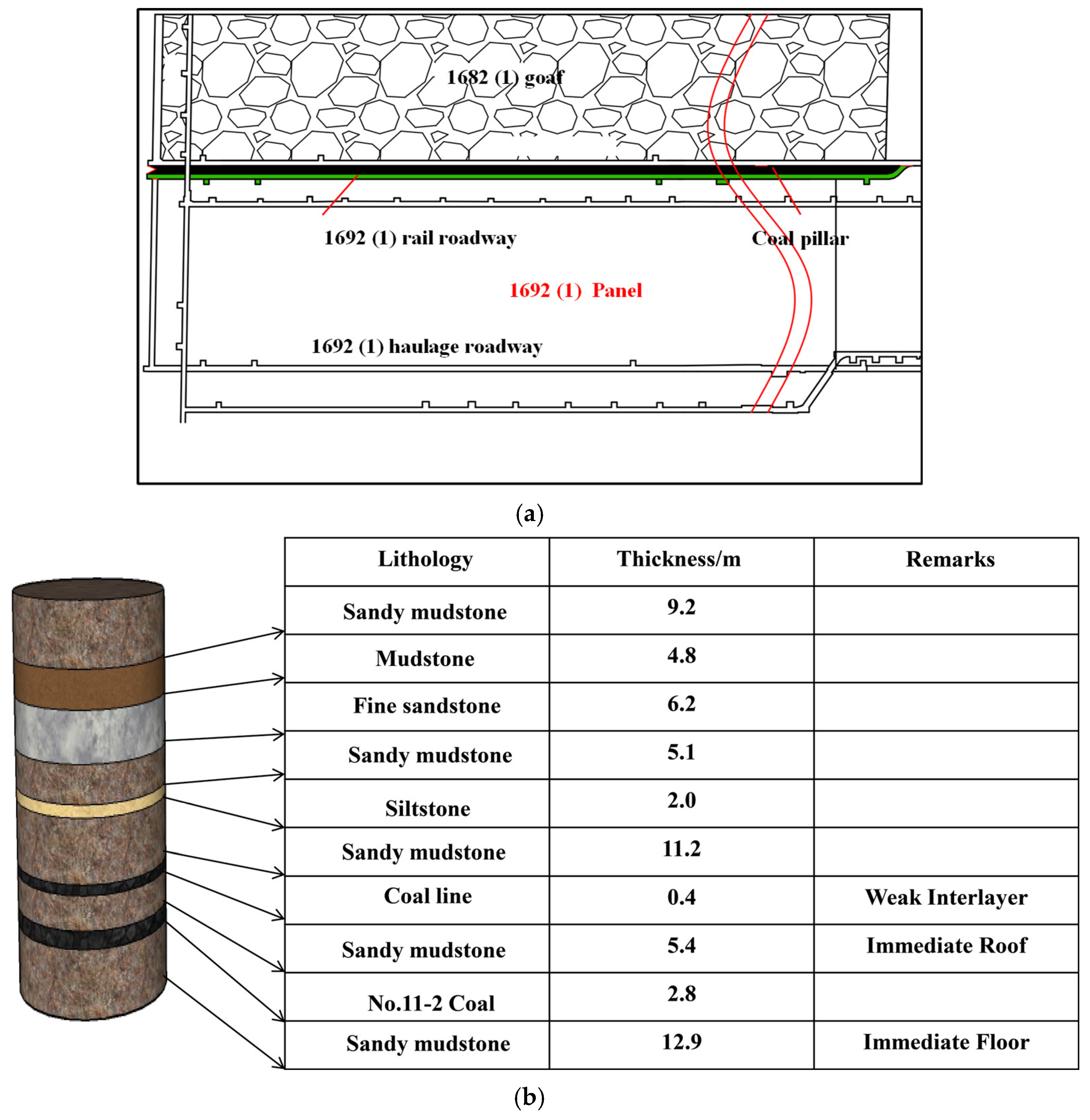
Pansan Coal Mine is located in Huainan City, Anhui Province, China. The 1692(1) working face is situated in the West No. 3 mining area below the 11–2 coal seam, with an elevation ranging from −832 to −891 m. It has a strike length of 1302 m and a dip length of 187 m. The adjacent 1682(1) working face has already completed its production. The 1692(1) rail roadway is driven along the gob of the 1682(1) working face, leaving a 6-m-wide coal pillar. As shown in the geological histogram provided by Pansan Coal Mine (Figure 1b), the immediate roof of the 1692(1) rail roadway is a composite roof consisting of sandy mudstone and the 11–3 coal seam. The sandy mudstone has a thickness of 5.4 m, while the 11–3 coal seam varies in thickness from 0.25 to 0.5 m along the strike, with an average thickness of 0.4 m. The immediate floor is composed of sandy mudstone with a thickness of 12.9 m. This roadway is a typical deep gob-side entry with a composite roof.
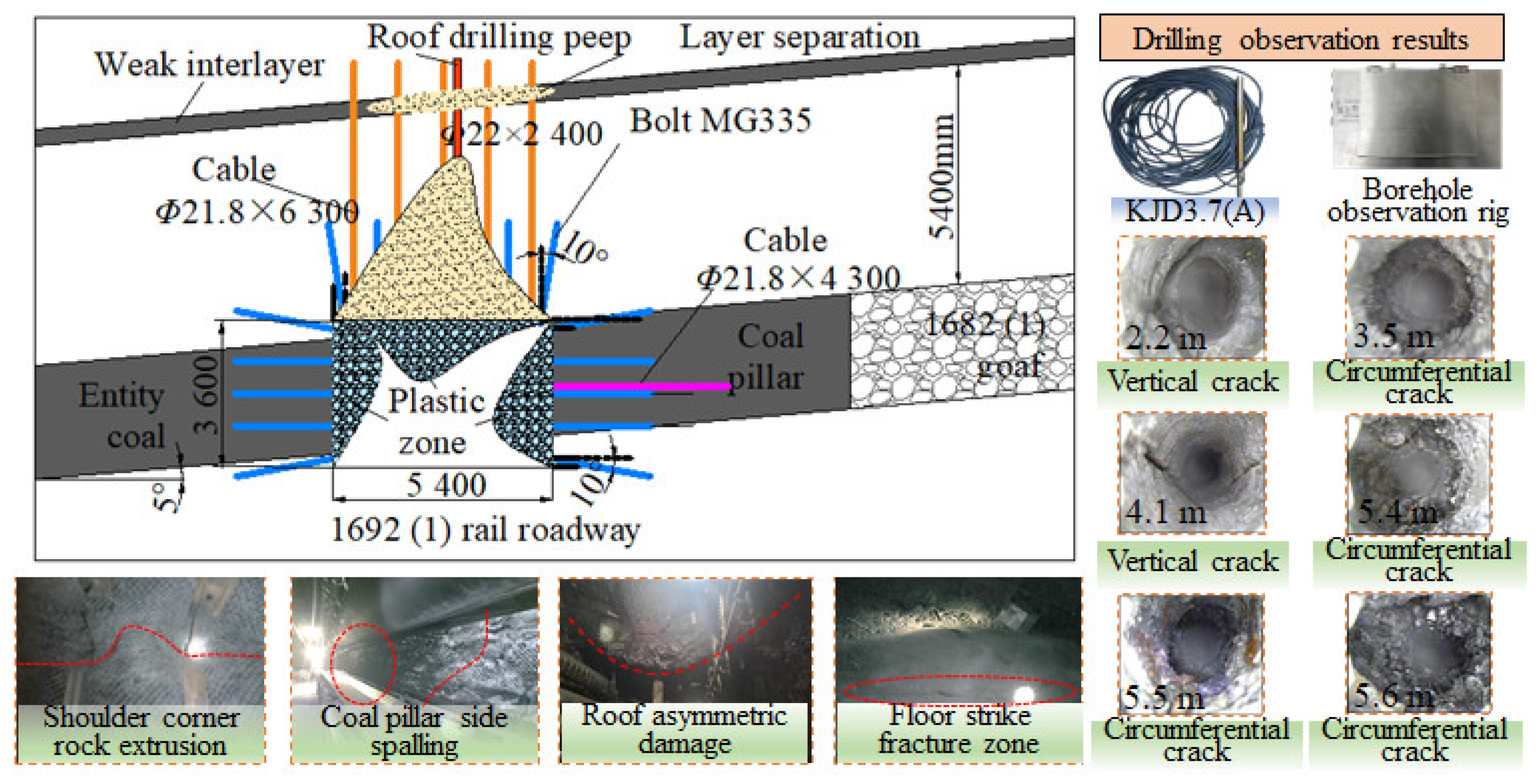
The original support scheme and parameters for the 1692(1) rail roadway are as follows: The roof is supported by seven rockbolts and five cables. The bolts are Φ 22 mm × 2400 mm MG335 rockbolts, with a spacing and row spacing of 800 mm × 800 mm. The cables are Φ 22 mm × 6300 mm; among which the three central cables are installed with a spacing and row spacing of 1100 mm × 800 mm, while the two side cables are spaced at 4400 mm × 1100 mm. Each rib is supported by five Φ22 mm × 2400 mm MG335 rockbolts with a spacing and row spacing of 800 mm × 800 mm. Additionally, on the side of the small coal pillar, one extra Φ 22 mm × 6300 mm anchor cable is installed with a row spacing of 1100 mm.
During roadway excavation, the cross-point method was adopted to monitor the surface displacement of the roadway. Boreholes were drilled in the middle of the roadway roof, and the KJD3.7(A) borehole imaging peeping system was used to observe the fracture development characteristics within the surrounding rock. The deformation characteristics of the roadway are shown in Figure 2. During the early stage of roadway excavation, rib spalling and bulging occurred on the small coal pillar side of the 1692(1) rail roadway. As the excavation continued, the surrounding rock deformation in the previously excavated sections exhibited distinct asymmetric features: the surrounding rock at the shoulder of the solid coal rib and the bottom corner of the small coal pillar rib squeezed into the roadway space. Additionally, a fracture zone along the strike appeared on the roof near the solid coal side, and cracks along the strike emerged on the floor. Furthermore, borehole peering conducted in the middle of the roadway revealed nearly vertical fracture zones in the shallow surrounding rock of the roof, with large-scale cracks developing near the weak interlayers. Severe separation phenomena were observed at multiple locations within the depth range of 5.4–5.6 m in the roof. To address the large deformation, the mine operators conducted grouting in the severely deformed sections. However, this has not fundamentally solved the problem of deformation.
In situ stress is one of the primary causes of roadway deformation and destruction, as well as an essential factor for surrounding rock stability analysis and support design. According to the provided in situ stress test report, the maximum principal stress reaches 25.76 MPa, with a lateral pressure coefficient of 1.5. Due to the tight schedule of mining and excavation succession, the excavation of the 1692(1) rail roadway commenced only three months after the completion of the adjacent 1682(1) working face. Based on the aforementioned data, the 1692(1) rail roadway is situated in a high-stress zone and is simultaneously subjected to the influence of lateral abutment pressure.

3. Evolution Law of the Plastic Zone in the Surrounding Rock

3.1. Model Establishment and Related Parameters

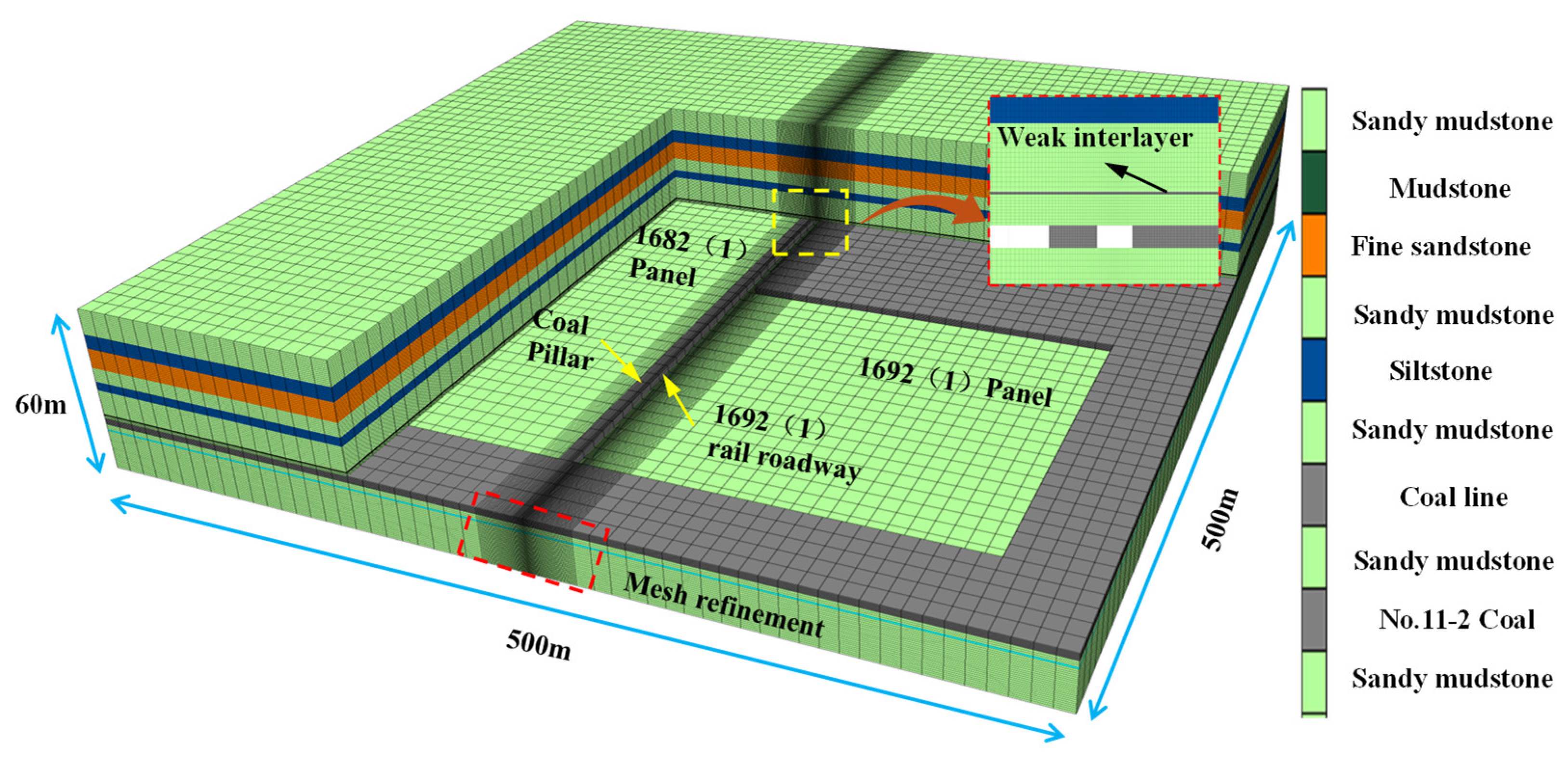
To investigate the evolution law of the surrounding rock plastic zone and the root causes of deformation in the 1692(1) rail roadway, an engineering-scale numerical calculation model, as shown in Figure 3, was constructed using the FLAC3D 6.0 numerical simulation software according to the geological conditions of the mine. The mechanical parameters of each rock stratum in the model were derived from laboratory test data. The model dimensions were 500 m × 500 m × 60 m (length × width × height). To better visualize the evolution of the plastic zone and stress around the roadway, the mesh near the roadway was refined. The Mohr–Coulomb constitutive model was adopted, and the relevant rock mass parameters are listed in Table 1. Based on the burial depth of the roadway, the vertical stress was taken as 21.5 MPa with a vertical stress gradient of 0.025 MPa/m, and the lateral pressure coefficient was set to 1.5. Accordingly, the horizontal stress in the model was set to 32.25 MPa with a horizontal stress gradient of 0.0375 MPa/m. The front, rear, left, and right boundaries of the model were constrained in their respective normal displacements, and full displacement constraints were applied to the bottom boundary. The simulation set the width of the adjacent 1682(1) working face to 200 m, with a total excavation distance of 250 m for the 1692(1) rail roadway. The cross-sectional dimensions of the 1692(1) rail roadway were 5400 mm × 3600 mm (width × height). To replicate the actual on-site mining and excavation sequence, the simulation steps were defined as follows: (a) initial geostatic stress equilibrium; (b) extraction of the 1682(1) working face; and (c) excavation of the 1692(1) rail roadway. Notably, to isolate the pure evolution of stress and plastic zone distribution, all support measures were excluded from this numerical model.

3.2. Coupled Evolution Law of the Plastic Zone and Stress in the Surrounding Rock of the Roadway

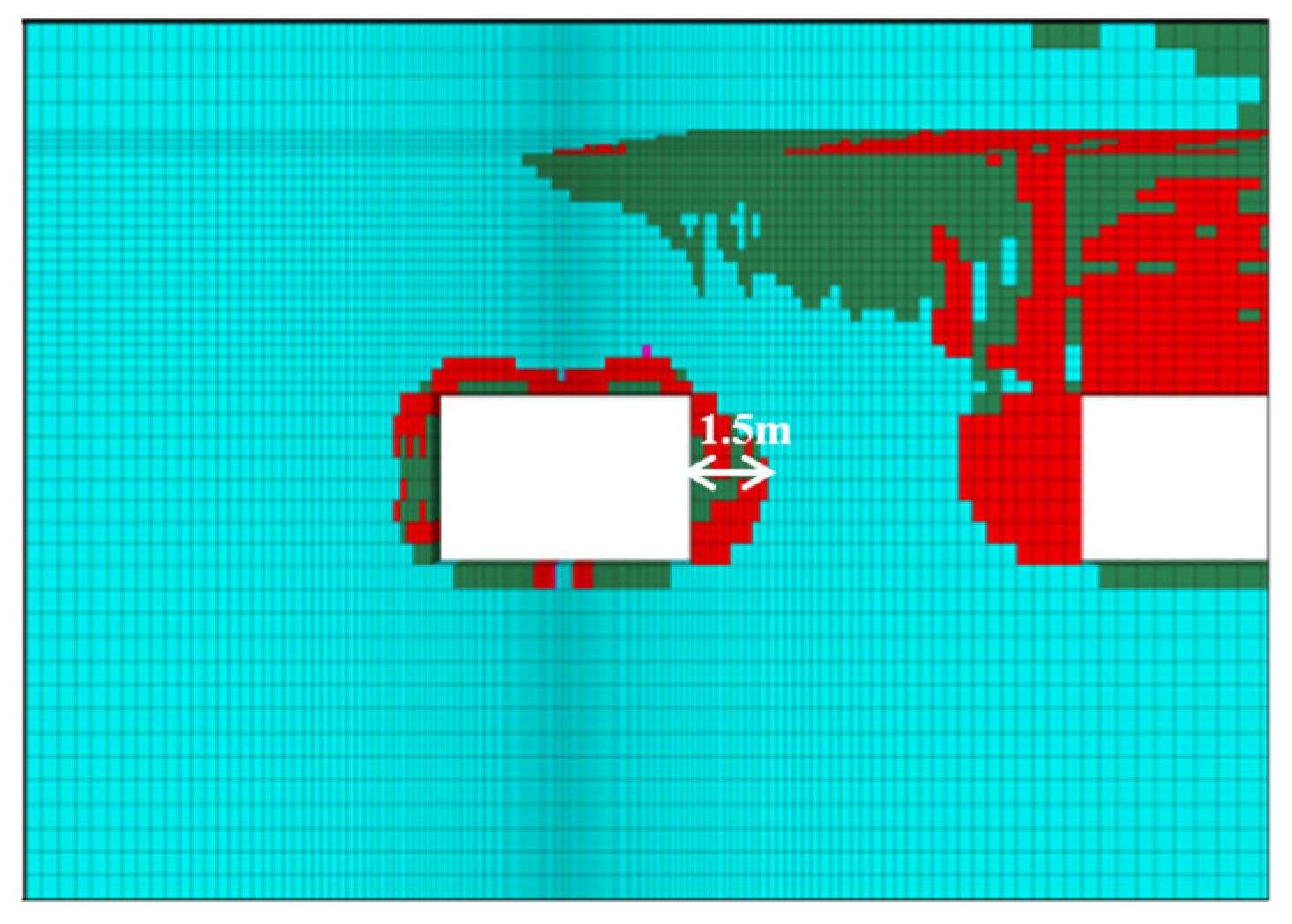
As shown in Figure 4, following the roadway excavation, the plastic zone is primarily concentrated near the free surface of the roadway. The extent of the plastic zone on the small coal pillar side is significantly larger than in other areas, reaching a maximum of 1.5 m. Although the plastic zone is shorter than the length of the anchor, the load-bearing capacity of the 6-m-wide coal pillar, which was left in place, is lower than that of undisturbed rock mass due to the impact of mining in the upper working face and tunnel excavation. Consequently, bulging of the coal pillar’s sidewalls occurred early in the tunnel excavation process. During subsequent excavation, the continuous influence of deviatoric stress may lead to variations in the form and extent of the plastic zone. Therefore, it is necessary to conduct a coupled plastic zone-stress analysis to reveal its evolution law.
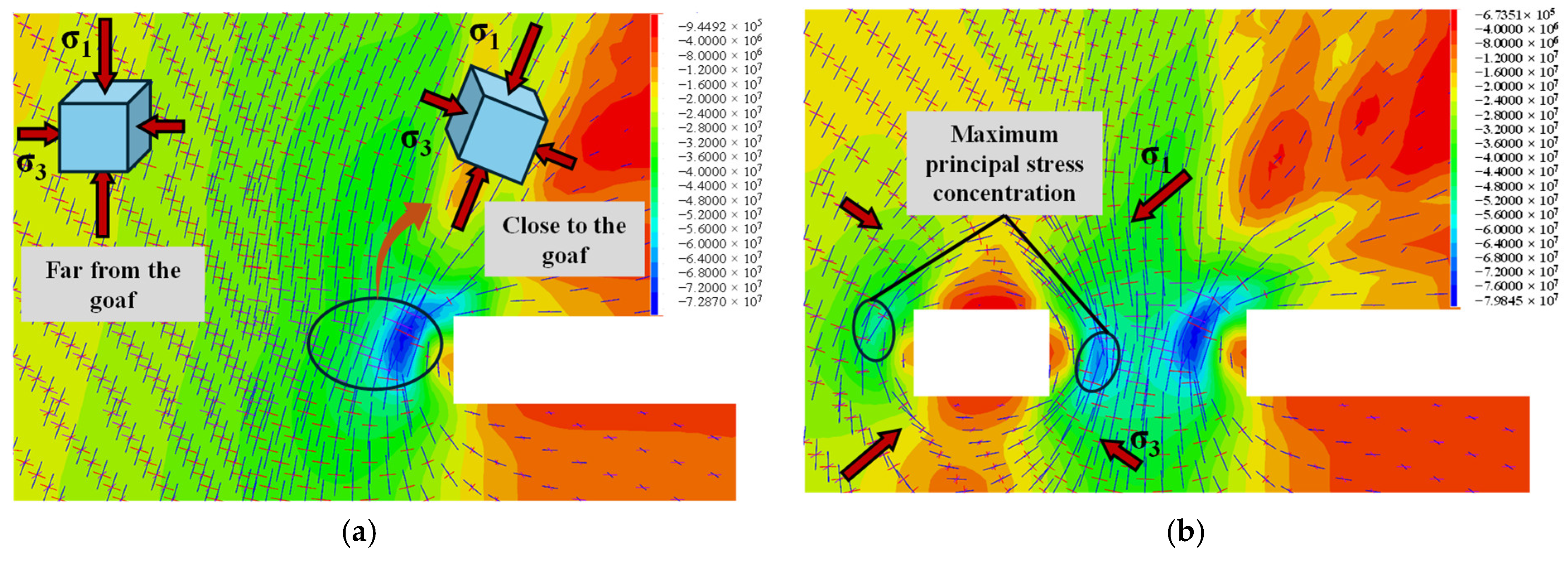
To conduct an in-depth analysis of the evolution law of the plastic zone in the surrounding rock, this study adopted plastic zone-stress correspondence analysis. In the simulation, a set of plastic zones and stress distribution maps was selected at 40-m intervals, and the stress analysis was based on the maximum principal stress, with the maximum principal stress chosen for the stress analysis. Both working face mining and roadway excavation trigger a redistribution of the surrounding rock stress, leading to a stress state significantly different from the pre-excavation conditions. As shown in Figure 5a, during the retreating stage of the 1682(1) working face, stress deviation occurs in the surrounding rock near the gob; the maximum and minimum principal stresses are no longer distributed along the horizontal and vertical directions. Conversely, the surrounding rock far from the gob showed no stress deviation. When a roadway is driven in such a stress environment, stress concentration occurs on the small coal pillar side (Figure 5b). Therefore, in the stress analysis, utilizing the maximum principal stress provides a more accurate description of the stress state within the surrounding rock.
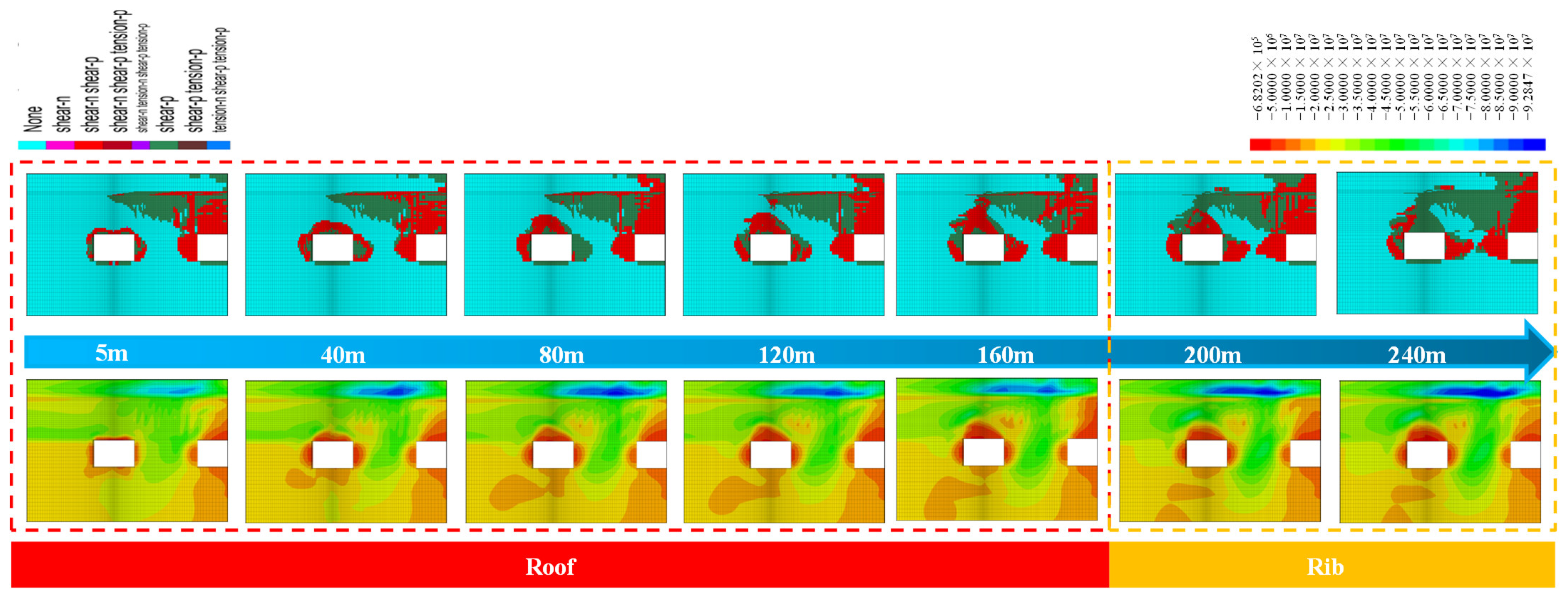
Figure 6 shows the distance from the selected cross-section to the excavation face. As illustrated in the figure, the evolution process of the plastic zone during roadway excavation can be divided into two stages:
(1) Roof-influenced stage: Within the range of 5 m to 160 m from the working face, the evolution of the plastic zone in the surrounding rock is primarily concentrated in the immediate roof and the weak interlayer. At 5 m from the excavation face, the plastic zone at the roadway surface and the weak interlayer is dominated by shear failure (shear-p). At this point, a pressure relief zone appears on the roadway surface, and stress concentration occurs in the weak interlayer above the coal pillar, indicating that the concentration of deviatoric stress leads to shear yielding. When the distance increases to 40 m, the extent of the plastic zone expands, and combined shear–tensile failure (shear-p–tension-p) emerges. This suggests that after the initial shear failure, some areas transition into a tensile failure state, with the stress concentration in the weak interlayer further increasing and extending above the roadway. Within the range of 80 m to 160 m, the failure mode of the immediate roof is dominated by shear failure and composite shear–tensile failure. The separation between the roof and the weak interlayer triggers the further expansion and interconnection of the plastic zones. The concentrated stress at the weak interlayer extends to the roof directly above the roadway, and the pressure relief zone of the roof expands upward. The direction of the maximum principal stress shifts and inclines toward the gob, reflecting the controlling effect of the lateral abutment pressure on the stress field of the surrounding rock. A distinct stress concentration zone appears on the small coal pillar side.
(2) Rib-influenced stage: Within the range of 200 m to 240 m from the working face, the changes in the plastic zone were mainly concentrated in the small coal pillar area. During this stage, the plastic zone of the small coal pillar extends deeper and tends to penetrate the entire pillar. Shear failure remains dominant within the coal pillar, and the stress distribution tends to stabilize. The expansion of the roof plastic zone has largely ceased, though localized tensile failure zones still exist.
Analysis of the correlation between the plastic zone and stress distribution reveals that the failure of surrounding rock is not solely determined by stress magnitude, but is the result of the interaction between the stress state and the mechanical properties of the surrounding rock. In the early stage of excavation (5–40 m), the plastic zone is dominated by shear failure in the roof, indicating that roadway stability is primarily controlled by the degree of deviatoric stress concentration. In the middle stage (80–160 m), the plastic zone transitions from shear to tensile failure, corresponding to the deviation in the direction of the maximum principal stress. In the late stage (after 200 m), the roof plastic zone tends to stabilize, but tensile failure persists, suggesting the presence of roof separation. At this point, the surrounding rock of the roadway ribs plays the primary load-bearing role. However, the continuous concentrated stress on the small coal pillar leads to a decline in its bearing capacity, subsequently triggering large deformations in the ribs.
In summary, the plastic zone-stress correspondence analysis effectively reveals the failure mechanism of the roadway: influenced by the mining of the upper working face and the roadway excavation, stress deviation first leads to stress concentration and plastic zone development at the weak interlayer of the roof, triggering separation phenomena. Once the roof loses its bearing capacity, the stress is transferred to the small coal pillar side, inducing plastic shear failure of the pillar. This sequence ultimately leads to roof separation and rib bulging.

4. Influence of Stress Deviation and Weak Interlayer on the Distribution of the Plastic Zone in the Roof

From the analysis above, it can be observed that the evolution of the plastic zone in the surrounding rock of the 1692(1) rail roadway is closely related to the stress state and the weak interlayers of the composite roof. The progressive development of the roof plastic zone occurs first, leading to roof separation and failure, which subsequently triggers rib instability. The fundamental key to controlling the surrounding rock of a roadway lies in inhibiting the expansion of the plastic zone [27]. Therefore, for the 1692(1) rail roadway, it is necessary to conduct an in-depth analysis of the influence of stress deviation and the characteristics of the weak interlayer on the distribution of the roof plastic zone, thus providing a theoretical foundation for rational support design.
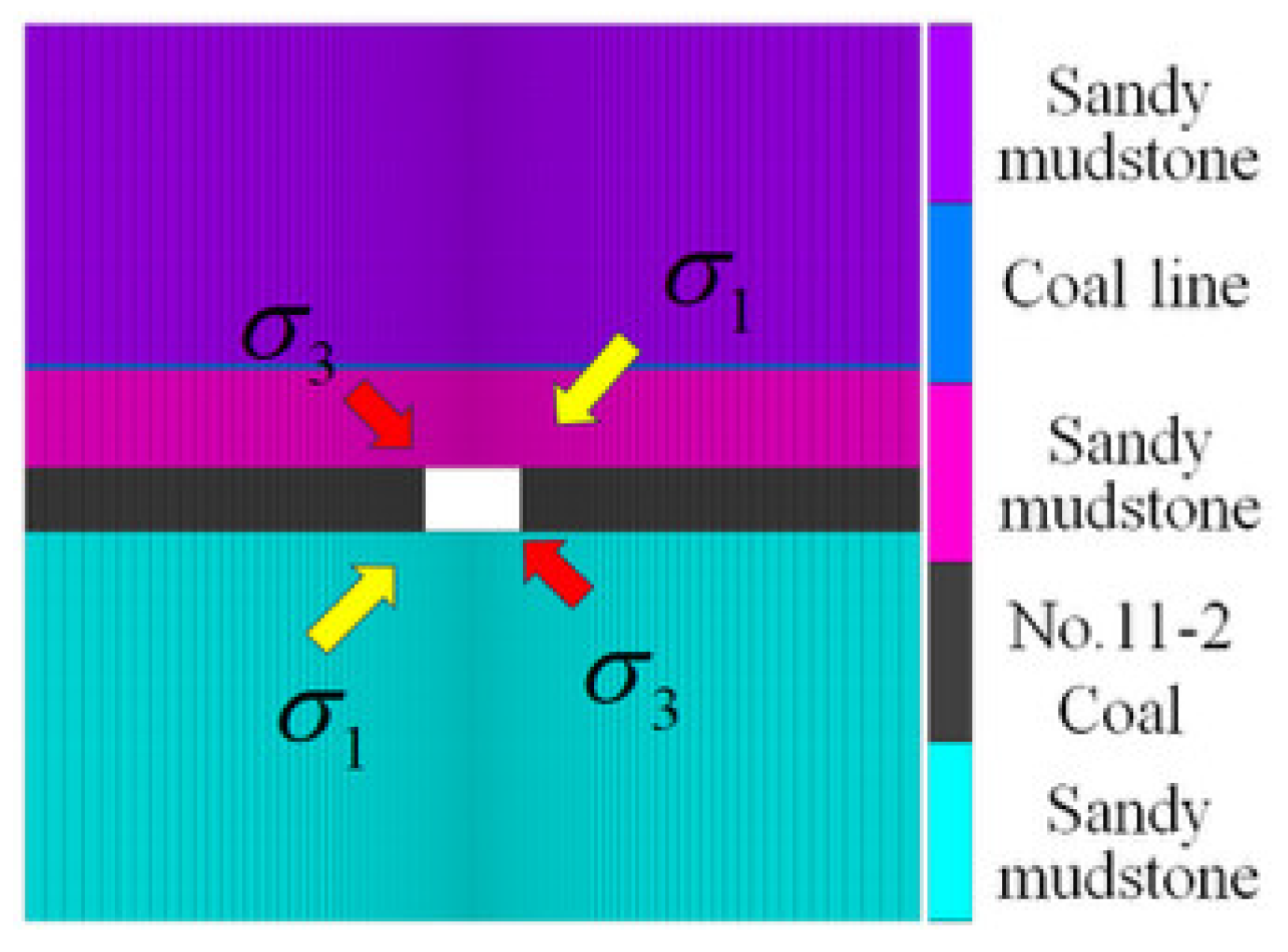
The model shown in Figure 7 was established with the rock mass parameters consistent with those used in Section 3. The large-scale model from Section 3 was not employed here because this section focuses on the variable analysis of individual factors, which is difficult to control within a large-scale model. For instance, discussing stress deviation requires precise adjustments of the rotation angle. In a large-scale model, it is challenging to accurately control the stress deviation angle through rock mass fracturing. However, in a small-scale model, precise settings of the stress deviation angle can be achieved through programming.

4.1. Influence of Stress Rotation Angle on the Distribution of the Plastic Zone

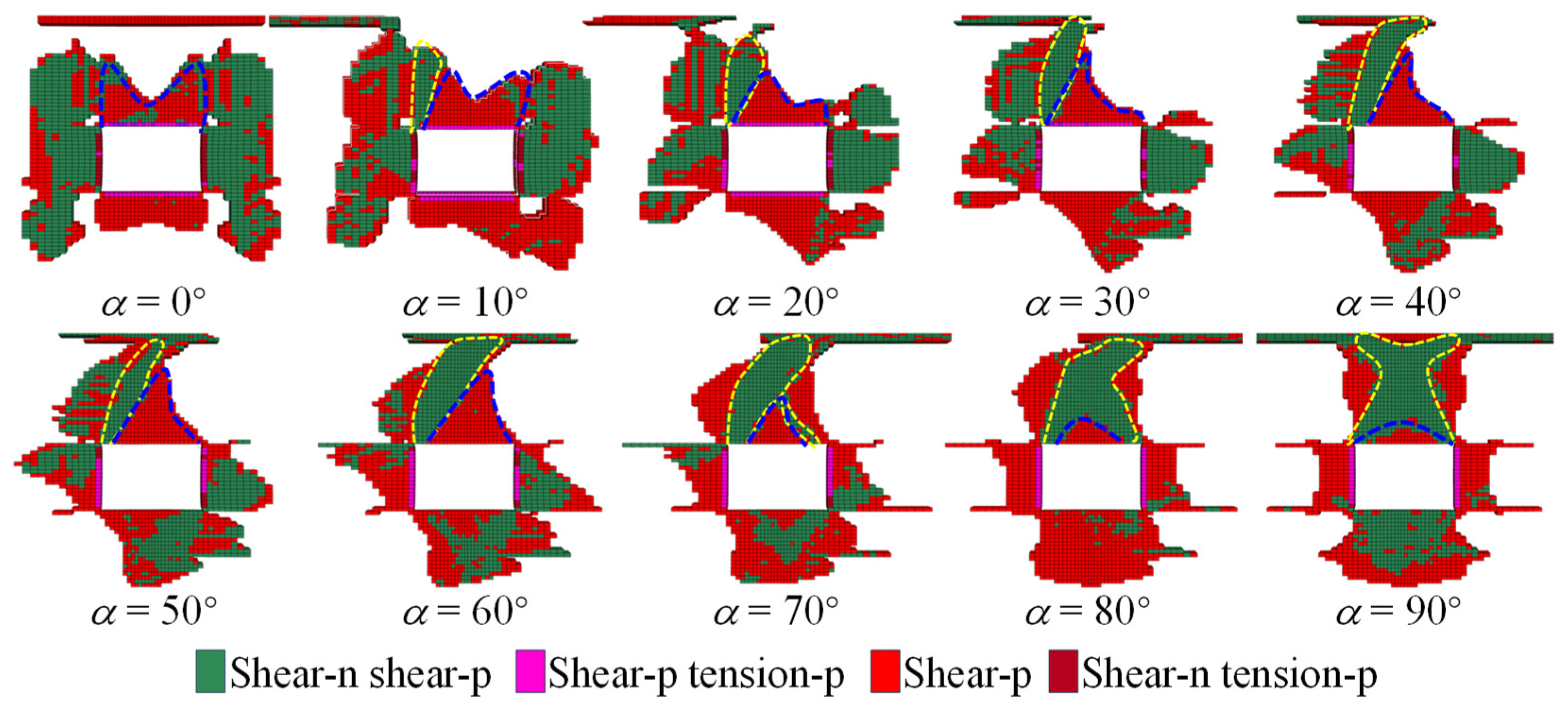
Figure 8 illustrates the distribution patterns of the plastic zone in the surrounding rock of the 1692(1) rail roadway under different principal stress rotation angles, specifically for a roof containing a single weak interlayer. As shown in the figure, as the principal stress rotation angle increases, the form of the plastic zone undergoes significant deflection, and its overall expansion direction is fundamentally consistent with the direction of the stress rotation. This phenomenon clearly demonstrates that the development of the plastic zone in the roadway surrounding rock exhibits strong directional dependency, and the spatial orientation of the maximum principal stress directly controls the extension direction of the plastic zone.
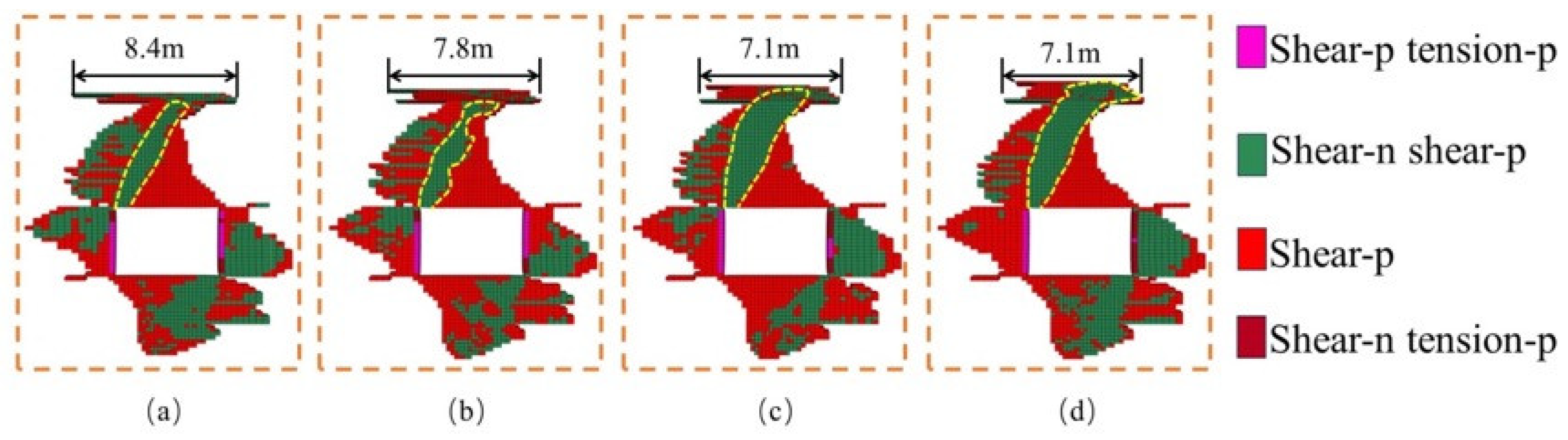
In the figure, the areas outlined by yellow dashed lines represent the roof shear fracture zones, while the areas enclosed by blue dashed lines denote the extent of roof collapse. When the principal stress deflection angle is 0° or 90°, the weak intercalation within the roof span undergoes significant bed separation failure, which is mainly concentrated in the area directly above the roof, exhibiting a symmetric or vertically focused distribution pattern. When the deflection angle is small (10° and 20°), a shear failure zone begins to emerge at the left roof edge of the roadway; however, this zone remains relatively localized and has not yet undergone large-scale propagation. In practical engineering, the orientation deflection of the maximum principal stress in the surrounding rock of coal pillar roadways typically ranges from 30° to 60°. Within this range, significant shear-induced bedding separation occurs at the weak interlayer in the roof, and the maximum width of the plastic zone is oriented toward the roof. A primary shear fracture zone forms, connecting the weak interlayer to the left shoulder of the roadway, which intensifies the separation phenomenon. This fracture zone interconnects with the roof plastic zone, further increasing the risk of roof collapse in the rock mass below the weak interlayer. As the principal stress rotation angle increases, the angle between the shear fracture zone and the vertical direction also increases, leading to a corresponding expansion of the roof fall area. When the rotation angle further increases to 70° and 80°, a new shear fracture zone appears on the right side of the roadway roof and connects with the primary shear fracture zone; as the angle continues to increase, the width of this secondary fracture zone further expands.
Therefore, the principal stress deflection angle directly governs the orientation and connectivity pattern of the plastic zone in the surrounding rock. In particular, it plays a decisive role in the spatial distribution of bed separation within the roof’s weak intercalation, the positioning of shear failure zones, and the resulting risk of roof collapse.

4.2. Influence of the Distribution Characteristics of Weak Interlayers on the Plastic Zone Distribution

The distribution of weak interlayers in roadway roofs often exhibits significant non-uniformity along the strike of the roadway, with notable variations in thickness, stratigraphic position, and the number of layers present. To systematically investigate the impact of these variations on the stability of the roadway surrounding rock, numerical analyses were conducted by setting the principal stress deflection angle to 50°, with the thickness, stratigraphic position, and number of weak interlayers treated as independent variables.
(1) Influence of the thickness of the weak interlayer
As illustrated in Figure 9, with the increasing thickness of the weak interlayer, the maximum depth of the plastic zone in the roadway roof remains oriented toward the roof. However, the failure range within the weak interlayer itself gradually decreases. This is primarily manifested as a reduction in the shear failure width of the structural plane between the weak interlayer and its overlying hard rock strata. Conversely, the width of the primary shear fracture zone in the roof and its degree of interconnection with the weak interlayer increase accordingly. This indicates that the severity of separation failure is significantly enhanced as the thickness of the weak interlayer grows, suggesting that while a thicker weak interlayer may experience reduced localized internal failure, it triggers more intense interlayer separation, thereby exacerbating the overall instability risk of the roof.
(2) Influence of the number of weak interlayers
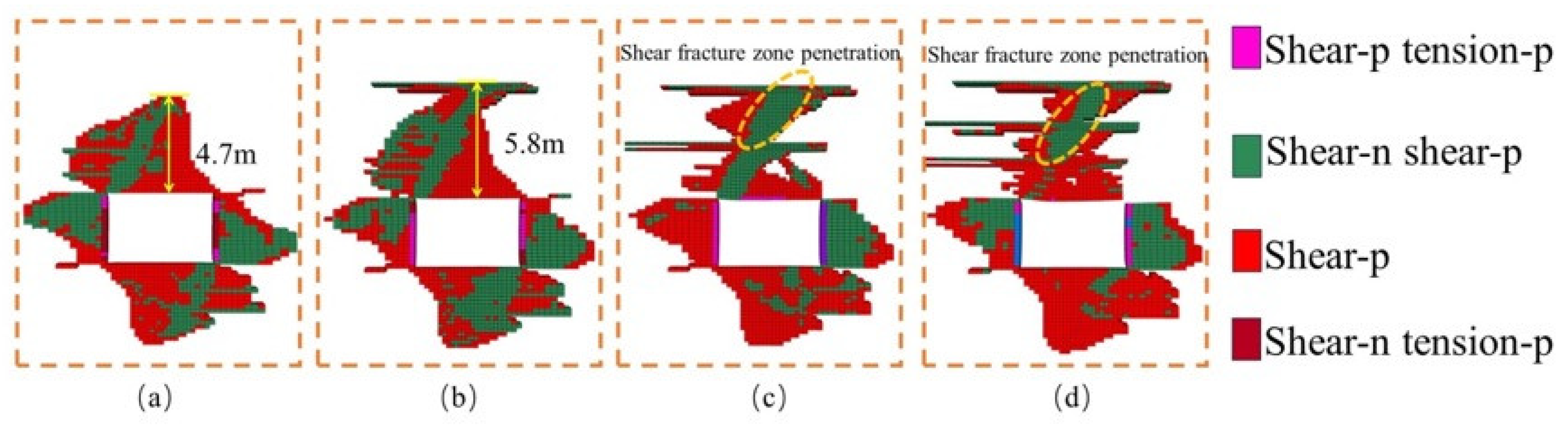
Figure 10 compares the development of the roof plastic zone under varying numbers of weak interlayers. In the absence of a weak interlayer, the plastic zone height reaches 4.7 m, which increases to 5.8 m when a single interlayer is introduced. The primary driver for this expansion is the cascading failure of adjacent competent rock triggered by the initial failure of the weak interlayer. Following excavation, the primary shear fracture zone connects with the failure zone in the rock mass underlying the interlayer, causing the plastic zone to extend upward. As the number of interlayers increases, the primary shear fracture zone acts as a bridge, sequentially linking the damage zones of each competent rock layer and penetrating through multiple interlayers. This process culminates in a multi-layered, interconnected failure system, which significantly expands the instability scope of the roof.
(3) Influence of the horizon (position) of the weak interlayer
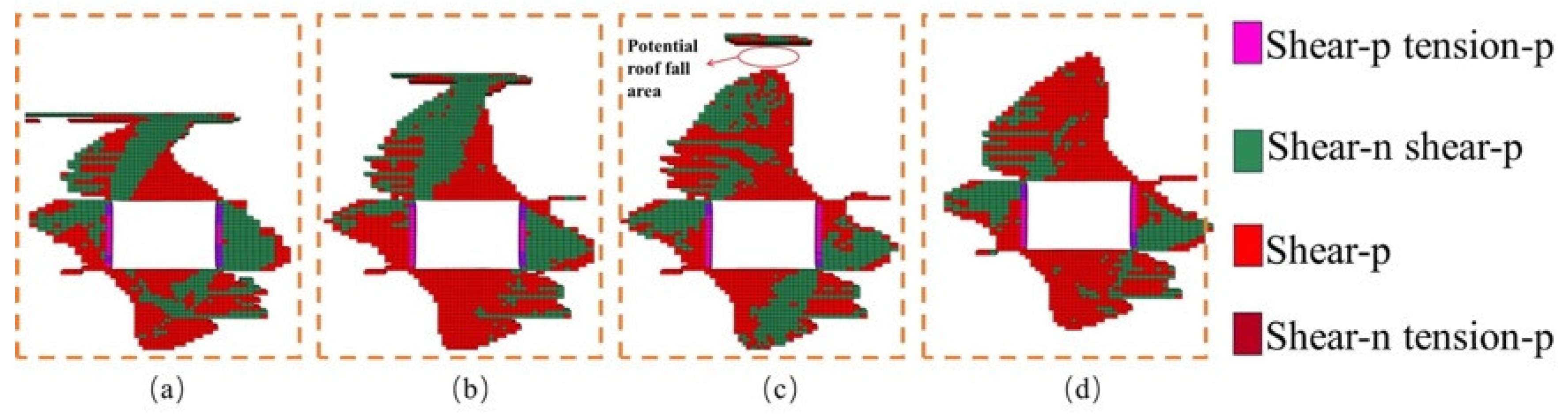
As shown in Figure 11, with the increasing height of the weak interlayer, the bed separation area gradually diminishes, while the potential roof caving zone shifts toward the coal pillar side. When the interlayer is located at a height of 8 m, the roof plastic zone has not yet connected with the interlayer; this area remains a critical zone for potential caving and is highly susceptible to collapse under the influence of mining-induced stress from the working face. As the interlayer height increases further, the impact of roadway excavation wanes, resulting in a reduction in both the intensity of the primary shear fracture zone and the degree of bed separation. However, the extent of the potential caving zone expands. When the interlayer height reaches 10 m, bed separation becomes negligible, indicating that this location lies beyond the primary influence zone of the roadway excavation.
In summary, the stability of the roadway roof is significantly influenced by the thickness, number, and stratigraphic position of the weak interlayer. An increase in thickness exacerbates bed separation, while a higher number of interlayers facilitates cascading failure across multiple strata. Furthermore, as the interlayer position shifts upward, bed separation is attenuated, yet the risk of potential roof caving shifts toward the coal pillar side.

5. Control Mechanism of Separation in Gob-Side Roadways with Composite Roof

5.1. Analysis of Roof Deflection Under Roof Support Loads and Coal Pillar Support Load

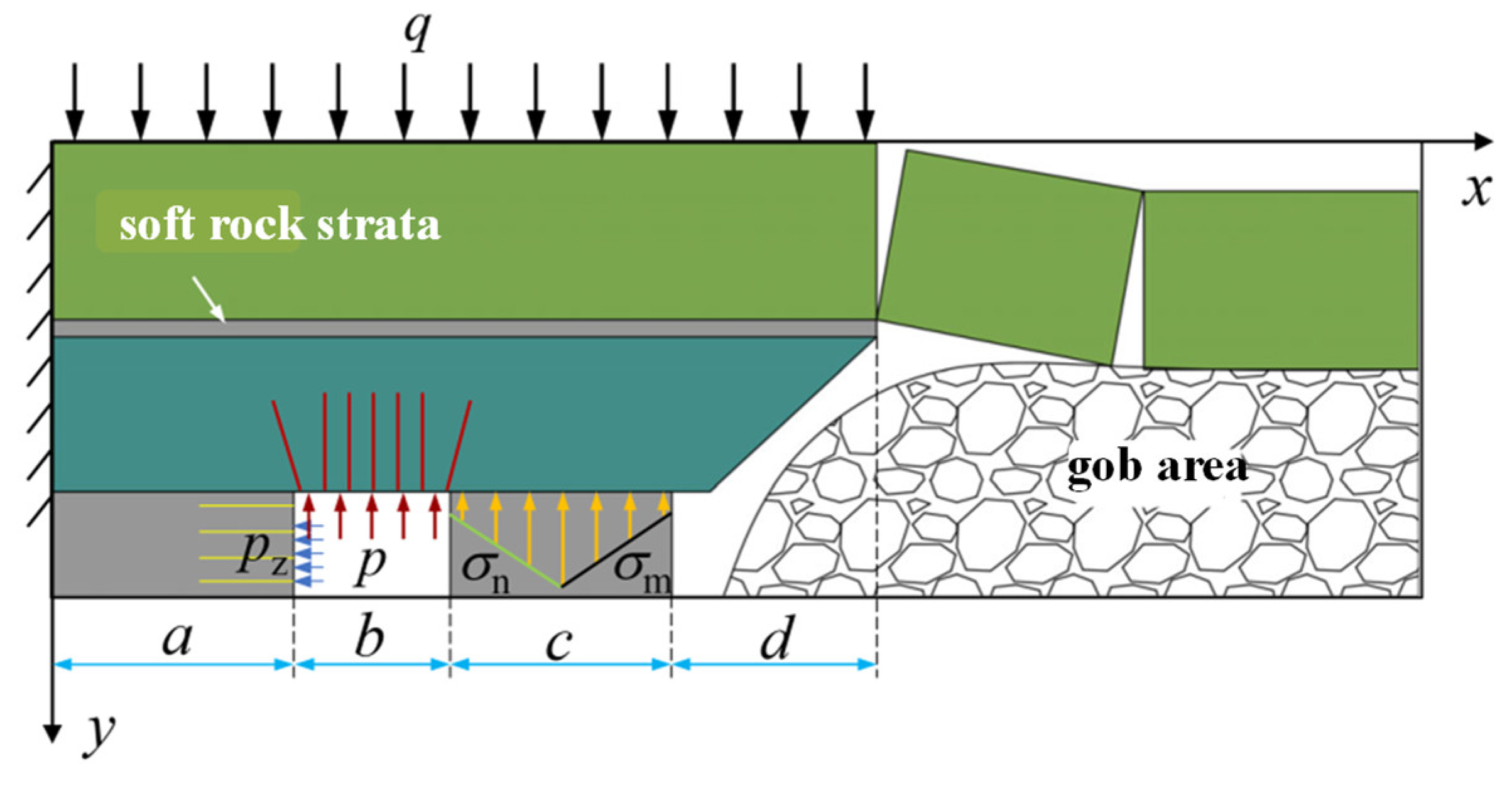
Based on the failure characteristics of separation in roadways with composite roofs, a cantilever beam mechanical model was established under roof support loads and small coal pillar bearing loads [28], as illustrated in Figure 12. For the convenience of theoretical analysis, the following assumptions are made: the roadway roof strata are assumed to be elastic bodies satisfying the small deformation condition; the coal pillar is under a given load state; the immediate roof, weak interlayer and main roof are in a given deformation state. Both the immediate roof and the main roof are treated as single-layer beams composed of sandy mudstone; the accumulation of inconsistent deformation between these two layers inevitably leads to separation failure. Although this simplification ignores the internal force transfer of rock strata, the sliding of structural planes, and the time-space disturbance effect caused by excavation, it can effectively qualitatively analyze the fundamental mechanism and evolutionary law of roof delamination.
Based on the limit equilibrium theory, the stress peak within the immediate and main roof is identified as the fixed-end support. The distance from this fixed end to the solid coal rib defines the width of the limit equilibrium zone. The width of the limit equilibrium zone in the solid coal rib, denoted as a, can be calculated using the following formula [29]:
a = λ h d 2 tan φ m ln k m γ H + C m cot φ m C m cot φ m + p z / λ
In the formula, λ represents the lateral pressure coefficient; hd is the cutting height of the coal seam in the roadway; Cm denotes the cohesion of the structural plane of the rock strata; km is the stress concentration factor; H represents the burial depth; φm is the internal friction angle of the structural plane; and pz is the support resistance provided by the rockbolts to the solid coal rib.
The loads acting on the immediate roof and the main roof adjacent to the weak interlayer are categorized into the overlying strata load q, the roof support load p, and the coal pillar bearing strength σp. In the mechanical model calculations, it can be assumed that the vertical stress within the coal pillar follows a symmetrical distribution. Let σm be the peak load of the coal pillar on the gob side and σn be the peak load of the coal body on the roadway side. The expressions for σp, σm, and σn are as follows [30]:
σ p = C / tan φ e C tan φ / λ m 1 σ m = σ p σ n = k n σ p
In the formula, C represents the internal friction angle of the roof strata; φ is the cohesion of the roof strata; m denotes the height of the coal pillar; and kn is the strengthening coefficient of the coal pillar on the roadway side, which represents the enhancement factor of the coal pillar’s bearing capacity after a series of support measures have been implemented.
According to the static equilibrium conditions and the principle of superposition, the deflection curve of a single-layer beam under the overlying strata load q is expressed as follows:
ω q ( x ) = 1 24 E I q x 4 4 ( a + b + c + d ) q x 3 + 6 ( a + b + c + d ) 2 q x 2
In the formula, E represents the elastic modulus of the roof strata; I is the moment of inertia per unit length of the cross-section (I = h3/12), where h is the height of the roof strata; x is the distance from the fixed end; b is the roadway width; c is the coal pillar width; and d is the hanging roof distance (overhanging length). Let n = a + b + c + d, m = a + b + c, l = a + b; then:
ω q ( x ) = q 24 E I ( x 4 4 n x 3 + 6 n 2 x 2 )
According to composite beam theory, the load q exerted by the overlying strata on the rock beam is expressed as follows:
q = E 1 h 1 3 γ 1 h 1 + γ 2 h 2 + + γ k h k E 1 h 1 3 + E 2 h 2 3 + + E k h k 3
In the formula, γk represents the unit weight (bulk density) of the k-th rock layer; hk is the thickness of the k-th rock layer; and Ek is the elastic modulus of the k-th rock layer.
Similarly, the deflection curve of the single-layer rock beam under the support load p is expressed as follows:
ω p ( x ) = p 24 E I ( x 4 4 x 3 l + 6 x 2 l 2 4 a 3 x + a 4 ) , ( a x l )
Under the bearing load σ of the small coal pillar, the deflection curve of the single-layer rock beam is expressed as follows:
ω σ ( x ) = 1 24 E I ( 3 c l x 2 + c 2 x 2 c x 3 ) σ n + ( 3 c l x 2 + 2 c 2 x 2 c x 3 ) σ m , ( 0 x l )
Four functions, f(x), g(x), h(x), and i(x), are defined solely in terms of the coordinate x.
f ( x ) = x 4 4 n x 3 + 6 n 2 x 2 g ( x ) = x 4 4 x 3 l + 6 x 2 l 2 4 a 3 x + a 4 h ( x ) = 3 c l x 2 + c 2 x 2 c x 3 i ( x ) = 3 c l x 2 + 2 c 2 x 2 c x 3
Substituting Equation (8) into Equations (4), (6) and (7), it follows that:
ω q ( x ) = q 24 E I f ( x ) ω p ( x ) = p 24 E I g ( x ) , ( a x l ) ω σ ( x ) = σ n 24 E I h ( x ) σ m 24 E I i ( x ) , ( 0 x l )

5.2. Analysis of Factors Influencing Separation and Control Principles for Composite Roofs

The weak interlayer undergoes damage and failure at the initial stage of roadway excavation along the gob. During the excavation process, the weak interlayer settles synchronously with the immediate roof. Consequently, it can be assumed that the deflection of the weak interlayer is consistent with that of the immediate roof. Therefore, the theoretical bed separation at the weak interlayer is calculated as the difference in deflection between the rock strata immediately above and below the interlayer.
When there is only one weak interlayer located within the anchorage zone, it is subjected to the overlying strata load, the support load, and the coal pillar bearing load. Consequently, the final deflection of the rock layers adjacent to the weak interlayer within the roadway width area is expressed as follows:
ω ( x ) = ω q ( x ) + ω p ( x ) + ω σ ( x ) = q 24 E I f ( x ) p 24 E I g ( x ) σ n 24 E I h ( x ) σ m 24 E I i ( x ) , ( a x l )
Therefore, the amount of separation can be expressed as:
1 ( x ) = ω i ω i + 1 = q i 2 E i h i 3 q i + 1 2 E i + 1 h i + 1 3 f ( x ) p 2 E i h i 3 p 2 E i + 1 h i + 1 3 g ( x ) σ n 2 E i h i 3 σ n 2 E i + 1 h i + 1 3 h ( x ) σ m 2 E i h i 3 σ m 2 E i + 1 h i + 1 3 i ( x )
In the formula, ωi represents the deflection of the i-th rock layer within the roof anchorage zone; qi is the load acting on the i-th rock layer within the roof anchorage zone; Ei denotes the elastic modulus of the i-th rock layer within the roof anchorage zone; and hi is the height of the i-th rock layer within the roof anchorage zone.
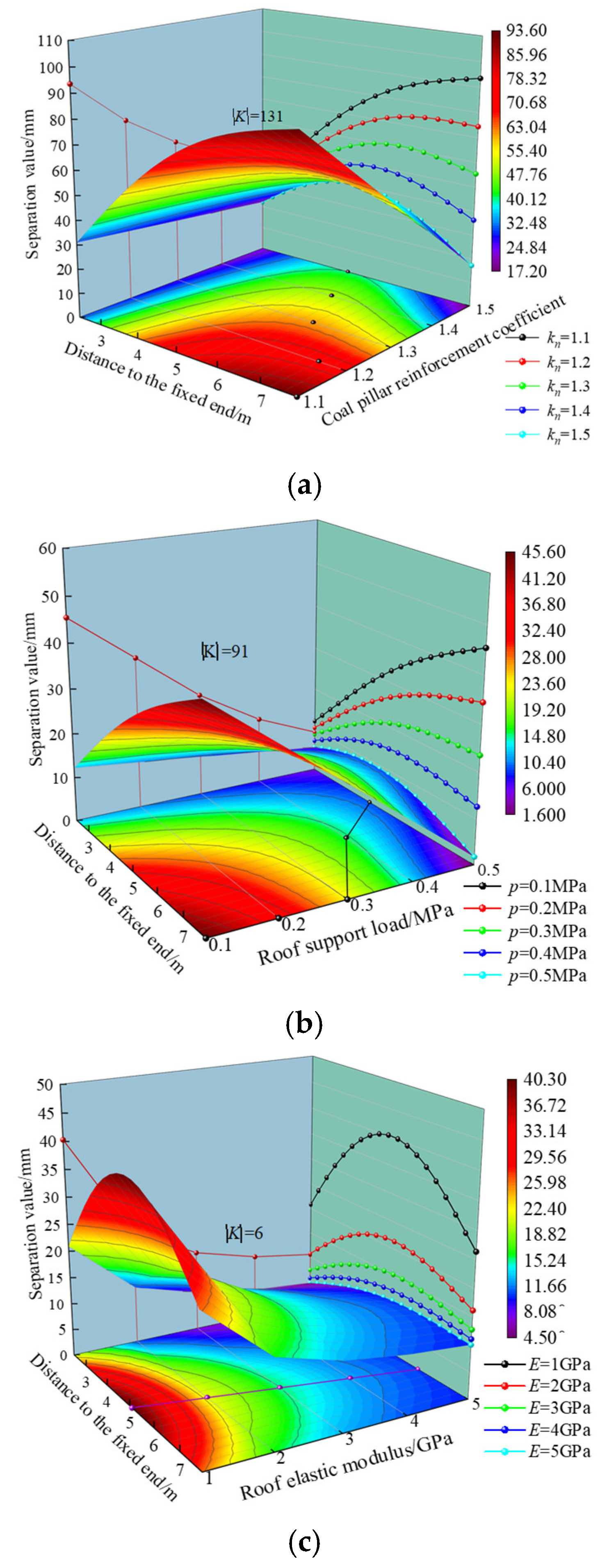
An analysis of the above equations reveals that given the physical parameters of the rock strata, the values of l and m remain constant. Therefore, the support load p, the bearing capacities of the coal pillar (σm and σn), and the elastic modulus of the roof E are the primary controlling factors for the deflection of each rock layer. The separation of the roadway roof decreases as the support load and the coal pillar bearing capacity increase, while it increases with the increase in the overlying strata load and the number of weak interlayers. When the roof is subjected to dynamic influences, the load q increases sharply, which may lead to the failure of the roof rockbolts and cables, resulting in a rapid surge in the amount of separation.
According to the geological conditions and rock mechanical parameters of the gob-side roadway with a composite roof provided by the Pansan Coal Mine, the average burial depth of the working face is 840 m. The lateral pressure coefficient is λ = 1.5, and the support resistance of the solid coal rib pz is 0.1 MPa. The width of the gob-side roadway is 5.4 m, with the calculated limit equilibrium zone width a = 2.5 m; therefore, the coordinate range of the roadway is 2.4–7.8 m. The coal pillar width is 8 m. For the rock strata structural plane, the cohesion Cm is 1.85 MPa and the internal friction angle is 28°. The vertical stress concentration factor of the solid coal rib is 1.5. The thicknesses of the immediate roof and the main roof are 5.4 m and 13.8 m, respectively, both with an elastic modulus of 4.65 GPa. The unit weight of the immediate roof is 24.2 kN/m3, and the number of weak interlayers in the roof is one.
To investigate the effects of the support load p within the anchorage zone, the coal pillar strengthening coefficient kn on the roadway side, and the roof elastic modulus E on the roof separation, a parametric study was conducted. The variation ranges were set as follows: 0.1–0.5 MPa for the support load, 1–1.5 for the coal pillar strengthening coefficient, and 1–5 GPa for the roof elastic modulus. By substituting these parameter ranges into Equation (11), the relationships between the influencing factors and the roof separation can be obtained, as shown in Figure 13.
Under the condition that other parameters remain constant, the increase in support intensity, the enhancement in the coal pillar strengthening coefficient on the roadway side, and the growth of the roof elastic modulus can all significantly inhibit the development of separation in the weak interlayer, leading to a corresponding reduction in the separation magnitude. With the improvement of the coal pillar strengthening coefficient and the roof support load, the evolution trend of the roof separation transforms from “continuous growth” to a “first increasing, then decreasing” pattern. Furthermore, the location of the maximum separation gradually migrates from the roadway edge toward the center of the roadway. This indicates that reinforcing coal pillars and enhancing support not only reduce the total separation but also promote a more uniform distribution of separation, thereby alleviating stress concentration and failure at the roadway edges. Furthermore, as the roof elastic modulus increases, the maximum separation location gradually shifts from the center of the roadway toward the coal pillar side. This reflects that the increased rock strata stiffness alters the stress transmission paths and deformation coordination within the roof, driving the concentration zone toward the more constrained coal pillar.
To quantitatively compare the contribution of each factor to separation control, a linear fitting was performed on the maximum separation under different coal pillar strengthening coefficients, support loads, and elastic moduli. The absolute value of the fitting curve slope K is defined as the control influence factor (CIF). A higher factor indicates a more significant effect of the parameter in inhibiting separation. The fitting results are as follows. The sensitivity factors for roof bed separation control were 131 for the coal pillar strengthening coefficient, 91 for the support load, and 6 for the roof elastic modulus. These results demonstrate that the bearing capacity of the coal pillar plays the most prominent role in controlling separation, followed by the roof support force, while the direct impact of the roof elastic modulus is relatively minor. Consequently, in the optimization of support parameters for roofs containing weak interlayers, a hierarchical strategy should be adopted: prioritize the enhancement of coal pillar bearing capacity, followed by the reinforcement of roof bolting systems, and finally, the improvement of roof strata stiffness.
The three controlling factors are primarily optimized through the restraining effect of rockbolts and cables on the surrounding rock. Relevant research indicates that full-length anchoring exhibits significantly superior crack-arresting effects compared to end-anchoring, and that this effect is further enhanced by high pre-stress [31]. Therefore, to suppress the development of the primary shear fracture zone in the roof, full-column anchored rockbolts are employed for roof support. The calculation formula for the anchoring force of a full-column anchored rockbolt is given by [32]:
F 1 = P 0 e 1 2 k 1 l 2
The calculation formula for the anchoring force of an end-anchored cable is given by:
F 2 = P 0 e 1 2 k 2 l L 2
In the formula, P0 is the applied prestress; l is the vertical distance from the roadway surface; L is the length of the free section of the anchor cable; and the expressions for k1 and k2 are respectively:
k 1 = E r 1 + μ 3 2 μ r 2 E b
k 2 = E r 2 1 + μ r 2 E b
In the formula, Er is the elastic modulus of the rock mass; μ is the Poisson’s ratio of the rock mass; r is the radius of the rockbolt (cable); and Eb is the elastic modulus of the rockbolt (cable). Let:
m 1 = E r 1 + μ 3 2 μ m 2 = E r 2 1 + μ
In the formula, m1 and m2 are coefficients related to the elastic modulus and Poisson’s ratio of the surrounding rock. According to the relationship between m1, m2, and these mechanical parameters, larger values of m1 and m2 indicate a stronger capacity of the surrounding rock to resist deformation. Based on Equations (12)–(16), the values of m1 and m2 can be derived as follows:
m 1 = 2 r 2 E b ln P 0 F 1 l 2 m 2 = 2 r 2 E b ln P 0 F 2 l L 2
From the above, it can be concluded that while other parameters remain constant, m1 is positively correlated with the prestress P0. Therefore, under full-column anchoring conditions, increasing the pre-stress of the rockbolt P0 can enhance the elastic modulus of the surrounding rock, thereby increasing its capacity to resist deformation. Additionally, m2 is positively correlated with the distance l and the prestress P0; the larger the values of l and P0, the stronger the deformation resistance of the surrounding rock. Consequently, increasing the anchor cable length and its pretension force enhances the overall deformation resistance of the weak interlayer and adjacent rock strata, thereby facilitating coordinated deformation of the surrounding rock.
Based on the above analysis, once the geological conditions of the roadway roof were determined, the bearing capacity of the coal pillar, the support resistance of bolts and cables, and the elastic modulus of roof strata emerged as the dominant factors controlling the deformation of gob-side entry with a composite roof. Increasing the length and pre-tightening force of bolts and cables can effectively enhance the stability of coal pillars and the elastic modulus of the rock strata, thereby further strengthening the constraint effect on surrounding rock.
Therefore, a combined control strategy focused on “increasing the width of small coal pillars, enhancing the pillar strength, suppressing the development of roof fractures, and improving the deformation compatibility of the weak-interlayer roof” is proposed. The key technical points of this method are as follows:
(1) Implementing high-strength grouted bolts, short anchor cables with high prestress, and grouting reinforcement techniques, in conjunction with increasing the coal pillar width, to enhance the bearing capacity and strength of the coal pillar, thereby reducing its plastic deformation and effectively suppressing roof delamination.
(2) Employing high-pre-tension, full-column anchored high-strength rockbolts to suppress the initiation and development of roof shear fracture zones toward the weak interlayer, thereby increasing the elastic modulus of the roof and reducing its flexural deformation.
(3) Increasing the length and pre-tension of the cables to improve their elongation and flexibility, ensuring that the weak interlayer is contained within the anchorage zone and achieving coordinated deformation with the surrounding rock mass.

6. Engineering Application

6.1. Surrounding Rock Control Scheme

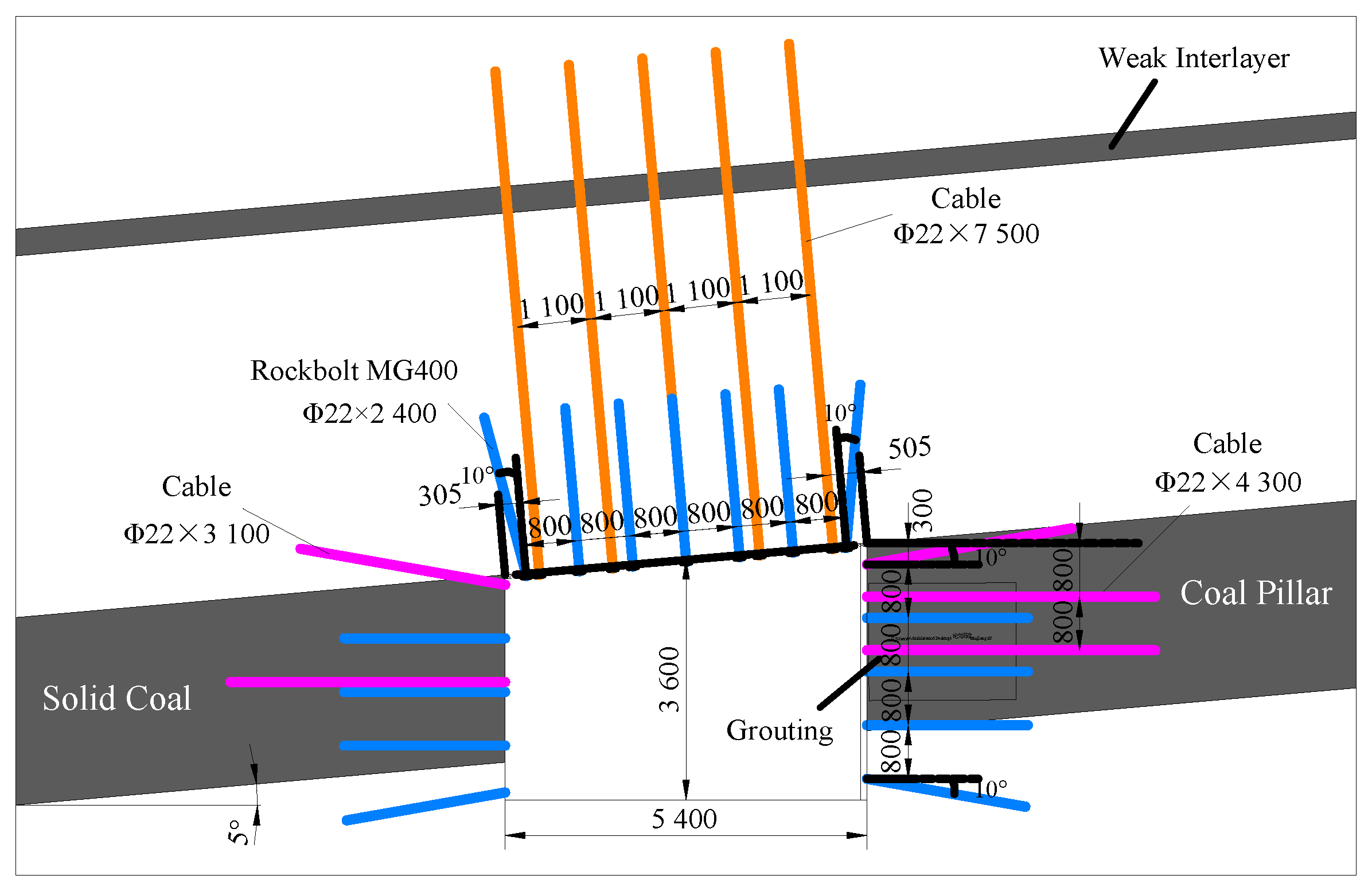
Based on the research findings and the proposed joint control method, a new support scheme for the 1692(1) rail roadway was developed (Figure 14). The specific parameters are as follows:
(1) The coal pillar width was adjusted from 6 m to 7.8 m.
(2) Roof support: ① Roof bolts: The roof is supported by high-strength bolts (MG400, Φ22 mm × 2400 mm) with a spacing and row spacing of 800 mm × 900 mm. Bolts at the roof-rib shoulders (shoulder holes) are installed at an angle of 10° toward the rib. ② Roof cables: Anchor cables (Φ 22 mm × 7500 mm) are installed with a spacing and row spacing of 800 mm × 900 mm, arranged perpendicularly to the roof.
(3) Rib support: ① Rib bolts: The ribs are supported by high-strength bolts (MG400, Φ22 mm × 2400 mm) with a spacing and row spacing of 800 mm × 900 mm. At the shoulder area, anchor cables (Φ 22 mm × 3100 mm) are used instead of bolts. These shoulder cables and the bottom-corner bolts are installed with an inclination of 10° toward the roof and floor, respectively. ② Rib anchor cables: Each rib is reinforced with two anchor cables (Φ 22 mm × 4300 mm) at a row spacing of 1800 mm, installed perpendicularly to the rib surface. ③ Grouting: Grout injection holes are arranged in two rows in a staggered pattern. The upper and lower rows are located 1 m from the roof and floor, respectively, with a longitudinal spacing of 3 m. The hole depth is no less than 4 m, and the grouting pressure is maintained at a minimum of 3 MPa. Finally, the surface is treated with shotcrete to a thickness of 100 mm.

6.2. Numerical Simulation

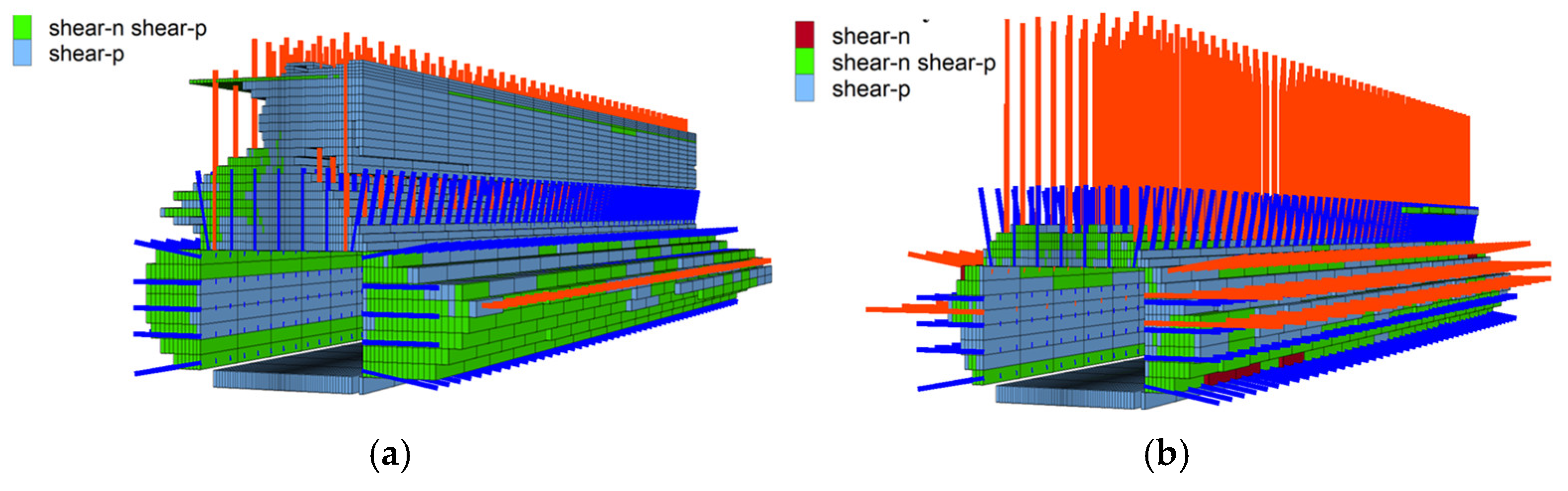
Under the original support scheme, the distribution of the plastic zone is shown in Figure 15a. It is evident that the plastic zone is extensively developed at both sides and the roof, with the anchored segments of the bolts and cables falling within the plastic zone, leading to the failure of the support system. This indicates that the original design cannot adequately maintain the stability of the roadway’s surrounding rock. Under the optimized support scheme, the extent of the plastic zone is significantly reduced, effectively suppressing the progressive expansion of the plastic failure, as illustrated in Figure 15b.

6.3. Field Monitoring Results

To evaluate the effectiveness of the optimized support scheme on surrounding rock control, the roof separation and surface displacement were monitored for a period of 60 days.
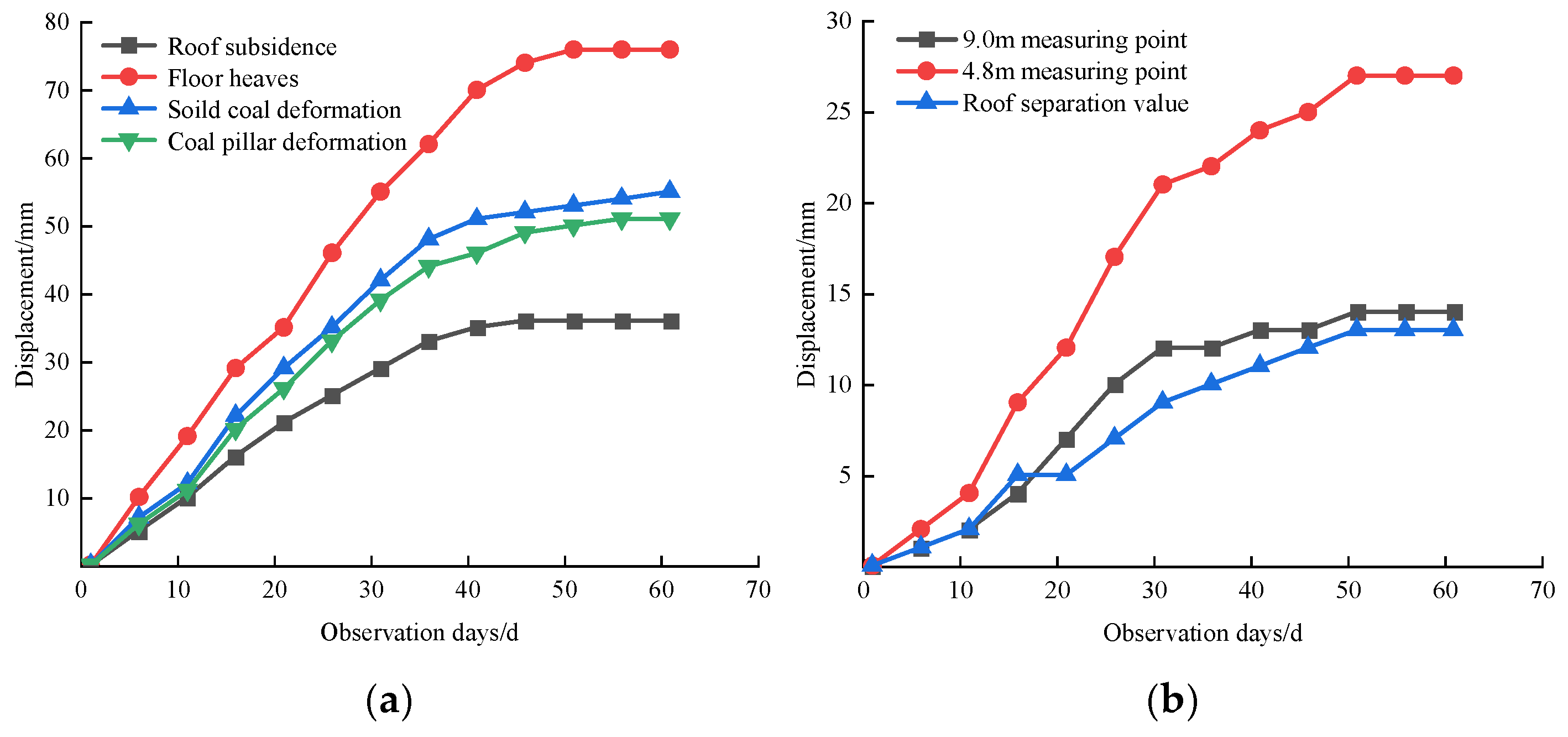
Field monitoring data indicate that the deformation of the surrounding rock in the roadway exhibits distinct spatiotemporal evolution characteristics (Figure 16), as detailed below:
(1) Evolution laws of roof separation. Significant displacement was observed at the deep monitoring point (9.0 m depth) within the first 50 days following roadway excavation, with an average rate of 0.54 mm/d and a cumulative displacement of 27 mm. The shallow monitoring point (4.8 m depth) exhibited rapid deformation within the first 30 days, reaching a maximum displacement of 17 mm at an average rate of 0.4 mm/d, after which it tended to stabilize. The maximum displacement difference between the two monitoring points was 10 mm, indicating a maximum roof separation of 10 mm.
(2) Characteristics of roadway surface displacement. The deformation rates of all monitored locations were relatively high during the first 40 days after excavation and gradually stabilized thereafter. The cumulative deformations during the monitoring period were as follows: 36 mm for roof subsidence, 76 mm for floor heave, 55 mm for the small coal pillar rib displacement, and 51 mm for the solid coal rib displacement. No severe or violent deformation was observed.
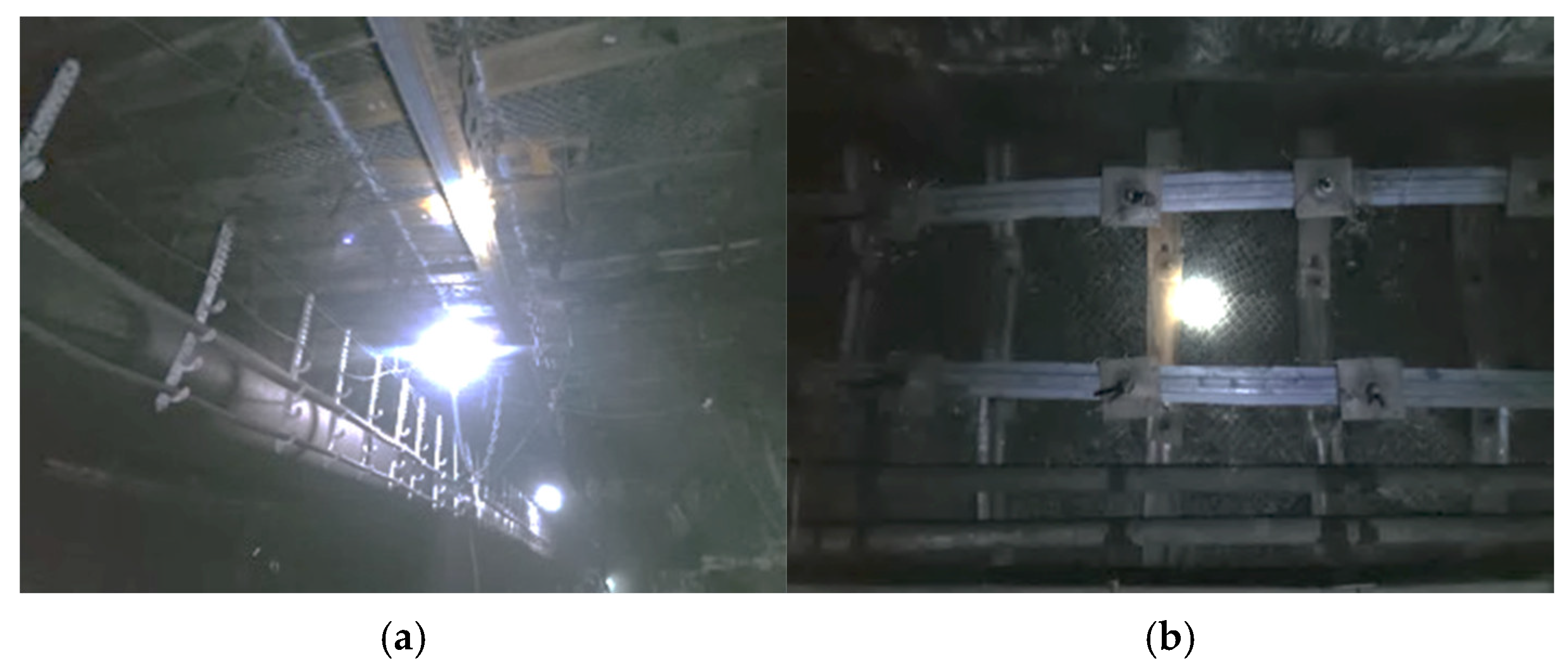
As shown in Figure 17, the roadway after repair, combined with the monitoring data, demonstrates that the support scheme proposed based on plastic zone analysis effectively inhibited the interlaminar sliding and fracture propagation of the roof. It enhanced the bearing capacity of the coal pillar and significantly improved the deformation conditions of the surrounding rock.

7. Conclusions

Taking the 1692(1) rail roadway in the Pansan Coal Mine as the engineering background, this study systematically investigated the evolution of the surrounding rock plastic zone and the mechanisms of separation control in gob-side roadways with a composite roof by utilizing a combination of theoretical analysis, numerical simulation, and field testing. The primary conclusions are as follows:
(1) The spatiotemporal evolution characteristics of the plastic zone were revealed. Controlled by the deflection of mining-induced stress and non-uniform stress fields, shear-induced separation initially occurs within the weak strata of the roadway roof. Subsequently, the plastic zone extends into the deeper strata accompanied by tensile failure, establishing a failure chain of “initial roof separation, followed by subsequent coal pillar instability and culminating in overall asymmetric deformation of the surrounding rock”.
(2) The dominant factors influencing the plastic zone distribution were identified. The principal stress rotation angle determines the initiation position and extension trajectory of shear fracture zones. Furthermore, the heterogeneity of weak interlayers (including thickness, quantity, and horizon) significantly alters the deformation coordination of the roof. Specifically, thick and multi-layered interlayers were identified as the critical risk factors for inducing large-scale separation and roof collapse.
(3) The priority sequence for separation control was established. Theoretical derivations and sensitivity analyses demonstrate that enhancing the bearing capacity of coal pillars is the most significant factor in suppressing bed separation, followed by increasing the roof support density. Support designs should prioritize coal pillar stabilization and simultaneously improve the deformation resistance stiffness of the roof strata through the application of high-pretension, full-column anchorage technology.
(4) The effectiveness of the joint control scheme was validated. Field application results demonstrate that the integrated strategy of “optimized coal pillar width, high-strength anchoring and grouting reinforcement” effectively constrains the expansion of the plastic zone in the surrounding rock. Notably, the maximum roof bed separation was reduced to only 10 mm.

Author Contributions

Conceptualization, B.W.; methodology, B.W. and X.W.; software, B.W. and Y.G.; formal analysis, B.W. and Y.G.; data curation, J.C., Y.G. and S.L.; writing—original draft preparation, B.W. and Y.G.; writing—review and editing, X.W. and J.C.; visualization, B.W., Y.G. and S.L.; funding acquisition, B.W. and S.L. All authors have read and agreed to the published version of the manuscript.

Funding

This research was funded by the Scientific Research Foundation for High-level Talents of Anhui University of Science and Technology, grant number 2024yjrc48, and the National Natural Science Foundation of China, grant number 52504083.

Institutional Review Board Statement

Not applicable.

Informed Consent Statement

Not applicable.

Data Availability Statement

The data used to support the findings of this study are included within the article.

Acknowledgments

The authors are grateful to Huaihe Energy Group Co., Ltd. Pansan Coal Mine.

Conflicts of Interest

The authors declare no conflicts of interest.

References

  1. Wang, M.; Xu, Y.L.; Xu, Q.Y.; Shan, C.F.; Li, Z.H.; Nan, H.; Li, Y.F.; Liu, H.L.; Chu, T.X. Stability control of overburden and coal pillars in the gob-side entry under dynamic pressure. Int. J. Rock Mech. Min. Sci. 2023, 170, 10540. [Google Scholar] [CrossRef]
  2. Chen, D.C.; Wang, X.Y.; Zhao, J.X.; Bai, J.B.; Chu, Y.; Zhou, Q.C.; Yu, Y. Research on the stability mechanism and control technique of surrounding rock in gob side entry driving. Sci. Rep. 2025, 15, 34676. [Google Scholar] [CrossRef] [PubMed]
  3. Chen, D.D.; Guo, F.F.; Xie, S.R.; Wang, E.; Wu, Y.Y.; Jiang, Z.S.; Wang, L.; Cui, J.Q.; Zhang, X.; Liu, R.P. Mining-induced failure characteristics and surrounding rock control of gob-side entry driving adjacent to filling working face in the deep coal mine. Energy Sci. Eng. 2022, 10, 2593–2611. [Google Scholar] [CrossRef]
  4. Zhan, X.Y.; Gao, L.; Liu, P.Z.; Zhao, Z.Q.; Zhang, P.D.; Liu, P.; Wang, Y.Y. Theoretical determination method and field verification of the fracture position of the main roof of the gob-side coal-rock roadway in gently inclined coal seam. Bull. Eng. Geol. Environ. 2023, 82, 209. [Google Scholar] [CrossRef]
  5. Xie, Z.Z.; Zhang, N.; Yuan, Y.X.; Xu, G.; Wei, Q. Study on safety control of composite roof in deep roadway based on energy balance theory. Sustainability 2019, 11, 3688. [Google Scholar] [CrossRef]
  6. Fan, D.Y.; Liu, X.S.; Tan, Y.L.; Song, S.L.; Gu, Q.H.; Yan, L.; Xu, Q. Roof cutting parameters design for gob-side entry in deep coal mine: A case study. Energies 2019, 12, 2032. [Google Scholar] [CrossRef]
  7. Yu, Y.; Wang, X.Y.; Bai, J.B.; Zhang, L.Y.; Xia, H.C. Deformation mechanism and stability control of roadway surrounding rock with compound roof: Research and applications. Energies 2020, 13, 1350. [Google Scholar] [CrossRef]
  8. Wang, C.S.; Yao, H.M.; Huang, Y.C. Stability control of goaf-driven roadway surrounding rock under interchange remaining coal pillar in close distance coal seams. Energy Sci. Eng. 2024, 12, 2553–2567. [Google Scholar] [CrossRef]
  9. Zhao, Z.Q.; Ma, N.J.; Liu, H.T.; Guo, X.F. A butterfly failure theory of rock mass around roadway and its application prospect. J. China Univ. Min. Technol. 2018, 47, 969–978. [Google Scholar]
  10. Pan, K.; Hou, B.; Zhang, Z.; Ju, W.J.; Huang, D.S.; Wang, Y.W. Stability analysis and failure control of composite roof in mining roadway considering plastic zone expansion. Energy Sci. Eng. 2025, 13, 687–699. [Google Scholar] [CrossRef]
  11. Shu, S.H.; Wang, W.J.; Ma, Y.J.; Yuan, C.; Tian, X.Y.; Du, R.J.; Ge, S. Research on the evolution law of the plastic zone and control technologies for surrounding rock in floor roadway influenced by mining activities. Energy Sci. Eng. 2025, 14, 444–459. [Google Scholar] [CrossRef]
  12. Ma, Z.Y.; Zuo, J.P.; Zhu, F.; Liu, H.Y.; Xu, C.Y. Non-orthogonal failure behavior of roadway surrounding rock subjected to deep complicated stress. Rock Mech. Rock Eng. 2023, 56, 6261–6283. [Google Scholar] [CrossRef]
  13. Shan, R.L.; Wei, Y.H.; Wang, C.H.; Li, Z.L.; Li, Y.Z.; Liu, D.; Zhao, X.P. Research on the failure mechanism of surrounding rock in a dynamic pressure roadway and active and passive coordinated support technology. Appl. Sci. 2024, 14, 1858. [Google Scholar] [CrossRef]
  14. Tang, Q.B.; Ding, Z.W.; Zhang, J.; Jia, J.D.; Di, G.Q. Evolution and control of plastic zone of roadway surrounding rock under the influence of mining. Min. Metall. Explor. 2026, 43, 183–196. [Google Scholar] [CrossRef]
  15. Li, J.; Ren, J.J.; Li, C.; Zhang, W.B.; Tong, F. Failure mechanism and stability control of soft roof in advance support section of mining face. Minerals 2023, 13, 178. [Google Scholar] [CrossRef]
  16. Bagheri, B.; Soltani, F.; Mohammadi, H. Prediction of plastic zone size around circular tunnels in non-hydrostatic stress field. Int. J. Min. Sci. Technol. 2014, 24, 81–85. [Google Scholar] [CrossRef]
  17. Wang, Y.L.; Huang, J.; Wang, G.C. Numerical analysis for mining-induced stress and plastic evolution involving influencing factors: High in situ stress, excavation rate and multilayered heterogeneity. Eng. Comput. 2022, 39, 2928–2957. [Google Scholar] [CrossRef]
  18. Fan, L.; Wang, W.J.; Yuan, C.; Ma, Y.J. Research on the differentiated support technology for roadways based on the mechanical response of the plastic zone. Energy Sci. Eng. 2024, 12, 670–683. [Google Scholar] [CrossRef]
  19. Wang, W.J.; Ma, Y.J.; Su, X.W.; Fan, L.; Yuan, C.; Wu, H.; Tian, X.Y.; Yuan, Y.; Shu, S.H. Deformation mechanism analysis and control technology research on surrounding rock of floor roadway based on the law of progressive expansion of plastic zone. J. Min. Saf. Eng. 2025, 42, 983–997. [Google Scholar]
  20. Li, L.; Bai, J.B.; Xu, Y.; Xiao, T.Q.; Wang, X.Y.; Zhang, K.X. Research on rock control of roadway with complex roof driven along goaf. J. Min. Saf. Eng. 2011, 28, 376–383. [Google Scholar]
  21. Oreste, P.; Hedayat, A.; Spagnoli, G. Effect of Gravity of the Plastic Zones on the Behavior of Supports in Very Deep Tunnels Excavated in Rock Masses. Int. J. Geomech. 2019, 19, 04019107. [Google Scholar] [CrossRef]
  22. Kang, H.P.; Zhang, X.; Wang, D.P.; Tian, J.Z.; Yi, Z.Y.; Jiang, W. Strata control technology and applications of non-pillar coal mining. J. China Coal Soc. 2022, 47, 16–44. [Google Scholar]
  23. Eugie, K.; Murat, K.; Emmanuel, K.C. Proposed solution for the ground reaction of non-circular tunnels in an elastic-perfectly plastic rock mass. Comput. Geotech. 2020, 119, 103354. [Google Scholar]
  24. Zhang, F.; Li, Y.E.; Guo, Z.Q.; Qiu, J.Z.; Lu, G. Evolution law and control method of plastic zone in soft weak roof of mining roadway. Coal Sci. Tech. 2021, 49, 24–30. [Google Scholar]
  25. Jia, H.X.; Pan, K.; Liu, S.W.; Zhang, L.W.; Fan, K.; Niu, Z.T.; Zhuo, J.; Wang, Q. Mechanism and prediction method of rock layer separation failure of composite roof in mining roadway. J. Min. Saf. Eng. 2021, 38, 518–527. [Google Scholar]
  26. Yuan, C.; Zhang, J.G.; Wang, W.J.; Lv, Y.C.; Guo, J.W.; Cao, Q.J.; Li, W.C. Controlling principles of surrounding rock in soft and broken roadway based on the distribution pattern of plastic zone. J. Min. Saf. Eng. 2020, 37, 451–460. [Google Scholar]
  27. Jia, H.X.; Li, G.S.; Wang, L.X.; Qiao, A.Z. Characteristics of stress-field environment and roof falling mechanism of mining influenced roadway. J. Min. Saf. Eng. 2017, 34, 707–714. [Google Scholar]
  28. Zhao, G.Z.; Ma, Z.G.; Sun, K.; Fan, J.Q.; Li, K. Research on deformation controlling mechanism of the narrow pillar of roadway driving along next goaf. J. Min. Saf. Eng. 2010, 27, 517–521. [Google Scholar]
  29. Gou, P.F.; Zhang, S.J.; Fan, J.; Mu, C.Y.; Zhao, K.; Chen, Z. Analysis on roof structure stability of gob-side entry retaining under composite basic roof conditions. J. Min. Saf. Eng. 2025, 42, 735–746. [Google Scholar]
  30. Zhang, B. Deformation Mechanisms and Strengthen Technology for the Gob-Side Roadway Surrounding Rock Under Mining Influence in Top Coal Caving Face with Thick Layer. Ph.D. Thesis, China University of Mining and Technology, Xuzhou, China, 2015. [Google Scholar]
  31. Wang, G.H.; Wang, X.Y.; Yang, J.X.; Zhu, X.X. Mechanism analysis of pre-stressed bonded rock bolt controlling the deformation in joint surrounding rocks. J. China Univ. Min. Technol. 2021, 50, 60–68. [Google Scholar]
  32. Wu, B.W. Research on Crack Evolution Mechanism and Large Deformation Control of Surrounding Rock in Soft Rock Roadway. Ph.D. Thesis, China University of Mining and Technology, Xuzhou, China, 2021. [Google Scholar]
Figure 1. Roadway layout and stratigraphic column: (a) roadway layout; (b) stratigraphic column.
Applsci 16 05088 g001
Figure 2. Original support scheme and deformation conditions of the roadway.
Applsci 16 05088 g002
Figure 3. Numerical simulation model.
Applsci 16 05088 g003
Figure 4. Distribution of the plastic zone in the surrounding rock.
Applsci 16 05088 g004
Figure 5. Stress deviation: (a) retreating of the upper working face; (b) roadway excavation.
Applsci 16 05088 g005
Figure 6. Coupled evolution of the plastic zone and stress in the surrounding rock during excavation.
Applsci 16 05088 g006
Figure 7. Numerical model for variable analysis.
Applsci 16 05088 g007
Figure 8. Influence of the principal stress rotation angle on the roof plastic zone.
Applsci 16 05088 g008
Figure 9. Influence of the thickness of the weak interlayer on the roof plastic zone: (a) 0.4 m, (b) 0.6 m, (c) 0.8 m, and (d) 1.0 m.
Applsci 16 05088 g009
Figure 10. Influence of the number of weak interlayers on the roof plastic zone: (a) 0, (b) 1, (c) 2, and (d) 3.
Applsci 16 05088 g010
Figure 11. Influence of the weak interlayer horizon on the roof plastic zone: (a) 3 m, (b) 6 m, (c) 8 m, and (d) 10 m.
Applsci 16 05088 g011
Figure 12. Mechanical structure model of the roof with a weak interlayer.
Applsci 16 05088 g012
Figure 13. Distribution laws of roof separation under various influencing factors: (a) relationship between coal pillar strengthening coefficient and roof separation; (b) relationship between roof support load and roof separation; (c) relationship between roof elastic modulus and roof separation.
Applsci 16 05088 g013
Figure 14. Optimized support scheme.
Applsci 16 05088 g014
Figure 15. Distribution of plastic zones under new and old support schemes. (a) Distribution of the original support plastic zone. (b) Distribution of the new support plastic zone.
Applsci 16 05088 g015
Figure 16. Curves of the surrounding rock deformation and roof separation in the 1692(1) rail roadway: (a) surrounding rock displacement; (b) roof separation.
Applsci 16 05088 g016
Figure 17. Conditions of the roadway roof and ribs after repair: (a) roof; (b) coal pillar rib.
Applsci 16 05088 g017
Table 1. Numerical calculation parameters.
LithologyDensity
(kg/m3)
Bulk Modulus (GPa)Shear Modulus (GPa)Cohesion (MPa)Friction (°)
Coal15002.761.041.8526
Sandy mudstone24204.331.761.9928
Mudstone24504.001.601.9027
Siltstone25305.022.522.1830
Fine sandstone26005.883.422.5332
Disclaimer/Publisher’s Note: The statements, opinions and data contained in all publications are solely those of the individual author(s) and contributor(s) and not of MDPI and/or the editor(s). MDPI and/or the editor(s) disclaim responsibility for any injury to people or property resulting from any ideas, methods, instructions or products referred to in the content.