1. Introduction
With the rapid development of urban rail transit, the scale of subway networks is continuously expanding, and the operating speed of subway vehicles is gradually increasing. On the one hand, the development of rail transit alleviates urban traffic congestion and improves the overall service level of cities. On the other hand, it has led to increasingly severe environmental vibration issues. The vibrations generated during subway vehicle operation are caused by the interaction between the wheels and the tracks. Vibration waves propagate through the track structure to the surrounding ground and are transmitted to adjacent structures after multiple attenuations. When the vibration intensity exceeds a certain threshold, it can adversely affect the daily lives and work of residents, even leading to health problems, thus becoming an urgent social issue requiring attention. The dynamic response of tunnels and surrounding soil induced by vibratory loads arising from wheel–rail interactions has gradually emerged as a research hotspot. Among the challenges is the accurate restoration of the vibration intensity caused by vehicle loads, which has become a key aspect in environmental vibration simulation studies.
Addressing this critical challenge of accurately restoring vibration intensity, research has progressively evolved from simplified moving load idealizations toward physics-based coupled simulations. Early foundational work established the theoretical basis for characterizing vehicle loads through excitation force functions, classifying vertical wheel–rail forces into three dominant frequency ranges [
1], later refined by incorporating sleeper dispersive effects and track irregularity spectra [
2]. Methodologically, these characterizations enabled equivalent moving load simulations, where trains were represented as concentrated forces moving at a constant speed over simply supported foundations [
3,
4]. Pioneering 2.5D finite/infinite element approaches were developed to simulate three-dimensional ground wave propagation under such idealized loading conditions [
5]. With the maturation of vehicle–track coupled dynamics theory [
6,
7], two-step approaches emerged to bridge the gap between computational efficiency and physical accuracy. Wheel–rail contact forces pre-calculated via multi-body dynamics software were implemented in ABAQUS as moving concentrated forces using the DLOAD subroutine [
8]. Alternatively, equivalent moving vehicle loads were achieved through the secondary development of the VDLOAD subroutine for explicit dynamic analysis [
9]. Parallel to these continuum analyses, other studies focused on simulating specific structural responses, such as the dynamic behavior of tunnel lining crowns under operational vehicle loads, using finite difference numerical simulation programs [
10]. Subsequent co-simulation workflows advanced this methodology by generating detailed wheel–rail contact time histories through specialized dynamics software for analysis of complete track–tunnel–soil systems [
11]. To address prohibitive computational costs associated with large-scale simulations, a novel multi-scale assembly and matrix reconstruction methodology was recently proposed to enable efficient analysis of railway track–substructure systems [
12]. Complementing these numerical developments, experimental investigations have provided essential validation benchmarks through high-fidelity equivalent moving load systems capable of reproducing high-speed train dynamic effects under controlled laboratory conditions [
13]. Field monitoring campaigns targeting heritage structures and deep soil layers have further furnished critical datasets for validating far-field attenuation models [
14,
15].
In the aforementioned studies, due to the complexity of soil dynamics under vehicle loading, early investigations generally simplified vehicle loads as vertical harmonic waves or equivalent moving forces, during which track irregularities and lateral vehicle vibrations were often neglected. Although field measurements can capture the full spectrum of real vibration responses, the presence of multiple sources of interference makes it difficult to establish a clear dynamic response relationship between vehicle loads and site effects. In recent years, track geometrical irregularities have been incorporated into several vehicle–track interaction and ground vibration studies, including the vehicle–track coupled dynamics framework by Zhai et al. [
7], the global sensitivity analysis of vehicle–track systems with special attention to track irregularities [
16], the prediction of ground vibration induced by track irregularities using vehicle–track–tunnel–soil coupling models [
17], and the coupled irregularity excitation models for metro systems developed by various Chinese research institutions [
18]. Nevertheless, these studies primarily employed simplified or decoupled approaches, such as equivalent moving load idealizations, 2.5D finite/infinite element methods, frequency-domain analyses, or two-step coupling procedures in which wheel–rail forces are first calculated and subsequently applied to the soil subsystem; these studies mainly focused on vehicle stability, near-field track dynamics, or vibration source intensity assessment. As a result, a fully coupled three-dimensional time-domain approach that simultaneously resolves vehicle dynamics, track irregularity excitation, and far-field wave propagation in layered soils, thereby systematically quantifying how the random spectral characteristics of irregularities, such as FRA spectra, translate into the frequency content of ground vibration, remains insufficiently explored.
This study introduces a dynamic response model of a multi-degree-of-freedom vibration system for multi-layered ground. By establishing a physical vehicle model within a three-dimensional finite element–infinite element coupling framework, the proposed model accurately accounts for track irregularities and both lateral and longitudinal accelerations. The vibration characteristics of the track–tunnel–site coupled system are analyzed in both time and frequency domains, and the transmission properties of vibration propagation. Additionally, the impact of different metro train speeds on vibration propagation characteristics is investigated to reveal the attenuation mechanisms. The findings are expected to provide important insights for subway vibration reduction design and urban planning.
2. Numerical Analysis Description
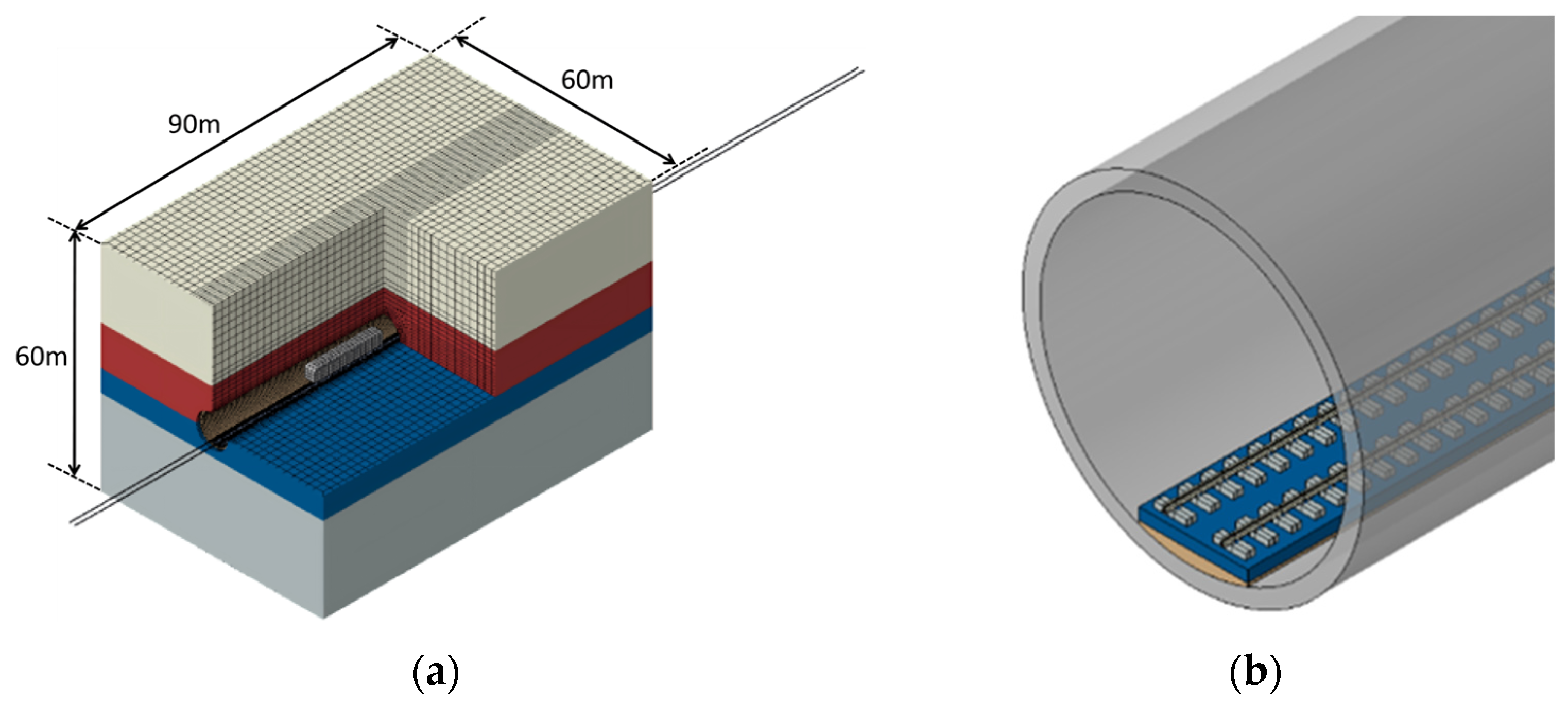
To investigate the dynamic response induced by metro train operations in layered ground, a three-dimensional dynamic finite element model was developed using ABAQUS2024. Considering both the computational domain and the required accuracy, the model dimensions were set to 60.0 m (width) × 60.0 m (height) × 90.0 m (length), employing C3D8R elements. The finite domain contains 84,504 soil elements, while the structural components (rails, fasteners, sleepers, track slab, concrete foundation, and tunnel structure) are discretized using an additional 68,136 C3D8R elements, yielding a total system of 152,640 elements. The tunnel has an inner diameter of 7.9 m and an outer diameter of 8.8 m. The track structure, comprising the rails, fasteners, sleepers, and track slab, follows the specifications of a conventional slab track system. All tunnel structures are modeled using a linear elastic constitutive model, and the main material parameters are listed in
Table 1.
Under operational confining pressures, relative displacements at the interfaces between structural components, including rail and sleeper, track and invert, and lining and surrounding soil, are sufficiently small to be neglected for the frequency range of interest (0–100 Hz). Consequently, these interfaces were simplified as perfectly bonded contacts using tie constraints to enforce displacement compatibility in the ground-borne vibration transmission analysis. This study assumes fully bonded interfaces without gap opening or slip, and all structural components are analyzed within the small-deformation framework. It should be acknowledged that this assumption neglects potential slip and nonlinear contact behavior, which may lead to a slight overestimation of high-frequency vibration transmission; nonlinear effects under extreme loads are not considered herein.
To account for the reduction in global bending rigidity caused by longitudinal joints, the segmental tunnel lining was homogenized as an equivalent cylindrical shell with a stiffness reduction factor of 0.8 [
19]. Regarding the surrounding soil, previous studies have shown that linear elastic models cannot adequately capture the hysteretic energy dissipation and permanent deformation characteristics of geomaterials under cyclic loading. By contrast, the Mohr–Coulomb elastoplastic framework provides natural damping through plastic flow while maintaining computational efficiency and enabling parameter determination from standard geotechnical investigations. Consequently, the Mohr–Coulomb model was adopted to represent the hysteretic damping of the layered soil strata, with spatial variability accounted for by assigning distinct parameters to each lithological unit (
Table 2).
While the Mohr–Coulomb model does not capture frequency-dependent damping or stiffness degradation, this limitation primarily affects high-frequency attenuation; the dominant response in the studied band is governed by geometric spreading and layer impedance contrasts, where the approximation is acceptable for comparative analysis. Advanced constitutive models will be explored in future work for improved high-frequency predictions.
The explicit time-step stability is governed by the smallest characteristic element length in the model, which occurs in the rail domain (~0.1 m). The resulting minimum stable time increment is 1.15 × 10
−6 s, corresponding to a theoretical Nyquist frequency of approximately 435 kHz, far exceeding the 0–100 Hz analysis bandwidth and ensuring negligible temporal numerical dispersion. A time-step convergence study was performed by comparing the baseline increment against a refined value (5.75 × 10
−7 s); the peak acceleration at the tunnel invert and the dominant spectral magnitude differ by less than 4%, confirming temporal convergence. For spatial resolution, a graded mesh is employed: ~0.1 m in structural components (resolving up to 100 Hz), 0.5 m in the soil near field within one tunnel diameter (0–8.8 m), and 2 m in the far field. A local mesh sensitivity analysis was conducted by refining the rail–sleeper–slab region to 0.05 m; the peak structural accelerations show deviations within 5%, verifying adequate resolution of the excitation source. Based on the dynamic elastic modulus, density, and Poisson’s ratio listed in
Table 2, the estimated shear wave velocities of the soil layers are approximately 72 m/s for silty clay, 97 m/s for cobbly soil, 66 m/s for silt, and 72 m/s for sand. The mesh was locally refined near the track–tunnel system, where large acceleration gradients and relatively high-frequency responses are expected, while a coarser mesh was adopted in the far-field soil domain, where vibration amplitudes and spatial gradients generally decrease with distance from the tunnel. This graded mesh strategy provides a balance between numerical accuracy in the near-field region and computational efficiency for the overall tunnel–soil model. Therefore, the subsequent frequency-domain results are interpreted mainly in terms of relative spectral characteristics and vibration attenuation trends rather than as a full resolution of all high-frequency wave components in the far-field soil.
It should be noted that the present study adopts a single layered soil profile. Variations in shear wave velocity, layer sequence, and damping characteristics across different sites would quantitatively alter the predicted vibration amplitudes, dominant frequencies, and attenuation rates. Consequently, the specific numerical values reported herein are site-specific. Nevertheless, the qualitative conclusions regarding near-field high-frequency attenuation, far-field dominant frequency concentration, and track-irregularity amplification are governed by fundamental wave physics and are expected to remain generally applicable.
To prevent spurious wave reflections at the artificial boundaries of the finite element domain, which would otherwise re-enter the study area and compromise computational accuracy, the CIN3D8 8-node linear infinite elements provided in ABAQUS are employed at the model boundaries to simulate the semi-infinite nature of the far-field soil. These elements provide a static-dynamic unified boundary that maintains the static stress field from geostatic analysis as the initial condition for dynamic response while providing continuous stiffness proportional damping to minimize wave reflection [
20]. To avoid numerical oscillations and ensure computational stability, a sufficiently long track section is incorporated into the model, with only the data from the stable test section extracted for subsequent analysis. Prior to the dynamic analysis, geostatic equilibrium is performed to establish the initial stress state of the soil–tunnel system under gravitational loading. Subsequently, the train is placed on the track, and a stabilization period is allowed for the transient vibrations induced by the train’s self-weight to decay. The stabilization process is deemed complete when the monitored vertical velocity at the rail and tunnel invert converges to below 1% of the peak velocity expected under the subsequent moving train load, ensuring that residual initial vibrations do not contaminate the operational response. In practice, this corresponds to approximately 1 s of physical time after the train placement, by which point the structural kinetic energy has decayed to a negligible level. Additionally, the track is extended beyond the tunnel exit to further mitigate boundary effects during this phase. The site finite element model and the structural finite element model are shown in
Figure 1.
3. Subway Train Dynamic Simulation Model
3.1. Subway Train System
The simulation utilizes the ABAQUS/Explicit solver, which advances time steps via a central difference scheme. This explicit integration scheme calculates the state of the model at the end of an increment based on nodal accelerations from the previous increment, bypassing the need for global stiffness matrix assembly and factorization. For dynamic analyses involving high-frequency wave propagation in tunnel–soil systems, an explicit time-domain finite element approach provides computational advantages [
21].
Nevertheless, the fully coupled three-dimensional explicit dynamic analysis of the vehicle–track–tunnel–soil system still entails substantial computational cost. Consequently, the present simulation employs this single vehicle as a representative excitation unit. This simplification is widely accepted in environmental vibration studies where the primary interest lies in characteristic frequency content and propagation mechanisms, since the passage of identical cars can be approximated by linear superposition. The physical simulation duration varies with operating speed. For the 90.0 m test section, the vehicle passage time ranges from 4.05 s at 80 km/h to 2.70 s at 120 km/h (head entry to head exit), while the complete passage (tail exit) requires 4.91–3.27 s. Including an initial stabilization period and a post-exit margin to avoid boundary reflection, the total analysis duration is approximately 5.5–7.0 s depending on speed. Full train convoy effects will be investigated in future work as computational resources permit.
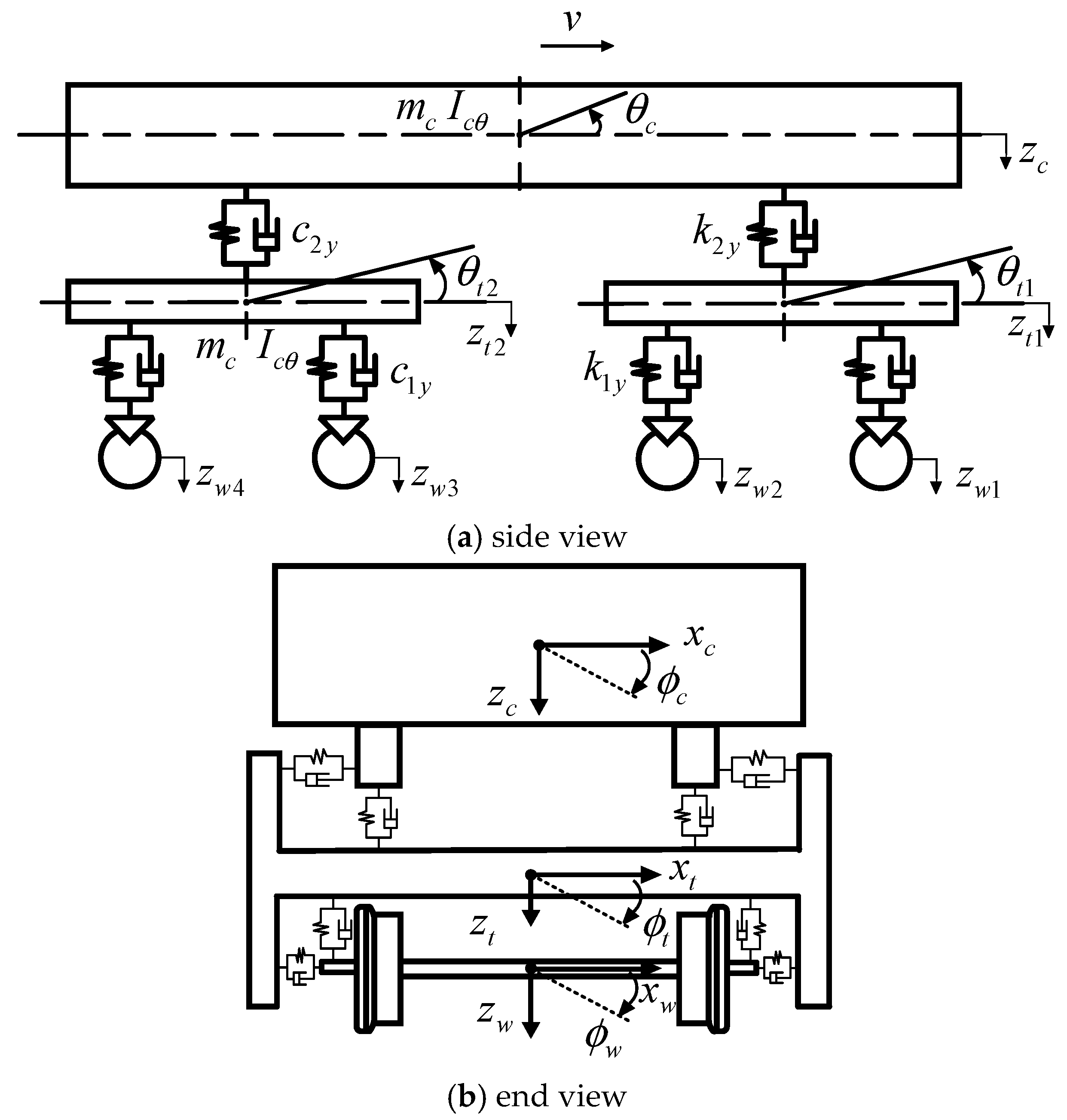
The physical model of the subway train is shown in
Figure 2, which illustrates the side and end views of the simplified multi-degree-of-freedom vehicle system comprising one car body, two bogies, and four wheelsets. The corresponding mass, inertia, stiffness, and damping parameters are listed in
Table 3. In this model, the car body is connected to the bogies via secondary suspensions, while the bogies are connected to the wheelsets via primary suspensions. Both the secondary and primary suspensions are simulated using three-dimensional Cartesian + Align connectors. In the numerical simulation model, the three simplified components are subjected to a uniform motion to emulate the train operation.
The system consists of a car body, two bogies, and four wheelsets. Each rigid body possesses six degrees of freedom. The equations of motion for the metro train system are expressed as follows:
- (1)
Equation of motion for the car body:
Longitudinal translation:
- (2)
Equations of motion for the bogie frame (taking bogie frame 1 as an example)
Longitudinal translation:
- (3)
Equations of motion for the wheelset (taking wheelset 1 as an example)
Longitudinal translation:
is the mass of the car body, is the mass of each bogie frame, and is the mass of each wheelset. The moments of inertia of the car body in roll, pitch, and yaw are represented by , , and , respectively. Similarly, the moments of inertia of the bogie frame in roll, pitch, and yaw are represented by , , and , and the moments of inertia of the wheelset are represented by , , and . The longitudinal, lateral, and vertical stiffnesses of the primary suspension system are denoted by , and , respectively, while the lateral and vertical stiffnesses of the secondary suspension system are denoted by and (). The vertical damping coefficient of the primary suspension is represented by (), while the lateral and vertical damping coefficients of the secondary suspension system are represented by and . The distance between bogies, or the wheelbase, is denoted by , and the axle distance is denoted by . The translational displacements are represented by , , and , and the rotational angles (roll, pitch, yaw) are represented by , , and . The subscripts , , and refer to the car body, bogie frame 1, and wheelset 1, respectively.
3.2. Track System and Track Irregularity Modeling
Following Reference [
22], 60 kg/m rails are used, with a monolithic ballastless track structure. The fastener vertical stiffness per node is 30 kN/mm, with horizontal and longitudinal stiffness of 15 kN/mm, and a damping coefficient of 50 kN·s/m. The fasteners are spaced at 0.6 m intervals and also simulated using 3D Cartesian + Align connectors.
To accurately reflect the impact of track irregularity on the system response in numerical simulations, the corresponding time-domain signal was reconstructed in MATLAB (R2025b) using the track irregularity power spectrum from the relevant literature [
23]. Both vertical and horizontal track irregularities are considered, with the corresponding FRA track irregularity PSD (Power Spectral Density) functions defined as follows:
Cross-level:
where
and
take the values 0.0233 m and 0.1312 m, respectively,
assumes the value 0.9525 × 10
−6 m, and
assumes the value 0.7197 × 10
−6 m (class 6).
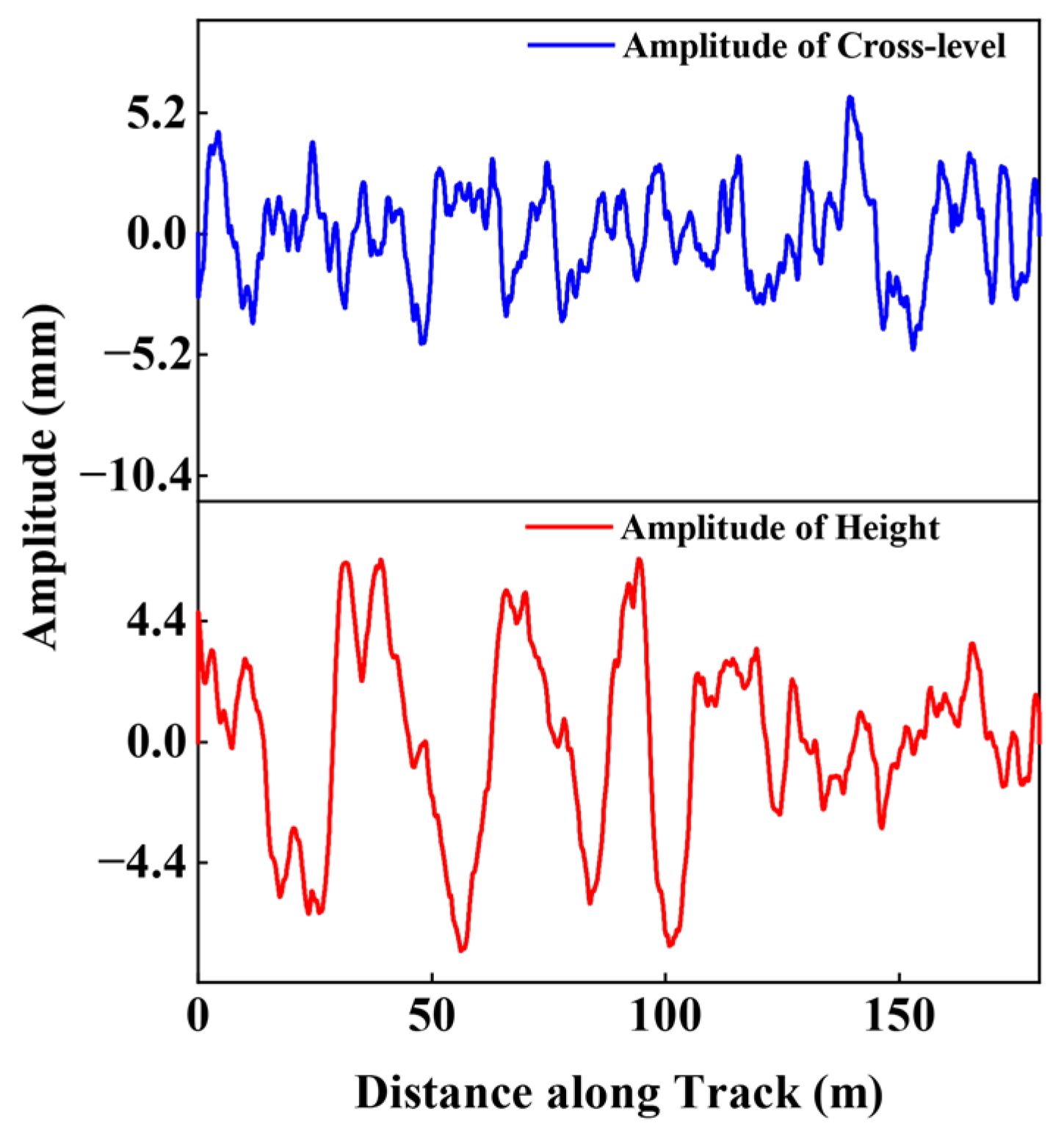
The inverse Fourier transform was then applied to generate spatial domain irregularity samples. The spatial wavelength band was explicitly truncated to 0.5–50 m during the PSD-based reconstruction, which corresponds to a direct excitation frequency range of approximately 2.7–66.7 Hz at the maximum operating speed of 120 km/h (33.3 m/s). Consequently, the shortest geometric wavelength considered in the irregularity generation is 0.5 m. The spatial sampling interval for the generated profile is 0.1 m, satisfying the Nyquist criterion for resolving this 0.5 m cutoff wavelength. For implementation in the finite element model, the irregularity data were linearly interpolated to the track node positions at 0.6 m intervals (fastener spacing). It should be noted that frequency components beyond 66.7 Hz may still be excited in the simulation through nonlinear wheel–rail contact behavior and structural resonances of the coupled vehicle–track–tunnel–soil system. To achieve spatial consistency with the track nodes in the finite element model, interpolation methods were employed to map the irregularity data to the node positions. Finally, the data were imported into ABAQUS as the initial geometric deviation of the track. Time-domain samples of rail high-low and horizontal irregularities are shown in
Figure 3.
3.3. Wheel–Rail Contact
Realistic wheel–rail interaction is key to accurately representing train vibration loads. In the vehicle–track coupled dynamics model, the tangential wheel–rail interaction is simulated via a penalty contact approach. The normal wheel–rail interaction uses Hertz’s nonlinear elastic contact theory [
24], where the contact force is given by:
In this equation,
is the wheel–rail contact force,
is the elastic compression between the wheel and rail, and
is the wheel–rail contact constant, defined as:
where
is the wheel radius. Regarding tangential behavior, friction forces are approximated using the penalty contact algorithm in ABAQUS/Explicit. Detailed nonlinear creep models and complex wheel–rail profile geometries were simplified: the wheel is approximated as conical and the rail as cylindrical. This simplification is acceptable for the present vertical vibration analysis but may slightly affect lateral dynamics.
5. Dynamic Response of the Structure
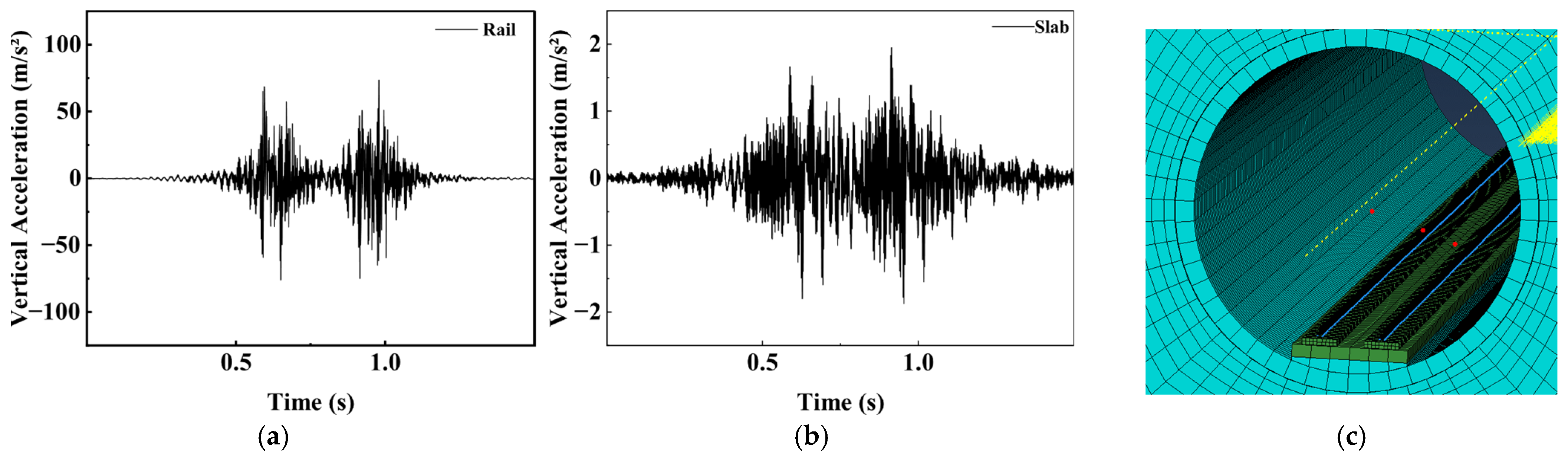
The acceleration responses presented in this section are extracted at key structural components (rail, track slab, and tunnel lining) to characterize the overall vibration intensity within the coupled system. Taking a train speed of 120 km/h, we examine vertical accelerations at the rail and track slab (
Figure 5). As the train passes the measurement cross-section, the rail and track-slab acceleration time histories show an abrupt increase followed by a gradual decay. The two distinct peaks in the rail acceleration time series correspond to the front and rear bogies passing. The peak track slab acceleration is significantly smaller (0.295 m/s
2) than that of the rails (75.9 m/s
2), reflecting the combined attenuation provided by the fastener system and the inertial resistance of the massive track slab.
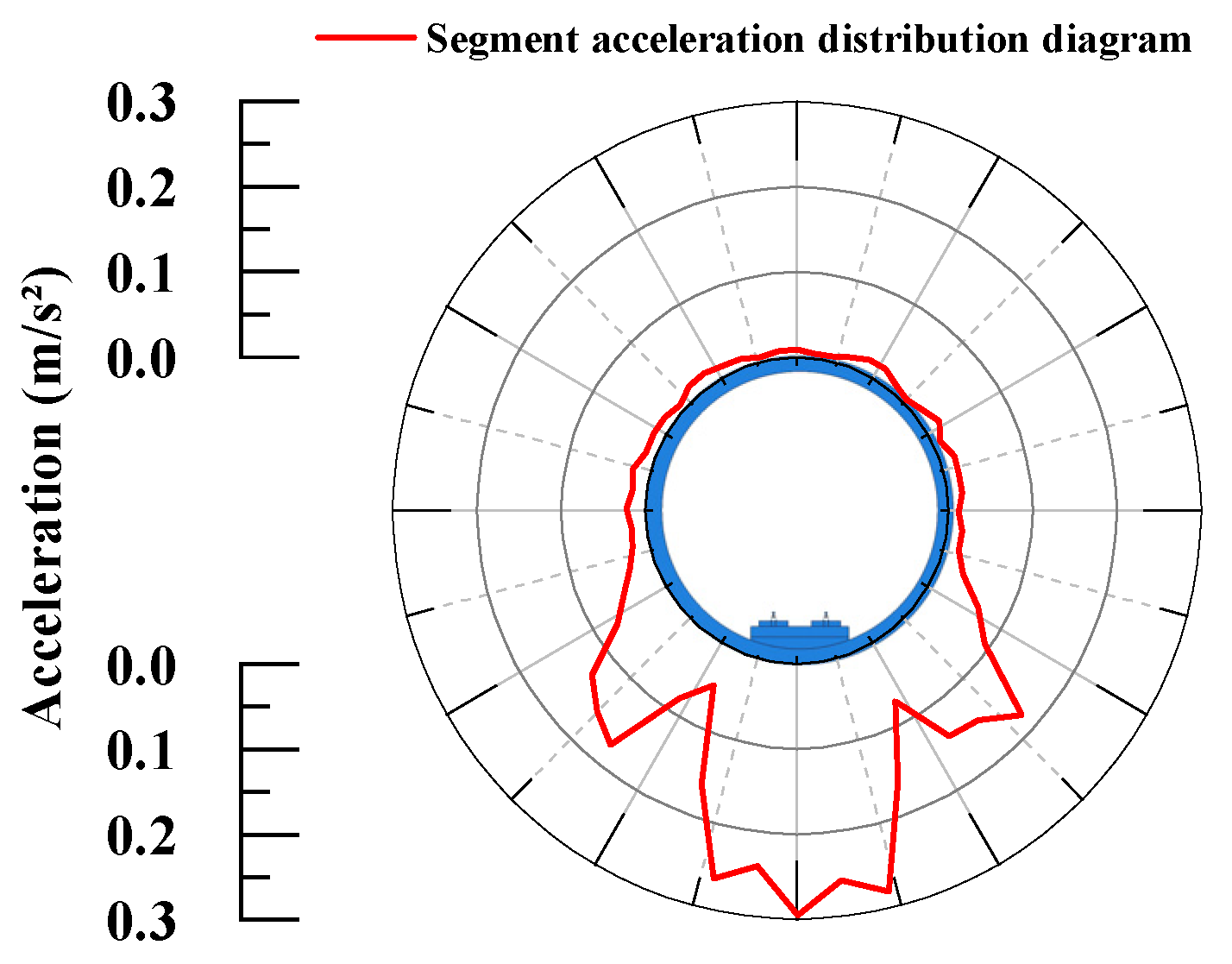
Figure 6 presents the instantaneous acceleration distribution at different circumferential positions of the tunnel segment when the third wheelset of the vehicle passes the longitudinal section corresponding to the reference point. It can be observed that the acceleration distribution along different directions of the tunnel segment is uneven, with notably higher instantaneous acceleration values in the lower region near the interface between the track foundation and the tunnel segment. At the tunnel cross-section, the maximum instantaneous acceleration reaches 0.295 m/s
2, while the minimum is 0.004 m/s
2. This indicates that the vibration level of the lower tunnel segment is significantly higher than that of the upper segment. The primary reason is that the moving vehicle exerts a dominant vertical dynamic excitation on the track, which transmits downward along the track-segment system, leading to higher vibration responses in the lower part of the tunnel segment. Statistical analysis shows that the spatially averaged peak acceleration at the tunnel segment exterior is 0.068 m/s
2, with a standard deviation of 0.07 m/s
2, indicating large fluctuations in peak acceleration across different circumferential positions and a certain degree of directional dependency in the vibration response.
6. Analysis of Site Vibration Propagation
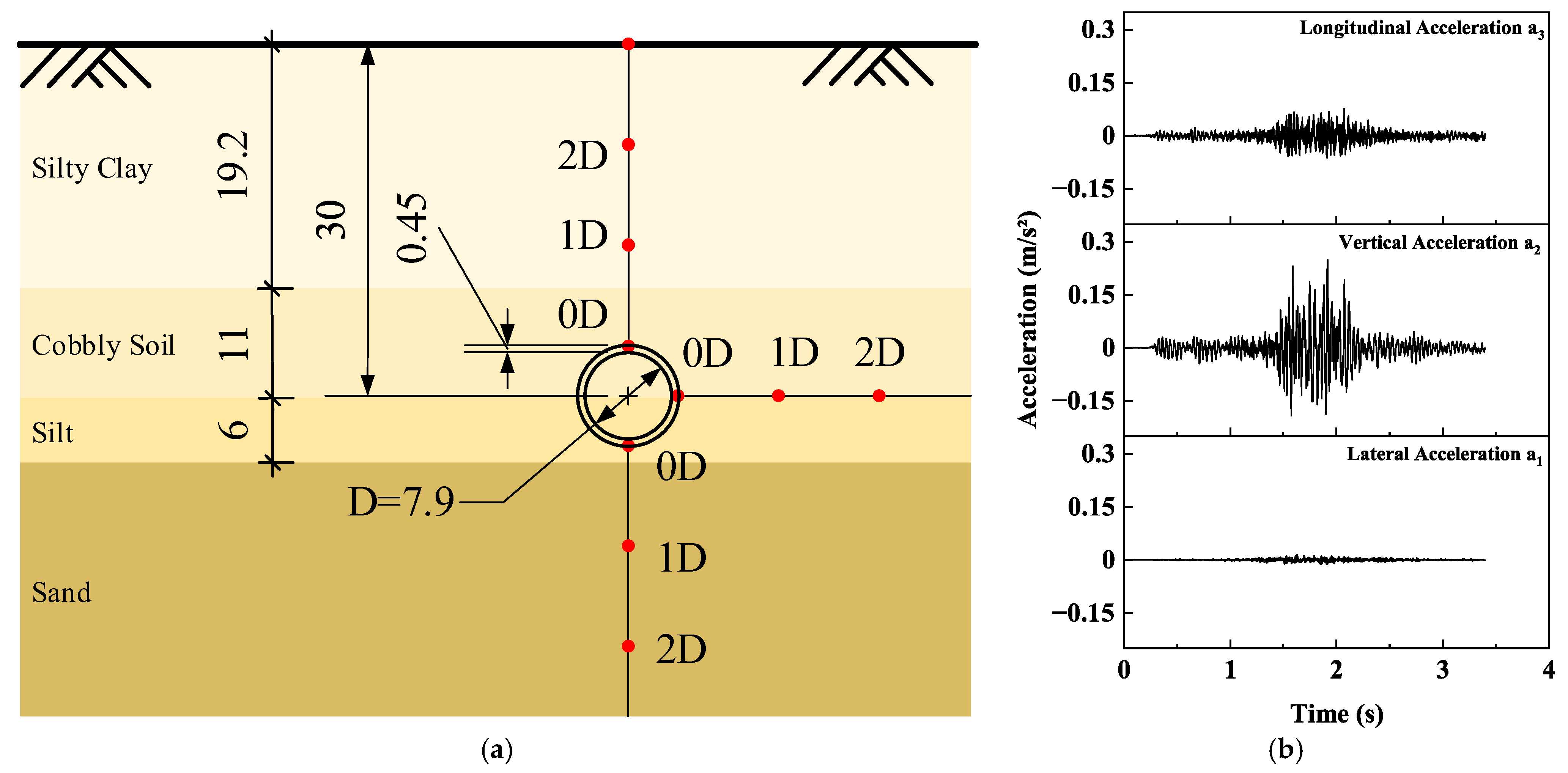
A set of monitoring points is placed in the soil domain, at horizontal offsets perpendicular to the tunnel axis and at vertical offsets above and below the tunnel, as shown in
Figure 7a (where D is the tunnel diameter). Considering both ideal (Track Regularity, TR) and irregular (Track Irregularity, TI) track conditions, and typical Beijing subway speeds of 80, 100, and 120 km/h, we examine vertical accelerations at these monitoring points in both time and frequency domains.
At 0D directly below the tunnel at 120 km/h, the soil’s lateral, vertical, and longitudinal accelerations are shown in
Figure 7b. The vertical acceleration has the largest proportion, followed by the longitudinal acceleration, which is approximately 30% of the vertical acceleration. The subsequent analysis will focus primarily on vertical acceleration, with an emphasis on its variation characteristics, influencing factors, and potential impact on vehicle dynamic performance.
6.1. Tunnel Bottom
6.1.1. Vertical Acceleration Response at the Tunnel Bottom
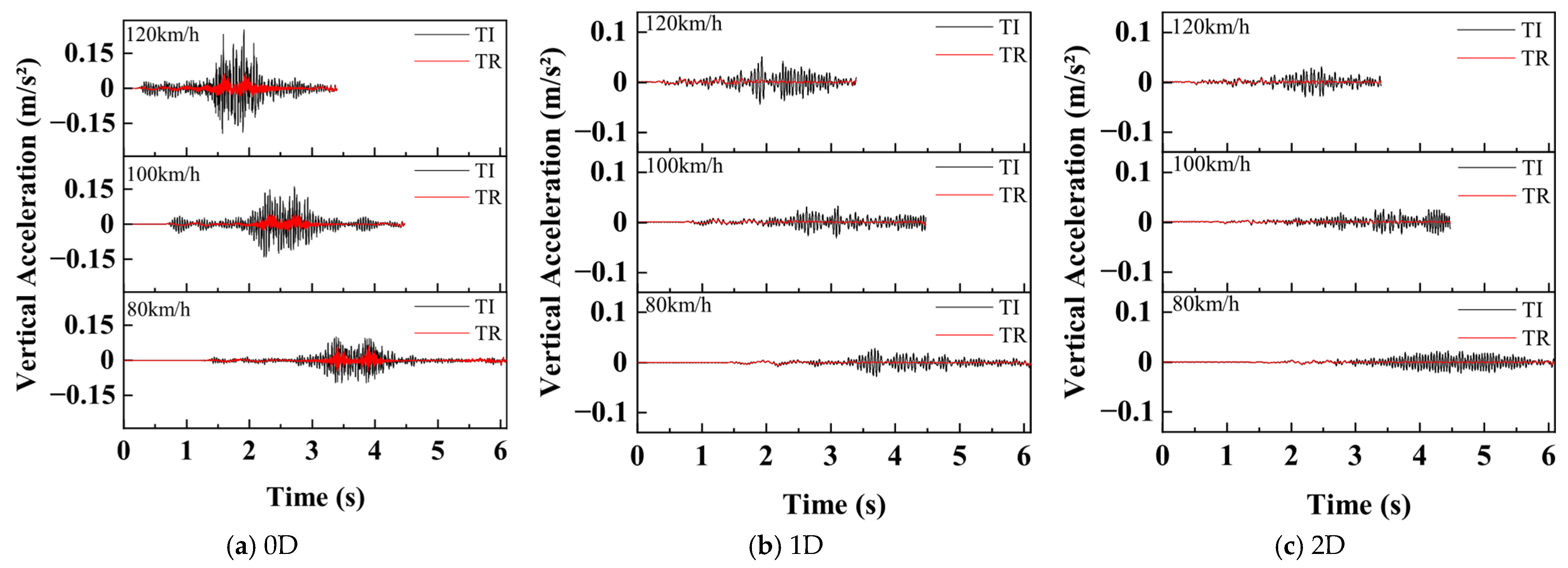
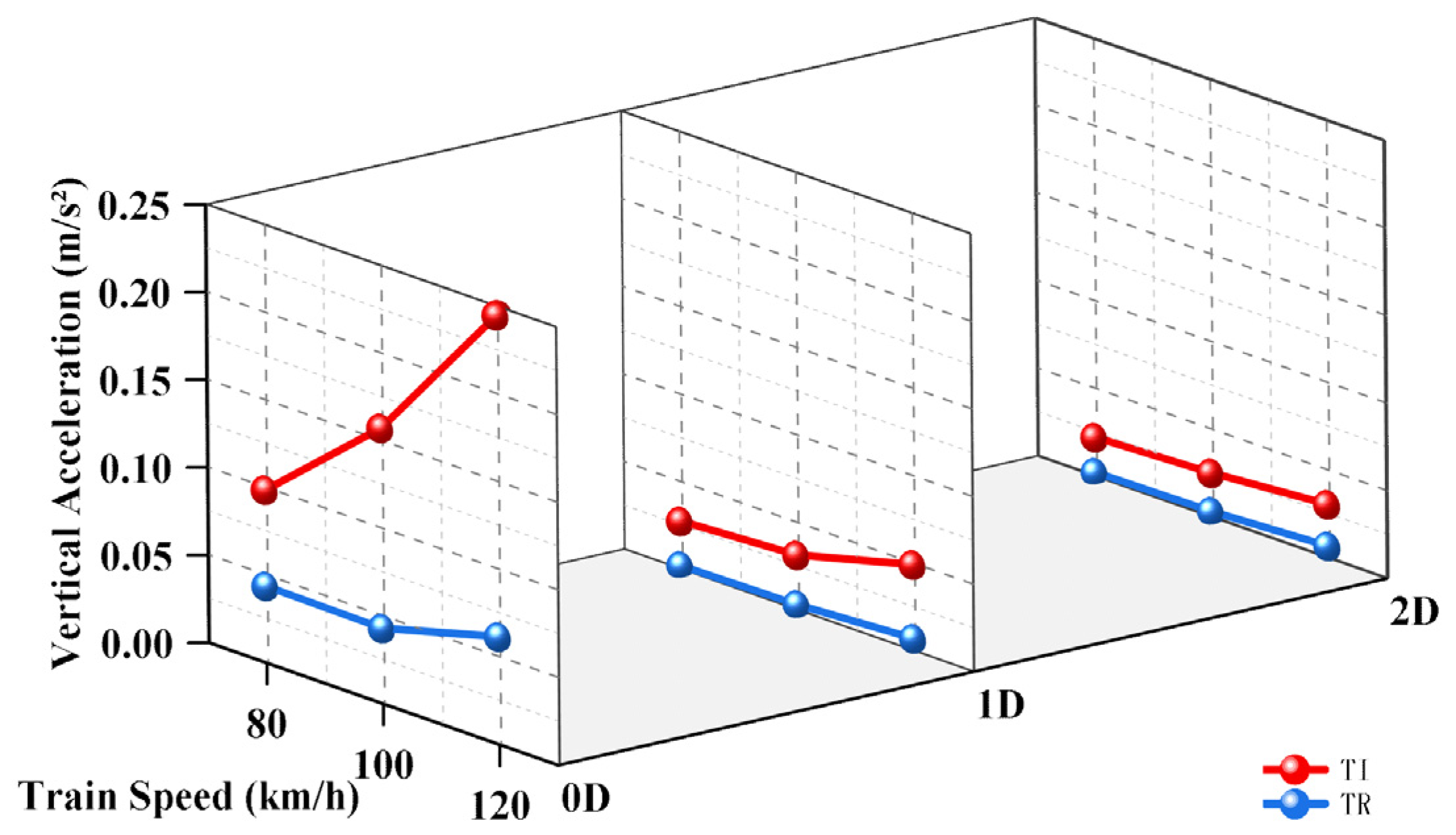
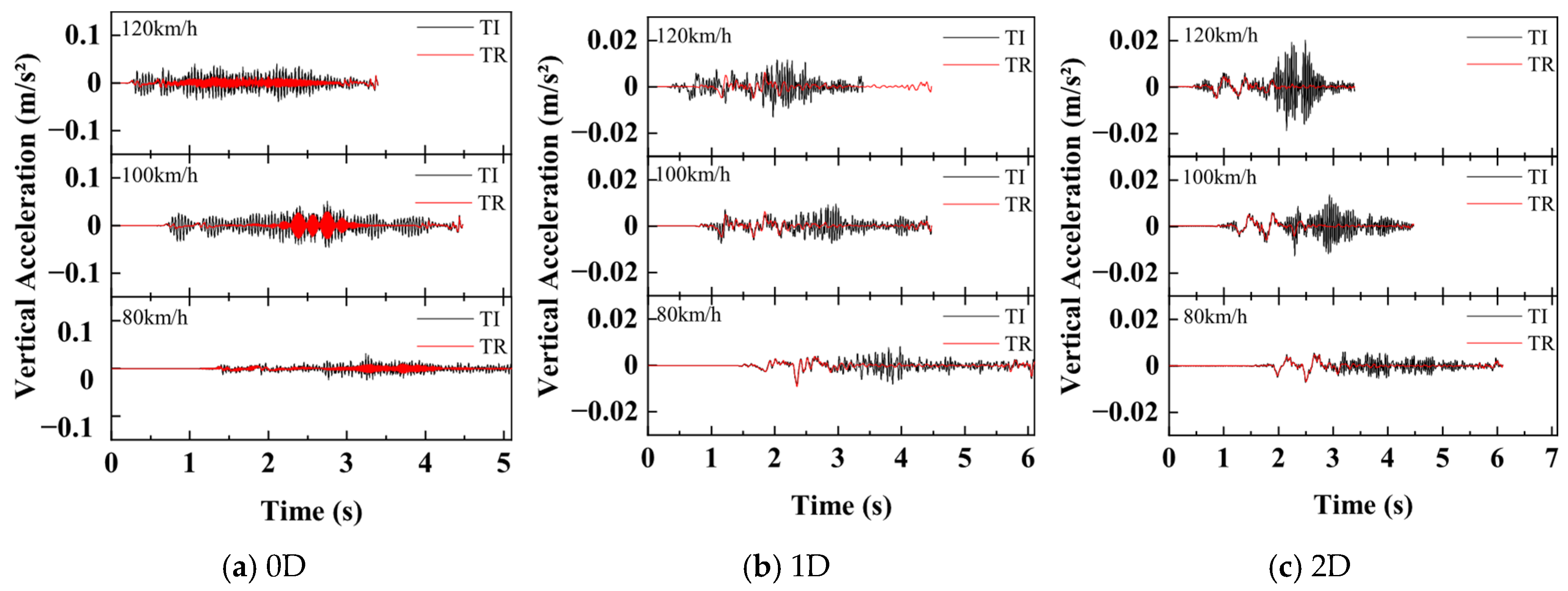
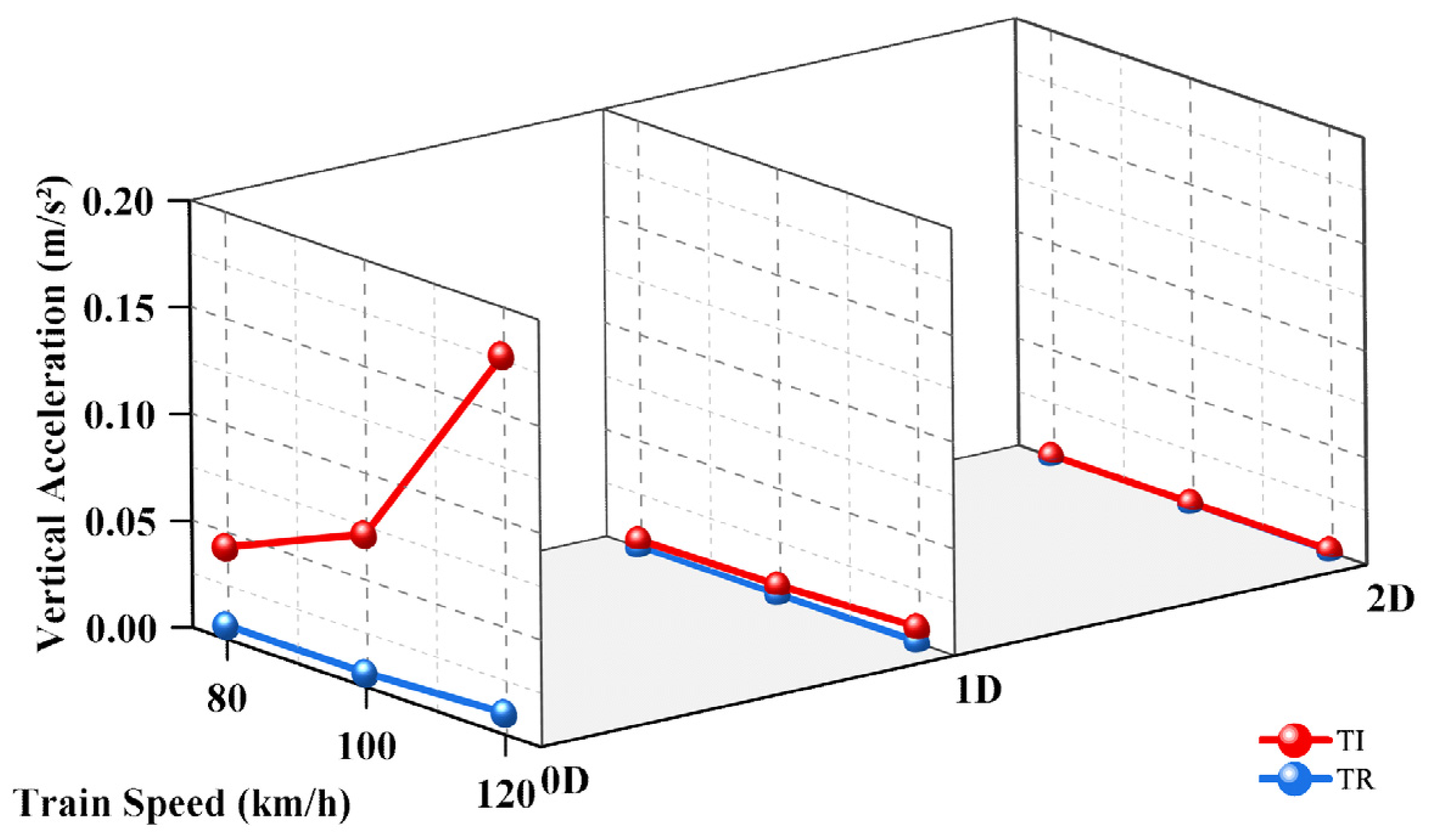
Figure 8 presents the vertical vibration acceleration curves at different distances from the tunnel bottom under metro train loads at various speeds. Subfigures a, b, and c depict the acceleration dynamic responses at distances of 0D, 1D, and 2D from the tunnel outer wall under different track regularity conditions and train speeds, respectively. The labels TR and TI denote smooth and uneven track conditions. Comparative analysis reveals that the acceleration amplitude is significantly influenced by train speed, exhibiting a general trend of increasing vertical acceleration amplitude with rising speed. Concurrently, the vertical acceleration magnitude in the surrounding ground gradually decreases with increasing depth (distance from the tunnel), showing rapid attenuation within a distance of 1D across all speeds.
Under track irregularity conditions, the vertical acceleration response near the tunnel bottom is markedly elevated. The acceleration response near 0D is approximately 2.5–4 times greater than under track regularity conditions. This disparity further increases with distance, reaching about 4–14 times at farther points. This phenomenon occurs because the train load generated under track regularity conditions is lower than under track irregularity conditions, resulting in lower energy. After attenuation through the soil layer, a significant portion of this energy is dissipated, limiting its propagation distance.
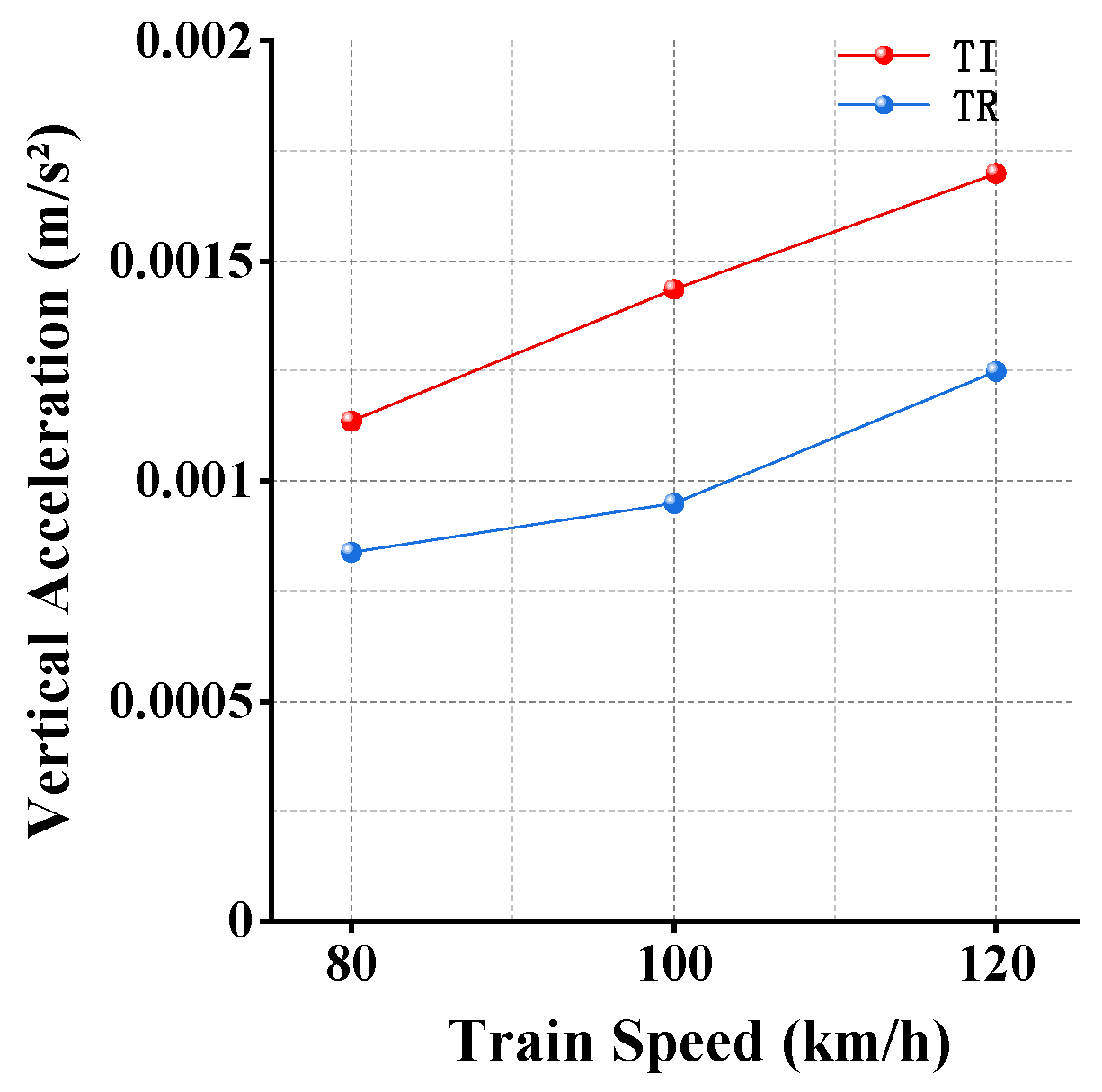
As shown in
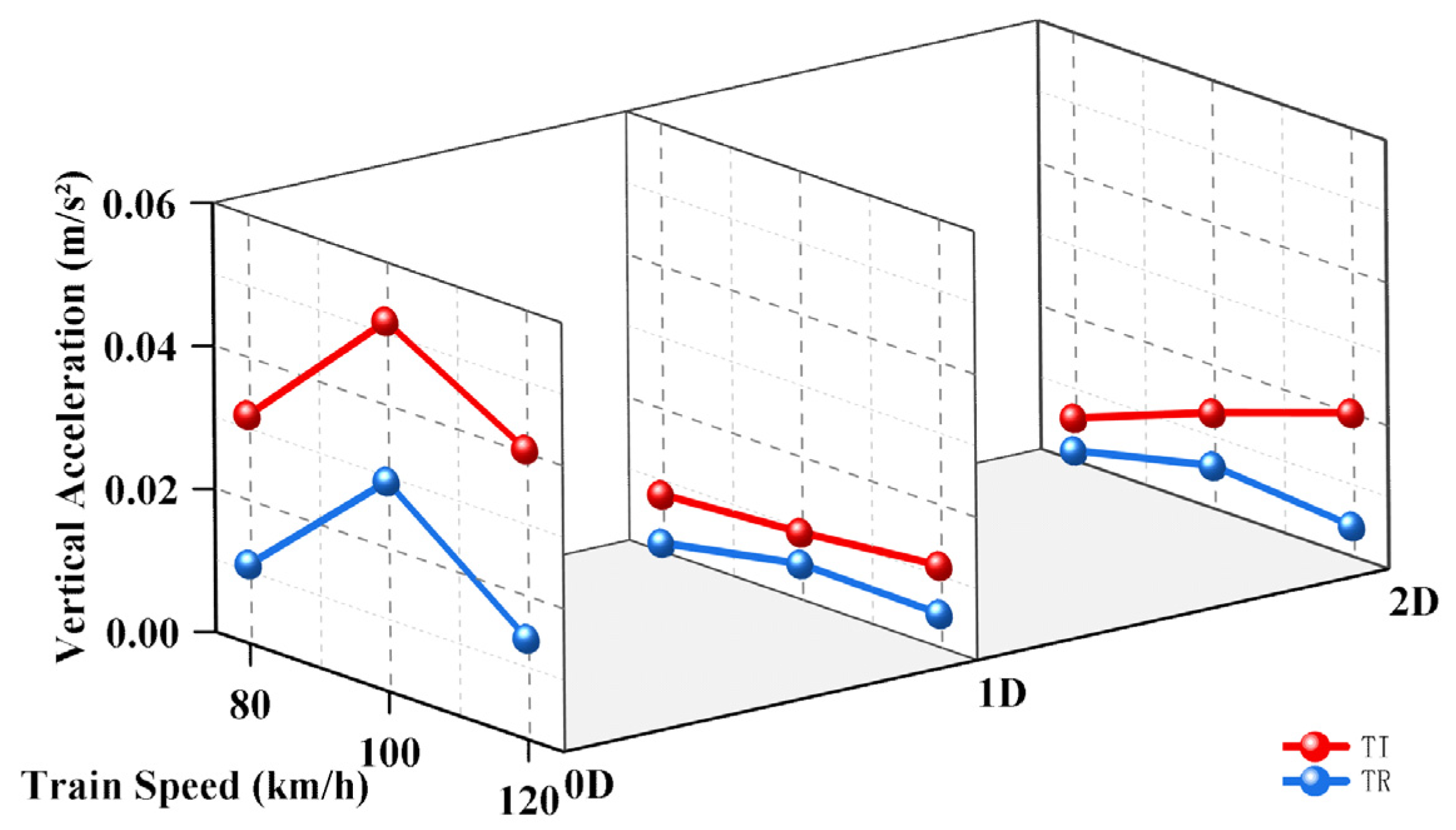
Figure 9, under track regularity conditions, the attenuation rates decrease as speed decreases: from 0D to 1D, the rates are 88%, 92%, and 95%; from 1D to 2D, the rates are 7%, 3%, and 2%. Conversely, under track irregularity conditions, the attenuation rates from 0D to 1D are 80%, 79%, and 72% with decreasing speed. Beyond 1D, the acceleration magnitudes show negligible difference, with attenuation rates from 1D to 2D being 38%, 20%, and 20%.
During the propagation of train vibration induced by track irregularity through the ground near the tunnel bottom, the vibration attenuates by 77% to 87% after propagating two tunnel diameters (2D). In contrast, vibration under track regularity conditions attenuates by 89% to 95% over the same distance. This indicates that vibrations with higher initial energy dissipate more slowly during propagation. Even after propagating 2D, the energy difference between the two track conditions remains significant, approximately 4.5 to 10 times greater under track irregularity.
6.1.2. Frequency Response at the Tunnel Bottom
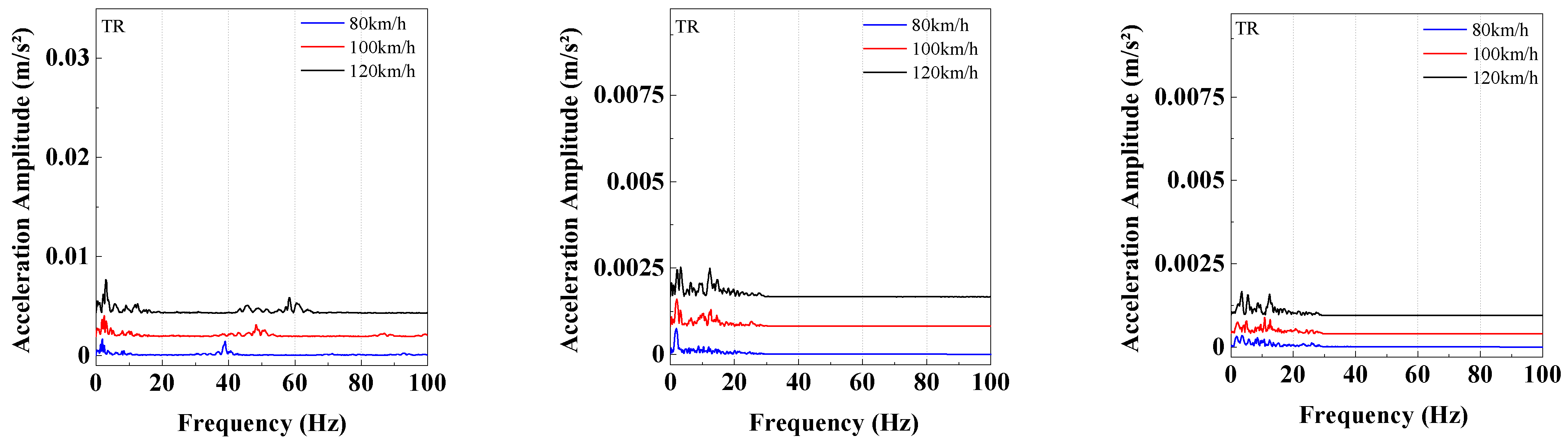
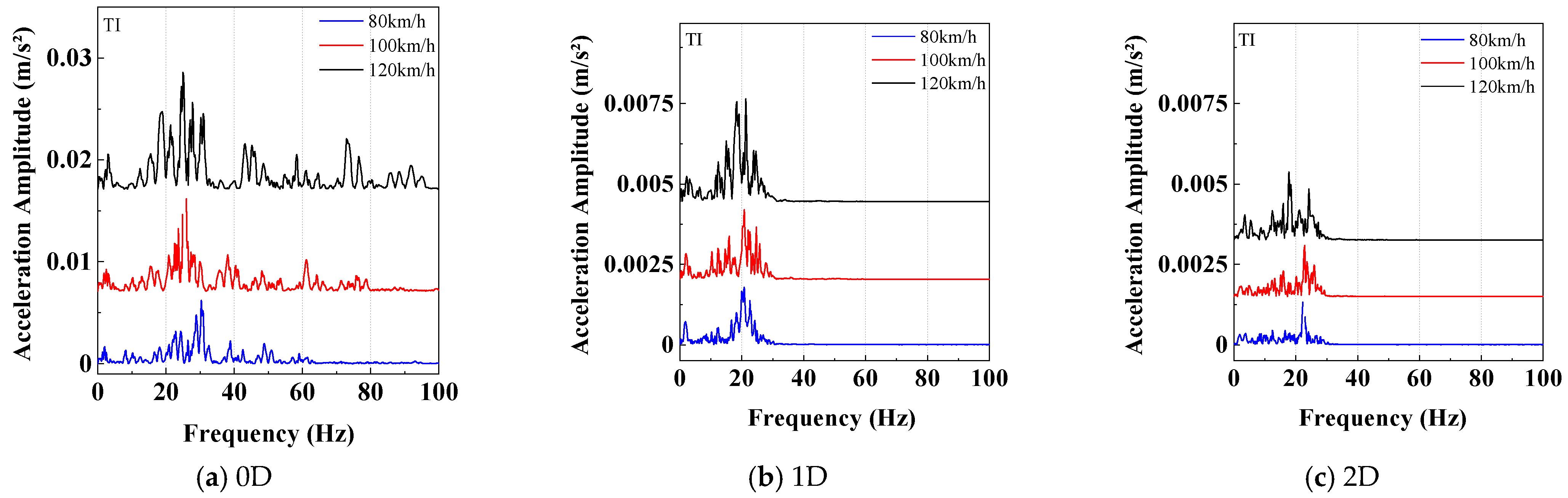
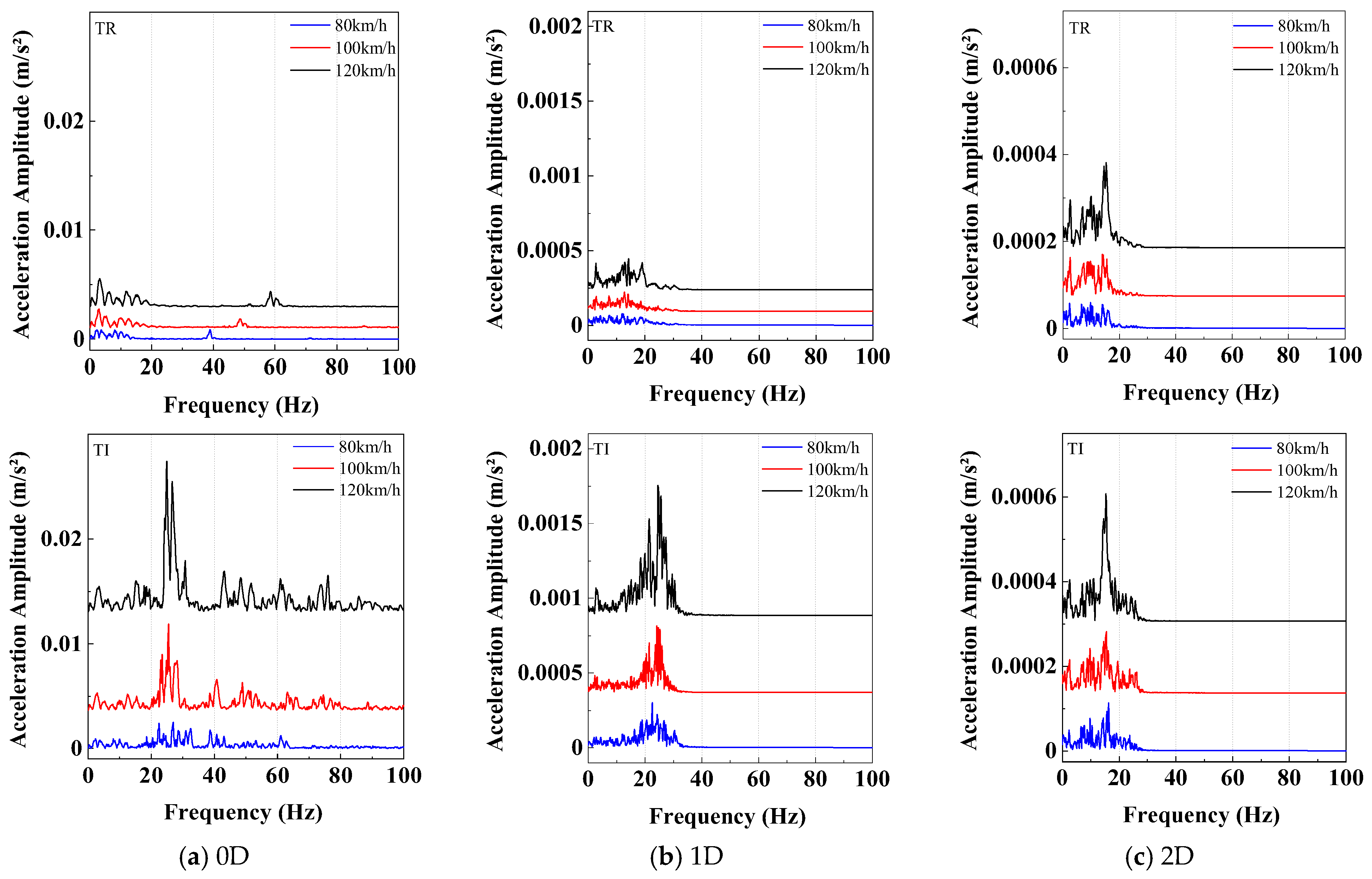
Fourier transforming the acceleration time–history curves in
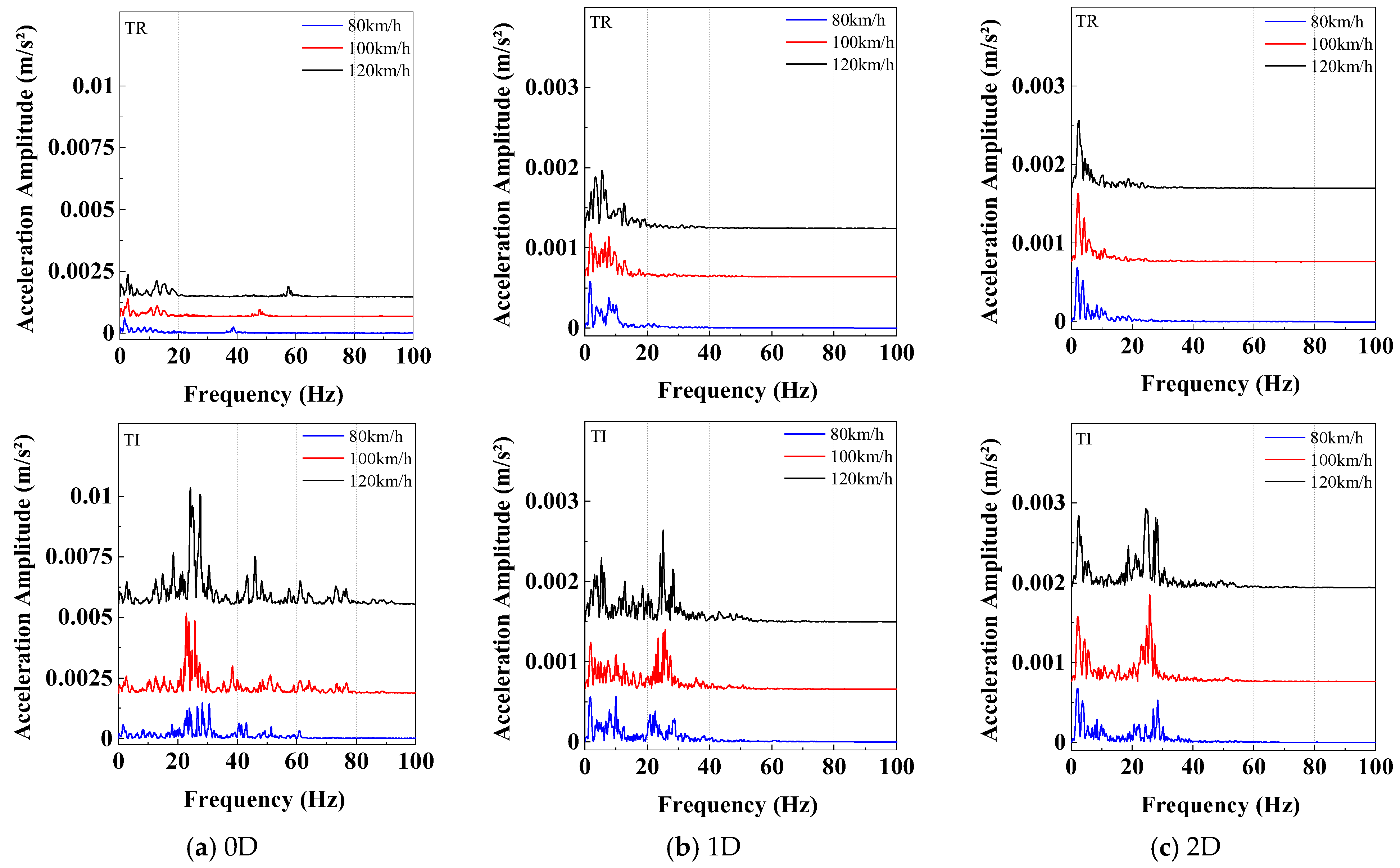
Figure 8 yields the corresponding soil vibration acceleration spectra at the tunnel bottom induced by metro train loads under different track regularity conditions and speeds, as shown in
Figure 10. Curves a, b, and c in this figure represent the vertical acceleration spectra at locations 0D, 1D, and 2D from the tunnel outer wall, respectively. Analysis focuses on the dominant frequency band of the train load (0–100 Hz).
As train speed increases, the amplitude at 0D shows a significant increase, indicating that higher speeds substantially intensify the vertical vibration acceleration near the tunnel wall. In contrast, the amplitude difference is negligible between locations 1D and 2D.
Across different track regularity conditions, the fundamental frequency bandwidth within the low-frequency range increases with train speed. This shift is likely attributable to (1) enhanced wheel–rail impact vibration at higher speeds, generating higher low-frequency amplitudes, (2) potential resonance of the tunnel structure within specific low-frequency ranges due to its geometry and material properties, significantly amplifying low-frequency vibration, (3) significant influence of tunnel–soil interaction on low-frequency vibration, and (4) the effect of soil properties (e.g., elastic modulus, density) on vibration propagation characteristics, thereby influencing low-frequency amplitude. At locations 1D and 2D, however, the influence of speed variation on vibration acceleration is relatively minor. The fundamental frequency bandwidth remains similar across speeds, with insignificant amplitude increase, indicating that train speed has a weaker effect on vertical vibration at these distances from the tunnel.
Comparing the acceleration spectral responses at different locations reveals that under various track regularity conditions, the high-frequency components of acceleration (approximately 30–90 Hz) attenuate significantly and eventually vanish within a distance of 1D as depth increases. Under track irregularity conditions, the amplitude near 0D is approximately 4–5 times greater than under track regularity conditions. The fundamental frequency bandwidth increases from around 60 Hz to about 90 Hz as train speed rises, with the dominant frequency located near 20 Hz. Under the same conditions but with track regularity, the fundamental frequency bandwidth increases from approximately 40 Hz to about 60 Hz, and the dominant frequency is near 2 Hz. This comparison demonstrates that track irregularity can significantly increase high-frequency vibration in the surrounding ground, an effect exacerbated by higher train speeds. It should be noted that these higher-frequency components are primarily captured in the near-field structural response; their propagation into the far-field soil is limited by the spatial discretization discussed in
Section 2, where the dominant ground vibration remains below 30 Hz.
During propagation from near 0D to approximately 2D, the fundamental frequency bandwidth gradually decreases and stabilizes, with the vibration primarily composed of low-frequency components (approximately 0–30 Hz). Specifically, with track irregularity, the fundamental frequency band attenuates to approximately 0–30 Hz, and the dominant frequency remains near 20 Hz. Conversely, under track regularity conditions, the band remains within about 0–28 Hz, with dominant frequencies near 2 Hz and 12 Hz.
6.2. Tunnel Sides
6.2.1. Vertical Acceleration Response at the Tunnel Side
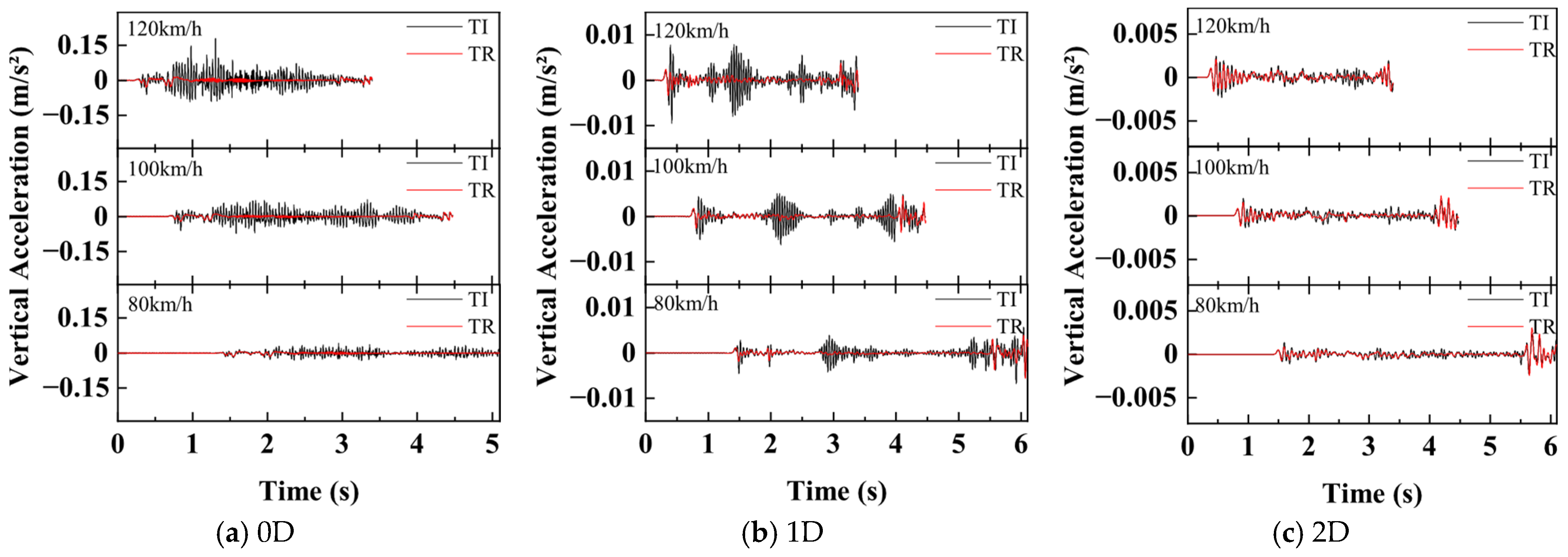
Figure 11 shows the vertical vibration acceleration curves at different distances from the tunnel side in the site under different track regularity conditions. Comparison shows that as train speed increases, the vertical acceleration amplitude gradually increases. At the same time, as the transverse distance from the tunnel centerline position, the magnitude of vertical vibration acceleration under different speeds attenuates within the 1D range. Within the 1D to 2D range, the magnitude of vertical vibration acceleration slightly increases, especially under track irregularity conditions where this difference is significantly higher than under track regularity conditions. At the 0D position, accounting for track irregularity increases the acceleration response to about 2.3–2.9 times that under the regularity state. As the monitoring position moves away from the tunnel wall, vibration energy gradually dissipates. However, because excitation induced by track irregularity persists, the difference between regular and irregular track conditions increases from an initial ratio of 2.3–2.9 to 1.7–6.2. This indicates that although vibration amplitude attenuates with distance, track irregularity remains influential away from the tunnel wall.
As shown in
Figure 12, under track regularity conditions, with decreasing train speed, the attenuation rates from 0D to 1D are 72%, 76%, and 88%, respectively. In the subsequent attenuation range (>1D), the magnitude of acceleration also increases. The attenuation rates from 1D to 2D are −8%, −10%, and −11%. Under track irregularity conditions, with decreasing train speed, the attenuation rates from 0D to 1D are 72%, 82%, and 75%, respectively. In the subsequent attenuation range (>1D), the magnitude of acceleration increases, and the attenuation rates from 1D to 2D are −74%, −42%, and 25%, respectively. The local amplification observed within the 1D–2D range is consistent with the general trend of vibration transmission in layered ground reported in the literature [
15,
26]; however, the exact physical mechanism cannot be conclusively identified from the present simulations alone and warrants further investigation.
During lateral propagation of train-induced vibration caused by track irregularity beside the tunnel, after two tunnel diameters, the vibration attenuates by 50–81%. In comparison, under track regularity conditions, train-induced vibration beside the tunnel attenuates by 69–87%. Thus, vibration induced by track irregularity attenuates less during lateral propagation beside the tunnel than vibration under regular-track conditions. Greater track irregularity therefore leads to a wider vibration propagation range in the soil.
6.2.2. Frequency Response at the Tunnel Side
Performing Fourier transform on the acceleration time–history curves in
Figure 11 yields the corresponding soil vibration acceleration spectra at different positions along the tunnel sidewall under varying metro train speeds and track regularity conditions, as shown in
Figure 13. The results show that as the train speed gradually increases, the amplitude at 0D progressively rises. The overall magnitude of the soil vibration acceleration spectrum exhibits an increasing trend. Between 0D and 1D, the vibration amplitude decreases rapidly, while from 1D to 2D, the vibration amplitude shows a slight increase.
Under different track conditions, as the train speed increases, the fundamental frequency range in the low-frequency band also increases. Under track regularity conditions, in addition to low frequencies in the 0–20 Hz range, mid-frequencies around 38–60 Hz exist. The mid-frequency range gradually expands with increasing speed, approximately 39 Hz, 49 Hz, and 58 Hz, respectively. Under track irregularity conditions, the low-frequency range is primarily around 20–30 Hz, while the mid-frequency fundamental ranges at the near-field position (0D) are 35–62 Hz, 36–78 Hz, and 40–90 Hz, respectively.
A comprehensive comparison of acceleration spectral responses at different positions shows that as the distance from the tunnel centerline gradually increases, the mid-frequency components progressively disappear, leaving only low-frequency components in the spectrum. Within the low-frequency band, amplitudes gradually attenuate. After attenuation (1D–2D), the amplitudes under different speeds show little difference. Under irregularity conditions, the dominant frequency range is approximately 0–15 Hz and 20–30 Hz, while under regularity conditions, it is mainly 0–15 Hz. During vibration propagation, amplitudes in the 0–5 Hz range exhibit a gradually increasing trend across all track conditions and speeds. This frequency band may represent the key range for vibration magnification zones. The phenomenon indicates that vibration magnification primarily occurs in the low-frequency band, especially within 0–5 Hz, and this is independent of track irregularity and train speed.
6.3. Tunnel Crown (Upper Portion)
6.3.1. Vertical Acceleration Response at the Tunnel Crown
Figure 14 shows the vertical vibration acceleration curves at different distances above the tunnel under different track regularity conditions. The comparison of vertical vibration accelerations at different tunnel positions shows that as train speed increases, the vertical acceleration amplitude above the tunnel gradually increases. Near the 0D position, the acceleration response generated under track irregularity conditions is approximately 7–17 times that under track regularity conditions. However, as distance increases, this gap significantly reduces to about 1.4–1.8 times.
As shown in
Figure 15, under track regularity conditions, the attenuation rate of vertical acceleration from 0D to 1D is as high as 89–94% and from 1D to 2D is approximately 80–85%. This high attenuation rate causes vibration to diminish rapidly. Under track irregularity conditions, The attenuation rate of vertical acceleration significantly decreases, with only 90–95% from 0D to 1D, and about 78–83% from 1D to 2D. This shows that higher speeds result in larger vertical acceleration response amplitudes, most notably in areas close to the tunnel wall. At positions farther from the tunnel wall, acceleration amplitudes under irregularity conditions exhibit lower sensitivity to changes in train operating speed.
During propagation of train-induced vibration caused by track irregularity above the tunnel, after two tunnel diameters, vibration attenuates by 98–99%. In comparison, under track regularity conditions, train-induced vibration above the tunnel attenuates by 91–92%. The attenuation rate above the tunnel is significantly higher than those beside or below the tunnel. This may be because soil compactness and layering above the tunnel affect vibration-energy transfer, so differences in the ground surface and soil strata influence vibration propagation.
6.3.2. Frequency Response at the Tunnel Crown
Performing Fourier transform on the acceleration time–history curves in
Figure 14 yields the corresponding soil vibration acceleration spectra at different positions above the tunnel under varying track regularity conditions, as shown in
Figure 16. From the spectrum, it can be observed that as train speed increases, the amplitude at the 0D position progressively rises, and the overall spectral amplitude correspondingly increases. Between 0D and 1D, the vibration amplitude rapidly decreases, while between 1D and 2D, the vibration amplitude slightly decreases.
Under different track conditions, as train speed increases, the fundamental frequency range in the low-frequency band also increases. Under track regularity conditions, within the 1D–2D range, mid-frequency components of vertical acceleration are essentially absent. In subsequent propagation ranges, the vibration pattern primarily consists of low-frequency components, with the fundamental frequency of the dominant band continuously decreasing as measurement points move away. The low-frequency band of 0–20 Hz dominates, accompanied by a mid-frequency band around 38–60 Hz. As speed increases, the fundamental frequency range of mid-frequencies gradually expands to approximately 39 Hz, 49 Hz, and 58 Hz. Under track irregularity conditions, the fundamental frequency range in the low-frequency band is concentrated around 20–30 Hz. With increasing speed, the fundamental frequency range of mid-frequencies progressively extends to 35–64 Hz, 40–80 Hz, and 42–85 Hz at 0D, respectively. As monitoring positions move away from the tunnel wall, the mid-frequency components of vibration gradually vanish, leaving primarily low-frequency components in the spectrum.
6.4. Ground Surface Directly Above the Tunnel
6.4.1. Vertical Acceleration Response at the Ground Surface
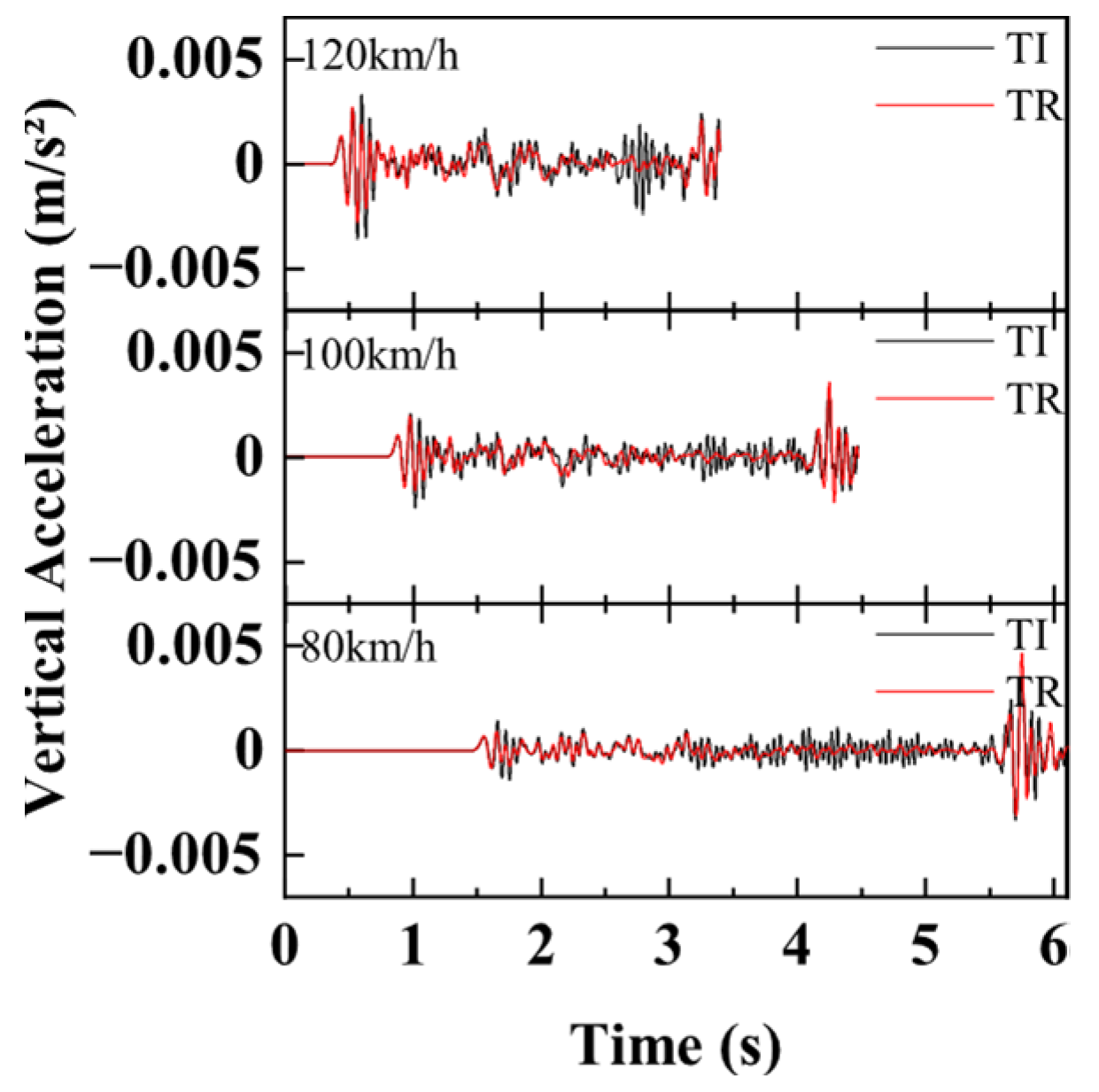
Figure 17 shows the vertical vibration acceleration curves at the ground surface directly above the tunnel under different track regularity conditions. As shown in
Figure 18, under track regularity conditions, as speed increases, the acceleration amplification rates are 47%, 36%, and 58%, respectively. Under track irregularity conditions, as speed increases, the acceleration amplification rates are 27%, 30%, and 51%, respectively.
This indicates that regardless of track regularity, ground surface vibration acceleration amplifies with increasing train speed. Under track irregularity conditions, the amplification effect is relatively smaller. This occurs because track irregularity already generates substantial vibration at lower speeds, so the vibration increase with higher speeds is less pronounced than under regular track conditions. However, as speed increases, track irregularity still causes further vibration enhancement, particularly at high speeds where resonance between vehicles and the track may occur. Such resonance intensifies vibration. Track regularity and train speed jointly influence vibration response at the ground surface above the tunnel, while high speed and irregular track are primary factors causing vibration intensification.
6.4.2. Frequency Response at the Ground Surface
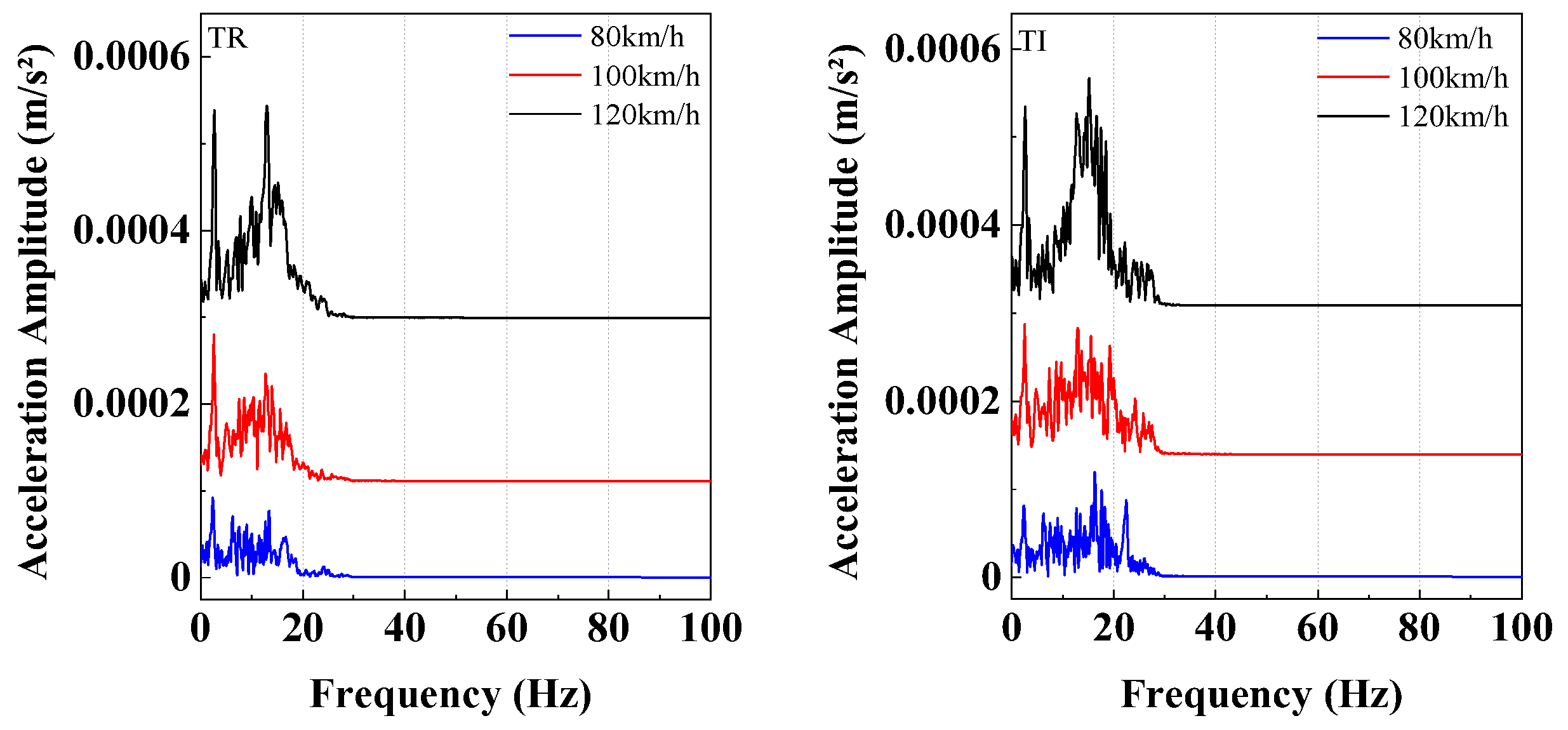
Performing Fourier transform on the acceleration time–history curves in
Figure 17 yields the soil vibration acceleration spectra at the ground surface directly above the tunnel under different track regularity conditions, as shown in
Figure 19. The results show that ground surface acceleration exhibits larger amplitudes in the low-frequency band (0–5 Hz), and the amplitude increases correspondingly with rising train speed.
Under track irregularity conditions, the dominant frequency band expands to 0–30 Hz, while under track regularity it remains 0–20 Hz, demonstrating significant spectral broadening. Under track regularity conditions, uniform train–rail contact results in a narrow vibration spectrum concentrated within 0–20 Hz. Amplitude increase transmitted from 2D to the ground surface is approximately 35–57%. Under track irregularity conditions, irregular rail surface complicates dynamic train–rail interaction, generating additional frequency components above 30 Hz, which are rapidly attenuated in the soil and primarily affect the near-field response. Amplitude increase is approximately 27–50%.
These results indicate that the vibration amplification in the low-frequency band (0–5 Hz) is not directly related to the dynamic action of the train or track irregularity. Regardless of whether the track is regular or irregular, vibration amplification in the low-frequency zone consistently exists. This phenomenon mainly relates to the amplification characteristics of ground surface vibration acceleration. As train speed increases, the vibration amplification in the low-frequency band shows an increasing trend, and this amplification exhibits certain consistency under different track conditions.