This section presents the main results obtained with the proposed 4RPv KV formulation. We analyze the capability of the model to capture nonlinear bubble dynamics and examine how higher-order nonlinear terms influence the response. Special attention is given to the comparison between liquid and viscoelastic media, as well as to the role of the excitation frequency near the bubble resonance. To further quantify the conditions under which the fourth-order model is necessary, a decision-tree classification approach is employed, providing a systematic method to identify the parameter regimes where cubic and quartic nonlinearities significantly affect the bubble dynamics.
3.1. Comparison of 2RPv and 4RPv KV Models
The equation derived in
Section 2 is tested by comparing the results obtained with the 2RPv KV formulation [
14], which includes nonlinear terms up to second order (see Equation (
1)).
To this purpose, we consider an air bubble of equilibrium radius
R0 = 4.5 μm, whose natural frequency is
, so that its resonance frequency is
[
22]. When surface tension
and elasticity
G are neglected, this expression reduces to the classical Minnaert frequency used in Equation (
5).
The bubble is excited by a continuous sinusoidal ultrasonic pressure wave of amplitude
and angular frequency
, such that
, and we focus on excitation at resonance,
, which produces the largest volume oscillations and enhances nonlinear effects [
23]. Simulations are performed at a high finite amplitude,
kPa, over a duration
, allowing the system to reach a stationary oscillatory regime. The bubble response is then analyzed during the last periods of the simulation.
The comparison is performed across different surrounding media, allowing us to investigate how the bubble response varies for the same excitation amplitude depending on the rheological properties of the medium. Each surrounding medium listed in
Table 1 is characterized by its density
, viscosity
, and shear elasticity
G. These three media were selected to span a representative range of rheological properties relevant to cavitation ultrasound applications. Water [
17] serves as the Newtonian reference, enabling direct comparison with the existing literature on nonlinear bubble dynamics in liquids. Gelatin (6 wt%) is a standard tissue-mimicking phantom [
20] with relatively low shear stiffness (
kPa) and high viscosity, representative of soft tissues such as fat or muscle. Liver represents a stiffer biological tissue (
kPa) commonly studied in the context of high-intensity focused ultrasound and histotripsy [
19,
24]. Together, these materials cover nearly two orders of magnitude in shear modulus and a tenfold range in viscosity, providing a comprehensive basis for evaluating the influence of viscoelasticity on the necessity of higher-order nonlinear terms.
The air bubble properties are taken as
,
,
, and
. It is worth emphasizing the very large magnitude of these nonlinear coefficients, which highlights the strong nonlinear nature of the bubble dynamics described by the model. The nonlinear coefficients are of the following orders:
When the surrounding medium is modified, the values of these coefficients change slightly due to the dependence of the Minnaert frequency on the density of the medium, although their orders of magnitude remain the same.
A first objective of this study is to investigate the differences between purely liquid media and viscoelastic media. In liquids, nonlinear oscillations become particularly significant when the driving frequency approaches the bubble resonance, where higher-order terms play an important role [
11]. In viscoelastic materials, both shear elasticity and viscosity introduce additional damping mechanisms that tend to reduce the amplitude of the oscillations and, consequently, the strength of nonlinear effects. The fourth-order model provides a useful framework to quantify and compare this behavior across media.
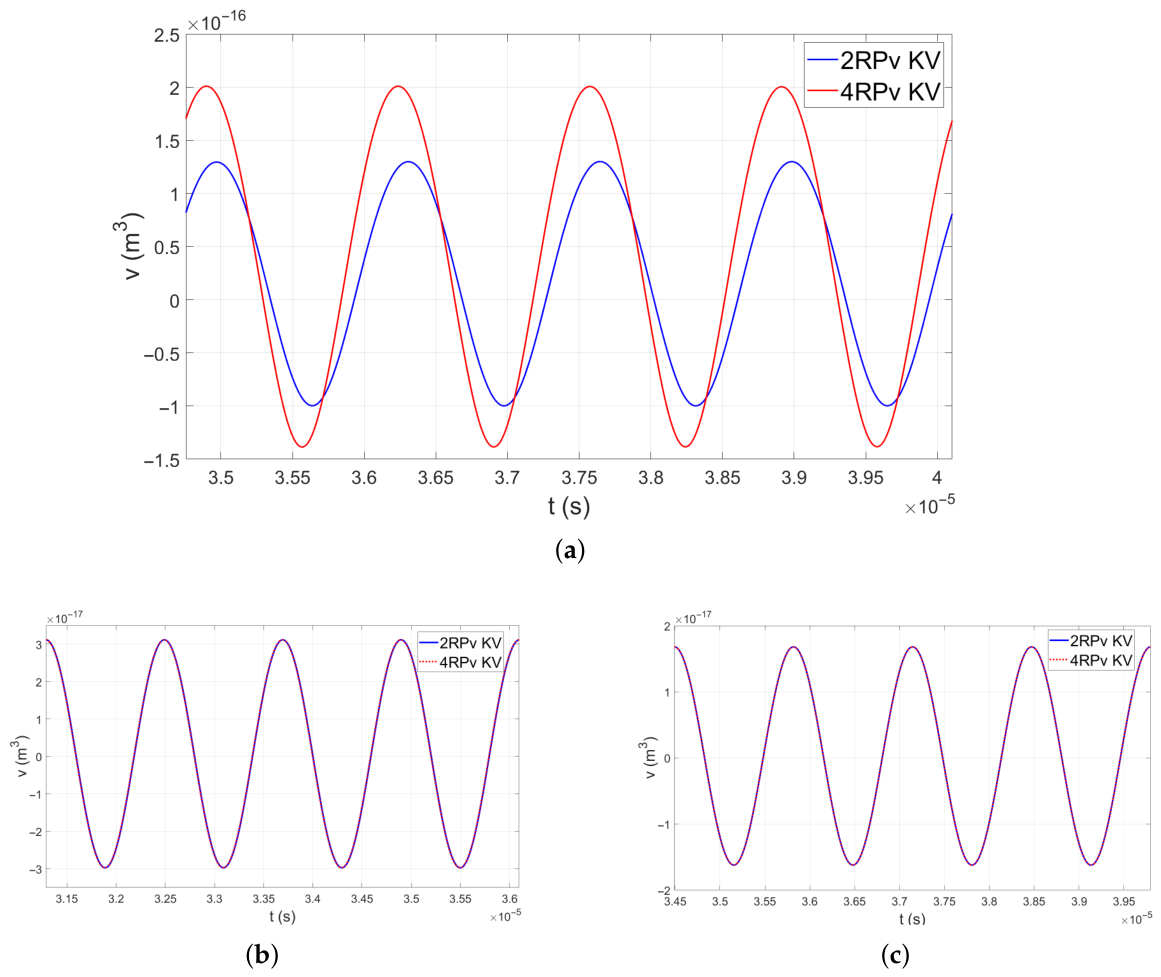
Figure 1 shows the comparison between the second- and fourth-order models for the three different media. In the case of a purely liquid medium (water), the oscillation amplitude becomes large when the bubble is driven at resonance. As a consequence, the nonlinear terms in Equation (
5) cannot be neglected. In particular, the nonlinear coefficients
,
, and
multiply large values of the volume variation
v, which significantly affects the bubble dynamics. This nonlinear distortion clearly illustrates the contribution of the higher-order nonlinear coefficients
and
, which are absent in the second-order formulation. The 4RPv KV model therefore captures nonlinear features that cannot be reproduced by the classical second-order approximation.
In contrast, as illustrated in
Figure 1b,c for liver and gelatin media, the oscillation amplitude is substantially reduced due to the additional damping introduced by viscoelasticity. Therefore, the volume variations
v remain relatively small, and the nonlinear terms appearing in Equation (
5) become much less significant, leading to an oscillatory signal that is almost sinusoidal and symmetric with respect to the axis
. In this case, the bubble response becomes nearly linear. The effect of the higher-order coefficients
and
is thus strongly attenuated by the viscoelastic properties of the surrounding medium, reducing nonlinear bubble oscillations.
This behavior is consistent with both our previous findings [
14] and the experimental observations of Ref. [
20], where finite-amplitude oscillations of a bubble in gelatin, the same tissue-mimicking medium considered here, were analyzed, and it was shown that the gel elasticity must be included in the Rayleigh–Plesset model to accurately reproduce the nonlinear bubble dynamics, with the resonance curve being sensitive to both shear modulus and viscosity.
Furthermore, the proposed 4RPv KV formulation is validated against the experimentally validated 2RPv KV model of Ref. [
14]. Since the present model reduces exactly to the 2RPv KV formulation in the limit
, it must recover the same viscoelastic response. In this section, we consider the same conditions as in Ref. [
14], namely, the same viscoelastic media of
Table 1, driven at resonance with the same excitation amplitude. Under these conditions, the 4RPv KV and 2RPv KV models yield identical solutions, as shown in
Figure 1b,c. In addition, we reproduced the experimental validation reported in Ref. [
14] using the present model, obtaining close agreement with the experimental data. In the regime considered in those experiments (low excitation amplitude and off-resonance), the oscillation amplitudes remain small, and the higher-order terms
and
are negligible compared to the quadratic contribution. As a result, both models provide identical predictions, as physically expected, which further confirms the consistency of the fourth-order formulation.
As a final validation step, we verify that in the limit
, the 4RPv KV model recovers the results reported in Ref. [
11] for water (see
Figure 1 and
Figure 2 therein). This constitutes a direct numerical validation of the fourth-order viscoelastic extension against established results in the literature.
Motivated by the observation that the differences between the 2RPv and 4RPv KV models become minimal in viscoelastic media, we now proceed to a more detailed analysis of the individual contributions of each nonlinear term to the bubble response under varying rheological conditions.
3.2. Nonlinear Terms vs. Source Amplitude
In this subsection, we analyze the contribution of the nonlinear terms as the source amplitude increases. The objective is to quantify how the different nonlinear components of the model evolve with the excitation amplitude and how this evolution is affected by the rheological properties of the surrounding medium.
The source amplitude is varied from Pa up to kPa, while the excitation frequency is fixed at the bubble resonance, . For each simulation, the maximal value of the bubble volume variation is extracted from the stationary regime. More precisely, let denote the maximal value of v reached during the last three oscillation periods of the simulation.
Using this quantity, the magnitude of the nonlinear contributions associated with the adiabatic gas law is estimated through the following quantities:
These quantities allow us to evaluate the relative importance of each nonlinear term in Equation (
5) as the excitation amplitude increases.
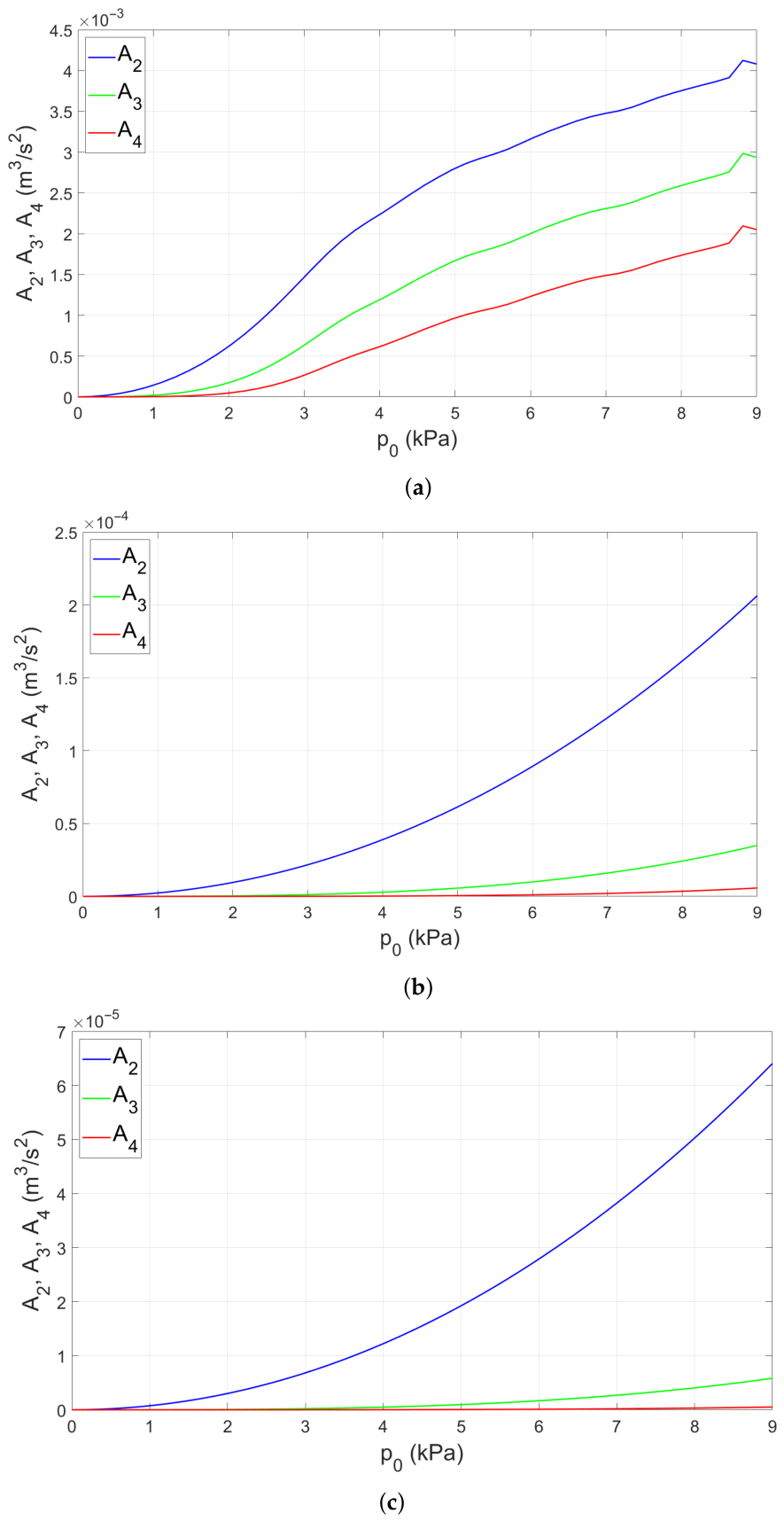
The analysis shows that the three nonlinear contributions increase significantly as
grows, both in liquid and viscoelastic media, as can be seen in
Figure 2. This behavior reflects the strong dependence of nonlinear bubble dynamics on the source amplitude. Since the nonlinear terms depend on powers of the volume variation
v, even moderate increases in the oscillation amplitude can lead to a rapid amplification of nonlinear effects.
In the case of water, see
Figure 2a, the nonlinear contributions exhibit a strong cubic-type growth as
increases from small amplitudes up to moderate finite amplitudes (approximately
kPa), with power-law exponents
,
, and
, consistent with the theoretical scaling
expected when the bubble responds linearly to the excitation, i.e.,
. Beyond this range, the increase of the nonlinear terms becomes closer to a quasi-linear trend with respect to the excitation amplitude [
11], with reduced exponents
,
, and
. This reduction reflects the fact that, at large oscillation amplitudes, the nonlinear terms in Equation (
5) significantly modify the bubble dynamics so that
v no longer grows proportionally to
. This behavior indicates that the nonlinear response remains significant over the entire amplitude range considered.
In contrast, when the surrounding medium is viscoelastic,
Figure 2b,c, the nonlinear contributions are noticeably reduced, in agreement with previous studies [
25,
26,
27]. An increase in the shear modulus
G or in the viscosity
leads to a reduction of the bubble oscillation amplitude, which in turn decreases the magnitude of the nonlinear terms by several orders of magnitude compared to water. For both viscoelastic media, the power-law exponents remain approximately
,
, and
over the entire amplitude range, indicating that although the absolute magnitude of the nonlinear terms is strongly reduced, their growth rate with
follows the linear scaling
throughout, as the viscoelastic damping keeps the bubble in the weakly nonlinear regime. Nevertheless, the fourth-order formulation remains relevant because it allows us to track and quantify how viscoelasticity progressively attenuates the higher-order nonlinear contributions
and
.
Despite the attenuation of nonlinear effects in viscoelastic media, we now examine whether the behavior previously observed in purely liquid media also holds in this case. In particular, in liquids, the differences between the second-order and fourth-order models were found to increase significantly in a frequency range around the resonance frequency
[
11].
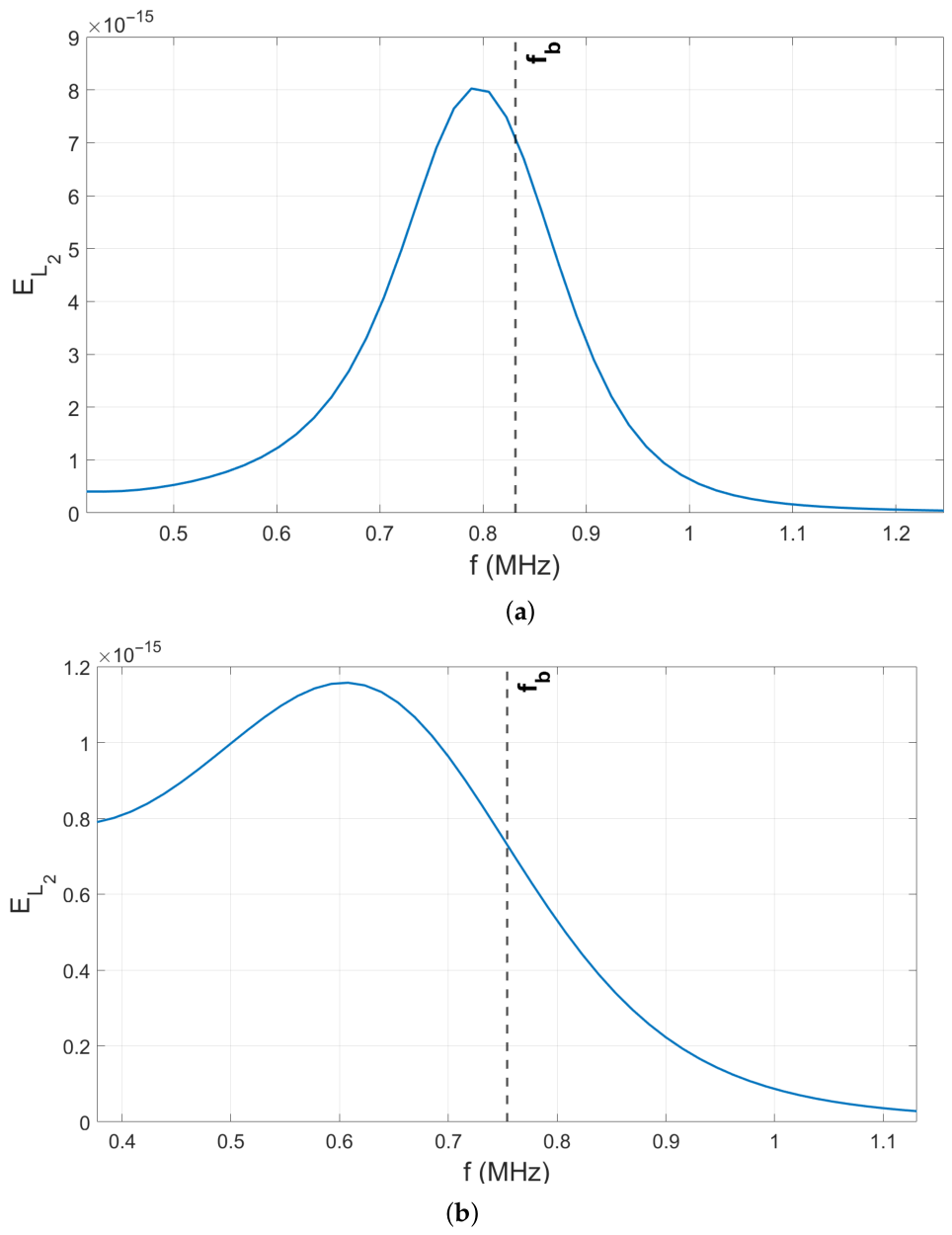
Specifically, we analyze whether, near resonance, the higher-order nonlinear terms included in the 4RPv KV model remain necessary to accurately describe the bubble dynamics in viscoelastic media. To quantify these differences, we consider a high finite amplitude
kPa, while the driving frequency
f is chosen close to the bubble resonance. The discrepancy between both solutions is evaluated through the discrete
-norm defined as
The results in
Figure 3 show that the difference between the two models becomes significant only at sufficiently high excitation amplitudes and when the driving frequency approaches the resonance frequency. The maximum absolute value of
reaches
m
3 for gelatin and
m
3 for liver, both near resonance. When normalized by the
-norm of the fourth-order solution, the maximum relative error is approximately 4% for gelatin and 19% for liver. The notable difference between both viscoelastic media suggests that the rheological properties of the medium play a significant role in determining the accuracy of the second-order model. The systematic identification of which rheological parameters govern this behavior is addressed in
Section 3.3.
Beyond the single-bubble framework analyzed here, the proposed formulation also opens perspectives for more complex configurations. The bubble equation developed in this work can also be considered a suitable framework to model the mutual nonlinear interaction between ultrasound waves and populations of multiple bubbles in viscoelastic media. In particular, nonlinear effects arising from bubble dynamics, such as those involved in the coupling between the Rayleigh–Plesset model and the acoustic wave equation, may be significantly modified when higher-order nonlinear terms are included. The introduction of the additional nonlinear terms
and
in the proposed 4RPv KV model, therefore, provides a more complete description of these nonlinear interactions than the 2RPv KV model used in [
28]. Applying the present formulation to revisit the study of nonlinear wave-bubble coupling in viscoelastic media is a natural next step.
3.3. Decision-Tree Analysis for Selecting the Appropriate Bubble Model
The previous sections have shown that discrepancies between the second-order and fourth-order formulations become significant under certain excitation conditions. In particular, high-amplitude forcing and frequencies close to the bubble resonance enhance nonlinear effects. This naturally raises the following question: under which physical conditions are cubic and quartic nonlinear terms truly required to describe bubble dynamics in viscoelastic media?
To address this question in a systematic manner, we perform a parametric analysis using a supervised classification approach based on decision trees [
29,
30]. The objective of this analysis is not predictive in a statistical sense but rather interpretative: to identify the boundary in parameter space separating the regimes where the truncated second-order model remains valid from those where higher-order nonlinearities become necessary.
The input parameters are selected to represent the main physical factors governing nonlinear bubble oscillations: the acoustic driving amplitude
, the normalized driving frequency
, the shear modulus
G, and the dynamic viscosity
of the surrounding medium. The explored ranges are
–20 kPa,
–1.5,
–100 kPa, and
–10 mPa·s. These intervals are representative of soft biological tissues and tissue-mimicking hydrogels such as agarose or collagen, whose stiffness can be tuned from brain-like values (
–10 kPa) up to significantly stiffer tissues (
kPa) [
31,
32].
For each parameter combination, the 2RPv KV and 4RPv KV models are solved. The governing ordinary differential equations are integrated over a time interval
, and only the last two oscillation cycles are analyzed to ensure that a stationary oscillatory regime has been reached. The maximum volume deviation
obtained from each model during these final cycles is used as a measure of the nonlinear response amplitude. A relative discrepancy indicator is then defined as
where
and
denote the stationary amplitudes predicted by the second- and fourth-order models, respectively.
Each parameter combination is labeled according to whether the discrepancy exceeded a prescribed threshold. If D is larger than the threshold, the fourth-order formulation is considered necessary (label 1, “4RPv KV”); otherwise, the second-order model is considered sufficient (label 0, “2RPv KV”). In total, 250,000 simulations are performed across the explored parameter space, of which 244,603 successfully converged and are retained for the analysis. The resulting dataset is then used to train a decision tree classifier, whose structure can provide an explicit partition of the parameter space into distinct dynamical regimes. The decision-tree analysis indicates that the frequency ratio is the most influential predictor, accounting for approximately 40–50% of the total importance depending on the complexity of the tree. The acoustic driving amplitude and the viscosity contribute at an intermediate level, whereas the shear modulus G plays a comparatively minor role. These findings confirm that the primary factors determining the necessity of beyond-quadratic-order nonlinearities are the proximity to resonance and the forcing amplitude, while the rheological parameters mainly modulate the nonlinear response. Among these, viscosity exerts a stronger influence than elasticity within the explored parameter range.
More specifically, in the near-resonant regime r = 0.8–1.2, the fourth-order 4RPv-KV model becomes necessary whenever the medium viscosity is below approximately , independently of the shear modulus. In this frequency range, bubble oscillations are strongly amplified due to resonance. If the surrounding medium is weakly viscous, dissipation is insufficient to damp these large-amplitude oscillations, and higher-order nonlinear effects become significant. As a result, second-order formulations fail to accurately capture the nonlinear response.
In contrast, for driving conditions exceeding
, oscillation amplitudes are inherently reduced as the system moves away from resonance. In this off-resonant regime, the second-order 2RPv-KV model is sufficient in weakly viscous media (
), provided that the excitation pressure remains moderate (
). Under these conditions, nonlinear contributions beyond second order are negligible, and a lower-order model achieves an adequate balance between accuracy and computational efficiency. These results are summarized in
Table 2.
These quantitative thresholds establish a physically interpretable criterion for model selection: near resonance and in weakly dissipative media, higher-order nonlinearities must be retained, whereas away from resonance and at moderate excitation levels, reduced-order formulations remain reliable. This is consistent with Ref. [
11], where the same transition was identified for Newtonian fluids, and the present work extends it to viscoelastic media by incorporating rheological properties as additional modulating parameters.
Shear Elasticity–Viscosity Parameter Space
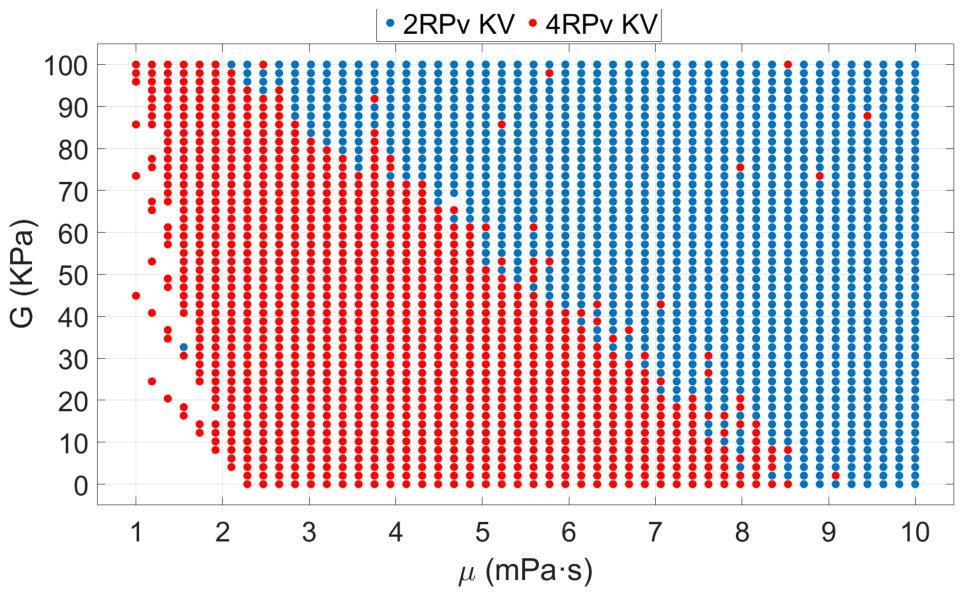
The present analysis investigates how the rheological properties of the surrounding medium influence the necessity of higher-order nonlinear terms in bubble dynamics. Specifically, we fix the excitation amplitude at kPa and work at resonance (f/f0 = 1), values that were identified as significant in the previous section. By isolating the shear modulus G and dynamic viscosity , we can directly examine their effect on the relative importance of third- and fourth-order nonlinearities.
Figure 4 combines both the simulation results and the classification boundaries predicted by a decision tree trained on this reduced dataset, allowing the identification of the frontiers between regimes where the second-order model is adequate and those where the fourth-order formulation becomes necessary.
Regions without plotted data points, particularly at very low viscosity or shear modulus, correspond to parameter combinations for which the numerical integration did not reach convergence and were therefore excluded from the dataset. These non-convergent regions arise near resonance and at sufficiently large excitation amplitudes, where oscillation amplitudes grow to approach , no longer satisfying the assumption underlying the model. In this regime, the solution grows rapidly, forcing the solver to reduce the time step below its minimum allowable value and causing the integration to terminate before completion. This represents a physical limitation of the volume-based formulation rather than a numerical one.
Parametric maps in the G- plane reveal that increasing either the shear modulus or the viscosity attenuates the nonlinear contributions of the bubble oscillation, thereby reducing the need for fourth-order terms. In particular, within the considered ranges (–100 kPa, –10 mPa·s), the importance associated with is approximately twice that of G. In particular, when the viscosity exceeds approximately mPa·s, viscous damping dominates the dynamics, and the 4RPv KV model becomes unnecessary across the entire range of G considered. In the intermediate viscosity range (–6 mPa·s), the classification boundary depends also on G, indicating that elasticity plays a non-negligible role in that regime. Conversely, elasticity alone in low-viscosity media does not significantly suppress bubble oscillations; its effect becomes noticeable only at higher shear moduli. At very high viscosities ( mPa·s), oscillations are strongly stabilized across the entire range of G.
Physically, this is consistent with the enhanced mechanical resistance and energy dissipation provided by stiffer and viscous media, while the shear modulus
G modifies the effective resonance frequency of the bubble, and viscosity directly controls energy dissipation and thus the amplitude of oscillation. Since strong nonlinear effects are linked to large-amplitude oscillations, viscous damping becomes the dominant rheological mechanism governing the reduction of higher-order contributions. Elastic stiffening also contributes, but its effect is comparatively smaller. This is supported by the experimental findings of Ref. [
20], who reported that the peak oscillation amplitude is sensitive to viscosity and shear modulus, respectively, the same two parameters that govern the boundaries of the parametric map and determine the transition between the 2RPv-KV and 4RPv-KV regimes.
In conclusion, this classification-based analysis provides both a quantitative and visually intuitive method to determine when additional nonlinear corrections are necessary for the description of bubble dynamics. The resulting parametric maps offer practical guidance for selecting the appropriate model: they clearly show the regions where the second-order approximation is sufficient and where the fourth-order nonlinear terms must be included to capture the fully nonlinear behavior of the bubble.
This is directly applicable to practical settings such as cavitation-enhanced therapies, sonochemistry, and tissue characterization, where the rheological properties of the surrounding medium determine the level of nonlinear modeling required for accurate prediction and control of bubble dynamics under ultrasound excitation.