Article

Internal Short-Circuit Fault Diagnosis for Lithium-Ion Batteries Based on Multivariate Information Entropy


1
National Industry-Education Platform for Energy Storage, Tianjin University, Tianjin 300384, China
2
Electric Power Research Institute, State Grid Tianjin Electric Power Company, Tianjin 300384, China
3
Key Laboratory of Smart Grid of Ministry of Education, Tianjin 300384, China
*
Author to whom correspondence should be addressed.
Appl. Sci. 2026, 16(10), 5078; https://doi.org/10.3390/app16105078
Submission received: 9 April 2026 / Revised: 18 May 2026 / Accepted: 18 May 2026 / Published: 19 May 2026
(This article belongs to the Section Electrical, Electronics and Communications Engineering)

Abstract

Lithium-ion battery energy storage systems (BESSs) face significant safety challenges arising from internal short-circuit (ISC) faults, which can ultimately trigger thermal runaway. To address this, this paper proposes an ISC fault diagnosis method based on multivariate information entropy (MIE). The proposed approach fuses voltage and temperature time series from battery cells to extract fault features via MIE. Furthermore, a hierarchical diagnosis framework incorporating statistical confidence intervals is developed to enable robust ISC fault diagnosis. Experiments were conducted on 180 Ah lithium iron phosphate batteries, utilizing external resistors to simulate ISC faults of varying severity. The method was further validated using real-world fault data from an electric vehicle accident. Results demonstrate that the proposed method effectively distinguishes between normal and faulty cells, with MIE values exhibiting a monotonic increase as fault severity intensifies. In the real-world dataset, the method identifies the faulty cell 240 s before a discernible voltage drop, demonstrating its capability for early ISC detection.

1. Introduction

The pursuit of carbon neutrality has driven the large-scale integration of renewable energy sources into modern power grids [1,2]. However, the inherent intermittency of renewable generation introduces substantial challenges to grid stability, including voltage transients, frequency deviations, and degraded system reliability [3,4]. In this context, lithium-ion battery energy storage stations (BESSs) have emerged as a viable solution, owing to their rapid response capability, high energy density, low self-discharge rate, and extended cycle life [5].
Despite these advantages, the safety concerns associated with BESSs have drawn considerable attention from both the academic community and the industry sector. Over the past few years, numerous fire and explosion incidents involving BESSs have been documented globally, posing a critical barrier to their large-scale deployment [6,7]. The primary cause of such incidents is the thermal runaway of lithium-ion batteries [8], which is frequently initiated by an internal short circuit (ISC) fault. Consequently, the development of rapid and reliable ISC fault diagnosis methods is of paramount importance for ensuring the safe operation of BESSs.
Considerable research efforts have been devoted to ISC diagnosis. Model-based methods typically rely on estimating the state of charge (SOC) or internal resistance to detect anomalies. For instance, Ref. [9] proposes a model-based algorithm that extracts open circuit voltage through an equivalent circuit model and estimates ISC resistance online during standard charging, achieving a relative estimation error below 6.4%. Ref. [10] develops a disturbance-immune and aging-robust diagnostic method by leveraging polarization dynamics within a model-switching framework, enabling unbiased estimation of ISC resistance under battery degradation and measurement disturbances. Ref. [11] proposes a two-step quantitative diagnosis approach that employs electrochemical impedance spectroscopy to distinguish between aging and ISC faults, followed by Extended Kalman Filtering to quantitatively estimate the equivalent ISC resistance. Although these methods can achieve high diagnostic accuracy, they require accurate battery models and precise parameter estimation, which remain challenging under dynamic operating conditions. These inherent limitations have motivated the exploration of data-driven alternatives that do not depend on explicit physical models.
As an alternative, data-driven methods extract fault features without the need for detailed battery modeling. For example, Ref. [12] develops a purely data-driven approach using relaxation voltage features combined with Gaussian process regression for quantitative ISC diagnosis, achieving diagnostic errors of less than 6.45%. Ref. [13] employs a residual network with multi-label data processing and transfer learning to diagnose ISC faults in batteries with unknown parameters, improving detection accuracy by 11.1%. Ref. [14] proposes an adaptive fault detection framework that integrates a temporal convolutional network with Gaussian process regression for dynamic threshold adjustment, achieving 9 to 25 h of early warning compared to conventional methods. Ref. [15] extracts feature from incremental capacity curves and applies the local outlier factor method to identify early soft ISC faults in battery packs. However, these methods typically require large volumes of training data and complex model architectures, limiting their applicability in resource-constrained battery management systems.
In response to this need, entropy-based approaches have gained increasing attention in the field of battery fault diagnosis in recent years. For instance, Shannon entropy was adopted to identify connection faults within battery clusters [16], while sample entropy was utilized for diagnosing external short circuit faults [17]. Additionally, multiscale sample entropy was introduced to characterize fault behavior in electric vehicle battery systems [18] and battery energy storage system [19]. However, the majority of these entropy-based methods rely on only a single physical variable, such as voltage or temperature. In practical ISC scenarios, the voltage and temperature anomalies do not always evolve synchronously, because different ISC triggering approaches produce distinct electro-thermal coupling behaviors [20]. Under such conditions, single-variable entropy methods that monitor only voltage or only temperature risk missing the ISC fault.
To address these limitations, this study introduces a fault diagnosis method for battery ISCs based on Multivariate Information Entropy (MIE). By integrating voltage and temperature measurements, the proposed MIE method fuses multi-domain information to extract fault features, offering a comprehensive indicator of electrical and thermal anomalies. The method’s efficacy is validated through experiments on lithium iron phosphate (LFP) batteries with different ISC resistances and a real-world electric vehicle accident dataset, proving its capability for early fault detection.
The remainder of this paper is organized as follows. Section 2 describes the methodology, including the calculation of multivariate information entropy and the fault diagnosis procedure. Section 3 presents the experimental setup. Section 4 analyzes the results and discusses the performance of the proposed method. Finally, Section 5 concludes the paper.

2. Methodology

2.1. Key Electrical and Thermal Characteristics of ISC

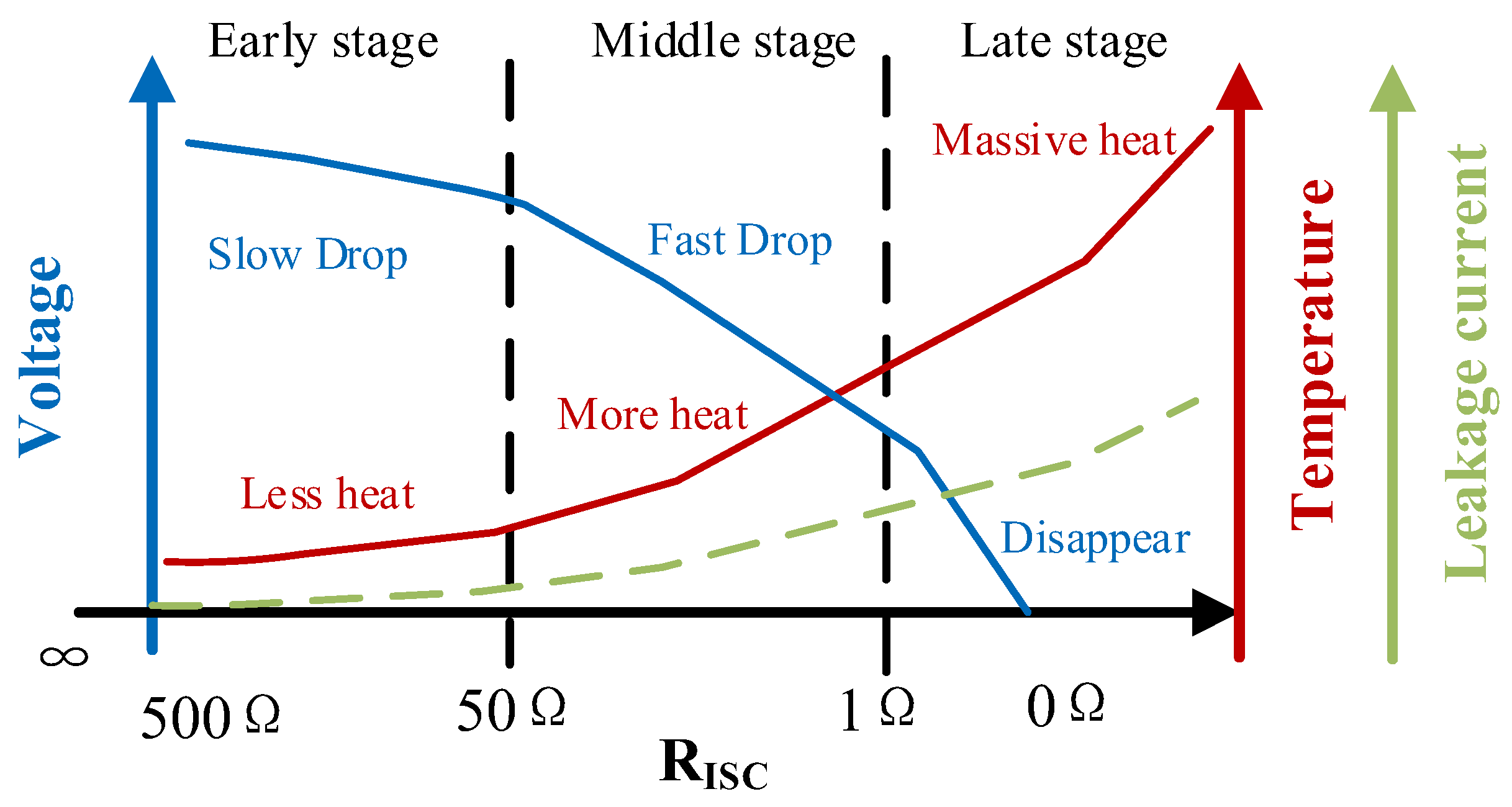
The evolution of an ISC is a complex electro-thermal process that can be divided into three stages based on its severity: early, middle, and late stages [21,22]. The key characteristics of voltage drop and temperature rise across these stages are schematically illustrated in Figure 1. Understanding these characteristics is fundamental to developing effective diagnostic methods.
Accelerated Voltage Drop: Once an ISC path is established, it acts as an internal load, consuming the battery’s energy through a leakage current, I leak = U t / R ISC , where U t is the terminal voltage and R ISC is the ISC resistance. This internal discharge causes the battery’s voltage to decrease at a rate faster than that of a normal, healthy cell under the same conditions. In the early stage of ISC, the ISC resistance is relatively large (e.g., >50 Ω), leading to a small leakage current and a subtle voltage drop that can be easily masked by normal operational fluctuations or noise. This stage is often referred to as a micro-short circuit. As the ISC evolves into the middle stage, R ISC decreases significantly, and the leakage current increases. This results in a more pronounced and observable acceleration in the voltage decay rate. In the late stage, the separator may collapse, creating a large-area short circuit with extremely low resistance, causing the terminal voltage to plummet rapidly toward zero.
Significant Temperature Rise: The leakage current flowing through the ISC resistance generates heat according to Joule’s law, Q ISC = I leak 2 × R ISC = U t 2 / R ISC . In the early stage, the heat generation power is low and can be mostly dissipated to the environment, resulting in little to no measurable temperature rise. However, as the ISC progresses to the middle stage and R ISC drops, the heat generation power increases sharply. When this power exceeds the battery’s heat dissipation capability, heat accumulates, causing the battery’s surface temperature to rise significantly. In the late stage, the temperature increase becomes extreme, triggering a cascade of exothermic side reactions—such as SEI decomposition, anode-electrolyte reaction, and cathode decomposition—that ultimately lead to thermal runaway.
In summary, an ISC faulty battery exhibits two characteristics: accelerated voltage decay and anomalous temperature rise. To capture these two characteristics with one single feature for convincing fault detection, multivariate information entropy (MIE), which can jointly quantify the uncertainty and disorder embedded in voltage and temperature time series, thereby capturing incipient electrical and thermal anomalies of the ISC faulty battery [23], is used in this research.

2.2. Fault Diagnosis Method Based on Multivariate Information Entropy

The proposed fault diagnosis method utilizes multivariate information entropy (MIE) to extract fault features from the voltage and temperature measurements of battery cells. MIE combines the randomness and complexity of multiple time series into a single feature, enabling effective discrimination between normal and faulty cells. The calculation of MIE and the subsequent fault diagnosis procedure are described below.

2.2.1. Multivariate Information Entropy

For a given battery cell, let the voltage and temperature measurements over a time window of length t be denoted as two time series X v , X T :
X v = x v 1 , x v 2 , , x v ( t ) ,   X T = x T 1 , x T 2 , , x T ( t )
where x v ( i ) and x T ( i ) are the voltage and temperature values at the i -th sampling instant, respectively. The MIE of the cell is computed through the following steps.
Step 1. Normalization: To eliminate the influence of different physical units and magnitudes, each time series is normalized to the range [0, 1] using min-max normalization:
x v i = x v i min X v max X v min X v , i = 1 , 2 , , t
x T ( i ) = x T ( i ) m i n ( X T ) m a x ( X T ) m i n ( X T ) , i = 1 , 2 , , t
where m i n ( ) and m a x ( ) denote the minimum and maximum values of the respective series.
Step 2. Quantization. In practical BESSs, voltage and temperature signals are acquired by embedded BMS hardware with intrinsically limited quantization resolution (typically 1 mV for voltage and 1 °C for temperature). To ensure a more accurate application of the probability estimation method, a quantization step is necessary. The normalized values are rounded to match the native resolution of the BMS acquisition system:
x v i = round x v i 1000 1000 , i = 1 , 2 , , t
x T ( i ) = round ( x T ( i ) 1000 ) 1000 , i = 1 , 2 , , t
where round ( ) denotes the rounding-to-nearest-integer function.
Step 3. Probability Estimation: For each normalized series, the probability distribution is estimated by counting the occurrences of each distinct value. Since the normalized values may be continuous, we consider that measurements are quantized by the acquisition system, leading to repeated values. The probability of a particular normalized value x appearing in the series X is:
p x = m x / t
where m ( x ) is the number of times x occurs in X .
Step 4. Information Entropy Calculation: The information entropy of each normalized series is calculated using Shannon’s formula:
H v = i = 1 t p ( x v ( i ) ) log 2 ( p ( x v ( i ) ) )
H T = i = 1 t p ( x T ( i ) ) l o g 2 ( p ( x T ( i ) ) )
where H v and H T represent the entropy of voltage and temperature, respectively. The entropy quantifies the disorder or complexity of the signal. Compared with a normal cell, an ISC fault causes abnormal deviations in the voltage and temperature profiles, making the time series more disordered. This increasing signal disorder will lead to a higher entropy value.
Step 5. Multivariate Information Entropy: The MIE of the battery cell is defined as the average of the individual entropies:
H MIE = H v + H T / 2
This combined feature captures both electrical and thermal anomalies, providing a single robust indicator for fault detection.

2.2.2. Fault Diagnosis in Battery Energy Storage System

The proposed fault diagnosis method adopts a hierarchical architecture to balance computational efficiency and detection accuracy. It performs a detailed multivariate information entropy (MIE) analysis on the cells within the triggered module. The procedure consists of the following steps.
  • Step 1: MIE calculation.
Once a module is triggered, the MIE values for all M cells within that module are computed using the method described in Section 2.2.1. For each cell j , a time window of length t containing recent voltage and temperature measurements is used to calculate its multivariate information entropy H j . The resulting set of MIE values for the module is H 1 , H 2 , , H M .
  • Step 2: Fault determination.
Under normal operating conditions, cells in the same module of the battery with ISC faults exhibit similar entropy characteristics due to a consistent working environment and state of health. An ISC fault introduces abnormal fluctuations in voltage and temperature, leading to a distinct MIE value that deviates from the majority. To identify such outliers, we construct a confidence interval based on the statistical distribution of the MIE values within the module.
First, the mean H ¯ and sample standard deviation σ H of the MIE set are calculated:
H ¯ = 1 / M × i = 1 M H i
σ H = 1 M 1 i = 1 M ( H i H ¯ ) 2
A confidence interval is constructed as H ¯ 3 σ H , H ¯ + 3 σ H . A cell j is identified as faulty if its MIE satisfies:
H j > H ¯ + 3 σ H
The 3 σ threshold is adopted to prevent false alarms caused by signal noise. Under normal conditions, signal noise may cause a momentary increase in the entropy value. However, such noise-induced fluctuations are typically small in magnitude and transient in duration. To avoid false alarms, the 3 σ threshold is adopted.

3. Experimental Setup

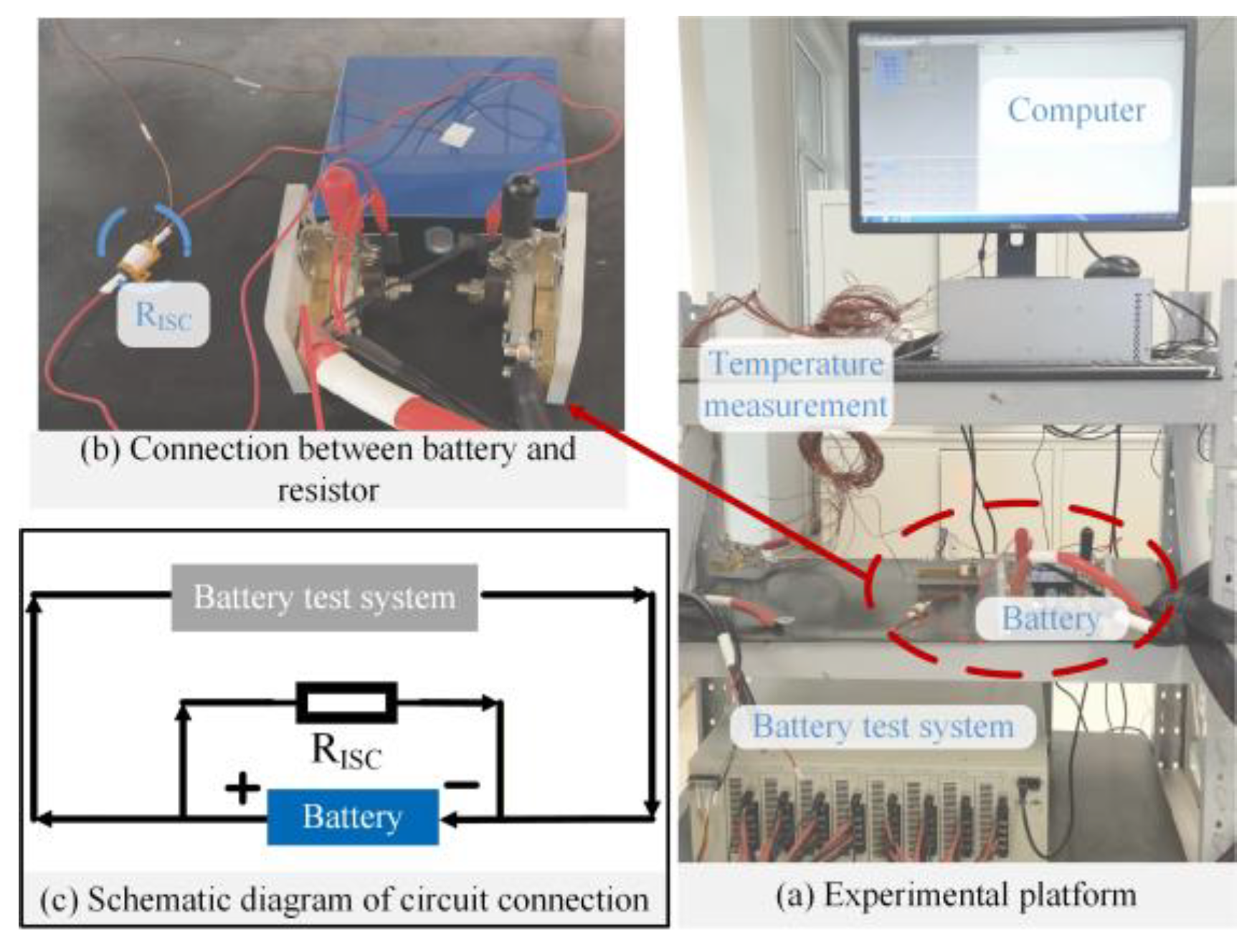
To verify the effectiveness of the proposed ISC fault diagnosis method, a series of experiments was conducted on LFP batteries. Since batteries with naturally occurring ISC faults at different stages are difficult to obtain, an equivalent simulation approach was adopted by connecting external resistors in parallel with healthy cells. A commercial 180 Ah LFP battery was used as the test subject.
The experimental setup, depicted in Figure 2, comprises four main components: (1) an insulated workbench for safe battery placement; (2) a battery testing system (LAN-HE-CT5002A, LANHE, Wuhan, China) supporting programmable charging and discharging; (3) a temperature data acquisition device (LANHE-AT2016B, LANHE, Wuhan, China) for monitoring the surface temperatures of both the battery and the parallel resistor; and (4) a host computer for system control and data logging.
The battery testing system (LAN-HE-CT5002A) provides a voltage measurement accuracy of ±0.1% of full scale. The temperature data acquisition device (LANHE-AT2016B) provides a temperature measurement accuracy of ±0.5 °C.
Based on the evolution characteristics of ISC faults [21,22], when the equivalent ISC resistance drops to 50 Ω, the battery enters the early ISC stage, characterized by mild electrical anomalies. As the resistance further decreases to 10 Ω, the battery approaches the middle stage, where both voltage decline and temperature rise become more evident. To represent different ISC severity levels, resistors of 10 Ω and 50 Ω were selected for fault simulation, while a battery without any parallel resistor served as the healthy reference.
The use of external resistors to simulate ISC faults is a simplified approach. As systematically evaluated by Ref. [20], this method provides excellent controllability and repeatability, yet it does not fully reproduce the internal heat absorption or electrochemical side reactions of a real ISC. However, it adequately captures the two essential fault signatures on which the proposed MIE method relies: the accelerated voltage decay and the associated anomalous temperature rise. It is therefore considered sufficient for this study.
The experimental procedure was as follows. First, each battery was fully charged to 100% state of charge (SOC) at a constant current of 0.5 °C, followed by a 2 h rest period to reach electrochemical equilibrium. Second, for the faulty batteries, a resistor of the specified value (10 Ω or 50 Ω) was connected in parallel with the battery terminals to simulate an ISC path. Finally, both the faulty and healthy batteries were discharged at a constant current of 0.5 °C until the SOC reached 0%.

4. Results

4.1. MIE Analysis of Experimental Results

4.1.1. Experimental Results

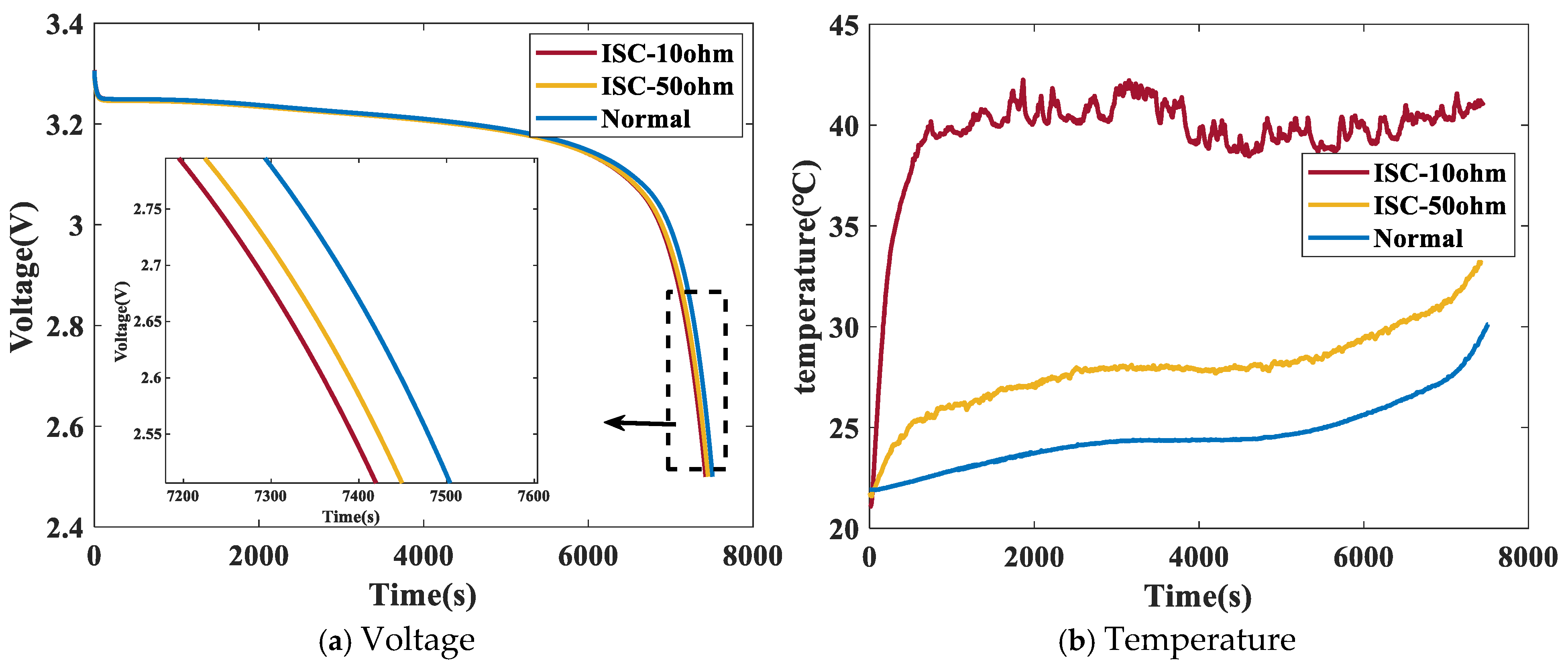
The experiment involved discharging both the faulty and normal batteries from 100% SOC to 0% SOC at a constant current of 0.5 °C. Figure 3 presents the ISC experimental data. As shown in Figure 3a, the voltage of all batteries declines during discharge; however, the voltage of the faulty batteries drops more rapidly than that of the normal ones due to continuous energy dissipation through the parallel resistor. Although a voltage difference exists between the faulty and normal batteries, it is relatively subtle and may be obscured by other factors such as variations in the state of health.
Figure 3a,b present the voltage and temperature profile of the ISC fault experiments, respectively. As shown in Figure 3b, the temperature rises during discharge for all batteries. However, the faulty battery exhibits a noticeably higher temperature than the normal one, and this difference becomes more pronounced as the ISC fault severity increases. This is because the leakage current flowing through the parallel resistor generates additional Joule heat, and a smaller resistance leads to a larger current. Despite the elevated temperature, the faulty battery remains below the maximum allowable operating temperature (45 °C), making it difficult to identify the fault based on temperature alone. Furthermore, the surface temperature of batteries in a BESS is also influenced by ambient conditions, which can introduce additional disturbances in ISC fault detection.

4.1.2. MIE Analysis with ISC Fault Experimental Results

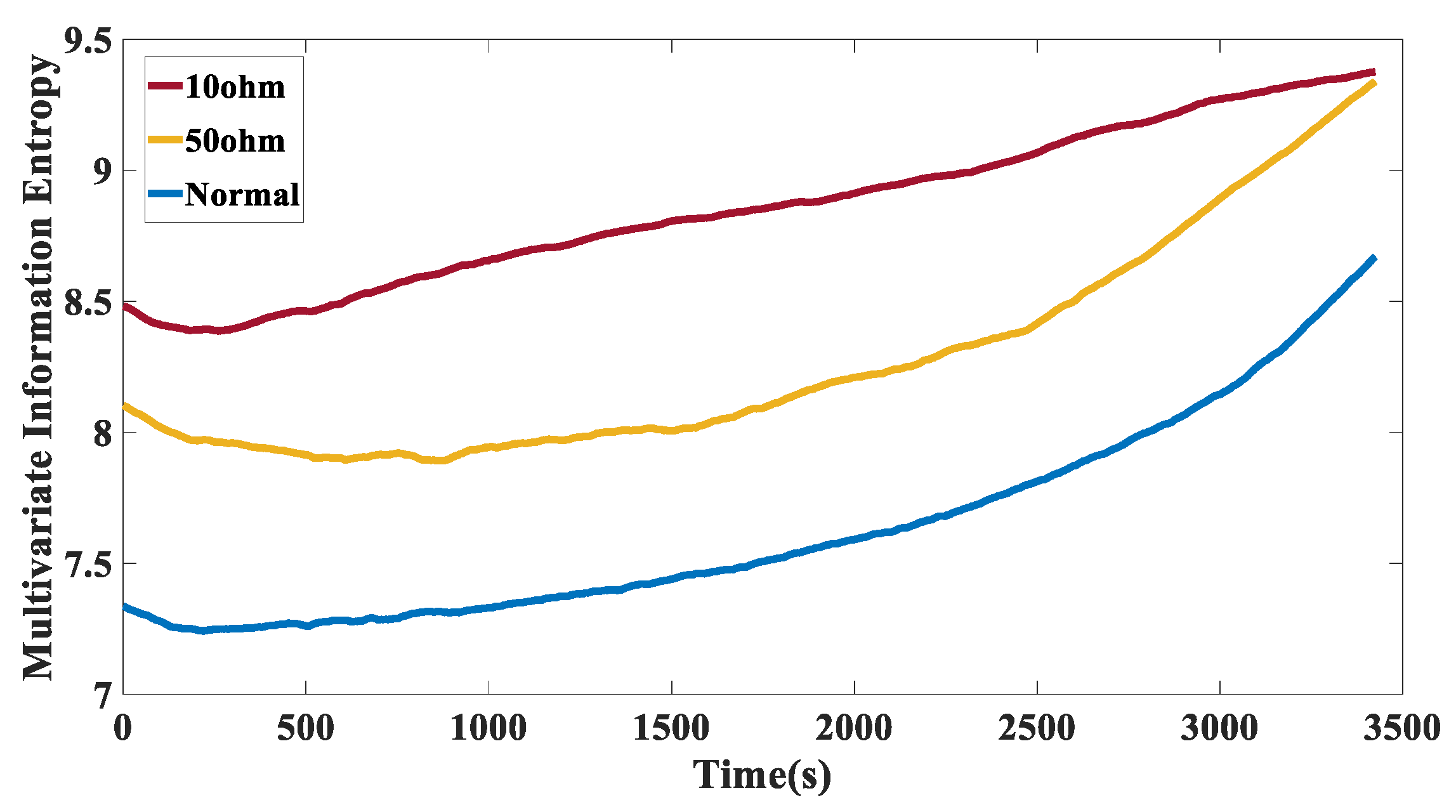
Figure 4 presents the MIE results for the normal battery and those with ISC faults at different severity levels. A clear distinction is observed between the normal battery and the two faulty batteries. Moreover, as the parallel resistance decreases during discharge, indicating increasing ISC severity, the MIE values continue to rise. Physically, it is because an ISC fault causes the voltage and temperature of the faulty cell to gradually deviate from those of normal cells, producing larger fluctuations in the time series. These fault-induced deviations increase the disorder of the signals and consequently drive the information entropy higher. The result validates that the proposed MIE-based method can effectively distinguish between normal and ISC-faulty batteries, and that the MIE value increases monotonically with fault severity.

4.2. Validation Using Real-World Electric Vehicle Fault Data

4.2.1. Dataset Description

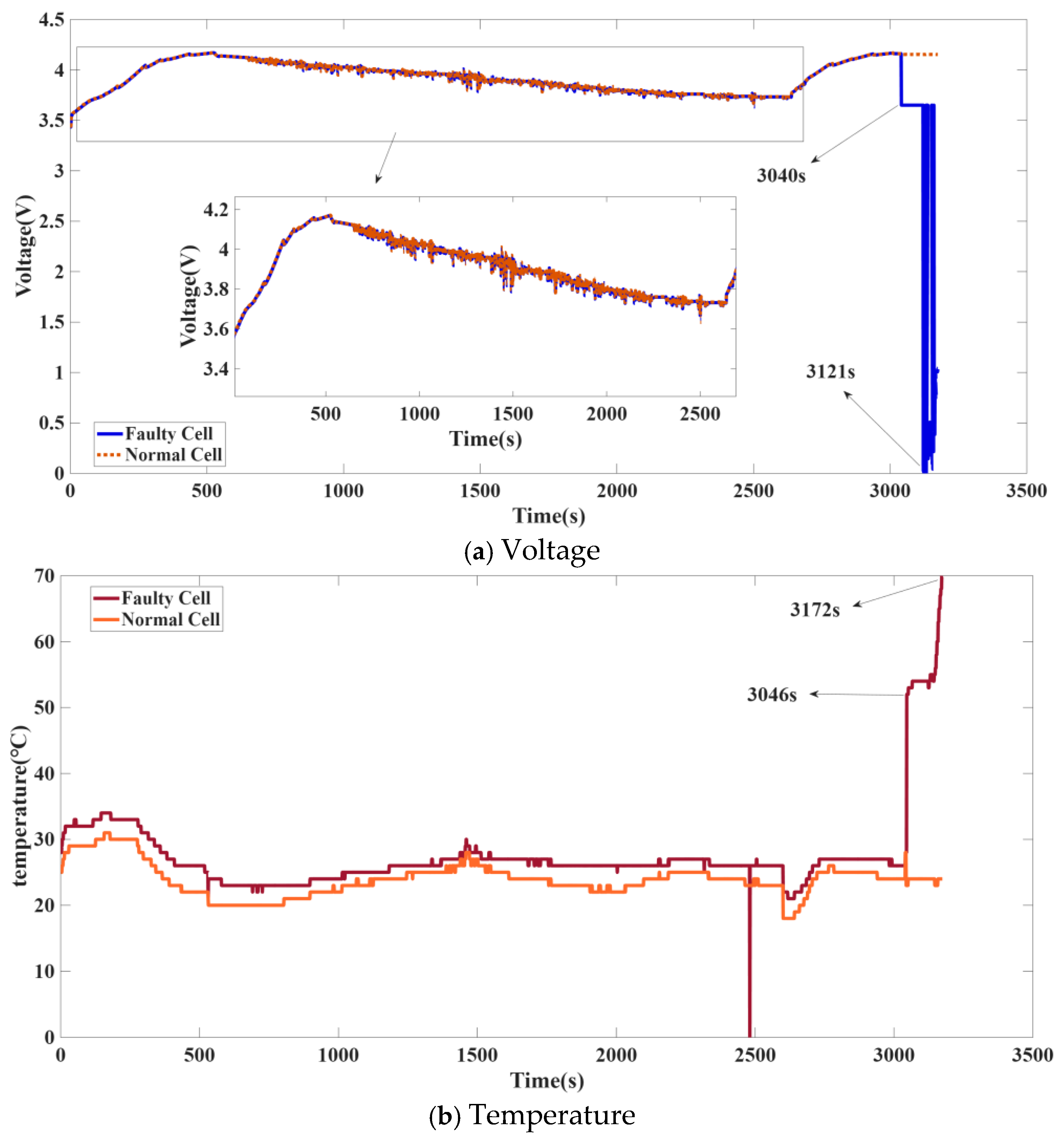
To further validate the effectiveness of the proposed method in practical applications, a publicly available dataset from the 2022 Digital Vehicle Competition is adopted. The battery pack labeled ‘LB_24’ is selected, in which Cells 24 and 25 both triggered fault alarms. For comparison, the voltage and temperature data of Cell 1 (normal) and Cell 25 (faulty) are extracted, as shown in Figure 5. Figure 5a,b present the voltage and temperature profile of the normal cell and faulty cell.
As shown in Figure 5, during the pre-fault period (1–3000 s), the voltage and temperature of the faulty cell are largely consistent with those of the normal cell. As shown in Figure 5a, at 3040 s, the voltage of the 24-cell drops abruptly but remains within the normal operating range (2.5–4.2 V) for a short duration. Then, at 3121 s, the voltage of the faulty cell drops abruptly to 0 V, and the BMS issues an under-voltage alarm. As shown in Figure 5b, the temperature of the faulty cell rises rapidly at 3046 s, exceeding 55 °C once the fault occurs, and then surpassing 70 °C at 3172 s, approaching the critical threshold for thermal runaway. In contrast, the voltage and temperature of the normal cell remain within the normal operating range throughout this period.

4.2.2. MIE Analysis with Real-World Electric Vehicle Fault Data

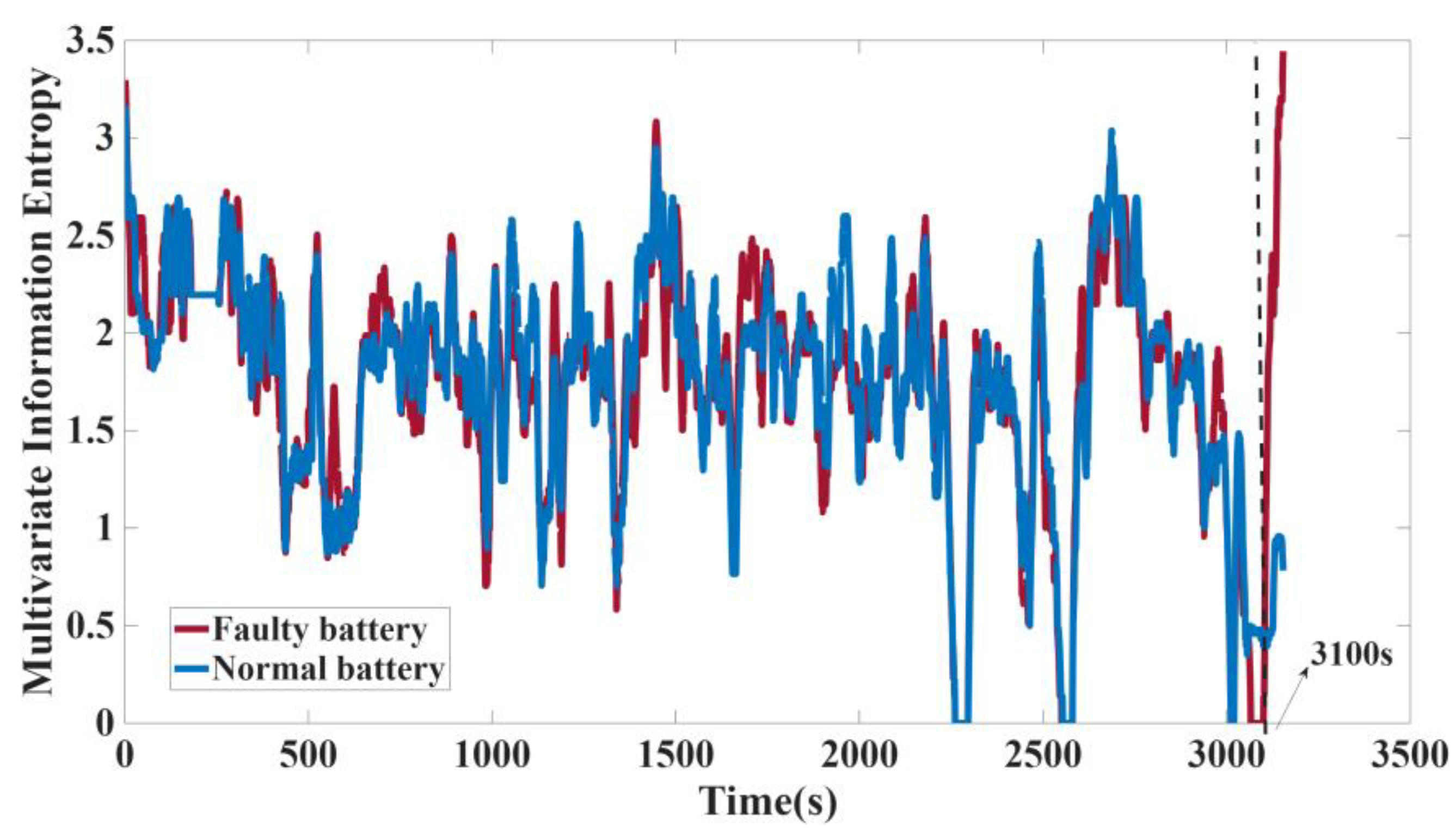
Figure 6 presents the MIE values calculated from the normal and faulty cells. Before 3100 s, the MIE of the faulty cell remains largely consistent with that of the normal cell. After the 3100 s, the MIE of the faulty cell increases rapidly, and the gap between the two cells widens significantly. This result further confirms that MIE can serve as an effective fault feature for the rapid identification of ISC faults.

4.3. Diagnostic Performance Evaluation

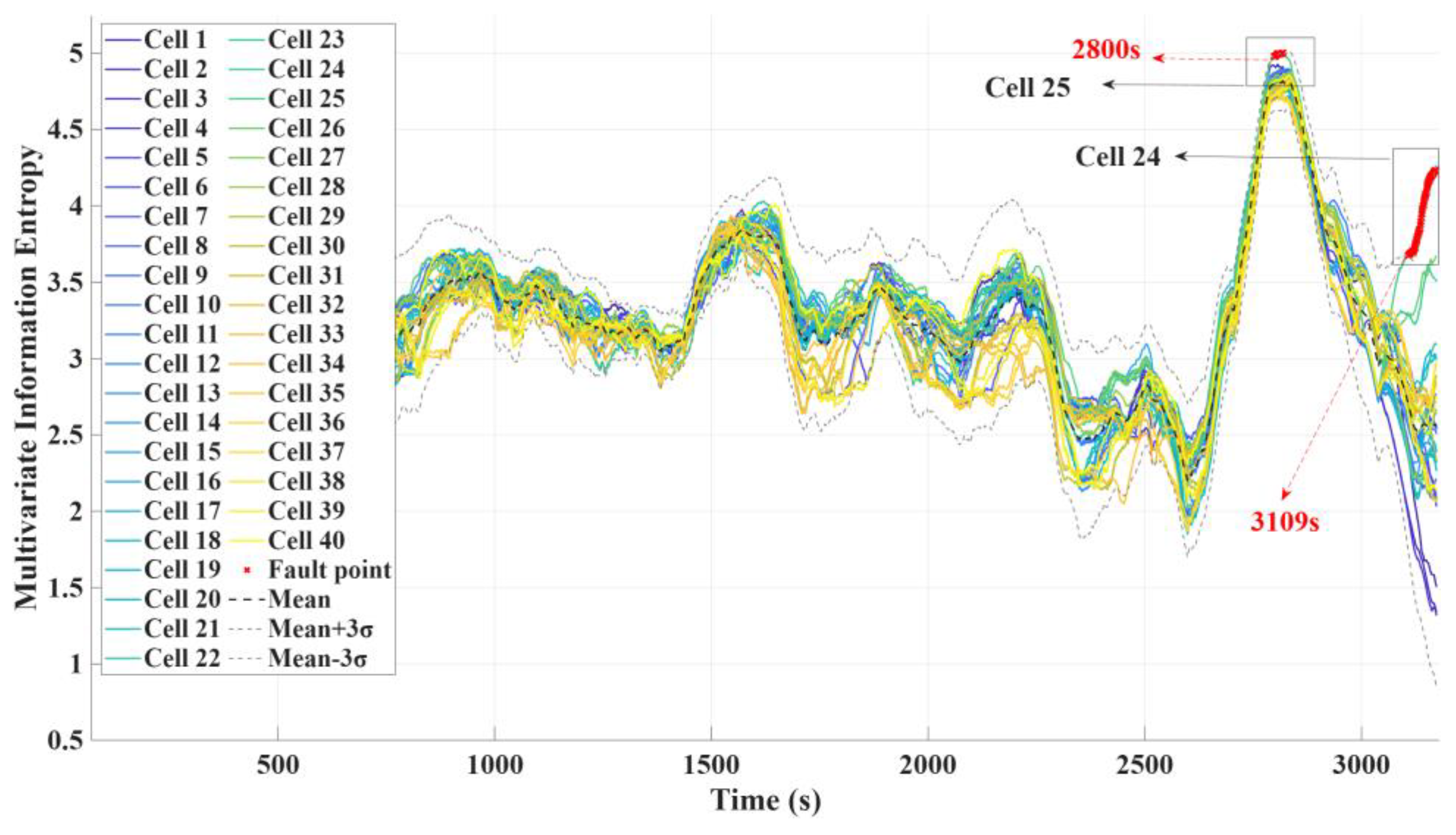
Figure 7 presents the MIE values of all 40 cells within the same battery module of the electric vehicle. The gray dashed line denotes the fault diagnosis threshold calculated using Equation (10). The red points indicate cells whose MIE values exceed the threshold and are thus identified as faulty. As shown in Figure 7, the MIE value of Cell 25 exceeds the threshold 240 s before a clear voltage drop occurs, and it is diagnosed as an ISC fault 321 s before the voltage drop to 0. No subsequent exceedances are observed for Cell 25 because its voltage signal was incompletely collected due to the fault; a substantial portion of the data being zero leads to a decrease in entropy. Cell 24 exceeds the threshold 309 s after Cell 25, likely due to fault propagation from Cell 25.
In addition, the real-world electric vehicle dataset used here merits additional discussion regarding data quality and robustness. Unlike the controlled laboratory experiments, the voltage and temperature signals in the electric vehicle dataset were acquired by the vehicle’s on-board BMS under real driving conditions. As shown in Figure 5, the voltage exhibits fluctuations during vehicle operation, reflecting the inherent variability of real-world driving cycles and sensor noise. Despite these non-negligible fluctuations, as shown in Figure 7, no cell’s MIE value exceeded the 3 σ threshold during the entire normal operating period, even though the MIE values of all cells varied over time in response to the fluctuating signals. This absence of false alarms under such dynamic and noisy conditions provides evidence for the robustness and reliability of the proposed method in practical applications.

5. Conclusions

A novel internal short-circuit (ISC) fault diagnosis method for lithium-ion batteries is proposed based on multivariate information entropy (MIE). Existing entropy-based diagnostic methods rely on a single physical variable, such as voltage or temperature, and are therefore prone to missed detections when voltage and temperature anomalies evolve asynchronously under different ISC triggering mechanisms. To address this gap, the proposed method fuses voltage and temperature time-series data into a joint entropy indicator, effectively capturing both electrical and thermal anomalies associated with ISC faults. A hierarchical diagnostic framework incorporating statistical confidence intervals enables reliable fault identification. Experimental results on 180 Ah LFP batteries with simulated ISC faults of varying severity demonstrate that the proposed MIE feature clearly distinguishes between normal and faulty cells and exhibits a monotonic increase with fault severity. The method is further validated using real-world fault data from an electric vehicle accident, where it successfully identified the faulty cell 240 s before a distinguished voltage drop. This study provides an effective approach for enhancing the safety of battery energy storage systems and electric vehicles.

Author Contributions

Conceptualization, P.C.; methodology, P.C.; software, K.Z.; validation, B.X.; formal analysis, C.L.; investigation, Q.L.; resources, Z.G.; data curation, K.Z.; writing—original draft preparation, P.C.; writing—review and editing, B.X.; visualization, C.L.; supervision, Q.L.; project administration, P.C.; funding acquisition, P.C. All authors have read and agreed to the published version of the manuscript.

Funding

This work is funded by the Science and Technology Program of Tianjin, China (24ZXKJGX00040) and the Science and Technology Project of State Grid Tianjin Electric Power Company (Electric Science- S&T Project 2025-13).

Institutional Review Board Statement

Not applicable.

Informed Consent Statement

Not applicable.

Data Availability Statement

Data will be made available on request.

Conflicts of Interest

Authors Peiyu Chen, Bin Xu, Qian Li and Zhiyong Gan were employed by the State Grid Tianjin Electric Power Company. The remaining authors declare that the research was conducted in the absence of any commercial or financial relationships that could be construed as a potential conflict of interest.

Abbreviations

The following abbreviations are used in this manuscript:
BESSBattery Energy Storage Stations
ISCInternal Short Circuit
MIEMultivariate Information Entropy

References

  1. Cardo-Miota, J.; Beltran, H.; Pérez, E.; Khadem, S.; Bahloul, M. Deep reinforcement learning-based strategy for maximizing returns from renewable energy and energy storage systems in multi-electricity markets. Appl. Energy 2025, 388, 125561. [Google Scholar] [CrossRef] [Scilit]
  2. Küçüker, A.; Baraklı, B.; Bayrak, G.; Başaran, K.; Balaban, G. A new intelligent power quality disturbance classification in renewable and decentralized hydrogen-based energy systems using SwResNET hybrid model. Renew. Energy 2025, 250, 123251. [Google Scholar] [CrossRef] [Scilit]
  3. Manoharan, Y.; Olson, K.; Headley, A.J. Sensitivity of energy storage system optimization program to the source of renewable energy in the presence of demand side management: A behind-the-meter case study. Appl. Energy 2025, 388, 125557. [Google Scholar] [CrossRef] [Scilit]
  4. Sayarshad, H.R. Integrating renewable energy and electric vehicle participation in regulation markets for empowering grid stability. Energy Convers. Manag. 2025, 342, 120041. [Google Scholar] [CrossRef] [Scilit]
  5. Kebede, A.A.; Kalogiannis, T.; Van Mierlo, J.; Berecibar, M. A comprehensive review of stationary energy storage devices for large scale renewable energy sources grid integration. Renew. Sustain. Energy Rev. 2022, 159, 112213. [Google Scholar] [CrossRef] [Scilit]
  6. Lai, X.; Yao, J.; Jin, C.; Feng, X.; Wang, H.; Xu, C. A Review of Lithium-Ion Battery Failure Hazards: Test Standards, Accident Analysis, and Safety Suggestions. Batteries 2022, 8, 248. [Google Scholar] [CrossRef] [Scilit]
  7. BESS Failure Incident Database. Available online: https://storagewiki.epri.com/index.php/BESS_Failure_Incident_Database (accessed on 1 May 2026).
  8. Chen, S.; Wei, X.; Zhu, Z.; Wu, H.; Ou, Y.; Zhang, G.; Wang, X.; Zhu, J.; Feng, X.; Dai, H.; et al. Thermal runaway front propagation characteristics, modeling and judging criteria for multi-jelly roll prismatic lithium-ion battery applications. Renew. Energy 2024, 231, 121045. [Google Scholar] [CrossRef] [Scilit]
  9. Seo, M.; Park, M.; Song, Y.; Kim, S.W. Online Detection of Soft Internal Short Circuit in Lithium-Ion Batteries at Various Standard Charging Ranges. IEEE Access 2020, 8, 70947–70959. [Google Scholar] [CrossRef] [Scilit]
  10. Hu, J.; He, H.; Wei, Z.; Li, Y. Disturbance-Immune and Aging-Robust Internal Short Circuit Diagnostic for Lithium-Ion Battery. IEEE Trans. Ind. Electron. 2022, 69, 1988–1999. [Google Scholar] [CrossRef] [Scilit]
  11. Sun, J.; Chen, S.; Xing, S.; Guo, Y.; Wang, S.; Wang, R.; Wu, Y.; Wu, X. A two-step quantitative diagnosis method for battery internal short circuit faults. Energy 2025, 335, 138241. [Google Scholar] [CrossRef] [Scilit]
  12. Qiao, D.; Wei, X.; Jiang, B.; Fan, W.; Lai, X.; Zheng, Y.; Dai, H. Quantitative Diagnosis of Internal Short Circuit for Lithium-Ion Batteries Using Relaxation Voltage. IEEE Trans. Ind. Electron. 2024, 71, 13201–13210. [Google Scholar] [CrossRef] [Scilit]
  13. Sun, T.; Zhu, H.; Xu, Y.; Jin, C.; Zhu, G.; Han, X.; Lai, X.; Zheng, Y. Internal short circuit fault diagnosis for the lithium-ion batteries with unknown parameters based on transfer learning optimized residual network by multi-label data processing. J. Clean. Prod. 2024, 444, 141224. [Google Scholar] [CrossRef] [Scilit]
  14. Zhang, X.; Yang, W.; Yan, L.; Kaleem, M.B.; Liu, W. Adaptive internal short-circuit fault detection for lithium-ion batteries of electric vehicles. J. Energy Storage 2024, 84, 110874. [Google Scholar] [CrossRef] [Scilit]
  15. Zhang, K.; Jiang, L.; Deng, Z.; Xie, Y.; Couture, J.; Lin, X.; Zhou, J.; Hu, X. An Early Soft Internal Short-Circuit Fault Diagnosis Method for Lithium-Ion Battery Packs in Electric Vehicles. IEEE/ASME Trans. Mechatron. 2023, 28, 644–655. [Google Scholar] [CrossRef] [Scilit]
  16. Sun, Z.; Liu, P.; Wang, Z. Real-time Fault Diagnosis Method of Battery System Based on Shannon Entropy. Energy Procedia 2017, 105, 2354–2359. [Google Scholar] [CrossRef] [Scilit]
  17. Gu, X.; Li, J.; Liu, K.; Zhu, Y.; Tao, X.; Shang, Y. A Precise Minor-Fault Diagnosis Method for Lithium-Ion Batteries Based on Phase Plane Sample Entropy. IEEE Trans. Ind. Electron. 2024, 71, 8853–8861. [Google Scholar] [CrossRef] [Scilit]
  18. Hong, J.; Wang, Z.; Ma, F.; Yang, J.; Xu, X.; Qu, C.; Zhang, J.; Shan, T.; Hou, Y.; Zhou, Y. Thermal Runaway Prognosis of Battery Systems Using the Modified Multiscale Entropy in Real-World Electric Vehicles. IEEE Trans. Transp. Electrif. 2021, 7, 2269–2278. [Google Scholar] [CrossRef] [Scilit]
  19. Li, C.; Zeng, K.; Li, B.; Li, G.; Yang, H.; Li, S. Internal Short-Circuit Fault Diagnosis for Batteries of Energy Storage Stations Based on Multivariate Multiscale Sample Entropy. IEEE Trans. Ind. Electron. 2025, 72, 2068–2077. [Google Scholar] [CrossRef] [Scilit]
  20. Liu, L.; Feng, X.; Zhang, M.; Lu, L.; Han, X.; He, X.; Ouyang, M. Comparative study on substitute triggering approaches for internal short circuit in lithium-ion batteries. Appl. Energy 2020, 259, 114143. [Google Scholar] [CrossRef] [Scilit]
  21. Zhang, G.; Wei, X.; Tang, X.; Zhu, J.; Chen, S.; Dai, H. Internal short circuit mechanisms, experimental approaches and detection methods of lithium-ion batteries for electric vehicles: A review. Renew. Sustain. Energy Rev. 2021, 141, 110790. [Google Scholar] [CrossRef] [Scilit]
  22. Lai, X.; Jin, C.; Yi, W.; Han, X.; Feng, X.; Zheng, Y.; Ouyang, M. Mechanism, modeling, detection, and prevention of the internal short circuit in lithium-ion batteries: Recent advances and perspectives. Energy Storage Mater. 2021, 35, 470–499. [Google Scholar] [CrossRef] [Scilit]
  23. Ahmed, M.U.; Mandic, D.P. Multivariate multiscale entropy: A tool for complexity analysis of multichannel data. Phys. Rev. E 2011, 84, 061918. [Google Scholar] [CrossRef] [Scilit]
Figure 1. Schematic diagram of voltage, leakage current and temperature profiles across different ISC stages.
Applsci 16 05078 g001
Figure 2. Battery ISC test rig.
Applsci 16 05078 g002
Figure 3. ISC fault experimental results.
Applsci 16 05078 g003
Figure 4. MIE values for normal and faulty batteries under experimental conditions.
Applsci 16 05078 g004
Figure 5. Voltage and temperature data from the real-world electric vehicle fault dataset.
Applsci 16 05078 g005
Figure 6. MIE values of the normal and faulty cells in the electric vehicle accident dataset.
Applsci 16 05078 g006
Figure 7. Diagnostic performance of the MIE method using the real-world electric vehicle fault dataset.
Applsci 16 05078 g007
Disclaimer/Publisher’s Note: The statements, opinions and data contained in all publications are solely those of the individual author(s) and contributor(s) and not of MDPI and/or the editor(s). MDPI and/or the editor(s) disclaim responsibility for any injury to people or property resulting from any ideas, methods, instructions or products referred to in the content.