1. Introduction
The agri-food industry generates large volumes of organic residues and processing by-products each year, creating ongoing challenges related to waste management and environmental sustainability. Rather than treating these materials solely as waste, increasing research and industrial efforts are now focused on their valorization through the recovery of valuable components. Many agri-food by-products are naturally rich in nutrients and bioactive compounds, including carbohydrates, proteins, lipids, and diverse phytochemicals, which makes them attractive and low-cost sources of functional ingredients. The extraction and utilization of these compounds support the development of value-added products such as functional foods, nutraceuticals, and cosmeceuticals, while simultaneously contributing to waste reduction and the advancement of circular economy strategies [
1].
Among these by-products, grape pomace stands out for its high valorization potential. This solid residue, composed mainly of grape skins, seeds, and stems, is generated during winemaking and represents approximately 20–30% of the original grape mass. The global wine industry produces large quantities of grape pomace annually, much of which has traditionally been treated as waste and disposed of through landfilling, land application, or combustion, practices that can lead to environmental concerns such as organic matter leaching and greenhouse gas emissions. In response to stricter environmental regulations and increasing sustainability goals, grape pomace is now increasingly viewed as a valuable resource, with its recycling and reuse becoming central to circular economy strategies within the wine sector [
2].
Notably, grape pomace should not be regarded as a waste material but rather as a rich source of nutritionally and biologically active compounds, which makes it a highly valuable raw material. Numerous studies have shown that grape pomace contains substantial amounts of polyphenols, including flavonoids, proanthocyanidins, anthocyanins, and stilbenes, in addition to other beneficial constituents such as dietary fiber, fatty acids, and biopolymers [
3]. Many of these phytochemicals exhibit antioxidant, antimicrobial, and health-promoting properties, which has driven growing interest in grape pomace as a source of natural compounds for food-related applications, including functional ingredients, clean-label formulations, and preservation-oriented systems. In this context, grape pomace valorization is not only an environmental strategy but also a route for recovering bioactive molecules that may contribute to safer and more sustainable food systems.
Among grape pomace polyphenols, trans-resveratrol (trans-3,5,4′-trihydroxystilbene) is one of the most studied stilbenes because of its antioxidant, anti-inflammatory, cardioprotective, and reported antimicrobial activities. These properties make it a high-value target compound for the development of bioactive ingredients and support its relevance in food, nutraceutical, and pharmaceutical sectors [
4]. Importantly, grape pomace contains appreciable levels of resveratrol, mainly because grape skins, which are a key component of pomace, are the primary site of stilbene biosynthesis. However, during red winemaking, maceration and fermentation transfer a substantial fraction of skin-bound resveratrol into the wine, so that red wines generally display higher resveratrol concentrations than the corresponding pomace. Nevertheless, significant residual amounts remain in the spent skins after pressing, and under specific conditions, such as limited skin contact, short maceration, or in white/rosé winemaking, the pomace may retain a larger share of the originally available resveratrol. This makes grape pomace an attractive, cost-effective raw material for resveratrol extraction. Efficient recovery and isolation techniques can therefore transform what was once considered waste into a valuable source of highly sought-after bioactives, creating new economic opportunities and advance environmental sustainability by promoting resource recovery and reducing agricultural waste [
5].
In this context, the present review addresses the need for sustainable valorization of winery byproducts by providing a comprehensive and critical analysis of grape pomace as a potential source of bioactive resveratrol. Specifically, this review centers on trans-resveratrol as the target compound and systematically distinguishes pomace-specific evidence from data obtained on other grapevine matrices, thereby enabling a clearer assessment of the actual recovery potential and technological readiness of each approach for grape pomace valorization. The review adopts an integrated perspective that considers the full recovery pathway, extending beyond extraction to include selective purification strategies based on molecular recognition as well as robust analytical approaches for accurate identification and quantification. By synthesizing findings from conventional methodologies alongside emerging advanced technologies, this work outlines a coherent framework for converting grape pomace into resveratrol-rich fractions or purified compounds suitable for high-value applications, particularly in food-grade, nutraceutical, and sustainable bioproduct contexts. Specifically, the review examines the distribution and recovery potential of resveratrol across different grape pomace components and cultivars, critically compares extraction intensification strategies, and evaluates selective isolation and purification approaches in relation to matrix complexity, while also addressing the analytical challenges associated with preserving the stability and bioavailability of trans-resveratrol within a circular bioeconomy context. Although the focus remains on grape pomace, the discussion also covers other grapevine by-products, such as stems, canes, leaves, and roots. This broader scope is supported by the fact that pomace itself contains fragments of different grapevine tissues. Furthermore, many extraction and purification technologies were initially developed or evaluated using these matrices, where stilbene content is generally higher than in pomace. Including such studies strengthens the comparison of techniques and enables pomace-relevant conclusions to be drawn where direct data remain scarce.
2. Review Conceptualization
The literature considered in this review was collected through searches in major scientific databases, including Scopus, Web of Science, and PubMed, complemented by targeted searches in Google Scholar. The search mainly focused on peer-reviewed articles published in recent years in order to capture current methodological developments, while earlier relevant studies were also retained when they provided important mechanistic or contextual information. The search terms combined keywords related to the biomass source, including grape pomace, grape marc, winery by-products, and other grapevine-derived matrices such as stems, canes, leaves, and roots, with terms related to the target compounds, including resveratrol, trans-resveratrol, stilbenes, piceid, and viniferins. The search was then refined using terms associated with extraction intensification, green solvent systems, selective purification, and chromatographic or spectroscopic determination, in order to cover the main steps involved in trans-resveratrol recovery and characterization.
Original research articles were primarily selected when they reported quantitative data on trans-resveratrol recovery, extraction efficiency, selectivity, purification performance, or analytical determination in grape pomace and related grapevine matrices. Review articles were also consulted to support the organization of the topic and to verify broader trends in the field. Overall, this review provides a structured synthesis of recent progress in the extraction, purification, and analytical determination of trans-resveratrol from grape pomace, while using findings from other grapevine by-products when they help clarify methodological potential, limitations, or knowledge gaps.
3. Grape Pomace as a Source of Resveratrol
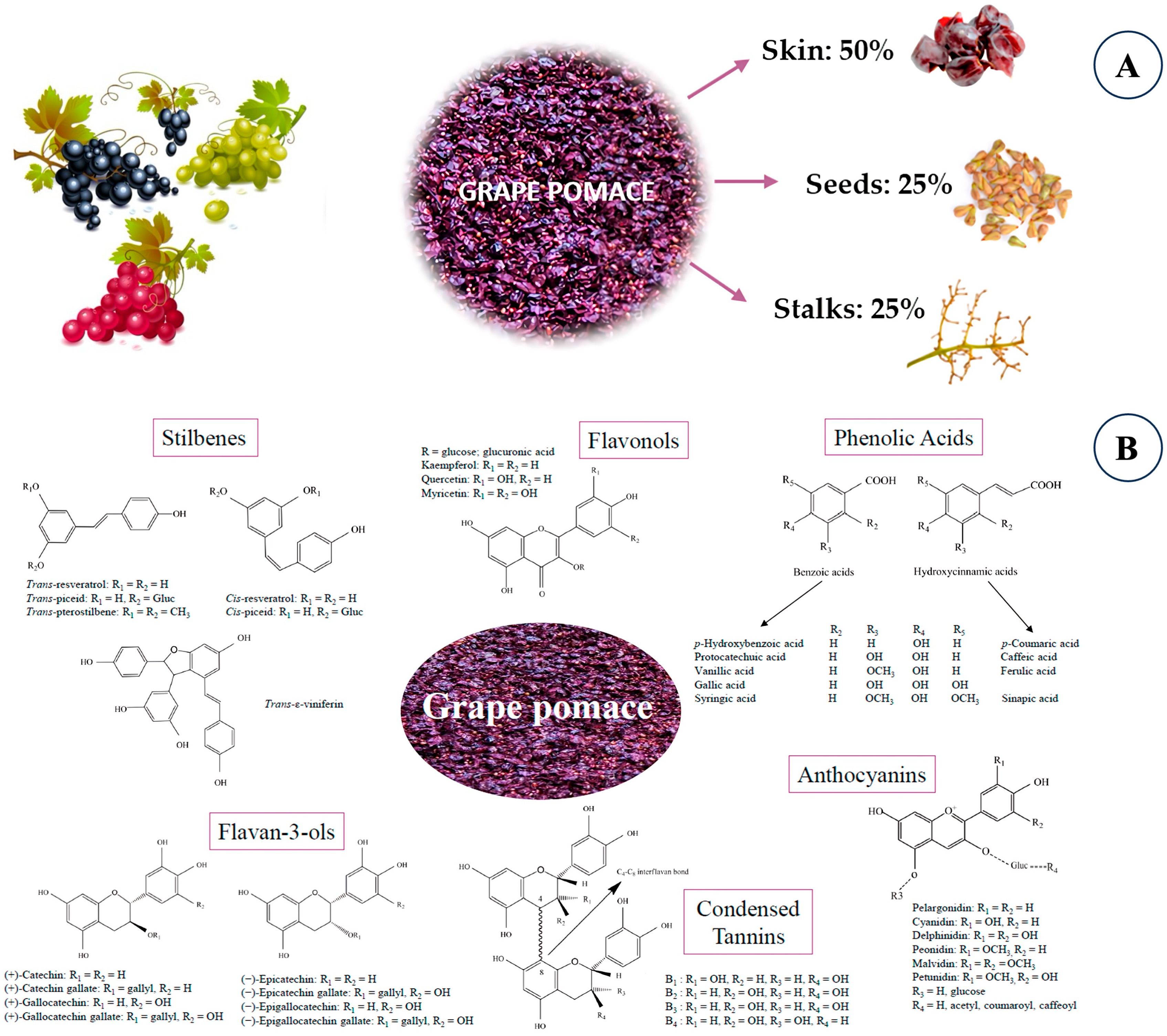
Grape pomace, commonly referred to as grape marc, is the primary solid by-product produced during the winemaking process. It consists of the skins, seeds, and residual stems of grapes after the pressing phase. In terms of its composition, the skins make up roughly half of the total mass of grape pomace, while the seeds account for about one-quarter, with the remaining quarter consisting of stems [
6]. This varied plant matrix is rich in macromolecules such as dietary fibers, proteins, and polysaccharides, along with a range of micronutrients and phytochemicals. Notably, polyphenols are a significant component of grape pomace, representing approximately 5–10% of its dry weight in various forms. These polyphenols encompass flavonoids (including proanthocyanidins/tannins, flavonols, and anthocyanins found in red grape pomace) and non-flavonoids (such as phenolic acids and stilbenes), as depicted in
Figure 1. It is important to highlight that the distribution of phenolic compounds differs between the skin and seed fractions, where grape seeds generally contain the majority of condensed tannins and catechins (up to 60–70% of the total phenolics in pomace), while the skins contribute a smaller share (~30–40%) but are particularly abundant in specific compounds like anthocyanins (in red varieties) and stilbenes [
7].
Resveratrol, a stilbenoid phytoalexin, is primarily found in grape skins, alongside other significant stilbenes such as piceid and astringin [
10,
11]. Nonetheless, it may also include minor quantities of related oligomeric stilbenes like ε-viniferin and δ-viniferin pallidol, which result from the oxidative coupling of resveratrol [
12]. The concentration of resveratrol in grape pomace extract can fluctuate significantly, ranging from negligible trace amounts to several hundred µg per g of dry pomace, influenced by various factors. For example, the fermentation method employed in red wine production greatly affects the amount of resveratrol retained in the pomace compared to that which is incorporated into the wine. During the fermentation of red wine, some resveratrol dissolves into the fermenting must, a process facilitated by the presence of ethanol and contact with the skins; however, a substantial quantity typically remains in the spent skins. Prior studies indicated that the levels of trans-resveratrol in black grape pomace diminish during alcoholic fermentation as it leaches into the wine, yet following the completion of malolactic fermentation, the pomace can still retain significant amounts of resveratrol, some of which may be produced or released from glycosidic precursors [
5]. In the white winemaking process, grape juice is typically separated from the skins before fermentation; thus, the white grape pomace primarily consists of unfermented skins and retains a considerable variety of polyphenols that were initially present in the grapes [
13]. Additionally, the physical state and treatment of the pomace can influence the measured levels of resveratrol. If the pomace remains in a moist condition or was exposed to the air for prolonged periods prior to extraction, certain polyphenols may degrade or undergo oxidation. Importantly, resveratrol shows comparatively higher stability than most other phenolics in grape pomace, such as anthocyanin pigments, and can retain its integrity during dried-pomace storage. Several studies have reported a modest rise in the measurable amount of stilbene and trans-resveratrol contents over storage periods of several months, most likely reflecting improved extractability which may be associated with the gradual release or conversion of glycosylated and matrix-bound stilbene forms. Gerardi et al. clarified this phenomenon by indicating that storage conditions (4° or 25 °C) can result in changes to plant and cell tissue structure, as well as the breakdown of covalently bound phenolic compounds. This ultimately leads to increased solubility and, therefore, enhanced extraction of these compounds [
14].
In addition to the previously mentioned factors, the resveratrol content found in grape pomace is considerably affected by both varietal and agronomic elements. The grape variety acts as a vital determinant, with specific cultivars genetically predisposed to generate higher levels of resveratrol. For instance, the study conducted by Fontana et al. examined the phenolic compounds in various grape pomace sourced from different grape varieties, namely Malbec,
Cabernet Sauvignon, Cabernet Franc, and Merlot, all grown in Argentina. The results revealed that the Malbec variety displayed the highest concentration of trans-resveratrol at 328 μg/g, while the Cabernet Franc variety presented the lowest levels, thereby underscoring the significant influence of grape variety on the resveratrol content within grape pomace extracts [
15]. Additionally, Onache et al. indicated that the Burgund Mare variety, cultivated in Romania, had the highest concentration of resveratrol at 0.98 mg/100 g of dry matter, whereas the Pinot Noir variety was found to contain merely trace amounts of trans-resveratrol (<0.14 mg/100 g) [
16]. In contrast, the investigation detailed by Rockenbach et al. demonstrated that trans-resveratrol was undetectable in Primitivo, Sangiovese, Pinot Noir, Negro Amaro, ‘
Cabernet Sauvignon (
Vitis vinifera), and Isabel (
Vitis labrusca) from Brazilian winemaking. This suggests that grape variety alone does not fully explain the resveratrol content of pomace, since the same cultivar may yield quantifiable levels in one study and undetectable amounts in another. Such discrepancies might be related to differences in pedoclimatic conditions, vine stress history, and winemaking protocols, although the relative contribution of each factor remains difficult to isolate from the available data [
17].
As previously mentioned, grapevines produce resveratrol in response to stress. Therefore, environmental factors such as sunlight exposure, temperature and dehydration, as well as pathogen presence, are crucial. For instance, Šelo et al. investigated the effects of fungal pre-treatment on grape pomace and its phenolic compounds. The results showed that both resveratrol and its dimer, including ε-viniferin and other stilbenes, were positively affected by the fungal treatment, leading to a 1.5-fold increase in resveratrol content compared to untreated samples, with the fungi
Pleurotus eryngii and
Rhizopus oryzae being the most effective [
18]. Moreover, altitude and climate also influence resveratrol levels, as higher altitudes are generally associated with increased UV radiation, which is known to stimulate stilbene biosynthesis. However, de Oliveira et al. reported that Syrah grape skins from the low-altitude site (350 m a.s.l.) contained higher trans-resveratrol contents (5.71–8.17 mg/kg fresh weight) than those from the higher-altitude (1100 m a.s.l.; 4.11–4.72 mg/kg fresh weight). The authors attributed this unexpected result to the high diurnal temperatures (above 30 °C) experienced at the low-altitude site, suggesting that thermal stress was a stronger driver of resveratrol accumulation than UV exposure in this tropical context [
19].
In summary, grape pomace is widely recognized as an abundant source of resveratrol, although its content is strongly influenced by multiple factors that directly affect the composition and richness of resveratrol-containing extracts. Accordingly, numerous approaches have been reported in the literature to enhance the resveratrol fraction within grape pomace extracts, including the optimization of extraction solvents as well as the application of physical, chemical, or biological treatments to improve recovery. These strategies aim to produce enriched extracts that facilitate the subsequent isolation and purification of resveratrol for potential industrial and bioactive applications.
4. Extraction of Resveratrol-Rich Fractions from Grape Pomace
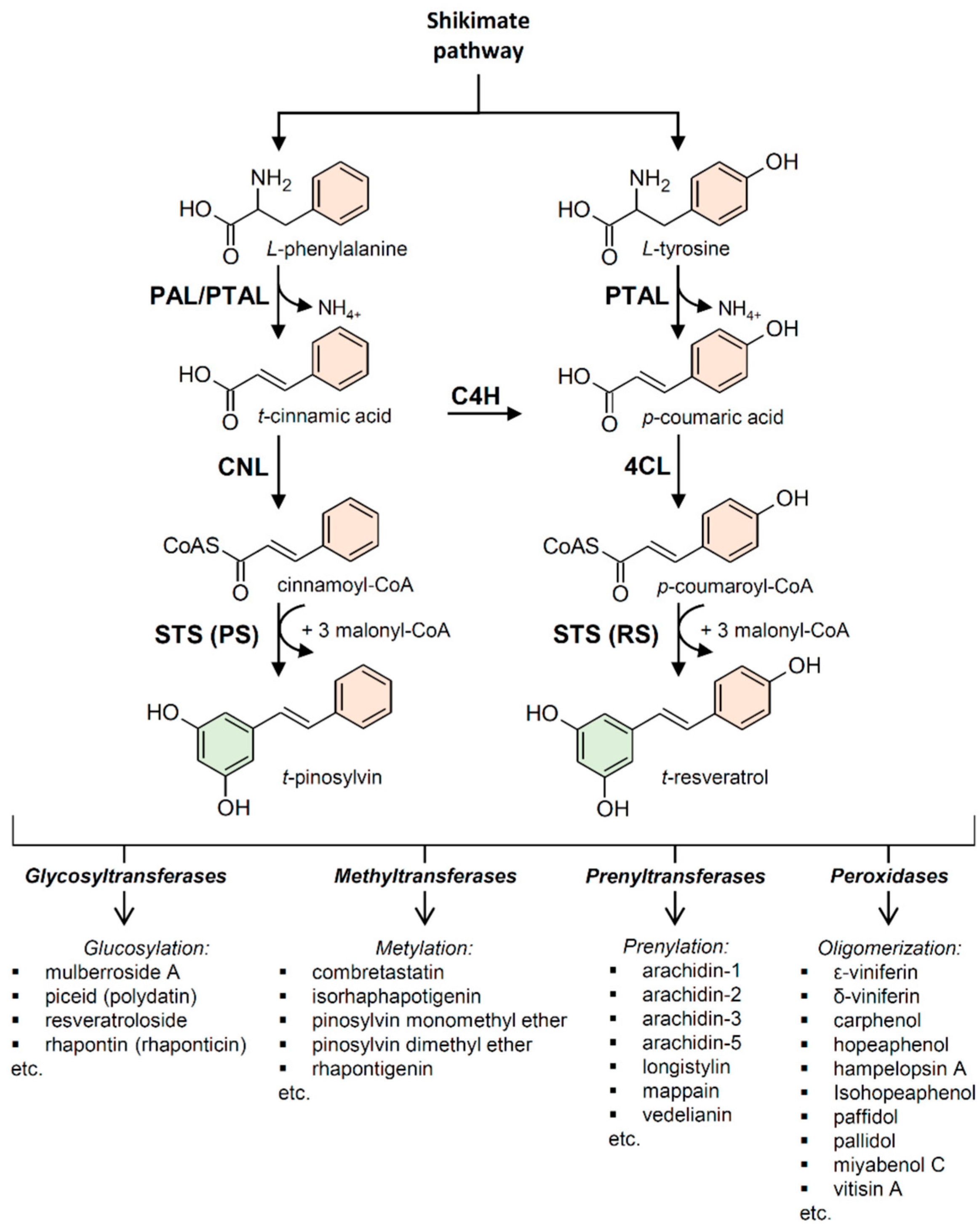
The process of extracting trans-resveratrol from grape pomace necessarily includes the co-extraction of various other stilbenes that are naturally present. These compounds are structural derivatives of resveratrol, primarily produced through reactions such as hydroxylation, glycosylation, methoxylation, or oligomerization, which originate from the 1,2-diphenylethylene unit, as depicted in
Figure 2. While grape pomace represents a particularly rich source of these compounds, similar stilbenes are also found in other plant matrices, including berries, rhubarb, and peanuts [
20].
The extraction behavior of trans-resveratrol is closely linked to its molecular structure and physicochemical properties, as this stilbene consists of a 1,2-diphenylethylene backbone bearing three phenolic hydroxyl groups that govern its polarity, hydrogen-bonding capacity, and chemical reactivity. From a solubility standpoint, trans-resveratrol is poorly soluble in pure water (typically reported in the range of about 0.03 mg/mL at room temperature) [
22] but is readily soluble in organic solvents [
23]. This solubility profile, combined with its three phenolic hydroxyl groups, explains why hydroalcoholic mixtures, especially ethanol–water systems with 50–80% ethanol, are widely preferred for its recovery, as they balance penetration of the plant matrix with effective solvation of the stilbene through hydrogen-bonding interactions. Cho et al. reported that an 80:20 (
v/
v) ethanol/water system enabled the extraction of up to 489.4 µg/g of dry material from grape stems of the Campbell and Gerbong varieties [
24]. More comprehensive physicochemical studies examining solvent selectivity toward stilbenes, including both trans-resveratrol and trans-viniferin, further confirmed the importance of solvent composition, as reducing the ethanol content from 70:30 to 30:70 (
v/
v) led to a pronounced decrease in resveratrol recovery from 3.45 mg/g to 0.47 mg/g of dry material. This behavior has been attributed to the capacity of protic solvents to form stabilizing hydrogen bonds with the phenolic hydroxyl groups of stilbenes, thereby enhancing their solubility and extractability. In addition, differences in molecular weight and polarity among stilbenes influence solvent selectivity, with the higher molecular weight and increased hydrophobicity of trans-viniferin favoring extraction in less polar media, whereas trans-resveratrol is more effectively stabilized and recovered in relatively polar, hydrogen-bonding solvent environments [
25]. Moreover, Pintać et al. investigated the selectivity of six solvents for extracting polyphenols from grape pomace, including methanol, ethanol, ethyl acetate, and acetone, along with their various ratios in acidified media over a maceration period of six hours. Ethyl acetate was identified as providing a stilbene-rich extract, with specific concentrations of resveratrol at 29.9 mg/kg and 78 mg/kg from grape pomace derived from the
Cabernet Sauvignon and Italian
Riesling Agner varieties, respectively [
13].
In terms of extraction techniques, traditional solvent extraction has been shown to effectively recover resveratrol, as indicated by earlier studies that employed simple mixing at elevated temperatures. For example, Romero-Pérez et al. utilized a conventional extraction method involving an ethanol/water mixture (80:20
v/
v) at 60 °C for 30 min, resulting in a yield of 24.06 μg/g of trans-resveratrol extracted from grape berry skin [
26]. In contrast, an optimized approach achieved a maximum yield of 4.25 mg/g of resveratrol using a moderate ethanol concentration (50−70%) and the highest temperature of 83.6 °C [
27]. It should be noted, however, that elevated extraction temperatures progressively favor the isomerization of trans-resveratrol to its less bioactive cis form and, in the presence of oxygen, can promote oxidative degradation. Thus, the use of such severe conditions should depend on the initial resveratrol content and its accessibility within the grape pomace matrix, to ensure that improved recovery does not come at the expense of trans-resveratrol stability.
Nevertheless, recent green extraction techniques offer substantial advantages in terms of yield, selectivity, and sustainability compared with conventional methods [
28]. These approaches aim to optimize the recovery and bioefficacy of resveratrol while avoiding harsh chemicals and processing conditions that may compromise molecular integrity or increase energy consumption, such as prolonged heating or intensive stirring typically associated with traditional maceration. A range of physical and chemical strategies has therefore been explored, including ultrasound-assisted extraction, enzyme-assisted extraction, and the use of innovative solvent systems such as natural deep eutectic solvents, as well as microwave-assisted and supercritical fluid extraction, applied either individually or in combination to enhance extraction efficiency and resveratrol recovery from winemaking residues. A summary of recent literature regarding the extraction methods reported for resveratrol recovery from grape pomace is presented in
Table 1.
4.1. Ultrasound-Assisted Extraction
Ultrasound-assisted extraction (UAE) has emerged as a cornerstone technique for the efficient recovery of resveratrol and other stilbenes from winemaking byproducts, primarily due to its ability to accelerate mass transfer and enhance extraction kinetics through acoustic cavitation. This mechanical effect involves the formation, growth, and implosive collapse of bubbles in the extraction solvent, which generates intense local pressure and temperature shifts that disrupt plant cell walls. By creating micro-fractures in the solid matrix, UAE allows the solvent to penetrate deeper into tissues like grape skins, stems, and canes, facilitating the rapid release of bioactive compounds into the medium [
29].
In grape pomace, these ultrasound-induced structural disruptions markedly enhance phenolic diffusion into the solvent, enabling higher extraction yields under comparatively mild conditions. Several studies have demonstrated the effectiveness of UAE in improving stilbene recovery relative to conventional maceration. González-Centeno et al. applied response surface methodology to optimize UAE parameters for polyphenol extraction from
Vitis vinifera grape pomace, identifying optimal conditions at 40 kHz, 150 W/L, and 25 min, which yielded 32.31 mg GA eq/100 g fresh weight of total phenolics and 2.04 mg quercetin eq/100 g fresh weight of total flavonols [
30]. However, this study reported global phenolic and flavonol contents rather than identifying and quantifying individual phenolic compounds, including resveratrol. Therefore, due to the limited number of studies specifically focused on resveratrol extraction from grape pomace, findings from other grape-derived matrices are also discussed here to provide a broader perspective on the applicability of UAE for resveratrol recovery. For instance, Cho et al. reported a 24 to 30% increase in resveratrol yield from grape stems of the Campbell and Gerbong varieties compared to conventional solvent extraction at 60 °C, with kinetic modeling indicating that up to 80% of total extractable resveratrol could be recovered within 3.48–5.80 min. Importantly, the extraction rate substantially exceeded the degradation rate, with a ratio of approximately 12, highlighting the advantage of short ultrasonic exposure in preserving resveratrol against oxidative or thermal degradation [
24].
The efficiency of UAE can be further enhanced through the use of modified solvent systems. Babazadeh et al. demonstrated that incorporating polyethylene glycol into an ethanol–water mixture increased extraction efficiency by 39.48%, an effect attributed to altered solvent viscosity and vapor pressure that intensified cavitation-induced shear forces. Under optimized conditions, this approach yielded up to 862 µg/g of resveratrol from grape skins, with antioxidant activity nearly four times higher than that obtained using conventional extraction methods suggesting a broader enrichment in antioxidant compounds alongside resveratrol recovery [
31]. UAE has also proven adaptable to other vine residues, as shown by Piñeiro et al. who optimized stilbene extraction from grape canes and reported total stilbene contents reaching 1362.9 mg/kg dry matter after only 10 min of extraction at 75 °C using a 60% hydroalcoholic solvent, with trans-resveratrol, trans-ε-viniferin, and piceatannol as the dominant compounds [
32]. Notably, resveratrol levels varied significantly among cultivars, underscoring the influence of varietal factors on extraction outcomes. Comparable benefits were reported for grape leaves, where Sun et al. identified 40% aqueous ethanol at 50 °C for 30 min as optimal, yielding extracts refined to a resveratrol purity of 20.6% [
33].
Ultimately, current evidence indicates that ultrasound-assisted extraction not only substantially improves the quantitative recovery of resveratrol from grape-derived residues but also preserves its bioactive integrity through reduced processing times and milder operating conditions, positioning UAE as a practical option for the valorization of industrial grape pomace, although its sustainability credentials depend on the solvent system chosen and the energy cost of the ultrasonic generator at production scale.
Table 1.
Summary of reported extraction methods for resveratrol recovery from grape pomace and related grapevine by-products.
Table 1.
Summary of reported extraction methods for resveratrol recovery from grape pomace and related grapevine by-products.
| Extraction Method | Variety and Cultivar | Extraction Parameters | Resveratrol Content; mg/g (Dry Material) | Reference |
|---|
| Ultrasound-assisted extraction | Grape Leaves (Huailai, Hebei, China) | 50 °C; >30 min; 1:20 (g/mL); 40% aqueous ethanol | 6.792 | [33] |
| | Red Grape Waste (Skin): GizilOzum | 53.6 °C; 19.4 min; 10 g/L (1:100); 48:32:20 Ethanol:PEG:Water (v/v/v) | 0.862 | [31] |
| | Red Grape Waste (Skin): ShaniAntab-B | 53.6 °C; 19.4 min; 10 g/L (1:100); 48:32:20 Ethanol:PEG:Water (v/v/v) | 0.0987 | [31] |
| | Red Grape Waste (Skin): Shirazi-A | 53.6 °C; 19.4 min; 10 g/L (1:100); 48:32:20 Ethanol:PEG:Water (v/v/v) | 0.689 | [31] |
| | Grape Canes: Melissa (White) | 75 °C; 10 min; 1:40 (g/mL); 60% ethanol in water | 1.529 | [32] |
| | Grape Canes: Moscatel rosado (Red) | 75 °C; 10 min; 1:40 (g/mL); 60% ethanol in water | 0.966 | [32] |
| | Grape Canes: Zinfandel (Red) | 75 °C; 10 min; 1:40 (g/mL); 60% ethanol in water | 0.529 | [32] |
| | Grape Canes: Tintilla de Rota (Red) | 75 °C; 10 min; 1:40 (g/mL); 60% ethanol in water | 0.575 | [32] |
| | Campbell (Fruit Stem) | Room Temp; 3.48 min; 8 g/L; Ethanol:Water (80:20 v/v) | 0.489 | [24] |
| | Gerbong (Fruit Stem) | Room Temp; 5.80 min; 8 g/L; Ethanol:Water (80:20 v/v) | 0.194 | [24] |
| Microwave-assisted extraction | Pinot Noir (Grape Pomace) | 1.0 kW; 55 °C; 30 min; 1:20 (g/mL); Ethanol | 3.770 | [34] |
| | Vitis vinifera L. cv. Cabernet Moravia (Grape Cane) | 150 W;64.7 °C (Boiling); 30 min; 1:33.3 (g/mL); Methanol | 5.510 | [35] |
| | Vijiriega (Grape Stem) | 750 W; 125 °C; 5 min; 1:100 (g/mL); 80% Ethanol | 1.529 | [36] |
| | Gewürtztraminer (Grape Cane) | 750 W; 125 °C; 5 min; 1:125 (g/mL); 80% Ethanol | 5.361 | [36] |
| | Malbec (Grape Cane) | 750 W; 125 °C; 5 min; 1:125 (g/mL); 80% Ethanol | 1.885 | [36] |
| | Tannat (Grape Stem) | 750 W; 125 °C; 5 min; 1:100 (g/mL); 80% Ethanol | 0.528 | [36] |
| Enzyme-assisted extraction | Mixed Grape Pomace | Tannase (5% w/w); 40 °C; 5 h; pH 5.0 sodium acetate buffer | 0.0139 | [37] |
| | Campbell Early (Grape Peel) | exo−1,3−β-glucanase and pectinases; 95 °C (10 min heat) + 50 °C (60 min enzyme); 80% Ethanol | 0.094 | [38] |
| Natural deep eutectic solvents | Grape Canes: Sauvignon blanc | Ambient; 4.5 min; 1:10 (w/w); Choline chloride/1,2-Propanediol (1:5) | 3.960 | [39] |
| | Grapevine Roots (Gewürztraminer) | Ambient; 10 min; 1:10 (w/w); Choline chloride/1,2-Propanediol (1:2) + 10% H2O | 2.470 | [40] |
| Supercritical CO2 extraction | Grape Pomace: Palomino fino (White) | 400 bar; 55 °C; 3 h; CO2 + 5% (v/v) ethanol | 0.192 | [41] |
| | Grape Skin: Palomino fino (White) | 400 bar; 55 °C; 3 h; CO2 + 5% (v/v) ethanol | 0.455 | [41] |
| Subcritical water extraction | Grape seeds (Hefei, China) | 1.02 MPa; 152.32 °C; 24.89 min; 1:15 (g/mL) | 0.006 | [42] |
4.2. Microwave-Assisted Extraction
Microwave-assisted extraction (MAE) has emerged as a highly effective green technique for the recovery of resveratrol and other stilbenes from grape pomace, offering advantages in terms of reduced solvent consumption, shorter processing times, and improved energy efficiency. MAE relies on electromagnetic radiation to induce rapid volumetric heating through dipolar rotation and ionic conduction, primarily targeting water and polar solvents within plant tissues. This localized heating generates internal pressure that disrupts cell walls and promotes solvent penetration, a mechanism visually confirmed using scanning electron microscopy, which revealed marked thinning of cell walls and pore formation in microwave-treated grape pomace, thereby facilitating the release of intracellular bioactive compounds [
43]. As a result, MAE can reduce extraction times by more than 80–90% compared with conventional solid–liquid extraction or maceration.
The effectiveness of MAE in enhancing resveratrol recovery has been demonstrated across different grape cultivars and matrix types. Piñeiro et al. investigated stilbene extraction from woody vine residues and identified optimal conditions at 125 °C for 5 min using 750 W microwave power, an 80:20 (
v/
v) ethanol/water solvent system, and a solid-to-liquid ratio of 1:100–1:125. Under these conditions, the extracted amount of trans-resveratrol varied widely among cultivars, with the highest value of 1529 ± 44 mg/kg dry matter observed in the Vijiriega variety and the lowest value of 11 ± 1 mg/kg dry matter in Marselan [
36]. Regarding grape pomace, MAE conditions optimized for Pinot Noir grape pomace achieved a resveratrol extraction recovery of 90.87% relative to the total resveratrol present in the matrix, corresponding to an extracted amount of 3.77 mg/g after 30 min at 55 °C using 1 kW microwave power [
34]. This value is notably higher than trans-resveratrol contents reported for grape pomace by other authors. For instance, Fontana et al. [
15] reported 0.328 mg/g for Malbec pomace, Babazadeh et al. [
31] obtained 0.862 mg/g from red grape skin waste, and Onache et al. [
16] found only 0.0098 mg/g for Burgund Mare pomace.
In contrast to grape pomace, grape canes represent a distinct woody viticultural residue with generally higher stilbene accumulation. Soural et al. further evaluated MAE for the extraction of stilbenes from Cabernet Moravia grape canes using methanol as the solvent and reported resveratrol as the dominant compound at 5505.7 µg/g, followed by trans-ε-viniferin and r2-viniferin, while also highlighting the importance of sample physical state, as powdered material yielded approximately twice the amount of extracted resveratrol compared to coarsely cut samples due to enhanced mass transfer [
35].
Despite its demonstrated efficiency in accelerating extraction kinetics and preserving resveratrol bioactivity, the application of MAE for resveratrol recovery remains less extensively explored than other emerging techniques such as ultrasound-assisted extraction. Nevertheless, the available evidence supports MAE as a powerful and time-efficient alternative for the valorization of grape pomace and vine residues, particularly when rapid processing and high extraction efficiency are required.
4.3. Enzyme-Assisted Extraction
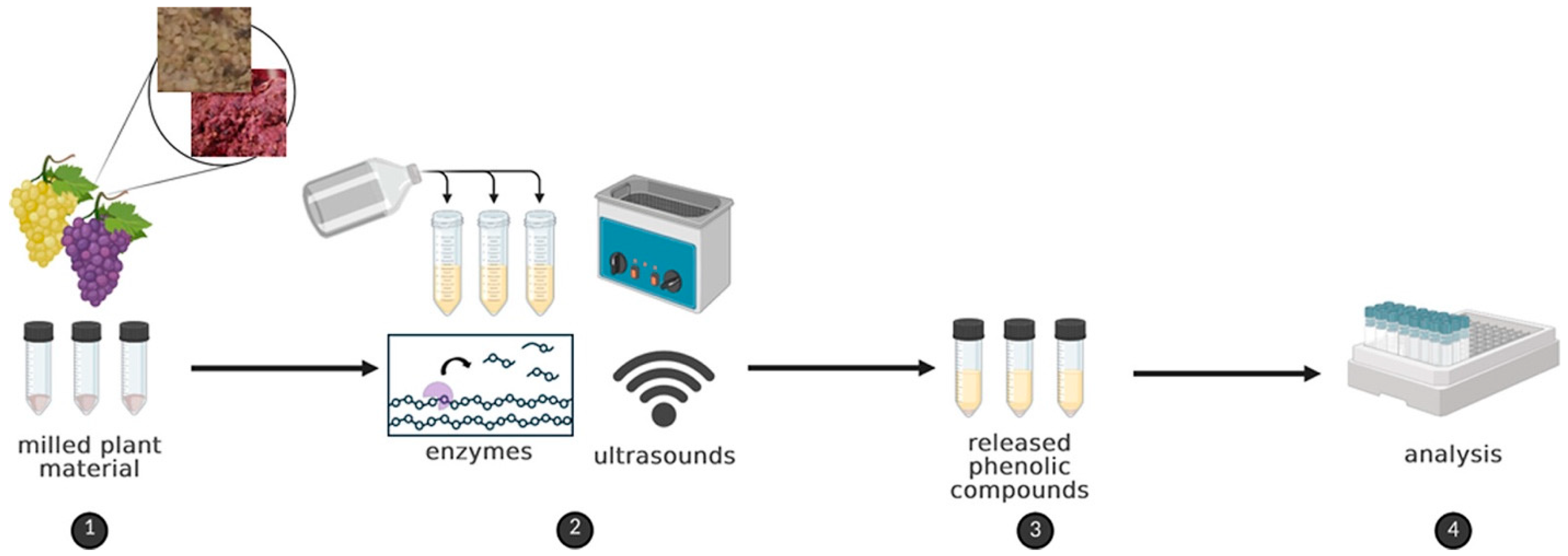
Enzyme-assisted extraction (EAE) is increasingly used as an environmentally compatible method for the recovery of phenolic compounds from plant-derived by-products, such as grape pomace (
Figure 3). This method employs cell-wall-degrading enzymes to liberate bioactive compounds that are typically bound or trapped within the intricate polysaccharide matrix of the pomace. The structural makeup of grape pomace consists of cellulose, hemicellulose, and pectin, which interact with polyphenols like resveratrol, thereby restricting their extractability. By incorporating enzymes such as pectinases, cellulases, and hemicellulases into an aqueous slurry of pomace, these polysaccharides undergo hydrolysis, which disrupts the structural barriers and promotes the release of bound phenolic compounds [
8,
44]. For instance, treatment with pectinase has been demonstrated to facilitate the hydrolysis of galloylated catechins, transforming them into their free forms and thereby enhancing the release of phenolic compounds, which subsequently enhances the antioxidant potential of the grape pomace extract [
45]. In a separate investigation, solid-state fermentation of grape pomace utilizing
Aspergillus niger and
Aspergillus oryzae was conducted to encourage in situ enzymatic production.
A. niger produced a well-balanced array of enzymes, including cellulase, tannase, and pectinase, while
A. oryzae mainly contributed to cellulase and tannase activities. These enzyme profiles were observed to affect both the polyphenolic composition and the antioxidant activity of the resultant extracts. Notably, resveratrol was not among the individual phenolic compounds identified in this study [
46].
While numerous studies have explored the application of enzyme-assisted extraction to enhance the overall recovery of polyphenols from grape pomace [
47,
48,
49], relatively fewer have concentrated specifically on the targeted extraction of trans-resveratrol. Among these, Martins et al. provided the most direct evidence by systematically examining the impact of three enzymatic treatments (tannase alone (T), pectinase plus cellulase (PC), and a combination of all three (TPC)) on the polyphenolic composition of red, white, and mixed grape pomaces derived from Brazilian wine production. Trans-resveratrol was detected only in the mixed grape pomace, where the untreated control contained 1.4 µg/g dry matter. Enzymatic treatment substantially increased this value, with tannase and TPC producing approximately 10-fold increases (13.9 and 14.3 µg/g dry matter, respectively) and PC achieving an 8.5-fold increase (12.1 µg/g dry matter). The authors attributed this enhancement to the enzymatic hydrolysis of glycosylated and oligomeric precursors, most notably piceid, into the free resveratrol aglycone. The absence of detectable trans-resveratrol in both red and white grape pomaces, even after enzymatic treatment, was attributed to cultivar-dependent differences in stilbene biosynthesis or the absence of Botrytis cinerea infection, a known inducer of resveratrol accumulation in grapevines [
37].
In a complementary study conducted on a different grape-derived matrix, Averilla et al. devised a sequential enzymatic extraction method for grape peels, which integrated thermal pretreatment with enzymatic hydrolysis. The refined protocol entailed heating the material to 95 °C for 10 min, followed by the introduction of a mixed enzyme preparation that included exo-1,3-β-glucanase and pectinases, with the enzymatic reaction conducted at 50 °C for 1 h. This method achieved a maximum extracted amount of trans-resveratrol of 101.47 µg/g dry matter, thereby illustrating the efficacy of enzyme-assisted cell wall disruption in facilitating the release of resveratrol from intricate plant matrices [
38].
The current findings demonstrate that enzyme-assisted extraction can release trans-resveratrol from grape pomace, primarily through the biotransformation of glycosylated precursors rather than solely through physical cell-wall disruption. However, the absolute amounts recovered remain low, and the strong cultivar dependence of resveratrol detectability raises concerns regarding the reproducibility and generalizability of this approach. The relatively modest extraction yields, together with the cost and variability of enzymatic formulations, might limit the applicability of EAE as a standalone extraction process for trans-resveratrol recovery from grape pomace, positioning it more appropriately as a pretreatment or biotransformation step within an integrated extraction strategy. Further investigation is required to determine whether optimized enzyme combinations, dosages, and incubation conditions can meaningfully improve trans-resveratrol yields across a broader range of grape pomace cultivars and vinification conditions.
Figure 3.
Schematic representation of the experimental workflow used for ultrasound-assisted and enzyme-assisted extraction of phenolic compounds from grape pomace. Reproduced with permission from ref. [
48].
Figure 3.
Schematic representation of the experimental workflow used for ultrasound-assisted and enzyme-assisted extraction of phenolic compounds from grape pomace. Reproduced with permission from ref. [
48].
4.4. Deep Eutectic Solvents
Deep eutectic solvents (DES) represent an emerging class of low-volatility, tunable solvents that are gaining recognition for their effectiveness in the extraction of polyphenols. These solvents are formed by the combination of particular organic compounds (for example, a quaternary ammonium salt such as choline chloride with a hydrogen bond donor like an organic acid, polyol, or sugar) in a way that produces a eutectic mixture with a melting point considerably lower than that of the individual components. As a result, the solvent matrix produced is often biodegradable, has low volatility, and offers a high level of tunability in terms of polarity and solvation capacity [
50]. In the context of resveratrol extraction, DES can be tailored to mimic the solvent properties of conventional organic solvents, while providing improved sustainability and, in certain instances, greater efficacy in dissolving phenolic compounds [
51].
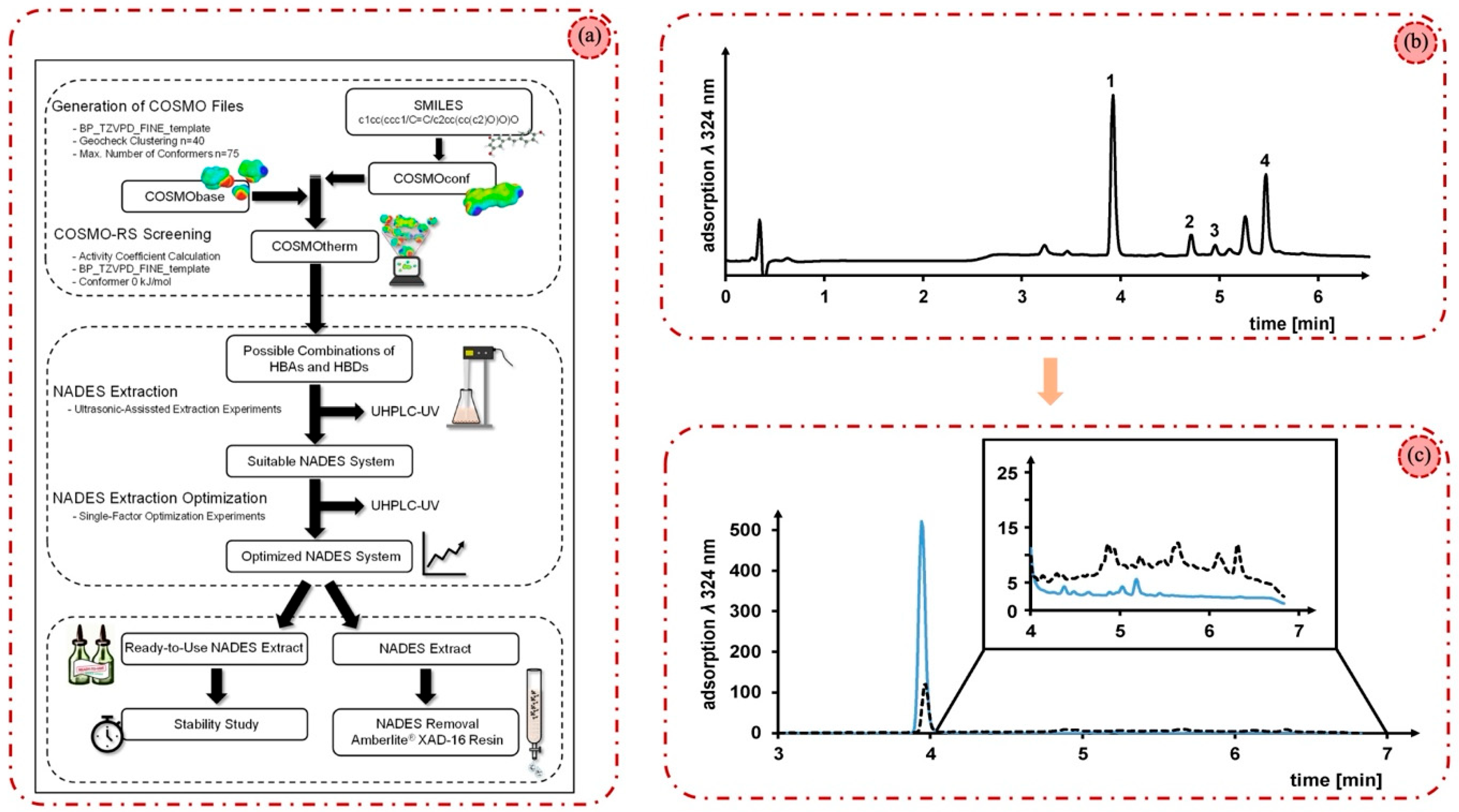
Natural deep eutectic solvents (NADES) have increasingly been utilized as substitutes for traditional organic solvents in the extraction of stilbenes and other phenolic compounds from grape pomace. In a particular study, a comprehensive assessment of various NADES formulations was conducted to enhance the extraction of trans-resveratrol and ε-viniferin from grapevine canes [
39]. The researchers evaluated numerous combinations of hydrogen bond acceptors (HBAs) and hydrogen bond donors (HBDs), in conjunction with ultrasound-assisted extraction. Among the solvents tested, a mixture of choline chloride and 1,2-propanediol was recognized as the most effective NADES, producing 3.96 mg/g dry matter of trans-resveratrol and 2.88 mg/g dry matter of ε-viniferin. In a follow-up study by the same team, the stability of stilbenes in NADES was examined (
Figure 4), indicating that certain NADES formulations could facilitate the degradation of the active compounds over time, thus requiring the recovery of stilbenes from the solvent prior to long-term storage or application [
40].
When it comes to the recovery of trans-resveratrol from grape pomace, the most pertinent question is whether NADES can extract this stilbene from the pomace matrix. Frontini et al. [
52] applied three choline chloride-based NADES systems (paired with lactic acid, tartaric acid or glycerol as hydrogen bond donors) to Primitivo grape pomace obtained from rosé vinification. The choline chloride–lactic acid system extracted 22 µg/g DW of trans-resveratrol, which is slightly higher than the value obtained using ethanol as a benchmark (20 µg/g DW). The tartaric acid- and glycerol-based formulations were less effective, extracting 10 and 13 µg/g DW, respectively. These results confirm that NADES can match or even surpass ethanol in the extraction process itself when the hydrogen bond donor is properly selected, while simultaneously recovering accompanying phenolic compounds such as flavan-3-ols, flavonol glycosides, astilbin and a wide range of anthocyanins that would normally require separate extraction protocols.
4.5. Supercritical Fluid Extraction and Subcritical Water Extraction
Supercritical fluid extraction using carbon dioxide (SFE-CO
2) represents one of the few techniques that has been directly applied to grape pomace as a target matrix for trans-resveratrol recovery. SC-CO
2 operates above the critical point of carbon dioxide, where the fluid exhibits gas-like diffusivity and liquid-like solvating power that can be precisely tuned by adjusting pressure and temperature. However, because SC-CO
2 alone exhibits limited affinity for moderately polar compounds such as trans-resveratrol, the addition of a polar co-solvent is generally required to enhance recovery. Casas et al. [
41] systematically investigated the effect of pressure (100 and 400 bar), temperature (35 and 55 °C), and the addition of 5% (
v/
v) ethanol as a co-solvent on trans-resveratrol recovery from the seeds, stems, skins, and whole pomace of Palomino fino grapes. At low pressure (100 bar), resveratrol was undetectable in all pomace fractions regardless of temperature or co-solvent addition, highlighting the critical role of fluid density in achieving sufficient solvating power for stilbene extraction. At 400 bar and 55 °C with 5% ethanol as co-solvent, the extracted amount of trans-resveratrol from whole grape pomace reached 0.192 mg/g dry matter, exceeding the value obtained by conventional methanol/HCl extraction (0.009 mg/g dry matter) and demonstrating the superior diffusional properties of supercritical fluids in penetrating the compact pomace matrix. Among the individual pomace fractions, grape skins yielded the highest trans-resveratrol content (0.455 mg/g dry matter under the same conditions), consistent with the known localization of stilbenes in berry skin tissue. Notably, SC-CO
2 also enabled resveratrol recovery from seeds, which was not achievable by conventional solvent extraction, a finding attributed to the capacity of supercritical fluids to access active sites within the seed matrix that remain inaccessible to liquid solvents. These results confirm that grape pomace of Palomino fino is a viable source of trans-resveratrol under optimized SFE-CO
2 conditions, and that the recovery is strongly governed by the proportion of skin, seed, and stem fractions within the pomace. Despite these promising findings, the requirement for high operating pressures, specialized high-pressure equipment, and the necessity of a co-solvent introduce significant capital and operational costs that might limit the scalability of SFE-CO
2 for large-volume pomace processing.
Subcritical water extraction (SWE) is increasingly recognized as a promising green chemistry technique, relying on the use of water as the extraction solvent under conditions of elevated temperature and pressure that keep it in the liquid state, yet below its critical point. This approach is gaining attention for both economic and environmental reasons, offering an alternative to conventional organic solvents in the recovery of bioactive compounds [
53,
54]. Resveratrol and other stilbenes are moderately polar polyphenols, typically requiring hydroalcoholic or moderately polar organic solvents for optimal solubilization and extraction. However, under subcritical conditions, the dielectric constant of water decreases with increasing temperature and pressure, effectively reducing its polarity and allowing it to behave more like an organic solvent [
55]. This physicochemical change enhances the solubility and extraction efficiency of less polar compounds such as stilbenes. One study applied SWE to extract stilbenes from various vine by-products, including canes, wood, and roots, by systematically investigating the effects of temperature (100, 130, 160, and 190 °C) and extraction time (5, 15, and 30 min) on yield and composition. The authors found that stilbenes were extractable at levels comparable to those obtained by conventional methods at 160 °C for 5 min, with total stilbene content of 3.62, 9.32, and 12.1 g/kg dry-matter in cane, wood, and root, respectively [
56]. In a separate study, response surface methodology (RSM) was employed to optimize SWE conditions specifically for trans-resveratrol extraction from grape seeds. The optimized parameters (152.32 °C, 1.02 MPa, and an extraction time of 24.89 min) yielded a trans-resveratrol extraction yield of 6.90 μg/g dry matter, with a recovery rate of 91.98%. Although this value is low in absolute terms, it reflects the inherently low stilbene content of grape seeds compared to skins or woody tissues; notably, SWE outperformed reflux extraction (4.16 μg/g), ultrasonic extraction (3.42 μg/g), and microwave-assisted extraction (4.66 μg/g) applied to the same matrix [
42]. However, no study has yet specifically optimized SWE conditions for the recovery of trans-resveratrol from grape pomace. This remains an important gap, particularly considering the potential of SWE as a solvent-free and food-grade extraction approach.
4.6. The Conversion of Piceid
The conversion of piceid, also referred to as polydatin, into its aglycone form resveratrol is a critical step for enhancing both the pharmacological value and economic viability of natural extracts. Although resveratrol is widely recognized for its broad biological activities, it occurs predominantly in plants as piceid, a glucosylated stilbene with comparatively limited commercial relevance. Advances in green extraction technologies and biocatalytic approaches have therefore focused on promoting the hydrolysis of piceid to release the bioactive aglycone, with biocatalysis emerging as a particularly cost-effective strategy to increase resveratrol availability. By integrating microbial activity with suitable chemical pretreatments, these methods facilitate cleavage of the glycosidic bond, thereby potentially supporting resveratrol production with reduced reliance on synthetic sources, provided that the biocatalyst and solvent systems used are themselves economically and environmentally viable at scale.
A major breakthrough in this context is the use of surfactant-assisted and ionic liquid aqueous systems for pretreating grape seed residue, as reported by [
57]. In their study, an immobilized microbial consortium composed of Yeast CICC 1912,
Aspergillus oryzae, and
Aspergillus niger was employed to achieve simultaneous biocatalysis and extraction. The synergy between the ionic liquid [C4MIM]Br and the surfactant Triton X-100 enhanced cell membrane permeability and stabilized secreted enzymes. This process effectively converts piceid into its aglycone form, achieving a 6.36-fold increase recovered amount of free resveratrol compared to untreated samples, an increase that reflects both the biocatalytic conversion of glycosylated precursors (mainly piceid) into the free aglycone and the improved cell-wall permeability facilitating its release. SEM micrographs further confirmed that this treatment physically disrupted the parenchyma cell walls, thereby improving solvent access to embedded bioactives, highlighting its potential for effective recovery from grape seed residue.
In contrast to this are other high-efficiency conversion techniques such as the use of glucose oxidase-assisted hydrolysis to cleave O-glucosidic bonds in Japanese knotweed (Fallopia japonica). This method increased resveratrol yield by 400%, specifically converting polydatin and resveratroloside into resveratrol without affecting non-O-glycoside bonds [
58]. Given that grape pomace also contains significant amounts of polydatin, the absence of glucose oxidase-assisted extraction could represent an interesting research direction for winery by-product valorization, although its applicability would depend on substrate composition, enzyme cost, and process selectivity.
5. Isolation and Purification Strategies of Resveratrol from Grape Pomace Extracts
The purification of resveratrol from grape pomace extract remains a particularly challenging task owing to the chemical complexity and heterogeneity of this winemaking byproduct, which contains a wide range of coexisting phenolic and non-phenolic constituents. Grape pomace extracts are generally rich in structurally diverse polyphenols, including flavonoids such as catechins and anthocyanins, various phenolic acids, and high-molecular-weight compounds such as tannins and lignin, many of which share comparable polarity and functional group patterns with resveratrol, notably aromatic rings and multiple phenolic hydroxyl groups. This structural and physicochemical similarity promotes competitive co-extraction and retention phenomena, leading to significant interference from closely related stilbenes such as piceatannol and viniferin derivatives. The challenge of resveratrol isolation is further exacerbated by the intrinsic variability of grape pomace, as stilbene content can vary markedly with grape cultivar, geographical origin, and post-harvest handling conditions that influence biosynthetic and degradative pathways. In parallel, the intrinsic chemical instability of resveratrol, characterized by its susceptibility to oxidation, photo-degradation, and thermally induced trans-to-cis isomerization, imposes additional constraints on purification processes, necessitating separation strategies that are not only selective but also capable of preserving molecular integrity under mild and controlled conditions.
5.1. Liquid–Liquid Separation
Liquid–liquid separation (LLS), or solvent partitioning represents one of the simplest and most widely applied approaches for isolating specific polyphenols from plant extracts, as it relies on partitioning an initial extract solution against an immiscible solvent to selectively transfer the target compound based on differences in polarity and solubility. In the case of resveratrol, its amphiphilic character, arising from the aromatic backbone combined with three phenolic hydroxyl groups, makes moderately polar organic solvents particularly suitable, and several studies have demonstrated effective enrichment using this principle. For example, Wang et al. reported a straightforward concentration of resveratrol from a 95% ethanol extract of
Polygonum cuspidatum by combining pH adjustment and solvent polarity control, where the extract was first acidified to pH 1 to promote the hydrolysis of polydatin into resveratrol and then subjected to liquid–liquid extraction with organic solvents such as ethyl acetate, ethyl acetate mixed with petroleum ether, petroleum ether alone, or methyl tert-butyl ether, allowing amphiphilic resveratrol to migrate from the aqueous acidic phase into the organic phase [
59]. This process was further refined by an additional elution step using an alkaline solution adjusted to pH 8 to 9, which facilitated the transfer of acidic and water-soluble impurities back into the aqueous phase while retaining resveratrol in the organic layer, ultimately leading to 4-fold enrichment in resveratrol concentration. A comparable strategy involving hydrolysis followed by solvent partitioning was applied to grape pomace extracts by Trifoi et al. where alcohol-based maceration and reflux extraction were followed by hydrolysis and subsequent LLS using ethyl acetate and methyl tert-butyl ether, with ethyl acetate showing superior performance by achieving a resveratrol concentration of approximately 41.54 mg/L in the organic phase and a purity close to 82% in the recovered fraction, a selectivity that primarily reflects the stronger affinity of resveratrol for the organic phase relative to water-soluble impurities [
60]. The study further highlighted that repeated extraction cycles significantly enhanced the overall transfer of resveratrol into the organic phase, underscoring the importance of multiple partitioning steps in maximizing recovery, a concept that aligns with broader fractionation strategies based on polarity gradients, such as sequential extraction using solvents of increasing polarity including hexane, chloroform, and ethyl acetate, which has been shown in a Petit Verdot pomace study to yield an ethyl acetate fraction enriched in stilbenes including resveratrol and viniferins compared to the crude extract [
61].
Beyond conventional alcoholic extracts, LLS has also proven valuable in validating greener alternatives for recovering bioactive compounds from grape pomace, particularly when natural deep eutectic solvents are used as extraction media, as these solvents are frequently described as safer and more sustainable but present challenges related to matrix complexity and downstream recovery of target molecules, and in this context, Frontini et al. reported a two-step liquid–liquid separation protocol that enabled the recovery of over 80 percent of resveratrol from NADES-based extracts by first applying ethyl acetate to remove less polar phenolics followed by 2-methyltetrahydrofuran to isolate more polar compounds such as anthocyanins and resveratrol [
52].
Despite these promising outcomes, solvent partitioning approaches for resveratrol remain highly dependent on careful optimization of solvent ratios and water content and typically require substantial volumes of organic solvents, while some degree of co-extraction of other phenolics and impurities is unavoidable, raising concerns related to safety, environmental impact, scalability, solvent recyclability, and the chemical stability of resveratrol, all of which require further investigation before reliable translation of this technique to industrial applications.
5.2. Solid Phase Isolation
Solid phase isolation (SPI) processes offer substantial advantages for the analysis of complex matrices such as grapes, wine, and spirits, as they provide high selectivity for retaining target compounds like trans-resveratrol while efficiently separating them from interfering components such as polar sugars, and by integrating sampling, extraction, and concentration into a single workflow they significantly streamline analytical procedures. These techniques offer high selectivity, and, in some cases, are nearly solvent-free, leading to a marked reduction in overall analysis time, while simultaneously improving reproducibility and operational simplicity. In addition, solid phase methods enhance sample stability by shielding sensitive analytes from exposure to light and air during processing, thereby minimizing degradation caused by oxidation or photo isomerization [
62], and as a result, the obtained extracts are typically enriched and sufficiently purified to be directly compatible with instrumental analysis without the need for additional cleanup steps.
In the study conducted by Aresta et al., solid-phase microextraction was employed as an integrated and streamlined approach for isolating trans-resveratrol from complex matrices such as wine, spirits, and grape juices, with the method designed to minimize sample handling while maintaining high selectivity. The optimized extraction conditions involved the addition of 10% sodium chloride and 6.6% ethanol to the sample in order to enhance partitioning, after which an 85 µm polyacrylate fiber was directly immersed in the extract to adsorb resveratrol, followed by a static desorption step in which the fiber was soaked in the mobile phase within a dedicated interface for 15 min [
63]. This approach demonstrated high selectivity toward trans-resveratrol, as evidenced by chromatograms showing improved efficiency and resolution, an effect attributed to the polyacrylate coating which was identified as particularly well suited for the extraction of resveratrol compared to other fiber types. Piñeiro et al. reported the determination of trans-resveratrol from grape extracts using pressurized liquid extraction coupled with solid-phase isolation in a single extraction chamber containing the polystyrene–divinylbenzene sorbent LiChrolut EN. The procedure involved an initial washing step with water at 40 °C and 40 atm to remove polar interfering compounds, followed by elution with methanol at 150 °C and 40 atm to recover the analyte. Although this temperature is high enough to raise concerns about possible degradation or isomerization, the authors specifically evaluated trans-resveratrol stability under PLE conditions using a standard solution supported on inert sand and reported quantitative recovery even at 150 °C. Therefore, the stability observed in this method should be understood as condition-dependent, likely favored by the short extraction time, pressurized closed system, inert atmosphere, and protection from light [
62].
Based on this, SPI can be characterized by its simplicity, rapid execution, and comparatively low solvent consumption relative to LLE, while also offering greater flexibility for further optimization, particularly through the rational selection of sorbent materials and washing and elution solvents with higher affinity for trans-resveratrol, thereby enabling enhanced selectivity and improved purification efficiency.
5.3. Column Chromatography
Column chromatography is another conventional and widely reported method for the purification of resveratrol from grape pomace and related matrices, with traditional solid support materials such as silica gel 60 and Sephadex LH-20 commonly employed as initial purification steps to address complex impurity profiles. In grape pomace applications, silica gel 60 is particularly valued for its polar surface properties and its effectiveness in removing pigments and other polar interfering compounds. Karagül and Uğraş, employed a silica gel 60 column using a mobile phase composed of chloroform ethyl acetate and formic acid in a 25:10:1
v/
v/
v ratio to isolate trans-resveratrol from grape pomace extracts obtained from Turkish wineries, identifying fractions containing the highest resveratrol concentration at 6.6 mg/L [
64]. Similarly, Güder et al. extracted crude phenolic fractions from different parts of
Vitis labrusca L. using a CH
3OH/NH
4OH solvent system, followed by purification on a large silica gel 60 column measuring 3 × 150 cm with a CH
2Cl
2/CH
3OH step gradient, which enabled the localization of resveratrol in specific fractions. This procedure was subsequently complemented by Sephadex LH-20 chromatography to obtain final purified resveratrol contents of 6.87 µg/g in the exocarp, 1.15 µg/g in seeds, and 0.93 µg/g in whole grape material [
65]. Despite their robustness and reproducibility, these classical solid support chromatographic approaches are often associated with long processing times, relatively low yields, and complex elution protocols, which limit their efficiency when large sample volumes are required.
To address these limitations, more advanced chromatographic techniques such as counter-current chromatography (CCC) and high-speed counter-current chromatography (HSCCC) have been developed, both of which operate via a support-free liquid–liquid partition mechanism that eliminates the need for a solid stationary phase. The absence of a solid matrix prevents irreversible adsorption and enables high recovery of injected samples. In this context, Li et al. demonstrated the effectiveness of counter-current chromatography for the isolation of resveratrol dimers from wine grape stems, achieving one-step separation of trans-δ-viniferin with 93.2% purity and trans-ε-viniferin with 97.5% purity using an n-hexane/ethyl acetate/methanol/water solvent system in a 2:5:4:5
v/
v/
v/
v ratio. Likewise, high-speed counter-current chromatography has proven particularly suitable for preparative-scale separations and for resolving cis/trans-isomers. Li et al. reported the isolation of polyphenols from red wine extracts using this technique, obtaining 12.69 mg of trans-piceid with 98.58% purity and 12.81 mg of cis-piceid with 97.64% purity from 100 mg of extract [
66].
For large-scale and industrially relevant applications, polymeric adsorbent resins operated in column mode represent a more scalable chromatographic alternative. Non-ionic polymer resins such as those from the Amberlite XAD series or Sepabeads function as porous hydrophobic matrices capable of adsorbing resveratrol from dilute aqueous solutions and releasing it upon elution with organic solvents [
67]. Building on this concept, Silva et al. developed a chromatography-based bind-and-elute strategy for the selective capture of trans-resveratrol from complex aqueous streams using functionalized hydrophobic resins, specifically Biotage RENSA PX containing imidazole groups and RENSA PY containing pyridine groups. Unlike conventional resins such as Amberlite XAD-16, which rely exclusively on hydrophobic interactions, these functionalized materials exhibit mixed-mode behavior through hydrogen bonding between nitrogen lone pairs on the resin and hydroxyl groups on the resveratrol molecule, resulting in markedly enhanced adsorption capacity and selectivity [
68]. Quantitatively, RENSA PX achieved a maximum adsorption capacity of 80 mg/g wet resin, compared to 17.7 mg/g for XAD-16, while RENSA PY exhibited approximately fivefold higher selectivity for trans-resveratrol relative to standard resins during separation from other polyphenols. Importantly, polymeric adsorbent resins are capable of processing large solution volumes and can be regenerated repeatedly with minimal performance loss, making them economically and technically attractive for industrial-scale recovery of resveratrol from winery byproducts, as previously highlighted [
69].
Thus, conventional open-column chromatography and resin-based chromatographic systems remain reliable tools for laboratory-scale purification, while advanced support-free and functionalized resin approaches provide clear and practical pathways for scaling up the purification of resveratrol from grape pomace and related agro-industrial residues.
5.4. Molecularly Imprinted Polymers
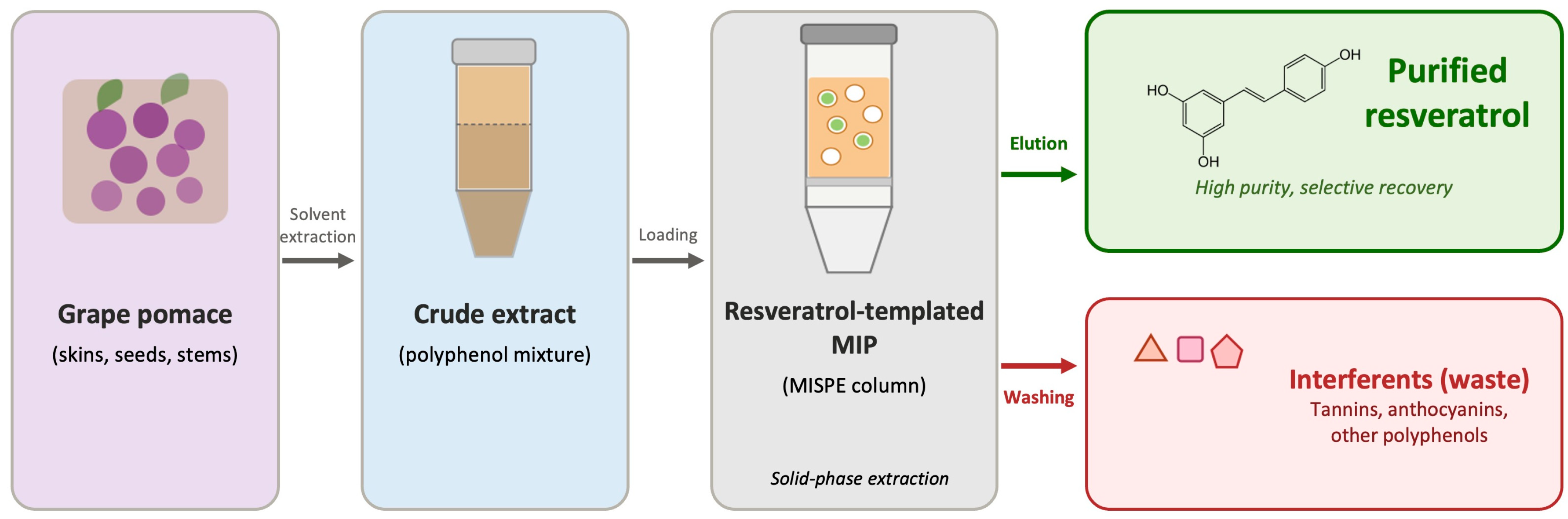
Molecularly Imprinted Polymers (MIPs) represent a sophisticated purification approach involving the creation of synthetic, highly cross-linked materials with stereospecific binding sites that are precisely complementary in shape, size, and functionality to a target molecule like resveratrol. Practically, these polymers are deployed in Molecularly Imprinted Solid-Phase Extraction (MISPE) or magnetic separation systems, allowing resveratrol to be isolated from complex grape pomace and stem extracts containing a plethora of interfering polyphenols, such as flavonoids, tannins, and hydroxycinnamic acids. Such MIP-based approaches are recognized for its selectivity that basically related to MIP cavities that prioritize the exact spatial arrangement of the analyte’s three phenolic hydroxyl groups while excluding co-extracted compounds that possess bulky carbohydrate attachments (such as piceids), different isomeric configurations (such as
cis-resveratrol), or excessive hydroxyl groups (such as myricetin) [
70]. Practically, several studies have relied on 4-vinylpyridine-based imprinting networks, exploiting hydrogen bonding interactions between the pyridine nitrogen and the phenolic hydroxyl groups of resveratrol to achieve selective adsorption, as demonstrated in both thermally polymerized bulk MIPs and photo-polymerized systems [
70,
71]. In bulk MIPs prepared via thermal polymerization, Hashim et al. pre-extract resveratrol from Pinot noir grape skin extract using ultrasound-assisted extraction. The bulk MIP prepared through thermal polymerization of 4-vinylpyridine and the crosslinker ethylene glycol dimethacrylate (EGDMA) showed that high selectivity toward trans-resveratrol can be achieved with a binding capacity of 12.36 μmol/g and a remarkable imprinting factor of 72. The process reached a rebinding recovery of 99.4% for trans-resveratrol from the loading solution while showing no affinity for the cis-isomer or piceid derivatives due to steric hindrance from carbohydrate attachments [
70].
More recent studies have addressed mass transfer limitations associated with bulk polymers by adopting surface imprinting and magnetic MIP designs, which improve binding site accessibility and facilitate rapid separation, leading to substantially higher adsorption capacities and recoveries above 90% in grape-derived matrices [
72]. In particular, Chen et al. applied Surface Molecularly Imprinted Polymers (SMIPs) based on magnetic multi-walled carbon nanotubes (MMCNTs) to treat crude extracts from
Vitis vinifera,
Arachis hypogaea, and
Polygonum cuspidatum. A schematic representation of the process and the proposed mechanism for the recovery of resveratrol using the developed MIP is summarized in
Figure 5. Unlike bulk polymers, the surface imprinting technique reduces the occurrence of deeply buried pores and enhances mass transfer. The resulting MMCNT-SMIP showed a high adsorption capacity of 45.73 mg/g and an imprinting factor of 2.89. It was highly efficient in real-sample applications, achieving high recoveries between 93.69% and 95.53% and final product purities ranging from 88.37% to 92.33% [
73].
In parallel, polymerization methodology has been identified as a critical factor influencing imprinting efficiency, with photo-induced polymerization at ambient temperature preserving noncovalent interactions that may be disrupted under thermal conditions, thereby significantly improving sorption capacity and purification efficiency. Based on this, Bzainia et al. reported a two-step purification strategy that increased trans-resveratrol purity from 29% in the crude extract to 87% with high recovery [
71], while a subsequent pilot-scale study extended this concept to fixed-bed systems operated under hydroalcoholic conditions, demonstrating the feasibility of MIP-based purification using environmentally benign solvents despite a reduction in selectivity in polar media [
74].
The recovery of resveratrol from MIPs is generally a desorption process that lies on the polarity changes to disrupt the strong hydrogen bonds and π-π stacking interactions within the polymer’s cavities. The standard procedure typically employs a mixture of methanol and acetic acid (9:1
v/
v), as the acid is crucial for breaking specific phenolic-monomer interactions during both initial template removal and final analyte recovery [
71].
5.5. Foam Fractionation
Foam fractionation has emerged as a cost-effective and environmentally friendly adsorptive bubble separation technique for the recovery and purification of trans-resveratrol from grape pomace, particularly because it operates under mild conditions that limit oxidative and photo-induced degradation of this easily oxidizable stilbene. The method is based on the generation of gas bubbles within a leaching solution, where specially designed collectors promote the attachment of non-surface-active resveratrol to the gas–liquid interface, enabling its selective transfer into a concentrated foam phase. In this context, Wu et al. demonstrated that molecularly imprinted SiO
2 nanoparticles can function as highly selective collectors by providing stereospecific recognition sites complementary to trans-resveratrol, allowing efficient discrimination against its cis-isomer and structurally related polyphenols, while simultaneously enhancing foam stability through particle aggregation at bubble plateau borders, which resulted in a high enrichment ratio of 13.68 and a recovery of approximately 89.73% [
75]. Alternative collector designs have focused on biocompatibility and food-grade applicability, as discussed by Liu et al., who employed Maillard reaction products in the form of soy protein isolate–dextran conjugates that associate with resveratrol through intermolecular interactions, forming complexes that are transported to the foam phase while also protecting the compound from thermal and ultraviolet degradation; although the enrichment ratio achieved was lower at 6.2, recovery remained high at 90.3%, and the resulting foamate could be directly utilized without additional surfactant removal [
76].
Addressing the inherently low surface activity of resveratrol from a molecular solubilization perspective, Liu et al. introduced partially ethylated β-cyclodextrin as a dual-function collector and frother, in which resveratrol is captured via a 1:1 inclusion complex within the hydrophobic cyclodextrin cavity, enabling flotation despite moderate enrichment and recovery values of 2.79 and 73.84%, respectively [
77]. This technique can be effectively adapted for resveratrol purification through rational collector design, highlighting its potential as a gentle, scalable, and environmentally compatible alternative to conventional solvent- and column-based purification techniques.
6. Analytical Determination of Resveratrol from Grape Pomace
6.1. High-Performance Liquid Chromatography
High-performance liquid chromatography (HPLC) has consistently been established as the most reliable and widely adopted analytical technique for the quantitative determination of resveratrol in grape pomace, stems, and other winery by-products. HPLC’s prominence is basically derived from its higher ability to determine target stilbenes from highly complex polyphenolic mixture while maintaining robust quantitative performance, a fact recently reinforced in the comprehensive review by Căpruciu and Gheorghiu, which summarizes the diverse HPLC and UHPLC approaches developed for grapevine analysis [
5]. Across multiple studies, reversed-phase C18 columns have been established as the stationary phase of choice, reflecting the intermediate polarity of trans-resveratrol and enabling reproducible separation when combined with acidified aqueous–organic mobile phases. Acid modifiers such as acetic, formic, or phosphoric acid are systematically incorporated into the mobile phase to suppress the ionization of phenolic hydroxyl groups, stabilize the trans-isomer, and improve peak symmetry, which directly enhances resolution and quantitative repeatability [
62].
Under these conventional conditions, resveratrol retention times on packed 250 mm C18 columns typically range from 6 to 17 min, which generally influenced by the HPLC methodologies adopted. For instance, weaker isocratic mobile phases (e.g., 23% acetonitrile) result in longer retention times of approximately 16.5 min for seed residues [
57], whereas stronger organic compositions (e.g., 40% acetonitrile) reduce this to 10.6 min for Pinot Noir pomace [
34]. In contrast, the use of high efficiency monolithic columns such as Chromolith Performance RP 18e markedly reduces analysis time to approximately 2.0 min without compromising chromatographic selectivity. This improvement arises from the ability to operate at higher elution flow rates using methanol as the mobile phase while maintaining comparable backpressure, which enables faster elution of trans-resveratrol compared with conventional reversed phase C18 packed columns [
62], which highlights the impact of column architecture on the practical analytical elution of resveratrol.
From a quantitative perspective, UV or diode-array detection (DAD/PDA) at wavelengths centered around 303–306 nm remains the most common detection strategy, providing adequate sensitivity for extracts where resveratrol is present at the µg/g level. Several authors have reported excellent linearity over these calibration ranges, confirming the suitability of HPLC-PDA for routine quantification while allowing for spectral verification to mitigate co-elution risks [
5,
64].
Enhanced sensitivity in the determination of stilbenes is frequently achieved through fluorescence detection (FLD), which exploits the native fluorescence of resveratrol to improve detection limits by more than two orders of magnitude relative to standard UV detection. As demonstrated by Piñeiro et al. the use of an RF 2000 fluorescence detector allowed for an analytical sensitivity approximately 250 times higher than conventional UV-vis spectroscopy [
62]. Their study optimized the detection parameters at an excitation wavelength of 310 nm and an emission wavelength of 403 nm, reaching a remarkably low limit of detection (LOD) of 0.003 mg/L and a quantification limit (LOQ) of 0.004 mg/L. Further expanding the application of this technique, Soural et al. utilized an Agilent G1321A fluorescence detector to quantify not only resveratrol but also its complex derivatives, such as trans-ϵ-viniferin and r2-viniferin, from grape canes [
35]. Their methodology employed slightly different parameters, specifically an excitation wavelength of 315 nm and an emission wavelength of 395 nm, while scanning the emission range from 300 to 600 nm.
Following the extensive application of HPLC coupled with optical detectors for routine resveratrol quantification, liquid chromatography–mass spectrometry has been adopted as a definitive complementary tool to address the limitations of matrix complexity and the structural similarity within the stilbenoid family [
5,
38]. In extracts from grape pomace and other grapevine tissues, where resveratrol coexists with its cis-isomer, glycosylated derivatives (piceid), and higher-order oligomers (viniferins), researchers have consistently reported that UV- or DAD-based detection alone may be insufficient for unambiguous peak assignment. In this context, LC-MS and LC-MS/MS are employed primarily to enhance selectivity and structural confidence rather than to replace chromatographic separation [
70].
Across the literature, electrospray ionization (ESI) in negative mode has emerged as the preferred interface for stilbene analysis, enabling the selective detection of the resveratrol monomer via its deprotonated molecular ion at
m/
z 227 (or 228 depending on the resolution) [
57]. Tandem mass spectrometric (MS/MS) approaches further strengthen identification through reproducible fragmentation pathways. As reported by [
38,
64], the deprotonated precursor ion at
m/
z 227.07 typically fragments into diagnostic product ions at
m/
z 185, 143, 119, and 117 through collision-induced dissociation. This specificity ensures the unequivocal identification of resveratrol even in the presence of interfering phenolic backgrounds.
Beyond the aglycone, LC-MS/MS has proven indispensable for differentiating resveratrol from its naturally abundant derivatives. Hashim et al. demonstrated this by identifying piceid isomers through their characteristic precursor ions at
m/
z 389 and diagnostic neutral losses corresponding to the cleavage of the glucoside moiety [
70]. Furthermore, high-resolution mass spectrometry (HRMS) was applied to definitively assign dimeric (ϵ-viniferin) and tetrameric (r2-viniferin) stilbenes based on exact monoisotopic mass measurements (
m/
z 455.1482 and 907.2745, respectively) in complex grape cane extracts [
35].
Quantitatively, such LC-based techniques can be considered efficient analytical methods for the reliable measurement and profiling of enriched extracts, biotransformation products, and the purification efficiency of resveratrol.
6.2. Nuclear Magnetic Resonance
Nuclear Magnetic Resonance (NMR) spectroscopy mainly serves as more definitive tool for the structural confirmation, characterization, and fingerprinting of resveratrol and its derivatives isolated from grape pomace. The use of such technique generally implemented during the final analytical stage of the process, acting as a crucial validation step following initial extraction and advanced purification methods to further confirm that resveratrol maintains its specific molecular connectivity and isomeric form, ensuring its pharmaceutical or nutraceutical grade purity.
Karagül and Uğraş employed
1H NMR to confirm the structural skeleton of their isolated trans-resveratrol following purification by flash chromatography. Their results identified specific aromatic benzene ring multiplets between 6.11 and 6.98 ppm, along with an aliphatic =C−H doublet at 7.36–7.40 ppm. Furthermore, the detection of a distinct phenolic hydroxyl (O−H) proton at 9.24 ppm and the analysis of the resulting integration ratios allowed the authors to confirm the high quantitative purity of the isolated bioactive compound [
64].
In parallel, Seif et al. focused on red grape pomace from the Asyut region of Egypt to establish a high-accuracy molecular fingerprint of the isolated stilbene. Their spectroscopic outcomes mapped six distinct aromatic proton environments, specifically identifying sp
2 aromatic protons at
δ 6.19 ppm (H-4) and
δ 6.37 ppm (H-3, 3′). Crucially, the researchers identified the presence of the bioactive trans-isomer by measuring a characteristic large trans-coupling constant (
J = 16.5 Hz) at δ 6.74 and 6.93 ppm, providing unequivocal evidence of the compound’s geometric configuration [
78].
7. Comparative Analysis of Extraction and Purification Techniques of Trans-Resveratrol from Grape Pomace
The literature reviewed highlights a clear compositional distinction between grape pomace and other grapevine by-products as sources of trans-resveratrol. Whereas lignified tissues such as canes, stems, and roots frequently accumulate stilbenes at extracted amounts ranging from 1 to 6 mg/g dry matter, the amounts reported for grape pomace typically remain below 1 mg/g, with the notable exception of optimized MAE on Pinot Noir pomace (3.77 mg/g). This disparity reflects both the partial depletion of phenolic compounds during vinification and the intrinsically lower stilbene biosynthesis of fleshy berry tissues. Consequently, the valorization of grape pomace presents a specific technological challenge; extraction strategies must not only maximize recovery but also accommodate the marked variability of the matrix, whose trans-resveratrol content is strongly influenced by cultivar, vinification conditions, and post-pressing handling.
When the techniques reviewed are assessed specifically against grape pomace as the target matrix, important distinctions emerge. MAE provides the strongest direct quantitative evidence, having yielded the highest extracted amount of trans-resveratrol reported specifically for grape pomace (3.77 mg/g in Pinot Noir pomace), though the elevated temperatures employed in some protocols raise concerns regarding trans-to-cis isomerization that require careful thermal management. UAE, despite demonstrating consistent effectiveness across grape skin and stem matrices, lacks pomace-specific resveratrol data within the studies reviewed, and direct extrapolation should therefore be made with caution given the structural and compositional differences between these substrates. SFE-CO
2 has been directly evaluated on grape pomace, yielding 0.192 mg/g dry matter of trans-resveratrol from Palomino fino pomace while uniquely enabling resveratrol recovery from the seed fraction, a result not achievable by conventional solvent extraction; its high selectivity and solvent-free character make it particularly suitable for high-value extract production, though its deployment is currently best suited to applications where extract quality justifies the associated equipment investment. EAE has demonstrated the ability to release trans-resveratrol directly from grape pomace through the biotransformation of glycosylated precursors such as piceid into the free aglycone, with tannase-based treatments reaching up to 14.3 µg/g dry matter in mixed grape pomace; however, the strong cultivar dependence of this response and the low absolute amounts recovered position EAE most appropriately as a pretreatment step capable of enhancing aglycone availability prior to a subsequent extraction stage. Regarding NADES, the direct pomace evidence has been reported by Frontini et al. [
52], who demonstrated that a choline chloride–lactic acid formulation could extract 22 µg/g dry weight of trans-resveratrol from Primitivo pomace, marginally exceeding the 20 µg/g dry weight obtained with ethanol, confirming that NADES can match conventional hydroalcoholic solvents when the hydrogen bond donor is appropriately selected. Nevertheless, practical obstacles related to solvent viscosity, downstream compound recovery, and long-term stilbene stability remain unresolved. SWE, while conceptually aligned with green chemistry principles and showing promise in related vine matrices, has not yet been optimized specifically for grape pomace, representing an open research opportunity given its solvent-free and food-grade character.
Beyond extraction efficiency, industrial feasibility must also be assessed through criteria such as solvent recyclability, energy demand, regulatory compliance, scalability, and operational cost. From this perspective, MAE offers the strongest evidence base for pomace-specific applications, while UAE presents highly favorable process characteristics that justify prioritization in future pomace-focused studies. NADES- and SWE-based approaches require further pomace-specific validation before large-scale implementation can be realistically envisaged.
Given the moderate and variable trans-resveratrol content characteristic of grape pomace, the extraction stage alone is unlikely to deliver the purity levels required for nutraceutical and pharmaceutical applications, and a selective downstream purification step therefore constitutes an equally critical component of any integrated valorization scheme. Among the purification strategies reviewed, polymeric adsorbent resins and molecularly imprinted polymers emerge as the most promising candidates for industrial-scale purification, offering high selectivity, substantial adsorption capacity, and operational compatibility with food-grade hydroalcoholic systems. Liquid–liquid extraction and open-column chromatography remain useful at laboratory and pilot scale but are constrained by solvent consumption and limited throughput, respectively, whereas foam fractionation represents an attractive ambient-condition alternative whose modest enrichment factors currently necessitate integration with complementary purification steps. Taken together, the most defensible valorization pathway on the basis of current evidence is a two-stage process combining a food-grade hydroalcoholic extraction, performed by MAE under tightly controlled thermal conditions or by UAE once pomace-specific data become available, and optionally preceded by enzymatic pretreatment, with a selective downstream capture step relying on functionalized adsorbent resins or molecularly imprinted polymers. Such a configuration directly addresses the central constraint of grape pomace by ensuring efficient initial recovery while concentrating the selectivity burden on the purification stage, where the highest enrichment factors and purities are achievable, in alignment with the requirements of food, nutraceutical, and pharmaceutical end-use applications.
8. Opportunities and Limitations of Grape Pomace for Resveratrol Recovery
Grape pomace offers an important opportunity for circular valorization because it is abundant, low-cost, and already concentrated within winemaking regions. Its use as a source of resveratrol-rich fractions could reduce the environmental burden associated with winery residues while generating ingredients of interest for food, nutraceutical, cosmetic, and pharmaceutical applications. In this sense, pomace is not only a waste stream, but a potential secondary raw material within an integrated grape biorefinery. However, its exploitation is limited by the fact that pomace is not a standardized feedstock. Its composition varies according to grape cultivar, maturity, geographic origin, vintage, vinification conditions, pressing intensity, and storage after processing. These factors influence not only the amount of trans-resveratrol present, but also the relative abundance of sugars, organic acids, tannins, anthocyanins, flavonoids, and polymeric phenolics. As a result, two pomace batches may behave differently during processing even when the same recovery protocol is applied. This variability remains one of the main barriers to reproducible product quality.
Another important limitation relates to the preservation of pomace quality before processing. As grape pomace is highly moist, biologically active, and rich in fermentable compounds, its composition can change rapidly after pressing. Microbial activity, oxidation, enzymatic reactions, and uncontrolled drying or storage conditions may reduce stilbene stability and alter the phenolic profile before extraction even begins. Therefore, successful resveratrol recovery depends not only on the extraction process itself, but also on appropriate stabilization, storage, and logistical management of the pomace immediately after vinification.
Future work should therefore move beyond demonstrating recovery at laboratory scale and focus on feedstock classification, batch-to-batch standardization, stability during storage, safety assessment, and techno-economic evaluation. These aspects are essential for determining whether grape pomace can become a reliable industrial source of resveratrol rather than only an experimentally promising matrix. In this perspective, the main opportunity lies in transforming a variable agricultural residue into a controlled and value-added ingredient through better raw-material management, process validation, and product specification.
9. Conclusions
Recent advances in extraction, separation, and analytical determination confirm grape pomace as a relevant feedstock for the recovery of trans-resveratrol within a byproduct valorization framework. However, its practical exploitation remains constrained by the moderate and variable abundance of trans-resveratrol, the complexity of the surrounding phenolic matrix, and the susceptibility of the target compound to degradation and isomerization. These limitations indicate that grape pomace cannot be valorized efficiently through extraction alone, but requires an integrated process combining controlled recovery conditions with selective downstream purification. On the basis of the available evidence, MAE currently provides the strongest direct quantitative support for trans-resveratrol recovery from grape pomace, provided that thermal conditions are carefully controlled. UAE remains one of the most attractive alternatives for future application because of its mild operating conditions, compatibility with ethanol–water systems, and potential scalability, although more pomace-specific data are still needed. EAE appears more suitable as a pretreatment to improve aglycone release, while SFE-CO2 may be relevant for high-value solvent-free extracts. The most realistic valorization pathway therefore appears to involve a mild, food-compatible extraction step, followed by a selective purification stage. Polymeric adsorbent resins and molecularly imprinted polymers are especially promising in this context because they can improve selectivity and enrichment when the initial trans-resveratrol content is low or variable. Nevertheless, important barriers remain, including feedstock standardization, solvent recycling, sorbent regeneration, protection of trans-resveratrol during processing and storage, regulatory suitability of solvents and materials, and overall economic feasibility.
Future progress will depend on the development of robust and economically viable recovery schemes that integrate extraction, purification, and analytical validation into coherent process chains. In this regard, valorizing grape pomace as a winemaking by-product can support both waste minimization and the production of standardized resveratrol-rich fractions for high-value applications. When obtained through mild and food-compatible processes, these fractions may be further explored as natural antioxidant and antimicrobial ingredients, clean-label bioactive compounds, or components of preservation-oriented formulations.