Article

Aeroelastic Effects on the Internal Flow Characteristics and Performance of the S-Shaped Inlet Duct

1
School of Aeronautics, Northwestern Polytechnical University, Xi’an 710072, China
2
High-Speed Aerodynamic Institute, China Aerodynamics Research and Development Center, Mianyang 621000, China
*
Author to whom correspondence should be addressed.
Appl. Sci. 2026, 16(10), 5033; https://doi.org/10.3390/app16105033
Submission received: 21 March 2026 / Revised: 15 April 2026 / Accepted: 13 May 2026 / Published: 18 May 2026

Abstract

The S-shaped inlet is increasingly used in modern aviation for its compact layout and stealth benefits, but its complex geometry induces strong pressure gradients and secondary flows that impact performance. Existing studies on S-shaped inlets are mostly based on the rigid-wall assumption, neglecting deformation of lightweight structures under aerodynamic loads and their feedback effects on the flow field. This study investigates fluid–structure interaction (FSI) effects using a scale-adaptive simulation (SAS) with the Spalart–Allmaras turbulence model, coupled with a finite element structural solver via a bidirectional tightly coupled approach. Numerical simulations compare rigid and elastic S-shaped inlets, analyzing the influence of Mach number (0.2–0.8), angle of attack (−4° to 8°), and sideslip angle (0–10°). Results show that wall elasticity alters the internal flow field, delaying secondary flows and inhibiting vortex development. At higher Mach numbers (Ma ≥ 0.6), local supersonic regions and shock waves form in the bend, intensifying separation and increasing total pressure loss and distortion. Angle of attack has limited impact within 0–8°, while sideslip angle induces asymmetric streamwise vortices, redistributing outlet pressure with minimal effect on average performance. These findings offer theoretical guidance for designing S-shaped inlets that account for aeroelastic effects.

1. Introduction

The engine inlet serves as its “throat,” responsible for critical functions including capture of the flow, streamlining, and deceleration with pressure rise. Its inlet performance plays a critical role in determining the thrust efficiency and operational stability of the engine [1]. Compared to straight ducts, the S-shaped inlet contributes to shortening the inlet length and reducing the overall weight of the engine because of its higher deceleration and pressure rise efficiency [2]. Additionally, the S-shaped inlet has excellent performance in shielding strong scattering sources such as fan blades and has a remarkable effect on reducing noise, infrared and radar signals [3]. Therefore, it has been widely applied in advanced aircraft [4]. The design of large curvature ducts introduces complex three-dimensional unsteady flow structures, including secondary flows, transverse pressure gradients and flow separation, which leads to increased total pressure loss and exacerbated flow distortion at the outlet. Thereby, the engine’s operational performance is degraded [5]. This inherent characteristic makes the inlet performance of the S-shaped inlet highly sensitive to its geometric configuration, as minor variations in shape parameters may induce significant changes in the outlet flow field quality [6,7].
To ensure the stable operation of the engine within a complex flight envelope, researchers have conducted in-depth studies on the S-shaped inlet by means of Computational Fluid Dynamics (CFD) technology and experimental methods. McLelland et al. [8] applied particle image velocimetry (PIV) to reveal the effect of boundary layer suction on the outlet flow field of the integrated intake, finding that thicker incoming boundary layers significantly enhance the secondary flow intensity and change the separation vortex shape. Saha et al. [9] combined numerical simulations with wind tunnel experiments to analyze the influence of the yaw angle on the performance of the double S-shaped inlet, demonstrating that key parameters such as the average exit velocity and total pressure recovery undergo systematic variations with the yaw angle. Behfarshad et al. [10] systematically evaluated the performance of the S-shaped inlet under various flight conditions such as cruise, climb and stall through low subsonic wind tunnel experiments and investigated the effect of installing a lip screen on improving the inlet performance. Jia et al. [11] studied the influence of geometric parameters such as centerline offset and inlet aspect ratio on the inlet flow field of distributed propulsion systems, and found that changes in geometric parameters exhibit opposing trends in their impacts on the central and edge fans, with coupling effects among different parameters. Previous studies have analyzed the effects of free-stream conditions and geometric configurations on the flow field quality at the outlet of S-shaped inlets, clarified the underlying mechanisms, and provided references for inlet design and performance evaluation.
However, previous studies have mostly assumed that the inlet is a rigid structure. With the increasing demand for lightweight and long-endurance performance of aircraft, lightweight thin-walled structures are becoming more and more popular in inlet design [12,13], and their aeroelastic deformation under high-speed non-uniform aerodynamic loads cannot be ignored. Such geometric deformations induced by fluid–structure interaction may deviate from the optimal design configuration of the inlet, thereby posing a potential threat to the inlet flow quality and engine stability. At present, the CFD/CSD coupled method, as a mature analysis technique, has been successfully applied to external flow simulations of wings [14] and turbine blades [15], and has achieved certain progress in static aeroelastic and aero-thermal-elastic analyses of hypersonic inlets [16,17,18,19]. However, research on the effects of aeroelastic deformation on internal flow characteristics of S-shaped inlets under subsonic conditions remains insufficient. Considering the strong three-dimensional flow field in S-shaped inlets and its sensitivity to wall deformation, this study employs a bidirectional tightly coupled CFD/CSD method to compare and analyze the differences in internal flow characteristics between rigid and flexible S-shaped inlets. Furthermore, it systematically studies the influence mechanism of elastic deformation on inlet performance under different flight parameters (Mach number, angle of attack, sideslip angle), aiming to provide theoretical foundations for the integrated optimization design of advanced inlets.

2. Numerical Method and Geometric Model

2.1. Numerical Method

The elastic effect of the inlet essentially belongs to a fluid–structure interaction (FSI) problem, which is commonly addressed using a partitioned solution strategy. This method treats the fluid domain and structural domain as two independent computational fields, allowing the adoption of the most suitable meshes and numerical methods for each domain separately, with data exchange occurring through the coupling interface [20]. Therefore, the rational selection of fluid and structural computational models and clarification of the data transfer method are essential for obtaining correct calculation results. In this paper, the compressible Navier-Stokes (N-S) equation solver based on the finite volume method is used in the fluid domain, and the elastodynamic equation solver based on the finite element method is used in the structural domain. A bidirectional tightly coupled strategy [21] is adopted between the two domains, ensuring that the interpolation of fluid, solid, and coupling surfaces achieves convergence accuracy at the same time in each physical time step and then advances to the next step synchronously.

2.1.1. Governing Equations of Fluid Dynamics

Under cruise conditions (Ma > 0.3), the compressibility of air must be considered. Neglecting the volume force terms, the governing equations for compressible flow are expressed in Cartesian coordinates as follows:
ρ t + ( ρ u i ) x i = 0
( ρ u i ) t + ( ρ u i u j ) x j = p x i + ( τ i j + τ i j mod ) x j
( ρ E ) t + [ ( ρ E + p ) u i ] x i = ( q i + q i mod ) x i + ( u j τ i j + u j τ i j mod ) x i
where u i is the velocity component, x i is the coordinate, ρ is the fluid density, p represents pressure, and E represents specific total energy. τ i j and τ i j mod represent molecular viscous stress and turbulent Reynolds stress, respectively. While q i j and q i j mod represent molecular heat flux and turbulent heat flux respectively. The turbulent stress and heat flux terms are closed by the scale-adaptive simulation (SAS) Spalart-Allmaras (S-A) turbulence model [22], which is based on the Boussinesq eddy viscosity hypothesis. This model can automatically adjust the turbulent scale resolution and effectively capture the unsteady vortex structure while ensuring computational efficiency.

2.1.2. Governing Equations of Structural Dynamics

In order to balance computational accuracy and efficiency under the framework of a coupled FSI solution, this study assumes that the inlet duct is constructed from a linear elastic material, with its governing equations given as
M S u ¨ S + C S u ˙ S + K S u S = F S
where M S , C S and K S represent the time-invariant mass matrix, damping matrix, and stiffness matrix, respectively. u S is the nodal displacement vector and F S is the fluid load vector. The Newmark method is used to solve the structural dynamic equations in time discretization. To ensure the accuracy of structural dynamic responses, the time step should be sufficiently small, typically taken as one-tenth of the smallest period that significantly influences the structural dynamic response [21].

2.1.3. Coupling Scheme

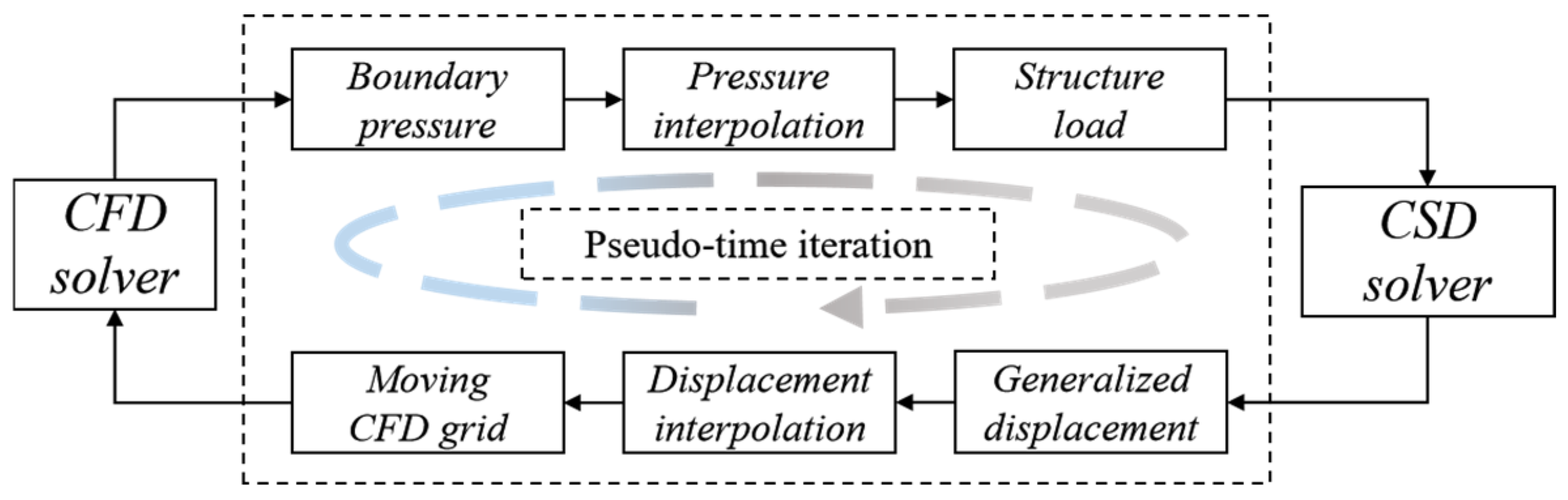
This study employs a bidirectional tightly coupled method to solve the aeroelastic problem of the S-shaped inlet duct. Figure 1 illustrates the computational workflow of this strategy, in which one loop represents a pseudo-time iteration of the control equations. Typically, multiple “fluid–structure” data exchange pseudo-time iterations occur within a single physical time step. During each pseudo-iteration, aerodynamic forces and displacement data at the fluid–structure interface are transferred using the Smart Bucket interpolation method [23], while the fluid domain mesh is dynamically updated via a moving mesh technique. When the data of the flow field, structure field and coupling surface all reach convergence tolerance in pseudo-time iteration, the computation proceeds to the next physical time step [24]. To balance computational stability and efficiency, the load information is usually transferred to the structural solver after several iterations in the fluid domain.

2.2. Method Validation

2.2.1. Flow Simulation Validation

The capability of the SAS approach based on the S-A turbulence model in simulating the internal flow of S-shaped ducts has been validated in the authors’ previous study [25]. In that work, the numerical predictions of wall static pressure coefficients at key cross-sections showed good agreement with the experimental data of Wellborn et al. [26]. Since the present investigation employs identical numerical settings, the detailed validation data are omitted here. Interested readers are referred to that study for details.

2.2.2. Validation of Fluid–Structure Interaction Methods

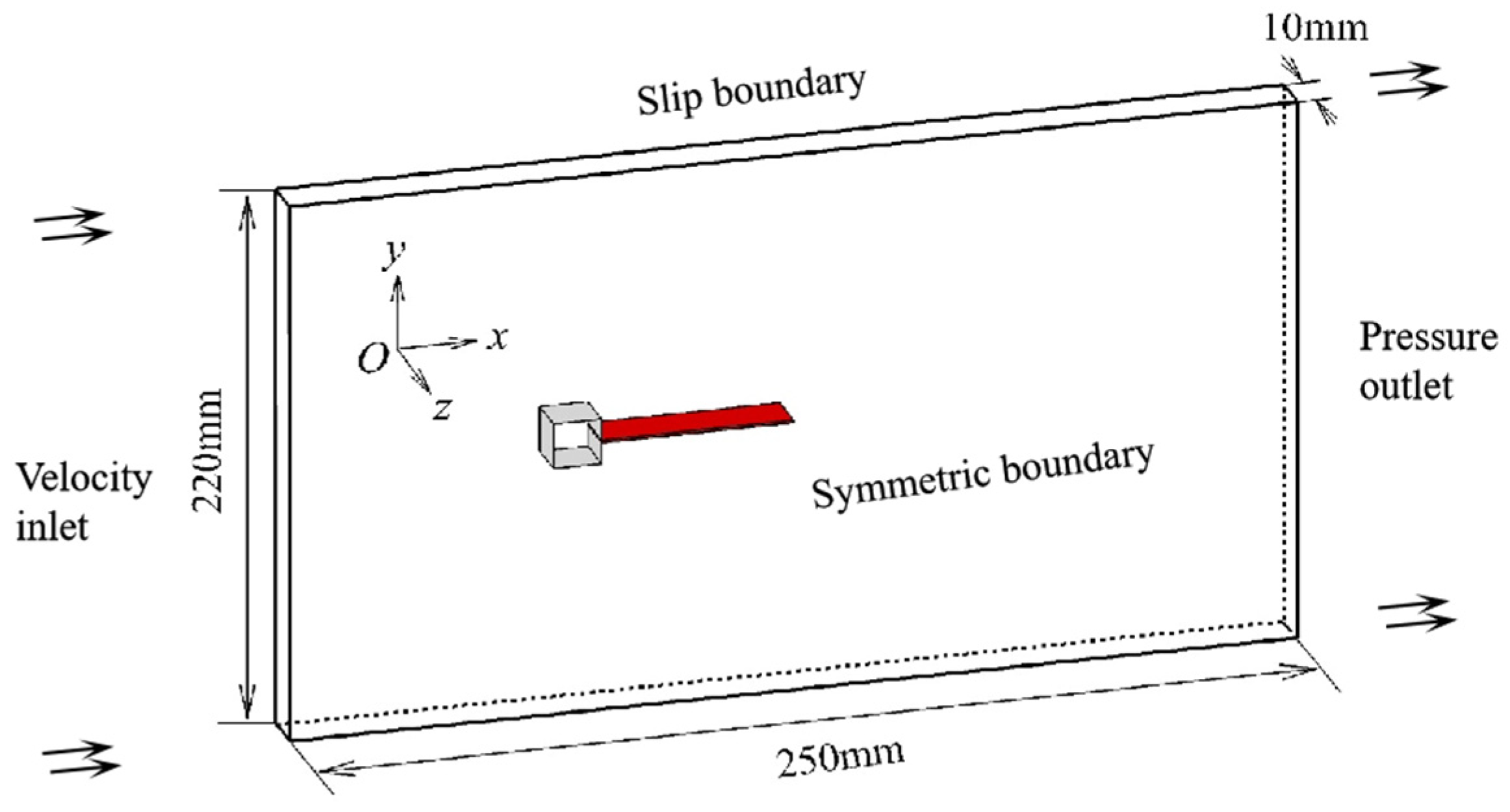
The classical vortex-induced vibration problem of a flexible plate in the wake of a square column is used to verify the reliability of the coupling scheme. The model and computational domain settings for the validation case are shown in Figure 2. The flexible plate is fixed in the center of the leeward side of the square column with a side length of 10 mm, with its dimensions of length, width, and thickness being 40 mm, 10 mm, and 0.6 mm, respectively. The flexible plate has a density of 100 kg/m3, elastic modulus of 0.25 MPa, and Poisson’s ratio of 0.3, while gravitational effects are neglected. The fluid is air with a density of 1.18 kg/m3 and dynamic viscosity of 1.82   ×   10 5 Pa·s. The computational domain is a rectangular box with dimensions of 250 mm (length) × 10 mm (width) × 220 mm (height). The left boundary is defined as a specified velocity inlet with u = 0.513 m/s, while the right boundary is a fixed pressure outlet with pressure matching the ambient pressure. The upper and lower surfaces of the computational domain are set as slip boundary conditions, and the spanwise boundaries are periodic. Correspondingly, the wall surfaces of the square cylinder and flexible plate are defined as no-slip and no-penetration boundaries.
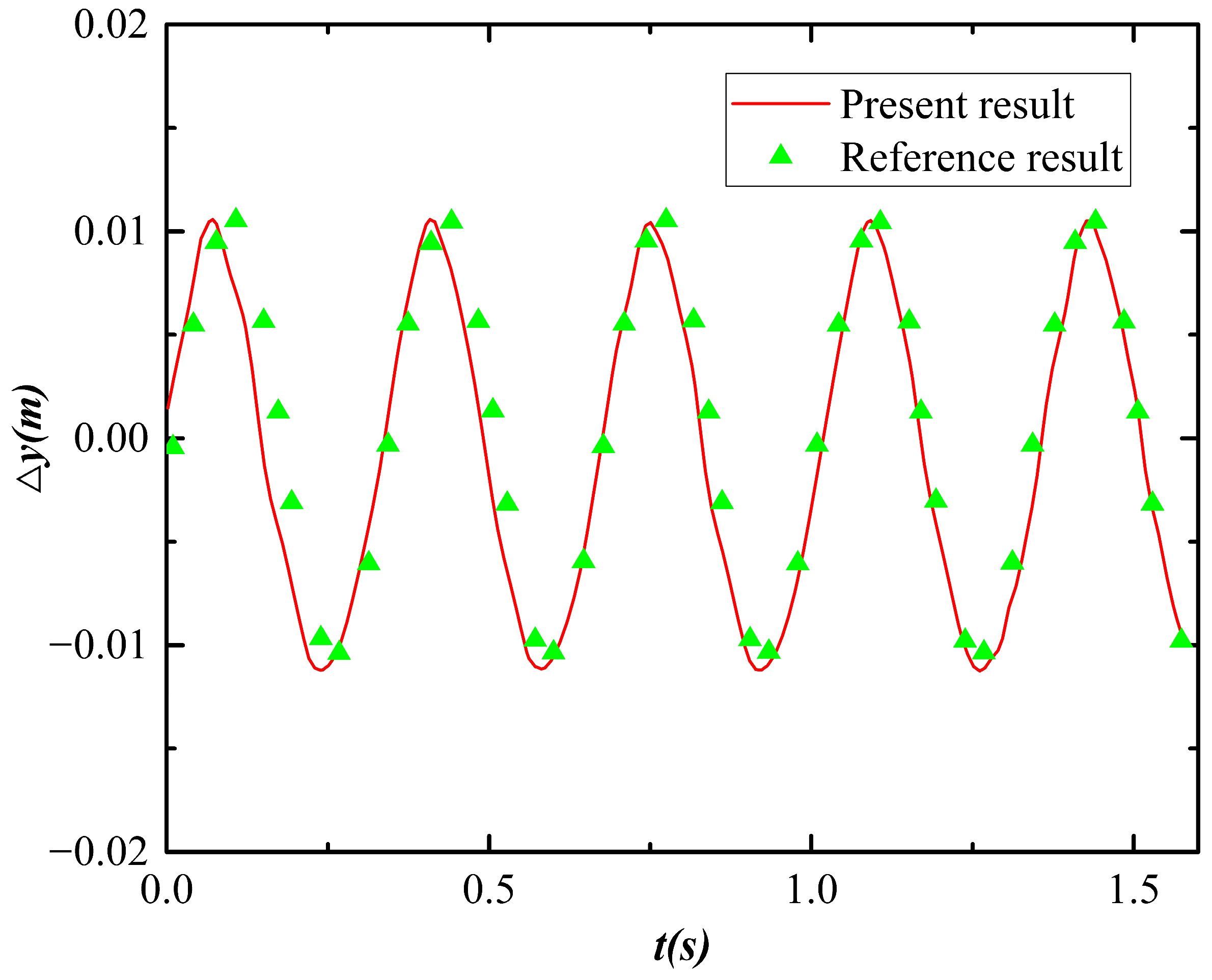
At the beginning of the calculation, the flexible plate is horizontally stationary, and a vertical load of 12 N is applied along the thickness direction. Considering the periodic impact of the shedding vortex in the wake region of the square column on the flexible plate, the plate will exhibit a typical vortex-induced vibration (VIV) phenomenon. Figure 3 shows the time history curve of the vertical displacement at the free end of the flexible plate, which is compared with the data from reference [27].
It can be seen that the current computational results show good agreement with the reference results, which proves the reliability and accuracy of the employed FSI method for solving tightly coupled unsteady problems. This method can be applied to subsequent aeroelastic research on S-shaped inlet ducts.

2.3. Geometric Model and Boundary Conditions

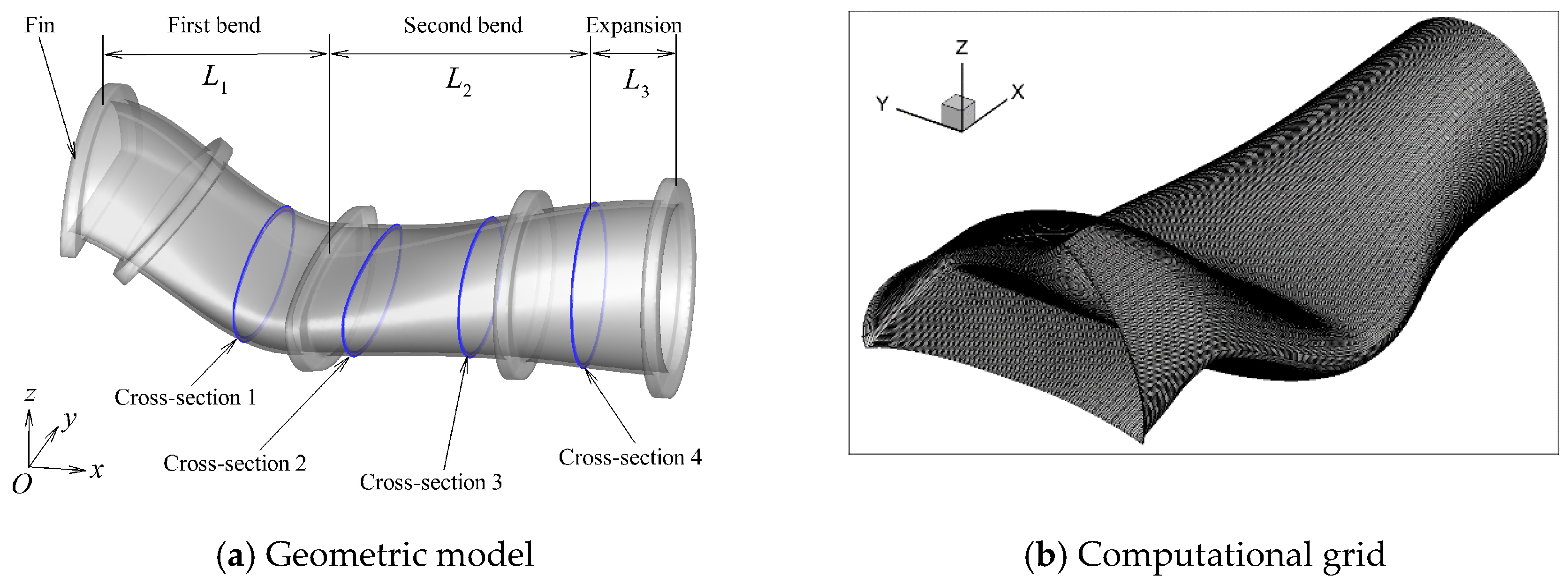
The geometric model of the S-shaped inlet duct studied in this paper is shown in Figure 4a, consisting of a semi-circular inlet, the first bend section, the second bend section, and a circular diffuser outlet. Owing to confidentiality restrictions tied to the engineering project from which the inlet model is derived, the detailed surface coordinates and the precise internal flow path dimensions cannot be released. Consequently, only the overall length L and the exit diameter D are supplied as basic dimensional references. The duct features an overall axial length of roughly 3.7 m, with a nominal exit diameter of approximately 0.9 m. It is worth noting that in order to simulate the actual installation constraints, several groups of fixed fin structures are set along the flow direction, and their boundaries are defined as fixed constraints in the coupled simulation. Four axial cross-sections (see Figure 4a) are selected for flow field analysis. Table 1 lists the geometric parameters, material properties, and computational conditions of the model. In addition, the fluid calculation domain uses an unstructured mesh with local refinement near the inlet and duct wall surfaces. After verifying grid independence, the total number of grids is approximately 4 million (see Figure 4b). A mass flow boundary condition is applied at the inlet, while a constant pressure boundary condition is specified at the outlet. To simulate different free-stream conditions, the specific values of mass flow rate at the inlet are determined based on the target Mach number using one-dimensional isentropic flow relations, ensuring that the calculated inlet mass flow corresponds to the desired flight Mach number. For non-zero angles of attack (α) and sideslip angles (β), the flow direction at the mass flow inlet is defined by specifying the velocity vector components. The angle of attack is implemented by rotating the velocity vector in the longitudinal (symmetry) plane, while the sideslip angle is achieved by rotating the vector in the lateral plane. This approach maintains the specified mass flow rate while correctly imposing the desired inflow angles relative to the duct axis. A grid independence study was conducted utilizing three sets of meshes with cell counts of 2.8 million, 4 million, and 6 million, respectively, as illustrated in Table 2. The results indicate that the total pressure recovery coefficient decreases slightly as the mesh resolution increases. Since the discrepancy between the 4 million and 6 million cell meshes is negligible, the 4 million cell mesh was selected for subsequent simulations to achieve an optimal balance between computational cost and accuracy. The study investigates flows with a Mach number ranging from 0.2 to 0.8.
The time step is set to ∆t = 5 × 10⁻⁶ s. Within each physical time step, the bidirectional tightly coupled approach performs pseudo-time iterations until the residuals of both the flow and structural fields drop below 10−4 and the relative error of displacement interpolation at the coupling interface falls below 0.5%, before advancing to the next time step to ensure synchronous convergence of the fluid–structure data exchange.

2.4. Evaluation Index of Inlet Performance

The primary role of an S-shaped inlet duct is to deliver a steady, uniform, and high-fidelity airstream to the engine face across the entire operational envelope. The total pressure recovery (TPR) and the total pressure distortion coefficient are key parameters for evaluating its performance. The definitions and calculation methods of these two indices are briefly introduced below.
To quantify the aerodynamic efficiency of the duct, the total pressure recovery (TPR) is evaluated as the ratio of the exit-plane total pressure to the freestream total pressure. Its expression is as follows:
TPR = P o u t P *
In the equation, P o u t and P represent the total pressure at the exit of the inlet and the total pressure of the free stream, respectively. A reduced TPR corresponds to heightened thrust penalties and degraded propulsive efficiency for the engine.
The total pressure distortion coefficient is defined as the ratio of the difference between the maximum and minimum total pressures at the exit section of the inlet to the average total pressure, to characterize the non-uniformity of total pressure distribution at the outlet cross-section. The expression is as follows:
D ¯ = P max P min P ¯
where P max , P min and P ¯ represent the maximum total pressure, minimum total pressure, and average total pressure at the outlet cross-section of the inlet duct, respectively. A higher D ¯ may pose a threat to the stable operation of the engine.
It should be noted that the max–min-based distortion coefficient adopted herein is primarily intended for comparative analysis between rigid and elastic configurations. While this metric is sensitive to local outliers, it provides a consistent conservative measure for assessing the relative impact of aeroelastic deformation on flow uniformity.

3. Results and Discussion

3.1. Comparative Analysis of Flow Characteristics Between Rigid and Flexible Intakes

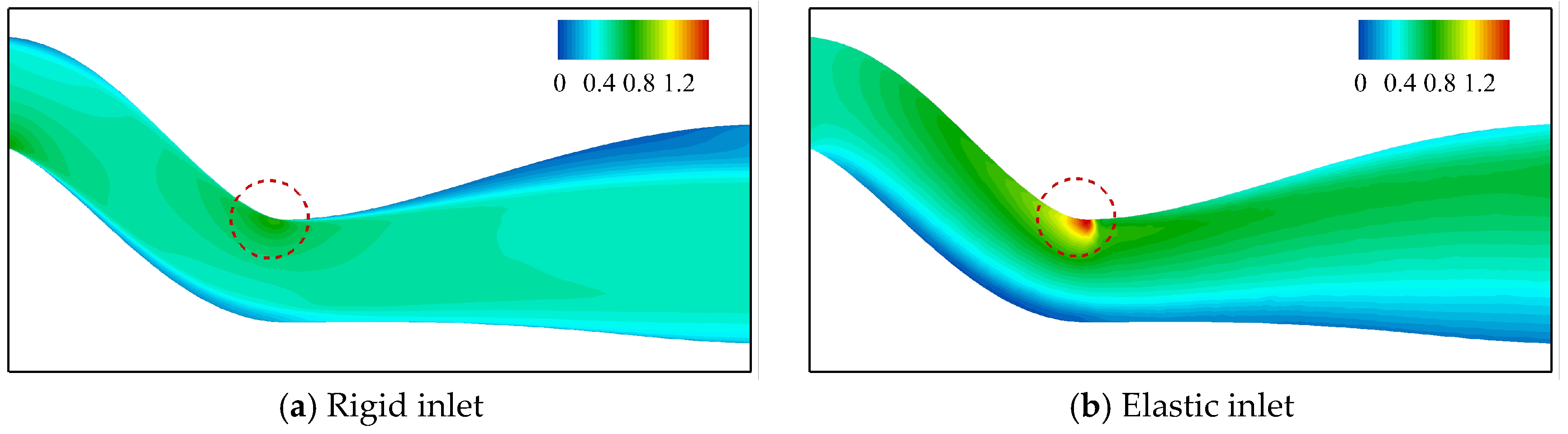
To reveal the influence of wall vibratory deformation on the internal flow field, the computational results of rigid and flexible (two-way strong coupling) inlets were compared under the condition of Mach number Ma = 0.5 with zero angle of attack and sideslip angle. For the rigid inlet configuration, a standalone CFD simulation is conducted with non-deformable wall boundaries, thereby excluding any aeroelastic effects. Figure 5 shows the Mach number distribution on the symmetry plane of the two inlets. It can be seen that the rigid inlet does not exhibit a supersonic region, and the high-speed flow adheres to the wall and develops uniformly, with only a part of the low-speed region appearing near the upper wall downstream of the second bend section. In contrast, the elastic inlet shows a local supersonic region near the upper wall at the junction of the first and second bend sections, and the flow velocity on the lower wall decays rapidly. This initially indicates that wall deformation alters the local equivalent curvature and flow structure.
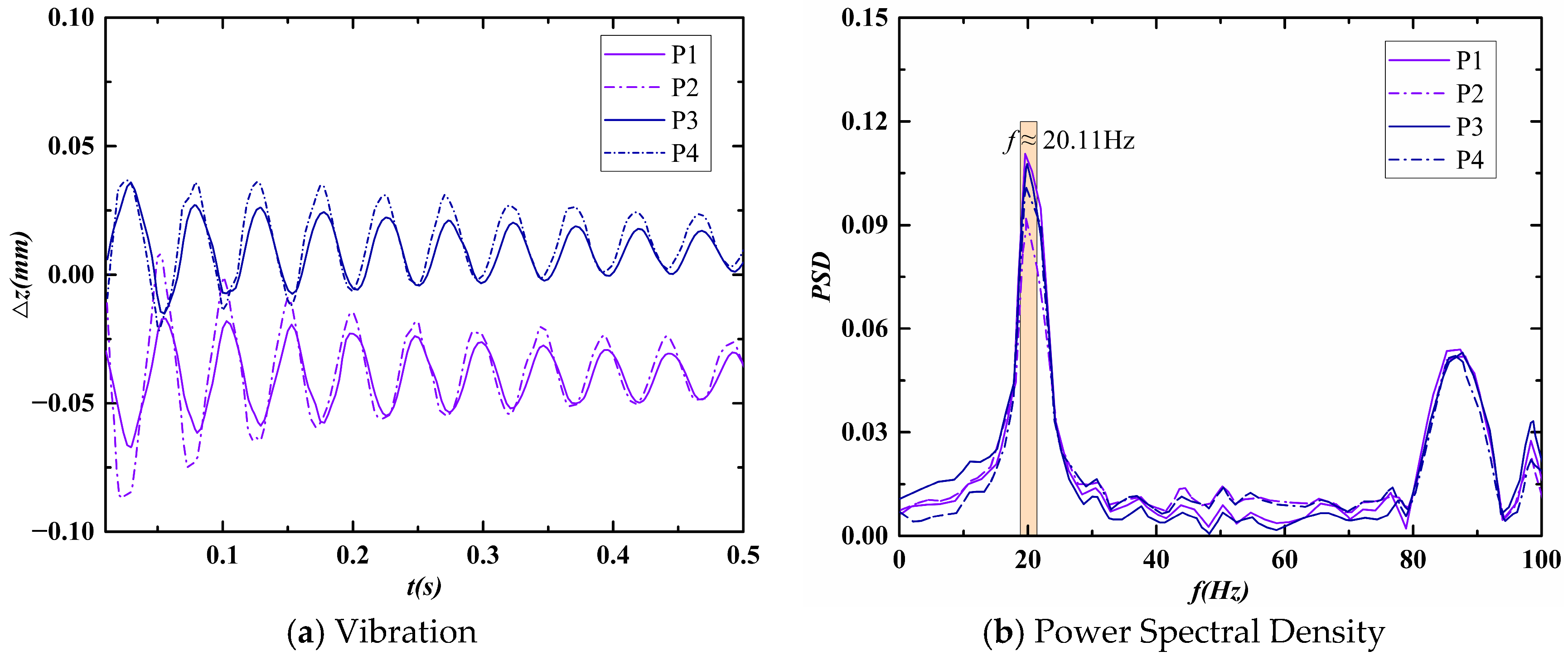
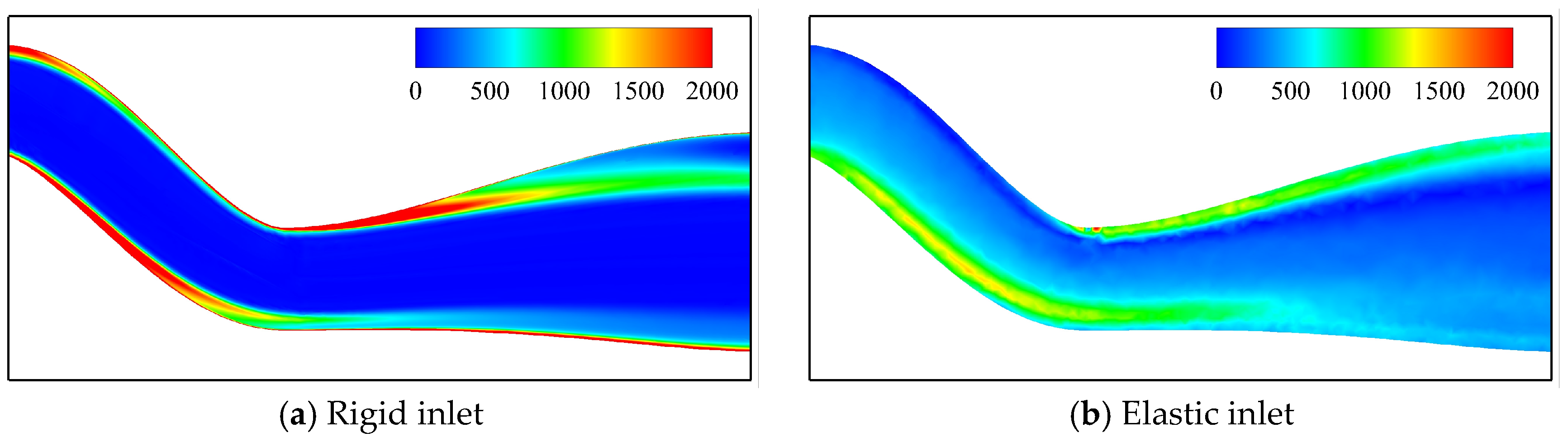
To investigate the deformation mode, Figure 6 presents the vibration displacement time histories and power spectral density distributions of the upper and lower wall monitoring points (P1–P4) at Section 1 and Section 2 of the elastic inlet during the initial transient phase. Among them, P1 and P2 correspond to the center points of the upper and lower walls at Section 1, while P3 and P4 correspond to the center points of the upper and lower walls at Section 2. It can be seen that the monitoring points exhibit periodic decaying vibrations with a dominant frequency of approximately 20.11 Hz, which indicates that the structural response is under a forced vibration state due to the constraint of fixed fins and has not reached the flutter critical point. Additionally, the lower wall of Section 1 shows external bulge deformation due to higher static pressure on the inner side caused by airflow impact, while the upper wall exhibits inward deformation due to reduced static pressure on the inner side caused by accelerated airflow. In contrast, both the upper and lower walls of Section 2 display alternating bulging and inward deformation. This phenomenon is attributed to the location of Section 2 at the junction of bend sections, where significant geometric curvature changes and surface profile variations, combined with strong secondary flow disturbances, make the structure more sensitive to flow excitation. With the advance of the time sequence, the transient response suggests that the first bend section shows a downward bending trend, while the second bend section shows an upward bending deformation, leading to an increase in the equivalent curvature of the inlet’s centerline. Based on the differences in internal flow fields of the two inlets shown in Figure 6, it can be inferred that the inward deformation of the upper wall increases local curvature, enhances flow acceleration effects, and even generates local supersonic flow. Meanwhile, the lower wall is shaped like an “aerodynamic slope”, and the outer bulge of the wall increases the local slope angle, which makes the airflow more prone to slow down and even separate. Under the combined effects of wall friction, adverse pressure gradient, and duct cross-sectional expansion, an extensive low-speed region forms near the lower wall of the elastic inlet.
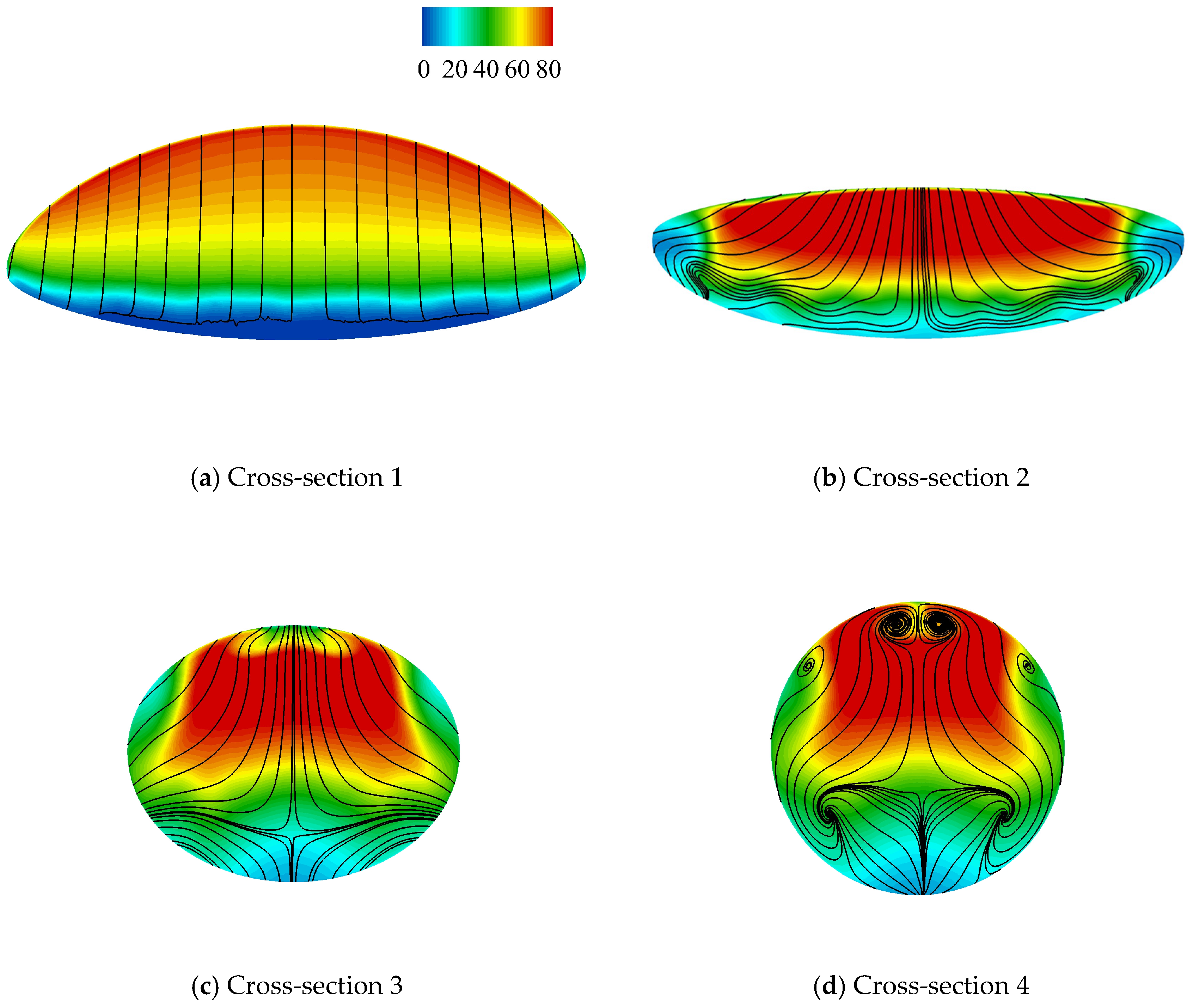
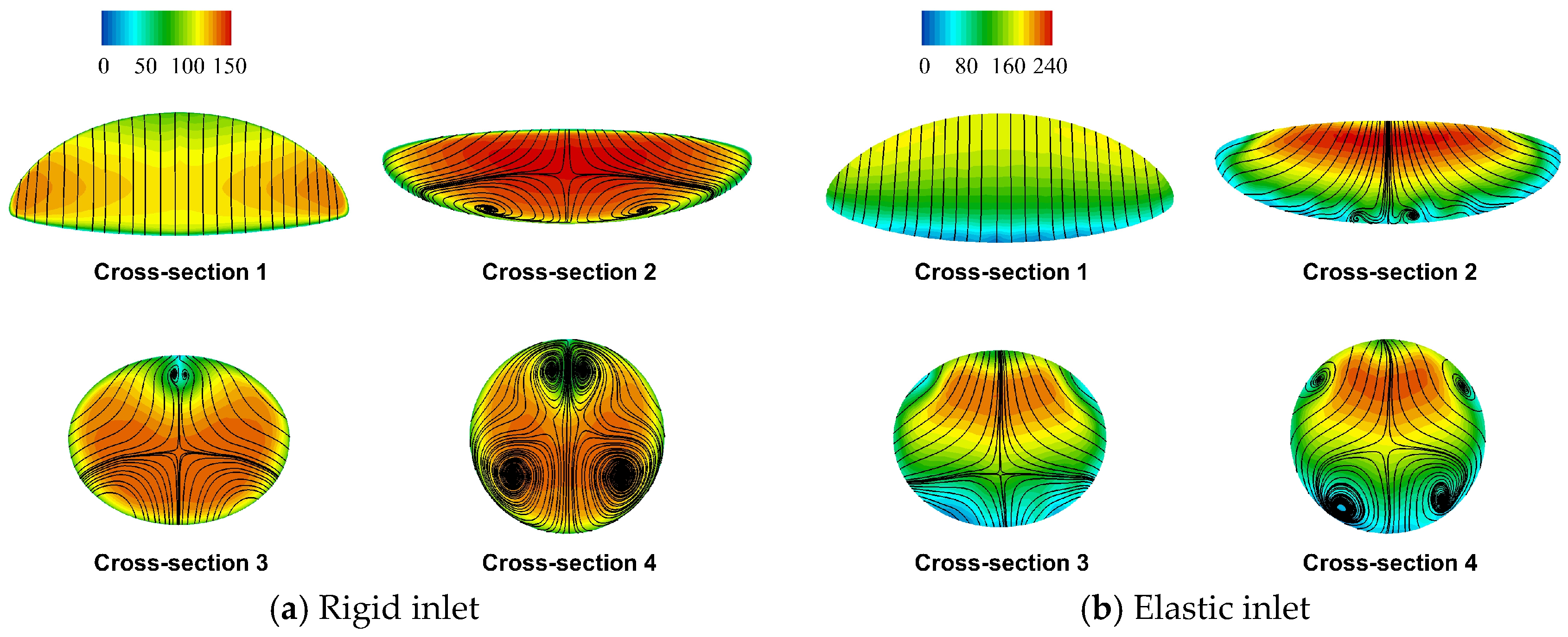
Figure 7 further compares the streamwise velocity and streamline distributions at four typical cross-sections of the two inlets. At Section 1, the flow fields of both inlets exhibit relatively uniform characteristics. At Section 2, the phenomenon of secondary flow and flow vortex appears obviously in the rigid inlet, while in the elastic inlet, the flow vortex is weaker, but the spanwise velocity gradient increases obviously. At Section 3, symmetric small-scale vortices appear near the upper wall of the rigid inlet, while the elastic inlet lacks obvious concentrated vortex structures but exhibits significantly increased spanwise velocity gradients (Figure 7). This indicates that wall vibration induces a redistribution of vorticity rather than mere suppression: the streamwise vorticity component is partially converted into cross-stream velocity gradients through the oscillating boundary condition, resulting in a more stratified velocity profile with reduced coherent vortical structures. At exit Section 4, the rigid inlet exhibits larger-scale symmetric vortices, while the vortex structure in the elastic inlet is suppressed. However, its velocity contour reveals that the flow is divided into a high-speed region near the upper wall and a low-speed region near the lower wall, significantly increasing flow non-uniformity. This phenomenon is primarily related to the mechanism of secondary flow in S-shaped inlets driven by transverse pressure gradients. The wall vibration deformation may interfere with the establishment of stable transverse pressure gradients, thus inhibiting the formation of strong vortex structures. However, it also introduces a new non-uniform velocity distribution.
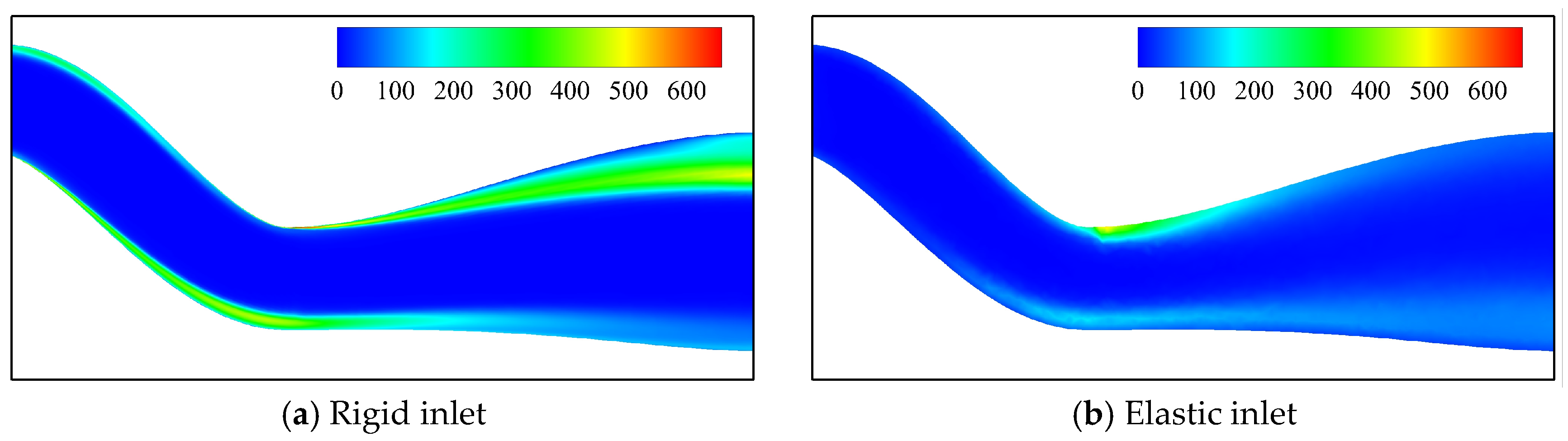
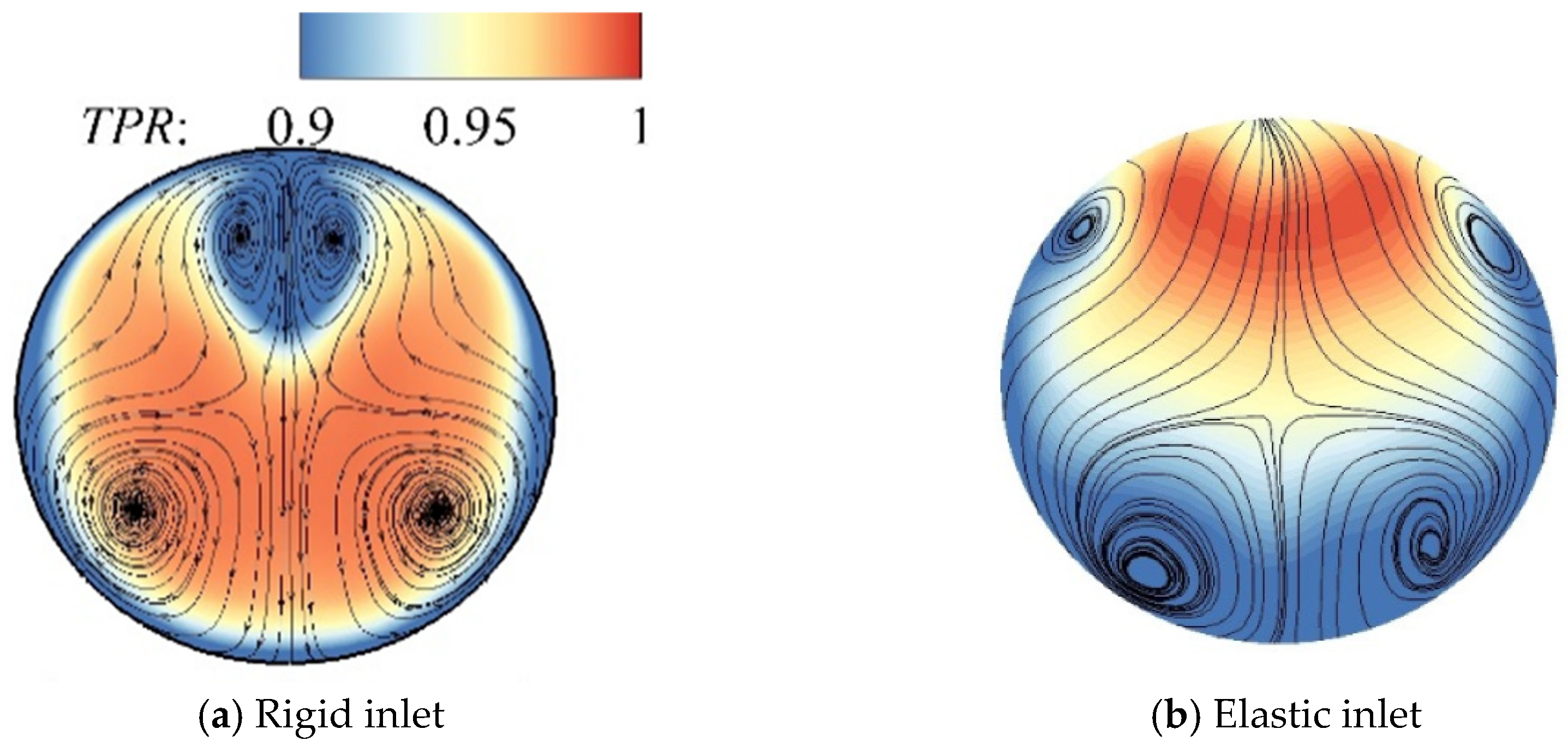
Vorticity and turbulent kinetic energy distribution further explain this phenomenon, as flow topology such as flow vortex in viscous flows is closely related to vortex dynamics, and turbulent fluctuations directly influence the evolution of vortex structure [28,29]. Figure 8 and Figure 9, respectively, compare the vorticity magnitude and turbulent kinetic energy distribution on the symmetric plane of the two inlets. For the rigid inlet, vorticity is highly concentrated in the near-wall boundary layer, primarily attributed to strong shear induced by flow acceleration caused by the large curvature of the wall structure. Combined with the streamline distribution in Figure 7a, it can be seen that the regions of concentrated vorticity and turbulent kinetic energy concentration are highly coincident with the secondary flow formation areas. It can be inferred that the secondary flow motion plays a dominant role in the formation of streamwise vortices and turbulent fluctuations. For the elastic inlet, vorticity exhibits a tendency to diffuse into the mainstream region, and the overall turbulent kinetic energy level is lower. According to vortex dynamics theory and related research on the suppression of near-wall turbulence by wall oscillation [30,31], wall vibration, as a velocity boundary condition perturbation, enhances the convection and diffusion transport of vorticity from the wall to the mainstream region, instead of enhancing turbulence to strengthen vorticity dissipation. This vorticity dilution effect reduces the near-wall vorticity peak and explains the weakened vortex structures observed in Figure 7b. However, this ‘dilution’ corresponds to a modal redistribution of vorticity—the energy originally concentrated in streamwise vortices is redistributed into cross-stream shear layers, evidenced by the increased spanwise velocity gradient at Section 4 (Figure 7). Subsequently, this vibration-induced non-uniform deformation leads to the total pressure distribution differences illustrated in Figure 10. Under identical flow conditions, the rigid inlet exhibits relatively uniform total pressure distribution (excluding the boundary layer), while the total pressure gradient in the elastic inlet is obvious. Its non-uniformity directly corresponds to the velocity stratification in cross-Section 4 of Figure 7b, indicating potential adverse effects on the inlet flow quality for the engine.

3.2. Analysis of the Impact of Free-Stream Mach Number on the Performance of Elastic Inlet

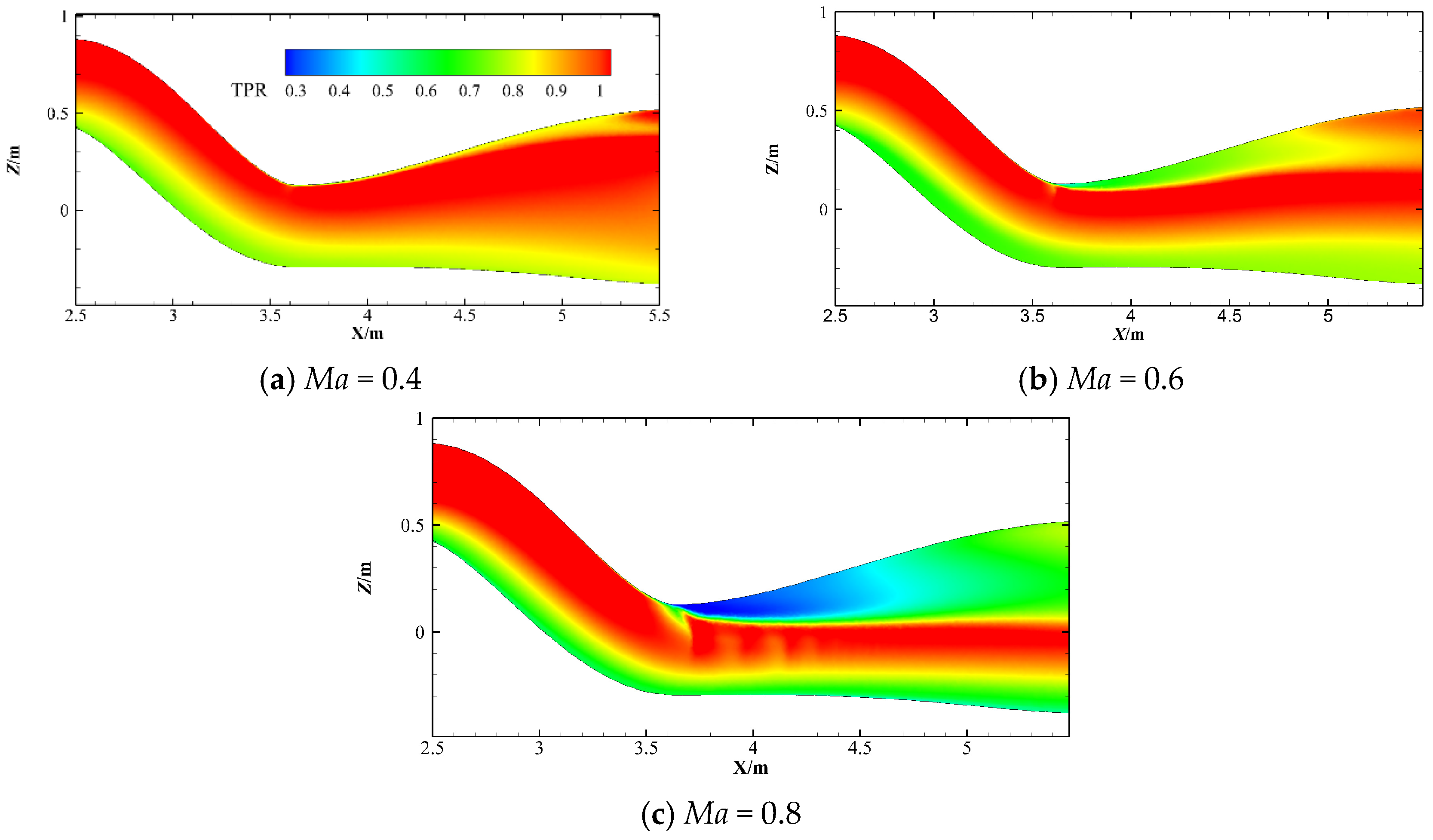
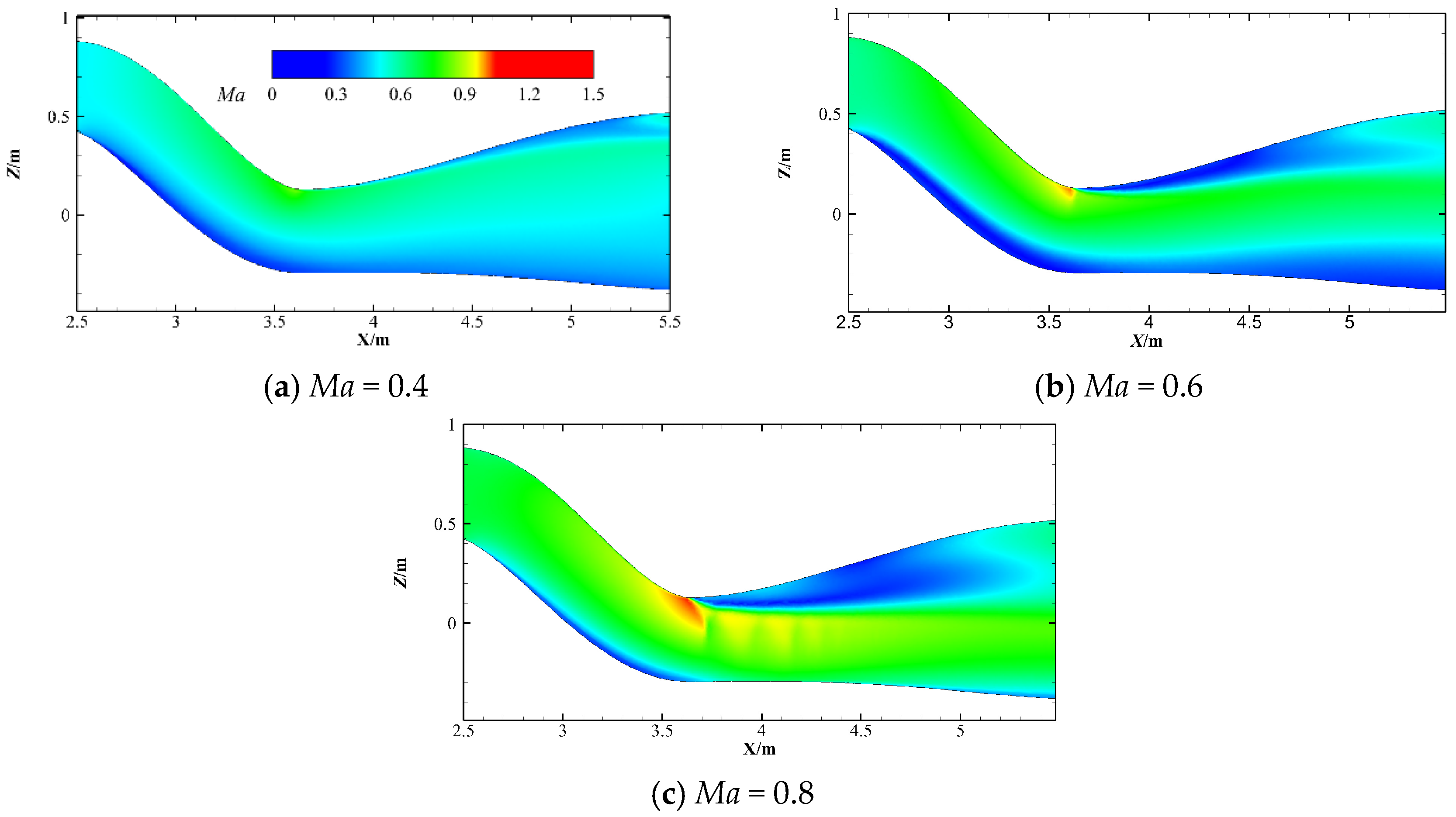
Figure 11 shows the TPR contour of the inlet flow field at Ma = 0.4, 0.6, and 0.8, and Figure 12 presents the velocity distribution on the symmetric cross-section of the inlet. Under three operating conditions, a low total pressure region forms on the lower wall due to the combined effects of friction, expansion, and vibration deformation. With the increase in Mach number, the airflow friction near the lower wall increases, causing the low-pressure area to gradually expand, which leads to a decrease in the TPR at the exit section. More importantly, at Ma = 0.6 and 0.8, a shock-induced boundary layer separation occurs on the upper wall of the second bend section due to localized acceleration to supersonic speeds (as observed in the shock surface and low-speed region in Figure 12’s velocity contour). The separation region exhibits intense momentum mixing, resulting in an extra core region of total pressure loss near the upper wall.
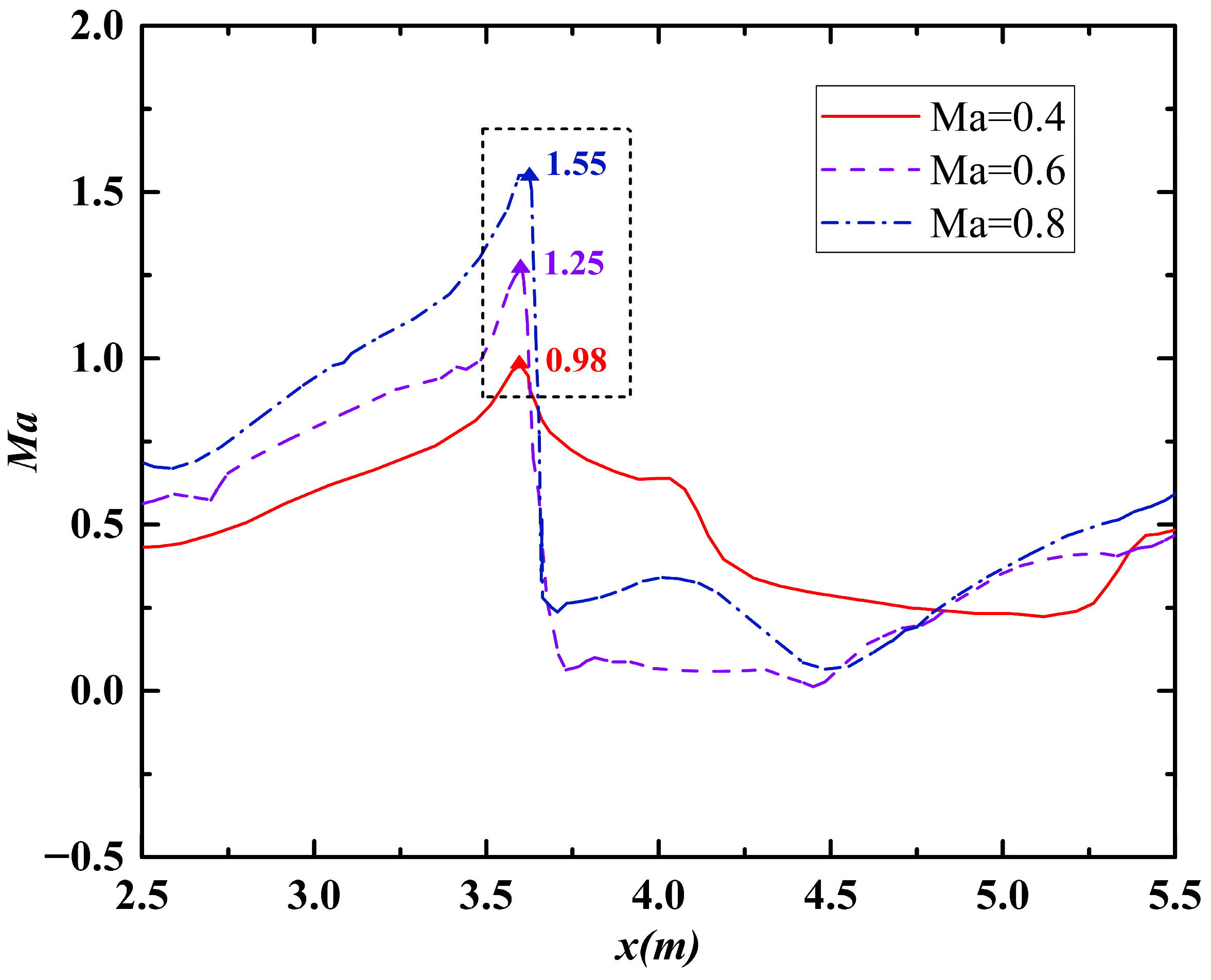
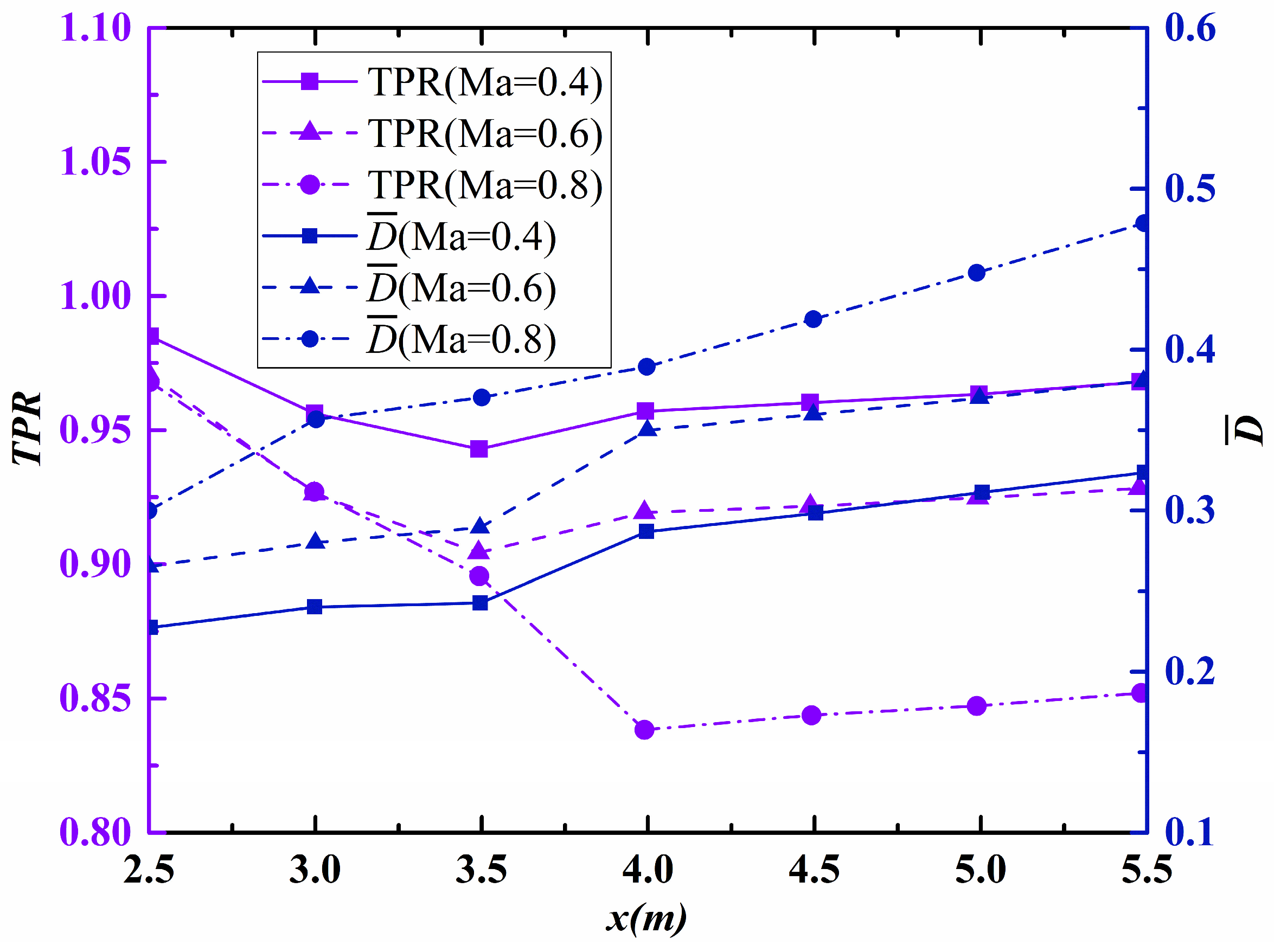
Figure 13 quantitatively illustrates the Mach number distribution near the centerline of the upper wall of the inlet. The supersonic peak appears in the second bend at Ma = 0.6 and 0.8 conditions and then decelerates rapidly due to shock waves and separation. The shock strength increases with the free-stream Mach number, resulting in a steeper adverse pressure gradient, a larger separation region and a higher total pressure loss. Figure 14’s performance parameter curves along the flow path quantitatively reflect this effect, where the TPR is minimized at the second bend position. Notably, the minimum value at Ma = 0.8 is as low as 0.838. Meanwhile, the total pressure distortion coefficient gradually increases along the flow direction and significantly rises at the outlet with increasing Mach number. This shows that localized supersonic flows and shock-induced separation have become the primary factors limiting the performance of the elastic inlet at high subsonic velocity.

3.3. Analysis of the Impact of Angle of Attack on the Performance of Elastic Inlet

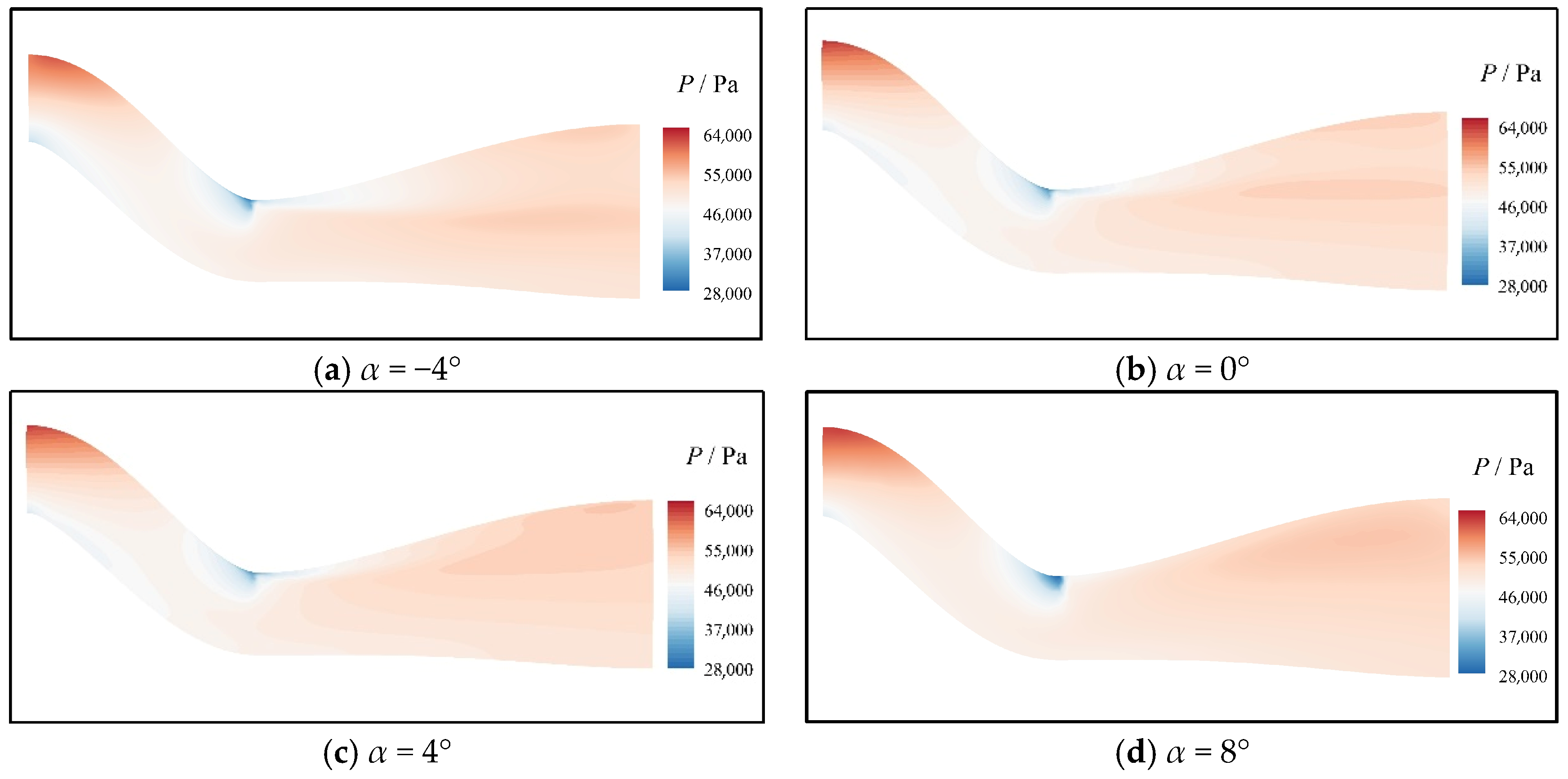
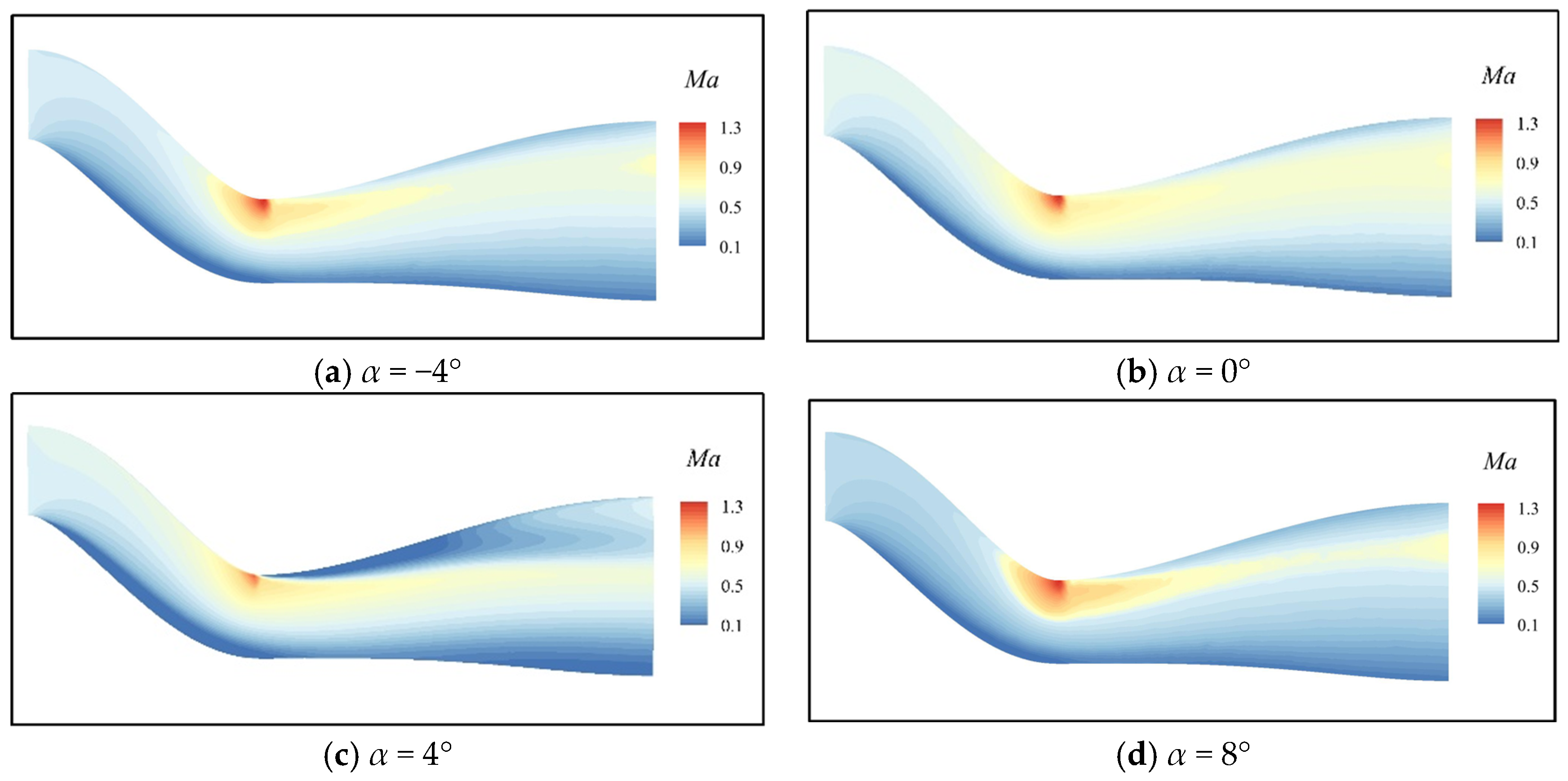
Under Ma = 0.5 conditions, the impact of angles of attack α = −4°, 0°, 4°, and 8° on inlet performance was analyzed. The total pressure distribution contour in Figure 15 shows that the overall pattern of total pressure loss has not changed fundamentally within this angle of attack range. However, the Mach number distribution in Figure 16 reveals the difference in local flow details. As the angle of attack increases, flow separation on the upper wall of the second bend section gradually intensifies, and there is a certain increase in the downstream low-speed region.
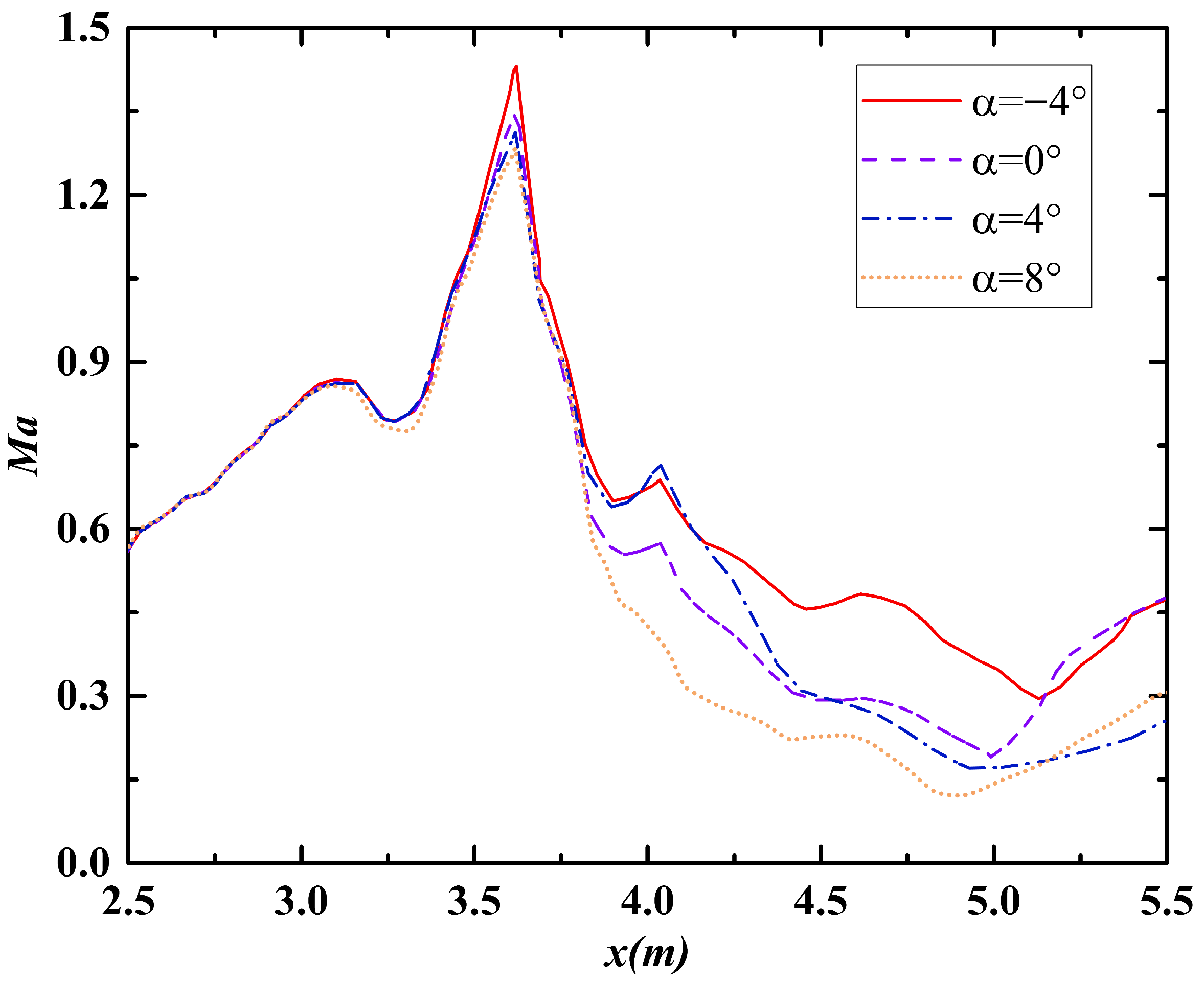
As presented in Figure 17, the Mach number curve on the upper wall shows that after undergoing shock wave deceleration, the airflow velocity in the divergent section under the 8° angle of attack condition is significantly lower than that in the small angle of attack condition. This is attributed to more pronounced flow separation, which leads to a thicker, low-energy flow region.
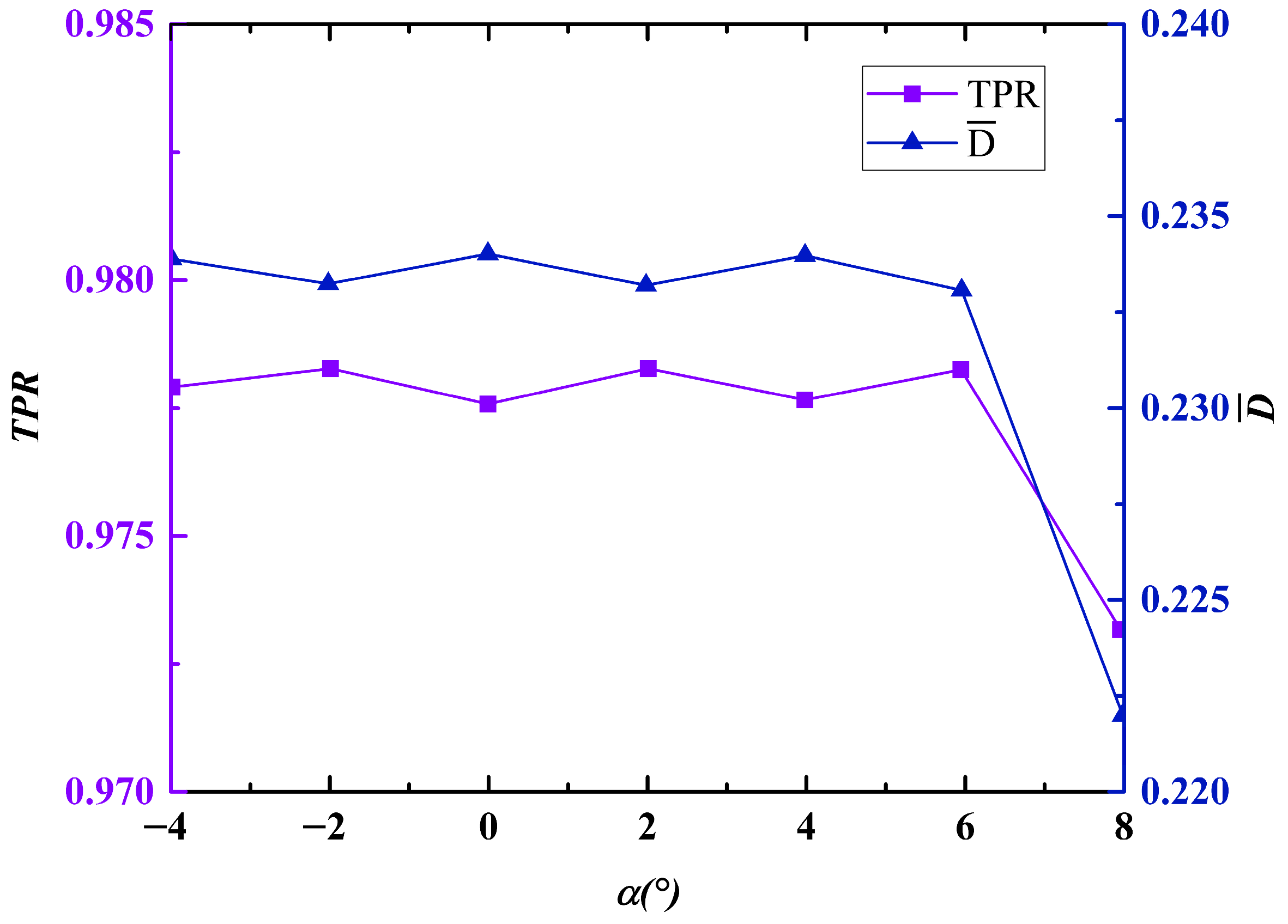
Although the flow structure has changed, the quantitative assessment of the inlet’s exit performance index in Figure 18 shows that at an angle of attack of 6°, both the TPR and the total pressure distortion coefficient experience little change. Only at α = 8° does the TPR slightly decrease from 0.978 to 0.973, while the distortion coefficient declines from 0.234 to 0.222. This indicates that within the current model and parameter range, small to moderate angle-of-attack variations have limited impact on the overall performance of elastic inlets. The performance degradation is primarily due to the extra total pressure loss caused by intensified flow separation.

3.4. Analysis of the Impact of Sideslip Angle on the Performance of Elastic Inlet

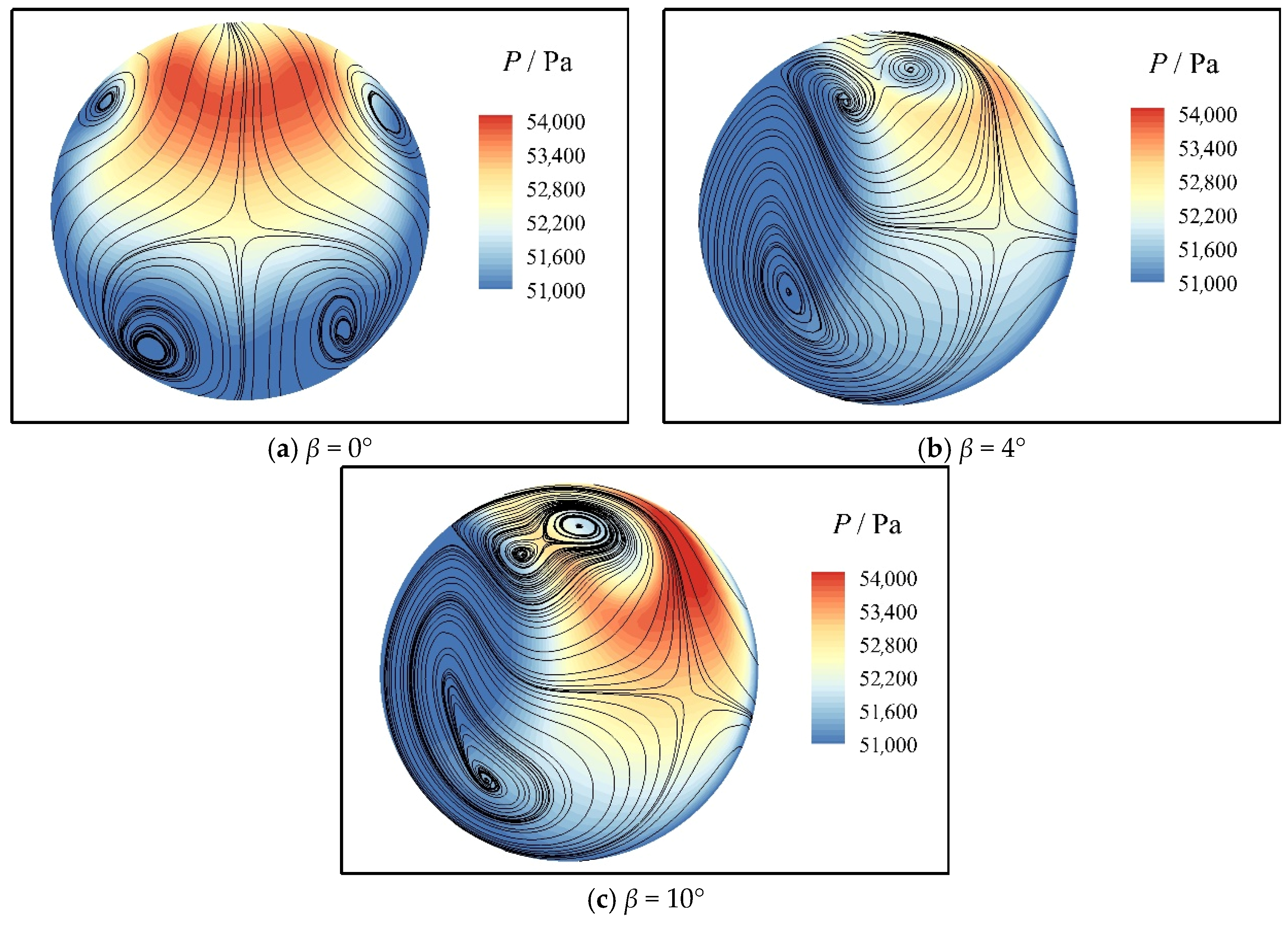
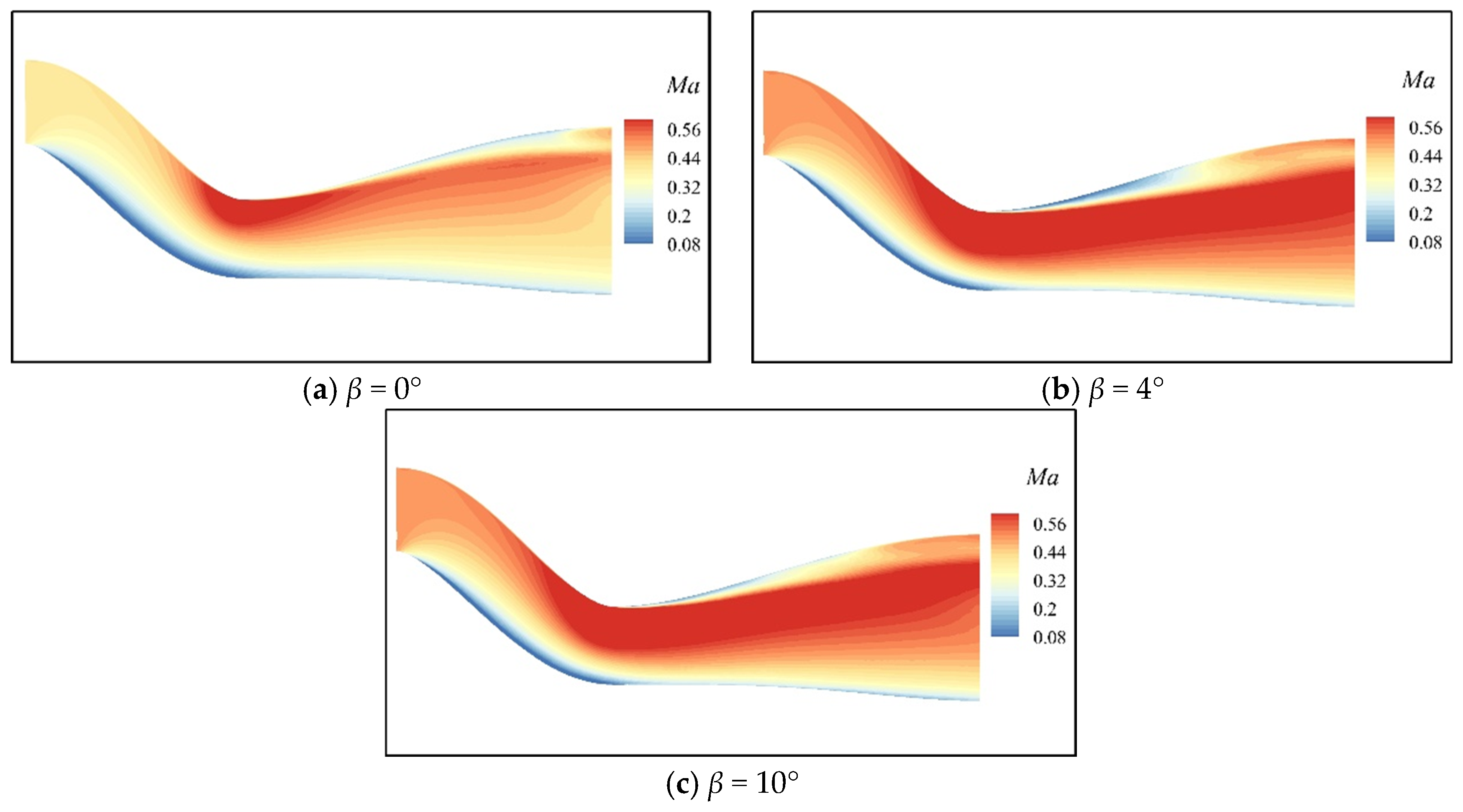
Under the conditions of Ma = 0.5 and α = 0°, the effects of sideslip angles β = 0°, 4°, and 10° were analyzed. Figure 19 illustrates the total pressure and streamline distribution at the exit section under three sideslip angles.
It can be observed that under the 0° sideslip angle condition, the flow field exhibits significant symmetry, with two pairs of streamwise vortices existing on the upper and lower sides. Upon introduction of the sideslip angle, the crossflow velocity component interacts nonlinearly with the secondary flow within the inlet, which destroys the symmetry. The vortex structure on the windward side tends to merge, while the vortex on the leeward side is stretched and weakened. In addition, the pressure on the windward side is obviously higher than that on the leeward side, forming a transverse total pressure gradient. Further observing the Mach number distribution in the symmetry plane of the inlet in Figure 20, the crossflow induced by the sideslip angle is intensified by the high-curvature geometric configuration in the second bend section, resulting in the expansion of the high-Mach-number region.
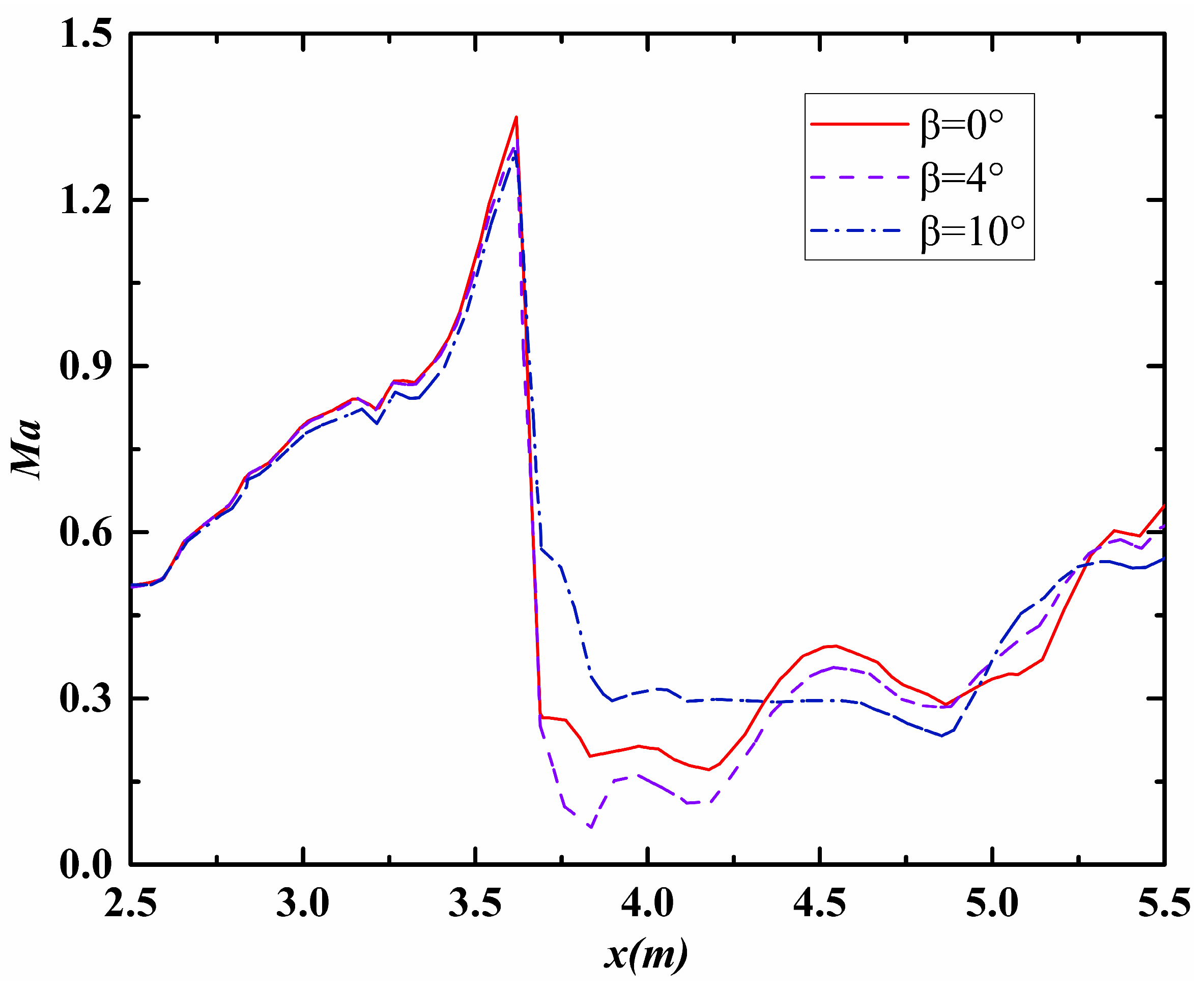
Figure 21 shows the Mach number distribution curves near the centerline of the inlet upper wall under three operating conditions. It can be observed that the sideslip angle has a non-monotonic effect on the velocity decay downstream of the shock wave. When β = 4°, the Mach number along the centerline of the upper wall drops sharply to approximately 0.1 downstream of the shock wave, which may be attributed to the continuous transportation and accumulation of low-energy fluid in this region by the moderate-intensity asymmetric vortices. The excessively dense low-speed fluid leads to an abnormal increase in the adverse pressure gradient, thereby leading to a significant deceleration of the flow. When β increases to 10°, the stronger crossflow effectively sweeps away the low-energy fluid, weakening the adverse pressure gradient and reducing the velocity decay. It should be noted that the current explanation regarding the non-monotonic effect at β = 4° is based on qualitative observations of flow field topology and vortex structures. Quantitative metrics such as vortex circulation and low-energy fluid volume fraction will be investigated in future work to provide further validation of this mechanism.
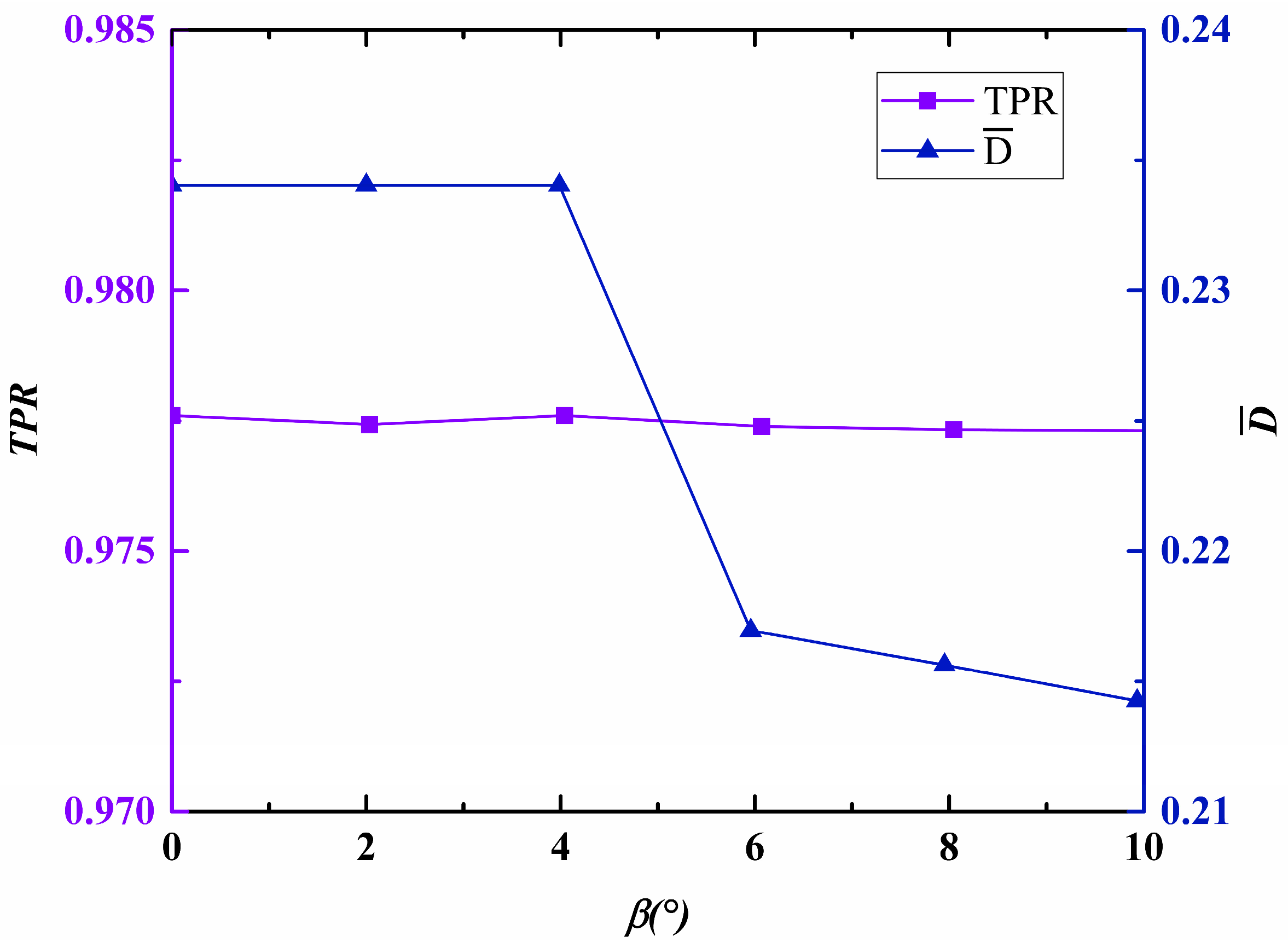
Although the internal flow field is significantly altered, Figure 22 shows that the average TPR at the exit section remains approximately 0.9775. However, the total pressure distortion coefficient decreases from 0.234 to 0.214 as β increases from 4° to 6°, which may be due to the moderate asymmetric vortex, which enhances the momentum exchange between the low-energy fluid and the mainstream in the transverse and spanwise directions. This effect acts as a "mixing recovery" upstream of the outlet, which reduces the degree of non-uniformity in the total pressure distribution. However, this comes at the cost of a more complex flow structure.

3.5. Performance Analysis of a Elastic Inlet Under High-Angle-of-Attack Takeoff Conditions

According to the standard inlet database published by NASA [32] and the analysis results in Section 3.2, inlet performance under low Mach number conditions typically exhibits a relatively low TPR, which limits the maximum thrust of the engine. In addition, total pressure distortion significantly affects the stability margin of engine operation [33]. During the aircraft takeoff phase, the low flight speed and large angle of attack result in poor inlet flow, which can easily trigger engine operational failures and cause serious consequences. Therefore, as one of the extreme operating conditions, analyzing the inlet performance under high-angle-of-attack takeoff conditions is necessary.
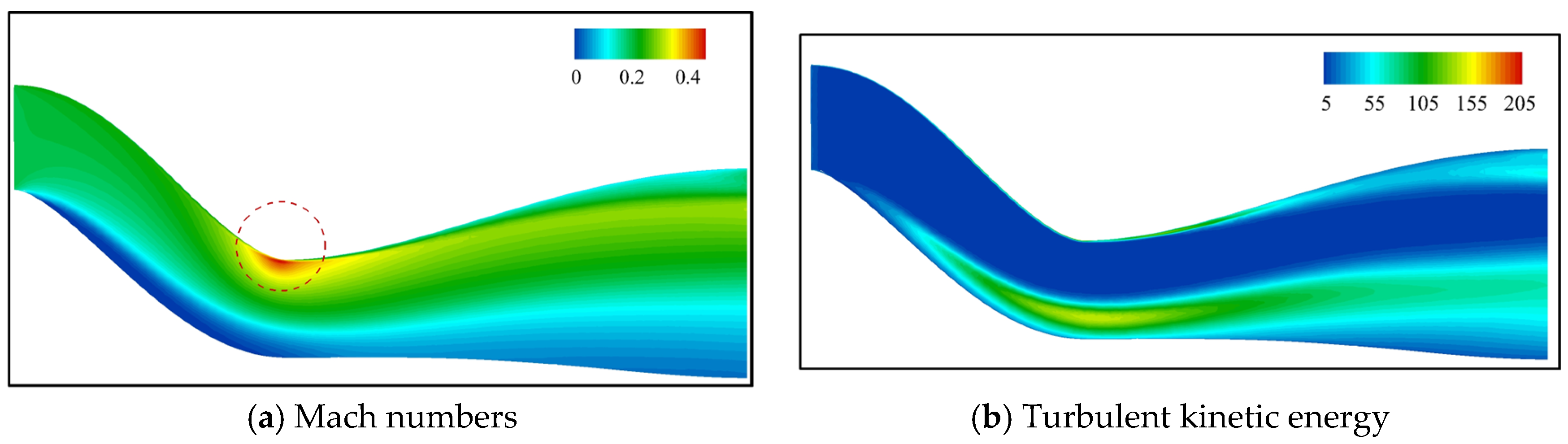
The takeoff angle of attack α is set to 10° and Ma is 0.2. Figure 23 shows the Mach number distribution and corresponding turbulent kinetic energy distribution on the symmetrical section of the inlet. Figure 24 presents the streamwise velocity and streamline distribution at typical cross-sections along the flow path. As shown in the figures, under high-angle-of-attack takeoff conditions, the angle between the inlet and the incoming flow is excessively large, causing severe flow separation on the lower wall of the inlet entrance and generating extensive low-speed regions and high-turbulence regions. The cross-sectional distribution nephogram of Figure 24 shows that there is obvious flow stratification in cross-section 1. In addition, the stratification of cross-sectional flow velocity generates a spanwise pressure gradient. The low-speed fluid in the separation region flows along the wall under the pressure gradient, forming a “pea-shaped” streamwise vortex structure as shown in Section 2 [34]. When the airflow passes through the second bend section, local acceleration occurs at the upper wall, and flow separation appears due to the large curvature of the wall, which corresponds to the absence of high-speed regions near the upper wall in Section 3. Combined with the analysis results from Section 3.1, the vibration and deformation of the lower wall suppress the vorticity peak, and the initially formed vortex structure is reorganized into secondary flow at Section 3. At Section 4, the flow field is still dominated by a strong symmetric vortex system, with a significant spanwise velocity gradient.
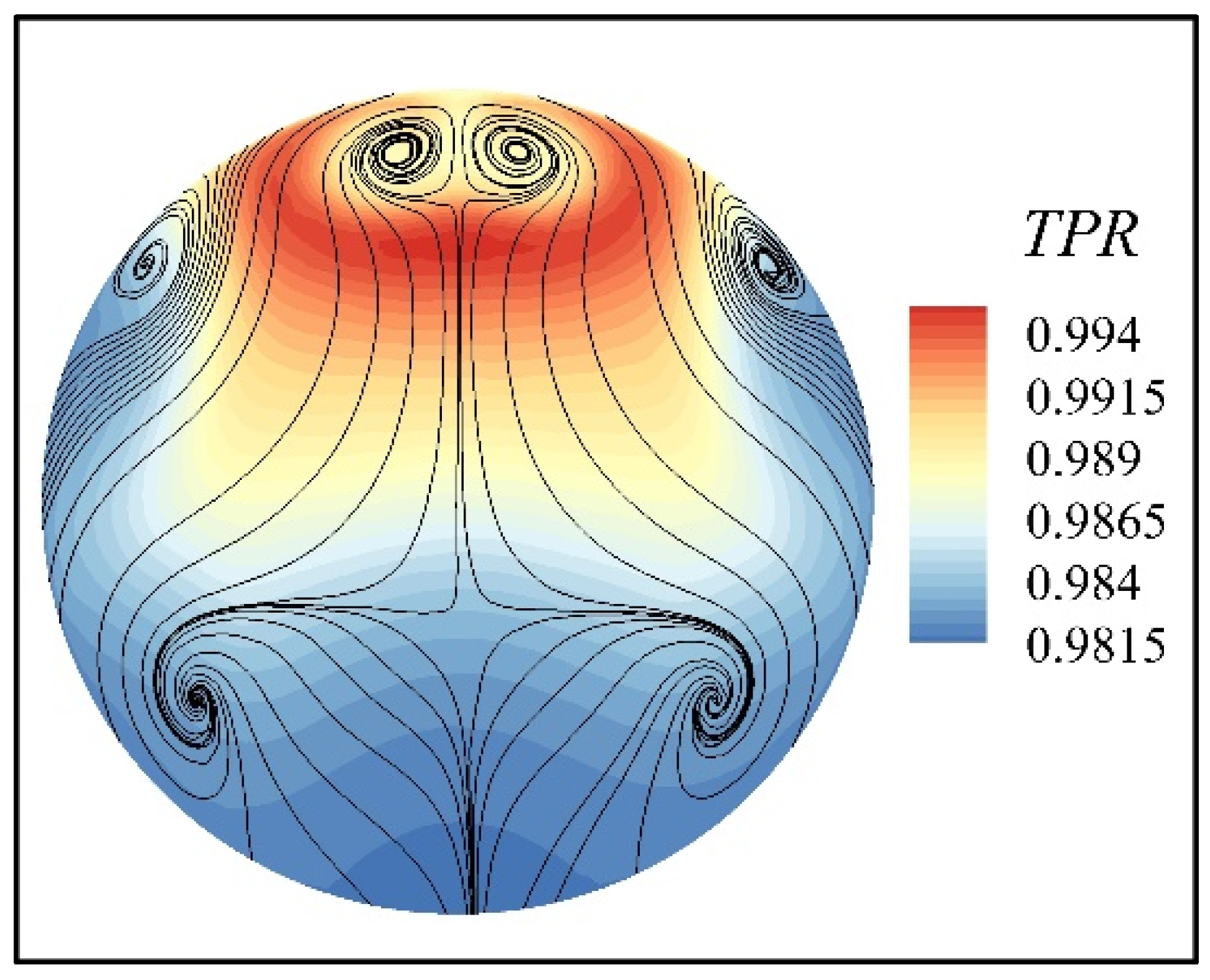
Under this operating condition, the TPR contour map of the exit section shown in Figure 25 exhibits a “C”-shaped distribution, with the high total pressure region constrained toward the upper-middle part of the duct. This is caused by the mixing of high total pressure loss airflow from the large separation region on the lower wall with the mainstream, which is induced by streamwise vortices, resulting in a significant transition region. Although the Mach number during takeoff is low and shock loss does not exist, the severe separation on the lower wall and complex streamwise vortex system still lead to poor uniformity of the exit flow field, posing a threat to the stability of engine operation.

4. Conclusions

This study systematically investigates the fluid-solid coupling characteristics of an S-shaped elastic inlet under subsonic conditions and their effects on inlet performance through CFD/CSD bidirectional tightly coupled numerical simulation. The main conclusions are as follows:
(1)
Wall vibration and deformation can significantly alter the flow field structure inside the S-shaped inlet. Compared to rigid models, elastic deformation changes the modality of secondary flow development: through vorticity diffusion and boundary perturbation effects, vorticity is redistributed from concentrated streamwise vortices into cross-stream shear layers, evidenced by reduced coherent vortical structures but increased spanwise velocity gradients at the exit. This modal redistribution delays the formation of organized vortices but introduces a stratified velocity distribution, leading to increased flow non-uniformity at the exit section and posing a potential threat to stable engine operation.
(2)
The free-stream Mach number is the most critical parameter affecting the performance of the elastic inlet. When Ma ≥ 0.6, local acceleration caused by curvature can easily trigger local supersonic flow. Shock-induced boundary layer separation becomes the primary cause of a sharp increase in total pressure loss and flow distortion at the outlet, and inlet performance declines significantly with rising Mach number.
(3)
Within the scope of this study, the angle of attack within 0–8° has limited impact on inlet performance, while the sideslip angle induces asymmetric streamwise vortices that alter the outlet total pressure distribution but has limited effect on the average performance. Furthermore, larger sideslip angles may even reduce the total pressure distortion coefficient by enhancing momentum exchange.
(4)
Under the large angle of attack takeoff condition, severe flow separation occurs at the intake entrance. The internal flow field is dominated by secondary flow and streamwise vortices, resulting in poor uniformity of the exit flow. This issue requires focused particular attention during the intake design process.
(5)
In the design of high-performance and lightweight intake, the effects of wall elastic deformation must be taken into comprehensive consideration. Conducting FSI analysis and co-optimization is crucial under high transonic cruise and high-angle-of-attack takeoff conditions.
These findings provide essential design guidelines for improving the aeroelastic stability and aerodynamic performance of next-generation S-duct inlet systems. Future work will focus on extending the analysis to transient maneuvers and incorporating active flow control strategies to mitigate aeroelastic effects.

Author Contributions

Conceptualization, D.L. (Daxin Liao) and Y.T.; methodology, D.L. (Daxin Liao) and H.W.; software, D.L. (Daxin Liao); validation, F.L. and C.Z.; formal analysis, H.W.; investigation, F.L.; resources, N.X. and D.L. (Dawei Liu); data curation, D.L. (Daxin Liao) and H.W.; writing—original draft preparation, D.L. (Daxin Liao); writing—review and editing, D.L. (Dawei Liu) and Y.T.; visualization, C.Z.; supervision, Y.T.; project administration, D.L. (Dawei Liu) and Y.T.; funding acquisition, N.X. and Y.T. All authors have read and agreed to the published version of the manuscript.

Funding

This research received no external funding.

Data Availability Statement

Data are available on request due to restrictions.

Conflicts of Interest

The authors declare no conflicts of interest. The funders had no role in the design of the study; in the collection, analyses, or interpretation of data; in the writing of the manuscript; or in the decision to publish the results.

Abbreviations

The following abbreviations are used in this manuscript:
FSIFluid–structure interaction
SASScale-adaptive simulation
PIVParticle image velocimetry
CSDComputational structural dynamics
TPRTotal pressure recovery

References

  1. Huang, H.X.; Sun, S.; Yu, H.; Tan, H.J.; Lin, Z.K.; Li, Z.J.; Wang, K. Recent progress in subsonic S-shaped inlets. J. Propuls. Technol. 2020, 41, 2641–2658. (In Chinese) [Google Scholar] [CrossRef]
  2. Vaccaro, J.C.; Elimelech, Y.; Chen, Y.; Sahni, O.; Jansen, K.E.; Amitay, M. Experimental and numerical investigation on steady blowing flow control within a compact inlet duct. Int. J. Heat Fluid Flow 2015, 54, 143–152. [Google Scholar] [CrossRef]
  3. Yang, H.; Li, F.; Song, Y.Y.; Sun, B.G. Numerical investigation of electrohydrodynamic (EHD) flow control in an S-shaped duct. Plasma Sci. Technol. 2012, 14, 897–904. [Google Scholar] [CrossRef]
  4. Wojewodka, M.M.; White, C.; Shahpar, S.; Kontis, K. A review of flow control techniques and optimization in S-shaped ducts. Int. J. Heat Fluid Flow 2018, 74, 223–235. [Google Scholar] [CrossRef]
  5. Zhao, W.C. Integrated Investigation of the Flow Features in A Serpentine Inlet and A Transonic Fan. Ph.D. Dissertation, Nanjing University of Aeronautics and Astronautics, Nanjing, China, 2019. (In Chinese) [Google Scholar]
  6. Guo, R.W.; Seddon, J. Swirl Characteristics of an S Shaped Air Intake with Both Horizontal and Vertical Offsets. Aeronaut. Q. 1983, 34, 130–146. [Google Scholar] [CrossRef]
  7. Abdellatif, O.; Abd, R.M.; Abd, E.M.; Shahin, I. Area Ratio Effect on the Turbulent Flow Through a Diffusing S-Duct Using Large-Eddy Simulation. In Proceedings of the 6th International Energy Conversion Engineering Conference (IECEC), Cleveland, OH, USA, 28–30 July 2008. AIAA Paper 2008-5726. [Google Scholar] [CrossRef]
  8. Mclelland, G.; Macmanus, D.G.; Zachos, P.K.; Gil-Prieto, D.; Migliorini, M. Influence of upstream total pressure profiles on S-duct intake flow distortion. J. Propuls. Power 2020, 36, 346–356. [Google Scholar] [CrossRef]
  9. Saha, K.; Singh, S.N.; Seshadri, V. Effect of yaw angle on the performance characteristics of twin intake duct. J. Aircr. 2017, 54, 1210–1215. [Google Scholar] [CrossRef]
  10. Behfarshad, G.; Mahlou, S. Wind-tunnel study of a-S-shaped air-intake performance. Aircr. Eng. Aerosp. Technol. 2014, 86, 99–107. [Google Scholar] [CrossRef]
  11. Jia, W.; Li, G.H.; Liu, T.; Kong, Q.G.; Ding, S.T. Numerical analysis of the effect of S-shaped duct key geometry parameters on the inlet distortion of distributed ducted fans. Aerospace 2025, 12, 316. [Google Scholar] [CrossRef]
  12. Jing, J.P.; Guo, R.W. Study on influence of pneumatic deformation on the performance of a single module inlet with thin shell. J. Astronaut. 2011, 32, 105–110. (In Chinese) [Google Scholar] [CrossRef]
  13. Ye, Z.Y.; Meng, Z.X.; Liu, C.; Ye, L.Q. Progress and prospects on aeroelasticity of hypersonic vehicles. Acta Aerodyn. Sin. 2018, 36, 983–994. (In Chinese) [Google Scholar] [CrossRef]
  14. Afonso, F.; Vale, J.; Oliveira, E.; Suleman, A. A review on non-linear aeroelasticity of high aspect-ratio wings. Prog. Aerosp. Sci. 2017, 89, 40–57. [Google Scholar] [CrossRef]
  15. Wang, L.; Liu, X.; Kolios, A. State of the art in the aeroelasticity of wind turbine blades: Aeroelastic modelling. Renew. Sustain. Energy Rev. 2016, 64, 195–210. [Google Scholar] [CrossRef]
  16. Kline, H.L.; Palacios, F.; Alonso, J.J. Sensitivity of the performance of a 3-dimensional hypersonic inlet to shape deformations. In Proceedings of the 19th AIAA International Space Planes and Hypersonic Systems and Technologies Conference, Atlanta, GA, USA, 16–20 June 2014. AIAA 2014-3228. [Google Scholar] [CrossRef][Green Version]
  17. Yao, C.; Liu, Z.S.; Wei, J.Q.; Qiu, S.Y.; Zhang, G.H. Effect of wall deformation on aerodynamic performance for mixed compression intake. In Proceedings of the 44th AIAA Fluid Dynamics Conference, Atlanta, GA, USA, 16–20 June 2014. AIAA 2014-2445. [Google Scholar] [CrossRef]
  18. Dai, G.Y.; Zeng LJia, H.Y.; Liu, L.; Qiu, B.; Gui, Y.W. Preliminary study on the influence of aerothermoelastic deformation on 2-D hypersonic inlet performance. In Proceedings of the 21st AIAA International Space Planes and Hypersonics Technologies, Xiamen, China, 6–9 March 2017. AIAA 2017-2403. [Google Scholar] [CrossRef]
  19. Duzel, U.; Eyi, S. The effects of static aeroelasticity on the performance of supersonic hypersonic nozzles. In Proceedings of the 44th AIAA Fluid Dynamics Conference, Atlanta, GA, USA, 16–20 June 2014. AIAA 2014-2770. [Google Scholar] [CrossRef]
  20. Hou, T.Y.; Wang, J.; Layton, A. Numerical Methods for Fluid-Structure Interaction—A Review. Commun. Comput. Phys. 2012, 12, 337–377. [Google Scholar] [CrossRef]
  21. Kamakoti, R.; Shyy, W. Fluid-structure interaction for aeroelastic applications. Prog. Aerosp. Sci. 2004, 40, 535–558. [Google Scholar] [CrossRef]
  22. Xu, C.Y.; Zhou, T.; Wang, C.L.; Sun, J.H. Application of scale-adaptive simulation technique based on one-equation turbulence model. Appl. Math. Mech. 2015, 36, 121–130. [Google Scholar] [CrossRef]
  23. Jansen, K.; Shakib, F.; Hughes, T.J.R. Fast projection algorithm for unstrucyured meshes. In Computational Nonlinear Mechanics in Aerospace Engineering; American Institute of Aeronautics and Astronautics: Washington, DC, USA, 1992; pp. 146–175. [Google Scholar] [CrossRef]
  24. Hurka, J.; Ballmann, J. Elastic panels in transonic flow. In Proceedings of the 15th AIAA Computational Fluid Dynamics Conference, Anaheim, CA, USA, 11–14 June 2001. [Google Scholar] [CrossRef]
  25. Cao, M.; Liao, D.; Wang, H.; Xiong, N.; Li, F.; Liu, D.; Zhang, C.; Chen, J.; Tao, Y. Study on the Effects of Inflow Conditions on the Inlet Performance of a Dorsal S-Shaped Inlet. Aerospace 2026, 13, 319. [Google Scholar] [CrossRef]
  26. Wellborn, S.R.; Reichert, B.A.; Okiishi, T.H. An experimental investigation of the flow in a diffusing S-duct. In Proceedings of the 28th Joint Propulsion Conference and Exhibit, Nashville, TN, USA, 6–8 July 1992. AIAA Paper 92-3622. [Google Scholar] [CrossRef]
  27. Kim, D.H.; Kwon, O.J.; Lee, I.; Park, S.H. Nonlinear aeroelastic computation of a wing/pylon/finned-store using parallel computing. AIAA J. 2005, 43, 53–62. [Google Scholar] [CrossRef]
  28. Pullin, D.L.; Saffman, P.G. Vortex dynamics in turbulence. Annu. Rev. Fluid Mech. 1998, 30, 31–51. [Google Scholar] [CrossRef]
  29. Visscher, I.D.; Bricteux, L.; Winckelmans, G. Aircraft wake vortices in stably stratified and weakly turbulence atmospheres: Simulation and modeling. AIAA J. 2013, 51, 551–566. [Google Scholar] [CrossRef]
  30. Jung, W.J.; Mangiavacchi, N.; Akhavan, R. Suppression of turbulence in wall-bounded flows by high-frequency spanwise oscillations. Phys. Fluids 1992, 4, 1605–1607. [Google Scholar] [CrossRef]
  31. Du, Y.; Karniadakis, G.E. Suppressing wall turbulence by means of transverse traveling wave. Science 2000, 288, 1230–1234. [Google Scholar] [CrossRef] [PubMed]
  32. Kowalski, E.J. Computer Code for Estimating Installed Performance of Aircraft Gas Turbine Engines. Volume 1: Final Report; NASA-CR-159691; Boeing Co.: Seattle, WA, USA, 1979. Available online: https://ntrs.nasa.gov/citations/19800004788 (accessed on 15 April 2026).
  33. Gil-Prieto, D.; MacManus, D.G.; Zachos, P.K.; Tanguy, G.; Wilson, F.; Chiereghin, N. Delayed detached-eddy simulation and particle image velocimetry investigation of S-duct flow distortion. AIAA J. 2017, 55, 1893–1908. [Google Scholar] [CrossRef]
  34. Sun, P.; Zhou, L.; Wang, Z.X.; Shi, J.W. Fluid-Structure Interaction Characteristic of Double Serpentine Nozzle. J. Propuls. Technol. 2022, 43, 158–167. (In Chinese) [Google Scholar] [CrossRef]
Figure 1. Coupled fluid–structure flow diagram.
Applsci 16 05033 g001
Figure 2. Schematic diagram of computational domain for flutter validation case.
Applsci 16 05033 g002
Figure 3. Comparison of free-end vertical displacement with reference.
Applsci 16 05033 g003
Figure 4. Schematic diagram of geometric model and grid of S-shaped inlet (Reprinted from Cao et al. [25]).
Applsci 16 05033 g004
Figure 5. Local Mach number distributions in two types of inlets.
Applsci 16 05033 g005
Figure 6. Vibration evolution and power spectral density curve of wall monitoring points in the inlet.
Applsci 16 05033 g006
Figure 7. Distribution of flow velocity and streamlines at typical cross sections of two types of inlets.
Applsci 16 05033 g007
Figure 8. Distribution of vorticity on the symmetry plane of two types of inlets.
Applsci 16 05033 g008
Figure 9. Distribution of turbulent kinetic energy on the symmetry plane of two types of inlets.
Applsci 16 05033 g009
Figure 10. Distribution of TPR at exit section of two inlets of two types of inlets.
Applsci 16 05033 g010
Figure 11. Distribution of TPR in the inlet under different free-stream Mach numbers.
Applsci 16 05033 g011
Figure 12. Velocity distribution in the inlet under different free-stream Mach numbers.
Applsci 16 05033 g012
Figure 13. Distribution of Mach number near the upper wall of inlet under different free-stream Mach numbers.
Applsci 16 05033 g013
Figure 14. Distribution of the inlet performance parameters at different Mach numbers along the flow path.
Applsci 16 05033 g014
Figure 15. Total pressure distribution in inlet under different angles of attack.
Applsci 16 05033 g015
Figure 16. Velocity distribution in the inlet under different angles of attack.
Applsci 16 05033 g016
Figure 17. Distribution of Mach number near the upper wall of inlet under different angles of attack.
Applsci 16 05033 g017
Figure 18. Distribution of the inlet performance parameters under different angles of attack.
Applsci 16 05033 g018
Figure 19. Distribution of total pressure and streamlines at the outlet cross section of the inlet under different sideslip angles.
Applsci 16 05033 g019
Figure 20. Velocity distribution in the inlet under different sideslip angles.
Applsci 16 05033 g020
Figure 21. Distribution of Mach number near the upper wall of the inlet under different sideslip angles.
Applsci 16 05033 g021
Figure 22. Distribution of the inlet performance parameters under different sideslip angles.
Applsci 16 05033 g022
Figure 23. Velocity and turbulent kinetic energy distribution of the inlet during takeoff at a high-angle-of-attack condition.
Applsci 16 05033 g023
Figure 24. Distribution of flow velocity and streamlines at typical cross sections of the inlet during takeoff in High-Angle-of Attack condition.
Applsci 16 05033 g024
Figure 25. Distribution of total pressure at the outlet cross section of the inlet during takeoff in a high-angle-of-attack condition.
Applsci 16 05033 g025
Table 1. Relevant parameters for S-shaped inlet.
Parameters [Units]Values
S-duct intake wall thickness [mm]5.0
Poisson’s ratio0.3
Young’s modulus [GPa]20.0
Static pressure [Pa]50539
Static temperature [K]252.4
Table 2. Mesh dependent validation.
Mesh/MillionTPR
2.40.942
40.938
60.937
Disclaimer/Publisher’s Note: The statements, opinions and data contained in all publications are solely those of the individual author(s) and contributor(s) and not of MDPI and/or the editor(s). MDPI and/or the editor(s) disclaim responsibility for any injury to people or property resulting from any ideas, methods, instructions or products referred to in the content.