Review

Review of Humanoid Robotic Astronauts for Space Missions

1
Beijing Institute of Control Engineering, Beijing 100094, China
2
Science and Technology on Space Intelligent Control Laboratory, Beijing 100094, China
3
School of Aerospace Engineering, Beijing Institute of Technology, Beijing 100081, China
*
Author to whom correspondence should be addressed.
Appl. Sci. 2026, 16(10), 5032; https://doi.org/10.3390/app16105032
Submission received: 31 March 2026 / Revised: 13 May 2026 / Accepted: 13 May 2026 / Published: 18 May 2026

Abstract

As human space missions become longer and more autonomous, robots are expected to assume broader responsibilities in inspection, maintenance, logistics, scientific support, and crew assistance. Among available robot forms, humanoid robotic astronauts are especially relevant because their anthropomorphic embodiment is compatible with human-centered habitats, tools, interfaces, and procedures. Their deployment in orbital and planetary environments, however, introduces challenges that differ from those of terrestrial humanoids, including floating-base dynamics, intermittent contact, whole-body coordination, constrained perception, and delayed supervision. This review contributes a mission-oriented and astronaut-centered synthesis of humanoid robotic astronauts, distinguishing itself from platform-by-platform or morphology-only surveys. It treats these systems as mission-compatible embodied agents whose feasibility depends on the coupling among mission context, morphology, contact behavior, perception, autonomy, and validation evidence. The primary goals are threefold: to classify representative platforms according to mission context, to synthesize the core technical foundations required for mission-compatible operation, and to identify cross-cutting deployment bottlenecks and benchmarking priorities for future development. Representative systems are organized into intravehicular assistance, extravehicular operations and on-orbit servicing, and surface exploration or transitional scenarios, showing how mission demands shape embodiment, mobility, manipulation, autonomy, and validation strategies. This review further summarizes recent progress in microgravity dynamics and contact mechanics, multimodal perception and scene understanding, whole-body motion planning and control, teleoperation and supervised autonomy, and evaluation and benchmarking methods. The analysis indicates that humanoid robotic astronauts are not simple extensions of terrestrial humanoids but astronaut-oriented embodied systems for mission-constrained environments. Three priorities are identified for future development: contact-rich whole-body intelligence under support transitions, delay-tolerant supervised autonomy with explicit authority handoff, and systematic benchmarking pipelines that connect simulation, ground analogs, short-duration microgravity tests, human-in-the-loop trials, and mission-context demonstrations.

1. Introduction

Human space activities are shifting from short specialized missions to long-duration operations that require greater continuity, safety, and autonomy. Robotic systems are therefore moving beyond isolated manipulation or inspection and are increasingly expected to support maintenance, logistics, scientific assistance, infrastructure preparation, and crew assistance in both crewed and uncrewed phases. As mission duration and operational complexity increase, advanced space robotics becomes a key enabling technology for orbital infrastructure, deep-space exploration, and autonomous servicing [1,2,3]. This trend is especially important for missions in which crew time is scarce, communication with ground support is delayed, and routine maintenance or contingency response must remain available even when astronauts are occupied by science, operations, or emergency tasks.
Among the many robotic forms proposed for space use, humanoid robotic astronauts are attractive because their anthropomorphic embodiment matches human-centered habitats, tools, interfaces, and procedures. Spacecraft interiors, handrails, workstations, maintenance panels, and tool layouts are largely designed for the human body rather than for task-specific robot morphologies. A humanoid platform can therefore reuse existing infrastructure with limited redesign while retaining flexibility across heterogeneous tasks, a rationale already present in early Robonaut concepts and later reflected in Robonaut 2, Valkyrie, Justin-based space teleoperation experiments, and recent intravehicular humanoid assistants [4,5,6,7,8]. This compatibility does not imply that humanoids are optimal for every space operation; rather, it explains why they are uniquely relevant in environments where procedures, interfaces, and safety rules have already been shaped around astronaut bodies and astronaut workflows.
At the same time, humanoid robotic astronauts cannot be understood as direct extensions of terrestrial humanoids. In microgravity, body motion, arm motion, and contact transitions are coupled through floating-base dynamics and angular momentum exchange; manipulation, posture regulation, local mobility, and support acquisition cannot be treated as loosely connected modules [9,10,11]. A grasp on a handrail, a push-off maneuver, a tool-mediated contact, or a failed capture can change the admissible whole-body motion of the system. These effects are less central in gravity-dominated terrestrial locomotion, where the ground provides persistent support, but they are fundamental for astronaut-oriented robots that must create, release, and regulate support through intermittent environmental contacts [12].
The practical value of a space humanoid also depends on capabilities beyond mechanically feasible motion. Such a system must perceive constrained and cluttered workspaces, recognize crew-facing tools and interfaces, monitor contact state, and maintain safe co-location with astronauts. It must also operate under supervisory structures that range from crew-assisted shared control to delayed ground or orbit-to-surface command [7,13,14,15]. These requirements make autonomy allocation, human–robot interaction, and validation methodology inseparable from hardware design and control theory. Recent survey work on space robotics and on-orbit servicing suggests that future bottlenecks lie less in hardware alone than in integrating perception, motion generation, autonomy allocation, and mission-aware validation [16].
Existing reviews in space robotics usually emphasize specialized servicing systems, such as orbital manipulators, free-flying inspection platforms, planetary rovers, or on-orbit servicers [1,2,17,18]. Studies that discuss humanoid systems often take the form of platform reports or focus on a single technical layer, such as whole-body control, teleoperation, manipulation, or microgravity dynamics [5,6,8]. Consequently, the relationship between mission context and humanoid-system design has not been systematically synthesized. Intravehicular assistance, extravehicular operations and on-orbit servicing, and surface or transitional missions place different demands on embodiment, mobility, manipulation, perception, control authority, and validation. A robot that is well suited for routine cabin assistance may not be suitable for free-floating servicing, and a platform designed for surface exploration may require a different balance between locomotion, autonomy, and operator intervention.
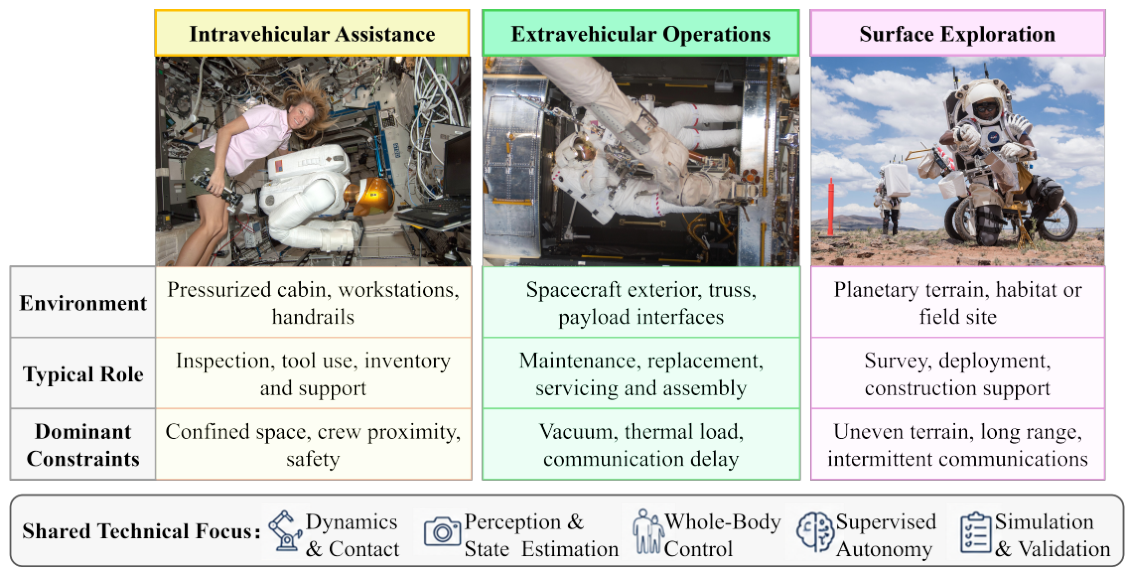
A mission-oriented synthesis is therefore needed to connect representative platforms, operating environments, and enabling technologies within a common analytical framework. In this review, humanoid robotic astronauts are organized into three operational regimes: intravehicular assistance, extravehicular operations and on-orbit servicing, and surface exploration or transitional scenarios. Twelve representative platforms are then compared in terms of institutional origin, embodiment, mobility, manipulation, perception, autonomy, and validation status. On this basis, the review synthesizes five technical foundations that determine whether such systems can become mission-compatible: microgravity dynamics and contact mechanics, multimodal perception and scene understanding, whole-body motion planning and control, teleoperation and supervised autonomy, and evaluation and benchmarking. The mission-oriented framework of the review is summarized in Figure 1.
Figure 1. Mission-oriented framework of humanoid robotic astronauts considered in this review. The three columns summarize the working environment, typical role, and dominant constraints of intravehicular assistance, extravehicular operations, and surface exploration, respectively. The bottom strip lists the shared technical focus across these regimes: dynamics and contact, perception and state estimation, whole-body control, supervised autonomy, and simulation and validation. Image sources: U.S. National Aeronautics and Space Administration (NASA)/Wikimedia Commons for Karen Nyberg working with Robonaut 2 on the International Space Station (ISS) [19]; NASA for the Hubble repair image [20]; NASA Johnson Space Center/Josh Valcarcel via Wikimedia Commons for the Joint Extravehicular Activity and Human Surface Mobility Test Team (JETT) 5 surface-exploration field image [21].
Applsci 16 05032 g001
The distinguishing contribution of this review is its mission-oriented and astronaut-centered synthesis of humanoid robotic astronauts. Existing reviews of space robotics often emphasize orbital manipulators, free-flying inspection systems, planetary rovers, or on-orbit servicing platforms, while studies on humanoid robots frequently focus on individual prototypes, hardware configurations, or isolated technical modules. In contrast, this review treats humanoid robotic astronauts as astronaut-oriented embodied systems whose mission value depends on the coupling among mission context, morphology, contact behavior, perception, autonomy, and validation. This perspective allows heterogeneous platforms to be compared not only by development chronology or mechanical design but also by the mission roles, operational constraints, and deployment evidence that shape their feasibility.
Accordingly, the primary goals of this review are threefold. First, it classifies representative humanoid robotic astronauts according to mission context, including intravehicular assistance, extravehicular operations and on-orbit servicing, and surface exploration or transitional scenarios. Second, it synthesizes the core technical foundations required for mission-compatible humanoid robotic astronauts, including microgravity dynamics and contact mechanics, perception and scene understanding, whole-body motion planning and control, teleoperation and supervised autonomy, and evaluation and benchmarking. Third, it identifies cross-cutting deployment bottlenecks and research priorities, including contact-rich whole-body intelligence under support transitions, delay-tolerant supervised autonomy, and systematic validation pipelines that connect simulation, ground analog facilities, short-duration microgravity tests, human-in-the-loop trials, and on-orbit demonstration.
To obtain the relevant literature on humanoid robotic astronauts for space missions, Web of Science Core Collection (WoSCC), Scopus, Institute of Electrical and Electronics Engineers (IEEE) Xplore, Association for Computing Machinery (ACM) Digital Library, Google Scholar, ScienceDirect, China National Knowledge Infrastructure (CNKI), and Wanfang were selected for retrieval, together with technical repositories and official mission sources such as the U.S. National Aeronautics and Space Administration (NASA) Technical Reports Server, German Aerospace Center (DLR) institutional publications, European Space Agency (ESA) project pages, Roscosmos materials, China Aerospace Science and Technology Corporation releases, and China Manned Space Engineering Office documents. The retrieval period mainly covered studies published from January 1990 to March 2026, with the retrieval deadline set as 31 March 2026; a small number of earlier foundational studies were also included when they provided necessary theoretical background for space robotics, floating-base dynamics, contact mechanics, or teleoperation. The main search terms were humanoid robot, humanoid astronaut, robonaut, anthropomorphic robot, dexterous robot, space robot, microgravity, free-floating, International Space Station, intravehicular, extravehicular, on-orbit servicing, planetary surface, lunar, and Mars. Secondary search terms included whole-body control, motion planning, contact mechanics, teleoperation, supervised autonomy, perception, human-robot interaction, benchmarking, and representative platform names such as Robonaut, Robonaut 2 (R2), Valkyrie, Justin, TORO, SAR-401, Skybot, Taikobot, Xiaotian, Linglong, GITAI, and Astrobee. The retrieval formulas were constructed by combining AND/OR Boolean logic. The included studies were formally published or officially released, relevant in content, and of acceptable academic or technical quality, including English and Chinese journal papers, conference papers, technical reports, dissertations, mission documents, and official project materials. Irrelevant, duplicate, non-academic, and low-quality records were excluded to ensure that the retrieved literature met the scope and research needs of this review.

2. Mission-Oriented Classification of Humanoid Robotic Astronauts

This section classifies humanoid robotic astronauts by mission context rather than by country or institution. This perspective clarifies design logic because mission constraints directly shape embodiment, mobility, manipulation, autonomy allocation, and validation strategy. The discussion is organized around three mission contexts: intravehicular activity (IVA) assistance in crewed habitats, extravehicular activity (EVA) operations and on-orbit servicing (OOS), and surface exploration together with transitional scenarios.
In operational terms, the three categories differ in where the robot works, who it primarily works with, and what it must do. IVA assistance robots operate inside a pressurized crewed habitat, such as a space-station module, a deep-space gateway compartment, or a lunar surface habitat. They share their workspace with the crew and primarily act as service-oriented coworkers: they prepare and stow tools, perform routine inspection of panels and consoles, handle inventory, and take over repetitive maintenance steps so that astronauts can focus on higher-value tasks. The dominant constraints here are confined geometry, close human proximity, and reuse of human-centered interfaces. EVA and OOS robots operate outside the pressurized environment, usually attached to the exterior of a spacecraft or to a dedicated servicing structure. Their primary partners are the spacecraft and its payloads rather than crew members in the same volume; their purpose is to reduce risk and cost by performing external inspection, fluid and electrical interface actuation, fastener manipulation, module replacement, refueling, and assistance to non-cooperative client satellites. The dominant constraints here are vacuum, thermal extremes, contact-rich free-floating manipulation, and supervision under communication delay. Surface and transitional robots are designed for partially structured planetary terrain, crater rims, lava tubes, and outpost-construction sites. They typically work in advance of, or alongside, human crews, performing site surveys, sample handling, equipment deployment, habitat preparation, and infrastructure inspection. The dominant constraints here are uncertain terrain, locomotion–manipulation coupling, longer mission horizons, and intermittent connectivity to ground operators.
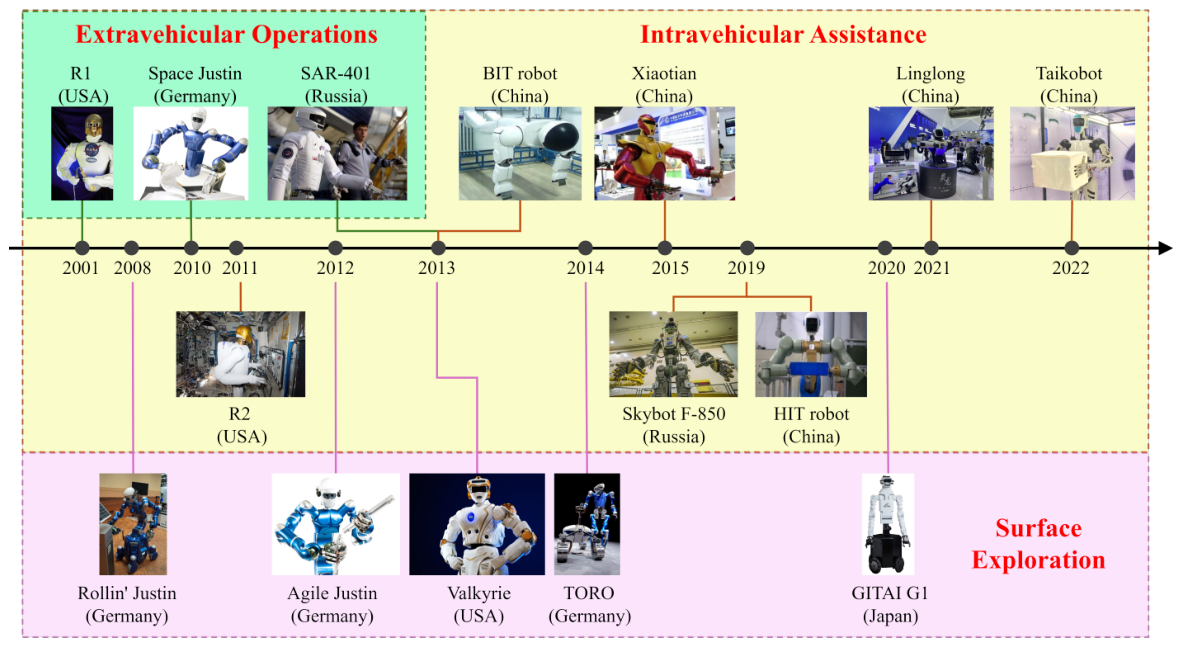
Across these contexts, humanoid embodiment serves different operational purposes rather than a single generic role. The mission-context framework introduced in Figure 1 is therefore used to organize the subsequent comparison of robot categories, functions, and deployment constraints, while Figure 2 summarizes representative platforms and their major public milestones.

2.1. Intravehicular Assistance in Space Stations and Crewed Habitats

Intravehicular assistance is among the most practical and near-term use cases for humanoid robotic astronauts. Robots in crewed modules must operate in spaces already organized for humans, including narrow passages, handrails, consoles, maintenance interfaces, and tool storage areas. In this setting, human-compatible embodiments provide value because they can reuse astronaut-centered infrastructure with limited redesign of cabin hardware and procedures.
The mission objective in this category is to improve operational continuity and crew efficiency. Long-duration missions include many repetitive but necessary tasks, such as inspection, logistics handling, equipment preparation, inventory updates, and routine support during maintenance windows. Offloading part of this work to robotic assistants can reduce crew workload and improve schedule stability [22]. For this reason, evaluation of intravehicular systems should emphasize sustained task support in constrained environments rather than pure locomotion novelty.
Robonaut 2 (R2), jointly developed by NASA and General Motors (GM), remains a benchmark in this domain. R2 is a 42-degrees-of-freedom (DoF) anthropomorphic upper body equipped with two 7-DoF arms, two five-fingered hands instrumented with distributed tactile sensors, and a stereo head, reaching a launch mass of approximately 150 kg [22,23]. Launched on Space Transportation System mission STS-133 in February 2011, it became the first humanoid robot to operate inside the International Space Station (ISS) [22]. Its early on-orbit campaigns demonstrated practical capabilities for switch operation, cable handling, soft-bag inventory tasks, and astronaut-oriented interface interaction in support of cabin work [23]. The platform was later upgraded with two climbing legs that interface with ISS handrails, providing intravehicular mobility through the cabin without floating-base locomotion [24]. Follow-up studies clarified that useful intravehicular performance in microgravity depends on movement between work areas, safe contact behavior, and procedural integration rather than only on anthropomorphic appearance [24,25]. This operational lesson is important because it links platform capability directly to daily mission workflow.
Figure 2. Timeline of representative humanoid robotic astronaut platforms by mission context (intravehicular assistance, extravehicular/on-orbit servicing, and surface exploration), arranged by representative public milestone year as a mission-oriented overview. Image sources and reuse notes: Robonaut 1 (R1), U.S. National Aeronautics and Space Administration (NASA) technology page [26]; Rollin’ Justin, German Aerospace Center (DLR) image source licensed under Creative Commons Attribution (CC BY) 3.0 [27]; Robonaut 2 (R2), NASA image source [28]; Space Justin, DLR image source licensed under Creative Commons Attribution–NonCommercial–NoDerivatives (CC BY-NC-ND) 3.0 [29]; Agile Justin, DLR image source licensed under CC BY-NC-ND 3.0 [30]; TORO, DLR image source [31]; SAR-401, public web image source [32]; Valkyrie (R5), NASA technology page [33]; Xiaotian, public web image source [34]; Skybot F-850, editorial image source credited to Roscosmos/Space.com [35]; Taikobot, image reproduced from the cited open-access article [8]; Linglong, public web image source [36]; GITAI G1, GITAI publicity image source [37]; Beijing Institute of Technology (BIT), image adapted from [38]; Harbin Institute of Technology (HIT), image adapted from [39].
Applsci 16 05032 g002
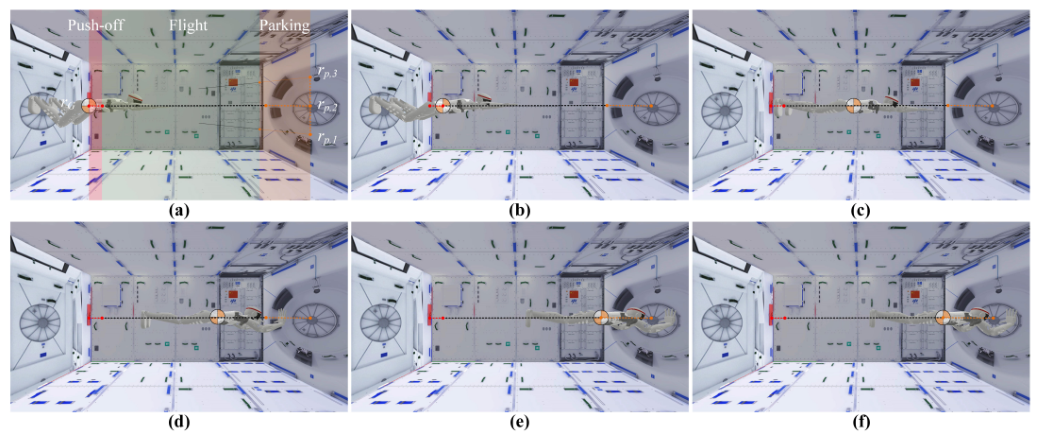
Chinese developments follow a similar mission orientation while exploring different implementation paths. Xiaotian, developed by the 805th Research Institute of the China Aerospace Science and Technology Corporation (CASC), adopted a torso plus dual-arm architecture with dexterous hands and end-effector tooling for structured onboard operations such as panel inspection, switch toggling, and tool exchange [34]. Linglong, developed by the 18th Research Institute of CASC, further emphasized a compact anthropomorphic upper-body design (approximately 1.6 m reach, two 7-DoF arms with multi-fingered hands) targeted at astronaut-like intravehicular tasks within the Tiangong space station envelope [36]. Taikobot, developed at the National University of Defense Technology (NUDT), introduced a different route: a free-flying humanoid that uses a push-off–flight–parking (PFP) locomotion strategy in which the limbs apply controlled impulses against handrails or panels and the floating base then drifts and reacquires support [8]. This formulation matches microgravity motion realities better than terrestrial legged assumptions in confined cabins and is also reflected in the simultaneous astronaut-accompanying and visual navigation (SAVN) framework that supports astronaut-accompanying motion in dynamic intravehicular scenes [40].
Related efforts from Russian and Chinese academic institutions complement these flagship platforms. The Russian Skybot F-850 mission, in which a full-size anthropomorphic robot was launched on a Soyuz MS-14 capsule for intravehicular evaluation on the ISS, indicates that intravehicular operation is used as a practical entry point before broader mission roles are defined [41]. Prototype work at the Beijing Institute of Technology (BIT) and the Harbin Institute of Technology (HIT), including gravity-aided and microgravity-related experiments on dual-arm climbing, handrail traversal, and contact-rich whole-body motion, has strengthened methods for cabin assistance research [38,39]. Taken together, this category shows that intravehicular humanoids are best understood as a family of service-oriented systems focused on safe close-range collaboration and efficient support of routine onboard procedures.
The Robonaut 2 ISS deployment chain provides the clearest operational reference for intravehicular humanoid use. The platform was launched as flight payload on STS-133 in February 2011 and stowed in the U.S. Destiny laboratory; first power-on inside the cabin took place in October 2011, after which a multi-year staged-activation campaign systematically expanded its capability envelope from passive observation, to constrained motion, to interaction with astronaut-facing interfaces, and finally to climbing-leg validation in 2014 [22,23,24]. Key engineering lessons from this campaign are that successful IVA operation depends on a careful interaction between joint-level safety envelopes and the cabin geometry, with each new motion class requiring explicit recertification rather than direct transfer from ground tests. Tactile-rich five-fingered hands enabled astronaut-compatible tasks such as handrail grasping, switch toggling, and soft-bag handling that would otherwise have required separate end-effectors. Adding climbing legs in 2014 also introduced momentum exchange between the legs and the floating cabin volume, which influenced how subsequent supervisory commands were authored [24]. These lessons motivate several technical sections of this review, including whole-body modeling under intermittent support, contact-rich perception, and supervisory autonomy.

2.2. Extravehicular Operations and On-Orbit Servicing

Extravehicular operations and on-orbit servicing (OOS) provide a strong strategic motivation for humanoid robotic astronauts. External inspection, maintenance, interface actuation, cable work, and component replacement are high-risk and high-cost when performed through astronaut extravehicular activity (EVA). Robotic intervention is therefore attractive for reducing exposure while preserving astronaut-oriented operational logic [42].
In this context, anthropomorphic compatibility remains useful because many external tools, handles, and maintenance procedures were originally designed for human operators [43]. At the same time, successful external servicing requires more than dexterous manipulation. The robot must manage free-floating and contact dynamics, perception uncertainty, force interaction, communication latency, and mission-level safety constraints in a tightly integrated way.
Robonaut 1 (R1), developed jointly by NASA and the U.S. Defense Advanced Research Projects Agency (DARPA) in the late 1990s, made this rationale explicit by framing an EVA-oriented anthropomorphic assistant concept that could work with astronaut interfaces instead of requiring extensive redesign of robotic fixtures. R1 used a single torso with two 7-DoF arms and two human-scale five-fingered hands, and was demonstrated on a Space Station Remote Manipulator System (SSRMS) mockup performing common EVA tool tasks such as connector mating and tether handling [4,26]. A major European line emerged through the German Aerospace Center (DLR, Deutsches Zentrum für Luft- und Raumfahrt), where servicing was treated as both a robotic capability problem and a human supervision problem. Early DLR work emphasized space-qualified torque-controlled hardware together with operating modes spanning autonomy and force-feedback teleoperation [44]. Within this trajectory, Space Justin became a representative architecture for dexterous servicing under ground-supervised operation, combining two 7-DoF DLR Light-Weight Robot III arms with five-fingered hands and a torso, and was used for the Robotic Components Verification on the ISS (ROKVISS) and KONTUR-2 in-orbit telepresence demonstrations [45].
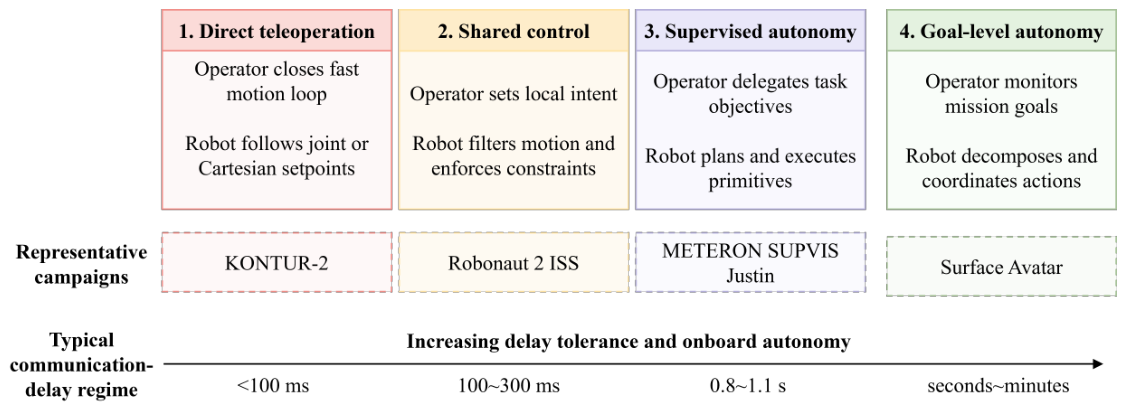
This logic was validated further in the Multi-Purpose End-To-End Robotic Operations Network (METERON) Supervised Autonomy (SUPVIS) Justin campaign. Astronauts on the ISS issued high-level tablet commands while local robot intelligence handled task execution. Results showed that supervised autonomy can reduce low-level operator burden while preserving human oversight in delayed and hazardous environments [14]. Later DLR work refined this framework and interface design, and campaign analyses confirmed that task-level astronaut–robot collaboration is feasible and efficient for mission-relevant servicing scenarios [46,47].
The METERON SUPVIS Justin campaign provides a representative orbit-to-ground example of supervised autonomy. Across three principal in-flight sessions in 2017–2018, ISS-resident astronauts issued task-level commands to Rollin’ Justin in a Mars analog environment at DLR Oberpfaffenhofen [7,14,47]. The communication path traversed the Telescience Resource Kit on board the ISS, then an S-band link to the Tracking and Data Relay Satellite (TDRS), the NASA Marshall payload operations center, and finally, a terrestrial link to the DLR ground station, with end-to-end one-way latency of the order of 400–800 ms once routing and protocol handling were included. Astronauts manipulated a tablet-based command interface that exposed object-centered actions, while the robot’s onboard knowledge graph mapped each action to a sequence of low-level whole-body primitives. The reported task completion rate exceeded 90%, with the dominant residual operator workload coming from anomaly handling rather than nominal command issuing [14]. The campaign provides quantitative evidence that supervisory modes can absorb sub-second-to-second-scale delays without forcing the astronaut into low-level joint control.
Russian work on SAR-401 offers another example of external anthropomorphic intervention. SAR-401 is a torso-and-dual-arm avatar robot mounted on a fixed base, with two 7-DoF arms instrumented for force feedback and a stereo head for telepresence; it is operated bilaterally by a remote astronaut wearing exoskeleton-style master arms [32]. Recent reviews and program descriptions associate it with grasp-intensive operations, tool handling, interaction with station structures, and handling of uncontrolled objects, all of which align closely with servicing requirements [48]. Overall, this mission class places stronger demands than intravehicular assistance on contact robustness, tool reliability, and autonomy–supervision coupling.

2.3. Surface Exploration and Transitional Mission Scenarios

Surface and transitional scenarios occupy a distinct position in the evolution of humanoid robotic astronauts. Unlike cabin assistance, which emphasizes interface compatibility in structured habitats, and unlike orbital servicing, which emphasizes constrained external intervention, surface-oriented missions must handle partially structured terrain and broader environmental uncertainty. Typical tasks include setup, transport, inspection, maintenance, and preparatory work before or alongside human crews.
This category gives greater weight to whole-body mobility and locomotion–manipulation integration. Systems must maintain stability on uneven ground, negotiate obstacles, and continue manipulation under changing support conditions. Here, anthropomorphic value comes from combining human-like reachability and task compatibility with robust terrain adaptability [6].
NASA Valkyrie (R5) is one of the clearest representatives. R5 is a 1.83 m, 125 kg full-body bipedal humanoid with 28 actuated joints, four-fingered hands, and a chest-mounted perception stack of stereo cameras and a rotating light detection and ranging (LiDAR) sensor. It was originally built for the 2013 DARPA Robotics Challenge Trials and was subsequently positioned by NASA as a research platform for extraterrestrial surface operations [6]. Public descriptions link R5 to future extraterrestrial mission needs in addition to difficult terrestrial environments [33]. Program decisions that distributed platforms to university teams further reinforced its positioning for future Mars-oriented development [49]. Related teleoperation studies indicate the importance of flexible mobility and manipulation control for remote surface work where delay and limited situational awareness are common [50].
DLR platforms provide a complementary pathway. Rollin’ Justin demonstrated supervised surface-style task execution in METERON [27]. Surface Avatar further extended astronaut-coordinated planetary analog operations with heterogeneous robotic assets [51,52]. Agile Justin advanced this direction with integrated mobile manipulation and mission-like benchmarks such as habitat-related tasks [30,53]. TORO, while not a deployed space mission platform, contributes key foundations in torque-controlled balance, dynamic locomotion, and multi-contact behavior that are directly relevant to future planetary humanoids [31,54].
Surface Avatar is a more recent DLR/ESA campaign that extended supervised autonomy to a heterogeneous robotic team, comprising Rollin’ Justin, a quadruped, a wheeled rover, and a humanoid avatar, commanded from the ISS through a single astronaut workstation [51,52]. Compared with single-platform supervised operation, this campaign places stronger demands on multi-robot orchestration, adaptive autonomy levels, and shared geometric and semantic representations of the analog terrain. The astronaut delegates a high-level goal, the planner allocates subtasks across the team, and the humanoid must remain compatible with the same map and task model used by the other assets. These requirements have direct consequences for whole-body planning, perception, and trust calibration.
Skybot F-850, derived from the FEDOR rescue robot program, was launched unmanned on Soyuz MS-14 on 22 August 2019 to test crewed-vehicle automation and remote intravehicular operation [35,41]. The mission encountered a docking anomaly with the Poisk module that delayed berthing by approximately 24 h, yielding an unintended robustness test of the avatar control chain. After successful berthing, the robot performed pre-planned tasks including instrumented manipulation of representative cabin tools and verification of communication paths between bilateral master controllers on the ground and the orbital avatar. The campaign provides one of very few public datapoints on the launch and re-entry environments seen by a humanoid platform, and indicates that the dominant integration risk is often the interface between the humanoid, the spacecraft, and the operational command chain rather than manipulation hardware alone.
Taikobot, developed at NUDT, is a representative example of a microgravity-native locomotion paradigm [8]. In the push-off–flight–parking cycle, the humanoid first establishes a closed kinematic chain with one or both hands on a handrail, then applies a controlled push-off impulse along the desired transfer direction, drifts ballistically across the cabin volume, and finally reacquires a target handrail using a parking controller that absorbs residual relative velocity and angular momentum. Reported simulation and ground-test results show that base attitude can be regulated during flight when an asymmetric actor–critic controller is paired with a reaction-null-space-aware impulse generator. This locomotion strategy is qualitatively different from terrestrial bipedal gaits and motivates contact-aware modeling for space humanoids.
Together, these systems show that surface-oriented robotic astronauts act as a bridge between general humanoid robotics and mission-specific space deployment. Their core requirement is not only dexterous manipulation but also coordinated whole-body adaptation under uncertain terrain and longer operational horizons.

2.4. Cross-Scenario Comparison and Discussion

Across all three mission categories, humanoid robotic astronauts share a common goal of extending human operational capability in environments still shaped by astronaut tools and procedures. Table 1 summarizes representative platforms in a single comparison, emphasizing mission role, embodiment, manipulation, perception, autonomy, and validation heritage. Detailed engineering parameters such as height, mass, and degrees of freedom are retained in the text when they are well documented and directly relevant to the discussion, rather than repeated as separate table columns for every platform.
Table 1. Mission roles, system capabilities, perception payloads, and validation heritage of representative humanoid robotic astronaut platforms.
PlatformInstitution/OriginPrimary ScenarioEmbodiment/MobilityManipulation CapabilityPrimary PerceptionControl/AutonomyValidation
R1 [4,26]NASA/DARPAEVA/OOSUpper-body assistant; fixed or arm-mountedEVA tool use and connector handlingStereo/operator-view camerasTeleoperation and supervised tasksGround EVA-interface tests
R2 [22,23,24]NASA/GMIVAUpper-body humanoid; later ISS handrail climbing legsTactile hands for switches, cables, and soft goodsStereo, range, tactile sensingCrew-assisted supervisionISS flight and IVA activation
Rollin’ Justin [27,53]DLRSurface/transitionalWheeled mobile humanoidDual-arm analog-task manipulationStereo, RGB-D, wrist force/torqueSupervised autonomy and teleoperationGround analog/METERON campaigns
Space Justin [45,55]DLREVA/OOSTorso-and-arms servicing platformFive-fingered servicing manipulationStereo, torque, force/torque feedbackSupervised autonomy and telepresenceROKVISS/KONTUR-2 heritage
Agile Justin [30,53]DLRSurface/transitionalMobile whole-body humanoidDual-arm habitat-task dexterityStereo/RGB-D and joint torque sensingAutonomous planning and manipulationGround demonstrations
TORO [31,54]DLRSurface/transitionalTorque-controlled bipedMulti-contact balance and locomotionStereo and proprioceptive torque sensingWhole-body controlGround balance experiments
SAR-401 [32,48]RussiaEVA/OOSTorso-and-dual-arm avatarTool handling and teleoperationStereo and force/torque feedbackBilateral human-in-the-loop controlGround avatar tests
Valkyrie (R5) [6,33]NASASurface/transitionalFull-body biped for rough terrainWhole-body four-finger manipulationStereo, LiDAR, hazard camerasTeleoperation and autonomyGround/field robotics heritage
Xiaotian [34]CASC 805IVAUpper-body cabin assistantDexterous panel/tool operationVision and end-tool sensingSupervised executionGround cabin-task tests
Skybot F-850 [35,41]Roscosmos/Android TechnicsIVAFull-size cabin avatarRepresentative cabin-tool useStereo cameras and operator feedbackHuman-guided avatar controlSoyuz MS-14/ISS mission
Linglong [36]CASC 18IVACompact upper-body assistantDual-arm multi-finger manipulationStereo visionSupervised executionGround development reports
Taikobot [8,40]NUDTIVAFree-flying push-off–flight–parking humanoidHandrail interaction and manipulationStereo, inertial, navigation sensingAutonomous navigation and parkingSimulation and ground validation
Note: Platforms are grouped by their primary mission scenario. Some systems can inform more than one scenario, but the table lists the dominant role discussed in this review. Abbreviations: NASA, U.S. National Aeronautics and Space Administration; DARPA, U.S. Defense Advanced Research Projects Agency; GM, General Motors; DLR, German Aerospace Center; CASC, China Aerospace Science and Technology Corporation (805 and 18 denoted, respectively, the 805th Research Institute of CASC Eighth Academy and the 18th Research Institute of CASC Fourth Academy); NUDT, National University of Defense Technology; IVA, intravehicular activity; EVA, extravehicular activity; OOS, on-orbit servicing; RGB-D, red–green–blue-depth; LiDAR, light detection and ranging; METERON, Multi-Purpose End-To-End Robotic Operations Network.
The strongest contrast among scenarios comes from environment and consequence of failure. Intravehicular systems operate in constrained but support-rich habitats, so priority is compatibility with interfaces, predictable procedures, and safe close-range cooperation. Extravehicular systems work in higher-risk conditions, so priority shifts to stable contact, reliable tool operation, fault tolerance, and efficient supervision under delay and communication limits. Surface and transitional systems face wider workspace variation, uncertain terrain, and longer task horizons, so they emphasize mobility robustness and local adaptation [3].
A second contrast concerns morphology and mobility requirements. Cabin tasks can often be handled by upper-body-dominant or partial humanoid embodiments when infrastructure provides support and guidance. External servicing still benefits from anthropomorphic reach and hand function, but adds stricter requirements for attachment strategies and contact management. Surface missions require broader whole-body capability, including locomotion–manipulation coupling, posture regulation, and stability recovery under terrain disturbance.
A third contrast concerns autonomy and human involvement. Intravehicular assistance can rely more on structured procedures and nearby crew oversight, which supports incremental autonomy in repetitive tasks. Extravehicular servicing often relies on supervised autonomy and teleoperation hybrids because intervention risk is higher and task conditions change quickly. Surface scenarios push this trend further by requiring autonomy that converts strategic human intent into reliable local behavior over larger areas and more variable contexts.

3. Microgravity Dynamics, Contact Mechanics, and Simulation Frameworks

Space-humanoid dynamics differ fundamentally from terrestrial humanoids because the base is floating and limb motion redistributes momentum across the full body [9,56,57]. As a result, locomotion, manipulation, attitude control, and reorientation must be modeled jointly, with explicit treatment of inertia-coupled singularities and base–manipulator coupling [10,58].
For humanoid robotic astronauts, this coupling is intensified by multi-limb coordination and intermittent environmental support. Whole-body stability therefore depends on unified treatment of momentum, support constraints, and contact-aware control, and successful execution must account for impact, friction, compliance, and uncertainty together [59,60,61,62,63]. Because orbital interaction is difficult to reproduce on Earth, dynamic modeling and validation capability must be developed in parallel [64]. Accordingly, this section addresses floating-base dynamics, contact and hybrid constraints, whole-body modeling paradigms, and simulation-validation pathways.
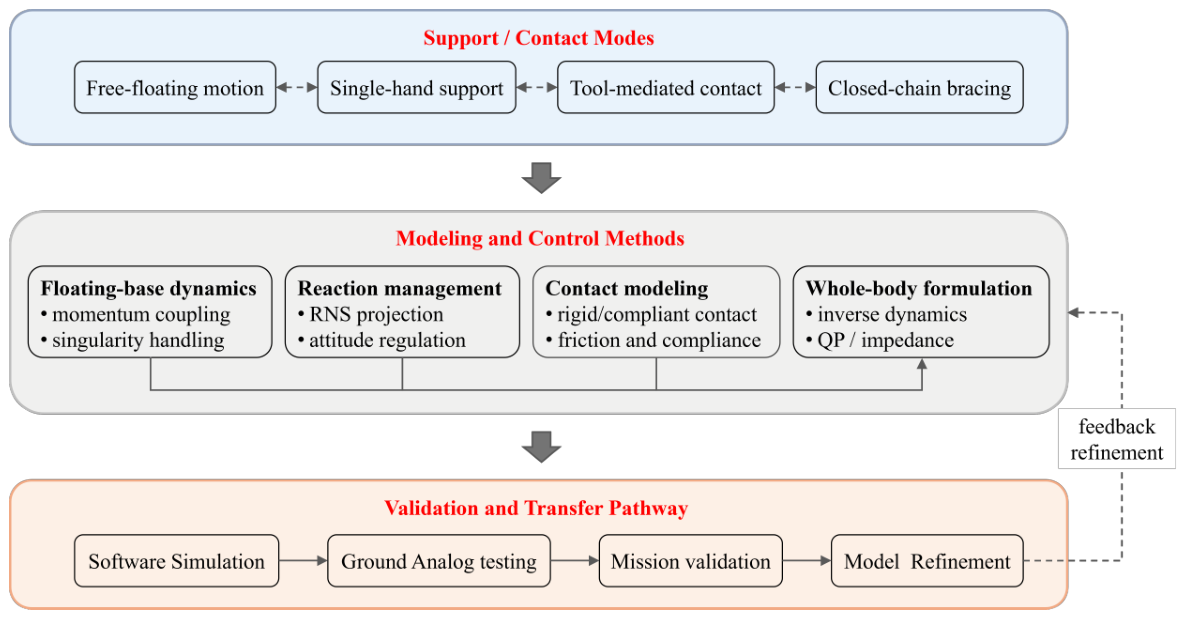
Figure 3 summarizes the method framework used in this section. The upper layer identifies typical operating conditions rather than a fixed task sequence. The middle layer organizes the core modeling and control methods, with floating-base dynamics, reaction management, and contact modeling feeding into whole-body formulations. The lower layer then links these methods to simulation, ground analog testing, mission-context validation, and model refinement.

3.1. Dynamic Characteristics of Floating-Base Space Humanoids

A useful entry point is the classification of base operating conditions. Depending on base constraints and control authority, the same articulated system may behave as fixed-base, partially regulated floating, or fully free-floating, and missions may switch among these regimes during attachment, transfer, and release [65]. For a humanoid robotic astronaut, a single high-level command such as moving between two racks and operating a panel is typically realized through several support modes: unconstrained drift, one-hand anchoring, dual-arm bracing, and tool-mediated contact. Each mode changes the admissible reaction forces and the way task wrenches propagate through the body. In free-floating motion, the base response is governed mainly by inertia and momentum exchange. A single grasp anchor introduces the first environmental reaction path. Dual bracing further creates a closed support loop, which can improve stability but also introduces internal-force regulation. Tool-mediated contact adds another coupling between the task wrench, the support contact, and the floating base. Thus, even before detailed contact mechanics is introduced, the dynamics of a space humanoid are strongly mode-dependent rather than governed by a single fixed-base or free-floating model.
This same coupling also changes how singularity and dexterity should be interpreted. A classical way to express the coupling is the generalized Jacobian formulation for free-floating manipulators. After eliminating base velocity through momentum conservation, the end-effector velocity can be written as
x ˙ e = J m J b H b 1 H b m q ˙ m = J g ( q ) q ˙ m
where J m is the manipulator Jacobian, J b maps base motion to the end-effector velocity, H b is the base inertia term, H b m describes base–manipulator inertial coupling, and J g is the generalized Jacobian [10,57]. Compared with the fixed-base Jacobian, J g depends more strongly on the system inertia distribution and therefore links dexterity to mass properties as well as to geometry. Equivalent-mapping and singularity-robust formulations further support this view [66,67]. In fixed-base robotics, singularity is usually discussed in geometric terms. In free-floating systems, however, loss of motion capability may arise not only from kinematic structure but also from inertia-dependent coupling between the base and the manipulator. These dynamic singularities remain important because they show that motion feasibility depends on mass distribution and momentum exchange as well as on link arrangement. This issue becomes more pronounced in anthropomorphic systems, where a larger number of body segments creates more internal pathways for reaction transfer and more configuration-dependent variations in controllability.
Reaction management is a central modeling concern. The reaction-null-space (RNS) concept and adaptive reactionless formulations show that manipulator motion can reduce base disturbance under uncertainty [68,69]. Concretely, the angular momentum balance of a free-floating humanoid with a single manipulator can be written as
H b ω b + H b m q ˙ m = H 0
where ω b R 3 is the base angular velocity, q ˙ m is the manipulator joint-velocity vector, H b and H b m are the inertia couplings between base and manipulator, and H 0 is the conserved total angular momentum, taken as zero in microgravity drift conditions [68]. The reaction-null subspace is then N ( H b m ) , and any joint motion q ˙ m N ( H b m ) leaves the base undisturbed. In projection form, reactionless motion is commonly represented as
P RNS = I H b m # H b m , q ˙ m = P RNS q ˙ m , d
where H b m # denotes a generalized inverse and q ˙ m , d is the desired joint motion before reaction filtering. The strength of RNS-based methods is that they provide a direct way to reduce base attitude disturbance during manipulation. Their limitation is that the reactionless subspace may conflict with end-effector motion, speed, or obstacle-avoidance requirements, especially when a humanoid must coordinate two arms, tools, and cabin clearances. Adaptive RNS formulations [69] partly address this limitation by updating the projection when payload or inertia parameters are uncertain. At the same time, the analogy with terrestrial humanoids has clear limits. Comparisons with human multibody studies remain useful at the abstraction level [70,71]. On Earth, whole-body movement is organized around persistent gravitational loading and repeated support exchange with the ground. In orbit, support is intermittent, externally created, and strongly task-dependent. A space humanoid may move from unconstrained drift to one-hand support, then to dual-arm bracing, and later to tool-mediated constrained action within the same maneuver. Even before detailed contact mechanics is introduced, this makes the dynamics strongly mode-dependent. The floating-base model must therefore be treated not simply as a description of free motion, but as the baseline dynamic layer from which successive support conditions can be interpreted.

3.2. Contact Mechanics and Hybrid Constraint Modeling

For space humanoids, contact is a primary mechanism for mobility, stabilization, and task execution rather than an auxiliary manipulation event. In microgravity, support must be created through rails, fixtures, and tools, and each contact transition changes whole-body admissible motion and force pathways [72,73].
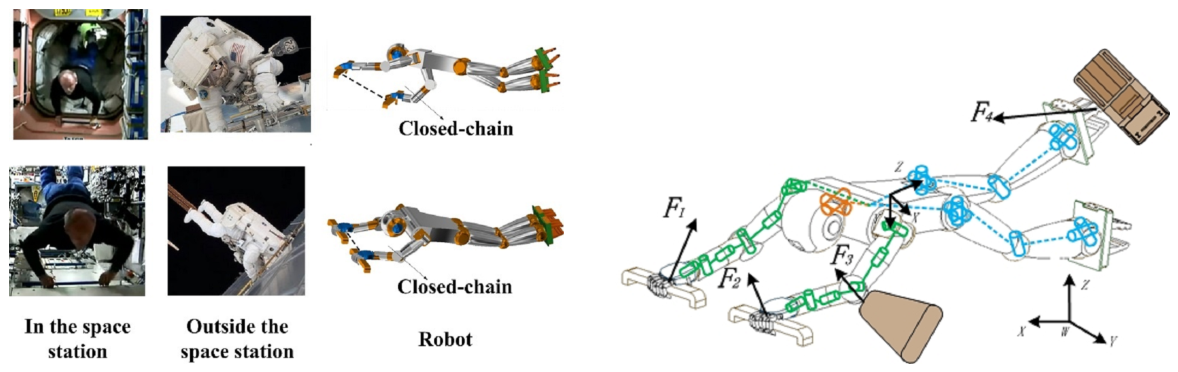
This issue is particularly important for space humanoids because their contact topology is richer than that of conventional single-arm space manipulators. A humanoid robot may stabilize with one arm while manipulating with the other, may transfer body load between contacts, or may temporarily brace with the palm or forearm before establishing a more secure grasp. Contact should therefore be modeled not only as a local interaction law, but as a mechanism that alters whole-body mobility, momentum pathways, and available reaction channels. As illustrated in Figure 4, astronaut-oriented locomotion in confined microgravity environments couples climbing motion with multi-contact impact and constraint modeling, and grasp quality is closely related to wrench-capable contact geometry [74,75].
From a mechanics perspective, the key transition is from unconstrained floating motion to constrained multibody motion under unilateral or bilateral environmental interaction. Once a hand forms a stable grasp on a rail or fixture, the robot no longer behaves as an entirely free-floating system. Its motion is instead governed by a new set of admissible accelerations and reaction pathways. For a rigid sticking contact, the acceleration-level constraint is commonly written as
J c ( q ) v ˙ + J ˙ c ( q , v ) v = 0
where J c is the contact Jacobian and v is the generalized velocity. Tangential feasibility is often approximated by a friction-cone condition,
λ t μ λ n
where λ n and λ t are the normal and tangential contact-force components and μ is the friction coefficient. These equations are useful for planning and constrained control because they express whether a proposed whole-body motion can remain compatible with a support. Their main limitation is that they idealize the transition into contact and therefore cannot by themselves describe impact, rebound, compliance, or slip onset. This is why orbital humanoid operation is naturally described as a hybrid dynamical process. Recent surveys of robot manipulation in contact emphasized that such tasks require simultaneous reasoning about geometry, force transmission, uncertainty, and mode switching. For space humanoids, this requirement extends from the hand to the whole body, because contact reshapes how the entire articulated system can move and stabilize in microgravity.
Figure 4. Representative modeling views of astronaut-oriented climbing and multi-contact dynamics in confined microgravity environments. The left panel illustrates a closed-chain climbing motion model, where the dashed lines on the rightmost robot subpanels mark the closed kinematic loop formed when both end-effectors grasp the same handrail. The right panel shows a multipoint impact model relevant to contact-rich astronaut locomotion: the symbols F 1 , F 2 , F 3 , and F 4 denote external contact forces at the four candidate support points (two graspers and two feet/grippers interacting with handrails and a panel); the inertial world reference frame is denoted by { W } with axes X, Y, and Z at the bottom right, and a body-attached frame with axes X, Y, and Z is placed at the torso to indicate the floating-base orientation. Adapted from Wei et al. [76], licensed under Creative Commons Attribution (CC BY) 3.0.
Applsci 16 05032 g004
The four contact regimes that a humanoid astronaut typically traverses when establishing a stable support on a handrail or panel are summarized in Table 2. They are not mutually exclusive: a single grasp event may begin with an approach phase without contact force, transition through impulsive impact and viscoelastic loading, and finally settle into a constrained support phase. The choice of contact formulation therefore depends on the regime, and a credible space-humanoid model has to support all four.
A useful distinction is between impulse-based and continuous-force contact formulations. Impulse-based models are appropriate when the interaction interval is short and deformation is neglected, whereas continuous-force models represent contact through force–deformation or force–penetration relationships over finite time [62]. Both are relevant to space humanoids. A glancing collision during drift arrest is better interpreted through impulsive effects, while handrail grasping, panel bracing, and tool-supported stabilization require sustained force exchange. A single contact abstraction is therefore rarely sufficient for orbital humanoid tasks that combine approach, engagement, support transfer, and release.
Table 2. Contact regimes and representative models relevant to handrail capture, bracing, and tool-supported operation in space humanoids.
Contact RegimeRepresentative Formulation and ReferencesMain UseMain LimitationSpace-Humanoid Implication
Pre-contact free flightFloating-base motion with no environmental wrench, λ = 0 ; generalized-Jacobian and free-floating formulations [10,57]Predicts approach motion and base–limb coupling before support is createdDoes not describe capture transients or force exchangeUsed before handrail capture, panel approach, or tool docking, where body attitude may drift during limb motion
Impulsive impactImpulse–momentum relation, t t + F n d t = Δ p ; contact-impact dynamics and space-robot impact studies [62,63,77,78]Represents short-duration collision and velocity jumpNeglects finite deformation and sustained loading unless coupled with a compliant modelImportant for missed grasps, hard handrail capture, and drift arrest where impact can inject unwanted rotation
Compliant loadingHertz or Hunt–Crossley-type normal contact, F n = k δ 3 / 2 ( 1 + c δ ˙ ) [79,80]Captures finite-time deformation, damping, and energy dissipationRequires calibrated stiffness, damping, geometry, and surface parametersUseful for soft capture, tool docking, panel bracing, and safety analysis of transient contact loads
Constrained supportRigid or nearly rigid constraint, J c v ˙ + J ˙ c v = 0 , with friction feasibility λ K μ [72,73]Supports planning and control under established contactIdealizes impact, slip onset, and complianceProvides the support wrench needed for braced manipulation, support transfer, and contact-consistent whole-body control
Coupled post-contact stabilizationContact-state-dependent coupled dynamics and controller interaction [81,82]Evaluates whether the captured support becomes dynamically useful after contactSensitive to controller design, target properties, and contact-state estimationDetermines whether a nominal support reduces drift or instead creates rebound, oscillation, or loss of attitude control
Compliant contact models are especially important because support acquisition in microgravity is rarely perfectly rigid. Hertzian contact theory provides the classical basis for relating normal force F n to local deformation δ through
F n = k δ 3 / 2 , k = 4 3 E * R *
where E * and R * are the equivalent Young’s modulus and radius of curvature of the contacting bodies [79]. Later multibody studies introduced damping into Hertz-type formulations, e.g., the Hunt–Crossley-style model
F n = k δ 3 / 2 ( 1 + c δ ˙ )
so that loading and unloading phases could be described with energy dissipation through the dimensionless coefficient c [80]. The advantage of Hertz and Hunt–Crossley formulations is that they capture finite-time deformation and energy loss during soft capture, which is important for handrail grasping, tool docking, and panel bracing. Their limitation is parameter sensitivity: stiffness, damping, local geometry, glove material, and surface condition must be calibrated before the model can provide credible force predictions. For this reason, compliant contact models are most useful when paired with experimental identification and should not be treated as universal replacements for rigid constraints.
Tangential interaction is equally critical because many microgravity maneuvers depend on controlled pulling, holding, and redirection rather than on normal push-off alone. Friction determines whether a tentative support becomes a stabilizing anchor or a slip event that injects unwanted body rotation. Comparative studies of friction modeling in mechanical systems have shown that Coulomb-like laws remain useful but differ substantially depending on regularization and transition assumptions [83]. For orbital humanoids, friction models should therefore be chosen according to the support function of the contact rather than purely for numerical convenience. Support sequences of initiation, loading, transfer, unloading, and release repeatedly change constraint rank and system structure, so these transitions should be represented in one unified whole-body framework, especially in microgravity.
Complete or nearly complete constraints deserve particular attention because they dominate safety-critical tasks. Once a space humanoid establishes a firm grasp or brace, the coupled robot–environment system may undergo a sharp change in effective inertia and reaction propagation. Capture studies showed that post-contact behavior depends strongly on compliance, damping, target properties, and controller design [81]. Related analyses of non-cooperative target grasping also demonstrated that stable interaction requires coordinated treatment of normal force, tangential effects, and coupled-system motion [82]. For robotic astronauts, these findings matter because a support used for stabilization may initially pass through an impact-dominated transient before becoming a reliable load-bearing constraint.
Rigid and compliant models should therefore be regarded as complementary. Rigid formulations are often convenient for planning and control, while compliant models better reproduce transient loads and interaction details [84]. In space-humanoid research, this suggests a layered use of models in which grasped supports may be idealized as hard constraints at the planning level, while high-fidelity simulation and safety analysis preserve compliance, frictional uncertainty, and transient loading. Contact mechanics in space-humanoid robotics should thus be understood as the study of how intermittent environmental support reshapes whole-body dynamics in microgravity, providing the bridge from floating-base motion to contact-consistent whole-body modeling.

3.3. Whole-Body Modeling Paradigms for Space Humanoids

A more operational paradigm formulates the same floating-base system through task hierarchies. Instead of reducing the robot to a single task-space map, this approach represents multiple objectives such as end-effector motion, body orientation, posture regulation, clearance maintenance, and contact consistency in prioritized form. Early work on free-floating humanoids showed that task-priority concepts could be extended from terrestrial whole-body control to robots moving without a fixed base [12]. This is attractive for space humanoids because mission requirements are inherently layered. A robot may need to preserve visual alignment, maintain safe clearance from surrounding structures, and simultaneously approach a support handle or tool interface. A prioritized whole-body formulation makes these distinctions explicit during motion generation, although strict hierarchies can become difficult to maintain when contact modes change rapidly.
When unilateral contacts, joint limits, self-collision avoidance, and support transitions are introduced, purely analytical task-priority methods become harder to manage. This motivates optimization-based whole-body modeling, in which accelerations, forces, or generalized motions are solved through constrained numerical programs. A representative quadratic-programming form is
min v ˙ , τ , λ J t v ˙ + J ˙ t v x ¨ t * W 2 + ρ τ 2 s . t . M ( q ) v ˙ + h ( q , v ) = S τ + J c λ J c ( q ) v ˙ + J ˙ c ( q , v ) v = 0 , λ K μ
where J t is the task Jacobian, x ¨ t * is the desired task acceleration, W is a weighting matrix, and K μ denotes the friction cone. A unified integration of unilateral constraints into stack-of-tasks control showed that task hierarchy and contact admissibility can be handled consistently [85]. Hierarchical quadratic programming then provided an efficient machinery for enforcing strict task priorities under equality and inequality constraints [86]. For space humanoids, this paradigm is particularly useful because it can represent floating-base motion, contact consistency, self-collision constraints, and whole-body objectives within a single framework. Its limitation is computational and modeling burden: real-time performance depends on solver reliability, accurate contact-state estimation, and carefully tuned task weights or priorities.
A closely related but dynamically richer paradigm is inverse-dynamics whole-body modeling. Rather than solving only for kinematic consistency, these formulations work directly with joint torques τ , contact wrenches λ , and floating-base accelerations v ˙ under the constrained rigid-body equations
M ( q ) v ˙ + h ( q , v ) = S τ + J c λ
where M is the inertia matrix, h aggregates Coriolis, centrifugal, and gravitational terms, S selects actuated joints, and J c is the contact Jacobian. Unified inverse-dynamics treatments clarified how underactuation and contact-force redundancy can be managed in floating-base robots with external constraints [87]. For a space humanoid, the main advantage is dynamic support consistency: the model can test whether a tool force, support wrench, and posture command are simultaneously feasible. The main limitation is that it requires reliable inertia parameters, contact-state information, and torque or force limits, which are not always available during early mission-concept studies.
Another important paradigm reduces the full multibody dynamics to centroidal or momentum-level descriptions. These models focus on the evolution of center-of-mass motion and aggregate linear and angular momentum rather than on every generalized coordinate. The centroidal momentum matrix formulation established this abstraction as a compact representation of global humanoid dynamics [88]. For space humanoids, such models are appealing because drift suppression, body reorientation, reaction minimization, and post-contact stabilization are naturally expressed in momentum terms. Momentum-based regulation studies in humanoids showed that major dynamic objectives can be stabilized without prescribing the detailed evolution of every link [89]. Hierarchical inverse-dynamics implementations later demonstrated that momentum control can be embedded into practical whole-body controllers [90]. In orbital applications, these models are best regarded as supervisory layers that encode global dynamic intent while leaving detailed contact realization to more complete formulations.
Whole-body impedance paradigms are especially useful when interaction quality and support acquisition dominate, because they regulate compliant yet responsive contact behavior [91,92,93]. A common task-space impedance relation is
F = K ( x d x ) + D ( x ˙ d x ˙ )
where K and D specify desired stiffness and damping. This formulation is intuitive for handrail capture, bracing, and tool-supported manipulation, but impedance gains must be chosen with care because excessive stiffness can amplify impact loads while excessive compliance can degrade precision. Parameter identification and trajectory-optimization methods further connect planning and control layers under uncertainty [94,95,96,97]. Table 3 summarizes the main method categories, representative formulations, advantages, limitations, and relevance to humanoid robotic astronauts.
Table 3. Comparison of representative modeling methods for space-humanoid dynamics and contact-rich whole-body behavior.
Method ClassRepresentative FormulationStrengthLimitationSpace-Humanoid Relevance
Generalized Jacobian/floating-base model [10,57] x ˙ e = J g ( q ) q ˙ m Captures base–manipulator couplingSensitive to inertia parameters and dynamic singularitiesProvides the baseline for free-floating manipulation, dexterity analysis, and mode-dependent motion feasibility
Momentum/RNS model [68,69] H b ω b + H b m q ˙ m = H 0 ; P RNS = I H b m # H b m Reduces base disturbance during limb motionMay reduce available end-effector motion or speedSupports cabin manipulation, visual-lock preservation, reaction reduction, and drift suppression during limb motion
Rigid contact constraint model [72,73] J c v ˙ + J ˙ c v = 0 ; λ t μ λ n Handles support feasibility and friction limitsPoor representation of impact and complianceUseful for planning handrail support, braced manipulation, and contact-consistent support transfer
Compliant contact model [79,80] F n = k δ 3 / 2 ( 1 + c δ ˙ ) Represents finite-time loading and energy dissipationRequires calibrated stiffness and dampingImportant for handrail capture, tool docking, panel bracing, and safety analysis of transient loads
Constrained inverse dynamics/quadratic programming (QP) [85,86,87] M v ˙ + h = S τ + J c λ with task optimizationIntegrates tasks, torques, contacts, and limitsComputationally and parametrically demandingForms a core whole-body-control route for intermittent support, multi-contact coordination, and tool-force regulation
Whole-body impedance model [91,92,93] F = K ( x d x ) + D ( x ˙ d x ˙ ) Provides compliant interaction behaviorGain tuning affects both safety and precisionSupports bracing, contact acquisition, handrail settling, and tool-mediated operation with controlled compliance
Abbreviations: RNS, reaction null-space; QP, quadratic programming.

3.4. Simulation and Validation Frameworks for Space Humanoids

Simulation and validation are particularly critical for space humanoids because their target tasks combine floating-base motion, intermittent support creation, constrained manipulation, and human-compatible operation in confined orbital environments. Unlike conventional industrial robots, robotic astronauts must be evaluated not only for motion accuracy, but also for whole-body stability during drift, controllability during support transitions, and recoverability after off-nominal contact. As a result, validation is not a final check after controller design, but an integral part of model development and system maturation. This broader view is consistent with recent work on space autonomous systems, where verification and validation are treated as layered processes that must combine software-level assurance, simulation-based stress testing, and operationally meaningful evidence rather than relying on a single demonstration environment [98].
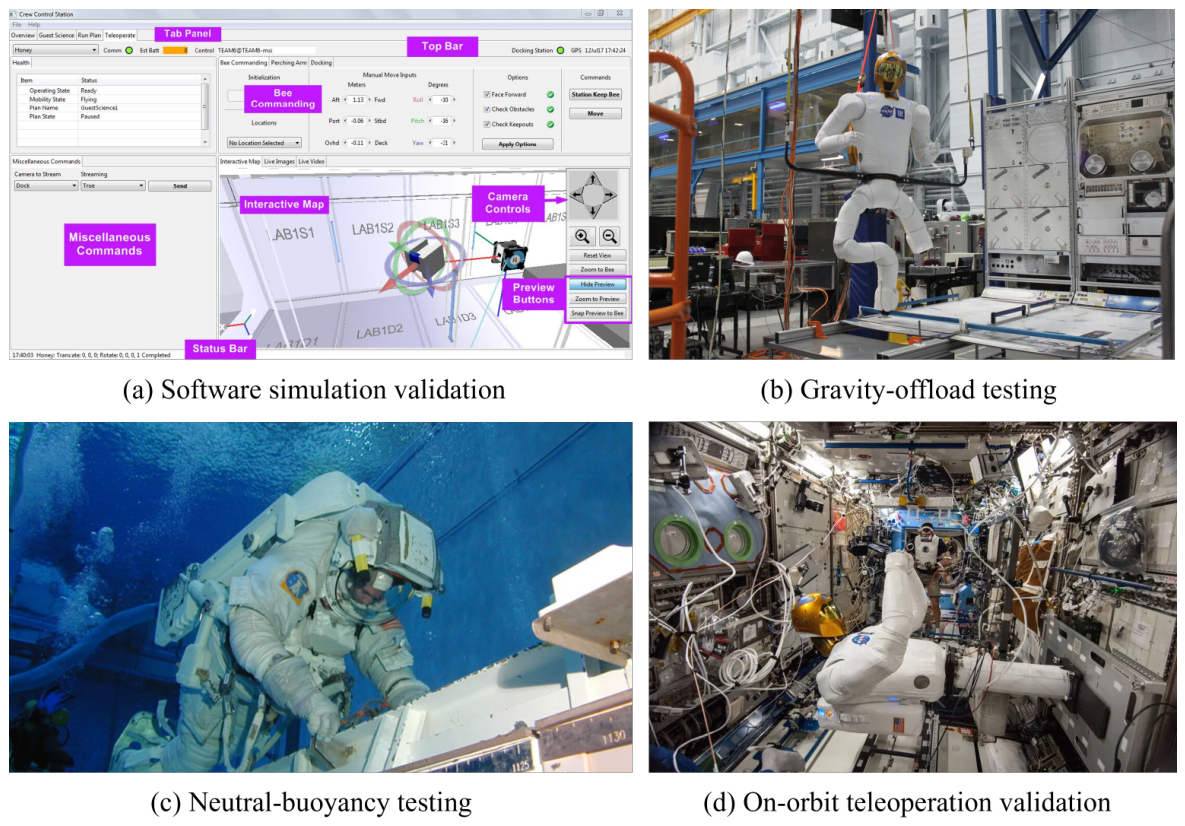
Ground- and flight-test systems are needed to evaluate whether anthropomorphic motion, support sequencing, dexterous manipulation, and autonomy remain feasible under microgravity or microgravity-analog conditions. Representative validation environments are shown in Figure 5. They illustrate why validation evidence for humanoid robotic astronauts should be interpreted as a layered chain, progressing from software-based evaluation and ground analogs to task rehearsal and mission-context validation, rather than as proof from a single facility.
As operational constraints accumulate in high-dimensional systems, validating the reliability of autonomy and execution logic becomes paramount. The initial ISS activities of Robonaut 2 already treated the station as a test environment in which multiple control modes and intravehicular maintenance actions could be progressively evaluated. Later work on complex-task specification and execution showed that humanoid operation in orbit requires validation against explicit task constraints, not merely against low-level motion commands [99]. Supervisory-control studies reinforced this lesson by demonstrating that microgravity manipulation with a humanoid robot depends on the interaction among autonomy, operator oversight, and recovery behavior [15]. For space humanoids, validation must include task-level robustness and not stop at controller stability alone.
Figure 5. Representative validation environments and tools for space-humanoid simulation, analog testing, rehearsal, and mission-context validation. Panel (a) shows a Visual Environment for Remote Virtual Exploration (VERVE) three-dimensional operations display for software and supervisory-command validation [100]; adapted and cropped from a U.S. National Aeronautics and Space Administration (NASA) Technical Reports Server (NTRS) presentation marked for public use. Panel (b) shows Robonaut 2 walking in NASA’s Active Response Gravity Offload System (ARGOS) for gravity-offload mobility testing [101]; image source: NASA image file, public domain. Panel (c) shows astronaut training in NASA’s Neutral Buoyancy Laboratory for extravehicular activity (EVA) rehearsal [102]; image source: NASA via Wikimedia Commons, undated photograph. Panel (d) shows astronaut Chris Cassidy with Robonaut 2 on the International Space Station (ISS) for human-in-the-loop on-orbit validation [103]; image source: NASA Image Article, photo identifier (ID) ISS036-E-029140.
Applsci 16 05032 g005
Ground analog facilities provide complementary evidence rather than interchangeable substitutes. Air-bearing and granite-table systems support free-floating approach and reaction-management tests, but remain limited in dimensionality and contact richness [104]. Neutral buoyancy preserves procedural realism, while fluid drag and added mass distort contact transients [105]. Gravity-compensation rigs support climbing and posture tests but introduce cable coupling [38]. Robot Experiment on the Japanese Experiment Module (REX-J) results likewise show that ground tests must be checked against on-orbit behavior [106].
A credible validation chain should therefore combine simulation, ground analogs, short-duration microgravity tests, and mission-context demonstrations. Software simulation can explore floating-base modes, contact-law sensitivity, and controller failures before hardware tests. Air-bearing systems, gravity-compensation rigs, parabolic-flight or drop-tower experiments, and on-orbit demonstrations then provide progressively stronger evidence for contact interaction, autonomy, and astronaut supervision. Model credibility improves when the same maneuver can be traced across these stages with explicit assumptions and transfer limits.
Translating ground tests into flight readiness requires an operationally relevant validation chain. IVA systems offer a useful reference: Astrobee supports staged testing of autonomy, sensing, docking, and onboard software in orbit [107]. Recent reviews similarly show that validation typically progresses from software simulation to ground analogs and then to orbital deployment, with each stage reducing a different class of uncertainty [108].
Overall, simulation and validation should be treated as layered engineering processes where simulation, analog facilities, integrated task-chain tests, and mission-context experiments provide complementary evidence for transfer validity. The main framework roles are summarized in Table 4.
Table 4. Comparison of simulation and validation frameworks relevant to space-humanoid missions.
MethodFloating-Base RealismContact RealismWhole-Body RealismMain AdvantageMain Limitation
Software simulation [98,108]High if models are accurateModel-dependentFlexibleMode transition analysis, controller testing, parameter sweepsWeak credibility for contact transients without calibration
Gravity-compensation system [38]ModerateLow-to-moderateModerate-to-highAnthropomorphic motion sequencing and posture validationCannot fully reproduce orbital contact dynamics
Air-bearing testbed [104]Good in selected directionsModerateLow-to-moderateFree-floating motion and approach logicReduced dimensionality and simplified support conditions
Neutral buoyancy/rehearsal environment [105]ModerateLow-to-moderateHigh at workspace levelProcedure rehearsal and accessibility assessmentFluid effects distort free motion and contact
Task-chain demonstration [15,99]Task-dependentTask-dependentHighIntegrated perception, manipulation, and procedure evaluationMission-specific and hard to generalize
On-orbit/mission-context validation [106,107]HighestHighestHighestFinal transfer assessmentRare, costly, operationally constrained

4. Perception and Scene Understanding for Space Humanoids

Perception is a core enabling capability for space humanoids because their value in orbit depends not only on anthropomorphic kinematics and dexterous hardware but also on whether they can understand astronaut-centered workspaces and act within them in a reliable and task-relevant manner. Robonaut 2 made this requirement explicit by bringing a humanoid upper body to the International Space Station and demonstrating that future robotic assistants are expected to operate near crew, tools, panels, and other human-designed interfaces rather than only in isolated robotic test conditions [109]. In that sense, perception for space humanoids should not be viewed as a narrow visual front end. It is the mechanism that connects habitat awareness, target recognition, manipulation readiness, and safe human–robot coexistence.
Early Robonaut work already framed perception as a human–robot control problem in astronaut workspaces, rather than as generic space target tracking [110]. Related work on autonomous humanoid tool use reinforced this view by treating astronaut tools, task procedures, and human-compatible interfaces as perception targets, rather than as background scene elements [111]. These studies suggest that perception for space humanoids should be defined by task relevance and astronaut compatibility. The key question is therefore not only whether a robot can recover pose in orbit but also whether it can perceive astronauts, tools, supports, and workspace structures in a form that remains useful for embodied action.
The public literature dedicated specifically to space humanoids is still limited, so adjacent evidence from intravehicular robotic assistants and space manipulation systems remains useful when it reflects the constraints that humanoid robotic astronauts will likely face in practice. Astrobee is an important example because it established a free-flying intravehicular autonomy stack for the ISS and thereby clarified the sensing and software demands of crewed orbital habitats [112]. Its software architecture further highlighted that reliable onboard autonomy in a cabin requires continuous localization, map use, and perception-driven decision support instead of isolated sensing modules [113]. More recent ISS free-flyer datasets made these habitat constraints concrete by exposing clutter, abrupt viewpoint changes, dynamic motion, and severe lighting variation in real intravehicular data [114]. These studies do not replace the humanoid perspective, but they help define the environment in which space humanoids are expected to operate.
Guided by this viewpoint, this section organizes perception for space humanoids as a task chain rather than as a catalog of sensors. The chain begins with ego-state estimation because a humanoid assistant must maintain action-ready self-awareness in a floating and crew-shared habitat. It then moves to object-level perception, scene-level understanding, and contact-rich manipulation perception before concluding with system-level challenges and emerging trends. The important review-level point is that these layers are sequentially coupled: localization defines where the robot can act, object and scene understanding define what the robot can act on, and contact perception determines whether physical interaction remains safe and useful. Table 5 summarizes each perception layer by task role, representative methods, space-humanoid relevance, and remaining challenges.
Table 5. Task-oriented perception layers, representative methods, and open challenges for space humanoids.
Perception LayerTask RoleRepresentative Sensing/MethodsSpace-Humanoid RelevanceMain Challenge
Ego-state estimation and localizationMaintain action-ready self-pose during drift, approach, and support changesStereo, IMU, RGB-D, fiducials; map-based IVA localization [115]; visual-inertial fusion [116]; astronaut-accompanying SLAM [40]Enables handrail-relative pose, panel approach, arbitrary attitude motion, and pre-contact alignmentStable 6-DoF estimation under fast attitude change, support transition, and crew motion
Object-level perceptionIdentify actionable objects and affordancesRGB/RGB-D detection, fiducials; astronaut tracking [117]; affordance recognition [118]; R2/Watson object understanding [119]Links astronauts, tools, handrails, switches, panels, and soft goods to task executionAffordance and grasp-region inference in cluttered, low-texture cabin scenes
Scene-level understandingInterpret the habitat as an operational workspaceMulti-view RGB-D, segmentation, dynamic-feature filtering; semantic SLAM [120]; online semantics [121]; region mapping [122]; human-aware navigation [123]Separates corridors, work zones, support-rich areas, occupied volumes, and contact opportunitiesAction-oriented habitat interpretation under crew motion, clutter, occlusion, and changing tasks
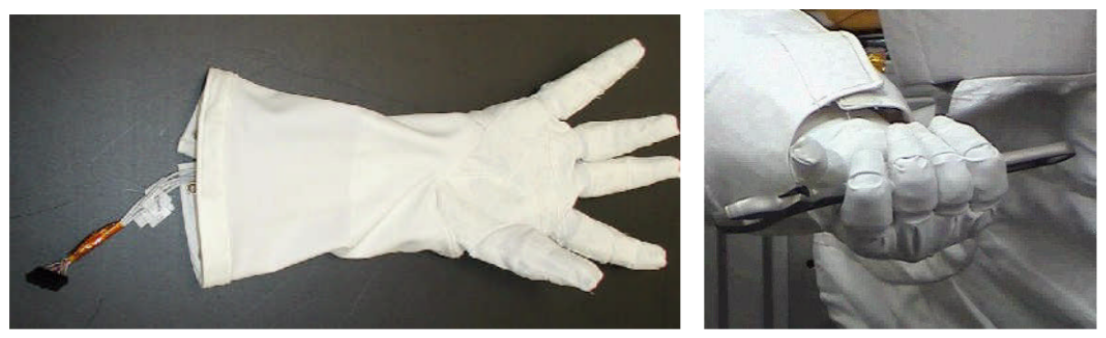
Contact-rich manipulation perceptionVerify grasping, bracing, and interface actuationTactile arrays, force/torque, proprioception, vision-tactile fusion; Robonaut tactile glove [124,125]; R2 hand [126]; vision-tactile grasping [127]; space-tactile sensing [128]Supports handles, fasteners, tethers, switches, and multi-contact body supportContact-state estimation under occlusion, environmental limits, and whole-body multi-contact
System-level integrationKeep localization, recognition, scene parsing, and contact estimation coherentMultimodal fusion, embodied models, simulation-supported evaluation; ISAM autonomy readiness [129]; synthetic datasets [130]; safety validation [131]; foundation models [132]Converts perception outputs into task readiness for crew-shared and contact-rich operationEvaluation on complete humanoid task chains rather than isolated perception benchmarks
Abbreviations: IMU, inertial measurement unit; RGB, red–green–blue; RGB-D, red–green–blue-depth; IVA, intravehicular activity; SLAM, simultaneous localization and mapping; 6-DoF, six degrees of freedom; R2, Robonaut 2; ISAM, in-space servicing, assembly, and manufacturing.

4.1. Ego-State Estimation and Localization

For a space humanoid, ego-state estimation is the perceptual basis of embodied action rather than a stand-alone navigation module. Unlike a fixed-base terrestrial humanoid, the robot cannot assume a stable support frame. Unlike a classical chaser spacecraft, it may need to localize while approaching a panel, aligning near a handrail, preparing to assist a crew member, or stabilizing itself before manipulation. The quality of localization is therefore not measured only by global trajectory accuracy. It is also measured by whether the estimated state remains sufficiently reliable for short-range positioning, interface approach, and pre-contact action.
Map-based localization on intravehicular free-flyers offers useful evidence for this requirement because it shows how prior cabin structure can support robot self-localization in a constrained habitat [115]. At the method level, tightly coupled visual-inertial estimation remains relevant because microgravity motion combines rapid viewpoint change, arbitrary attitude, and the absence of a stable terrestrial gravity frame. Representative visual-inertial systems such as keyframe-based nonlinear fusion, preintegration-based estimation, and lightweight monocular state estimation have established the algorithmic basis for such motion recovery [116]. That said, these methods alone do not define the humanoid problem. Space humanoids need localization that remains compatible with collaboration, habitat structure, and later contact-rich action rather than only smooth free-flight motion.
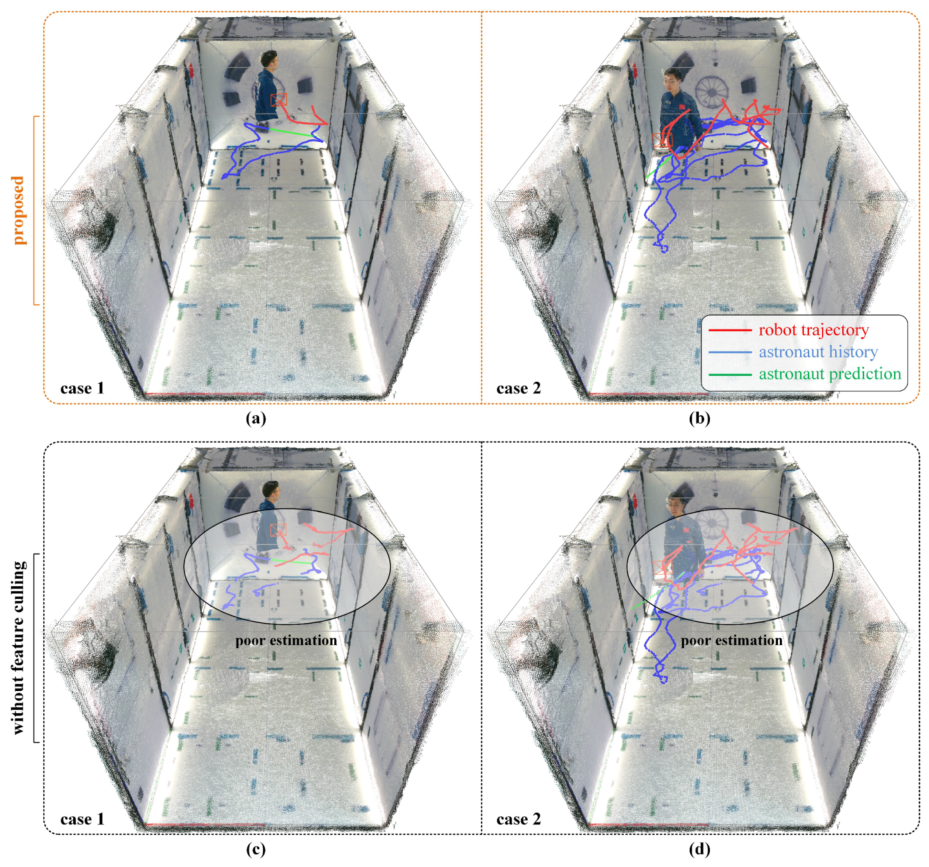
This becomes clearer in astronaut-accompanying navigation, where the robot must maintain its own pose estimate while moving with or around a crew member in a semi-structured and dynamic cabin. The implication for space humanoids is important. Ego-state estimation should not treat humans as incidental dynamic obstacles. It should distinguish stable habitat structure from moving human partners and preserve a usable state estimate throughout approach, positioning, and interaction.

4.2. Object-Level Perception for Space Tasks

Object-level perception for space humanoids should be defined by astronaut-compatible task objects. The relevant entities are not generic targets in open space, but astronauts, tools, handrails, storage interfaces, panel elements, and other structures designed for human use. In a crewed habitat, these objects matter because they determine where the robot can assist, what it can manipulate, and how it can share space safely with humans. Visual astronaut tracking is therefore not a peripheral feature. It is a direct component of task-level perception in astronaut assistance [117].
Object-level perception should also move beyond coarse category recognition. For a humanoid assistant, detecting that an object is a tool is not enough; the robot must estimate whether it can be reached, how it is oriented, and where it can be grasped safely. A handrail matters because it provides a potential support or stabilization contact. A panel element matters because it affords actuation at a specific local region. Affordance-oriented visual recognition is highly relevant to space humanoids because it shifts the perceptual target from category-level object naming to actionable interaction possibilities [118]. For example, a humanoid astronaut must determine whether a handrail can be grasped or used for bracing, whether a tool handle is reachable and safely graspable, and whether a switch, connector, or cover can be pushed, pulled, rotated, inserted, or released. This emphasis is more appropriate than target-only detection because the robot ultimately needs perception outputs that support contact planning, manipulation strategy, safe force application, and recovery from failed interactions, rather than merely reporting that an object or structure is present in a cluttered astronaut workspace.
Work on Robonaut 2 and Watson also points toward a richer interpretation of object-level perception by linking recognition to cognitive task support rather than to isolated detector performance [119]. This is especially important in future astronaut-assistance scenarios, where object recognition must remain connected to procedure context, interface meaning, and the sequencing of actions.

4.3. Scene-Level Understanding in Habitats and Workspaces

If object-level perception identifies what is locally relevant, scene-level understanding explains how the habitat is organized for humanoid action. This distinction matters because a space station or future orbital habitat is not merely a navigable volume. It is a densely structured human workspace containing circulation corridors, maintenance zones, stowage areas, handrail-rich support regions, and temporarily occupied crew workspaces. A humanoid robot should therefore understand not only what objects are present but also how the surrounding environment is functionally arranged.
Recent surveys of semantic simultaneous localization and mapping (SLAM) have shown that robotic perception is increasingly moving from pure geometry toward semantically enriched environment representation [120]. More specialized work on online semantic knowledge integration suggests that mapping becomes more useful when object- and relation-level knowledge are incorporated into the representation rather than added as post-processing labels [121]. For space humanoids, the relevance of these trends lies in habitat interpretation. The robot needs a representation that distinguishes navigable volume from operational workspace, temporary clutter from stable support structure, and visually present surfaces from semantically meaningful contact opportunities.
This need is even stronger in crew-shared environments. Human-aware navigation research has long argued that robot movement in human spaces should account for human motion, occupancy, and social compatibility rather than only obstacle avoidance [123]. In orbital habitats, these requirements are amplified by confinement, floating motion, and task coupling. Figure 6 shows a representative crew-shared intravehicular perception case in which robot localization and astronaut motion are tightly coupled. The comparison between feature culling and no feature culling illustrates the review-level point: scene understanding for a humanoid robotic astronaut must preserve a stable habitat structure while explicitly accounting for moving crew members and task partners.
Figure 6. Crew-shared intravehicular perception example for scene-level understanding. Red curves denote the estimated trajectories of the robotic assistant, while blue and green curves denote the estimated and predicted trajectories of the served astronaut, respectively. Panels (a,b) show the proposed dynamic-feature-aware framework, and panels (c,d) show the degraded result without feature culling. The example illustrates why space-humanoid perception must distinguish a stable habitat structure from moving crew members before task-level action. Reproduced from [40], licensed under Creative Commons Attribution (CC BY) 4.0.
Applsci 16 05032 g006
A useful extension of this idea is to represent high-level functional regions instead of relying only on explicit object inventories. Region-centric semantic mapping has shown that indoor environments can be partitioned into meaningful areas even without exhaustive object recognition [122]. For space humanoids, this direction is attractive because action often depends on workspace type rather than object count alone. The robot may need to know that it is entering a work zone, crossing a support-rich corridor, or approaching a temporarily occupied region where interaction should be delayed. Scene understanding for space humanoids is therefore best framed as habitat interpretation for action.

4.4. Perception for Contact-Rich Manipulation

Contact-rich manipulation is the perceptual layer where the distinctiveness of space humanoids becomes most visible. A free-flying inspection platform may rely mainly on localization and vision. A humanoid robotic astronaut cannot. Once the robot begins to grasp a tool, stabilize against a handrail, actuate an interface, or establish a support contact, the relevant perceptual evidence shifts from global appearance to local interaction state. This point was already clear in tactile glove work for Robonaut, where distributed tactile sensing was introduced as a practical foundation for autonomous grasping rather than as a minor accessory [124].
The same design logic continued in Robonaut 2, whose hand was explicitly engineered to do work with tools and therefore to support dexterous, astronaut-compatible interaction instead of only basic parallel-jaw grasping [126]. This makes local contact sensing crucial. Tool handles, switches, tether points, and small interface elements all demand perception that can resolve contact onset, pressure distribution, grasp progression, and local alignment under occlusion. A representative example of tactile sensing and reflexive contact response in astronaut-oriented manipulation is shown in Figure 7.
Figure 7. Contact-rich perception example for astronaut-oriented dexterous manipulation: the left panel shows the Robonaut tactile glove, and the right panel shows reflexive grasp behavior triggered by tactile stimulation. The figure illustrates how local tactile evidence supports grasp verification and rapid contact response when vision alone is insufficient. Reproduced from [125].
Applsci 16 05032 g007
This emphasis is consistent with broader work on vision–touch integration, where grasping and regrasping performance improves when tactile information complements visual inference instead of being deferred to a late error-correction stage [127]. In space systems, the importance of local contact evidence is even more pronounced because sensing hardware must tolerate strict environmental and reliability constraints. Recent reviews of tactile sensing in space robotics underline that contact perception is both technically challenging and operationally central for manipulation in orbital environments [128]. Space humanoids intensify this need because meaningful contact may occur through the hand, forearm, torso, or multiple body supports during whole-body stabilization and astronaut-compatible operation. For clarity, the main perceptual modalities involved in contact-rich manipulation are summarized in Table 6.
Table 6. Perceptual modalities for contact-rich manipulation in space humanoids.
ModalityMain ContributionTypical UseWeakness in Isolation
Vision [127]Global alignment and scene contextApproaching tools, rails, handles, panelsWeak local contact observability under occlusion
Force and torque sensing [126]Net interaction load and guarded motionWrist monitoring, compliant interface actuationPoor spatial detail of contact distribution
Tactile sensing [124,125,128]Contact location, pressure pattern, incipient slipDexterous grasping, contact verificationLimited sensing range, hardware complexity
Proprioception [126]Hand posture and body support configurationIn-hand motion, whole-body stabilizationCannot directly infer external contact meaning
Multimodal fusion [127,128]Cross-phase contact-state estimationTool use, panel operation, support-aware manipulationIntegration, calibration, compute burden

4.5. System-Level Challenges and Trends

The main system-level challenge is not simply to improve each perceptual block independently. It is to make localization, object-level perception, scene understanding, and contact-rich manipulation remain coherent inside one embodied robotic astronaut system. A perception stack that localizes accurately but cannot recognize support affordances, or one that detects tools but cannot verify contact state, is insufficient for astronaut-compatible operation. Current NASA assessments of in-space servicing, assembly, and manufacturing have increasingly emphasized integrated autonomy readiness over isolated algorithmic gains [129]. This systems view is especially important for space humanoids because the same platform is expected to move in crew-shared habitats, interpret astronaut-facing objects, and perform physically grounded manipulation in close proximity to humans.
A major bottleneck is the lack of datasets and evaluation settings that directly reflect the full humanoid task chain. Large synthetic benchmarks are expanding the evaluation of non-cooperative space perception, but they do not yet capture the combined demands of astronauts, tools, support structures, interfaces, and contact transitions in one unified habitat-centered setting [130]. Another bottleneck is validation. Safety-critical orbital robotics requires stronger verification practices than ordinary benchmark testing, especially when perceptual outputs influence motion near crew and high-value infrastructure [131]. At the same time, embodied foundation-model research suggests that future systems may gain richer semantic flexibility and instruction grounding, although those gains will only matter if they remain tied to reliable embodied sensing and controllable action [132]. The most important trend is therefore a shift away from benchmark-centric perception modules and toward mission-centric perception stacks designed specifically for astronaut-compatible humanoid operation.

5. Motion Planning and Whole-Body Control for Space Humanoids

After a space humanoid reaches acceptable morphology and perception capability, the technical bottleneck shifts to motion generation and execution in microgravity. Planning and control cannot be separated into a geometric front end and a tracking back end. The robot is a floating-base multibody system with tight coupling among contact timing, momentum redistribution, and body attitude evolution. In orbit-like environments, robots alternate among free flight, braced manipulation, handrail-assisted translation, and transient contacts, so dynamic feasibility must be preserved across the full pipeline rather than checked after trajectory design [11].
This challenge is reflected across several research lines. Early astronaut-assistance humanoids such as Robonaut emphasized compatibility with tools and crew interfaces [133]. Robonaut 2 exposed the operational difficulty of combining dexterous manipulation with intravehicular mobility under floating-base disturbance. More recent systems such as Taikobot treat locomotion as a microgravity-native whole-body transfer process rather than a variant of terrestrial gaiting.
To make the landscape readable, this section keeps four coupled layers. The first is planning foundations under floating-base dynamics. The second is whole-body contact sequencing and support-mode transition. The third is execution-level control under uncertainty and closed-chain interaction. The fourth is integrated planning-control design where learning is used as a bounded auxiliary module.

5.1. Planning Foundations for Microgravity Space Humanoids

Planning for space humanoids is best defined as generation of support-aware and dynamically credible behavior. The planner must decide end-effector motion, trunk reorientation, momentum flow, and contact maintenance or release while preserving future reachability. This perspective explains why early space-humanoid programs remain conceptually important. Robonaut framed the humanoid body as a compatibility layer for astronaut workspaces and interfaces, which turned planning into a whole-body compatibility problem rather than a single manipulator path problem.
Recent robotic astronaut platforms formalize locomotion as a microgravity-native transfer behavior. Taikobot is a representative case. Its push-off–flight–parking process uses centroidal reasoning and a multi-contact structure instead of ground-derived balance assumptions [8]. That formulation suggests that relevant planning variables for space humanoids are support availability, contact order, body attitude evolution, and post-contact settling quality, rather than footsteps and static margin proxies inherited from terrestrial locomotion.
Studies on specific astronaut-like maneuvers reinforce the same message. Stable dual-arm climbing in station-like interiors requires anticipation of internal-force conflict before execution starts. A kinematically reachable move may still fail if closed-chain loading is poor. Parking maneuvers further show that terminal interaction is not only a geometric docking problem. Approach velocity and orientation determine impact response, rebound risk, and stabilization effort after contact [134]. Planning therefore needs terminal dynamic conditioning, not only collision-free final pose generation.
The problem becomes harder in extravehicular and sparse-support scenarios. AstroLimbs illustrates this trend by combining anthropomorphic mission intent with reinforcement-learning-based motion generation for less structured EVA conditions [135]. A more explicit whole-body formulation appears in trajectory optimization for free-floating two-arm humanoids moving along handrails, where grasp and non-grasp phases, rail topology, and continuity constraints are solved together [136]. In these formulations, contact-mode scheduling is a planning variable from the start.

5.2. Whole-Body Motion and Contact Sequencing

If planning foundations establish dynamic credibility, whole-body motion design must specify what is planned at each support transition. In terrestrial humanoids, extra contacts often improve stability around gravity-dominant locomotion. In space humanoids, contact plays a more central role. It creates support, redirects momentum, limits drift, and enables the next feasible action. Whole-body motion generation should therefore be organized around support modes and transitions, not only waypoint interpolation. Figure 8 illustrates a representative push-off–flight–parking transition sequence in microgravity.
A posture sequence is insufficient if support topology is implicit. It must be clear which limbs carry load, which contacts are prepared or released, and whether the resulting configuration preserves controllability and future reach. In the broader humanoid literature, contact planning has been formulated as a coupled problem involving candidate contacts, posture, and collision handling [137]. This abstraction is even more critical in microgravity because poor grasp order or mistimed release can immediately trigger attitude drift or block the next support.
Figure 8. Representative phases of Taikobot’s push-off–flight–parking (PFP) locomotion in microgravity: (a,b) impulse generation and support release during push-off, (c,d) free-flight transfer with floating-base attitude evolution, and (e,f) terminal parking and support reacquisition. The sequence illustrates why space-humanoid motion planning must couple contact timing, body transfer, and post-contact stabilization rather than treating locomotion as a terrestrial gait problem. Reproduced from [8], licensed under Creative Commons Attribution (CC BY) 4.0.
Applsci 16 05032 g008
Recent multi-contact studies support this view and show that repeated establishment and release of noncoplanar contacts should be handled as coupled planning and control rather than geometric preprocessing [138]. For robotic astronauts, each support transition changes wrench transmission paths through the body and reshapes feasible dynamics. During handrail translation, structural bracing, or near-worksite stabilization, the contact sequence defines the evolving dynamic structure of the system.
Astronaut-inspired dual-arm mobility studies make this concrete. Omnidirectional continuous movement methods model alternating contact and flight phases while enforcing prohibited contact regions, obstacle constraints, and performance criteria in one transfer process [139]. The key implication is that locomotion cannot be decoupled from contact selection. The robot must evaluate where support can be formed, how limb action generates body transfer, and how the next support is reached without degrading current maneuver quality.
Work on human-like acceleration and deceleration patterns in station interiors further shows that even short translations are shaped by force timing and coordinated whole-body motion [140]. Support transition is not only a graph event. It has a time structure. Force build-up before release and body settling before re-contact strongly influence safety and controllability of the next phase.
Extravehicular scenarios add sparse and anisotropic support geometry. Discontinuous crawling studies formulate autonomous motion through gait triggering, support candidate selection, and whole-body coordination under self-collision constraints [141]. Although not full humanoids, they expose a difficulty that transfers directly. The planner must traverse a sparse contact graph while maintaining configurations that preserve future options. This is closer to astronaut support planning than to free-space manipulation.
Contact sequencing is also tied to force feasibility. Whole-body compliance control for truss crawling shows that kinematic validity does not guarantee operational quality if force distribution across supports is poor [142]. For space humanoids, contact sequence quality should be evaluated by geometric reachability and downstream controllability together, including internal-force behavior, load concentration, and tolerance to contact uncertainty.
These constraints explain growing interest in predictive methods. Whole-body model predictive control (MPC) has shown in terrestrial settings that continuous re-optimization handles constraints and delays better than fixed execution of offline plans [143]. In space settings, support transitions are more dynamically consequential. A released handrail or imperfect contact settlement can move the robot far from nominal states. Receding-horizon methods that revise body motion, transition timing, and force objectives are therefore attractive.
At the system level, whole-body planning for space humanoids can be reframed as management of support creation, release, and body transfer such that each phase preserves feasibility of the next one. Dynamic admissibility at the current instant is necessary but not sufficient. Transition readiness matters equally. This property is critical in astronaut tasks where geometry is irregular, supports are limited, and local errors propagate quickly.
Overall, available evidence suggests that motion generation is best organized around four linked planning objects. These are support mode, contact order, transfer trajectory, and transition-force profile. Existing work often addresses them separately across subcommunities. Limited studies combine all four in one tractable architecture. This remains a primary reason that space-humanoid planning maturity lags behind terrestrial loco-manipulation.

5.3. Control Architectures for Floating-Base Humanoids

Current whole-body control research indicates a common architecture pattern based on hierarchical task handling, optimization-based back ends, and contact-consistent execution [144,145]. For space humanoids, this architecture is especially important because control acts on an underactuated floating-base body without gravity-dominated passive stabilization. Posture, contact forces, and task behavior stay coupled through momentum exchange and interaction constraints. A useful controller must coordinate task execution, base attitude regulation, interaction stability, and transition robustness in one stack.
The free-floating humanoid control literature provides the baseline. Task-priority strategies established that operational objectives should be coordinated hierarchically inside a floating-base model rather than through isolated joint tracking loops [12,146]. This remains directly relevant to robotic astronauts, where end-effector behavior, visual orientation, posture control, and contact maintenance are simultaneous requirements. Later formulations reinforced that multiple tasks and constraints should be solved in one dynamic framework, using hierarchical optimization or inverse-dynamics formulations that can account for contacts and external constraints [85,86,87].
Space use cases impose stronger contact sensitivity. Hierarchical control must preserve task priorities while handling support creation and release under disturbance. This is visible in free-floating two-arm humanoid translation for EVA-like tasks. Execution quality depends on consistency with rail topology, arm alternation, and transient disturbance at grasp transitions. Trajectory optimization and control studies in this context confirm that arm motion, base response, and task progression are tightly coupled and cannot be decoupled without quality loss.
Momentum-aware regulation is therefore central. Limb-level tracking alone is insufficient because small local errors can accumulate into large base attitude drift when support is weak or intermittent. Practical controlled quantities should include centroidal momentum behavior, base reaction trends, wrench consistency, and post-contact settling quality in addition to joint errors [88,90]. Near delicate structures or crew interfaces, this dynamic coherence is tied directly to mission safety.
Compliance is equally central. In microgravity, contact is enabling and potentially destabilizing. Rigid behavior may reach a target grasp and still fail due to impact transients, closed-chain mismatch, or internal load spikes. Adaptive impedance results for robot-astronaut climbing showed suppression of conflicting internal-force disturbance during dual-arm motion, improving closed-chain stability [76]. The key lesson extends beyond one platform. Compliance is part of the execution mechanism that keeps multi-contact motion feasible.
This principle also appears in whole-body compliant interaction with large targets. Multi-arm capture studies demonstrate that force quality must be regulated at the system level and distributed across all active limbs under coupled constrained dynamics [147]. For space humanoids, whenever one limb braces and another manipulates, the problem immediately becomes whole-body and contact-coupled. End-effector local control is not enough.
Recent truss crawling work extends the argument by embedding compliance across contacting limbs and the floating base together. In such approaches, a unified compliance model is combined with predictive optimization of contact forces to preserve stability during structure-relative locomotion [142]. Though developed for non-anthropomorphic systems, the architecture is informative for future humanoids because it integrates contact stability, base disturbance management, and motion consistency in one loop.
A complementary control regime is compliant floating-base behavior without strict global pose regulation. This is relevant to local service and assistive interaction tasks where bounded cooperative response may be preferable to rigid disturbance rejection. Such controllers allow environment-induced deviation while keeping forces bounded and behavior safe around fixtures and interfaces [148]. In space tasks, preserving dynamic admissibility and hardware safety can be more important than exact geometric tracking.
Predictive control methods further strengthen this direction. Receding-horizon control can couple force regulation, posture evolution, and contact consistency over short horizons. In space applications, this is valuable after support release or contact settlement error, when state deviation from nominal references can be significant. Predictive layers can revise near-term action while enforcing updated force limits and floating-base constraints.
Robustness and adaptation remain mandatory because uncertainty is persistent. Contact stiffness varies across structures. Payload properties may be only partly known. Estimation errors can project into force misallocation and base drift. Fixed-gain designs are often brittle under these conditions. Recent astronaut and multi-arm space robot control work increasingly favors adaptive compliance, disturbance-aware force redistribution, and integrated whole-body robustness mechanisms.
The emerging architecture trend is clear. A top whole-body layer coordinates tasks, posture objectives, and contact constraints in one floating-base model. An interaction layer enforces impedance or compliance during support formation and release. A robustness layer uses predictive and adaptive mechanisms to preserve controllability under uncertainty. The open engineering task is integration into a computationally tractable and operationally reliable stack for real missions. From a control viewpoint, discontinuous microgravity crawling further confirms that execution must couple body transfer, limb coordination, and contact stabilization.
Table 7 summarizes the main planning and control method families relevant to space humanoids, emphasizing their operational role, mission relevance, and current limitations.
Table 7. Planning and whole-body control method families for space-humanoid robots.
Method FamilyPlanning/Control RoleSpace-Humanoid RelevanceMain Limitation
Support-aware motion planning [8,136]Select support mode, contact order, body transfer, and terminal parking conditionCouples cabin mobility, handrail transfer, and post-contact stabilization under floating-base dynamicsSensitive to support-geometry error, missed grasp, and terminal impact
Multi-contact transition planning [137,138,141]Coordinate candidate contacts, posture evolution, collision avoidance, and support releaseFits handrail translation, braced manipulation, and sparse truss traversalHybrid search grows rapidly as contacts and constraints increase
Task-priority/hierarchical control [12,85,86,146]Order end-effector, gaze, posture, contact, and safety objectivesMatches simultaneous manipulation, visual alignment, clearance, and support maintenanceStrict priorities can be brittle during rapid contact-mode changes
Optimization-based inverse dynamics/quadratic programming (QP) [87,144,145]Solve feasible accelerations, torques, and contact forces with constraintsHandles underactuation, joint limits, tool forces, and multi-contact support consistencyNeeds reliable contact state, dynamic parameters, and certifiable solver behavior
Momentum-aware regulation [88,90]Regulate base reaction, centroidal momentum, and post-contact settlingDirectly targets attitude drift and reaction management during weak supportReduced-order models may miss local contact transients and limb-force distribution
Impedance/compliance control [76,91,92,93,142]Shape safe interaction, absorb impact, and redistribute internal forcesSupports handrail capture, bracing, tool contact, and crew-adjacent operationGain tuning and stability margins remain difficult under variable stiffness
Predictive and learning-assisted control [143,149,150,151,152]Update near-term motion, force objectives, and stabilization actionsUseful after support release, imperfect contact settlement, or state-estimation errorOnboard computation, model credibility, and out-of-distribution verification remain unresolved

5.4. Integrated Trends and Open Directions

A major trend is the erosion of a strict boundary between planning and control. In space humanoids, this shift is driven by physics. A geometrically feasible support sequence may become dynamically unsafe when floating-base response, force transients, and contact uncertainty are included. Recent work across robotic astronaut locomotion, free-floating translation, and contact-rich crawling therefore moves toward coupled motion generation and execution pipelines.
Support-aware predictive schemes are gaining weight in this transition. Because repeated grasp and release events dominate microgravity mobility, reactive tracking alone often cannot preserve transition feasibility over multiple events. Predictive formulations can co-manage transfer trajectory, force evolution, and timing in one receding-horizon workflow, which helps maintain consistency across successive supports.
The role of compliance has also shifted. It is no longer a peripheral protection layer. It has become a primary mechanism for transition execution under uncertainty, closed-chain load redistribution, and disturbance accommodation when environment models are incomplete. In sparse-support operations with limited structural tolerance, this property is necessary for robust autonomy.
Learning-based methods are increasingly used as bounded enhancement modules rather than unrestricted end-to-end replacements. Recent review work in humanoid control points to hybrid directions where model structure, optimization, and safety constraints remain central while learned modules improve adaptation and generalization [150,151,152]. A representative example is reinforcement-learning-based attitude stabilization for robot astronauts, using curriculum design with asymmetric actor–critic Proximal Policy Optimization (PPO) and showing stable regulation under varied initial conditions in Isaac Gym [149]. Its practical value lies in bounded stabilization support, not in replacing model-based whole-body reasoning.
Several open problems remain. A unified and tractable formulation for joint support sequencing, transfer optimization, and force regulation under floating-base dynamics is still missing. Many current pipelines separate these functions into loosely connected layers and create interface vulnerabilities. Integrated optimization with explicit transition-force reasoning remains difficult.
Closed-chain internal-force management during transition is another unresolved issue. When a humanoid braces with multiple limbs or manipulates while anchored, internal loading must be regulated alongside task motion. Local force errors can perturb base attitude and damage interfaces. General frameworks that couple internal-force regulation with support planning are still immature.
Contact uncertainty in operationally realistic conditions also needs stronger treatment. Many methods assume accurate support geometry and stable interaction properties. Real deployments face estimation error, structural compliance, and partial contact failure. Uncertainty representation should move upward into support-transition planning rather than stay only in low-level tracking compensation.
Computational hierarchy and certifiability form an additional bottleneck. Whole-body hybrid reasoning is high-dimensional, yet onboard resources are constrained and mission software must be auditable. Compared with terrestrial settings that can absorb larger models through compute scaling, space systems must rely more on structured decomposition, approximation with guarantees, and predictable runtime behavior.
In summary, motion planning and whole-body control for space humanoids are moving from loosely coupled subsystems toward integrated contact-aware autonomy in microgravity. The decisive next step is whether planning, control, compliance, and learning can be combined into an architecture that is computationally credible and operationally trustworthy for mission use.

6. Human–Robot Interaction and Teleoperation for Space Humanoids

The operational value of a space humanoid is not determined only by dexterous hardware or whole-body mobility. It depends on whether the robot can be integrated into astronaut workflows with acceptable supervision cost, predictable behavior, and explicit authority boundaries. For this reason, space human–robot interaction (HRI) should be treated as a mission architecture problem rather than only an interface problem [13]. Human-centered metrics such as workload, situation awareness, usability, communication quality, and intervention structure are therefore central in autonomy allocation decisions [153].
This framing is especially important for humanoids because they are deployed in environments and procedures designed around human bodies and human task logic. The interaction problem includes command input, authority sharing, intent communication, and recovery handoff design [154]. Space conditions then increase the penalty of weak interaction architecture. Communication delay, intermittent links, sparse crew time, viewpoint constraints, and high consequence failure can quickly make a lab-effective control strategy operationally inefficient [155,156].

6.1. Teleoperation and Autonomy Allocation Under Delay and Bandwidth Constraints

Teleoperation remains indispensable in space robotics, but continuous low-level control is rarely scalable for humanoids. Early delayed-control studies already showed that precision degrades when operators must close fast loops through latency and incomplete perception [157]. For humanoids, this burden grows because operators must account for coordinated arms, torso motion, contact transitions, and a safety envelope. The Robonaut 2 experience similarly showed that practical ISS use depends on constrained supervision modes rather than unrestricted joint-level command [5].
A more sustainable approach is adaptive authority sharing. Direct control remains valuable for contingencies and finely judged contact. Shared control is effective when operators shape execution through preview and constraints. Supervisory control is effective when operators issue goals and monitor progress while onboard autonomy performs local planning and regulation. This spectrum matches lessons from bilateral telepresence benchmarks under delay and bandwidth limitations [158]. Figure 9 maps the four canonical autonomy levels onto representative space-robotics campaigns and the operator and robot responsibilities that each level entails. The figure makes explicit a point that is often blurred in the literature: as the round-trip delay between operator and robot grows, authority shifts toward onboard autonomy, and the corresponding HRI artifacts, including predictive displays, intervention contracts, and anomaly bookmarks, become mission-control elements rather than optional usability features.
Evidence from the METERON SUPVIS Justin line supports this shift. Tablet-mediated task command reduced burden for non-expert operators in preparation studies [159]. Later, ISS-to-ground experiments showed that supervised autonomy can sustain meaningful astronaut–robot collaboration under mission-relevant communication and workload constraints. Recent extensions further indicate that scalable autonomy is most effective when paired with explicit intervention points for ambiguity or anomaly handling [160].
Task-level operation is more robust when command intent is semantic rather than purely kinematic. Affordance-based methods allow operators to express object-centered goals while local autonomy handles waypoint adaptation and execution detail, which aligns with astronaut procedural logic [161]. Delay-tolerant operation also depends on feedback design. Predictive display and mixed-reality planning tools can restore part of lost temporal continuity and improve judgment of posture, contact transition, and workspace occupancy [162,163]. Orbit-to-surface telepresence studies further show that immersive control is valuable for specific subtasks, but mission-scale performance still depends on autonomy scaling and coherent mode transitions.
For mission architecture, phase-aware autonomy allocation is important. During repetitive nominal procedures, higher local autonomy can reduce crew interruption and improve throughput. During ambiguous contact events or high-value operations, faster human re-entry is preferable. This selective allocation principle is consistent with station operation experience and with supervised telepresence campaigns where operator burden varies substantially across task phases [159,164].
A practical extension is to define transition contracts between modes, including required status reports, visible confidence cues, and bounded actions during authority transfer. Such contracts reduce confusion and improve safety under delay.

6.2. Shared Situational Awareness and Safe Co-Location in Microgravity

In intravehicular operation, interaction quality depends on whether astronauts can infer what the robot is doing, what it will do next, and how that motion relates to surrounding structures and people. NASA HRI analyses highlight this as a distinctive challenge in microgravity habitats, where crew-adjacent operation must remain both safe and useful under real mission constraints [165].
Microgravity changes observability and coordination assumptions. Viewpoints shift, support contacts are intermittent, and small impulses can alter the local workspace state. A co-located humanoid therefore needs behavior that communicates intent from multiple perspectives. Legible motion is important because observers can infer action intent earlier [166]. Human-aware planning is equally important because comfort, approach direction, workspace intrusion, and expected pause behavior influence collaboration quality beyond collision avoidance [167,168].
Situational awareness also has a team cognition dimension. Local crew, robot autonomy, and ground control often hold partial and asynchronous task views. Shared mental model frameworks are therefore relevant because they target alignment in state understanding, intent expectation, and responsibility boundaries under communication constraints [169]. Work on performative autonomy similarly suggests that slightly more explicit behavior can preserve operator understanding and team fluency over long tasks [170]. Human-in-the-loop station-analog evaluations support this view by showing that inspection effectiveness depends on viewpoint control, intervention timing, and operator comprehension as much as raw platform capability [171].
A practical implication is that co-location metrics should couple physical safety and cognitive load. Near-miss rate and clearance margin are necessary but insufficient without mode-awareness latency, interruption burden, and handoff timing quality. This combined evaluation better indicates whether a humanoid can remain safe and cognitively manageable during routine station work.

6.3. Trust Calibration and Long-Duration Human–Robot Teaming

For space humanoids, trust should be treated as calibration rather than maximization. The operational question is whether people rely on the robot at appropriate moments, intervene when needed, and avoid both complacency and under-use. This challenge becomes stronger when the robot is embedded in repeated procedures and long mission horizons instead of isolated demonstrations. Human-autonomy teaming studies in high-workload domains reach similar conclusions about sustained role alignment and calibrated reliance [172].
Calibration depends strongly on transparency and explanation quality. HRI evidence shows that trust alignment improves when the robot makes decision rationale interpretable, rather than leaving operators to infer internal logic from outcomes only [173]. In practice, targeted transparency is more effective than indiscriminate data exposure. Operators need clear visibility of autonomy mode, competence boundary, intended next action, and help-request conditions.
Failure and recovery design are equally important. Space humanoids inevitably face uncertainty from occlusion, contact ambiguity, and procedural novelty. The key issue is whether degradation remains predictable and recoverable. NASA evidence on human-automation integration shows that unclear authority boundaries can produce misuse, disuse, and responsibility confusion [174]. Exploration risk studies also note that robots are often treated as teammates, and anthropomorphic embodiment can amplify over-attribution when capability limits are not explicit [175].
Trust calibration should therefore be measured as a dynamic team property. Behavioral indicators such as reliance timing, override frequency, and response to uncertainty provide stronger evidence of appropriate use than post-task acceptance ratings alone [176]. Long-horizon missions also require explicit recalibration cycles after anomalies, software updates, and role changes. These cycles help maintain alignment between capability claims, observed behavior, and fallback policy, reducing both over-trust and unnecessary override [172,176].
For mission design, the practical target is delegation without complacency, intervention without micromanagement, and explicit authority transfer during autonomy-mode change. Interaction architectures that expose competence boundaries and recovery logic clearly are more likely to sustain stable human–robot teaming over long durations. Table 8 summarizes representative systems together with mission-relevant design implications and evaluation metrics.
Table 8. Representative space human–robot interaction (HRI) and teleoperation systems with associated design implications and evaluation metrics for humanoid robotic astronauts.
System/ProjectMission ContextInteraction ModeHuman RoleCommunicationDesign ImplicationMetrics
Robonaut 2 [5]IVA assistance on ISSSupervised constrained executionCrew monitoring and interventionLocal onboard interactionSafe co-location and clear intervention pathsTask completion, interventions, near misses, workload
KONTUR-2 [158]ISS-to-ground telemanipulation analogBilateral force-feedback teleoperationContinuous manual controlDelayed, bandwidth-limited loopReserve haptics for critical contact phasesForce error, latency, packet-loss recovery
METERON SUPVIS Justin [7,14]Orbit crew commanding a surface coworkerTask-level supervised autonomyGoal setting and monitoringDelayed supervisory loopContract-based supervision and mode handoffCommands per task, handoff latency, mode switches, recovery
Astrobee [164]IVA free-flyer support on ISSSupervised, teleoperated, and autonomous modesCrew and ground supervisionOnboard and intermittent space-to-ground linksShared state across crew and groundSituation awareness, intervention timing, localization confidence
Surface Avatar [51]Orbit-to-surface telepresenceImmersive telepresence with scalable autonomyRemote supervision and teleoperationLatency-sensitive orbit-to-surface loopTelepresence with autonomy and re-entry rulesDwell time, mode transition, throughput, trust calibration
Abbreviations: IVA, intravehicular activity; ISS, International Space Station; SUPVIS, supervised autonomy.

7. Evaluation, Benchmarking, and Open Challenges

Evaluation for space-humanoid robotics should not be treated as a direct extension of terrestrial benchmarking. A robotic astronaut has to interact with human interfaces, absorb floating-base disturbance, stay useful under delayed supervision, and support mission efficiency when crew time is scarce. Reviews of space human–robot operations show that autonomy allocation, communication conditions, workload, and trust are central mission variables rather than peripheral user study factors [17]. Surveys of on-orbit servicing reach a similar view and stress integrated performance across perception, planning, control, and operational safety [18]. A strong benchmark report should therefore state what was tested, under which supervision model, and how much of the result is likely to transfer to mission conditions.

7.1. Benchmark Targets and Mission-Relevant Metrics

Dynamic and contact robustness remains a core target. In microgravity, manipulation cannot be separated from whole-body motion because the base is free-floating and reacts to every contact event. NASA studies on supervisory control of Robonaut 2 in simulated microgravity made this point by focusing on operation in a human environment with constrained communication and limited direct teleoperation bandwidth. Useful metrics include base pose drift during contact, impulse peaks, force tracking error, handrail capture success, grasp retention under disturbance, and safe recovery rate after unintended momentum transfer. These signals describe functional stability and should be treated as benchmark outputs.
Supervisory efficiency is equally important. Space humanoids will often switch between telepresence, shared control, supervised autonomy, and contingency takeover. KONTUR-2 is informative because it validated force-feedback telemanipulation in-flight with the ISS as an orbital supervisory node for ground robots [55]. Benchmark reports should capture commands per task, operator dwell time, intervention delay, mode switching frequency, and task progress retained after communication degradation or handover.
Human-facing variables should be treated as benchmark metadata rather than post hoc usability observations. The retrospective analysis of model-augmented haptic telemanipulation around KONTUR-2 showed that force feedback shaped how well operators regulated interaction forces under delay and data loss [177]. A benchmark report should therefore record workload, situation awareness, perceived safety, trust calibration, training burden, interface mode, intervention count, handoff latency, and autonomy-mode switches. The NASA Task Load Index (NASA-TLX) remains a practical workload baseline in supervisory studies [178]. Recent interface work for planetary use cases also indicates that astronaut performance depends on mission-specific interface requirements [179]. These variables make it possible to compare not only whether a task succeeded, but also how much human effort and supervisory risk were required.

7.2. Benchmark Carriers and Validation Environments

Benchmark carriers are the concrete artifacts and tasks that expose capability. Terrestrial robotics has shown why shared carriers matter. RLBench demonstrated the value of reusable and diverse manipulation tasks under repeatable conditions [180]. HumanoidBench extended this idea to whole-body behavior in a common simulation family [181]. These frameworks are not directly transferable to space missions, but they clarify the current gap in space humanoids where task design, scoring logic, and metadata are still weakly standardized.
For space humanoids, carriers should be modular. One layer can cover canonical habitat artifacts and task boards. Another can probe contact transition and stabilization behavior. A third can capture supervision and telepresence under varying communication conditions. Recent simulation-oriented work argues for procedural generation and task variability to evaluate generalization rather than overfitting [182]. That direction is valuable and still needs extension toward integrated humanoid operation beyond manipulation-only tasks.
The telerobotics literature offers useful examples. Preparatory work for METERON SUPVIS Justin framed astronaut command as scalable task-level instruction for a humanoid coworker in a mission-representative maintenance setting [183]. Orbit-to-ground experiments then showed how interface design, training, and supervised autonomy jointly influenced execution quality on Rollin’ Justin. Recent multi-user teleoperation results suggest that future benchmarks should account for operator handover and multiple robotic assets [184].

7.3. Persistent Gaps in Current Benchmarking Practice

Progress is clear, yet cross-platform comparison remains limited. A major gap is the lack of shared artifacts and scoring protocols for space-specific manipulation. In terrestrial assembly, the U.S. National Institute of Standards and Technology (NIST) task boards improved comparability by fixing procedure, object sets, and metrics [185]. Related deformable assembly work showed that even difficult manipulation classes can be benchmarked with shared boards, explicit protocols, and human baselines [186]. Space-humanoid research still needs comparable artifact families for handrail translation, IVA maintenance, connector operation, contingency recovery, and mixed rigid–soft goods handling.
Another gap is fragmented reporting across mission classes and autonomy settings. IVA support, external servicing, and planetary telepresence share elements but are not equivalent contexts. Many studies report success in one autonomy mode without documenting transfer across other supervisory modes. The field needs a benchmark family with shared core metrics and mission-specific extensions, plus explicit reporting of autonomy-mode transitions and validation fidelity.

7.4. Toward a Benchmark Taxonomy for Space Humanoids

Recent work on autonomy verification, benchmark design, and human-in-the-loop evaluation supports a compact taxonomy where evidence type is explicit [182]. One axis represents validation fidelity from simulation to analog hardware, then to supervised human operation and mission-representative or in-flight deployment. The other axis represents the evaluation scope from component metrics to subsystem behavior and mission-level outcomes. This matrix separates validated claims from open claims and improves cross-study interpretation.
The benchmark family should remain modular. A shared core can include canonical hand interface tasks, contact and stabilization tasks, standard supervisory metadata, and a unified reporting template. Mission extensions can then add habitat procedures, servicing interactions, or multi-robot telepresence tasks. This preserves comparability while respecting mission diversity. Table 9 integrates benchmark families and representative study lines to clarify both transferable strengths and mission-specific gaps.
Overall, benchmarking for space humanoids should move from isolated success reporting toward evidence packages that state the task artifact, supervision mode, validation level, human workload, failure recovery, and transfer assumptions together. This does not require a single universal benchmark, but it does require shared reporting fields so that simulation results, analog tests, human-in-the-loop trials, and mission demonstrations can be compared without overstating their equivalence.
Table 9. Benchmark families and study lines relevant to space humanoids, with transferable strengths and required extensions.
Benchmark Family/Study LineMission ContextValidation LevelCurrent StrengthRequired Extension for Space Humanoids
Whole-body humanoid simulation benchmarks [181]Generic whole-body behaviorSimulationLocomotion, reaching, manipulation, and policy comparisonAdd floating-base disturbance, handrail motion, and contact-transition scores
Manipulation and assembly task boards [185,186]IVA-like assemblyLaboratory/analogRepeatable artifacts, success criteria, and human baselinesAdd habitat interfaces, cable/soft goods handling, tool retention, and intervention logs
Robot learning benchmark suites [180]Generic manipulationSimulationLarge task sets, reproducible evaluation, and generalization testsAdd delay-aware supervision, autonomy-mode shifts, and operator-action metadata
Service or servicing-style space simulation tasks [182]Orbital/extraterrestrial roboticsSimulationSpace-relevant geometry and scalable trialsAdd humanoid morphology constraints and sim-to-analog correlation
Robonaut IVA studies [5]IVA assistanceMission-representative/ground analogTool-compatible manipulation and supervised operationConvert platform procedures into shared artifacts and scoring templates
KONTUR-2 [55,177]Orbital/planetary telepresenceIn-flight human-in-the-loopHaptics, force modulation, and delay-constrained operationBroaden beyond narrow tasks; report autonomy-mode transfer
METERON SUPVIS Justin [14,183]Supervised coworker operationOrbit-to-ground human-in-the-loopCommand abstraction, astronaut training, and maintenance tasksAdd shared task-board cores and cross-autonomy transfer metrics
Surface Avatar [51,184]Planetary surface telepresenceOrbit-to-ground team supervisionScalable autonomy, multi-robot coordination, and mission commandsNormalize cross-asset scoring and handover metrics
Abbreviations: IVA, intravehicular activity; KONTUR, force-feedback teleoperation mission series; SUPVIS, supervised autonomy.

8. Conclusions

Humanoid robotic astronauts have emerged as a distinctive research direction at the intersection of space robotics, humanoid robotics, and human–robot interaction. Their significance lies not in anthropomorphic form alone but in operational compatibility with astronaut-oriented environments, tools, interfaces, and procedures. This compatibility gives them practical value across intravehicular assistance, extravehicular operations and on-orbit servicing, and future surface missions, where task diversity, safety, and operational continuity are often more important than narrow single-task optimization.
This review contributes a mission-oriented and astronaut-centered synthesis of humanoid robotic astronauts for space missions. Rather than treating existing platforms as isolated prototypes or chronological entries, the review organizes the literature around mission context, embodied capability, and validation evidence. This organization clarifies how intravehicular assistance, extravehicular operations and on-orbit servicing, and surface exploration impose different but connected requirements on morphology, contact behavior, perception, autonomy, and benchmarking. A mission-oriented classification therefore provides a clearer comparison framework than morphology-only, country-only, or platform-only descriptions.
This review further shows that deployment challenges often arise at the interfaces between subsystems rather than within any single technical layer. Microgravity contact dynamics affect whole-body control; perception must support tool use, support selection, contact planning, and human-compatible interaction; autonomy must balance onboard decision-making with astronaut or ground supervision; and validation must connect simulation, ground analogs, short-duration microgravity tests, human-in-the-loop trials, and mission-context demonstration. This cross-layer perspective is essential for assessing whether a humanoid robotic astronaut can perceive, move, interact, recover, and remain useful under the supervision constraints of real missions.
Looking forward, three priorities are most critical for moving humanoid robotic astronauts from platform demonstrations to reliable long-duration operational partners. The first is contact-rich whole-body intelligence under changing support conditions, including free-floating approach, handrail grasping, bracing, climbing, tool operation, and recovery from failed contacts. The second is delay-tolerant supervised autonomy for intermittent and time-delayed command, where astronauts or ground operators provide task-level intent while the robot handles local perception, motion execution, anomaly detection, and safe recovery. The third is systematic benchmarking and validation, in which comparable tasks, metrics, environments, and failure modes are reported across simulation, ground analog facilities, short-duration microgravity tests, human-in-the-loop experiments, and on-orbit demonstration. Advancing these priorities together will provide a structured basis for comparing future systems and for translating humanoid robotic astronaut research into deployable capability for future space missions.


Author Contributions

Conceptualization, L.F., J.Z. and L.T.; writing—original draft preparation, L.F.; writing—review and editing, J.Z., L.T. and Q.H.; visualization, L.F.; supervision, J.Z., L.T. and Q.H.; funding acquisition, Q.H. All authors have read and agreed to the published version of the manuscript.

Funding

This work was supported by the National Natural Science Foundation of China (12272039).

Institutional Review Board Statement

Not applicable.

Informed Consent Statement

Not applicable.

Data Availability Statement

No new datasets were generated.

Acknowledgments

The authors acknowledge the use of publicly available materials for scholarly review and illustration. Relevant image and document sources have been cited in the manuscript.

Conflicts of Interest

The authors declare no conflicts of interest.

References

  1. Flores-Abad, A.; Ma, O.; Pham, K.; Ulrich, S. A review of space robotics technologies for on-orbit servicing. Prog. Aerosp. Sci. 2014, 68, 1–26. [Google Scholar] [CrossRef]
  2. Gao, Y.; Chien, S. Review on space robotics: Toward top-level science through space exploration. Sci. Robot. 2017, 2, eaan5074. [Google Scholar] [CrossRef] [PubMed]
  3. Arney, D.; Mulvaney, J.; Williams, C.; Sutherland, R.; Stockdale, C. In-Space Servicing, Assembly, and Manufacturing State of Play 2022; Technical report; National Aeronautics and Space Administration: Washington, DC, USA, 2022. Available online: https://ntrs.nasa.gov/citations/20220010995 (accessed on 12 May 2026).
  4. Ambrose, R.O.; Aldridge, H.; Askew, R.S.; Burridge, R.R.; Bluethmann, W.; Diftler, M.; Lovchik, C.; Magruder, D.; Rehnmark, F. Robonaut: NASA’s space humanoid. IEEE Intell. Syst. 2000, 15, 57–63. [Google Scholar] [CrossRef]
  5. Diftler, M.A.; Mehling, J.S.; Abdallah, M.E.; Radford, N.A.; Bridgwater, L.B.; Sanders, A.M.; Askew, R.S.; Linn, D.M.; Yamokoski, J.D.; Permenter, F.A.; et al. Robonaut 2—The first humanoid robot in space. In Proceedings of the 2011 IEEE International Conference on Robotics and Automation (ICRA); IEEE: New York, NY, USA, 2011; pp. 2178–2183. [Google Scholar] [CrossRef]
  6. Radford, N.A.; Strawser, P.; Hambuchen, K.; Mehling, J.S.; Verdeyen, W.K.; Donnan, A.S.; Holley, J.; Sanchez, J.; Nguyen, V.; Bridgwater, L.; et al. Valkyrie: NASA’s first bipedal humanoid robot. J. Field Robot. 2015, 32, 397–419. [Google Scholar] [CrossRef]
  7. Lii, N.Y.; Leidner, D.; Schiele, A.; Birkenkampf, P.; Pleintinger, B.; Bayer, R. Command robots from orbit with supervised autonomy: An introduction to the METERON SUPVIS-Justin experiment. In Proceedings of the Tenth Annual ACM/IEEE International Conference on Human-Robot Interaction Extended Abstracts; ACM: New York, NY, USA, 2015; pp. 53–54. [Google Scholar] [CrossRef]
  8. Zhang, Q.; Zhao, C.; Fan, L.; Zhang, Y. Taikobot: A full-size and free-flying humanoid robot for intravehicular astronaut assistance and spacecraft housekeeping. Machines 2022, 10, 933. [Google Scholar] [CrossRef]
  9. Vafa, Z.; Dubowsky, S. The kinematics and dynamics of space manipulators: The virtual manipulator approach. Int. J. Robot. Res. 1990, 9, 3–21. [Google Scholar] [CrossRef]
  10. Papadopoulos, E.; Dubowsky, S. Dynamic singularities in free-floating space manipulators. J. Dyn. Syst. Meas. Control 1993, 115, 44–52. [Google Scholar] [CrossRef]
  11. Nanos, K.; Papadopoulos, E.G. On the dynamics and control of free-floating space manipulator systems in the presence of angular momentum. Front. Robot. AI 2017, 4, 26. [Google Scholar] [CrossRef]
  12. Sentis, L.; Khatib, O. Control of free-floating humanoid robots through task prioritization. In Proceedings of the 2005 IEEE International Conference on Robotics and Automation (ICRA); IEEE: New York, NY, USA, 2005; pp. 1718–1723. [Google Scholar] [CrossRef]
  13. Sheridan, T.B. Telerobotics, Automation, and Human Supervisory Control; MIT Press: Cambridge, MA, USA, 1992. [Google Scholar]
  14. Schmaus, P.; Leidner, D.; Krüger, T.; Schiele, A.; Pleintinger, B.; Bayer, R.; Lii, N.Y. Preliminary insights from the METERON SUPVIS Justin space-robotics experiment. IEEE Robot. Autom. Lett. 2018, 3, 3836–3843. [Google Scholar] [CrossRef]
  15. Farrell, L.; Strawser, P.; Hambuchen, K.; Baker, W.; Badger, J. Supervisory control of a humanoid robot in microgravity for manipulation tasks. In Proceedings of the 2017 IEEE/RSJ International Conference on Intelligent Robots and Systems (IROS); IEEE: New York, NY, USA, 2017; pp. 3797–3802. [Google Scholar] [CrossRef]
  16. Smith, C.; Mott, T.; Williams, T. Perspectives on level of autonomy decisions in space robotics. In Proceedings of the Companion of the 2024 ACM/IEEE International Conference on Human-Robot Interaction (HRI); IEEE: New York, NY, USA, 2024; pp. 990–993. [Google Scholar] [CrossRef]
  17. Hambuchen, K.; Marquez, J.; Fong, T. A review of NASA human-robot interaction in space. Curr. Robot. Rep. 2021, 2, 265–272. [Google Scholar] [CrossRef]
  18. Alizadeh, M.; Zhu, Z.H. A comprehensive survey of space robotic manipulators for on-orbit servicing. Front. Robot. AI 2024, 11, 1470950. [Google Scholar] [CrossRef] [PubMed]
  19. NASA. ISS-36 Karen Nyberg Works with Robonaut 2. Available online: https://commons.wikimedia.org/wiki/File:ISS-36_Karen_Nyberg_works_with_Robonaut_2.jpg (accessed on 11 May 2026).
  20. National Aeronautics and Space Administration. Repairing Hubble. Updated 2023-09-19. Available online: https://www.nasa.gov/image-article/repairing-hubble-2/ (accessed on 11 May 2026).
  21. NASA Johnson Space Center; Valcarcel, J. Andre Douglas—JETT 5-jsc2024e033758.jpg. Available online: https://commons.wikimedia.org/wiki/File:Andre_Douglas_-_JETT_5_-_jsc2024e033758.jpg (accessed on 11 May 2026).
  22. National Aeronautics and Space Administration. Robonaut 2 Fact Sheet; Fact sheet; NASA: Washington, DC, USA, 2011. [Google Scholar]
  23. Diftler, M.A.; Ahlstrom, T.D.; Ambrose, R.O.; Radford, N.A.; Joyce, C.A.; De La Pena, N.; Parsons, A.H.; Noblitt, A.L. Robonaut 2—Initial activities on-board the ISS. In Proceedings of the 2012 IEEE Aerospace Conference; IEEE: New York, NY, USA, 2012; pp. 1–12. [Google Scholar] [CrossRef]
  24. Badger, J.; Hulse, A.; Taylor, R.; Curtis, A.; Gooding, D.; Thackston, A. Model-based robotic dynamic motion control for the Robonaut 2 humanoid robot. In Proceedings of the 2013 13th IEEE-RAS International Conference on Humanoid Robots (Humanoids); IEEE: New York, NY, USA, 2013; pp. 62–67. [Google Scholar] [CrossRef]
  25. Ahlstrom, T.; Curtis, A.; Diftler, M.; Berka, R.; Joyce, C.; Badger, J.; Yayathi, S. Robonaut 2 on the International Space Station: Status update and preparations for IVA mobility. In Proceedings of the AIAA SPACE 2013 Conference and Exposition, American Institute of Aeronautics and Astronautics, Boston, MA, USA, 19–22 August 2013; p. 5340. [Google Scholar] [CrossRef]
  26. NASA. R1—The First Generation. Available online: https://www.nasa.gov/technology/r1-the-first-generation/ (accessed on 22 March 2026).
  27. German Aerospace Center (DLR). Rollin Justin. Available online: https://www.dlr.de/en/rm/research/robotic-systems/humanoids/rollin-justin (accessed on 22 March 2026).
  28. NASA. Robonaut Operates Task Board in Space. Available online: https://www.nasa.gov/image-article/robonaut-operates-task-board-space/ (accessed on 26 March 2026).
  29. German Aerospace Center (DLR). SpaceJustin (2010–2016). Available online: https://www.dlr.de/en/rm/research/robotic-systems/humanoids/spacejustin (accessed on 26 March 2026).
  30. German Aerospace Center (DLR). Agile Justin. Available online: https://www.dlr.de/en/rm/research/robotic-systems/humanoids/agile-justin (accessed on 22 March 2026).
  31. German Aerospace Center (DLR). TORO. Available online: https://www.dlr.de/en/rm/research/robotic-systems/humanoids/toro (accessed on 22 March 2026).
  32. uux.cn. SAR-401 Humanoid Robot Web Image Source. Available online: https://www.uux.cn/viewnews-54141.html (accessed on 26 March 2026).
  33. NASA. R5. Available online: https://www.nasa.gov/technology/r5/ (accessed on 22 March 2026).
  34. China Youth Daily. Robotic Astronaut Makes an Appearance. Available online: http://zqb.cyol.com/html/2015-11/04/nw.D110000zgqnb_20151104_4-01.htm (accessed on 21 February 2026). (In Chinese)
  35. Wall, M. Meet Skybot F-850, the Humanoid Robot Russia Is Launching into Space. Available online: https://www.space.com/russia-launching-humanoid-robot-into-space.html (accessed on 26 March 2026).
  36. Southern Metropolis Daily. Robotic Astronaut Debuts at Airshow: Humanoid Design with Six-DOF Dual Arms. Available online: https://new.qq.com/rain/a/20210929A0HNG300 (accessed on 21 February 2026). (In Chinese)
  37. ROBOTS: Your Guide to the World of Robotics. GITAI G1. Available online: https://robotsguide.com/robots/gitai (accessed on 26 March 2026).
  38. Jiang, Z.; Liu, S.; Li, H.; Dong, Q.; Chen, X.; Huang, Q. Mechanism design and system control for humanoid space robot movement using a simple gravity-compensation system. Int. J. Adv. Robot. Syst. 2013, 14, 389. [Google Scholar] [CrossRef]
  39. Li, Z.; Liu, Y.; Yu, C.; Jin, M.; Ni, F.; Liu, H. Elaborate operation method for robot astronaut and its on-orbit verification. Manned Spacefl. 2019, 25, 606–612. (In Chinese) [Google Scholar]
  40. Zhang, Q.; Fan, L.; Zhang, Y. Simultaneous astronaut accompanying and visual navigation in semi-structured and dynamic intravehicular environment. Drones 2022, 6, 397. [Google Scholar] [CrossRef]
  41. Osmond, E.; Balmforth, T. Earth to Fedor: Russia Launches Humanoid Robot into Space. Available online: https://jp.reuters.com/article/world/earth-to-fedor-russia-launches-humanoid-robot-into-space-idUSKCN1VC13I/ (accessed on 22 March 2026).
  42. Papadopoulos, E.; Aghili, F.; Ma, O.; Lampariello, R. Robotic manipulation and capture in space: A survey. Front. Robot. AI 2021, 8, 686723. [Google Scholar] [CrossRef]
  43. Fullerton, R.K. EVA Tools and Equipment Reference Book; NASA Technical Memorandum; NASA: Washington, DC, USA, 1993; p. 17339. [Google Scholar]
  44. Landzettel, K.; Preusche, C.; Albu-Schäffer, A.; Reintsema, D.; Rebele, B.; Hirzinger, G. Robotic on-orbit servicing—DLR’s experience and perspective. In Proceedings of the 2006 IEEE/RSJ International Conference on Intelligent Robots and Systems (IROS); IEEE: New York, NY, USA, 2006; pp. 4587–4594. [Google Scholar] [CrossRef]
  45. German Aerospace Center (DLR). DLR Space Justin. Available online: https://www.dlr.de/en/images/2011/2/dlr-s-space-justin_1883 (accessed on 22 March 2026).
  46. German Aerospace Center (DLR). METERON SUPVIS Justin: An Astronaut in Space and a Robot on Earth Working Together. Available online: https://www.dlr.de/en/research-and-transfer/projects-and-missions/horizons/meteron-supvis-justin (accessed on 22 March 2026).
  47. Schmaus, P.; Leidner, D.; Bayer, R.; Pleintinger, B.; Krüger, T.; Lii, N.Y. Continued advances in supervised autonomy user interface design for METERON SUPVIS Justin. In Proceedings of the 2019 IEEE Aerospace Conference; IEEE: New York, NY, USA, 2019; pp. 1–11. [Google Scholar] [CrossRef]
  48. Jiang, Z.; Cao, X.; Huang, X.; Li, H.; Ceccarelli, M. Progress and development trend of space intelligent robot technology. Space Sci. Technol. 2022, 2022, 9835071. [Google Scholar] [CrossRef]
  49. NASA. NASA Awards Two Robots to University Groups for R&D Upgrades. Available online: https://www.nasa.gov/news-release/nasa-awards-two-robots-to-university-groups-for-rd-upgrades-2/ (accessed on 22 March 2026).
  50. Jorgensen, S.J.; Wonsick, M.; Paterson, M.; Watson, A.; Chase, I.; Mehling, J.S. Cockpit Interface for Locomotion and Manipulation Control of the NASA Valkyrie Humanoid in Virtual Reality (VR); New Technology Report MSC-27278-1; National Aeronautics and Space Administration: Washington, DC, USA, 2022. [Google Scholar]
  51. Lii, N.Y.S.; Schmaus, P.; Leidner, D.; Krueger, T.; Grenouilleau, J.; Pereira, A.; Giuliano, A.; Bauer, A.S.; Köpken, A.; Lay, F.S.; et al. Introduction to Surface Avatar: The first heterogeneous robotic team to be commanded with scalable autonomy from the ISS. In Proceedings of the International Astronautical Congress, IAC; International Astronautical Federation, IAF: Paris, France, 2022. [Google Scholar]
  52. German Aerospace Center (DLR). Crossing to Mars: ISS Robotics Experiment Surface Avatar Successfully Completed. Available online: https://www.dlr.de/en/rm/latest/news/2025/surface-avatar-successful-completed (accessed on 22 March 2026).
  53. Bäuml, B.; Hammer, T.; Wagner, R.; Birbach, O.; Gumpert, T.; Zhi, F.; Hillenbrand, U.; Beer, S.; Friedl, W.; Butterfass, J. Agile Justin: An upgraded member of DLR’s family of lightweight and torque-controlled humanoids. In Proceedings of the 2014 IEEE International Conference on Robotics and Automation (ICRA); IEEE: New York, NY, USA, 2014; pp. 2562–2563. [Google Scholar] [CrossRef]
  54. Englsberger, J.; Werner, A.; Ott, C.; Henze, B.; Roa, M.A.; Garofalo, G.; Burger, R.; Beyer, A.; Eiberger, O.; Schmid, K.; et al. Overview of the torque-controlled humanoid robot TORO. In Proceedings of the 2014 IEEE-RAS International Conference on Humanoid Robots; IEEE: New York, NY, USA, 2014; pp. 916–923. [Google Scholar] [CrossRef]
  55. Riecke, C.; Artigas, J.; Balachandran, R.; Bayer, R.; Beyer, A.; Brunner, B.; Buchner, J.; Gumpert, T.; Gruber, R.; Hacker, F.; et al. Kontur-2 mission: The DLR force feedback joystick for space telemanipulation from the ISS. In Proceedings of the International Symposium on Artificial Intelligence, Robotics and Automation in Space (i-SAIRAS 2016), Beijing, China, 20–22 June 2016. [Google Scholar]
  56. Dubowsky, S.; Papadopoulos, E. The kinematics, dynamics, and control of free-flying and free-floating space robotic systems. IEEE Trans. Robot. Autom. 1993, 9, 531–543. [Google Scholar] [CrossRef]
  57. Umetani, Y.; Yoshida, K. Resolved motion rate control of space manipulators with generalized Jacobian matrix. IEEE Trans. Robot. Autom. 1989, 5, 303–314. [Google Scholar] [CrossRef]
  58. Wilde, M.; Kwok Choon, S.; Grompone, A.; Romano, M. Equations of motion of free-floating spacecraft-manipulator systems: An engineer’s tutorial. Front. Robot. AI 2018, 5, 41. [Google Scholar] [CrossRef]
  59. Sugihara, T.; Morisawa, M. A survey: Dynamics of humanoid robots. Adv. Robot. 2020, 34, 1338–1352. [Google Scholar] [CrossRef]
  60. Sentis, L.; Khatib, O. A whole-body control framework for humanoids operating in human environments. In Proceedings of the 2006 IEEE International Conference on Robotics and Automation (ICRA); IEEE: New York, NY, USA, 2006; pp. 2641–2648. [Google Scholar] [CrossRef]
  61. Padois, V.; Ivaldi, S.; Babič, J.; Mistry, M.; Peters, J.; Nori, F. Whole-body multi-contact motion in humans and humanoids: Advances of the CoDyCo European project. Robot. Auton. Syst. 2017, 90, 97–117. [Google Scholar] [CrossRef]
  62. Gilardi, G.; Sharf, I. Literature survey of contact dynamics modelling. Mech. Mach. Theory 2002, 37, 1213–1239. [Google Scholar] [CrossRef]
  63. Suomalainen, M.; Karayiannidis, Y.; Kyrki, V. A survey of robot manipulation in contact. Robot. Auton. Syst. 2022, 156, 104224. [Google Scholar] [CrossRef]
  64. Xu, W.; Liang, B.; Xu, Y. Survey of modeling, planning, and ground verification of space robotic systems. Acta Astronaut. 2011, 68, 1629–1649. [Google Scholar] [CrossRef]
  65. Santini, P.; Gasbarri, P. Dynamics of multibody systems in space environment: Lagrangian vs. Eulerian approach. Acta Astronaut. 2004, 54, 1–24. [Google Scholar] [CrossRef]
  66. Liang, B.; Xu, Y.; Bergerman, M. Mapping a space manipulator to a dynamically equivalent manipulator. J. Dyn. Syst. Meas. Control 1998, 120, 1–7. [Google Scholar] [CrossRef]
  67. From, P.J.; Pettersen, K.Y.; Gravdahl, J.T. Singularity-free dynamic equations of spacecraft manipulator systems. Acta Astronaut. 2011, 69, 1057–1065. [Google Scholar] [CrossRef]
  68. Nenchev, D.N.; Yoshida, K.; Vichitkulsawat, P.; Uchiyama, M. Reaction null-space control of flexible structure-mounted manipulator systems. IEEE Trans. Robot. Autom. 1999, 15, 1011–1023. [Google Scholar] [CrossRef]
  69. Xu, S.; Wang, H.; Zhang, D.; Yang, B. Adaptive zero reaction motion control for free-floating space manipulators. IEEE Trans. Aerosp. Electron. Syst. 2016, 52, 1067–1076. [Google Scholar] [CrossRef]
  70. Blajer, W.; Dziewiecki, K.; Mazur, Z. Multibody modeling of human body for the inverse dynamics analysis of sagittal plane movements. Multibody Syst. Dyn. 2007, 18, 217–232. [Google Scholar] [CrossRef]
  71. Collins, S.H.; Adamczyk, P.G.; Kuo, A.D. Dynamic arm swinging in human walking. Proc. R. Soc. B 2009, 276, 3679–3688. [Google Scholar] [CrossRef]
  72. Kao, I.; Lynch, K.M.; Burdick, J.W. Contact Modeling and Manipulation. In Springer Handbook of Robotics; Springer International Publishing: Cham, Switzerland, 2016; pp. 931–954. [Google Scholar] [CrossRef]
  73. Li, S.; She, Y. Recent advances in contact dynamics and post-capture control for combined spacecraft. Prog. Aerosp. Sci. 2021, 120, 100678. [Google Scholar] [CrossRef]
  74. Xydas, N.; Kao, I. Modeling of contact mechanics and friction limit surfaces for soft fingers in robotics, with experimental results. Int. J. Robot. Res. 1999, 18, 941–950. [Google Scholar] [CrossRef]
  75. Jameson, J.; Leifer, L. Quasi-static analysis: A method for predicting grasp stability. In Proceedings of the 1986 IEEE International Conference on Robotics and Automation (ICRA); IEEE: New York, NY, USA, 1986; Volume 3, pp. 876–883. [Google Scholar] [CrossRef]
  76. Wei, B.; Jiang, Z.; Li, H.; Dong, Q.; Ni, W.; Huang, Q. Adaptive impedance controller for a robot astronaut to climb stably in a space station. Int. J. Adv. Robot. Syst. 2016, 13, 81. [Google Scholar] [CrossRef]
  77. Uyama, N.; Fujii, Y.; Nagaoka, K.; Yoshida, K. Experimental evaluation of contact-impact dynamics between a space robot with a compliant wrist and a free-flying object. In Proceedings of the International Symposium on Artificial Intelligence, Robotics and Automation in Space (i-SAIRAS), Turin, Italy, 4–6 September 2012. [Google Scholar]
  78. Zhang, L.; Jia, Q.; Chen, G.; Sun, H.; Cao, L. Impact analysis of space manipulator collision with soft environment. In Proceedings of the 2014 9th IEEE Conference on Industrial Electronics and Applications (ICIEA); IEEE: New York, NY, USA, 2014; pp. 1965–1970. [Google Scholar] [CrossRef]
  79. Johnson, K.L. Contact Mechanics; Cambridge University Press: Cambridge, UK, 1987. [Google Scholar]
  80. Machado, M.; Moreira, P.; Flores, P.; Lankarani, H.M. Compliant contact force models in multibody dynamics: Evolution of the Hertz contact theory. Mech. Mach. Theory 2012, 53, 99–121. [Google Scholar] [CrossRef]
  81. Wu, S.; Mou, F.; Liu, Q.; Cheng, J. Contact dynamics and control of a space robot capturing a tumbling object. Acta Astronaut. 2018, 151, 532–542. [Google Scholar] [CrossRef]
  82. Liu, X.F.; Cai, G.P.; Wang, M.M.; Chen, W.J. Contact control for grasping a non-cooperative satellite by a space robot. Multibody Syst. Dyn. 2020, 50, 119–141. [Google Scholar] [CrossRef]
  83. Liu, L.L.; Liu, H.Z.; Wu, Z.Y.; Wang, Z.M. Research progress of friction model in mechanical system. Adv. Mech. 2008, 38, 201–213. [Google Scholar]
  84. Khadiv, M.; Moosavian, S.A.A.; Yousefi-Koma, A.; Sadedel, M.; Ehsani-Seresht, A.; Mansouri, S. Rigid vs. compliant contact: An experimental study on biped walking. Multibody Syst. Dyn. 2019, 45, 379–401. [Google Scholar] [CrossRef]
  85. Mansard, N.; Khatib, O.; Kheddar, A. A unified approach to integrate unilateral constraints in the stack of tasks. IEEE Trans. Robot. 2009, 25, 670–685. [Google Scholar] [CrossRef]
  86. Escande, A.; Mansard, N.; Wieber, P.B. Hierarchical quadratic programming: Fast online humanoid-robot motion generation. Int. J. Robot. Res. 2014, 33, 1006–1028. [Google Scholar] [CrossRef]
  87. Righetti, L.; Buchli, J.; Mistry, M.; Schaal, S. Inverse dynamics control of floating-base robots with external constraints: A unified view. In Proceedings of the 2011 IEEE International Conference on Robotics and Automation (ICRA); IEEE: New York, NY, USA, 2011; pp. 1085–1090. [Google Scholar] [CrossRef]
  88. Orin, D.E.; Goswami, A.; Lee, S.H. Centroidal dynamics of a humanoid robot. Auton. Robot. 2013, 35, 161–176. [Google Scholar] [CrossRef]
  89. Lee, S.H.; Goswami, A. A momentum-based balance controller for humanoid robots on non-level and non-stationary ground. Auton. Robot. 2012, 33, 399–414. [Google Scholar] [CrossRef]
  90. Herzog, A.; Rotella, N.; Mason, S.; Grimminger, F.; Schaal, S.; Righetti, L. Momentum control with hierarchical inverse dynamics on a torque-controlled humanoid. Auton. Robot. 2016, 40, 473–491. [Google Scholar] [CrossRef]
  91. Dietrich, A.; Wimböck, T.; Albu-Schäffer, A. Dynamic whole-body mobile manipulation with a torque-controlled humanoid robot via impedance control laws. In Proceedings of the 2011 IEEE/RSJ International Conference on Intelligent Robots and Systems (IROS); IEEE: New York, NY, USA, 2011; pp. 3199–3206. [Google Scholar] [CrossRef]
  92. Dietrich, A.; Wimbock, T.; Albu-Schaffer, A.; Hirzinger, G. Reactive whole-body control: Dynamic mobile manipulation using a large number of actuated degrees of freedom. IEEE Robot. Autom. Mag. 2012, 19, 20–33. [Google Scholar] [CrossRef]
  93. Dietrich, A.; Bussmann, K.; Petit, F.; Kotyczka, P.; Ott, C.; Lohmann, B.; Albu-Schäffer, A. Whole-body impedance control of wheeled mobile manipulators: Stability analysis and experiments on the humanoid robot Rollin’Justin. Auton. Robot. 2016, 40, 505–517. [Google Scholar] [CrossRef]
  94. Ayusawa, K.; Venture, G.; Nakamura, Y. Identifiability and identification of inertial parameters using the underactuated base-link dynamics for legged multibody systems. Int. J. Robot. Res. 2014, 33, 446–468. [Google Scholar] [CrossRef]
  95. Dai, H.; Valenzuela, A.; Tedrake, R. Whole-body motion planning with centroidal dynamics and full kinematics. In Proceedings of the 2014 IEEE-RAS International Conference on Humanoid Robots; IEEE: New York, NY, USA, 2014; pp. 295–302. [Google Scholar] [CrossRef]
  96. Feng, S.; Whitman, E.; Xinjilefu, X.; Atkeson, C.G. Optimization-based full body control for the DARPA Robotics Challenge. J. Field Robot. 2015, 32, 293–312. [Google Scholar] [CrossRef]
  97. Yoshida, E.; Ayusawa, K. Towards unified framework for trajectory optimization using general differential kinematics and dynamics. In Proceedings of the Robotics Research: The 18th International Symposium ISRR; Springer: Berlin/Heidelberg, Germany, 2019; pp. 217–232. [Google Scholar] [CrossRef]
  98. Cardoso, R.C.; Kourtis, G.; Dennis, L.A.; Dixon, C.; Farrell, M.; Fisher, M.; Webster, M. A review of verification and validation for space autonomous systems. Curr. Robot. Rep. 2021, 2, 273–283. [Google Scholar] [CrossRef]
  99. Baker, W.; Kingston, Z.; Moll, M.; Badger, J.; Kavraki, L.E. Robonaut 2 and you: Specifying and executing complex operations. In Proceedings of the 2017 IEEE Workshop on Advanced Robotics and Its Social Impacts (ARSO); IEEE: New York, NY, USA, 2017; pp. 1–8. [Google Scholar] [CrossRef]
  100. Wheeler, D.W.; Allan, M.; Gyorfi, J.; Rose, M. VERVE: A 3D Operations Tool for Space Robots; Technical Report 20250005241, NASA Technical Reports Server; NASA: Washington, DC, USA, 2025. Available online: https://ntrs.nasa.gov/citations/20250005241 (accessed on 12 May 2026).
  101. NASA. R2 ARGOS Image. Image Credit: NASA; Public Domain. Available online: https://www.nasa.gov/wp-content/uploads/2022/03/r2-argos-1.jpg (accessed on 11 May 2026).
  102. NASA. NASA Neutral Buoyancy Laboratory Astronaut Training.jpg. Image Credit: NASA. Available online: https://commons.wikimedia.org/wiki/File:NASA_Neutral_Buoyancy_Laboratory_Astronaut_Training.jpg (accessed on 11 May 2026).
  103. NASA. Astronaut Chris Cassidy and Robonaut 2. Available online: https://www.nasa.gov/image-article/astronaut-chris-cassidy-robonaut-2-2/ (accessed on 11 May 2026).
  104. Rybus, T.; Seweryn, K. Planar air-bearing microgravity simulators: Review of applications, existing solutions and design parameters. Acta Astronaut. 2016, 120, 239–259. [Google Scholar] [CrossRef]
  105. Jairala, J.C.; Durkin, R.; Marak, R.J.; Sipila, S.A.; Ney, Z.A.; Parazynski, S.E.; Thomason, A.H. EVA Development and Verification Testing at NASA’s Neutral Buoyancy Laboratory. In Proceedings of the 42nd International Conference on Environmental Systems (ICES), San Diego, CA, USA, 15–19 July 2012. Report No.: JSC-CN-26179. [Google Scholar]
  106. Watanabe, S.; Kimura, T.; Murase, H.; Hagiwara, Y.; Awaya, I.; Ueta, A. Space demonstration of astronaut extravehicular activity (EVA) support robot REX-J (Robot Experiment on JEM) project achieved great success. Mitsubishi Heavy Ind. Tech. Rev. 2014, 51, 33. [Google Scholar]
  107. Bualat, M.; Barlow, J.; Fong, T.; Provencher, C.; Smith, T. Astrobee: Developing a free-flying robot for the International Space Station. In Proceedings of the AIAA SPACE 2015 Conference and Exposition, American Institute of Aeronautics and Astronautics, Pasadena, CA, USA, 31 August–2 September 2015; p. 4643. [Google Scholar] [CrossRef]
  108. Turchetti, F.; Ekal, M.; Lii, N.Y.S.; Roa Garzon, M.A. Analysis of intra-vehicular robotic free-flyers and their manipulation capabilities. In Proceedings of the 2024 IAF Microgravity Sciences and Processes Symposium at the 75th International Astronautical Congress (IAC 2024), Milan, Italy, 14–18 October 2024. [Google Scholar]
  109. Diftler, R. Robonaut 2-Operations on the International Space Station. In Proceedings of the ISS Research and Development Conference, Denver, CO, USA, 16–18 July 2013. Report No.: JSC-CN-28198. [Google Scholar]
  110. Diftler, M.A.; Huber, F.L.; Culbert, C.J.; Ambrose, R.O.; Bluethmann, W.J. Human-robot control strategies for the NASA/DARPA Robonaut. In Proceedings of the 2003 IEEE Aerospace Conference Proceedings; IEEE: New York, NY, USA, 2003; Volume 8, pp. 3939–3947. [Google Scholar] [CrossRef]
  111. Bluethmann, W.; Ambrose, R.; Diftler, M.; Huber, E.; Fagg, A.; Rosenstein, M.; Platt, R.; Grupen, R.; Breazeal, C.; Brooks, A.; et al. Building an autonomous humanoid tool user. In Proceedings of the 4th IEEE/RAS International Conference on Humanoid Robots; IEEE: New York, NY, USA, 2004; Volume 1, pp. 402–421. [Google Scholar] [CrossRef]
  112. Smith, T.; Barlow, J.; Bualat, M.; Fong, T.; Provencher, C.; Sanchez, H.; Smith, E. Astrobee: A new platform for free-flying robotics on the international space station. In Proceedings of the International Symposium on Artificial Intelligence, Robotics, and Automation in Space (i-SAIRAS), Beijing, China, 20–22 June 2016. Report No.: ARC-E-DAA-TN31584. [Google Scholar]
  113. Fluckiger, L.; Coltin, B. Astrobee Robot Software: Enabling Mobile Autonomy on the ISS; Technical report; NASA Ames Research Center: Moffett Field, CA, USA, 2019. [Google Scholar]
  114. Kang, S.; Soussan, R.; Lee, D.; Coltin, B.; Vargas, A.M.; Moreira, M.; Browne, K.; Garcia, R.; Bualat, M.; Smith, T.; et al. Astrobee ISS free-flyer datasets for space intra-vehicular robot navigation research. IEEE Robot. Autom. Lett. 2024, 9, 3307–3314. [Google Scholar] [CrossRef]
  115. Coltin, B.; Fusco, J.; Moratto, Z.; Alexandrov, O.; Nakamura, R. Localization from visual landmarks on a free-flying robot. In Proceedings of the 2016 IEEE/RSJ International Conference on Intelligent Robots and Systems (IROS); IEEE: New York, NY, USA, 2016; pp. 4377–4382. [Google Scholar] [CrossRef]
  116. Leutenegger, S.; Lynen, S.; Bosse, M.; Siegwart, R.; Furgale, P. Keyframe-based visual–inertial odometry using nonlinear optimization. Int. J. Robot. Res. 2015, 34, 314–334. [Google Scholar] [CrossRef]
  117. Zhang, R.; Wang, Z.; Zhang, Y. Astronaut visual tracking of flying assistant robot in space station based on deep learning and probabilistic model. Int. J. Aerosp. Eng. 2018, 2018, 6357185. [Google Scholar] [CrossRef]
  118. Chen, D.; Kong, D.; Li, J.; Wang, S.; Yin, B. A survey of visual affordance recognition based on deep learning. IEEE Trans. Big Data 2023, 9, 1458–1476. [Google Scholar] [CrossRef]
  119. Badger, J.M.; Strawser, P.; Farrell, L.; Goza, S.M.; Claunch, C.; Chancey, R.; Potapinski, R. Robonaut 2 and Watson: Cognitive dexterity for future exploration. In Proceedings of the 2018 IEEE Aerospace Conference; IEEE: New York, NY, USA, 2018; pp. 1–8. [Google Scholar] [CrossRef]
  120. Chen, W.; Shang, G.; Ji, A.; Zhou, C.; Wang, X.; Xu, C.; Li, Z.; Hu, K. An overview on visual SLAM: From tradition to semantic. Remote Sens. 2022, 14, 3010. [Google Scholar] [CrossRef]
  121. Igelbrink, F.; Renz, M.; Günther, M.; Powell, P.; Niecksch, L.; Lima, O.; Atzmueller, M.; Hertzberg, J. Online knowledge integration for 3d semantic mapping: A survey. arXiv 2024, arXiv:2411.18147. [Google Scholar] [CrossRef]
  122. Bigazzi, R.; Baraldi, L.; Kousik, S.; Cucchiara, R.; Pavone, M. Mapping high-level semantic regions in indoor environments without object recognition. In Proceedings of the 2024 IEEE International Conference on Robotics and Automation (ICRA); IEEE: New York, NY, USA, 2024; pp. 7686–7693. [Google Scholar] [CrossRef]
  123. Möller, R.; Furnari, A.; Battiato, S.; Härmä, A.; Farinella, G.M. A survey on human-aware robot navigation. Robot. Auton. Syst. 2021, 145, 103837. [Google Scholar] [CrossRef]
  124. Martin, T.B.; Ambrose, R.O.; Diftler, M.A.; Platt, R.; Butzer, M.J. Tactile gloves for autonomous grasping with the NASA/DARPA Robonaut. In Proceedings of the 2004 IEEE International Conference on Robotics and Automation (ICRA); IEEE: New York, NY, USA, 2004; Volume 2, pp. 1713–1718. [Google Scholar] [CrossRef]
  125. Diftler, M.A.; Ambrose, R.O.; Goza, S.M.; Tyree, K.S.; Huber, E.L. Robonaut mobile autonomy: Initial experiments. In Proceedings of the 2005 IEEE International Conference on Robotics and Automation (ICRA); IEEE: New York, NY, USA, 2005; pp. 1425–1430. [Google Scholar] [CrossRef]
  126. Bridgwater, L.B.; Ihrke, C.A.; Diftler, M.A.; Abdallah, M.E.; Radford, N.A.; Rogers, J.M.; Yayathi, S.; Askew, R.S.; Linn, D.M. The Robonaut 2 hand—Designed to do work with tools. In Proceedings of the 2012 IEEE International Conference on Robotics and Automation (ICRA); IEEE: New York, NY, USA, 2012; pp. 3425–3430. [Google Scholar] [CrossRef]
  127. Calandra, R.; Owens, A.; Jayaraman, D.; Lin, J.; Yuan, W.; Malik, J.; Adelson, E.H.; Levine, S. More than a feeling: Learning to grasp and regrasp using vision and touch. IEEE Robot. Autom. Lett. 2018, 3, 3300–3307. [Google Scholar] [CrossRef]
  128. Jahanshahi, H. A comprehensive review of tactile sensing technologies in space robotics. Chin. J. Aeronaut. 2025, 38, 103423. [Google Scholar] [CrossRef]
  129. Mulvaney, J.; Arney, D.; Williams, C.; Morel, J.; Stockdale, C.; Whitlock, C.; Balaji, V. In-Space Servicing, Assembly, and Manufacturing (ISAM) State of Play—2025 Edition; Technical report; NASA: Washington, DC, USA, 2025. [Google Scholar]
  130. Liu, Y.; Bian, C.; Nie, H.; Chen, S.; Yang, Z. A large-scale synthetic benchmark dataset for non-cooperative space target perception. Sci. Data 2025, 12, 1780. [Google Scholar] [CrossRef] [PubMed]
  131. Lampariello, R.; Specht, C.; Piccinin, M.; Mishra, H.; De Stefano, M.; Stelzer, M. Validation and Verification of Safety-Critical Aspects of Autonomy in Orbital Robotics. In Proceedings of the 2nd Space Robotics Workshop at the IEEE SMC-IT/SCC 2025, Los Angeles, CA, USA, 28 July 2025. [Google Scholar]
  132. Xu, Z.; Wu, K.; Wen, J.; Li, J.; Liu, N.; Che, Z.; Tang, J. A survey on robotics with foundation models: Toward embodied AI. arXiv 2024, arXiv:2402.02385. [Google Scholar] [CrossRef]
  133. Bluethmann, W.; Ambrose, R.; Diftler, M.; Askew, S.; Huber, E.; Goza, M.; Rehnmark, F.; Lovchik, C.; Magruder, D. Robonaut: A robot designed to work with humans in space. Auton. Robot. 2003, 14, 179–197. [Google Scholar] [CrossRef]
  134. Jiang, Z.; Xu, J.; Li, H.; Huang, Q. Stable parking control of a robot astronaut in a space station based on human dynamics. IEEE Trans. Robot. 2019, 36, 399–413. [Google Scholar] [CrossRef]
  135. Zhao, S.; Zhao, J.; Sui, D.; Wang, T.; Zheng, T.; Zhao, C.; Zhu, Y. Modular robotic limbs for astronaut activities assistance. Sensors 2021, 21, 6305. [Google Scholar] [CrossRef]
  136. Ramón, J.L.; Calvo, R.; Trujillo, A.; Pomares, J.; Felicetti, L. Trajectory optimization and control of a free-floating two-arm humanoid robot. J. Guid. Control Dyn. 2022, 45, 1661–1675. [Google Scholar] [CrossRef]
  137. Escande, A.; Kheddar, A.; Miossec, S. Planning contact points for humanoid robots. Robot. Auton. Syst. 2013, 61, 428–442. [Google Scholar] [CrossRef]
  138. Ferrari, P.; Rossini, L.; Ruscelli, F.; Laurenzi, A.; Oriolo, G.; Tsagarakis, N.G.; Mingo Hoffman, E. Multi-contact planning and control for humanoid robots: Design and validation of a complete framework. Robot. Auton. Syst. 2023, 166, 104448. [Google Scholar] [CrossRef]
  139. Zhang, Z.; Wang, Z.; Zhou, Z.; Li, H.; Zhang, Q.; Zhou, Y.; Li, X.; Liu, W. Omnidirectional continuous movement method of dual-arm robot in a space station. Sensors 2023, 23, 5025. [Google Scholar] [CrossRef] [PubMed]
  140. Shen, M.; Huang, X.; Zhao, Y.; Wang, Y.; Li, H.; Jiang, Z. Human-like acceleration and deceleration control of a robot astronaut floating in a space station. ISA Trans. 2024, 148, 397–411. [Google Scholar] [CrossRef] [PubMed]
  141. Jiang, J.; Wei, C.; Yu, Y.; Sun, S. Autonomous planning of discontinuous terrain-dependent crawling for space dobby robots. Sensors 2023, 23, 3334. [Google Scholar] [CrossRef]
  142. Dai, Z.; Wang, P.; Lin, T.; Yue, C. A whole-body compliance control strategy of truss crawling for multi-arm space robots. In Proceedings of the International Conference on Guidance, Navigation and Control; Springer: Singapore, 2025; pp. 203–214. [Google Scholar] [CrossRef]
  143. Koenemann, J.; Del Prete, A.; Tassa, Y.; Todorov, E.; Stasse, O.; Bennewitz, M.; Mansard, N. Whole-body model-predictive control applied to the HRP-2 humanoid. In Proceedings of the 2015 IEEE/RSJ International Conference on Intelligent Robots and Systems (IROS); IEEE: New York, NY, USA, 2015; pp. 3346–3351. [Google Scholar] [CrossRef]
  144. Harris, C. Whole-Body Control for Humanoid Robots: Architectures, Optimization Back-Ends, and Benchmarking. Multidiscip. Eng. Sci. Open 2024, 1, 1–11. [Google Scholar]
  145. Bang, S.H.; Gonzalez, C.; Ahn, J.; Paine, N.; Sentis, L. Control and Evaluation of a Humanoid Robot with Rolling Contact Joints on Its Lower Body. Front. Robot. AI 2023, 10, 1164660. [Google Scholar] [CrossRef]
  146. Bouyarmane, K.; Kheddar, A. On the dynamics modeling of free-floating-base articulated mechanisms and applications to humanoid whole-body dynamics and control. In Proceedings of the 2012 12th IEEE-RAS International Conference on Humanoid Robots (Humanoids); IEEE: New York, NY, USA, 2012; pp. 36–42. [Google Scholar] [CrossRef]
  147. Liu, J.; Huang, Q.; Yang, T.; Chen, X.; Wang, Y. Whole-body compliance for multi-arm space robotic capturing of large tumbling target in connection compliant phase. Adv. Mech. Eng. 2018, 10, 1687814018767196. [Google Scholar] [CrossRef]
  148. Giordano, A.M.; Calzolari, D.; De Stefano, M.; Mishra, H.; Ott, C.; Albu-Schäffer, A. Compliant floating-base control of space robots. IEEE Robot. Autom. Lett. 2021, 6, 7485–7492. [Google Scholar] [CrossRef]
  149. Fang, L.; Tang, L.; Zhang, J.; Hu, Q. Reinforcement learning-based attitude stabilization control for robot astronauts. IFAC-PapersOnLine 2025, 59, 2284–2289. [Google Scholar] [CrossRef]
  150. Sun, S.; Huang, H.; Li, C. Advancements in Humanoid Robot Dynamics and Learning-Based Locomotion Control Methods. Intell. Robot. 2025, 5, 631–660. [Google Scholar] [CrossRef]
  151. Sheng, Q.; Zhou, Z.; Li, J.; Mi, X.; Xiang, P.; Chen, Z.; Xu, H.; Jia, S.; Wu, X.; Cui, Y.; et al. A Comprehensive Review of Humanoid Robots. SmartBot 2025, 1, e12008. [Google Scholar] [CrossRef]
  152. Cao, L. Humanoid Robots and Humanoid AI: Review, Perspectives and Directions. ACM Comput. Surv. 2025, 58, 1–37. [Google Scholar] [CrossRef]
  153. Ezer, N.; Zumbado, J.R.; Sándor, A.; Boyer, J. Development of methodologies, metrics, and tools for investigating human-robot interaction in space robotics. In Proceedings of the 14th IEEE International Conference on Space Mission Challenges; IEEE: New York, NY, USA, 2011; Report No.: JSC-CN-24315. [Google Scholar]
  154. Fong, T.; Provencher, C.; Micire, M.; Diftler, M.; Berka, R.; Bluethmann, B.; Mittman, D. The Human Exploration Telerobotics project: Objectives, approach, and testing. In Proceedings of the 2012 IEEE Aerospace Conference; IEEE: New York, NY, USA, 2012; pp. 1–9. [Google Scholar] [CrossRef][Green Version]
  155. Lane, J.C.; Carignan, C.R.; Akin, D.L. Advanced operator interface design for complex space telerobots. Auton. Robot. 2001, 11, 49–58. [Google Scholar] [CrossRef]
  156. Bualat, M.; Carey, W.; Fong, T.; Nergaard, K.; Provencher, C.; Schiele, A.; Schoonejans, P.; Smith, E. Preparing for crew-control of surface robots from orbit. In Proceedings of the Space Exploration Conference, Washington, DC, USA, 9 January 2014. Report No.: ARC-E-DAA-TN12354. [Google Scholar]
  157. Bejczy, A.K.; Kim, W.S.; Venema, S.C. The phantom robot: Predictive displays for teleoperation with time delay. In Proceedings of the 1990 IEEE International Conference on Robotics and Automation (ICRA); IEEE: New York, NY, USA, 1990; pp. 546–551. [Google Scholar] [CrossRef]
  158. Artigas, J.; Balachandran, R.; Riecke, C.; Stelzer, M.; Weber, B.; Ryu, J.H.; Albu-Schaeffer, A. Kontur-2: Force-feedback teleoperation from the International Space Station. In Proceedings of the 2016 IEEE International Conference on Robotics and Automation (ICRA); IEEE: New York, NY, USA, 2016; pp. 1166–1173. [Google Scholar] [CrossRef]
  159. Lii, N.Y.; Leidner, D.; Birkenkampf, P.; Pleintinger, B.; Bayer, R.; Krueger, T. Toward Scalable Intuitive Telecommand of Robots for Space Deployment with METERON SUPVIS Justin; European Space Agency: Paris, France, 2017. [Google Scholar]
  160. Schmaus, P.; Bauer, A.; Bechtel, N.; Denninger, M.; Köpken, A.; Lay, F.; Schmidt, F.; Sewtz, M.; Krüger, T.; Leidner, D.; et al. Extending the knowledge driven approach for scalable autonomy teleoperation of a robotic avatar. In Proceedings of the 2023 IEEE Aerospace Conference; IEEE: New York, NY, USA, 2023; pp. 1–10. [Google Scholar] [CrossRef]
  161. Hart, S.; Dinh, P.; Hambuchen, K. The affordance template ROS package for robot task programming. In Proceedings of the 2015 IEEE International Conference on Robotics and Automation (ICRA); IEEE: New York, NY, USA, 2015; pp. 6227–6234. [Google Scholar] [CrossRef]
  162. Kazanzides, P.; Vagvolgyi, B.P.; Pryor, W.; Deguet, A.; Leonard, S.; Whitcomb, L.L. Teleoperation and visualization interfaces for remote intervention in space. Front. Robot. AI 2021, 8, 747917. [Google Scholar] [CrossRef]
  163. Quintero, C.P.; Li, S.; Shing, C.; Chan, W.; Sheikholeslami, S.; Van der Loos, H.F.M.; Croft, E. Robot programming through augmented trajectories. In Proceedings of the 1st International Workshop on Virtual, Augmented, and Mixed Reality for Human-Robot Interaction (VAM-HRI); ACM: New York, NY, USA, 2018. [Google Scholar]
  164. Bualat, M.G.; Smith, T.; Smith, E.E.; Fong, T.; Wheeler, D.W. Astrobee: A new tool for ISS operations. In Proceedings of the 2018 SpaceOps Conference; American Institute of Aeronautics and Astronautics: Reston, VA, USA, 2018; p. 2517. [Google Scholar] [CrossRef]
  165. Marquez, J.J. Unique Considerations for Human-Robotic Interaction in Human Spaceflight; Technical report; Elsevier: Amsterdam, The Netherlands, 2017. [Google Scholar]
  166. Dragan, A.D.; Lee, K.C.T.; Srinivasa, S.S. Legibility and predictability of robot motion. In Proceedings of the 2013 8th ACM/IEEE International Conference on Human-Robot Interaction (HRI); IEEE: New York, NY, USA, 2013; pp. 301–308. [Google Scholar] [CrossRef]
  167. Lasota, P.A.; Fong, T.; Shah, J.A. A survey of methods for safe human-robot interaction. Found. Trends Robot. 2017, 5, 261–349. [Google Scholar] [CrossRef]
  168. Sisbot, E.A.; Marin-Urias, L.F.; Alami, R.; Simeon, T. A human-aware mobile robot motion planner. IEEE Trans. Robot. 2007, 23, 874–883. [Google Scholar] [CrossRef]
  169. Gervits, F.; Fong, T.W.; Scheutz, M. Shared mental models to support distributed human-robot teaming in space. In Proceedings of the 2018 AIAA SPACE and Astronautics Forum and Exposition; American Institute of Aeronautics and Astronautics: Reston, VA, USA, 2018; p. 5340. [Google Scholar] [CrossRef][Green Version]
  170. Roy, S.; Smith, T.; Coltin, B.; Williams, T. I need your help... or do I? Maintaining situation awareness through performative autonomy. In Proceedings of the 2023 ACM/IEEE International Conference on Human-Robot Interaction (HRI); IEEE: New York, NY, USA, 2023; pp. 122–131. [Google Scholar] [CrossRef]
  171. Weiss, H.; Patel, A.; Romano, M.; Apodaca, B.; Kuevor, P.; Atkins, E.; Stirling, L. Methods for evaluation of human-in-the-loop inspection of a space station mockup using a quadcopter. In Proceedings of the 2022 IEEE Aerospace Conference (AERO); IEEE: New York, NY, USA, 2022; pp. 1–12. [Google Scholar] [CrossRef]
  172. Rorie, C.; Battiste, V.; Shively, R.J. m:N and Human Autonomy Teaming Concepts for High Density Vertiport Operations; NASA: Washington, DC, USA, 2021. [Google Scholar]
  173. Wang, N.; Pynadath, D.V.; Hill, S.G. Trust calibration within a human-robot team: Comparing automatically generated explanations. In Proceedings of the 2016 11th ACM/IEEE International Conference on Human-Robot Interaction (HRI); IEEE: New York, NY, USA, 2016; pp. 109–116. [Google Scholar] [CrossRef]
  174. Zumbado, J.R.; Billman, D.; Feary, M.; Green, C. Evidence Report, Risk of Inadequate Design of Human and Automation/Robotic Integration; NASA: Washington, DC, USA, 2011. [Google Scholar]
  175. Gore, B.F.; Vera, A.; Marquez, J.; Holden, K.; Amick, R.; Dempsey, D.; Munson, B. Risk of Inadequate Human-System Integration Architecture. HRP Road Map Website. 2021. Available online: https://ntrs.nasa.gov/citations/20210012912 (accessed on 12 May 2026).
  176. Krausman, A.; Neubauer, C.; Forster, D.; Lakhmani, S.; Baker, A.L.; Fitzhugh, S.M.; Gremillion, G.; Wright, J.L.; Metcalfe, J.S.; Schaefer, K.E. Trust measurement in human-autonomy teams: Development of a conceptual toolkit. ACM Trans. Hum.-Robot Interact. 2022, 11, 1–58. [Google Scholar] [CrossRef]
  177. Hulin, T.; Panzirsch, M.; Singh, H.; Coelho, A.; Balachandran, R.; Pereira, A.; Weber, B.M.; Bechtel, N.; Riecke, C.; Brunner, B.; et al. Model-augmented haptic telemanipulation: Concept, retrospective overview, and current use cases. Front. Robot. AI 2021, 8, 611251. [Google Scholar] [CrossRef]
  178. Hart, S.G.; Staveland, L.E. Development of NASA-TLX (Task Load Index): Results of empirical and theoretical research. In Advances in Psychology; North-Holland: Amsterdam, The Netherlands, 1988; Volume 52, pp. 139–183. [Google Scholar] [CrossRef]
  179. Arzberger, J.; Zevering, J.; Arzberger, F.; Nüchter, A. Design and evaluation of a UI for astronauts to control mobile robots on planetary surfaces. In Proceedings of the 2024 IEEE International Conference on Autonomous Robot Systems and Competitions (ICARSC); IEEE: New York, NY, USA, 2024; pp. 74–81. [Google Scholar] [CrossRef]
  180. James, S.; Ma, Z.; Arrojo, D.R.; Davison, A.J. RLBench: The robot learning benchmark and learning environment. IEEE Robot. Autom. Lett. 2020, 5, 3019–3026. [Google Scholar] [CrossRef]
  181. Sferrazza, C.; Huang, D.M.; Lin, X.; Lee, Y.; Abbeel, P. HumanoidBench: Simulated humanoid benchmark for whole-body locomotion and manipulation. arXiv 2024, arXiv:2403.10506. [Google Scholar] [CrossRef]
  182. Orsula, A.; Richard, A.; Geist, M.; Olivares-Mendez, M.; Martinez, C. Towards benchmarking robotic manipulation in space. In Proceedings of the CoRL 2024 Workshop on Mastering Robot Manipulation in a World of Abundant Data, Munich, Germany, 9 November 2024. [Google Scholar]
  183. Schmaus, P.; Leidner, D.; Krüger, T.; Bayer, R.; Pleintinger, B.; Schiele, A.; Lii, N.Y. Knowledge driven orbit-to-ground teleoperation of a robot coworker. IEEE Robot. Autom. Lett. 2019, 5, 143–150. [Google Scholar] [CrossRef]
  184. Schmaus, P.; Batti, N.; Bauer, A.S.; Beck, J.; Chupin, T.; den Exter, E.; Grabner, N.; Köpken, A.; Lay, F.S.; Sewtz, M.; et al. Toward multi-user knowledge-driven teleoperation of a robotic team with scalable autonomy. In Proceedings of the 2023 IEEE International Conference on Systems, Man, and Cybernetics (SMC); IEEE: New York, NY, USA, 2024. [Google Scholar] [CrossRef]
  185. Kimble, K.; Van Wyk, K.; Falco, J.; Messina, E.; Sun, Y.; Shibata, M.; Uemura, W.; Yokokohji, Y. Benchmarking protocols for evaluating small parts robotic assembly systems. IEEE Robot. Autom. Lett. 2020, 5, 883–889. [Google Scholar] [CrossRef]
  186. Kimble, K.; Albrecht, J.; Zimmerman, M.; Falco, J. Performance measures to benchmark the grasping, manipulation, and assembly of deformable objects typical to manufacturing applications. Front. Robot. AI 2022, 9, 999348. [Google Scholar] [CrossRef]
Figure 3. Layered method framework for reviewing microgravity dynamics, contact mechanics, whole-body modeling, and validation of humanoid robotic astronauts. Operating conditions define typical support and contact modes, with dashed two-way arrows indicating possible mode transitions rather than a fixed sequence. Floating-base dynamics, reaction management, and contact modeling provide inputs to whole-body formulations. Validation and transfer activities form an evidence chain from simulation and ground analogs toward mission-context deployment, with feedback for model refinement.
Applsci 16 05032 g003
Figure 9. Autonomy spectrum for space humanoid human–robot interaction (HRI) under increasing communication delay. The top row lists canonical autonomy levels and the corresponding partition of operator and robot responsibilities, while the lower row anchors these levels to representative campaigns or platform-operation cases: KONTUR-2 force-feedback teleoperation, Robonaut 2 International Space Station (ISS) operations, Multi-Purpose End-To-End Robotic Operations Network (METERON) Supervised Autonomy (SUPVIS) Justin, and Surface Avatar. The horizontal axis indicates that delay tolerance increases from direct teleoperation toward supervised and scalable autonomy, with low-level teleoperation becoming difficult beyond roughly 300 milliseconds (ms) of round-trip delay.
Applsci 16 05032 g009
Disclaimer/Publisher’s Note: The statements, opinions and data contained in all publications are solely those of the individual author(s) and contributor(s) and not of MDPI and/or the editor(s). MDPI and/or the editor(s) disclaim responsibility for any injury to people or property resulting from any ideas, methods, instructions or products referred to in the content.