Article

Effects of a 12-Week Aquatic Exercise Program Incorporating Multiple Immersion Depths on Muscle Strength, Postural Alignment, and Balance in Middle-Aged Women


1
Sports Science Institute, College of Sports Science, Dankook University, Cheonan 31116, Republic of Korea
2
Department of Recreation and Leisure Sports, College of Sports Science, Dankook University, Cheonan 31116, Republic of Korea
3
Department of Sports Healthcare, Graduate School, College of Sports Science, Dankook University, Cheonan 31116, Republic of Korea
4
Healthcare & Spa Industry Promotion Agency, Asan 31442, Republic of Korea
*
Authors to whom correspondence should be addressed.
Appl. Sci. 2026, 16(10), 4976; https://doi.org/10.3390/app16104976
Submission received: 7 April 2026 / Revised: 11 May 2026 / Accepted: 13 May 2026 / Published: 16 May 2026

Abstract

This study investigated the effects of a 12-week structured aquatic exercise program incorporating multiple immersion depths on muscle strength, postural alignment, and static balance in middle-aged women. Eighteen women in their 40s were randomly allocated to an aquatic exercise group (AG, n = 9) or a control group (CG, n = 9). The AG participated in a 12-week aquatic exercise program twice weekly in an indoor rehabilitation pool with progressively increased intensity (RPE 11–13 for weeks 1–6 and 14–16 for weeks 7–12) and multiple immersion depths (knee, waist, and xiphoid process levels). The CG was instructed to refrain from moderate-to-vigorous physical activity for 12 weeks. Outcomes included dominant handgrip strength, a 60-s abdominal curl-up test, postural alignment (3D posture analysis), and static balance (single-leg stance test). Data were analyzed using two-way mixed ANOVA. Significant group × time interactions were found for handgrip strength (p = 0.003), 60-s abdominal curl-up performance (p < 0.001), pelvic tilt alignment (p = 0.017), and single-leg stance time (p < 0.001). The AG improved handgrip strength (25.62 ± 2.81 to 27.57 ± 2.13 kg), 60-s abdominal curl-up performance (26.89 ± 2.93 to 41.56 ± 3.05 repetitions), pelvic tilt alignment (10.94 ± 3.46 to 7.63 ± 0.17), and single-leg stance time (29.49 ± 2.81 to 34.65 ± 2.60 s), whereas the CG showed no meaningful changes. No significant interaction effects were observed for head displacement, shoulder asymmetry, hip alignment, or knee alignment (all p > 0.05). These preliminary findings suggest that a structured aquatic exercise program incorporating multiple immersion depths may improve muscle strength, trunk muscular endurance, pelvic tilt alignment, and static balance in middle-aged women compared with a non-exercise control group. However, because this study did not include a fixed-depth aquatic exercise comparator, the findings should not be interpreted as evidence that exercise incorporating multiple immersion depths is superior to fixed-depth aquatic exercise.

1. Introduction

Middle-aged women tend to exhibit a marked decline in health-related fitness compared with younger women. This decline is primarily attributable to rapid hormonal changes associated with the menopausal transition, in addition to lifestyle factors [1,2]. A salient aging-related change is the loss of muscle strength driven by neuromuscular deterioration, which has been reported to reach approximately 3–4% per year after the age of 40 [3,4]. Furthermore, even when comparing individuals with equivalent muscle mass, research indicates that middle-aged and older adults typically generate lower levels of force, indicating that factors such as muscle quality and neural mechanisms play a significant role in functional decline [5]. Such changes have the potential to compromise activities of daily living, including carrying objects, recovering balance following postural perturbations, and negotiating stairs [6].
Postural control, which is closely associated with fall risk, is also affected by aging. Previous studies have reported increased postural instability and decreased balance performance as early as midlife [7,8]. Such deficits may be linked to age-related alterations in body inclination angle, the slope of spinal curvatures, and trunk asymmetry, which can modify load distribution across the body [9,10]. Furthermore, age-related muscle weakness may result in individuals consciously or subconsciously adjusting spinal alignment to support body weight [11]. These compensations can disrupt physiological spinal curvatures (e.g., increased upper thoracic kyphosis and altered lumbar lordosis) [12,13], shift the center of mass anteriorly, and consequently elevate fall risk [14,15]. Postural adaptations may further extend to compensatory changes at the hip and knee joints [16].
In middle-aged women, aging-related changes in neuromuscular function may occur alongside the menopausal transition; however, the timing and physiological characteristics of this transition vary substantially among individuals. Although the biological mechanisms are not fully understood, estrogen receptors are expressed across the neuromuscular pathway, including the brain [17], motoneurons [18], and skeletal muscle cells [19]. Research has consistently demonstrated that postmenopausal women exhibit reduced knee extension strength (~5%) and handgrip strength (~8%) compared with premenopausal women [20]. Collectively, these findings underscore the need for targeted training interventions for middle-aged women [21,22].
Aquatic exercise is regarded as a safe and effective intervention to enhance reduced physical function and promote health [23,24]. The aquatic environment is characterized by unique physical properties. Hydrostatic pressure facilitates cardiovascular circulation by influencing peripheral vascular mechanisms [25], and water viscosity offers multidirectional resistance during movement [26]. Importantly, viscosity enables the regulation of exercise intensity in proportion to movement velocity, which may serve as a key mechanism for improving muscular strength and power [27]. Buoyancy reduces weight-bearing by counteracting gravity [28], thereby alleviating joint stress and providing an accessible exercise environment for individuals with lower-limb musculoskeletal limitations and middle-aged to older adults.
Physiological and neuromuscular responses to aquatic exercise may vary according to immersion depth. Barbosa et al. [29] reported higher ratings of perceived exertion (RPE) and percentage of maximal heart rate (%HRmax) at hip-level immersion than at chest-level immersion, suggesting that excessively deep immersion may reduce exercise responses. Similarly, Benelli et al. [30] observed lower heart rate and blood lactate concentration in deeper water (1.4 m) than in shallower water (0.8 m). In contrast, Haupenthal et al. [31] reported that greater immersion depth decreases vertical ground reaction forces, whereas anterior ground reaction forces during walking or running may increase, potentially due to a larger frontal body area interacting with water resistance [32]. Furthermore, Colado et al. [33] found that erector spinae activation tended to be higher during shoulder flexion/extension at clavicle depth than at xiphoid depth, which was attributed to increased trunk instability at deeper immersion. Depth-dependent training outcomes have also been reported: Neiva et al. [34] demonstrated improvements in strength and muscular endurance following a 12-week program at chest depth (1.5 m), whereas Resende and Rassi [35] observed significant balance improvements following a 12-week program at waist depth (umbilical level), indicating that exercise effects may depend on immersion depth.
However, most previous studies have primarily examined aquatic exercise programs conducted at a single depth [36,37], and the effects of programs that incorporate multiple immersion depths remain unclear. The objective of this study was to examine the effects of a structured aquatic exercise program incorporating multiple immersion depths on muscular fitness, postural alignment, and static balance in middle-aged women.

2. Materials and Methods

2.1. Experimental Approach

The present study was designed as a two-arm, parallel-group randomized controlled trial with pre- and post-intervention assessments. After baseline assessments, participants who met the eligibility criteria were randomly assigned to either the aquatic exercise group (AG) or the control group (CG) in a 1:1 ratio.
Participants who met the eligibility criteria and provided written informed consent were randomly assigned to either the AG or the CG. The randomization sequence was generated using a computer-generated random number table, and allocation was performed after completion of the baseline assessment. Outcome assessments were conducted using standardized procedures at baseline and after the 12-week intervention period. Due to the nature of the exercise intervention, participants and instructors could not be blinded to group allocation; however, the evaluators were instructed to remain unaware of group allocation to the greatest extent possible.
The present study was conducted from September 2025 to February 2026. A total of 18 middle-aged women participated in this study. As this was designed as a small-scale exploratory randomized controlled trial, no formal sample size calculation was performed in advance. The sample size was determined on the basis of participant availability, eligibility, and the feasibility of conducting the 12-week aquatic exercise intervention. Consequently, the findings of this study should be interpreted with caution and require confirmation by future large-scale studies with adequate statistical power.
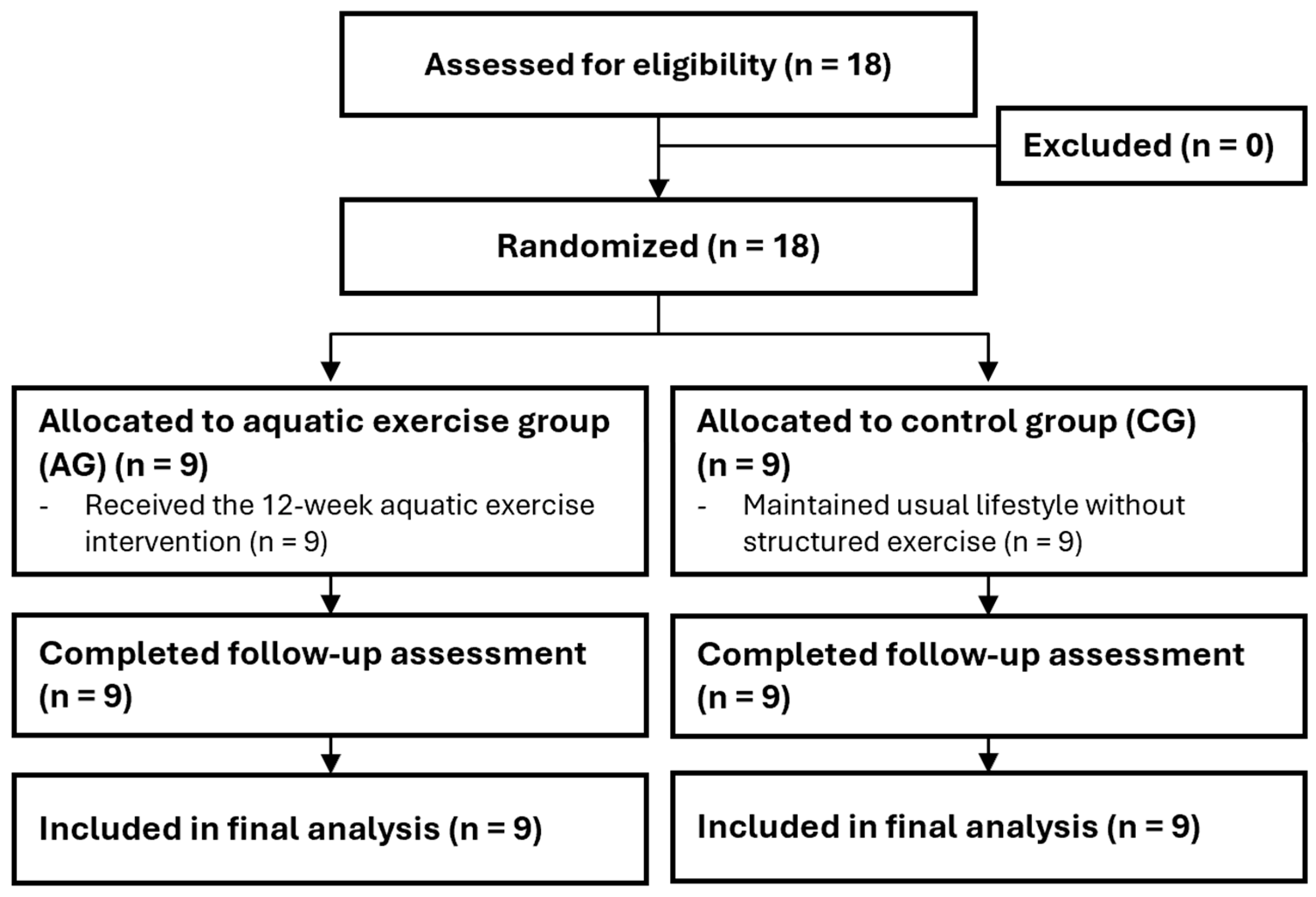
At the initial visit, baseline assessments (pre-test) were conducted to evaluate body composition, muscle strength (handgrip strength and 60-s abdominal curl-up performance), static balance, and postural alignment. After the preliminary evaluation, the AG undertook a 12-week aquatic exercise program conducted twice weekly at the pool of the Healthcare Spa Industry Promotion Agency. The CG was instructed to maintain their usual daily lifestyle and to refrain from moderate- to vigorous-intensity physical activity during the 12-week study period. They were also asked not to begin any new structured exercise program and to avoid activities similar to the outcome assessments, including handgrip-strength training, abdominal curl-up or sit-up exercises, balance training, and aquatic exercise. Post-intervention assessments (post-tests) were conducted using the same procedures and instruments as those used at baseline. The processes for participant recruitment, allocation, follow-up, and analysis are presented in the CONSORT flow diagram in Figure 1.

2.2. Participants

Participants were recruited through the Healthcare & Spa Industry Promotion Agency (HESPA), located in Asan-si, South Korea. A total of 18 women in their 40s residing in Asan, Chungcheongnam-do, who met the selection criteria were enrolled in this study and provided written informed consent. The inclusion criteria were as follows: (i) no engagement in moderate-to-vigorous physical activity for at least six months; (ii) the ability to complete the assessments necessary for measuring study outcomes; and (iii) the ability to understand and follow instructions and activities related to the aquatic exercise program. The exclusion criteria were as follows: (i) A history of cardiovascular disease, malignant tumors, infectious diseases, or musculoskeletal disorders; (ii) Current use of medications that could influence study outcomes (e.g., medications affecting cardiovascular function, neuromuscular function, or balance); (iii) Refusal to commit to long-term participation or changes in habitual exercise behavior outside the study intervention during the study period.
Menopausal status was not considered as an inclusion or exclusion criterion, and participants were not stratified as premenopausal, perimenopausal, or postmenopausal. Therefore, the study participants should be interpreted as middle-aged women in their 40s rather than as a menopause-specific cohort. The study protocol was approved by the Institutional Review Board of Dankook University (DKU-IRB No. 2025-09-066-003). The baseline characteristics of the participants are presented in Table 1.

2.3. Twelve-Week Aquatic Training Program

The aquatic exercise group (AG) participated in a 12-week aquatic exercise program conducted twice weekly. All sessions were conducted in the indoor rehabilitation pool (104 m2) of the Healthcare & Spa Industry Promotion Agency (HESPA), where the water temperature was maintained at 28–30 °C. Each session comprised a 10-min warm-up, a 40-min main exercise phase, and a 10-min cool-down. Exercise intensity was prescribed using the Rating of Perceived Exertion (RPE) and was maintained at 11–13 from weeks 1 to 6 and at 14–16 from weeks 7 to 12.
Before the intervention, participants were familiarized with the Borg RPE scale and instructed how to report their perceived exertion during aquatic exercise. During each session, the instructor monitored whether participants remained within the target RPE range. When the reported RPE was below the target range, participants were instructed to increase movement speed, range of motion, repetitions, or water displacement. When the reported RPE exceeded the target range, movement speed was reduced or a brief rest interval was provided.
The program included aquatic walking and running at knee-, waist-, and xiphoid process-level immersion. It also comprised lower-limb exercises, trunk/core exercises performed at waist- and xiphoid process-level immersion, and upper-limb exercises performed at xiphoid process-level immersion. The aquatic exercise protocol, including session structure, immersion depth, exercise components, RPE-based intensity progression, and target functions, is provided in Supplementary Table S1.

2.4. Body Composition

Body composition (body weight, skeletal muscle mass, fat mass, and body mass index [BMI]) was assessed using a bioelectrical impedance analysis (BIA) device (InBody 4.0, InBody Co., Seoul, Republic of Korea). Participants were instructed to fast for at least 8 h prior to testing. Upon arrival at the laboratory, they removed shoes, socks, and any metal accessories before measurement. Participants then stood barefoot on the device foot electrodes and grasped the hand electrodes. During the measurement, they were instructed to remain still and refrain from speaking.

2.5. Handgrip Strength

Handgrip strength was assessed using a digital hand dynamometer (T.K.K. 5401 Grip-D, Takei Scientific Instruments Co., Ltd., Niigata, Japan), and the dominant-hand value was used for analysis. Participants stood upright with their feet positioned approximately shoulder-width apart and their arms naturally extended alongside the body. The dynamometer was adjusted so that the handle was held between the first and second finger joints (excluding the thumb), and participants were instructed to squeeze maximally. During testing, participants were instructed not to lean on external objects or hold onto anything for support, and excessive flexion of the elbow, knee, or trunk was not permitted. Measurements were performed 2–3 times in an alternating left–right sequence, and the highest value was recorded as the final score.

2.6. 60-s Abdominal Curl-Up Test

Abdominal muscular endurance was assessed using the 60-s abdominal curl-up test. Participants lay supine with the knees flexed to 90° and the hands placed behind the head. The examiner stabilized the feet to prevent movement and, upon the start signal, participants repeatedly lifted the trunk until the elbows touched the knees. The number of correctly performed repetitions completed within 60 s was recorded as the test score.

2.7. Postural Alignment

Postural alignment was assessed using a three-dimensional posture analysis system (ABW Mapper, ABW GmbH, Frickenhausen, Germany). Participants stood barefoot on the platform in a standardized anatomical position, with foot placement aligned to the reference markers according to the manufacturer’s guidelines. After confirming that the participant’s full body was correctly captured on the monitor, the examiner performed a lateral scan. The system uses optical 3D scanning technology to analyze static postural alignment, and the software automatically computes variables including head and shoulder displacement, pelvic tilt, and hip and knee alignment.

2.8. Single-Leg Stance Test

Static balance was assessed using the single-leg stance test. Participants stood upright in a stable position and, upon the examiner’s signal, lifted one leg with the hip flexed to 45° and the knee flexed to 90°, while keeping both hands on the hips. The duration for which balance was maintained on the supporting leg was recorded. The test was terminated if the raised foot touched the ground, contacted the supporting leg, or if the participant removed the hands from the hips or moved the arms to assist balance.

2.9. Reliability and Validity of Measurement Instruments

The reliability and validity of the measurement tools and physical fitness tests used in this study have been reported in previous studies. Segmented multi-frequency bioelectrical impedance analysis demonstrated superior validity in estimating body composition in middle-aged adults compared to dual-energy X-ray absorptiometry, showing very high agreement for total lean body mass, fat mass, and body fat percentage (ICC = 0.88–0.97) [38]. The Borg Rating of Perceived Exertion (RPE) scale has been widely used as a practical indicator of exercise intensity and has shown significant associations with physiological responses, including heart rate and blood pressure during exercise [39].
Handgrip strength assessed using the TKK/Takei handgrip dynamometer demonstrated high reliability and validity; previous studies reported very high intra-instrument reliability and systematic retest error of less than 0.3 kg [40]. The 60-s curl-up test, used to assess abdominal muscular endurance, demonstrated a high level of reliability (ICC = 0.89–0.98) in studies involving adults aged 18–57 [41,42,43].
For postural alignment assessment, raster stereography measurements using the ABW Mapper demonstrated excellent intra-rater reliability (ICC = 0.956–0.974), inter-rater reliability (ICC = 0.962), and test–retest reliability (ICC = 0.945). It also demonstrated strong criterion-related validity with the Q-angle and hip-knee-ankle angles (r = −0.739 and r = −0.702, respectively) [44]. The single-leg standing test has been reported to have good to excellent reliability, with test–retest ICC values ranging from 0.40 to 0.85, and has been proven to be sensitive to balance-related performance [45].

2.10. Statistical Analysis

Statistical analyses were performed using IBM SPSS Statistics for Windows, version 22.0 (IBM Corp., Armonk, NY, USA). All variables are presented as mean ± standard deviation (M ± SD). A two-way mixed analysis of variance (mixed ANOVA) was conducted with group (experimental vs. control) as the between-subject factor and time (pre vs. post) as the within-subject factor to examine the main effects of group and time, as well as the group × time interaction. Statistical significance was set at p < 0.05. Effect sizes were calculated using partial eta-squared (partial η2).

3. Results

3.1. Changes in Muscle Strength

As shown in Table 2, the 12-week aquatic exercise program affected muscle strength outcomes. Handgrip strength showed a significant main effect of time (p = 0.013) and a significant group × time interaction effect (p = 0.003). The AG demonstrated an increase from baseline to post-intervention (25.62 ± 2.81 to 27.57 ± 2.13 kg), whereas the CG showed only a negligible change (24.49 ± 2.83 to 24.27 ± 3.15 kg).
For the 60-s abdominal curl-up test, significant main effects of group and time (both p < 0.001) were identified, along with a significant group × time interaction (p < 0.001). Specifically, the AG demonstrated a significant increase in repetitions (26.89 ± 2.93 to 41.56 ± 3.05), whereas the CG showed only a marginal change (25.67 ± 3.00 to 26.44 ± 2.83).

3.2. Changes in Postural Alignment

Table 3 summarizes changes in postural alignment. No significant main effects or interactions were observed for head displacement or shoulder asymmetry (all p > 0.05). For pelvic tilt alignment, a significant main effect of time (p = 0.007) and a significant group × time interaction (p = 0.017) were identified. In the AG, pelvic tilt decreased from 10.94 ± 3.46 to 7.63 ± 0.17, whereas the CG showed only a negligible change from 10.20 ± 3.11 to 9.94 ± 3.33.
Hip alignment showed a significant main effect of time (p = 0.005), with a decrease in the AG from 21.11 ± 8.78 to 11.44 ± 14.15, while the group × time interaction did not reach statistical significance (p = 0.149). No significant effects were observed for knee alignment (all p > 0.05). Overall, the intervention was associated with favorable changes in selected postural alignment indices, particularly pelvic tilt alignment.

3.3. Changes in Static Balance

The results of the static balance assessment are shown in the single-leg stance test results (Table 4). A significant main effect of time (p < 0.001) and a significant group × time interaction effect (p < 0.001) were observed. The AG demonstrated an increase in single-leg stance time from baseline to post-intervention (29.49 ± 2.81 s to 34.65 ± 2.60 s), whereas the CG showed only a marginal change (29.32 ± 2.71 s to 29.85 ± 3.66 s).

4. Discussion

This study was a small-scale randomized controlled trial that examined the effects of a 12-week structured aquatic exercise program incorporating multiple immersion depths on muscle strength, postural alignment, and static balance in middle-aged women. The primary findings indicate that the AG showed greater improvements than the CG in dominant handgrip strength, 60-s abdominal curl-up performance, pelvic tilt alignment, and single-leg stance time. Conversely, no significant group × time interaction was evident for head displacement, shoulder asymmetry, hip alignment, or knee alignment. Consequently, while the findings of this study suggest that structured aquatic exercise programs incorporating multiple immersion depths may offer selective benefits for muscle strength, lumbopelvic control, and static balance, they do not demonstrate that exercise incorporating multiple immersion depths is superior to fixed-depth aquatic exercise.
The enhancements in muscle strength and muscular endurance evident in the aquatic exercise group are consistent with a substantial corpus of the literature demonstrating that aquatic exercise can induce significant neuromuscular adaptations. A systematic review and meta-analysis of randomized controlled trials has demonstrated that aquatic exercise improves muscle strength in both young and older adults, thereby supporting the efficacy of aquatic resistance stimulation when the program is appropriately prescribed [46].
The observed muscle strength-related adaptations can be explained by several mechanisms. Water provides multidirectional resistance through drag force, which increases nonlinearly depending on exercise speed and the frontal surface area of the moving body part or equipment. Consequently, participants can adjust resistance by changing exercise speed or lever length, or by using resistance equipment, thereby enabling progressive overload without the need for high external loads. Furthermore, buoyancy has been demonstrated to reduce effective body weight and vertical load, thereby enabling participants to perform repetitive high-speed movements while experiencing reduced joint stress. Literature reviews on aquatic training emphasize that immersion depth significantly alters body weight and mechanical load while allowing for substantial drag-based resistance, and that deeper immersion further reduces vertical load but may increase instability and the energy cost of moving through a larger volume of water [47].
Aquatic resistance training has been demonstrated to enhance torque generation and rapid force production, particularly in the lower-limb joints. This suggests that such training can improve neuromuscular function in relation to daily activities [48]. The findings support the interpretation that this program, which combined aerobic exercise with trunk, upper-limb, and lower-limb exercises using progressive overload and varying immersion depths, provided sufficient resistance and neuromuscular stimulation to improve both handgrip strength and trunk muscular endurance.
The improvements in handgrip strength and abdominal muscular endurance may be associated with specific upper-limb and trunk/core exercise components incorporated within the aquatic exercise program. Upper-limb exercises performed at xiphoid process-level immersion included repeated shoulder flexion/extension, horizontal abduction/adduction, elbow flexion/extension, arm push–pull movements, and hand opening–closing movements against water resistance. Although isolated handgrip training was not performed, these repeated upper-limb movements may have increased neuromuscular demands on the forearm and hand-related muscles through multidirectional water resistance. Consequently, the improvement in handgrip strength should be interpreted as a functional adaptation resulting from repeated upper-limb water-resistance exercises rather than as a direct effect of handgrip-specific training.
Similarly, the improvement in the 60-s abdominal curl-up test may be partially attributed to trunk/core exercises performed at waist- and xiphoid process-level immersion. These exercises included standing trunk rotations, pelvic tilt control, standing abdominal contraction movements, knee tucks, diagonal knee-to-elbow movements, and trunk stabilization during aquatic walking and running. Water turbulence, buoyancy, and drag continuously demand postural control, requiring repeated stabilization of the trunk and lumbopelvic region. These repeated stabilization demands may have contributed to the observed improvement in trunk muscular endurance, as reflected in improved 60-s abdominal curl-up performance. However, because this study did not directly assess muscle activity using electromyography, these mechanisms should be interpreted as plausible explanations rather than direct evidence of muscle activity.
Moreover, the duration and frequency of the intervention in this study should be interpreted in relation to previous research on aquatic exercise. The program was performed twice weekly over a period of 12 weeks, which aligns with studies conducted in real-world aquatic aerobics settings. These studies have reported that aquatic exercise performed twice weekly for 12 weeks can enhance physical function-related outcomes in adults and older adults. Neiva et al. [34] reported that 12 weeks of twice-weekly aquatic aerobics improved explosive power, body composition, and blood pressure, but had limited effects on cardiorespiratory fitness and blood lipid levels. Conversely, certain randomized controlled trials focusing on aquatic exercise administered exercise interventions at higher frequencies, such as three times weekly, and documented enhancements in health-related fitness or frailty-related indicators. This comparison suggests that while a 12-week intervention performed twice weekly may be sufficient to improve some neuromuscular and functional outcomes, a higher weekly frequency may be necessary for more extensive cardiovascular and metabolic adaptations [34,36]. Therefore, the results of this study should be interpreted as supporting the feasibility and potential effectiveness of a twice-weekly aquatic exercise program for improving muscle strength, trunk muscular endurance, pelvic tilt alignment, and static balance; they should not be interpreted as evidence that this frequency is optimal.
In terms of postural alignment, pelvic tilt was the only alignment variable that exhibited a significant group × time interaction, indicating that the intervention may have particularly influenced lumbopelvic control. One plausible explanation is improved strength and endurance of the trunk and hip musculature, which can modify habitual pelvic orientation during quiet standing. In aquatic environments, changes in buoyancy and hydrostatic pressure may further facilitate postural re-education by reducing axial loading and allowing participants to practice upright alignment with decreased discomfort and fear of movement [25,28]. Importantly, immersion depth alters stability and resistance demands by changing the effective body weight, the center of buoyancy, and the drag forces acting on the moving body segments; thus, varying depth within a program may provide a graded challenge to lumbopelvic control [39].
Static balance, assessed via the single-leg stance test, improved substantially in the aquatic exercise group. This finding aligns with evidence that aquatic exercise is an effective modality for improving balance [33], potentially due to the combination of reduced fall consequences and constant perturbations from water turbulence and drag. A systematic review with meta-analysis of randomized controlled trials in older adults reported beneficial effects of aquatic exercise on physical functioning and balance-related outcomes, supporting aquatic training as a safe alternative when land-based exercise is limited by pain or fall risk [34]. In addition, a randomized controlled trial in community-dwelling older women with osteopenia/osteoporosis found that a water-based exercise and self-management program improved balance and reduced fear of falling compared with controls [36]. While our cohort was younger, the same principles may apply. The aquatic environment provides a supportive yet unstable medium that encourages greater reliance on proprioceptive and vestibular inputs and promotes reactive postural adjustments, which may translate into improved single-leg stability on land.
The incorporation of multiple immersion depths in the present program may be relevant for optimizing the training stimulus while managing mechanical load. Biomechanical studies of shallow-water locomotion demonstrate that vertical loading decreases with deeper immersion, thereby reducing ground reaction forces and loading rates compared with land running, whereas propulsion-related demands can remain substantial depending on speed and immersion level [32]. From a practical perspective, clinicians and exercise professionals can use changes in immersion depth alongside speed manipulation to tailor loading, minimize joint stress, and still deliver sufficient neuromuscular and balance challenges. The significant improvements observed in strength and balance outcomes in the aquatic exercise group support the feasibility and potential effectiveness of this approach in middle-aged women.
Several limitations should be considered. First, the sample size was small and included only women in their 40s from a single region, which limits the generalizability of the findings. Second, the present study did not assess menopausal status, menstrual cycle phase, or circulating sex hormone levels. Although the menopausal transition was discussed in the Introduction as a relevant physiological background for middle-aged women, participants were not categorized as premenopausal, perimenopausal, or postmenopausal. Consequently, the potential influence of hormonal status on responses to aquatic exercise could not be examined. Future studies should classify or stratify participants according to menopausal status and, where feasible, include hormone-related variables as covariates. Third, exercise intensity was prescribed and monitored using RPE, without objective physiological measures such as heart rate, heart-rate reserve, blood lactate, or accelerometry. Although RPE is practical for regulating intensity in aquatic exercise settings, it does not fully ensure objective intensity monitoring. Future studies should combine RPE with objective intensity indicators to more precisely quantify the exercise stimulus. Finally, longer follow-up is needed to determine whether the observed improvements are maintained.

5. Conclusions

This small-scale randomized controlled trial showed that a 12-week structured aquatic exercise program incorporating multiple immersion depths, performed twice weekly, improved dominant handgrip strength, abdominal muscular endurance (60-s abdominal curl-up performance), pelvic tilt alignment, and static balance (single-leg stance time) in middle-aged women compared with a non-exercise control group. These preliminary findings suggest that incorporating multiple immersion depths within a structured aquatic exercise program may be a feasible and potentially effective strategy for delivering progressive overload while maintaining a low-impact and safe training environment for midlife populations. Future studies with larger samples, objective monitoring of exercise intensity and physical activity, and longer follow-up are warranted to confirm the generalizability and durability of these benefits and to further clarify the underlying neuromuscular and biomechanical mechanisms.

Supplementary Materials

The following supporting information can be downloaded at: https://www.mdpi.com/article/10.3390/app16104976/s1, Table S1: Detailed Description of the 12-Week Aquatic Exercise Protocol.

Author Contributions

Conceptualization, K.K.; methodology, B.K. and K.K.; validation, S.L. and J.W.; formal analysis, B.K.; investigation, G.R. and S.L.; resources, S.L. and J.W.; data curation, B.K. and G.R.; writing—original draft preparation, B.K. and G.R.; writing—review and editing, B.K. and J.W.; visualization, B.K.; supervision, K.K. and J.W.; project administration, B.K. and S.L.; funding acquisition, S.L. and J.W. All authors have read and agreed to the published version of the manuscript.

Funding

This research was supported by Asan-si and the Healthcare & Spa Industry Promotion Agency.

Institutional Review Board Statement

This study was conducted in accordance with the Declaration of Helsinki, and approved by the Institutional Review Board of Dankook University (DKU-IRB No. 2025-09-066-003, approval date 31 December 2025).

Informed Consent Statement

Informed consent was obtained from all subjects involved in this study.

Data Availability Statement

The data supporting the findings of this study are available from the corresponding author upon reasonable request.

Conflicts of Interest

Authors Sunhee Lee and Jongmin Woo were employed by the company Healthcare & Spa Industry Promotion Agency. The remaining authors declare that the research was conducted in the absence of any commercial or financial relationships that could be construed as a potential conflict of interest.

References

  1. Maltais, M.L.; Desroches, J.; Dionne, I.J. Changes in muscle mass and strength after menopause. J. Musculoskelet. Neuronal Interact. 2009, 9, 186–197. [Google Scholar]
  2. Greendale, G.A.; Sternfeld, B.; Huang, M.; Han, W.; Karvonen-Gutierrez, C.; Ruppert, K.; Cauley, J.A.; Finkelstein, J.S.; Jiang, S.F.; Karlamangla, A.S. Changes in body composition and weight during the menopause transition. JCI Insight 2019, 4, e124865. [Google Scholar] [CrossRef] [PubMed]
  3. Macaluso, A.; De Vito, G. Muscle strength, power and adaptations to resistance training in older people. Eur. J. Appl. Physiol. 2004, 91, 450–472. [Google Scholar] [CrossRef]
  4. von Haehling, S.; Morley, J.E.; Anker, S.D. An overview of sarcopenia: Facts and numbers on prevalence and clinical impact. J. Cachexia Sarcopenia Muscle 2010, 1, 129–133. [Google Scholar] [CrossRef]
  5. Kennis, E.; Verschueren, S.; Van Roie, E.; Thomis, M.; Lefevre, J.; Delecluse, C. Longitudinal impact of aging on muscle quality in middle-aged men. Age 2014, 36, 9689. [Google Scholar] [CrossRef]
  6. Thompson, B.J.; Sobolewski, E.J.; Ryan, E.D. Comparison of age-specific leg extensor muscle function torque-time and rapid velocity attributes across the adult lifespan: A relative deficiency investigation. Exp. Gerontol. 2020, 131, 110819. [Google Scholar] [CrossRef]
  7. Abrahamova, D.; Hlavačka, F. Age-related changes of human balance during quiet stance. Physiol. Res. 2008, 57, 957–964. [Google Scholar] [CrossRef]
  8. Røgind, H.; Lykkegaard, J.J.; Bliddal, H.; Danneskiold-Samsøe, B. Postural sway in normal subjects aged 20–70 years. Clin. Physiol. Funct. Imaging 2003, 23, 171–176. [Google Scholar] [CrossRef] [PubMed]
  9. Ostrowska, B.; Giemza, C.; Wojna, D.; Skrzek, A. Postural stability and body posture in older women: Comparison between fallers and non-fallers. Ortop. Traumatol. Rehabil. 2008, 10, 486–495. [Google Scholar]
  10. Azadinia, F.; Kamyab, M.; Behtash, H.; Maroufi, N.; Larijani, B. The effects of two spinal orthoses on balance in elderly people with thoracic kyphosis. Prosthet. Orthot. Int. 2013, 37, 404–410. [Google Scholar] [CrossRef] [PubMed]
  11. Drzał-Grabiec, J.; Snela, S.; Rykała, J.; Podgórska, J.; Banaś, A. Changes in the body posture of women occurring with age. BMC Geriatr. 2013, 13, 108. [Google Scholar] [CrossRef]
  12. Mika, A.; Unnithan, V.B.; Mika, P. Differences in thoracic kyphosis and in back muscle strength in women with bone loss due to osteoporosis. Spine 2005, 30, 241–246. [Google Scholar] [CrossRef] [PubMed]
  13. Kado, D.M.; Huang, M.H.; Barrett-Connor, E.; Greendale, G.A. Hyperkyphotic posture and poor physical functional ability in older community-dwelling men and women: The Rancho Bernardo study. J. Gerontol. Ser. A Biol. Sci. Med. Sci. 2005, 60, 633–637. [Google Scholar] [CrossRef] [PubMed]
  14. Kado, D.M.; Huang, M.H.; Nguyen, C.B.; Barrett-Connor, E.; Greendale, G.A. Hyperkyphotic posture and risk of injurious falls in older persons: The Rancho Bernardo Study. J. Gerontol. Ser. A Biol. Sci. Med. Sci. 2007, 62, 652–657. [Google Scholar] [CrossRef]
  15. Sinaki, M.; Brey, R.H.; Hughes, C.A.; Larson, D.R.; Kaufman, K.R. Balance disorder and increased risk of falls in osteoporosis and kyphosis: Significance of kyphotic posture and muscle strength. Osteoporos. Int. 2005, 16, 1004–1010. [Google Scholar] [CrossRef]
  16. Anwajler, J.; Barczyk, K.; Wojna, D.; Ostrowska, B.; Skolimowski, T. Characteristics of body posture in the sagittal plane in elderly people-residents of social care centres. Gerontol. Pol. 2010, 18, 134–139. [Google Scholar]
  17. Srivastava, D.P.; Penzes, P. Rapid estradiol modulation of neuronal connectivity and its implications for disease. Front. Endocrinol. 2011, 2, 77. [Google Scholar] [CrossRef]
  18. Behan, M.; Thomas, C.F. Sex hormone receptors are expressed in identified respiratory motoneurons in male and female rats. Neuroscience 2005, 130, 725–734. [Google Scholar] [CrossRef]
  19. Pöllänen, E.; Sipilä, S.; Alen, M.; Ronkainen, P.H.; Ankarberg-Lindgren, C.; Puolakka, J.; Suominen, H.; Hämäläinen, E.; Turpeinen, U.; Konttinen, Y.T.; et al. Differential influence of peripheral and systemic sex steroids on skeletal muscle quality in pre- and postmenopausal women. Aging Cell 2011, 10, 650–660. [Google Scholar] [CrossRef]
  20. Bondarev, D.; Laakkonen, E.K.; Finni, T.; Kokko, K.; Kujala, U.M.; Aukee, P.; Kovanen, V.; Sipilä, S. Physical performance in relation to menopause status and physical activity. Menopause 2018, 25, 1432–1441. [Google Scholar] [CrossRef]
  21. Lee, M.S.; Kim, J.M. The effects of health promotion program on health belief, health promoting behavior and quality of life for middle-aged women: Based on health belief model. Int. J. Adv. Cult. Technol. 2019, 7, 25–34. [Google Scholar]
  22. Park, H.J.; Jung, H.Y. The impact of middle-aged women’s health on successful aging: The mediating effect of social support. J. Converg. Cult. Technol. 2025, 11, 139–147. [Google Scholar]
  23. Faíl, L.B.; Marinho, D.A.; Marques, E.A.; Costa, M.J.; Santos, C.C.; Marques, M.C.; Neiva, H.P. Benefits of aquatic exercise in adults with and without chronic disease—A systematic review with meta-analysis. Scand. J. Med. Sci. Sports 2022, 32, 465–486. [Google Scholar] [CrossRef]
  24. Kim, B.K.; Jeong, H.J. Effect of acute aquatic plyometric training on muscle strength, edema and pain. Int. J. Internet Broadcast. Commun. 2022, 14, 224–232. [Google Scholar]
  25. Zhou, W.S.; Ren, F.F.; Yang, Y.; Chien, K.Y. Aquatic exercise for health promotion: A 31-year bibliometric analysis. Percept. Mot. Ski. 2021, 128, 2166–2185. [Google Scholar] [CrossRef] [PubMed]
  26. Gobbi, M.; Aquiri, A.; Monoli, C.; Cau, N.; Capodaglio, P. Aquatic exercise. In Rehabilitation Interventions in the Patient with Obesity; Springer: Cham, Switzerland, 2020; pp. 35–50. [Google Scholar]
  27. Katsura, Y.; Yoshikawa, T.; Ueda, S.Y.; Usui, T.; Sotobayashi, D.; Nakao, H.; Sakamoto, H.; Okumoto, T.; Fujimoto, S. Effects of aquatic exercise training using water-resistance equipment in elderly. Eur. J. Appl. Physiol. 2010, 108, 957–964. [Google Scholar] [CrossRef] [PubMed]
  28. Grosse, S.J. Aquatic progressions: The buoyancy of water facilitates balance and gait. Rehab Manag. 2009, 22, 25–28. [Google Scholar] [PubMed]
  29. Barbosa, T.M.; Garrido, M.F.; Bragada, J. Physiological adaptations to head-out aquatic exercises with different levels of body immersion. J. Strength Cond. Res. 2007, 21, 1255–1259. [Google Scholar]
  30. Benelli, P.; Ditroilo, M.; De Vito, G. Physiological responses to fitness activities: A comparison between land-based and water aerobics exercise. J. Strength Cond. Res. 2004, 18, 719–722. [Google Scholar] [CrossRef]
  31. Haupenthal, A.; de Brito Fontana, H.; Ruschel, C.; dos Santos, D.P.; Roesler, H. Ground reaction forces in shallow water running are affected by immersion level, running speed and gender. J. Sci. Med. Sport 2013, 16, 348–352. [Google Scholar] [CrossRef]
  32. Haupenthal, A.; Ruschel, C.; Hubert, M.; de Brito Fontana, H.; Roesler, H. Loading forces in shallow water running in two levels of immersion. J. Rehabil. Med. 2010, 42, 664–669. [Google Scholar]
  33. Colado, J.C.; Borreani, S.; Pinto, S.S.; Tella, V.; Martin, F.; Flandez, J.; Kruel, L.F. Neuromuscular responses during aquatic resistance exercise with different devices and depths. J. Strength Cond. Res. 2013, 27, 3384–3390. [Google Scholar] [CrossRef]
  34. Pereira Neiva, H.; Brandão Faíl, L.; Izquierdo, M.; Marques, M.C.; Marinho, D.A. The effect of 12 weeks of water-aerobics on health status and physical fitness: An ecological approach. PLoS ONE 2018, 13, e0198319. [Google Scholar] [CrossRef]
  35. Resende, S.M.; Rassi, C.M. Effects of hydrotherapy in balance and prevention of falls among elderly women. Braz. J. Phys. Ther. 2008, 12, 57–63. [Google Scholar]
  36. Kim, J.H.; Ha, M.S.; Ha, S.M.; Kim, D.Y. Aquatic exercise positively affects physiological frailty among postmenopausal women: A randomized controlled clinical trial. Healthcare 2021, 9, 409. [Google Scholar] [CrossRef]
  37. Jang, T.S.; Lee, D.S.; Kim, K.H.; Kim, B.K. Effects of maximum repeated squat exercise on number of repetition, trunk and lower extremity EMG response according to water depth. Int. J. Internet Broadcast. Commun. 2021, 13, 152–160. [Google Scholar]
  38. Ling, C.H.; de Craen, A.J.; Slagboom, P.E.; Gunn, D.A.; Stokkel, M.P.; Westendorp, R.G.; Maier, A.B. Accuracy of direct segmental multi-frequency bioimpedance analysis in the assessment of total body and segmental body composition in middle-aged adult population. Clin. Nutr. 2011, 30, 610–615. [Google Scholar] [CrossRef] [PubMed]
  39. Haddad, M.; Stylianides, G.; Djaoui, L.; Dellal, A.; Chamari, K. Session-RPE method for training load monitoring: Validity, ecological usefulness, and influencing factors. Front. Neurosci. 2017, 11, 612. [Google Scholar] [CrossRef] [PubMed]
  40. Cadenas-Sanchez, C.; Sanchez-Delgado, G.; Martinez-Tellez, B.; Mora-Gonzalez, J.; Löf, M.; España-Romero, V.; Ruiz, J.R.; Ortega, F.B. Reliability and validity of different models of TKK hand dynamometers. Am. J. Occup. Ther. 2016, 70, 7004300010p1–7004300010p9. [Google Scholar] [CrossRef]
  41. Kahraman, B.O.; Sengul, Y.S.; Kahraman, T.; Kalemci, O. Developing a reliable core stability assessment battery for patients with nonspecific low back pain. Spine 2016, 41, E844–E850. [Google Scholar] [CrossRef]
  42. Diener, M.H.; Golding, L.A.; Diener, D. Validity and reliability of a one-minute half sit-up test of abdominal strength and endurance. Res. Sports Med. 1995, 6, 105–119. [Google Scholar] [CrossRef]
  43. Moreland, J.; Finch, E.; Stratford, P.; Balsor, B.; Gill, C. Interrater reliability of six tests of trunk muscle function and endurance. J. Orthop. Sports Phys. Ther. 1997, 26, 200–208. [Google Scholar] [CrossRef]
  44. Yim, J.Y.; Yim, H.S.; Park, D.S.; Lee, J.H.; Lee, N.K. Surface topographic measurement method for assessing lower extremity alignment: Examination on a novel clinical and research tool. J. Rehabil. Welf. Eng. Assist. Technol. 2016, 10, 37–45. [Google Scholar]
  45. Da Silva, R.A.; Bilodeau, M.; Parreira, R.B.; Teixeira, D.C.; Amorim, C.F. Age-related differences in time-limit performance and force platform-based balance measures during one-leg stance. J. Electromyogr. Kinesiol. 2013, 23, 634–639. [Google Scholar] [CrossRef] [PubMed]
  46. Prado, A.K.; Reichert, T.; Conceição, M.O.; Delevatti, R.S.; Kanitz, A.C.; Kruel, L.F. Effects of aquatic exercise on muscle strength in young and elderly adults: A systematic review and meta-analysis of randomized trials. J. Strength Cond. Res. 2022, 36, 1468–1483. [Google Scholar] [CrossRef]
  47. Torres-Ronda, L.; i del Alcázar, X.S. The properties of water and their applications for training. J. Hum. Kinet. 2014, 44, 237–248. [Google Scholar] [CrossRef] [PubMed]
  48. Bento, P.C.B.; Rodacki, A.L.F. Muscle function in aged women in response to a water-based exercises program and progressive resistance training. Geriatr. Gerontol. Int. 2015, 15, 1193–1200. [Google Scholar] [CrossRef] [PubMed]
Figure 1. Study flowchart based on the Consort flowchart. The 18 participants initially enrolled in this study are divided into an aquatic exercise group and a control group, and all participants complete the interventions and assessments assigned to their respective groups.
Applsci 16 04976 g001
Table 1. Baseline characteristics of participants.
VariablesAG (n = 9)CG (n = 9)p
Age (years)41.78 ± 1.7943.33 ± 3.000.200
Height (cm)160.08 ± 5.79158.93 ± 3.770.626
Weight (kg)59.37 ± 8.6260.27 ± 8.230.980
BMI (kg/m2)40.19 ± 5.1039.22 ± 4.440.674
Fat-Free Mass (kg)30.88 ± 5.6331.17 ± 2.460.890
Body Fat (%)23.19 ± 3.4124.42 ± 3.230.850
Data are presented as mean ± SD.
Table 2. Effects of the 12-week aquatic exercise program on muscle strength.
VariableGroupBaselinePost pES
Handgrip strength (kg)AG25.62 ± 2.8127.57 ± 2.13Group0.0970.162
CG24.49 ± 2.8324.27 ± 3.15Time0.0130.325
Group × Time0.0030.433
60-s abdominal curl-up test (repetitions)AG26.89 ± 2.9341.56 ± 3.05Group<0.0010.747
CG25.67 ± 3.0026.44 ± 2.83Time<0.0010.876
Group × Time<0.0010.851
Data are presented as mean ± SD.
Table 3. Effects of the 12-week aquatic exercise program on postural alignment.
VariableGroupBaselinePost pES
Head displacementAG−22.89 ± 22.47−20.11 ± 26.89Group0.8850.001
CG−20.56 ± 22.78−19.33 ± 21.82Time0.5770.020
Group × Time0.8280.003
Shoulder asymmetryAG−37.56 ± 20.42−34.78 ± 27.87Group0.6610.012
CG−39.78 ± 15.59−40.56 ± 18.67Time0.8220.003
Group × Time0.6910.010
Pelvic tiltAG10.94 ± 3.467.63 ± 0.17Group0.5300.025
CG10.20 ± 3.119.94 ± 3.33Time0.0070.377
Group × Time0.0170.308
Hip alignmentAG21.11 ± 8.7811.44 ± 14.15Group0.5850.019
CG20.33 ± 7.2516.78 ± 6.63Time0.0050.402
Group × Time0.1490.126
Knee alignmentAG16.89 ± 20.7512.00 ± 34.11Group0.8870.010
CG12.00 ± 34.1119.89 ± 26.36Time0.8340.003
Group × Time0.6360.014
Data are presented as mean ± SD.
Table 4. Effects of the 12-week aquatic exercise program on static balance.
VariableGroupBaselinePost pES
Single-leg stance (s)AG29.49 ± 2.8134.65 ± 2.60Group0.0690.192
CG29.32 ± 2.7129.85 ± 3.66Time<0.0010.596
Group × Time<0.0010.945
Data are presented as mean ± SD.
Disclaimer/Publisher’s Note: The statements, opinions and data contained in all publications are solely those of the individual author(s) and contributor(s) and not of MDPI and/or the editor(s). MDPI and/or the editor(s) disclaim responsibility for any injury to people or property resulting from any ideas, methods, instructions or products referred to in the content.