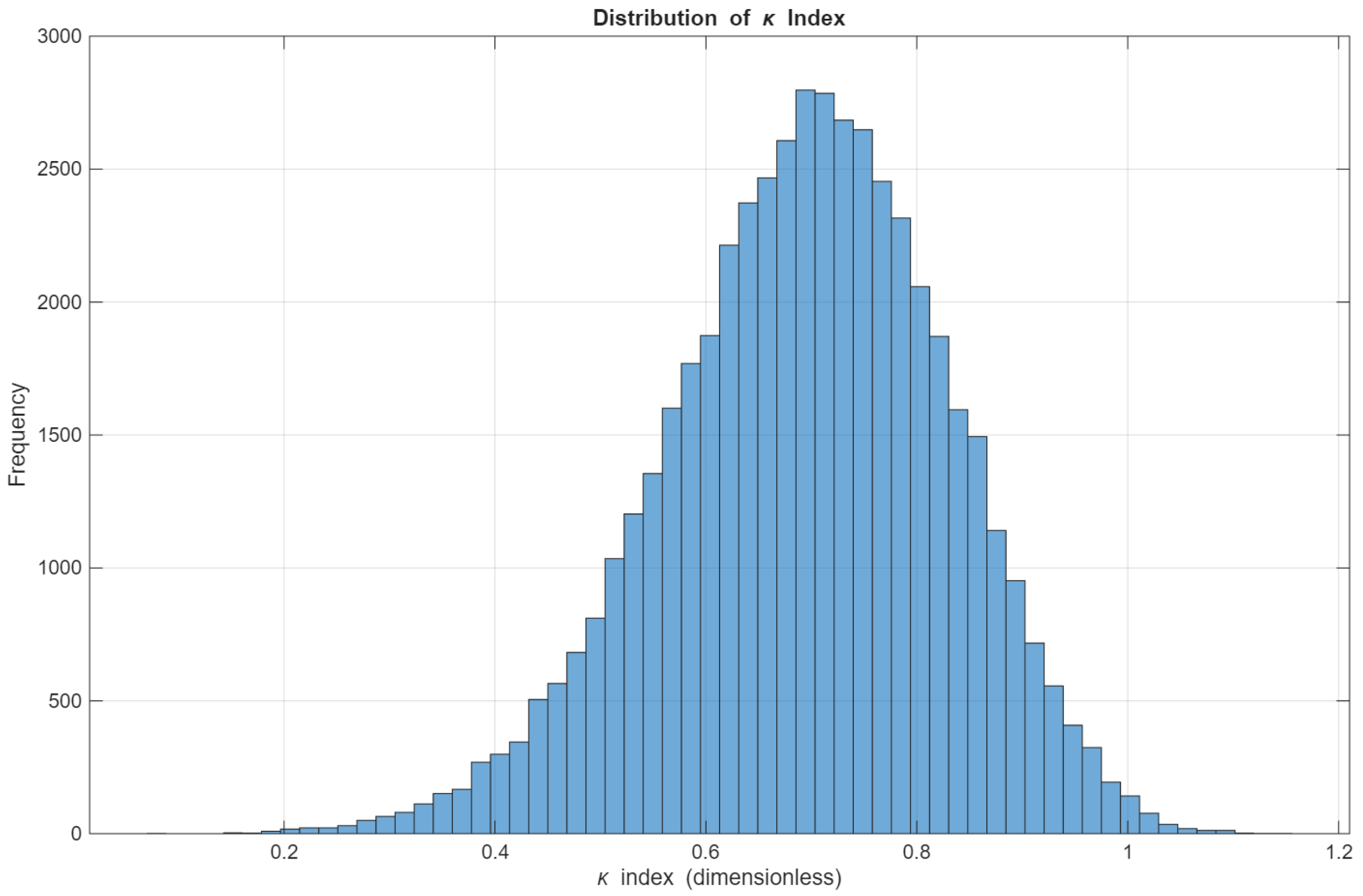
2.2.1. Index of Deviation from an Ideal Configuration
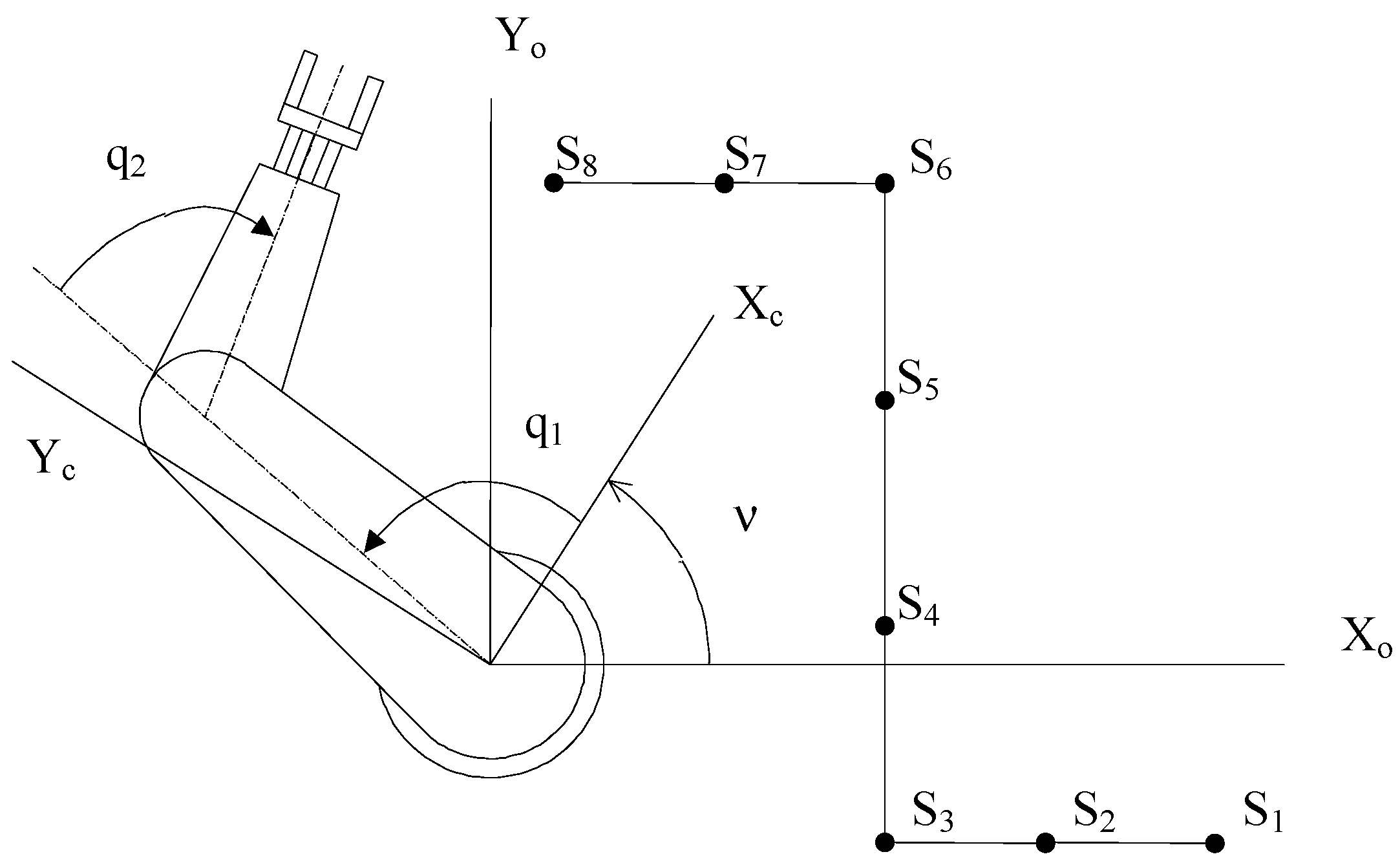
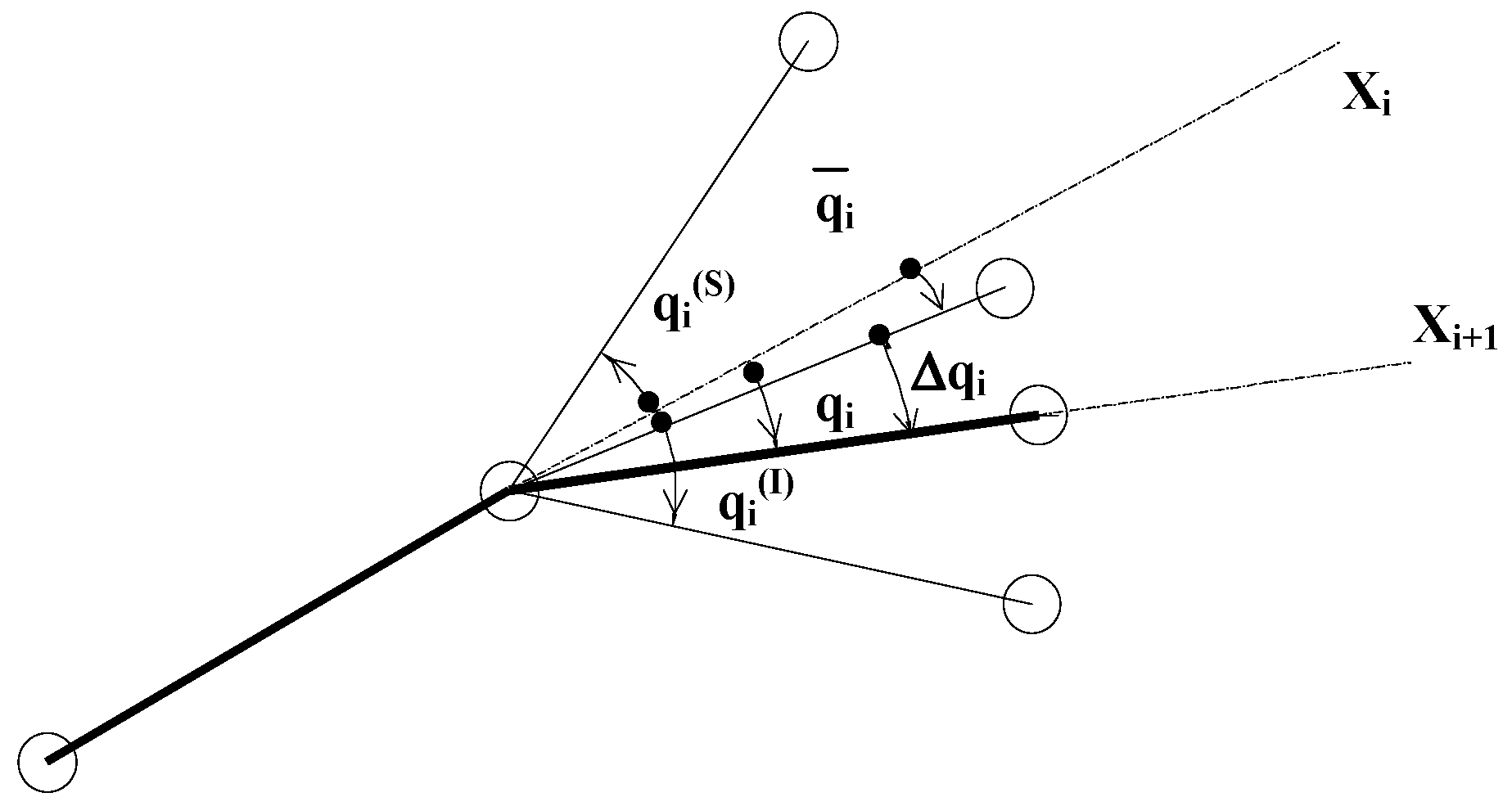
Regarding the joint parameters related to the joint variable
qi, considering
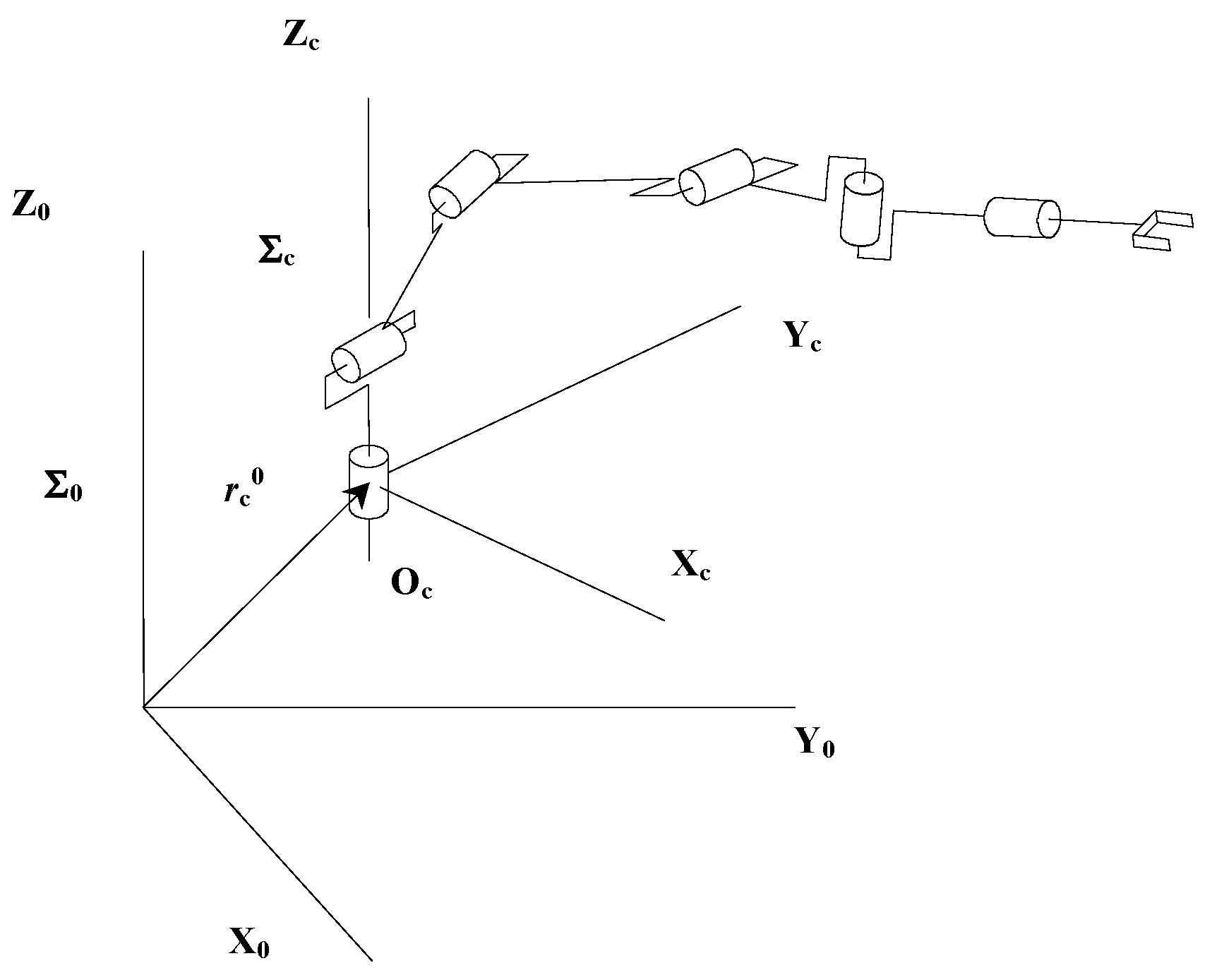
Figure 1, in which two adjacent links are represented, numbered
i − 1 and
i (
i = 1, 2, …,
n),
is the lower limit of
is the upper limit of
is the average position of
in its variation interval, and
is the deviation of
with respect to the average position.
Based on these parameters, the situation of the
i-th joint variable, in relation to its limits, is measured by means of the joint index:
where
is the amplitude of the maximum permissible deviation of
, with respect to the mean position:
If , the joint variable is at the center of its variation range.
For a given configuration of an
n-jointed robot, there is a set of
n relationships. The mean and standard deviation will be used to account for the deviation of any given configuration from the ideal configuration; that is,
where
is the mean of the set of
,
is the standard deviation of the set, and
is a weighting factor of the standard deviation (
).
To clarify the definitions introduced in Equations (10)–(12), it is important to note that the joint index represents a normalized measure of how far a joint variable is from the midpoint of its allowable range. This normalization ensures that all joint variables are evaluated on a common scale, regardless of their physical limits or units.
Specifically, indicates that the joint operates exactly at the center of its admissible interval, while corresponds to the joint reaching one of its limits. Therefore, the set provides a dimensionless representation of the configuration state of the manipulator.
Equation (12) aggregates these normalized deviations by computing both their mean value and their dispersion. The mean value reflects the global deviation of the configuration from the center of the joint space, whereas the standard deviation captures the imbalance among joints. A low standard deviation indicates that all joints contribute uniformly to the configuration, while a high value suggests that some joints operate closer to their limits than others.
The proposed κ-index is designed to explicitly quantify the deviation of joint variables from the mid-range of their admissible limits, promoting balanced joint utilization. Unlike classical kinematic performance indices such as manipulability or Jacobian condition number, which evaluate instantaneous dexterity, the κ-index directly incorporates joint limit information into the optimization process. This characteristic is particularly relevant in industrial applications, where operating near joint limits may degrade accuracy and increase mechanical stress.
Additionally, the structure of the κ-index, defined as the combination of the mean and a weighted standard deviation, allows simultaneous minimization of global deviation and uneven joint distribution. This ensures that no individual joint operates disproportionately close to its limits. Compared to energy-based or torque-margin criteria, the κ-index provides a computationally efficient alternative that does not require dynamic modeling, making it suitable for early-stage workstation design.
The κ-index differs from classical kinematic performance measures such as Yoshikawa’s manipulability index, isotropy, and the Jacobian condition number, as it explicitly incorporates joint limit information into the optimization process. While these traditional metrics evaluate instantaneous dexterity based on the properties of the Jacobian matrix, they do not directly penalize configurations that lie near the boundaries of the joint space.
As a result, classical indices may favor configurations that are kinematically optimal but mechanically undesirable due to proximity to joint limits. In contrast, the κ-index ensures that optimal solutions remain within balanced regions of the configuration space, promoting uniform joint utilization.
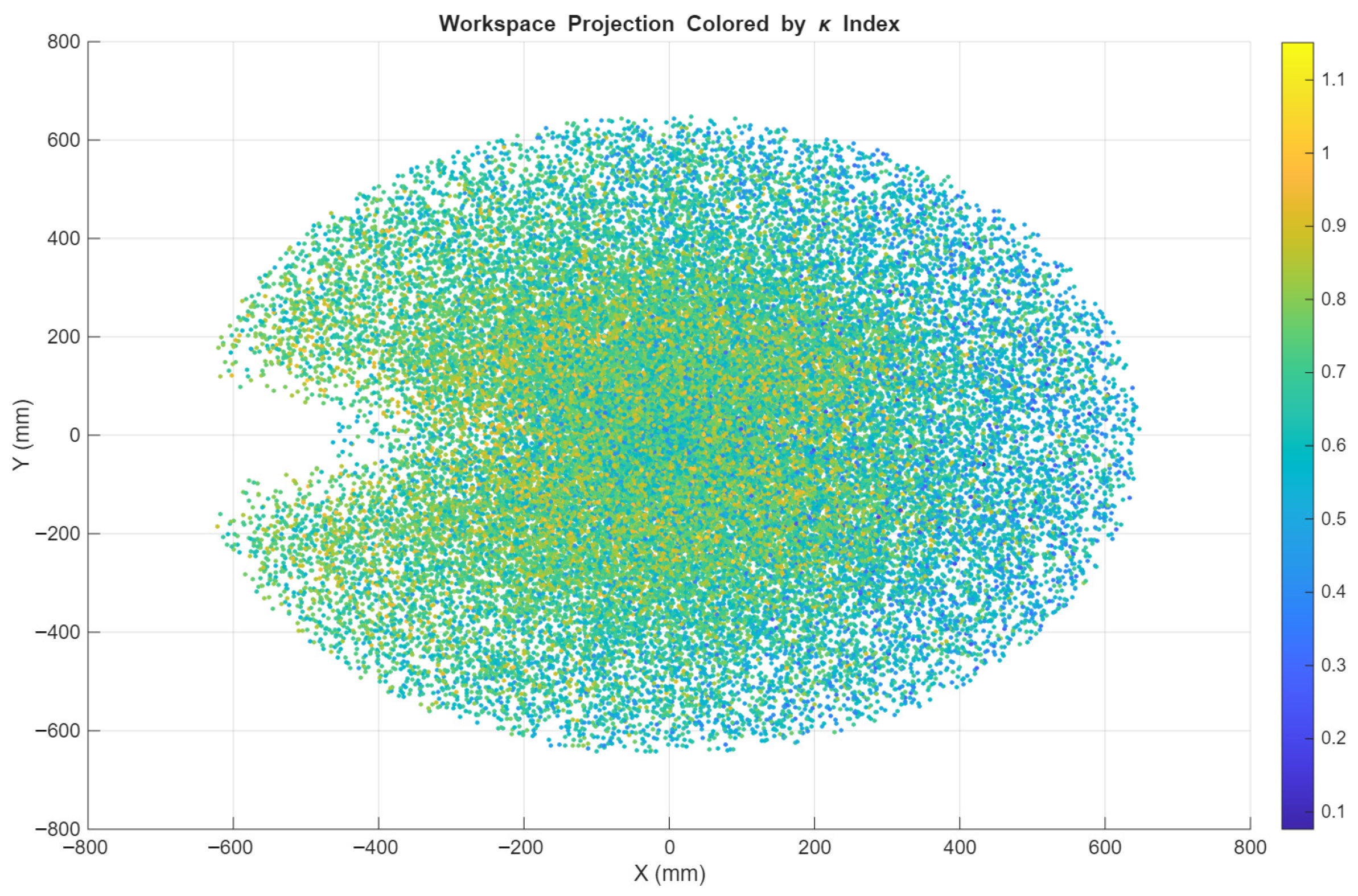
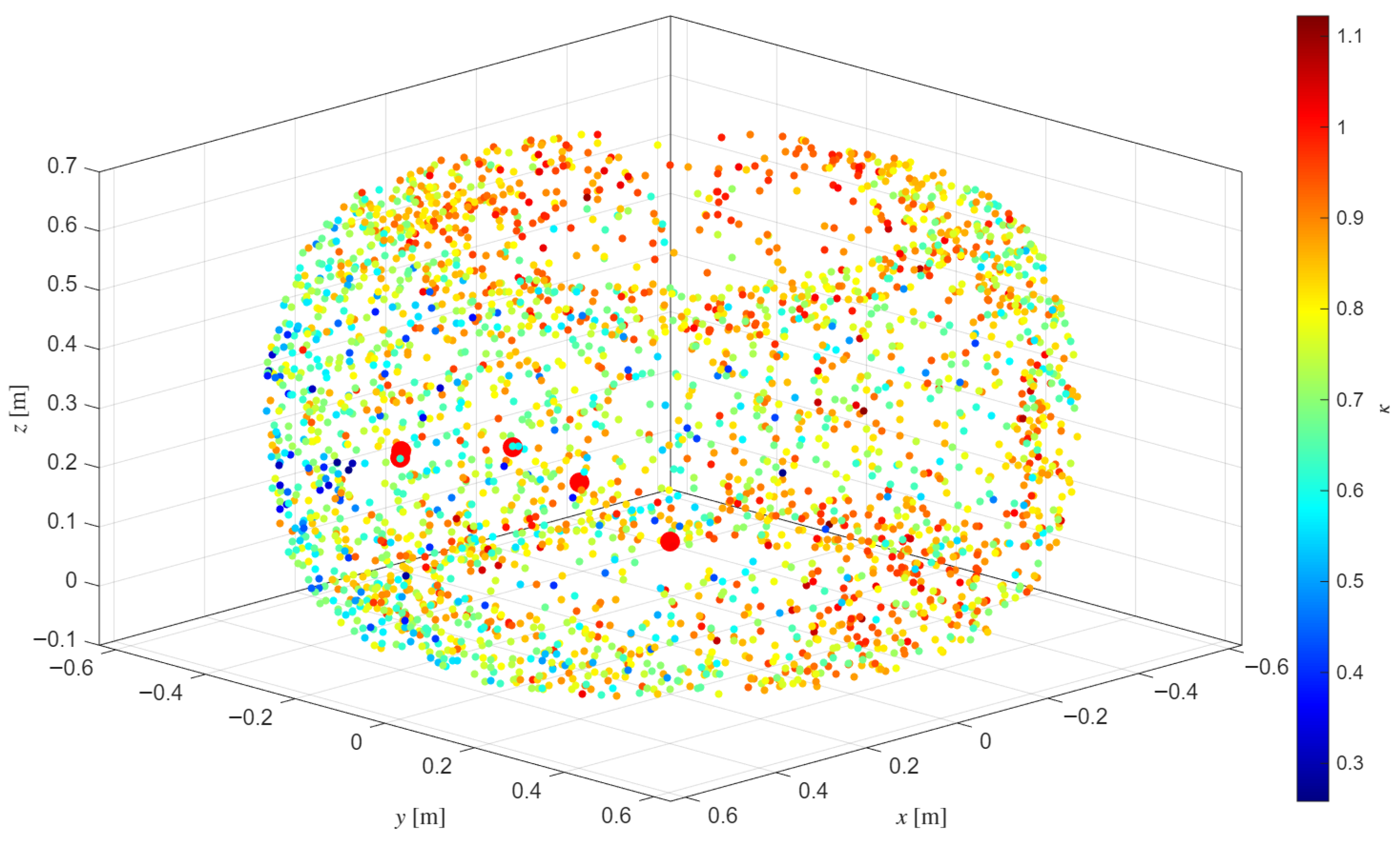
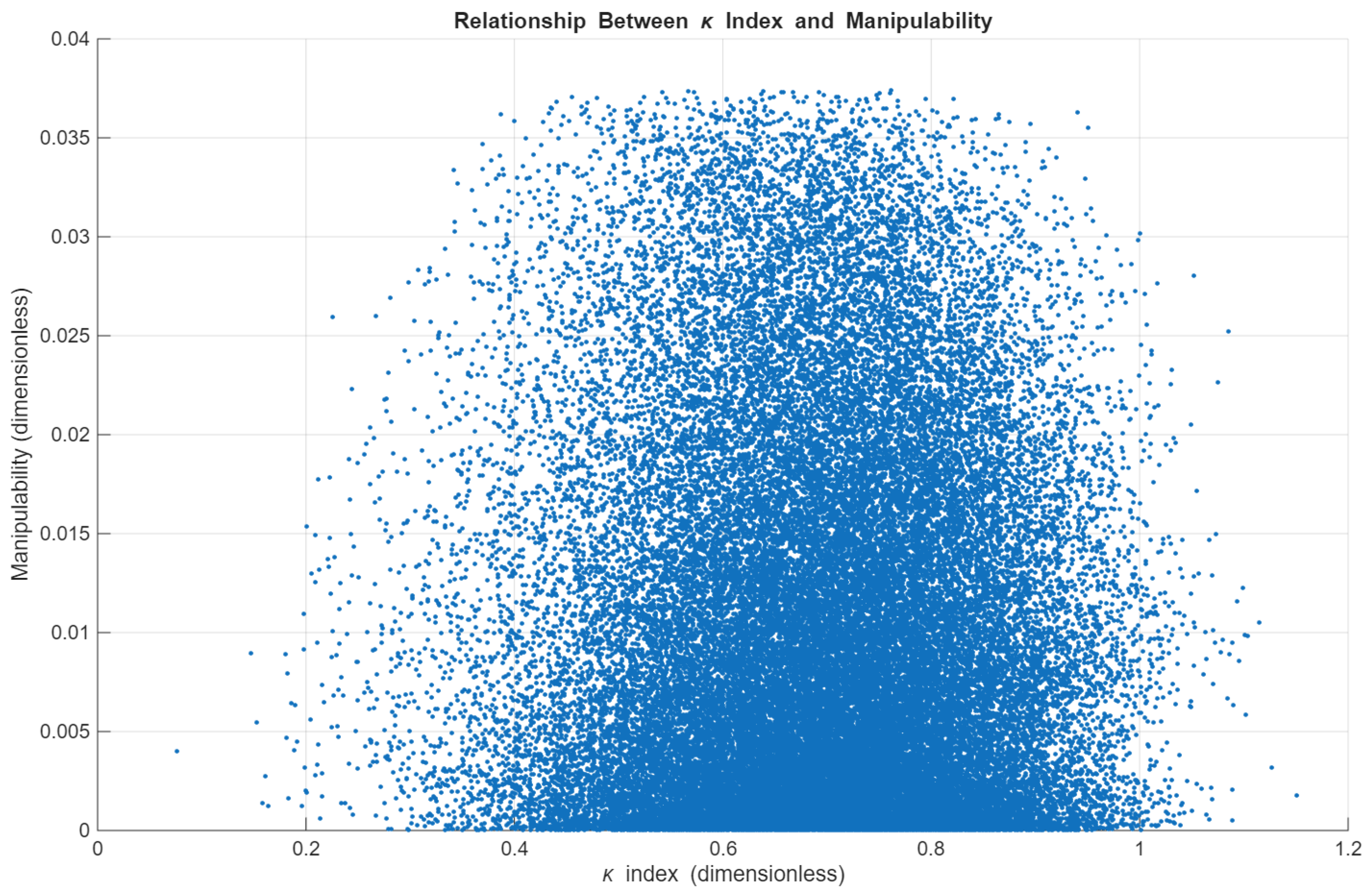
Furthermore, a comparative evaluation performed in this work indicates that configurations with low κ-index values tend to correspond to regions of higher manipulability. This suggests that the proposed metric not only enforces joint-limit-aware behavior but also indirectly promotes favorable kinematic performance.
Therefore, the κ-index should be understood as a complementary metric rather than a replacement for classical indices, providing additional insight into configuration quality in accessibility-based placement optimization.
Remark on the formulation and novelty of the κ-index. It is worth noting that the individual components of the κ-index are well-established mathematical tools, including normalized joint deviation, mean value, and standard deviation. The contribution of the proposed index in this work does not lie in the novelty of these components themselves, but rather in their deliberate combination and in the specific context of their application.
First, a robot configuration may exhibit a favorable average joint deviation while individual joints operate close to their limits. The inclusion of the standard deviation term explicitly penalizes such asymmetric joint loading, which cannot be captured by a mean-based metric alone. This ensures that all joints contribute in a balanced manner to the overall configuration.
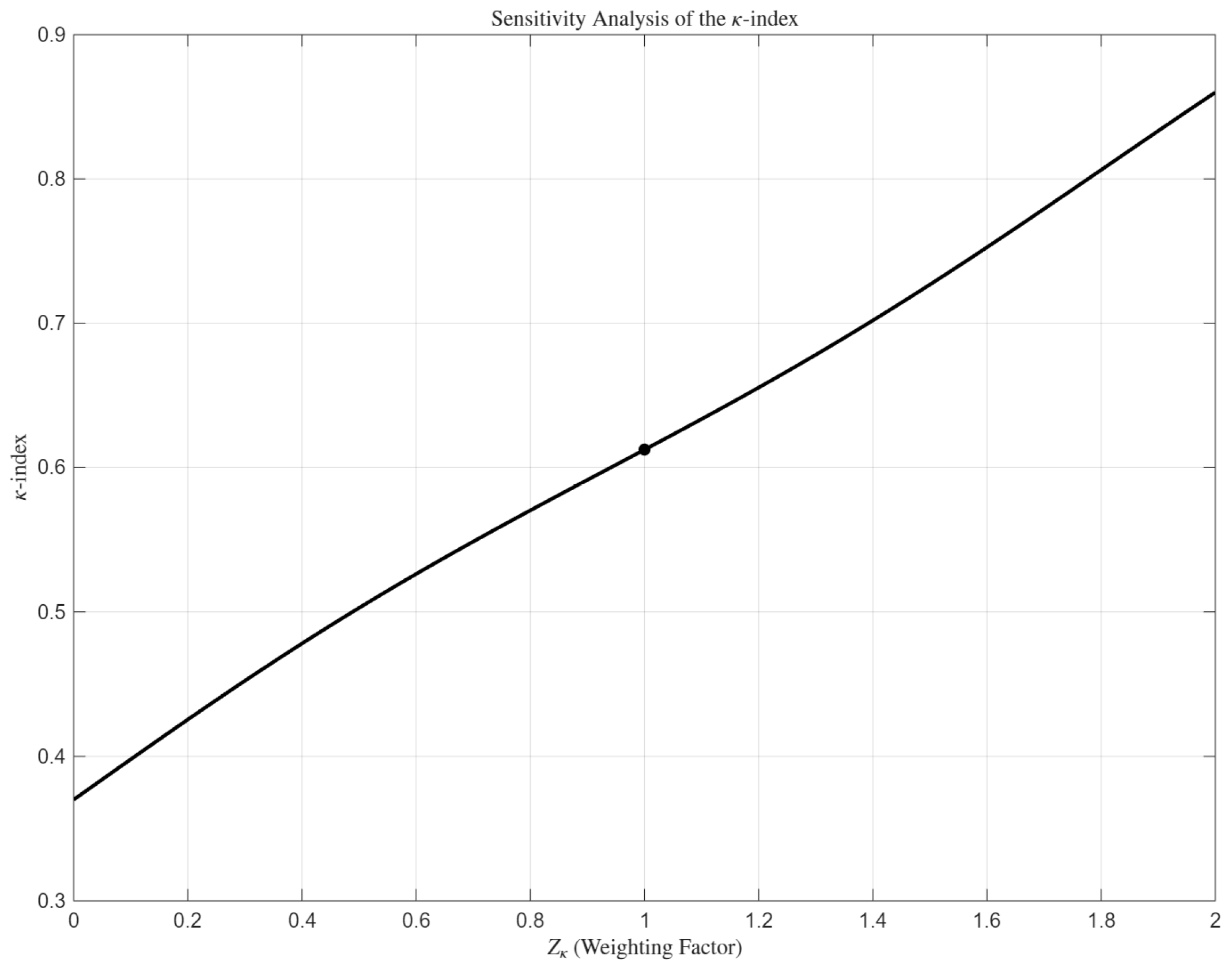
Second, the introduction of the weighting factor provides a tunable design parameter that allows controlling the trade-off between global joint centering and uniformity of joint utilization. This flexibility is particularly relevant in industrial applications, where different tasks may prioritize robustness, uniform wear, or proximity to nominal configurations.
Third, and more importantly, the κ-index is employed here as a workspace-level performance metric rather than as a local or instantaneous criterion. Unlike traditional joint-limit avoidance strategies used in redundancy resolution during trajectory execution, the κ-index is evaluated over the entire set of task configurations. This allows assessing robot base placement by aggregating joint behavior across the workspace, making it suitable for design-stage optimization rather than real-time control.
In this sense, the κ-index should be understood as a placement-oriented design metric that complements classical kinematic performance indices by explicitly incorporating joint-limit awareness into the optimization framework.
The proposed κ-index can also be interpreted from an optimization-theoretic perspective as a regularized cost function defined over the normalized joint space. Let the normalized joint deviation vector be defined as
where each component represents the relative deviation of a joint variable with respect to the midpoint of its admissible interval.
Under this formulation, the κ-index combines the mean and dispersion of the vector , which can be interpreted as simultaneously minimizing the average deviation from the center of the feasible set and the imbalance across joints. This structure is analogous to minimizing a joint-space cost that penalizes both bias and variance.
From an optimality perspective, minimizing the κ-index promotes configurations that maximize a uniform margin to joint limits, avoiding degenerate solutions in which only a subset of joints operate near saturation. Therefore, the κ-index can be interpreted as a surrogate objective for balanced configuration optimization in bounded joint spaces.
2.2.2. Formulation of the Optimal Placement Problem
The problem essentially consists of assigning a set of configurations of a robot associated with a task to the domain of accessible configurations while maintaining in one aspect. To solve this problem, an optimization approach is used, the objective function of which is defined below.
Let there be any n-jointed robot that must perform a certain task . Consider a candidate set to satisfy the condition (accessibility condition). For each of the n configurations of , it is possible to calculate the index κ of departure from an ideal configuration.
Now, there is a set of indices
, with
i = 1, 2, …,
n, from which it can be extracted a representative number that allows to qualify the set of configurations
with respect to their deviation from its limits. This number is defined by
Equation (14) defines the κ-index as a scalar performance indicator that combines the average deviation and the dispersion of the joint indices. The weighting factor Z_κ regulates the relative importance of uniformity versus global centering.
From an optimization perspective, minimizing the κ-index leads to configurations that are not only centered within the admissible joint space but also evenly distributed across all joints. This avoids solutions in which only a subset of joints approaches their limits while others remain underutilized.
This formulation provides a balance between feasibility and robustness, making the κ-index particularly suitable for accessibility-based placement problems in constrained robotic systems.
is the mean value of the set of the , is the standard deviation of the set, and is a weighting factor of the standard deviation.
is selected to characterize an objective function that will minimize both the mean value and standard deviation of the set of configurations . A suitable value for is .
The smaller is, the closer the configurations of will be to the center of the accessible configuration domain .



 ,
,