


Abstract
The Antarctic stratospheric ozone plays a crucial role in the polar climate system and is strongly influenced by energetic particle precipitation. Among these processes, medium-energy electron (MEE) precipitation enhances the production of odd nitrogen (NOx) in the polar mesosphere and stratosphere, thereby driving ozone depletion through catalytic reactions. However, quantifying its atmospheric impact remains challenging, largely because the spatial and temporal variability of MEE is poorly constrained, and most current global chemistry–climate models lack a realistic MEE forcing. This study employs the Whole Atmosphere Community Climate Model coupled with Sodankylä Ion Chemistry (WACCM–SIC) to investigate the influence of MEE precipitation during 2013–2014, when moderate geomagnetic storms were more frequent in the winter of 2013. A control simulation (Case1) and two sensitivity experiments (Case 2 and Case 3) were conducted to isolate MEE-driven effects. Model-simulated NOx (NO + NO2) and ozone concentrations agree well with satellite observations, indicating that WACCM–SIC captures the key photochemical and dynamical processes. The results further suggest that the direct impact of MEE precipitation on the middle and lower atmosphere during winter is relatively weak. Nevertheless, MEE-generated NOx can be efficiently transported downward within the polar vortex, reaching altitudes below 15 km. In these regions, MEE-related NOx enhancement can reach up to 5%, with values during the winter of 2013 approximately twice those in 2014. Sensitivity experiments further reveal that enhanced NOx leads to pronounced ozone depletion in the lower stratosphere, with ozone losses reaching up to 25%. A clear negative relationship between NOx and ozone is therefore evident, highlighting the importance of accurately representing MEE precipitation in chemistry–climate models.
1. Introduction
Antarctic ozone variability plays an important role in the global climate system, and has been the subject of sustained scientific interest since the discovery of the ozone hole [1]. Reactive nitrogen species, dominated by odd nitrogen (NOx, NO and NO2), regulate the photochemical balance of stratospheric ozone through catalytic cycles and represent a key factor controlling polar ozone variability. The spatiotemporal distribution of NOx is controlled by both dynamical transport and chemical processes. Among these, energetic particle precipitation (EPP) events are especially critical in the mesosphere and stratosphere by producing NOx through ionization, dissociation, and recombination reactions, subsequently leading to catalytic ozone loss [2,3,4,5]. Influenced by solar ultraviolet and X-ray radiation, as well as EPP from the magnetosphere, the neutral atmosphere in the thermosphere becomes partially ionized, forming the ionosphere. The ionosphere is strongly coupled with both the middle and upper atmosphere and the magnetosphere [6]. EPP represents an important forcing mechanism in the polar middle and upper atmosphere. In the neutral atmosphere, EPP induces ionization and leads to the production of odd nitrogen (NOx = NO + NO2), thereby enhancing NOx concentrations [7,8]. NOx plays an important role in the catalytic reaction cycles responsible for ozone destruction in the upper stratosphere and mesosphere [9]. EPP can be classified into several particle types that affect atmospheric chemistry. Solar proton events (SPEs), the major form, can cause rapid increases in NOx and H2O concentrations within a few days and result in severe stratospheric ozone losses by 60% [10], but they are sporadic and short-lived, typically occurring only during solar maximum and up to one to two years thereafter [11]. In contrast, medium-energy electron (MEE) precipitation persists for much longer timescales in the polar mesosphere and stratosphere, enhances ionization, substantially increases NOx and HOx (hydrogen oxide radicals, including OH and HO2) concentrations, and leads to sustained ozone depletion [12]. Other EPP sources, such as auroral electrons and galactic cosmic rays (GCRs), primarily influence the thermosphere at high altitude and the lower stratosphere and troposphere, respectively, with GCRs contributing less than 1% NOx production and exerting limited impacts on the stratosphere and lower mesosphere [13].
In recent years, the mechanisms by which SPEs induce short-term perturbations to the ozone layer have become relatively well understood, with enhanced production of NOx in the polar middle atmosphere causing pronounced but transient ozone depletion [14,15,16]. In contrast, the long-term impacts of MEE precipitation on ozone remain less well constrained. Numerical modeling studies have shown that NOx produced by MEE can persist for several months under polar night conditions and can be continuously transported downward into the stratosphere by the polar vortex circulation, resulting in a gradual wintertime ozone loss [12,17]. Observations from Antarctic stations further show rapid and pronounced enhancement of NO in the upper mesosphere and lower thermosphere (approximately 70–105 km) during and following geomagnetic storms, with associated ozone depletion up to 20–70% [18,19]. Previous studies using Whole Atmosphere Community Climate Model (WACCM) simulations that did not include MEE forcing substantially underestimated NOy and O3 concentrations near 80 km by one to two orders of magnitude compared with observations, while enhanced MEE forcing has been shown to produce up to approximately 25% ozone loss in the polar stratosphere at altitudes of 28–45 km, consistent with ACE–FTS satellite observations [12].
Despite growing evidence that MEE plays a significant role in driving stratospheric ozone variability, its quantitative impacts remain highly uncertain. This uncertainty stems from limitations in both data and models, including discontinuous satellite observational coverage, insufficient reanalysis resolution, and the historically incomplete representation of MEE precipitation in atmospheric models [20]. At present, most global climate models account for atmospheric ionization driven by solar X-rays, solar protons, and radiation belt electrons, but they lack a realistic representation of MEE precipitation associated with solar activity. Thus, to address these limitations and more accurately simulate the effects of MEE precipitation in the polar atmosphere, this study employs WACCM–SIC model simulations to investigate the influence of MEE on Antarctic stratospheric ozone variability. Specifically, the main objective is to quantify the impact of MEE precipitation in the polar mesosphere and stratosphere and to evaluate its contribution to ozone depletion through NOx production and downward transport. Using the WACCM–SIC framework, we further examine the impacts of MEE precipitation (30–1000 keV) on the middle and upper atmosphere. In this study, we use a newly coupled ion-neutral chemistry model, WACCM–SIC, which integrates the Sodankylä Ion Chemistry (SIC) model with the WACCM to simulate ionospheric D-region processes at altitudes of approximately 50–90 km [21]. The WACCM–SIC model couples WACCM with a comprehensive ion-neutral chemistry framework that is reduced using the structural equation modeling-connectivity minimization (SEM–CM) method to balance chemical fidelity and computational efficiency, enabling effective representation of the D-region ionospheric process in this region. The analysis focuses on NOx variability during 2013–2014, a period selected because the winter of 2013 experienced more frequent moderate geomagnetic storms than 2014, providing favorable conditions for such examination.
2. Models and Methods
The simulations are based on the Community Earth System Model (CESM) framework developed by the National Center for Atmospheric Research (NCAR). The WACCM includes ion chemistry processes as well as key external forcings, such as the solar cycle, SPEs, auroral electrons, and MEE precipitation. Building upon the standard chemical scheme of WACCM, the WACCM–SIC configuration incorporates 306 additional ion-neutral and ion recombination reactions involving neutral species, positive ions, negative ions, and electrons. This extension enables the explicit simulation of NOx and HOx production driven by MEE and auroral particle precipitation. The WACCM–SIC model is operated in the specified-dynamics (SD) configuration, with a horizontal resolution of 1.9° × 2.5° (latitude × longitude) and 88 vertical levels, driven by the F_SD_WACCM dataset provided within the standard WACCM configuration. The simulation period spans 2013–2014, and hourly model output from this period is analyzed. The WACCM–SIC model is operated in the specified–dynamics (SD) configuration, with a horizontal resolution of 1.9° × 2.5° (latitude × longitude) and 88 vertical levels. All simulations in this study are conducted at the native model resolution, and no additional spatial refinement procedures (e.g., dynamical nesting or statistical downscaling) are applied. The improvements mentioned in the revised manuscript refer only to visualization quality and do not involve modifications to the model resolution.
The ionization rate calculation is based on the solar forcing implemented in WACCM, which adopts daily varying input from the Coupled Model Intercomparison Project Phase 6 (CMIP6) provided via the SOLARIS–HEPPA framework (https://solarisheppa.geomar.de/cmip6, accessed on 10 October 2024) and has been described in detail in previous studies [22]. Ionization rates are calculated offline using the atmospheric model described by Picone [23], with comprehensive documentation available for the CMIP6 ionization dataset [24].
Based on the WACCM–SIC model, three sets of experiments are designed for the Antarctic region during 2013–2014. A control experiment with standard MEE forcing (Case 1, MEE), a sensitivity experiment without MEE forcing (Case 2, NOMEE), and a sensitivity experiment with doubled MEE forcing (Case 3, DOUBLEMEE). All simulations are performed under the same model configuration, with the MEE forcing being the only varying factor among the experiments. The MEE forcing is derived from CMIP6 output following Matthes [22]. All simulations are performed using the specified-dynamics (SD) version of WACCM constrained by MERRA reanalysis below 60 km [25,26]. The Prandtl number is set to 2, and solar forcings, including F10.7, Ap, SPEs, and spectral solar irradiance (SSI), are updated consistently [27]. It should be noted that the frontal-scale dynamics and waves (FSDW) configuration does not include MEE forcing but accounts for auroral electrons and SPEs. Case 2 excludes the MEE forcing while retaining auroral precipitation, and it is therefore taken as a sensitivity simulation.
Model performance is evaluated using observations from the Atmospheric Chemistry Experiment–Fourier Transform Spectrometer (ACE–FTS). The ACE instrument is aboard the Science Satellite (SCISAT), launched on 12 August 2003 and operating in a circular low-Earth orbit at an altitude of approximately 650 km with a 74° inclination and a 97.6 min orbital period. The ACE–FTS measures infrared solar occultation spectra, providing up to 15 sunrise and 15 sunset occultations per day [24]. It retrieves a wide range of atmospheric parameters, including temperature and volume mixing ratios (VMR) of more than 30 trace gases. The measurements cover altitudes from the surface to about 150 km, with a vertical resolution of roughly 1 km. Owing to its extensive polar coverage and high data quality, ACE–FTS observations are well–suited for characterizing atmospheric chemical variability at middle and high latitudes. Thus, ACE–FTS data over the Antarctic region during 2013–2014 are used in this study to evaluate and validate the WACCM–SIC simulation results.
3. Evaluation of Model Performance
3.1. Geomagnetic Conditions
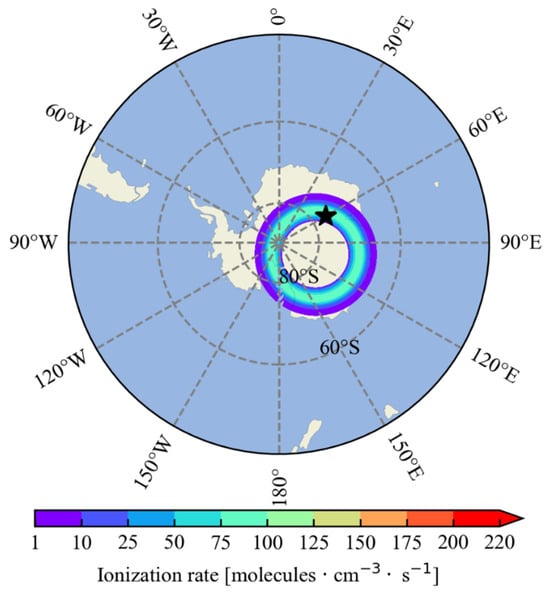
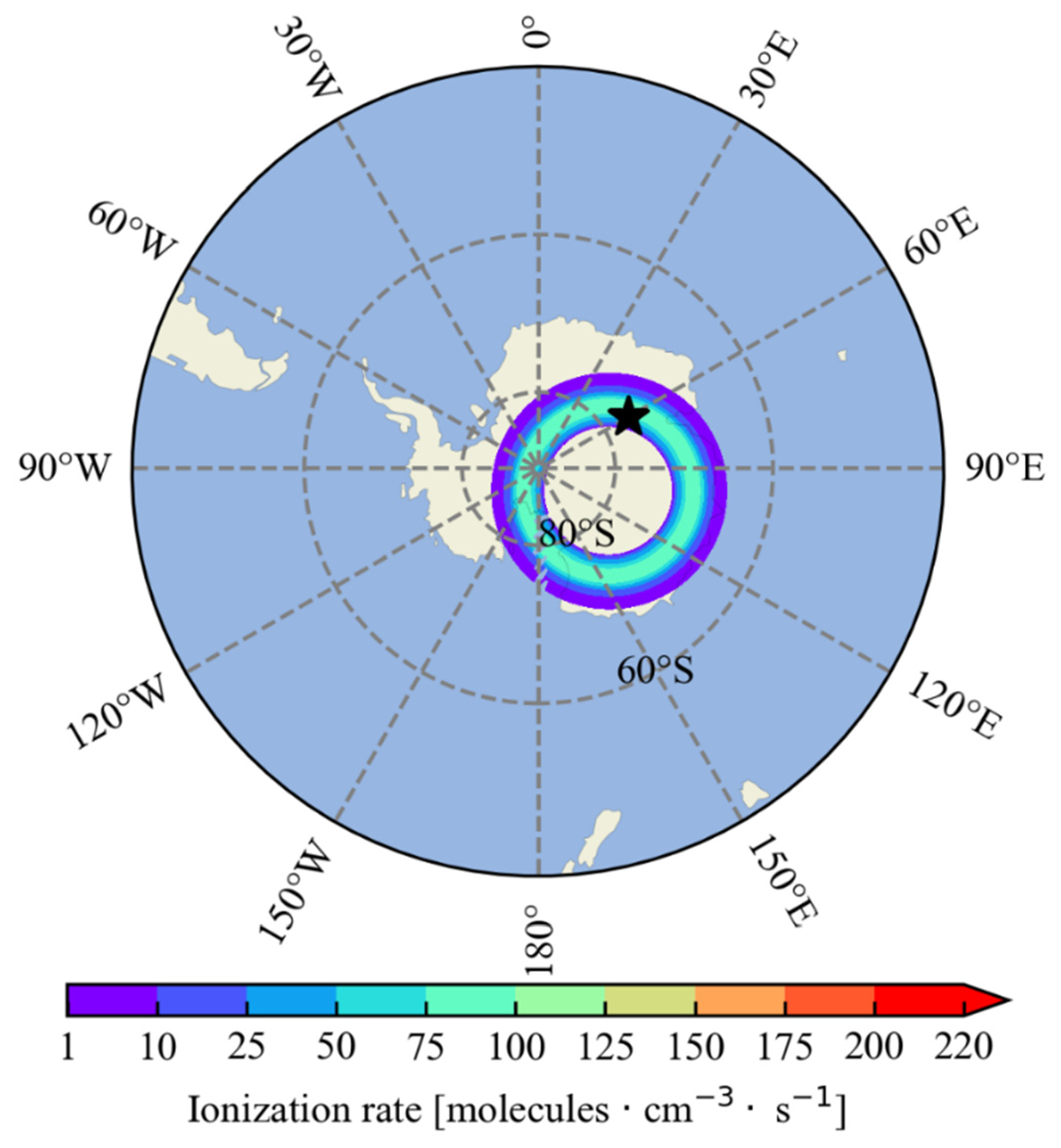
Figure 1 illustrates the latitudinal distribution of ionization rates at an altitude of approximately 80 km over the Antarctic region (60° S–90° S). The spatial distribution of ionization is strongly asymmetric, with a pronounced maximum (marked by a star; 59.9896° E, 76.4864° S; referred to as the starred location hereafter). This spatial asymmetry is primarily associated with the particle loss cone drift, whereby energetic electrons gyrating along geomagnetic field lines and bouncing between the two magnetic poles are preferentially lost through collisions in denser atmospheric regions at high latitudes. This loss process is further enhanced in regions of a weakened geomagnetic field. In the Southern Hemisphere, particle precipitation intensifies at the magnetic field line footprints passing through the South Atlantic Anomaly (SAA), contributing to the observed asymmetry. The southern displacement of the SAA also leads to a hemispheric asymmetry in ionization rates. Previous studies suggest that this pattern may be shaped by the spatial structure of the Earth’s magnetic field, variations in solar activity, and interactions among different atmospheric chemical constituents. In particular, convergence of magnetic field lines near the southern geomagnetic pole enhances interactions between charged particles and atmospheric molecules. Moreover, the precipitation rates of energetic particles from the solar wind may vary with latitude, leading to differences in ionospheric ionization, an effect that becomes more pronounced during periods of high solar activity. In the atmosphere, molecular oxygen and nitrogen play a central role in ionization processes, and latitudinal variations in their abundances can further modulate ionization rates [12].
Figure 1.
Latitudinal variation in ionization rate at 80 km altitude over high latitudes and the Antarctic region. The five-pointed star marks the Antarctic magnetic conjugate area used for further analysis.
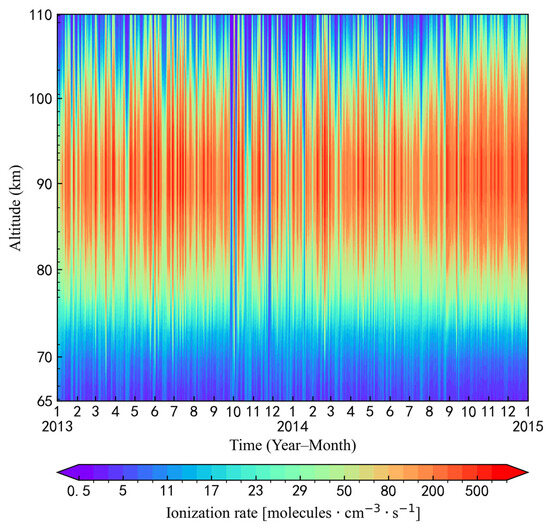
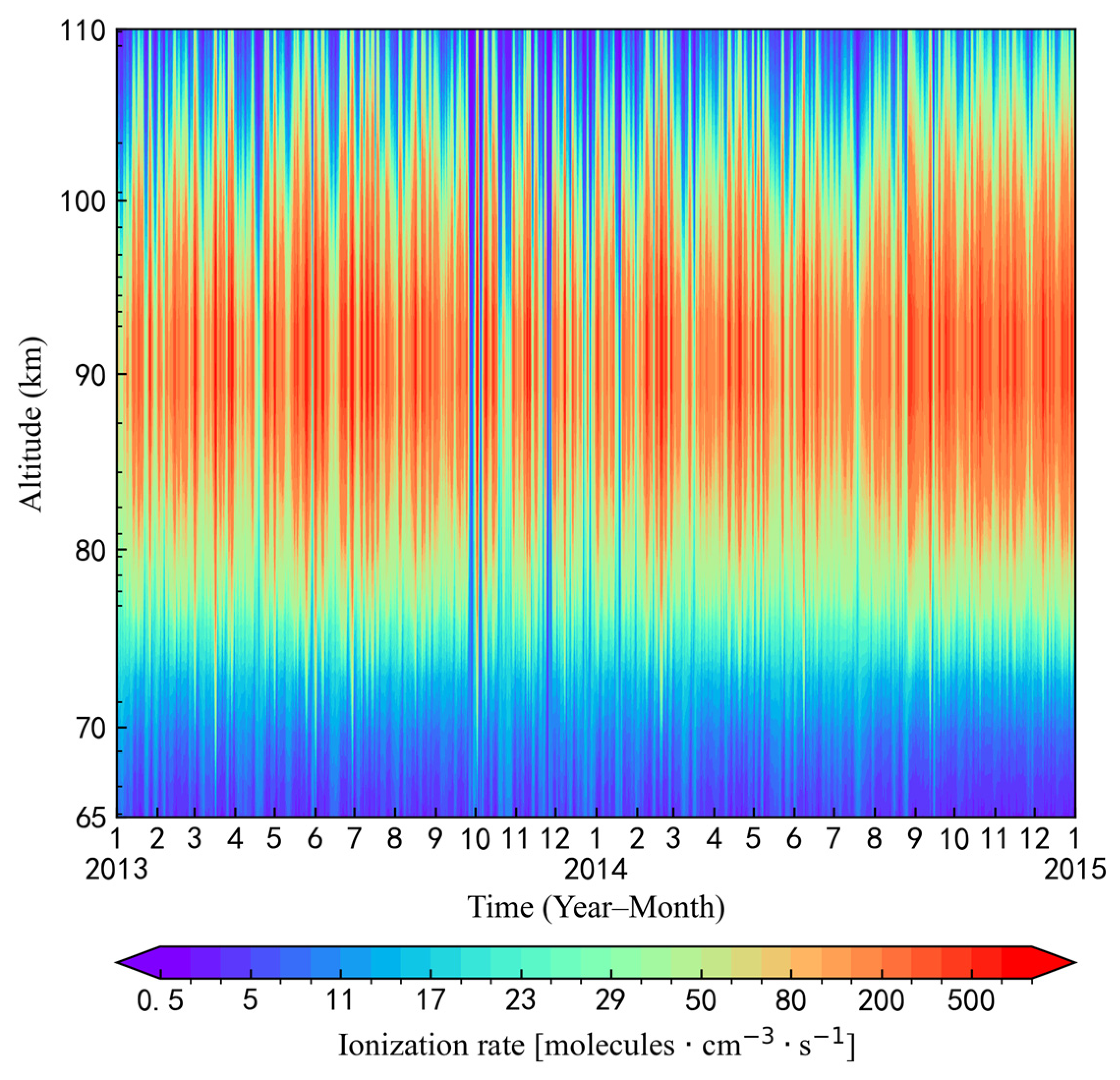
The location marked at the starred location (59.9896° E, 76.4864° S) corresponds to the Antarctic magnetic conjugate area of field lines extending from the SAA and represents a core area of enhanced MEE precipitation [28]. The reduced geomagnetic field strength and the configuration of the magnetic field lines in this region promote MEE precipitation, leading to a pronounced enhancement of ionization rates in the middle and upper atmosphere [29]. As one of the core regions of enhanced ionization, this location is a suitable testbed for evaluating the magnetosphere–atmosphere coupling in global models. To further examine the fine-scale characteristics of ionization, Figure 2 presents the three-hourly variation in ionization rates at the starred location as a function of altitude. The results show that enhanced ionization occurs in the upper mesosphere and lower thermosphere. Most of the signal is between about 80 and 100 km, and the peak is near 90 km. The ionization is much weaker below about 70 km. During strong events, the signal can extend down to around 70 km, but it becomes weaker quickly. In terms of temporal variability, ionization rates are substantially enhanced from April to September, reaching maximum values of approximately 500 molecules cm−3 s−1 and exhibiting a clear diurnal cycle. The temporal variability in the ionization rates discussed above is consistent with previous studies [30].
Figure 2.
Daily variation in ionization rate at different altitudes provided by WACCM–SIC as a function of time.
According to Newnham (2018), no major SPEs occurred during 2013–2014 [11]. This period is therefore selected to minimize the influence of SPEs and to better assess the effects of MEE precipitation. Ionization rates during April–September 2013 were substantially higher than those in 2014, primarily attributed to stronger geomagnetic activity. During the austral winter of 2013 (June–August), nine moderate geomagnetic storms were recorded, whereas only two such events occurred in 2014 near the beginning and end of winter (early May and late August). Figure 2 reveals several pronounced, short-lived ionization enhancement events during March–July and September–October 2013, as well as January–April and September–October 2014. During these episodes, ionization rates increased rapidly over short timescales and propagated downward toward the stratosphere, potentially altering NOx concentrations and thereby influencing the stratospheric ozone. However, the mechanisms linking ionization variability to ozone changes, as well as the magnitude of this impact, are beyond the scope of this study and will be examined in future work. Here, we focus on quantifying the influence of MEE on the Antarctic stratospheric ozone during 2013–2014.
3.2. Analysis of Simulation Results
Polar stratospheric ozone depletion is mainly driven by catalytic cycling of reactive halogen species, primarily chlorine oxides (ClO) and bromine oxides (BrO), with reactive bromine widely recognized as a key indicator of ozone loss. A key fundamental ozone-destroying reaction is Br + O3 → BrO + O2. In contrast, inert chlorine reservoir species, mainly hydrogen chloride (HCl) and chlorine nitrate (ClONO2), must be converted into chemically active chlorine (ClOx, including Cl, ClO, and Cl2O2) through specific pathways. These key activation processes depend on heterogeneous reactions occurring on the surfaces of polar stratospheric cloud (PSC) particles, including:
The reaction between chlorine nitrate and hydrogen chloride:
ClONO2 + HCl → Cl2 + HNO3
Hydrolysis of chlorine nitrate:
ClONO2 + H2O → HOCl + HNO3
Secondary reaction between hypochlorous acid and hydrogen chloride:
HOCl + HCl → Cl2 + H2O
These reactions are strongly accelerated on the surfaces of PSC particles, which is particularly pronounced during the Antarctic winter polar night, when low temperatures favor PSC formation and substantially enhance the decomposition of chlorine nitrate (ClONO2), thereby releasing large amounts of reactive chlorine. The formation and removal of chlorine nitrate, a major chlorine reservoir species, are regulated by catalytic cycles involving NOx. Previous studies have shown that under the cold conditions of the Antarctic winter and early spring, hydrogen chloride (HCl) can release chlorine through heterogeneous reactions on ice surfaces. Following the end of the polar night, photochemical processes liberate active chlorine atoms, which subsequently react with ozone (O3), leading to stratospheric ozone destruction [31,32,33]. NOx is primarily produced through the photochemical decomposition of nitric acid (HNO3):
Photolysis of nitric acid:
HNO3 + hv → OH + NO2
Reaction between nitric acid and hydroxyl radicals:
HNO3 + OH → H2O + NO3
Formation of chlorine nitrate through the reaction of NO2 with ClO:
ClO + NO2 + M → ClONO2 + M
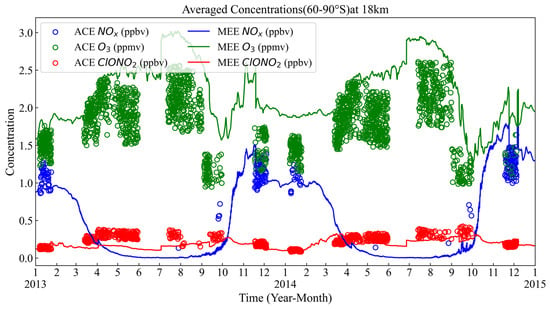
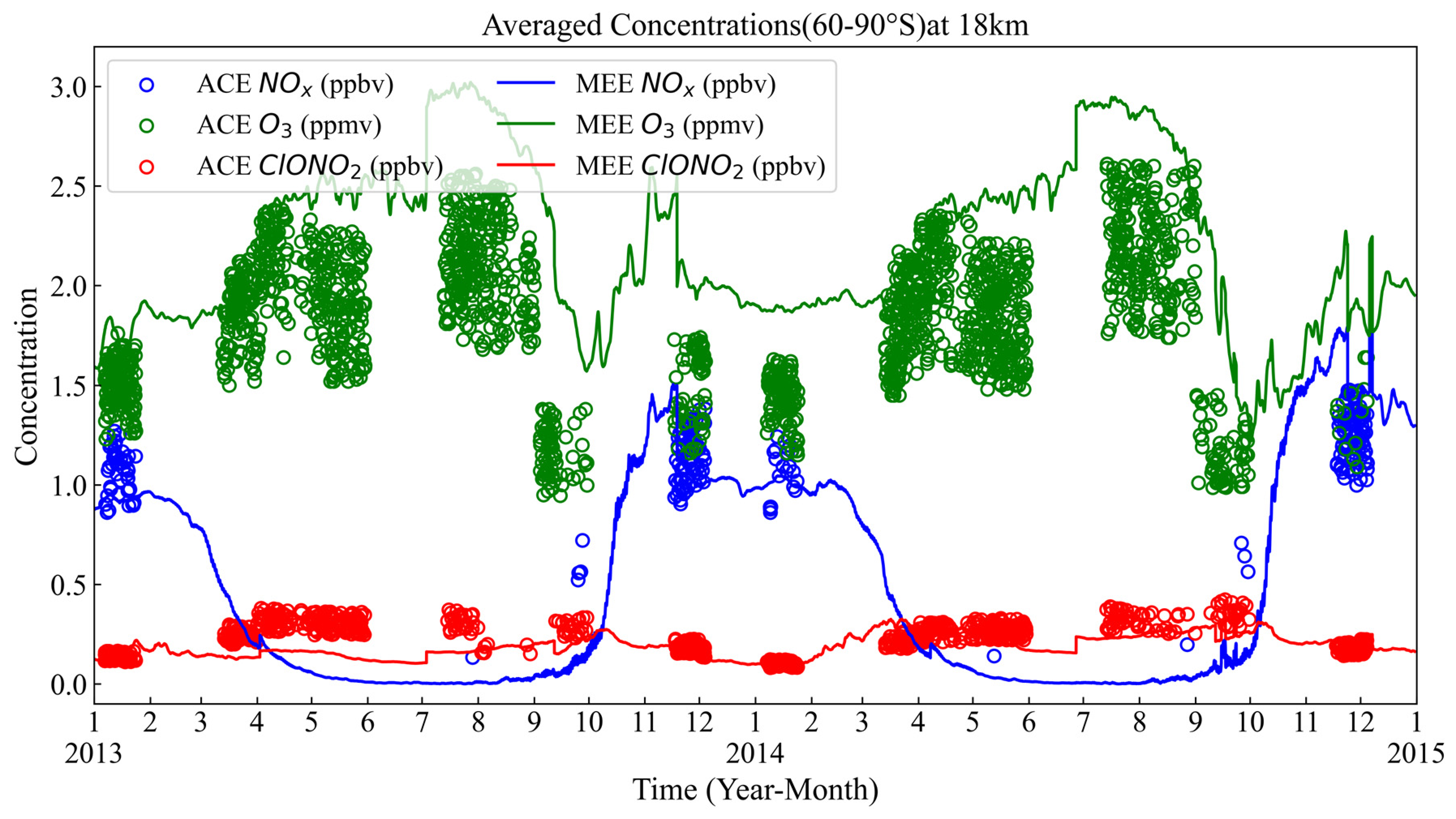
However, because Reactions (4) and (5) are driven by solar radiation, where hν represents the energy of incoming solar radiation, NOx production is strongly suppressed in the core region of the polar night, where the lack of sunlight limits photochemical processes and inhibits chlorine activation. This raises uncertainty on whether current theoretical models can accurately represent the accumulation of reactive chlorine during the polar night. To address this issue, this study focuses on the region of maximum Antarctic ozone depletion at 18 km altitude, as it likely represents the maximum of photochemical processes (Case1). Area-averaged time series of simulated ClONO2, NOx, and O3 concentrations are shown in Figure 3 and compared with observations from the Atmospheric Chemistry Experiment (ACE). There are gaps in the ACE–FTS time series. These gaps are caused by the observation method. ACE–FTS measures the atmosphere at sunrise and sunset, so the data are not continuous. The satellite does not always pass over the Antarctic region, so some periods have no observations.
Figure 3.
Time series comparison of NOx, ClONO2, and O3 at 18 km altitude over high latitudes and the Antarctic region (60° S–90° S). NOx denotes the sum of nitric oxide (NO) and nitrogen dioxide (NO2). ClONO2 represents chlorine nitrate. Solid lines indicate model simulations, while circles denote observations from the Atmospheric Chemistry Experiment (ACE). Units are ppmv for O3 and ppbv for NOx and ClONO2.
Figure 3 shows the time series of ClONO2, NOx, and O3 at 18 km over 60° S–90° S. The O3 concentrations derived from ACE–FTS observations and the simulations are generally above 1 ppmv during the available periods, and the model captures the overall variability in O3. In contrast, ClONO2 concentrations are much lower than O3 and exhibit clear temporal variability, with a marked decrease from late 2013 to early 2014 followed by a gradual recovery. The simulated ClONO2 values reproduce this overall evolution, although the modeled variations are smoother than those in the observations. NOx concentrations also show pronounced temporal changes. Both the ACE–FTS observations and simulations remain at relatively low levels during much of 2013, then increase from late 2013 to early 2014, and decrease again afterward. The simulations capture this general pattern and are broadly consistent with the observed NOx variations. Notably, the decrease in ClONO2 is accompanied by an increase in NOx during the same period, indicating a clear contrast in their temporal evolution. This reduction is associated with the formation of PSCs, which facilitate heterogeneous reactions that release reactive chlorine and subsequently catalyze ozone destruction. Meanwhile, NOx is reduced through uptake on PSCs, while its subsequent recovery enhances ozone loss through catalytic cycles.
During spring (September–November), nitric acid (HNO3) reaches a photolytic maximum of approximately 2.5 ppbv in observations and about 2.1 ppbv in simulations, coincident with the simultaneous recovery of both observed and simulated ClONO2. The increase is driven by gradually strengthening solar radiation in spring, which promotes HNO3 photolysis. At the same time, the elevated wintertime HNO3 enhances NO2 production by efficiently consuming hydroxyl radicals through Reaction (5). The released NO2 subsequently reacts with ClO to form ClONO2, which is transported into the polar vortex core by stratospheric circulation. Within the vortex core, limited sunlight suppresses photochemical loss processes, and the stability of ClONO2 becomes strongly controlled by HCl concentrations. When HCl exceeds approximately 2 ppbv, the rate of heterogeneous Reaction (1) increases markedly, accelerating depletion of ClONO2 under high–HCl conditions. ClONO2 can persist within the polar vortex only after the depletion of HCl in September, leading to its sustained accumulation during winter.
Despite differences in spatial resolution between the model (finer) and the ACE satellite observations, simulated ClONO2 concentrations agree with observations within 8%. Model diagnostics indicate that approximately 70% of ClONO2 within the vortex core originates from photochemical production at the vortex edge, followed by transport into the interior, while the remaining 30% is produced locally through Reaction (6) involving residual NO2. This result supports a coupled control mechanism in which solar illumination gradients and dynamical mixing jointly regulate ClONO2 formation. Overall, the WACCM–SIC model simulations reproduce satellite observations, including ACE–FTS, with concentrations of O3, HNO3, HCl, and ClONO2, with typical biases within ±10%. This agreement further supports the robustness of the WACCM–SIC model in representing polar stratospheric chemistry [22,34,35,36].
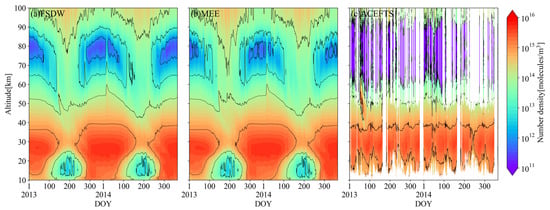
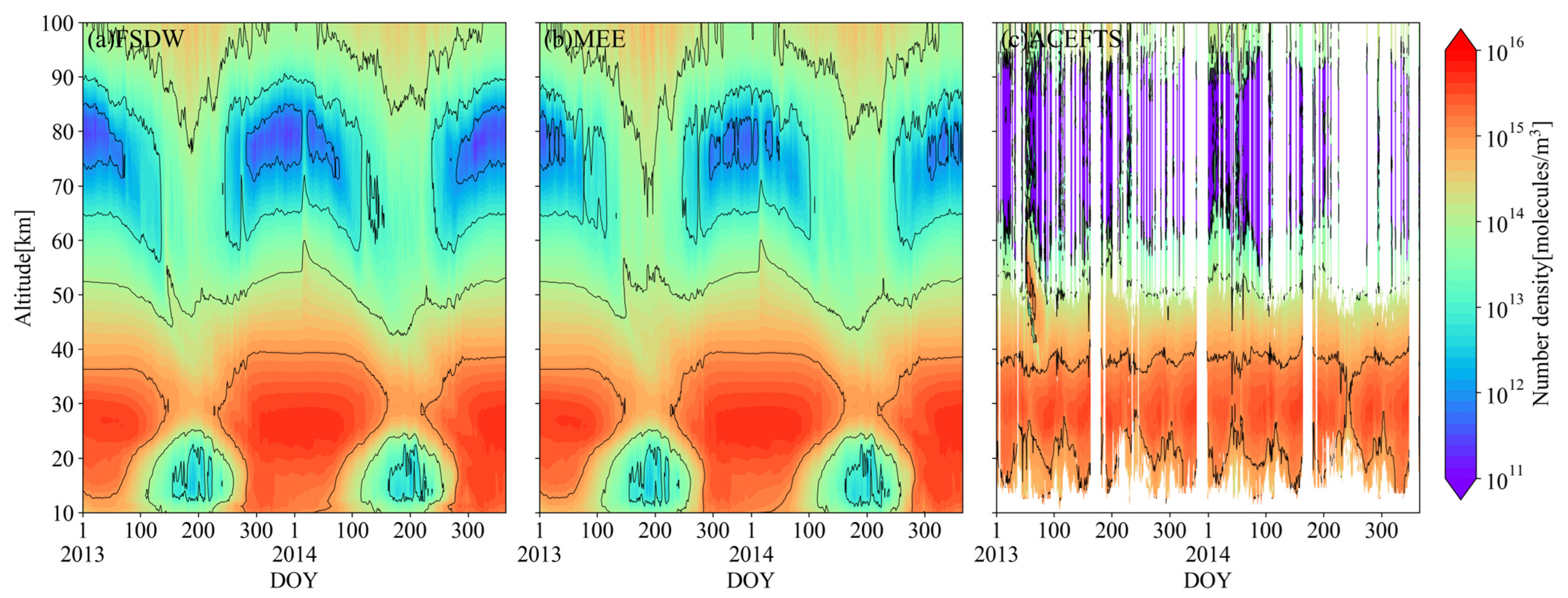
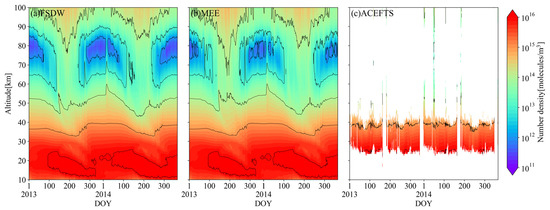
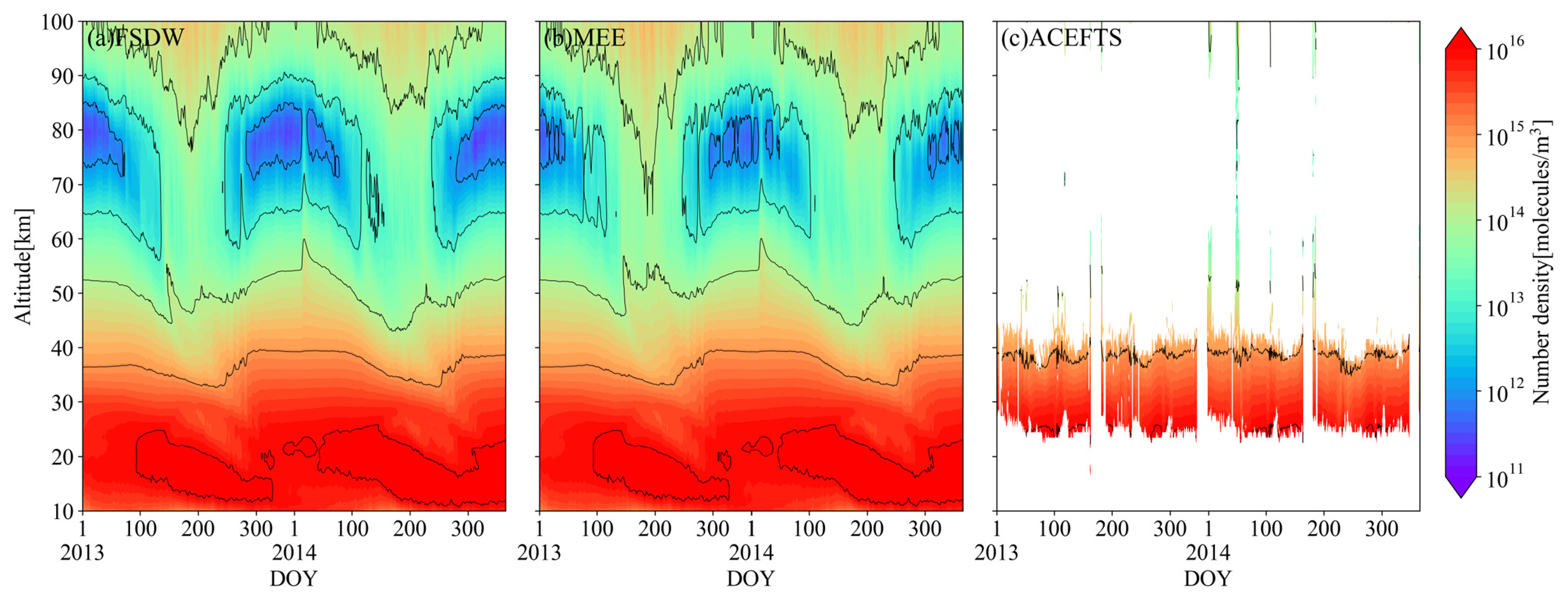
Based on the analysis above, ozone variability is influenced by both ClONO2 and NOx. To further quantify the evolution of NOx, spatial averaging is applied over the high-latitude Antarctic region (60° S–90° S). Figure 4 presents time-height cross-sections of NOx number density derived from different data sources for comparison, revealing pronounced seasonal variability.
Figure 4.
Comparison of the spatiotemporal distribution of NOx number density. (a) Simulated NOx number density from the MEE experiment. (b) Simulated NOx number density from the NOMEE experiment. (c) NOx number density derived from ACE–FTS observations.
A comparison of the three datasets shows that the FSDW simulation (Figure 4a) and Case 2 (NOMEE, Figure 4b) yield broadly similar results. Below 60 km, both simulations are consistent with the observations (Figure 4c). Above 60 km, the observational data are limited by relatively coarse vertical resolution, whereas the model simulations (Figure 4a,b) exhibit a more continuous structure. The observed NOx values (Figure 4c) are generally lower than those simulated (Figure 4a,b), indicating an overall tendency of the model to overestimate NOx number density. Nevertheless, relative to the FSDW simulation, Case 2 reproduces the magnitude of NOx more realistically and its observed downward extension, indicating a closer agreement with the observations and achieving a better overall fit than the FSDW configuration.
In the mesosphere and lower thermosphere (50–90 km), NOx exhibits relatively small variability on daily to weekly timescales, whereas its seasonal and interannual variations are much more pronounced. During winter, NOx number densities increase below 100 km with a minimum observed in the 0–20 km layer, whereas in summer NOx shows a decrease followed by an increase with height, with a local maximum between 0 and 30 km and a minimum near 80 km. Interannual variability reveals that during winter, a tongue-shaped region of enhanced NOx in the mesosphere and lower thermosphere (50–90 km) gradually descends over time and propagates toward lower altitudes, merging with background NOx near 80 km (Figure 4a–c). This feature is associated with MEE precipitation, which enhances auroral electron fluxes that dominate ionization in the lower thermosphere. Consistently, periods of enhanced geomagnetic conditions (geomagnetic index Kp ≥ 5) are accompanied by substantially increased NOx production. In both the FSDW-forced simulation and the WACCM–SIC simulation, electron forcing above approximately 90 km is nearly identical, suggesting that differences at lower altitudes primarily reflect transport and chemical processes.
In the Southern Hemisphere, EPP-related NOx production, a major source of NOx in the polar mesosphere and stratosphere [37,38], exhibits greater vertical extent and larger interannual variability. NOy produced by EPP is initially generated in the lower thermosphere (80–120 km) and is subsequently transported downward into the mesosphere and stratosphere (45–70 km) by subsidence driven by the polar night jet. During winter, persistent low-light conditions in the middle and upper atmosphere (>45 km) strongly suppress the photochemical NOy loss, primarily through NO photolysis and reactions involving nitrogen atoms. Consequently, NOy lifetimes extend from weeks to several years, facilitating its accumulation toward late winter and early spring. Model simulations further indicate that the tongue-shaped NOy structures observed in spring result from enhanced meridional mixing following polar vortex breakup.
Consistent with these production and transport mechanisms, the spatiotemporal distribution of NOy (NOy = NO + NO2 + HNO3 + N2O5) over the high-latitude Antarctic region (60° S–90° S) shows pronounced seasonal variability in NOy density (Figure 5), similar to that of NOx density. Area-averaged time–height distributions reveal that during summer, NOy concentrations decrease with altitude before rising again, with a minimum near 80 km. In winter, a tongue-shaped NOy enhanced region appears in the mesosphere and lower thermosphere (50–90 km) and gradually propagates to lower altitudes (Figure 5a,b) and merges with the background NOy concentrations near 80 km. Across the 40–80 km altitude range, summer NOy concentrations are lower than those in winter. This seasonal contrast reflects stronger ultraviolet radiation in the upper stratosphere and lower mesosphere during summer, which enhances the net photochemical loss of NOy and increases susceptibility to radiative depletion.
Figure 5.
Comparison of the spatiotemporal distribution of NOy number density. (a) Simulated NOy number density from the MEE experiment. (b) Simulated NOy number density from the NOMEE experiment. (c) NOy number density derived from ACE–FTS observations.
Observations further reveal a bimodal seasonal cycle in NOy, with a primary maximum in September and a secondary maximum during February–March. This feature is particularly pronounced in years associated with sudden stratospheric warming (SSW) events, such as 2004, 2006, 2009, and 2012. The primary maximum is attributed to enhanced polar upwelling associated with SSW-induced stratospheric elevation, which facilitates the vertical transport of NOy from lower levels into the mesosphere and stratosphere. The secondary maximum arises from intensified meridional mixing during the later stages of the warming, leading to horizontal transport of NOy from lower latitudes into the polar region. During winter, the NOx enhancement induced by MEE precipitation accelerates chlorine activation through Reaction (6), while the enhanced NOx family contributes to ozone loss in the 30–50 km layer via catalytic cycles, accounting for up to 18% of the total ozone depletion in this region. In summer, this mechanism is substantially weakened due to enhanced photolysis, indicating a pronounced seasonal dependence of MEE-related chemical effects.
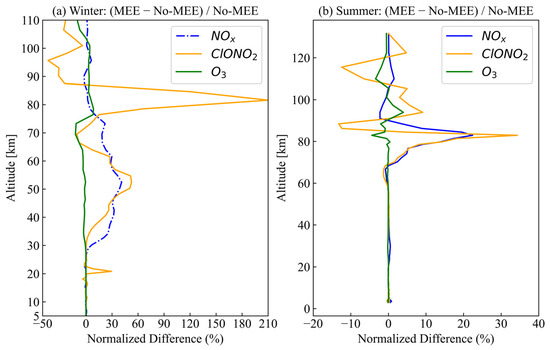
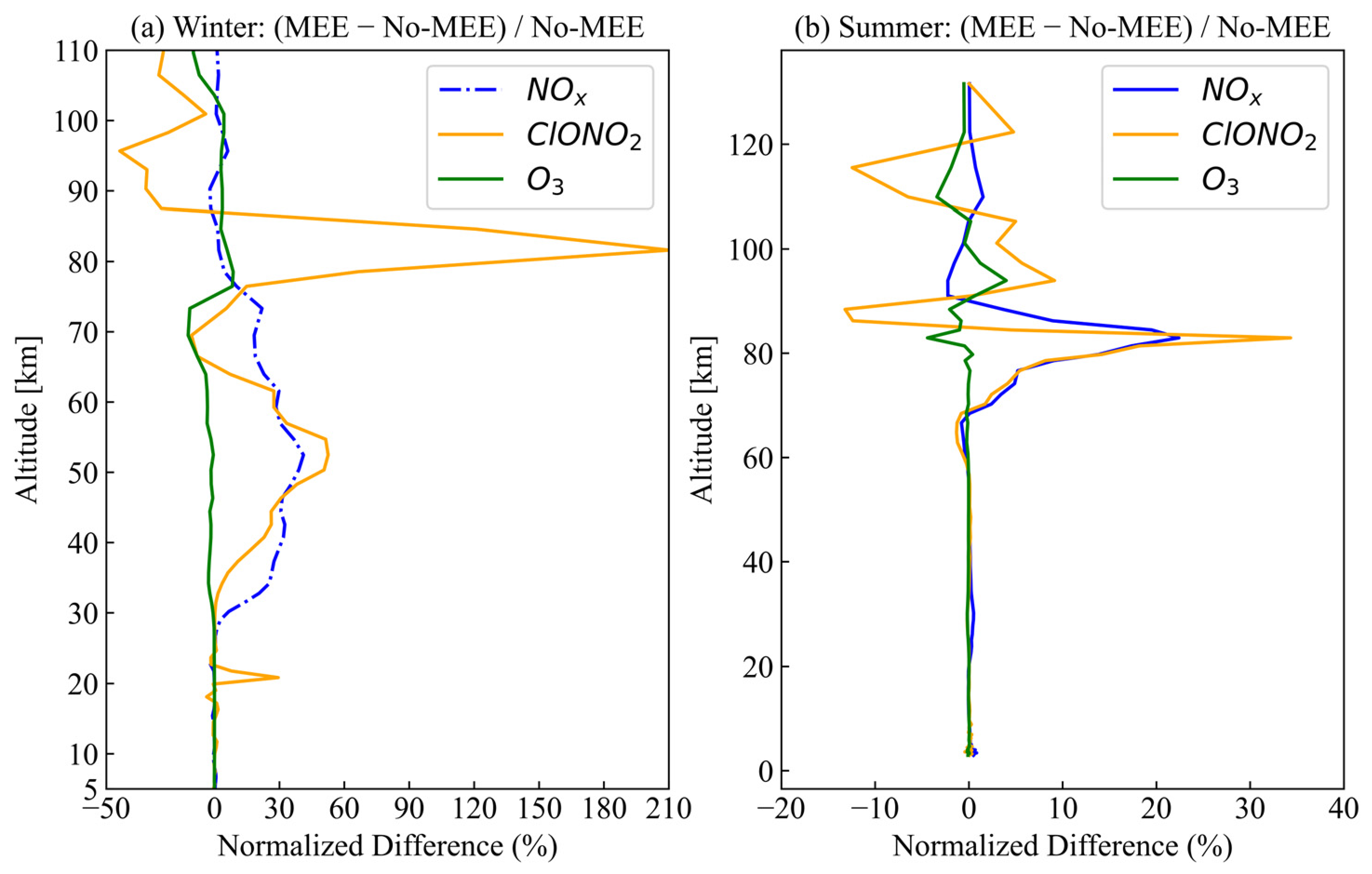
Variations in NOy further modulate NOx production and storage, thereby influencing photochemical ozone loss rates. In particular, during winters with enhanced MEE activity, increased vertical transport of NOy can suppress catalytic chlorine (ClOx) cycles through the formation of ClONO2, ultimately affecting ozone variability. To quantify this MEE-driven chemical response on stratospheric ozone, results from sensitivity experiments are examined. Figure 6 illustrates the relative differences in vertical distributions of NOx, ClONO2, and O3 at the star between simulations with and without MEE forcing, calculated as (MEE − NOMEE)/NOMEE. December and July are selected to represent the austral summer and winter, respectively. Hourly model outputs averaged over July and December 2013 for the Antarctic region (60° S–90° S) are used in the analysis.
Figure 6.
The relative percentage differences in vertical distributions of NOx, ClONO2, and O3 concentrations between winter and summer.
During winter, MEE induces pronounced perturbations in NOx and ClONO2 (Figure 6a). In the 30–70 km altitude range, NOx changes exceed 30%, while ClONO2 anomalies reach up to 180% near 90 km. Despite these substantial chemical perturbations, the wintertime response of O3 remains relatively weak. In summer, MEE-induced disturbances are mainly confined to the 70–90 km region (Figure 6b), with NOx and ClONO2 anomalies reduced to approximately 20% and 30%, respectively, whereas O3 exhibits a stronger response of about 15%. This seasonal contrast reflects the role of Reaction (6) that converts reactive chlorine and NOx into ClONO2, thereby weakening both ClOx- and NOx-driven catalytic cycles and buffering the ozone loss. This buffering mechanism is strongly modulated by solar illumination and temperature. Although MEE enhances NOx in the 30–70 km layer during winter, the pronounced increase in ClONO2 near 90 km reduces the mixing ratios of ClO, NO, and NO2, slowing both catalytic cycles and yielding a weak net O3 response. In contrast, during summer, continuous solar illumination accelerates ClONO2 photolysis, releasing ClO and NO2 and reactivating catalytic cycles, leading to enhanced ozone depletion accompanied by a depletion of the ClONO2 reservoir. To further elucidate the processes by which MEE affects stratospheric ozone, a more detailed analysis is presented in the next section.
4. Impacts of Medium-Energy Electrons on Stratospheric Ozone
4.1. Response of Polar Stratospheric Ozone to NOx Descent
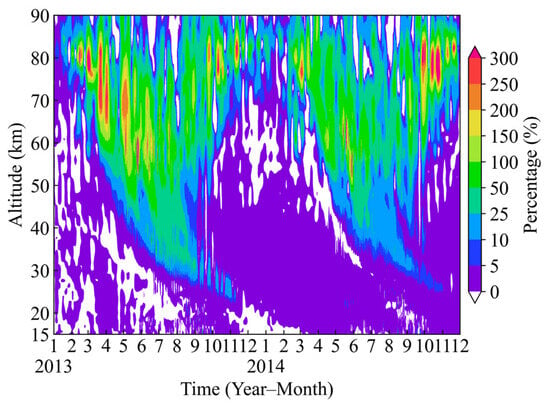
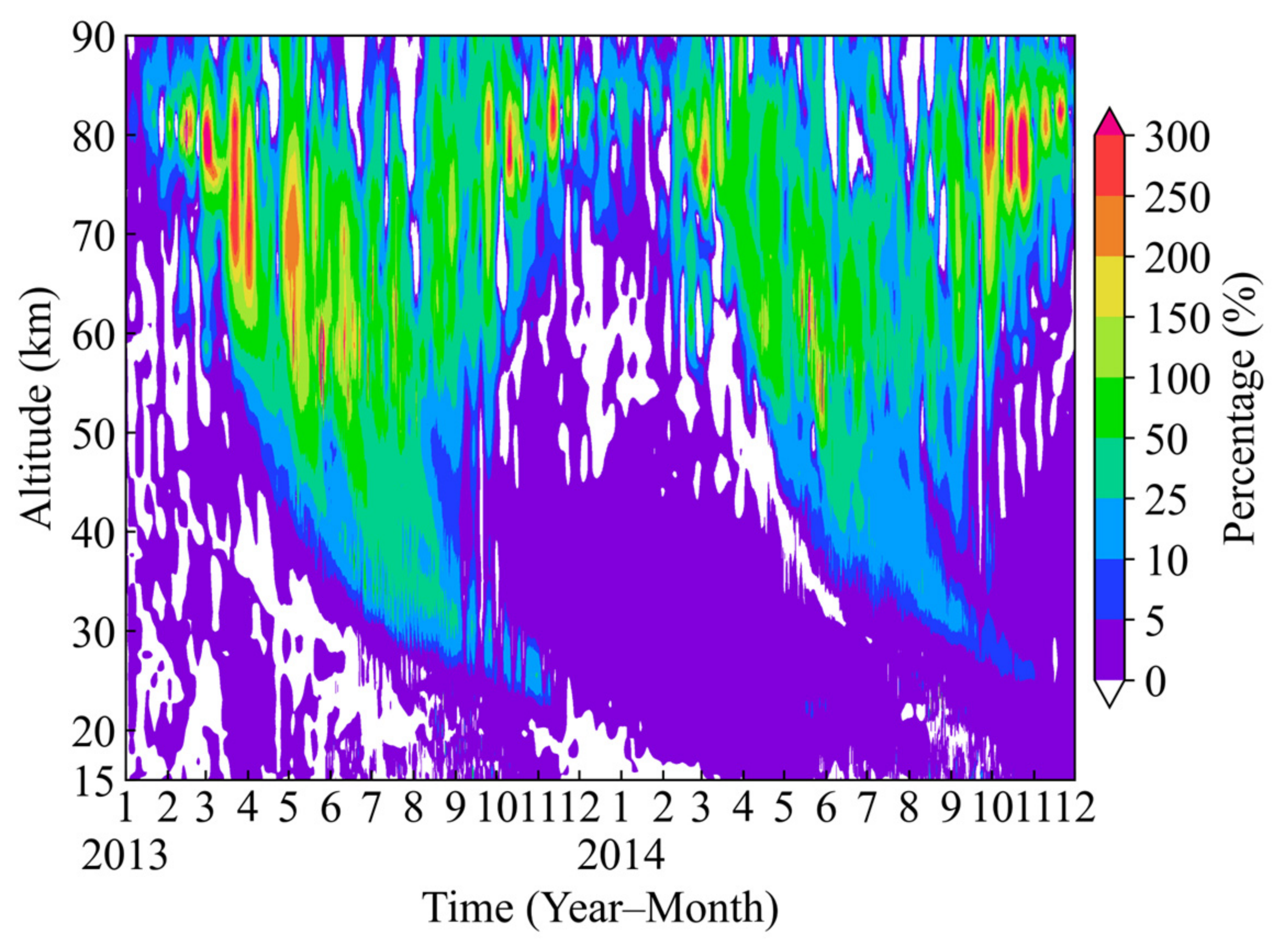
This study compares the vertical transport of NOx at the Antarctic star (59.9896° E, 76.4864° S) during 2013–2014 by comparing simulations with and without MEE forcing. Relative differences are expressed as (MEE − NOMEE)/NOMEE × 100. MEE-induced ionization peaks near the upper mesosphere (~80 km) in the polar region, with elevated NOx concentrations up to 200% relative to the NOMEE case (Figure 7). This upper-mesospheric maximum aligns with the energetic electron penetration depth shown in Figure 2, where enhanced ionization leads to substantial NOx production.
Figure 7.
The relative percentage differences in the vertical distributions of NOx under conditions with and without MEE.
During winter (June–July), regions of elevated NOx (>150%) descend from approximately 80 km into the middle stratosphere (~30 km), driven by dynamical subsidence associated with the polar vortex circulation. This process produces a tongue-shaped structure extending from the mesosphere into the stratosphere, exhibiting pronounced seasonal evolution. By September–October, the tongue-shaped structure reaches altitudes near 20 km. Still, the descent rate slows below 50 km due to constraints imposed by stratospheric circulation. Even when polar vortex-driven subsidence extends below 15 km during winter, MEE still leads to an increase in NOx of approximately 5%. Moreover, MEE-related NOx enhancements persist and intensify from April to December, demonstrating that MEE modulates both the depth and intensity of NOx vertical transport and thereby drives changes in stratospheric ozone chemistry.
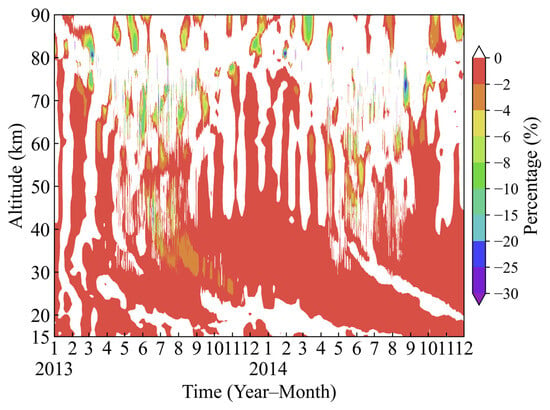
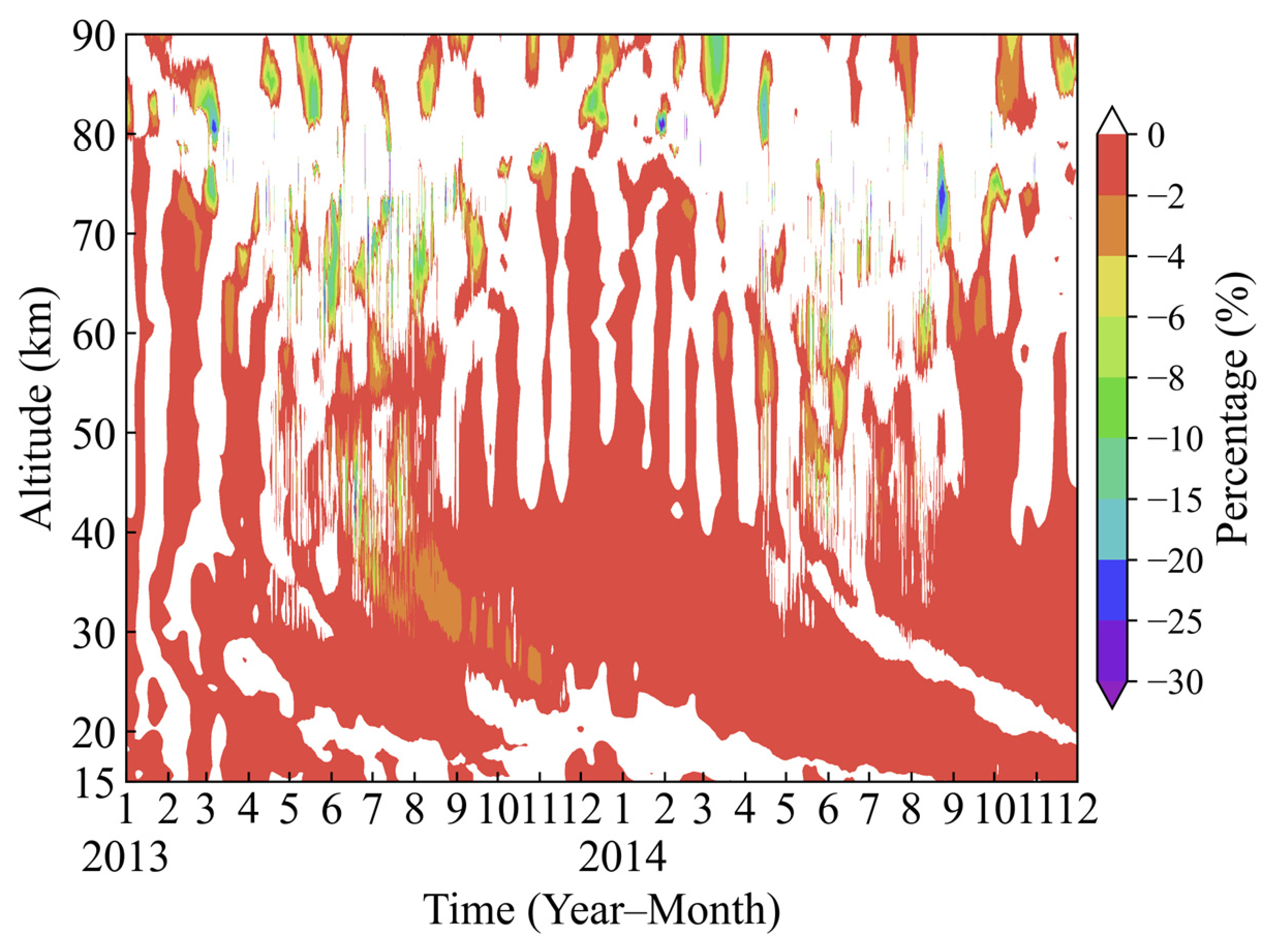
Figure 8 further presents the relative percentage differences in the vertical distribution of O3 at the star (59.9896° E, 76.4864° S) during 2013–2014 under conditions with and without MEE forcing. From March to September, negative ozone anomalies propagate downward within the 15–40 km altitude range, mirroring the downward evolution of NOx anomalies. This ozone depletion is primarily associated with enhanced NOx, which alters HOx chemistry and enhances ozone destruction. On an annual mean basis, MEE contributes approximately 5% to ozone loss, with a wintertime reduction reaching 15%. In the mesosphere, a seasonal reversal is evident: positive ozone anomalies during spring and autumn arise from NOx-induced suppression of ClO- and BrO-driven catalytic activity, whereas the response weakens in winter due to the stagnation of photochemical processes under polar night conditions. Notably, ozone concentrations increase markedly near 80 km in October, reaching a local maximum. This enhancement results from elevated NOx converting reactive chlorine (Cl) and bromine (Br) into reservoir species, thereby reducing catalytic ozone loss. This behavior highlights the sensitivity of mesospheric halogen chemistry to EPP.
Figure 8.
The relative percentage differences in the vertical distributions of O3 under conditions with and without MEE.
Previous studies [14] have shown that MEE exerts an indirect influence on the stratosphere. Over Antarctica, a tongue-shaped structure of enhanced NOx within the 15–65 km altitude range begins to descend from autumn onward, reducing stratospheric ozone. Because MEE does not directly affect the stratosphere, the ozone changes observed near 30 km in early winter can be attributed to chemical loss driven by NOx descending from the mesosphere, including residual NOx produced during the preceding summer. Observations confirm that the transport of NOx from the mesosphere (~80 km) into the middle stratosphere (~30 km) forms a characteristic tongue-shaped structure. Specifically, during June–July, regions of enhanced NOx descend from about 80 km into the middle and lower stratosphere, and by September–October, the descent can extend to altitudes near 20 km. This behavior reflects auroral and photoelectron-driven dissociation of molecular nitrogen in the thermosphere, which produces large amounts of atomic nitrogen that subsequently forms NOx. Effective downward transport of this NOx requires prolonged polar night conditions, as the daytime lifetime of NOx in the thermosphere and mesosphere is less than one day. In addition, during the cold Antarctic winter, the NOy in the stratosphere does not exist entirely in the gaseous phase, further enhancing NOy variability. Consequently, Antarctic winter exhibits the most pronounced variability in NOy concentrations.
The impacts of EPP depend on its chemical coupling with NOx and NOy, and their interactions with radiatively active gases such as ozone. These processes operate primarily through the downward transport of NOx into the stratosphere, where associated ozone changes can further modulate stratospheric circulation and potentially influence longer-term variability.
4.2. Impacts of MEE on NOx and Stratospheric Ozone
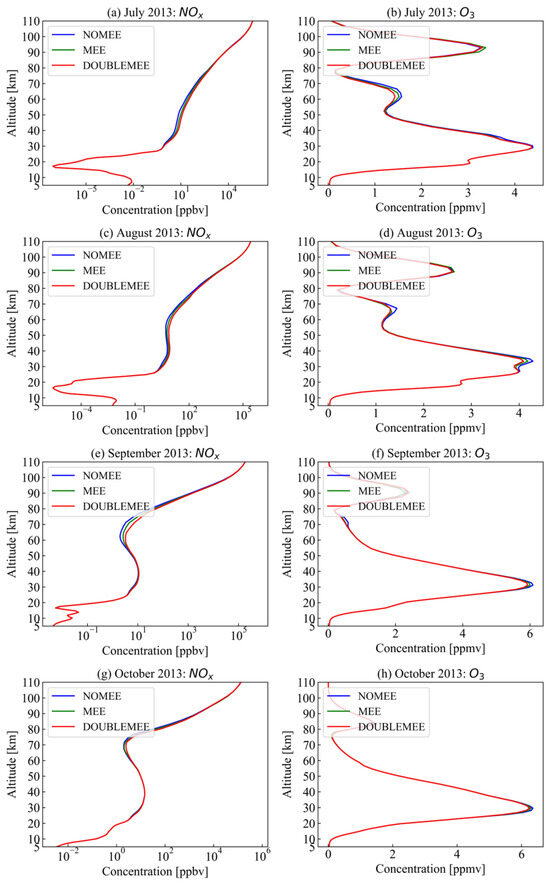
Based on the analyses above, NOx and O3 exhibit a strong correspondence in both time and altitude under different MEE conditions. To better quantify the magnitude of the MEE impact on NOx and O3, the analysis focuses on July–October, when the downward signals of NOx and O3 are most pronounced. The model results from three experiments are used to quantitatively assess the effects of MEE on NOx and O3, as shown in Figure 9 (panels a,c,e,g for NOx and panels b,d,f,h for O3).
Figure 9.
Vertical profiles of NOx and O3 from July to October 2013. (a) July 2013 NOx, (b) July 2013 O3, (c) August 2013 NOx, (d) August 2013 O3, (e) September 2013 NOx, (f) September 2013 O3, (g) October 2013 NOx, and (h) October 2013 O3.
The NOx profiles show clear differences between the MEE and NOMEE simulations (Figure 9a,c,e,g). In July and August (Figure 9a,c), NOx concentrations are higher in the upper mesosphere in the MEE case compared with the NOMEE case. From September to October (Figure 9e,g), the differences between the two simulations extend to lower altitudes, indicating a downward propagation of the enhanced NOx signal. The ACE–FTS observations generally fall between the two simulations at most altitudes, although deviations are present at certain levels.
The corresponding O3 profiles also show systematic differences between the simulations (Figure 9b,d,f,h). Compared with the NOMEE case, the MEE simulation exhibits lower O3 concentrations in the upper mesosphere, particularly in July and August (Figure 9b,d). From September to October (Figure 9f,h), the differences in O3 between the simulations become less pronounced at higher altitudes but remain evident at lower levels. The ACE–FTS observations are generally closer to the MEE simulation in the upper mesosphere, while larger discrepancies appear at lower altitudes.
During July–August, the vertical transport from the mesosphere (~80 km) to the middle stratosphere (~30 km) reveals clear gradients in NOx concentrations among the three experiments: NOx (NOMEE) > NOx (MEE) > NOx (DOUBLEMEE), while the ozone shows the opposite response, with O3 (NOMEE) < O3 (MEE) < O3 (DOUBLEMEE), consistent with the findings presented earlier. The differences are most pronounced at 30 km during August and September and gradually diminish in October. In the lower mesosphere, the contribution of MEE is more evident during austral summer. In the stratosphere near 30 km, however, the downward propagation of the MEE signal leads to enhanced NOx and a corresponding reduction in O3.
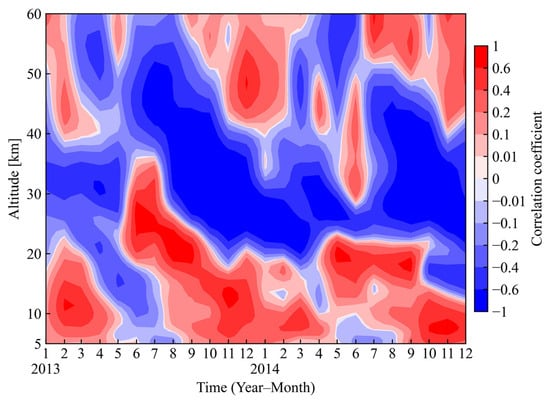
Focusing on the star (59.9896° E, 76.4864° S), the relationship between NOx and ozone under different forcing conditions is further examined. Figure 10 presents the spatiotemporal correlation between ΔNOx (the difference in NOx between Case1 and Case2) and ΔO3 (the difference in O3 between Case1 and Case2) associated with MEE precipitation, as simulated by WACCM. The results show a clear negative correlation between NOx and O3 from July to November in both 2013 and 2014, descending from the mesosphere into the upper stratosphere. The strongest negative correlation is found near 30 km and persists until the end of austral summer (February). Notably, owing to stronger ionization activity in 2013 than in 2014, the negative correlation signal in 2013 appears near ~30 km in March and extends downward to lower altitudes during the following months within the time range shown in Figure 10, while the corresponding signal in 2014 does not exhibit a similarly clear and continuous downward structure over the same period. This contrast can be explained by two main factors: (1) enhanced PSC occurrence during the Antarctic winter (June–August) under polar night conditions accelerates NOx-driven ozone loss, and (2) nitrogen oxides in NOx, particularly NO and NO2, efficiently destroy ozone through catalytic cycles. The weaker ionization in 2014 results in reduced NOx production and consequently a much weaker downward-propagating signal.
Figure 10.
Correlation between ΔNOx (with MEE − NOMEE) and ΔO3 (MEE − NOMEE).
As shown in Figure 8, during the austral winter (June–August) of 2013, the relative percentage differences in ozone at 30–40 km in the middle stratosphere reach approximately −25% to −30%. In 2014, ozone loss during the same period was reduced by about 40%. In 2013, the ozone anomaly persisted for nearly eight months and propagated downward to altitudes as low as 10 km, whereas no comparable descent was observed in 2014. In the 90–100 km region, the relative percentage differences remain within approximately −5% to −10% throughout the year, indicating that solar illumination suppresses MEE-induced disturbances in both the mesosphere and the stratosphere.
At an altitude of 30 km in the middle stratosphere, NOx exhibits a pronounced negative correlation with ozone, with wintertime ozone loss in 2013 reaching up to −30%. During this year of strong ionization, the signal extends downward through vertical transport and approaches the tropopause region. In contrast, ozone loss in 2014 was reduced by approximately 40%, and no downward propagation was observed, primarily due to weaker ionization and enhanced chemical removal of NOx by PSCs under polar night conditions.
Across the 0–100 km altitude range, annual mean ozone loss remains limited to approximately −5% to −10%, confirming that strong solar illumination suppresses MEE-induced perturbations. Together, the NOx catalytic cycle and MEE-modulated vertical transport constitute the core mechanisms governing ozone depletion.
5. Conclusions
Using the WACCM–SIC model, together with MERRA reanalysis data, daily solar forcing parameters from CMIP6, ACE–FTS satellite observations, and radar measurements at an Antarctic reference site, this study applies a combination of numerical simulations, control experiments, and sensitivity experiments to investigate the impact of medium-energy electron (MEE) precipitation on Antarctic ozone. The main conclusions are as follows:
- By incorporating detailed D-region ion-neutral chemistry and refined MEE ionization parameters, WACCM–SIC successfully reproduces the vertical distributions of NOx and ozone over Antarctica. The differences between the simulated results and ACE–FTS observations are generally within 15%, demonstrating the model’s capability in realistically representing photochemical–dynamical coupling processes in the polar atmosphere.
- Sensitivity experiments indicate a strong link between MEE-induced increases in NOx and ozone loss. In the lower stratosphere (15–25 km), a 10% increase in NOx leads to a 2.5–3.2% reduction in ozone, with the maximum response occurring near 20 km. During June–August 2013, ozone depletion at this altitude reached up to 25%.
- The MEE ionization rate increases with geomagnetic activity and dominates atmospheric ionization in the polar mesosphere and stratosphere. During winter, MEE contributions to NOx increase significantly within the 70–90 km altitude range, and the associated perturbation signal can extend below 15 km through polar vortex-driven subsidence, contributing up to 5%. The combined effects of NOx catalytic cycles and MEE-driven vertical transport constitute the core mechanisms of ozone depletion, with this process being particularly pronounced under polar night conditions.
Together, these findings demonstrate that MEE precipitation is not a minor or episodic influence but a systematic and dynamically integrated driver of polar ozone variability. Accurately representing MEE forcing is therefore essential for chemistry–climate models seeking to capture Antarctic ozone trends, diagnose interannual variability, and assess the broader coupling between space-weather processes and Earth’s atmosphere. Overall, this study improves our understanding of how MEE-driven ionization affects the polar middle atmosphere. The results show that the WACCM–SIC model reasonably reproduces the key photochemical and dynamical processes associated with NOx production and ozone depletion, highlighting the important role of MEE precipitation in Antarctic stratospheric ozone variability.
6. Limitations and Future Perspectives
This study is based on a case analysis of the 2013–2014 period, which may limit the generality of the results. Future work will extend the analysis to longer and more recent periods to assess the robustness of the findings. In addition, the native model resolution may limit the representation of small-scale variability. Higher-resolution or multi-model approaches will be explored in future studies.
Author Contributions
Conceptualization, Z.C.; investigation, Z.C.; software, Z.C., T.X., S.C. and Y.Z.; validation, Z.C. and T.X.; formal analysis, Z.C. and T.X.; resources, P.Q. and S.C.; data curation, P.Q. and S.C.; writing—original draft preparation, Z.C. and Y.Z.; writing—review and editing, Z.C. and Y.Z.; visualization, Z.C.; supervision, D.Z., S.C. and C.R.; project administration, D.Z. and C.R.; funding acquisition, D.Z. and C.R. All authors have read and agreed to the published version of the manuscript.
Funding
This research was funded by National Natural Science Foundation of China (42475082), Tropical Ocean Environment in Western Coastal Waters Observation and Research Station of Guangdong Province (2024B1212040008), Innovative Team Plan for Department of Education of Guangdong Province (2023KCXTD015), First-Class Discipline Plan of Guangdong Province (080503032101 and 231420003), Innovation Team Project of General University in Guangdong Province of China (2024KCXTD042), Science and Technology Project of the Tibet Autonomous Region of China “Study on Near-Surface Ozone Pollution Characteristics and Meteorological Conditions in Tibet” (XZ202403ZY0013), Humanities and Social Sciences General Project of the Ministry of Education of China. “Research on the Construction of a Knowledge Graph for National Wetland Parks on the Qinghai–Tibet Plateau and the Enhancement of Science Education Functions for University Students” (23YJAZH019), Project of Key Laboratory of Guangdong Provincial Department of Education (2025KSYS009).
Data Availability Statement
The ACE-FTS satellite observation data used in this study are publicly available at https://www.frdr-dfdr.ca/repo/dataset/c75d2c49-0def-49e5-9c69-5e74c824dc6c (accessed on 2 February 2026). The model simulation data generated during the current study are available from the corresponding author upon reasonable request.
Acknowledgments
The authors would like to express their sincere gratitude to John Plane from the School of Chemistry, University of Leeds, Leeds, UK, Daniel Marsh from the Atmospheric Chemistry Division, National Center for Atmospheric Research (NCAR), Boulder, CO, USA, and Pekka Verronen from the Earth Observation Unit, Finnish Meteorological Institute (FMI), Helsinki, Finland, for their valuable guidance and technical support in the application of the WACCM–SIC model. The authors gratefully acknowledge the support provided by the open research cruise NORC2023-11 under the NSFC Shiptime Sharing Project. The authors also acknowledge the support provided by the Laboratory of Coastal Ocean Change and Disaster Warning Technology, Guangdong Ocean University, the Key Laboratory of Shelf and Deep-Sea Climate, Resources and Environment of Guangdong Higher Education Institutes, and the Key Laboratory of Space Ocean Remote Sensing and Application, Ministry of Natural Resources.
Conflicts of Interest
Pengran Qi was employed by Beijing Huafeng Tianji Meteorological Service Co., Ltd. The remaining authors declare that the research was conducted in the absence of any commercial or financial relationships that could be construed as a potential conflict of interest.
References
- Szela̧g, M.E.; Marsh, D.R.; Verronen, P.T.; Seppälä, A.; Kalakoski, N. Ozone impact from solar energetic particles cools the polar stratosphere. Nat. Commun. 2022, 13, 6883. [Google Scholar] [CrossRef] [Scilit]
- Jia, J.; Murberg, L.E.; Løvset, T.; Orsolini, Y.J.; Espy, P.J.; Zeller, L.C.G.; Salinas, C.C.J.H.; Lee, J.N.; Wu, D.; Zhang, J. Energetic particle precipitation influences global secondary ozone distribution. Commun. Earth Environ. 2024, 5, 270. [Google Scholar] [CrossRef] [Scilit]
- Arsenović, P.; Rozanov, E.; Usoskin, I.; Turney, C.; Sukhodolov, T.; McCracken, K.; Friedel, M.; Anet, J.; Simić, S.; Maliniemi, V.; et al. Global impacts of an extreme solar particle event under different geomagnetic field strengths. Proc. Natl. Acad. Sci. USA 2024, 121, e2321770121. [Google Scholar] [CrossRef] [Scilit] [PubMed]
- Wan, Y.; Xu, F.; Chang, S.; Wan, L.; Li, Y. The Impact of Different Types of El Niño Events on the Ozone Valley of the Tibetan Plateau Based on the WACCM4 Mode. Appl. Sci. 2024, 14, 1090. [Google Scholar] [CrossRef] [Scilit]
- Pan, Y.; Xu, W.; Gu, X.; Ni, B.; Pettit, J.M.; Nesse, H.; Feng, J.; Wang, S.; Cheng, W.; Xu, H.; et al. WACCM Simulation of Polar Ozone Response to Relativistic Electron Precipitation. Geophys. Res. Lett. 2025, 52, e2024GL114012. [Google Scholar] [CrossRef] [Scilit]
- Liu, R.; Yang, H. Progress in the polar upper atmospheric physics research in China. Chin. J. Polar Res. 2011, 23, 241–258. [Google Scholar] [CrossRef] [Scilit]
- Mironova, I.A.; Aplin, K.L.; Arnold, F.; Bazilevskaya, G.A.; Harrison, R.G.; Krivolutsky, A.A.; Nicoll, K.A.; Rozanov, E.V.; Turunen, E.; Usoskin, I.G. Energetic Particle Influence on the Earth’s Atmosphere. Space Sci. Rev. 2015, 194, 1–96. [Google Scholar] [CrossRef] [Scilit]
- Sinnhuber, M.; Nieder, H.; Wieters, N. Energetic Particle Precipitation and the Chemistry of the Mesosphere/Lower Thermosphere. Surv. Geophys. 2012, 33, 1281–1334. [Google Scholar] [CrossRef] [Scilit]
- Crutzen, P.J.; Isaksen, I.S.A.; Reid, G.C. Solar Proton Events: Stratospheric Sources of Nitric Oxide. Science 1975, 189, 457–459. [Google Scholar] [CrossRef] [Scilit] [PubMed]
- Zou, Z.; Xue, X.; Shen, C.; Yi, W.; Wu, J.; Chen, T.; Dou, X. Response of Mesospheric HO2 and O3 to Large Solar Proton Events. J. Geophys. Res. Space Phys. 2018, 123, 5738–5746. [Google Scholar] [CrossRef] [Scilit]
- Newnham, D.A.; Clilverd, M.A.; Rodger, C.J.; Hendrickx, K.; Plane, J.M.C. Observations and Modeling of Increased Nitric Oxide in the Antarctic Polar Middle Atmosphere Associated With Geomagnetic Storm-Driven Energetic Electron Precipitation. J. Geophys. Res. Space Phys. 2018, 123, 6009–6025. [Google Scholar] [CrossRef] [Scilit]
- Andersson, M.E.; Verronen, P.T.; Marsh, D.R.; Seppälä, A.; Päivärinta, S.; Rodger, C.J.; Clilverd, M.A.; Kalakoski, N.; van de Kamp, M. Polar Ozone Response to Energetic Particle Precipitation Over Decadal Time Scales: The Role of Medium-Energy Electrons. J. Geophys. Res. Atmos. 2018, 123, 607–622. [Google Scholar] [CrossRef] [Scilit]
- Ozaki, M.; Shiokawa, K.; Kataoka, R.; Mlynczak, M.; Paxton, L.; Connors, M.; Yagitani, S.; Hashimoto, S.; Otsuka, Y.; Nakahira, S. Localized mesospheric ozone destruction corresponding to isolated proton aurora coming from Earth’s radiation belt. Sci. Rep. 2022, 12, 16300. [Google Scholar] [CrossRef] [Scilit]
- Jia, J.; Kero, A.; Kalakoski, N.; Szelg, M.E.; Verronen, P.T. Is there a direct solar proton impact on lower-stratospheric ozone? Atmos. Chem. Phys. 2020, 20, 14969–14982. [Google Scholar] [CrossRef] [Scilit]
- Stone, K.A.; Solomon, S.; Kinnison, D.E. On The Identification of Ozone Recovery. Geophys. Res. Lett. 2018, 45, 5158–5165. [Google Scholar] [CrossRef] [Scilit]
- He, H.; Chang, S.; Feng, W.; Chipperfield, M.P.; Dhomse, S.S.; Li, Y.; Heddell, S. Lagged ENSO teleconnection mechanisms driving Antarctic stratospheric ozone depletion variability. Atmos. Res. 2025, 329, 108539. [Google Scholar] [CrossRef] [Scilit]
- Funke, B.; Ball, W.; Bender, S.; Gardini, A.; Harvey, V.L.; Lambert, A.; López-Puertas, M.; Marsh, D.R.; Meraner, K.; Nieder, H.; et al. HEPPA-II model–measurement intercomparison project: EPP indirect effects during the dynamically perturbed NH winter 2008–2009. Atmos. Chem. Phys. 2017, 17, 3573–3604. [Google Scholar] [CrossRef] [Scilit]
- López-Puertas, M.; Funke, B.; Gil-López, S.; Von Clarmann, T.; Stiller, G.; Höpfner, M.; Kellmann, S.; Fischer, H.; Jackman, C. Observation of NOx enhancement and ozone depletion in the Northern and Southern Hemispheres after the October–November 2003 solar proton events. J. Geophys. Res. Space Phys. 2005, 110, A9. [Google Scholar] [CrossRef] [Scilit]
- Maliniemi, V.; Arsenovic, P.; Seppälä, A.; Nesse Tyssøy, H. The influence of energetic particle precipitation on Antarctic stratospheric chlorine and ozone over the 20th century. Atmos. Chem. Phys. 2022, 22, 8137–8149. [Google Scholar] [CrossRef] [Scilit]
- Rodger, C.J.; Clilverd, M.A.; Green, J.C.; Lam, M.M. Use of POES SEM-2 observations to examine radiation belt dynamics and energetic electron precipitation into the atmosphere. J. Geophys. Res. Space Phys. 2010, 115, A4. [Google Scholar] [CrossRef] [Scilit]
- Kovács, T.; Plane, J.M.C.; Feng, W.; Nagy, T.; Chipperfield, M.P.; Verronen, P.T.; Andersson, M.E.; Newnham, D.A.; Clilverd, M.A.; Marsh, D.R. D-region ion–neutral coupled chemistry (Sodankylä Ion Chemistry, SIC) within the Whole Atmosphere Community Climate Model (WACCM 4)—WACCM-SIC and WACCM-rSIC. Geosci. Model Dev. 2016, 9, 3123–3136. [Google Scholar] [CrossRef] [Scilit]
- Matthes, K.; Funke, B.; Andersson, M.E.; Barnard, L.; Beer, J.; Charbonneau, P.; Clilverd, M.A.; de Wit, T.D.; Haberreiter, M.; Hendry, A.; et al. Solar Forcing for CMIP6 (v3.1). Geosci. Model Dev. Discuss. 2016. [Google Scholar] [CrossRef] [Scilit]
- Picone, J.M.; Hedin, A.E.; Drob, D.P.; Aikin, A.C. NRLMSISE-00 empirical model of the atmosphere: Statistical comparisons and scientific issues. J. Geophys. Res. Space Phys. 2002, 107, SIA 15-11–SIA 15-16. [Google Scholar] [CrossRef] [Scilit]
- van de Kamp, M.; Seppälä, A.; Clilverd, M.A.; Rodger, C.J.; Verronen, P.T.; Whittaker, I.C. A model providing long-term data sets of energetic electron precipitation during geomagnetic storms. J. Geophys. Res. Atmos. 2016, 121, 12520–12540. [Google Scholar] [CrossRef] [Scilit]
- Marsh, D.R.; Mills, M.J.; Kinnison, D.E.; Lamarque, J.-F.; Calvo, N.; Polvani, L.M. Climate change from 1850 to 2005 simulated in CESM1 (WACCM). J. Clim. 2013, 26, 7372–7391. [Google Scholar] [CrossRef] [Scilit]
- Gelaro, R.; McCarty, W.; Suárez, M.J.; Todling, R.; Molod, A.; Takacs, L.; Randles, C.A.; Darmenov, A.; Bosilovich, M.G.; Reichle, R. The modern-era retrospective analysis for research and applications, version 2 (MERRA-2). J. Clim. 2017, 30, 5419–5454. [Google Scholar] [CrossRef] [Scilit]
- Matthes, K.; Funke, B.; Andersson, M.E.; Barnard, L.; Beer, J.; Charbonneau, P.; Clilverd, M.A.; de Wit, T.D.; Haberreiter, M.; Hendry, A.; et al. Solar forcing for CMIP6 (v3.2). Geosci. Model Dev. 2017, 10, 2247–2302. [Google Scholar] [CrossRef] [Scilit]
- Andersson, M.; Verronen, P.; Rodger, C.; Clilverd, M.; Seppälä, A. Missing driver in the Sun–Earth connection from energetic electron precipitation impacts mesospheric ozone. Nat. Commun. 2014, 5, 5197. [Google Scholar] [CrossRef] [Scilit]
- Steen-Larsen, H.; Risi, C.; Werner, M.; Yoshimura, K.; Masson-Delmotte, V. Evaluating the skills of isotope-enabled general circulation models against in situ atmospheric water vapor isotope observations. J. Geophys. Res. Atmos. 2017, 122, 246–263. [Google Scholar] [CrossRef] [Scilit]
- Bernath, P. Atmospheric Chemistry Experiment (ACE): An Overview. Geophys. Res. Lett. 2001, 32, L15S01. [Google Scholar] [CrossRef] [Scilit]
- Li, Y.; Xu, F.; Wan, L.; Chen, P.; Guo, D.; Chang, S.; Yang, C. Effect of ENSO on the Ozone Valley over the Tibetan Plateau Based on the WACCM4 Model. Remote Sens. 2023, 15, 525. [Google Scholar] [CrossRef] [Scilit]
- Wang, P.; Solomon, S.; Stone, K. Stratospheric chlorine processing after the 2020 Australian wildfires derived from satellite data. Proc. Natl. Acad. Sci. USA 2023, 120, e2213910120. [Google Scholar] [CrossRef] [Scilit]
- Chang, S.; He, H.; Huang, D. The effects of gravity waves on ozone over the Tibetan Plateau. Atmos. Res. 2024, 299, 107204. [Google Scholar] [CrossRef] [Scilit]
- Zhang, J.; Wang, P.; Kinnison, D.; Solomon, S.; Guan, J.; Stone, K.; Zhu, Y. Stratospheric Chlorine Processing After the Unprecedented Hunga Tonga Eruption. Geophys. Res. Lett. 2024, 51, e2024GL108649. [Google Scholar] [CrossRef] [Scilit]
- Verronen, P.T.; Andersson, M.E.; Marsh, D.R.; Kovács, T.; Plane, J.M.C. WACCM-D—Whole Atmosphere Community Climate Model with D-region ion chemistry. J. Adv. Model. Earth Syst. 2016, 8, 954–975. [Google Scholar] [CrossRef] [Scilit]
- Weimer, M.; Kinnison, D.E.; Wilka, C.; Solomon, S. Effects of denitrification on the distributions of trace gas abundances in the polar regions: A comparison of WACCM with observations. Atmos. Chem. Phys. 2023, 23, 6849–6861. [Google Scholar] [CrossRef] [Scilit]
- Sheng, Z.; He, Y.; Wang, S.; Chang, S.; Leng, H.; Wang, J.; Zhang, J.; Wang, Y.; Zhang, H.; Sui, H.; et al. Dynamics, chemistry, and modeling studies in the aviation and aerospace transition zone. Innovation 2025, 6, 101012. [Google Scholar] [CrossRef] [Scilit]
- Arsenovic, P.; Rozanov, E.; Stenke, A.; Funke, B.; Wissing, J.M.; Mursula, K.; Tummon, F.; Peter, T. The influence of Middle Range Energy Electrons on atmospheric chemistry and regional climate. J. Atmos. Sol. Terr. Phys. 2016, 149, 180–190. [Google Scholar] [CrossRef] [Scilit]
Disclaimer/Publisher’s Note: The statements, opinions and data contained in all publications are solely those of the individual author(s) and contributor(s) and not of MDPI and/or the editor(s). MDPI and/or the editor(s) disclaim responsibility for any injury to people or property resulting from any ideas, methods, instructions or products referred to in the content. |
© 2026 by the authors. Licensee MDPI, Basel, Switzerland. This article is an open access article distributed under the terms and conditions of the Creative Commons Attribution (CC BY) license.