Advances in Spatial Optimization for Intelligent UAV Swarms: Methods, Coordination Mechanisms, and Decision Support


Abstract
1. Introduction
- (1)
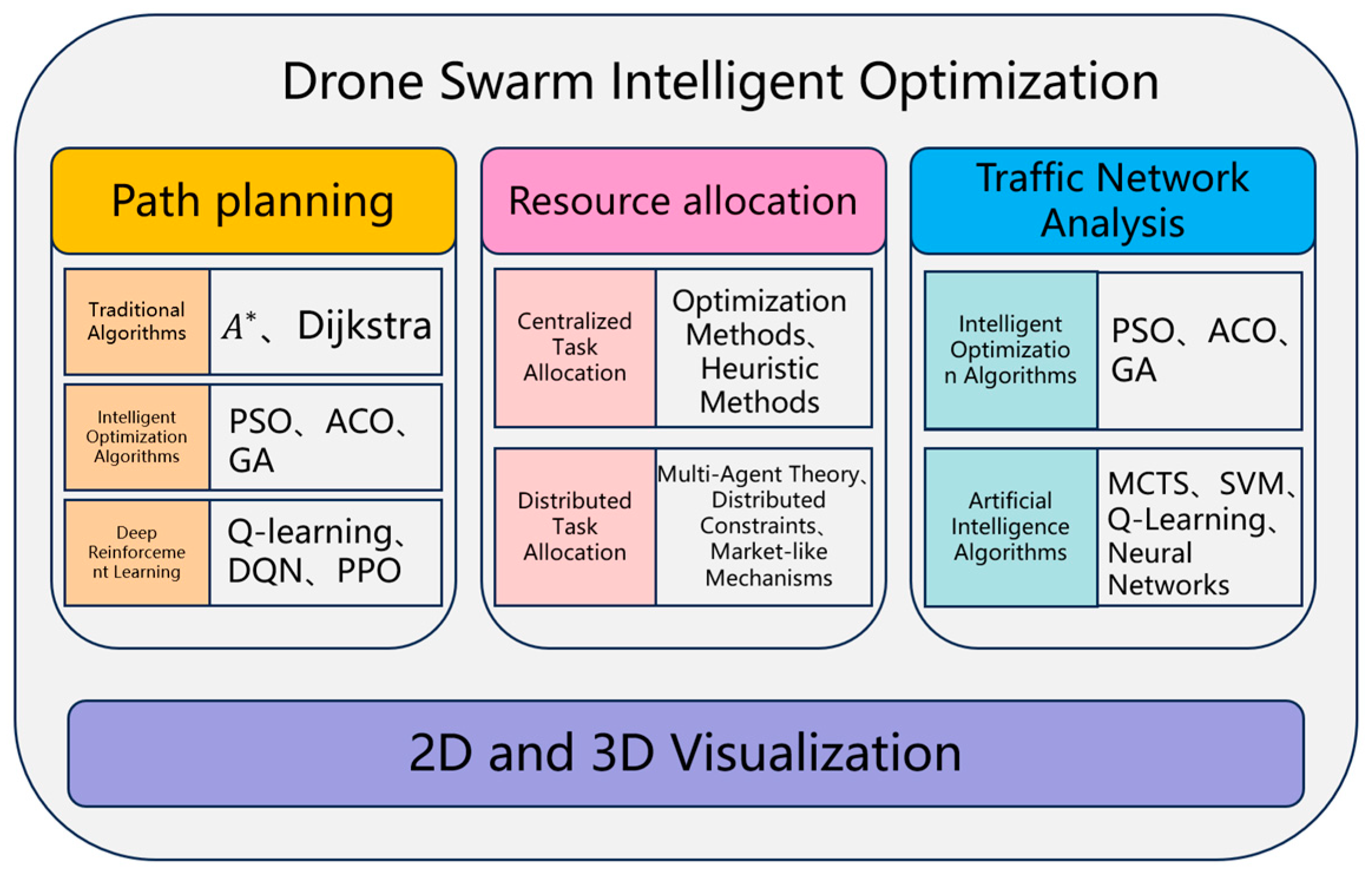
- Methods—including classical optimization, bio-inspired algorithms, and DRL-based approaches for swarm path planning and spatial decision-making;
- (2)
- Coordination mechanisms—covering centralized, distributed, and hybrid strategies for multi-agent task and resource allocation;
- (3)
- Decision-support techniques—encompassing spatial network modeling, situational awareness, and visualization technologies.
2. Bibliometric Analysis
3. Research Trends
3.1. UAV Swarm Path Planning: Methods, Capabilities, and Algorithmic Evolution
3.1.1. Traditional Deterministic Algorithms
3.1.2. Intelligent Optimization Algorithms
3.1.3. Deep Reinforcement Learning Algorithms
3.1.4. Comparative Summary of Path Planning Algorithms
3.2. Resource Allocation Strategies for Drone Swarms
3.2.1. From Single Algorithms to Hybrid Algorithms
3.2.2. Distributed Self-Organizing Collaboration and Real-Time Optimization
- (1)
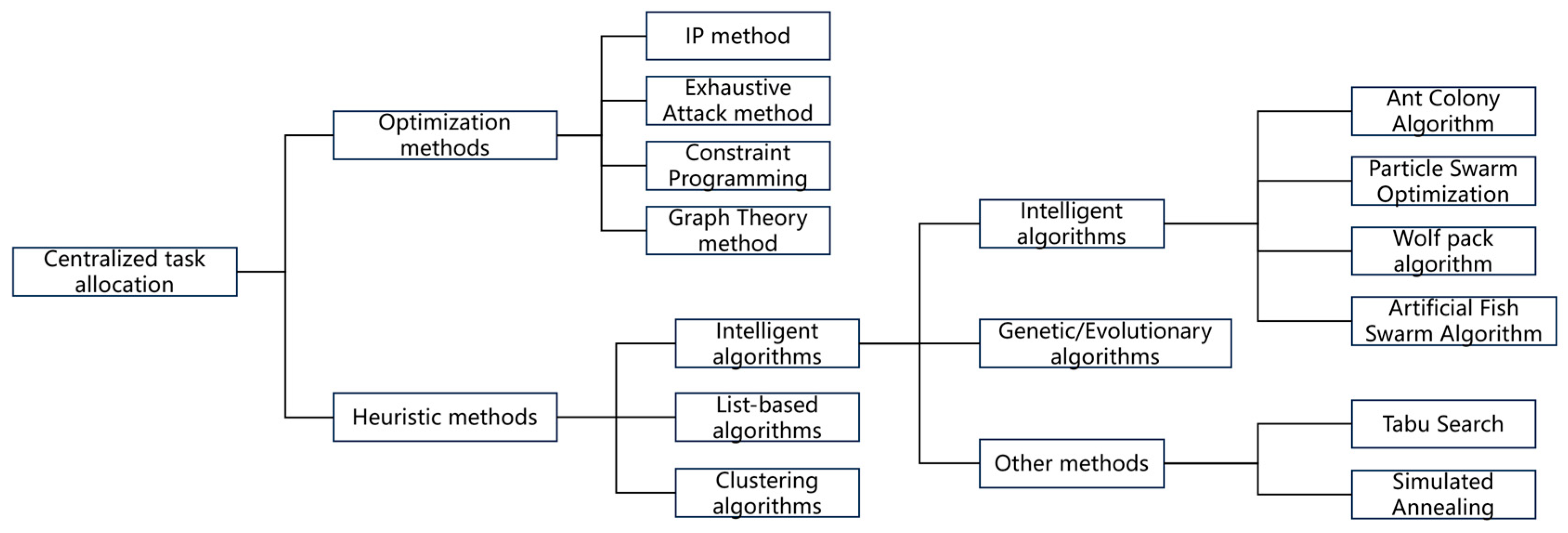
- Centralized Task Allocation Methods
- (2)
- Distributed Task Allocation Methods
3.2.3. Comparative Summary of Resource Allocation for Intelligent Methods
3.3. Intelligent UAV Swarm Traffic Network Analysis
3.3.1. Traffic Network Analysis and Intelligent Optimization Algorithms
3.3.2. Learning-Driven Traffic Network Modeling for Intelligent UAV Swarms
3.4. 2D and 3D Visualization
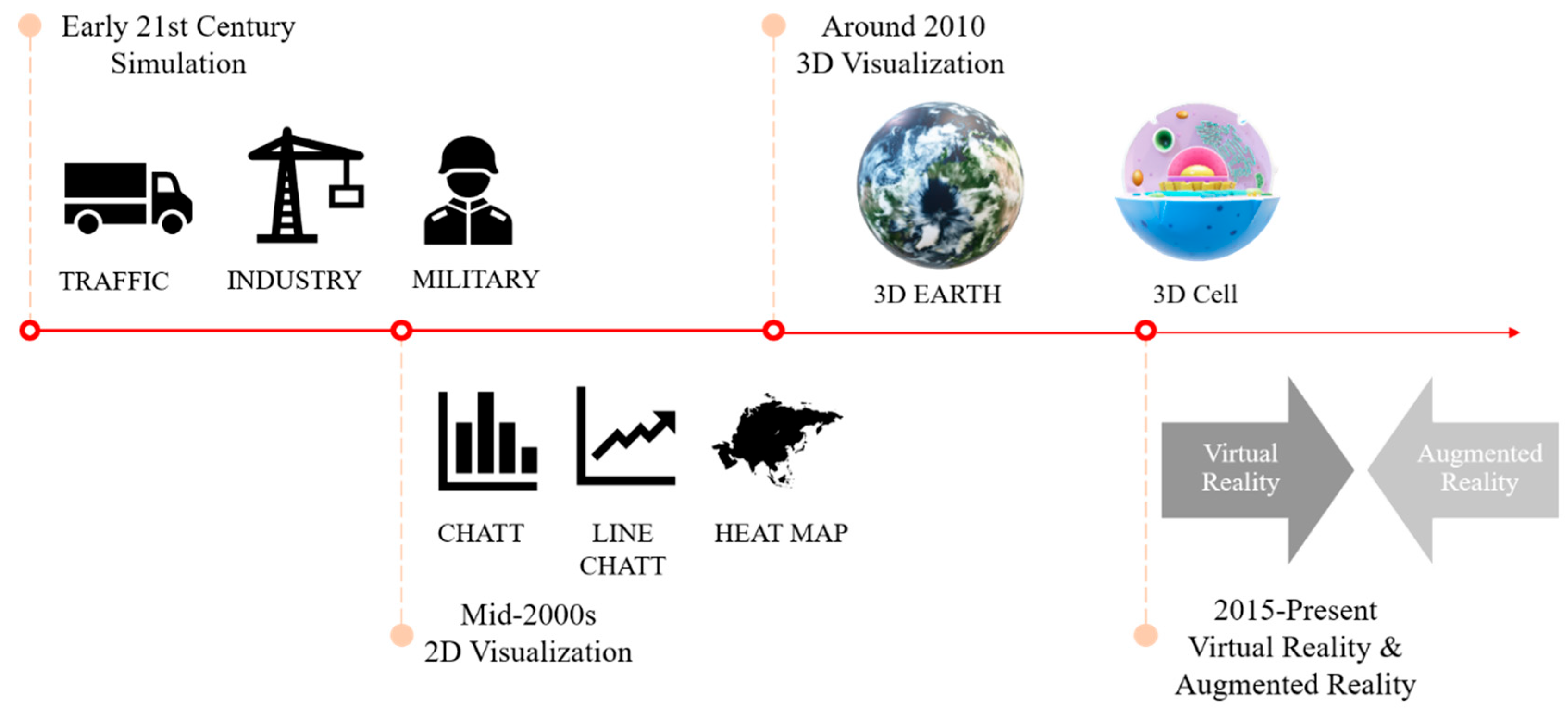
3.4.1. From Early 2D Simulation to Dynamic Visualization
3.4.2. Advancements in 3D Visualization and Agent-Based Simulation
- (1)
- Intuitive spatiotemporal perception—UAV obstacle avoidance, formation changes, or multi-target tracking can be directly mapped in 3D space [100].
- (2)
- Higher task efficiency—Kjellin et al. showed that 3D visualization reduces task time by more than fourfold in low-density information environments and lowers user error rates [101].
- (3)
- Accurate representation of interactions—3D platforms also enable analysis of communication topology and sensor coverage [102].
3.4.3. Toward Immersive VR/AR Visualization and Digital Twins
4. Discussion
5. Conclusions
6. Future Perspectives
Author Contributions
Funding
Data Availability Statement
Conflicts of Interest
References
- Zhou, X.; Wen, X.; Wang, Z.; Gao, Y.; Li, H.; Wang, Q.; Yang, T.; Lu, H.; Cao, Y.; Xu, C.; et al. Swarm of micro flying robots in the wild. Sci. Robot. 2022, 7, eabm5954. [Google Scholar] [CrossRef] [Scilit]
- Wang, H.; Zhao, H.; Zhang, J.; Ma, D.; Li, J.; Wei, J. Survey on unmanned aerial vehicle networks: A cyber physical system perspective. IEEE Commun. Surv. Tutor. 2019, 22, 1027–1070. [Google Scholar] [CrossRef] [Scilit]
- Rajender, R.; Anupama, C.S.S.; Moses, G.J.; Lydia, E.L.; Kadry, S.; Lim, S. Artificial Intelligence-Enabled Cooperative Cluster-Based Data Collection for Unmanned Aerial Vehicles. Comput. Mater. Contin. 2022, 73, 3351–3365. [Google Scholar]
- Husnain, G.; Anwar, S. An intelligent cluster optimization algorithm based on Whale Optimization Algorithm for VANETs (WOACNET). PLoS ONE 2021, 16, e0250271. [Google Scholar] [CrossRef] [Scilit]
- Li, J.; Xiong, N.; Park, J.H.; Liu, C.; Ma, S.; Cho, S. Intelligent model design of cluster supply chain with horizontal cooperation. J. Intell. Manuf. 2012, 23, 917–931. [Google Scholar] [CrossRef] [Scilit]
- Senouci, O.; Harous, S.; Aliouat, Z. Survey on vehicular ad hoc networks clustering algorithms: Overview, taxonomy, challenges, and open research issues. Int. J. Commun. Syst. 2020, 33, e4402. [Google Scholar] [CrossRef] [Scilit]
- Jin, Y.; Qian, Z.; Yang, W. UAV cluster-based video surveillance system optimization in heterogeneous communication of smart cities. Drones 2020, 8, 55654–55664. [Google Scholar] [CrossRef] [Scilit]
- Sushma, M.B.; Mashhoodi, B.; Tan, W.; Liujiang, K.; Xu, Q. Spatial drone path planning: A systematic review of parameters and algorithms. J. Transp. Geogr. 2025, 125, 104209. [Google Scholar] [CrossRef] [Scilit]
- Chen, H.; Luo, F.; Zhou, J.; Dong, Y. Multi-Objective Optimized GPSR Intelligent Routing Protocol for UAV Clusters. Mathematics 2024, 12, 2672. [Google Scholar] [CrossRef] [Scilit]
- Heidari, A.; Jafari Navimipour, N.; Unal, M.; Zhang, G. Machine learning applications in internet-of-drones: Systematic review, recent deployments, and open issues. ACM Comput. Surv. 2023, 55, 1–45. [Google Scholar] [CrossRef] [Scilit]
- Yang, J.; Huang, X. Intelligent Planning Modeling and Optimization of UAV Cluster Based on Multi-Objective Optimization Algorithm. Electronics 2022, 11, 4238. [Google Scholar] [CrossRef] [Scilit]
- Ahmad, T.; Morel, A.; Cheng, N.; Palaniappan, K.; Calyam, P.; Sun, K.; Pan, J. Future UAV/Drone Systems for Intelligent Active Surveillance and Monitoring. ACM Comput. Surv. 2025, 58, 1–37. [Google Scholar] [CrossRef] [Scilit]
- Chen, C. Searching for intellectual turning points: Progressive knowledge domain visualization. Proc. Natl. Acad. Sci. USA 2004, 101, 5303–5310. [Google Scholar] [CrossRef] [Scilit]
- Chen, C. CiteSpace II: Detecting and visualizing emerging trends and transient patterns in scientific literature. J. Am. Soc. Inf. Sci. Technol. 2006, 57, 359–377. [Google Scholar] [CrossRef] [Scilit]
- Chen, X.; Liu, Y. Visualization analysis of high-speed railway research based on CiteSpace. Transp. Policy 2020, 85, 1–17. [Google Scholar] [CrossRef] [Scilit]
- Fang, Y.; Yin, J.; Wu, B. Climate change and tourism: A scientometric analysis using CiteSpace. J. Sustain. Tour. 2018, 26, 108–126. [Google Scholar] [CrossRef] [Scilit]
- Azam, A.; Ahmed, A.; Wang, H.; Wang, Y.; Zhang, Z. Knowledge structure and research progress in wind power generation (WPG) from 2005 to 2020 using CiteSpace based scientometric analysis. J. Clean. Prod. 2021, 295, 126496. [Google Scholar] [CrossRef] [Scilit]
- Gul, F.; Mir, I.; Abualigah, L.; Sumari, P.; Forestiero, A. A consolidated review of path planning and optimization techniques: Technical perspectives and future directions. Electronics 2021, 10, 2250. [Google Scholar] [CrossRef] [Scilit]
- Ding, C.; Cao, X.; Liu, C. How does the station-area built environment influence Metrorail ridership? Using gradient boosting decision trees to identify non-linear thresholds. J. Transp. Geogr. 2019, 77, 70–78. [Google Scholar] [CrossRef] [Scilit]
- Maritan, C.A.; Lee, G.K. Resource allocation and strategy. J. Manag. 2017, 43, 2411–2420. [Google Scholar] [CrossRef] [Scilit]
- Hashmi, S.J.; Alabdullah, B.; Al Mudawi, N.; Algarni, A.; Jalal, A.; Liu, H. Enhanced data mining and visualization of sensory-graph-Modeled datasets through summarization. Sensors 2024, 24, 4554. [Google Scholar] [CrossRef] [Scilit]
- Van Wijk, J.J. The value of visualization. In VIS 05; IEEE Visualization: New York, NY, USA, 2005; pp. 79–86. [Google Scholar]
- Liu, J.; Zhang, W.; Ji, H.; Zhu, M. A summary of UAV swarm path planning algorithm research. Aerosp. Electron. Warf. 2022, 38, 9–12. [Google Scholar]
- Flores-Caballero, G.; Rodriguez-Molina, A.; Aldape-Perez, M.; Villarreal-Cervantes, M.G. Optimized Path-Planning in Continuous Spaces for Unmanned Aerial Vehicles Using Meta-Heuristics. Drones 2020, 8, 176774–176788. [Google Scholar] [CrossRef] [Scilit]
- Prasad, N.L.; Ramkumar, B. 3-D Deployment and Trajectory Planning for Relay Based UAV Assisted Cooperative Communication for Emergency Scenarios Using Dijkstra’s Algorithm. IEEE Trans. Veh. Technol. 2023, 72, 5049–5063. [Google Scholar] [CrossRef] [Scilit]
- Li, J.; Xiong, Y.; She, J. UAV Path Planning for Target Coverage Task in Dynamic Environment. IEEE Internet Things J. 2023, 10, 17734–17745. [Google Scholar] [CrossRef] [Scilit]
- Zhang, Z.; Wu, J.; Dai, J.; He, C. Optimal Path Planning with Modified A-Star Algorithm for Stealth Unmanned Aerial Vehicles in 3D Network Radar Environment. Proc. Inst. Mech. Eng. Part G J. Aerosp. Eng. 2022, 236, 72–81. [Google Scholar] [CrossRef] [Scilit]
- Farid, G.; Cocuzza, S.; Younas, T.; Razzaqi, A.A.; Wattoo, W.A.; Cannella, F.; Mo, H. Modified A-Star (A*) Approach to Plan the Motion of a Quadrotor UAV in Three-Dimensional Obstacle-Cluttered Environment. Appl. Sci. 2022, 12, 5791. [Google Scholar] [CrossRef] [Scilit]
- Liu, L.; Zhou, X.; Li, C.; Gao, X.; Luo, S.; Xue, G. Research and Design of Grid Safety Inspection Path Planning and Work Order Assignment Based on Dijkstra and Optimal Scheduling. Appl. Math. Nonlinear Sci. 2024, 9. [Google Scholar] [CrossRef] [Scilit]
- Mohiuddin, A.; Taha, T.; Zweiri, Y.; Gan, D. UAV Payload Transportation via RTDP Based Optimized Velocity Profiles. Energies 2019, 12, 3049. [Google Scholar] [CrossRef] [Scilit]
- Zhang, Z.; Wu, Q.; Zhang, B.; Yi, X.; Tang, Y. UAV Flight Strategy Algorithm Based on Dynamic Programming. J. Syst. Eng. Electron. 2018, 29, 1293. [Google Scholar] [CrossRef] [Scilit]
- Roberge, V.; Tarbouchi, M.; Labonte, G. Comparison of Parallel Genetic Algorithm and Particle Swarm Optimization for Real-Time UAV Path Planning. IEEE Trans. Ind. Inform. 2013, 9, 132–141. [Google Scholar] [CrossRef] [Scilit]
- Li, Y.; Zhang, Z.; Sun, Q.; Huang, Y. An Improved Ant Colony Algorithm for Multiple Unmanned Aerial Vehicles Route Planning. J. Frankl. Inst. 2024, 361, 107060. [Google Scholar] [CrossRef] [Scilit]
- Li, L.; Gu, Q.; Liu, L. Research on Path Planning Algorithm for Multi-UAV Maritime Targets Search Based on Genetic Algorithm. In Proceedings of the 2020 IEEE International Conference on Information Technology, Big Data and Artificial Intelligence (ICIBA), Chongqing, China, 6–8 November 2020; Volume 1, pp. 840–843. [Google Scholar]
- Yu, Z.; Si, Z.; Li, X.; Wang, D.; Song, H. A Novel Hybrid Particle Swarm Optimization Algorithm for Path Planning of UAVs. IEEE Internet Things J. 2022, 9, 22547–22558. [Google Scholar] [CrossRef] [Scilit]
- Haris, M.; Bhatti, D.M.S.; Nam, H. A Fast-Convergent Hyperbolic Tangent PSO Algorithm for UAVs Path Planning. IEEE Open J. Veh. Technol. 2024, 5, 681–694. [Google Scholar] [CrossRef] [Scilit]
- Zhen, Z.; Chen, Y.; Wen, L.; Han, B. An intelligent cooperative mission planning scheme of UAV swarm in uncertain dynamic environment. Aerosp. Sci. Technol. 2020, 100, 105826. [Google Scholar] [CrossRef] [Scilit]
- Wang, Y.; Zhu, J.; Huang, H.; Xiao, F. Bi-Objective Ant Colony Optimization for Trajectory Planning and Task Offloading in UAV-Assisted MEC Systems. IEEE Trans. Mob. Comput. 2024, 23, 12360–12377. [Google Scholar] [CrossRef] [Scilit]
- Pehlivanoglu, Y.V.; Pehlivanoglu, P. An enhanced genetic algorithm for path planning of autonomous UAV in target coverage problems. Appl. Soft Comput. 2021, 112, 107796. [Google Scholar] [CrossRef] [Scilit]
- Wu, X.; Yin, Y.; Xu, L.; Wu, X.; Meng, F.; Zhen, R. MULTI-UAV Task Allocation Based on Improved Genetic Algorithm. IEEE Access 2021, 9, 100369–100379. [Google Scholar] [CrossRef] [Scilit]
- Bo, L.; Zhang, T.; Zhang, H.; Yang, J.; Zhang, Z.; Zhang, C.; Liu, M. Improved Q-Learning Algorithm Based on Flower Pollination Algorithm and Tabulation Method for Unmanned Aerial Vehicle Path Planning. IEEE Access 2024, 12, 104429–104444. [Google Scholar] [CrossRef] [Scilit]
- Li, D.; Yin, W.; Wong, W.E.; Jian, M.; Chau, M. Quality-Oriented Hybrid Path Planning Based on A* and Q-Learning for Unmanned Aerial Vehicle. IEEE Access 2022, 10, 7664–7674. [Google Scholar] [CrossRef] [Scilit]
- Liu, X.; Zhong, W.; Wang, X.; Duan, H.; Fan, Z.; Jin, H.; Huang, Y.; Lin, Z. Deep Reinforcement Learning-Based 3D Trajectory Planning for Cellular Connected UAV. Drones 2024, 8, 199. [Google Scholar] [CrossRef] [Scilit]
- Han, L.; Zhang, H.; An, N. A Continuous Space Path Planning Method for Unmanned Aerial Vehicle Based on Particle Swarm Optimization-Enhanced Deep Q-Network. Drones 2025, 9, 122. [Google Scholar] [CrossRef] [Scilit]
- Huang, X.; Wang, W.; Ji, Z.; Cheng, B. Representation Enhancement-Based Proximal Policy Optimization for UAV Path Planning and Obstacle Avoidance. Int. J. Aerosp. Eng. 2023, 2023, 1–15. [Google Scholar] [CrossRef] [Scilit]
- Zhan, G.; Zhang, X.; Li, Z.; Xu, L.; Zhou, D.; Yang, Z. Multiple-UAV Reinforcement Learning Algorithm Based on Improved PPO in Ray Framework. Drones 2022, 6, 166. [Google Scholar] [CrossRef] [Scilit]
- Holland, J.H. Adaptation in Natural and Artificial Systems: An Introductory Analysis with Applications to Biology, Control, and Artificial Intelligence; MIT Press: Cambridge, MA, USA, 1992. [Google Scholar]
- Kennedy, J.; Eberhart, R. Particle swarm optimization. In Proceedings of the ICNN’95-International Conference on Neural Networks, Perth, WA, Australia, 27 November–1 December 1995; IEEE: New York, NY, USA; Volume 4, pp. 1942–1948.
- Xu, Y.; Fan, P.; Yuan, L. A simple and efficient artificial bee colony algorithm. Math. Probl. Eng. 2013, 2013, 526315. [Google Scholar] [CrossRef] [Scilit]
- Rashedi, E.; Nezamabadi-pour, H.; Saryazdi, S. GSA: A Gravitational Search Algorithm. Inf. Sci. 2009, 179, 2232–2248. [Google Scholar] [CrossRef] [Scilit]
- Liu, Z.; Wang, X.; Shen, L.; Zhao, S.; Cong, Y.; Li, J.; Yin, D.; Jia, S.; Xiang, X. Mission-oriented miniature fixed-wing UAV swarms: A multilayered and distributed architecture. IEEE Trans. Syst. Man Cybern. Syst. 2020, 52, 1588–1602. [Google Scholar] [CrossRef] [Scilit]
- Butenko, S.; Murphey, R.; Pardalos, P.M. (Eds.) Cooperative Control: Models, Applications and Algorithms; Springer Science & Business Media: Berlin/Heidelberg, Germany, 2013; p. 1. [Google Scholar]
- Dorling, K.; Heinrichs, J.; Messier, G.G.; Magierowski, S. Vehicle routing problems for drone delivery. IEEE Trans. Syst. Man Cybern. Syst. 2016, 47, 70–85. [Google Scholar] [CrossRef] [Scilit]
- Pasha, J.; Elmi, Z.; Purkayastha, S.; Fathollahi-Fard, A.M.; Ge, Y.E.; Lau, Y.Y.; Dulebenets, M.A. The drone scheduling problem: A systematic state-of-the-art review. IEEE Trans. Intell. Transp. Syst. 2022, 23, 14224–14247. [Google Scholar] [CrossRef] [Scilit]
- Gao, X.; Zhu, X.; Zhai, L. Minimization of aerial cost and mission completion time in multi-UAV-enabled IoT networks. IEEE Trans. Commun. 2023, 71, 5335–5347. [Google Scholar] [CrossRef] [Scilit]
- Huo, L.; Zhu, J.; Wu, G.; Li, Z. A Novel Simulated Annealing Based Strategy for Balanced UAV Task Assignment and Path Planning. Sensors 2020, 20, 4769. [Google Scholar] [CrossRef] [Scilit] [PubMed]
- Zhang, Z.; Jiang, J.; Xu, H.; Zhang, W.-A. Distributed dynamic task allocation for unmanned aerial vehicle swarm systems: A networked evolutionary game-theoretic approach. Chin. J. Aeronaut. 2024, 37, 182–204. [Google Scholar] [CrossRef] [Scilit]
- Petrenko, V.; Tebueva, F.; Antonov, V.; Ryabtsev, S.; Pavlov, A.; Sakolchik, A. Method and algorithm for task allocation in a heterogeneous group of UAVs in a clustered field of targets. J. King Saud Univ.-Comput. Inf. Sci. 2023, 35, 101580. [Google Scholar] [CrossRef] [Scilit]
- Boroujeni, S.P.H.; Razi, A.; Khoshdel, S.; Afghah, F.; Coen, J.L.; O’Neill, L.; Fule, P.; Watts, A.; Kokolakis, N.M.T.; Vamvoudakis, K.G. A comprehensive survey of research towards AI-enabled unmanned aerial systems in pre-, active-, and post-wildfire management. Inf. Fusion 2024, 108, 102369. [Google Scholar] [CrossRef] [Scilit]
- Hu, J.; Xie, L.; Lum, K.-Y.; Xu, J. Multiagent Information Fusion and Cooperative Control in Target Search. IEEE Trans. Control Syst. Technol. 2013, 21, 1223–1235. [Google Scholar] [CrossRef] [Scilit]
- Fu, X.; Zhang, J.; Zhang, L.; Chang, S. Coalition formation among unmanned aerial vehicles for uncertain task allocation. Wirel. Netw. 2019, 25, 367–377. [Google Scholar] [CrossRef] [Scilit]
- Huang, L.; Qu, H.; Zuo, L. Multi-Type UAVs Cooperative Task Allocation Under Resource Constraints. IEEE Access 2018, 6, 17841–17850. [Google Scholar] [CrossRef] [Scilit]
- Hu, J.; Yang, J. Application of distributed auction to multi-UAV task assignment in agriculture. Int. J. Precis. Agric. Aviat. 2018, 1, 44–50. [Google Scholar] [CrossRef] [Scilit]
- Rinaldi, M.; Primatesta, S. Comprehensive task optimization architecture for urban UAV-based intelligent transportation system. Drones 2024, 8, 473. [Google Scholar] [CrossRef] [Scilit]
- Zhen, Z.; Wen, L.; Wang, B.; Hu, Z.; Zhang, D. Improved contract network protocol algorithm based cooperative target allocation of heterogeneous UAV swarm. Aerosp. Sci. Technol. 2021, 119, 107054. [Google Scholar] [CrossRef] [Scilit]
- Wang, X.; Gao, X.; Wang, L.; Su, X.; Jin, J.; Liu, X.; Deng, Z. Resilient multi-objective mission planning for UAV formation: A unified framework integrating task pre- and re-assignment. Def. Technol. 2025, 45, 203–226. [Google Scholar] [CrossRef] [Scilit]
- Lu, J.; Osorio, C. A probabilistic traffic-theoretic network loading model suitable for large-scale network analysis. Transp. Sci. 2018, 52, 1509–1530. [Google Scholar] [CrossRef] [Scilit]
- Zhang, M.; Huang, T.; Guo, Z.; He, Z. Complex-network-based traffic network analysis and dynamics: A comprehensive review. Phys. A Stat. Mech. Its Appl. 2022, 607, 128063. [Google Scholar] [CrossRef] [Scilit]
- Iliopoulou, C.; Kepaptsoglou, K.; Vlahogianni, E. Metaheuristics for the transit route network design problem: A review and comparative analysis. Public Transp. 2019, 11, 487–521. [Google Scholar] [CrossRef] [Scilit]
- Shi, J.; Leau, Y.B.; Li, K.; Park, Y.J.; Yan, Z. Optimization and decomposition methods in network traffic prediction model: A review and discussion. IEEE Access 2020, 8, 202858–202871. [Google Scholar] [CrossRef] [Scilit]
- Zhao, F.; Zeng, X. Simulated annealing–genetic algorithm for transit network optimization. J. Comput. Civ. Eng. 2006, 20, 57–68. [Google Scholar] [CrossRef] [Scilit]
- Shanmugasundaram, N.; Sushita, K.; Kumar, S.P.; Ganesh, E.N. Genetic algorithm-based road network design for optimising the vehicle travel distance. Int. J. Veh. Inf. Commun. Syst. 2019, 4, 344–354. [Google Scholar] [CrossRef] [Scilit]
- Mahfoud, S.W.; Goldberg, D.E. Parallel recombinative simulated annealing: A genetic algorithm. Parallel Comput. 1995, 21, 1–28. [Google Scholar] [CrossRef] [Scilit]
- Zhang, Z.; Pan, K. Analysis of Transportation Network Scheduling of Maritime Silk Road and International Digital Trade Potential Based on Improved Genetic Algorithm under Digital Trade Barriers. Wirel. Commun. Mob. Comput. 2022, 2022, 7903376. [Google Scholar] [CrossRef] [Scilit]
- Vitins, B.J.; Axhausen, K.W. Optimization of large transport networks using the ant colony heuristic. Comput.-Aided Civ. Infrastruct. Eng. 2009, 24, 1–14. [Google Scholar] [CrossRef] [Scilit]
- Ye, S.; Xu, L.; Li, X. Vehicle-Mounted Self-Organizing Network Routing Algorithm Based on Deep Reinforcement Learning. Wirel. Commun. Mob. Comput. 2021, 2021, 9934585. [Google Scholar] [CrossRef] [Scilit]
- Zhou, R.; Chen, H.; Chen, H.; Liu, E.; Jiang, S. Research on traffic situation analysis for urban road network through spatiotemporal data mining: A case study of Xi’an, China. IEEE Access 2021, 9, 75553–75567. [Google Scholar] [CrossRef] [Scilit]
- Nie, S.; Zhong, Y.; Hu, M. Short-time traffic flow prediction method based on universal organic computing architecture. Adv. Mater. Res. 2012, 756–759, 2785–2789. [Google Scholar]
- Yang, S.; Wu, J.; Qi, G.; Tian, K. Analysis of traffic state variation patterns for urban road network based on spectral clustering. Adv. Mech. Eng. 2017, 9, 1687814017723790. [Google Scholar] [CrossRef] [Scilit]
- Ding, R.; Fu, J.; Du, Y.; Du, L.; Zhou, T.; Zhang, Y.; Shen, S.; Zhu, Y.; Chen, S. Structural evolution and community detection of China rail transit route network. Sustainability 2020, 14, 12342. [Google Scholar] [CrossRef] [Scilit]
- Jiang, X.; Wen, X.; Wu, M.; Song, M.; Tu, C. A complex network analysis approach for identifying air traffic congestion based on independent component analysis. Phys. A Stat. Mech. Its Appl. 2019, 523, 364–381. [Google Scholar] [CrossRef] [Scilit]
- Sui, Z.; Wen, Y.; Huang, Y.; Zhou, C.; Xiao, C.; Chen, H. Empirical analysis of complex network for marine traffic situation. Ocean Eng. 2020, 214, 107848. [Google Scholar] [CrossRef] [Scilit]
- Song, R.; Spadon, G.; Pelot, R.; Matwin, S.; Soares, A. Enhancing global maritime traffic network forecasting with gravity-inspired deep learning models. Sci. Rep. 2024, 14, 16665. [Google Scholar] [CrossRef] [Scilit] [PubMed]
- Zhao, J.; Liang, Q.; Guo, J.; Pu, K. Vulnerability assessment and evolution analysis of Beijing’s urban rail transit network. Phys. A Stat. Mech. Its Appl. 2024, 653, 130078. [Google Scholar] [CrossRef] [Scilit]
- Chen, M.; Chen, R.; Cai, F.; Li, W.; Guo, N.; Li, G. Short-term traffic flow prediction with recurrent mixture density network. Math. Probl. Eng. 2021, 2021, 1–9. [Google Scholar] [CrossRef] [Scilit]
- Xiao, N.; Bennett, D.A.; Armstrong, M.P. Interactive evolutionary approaches to multiobjective spatial decision making: A synthetic review. Comput. Environ. Urban Syst. 2007, 31, 232–252. [Google Scholar] [CrossRef] [Scilit]
- O’Kane, J.F.; Spenceley, J.R.; Taylor, R. Simulation as an essential tool for advanced manufacturing technology problems. J. Mater. Process. Technol. 2000, 107, 412–424. [Google Scholar] [CrossRef] [Scilit]
- Fellendorf, M.; Vortisch, P. Microscopic traffic flow simulator VISSIM. In Fundamentals of Traffic Simulation; Springer: Berlin/Heidelberg, Germany, 2010; pp. 63–93. [Google Scholar]
- Han, Y.; Liu, L.; Duan, L.; Zhang, R. Towards reliable UAV swarm communication in D2D-enhanced cellular networks. IEEE Trans. Wirel. Commun. 2020, 20, 1567–1581. [Google Scholar] [CrossRef] [Scilit]
- Cao, P.; Lei, L.; Cai, S.; Shen, G.; Liu, X.; Wang, X.; Zhang, L.; Zhou, L.; Guizani, M. Computational intelligence algorithms for UAV swarm networking and collaboration: A comprehensive survey and future directions. IEEE Commun. Surv. Tutor. 2024, 26, 2684–2728. [Google Scholar] [CrossRef] [Scilit]
- Fu, S.; Li, K.; Huang, H.; Ma, C.; Fan, Q.; Zhu, Y. Red-billed blue magpie optimizer: A novel metaheuristic algorithm for 2D/3D UAV path planning and engineering design problems. Artif. Intell. Rev. 2024, 57, 134. [Google Scholar] [CrossRef] [Scilit]
- Nowak, D.J.; Price, I.; Lamont, G.B. Self organized UAV swarm planning optimization for search and destroy using SWARMFARE simulation. In Proceedings of the 2007 Winter Simulation Conference, Washington, DC, USA, 9–12 December 2007; pp. 1315–1323. [Google Scholar]
- Gong, S. UAV Based Distributed Automatic Target Detection Algorithm Under Realistic Simulated Environmental Effects; West Virginia University: Morgantown, WV, USA, 2007. [Google Scholar]
- Bai, C.; Duan, H.; Li, C.; Zhang, Y. Dynamic multi-UAVs formation reconfiguration based on hybrid diversity-PSO and time optimal control. In Proceedings of the 2009 IEEE Intelligent Vehicles Symposium, Xi’an, China, 3–5 June 2009; pp. 775–779. [Google Scholar]
- Abdalhakim, H.; Abdelfattah, M. An intelligent visualized decision toolbox IVDT for fuzzy decision maker. In Proceedings of the 2009 ISECS International Colloquium on Computing, Communication, Control, and Management, In Virtual, 29 September 2009; IEEE: New York, NY, USA, 2009; Volume 2, pp. 115–118. [Google Scholar]
- Metni, N.; Hamel, T. A UAV for bridge inspection: Visual servoing control law with orientation limits. Autom. Constr. 2007, 17, 3–10. [Google Scholar] [CrossRef] [Scilit]
- Dean, J.; Ghemawat, S. MapReduce: Simplified data processing on large clusters. Commun. ACM 2008, 51, 107–113. [Google Scholar] [CrossRef] [Scilit]
- Wang, T.; Tang, S.; Pang, P. 3D urban traffic system simulation based on geo-data. In Proceedings of the ITRE 2004. 2nd International Conference Information Technology: Research and Education, London, UK, 28 June–1 July 2004; IEEE: New York, NY, USA, 2004; pp. 59–63. [Google Scholar]
- Kalogerakis, E.; Christodoulakis, S.; Moumoutzis, N. Coupling ontologies with graphics content for knowledge driven visualization. In Proceedings of the IEEE Virtual Reality Conference (VR 2006), Alexandria, VA, USA, 25–29 March 2006; pp. 43–50. [Google Scholar]
- Wagner Filho, J.A.; Stuerzlinger, W.; Nedel, L. Evaluating an immersive space-time cube geovisualization for intuitive trajectory data exploration. IEEE Trans. Vis. Comput. Graph. 2019, 26, 514–524. [Google Scholar] [CrossRef] [Scilit]
- Kjellin, A.; Pettersson, L.W.; Seipel, S.; Lind, M. Evaluating 2D and 3D visualizations of spatiotemporal information. ACM Trans. Appl. Percept. (TAP) 2008, 7, 1–23. [Google Scholar] [CrossRef] [Scilit]
- Abramson, J.; Adler, J.; Dunger, J.; Evans, R.; Green, T.; Pritzel, A.; Ronneberger, O.; Willmore, L.; Ballard, A.J.; Jumper, J.M.; et al. Accurate structure prediction of biomolecular interactions with AlphaFold 3. Nature 2024, 630, 493–500. [Google Scholar] [CrossRef] [Scilit]
- Cauchard, J.R.; Tamkin, A.; Wang, C.Y.; Vink, L.; Park, M.; Fang, T.; Landay, J.A. Drone. io: A gestural and visual interface for human-drone interaction. In Proceedings of the 2019 14th ACM/IEEE International Conference on Human-Robot Interaction (HRI), Daegu, Republic of Korea, 11–14 March 2019; pp. 153–162. [Google Scholar]
- Shi, W.; Li, J.; Xu, W.; Zhou, H.; Zhang, N.; Shen, X. 3D Drone-cell deployment optimization for drone assisted radio access networks. In Proceedings of the 2017 IEEE/CIC International Conference on Communications in China (ICCC), Qingdao, China, 22–24 October 2017; pp. 1–6. [Google Scholar]
- Rodina, A.; Wang, T.; Yan, P.; Gomes, E.D.; Dunphy, M.P.; Pillarsetty, N.; Koren, J.; Gerecitano, J.F.; Taldone, T.; Chiosis, G.; et al. The epichaperome is an integrated chaperome network that facilitates tumour survival. Nature 2016, 538, 397–401. [Google Scholar] [CrossRef] [Scilit]
- Wang, X.; Wang, X.; Ma, S.; Chen, W.; Wang, F.Y. Vehicular Visualization: Enhancing Mobility Decisions With Human–Machine Interactions. IEEE Trans. Intell. Veh. 2023, 8, 4653–4663. [Google Scholar] [CrossRef] [Scilit]
- Wald, I.; Johnson, G.P.; Amstutz, J.; Brownlee, C.; Knoll, A.; Jeffers, J.; Jeffers, J.; Navrátil, P. OSPRay-a CPU ray tracing framework for scientific visualization. IEEE Trans. Vis. Comput. Graph. 2016, 23, 931–940. [Google Scholar] [CrossRef] [Scilit] [PubMed]






| Stage | Description | Publications |
|---|---|---|
| Initial Retrieval | Search results based on WoSCC | 4112 |
| Deduplication | Removal of duplicated records | 3284 |
| Title & Abstract Screening | Exclusion of clearly irrelevant or marginally related literature | 1187 |
| Relevance & Scope Filtering | Screening based on thematic alignment and research-focus consistency | 500 |
| In-depth Methodological Assessment | Evaluation of methodological rigor, model completeness, and experimental validity | 233 |
| Full-Text Screening | Final selection based on theoretical contribution and technical depth | 107 |
| Final Included Studies | Publications used for full-text citation and qualitative deep analysis | 107 |
| Category | Representative Methods | Strengths | Limitations | Typical Application Scenarios |
|---|---|---|---|---|
| Traditional Deterministic Algorithms | A*, Dijkstra, Dynamic Programming | Mathematically rigorous; optimality guarantees in static and fully observable environments | Limited scalability; poor adaptability to dynamic, uncertain, or multi-agent settings | Single-UAV planning; static obstacle environments |
| Bio-inspired Optimization | PSO, ACO, GA | Strong global search capability; flexible handling of multi-objective and non-convex landscapes | Vulnerable to early convergence; parameter sensitivity; limited real-time performance | Cooperative multi-UAV missions; navigation in uncertain terrains |
| Hybrid Algorithms | GA–PSO, ACO–SA, heuristic fusion models | Combine global and local search abilities; improved convergence and robustness | Complexity increases with hybridization; difficult to generalize | Real-time mission re-planning; multi-constraint optimization tasks |
| Deep Reinforcement Learning | DQN, PPO, A3C | High adaptability; scalable decision-making in high-dimensional dynamic environments; supports continuous learning | Requires extensive training data; high computational cost; limited interpretability and stability | Large-scale dynamic UAV swarms; real-time adaptive flight control |
| Top-Level Paradigm | Sub-Category/Representative Approaches | Strengths | Limitations | Application Scenarios |
|---|---|---|---|---|
| Centralized Methods | Optimization-Based (Linear/Nonlinear Programming, MIP) | High control precision; globally optimal | Low scalability; single-point failure | Small-scale UAV networks; deterministic scheduling |
| Heuristic/Intelligent Algorithms (TS, SA, ACO, PSO) | Flexible; efficient for complex constraints | Still limited by central controller | Medium-sized routing & task assignment | |
| Distributed Methods | Distributed Optimization (Consensus, Distributed Gradient Descent) | Scalable; robust to failures | Sensitive to communication delays | Cooperative mapping; decentralized scheduling |
| Market-/Auction-Based (CNP, Auctions) | Intuitive; suitable for dynamic tasks | May yield suboptimal results | Real-time logistics; heterogeneous coordination | |
| Game-Theoretic/Evolutionary Models | Capture strategic interactions | May not converge; complex | Strategic resource sharing; coalition formation | |
| Learning-Based & Self-Organizing (MARL, Hybrid Models) | Adaptive; supports non-stationary environments | High training cost; stability issues | Large-scale adaptive UAV swarms |
| Research Topic | Main Findings | Key Future Development Directions |
|---|---|---|
| Path Planning | Deterministic and sampling-based methods ensure stability in static environments; learning-based and hybrid methods enhance adaptability in dynamic scenarios | Large-scale real-time cooperative planning; safety-guaranteed learning; hybrid optimization–learning frameworks |
| Resource Allocation | Centralized methods achieve high global optimality but limited scalability; distributed and MARL methods improve robustness and adaptability | Scalable distributed allocation; communication-efficient coordination; generalizable multi-agent learning |
| Traffic Network Analysis | Static models support offline evaluation; dynamic and data-driven models improve real-time prediction | Lightweight dynamic modeling; edge-enabled airspace optimization; hierarchical network abstraction |
| Visualization | 2D visualization ensures efficiency; 3D, VR/AR, and digital twins enhance situational awareness | Real-time digital twins; immersive decision-support systems; AI-driven visual analytics |
Disclaimer/Publisher’s Note: The statements, opinions and data contained in all publications are solely those of the individual author(s) and contributor(s) and not of MDPI and/or the editor(s). MDPI and/or the editor(s) disclaim responsibility for any injury to people or property resulting from any ideas, methods, instructions or products referred to in the content. |
© 2026 by the authors. Licensee MDPI, Basel, Switzerland. This article is an open access article distributed under the terms and conditions of the Creative Commons Attribution (CC BY) license.
Share and Cite
Zhu, Y.; Zhou, H.; Liang, H.; Chang, R. Advances in Spatial Optimization for Intelligent UAV Swarms: Methods, Coordination Mechanisms, and Decision Support. Appl. Sci. 2026, 16, 4912. https://doi.org/10.3390/app16104912
Zhu Y, Zhou H, Liang H, Chang R. Advances in Spatial Optimization for Intelligent UAV Swarms: Methods, Coordination Mechanisms, and Decision Support. Applied Sciences. 2026; 16(10):4912. https://doi.org/10.3390/app16104912
Chicago/Turabian StyleZhu, Yupeng, Hui Zhou, Haojian Liang, and Ren Chang. 2026. "Advances in Spatial Optimization for Intelligent UAV Swarms: Methods, Coordination Mechanisms, and Decision Support" Applied Sciences 16, no. 10: 4912. https://doi.org/10.3390/app16104912
APA StyleZhu, Y., Zhou, H., Liang, H., & Chang, R. (2026). Advances in Spatial Optimization for Intelligent UAV Swarms: Methods, Coordination Mechanisms, and Decision Support. Applied Sciences, 16(10), 4912. https://doi.org/10.3390/app16104912