1. Introduction
In the background of global sustainable development and increasing human health needs, the development of functional fabrics with high heat and humidity control ability is becoming an important direction of textile engineering and ergonomics research. With global warming and the urban heat island effect intensifying, the number of people exposed to high-temperature environments during sports, outdoor work, and high-intensity labor continues to increase. Meanwhile, heat exposure also poses greater risks to elderly and other vulnerable populations, increasing the incidence of heat-related illness, hospitalization, and even death, thereby posing severe challenges to individual health and public safety [
1]. The human body will sweat a lot under exercise, environmental temperature rise or stress state, and body surface heat is lost through radiation, convection, conduction and evaporation. Among them, when the heat stress or exercise intensity is high, evaporative heat dissipation (sweating) and skin vasodilation become the key mechanisms to maintain the core temperature. Sweat evaporation can significantly take away latent heat, and when the ambient temperature is close to or higher than the skin temperature, it can only rely on evaporation to complete effective heat dissipation [
2,
3,
4].
On the one hand, clothing (fabric) provides a certain thermal resistance to regulate the sensible heat exchange on the body surface. It affects the moisture diffusion and sweat evaporation efficiency through its pore structure, wettability and microclimate layer, thus playing a decisive role in the heat and moisture balance of the body surface [
5,
6]. Under this background, the ways to improve the heat dissipation and sweat management ability at the fabric level mainly include: high moisture absorption natural fibers (such as cotton and bamboo fibers), which take away sweat through moisture absorption. Functional synthetic fiber (e.g., quick-drying polyester, modified polyester) improves perspiration speed by means of a profiled cross-section and surface wetting gradient, and a composite/multilayer structure of phase change materials uses the latent heat of phase change to assist temperature adjustment. Although natural fibers (e.g., cotton) can absorb water quickly in the initial stage, they are easy to retain moisture due to strong water storage and slow drying, which makes it difficult to cope with high-intensity perspiration scenarios [
7,
8]. Although some synthetic fiber solutions, such as PET-based quick-drying polyester and surface-modified PET fibers with enhanced moisture-wicking properties, exhibit superior fast-drying performance, they are often associated with drawbacks such as reduced air permeability, limited durability, or increased cost [
9,
10].
Meanwhile, recent phase change/intelligent response materials have shown potential in heat dissipation control, but they still face bottlenecks such as compatibility, complexity and stability [
11,
12]. In general, fabric materials that combine rapid moisture transmission, uniform heat dissipation and structural stability under high-perspiration conditions still need to be broken through. In the field of fabric thermal management and sweat transport research, researchers have made remarkable progress in recent years, from fiber morphology optimization, surface wetting control, fabric structure design, and multi-physical field coupling simulation. For example, Zhang et al. [
13] summarized the research progress of advanced cooling fabrics in radiative cooling, moisture transmission and heat dissipation and intelligent temperature regulation, and pointed out the potential of profiled fibers and bionic porous structures in improving moisture transmission rate and evaporative heat dissipation. He et al. [
14] systematically reviewed personal cooling garments and found that cooling performance varies with the cooling medium and environmental conditions, with active systems generally providing stronger cooling and passive systems being more constrained by weight, duration, and cost. Vasile et al. [
15] analyzed the heat–moisture coupling characteristics of knitted fabrics by experimental methods, providing a parametric basis for the evaluation of fabric thermal comfort. Peng et al. [
16] emphasized that the thermal diffusion performance and thermal management stability of fabrics could be significantly improved by introducing thermal conductive fillers and nanocomposite fibers.
Despite all the progress, there are still many technical challenges of the existing materials to be solved in high-sweat and high-temperature environments. First, the existing research often focuses on a single mechanism (e.g., evaporative heat dissipation or moisture conduction), while ignoring the complex interaction of heat–moisture coupling effects inside the fabric, resulting in large deviations between simulation and experimental results under complex conditions [
13]. Second, when the sweat secretion rate is high or continuous sweating, the evaporation capacity of the fabric surface often becomes a limiting factor, especially when the outer layer forms a wet film, the evaporation resistance increases significantly, thus weakening the overall perspiration efficiency [
14]. Thirdly, for thick or multilayer fabrics, the internal moisture has a long path and a large resistance in the process of transporting to the outer layer, which easily leads to the challenges of moisture retention and uneven distribution of temperature and humidity, which makes the thermal regulation performance of traditional fabrics obviously limited in high-intensity sports or hot environments [
15].
Furthermore, although functional fabric designs have emerged in recent years (e.g., introducing thermally conductive fibers, phase change materials or nano-fillers) to enhance heat dissipation or storage capacity, these methods are often accompanied by reduced air permeability, reduced flexibility, insufficient durability or increased manufacturing costs, which limit their application in the field of practical clothing [
16].
In this context, Coolmax functional polyester fibers [
17] are strong candidates for vapor-dominated moisture transfer and heat-dissipating fabrics due to their profiled cross-sections and hydrophobic nature. As shown in
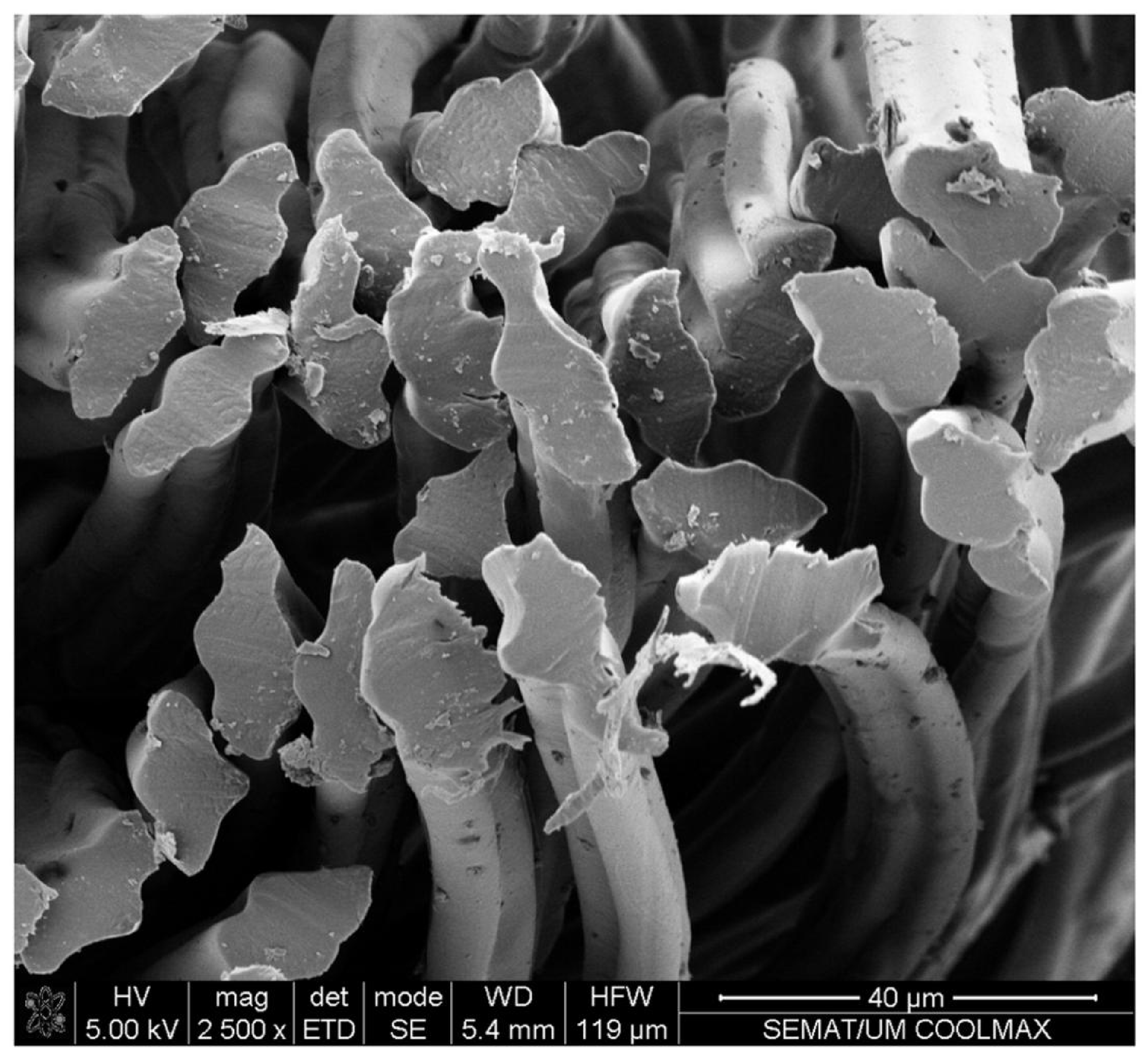
Figure 1, the typical four-groove cross-section of Coolmax fiber can provide continuous transport channels and increase the effective surface area for moisture removal, which is beneficial for moisture migration from the skin side to the outer side of the fabric and for subsequent evaporation [
18]. In contrast, conventional polyester fibers usually have a circular and smooth cross-section, as shown in
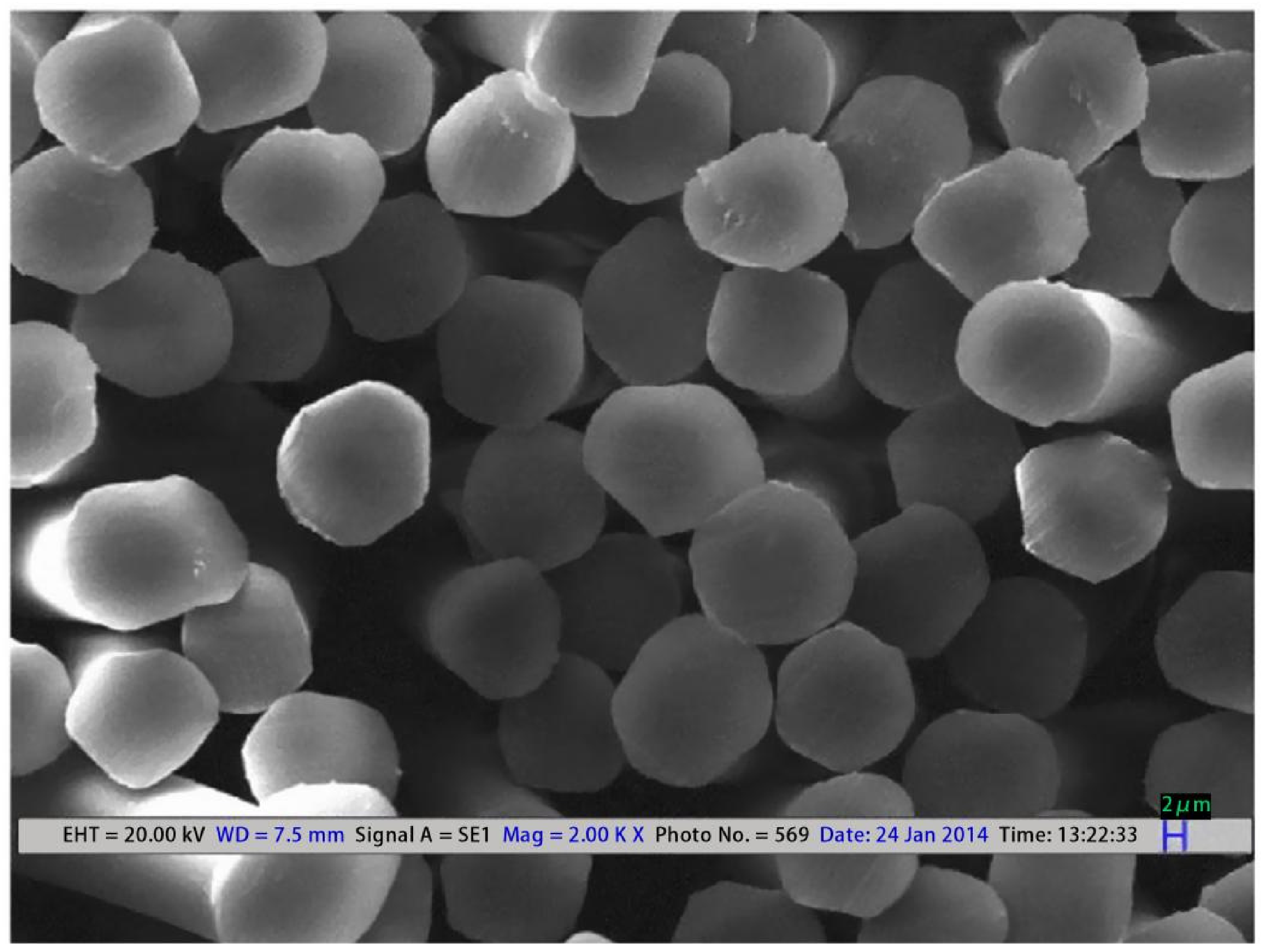
Figure 2, which leads to closer fiber packing and relatively weaker moisture transfer pathways. Therefore, the comparison between the grooved Coolmax fiber and the conventional circular polyester fiber helps explain why profiled polyester structures are more favorable for vapor transfer and heat–moisture regulation in porous fabrics.
Related studies have confirmed Coolmax’s four-channel morphology and its structural advantages in increasing specific surface area, as well as its effectiveness in improving moisture transmission and drying rate at the fabric and clothing levels [
19,
20]. By contrast, fabrics spun from conventional circular cross-section fibers have uniform smooth surfaces that allow closer packing of the filaments and yield more compact structures, resulting in lower specific surface area and inferior moisture transport compared to profiled fibers such as Coolmax [
21]. In addition, profiled fibers with stable capillary channels can also maintain effective moisture removal pathways in thick fabrics or multilayer systems, which are conducive to continuous perspiration and evaporation in high-sweat environments [
22]. Although there have been experimental performance evaluations, there is still a research gap to get more detailed information on the performance. In the literature, there are still relatively few comparative studies on the heat–moisture coupling simulation of the internal temperature and humidity transfer mechanism of Coolmax. This limits the quantitative understanding of the coupling relationship between sweat migration, evaporative heat dissipation, and fabric structure parameters to a certain extent. As a result, existing studies rely on empirical judgment, and it is difficult to provide a systematic and repeatable theoretical basis for the structural optimization and performance prediction of functional fabrics.
Figure 1.
Cross-sectional view of Coolmax fiber with four-groove profile [
19].
Figure 1.
Cross-sectional view of Coolmax fiber with four-groove profile [
19].
Figure 2.
Cross-sectional view of conventional polyester fibers with a circular profile [
21].
Figure 2.
Cross-sectional view of conventional polyester fibers with a circular profile [
21].
In recent years, with the development of computational fluid dynamics and multiphysics simulation technology, researchers have begun to establish bidirectional heat–moisture coupling models for fabrics on platforms such as COMSOL Multiphysics to more accurately describe evaporation, diffusion, and convection processes. Gholamreza et al. [
23] proposed a thermal–moisture coupling numerical model based on a single-layer fabric system, which systematically simulated the thermal and moisture behavior of fabrics under sweat and temperature loads. Fontana et al. [
24] numerically solved the temperature field and moisture content changes under different humidity gradients by establishing a mathematical model of heat and moisture transfer in porous media. Lu et al. [
17] established a heat–moisture coupling transfer model for polyester knitted fabrics with irregular cross-sections based on COMSOL, and the simulation showed that the irregular cross-section structure, especially after structural optimization, could maintain more effective moisture transmission and evaporation pathways under high-humidity conditions, thereby enhancing moisture transport performance and thermo-hygrometric comfort. In addition, Wang et al. [
25] established a three-dimensional heat–moisture transfer numerical model for woven fabrics, revealing the coupling characteristics of heat transfer and moisture diffusion inside the fabric. The official COMSOL case study [
26] also verified the agreement between simulation and experimental data through multiphysics coupling, further demonstrating the reliability and accuracy of numerical simulation in predicting the thermal and moisture properties of fabrics.
However, in the comparison between numerical simulation and experiment, most of the current studies are still difficult to accurately reproduce the real boundary conditions of sweat generation and migration, and the complex coupling relationship between human skin–clothing–environment, resulting in a certain gap between the simulation results and the actual human thermal and moisture comfort. By applying sweat input boundary conditions and ambient heat dissipation boundary conditions, the differences in moisture transmission rate, temperature response, evaporation efficiency and moisture distribution between the two materials under the same sweating condition were compared and simulated.
Compared with previously published studies, the present work differs in three main aspects. First, most existing studies on Coolmax or profiled polyester fabrics have focused on experimental moisture-management performance, drying behavior, or general thermal comfort evaluation, whereas the internal coupled heat and moisture transfer mechanisms under sweating boundary conditions have not been sufficiently quantified. Second, previous numerical studies have often considered either a single material, a single structural parameter, or limited environmental conditions. In contrast, this study establishes a three-dimensional thermo-moisture coupled porous-medium model to directly compare irregular cross-section polyester fabric with cotton under the same sweating and environmental boundary conditions. Third, the effects of convective heat transfer coefficient, ambient temperature, fabric thickness, and porosity are systematically investigated, and a dimensionless comfort and sweating index (CSI) is introduced to evaluate the combined cooling and moisture-management performance. Therefore, this work provides not only a material-level comparison but also a parameter-based numerical framework for optimizing sweat-protective fabrics.
2. Modeling and Simulation
To investigate the heat and moisture transfer behavior of irregular cross-section polyester fabric under sweating conditions, a three-dimensional thermal–moisture coupled model was established in COMSOL Multiphysics. In this model, Coolmax fabric and cotton fabric were compared under the same thermal and moisture boundary conditions to evaluate their differences in temperature regulation and moisture transport performance. The effects of key structural and environmental parameters, including fabric thickness, porosity, ambient temperature, and convective heat transfer coefficient, were further analyzed. This section presents the overall modeling idea, including the geometric configuration, material parameters, governing equations, boundary conditions, mesh-independence analysis, and model validation.
COMSOL Multiphysics was selected for this study because it provides a flexible finite element platform for solving coupled heat and mass transfer problems in porous media. Compared with a simplified analytical or lumped-parameter model, COMSOL allows the simultaneous solution of heat transfer and moisture transport equations under the same geometric domain and boundary conditions. This is particularly suitable for fabric systems, where temperature evolution, vapor diffusion, convective heat exchange, and moisture flux occur simultaneously and interact with each other. In addition, COMSOL enables convenient parameterized simulations of fabric thickness, porosity, ambient temperature, and convective heat transfer coefficient, which makes it possible to evaluate the sensitivity of thermal–moisture performance under different working conditions. Another advantage is that the spatial distributions of temperature and relative humidity can be directly visualized, allowing local heat and moisture accumulation inside the fabric to be analyzed more clearly. Therefore, COMSOL was adopted as the main numerical simulation tool in this study, while Simulink was used as a supplementary low-order validation model.
The numerical simulations were performed using COMSOL Multiphysics 6.3. MATLAB/Simulink 2025a was used to establish the supplementary lumped-parameter validation model, and Origin 2024 was used for data post-processing and figure plotting. All computations were carried out on a MacBook Air equipped with an Apple M4 chip and 32 GB memory, running macOS Sequoia 15.6.1. For the selected mesh used in the subsequent simulations, corresponding to 46,550 nodal unknowns, the computation time for a typical transient case was approximately 18 s. In the mesh-independence analysis, the computation time ranged from approximately 1 s for the coarsest mesh to 73 s for the finest mesh.
In addition to the variables investigated in this study, COMSOL can also be used to simulate several other parameters related to fabric thermal–moisture performance. For example, the sweat vapor concentration or moisture flux at the skin-side boundary can be varied to represent different sweating intensities, which provides information on the moisture removal capacity of the fabric under low, moderate, and heavy sweating conditions. The external relative humidity and air velocity can also be adjusted to evaluate the influence of different outdoor or indoor microclimate conditions on evaporation and heat dissipation. In addition, material parameters such as permeability, moisture diffusion coefficient, thermal conductivity, specific heat capacity, and water content can be modified to analyze how fiber composition and fabric structure affect heat and moisture transport. COMSOL can further output spatial distributions of temperature, relative humidity, water vapor concentration, heat flux, and moisture flux, which help identify local heat accumulation, moisture retention, and preferred transfer pathways inside the fabric. Therefore, the model has the potential to be extended from the present comparison of Coolmax and cotton fabrics to a broader parametric evaluation of functional textiles under different material, structural, and environmental conditions.
2.1. Geometric Model
- (1)
Model structure composition
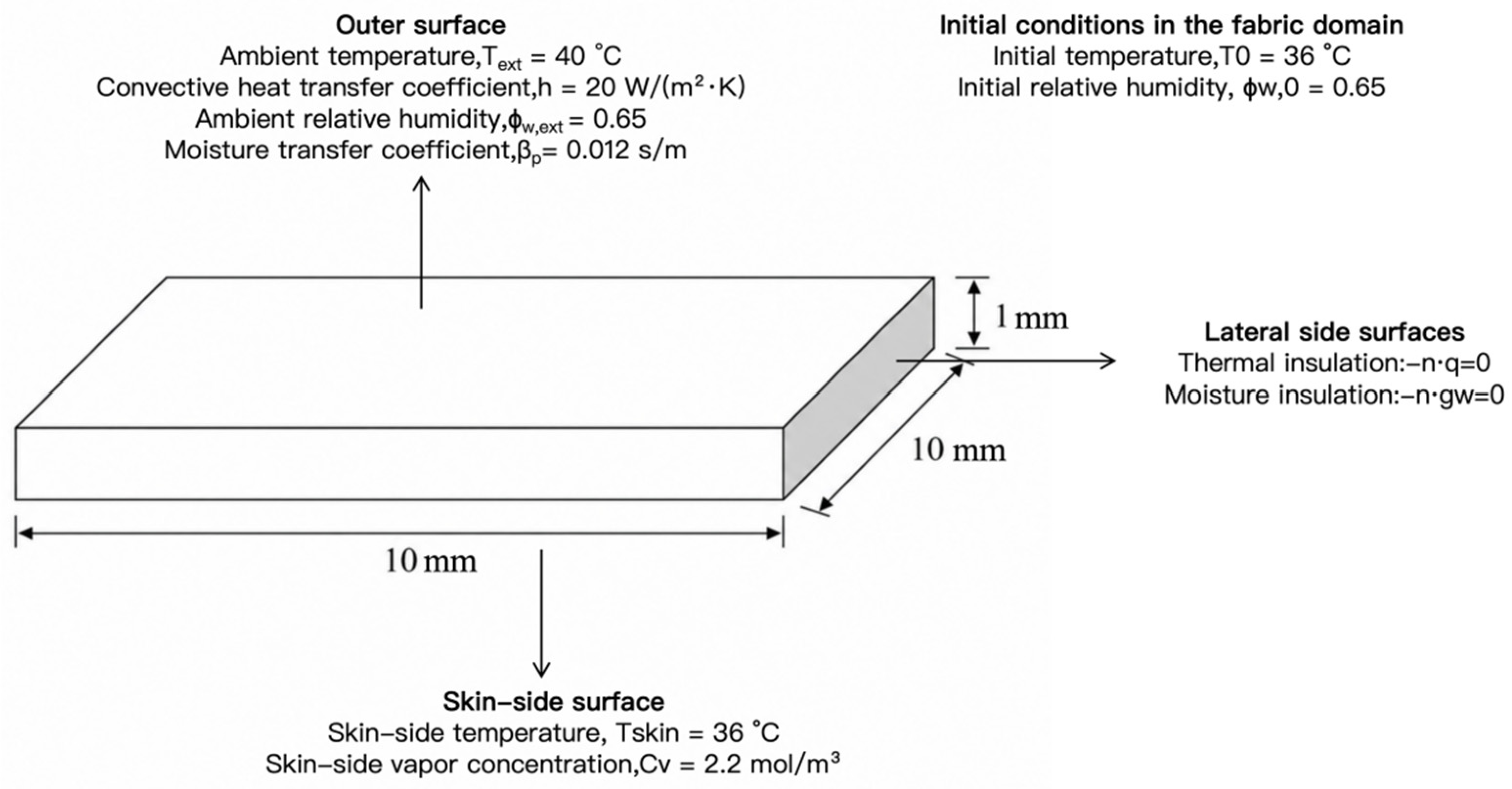
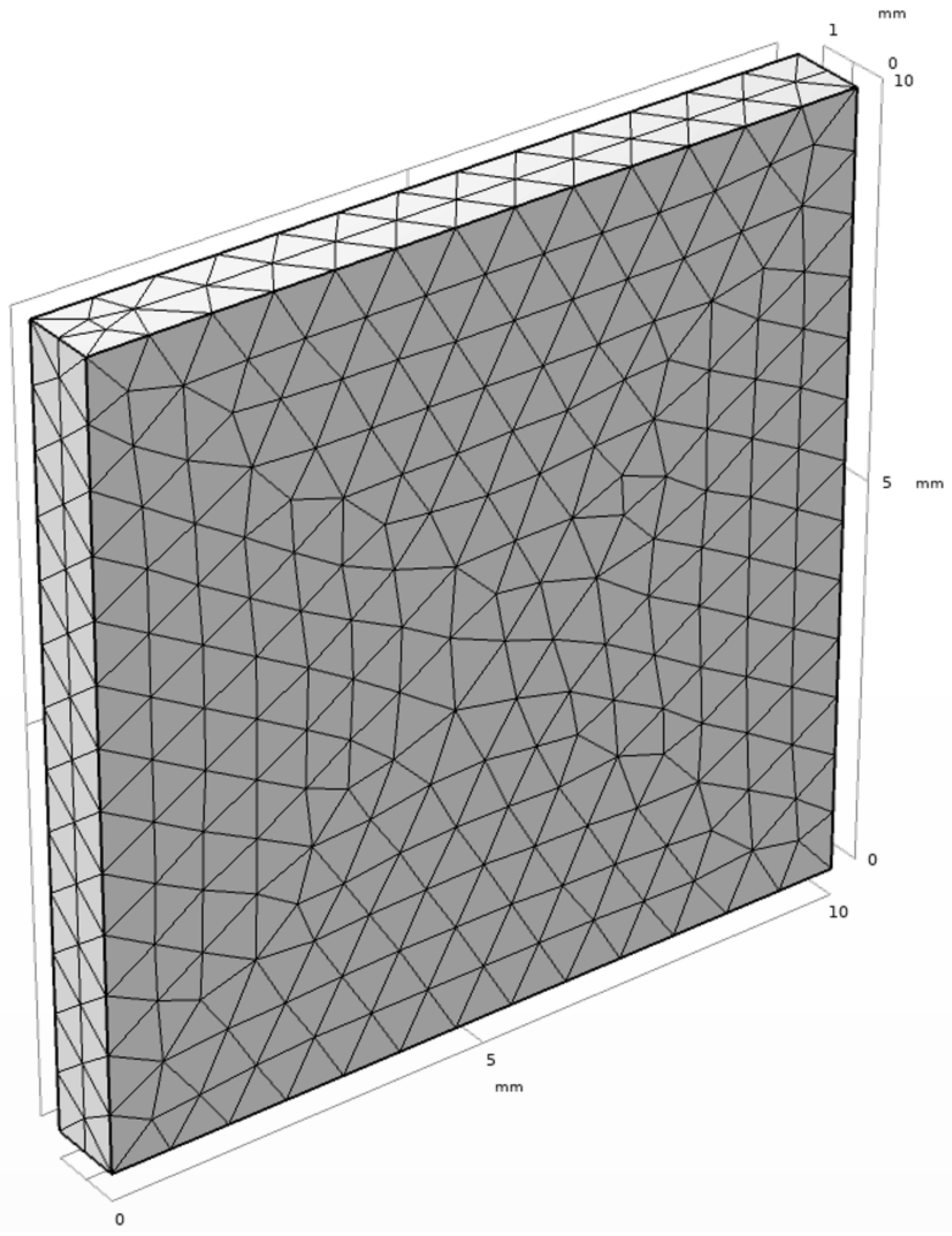
Figure 3 illustrates the computational model used in this study, including the geometric dimensions, boundary conditions, and initial conditions. To simulate the heat and moisture transfer behavior of a single-layer fabric, the fabric domain was simplified as a three-dimensional homogeneous porous cuboid with dimensions of 10 mm × 10 mm × 1 mm, which serves as the representative computational unit in the thermal–moisture coupled analysis.
- (2)
Model parameters and material parameters
According to the fiber property data compiled by CottonWorks, the density of cotton fibers is approximately 1540 kg/m
3, while polyester fibers have a density in the range 1300–1400 kg/m
3 [
27,
28]. Lu et al. [
17] reported that the porosity of knitted fabrics, including both cotton and profiled polyester types, typically lies between 0.6 and 0.8. Although precise Darcy-law permeability varies with fabric structure, pore geometry, thickness, porosity, and fibre swelling state, it can be treated as an effective porous-medium parameter in textile heat–moisture transfer models. Salokhe et al. [
29] experimentally investigated fluid flow in cotton fabrics and reported a permeability value of 1.5507 × 10
−11 m
2 under their tested cotton-fabric conditions. Based on this reference, the permeability of cotton fabric in the present model was set to 1.5 × 10
−11 m
2. The permeability of Coolmax was set to 1 × 10
−11 m
2 to represent the relatively compact packing of profiled polyester fibers. Moisture retention experiments by Martí et al. showed that, at 65% relative humidity, cotton retains about 4.9% water by weight, while untreated polyester retains only 0.5%, and that water diffusion through polyester is at least ten times faster than through cotton [
30]. The specific heat of cotton is about 1340 J/(kg·K) [
31], whereas polyethylene terephthalate, PET, shows a specific heat of 1200–1350 J/(kg·K) [
28]. Cotton’s thermal conductivity is low, typically around 0.04 W/(m·K) [
31], while polyester is more conductive, about 0.2 W/(m·K) [
16,
31]. Due to the lack of direct measurements, effective moisture diffusion coefficients used in numerical models are usually set to about 1 × 10
−10 m
2/s for cotton and 1 × 10
−9 m
2/s for polyester, in keeping with the measured diffusion-rate disparity reported by Martí et al. [
30]. With respect to mechanical properties, micromechanics studies place the intrinsic Young’s modulus of cotton fibers between 5 × 10
9 and 13 × 10
9 Pa [
32], whereas PET fibers typically exhibit moduli of 2 × 10
9–4 × 10
9 Pa [
31]. Finally, numerical analyses of cotton yarn indicate Poisson’s ratios of 0.30–0.32 [
33], and PET fibers generally have slightly higher values of 0.37–0.44 [
28].
The material parameters of each component are shown in
Table 1 and
Table 2.
2.2. COMSOL Mathematical Model
The simulation was implemented in COMSOL Multiphysics using the coupled interfaces for heat and moisture transport in porous media. The governing equations are presented here to clarify the physical basis of the model.
- (1)
Equilibrium water transport equation
In the equation, is the gas phase density (kg/m3). is the water vapor mass fraction. is the gas phase velocity vector (m/s). is the water vapor diffusion flux (kg/(m2·s)). is the liquid water density (kg/m3). is the liquid water Darcy velocity (m/s). is the liquid water capillary diffusion flux (kg/(m2·s)). is the water phase change mass source (kg/(m3·s)).
- (2)
Equilibrium moisture content equation
In the equation, is the equilibrium moisture content, (kg/m3). is the porous-medium porosity. is the liquid water saturation.
- (3)
Heat transfer governing equations in wet porous media
In the equation, is the gas phase specific heat capacity at constant pressure (. is the liquid phase specific heat capacity at constant pressure (. is the heat flux vector (). is the effective thermal conductivity . T is the temperature (K). Q is the volumetric heat source term (such as external heat input) (). is the latent heat term due to water evaporation–condensation (). is the solid phase volume fraction. is the solid phase thermal conductivity. is the gas phase thermal conductivity. is the liquid phase thermal conductivity.
2.3. Boundary Conditions and Assumptions
The material behavior over time was modeled using a time-dependent transient analysis in COMSOL rather than a quasi-static approach. The initial temperature and relative humidity of the fabric domain were set to 36 °C and 0.65, respectively. Under the imposed skin-side moisture input and external convective heat–moisture exchange boundary conditions, the coupled heat and moisture transport equations were solved with the time-dependent terms retained. Therefore, the step-response curves presented in
Section 3 represent the transient thermal–moisture evolution of the fabric system from the initial state to the final steady state, rather than a sequence of independent steady-state solutions.
To simplify the calculation and ensure the rationality of the numerical model, the fabric was treated as a homogeneous and isotropic porous medium, and the porosity, permeability, and diffusion coefficient were assumed to be uniformly distributed within the computational domain. Porosity was introduced as an effective material parameter of the volume-averaged porous fabric domain, rather than being represented by explicitly resolved pore geometry. It represents the volume fraction of void space within the representative fabric domain, namely the ratio of pore volume to total fabric volume. No specialized finite elements or user-defined functionals were used to model porosity. Instead, porosity was directly assigned in the material and porous-medium settings of the built-in heat and moisture transfer interfaces in COMSOL. For the baseline cases, including the analyses of convective heat transfer coefficient, ambient temperature, and thickness, the porosity was kept constant according to the material parameters listed in
Table 1 and
Table 2. For the porosity sensitivity analysis, porosity was varied parametrically to represent different pore morphologies associated with different fabric structures. Therefore, the introduced porosity should be interpreted as an equivalent macroscopic parameter related to the air-gap fraction of the real fabric, rather than as a directly reconstructed microscopic pore structure.
The following additional assumptions were adopted: air and water vapor were regarded as ideal gases; moisture transport was mainly governed by vapor diffusion and moisture redistribution within the porous fabric domain under the prescribed vapor-input boundary condition; the fiber skeleton was assumed to be non-deformable during the simulation; and moisture transport in the fabric was considered mainly in the vapor phase, without explicitly resolving liquid-sweat-wicking, droplet condensation, and re-evaporation.
This simplification is considered acceptable for the present comparative study because both Coolmax and cotton were simulated under the same vapor-input and external convective boundary conditions. The objective was to compare their relative heat–moisture responses, rather than to reproduce the full liquid-sweat-wicking process. Similar effective porous-medium or vapor-related approaches have been used in previous textile studies: Fontana et al. [
24] evaluated temperature, relative humidity, and vapor pressure in a porous textile heat–moisture model, Wang et al. [
25] used heat flux, moisture resistance, water vapor permeability, and water vapor concentration in a COMSOL-based fabric model that agreed with experimental measurements, and Lu et al. [
18] simulated moisture–thermal transfer in irregular cross-section PET knitted fabrics. Therefore, neglecting explicit droplet condensation and re-evaporation is unlikely to change the main comparative trends between Coolmax and cotton, although fully wetted liquid-sweat transport should be further considered in future work.
The boundary conditions include convective heat flux, moisture flux, thermal and moisture insulation, and prescribed conditions on the skin-side and outer surfaces, as expressed below:
In the equation, n is the outward unit normal vector of the boundary. q is the heat flux vector .
The outer layer, away from the skin, is set to convective heat flux boundary conditions:
In the equation, n is the outward unit normal vector of the boundary. q is the heat flux vector (W/m2). is the boundary heat exchange flux (W/m2). h is the convective heat transfer coefficient (W/(m2·K)). is the external environment temperature (K). is the fabric surface temperature (K).
A high ambient air temperature of 40 °C was applied as a test case to represent extreme hot-weather conditions and evaluate the fabric’s heat- and moisture regulation capability. The convective heat transfer coefficient was set to
h = 20 W/(m
2·K), corresponding to brisk walking or slow running. According to Yang et al. [
34], the whole-body convective heat transfer coefficient increases with air speed, and h = 20 W/(m
2·K) is reached at a relative air speed of about 2–3 m/s. The surface in contact with the skin was treated as a constant temperature boundary:
The skin-side boundary was prescribed as a constant temperature of 36 °C, which represents the upper range of human skin temperatures under heat stress conditions, where local skin temperatures can approach 35–36 °C [
2]. This value was therefore selected as a conservative high-temperature boundary condition for the torso.
The four rectangular areas of 10 mm × 1 mm are also set as insulation for water vapor to simplify the simulation and reduce unnecessary moisture leakage:
In the equation, is the outward unit normal vector of the boundary. is the water vapor diffusion flux vector (mol/(m2·s)). is the liquid–gas convective flux vector (mol/(m2·s)).
The concentration of water vapor on the contact side of the human body is set to C
v to simulate the evaporative input of sweat from the skin surface:
vapor concentration C
0 = 2.2 mol/m
3.
The moisture flux in the outer region away from the skin adopts boundary conditions:
In the equation, is the boundary water vapor flux (mol/(m2·s)). is the fabric surface relative humidity. is the saturated vapor pressure at temperature T (Pa). is the saturated vapor pressure at external temperature (Pa).
Moisture transfer coefficient = 0.012 s/m. external temperature = 40 °C, external relative humidity = 0.65.
2.4. Mesh-Independence Analysis
The mesh-independence analysis was performed using the baseline computational case of the Coolmax fabric model. In this test case, the fabric was simplified as a three-dimensional homogeneous porous medium with a width of 10 mm, a depth of 1 mm, and a height of 10 mm. The Coolmax material parameters listed in
Table 1 were used. The initial temperature and initial relative humidity of the fabric domain were set to 36 °C and 0.65, respectively. The skin-side surface was prescribed as a constant temperature boundary of 36 °C, and a water vapor concentration of 2.2 mol/m
3 was applied to represent the evaporative moisture input from the skin. The outer surface was subjected to convective heat and moisture exchange with the ambient environment, where the ambient temperature was 40 °C, the external relative humidity was 0.65, the convective heat transfer coefficient was 20 W/(m
2·K), and the moisture transfer coefficient was 0.012 s/m. The mesh-independence analysis was conducted using a time-dependent transient calculation. For each mesh, the transient simulation was run from the initial state until the temperature and relative humidity responses became stable. The final steady-state temperature and steady-state relative humidity obtained from the transient calculation were then selected as the convergence indicators for the mesh-independence verification.
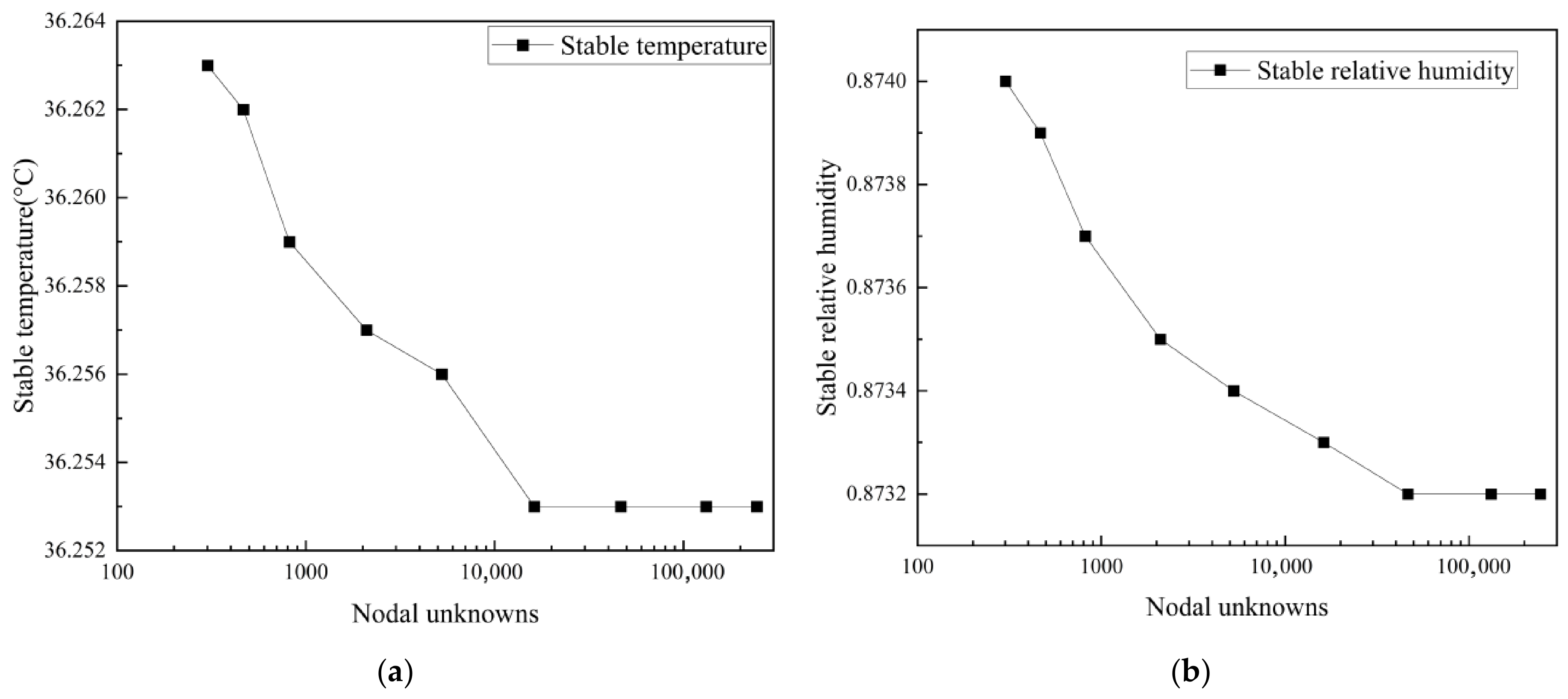
Based on this baseline computational case, mesh-independence verification was carried out to ensure that the numerical results were not affected by mesh resolution and to balance computational accuracy with computational cost. Following the finite element formulation, the mesh refinement level was expressed using the number of nodal unknowns/DOFs rather than only the number of mesh elements. The number of nodal unknowns/DOFs used in the verification was 301, 466, 818, 2093, 5240, 16,200, 46,550, 131,793, and 244,594. The results show that both the steady-state temperature and steady-state relative humidity changed slightly at the coarse-mesh stage and then gradually converged as the number of nodal unknowns increased.
As shown in
Figure 5a, increasing the number of nodal unknowns from 301 to 818 slightly reduced the steady-state temperature from about 36.26 °C to 36.25 °C. Further increases to 2093 and 5240 nodal unknowns produced only a marginal drop of about 0.01 °C, and beyond 46,550 nodal unknowns, the steady-state temperature remained approximately 36.25 °C, indicating convergence. Similarly,
Figure 5b shows that the steady-state relative humidity decreased from about 0.874 to 0.873 as the number of nodal unknowns increased from 301 to 5240. When the number of nodal unknowns exceeded 46,550, the steady-state relative humidity stabilized around 0.873, demonstrating that both temperature and humidity results had converged.
It can be seen from the synthesis of the two key output parameters of temperature and relative humidity that the results have basically stabilized at 16,200 nodal unknowns, but under 46,550 nodal unknowns, the two indices are completely consistent with the results calculated by higher-density meshes. Further densification to 131,793 and 244,594 nodal unknowns does not improve the results, but only increases the calculation amount. Therefore, the mesh corresponding to 46,550 nodal unknowns is finally selected as the unified mesh for all subsequent calculations to ensure reliable calculation accuracy and take into account calculation efficiency.
2.5. Model Validation
- (1)
Simulink validation thought
To validate the accuracy of the COMSOL porous-media heat–moisture coupling results, a simplified lumped-parameter model was developed in Simulink. Simulink offers a graphical, modular environment for constructing low-order dynamic systems based on energy and moisture conservation. This approach has been employed in previous studies on heat and moisture transfer, where simplified lumped-parameter models have been used to validate more detailed numerical simulations. For example, hygrothermal modeling frameworks such as those developed in IEA Annex 41 combine MATLAB/Simulink-based models with finite element tools to simulate coupled heat and moisture transport in building components [
35]. In addition, simplified lumped-parameter models based on thermal network analogies have been widely used to approximate and validate detailed heat transfer simulations, owing to their ability to capture the dominant transient response of the system with reduced computational cost [
36].
Although direct laboratory measurements were not conducted in the present study, the reliability of the COMSOL-based modeling approach was assessed in three ways. First, the governing equations, material parameters, and boundary conditions were established based on heat and moisture transfer theory and values reported in previous experimental studies. Second, the use of COMSOL for coupled heat and moisture transfer has been validated in previous studies, where numerical results showed good agreement with experimental or benchmark data. Third, in this study, a simplified lumped-parameter Simulink model was further developed as a supplementary verification tool. The comparison between COMSOL and Simulink results showed similar transient trends and steady-state responses, indicating that the COMSOL model can reasonably capture the macroscopic heat and moisture transfer behavior of the fabric system. Therefore, although further laboratory validation is still needed in future work, the present COMSOL model is considered reliable for comparative analysis and parametric investigation of Coolmax and cotton fabrics under controlled boundary conditions.
In addition, the simulated trends were compared qualitatively with data and conclusions reported by other authors. Lu et al. [
18] developed a coupled moisture–thermal transfer model for irregular cross-section PET knitted fabrics using COMSOL and showed that profiled polyester structures could maintain effective moisture transport and evaporation pathways under humid conditions. Gholamreza et al. [
23] established a numerical model of a single-layer fabric system using a sweating torso and demonstrated that numerical modeling can be used to predict the thermophysiological comfort response of fabrics under sweating conditions. Yang et al. [
37] also experimentally verified heat and moisture transfer modelling for fabrics consisting of hydrophobic fibers. The present results, including the lower temperature rise and more stable humidity response of Coolmax compared with cotton, are consistent with these reported findings. Therefore, although direct laboratory validation was not performed in this study, the model is supported by the literature-based parameters, mesh-independence analysis, comparison with a simplified Simulink model, and qualitative agreement with published experimental and numerical data.
In such approaches, the lumped-parameter model captures the macroscopic transient response of the system, while the finite element model provides detailed spatial resolution. Therefore, the Simulink model in this study is adopted as a complementary validation tool to provide a rapid comparison with the COMSOL-based finite element simulation. The governing equations for this lumped-parameter model are derived from the energy and moisture balance relations described below:
In the equation, is the equivalent density (kg/m3). is the equivalent specific heat capacity at constant pressure (J/(kg·K)). is the equivalent control volume (m3). is the system equivalent average temperature, (K). is the input heat power (W). is the output heat power (W). is the latent heat power removed by evaporation (W). is the time derivative operator (s−1).
And the mass conservation equation:
In the equation, is the water content within the control volume (kg). is the rate of change in water content (kg/s). is the mass flow rate of water entering the control volume (kg/s). is the mass flow rate of water leaving the control volume (kg/s). is the mass flow rate of water loss due to evaporation (kg/s).
The fabric-skin microclimate system can be regarded as a first-order lumped-parameter model, and the dynamic response process of temperature and humidity can be described by a transfer function.
As shown in
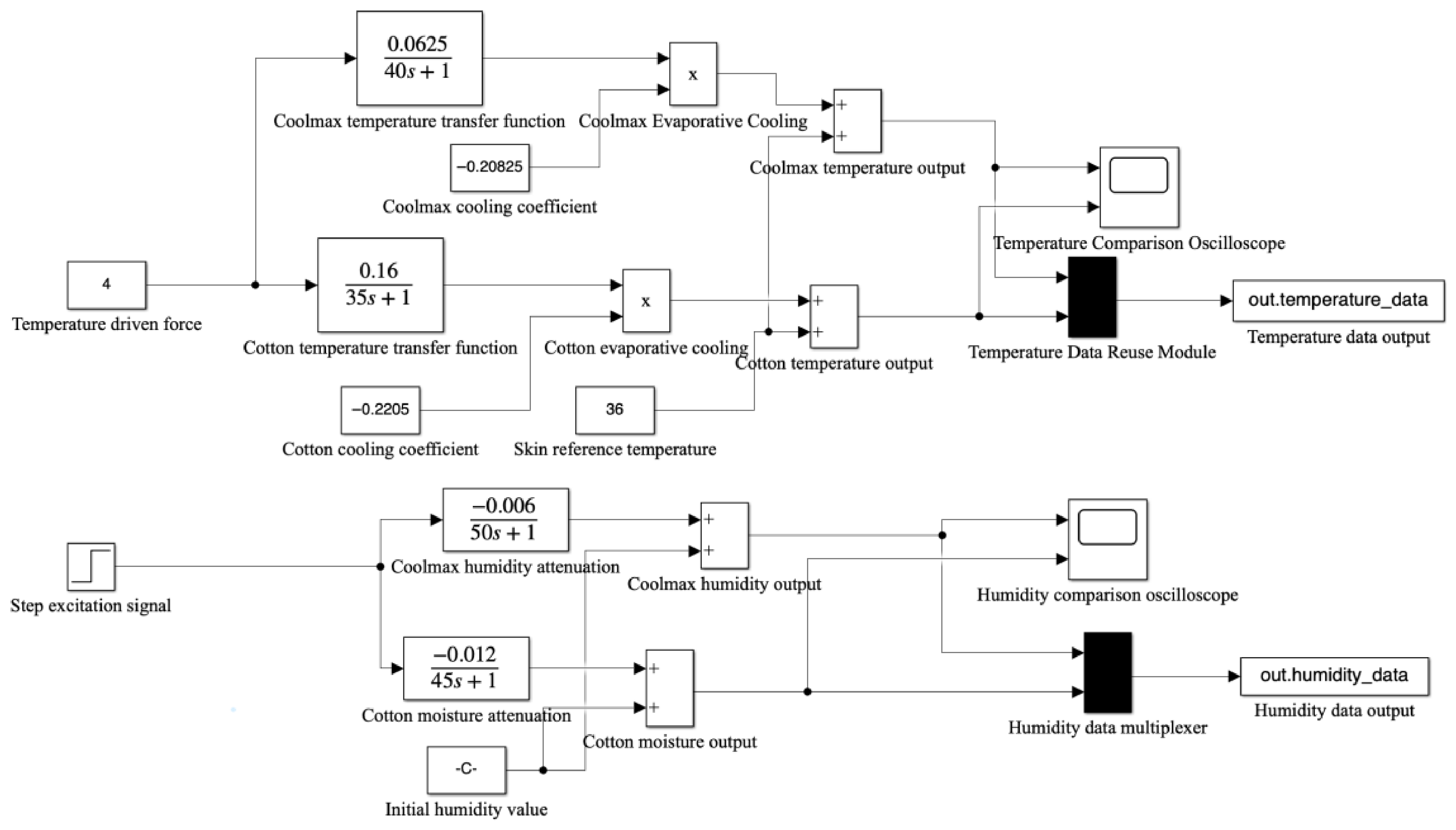
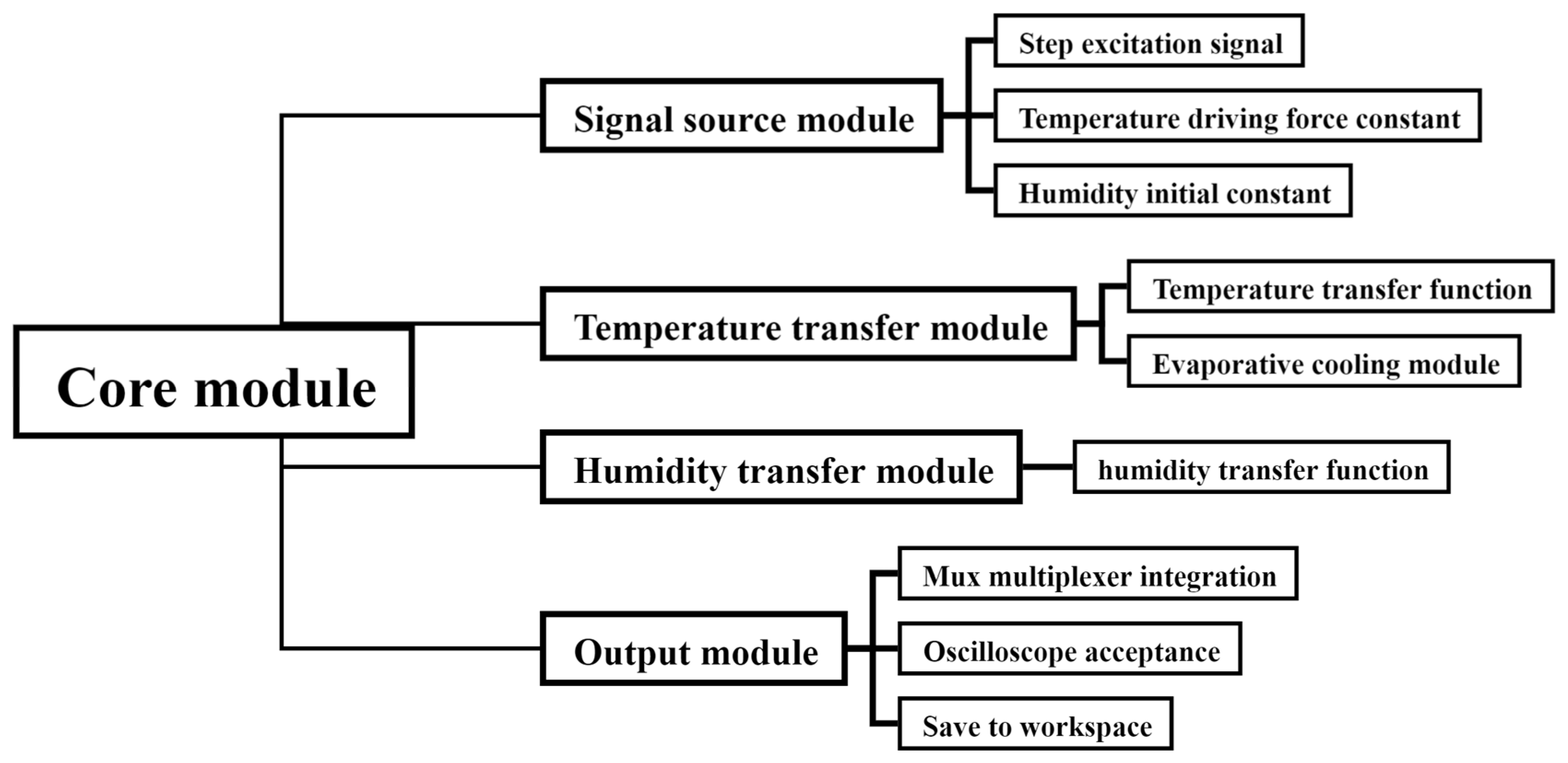
Figure 6, The signal source module mainly includes a step excitation signal, temperature driving force constant and humidity initial value constant, wherein the step excitation signal provides a unit step input for the transfer function, and the temperature driving force constant selects the temperature difference between skin and environment (4 °C).
- b.
Temperature transfer module
The core of the temperature transfer module of the system consists of two parts: one is the temperature transfer function based on the first-order heat transfer response model:
In the equation, is the system steady-state gain. is the time constant (s). is the Laplace operator, (s−1).
Where represents the steady-state gain of the system, defined as the ratio of output variation to input variation, which determines the final height of the response curve and reflects the steady-state performance of the system. is the time constant, defined as the time required for the output to reach steady state after step excitation, and it characterizes the response speed of the system as well as the steepness of the rising curve. is the Laplace operator.
The other is an evaporative cooling module, which is based on the principle of energy conservation and latent heat of evaporation:
In the equation, is the evaporative cooling power (W). is the sweat evaporation rate (kg/s). is the latent heat of sweat evaporation (J/kg).
The two components together form the basis for solving the thermal dynamic response of the system. The output from the evaporative cooling multiplier is added to the skin reference temperature to obtain the final temperature. The detailed signal path is illustrated in
Figure 7.
- c.
Humidity transfer module
The core of the humidity transfer module is the humidity attenuation function:
where
,
and
have the same meanings as in the temperature transfer function above. The specific signal path is illustrated in
Figure 8.
The output module is responsible for the visualization and recording of data, providing a direct basis for the analysis of results. The module consists of three core parts: firstly, the Mux multiplexer combines the scattered temperature and humidity signals in the system into an integrated multi-channel signal, simplifying the data flow structure. Finally, the To Workspace module saves the data to MATLAB/Simulink 2025a workspace, which ensures the traceability of the original data and lays the data foundation for subsequent quantitative analysis, data processing and chart generation.
The overall Simulink framework used for the comparative validation of Coolmax and cotton is shown in
Figure 9. This framework was established to reproduce and compare the transient temperature and humidity responses of the two fabrics under the same thermal and moisture boundary conditions. It mainly consists of a signal source module, a temperature transfer module, a humidity transfer module, and an output module. The signal source module generates the system input, including the step signal and the temperature driving force constant. The temperature transfer module describes the first-order thermal response of the fabric and incorporates an evaporative cooling submodule to account for the cooling effect of sweat evaporation. The humidity transfer module represents the transient moisture response through a humidity attenuation function. The output module combines the temperature and humidity signals through a Mux block, displays the dynamic curves in real time using a Scope, and exports the data to the MATLAB workspace through the ToWorkspace block for further comparison and validation. It should be noted that the transfer functions and cooling-related coefficients for Coolmax and cotton were not assigned arbitrarily; instead, they were determined from the lumped-parameter heat and moisture balance equations and calibrated according to the corresponding macroscopic response characteristics obtained from the COMSOL simulations. In this way, the whole framework provides a complete validation workflow from input excitation to output comparison.
- (4)
Visualization of Simulink outputs for validation
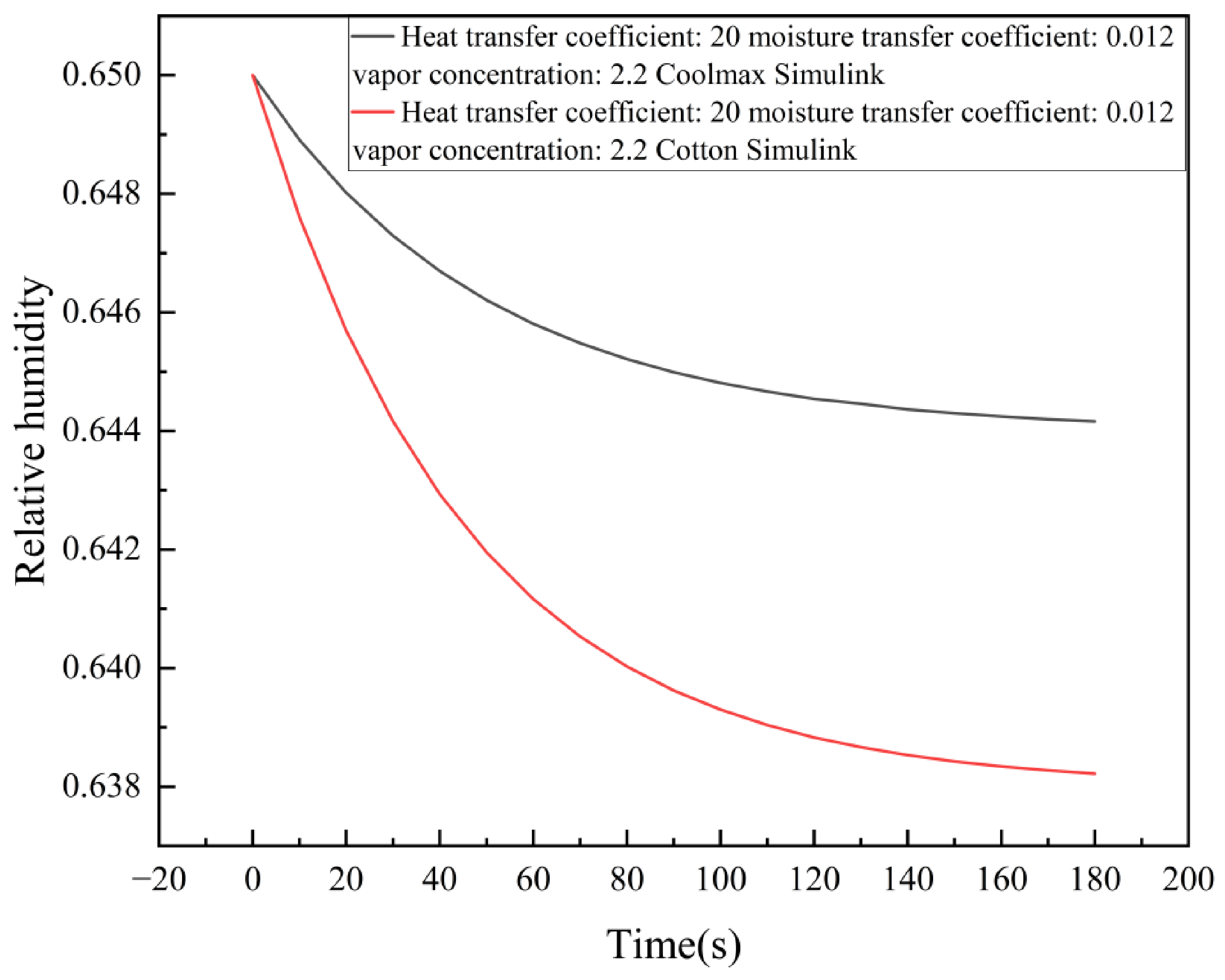
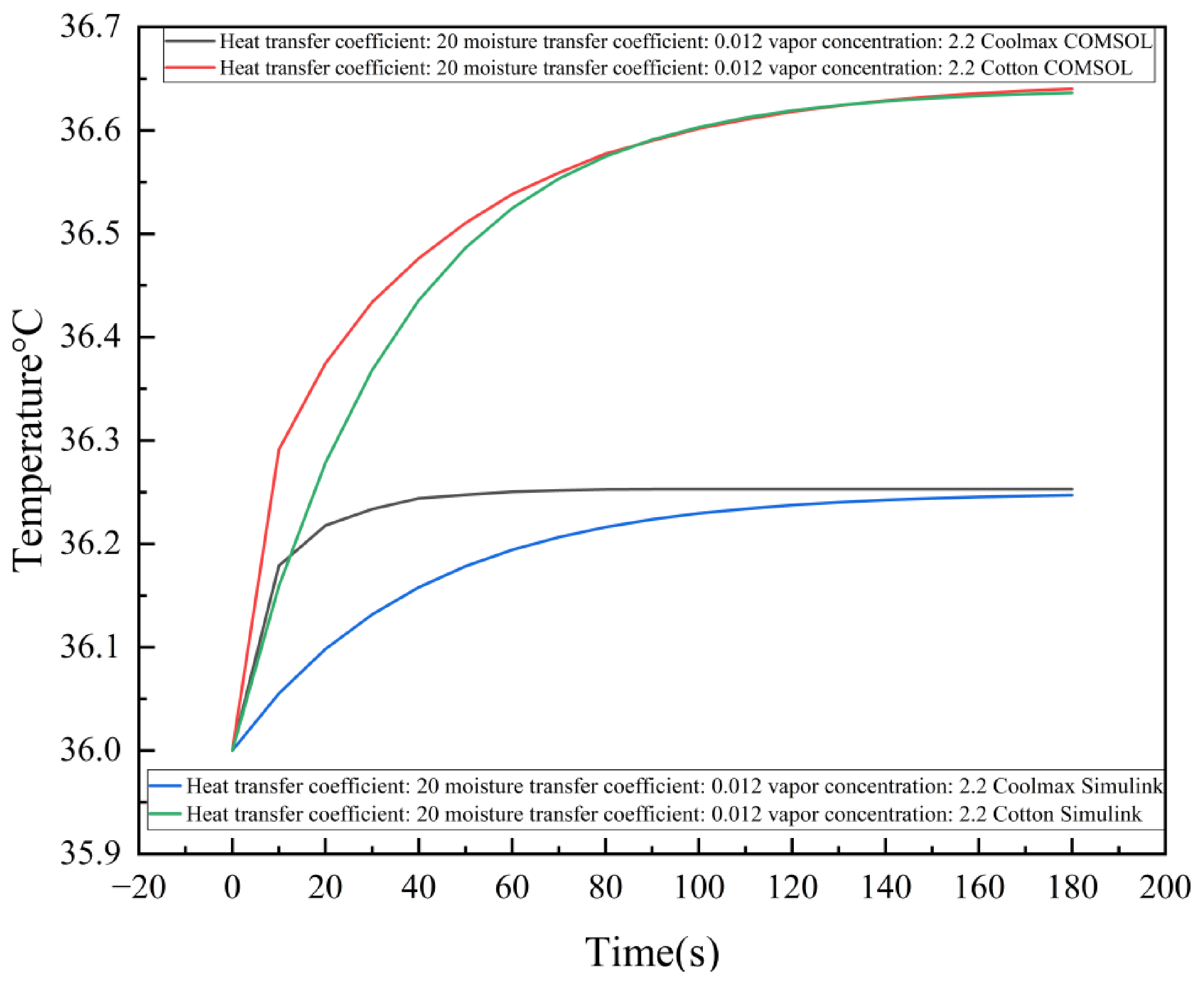
For validation purposes, the Simulink outputs were imported into MATLAB to plot the temperature and humidity step responses of Coolmax and cotton. These curves were generated using the transfer-function parameters and material-property settings described above, and were used to examine whether the simplified lumped-parameter model could reproduce reasonable transient thermal and moisture responses. It should be noted that the Simulink model was adopted only as a supplementary validation tool for comparison with the COMSOL results, whereas the detailed parametric analyses in
Section 3 were based on the COMSOL simulations.
- a.
Temperature-response output for preliminary validation
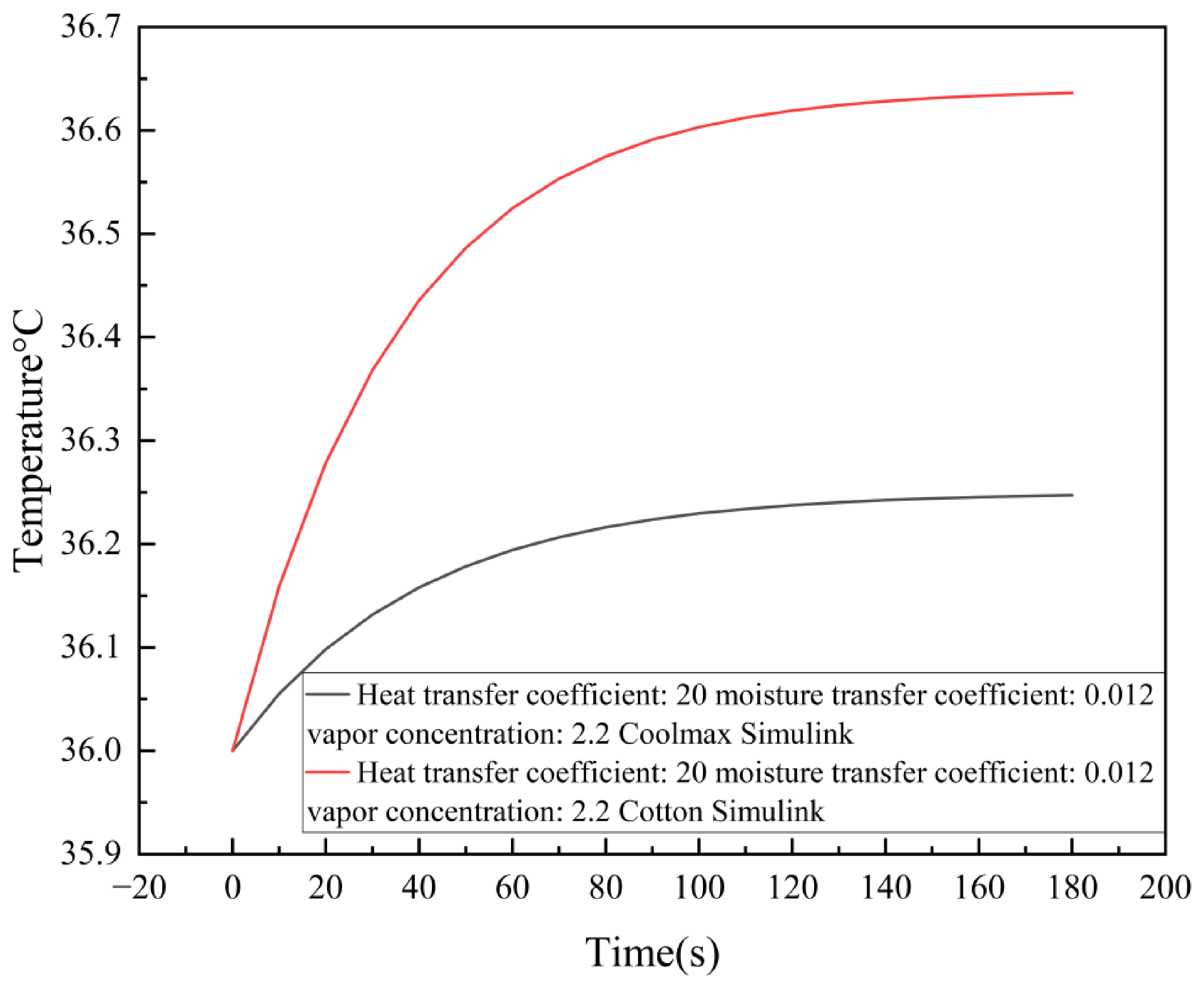
In the temperature change graph, the Coolmax material slowly and steadily rises in temperature from 36 °C to about 36.25 °C within a simulation time of 200 s, showing a continuous heat dissipation trend. In contrast, cotton material rises faster at the same initial temperature and maintains a higher temperature than Coolmax throughout the time period, which clearly indicates that Coolmax material is superior to cotton in thermal conductivity and heat dissipation performance, and can reduce skin surface temperature more effectively. The specific changes are shown in
Figure 10.
- b.
Humidity-response output for preliminary validation
In the humidity change diagram, both materials show a gradual decrease in humidity. The humidity of cotton material decreases more obviously and rapidly, and its value decreases from 0.65 to 0.649 faster. while the humidity curve of Coolmax material changes gently, and the humidity remains between 0.65 and 0.64. The specific changes are shown in
Figure 11.
- (5)
COMSOL and Simulink results combined analysis
Both Simulink and COMSOL simulation models use consistent boundary conditions and parameter settings, including a heat transfer coefficient of 20 W/(m2·K), a moisture transfer coefficient of 0.012 s/m, and a body-side vapor concentration of 2.2 mol/m3.
As shown in
Figure 12, the temperature curves obtained by COMSOL and Simulink show high consistency in overall trends during transient heat transfer. The temperature of Coolmax material increases rapidly in the initial stage, and then tends to stabilize gradually, showing a typical “fast response–slow convergence” characteristic. In the steady-state stage, the temperature of the Coolmax material is obviously lower than that of the cotton material, and the difference in steady-state temperature values obtained by the two simulation methods is small.
The temperature curves calculated by Simulink and COMSOL are consistent in trend, heating rate and final steady-state temperature level, except for slight deviation at the initial transient stage, which is mainly due to the Simulink model adopting a lumped-parameter form to simplify the temperature distribution in fabric space, while the COMSOL model is based on a three-dimensional porous-medium structure, which can describe the local heat transfer process more precisely.
In general, Simulink and COMSOL simulation results have good consistency in macroscopic thermal response behavior, which verifies the accuracy and credibility of the COMSOL heat–moisture coupling model in describing the temperature evolution of fabrics.
3. Analysis of Results
This section presents the detailed parametric analysis of the thermal–moisture behavior of Coolmax and cotton fabrics, with emphasis on the effects of convective heat transfer coefficient, ambient temperature, thickness, and porosity, as well as the CSI-based comprehensive evaluation. All results discussed in this section are derived from the COMSOL simulations.
3.1. The Influence of Surface Heat Transfer Coefficient on Temperature and Relative Humidity
In order to investigate the influence of convective heat transfer intensity on heat and moisture transfer performance of fabrics, the convective heat transfer coefficients
h = 6, 20, and 25 W/(m
2·K) were set respectively under the conditions of constant ambient temperature of 40 °C and relative humidity of 0.65, corresponding to three representative activity or airflow states of the human body: static/low-airflow, walking, and running/high-airflow conditions. This selection was based on the fact that the convective heat transfer coefficient of the human body increases with relative air speed. According to Yang et al. [
34],
h = 20 W/(m
2·K) can be reached at a relative air speed of about 2–3 m/s. Therefore, 6 W/(m
2·K) was used to represent a weak convection or nearly static condition, 20 W/(m
2·K) was used to represent a walking or slow-running condition, and 25 W/(m
2·K) was selected as a stronger convection condition associated with higher activity intensity or airflow speed. The transient temperature field and humidity field in porous media were calculated by using the coupled model of “heat transfer and equilibrium moisture transport in porous media containing moisture” established by COMSOL Multiphysics, and the output data of probes were fitted and plotted in Origin.
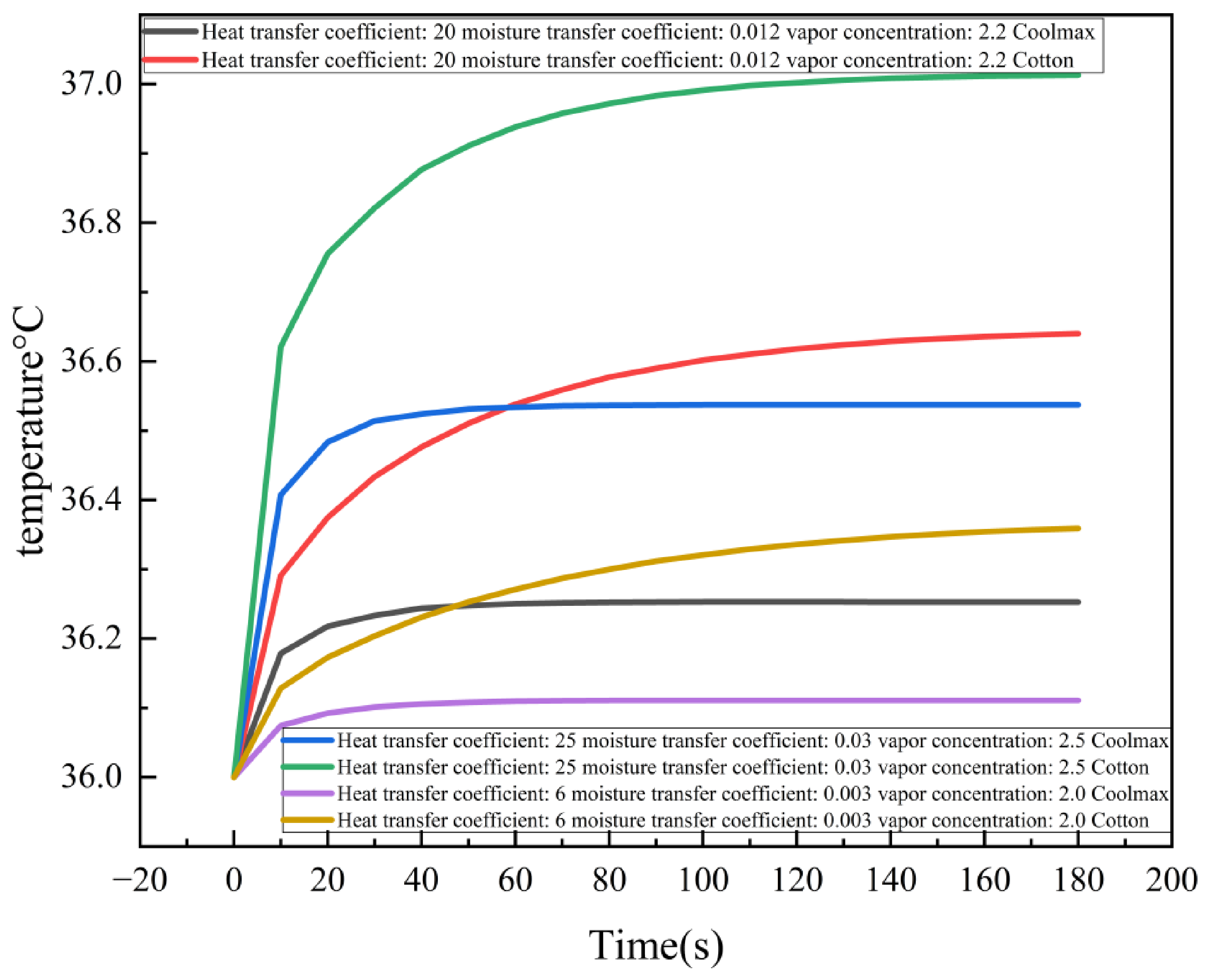
As shown in
Figure 13, when the heat transfer coefficient increases from 6 to 25 W/(m
2·K), the temperature of both materials shows a significant upward trend, but the temperature rise in the Coolmax material is smaller, and its internal temperature changes more gently. Specifically, when
h = 6 W/(m
2·K), the maximum temperature of Coolmax is about 36.15 °C; when
h = 20 W/(m
2·K), it rises to 36.25 °C; when
h = 25 W/(m
2·K), it reaches about 36.55 °C. The highest temperatures of cotton fabrics under the same conditions are 36.35 °C, 36.50 °C and 37.00 °C, respectively. It can be seen that with the increase in convective heat transfer intensity, the temperature increase rate of cotton fabrics is significantly faster than that of Coolmax, indicating that its thermal insulation performance is poor.
This difference can be explained by the known material characteristics of Coolmax and cotton. Coolmax is a hydrophobic profiled polyester fiber with relatively low thermal conductivity and a groove-like cross-section, which can help form stable air gaps between fibers and weaken inward heat transfer. In contrast, cotton fibers are more hydrophilic and have stronger moisture absorption, which may facilitate moisture retention and heat accumulation within the fiber gaps, leading to a faster temperature rise.
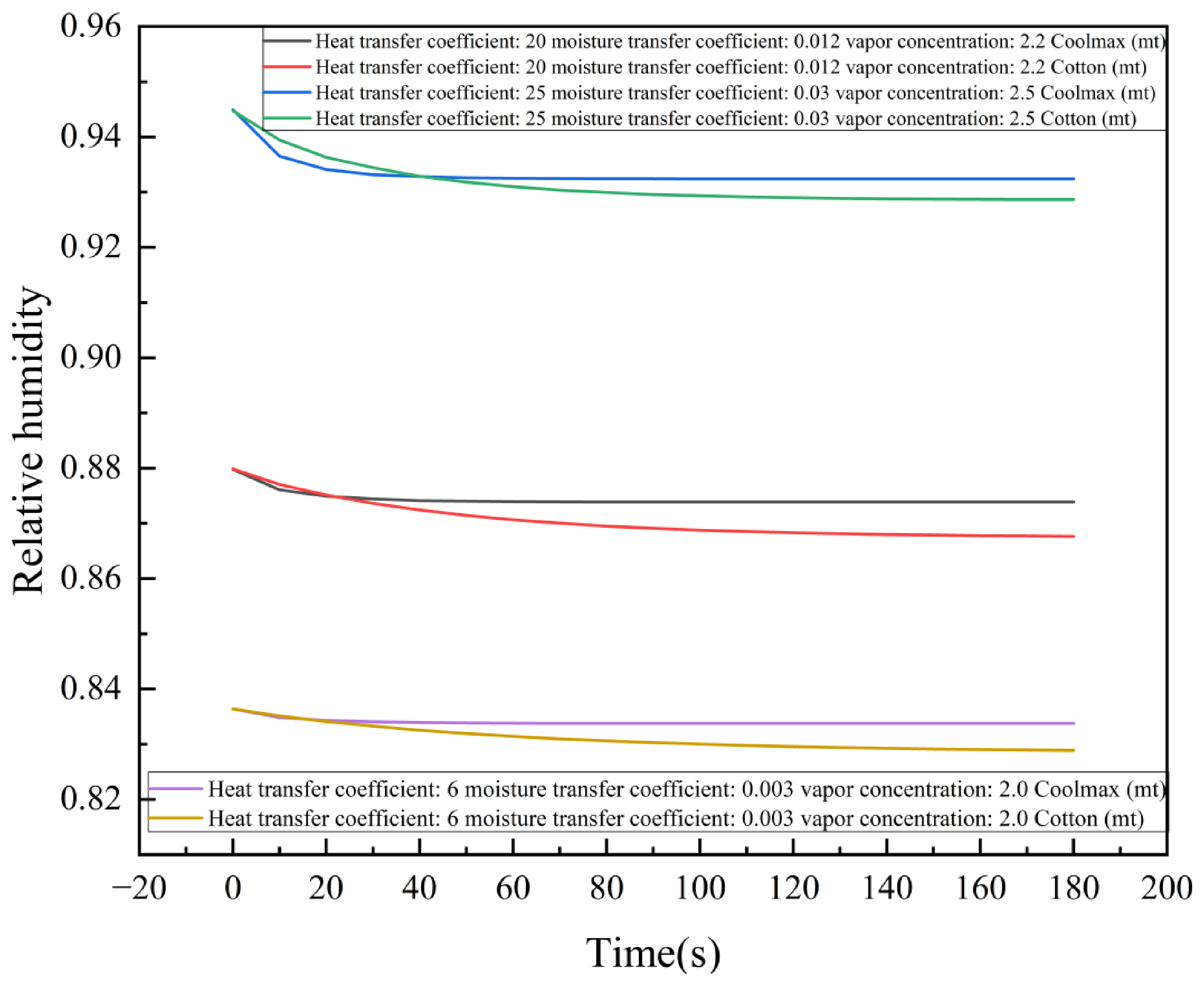
In terms of humidity change, as shown in
Figure 14, the average relative humidity of Coolmax material is always higher than that of cotton fabric, and it shows the characteristics of “initial decrease–late stabilization” with h increasing. When
h = 6 W/(m
2·K), the steady-state relative humidity of Coolmax is about 0.83; when
h = 25 W/(m
2·K), it rises to about 0.93. The humidity curve of cotton fabric decreases faster, especially under high h conditions, its relative humidity rapidly decreases from 0.94 to below 0.90. The difference is due to the water vapor diversion effect of the Coolmax fiber groove structure, and the capillary channel formed on its surface can promote the diffusion and transmission of sweat evaporation, so as to maintain humidity balance under high wind speed and high heat transfer conditions, while cotton fabric has strong moisture absorption, which leads to rapid evaporation and loss of moisture.
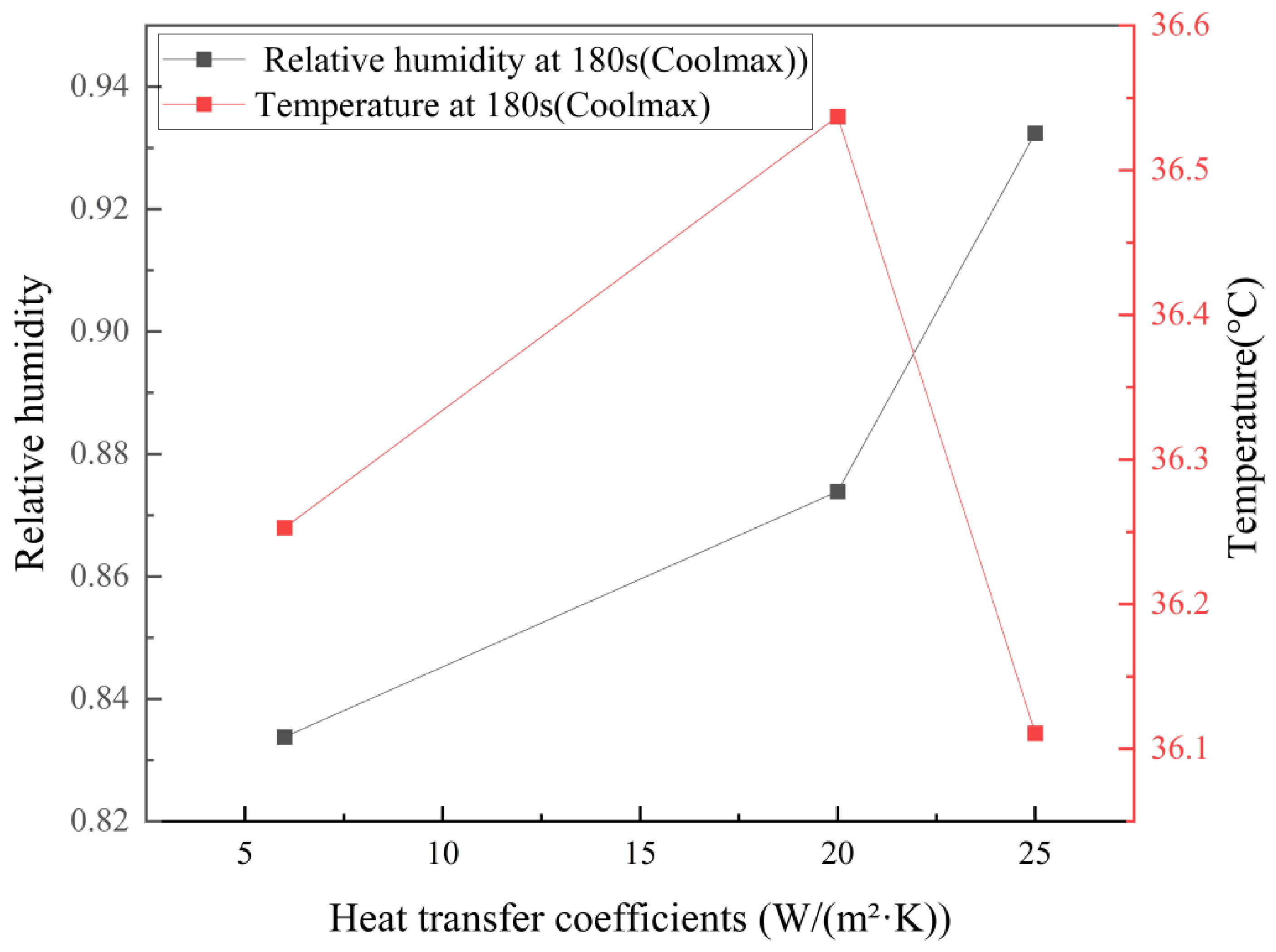
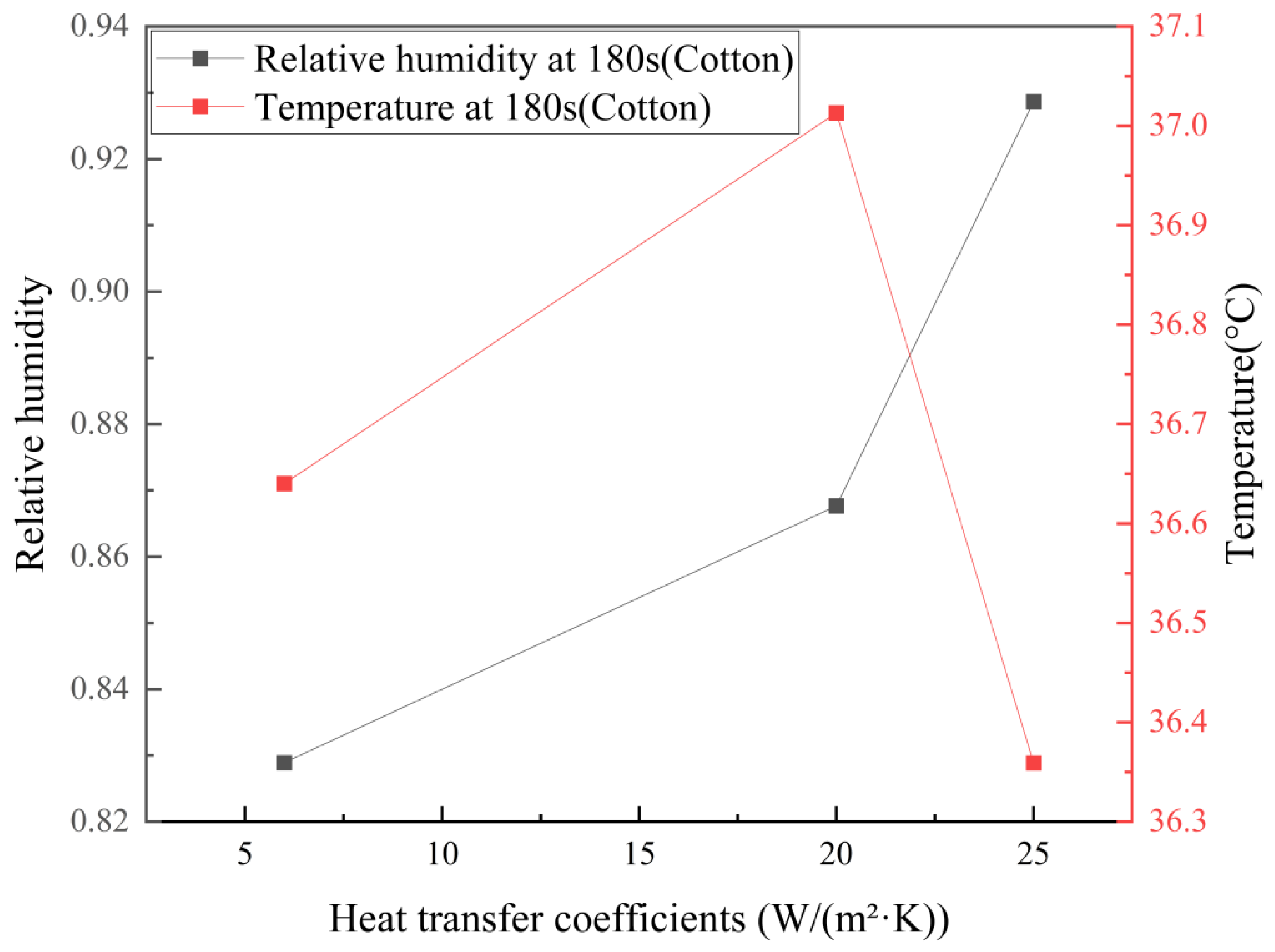
To further demonstrate the dependence of the numerical solution on the convective heat transfer coefficient, the temperature and relative-humidity values at the representative time point of t = 180 s were extracted and compared, as shown in
Figure 15 and
Figure 16. For Coolmax fabric, the relative humidity increases from approximately 0.83 to 0.93 as the convective heat transfer coefficient increases from 6 to 25 W/(m
2·K), indicating that stronger external heat and moisture exchange promote moisture redistribution and help maintain a higher humidity level near the fabric surface at the selected time point. The corresponding temperature remains in a relatively narrow range of about 36.1–36.6 °C, suggesting that Coolmax can limit excessive temperature variation under different convective conditions. For cotton fabric, the relative humidity also increases with the convective heat transfer coefficient, but its temperature level is generally higher than that of Coolmax, especially under the medium heat transfer condition. This comparison at t = 180 s provides a more direct parameter-based view of the heat–moisture response and confirms that Coolmax maintains a more favorable balance between temperature control and humidity regulation than cotton under different convective heat transfer conditions.
Overall, the transient curves and the extracted values at t = 180 s consistently show that Coolmax fabric exhibits a slower temperature rise and more stable humidity regulation under different convective heat transfer coefficients. Therefore, Coolmax is more suitable for sportswear and sweat-protective clothing used in high-airflow and high-temperature environments.
3.2. Effect of Ambient Temperature on Temperature and Relative Humidity
In order to analyze the influence of ambient temperature on the heat and moisture transfer behavior of the fabrics under hot-environment conditions, the convective heat transfer coefficient was kept at 20 W/(m2·K), the ambient relative humidity was 0.65, and the moisture transfer coefficient was fixed at 0.012 s/m. The ambient temperature was set at 37, 40, and 43 °C, while the simulated skin temperature was maintained at 36 °C, the sweat vapor concentration was 2.2 mol/m3, and the initial relative humidity was uniformly 0.65. These ambient temperatures were intentionally selected to represent conditions close to or above skin temperature, where sensible heat dissipation is reduced, and evaporative cooling becomes the dominant heat-loss pathway.
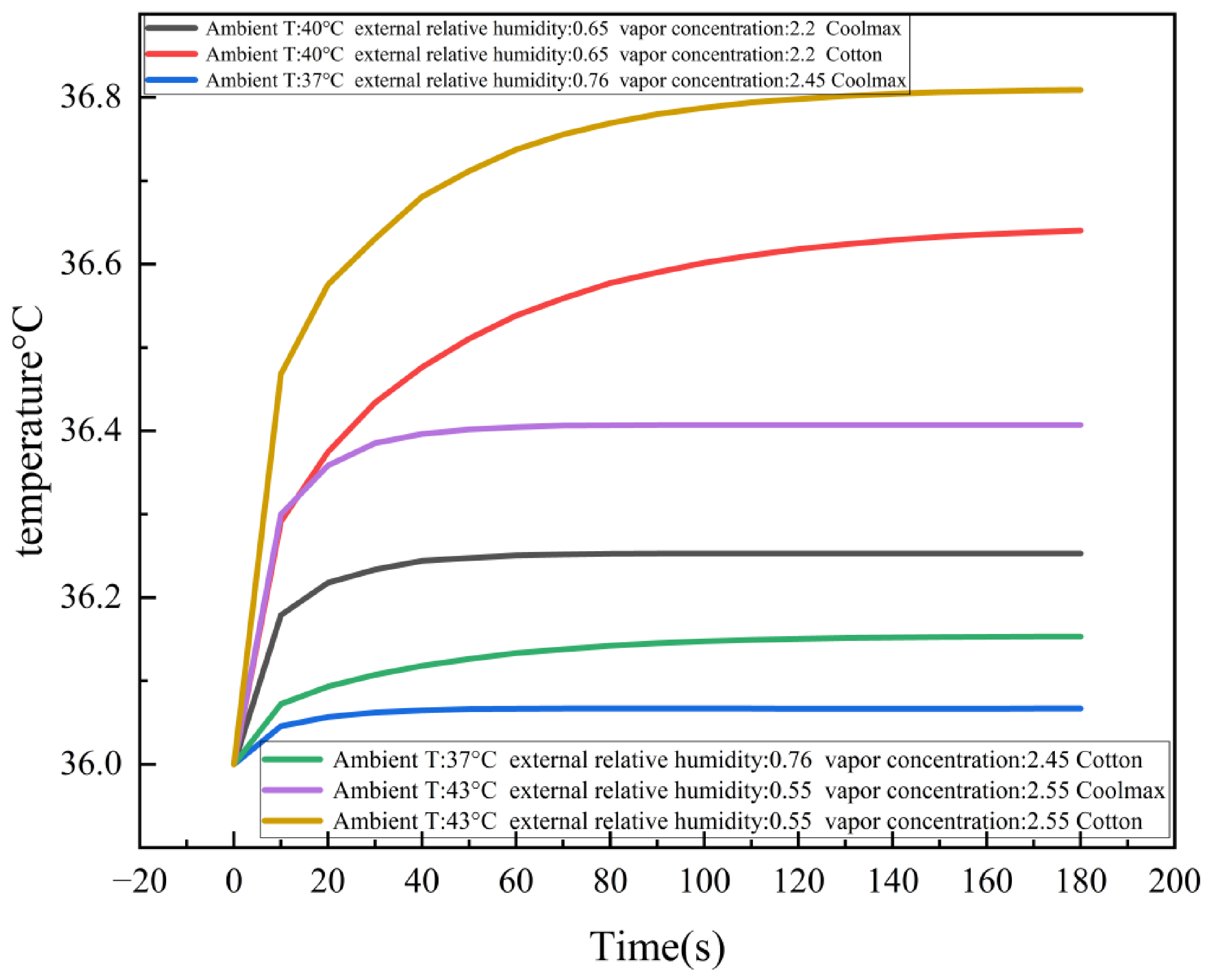
The simulation results are shown in
Figure 17. The increase in external temperature makes the internal temperature of the two fabrics increase as a whole, but the temperature rise range of Coolmax is always smaller than that of the cotton fabric. When the external temperature is 37 °C, the maximum temperature of Coolmax is about 36.05 °C; when it rises to 43 °C, its maximum temperature only rises to 36.45 °C, and the change range is about 0.4 °C. The temperature rise range of cotton fabric in the same range exceeds 0.8 °C. In addition, the temperature rise period of Coolmax is shorter than cotton, and its temperature tends to stabilize after 60 s, while cotton takes about 90 s to reach steady state, which indicates that Coolmax has a faster heat equilibrium establishment speed and better heat conduction stability.
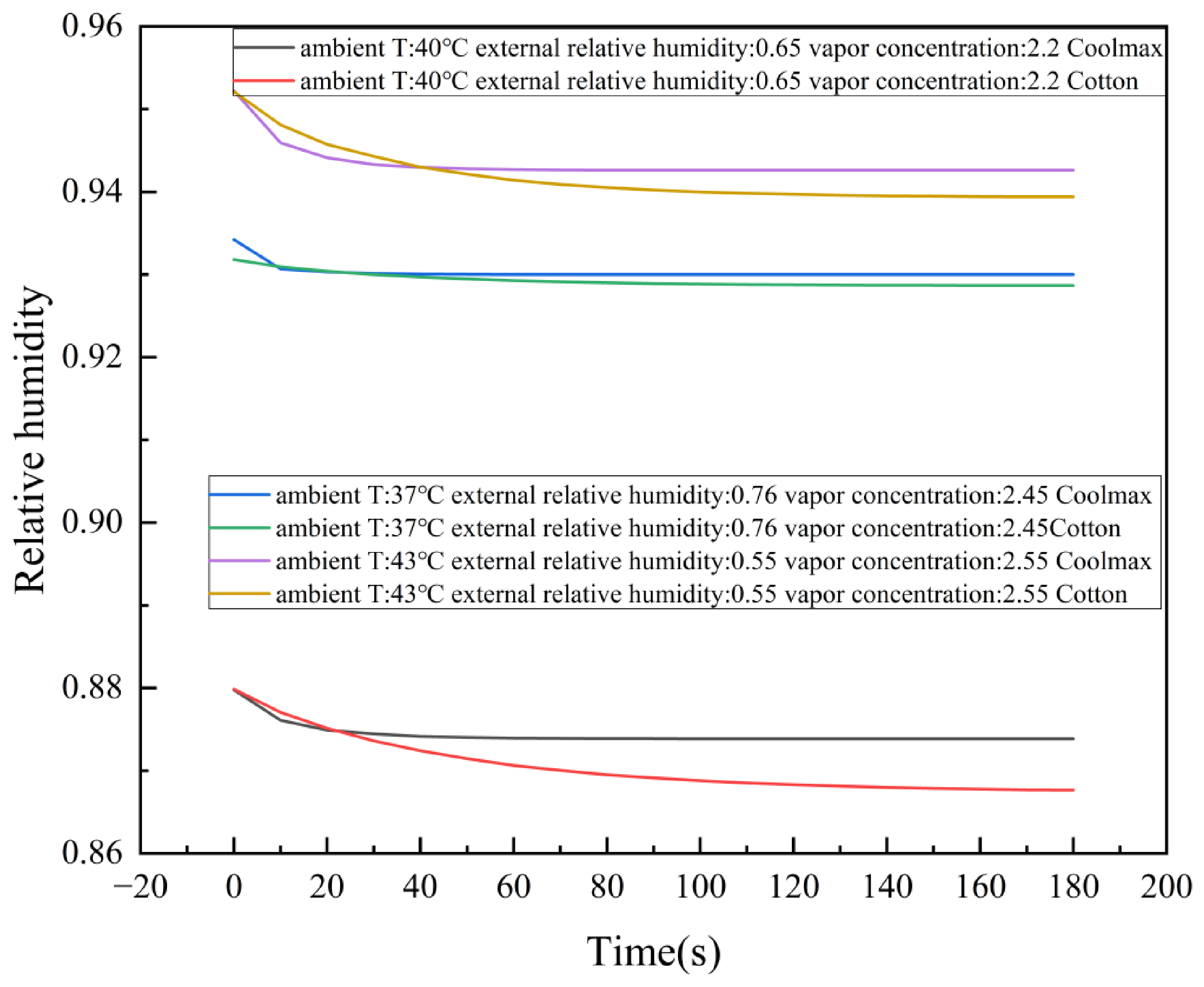
The humidity results are shown in
Figure 18. The relative-humidity curve of Coolmax is always above that of cotton fabric in the range of 37–43 °C, and tends to stabilize after 200 s. When the ambient temperature is 37 °C, the Coolmax steady state relative humidity is 0.94, cotton fabric is 0.92. When the ambient temperature is 43 °C, Coolmax is 0.95, and cotton fabric is only 0.93. When the temperature increases, the humidity difference between the two increases further.
The analysis shows that the moisture evaporation rate of cotton fiber increases rapidly at high temperatures due to its high hydrophilicity and high moisture content, which causes the moisture to decrease rapidly. Coolmax has strong hydrophobicity and a small evaporation heat absorption effect, which can establish a stable moisture distribution in a short time.
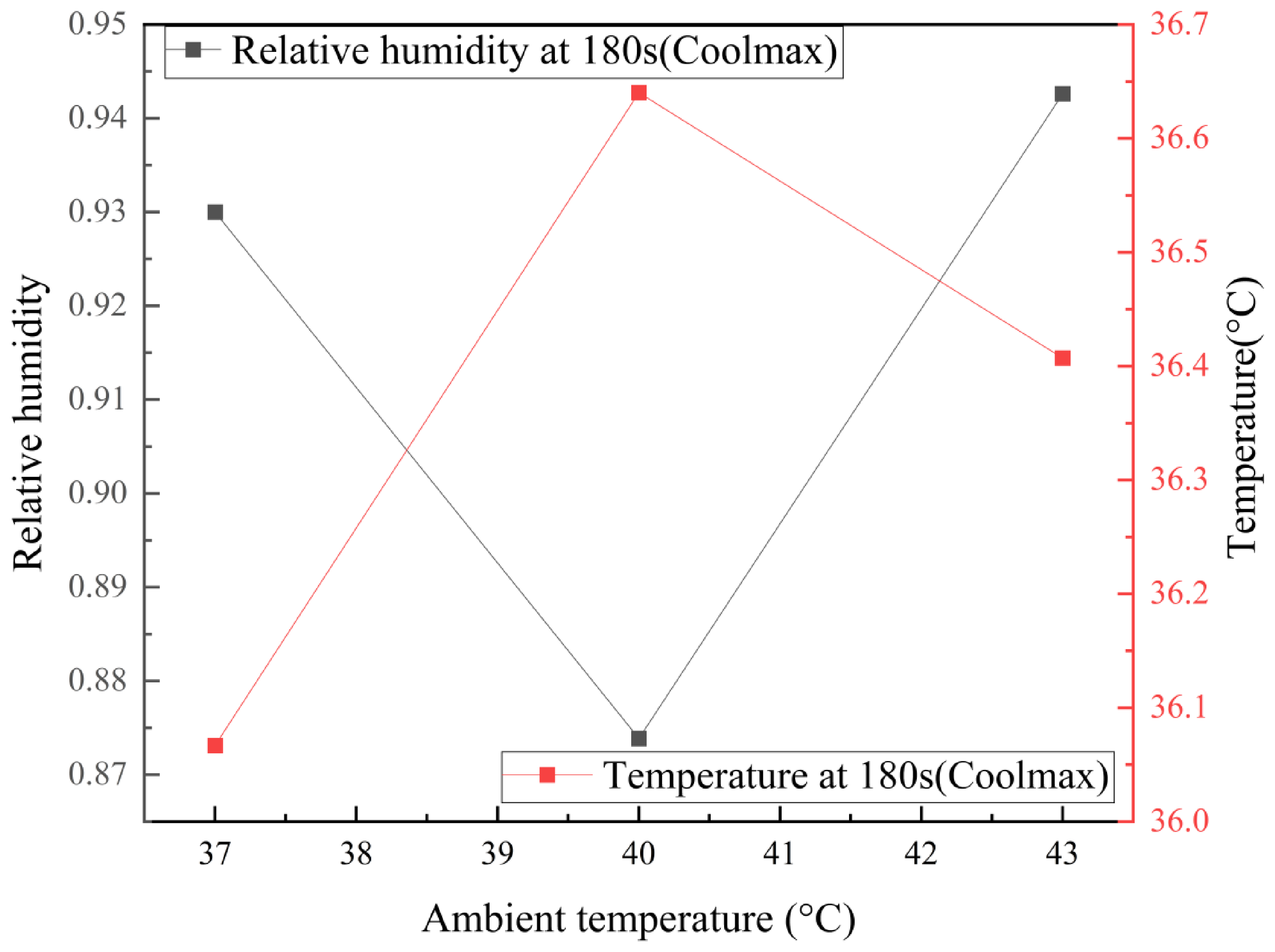
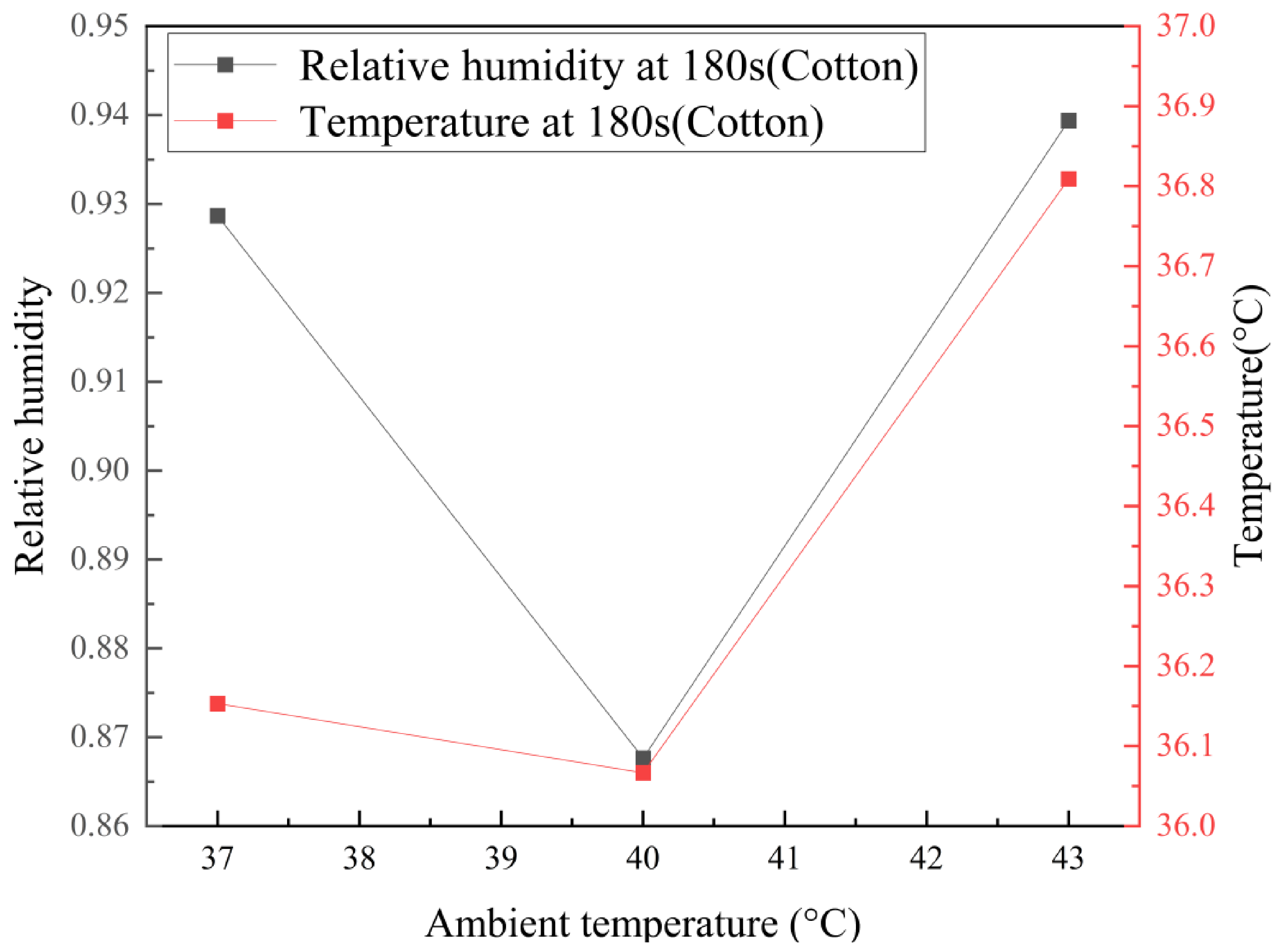
To further clarify the dependence of the heat–moisture response on ambient temperature, the temperature and relative-humidity values at the representative time point of t = 180 s were extracted and compared, as shown in
Figure 19 and
Figure 20. For Coolmax fabric, the relative humidity first decreases from about 0.93 at 37 °C to about 0.87 at 40 °C, and then increases to about 0.94 at 43 °C, while the corresponding temperature remains within a relatively limited range of approximately 36.0–36.6 °C. This indicates that Coolmax can maintain a stable thermal response under different hot-environment conditions, although the humidity field is affected by the combined influence of ambient temperature, vapor concentration, and external relative humidity. For cotton fabric, both temperature and relative humidity also vary with ambient temperature, but the temperature level at 43 °C is higher than that of Coolmax, indicating stronger heat accumulation under high-temperature conditions. The comparison at t = 180 s provides a more direct parameter-based view of the ambient-temperature effect and further confirms that Coolmax exhibits better heat–moisture adaptability than cotton in hot environments.
Overall, the transient curves and the extracted values at t = 180 s consistently indicate that Coolmax fabric has a smaller temperature rise range and better humidity-regulation stability under different ambient temperatures. With increasing ambient temperature, the difference between Coolmax and cotton becomes more evident, suggesting that Coolmax is more suitable for sweat-protective clothing used in high-temperature and high-humidity environments.
3.3. Effect of Thickness Change on Temperature and Relative Humidity
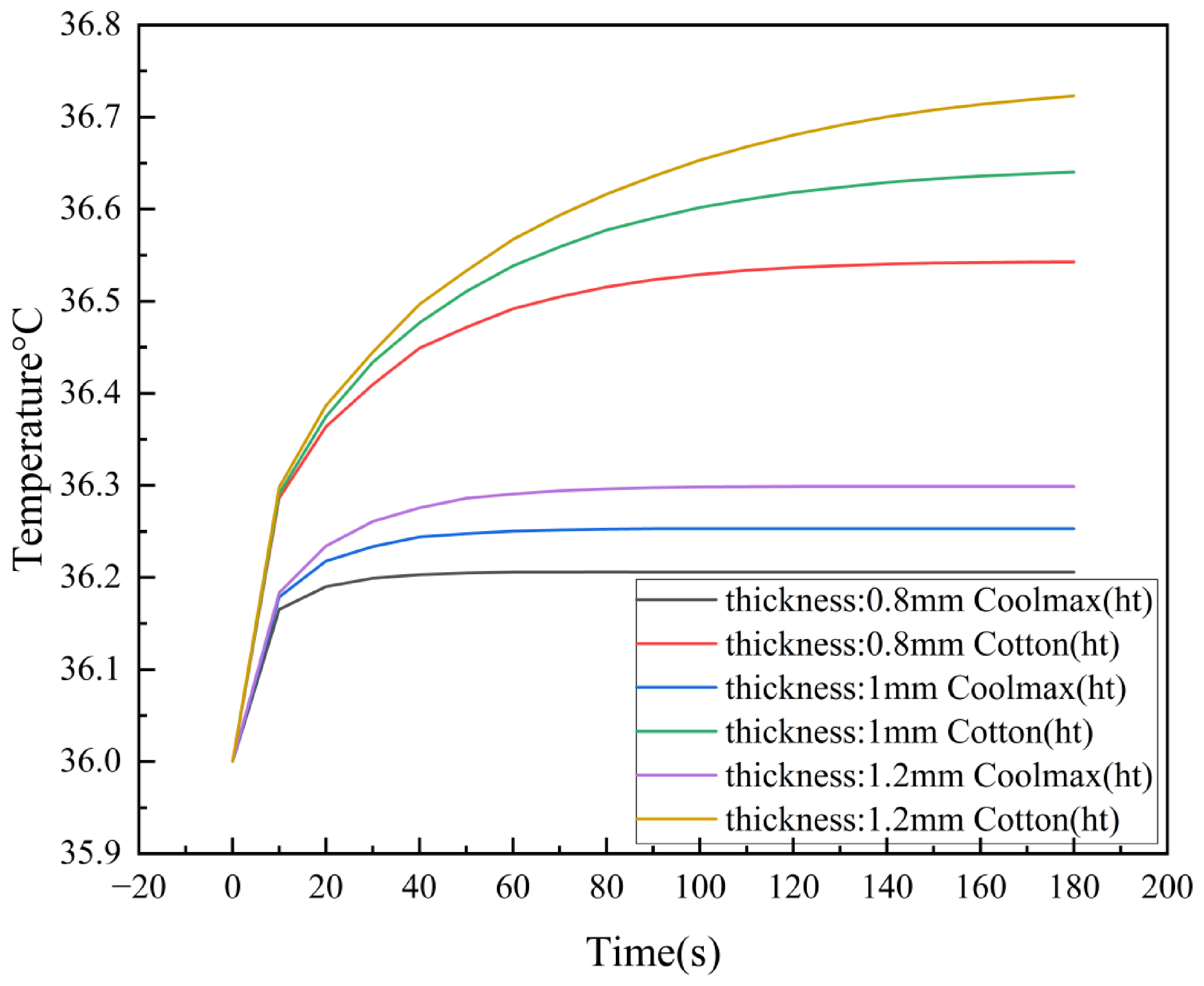
In order to investigate the influence of fabric thickness on heat and moisture transfer properties, the fabric thickness was set to 0.8 mm, 1.0 mm and 1.2 mm, respectively, under the condition of constant ambient temperature of 40 °C and relative humidity of 0.65, corresponding to three structural forms: light-weight type, conventional type and thickened type. Using the coupled model of “heat transfer and equilibrium moisture transport in wet porous media” established by COMSOL Multiphysics, the transient variation in temperature field and humidity field in different thickness materials was calculated, and the output data of probes were fitted and plotted in Origin.
As shown in
Figure 21, when the thickness increases from 0.8 mm to 1.2 mm, the temperature of both materials tends to increase with increasing thickness, but the Coolmax material has a smaller temperature rise, and its internal temperature changes more gently. Specifically, when the thickness is 0.8 mm, the maximum temperature of Coolmax is about 36.20 °C. When the thickness increases to 1.0 mm, it rises to 36.27 °C, and when the thickness increases to 1.2 mm, it reaches about 36.30 °C. The highest temperature of cotton fabric is 36.32 °C, 36.45 °C and 36.70 °C respectively, and the heating rate is obviously higher than Coolmax, which indicates that cotton fabric has a more obvious heat accumulation phenomenon with increasing thickness.
The thickness-dependent temperature response can be attributed to the known structural and thermal characteristics of the two fabrics. Coolmax is composed of hydrophobic profiled polyester fibers with relatively low thermal conductivity, and the air gaps between fibers can form a relatively stable insulating layer, thereby weakening inward heat transfer. Therefore, increasing thickness has only a limited influence on the internal temperature of Coolmax. In contrast, cotton fibers have stronger moisture absorption and moisture retention, so increasing thickness tends to increase the heat transfer path and promote heat accumulation.
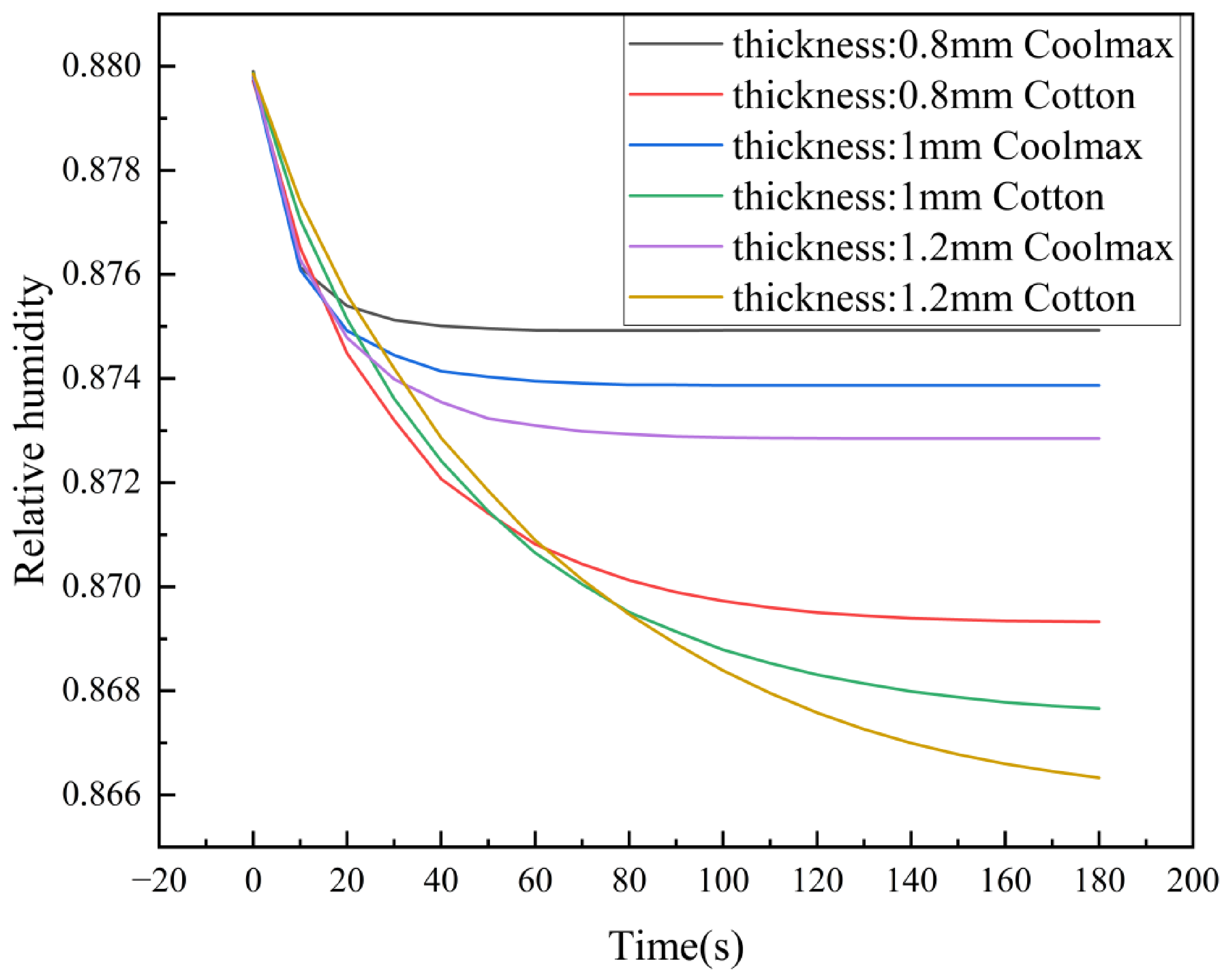
In terms of humidity change, as shown in
Figure 22, the average relative humidity of Coolmax material shows a slight downward trend with increasing thickness, while cotton fabric shows a more pronounced decreasing trend. When the thickness is 0.8 mm, the steady-state relative humidity of Coolmax is about 0.875. When it increases to 1.0 mm, it decreases to 0.873, and when it increases to 1.2 mm, it further decreases to 0.872. However, the moisture curve of cotton fabric decreases faster, and its steady-state relative humidity gradually decreases from 0.870 (0.8 mm) to 0.868 (1.0 mm) and 0.866 (1.2 mm). The difference is due to the fact that the Coolmax fiber groove structure can form moisture transmission channels along the fiber direction, which is conducive to moisture diffusion, while cotton fabric has obvious moisture absorption and moisture storage effects, and the increase in thickness leads to an increase in moisture diffusion path, and the humidity is not easy to decrease.
It should be noted that this explanation refers to the effective vapor-dominated moisture response within the porous-medium model, rather than to a fully resolved liquid-sweat-wicking process. The faster decrease in the cotton relative-humidity curve does not contradict its moisture absorption and storage tendency. In the present model, cotton has a stronger effective moisture storage capacity, but the increase in thickness also lengthens the vapor diffusion path and increases the resistance to moisture redistribution. As a result, the relative humidity of cotton becomes more sensitive to thickness variation. By contrast, the grooved structure of Coolmax provides more continuous vapor-transfer pathways, so the increase in thickness causes only a slight decrease in relative humidity. Therefore, the observed humidity trends are reasonable under the same vapor-input boundary condition and effective porous-medium assumption.
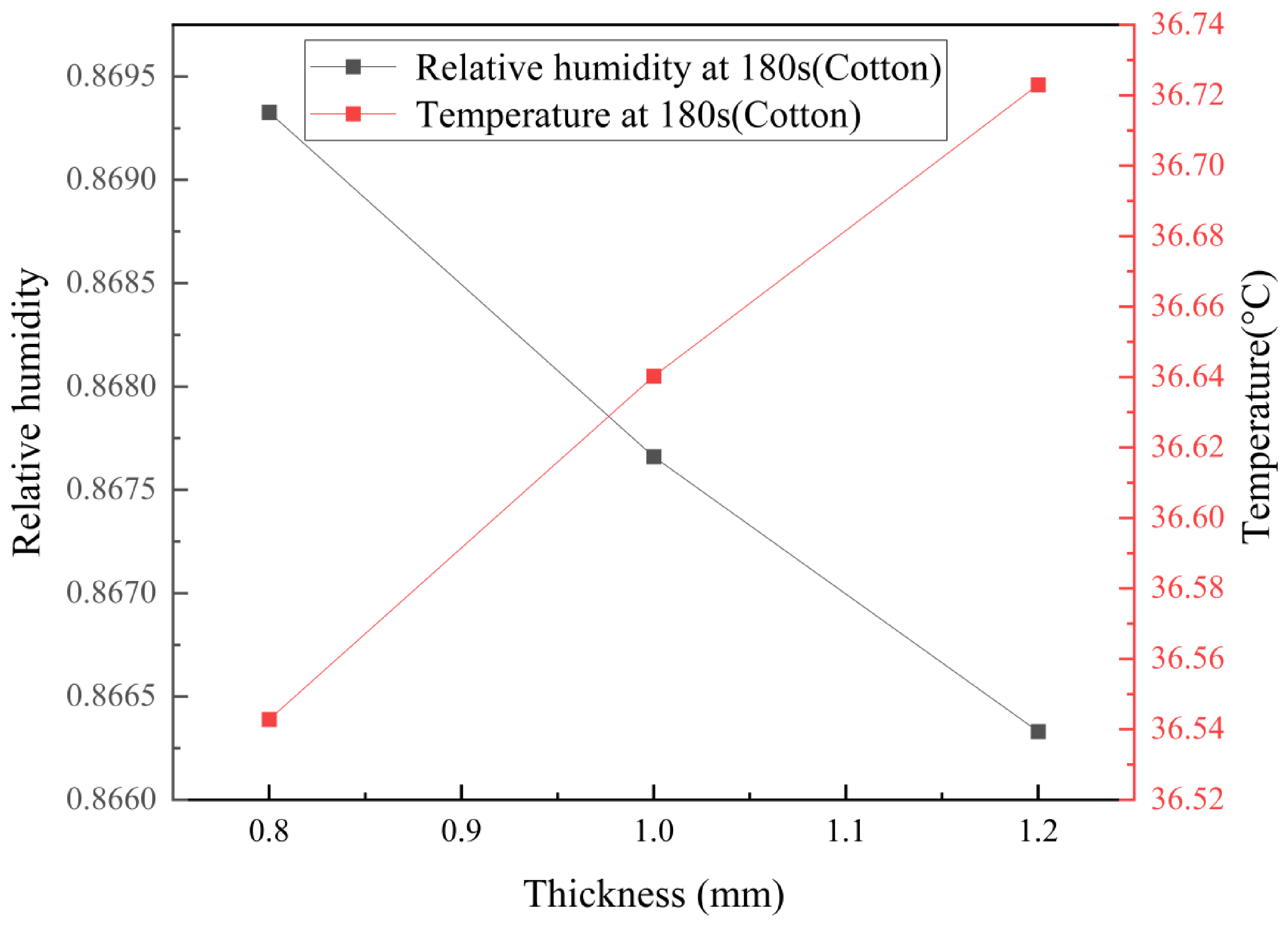
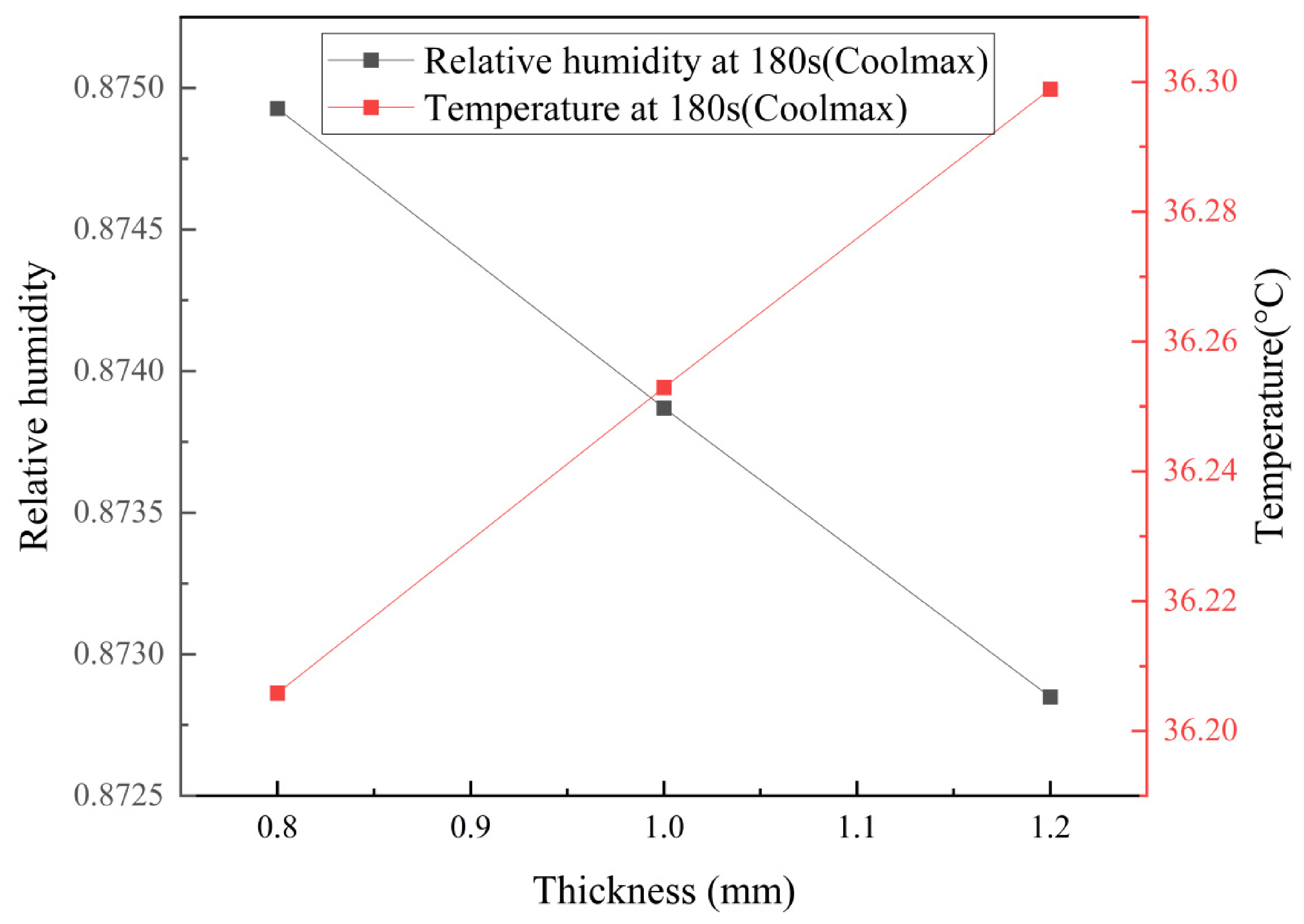
To further demonstrate the dependence of the heat–moisture response on fabric thickness, the temperature and relative-humidity values at the representative time point of t = 180 s were extracted and compared, as shown in
Figure 23 and
Figure 24. For Coolmax fabric, as the thickness increases from 0.8 to 1.2 mm, the temperature increases slightly from about 36.21 °C to 36.30 °C, while the relative humidity decreases only slightly from about 0.875 to 0.873. This indicates that the thermal and moisture responses of Coolmax remain relatively stable even when the fabric thickness increases. In contrast, cotton shows a more pronounced temperature increase from about 36.54 °C to 36.72 °C, accompanied by a decrease in relative humidity from about 0.869 to 0.866. The comparison at t = 180 s provides a more direct parameter-based view of the thickness effect and confirms that increasing thickness has a stronger adverse influence on cotton than on Coolmax.
Overall, both the transient curves and the extracted values at t = 180 s show that Coolmax maintains a smaller temperature rise and more stable humidity response under different thickness conditions, whereas cotton exhibits stronger heat accumulation and greater humidity variation as thickness increases. This indicates that Coolmax is more suitable for thickened or composite sweat-protective clothing structures.
3.4. Effect of Porosity Change on Temperature and Humidity
In order to investigate the influence of fabric pore structure on its heat and moisture transfer performance, under the conditions of constant external temperature of 40 °C, relative humidity of 0.65 and convective heat transfer coefficient h = 20 W/(m
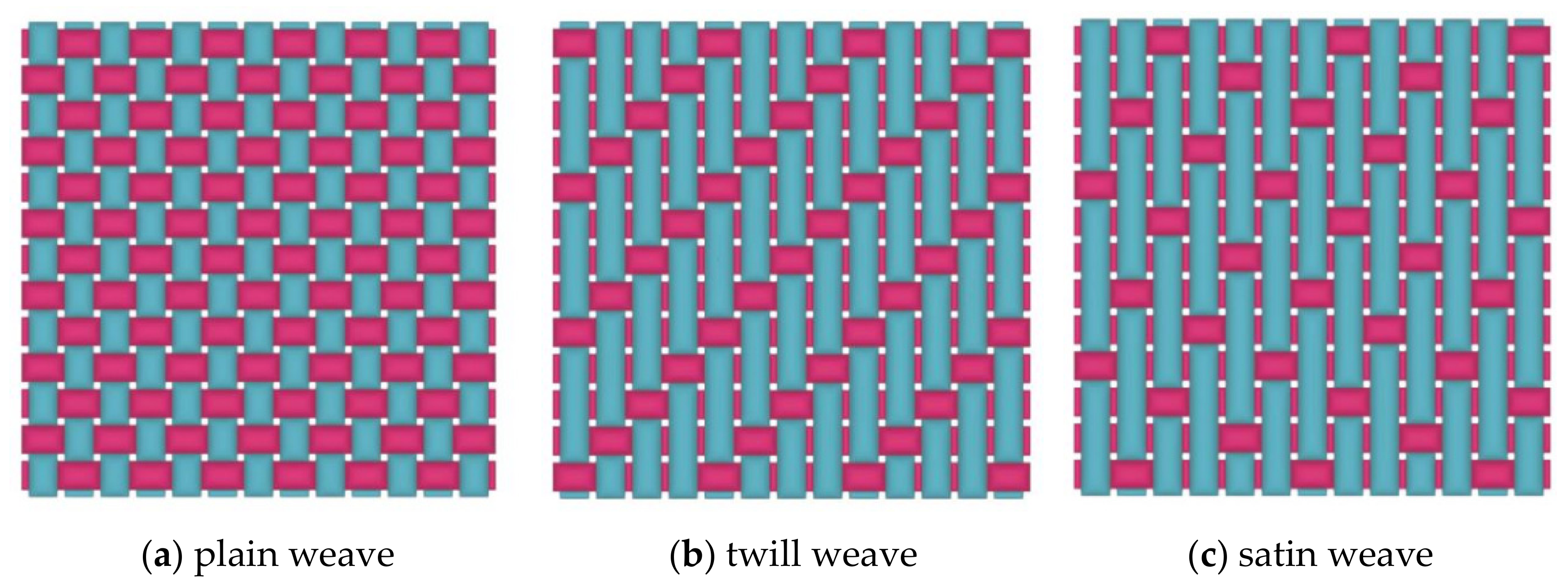
2·K), three fabric structures of plain, twill and satin were constructed respectively, corresponding to three pore morphologies of low porosity, medium porosity and high porosity, as shown in
Figure 25a,
Figure 25b and
Figure 25c respectively. In these figures, the red and blue blocks represent the weft and warp yarns of the woven fabric, respectively, while the white spaces between yarns correspond to the pore regions (air gaps) within the fabric structure.
It should be noted that the plain, twill, and satin structures shown in
Figure 25 were used to represent different pore morphologies and porosity levels, rather than to construct fully resolved yarn-scale braided geometries in COMSOL. In the numerical simulations, the same equivalent porous-medium model, governing equations, boundary conditions, and solution procedure described in
Section 2.2,
Section 2.3 and
Section 2.4 were used. The effect of weave structure was introduced by changing the effective porosity parameter in the porous-medium material settings. Therefore, no additional specialized solution method or separate finite element formulation was required for the weave-structure cases. The mesh corresponding to 46,550 nodal unknowns, which had been verified by the mesh-independence analysis in
Section 2.4, was used for all porosity cases. In this way, the influence of numerical discretization on the porosity-analysis results was controlled, and the observed differences mainly reflect the effect of the prescribed effective porosity rather than mesh variation.
The variation in weave pattern (plain, twill, and satin) leads to different yarn interlacing frequencies and pore distributions, thereby resulting in distinct porosity levels and internal flow pathways for heat and moisture transfer.
Using the coupled model of “heat transfer and equilibrium moisture transport in porous media containing moisture” established by COMSOL Multiphysics, the transient variation in temperature field and humidity field in materials with different pore structures was calculated, and the output data of probes were fitted and plotted in Origin.
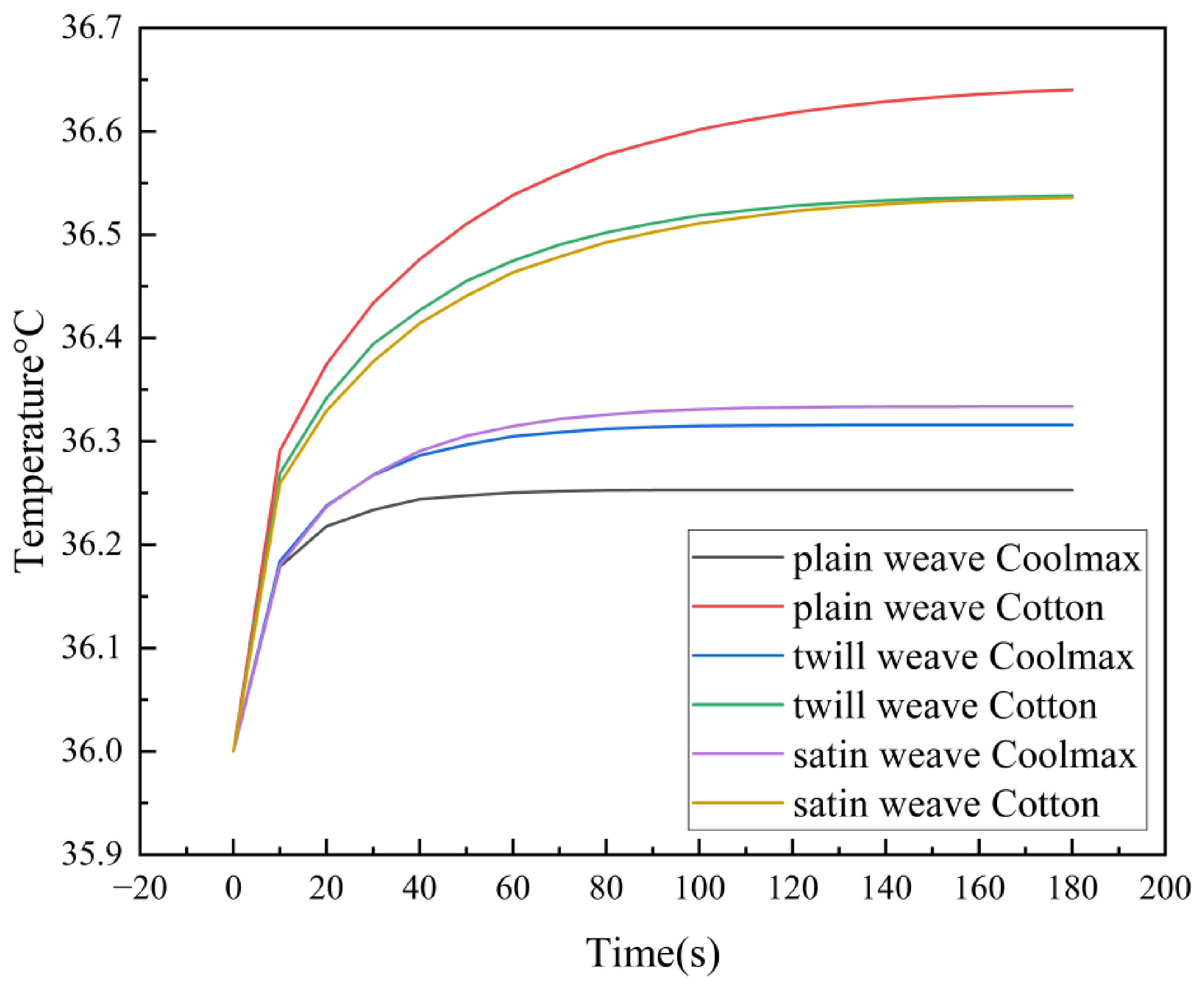
As shown in
Figure 26, when the fabric structure changes from plain to twill to satin (gradually increasing porosity), the temperature of the two materials shows a significantly different trend. For Coolmax material, the steady-state temperature increases slightly with increasing porosity: about 36.25 °C for plain, 36.31 °C for twill, and further to about 36.33 °C for satin structure. The temperature of cotton fabric decreases slightly with the increase in porosity, from 36.64 °C in plain weave to 36.53 °C in twill weave, and further decreases to 36.52 °C in satin weave.
This porosity-dependent response can be interpreted based on the known hydrophobic grooved structure of Coolmax and the hydrophilic nature of cotton. In the present vapor-dominated porous-medium model, moisture transport in Coolmax mainly occurs through vapor diffusion and moisture redistribution. As porosity increases, the internal air channels become more continuous, which enhances vapor diffusion and air exchange, resulting in a slight increase in temperature and a slight decrease in relative humidity. In contrast, cotton has a stronger moisture adsorption and storage tendency, so its response to porosity is more strongly affected by moisture retention and redistribution.
It should be noted that the above temperature trend and the following relative-humidity trend describe two different aspects of the coupled heat–moisture response, and therefore they are not contradictory. The decrease in cotton temperature with increasing porosity is mainly related to the enhanced effective moisture redistribution and evaporative heat removal under a more open pore structure. In contrast, the increase in cotton relative humidity reflects its stronger moisture adsorption and storage tendency after moisture is redistributed within the porous domain. In other words, higher porosity can simultaneously reduce local heat accumulation through enhanced moisture exchange and increase the overall humidity level because hydrophilic cotton fibers retain more moisture than hydrophobic profiled polyester. For Coolmax, the hydrophobic grooved structure promotes vapor diffusion and discharge through the enlarged pore channels, so its relative humidity decreases slightly, while the enhanced air exchange also leads to a limited temperature increase. Therefore, the opposite temperature and humidity trends of Coolmax and cotton are reasonable within the effective porous-medium framework of the present model.
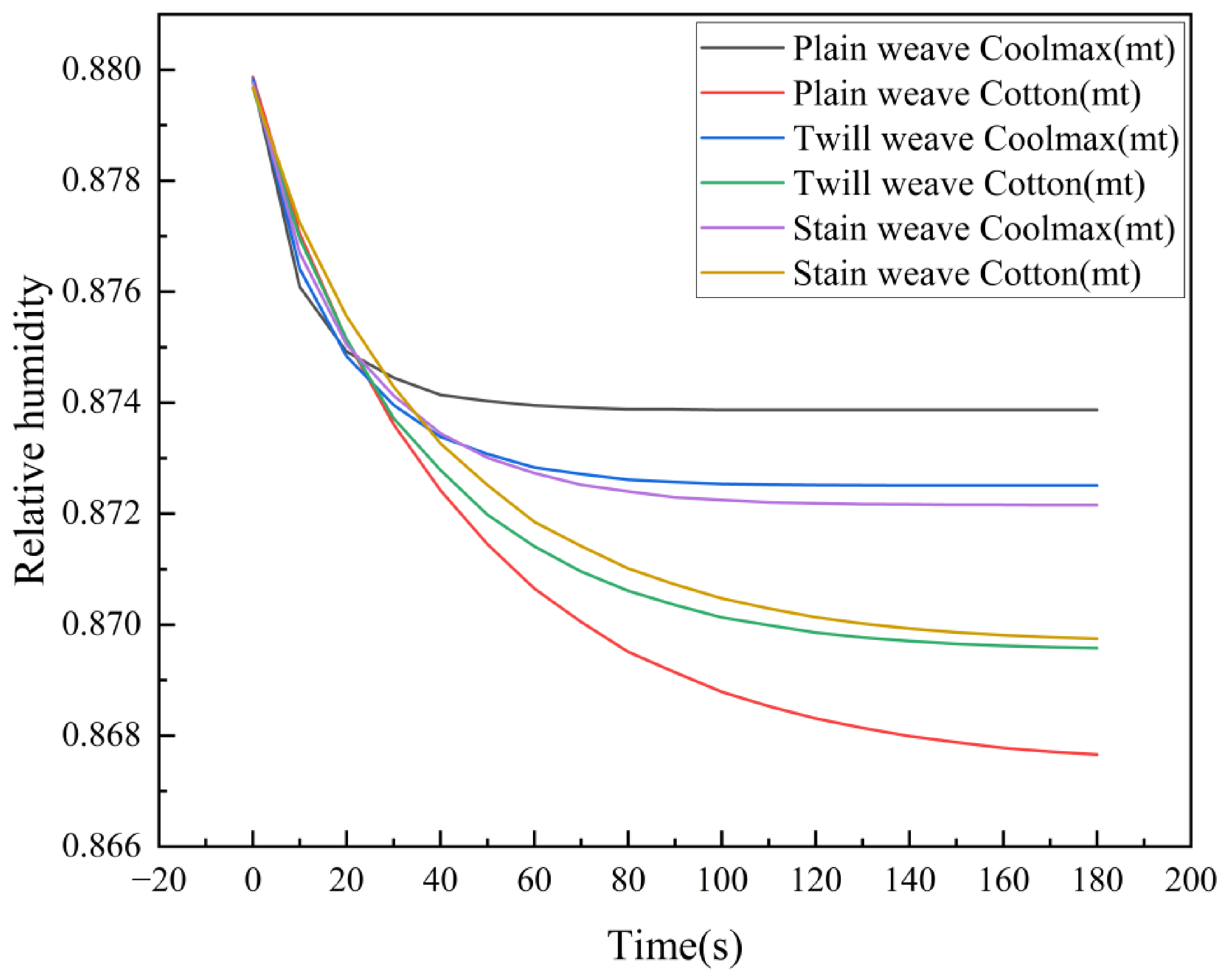
In terms of humidity variation, Coolmax shows a diametrically opposite trend to cotton materials, as shown in
Figure 27. The average relative humidity of Coolmax decreases gradually with increasing porosity, from about 0.874 in plain weave to 0.873 in diagonal weave, and further to about 0.872 in satin weave. The moisture content of cotton increased with the increase in porosity, from 0.868 in plain weave to 0.870 in diagonal weave, and reached about 0.871 in satin weave. The difference was due to the fact that Coolmax fiber grooves and hydrophobic surfaces were more conducive to rapid water vapor discharge in high porosity, while cotton fibers were more likely to absorb and retain moisture in high porosity conditions.
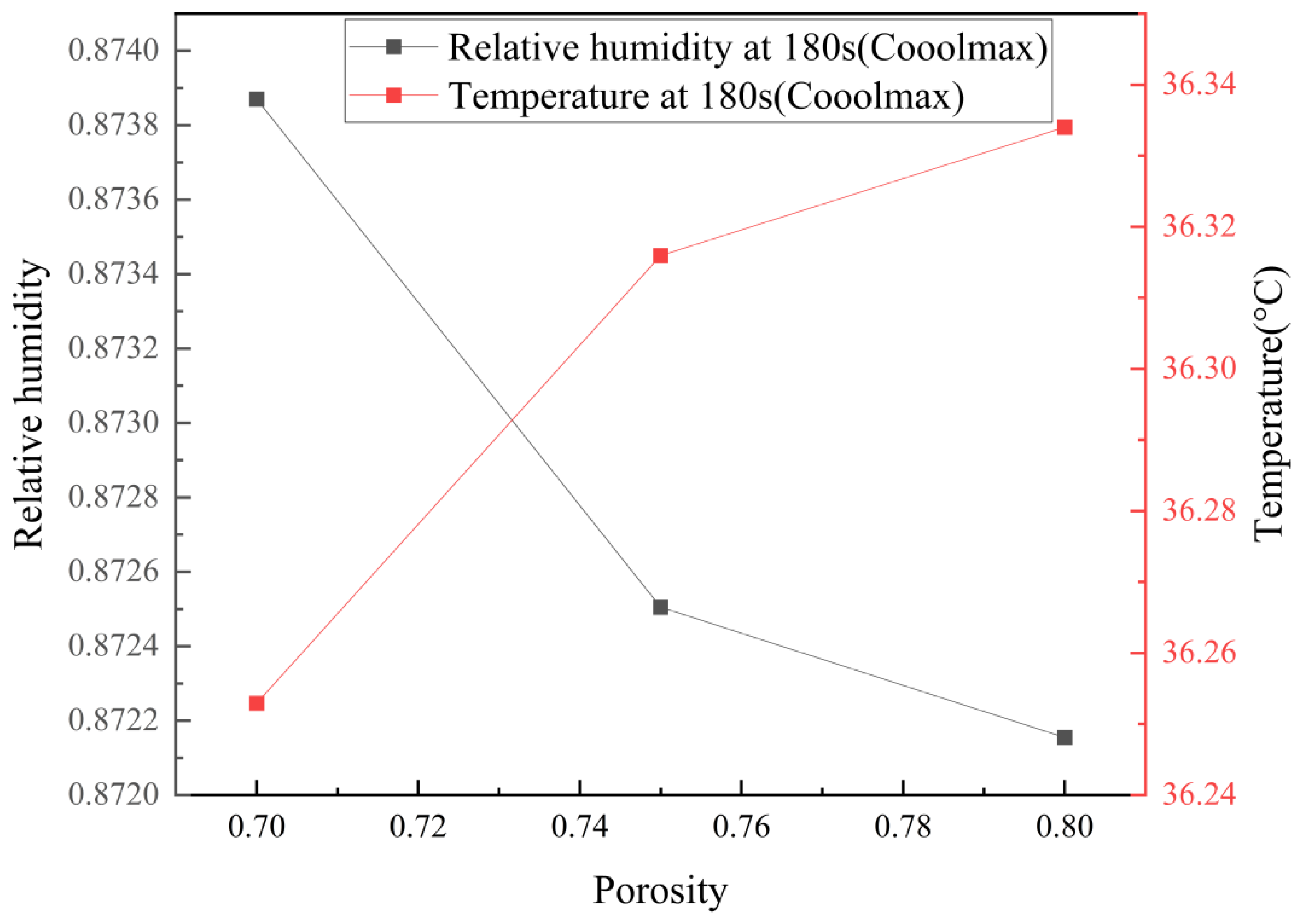
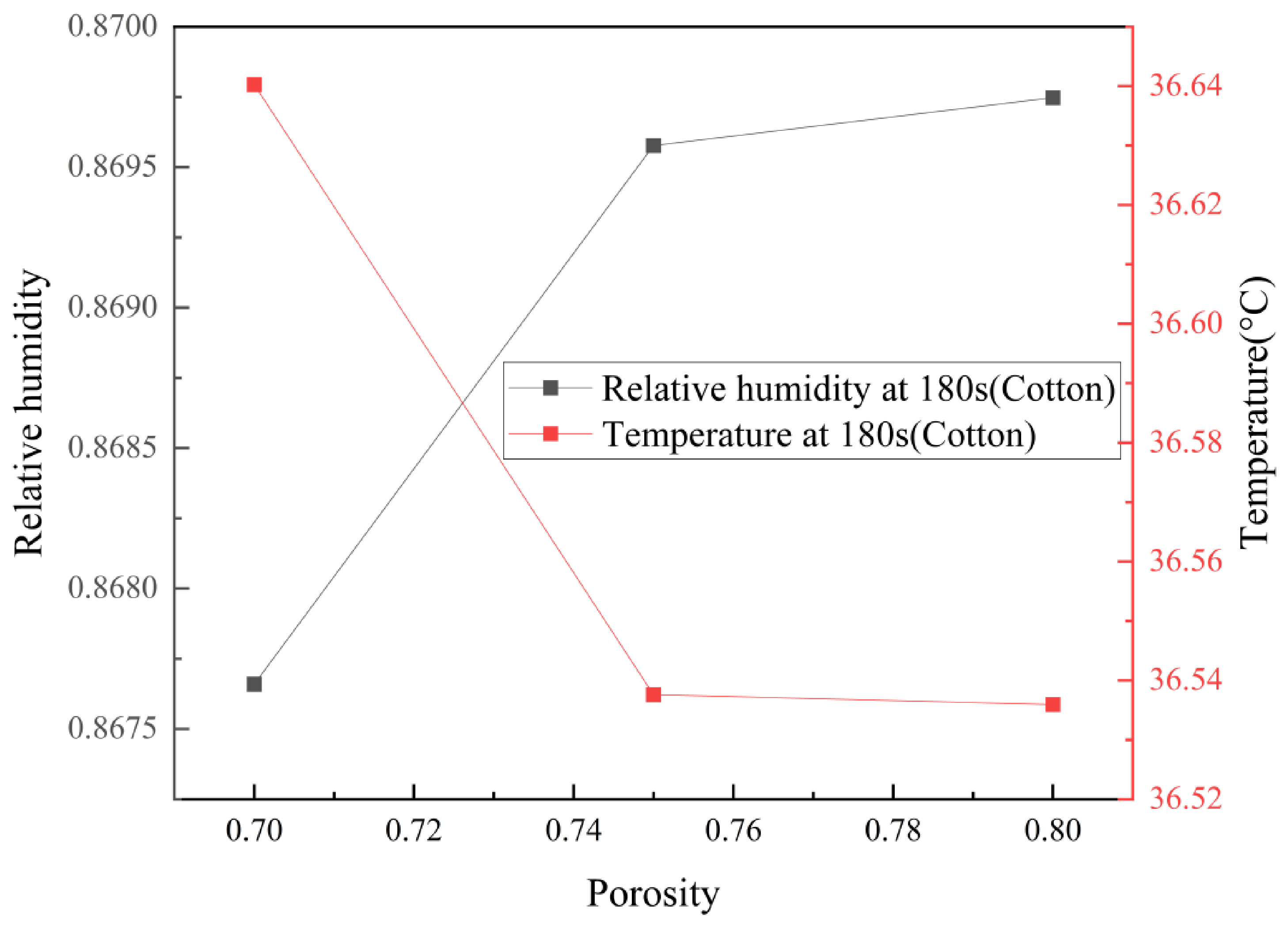
To further demonstrate the dependence of the heat–moisture response on porosity, the temperature and relative-humidity values at the representative time point of t = 180 s were extracted and compared, as shown in
Figure 28 and
Figure 29. For Coolmax fabric, as the porosity increases from 0.70 to 0.80, the relative humidity decreases slightly from about 0.874 to 0.872, while the temperature increases slightly from about 36.25 °C to 36.34 °C. This indicates that higher porosity promotes moisture diffusion and air exchange in the Coolmax porous domain, leading to a lower humidity level but a slightly higher temperature at the selected time point. For cotton fabric, the relative humidity increases from about 0.868 to 0.870, whereas the temperature decreases from about 36.64 °C to 36.54 °C as porosity increases. This opposite trend suggests that cotton is more affected by moisture absorption and retention, while the increased pore space changes the balance between heat storage and moisture redistribution. The comparison at t = 180 s provides a more direct parameter-based view of the porosity effect and confirms that Coolmax maintains a more stable heat–moisture response under different pore-structure conditions.
Overall, both the transient curves and the extracted values at t = 180 s show that increasing porosity leads to a slight decrease in relative humidity and a limited temperature rise for Coolmax, reflecting its enhanced moisture diffusion and air-exchange capability. In contrast, cotton shows a humidity increase and temperature decrease with increasing porosity, indicating that its response is more strongly influenced by moisture absorption and storage. Therefore, under high-porosity fabric structures, Coolmax can maintain a relatively dry and stable heat–moisture state, making it more suitable for protective clothing and functional clothing applications under high-perspiration conditions.
In addition to the plain, twill, and satin structures investigated in this study, other woven fiber or yarn arrangements may also be considered by combining or extending the structural characteristics of these three basic weave patterns. The basis for this inference is that the present results show that changes in yarn interlacing frequency, pore distribution, porosity, and internal transfer pathways can significantly affect temperature and humidity regulation. Therefore, woven structures with optimized interlacing frequency, yarn spacing, pore distribution, and directional arrangement of grooved fibers may provide further optimization potential. For example, reducing local yarn interlacing density or increasing the continuity of pore channels may improve vapor diffusion and air exchange within the woven fabric domain. In addition, aligned grooved fibers or directional yarn arrangements may further strengthen the continuous transfer pathways observed in the Coolmax structure, thereby improving vapor diffusion and evaporation. Therefore, future optimization of sweat-protective woven fabrics can draw on the mechanisms revealed by the plain, twill, and satin cases, but the actual performance of these extended woven structures still needs to be verified through further numerical simulations and experiments.
3.5. Coolmax Material Performance Evaluation
To quantitatively evaluate the heat–moisture regulation performance of Coolmax fabric in sweat-protective clothing, a comprehensive performance assessment was conducted based on the simulation results. A dual-objective evaluation method, considering both cooling and moisture removal, was established with reference to commonly used performance assessment approaches in the field of heat transfer and thermal management. The overall performance of Coolmax and cotton fabrics under different working conditions was then compared and analyzed.
The comfort and safety of sweat-protective clothing are mainly governed by two key factors. One is the maximum temperature of the fabric surface, since excessively high local temperatures may cause thermal discomfort and even thermal stress. The other is the overall humidity level of the fabric surface, because excessive humidity can hinder evaporative heat dissipation and thereby reduce wearing comfort. Based on the concept of composite thermal comfort indices for textile materials, such as the thermal comfort index (TCI) proposed in previous studies [
38], this study selects the maximum fabric-surface temperature and the average relative humidity of the fabric surface as the key evaluation parameters, and further constructs a dimensionless comfort and sweating index (CSI) to characterize the overall cooling and perspiration performance of fabrics. The definition of CSI is given as follows:
In these equations, is the set temperature on the skin side. is the external environment temperature. is the temperature penalty term. is the humidity penalty term. is the weight coefficient. is the weight coefficient. = = 0.5 is taken, indicating that cooling is as important as perspiration.
The temperature penalty term represents the normalized thermal burden caused by the increase in the maximum fabric-surface temperature. A larger temperature penalty indicates a higher local temperature rise and a greater risk of thermal discomfort. The humidity penalty term represents the moisture burden associated with the average relative humidity of the fabric surface. A larger humidity penalty indicates stronger moisture accumulation near the fabric surface and a weaker moisture-removal ability. Therefore, the CSI combines the thermal penalty and humidity penalty into one dimensionless index, where a lower CSI value indicates better overall cooling and perspiration performance.
- (1)
Comparative analysis of CSI under different convective heat transfer coefficients
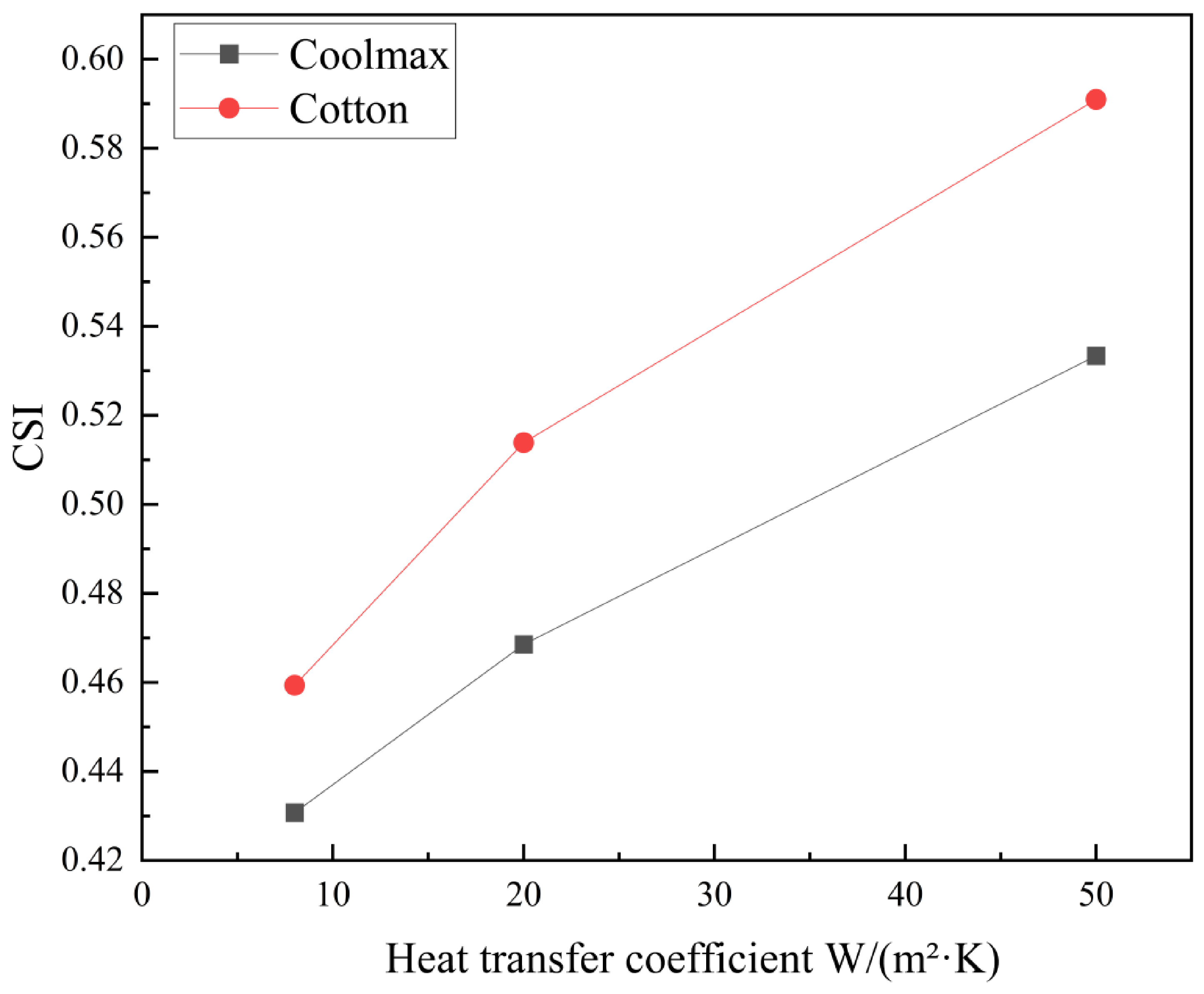
Figure 30 shows the CSI comparison results of Coolmax and cotton materials under different convective heat transfer coefficients
h = 6, 20, 25 W/(m
2·K). It can be seen that the CSI values of both materials increase with the increase in convective heat transfer coefficient, indicating that the heat–moisture load on the fabric surface increases under strong convective conditions. However, the CSI values of Coolmax fabrics are always lower than those of cotton materials under all heat transfer coefficient conditions, showing better comprehensive heat and moisture regulation performance.
At a low heat transfer coefficient h = 6 W/(m2·K), the CSI difference between Coolmax and cotton is relatively small, but Coolmax still shows a low comprehensive penalty level. With the increase in heat transfer coefficient h = 20 and 25 W/(m2·K), the CSI of cotton increases more obviously, while the CSI of Coolmax increases relatively gently. This indicates that Coolmax fabric can coordinate temperature control and humidity transfer more effectively in the case of increased human activity and increased air flow, and reduce the negative impact of a strong convective environment on comfort.
- (2)
Comparative analysis of CSI at different ambient temperatures
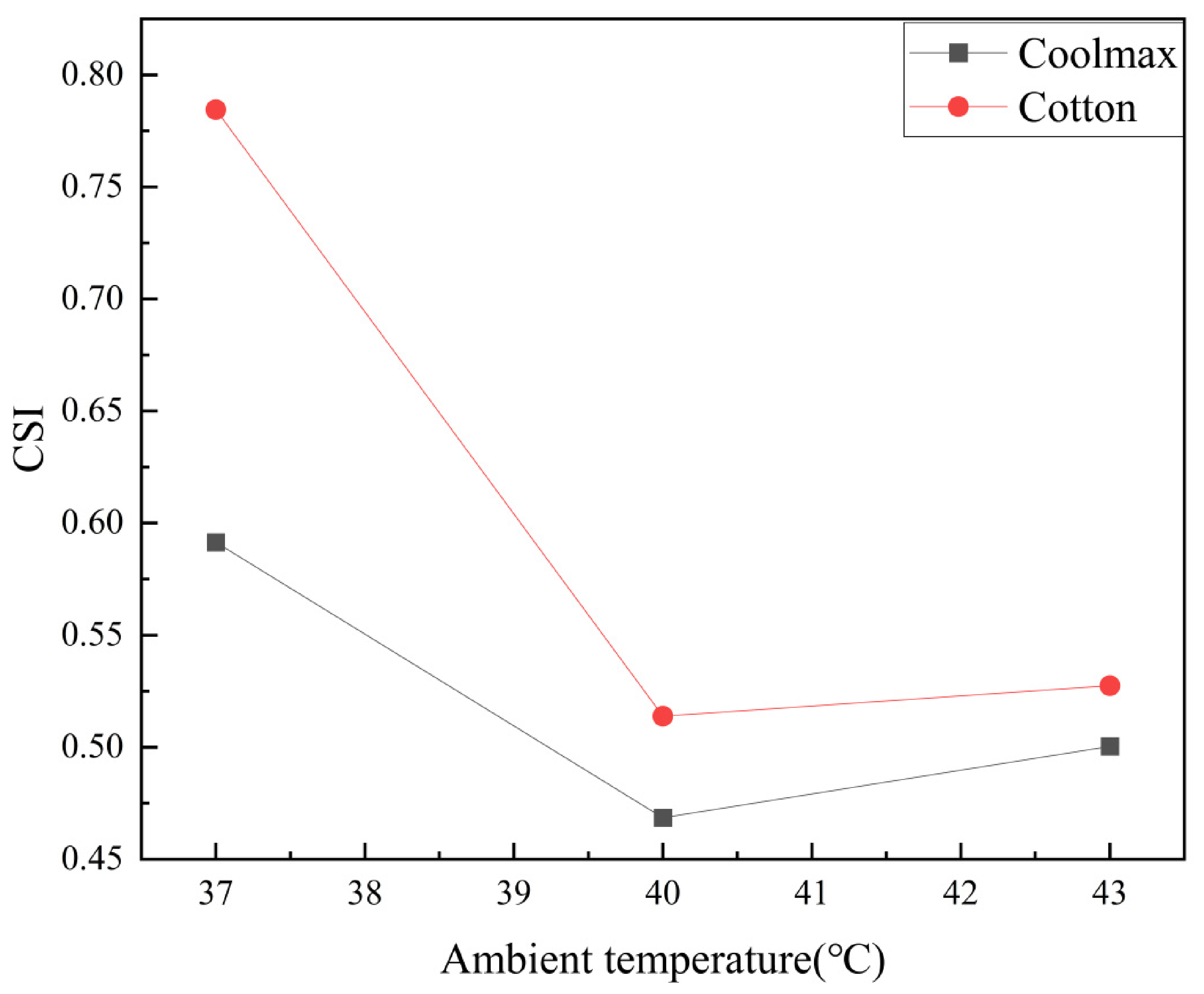
Figure 31 shows that the CSI values of both Coolmax and cotton do not increase monotonically with ambient temperature. Instead, the CSI is highest at 37 °C, decreases markedly at 40 °C, and then increases slightly again at 43 °C. This indicates that the overall thermal–moisture penalty is governed by the combined effects of temperature rise and humidity variation, rather than by ambient temperature alone.
At 37 °C, the ambient temperature is close to the skin temperature, which weakens sensible heat dissipation while not yet providing sufficient driving force for effective moisture transport, leading to the highest CSI values. At 40 °C, the balance between heat transfer and moisture removal becomes more favorable, resulting in the lowest CSI. When the ambient temperature further increases to 43 °C, the thermal burden rises again, and the CSI correspondingly increases, although the increase remains relatively small for Coolmax. Under all three conditions, the CSI of Coolmax is consistently lower than that of cotton, indicating better overall heat–moisture adaptability.
- (3)
Comprehensive assessment
Compared with cotton fabric, Coolmax fabric shows lower CSI values under all investigated conditions, indicating better comprehensive heat–moisture regulation performance. This result suggests that the profiled grooved structure of Coolmax fiber can promote vapor-dominated moisture transfer and heat dissipation while limiting local temperature rise, thereby maintaining a lower heat–moisture penalty level under high convective heat transfer intensity or high ambient-temperature conditions. In contrast, cotton fabric shows relatively higher CSI values because its stronger moisture absorption and retention tendency may lead to greater humidity accumulation and less stable heat–moisture regulation.
Overall, the CSI-based comprehensive evaluation can effectively reflect the performance differences between Coolmax and cotton fabrics in sweat-protective clothing applications. The CSI results are consistent with the temperature-field and relative-humidity-field analyses, further verifying the application advantages of Coolmax-type profiled polyester fabrics in sweat-protective clothing and high-intensity work garments.
4. Discussion
4.1. Scientific Interpretation of Results
The results demonstrate that the thermal–moisture behavior of fabrics is governed by the coupling between heat transfer and moisture transport mechanisms. Compared with cotton, Coolmax exhibits lower temperature rise and more stable humidity distribution, which can be attributed to its profiled groove structure and hydrophobic properties.
From a physical perspective, the groove channels enhance capillary-driven vapor transport and facilitate rapid moisture diffusion, while the reduced liquid water retention suppresses local heat accumulation. This indicates that vapor-dominated transport plays a key role in improving thermal comfort under high-temperature conditions.
This interpretation is limited to the effective porous-medium framework of the present model. Previous textile heat–moisture studies have shown that fabric performance can be evaluated using vapor-related indicators such as relative humidity, vapor pressure, water vapor concentration, moisture resistance, and water vapor permeability [
24,
25]. Therefore, the omission of explicit droplet condensation and re-evaporation does not change the main conclusion that Coolmax shows a smaller temperature rise and more stable humidity response than cotton under the same vapor-dominated boundary conditions. However, this conclusion should not be directly extended to fully wetted fabrics under heavy liquid-sweat conditions.
4.2. Practical Implications and Application Scenarios
From an engineering perspective, the results suggest that Coolmax fabrics are particularly suitable for high-temperature and high-sweat environments. For example, under ambient temperatures above 40 °C and high convective heat transfer conditions, Coolmax maintains lower CSI values and more stable thermal–moisture performance.
It should be noted that the purpose of this discussion is not to claim Coolmax as a newly developed commercial material, since its moisture-wicking ability has already been recognized in existing textile applications. Rather, the present study further verifies and quantifies its thermal–moisture regulation performance under controlled boundary conditions. By comparing Coolmax with cotton under different ambient temperatures, convective heat transfer coefficients, fabric thicknesses, and porosity levels, the simulation results provide additional evidence for its stable heat and moisture transfer behavior. Therefore, this work can promote the practical application of Coolmax-type profiled polyester fabrics by offering a quantitative reference for material selection, structural parameter optimization, and performance prediction in functional clothing design.
4.3. Impact on Human Thermal Comfort and Vulnerable Populations
The improved heat–moisture regulation performance of Coolmax fabrics can significantly enhance human thermal comfort. By reducing heat accumulation and maintaining stable humidity near the skin, the risk of heat stress and discomfort can be effectively mitigated.
This is particularly important for vulnerable populations, such as elderly individuals and outdoor workers, who are more susceptible to heat-related illnesses. The application of such functional fabrics can contribute to improving safety and working conditions in hot environments.
4.4. Limitations and Future Work
Although this study analyzed the heat and moisture transfer performance of Coolmax and cotton fabrics through numerical simulation, several limitations still exist. First, the fabric structure was simplified as an equivalent porous medium, which cannot fully represent the real yarn arrangement and fiber-level moisture transport behavior. Second, the boundary conditions were idealized, and dynamic factors in actual wearing conditions, such as body movement, variations in sweat rate, unstable airflow, and differences in skin temperature at different body parts, were not considered. Third, this study mainly focused on two fabric materials, while other factors such as weave structure, multilayer clothing systems, and long-term moisture accumulation were not included. In addition, the CSI evaluation method still needs further validation through experimental studies, such as sweating thermal manikin tests and human wearing trials under hot and humid conditions. Subjective evaluations of user comfort and acceptance should also be included to assess the practical applicability of the proposed index.
In future work, a more detailed multiscale model can be developed to better describe the real fabric structure and transport process. Experimental verification should also be carried out to compare simulation results with actual temperature and moisture data. At the same time, dynamic environmental conditions and sweating processes can be introduced into the model to improve its practical relevance. More functional textile designs, such as multilayer structures and phase change material integration, can also be studied to further enhance thermal–moisture comfort performance.
5. Conclusions
To improve the understanding and design of sweat-protective fabrics for hot environments, a three-dimensional thermal–moisture coupled porous-medium model of Coolmax and cotton fabrics was established in COMSOL Multiphysics. Using this model, the heat transfer and moisture transport behaviors of the two fabrics were systematically investigated under different ambient temperatures, convective heat transfer conditions, and structural parameters (thickness and porosity). The main conclusions are as follows:
- (1)
Coolmax fabric shows better temperature stability under various working conditions:
The numerical simulation results show that the skin-side temperatures of both fabrics increase with the ambient temperature (37–43 °C) and convective heat transfer coefficient (6–25 W/(m2·K)). However, the temperature rise in Coolmax is approximately 0.40 °C, which is about 50% lower than that of cotton (≈0.8 °C). In addition, the steady-state temperature of Coolmax remains about 0.3–0.6 °C lower than that of cotton under the same conditions.
- (2)
Coolmax has more excellent dynamic moisture removal and humidity stability characteristics:
Under different ambient temperatures and structural conditions, the skin-side relative humidity of Coolmax generally remains slightly higher and more stable than that of cotton. For example, under varying ambient temperatures, the steady-state relative humidity of Coolmax is about 0.94–0.95, whereas that of cotton is about 0.92–0.93, corresponding to a difference of approximately 0.02. Under different thickness conditions, the steady-state relative humidity of Coolmax remains in the range of about 0.872–0.875, compared with about 0.866–0.870 for cotton. Similarly, under different porosity conditions, Coolmax shows a range of about 0.872–0.874, while cotton remains around 0.868–0.871. These results indicate that Coolmax can maintain a more stable humidity state while still supporting moisture transport, whereas cotton tends to exhibit larger humidity variations due to its stronger moisture absorption and storage behavior.
- (3)
The adverse effect of fabric thickness on cotton materials is significantly stronger than that of Coolmax:
When the thickness increases from 0.8 mm to 1.2 mm, the maximum temperature of cotton fabric rises from approximately 36.32 °C to 36.70 °C (ΔT ≈ 0.38 °C), whereas that of Coolmax increases only from about 36.20 °C to 36.30 °C (ΔT ≈ 0.10 °C), indicating that the temperature rise in cotton is about 3–4 times higher than that of Coolmax.
In terms of humidity, the steady-state relative humidity of Coolmax decreases slightly from about 0.875 to 0.872 (Δ ≈ 0.003), while that of cotton changes from about 0.870 to 0.866 (Δ ≈ 0.004), showing a relatively larger variation.
These results indicate that cotton exhibits a more pronounced heat and moisture accumulation effect with increasing thickness, whereas the temperature and humidity variation in Coolmax remains limited. This suggests that the continuous moisture transmission channels formed by the grooved fiber structure can effectively shorten the moisture transfer path and reduce the heat and mass transfer resistance induced by thickness increase.
- (4)
Porosity significantly regulates the heat–moisture transfer behavior:
The numerical results show that, as porosity increases, the steady-state temperature of Coolmax rises slightly from about 36.25 °C to 36.33 °C (ΔT ≈ 0.08 °C), while its average relative humidity decreases from about 0.874 to 0.872 (ΔRH ≈ −0.002). In contrast, the steady-state temperature of cotton decreases from about 36.64 °C to 36.52 °C (ΔT ≈ −0.12 °C), whereas its average relative humidity increases from about 0.868 to 0.871 (ΔRH ≈ +0.003). These results reflect the synergistic characteristics of high porosity, enhanced moisture transport, and accelerated evaporation in Coolmax, indicating that a higher-porosity structure is more conducive to air circulation and moisture diffusion, thereby enhancing the evaporation and heat dissipation process. In general, higher porosity is more favorable for exploiting the moisture-transport advantage of Coolmax, whereas cotton fabrics are more prone to moisture accumulation and uneven heat–moisture distribution.
- (5)
The comprehensive evaluation results based on CSI further verify the performance advantages of Coolmax:
Similarly, under different ambient temperatures (
Figure 31), the CSI of Coolmax remains consistently lower than that of cotton. At 37 °C, the CSI values are 0.59 for Coolmax and 0.78 for cotton, corresponding to a significant reduction of approximately 24%. At 40 °C, the CSI decreases to 0.47 for Coolmax and 0.51 for cotton, while at 43 °C, it slightly increases to 0.50 and 0.53, respectively.
These results demonstrate that Coolmax maintains a consistently lower thermo-moisture penalty than cotton across varying environmental and convective conditions. The CSI trends are in good agreement with the temperature and humidity field analyses, further confirming the superior synergistic heat–moisture regulation capability of Coolmax in perspiration protection applications.