Article

Tapped Inductor-Based Current Converter with Wide Step-Down Range for DC Current Link Power Distribution

1
Department of Electrical and Electronics Engineering, The Hong Kong Polytechnic University, Hong Kong 999077, China
2
Department of Electrical Engineering, University of California, Merced, CA 95343, USA
*
Author to whom correspondence should be addressed.
Appl. Sci. 2026, 16(10), 4903; https://doi.org/10.3390/app16104903
Submission received: 4 April 2026 / Revised: 4 May 2026 / Accepted: 7 May 2026 / Published: 14 May 2026
(This article belongs to the Section Energy Science and Technology)

Featured Application

A new method of power distribution based on current mode that is an alternative method of power conversion and suitable for today’s high-demand load including electric vehicles, battery systems, and robots.

Abstract

Current-source DC links and their associated power converters require continuous conduction mode (CCM), necessitating specialized switching device configurations. These topologies have gained significant attention due to the increasing adoption of current-mode power distribution systems. The operation of a current-source DC-DC converter relies on temporary magnetic energy storage, typically regulated using established switch-mode power conversion techniques. For a stable current step up or step down the use of the tapped inductor concept can provide an ultimate stable solution for current adjustment and the proposed concept is now developed on a step-down current source DC-DC power converter for the first time to reveal in the power electronics field. The use of tapping concept is similar to a coupled inductor and this allows flexible current modification. In this article, this concept is extended to a family of Tapped inductor current-based DC-DC together with soft-switching to reduce the loss of the switching devices. The key advantage is that it can offer a wide range of current conversions with high efficiency. The theoretical and experimental analysis of the proposed converter family is presented. An experimental prototype of the converter was built and tested, operating with a switching frequency of 100 kHz and accommodating input currents ranging from 1 A to 10 A. The converter achieved current conversion ratios of 0.8, 0.67 and 0.57 times the input current, with an output power range of 1 W to 314 W. The maximum efficiency of 88% was achieved at an output power of 314 W. The high efficiency and wide current conversion range of this current-based converter make it suitable for a variety of applications such as current driving LED systems, photovoltaic (PV) system current source control, and constant current fast charging systems for electric vehicles (EVs).

1. Introduction

Over the past few decades, high step-down converters have become essential in various applications, including voltage regulator modules (VRMs) for microprocessors, telecommunications equipment, electric vehicles (EVs), and LED drivers. These converters are generally categorized into isolated and non-isolated topologies. While the conventional buck converter is a standard choice, it is often unsuitable for high step-down operations because it requires an extremely narrow duty cycle, which leads to significant power losses and degraded efficiency. Consequently, non-isolated converters are typically preferred over isolated alternatives, as the latter often introduce increased weight, higher costs, and additional power losses. Furthermore, the leakage inductance associated with isolation components can increase electromagnetic interference and slow down the overall system response. Therefore, significant numbers of non-isolated high step-down topologies have been introduced in recent years and aim to widen the duty cycle, decreasing the voltage and current stress on switches and diodes, reducing the switching and conduction losses, and improving the efficiency of the converters. The simplest way to achieve a high step-down conversion ratio is to utilize two-stage power conversion architectures as presented in [1,2,3,4,5]. The first stage converts the high input voltage to the middle-level voltage. After that, the second stage converts the middle-level voltage to a low output voltage. This approach can enable the converter to achieve a high voltage step-down. However, too many components are involved, leading to a decrease in the overall system efficiency and an increase in the cost. Therefore, single-stage high step-down converters have drawn more attention to be developed. Current development also includes various types of single-stage converter topologies, for example, series-capacitor, switched capacitors, coupled inductors, interleaved, and tapped inductors. In [6,7], Series-capacitor step-down converter topologies have been introduced. On the loading side, they can operate in the same way as a two-phase interleaved step-down converter that can provide an extremely fast dynamic response under load variation. Also, they can reduce the voltage stress on the semiconductor devices and double the useable duty cycle when compared with the conventional buck converter. Converters with coupled inductors were presented in [8,9,10], they can achieve a high step-down ratio by changing the coupled inductor turns ratio, and a new coupled inductor design was shown in [11]. A discrete inductor is used together with the coupled inductor in order to improve the output current ripple. This converter is suitable for low-current applications. In [12,13], switched capacitor converters (SCCs) topologies were introduced, which are constructed by switches and capacitors only, and a high step-down conversion ratio can be obtained depending on the number of capacitors used. The step-down ratio can be increased with an increase in the number of switched capacitors. Resonant converters are illustrated in [14,15,16] for increasing efficiency by providing soft switching in order to reduce switching losses.
Resonant switched-capacitor converters (SCCs) combine the high power density of traditional switched-capacitor circuits with enhanced efficiency. By incorporating an inductor into the resonant tank, these converters effectively limit switching current spikes and mitigate electromagnetic interference (EMI). As discussed in [17,18], resonant SCCs facilitate soft-switching, which significantly reduces switching losses and improves overall system efficiency. Since every converter topology presents a unique set of advantages and trade-offs, recent research has increasingly focused on hybrid topologies that integrate the strengths of different converter types into a single system. Integration can provide new features to the converter and maintain some of the original characteristics. In [19,20], a combination of a resonant switched-capacitor converter and a PWM converter is introduced in order to increase the voltage conversion ratio. The proposed multilevel resonant switched-capacitor converters, as shown in [21,22], can obtain a high step-down ratio and high power density. Converters presented in [23,24,25,26,27], consisting of tapped inductors, coupled inductors, and switched capacitors, have become a popular research topic recently. Ref. [27] shows a simple study, without considering ZVS. Combining the advantages of the coupled inductor and switch-capacitor, it can obtain an extremely high step-down conversion ratio and eliminate the voltage spike problem created by the leakage inductor of the coupled inductor. The development of the DC-DC voltage mode converter is well-developed and mature. However, the DC-DC current-based converters are rare to be studied and investigated, which offer benefits in tight control of current conversion, smooth and stable output current [28]. Based on the aforementioned studies, the current-based converters have huge benefits and contributions. Thus, a family of DC-DC current-based tapped inductor buck converters is introduced in this paper. In order to prove the feasibility and performance of the proposed family of current-based buck converters, the introduced buck converters were analyzed and investigated by simulation and experiments.

2. Current Mode Power Conversion

Voltage mode power conversion has dominated the power conversion market for years. The DC power suppliers are mostly designed and sold at a constant voltage. Even the loads defined an accepted constant voltage. That is why most of the research and products have been focused on voltage-mode power conversion. However, it is noted that current mode power conversion is also a large power distribution method. For example, the renewable energy source photovoltaic is a current source. Even the loads today are mostly related to the battery system. All the batteries have to use constant current charging between state of charge (SoC) 0–85% [29]. Electric motors account for over 50% of the global electrical load, driven by widespread applications in electric vehicles (EVs), industrial pumps, and robotics. Because motor torque is directly proportional to current, current-source converters are particularly well-suited for these applications. Furthermore, current-mode control is highly effective for both battery charging—where precise current regulation is essential—and torque-controlled loads, ensuring stable and responsive performance.

2.1. DC Current Distribution

Besides the conventional DC link power distribution, which links the DC voltage and the load [30], an alternative method is a DC current link, which can link the current source and the current mode loads together. Although it is not often seen in the literature, because of the future renewable energy, including PV and wind power, which is motor driven drive are also current sources, and also the future load mostly belongs to the category of current sink, it is time now to start to examine all the current-based systems.
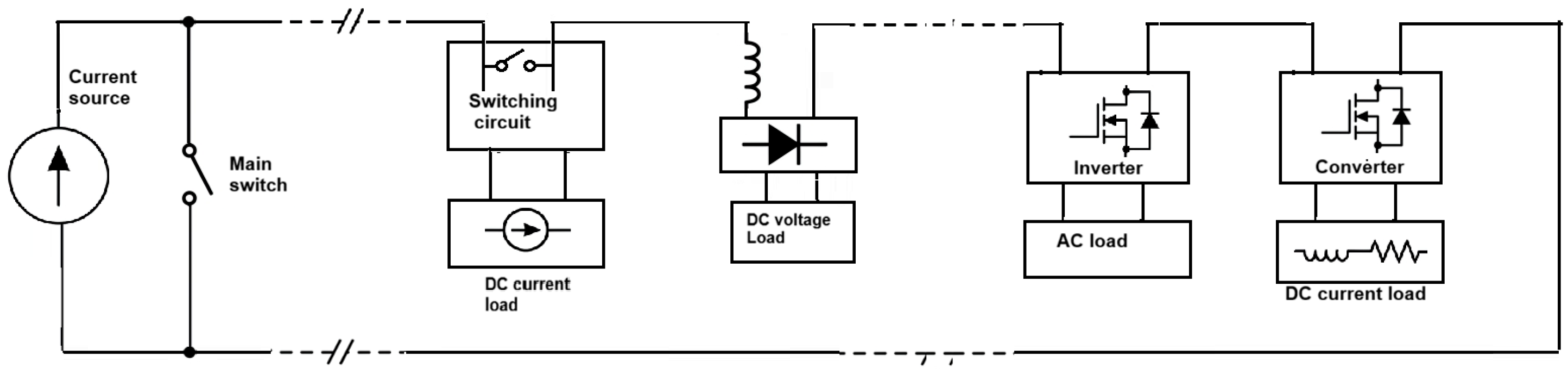
Figure 1 shows a typical current link power distribution system. The current source DC link is operated in analogy with the DC voltage source. The load is connected in series. The current source provided continuous current, and if any one of the loads is off, its internal parallel is turned on to bypass the link current. If all the loads are to be powered off or turned off, its input side switch is then connected in short circuit, whereas for the voltage source DC link, the load is disconnected by turning off the input switch of the load. The current DC link can power the DC current sink or load, and they are actually an inductive load. All the loads are connected in series.
Table 1 shows the duality relationship between the DC voltage link and current link. The doubled arrows indicate how the parts can be converted between the DC current link and DC voltage link. The DC current link can be turned off by switching on the main switch in parallel, so that the source current can be looped in the source instead of being delivered to the output. The DC current link provides an excellent power distribution as compared to the conventional voltage DC link [31]. Inductive coupling and load are often used in the converter.

2.2. Current Mode Converter

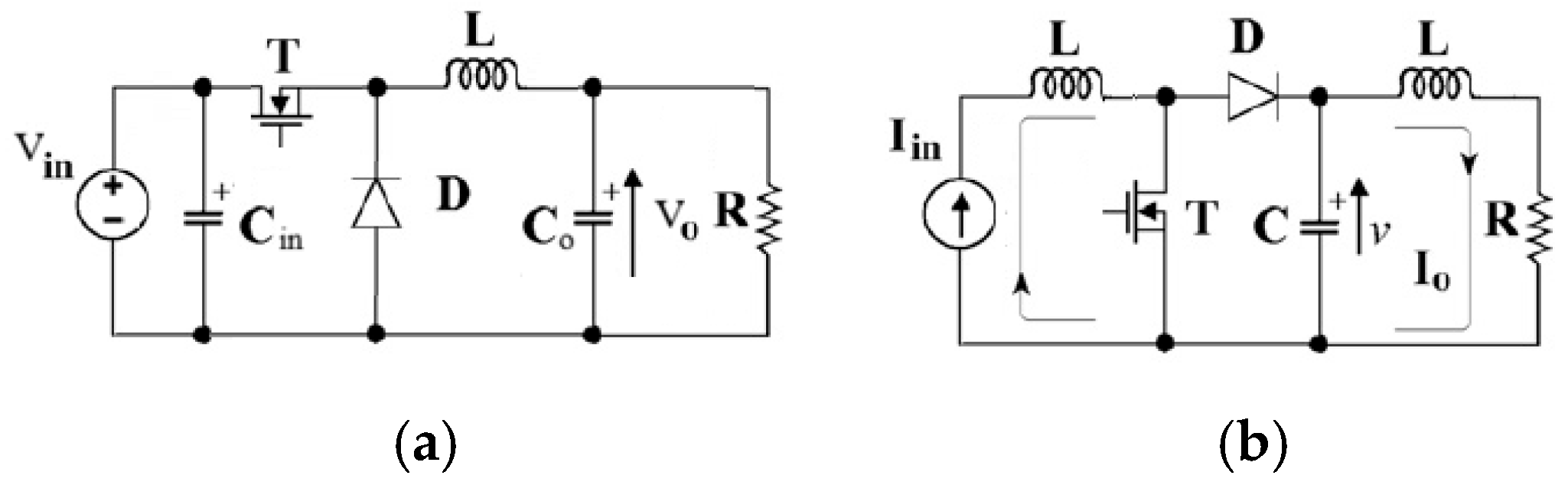
To further develop a current converter, a typical current converter has an inductor on the input side that is used to decouple the current ripple and couple the DC current to the output of the load. The current converter is characterized by certain inductor energy storage that is connected with switching devices for power processing. The output is also characterized by an inductor coupling filter. Figure 2 shows a simple illustration of a classical voltage-mode buck converter and its current-mode buck converter. Figure 2b looks like a voltage mode boost converter but it is a current mode converter. The current conversion ratio is less than 1 and bucking against the input.
It is interesting to see that the voltage conversion of the Buck converter is:
V o V i n = D
whereas the current conversion ratio of the current mode buck converter is:
I o I i n = 1 D
where D is the duty ratio of the transistor T.

2.3. Tapped Converter

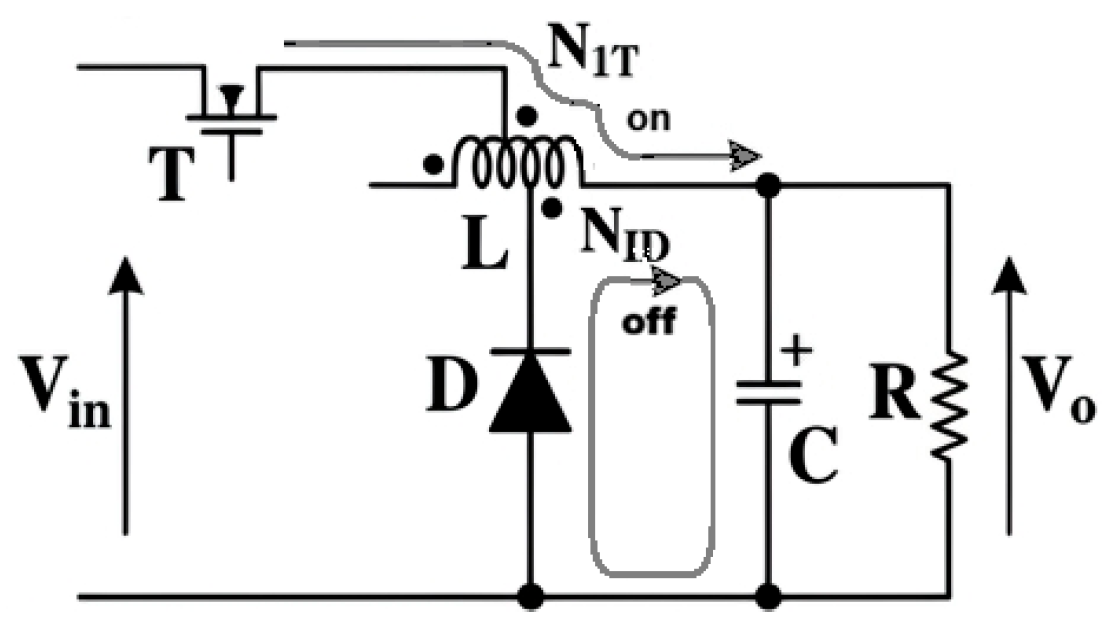
The tapped inductor is used in inductor tapping to provide current conversion like an autotransformer [32]. Figure 3 shows the operation of a tapped inductor, where the inductor L has two taps. One is connected to the transistor T, and one is connected to the diode. When T is on, the number of turns excited is N1T, and when T is off and D is then on, the number of turns excited is N1D.
The conversion ratio can be calculated by the invariance of the MMF for the flux through before and after the change of tapping, i.e.,
ϕ = V i n V o D T s N 1 T = V o 1 D T s N 1 D
V o = D D + 1 D N 1 T N 1 D
To further examine the tapped converter under the current mode power conversion, a multiple-tapping scheme is proposed. Also, a zero-voltage switching is then proposed to provide an additional feature of the switching devices.

3. Circuit Description and Operation Principles

Using the above two concepts, we can further develop a multiple-tapping step-down converter using the current source and output a current load. Different tapping produces a different output conversion ratio, and we name each tapping from top to bottom as Mode 1 to Mode 3.

3.1. Circuit Description

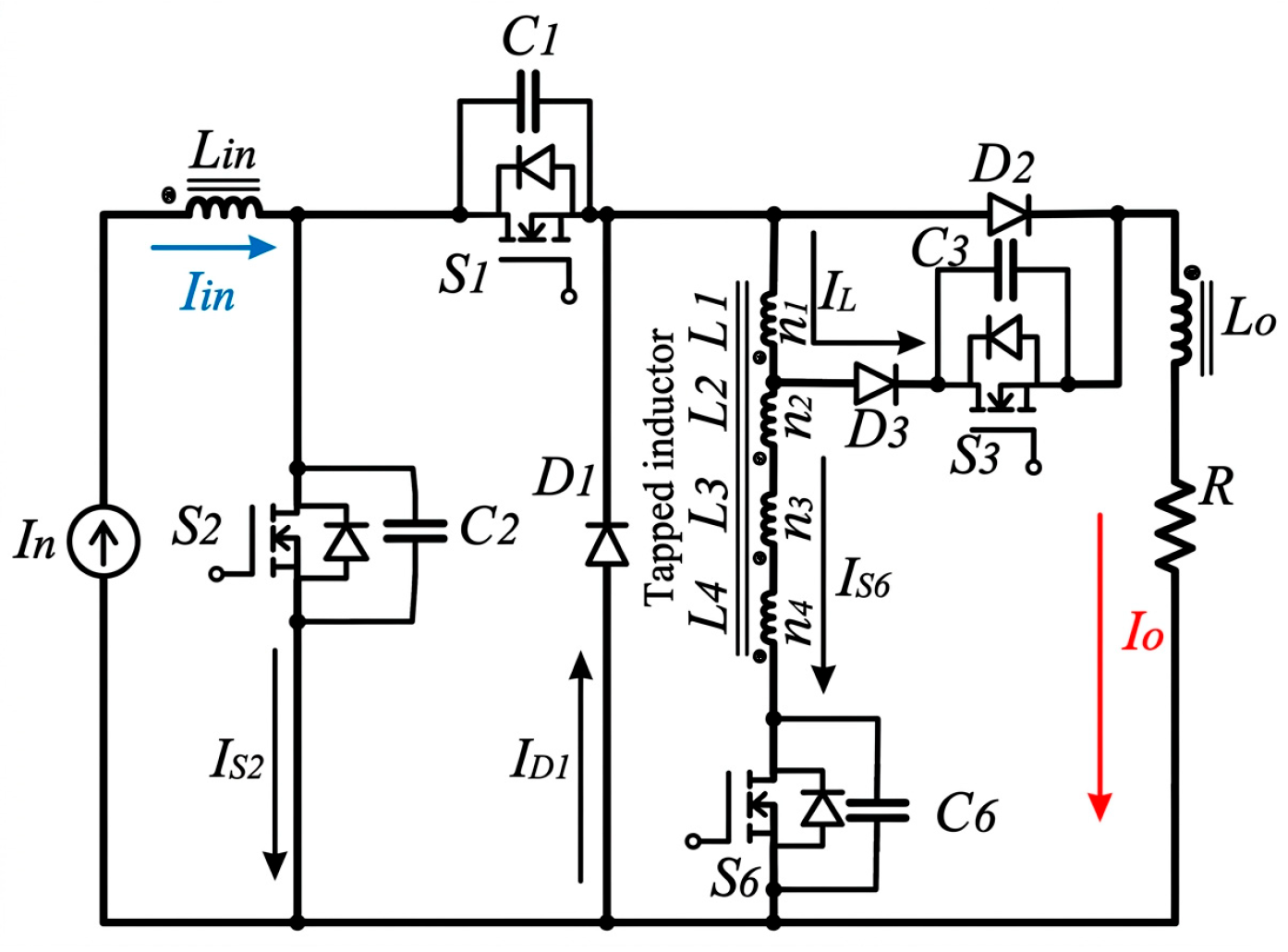
The topology of the basic proposed tapped inductor buck current-based converter (mode 1) is shown in Figure 4. The basic proposed topology contains four switches, S1 to S3 and S6, a tapped inductor consisting of L1, L2, L3 and L4, and diodes, D1, D2 and D3. There are four capacitors C1–C3 and C6, the output capacitances of switches S1S3 and S6, respectively. C2 and C6 operate as resonant capacitors to attain the ZVS feature for switches S2 and S6, respectively. The buck converter is also equipped with an input inductive filter inductance Lin and an output inductive filter inductance Lo. Both of these inductors serve as decoupling reactive components that stabilize the current between the source and load. Both switches S1 and S6 are in either “ON” or “OFF” states simultaneously, while the complementary pair switches S2 and S3 are either in “OFF” or “ON” states. The input current source Iin charges the tapped inductors, L1 to L4, and together supplies the output current Io via D2. When switches S2 and S3 are in the “ON” state, switches S1 and S6 are in the “OFF” state. Thus, the input current source Iin flows through the S2 and then back to the current source. The tapped inductor L1 discharges to the output load through switch S3.

3.2. Operation Principle

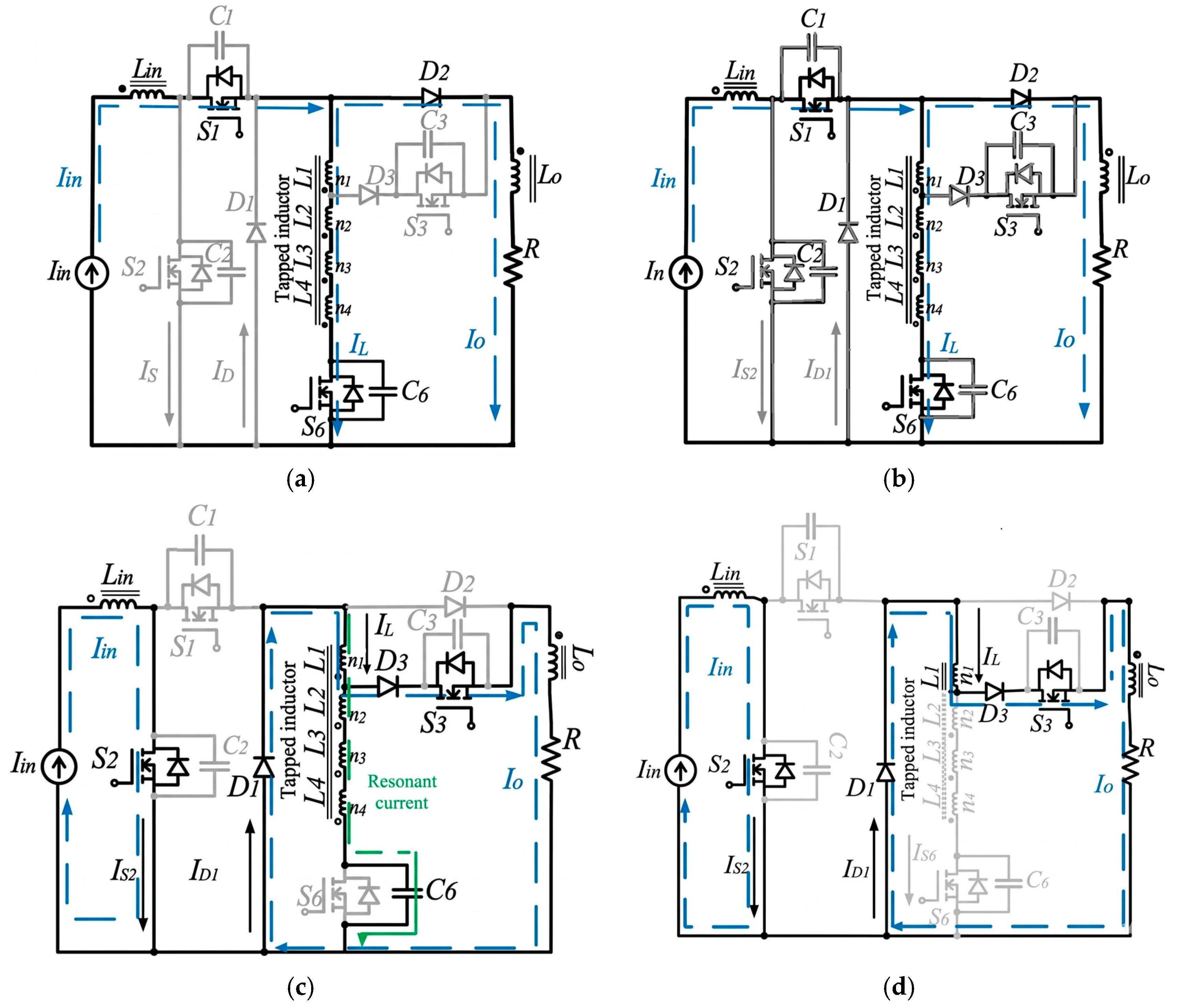
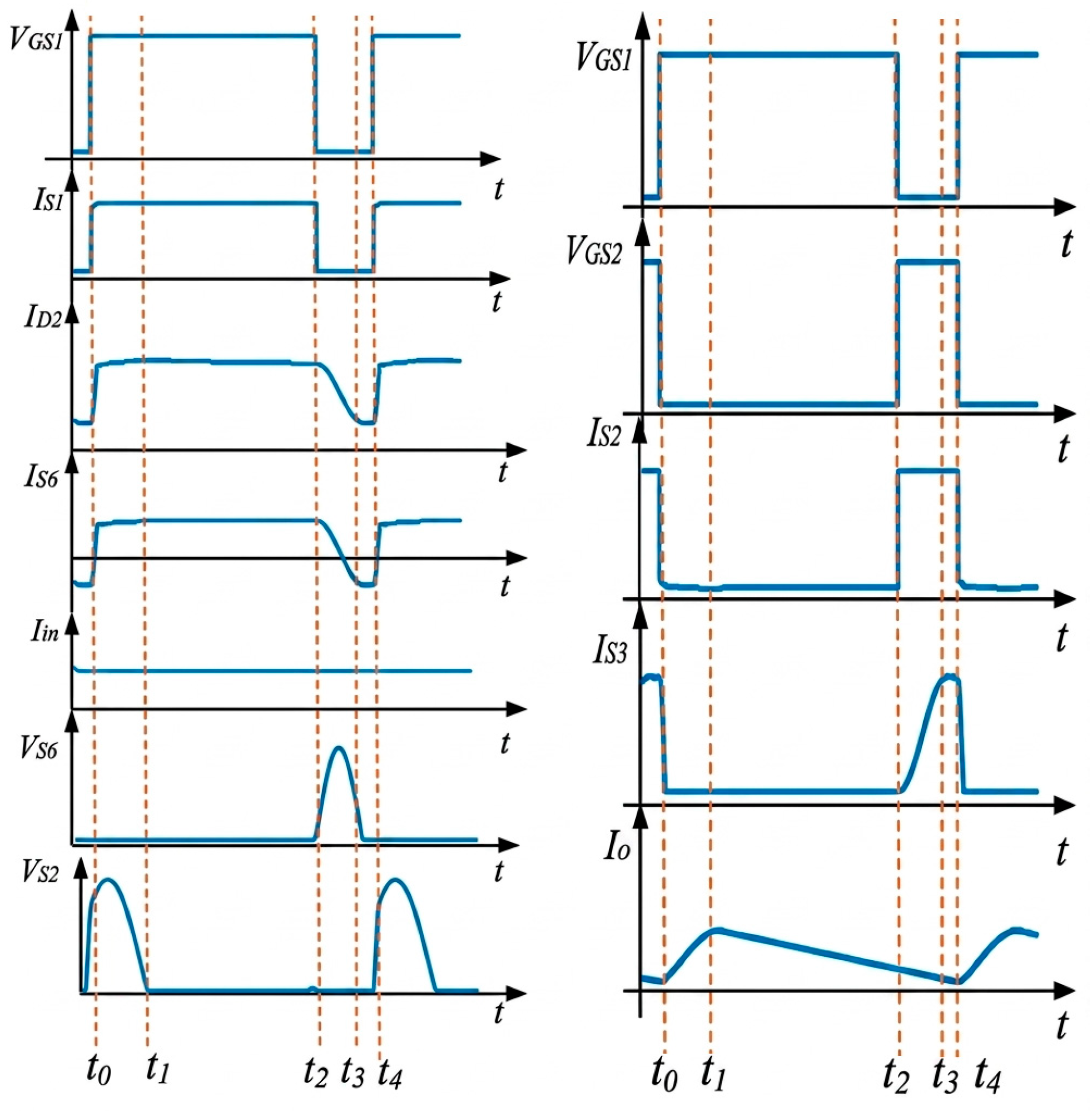
In the proposed basic tapped inductor step-down current-based converter (mode 1), the working period (Ts) can be divided into 4 states. The operating states under one working period are illustrated in Figure 5. The components are shown in grey when they are not conducting, and the current paths are indicated by blue broken lines. The typical waveforms of the voltage and current are depicted in Figure 6. To facilitate the comparison with the experimental results, the duty cycle is set to 0.8, and all components are assumed to be ideal, and the output inductive filter Lo is large enough to keep the output current Io constant.
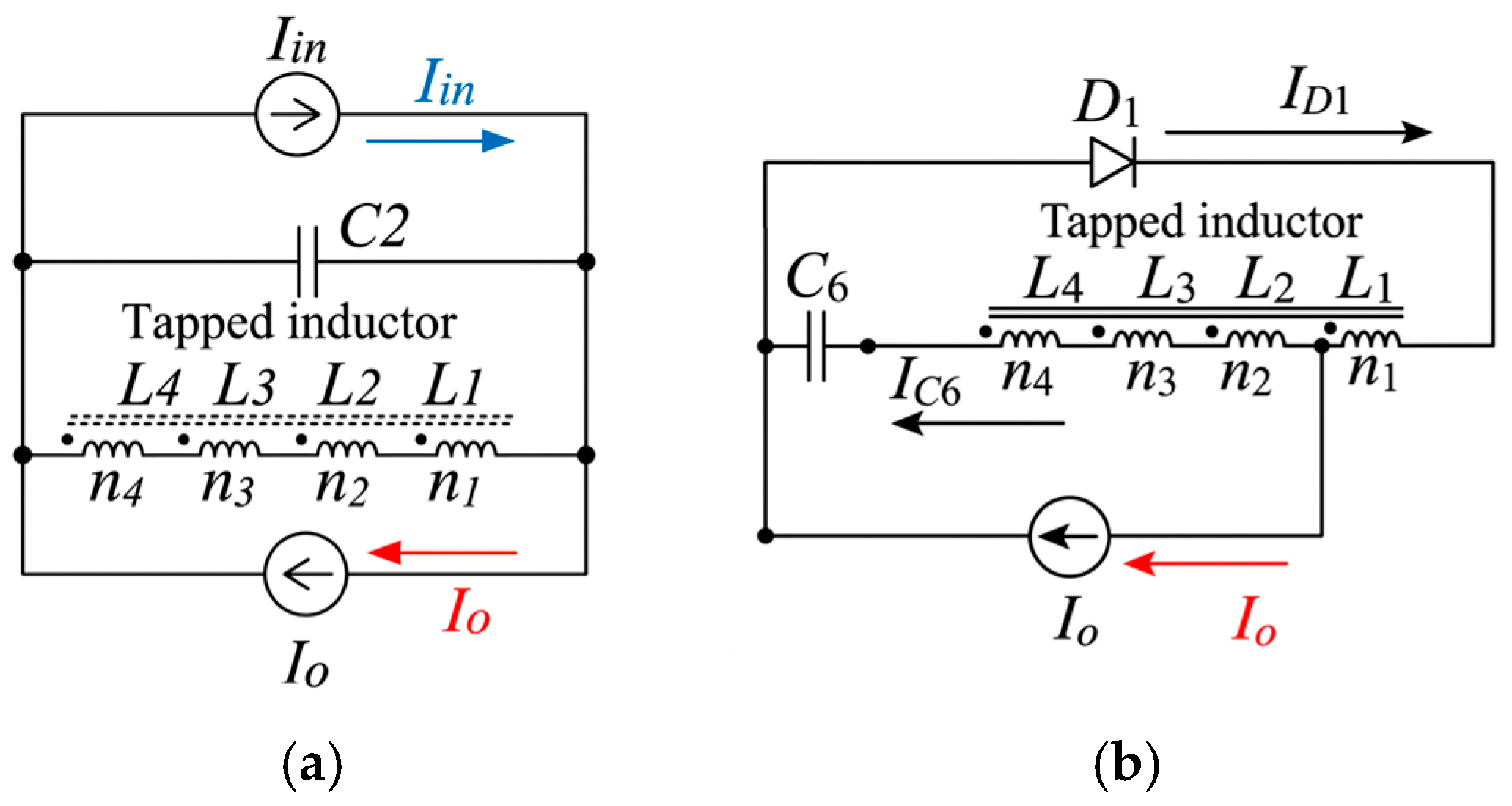
State I [to < t < t1]: As shown in Figure 5a, while the switches S2 and S3 are turned off, both switches S1 and S6 are turned on. As shown in Figure 3, the voltage across the switch S2 drops to zero before commissioning. Thus, this proves that switch S2 obtains the ZVS feature. The capacitor C2 is connected to the tapped inductors L1 to L4 in parallel to form a resonant tank. At time to, the capacitor is gradually charged up to its peak value, after which it returns to zero at t1. Concurrently, the tapped inductors L1 to L4 are charged up at to and their currents reach the maximum value at t1. The input current source supplies the output load at the same moment. In this state, the mathematical description can be derived as follows.
I i n = C 2 d V S 2 d t +   I L +   I O
V S 2 = L 1 + L 2 + L 3 + L 4 d I L d t
The resonant tank is shown in Figure 7a, and the resonant frequency f1 can be derived as follows.
f 1 = 1 2 π C 2 L 1 + L 2 + L 3 + L 4
Similarly, L1 and C3 of the transistor S3 will also form a resonant turn-off through the load current of Io in the loop of D1, L1, D3, C3, Lo and R. The detail is similar and is not described in detail.
State II [t1 < t < t2]: As shown in Figure 5b, switches S2 and S3 are still turned off, and both switches S1 and S6 are kept turned on. The f1 resonant tank finishes resonance at t1. The voltage across the S2 reaches zero at t1 and remains this value until the next cycle starts. The current of the tapped inductor IL attains maximum value at t1, the maximum value will be maintained until t2. The input current source Iin keeps charging up the tapped inductor and supplies energy to the output load simultaneously. In this state, the mathematical description can be expressed as follows.
I i n = I L + I o
According to the magnetomotive force (MMF) and Figure 5b, the MMF in the tapped inductor can be derived as follows.
F = I i n I O n 1 + n 2 + n 3 + n 4
State III [t2 < t < t3]: In this state, switches S1 and S6 turn off while switches S2 and S3 turn on. As shown in Figure 3, the voltage across the switch VS6 drops to zero before it turns on. Therefore, the ZVS feature can be achieved on switch S6. Another resonant tank with resonant frequency f2 forms. The resonant tank consists of capacitor C6 and the tapped inductor, including L1 to L4, but L1 is not involved in the resonance as the Lo is assumed to be large. The capacitor is connected with the tapped inductor L2 to L4 in series in a resonant loop. The voltage across the switch S6 (VS6) increases from zero, gradually reaching peak amplitude, and then back to zero at t3. In this state, the current sum is as follows.
I C 6 + I o = I D 1
According to Figure 7b, the resonant frequency f2 of the resonant tank can be derived as follows.
f 2 = 1 2 π C 6 L 2 + L 3 + L 4
It is noted that S1 cannot perform ZVS as the resonant circuit using C1 is not possible because it is connected to one current source and one current sink at the instant of turning off.
State IV [t3 < t < t4]: As shown in Figure 5d, the switches S1 and S6 still turn off while switches S2 and S3 remain turned on. In this state, the f2 resonant tank stops operation. In this state, the tapped inductor L1 and output inductive filter Lo keep supplying current to the output load, and the input current Iin through the switch S2 flows back to the input current source. According to the principle of the invariance of the MMF in the current transformer and the operation principle in Figure 5d, the output current Io can be derived as follows.
I i n I O n 1 + n 2 + n 3 + n 4 = ( n 1 ) I O
Thus, the output current I O as shown in Figure 5d can be obtained as follows:
I i n n 1 + n 2 + n 3 + n 4 = n 1 I O + n 1 + n 2 + n 3 + n 4 I O
I O = I i n n 1 + n 2 + n 3 + n 4 n 1 + n 2 + n 3 + n 4 + n 1
While n 1 = n 2 = n 3 = n 4 , then the output current Io can be expressed as follows.
I O = ( 4 5 )   I i n
I O = 0.8 I i n

3.3. Tapped Inductor Buck Current-Based Converters with Higher Conversion Ratio

As analyzed in Sections A and B, the proposed basic tapped inductor current-based converter (mode 1) can be extended to more modes with a higher current step-down ratio. Table 2. illustrates the diagrams for proposed other mode converters with higher current step-down ratios. Using the same concept of the basic tapped inductor current-based converter (mode 1), converters with 0.67 times, 0.57 times, and even n-times current step-down ratios can be developed. Table 2. shows the diagrams for the proposed converters with higher current step-down ratios. Similarly, in the operation principle in Section B, the operation principle of the proposed 0.67 times the current step-down ratio converter is shown in Table 3.
When the switches S1 and S6 turn on, switches S2 and S4 should be turned off, and vice versa. The tapped inductor is charged up by the input current Iin, and the input current source supplies the output at the same time. Also, all proposed current-based buck converters are operated in continuous mode. The output current Io is assumed to be constant. The proposed 0.57 times current step-down ratio converter (mode 3) is also developed. By employing the same theory, the tapped inductor current-based buck converter (mode n) with ( n 2 n 1 ) times the current step-down ratio can be derived. The output current step-down ratio can be selected by adopting a suitable mode of the proposed current-based converters.

4. Design Considerations

In this section, the design of the proposed current-based boost converters is carried out. The design is based on the analysis of Section 2. The components, including the diodes and semiconductor switches, are considered to be ideal.
A.
Switches and Diodes Voltage and Current Stress
The voltage stress on the switches and diodes is mainly affected by the input voltage Vin and the current stress of the switches and diodes relies on the input current and the magnified current from the tapped inductor. Thus, the voltage stress on the switches and diodes can be expressed as follows:
V i n V L i n =   V S 2 = V D 1
V S 3 = V i n   V L i n V L 1
The voltages of the input filter VLin and the partial inductance of the tapped inductor L1 can be obtained as follows:
V L i n =   L i n   I i n D T s
V L 1 = L 1   I i n I O D T s
Substituting (19) and (20) into (18), the VS3 can be expressed:
V S 3 =   V i n   L i n   I i n D T s     L 1   I i n I O D T s
The voltage stress on the diode D1 can be derived from
V D 1 = V i n   V L i n
Substituting (19) into (22), the VD1 can be expressed as
V D 1 = V i n   L i n   I i n D T s
And the current stress on the switches and diodes can be expressed as follows.
I i n   = I S 1 = I S 2
According to (12) and (24), the current stress on the switch S3 can be expressed as
I S 3 = n 1 + n 2 + n 3 + n 4 n 1 I i n I O
B.
Output Inductive Filter Determination
According to the KVL, the voltage of the inductive filter Lo can be calculated as follows.
V L o = V i n V L i n V R
Referring to the same theory of (19) and substituting into (26), the VLo can be expressed as
V L o = V i n L i n   I i n D T s I O R
L o Δ I L o D T s = V i n L i n   I i n D T s I O R
Based on (26), the output inductive filter Lo can be expressed below
L o = ( V i n L i n   I i n D T s I O R ) ( D T s ) Δ I L o
From (29), it shows that the output current ripple is inversely proportional to the output inductive filter Lo.
C.
Tapped inductor determination.
1.
Magnetic flux density (B) calculation
The tapped inductor in the proposed topology is a main technique for stepping down the input current Iin based on the selected modes, as shown in (8), Figure 4, Table 2 and Table 4. The magnetomotive force (MMF), F , of the tapped inductor can be calculated as follows:
F = N I
where N is the number of turns of the excited current-fed windings; I is excitation current (A).
Based on the relationship between the magnetic flux (Φ), air gap lg, and MMF, the magnetic flux density (B) can be obtained as follows:
F = Φ R
B = N I l e l g   µ o µ r + l g   µ o
where
  • R reluctance;
  • l e   effective magnetic core path length;
  • l g   total air gap length;
  • µ o permeability of free space;
  • µ r relative permeability.
The magnetic flux density ( B ) of the tapped inductor can be calculated based on (31), Table 3 and Table 4.
The theoretical MMF is to be verified to be constant in the tapped inductor. The calculated magnetic flux density (B) in States II and IV of Mode 2, based on Figure 2, (28), Table 2, Table 3 and Table 4 is 214 mT.
2.
Finite Element Analysis (FEA) Results
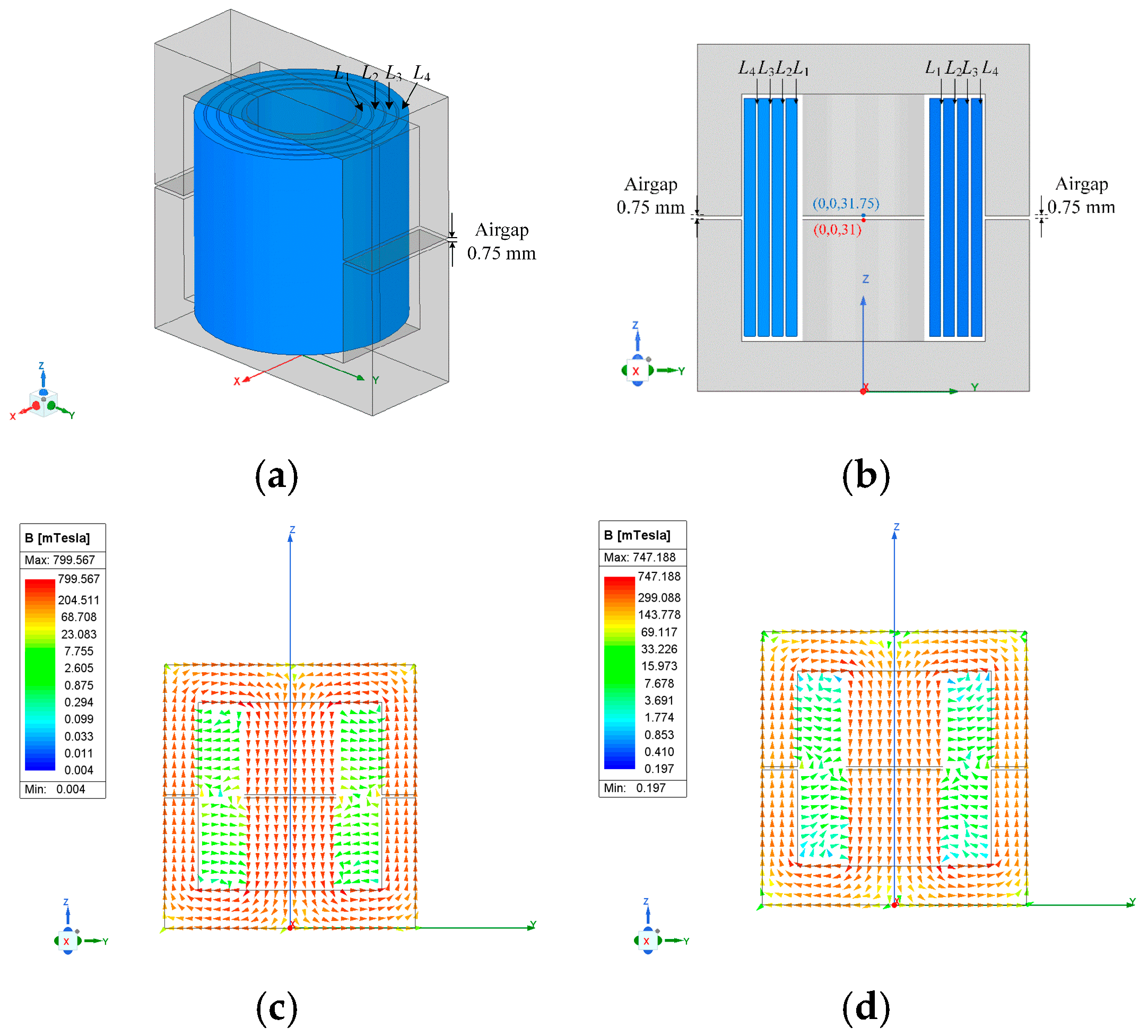
Figure 8 shows the finite element estimation of the electromagnetic field (EMF) in States II and IV of Mode 2. Figure 8a,b illustrate the arrangement. The air gap is 0.75 mm on each limb of the core as shown in Figure 8a,b. The tapped inductor is operated at 100 kHz to observe the magnetic field in the middle center of the core. The amplitude of the excitation current in State II of Mode 2 as shown in Figure 5b is set to 3.31 Arms and the excitation current in State IV of Mode 2 illustrated in Figure 5d is 6.64 Arms. Figure 8c,d show the EMF in the tapped inductor under State II and State IV of Mode 2, respectively.
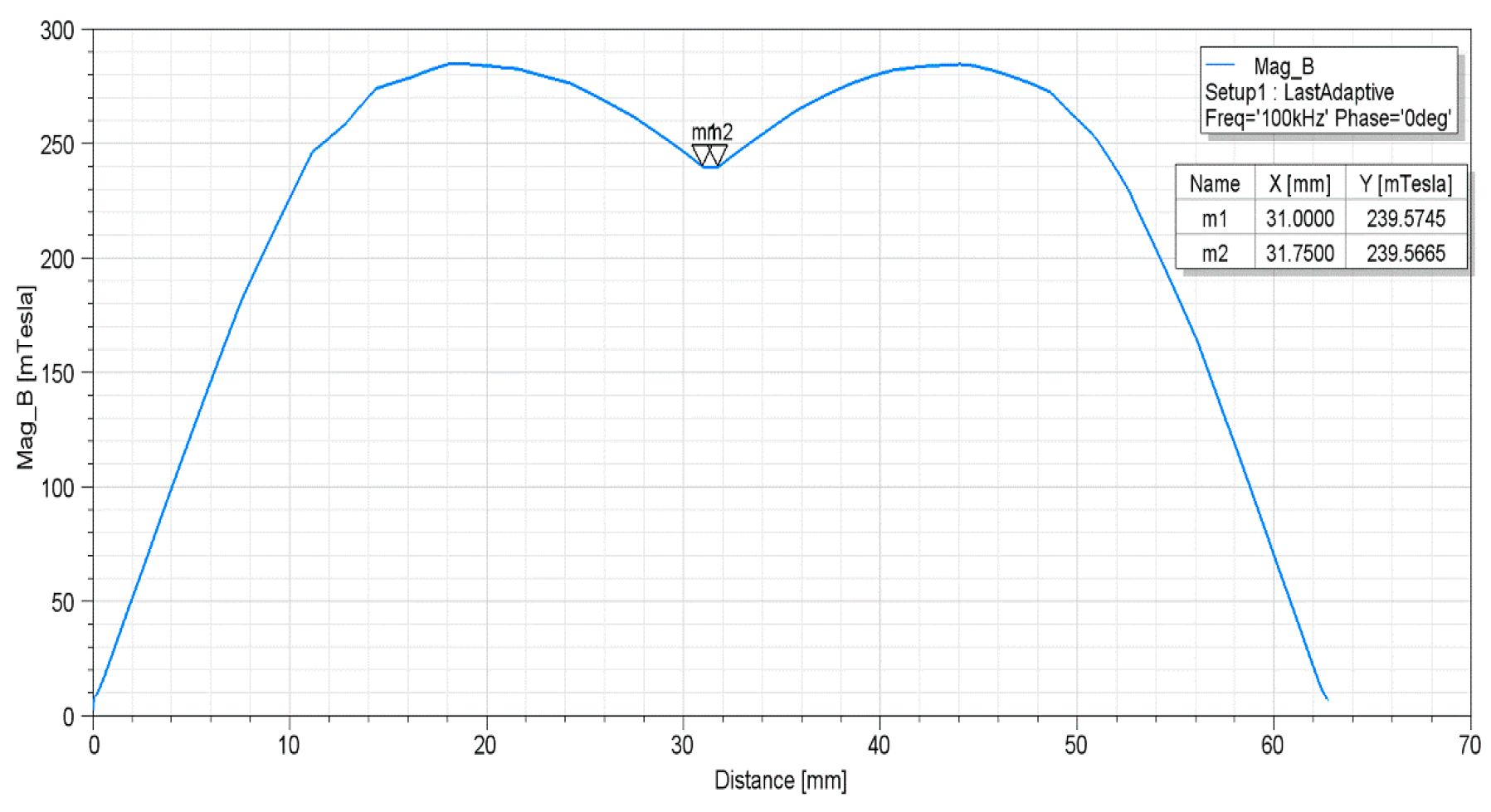
Figure 9 shows the EMF measured values in simulation as shown in Figure 8a,b. The EMF value is 239.57 mT on either side of the airgap at the center limb of the core, which is 31.75 mm and 31 mm distance from the bottom of the core. The measured values under simulations are close to the calculated values. Thus, it can be proven that the MMF in the tapped inductor remains unchanged. The flux density is well below the core saturation, and the analysis of stable inductance during the tapping inductor switching operation is confirmed.

5. Experimental Setup and Verification

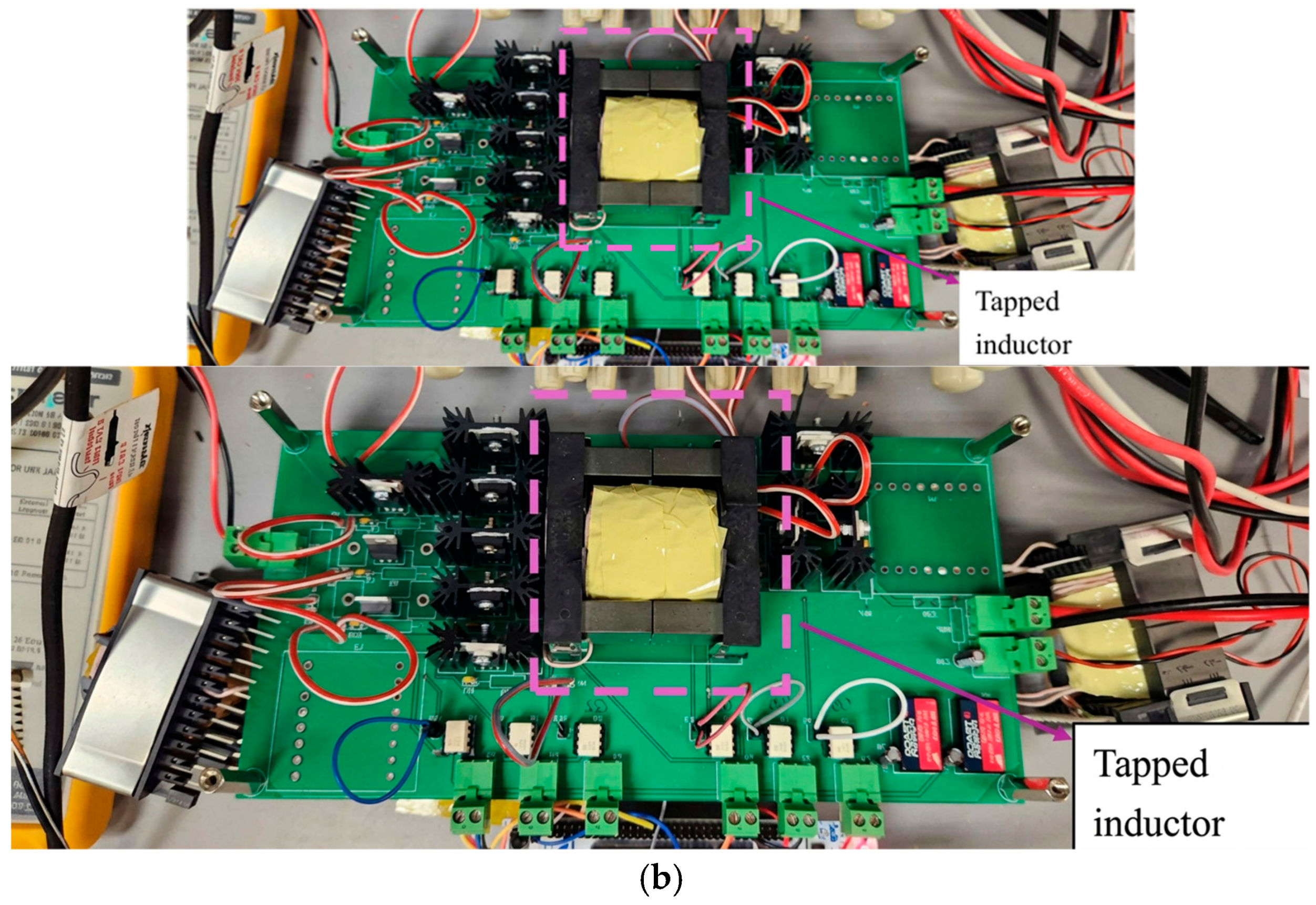
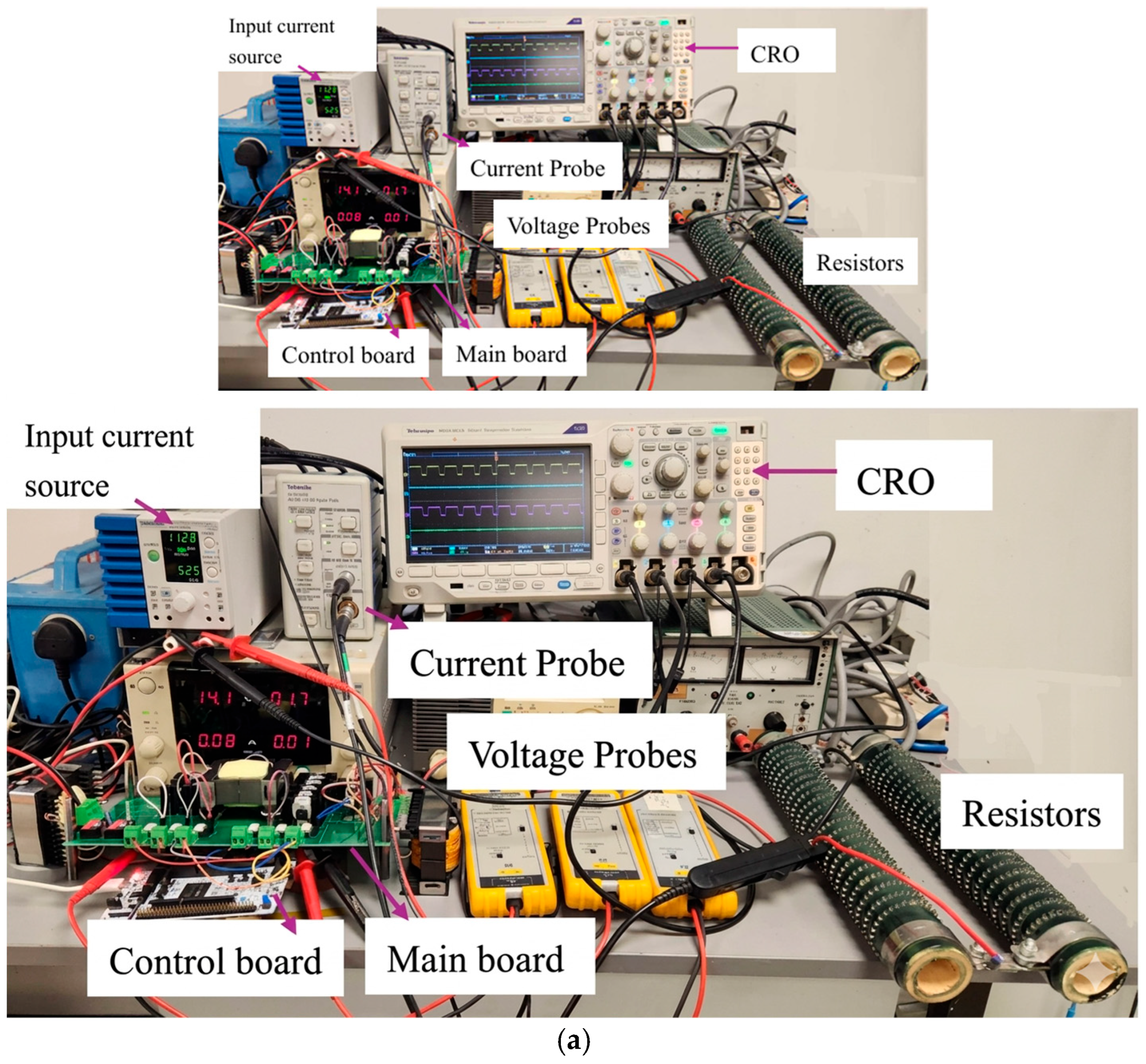
The proposed tapped inductor buck current-based converter has been constructed as shown in Figure 10a,b. The experimental results for mode 1, mode 2 and mode 3 are provided in this section. By referring to Figure 4 and Table 2 and Table 4, the prototype was built, as shown in Figure 10. The Bill of Materials is provided in Table 4.
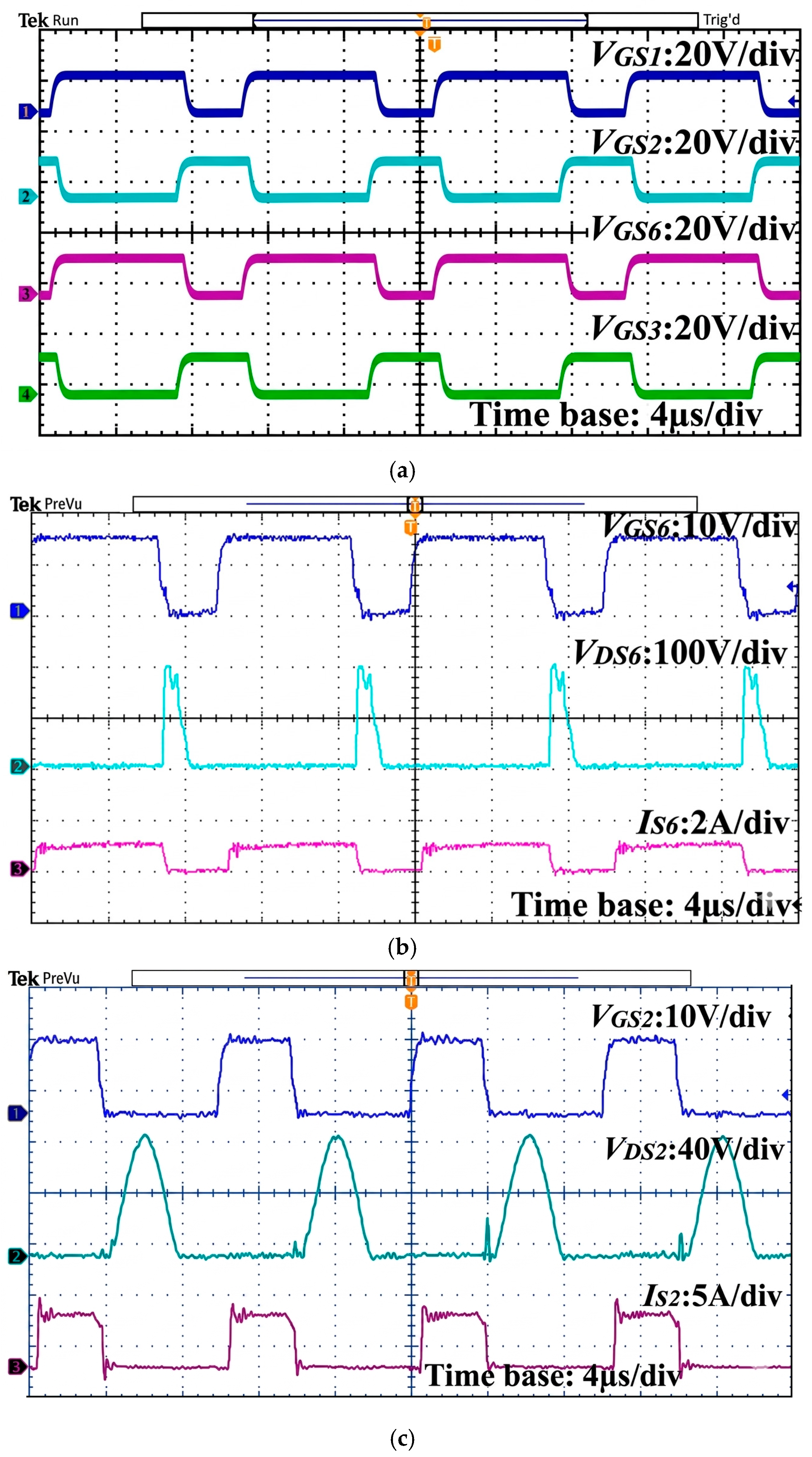
Figure 11 illustrates the key experimental waveforms, including the gate-source voltages and the drain-source voltages of the switches S1–S3 and S6 when the resistive load was set to 5.2 Ω under mode 1. Referring to Table 2 and Table 3, the resistive load is the same under measurements of all different modes. And the switching patterns for modes 2 and 3 are similar to mode 1. For mode 2, when the switches S1 and S6 turn on, the switches S2 and S4 will turn off, and vice versa. For mode 3, the switches S1 and S6 turn on, and the switches S2 and S4 turn off. The switches S1 and S6 performs alternate manner with switches S2 and S4.
As shown in Figure 11c, the ZVS feature can be obtained. Both resonant frequencies f1 and f2 are higher than the switching frequency. Soft switching can occur on the switch S1 at the same time. Apart from an extremely short time, a comparable low voltage overshoot at the beginning of the switch S1 turns off. Based on the electric circuitry design, the voltage across the switch S1 is kept at zero as shown in Figure 11a.
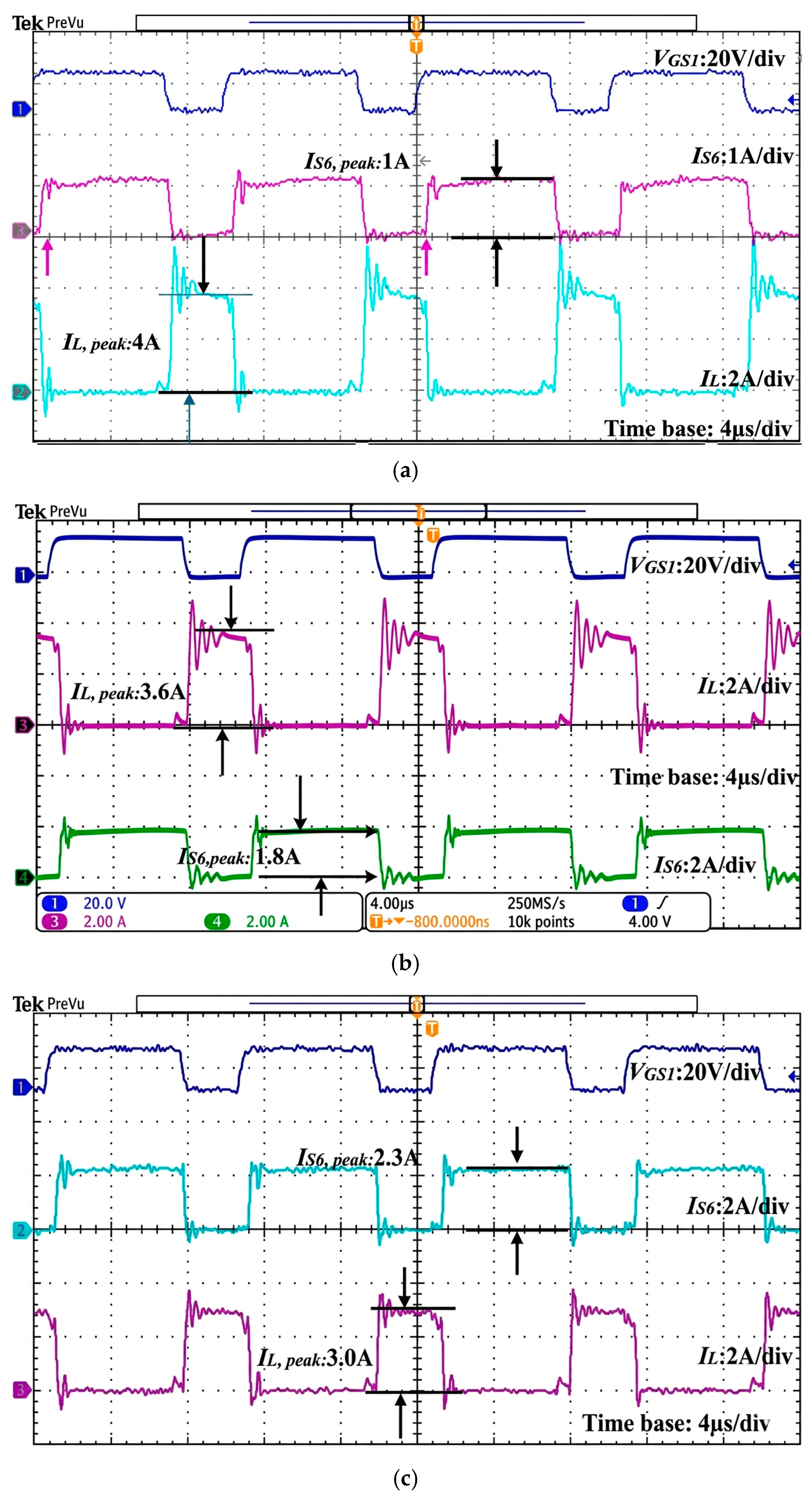
Figure 12 shows the waveforms of the input current IS6 and output current IL of the tapped inductor in different modes. Based on the theoretical calculation in (10) and Table 1, the output current IL of the tapped inductor is 4 times the input current IS6 under Mode 1 since the magnetomotive force (MMF) is assumed to be constant. For mode 2 and mode 3, the output current IL is 2 times and 1.33 times the input current IS6, respectively, based on the theoretical calculation referring to (10). As shown in Figure 12a–c, the conversion ratio I L I S 6 from the tapped inductor is 4 times, 2 times and 1.3 times for mode 1, mode 2 and mode 3, respectively. The theoretical calculations for the conversion ratio I L I S 6 are close to the measured results. Based on the measured results, the maximum deviation from the theoretical calculations is only 0.03. The theoretical calculations closely align with the actual measurements.
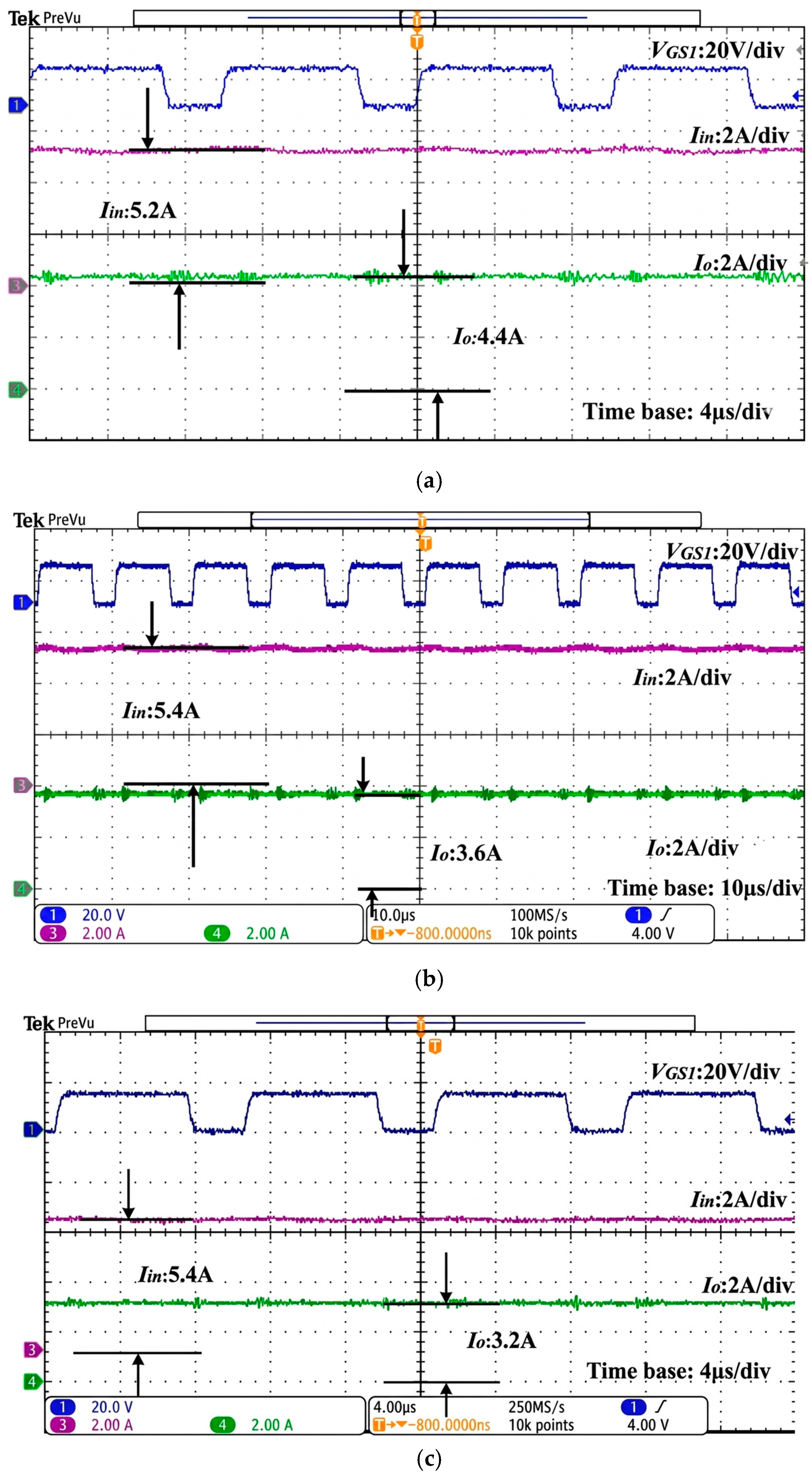
The input currents Iin and output currents Io of the family of proposed buck converters are shown in Figure 13. Referring to Table 2, the output currents Io of modes 1, 2 and 3 are 0.8, 0.67 and 0.57 times the input currents Iin, respectively. Based on the experiment results presented in Figure 13 xls, the output currents for modes 1, 2 and 3 are 0.85, 0.67 and 0.59 times the input currents. The maximum variance between the measurements and the theoretical calculations of all modes is 0.05 only. This shows that the theoretical calculations aligned with the experiments. All output currents of the proposed converters are linear. This is an advantage of utilizing a tapped inductor. The tapped inductor can enhance the smoothing function for the output current ripple.
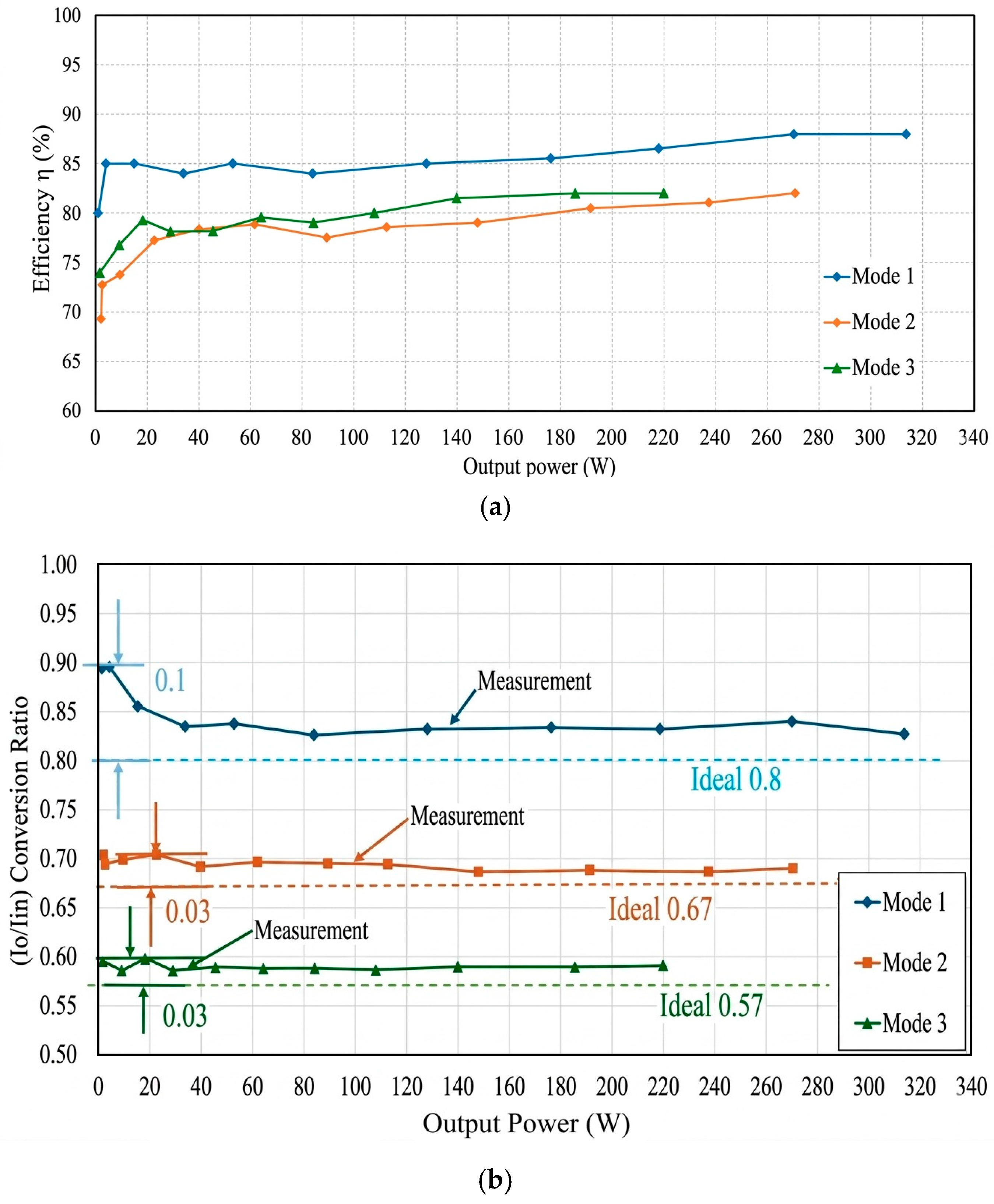
Moreover, the efficiency and current conversion ratio of the family of the proposed converters were measured over a wide output power range from 1 W to 314 W. The measured efficiency versus the output power is illustrated in Figure 14a.
Under the low output power, the efficiency is relatively lower since a relatively larger proportion of power dissipates in component losses. Based on experimental results as depicted in Figure 14a, the proposed converter with a 0.8 times conversion ratio (mode 1) performed the best in terms of efficiency. The efficiency of the converter (mode 1) can reach 88% at the output power of 314 W, while the maximum efficiencies for both converters (mode 2) and (mode 3) can obtain 82% at 271 W and 220 W, respectively. The performance of the family of the proposed converters for the current conversion ratio is also investigated. The current conversion ratio drops slightly when the output power increases because of the switches’ parasitic resistances, leading to the current loss. However, the performance of the family of the proposed converters is still doing well. The maximum deviation from the measured values of the proposed converter family with 0.8 times (mode 1), 0.67 times (mode 2) and 0.57 times (mode 3) current conversion from the ideal values over a wide range of output power, still having 12.5%, 4.5% and 5.3%, respectively. It is important to note that the deviations mentioned above are measured at close to the lowest output power of the range. Apart from the beginning of the output power range, the deviations for mode 1, mode 2 and mode 3, only have around 3.8%, 2.99% and 3.51%, respectively.

6. Discussion

The proposed topology is a current converter, functioning analogously to a conventional voltage converter with a defined conversion ratio. It inherits standard current-mode limitations; specifically, both input and output currents must remain continuous, as the ports act as current sources and sinks. To mitigate the risks associated with these characteristics, the circuit incorporates protection via a freewheeling diode path (comprising S2 and D1), which safeguards the system against potential open-circuit conditions in the source or sink.
The temporary energy storage ratio is the maximum energy storage against the output power, which is a factor to understand the performance and efficiency. This ratio for the voltage mode buck converter is governed by the inductor RSL = 1 − D [33] and the energy storage factor ratio for the proposed current mode Buck is governed by the capacitor, which is RSC = D, showing that they have a similar energy storage processing feature. It is expected that their efficiency is similar.
The converter is designed for a rated power of 314 W with a rated input current of 10 A. A key advantage of this design is its scalability. For a constant conversion ratio, the fundamental component values remain unchanged; however, the current ratings must be scaled proportionally. Specifically, if the power level is modified, the component current ratings must be adjusted by the same factor to accommodate the new operating conditions.
The state-of-the-art features of the proposed converter family are summarized in Table 5.

7. Conclusions

Current-mode DC-link architectures offer a viable alternative for power distribution due to the widespread availability of current sources and current-driven loads; therefore, investigating current-based converters is of significant value. The tapped-inductor converter features a simple topology well-suited for current conversion within these DC-link systems. This paper introduces, analyzes, and thoroughly evaluates a family of proposed current-based step-down converters featuring zero-voltage switching (ZVS). Experimental and simulation results validate the feasibility and adaptability of this circuit design. To demonstrate its wide operational range using a single circuit, the converter was tested across three distinct modes: a 0.8 current conversion ratio (Mode 1), 0.67 (Mode 2), and 0.57 (Mode 3). The measured outcomes closely align with theoretical predictions. Alternative conversion ratios can be easily realized by adjusting the tapping point and the number of inductor turns, meaning the physical hardware does not require modification when a different ratio is selected.
Moreover, the current conversion ratios remain highly stable across all modes, despite the inevitable slight drops observed at higher output powers or lower output currents. Specifically, the maximum measured efficiencies for Modes 1, 2, and 3 reached 88% (at 314 W), 82% (at 271 W), and 82% (at 220 W), respectively. The proposed converter also maintains continuous conduction mode (CCM), ensuring a consistently low output current ripple (Io) across all operating states. Because the current is stepped down, the voltage is inherently stepped up, making this topology particularly beneficial for systems driven by current sources, such as photovoltaic (PV) solar arrays. Consequently, its stable current-source characteristics make the proposed converter highly suitable for electric vehicle (EV) charging applications and LED driving systems. In short, the state of the art is: the first family of tapped-inductor, soft-switched, current-source step-down DC-DC converters with selectable, stable current conversion ratios, experimentally verified at 100 kHz.

Author Contributions

Conceptualization, K.W.E.C. and C.P.L.; methodology, K.W.E.C. and C.P.L.; software, H.W.; validation, C.P.L.; formal analysis, C.P.L.; investigation, K.W.E.C., C.P.L. and H.W.; resources, K.W.E.C.; writing—original draft preparation, C.P.L.; writing—review and editing, K.W.E.C. and C.P.L.; supervision, K.W.E.C.; project administration, K.W.E.C. All authors have read and agreed to the published version of the manuscript.

Funding

This research received no external funding.

Data Availability Statement

The raw data supporting the conclusions of this article will be made available by the authors on request.

Conflicts of Interest

The authors declare no conflicts of interest.

References

  1. Amiri, M.; Farzanehfard, H.; Adib, E. A Nonisolated Ultrahigh Step Down DC–DC Converter with Low Voltage Stress. IEEE Trans. Ind. Electron. 2018, 65, 1273–1280. [Google Scholar] [CrossRef]
  2. Wang, Y.; Rong, Z.; Sun, Z.; Guan, Y.; Han, S.; Xu, D. Analysis and Implementation of a Transformerless Interleaved ZVS High-Step-Down DC-DC Converter. IEEE Trans. Power Electron. 2023, 38, 13484–13495. [Google Scholar] [CrossRef]
  3. Amiri, M.; Farzanehfard, H. A High-Efficiency Interleaved Ultra-High Step-Down DC–DC Converter with Very Low Output Current Ripple. IEEE Trans. Ind. Electron. 2019, 66, 5177–5185. [Google Scholar] [CrossRef]
  4. Hwu, K.I.; Jiang, W.Z.; Wu, P.Y. An Expandable Two-Phase Interleaved Ultrahigh Step-Down Converter with Automatic Current Balance. IEEE Trans. Power Electron. 2017, 32, 9223–9237. [Google Scholar] [CrossRef]
  5. Fei, C.; Ahmed, M.H.; Lee, F.C.; Li, Q. Two-stage 48 V–2 V/6 V–1.8 V voltage regulator module with dynamic bus voltage control for light-load efficiency improvement. IEEE Trans. Power Electron. 2017, 32, 5628–5636. [Google Scholar] [CrossRef]
  6. Shenoy, P.S.; Amaro, M.; Morroni, J.; Freeman, D. Comparison of a buck converter and a series capacitor buck converter for high-frequency high-conversion-ratio voltage regulators. IEEE Trans. Power Electron. 2016, 31, 7006–7015. [Google Scholar] [CrossRef]
  7. Kim, K.; Cha, H.; Park, S.; Lee, I.-O. A modified series-capacitor high conversion ratio DC–DC converter eliminating start-up voltage stress problem. IEEE Trans. Power Electron. 2018, 33, 8–12. [Google Scholar] [CrossRef]
  8. Wai, R.J.; Liaw, J.J. High-efficiency coupled-inductor-based step-down converter. IEEE Trans. Power Electron. 2016, 31, 4265–4279. [Google Scholar]
  9. Hwu, K.-I.; Jiang, W.-Z. Voltage Gain Improvement of a High-Step-Down Converter with Coupled-Inductor Core Size Reduction Based on Flux Linkage. IEEE Trans. Power Electron. 2018, 33, 6033–6047. [Google Scholar] [CrossRef]
  10. Hu, R.; Zeng, J.; Liu, J.; Cheng, K.W.E. A Nonisolated Bidirectional DC–DC Converter with High Voltage Conversion Ratio Based on Coupled Inductor and Switched Capacitor. IEEE Trans. Ind. Electron. 2021, 68, 1155–1165. [Google Scholar] [CrossRef]
  11. Hwu, K.I.; Jiang, W.Z.; Yau, Y.T. Nonisolated coupled-inductor-based high step-down converter with zero dc magnetizing inductance current and nonpulsating output current. IEEE Trans. Power Electron. 2016, 31, 4362–4377. [Google Scholar] [CrossRef]
  12. Xiong, S.; Tan, S.C. Cascaded high-voltage-gain bidirectional switched-capacitor dc–dc converters for distributed energy resources applications. IEEE Trans. Power Electron. 2017, 32, 1220–1231. [Google Scholar] [CrossRef]
  13. Xiong, S.; Wong, S.C.; Tan, S.C.; Tse, C.K. Optimal design of complex switched-capacitor converters via energy-flow-path analysis. IEEE Trans. Power Electron. 2017, 32, 1170–1185. [Google Scholar] [CrossRef]
  14. Kim, J.W.; Moon, J.P.; Moon, G.W. Duty-ratio-control-aided LLC converter for current balancing of two-channel LED driver. IEEE Trans. Ind. Electron. 2017, 64, 1178–1184. [Google Scholar] [CrossRef]
  15. Lin, R.-L.; Huang, L.H. Efficiency Improvement on LLC Resonant Converter Using Integrated LCLC Resonant Transformer. IEEE Trans. Ind. Appl. 2018, 54, 1756–1764. [Google Scholar] [CrossRef]
  16. Teng, J.-H.; Chen, S.-S.; Chou, Z.-X.; Liu, B.-H. Novel Half-Bridge LLC Resonant Converter with Variable Resonant Inductor. IEEE Trans. Ind. Appl. 2023, 59, 6952–6962. [Google Scholar] [CrossRef]
  17. Cervera, A.; Peretz, M.M. Resonant switched-capacitor voltage regulator with ideal transient response. IEEE Trans. Power Electron. 2015, 30, 4943–4951. [Google Scholar] [CrossRef]
  18. Zhang, X.; Yao, C.; Wang, J. A quasi-switched-capacitor resonant converter. IEEE Trans. Power Electron. 2016, 31, 7849–7856. [Google Scholar] [CrossRef]
  19. Forouzesh, M.; Yari, K.; Baghramian, A.; Hasanpour, S. Single-switch high step-up converter based on coupled inductor and switched capacitor techniques with quasi-resonant operation. IET Power Electron. 2017, 10, 240–250. [Google Scholar] [CrossRef]
  20. Ye, Y.; Cheng, K.W.E.; Chen, S. A high step-up PWM DC-DC converter with coupled-inductor and resonant switched-capacitor. IEEE Trans. Power Electron. 2017, 32, 7739–7749. [Google Scholar] [CrossRef]
  21. Lei, Y.; May, R.; Pilawa-Podgurski, R. Split-phase control: Achieving complete soft-charging operation of a Dickson switched-capacitor converter. IEEE Trans. Power Electron. 2016, 31, 770–782. [Google Scholar] [CrossRef]
  22. Xie, W.; Brown, B.Y.; Smedley, K.M. Multilevel Step-Down Resonant Switched-Capacitor Converters with Full-Range Regulation. IEEE Trans. Ind. Electron. 2021, 68, 9481–9492. [Google Scholar] [CrossRef]
  23. Shi, Z.H.; Cheng, K.W.E.; Ho, S.L. Static performance and parasitic analysis of tapped-inductor converters. IET Power Electron. 2014, 7, 366–375. [Google Scholar] [CrossRef]
  24. Yu, L.; Wang, L.; Mu, W.; Yang, C. An Ultrahigh Step-Down DC–DC Converter Based on Switched-Capacitor and Coupled Inductor Techniques. IEEE Trans. Ind. Electron. 2022, 69, 11221–11230. [Google Scholar] [CrossRef]
  25. Sun, J.; Fong, Y.C.; Cheng, K.W.E. Current Source Mode Bidirectional DC/DC Converter with Multiple-Level Output Conversion Ratios Based on the Hybrid PWM Control of the Switched-Capacitor Structure. IEEE J. Emerg. Sel. Top. Power Electron. 2022, 10, 604–616. [Google Scholar] [CrossRef]
  26. Wang, H.; Cheng, K.W.E.; Yang, Y. A New Resonator Design for Wireless Battery Charging Systems of Electric Bicycles. IEEE J. Emerg. Sel. Top. Power Electron. 2022, 10, 6009–6019. [Google Scholar] [CrossRef]
  27. Leung, C.P.; Cheng, K.W.E. Design, Analysis and Implementation of the Tapped-Inductor Boost Current Converter on Current Based System. Energies 2021, 14, 888. [Google Scholar] [CrossRef]
  28. Xu, C.; Cheng, K.W.E. Topology and Formation of Current Source Step Down Resonant Switched Inductor Converters. Energies 2022, 15, 1697. [Google Scholar] [CrossRef]
  29. Cheng, K.W.E.; Divakar, B.P.; Wu, H.; Ding, K.; Ho, F.H. Battery-Management System (BMS) and SOC Development for Electrical Vehicles. IEEE Trans. Veh. Technol. 2011, 60, 76–88. [Google Scholar] [CrossRef]
  30. Ding, K.; Cheng, K.W.E.; Wang, D.H.; Ye, Y.M.; Wang, X.L.; Liu, J.F. Low Voltage DC Distribution System. Asian Power Electron. J. 2014, 8, 106–115. [Google Scholar]
  31. Cheng, K.W.E.; Ye, Y.-M. Duality approach to the study of switched-inductor power converters and its higher-order variations. IET Power Electron. 2015, 8, 489–496. [Google Scholar] [CrossRef]
  32. Li, S.; Cheng, K.W.E.; Ye, Y.; Shi, Z. Wide input and wide output topology analysis for tapped-inductor converters with consideration of parasitic elements. IET Power Electron. 2016, 9, 1952–1961. [Google Scholar]
  33. Cheng, K.W.E. Storage energy for classical switched mode power converters. IEE Proc. Electr. Power Appl. 2003, 150, 439–446. [Google Scholar]
  34. Grant, D.A.; Darroman, Y.; Suter, J. Synthesis of Tapped-Inductor Switched-Mode Converters. IEEE Trans. Power Electron. 2007, 22, 1964–1969. [Google Scholar] [CrossRef]
  35. Jiang, Y.; Ruan, X.; Liu, F. A Zero-Voltage-Switching Four-Switch Buck-Boost PFC Converter. IEEE J. Emerg. Sel. Top. Power Electron. 2026, 14, 156–167. [Google Scholar] [CrossRef]
  36. Chen, Q.; Klumpner, C.; Ahmed, R. An Unbalanced Capacitor Voltage Buck Converter with Wide Soft Switching Range. IEEE Trans. Ind. Electron. 2024, 71, 8703–8713. [Google Scholar] [CrossRef]
  37. Jeong, J.-B.; Kim, C.-G.; Kang, J.-I.; Han, S.-K. Two Independent Single-Loop Voltage Mode Control Method for 3-Level Buck Converter. IEEE Access 2024, 12, 151382–151394. [Google Scholar] [CrossRef]
  38. Majumder, P.; Kapat, S.; Kastha, D.; Maulik, A. Stability Analysis and Controller Design for Parallel Operated Digitally Current-Mode Controlled Series Capacitor Buck Converters with Fast Transient. IEEE J. Emerg. Sel. Top. Power Electron. 2026, 14, 748–759. [Google Scholar] [CrossRef]
Figure 1. Illustration of a DC current link with a current source.
Applsci 16 04903 g001
Figure 2. Illustration of the voltage mode converter versus current mode converter (a) voltage mode buck (b) current mode buck.
Applsci 16 04903 g002
Figure 3. Basic topology of a buck tapped converter.
Applsci 16 04903 g003
Figure 4. The basic tapped inductor topology of the proposed current-based step-down converter (mode 1).
Applsci 16 04903 g004
Figure 5. State circuits of the proposed basic topology. (a) State I (t0t1). (b) State II (t1t2). (c) State III (t2t3). (d) State IV (t3t4).
Applsci 16 04903 g005
Figure 6. Typical waveforms of the proposed basic buck converter (mode 1).
Applsci 16 04903 g006
Figure 7. Equivalent resonant circuits. (a) Resonant tank with resonant frequency f1. (b) Resonant tank with resonant frequency f2.
Applsci 16 04903 g007
Figure 8. The simulated magnetic flux density under State II and IV of Mode 2. (a) The physical construction of the tapped inductor with 3D view (b) The side-view of the tapped inductor, (c) The EMF simulated in State II of Mode 2, (d) The EMF simulated in State IV of Mode 2.
Applsci 16 04903 g008
Figure 9. The graph of the simulated magnetic flux density under State II and IV of Mode 2.
Applsci 16 04903 g009
Figure 10. Experimental work of the proposed converter. (a) Setup. (b) Main board.
Applsci 16 04903 g010aApplsci 16 04903 g010b
Figure 11. Experimental waveforms of the proposed basic buck converter (mode 1). (a) Gate source voltages of the switches S1S3 and S6 (b) Gate source voltage, Drain source voltage of switch S6 and S6 current (c) Gate source voltage and the Drain source voltage of switch S2 and S2 current.
Applsci 16 04903 g011
Figure 12. Experimental waveforms of the input and output currents from the tapped inductor of the proposed family of buck converters. (a) mode 1. (b) mode 2. (c) mode 3.
Applsci 16 04903 g012
Figure 13. Experimental waveforms of the input and output currents of the proposed family of buck converters. (a) mode 1. (b) mode 2. (c) mode 3.
Applsci 16 04903 g013
Figure 14. The measured results of the efficiency and current conversion ratio. (a) The measured efficiency. (b) The measured current conversion ratio.
Applsci 16 04903 g014
Table 1. Comparison between dc current and voltage links.
TypeDC Current Link DC Voltage Link
SourceCurrent sourceVoltage source
CouplingInductor couplingCapacitor decoupling
Load side Input switchParallel switchSeries switch
Connection methodSeries connectionParallel connection
LoadCurrent sinkVoltage load
Source’s main switchParallel switchSeries switch
Table 2. Conversion ratios of the extended tapped inductor buck current-based converters.
Mode 2Mode 3Mode n
Applsci 16 04903 i001Applsci 16 04903 i002Applsci 16 04903 i003
n 1 + n 2 + n 3 + n 4 n 1 + n 2 + n 3 + n 4 + n 1 + n 2 = 0.67   t i m e s   1 n 1 + n 2 + n 3 + n 4 n 1 + n 2 + n 3 + n 4 + n 1 + n 2 + n 3 = 0.57     t i m e s   1 1 n n i 1 n n i + 1 n 1 n i = n 2 n 1   t i m e s   1
Note 1: To facilitate the analysis, assume all turns ratios n are identical.
Table 3. Parameters of the tapped inductor core and windings.
ParametersValue
Effective magnetic path length ( l e   ) 139 mm
Total air gap length ( l g   ) 1.5 mm
Relative permeability ( µ r ) 2500
Number of turns n1, n2, n3, n420, 20, 20, 20
Table 4. Bill of materials of the proposed circuit.
DescriptionMode 1Mode 2Mode 3
Input current1–10 A
Switching frequency (fs)100 kHz
Input inductive filter (Lin)800 µH
Tapped inductorTurns ratio n1:n2:n3:n420:20:20:20
Measured InductanceL1, L279.09 µH, 81.04 µH
L3, L483.44 µH, 84.35 µH
SwitchesIRFB4137
DiodesSBR30300CTFP
Output inductive filter (Lo)2.5 mH
ControllerSTM NUCLEO-F767ZI
Resistive Load5.2 Ω
Table 5. State-of-the-art of the proposed converter family.
TechnologyState-of-the-Art of the Proposed ConverterTraditional Converter
Tapped inductor converterFirst time to reveal current mode conversionVoltage mode conversion [34]
Wide current conversionUse different modes to provide a wide current outputVoltage conversion using duty ratio only [32]
Soft-switchingTapped inductor with zero-voltage switching is novel and reduces switching lossZero-voltage or zero-current switching is found in traditional switching mode, but not in a tapped inductor [35,36]
Continuous current modeOperates in continuous mode with low ripple and is advantageous for current-fed loadsUsually provides a constant voltage and needs additional current loop control for feeding a current sink [37,38]
Disclaimer/Publisher’s Note: The statements, opinions and data contained in all publications are solely those of the individual author(s) and contributor(s) and not of MDPI and/or the editor(s). MDPI and/or the editor(s) disclaim responsibility for any injury to people or property resulting from any ideas, methods, instructions or products referred to in the content.