Study on the Mass Loss Characteristics of Underwater Explosion Bubble Pulsation

Abstract
1. Introduction
2. Basic Theoretical Model of Underwater Explosion Bubble
2.1. Basic Assumptions
- Irrotational and inviscid assumption: The high-speed motion of underwater explosion bubbles constitutes a typical high Reynolds number flow, where the fluid inertial force is significantly greater than the viscous force; thus, fluid viscosity can be reasonably neglected in theoretical calculations. Simultaneously, according to Kelvin’s circulation theorem, the motion of this inviscid flow field can be approximately treated as an irrotational potential flow;
- Negligible surface tension assumption: Explosion bubbles possess a large macroscopic scale and an extremely high initial internal pressure. That is, under extreme conditions where the initial pressure reaches the order of several GPa and the initial boundary expansion velocity of the bubble reaches several km/s.
- Compared to the high-pressure hydrodynamic loads inside the bubble, the surface tension at the gas–liquid interface is a higher-order small quantity and is consequently ignored in dynamic calculations;
- Adiabatic process assumption: The first pulsation period of the bubble is extremely short, and the heat exchange at the gas–liquid interface is negligible compared to the total thermal energy contained within the bubble. Therefore, it is assumed that the thermodynamic state evolution during this period strictly follows an adiabatic process.
- Fluid compressibility assumption: The compressibility of the liquid is implicitly defined by the characteristic constant (B = 3049) bar and the adiabatic index (m = 7.15) in the Tait equation of state, corresponding to an equivalent bulk modulus of water under normal temperature and pressure of approximately 2.2 GPa. The detonation process of explosives exerts a strong compressive effect on the surrounding water medium. Therefore, the compressibility of the fluid must be fully taken into account, which is a fundamental prerequisite for characterizing shock wave radiation and bubble dynamic evolution.
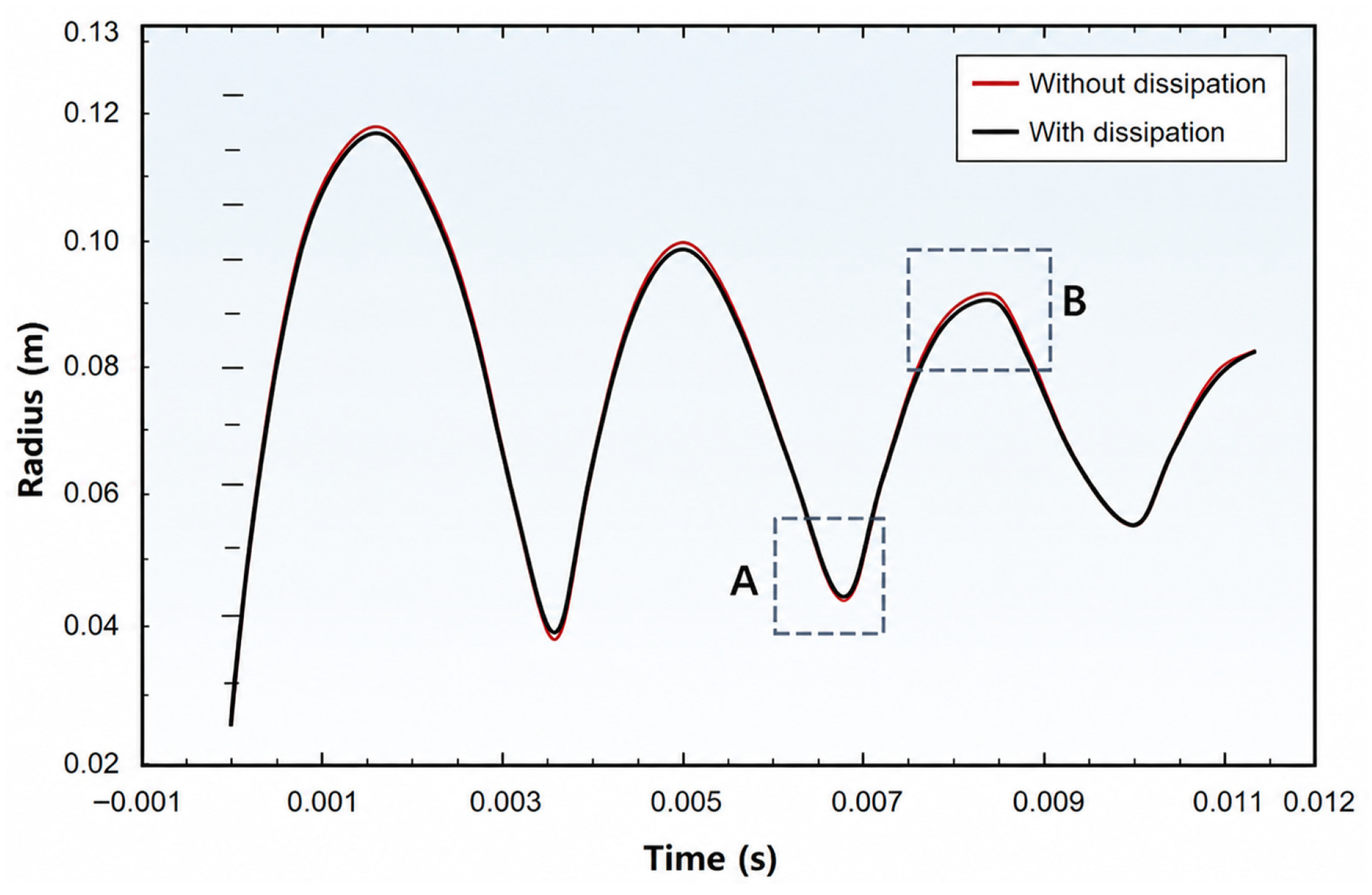
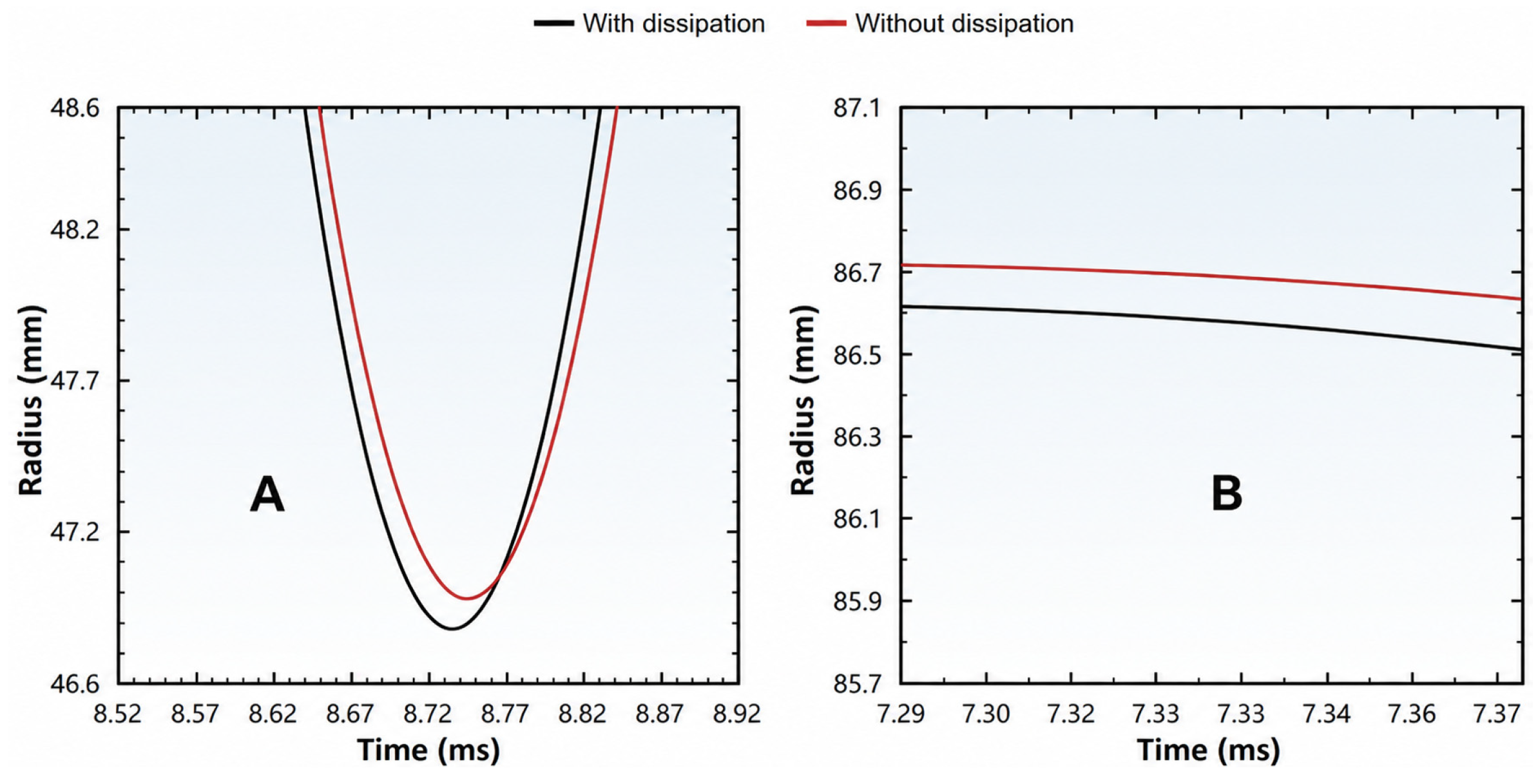
- It should be particularly noted that neglecting viscosity and surface tension during the bubble expansion phase and the high-speed collapse phase is entirely reasonable. However, when the bubble collapses to near its minimum radius, the extremely large interfacial curvature causes the surface tension effect to become pronounced; in the subsequent residual pulsation stage, the decrease in flow velocity also increases the contribution of viscous dissipation. Nevertheless, within the first two primary pulsation cycles, due to the dominance of the extremely high internal gas pressure, the influence of these two effects on the deviation of the macroscopic radius trajectory remains secondary.
2.2. Basic Bubble Dynamic Equations
2.3. Construction of Initial Bubble Conditions Based on the JWL Equation of State
2.4. Validation of the Theoretical Model
2.4.1. Model Validation Based on Classical Experimental Data
2.4.2. Model Validation Against Simulated Deep-Water Explosion Pressure Tank Test Data
3. Deep-Water Explosion Bubble Mass Loss Theoretical Model
3.1. Mechanism of Mass Loss in Deep-Water Explosion Bubbles
3.2. Theoretical Model of Mass Loss
4. Underwater Explosion Tests and Analysis of Mass Loss Effects
4.1. Underwater Explosion Bubble Test
4.2. Experimental Results
4.3. Analysis of the Influence of Mass Loss from Exploding Bubbles
5. Conclusions
- (1)
- Based on bubble dynamics equations, the JWL equation of state for explosives was introduced. Combined with detonation theory analysis of explosives, an analytical model for spherical pulsation of explosion bubbles was proposed. Combined with classical literature data, the scientific rationality of the proposed model was demonstrated, enabling a high-precision solution for spherical pulsation of explosion bubbles within the first pulsation period.
- (2)
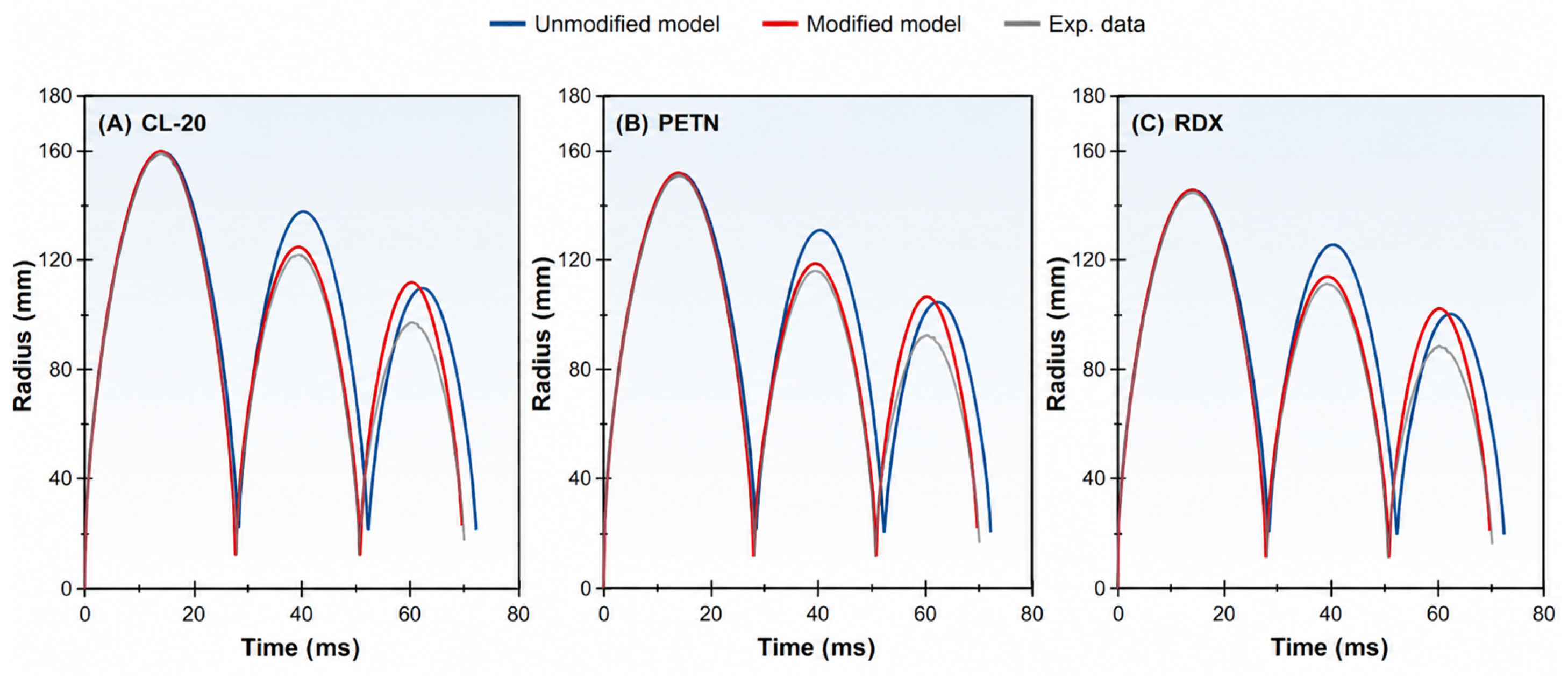
- Based on analysis of detonation product characteristics and the physical process of underwater explosion bubble pulsation, two primary mass loss mechanisms for explosion bubble pulsation were proposed: convective mass transfer at the gas–liquid interface and inertial scattering of insoluble products. On this basis, a mass loss model for explosion bubble pulsation based on classical mass transfer theory was developed. A correction method for the analytical model of explosion bubbles accounting for mass loss was proposed, and the reliability of the model was validated through experiments.
- (3)
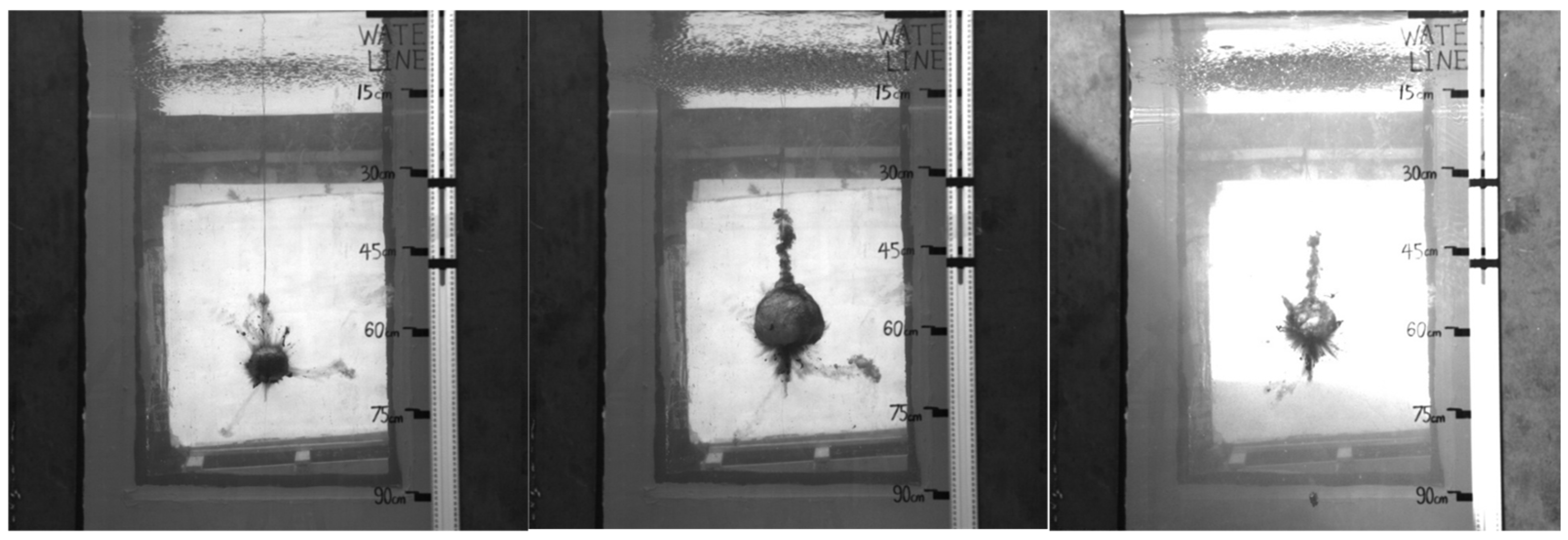
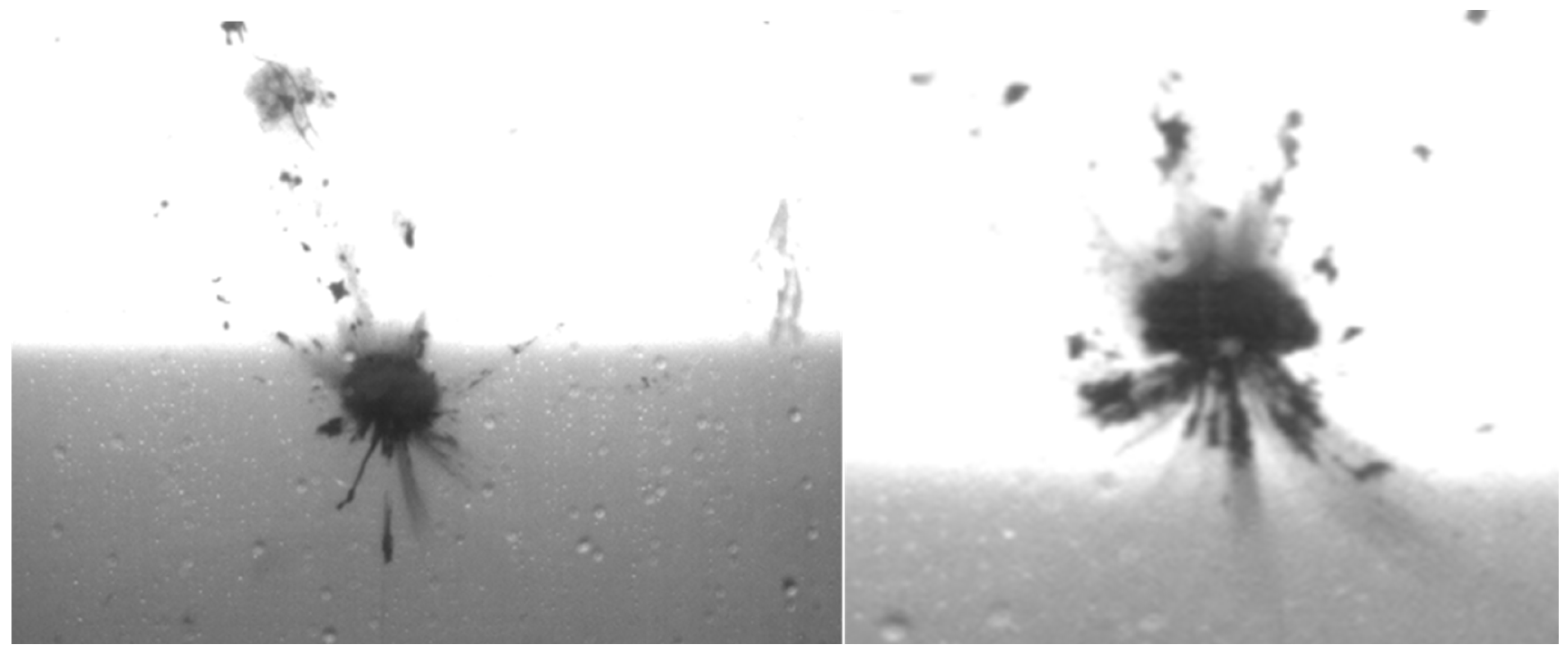
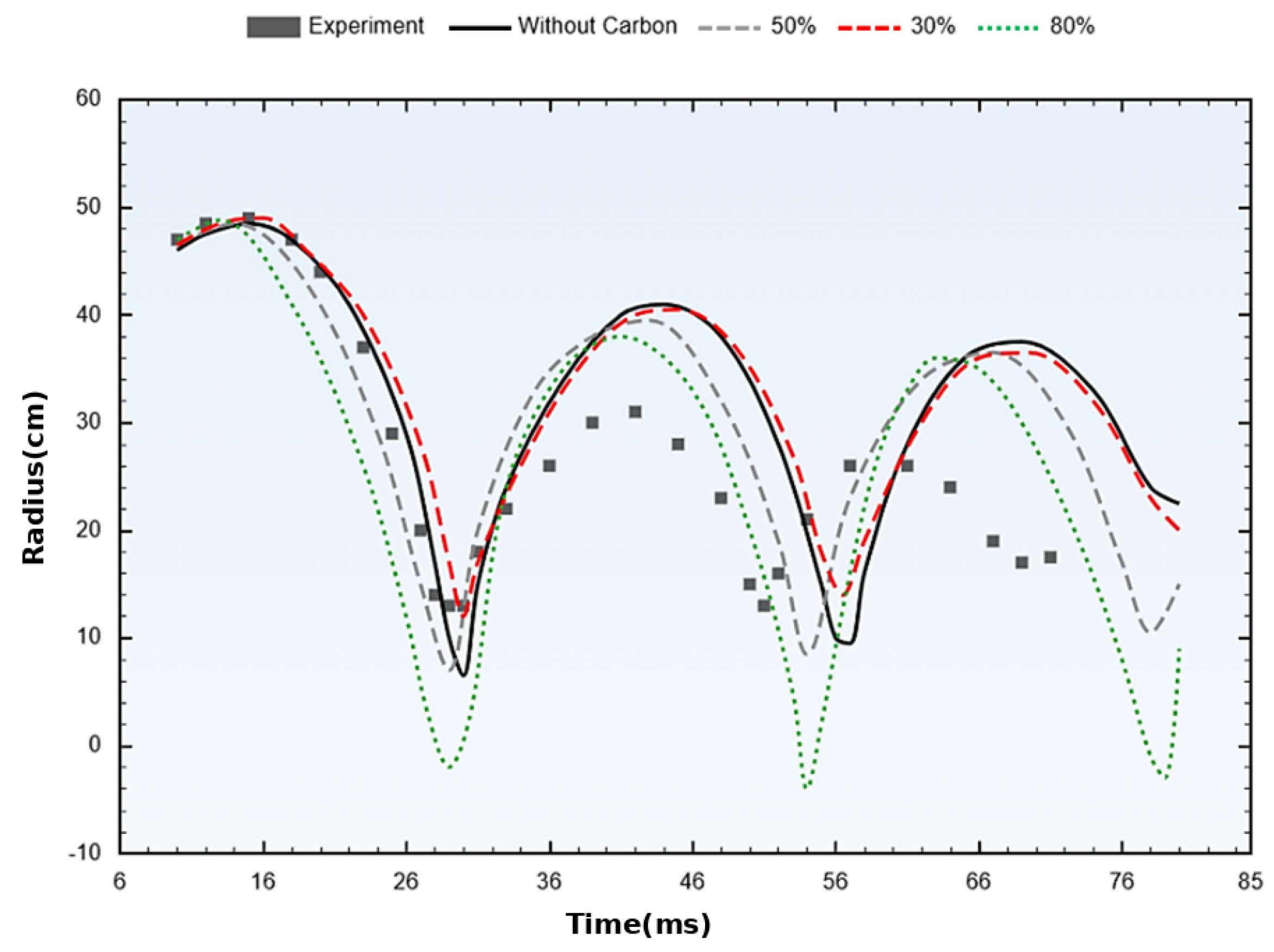
- Based on the proposed model and experimental data, the influence of mass loss on explosion bubble pulsation was analyzed. The findings reveal that among the two mass loss mechanisms proposed in this study, the influence of inertial scattering of insoluble products is more significant, while the effect of convective mass transfer is minimal. Mass loss has minimal impact on the first pulsation of explosion bubbles, but its influence becomes more pronounced during cycles after the second pulsation. Quantitative analysis indicates that the inertial scattering mechanism of insoluble products plays a dominant role, contributing over 90% of the apparent mass and energy loss, whereas the convective mass transfer effect based on dissolution-diffusion accounts for less than 10% of the macroscopic loss on the microsecond-to-millisecond timescale.
Author Contributions
Funding
Institutional Review Board Statement
Informed Consent Statement
Data Availability Statement
Conflicts of Interest
Abbreviations
| TNT | Trinitrotoluene |
| CL-20 | Hexanitrohexaazaisowurtzitane |
| PETN | Pentaerythritol tetranitrate |
| RDX | Cyclotrimethylenetrinitramine |
References
- Shima, A. Studies on bubble dynamics. Shock Waves 1997, 7, 33–42. [Google Scholar] [CrossRef]
- Besant, W.H. A Treatise on Hydrostatics and Hydrodynamics; Cambridge University Press: London, UK, 1859; pp. 92–97. [Google Scholar]
- Rayleigh, L. On the pressure developed in a liquid during the collapse of a spherical cavity. Lond. Edinb. Dublin Philos. Mag. J. Sci. 1917, 6, 94–98. [Google Scholar] [CrossRef]
- Lamb, H. On the early stages of a submarine explosion. Lond. Edinb. Dublin Philos. Mag. J. Sci. 1923, 6, 257–265. [Google Scholar] [CrossRef]
- Plesset, M.S. The dynamics of cavitation bubbles. J. Appl. Mech. 1949, 16, 277–282. [Google Scholar] [CrossRef]
- Herring, C. Theory of the Pulsations of the Gas Bubble Produced by an Underwater Explosion; Department of the Navy, Office of Naval Research: Washington, DC, USA, 1950; pp. 35–130. [Google Scholar]
- Trilling, L. The collapse and rebound of a gas bubble. J. Appl. Phys. 1952, 23, 14–17. [Google Scholar] [CrossRef]
- Gilmore, F.R. The Growth or Collapse of a Spherical Bubble in a Viscous Compressible Liquid; Engineering Report No.26; California Institute of Technology: Pasadena, CA, USA, 1952. [Google Scholar]
- Kirkwood, J.G.; Bethe, H. The Pressure Wave Produced by an Underwater Explosion, Basic Propagation Theory, Part 1; Report No.588; OSRD: Washington, DC, USA, 1942. [Google Scholar]
- Keller, J.B.; Kolodner, I.I. Damping of Underwater Explosion Bubble Oscillation. J. Appl. Phys. 1956, 27, 1152–1161. [Google Scholar] [CrossRef]
- Flynn, H.G. Cavitation dynamics. I. A mathematical formulation. Acoust. Soc. Am. J. 1975, 57, 1379–1396. [Google Scholar] [CrossRef]
- Flynn, H.G. Cavitation dynamics: II. Free pulsations and models for cavitation bubbles. J. Acoust. Soc. Am. 1975, 58, 1160–1170. [Google Scholar] [CrossRef]
- Lastman, G.J.; Wentzell, R.A. Cavitation of a bubble in an inviscid compressible liquid, with comparisons to a viscous incompressible liquid. Phys. Fluids 1979, 22, 2259–2266. [Google Scholar] [CrossRef]
- Cramer, E. The dynamics and acoustic emission of bubbles driven by a sound field. In Cavitation and Inhomogeneities in Underwater Acoustics; Springer: Berlin/Heidelberg, Germany, 1980; pp. 54–63. [Google Scholar]
- Rath, H.J. Free and forced oscillations of spherical gas bubbles and their translational motion in a compressible fluid. In Cavitation and Inhomogeneities in Underwater Acoustics; Springer: Berlin/Heidelberg, Germany, 1980; pp. 64–71. [Google Scholar]
- Keller, J.B.; Miksis, M. Bubble oscillations of large amplitude. J. Acoust. Soc. Am. 1980, 68, 628–633. [Google Scholar] [CrossRef]
- Prosperetti, A.; Lezzi, A. Bubble dynamics in a compressible liquid. Part 1. First-order theory. J. Fluid Mech. 1986, 168, 457–478. [Google Scholar] [CrossRef]
- Lighthill, M.J. A technique for rendering approximate solutions to physical problems uniformly valid. Phil. Mag. 1949, 40, 1179–1201. [Google Scholar] [CrossRef]
- Kuo, Y.H. On the flow of an incompressible viscous fluid past a flat plate at moderate Reynolds numbers. J. Math. Phys. 1953, 32, 83–101. [Google Scholar] [CrossRef]
- Tilmann, P.M. Nonlinear Sound-Scattering by Small Bubbles. In Cavitation and Inhomogeneities in Underwater Acoustics; Springer: Berlin/Heidelberg, Germany, 1980; pp. 113–118. [Google Scholar]
- Tomita, Y.; Shima, A. High-speed photographic observations of laser-induced cavitation bubbles in water. Acta Acust. United Acust. 1990, 71, 161–171. [Google Scholar]
- Tomita, Y.; Shima, A.; Sato, K. Dynamic behavior of two-laser-induced bubbles in water. Appl. Phys. Lett. 1990, 57, 234–236. [Google Scholar] [CrossRef]
- Lezzi, A.; Prosperetti, A. Bubble dynamics in a compressible liquid. Part 2. Second-order theory. J. Fluid Mech. 1987, 185, 289–321. [Google Scholar] [CrossRef]
- Zhang, J.; Wang, S.; Jia, X.; Gao, Y.; Ma, F. An engineering application of Prosperetti and Lezzi equation to solve underwater explosion bubbles. Phys. Fluids 2021, 33, 017118. [Google Scholar] [CrossRef]
- Cole, R.H. Underwater Explosion; American Institute of Physics: College Park, MD, USA, 1948. [Google Scholar]
- Swift, E.; Decius, J.C.; Winget, C.L.; Brown, R.M.; Allen, B. Measurement of Bubble Pulse Phenomena, III: Radius and Period Studies; Navy Department, Bureau of Ordnance: Washington, DC, USA, 1947. [Google Scholar]
- Wang, B.; Zhang, Y.P.; Wang, Y.P. Experimental study on bubble oscillation formed during underwater explosions. Explos. Shock Waves 2008, 28, 572–576. [Google Scholar]
- Wang, B.; Zhang, Y.P.; Wang, Y.P. An Experimental Method of Studying Underwater Explosion Bubble Oscillation. Chin. J. High Press. Phys. 2009, 23, 332–337. [Google Scholar]
- Chao, H.; Bin, W.; Yuanping, Z.; Cangli, L.; Xiongliang, Y. Jet characteristics of explosion bubbles in free-field water from cylindrical charges. Explos. Shock Waves 2011, 31, 263–267. [Google Scholar]
- Swift, E.; Decius, J.C. Underwater Explosion Research; Office of Naval Research: Washington, DC, USA, 1950. [Google Scholar]



| Test ID | Explosive Type | Charge Mass/g | Water Depth/m |
|---|---|---|---|
| 1 | TNT | 272.00 | 182.88 |
| 2 | PETN | 4.45 | 1.06 |
| 3 | PETN | 1.52 | 1.07 |
| 4 | TETRYL | 249.00 | 91.44 |
| Explosive Type | A/GPa | B/GPa | C/GPa | R1 | R2 | ω |
|---|---|---|---|---|---|---|
| TNT | 371.2 | 3.231 | 0.734 | 4.15 | 0.95 | 0.30 |
| PETN | 617.0 | 16.9 | 0.69 | 4.4 | 1.2 | 0.25 |
| TETRYL | 586.83 | 10.671 | 0.774 | 4.4 | 1.2 | 0.275 |
| Test ID | First Maximum Radius/m (Experimental) | First Maximum Radius/m (Calculated) | Relative Deviation |
|---|---|---|---|
| 1 | 0.379 | 0.356 | 6.23% |
| 2 | 0.0269 | 0.0253 | 5.77% |
| 3 | 0.0192 | 0.0177 | 7.92% |
| 4 | 0.452 | 0.447 | 1.10% |
| Test ID | First Pulsation Period/ms (Experimental) | First Pulsation Period/ms (Calculated) | Relative Deviation |
|---|---|---|---|
| 1 | 16.67 | 15.63 | 6.24% |
| 2 | 45.31 | 44.59 | 1.59% |
| 3 | 32.922 | 31.176 | 5.30% |
| 4 | 26.85 | 26.72 | 0.48% |
| Explosive Mass/g | Ambient Pressure/MPa | Pulsation Period/ms (Test) | Pulsation Period/ms (Calculated) | Relative Deviation |
|---|---|---|---|---|
| 10 | 4 | 3.041 | 2.978 | 2.07% |
| 5 | 2.532 | 2.476 | 2.21% | |
| 6 | 2.178 | 2.122 | 2.53% | |
| 30 | 5 | 3.613 | 3.567 | 1.16% |
| 6 | 3.123 | 3.067 | 1.79% |
| Explosive Mass/g | Ambient Pressure/MPa | Specific Bubble Energy/(MJ/kg) (Experimental) | Specific Bubble Energy/(MJ/kg) (Calculated) | Relative Deviation |
|---|---|---|---|---|
| 10 | 4 | 1.945 | 1.832 | 5.81% |
| 5 | 1.963 | 1.836 | 6.47% | |
| 6 | 1.971 | 1.839 | 6.60% | |
| 30 | 5 | 1.902 | 1.922 | 1.16% |
| 6 | 1.931 | 1.929 | 0.11% |
Disclaimer/Publisher’s Note: The statements, opinions and data contained in all publications are solely those of the individual author(s) and contributor(s) and not of MDPI and/or the editor(s). MDPI and/or the editor(s) disclaim responsibility for any injury to people or property resulting from any ideas, methods, instructions or products referred to in the content. |
© 2026 by the authors. Licensee MDPI, Basel, Switzerland. This article is an open access article distributed under the terms and conditions of the Creative Commons Attribution (CC BY) license.
Share and Cite
Lu, T.; Gao, Y.; Ding, L.; Zhang, H. Study on the Mass Loss Characteristics of Underwater Explosion Bubble Pulsation. Appl. Sci. 2026, 16, 4888. https://doi.org/10.3390/app16104888
Lu T, Gao Y, Ding L, Zhang H. Study on the Mass Loss Characteristics of Underwater Explosion Bubble Pulsation. Applied Sciences. 2026; 16(10):4888. https://doi.org/10.3390/app16104888
Chicago/Turabian StyleLu, Tan, Yuan Gao, Libo Ding, and He Zhang. 2026. "Study on the Mass Loss Characteristics of Underwater Explosion Bubble Pulsation" Applied Sciences 16, no. 10: 4888. https://doi.org/10.3390/app16104888
APA StyleLu, T., Gao, Y., Ding, L., & Zhang, H. (2026). Study on the Mass Loss Characteristics of Underwater Explosion Bubble Pulsation. Applied Sciences, 16(10), 4888. https://doi.org/10.3390/app16104888