1. Introduction
With the emergence and development of low-altitude traffic and transportation, a large number of aircraft equipped with sensing and communication devices are being widely used [
1,
2,
3]. However, the surge in the number of radio-frequency devices in low-altitude wireless networks poses severe challenges to the existing PRACH-based random access in low-altitude long-distance communication scenarios. M. Hua et al. [
4] have theoretically analyzed that in PRACH, traditional ZC sequences are extremely sensitive to frequency offsets. Their work demonstrates that in a Doppler shift environment, the ideal auto-correlation properties of ZC sequences are seriously disrupted, leading to timing ambiguities and errors in timing estimation, which directly affect the reliability of random access [
5]. However, the increase in the number of RF devices exacerbates the shortage of spectrum resources. Integrated sensing and communication (ISAC) technology, which shares spectrum and hardware resources, is a key approach to improving resource utilization [
6]. In 4G systems (LTE), the signals and protocol stack were designed around communication functions, and the system inherently lacked integrated sensing and communication capabilities. In the development stage of the 5G system, the initial versions did not consider ISAC as a core function, and the sensing capabilities remained in the preliminary exploration phase [
7]. While 5G-Advanced (5G-A, also known as 5.5G) has initiated preliminary explorations and study items on ISAC, it is primarily envisioned as a core, standardized evolution direction for upcoming 6G networks, aiming to deeply integrate sensing functions into communication systems [
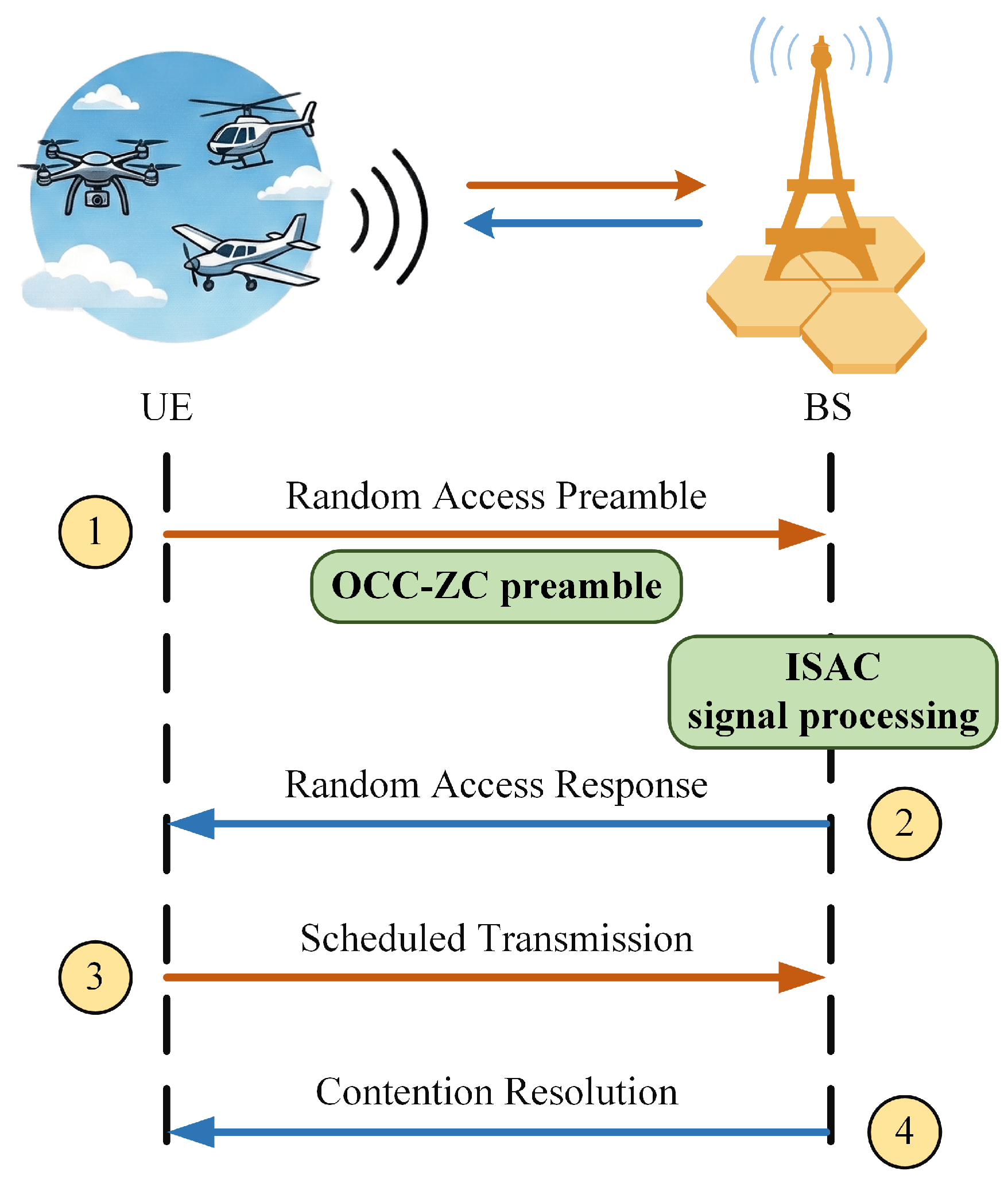
8]. In current 5G-A research and applications, sensing functions mainly rely on dedicated sensing signals configured after the terminal completes random access or establishes business channels [
9]. This “access first, sense later” [
10,
11] working mode means that the system’s sensing capability cannot be activated during the random access phase, creating an “initial sensing blind zone”—that is, the network can only effectively sense the terminal and its surrounding environment after the terminal successfully accesses the network via the Physical Random Access Channel (PRACH) [
12,
13].
The initial sensing blind zone poses multiple challenges for low-altitude long-distance communication. First, it causes a lag in the detection: since the network cannot obtain any state information about the terminal before access, there is an inevitable time window between the terminal’s appearance and its effective detection by the network [
14,
15]. Second, it creates regulatory loopholes: traditional sensing mechanisms rely on authorized terminals, allowing unauthorized or intentionally evasive rogue aircraft to hide their presence before access [
16,
17,
18]. Finally, it leads to resource inefficiency: PRACH, as a mandatory signal for every terminal waiting to access the network, carries valuable channel information that fails to be converted into environmental sensing data after access detection is completed, wasting scarce wireless resources [
19]. Consequently, it will be a key breakthrough to achieve ISAC.
Previous studies have investigated the design of PRACH in terms of sensing capabilities. Linsalata et al. proposed an OTFS-superimposed PRACH scheme, which enhances delay and Doppler resolution through the superimposition of the OTFS structure, but it requires significant modifications to existing protocols and terminals, increases signal processing complexity, and its performance still deteriorates in strong interference environments [
20]. Kumari et al. explored a non-uniform preamble layout virtual waveform design, which, although improving Doppler estimation accuracy by optimizing time-domain intervals, is essentially a trade-off between communication and sensing and does not achieve true functional integration [
21]. Accordingly, we found that although there has been research on PRACH sensing, the ultimate sensing performance has not significantly improved. Moreover, to our knowledge, the integrated functionality of sensing and communication in PRACH has rarely been studied. In this paper, we propose an enhanced PRACH frame structure design leveraging established OCC techniques for low-altitude long-distance communication scenarios, aiming to introduce sensing capabilities into PRACH, enabling the network to possess the target-sensing capability from the very beginning of access.
Before presenting the main contributions of this work, it is necessary to provide a brief overview of the optimization algorithms employed. The system, operating in a low-altitude long-distance integrated sensing and communication (ISAC) scenario, faces multiple constraints and trade-offs among communication reliability, sensing accuracy, and resource efficiency. Traditional single-objective optimization methods are inadequate for simultaneously satisfying these conflicting performance requirements. Therefore, a multi-objective optimization framework is essential to explore reasonable trade-off solutions within the complex system parameter space. This paper adopts the Non-dominated Sorting Genetic Algorithm II (NSGA-II) [
22] to jointly optimize parameters such as the Orthogonal Cover Code (OCC) design in the PRACH preamble, transmission power, and bandwidth. The goal is to concurrently enhance the random access success probability, reduce the estimation errors for both range and velocity in sensing, and control resource overhead. The necessity for multi-objective optimization stems from the fact that no single configuration exists in a practical system that can simultaneously optimize communication, sensing, and resource efficiency to their respective extrema. Instead, a set of Pareto-optimal solutions emerges [
23], each corresponding to a distinct communication-sensing trade-off strategy. Through the efficient search and sorting mechanisms of the NSGA-II algorithm, the system can obtain a series of feasible configurations under the constraints of power, bandwidth, and codebook. This capability enables the network to flexibly select operational strategies such as “communication-priority”, “sensing-priority”, or “balanced mode” based on real-time demands, thereby achieving sustainable and synergistic optimization of ISAC functionalities in resource-constrained environments.
The contributions of this paper are summarized as follows:
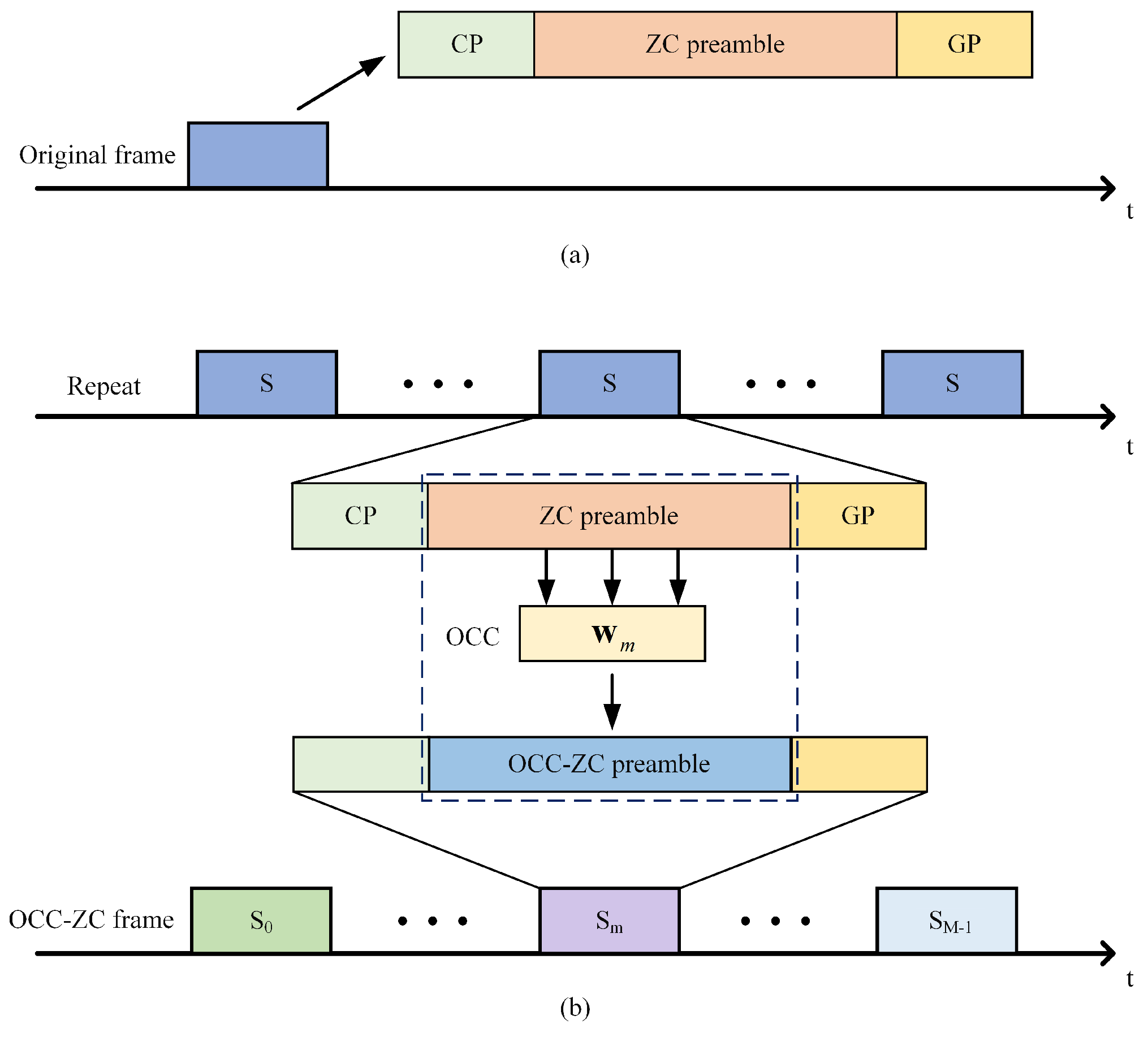
This paper proposes an enhanced PRACH framework structure based on time–frequency orthogonal block sequences. By introducing the time–frequency orthogonal block structure and orthogonal covering codes (OCCs), the Doppler effect is no longer simply regarded as an interference that needs to be avoided, but is actively utilized as a valuable sensing resource. This changes the physical layer frame structure and signal processing mode of PRACH.
In the time domain, the basic ZC sequence repeats N times, thereby forming multiple discrete-time blocks. We apply a fixed orthogonal covering code to each time block, thereby adding a new encoding dimension to the traditional sequence dimension. The design of the OCC-ZC sequence is transformed into a weighted optimization problem through detection probability and the Cramér–Rao lower bound (CRLB) for communication- and target-sensing performance, in order to achieve the ISAC function.
For the non-convex problem of a multi-objective optimization function, we used the NSGA-II algorithm to solve the optimization problem of OCC-ZC design under resource allocation conditions.
We conducted a large number of simulation experiments, and the results showed that the proposed method enables PRACH to achieve the ISAC function, while also ensuring the performance of communication access.
It should be noted that the proposed OCC-ZC preamble introduces additional PRACH resource consumption due to the repetition of the base ZC sequence. This overhead is mainly reflected in the increased preamble duration proportional to the repetition factor M.However, the proposed design is primarily targeted at low-altitude long-distance access scenarios, where the number of simultaneously contending UEs is relatively limited, while access reliability and sensing capability are of higher priority. In such scenarios, PRACH transmission is sporadic rather than continuous, and the additional resource consumption does not significantly affect the whole system capacity. When the system load increases, smaller values of M can be adopted to reduce resource consumption, while larger values of M are preferred in sensing-priority or coverage-limited scenarios. Therefore, the proposed scheme is not intended as a universal replacement for conventional PRACH, but as a flexible enhancement for specific ISAC-oriented scenarios.
The subsequent content of this paper will elaborate on the detailed design and performance of the enhanced PRACH preamble.
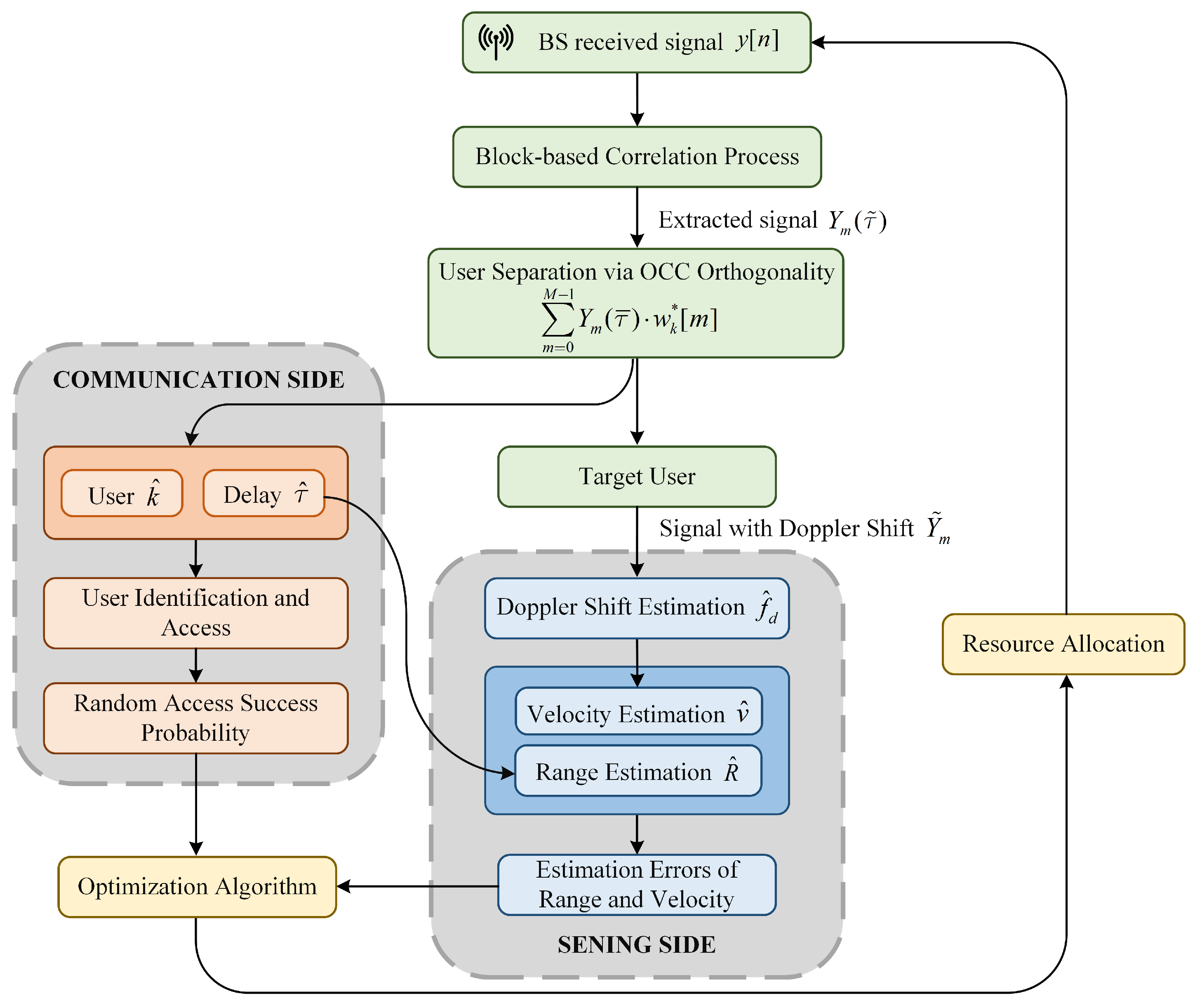
Section 2 systematically describes the frame structure design of the proposed OCC-ZC preamble, including the construction methods of ZC and OCC sequences, and derives the ISAC signal processing flow based on this preamble. It establishes performance analysis models from both sensing and communication perspectives, including the Cramér–Rao lower bound (CRLB) for range and velocity estimation and the closed-form expression for preamble detection probability.
Section 3 formalizes the preamble design into a multi-objective optimization problem under the constraints of transmission power, bandwidth, and orthogonal codebook, aiming to balance the random access success probability, sensing estimation error, and resource consumption cost. To solve this non-convex mixed-integer programming problem,
Section 4 introduces the NSGA-II algorithm, detailing its steps to obtain a Pareto-optimal solution set via multi-objective evolutionary search.
Section 5 validates the effectiveness of the proposed scheme in low-altitude long-distance scenarios through extensive simulations, including a multi-objective trade-off analysis, comparison of communication detection probability, and assessment of sensing parameter (range and velocity) estimation accuracy. Results show that the OCC-ZC structure improves detection probability while significantly enhancing sensing accuracy. Finally,
Section 6, summarizes the work and suggests directions for future research.
3. Problem Formulation
The main objective of this work is to identify an OCC code so that the proposed OCC-ZC preamble signal can be used for PRACH communication- and target-sensing under transmission-power and orthogonal-codebook constraints.
represents a resource allocation penalty term, which can adjust weights and resource allocation strategies based on real-time performance feedback. By introducing
, power
P and bandwidth resources
B can be dynamically allocated between communication and sensing to prevent one function from consuming too many resources and causing a sharp decline in the performance of the other function, which can be written as follows:
where B is the bandwidth and
are weighting coefficients that control the cost of resource consumption.
To solve the optimization problem, which involves the joint optimization of the discrete orthogonal codeword
w and continuous transmission parameters (power
P, bandwidth
B, and sensing slot duration
), a three-objective optimization framework is adopted. The problem aims to simultaneously balance three competing performance metrics: the random access success probability
, the sensing estimation error
, and the resource consumption cost
. Its mathematical description is as follows:
where
denotes the vector of decision variables and
is the vector of objective functions to be minimized. where
is random access success probability,
is the normalized estimation errors of range and velocity is defined as
where
and
are dual variables.
is the maximum sensing distance required by the system.
is the maximum velocity that the system is required to sense.
Problem (
42) describes that the OCC-ZC preamble of the PRACH frame realizes ISAC under the constraints of transmission power and the orthogonal codebook.
The continuous variable transmit power P and the orthogonal codeword of the discrete variable form the basic framework of a mixed-integer programming problem. Any optimization problem involving integer variables has a feasible region consisting of a discrete set of points, and discrete sets are non-convex. Consequently, the problem automatically becomes an NP-hard combinatorial optimization problem. Given the non-convex nature of the problem, genetic algorithms can be employed to find locally optimal solutions.
4. The Proposed Algorithm
The optimization problem formulated in
Section 3 is inherently a three-objective optimization. Due to the inherent trade-offs among communication performance, sensing accuracy, and resource efficiency, there exists no single global solution that can simultaneously optimize all three objectives to their respective extremes. Instead, a set of Pareto-optimal solutions emerges, where each solution represents the best attainable balance among the three objectives under the given constraints.
To systematically explore this complex high-dimensional trade-off frontier, this paper employs the Non-dominated Sorting Genetic Algorithm II (NSGA-II) [
22], a dedicated multi-objective optimization algorithm. NSGA-II can directly handle the aforementioned three-objective optimization problem without requiring a predefined fixed weighting scheme. It effectively searches for and returns a well-distributed set of Pareto-optimal solutions. This solution set provides a decision-making basis for the network to flexibly select operational strategies, such as “communication-priority”, “sensing-priority”, or “balanced-mode”, according to diverse real-time requirements.
The specific steps of the algorithm are as follows:
- 1.
Population initialization
Within the feasible region satisfying the constraints, randomly generate the initial population , with a total of I individuals. Each individual contains three optimization objective function values: , , and .
- 2.
Genetic operations
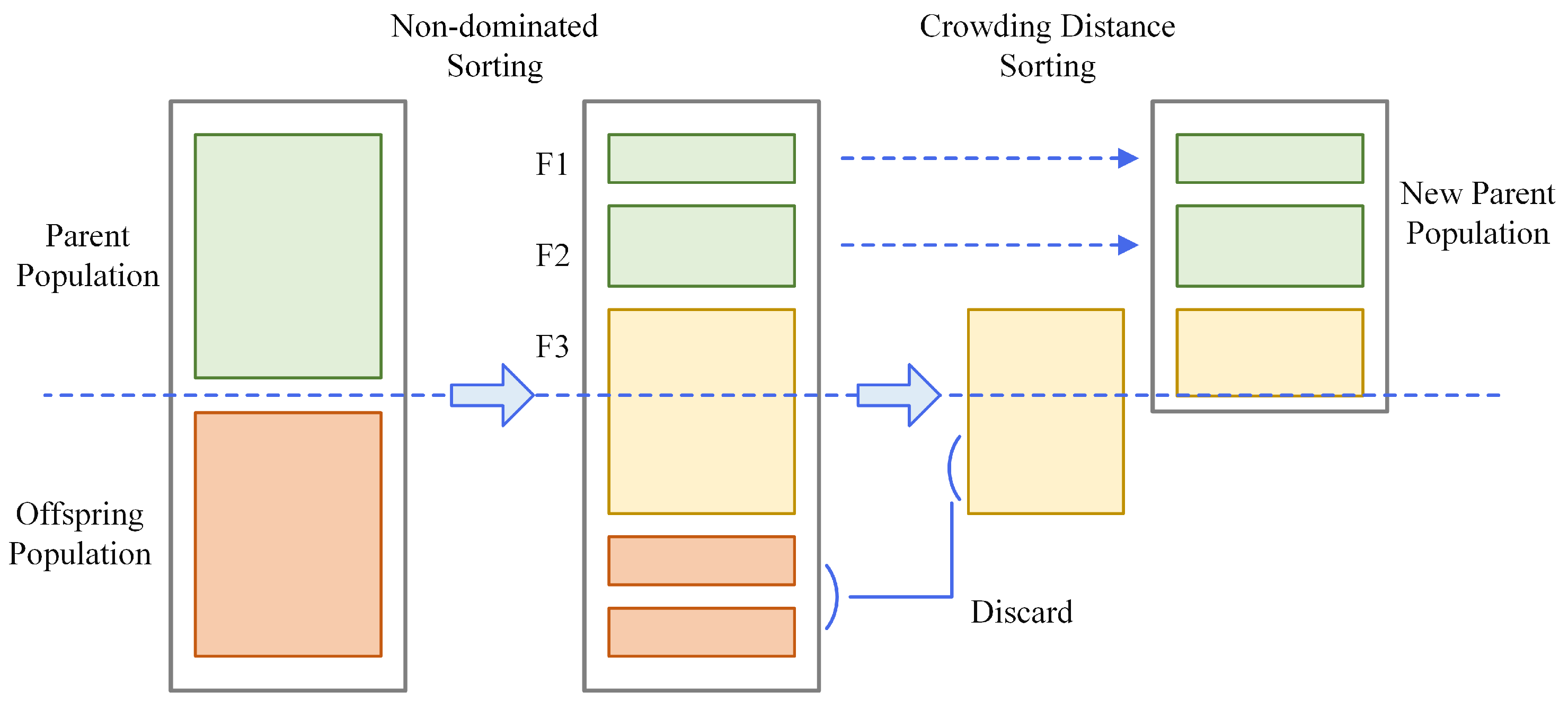
Perform selection, crossover, and mutation operations on the parent population to generate the offspring population. The selection adopts a binary tournament strategy, prioritizing individuals with a lower non-dominated rank or a larger crowding distance for retention. Crossover uses simulated binary crossover to generate new solutions, with a crossover factor controlling the crossover probability. Mutation employs polynomial mutation to enhance local search capability, with a mutation factor controlling the mutation probability, ultimately yielding the offspring population.
- 3.
Population combination
The parent and offspring populations are combined to form a new population.
- 4.
Non-dominated sorting
The merged new population is then divided into hierarchical levels using the non-dominated sorting method. Non-dominated sorting refers to the process of stratifying and ranking all individuals in the population based on Pareto dominance relationships, dividing them into several non-dominated layers. Its essence lies in establishing hierarchical priorities through dominance relationships, thereby providing a foundation for subsequent crowding distance calculations and individual selection.
- 5.
Crowding distance calculation
Next, calculate the crowding distance
for an individual
i in the current population, considering all three objective functions,
,
, and
, as shown below:
where
and
represent the
j-th optimization objective function values of the two individuals adjacent to the individual
i after sorting, and
and
denote the maximum and minimum values of the
j-th optimization objective in the current population. The crowding distance reflects the crowding degree among individuals; a larger crowding distance indicates sparser distribution of individuals, leading to better diversity of the solution set.
- 6.
Selection of individuals
First, individuals at lower non-dominated ranks are prioritized for retention. When selection is required among individuals within the same rank, those with larger crowding distances are given priority. This process continues until the number of individuals reaches I, thereby generating a new parent population.
- 7.
Iteration
Repeat steps 2 to 6 until the maximum number of evolutionary iterations is reached, obtaining the Pareto-approximate-optimal solution set.
For more details please refer to the Algorithm 1. The process of population sorting and selection is shown in
Figure 4.
| Algorithm 1 NSGA-II for multi-objective resource optimization in OCC-ZC PRACH system |
Require: Individual encoding: , ,
Ensure: Pareto-optimal solution set - 1:
procedure NSGA-II() - 2:
Initialize with N feasible configurations - 3:
Evaluate each individual in on three objectives: - 4:
1. : access success probability - 5:
2. : normalized sensing error - 6:
3. : resource consumption cost - 7:
Non-dominated sort , compute crowding distance - 8:
- 9:
while do - 10:
- 11:
for to do - 12:
Select parents from via binary tournament - 13:
Crossover: hybrid operators with probability : - 14:
- For : Simulated Binary Crossover (SBX) - 15:
- For : Single-point crossover - 16:
Generate offspring - 17:
Mutation: hybrid operators with probability : - 18:
- For : Polynomial mutation - 19:
- For : Random replacement in - 20:
- 21:
end for - 22:
Evaluate all individuals in on the three objectives - 23:
- 24:
Fast non-dominated sort - 25:
- 26:
- 27:
while do - 28:
Compute crowding distance for each in - 29:
- 30:
- 31:
end while - 32:
Sort by descending crowding distance - 33:
- 34:
- 35:
end while - 36:
(i.e., ) - 37:
return - 38:
end procedure
|
Specifically, the algorithm aims to enhance the random access success rate and uplink throughput on the communication side, as well as optimize Doppler velocity estimation accuracy and target detection probability on the sensing side, while minimizing resource consumption cost . Leveraging its distinctive mechanisms of fast non-dominated sorting and crowding distance calculation, the NSGA-II algorithm efficiently handles these three competing objectives, searching for the Pareto-optimal set within the complex solution space. Consequently, it provides the network with a range of feasible configuration strategies, spanning from ‘communication-priority’ to ‘sensing-priority’ options, with varying resource consumption levels.
5. Performance Evaluation
5.1. Simulation Parameters
In this subsection, we evaluate the performance of the proposed OCC-ZC preamble in a low-altitude long-distance ISAC scenario.
The simulation parameters are summarized in
Table 1 and
Table 2. We compare the proposed scheme with the conventional ZC-based PRACH scheme. The performance metrics include: (i) detection probability
for communication; (ii) root mean square error (RMSE) of range and velocity estimation for sensing; and (iii) Cramér–Rao lower bound (CRLB) for range and velocity as theoretical benchmarks. The impact of the weighting factor
is also analyzed.
The selection of simulation parameters in
Table 1 is designed to construct a rigorous and realistic evaluation scenario for long-distance communication access at low-altitude [
30]. The carrier frequency is set to 3.5 GHz with a system bandwidth of 20 MHz, directly corresponding to the configuration of a mainstream 5G mid-band (e.g., n78 band). A transmit power of 23 dBm is selected to model the typical uplink transmission power level of current commercial aircraft communication payloads. The channel model adopts the 3GPP Urban Macrocell (UMa) line-of-sight model supplemented by log-normal shadowing with a standard deviation of 4 dB. This model effectively captures the channel characteristics in open airspace, such as suburban or campus areas, where a stable LOS path exists between the UE and the base station while subject to minor blockages from sporadic obstacles, providing propagation conditions with both stability and randomness.
A Zadoff–Chu sequence of length 839 is employed as the base preamble, and a conventional preamble space of 64 based on cyclic shifts is assumed per cell. This fully adheres to the standard design of long preambles in 4G/5G PRACH, ensuring a fair baseline for comparison between the proposed and conventional schemes. The core of the simulation is to observe the effect of the introduced “repetition” and “orthogonal covering” mechanism. Therefore, the repetition number M is set to four for comparison. All access attempts are evaluated within a fixed time window of 100 ms. This duration is adequate to encompass a complete four-step random access procedure and simulate certain retransmission processes.
The parameters in
Table 2 are selected to evaluate sensing performance under realistic conditions [
31]. The carrier frequency
and signal bandwidth
together form a typical sub-6GHz carrier configuration of 5G NR. The transmit power
mimics the typical uplink transmission power level of commercial aircraft communication payloads. The channel model adopts the 3GPP UMa line-of-sight model supplemented with moderate shadow fading (
), characterizing the channel features where a dominant line-of-sight path exists between the UE and the base station in suburban or campus environments, yet is subject to minor blockages from sporadic obstacles.
5.2. Communication Performance
This subsection evaluates the communication performance of the proposed OCC-ZC preamble in terms of detection probability.
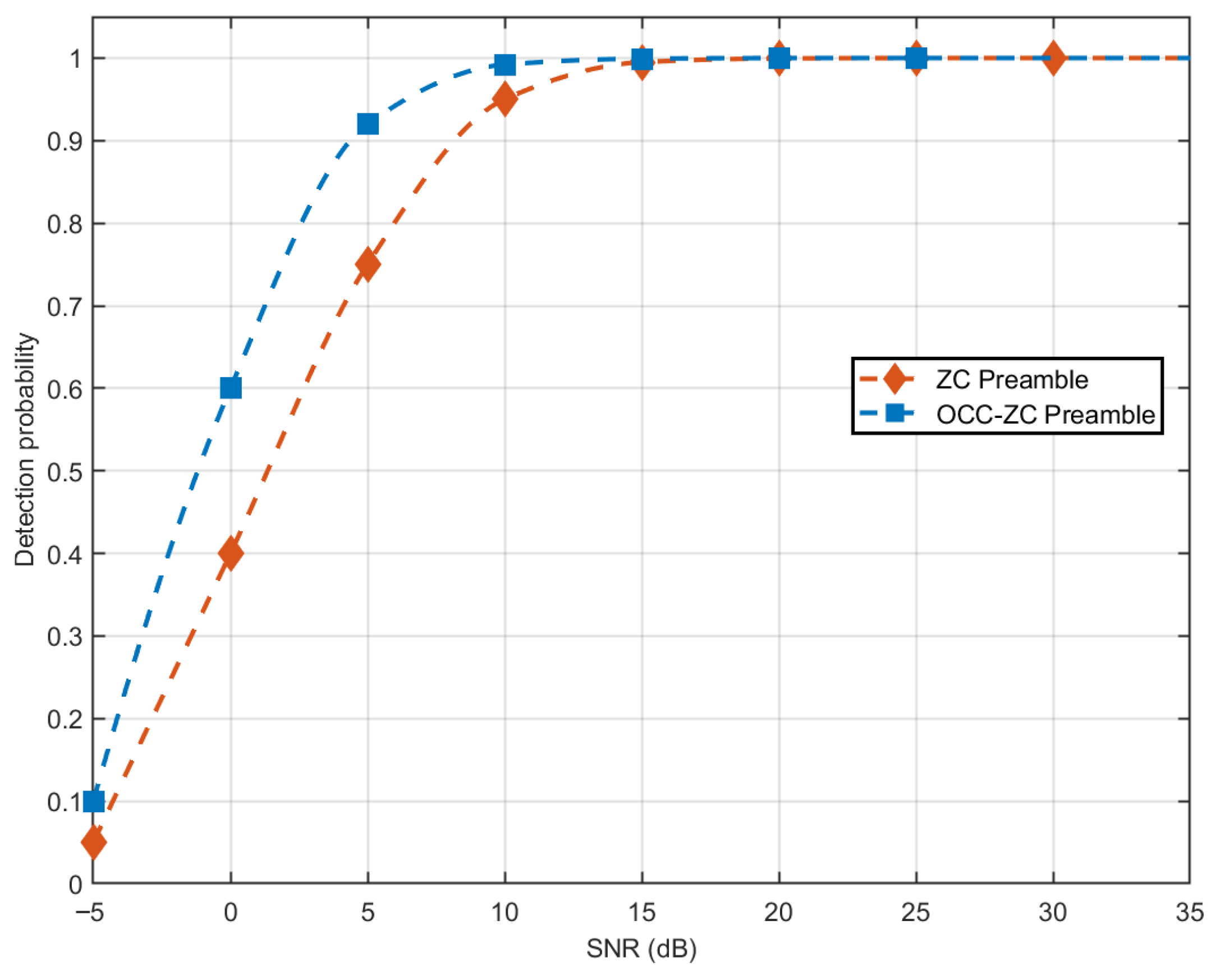
Figure 5 compares the detection probability of the conventional ZC preamble and the proposed OCC-ZC preamble under varying SNR. The OCC-ZC scheme achieves a detection probability of 1 at an SNR of 10 dB, while the conventional scheme requires 15 dB. Furthermore, throughout the entire SNR range, the OCC-ZC PRACH curve consistently lies above the conventional PRACH curve, demonstrating its performance advantage under various channel conditions. This improvement stems from the additional orthogonal dimension introduced by OCC, which enhances the distinguishability of preambles.
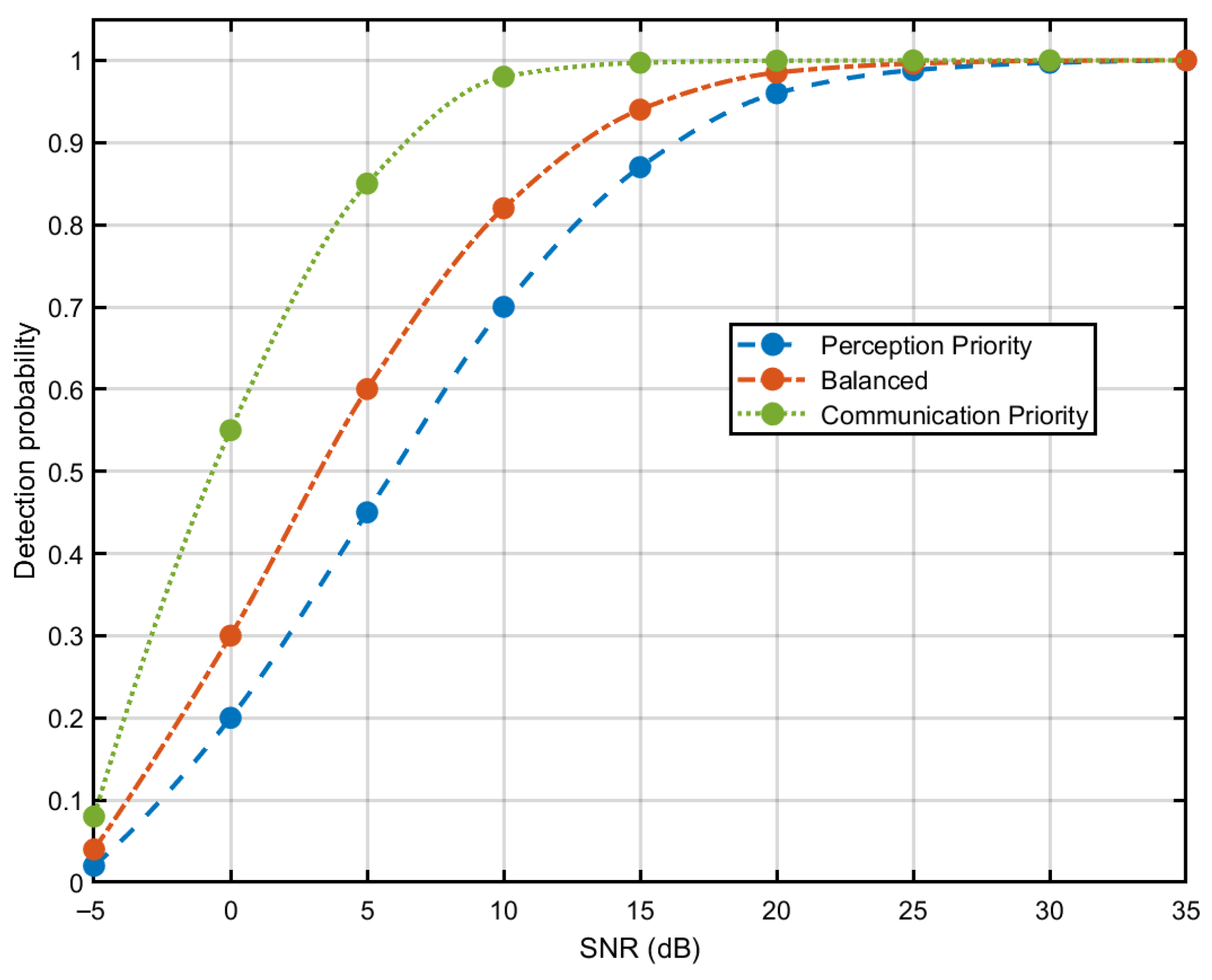
The detection probability performance of the OCC-ZC preamble under different system strategies is further investigated and the evaluation results are shown in
Figure 6.
The detection probability performance of three representative configurations selected from the obtained Pareto-optimal solution set, which corresponds to the sensing-priority, balanced, and communication-priority strategies, is compared. As shown in
Figure 6, these three configurations, originating from different trade-off points on the Pareto front, exhibit significant differences in detection performance. In the low-SNR region (SNR < 15 dB), the communication-priority configuration demonstrates a clear detection advantage, achieving a near-unity detection probability at SNR ≈ 15 dB. In contrast, the sensing-priority configuration yields a lower detection probability at the same SNR levels, requiring SNR ≈ 25 dB to reach comparable performance. The performance of the balanced configuration lies between these two extremes. This result visually illustrates the characteristics of different solutions along the Pareto frontier and validates the inherent resource trade-off between communication and sensing functions: higher requirements for sensing accuracy typically come at the cost of reduced access reliability.
5.3. Sensing Performance
The sensing performance of the proposed PRACH preamble scheme in terms of range and velocity estimation accuracy is evaluated as follows.
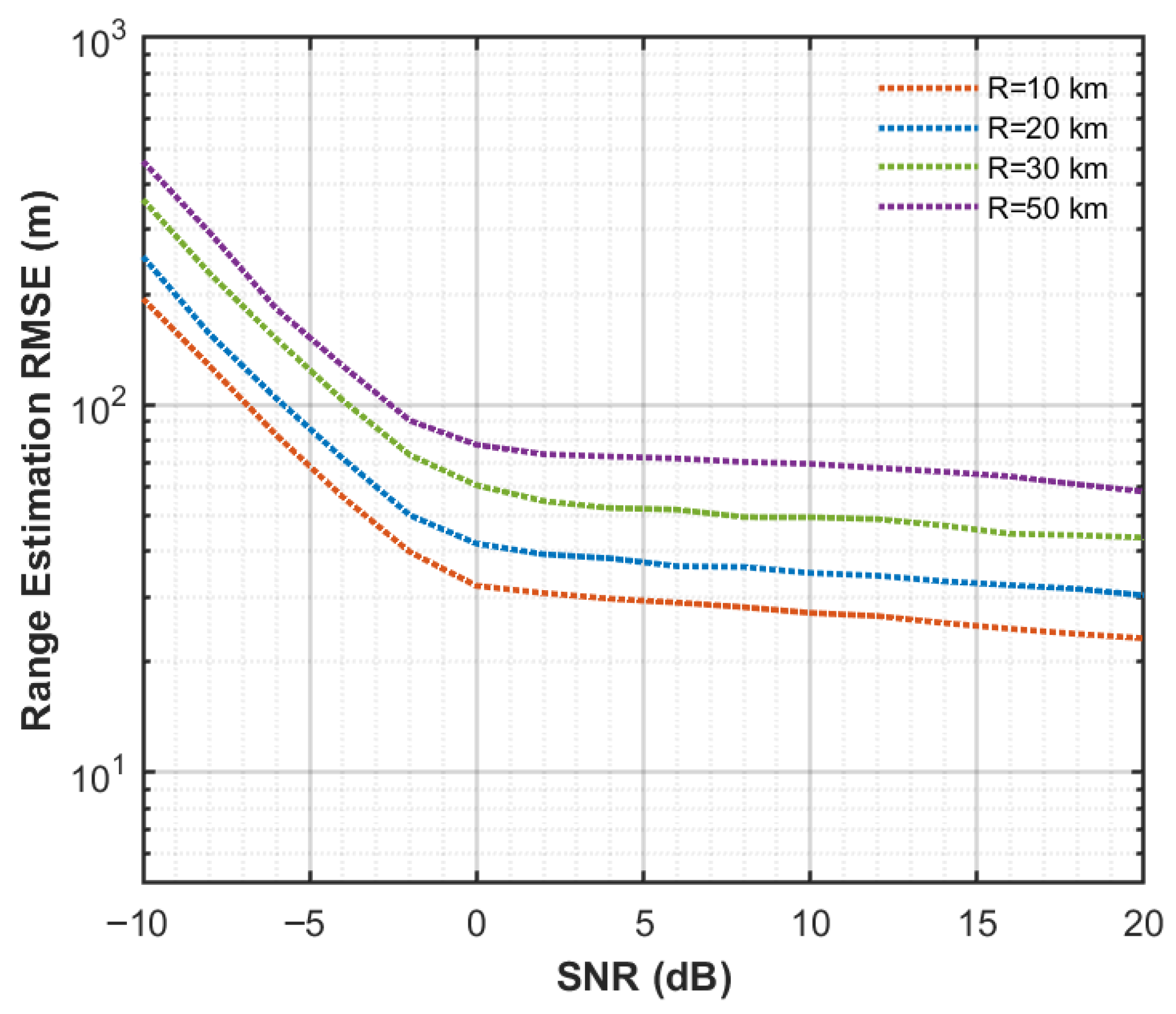
As shown in
Figure 7, the distance estimation performance based on the OCC-ZC preamble is evaluated. The graph illustrates the relationship between the root mean square error (RMSE) of distance estimation and the reference transmit signal-to-noise ratio (transmit SNR) for four different target distances (10 km, 20 km, 30 km, and 50 km). It can be observed that all curves exhibit a typical threshold effect: in the low SNR region (−10 dB to 0 dB), the distance estimation error decreases rapidly as the transmit SNR increases; in the high SNR region, the rate of error reduction slows down, asymptotically approaching the theoretical bound.
Crucially, it is observed that the estimation accuracy heavily depends on the target distance. At a fixed transmit SNR, the estimation error significantly increases for targets at greater distances (e.g., 50 km). This is strictly consistent with electromagnetic propagation physics: as the distance increases, severe path loss significantly degrades the actual received SNR at the base station. Consequently, the reduced received signal power leads to a deterioration in delay estimation accuracy. Nevertheless, even at a long distance of 50 km, when the transmit SNR reaches 20 dB, the system can still achieve a positioning accuracy of about 60 m, which fully demonstrates the effectiveness of the proposed OCC-ZC preamble in low-altitude long-distance ISAC scenarios.
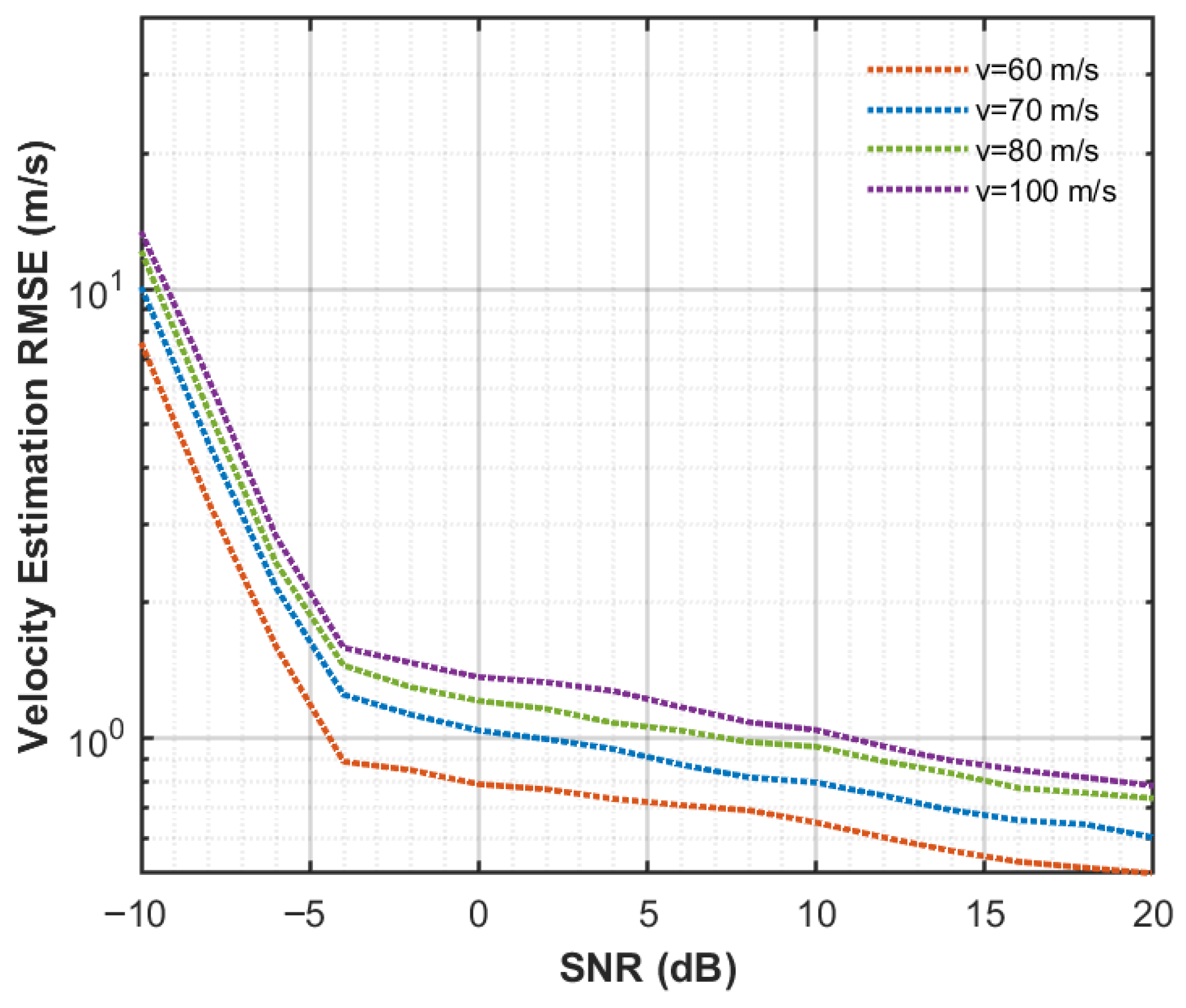
Figure 8 illustrates the velocity estimation performance, depicting the variation of velocity estimation RMSE with the transmit SNR for four different target radial velocities (60 m/s, 70 m/s, 80 m/s, and 100 m/s). Similar to the range estimation, the velocity estimation error exhibits a rapid decline followed by a slower asymptotic decrease as the SNR improves.
Under identical SNR conditions, targets with higher radial velocities (e.g., 100 m/s) exhibit slightly larger estimation errors compared to lower-speed targets (e.g., 60 m/s). This behavior accurately reflects the characteristics of the practical phase-difference estimator implemented in our system. Higher target velocities induce larger Doppler frequency shifts, causing the block-to-block phase rotation to approach the ambiguity boundaries (). In the presence of noise, this reduced phase margin makes the estimator more susceptible to phase wrapping errors. Furthermore, severe Doppler shifts introduce slight intra-block channel variations, which mildly disrupt the strict orthogonality of the ZC sequence and cause Inter-Carrier Interference (ICI). Despite these practical challenges, when the SNR reaches 15 dB, the system maintains a highly precise velocity estimation accuracy of approximately 0.7 m/s even under high-speed conditions of 100 m/s, strictly fulfilling the stringent requirements of low-altitude aircraft tracking.
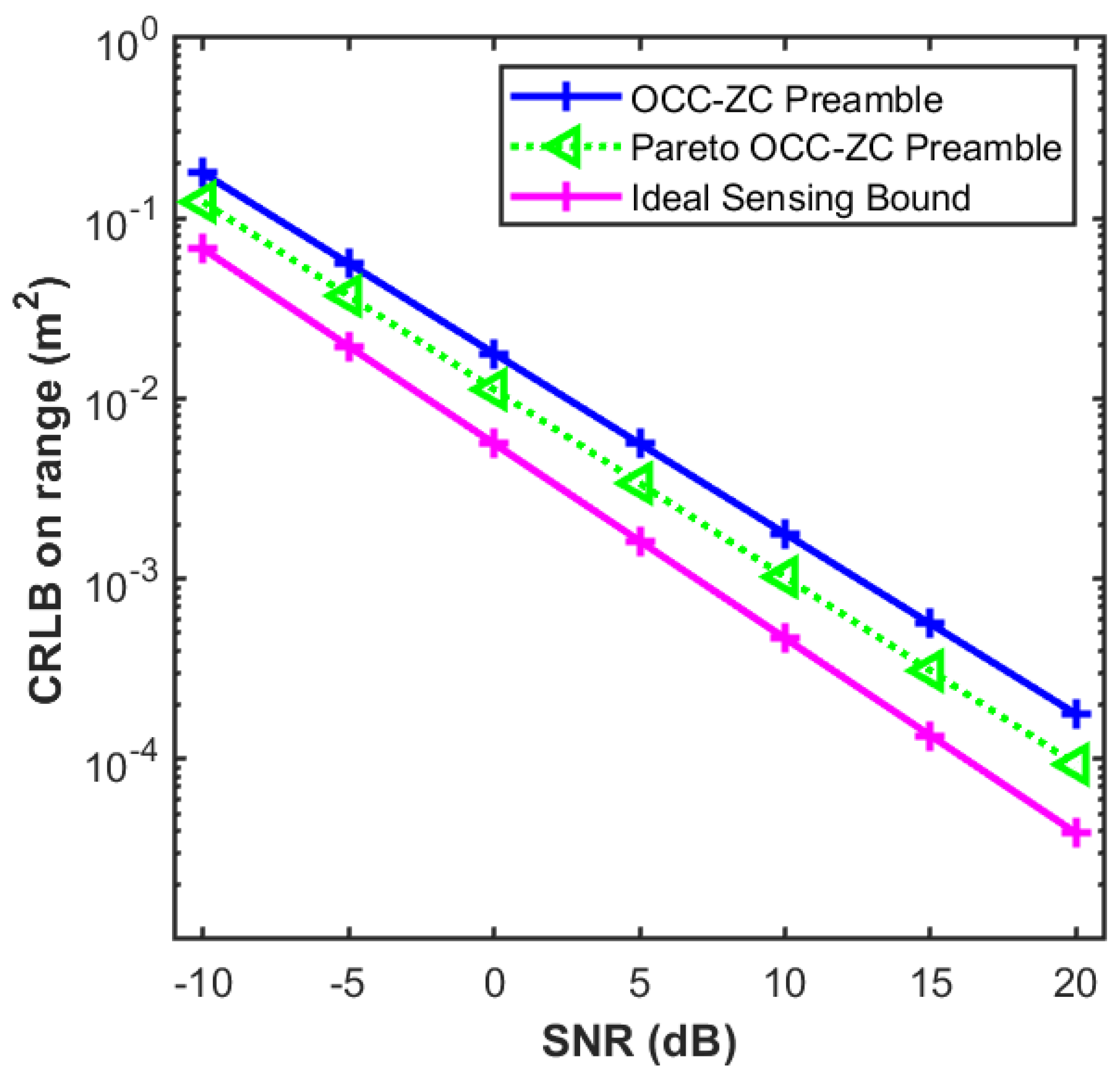
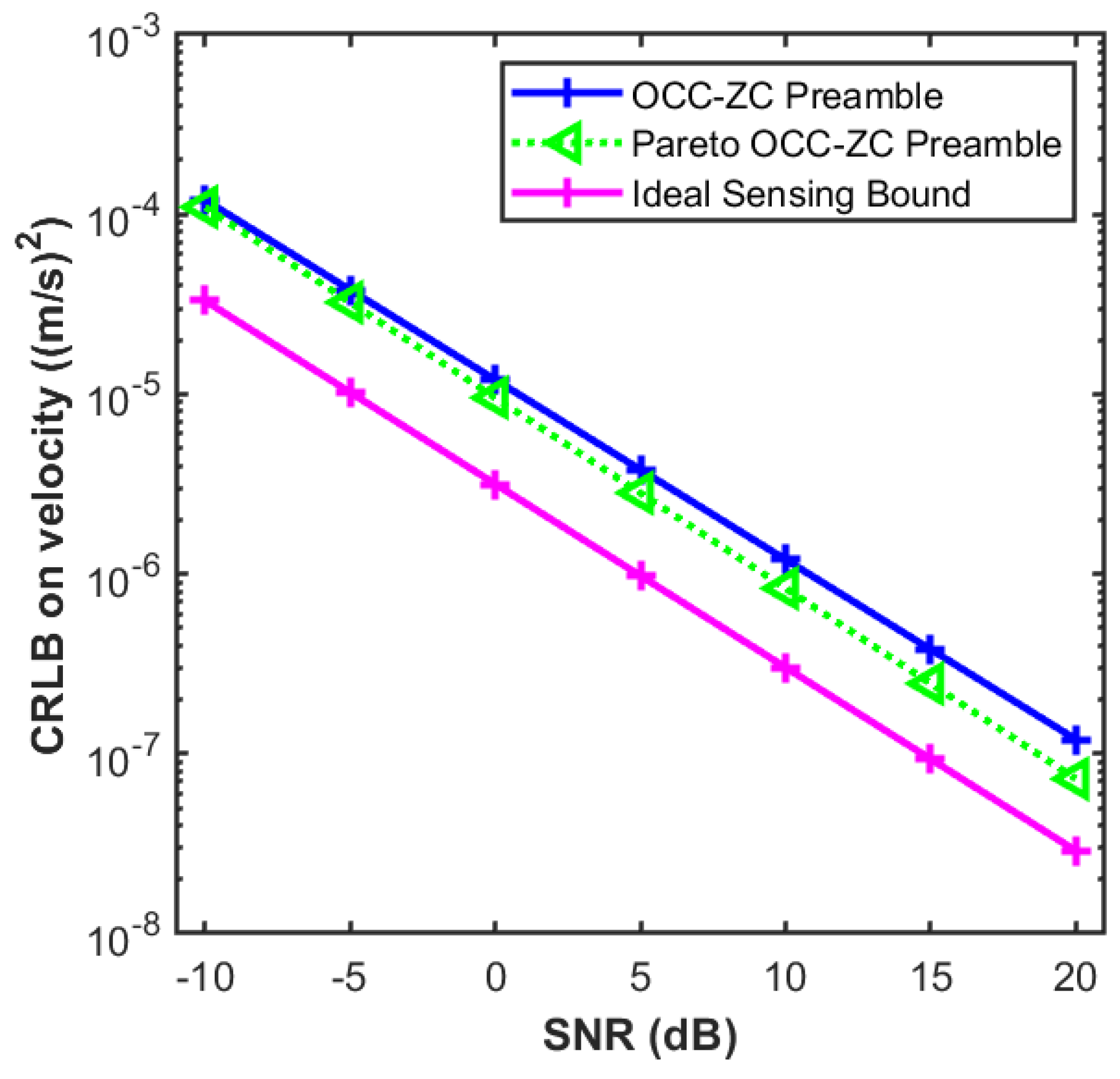
Figure 9 and
Figure 10 compare the Cramér–Rao lower bound (CRLB) for range and velocity estimation [
32], respectively. As theoretically expected, the CRLB curves for both waveforms exhibit a strictly linear decreasing trend on the semi-logarithmic scale. It can be distinctly observed that the proposed Pareto OCC-ZC scheme strictly outperforms the fixed OCC-ZC scheme across the entire SNR regime. Furthermore, instead of asymptotically converging, the curves maintain a constant parallel gap on the logarithmic scale. This parallel relationship accurately indicates a constant theoretical performance gain achieved by the NSGA-II optimization, confirming its stable superiority in sensing accuracy.
By comparing
Figure 7 with
Figure 9 and
Figure 8 with
Figure 10, it can be observed that the RMSE curves of the range and velocity estimates obtained using the OCC-ZC preamble achieve the same decreasing slope as the corresponding
curves as the SNR increases. The constant parallel gap on the logarithmic scale indicates a marginal, constant implementation and approximation loss, yet confirms that the proposed estimator is asymptotically efficient. The alignment between simulation and theory (
35) confirms that the OCC-ZC preamble enables near-optimal estimation accuracy in both range and velocity under high SNR conditions.
5.4. Multi-Objective Optimization
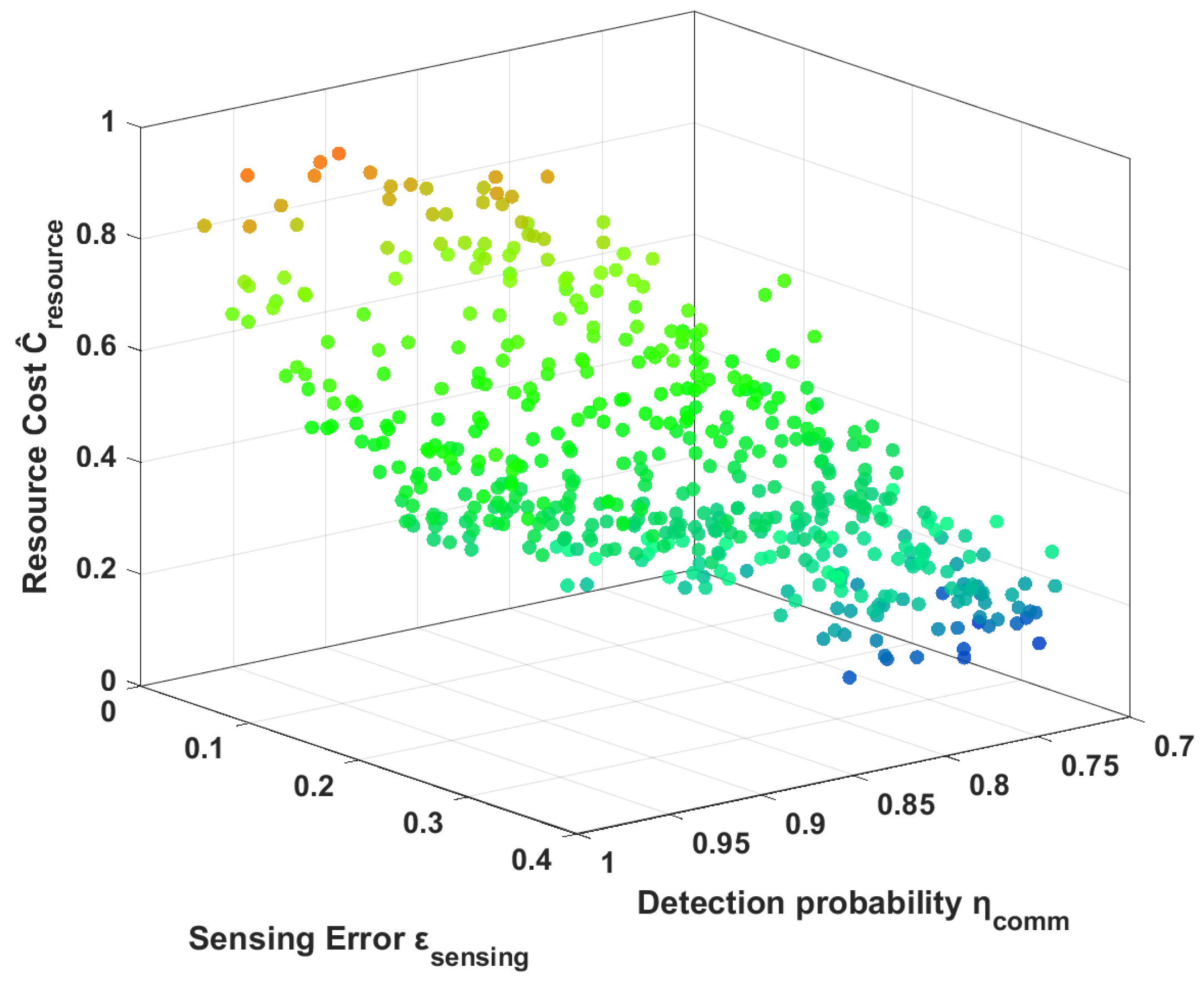
To comprehensively analyze the trade-off among communication performance, sensing accuracy, and resource efficiency, we first present the Pareto frontier obtained by the NSGA-II algorithm in
Figure 11. The three axes represent detection probability
, sensing error
, and resource cost
. The Pareto front clearly illustrates the inherent trade-offs among these three objectives [
23].
The color gradient of the scatter points corresponds to the magnitude of the resource cost , ranging from dark blue (lowest cost) to orange/red (highest cost), clearly demonstrating the decisive impact of resource investment on system performance: solutions with low resource cost cluster in regions characterized by lower detection probability and higher sensing errors, whereas those with high resource cost achieve both high detection probability and low sensing errors.
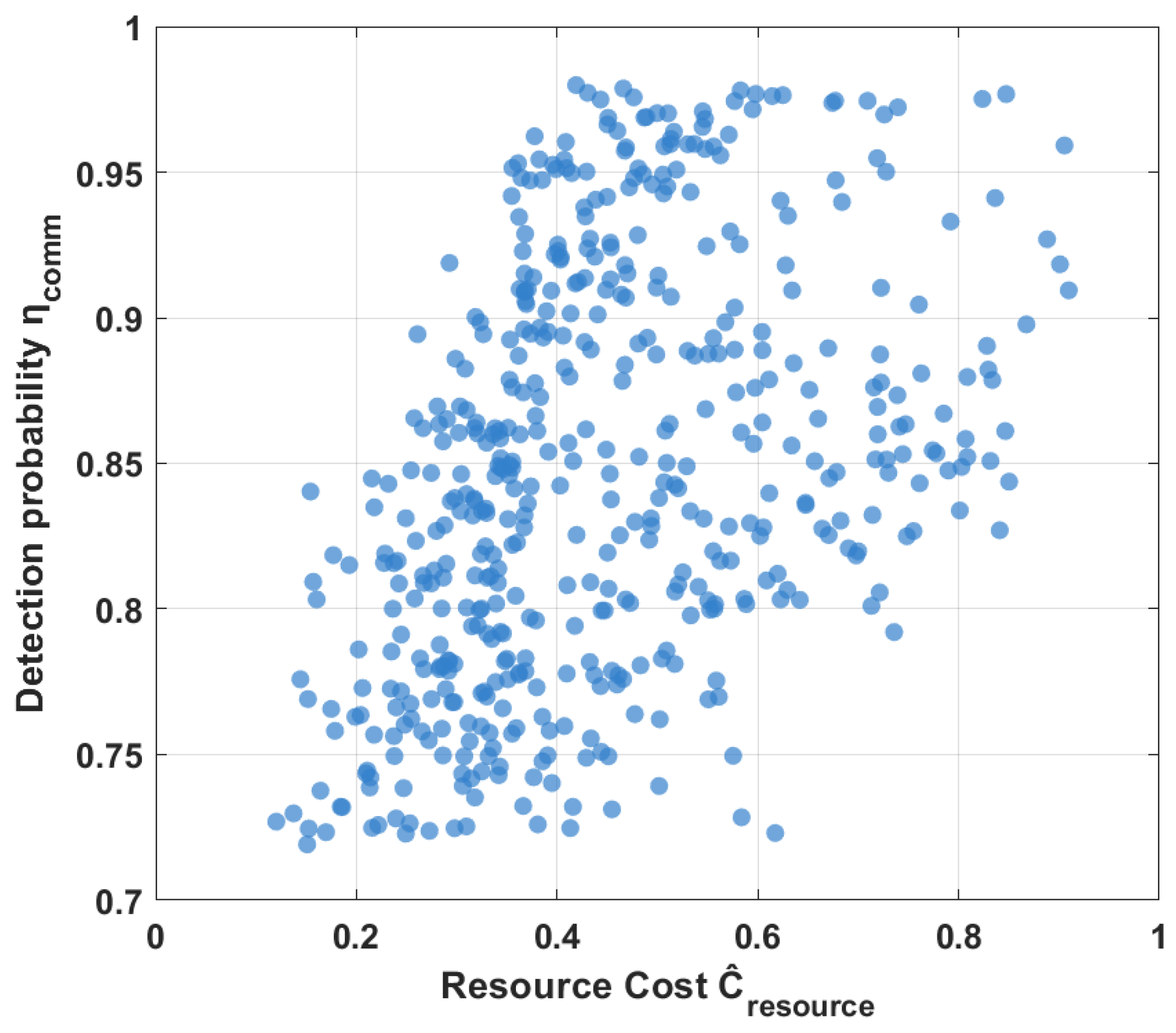
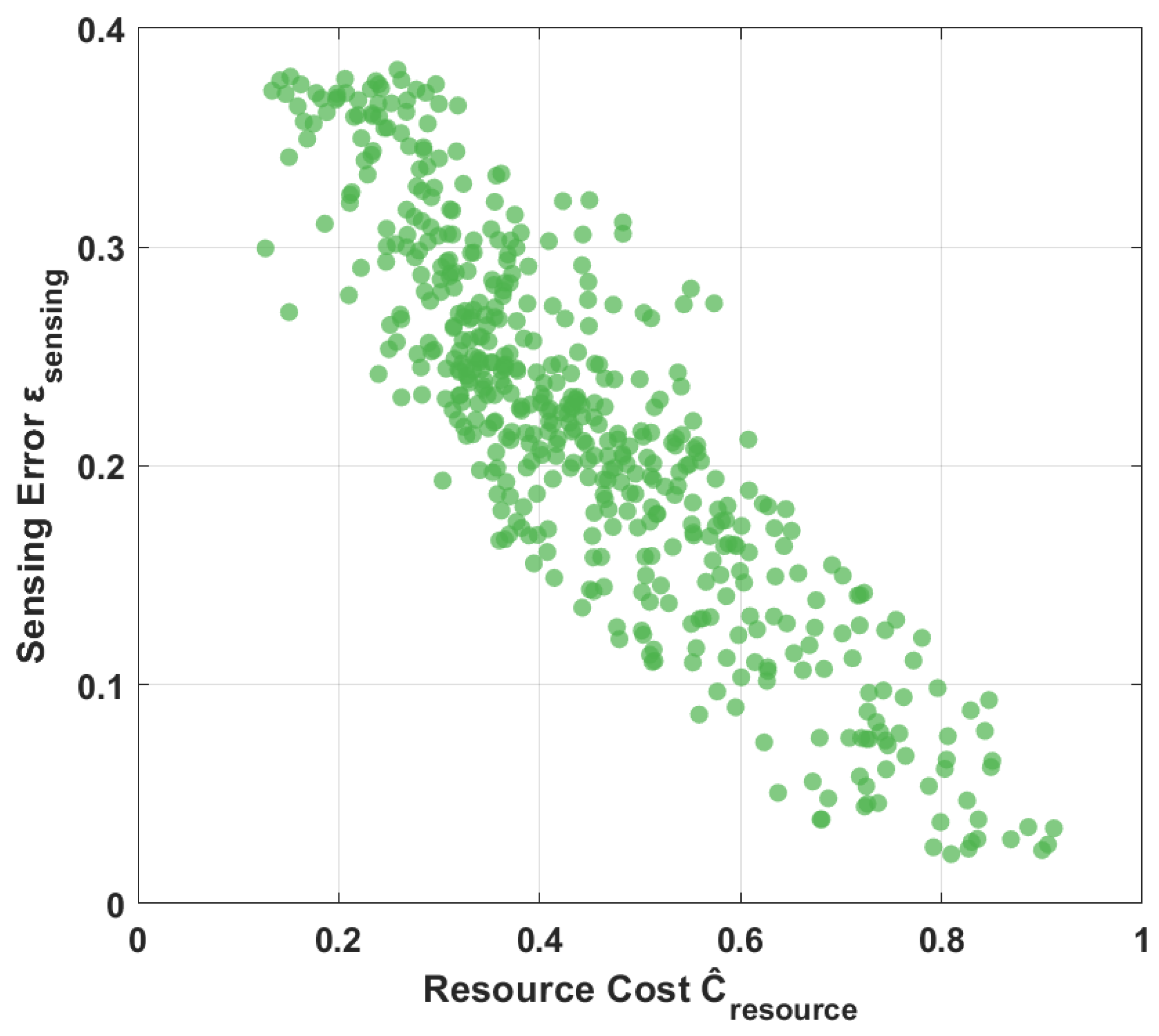
Figure 12 and
Figure 13 further depict the relationships between resource cost and detection probability and between resource cost and sensing error, respectively. As resource investment increases, both communication reliability and sensing accuracy improve, but the marginal gain diminishes beyond a certain point, indicating the need for balanced resource allocation.
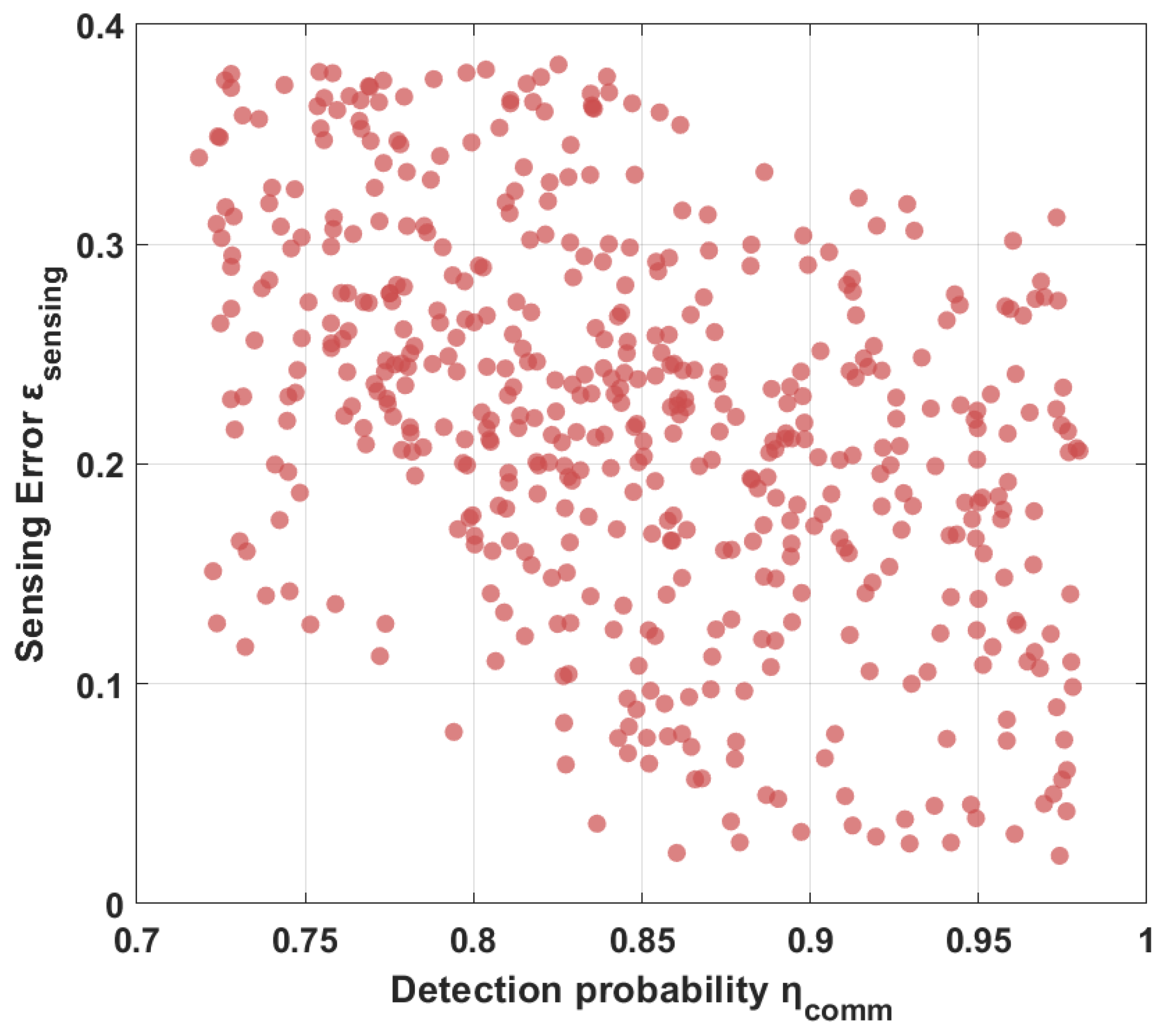
Figure 14 illustrates the relationship between the detection probability
and the sensing error
. The scatter plot reveals that as the detection probability increases, the sensing error exhibits a decreasing trend, demonstrating a co-improvement relationship between the two metrics. This phenomenon fundamentally stems from our proposed OCC-ZC structure design, where the repetition count
M serves as the core parameter for simultaneously optimizing both performance indicators. An increase in
M expands the orthogonal preamble space, significantly reducing the collision probability during the random access process, thereby enhancing the detection probability. On the other hand, it provides more time-domain observation samples for the sensing function, substantially improving the accuracy of Doppler frequency shift and range estimation through coherent combining gain, which in turn reduces the sensing error.
The simulation results demonstrate that the proposed OCC-ZC preamble scheme successfully integrates sensing capabilities into the PRACH access procedure. Compared with conventional access schemes, it achieves superior detection probability for random access while simultaneously providing an accurate estimation of range and velocity. The closed-loop optimization framework governed by the weighting factor enables flexible trade-offs between communication reliability and sensing accuracy. This verifies that the proposed scheme is an efficient solution for low-altitude long-distance ISAC systems, achieving the design goal of “sensing before access completion”.
Furthermore, compared to recent ISAC designs that often propose entirely new waveform structures—such as OTFS-superimposed preambles or custom radar-centric waveforms [
9,
20,
21]—which necessitate significant hardware modifications, a major advantage of the proposed OCC-ZC scheme is its exceptional backward compatibility. Since the phase modulation introduced by OCC operates exclusively at the symbol level of repeated ZC blocks, the scheme does not demand any alterations to the existing Radio Frequency (RF) front-end architectures. Consequently, this novel ISAC framework can be seamlessly integrated into widely deployed commercial base stations (gNBs) through straightforward base-band software or DSP firmware upgrades, maintaining extremely low computational and hardware complexities.




 ,
,