Article

Direct and Quantitative Formation of 2,5-Diethoxymethylfuran from HMF via Hybrid Catalytic Hydrogenation by Using a Ru-PNP Catalyst and Acid-Catalyzed Etherification in Ethanol

Department of Chemistry, Technical University of Denmark, 2800 Kgs. Lyngby, Denmark
*
Author to whom correspondence should be addressed.
Appl. Sci. 2026, 16(10), 4794; https://doi.org/10.3390/app16104794
Submission received: 30 March 2026 / Revised: 6 May 2026 / Accepted: 9 May 2026 / Published: 12 May 2026
(This article belongs to the Special Issue Technical Advances in Biomass Conversion)

Abstract

This study presents an integrated catalytic system enabling the quantitative production of 2,5-diethoxymethylfuran from HMF through a hybrid sequence that combines Ru-PNP-catalyzed hydrogenation with heterogeneous acid-catalyzed etherification in ethanol. The approach provides complete selectivity under mild conditions and demonstrates the compatibility of homogeneous hydrogenation catalysts with solid acid co-catalysts in a single process environment. In addition, we report the first example of homogeneously catalyzed hydrogenative valorization of HMF employing a co-catalytic, potentially recyclable acid additive. This strategy expands the scope of HMF upgrading pathways and highlights the potential of hybrid catalytic systems for the efficient synthesis of stable, energy-dense furan derivatives relevant to biofuel and biobased chemical applications.

1. Introduction

The transition towards renewable, carbon-neutral resources has intensified interest in converting biomass into sustainable fuels and value-added platform molecules [1,2,3,4,5,6]. The development of biorefinery technologies capable of transforming non-edible lignocellulosic feedstocks is advancing rapidly, offering viable alternatives to fossil-derived chemicals and renewable inputs for their synthesis [7]. Within this framework, considerable attention has focused on carbohydrate-derived building blocks such as 5-hydroxymethylfurfural (HMF) and related furanic compounds. HMF has emerged as a versatile biomass-derived platform molecule with strong potential to replace petroleum-based intermediates in both chemical and fuel applications [8,9,10]. The catalytic upgrading of HMF therefore remains a central strategy in the development of biomass-derived fuels and chemicals, owing to its high intrinsic reactivity and multifunctional nature, as demonstrated in previous work from our group and others [11,12,13,14,15]. Despite its versatility, the direct utilization of HMF is challenged by its limited stability under acidic and thermal conditions, where rehydration, condensation, and humin formation readily occur. Among the available stabilization strategies, acid-catalyzed etherification of HMF with alcohols represents an effective protection route, converting the reactive hydroxyl and aldehyde functionalities into more robust acetal-type structures. Recent studies have shown that etherification of the hydroxymethyl group, as well as appropriate solvent environments, can significantly enhance HMF stability by suppressing side reactions and improving its robustness in catalytic transformations [16]. In particular, etherification with ethanol provides access to ethoxy-protected derivatives such as 2,5-diethoxymethylfuran (2,5-DiEMF), which exhibit enhanced chemical stability and reduced propensity toward humin formation. Etherification of HMF in ethanol has been achieved over mesoporous solid acids and ion-exchange resins, yielding furanic ethers that are actively investigated as potential biofuel components and synthetic intermediates [17].
Within the broader class of HMF-derived ethers, compounds such as 5-ethoxymethylfurfural (EMF) have received significant attention as promising diesel blendstocks due to their high energy density and favorable combustion properties, with high selectivity reported over Brønsted acidic zeolites such as H-BEA [18]. Compared to mono-etherified derivatives like EMF, fully etherified products such as 2,5-DiEMF offer increased resistance toward hydrolytic and acidic degradation, making them particularly attractive as stabilized intermediates in multi-step upgrading sequences. Recent studies highlight the strategic value of such stabilized HMF derivatives in integrated catalytic routes leading to furanic and tetrahydrofuranic diethers with biofuel relevance, underscoring the importance of etherification as both a protection and upgrading step within biorefinery schemes [19]. Although 2,5-DiEMF is not yet commercialized as a fuel component, its formation via ethanol etherification positions it as a valuable intermediate for downstream hydrogenation, hydrodeoxygenation, and fuel-range molecule synthesis, as well as a useful model substrate for mechanistic and catalytic studies.
We recently reported the first example of homogeneously catalyzed hydrogenative valorization of furfural (FA), employing a co-catalytic and recyclable acid additive that could be reused over ten cycles without loss of catalytic efficiency [15]. Extending this approach to HMF is non-trivial, however, due to the presence of an additional hydroxymethyl group that increases molecular polarity, susceptibility to side reactions, and catalyst deactivation pathways. Compared to furfural, HMF requires a more carefully balanced catalytic environment capable of mediating hydrogenation while simultaneously controlling acid-driven transformations, without promoting excessive degradation or polymerization. These differences necessitate distinct catalyst requirements and motivate the exploration of hybrid catalytic strategies. Solid acid materials represent an attractive class of catalysts in this context, as they combine strong Brønsted acidity with facile separation and recyclability. Sulfonated polystyrene–divinylbenzene resins are widely employed in biomass-related transformations—including dehydration, esterification, and etherification—owing to their high density of acidic sites, stability under hydrothermal conditions, and suitability for liquid-phase processing [20,21,22]. Their heterogeneous nature enables simple catalyst recovery by filtration, and the anchored sulfonic groups typically exhibit minimal leaching even in aqueous or biphasic media [23]. Furthermore, these materials can be readily regenerated by solvent washing or mild thermal treatment to remove adsorbed organic residues, allowing them to retain catalytic performance over multiple reaction cycles [24,25].
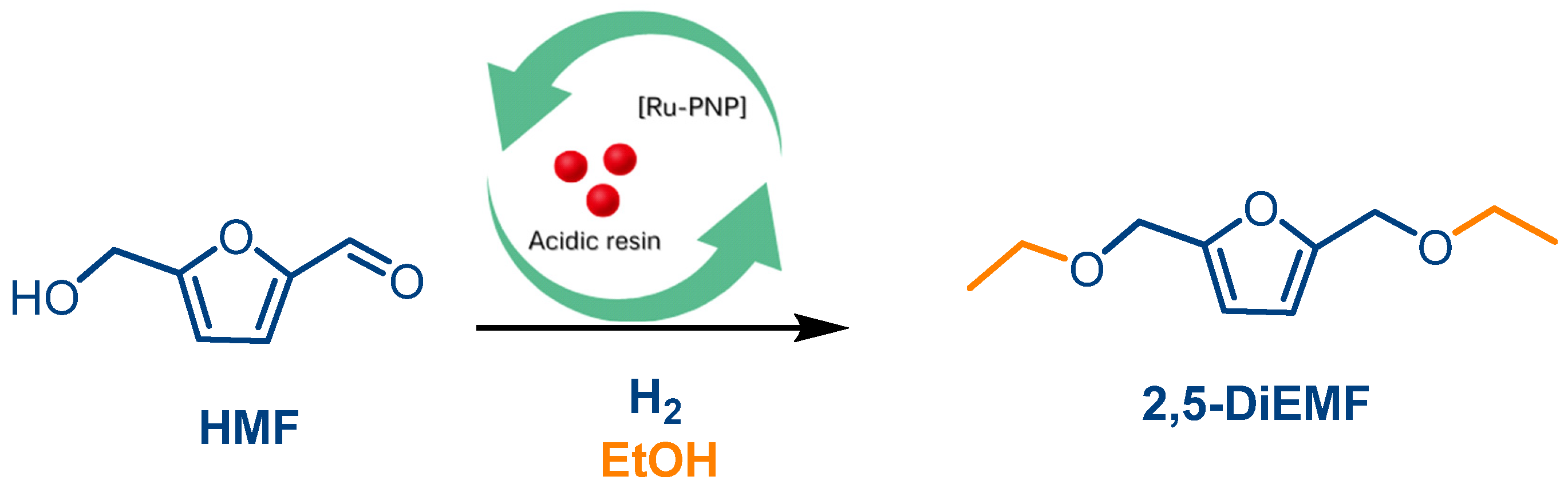
Despite significant advances in HMF etherification and upgrading, most reported approaches rely on either exclusively homogeneous acid catalysis or purely heterogeneous acidic materials, often requiring strong acids, elevated temperatures, or sequential processing steps that exacerbate humin formation and complicate catalyst recovery [26,27,28,29,30]. In particular, the direct combination of hydrogenation and acid-catalyzed etherification in a single, controlled process remains challenging due to the mutual incompatibility of metal hydrogenation catalysts with strong acidic media and the tendency of HMF to undergo degradation under harsh conditions. To the best of our knowledge, no general strategy has been demonstrated that enables the controlled upgrading of HMF through a deliberately designed hybrid homogeneous–heterogeneous catalytic system, in which hydrogenation and acid functions are spatially and chemically decoupled yet operate cooperatively under mild conditions. Prior studies typically employ either homogeneous acids that are difficult to recycle or solid acids that lack compatibility with molecular hydrogenation catalysts, limiting efficiency, selectivity, and sustainability. In this work, we introduce a fundamentally different approach to HMF upgrading based on a hybrid catalytic architecture that combines homogeneous Ru–PNP hydrogenation catalysis with heterogeneous sulfonic acid-catalyzed etherification (Figure 1). By assigning hydrogen activation to a well-defined molecular catalyst and acid-mediated etherification to a recoverable solid resin, this strategy overcomes key limitations of prior methods, including acid-induced catalyst deactivation, uncontrolled side reactions, and poor catalyst recyclability. This modular separation of functions enables the quantitative formation of the stabilized ether 2,5-diethoxymethylfuran (2,5-DiEMF) from HMF under mild conditions in ethanol, while minimizing humin formation and facilitating potential acidic catalyst recovery and its reuse.

2. Materials and Methods

General information. Most chemicals were purchased from commercial suppliers and used without further purification unless otherwise stated. HMF, acidic resins (Amberlyst-15, Amberlyst-36, Amberlite IR 120 are commercially available and used without further purification. The Ru-based catalysts (Ru-MACHO, iPrRu-MACHO, Ru-MACHO-BH) were purchased from commercial suppliers and used without further purification. [Ru-ACN]PF6 was synthesized according to the literature [13]. H2 gas (H2O ≤ 3 ppm; O2 ≤ 2 ppm) was purchased from a commercial supplier as well. All reactions dealing with air or moisture-sensitive compounds were performed using standard Schlenk techniques or in an argon-filled glovebox. Amberlyst-36TM pellets (wet) were manufactured by Dow Chemicals. The commercial resin is made from cross-linked styrene divinylbenzene copolymers with active sites of sulfonic groups (–RSO3H). The resin pellets (0.6–0.85 mm in diameter) have a density of 1.2 g/mL at 25 °C, pore volume of 0.2 mL/g, surface area of 33 m2/g, proton (H+) content of 5.4 mol/g and maximum working temperature of 150 °C. More information on Amberlyst-36TM can be obtained from the manufacturer. Amberlite IR 120 hydrogen form beads (wet) were manufactured by Dow Chemicals. The commercial resin is made from cross-linked styrene divinylbenzene copolymers with active sites of sulfonic groups (–RSO3H). The resin pellets (0.62–0.83 mm in diameter) have a capacity of 1.8 eq/L at 25 °C and maximum working temperature of 121 °C. More information on Amberlite IR 120 can be obtained from the manufacturer. All the resins were used without any pre-treatment/activation protocols.
General Procedure for hydrogenation of HMF to 2,5-DiEMF. For a typical hydrogenation screening experiment, the high-pressure reactor was loaded with the Ru-PNP complex (0.1–2 mol%), HMF (0.79 mmol), acidic resins (5 mol%) and 2 mL of EtOH. Subsequently, the reactor was equipped with a magnetic stirring bar and sealed. The system was flushed with nitrogen/hydrogen (three times). Next, a H2 pressure of 30 bar was applied. The reaction mixture was stirred for 24 h (250 rpm) at the desired temperature. After this time, the reactor was cooled down to room temperature and the gas was released. The crude reaction mixture was then analyzed using 1H-NMR spectroscopy in CDCl3 to check both the conversion and the NMR yield of the desired product. For NMR analysis, an internal standard, dimethyl sulfone (DMS) (10.0 mg, 0.106 mmol), was added to the reaction mixture. The solution was stirred for 5 min to ensure thorough mixing. A sample was then taken from the mixture for NMR analysis. All the experiments were replicated to corroborate the results. HMF conversion was obtained with ± 5% variability was obtained (n = 3).
Reactor specifications. The reactor used in this study is a 7-well reactor (locally produced at DTU Chemistry manufacturing site, Kgs. Lyngby, Denmark, Alloy 600, reactor capacity: 483 mL). The pressure gauge is non-electronic and subject to error.
NMR measurements. Conversions in all reactions were measured by 1H-NMR spectroscopy at 400 MHz in CDCl3 at 25 °C. Then, 128 scans were applied for each sample, with a delay time d1 of 4 s to ensure complete relaxation of the hydrogens. Errors in the conversion measurements were estimated by comparing the results of at least three integrations of each spectrum. The conversion was calculated using the signals from the CH (6.67 ppm, d) hydrogens of the unreacted substrate HMF and the CH2 (6.24 ppm, s) hydrogens of 2,5 DiEMF. The errors in the conversion measurements were estimated by comparing the results of at least three integrations of each spectrum. For NMR analysis, an internal standard, dimethyl sulfone (DMS) (10.0 mg, 0.106 mmol), was added to the reaction mixture and its signal for the CH3 (2.97 ppm, s) hydrogens was taken into consideration to calculate the NMR yield.

3. Results and Discussion

In the primary screening, we evaluated the catalytic efficiency of the hybrid system Ru-PNP/acidic resins to valorize HMF at 120 °C using 2 mol% of commercially available Ru-MACHO-BH, 5 mol% of Amberlyst-36, and 30 bar of H2 in ethanol for 24 h. Under the first set of reaction conditions, the system delivered quantitative conversion of HMF but only 53% yield of the desired 2,5-DiEMF, indicating that the etherification step was not yet fully optimized. Noteworthy, the reaction using the Ru-MACHO family complexes led to the formation of humins, observed as a brown solid in the reaction mixture [16]. This prompted a closer evaluation of the effect of reaction concentration, shown in Table 1.
The concentration screening experiments (Table 1) reveal that ethanol volume plays a significant role in determining the yield of 2,5-DiEMF, despite consistently complete conversion with humins as byproduct. Reducing the solvent volume from 2 mL to 1 mL decreases the yield from 51% to 33% (Table 1, entry 2), whereas increasing to 4 mL results in a moderate yield of 49% (Table 1, entry 3). These variations suggest that the balance between substrate concentration, hydrogen solubility, and resin swelling influences the efficiency of the etherification step. At low solvent volume, higher local concentrations of HMF likely promote acid-catalyzed side reactions and humin formation, while restricted resin swelling may limit acid site accessibility within the polymer matrix. Conversely, overly dilute conditions may reduce the effective local concentration of reactive intermediates at the resin surface and lower the solubility and mass transfer of hydrogen in the liquid phase, thereby diminishing the overall efficiency of the hydrogenation–etherification sequence. Then, we started investigating the performance of different acidic resins, as shown in Table 2.
The resin screening study highlights Amberlite IR 120 (Table 2, entry 3) as the most effective solid acid for promoting the etherification step, delivering an NMR yield of 84% compared to 51% for Amberlyst-36 (Table 2, entry 1) and 47% for Amberlyst-15 (Table 2, entry 2). This performance difference correlates with the higher proton capacity of Amberlite IR 120 and its gel-type morphology, which is known to provide a high density of accessible Brønsted acid sites under swollen conditions. Its superior performance suggests that resin morphology and acid site accessibility are key factors in stabilizing the reactive intermediates leading to 2,5-DiEMF. In contrast, the macroporous structure of Amberlyst resins, while beneficial for diffusion of bulky substrates, may provide less efficient stabilization of short-lived oxocarbenium or acetal intermediates involved in HMF etherification under the present reaction conditions. We therefore propose that both total proton capacity and microenvironment effects within the resin matrix play a decisive role in stabilizing reactive intermediates and suppressing humin formation. This interpretation is supported by prior studies correlating resin morphology and acid density with selectivity in biomass-derived etherification reactions [31,32]. Knowing that acidic resin plays a crucial role in the process under investigation, we screened several catalytic loadings (from 10% to 1%), as reported in Table 3 (entry 1–4).
The screening of Amberlite IR-120 shows that decreasing the acidic co-catalyst loading from 10 mol% to 5 mol% and further to 2.5 mol% maintains high efficiency, with NMR yields remaining around 80% (Table 3, entries 1–3). Only when the loading is reduced to 1 mol% is a slight decrease observed, with the yield dropping to 75% (Table 3, entry 4). These results indicate that the etherification step does not require a large excess of acid sites and that the resin operates catalytically under the reaction conditions. We then examined the effect of concentration under the optimized acid loading (Table 3, entries 5 and 6). Reducing the ethanol volume to 1 mL markedly increases the yield to 97%, demonstrating that higher substrate concentration strongly promotes acetal formation. From an equilibrium perspective, the etherification of HMF involves reversible acid-catalyzed acetalization steps, for which increased substrate concentration shifts the equilibrium toward product formation according to Le Chatelier’s principle. From a kinetic standpoint, higher concentration accelerates the rate of acetal formation relative to competing degradation pathways, such as rehydration and humin formation, which are known to dominate at low substrate concentration and extended residence times. In addition, the higher local concentration likely enhances resin swelling and acid site utilization, creating a microenvironment in which acid-catalyzed acetal formation becomes kinetically favored. Together, these equilibrium and kinetic effects rationalize the sharp increase in 2,5-DiEMF yield observed at 1 mL ethanol, highlighting the importance of concentration control in suppressing side reactions and enabling selective stabilization of HMF. Moreover, we speculate that the divergent yield trends arise from the distinct morphologies and capacities of the resins. Amberlyst-36 is a high-capacity, macroporous resin with permanent porosity; its high acid site density and easy accessibility mean that increasing its concentration quickly leads to an ‘over-acidified’ environment, triggering HMF degradation into humins. Conversely, Amberlite IR-120 is a lower-capacity, gel-type resin that swells poorly in ethanol, sequestering many of its active sites. Therefore, increasing the Amberlite loading is necessary to provide enough accessible surface-active sites to overcome its inherent mass transfer limitations and lower intrinsic acidity. With the optimized reaction conditions established, we next examined the influence of the catalyst identity and loading on the overall efficiency of the transformation (Table 4).
The catalyst screening results confirm that Ru-MACHO-BH is uniquely effective in driving the hydrogenation step required to generate the reactive intermediates for etherification. At 2 mol% loading, the system delivers quantitative conversion and a near-quantitative NMR yield of 97%. Lowering the catalyst loading leads to a progressive decline in yield (56% at 1 mol%, 55% at 0.5 mol%, and 24% at 0.1 mol%). Other Ru-PNP variants tested (Ru-MACHO, iPrRu-MACHO, and [Ru-ACN]PF6 [13]) show significantly lower yields despite full conversion, suggesting that subtle differences in ligand electronics and hydricity affect the formation and stability of key intermediates.

4. Conclusions

The results demonstrate that the Ru MACHO BH/Amberlite IR-120 combination provides a highly efficient, operationally simple, and potentially recyclable hybrid catalytic system for the direct synthesis of 2,5-DiEMF from HMF. The ability to achieve >99% conversion and up to 97% NMR yield under mild conditions and in a green solvent (ethanol) underscores the potential of this approach for scalable biomass valorization. In the broader context of transitioning from fossil-based feedstocks to renewable carbon sources, such efficient catalytic strategies are essential for the sustainable production of value-added chemicals and advanced biofuels. The integration of homogeneous hydrogenation with heterogeneous acid catalysis further highlights the advantages of highly efficient and streamlined processes, which can reduce process complexity, energy input, and environmental impact. Importantly, the conversion of HMF into stabilized, oxygen-reduced furan derivatives such as 2,5-DiEMF addresses key challenges associated with the instability and high oxygen content of biomass-derived intermediates, improving fuel properties such as energy density and storage stability. Overall, this methodology represents a promising platform for the development of integrated catalytic processes targeting stable, energy-dense furan derivatives relevant to both biofuel applications and the production of biobased chemicals.

Supplementary Materials

The following supporting information can be downloaded at: https://www.mdpi.com/article/10.3390/app16104794/s1, Figure S1: Custom high-pressure reactor used in this study. 7-well reactor (Alloy 600, reactor capacity: 483 mL). The pressure gauge is non-electronic and subject to error; Figure S2: 1H-NMR (CDCl3, 400 MHz, 25 °C) of the crude reaction of HMF with Ru-MACHO-BH (2 mol%), Amberlyst-36 (5 mol%), H2 (30 bar), EtOH (2 mL) at 120 °C after 24 h (conversion = >99%, yield2,5DiEMF = 51% Table 1, entry 1); Figure S3: 1H-NMR (CDCl3, 400 MHz, 25 °C) of the crude reaction of HMF with Ru-MACHO-BH (2 mol%), Amberlyst-36 (5 mol%), H2 (30 bar), EtOH (1 mL) at 120 °C after 24 h (conversion = >99%, yield2,5DiEMF = 33% Table 1, entry 2); Figure S4: 1H-NMR (CDCl3, 400 MHz, 25 °C) of the crude reaction of HMF with Ru-MACHO-BH (2 mol%), Amberlyst-15 (5 mol%), H2 (30 bar), EtOH (2 mL) at 120 °C after 24 h (conversion = >99%, yield2,5DiEMF = 47% Table 2, entry 2); Figure S5: 1H-NMR (CDCl3, 400 MHz, 25 °C) of the crude reaction of HMF with Ru-MACHO-BH (2 mol%), AmberLite-IR120 (5 mol%), H2 (30 bar), EtOH (2 mL) at 120 °C after 24 h (conversion = >99%, yield2,5DiEMF = 85% Table 2, entry 3); Figure S6: 1H-NMR (CDCl3, 400 MHz, 25 °C) of the crude reaction of HMF with Ru-MACHO-BH (2 mol%), AmberLite-IR120 (1 mol%), H2 (30 bar), EtOH (2 mL) at 120 °C after 24 h (conversion = >99%, yield2,5DiEMF = 75% Table 3, entry 4); Figure S7: 1H-NMR (CDCl3, 400 MHz, 25 °C) of the crude reaction of HMF with Ru-MACHO-BH (2 mol%), AmberLite-IR120 (5 mol%), H2 (30 bar), EtOH (4 mL) at 120 °C after 24 h (conversion = >99%, yield2,5DiEMF = 55% Table 3, entry 5); Figure S8: 1H-NMR (CDCl3, 400 MHz, 25 °C) of the crude reaction of HMF with Ru-MACHO-BH (2 mol%), AmberLite-IR120 (5 mol%), H2 (30 bar), EtOH (1 mL) at 120 °C after 24 h (conversion = >99%, yield2,5DiEMF = 97% Table 3, entry 6); Figure S9: 1H-NMR (CDCl3, 400 MHz, 25 °C) of the crude reaction of HMF with Ru-MACHO-BH (0.1 mol%), AmberLite-IR120 (5 mol%), H2 (30 bar), EtOH (1 mL) at 120 °C after 24 h (conversion = >99%, yield2,5DiEMF = 24% Table 4, entry 5); Figure S10: 1H-NMR (CDCl3, 400 MHz, 25 °C) of the crude reaction of HMF with Ru-MACHO (2 mol%), AmberLite-IR120 (5 mol%), H2 (30 bar), EtOH (1 mL) at 120 °C after 24 h (conversion = >99%, yield2,5DiEMF= 21% Table 4, entry 6); Figure S11: 1H-NMR (CDCl3, 400 MHz, 25 °C) of the crude reaction of HMF with iPrRu-MACHO (2 mol%), AmberLite-IR120 (5 mol%), H2 (30 bar), EtOH (1 mL) at 120 °C after 24 h (conversion = >99%, yield2,5DiEMF = 18% Table 4, entry 7); Figure S12: 1H-NMR (CDCl3, 400 MHz, 25 °C) of the crude reaction of HMF with [Ru-ACN] PF6 (2 mol%), AmberLite-IR120 (5 mol%), H2 (30 bar), EtOH (1 mL) at 120 °C after 24 h (conversion= >99%, yield2,5DiEMF= 15% Table 4, entry 8) [13,33].

Author Contributions

Conceptualization: V.N. and M.N.; Methodology: V.N. and M.N.; Investigation and data curation: V.N.; Formal analysis: V.N. and M.N. Visualization: V.N. and M.N.; Writing—original draft: V.N. and M.N.; Writing—review and editing: V.N. and M.N.; Supervision: M.N.; Funding acquisition, resources, and project administration: M.N. All authors have read and agreed to the published version of the manuscript.

Funding

This research was funded by VILLUM FONDEN (53069) and COWI Foundation (A-149.10).

Data Availability Statement

Supporting data is available online in the Supplementary Materials.

Conflicts of Interest

The authors declare no conflicts of interest.

References

  1. Tuck, C.O.; Pérez, E.; Horváth, I.T.; Sheldon, R.A.; Poliakoff, M. Valorization of Biomass: Deriving More Value from Waste. Science 2012, 337, 695–699. [Google Scholar] [CrossRef] [PubMed]
  2. Demirbas, M.F.; Balat, M.; Balat, H. Potential contribution of biomass to the sustainable energy development. Energy Convers. Manag. 2009, 50, 1746–1760. [Google Scholar] [CrossRef]
  3. Tilman, D.; Hill, J.; Lehman, C. Carbon-negative biofuels from low-input high-diversity grassland biomass. Science 2006, 314, 1598–1600. [Google Scholar] [PubMed]
  4. Armaroli, N.; Balzani, V. The future of energy supply: Challenges and opportunities. Angew. Chem. Int. Ed. 2007, 46, 52–66. [Google Scholar] [CrossRef]
  5. Okkerse, C.; Bekkum, H.V. From fossil to green. Green Chem. 1999, 4, 107–114. [Google Scholar]
  6. Padilla, R.; Koranchalil, S.; Nielsen, M. Homogeneous Catalyzed Valorization of Furanics: A Sustainable Bridge to Fuels and Chemicals. Catalysts 2021, 11, 1371. [Google Scholar] [CrossRef]
  7. Bozell, J.J.; Petersen, G.R. Technology development for the production of biobased products from biorefinery carbohydrates—The US Department of Energy’s “Top 10” revisited. Green Chem. 2010, 12, 539–554. [Google Scholar] [CrossRef]
  8. Tong, X.; Ma, Y.; Li, Y. Biomass into chemicals: Conversion of sugars to furan derivatives by catalytic processes. Appl. Catal. A Gen. 2010, 385, 1–13. [Google Scholar] [CrossRef]
  9. Schöppe, H.; Kleine-Möllhoff, P.; Epple, R. Energy and material flows and carbon footprint assessment concerning the production of HMF and furfural from a cellulosic biomass. Processes 2020, 8, 119. [Google Scholar] [CrossRef]
  10. Li, C.; Wang, L.; Wang, M.; Liu, B.; Liu, X.; Cui, D. Step-Growth Coordination Polymerization of 5-Hydroxymethyl Furfural with Dihydrosilanes: Synergistic Catalysis Using Heteroscopionate Zinc Hydride and B(C6F5)3. Angew. Chem. Int. Ed. 2019, 58, 11434–11438. [Google Scholar]
  11. Koranchalil, S.; Nielsen, M. Direct biomass valorisation to γ-valerolactone by Ru-PNP catalysed hydrogenation in acid. EES Catal. 2024, 2, 803–810. [Google Scholar] [CrossRef]
  12. Koranchalil, S.; Pinheiro, D.L.J.; Padilla, R.; Nielsen, M. Homogeneous Catalyzed Direct Conversion of Furfural to Gamma-Valerolactone. ChemSusChem 2024, 17, e202301608. [Google Scholar] [CrossRef]
  13. Nori, V.; Padilla, R.; Jørgensen, M.S.B.; Tran, T.A.; Nikol, A.T.; Larsen, R.W.; Kubus, M.; Paixao, M.W.; Nielsen, M. Selective Hydrogenation of HMF to DHMF Using Cationic Ru-PNP Complex. ChemCatChem 2025, 17, e202500456. [Google Scholar] [CrossRef]
  14. Su, T.; Zhao, D.; Wang, Y.; Lü, H.; Varma, R.S.; Len, C. Innovative Protocols in the Catalytic Oxidation of 5-Hydroxymethylfurfural. ChemSusChem 2021, 14, 266–280. [Google Scholar] [CrossRef]
  15. Xia, H.; Xu, S.; Hu, H.; An, J.; Li, C. Efficient Conversion of 5-Hydroxymethylfurfural to High-Value Chemicals by Chemo- and Bio-Catalysis. RSC Adv. 2018, 8, 30875–30886. [Google Scholar] [CrossRef]
  16. Righetti, G.I.C.; Di Pietro, M.E.; Leonardi, G.; Sinibaldi, A.; Mezzetta, A.; Guazzelli, L.; Mele, A. Harnessing the Potential of 5-Hydroxymethylfurfural: Investigating Solubility and Stability in Tailored Deep Eutectic Solvents. ACS Sustain. Chem. Eng. 2025, 13, 6518–6527. [Google Scholar] [CrossRef] [PubMed]
  17. Lanzafame, P.; Temi, D.M.; Perathoner, S.; Centi, G.; Macario, A.; Aloise, A.; Giordano, G. Etherification of 5-hydroxymethyl-2-furfural (HMF) with ethanol to biodiesel components using mesoporous solid acidic catalysts. Catal. Today 2011, 175, 435–441. [Google Scholar] [CrossRef]
  18. Allen, M.C.; Hoffman, A.J.; Liu, T.; Webber, M.S.; Hibbitts, D.; Schwartz, T.J. Highly Selective Cross-Etherification of 5-Hydroxymethylfurfural with Ethanol. ACS Catal. 2020, 10, 6771–6785. [Google Scholar] [CrossRef]
  19. Fulignati, S.; Antonetti, C.; Tabanelli, T.; Cavani, F.; Raspolli Galletti, A.M. Integrated Cascade Process for the Catalytic Conversion of 5-Hydroxymethylfurfural to Furanic and Tetrahydrofuranic Diethers as Potential Biofuels. ChemSusChem 2022, 15, e202200241. [Google Scholar] [CrossRef]
  20. Corma, A. Inorganic solid acids and their use in acid-catalyzed hydrocarbon reactions. Chem. Rev. 1995, 95, 559–614. [Google Scholar] [CrossRef]
  21. Okuhara, T. Water-tolerant solid acid catalysts. Chem. Rev. 2002, 102, 3641–3666. [Google Scholar] [CrossRef]
  22. Climent, M.J.; Corma, A.; Iborra, S. Conversion of biomass platform molecules into fuel additives and liquid hydrocarbon fuels. Green Chem. 2014, 16, 516–547. [Google Scholar]
  23. Melero, J.A.; Iglesias, J.; García, A. Heterogeneous acid catalysts for biodiesel production: Current status and future challenges. Green Chem. 2009, 11, 1285–1308. [Google Scholar]
  24. Dow Chemical. Amberlyst™ 36 Wet Technical Datasheet. Available online: http://www.dupont.com/content/dam/water/amer/us/en/water/public/documents/en/IER-AmberLyst-36WET-PDS-45-D00912-en.pdf (accessed on 8 May 2026).
  25. Clark, J.H.; Macquarrie, J.A. (Eds.) Handbook of Green Chemistry and Technology; John Wiley & Sons: Hoboken, NJ, USA, 2008. [Google Scholar]
  26. van Putten, R.-J.; van der Waal, J.C.; de Jong, E.; Rasrendra, C.B.; Heeres, H.J.; de Vries, J.G. Hydroxymethylfurfural, a Versatile Platform Chemical Made from Renewable Resources. Chem. Rev. 2013, 113, 1499–1597. [Google Scholar] [CrossRef] [PubMed]
  27. Chheda, J.N.; Huber, G.W.; Dumesic, J.A. Liquid-Phase Catalytic Processing of Biomass-Derived Oxygenated Hydrocarbons to Fuels and Chemicals. Angew. Chem. Int. Ed. 2007, 46, 7164–7183. [Google Scholar] [CrossRef]
  28. Chen, S.; Wojcieszak, R.; Dumeignil, F.; Marceau, E.; Royer, S. Efficient Synthesis of 5-Ethoxymethylfurfural from Biomass-Derived 5-Hydroxymethylfurfural over Brønsted Acid Catalysts. Energy Fuels 2015, 29, 5255–5264. [Google Scholar]
  29. Li, W.; Xue, Z.; Wang, J.; Jiang, J.; Zhao, X.; Mu, T. Acid-Catalyzed Etherification of 5-Hydroxymethylfurfural to Value-Added Liquid Biofuels. Green Chem. 2014, 16, 4472–4478. [Google Scholar]
  30. Rennenberg, N.; Sewell, J.; Smirnova, I.; Jess, A. Etherification of 5-Hydroxymethylfurfural over Sulfonated Resins and Zeolites: Activity, Selectivity and Catalyst Stability. Catal. Sci. Technol. 2018, 8, 124–135. [Google Scholar]
  31. Harmer, M.A.; Sun, Q. Solid Acid Catalysis Using Ion-Exchange Resins. Appl. Catal. A 2001, 221, 45–62. [Google Scholar] [CrossRef]
  32. Corma, A.; Iborra, S.; Velty, A. Chemical Routes for the Transformation of Biomass into Chemicals. Chem. Rev. 2007, 107, 2411–2502. [Google Scholar] [CrossRef] [PubMed]
  33. Fulmer, G.R.; Miller, A.J.M.; Sherden, N.H.; Gottlieb, H.E.; Nudelman, A.; Stoltz, B.M.; Bercaw, J.E.; Goldberg, K.I. NMR Chemical Shifts of Trace Impurities: Common Laboratory Solvents, Organics, and Gases in Deuterated Solvents Relevant to the Organometallic Chemist. Organometallics 2010, 29, 2176–2179. [Google Scholar] [CrossRef]
Figure 1. General scheme showing our novel approach.
Applsci 16 04794 g001
Table 1. Identification of suitable conditions for the formation of 2,5-DiEMF from HMF in EtOH at 120 °C for 24 h a.
Applsci 16 04794 i001
EntryEthanol (mL)Conversion (%) bNMR Yield (%) b
12>9951
21>9933
34>9949
[a] Standard reaction conditions: 0.79 mmol of HMF, Ru-MACHO-BH (2 mol%), Amberlyst-36 (5 mol%), EtOH (2.0 mL), 30 bar H2, 120 °C, 24 h. [b] Determined by crude 1H-NMR analysis using dimethyl sulfone as an internal standard as shown in the Supplementary Material.
Table 2. Acidic resin screening a.
Applsci 16 04794 i002
EntryAcidic Resin (mol%)Conversion (%) bNMR Yield (%) b
1Amberlyst-36 >9951
2Amberlyst-15 >9947
3Amberlite IR 120 >9984
[a] Standard reaction conditions: 0.79 mmol of HMF, Ru-MACHO-BH (2 mol%), acidic resin (5 mol%), EtOH (2.0 mL), 30 bar H2, 120 °C, 24 h. [b] Determined by crude 1H-NMR analysis using dimethyl sulfone as an internal standard as shown in the Supplementary Material.
Table 3. Amberlite IR 120 loading and concentration screening a.
Applsci 16 04794 i003
EntryAmberlite IR 120
Loading (mol%)
EtOH (mL)Conversion (%) bNMR Yield (%) b
1102 mL>9980
252 mL>9985
32.52 mL>9983
412 mL>9975
554 mL >9955
651 mL>9997
[a] Standard reaction conditions: 0.79 mmol of HMF, Ru-MACHO-BH (2 mol%), Amberlite IR 120, EtOH (2.0 mL), 30 bar H2, 120 °C, 24 h. [b] Determined by crude 1H-NMR analysis using dimethyl sulfone as an internal standard as shown in the Supplementary Material.
Table 4. Catalyst and catalytic loading screening a.
Applsci 16 04794 i004
EntryRu CatalystRu Catalyst Loading (%)Conversion (%) bNMR Yield (%) b
1--00
2Ru MACHO-BH2>9997
3Ru MACHO-BH1>9956
4Ru MACHO-BH0.5>9955
5Ru MACHO-BH0.1>9924
6Ru MACHO2>9921
7iPrRu MACHO2>9918
8[Ru-ACN] PF62>9915
[a] Standard reaction conditions: 0.79 mmol of HMF, catalyst, Amberlite IR 120, EtOH (2.0 mL), 30 bar H2, 120 °C, 24 h. [b] Determined by crude 1H-NMR analysis using dimethyl sulfone as an internal standard as shown in the Supplementary Material.
Disclaimer/Publisher’s Note: The statements, opinions and data contained in all publications are solely those of the individual author(s) and contributor(s) and not of MDPI and/or the editor(s). MDPI and/or the editor(s) disclaim responsibility for any injury to people or property resulting from any ideas, methods, instructions or products referred to in the content.