Review

Finite Element Analysis of Active Vibrating Mesh Nebulisers and Atomisers for Respiratory Drug Delivery—A Review


1
School of Engineering, University of Limerick, V94 T9PX Limerick, Ireland
2
Aerogen Ltd., Galway Business Park, H91 HE94 Galway, Ireland
3
Mechanical and Automobile Engineering, Technological University of the Shannon Midwest, V94 EC5T Limerick, Ireland
4
School of Pharmacy and Biomolecular Science, Royal College of Surgeons in Ireland, D02 YN77 Dublin, Ireland
5
School of Pharmacy and Pharmaceutical Sciences, Trinity College, D02 PN40 Dublin, Ireland
*
Author to whom correspondence should be addressed.
Appl. Sci. 2026, 16(10), 4796; https://doi.org/10.3390/app16104796
Submission received: 7 April 2026 / Revised: 28 April 2026 / Accepted: 6 May 2026 / Published: 12 May 2026
(This article belongs to the Section Mechanical Engineering)

Abstract

Piezo-driven active vibrating mesh devices are increasingly being used across a variety of applications. These include respiratory drug delivery and inhaled vaccine delivery, as well as multiple industrial processes such as coating, improving the efficiency of chemical reactions through mixing and 3D printing in low gravity. The adoption of this technology shall continue to rise as its reliability, the scalability of manufacturing, and the functionalisation of active vibrating mesh assemblies advance. Early-stage design and development of these complex electromechanical devices can be a costly and time-consuming process. Finite element analysis (FEA) allows us to simulate these devices and analyse their input parameter interactions and design optimisation without the expense of costly prototyping, while also reducing time to market. A review of the state of the art in FEA techniques has identified piezoelectric coupling, modal analysis, harmonic response, fluid–structure interaction, acoustic–structural coupling, and thermal analysis as the recommended simulation tools for dry (no liquid present) and wet (with liquid present) state simulations. Theoretical and empirical validation techniques have given us confidence in these tools for vibrating mesh device design iterations and optimisation. This review summarises the current state of the art for the application of these techniques in the development of active vibrating mesh devices intended for use in respiratory drug delivery.

1. Introduction

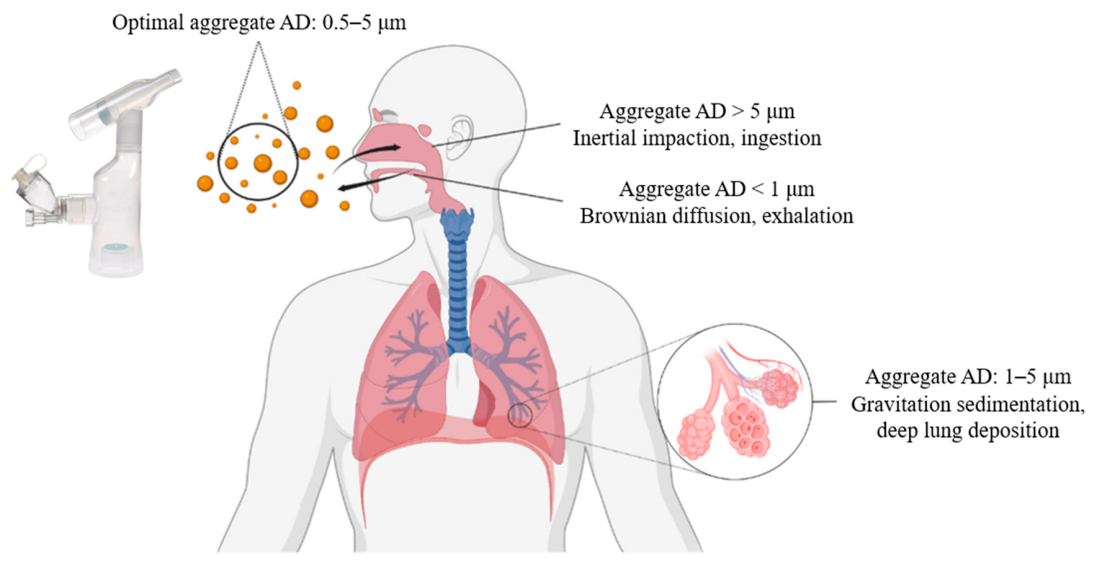
The process of nebulisation has several applications, but of critical interest is the application of nebulisers to respiratory drug delivery. Aerosols have been used therapeutically for millennia. Advances in medicine, particularly the fundamental gains in understanding underlying disease mechanisms, concurrent advancement of pharmaceutical science, and potential for optimised drug delivery through controlled aerosol performance, have led to an increased adoption of vibrating mesh nebulisers (VMNs) [1,2]. The characteristics of the aerosol produced by VMNs are broadly defined as output rate and droplet size. Output rate is of importance in relation to the time it takes to deliver a prescribed dose. Droplet size is important because it is a key predictor of the ultimate location of deposition. In combination, both characteristics are primary levers that can be manipulated to optimise aerosol-mediated drug delivery. The others, which are not in the scope of this review, include the device design, the patient intervention, and the patient interface, as well as patient breathing parameters [3]. Broadly speaking, under tidal breathing conditions, larger droplets are predicted to deposit in the upper airways (nasal passages, nasopharynx, oral cavity, oropharynx, and trachea). Smaller droplets tend to deposit in the lower airways (conducting airways, e.g., bronchi and bronchioles; peripheral airways, e.g., alveoli) [4,5,6]. The ability of VMN design to be controlled to produce specific droplet size ranges makes it especially appealing for this application. Figure 1 illustrates the deposition regions for different droplet aerodynamic diameters (ADs).
Small-volume nebulisers are aerosolising systems that transform liquid or suspended medications into aerosol using compressed gas or electrical means. Currently available alternatives within this category are jet, ultrasonic, and vibrating mesh nebulisers. Jet nebulisers (JNs) employ the Venturi effect and high-velocity compressed gas to generate negative pressure on the medication surface. When combined with the liquid, surface tension causes droplets to break away from the body of the liquid. Ultrasonic nebulisers (USNs) employ the inverse piezoelectric effect, a phenomenon that occurs when an alternating voltage is applied to a piezoelectric element. This results in cyclical deformation and vibration at the applied frequency [7] to create an aerosol. This vibration moves through to the surface of the medication, inducing capillary waves that produce aerosol [8,9]. Vibrating mesh nebulisers (VMNs) incorporate a mesh component to generate droplets. This comprises a thin plate with an array of potentially thousands of micron-sized holes. There are two types: Active VMNs that aerosolise medication by oscillating the mesh axially using a piezoelectric element, and passive VMNs that aerosolise medication through a static mesh using a piezoelectrically driven ultrasonic horn [6].
Of particular interest are active vibrating mesh-based nebulisers, which have become one of the most prevalent device types used in respiratory drug delivery today [10]. Due to their mechanism of action and design features, they provide several advantages over the other commonly used nebuliser technologies. Active VMNs find application across a wide variety of respiratory interventions. Their key features have been exploited in basic and applied fundamental research investigating and enabling new therapies and mechanisms of action. These include next-generation gene and cell-derived therapies, immune response mapping, and disease modelling [11,12,13,14], as well as some of the most notable advances in respiratory drug delivery over the last decade. Additional areas include inhaled vaccine programmes, effective antibiotic treatment of lung infection in ventilated patients, and inhaled therapies in premature infants [15,16,17,18]. The key advantageous features of active VMNs are summarised in Table 1.
Table 2 gives an overview of some commercially available VMNs with details of mesh materials and features of interest. These include drive frequency, output rate, and reported Mass Median Aerodynamic Diameter (MMAD), which is related to inhaled droplet size.
This review focusses specifically on active vibrating mesh devices, including nebulisers and vibrating mesh atomisers (VMAs). These vibrating mesh devices incorporate piezoelectric elements. These elements are used extensively in vibration and vibration control applications as they exhibit intrinsic electromechanical coupling behaviour. This allows for both vibration sensing and also actuation within the same component, whereby mechanical vibration is converted into an electrical signal or vice versa. This dual functionality allows for high sensitivity, rapid feedback with a large frequency bandwidth. These capabilities make piezoelectric elements advantageous for vibration control applications across aerospace, automotive, and manufacturing industries [39]. General applications in these areas include monitoring of structural health, machinery conditions, chatter suppression, and active mountings for equipment or engines. Piezoelectric elements can sense vibration and, when integrated into actuators, can produce counter vibration to reduce noise, suppress 3D vibration, or compensate for mechanical vibration and flutter [40,41,42]. Precision applications use these elements for micro-positioning, micro-manipulation, actuation of optical systems, and lithography processes. Consumer electronics and automotive safety systems exploit piezoelectric elements as accelerometers and inertial sensors to monitor vibration [39]. Attenuation of passive and semi-active vibration is also possible via shunt damping. This employs piezoelectric elements coupled to electrical circuits, which are used to dissipate vibration in the form of heat via incorporated resistors [43,44,45]. The most recent use for these elements involves combining energy harvesting with sensing and actuation for autonomous, energy-efficient vibration control systems. Piezoelectric elements provide robust and reliable multipurpose solutions for complex vibration monitoring and control applications due to the lack of moving parts, small size, and durability [46,47].
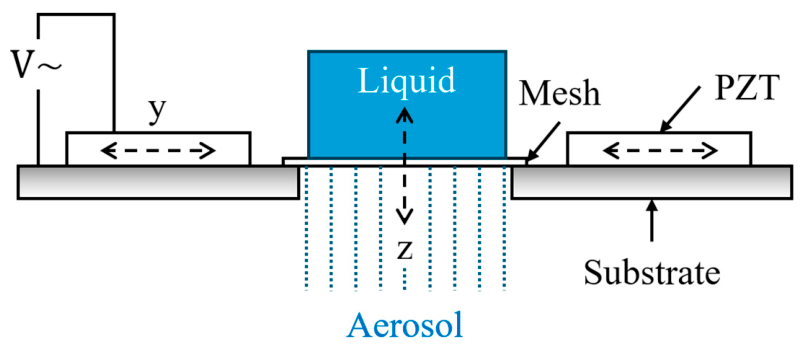
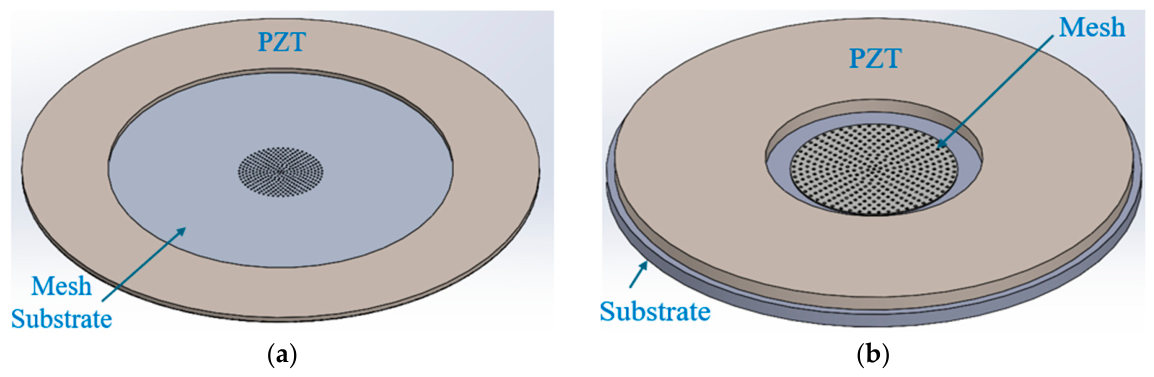
Two main architecture variations have been identified in the literature, as shown in Section 3. The most common vibrating mesh device described in the literature, focussing on FEA, comprises an annular piezoelectric element, generally formulated from Lead Zirconate Titanate (PZT), bonded to a mesh substrate [48,49,50,51,52,53,54,55,56]. Some versions incorporate two PZT ring elements or a bimorph structure with the mesh substrate sandwiched between [57,58]. A smaller number of studies have been completed on the second architecture type, as per Figure 2. This variant comprises an annular PZT element bonded to a substrate onto which the mesh component is attached [59,60,61,62,63]. The principles of operation and architecture of both vibrating mesh nebuliser and atomiser devices are essentially the same; however, the applications can differ widely. In addition to drug delivery, VMAs have been used as transducers (without holes) and for moisture recovery and removal, soft robot actuation, inkjet printing, liquid fuel atomisation, high-viscosity liquids, coating, 3D prototyping, spray drying, and cooling [48,49,50,51,52,53,55,56,57,58,63,64]. When drive conditions are applied close to the resonance frequency (RF) of the device, the mesh component acts as a pump that extrudes the medication in contact through the holes or apertures via a micro-pump effect. Figure 2 illustrates the principle of operation of an active VMN actuated by an annular PZT element via an alternating voltage. The radially oscillating PZT displacement transfers into the substrate and, in turn, generates axial displacement of the mesh component to generate aerosol [59].
Optimum device performance relies on axisymmetric vibration modes of the mesh component where central displacement is greatest. Mode shapes are described by the number of diametral lines and nodal circles for the circular mesh component [52,55,56,59,60,61,62,63]. Hole diameters dictate aerosol droplet size, which are generally in the order of microns, and there can be thousands per mesh component. Solutions and suspensions can be aerosolised using VMNs. Heating effects, which can be detrimental to medication, are negligible, and these types of nebulisers are compact and quieter than other commercially available alternatives [65,66]. Vibrating mesh nebulisers are capable of consistently and efficiently producing aerosols with the required fine droplet diameters for deep lung deposition [67].
While theoretical analysis of individual components is possible, the complex nature and electromechanical interactions of vibrating mesh devices are very difficult to predict as a whole. In lieu of expensive and time-consuming prototype iterations to design and develop vibrating mesh devices, finite element analysis (FEA) provides a solution. FEA is a computational approach whereby a 3D geometric model of the device is discretised into finite elements. Material properties and boundary conditions (BCs) are applied, and the model is analysed for various performance outputs. Recent advances in vibration analysis have aimed to improve simulation accuracy in thin-to-moderately thick piezoelectric plate and shell elements. Research has concentrated on refined electromechanical coupling formulae, the inclusion of non-linear behaviour, enhanced representation of electrical fields across element thickness, and employing higher-order or quasi-3D kinematic models. To better predict resonance frequency and mode shapes in coupled electromechanical systems, recent approaches employ layer-wise and refined shear deformation techniques to simulate electric field non-linearity, transverse shear, and thickness stretching [68,69,70]. Concurrently, isogeometric and higher-order elements have become increasingly popular, as they exhibit improved modal fidelity and convergence over traditional lower-order elements. This is attributed to decreased susceptibility to shear and improved geometric accuracy [71,72,73]. These methods have proven very useful for high-frequency miniaturised piezoelectric applications where traditional plate and shell element assumptions are insufficient [69,72]. The caveat for applying these approaches is that it can be difficult to achieve a balance between computation expense and high fidelity. Also, as the methods are relatively new, there is limited experimental validation of advanced analyses for complex geometries and realistic BCs [70,73].
For vibrating mesh devices, performance outputs include vibrational characteristics such as resonant frequency (RF) and corresponding mode shape. Mesh displacement and velocity in the dry- and liquid-loaded states are also related to performance. RF determines the drive frequency at which the device will be actuated and is related to the mode shape. Mode shape dictates which areas of the mesh component will be active during vibration. A larger active mesh area is desirable to increase the number of active holes available for droplet formation [48,49,50,51,58,59,60,61,62]. Mode shape also determines the areas of maximum displacement of the oscillating mesh component [52,53,54,56]. This, in turn, then relates to mesh velocity and acceleration [55,57]. The combination of these parameters influences the ability of the device to generate aerosol during vibration. Hence, it is critical to identify the optimum RF and associated mode shape to ensure mesh displacement, and by extension, velocity and acceleration are sufficient to generate droplets during device operation [51,55,57,63,74]. While it is important to understand how the device behaves in dry conditions, the effect of liquid loading on the device is also critical to understand. Liquid loading imparts damping, which impacts RF, mode shape, and displacement, as this is the operating condition for the vibrating mesh device [60,62].
The literature presents FEA as a powerful tool for simulating piezo coupling and device vibration and predicting atomisation. This leads to simplification and design optimisation, thus reducing cost and development time. FEA also allows for the interaction of design parameters to be assessed, reducing the amount of prototype manufacture and experimentation required [48,49,50,51,52,53,54,55,56,57,58,59,60,61,62,63,64,74,75].
The aim of this review is to assess the state of the art in FEA approaches in the design and development of active vibrating mesh devices used particularly in respiratory drug delivery and identify recommended approaches. The scope includes FEA but does not include passive vibrating mesh devices or computational fluid dynamics (CFD). This review is divided into the review methodology, then vibrating mesh device architecture types and chronological details of the relevant publications, followed by a summary of the techniques applied. This work has identified piezoelectric coupling, modal analysis, harmonic response, fluid–structure interaction, acoustic–structural coupling, and thermal analysis as the current recommended simulation tools for vibrating mesh device dry- and wet-state simulation. Theoretical and empirical validation techniques have given us confidence in these tools for vibrating mesh device design iterations and optimisation.

2. Review Methodology

The review methodology employed for this study followed that of a narrative as opposed to a systematic review approach. The focus of the review was finite element analysis of active vibrating mesh technology, which included nebuliser and atomiser devices. Initially, the research focus was specifically on nebuliser technology; this was expanded to include atomiser technology due to the limited number of articles on VMN FEA in the public domain. Major engineering and biomedical databases were consulted, including Web of Science, Scopus, IEEE Xplore, and Science Direct. Combinations of keywords used included active vibrating mesh, vibrating plate, nebuliser, nebulizer, atomiser, atomizer, piezoelectric, finite element analysis, modal analysis, and harmonic analysis. The timeframe of the search was limited from 2015 to the present to capture more recent relevant publications. The inclusion criteria applied were original publications that included FEA of active vibrating mesh devices, which included analysis methods and details for the vibrating mesh technology to allow for adequate review. Exclusion criteria for the FEA review element comprised passive vibrating mesh technology, and jet and ultrasonic nebulisers and atomisers. CFD analysis of droplet formation and analytical or experimental publications without an FEA component were also excluded. Titles and abstracts of the filtered articles were first reviewed, followed by a full-text review of the relevant publications. Citation searching was also employed as a supplementary review method on key publications to identify additional references that may have been missed during the database search. For references included in this review article, a summary of the content of each publication was extracted. Additional details were further distilled and tabulated into the FEA software used, methods applied, validation approach, advantages, disadvantages, component description, and dimensional overview.

3. Finite Element Analysis by Architecture

On reviewing the literature, two main architecture types were identified for VMA and VMN technology. The first type comprises a disc-shaped mesh substrate with holes or apertures in the centre, onto which a PZT element is bonded on either the inlet (fluid) or outlet (air) side of the device. Some examples of this architecture incorporate two PZT elements on either side of the disc substrate, as shown in Figure 3a. The second type of architecture comprises an annular substrate component, an inlet-side bonded annular PZT element, and a bonded circular mesh component, as illustrated in Figure 3b.
The following sections will provide a chronological review of the literature for FEA analyses of each architecture type.

3.1. Piezoelectric Element and Mesh Substrate

Li and Li demonstrated how ANSYS 15.0 could be used to model the complex electromechanical coupling of a VMA. The device comprises a PZT4 piezoelectric annulus coupled to the outlet side of a Stainless steel (SS) 304 metallic substrate. Existing analytical methods limited analysis to the plate component only. These did not account for the effects of piezoelectric element coupling and the transfer of electromechanical energy to the substrate. Modal analysis was employed to identify resonant frequencies (RFs) and vibration mode shapes of the VMA device. ANSYS Parametric Design Language (APDL) code and material properties for both the substrate and PZT were described, which included the piezoelectric matrices to describe the anisotropic nature. The first ten mode shapes and associated RFs were simulated, as these are the points at which maximum electrical to mechanical power conversion occurs. Axisymmetric modes were selected for further analysis as they exhibited high central displacement, with the fifth mode (0,2) at a frequency of 108.93 kHz displacing the most. This was desirable for a higher atomisation rate and consistent droplet formation. Prototype samples were measured using a TH2818 digital bridge. Analytical, simulated, and empirical frequency results showed excellent agreement of approximately 0.2%, which validated the FEA model. This showed FEA could practically and accurately simulate PZT to substrate coupling while predicting RFs and mode shapes of the device. FEA simulation predicted RFs and modes at which optimum power conversion was achieved, with high performance of the device as expected. The validated coupled field and modal FEA allowed for accurate simulation of mode shapes and RFs. This demonstrated enhanced design development and optimisation, simplification of analysis for device variants, and faster lead times when prototyping [48]. However, FEA was limited to the dry state (no liquid present). Simulation employed simple BCs and did not include holes. PZT electrodes or a PZT bond medium were also omitted. Displacement or mode shape was not measured or validated in the study.
Shafik incorporated a vibrating mesh nebuliser into a heat and moisture exchange (HME) humidifier for intensive care applications. The purpose was to recover moisture in the ventilation circuit and improve performance. The VMA assembly comprised a flat Stainless steel (SS) disc with an array of laser-machined holes. This was bonded to an LZT-PC4D PZT annulus supported by a printed circuit board (PCB) holder. Modal FEA via ANSYS was used to simulate RFs of the PZT component. The purpose was to identify the material to be used and vibration modes associated with the given geometry. PZT displacement versus excitation frequency was analysed via harmonic response analysis. This predicted an RF of 42.2 kHz and displacement of 0.7 µm at 50 volts. A wick feed system was used for multiple orientations. The device was experimentally verified with 6 µm holes having an RF of 41.7 kHz at a drive voltage of 50 V. Good agreement between the simulated PZT RF and VMA assembly drive frequency was observed (approximately 1.2% error) [49]. Validation methods were not described, and simulation was limited to the dry-state PZT component as opposed to the whole nebuliser assembly. As such, this did not account for the mesh component, piezo coupling, PCB holder, or soldering and bonding used to generate the prototype units. Furthermore, limited material property data was provided. Meshing, geometry, and boundary conditions were not described. Measurement of the mode shape and displacement of the PZT element were not reported.
Dupuis et al. detailed a novel use for VMAs, removing moisture from wet fabric by direct contact atomisation. An analytical model linked moisture removal rate to mesh acceleration. This reduced the dependence on the linear relationship between flow rate and input voltage. COMSOL Multiphysics modelled the vibration of a dual PZT5A ring and SS circular mesh assembly via harmonic FEA. A fixed BC was applied to the bottom surface of one PZT to emulate the mounting fixture. An AC voltage of 50 V peak to peak was applied with varying frequency. Axisymmetric modes were analysed to maximise mesh central displacement via a 2D model to reduce computational expense. The theoretical analysis of the plate component agreed well with the plate FEA. A maximum error of 1.8% was observed across the first ten axisymmetric modes. Prototypes assembled via vacuum bonding using high-shear epoxy were measured using a Polytec OFV 505 Laser Doppler Vibrometer (LDV) instrument. The PZT displacement and mesh central acceleration yielded good agreement with FEA. RF was plotted versus acceleration, with atomisation occurring where RF intersected the acceleration curve. This determined a drive frequency of 107 kHz, with, however, poor correlation being observed over 110 kHz. It was proposed that FEA could accurately predict atomisation. Simulation allows for changes to device dimensions or materials to achieve higher, more efficient acceleration, and hence atomisation [57]. The FEA did not discuss the meshing method and was limited to the dry state. Omissions included PZT electrodes, PZT material properties, bond medium, and holes. Displacement or mode shape was not measured or validated.
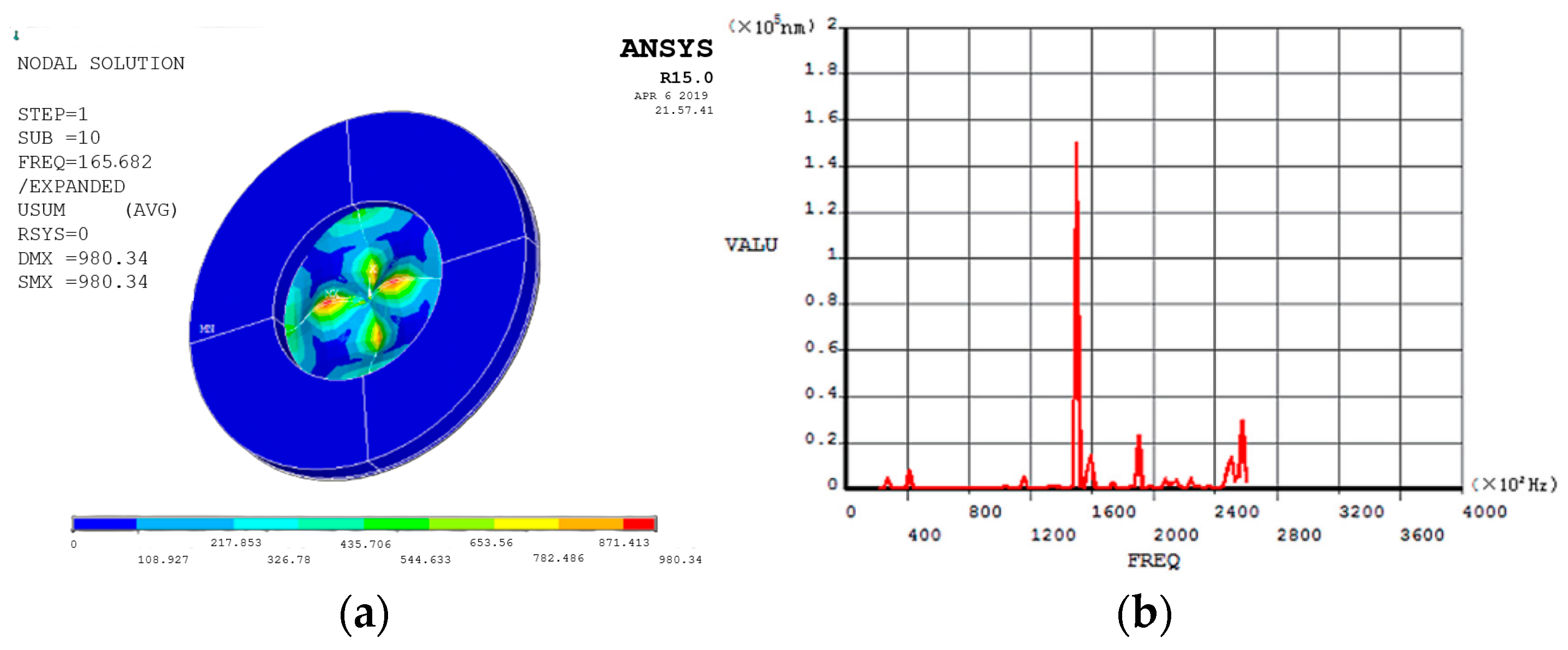
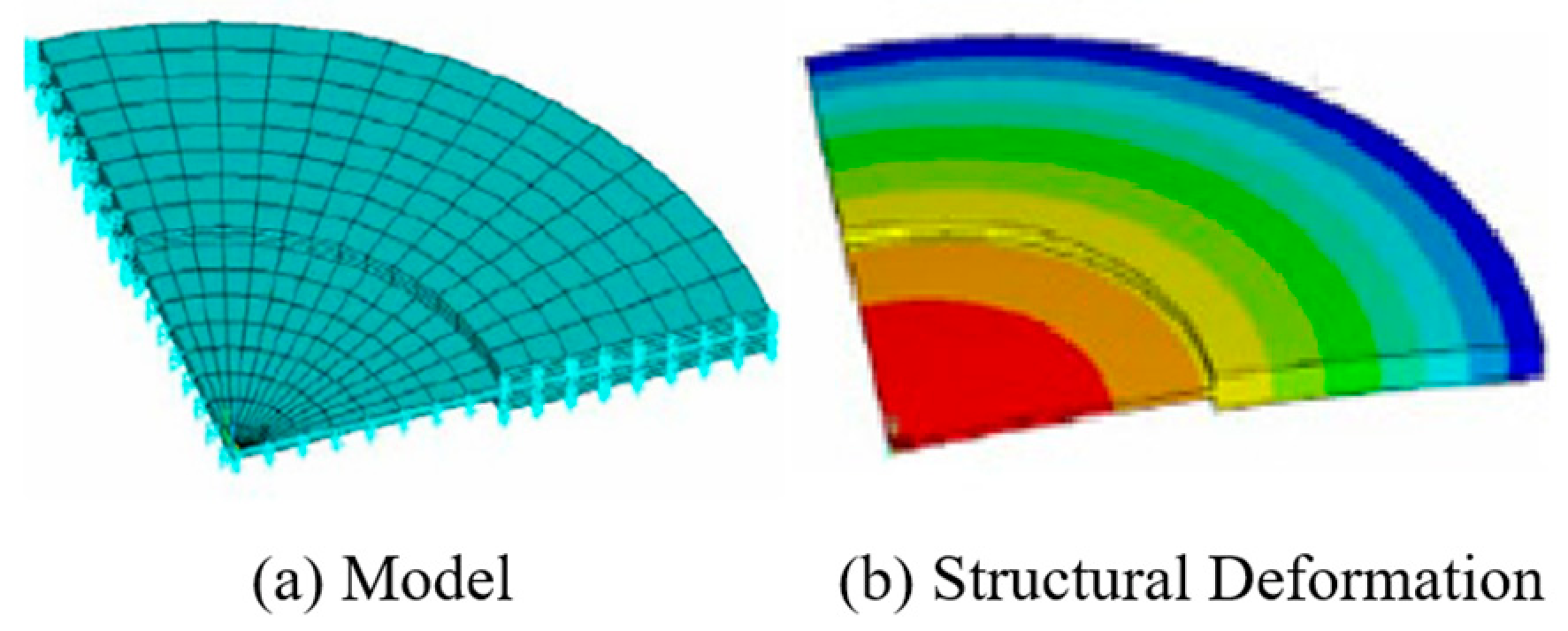
Chen et al. used ANSYS 15.0 FEA to simulate and analyse piezo coupling, modal, and harmonic response of a SS 304 disc substrate VMA with a PZT4 ring coupled to the outlet side. Isotropic material properties for the plate component were supplied, but the anisotropic matrices for the PZT4 annulus were omitted. The RF of 160 kHz was calculated for an initial design assembly geometry. Using modal analysis, a frequency sweep was conducted between 20 and 260 kHz, with 16 vibrational modes being identified. Symmetry was employed with a model quadrant being analysed to reduce computational expense, and fixed BCs were applied to the periphery of the model. Mode shapes with high plate amplitude were desired to produce aerosol. To determine which RF and associated mode shape produced high plate central amplitude, harmonic frequency response analysis was conducted, with 20 V being applied to the assembly via the PZT. The resultant RF versus central displacement curve identified a maximum displacement of 151.9 µm at a frequency of 158.93 kHz, as shown in Figure 4. Theoretical RF values were calculated for three variants of VMA, and component diameter, along with thickness, were varied and compared with the results of modal analysis. Good agreement was observed between theoretical and simulation results, with values being within 2 kHz or less than 2% error. One variant exhibited the highest amplitude of 182.5 µm in harmonic analysis, and the corresponding prototype yielded the best aerosol output. Relationships between RF, central amplitude versus PZT inner and outer diameter, PZT thickness, and plate thickness were simulated using FEA. It was reported that the PZT dimensions had a significant effect on the VMA RF, with the outer diameter being inversely proportional. However, the results were not verified experimentally. PZT inner diameter was varied between 3.6 and 4.2 mm, yielding RF and amplitude variation of approximately 75 kHz and 90 µm, respectively. PZT outer diameter was between 7.4 and 8.6 mm, resulting in an RF decrease from 150 to 90 kHz and an amplitude variation of approximately 50 µm. PZT thickness between 0.54 and 0.66 mm yielded RF and amplitude variation of approximately 45 kHz and 60 µm, respectively. Plate thickness between 0.14 and 0.20 mm resulted in RF and amplitude variation of approximately 30 kHz and 75 µm, respectively. FEA was recommended as a tool for optimising VMA geometry to achieve desired vibrational characteristics [50]. Limitations of this study were the lack of experimental validation and the fact that only dry state was analysed. Additionally, the PZT bond and apertures were not modelled, and a desired mode shape was not recommended. The FEA model would be difficult to replicate as PZT4 material properties and APDL code were not given.
Zhou et al. simulated the piezoelectric coupling effect on an axisymmetric VMA bimorph device. This comprised a copper plate with PZT8A annuli fixed to either side and simulated using ANSYS 13.0. The isotropic plate and anisotropic PZT material properties were described. Model symmetry was used given the axisymmetric geometry of the VMA. Modal analysis was employed to determine RFs and associated mode shapes for each RF. Both PZT components had the same polarity, and five volts was applied to the assembly. A maximum displacement was observed in the centre of the mesh substrate, as shown in Figure 5. Using a harmonic response analysis on the model quadrant with a fixed BC applied, a displacement versus frequency response curve was generated. This indicated a maximum central amplitude at an RF of 105 kHz, which was required to yield the highest atomization rate. A desired mode shape was not identified or recommended. A prototype device with a copper mesh, bonded PZT elements, and uniform hole array was manufactured. This produced droplets of diameter 3–4 µm and a flow rate of 0.07–0.08 g/min when oscillated at the 105 kHz resonant frequency identified during FEA [58]. Meshing methods for the model were not described and analysis was in the dry state only. The model did not incorporate holes or bond geometry. RF and associated mode or displacement were not validated theoretically or empirically.
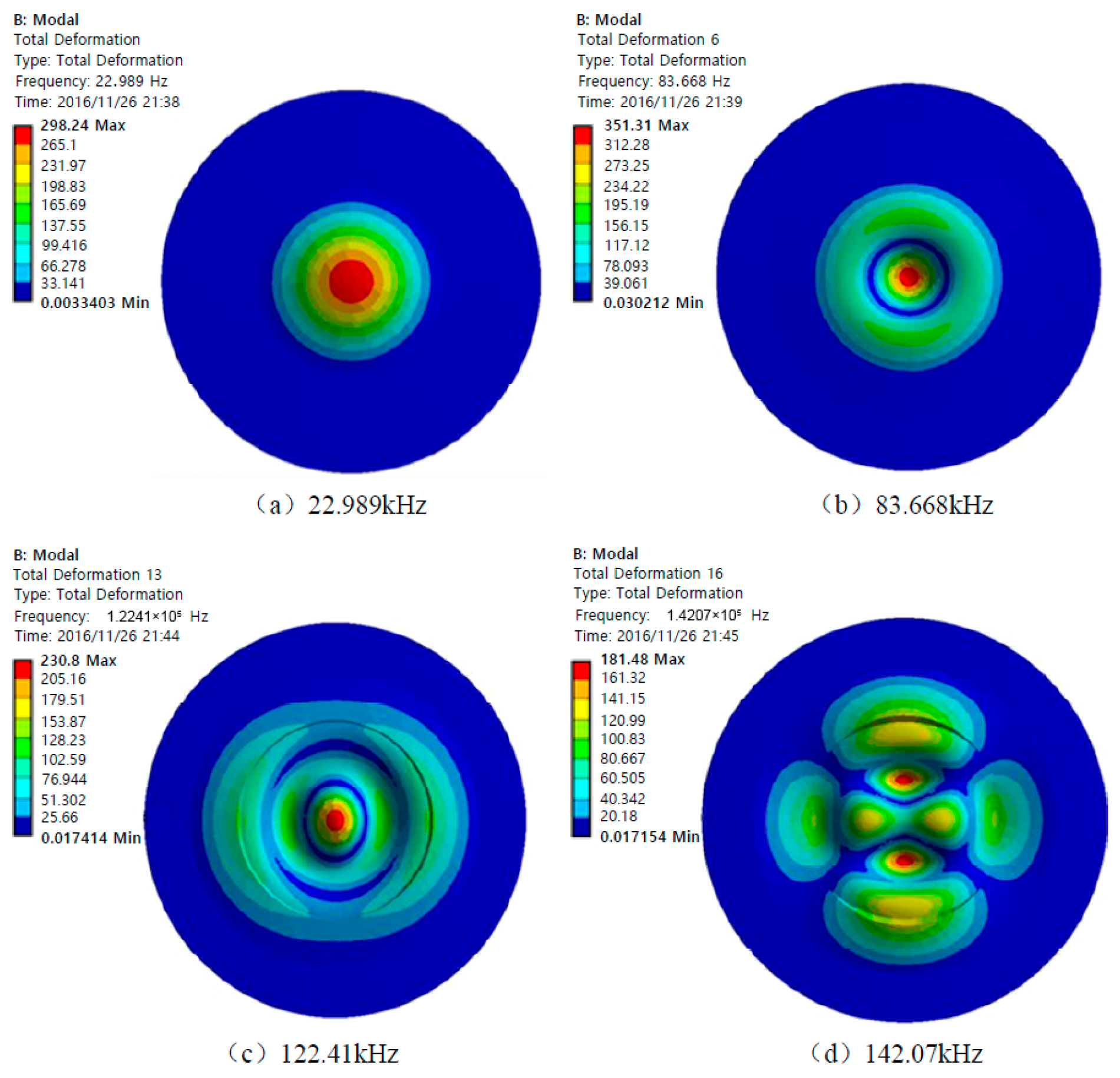
Yan et al. investigated the effect of drive voltage, drive frequency, outlet hole diameter, liquid temperature, and concentration on the aerosol flow rate of a VMA. ANSYS modal analysis identified optimal RFs and associated mode shapes of the SS plate with a fixed outlet-side mounted PZT assembly, as shown in Figure 6. Prototypes had 400 laser-drilled holes at the plate centre. These exhibited a large taper diameter on the fluid or inlet side, and the PZT was bonded using adhesive to the outlet side of the substrate. An LDV frequency sweep using a Polytech PSV-300F-B found prototype mode shapes and RFs. Frequencies were similar to modal analysis results but included two additional RFs, which were attributed to external factors with associated measurement errors.
For simulated RFs above 80 kHz, there was good agreement with experimental results, with an error < 6.5%. Mode shapes were visualised using LDV, but did not correlate well with the simulated versions. Atomisation began as mesh amplitude and velocity increased linearly with maximum flow rate for voltages of 100, 120, and 140 V at 122 kHz using diameter 12 µm outlets. This was attributed to increased taper volume variation during oscillation. Outlet dimensions of diameter 8–12 µm were investigated with higher flow rates for larger diameters at 122 kHz [51]. The FEA was limited to the dry state and did not include the PZT-to-substrate bond. Holes and PZT electrodes were also omitted from the simulation. Boundary conditions or meshing techniques were not described, and mode shapes were not validated empirically.
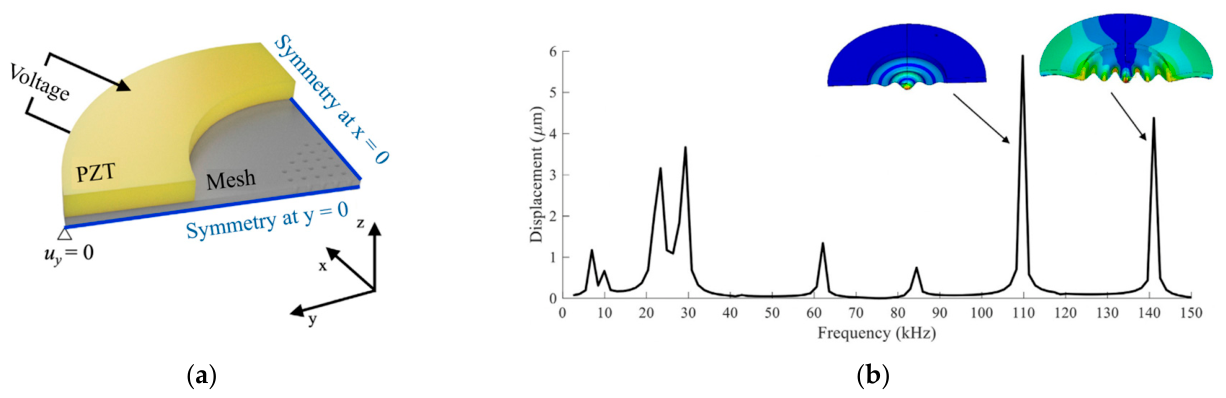
Lee et al. investigated liquid atomisation and evaporation via a heating element to optimise soft actuation speed. The aim was to replace heavy fixed pneumatics with flexible hollow structures. A VMA was selected due to its energy efficiency; it comprised a PZT4 ring epoxy bonded to a SS mesh with 551 central conical holes. ANSYS modal FEA of the PZT coupled via a bonded contact to the inlet side of the mesh substrate determined the device drive frequency. This was simulated by finding vibration modes and RFs. Symmetry was used on a quadrant, with the bottom edge Y direction displacement being fixed, as shown in Figure 7a. Harmonic FEA applied a sine-wave voltage of 20 V AC to the PZT. An RF sweep between 0 and 150 kHz identified central displacements of approximately 6 µm and 4.2 µm at 110 kHz and 140 kHz, respectively. These RFs exhibited a focussed central displacement and a (0,4) axisymmetric mode at 110 kHz, as shown in Figure 7b. Simulation voltage was increased to 80 V, which yielded central displacements of approximately 23 and 18 µm at the same respective RFs. Flow rate was measured from 100 to 150 kHz in 2 kHz increments at 80 V on a prototype. This produced approximately 400 and 250 mg/min at 110 and 140 kHz, respectively. Given the high central displacement simulated and high experimental atomisation rate at 80 V and 110 kHz, further analysis was conducted to assess the effect of voltage variation on the performance of the VMA. FEA was conducted between 5 and 80 V at 110 kHz, with a linear relationship being observed between input voltage and central displacement of the VMA. When compared to the experimental rate of atomisation, a linear relationship was also observed between input voltage and VMA flow rate. A minimum threshold of approximately 18 V was required to initiate atomisation. The study showed that FEA can be used to determine optimum RF and associated mode shapes of the device to maximise prototype atomisation rate. Inferences can be made between the linear direct correlation between atomisation rate and simulated displacement [53]. Empirical validation of the vibrational characteristics of the VMA was not detailed in the article for RFs and associated mode shapes or displacement. While the simulation included PZT and substrate assembly with holes, meshing methods were not described. Simplified BCs were employed, where the assembly was assessed in the dry state and the electrodes or bond geometry were not modelled. Variations between simulated results and prototype performance were attributed to the epoxy bond medium and soldered wire contacts used to actuate the PZT.
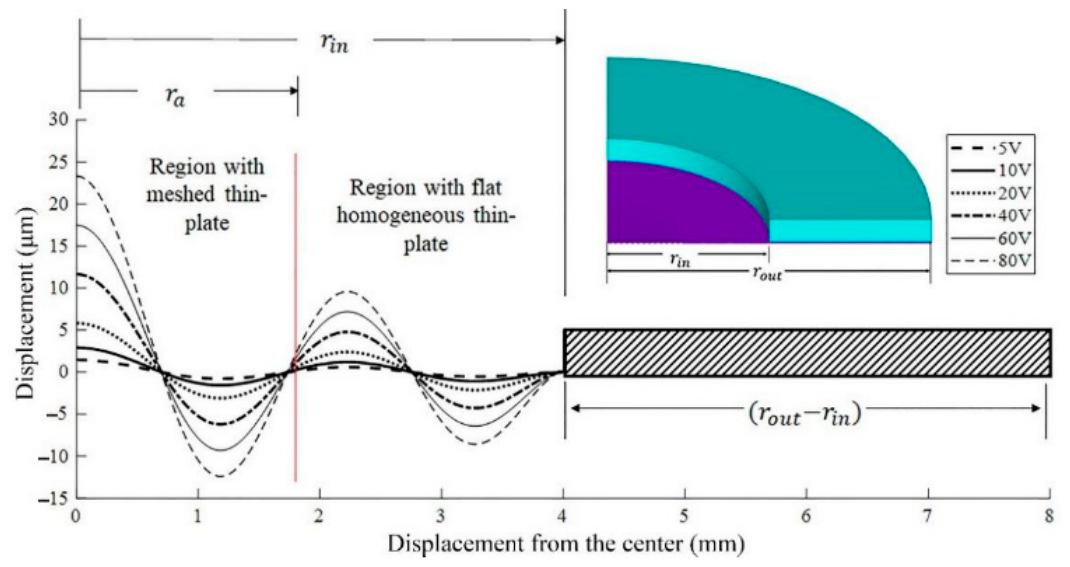
Guerra-Bravo et al. investigated atomisation rate control for an axisymmetric PZT ring with epoxy-bonded SS mesh VMA to optimise soft robot actuation. ANSYS FEA simulated the effect of hole shape on vibration. The radial PZT mode was identified as the vibration transfer mechanism for the coupled plate. Modal FEA with clamped BCs simulated the first nine RFs and modes for the substrate component without holes. This yielded an approximately 0.12% error in comparison to analytical results with axisymmetric modes yielding greater central displacement. Harmonic FEA was conducted where the PZT was coupled using a bonded contact to the inlet side of the substrate. Conical holes, clamped circumferential BC, and symmetry were included in the simulation. By applying a sine-wave AC voltage of 5–80 V to the PZT, the first five axisymmetric modes were found. Maximum central displacement occurred at 110 kHz at the (0,4) mode and exhibited a linear correlation to voltage. A central area of cylindrical, pyramidal, and conical holes in an array of 551 sites with inlet and outlet dimensions of 80 and 10 µm was assessed using the model. For the (0,4) mode with an RF of 110 kHz, a sine-wave voltage of 5–80 V was applied to the PZT, with maximum displacement being assessed for different apertures, as shown in Figure 8.
Displacement was proportional to voltage for all hole geometries. RF differences were attributed to plate density loss due to hole geometry. Cylindrical apertures had the highest displacement at the lowest frequency, followed by conical and pyramidal holes. Modes exhibiting displacement at 110 and 140 kHz were tested at 20–80 V AC. Displacement was compared to atomisation rate with a good linear correlation. Differences between simulated displacement results and prototype atomisation performance were attributed to prototype assembly variation. The effects of PZT epoxy bond layer and soldered actuation wire connections were identified as potential causes of error [52]. FEA proved a valuable optimisation tool to determine drive RF and voltage for different VMA designs. However, the study did not assess wet state and employed simple BCs. Additionally, PZT electrodes or bond geometry were not modelled. RF, associated mode shapes, and resultant displacement were not measured or validated in the study.
Fossat et al. developed an analytical model to optimise the efficiency of a PZT4 ring coupled to the outlet side of a circular steel mesh VMN, which was verified using FEA. Initially, perforations were omitted from the analytical model and the PZT-to-plate bond was deemed negligible due to low thickness. A theoretically derived effective mass equation was used to model the vibrating plate under fluid loading. When assessed analytically for the first mode of a clamped circular plate, flexural rigidity was varied by ±20%, yielding a proportional ±10% RF variation. A variation of +5% thickness yielded a proportional +10% RF variation, and ±20% fluid mass yielded a proportional −11 to 8% RF variation. Conical aperture volume variation at the mesh centre was simulated using FEA. Harmonic circumferential excitation was applied from 0 to 1 MHz; this showed that inlet and outlet hole diameters cyclically increased and decreased opposite to each other. This dynamic cone angle phenomenon was previously proven theoretically and empirically. It was proposed for uses including liquid fuel, spray drying and cooling, 3D prototyping coating, inkjet printing, and nebulisation [76]. Conical and cylindrical holes showed similar volume change, where variation depended on RF and amplitude. This change in volume occurred at resonant modes and was maximum at the plate centre. This study is a very good example of comparative analysis between geometrical, vibrational, and mechanical parameters. A 2D axisymmetric FEA model with a single central aperture was used for modal FEA on the coupled PZT and mesh with free BCs [54]. Excellent agreement versus calculation using a fixed BC was noted; however, empirical validation was not reported. Volume variation analysis for multiple holes was not conducted due to computational expense. Analysis also only assessed the dry state. No bond geometry or electrodes were modelled, and simplified BCs were employed.
Liu et al. investigated a modified SS 304 single-hole VMA driven by a conductive epoxy-bonded inlet-side PZT4 annulus repurposed as a membrane ejector. The proposed use was for direct ink writing of low-volume printed electronic components with a near 100 µm line width using silver ink. The central region of the mesh substrate was laser-ablated down from 140 to 40 µm and formed into a convex shape, with the laser-machined conical hole in its centre. COMSOL Multiphysics was employed to determine the RFs and associated mode shapes of the coupled PZT and substrate assembly using modal analysis. The first eight assembly mode shapes and associated frequencies were simulated. Modes that exhibited deformation of the PZT-to-substrate interface area were omitted. This ensured assembly stability during vibration to prevent PZT damage or delamination. Harmonic analysis was used to apply a frequency sweep to find displacement and velocity at different frequencies and voltages. As a 2D axisymmetric model was used for the analysis, symmetry was employed for the axis, where only half of the model was used. A fixed edge BC was applied to the peripheral edge of the mesh, electric grounding was applied to the bottom of the PZT, and voltage was applied to the top surface. Excessive deformation in the bonding region between the mesh and PZT was assessed, as this could cause issues with the PZT or interface integrity. Simulation predicted that an RF of 111.9 kHz would exhibit a (0,3) mode shape with no deformation at the PZT-to-substrate interface area. Voltage was increased incrementally to determine the upper threshold, and deformation in this region was insignificant up to 80 V peak to peak. Nozzle velocity was found to be critical to ensure there was adequate momentum to overcome liquid surface tension and achieve droplet ejection. Viscosity was also found to influence stable ejection of different media, where increased driving voltage was required for higher-viscosity liquids when tested using prototypes. Simulated displacement and nozzle velocity were both found to increase with input voltage [55]. Frequencies and their associated mode shapes, resultant velocities, and displacements were not verified empirically. The 2D axisymmetric model simplified the analysis and reduced computational expense. In the wet state, the PZT-to-substrate bond geometry and conical hole were not simulated. The PZT properties were assumed to be isotropic, and meshing techniques were not discussed.
More recent developments in the field include the work by Zhong et al., where VMAs were assembled using Potassium Sodium Niobate (KNN) lead-free piezoelectric elements. The purpose was to assess the feasibility of alternative versus conventional PZT elements. The devices comprised a KNN ring thermoset epoxy bonded to the exit side of an SS 316 substrate with an embossed central mesh region. The dome feature was embossed to reduce blockage and pooling, with conical holes drilled using a three-stage laser process. Dry-state FEA modal analysis was employed to determine RF with associated mode shapes. Harmonic response analysis was used to simulate displacement versus frequency response curves for KNN and PZT rings coupled to the domed substrate. Piezo electrodes, holes, and adhesive geometry were omitted from the model, while limited piezoelectric material properties were given. The sweep-meshing method was used, and symmetry was employed to analyse a quadrant of the model. A cylindrical support was applied to the periphery, along with fixed axial and tangential BCs. Modal analysis identified RFs at 122 and 140 kHz for the KNN VMA. RFs of 99 and 129 kHz were observed for the PZT VMA. Harmonic analysis with a sine-wave input of 1 V AC applied to the piezo element. This yielded a central displacement of 0.6 µm at 122 kHz and 0.7 µm at 140 kHz for the KNN VMA. This compares to 1.4 µm at 99 kHz and 1.6 µm at 129 kHz for the PZT VMA. A laser vibrometer was used to validate the FEA analyses. The KNN VMA was assessed using sinusoidal AC drive voltages from 20 to 100 V in 20 V increments. At 100 V, central displacements of 0.1 µm at 123.5 kHz and 0.08 µm at 143.3 kHz were observed. This compares to 0.14 µm at 99.5 kHz and 0.06 µm at 114.7 kHz at 60 V for the PZT VMA. Both peaks were found to shift downwards as the voltage and amplitude increased. Good agreement was observed for RFs; resultant displacement differed significantly between FEA and experimental results. Associated mode shapes for these RFs were not validated. Prototypes did not produce aerosol below 125 kHz, and increasing input voltage from 20 to 100 V saw increased amplitude and flow rate for both mode shapes. It was recommended that lower voltages be used for VMA actuation to prevent liquid heating and plate fracture. Flow rate was determined to be a function of hole taper angle (greater than 30° entry angle recommended), active area of holes, and dome shape. Mesh material properties, mode shape, drive voltage, and fluid properties were also attributed to having an effect on flow rate [56].
Table 3 gives an FEA summary for the articles reviewed in this section for the piezoelectric annulus and mesh substrate architecture.
Table 4 gives a finite element model summary for the articles reviewed in this section for the piezoelectric annulus and mesh substrate architecture.

3.2. Piezoelectric Element, Substrate, and Mesh

While investigating MEMs for the design and fabrication of a Silicon mesh component for use in VMNs, Olszewski et al. demonstrated that FEA could be used to expedite product development. The objective was to propose an alternative high-volume and high-yield manufacturing process to produce uniform mesh components. Modal analysis was used to predict and optimise the thickness of the mesh component for use in a VMN for the (0,2) mode shape at a drive frequency of 100 kHz. COMSOL was employed to vary the thickness of a simple 4 mm diameter 3D model of the disc component, which was fixed around its boundary and free of mechanical stress. Simulation found that when using material properties for silicon, with a defined outer diameter and applied boundary conditions, the (0,2) mode shape occurred at 100 kHz for a 25 µm-thick circular plate. However, the simulation used isotropic material properties and simplified BCs on the mesh component. FEA did not include thermal or material stresses, omitted mesh-to-fluid interactions, and did not simulate the electromechanical assembly interactions of the device. Modal analysis was also used to determine the influence of apertures on the RF. A mesh component with 2000 apertures at a pitch of 80 µm resulted in a simulated <5% reduction in RF. To validate the FEA results, prototypes with pyramidal apertures at a pitch of 120 µm were fabricated. These components were assembled onto the inlet side of a substrate and a piezoelectric element assembly and measured using LDV. A frequency sweep was conducted across a range of frequencies at low voltage while outputting vibrational mode shapes and associated amplitudes. Good agreement between simulation and empirical results was observed, where a (0,2) mode shape at approximately 90 kHz was documented, 10 kHz less than the simulated RF. The linear effect of increased voltage on amplitude for this mode was also determined via LDV. From an aerosolisation perspective, the silicon mesh samples produced a 3.75 µm droplet size and 0.45 mL/min flow rate. This was comparable to commercial metallic meshes produced by standard production methods such as electroforming or laser drilling. This analysis showed FEA can be used to optimise mesh component geometry ahead of performing costly prototyping activity in the early-stage design phase. Combined with theoretical and empirical validation, this gives us confidence in the model for design iterations [59]. However, displacement or stress acting on the mesh was not analysed.
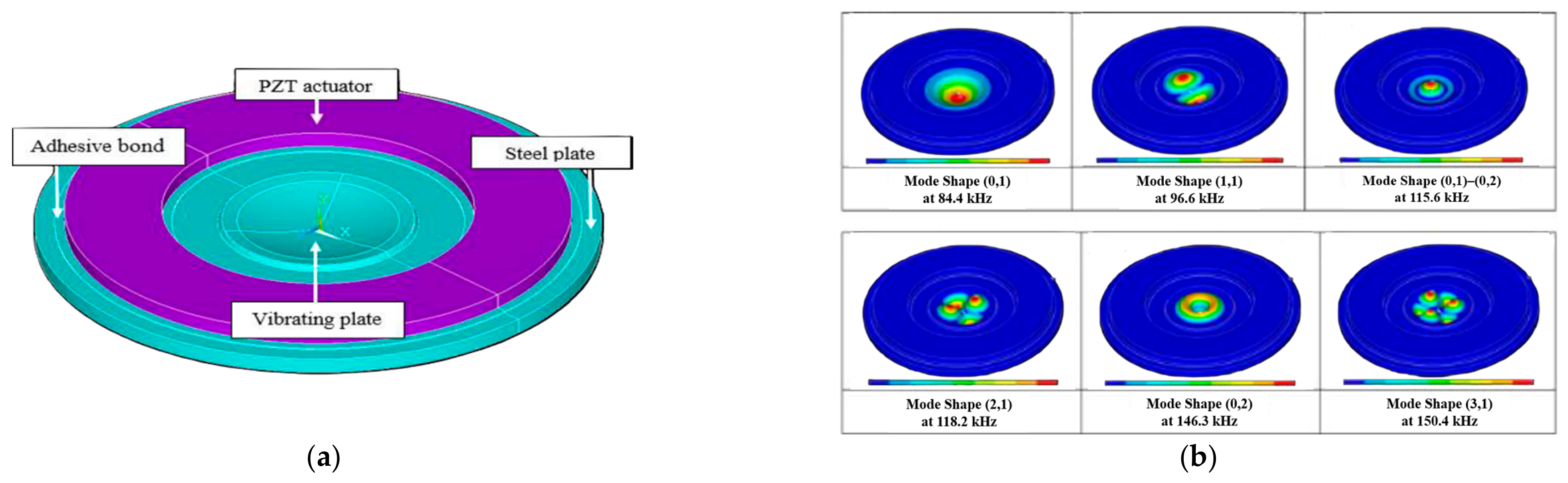
Research by Butan et al. analysed the effect of PZT adhesive elastic modulus and thickness on VMN vibrational characteristics using ANSYS modal and harmonic FEA. The VMN comprised a steel substrate to which a PZT ring and domed circular mesh were attached on the inlet side, as shown in Figure 9a. Analysis focused on the (0,2) mode at a drive frequency of 126 kHz. The annular PZT adhesive bond thickness was varied between 10 and 80 µm, with FEA predicting an inverse relationship between mesh thickness, output RF, and resultant amplitude. Simulation predicted RF would decrease from 148.1 to 145.6 kHz while vibrating mesh displacement would decrease from 2.5 to 1.25 µm across the bond thickness range. Larger bond thickness heavily damped amplitude, which would affect aerosol performance. PZT bond elastic modulus (E) was varied between 1 and 10 GPa, with FEA predicting a linear relationship with RF and amplitude. Simulation predicted RF would increase from 144 to 147 kHz while vibrating mesh displacement would reduce from 0.5 to 2.5 µm across the bond elastic modulus range. Increased bond modulus of elasticity increased mesh amplitude, which would improve aerosol performance. Prediction equations were given for both analyses [61]. Following this, ANSYS modal and fluid–structure interaction (FSI) analyses were used to simulate dry and wet vibration for the same assembly model. Modal FEA predicted RFs and associated mode shapes in the dry (air-damped) state within 80–160 kHz, as per Figure 9b; simulated results compared well with the empirical and theoretical calculation results. A coupled FSI simulation predicted vibration in the wet (water-damped) state for 60–160 kHz. This found that the (0,2) mode exhibited greater displacement while all other modes were significantly damped in the wet state. It was determined that the (0,2) mode was most efficient for VMN performance due to increased flow rate. Results from the FSI simulation compared well with empirical and calculated fluid-damping equation results. FEA was validated using calculation and LDV. Optimum mode shape and drive frequency were determined for the device in the wet state [62]. These studies modelled the bond interfaces between components, and the PZT to substrate bond geometry was assumed to be a flat annulus. Limited information on the FEA methodology was given in the publications. Omissions included dimensional data, material properties, meshing methods, and BCs.
Houlihan et al. analysed a VMN comprising a silicon MEMs fabricated mesh bonded to a substrate with an inlet-side PZT ring assembly. COMSOL Multiphysics was employed to compare simulated versus experimental results in the dry and wet states. Symmetry was used on the axisymmetric VMN, and modal FEA identified the first five axisymmetric mode shapes and corresponding RFs. Separate assembly and mesh component modes were observed for the VMN. However, the mesh modes could not be clearly identified by experimental impedance analysis. Harmonic FEA central displacement versus frequency exhibited good RF agreement with LDV results using a Polytec MSA400 instrument. Displacement discrepancies were observed and were attributed to the BCs applied to the FEA model. To assess the impact of fluid, a drop of saline was added to the prototype silicon mesh assembly. LDV frequency scanning was conducted at a low voltage to avoid liquid aerosolisation. In the wet (liquid-damped) state, LDV showed a downward shift in RF of the vibrating mesh component and assembly RFs. RF reduction of more than half was observed for the mesh component modes. This prompted harmonic FEA coupling of the structural domain (VMN) to acoustic domains on either side of the mesh (air and liquid). The benefit of the study consisted of FEA being used to assess liquid-loaded mode shapes, which are difficult to measure using LDV. At a 120 kHz drive frequency, FEA showed that the mode shape changed from a (0,2) dry mode to a (0,3) wet mode. While the pyramidal holes were not modelled during simulation, the reduction in stiffness was accounted for using an equivalent thickness [60]. The meshing method, element types, and BCs were not described. Bonding of the PZT and mesh components was also not described.
To better understand VMA performance, Sharma and Jackson investigated vibration characteristics of an axisymmetric silicon VMA. This device could be used for drug delivery, spray drying and coating, mass spectroscopy, and dry powder aerosolisation. COMSOL Multiphysics was used to simulate the dynamics of a MEMs fabricated silicon mesh. This mesh, along with a PZT annulus, was coupled to an SS substrate on the inlet side of a VMA assembly. The model included 100 nm aluminium electrodes on the top and bottom faces of the PZT ring. The parameters investigated were the inputs that affected RF, the corresponding mode shape, the resultant displacement, and the associated velocity. A mesh independence study was conducted to determine the correct number of model elements. While actual device apertures were pyramidal, 1000 equivalent volume cylinders of 15 µm diameter were used for harmonic FEA to reduce model complexity, as [52] showed comparable output. A fixed-substrate circumferential edge BC and PZT sinusoidal voltage were applied. Modal analysis identified the first nine modes and corresponding RFs. Simulation also assessed the effect on RF when mesh diameter varied from 1 to 6 mm with a constant thickness of 25 µm, and the thickness varied from 10 to 70 µm with a constant mesh diameter of 4 mm; the hole pitch was varied, and the mesh was compared to a blank plate. Harmonic FEA was employed to assess the linear effect of input voltage variation on mesh displacement for the (0,1), (0,2), and (0,3) mode shapes. The effect of different mesh diameters on displacement at 100 V peak to peak was also assessed for these modes. Prototype devices were assembled where the PZT and mesh components were bonded to the SS substrate. Contact wires were bonded to the top and bottom electrodes of the PZT for actuation. Measurement of mode shape, amplitude, velocity, and frequency of the fabricated units with pyramidal apertures was conducted with a SmarAct LDV. With 50 V applied to the prototype VMA device, atomisation was not possible for the (0,1) mode but initiated above 85 kHz for the (0,2) mode. This was attributed to mesh velocity in conjunction with displacement. Velocity was also observed to exhibit a linear relationship with input voltage. Strong agreement was observed between FEA and empirical RFs, with an error of 7% for the (0,1) and 0.8% for the (0,2) mode shapes. Displacement for the (0,2) mode at 100 V peak to peak also agreed well between FEA and empirical results. This yielded displacement values of 2.01 and 1.99 µm, respectively, giving an error of 1%. Atomisation rate increased with voltage for the (0,2) mode when water was applied to the VMA; this was at a maximum at 99 kHz and 90 V driving conditions. It was concluded that FEA could be used to design VMAs for specific requirements and performance [63]. The study only assessed the dry state, did not include bond geometries, and isotropic material properties were used for the PZT and silicon mesh.
Building upon this research, Sharma et al. employed a novel approach incorporating a microheater into the assembly to atomise higher-viscosity liquids. In addition to the device previously described, a spacer was added to separate the mesh and microheater elements. The microheater was bonded onto this spacer using a non-conductive epoxy. The aim was to increase liquid temperature, but to a limit of below 100 °C, so as not to vaporise or promote thermal reaction. COMSOL was employed to design the microheater component, which comprised a platinum heating circuit sandwiched between a polyimide substrate and a top insulation layer. Four separate layouts were simulated and assessed for temperature profile and power usage. The optimum layout was selected based on the results of static and time-based studies, which analysed heating profile and time to steady state parameters. Simulation was similar to empirical results measured using an infra-red camera [77]. However, microheater analysis was limited to dry state and component level. Other limitations included the use of simple BCs, such as negligible radiation or resistance changes, and assembly or vibrational effects were not considered. The effect of temperature on the VMA assembly was not assessed.
Table 5 gives an FEA summary for the articles reviewed in this section for the piezoelectric annulus, substrate, and bonded mesh substrate architecture.
Table 6 gives a finite element model summary for the articles reviewed in this section for the piezoelectric annulus and mesh substrate architecture.

4. Critical Synthesis

4.1. Analyses Employed and Validation Methods

As discussed in Section 3.1 and Section 3.2, and with reference to Table 3 and Table 5, modal analysis was identified as the most common FEA method used when simulating the different vibrating mesh technology architectures. This analysis determines the natural frequencies and corresponding mode shapes for a given component or assembly under specified boundary conditions. Coupling of the piezoelectric component was included in many studies to model the interaction between the PZT and the system’s mesh or substrate. Modal FEA was employed to identify resonance conditions of the vibrating mesh, piezoelectric elements, and device assemblies. As the most commonly used, this proved to be the most robust analysis method, as there were multiple examples in the literature analysing both component and assembly levels. Theoretical validation of modal FEA exhibited very good-to-excellent agreement for studies that included this aspect. The limitation with theoretical validation is that it pertains to the plate or PZT annulus at the component level. Some studies used theoretical component analysis to validate the vibrating mesh assembly FEA, which may be acceptable for proof-of-principle studies or if test equipment is not available, but it is not ideal. Impedance analysis, which measures how electrical systems resist AC over different frequencies, was used to experimentally validate RF values with very good-to-excellent agreement observed. Laser Doppler Vibrometry is a non-contact optical measurement technique used to quantify vibration and velocity. This was used in a limited number of studies to measure and validate the mode shape of the vibrating mesh component.
Across the different architecture types, the second most commonly used FEA method observed in this review was harmonic response analysis. This analysis was used to determine the response of components or assemblies when subjected to harmonic or sinusoidal loading over a specified frequency range. Typical analysis outputs include displacement, stress, and strain while subject to specific boundary conditions. This method is used to assess the structure for resonance issues, excessive vibration amplitude, and potential for yielding. Piezoelectric coupling was also extensively employed for this analysis to model the electromechanical interactions between PZT and substrate components. This allowed for more complex analysis of the vibrating mesh devices to assess mesh central displacement and velocity at given voltage and frequencies. Validation activity of this analysis was much more limited, with measurement of displacement and velocity attainable by LDV. Theoretical validation of harmonic analysis is much more complex than modal analysis due to multiple parts with different material properties. As such, it is generally limited to component frequency calculation. Experimental validation of FEA displacement ranged from exhibiting very good agreement to poor alignment. This indicates that harmonic analysis of vibrating mesh devices can be robust if modelled correctly.
More recent studies on the annular substrate, inlet-side bonded annular PZT, and bonded circular mesh component architecture have included thermal analysis and wet-state or liquid-loaded analysis. Thermal analysis in the field of vibrating mesh technology is very limited, but has been completed on an ancillary heater component to the vibrating assembly. FEA results were validated using an infra-red camera, which gave us confidence in the FEA method. Fluid–structure interaction is a method by which a deforming component or assembly interacts with a contacting fluid. Theoretical calculation and wet-state LDV analysis validated the FEA results with very good RF agreement. Acoustic–structural coupling has also been presented in the literature as a method of modelling the device in the wet state. This models the interaction between vibrating components or assemblies and a contacting fluid medium. Again, theoretical calculation and LDV analysis were employed with excellent agreement of RF. Displacement was also validated experimentally via LDV. Research in the public domain on these approaches for vibrating mesh devices is very limited, prompting further analysis and additional validation. As such, they can be considered somewhat robust, but more work is required in these areas. In general, all future studies should include more detailed methodologies along with more robust experimental verification and validation. This will ensure that the research can be replicated and leveraged to further the knowledge in the field.

4.2. Frequent Simplifying Assumptions and Impact

One of the most prominent and frequent simplifying assumptions observed throughout the review was the prevalence of dry-state analysis in vibrating mesh technology. While it is of benefit to understand how the device behaves in the dry condition, it is critical to device performance to understand how it behaves in the wet or liquid-loaded state. In the field, the operational condition of vibrating mesh devices is when liquid-loaded, and therefore, this is a critical omission in most of the literature. Of the studies that have been completed, the effect of fluid damping has resulted in a reduction from dry- to wet-state frequency of approximately 10 to 45% [60,62]. From an accuracy perspective, this is a critical consideration to ensure that the operating frequency aligns with the liquid-loaded frequency during operation. Another frequent simplifying assumption relates to the lack of bonding media between the PZT and substrate components. It is generally assumed that the bond geometry between these components can be omitted with a fully bonded contact being applied at the interface. While very good agreement has been observed for research employing this approach, the criticality of this was highlighted in one study. For the mesh component, variation in bond elastic modulus had a significant direct relationship with frequency and displacement. Thickness variation had a significant inverse relationship with frequency and amplitude. An increase in elastic modulus by 9 GPa reduced displacement twofold, and increasing bond thickness by 70 μm led to a fourfold increase in displacement [61].
Very few analyses incorporate holes in the FEA, likely due to the difficulty of discretising these areas via meshing and additional computation expense. One study described how including 2000 apertures with an 80 μm pitch impacted the mesh component by less than 5% [59]. Another study found that variations in hole geometry from conical to pyramidal to cylindrical resulted in frequency variations of approximately 3% [52]. These considerations would certainly impact homogenous plate analyses with very good-to-excellent agreement versus theoretical calculation and experimental data. The assumption of isotropy for the PZT component was also a frequent occurrence. However, piezoelectric material is anisotropic with material properties differing in each direction. It is expected that achieving correct component behaviour and displacement during harmonic FEA would be quite difficult using isotropic material properties. Unfortunately, there is no head-to-head analysis of isotropic versus anisotropic piezoelectric material simulation, so the effect on accuracy is difficult to quantify. Most studies omit piezoelectric component electrodes as they are assumed to be negligible due to micron-level thicknesses. Again, there is no comparative analysis on this, and it may be an avenue for future research, along with the isotropy versus anisotropy assumption. Above is a summary of the most frequent assumptions made in the literature; additional items for future research have been added to the Section 7.

4.3. Piezoelectric Element Anisotropy and Electromechanical Coupling

For actuator applications such as active vibrating mesh technology, the stress–charge piezoelectric constitutive matrices are employed to express electromechanical coupling. Strain–charge matrices are not applicable, as these are related to sensor-type systems where a charge output is required from a known mechanical load. For these devices, the piezoelectric element converts an electric field into mechanical deformation. These matrices are applied where an electric field predicts deformation and relate to mechanical stress σ, mechanical strain ε, and electric field E. The general form employed in the literature is described by Equations (1) and (2) [52,53]:
σ = C E   ·   ε e   ·   E
D = e T   ·   ε + ξ S   ·   E
where C E denotes elastic stiffness at constant electric field, e is the piezoelectric stress matrix, D is the electrical displacement, the superscript T denotes the transpose of e , and ξ S denotes the dielectric matrix at constant mechanical strain. Variations in these equations, which employed different notations for different variables, were observed in the literature and are interchangeable. For example, mechanical stress is also denoted by T and mechanical strain by S in different studies [58]. This is a consideration for researchers to be mindful of, as different simulation packages use different notation for compliance matrices. For an annular piezoelectric element, the matrices for [ C E ] , [ e ] and [ ξ S ] must be applied to the material in the FEA software. To effectively simulate anisotropy and electromechanical coupling, attention must be paid to the subscripts of each coefficient variable within these matrices, as they relate to the piezoelectric coordinate system and polarisation direction.

4.4. Element Types and Meshing Strategies

On review of the element types and meshing methods utilised, details are as follows. Li and Li employed SOLID5 8-node brick elements for the piezoelectric element and SOLID45 8-node brick elements for the plate component [48]. Dupuis conducted FEA but did not describe the element types used or meshing methods. Chen et al. opted for the same mesh element types as Li and Li and used the VSWEEP method to create a swept mesh. Symmetry was applied to the model to reduce it to a quadrant, decrease the number of elements, and hence computational expense. The number of mesh elements reported was 1044 with 1066 nodes [50]. Zhou et al. applied these elements to a dual PZT VMA assembly along with quadrant symmetry to quarter the FEA model. The meshing method, element size, or quantity was not provided for this study [58]. Lee et al. also employed symmetry and discretised the PZT quadrant into a mapped mesh of 675 SOLID5 8-node hexahedral elements. The SS disc with 551 conical holes of inlet diameter 80 μm and outlet 10 μm was discretised into 70,341 SOLID186 8-node tetrahedral elements. A bonded contact was used between the two discretised components. Element sizes were not described, and a meshing method for the SS component or a mesh refinement method for around the conical holes was not reported [53]. Guerra-Bravo et al. described how 16,746 SOLID186 20-node elements were used to mesh the circular SS plate before conducting modal analysis on the component. For harmonic analysis of the VMA assembly, quadrant symmetry was employed to reduce computational expense. A bonded contact type was used between the PZT and SS components. Mesh component models with 551 conical, pyramidal, and cylindrical through holes were assessed using FEA. Meshing methods, refinement methods around the holes, PZT elements or quantity, and element size were not reported [52]. Dupuis employed 2D symmetry on a segment of a VMN assembly. Both PZT and vibrating mesh components were discretised into 307 triangular elements. Element type and size, along with meshing method and refinement, were not reported [57]. Zhong et al. applied a sweep-meshing method to discretise a VMA assembly. This resulted in the FEA model having a total of 1024 elements and 7224 nodes. Quadrant symmetry was employed, and element types were not identified [56]. Sharma and Jackson modelled a VMA device with 1000 cylindrical through holes of 15 μm diameter. A bonded contact was used between the PZT and mesh components. While the quantity and size of elements were discussed, the element types, meshing method, or refinement around hole features were not disclosed [63]. In general, more transparency and standardisation are required around meshing methods and element types used for vibrating mesh device modelling. Earlier studies favoured 8-node brick elements, while more recent research uses tetrahedral and hexahedral elements for 3D analyses. Many publications omit much of the detail required to replicate the finite element analyses.
Mesh independence or convergence studies were conducted for two of the studies reviewed. These methods are effectively the same process, whereby a meshed component or assembly is iteratively refined from coarse to fine mesh elements to determine at which point FEA results are no longer influenced by element size. Dupuis et al. employed this method for the first modal frequency, where a convergence study recommended an element size of 125 μm; the method was not discussed beyond this [57]. Sharma and Jackson conducted a mesh independence study to determine the number of elements required to accurately simulate frequency. RF normalised with greater than 50,000 elements, and the change in RF was negligible with greater than 100,000 elements. From this, 150,000 elements with a 2 μm minimum element size were used for FEA [63]. Again, given the limited application of this approach, more standardisation is required across the literature to ensure model accuracy.

4.5. Fluid Modelling Studies

Butan employed FSI to determine the wet-state RF of a VMN assembly, but the details of how this was modelled and analysed were omitted [62]. Similarly, Houlihan et al. showed that wet-state RF analysis was employed and analysed using FEA. However, the technical detail of how this was achieved was limited from a modelling and element meshing perspective. The research described that acoustic domains were added to either side of the mesh component: one to represent liquid at the inlet side and the other to represent air on the exit side. The acoustic and structural domains were fully coupled in the finite element model. During operation, the mesh component generated an acoustic pressure field that varied harmonically and resulted in a force acting on the mesh component [60]. Future research should further clarify methods employed for ease of replication and consistency.

4.6. Parameters Linked to Atomisation Performance

As discussed in Section 3.1 and Section 3.2, and with reference to Table 3 and Table 5, resonance frequency is the most commonly researched parameter and relates to most other parameters linked to atomisation performance. Being able to predict RF for an active vibrating mesh device ensures that drive conditions, such as AC voltage at specific frequencies, can be applied to the device. Ensuring drive and resonant frequencies do not overlap reduces the risk of excessive displacement, fatigue, and fracture. The RFs of the device each have their own associated mode shape at which the mesh component deforms. Selecting the correct mode shape is critical to ensure high mesh component displacement and that a maximum area of active holes is exploited. This selection process will influence droplet formation; axisymmetric mode shapes are preferred in the literature. The voltage applied is also an important consideration, as there is a direct relationship between input voltage and mesh component displacement. Mesh component displacement is directly related to droplet formation, as this provides the means to extrude and eject droplets through and from the holes. In turn, displacement relates to velocity and acceleration of the mesh component, and all contribute to the ability of the device to generate droplets. Lower displacement and, hence, lower velocity and acceleration reduce the droplet formation ability of the active vibrating mesh technology. The majority of research to date has only considered these parameters in the dry state. It is more critical to understand the effects of liquid loading on the mesh component, as this will impart damping on the assembly, reducing RF and displacement. The effect of bond media variation was discussed in Section 4.2, and research has identified this as a significant parameter that can influence displacement. However, bond geometry is generally omitted from FEA. Another parameter that was over-simplified in a large portion of the research was isotropic modelling of crystalline materials; this was discussed in Section 4.2 and Section 4.3. All analyses incorporate idealised BCs, with FEA models being reduced to simple circular or annular components. During experimentation, these assemblies are generally held in fixtures, housings, or incorporate soldered electrical connections to actuate and test. These factors are generally omitted, but would certainly impact droplet formation performance due to additional clamping, damping, or localised fixed points.

5. Discussion

Two main architecture types have been identified in the literature that have undergone extensive FEA. The first type comprises a disc-shaped mesh substrate with holes or apertures in the centre, onto which a PZT element is bonded on either the inlet (fluid) or outlet (air) side of the device. The second type of architecture comprises an annular substrate component, an inlet-side bonded annular PZT element, and a bonded circular mesh component. Most analyses focused on the first architecture type, and different variations were analysed where PZT rings were located on the inlet side, exit side, or both, but the overall operational principles were similar. For the second architecture, less literature was available due to the limited amount of research in the public domain. ANSYS software was used in most cases, which presents a larger volume of reference material for future studies.
For the piezoelectric ring and mesh substrate architecture, earlier research focused on modal analysis to determine mode shapes and corresponding RFs for individual components or basic assemblies comprising the PZT ring and coupled substrate. These are important parameters of interest, as RF will dictate the drive frequency of the device, while mode shape will determine which areas of the mesh component are active during vibration. A large active mesh area is desirable, as this will increase the number of active holes for droplet formation. Validation was not conducted for some studies or was limited to comparison with plate component theoretical calculation and measurement of RF alone. Mode shape, displacement, or stress were generally not verified. Harmonic response followed modal analysis, where a voltage was applied to the PZT element to actuate the device at specific RFs and mode shapes. The purpose was to determine output displacement, central velocity, and acceleration. The mode shape of the mesh component dictates the areas of maximum displacement, which relate to the velocity and acceleration. These parameters influence the ability of the mesh component to generate droplets during vibration. Therefore, it is critical to determine the optimum mode shape for the device to ensure displacement and, hence, velocity and acceleration are sufficient to generate aerosol. Theoretical and empirical validation of harmonic response outputs was limited. All studies for this architecture were in the dry state and did not include bond geometry, and isotropic material properties were used to model anisotropic piezoelectric materials. Simple boundary conditions were employed, and a limited number of studies incorporated apertures. Recent studies included convex mesh features and different piezoelectric materials.
Similarly, for the substrate with a bonded piezoelectric ring and mesh architecture, modal and harmonic analyses have been conducted at the mesh component and coupled assembly level. These aimed to analyse the parameters described previously, with displacement validation being conducted. Additional FEA activities for this architecture include wet-state analysis of RF, mode shape, and displacement using FSI and acoustic–structural coupling. More recent work has included thermal analysis, but the vibrational characteristics of the device were not assessed in that particular study [77]. A greater number of studies for this layout also incorporated holes for analysis. While the majority of studies focussed on the dry-state device, wet-state analysis is a critical consideration, as this will be the operating condition for these vibrating mesh devices. FEA in the dry state is advantageous for assessing device performance during design and development, but wet-state analysis is required to determine the impact of fluid damping on mesh component RF, displacement, and stress. Stress analysis is an important consideration as it relates to the reliability and fatigue resistance of the mesh component. Excessive stresses in the mesh component can result in stress concentrations and yielding due to crack formation and propagation. When liquid-loaded, the mesh component and, hence, device performance behave differently as RF, mode shape, and displacement are affected. In most studies, simple boundary conditions were employed that do not model the real-world constraints of housings. While it may lead to simplification of FEA, assuming isotropy of ceramic and crystalline materials should be avoided, as their anisotropic nature changes the material properties in each direction. Quadrant and 2D symmetry have been effectively employed to reduce the computational expense and simplify the axisymmetric models for analysis. Validation of FEA has been identified as a critical step in the design and development of vibrating mesh devices to ensure the accuracy and reliability of analyses. Using the methods identified in the literature, FEA can be used to analyse the interaction of parameters for the design optimisation of vibrating mesh devices. This can be conducted ahead of performing costly prototyping activity in the early-stage design phase, with theoretical and empirical validation giving confidence in the model for design iterations.

6. Conclusions

Regarding our review of the existing literature on VMN and VMA device architectures, the following can be concluded:
  • Modal analysis has been identified and proven as a valuable analysis tool to determine component and device RFs, along with corresponding mode shapes.
  • Harmonic response analysis builds upon modal analysis, whereby model actuation at specific RFs and voltages can be employed to investigate deformation and velocity of the mesh component to optimise droplet formation.
  • These approaches have been widely used along with model symmetry for piezoelectric annulus and circular mesh substrate device analyses; however, simplified assumptions have been relied upon in some instances.
  • Simplified assumptions include idealised BCs, dry-state conditions, isotropic material properties for piezoelectric or crystalline materials, lack of experimental validation, exclusion of holes, and adhesive bond geometries.
  • While reducing computational expense, these assumptions may impact the accuracy of the FEA versus actual device performance.
  • Recent studies in this area have incorporated more complex mesh geometries and alternative piezoelectric materials, and focused on including electrodes.
  • More complex analyses have been conducted on the piezoelectric ring and circular mesh with annular substrate architecture.
  • Along with modal and harmonic response analyses, wet or liquid-loaded simulation via fluid–structure interaction or acoustic–structural coupling and thermal analysis have been employed and have beenvalidated empirically.
  • While these analyses better model the real-world device conditions in the wet state, simplified BCs, omission of adhesive bond regions, and use of isotropic instead of anisotropic material properties in some studies may not fully emulate prototype device performance.
  • Future research should incorporate actual bond conditions and BCs to more accurately simulate real-world conditions with increased focus on displacement, velocity, stress, fatigue, and thermal effects for devices in the wet state.
  • Emerging directions in this field include integration of CFD with FEA for predictive droplet generation modelling and use as a development tool to identify other alternative piezoelectric materials.
  • The inclusion of AI, machine learning, and digital twins to further accelerate design and development cycles while improving simulation accuracy is also a relevant emerging direction. Combined with robust experimental validation, these techniques would significantly enhance design optimisation for the next generation of vibrating mesh devices.

7. Future Directions and Outlook

Further research in this area should include modelling of the complete vibrating mesh device with actual piezoelectric elements and mesh bond geometries. Real-world boundary conditions should also be applied. In most actual applications, the vibrating mesh assembly is constrained within a housing and held in place with gaskets to prevent liquid from contacting the piezoelectric element. Further detailed multiphysics analysis is required in the wet state, as this is the device’s operating condition, particularly in the areas of displacement, velocity, stress, and fatigue. Stress analysis should be considered as it pertains to the reliability and fatigue resistance of the vibrating mesh component. This could be combined with CFD via FSI to integrate device FEA for aerosol formation analysis and prediction.
For piezoelectric components in the field of active vibration control, future development will require coordinated research advances in materials, modelling, control, and integration. The identification of lead-free alternatives to the conventional PZT material is becoming increasingly important from a sustainability and environmental perspective, particularly for medical device applications. Regulatory constraints imposed by frameworks such as the European Medical Device Regulation (MDR) require alternative piezoelectric materials with equivalent or superior functionality for long-term compliance. This brings new challenges to ensure components and devices achieve equivalent electromechanical coupling performance while using these alternative materials. Additional research into achieving superior electromechanical coupling will enable further device miniaturisation without impacting output performance. Other areas for development include alternative bonding methods, bonding method optimisation, reduction in interface degradation, and adaptation to changing boundary conditions. Optimal piezoelectric element placement also merits further assessment, as this is an important factor from a vibration and mode shape perspective. Concentricity and coplanarity are generally assumed for circular flat components, which do not consider manufacturing variability or geometric inconsistencies. The challenges described above will drive the development of intelligent adaptive control capable of compensating for non-linearities in piezoelectric components or integrated devices. These control systems should compensate for manufacturing variability, hysteresis, changing boundary conditions, and ageing effects via closed-loop adaptive self-tuning. Future research should also correctly model piezoelectric and crystalline materials as anisotropic to ensure better alignment between simulation and real-world component behaviours.
Thermal effects should also be analysed to determine if device heating could be a risk to the component bond interfaces or solutions to be nebulised or atomised. To date, thermal effects on the vibrating mesh assembly have not been assessed in the literature. Further research is required in this area to quantify and analyse piezoelectric element heating due to extended high-frequency oscillation on the assembly as a whole. This should include an analysis of thermal stress on the components and the quantification of the effect of thermal strain on the RF of the device. Digital twins of vibrating mesh devices could be integrated with research and development activity or manufacturing to allow real-time data-driven simulation of development or production output and issues. Machine learning could be employed to automatically detect errors in FEA models and simulations, such as insufficient boundary conditions, poor element quality, mesh convergence issues, or unrealistic simulation results. Design tolerances, experimental results, and manufacturing data could be used in conjunction with ML to identify errors in FEA results or, alternatively, to generate new product design variations for analysis based on historical datasets. Additionally, ML could be used in conjunction with parametric 3D modelling and design of experiments to iteratively optimise and simulate alternative vibrating mesh device architectures. Artificial intelligence could revolutionise FEA by optimising models, meshing methods, and geometric or material property analyses to further reduce device development times.
While CFD was out of scope for this work, similar research on CFD culminating in a review paper could be conducted on vibrating mesh technology. This should include analyses on droplet formation and how FEA-to-CFD couplings are modelled to handle large amounts of micron-scale holes. One of the main recommendations is the need for greater clarity of reporting and consistency of approaches for future studies. Future research should aim to standardise analysis methods and meshing techniques, recommend mesh types, and add more detail in published articles. More consistency and a higher level of validation would allow for more comparability in this field.

Author Contributions

Conceptualization, B.N., D.B. and P.G.; investigation, B.N.; writing—original draft preparation, B.N.; writing—review and editing, D.B. and R.M.; supervision, D.B. and P.G. All authors have read and agreed to the published version of the manuscript.

Funding

This research received no external funding.

Institutional Review Board Statement

Not applicable.

Informed Consent Statement

Not applicable.

Data Availability Statement

No new data was created or analysed in this study. Data sharing is not applicable to this article.

Conflicts of Interest

BN and RMACL are both employed by Aerogen Limited, a manufacturer of vibrating mesh nebuliser-based products. Both are named inventors on several patents, granted and pending, relating to the application of vibrating mesh for medical aerosols. DB and PG have no conflicts to declare. The funders had no role in the design of the study; in the collection, analyses, or interpretation of data; in the writing of the manuscript, or the decision to publish the results of the review.

Abbreviations

The following abbreviations are used in this manuscript:
ACAlternating current
ADAerodynamic diameter
APDLAnsys Parametric Design Language
BCBoundary condition
FEAFinite element analysis
FEMFinite element model
g/minGram per minute
GPaGigapascal
HMEHeat and moisture exchange
JNJet nebuliser
kHzKilohertz
KNNPotassium sodium niobate
LDVLaser doppler vibrometry
MEMsMicroelectromechanical system
mg/minMilligram per minute
MHzMegahertz
MLMachine learning
mL/minMillilitre per minute
nmNanometre
PCBPrinted circuit board
PdPalladium
PZTLead zirconate titanate
RFResonant frequency
SSStainless steel
USNUltrasonic nebuliser
VVolt
VMAVibrating mesh atomiser
VMNVibrating mesh nebuliser
µmMicrometre

References

  1. Stein, S.W.; Thiel, C.G. The History of Therapeutic Aerosols: A Chronological Review. J. Aerosol Med. Pulm. Drug Deliv. 2017, 30, 20–41. [Google Scholar] [CrossRef]
  2. Clark, A.R. Half a Century of Technological Advances in Pulmonary Drug Delivery: A Personal Perspective. Front. Drug Deliv. 2022, 2, 871147. [Google Scholar] [CrossRef]
  3. Fernández Fernández, E.; Joyce, M.; O’Sullivan, A.; MacLoughlin, R. Evaluation of Aerosol Therapy during the Escalation of Care in a Model of Adult Cystic Fibrosis. Antibiotics 2021, 10, 472. [Google Scholar] [CrossRef] [PubMed]
  4. Leong, E.W.X.; Ge, R. Lipid Nanoparticles as Delivery Vehicles for Inhaled Therapeutics. Biomedicines 2022, 10, 2179. [Google Scholar] [CrossRef]
  5. Sosnowski, T.R. Towards More Precise Targeting of Inhaled Aerosols to Different Areas of the Respiratory System. Pharmaceutics 2024, 16, 97. [Google Scholar] [CrossRef]
  6. Yan, R.; Zou, C.; Yang, X.; Zhuang, W.; Huang, Y.; Zheng, X.; Hu, J.; Liao, L.; Yao, Y.; Sun, X.; et al. Nebulized Inhalation Drug Delivery: Clinical Applications and Advancements in Research. J. Mater. Chem. B 2025, 13, 821–843. [Google Scholar] [CrossRef]
  7. Wu, Y.; Ma, Y.; Zheng, H.; Ramakrishna, S. Piezoelectric Materials for Flexible and Wearable Electronics: A Review. Mater. Des. 2021, 211, 110164. [Google Scholar] [CrossRef]
  8. Alharbi, A.; Yousef, A.; Alharbi, S.; Al-Shamrani, A.; Alqwaiee, M.; Almeziny, M.; Said, Y.; Alshehri, S.; Alotaibi, F.; Mosalli, R.; et al. Application of Aerosol Therapy in Respiratory Diseases in Children: A Saudi Expert Consensus. Ann. Thorac. Med. 2021, 16, 188–218. [Google Scholar] [CrossRef] [PubMed]
  9. Saxena, D.; Murugesan, N.; Evbayiro, U.D.; Ngassa, M.K.; Adrish, M. Inhalational Drug Devices: Revisiting the Linchpin of Asthma Management. J. Pers. Med. 2024, 14, 867. [Google Scholar] [CrossRef]
  10. Pritchard, J.N.; Hatley, R.H.M.; Denyer, J.; Von Hollen, D. Mesh Nebulizers Have Become the First Choice for New Nebulized Pharmaceutical Drug Developments. Ther. Deliv. 2018, 9, 121–136. [Google Scholar] [CrossRef]
  11. Martini, V.; Hinchcliffe, M.; Blackshaw, E.; Joyce, M.; McNee, A.; Beverley, P.; Townsend, A.; MacLoughlin, R.; Tchilian, E. Distribution of Droplets and Immune Responses After Aerosol and Intra-Nasal Delivery of Influenza Virus to the Respiratory Tract of Pigs. Front. Immunol. 2020, 11, 594470. [Google Scholar] [CrossRef]
  12. McCarthy, S.D.; Horgan, E.; Ali, A.; Masterson, C.; Laffey, J.G.; MacLoughlin, R.; O’Toole, D. Nebulized Mesenchymal Stem Cell Derived Conditioned Medium Retains Antibacterial Properties against Clinical Pathogen Isolates. J. Aerosol Med. Pulm. Drug Deliv. 2020, 33, 140–152. [Google Scholar] [CrossRef]
  13. Bahlool, A.Z.; Fattah, S.; O’Sullivan, A.; Cavanagh, B.; MacLoughlin, R.; Keane, J.; O’Sullivan, M.P.; Cryan, S.A. Development of Inhalable ATRA-Loaded PLGA Nanoparticles as Host-Directed Immunotherapy against Tuberculosis. Pharmaceutics 2022, 14, 1745. [Google Scholar] [CrossRef]
  14. Keep, S.; Carr, B.V.; Lean, F.Z.X.; Fones, A.; Newman, J.; Dowgier, G.; Freimanis, G.; Vatzia, E.; Polo, N.; Everest, H.; et al. Porcine Respiratory Coronavirus as a Model for Acute Respiratory Coronavirus Disease. Front. Immunol. 2022, 13, 867707. [Google Scholar] [CrossRef] [PubMed]
  15. Jardine, L.; Lui, K.; Liley, H.G.; Schindler, T.; Fink, J.; Asselin, J.; Durand, D. Trial of Aerosolised Surfactant for Preterm Infants with Respiratory Distress Syndrome. Arch. Dis. Child. Fetal Neonatal Ed. 2021, 107, 51–55. [Google Scholar] [CrossRef]
  16. Jeyanathan, M.; Fritz, D.K.; Afkhami, S.; Aguirre, E.; Howie, K.J.; Zganiacz, A.; Dvorkin-Gheva, A.; Thompson, M.R.; Silver, R.F.; Cusack, R.P.; et al. Aerosol Delivery, but Not Intramuscular Injection, of Adenovirus-Vectored Tuberculosis Vaccine Induces Respiratory-Mucosal Immunity in Humans. JCI Insight 2022, 7, e155655. [Google Scholar] [CrossRef] [PubMed]
  17. Ehrmann, S.; Barbier, F.; Demiselle, J.; Quenot, J.-P.; Herbrecht, J.-E.; Roux, D.; Lacherade, J.-C.; Landais, M.; Seguin, P.; Schnell, D.; et al. Inhaled Amikacin to Prevent Ventilator-Associated Pneumonia. N. Engl. J. Med. 2023, 389, 2052–2062. [Google Scholar] [CrossRef]
  18. Li, J.X.; Hou, L.H.; Gou, J.B.; Yin, Z.D.; Wu, S.P.; Wang, F.Z.; Zhang, Z.; Peng, Z.H.; Zhu, T.; Shen, H.B.; et al. Safety, Immunogenicity and Protection of Heterologous Boost with an Aerosolised Ad5-NCoV after Two-Dose Inactivated COVID-19 Vaccines in Adults: A Multicentre, Open-Label Phase 3 Trial. Lancet Infect. Dis. 2023, 23, 1143–1152. [Google Scholar] [CrossRef]
  19. MacLoughlin, R.J.; Higgins, B.D.; Laffey, J.G.; O’Brien, T. Optimized Aerosol Delivery to a Mechanically Ventilated Rodent. J. Aerosol Med. Pulm. Drug Deliv. 2009, 22, 323–332. [Google Scholar] [CrossRef]
  20. Forde, É.; Kelly, G.; Sweeney, L.; Fitzgerald-Hughes, D.; MacLoughlin, R.; Devocelle, M. Vibrating Mesh Nebulisation of Pro-Antimicrobial Peptides for Use in Cystic Fibrosis. Pharmaceutics 2019, 11, 239. [Google Scholar] [CrossRef] [PubMed]
  21. Galindo-Filho, V.C.; Alcoforado, L.; Rattes, C.; Paiva, D.N.; Brandão, S.C.S.; Fink, J.B.; Dornelas de Andrade, A. A Mesh Nebulizer Is More Effective than Jet Nebulizer to Nebulize Bronchodilators during Non-Invasive Ventilation of Subjects with COPD: A Randomized Controlled Trial with Radiolabeled Aerosols. Respir. Med. 2019, 153, 60–67. [Google Scholar] [CrossRef] [PubMed]
  22. Saeed, H.; Mohsen, M.; Eldin, A.S.; Elberry, A.A.; Hussein, R.R.S.; Rabea, H.; Abdelrahim, M.E.A. Effects of Fill Volume and Humidification on Aerosol Delivery during Single-Limb Noninvasive Ventilation. Respir. Care 2018, 63, 1370–1378. [Google Scholar] [CrossRef]
  23. Otto, M.; Kropp, Y.; Jäger, E.; Neumaier, M.; Thiel, M.; Quintel, M.; Tsagogiorgas, C. The Use of an Inspiration-Synchronized Vibrating Mesh Nebulizer for Prolonged Inhalative Iloprost Administration in Mechanically Ventilated Patients—An In Vitro Model. Pharmaceutics 2023, 15, 2080. [Google Scholar] [CrossRef]
  24. Ehrmann, S.; Lyazidi, A.; Louis, B.; Isabey, D.; Le Pennec, D.; Brochard, L.; Apiou-Sbirlea, G. Ventilator-Integrated Jet Nebulization Systems: Tidal Volume Control and Efficiency of Synchronization. Respir. Care 2014, 59, 1508–1516. [Google Scholar] [CrossRef]
  25. Nikander, K.; Turpeinen, M.; Wollmer, P. The Conventional Ultrasonic Nebulizer Proved Inefficient in Nebulizing a Suspension. J. Aerosol Med. 1999, 12, 47–53. [Google Scholar] [CrossRef]
  26. Sweeney, L.; McCloskey, A.P.; Higgins, G.; Ramsey, J.M.; Cryan, S.A.; MacLoughlin, R. Effective Nebulization of Interferon-γ Using a Novel Vibrating Mesh. Respir. Res. 2019, 20, 66. [Google Scholar] [CrossRef]
  27. Wang, R.; Leime, C.O.; Gao, W.; MacLoughlin, R. Aerosol Delivery in Models of Pediatric High Flow Nasal Oxygen and Mechanical Ventilation. Pediatr. Pulmonol. 2022, 58, 878–886. [Google Scholar] [CrossRef]
  28. Caille, V.; Ehrmann, S.; Boissinot, E.; Perrotin, D.; Diot, P.; Dequin, P.F. Influence of Jet Nebulization and Oxygen Delivery on the Fraction of Inspired Oxygen: An Experimental Model. J. Aerosol Med. Pulm. Drug Deliv. 2009, 22, 255–261. [Google Scholar] [CrossRef] [PubMed]
  29. Baldry, M.; Costa, C.; Zeroual, Y.; Cayet, D.; Pardessus, J.; Soulard, D.; Wallet, F.; Beury, D.; Hot, D.; MacLoughlin, R.; et al. Targeted Delivery of Flagellin by Nebulization Offers Optimized Respiratory Immunity and Defense against Pneumococcal Pneumonia. Antimicrob. Agents Chemother. 2024, 68, e0086624. [Google Scholar] [CrossRef] [PubMed]
  30. Dugernier, J.; Hesse, M.; Vanbever, R.; Depoortere, V.; Roeseler, J.; Michotte, J.B.; Laterre, P.F.; Jamar, F.; Reychler, G. SPECT-CT Comparison of Lung Deposition Using a System Combining a Vibrating-Mesh Nebulizer with a Valved Holding Chamber and a Conventional Jet Nebulizer: A Randomized Cross-over Study. Pharm. Res. 2017, 34, 290–300. [Google Scholar] [CrossRef]
  31. Dugernier, J.; Hesse, M.; Jumetz, T.; Bialais, E.; Roeseler, J.; Depoortere, V.; Michotte, J.B.; Wittebole, X.; Ehrmann, S.; Laterre, P.F.; et al. Aerosol Delivery with Two Nebulizers Through High-Flow Nasal Cannula: A Randomized Cross-Over Single-Photon Emission Computed Tomography-Computed Tomography Study. J. Aerosol Med. Pulm. Drug Deliv. 2017, 30, 349–358. [Google Scholar] [CrossRef] [PubMed]
  32. Joyce, M.; McGrath, J.A.; Eain, M.M.G.; O’Sullivan, A.; Byrne, M.; MacLoughlin, R. Nebuliser Type Influences Both Patient-Derived Bioaerosol Emissions and Ventilation Parameters during Mechanical Ventilation. Pharmaceutics 2021, 13, 199. [Google Scholar] [CrossRef]
  33. O’Toole, C.; McGrath, J.A.; Joyce, M.; O’Sullivan, A.; Thomas, C.; Murphy, S.; MacLoughlin, R.; Byrne, M.A. Effect of Nebuliser and Patient Interface Type on Fugitive Medical Aerosol Emissions in Adult and Paediatric Patients. Eur. J. Pharm. Sci. 2023, 187, 106474. [Google Scholar] [CrossRef] [PubMed]
  34. Omron. Instruction Manual MicroAIR U100 (NE-U100-E); Omron: Kyoto, Japan, 2017. [Google Scholar]
  35. Tseng, H.Y.; Lin, H.L.; Chiang, H.S. In Vitro Evaluation of Aerosol Delivery by Hand-Held Mesh Nebulizers in an Adult Spontaneous Breathing Lung Model. J. Aerosol Med. Pulm. Drug Deliv. 2022, 35, 83–90. [Google Scholar] [CrossRef]
  36. PARI. Instructions for Use PARI EFlow®Rapid; PARI: Starnberg, Germany, 2022. [Google Scholar]
  37. Vectura. Instructions for Use FOX MOBILE Inhalation System; Vectura: Wiltshire, UK, 2022. [Google Scholar]
  38. Microbase Technology Corp. Microbase-MBPN002. Available online: https://www.microbasetech.com/supports/pages/2ba6ed2fef42ad4560337609df0f99a7 (accessed on 5 May 2026).
  39. Zhou, X.; Wu, S.; Wang, X.; Wang, Z.; Zhu, Q.; Sun, J.; Huang, P.; Wang, X.; Huang, W.; Lu, Q. Review on Piezoelectric Actuators: Materials, Classifications, Applications, and Recent Trends. Front. Mech. Eng. 2024, 19, 6. [Google Scholar] [CrossRef]
  40. Sun, X.G.; Chi, W.C.; Li, J.; Wang, Y.Q. Three-Dimensional Vibration Suppression of Flexible Beams under Multi-Directional Excitations via Piezoelectric Actuators: Theoretical and Experimental Investigations. Alex. Eng. J. 2025, 129, 1039–1060. [Google Scholar] [CrossRef]
  41. Wang, S.; Jin, H.; Wang, Y.; Huo, J.; Liu, X. Optimizing Piezoelectric Actuator Placement for Enhanced Vibration Control Using Genetic Algorithms. Sci. Rep. 2025, 15, 22340. [Google Scholar] [CrossRef]
  42. Gao, Z.; Zhang, L.; Xu, T.; Zhu, X. Active Micro-Vibration Isolation System for Adaptive Vibration Suppression Tests Using Piezoelectric Stack Actuator. J. Low Freq. Noise Vib. Act. Control 2025, 44, 1187–1199. [Google Scholar] [CrossRef]
  43. Marakakis, K.; Tairidis, G.K.; Koutsianitis, P.; Stavroulakis, G.E. Shunt Piezoelectric Systems for Noise and Vibration Control: A Review. Front. Built Environ. 2019, 5, 64. [Google Scholar] [CrossRef]
  44. Wu, Y.; Yuan, Q.; Ren, K.; Shen, X.; Shen, H.; Badel, A.; Ji, H.; Qiu, J. Bidirectional Energy-Controlled Piezoelectric Shunt Damping Technology and Its Vibration Attenuation Performance. Int. J. Mech. Syst. Dyn. 2024, 4, 63–76. [Google Scholar] [CrossRef]
  45. Al-Souqi, K.; Kadri, K.; Emam, S. A Review on Vibration Control Using Piezoelectric Shunt Circuits. Appl. Sci. 2025, 15, 6035. [Google Scholar] [CrossRef]
  46. Wakshume, D.G.; Płaczek, M.Ł. Optimizing Piezoelectric Energy Harvesting from Mechanical Vibration for Electrical Efficiency: A Comprehensive Review. Electronics 2024, 13, 987. [Google Scholar] [CrossRef]
  47. Brusa, E.; Carrera, A.; Delprete, C. A Review of Piezoelectric Energy Harvesting: Materials, Design, and Readout Circuits. Actuators 2023, 12, 457. [Google Scholar] [CrossRef]
  48. Li, F.; Li, G. Application of ANSYS APDL in the Design of Piezoelectric Transducer. In Proceedings of the 5th International Conference on Advanced Engineering Materials and Technology, Guangzhou, China, 22–23 August 2015; Atlantis Press: Dordrecht, The Netherlands, 2015; pp. 506–511. [Google Scholar]
  49. Shafik, M. An Ultrasonic Atomisation Unit for Heat and Moisture Exchange Humidification Device for Intensive Care Medicine Applications. World J. Res. Rev. 2016, 2, 22–32. [Google Scholar]
  50. Chen, Y.; Ma, C.; Shen, Z.; Chen, R. Research on Vibration Characteristics of Piezoelectric Ceramic Atomizer Based on ANSYS. In Proceedings of the 2019 4th International Conference on Advances in Energy and Environment Research (ICAEER 2019), Shanghai, China, 16–18 August 2019; E3S Web of Conferences: Les Ulis, France, 2019; Volume 118, pp. 1–5. [Google Scholar]
  51. Yan, Q.; Sun, W.; Zhang, J. Study on the Influencing Factors of the Atomization Rate in a Piezoceramic Vibrating Mesh Atomizer. Appl. Sci. 2020, 10, 2422. [Google Scholar] [CrossRef]
  52. Guerra-Bravo, E.; Lee, H.-J.; Baltazar, A.; Loh, K.J. Vibration Analysis of a Piezoelectric Ultrasonic Atomizer to Control Atomization Rate. Appl. Sci. 2021, 11, 8350. [Google Scholar] [CrossRef]
  53. Lee, H.; Guerra-Bravo, E.; Baltazar, A.; Loh, K.J. Atomization Control to Improve Soft Actuation Through Vaporization. Front. Robot. AI 2021, 8, 747440. [Google Scholar] [CrossRef]
  54. Fossat, P.; Ichchou, M.; Bareille, O. Analytical Model of the Dynamic Behaviour of a Vibrating Mesh Nebulizer for Optimal Atomization Efficiency. Sens. Actuators A Phys. 2022, 343, 113646. [Google Scholar] [CrossRef]
  55. Liu, S.; Hu, S.; Lin, S.; Wu, J.; Shao, F.; Liang, J.; Wan, X.; Gu, X. A Vibrating Membrane Ejector for Direct Ink Writing of Printed Electronics. Flex. Print. Electron. 2024, 9, 025009. [Google Scholar] [CrossRef]
  56. Zhong, M.; Zhu, J.; Xiong, Y.; Zhou, Y. Design and Verification of a KNN-Based Vibrating Mesh Atomiser. Flow Meas. Instrum. 2025, 102, 102801. [Google Scholar] [CrossRef]
  57. Dupuis, E.D.; Momen, A.M.; Patel, V.K.; Shahab, S. Coupling of Electroelastic Dynamics and Direct Contact Ultrasonic Drying Formulation for Annular Piezoelectric Bimorph Transducers. Smart Mater. Struct. 2020, 29, 4. [Google Scholar] [CrossRef]
  58. Zhou, H.; Shi, L.; Tan, J.; Huang, S. The Design of Medical Micro Atomization Device Based on Piezoelectric Actuators. IOP Conf. Ser. Mater. Sci. Eng. 2019, 563, 042039. [Google Scholar] [CrossRef]
  59. Olszewski, O.Z.; MacLoughlin, R.; Blake, A.; O’Neill, M.; Mathewson, A.; Jackson, N. A Silicon-Based MEMS Vibrating Mesh Nebulizer for Inhaled Drug Delivery. Procedia Eng. 2016, 168, 1521–1524. [Google Scholar] [CrossRef]
  60. Houlihan, R.; Timothy, M.; Duffy, C.; MacLoughlin, R.; Olszewski, O. Acoustic Structural Coupling in a Silicon Based Vibrating Mesh Nebulizer. In Proceedings of the 21st International Conference on Solid-State Sensors, Actuators and Microsystems (Transducers), Orlando, FL, USA, 20–24 June 2021; IEEE: New York, NY, USA, 2021; pp. 615–618. [Google Scholar]
  61. Butan, D.; Clifford, S.; Southern, M.; Cunningham, S.; Moroney, P.; Harris, J. The Effect of Geometrical and Material Properties of the Adhesive Bond on the Vibrational Characteristics of a Metallic Plate Driven by a Ring-Shaped Piezoelectric Ceramic. In Proceedings of the ISE17 2019 17th International Symposium on Electrets, Limerick, Ireland, 2–6 September 2019. [Google Scholar]
  62. Butan, D.; Clifford, S.; Southern, M.; Cunningham, S.; Moroney, P.; Harris, J. FEA Simulation of a Vibrating Plate Stack Assembly Actuated by a Ring-Shaped Piezoelectric Ceramic. In Proceedings of the ISE17 2019 17th International Symposium on Electrets, Limerick, Ireland, 2–6 September 2019. [Google Scholar]
  63. Sharma, P.; Jackson, N. Vibration Analysis of MEMS Vibrating Mesh Atomizer. J. Micromech. Microeng. 2022, 32, 065007. [Google Scholar] [CrossRef]
  64. Sharma, P.; Vazquez, I.R.; Jackson, N. Microsystem Vibrating Mesh Atomizer with Integrated Microheater for High Viscosity Liquid Aerosol Generation. In Proceedings of the Proceedings of the IEEE International Conference on Micro Electro Mechanical Systems (MEMS), Munich, Germany, 15–19 January 2023; IEEE: New York, NY, USA, 2023; pp. 467–470. [Google Scholar]
  65. Moon, S.H.; Chang, K.H.; Park, H.M.; Park, B.J.; Yoo, S.K.; Nam, K.C. Effects of Driving Frequency and Voltage on the Performances of Vibrating Mesh Nebulizers. Appl. Sci. 2021, 11, 1296. [Google Scholar] [CrossRef]
  66. Fink, J.B.; Stapleton, K.W. Nebulizers. J. Aerosol Med. Pulm. Drug Deliv. 2024, 37, 140–156. [Google Scholar] [CrossRef]
  67. Salameh, L.; AbuEbaid, M.H.; Hamoudi, R.; Mahboub, B. Optimizing Respiratory Disease Management: A Systematic Review Comparing Vibrating Mesh Nebulizers and Traditional Nebulizers Devices. J. Biomed. Res. Environ. Sci. 2025, 6, 1231–1241. [Google Scholar] [CrossRef]
  68. Zhang, Y.; Yuan, S.; Wang, L. Investigation of Capillary Wave, Cavitation and Droplet Diameter Distribution during Ultrasonic Atomization. Exp. Therm. Fluid Sci. 2021, 120, 110219. [Google Scholar] [CrossRef]
  69. Ji, M.; Wu, Y.C.; Ma, C.C. In-Plane-Dominated Vibration Characteristics of Piezoelectric Thick Circular Plates Based on Higher-Order Plate Theories. J. Mech. 2022, 38, 410–432. [Google Scholar] [CrossRef]
  70. Nourmohammadi, H.; Behjat, B. Geometrically Nonlinear Analysis of Composite Piezoelectric Plates Using Meshfree RPIM with a New Layerwise Approach. Q. J. Mech. Appl. Math. 2024, 77, hbae009. [Google Scholar] [CrossRef]
  71. Nguyen, L.B.; Thai, C.H.; Zenkour, A.M.; Nguyen-Xuan, H. An Isogeometric Bézier Finite Element Method for Vibration Analysis of Functionally Graded Piezoelectric Material Porous Plates. Int. J. Mech. Sci. 2019, 157–158, 165–183. [Google Scholar] [CrossRef]
  72. Liu, T.; Jiang, Y.; Li, S.; Liu, Q.; Wang, C. Isogeometric Analysis for Active Control of Piezoelectric Functionally Graded Plates in Thermal Environment. Shock Vib. 2021, 2021, 514476. [Google Scholar] [CrossRef]
  73. Haşim, K.A. Static Analysis of Functionally Graded Piezoelectric Plates via an Isogeometric Layerwise Finite Element. J. Struct. Eng. Appl. Mech. 2024, 7, 238–258. [Google Scholar] [CrossRef]
  74. Dupuis, E.; Momen, A.M.; Patel, V.K.; Shahab, S. Multiphysics Modeling of Mesh Piezoelectric Atomizers. In Proceedings of the Proc. SPIE 10595, Active and Passive Smart Structures and Integrated Systems XII, Denver, CO, USA, 5–8 March 2018; SPIE: Bellingham, WA, USA, 2018; Volume 10595, p. 105951R. [Google Scholar]
  75. Guerra-Bravo, E.; Baltazar, A. Frequency Analysis of a Piezoelectric Ultrasonic Atomizer. In Proceedings of the Memorias del XXVII Congreso Internacional Anual de la SOMIM, Hidalgo, Mexico, 22–24 September 2021; pp. 128–134. [Google Scholar]
  76. Yan, Q.; Zhang, J.; Huang, J.; Wang, Y. The Effect of Vibration Characteristics on the Atomization Rate in a Micro-Tapered Aperture Atomizer. Sensors 2018, 18, 934. [Google Scholar] [CrossRef] [PubMed]
  77. Sharma, P.; Vazquez, I.R.; Jackson, N.; Member, S. Atomization of High Viscous Liquids Using a MEMS Vibrating Mesh with Integrated Microheater. J. Microelectromech. Syst. 2023, 32, 362–370. [Google Scholar] [CrossRef]
Figure 1. Regions of droplet deposition by aerodynamic diameter. Reproduced and adapted from [4] under CC BY licence.
Applsci 16 04796 g001
Figure 2. Section view schematic of an active VMN/VMA. Alternating voltage (V~) applied to the piezoelectric element (PZT), inducing radial displacement (y-direction) and generating axial displacement of the mesh component (z-direction).
Applsci 16 04796 g002
Figure 3. (a) Vibrating mesh device with a single-bonded PZT element; (b) vibrating mesh device with annular substrate, an inlet-side bonded annular PZT, and a bonded circular mesh component.
Applsci 16 04796 g003
Figure 4. (a) VMA mode shape for 165.7 kHz; (b) VMA centre point amplitude vs. frequency. Reproduced and adapted from [50] under CC BY licence.
Applsci 16 04796 g004
Figure 5. VMA model with meshing and symmetry applied and deformation observed. Reproduced and adapted from [58] under CC BY licence. In Figure 5b dark blue indicates negligible deformation while red indicates the region of maximum deformation.
Applsci 16 04796 g005
Figure 6. Simulated mode shapes of the VMA. Reproduced from [51] under CC BY licence.
Applsci 16 04796 g006
Figure 7. (a) VMA model with symmetry and BCs applied; (b) displacement vs. frequency of the VMA with mode shapes for 110 and 140 kHz. Reproduced and adapted from [53] under CC BY licence. In Figure 7b dark blue indicates negligible displacement while red indicates the regions of maximum displacement.
Applsci 16 04796 g007
Figure 8. Displacement vs. voltage for the (0,4) mode at 110 kHz. Reproduced from [52] under CC BY licence.
Applsci 16 04796 g008
Figure 9. (a) VMN architecture; (b) frequency and mode shapes for the VMN assembly. Reproduced and adapted with permission from [61,62].
Applsci 16 04796 g009
Table 1. Summary of key advantageous features of vibrating mesh nebulisers (VMNs) compared with jet and ultrasonic nebulisers (JNs and USNs).
FeatureVMN AdvantageComparison with JN and USNReference
Low heat
generation.
Compatibility with heat-sensitive drugs, e.g., biologics.Temperature drops
during JN.
Temperature increases
during USN.
MacLoughlin et al. (2009) [19]
Low residual
volume of drug not
nebulised.
Minimises the amount of drug left in the device, not nebulised.JNs can leave up to 60% of the nominal dose remaining in the nebuliser, unavailable to the patient.
USN can result in high drug mass remaining as the diluent is evaporated.
Forde et al.
(2019) [20]
Galindo-Filho et al. (2019) [21]
Low dose volume required.VMN is able to nebulise as little as 5 microlitres or less. This is a key advantage for high-value or high-potency formulations.JN minimum fill volume
is 1 mL.
USN minimum fill volume
is up to 2 mL.
Saeed et al.
(2018) [22]
Ability to synchronise with the breath.Prevents wastage of aerosol during inhalation.JNs can be breath-actuated but require 80 ms to begin to generate aerosol. This risks missing the start of the inhalation phase. Especially in
short, shallow breathing.
USNs can also be breath-synchronised and require 150 ms to generate aerosol.
Otto et al.
(2023) [23]
Ehrmann et al. (2014) [24]
Nikander et al. (1999) [25]
Customisable aerosol characteristics.Increased adaptability when designing delivery systems requiring specifically large or small droplets.JN—not possible as
the mechanism of action leads to smaller droplets only.
USN—not possible.
Sweeney et al. (2019) [26]
Martini et al.
(2020) [11]
No additional flow or pressure to a ventilatory support circuit.Safer respiratory support and ventilation of paediatric and neonatal lungs. Does not interfere with supplemental oxygen concentrations.
Also allows for optimal aerosol delivery in small animals and other preclinical development assays.
JNs require flow and pressure to operate, and this adds a minimum pressure to a circuit. It is also known to dilute the prescribed oxygen supply to the patient.Wang et al.
(2022) [27]
Caille et al.
(2009) [28]
Baldry et al.
(2024) [29]
High dose delivery.Controlled, repeatable dose delivery of higher amounts may facilitate better clinical outcomes.JNs and USNs deliver less to the lungs and thus influence clinical outcomes.Dugernier et al. (2017) [30]
Dugernier et al. (2017) [31]
Reduced fugitive medical aerosol emissions to the local environment.Reduces the risk of secondary exposure of caregivers to a patient’s medication.JNs have been shown to facilitate greater emissions.Joyce et al.
(2021) [32]
O’Toole et al. (2023) [33]
Table 2. Summary of commercial vibrating mesh nebulisers (VMNs).
System NameManufacturerMesh
Material
Drive
Frequency *
Reported Features and Aerosol Performance
Solo
(A-VMNTM)
AerogenPalladium Nickel128 kHz1000 precision holes
0.42 mL/min
4.3 μm MMAD
[26]
PDAPAerogenPalladium Nickel128 kHz15,800 precision holes
0.44 mL/min
2.79 μm MMAD
[26]
MicroAir U100OmronPalladium Nickel-Greater than 0.25 mL/min
4.5 μm MMAD
[34]
eFlow RapidPariStainless steel117 kHz
[35]
0.43 mL/min
4.7 μm MMAD
[36]
FOXVectura
Phillips Medisize
Metal alloy-Greater than 0.24 mL/min
4.91 μm MMAD
[37]
GOCareMicroBasePolyimide117 kHzGreater than 0.25 mL/min
Less than 5.0 μm MMAD
[38]
* Dash symbol (-) indicates this information is not available in the literature.
Table 3. FEA summary for annular piezoelectric element and mesh substrate architecture.
Author & YearSoftware & AnalysisValidationAdvantagesDisadvantagesKey Takeaway and
Primary Limitation
Li and Li (2015)
[48]
ANSYS 15.0
Modal
Theoretical &
empirical RF
error approx. 0.2%.
Assembly, PZT coupling.
APDL code, all dimensions.
All material properties.
Element types described.
RF & modes simulated.
Dry state, no holes or bond.
No electrodes, simplified BCs.
No displacement or stress FEA.
No mode or displacement
measurement or validation.
Dry-state modal FEA
on simplified VMA.
Only RF validated.
Shafik (2016)
[49]
ANSYS
Modal &
Harmonic
Response
Empirical PZT RF
error approx. 1.2% versus assembly drive frequency.
PZT RF & mode simulated.
Max. PZT displacement
And RF determined.
Dry state, PZT only, no electrodes.
Limited PZT properties.
No dimensions, meshing, or BCs.
PZT RF, mode, or displacement not measured or validated.
Dry-state modal
and harmonic FEA
on PZT component.
Only PZT RF
validated versus
VMA device.
Dupuis et al.
(2018)
[57]
COMSOL
Modal
Plate theory RF error < 1.8% for first 10 axisymmetric modes.Assembly, PZT coupling.
All dimensions, 2D symmetry.
Acceleration vs. RF for
axisymmetric modes.
Mesh convergence study.
Dry state, no holes or bond.
No PZT properties.
No meshing, simplified BCs.
No displacement or stress FEA.
No mode or displacement measurement and validation.
Dry-state modal FEA
on simplified VMA. Only RF validated versus
flat plate theory.
Chen et al. (2019) [50] ANSYS 15.0
Modal &
Harmonic
Response
Theoretical
error approx. 2%.
Assembly, PZT coupling.
All dimensions, symmetry.
Material properties given.
Element types described.
RF & modes simulated.
Dry state, no holes or bond.
Limited PZT properties.
No electrodes, simple BCs.
No displacement or stress FEA.
No RF, mode or displacement measurement and validation.
Dry-state modal and
harmonic FEA on
simplified VMA. Only
RF validated versus
PZT theory.
Zhou et al. (2019) [58]ANSYS 13.0
Modal &
Harmonic
Response
N/A.Assembly, PZT coupling.
All dimensions, symmetry.
All material properties.
Element types described.
RF & mode simulated.
Dry state, no holes or bonds.
No electrodes, simple BCs.
No displacement or stress FEA.
No validation.
Dry-state modal and
harmonic FEA on
simplified VMA. No
outputs validated.
Yan et al. (2020) [51]ANSYS
Modal
Empirical RF error approx. 6.5% for >80 kHz.Assembly, PZT coupling.
All dimensions.
Material properties given.
RF & modes simulated.
Dry state, no holes or bond.
Isotropic PZT, no electrodes.
No meshing or BCs given.
No displacement or stress FEA.
Mode shapes not validated.
Dry-state modal FEA
on simplified VMA.
Only RF validated
for >80 kHz via
experiment.
Lee et al. (2021) [53] ANSYS
Modal &
Harmonic
Response
N/A.Assembly, PZT coupling.
All dimensions, symmetry.
Material properties given.
Element types described.
RF, modes & displacement.
Holes included.
Dry state, no bond geometry.
PZT properties referenced [48].
No electrodes, simple BCs.
No validation.
No stress FEA.
Dry-state modal and
harmonic FEA on
simplified VMA. No
outputs validated.
Guerra-Bravo et al. (2021) [52]ANSYS
Modal &
Harmonic
Response
Theoretical RF
error approx. 0.12% for first 9 substrate disc modes. Peak atomization empirical RF error approx. 0.7%.
Assembly, PZT coupling.
All dimensions, symmetry.
All material properties.
Element types described.
RF, modes & displacement.
Holes included.
Dry state, no bond geometry.
No electrodes, simple BCs.
No mode or displacement measurement and validation.
No stress FEA.
Dry-state modal and
harmonic FEA on
simplified VMA. Only
RF validated versus
flat plate theory and
experiment.
Fossat et al. (2022) [54] Modal &
Harmonic
Response
Theoretical,
excellent agreement.
Assembly, PZT coupling.
All dimensions, 2D symmetry.
All material properties.
Element types described.
RF, modes & displacement.
Hole included.
Dry state, no bond geometry.
No electrodes, simple BCs.
No RF, mode or displacement measurement and validation.
No stress FEA.
Dry-state modal and
harmonic FEA on
simplified VMA. Only theoretical validation.
Liu et al. (2024) [55]COMSOL
Modal &
Harmonic
Response
N/A.Assembly, PZT coupling.
All dimensions, 2D symmetry.
Material properties given.
RF, modes, displacement and centre velocity.
Dry state, no holes or bond.
No electrodes, simple BCs.
Isotropic PZT properties.
No meshing, no validation.
No stress FEA.
Dry-state modal and
harmonic FEA on
simplified VMA. No
outputs validated.
Zhong et al. (2025) [56] Modal &
Harmonic
Response
Empirical RF error ≤ 2.4% for KNN at 100 V.Assembly, PZT coupling.
All dimensions, symmetry.
Mesh method & BCs given.
Material properties given.
RF, modes & displacement.
Dry state, no holes or bond.
Isotropic piezo properties.
Mode shapes not validated.
Displacement differs between
FEA and experiment.
No electrodes, no stress FEA.
Dry-state modal and
harmonic FEA on
simplified VMA. RF
validated with experimental data. Error between FEA and actual displacement.
Table 4. FEA model summary for annular piezoelectric element and mesh substrate architecture.
ReferenceComponents *OD/ID **
(mm)
Thickness (mm)Frequency (kHz) & Mode ShapeAperture ***
Li and Li
(2015) [48]
PZT4 ring
SS 304 disc
16/8
16
0.6
0.17
108.93
(0,2)
-
Shafik (2016) [49]LZT-PC4D ring--42.2-
Dupuis et al.
(2018) [57]
PZT5A rings (2)
SS disc
30/21
30
0.32
0.05
Multiple-
Chen et al.
(2019) [50]
PZT4 ring
SS 304 disc
10/5; 16/7.8; 15.8/8
10; 16; 15.8
0.6
0.12; 0.17; 0.16
158.93
115.12
109.78
-
Zhou et al.
(2019) [58]
PZT8A rings (2)
Copper disc
20/12
20
0.3
0.3
105-
Yan et al.
(2020) [51]
PZT ring
SS disc
15.96/7.69
15.96
0.63
0.05
22.99
83.67
122.41
142.07
-
Lee et al.
(2021) [53]
PZT4 ring
SS disc
16/8
16
0.63
0.05
110
(0,4)
Conical
80/10 µm, n = 551
Area = 40.7 mm2
Guerra-Bravo et al. (2021) [52]PZT ring
SS disc
16/8
16
0.63
0.05
110
(0,4)
Conical
Pyramidal
Cylindrical
80/10 µm, n = 551
Area = 40.7 mm2
Fossat et al.
(2022) [54]
PZT4 ring
SS disc
10/5
10
0.3
0.1
15, 45
(0,1)
130, 201
(0,2)
Conical
n = 1
Liu et al.
(2024) [55]
PZT4 ring
SS 304 disc
Convex thinned mesh area
16/7.8
20
7
0.66
0.14
0.04
65.9 (0,2)
111.9 (0,3)
176.9 (0,4)
-
Zhong et al.
(2025) [56]
PZT ring
KNN ring
SS 316 disc
Convex mesh area
15.95/7.45
15.95/7.45
15.95
0.64
0.64
0.05
PZT 99/129
(0,3)/(0,2)
KNN: 122/140
(0,2)/(0,3)
-
* PZT: Lead zirconate titanate, SS: Stainless steel, KNN: Potassium sodium niobate. ** OD: Outer diameter, and ID: Inner diameter. *** Describes aperture geometry assessed with FEA.
Table 5. FEA summary for annular piezoelectric element, substrate, and bonded mesh architecture.
Author & YearSoftware &
Analysis
ValidationAdvantagesDisadvantagesKey Takeaway and
Primary Limitation
Olszewski et al. (2016) [59]COMSOL
Modal
Theoretical,
empirical RF
error 10% for
(0,2) mode shape.
All mesh dimensions.
Material properties given.
(0,2) mode RF for range
of plate thickness.
Holes assessed.
Dry state, mesh only.
No assembly interactions.
Isotropic material properties.
Simplified BCs.
RF analysis only.
Dry-state modal FEA on mesh component. Only
RF validated versus
flat plate theory and
experiment.
Butan et al. (2019) [61]ANSYS 17.0
Modal &
Harmonic
Response
N/A.Assembly, PZT coupling.
RF and displacement
for (0,2) mode shape
at 126 kHz.
Prediction equations.
Dry state, no holes.
No dimensions.
No material properties.
Mesh & BCs not described.
No electrodes, no stress FEA.
Dry-state modal and
harmonic FEA on
VMN assembly.
Validated versus
embargoed work.
Butan et al. (2019) [62]ANSYS 17.0
Modal &
Coupled FSI
Good RF agreement with
theory and LDV.
Assembly, PZT coupling.
RF & modes shapes for dry & wet states. Dry- & wet-state validation.
No dimensions, no holes.
No material properties.
Mesh & BCs not described.
No electrodes or stress FEA.
Dry- and wet-state modal
and FSI on VMN assembly.
Validated versus plate
theory and experiment.
Houlihan et al. (2021) [60]COMSOL
Modal,
Harmonic
& acoustic–structural
coupling.
Theoretical &
empirical RF with
excellent agreement. Empirical displacement.
Equivalent mesh thickness.
Symmetry employed.
RF & mode shapes for first five axisymmetric modes.
Dry- & wet-state with RF & modes simulated.
Mesh dimensions only.
Material properties per [59].
Meshing or BCs
not described.
No holes or bonds.
Normalised FEA
displacement.
No stress FEA.
Dry- and wet-state modal
and harmonic FEA. Theoretical and experimental validation of RF; experimental validation of displacement.
Sharma and Jackson (2022) [63]COMSOL
Multiphysics
Modal &
Harmonic
Response
Empirical RF
error 7% vs. FEA for (0,1) & 0.8% for (0,2) mode. Displacement
error of 1% for (0,2) mode.
Assembly, PZT coupling.
Dimensions given.
Material properties given.
Electrodes & holes.
Mesh & BCs described.
Mesh independence study.
RF & mode shapes for first nine axisymmetric modes.
Displacement & velocity.
Dry state, no bonds.
Isotropic piezo properties.
Substrate diameter omitted.
Simplified BCs,
no stress FEA.
Symmetry not employed.
Dry-state modal and harmonic FEA on simplified VMN. RF and
displacement validated
versus experiment.
Sharma et al. (2023) [77]COMSOL
Multiphysics
Thermal
Empirical heat profile & transfer rate comparable to empirical.Dimensions given.
Four different
layouts assessed.
Dry state, microheater only.
No assembly interactions.
No material properties.
Simplified BCs.
Thermal analysis only.
Thermal analysis FEA
of microheater component, experimentally validated. VMA assembly not
included.
Table 6. FEM summary for annular piezoelectric element, substrate, and bonded mesh architecture.
ReferenceComponents **OD/ID
(mm)
Thickness (mm)Frequency (kHz) & Mode ShapeAperture ***
Olszewski et al. (2016) [59]Silicon disc40.025100
(0,2)
Pyramidal
38/2.5 µm
n = 1000
Pitch = 120 µm
Area = 50.3 cm2
Butan (2019) [61,62]Domed disc
PZT ring
PZT bond ring
Steel ring
--126
(0,2)
-
Houlihan et al. (2021) [60]Silicon disc
PZT ring
Metal ring
OD: 40.050121
Dry (0,2)
Wet (0,3)
-
Sharma and Jackson (2022) [63]Silicon disc
PZT ring
Aluminium
SS ring substrate
OD: 5
16/6.5
16/6.5
0.025
0.5
0.0001
0.5
25.8
(0,1)
101.2
(0,2)
Cylindrical
Diameter 15 µm
n = 1000
Sharma et al.
(2023) [77]
Polyimide
Platinum
2.5 × 2.5
Pattern
0.016
10–100 nm
--
** PZT: Lead zirconate titanate, and SS: Stainless steel. *** Describes aperture geometry.
Disclaimer/Publisher’s Note: The statements, opinions and data contained in all publications are solely those of the individual author(s) and contributor(s) and not of MDPI and/or the editor(s). MDPI and/or the editor(s) disclaim responsibility for any injury to people or property resulting from any ideas, methods, instructions or products referred to in the content.