Article

An OOA-BP-EKF Integrated Framework for Maneuvering Target Tracking in WSNs

1
College of Automation and Electronic Information, Xiangtan University, Xiangtan 411105, China
2
College of Materials Science and Engineering, Xiangtan University, Xiangtan 411105, China
*
Author to whom correspondence should be addressed.
Appl. Sci. 2026, 16(10), 4755; https://doi.org/10.3390/app16104755
Submission received: 9 April 2026 / Revised: 7 May 2026 / Accepted: 9 May 2026 / Published: 11 May 2026

Abstract

To address tracking accuracy degradation caused by noise in sensor observations, a maneuvering target tracking algorithm based on an improved Received Signal Strength Indicator (RSSI) ranging model is proposed for Wireless Sensor Networks (WSNs). The traditional deterministic ranging model is replaced by a backpropagation neural network optimized via the Osprey Optimization Algorithm (OOA-BP), which directly maps noisy RSSI measurements to precise physical distances. Filtering and tracking are executed using an Extended Kalman Filter (EKF) combined with a uniform circular motion model, demonstrating the robustness of the observation model across dynamic predictions. Simulation results validate the efficacy of the proposed framework. In the distance estimation phase, the OOA-BP model reduces the average ranging error to 0.04 m. During dynamic tracking, the integrated OOA-BP-EKF architecture demonstrates superior tracking performance compared to standard frameworks, reducing the Root Mean Square Error (RMSE) by 15.33% and 59.89% compared to GA-BP and standard BP algorithms, respectively.

1. Overview

WSNs, serving as an intelligent information system that seamlessly integrates information collection, transmission, and processing, occupy a pivotal position in shaping the next-generation distributed processing systems. Especially in the realm of target tracking, WSNs demonstrate significant advantages stemming from their attributes like miniaturization, cost-effectiveness, wireless communication, and random deployment. Sensor nodes, endowed with self-organization, robustness, and concealment, render WSNs a highly effective solution for locating and tracking mobile targets.
Currently, there are two primary methodologies for achieving WSN target tracking. The first category centers on localization, which involves obtaining target trajectories through precise measurement of positional information. Within this category, ranging algorithms, such as RSSI, Time of Arrival (TOA), Time Difference of Arrival (TDOA), and Angle of Arrival (AOA), meticulously calculate the angle and distance of signals to pinpoint the target’s location. Conversely, non-ranging algorithms rely solely on node connectivity factors, like hop count, for localization, negating the need for additional hardware support. However, despite their advantages in real-time tracking performance, localization-based methods often struggle with achieving optimal tracking accuracy.
The second category encompasses prediction and tracking based on sampled data. These methods primarily consist of filtering algorithms and neural network algorithms. Filtering algorithms, including Kalman Filter (KF), EKF, Unscented Kalman Filter (UKF), and Particle Filter (PF), have been widely employed in target tracking. Nevertheless, when dealing with intricate nonlinear systems, filtering algorithms may encounter challenges in managing high computational complexity and maintaining real-time performance. Alternatively, neural network algorithms, such as BP networks, predict and track targets based on observed target information from nodes, exhibiting robust nonlinear processing capabilities. Despite this, neural network algorithms also face hurdles in terms of computational load and real-time performance. Balancing tracking accuracy with real-time requirements remains a critical challenge.
In recent years, numerous scholars have dedicated their efforts to enhancing and optimizing target tracking algorithms. Some researchers have proposed an enhanced version of the EKF integrated with the BP neural network, with the aim of bolstering tracking accuracy. However, this methodology may compromise the system’s real-time performance due to its heightened computational load. Additionally, other researchers have attempted to refine the EKF tracking algorithms by modifying the RSSI ranging model. Nevertheless, the inherent instability of RSSI ranging can potentially undermine tracking accuracy.
Furthermore, meta-heuristic techniques, such as Particle Swarm Optimization (PSO) and Butterfly Optimization Algorithm (BOA), have been incorporated into target tracking algorithms to further improve tracking performance. Despite their promise, these algorithms may encounter challenges like high computational complexity and a tendency to fall into local optima when confronted with intricate nonlinear systems and dynamic environments.
Many domestic and international scholars have made efforts to improve the EKF. Reference [1] proposes a modified EKF based on the BP neural network to enhance tracking accuracy. However, the extensive computations required by the BP neural network can compromise the system’s efficiency. Reference [2] introduces an EKF tracking algorithm that relies on modifications to the RSSI ranging model. Nevertheless, the inherent instability of RSSI ranging can have a significant negative impact on tracking accuracy. In reference [3], a PSO algorithm is suggested to refine the covariance matrix of the EKF, aiming to boost tracking accuracy. Reference [4] initially employs a Kalman filtering model to smooth RSSI values, aiming to approximate the true signal strength. Subsequently, a weighted centroid algorithm is utilized to determine the position of the measured node, thereby enhancing localization accuracy. It is worth noting, however, that Kalman filtering is primarily designed for linear systems, which may limit its effectiveness in filtering RSSI values. On the other hand, reference [5] explores the application of metaheuristic techniques to enhance neural network accuracy in sensor networks. The success of these metaheuristic algorithms heavily relies on the heuristic information provided by various search algorithms. Any inaccuracies or inapplicability of this information can significantly affect the algorithm’s overall performance. Lastly, reference [6] introduces the BOA for optimizing the parameters of the Long Short-Term Memory (LSTM) model, leading to improved predictive capabilities. However, a notable limitation of the BOA is its tendency to get trapped in local optima, compromising its overall robustness.
However, when dealing with problems in a dynamic environment, the PSO algorithm may undergo rapid changes, rendering it unable to adapt to such variations. Consequently, satisfactory tracking results may not be achieved in nonlinear motion models with significant noise. It is important to note that all the aforementioned algorithms are enhanced target tracking algorithms that operate under the assumption of known noise. In practical applications, however, the impact of noise on maneuvering targets is frequently unknown beforehand [7,8,9].
It is worth highlighting that the majority of existing target tracking algorithms presume known noise conditions. Nevertheless, in real-world scenarios, the influence of noise on maneuvering targets is often unpredictable, posing significant obstacles for current target tracking algorithms. Therefore, achieving accurate and real-time target tracking amidst unknown or varying noise remains a pivotal research challenge in the domain of WSN target tracking [10,11,12,13].
Although recent advancements in deep learning (DL) have shown significant performance in target tracking tasks, these techniques are deliberately omitted from our comparative scope due to their substantial computational, memory, and energy overheads. Such extreme hardware demands often exceed the physical capabilities of typical resource-constrained WSN edge nodes. Instead, this paper explicitly aims to develop a lightweight, high-precision framework that balances tracking accuracy with strict computational efficiency.
The design of the proposed OOA-BP-EKF framework is fundamentally driven by two core testable hypotheses regarding noise robustness and tracking accuracy. Specifically, it is hypothesized that by leveraging the OOA’s superior capability to escape local optima within complex non-convex search spaces, the optimized BP neural network can extract a highly stable nonlinear mapping relationship between RSSI and distance. This capability enables the model to exhibit significantly greater robustness against unknown, dynamic environmental noise when compared to traditional meta-heuristic optimizers. Furthermore, the framework posits that integrating these high-fidelity distance estimations generated by the OOA-BP model into the EKF will continuously calibrate the observation matrix. This integration is thereby expected to significantly reduce the RMSE in maneuvering target tracking under highly nonlinear scenarios, outperforming standalone filtering methods.
The primary contribution of this paper is the development of a highly integrated, data-driven tracking framework OOA-BP-EKF that effectively mitigates the limitations of traditional deterministic RSSI algebraic models under severe noise within a controlled simulation environment. To enhance robustness against measurement errors, the proposed model utilizes the two-stage heuristic of the OOA to systematically escape local optima within the neural network’s parameter space. This targeted optimization prevents the ranging model from over-fitting to localized RSSI noise spikes, thereby demonstrating superior empirical stability under complex WSN interference compared to standard optimizers Building upon this robust global search capability, the OOA-BP architecture achieves significantly lower ranging errors. By strategically allocating the intensive non-linear optimization to the offline training phase, the online forward-propagation process ensures strict real-time feasibility while providing highly accurate distance mapping. Within this integrated architecture, the pre-trained OOA-BP network functions as a high-fidelity observation generator for the EKF, effectively suppressing the cumulative trajectory errors typically caused by observation distortions during target maneuvering.

2. Observation Model of Sensors

In the context of the tracking problem within the WSN, it is assumed that the sensor network is composed of homogeneous nodes. Consequently, the observation model for each sensor is formulated as follows:
z i = 1 + γ i r i + n i = r i + u i
r i = x x i 2 + y y i 2
The formula (x, y) is the position of the target at t time, (xi, yi) is the position of sensor I, ui is the random noise generated by covariance Q.
From Formulas (1) and (2), it becomes evident that traditional maneuvering target ranging models are inherently sensitive to random noise interference. This is a critical limitation as, in the context of tracking maneuvering targets, the magnitude of noise is frequently unknown in advance. The employment of such traditional ranging models, therefore, can lead to a significant decrease in the precision of sensor observations, especially in the presence of unknown environmental noise.
Furthermore, the ranging model commonly utilizes a direct ranging approach, which, while theoretically appealing, is often too idealistic to be effectively applied in practical ranging scenarios. This idealization can lead to inaccuracies and limitations in the real-world application of these models.
Recognizing these challenges, this article proposes an RSSI ranging model that is based on the OOA-BP method. This innovative approach aims to overcome the limitations of traditional ranging models and improve the accuracy and reliability of target tracking. By leveraging the capabilities of the OOA-BP method, the proposed RSSI ranging model is designed to be more robust against noise interference and better suited for practical applications. By replacing traditional ranging models with this advanced approach, we can expect to achieve more accurate and reliable target tracking results, especially in environments with unknown or varying noise levels.

3. Improvement Strategy

3.1. RSSI Ranging Model and Interference Analysis

The RSSI refers to the intensity of the energy signals received by unknown nodes from anchor nodes. As the signals propagate, their energy gradually weakens with the increasing distance, leading to signal attenuation. Consequently, a signal loss model is also employed. Among the common signal loss models, the free space propagation model and the logarithmic normal distribution model are primarily utilized. Compared to the free space propagation model, the log normal distribution model has advantages such as more accurate, more suitable for complex environments, better predictive performance, and better system performance. Therefore, this article chooses the logarithmic normal distribution model as the research object, and its formula is shown in Equation (3):
P d = P ( d 0 ) 10 n lg ( d d 0 ) + X σ
In the formula, P(d) is the received signal strength at distance d. P(d0) takes a value of A, representing the signal strength at a reference distance d0 (typically 1 m). n is the path loss index, and is a Gaussian random variable representing environmental noise and interference.
Target tracking requires the inverse of this process: estimating the distance d based on the observed RSSI value P(d). Theoretically, the distance can be inverted using the RSSI-d conversion formula shown in Equation (4):
d = d 0 10 A P ( d ) 10 n
It must be explicitly stated that Equation (4) serves strictly as a deterministic inverse RSSI model (a theoretical baseline), which inherently omits the stochastic noise component. However, relying on this deterministic theoretical baseline is highly problematic in practical tracking scenarios because actual WSN environments yield a noisy RSSI observation model affected by severe nonlinear interference (the unpredictable X σ component).The numerical relationship between A and n under different scenarios is shown in Table 1.
Therefore, instead of using the traditional deterministic inverse formula, this paper utilizes the OOA-BP framework to establish a learned nonlinear inverse mapping directly from the noisy RSSI observation space to the physical distance space. This data-driven approach implicitly absorbs the stochastic noise component, effectively bypassing the mathematical limitations of Equation (4).

3.2. The OOA-BP Ranging Model

Osprey Optimization Algorithm

To overcome the inherent limitations of BP neural networks—such as the tendency to fall into local optima and sensitivity to random initial weights—this study introduces a novel tracking framework incorporating the recently developed Osprey Optimization Algorithm (OOA). While OOA has shown strong global exploration and local exploitation capabilities in mathematical benchmarks, this paper explores its specific adaptation for optimizing the initial weights and thresholds of BP neural networks in the highly nonlinear context of WSN target tracking.
The OOA is an optimization algorithm based on the behavior of fish eagles, proposed in 2023 [14]. The algorithm simulates the hunting behavior of fish eagles for optimization, and has strong optimization ability and fast convergence speed. The specific steps of the algorithm are as follows:
(1)
Initialize:
In OOA, the calculation formula for initializing the position of the Osprey population is shown in Equation (5):
x i , j = l b j + r u b j l b j
In the equation: Xi,j is Osprey individual. ubj is the upper boundary of optimization. lbj is the lower boundary of optimization. R is a random value between [0, 1].
(2)
Exploring
The first stage of OOA simulates the global exploration phase. For each osprey, the positions of other members with better objective function values are considered as potential target regions. This attack mechanism encourages significant position updates in the search space, enhancing the algorithm’s ability to identify optimal regions and escape local optima [15,16,17].
In OOA design, for each Osprey, the positions of other Osprey with better objective function values in the search space are considered as underwater fish. The fish group of each Osprey is specified using Formula (6):
F P i = X k k { 1 , 2 , , N } F k < F i X best  
In the formula, FPi is the position of the i-th individual of the Osprey, and Xbest is the optimal individual position of the Osprey.
x i , j P 2 = x i , j + l b j + r · u b j l b j t
x i , j P 2 = x i , j P 2 , l b j x i , j P 2 u b j l b j , x i , j P 2   <   l b j u b j , x i , j P 2 > u b j
X i = X i P 2 , F i P 2 < F i X i , e l s e
The Osprey randomly detects the position of one of the fish and attacks it. On the basis of simulating the movement of an eagle towards a fish, use Formulas (7) and (8) to calculate the new position of the corresponding eagle [18]. If the new position is better, replace the previous position of the Osprey according to Formula (9). In the formula, SF(i, j) is the location of the fish selected by the Osprey, r is a random number of [0, 1], and the value of I is one of {1,2}.
The second stage simulates the local exploitation phase. This phase models the refinement of position updates near identified solutions, resulting in slight localized adjustments. This increases the exploitation ability of OOA, allowing for faster convergence toward higher-quality solutions near the discovered optima. In the design of OOA, to simulate the natural behavior of eagles, first, for each member of the population, Formulas (10) and (11) are used to calculate a new random position as the “edible position”. Then, if the value of the objective function improves at this new position, it replaces the previous position of the corresponding Osprey according to Formula (12).
x i , j P 2 = x i , j + l b j + r · u b j l b j t
x i , j P 2 = x i , j P 2 , l b j x i , j P 2 u b j l b j , x i , j P 2   <   l b j u b j , x i , j P 2 > u b j
X i = X i P 2 , F i P 2 < F i X i , e l s e
In the formula, t is the number of iterations, and T is the maximum number of iterations. In response to the problem of traditional signal propagation path loss models overly relying on environmental parameter A and signal constant n, the dynamic optimization algorithm of the Osprey algorithm is used to iteratively optimize the weights and thresholds suitable for the BP neural network [19,20,21,22,23,24].
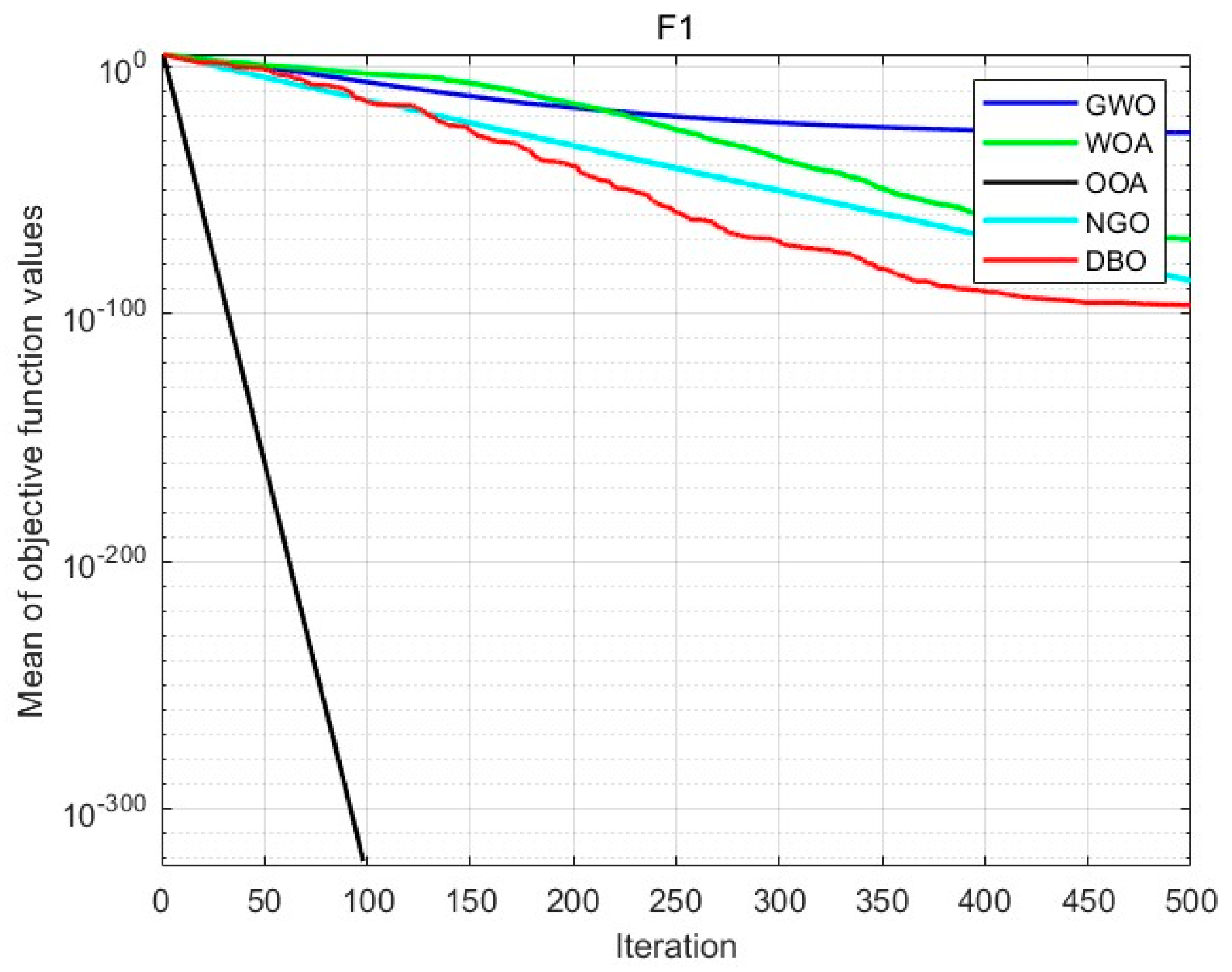
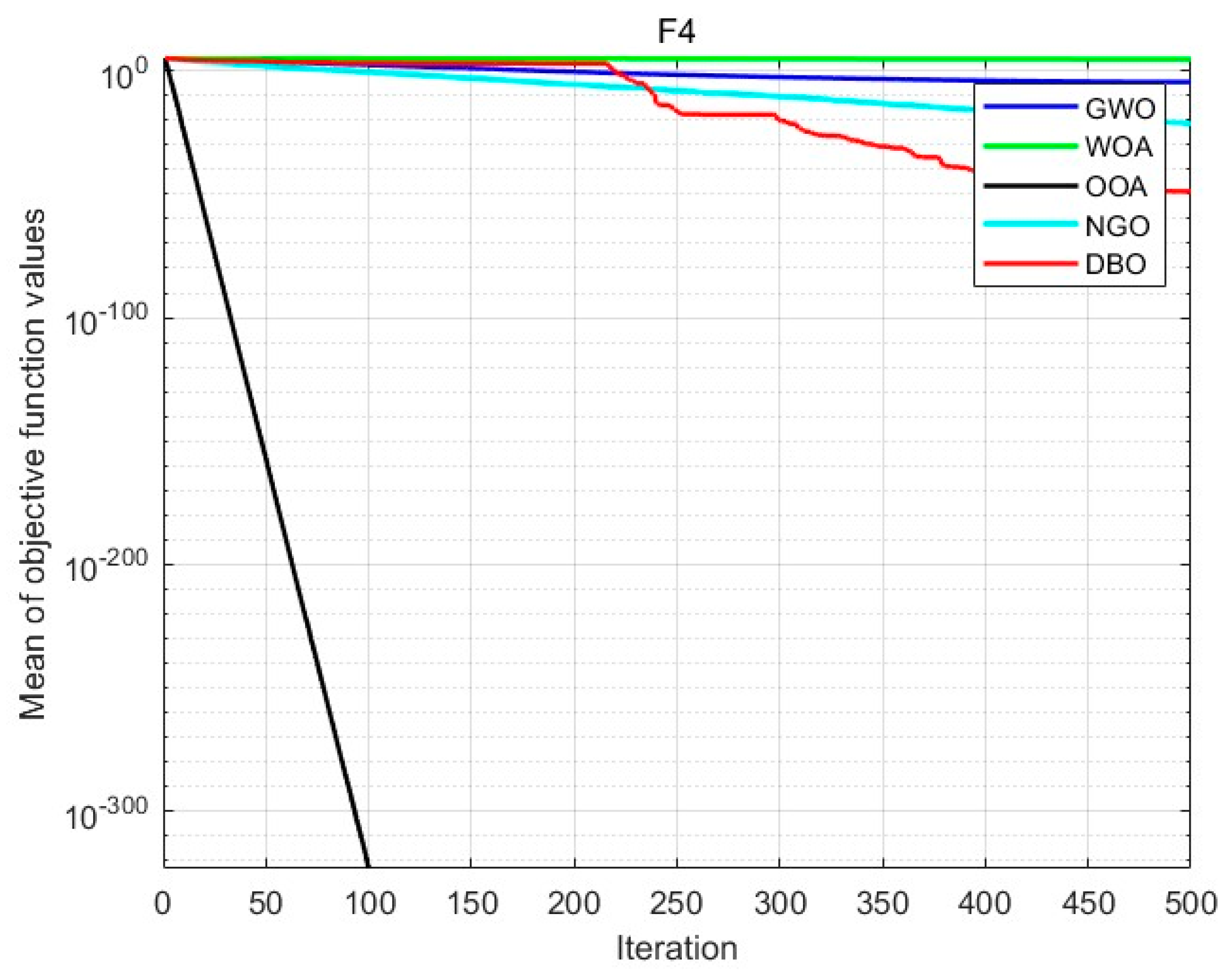
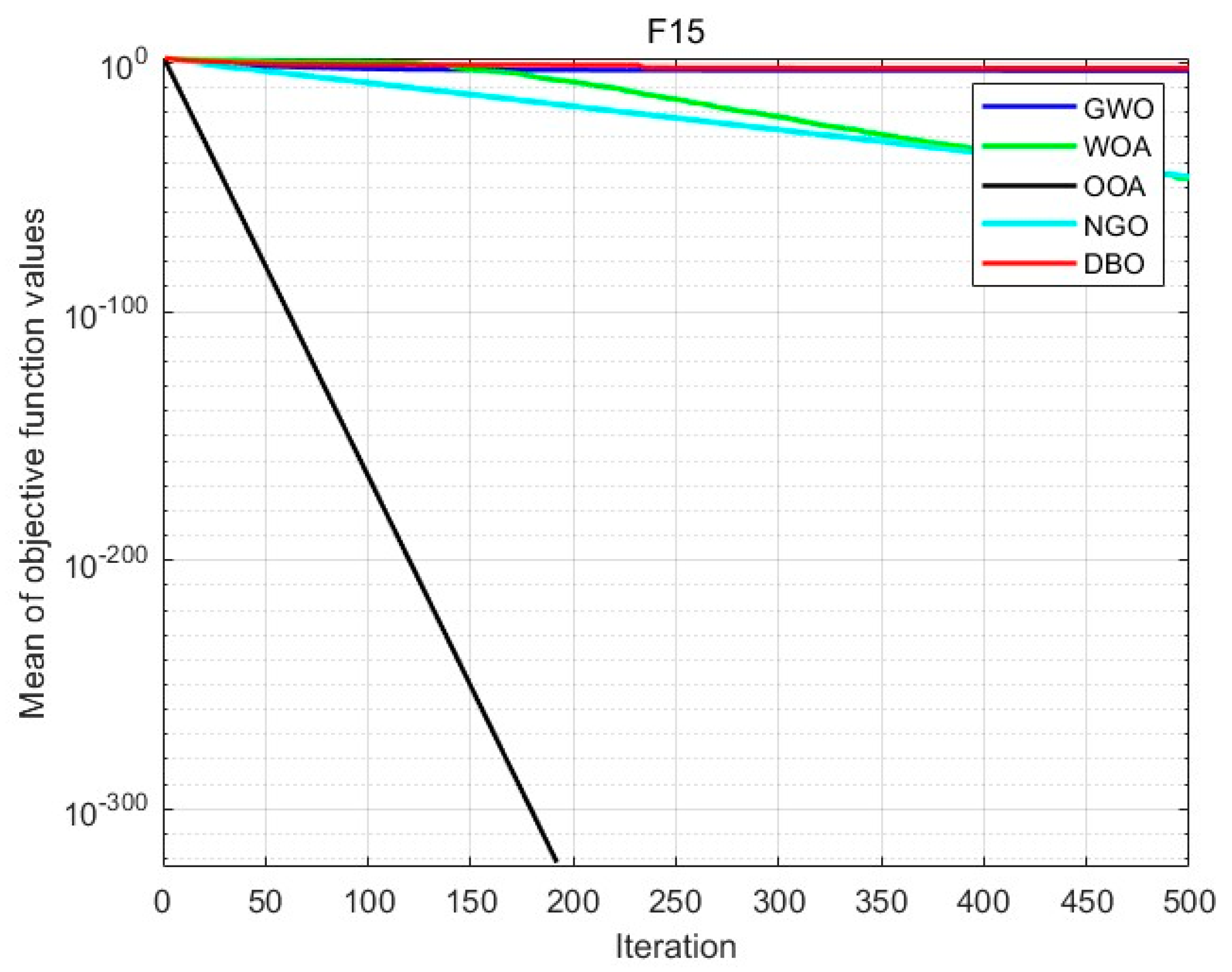
To compare the optimization performance of the OOA optimization algorithm proposed in this paper, F1, F4 and F15 were selected from the benchmark function library for simulation experiments. The population number was set to 30, and the number of iterations was set to 200. Dung beetle optimization algorithm (DBO), gray wolf optimization algorithm (GWO), whale optimization algorithm (WOA) and northern goshawk algorithm (NGO) were selected to compare with this algorithm.
According to Figure 1, the algorithm proposed in this article has the highest convergence speed, indicating that the optimization ability of the F1 function proposed in this article is very stable, and the repeatability accuracy is higher compared to other algorithms. It can be seen from Figure 2 and Figure 3 that for functions F4 and F15, the results are similar to F1, and the optimization performance of the algorithm proposed in this article is still the best. Additionally, the fitness value obtained by the algorithm proposed in this article is the smallest, and the average fitness value obtained by the optimization algorithm proposed in this article is closer to the theoretical optimum value of 0, indicating better optimization performance.
Utilizing the OOA to Enhance a New RSSI Model Based on a BP Neural Network can be achieved through the following steps.
Firstly, it is necessary to establish the basic framework of the BP neural network model, determining the structure of the network, including the number of neurons in the input layer, hidden layer, and output layer, as well as selecting appropriate activation functions and loss functions. The BP neural network adjusts the weights and biases of the network through the BP algorithm to minimize prediction errors.
Next, the OOA is introduced to optimize the weights and biases of the BP neural network model. OOA simulates the predatory behavior of ospreys, utilizing both global search and local fine-tuning to find optimal solutions. In this process, the weights and biases of the BP neural network are regarded as the osprey’s position, while the prediction error of the RSSI model serves as the osprey’s fitness function.
Subsequently, iterative optimization is conducted using the OOA. In each iteration, the osprey’s position, or the weights and biases of the BP neural network, are updated based on its fitness value and search behavior. Through continuous iterations, the OOA guides the BP neural network to gradually approach the optimal solution, thereby improving the prediction performance of the RSSI model.
Finally, the optimized BP neural network model is applied to the new RSSI model. By inputting RSSI-related data, the model can learn the mapping relationship between the data and output prediction results. Since the BP neural network optimized by the OOA exhibits better performance and generalization capabilities, the new RSSI model will possess higher prediction accuracy and stability.
In summary, utilizing the OOA to enhance a new RSSI model based on a BP neural network can effectively improve the model’s prediction performance, providing accurate and reliable RSSI prediction support for WSN mobile target tracking.

4. A Mobile Target Tracking Model Based on OOA-BP

To address the issue of BP neural networks being highly sensitive to random initial weights and prone to local optima, this study employs the OOA for the global optimization of its initial parameters. To establish the model rigorously, the biological hunting mechanism of OOA is mathematically mapped into the hyperparameter space of the BP network.

4.1. Mathematical Formulation and Parameter Mapping

In the OOA-BP framework, the position of each osprey individual Xi in the search space represents a potential set of initial weights and thresholds for the BP neural network. Assuming the BP network consists of I input nodes, H hidden nodes, and O output nodes, the dimension D of each osprey individual X i = [ x i , 1 , x i , 2 , , x i , D ] is defined as:
D = ( I × H ) + ( H × O ) + H + O
According to the specific target tracking scenario in this study, the BP network is configured with a 1-11-1 topology (i.e., I = 1 for RSSI input, H = 11 for hidden nodes, and O = 1 for distance output). Therefore, the exact dimension of the optimization space is calculated as D = 34. The algorithm guides the BP network toward the global optimum by iterating through this 34-dimensional continuous space.
The core objective of the OOA is to identify the optimal global position that minimizes the prediction error. To maintain rigorous consistency with the tracking evaluation metrics employed later in this study, the fitness function F(Xi) is formally defined as the RMSE over the training dataset:
F ( X i ) = 1 M k = 1 M ( d ^ k d t r u e , k ) 2
where M is the total number of training samples, d t r u e , k is the actual physical distance for the k-th sample, and d ^ k is the output distance predicted by the BP network initialized with the parameters encoded in Xi.

4.2. Algorithmic Implementation and System Integration

The implementation process of utilizing OOA to enhance the RSSI ranging model is partitioned into the following stages:
System Initialization: Establish the basic framework of the BP neural network, determining the 1-11-1 structure and activation functions. Concurrently, the osprey population size N is set to 30, the maximum number of iterations T m a x is set to 50, and the optimization boundaries are restricted within [−1, 1] to ensure algorithmic efficiency and reproducibility.
Global Exploration (Phase 1): Simulate ospreys detecting fish positions within the search space. By significantly altering individual positions, the algorithm identifies optimal regions and escapes local optima.
Local Exploitation (Phase 2): Perform fine-tuning near the identified optimal solutions to improve the convergence accuracy of the ranging model in complex noise environments.
Model Application and Integration: Through continuous iteration, OOA provides high-quality initial weights for the BP network. The optimized BP network learns the complex mapping between RSSI observations and physical distances to achieve high-precision distance prediction. Finally, the precise distances output by this model are fed into an EKF, enabling robust tracking of maneuvering targets in dynamic and noisy WSN environments.

5. Simulation Experiment and Analysis

5.1. WSN Modeling

In this paper, the performance test is mainly aimed at the uniform turning movement model. The motion state equation of the uniform turning motion model is as follows:
F = 1 sin t 0 1 cos t 0 cos t 0 sin t 0 1 cos t 0 sin t 0 sin t 0 cos t
G k = t k 2 2 0 t k 0 0 t k 2 2 0 t k
x k + 1 = F x k + G k w k
Wk is a Gaussian noise sequence. Δ t the time interval between two consecutive measurement times.
Aiming at the tracking problem in the WSN area, it is assumed that the sensors in the sensor network are all of the same type, The performance of target tracking algorithms is usually reflected by the size of the tracking accuracy, which is typically represented by the mean square root error:
In the simulation experiment, RMSE is used as the standard to measure the tracking effect, and the formula is as follows:
RMSE = 1 n i = 1 n x ¯ i x 0 i 2 y ¯ i y 0 i 2
In the formula: RMSE is the normalized average positioning error of the node, x 0 i , y 0 i is the true position of the target at time i , x ¯ i , y ¯ i is the target position for each algorithm at time i .

5.2. WSN Ranging Model Modeling

For the tracking problem within the WSN region, assuming that all sensors in the sensor network are of the same model, the observation model used by the sensors is as follows:
P j k + 1 = S i k + 1 R i , j α k + 1
In the formula Pj(k + 1) is the signal strength of the target node i, is the geometric distance between points i, represents the attenuation factor, and its value range is between 2–5 depending on environmental and atmospheric conditions. Therefore, by measuring Pj (k + 1), it is calculated according to Formula (19).

5.3. Simulation Conditions

In the simulation, 30 sensor nodes are randomly deployed across a 100 m × 100 m wireless sensor network monitoring area. The communication radius of each sensor is set to 30 m. The system operates with a sampling period of 0.1 s, and a total of 50 discrete samples are collected. Furthermore, the parameters for the OOA are configured with a population size (M) of 30 and a maximum number of iterations of 50.

5.4. Simulation Results

5.4.1. Distance Measurement Error Analysis

Firstly, to generate the experimental dataset, A = −45 dBm and n = 2 are incorporated into the logarithmic normal distribution model to calculate corresponding RSSI values for randomly generated distances. A total of 600 data pairs are generated. To ensure reproducibility, the specific training configurations are detailed as follows: The dataset is split into 550 training samples and 50 testing samples (an 11:1 ratio). Signal strength serves as the input, and distance serves as the output. Data normalization is applied using the Min-Max scaling method to map values between [−1, 1]. For the BP network architecture, a tansig activation function is employed in the 11 hidden nodes, and a purelin function is used in the output node. The learning rate is set to 0.01, with a maximum of 1000 epochs and a stopping criterion of Mean Squared Error (MSE) < 1 0 4 .
Next, four different neural networks are evaluated: GA-BP, Whale Optimization Algorithm-BP (WOA-BP), standard BP, and the proposed OOA-BP neural network in this paper [25,26,27,28,29,30]. In the parameter settings of OOA-BP, the osprey population is set to 30 and the maximum number of iterations is 50. To ensure a strictly fair comparison, all baseline algorithms are evaluated under identical data splits, random-seed initializations, and stopping conditions. Furthermore, overfitting is continuously monitored and prevented by evaluating the validation loss and employing early stopping mechanisms during the offline training phase [31,32].
Using the difference in distance measurement as the evaluation index, the comparison of distance measurement errors is shown in Table 2.
From Table 2, it can be seen that the average ranging error of OOA-BP is 0.04 m; the minimum error of OOA-BP ranging is 0.0270 m, and the maximum ranging error is 0.05 m; the minimum error of GA-BP ranging is 0.147 m, the maximum ranging error is 0.4106 m, and the average ranging error is 0.2771 m; the minimum error of BP ranging is 0.7768 m, the maximum ranging error is 1.0851 m, and the average ranging error is 0.8857 m. These results indicate that OOA-BP has better stability and ranging accuracy.

5.4.2. Tracking Error Analysis

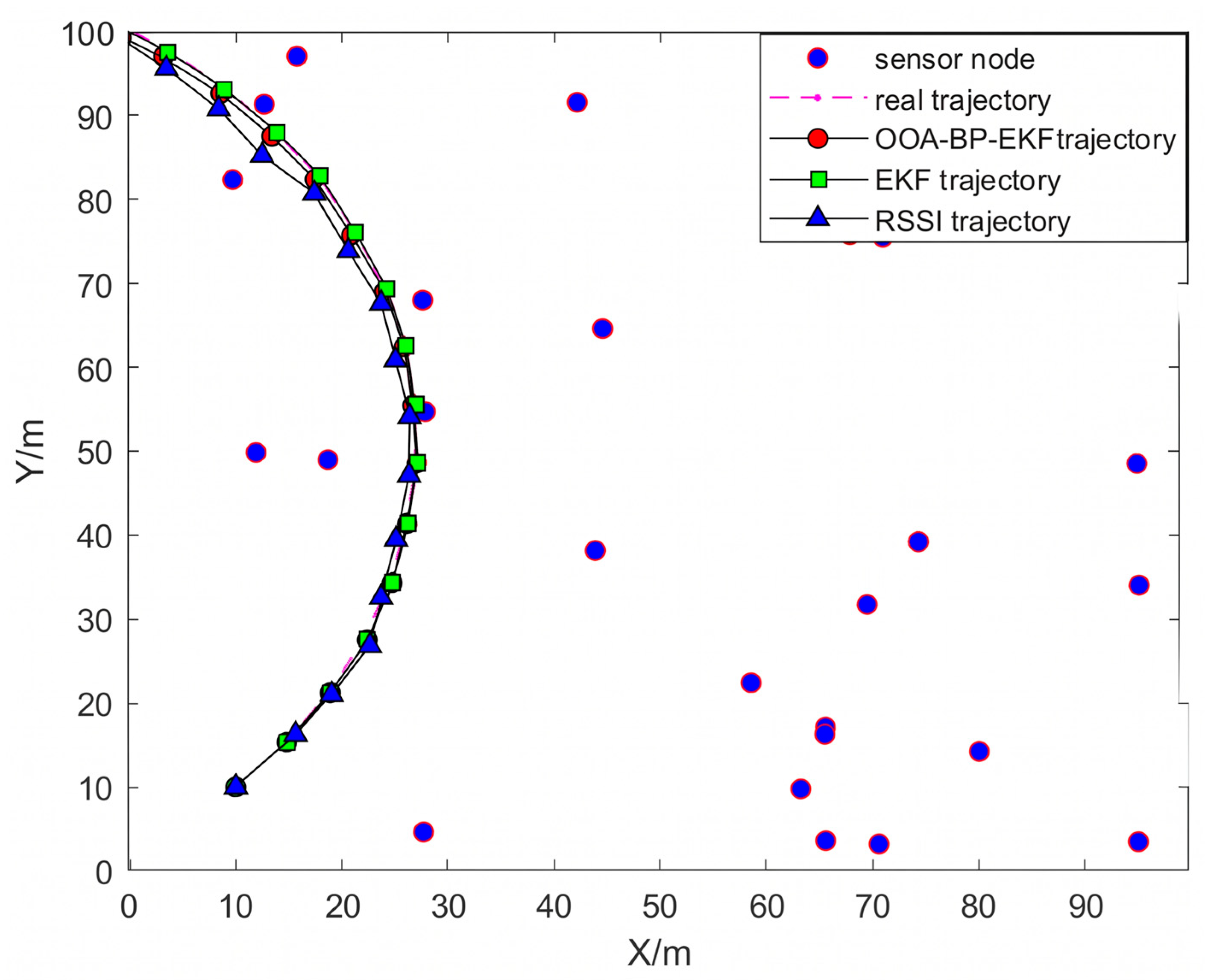
The initial value of the trajectory in the x direction is set at 35 m, the initial value in the y direction is set at 10 m, the initial velocity values in the x and y directions are set at 5 m/s, and the angular velocity is set at 0.122.
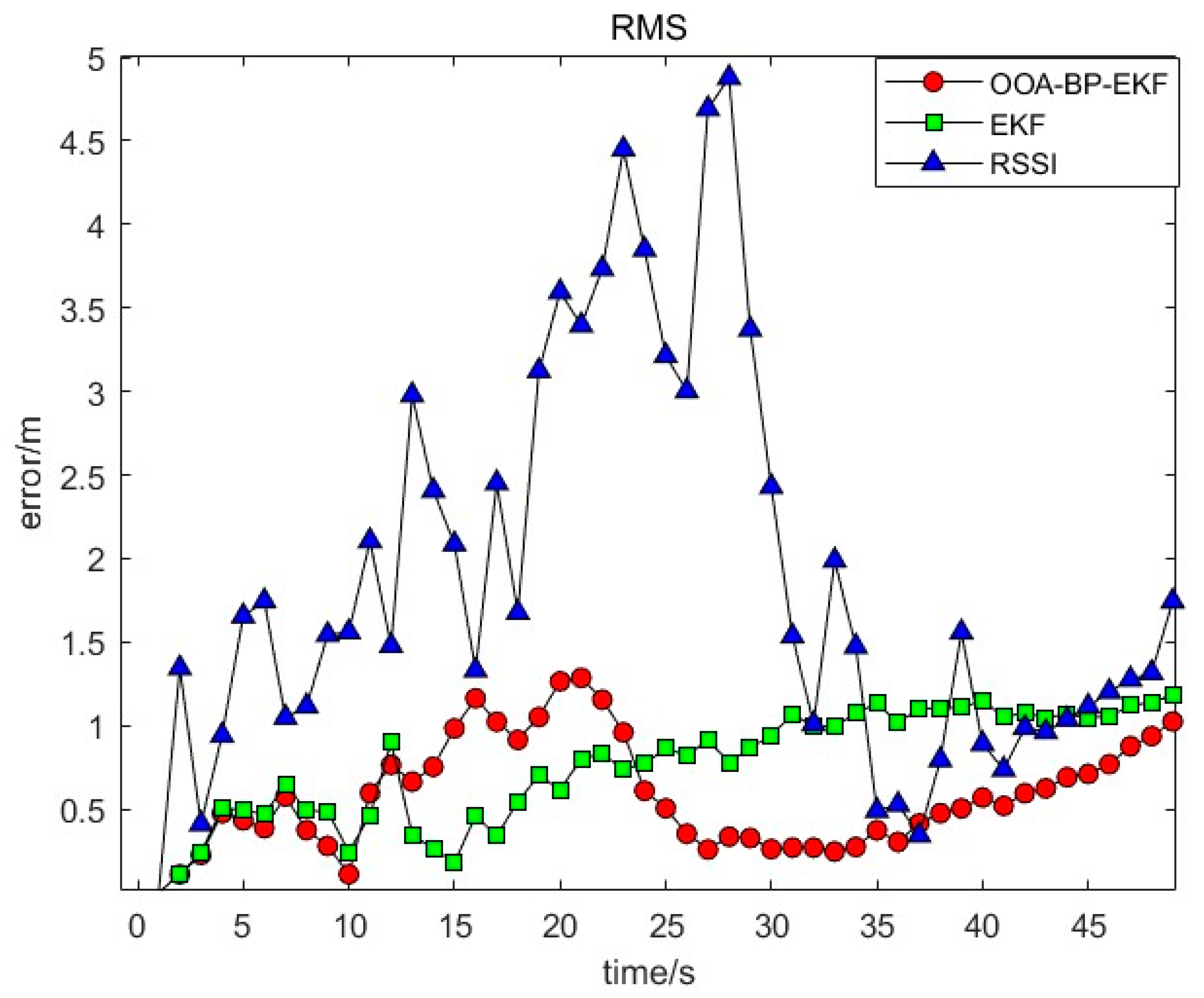
The diagram presented below offers a comparative visualization of three distinct algorithms: the algorithm proposed in this article, designated as OOA-BP-EKF, the EKF algorithm, and the RSSI algorithm. This comparison serves to illustrate the performance characteristics and relative merits of each method in a side-by-side manner.
Thirty sensors are randomly arranged within the 100 m × 100 m monitoring area of the wireless sensor network. The communication radius of the sensors is set to 30 m, the sampling period is 0.1 s, and the number of sampling points is 25. To simulate a realistic WSN environment, the system state noise W k and the observation noise V k are modeled to follow Gaussian distributions. Specifically, instead of being randomly selected, the process noise covariance matrix Q is meticulously configured based on typical maneuvering target characteristics, defined as Q = d i a g ( [ 0.01,0.01 ] ) . Furthermore, the observation noise covariance matrix R is empirically established based on the residual variance derived from the OOA-BP ranging experiments.The experimental results are illustrated in Figure 4 and Figure 5.
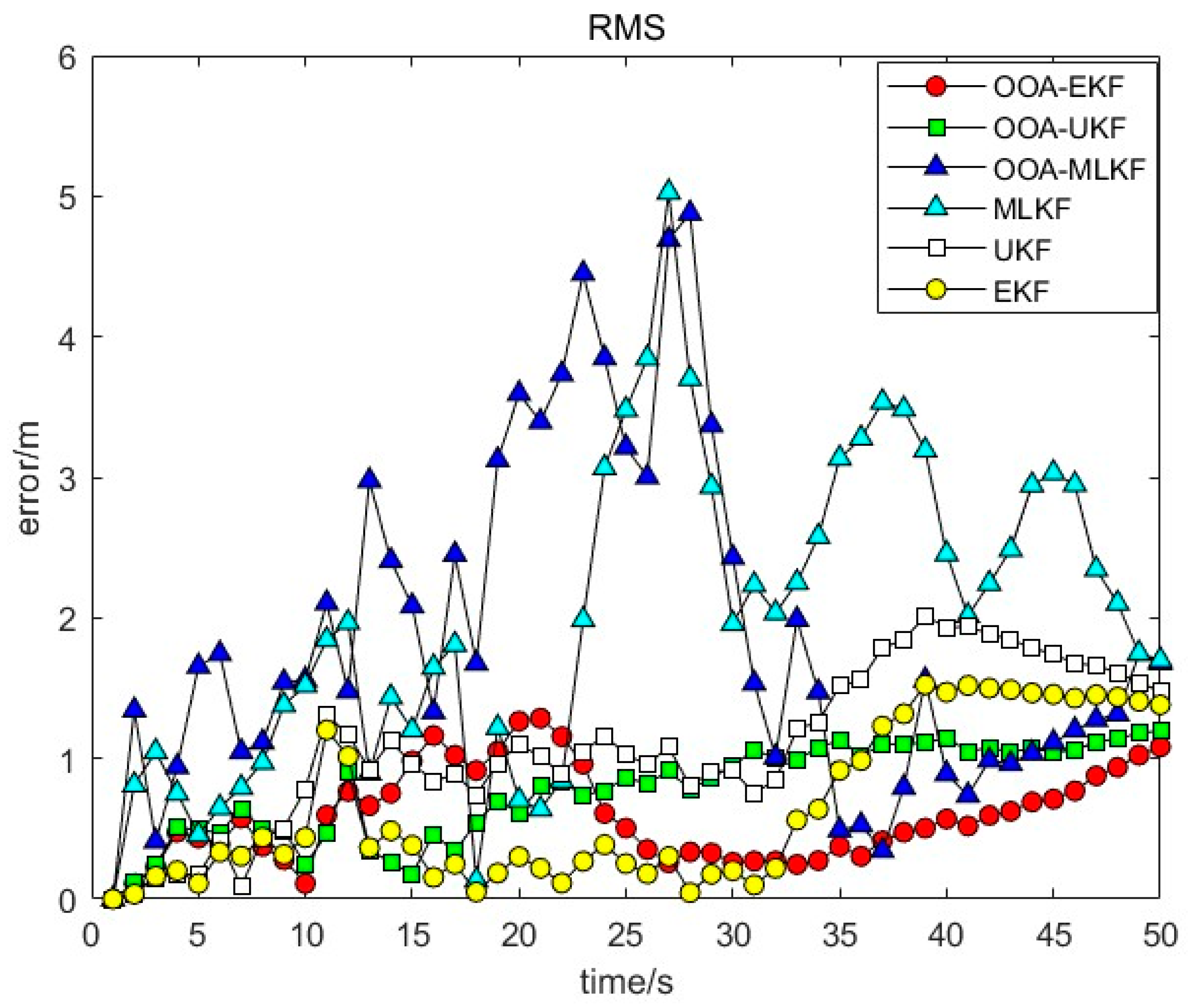
To comprehensively evaluate the applicability and superiority of the proposed OOA-BP-EKF algorithm, a rigorous comparison was conducted with three other filtering algorithms: the EKF, the UKF, and the Maximum Likelihood Kalman Filter (MLKF). The comparison was conducted using both traditional ranging methods and the innovative ranging method proposed in this article. The simulation results, as detailed below, offer a profound insight into the performance characteristics of each algorithm, highlighting the advantages of the OOA-BP-EKF algorithm in terms of accuracy, robustness, and adaptability to varying environmental conditions.
A careful analysis of Figure 6 clearly demonstrates that the enhanced ranging model proposed in this study significantly improves tracking accuracy. This result not only validates the effectiveness and robustness of the improved ranging model but also highlights the algorithm’s adaptability and applicability in nonlinear environments.
To validate the efficacy of the proposed framework, 10 independent experiments were conducted for maneuvering target tracking, benchmarking its performance against the GA-BP and standard BP algorithms. Using the RMSE as the primary evaluation metric, the comparative tracking errors are summarized in Table 3. The simulation results support the feasibility and potential robustness of the proposed method in improving tracking accuracy. Specifically, averaged across the 10 trials, the proposed approach achieves a 15.33% reduction in RMSE compared to the GA-BP algorithm, and a 59.89% reduction compared to the standard BP algorithm.
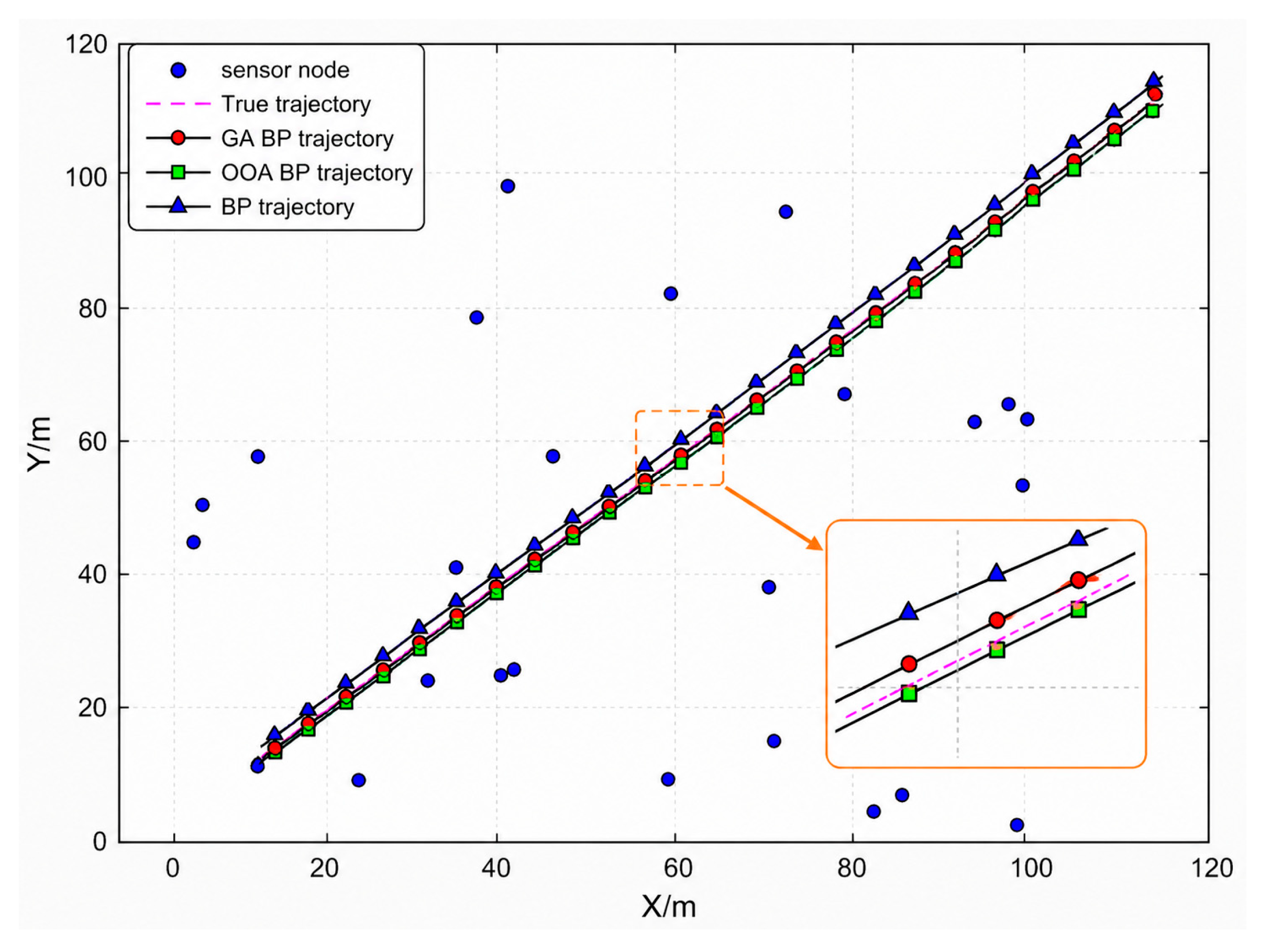
To verify the tracking performance of the proposed algorithm under linear dynamics, a uniformly accelerated linear motion model was evaluated. The initial position of the target was set to (0 m, 10 m), with initial velocities in both the X and Y directions specified as 3 m/s. Additionally, a constant acceleration of 1 m/s2 was applied to the model.
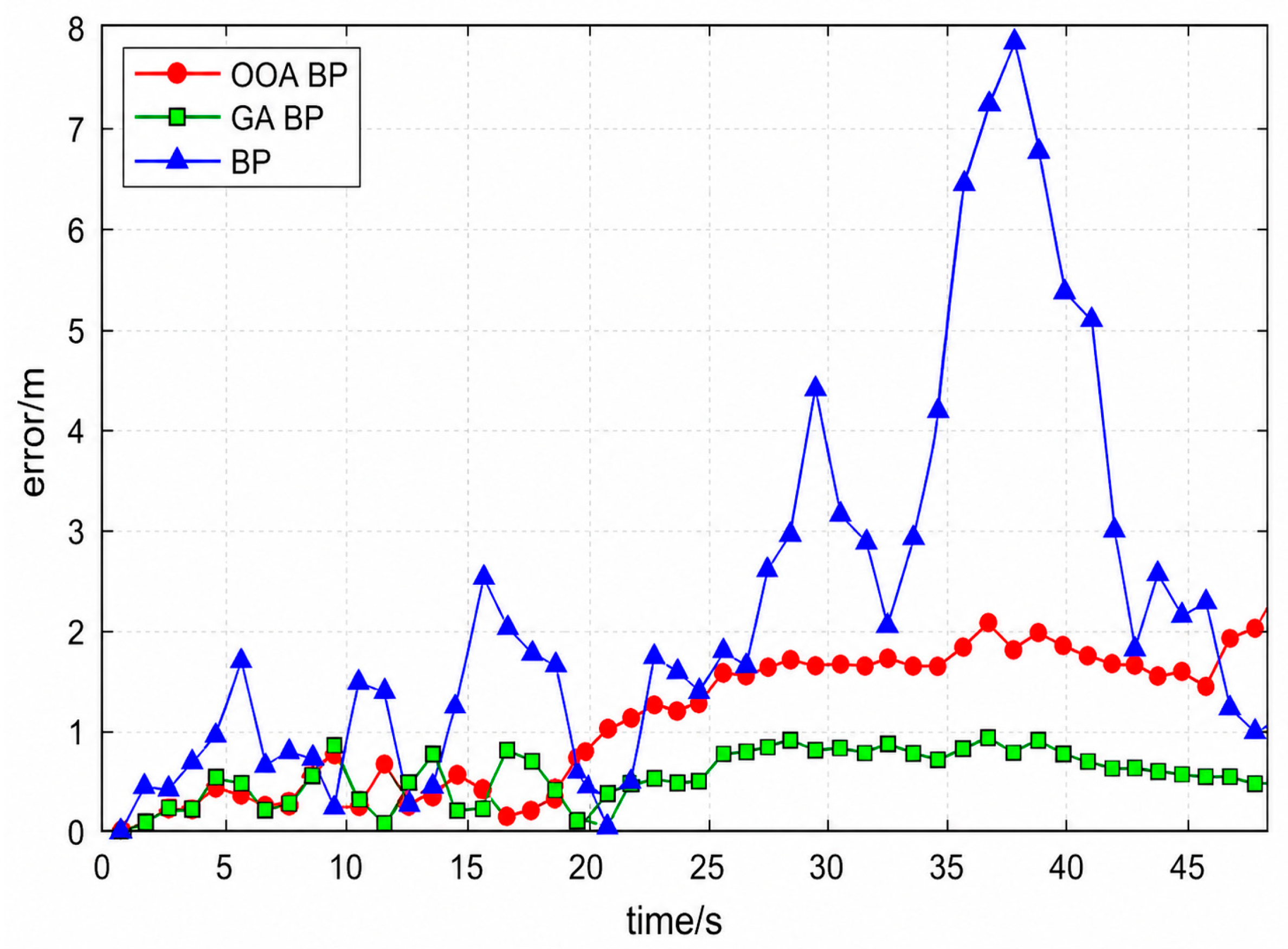
The experimental results are shown in Figure 7 and Figure 8.
As illustrated by the comparative results in Figure 7 and Figure 8, the proposed algorithm exhibits high accuracy in linear maneuvering target tracking tasks. These findings confirm the framework’s versatility: it not only adapts robustly to complex nonlinear tracking conditions but also maintains highly reliable tracking precision in straightforward linear environments.
To rigorously evaluate the performance under linear dynamics, the RMSE values were recorded across ten independent trials, as summarized in Table 4. Based on the statistical analysis, the proposed method achieves a 14.54% and 54.16% reduction in average RMSE compared to the GA-BP and standard BP algorithms, respectively. However, a more nuanced observation of Table 4 reveals that while OOA-BP provides the highest average accuracy, its maximum RMSE (0.85764 m) and standard deviation (0.22894 m) are higher than those of GA-BP (0.68819 m and 0.11038 m, respectively). This indicates that in simplified linear motion scenarios, the superior global exploration capability of the OOA—which is essential for complex maneuvering—may occasionally introduce slight localized variance compared to the more conservative search mechanism of the GA. Thus, while the proposed framework demonstrates enhanced average precision, its stability in linear trajectories exhibits slightly higher dispersion due to the exploratory nature of the optimizer. This trade-off confirms that the algorithm’s primary strength is optimized for robust performance in highly nonlinear and uncertain environments.

5.4.3. Algorithm Time Complexity and Efficiency Analysis

In WSNs, computational complexity is a critical metric for evaluating algorithm feasibility. To objectively analyze the efficiency of the proposed method, the time complexity must be decomposed into two distinct phases: offline training and online tracking.
To facilitate a rigorous analysis, let n denote the state dimension of the EKF (in this study, n = 5 for the state vector [ x , y , v x , v y , ω ] T ). Let D represent the total number of neural network weights and thresholds (where D = 34 for our 1-11-1 topology), which also determines the computational cost of a single online forward-propagation pass. Furthermore, M denotes the total number of training samples, E is the number of standard BP training epochs, N is the osprey population size, and T is the maximum number of OOA iterations The theoretical time complexities are derived as follows:
Standard EKF: This method involves no offline training. The online single-step complexity is dominated by the continuous calculation of Jacobian matrices and matrix inversions, resulting in an online complexity of O ( n 3 ) .
Standard BP-EKF: The offline training phase utilizes gradient descent, yielding a complexity of O ( E M D ) . During the online phase, the observation model is replaced by the forward propagation of the network, resulting in an online single-step complexity of O ( n 3 + D ) .
Proposed OOA-BP-EKF: The offline phase requires both the global search of the OOA and the fine-tuning of the BP network. The calculation of the fitness function for each osprey individual increases the offline complexity to O ( T m a x N M D + E M D ) . The online single-step tracking complexity remains O ( n 3 + D ) .
From the perspective of the entire algorithmic lifecycle, the total computational cost of the proposed OOA-BP-EKF is clearly the highest among the three methods. However, this substantial increase in time cost is highly justified and necessary for achieving accurate tracking in non-linear noisy environments.
First, the standard BP neural network is extremely sensitive to initial weights and easily falls into local minima when processing severely noisy RSSI data. The substantial computational burden of OOA ( O ( N T M D ) ) is strictly confined to the offline training phase to conduct a rigorous global search in the 34-dimensional space, mitigating the inherent limitations of standard BP networks and significantly enhancing the algorithm’s ability to approach global optimal solutions within the high-dimensional weight space.
Second, for resource-constrained WSN sensor nodes, real-time performance is determined exclusively by the online tracking phase. The proposed algorithm successfully shifts the massive non-linear optimization burden offline. During online execution, the complexity significantly decreases to O ( n 3 + D ) . This lightweight forward propagation provides highly accurate distance observations that effectively prevent EKF covariance divergence without increasing the online computational load compared to standard BP-EKF. Therefore, the significant tracking accuracy and stability gains achieved by this method far outweigh its offline computational overhead.
By successfully decoupling the intensive offline training from the lightweight online execution, the proposed OOA-BP-EKF method avoids the prohibitive computational costs associated with deep learning models, making it conceptually feasible and supporting its potential for deployment on power-constrained WSN nodes.

6. Discussion

This study demonstrates that integrating the OOA-BP neural network with the EKF significantly improves maneuvering target tracking accuracy in WSNs. The simulation results confirm that, compared to the standard EKF and BP-EKF, the proposed framework effectively mitigates the impact of severe nonlinear RSSI noise and prevents tracking divergence.
The performance improvement is primarily attributed to the data-driven substitution of the observation model. Traditional algebraic RSSI models struggle with unpredictable environmental noise. By utilizing OOA to perform a global search within the high-dimensional parameter space, the BP network effectively avoids local optima and establishes a highly accurate nonlinear mapping from RSSI to distance. Furthermore, as previously analyzed, while the OOA-BP method introduces substantial computational overhead during the offline training phase, it ensures that the online tracking execution remains lightweight. This strategic decoupling of offline training and online execution represents a practical and realistic trade-off, enabling high-precision tracking on resource-constrained WSN nodes. While this study relies on synthetically generated RSSI data, our experimental design was strictly formulated to approximate variable wireless conditions. Specifically, non-linear noise models based on log-normal shadowing, Gaussian perturbations, and diverse dynamic tracking scenarios were deliberately incorporated to rigorously test the algorithm’s resilience against environmental uncertainty. Consequently, the absence of real hardware measurements is not a late-discovered limitation, but rather a defined boundary of the current simulation-based validation phase. To manage practical expectations, our explicitly planned future work will focus on deploying the proposed algorithm on physical WSN testbeds (e.g., ZigBee or LoRa nodes) to thoroughly evaluate its performance under actual multipath fading and severe nonlinear attenuation.

7. Summary

This paper proposes an integrated OOA-BP-EKF framework for WSN maneuvering target tracking. By utilizing the OOA to dynamically optimize the BP neural network’s weights, the proposed method effectively addresses the limitations of traditional deterministic RSSI models under severe non-linear noise within the scope of this simulation study. Simulation results demonstrate that the optimized model reduces the average ranging error to 0.04 m. In dynamic tracking, the proposed architecture significantly outperforms standard algorithms, reducing the RMSE by 15.33% and 59.89% compared to GA-BP and BP, respectively. In accordance with our established research roadmap, the transition from this comprehensive simulation baseline to physical testbed implementation is a key focus of our upcoming work. Specifically, future efforts will prioritize optimizing the offline training phase for edge-level deployment and conducting systematic hardware trials to verify the framework’s long-term reliability in practical WSN environments.

Author Contributions

Conceptualization, C.C. and W.H.; methodology, K.X. and S.L.; software, K.X. and S.L.; validation, S.L. and W.H.; formal analysis, K.X. and S.L.; investigation, S.L. and W.H.; resources, C.C. and W.H.; data curation, S.L.; writing—original draft preparation, K.X.; writing—review and editing, C.C., W.H. and S.L.; visualization, K.X. and S.L.; supervision, C.C. and W.H.; project administration, C.C. and W.H.; funding acquisition, C.C. All authors have read and agreed to the published version of the manuscript.

Funding

We extend our gratitude extends to for the funding provided by the National Key Research and Development Program of China (Grant No. 2020YFA0713501).

Institutional Review Board Statement

Not applicable.

Informed Consent Statement

Not applicable.

Data Availability Statement

The original contributions presented in this study are included in the article. Further inquiries can be directed to the corresponding author.

Conflicts of Interest

The authors declare no conflicts of interest.

References

  1. Munadhil, Z.; Gharghan, S.K.; Mutlag, A.H.; Al-Naji, A.; Chahl, J. Neural Network-Based Alzheimer’s Patient Localization for Wireless Sensor Network in an Indoor Environment. IEEE Access 2020, 8, 150527–150538. [Google Scholar] [CrossRef]
  2. Bu, D.; Qiang, Z. Application of Neural Network Corrected EKF in Localization Tracking. J. Navig. Position. 2021, 9, 84–89. [Google Scholar]
  3. Li, H.; Zhu, J. An Improved WSN Target Tracking Algorithm Based on EKF. J. Shanxi Univ. (Nat. Sci. Ed.) 2017, 40, 743–749. [Google Scholar]
  4. Yu, Z.; Lu, X.; Liu, Y.; Yu, P.; Zhang, D. Received signal strength ranging algorithm based on improved BP Neural network. Sci. Surv. Mapp. 2020, 45, 48–52. [Google Scholar]
  5. Yu, Z.; Lu, X.; Tao, X.; Zhou, Y.; Huang, Y. RSSI Ranging algorithm based on GA-BP Neural Network Model. J. Navig. Position. 2020, 8, 63–68. [Google Scholar]
  6. Ren, X.; Yu, B.; Li, Y. Improved weighted centroid localization algorithm based on RSSI. Transducer Microsyst. Technol. 2021, 40, 150–153. [Google Scholar]
  7. Wei, Y.; Guo, L. WSN Target Tracking Based on Improved Cuckoo Particle Filtering Algorithm. Comput. Meas. Control 2022, 30, 273–279. [Google Scholar]
  8. Liu, S.X.; Zhang, D.P.; Wu, Y.; Liu, P. Wireless Sensor Network Localization Algorithm Based on RSSI Model. Comput. Simul. 2022, 39, 427–431. [Google Scholar]
  9. Zafari, F.; Gkelias, A.; Leung, K.K. A Survey of Indoor Localization Systems and Technologies. IEEE Commun. Surv. Tutor. 2019, 21, 2568–2599. [Google Scholar] [CrossRef]
  10. Qiu, Y. Research on Node Localization and Target Tracking Technology in Large-Scale WSNs. Ph.D. Dissertation, University of Electronic Science and Technology of China, Chengdu, China, 2022. [Google Scholar]
  11. Han, G.; Gao, X.M. Localization and Tracking Algorithm for Unmanned Substation Based on WSN. Autom. Technol. Appl. 2021, 40, 63–67. [Google Scholar]
  12. Yang, Y.F.; Wang, W.; Wang, Z.B. Research on Path Loss Model Parameter Algorithm for WSN Indoor Localization. Electron. Meas. Technol. 2021, 44, 54–58. [Google Scholar]
  13. Li, S.H.; Ye, L.L. Otsu Image Segmentation Method Based on Snake Optimization Algorithm. Foreign Electron. Meas. Technol. 2023, 42, 30–37. [Google Scholar]
  14. Dehghani, M.; Trojovský, P. Osprey optimization algorithm: A new bio-inspired metaheuristic algorithm for solving engineering optimization problems. Front. Phys. 2023, 10, 1126450. [Google Scholar] [CrossRef]
  15. Zhang, T.Y. Target Tracking Technology in Wireless Sensor Networks. Electron. Technol. Softw. Eng. 2021, 7, 41–42. [Google Scholar]
  16. Zhong, L.H. Research on Target Tracking Technology in Wireless Sensor Networks Based on Trajectory Prediction. Master’s Thesis, Nanjing University of Posts and Telecommunications, Nanjing, China, 2018. [Google Scholar]
  17. Wang, Q.Y.; Feng, H.; Hu, B.; Luo, L.B. Estimation of Target Motion Model and Node Scheduling in WSN Tracking Tasks. J. Fudan Univ. (Nat. Sci. Ed.) 2019, 58, 221–230. [Google Scholar]
  18. Zhu, H.; Luo, J.; Luo, M.; Minane, J. A Recursive Robust Set-Membership Estimator for WSN-Assisted Moving Targets Tracking With UBB Anchor Location Uncertainty. IEEE Trans. Veh. Technol. 2023, 72, 6547–6557. [Google Scholar] [CrossRef]
  19. Luo, J.; Zhang, Z.; Liu, C.; Luo, H. Reliable and Cooperative Target Tracking Based on WSN and WiFi in Indoor Wireless Networks. IEEE Access 2018, 6, 24846–24855. [Google Scholar] [CrossRef]
  20. Ahmed, S.H.; Rashid, A.N. Hybrid K-Mean PSO Clustering Algorithm for Energy-Efficient of Object Tracking in WSNs. In Proceedings of the 2023 3rd International Conference on Electrical, Computer, Communications and Mechatronics Engineering (ICECCME), Tenerife, Spain, 19–21 July 2023; pp. 1–6. [Google Scholar]
  21. Chen, B.-S.; Yang, K.-C.; Lee, M.-Y. Robust H∞ NLOS-Tolerant Localization Filter and NLOS-Tolerant Remote Reference Tracking Control of Mobile Robot in Wireless Sensor Networks. IEEE Access 2021, 9, 164801–164819. [Google Scholar] [CrossRef]
  22. Lamberti, R.; Septier, F.; Salman, N.; Mihaylova, L. Gradient-Based Sequential Markov Chain Monte Carlo for Multitarget Tracking with Correlated Measurements. IEEE Trans. Signal Inf. Process. Over Netw. 2018, 4, 510–518. [Google Scholar] [CrossRef]
  23. Lu, L.; Wang, J. Image Processing and Recognition Algorithm for Target Tracking. Int. J. Smart Sens. Intell. Syst. 2016, 9, 353–376. [Google Scholar] [CrossRef]
  24. Kanwar, V.; Rani, S.; Kaur, A.; Behal, A.; Nath, D.; Sharma, N. DV-Hop Localization based energy efficient Algorithm for Wireless Sensor Networks. In Proceedings of the 2022 12th International Conference on Cloud Computing, Data Science & Engineering (Confluence), Noida, India, 27–28 January 2022; pp. 159–164. [Google Scholar]
  25. Wu, J.; Li, G. Drift Calibration Using Constrained Extreme Learning Machine and Kalman Filter in Clustered Wireless Sensor Networks. IEEE Access 2020, 8, 13078–13085. [Google Scholar] [CrossRef]
  26. Montano-Ugalde, K.; Shmaliy, Y.S.; Alanis, J.L. UFIR Filtering for GPS-Based Tracking over WSNs with Delayed and Missing Data. J. Electr. Comput. Eng. 2018, 2018, 7456010. [Google Scholar] [CrossRef]
  27. Balasubramanian, D.L.; Govindasamy, V. Enhanced seagull optimization based node localization scheme for wireless sensor networks. Int. J. Adv. Technol. Eng. Explor. 2022, 9, 1875. [Google Scholar] [CrossRef]
  28. Ou, X.; Wu, M.; Chen, S.; Li, W.; Zhang, G. An improved cuckoo search algorithm based on DV-Hop for location in WSN. Softw. Impacts 2022, 14, 100418. [Google Scholar] [CrossRef]
  29. Chen, C.-Y. Distributed Information Compression for Target Tracking in Cluster-Based Wireless Sensor Networks. Sensors 2016, 16, 937. [Google Scholar] [CrossRef]
  30. Liu, H.Q.; So, H.C. Target Tracking with Line-of-Sight Identification in Sensor Networks under Unknown Measurement Noises. Prog. Electromagn. Res. 2009, 97, 373–389. [Google Scholar] [CrossRef]
  31. Liu, C.; Huang, X.; Wang, M. Target Tracking for Visual Servoing Systems Based on an Adaptive Kalman Filter. Int. J. Adv. Robot. Syst. 2012, 9, 149. [Google Scholar] [CrossRef]
  32. Naidu, V.P.S.; Raol, J.R. Target tracking with multi acoustic array sensors data. Def. Sci. J. 2007, 57, 289–303. [Google Scholar] [CrossRef]
Figure 1. Comparison of F1 function.
Applsci 16 04755 g001
Figure 2. Comparison of F4 function.
Applsci 16 04755 g002
Figure 3. Comparison of F15 function.
Applsci 16 04755 g003
Figure 4. Comparison of curved trajectories.
Applsci 16 04755 g004
Figure 5. Comparison of position errors in the curved trajectory.
Applsci 16 04755 g005
Figure 6. Comparison of Position Errors.
Applsci 16 04755 g006
Figure 7. Comparison of Linear Path.
Applsci 16 04755 g007
Figure 8. Comparison of position errors in the linear trajectory.
Applsci 16 04755 g008
Table 1. Values of A and n in Different Scenarios.
An
park32.7–36.03.0–3.9
staircase33.5–36.01.4–2.4
office39.0–50.51.4–2.5
Corridor35.0–38.21.9–2.0
Table 2. Distance Measurement Comparison.
Signal intensity (dBm)−42.6768−42.918−43.0432−43.2131−43.3625−43.6624
True value (m)1717.417.818.218.619
BP17.845918.385218.885119.044219.376819.7768
GA-BP17.258217.777918.049418.419618.74719.4106
WOA-BP17.058617.4517.736618.236518.55719.9472
OOA-BP16.950017.353517.85818.227018.630118.9710
1 0.84590.98521.08510.84420.77680.7768
2 0.25820.37790.24940.21960.1470.4106
3 0.05860.050.06340.03640.0430.0562
4 0.05000.04650.05800.02700.03000.0290
Table 3. RMSE Comparison in the Curved Trajectory.
Min RMSE (m)Max RMSE (m)Mean RMSE (m)STD (m)
GA-BP0.503590.965040.6799470.16297
OOA-BP0.388760.874780.5757050.16467
BP1.13852.12461.435150.31194
Table 4. RMSE Comparison in the Linear Trajectory.
Min RMSE (m)Max RMSE (m)Mean RMSE (m)STD (m)
GA-BP0.420940.688190.5718840.11038
OOA-BP0.205640.857640.488760.22894
BP0.652932.21171.0662970.45732
Disclaimer/Publisher’s Note: The statements, opinions and data contained in all publications are solely those of the individual author(s) and contributor(s) and not of MDPI and/or the editor(s). MDPI and/or the editor(s) disclaim responsibility for any injury to people or property resulting from any ideas, methods, instructions or products referred to in the content.