Article

Algorithm to Forecast Railway Track Assets Performance in Europe

1
University of Minho, ISISE, ARISE, Department of Civil Engineering, 4800-058 Guimarães, Portugal
2
ALGORITMI Research Centre, Department of Production and System, University of Minho, 4888-058 Guimarães, Portugal
*
Author to whom correspondence should be addressed.
Appl. Sci. 2026, 16(10), 4754; https://doi.org/10.3390/app16104754
Submission received: 19 January 2026 / Revised: 16 April 2026 / Accepted: 19 April 2026 / Published: 11 May 2026
(This article belongs to the Section Civil Engineering)

Abstract

Railway track assets may suffer from different types of degradation due to aging, traffic conditions, environmental conditions, and natural and man-made hazards, which affect their performance in terms of reliability and availability, as well as passenger safety and comfort. By knowing which variables influence the degradation and performance of railway tracks, and the most appropriate maintenance and renewal actions, it is possible to define the most appropriate Performance Indicators. The use of predictive models to forecast these indicators can support the decision-making process during the maintenance management over time. In this work, a proposal including the selection of the most appropriate Performance Indicators is presented, together with a brief overview of predictive models used for railway systems. Based on that, a holistic framework to forecast the railway track performance aiming to support the decision-making process is given and its applicability is discussed. The proposed framework integrates the selection, processing, and aggregation of different types of Performance Indicators within a predictive modelling framework, enabling the analysis even when data availability is limited. The applicability of the framework is demonstrated through an illustrative example based on inspection data. The results illustrate the evolution of track condition states over time within a probabilistic framework.

1. Introduction

Just after a railway infrastructure begins operation, degradation processes start to occur, and over time maintenance and renewal interventions become necessary once the degradation affects its performance. Railway infrastructure management follows a RAMS analysis that covers the safety (S) and availability (A) that are based on reliability (R) and maintainability (M), together with operation and maintenance aspects [1,2]. As highlighted in the 2017 report of the Committee on Technical Cooperation in the Development of the Rail Transport System [3], costs related to inspections, preventive and corrective maintenance, and operational restrictions should be considered, as they represent a significant share of the total life-cycle costs of railway infrastructure.
The prediction of the future performance of railway tracks contributes to more optimized infrastructure management, allowing more efficient and integrated maintenance planning, regular inspections and monitoring [4]. In this way, the reliability and availability of the railway track can be ensured, as well as passenger safety and comfort, while also contributing to life-cycle over reduction [4,5]. Performance Indicators (PIs) can be obtained through visual inspections, non-destructive testing, monitoring systems [6,7,8], as well as numerical and experimental modelling approaches [9,10]. These PIs parametrize the mechanical and technical properties of railway infrastructures and their degradation process over the life cycle. They also provide information regarding serviceability, availability, robustness, sustainability, environmental efficiency, total life-cycle costs, and social aspects [8,11], thus supporting the management of railway infrastructure assets [4,6].
The aim of this paper is to present a framework for monitoring railway track performance over time, capable of integrating heterogeneous data from inspections, tests, and component-level monitoring, developed within the scope of the In2Track2 Project [12]. It is intended to support more accurate, systematic and informed management of railway track systems, guaranteeing its reliability and availability while ensuring passenger safety and comfort. This work addresses ongoing challenges related to railway performance and is conceived considering current practices in railway assets maintenance and management, as reflected in [13]. This paper is structured as follows: firstly, a brief literature overview is presented, followed by the description of the developed framework. Subsequently, an illustrative application is provided, and finally concluding remarks are presented.

2. Railway Track Performance

Railway tracks are subjected to different loads and environmental conditions, with most track problems arising as a consequence of these two factors. Loading cycles can cause plastic differential settlements, which over time lead to track geometry deviations, breakage, and shear deformation. These can increase train acceleration and dynamic forces caused by train passage, further accelerating track degradation [4,14]. In turn, the degradation process can amplify variations in the wheel/rail interaction, reducing the track performance [4,15,16]. As the train velocity increases, track geometry degradation is significantly influenced by dynamic forces [17]. Environmental conditions, such as high temperatures, wind and heavy rainfall also influence the track degradation evolution [12,14], leading to displacements [18] or saturation of the substructure [19]. Moreover, rail corrugation is a major problem, contributing in the long term to fastening loss, ballast deterioration, noise, and derailment risks [18,20,21].
Cracks and wear are particularly critical in European railway tracks, as their progression increases stress concentration and may lead to rail breakage [14,21]. Rail joint fatigue, corrosion, head checks, spalling, bolt hole cracks, lateral buckling, and squats are other possible damages that may occur [12,14]. In addition to these defects, railway track heterogeneity is another important factor influencing track behaviour. This heterogeneity is due to the existence of singularities such as curves, switches, crossovers, rail joints and sleepers spacing, as well as discontinuities in support conditions at bridge decks, box culverts, and tunnels [5,14,22]. Railway track heterogeneity results in variation in track stiffness [14], which can cause dynamic loading, differential settlements, ballast fouling, wear, and fatigue failures of various components [14,22,23].
This variation in track stiffness and support conditions leads to increased dynamic vibrations. The increase in dynamic vibrations due to track heterogeneity leads to higher levels of noise. Damages on both wheels and track, especially rail corrugation and geometry deviations, contribute to wheel and track vibration and consequently to increased noise levels [24,25,26]. The vibration and noise are also influenced by rail stiffness, sleeper spacing, train velocity, and train mass [25].
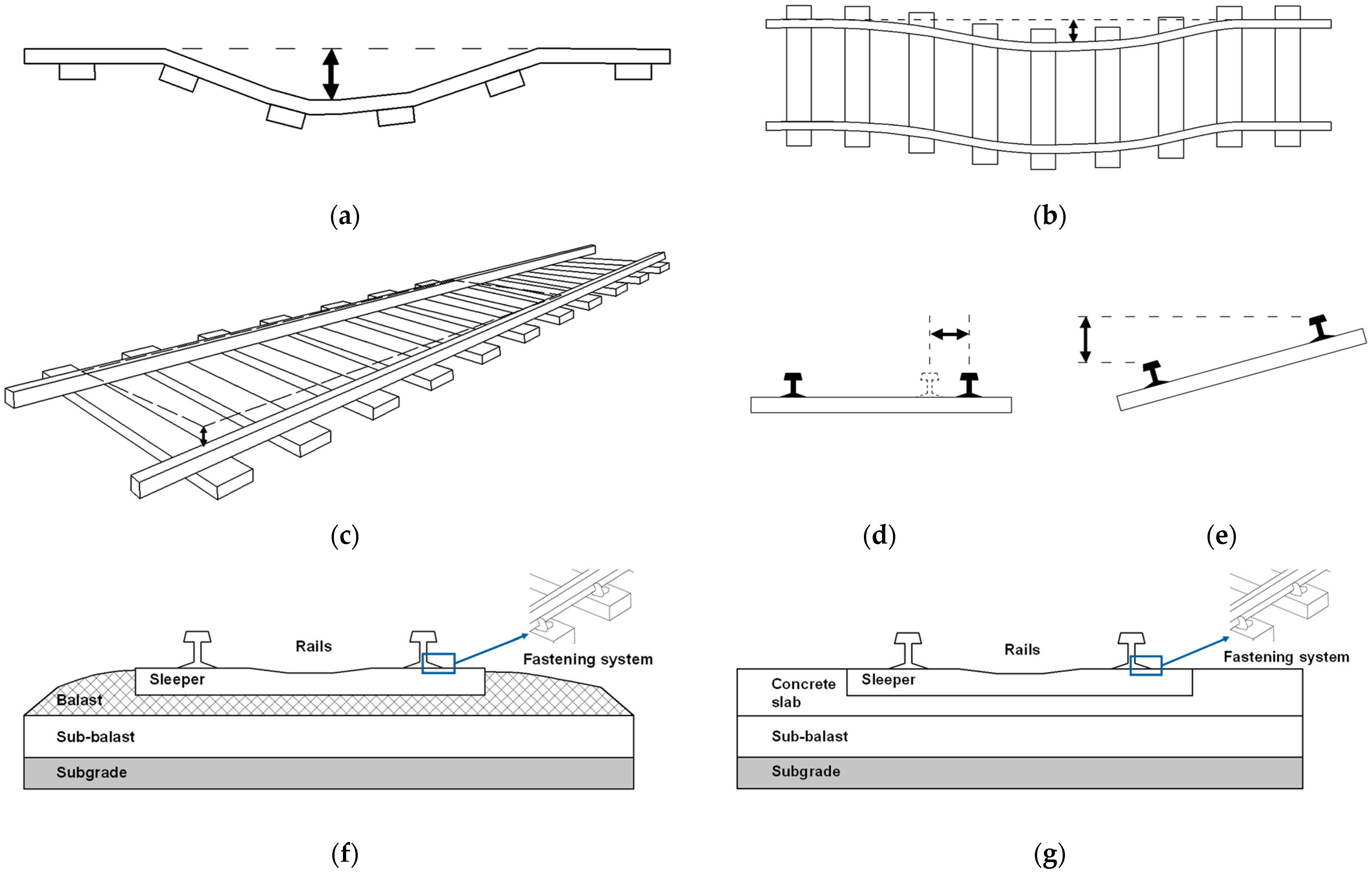
To assess these degradation mechanisms and their effects, different track Performance Indicators are used. Track geometry parameters and track structural parameters (see Figure 1) are the main groups of parameters considered for the assessment of the railway track condition [14,27]. The first group includes longitudinal level, alignment, twist, cant, and gauge, while the second one is related to the track components (rails, sleepers, fastening system, ballast or ballastless and subgrade) [5,12,28]. The standard deviation of longitudinal level and alignment are considered reliable predictors of track condition. Even if the second one is limited comparatively to the first one, the combination of the two is considered more accurate and realistic [12,28]. The European standard EN 13848-5 [29] provides limit values for these two parameters, defining preventive maintenance, corrective maintenance and safety limits based on the severity of these parameters, and a three-level scale of condition indexes (QI1 to QI3) according to the allowed line track velocity [30]. Ref. [31] mentioned that geometry deviations may lead to damage in track components, highlighting the interaction between geometry and structural parameters. Ref. [32] shows that both geometry and structural PIs are being monitored in railway tracks, being a relevant complement for Predictive Maintenance and Structural Health Monitoring of railway tracks. In addition to geometry and structural parameters, track stiffness is considered a relevant PI by some authors, such as [23,33]. Track stiffness influences the degradation of the railway track components and affects vibration and dynamic response, which may impact noise emissions. In addition, the vertical stiffness of ballast and substructure layers influences the deterioration of the track geometry.
The impact of railway operations on the environment and on people living and working nearby is assessed through environmental PI. Among these PIs, this work focuses on noise generated from wheel/rail interaction. The noise generated during the wheel/rail interaction, the power equipment or traction noise, and the aerodynamic noise are considered the main sources of noise [34,35]. The European Environmental Noise Directive 2002/49/EC [36] provides four noise indicators, day-evening-night (Lden), day (Lday), evening noise (Levening) and night-time (Lnight) noise indicators. A threshold of 54 dB for Lden and 44 dB for Lnight is recommended by the World Health Organization (WHO) environmental noise guidelines [37].
The PIs previously described can be used to evaluate railway infrastructure performance. The performance of railway infrastructure is commonly assessed using the RAMS analysis (Reliability, Availability, Maintainability, and Safety) [2], complemented by operation and maintenance indicators and life-cycle costs (LCC) [12]. Reliability (R) is typically expressed through time-to-failure parameters such as mean time to failure (MTF) or mean time between failures (MTBF), which are indirectly related to traffic loading, or through the failure rate (λ), which increases with cumulative traffic load [12,14]. Availability (A) provides the proportion of time an asset is operational and depends on failure parameters, repair time, and traffic levels [38]. Maintainability (M) is evaluated through indicators such as mean time to restoration or mean time between maintenance (MTTR and MTBM), which according to [14] are influenced by traffic and repair requirements. According to EN 50126-1, Safety (S) is a function of hazard, frequency and severity, depending mainly on track geometry and structure, traffic, speed and maintainability [14]. The RAMS indicators and influencing factors are described in EN 13306 and EN 50126-1 respectively [39,40].
In addition to technical performance aspects, economic considerations are also relevant in railway infrastructure assessment. Each railway track component has an expected service life, making preventive and corrective maintenance necessary over time. These activities involve resource management of materials, equipment and labor, and speed or traffic restrictions, generating significant operating costs [12]. Formulas for preventive and corrective maintenance costs are provided in [3]. Cost-related PIs are often expressed as ratios of cost-related parameters according to EN 15341 [41].
Based on the literature review presented in this section, the main railway PIs discussed in this study are summarized in Table 1.
Figure 1. Track geometry parameters (based on [42]): (a) longitudinal level, (b) alignment, (c) twist (d), cant (e) gauge; Track structural components (based on [43]), with identification of the main components for: (f) ballast system, (g) ballastless system.
Applsci 16 04754 g001
To support a comprehensive performance assessment, PIs used in other transport infrastructures, such as roadway pavements and bridges, were also analyzed. Under COST Action 354 dedicated to roadway pavements, three performance levels were defined. Variables such as longitudinal and transverse evenness, macro-texture, friction, bearing capacity, noise, air pollution, cracking, and surface defects were combined using weighting factors to obtain safety, comfort, structural and environmental PIs. These were integrated into an overall PI [44,45]. Under COST Action TU 1406, three performance levels were considered: (i) component, (ii) system and (iii) network levels. At the first level, the focus was on damage assessment. The second level incorporates technical aspects of structural safety and serviceability, sustainable aspects related to durability, and socio-economic aspects related to traffic safety. At the third level, the importance of the asset within the network was used as the criteria. For transitions between levels, PIs were obtained combining weighted PIs from the previous level according to their relative importance [6,7,8,9]. Five PI groups were defined: (i) reliability, combining safety, reliability and security; (ii) availability, combining availability and maintainability; (iii) safety, including health and policy aspects; (iv) economy, focused on reducing long-term maintenance costs; and (v) environment, concerning the mitigation of noise and air, soil and water pollution [6,7]. The main characteristics of the performance assessment approaches developed under COST Action 354 and COST Action TU1406 are summarized in Table 2.

3. Predictive Models Overview and Its Application to Railway Track

Predictive approaches for railway track performance are commonly classified into three main categories: (i) mechanistic (including empirical mechanistic), (ii) statistical models, and (iii) artificial intelligence/machine-learning models, the latter two being generally considered data-driven approaches [5,19,46,47]. These approaches differ in terms of data requirements, interpretability, and their suitability for infrastructure management applications.
Unlike mechanistic models, which rely on mechanical properties of the track/wheel system and its interaction with influencing factors, statistical models rely on observed data and are able to handle large datasets describing infrastructure performance. These models are divided into deterministic, probabilistic and stochastic approaches [5,19,47].
Deterministic models establish explicit input–output relationships without explicitly accounting for uncertainty. This way, they do not allow for consideration of the track heterogeneity and possible measurement errors [16], as well as interdependencies among degraded components [48]. These models are widely used due to their simplicity but require large datasets to achieve acceptable accuracy and cannot be updated with new information [5].
Probabilistic models involve randomness and consider the current assets condition [48]. The probability of failure over a given period is typically represented by distribution patterns [19] without considering the memory of past states, making the process time independent. Bayesian networks and Markov models are among the most commonly used ones.
Bayesian networks combine observed data with expert knowledge or variables lacking information [49] and allow causal analysis through forward and backward inference supported by domain expertise [50]. They have been applied to track degradation forecasting by some authors, such as [31,51,52,53]. Markov chains are useful for reliability and availability studies, allowing failure probabilities to be calculated even when component dependencies exist [54]. Markov chains assume that the future condition state depends only on the current state and not on the sequence of previous states [19,48,55,56]. Moreover, causal relationships cannot be captured [54], and updating the model with new data can be time-consuming [48]. The effects caused by the interaction between different degraded components are not considered in an efficient way [48], making them suitable mainly for small-scale track models [47]. In railway applications, observed track conditions can be grouped into discrete states (e.g., via clustering or threshold-based classification), from which transition probabilities are estimated for use in the Markov chain model. This approach provides a probabilistic forecast of system evolution while maintaining interpretability for infrastructure managers. They have been used by some authors such as those in [53,56] to forecast track degradation over time.
Stochastic models incorporate randomness and are time dependent, providing a more realistic representation [19,47]. Time series and Petri nets are two types of models [19]. The first ones enable the analysis of how variables evolve over time, by analyzing the historical data, monitoring the present and predicting the future [27]. Refs. [19,47] are examples of the application of these models in the railway field.
Artificial intelligence (AI) approaches, inspired by human brain behaviour, have shown higher accuracy than other approaches, particularly in handling large and complex datasets [19,47]. Among the most applied are artificial neural networks (ANNs) and adaptive neuro-fuzzy inference systems (ANFIS) [19,47]. ANNs consist in a neural network that is trained by adjusting the weights of neuron connections until the outputs converge to the desired values [51,55], while ANFIS combine ANNs with fuzzy inference systems (FIS), capturing intermediate states between true/false logic [19,47]. However, these models may lack transparency and interpretability compared to mechanistic and statistical approaches and often face difficulties with parameter calibration [47].
To overcome these issues, some authors explore hybrid and explainable AI approaches. For instance, ref. [57] combined probabilistic modelling and deep learning for railway track damage detection, showing how uncertainty quantification can improve predictive reliability while incorporating physical constraints. Deep learning allows finding non-linear patterns that statistical models might miss. Similarly, ref. [58] proposed a combination of Convolutional Neural Network (CNN) and Long Short-Term Memory network (LSTM) for track geometry prediction, which allows recognizing spatial patterns over time (e.g., location of damage on the track and its evolution over time), enhancing long-term predictions. In addition, ref. [59] showed in their review work that combining AI with physical knowledge (physics-informed models) or AI with Bayesian inference (to handle uncertainty) can help models be less sensitive to calibration issues while keeping outputs more interpretable.
Explainable AI techniques (XAI) such as feature attribution and visualization are gaining traction in predictive maintenance, aiming to understand how input factors (e.g., traffic load, stiffness, geometry deviations) influence model outputs. A systematic overview of XAI for predictive maintenance, including examples relevant to railway infrastructure, can be found in [60], while ref. [61] covers XAI and its role in making AI models usable in real maintenance contexts, stressing that AI models for predictive maintenance will only be used in practice if they are not only accurate but also transparent and trustworthy.
Despite the wide range of predictive models available in the literature, several limitations remain when applying them to railway infrastructure management. Many approaches focus on the prediction of individual condition parameters, such as track geometry indicators, rather than integrating multiple Performance Indicators describing the overall condition of the track system. In addition, highly complex data-driven models, although often achieving high predictive accuracy, may lack transparency and interpretability, which can limit their practical use in infrastructure management decision-making.
Table 3 summarizes the main advantages and disadvantages of each approach, while Table 4 presents the main influencing variables typically considered in railway track performance prediction. Only those variables most frequently used in railway track performance modelling are presented in this comparative overview.
These limitations highlight the need for approaches capable of integrating multiple Performance Indicators while maintaining interpretability for practical infrastructure management applications.

4. Framework

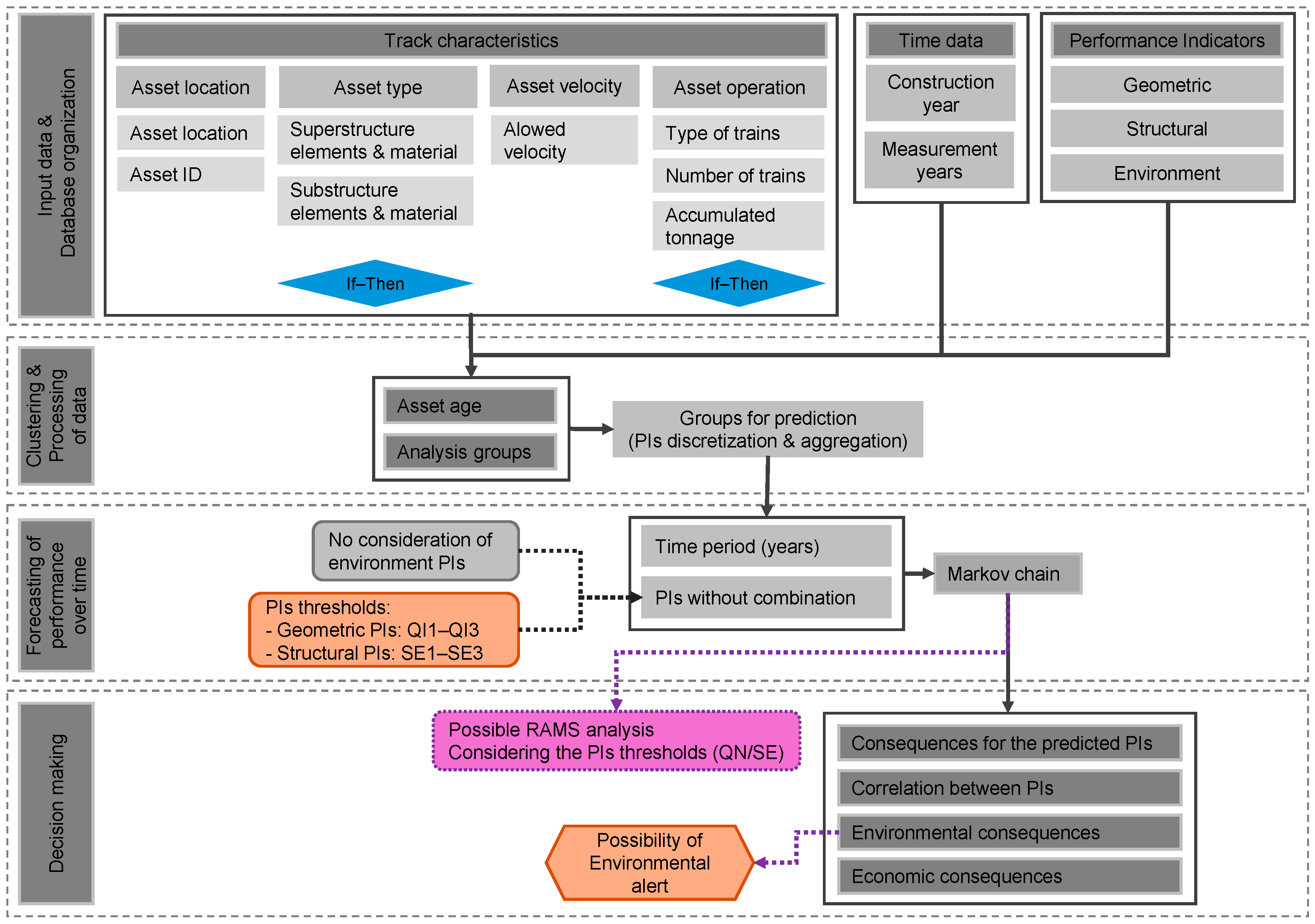
The framework presented here (see Figure 2) was conceived during the In2Track2 Project [12] which aimed to develop a framework for forecasting the performance of railway track assets over time, and that allows the inclusion of diverse data aiming of optimizing the management decision-making. It consists of four main phases organized in a consecutive sequence of four phases: Phase I—Input data and database organization, Phase II—Clustering data, Phase III—Forecasting of performance over time and Phase IV—Decision making. In the following subsections, more information is provided concerning the different phases.

4.1. Phase I—Input Data and Database Organization

Phase I involves collecting and organizing of data related to the railway track assets. The collected data may be provided by the railway infrastructure manager/owner, or collected from inspections, monitoring systems, and tests. This data is then categorized into three groups: (i) track characteristics, (ii) time data and (iii) Performance Indicators.
The track characteristics group concerns those aspects inherent to the railway track as well as those related to the operation, being subdivided into four layers of information: (i) asset location, (ii) asset type, (iii) asset allowed velocity and (iv) asset operation, which are described in the following:
  • The asset location has an informative nature, being subdivided into two subgroups: asset location and asset ID. The first one concerns the region and/or city. The second one concerns the asset identification, line track identification, the segments identification and the beginning and ending kilometres.
  • In the asset type, the data is organized according to the different materials and geometry, due to their possible influence in the behaviour of the track. It is subdivided into two subgroups: superstructure elements and material, and substructure elements and material.
    The first subgroup includes the type of line track (single-track or double-track); type of gauge (metric, Iberian, European standard gauge (UIC—International Union of Railways), Russian or other); type of line layout (straight or curve); existence of singularities (switches, crossovers, joints); and geometry and material of the elements (gauge, rails, fastening system, sleepers (including the distance between sleepers) and rail pads).
    The second one includes the type of substructure (ballast or ballastless), type of support (soil, crossing bridges, box culvert or tunnel), and geometry and material of the elements.
  • The asset-allowed velocity is considered a division parameter, that takes into account the influence of the velocity on the track degradation. This way it was separated from the following group.
  • The asset operation aims to understand the influence of the type of train and loading. It is subdivided into three subgroups: type of trains; number of trains; and accumulated tonnage of trains driving on the line track.
    If no information concerning the superstructure is provided, no assumptions are made concerning those aspects. In the same way, if no information concerning the substructure is provided, a traditional ballast track is assumed (over the soil). Moreover, if no information concerning the existence of singularities is provided, a straight layout is assumed. If no information concerning the properties and geometry of the components is available, no considerations are made concerning these.
    If no information concerning type of trains, number of trains, and accumulated tonnage is available, no assumptions are made about these parameters, or their possible influence on the PIs and consequently on the quality and performance of the track.
    The time data group is considered a division parameter according to the age of the track, being subdivided into two sub-fields: (i) construction year and (ii) measurement years.
  • The construction year is defined according to three aspects. When the year of construction is available, it is taken as the asset age. If information concerning the year of reconstruction or a significant intervention exists, the year of this action is considered as the asset age. In those cases where there are doubts about the data collected in the year of reconstruction or a significant intervention, or if no data exists to the identified year, the subsequent year with available measurements is considered for the asset age.
  • The measurement years correspond to the time (years) when the measurements of data were made. If no data is available for a given year, that year is excluded from the analysis.
    If no information concerning (I) works carried out during the last year of renovation, (II) the measurement procedures, and (III) interventions performed between or during inspections is available, it is assumed that these activities did not take place. However, if an improvement in some track sections is observed, it may be attributable to one or more of the following factors: (i) measurement errors and/or the use of different equipment or measurement trains, which may introduce variations in the final values of the indicators; (ii) differences in the exact position where measurements were taken; (iii) wheel/rail interaction effects during the passage of the measurement car; and (iv) maintenance or intervention activities performed between inspections that were not recorded, or minor interventions carried out during inspections, with only the post-intervention measurements being registered.
The Performance Indicators group is subdivided into the three types of PIs, (i) geometric PIs, (ii) structural PIs, and (iii) environment PIs.
  • Geometric PIs concerning the geometric deviations, being subdivided into longitudinal level (LL), alignment (ALG), cant, gauge, and twist.
  • Structural PIs concerning the possible failures at component level, being subdivided into rail, fixations, sleepers, and substructure, with each one of these subdivided into other indicators.
  • Environment PIs concerning the environmental impact and possible problems due to the operation of the track during its service life in terms of noise, namely the day-evening-night-time noise Level (Lden) and the night-time noise Level (Lnight) indicators.
Table 5 presents the PIs and their integration information concerning determination, measurement methods, and integration into the framework model for each type of PI.
In the proposed framework, each PI is represented as a discrete condition index state suitable for stochastic modeling. Continuous measurements are therefore converted into predefined condition index levels (QI1–QI3 for geometric indicators and SE1–SE3 for structural indicators), which define the state space of the predictive model.

4.2. Phase II—Clustering and Processing of Data

Phase II is subdivided into two steps, definition of the (i) asset age and (ii) analysis groups. In this scenario, the asset age is defined according to the construction year and measurement years parameters. The analysis groups are defined based on the asset location, asset allowed velocity and PIs considered in an isolated way. Each group may be identified through a combination of name (according to the location), velocity class, and PI (e.g., Littoral-IV-ALG).
Within this phase, continuous measurements of the selected PIs are converted into discrete condition index levels according to predefined thresholds, ensuring that all PIs are expressed on a common discrete condition scale. This discretization allows the comparison of PIs even when originally expressed in different units or measurement scales. When multiple PIs are analyzed within the same group, they may be combined into a representative condition index using a worst-condition approach. When the different types of PIs are considered, namely geometric, structural, and environmental, the corresponding condition indices are used for their integration, which may be performed using a weighted formulation, in which the weighting coefficients reflect the relative importance assigned to each group.

4.3. Phase III—Forecasting of Performance over Time

In Phase III, for each defined group, the PIs are forecasted independently, without assuming any combination between them. The optimal scenario is to include all possible PIs. However, if no information concerning the diverse PIs is provided, the analysis is carried out using the available data, requiring at least one of the two geometric PIs, LL or ALG.
A time period of 40 years is considered, reflecting the expected service life of rails and sleepers (30 to 40 years). This allows the evaluation of potential consequences on safety and passenger comfort, as well as environmental and cost-related consequences, in scenarios where no maintenance or intervention actions are performed.
A continuous Markov chain (see Equations (1)–(6) (adapted from [13])) was selected to describe the evolution of track performance over time, as it allows modelling situations where no constant time interval exists between collected data, in contrast to discrete-time approaches.
The discrete condition index levels defined in Phase II constitute the state space of the model. The model assumes that the future condition depends exclusively on the current state. Transitions between condition index levels represent a progressive degradation process, where an asset may remain in the same state or deteriorate to the next severity level. Direct transitions between non-consecutive states are not considered.
The forecasting results provide, for each time step within the 40-year analysis period, the probability distribution of the asset condition states.
This way, the following model considerations must be taken into account.
  • The asset age is mainly an informative parameter, since the prediction of the future condition is based only on the current state, being independent of the asset age and its effects.
  • Time is represented by the x-variable and measurements of the PIs by the y-variable.
  • Concerning the performance condition, a three-level scale of condition indexes (QI1 to QI3), presented in the EN 13848-5, according to the velocity class, is selected for the thresholds of geometric PIs. In this scale, higher velocity classes correspond to lower allowed velocities, and for each of the six velocities classes, a lower allowable velocity corresponds to a higher QI. For structural PIs, a qualitative severity scale of three levels, similar to that presented in [38], ranging from SE1: low severity to SE3: high severity, is adopted. These indexes define the discrete states of the Markov model.
  • An intensity matrix, Q, is used, which represents the instantaneous transition probability and is related to the transition matrix, P, through a differential equation derived from a Poisson distribution. Matrix Q allows the estimation of the time required to reach the adopted condition limits. Both matrices have a dimension of 3 × 3, corresponding to the adopted three-level condition scale.
  • Once the asset condition can either remain the same or get worse, a split in the degradation path should be assumed and a new and fictitious line starting at that measurement year must be assumed.
  • Additionally, an asset cannot transition directly from QI1 to QI3 without first passing through QI2.
Q = θ 1 θ 1 0 0 θ 2 θ 2 0 0 0
θ 1 θ 2 = q 12 q 23
θ i = q i j = n i j Δ t i
P Δ t = e Q × Δ t
Q N m e a n Δ t = Q N i n i c i a l × P Δ t × 1 2 3
T i = 1 θ i
where:
  • Q—represents the instantaneous transition probability
  • θ—represents the transition rate between states
  • nij—number of elements that transit from state i to state j
  • ∑Δti—sum of the time intervals whose initial state is i
Conditions:
  • qij ≥ 0, when j − i = 1;
  • qij = 0, when i > j;
  • qij = 0, when j − i > 1;
  • qij = 0, when i, j = m;
  • qij = −∑ qij, with i = 1, 2, …, m
  • m—number of condition states

4.4. Phase IV—Decision Making

Phase IV comprises the consequences of decreasing PIs and is subdivided into four steps: (i) consequences for the predicted PIs according to the defined thresholds; (ii) correlations between PIs in situations where not all parameters are provided, namely in situations where certain PIs are not available, and their effects may be indirectly assessed through correlations with other indicators and the corresponding environmental and economic consequences; (iii) environmental consequences; and (iv) economic consequences in terms of time, equipment, labour, materials, and operational restrictions (speed limitations, tonnage, type of train and schedules).
For the third step, in situations where failure indicators contribute to an increase in noise beyond the limit values mentioned in the literature for Lden and Lnight, an alert information can be issued to indicate the need for intervention in order to reduce environment impact.
A RAMS interpretation can also be obtained from the Markov-chain results, by using the intensity matrix, transition rates and the mean permanence time. This interpretation follows the conceptual definitions of Reliability, Availability, Maintainability and Safety provided in EN 50126-1, while the Markov states are used strictly as a mathematical framework to quantify how a section evolves between different condition states.
  • Reliability can be associated with the probability of a section to remain in QI1: perfect operation condition/SE1: Low severity, corresponding to a condition that allows the system to operate without the need for intervention (as defined conceptually in EN 50126-1).
  • Availability can be obtained from the combined time that a section remains in QI1 (SE1) and QI2 (SE2), since both represent operational conditions in which the section can continue functioning, even if performance is reduced. This follows the EN 50126-1 definition of availability as the ability of an item to perform a required function under given conditions.
  • Maintainability can be associated with the expected time before a PI reaches QI3: deficient operation condition/SE3: High severity. It can be obtained from the permanence time in each state or from the transition rates between states, which reflect how quickly the system may approach a condition requiring maintenance, in line with EN 50126-1.
  • Safety can be related to the probability of exceeding QI3 (SE3), since this represents a condition that may compromise safe system operation. This interpretation is consistent with EN 50126-1, where safety is defined as freedom from unacceptable risk.
If maintenance costs, operational restrictions, or environmental effects are associated with each condition state (QI/SE), it becomes possible to quantify the corresponding economic and environmental consequences derived from the Markov forecasting results.
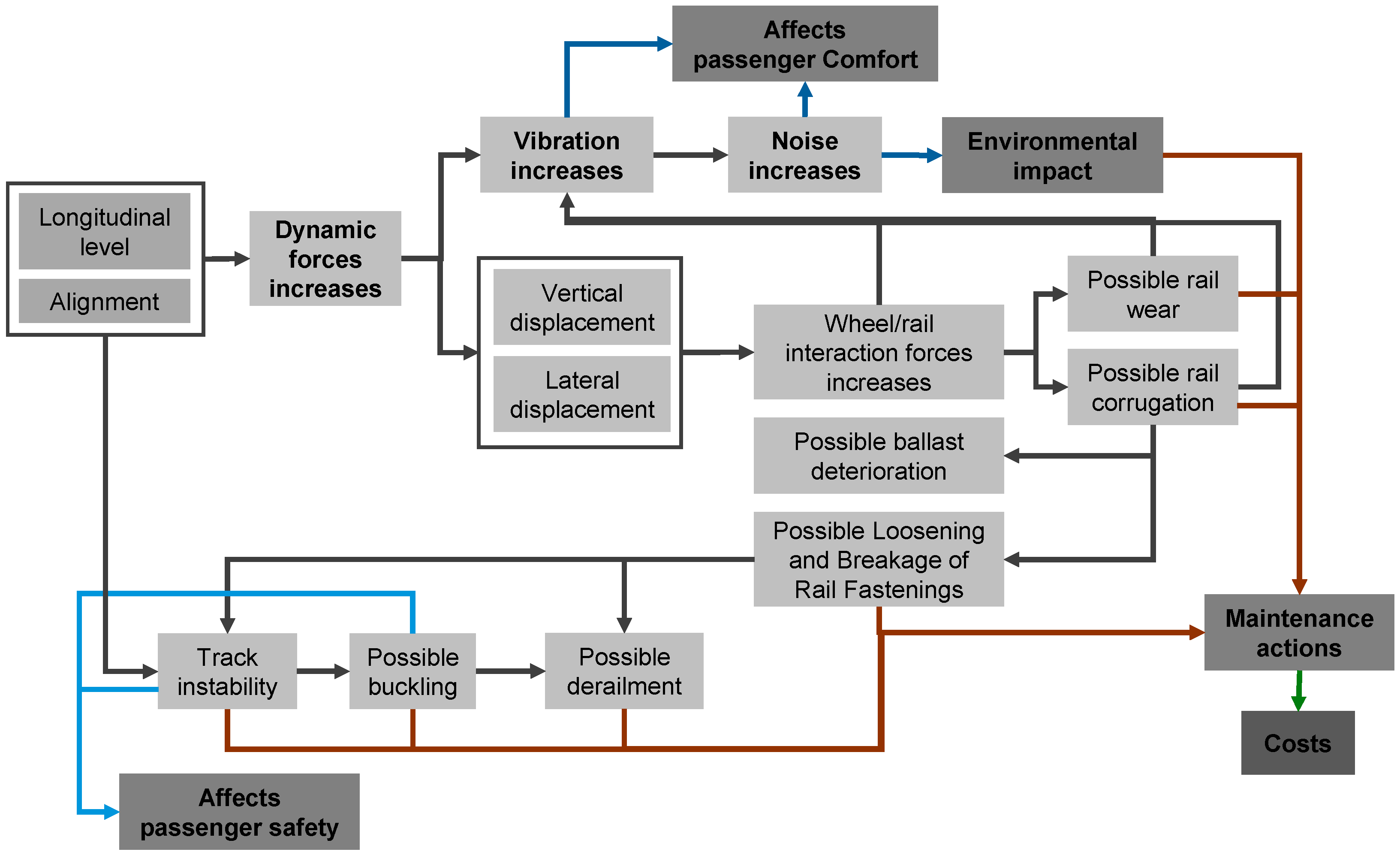
As an example, Figure 3 shows the possible consequences of increasing geometric PIs, namely LL and ALG. According to the literature, an increase in LL and ALG leads to higher dynamic forces and increased train acceleration. Higher dynamic forces may accelerate degradation, resulting in higher vertical and lateral displacements. Differential lateral movements can compromise track stability, potentially leading to buckling, and, in extreme cases, derailment.
An increase in degradation can lead to a variation in wheel/rail interaction forces that may increase vibration and noise. While increased noise does not directly compromise track safety or passengers, it may cause disturbance to people living or working near the railway line.

5. Illustrative Application of the Proposed Framework

To illustrate the adaptability of the proposed framework and ensure methodological clarity and reproducibility, a representative subset of 30 track segments (200 m each) was selected as an illustrative example. This subset corresponds to a de-identified sample extracted from an inspection database of a railway line. Five consecutive inspection years were considered to ensure temporal consistency in the estimation of state transitions. This configuration reflects a common situation in infrastructure management, where data availability is heterogeneous, incomplete, and irregular over time.

5.1. Phase I—Input Data and Database Organization

For illustrative purposes, only data concerning the geometric PIs longitudinal level (LL) and alignment (ALG), recorded over five consecutive inspection years, were used.
Due to the absence of information regarding track geometry, materials, and surrounding conditions, the analyzed sections were assumed to correspond to straight track segments without structural discontinuities, with ballast over soil, located in an area close to houses and services. No information regarding train types, traffic loads, or tonnage per period was provided; therefore, no assumptions were made regarding their possible influence on track degradation. No information concerning the construction year was available. Only the last year of renovation was provided, which was assumed to represent to the year of the first inspection measurement used to estimate the parameter age. No information regarding the type of interventions performed, possible maintenance actions between inspections, or the measurement procedures and equipment used during inspections was available. The lack of data is representative of common datasets and is considered in this example to evidence the use of this methodology even with a low level of data.
Based on the provided dataset, some improvements in condition states were observed between consecutive inspection years. However, no information was available to determine whether these changes resulted from maintenance actions, measurement variability, or other external factors. Therefore, the dataset was analyzed as provided, without introducing additional assumptions regarding the causes of observed condition changes.

5.2. Phase II—Clustering and Processing of Data

The LL and ALG measurements were analyzed independently for each segment and inspection year. Since geometric PIs are continuous variables, their values were converted into discrete condition indexes levels (QI1–QI3) using the threshold limits defined in EN 13848-5, according to the corresponding velocity class. The overall geometric condition was then defined using a worst-condition approach by selecting the most degraded condition index between LL and ALG.
Given the limited number of analyzed segments, no additional clustering based on location or operational characteristics was performed. Similarly, normalization procedures were not required, since each PI was analyzed independently and expressed using its corresponding condition thresholds.
The resulting sequence of condition states constitutes the input dataset used for the Markov-based degradation modelling presented in Phase III.

5.3. Phase III—Forecasting of Performance over Time

The future evolution of the track condition was estimated based on the available geometric PIs (LL and ALG). Transition rates between condition index states were derived from the observed data, allowing the construction of the intensity matrix (Q), the corresponding transition probability matrix (P), and the expected permanence time in each condition state, calculated as the inverse of the transition rate to the next deterioration state, as presented in Table 6.
The transition parameters were estimated directly from the observed condition state sequences, without distinguishing between the underlying causes of state changes. As a result, the transition probabilities reflect the overall observed behaviour of the system between inspection campaigns.
The expected permanence time indicates that once deterioration begins, the transition towards the most degraded condition state (QI3) tends to occur progressively faster. This behaviour is consistent with typical degradation patterns observed in railway track geometry, where defects tend to accumulate and accelerate over time in the absence of maintenance interventions.
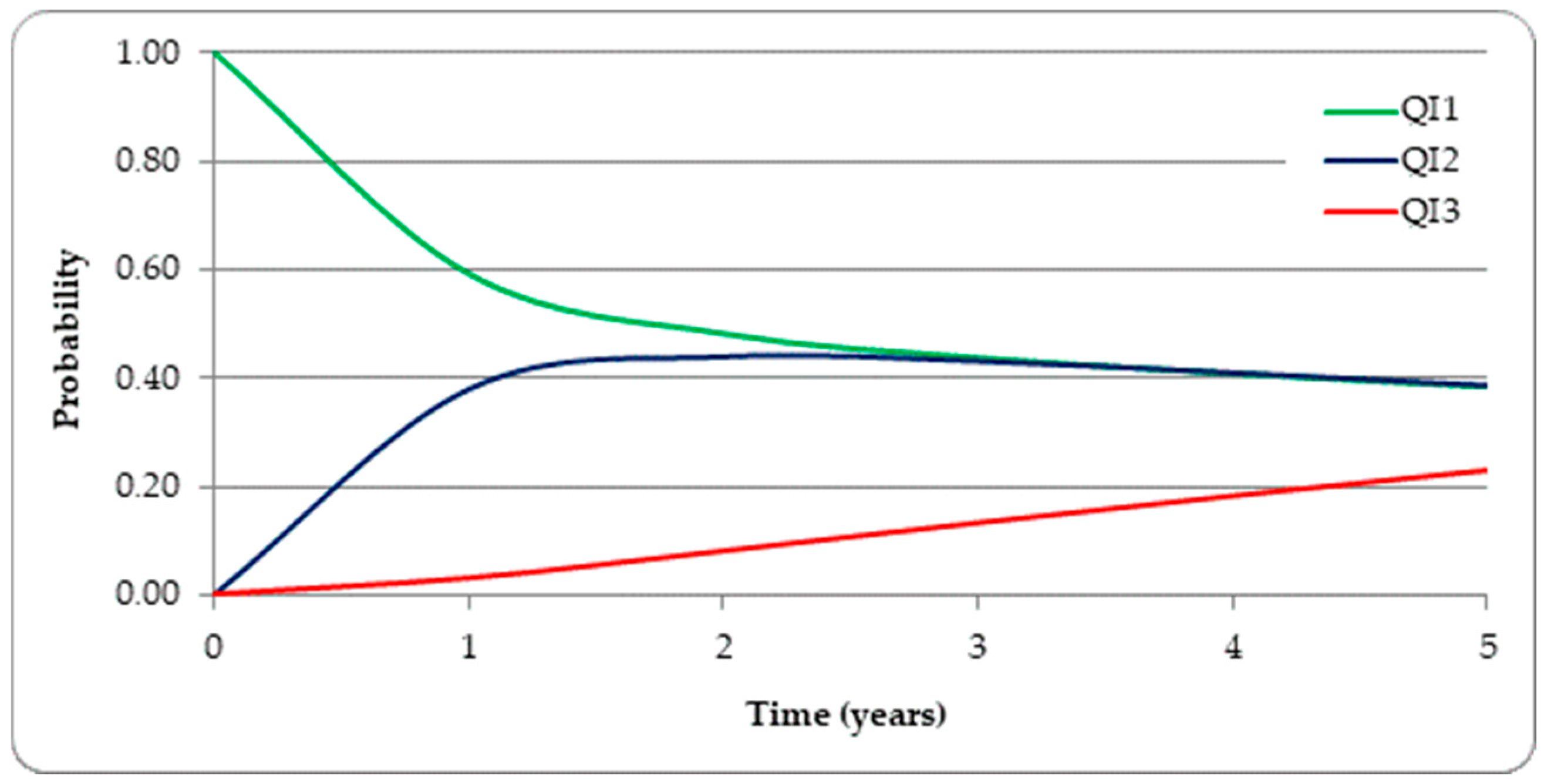
The probability of remaining in QI1 progressively decreases with time, while the probability of being in QI2 and QI3 gradually increases, as shown in Figure 4.
Considering, for example, a segment initially in QI1, after approximately 5 years there is a probability of approximately 38% of remaining in QI1, 39% of transitioning to QI2, and 23% of already reaching QI3. Within the analyzed time horizon of 5 years, the probability distribution becomes dominated by the intermediate condition state (QI2), while the probability of reaching the most degraded state (QI3) remains comparatively limited. A similar pattern is observed for segments initially in QI2. These results highlight the progressive degradation of track geometry when no maintenance actions are performed and provide quantitative insight into the expected evolution of track condition over time.
The overall evolution of the condition states and geometric PIs is summarized over a 5-year period in Figure 4. The apparent stabilisation observed after approximately 5 years may be associated with the limited number of observed transitions and the short time span of the analysis, rather than representing a long-term equilibrium condition.

5.4. Phase IV—Decision Making

Based on the estimated degradation process presented in Phase III, the future condition of the analyzed track segment can be interpreted in terms of maintenance planning needs.
Considering a segment currently classified in condition index state QI1, the results indicate that within approximately 5 years a progressive deterioration from good to intermediate condition states occurs. This evolution is illustrated in Figure 4, which summarises the behaviour of all segments. At the same time, a non-negligible probability of reaching the most degraded condition state (QI3) is observed within this time horizon.
In practical terms, this suggests that preventive monitoring should be maintained during this period, while corrective interventions are not yet immediately required.
Within the analyzed 5-year period, the probability of reaching condition index state QI3 increases but does not become dominant. The results suggest that maintenance planning should focus on the intermediate condition stage (QI2), where intervention can be more effective and less costly before significant degradation occurs.
From a maintenance management perspective, these results indicate that interventions should ideally be planned before the segment reaches the most degraded state, in order to avoid operational restrictions and higher intervention costs. Maintenance actions targeting the correction of LL and ALG defects could therefore be scheduled during the intermediate degradation stage (QI2), where interventions are typically less complex and less costly.
In addition to direct geometric degradation, the deterioration of these PIs may also have implications for other PIs. Increased irregularities in LL and ALG can lead to higher wheel/rail interaction forces, which may accelerate degradation of other track components and increase maintenance needs. Furthermore, delayed maintenance may result in higher operational costs and increased environmental impacts associated with heavier interventions. When some PIs are not available, their potential effects can be interpreted based on known interactions between the available PIs and other PIs (geometric and structural), as well as the associated environmental and economic consequences.

5.5. Integration with Other PIs

In the present illustrative example, only geometric PIs were available. However, the proposed framework allows the integration of multiple groups of PIs, including geometric, structural, and environmental PIs. At a first level, PIs within each group can be combined into a single representative condition index using a worst-condition approach (e.g., QI, SE, EV). At a second level, these group-level indexes can be aggregated using a weighted formulation, in which the weighting coefficients reflect the relative importance assigned to each group according to infrastructure management priorities.

6. Final Considerations

The framework presented allows the clustering of data from diverse sources, the definition of analysis groups, the forecasting of Performance Indicators (PIs) using a Markov chain–based predictive model, and the identification of the associated technical, environmental, and economic consequences. This predictive perspective enables infrastructure managers to anticipate degradation and better understand the potential consequences of delayed interventions, something that traditional approaches, which rely mainly on threshold-based inspection results or short-term maintenance planning, generally do not provide.
It specifies the data requirements, assumptions, and parameters to be considered and clarifies how geometric, structural, operational, and contextual aspects are incorporated into the assessment process, while explicitly accounting for the limitations of the available information. By integrating the individual evolution of each Performance Indicator with the adopted thresholds for geometric and structural parameters and considering correlations between indicators when some are missing, together with the corresponding environmental and economic consequences, the framework provides a structured basis for comparing alternative conditions and identifying situations where intervention is advisable. In this way, it supports a consistent decision-making process grounded in the expected behaviour of the track and the implications associated with its degradation.
The illustrative example demonstrates how the framework can be applied, even when only a limited set of data is available. In particular, the use of a reduced dataset comprising a limited number of segments and a short observation period highlights the applicability of the framework under realistic data constraints. Although the framework is designed to accommodate a wider set of Performance Indicators and includes procedures for the normalization and integration of heterogeneous data, these aspects were only partially explored in the example presented.
Future research may also investigate the integration of stochastic maintenance scenarios and cost–benefit analyses, enabling explicit evaluation of preventive and corrective intervention strategies. Further research should also explore the application of the framework to datasets including a broader range of Performance Indicators, allowing its validation across different operational contexts and infrastructures, strengthening its generalisability and robustness. Additional developments may also consider the explicit integration of maintenance actions as Performance Indicators, enabling a more direct representation of maintenance strategies and their influence on track performance evolution.
Moreover, embedding the framework within digital twin environments could facilitate real-time monitoring, dynamic updating of Performance Indicators, and improved decision-support capabilities through the combination of real-time data, predictive models, and performance assessment tools. Such integration would further support proactive and data-driven asset management strategies.
Overall, the proposed framework provides a structured and flexible basis for predictive railway track performance assessment and maintenance decision support, demonstrating its capability to support data-driven and anticipatory infrastructure management even under conditions of limited and heterogeneous data availability.

Author Contributions

Conceptualization, M.-J.M., H.S.S., J.C.M.; methodology, M.-J.M., H.S.S., J.C.M.; validation, M.-J.M., H.S.S., J.C.M.; formal analysis, M.-J.M.; investigation, M.-J.M.; data curation, M.-J.M.; writing—original draft preparation, M.-J.M.; writing—review and editing, H.S.S., J.C.M., M.A.; visualization, M.-J.M.; supervision, H.S.S., J.C.M.; project administration, H.S.S., J.C.M. All authors have read and agreed to the published version of the manuscript.

Funding

This work is financed by national funds through FCT—Foundation for Science and Technology, from the Portuguese State Budget (Orçamento de Estado), under grant agreement [PRT/BD/153494/2021] attributed to the 1st author, under the MIT Portugal Program. This work was also supported by FCT/MCTES under the R&D Unit Institute for Sustainability and Innovation in Structural Engineering (ISISE), under the references UID/04029/2025 (https://doi.org/10.54499/UID/04029/2025), UID/PRR/04029/2025 (https://doi.org/10.54499/UID/PRR/04029/2025) and UID/PRR2/04029/2025 (https://doi.org/10.54499/UID/PRR2/04029/2025), and under the Associate Laboratory Advanced Production and Intelligent Systems ARISE under reference LA/P/0112/2020 (https://doi.org/10.54499/LA/P/0112/2020).

Institutional Review Board Statement

Not applicable.

Informed Consent Statement

Not applicable.

Data Availability Statement

The original contributions presented in this study are included in the article. Further inquiries can be directed to the corresponding author.

Acknowledgments

This work was developed under the European Commission Shift2Rail Program through the R&D project IN2TRACK2 (Research into enhanced track and switch and crossing system 2) with reference 10.3030/826255.

Conflicts of Interest

The authors declare no conflicts of interest. The funders had no role in the design of the study; in the collection, analyses, or interpretation of data; in the writing of the manuscript; or in the decision to publish the results.

Abbreviations

The following abbreviations are used in this manuscript:
AAvailability
AIArtificial intelligence
ALGAlignment
ANFISAdaptive neuro-fuzzy inference systems
ANNsArtificial neural networks
CNNConvolutional Neural Network
ENEuropean
IUCInternational Union of Railways
LCCLife cycle costs
LdayDay noise indicator
LdenDay-evening-night noise indicator
LeveningEvening noise indicator
LLLongitudinal level
LnightNight-time noise indicator
LSTMLong Short-Term Memory network
MMaintainability
MTBFMean time between failures
MTBMMean time between maintenance
MTFMean time to failure
MTTRMean time to restoration
PTransition matrix
PIsPerformance Indicators
QIntensity matrix
QICondition indexes scale
RReliability
RAMSReliability, Availability, Maintainability and Safety
SSafety
SESeverity scale
XAIExplainable AI techniques
λFailure rate

References

  1. Patra, A.P. RAMS and LCC in Rail Track Maintenance; Luleå University of Technology: Luleå, Sweden, 2007. [Google Scholar]
  2. Matsumoto, M. Changing RAMS for Railways: Proposals from Japan. JR EAST Tech. Rev. 2008, 5, 5–8. [Google Scholar]
  3. Committee on Technical Cooperation in the Development of the Rail Transport System. Reliability, Availability, Maintainability, Safety (RAMS) and Life Cycle Costs (LCC); Committee on Technical Cooperation in the Development of the Rail Transport System: Warsaw, Poland, 2017. [Google Scholar]
  4. Morais, M.J.; Sousa, H.S.; Matos, J.C. An overview of performance predictive models for railway track assets in Europe. In 18th International Probabilistic Workshop (IPW 2021); Lecture Notes in Civil Engineering, Vol. 153; Springer: Cham, Switzerland, 2021; pp. 1–12. [Google Scholar] [CrossRef]
  5. Soleimanmeigouni, I.; Ahmadi, A.; Kumar, U. Track geometry degradation and maintenance modelling: A review. Proc. Inst. Mech. Eng. F J. Rail Rapid Transit 2016, 230, 73–87. [Google Scholar] [CrossRef]
  6. Matos, J.C.; Casas, J.R.; Fernandes, S. Performance indicators. In Proceedings of the 8th International Conference on Bridge Maintenance, Safety and Management (IABMAS 2016); CRC Press: Boca Raton, FL, USA, 2016; pp. 935–942. [Google Scholar]
  7. Stipanovic, J.R.C.I.; Chatzi, E.; Limongelli, M.; Gavin, K.; Allah Bukhsh, Z.; Škarić Palic, S.; Xenidis, Y.; Imam, B.; Anzlin, A.; Zanini, M.; et al. WG2 Technical Report: Performance Goals for Roadway Bridges of COST Action TU1406; Boutik: Braga, Portugal, 2017. [Google Scholar]
  8. Pakrashi, V.; Wenzel, H.; Matos, J.C.; Casas, J.R.; Strauss, A.; Stipanovic, I.; Haj-Din, R.; Kedar, A.; Guðmundsson, G.; Limongelli, M.-P.-N.; et al. WG5 Technical Report: Drafting of Guidelines/Recommendations of COST Action TU1406; EuroStruct: Dublin, Ireland, 2019. [Google Scholar]
  9. Strauss, A.; Ivanković, A.M.; Matos, J.C.; Casas, J.R. WG1 Technical Report: Performance Indicators for Roadway Bridges of COST Action TU1406; EuroStruct: Dublin, Ireland, 2016; Available online: https://www.tu1406.eu/wp-content/uploads/2016/10/COST_TU1406_WG1_TECH_REPORT.pdf (accessed on 5 November 2020).
  10. Bai, L.; Liu, R.; Sun, Q.; Wang, F.; Xu, P. Markov-based model for the prediction of railway track irregularities. Proc. Inst. Mech. Eng. F J. Rail Rapid Transit 2015, 229, 150–159. [Google Scholar] [CrossRef]
  11. Strauss, A.; Fernandes, S.; Casas, J.R.; Mold, L.; Matos, J.C. Quality specifications and performance indicators for road bridges in Europe. In Proceedings of IABMAS 2018; CRC Press: Boca Raton, FL, USA, 2018; pp. 1822–1831. [Google Scholar]
  12. Morais, M.J.; Sousa, H.S.; Matos, J.C. WP4—Next Generation Track Solutions: Algorithm for Monitoring Track Health; In2Track2 Project Final Report; Trafikverket: Borlänge, Sweden, 2021.
  13. Rodríguez, M.; González-Prida, V.; Sánchez, A.; Crespo, A. Application of Degradation and Optimization Models for Digitization of Maintenance Management in Railway Infrastructures. IFAC Pap. 2024, 58, 115–120. [Google Scholar] [CrossRef]
  14. Michas, G. Slab Track Systems for High-Speed Railways. Master’s Thesis, Stockholm, Sweden, 2012. [Google Scholar]
  15. Akiyama, M.; Frangopol, D.M.; Ishibashi, H. Toward life-cycle reliability-, risk- and resilience-based design. Struct. Infrastruct. Eng. 2020, 16, 26–50. [Google Scholar] [CrossRef]
  16. Audley, M.; Andrews, J. The effects of tamping on railway track geometry degradation. Proc. Inst. Mech. Eng. F J. Rail Rapid Transit 2013, 227, 376–391. [Google Scholar] [CrossRef]
  17. Rohim, A.; Berawi, B.; Delgado, R. Evaluating track geometrical quality through Different Methodologies. Int. J. Technol. 2010, 1, 38–47. [Google Scholar]
  18. Box, P.O. On the relationship between wheel and rail surface roughness and rolling noise. J. Sound Vib. 1996, 193, 149–160. [Google Scholar]
  19. Falamarzi, A.; Moridpour, S.; Nazem, M. A review of rail track degradation prediction models. Aust. J. Civ. Eng. 2019, 17, 152–166. [Google Scholar] [CrossRef]
  20. Kumar, S. A Study of the Rail Degradation Process to Predict Rail Breaks. 2006. Available online: https://www.diva-portal.org/smash/get/diva2:991233/FULLTEXT01.pdf (accessed on 11 September 2025).
  21. Schilke, M. Degradation of Railway Rails from a Materials Point of View; Chalmers University of Technology: Gothenburg, Sweden, 2013. [Google Scholar]
  22. Ramos, A.; Gomes Correia, A.; Indraratna, B.; Ngo, T.; Calçada, R.; Costa, P.A. Mechanistic–empirical permanent deformation models. Transp. Geotech. 2020, 23, 100326. [Google Scholar] [CrossRef]
  23. Hoelzl, C.; Dertimanis, V.; Ancu, L.; Kollros, A.; Kollros, E. Vold–Kalman filter order tracking of axle box accelerations. Mech. Syst. Signal Process. 2023, 204, 110817. [Google Scholar] [CrossRef]
  24. Chiacchiari, L.; Loprencipe, G. Measurement methods for rail irregularities. J. Mod. Transp. 2015, 23, 137–147. [Google Scholar] [CrossRef]
  25. Lee, B.; Sanchez Villardon, R.; Ekberg, A.; Penny, C.; Gibbons, N.; Contijoch Roqueta, À.; Famurewa, S.; Lestoille, N.; Bezin, Y.; Jaiswal, J.; et al. Deliverable D3.4: Guideline for the Evaluation and Selection of Innovative Track Solutions; In2Rail Project, Grant Agreement No. 635900; European Commission: Brussels, Belgium, 2018. [Google Scholar]
  26. International Union of Railways (UIC). Railway Induced Vibration—State of the Art Report; International Union of Railways (UIC): Paris, France, 2017. [Google Scholar]
  27. Praticò, F.G.; Giunta, M. Proposal of a key performance indicator for railway track based on LCC and RAMS analyses. J. Constr. Eng. Manag. 2018, 144, 04018039. [Google Scholar] [CrossRef]
  28. Andrade, A.R.; Teixeira, P.F. Statistical modelling of railway track geometry degradation using hierarchical Bayesian models. Reliab. Eng. Syst. Saf. 2015, 142, 169–183. [Google Scholar] [CrossRef]
  29. EN 13848-5:2008; Railway Applications—Track—Track Geometry Quality—Part 5: Geometric Quality Levels. European Committee for Standardization: Brussels, Belgium, 2008.
  30. Infraestruturas de Portugal. GR.IT.VIA.018—Tolerâncias dos Parâmetros Geométricos da Via; Infraestruturas de Portugal: Almada, Portugal, 2017. [Google Scholar]
  31. Sadeghi, J.; Askarinejad, H. Application of neural networks in railway track quality evaluation. J. Mech. Sci. Technol. 2012, 26, 113–122. [Google Scholar] [CrossRef]
  32. Bianchi, G.; Fanelli, C.; Freddi, F.; Giuliani, F.; La Placa, A. Systematic review on railway infrastructure monitoring. Adv. Mech. Eng. 2025, 17, 1. [Google Scholar] [CrossRef]
  33. Merheb, A.; Palese, J.; Hartsough, C.M.; Zarembski, A.; Bernucci, L. Influence of seasonal effects on railway vertical track modulus. Infrastructures 2024, 9, 120. [Google Scholar] [CrossRef]
  34. Imagine Project. Available online: https://www.imagine-project.org/ (accessed on 12 May 2021).
  35. International Union of Railways (UIC). Railway Noise in Europe—State of the Art Report; International Union of Railways (UIC): Paris, France, 2021. [Google Scholar]
  36. European Commission. Directive 2002/49/EC of the European Parliament and of the Council of 25 June 2002 relating to the assessment and management of environmental noise. Off. J. Eur. Communities 2002, L189, 12–25. [Google Scholar]
  37. World Health Organization. Environmental Noise Guidelines for the European Region; WHO Europe: Copenhagen, Denmark, 2018. [Google Scholar]
  38. Graves, T.L.; Hamada, M.S. A demonstration of modern Bayesian methods. Int. J. Qual. Stat. Reliab. 2009, 2009, 754896. [Google Scholar] [CrossRef][Green Version]
  39. BS EN 13306; Maintenance—Maintenance Terminology. British Standards Institution: London, UK, 2018.
  40. BS EN 50126-1; Railway Applications—RAMS—Part 1. British Standards Institution: London, UK, 2017.
  41. EN 15341; Maintenance—Maintenance Key Performance Indicators. European Committee for Standardization: Brussels, Belgium, 2019.
  42. Praticò, F.G.; Fedele, R. Economic Sustainability of High-Speed and High-Capacity Railways. Sustainability 2023, 15, 725. [Google Scholar] [CrossRef]
  43. D’Angelo, G.; Bressi, S.; Giunta, M.; Lo Presti, D.; Thom, N. Novel Performance-Based Technique for Predicting Maintenance Strategy of Bitumen Stabilised Ballast. Constr. Build. Mater. 2018, 161, 1–8. [Google Scholar] [CrossRef]
  44. Litzka, J.; Leben, B.; Torre, F.L. COST Action 354. Performance Indicators for Road Pavements: Final Evaluation Report; European Cooperation in the Field of Scientific and Technical Research: Brussels, Belgium, 2008. [Google Scholar]
  45. Litzka, J.; Leben, B.; La Torre, F.; Weninger-Vycudil, A.; de Lurdes Antunes, M.; Kokot, D.; Mladenovic, G. COST Action 354. The Way Forward for Pavement Performance Indicators Across Europe; European Cooperation in the Field of Scientific and Technical Research: Brussels, Belgium, 2008. [Google Scholar]
  46. Soleimanmeigouni, I. Predictive Models for Railway Track Geometry Degradation; Luleå University of Technology: Luleå, Sweden, 2019; Available online: https://ltu.diva-portal.org/smash/get/diva2:1286681/FULLTEXT01.pdf (accessed on 1 April 2020).
  47. Elkhoury, N.; Hitihamillage, L.; Moridpour, S.; Robert, D. Degradation prediction of rail tracks. Open Transp. J. 2018, 12, 88–104. [Google Scholar] [CrossRef]
  48. Morcous, G.; Rivard, H.; Hanna, A.M. Modeling bridge deterioration. J. Infrastruct. Syst. 2002, 8, 86–95. [Google Scholar] [CrossRef]
  49. Uusitalo, L. Advantages and challenges of Bayesian networks. Ecol. Model. 2007, 203, 312–318. [Google Scholar] [CrossRef]
  50. Liang, C.; Ghazel, M.; Cazier, O.; El-Koursi, E.M. Bayesian network modeling for railway safety. In RSSRail 2017; Springer: Berlin/Heidelberg, Germany, 2018. [Google Scholar]
  51. Andrade, A.R.; Teixeira, P.F. A Bayesian model to assess rail track geometry degradation through its life-cycle. Res. Transp. Econ. 2012, 36, 1–8. [Google Scholar] [CrossRef]
  52. Andrade, A.R.; Teixeira, P.F. Unplanned-Maintenance needs related to Rail Track Geometry. Proc. Inst. Civ. Eng. Transp. 2014, 167, 400–410. [Google Scholar] [CrossRef]
  53. Jamshidi, A.; Faghih-Roohi, S.; Núñez, A.; Babuska, R.; De Schutter, B.; Dollevoet, R.; Li, Z. Probabilistic defect-based risk assessment approach for rail failures in railway infrastructure. IFAC-PapersOnLine 2016, 49, 73–77. [Google Scholar] [CrossRef]
  54. Weber, P.; Medina-Oliva, G.; Simon, C.; Iung, B. Overview on Bayesian networks applications for dependability, risk analysis and maintenance areas. Eng. Appl. Artif. Intell. 2012, 25, 671–682. [Google Scholar] [CrossRef]
  55. Shafahi, Y.; Masoudi, P.; Hakhamaneshi, R. Track Degradation Prediction Models, Using Markov Chain, Artificial Neural and Neuro-Fuzzy Network. In Proceedings of the 8th World Congress on Railway Research, Seoul, Republic of Korea, 18–22 May 2008; pp. 1–9. [Google Scholar]
  56. Zakeri, J.A.; Shahriari, S. Developing a deterioration probabilistic model for rail wear. Int. J. Traffic Transp. Eng. 2012, 1, 13–18. [Google Scholar] [CrossRef]
  57. Zhang, Y.; Dang, D.-Z.; Wang, Y.-W.; Ni, Y.-Q. Damage identification for railway tracks using ultrasound guided wave and hybrid probabilistic deep learning. Constr. Build. Mater. 2024, 418, 135466. [Google Scholar] [CrossRef]
  58. Wang, X.; Bai, Y.; Liu, X. Prediction of railroad track geometry change using a hybrid CNN–LSTM spatial-temporal model. Adv. Eng. Inform. 2023, 58, 102235. [Google Scholar] [CrossRef]
  59. Lourenço, A.; Ribeiro, D.; Fernandes, M.; Marreiros, G. Time series data mining for railway wheel and track monitoring: A survey. Neural Comput. Appl. 2024, 36, 16707–16725. [Google Scholar] [CrossRef]
  60. Pashami, S.; SNowaczyk, S.; Fan, Y.; Jakubowski, J.; Paiva, N.; Davari, N.; Bobek, S.; Jamshidi, S.; Sarmadi, H.; Alabdallah, A.; et al. Explainable Predictive Maintenance. arXiv 2023, arXiv:2306.05120. Available online: https://arxiv.org/abs/2306.05120 (accessed on 13 September 2025).
  61. Uçar, A.; Karaköse, M.; Kırımça, N. Artificial Intelligence for Predictive Maintenance Applications: Key Components, Trustworthiness, and Future Trends. Appl. Sci. 2024, 14, 898. [Google Scholar] [CrossRef]
Figure 2. Framework illustrating the different steps within each phase (adapted from [12]).
Applsci 16 04754 g002
Figure 3. Possible consequences of the increasing of the longitudinal level and alignment geometric PIs (adapted from [12]).
Applsci 16 04754 g003
Figure 4. Forecasted evolution of track condition states over a 5-year period without maintenance actions, for segments initially in QI1.
Applsci 16 04754 g004
Table 1. Main railway track Performance Indicators (PIs) identified in the literature⁠.
Performance Indicator GroupPerformance IndicatorsSourceAspect of Track Performance Assessed
RAMS
parameters
Reliability; Availability; Maintainability; SafetyEN 50126-1;
EN 13306
Operational performance of the railway system, including reliability, availability, maintainability and safety.
Track geometry
parameters
Longitudinal level; Alignment; Cross level; Gauge; TwistEN 13848-5Geometric condition of the track and deviations affecting ride quality, wheel/rail interaction and operational safety.
Track structural
parameters
Rail; Sleeper; Ballast; SubstructureLiterature reviewStructural integrity and degradation of track components influencing infrastructure condition.
Track mechanical
parameters
Track stiffnessLiterature reviewMechanical behaviour of the track system influencing dynamic response and load distribution along the track structure.
Environmental impactWheel/rail noise
(day, evening and night-time noise)
European Environmental Noise Directive 2002/49/ECEnvironmental effects generated by railway operations, particularly noise exposure in surrounding areas.
CostsInspections; Preventive maintenance; Corrective maintenance; RestrictionLiterature reviewEconomic implications associated with infrastructure condition, maintenance activities and operational restrictions.
Table 2. Main characteristics of the performance assessment approaches developed under COST Action 354 and COST Action TU1406⁠.
ApproachPerformance
Levels
VariablesPerformance
Indicators
Aggregation
Approach
Roadway pavements: COST Action 354Variables measurement; Performance Indicators; Overall performance indicatorDefects and damages; Environmental variablesSafety; Comfort; Structural; EnvironmentalUse of weighting factors to from one level to the next one
Roadway bridges: COST Action TU1406Component level; System level; Network levelDamage assessment at component level; Indicators related to structural, sustainability and socio-economic aspectsReliability; Availability; Safety; Economy; EnvironmentUse of weighting factors to from one level to the next one
Table 3. Main advantages and disadvantages according to the approach (adapted from [4])⁠.
Predictive
Models
AdvantagesDisadvantages
Mechanistic
Models
- Uses limited geometrical data
- Based on the mechanical behaviour of the system components
- Does not account for uncertainty in track behavior due to heterogeneity
- Difficulty in quantifying track and vehicle properties
- Difficulty in understanding the interaction between track components and their properties
Statistical
Models
- Handles large datasets
- Based on real data
- Uses distribution pattern to represent the probability of failure or disruption over a time interval
- Not based on the mechanical behavior of system components
- Does not account for randomness
- Does not consider possible interactions between degraded components
- Requires more statistical computation capability
Deterministic- Easier to use
Probabilistic/
Stochastic
- Incorporates randomness
- Does not account for uncertainty in track behaviour due to heterogeneity
- Considers the current state of assets
- More realistic
Artificial
Intelligence
Models
- Can be trained and tested with large datasets- Limited information available since these models are recent
- Parameter calibration can be difficult
Table 4. Main influencing variables considered by different predictive model types, where the symbol “x” indicates that a given variable is considered by the model (adapted from [4])⁠.
Influencing VariablesPredictive Models
MMDMPMSMAIM
Track Geometryxxxx
- Longitudinal level, alignment, gauge, cant and twist
- Breakage of the rail and settlement of the track
Track Structure x
- Type of rails, sleepers and fastening system
- Support and drainage system
Track Quality Index x
- Train speed and track limit speed, traffic volume
- Axle weight and accumulated tonnage
Environmental conditions x x
- Temperature, snow and flooding
- Soil type, falling rock, landslide
Maintenance parameters xxxx
- Inspection and renewal time
- Number of interventions, speed restrictions and track closures
- Maintenance actions such as rail lubrification, grinding and welding, ballast cleaning, tamping and stone blowing
Time xx
MM—Mechanistic, DM—Deterministic, PM—Probabilistic, SM—Stochastic and AIM—Artificial Intelligence models.
Table 5. Performance Indicators (PIs): geometric, structural and environment (adapted from [12]).
Performance IndicatorTypeSub-TypeModel Application
GeometricLongitudinal level Converted to
discrete model state QI1–QI3
Alignment
Gauge
Cant
Twist
StructuralSuperstructureRailsConverted to
discrete model state SE1–SE3
Corrugation
Corrosion
Cracks
Wear
SleepersCracks
Hanging elements
FixationsCorrosion, separation and loss of pieces in joint bonds
Corrosion, separation and loss of pieces in joint welding
Corrosion, separation and loss of pieces in rail pads
Corrosion, separation and loss of pieces in the fastening system
SubstructureSettlement
EnvironmentNoiseDay-evening-night-time noise Level (Lden)Conceptually
included
Night-time noise Level (Lnight)
Table 6. Estimated Markov transition parameters for railway track condition states: (I) estimated transition rate (intensity) matrix Q for the geometric PIs derived from the observed transitions in the available dataset; (II) transition probability matrix P derived from the estimated intensity matrix Q; and (III) estimated permanence time in each condition state before transitioning to the next deterioration level.
From/ToI. Transition Probability Matrix PII. Intensity Matrix QIII. Mean Permanence Time
QI1QI2QI3QI1QI2QI3(Years)
QI10.590.380.03−0.380.380.002.64
QI20.350.570.090.00−0.090.0911.50
QI30.000.001.000.000.000.00---
Disclaimer/Publisher’s Note: The statements, opinions and data contained in all publications are solely those of the individual author(s) and contributor(s) and not of MDPI and/or the editor(s). MDPI and/or the editor(s) disclaim responsibility for any injury to people or property resulting from any ideas, methods, instructions or products referred to in the content.