Article

Adaptive Multi-Strategy Particle Swarm Optimization Path Planning Algorithm for Multi-Terrain Post-Disaster Relay Rescue


1
School of Electrical and Control Engineering, Xuzhou University of Technology, Xuzhou 221018, China
2
School of Electrical Engineering and Technology, Jiangsu Normal University, Xuzhou 221008, China
3
School of Information and Control Engineering, China University of Mining and Technology, Xuzhou 221008, China
*
Author to whom correspondence should be addressed.
Appl. Sci. 2026, 16(10), 4748; https://doi.org/10.3390/app16104748
Submission received: 30 March 2026 / Revised: 20 April 2026 / Accepted: 6 May 2026 / Published: 11 May 2026
(This article belongs to the Section Electrical, Electronics and Communications Engineering)

Abstract

Post-disaster rescue scenarios often involve complex and variable terrains, imposing heterogeneous mobility requirements on different transport modes. Single-type vehicles face challenges in independently completing comprehensive rescue tasks. This study addresses the critical problem of coordinating heterogeneous aerial and ground vehicles to collaboratively plan relay rescue routes. To tackle the NP hard multi-terrain, multi-vehicle, and multi-route path planning problem, we propose a New Adaptive Multi-Strategy Particle Swarm Optimization algorithm (AMS-PSO-NEW). The algorithm features a synergistic integration of differential evolution’s multi-strategy mutation, SHADE-based adaptive parameter control, population diversity monitoring with restart mechanisms, and multi-level local search. A sequential hybrid mechanism is designed in which DE-generated trial vectors serve as reference positions for PSO velocity updates, enabling balanced global exploration and local exploitation. By leveraging adaptive parameter tuning, success history memory, and diverse population maintenance, AMS-PSO-NEW effectively overcomes premature convergence and low accuracy issues typical in discrete combinatorial optimization using traditional PSO, achieving a balanced global exploration and local exploitation. Performance validation is conducted over six rescue scenarios varying in scale and complexity, benchmarking AMS-PSO-NEW against nine algorithms: PSO, GA, NSGA-II, GWO, DE, ABC, CS, Q-learning, and MIP. Results demonstrate superior performance across four metrics (rescue success rate, average rescue time, total cost, and fairness), with significant improvements in high-complexity environments.

1. Introduction

In recent years, the frequency of extreme natural disasters worldwide has increased significantly. Events such as earthquakes and urban floods pose severe threats to public safety. According to the International Disaster Database (EM-DAT), from 2000 to 2023, over 7800 major natural disasters were recorded globally, resulting in approximately 1.5 million deaths, 3 billion affected individuals, and direct economic losses exceeding 3.5 trillion USD [1]. In China, the annual direct economic losses from natural disasters exceed 400 billion RMB (approximately 55 billion USD, based on the exchange rate at the time of writing), and over 100 million people are affected each year due to natural disasters [2].
Post-disaster rescue environments are typically characterized by complex terrains, diverse obstacles, and significant geomorphological variations, rendering single-type rescue platforms insufficient for comprehensive operations [3]. Aerial vehicles offer advantages in wide-area reconnaissance and rapid response but are constrained by limited endurance and payload, restricting access to indoor or narrow rubble zones. Ground vehicles have stronger endurance and payload capabilities, enabling tasks such as material delivery and obstacle clearance in complex terrains; however, their mobility and visual coverage are limited, making rapid deployment across large disaster areas challenging. Therefore, integrating aerial and ground vehicles to form a coordinated rescue system has become crucial for enhancing rescue efficiency and safety.
Post-disaster rescue scenarios often exhibit multi-terrain heterogeneity [4], which distinguishes this problem from standard Vehicle Routing Problems (VRPs). For example, grasslands and plains offer good mobility and open visibility but cover large distances requiring high efficiency; mountainous and hilly areas involve significant elevation changes and damaged roads, necessitating helicopter intervention; road networks provide high communication efficiency but face congestion and single-point failures; rivers and water bodies disrupt transport, requiring bridging or airlift solutions; and sandy or swampy grounds have a low load-bearing capacity, risking vehicle entrapment. These terrain-specific constraints impose differentiated capability demands on heterogeneous vehicles [5]. For instance, helicopters offer all-terrain reach but incur high costs and low capacity; rescue robots excel in confined spaces but suffer from slow speeds and short endurance. Such capability–terrain coupling constraints prevent any single vehicle type from independently completing full-area rescue, necessitating multi-vehicle collaborative strategies. Relay mechanisms, leveraging complementary abilities and extended ranges, significantly improve rescue outcomes under cost constraints, which is particularly critical for time-sensitive severe casualties.
Relay rescue path planning under such post-disaster conditions constitutes a typical spatiotemporally constrained combinatorial optimization problem [6], involving multiple vehicle types, survivor injury levels, complex terrain passability, and time window constraints. The solution must balance multiple objectives: maximizing the number of rescued survivors, minimizing the average rescue time, controlling operational costs, and ensuring fairness in resource allocation, thus forming a multi-objective optimization problem [7].
Existing methods addressing this problem include exact algorithms [8], traditional heuristics [9], and evolutionary optimization approaches [10]. Exact methods only suit small-scale scenarios and cannot meet real-time rescue demands requiring minute-level responses. Traditional heuristics, such as Genetic Algorithms (GAs) [11], face feasibility disruption from crossover operations and balancing selection pressure challenges. Simulated Annealing (SA) [12] relies on single-point search without population information and exhibits an unstable solution quality in multi-objective contexts. Tabu Search (TS) [13] suffers from complex tabu list management, parameter sensitivity, and lack of adaptive mechanisms, leading to limited robustness across scenarios.
Particle Swarm Optimization (PSO), known for its simple structure, few parameters, and rapid convergence, has been widely applied in path planning [14]. Its information sharing and dual-memory structure suit multi-modal optimization. However, standard PSO struggles with discrete decision variables and is prone to premature convergence, weak local search, and parameter sensitivity. To address these limitations while preserving PSO’s core advantages, this paper proposes a New Adaptive Multi-Strategy Particle Swarm Optimization algorithm (AMS-PSO-NEW), enhancing performance through the following technical innovations:
  • A hybrid initialization strategy combining greedy construction, chaotic mapping, and random initialization to ensure initial population quality and diversity;
  • Incorporation of three differential evolution mutation strategies with adaptive probability adjustment based on successful history;
  • Dynamic parameter tuning of mutation factor (F) and crossover rate (CR) via SHADE adaptive control;
  • Diversity monitoring using entropy-based metrics coupled with a restart mechanism triggering chaotic reinitialization upon population stagnation;
  • Multi-level local search strategies including 2-opt swaps, 3-opt rearrangements, and load balancing optimization for fine-tuning high-quality solutions.
The remainder of this paper is organized as follows: Section 2 reviews related work; Section 3 details the problem formulation; Section 4 presents the AMS-PSO-NEW algorithm framework; Section 5 provides simulation results and analysis across multiple scenarios; and Section 6 concludes the paper and outlines future research directions.

2. Related Work

Numerous intelligent methods have been developed for UAV path planning. For instance, Ren et al. [15] addressed target inaccessibility in Artificial Potential Field (APF) methods and slow convergence in deep reinforcement learning by integrating the APF with an improved twin-delayed deep deterministic policy gradient algorithm (PG-ITD3) for post-disaster UAV path planning. Sun et al. [16] proposed a bi-level multi-objective path planning model minimizing the path length and hazard distance for AUVs, solved via a hybrid bi-level algorithm. To tackle challenges in uncertain environments and high task density in multi-UAV systems, especially collision risk reduction, Zhao et al. [17] introduced a dynamic spatiotemporal optimization method combining an enhanced multi-ant colony system with an active collision avoidance strategy for time-windowed Vehicle Routing Problems. Wang et al. [18] developed MAC-Planner, a unified framework integrating multi-robot task allocation and online coverage path planning, enabling efficient operation within designated areas through dynamic task assignment based on real-time status. Su et al. [19] proposed a dynamic path planning scheme by combining an improved Rapidly Exploring Random Tree star (RRT*) algorithm with an enhanced Dynamic Window Approach (DWA) to address low efficiency, redundant sampling, and unsuitability in unknown dynamic environments.
While these methods effectively address general path planning problems, their direct application to post-disaster path planning is limited due to complex environmental constraints. Consequently, dedicated research has emerged for disaster rescue scenarios. Yang et al. [20] identified limitations in the basic Dung Beetle Optimization (DBO) algorithm’s update strategy causing premature convergence and insufficient exploration and proposed a Landmark Operator-guided DBO (LODBO) to overcome these issues. Adam et al. [21] introduced a hybrid path planning method combining Affinity Propagation Clustering (APC) and a Genetic Algorithm (GA) to maximize coverage and ensure Quality of Service (QoS) compliance under varied disaster conditions. Adnan et al. [22] designed a multi-UAV-aided Mobile Edge Computing (MEC) network path planning framework leveraging Reinforcement Learning (RL) to optimize service quality and routing in urban disaster scenarios. Li et al. [23] aimed to enhance coverage efficiency by optimally allocating task points to minimize coverage rounds and flight time, constructing a path planning model with task-priority-based allocation, and developing an improved mutation-based Beetle Antennae Search (MBAS) algorithm for path optimization. Yang et al. [24] addressed redundant flight distances via a Multi-Selector Genetic Algorithm with Reinforcement Learning (MSGA-RL), which enhances population diversity through a distance-priority greedy initialization, utilizes multi-selector crossover for solution diversity and convergence speed, and integrates RL-based individual retention with elite pool protection to prevent premature convergence.
Compared with complex hybrid metaheuristics, Particle Swarm Optimization (PSO) stands out for its simple structure, clear parameter semantics, and linear computational complexity, achieving competitive optimization while reducing implementation complexity. PSO’s social cognitive model naturally balances global exploration and local exploitation without requiring extra operators like DBO’s landmark or GA’s multi-selector mechanisms to avoid premature convergence. Moreover, PSO’s real-time computational characteristics suit onboard UAV embedded systems with resource constraints, avoiding the large offline training overhead of RL-based methods.
Recent PSO applications in these domains include the following: Thangavelu et al. [25] explored a hybrid PSO and Simulated Annealing (PSO-SA) for post-disaster scenarios, analyzing comparative advantages and limitations; Zhang et al. [26] enhanced traditional A* for complex 3D environments by integrating PSO, proposing a direction-aware adaptive A* named DASA*; Geng et al. [27] utilized multi-robot systems and global-optimal PSO for rescue task assignment and routing, developing an improved Task Allocation PSO (TAPSO) validated across scenarios; Wang et al. [28] addressed PSO’s local optima stagnation and slow convergence by employing Tent chaotic mapping for initialization and integrating a novel flight mechanism (lsamvy) to improve robustness; Wu et al. [29] proposed a hybrid enhanced PSO for the safe, feasible path planning of UAVs in dense rescue and logistics environments, demonstrating effectiveness via simulations; and Sun et al. [30] took the rescue deadline and energy consumption into consideration, and proposed a confidence-driven multi-objective PSO algorithm to solve the problem of task allocation after disaster.
These studies provide valuable insights into PSO’s application for post-disaster path planning but still face limitations in algorithm adaptability and simplistic and single-model formulations. Therefore, this paper further advances the field by developing a more robust and comprehensive approach aiming for superior results.

3. Problem Description and Mathematical Modeling

3.1. Rescue Scenario Description

Consider a post-disaster rescue scenario modeled as a terrain network G = ( N , E , T ) , where nodes N represent garages, hospitals, and survivor locations; edges E denote weighted connections reflecting distance and communication difficulty; and T assigns terrain labels to edges or nodes. The survivor set M = { M 1 , M 2 , , M n } consists of individuals each characterized by position pm, injury severity wm, life decay rate λm, and discovery time t m d e t e c t . A heterogeneous vehicle fleet V = { V 1 , V 2 , , V k } operates across multiple terrain types, each with distinct communication challenges and mobility constraints. The objective is to optimally plan allocation, relay, and routing strategies to rescue all survivors in the minimal total time while considering terrain-dependent vehicle accessibility and survivors’ survival windows.
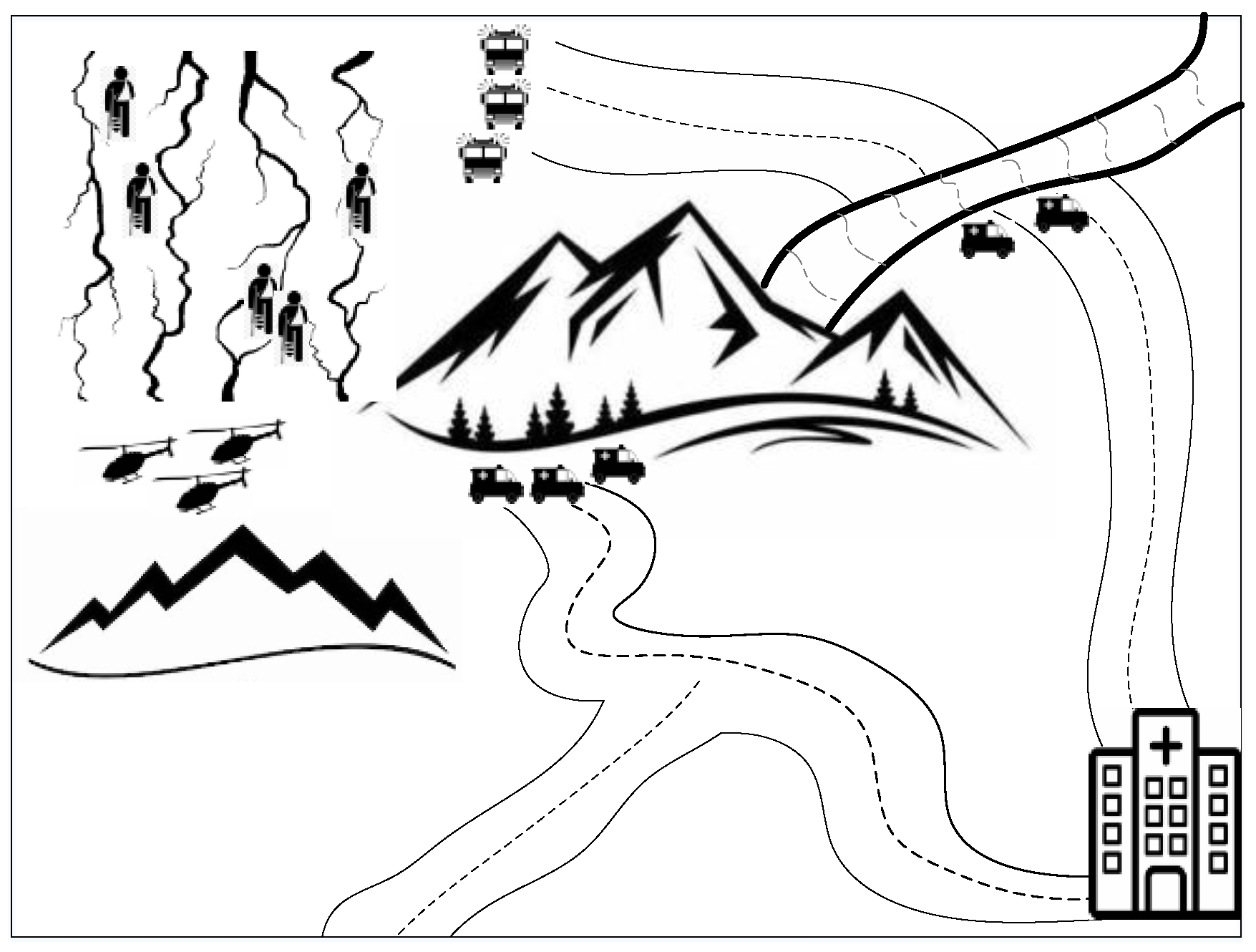
Figure 1 illustrates the multi-modal relay rescue deployment: Survivors are dispersed across disaster zones; heterogeneous vehicles such as trucks are positioned on roads, hills, or grasslands; ambulances are confined to roads; and helicopters are capable of operating over all terrains. Effective rescue operations must integrate vehicle capabilities, terrain passability, and survivor survival dynamics to maximize the number of rescued individuals within the shortest possible timeframe.

3.2. Decision Variables and Constraints

Based on the above analysis, the optimization problem’s decision variables and constraints are defined as follows:
  • Decision Variables
In this paper, the task allocation variable is set as x = ( x 1 , x 2 , , x n ) { 0 , 1 , , k 1 } n , where x m { 0 , 1 , , k 1 } denotes that survivor i is assigned to vehicle m. And the vehicle collaborative variable is set as H = { H m } m = 1 n , H m = { ( h m 1 , v m 1 ) , ( h m 2 , v m 2 ) , } , where h m i { 1 , 2 , , N t e r r a i n } denotes the i-th delay node for vehicle m; v m i { 1 , 2 , , k 1 } is the vehicle identifier involved in successive rescue operations.
The complete solution is represented as S = ( x , H , P ) , where P = { P 0 , P 1 , , P k 1 } denotes the route for all vehicles. To reduce dimensionality, routes are heuristically generated by ( x , H ) .
2.
Constraints
The following constraints are considered in this paper:
Vehicle capacity constraint: To guarantee the weight of onboard survivors does not exceed the vehicle’s rated load capacity:
m = 1 n 1 [ x m = k ] C k , k { 0 , 1 , , k 1 }
where C k is the capacity of vehicle k, and 1 [ ] is the indicator function, which evaluates whether the condition in parentheses is satisfied: returns 1 if true; otherwise, it is 0.
Vehicle endurance constraint: The vehicle’s travel distance cannot exceed its maximum driving range:
( i , j ) P k d i j L k , k
where L k is the maximum travel distance (endurance) for vehicle k, and d i j is the distance between node i and node j.
Unlike traditional strict limits, this model permits endurance overruns by imposing penalties and triggering relays
f p e n a l t y = λ max ( 0 , ( i , j ) P k d i j )
which maintains route connectivity and promotes relay optimization.
Terrain accessibility constraint: The terrain’s accessibility is set as follows:
R i j v { 0 , 0.3 , 1 } , i , j { 0 , 1 , , n + 1 } , v { 1 , 2 , }
where R i j v = 0 indicates vehicle type v that cannot traverse the terrain (e.g., ambulance crossing rivers), R i j v = 0.3 denotes difficult communication (e.g., ambulance in mountainous areas), and R i j v = 1 means normal passability.
Speed attenuation model: Vehicle’s speed varies across different terrains, and it can be calculated using Equation (5):
s a c t u a l = s b a s e ( 1 δ t e r r a i n ) R i j v
where s a c t u a l is the actual speed of the vehicle on one certain terrain, and its value is in the range of [0, s b a s e ], s b a s e is the baseline speed under ideal conditions (smooth asphalt roads without obstacles), and δ t e r r a i n is the terrain attenuation coefficient representing inherent speed loss due to terrain.
Time window constraints: Rescue operations must be completed within the designated time window:
t p i c k i p ( m ) t d e t e c t ( m ) , t h o t s p i t a l ( m ) t d e a t h ( m ) = L 0 ( m ) λ d e c a y ( m )
where t d e t e c t is the time of discovery, L 0 ( m ) is the initial vital sign of survivor m, and λ d e c a y ( m ) is the decay rate of life signs of survivor m.
Load balancing constraint: To guarantee the workload balance among vehicles:
min   max k | { m : x m = k } | min k | { m : x m = k } | Δ
where Δ is a tunable parameter controlling the workload balance among vehicles, typically between 1 and 2.

3.3. Optimization Objectives

The algorithm simultaneously optimizes four objectives, which are the rescue success rate, rescue time, cost, and fairness deviation in rescue time.
(1)
Maximized weighted rescue success rate f1
Weighted rescue success rate is defined as the proportion of rescued survivors weighted by injury severity. Formally,
f 1 = m ω m m = 1 M ω m × 100 %
where = { m : L f i n a l ( m ) > L t h r e s h o l d } is the set of rescued survivors whose life status remains above a critical threshold upon hospital arrival. The weight ω m { 0.6 , 0.8 , 1.0 } denotes injury severity weights corresponding to mild, moderate, and severe injuries; L t h r e s h o l d = 0 represents vital sign thresholds. Thus, f1 prioritizes the rescue of critically injured individuals, reflecting the ethical principle of triage in disaster response. A solution is considered feasible only when f1 = 1, i.e., all survivors are rescued regardless of weight differences; otherwise, the algorithm treats feasibility as the primary objective in the lexicographic hierarchy.
(2)
Minimized weighted average rescue time f2
Weighted average rescue time is defined as the weighted average time for rescued survivors to reach hospitals:
f 2 = m ω m t r e s c u e ( m ) m = 1 M ω m
where t h o s p i t a l ( m ) = t h o s p i t a l ( m ) t d e t e c t ( m ) = t t r a v e l ( m ) + t w a i t ( m ) + t t r a n s f e r ( m ) + t l o a d ( m ) , t h o s p i t a l ( m ) is the time the injured survivor m reaches the hospital, t d e t e c t ( m ) is the time survivor m is discovered, t t r a v e l ( m ) denotes vehicle travel time, t t r a v e l ( m ) = d i j s a c t u a l , t w a i t ( m ) is the waiting time, t w a i t ( m ) = max ( 0 , t a r r i v e t r e a d y ) , t t r a n s f e r ( m ) is the relay handover time depending on vehicle type, and t l o a d ( m ) is the loading/unloading time.
(3)
Minimized total operational cost f3
Total operation cost includes fixed vehicle costs, travel costs, and relay coordination costs:
f 3 = k V ( c k f i x e d + c k u n i t d k ) + h H c h a n d o v e r
where c k f i x e d is the fixed dispatch cost of vehicle k, c k u n i t is the unit distance cost, and c h a n d o v e r is the cost per relay coordination.
(4)
Minimized fairness deviation in rescue time f4 is the range of rescue times among rescued survivors:
f 4 = max m t r e s c u e ( m ) min m t r e s c u e ( m )
where t r e s c u e ( m ) is the rescue duration for survivor m, t r e s c u e ( m ) = t h o s p i t a l ( m ) t d e t e c t ( m ) , is the set of rescued survivors, ω m denotes injury severity weights, and d k is the distance for vehicle k.
To simplify optimization, a hierarchical fitness function is employed: to ensure all survivors are rescued, (f1 = 1) takes precedence, followed by the optimization of time, cost, and fairness.
A lexicographic optimization strategy is adopted to effectively prioritize objectives. The algorithm operates in two distinct phases defined by the feasible set Sfeasible = {x|f1(x) = 1}.
Phase 1 (feasibility search): The primary goal is to find any solution in Sfeasible. Any solution with f1 = 1 strictly dominates any solution with f1 < 1, regardless of its performance in f2, f3, and f4.
Phase 2 (optimality): Once the feasible region is reached, the algorithm optimizes within Sfeasible based on secondary/third/fourth criteria.
Based on the above idea, the fitness function in this paper is defined with the hierarchical fitness function, which is listed in Formula (12):
F i t n e s s = N s u r v i v a l × 10000 f 2 , i f N s u r v i v a l < M 10000 + 1000 1 1 + f 2 / 10 + 100 1 1 + f 3 / 10 5 + 10 1 1 + f 4 / 10 ,       o t h e r w i s e
where N s u r v i v a l = n f 1 .
Assuming any two solutions of x1 and x2 with objective vector (f1, f2, f3, and f4), the lexicographic comparison, x1 dominates x2, is defined as:
x 1 l e x x 2 j : f j ( x 1 ) < f j ( x 2 ) i < j : f i ( x 1 ) = f i ( x 2 )
According to this lexicographic fitness ordering:
  • If f 1 ( x 1 ) < f 1 ( x 2 ) , then Fitness(x1) < Fitness(x2), x1 dominates x2 (first-level dominance);
  • If f 1 ( x 1 ) = f 1 ( x 2 ) < 1 , then compare −f2 to prioritize smaller rescue time (second level);
  • If f 1 ( x 1 ) = f 1 ( x 2 ) = 1 , then compare the aggregated sum of time, cost, and fairness for final differentiation.
This aggregate score ensures that, among feasible solutions, those with shorter rescue times, lower costs, and better fairness are preferred. In summary, the mathematical model of this paper is as follows:
F i t n e s s = N s u r v i v a l × 10000 f 2 , i f N s u r v i v a l < M 10000 + 1000 1 1 + f 2 / 10 + 100 1 1 + f 3 / 10 5 + 10 1 1 + f 4 / 10 , o t h e r w i s e s . t . m = 1 n 1 [ x m = k ] C k , k { 0 , 1 , , k 1 } ( i , j ) P k d i j L k , k R i j v { 0 , 0.3 , 1 } , i , j { 0 , 1 , , n + 1 } , v { 1 , 2 , } t p i c k i p ( m ) t d e t e c t ( m ) , t h o t s p i t a l ( m ) t d e a t h ( m ) = L 0 ( m ) λ d e c a y ( m ) min   max k | { m : x m = k } | min k | { m : x m = k } | Δ

4. AMS-PSO-NEW Algorithm Framework

4.1. Overall Algorithm Architecture

AMS-PSO-NEW builds upon the standard Particle Swarm Optimization (PSO) by integrating multi-strategy mutation from differential evolution, SHADE for parameter self-adaptation, diversity monitoring with restart mechanisms, and a multi-level local search. Algorithm 1 outlines the complete workflow.
Algorithm 1: AMS-PSO-NEW main procedure
Input: rescue scenario, population size NP, the maximum iterations Gmax
Output: global best solution gbest
1. Initialize() //Hybrid Initialization
2. For g = 1 to Gmax do
3.   SF ← ∅, SCR ← ∅ //Successful Parameter Archive
4.   diversity ← CalculateDiversity()
5.   If diversity < θdiv or stagnation > Gstag then
6.     Restart Mechanism() //Diversity Restart
7.   End If
8.   For i = 1 to NP do
9.     F, CR ← SampleParameters() //SHADE sample
10.      strategy ← SelectStrategy() //Roulette Wheel Selection
11.      mutant ← MultiStrategyDE(i, F, CR, strategy)
12.      trial ← AdaptivePSOUpdate(i, mutant, g)
13.      trial ← Repair(trial) //Constraint Repair
14.      If trial.fitness > population[i].fitness then
15.        population[i] ← trial
16.        UpdatePbest(i, trial)
17.        SFSF ∪ {F}, SCRSCR ∪ {CR}
18.        strategysuccess[strategy]++
19.      End If
20.   End For
21.   UpdateSuccessHistory(SF, SCR)
22.   If g mod 10 = 0 then UpdateStrategyProbs()
23.   If g mod 3 = 0 then EliteLocalSearch(gbest)
24.   If g mod 20 = 0 then EliteMultiSearch()
25.   UpdateGbest()
26. End For
27. Return gbest

4.2. Synergistic Mechanism of Algorithm Components

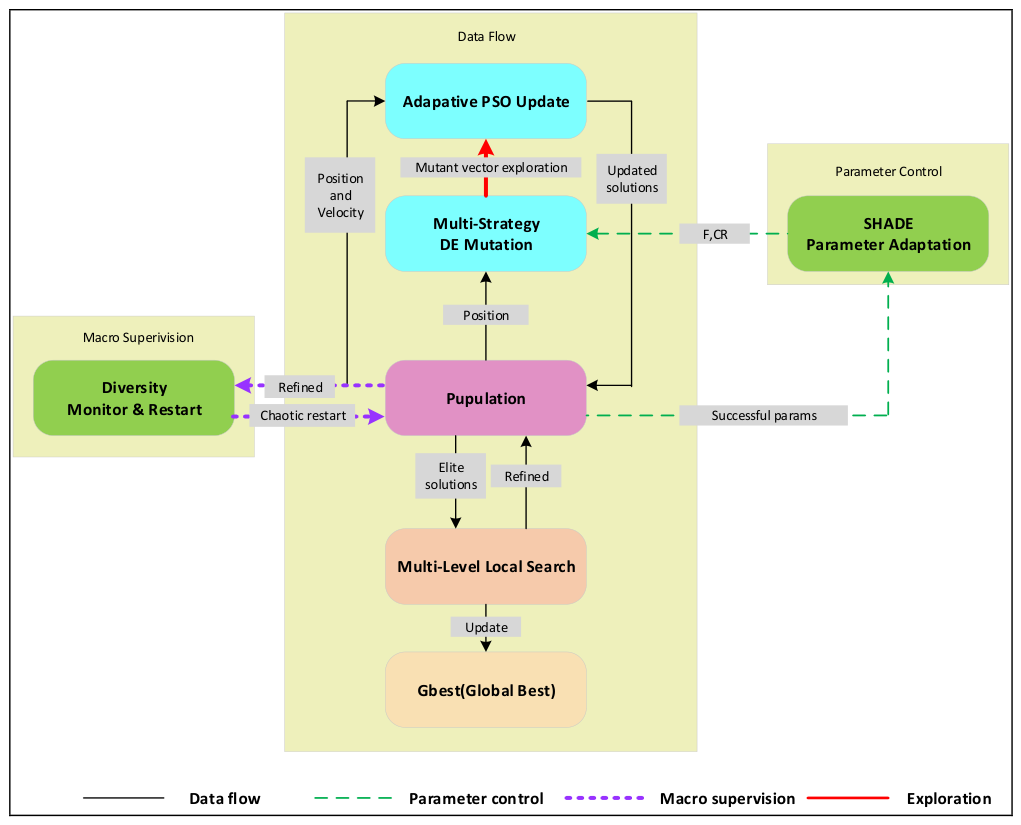
The power of AMS-PSO-NEW stems not from a simple juxtaposition of techniques, but from their deep synergistic integration. Figure 2 illustrates the information flow among the core modules, distinguishing data flow (solid arrows), adaptive parameter control (dashed green), macro-level supervision (dotted purple), and the critical exploration guidance (bold red).
In Figure 2, DE injects exploratory momentum into PSO to avert stagnation; SHADE adaptively throttles the exploration–exploitation balance; diversity monitoring exerts macro-level intervention via chaotic restart when diversity collapses; and local search polishes the global best into a precise optimum. Together, these components form an organic synergy in which PSO provides the backbone, DE supplies the exploratory drive, SHADE dynamically tunes the interaction, diversity monitoring enforces global oversight, and local search delivers final precision.

4.3. Hybrid Initialization Strategy

To ensure both the quality and diversity of the initial population, three initialization methods are employed as follows:
  • Greedy Initialization (20% particles): Assigns survivors to the nearest available vehicles based on proximity and vehicle capacity constraints.
  • Chaotic Initialization (40% particles): For each particle, a pseudo-random sequence {c1, c2, …, cn} is generated using Equation (15), where cn+1 is the next state in the sequence, and c0 is a randomly chosen initial value between 0 and 1 (excluding 0.5). These chaotic values are then mapped to the decision variable space to create the initial position of the particle. This ensures diversity and avoids clustering inherent in purely random distributions:
    c n + 1 = μ c n ( 1 c n )
    where c n is the state at iteration n, c n + 1 is the next state, and μ is the control parameter. The pseudo-randomness of the chaotic sequence mitigates exploration blind spots caused by uniform distributions, thereby enhancing population diversity.
  • Random Initialization (40% particles): Uniformly assigns survivors to vehicles randomly, maintaining diversity and ensuring spatial coverage.

4.4. Multi-Strategy Differential Evolution Mutation

For the integer-encoded survivor assignment problem, DE operates directly on the decision vector (i.e., the complete assignment of all survivors to vehicles). Each individual is represented as a real-valued vector x i = ( x i 1 , x i 2 , , x i n ) , where n is the number of survivors.
Three mutation strategies are employed to generate a mutant vector m i = ( m i 1 , m i 2 , , m i n ) :
Strategy 1 (DE/best/1): m i = x b e s t + F ( x r 1 x r 2 ) . This strategy ensures fast convergence by exploiting the best individual.
Strategy 2 (DE/rand/1): m i = x r 1 + F ( x r 2 x r 3 ) . This global exploration strategy maintains population diversity.
Strategy 3 (DE/current-to-best/1): m i = x i + F ( x b e s t x i ) + F ( x r 1 x r 2 ) . It balances exploration and exploitation.
In the above, x best is the global best solution, and x r 1 , x r 2 , and x r 3 are mutually distinct individuals randomly selected from the population. The scaling factor F [ 0.1 , 1.0 ] controls the magnitude of the differential variation.
After mutation, binomial crossover is performed between the mutant vector m i and the original individual x i to produce the trial vector u i :
u i j = m i j , i f r a n d ( 0 , 1 ) C R o r j = j r a n d x i j , o t h e r w i s e
Adaptive Strategy Selection: The probability of selecting each mutation strategy is dynamically adjusted based on its historical success rate:
p s = 0.1 + 0.8 r s j r j
where rs is the success rate, rs = Ss/Ts, Ss and Ts denote the number of successful trials and total trials for strategy s (s = 1, 2, 3) over the past τ generation, and rj is the j-th strategy’s success rate.
These probabilities are used in a roulette wheel selection to determine which mutation strategy is applied to each particle during the DE phase.

4.5. SHADE Parameter Adaptation

Inspired by SHADE’s (Success History-based Adaptive Differential Evolution) memory archive mechanism, two success history arrays MF and MCR store recent successful scale factors and crossover rates. For each individual, parameters are sampled as:
F = C a u c h y ( M F , r , 0.1 ) , C R = N o r m a l ( M C R , r , 0.1 )
where C a u c h y ( ) denotes the cauchy distribution, and N o r m a l ( , ) denotes the normal distribution. The parameters are truncated to the ranges [0.1, 1.0] and [0.0, 1.0], respectively. Upon successful updates, the values of F and CR are stored in the success archives SF and SCR, which are then used to periodically update historical memory arrays.

4.6. Adaptive PSO Update

In AMS-PSO-NEW, the particle velocity and position are updated by incorporating the differential evolution mutant vector into the standard PSO framework. The velocity update formula is defined as:
v i , j = w v i , j + c 1 r 1 ( p b e s t i , j u i , j ) + c 2 r 2 ( g b e s t j u i , j ) x i , j = u i , j + v i , j
where inertia weight w adapts by individual rank, w = 0.3 + 0.6 (rank/NP), where rank ∈ {1, 2, …, NP} is the fitness ranking of the individual in the current population; pbesti,j and gbestj are the personal and global best positions, respectively. Learning factors vary with generation t over total iteration Gmax according to the following two formulae:
c 1 = 2.5 2.0 t / G m a x
c 2 = 0.5 + 2.0 t / G m a x
Final position updates combine DE mutation and PSO velocity to leverage DE’s exploration and PSO’s exploitation capabilities.

4.7. Diversity Monitoring and Restart Mechanism

Population diversity is defined as the average allocation entropy per survivor, expressed as:
d i v = 1 M m = 1 M k = 1 K p m k log 2 p m k log 2 K
where p m k denotes the proportion of survivor m assigned to vehicle k. When diversity falls below the threshold θ = 0.15 or no improvement occurs over 10 consecutive generations, a restart is triggered. This involves preserving the top 25% elite individuals, while the remainder are reinitialized using chaotic initialization, with velocity and personal bests reset accordingly.

4.8. Multi-Level Local Search

To enhance solution accuracy, a three-tier local search framework is implemented:
Level 1—Standard Elite Search: Applies 2-opt swaps on the best individual by iterating over all pairs of survivors. Swaps that improve fitness are accepted.
Level 2—Intensified Search: Randomly selects three survivors for 3-opt rearrangement combined with load balancing optimization. Improvements in fitness lead to acceptance of the new solution.
Level 3—Load Balancing Optimization: Transfers survivors between overloaded and underloaded vehicles to balance the load while attempting to improve fitness; transfers are retained if fitness improves.
The standard elite search is executed every three generations on the global best solution, while the intensified search is applied every 20 generations on the top one-third elite individuals.

4.9. Algorithm Complexity Analysis

  • Time Complexity
The per-generation time complexity of AMS-PSO is O ( N P n 2 k + N P n H + n L S n 2 ) , where n is the number of survivors, k is the number of vehicles, and nLS is the number of local search calls.
Proof: Decomposing the main operations yields:
  • DE mutation: O ( N P n ) ;
  • PSO update for each individual: O ( N ) ;
  • Constraint repair (worst case): O ( n k ) ;
  • Path reconstruction using nearest neighbor: O ( n 2 ) ;
  • Fitness evaluation (simulated rescue): O ( n k ) ;
  • Parameter sampling per individual: O ( H ) ;
  • Local search (2-opt): O ( n 2 ) , executed nLS times.
Combining the above, the overall per-generation complexity is as stated. For Gmax generations, the total complexity is O ( G max N P n 2 k ) . The n2 term is mainly due to heuristic path reconstruction, which is essential for generating high-quality feasible solutions. Guided by local search, the required number of iterations for convergence is significantly reduced compared to other algorithms, ensuring a competitive runtime performance.
2.
Space Complexity
The space complexity of AMS-PSO-NEW is O ( N P n H + H + n k + n 2 ) .
Proof: The storage requirements include:
  • Population: NP solutions, each of n dimensions; thus, O ( N P n ) .
  • Velocity vectors: O ( N P n ) .
  • Archive: H parameter pairs; thus, O ( H ) .
  • Distance matrix: O(n2).
  • Reachability tensor: O ( n 2 k ) .
Therefore, the overall space complexity is dominated by the largest term, as stated.

5. Experiments and Analysis

5.1. Experimental Setup

To validate the proposed algorithm’s effectiveness, six rescue scenarios of varying scales were designed, ranging from basic verification (five terrains, 20 survivors) to extreme challenge (50 terrains, 200 survivors). Vehicle types and quantities were fixed within each scenario, with stress ratios (survivors/total capacity) varying from 0.8 to 3.08. Detailed scenario information and parameter settings are presented in Table 1 and Table 2, respectively.
Additionally, to demonstrate the superiority of the proposed method, it was compared against classical algorithms including PSO, GA, NSGA-II, Q-learning, GWO, DE, ABC, CS, MIP (OR-Tools CP-SAT), and AMS-PSO-NEW. All algorithms used a uniform population size of 30 or 50 iterations or a 10 min timeout, and four objective metrics and runtimes are recorded.
All algorithms were implemented in Python 3.9 and executed on a desktop computer with an Intel Core i7-8750H CPU (Santa Clara, CA, USA) and 32 GB of RAM (Samsung, Suwon, Republic of Korea).

5.2. Ablation Study

To analyze the contributions of key components within AMS-PSO-NEW, two ablation studies were conducted under medium complexity (10 terrains, 80 survivors, and 30 vehicles) and high complexity (20 terrains, 120 survivors, and 32 vehicles) scenarios. Seven variants were compared, as detailed in Table 3.
All variants employed the same random seed (42), with a population size of 100, a maximum of 30 iterations, and a 600 s timeout limit.
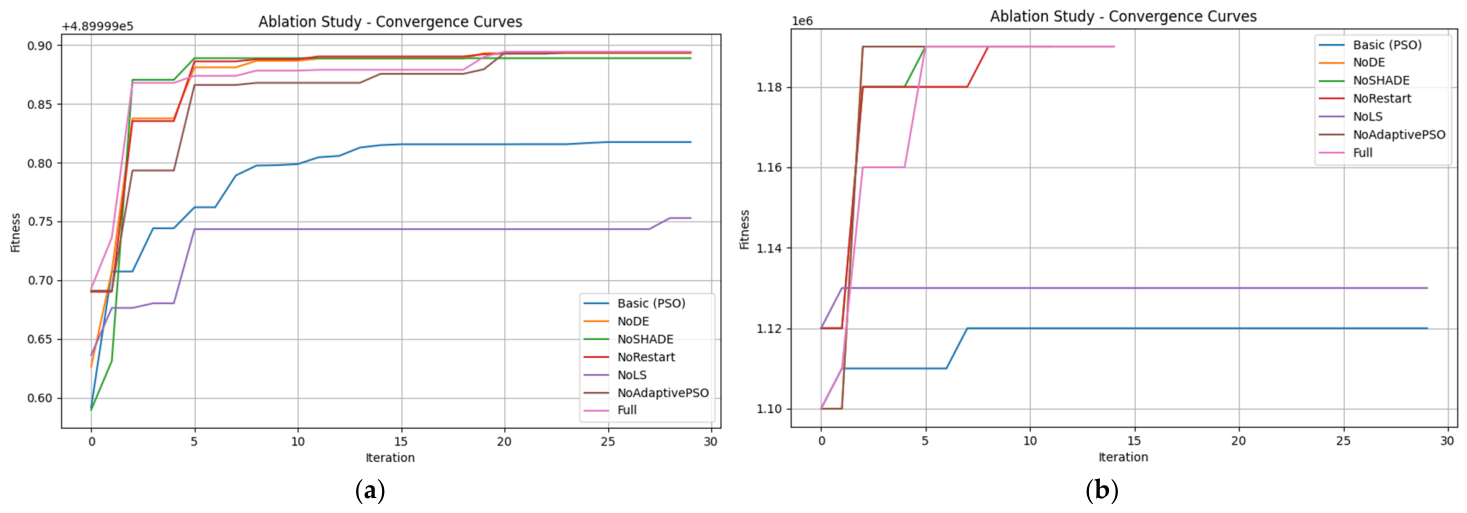
The ablation results of the algorithm and its six variants for medium- and high-complexity scenarios are presented in Table 4, with convergence curves shown in Figure 3.
We begin by examining the two components that most directly influence the solution quality: local search and DE mutation. The omission of local search (NoLS) causes the most severe performance degradation across all metrics. In medium-complexity scenarios, the rescue time increases from 0.13 h to 0.40 h and cost rises from 55,359 to 59,226; in high-complexity scenarios, the success rate drops from 98.97% to 93.20%, while fairness deteriorates to 12.24. These sharp declines confirm that multi-level local search is indispensable for refining promising regions into precise, high-quality solutions. Removing DE mutation (NoDE) produces a different pattern: solution quality remains competitive (indeed, NoDE slightly outperforms Full in time and cost in complex scenarios), but the runtime balloons to 1563 s—nearly double that of Full (921 s). This reveals that DE mutation alone can locate good solutions, yet it converges slowly without the velocity-guided acceleration provided by PSO. Thus, DE supplies the essential exploratory momentum, while PSO delivers the speed—a synergy whose absence is paid for in computational time.
Building on this foundation, the adaptive mechanisms and diversity control modules further refine the algorithm’s robustness. Disabling SHADE parameter adaptation (NoSHADE) or the restart mechanism (NoRestart) yields mixed outcomes. In simpler scenarios, fixed parameters prove to be adequate, and NoSHADE even exhibits a slightly shorter runtime (336 s vs. 437 s). In complex scenarios, however, the adaptive tuning of SHADE becomes advantageous: Full achieves a better balance between the rescue time (1.49 h) and fairness (5.30) compared to NoSHADE (1.56 h and 6.22). Similarly, the restart mechanism helps sustain population diversity in challenging landscapes—without it, NoRestart achieves marginally better isolated metrics but sacrifices overall robustness. Interestingly, the variant without adaptive PSO updates (NoAdaptivePSO) consistently yields the lowest cost (55,245 and 90,114), suggesting that DE mutation efficiently drives cost optimization, whereas the PSO velocity update introduces minor cost perturbations but markedly improves the convergence speed and stability.
Stepping back to assess the Full algorithm, AMS-PSO-NEW is not strictly optimal on any single metric but consistently delivers the most balanced and robust overall performance. In high-complexity scenarios, it attains the highest success rate (98.97%) while maintaining a competitive time (1.49 h) and cost (93,949), avoiding the extreme trade-offs observed in specialized variants. For instance, NoDE achieves a lower time and cost but at a prohibitive runtime; NoAdaptivePSO minimizes cost but sacrifices convergence speed. The Full algorithm’s equilibrium—prioritizing life-saving feasibility while preserving efficiency and fairness—demonstrates that the synergistic integration of all modules yields practical value that far exceeds the sum of their individual contributions. Notably, Full’s runtime (~921 s) remains comparable to other adaptive variants, confirming that the comprehensive module integration does not incur disproportionate computational overhead.

5.3. Comparative Experiments

5.3.1. Parameter Settings of Comparative Algorithms

To validate the effectiveness of the proposed AMS-PSO-NEW algorithm, nine representative optimization algorithms from diverse paradigms—including swarm intelligence, evolutionary computation, Reinforcement Learning, and mathematical programming—were selected for comparison. The parameter configurations and algorithm settings are detailed in Table 5.
All comparative algorithms were implemented with a uniform population size of 30 (except for MIP, which is a single-shot solver), a maximum of 50 iterations, and were executed on identical hardware. To ensure experimental fairness, all algorithms integrated the same constraint repair and path reconstruction modules, with a 600 s timeout limit returning the best-found solution upon timeout.

5.3.2. Comparative Algorithm Results

Detailed results for the six rescue scenarios are presented in Table 6 and Figure 3, Figure 4, Figure 5, Figure 6 and Figure 7, including four objectives (weighted success rate, average rescue time, total cost, and fairness) and the runtime. Success rate is reported as a percentage, time in hours, cost in monetary units, and fairness as the maximum rescue time difference (hours).
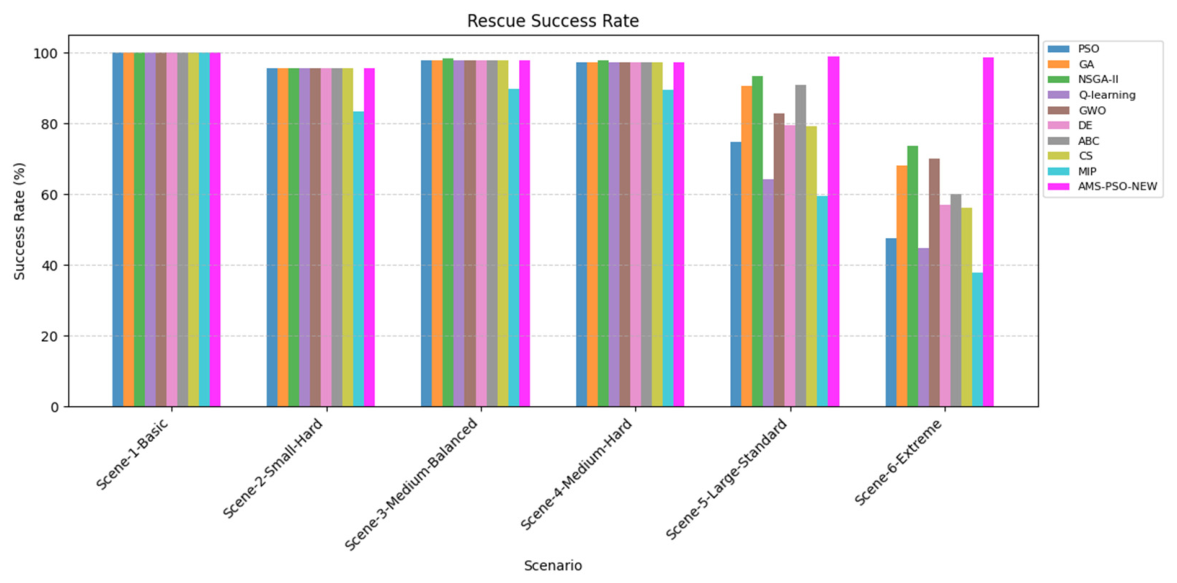
Figure 4 illustrates that AMS-PSO-NEW achieves success rates comparable to or slightly exceeding the best algorithms in Scenes 1–4, except for marginally lower rates than NSGA-II in Scene 3 and Scene 4 by 0.43% and 0.52%, respectively. In large-scale scenarios (Scene 5 and Scene 6), AMS-PSO-NEW attains outstanding success rates of 98.95% and 98.74%, significantly outperforming other methods. By contrast, PSO, GA, and GWO generally yield success rates below 75% in complex scenarios, while Q-learning and MIP exhibit rates under 65% due to limited global search capabilities. This shows that AMS-PSO-NEW’s multi-strategy hybrid mechanism and adaptive parameter tuning effectively address high-dimensional, strongly constrained rescue planning problems.
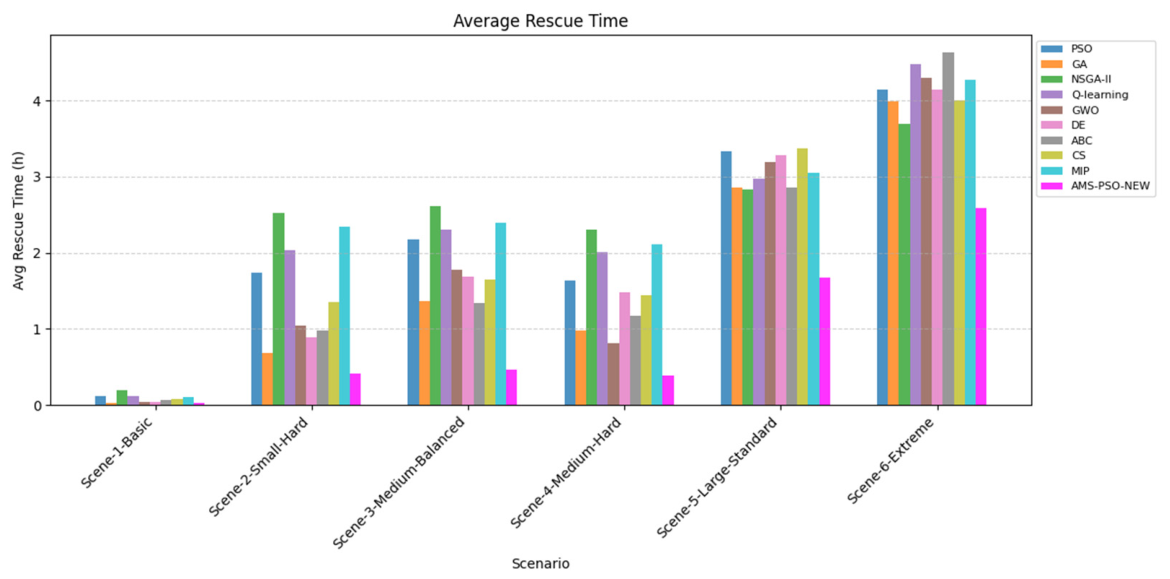
As shown in Figure 5, AMS-PSO-NEW consistently achieves the shortest average rescue times across all scenarios. Notably, in Scenes 3–5, its times are only one-third to one-half of the second-best algorithms; for example, in Scene 3, AMS-PSO-NEW requires 0.46 h versus 1.37 h for GA and 1.33 h for ABC. This advantage stems from the integrated elite local search and load balancing optimization, enabling fine-grained vehicle routing and task allocation that substantially reduces the transfer time.
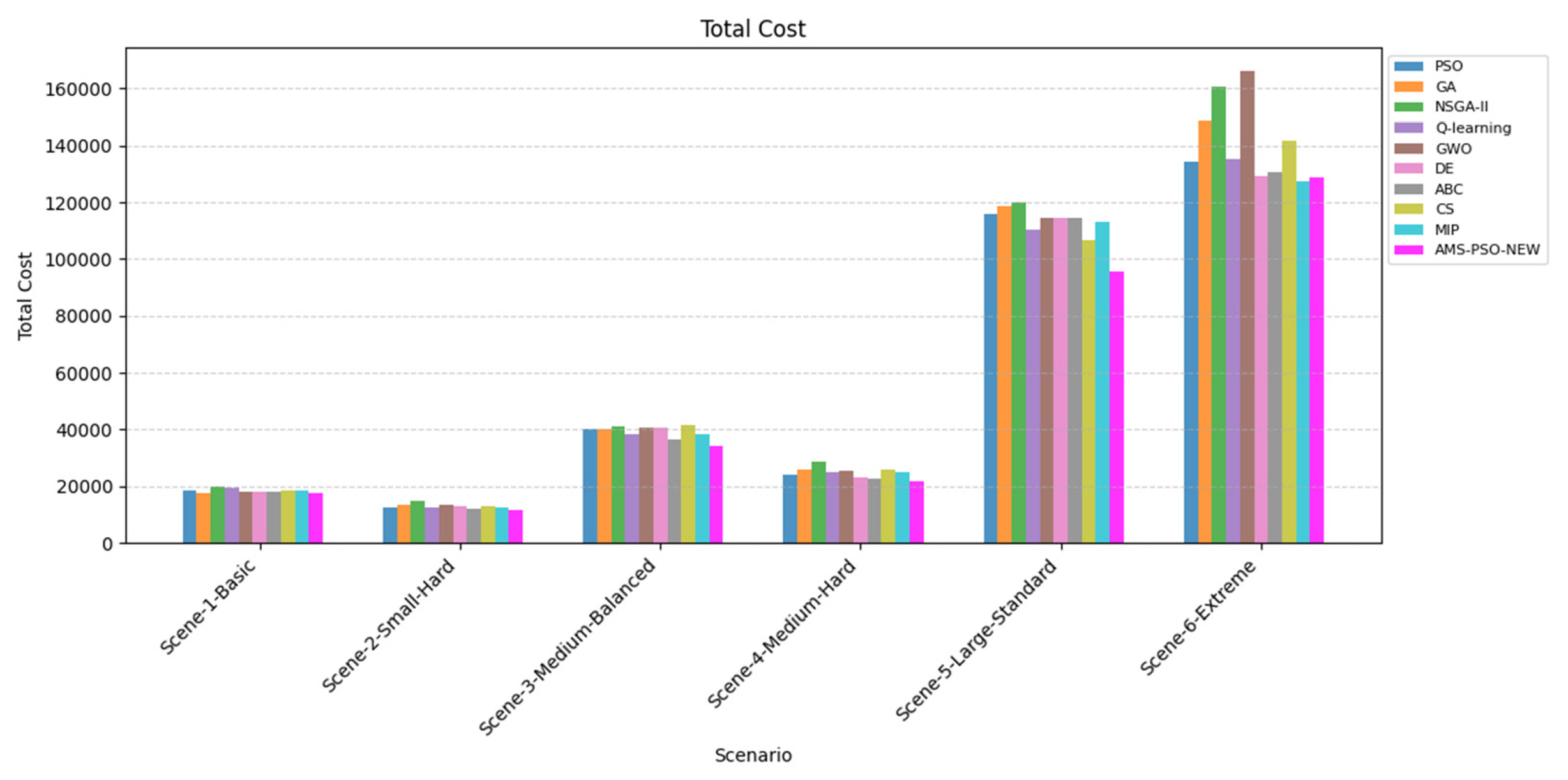
Figure 6 presents total cost results, where AMS-PSO-NEW attains the lowest costs in Scenes 1–5. Although its cost in Scene 6 is slightly higher than DE and MIP, it achieves over 40% higher success rates, demonstrating a favorable trade-off between cost and rescue effectiveness. Regarding fairness metrics, AMS-PSO-NEW ranks first or second in most scenarios, indicating balanced rescue times across survivors and the avoidance of extreme delays.
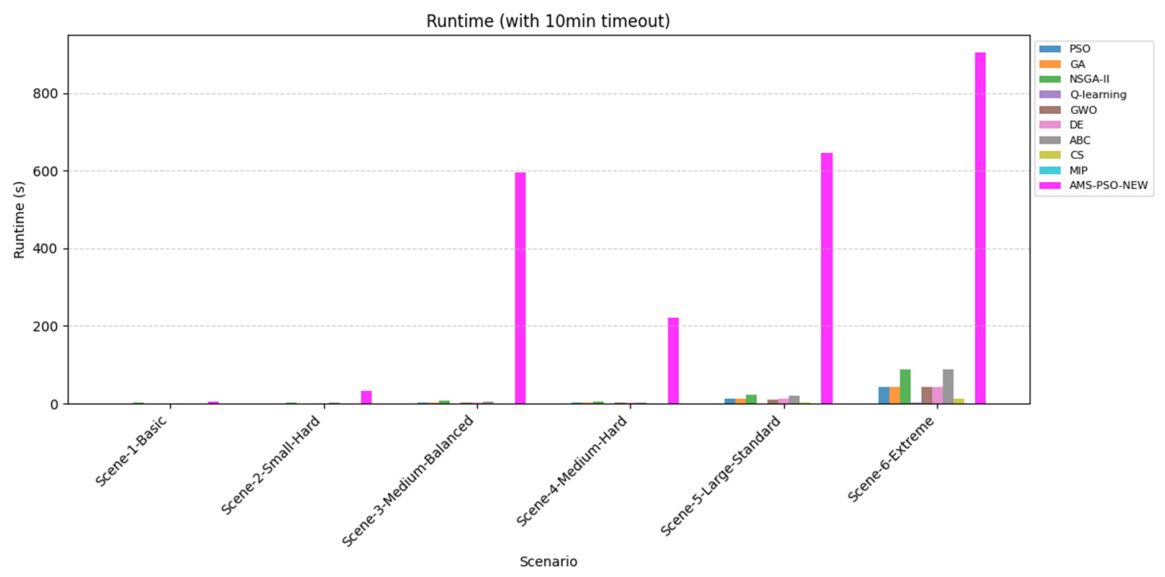
Figure 7 reveals that AMS-PSO-NEW’s runtime increases significantly with scenario scale, reaching 645 s and 904 s in Scenes 5 and 6, surpassing the timeout threshold. Nevertheless, it returns the best-found solution before timeout. Other algorithms complete 50 iterations within seconds to tens of seconds, reflecting their lower computational complexity. The increased runtime of AMS-PSO-NEW is attributed to its sophisticated local search and diversity monitoring modules, which incur higher per-iteration costs. Despite this, the method demonstrates high search efficiency under time constraints. Future improvements could include parallelization or reduced local search frequency to better balance efficiency and solution quality.
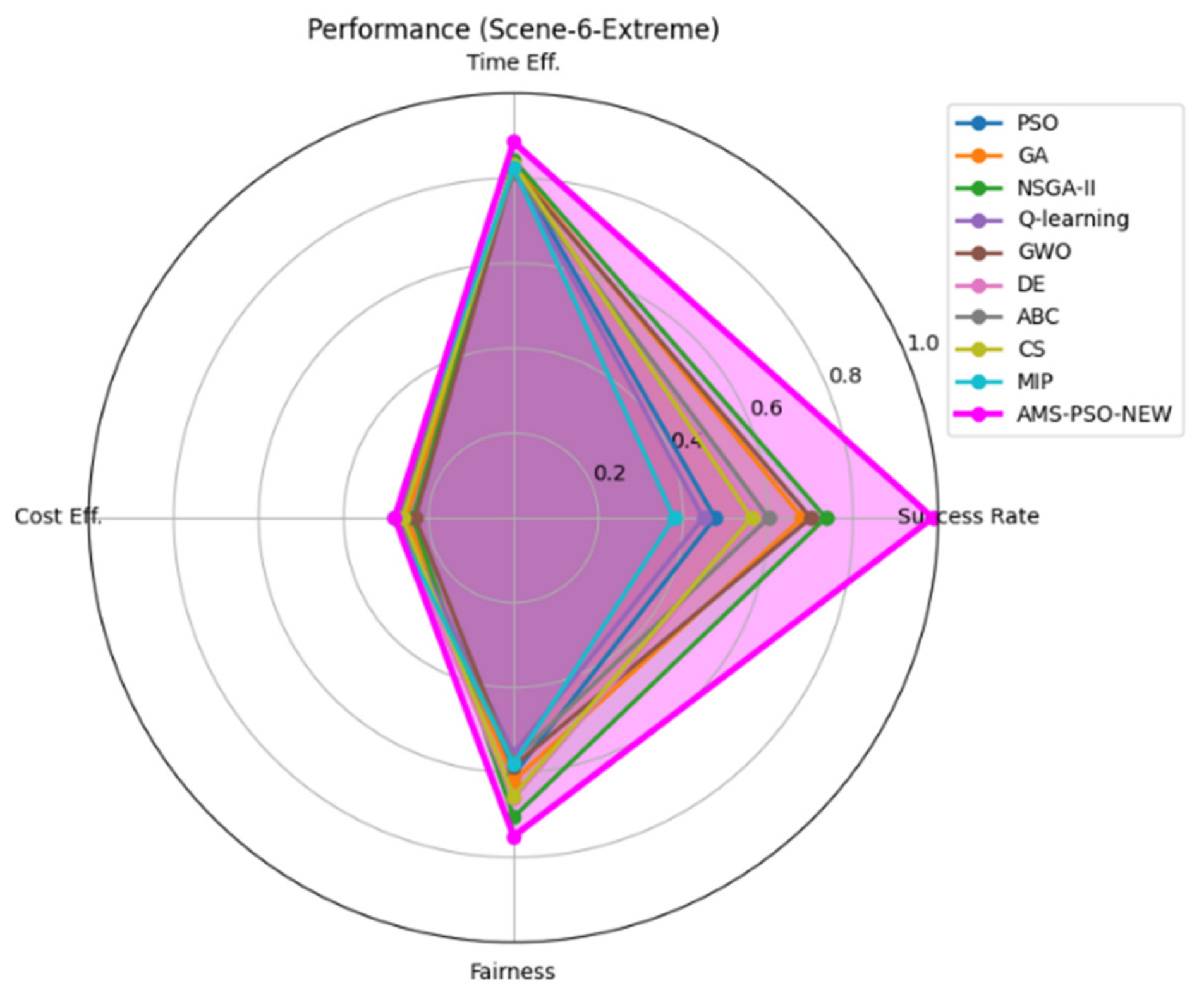
Figure 8 shows that AMS-PSO-NEW approaches or reaches the outermost layer across all four metrics, demonstrating a robust overall performance in extreme scenarios. Its superior success rate and fairness highlight its strengths in robustness and balance. Although somewhat time-consuming, AMS-PSO-NEW’s balanced radar profile under these conditions reflects a strong generalization ability.
Table 7 summarizes AMS-PSO-NEW’s average improvement percentages over comparative algorithms in the success rate, average rescue time, and total cost across six scenarios (with scenarios already at 100% success considered as no improvement). AMS-PSO-NEW achieves an average success rate increase of 22.6% (up to 59.6% over MIP), reduces the rescue time by 52.3%, and lowers the cost by 10.5%, thereby validating its comprehensive superiority.
The experimental results demonstrate that AMS-PSO-NEW outperforms comparative algorithms across most objectives, with pronounced advantages in large-scale, complex scenarios. Its success primarily stems from hybrid exploration mechanisms, adaptive parameter control, and multi-level local refinement. While the MIP solver can quickly obtain feasible solutions in small- to medium-scale problems, it fails to find feasible solutions in large-scale instances (Scenes 2–6) due to model explosion, highlighting the necessity of metaheuristics for handling complex constraints. Q-learning performs poorest in large-scale scenarios owing to simplistic state representation and low learning efficiency. Although NSGA-II achieves slightly higher success rates in some cases as a multi-objective algorithm, it generally lags behind AMS-PSO-NEW in time, cost, and fairness, indicating that single-objective hierarchical optimization is more effective for this problem.
In summary, AMS-PSO-NEW is an efficient and robust rescue path planning algorithm capable of providing high-quality decision support in real emergency responses. Here, “high-quality” refers specifically to solutions that satisfy three critical criteria: (i) guaranteed rescue of all survivors (f1 = 1), reflecting the non-negotiable priority of life preservation; (ii) minimal weighted rescue time (f2), which directly enhances survival probabilities for severely injured individuals; and (iii) balanced performance across operational cost (f3) and fairness (f4), avoiding extreme sacrifices in any single dimension—as visually confirmed by the radar chart in Figure 8. AMS-PSO-NEW consistently meets these stringent requirements, whereas competing algorithms often fail in at least one aspect, particularly in complex scenarios. It is worth noting, however, that this superior solution quality entails a longer average runtime of approximately 400–900 s, in contrast to under 10 s for most comparators. This trade-off between computational time and solution quality is acceptable given that the algorithm is intended for strategic pre-mission planning rather than real-time reactive control, where the benefits of a near-optimal rescue plan far outweigh the additional computation time.

5.3.3. Statistical Significance Analysis

To assess the statistical reliability and robustness of the observed performance improvements, we conducted 30 independent runs for all algorithms across two typical scenarios using different random seeds. Table 8 reports the mean and standard deviation of the four objective metrics and runtime for the two most challenging scenarios in Scene 5 and Scene 6.
The results presented in Table 8 provide strong evidence for the robustness and statistical reliability of AMS-PSO-NEW. First, with respect to the primary objective of rescue success, the proposed algorithm attains mean success rates of 99.02% and 96.67% in Scene 5 and Scene 6, respectively, accompanied by remarkably small standard deviations (0.10% and 3.30%). By comparison, the second-best algorithm (NSGA-II) reaches only 94.99% and 73.67%, while the exact MIP solver fails entirely in these large-scale instances—underscoring the necessity of metaheuristic approaches for such complex, constrained planning problems. Turning to operational efficiency, AMS-PSO-NEW reduces the average rescue time by approximately 46% in Scene 5 (1.57 h versus a range of 2.86–3.15 h for competitors) and by 26% in Scene 6 (2.77 h versus 3.72–4.10 h). These reductions are of direct practical significance, as shorter rescue times translate to higher survival probabilities in time-critical post-disaster operations. Furthermore, the algorithm consistently achieves the lowest total cost and the best fairness (i.e., the smallest disparity in rescue times among survivors), indicating that the secondary objectives are not sacrificed in pursuit of feasibility—a hallmark of well-balanced multi-objective optimization. Finally, regarding computational effort, the enhanced solution quality of AMS-PSO-NEW entails a higher runtime (approximately 1000 s). Given that the algorithm is intended for strategic, pre-mission planning rather than real-time reactive control, this trade-off is entirely acceptable. In contrast, simpler algorithms such as GA and PSO terminate within 10–40 s but deliver a markedly inferior rescue performance, confirming that the additional computational investment yields substantial practical returns.
In addition, the MIP solver (OR-Tools CP-SAT) failed to find any feasible solution in Scene 5 and Scene 6 within the 600 s time limit. This is expected, because the exact combinatorial model explodes in size for large-scale instances (120–200 survivors, 26–32 vehicles), making it intractable for exact methods. This observation reinforces the practical necessity of metaheuristic approaches like AMS-PSO-NEW for real-world post-disaster rescue planning.
Furthermore, to determine whether the observed improvements are statistically significant, we performed Mann–Whitney U tests comparing AMS-PSO-NEW against the second-best algorithm (NSGA-II) on the two primary metrics: success rate and rescue time. The results are summarized in Table 9.
The Mann–Whitney U statistic quantifies the degree of separation between the two distributions. The extremely low p-values (all < 0.0001) confirm that the superior performance of AMS-PSO-NEW in high-complexity scenarios is statistically highly significant and not attributable to random variation. The large U-statistics for success rate (814.5 and 900.0) indicate a substantial stochastic dominance of AMS-PSO-NEW over NSGA-II, while the U-statistics of 0.0 and 3.0 for the rescue time demonstrate an almost complete separation of the two distributions (AMS-PSO-NEW consistently achieves shorter rescue times).
In sum, the 30-run statistical analysis confirms that AMS-PSO-NEW not only achieves the best mean performance across all metrics but also exhibits remarkable stability (low standard deviations) and statistically significant superiority (p < 0.0001) over state-of-the-art algorithms. The algorithm’s robust performance in the most challenging scenarios validates its effectiveness for large-scale, multi-terrain post-disaster relay rescue planning.

6. Conclusions

This paper proposes AMS-PSO-NEW, an adaptive multi-strategy Particle Swarm Optimization algorithm for multi-terrain post-disaster relay rescue path planning. By integrating differential evolution’s multi-strategy mutation, SHADE-based parameter adaptation, diversity monitoring with restart, and multi-level local search, the algorithm dynamically balances exploration and exploitation. Comparative experiments across six scenarios of varying scale demonstrate consistent superiority over nine benchmark algorithms in key metrics including the rescue success rate, average rescue time, and fairness, with particularly significant improvements in high-complexity settings. Future work will proceed in three principal directions. First, we plan to explore Pareto front-based multi-objective optimization frameworks to handle trade-offs among objectives more explicitly. Second, parallel implementations will be investigated to reduce computational time and accommodate larger-scale practical problems involving real road networks and additional constraints. Finally, a more rigorous investigation into computational budget allocation is warranted. It is worth noting that the computational budget (e.g., maximum generations or time) is a key factor in fair comparisons. While algorithms like GA or PSO could be allocated larger population sizes within the same time limit, their performance gains may be marginal if the core search mechanism suffers from premature convergence. A future study could therefore tune the computational budget for each algorithm to its ‘best-effort’ level, ensuring that all methods fully utilize the allotted time window.

Author Contributions

Conceptualization, J.Z. and S.P.; methodology, J.Z.; software, S.P.; validation, X.R., G.N. and Y.D.; formal analysis, Y.Z.; investigation, Y.D.; resources, Y.Z.; data curation, S.P.; writing—original draft preparation, J.Z.; writing—review and editing, G.N. and Y.Z.; visualization, Y.Z.; supervision, Y.Z. and G.N.; project administration, J.Z.; funding acquisition, J.Z. All authors have read and agreed to the published version of the manuscript.

Funding

This research was funded by [Xuzhou Science and Technology Plan Modern Agriculture Project and National Natural Science Foundation of China] grant number [KC23133 and 62563001] And The APC was funded by [Xuzhou Science and Technology Plan Modern Agriculture Project].

Institutional Review Board Statement

Not applicable.

Informed Consent Statement

Not applicable.

Data Availability Statement

The data that support the findings of this study are available from the corresponding author upon reasonable request.

Acknowledgments

We would like to thank the anonymous reviewers for their insightful comments, and the editorial team of Applied Sciences for their professional handling.

Conflicts of Interest

The authors declare no conflicts of interest.

References

  1. Rebecca, L.J.; Debarati, G.S.; Sandy, T. Human and economic impacts of natural disasters: Can we trust the global data? Sci. Data 2022, 9, 572. [Google Scholar] [CrossRef]
  2. National Bureau of Statistics. China Statistical Yearbook 2025; China Statistics Press: Beijing, China, 2025. Available online: https://www.stats.gov.cn/sj/ndsj/2025/indexch.htm (accessed on 12 March 2026).
  3. Zhang, X.; Xu, J.; Chen, T. Research status and development trend of rescue equipment for major natural disasters. Sci. Technol. Eng. 2021, 21, 10552–10565. (In Chinese) [Google Scholar]
  4. Leong, W.Y. Drone Swarms for Post-Disaster Search and Rescue in Remote and Inaccessible Areas. In 2025 IEEE 13th Region 10 Humanitarian Technology Conference (R10-HTC), Ichikawa, Japan; IEEE: New York, NY, USA, 2025; pp. 351–356. [Google Scholar]
  5. Brooke, K. A review of smart vehicles in smart cities: Dangers, impacts, and the threat landscape. Veh. Commun. 2025, 51, 100871. [Google Scholar] [CrossRef]
  6. El Debeiki, M.; Al-Rubaye, S.; Perrusquía, A.; Conrad, C.; Flores-Campos, J.A. An Advanced Path Planning and UAV Relay System: Enhancing Connectivity in Rural Environments. Future Internet 2024, 16, 89. [Google Scholar] [CrossRef]
  7. Bin, H.; Guo, P. Low-cost safe path planning and exit scheduling of multi-UAV aerial refueling based on swarm intelligence. Swarm Evol. Comput. 2026, 101, 102293. [Google Scholar] [CrossRef]
  8. Woeginger, G.J. Exact Algorithms for NP-Hard Problems: A Survey. In Combinatorial Optimization—Eureka, You Shrink! Jünger, M., Reinelt, G., Rinaldi, G., Eds.; Lecture Notes in Computer Science; Springer: Berlin/Heidelberg, Germany, 2003; Volume 2570. [Google Scholar] [CrossRef]
  9. Izquierdo-Monge, O.; Bonilla, A.Z.V.; Lafuente-Cacho, M. Heuristic method for electric vehicle charging in a Spanish microgrid: Leveraging renewable energy surplus. J. Power Sources 2025, 629, 235945. [Google Scholar] [CrossRef]
  10. Wang, Q.; Li, H.; Zhang, W. Surrogate-assisted evolutionary algorithm with adaptive local region search for high-dimensional expensive multi-objective optimization problems. Swarm Evol. Comput. 2026, 100, 102232. [Google Scholar] [CrossRef]
  11. Zhou, T.; Niu, Y.; Lu, H. Transformer Optimization Algorithm for selecting Tokens based on genetic Algorithm. Appl. Soft Comput. 2026, 190, 114632. [Google Scholar] [CrossRef]
  12. He, Z.; Zhang, Z.; Chen, S. Mathematical modelling and an effective algorithm for unidirectional loop layout problem with fixed loading and unloading points. Comput. Oper. Res. 2026, 190, 107410. [Google Scholar] [CrossRef]
  13. Mourão, F.P.; Sá, E.M.; Souza, S.R. A Tabu Search algorithm for the single source capacitated partial set covering location problem. J. Heuristics 2026, 32, 10. [Google Scholar] [CrossRef]
  14. Geng, N.; Meng, Q.; Gong, D.; Chung, P.W.H. How Good are Distributed Allocation Algorithms for Solving Urban Search and Rescue Problems? A Comparative Study with Centralized Algorithms. IEEE Trans. Autom. Sci. Eng. 2019, 16, 478–485. [Google Scholar] [CrossRef]
  15. Ren, X.; Geng, N.; Zhang, Y.; Xiao, L.; Gong, D. PG-ITD3: A Potential Field-Guided Deep Reinforcement Learning Approach for UAV Path Planning After Disaster. IEEE Trans. Autom. Sci. Eng. 2025, 22, 20221–20233. [Google Scholar] [CrossRef]
  16. Sun, F.L.; Tang, X.K.; Dong, Z.H.; Gan, X.J.; Luo, P.; Sun, J. ACO+PSO+A*: A bi-layer hybrid algorithm for multi-task path planning of an AUV. Comput. Ind. Eng. 2023, 175, 108905. [Google Scholar]
  17. Zhao, H.; Gu, M.; Qiu, S. Dynamic path planning for space-time optimization cooperative tasks of multiple unmanned aerial vehicles in uncertain environment. IEEE Trans. Consum. Electron. 2025, 71, 7673–7682. [Google Scholar] [CrossRef]
  18. Wang, Z.; Lyu, X.; Zhang, J. MAC-Planner: A novel task allocation and path planning framework for multi-robot online coverage processes. IEEE Robot. Autom. Lett. 2025, 10, 4404–4411. [Google Scholar] [CrossRef]
  19. Su, Y.; Xin, J.; Sun, C. Dynamic path planning for mobile robots based on improved RRT* and DWA algorithms. IEEE Trans. Ind. Electron. 2025, 72, 10595–10604. [Google Scholar] [CrossRef]
  20. Yang, L.; Zhang, X.; Li, Z. A LODBO algorithm for multi-UAV search and rescue path planning in disaster areas. Chin. J. Aeronaut. 2025, 38, 103301. [Google Scholar] [CrossRef]
  21. Adam, M.S.; Abdullah, N.F.; Abu-Samah, A. Advanced path planning for UAV swarms in smart city disaster scenarios using hybrid metaheuristic algorithms. Drones 2025, 9, 64. [Google Scholar] [CrossRef]
  22. Adnan, M.H. Path planning for multi-UAV-assisted mobile edge computing framework using reinforcement learning in urban environment disaster scenarios. Ad Hoc Netw. 2025, 178, 103928. [Google Scholar] [CrossRef]
  23. Li, J.; Xiong, Y.; She, J. Optimal path planning for unmanned aerial vehicles with multiple round-trip flights in coverage tasks. Robot. Auton. Syst. 2025, 189, 104970. [Google Scholar] [CrossRef]
  24. Yang, J.; Lu, X.; Cui, M. Disaster Relief Coverage Path Planning for Fixed-Wing UAV Based on Multi-Selector Genetic Algorithm and Reinforcement Learning. Aerospace 2026, 13, 192. [Google Scholar] [CrossRef]
  25. Thangavelu, S.; Nagarajan, L.; Narendran, A. Hybrid PSO-SA Algorithm for Efficient 3D Path Planning of UAVs. In Artificial Intelligence in Instrumentation Control and Automation; Scrivener Publishing: Beverly, MA, USA, 2026; pp. 535–556. [Google Scholar] [CrossRef]
  26. Zhang, X.; Tan, L.; Chai, J. Direction aware and self-adaptive A* algorithm with PPO heuristic for UAV path planning of smart city. Sci. Rep. 2026, 16, 6174. [Google Scholar] [CrossRef] [PubMed]
  27. Na, G.; Zhi, C.; Nguyen, Q.A. Particle swarm optimization algorithm for the optimization of rescue task allocation with uncertain time constraints. Complex Intell. Syst. 2021, 7, 873–890. [Google Scholar] [CrossRef]
  28. Wang, X.; Chen, G. Multi-Strategy Enhanced PSO for UAV Path Planning in Post-Disaster Scenarios. In 2025 5th International Conference on Electronic Information Engineering and Computer Science (EIECS). Changchun, China; IEEE: New York, NY, USA, 2025; pp. 59–62. [Google Scholar] [CrossRef]
  29. Wu, J.; Sun, Y.; Bi, J. A novel hybrid enhanced particle swarm optimization for UAV path planning. IEEE Trans. Veh. Technol. 2025, 74, 11806–11819. [Google Scholar] [CrossRef]
  30. Sun, Q.; Chen, Q.H.; Ren, X.H.; Pang, S.Q.; Zhu, C.K.; Geng, N. Confidence-driven multi-objective PSO for post-disaster UAV task allocation considering rescue deadline and energy consumption. J. Renew. Sustain. Energy 2026, 18, 025702. [Google Scholar] [CrossRef]
Figure 1. Multi-terrain, multi-vehicle rescue illustration.
Applsci 16 04748 g001
Figure 2. Information flow among the core modules.
Applsci 16 04748 g002
Figure 3. Algorithm convergence curves: (a) scenario 1; (b) scenario 2.
Applsci 16 04748 g003
Figure 4. Comparison of rescue success rates among nine algorithms.
Applsci 16 04748 g004
Figure 5. Comparison of average rescue time among nine algorithms.
Applsci 16 04748 g005
Figure 6. Comparison of cost among nine algorithms.
Applsci 16 04748 g006
Figure 7. Comparison of CPU runtime among nine algorithms.
Applsci 16 04748 g007
Figure 8. Radar chart comparing metrics of nine algorithms in Scenario 6.
Applsci 16 04748 g008
Table 1. Information about the six scenarios.
ScenarioNumber of TerrainsNumber of SurvivorsNumber of VehiclesArea (km2)Pressure Ratio
Scene 1—Basic520104000.8
Scene 2—Small Hard103074003.0
Scene 3—Medium Balanced15601616001.5
Scene 4—Medium Hard2050109002.5
Scene 5—Large Standard301203264001.5
Scene 6—Extreme502002610,0003.08
Table 2. Environment settings.
ParameterVehiclesDescription
Sbasehelicoptercruising speed 180–220 km/h
ambulance60 km/h in urban roads, up to 100 km/h on highways, average 80 km/h
off-road vehicle30–60 km/h on rough terrain, average 50 km/h
rescue robotwalking speed 5–10 km/h, wheeled speed 20 km/h
δterraingrasshelicopter: 0.1; ambulance: 0.3; off-road vehicle: 0.2; rescue robot: 0.15
mountainhelicopter: 0.15; ambulance: 0.6; off-road vehicle: 0.3; rescue robot: 0.25
roadhelicopter: 0.05; ambulance: 0.05; off-road vehicle: 0.15; rescue robot: 0.1
riverhelicopter: 0.2; ambulance: 0.9; off-road vehicle: 0.5; rescue robot: 0.3
sandhelicopter: 0.1; ambulance: 0.5; off-road vehicle: 0.25; rescue robot: 0.2
Rijv0impassable
0.3forced passable but extremely slow and risky
1normal passable
Table 3. Comparative algorithms and strategy descriptions.
AlgorithmsDescription
Basic (PSO)Retains only adaptive PSO updates (equivalent to a standard PSO variant), excluding DE, SHADE, restart, and local search.
NoDERemoves multi-strategy differential evolution (DE) mutation.
NoSHADEEliminates SHADE parameter adaptation; fixes F = 0.5, CR = 0.9, and uniform strategy probabilities.
NoRestartDisables diversity monitoring and restart mechanisms.
NoLSOmits all local search methods, including standard elite search, intensified search, and load balancing optimization.
NoAdaptivePSORemoves adaptive PSO updates, retaining only multi-strategy DE mutation.
Full(AMS-PSO-NEW)The complete algorithm proposed in this paper integrates all of these components.
Table 4. Ablation study comparison results.
ScenarioVariantSuccess Rate (%)Average Time (h)CostFairness (h)Running Time (s)
Scenario 1:
10 terrains
80 survivors
30 vehicles
Basic (PSO)98.410.3157,2023.838.69
NoDE98.410.1355,3393.83974.55
NoSHADE98.410.1355,5303.71335.78
NoRestart98.410.1355,8563.71396.34
NoLS98.410.4059,2263.8310.98
NoAdaptivePSO98.410.1355,2453.71395.58
Full98.410.1355,3593.83436.62
Scenario 2:
20 terrains
120 survivors
32 vehicles
Basic (PSO)91.962.04107,0598.4225.06
NoDE98.971.4093,1435.301563.24
NoSHADE98.971.5690,2336.22866.16
NoRestart98.971.4191,9184.97736.38
NoLS93.202.17103,67412.2427.63
NoAdaptivePSO98.971.4090,1145.30936.42
Full98.971.4993,9495.30921.53
Table 5. Comparison algorithm settings.
AlgorithmSettings
PSO (Standard Particle Swarm Optimization)Uses linearly decreasing inertia weight; velocity and position updated based on individual and global bests.
GA (Genetic Algorithm)Employs tournament selection, single-point crossover, uniform mutation, and elitism preservation.
NSGA-II (Non-dominated Sorting Genetic Algorithm II)Multi-objective evolutionary algorithm based on Pareto dominance for evaluating multi-objective handling.
Q-learning (Reinforcement Learning)Models survivor allocation as a Markov Decision Process; state represents vehicle load distribution; and action adjusts allocation of a single survivor.
GWO (Gray Wolf Optimizer)Simulates gray wolf social hierarchy and hunting behavior; population update guided by alpha, beta, and delta wolves.
DE (Differential Evolution)Uses DE/rand/1/bin strategy with scaling factor F = 0.5 and crossover probability CR = 0.9.
ABC (Artificial Bee Colony)Comprises employed, onlooker, and scout bee phases; neighborhood search via swapping allocations of two survivors.
CS (Cuckoo Search)Generates new solutions via Lévy flights; discovery probability pa = 0.25.
MIP (Mixed Integer Programming)Formulates integer program minimizing weighted travel time solved by OR-Tools CP-SAT solver with a 600 s timeout.
Table 6. Performance comparison of nine algorithms across six scenarios. (★ indicates AMS-PSO-NEW; bold highlights the best value for each metric—success rate, time, cost, and fairness).
ScenarioAlgorithmSuccess Rate (%)Average Time (h)CostFairness (h)Running Time (s)Running State
Scene 1:
Small basic
PSO100.000.1118,5711.180.44OK
GA100.000.0317,7680.250.46OK
NSGA-II100.000.1919,9650.672.54OK
Q-learning100.000.1219,4480.620.01OK
GWO100.000.0417,9010.310.51OK
DE100.000.0418,0560.280.44OK
ABC100.000.0617,8710.351.19OK
CS100.000.0818,6780.660.17OK
MIP100.000.1018,5900.650.04OK
AMS-PSO-NEW ★100.000.0317,7150.225.32OK
Scene 2:
Small hard
PSO95.651.7412,3173.820.83OK
GA95.650.6813,2093.280.78OK
NSGA-II95.652.5214,5976.663.25OK
Q-learning95.652.0312,5303.870.03OK
GWO95.651.0513,5343.620.89OK
DE95.650.8813,0183.780.80OK
ABC95.650.9712,0683.091.50OK
CS95.651.3612,8813.550.23OK
MIP83.482.3512,2475.770.08OK
AMS-PSO-NEW ★95.650.4211,3483.7133.43OK
Scene 3:
Medium balanced
PSO97.862.1840,0385.922.37OK
GA97.861.3740,3643.442.42OK
NSGA-II98.292.6141,24511.356.36OK
Q-learning97.862.3138,4615.440.07OK
GWO97.861.7740,5824.503.12OK
DE97.861.6940,8386.803.17OK
ABC97.861.3336,6833.355.06OK
CS97.861.6541,4546.740.77OK
MIP89.742.3938,5295.450.19OK
AMS-PSO-NEW ★97.860.4634,0941.93596.72OK
Scene 4:
Medium hard
PSO97.401.6423,8204.191.94OK
GA97.400.9826,0403.801.72OK
NSGA-II97.922.3028,8269.625.63OK
Q-learning97.402.0124,9615.370.05OK
GWO97.400.8125,4303.952.09OK
DE97.401.4823,0255.092.01OK
ABC97.401.1722,5113.763.56OK
CS97.401.4425,8674.540.48OK
MIP89.582.1124,7617.160.12OK
AMS-PSO-NEW ★97.400.3821,5193.25220.07OK
Scene 5:
Large standard
PSO74.793.33116,0288.7811.51OK
GA90.552.86118,7889.0111.35OK
NSGA-II93.492.84119,9678.0522.50OK
Q-learning64.292.98110,13914.210.32OK
GWO82.983.19114,5398.8711.09OK
DE79.623.28114,37915.1411.45OK
ABC90.972.86114,6938.4721.02OK
CS79.203.37106,87310.453.13OK
MIP59.453.06113,00013.590.54OK
AMS-PSO-NEW ★98.951.6795,5075.80645.56Timeout
Scene 6:
Extreme
PSO47.484.15134,12813.0743.16OK
GA68.014.00148,80712.2943.11OK
NSGA-II73.553.70160,8238.3586.87OK
Q-learning44.714.48135,49616.061.36OK
GWO70.034.29166,06414.1741.80OK
DE56.934.14129,22510.2741.80OK
ABC60.084.63130,67915.0288.24OK
CS56.054.00141,62110.5511.48OK
MIP37.784.27127,34914.500.88OK
AMS-PSO-NEW ★98.742.58128,6276.65904.06Timeout
Note: “Timeout” in the “Running State” column indicates that the execution was terminated upon exceeding the 600 s time limit, and the best solution found up to that point was recorded. The reported runtime includes minor overhead for finalization procedures.
Table 7. Average improvement percentage of AMS-PSO-NEW over comparative algorithms.
Metricsvs. PSOvs. GAvs. NSGA IIvs. Q-Learningvs. GWOvs. DEvs. ABCvs. CSvs. MIP
Success rate+23.5%+7.1%+6.49%+29.10%+10.7%+19.0%+13.4%+18.8%+59.6%
Average rescue time−53.8%−44.9%−67.48%−66.98%−52.0%−51.7%−51.4%−55.1%−61.4%
Cost−9.2%−12.2%−19.44%−10.31%−13.4%−8.4%−5.1%−10.8%−7.9%
Table 8. Statistical comparison for Scene 5 and Scene 6 over 30 independent runs (mean ± standard deviation). (★ indicates AMS-PSO-NEW; bold highlights the best value for each metric—success rate, time, cost, and fairness).
ScenarioAlgorithmSuccess (%)Time (h)CostFairness (h)Runtime (s)
Scene 5PSO75.98 ± 5.783.03 ± 0.18113,307 ± 558811.32 ± 1.9611.62 ± 0.98
GA91.57 ± 4.012.91 ± 0.26117,469 ± 63398.59 ± 1.3411.02 ± 0.99
NSGA-II94.99 ± 2.672.93 ± 0.22119,814 ± 64399.98 ± 1.5923.67 ± 2.11
Q-learning71.10 ± 5.643.04 ± 0.25113,308 ± 545711.24 ± 1.890.36 ± 0.07
GWO84.38 ± 5.293.04 ± 0.21114,142 ± 560510.16 ± 2.0211.75 ± 0.99
DE79.48 ± 4.413.15 ± 0.19113,503 ± 668411.00 ± 2.3512.26 ± 1.07
ABC90.53 ± 3.222.86 ± 0.24108,959 ± 532810.43 ± 1.5420.94 ± 1.70
CS80.29 ± 4.773.07 ± 0.24113,025 ± 594311.05 ± 1.803.19 ± 0.36
MIP0.00 ± 0.000.51 ± 0.06
AMS-PSO-NEW ★99.02 ± 0.101.57 ± 0.1295,071 ± 21465.23 ± 0.581040.71 ± 247.80
Scene 6PSO45.54 ± 3.744.10 ± 0.38144,817 ± 866412.86 ± 1.9741.38 ± 2.49
GA65.89 ± 4.393.92 ± 0.25157,325 ± 825612.48 ± 1.4041.33 ± 1.87
NSGA-II73.67 ± 4.093.91 ± 0.23167,043 ± 676211.93 ± 1.4983.63 ± 4.06
Q-learning40.11 ± 5.274.10 ± 0.35141,707 ± 918312.99 ± 1.681.39 ± 0.14
GWO70.36 ± 4.953.83 ± 0.20159,936 ± 845611.35 ± 1.6942.12 ± 1.92
DE57.32 ± 3.893.72 ± 0.31143,696 ± 631212.16 ± 1.7542.47 ± 1.71
ABC57.44 ± 4.583.99 ± 0.35133,405 ± 709112.15 ± 2.2181.98 ± 4.23
CS50.21 ± 3.664.04 ± 0.26148,168 ± 787812.19 ± 1.7611.63 ± 0.81
MIP0.00 ± 0.000.79 ± 0.06
AMS-PSO-NEW ★96.67 ± 3.302.77 ± 0.33125,093 ± 72027.78 ± 1.51962.30 ± 295.39
Table 9. Mann–Whitney U test results for Scene 5 and Scene 6 (AMS-PSO-NEW vs. NSGA-II).
ScenarioMetricU-Statisticp-Value
Scene 5Success Rate814.5<0.0001
Rescue Time0.0<0.0001
Scene 6Success Rate900.0<0.0001
Rescue Time3.0<0.0001
Disclaimer/Publisher’s Note: The statements, opinions and data contained in all publications are solely those of the individual author(s) and contributor(s) and not of MDPI and/or the editor(s). MDPI and/or the editor(s) disclaim responsibility for any injury to people or property resulting from any ideas, methods, instructions or products referred to in the content.