Wearable Technologies in Occupational Safety and Health: A Systematic Review and a Human-Centered Implementation Model
 , ,
, ,  , ,
, ,  and
and
Featured Application
Abstract
1. Introduction
2. Background
2.1. Multimodal Sensing in OSH
2.2. AI and Predictive Analytics for Proactive Risk Prevention
2.3. Human Factors and Implementation Barriers
3. Materials and Methods
3.1. Methodological Approach
3.2. Data Sources and Search Strategy
3.3. Inclusion and Exclusion Criteria
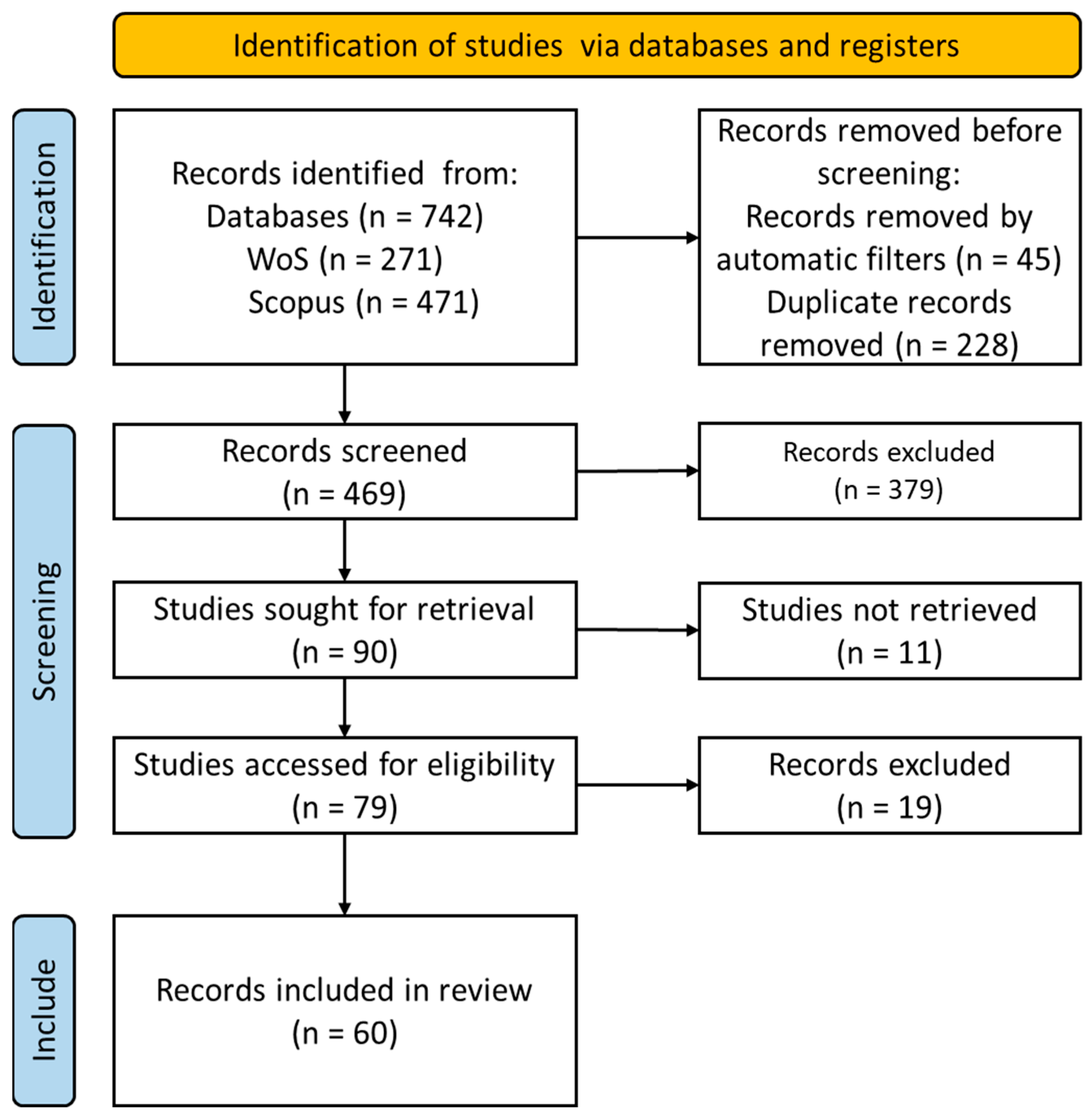
3.4. Data Selection and Extraction Process
3.5. Evaluation of the Methodological Quality of the Included Studies
4. Results
4.1. Analysis of Included Studies
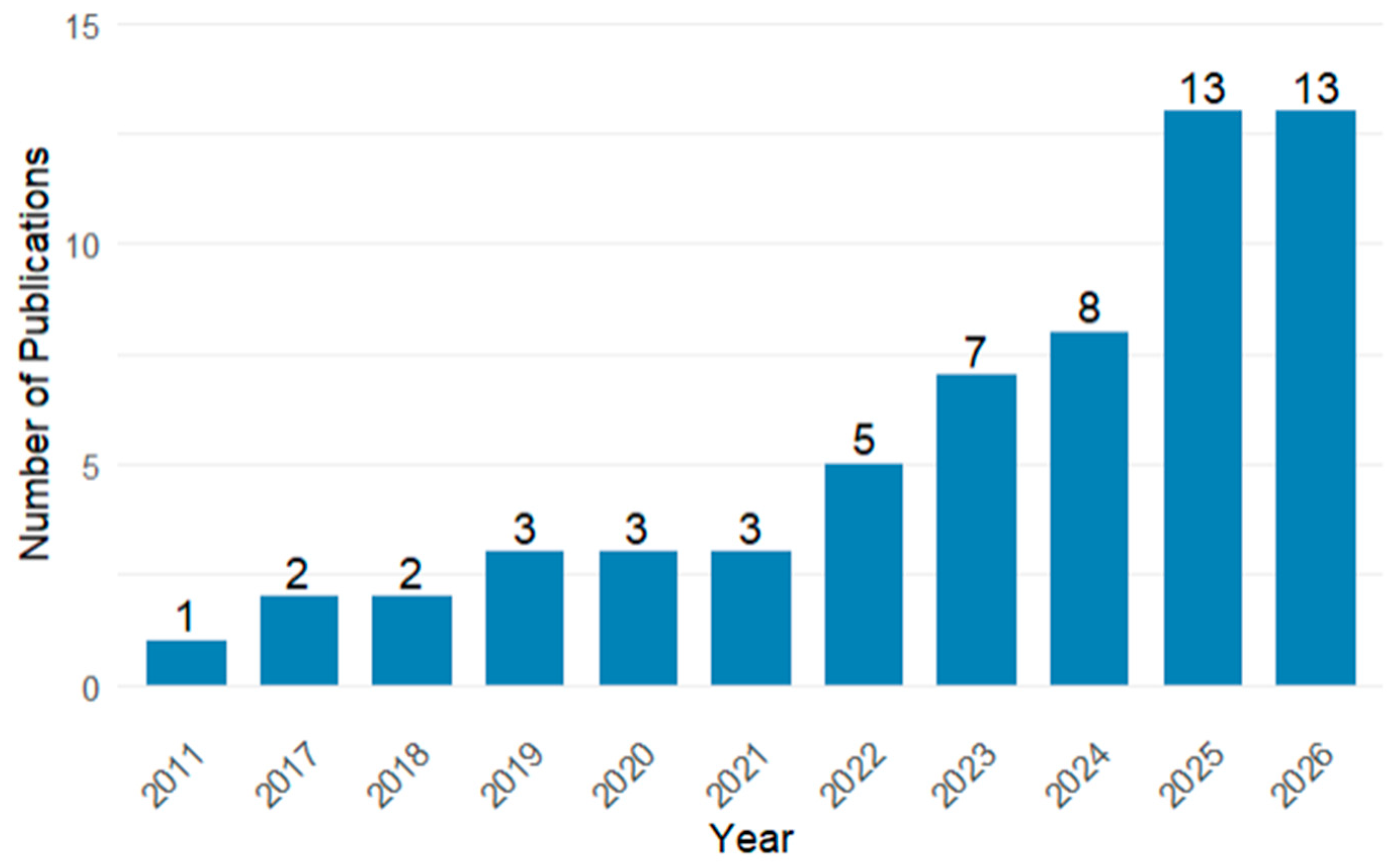
4.2. Temporal Distribution of Publications
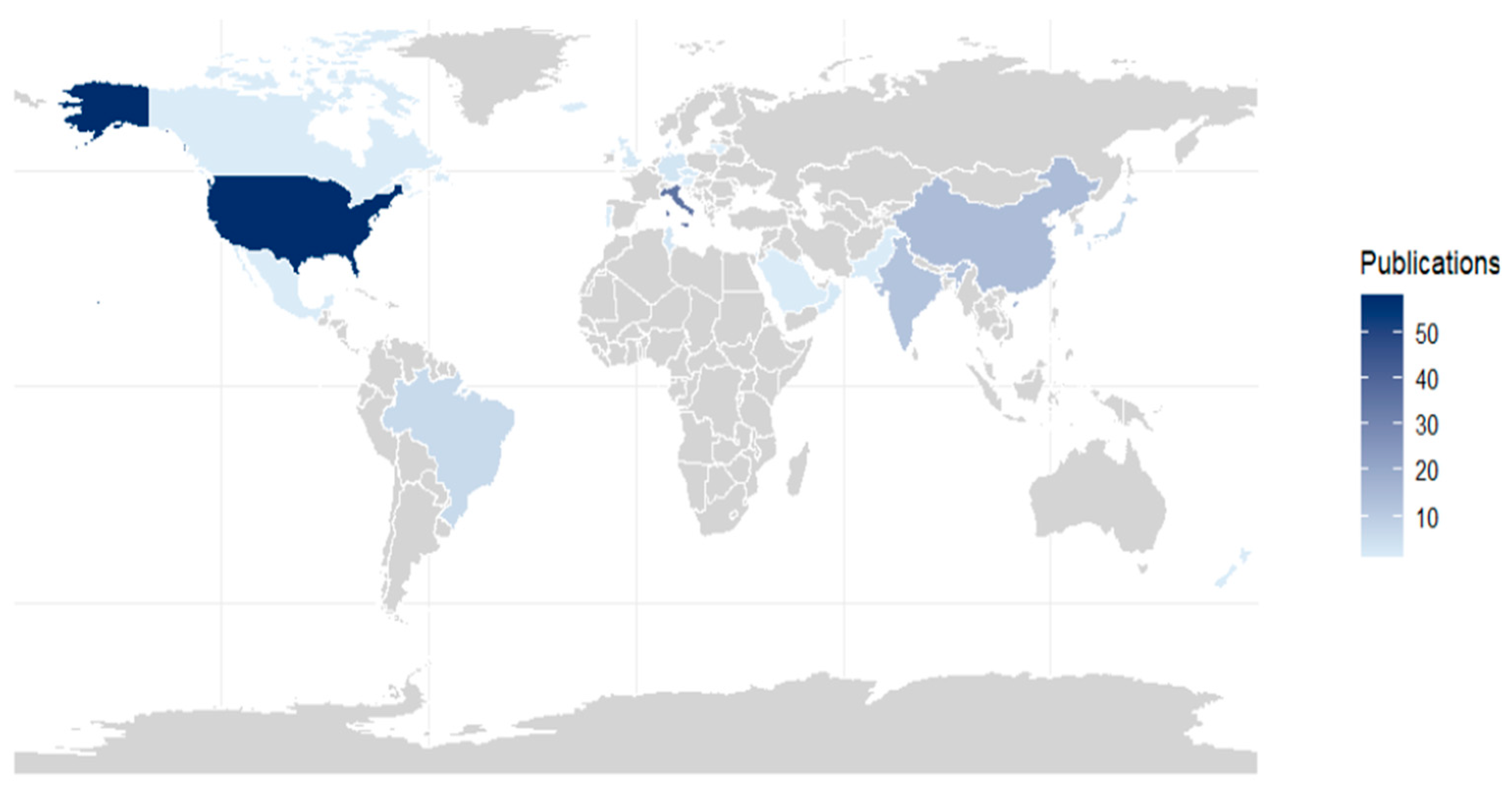
4.3. Geographic Distribution of Publications
4.4. Distribution of Publications by Type, Journal and Publisher
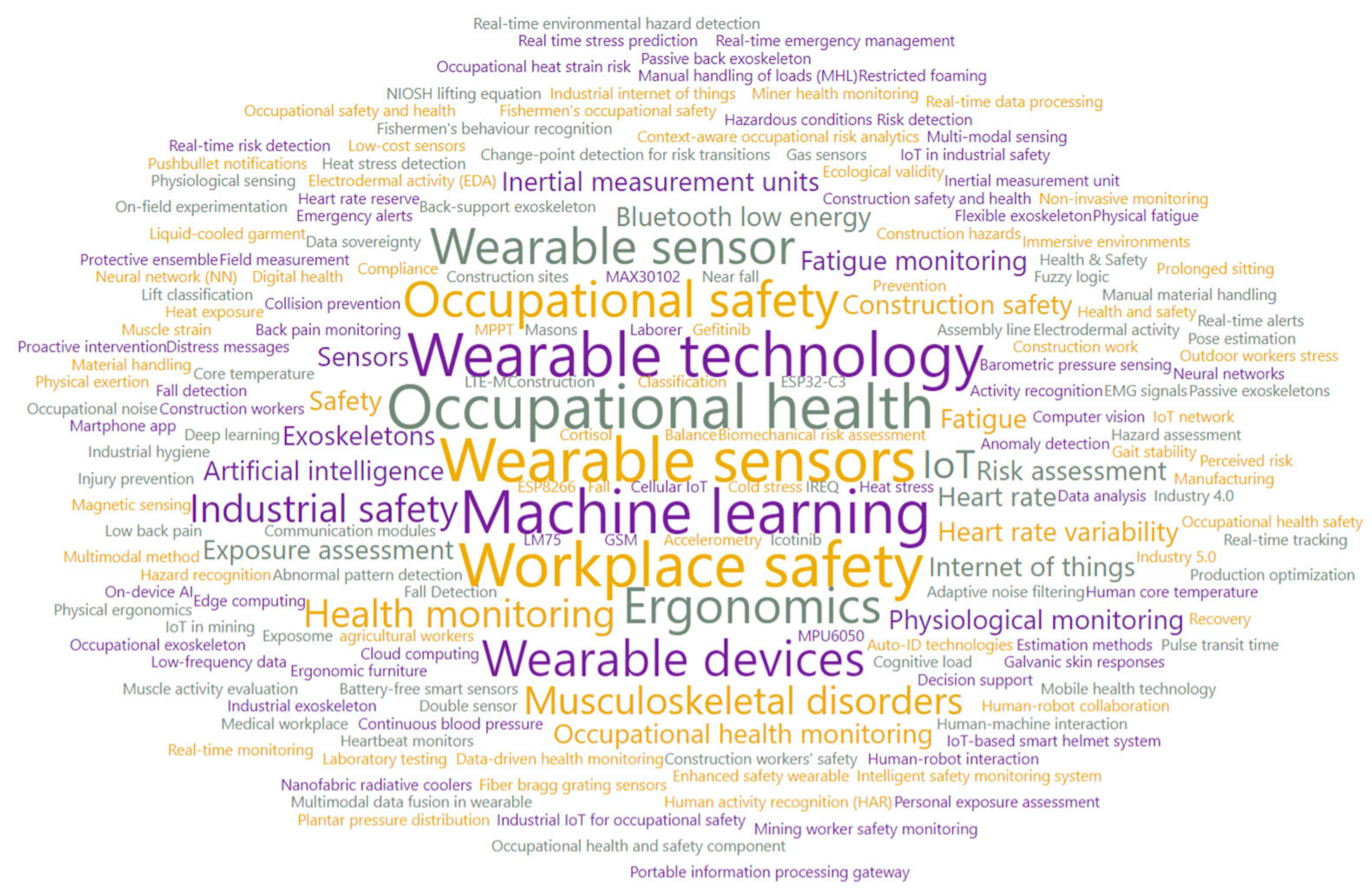
4.5. Keyword Analysis
5. Discussion
5.1. RQ1—What Types of Wearable Technologies Are Applied in OSH, and for Which Occupational Risks or Functions?
5.2. RQ2—How Are Wearable Technologies Used to Monitor, Assess, and Prevent Occupational Risks?
5.3. RQ3—What Evidence Exists Regarding Their Effectiveness in Improving Safety-Related Outcomes?
5.4. RQ4—What Metrics and Evaluation Approaches Are Used to Assess Wearable-Based OSH Interventions?
5.5. RQ5—What Are the Main Barriers, Limitations, and Challenges Affecting the Real-World Implementation of Wearable Technologies in OSH Contexts?
5.6. Relationship Between RQs
6. Proposed Model for the Adoption of Wearable Technologies
6.1. Factors Influencing the Acceptance of Wearable Technologies
6.2. Integrative Model for the Implementation of Wearable Technologies
6.3. Positioning of the Proposed Model in Relation to Existing Frameworks
6.4. Recommendations for Change Management
6.5. Limitations of the Proposed Model
7. Conclusions
7.1. General Conclusions
7.2. Limitations of the Study and Proposed Model
7.3. Proposals for Future Work
Supplementary Materials
Author Contributions
Funding
Institutional Review Board Statement
Informed Consent Statement
Data Availability Statement
Acknowledgments
Conflicts of Interest
Abbreviations
| AI | Artificial Intelligence |
| IoT | Internet of Things |
| JBI | Joanna Briggs Institute |
| OSH | Occupational Safety and Health |
| PPE | Personal Protective Equipment |
| PRISMA | Preferred Reporting Items for Systematic Reviews and Meta-Analyses |
| RQs | Research Questions |
| SLR | Systematic Literature Review |
| TAM | Technology Acceptance Model |
| UTAUT | Unified Theory of Acceptance and Use of Technology |
| WoS | Web of Science |
Appendix A
Appendix A.1

| Reference | Type of Study | Clear Objective | Defined Context | Appropriate Method | Rigorous Data Collection | Coherent Analysis | Relevant Results | Limitations Discussed | Overall Score | Ranking |
|---|---|---|---|---|---|---|---|---|---|---|
| [88] | Field experimental study | Yes | Yes | Yes | Yes | Yes | Yes | Partial | 6.5 | High |
| [83] | Experimental | Yes | Yes | Yes | Yes | Yes | Yes | Partial | 6.5 | High |
| [96] | Experimental/field study | Yes | Yes | Yes | Yes | Yes | Yes | Partial | 6.5 | High |
| [77] | Delphi study/mixed-method | Yes | Yes | Yes | Partial | Yes | Yes | Yes | 6.5 | High |
| [107] | Experimental study | Yes | Yes | Yes | Yes | Yes | Yes | Partial | 6.5 | High |
| [121] | Case study/experimental | Yes | Yes | Yes | Yes | Yes | Yes | Yes | 7.0 | High |
| [106] | Experimental/data-driven study | Yes | Yes | Yes | Yes | Yes | Yes | Partial | 6.5 | High |
| [114] | Experimental/AI-based study | Yes | Yes | Yes | Yes | Yes | Yes | Partial | 6.5 | High |
| [104] | Experimental study | Yes | Yes | Yes | Yes | Yes | Yes | Yes | 7.0 | High |
| [105] | Experimental/ML study | Yes | Yes | Yes | Yes | Yes | Yes | Partial | 6.5 | High |
| [95] | Pilot/usability study | Yes | Yes | Yes | Partial | Yes | Yes | Yes | 6.5 | High |
| [115] | Experimental/biomechanics study | Yes | Yes | Yes | Yes | Yes | Yes | Partial | 6.5 | High |
| [109] | Prototype/conceptual and experimental | Yes | Yes | Partial | Partial | Yes | Yes | No | 5.0 | Low |
| [129] | Experimental/engineering system | Yes | Yes | Yes | Yes | Yes | Yes | Partial | 6.5 | High |
| [78] | System design/applied research | Yes | Yes | Yes | Partial | Partial | Yes | Yes | 6.0 | Moderate |
| [117] | Experimental study | Yes | Yes | Yes | Yes | Yes | Yes | Partial | 6.5 | High |
| [130] | Experimental validation study | Yes | Yes | Yes | Yes | Yes | Yes | Partial | 6.5 | High |
| [119] | Experimental/deep learning study | Yes | Yes | Yes | Yes | Yes | Yes | Partial | 6.5 | High |
| [131] | Experimental/sensor platform development | Yes | Yes | Yes | Yes | Yes | Yes | Partial | 6.5 | High |
| [118] | Field feasibility study | Yes | Yes | Yes | Yes | Yes | Yes | Yes | 7.0 | High |
| [102] | Experimental/machine learning study | Yes | Yes | Yes | Yes | Yes | Yes | Yes | 7.0 | High |
| [90] | Preliminary field experimentation | Yes | Yes | Yes | Partial | Yes | Yes | Partial | 6.0 | Moderate |
| [103] | Prototype/IoT validation study | Yes | Yes | Yes | Partial | Yes | Yes | Partial | 6.0 | Moderate |
| [132] | Prototype/IoT system study | Yes | Yes | Yes | Partial | Yes | Yes | Partial | 6.0 | Moderate |
| [59] | Experimental/wearable bioelectronics study | Yes | Yes | Yes | Yes | Yes | Yes | Partial | 6.5 | High |
| [133] | Prototype/IoT fall detection study | Yes | Yes | Yes | Partial | Yes | Yes | Partial | 6.0 | Moderate |
| [108] | Device development/laboratory and field validation | Yes | Yes | Yes | Yes | Yes | Yes | Yes | 7.0 | High |
| [84] | Prototype/IoT-enabled PPE study | Yes | Yes | Yes | Partial | Yes | Yes | Partial | 6.0 | Moderate |
| [94] | Proof-of-concept/prototype study | Yes | Yes | Partial | Partial | Yes | Yes | Yes | 6.0 | Moderate |
| [89] | System development/experimental validation | Yes | Yes | Yes | Yes | Yes | Yes | Partial | 6.5 | High |
| [71] | Experimental/AI-based wearable system | Yes | Yes | Yes | Yes | Yes | Yes | Partial | 6.5 | High |
| [76] | Experimental/smart PPE HAR study | Yes | Yes | Yes | Yes | Yes | Yes | Yes | 7.0 | High |
| [72] | Proof-of-concept/system validation | Yes | Yes | Yes | Partial | Yes | Yes | Yes | 6.5 | High |
| [82] | Experimental/machine learning ergonomics study | Yes | Yes | Yes | Yes | Yes | Yes | Partial | 6.5 | High |
| [73] | System design/experimental AI-IoT evaluation | Yes | Yes | Yes | Yes | Yes | Yes | Yes | 7.0 | High |
| [101] | Experimental/EMG anomaly detection study | Yes | Yes | Yes | Partial | Yes | Yes | Partial | 6.0 | Moderate |
| [75] | Prototype/wearable monitoring solution | Yes | Yes | Yes | Partial | Yes | Yes | Partial | 6.0 | Moderate |
| [79] | Prototype/IoT smart insole study | Yes | Yes | Yes | Partial | Yes | Yes | Partial | 6.0 | Moderate |
| [81] | Preliminary experimental study | Yes | Yes | Yes | No | Yes | Yes | Yes | 6.0 | Moderate |
| [91] | Feasibility/wearable biosensor ML study | Yes | Yes | Partial | Partial | Yes | Yes | Yes | 6.0 | Moderate |
| [85] | Feasibility/wearable sensor study | Yes | Yes | Yes | Partial | Yes | Yes | Partial | 6.0 | Moderate |
| [100] | Design and experimental validation study | Yes | Yes | Yes | Yes | Yes | Yes | Yes | 7.0 | High |
| [7] | Machine learning/stress prediction study | Yes | Yes | Yes | Partial | Yes | Yes | Partial | 6.0 | Moderate |
| [99] | Design and experimental evaluation study | Yes | Yes | Yes | Yes | Yes | Yes | Partial | 6.5 | High |
| [93] | System framework/applied validation | Yes | Yes | Yes | Partial | Yes | Yes | Partial | 6.0 | Moderate |
| [112] | Experimental/ML-based biomechanical risk study | Yes | Yes | Yes | Yes | Yes | Yes | Yes | 7.0 | High |
| [80] | Experimental/wearable heat-stress monitoring study | Yes | Yes | Yes | Yes | Yes | Yes | Partial | 6.5 | High |
| [116] | Prototype/sensor compliance study | Yes | Yes | Yes | Partial | Partial | Yes | Yes | 6.0 | Moderate |
| [113] | Field study/workload risk modelling | Yes | Yes | Yes | Yes | Yes | Yes | Yes | 7.0 | High |
| [29] | Experimental/IMU-based WMSD risk assessment study | Yes | Yes | Yes | Yes | Yes | Yes | Partial | 6.5 | High |
| [110] | Cloud-based IoT monitoring study | Yes | Yes | Yes | Yes | Yes | Yes | Yes | 7.0 | High |
| [87] | Machine learning/near-fall detection study | Yes | Yes | Yes | Yes | Yes | Yes | Yes | 7.0 | High |
| [123] | Design and pilot validation study | Yes | Yes | Yes | Yes | Yes | Yes | Partial | 6.5 | High |
| [98] | Prototype/IoT and ML study | Yes | Yes | Yes | Partial | Yes | Yes | Partial | 6.0 | Moderate |
| [111] | Poster/conceptual prototype system | Yes | Yes | Partial | Partial | Partial | Yes | Partial | 5.0 | Low |
| [92] | Experimental ergonomics study | Yes | Yes | Yes | Yes | Yes | Yes | Yes | 7.0 | High |
| [134] | Multimodal clustering/field monitoring study | Yes | Yes | Yes | Yes | Yes | Yes | Yes | 7.0 | High |
| [86] | Lab-based simulation/smart textile study | Yes | Yes | Yes | Yes | Yes | Yes | Partial | 6.5 | High |
| [97] | Prototype/IoT wearable system | Yes | Yes | Yes | Partial | Yes | Yes | Partial | 6.0 | Moderate |
| [74] | System proposal/wearable monitoring framework | Yes | Yes | Yes | Partial | Yes | Yes | Partial | 6.0 | Moderate |
Appendix A.2
| Reviewer 1\Reviewer 2 | High | Moderate | Low | Total |
|---|---|---|---|---|
| High | 34 | 5 | 0 | 39 |
| Moderate | 0 | 19 | 0 | 19 |
| Low | 0 | 0 | 2 | 2 |
| Total | 34 | 24 | 2 | 60 |
Appendix A.3
| Reference | Research Objective | Main Contributions |
|---|---|---|
| [88] | To evaluate manufacturing workers’ perceptions of discomfort, distraction, and burden associated with wearing inertial sensors during multiple work shifts. | The study demonstrates that wearable inertial sensors are generally well accepted by workers, with low levels of discomfort, distraction, and perceived burden. Factors such as non-neutral postures and higher body mass index slightly increased negative perceptions, though effects were minimal. The findings support the feasibility of long-term wearable sensor use in occupational settings for exposure assessment. |
| [83] | To investigate whether back-support exoskeletons improve work posture among masons using AI-based pose estimation techniques. | The study shows that back-support exoskeletons provide minimal improvements in posture despite reducing muscle activity. The findings challenge their effectiveness as a solution for postural correction in construction tasks, highlighting the need for critical evaluation before widespread adoption. |
| [96] | To develop and validate a wearable system for continuous physiological monitoring of work-related stress over 24 h periods. | The study demonstrates that wearable devices can reliably monitor physiological stress indicators such as heart rate variability and pulse transit time in real-world conditions. Results show clear differences between work and non-work stress levels, supporting the use of wearable technologies for continuous occupational health monitoring. |
| [77] | To identify and assess safety risks and mitigation strategies associated with exoskeleton use in construction tasks. | The study identifies 10 critical safety risks and 12 mitigation strategies related to exoskeleton use. It highlights the importance of addressing human–robot interaction risks and provides practical guidance for improving safety and adoption in construction environments. |
| [107] | To develop a multimodal method for assessing physical fatigue using wearable sensors combining physiological and kinematic data. | The study proposes an integrated fatigue assessment approach combining heart rate, skin temperature, and kinematic data (jerk), validated against perceived exertion. The method enables real-time fatigue monitoring and offers a more comprehensive and practical solution for workplace safety. |
| [121] | To evaluate the effort, comfort, and acceptance of passive back-support exoskeletons in both laboratory and field conditions. | The study reveals significant discrepancies between laboratory and field performance of exoskeletons, showing reduced effectiveness and acceptance in real-world conditions. It emphasizes the importance of field validation and highlights comfort and usability as key factors for adoption. |
| [106] | To develop a wearable sensor-based approach for continuous assessment of occupational heat stress in construction workers. | The study proposes a data-driven framework using physiological signals and machine learning to assess heat strain, achieving over 92% prediction accuracy. It highlights the importance of individualized monitoring and demonstrates the effectiveness of wearable biosensors for real-time occupational safety management. |
| [114] | To develop and evaluate a training platform for human–robot collaboration in construction using wearable physiological sensing and immersive technologies. | The study introduces an innovative training system that uses physiological data to assess cognitive load during human–robot collaboration. Results show the platform can effectively evaluate training performance and improve safety outcomes by linking cognitive load to safety behavior. |
| [104] | To investigate the impact of physical fatigue on construction workers’ situational awareness using wearable sensor data. | The study demonstrates that physical fatigue significantly reduces hazard recognition and safety risk assessment performance. Wearable sensors effectively capture fatigue through heart rate and heart rate variability, confirming their value for real-time safety monitoring and decision-making. |
| [105] | To develop an early detection system for physical fatigue in industrial environments using wearable sensors and contextual data. | The study shows that combining biometric and contextual data significantly improves fatigue detection accuracy. The approach reduces false negatives and enhances real-time safety interventions, supporting Industry 5.0 human-centered safety systems. |
| [95] | To evaluate the feasibility and usability of wearable sensors for monitoring construction workers’ physiological status during on-duty and off-duty activities. | The study confirms the usability of wearable sensors for monitoring worker health and behavior. It highlights variability in physiological responses and identifies practical challenges in applying wearable technologies within total worker health frameworks. |
| [115] | To evaluate the impact of passive back-support exoskeletons on fall risk indicators during slip and trip events. | The study shows that exoskeleton use alters biomechanical responses and may negatively affect balance recovery, potentially increasing fall risk. It highlights the need for improved design and usage guidelines for safe implementation. |
| [109] | To develop and evaluate a sensor-integrated smart shirt for monitoring posture and movement in occupational settings. | The study presents a wearable smart textile prototype capable of monitoring upper body movement in real time. It highlights design challenges and demonstrates the potential of smart clothing for ergonomic assessment and human–machine interaction. |
| [129] | To develop a self-powered wearable sensing system for fall detection and vibration risk monitoring in construction workers. | The study introduces a self-powered triboelectric sensor system capable of detecting falls and monitoring vibration exposure with high accuracy (~94%). It integrates sensing, power generation, and machine learning for real-time safety monitoring. |
| [78] | To design and evaluate a wearable IoT-based system for monitoring worker health and safety in remote and hazardous environments. | The study presents an integrated IoT system combining wearable sensors, networking, and real-time analytics tailored for remote environments. It emphasizes contextual data integration and user-centered monitoring approaches. |
| [117] | To evaluate the use of wearable sensor data for improving occupational cold stress assessment. | The study shows that continuous physiological monitoring provides better insight into cold stress than traditional methods. It highlights variability between individuals and the limitations of generalized models, supporting personalized assessment approaches. |
| [130] | To evaluate the accuracy of a non-invasive sensor for measuring core body temperature under heat stress conditions. | The study shows that the Dräger Double Sensor produced temperature estimates close to rectal temperature measurements during heat exposure. It supports the potential use of non-invasive wearable temperature monitoring for workers exposed to heat stress or protective clothing, while emphasizing the need for further validation under varied occupational conditions. |
| [119] | To develop and evaluate a wearable sensor-based deep learning approach for recognizing fishermen’s behaviours during fishing operations. | The study demonstrates that multimodal fusion of accelerometer and gyroscope data improves behaviour recognition accuracy. The proposed model achieved high classification performance and shows strong potential for monitoring human-related risk factors and improving maritime occupational safety. |
| [131] | To develop a wearable SERS platform for rapid field detection of antineoplastic drug contamination in medical workplaces. | The study introduces a flexible wearable detection platform capable of identifying icotinib and gefitinib residues on work surfaces and packaging within minutes. It contributes a practical method for occupational exposure monitoring and risk reduction in healthcare environments. |
| [118] | To investigate the feasibility of using electrodermal activity collected from wearable sensors to assess construction workers’ perceived risk during ongoing work. | The study shows that electrodermal responses differ significantly between low- and high-risk activities. It demonstrates the feasibility of using wearable physiological sensing as a continuous, objective, and non-intrusive method for assessing perceived risk in construction safety management. |
| [102] | To classify worker fatigue under diverse thermal conditions using wearable physiological sensors and machine learning. | The study shows that combining electromyography, heart rate, heart rate variability and thermal condition data improves real-time fatigue classification. The models achieved high predictive accuracy, supporting proactive fatigue management in construction and other physically demanding industries. |
| [90] | To preliminarily evaluate the use of a passive back-support exoskeleton in a real industrial warehouse context. | The study reports reduced muscle activation and improved posture during lifting tasks when using the exoskeleton. It also suggests reduced perceived fatigue and increased operator confidence, while noting the need for further research due to the preliminary nature of the study. |
| [103] | To develop and validate an IoT-based smart helmet for real-time mining safety monitoring. | The study presents a helmet integrating environmental, physiological, motion and helmet-removal sensors with LoRa/cloud-based alerting. The prototype achieved high detection accuracy, low latency and strong communication reliability under simulated mining conditions, supporting its potential for high-risk industrial environments. |
| [132] | To develop a wearable smart glove system for real-time miner health monitoring and location tracking. | The study proposes a glove-based system integrating temperature, pulse, motion and fall-detection sensors with wireless communication and a mobile dashboard. It demonstrates the potential to reduce emergency response delays by continuously monitoring miner health and movement in hazardous environments. |
| [59] | To develop a field-deployable wearable bioelectronic system for monitoring stress in outdoor workers under hot conditions. | The study introduces a soft wearable device integrating electrodermal activity and temperature sensing with nanofabric radiative cooling. It improves thermal management, reduces motion artifacts and supports continuous real-time stress monitoring during outdoor work activities. |
| [133] | To develop a wearable IoT-based fall detection system for workers in confined industrial spaces. | The study proposes a waist-worn system using dual tri-axial accelerometers and a threshold-based algorithm to detect falls and prolonged inactivity. Its main contribution is a simple, low-cost and real-time alerting solution that avoids complex machine learning and supports rapid supervisor response. |
| [108] | To develop and validate a wearable monitor for characterizing personal exposure to particulate matter and volatile organic compounds. | The AirPen combines physical sample collection with low-cost sensors for particulate matter, volatile organic compounds, environmental variables, location and motion. The study demonstrates its usefulness for identifying exposure sources by time, location and activity, advancing occupational and environmental exposure assessment. |
| [84] | To design a Smart PPE vest for real-time hazard detection and worker health monitoring in worksites. | The study presents a vest integrating environmental and biometric sensors with LoRa communication, local alerts, GPS tracking and mobile app notifications. It contributes a scalable smart PPE concept for improving hazard detection and emergency response in infrastructure-limited worksites. |
| [94] | To design and implement a multi-modal wearable system for proactive monitoring of physiological distress in industrial workers. | The study integrates photoplethysmography, electrodermal activity, skin temperature and ambient volatile organic compound sensing into a compact wearable device. It demonstrates early detection of heat-stress indicators under controlled conditions and proposes a roadmap toward personalized machine learning and federated learning for industrial deployment. |
| [89] | To develop a mobile health monitoring and alert application for agricultural workers using multiple wearable sensors. | The study presents a smartphone-based system integrating pulse oximetry, skin temperature and inertial measurement unit data via Bluetooth low-energy signaling. It enables real-time monitoring, anomaly alerts and automatic reconnection, offering a scalable framework for agricultural and broader occupational safety applications. |
| [71] | To develop an AI-based wearable sensor system to assess the safety of workers during manual load lifting. | The study proposes a smart safety jacket integrating barometric, accelerometer and magnetometer data to detect lifting events and classify whether lifting was performed safely. The system achieved high accuracy and contributes to automated prevention of low back pain and musculoskeletal injury risks. |
| [76] | To design and evaluate a non-invasive smart helmet system for human activity recognition in worker safety applications. | The study develops a certification-compliant smart helmet integrating motion and environmental sensors. It evaluates several machine learning pipelines and shows that XGBoost provides the best balance between accuracy, latency and computational efficiency for on-board activity recognition. |
| [72] | To design and validate a wireless-powered smart PPE system for monitoring correct PPE usage in industrial IoT environments. | The study presents a battery-free smart PPE prototype using ultra high frequency radio frequency identification power harvesting, radio frequency identification communication and capacitive sensing. It demonstrates feasible wireless power and communication up to 4 m, supporting real-time monitoring of PPE compliance without batteries. |
| [82] | To automate ergonomic risk assessment in manual material handling using sEMG wearable sensors and machine learning. | The study demonstrates that sEMG data can classify ergonomic risk levels associated with lifting tasks based on the NIOSH lifting equation. Machine learning models, especially Decision Tree, achieved very high accuracy, supporting automated ergonomic monitoring beyond visual posture assessment. |
| [73] | To develop and evaluate an IoT- and AI-based smart hearing protection system for high-noise industrial environments. | The study proposes intelligent hearing protection that selectively attenuates hazardous noise while preserving speech and safety notifications. It integrates voice activity detection, adaptive filtering and indoor localization, improving speech intelligibility and targeted safety communication in noisy workplaces. |
| [101] | To evaluate the impact of a passive shoulder-support exoskeleton on muscle strain using electromyography-based anomaly detection. | The study applies feature engineering and Isolation Forest anomaly detection to electromyography signals collected during lifting tasks with and without exoskeleton support. Results indicate fewer muscle-strain anomalies when the exoskeleton is used, supporting its potential ergonomic benefit. |
| [75] | To develop a wearable monitoring solution to improve safety for sewer and septic tank cleaning workers. | The study proposes a wearable kit integrating gas sensors, heart-rate monitoring, communication modules and emergency alerts. It contributes a real-time safety monitoring approach for workers exposed to toxic gases, enabling supervisor oversight and rapid emergency response. |
| [79] | To design and implement a smart insole system for monitoring back pain risk and lifting techniques among older workers. | The study uses plantar pressure sensors and real-time wireless processing to classify lifting techniques. The system achieved high classification accuracy and showed good user acceptance, supporting smart insoles as a less intrusive tool for ergonomic monitoring. |
| [81] | To examine the feasibility of estimating human core temperature from heart rate data for occupational heat-stress monitoring. | The study evaluates heart-rate-based core temperature estimation during work tasks in a climate chamber. Results suggest reasonable approximation during work phases but weaker performance during recovery, highlighting the need for further model refinement before workplace deployment. |
| [91] | To assess the feasibility of integrating wearable cortisol sensor data with machine learning for identifying physical fatigue in construction workers. | The study develops a sweat cortisol sensor and combines cortisol-related impedance changes with physiological metrics for fatigue classification. Support Vector Machine achieved the best classification performance, supporting cortisol as a promising biomarker for proactive fatigue monitoring. |
| [85] | To assess the feasibility of an FBG-based wearable system for monitoring back dorsal flexion-extension in video terminal workers. | The study shows that a smart textile with Fiber Bragg Grating sensors can detect dorsal flexion–extension movements over time. It supports the potential of lightweight, non-invasive optical fiber wearables for monitoring poor postural habits and preventing back musculoskeletal disorders. |
| [100] | To design and validate FleXo, a flexible passive back-support exoskeleton for reducing lower back strain during manual handling tasks. | The study introduces a lightweight and flexible passive exoskeleton optimized to reduce perceived effort during lifting while preserving freedom of movement. User feedback indicates improved comfort, satisfaction and potential benefits for reducing low back strain in occupational manual handling. |
| [7] | To develop and validate a real-time worker stress prediction framework for smart factory assembly lines using wearable physiological data and machine learning. | The study uses physiological indicators such as heart rate, respiration rate and skin conductance to predict worker stress. XGBoost achieved the strongest performance, suggesting that IoT-enabled wearable monitoring can support proactive stress management and improve worker wellbeing and productivity. |
| [99] | To design and evaluate a passive shoulder exoskeleton based on a variable stiffness torque generator for industrial applications. | The study presents a compact, lightweight passive shoulder exoskeleton with adjustable torque assistance. Experimental results show reduced muscle effort during overhead reaching and load lifting, supporting its use for repetitive industrial tasks and WMSD prevention. |
| [93] | To propose a wearable occupational health and safety assurance system for power operation workers in complex environments. | The study presents a wearable framework integrating vital-sign monitoring, wireless communication and SVM-based life-status assessment. It supports real-time evaluation of operator health and early warning of risks caused by abnormal physical conditions during power operations. |
| [112] | To develop an automatic method using inertial wearable sensors and machine learning to classify biomechanical risk during load lifting. | The study uses IMUs placed on the sternum and lumbar region to discriminate biomechanical risk classes based on the Revised NIOSH Lifting Equation. Results show high classification performance, with the sternum emerging as the most informative sensor location. |
| [80] | To analyze occupational heat stress using a sensor-based wearable safety helmet from an environmental ergonomics perspective. | The study demonstrates that a sensor-based helmet can monitor environmental variables, heat stress indices and physiological indicators under different work conditions. It supports individualized heat-stress awareness and site-specific occupational safety interventions. |
| [116] | To design and test a Hall-effect sensor system for monitoring safety goggle compliance. | The study demonstrates that Hall-effect sensing can detect safety eyewear position and movement related to compliance. Although static detection had limited success, movement-based matched filtering distinguished compliance-related transitions, supporting smart PPE compliance monitoring. |
| [113] | To develop a practical method for estimating individual construction workers’ workload risk based on physical activity, work conditions and age. | The study combines wearable heart-rate and activity data with WBGT and worker age to estimate workload risk. The proposed model achieved strong accuracy and provides a practical approach for health-risk judgement on construction sites. |
| [29] | To develop and evaluate an IMU-based wearable system for objective work-related musculoskeletal disorder risk assessment. | The study presents a wearable IMU system with orientation estimation, joint-angle measurement and ergonomic risk evaluation. It aligns with established methods such as RULA, REBA, Strain Index and Rodgers analysis, while enabling more detailed and targeted ergonomic intervention. |
| [110] | To develop and evaluate a cloud-based infrastructure for real-time health monitoring in emergency response scenarios. | The study presents a scalable cloud architecture for monitoring vital signs of paramedics and emergency workers using wearable devices. Its main contribution is demonstrating large-scale deployment, real-time alarm management and improved operational safety in emergency response contexts. |
| [87] | To improve slip, trip and fall prevention by detecting real-world near-fall events using wearable IMU data and machine learning. | The study uses real occupational near-fall data from 110 workers and evaluates multiple neural network architectures. It shows that CNN and InceptionTime models can effectively classify near-fall events, supporting more ecologically valid fall-prevention systems. |
| [123] | To design and validate a modular smart chair system for improving workplace ergonomics and reducing risks associated with prolonged sitting. | The study introduces a smart chair integrating pressure sensing, vibration, LED feedback and BLE communication. Pilot testing showed high posture-detection accuracy and rapid user response to alerts, supporting its use for sedentary workplace health monitoring. |
| [98] | To develop smart gloves for preventing hand injuries in manufacturing plants using IoT sensors and One-Class SVM. | The study proposes gloves that monitor grip strength, finger angle and environmental risks, using One-Class SVM to detect abnormal or hazardous patterns. It contributes a proactive wearable approach for identifying hand-injury risks and improving manufacturing safety. |
| [111] | To present Smart_Safe, an AI-driven modular safety system for indoor industrial environments using wearable sensors and Auto-ID technologies. | The poster outlines a platform for real-time worker tracking, fall detection, zone violation detection and collision prevention between workers and mobile robots or forklifts. Its main contribution is the integration concept combining wearables, Auto-ID, edge computing and digital twins, although empirical validation appears limited. |
| [92] | To evaluate the effects of a liquid-cooled garment worn under protective equipment on subjective thermal strain, physiological responses and ergonomics during intermittent exercise. | The study shows that liquid cooling under PPE reduces perceived heat strain, body temperature increase and heart rate without negatively affecting ergonomic features. It supports wearable cooling garments as a strategy to reduce heat burden in protective ensembles. |
| [134] | To develop and validate an adaptive multimodal clustering framework for occupational health risk monitoring using wearable sensor data. | The study integrates physiological, activity and location data from highway-maintenance workers. It identifies interpretable behavioral–physiological states and provides spatiotemporal risk mapping, supporting context-aware occupational health surveillance. |
| [86] | To assess the feasibility and accuracy of smart textile systems for classifying occupational manual material handling tasks. | The study demonstrates that smart socks and a smart shirt can classify simulated MMH tasks with very high accuracy. It supports smart textiles as promising tools for ergonomic exposure assessment and occupational injury prevention. |
| [97] | To develop an affordable smart wearable vest for monitoring construction worker health in harsh environments. | The Vital Vest integrates WBAN and IoT technologies with sensors for heart rate, SpO2, temperature and activity/fall detection. It contributes a low-cost, energy-efficient monitoring solution for real-time alerts and worker safety in construction environments. |
| [74] | To propose a wearable-based monitoring system for power utility linemen to mitigate workplace health and safety risks. | The study applies the smart connected worker concept by integrating physiological, physical and environmental sensing into PPE, connected to a mobile app and cloud analytics platform. It contributes a framework for real-time and offline supervision, supporting accident prevention and improved safety procedures in power utilities. |
References
- Mahmood, M.S.; Ruma, N.H.; Ahmed, T.; Nagai, Y. Exploring Suppliers’ Approaches toward Workplace Safety Compliance in the Global Garment Sector: From Bangladesh Perspective. Soc. Sci. 2021, 10, 90. [Google Scholar] [CrossRef]
- McLeod, C.B.; Macpherson, R.A.; He, A.; Amick, B.C.; Koehoorn, M.; Tompa, E. The Impact of Regulatory Workplace Safety Inspections on Workers’ Compensation Claim Rates. Am. J. Ind. Med. 2024, 67, 877–887. [Google Scholar] [CrossRef]
- Dodoo, J.E.; Al-Samarraie, H.; Alzahrani, A.I.; Lonsdale, M.; Alalwan, N. Digital Innovations for Occupational Safety: Empowering Workers in Hazardous Environments. Workplace Health Saf. 2024, 72, 84–95. [Google Scholar] [CrossRef]
- Damilos, S.; Saliakas, S.; Karasavvas, D.; Koumoulos, E.P. An Overview of Tools and Challenges for Safety Evaluation and Exposure Assessment in Industry 4.0. Appl. Sci. 2024, 14, 4207. [Google Scholar] [CrossRef]
- Moshawrab, M.; Adda, M.; Bouzouane, A.; Ibrahim, H.; Raad, A. Smart Wearables for the Detection of Occupational Physical Fatigue: A Literature Review. Sensors 2022, 22, 7472. [Google Scholar] [CrossRef]
- Pasquale, V.D.; De Simone, V.; Radano, M.; Miranda, S. Wearable Devices for Health and Safety in Production Systems: A Literature Review. IFAC PapersOnLine 2022, 55, 341–346. [Google Scholar] [CrossRef]
- Hijry, H.; Naqvi, S.M.R.; Javed, K.; Albalawi, O.H.; Olawoyin, R.; Varnier, C.; Zerhouni, N. Real Time Worker Stress Prediction in a Smart Factory Assembly Line. IEEE Access 2024, 12, 116238–116249. [Google Scholar] [CrossRef]
- Cannady, R.; Warner, C.; Yoder, A.; Miller, J.; Crosby, K.; Elswick, D.; Kintziger, K.W. The implications of real-time and wearable technology use for occupational heat stress: A scoping review. Saf. Sci. 2024, 177, 106600. [Google Scholar] [CrossRef]
- Flor-Unda, O.; Fuentes, M.; Dávila, D.; Rivera, M.; Llano, G.; Izurieta, C.; Acosta-Vargas, P. Innovative Technologies for Occupational Health and Safety: A Scoping Review. Safety 2023, 9, 35. [Google Scholar] [CrossRef]
- El-Helaly, M. Artificial Intelligence and Occupational Health and Safety, Benefits and Drawbacks. Med. Lav. 2024, 115, e2024014. [Google Scholar] [CrossRef]
- Chen, H.; Mao, Y.; Xu, Y.; Wang, R. The Impact of Wearable Devices on the Construction Safety of Building Workers: A Systematic Review. Sustainability 2023, 15, 11165. [Google Scholar] [CrossRef]
- Tandel, V.; Kumari, A.; Tanwar, S.; Singh, A.; Sharma, R.; Yamsani, N. Intelligent Wearable-Assisted Digital Healthcare Industry 5.0. Artif. Intell. Med. 2024, 157, 103000. [Google Scholar] [CrossRef] [PubMed]
- Sabino, I.; Fernandes, M.D.C.; Cepeda, C.; Quaresma, C.; Gamboa, H.; Nunes, I.L.; Gabriel, A.T. Application of wearable technology for the ergonomic risk assessment of healthcare professionals: A systematic literature review. Int. J. Ind. Ergon. 2024, 100, 103570. [Google Scholar] [CrossRef]
- Naji, G.M.A.; Kalid, K.S.; Savita, K.S. The Moderating Effect of App Trustworthiness and User Attitudes on Intention to Use Adopt Mobile Applications Among Employees in The Oil and Gas Industry. Sage Open 2024, 14, 21582440241286300. [Google Scholar] [CrossRef]
- Falegnami, A.; Tomassi, A.; Corbelli, G.; Romano, E. Resilience Analysis Grid–Rasch Rating Scale Model for Measuring Organizational Resilience Potential. Appl. Sci. 2025, 15, 1695. [Google Scholar] [CrossRef]
- Rajendran, S.; Giridhar, S.; Chaudhari, S.; Gupta, P.K. Technological Advancements in Occupational Health and Safety. Meas. Sens. 2021, 15, 100045. [Google Scholar] [CrossRef]
- Moon, J.; Ju, B.-K. Wearable Sensors for Healthcare of Industrial Workers: A Scoping Review. Electronics 2024, 13, 3849. [Google Scholar] [CrossRef]
- De Fazio, R.; Al-Hinnawi, A.-R.; De Vittorio, M.; Visconti, P. An Energy-Autonomous Smart Shirt Employing Wearable Sensors for Users’ Safety and Protection in Hazardous Workplaces. Appl. Sci. 2022, 12, 2926. [Google Scholar] [CrossRef]
- Tjøsvoll, S.O.; Wiggen, Ø.; Gonzalez, V.; Seeberg, T.M.; Elez Redzovic, S.; Frostad Liaset, I.; Holtermann, A.; Steiro Fimland, M. Assessment of Physical Work Demands of Home Care Workers in Norway: An Observational Study Using Wearable Sensor Technology. Ann. Work Expo. Health 2022, 66, 1187–1198. [Google Scholar] [CrossRef]
- Callihan, M.; Cole, H.; Stokley, H.; Gunter, J.; Clamp, K.; Martin, A.; Doherty, H. Comparison of Slate Safety Wearable Device to Ingestible Pill and Wearable Heart Rate Monitor. Sensors 2023, 23, 877. [Google Scholar] [CrossRef]
- Srinivasan, K.; Currim, F.; Lindberg, C.M.; Razjouyan, J.; Gilligan, B.; Lee, H.; Canada, K.J.; Goebel, N.; Mehl, M.R.; Lunden, M.M. Discovery of Associative Patterns between Workplace Sound Level and Physiological Wellbeing Using Wearable Devices and Empirical Bayes Modeling. npj Digit. Med. 2023, 6, 5. [Google Scholar] [CrossRef] [PubMed]
- Güntner, A.T.; Schenk, F.M. Environmental Formaldehyde Sensing at Room Temperature by Smartphone-Assisted and Wearable Plasmonic Nanohybrids. Nanoscale 2023, 15, 3967–3977. [Google Scholar] [CrossRef] [PubMed]
- Coccia, A.; Capodaglio, E.M.; Amitrano, F.; Gabba, V.; Panigazzi, M.; Pagano, G.; D’Addio, G. Biomechanical Effects of Using a Passive Exoskeleton for the Upper Limb in Industrial Manufacturing Activities: A Pilot Study. Sensors 2024, 24, 1445. [Google Scholar] [CrossRef]
- Kim, H.; Won, Y.I.; Kang, S.; Choi, Y.; Park, J.H.; Lee, J.; Kim, I.Y.; Chung, C.K. Comparison of Neck Pain and Posture with Spine Angle Tracking System between Static and Dynamic Computer Monitor Use. Electronics 2024, 13, 1363. [Google Scholar] [CrossRef]
- Bonin, W.R.; Brost, S.; Kalun, P.; Tomescu, S.; Strauss, B.H.; Whyne, C.M.; Li, Q. Ergonomic Risks in Healthcare Workers in Acute Care; the POSTURE Framework. Injury 2026, 57, 113085. [Google Scholar] [CrossRef]
- Donisi, L.; Jacob, D.; Guerrini, L.; Prisco, G.; Esposito, F.; Cesarelli, M.; Amato, F.; Gargiulo, P. SEMG Spectral Analysis and Machine Learning Algorithms Are Able to Discriminate Biomechanical Risk Classes Associated with Manual Material Liftings. Bioengineering 2023, 10, 1103. [Google Scholar] [CrossRef]
- Pitzalis, R.F.; Park, D.; Caldwell, D.G.; Berselli, G.; Ortiz, J. State of the Art in Wearable Wrist Exoskeletons Part II: A Review of Commercial and Research Devices. Machines 2023, 12, 21. [Google Scholar] [CrossRef]
- Lind, C.M.; Abtahi, F.; Forsman, M. Wearable Motion Capture Devices for the Prevention of Work-Related Musculoskeletal Disorders in Ergonomics—An Overview of Current Applications, Challenges, and Future Opportunities. Sensors 2023, 23, 4259. [Google Scholar] [CrossRef] [PubMed]
- Baklouti, S.; Chaker, A.; Rezgui, T.; Sahbani, A.; Bennour, S.; Laribi, M.A. A Novel IMU-Based System for Work-Related Musculoskeletal Disorders Risk Assessment. Sensors 2024, 24, 3419. [Google Scholar] [CrossRef]
- Wu, B.; Hu, Y. Analysis of Substation Joint Safety Control System and Model Based on Multi-Source Heterogeneous Data Fusion. IEEE Access 2023, 11, 35281–35297. [Google Scholar] [CrossRef]
- Papoutsakis, K.; Papadopoulos, G.; Maniadakis, M.; Papadopoulos, T.; Lourakis, M.; Pateraki, M.; Varlamis, I. Detection of Physical Strain and Fatigue in Industrial Environments Using Visual and Non-Visual Low-Cost Sensors. Technologies 2022, 10, 42. [Google Scholar] [CrossRef]
- Mahmud, T.; Kayastha, R.; Kisi, K.; Ngu, A.H.; Alamgeer, S. Evaluating the Effectiveness of Plantar Pressure Sensors for Fall Detection in Sloped Surfaces. Electronics 2025, 14, 3003. [Google Scholar] [CrossRef]
- Patel, V.; Chesmore, A.; Legner, C.M.; Pandey, S. Trends in workplace wearable technologies and connected-worker solutions for next-generation occupational safety, health, and productivity. Adv. Intell. Syst. 2022, 4, 2100099. [Google Scholar] [CrossRef]
- Tabatabaee, S.; Mohandes, S.R.; Ahmed, R.R.; Mahdiyar, A.; Arashpour, M.; Zayed, T.; Ismail, S. Investigating the Barriers to Applying the Internet-of-Things-Based Technologies to Construction Site Safety Management. Int. J. Environ. Res. Public Health 2022, 19, 868. [Google Scholar] [CrossRef]
- Dai, R.; Kannampallil, T.; Zhang, J.; Lv, N.; Ma, J.; Lu, C. Multi-Task Learning for Randomized Controlled Trials: A Case Study on Predicting Depression with Wearable Data. Proc. ACM Interact. Mob. Wearable Ubiquitous Technol. 2022, 6, 1–23. [Google Scholar] [CrossRef]
- Fanti, G.; Spinazzè, A.; Borghi, F.; Rovelli, S.; Campagnolo, D.; Keller, M.; Borghi, A.; Cattaneo, A.; Cauda, E.; Cavallo, D.M. Evolution and Applications of Recent Sensing Technology for Occupational Risk Assessment: A Rapid Review of the Literature. Sensors 2022, 22, 4841. [Google Scholar] [CrossRef]
- Aksüt, G.; Eren, T.; Alakaş, H.M. Using wearable technological devices to improve workplace health and safety: An assessment on a sector base with multi-criteria decision-making methods. Ain Shams Eng. J. 2023, 15, 102423. [Google Scholar] [CrossRef]
- Mohammadi, P.; Galera, A.; Costa, N.; Mondelo, P.R. Assessing nanosafety protocols: A tool for evaluating effectiveness and identifying areas for improvement. Theor. Issues Ergon. Sci. 2025, 26, 243–256. [Google Scholar] [CrossRef]
- Vanderstichelen, S.; De Moortel, D.; Nielsen, K.; Wegleitner, K.; Eneslätt, M.; Sardiello, T.; Martos, D.; Webster, J.; Nikandrou, I.; Delvaux, E.; et al. Developing and evaluating Compassionate Workplace Programs to promote health and wellbeing around serious illness, dying and loss in the workplace (EU-CoWork): A transdisciplinary, cross-national research project. Palliat. Care Soc. Pract. 2024, 18, 26323524241281070. [Google Scholar] [CrossRef] [PubMed]
- Mohapatra, P.; Aravind, V.; Bisram, M.; Lee, Y.-J.; Jeong, H.; Jinkins, K.; Gardner, R.; Streamer, J.; Bowers, B.; Cavuoto, L. Wearable Network for Multilevel Physical Fatigue Prediction in Manufacturing Workers. PNAS Nexus 2024, 3, pgae421. [Google Scholar] [CrossRef] [PubMed]
- Prisco, G.; Romano, M.; Esposito, F.; Cesarelli, M.; Santone, A.; Donisi, L.; Amato, F. Capability of Machine Learning Algorithms to Classify Safe and Unsafe Postures During Weight Lifting Tasks Using Inertial Sensors. Diagnostics 2024, 14, 576. [Google Scholar] [CrossRef] [PubMed]
- Antwi-Afari, M.F.; Qarout, Y.; Herzallah, R.; Anwer, S.; Umer, W.; Zhang, Y.; Manu, P. Deep Learning-Based Networks for Automated Recognition and Classification of Awkward Working Postures in Construction Using Wearable Insole Sensor Data. Autom. Constr. 2022, 136, 104181. [Google Scholar] [CrossRef]
- Page, M.J.; McKenzie, J.E.; Bossuyt, P.M.; Boutron, I.; Hoffmann, T.C.; Mulrow, C.D.; Shamseer, L.; Tetzlaff, J.M.; Akl, E.A.; Brennan, S.E. The PRISMA 2020 Statement: An Updated Guideline for Reporting Systematic Reviews. BMJ 2021, 372, n71. [Google Scholar] [CrossRef] [PubMed]
- Smela, B.; Toumi, M.; Świerk, K.; Gawlik, K.; Clay, E.; Boyer, L. Systematic literature reviews over the years. J. Mark. Access Health Policy 2023, 11, 2244305. [Google Scholar] [CrossRef] [PubMed]
- Hernandez Korner, M.E.; Lambán, M.P.; Albajez, J.A.; Santolaria, J.; Ng Corrales, L.d.C.; Royo, J. Systematic Literature Review: Integration of Additive Manufacturing and Industry 4.0. Metals 2020, 10, 1061. [Google Scholar] [CrossRef]
- Terradillos, E.; Matias, J.; Navas, H.V.G.; Costa, O. Integrating Lean Philosophy and Sustainability: A Systematic Literature Review with a Focus on the Social Dimension. Sustainability 2026, 18, 1666. [Google Scholar] [CrossRef]
- Alrezq, M.; Van Aken, E.M. Systematic literature review of lean management in local government organizations. Int. J. Lean Six Sigma 2025, 16, 1–24. [Google Scholar] [CrossRef]
- Mokhtari, F.; Cheng, Z.; Wang, C.H.; Foroughi, J. Advances in Wearable Piezoelectric Sensors for Hazardous Workplace Environments. Glob. Chall. 2023, 7, 2300019. [Google Scholar] [CrossRef]
- Xu, W.; He, J.; Li, W.; He, Y.; Wan, H.; Qin, W.; Chen, Z. Long-Short-Term-Memory-Based Deep Stacked Sequence-to-Sequence Autoencoder for Health Prediction of Industrial Workers in Closed Environments Based on Wearable Devices. Sensors 2023, 23, 7874. [Google Scholar] [CrossRef]
- Maksimović, N.; Čabarkapa, M.; Tanasković, M.; Randjelović, D. Challenging Ergonomics Risks with Smart Wearable Extension Sensors. Electronics 2022, 11, 3395. [Google Scholar] [CrossRef]
- Mu, X.; Antwi-Afari, M.F. The Applications of Internet of Things (IoT) in Industrial Management: A Science Mapping Review. Int. J. Prod. Res. 2024, 62, 1928–1952. [Google Scholar] [CrossRef]
- Shah, I.A.; Mishra, S. Artificial intelligence in advancing occupational health and safety: An encapsulation of developments. J. Occup. Health 2024, 66, uiad017. [Google Scholar] [CrossRef]
- Özdemir, M.; Albayrak, S. Occupational Safety and Hidden Risks in a Furniture Factory: A Comprehensive Assessment of Hazards Related to Noise, Lighting, Thermal Comfort, and Dust Exposure. Bioresources 2024, 19, 925. [Google Scholar] [CrossRef]
- Zahiri Harsini, A.; Bohle, P.; Matthews, L.R.; Ghofranipour, F.; Sanaeinasab, H.; Amin Shokravi, F.; Prasad, K. Evaluating the Consistency Between Conceptual Frameworks and Factors Influencing the Safe Behavior of Iranian Workers in the Petrochemical Industry: Mixed Methods Study. JMIR Public Health Surveill. 2021, 7, e22851. [Google Scholar] [CrossRef]
- Guzman, J.; Recoco, G.A.; Padrones, J.M.; Ignacio, J.J. Evaluating Workplace Safety in the Oil and Gas Industry During the COVID-19 Pandemic Using Occupational Health and Safety Vulnerability Measure and Partial Least Square Structural Equation Modelling. Clean. Eng. Technol. 2022, 6, 100378. [Google Scholar] [CrossRef]
- Yuan, X.; Zhao, Y.; Jia, Q. Antecedents and Outcome of Situation Awareness: A Meta-Analysis of Presence and Effect Size. Ergonomics 2026, 1–67. [Google Scholar] [CrossRef] [PubMed]
- Doherty, C.; Baldwin, M.; Lambe, R.; Altini, M.; Caulfield, B. Privacy in Consumer Wearable Technologies: A Living Systematic Analysis of Data Policies across Leading Manufacturers. npj Digit. Med. 2025, 8, 363. [Google Scholar] [CrossRef]
- Okonkwo, C.; Awolusi, I.; Nnaji, C.; Akanfe, O. Privacy and Security of Wearable Internet of Things: A Scoping Review and Conceptual Framework Development for Safety and Health Management in Construction. Comput. Secur. 2025, 150, 104275. [Google Scholar] [CrossRef]
- Kim, H.; Yoo, Y.J.; Yun, J.H.; Heo, S.; Song, Y.M.; Yeo, W. Outdoor Worker Stress Monitoring Electronics with Nanofabric Radiative Cooler-based Thermal Management. Adv. Healthc. Mater. 2023, 12, 2301104. [Google Scholar] [CrossRef]
- Wang, X.; Zhang, Z.; Liang, S.; Yang, Z.; Su, C. Faultlines and Miners’ Safety Behaviour: Role of Emotional Exhaustion and Safety Self-Efficacy. Small Group Res. 2026, 10464964261422472. [Google Scholar] [CrossRef]
- Pitzalis, R.F.; Park, D.; Caldwell, D.G.; Berselli, G.; Ortiz, J. State of the Art in Wearable Wrist Exoskeletons Part I: Background Needs and Design Requirements. Machines 2023, 11, 458. [Google Scholar] [CrossRef]
- Di Vincenzo, G.; Digo, E.; Cornagliotto, V.; Gastaldi, L.; Pastorelli, S. A Comprehensive Narrative Review of Abrupt Movements in Human–Robot Interaction. Appl. Sci. 2026, 16, 3350. [Google Scholar] [CrossRef]
- Kubota, K.; Tsuda, S.; Kubota, A. AI-Driven Inpatient Fall Prevention Using Continuous Monitoring: From Early Detection to Workflow-Integrated Decision Support: A Scoping Review. Appl. Sci. 2026, 16, 3383. [Google Scholar] [CrossRef]
- Moreno-Herraiz, N.; Bohn, L.; Otero-Luis, I.; Cavero-Redondo, I.; Zornoza-González, E.; Escobar-Molina, A.; Saz-Lara, A. Association Between Cardiovascular Risk Factors and Hearing Loss, Including Sudden Sensorineural Hearing Loss: An Umbrella Review of Systematic Reviews and Meta-Analyses. Appl. Sci. 2026, 16, 2951. [Google Scholar] [CrossRef]
- Jamwal, A.; Agrawal, R.; Sharma, M.; Giallanza, A. Industry 4.0 Technologies for Manufacturing Sustainability: A Systematic Review and Future Research Directions. Appl. Sci. 2021, 11, 5725. [Google Scholar] [CrossRef]
- Mendes, D.; Gaspar, P.D.; Charrua-Santos, F.; Navas, H. Synergies between Lean and Industry 4.0 for Enhanced Maintenance Management in Sustainable Operations: A Model Proposal. Processes 2023, 11, 2691. [Google Scholar] [CrossRef]
- Tugwell, P.; Tovey, D. PRISMA 2020. J. Clin. Epidemiol. 2021, 134, A5–A6. [Google Scholar] [CrossRef] [PubMed]
- Murikah, W.; Nthenge, J.K.; Musyoka, F.M. Bias and Ethics of AI Systems Applied in Auditing-A Systematic Review. Sci. Afr. 2024, 25, e02281. [Google Scholar] [CrossRef]
- Paterson, C.; Mckie, A.; Turner, M.; Kaak, V. Barriers and Facilitators Associated with the Implementation of Surgical Safety Checklists: A Qualitative Systematic Review. J. Adv. Nurs. 2024, 80, 465–483. [Google Scholar] [CrossRef] [PubMed]
- Aromataris, E.; Fernandez, R.; Godfrey, C.; Holly, C.; Khalil, H.; Tungpunkom, P. Summarizing systematic reviews: Methodological development conduct and reporting of an umbrella review approach. Int. J. Evid. Based Healthc. 2015, 13, 132–140. [Google Scholar] [CrossRef]
- Pistolesi, F.; Lazzerini, B. Assessing the Risk of Low Back Pain and Injury via Inertial and Barometric Sensors. IEEE Trans. Ind. Inform. 2020, 16, 7199–7208. [Google Scholar] [CrossRef]
- Bontempi, A.; Demarchi, D.; Ros, P.M. Design of Wireless Power Smart Personal Protective Equipment for Industrial Internet of Things. IEEE Access 2024, 12, 79613–79625. [Google Scholar] [CrossRef]
- Bramanti, A.; Catarinucci, L.; Cotardo, M.; Del Sorbo, R.; Giliberti, C.; Jan, M.; Landi, L.; Mariconte, R.; Montanaro, T.; Paolucci, F. Smart Industrial Safety in High-Noise Environments Using IoT and AI. Electronics 2026, 15, 1311. [Google Scholar] [CrossRef]
- De Vasconcelos, F.M.; Almeida, C.F.M.; Gualtieri, S.R.; De Eston, S.M.; Kagan, N.; Demuner, V.R.S.; S Filho, J.; De Souza, J.J.; Rosa, L.H.; Sá, E.C.; et al. Wearable-Based Monitoring System for Lineman in Power Utilities to Mitigate Workplace Health and Safety Risks. In Proceedings of the IEEE IAS Electrical Safety Workshop, Jacksonville, FL, USA, 7–11 March 2022; IEEE Computer Society: Washington, DC, USA, 2022. [Google Scholar] [CrossRef]
- Tamilselvan, V.; Anand Kumar, V.P.; Sanjay, V.; Jeya Sree, R.K.; Ajithkumar, S. Enhancing Safety for Sewer and Septic Tank Cleaning Workers—A Wearable Monitoring Solution. In Proceedings of the 2023 International Conference on Intelligent Technologies for Sustainable Electric and Communications Systems (iTech SECOM), 2023; IEEE: New York, NY, USA, 2023; pp. 22–27. [Google Scholar] [CrossRef]
- Pinnelli, M.; Albanil, I.D.P.M.; Ledda, A.; Schena, E.; Setola, R.; Massaroni, C. Design and Performance Evaluation of a Smart Helmet System for Human Activity Recognition in Worker Safety Applications. IEEE Sens. J. 2025, 26, 3206–3215. [Google Scholar] [CrossRef]
- Nnaji, C.; Okpala, I.; Gambatese, J.; Jin, Z. Controlling Safety and Health Challenges Intrinsic in Exoskeleton Use in Construction. Saf. Sci. 2023, 157, 105943. [Google Scholar] [CrossRef]
- Hinze, A.; Bowen, J.; König, J.L. Wearable Technology for Hazardous Remote Environments: Smart Shirt and Rugged IoT Network for Forestry Worker Health. Smart Health 2022, 23, 100225. [Google Scholar] [CrossRef]
- Nwabuona, S.C.; Sharma, K.; Petersen, M.N.; Ruepp, S.R. Ergonomic Back Pain Monitoring in Older Workers Using Smart Insoles. In Proceedings of the 2024 11th International Conference on Internet of Things: Systems, Management and Security (IOTSMS), 2024; IEEE: New York, NY, USA, 2024; pp. 153–160. [Google Scholar] [CrossRef]
- Sharma, M.; Suri, N.M.; Kant, S. Analyzing Occupational Heat Stress Using Sensor-Based Monitoring: A Wearable Approach with Environmental Ergonomics Perspective. Int. J. Environ. Sci. Technol. 2022, 19, 11421–11434. [Google Scholar] [CrossRef]
- Falcone, T.; Del Ferraro, S.; Molinaro, V.; Zollo, L.; Lenzuni, P. Estimation of Human Core Temperature from Heart Rate: A Preliminary Study for Application in Occupational Field. In Proceedings of the 2022 IEEE International Workshop on Metrology for Industry 4.0 & IoT (MetroInd4.0&IoT), 2022; IEEE: New York, NY, USA, 2022; pp. 60–64. [Google Scholar] [CrossRef]
- Mudiyanselage, S.E.; Nguyen, P.H.D.; Rajabi, M.S.; Akhavian, R. Automated Workers’ Ergonomic Risk Assessment in Manual Material Handling Using SEMG Wearable Sensors and Machine Learning. Electronics 2021, 10, 2558. [Google Scholar] [CrossRef]
- Al-Khiami, M.I.; Lindhard, S.M. Investigating the Effects of Back-Support Exoskeletons on Work Posture: An Automated AI-Based NIOSH Measurement Using YOLO. Appl. Ergon. 2026, 135, 104766. [Google Scholar] [CrossRef]
- Al-Fazari, A.; Al-Zarei, R.; Al-Harooni, A.; Al-Qurashi, Z. Smart PPE Vest: IoT-Enabled System with LoRa for Real-Time Hazard Detection in Worksites. J. Phys. Conf. Ser. 2026, 3191, 12014. [Google Scholar] [CrossRef]
- Zaltieri, M.; Presti, D.L.; Massaroni, C.; Schena, E.; D’Abbraccio, J.; Massari, L.; Oddo, C.M.; Formica, D.; Caponero, M.A.; Bravi, M. Feasibility Assessment of an FBG-Based Wearable System for Monitoring Back Dorsal Flexion-Extension in Video Terminal Workers. In Proceedings of the 2020 IEEE International Instrumentation and Measurement Technology Conference (I2MTC); IEEE: New York, NY, USA, 2020; pp. 1–5. [Google Scholar] [CrossRef]
- Mokhlespour Esfahani, M.I.; Nussbaum, M.A.; Kong, Z. Using a Smart Textile System for Classifying Occupational Manual Material Handling Tasks: Evidence from Lab-Based Simulations. Ergonomics 2019, 62, 823–833. [Google Scholar] [CrossRef] [PubMed]
- Schneider, M.; Seeser-Reich, K.; Fiedler, A.; Frese, U. Enhancing Slip, Trip, and Fall Prevention: Real-World near-Fall Detection with Advanced Machine Learning Technique. Sensors 2025, 25, 1468. [Google Scholar] [CrossRef]
- Zhang, X.; Schall, M.C., Jr.; Chen, H.; Gallagher, S.; Davis, G.A.; Sesek, R. Manufacturing Worker Perceptions of Using Wearable Inertial Sensors for Multiple Work Shifts. Appl. Ergon. 2022, 98, 103579. [Google Scholar] [CrossRef] [PubMed]
- Oztoprak, O.; Ryu, J.-C. Development of a Mobile Health Monitoring and Alert Application for Agricultural Workers. Appl. Syst. Innov. 2025, 8, 133. [Google Scholar] [CrossRef]
- Ciccarelli, M.; Tonelli, S.; Terlizzi, S.; Scoccia, C.; Papetti, A.; Germani, M. A Preliminary Experimentation of Passive Back-Support Exoskeleton in a Real Industrial Context. In Proceedings of the 2024 20th IEEE/ASME International Conference on Mechatronic and Embedded Systems and Applications (MESA); IEEE: New York, NY, USA, 2024; pp. 1–8. [Google Scholar] [CrossRef]
- Pali, M.; Hossain, A.; Tian, C.; Bao, J.; Sangmen, E.D.; Tabassum, S. Feasibility Analysis of Integrating Wearable Cortisol Sensor Data with Machine Learning for Physical Fatigue Identification in Construction Workers. In Proceedings of the 2025 IEEE 21st International Conference on Body Sensor Networks (BSN); IEEE: New York, NY, USA, 2025; pp. 1–4. [Google Scholar] [CrossRef]
- Kim, J.-H.; Coca, A.; Williams, W.J.; Roberge, R.J. Subjective Perceptions and Ergonomics Evaluation of a Liquid Cooled Garment Worn under Protective Ensemble during an Intermittent Treadmill Exercise. Ergonomics 2011, 54, 626–635. [Google Scholar] [CrossRef]
- Xie, X.; Chang, Z. Intelligent Wearable Occupational Health Safety Assurance System of Power Operation. J. Med. Syst. 2019, 43, 16. [Google Scholar] [CrossRef] [PubMed]
- Rao, S.S.; Yadav, A. An Integrated Multi-Modal Wearable System for Proactive Monitoring of Physiological Distress in Industrial Workers. In Proceedings of the 2025 Conference on Building a Secure & Empowered Cyberspace (BuildSEC); IEEE: New York, NY, USA, 2025; pp. 148–153. [Google Scholar] [CrossRef]
- Lee, W.; Lin, K.-Y.; Seto, E.; Migliaccio, G.C. Wearable Sensors for Monitoring On-Duty and off-Duty Worker Physiological Status and Activities in Construction. Autom. Constr. 2017, 83, 341–353. [Google Scholar] [CrossRef]
- Shishavan, H.H.; Garza, J.; Henning, R.; Cherniack, M.; Hirabayashi, L.; Scott, E.; Kim, I. Continuous Physiological Signal Measurement over 24-Hour Periods to Assess the Impact of Work-Related Stress and Workplace Violence. Appl. Ergon. 2023, 108, 103937. [Google Scholar] [CrossRef]
- More, K.; Mane, K.; Mane, M.; Mane, R.; Mane, S.; Bhojane, M. Vital Vest: Smart Wearable for Monitoring Construction Worker Health in Harsh Environments. In Proceedings of the 2024 International Conference on Sustainable Communication Networks and Application (ICSCNA); IEEE: New York, NY, USA, 2024; pp. 1748–1754. [Google Scholar] [CrossRef]
- Hasan, M.D.A.; Gurulakshmanan, G.; Sampathrajan, R.; Tidke, B.; Srinivasan, C.; Kamalakannan, R. Smart Gloves for Hand Injury Prevention in Manufacturing Plants Using IoT Sensors and One-Class SVM Integration. In Proceedings of the 2024 International Conference on Smart Technologies for Sustainable Development Goals (ICSTSDG); IEEE: New York, NY, USA, 2024; pp. 1–6. [Google Scholar] [CrossRef]
- Zhu, Y.; Balser, F.; Shen, M.; Bai, S. Design and Evaluation of a Novel Passive Shoulder Exoskeleton Based on a Variable Stiffness Mechanism Torque Generator for Industrial Applications. Robotics 2024, 13, 120. [Google Scholar] [CrossRef]
- Allione, F.; Lazzaroni, M.; Gkikakis, A.E.; Di Natali, C.; Monica, L.; Caldwell, D.G.; Ortiz, J. FleXo: A Flexible Passive Exoskeleton Optimized for Reducing Lower Back Strain in Manual Handling Tasks. Front. Robot. AI 2025, 12, 1687825. [Google Scholar] [CrossRef]
- Vora, H.; Kakhki, F.D. EMG-Based Anomaly Detection for Evaluating Exoskeleton Impact on Muscle Strain. In Proceedings of the 2025 IEEE International Conference on Consumer Electronics (ICCE); IEEE: New York, NY, USA, 2025; pp. 1–4. [Google Scholar] [CrossRef]
- Khan, M.; Anjum, S.; Ibrahim, A.; Nnaji, C.; Aryal, A.; Koh, A.S. Wearable Sensor-Based Fatigue Classification under Diverse Thermal Conditions. J. Inf. Technol. Constr. 2025, 30, 875–902. [Google Scholar] [CrossRef]
- Riti, R.; Dhangar, J.; Tiwari, S. A Smart Helmet Solution for Mining Safety Using IoT and Wearable Sensing Technologies. In Proceedings of the 2025 2nd Global AI Summit—International Conference on Artificial Intelligence and Emerging Technology (AI Summit); IEEE: New York, NY, USA, 2025; pp. 329–334. [Google Scholar] [CrossRef]
- Ibrahim, A.; Nnaji, C.; Namian, M.; Koh, A.; Techera, U. Investigating the Impact of Physical Fatigue on Construction Workers’ Situational Awareness. Saf. Sci. 2023, 163, 106103. [Google Scholar] [CrossRef]
- Morillo, C.A.; Shi, H.; Suárez-Pérez, J.; Demichela, M. Early Detection of Physical Fatigue in Industry Using Wearable Sensors and Contextual Modeling. Saf. Sci. 2026, 194, 107041. [Google Scholar] [CrossRef]
- Shakerian, S.; Habibnezhad, M.; Ojha, A.; Lee, G.; Liu, Y.; Jebelli, H.; Lee, S. Assessing Occupational Risk of Heat Stress at Construction: A Worker-Centric Wearable Sensor-Based Approach. Saf. Sci. 2021, 142, 105395. [Google Scholar] [CrossRef]
- Rahman, M.H.; Ryu, J. A Multimodal Physical Fatigue Assessment Method Using a Biomarker and Accelerometer-Embedded Wearable Wristband. Int. J. Ind. Ergon. 2026, 111, 103867. [Google Scholar] [CrossRef]
- Tryner, J.; Quinn, C.; Molina Rueda, E.; Andales, M.J.; L’Orange, C.; Mehaffy, J.; Carter, E.; Volckens, J. AirPen: A Wearable Monitor for Characterizing Exposures to Particulate Matter and Volatile Organic Compounds. Environ. Sci. Technol. 2023, 57, 10604–10614. [Google Scholar] [CrossRef] [PubMed]
- Petz, P.; Eibensteiner, F.; Langer, J. Sensor Shirt as Universal Platform for Real-Time Monitoring of Posture and Movements for Occupational Health and Ergonomics. Procedia Comput. Sci. 2021, 180, 200–207. [Google Scholar] [CrossRef]
- Orro, A.; Geminiani, G.A.; Sicurello, F.; Modica, M.; Pegreffi, F.; Neri, L.; Augello, A.; Botteghi, M. A Cloud Infrastructure for Health Monitoring in Emergency Response Scenarios. Sensors 2024, 24, 6992. [Google Scholar] [CrossRef]
- Stasa, P.; Benes, F.; Svub, J.; Holusa, V.; Obrusnikova, M.; Dulovec, J.; Jung, J.W. Smart_Safe: AI-Driven Safety System for Indoor Industrial Environments Using Wearable and Auto-ID. In Proceedings of the 2025 IEEE 22nd International Conference on Mobile Ad-Hoc and Smart Systems (MASS); IEEE: New York, NY, USA, 2025; pp. 510–511. [Google Scholar] [CrossRef]
- Prisco, G.; Cesarelli, M.; Esposito, F.; Santone, A.; Gargiulo, P.; Amato, F.; Donisi, L. An Automatic Approach to Assess Biomechanical Risk Using Machine Learning Algorithms and Inertial Sensors. Phys. Eng. Sci. Med. 2025, 49, 101–113. [Google Scholar] [CrossRef]
- Hashiguchi, N.; Kodama, K.; Lim, Y.; Che, C.; Kuroishi, S.; Miyazaki, Y.; Kobayashi, T.; Kitahara, S.; Tateyama, K. Practical Judgment of Workload Based on Physical Activity, Work Conditions, and Worker’s Age in Construction Site. Sensors 2020, 20, 3786. [Google Scholar] [CrossRef] [PubMed]
- Shayesteh, S.; Ojha, A.; Liu, Y.; Jebelli, H. Human-Robot Teaming in Construction: Evaluative Safety Training through the Integration of Immersive Technologies and Wearable Physiological Sensing. Saf. Sci. 2023, 159, 106019. [Google Scholar] [CrossRef]
- Khan, M.; Seo, J.; Antwi-Afari, M.F.; Zhou, Y.; Gong, Y. Assessing Fall Risk in Construction: Effects of a Passive Back Support Exoskeleton during Slip and Trip Perturbations. Adv. Eng. Inform. 2026, 71, 104296. [Google Scholar] [CrossRef]
- Wilson, D.M.; Chheng, C.; Stimson, L. Safety Goggle Compliance Monitoring Using Hall Effect Sensors. IEEE Sens. Lett. 2018, 2, 5500504. [Google Scholar] [CrossRef]
- Austad, H.; Wiggen, Ø.; Faerevik, H.; Seeberg, T.M. Towards a Wearable Sensor System for Continuous Occupational Cold Stress Assessment. Ind. Health 2018, 56, 228–240. [Google Scholar] [CrossRef]
- Choi, B.; Jebelli, H.; Lee, S. Feasibility Analysis of Electrodermal Activity (EDA) Acquired from Wearable Sensors to Assess Construction Workers’ Perceived Risk. Saf. Sci. 2019, 115, 110–120. [Google Scholar] [CrossRef]
- Yang, C.; Chen, D.; Man, J.; Yan, X.; Soares, C.G. Deep Learning-Based Fishermen’s Behaviour Recognition with Wearable Devices to Enhance Maritime Safety. Sens. Actuators A Phys. 2025, 398, 117351. [Google Scholar] [CrossRef]
- Liu, Y.; Yang, B.; Liu, L.; Jilili, M.; Yang, A. Occupational Characteristics in the Outbreak of the COVID-19 Delta Variant in Nanjing, China: Rethinking the Occupational Health and Safety Vulnerability of Essential Workers. Int. J. Environ. Res. Public Health 2021, 18, 10734. [Google Scholar] [CrossRef]
- Al-Khiami, M.I.; Lindhard, S.M.; Saad, A.S. Laboratory and Field Evaluation of User-Perceived Effort, Comfort, and Acceptance of Passive Back-Support Exoskeletons for Masons. Int. J. Ind. Ergon. 2026, 112, 103881. [Google Scholar] [CrossRef]
- Mone, V.; Shakhlo, F. Health Data on the Go: Navigating Privacy Concerns with Wearable Technologies. Leg. Inf. Manag. 2023, 23, 179–188. [Google Scholar] [CrossRef]
- Rakauskas, Z.; Macaitis, V.; Vasjanov, A.; Barzdenas, V. Ergonomic Innovation: A Modular Smart Chair for Enhanced Workplace Health and Wellness. Sensors 2025, 25, 4024. [Google Scholar] [CrossRef]
- Venkatesh, V.; Morris, M.G.; Davis, G.B.; Davis, F.D. User Acceptance of Information Technology: Toward a Unified View1. MIS Q. 2003, 27, 425–478. [Google Scholar] [CrossRef]
- Kwee-Meier, S.T.; Bützler, J.E.; Schlick, C. Development and Validation of a Technology Acceptance Model for Safety-Enhancing, Wearable Locating Systems. Behav. Inf. Technol. 2016, 35, 394–409. [Google Scholar] [CrossRef]
- Choi, B.; Hwang, S.; Lee, S. What Drives Construction Workers’ Acceptance of Wearable Technologies in the Workplace?: Indoor Localization and Wearable Health Devices for Occupational Safety and Health. Autom. Constr. 2017, 84, 31–41. [Google Scholar] [CrossRef]
- Fugate, H.; Alzraiee, H. Quantitative Analysis of Construction Labor Acceptance of Wearable Sensing Devices to Enhance Workers’ Safety. Results Eng. 2023, 17, 100841. [Google Scholar] [CrossRef]
- Jacobs, J.V.; Hettinger, L.J.; Huang, Y.-H.; Jeffries, S.; Lesch, M.F.; Simmons, L.A.; Verma, S.K.; Willetts, J.L. Employee Acceptance of Wearable Technology in the Workplace. Appl. Ergon. 2019, 78, 148–156. [Google Scholar] [CrossRef] [PubMed]
- Liu, K.; Chen, G.; Jing, X.; Li, H.; Antwi-Afari, M.F.; Mi, H.-Y.; Liu, C.; Shen, C. A Self-Powered Wearable Structured Foam Built-in Electrode Triboelectric Sensor System for Fall Risk Detection and Vibration Hazard Monitoring of Construction Workers. Nano Energy 2026, 151, 111828. [Google Scholar] [CrossRef]
- Mazgaoker, S.; Ketko, I.; Yanovich, R.; Heled, Y.; Epstein, Y. Measuring Core Body Temperature with a Non-Invasive Sensor. J. Therm. Biol. 2017, 66, 17–20. [Google Scholar] [CrossRef] [PubMed]
- Ni, X.; Wang, H.; Chen, W.; Meng, X.; Zhang, M.; Shao, H.; Zhang, F.; Wang, C. Field-Ready Detection of Antineoplastic Drugs in Workplaces Using a Wearable Flexible Surface-Enhanced Raman Spectroscopy Platform. Sens. Actuators B Chem. 2026, 452, 139447. [Google Scholar] [CrossRef]
- Selvadharshini, A.; Varshini, A.; Sriram, B.M.; Gowrishankar, V.; Sathya, T. A Smart System for Realtime Miner Tracking and Health Monitoring. In Proceedings of the 2025 7th International Conference on Inventive Material Science and Applications (ICIMA); IEEE: New York, NY, USA, 2025; pp. 1244–1251. [Google Scholar] [CrossRef]
- Panneerselvam, R.K.; Sailaja, K.L.; Surendra, L.P.; Avinash, L.; Dileep, P. AIoT-Based Fall Detection System for Enhanced Worker Safety in Confined Spaces. In Proceedings of the 2025 6th International Conference on Recent Advances in Information Technology (RAIT); IEEE: New York, NY, USA, 2025; pp. 1–6. [Google Scholar] [CrossRef]
- Wang, Y.; Lai, S.; Mu, H.; Xu, S.; Hu, R.; Hsu, C.-Y. Multimodal Clustering and Spatiotemporal Analysis of Wearable Sensor Data for Occupational Health Risk Monitoring. Technologies 2026, 14, 38. [Google Scholar] [CrossRef]


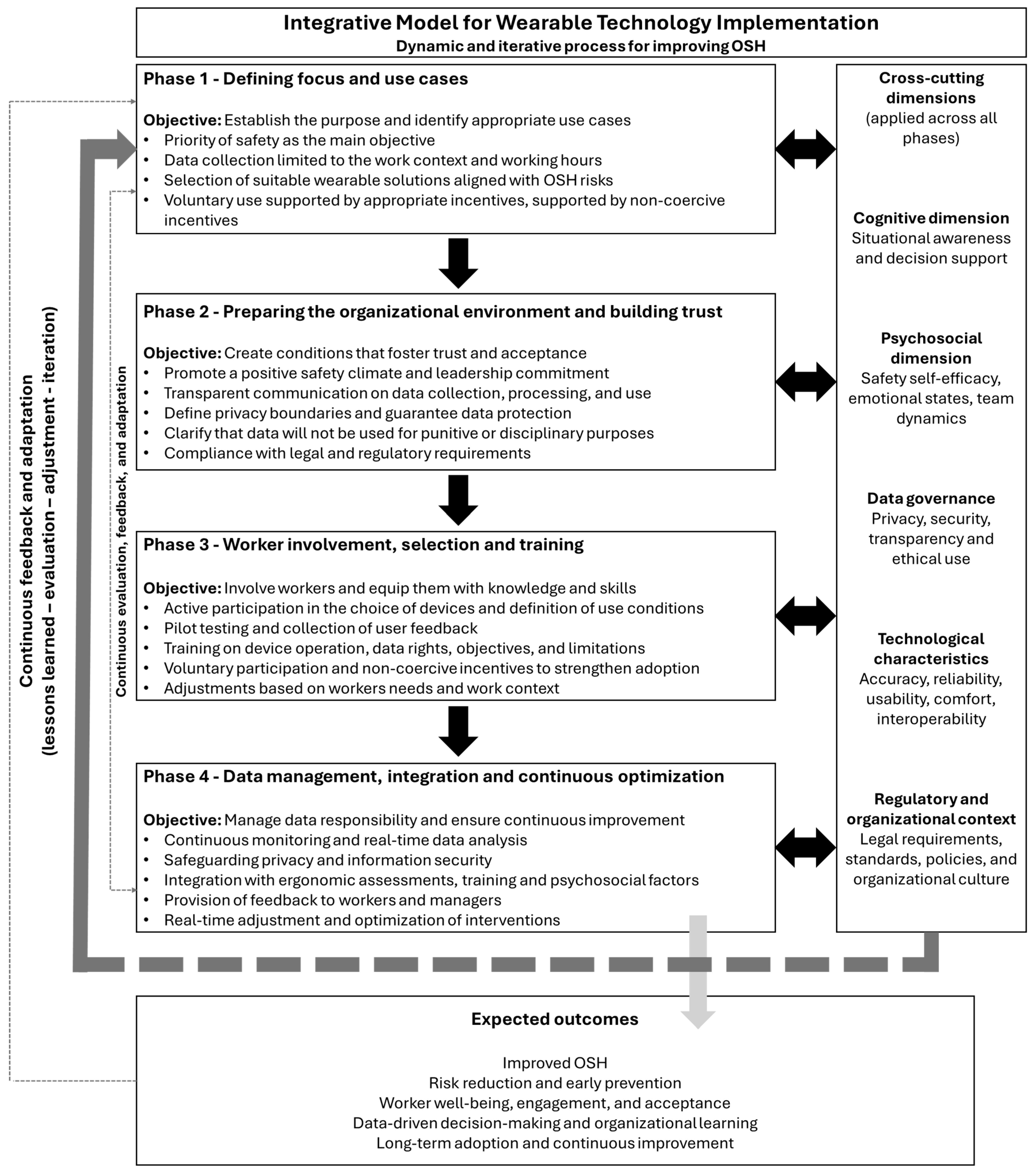
| Phase | Practical Actions | Possible Indicators | Responsible Actors |
|---|---|---|---|
| Phase 1—Defining focus and use cases | Define safety-oriented use cases; limit data collection to work-related purposes; identify suitable wearable solutions | Use-case clarity; perceived usefulness; alignment with OSH risks | Management; OSH team; supervisors |
| Phase 2—Preparing the organizational environment and building trust | Communicate data purposes; define privacy boundaries; clarify non-punitive use of data | Trust level; privacy acceptance; worker perception of fairness | Management; Human Resources; legal/data protection officer; OSH team |
| Phase 3—Worker involvement, selection, and training | Involve workers in device selection; conduct pilot testing; provide training on use, rights, and limitations | Participation rate; training completion; usability feedback; acceptance intention | Workers; supervisors; OSH team; technology providers |
| Phase 4—Data management, integration, and continuous optimization | Establish data governance; monitor indicators; provide feedback; adjust interventions | Data access rules; feedback frequency; intervention records; worker-reported workload | OSH team; Information Technology/data team; management; worker representatives |
Disclaimer/Publisher’s Note: The statements, opinions and data contained in all publications are solely those of the individual author(s) and contributor(s) and not of MDPI and/or the editor(s). MDPI and/or the editor(s) disclaim responsibility for any injury to people or property resulting from any ideas, methods, instructions or products referred to in the content. |
© 2026 by the authors. Licensee MDPI, Basel, Switzerland. This article is an open access article distributed under the terms and conditions of the Creative Commons Attribution (CC BY) license.
Share and Cite
Mendes, D.; Terradillos, E.; Navas, H.V.G.; Costa, O.; Matias, J.; Soares, V. Wearable Technologies in Occupational Safety and Health: A Systematic Review and a Human-Centered Implementation Model. Appl. Sci. 2026, 16, 4715. https://doi.org/10.3390/app16104715
Mendes D, Terradillos E, Navas HVG, Costa O, Matias J, Soares V. Wearable Technologies in Occupational Safety and Health: A Systematic Review and a Human-Centered Implementation Model. Applied Sciences. 2026; 16(10):4715. https://doi.org/10.3390/app16104715
Chicago/Turabian StyleMendes, David, Elena Terradillos, Helena V. G. Navas, Olga Costa, João Matias, and Vanessa Soares. 2026. "Wearable Technologies in Occupational Safety and Health: A Systematic Review and a Human-Centered Implementation Model" Applied Sciences 16, no. 10: 4715. https://doi.org/10.3390/app16104715
APA StyleMendes, D., Terradillos, E., Navas, H. V. G., Costa, O., Matias, J., & Soares, V. (2026). Wearable Technologies in Occupational Safety and Health: A Systematic Review and a Human-Centered Implementation Model. Applied Sciences, 16(10), 4715. https://doi.org/10.3390/app16104715