1. Introduction
Technical policy in rail transport, primarily in the design and manufacture of freight cars, focuses on further improvements to their design, primarily in terms of their dynamic (running) performance. This is driven by increasing freight train speeds and increasing axle loads on freight cars. This raises the challenge of selecting rational spring suspension parameters for developing car designs and their vehicles at the design stage.
This issue has always been and remains central to engineering and technical staff involved in the development and calculation of freight car designs. Increasing freight car load capacity and axle loads place special demands on their dynamic performance, necessitating more detailed theoretical studies and the development of refined calculation models that take into account various design features, as well as the development of advanced mathematical models and further refinement of dynamic calculation methods. An analysis of the development trends of theoretical studies of forced and natural oscillations and the stability of undisturbed motion of vehicles shows that they are aimed at the constant improvement of calculation schemes: from simple to complex, that is, to complex nonlinear multi-mass systems with a large number of degrees of freedom.
Based on the objectives set for the researchers during the preparation of this article, the authors set the goal of developing a mathematical model for studying the spatial oscillations of railway vehicles, implementing it using computer technology, testing it by comparing the results of theoretical studies and field tests, analyzing the feasibility of using simpler calculation schemes, and developing recommendations for practicing engineers based on the completed research.
During the preliminary stage of preparing this article, a fairly extensive literature review of classical approaches to studying the dynamic properties of railway vehicles was conducted and more modern sources related to the mathematical and numerical modeling of the behavior of freight and passenger cars and trains were examined.
The theoretical foundation for studying the dynamics of railway vehicles, in particular lateral dynamics, motion in curves and stability loss conditions, forms the classical foundations of the dynamics and stability of rail vehicles. Ref. [
1] laid the foundations for the analysis of the lateral dynamics of railway vehicles, describing the general patterns of oscillations and critical speeds that determine the onset of unstable motion modes. Ref. [
2] developed these principles in relation to the steady motion of vehicles in curves, examining in detail the influence of track geometry and bogie parameters on stability. In their scientific works, ref. [
3] expanded on classical approaches by investigating the nonlinear effects of motion on transition curves near critical speeds, which is of importance for modern heavily loaded cars.
The nonlinear dynamics and stability of freight cars are the subject of numerous scientific papers, which examine nonlinear effects involving bogies, suspension systems, and the complex issues of contact interaction in the wheel–rail system.
For example, ref. [
4] investigated the nonlinear dynamics of a two-axle freight car when moving in curves, identifying the key mechanisms for the occurrence of unstable modes. Ref. [
5] considered a four-axle car with Y25 bogies, proposing engineering measures to improve lateral stability. Ref. [
6] analyzed the influence of wheel polygonality and body natural vibration modes on the dynamic performance of a C80 car.
The authors also analyzed the research of various scientists aimed at developing mathematical and numerical models of the interaction between rolling stock and infrastructure, in which a comprehensive analysis and modeling of the “vehicle-track” system was performed and multi-criteria approaches to studying the above problems were proposed. Thus, ref. [
7] proposed a nonlinear model of a rubber suspension element, widely used in multivariate dynamic calculations. Ref. [
8] integrated the flexibility of the car body into the train–track interaction model, showing its effect on dynamic loads. Ref. [
9] developed a stochastic model taking into account random parameters of rail fastenings. Previous studies of the authors, for example, ref. [
10] are devoted to modeling the elastic-viscous properties of the track with experimental validation.
Numerical modeling and multimass dynamics have been used in a number of studies to analyze the dynamic properties of railway vehicles. For example, ref. [
11] presented the state of the art in the design of railway vehicles taking into account their multimass properties. In the article by [
12], the authors summarized the methods for the dynamic analysis of railway vehicles. Ref. [
13] systematized modern models for lateral stability analysis, and [
14] developed a dynamic stability model with an analysis of the mechanical characteristics of the system.
It should be noted that a number of articles are devoted to vertical dynamics and vibration processes, in which the issues of vertical dynamics, vibration and oscillations of the body of railway vehicles are analyzed in detail. Ref. [
15] showed the influence of the suspension model on the vertical oscillations of the body. In the work [
16] proposed analytical formulas for vertical dynamic responses, and in the scientific article [
17] considered low-frequency vibration damping using a dynamic absorber. Ref. [
18] investigated the influence of suspension equipment on the vibration modes of the body.
Track condition monitoring and diagnostics based on dynamic responses have also found their way into various studies and papers that address the impact of rolling stock on railway tracks. Ref. [
19] developed a method for assessing track geometry based on body vibrations, and [
20] applied time-frequency analysis to track condition monitoring. In a research study, ref. [
21] proposed a method for assessing track geometry and identifying “hanging sleepers” with unknown system parameters. Ref. [
22] established a relationship between the quality of track geometry and the dynamic response of a vehicle.
Experimental studies and model validation are essential for establishing correct values for the dynamic interaction parameters of railway vehicles. Research in this area focuses on in-kind measurements and experimental validation of models. For example, ref. [
23] investigated the risk of rollover based on measurements and dynamic modeling, ref. [
24] determined dynamic load factors based on instrumented wheelset data, and ref. [
25] examined physical and virtual test rig technologies.
In addition, the authors analyzed studies devoted to the impact of operational factors [
26] affecting the interaction between the track and rolling stock [
27], for example, ref. [
28] analyzed the effect of cargo sloshing on the car dynamics. In the article, ref. [
29] assessed the clearances of the car–cargo–infrastructure system, and ref. [
30] studied active suspension to prevent derailment during earthquakes.
Also, it is worth noting the applied studies of the dynamics of rolling stock and interaction with the railway track, for example, in the article by [
31] they optimized the parameters of the wedge damper of vibrations of a freight car, and the bogie [
32,
33] experimentally assessed the impact of the bogie on the rails. The authors of [
34] demonstrate that combining multisensor measurements with numerical simulation allows for a more accurate identification of critical speeds and the mechanisms underlying the development of instability in rolling stock bogies, while the authors of [
35] analyze the motion of subway car bogies and propose a model for estimating their critical speed.
Thus, the presented body of literature, reviewed by the authors in preparing the article, covers the evolution of research from classical linear models to modern nonlinear, stochastic and experimentally confirmed approaches.
2. Materials and Methods
It is known that freight bogies currently in use in the CIS countries have only a single stage of spring suspension. However, the bogie frame is not completely rigid, so frame warping is invariably measured during full-scale tests. Therefore, to avoid this design flaw, a new element—a diagonal brace—was introduced into the experimental bogie design. The bogie sidewalls are connected by hinges, and the differential equations for oscillations were derived as a special case of the equations. This assumption assumes that the track in the vertical plane is rigid. This article provides a comparison with full-scale experiments and presents the results of vehicle oscillation modeling obtained using the “Universal Mechanism” program, version 8.1.1 (Laboratory of Computational Mechanics LLC, Bryansk, Russia).
The list of symbols used in the analytical dependencies and their physical meaning are given in
Table 1.
It will be assumed that the wheelsets and sidewalls of the bogie are pivotally connected in the vertical and horizontal planes, meaning there is no axle box stage of the spring suspension. This calculation scheme corresponds to the design of the model 18-9996 bogie. This assumption leads to the following constraint equations:
In addition, the following assumptions are introduced: when studying the vibrations of a gondola car, the body is assumed to be a rigid body, and then:
The path is assumed to be elastic–viscous and inertial in the horizontal plane; in this case, many dynamic connections between coordinates disappear, and half-degrees of freedom take place for the displacements .
The introduction of these assumptions imposes an additional 32 constraint equations on the system. Therefore, the system has 54 − 32 = 22 degrees of freedom, as well as 8 half degrees of freedom.
This simplification of the original system, discussed in the authors’ previous study [
36], is explained not only by the design features of the bogie but also by the fact that this approach allows for the identification of the dominant modes of vibration that have the greatest influence on dynamic stability within the frequency range under consideration, and ensures a high convergence rate of results when optimizing the parameters of the spring suspension, which is critically important for integration with modern real-time rolling stock condition monitoring software. Therefore, it became necessary to lower the order of the system of differential equations.
The following generalized coordinates of the original system were used:
Here, to reduce the number of dynamic constraints, the and coordinates are introduced—the vertical displacements and rotation angles of the wheel pairs relative to the -axis passing through their centers of gravity—instead of the vertical displacements of the wheels .
The kinetic energy of the system was expressed as:
Next, an expression for the potential energy of the path was obtained. The relationship between the vertical and horizontal displacements of the rails is defined, as before, by the expression:
where the horizontal displacements of the wheels relative to the rails are determined as follows:
It was assumed that there was no influence from adjacent wheel sets, which is:
The potential energy of the path has the following form:
In the equations for the mutual displacements of the bodies of the system, the following expressions change:
and the displacements
are absent in this formulation of the problem.
The forces of interaction between the wheels and the rails are now equal to:
Wheel slip is defined as:
The pseudo-slip coefficient is assumed to be constant,
. The differential equations for oscillations take the form:
The expressions for the inertial coefficients are derived based on (4):
The generalized forces
have the form:
Next, the generalized forces were determined as
, which, without taking into account the influence of the adjacent wheelset, have a simpler form:
In this study, Expressions (5) and (7) were employed to derive the results:
Taking into account the rail inclination, as before, instead of in the expression, , should be substituted.
To eliminate the dynamic relationship between the coordinates
and
, it is sufficient to introduce a new coordinate:
Then:
and the second and thirtieth equations are separated:
The following transformations were performed on Equations (13) and (14). Consider that
; multiply the first by
, and the second by
, and subtract the second from the first. The following was received:
By applying the same method to all equations
, it was found that:
The correctness of the resulting differential equations was verified by simulation using the “Universal Mechanism” program.
The model was defined by deterministic disturbances in the vertical plane, superimposed on them by random disturbances in the vertical and horizontal planes. The deterministic irregularities were assumed to be symmetrical on both rails; these irregularities have the following form:
with parameters
, and the unevenness depth
varied. The unevenness was introduced into the model using a sine wave generator and a software device that applied unevenness to each wheel with the required delay depending on the driving speed:
Random track irregularities had a continuous frequency spectrum
in the range from 0 to 100 Hz. The spectral density of an irregularity is equal to:
and is a function decreasing with increasing frequency. To implement such a random disturbance during the study, a signal from a white noise generator was fed to a special circuit and then to the model, with random irregularities under each wheel assumed to be independent. The disturbance level was regulated by the value of the standard deviation of random irregularities
, which varied from 0.5 to 2.0 mm. These random irregularities were specified as vertical. Horizontal random irregularities were also introduced into the model. They had the same level as the vertical ones, but were assumed to be the same for all wheels on one side of the car; horizontal random irregularities were fed to each rail independently.
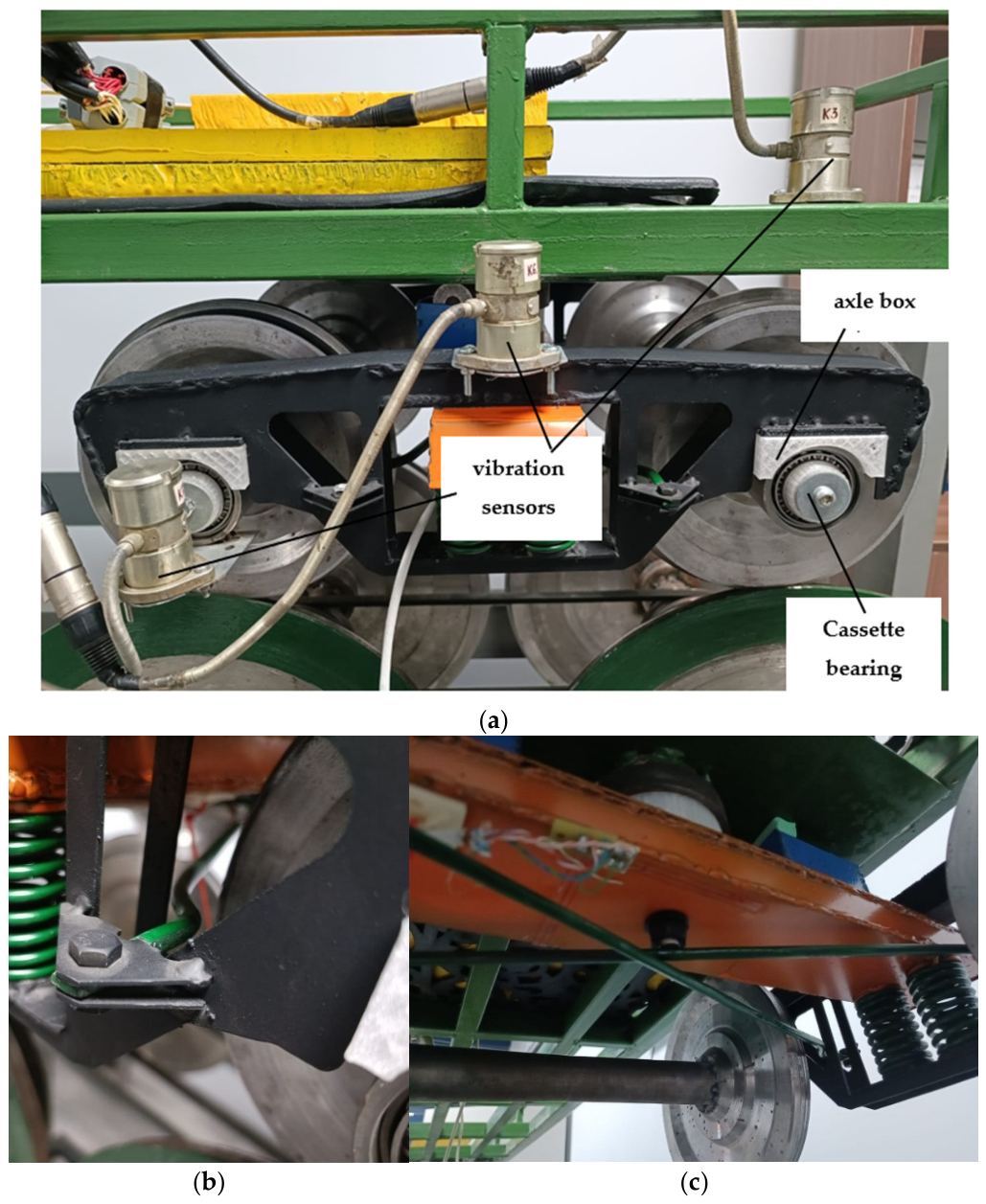
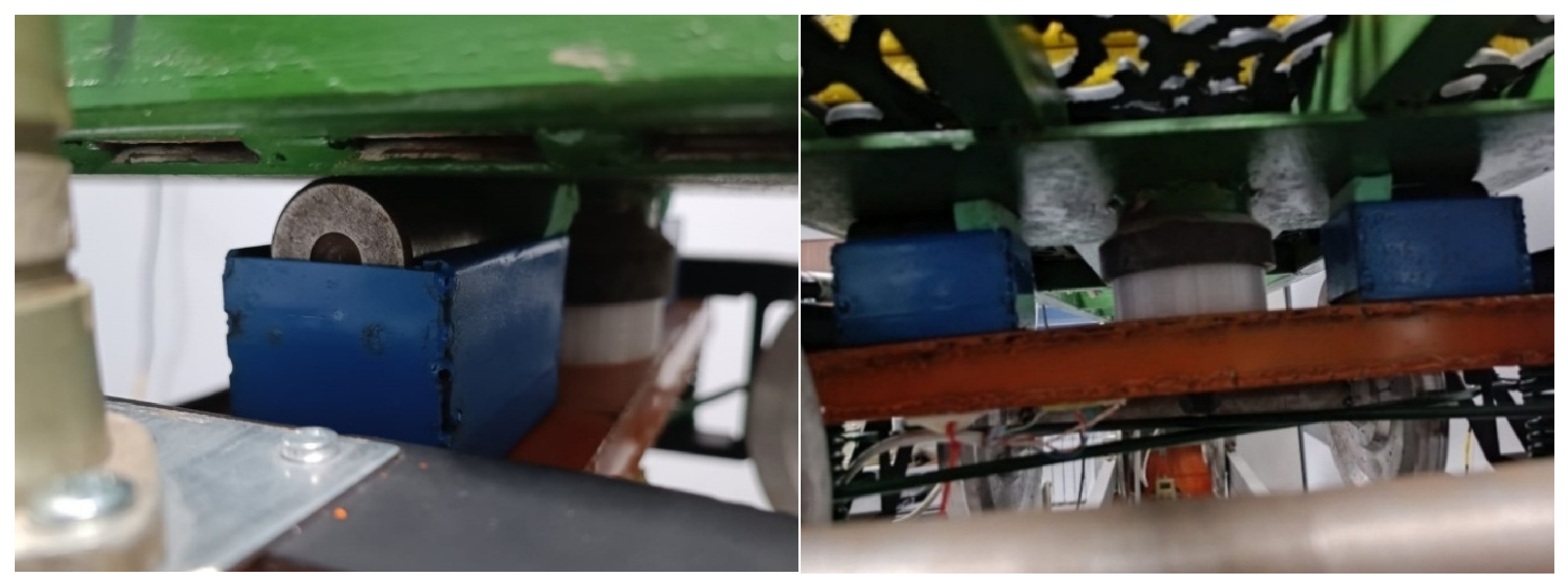
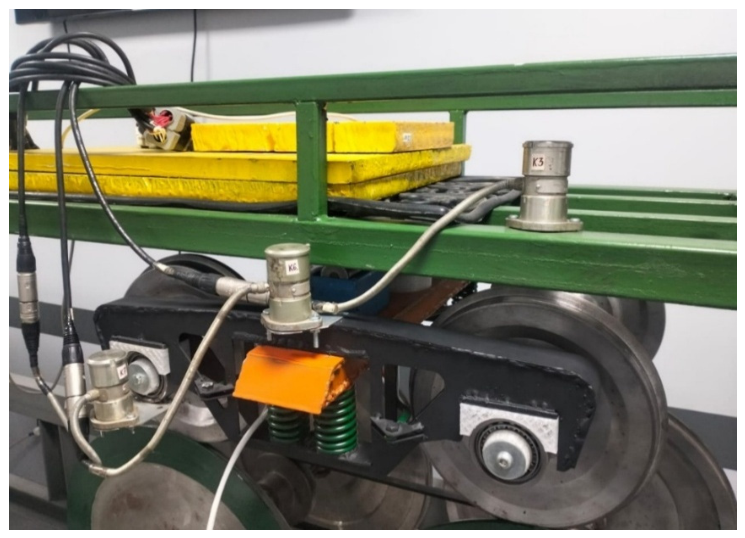
To conduct laboratory studies of the dynamic characteristics of an innovative cargo trolley model (
Figure 1 and
Figure 2), a universal hardware and software device, the E14-440, was used. It is designed for building multichannel measurement systems for input, output, and processing of analog and digital data. It features a USB interface for connection to a PC. The E14-440 module features software-controlled configuration of data acquisition parameters, including the number and sequence of input channel polls, measurement ranges, and ADC conversion frequency. Data acquisition can be synchronized using an external clock signal or the input signal level, digital filtering, spectral analysis, and more.
The acceleration of the sprung (side frame and car body) and unsprung (axle box) parts of the bogie was recorded using MV-25D-V sensors, which convert mechanical vibrations into electrical signals and are used to measure the speed of vibrations.
The main technical characteristics of the MV-25D-V vibration sensors are presented in
Table 2.
3. Results
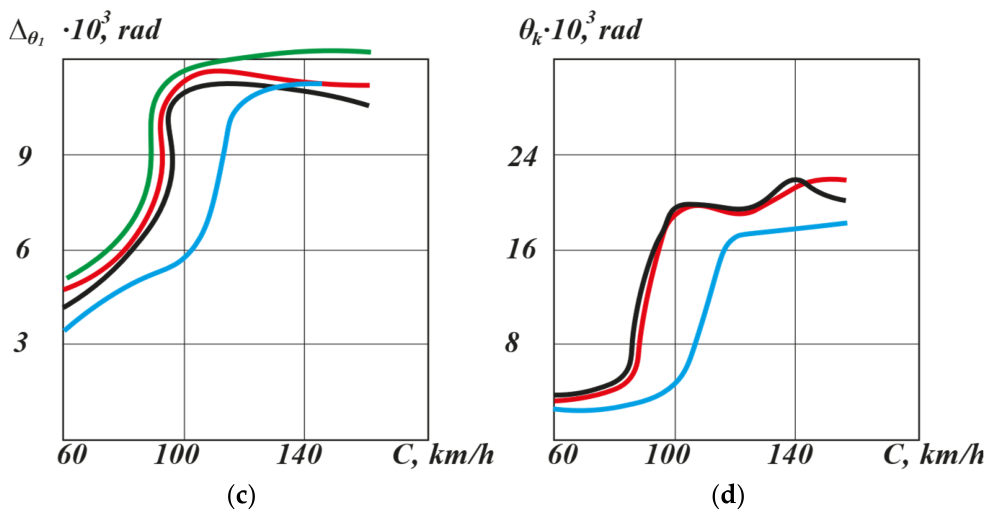
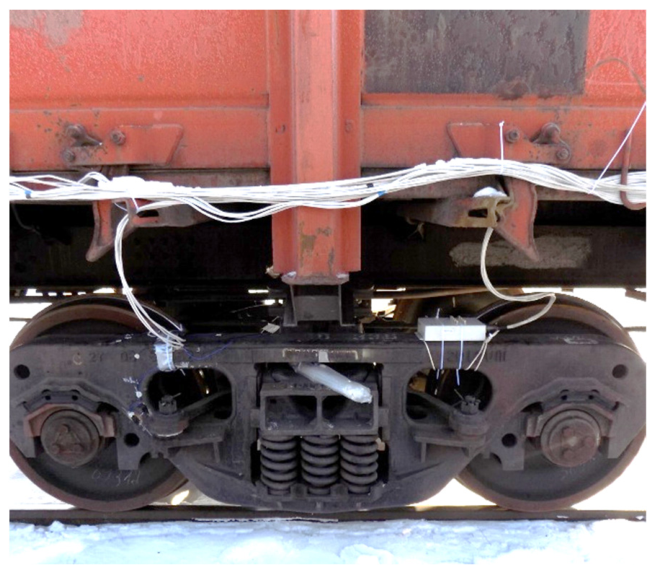
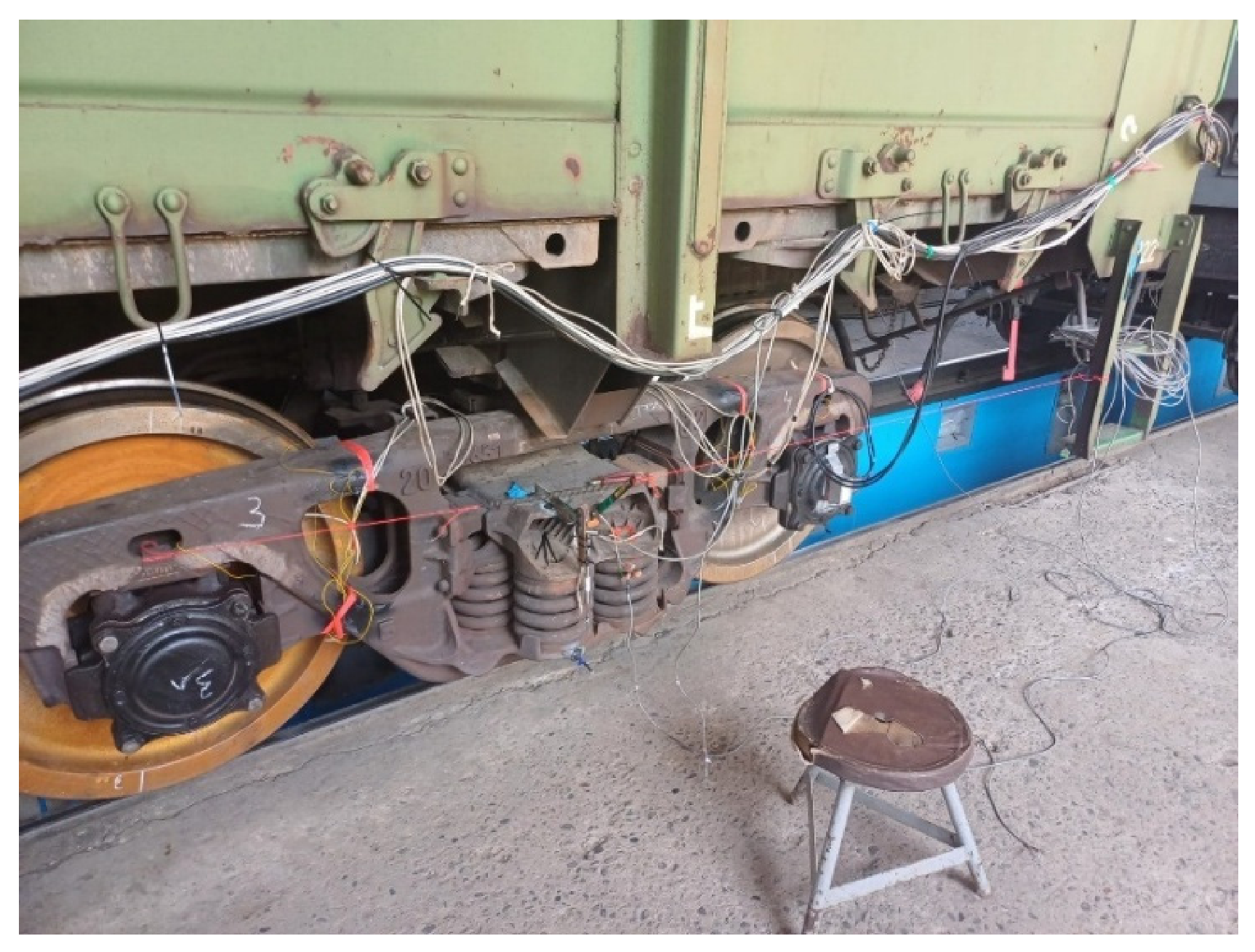
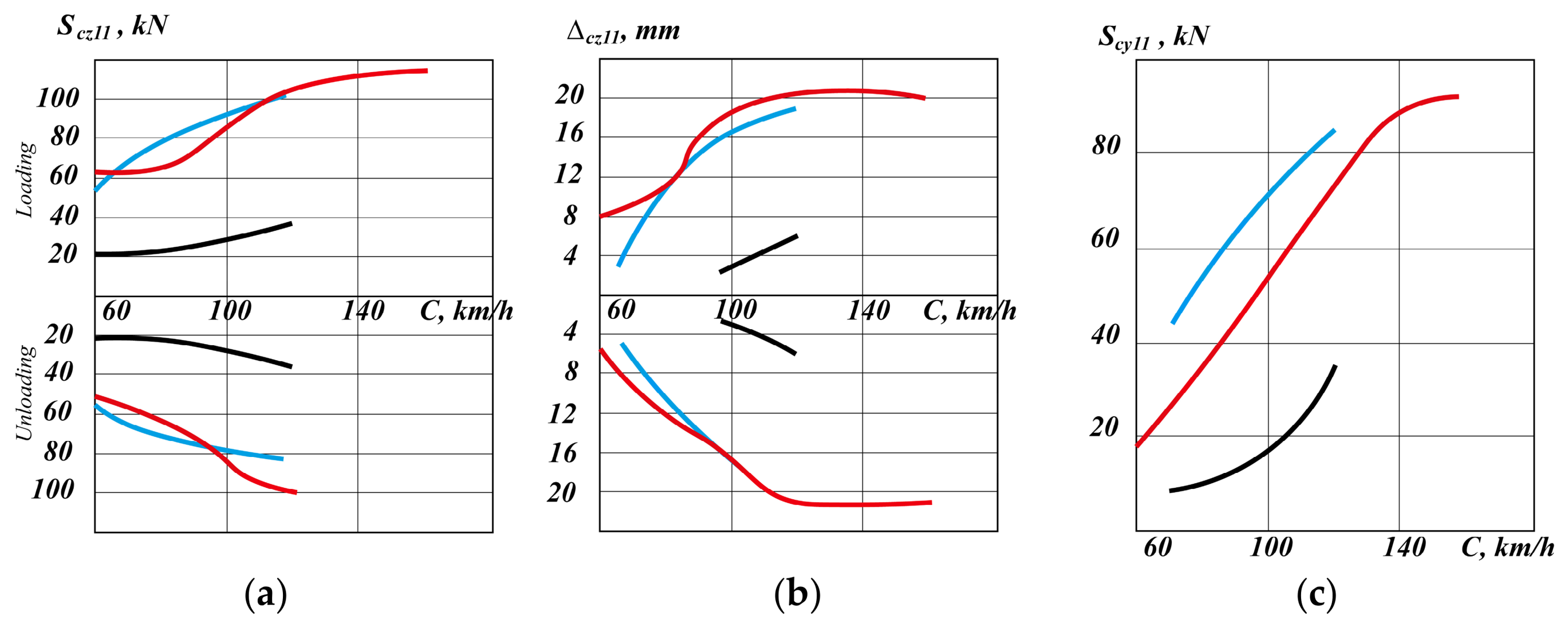
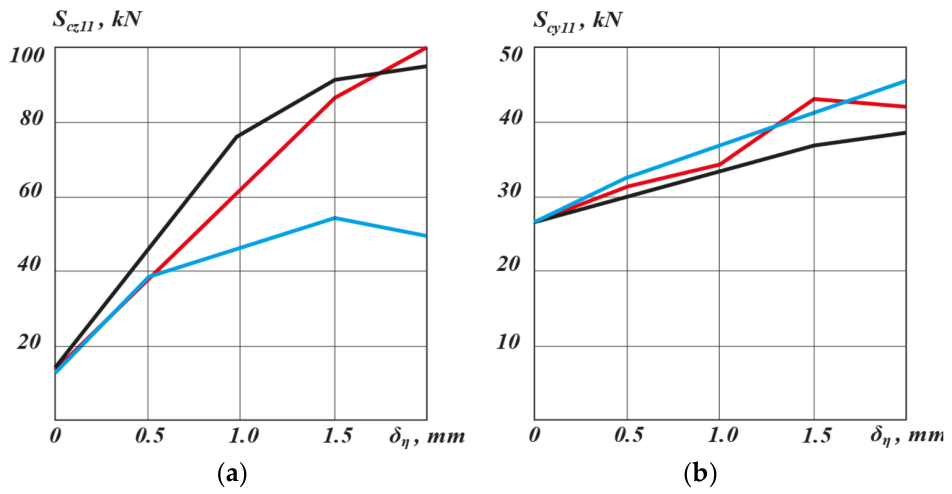
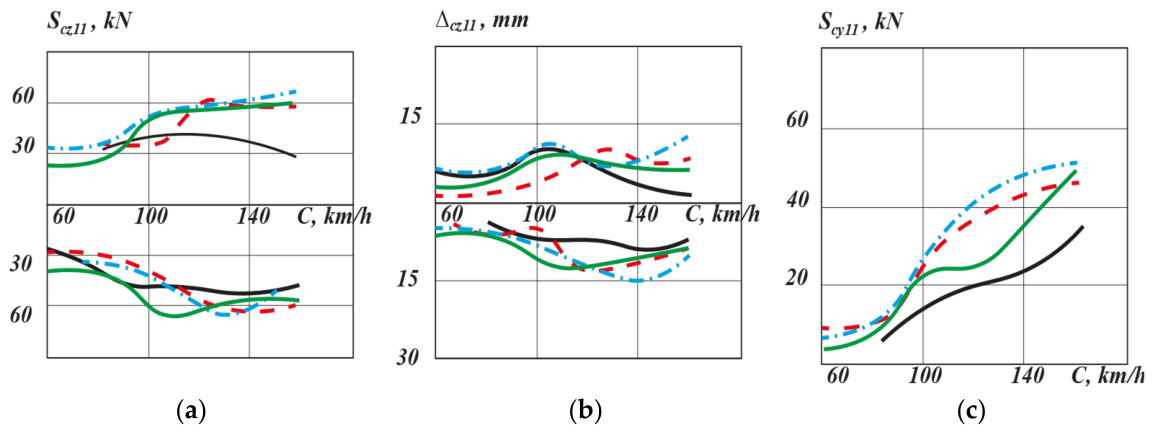
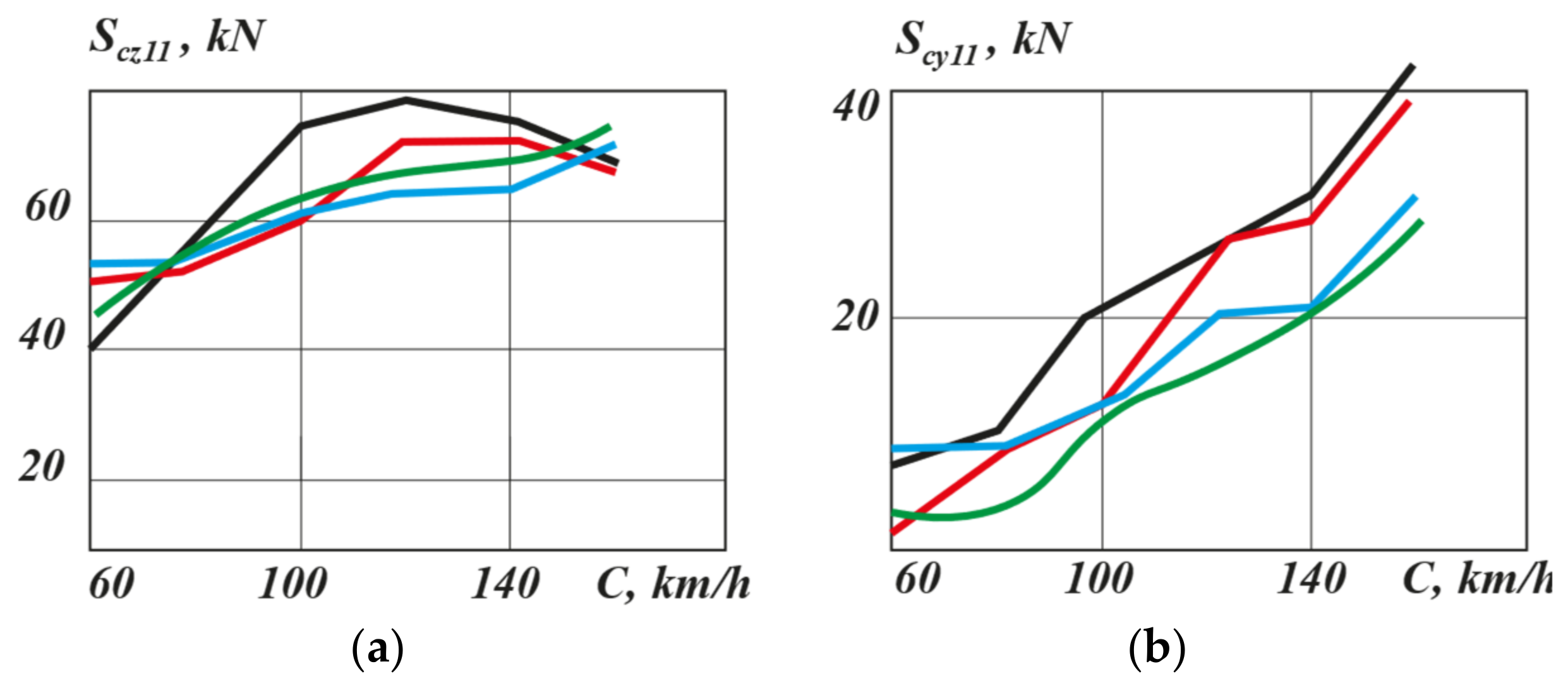
Freight car vibrations were studied in the speed range of 60–140 km/h. The conformity of the forces and displacements obtained during the simulation with experimental data was assessed by comparing the simulation results with full-scale test data. The results of dynamic (running) tests of freight cars with 18-9996 bogies with modernized axlebox assemblies, performed on the Birlik–Zhideli section, were used. In addition, the results of tests of a new bogie with diagonal braces (
Figure 3,
Figure 4 and
Figure 5) on the Belorechenskaya–Maikop high-speed test site were utilized, as well as the simulation for a stamped-and-welded bogie with diagonal braces and conical cassette bearings, with elastic roller bearings installed on the bogie bolster.
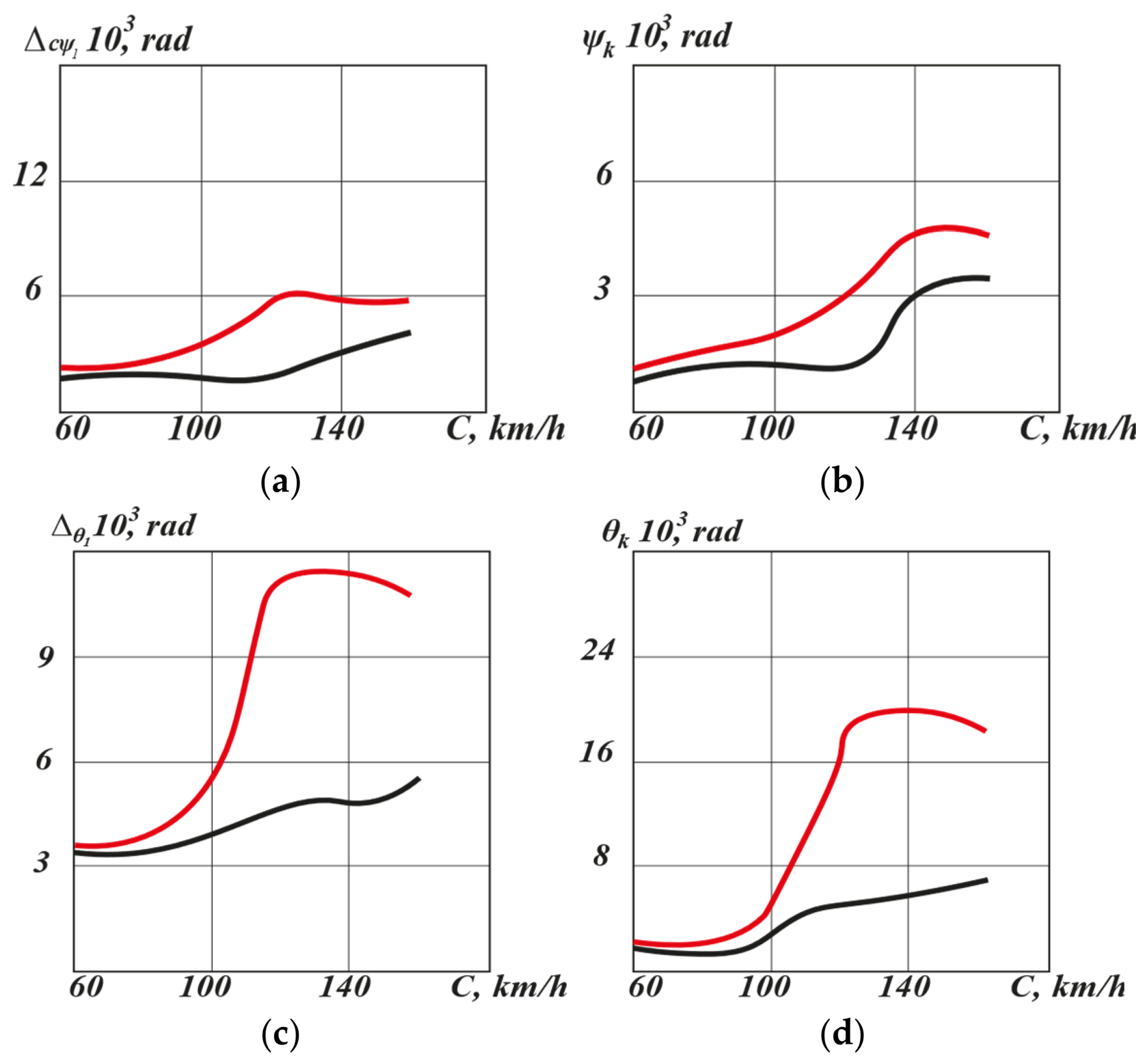
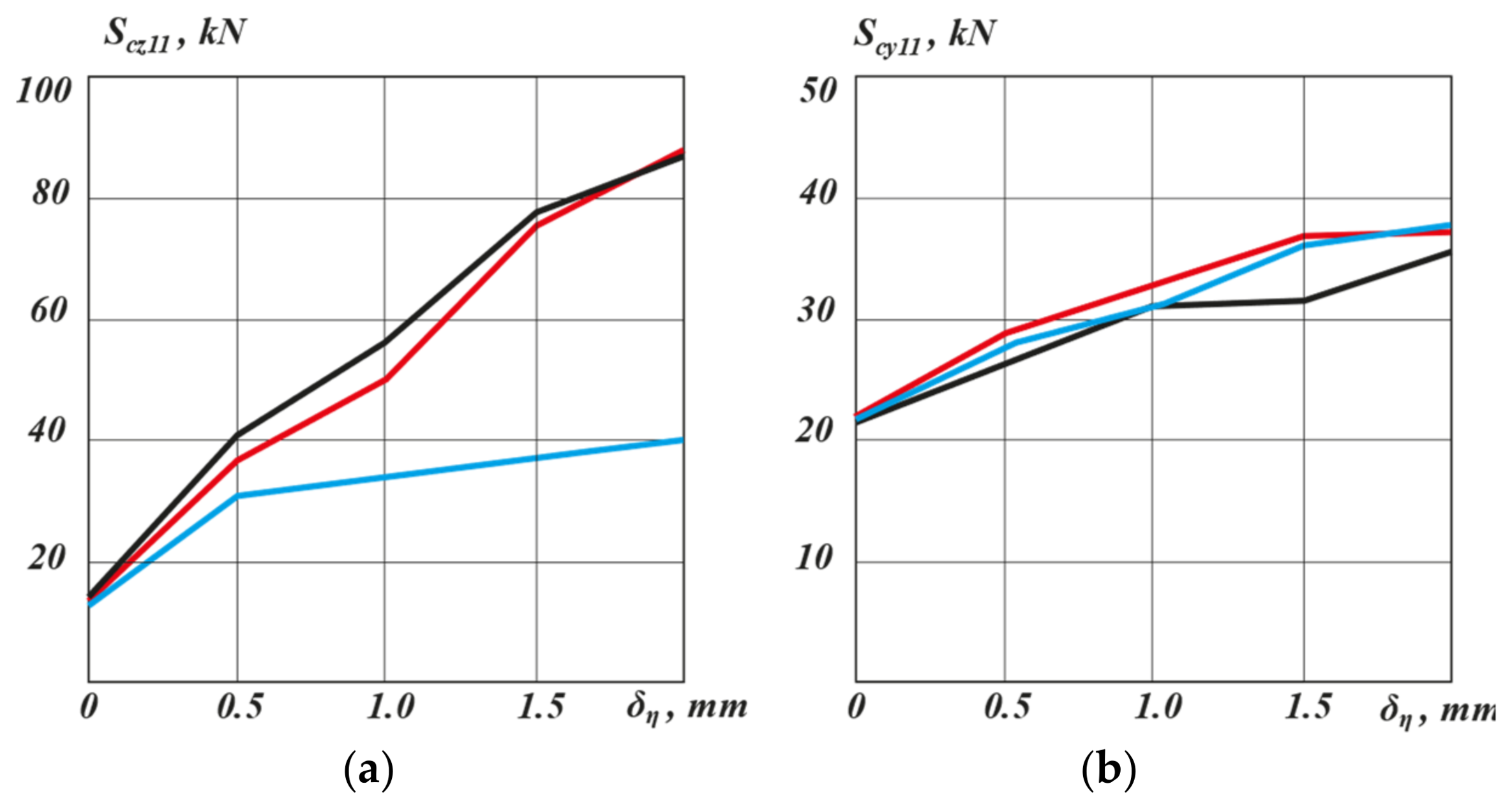
The black lines in these figures represent the envelope curves obtained by processing the experimental data (the angular displacements of the vehicle body relative to the bogies during lateral roll and yaw
were not measured). These graphs also show the points from the simulation results and their envelope curves (red lines). The disturbance level was selected at a speed of 100 km/h and remained constant throughout the entire speed range considered (
Figure 6,
Figure 7 and
Figure 8).
From
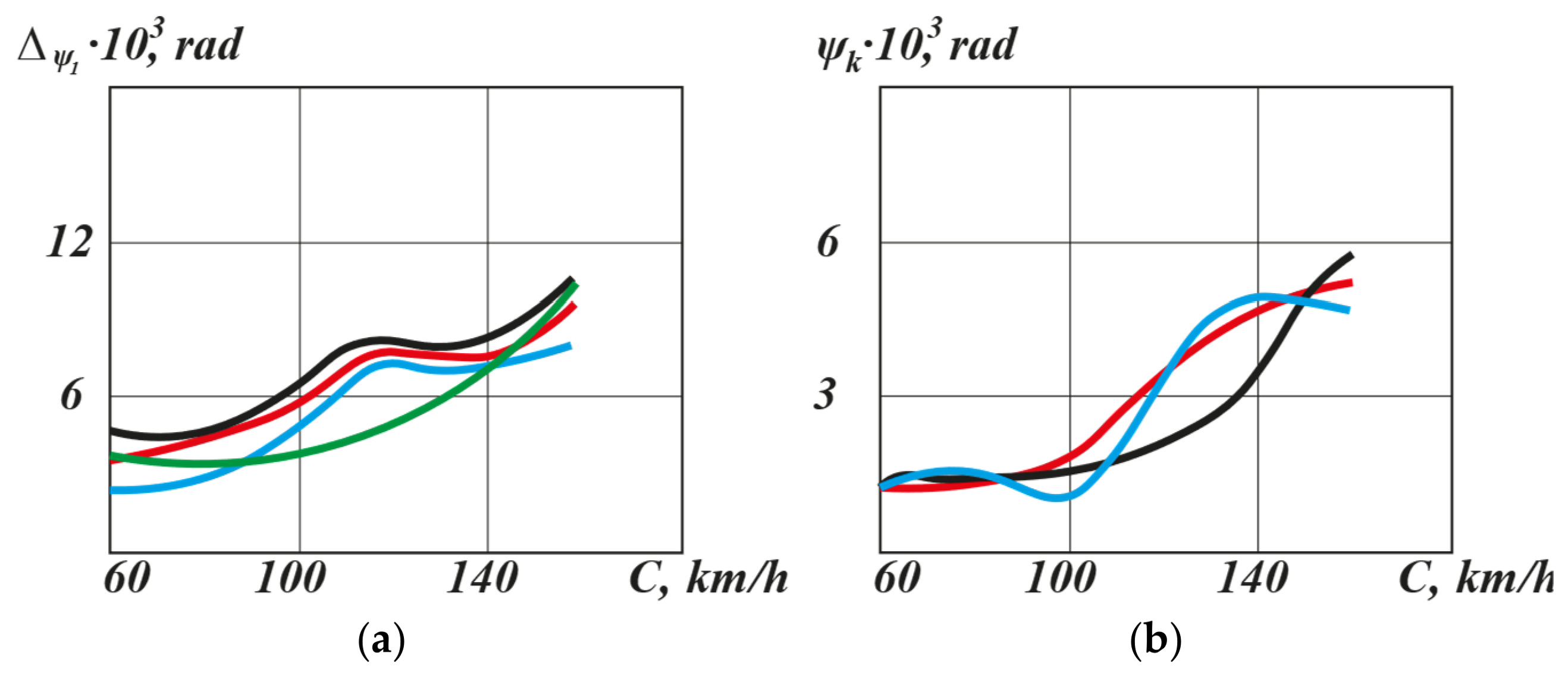
Figure 7b it is evident that, at a speed of approximately 100 km/h, a loss of stability of the car’s motion is observed, since the values of
, starting from this speed, increase sharply. At the same speed, a sharp increase in the car body roll occurs, which leads to an increase in
(
Figure 7a); at speeds of 120 km/h and higher, the gap between the side bearings is completely exhausted (a limitation is observed on the
curve). In connection with this, impact forces
arise, which lead to an increase in the vertical forces in the central suspension of the railway vehicle
Figure 9.
The sharp increase in
is also visible in
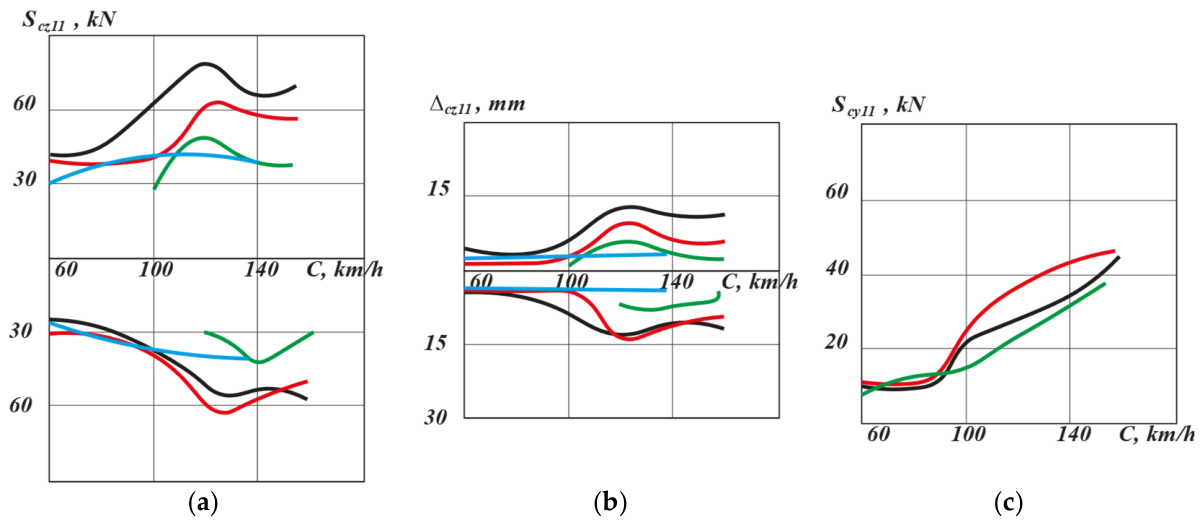
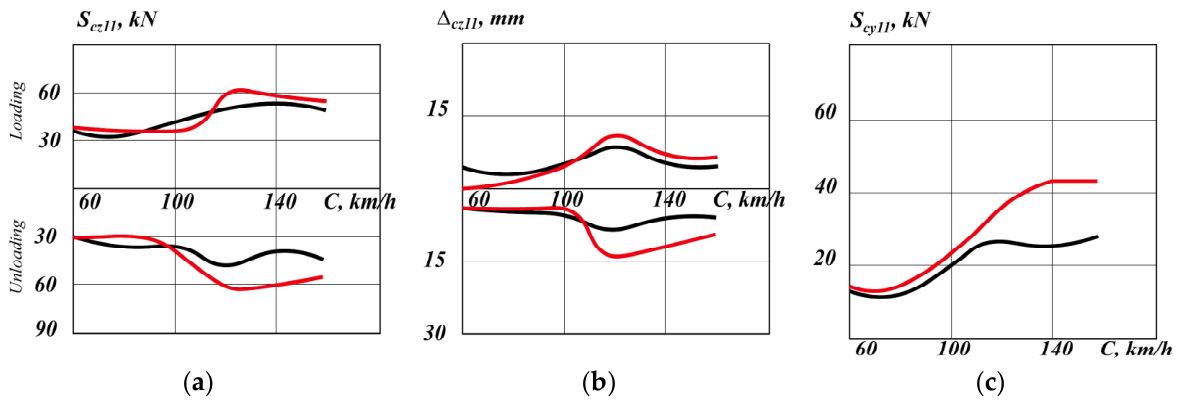
Figure 8, both in the experiment and in the model. These circumstances distinguish the spatial formulation of the problem from the plane one. For clarity,
Figure 10a–c show graphs of
and
и
, respectively, obtained by modeling irregularities with a depth of
mm (black lines), a depth of
mm (red lines) and with natural vibrations (blue lines), as well as by modeling a plane problem with an irregularity depth of
mm (blue line).
The horizontal forces
(
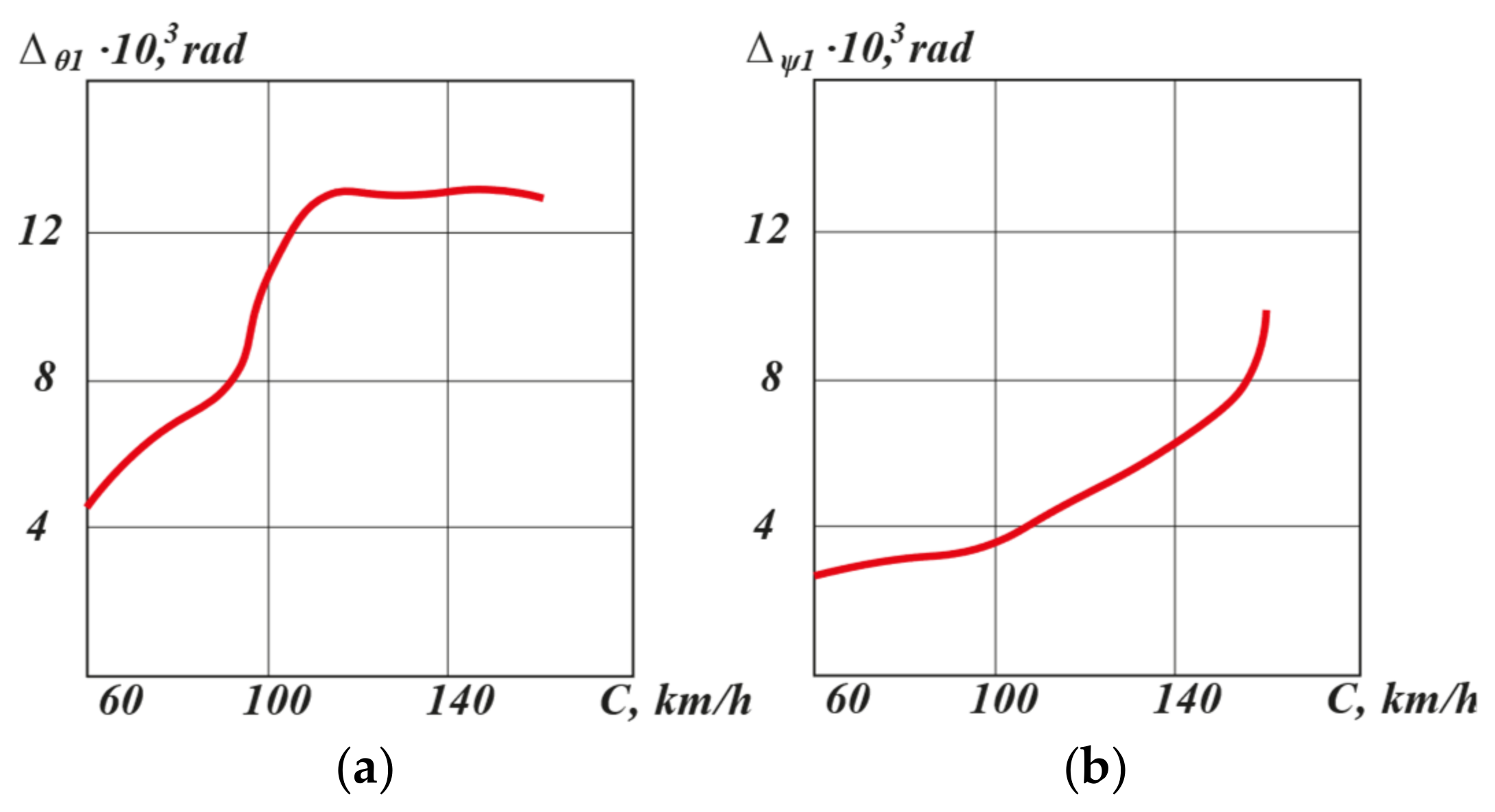
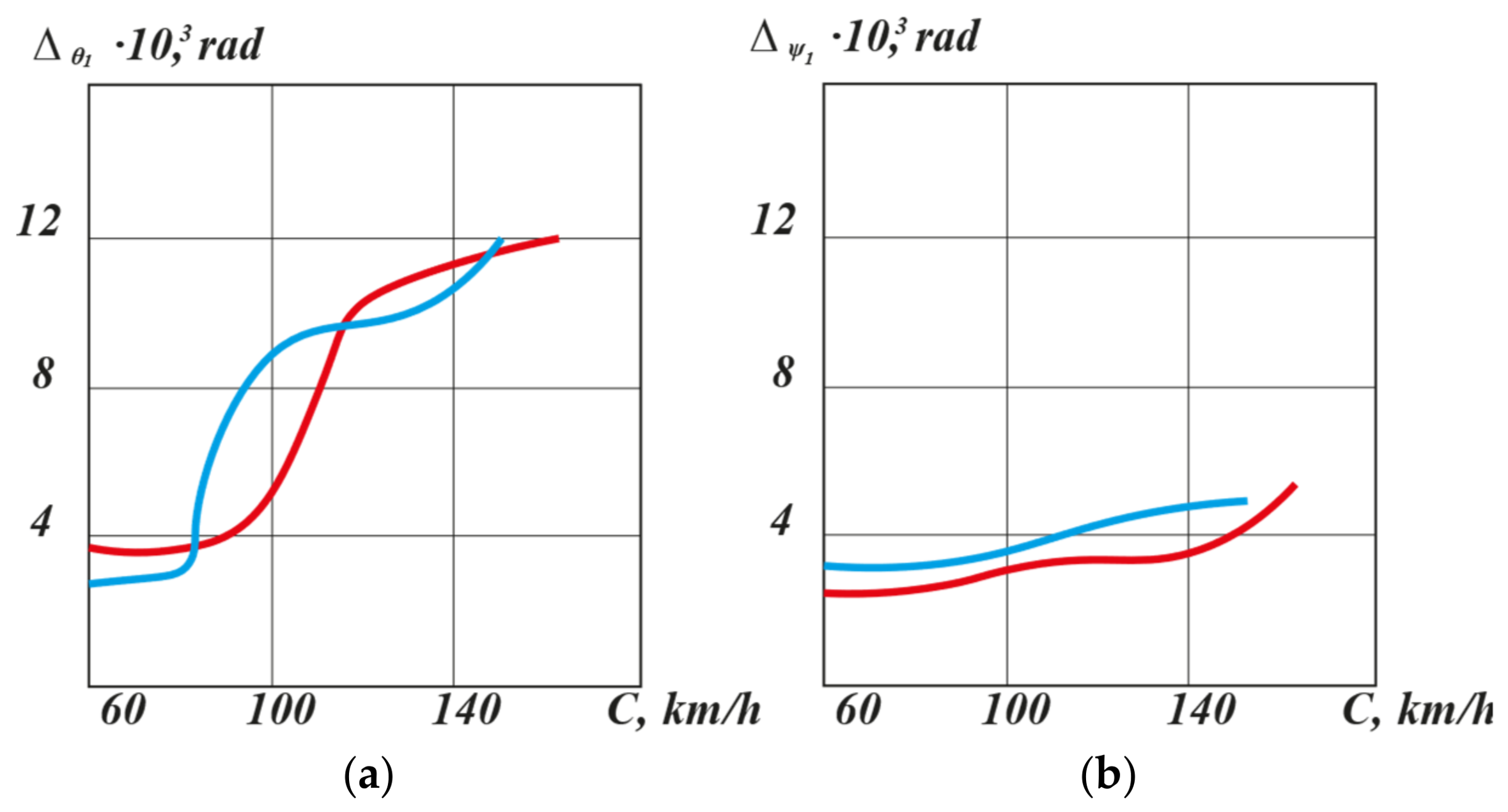
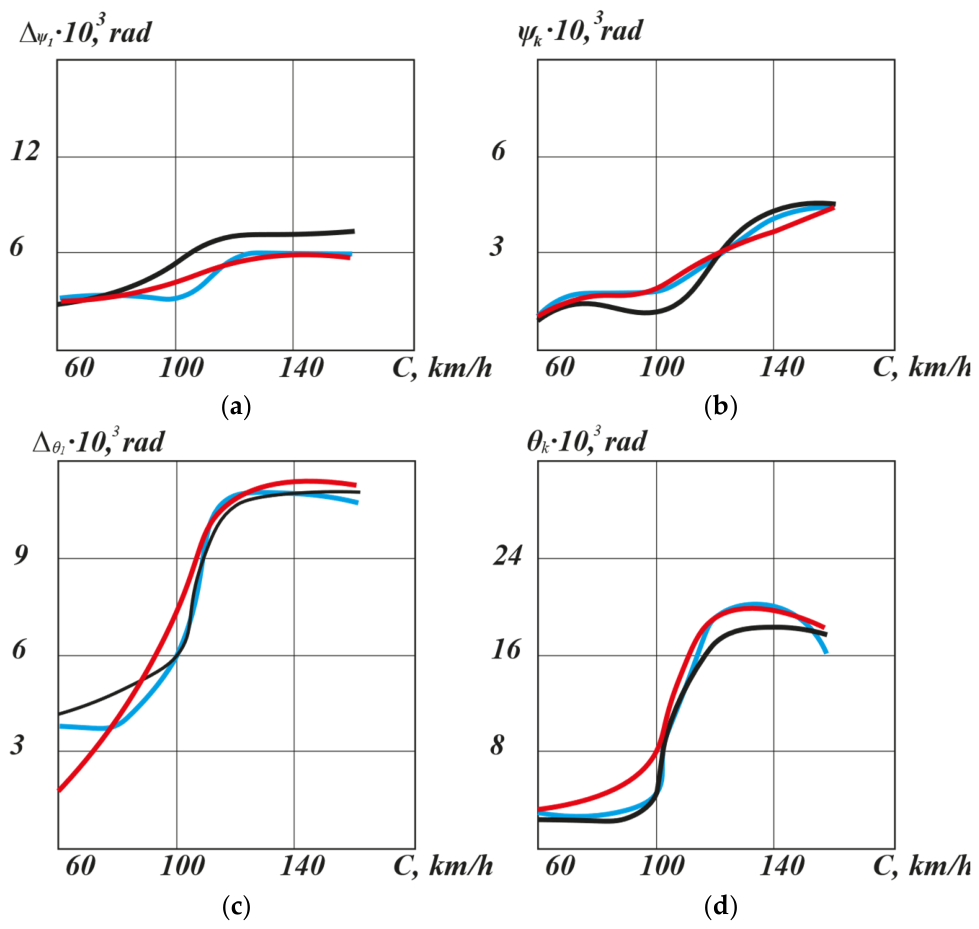
Figure 10c) during railway vehicle motion over vertical unevenness of varying depths and during oscillations caused by initial disturbances differ little over the entire speed range, suggesting that symmetrical vertical unevenness, even of great depth, has little effect on the horizontal forces. The results for
, yaw
, and body roll
also differ little in this case (
Figure 11a–d; the line designations are the same as in
Figure 7). The loss of stability of the freight car’s motion occurs at a speed of approximately 100 km/h, after which a sharp increase in the indicated angular displacements is observed.
From the analysis of these graphs, it follows that at the speeds when the vehicle is stable (60–80 km/h), there is practically no difference in the results of solving the two-dimensional problems at different unevenness depths (see
Figure 10a,b). At
km/h (at the stability boundary), a discrepancy between the results of solving both problems is already observed (for additional loading forces—38%). The two-dimensional problem is characterized by a slow increase in the vertical forces and displacements
and
with increasing speed, which contradicts the experimental data; when solving the three-dimensional problem, due to the appearance of impact forces in the sliders, the forces and displacements
increase sharply at speeds of 120 km/h and higher. The discrepancy between the results of the two-dimensional and three-dimensional calculation schemes reaches 100%. The absolute values of these forces and displacements are lower than those obtained in full-scale tests. This is explained by the fact that random unevenness occurs on a real track. Their contribution to the formation of forces
and displacements
is large, as can be seen from a comparison of
Figure 6a,b and
Figure 10a,b. A decrease in the depth of the vertical unevenness leads (black and red lines in
Figure 10a,b) to a decrease in the additional loading forces and displacements, and during unloading, the opposite result sometimes occurs. During natural oscillations, vertical forces and displacements appear only at speeds of 100 km/h.
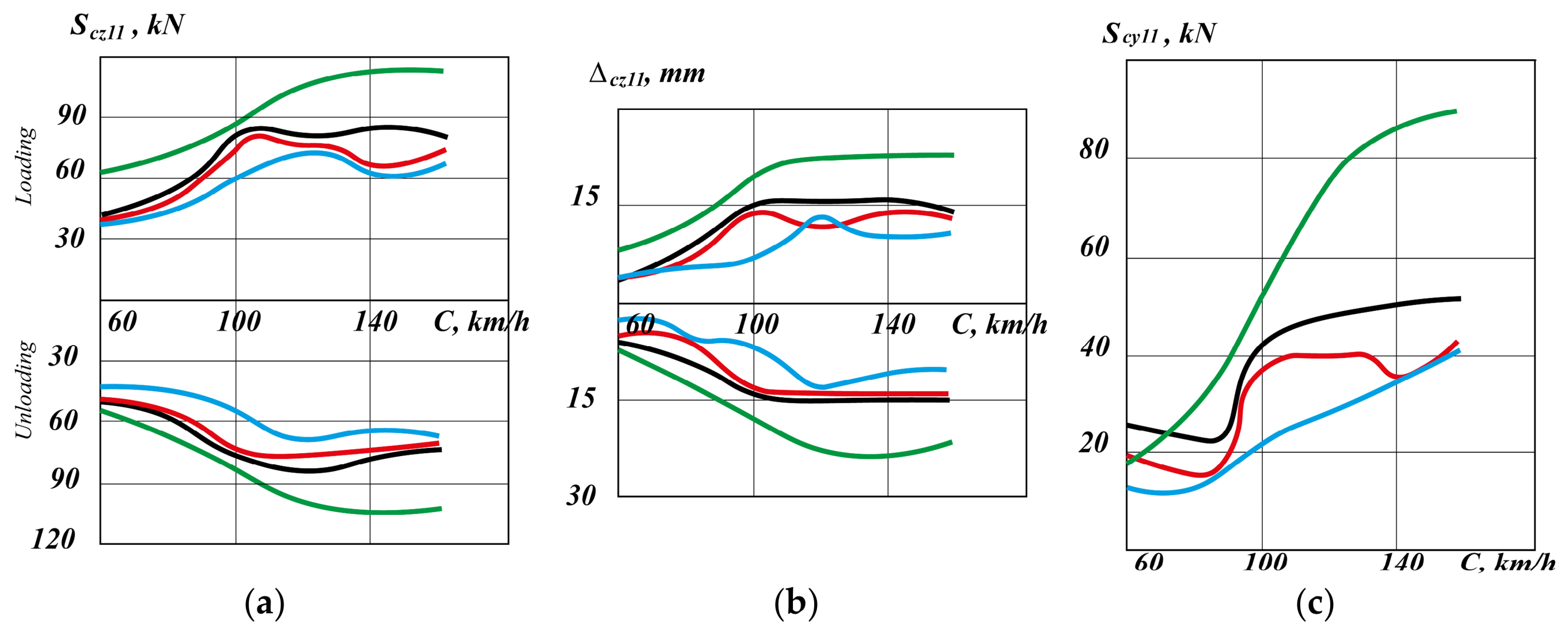
The above-mentioned influence of random irregularities is more clearly demonstrated in
Figure 12a–c and
Figure 13a–d where a comparison is given of the forces
and
and the displacements
when the vehicle moves only over vertical symmetrical irregularities 10 mm deep (blue lines), over the same irregularities 10 mm deep, as well as random vertical irregularities with
mm (red lines), over the same irregularities with
mm and
mm, as well as random horizontal irregularities with
(black lines), and finally, over the same irregularities
mm, but
mm for vertical and horizontal random irregularities (green line).
The following conclusions were drawn from the analysis of these graphs: the introduction of random vertical irregularities leads (see blue and red lines) to an increase in the vertical forces and displacements, as well as the roll of the freight car body
and
; and the horizontal forces increase only at speeds of 100 and 120 km/h, and remain virtually unchanged at other speeds. Consequently, random vertical irregularities also have little effect on the horizontal forces. The introduction of random horizontal irregularities leads (black and red lines) to a sharp increase in the horizontal forces and has little effect on the vertical forces and displacements at low speeds. At speeds above the critical value, the vertical forces increase (
Figure 12a). An increase in the dispersion of random irregularities from
mm to
mm (black and green lines) causes a sharp increase in the vertical and horizontal forces and displacements, especially at high speeds.
It is of interest to determine the influence of the level of random disturbances on the vertical and horizontal forces. For this purpose, the forces
and
were determined at a speed of 100 km/h when the vehicle was moving only over random irregularities with
and 2 mm. For each disturbance variant, five experiments were conducted and then the mathematical expectations of these quantities were calculated. The results of this study are shown in
Figure 14a,b (mathematical expectations of the forces
and
and in
Figure 15a,b (maximum measured forces) when specifying only random horizontal disturbances
(blue lines), random vertical disturbances
(black lines) and both disturbances together (red lines).
From the analysis of these graphs, it follows that the forces increase most significantly with an increase in the disturbance level (in the presence of both types of unevenness and , these forces are even somewhat lower), while an increase in the level of has a significantly smaller effect on the magnitude of the forces . The horizontal forces also increase with an increase in the disturbance level; unevenness has a greater effect on them than unevenness , but here, the difference is less pronounced than for the forces .
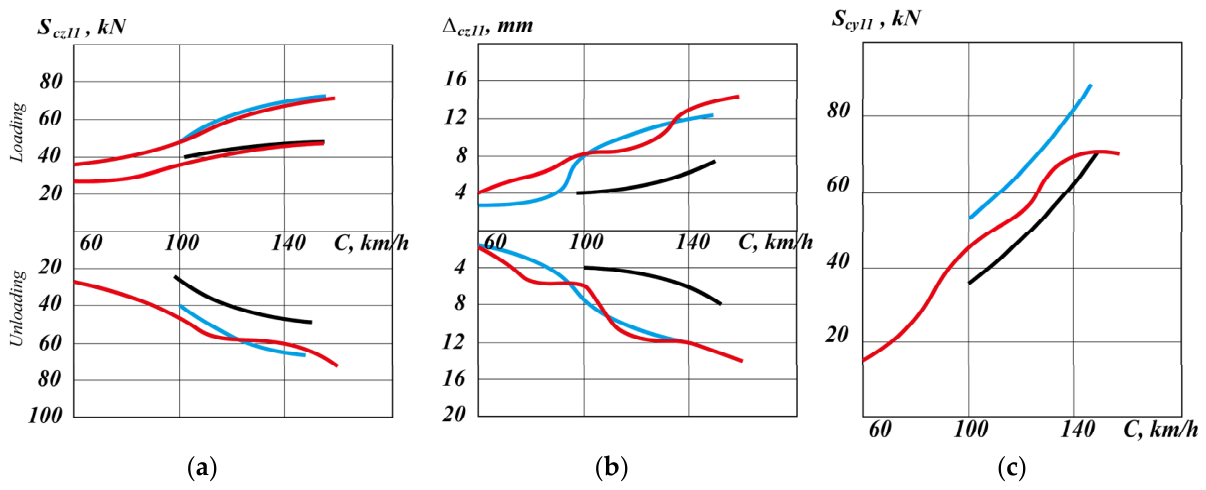
The influence of disturbance levels during full-scale testing is clearly evident when testing is performed on track sections in various conditions. For example, during tests conducted on the Belorechensk–Maikop high-speed track, the force and displacement levels for gondola cars with new bogies (black lines in
Figure 8a–c) were lower than the corresponding values shown in
Figure 6.
The bending values corresponding to the highest force values were obtained by processing the records from one of the test variants. In this case, good agreement with the experiment was achieved by specifying deterministic disturbances of 5 mm depth and random vertical and horizontal disturbances with mm (the simulation data are plotted as dots, and the envelopes are shown as red lines). The track clearance in this case was 7 mm.
Good agreement between the experimental and theoretical results is also observed in this case based on spectral analysis data. The results of the analysis of the experimental oscillogram recordings obtained by modeling the problem are presented in
Table 1, which lists the processes under study and the frequencies at which the spectral density ordinates are highest (in the numerator), as well as the experimental frequency values (in the denominator).
A comparison of the results presented in
Table 3 demonstrates good agreement between the experimental and theoretical data on the vibrations of cars with new bogies.
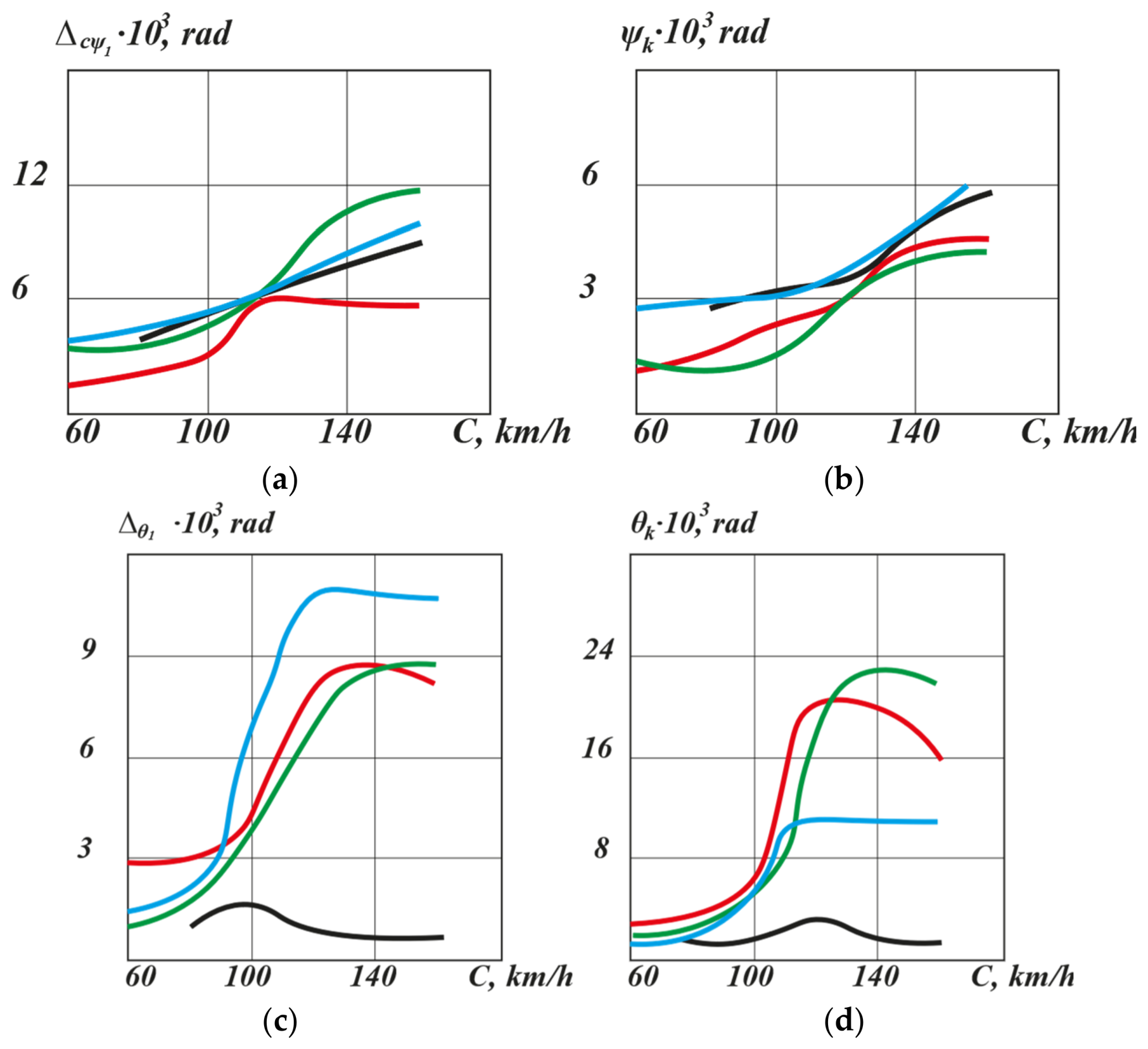
The influence of track clearance on the forces and displacements of the vehicle was studied in more detail when the freight car was moving over vertical, determined unevenness of 5 mm depth (
Figure 16a–c and
Figure 17a–d). At speeds of up to 100 km/h, the forces and displacements with a track clearance of 7 mm (black lines) and 9 mm (red lines) differ little from each other.
At the highest speeds, the influence of the track clearance becomes significant: with a 9 mm track clearance, all movements and forces are significantly higher, especially the values of the lateral roll of the body
and
increase, which cause an increase in the forces
and
(
Figure 16) due to the fact that with this clearance, the gap between the sliders is selected earlier (at C = 120 km/h), and with a 7 mm track clearance, it does not close with an unevenness of 5 mm depth.
For the same unevenness depth (
mm), the effect of the gap between typical side bearings was investigated. The results of this study are presented in
Figure 18 and
Figure 19. As the gap decreases from
mm (red lines) to
(black lines), the roll of the car body decreases (
Figure 19c,d) and, as a consequence, the vertical and horizontal forces and displacements (
Figure 18a,c) at high speeds are reduced. However, decreasing the gap between the side bearings to zero simultaneously leads to an increase in the wobble of the vehicle (
Figure 20a,b).
Reducing the stiffness of the elements that take into account the elasticity of the side bearings after selecting the gap, that is, switching to elastic side bearings with stiffness
, causes an increase in the mutual rotation of the body relative to the bolster beam during lateral roll (
Figure 19a,b). However, installing dampers with a friction wedge
at an initial tightening of
mm of springs with the same stiffness
(green line in
Figure 18 and
Figure 19) leads to a decrease in
and in this case approximately coincides with the values that occur with typical side bearings, and the yaw of the vehicle (
, see
Figure 19a) is even higher. Thus, the installation of elastic roller bearings in new bogies with a low level of disturbances does not lead to a noticeable improvement in dynamic qualities.
The influence of the rigidity of elastic roller bearings in the range of (the results are practically the same) and the magnitude of friction (it turned out that in the absence of friction, the forces increase at high speeds) were also investigated.
Figure 20 shows the influence of the parameters of this characteristic on the vertical
(
Figure 20a) and horizontal
(
Figure 20b) forces. With a beveled wedge, the angular stiffness at
increases and becomes equal to
(black line at
); with a double-beveled wedge, the characteristic becomes symmetrical, and the angular stiffness is equal to:
When
(blue lines) and when
(green lines in
Figure 20), the forces are approximately the same, that is, the asymmetry of the characteristic has little effect on the results. If
(black lines), then the forces increase (vertical by 18%, horizontal by 50% at a speed of 120 km/h). This means that the angular momentum is necessary to reduce the level of forces in the spring suspension of the car. The same conclusion was reached regarding angular stiffness. If we set it equal to zero, and (red lines), then the forces also increase (vertical by 10%, horizontal by 50% at a speed of 120 km/h). Setting the parameter to zero (
) and adjusting it
to
(red lines) results in a force increase: 10% in the vertical plane and 50% in the horizontal plane at a speed of 120 km/h.
The influence of the angular momentum of friction in the range of 20–60 kN·m was studied. Changing the moment within the specified range has little effect on the results.
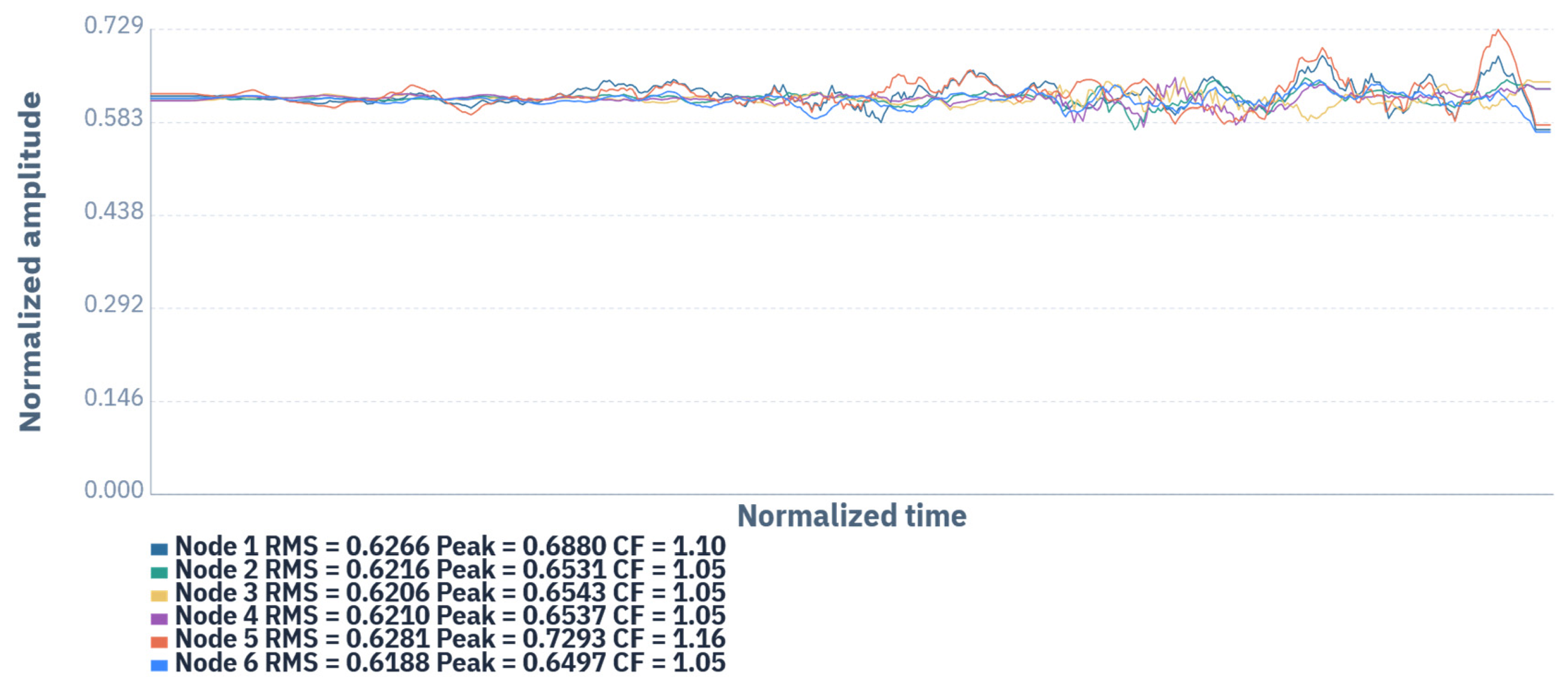
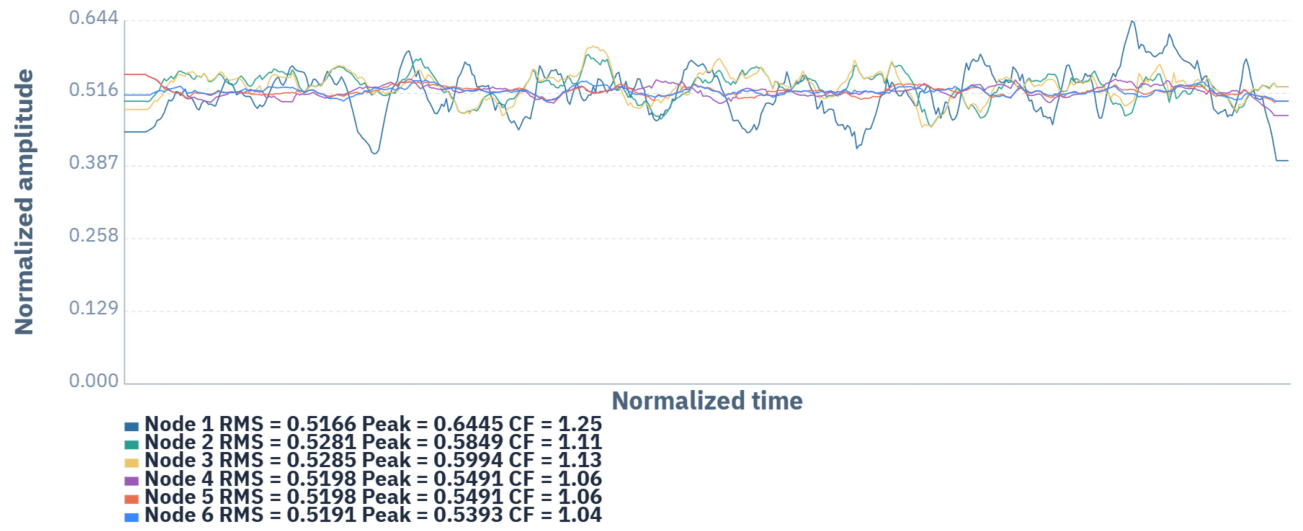
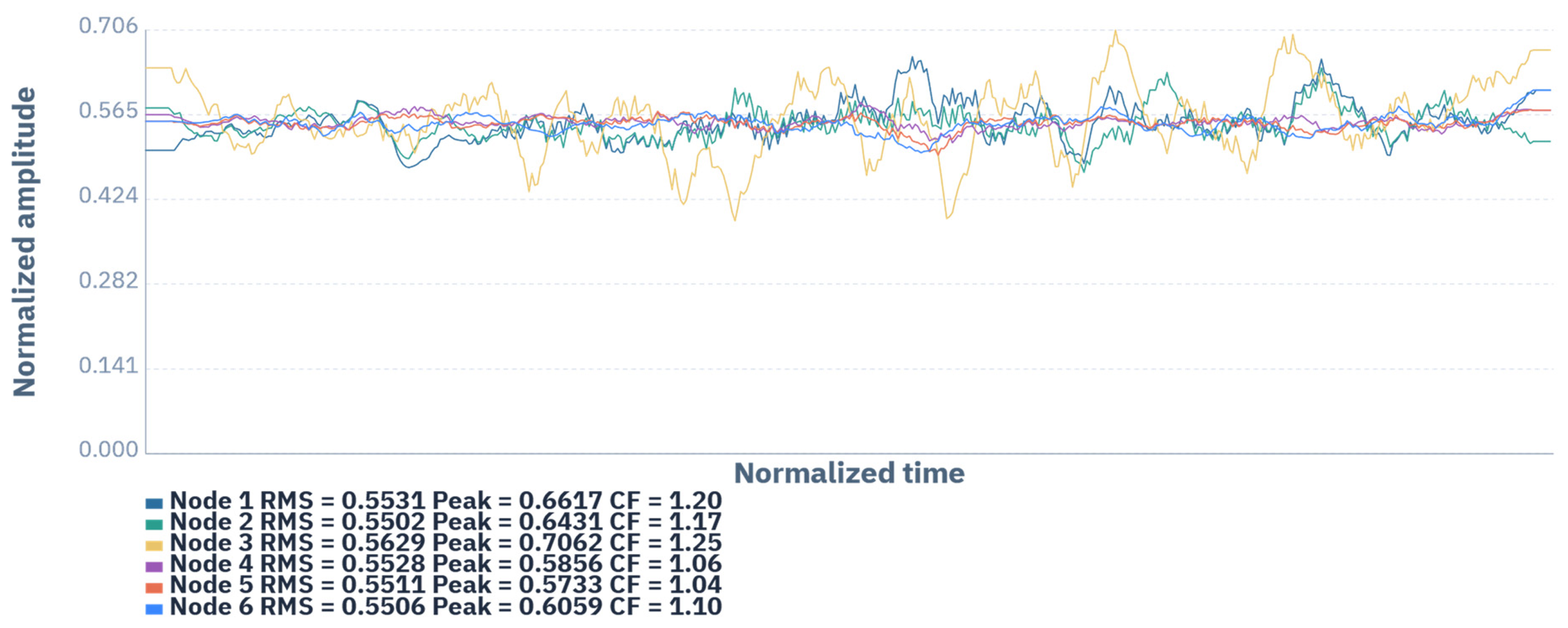
Figure 28,
Figure 29 and
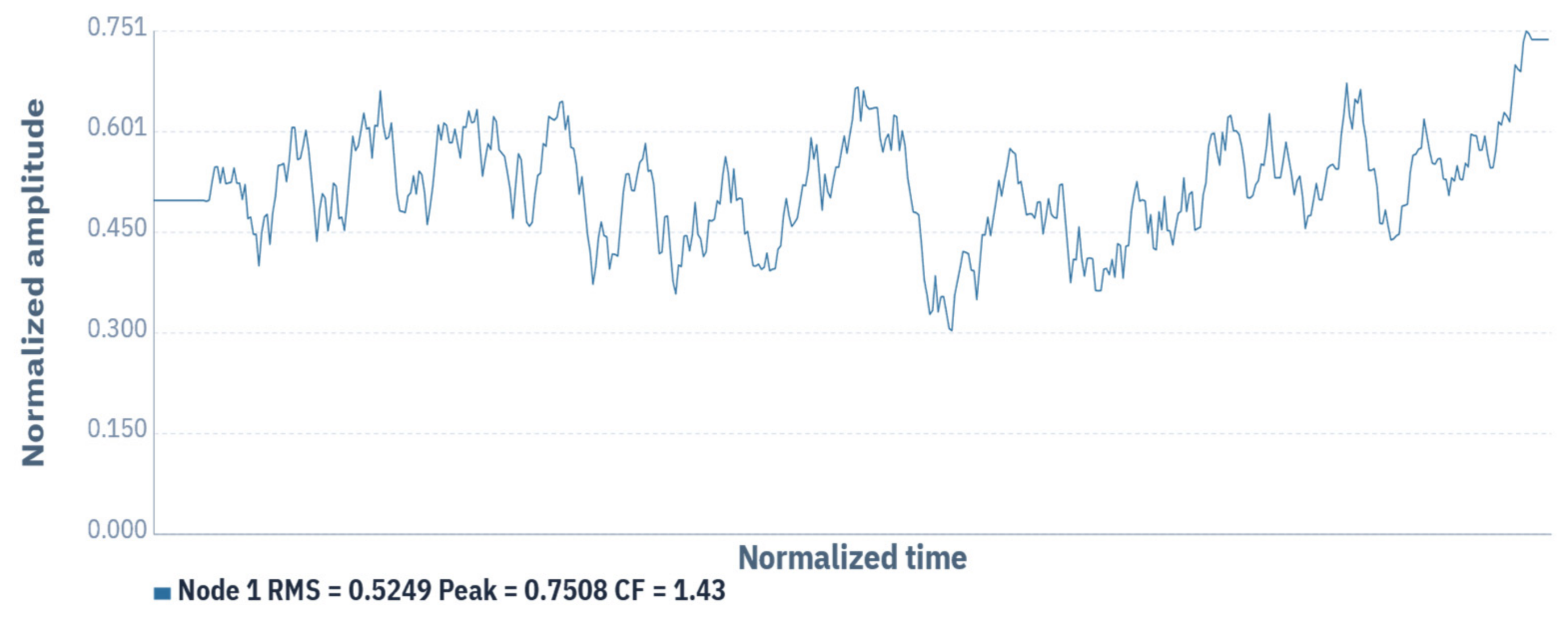
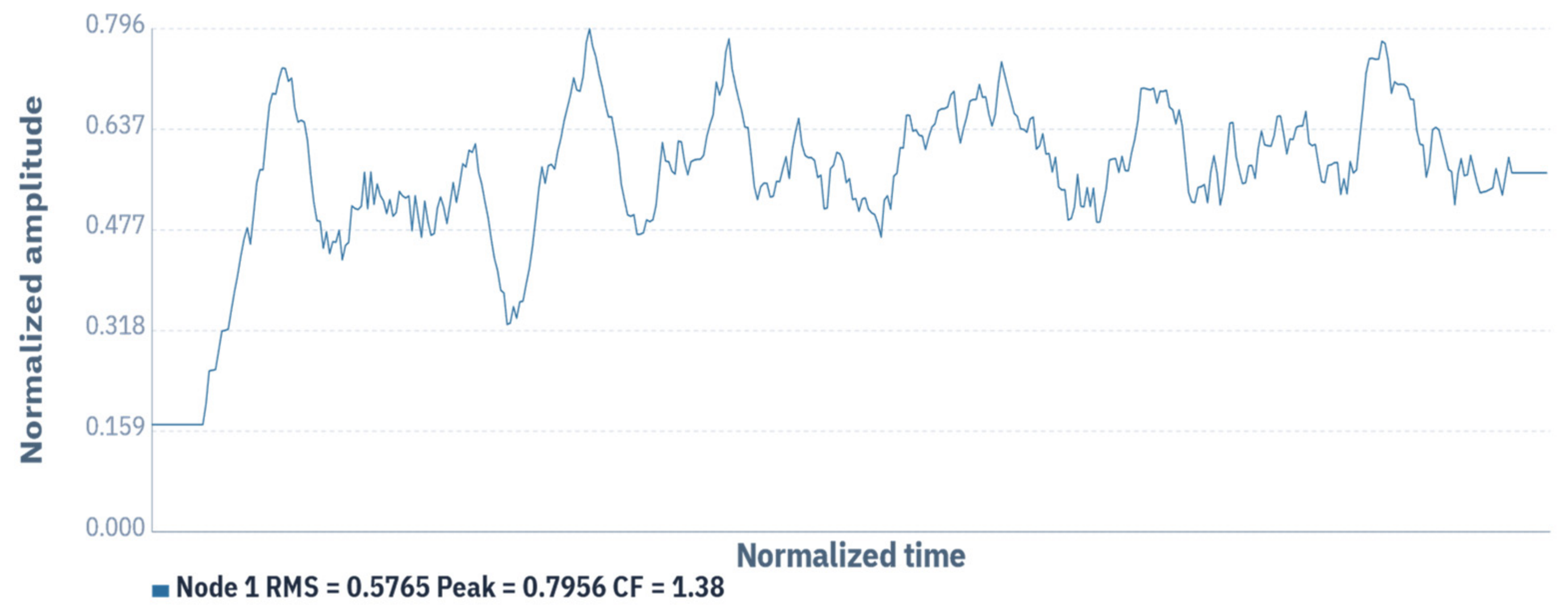
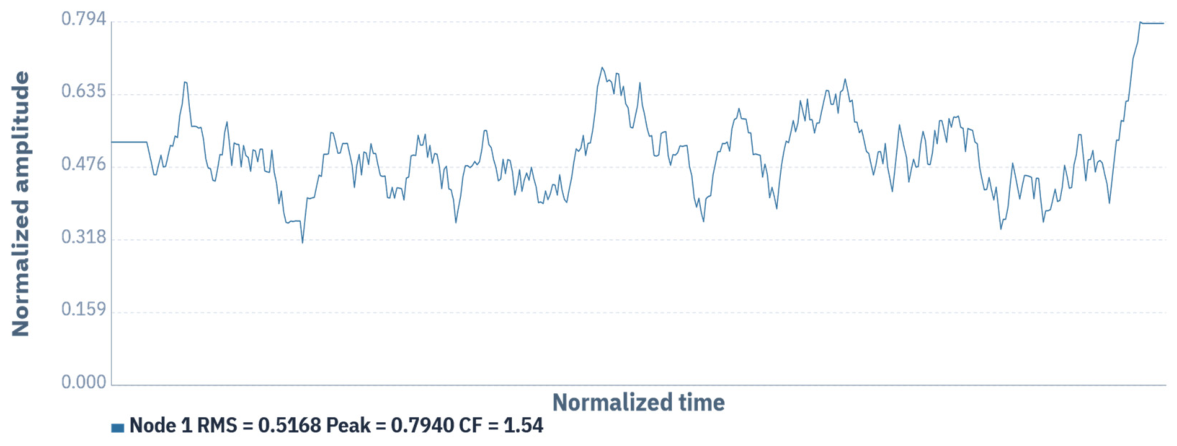
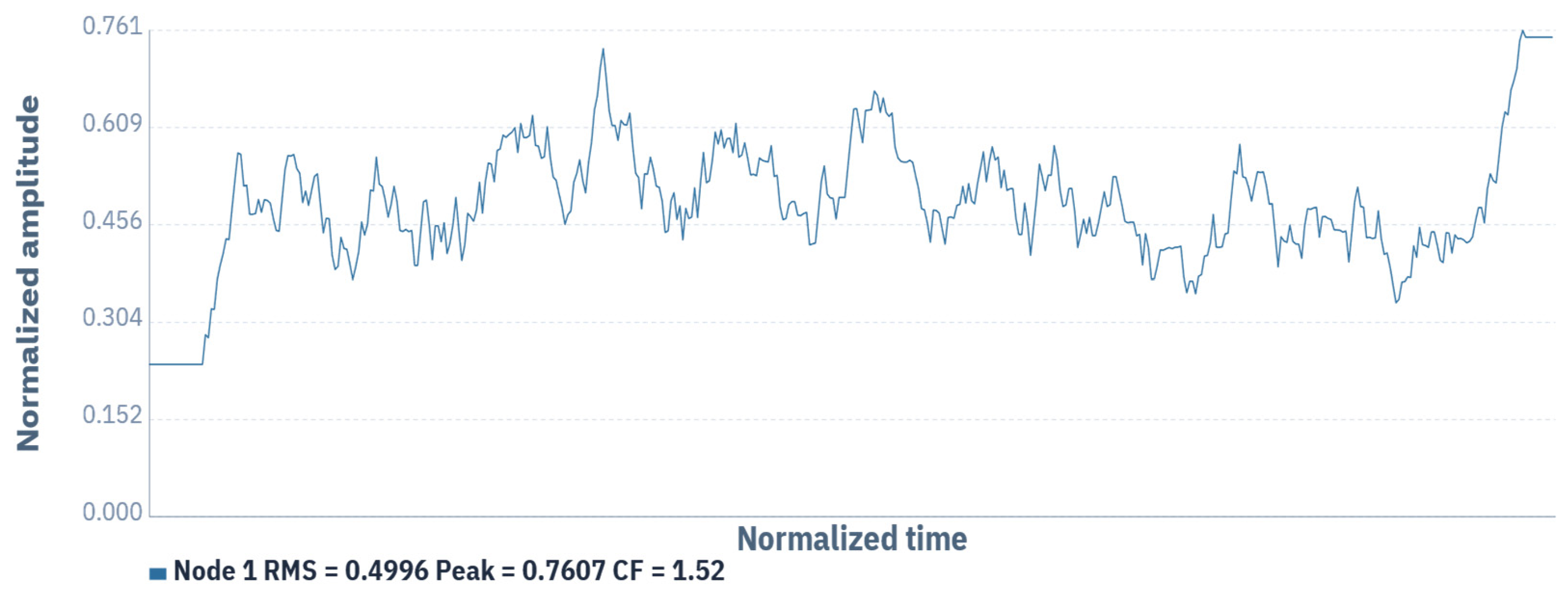
Figure 30 show graphs root mean square (RMS) values of acceleration at speeds of 60, 100, and 140 km/h, obtained from the axle assemblies (curves 3 and 5), the bogies (curves 2 and 4), and the car body (curves 1).
4. Discussion
Figure 21,
Figure 22,
Figure 23,
Figure 24,
Figure 25,
Figure 26 and
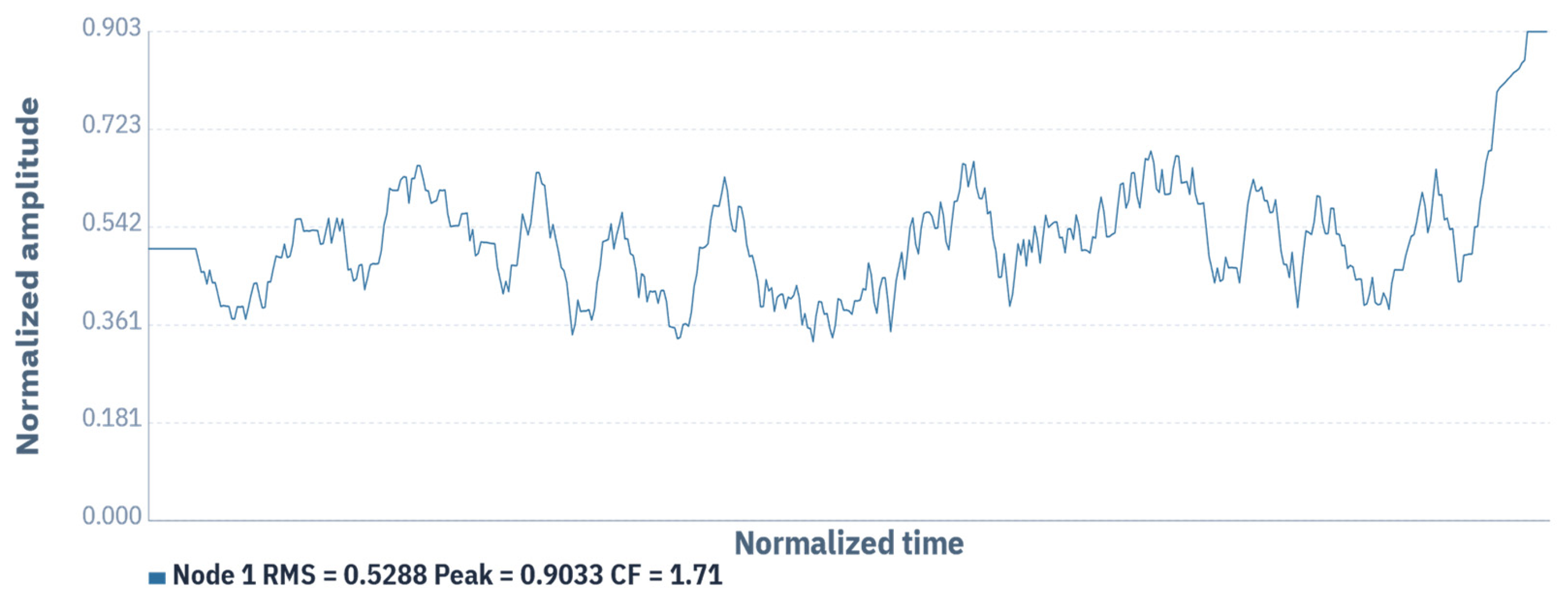
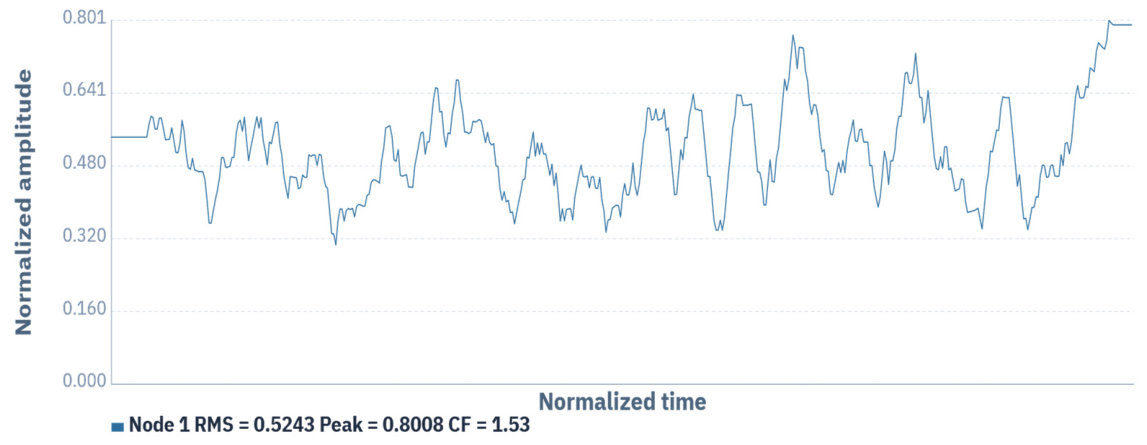
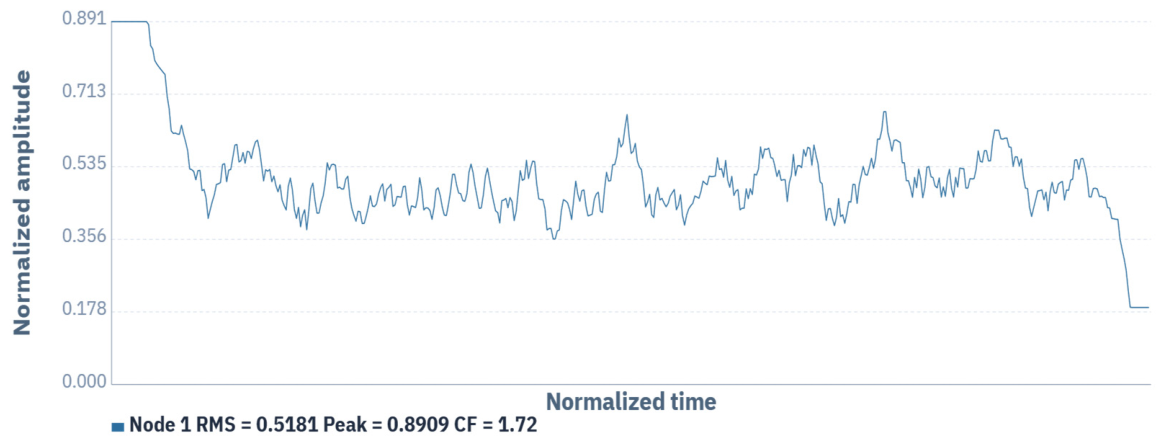
Figure 27 illustrate the vibrations of individual components of the under vehicle, frame, and body of a freight car model. Analysis of acceleration records revealed that, when simulating freight car movement on an innovative bogie at speeds of 60 km/h, the spring assemblies remain virtually motionless. Body vibrations occur due to its elasticity, as evidenced by vertical acceleration records of the car frame (
Figure 21,
Figure 22 and
Figure 23). At higher speeds (120 km/h) on innovative bogies, frame accelerations occur at certain points due to movement of the spring suspension. These accelerations are aperiodic in nature and quickly dampen (
Figure 23 and
Figure 27).
At all travel speeds, periodic vertical accelerations of the spring-suspended vehicle body are observed, caused by the spring assembly stiffness. The resulting body accelerations at speeds of 60, 100, and 140 km/h (
Figure 28,
Figure 29 and
Figure 30) are extremely important indicators, as they allow one to evaluate the ride smoothness and, consequently, the dynamic performance of the vehicle.
In this study, a railway vehicle was considered as a system consisting of multiple masses, the vibrations of whose elements were described by linear differential equations. The dependences of the vehicle parameters and its design features were determined for various travel speeds. The research revealed that increasing the rigidity of horizontal connections—through diagonal connections to the side frames and the use of elastic roller bearings—promotes increased dynamic stability.
The reduction in vibration amplitudes observed during the simulation when diagonal ties are used is explained by the physical mechanism of energy redistribution between the bogie’s side frames. In traditional designs (Model 18-100), the absence of rigid connections in the horizontal plane causes one side frame to “run ahead” relative to the other, leading to wobbling and an increase in horizontal forces. The introduction of diagonal ties increases the bogie’s shear stiffness, which shifts the critical speed at which self-oscillations occur to a higher range (above 120 km/h). The reduction in vertical dynamic forces when optimizing suspension stiffness (a decrease of up to 6% for the new bogies) is associated with the minimization of resonance phenomena in the “body–spring suspension–track” system. The empirical dependence of
confirms that innovative bogies with increased axle load require a nonlinear damping characteristic that ensures the attenuation of high-frequency disturbances from track irregularities without compromising ride comfort at low speeds. The obtained results correlate with the data from the studies by Zheng and Wei [
34]; however, this research reveals that, for innovative models of the 18-9996 type, the influence of diagonal connections on stability is more pronounced (a 12% increase in the stability index compared to 8–9% in earlier studies [
36]).
This is due to the combined effect of using elastic roller skids and a stiffer frame, which creates a dual body stabilization system. Despite the positive performance trends, the proposed innovative design has a number of limitations. First, the increased stiffness of the side frame connections may lead to increased wear on the wheel flanges in tight curves (less than 300 m) due to the difficulty of radial self-alignment of the wheel sets. Second, the developed model is based on linear differential equations, which imposes limitations when studying subcritical motion modes with large oscillation amplitudes (the “impact” effect when clearances are exhausted). Analytical and experimental studies have shown that the optimized parameters of the innovative car body affect the dynamic load factors and track impact indicators within regulatory tolerances [
37]. A comparative analysis confirms that the proposed design changes not only comply with current railway regulations but also provide a margin of stability at higher speeds.
The optimized parameters of the spring suspension were compared with the safety requirements established in the relevant regulatory documents for railway transport (e.g., GOST 33211 [
38] or equivalent international standards). Specifically, the reduction in the relative friction coefficient to 6% for new bogies and its increase to 12% for bogies with diagonal braces ensures that dynamic force levels remain within the permissible limits across the entire speed range of 40–140 km/h. The simulation results, validated by field tests, demonstrate that the vertical and horizontal force factors do not exceed the standard thresholds (e.g., the derailment stability coefficient remains significantly above the minimum required 1.6). Thus, the proposed innovative design fully complies with the operational safety criteria for high-speed freight traffic [
39].
5. Conclusions
Based on the conducted research, the following main conclusions were formulated based on the results of optimization of the relative friction coefficient:
is the weight of the body with cargo for dry friction dampers in the central suspension when studying planar vibrations of cars using the software “Universal Mechanism”.
was chosen as the optimization criterion. The optimization results obtained by enumerating the parameters
and
make it possible to construct the surfaces for each travel speed:
The lines of intersection of these surfaces with the planes make it possible to obtain a visual picture of the distribution of the levels. As an example, such a graph is shown, obtained for C = 100 km/h and the depth of deterministic irregularities 10 mm. The following points are marked on the graph: 1—a car with new bogies ( kN), and 2—with bogies of model 18-9996 (). For each rigidity, the optimal value of the coefficient is then selected.
A similar procedure is repeated for each traveling speed. The optimization result for the operational speed range of 40–140 km/h is presented. An analysis of the analytical and experimental studies conducted has shown that the values of can be corrected: for the car with new bogies, they are reduced to 6%, and with model 18-9996 bogies, they are increased to 12%. However, these values cannot be considered optimal. The fact is that in the plane problem, the largest values of the dynamic additives of the forces acting on the car body are lower than the values obtained in the experiment, as noted above. This occurs due to the failure to take into account the lateral roll of the car body when studying vertical vibrations. To optimize the spring suspension parameters for the force levels found in a real system, in a two-dimensional problem formulation, a compensation with an unevenness depth of 30 mm must be specified. This ensures that the forces reach the values recorded in the experiment.
The influence of the disturbance level in a nonlinear problem is analyzed. For this, optimization was performed using the method described above. The equal-level lines are for , and the dependence . It is clear that points 1 and 3 lie in the optimal zone, and no change in the values for the dampers of these bogies is required.
Therefore, the selection of the optimal value for the relative friction coefficient depends on the disturbance magnitude and should be made for the level of forces in the spring suspension that occurs in the real system.




 ,
,