1. Introduction
According to the 2019 report of the International Labour Organization (ILO), approximately 2.7 million people worldwide die each year from work-related accidents or diseases, and more than 374 million occupational accidents are estimated to occur annually [
1]. Beyond direct economic losses such as reduced productivity, compensation, and medical expenses, industrial accidents impose broader societal impacts, including deterioration in quality of life, organizational instability, and erosion of social trust. As a result, sustained and systematic public-level interventions remain essential.
In response, many countries have strengthened legal, institutional, and policy measures aimed at preventing industrial accidents. The European Union (EU) has reinforced risk assessment requirements for high-risk working environments [
2], while South Korea has enhanced accountability and enforcement mechanisms through the enactment of the Serious Accidents Punishment Act and amendments to the Occupational Safety and Health Act [
3,
4]. However, the effectiveness of such institutional measures depends not only on regulatory enforcement, but also on the quality and structure of accident data used to inform preventive strategies. Prevention-oriented analysis requires detailed information on how accidents unfold, including the conditions, actions, and pathways involved in accident occurrence processes [
5,
6,
7].
Recent studies have attempted to improve the analytical usability of accident reports by applying automated text structuring approaches. For example, natural language processing and machine learning have been used to extract structured information from narrative reports [
8], and data-driven mining techniques have been applied to derive safety management implications from large-scale accident datasets [
9].
However, a growing body of recent literature suggests that the limitations of occupational accident data are not only technical, but also structural and institutional.
First, safety performance measurement and reporting systems are frequently designed around outcome-based indicators, which may not fully capture real work conditions and the unfolding process of accidents. Such outcome-centered measurement structures constrain the preventive value of accident statistics and limit their interpretability for upstream interventions [
10]. Second, the quality of accident data is systematically threatened by underreporting. Underreporting is not random; it is associated with organizational, cultural, and regulatory contexts, meaning that official datasets may underestimate true accident rates and distort risk profiles [
11,
12]. Recent discussions further emphasize that standardized report formats and simplified classification schemes can suppress contextual and process-level information, encourage minimal reporting and reduce the explanatory power of reports for prevention-oriented learning [
13].
Third, reporting practices themselves are shaped by governance and workplace culture. Empirical work indicates that weak enforcement, punitive management climates, and unclear reporting procedures can produce systematic reporting bias, thereby undermining reliable hazard assessment and prevention policy design [
14]. In addition, even when injury metrics are available, their interpretation can vary across professionals and organizational contexts, implying that outcome metrics alone may not consistently reflect underlying safety conditions [
15]. Together, these findings reinforce that accident reporting should be treated not merely as a documentation requirement, but as a reporting mechanism for generating analyzable, prevention-relevant data.
Despite these efforts, existing accident reporting systems have limitations in consistently recording and accumulating accident progression processes. Accident reports are often written in an outcome-centered manner or describe events in fragmented temporal sequences, making it difficult to capture critical information such as accident stages and transition points between events that are essential for preventive design [
16,
17,
18,
19]. This suggests that current accident reporting frameworks are not inherently designed to generate process-oriented information. When accident reports are produced at worksites by employers or injured workers with limited safety expertise, complex progressions are often condensed into a single outcome label or fragmented narrative, and critical information about initiating conditions, intermediate events, and causal transitions may be omitted or inconsistently recorded.
To address these limitations at the reporting framework level, this study presents an event-based accident information reporting framework that conceptualizes accidents as sequences of temporally ordered events. Within the proposed framework, actions and conditions observed throughout the accident occurrence process are defined as discrete “events,” each classified according to predefined occurrence types and linked to standardized objects that describe their key characteristics.
2. Literature Review
2.1. Event-Based Accidents
Industrial accidents may occur as isolated events; however, in many cases, they result from a sequence of causally connected events that transition over time and ultimately lead to a final outcome. These events can be arranged in temporal order, enabling a systematic understanding of how accidents evolve through successive transitions [
20]. Adopting an event-sequence perspective allows several key aspects of accident processes to be clarified. First, the pathway from initial triggering factors to final outcomes can be traced as a continuous flow. Second, by describing each constituent event in terms of actors and actions, individual events can be more concretely identified and compared. Third, the temporal and causal relationships among events can be logically represented, facilitating shared understanding among stakeholders and providing an evidentiary basis for the development of preventive measures [
20].
This event-sequence perspective—treating accidents as temporally ordered event flows—has been incorporated into various accident investigation and analysis methodologies. A representative example is the Event and Causal Factors Charting and Analysis (ECFA) method, which has been employed by the U.S. Department of Energy (DOE) in major accident investigations to reconstruct accidents as event flows and systematically organize causal factors at each stage [
21,
22]. Event Tree Analysis (ETA) conceptualizes combinations of subsequent events branching from an initiating event and is widely used to evaluate possible accident pathways and associated risk levels. ETA is particularly well suited to probabilistic risk assessment and has been applied to real-world cases, including railway accidents in Malaysia (KTMB cases) and maritime accidents in Bangladesh [
23,
24,
25].
The Bow-Tie model integrates fault tree analysis (causal pathways) and event tree analysis (consequence pathways) into a single framework, enabling bidirectional visualization of accident progression. This approach allows preventive (barrier-based) strategies prior to accident occurrence and mitigation strategies following accident occurrence to be examined simultaneously. In particular, it is effective for analyzing how failures of defense layers accumulate after an initiating event, leading to accident escalation, and for identifying intervention points to interrupt or contain such escalation processes [
26].
2.2. National Reporting Standards and Statistical Status of Occupational Accidents
National-level industrial accident statistics constitute a fundamental basis for the design and evaluation of prevention policies, the comparison of risk levels across industries and occupations, and the allocation of occupational safety and health resources. However, the practical usefulness of such statistics is ultimately determined by the quality of the underlying accident information.
To ensure international comparability of industrial accident statistics, the International Labour Organization (ILO) adopted the Resolution concerning Statistics of Occupational Injuries at the 16th International Conference of Labour Statisticians in 1998. This resolution established standardized principles regarding the definition of occupational injuries, the scope of data collection, classification items, and the derivation of key indicators [
27]. Subsequently, these principles have been supplemented and expanded through technical documents and guidelines that further specify reporting elements and classification criteria [
28,
29].
The ILO recommendations encompass a broad range of employment types, including standard and non-standard workers as well as the self-employed, and incorporate multiple outcome indicators such as fatalities, lost working days, and cases requiring medical treatment. They also recommend the collection of essential information related to accident occurrence, including time and location, characteristics of the injured worker (e.g., sex, age, and occupation), type of accident and immediate cause, injured body part and severity, and information related to recovery or work absence [
28,
29]. In addition, the ILO provides representative indicators widely used for international comparison—such as incidence rates, frequency rates, and severity rates—thereby supporting cross-national comparisons of safety performance and the policy-oriented use of accident statistics [
27,
28,
29,
30].
2.2.1. South Korea
South Korea’s industrial accident reporting and statistical system is governed by the Occupational Safety and Health Act, the Statistics Act, and related administrative regulations. Under the Occupational Safety and Health Act, employers are legally obligated to record and report industrial accidents when they occur [
31], and the resulting data are managed as designated national statistics under the Statistics Act. Detailed procedures for compiling and managing industrial accident statistics are specified in the Regulations on the Handling of Industrial Accident Statistics [
32], and employers are required to submit industrial accident investigation reports in accordance with the Enforcement Rules of the Occupational Safety and Health Act [
33]. Fatal accidents must generally be reported immediately, while accidents requiring medical treatment beyond a specified period must be reported within a designated time frame. National statistics are published annually and are primarily compiled based on fatal accidents and cases exceeding a minimum lost-workday threshold [
34,
35,
36,
37].
The Korean industrial accident investigation report provides relatively well-structured information on workplace characteristics, injured worker demographics, and administrative classification items [
32,
33]. However, information describing accident occurrence processes remains limited. Key process-level elements—such as accident progression, causal factors, and preventive measures—are mainly recorded as free-text narratives, which increases subjectivity and reduces comparability. As a result, standardized accumulation of temporal accident progression and stage-by-stage causal relationships is difficult, and statistical analyses tend to focus on indirect and outcome-centered information. This structural limitation has been repeatedly identified as a barrier to precise root cause analysis and prevention-oriented safety design [
18,
38].
2.2.2. United States
In the United States, occupational injury and illness reporting is institutionalized under regulations enforced by the Occupational Safety and Health Administration (OSHA). Title 29, Part 1904 of the Code of Federal Regulations specifies employers’ obligations regarding recordkeeping and reporting, including requirements for reporting fatal accidents and certain severe injuries within a short time frame [
39]. OSHA provides standardized recordkeeping forms, including OSHA Form 301, which is used to document information on individual incidents [
40].
At the national level, occupational injury and illness statistics are compiled by the Bureau of Labor Statistics (BLS) through the Survey of Occupational Injuries and Illnesses (SOII) for nonfatal cases and the Census of Fatal Occupational Injuries (CFOI) for fatal accidents [
41,
42]. Despite this structured system, persistent concerns have been raised regarding underreporting and omissions, particularly in certain industries [
43,
44,
45]. Although OSHA Form 301 includes selected event-related information—such as the task being performed, the mechanism of injury, and involved objects—it remains limited in reconstructing complete temporal and causal accident sequences. Consequently, key information on accident progression continues to rely on narrative descriptions, reinforcing an outcome-centered analytical focus [
46].
2.2.3. United Kingdom
In the United Kingdom, industrial accident reporting is mandated under the Reporting of Injuries, Diseases and Dangerous Occurrences Regulations (RIDDOR) 2013. RIDDOR specifies reporting obligations and deadlines according to accident severity and work absence duration [
47], and annual statistics are published covering accident rates, incident types, and occupational diseases across industries [
48,
49,
50,
51,
52]. Reporting items include information on accident timing, location, task context, and standardized accident type classifications, with additional details required for certain incidents [
47].
Despite this relatively detailed institutional design, underreporting of nonfatal accidents remains a recognized issue [
53], and critical aspects of accident progression continue to rely largely on narrative descriptions. Structural constraints persist in systematically capturing standardized temporal sequences and causal linkages of events leading to accidents [
47,
48,
49,
50,
51,
52,
53].
2.2.4. Canada
In Canada, accident investigation reports are required under the Canada Labour Code and related regulations, with distinct reporting requirements for fatal accidents and serious injuries [
54,
55,
56]. Reported data are used to compile statistics at both national and provincial levels, categorized by accident severity, industry, accident type, and demographic characteristics [
57,
58,
59].
Although reporting requirements broadly align with the 5W1H framework, accident progression processes are predominantly documented through narrative descriptions [
56]. Similar to other national systems, this limits the standardized capture of temporal and causal accident sequences and constrains process-oriented analysis [
57,
58].
2.3. Common Structural Limitations of Existing Reporting Systems
Although national legal frameworks and reporting procedures differ, as shown in
Table 1, several common characteristics can be observed from the perspective of accident reporting framework design. First, most reporting systems are relatively well structured with respect to indirect information required for administrative compliance and statistical compilation—such as worker characteristics, workplace attributes, administrative classifications, and outcome indicators—whereas information describing how accidents unfold over time is often insufficiently structured. Second, accident progression processes rely primarily on narrative descriptions, which makes the standardized accumulation of event flows difficult and may reduce reporting reliability depending on the report writer’s level of expertise and reporting practices.
These limitations constrain the scope of statistical utilization. While indirect and outcome-centered data are effective for generating summary indicators such as incidence rates, frequency rates, and severity rates, they do not provide sufficient causal and process-oriented information to identify intervention points or to design effective preventive strategies. Consequently, as long as reporting systems fail to structure the way in which process-level information is generated, the application of advanced analytical methods will inevitably be constrained by the limited reliability of the underlying input data.
Previous studies have attempted to address these limitations in accident causation analysis by proposing multi-layered causal classification systems or data-driven analytical frameworks. For example, Goncalves et al. [
60] proposed a multi-level causal classification framework encompassing governmental, organizational, managerial, technical, physical, and environmental factors, demonstrating its usefulness in systematically organizing the structural causes of accidents. However, such classification schemes typically presuppose that accident information is reconstructed and coded by experts with investigation experience and domain-specific knowledge, making them difficult to directly translate into reporting templates that can be readily completed by injured workers or employers in real-world settings.
Meanwhile, text-mining-based approaches, such as those proposed by Qiu et al. [
61], are capable of extracting patterns from large volumes of narrative data; however, their analytical performance depends heavily on the completeness and consistency of the reported descriptions. When accident progression processes are condensed or key events are omitted in reports prepared by non-experts, even advanced analytical techniques struggle to extract meaningful causal insights.
Therefore, there is a clear need for an event-based reporting framework that enables accidents to be recorded as temporally ordered event units and allows the reconstruction of transition structures between events. This need does not merely involve adding reporting items, but rather represents a design challenge of structuring reporting methods so that critical events and conditions in accident progression are not omitted, even when reports are prepared by non-experts. In response to this need, the present study proposes an event-based accident information reporting framework that decomposes accidents into sequential events and records them in a standardized form using occurrence types and associated objects.
3. Research Methodology
This study conceptualizes industrial accidents not as isolated incidents attributable solely to individual worker behavior, but as processes composed of temporally ordered events. To operationalize this perspective, this study presents an event-based accident information Structuring Framework that is designed to support the systematic reconstruction of accident processes without requiring specialized safety expertise from reporters.
The objective of this framework is to provide a consistent methodological basis for decomposing accident narratives into event-level units, thereby supporting subsequent analytical comparisons and interpretation. This section focuses exclusively on the conceptual design and procedural structure of the proposed framework, while the application results and analytical outcomes are presented separately in
Section 4 and
Section 5.
3.1. Design Concept
The proposed framework decomposes an accident into a sequence of discrete events arranged in chronological order. An event is defined as a single action or state that occurs during accident progression and is intentionally expressed using one verb. This single-verb representation serves as the minimum analytical unit, ensuring consistent decomposition and classification across reporters and cases.
By structuring accidents as sequences of initiating events, intermediate transitions, and final outcomes, the framework enables systematic examination of accident progression pathways. This design facilitates identification of initiating conditions and transition points that are critical for accident prevention strategies. To enhance clarity and practical usability, preliminary versions of the framework were iteratively refined based on feedback from approximately 30 workers who reviewed and applied the event decomposition procedure to representative accident cases.
3.2. Components of an Event
Each event is composed of two core elements: an Occurrence Type and an Object. The Occurrence Type represents the action or state that characterizes the event, while the Object provides the minimal contextual information necessary to interpret that action or state.
Objects are not intended to exhaustively enumerate all entities involved in an accident. Instead, they function as analytically relevant elements that contribute to event transitions. This separation between action and context allows the framework to remain flexible while maintaining structural consistency.
3.2.1. Occurrence Type (Conceptual Basis)
In the proposed framework, occurrence types are conceptual descriptors used to represent event-level actions or states within an accident process. Unlike conventional industrial accident statistics, which classify occurrence types primarily based on final outcomes, the present framework treats occurrence types as fundamental components for reconstructing the temporal progression of accidents.
Existing accident statistics in South Korea employ 16 occurrence types that are effective for summarizing accident outcomes at an aggregate level [
62]. However, such outcome-oriented classifications provide limited explanatory capacity for identifying initiating events and intermediate transitions that occur during accident progression.
Accordingly, this framework redefines occurrence types as building blocks of event sequences rather than as labels of final accident results. By applying occurrence types at the event level, the framework enables systematic representation of accident processes from initiation to outcome. The detailed structure and composition of the occurrence type system used for practical application are defined in
Section 4.
3.2.2. Object Types and Requirements
Following identification of an occurrence type, object information is specified to define the corresponding event. Objects are classified into three types: Actor, Target, and Location. The combination and necessity of these object types vary depending on the nature of the occurrence type.
By defining object requirements at the methodological level, the framework helps ensure that events are described using the minimum information necessary for consistent interpretation, while avoiding excessive descriptive burden on reporters.
3.3. Recording Procedure
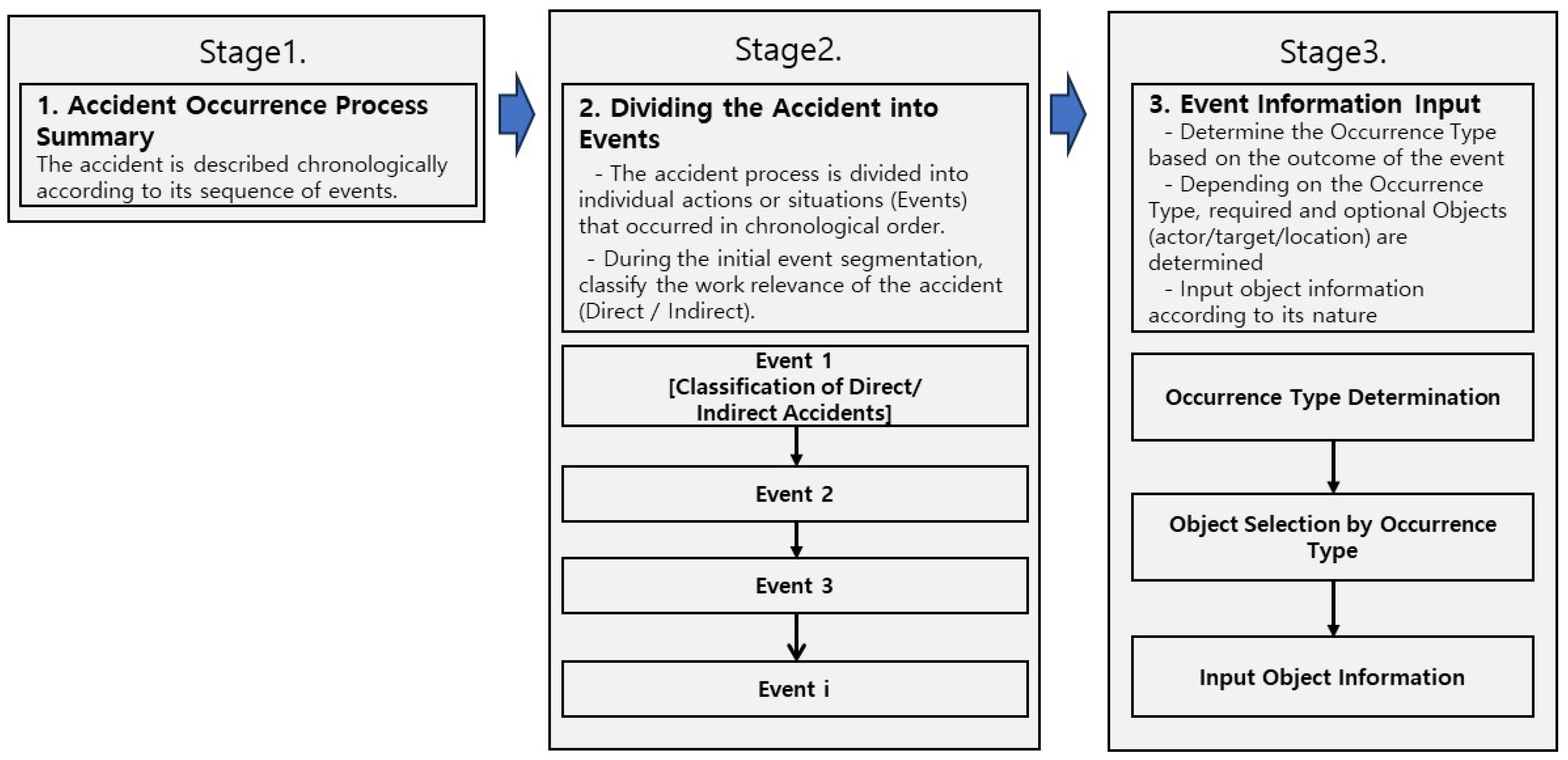
The framework consists of a three-step recording procedure, as shown in
Figure 1. First, accident narratives are described chronologically. Second, the narrative is decomposed into discrete events and ordered temporally. Third, each event is structured by assigning an occurrence type and specifying the required object information.
This procedure offers a standardized method for transforming qualitative accident descriptions into structured, event-based representations suitable for comparative analysis.
In addition, accidents may be classified as direct or indirect based on the initiating event. Direct accidents are defined as those originate from the injured worker’s own task activity, whereas indirect accidents are defined as those initiated by external factors such as other workers’ actions or environmental conditions. This distinction may facilitate differentiation between task-level and system-level accident mechanisms.
4. Proposed Event-Based Accident Reporting Template
This section presents the proposed event-based accident information reporting template developed based on the methodological framework described in
Section 3. While
Section 3 focused on the conceptual principles and procedural steps for structuring accident information, this section formally defines the analytical template used for practical implementation, including the occurrence type system and object specification rules. These components constitute the structural foundation for event-level accident representation.
4.1. Structure of the Reporting Template
The proposed reporting template represents each industrial accident as a sequence of structured events. Each event is defined by a combination of an occurrence type and a predefined set of object elements. By applying a uniform structural template across all accident cases, the framework ensures consistency in event decomposition and comparability across different accident types and work environments.
An accident report structured using the proposed template consists of multiple event entries ordered temporally, beginning with the initiating event and terminating at the final outcome event. This standardized structure enables systematic identification of event transitions and initiating mechanisms.
4.2. Occurrence Type System for Event Representation
The occurrence type system defines the action or state that characterizes each event within the accident sequence. Building upon the 16 occurrence types employed in the Korean national industrial accident statistics [
62], the proposed framework extends this classification to support event-level representation of accident processes.
To capture initiating events, intermediate states, and object-driven transitions that are not sufficiently represented in outcome-oriented statistics, additional occurrence types were introduced. As a result, the finalized occurrence type system consists of 21 categories, including both retained existing types and newly defined types. The complete list of occurrence types and their definitions is presented in
Table 2. This occurrence type system serves as the foundational classification layer of the reporting template, ensuring that each event is represented by a clearly defined and operationally distinguishable exclusive action or state.
4.3. Object Specification Rules by Occurrence Type
To complement the occurrence type system, the proposed template specifies object requirements for each occurrence type. Objects provide the minimal contextual information necessary to interpret an event and are classified into three types: Actor, Target, and Location.
The required object configuration varies depending on the occurrence type. For example, events involving equipment malfunction require specification of an Actor object, whereas events such as falls or oxygen deficiency require Location information as the primary contextual element. In cases where interaction between two entities is essential, multiple Actor objects are specified.
The detailed object specification rules for each occurrence type are summarized in
Table 3. By standardizing object requirements at the template level, the framework ensures that events are described consistently while minimizing unnecessary descriptive burden on accident reporters.
4.4. Illustrative Example of Template-Based Accident Structuring
This subsection illustrates how the proposed event-based accident information reporting template structures an industrial accident into event-level representations using a representative fatal accident case. The purpose of this example is not to analyze accident causes or outcomes, but to demonstrate how an accident narrative is recorded and organized using the proposed reporting template.
The case involves a cargo truck loaded with materials that was traveling along an S-shaped access road at a worksite. For unknown reasons, an initial collision occurred, after which the truck struck a utility pole. The pole was subsequently damaged and overturned, and a worker who came into contact with the live electrical line was electrocuted and died.
In conventional accident reports, such incidents are typically documented with emphasis on the final outcome (electrocution) and the immediately observable cause (the cargo truck), while preceding and intermediate events are often condensed or insufficiently described. In contrast, the proposed reporting template decomposes the accident narrative into a sequence of discrete events, each defined by an occurrence type and the required object information, and arranges them in chronological order.
When the proposed template is applied to this case, the accident is structured into four sequential events:
- (1)
An initial collision involving the cargo truck (Event 1);
- (2)
Collision between the truck and the utility pole (Event 2);
- (3)
Damage and overturning of the utility pole (Event 3); and
- (4)
Electrocution resulting from contact with the overturned pole or live wire (Event 4).
Table 4 presents the structured accident record generated using the proposed reporting template, showing how each event is documented by specifying its occurrence type, associated objects, and event order. This example demonstrates how a single accident narrative can be consistently translated into a standardized, event-based representation at the reporting stage. By recording accidents in this manner, the proposed template preserves the temporal sequence of events and makes initiating events and intermediate transitions explicitly visible in the recorded data. This structured representation provides the basis for subsequent analytical comparison and interpretation, which are addressed in
Section 5.
5. Case Study: Application Results of the Event-Based Framework
This section presents a case study applying the proposed event-based accident information structuring framework to empirical industrial accident data. The objective of this case study is to examine how accident interpretation changes when accident processes are reconstructed as sequences of events rather than being classified solely by final outcomes.
A comparative analysis was conducted using data from 462 fatal industrial accidents that occurred in South Korea in 2018, compiled from official national accident investigation statistics [
63]. Under the conventional approach, accident types were classified according to national industrial accident code references [
64], which primarily reflect outcome-centered classifications. These results were compared with those obtained using the proposed event-based framework, in which accidents are represented as temporally ordered sequences of events.
The analysis focused on four key aspects directly related to the methodological framework and reporting template introduced in
Section 3 and
Section 4:
- (1)
Differences between the occurrence type of the initiating event (Event 1) identified through the event-based framework and the occurrence type recorded in conventional accident reports.
- (2)
The number of event stages through which accidents progress.
- (3)
The presence of recurring event transition patterns across accident cases.
- (4)
The relative proportions of direct and indirect accidents as defined by the initiating event.
5.1. Occurrence Type Analysis
5.1.1. Differences in Occurrence Type
Within the structured framework, the first event (Event 1) represents the initiating point that triggers accident progression. The occurrence types for Event 1 derived from the proposed framework were compared with the outcome-oriented occurrence types recorded in the conventional accident classification system.
The results show that in 47.8% of all cases, the occurrence type of Event 1 identified by the structured framework differed from that recorded using the conventional reporting approach. These differences were particularly evident in the distribution of major occurrence types. Under the conventional approach, the top five occurrence types were fall, toppling/overturn, collision, struck by, and caught in/between. In contrast, under the structured framework, the top five occurrence types for Event 1 were fall, separation/breakage, abnormal operation, collapse, and overturn.
Notably, while falls accounted for 63.6% of cases under the conventional reporting method, the proportion of falls identified as Event 1 decreased to 41.3% under the structured framework, representing a reduction of 22.3 percentage points. This finding indicates that although many accidents ultimately result in falls, a substantial proportion are initiated by preceding events such as separation/breakage or abnormal operation rather than by falls themselves (see
Table 5).
5.1.2. Changes in Major Occurrence Types
To further examine these differences, cases classified as fall, collision, and struck by under the conventional reporting system were analyzed to determine how their initiating events were reclassified using the structured framework. Among the 294 cases originally classified as falls, 188 cases (63.9%) remained classified as falls at Event 1, whereas 106 cases (36.1%) were reclassified into other occurrence types. Of these, separation/breakage was the most prominent, accounting for 62 cases (21.1%). Of the 40 cases originally classified as collisions, 35 cases (87.5%) were reclassified as abnormal operation under the structured framework, while only 3 cases (7.5%) remained classified as collisions. Similarly, among the 23 cases originally classified as struck by, 13 cases (56.5%) were reclassified as separation/breakage, and 5 cases (21.7%) were reclassified as falling/scattering (see
Table 6).
5.2. Event Transition Analysis
5.2.1. Distribution by Number of Events
Accidents were analyzed based on the number of events involved in their progression. The results showed that one-event accidents (cases terminating at the first event) accounted for 214 cases (46.3%), two-event accidents accounted for 199 cases (43.1%), and multiple-event accidents (three or more events) accounted for 49 cases (10.6%). Overall, 248 out of 462 cases (53.7%) involved multi-stage transitions consisting of two or more sequential events. This finding indicates that industrial accidents are more often the result of accumulated, temporally and causally connected events rather than isolated single events.
A critical aspect of multi-stage accidents is that the initiating event plays a key role in shaping subsequent transition pathways. Among one-event accidents (214 cases), the occurrence type of Event 1 was overwhelmingly dominated by falls (188 cases, 87.9%). In contrast, for two-event accidents (199 cases) and multiple-event accidents (49 cases), the distribution of Event 1 differed substantially, with separation/breakage, abnormal operation, overturn, and collapse appearing more frequently as initiating events (see
Table 7). This suggests that separation/breakage, abnormal operation, collapse, and overturn often function as initiating factors in multi-stage accident sequences and are likely to mediate subsequent events. Therefore, reducing multi-stage accidents requires not only reactive measures targeting final outcomes, but also accurate information and interventions at the initiating event stage.
5.2.2. Transition Patterns
In this study, a transition is defined as a linkage between two adjacent events. Accordingly, an accident consisting of n events contains (n − 1) transitions. For example, an accident composed of two events includes a single transition representing the process connecting the two events.
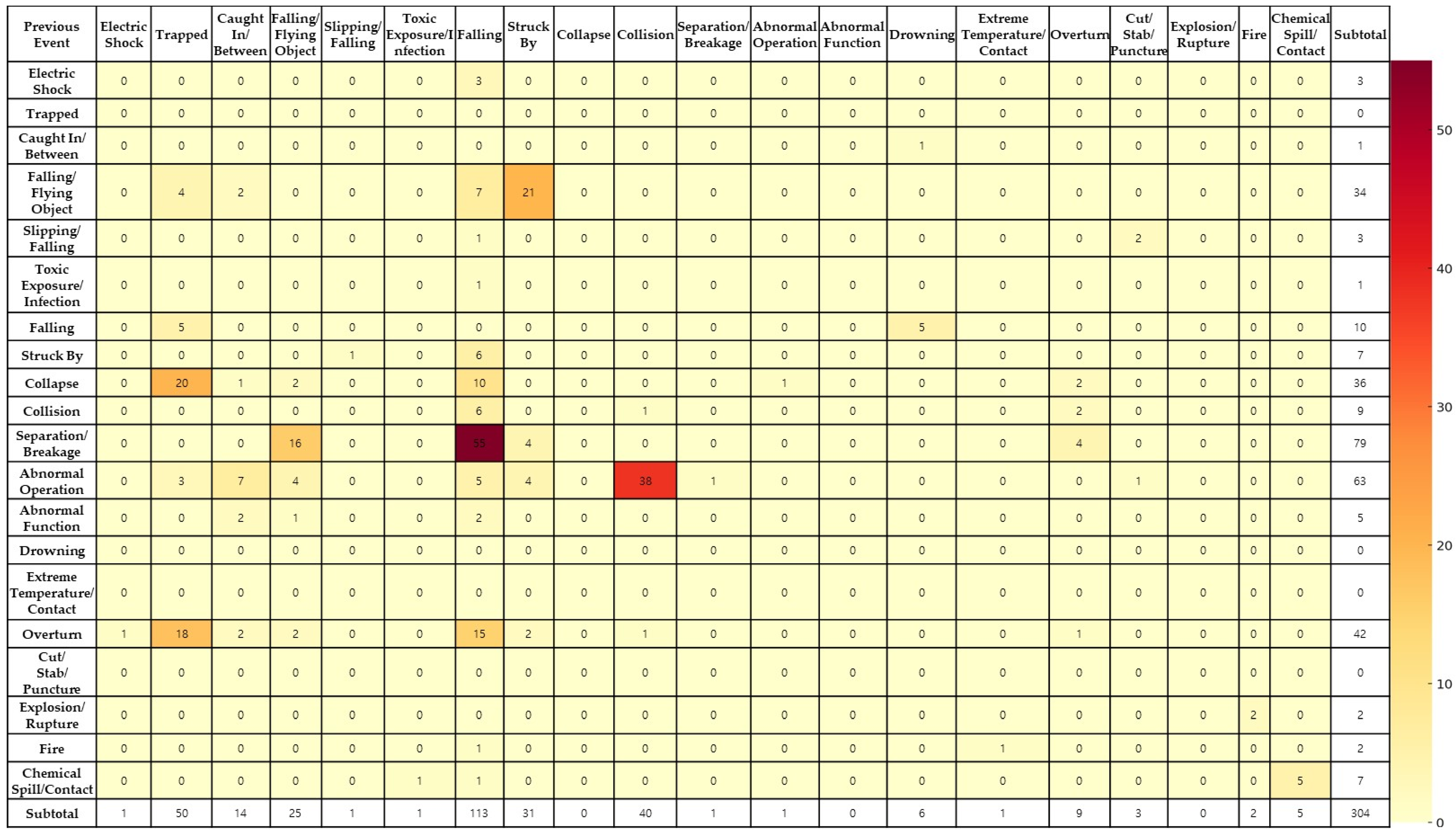
Figure 2 presents the 304 observed transitions across the 462 accident cases in the form of a transition matrix. Because transitions are defined only between adjacent events, these transitions arise from cases that contain two or more events. In
Figure 2, the columns represent the occurrence types of the preceding or initiating events, while the rows represent the occurrence types of the final events. Each cell indicates the observed frequency of the corresponding transition. For instance, the most frequently observed transitions include those from separation/breakage to fall (55 cases) and from separation/breakage to collision (38 cases) (see
Table 8).
The key insight from transition analysis lies not in the frequency of individual occurrence types, but in how often specific preceding events generate subsequent events and advance the accident to the next stage. Certain occurrence types were found to connect to a wide range of subsequent events and to generate relatively large numbers of transitions. These types are therefore likely to function as mediating points through which accidents expand into multi-stage sequences. Identifying recurrent transition patterns and interrupting these pathways can contribute to the development of targeted management strategies for accident prevention.
5.2.3. Occurrence Types of Initiating Events and Final Outcomes
The study further examined which final occurrence types were associated with frequently observed initiating events, including separation/breakage, abnormal operation and abnormal functioning, collapse, and overturn (
Table 9). When the initiating event was separation/breakage, the final outcome was fall in 79.5% of cases. For abnormal operation or abnormal functioning, the most frequent final outcome was collision (52.2%). When collapse served as the initiating event, the final outcome was crushing in 68.6% of cases, while overturn as the initiating event most frequently resulted in crushing (52.9%). These results indicate that while initiating occurrence types influence the distribution of accident outcomes to some extent, they do not converge on a single deterministic result; rather, initiating events can branch into multiple final outcomes.
5.3. Direct and Indirect Accident Classification
When all cases were classified based on work-relatedness, 173 cases (37.5%) were identified as indirect accidents, in which the initiating event was triggered by the actions of other workers or environmental conditions not directly related to the injured worker’s task. These results suggest that a substantial proportion of industrial accidents cannot be sufficiently explained by individual safety behavior alone. Instead, system-level factors—such as task interference, equipment movement, concurrent operations, and shared workspaces—often function as initiating conditions. Therefore, reducing indirect accidents requires approaches beyond task-level safety measures, including process coordination, inter-task communication, and centralized control of equipment operations as part of integrated site management.
An examination of the occurrence types of initiating events (Event 1) revealed distinct patterns between direct and indirect accidents. Among occurrence types observed in five or more cases, direct accidents were predominantly associated with falls, electric shocks, and slips/trips, which are closely linked to the injured worker’s own task and typically involve single-stage accidents. In contrast, separation/breakage, abnormal operation, collapse, falling/scattering, collision, and abnormal functioning exhibited a higher proportion of indirect accidents. This suggests that certain types of initiating events are more likely to arise from external tasks or system-level conditions, thereby increasing the likelihood of indirect accident pathways.
6. Discussion
The main discussion of this study focuses on how the application of an event-based reporting framework provides a different perspective on industrial accident mechanisms from conventional reporting systems. The findings indicate that while outcome-centered reporting systems are effective for summarizing final accident outcomes, they exhibit structural limitations in explaining how accidents are initiated and how they propagate over time.
First, the substantial discrepancy between the occurrence types of initiating events (Event 1) identified through structured event-based recording and those reported in conventional statistics suggests that current accident reporting and statistical systems may not sufficiently capture initiating events. Even when accidents ultimately result in falls, transition analysis revealed that many were triggered by preceding events such as separation/breakage, abnormal operation, or falling/scattering. This indicates that prevention strategies based solely on final outcome categories may fail to control the actual starting points of risk.
Second, the finding that more than half of the accidents involved multi-stage event sequences reaffirms that industrial accidents possess a process-oriented nature that cannot be reduced to a single event. Moreover, transition pattern analysis showed that accident progression is not random but rather characterized by recurrent transitions between specific types of events.
Third, the observation that a single initiating event can lead to multiple final outcomes further highlights the structural limitations of outcome-centered prevention policies. This implies that identical outcomes may originate from different initiating conditions, while the same initiating condition may branch into diverse consequences. Consequently, effective accident prevention should move beyond uniform responses to outcome categories and be refined into a targeted approach that jointly considers initiating events and event transition patterns.
Finally, the substantial proportion of indirect accidents reinforces the difficulty of attributing industrial accidents solely to individual workers’ safety behaviors. Indirect accidents are often triggered by system-level interactions, including actions of other workers, equipment movement, shared workspaces, and process interference. The overlap between indirect accidents and the initiating event types associated with multi-stage accidents suggests that the focus of accident prevention should be expanded from individual behavior to site operation and system-level management factors.
These findings may support more structured accident reporting practices, particularly by enabling the identification of initiating events and event transition pathways during incident documentation, thereby contributing to the development of more targeted prevention strategies. In worksite environments where accident reports are often prepared by non-expert workers or employers, the proposed framework may be usefully applied to support the structuring of accident documentation. It may also contribute to improving the understanding of accident propagation processes.
Limitations and Future Research
This study has several methodological and contextual limitations. First, the empirical analysis was based solely on fatal occupational accidents that occurred in Korea in 2018. Although accident severity may influence outcome characteristics, the fundamental structure of accident progression as a sequence of events is not expected to differ substantially. Nevertheless, caution is required when generalizing the findings beyond the analyzed dataset.
Second, the analysis focused on the construction industry. Accident mechanisms and operational contexts in other sectors may differ, and additional validation is required before applying the proposed framework across industries with different operational structures.
Third, while national accident reporting systems differ in legal definitions and reporting requirements, most countries impose mandatory reporting obligations for serious occupational accidents. From this perspective, the proposed event-based reporting framework may be conceptually adaptable across national contexts, although empirical verification in other countries remains necessary.
Future research should apply the proposed framework to nonfatal accidents, different industries, and multiple national reporting systems to further assess its generalizability and practical applicability.
7. Conclusions
This study proposes an event-based accident information Structuring Framework that is intended to support more consistent and comparable recording of industrial accidents, taking into account the reality that accident reports are often completed by injured workers or employers without specialized safety expertise. The core of the proposed framework lies in guiding accident reporting to reconstruct accidents not as isolated final outcomes, but as temporal transitions among sequential events.
By adopting an event-level recording structure that combines occurrence types and objects, the framework is designed to structurally generate information on initiating events, intermediate events, and event-to-event transitions at the data input stage—information that is difficult to obtain through conventional outcome-centered reporting systems. Application of the framework to fatal occupational accident cases in Korea in 2018 provided empirical evidence of its usefulness in capturing accident progression processes and underlying triggering mechanisms within real-world accident data.
The contribution of this study does not lie in proposing a new analytical or causal model, but rather in presenting a reporting framework as a data structuring mechanism that enables diverse downstream analyses, including statistical analysis, transition analysis, causal inference, and scenario-based prevention design. In this respect, the proposed framework provides a foundation for strengthening data-driven accident prevention strategies and offers a starting point for addressing the structural limitations of outcome-centered prevention approaches.
Author Contributions
Conceptualization, J.Y.P.; methodology, J.N.K.; validation, J.Y.P.; formal analysis, J.N.K.; investigation, J.N.K., Y.B.K. and J.Y.P.; data curation, J.N.K.; writing—original draft preparation, J.N.K.; writing—review and editing, Y.B.K.; visualization, J.N.K. and Y.B.K.; supervision, J.Y.P. All authors have read and agreed to the published version of the manuscript.
Funding
This research received no external funding.
Institutional Review Board Statement
Not applicable.
Informed Consent Statement
Not applicable.
Data Availability Statement
Available from the corresponding author upon reasonable request.
Acknowledgments
During the preparation of this manuscript, the authors used ChatGPT (version 5.2, OpenAI, GPT-5) for language editing and improvement of academic English expression. The authors reviewed and edited the output and take full responsibility for the content of this publication.
Conflicts of Interest
The authors declare no conflicts of interest.
References
- International Labour Organization. Safety and Health at the Heart of the Future of Work: Building on 100 Years of Experience; ILO: Geneva, Switzerland, 2019. Available online: https://www.ilo.org/sites/default/files/wcmsp5/groups/public/@dgreports/@dcomm/documents/publication/wcms_686645.pdf (accessed on 8 February 2026).
- European Agency for Safety and Health at Work. Guidance on Risk Assessment at Work. Available online: https://osha.europa.eu/en/legislation/guidelines/guidance-risk-assessment-work (accessed on 8 February 2026).
- Roh, S.H. Occupational Safety and Health Act Measures to Major Industrial Accidents. J. Soc. Secur. Law 2020, 42, 1–29. [Google Scholar] [CrossRef]
- Kim, Y.G. Legal Issues and Legal Policy Tasks of the Severe Accident Punishment Act—From the Perspective of Strengthening Safety and Health Measures of Enterprises. J. Legis. Stud. 2021, 18, 111–147. (In Korean) [Google Scholar] [CrossRef]
- Korea Occupational Safety and Health Agency (KOSHA). KOSHA Guide Z-29-2022: Guidelines for Accident Analysis; KOSHA: Ulsan, Republic of Korea, 2022. Available online: https://portal.kosha.or.kr/archive/resources/tech-support/search/industry/history?techGdlnNo=Z-29-2022 (accessed on 8 February 2026). (In Korean)
- Health and Safety Executive. Investigating Accidents and Incidents: A Workbook for Employers, Unions, Safety Representatives and Safety Professionals (HSG245); HSE Books: London, UK, 2004. Available online: https://www.hse.gov.uk/pubns/books/hsg245.htm (accessed on 8 February 2026).
- Occupational Safety and Health Administration. Incident [Accident] Investigations: A Guide for Employers; U.S. Department of Labor: Washington, DC, USA, 2015. Available online: https://www.osha.gov/sites/default/files/IncInvGuide4Empl_Dec2015.pdf (accessed on 8 February 2026).
- Valcamonico, D.; Baraldi, P.; Amigoni, F.; Zio, E. A Framework Based on Natural Language Processing and Machine Learning for the Classification of the Severity of Road Accidents from Reports. J. Risk Reliab. 2024, 238, 957–971. [Google Scholar] [CrossRef]
- Yoon, Y.G.; Ahn, C.R.; Yum, S.G.; Oh, T.K. Establishment of Safety Management Measures for Major Construction Workers through the Association Rule Mining Analysis of the Data on Construction Accidents in Korea. Buildings 2024, 14, 998. [Google Scholar] [CrossRef]
- Safe Work Australia. Issues in the Measurement and Reporting of Work Health and Safety Performance; Safe Work Australia: Canberra, Australia, 2013. Available online: https://www.safeworkaustralia.gov.au/system/files/documents/1703/issues-measurement-reporting-whs-performance.pdf (accessed on 3 May 2026).
- Probst, T.M.; Bettac, E.; Austin, C. Accident Underreporting in the Workplace. In Increasing Occupational Health and Safety in Workplaces; Burke, R., Richardsen, A., Eds.; Edward Elgar: Cheltenham, UK, 2019; pp. 30–47. [Google Scholar]
- Bazzoli, A.; Probst, T.M. Best practice recommendations to measure and estimate workplace accident underreporting. Saf. Sci. 2025, 181, 106660. [Google Scholar] [CrossRef]
- Marrocco, A.; Antonelli, M.A.; Castaldo, A. The silent risk: Exploring underreporting bias in occupational accidents through severity-based modelling. Econ. Politica 2025, 43, 259–283. [Google Scholar] [CrossRef]
- Ghahramani, A.; Samadi, Z.; Mansouri, M.; Aghaei, F. Investigating the culture and practice of reporting occupational incidents in Iranian industries: A mixed-methods study. BMC Public Health 2025, 25, 4364. [Google Scholar] [CrossRef] [PubMed]
- Pomeroy, J.; Pilbeam, C. Signs of safety: An investigation of how OHS professionals interpret injury metrics. J. Saf. Res. 2025, 95, 87–100. [Google Scholar] [CrossRef] [PubMed]
- Jo, H.; Park, M. Consideration on the Problems of Current Fatal Accident Investigation System under the Current OSHA Act. Dong-A Law Rev. 2021, 91, 345–388. Available online: https://www.kci.go.kr/kciportal/ci/sereArticleSearch/ciSereArtiView.kci?sereArticleSearchBean.artiId=ART002724078 (accessed on 3 May 2026).
- Jeon, Y. A Study on Policy Measures for the Prevention of Serious Accidents; Report No. KOSHA-SP2021-101; Korea Occupational Safety and Health Agency: Ulsan, Republic of Korea, 2021; pp. 22–25. Available online: http://oshri.docubrain.co.kr/documanage (accessed on 8 February 2026). (In Korean)
- Lee, S. Problems and Improvement Tasks of the Industrial Accident Investigation Form. Korean Confederation of Trade Unions, 30 January 2023. Available online: https://nodong.org/statement/7812492 (accessed on 8 February 2026). (In Korean)
- Oh, S. A Study on the Current Status and Utilization Measures of Industrial Accident Reporting; Report No. KOSHA-SP2017-101; Korea Occupational Safety and Health Research Institute, Korea Occupational Safety and Health Agency: Ulsan, Republic of Korea, 2017; pp. 7–9. Available online: https://www.aposho.org/oshri/publication/researchReportSearch.do?mode=view&articleNo=408132&article.offset=0&articleLimit=5 (accessed on 8 February 2026). (In Korean)
- Benner, L. Accident investigations: Multilinear events sequencing methods. J. Saf. Res. 1975, 7, 67–73. [Google Scholar]
- U.S. Department of Energy. DOE-HDBK-1120-2012: Accident and Operational Safety Analysis—Volume I: Accident Analysis Techniques; U.S. Department of Energy: Washington, DC, USA, 2012. Available online: https://www.standards.doe.gov/standards-documents/1200/1208-bhdbk-2012-v1 (accessed on 8 February 2026).
- Buys, J.R.; Clark, J.L. Events and Causal Factors Analysis; SCIENTECH Inc., Technical Research and Analysis Center: Idaho Falls, ID, USA, 1995. [Google Scholar]
- Kim, D.-H.; Kim, S.-C.; Kim, E.-S.; Park, Y.-H. Risk Assessment of Energy Storage System Using Event Tree Analysis. J. Korean Soc. Saf. 2016, 31, 34–41. [Google Scholar] [CrossRef]
- Khalid, N.I.M.; Najdi, N.F.N.; Adlee, N.F.K.; Misiran, M.; Sapiri, H. Assessing railway accident risk through event tree analysis. AIP Conf. Proc. 2019, 2138. [Google Scholar] [CrossRef]
- Raiyan, A.; Das, S.; Islam, M.R. Event tree analysis of marine accidents in Bangladesh. Procedia Eng. 2017, 194, 276–283. [Google Scholar] [CrossRef]
- de Ruijter, A.; Guldenmund, F. The bowtie method: A review. Saf. Sci. 2016, 88, 211–218. [Google Scholar] [CrossRef]
- International Labour Organization. Resolution Concerning Statistics of Occupational Injuries (Resulting from Occupational Accidents); ILO: Geneva, Switzerland, 1998. Available online: https://www.ilo.org/resource/resolution-concerning-statistics-occupational-injuries-resulting (accessed on 8 February 2026).
- International Labour Organization. Quick Guide on Sources and Uses of Statistics on Occupational Safety and Health; ILO: Geneva, Switzerland, 2020. Available online: https://www.ilo.org/publications/quick-guide-sources-and-uses-statistics-occupational-safety-and-health (accessed on 8 February 2026).
- International Labour Organization. Occupational Injuries Statistics from Household Surveys and Establishment Surveys: ILO Manual on Methods; ILO: Geneva, Switzerland, 2012. Available online: https://ilostat.ilo.org/methods/concepts-and-definitions/description-occupational-safety-and-health-statistics/ (accessed on 8 February 2026).
- International Labour Organization. Improvement of National Reporting, Data Collection and Analysis of Occupational Accidents and Diseases; ILO: Geneva, Switzerland, 2012. [Google Scholar]
- Ministry of Government Legislation. Occupational Safety and Health Act. Available online: https://www.law.go.kr/LSW/lsInfoP.do?lsiSeq=253521&efYd=20240517&ancYnChk=0#0000 (accessed on 8 February 2026). (In Korean)
- Ministry of Employment and Labor. Regulations on the Handling of Industrial Accident Statistics. Available online: https://www.law.go.kr/LSW/admRulLsInfoP.do?admRulSeq=2100000211191 (accessed on 8 February 2026). (In Korean)
- Ministry of Employment and Labor. Enforcement Rule of the Occupational Safety and Health Act. Available online: https://www.law.go.kr/LSW/lsInfoP.do?lsiSeq=271027 (accessed on 8 February 2026). (In Korean)
- Ministry of Employment and Labor. Status of Industrial Accidents as of the End of December 2023. Available online: https://www.moel.go.kr/policy/policydata/view.do?bbs_seq=20240300412 (accessed on 8 February 2026). (In Korean)
- Ministry of Employment and Labor. Analysis of Industrial Accident Statistics in 2023; Occupational Safety and Health Policy Division: Seoul, Republic of Korea, 2024. Available online: https://www.moel.go.kr/policy/policydata/view.do?bbs_seq=20241201548 (accessed on 8 February 2026). (In Korean)
- Korea Occupational Safety and Health Agency. Guidelines on Industrial Accident Investigation, Recording, and Statistical Analysis (KOSHA Guide Z-23-2022); KOSHA: Ulsan, Republic of Korea, 2022. Available online: https://portal.kosha.or.kr/archive/resources/tech-support/search/industry/history?techGdlnNo=Z-23-2022 (accessed on 29 June 2025). (In Korean)
- Ministry of Employment and Labor. Guide to the Forms for Industrial Accident Investigation and Serious Accident Reporting. Available online: https://www.moel.go.kr/local/daejeon/info/dataroom/view.do?bbs_seq=20250300079 (accessed on 8 February 2026). (In Korean)
- Cho, H. A Study on the Reform Plan of the Industrial Accident Reporting System; Report No. 2016-Researcher-1152; Korea Occupational Safety and Health Research Institute: Ulsan, Republic of Korea, 2016; Available online: https://oshri.kosha.or.kr/oshri/publication/researchReportSearch.do?mode=view&articleNo=63556&article.offset=610&articleLimit=10 (accessed on 8 February 2026). (In Korean)
- Occupational Safety and Health Administration. 29 CFR Part 1904: Recording and Reporting Occupational Injuries and Illnesses. U.S. Department of Labor. 2023. Available online: https://www.osha.gov/laws-regs/regulations/standardnumber/1904 (accessed on 3 May 2026).
- Occupational Safety and Health Administration. OSHA Form 301: Injury and Illness Incident Report. U.S. Department of Labor. Available online: https://www.osha.gov/recordkeeping/forms (accessed on 3 May 2026).
- Bureau of Labor Statistics. Survey of Occupational Injuries and Illnesses (SOII) Overview. U.S. Department of Labor. 2025. Available online: https://www.bls.gov/iif/overview/soii-overview.htm (accessed on 3 May 2026).
- Bureau of Labor Statistics. Census of Fatal Occupational Injuries (CFOI): 2022 Results. U.S. Department of Labor. 2023. Available online: https://www.bls.gov/news.release/pdf/cfoi.pdf (accessed on 3 May 2026).
- Boden, L.I.; Ozonoff, A.L. Capture–Recapture Estimates of Nonfatal Workplace Injuries and Illnesses. Ann. Epidemiol. 2008, 18, 500–506. [Google Scholar] [CrossRef] [PubMed]
- United States Government Accountability Office. Workplace Safety and Health: Additional Data Needed to Address Continued Hazards in the Meat and Poultry Industry. GAO Publication No. GAO-16-337. 2016. Available online: https://www.gao.gov/products/gao-16-337 (accessed on 3 May 2026).
- Bureau of Labor Statistics. Occupational Safety and Health Statistics: Survey of Occupational Injuries and Illnesses (SOII). In BLS Handbook of Methods; Bureau of Labor Statistics: Washington, DC, USA, 2023. Available online: https://www.bls.gov/opub/hom/soii/home.htm (accessed on 3 May 2026).
- Occupational Safety and Health Administration. OSHA Forms for Recording Work-Related Injuries and Illnesses. U.S. Department of Labor. 2023. Available online: https://www.osha.gov/sites/default/files/OSHA-RK-Forms-Package.pdf (accessed on 3 May 2026).
- Health and Safety Executive. Reporting of Injuries, Diseases and Dangerous Occurrences Regulations (RIDDOR) 2013: Guidance for Employers. Health and Safety Executive. 2013. Available online: https://www.hse.gov.uk/riddor/ (accessed on 3 May 2026).
- Health and Safety Executive. Health and Safety at Work: Summary Statistics for Great Britain 2023. Health and Safety Executive. 2023. Available online: https://www.hse.gov.uk/statistics/overview.htm (accessed on 1 January 2026).
- Health and Safety Executive. Kind of Accident Statistics in Great Britain: 2024. Health and Safety Executive. 2024. Available online: https://www.hse.gov.uk/statistics/assets/docs/kinds-of-accident.pdf (accessed on 3 May 2026).
- Health and Safety Executive. Historical Picture Statistics in Great Britain 2024: Trends in Work-Related Ill Health and Workplace Injury. Health and Safety Executive. 2024. Available online: https://www.hse.gov.uk/statistics/ (accessed on 3 May 2026).
- Health and Safety Executive. Work-Related Fatal Injuries in Great Britain: 2023. Health and Safety Executive. 2023. Available online: https://www.hse.gov.uk/statistics/fatals.htm (accessed on 3 May 2026).
- Health and Safety Executive. Report of an Injury or Dangerous Occurrence (Form F2508). Health and Safety Executive. 2013. Available online: https://notifications.hse.gov.uk/RiddorForms/ (accessed on 3 May 2026).
- Health and Safety Executive. RIDDOR Background Quality Report: Injury Statistics as Reported Under RIDDOR. Health and Safety Executive. 2024. Available online: https://www.hse.gov.uk/statistics/about/quality-guidelines.htm (accessed on 3 May 2026).
- Government of Canada. Canada Labour Code—Part II: Occupational Health and Safety. 2024. Available online: https://laws-lois.justice.gc.ca/eng/acts/L-2/ (accessed on 3 May 2026).
- Government of Canada. Canada Occupational Health and Safety Regulations (SOR/86-304). 2023. Available online: https://laws-lois.justice.gc.ca/eng/regulations/SOR-86-304/ (accessed on 3 May 2026).
- Government of Canada. Hazardous Occurrence Investigation Report (LAB 1070). Employment and Social Development Canada. 2024. Available online: https://catalogue.servicecanada.gc.ca/content/EForms/en/CallForm.html?Lang=en&PDF=ESDC-LAB1070.pdf (accessed on 3 May 2026).
- Employment and Social Development Canada. 2022 Annual Report—Occupational Injuries in the Canadian Federal Jurisdiction. 2023. Available online: https://www.canada.ca/en/employment-social-development/services/health-safety/reports/2022-injuries.html (accessed on 3 May 2026).
- Association of Workers’ Compensation Boards of Canada. 2023. National Work Injury Statistics Program (NWISP): Public Version. Available online: https://awcbc.org/files/publications/2023-Nwisp-Publicaiton-public-version.pdf (accessed on 3 May 2026).
- Statistics Canada. Injuries and Fatalities, by Occupation and Industry. 2023. Available online: https://www.statcan.gc.ca/en/start (accessed on 3 May 2026).
- Goncalves Filho, A.P.; Waterson, P.; Jun, G.T. Improving Accident Analysis in Construction—Development of a Contributing Factor Classification Framework and Evaluation of Its Validity and Reliability. Saf. Sci. 2021, 140, 105303. [Google Scholar] [CrossRef]
- Qiu, Z.; Liu, Q.; Li, X.; Zhang, J.; Zhang, Y. Construction and analysis of a coal mine accident causation network based on text mining. Process Saf. Environ. Prot. 2021, 153, 398–408. [Google Scholar] [CrossRef]
- Ministry of Employment and Labor (MOEL). 2018 Analysis of Industrial Accident Status; Industrial Accident Prevention and Compensation Policy Bureau, Ministry of Employment and Labor: Sejong, Republic of Korea, 2019. Available online: https://moel.go.kr/info/publicdata/majorpublish/majorPublishView.do?bbs_seq=20200401123&searchDivCd=3 (accessed on 3 May 2026).
- Korea Occupational Safety and Health Research Institute. Serious Accident Issue Reports. Available online: https://portal.kosha.or.kr/archive/disaster-case/accident-case/acccase-industry/construc-industry (accessed on 3 May 2026).
- Public Data Portal. Search Results for Industrial Accident Codes. 2025. Available online: https://www.data.go.kr/tcs/dss/selectDataSetList.do?dType=FILE&keyword=산업재해+코드 (accessed on 3 May 2026).
| Disclaimer/Publisher’s Note: The statements, opinions and data contained in all publications are solely those of the individual author(s) and contributor(s) and not of MDPI and/or the editor(s). MDPI and/or the editor(s) disclaim responsibility for any injury to people or property resulting from any ideas, methods, instructions or products referred to in the content. |