Article

Hybrid Simulation Modeling of Underground Mining Processes Under Multidimensional Constraints: A Case Study of the Sanshandao Gold Mine

1
State Key Laboratory of Intelligent Deep Metal Mining and Equipment, Northeastern University, Shenyang 110819, China
2
Shandong Gold Mining (Laizhou) Co., Ltd., Laizhou 261400, China
*
Author to whom correspondence should be addressed.
Appl. Sci. 2026, 16(10), 4646; https://doi.org/10.3390/app16104646
Submission received: 9 April 2026 / Revised: 2 May 2026 / Accepted: 4 May 2026 / Published: 8 May 2026
(This article belongs to the Special Issue Surface and Underground Mining Technology and Sustainability)

Abstract

Underground mining is a complex dynamic system. Traditional static analytical methods are insufficient to characterize the operational behavior and efficiency variations in such systems under coupled multidimensional constraints. To address this limitation, this study proposes a novel hybrid simulation-modeling method for underground mining processes with multidimensional constraints. The method integrates discrete-event simulation and agent-based simulation. It reconstructs the spatiotemporal constraints of multiple stopes, process constraints, and organizational constraints into an explicit multidimensional constraint system. Using the upward horizontal layered cut-and-fill mining method at the Sanshandao Gold Mine as an engineering case, a simulation model was established for development, cutting, stoping cycles, haulage, and backfilling. Key factors, including stope availability, backfill curing delays, centralized blasting, shift organization, and equipment availability, were embedded as explicit mechanisms. The results show that simulated operating time, production, and efficiency are generally consistent with field statistical data at multiple scales, including cycle operations, individual stopes, individual horizontal layers, and complete mining blocks. This indicates that the model can effectively reproduce the operating characteristics of the underground mining system under multidimensional constraints. Further analysis shows that production rhythm is governed by the combined effects of stope spatiotemporal relationships, process coordination, backfill waiting, and organizational resource constraints, rather than by single-process capacity. Spatiotemporal and process constraints define operation initiation and advancement sequence, while organizational constraints mainly appear as waiting accumulation, process disturbances, and resource-utilization fluctuations. The proposed method provides a reusable tool for capacity evaluation, production organization analysis, and decision optimization in complex underground mines.

1. Introduction

Underground mining is a complex, dynamic system rather than a linear workflow governed by fixed parameters. It encompasses interwoven operations, including development, cutting, stoping, ore drawing, haulage, backfilling, and auxiliary tasks [1]. In practice, multiple stopes often operate in parallel, with different processes connected sequentially, while various types of personnel and equipment must be shared and scheduled among different working locations. Meanwhile, engineering conditions such as stope availability, backfill curing time, centralized blasting windows, shift arrangements, and equipment availability continuously constrain the initiation, advancement, and switching of operations [2,3]. This means that the operational outcomes of an underground mining system are not directly determined by the capacity of a single process or a few fixed parameters, but instead evolve dynamically under the combined effects of multiple constraints and operational disturbances. A delay in any single link may propagate through the chain of process connections and resource occupation to subsequent operations, thereby triggering cascading effects such as queueing delays, ore accumulation, and imbalanced equipment utilization [2,4]. Therefore, analysis methods based solely on static indicators or empirical parameters cannot accurately capture the system evolution patterns and operational bottlenecks in complex constrained environments [5,6,7].
Discrete-event simulation (DES), owing to its ability to represent the dynamics, uncertainty, and operational variability of complex production systems, has become an important tool for underground mine process analysis, production organization evaluation, and scheme optimization [8,9,10]. Baek and Choi reconstructed the underground truck haulage process using underground ICT data and analyzed the effects of variations in haulage time parameters on system performance based on a discrete-event model [11,12]. Soto et al. discretized individual unit operations in the tunneling cycle to identify the key constraints on development rates in newly built mines [13]. Manríquez et al. introduced DES into short-term production plan evaluation to characterize the effects of operational uncertainty on deviations in plan execution, thereby improving the feasibility and fitness of production plans [14]. In addition, Hou et al. conducted simulation-based optimization on the matching of load-haul-dump equipment under multi-stope conditions in underground mines, considering constraints such as stope production capacity, haulage routes, and vehicle capacity [15]. However, the modeling core of DES still mainly revolves around events, process flows, and resource logic. Although it can characterize certain interactive features in the mining process through additional rules, it often requires strong rule predefinition and substantial system simplification [13], making it difficult to fully capture the coupling processes of complex constraints and their mechanisms of action within the system [5].
Conversely, Agent-based simulation (ABS) is better suited to representing the behavioral rules, local interactions, information transmission, and state evolution of heterogeneous agents, and has demonstrated notable advantages in underground evacuation [16], state transition [17], path selection [18], coordinated control of vehicle systems [19], and vehicle dispatching [20,21,22]. By representing mine personnel, equipment, or operational units as entities with autonomous states and local decision-making rules, ABS can more realistically describe behavioral heterogeneity and feedback processes within the system. However, ABS primarily focuses on agent behavior and interaction mechanisms. For issues such as process coordination, workflow progression, and resource competition in underground mining, the modeling cost is often high, and model validation and interpretation are relatively difficult. Therefore, for underground mining processes that simultaneously involve process constraints, behavioral constraints, and state feedback, neither DES alone nor ABS alone can fully characterize their operating mechanisms.
To bridge this gap, hybrid simulation methods combining DES and ABS have become an emerging trend for representing complex mining systems. For example, in research on fleet management in underground gold mines, Basilico used the agent-based approach to characterize the autonomous behavior and local decision-making of underground mine vehicles, while the discrete-event approach was used to construct process workflow progression [23]. However, existing hybrid simulation studies are mostly limited to local aspects such as haulage, development, or dispatching, and have not incorporated constraint logic throughout the entire mining process. Regarding mining constraints, many existing studies have incorporated different forms of constraints into the modeling process [13,15,24,25], indicating that constraint factors are widely recognized as important elements affecting mine system operation and simulation results. However, the treatment of constraints in existing studies is still largely concentrated on local links such as haulage, development, ore drawing, or dispatching [26,27], and remains insufficient for a unified representation of the combined effects of multiple types of constraints during underground mining processes. At the same time, studies using agent-based methods to represent constraint logic, or further explicitly integrating hybrid simulation with a multidimensional constraint system, are still limited. Therefore, for underground mining as a complex system involving process progression, agent behavior, and the coupling of multiple constraints, there remains a lack of a modeling method capable of explicitly representing the constraint system and its mechanisms of action within a unified framework.
To address these research gaps, this study proposes a novel hybrid simulation modeling method for underground mining processes under multidimensional constraints. The main contribution of the method lies in the explicit integration of process evolution and constraint-action mechanisms. Specifically, DES is used to represent process progression, resource occupation, queuing, and operational delays, whereas ABS is used to describe the state transitions and local interactions of stopes, equipment, and work crews. On this basis, stope spatiotemporal constraints, process-precedence constraints, and organizational resource constraints are embedded into the simulation procedure as endogenous mechanisms rather than being treated as fixed empirical parameters. Constraints such as stope availability, backfill curing, centralized blasting, shift organization, and equipment availability can therefore drive state transitions, process progression, and production-rhythm evolution within a unified model. The proposed framework is applied to the upward horizontal layered cut-and-fill mining method at the Sanshandao Gold Mine. The case model covers development and cutting, stoping cycles, haulage, and backfilling, and is used to analyze resource coordination, production rhythm, and constraint-induced interruptions under multi-stope operating conditions.
The remainder of this paper is organized as follows. Section 2 introduces the proposed hybrid simulation modeling method, including the multi-level process structure and the multidimensional constraint system. Section 3 describes the implementation of the model in AnyLogic (https://www.anylogic.cn/), with emphasis on stope agents, process transitions, equipment and personnel resources, and resource competition among multiple stopes. Section 4 presents the case study of the Sanshandao Gold Mine, including model construction, parameter setting, field-data validation, and production-characteristic analysis. Section 5 summarizes the main conclusions, discusses the applicability of the proposed method, and outlines future research directions.

2. A Hybrid Simulation Modeling Method for Underground Mining Processes Under Multidimensional Constraints

2.1. Overview of the Modeling Approach

In a simulation environment, building an underground mining system model is not simply a matter of placing the development, stoping, backfilling, and haulage processes in sequence. The real challenge lies in whether the model can capture variations in production rhythm during mining and the engineering causes behind these variations. The model must not only reproduce the spatiotemporal coordination of multiple sublevels and multiple stopes operating in parallel, but also explicitly represent the propagation and feedback of engineering constraints in its logic. If these key aspects are ignored, the model may appear reasonable in terms of production indicators such as output, yet it will be difficult to explain problems observed in real operations and even harder to support engineering optimization. So, this paper proposes a novel hybrid simulation modeling method for underground mining processes under multidimensional constraints.
The approach is grounded in the system structure and driven by constraint logic. It first establishes a three-level framework of “panel–stope–stoping cycle” so that the simulation structure corresponds to the actual production organization. Key engineering constraints related to safety, process sequencing, equipment, and organizational arrangements (including personnel deployment), are then embedded into the model in the form of algorithmic rules, which dynamically control the start–stop status, rhythm, and coordination of each operational unit. In this way, the simulation is transformed from an idealized sequence of operations into a constrained, realistically operating system. The more complete the constraint system, the closer the model approaches the actual production state.
This study first establishes a structurally clear and idealized baseline model, and then progressively superimposes various constraints, allowing the model behavior to approach real production patterns as the restrictions are gradually tightened. This procedure mimics the “efficiency reduction” phenomenon observed in real mine operations, namely changes in production rhythm and capacity loss caused by the combined action of multiple constraints.
On this basis, a simulation framework with clear engineering interpretability is formed, which can not only reproduce the cyclic production rhythm and structural fluctuations at the stope scale, but also reveal how different constraint conditions affect production capacity, project duration, and equipment utilization. This provides support for the optimization of scheduling and intelligent decision-making in complex mine systems.

2.2. Multi-Level Modeling of the Underground Mining Process

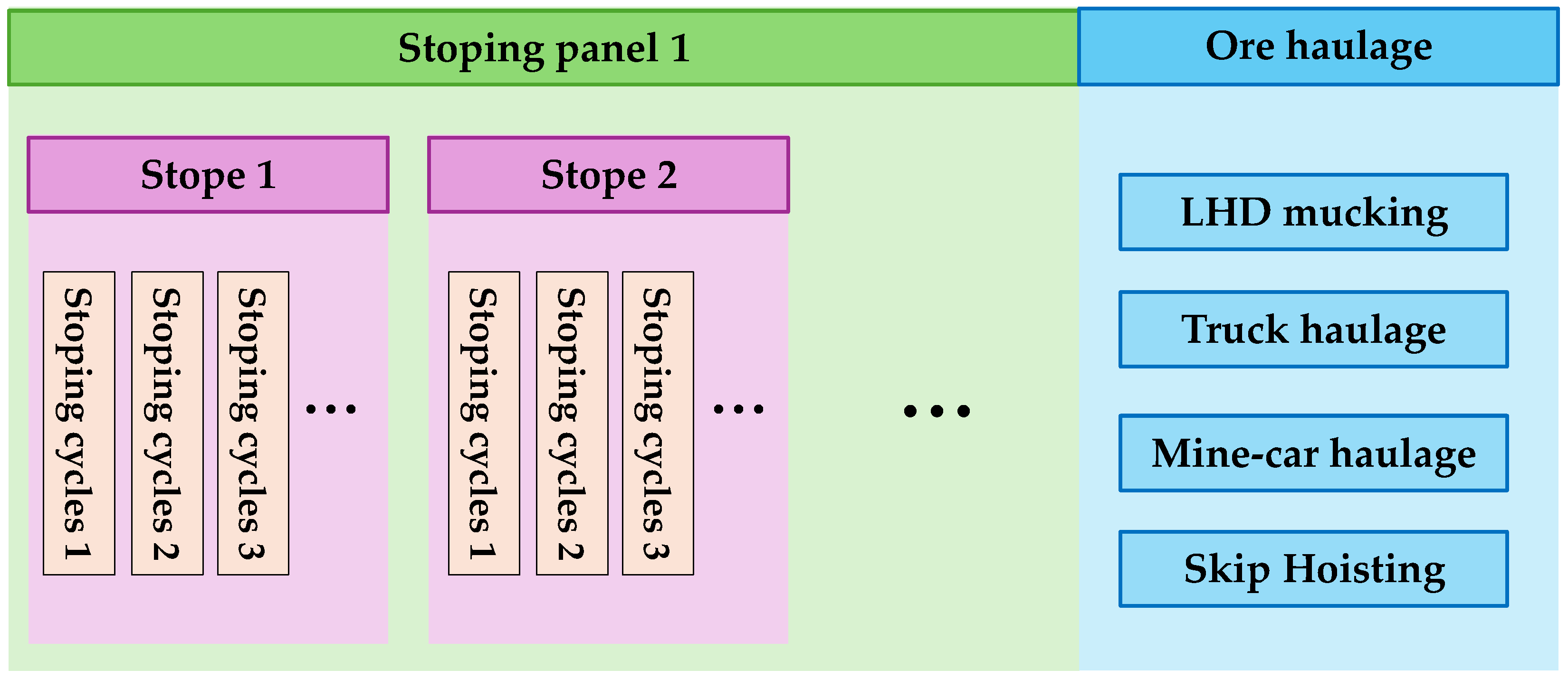
The complexity of the underground mining system arises from the combination of multi-scale spatial structures and coupled processes. In practice, the orebody is first divided into several panels, which serve as planning units for overall extraction; within each panel, stopes are further delineated to organize local operations; and the extraction of a single stope proceeds through multiple rounds of “drilling–blasting–mucking–backfilling” cycles, forming the most basic process unit.
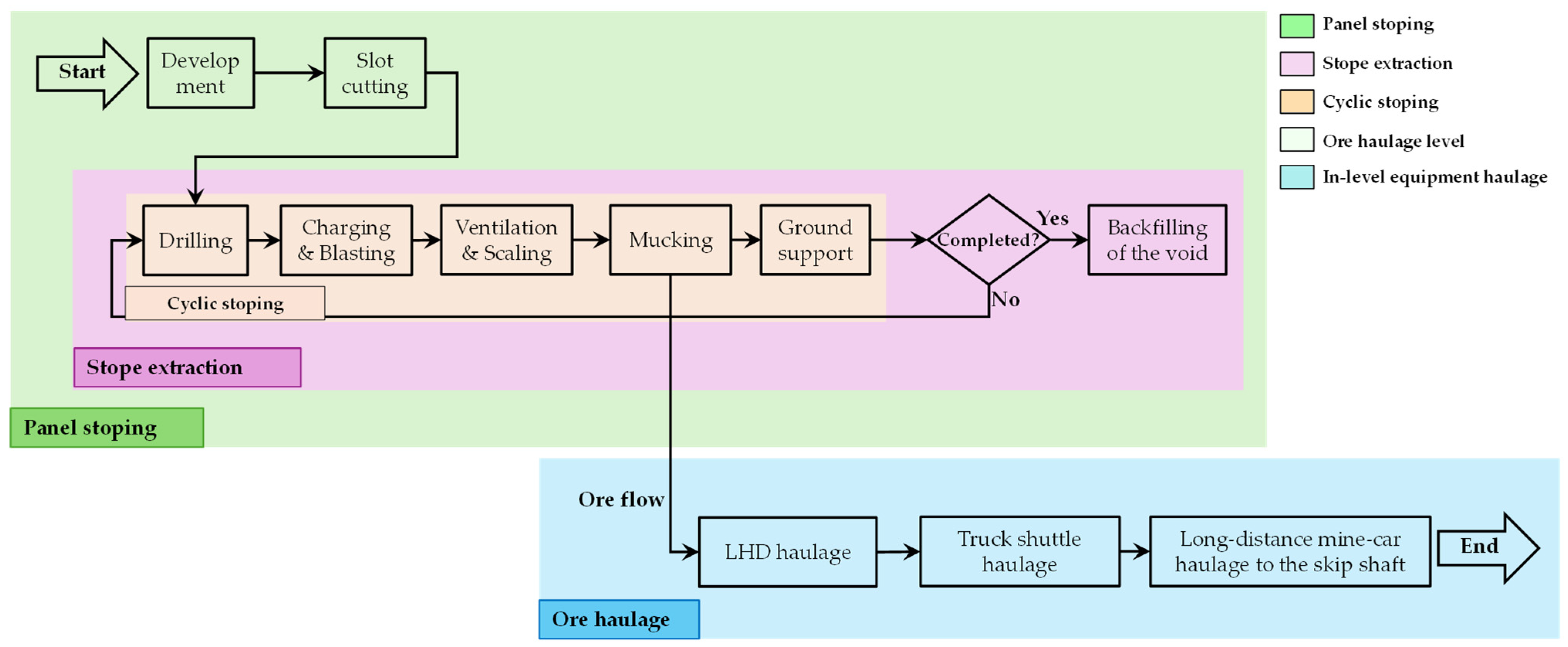
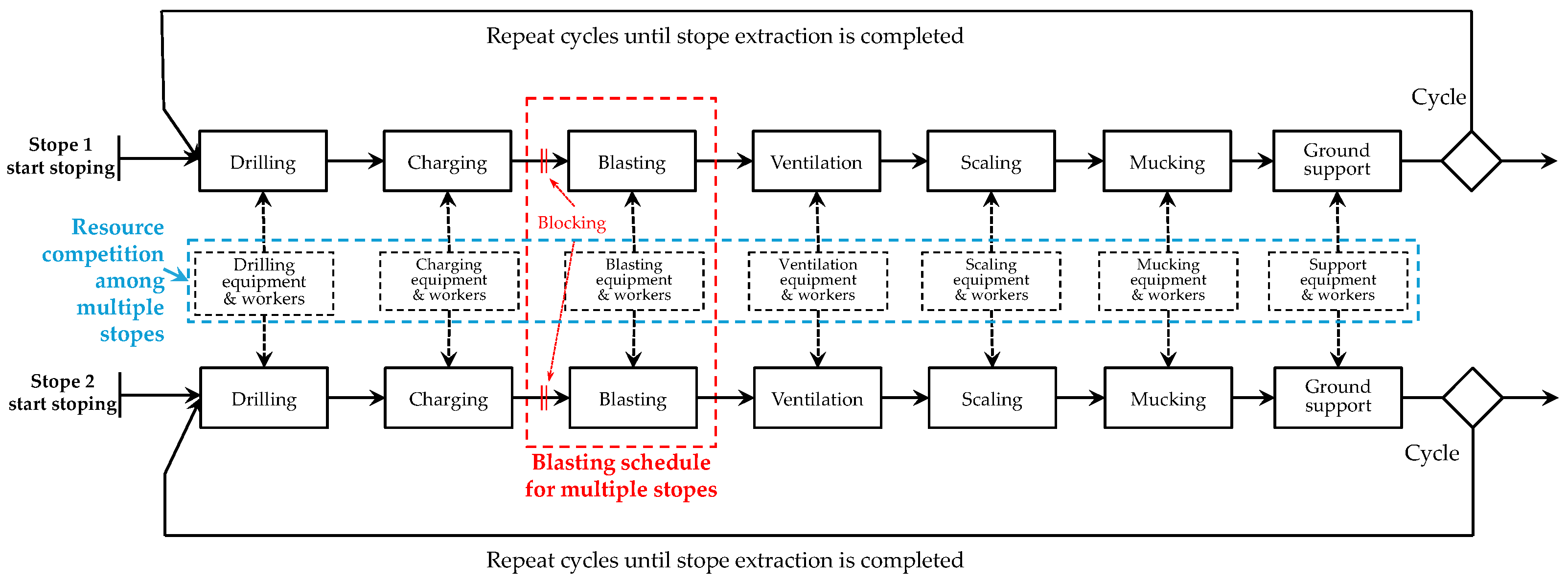
In the structured modeling scheme, a panel-level mining organization module, a stope-level extraction and backfilling module, and an internal cycle-control module within each stope are constructed to map the actual layout from panel organization and stope arrangement down to cycle progression, as illustrated in Figure 1.
On this basis, the simulation model is decomposed into four functional modules. This design maintains the spatial hierarchy of “panel–stope–stoping cycle” while embedding time, safety, and capacity constraints into each module, to analyze how changes in constraints affect production rhythm and overall system performance.
  • Spatial modeling module. This module represents the spatial layout of panels and stopes. A three-dimensional grid is used to define panel boundaries and stope geometries, automatically generate a stope matrix and its spatial coordinates, and output basic data such as mineable range and service radius. These outputs provide positional and boundary conditions for subsequent process modeling and equipment dispatching. Calibration of the spatial matrix and related parameters is detailed in Section 2.3 on spatiotemporal constraints.
  • Stoping and backfilling module. This module focuses on the stope extraction and backfilling processes, describing key parameters such as blasted ore tonnage, consumption of backfilling materials, and advance per cycle. The model updates stope states according to cycle advancement and outputs ore tonnage and backfill demand on a per-cycle basis, thereby supplying demand-side information to the haulage and material supply module.
  • Cycle control module. This module contains an iterative control logic that advances the sequence of cyclic operations according to process flows and engineering constraints. By combining conditions such as completion of development, backfill strength and curing time, ventilation status, and safety boundaries, it controls the start–stop status and state transitions of different operational stages, thus realizing internal process control at the stope scale—i.e., determining whether a given block can be mined and which block is mined first.
  • Haulage and dispatching module. This module takes haulage equipment and auxiliary units as basic entities. Tasks are assigned based on ore tonnage and operational demand, and operating information such as equipment location, loading status, and waiting time is updated in real time. By recording haulage efficiency, queuing time, and production completion, the module reflects the match between panel-level constraints and stope-level demand.
The resulting multi-level structured model supports dynamic optimization of complex underground mining operations and enables multi-scenario analysis and decision-making.

2.3. Engineering Constraint System for the Underground Mining Process

Although a simulation model based on a multi-level structured modeling framework can reconstruct the underground mining process, a significant gap still exists between such models and actual engineering operations. The fundamental reason is that underground mining is always dominated by multiple engineering constraints, especially limits related to temporal and spatial boundaries, process interfaces, organizational management, and safety regulations. These constraints overlap and interact, forming a complex constraint environment for the mining system. From the perspectives of system characteristics, safety, efficiency, and resource utilization, the main engineering constraints in this study are classified into three categories: spatiotemporal constraints for safe stoping, process constraints in the underground mining process, and organizational constraints related to personnel and equipment allocation.

2.3.1. Spatiotemporal Constraints for Safe Underground Stoping

Underground mining is a complex engineering activity that is strictly constrained by orebody geometry, and its spatial organization is typically expressed as a specific three-dimensional distribution of panels, ore blocks, or stopes. Except for a few scattered thin veins, most stopes are clustered and form compact spatial structures. During the transition from active mining to void formation, backfilling, and curing, each stope goes through several distinct states, and complex spatiotemporal dependencies exist among these states. The detailed rules are determined by the mining method.
The sequence of stope extraction, the timing of backfilling, and the spatial arrangement of stopes directly influence both mining efficiency and operational safety, and therefore must be represented accurately in the simulation model. For the safe extraction of multiple underground stopes, the spatiotemporal constraint modeling is carried out in three steps.
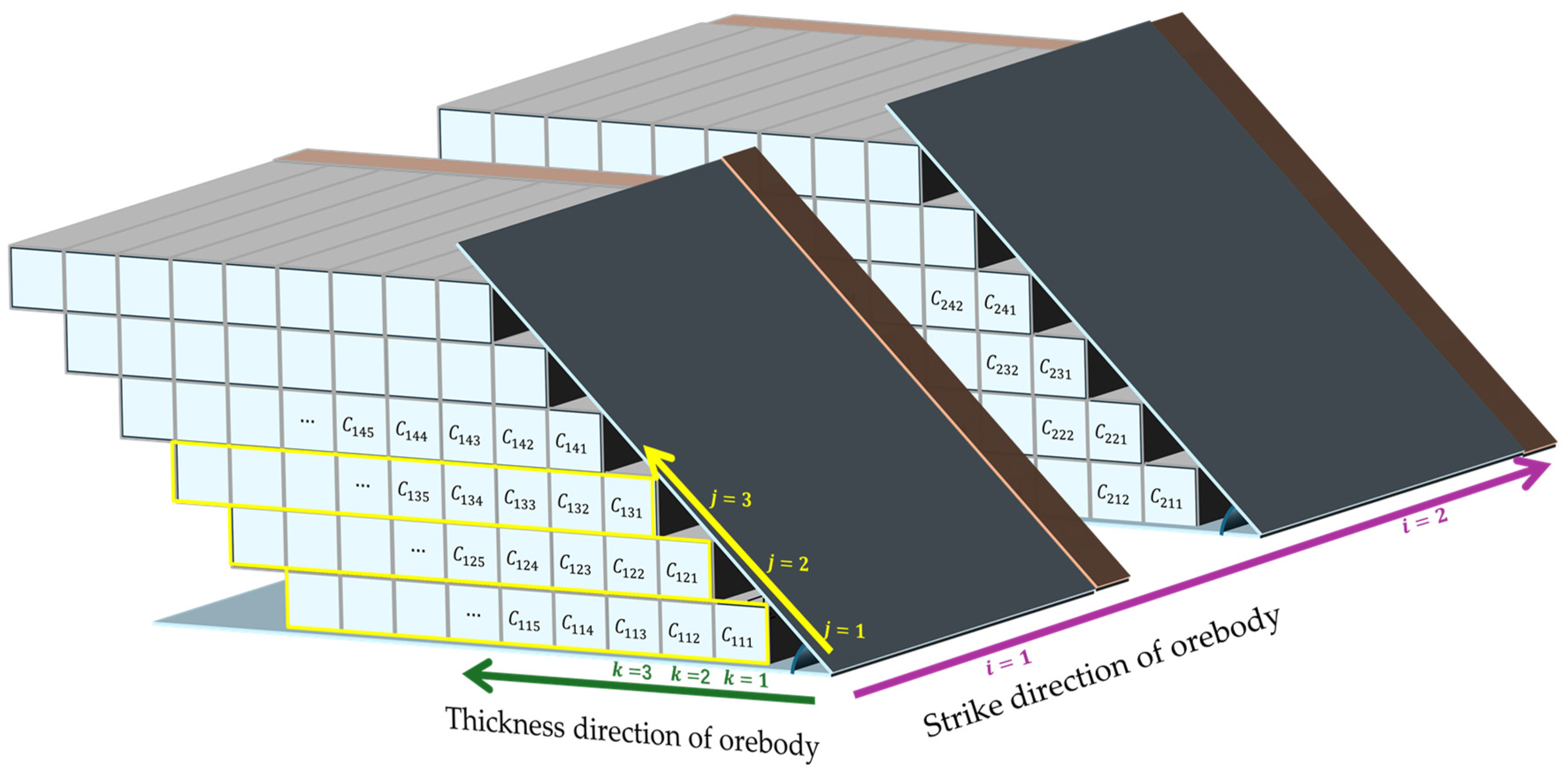
First, a three-dimensional spatial matrix of the underground stopes is defined. A 3D matrix is used to represent stope units, where the indices i, j, k correspond to the strike, vertical, and thickness directions, respectively, and each matrix element C i j k specifies the spatial position of a stope cell (as illustrated in Figure 2). Similarly, pillars P i j k and development drifts D i j k , along with other structural elements of the stoping area, can be defined using the same indexing scheme to achieve precise spatial positioning.
Second, stope states are defined. According to their spatiotemporal evolution, stopes are classified into several stages during the mining process, such as development completed, mined, backfilled-and-cured, and state transitions strictly follow the spatiotemporal constraints. Before entering the stoping stage, it is necessary to check whether the safety protection zone defined by the states of surrounding stopes meets the requirements, and to confirm that the current stope satisfies the conditions for safe mining. These state transitions are closely linked to agent behaviors and provide the basis for the spatial constraint logic of the stope agents, ensuring the orderly extraction of individual stopes in both time and space.
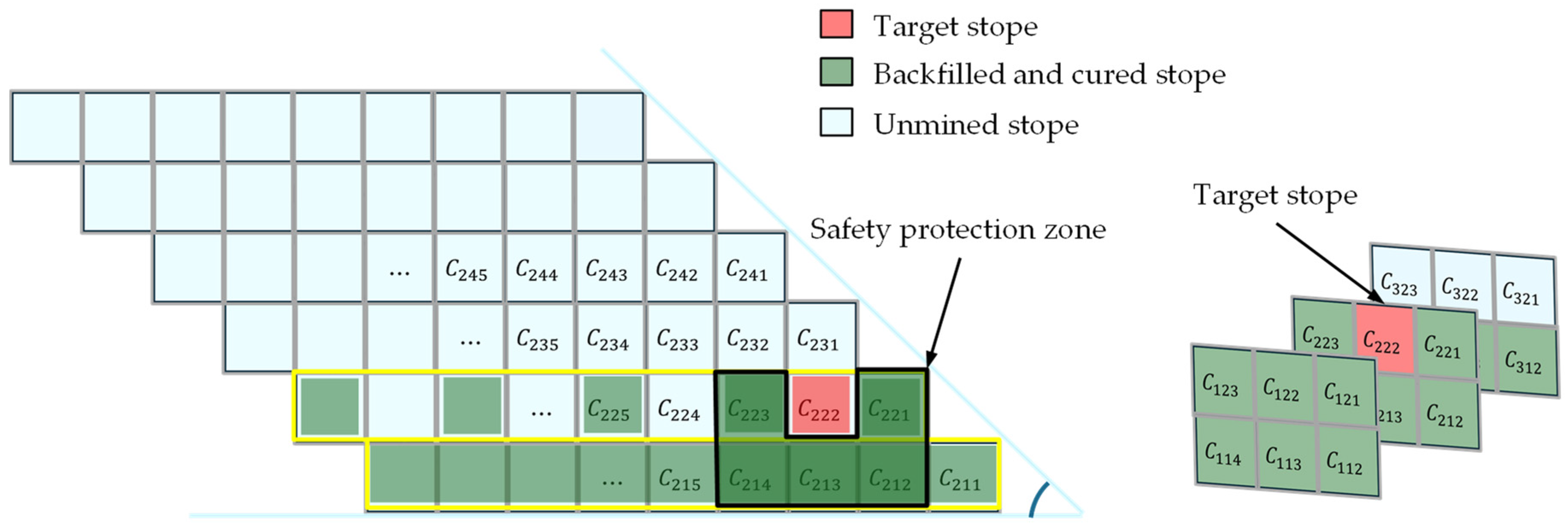
Third, and most importantly, the spatial constraint logic for multiple stopes is established. Based on the definitions of stope locations and states, a spatial constraint mechanism is constructed. Taking the drift-based overhand horizontal cut-and-fill mining method as an example, each drift is treated as an independent stope and indexed as C i j k . As illustrated by the safety protection zone in Figure 3, before mining the target stope C 222 , all underlying stopes C 21 k   ( k = 1 ,   2 ,   3 , , n ) must have been backfilled-and-cured. The adjacent stopes on the same level, C 221 and C 223 , must be in either the “unmined” or “backfilled-and-cured” state to satisfy the requirement of alternate stoping and backfilling. If the orebody is fractured, the neighboring stopes along the strike direction, C 122 and C 322 , must also remain in a supporting state. Accordingly, when mining any stope C i 0 j 0 k 0 , the following spatial constraints are imposed:
  • Strike direction ( i ): adjacent stopes C ( i 0 ± 1 ) j 0 k 0 must be in the “unmined” or “backfilled-and-cured” state to ensure roof integrity.
  • Vertical direction ( j ): the lower group of stopes C i 0 j 0 1 k   ( k = 1 ,   2 ,   3 , , n ) must have been backfilled-and-cured to provide effective support and prevent damage induced by overlying stoping.
  • Thickness direction ( k ): neighboring stopes C i 0 j 0 ( k 0 ± 1 ) must provide sufficient pillar support to avoid lateral instability.
Finally, temporal constraints for multiple stopes are defined. These time-related constraints are central to coordinated multi-stope mining plans and mainly include limits related to backfill curing, blasting isolation, and waiting caused by resource occupation. They are closely coupled with the spatial topology:
  • Backfill curing: the required curing period for backfilling in underlying or adjacent stopes before the target stope can be mined.
  • Blasting safety limits: the safety window during which operations in adjacent stopes are suspended and personnel and equipment are evacuated when blasting is conducted.
  • Resource competition and waiting: when shared production resources can serve only one stope at a time, other stopes must wait in a queue.
During the simulation, the stoping area dynamically adjusts the sequence of extraction and backfilling according to the above spatiotemporal constraints. By jointly considering the spatiotemporal relationships and dynamic state transitions among stopes, the model enhances its ability to represent the real complexity of underground mining operations.

2.3.2. Process Constraints in the Underground Mining Process

The underground stope mining process comprises panel development and slot preparation, stope extraction, and ore haulage. Stoping usually takes panel development and slot cutting as prerequisites, after which the operation proceeds to the stope extraction stage. Stope extraction is completed through multiple cycles; in each cycle, drilling, charging, blasting, ventilation, mucking, and ground support are executed in sequence. Once the cyclic operations are finished, backfilling is carried out to complete the stope extraction, and the ore is hauled to the surface through the transport system.
Strict dependencies exist among these process steps, mainly including:
  • Process sequence constraint: the sequence “development → slot cutting → stoping (drilling, charging, blasting, ventilation, mucking, ground support) → backfilling” must be strictly followed, and reverse or out-of-order execution of operations is prohibited.
  • Blasting safety constraint: when multiple panels or stopes operate in parallel, blasting must be conducted within coordinated time windows; during blasting, adjacent operations must be suspended and personnel evacuated to ensure safety.
  • Backfill curing constraint: when the target stope is being extracted, adjacent stopes on the same level must be in either the “unmined” or “backfilled-and-cured” state to ensure stope safety. Between sublevels, upper-level stoping is permitted only after the backfill in the lower level has fully cured; otherwise, stoping must be postponed until curing is complete.

2.3.3. Organizational Constraints on Personnel and Equipment

In underground mines, organizational constraints on personnel and equipment not only determine dispatching outcomes, but are also critical to the realism and fidelity of the process simulation. In this study, personnel and equipment constraints are embedded into the simulation model through a combined resource-constrained, state-machine-based, and event-triggered approach.
First, regarding process-related resource constraints, the required personnel, equipment types, and quantities for each operation are structurally defined, and the “group availability” of these resources is used as the trigger condition for the operation state machine. For example, if a drilling task requires two workers and one drill jumbo, the operation state changes from “waiting” to “executable” only when all three resources are simultaneously available; otherwise, it remains in the waiting state. This ensures that each operation in the model strictly adheres to the actual resource-combination requirements.
Second, for shift-scheduling constraints, shift rosters are embedded in the model. The availability periods of different worker categories in each shift are represented as a time matrix of “dispatchable/non-dispatchable” states, which serves as the basis for workforce dispatching. For operations spanning multiple shifts, rules are defined according to whether the task is interruptible: interruptible tasks are suspended at shift-change boundaries and resumed by the next shift, whereas non-interruptible tasks (such as blasting) are checked at the dispatching stage to ensure they can be completed within a single shift; otherwise, their start time is postponed. By linking the time axis with operation states, personnel time constraints are directly imposed on the process flow.
Third, for equipment failure and maintenance constraints, a dynamic update function for equipment failure probability is established. Equipment age is used to define a baseline failure rate, which increases with the duration of continuous operation, and is reduced through periodic maintenance events. Equipment states are described by five statuses: “idle–working–failed–under maintenance–recovered.” When a failure event is triggered, the equipment switches to the “under maintenance” state and is removed from the dispatchable pool; after maintenance, it returns to a dispatchable state. This can be combined with a backup-equipment dispatching mechanism to mitigate the impact of unexpected failures on operations.
By jointly modeling workforce availability and shift schedules, grouped resource-occupancy checks for operations, equipment state-machine evolution, and event-triggered mechanisms, personnel and equipment constraints act dynamically on the underground mining process within the simulation. The model outputs—such as production rhythm, waiting times, and utilization rates—are sensitive to resource allocation and constraint settings, enabling comparison of different dispatching schemes and identification of organizational risk points.

3. Constraint-Based Simulation Model of Underground Mining Operations

3.1. Model Overview

Building on the proposed modeling approach, this section develops a constraint-based underground mining simulation model on the AnyLogic multi-method simulation platform. Within a unified framework, the model simultaneously represents the mining process flow, resource occupancy, and the action of multi-dimensional engineering constraints, thereby achieving constraint-based modeling of underground mining operations. AnyLogic’s capability for multi-method integration and its logic-based modeling mechanism align well with the constraint-oriented modeling concept, enabling explicit representation of constraint logic and process control within a single platform.
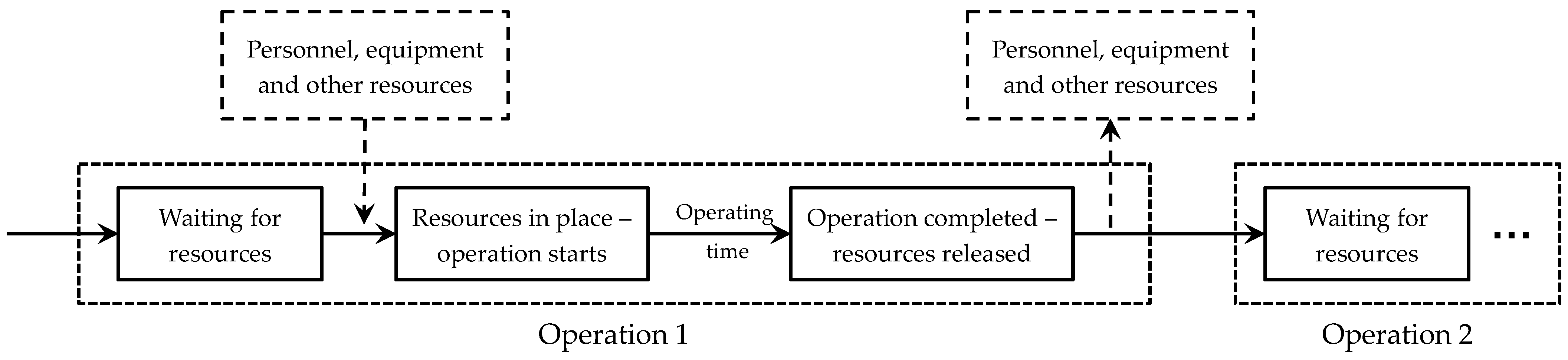
A discrete-event simulation (DES) model is first used to establish an ideal baseline for the underground mining process. The overall process flow of underground mining operations in the simulation model is shown in Figure 4. This baseline model describes job queues, resource occupancy, equipment dispatching, and processes such as dynamic resource availability and resource competition induced by shift schedules. Operations such as drilling, charging, blasting, ventilation, scaling, mucking, and ground support are modeled as independent tasks. Each task is represented as a discrete-state process comprising “waiting for resources,” “resources in place and operation start,” “in operation,” and “completed,” as illustrated in Figure 5. Personnel and equipment are modeled as seizable resources, with capacity and competition explicitly considered. An operation can only enter the execution state when the full combination of required resources is available, thereby reflecting resource constraints on operating conditions.
Agent-based simulation is then incorporated by modeling stopes, equipment, and work crews as objects with independent states and behaviors. This layer is used to represent stope state evolution, safety constraint logic, and equipment failure and maintenance processes. The DES and agent-based components run collaboratively within the same model so that process advancement remains consistent with the state transitions of individual objects.
The engineering constraint system is implemented in AnyLogic via Java code. Constraints related to time windows, spatial reachability, and precedence relationships among operations are encoded as event-trigger conditions; safety-state checks and failure–maintenance rules are implemented through state-machine transitions; workforce schedules, equipment capacities, and priorities are expressed through resource attributes and dispatching rules. By combining multi-method simulation with code-based constraints, temporal, spatial, and organizational constraints are controlled in a unified framework, providing a basis for subsequent model refinement and analysis of scheduling strategies.

3.2. Implementation of Multi-Dimensional Constraints in the Simulation

This section further describes how the underground mining process is implemented in AnyLogic. Focusing on key issues such as spatial constraints, equipment state evolution, shift scheduling of personnel, and coordination of resources and process flows among multiple stopes, the implementation is presented in three parts: the spatiotemporal constraint system for multiple stopes; organizational constraint modeling for personnel and equipment; resource competition and process-flow constraints among multiple stopes.

3.2.1. Spatiotemporal Constraint System for Multiple Stopes

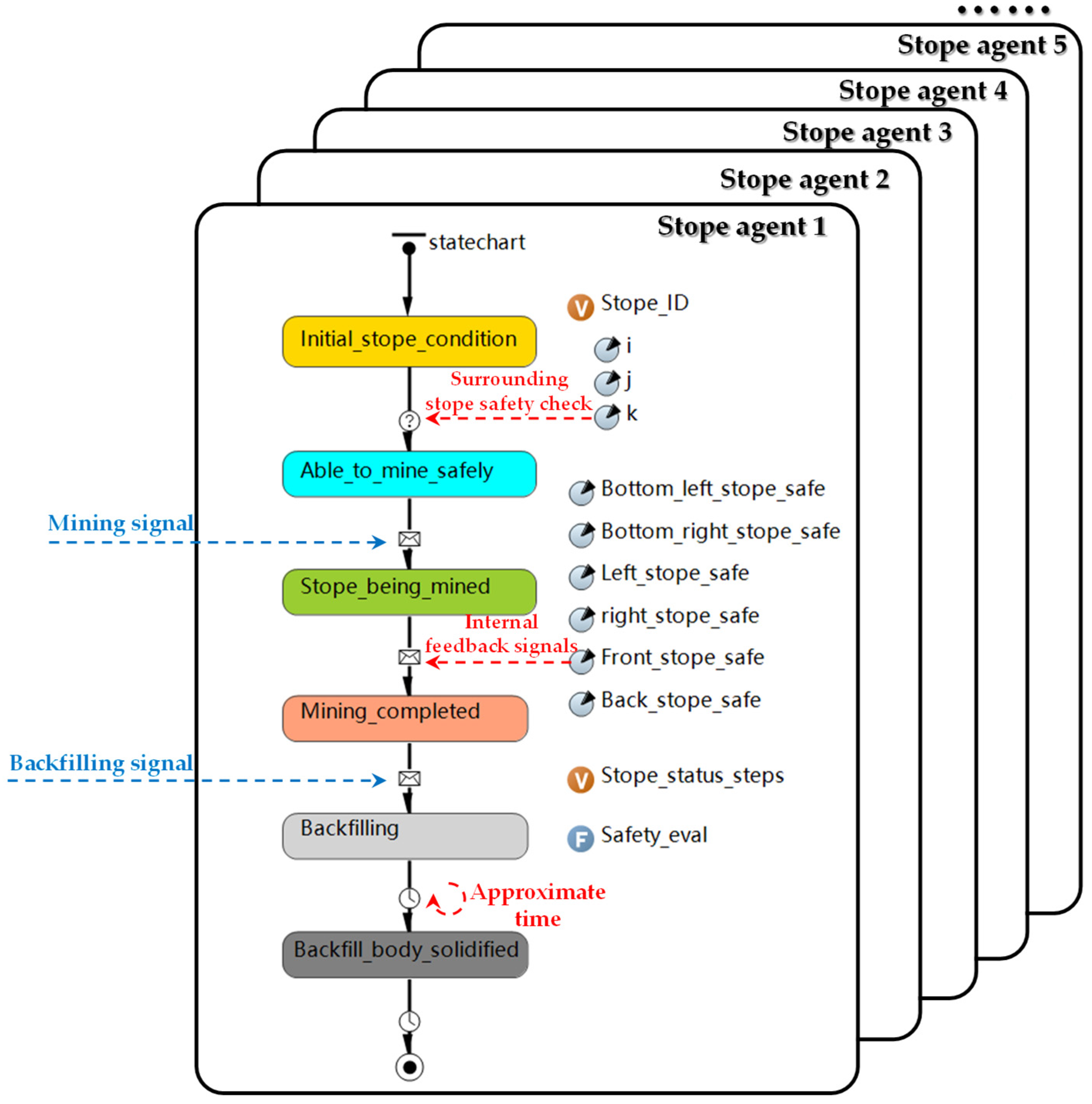
Based on the agent-based simulation approach, each stope is modeled as an individual agent. Within each agent, three components are defined: three-dimensional spatial coordinates, spatial safety constraints, and stope state transitions, as shown in Figure 6.
Modeling the three-dimensional spatial position of stopes. Inside each stope agent, three spatial indices i , j , k and an identifier StopeID are defined to locate the agent in the underground 3D space and assign a unique index. Given the matrix width W and height H , the mapping is defined as follows:
  • k is taken as StopeID modulo W , representing the position of the stope along the orebody thickness direction;
  • j is taken as the integer part of StopeID divided by W , representing the row index in the vertical direction;
  • i is taken as the integer part of StopeID divided by W × H , representing the layer index along the orebody strike direction.
  • The corresponding mathematical expressions are given in the model equations, see Formula (1), where mod denotes the remainder (modulo) operator and denotes the floor (integer part) operator.
k = StopeID   mod W , j = StopeID W , i = StopeID W × H
Through this mapping, the one-dimensional stope indices are sequentially filled into the three-dimensional grid, achieving a matrix-based representation and localization of stope positions in space.
Modeling three-dimensional spatial constraints for safe mining. By using the mathematical relationships among the indices (i, j, k), all stopes surrounding a target stope are associated, linking those located at different spatial offsets relative to the target. Based on the “safety protection zone” criteria for safe stope extraction, the model then evaluates the safe-mineability of the current stope. In this process, six parameters—“Bottom left stope safe”, “Bottom right stope safe”, etc.—are used to represent the safety status of the six neighboring stopes. These parameters are passed to the “Safety eval” function, which evaluates whether the current stope can be mined safely. In this way, each stope agent can autonomously determine its own safe-mineability based on the safety status of surrounding stopes.
Stope extraction states and transitions. The stope extraction process is divided into six states in the model: “Initial stope condition”, “Able to mine safely”, “Stope being mined”, “Mining completed”, “Backfilling”, and “Backfill body solidified”. State transitions are driven and determined by two types of signals: (i) external control signals such as “Mining signal” and “Backfilling signal”; and (ii) internal assessments and feedback of the stope agent, such as “Surrounding stope safety check”, “Internal feedback signals”, and “Approximate time”. Real-time changes in the stope state directly affect its safety-related parameters. Only stopes in the “Initial stope condition” or “Backfill body solidified” state are regarded as reliable supporting units in the safety evaluation of surrounding stopes. Furthermore, state transitions influenced by backfill curing time impose additional restrictions on the initiation and advancement of subsequent process steps in the technological system. Under the combined action of these states and decision rules across multiple stope agents, an interdependent spatiotemporal constraint system is formed among stopes.

3.2.2. Organizational Constraint Modeling for Personnel and Equipment

The equipment state machines and personnel shift schedules jointly determine resource availability. Equipment failures, maintenance, repairs, and shift changes all cause temporary unavailability of resources, leading to interruptions and delays in the operation process. Such organizational constraints are ubiquitous in continuous mine operations and are explicitly represented in the simulation.
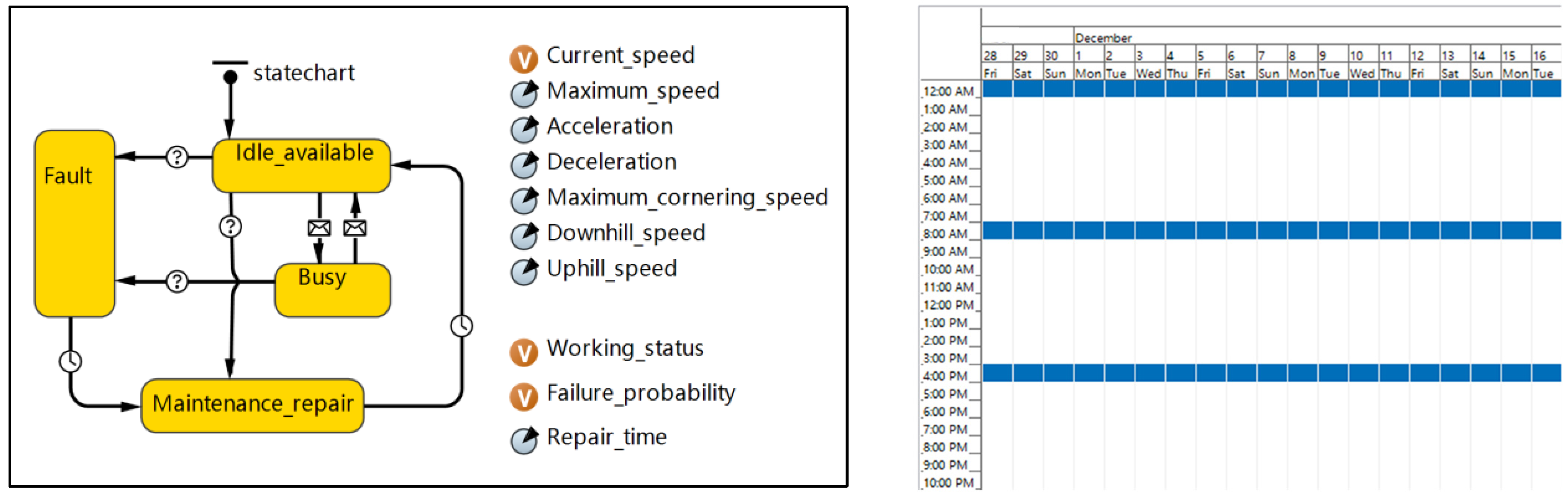
At the equipment level, failures, maintenance, and repairs are modeled through agent-based state machines. Each unit of equipment is assigned discrete states such as “Idle available”, “Busy”, “Fault”, and “Maintenance repair” (Figure 7). Failure times are randomly generated according to empirical probability distributions, maintenance is triggered at predefined intervals, and repair durations follow empirical time distributions. Once a piece of equipment enters the Fault, Maintenance, or Maintenance repair state, it is removed from the dispatchable resource pool and is no longer considered in task assignment, which is reflected in the model as equipment unavailability.
At the personnel level, shift constraints are formulated according to the three-shift, eight-hour working system used in the mine. Along the simulation time axis, the availability periods for workers in each shift are marked, and a one-hour handover period is set at each shift change. During this handover window, the corresponding personnel are flagged as unavailable and are excluded from new task assignments. In this way, the shift-scheduling system is translated into an “available/unavailable” state control mechanism for human resources.

3.2.3. Resource Competition and Process-Flow Constraints Among Multiple Stopes

When multiple stopes are mined simultaneously, they share a shared resource pool, as illustrated in Figure 8. When several stopes request the same limited equipment or work crew at the same time, the model treats these requests through a shared resource pool. Before entering a given operation, each stope must request the required resources from this pool; if the resources are not allocated, the stope remains in a waiting state. This queuing mechanism explicitly captures the effect of simultaneous resource demand under limited equipment availability.
Blasting is modeled as a synchronized event controlled by process readiness and a predefined blasting time window. After drilling and charging are completed, a stope enters the “ready-to-blast” state, and blasting can be initiated only when all stopes in the same blasting round satisfy this condition and the blasting window is available. During blasting, affected adjacent operations are temporarily suspended, with personnel and equipment assumed to be evacuated according to safety requirements. If a stope misses the current blasting window, it remains in a waiting state until the next permissible window, thereby capturing the delay caused by centralized blasting organization.
At the same time, the model dynamically updates mucking locations as the working face advances, adjusting the coordinates of loading points according to the advance step and recalculating haul distances and travel times. In this way, resource competition, process waiting, and changes in haul distance are jointly incorporated into the simulation process.

4. Constraint-Based Simulation Case Study of Underground Mining Operations

4.1. Simulation Model of Drift-Based Horizontal Cut-and-Fill Mining at the Sanshandao Gold Mine

4.1.1. Case Study Background

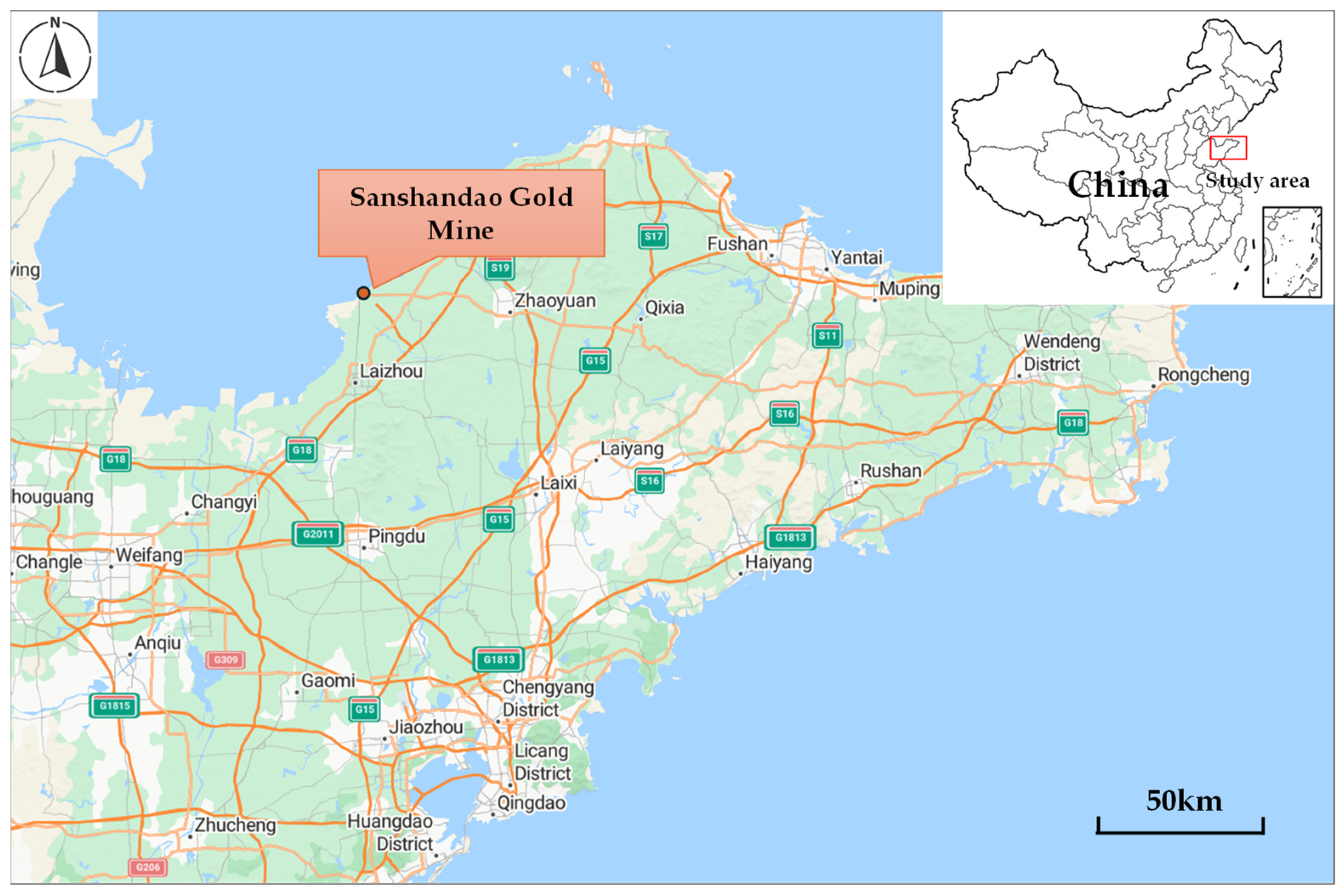
The Sanshandao Gold Mine in Shandong Province, China (Figure 9), hosts an inclined, thick orebody that is mined at depth and is significantly affected by faulting and deformation of the surrounding rock. The mine plans to adopt a horizontal cut-and-fill mining method for large-scale deep extraction. However, under this method, a large number of stopes are extracted simultaneously, leading to complex resource competition and scheduling challenges. Existing design approaches, which rely mainly on experience and static planning, are difficult to adapt to the demands of large-scale mining under such deep and complex conditions.
The horizontal cut-and-fill method is characterized by a regular stope layout, strict sequencing between stoping and backfilling, and a strong influence of the stoping–backfilling relationship on the safety windows of adjacent stopes and on the advancement of process steps. Its spatiotemporal structure is clear and constraint relationships are explicit, which makes it highly compatible with hybrid simulation method for underground mining under multi-dimensional constraints. On this basis, the drift-based overhand horizontal cut-and-fill system at the Sanshandao Gold Mine is selected as the case study. A full-process stoping simulation model is developed that covers drilling, charging, blasting, mucking, ground support, and backfilling. The model dynamically simulates process flows, resource competition, and cyclic operations under multi-stope conditions, and evaluates the production capacity of different process designs and organizational schemes.

4.1.2. Model Construction

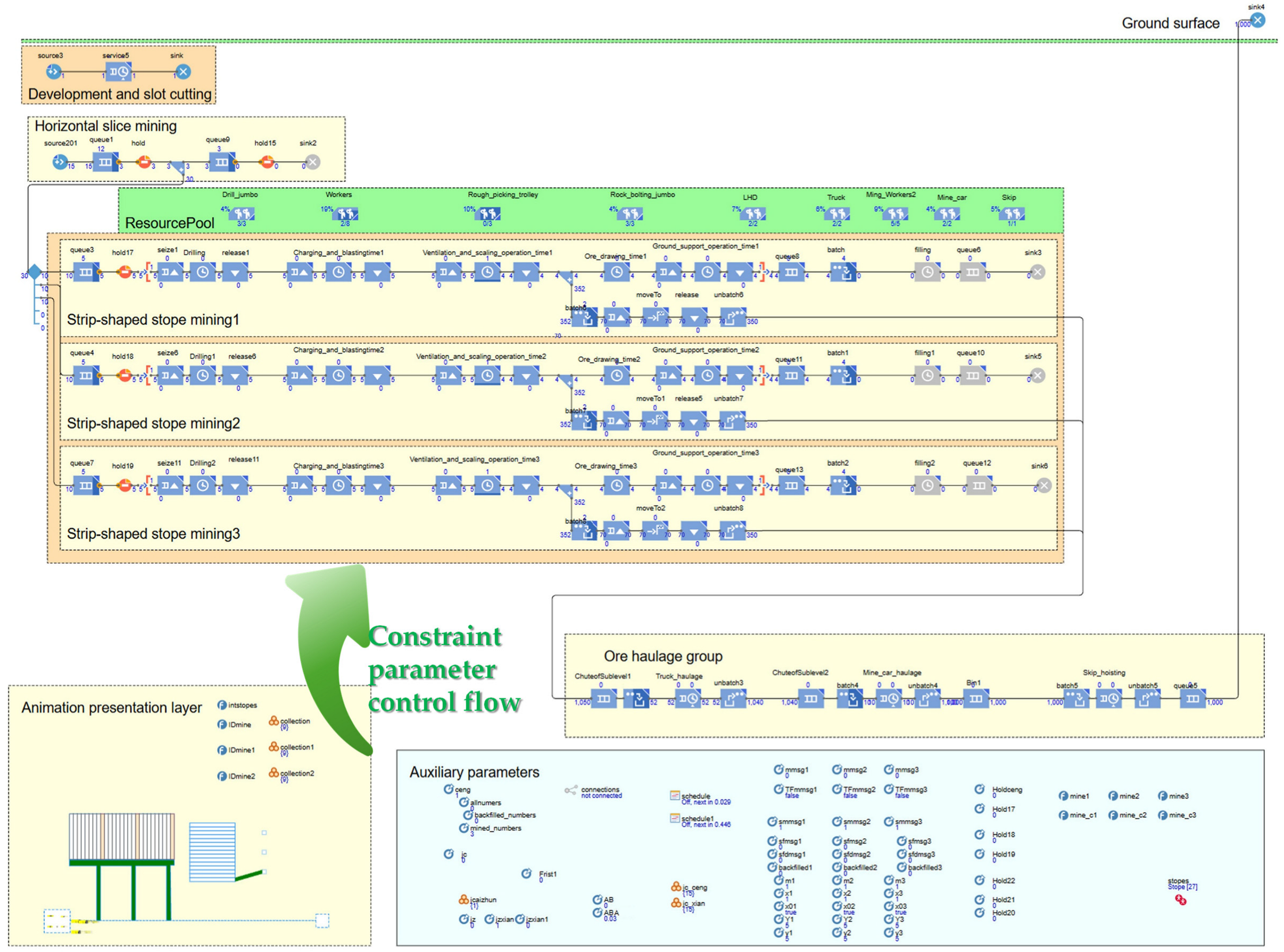
Based on the approach, a simulation model of the drift-based horizontal cut-and-fill mining method for the Sanshandao Gold Mine is developed, as shown in Figure 10.

4.2. Reliability Testing of the Simulation Model

4.2.1. Initial Input Conditions

To evaluate the reliability of the model, empirical operating data from the mine were input into the simulation, and the resulting production capacity was compared with actual performance. The initial input data for the model are summarized in Table 1, and the detailed conversion and calculation process for the ore haulage system is given in Table 2.
Conversion of haulage parameters for simulation. In mine production, a 3 m3 load–haul–dump (LHD) unit is used for mucking and short-distance haulage. The minimum haul distance is 80 m, and the actual distance is updated in real time as the working face advances. The LHD bucket fill factor is taken as 0.8, ore density as 2.8 t/m3, and the loosening factor as 1.5. The LHD travel speed on a gravel road is 8 km/h, and the total time for loading, unloading, and turning is 2.5 min. The payload per bucket is therefore taken as 5 t.
Initial data for personnel and equipment. The personnel and equipment required for each operation are listed in Table 3. The initial failure rate of each piece of equipment is assumed to be 3%. Preventive maintenance is performed once per week, with each maintenance event lasting 4 h. Within a one-week period, the failure probability increases quadratically with operating time T (in hours), reaching a maximum of 10%. The actual probability of equipment failure (PEF, Probability of equipment failure) is therefore expressed as Formula (2):
P E F   =   3   +   T 2 / 4032
where PEF is the actual failure probability in %, and T is time in hours.

4.2.2. Simulation Environment

The simulation model in this study was developed on the AnyLogic platform. AnyLogic provides an integrated multi-paradigm environment combining discrete-event simulation, system dynamics, and agent-based modeling, and allows Java code and database interfaces to be embedded conveniently, enabling unified management of multiple processes and constraints in the mine. The model runs on a Windows 10 64-bit system with an Intel i5-13600KF CPU and 32 GB RAM, ensuring sufficient performance for large-scale event scheduling under deep mining scenarios.
The simulation clock adopts a base time step of 1 h and can be switched to an event-driven mode when needed. Input data are managed using AnyLogic’s built-in table and parameter modules, into which measured production data from the Sanshandao Gold Mine are imported.

4.2.3. Simulation Results and Validation

To verify the reliability of the model outputs, simulated results were compared with layered mining data from a typical production area. Four scales were selected as evaluation units: a single production cycle, a single stope, a single level, and a complete ore block. For each scale, operating time, ore production, and efficiency indicators were obtained.
As shown in Table 4, the average time required to complete one production cycle is about 7.1 h, yielding 88 t of ore, corresponding to an efficiency of approximately 297.5 t/d. For a complete ore block, the total extraction time is about 31,511 h, with a total output of 356.4 kt and an efficiency of 271.4 t/d. The multi-scale results agree closely with on-site records, indicating that the model achieves good accuracy and applicability in representing complex processes and multi-resource constraints in deep underground mining. Specifically, using the field statistical values as the reference, the relative errors of the simulated mining efficiencies are 4.31%, 4.74%, 5.36%, and 6.77% at different production scales, with an average relative error of approximately 5.30%. Although the error increases slightly as the simulation scale expands from a single production cycle to the complete ore block, the overall deviation remains within a reasonable range for underground mining simulation, considering the stochastic nature of equipment operation, task waiting, resource coordination, and field production fluctuations.

4.3. System-Level Characteristics Revealed by the Simulation Model

4.3.1. Production Rhythm and Structural Characteristics

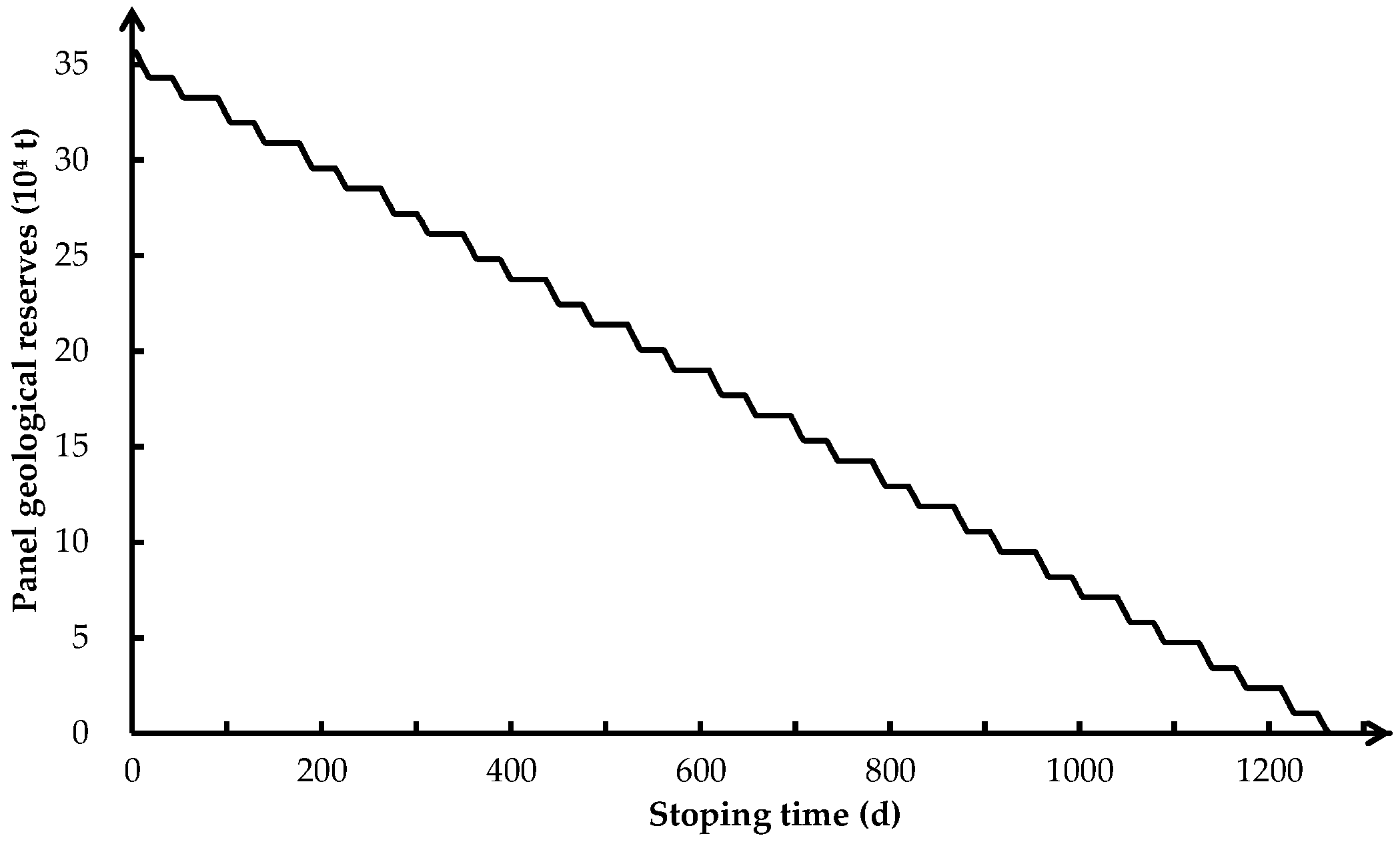
Based on the developed mine system model, the production rhythm and structural characteristics of the mine are examined using three time-series indicators at the panel scale: panel geological reserves, equipment utilization for stoping, and the cumulative number of stoping drifts.
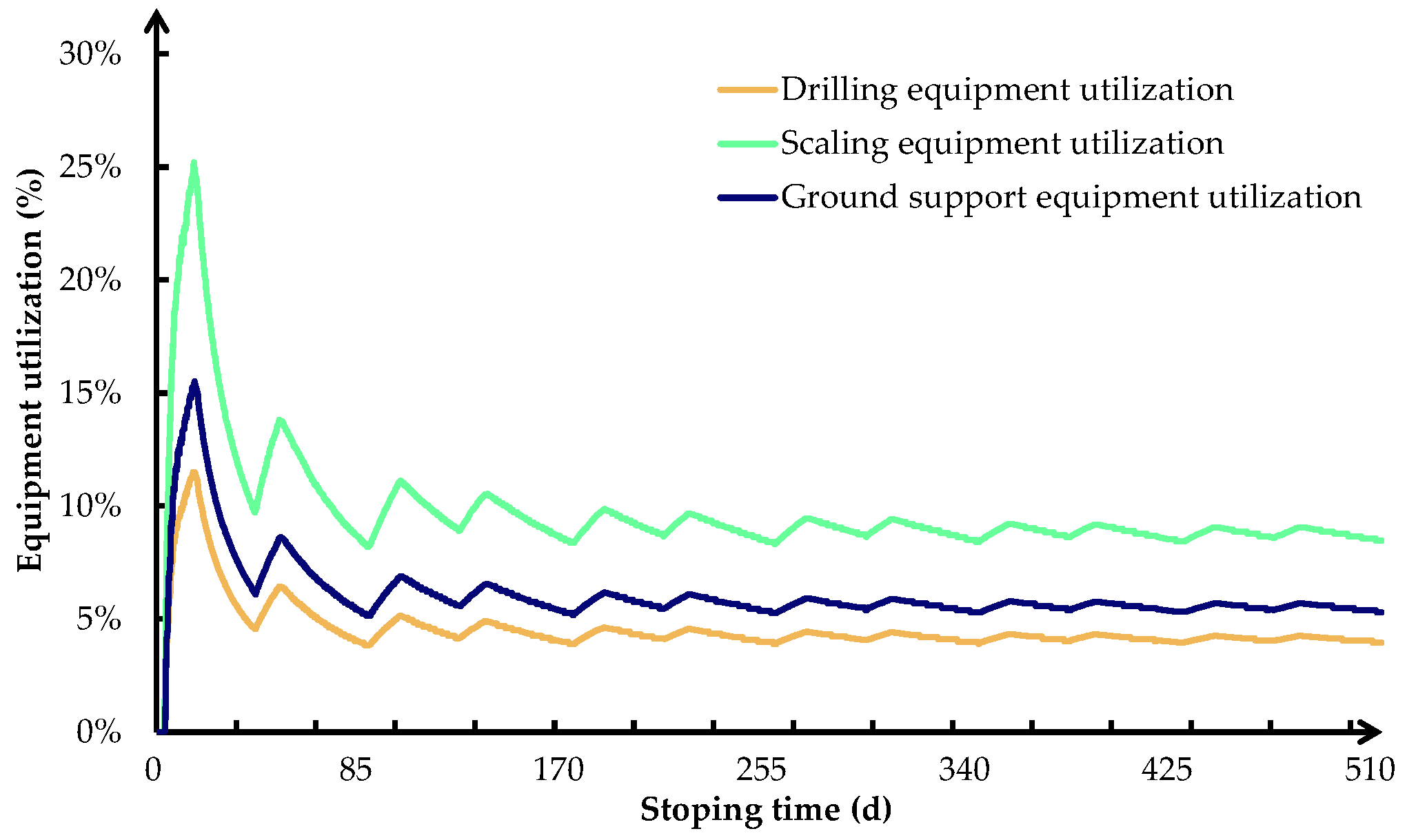
The evolution of panel geological reserves and stoping equipment utilization over time is shown in Figure 11 and Figure 12. Under the drift-based horizontal cut-and-fill layout with an alternate stoping pattern (“mine one, leave one”) on a single level, the production organization exhibits a typical staged rhythm. During extraction of a given level, stopes advance according to the rule of “complete one drift, backfill one drift in time.” After the first-step stoping is completed, the system enters a backfilling and curing waiting stage, followed by second-step stoping. Constrained by the backfilling operations and associated waiting times, the system as a whole displays a repeated “stoping–backfilling wait–stoping again” pattern. The corresponding consumption rate of panel geological reserves and utilization of stoping equipment both show pronounced periodic fluctuations.
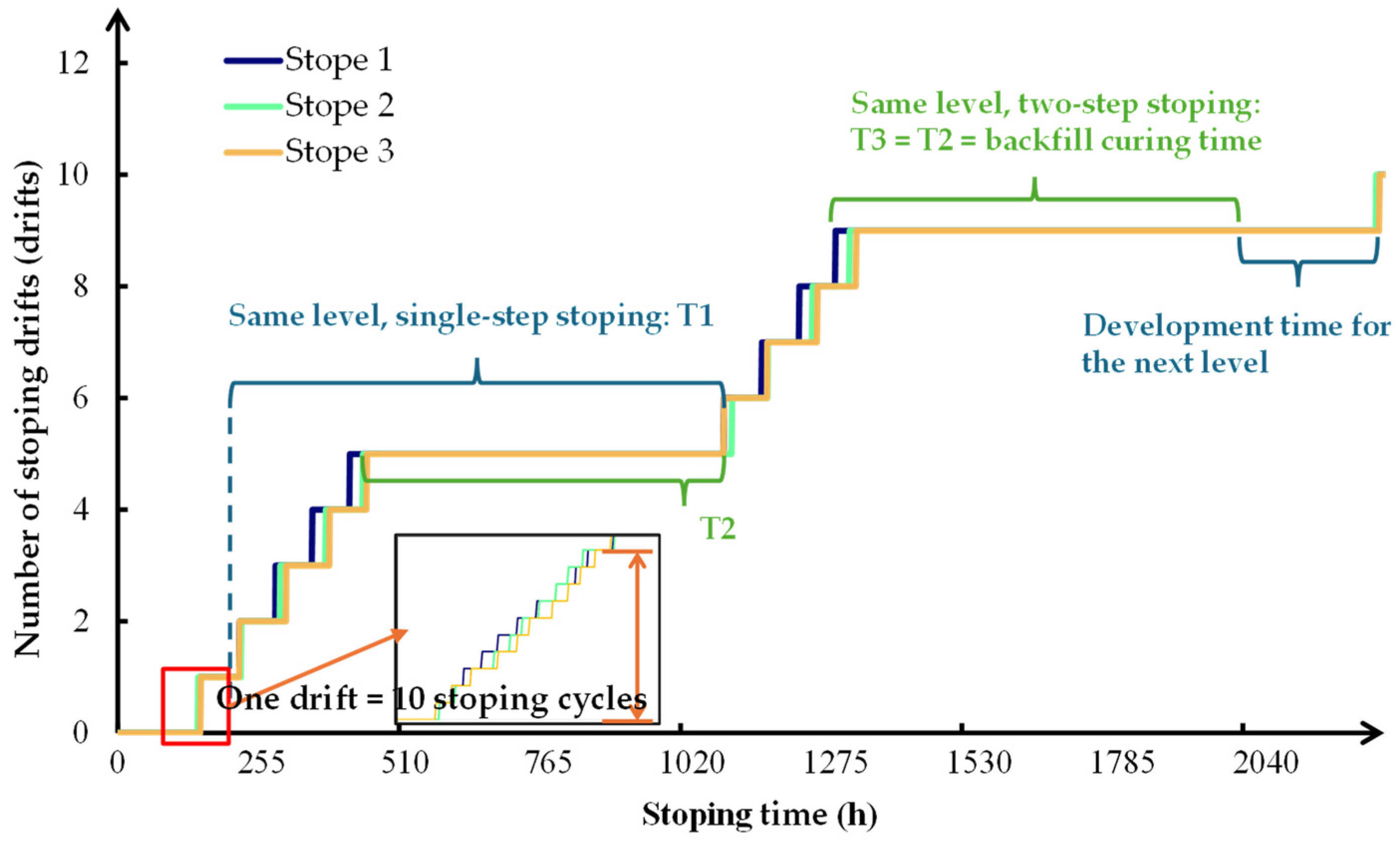
The curve of the cumulative number of stoping drifts over time characterizes the rhythm and staging of the stoping process within a single level. As shown in Figure 13, this curve uses the “number of completed stoping drifts” as a cumulative indicator, where each additional drift corresponds to 10 completed stoping cycles. Changes in the slope of the curve directly reflect the stoping intensity and organizational rhythm at different periods. The results indicate that, due to the alternate stoping layout (“mine one, leave one”), the first-step and second-step stoping phases advance alternately along the time axis. The first-step phase mainly consists of stoping and its associated backfilling, during which the curve grows in a relatively continuous and stable manner. In the second-step phase, in addition to stoping and backfilling, development time is required to prepare working faces for the next level. This leads to noticeable changes in rhythm and locally reduced slopes of the curve.
These parameter time series obtained from the system model clearly separate and highlight the structural roles of the stoping–backfilling–development sequence. They provide intuitive data support for analyzing organizational coordination among stoping, backfilling, and development, the sequencing of stopes, and the coordination among process steps at the stope scale.

4.3.2. Model Results Under Different Engineering Constraint Scenarios

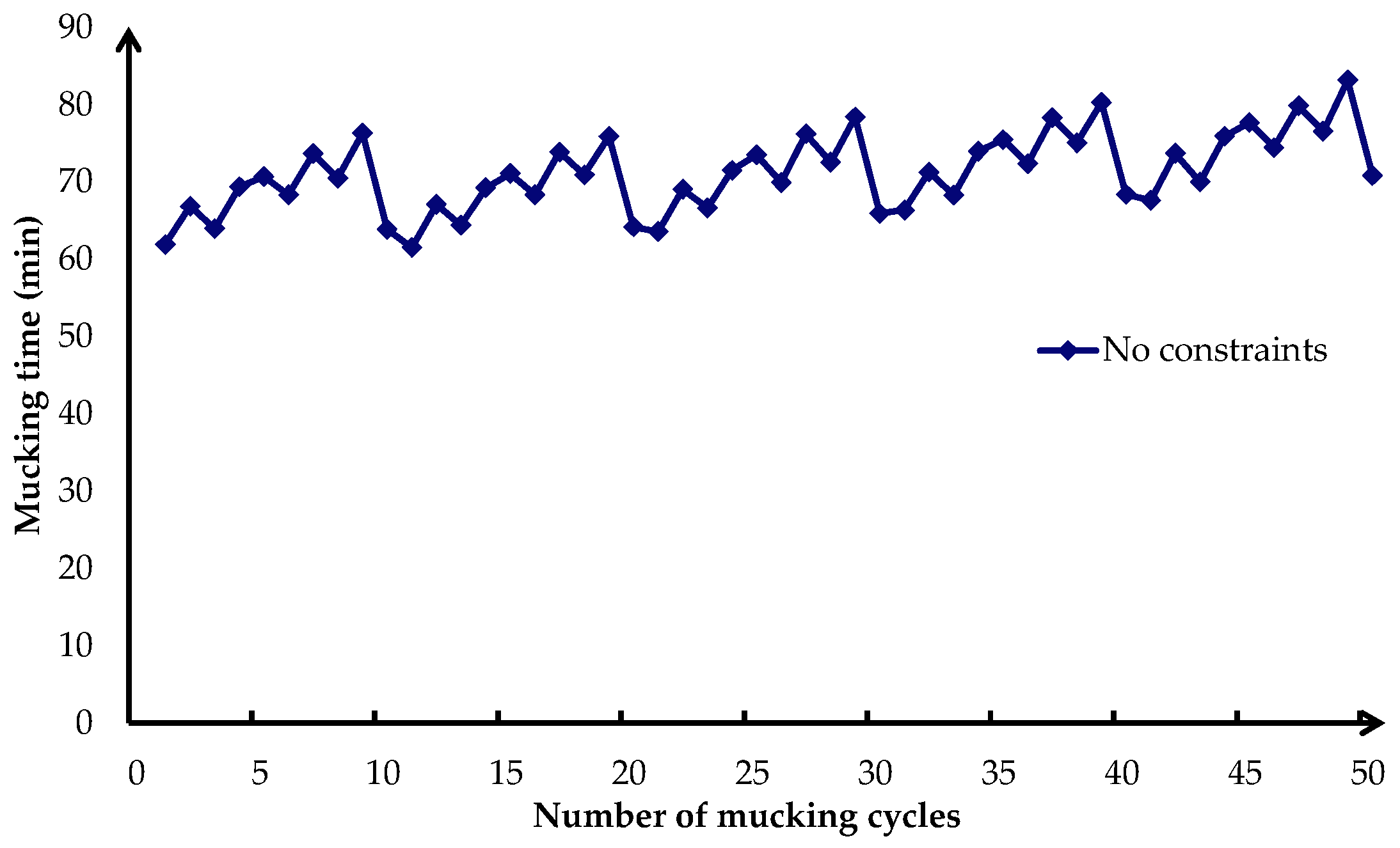
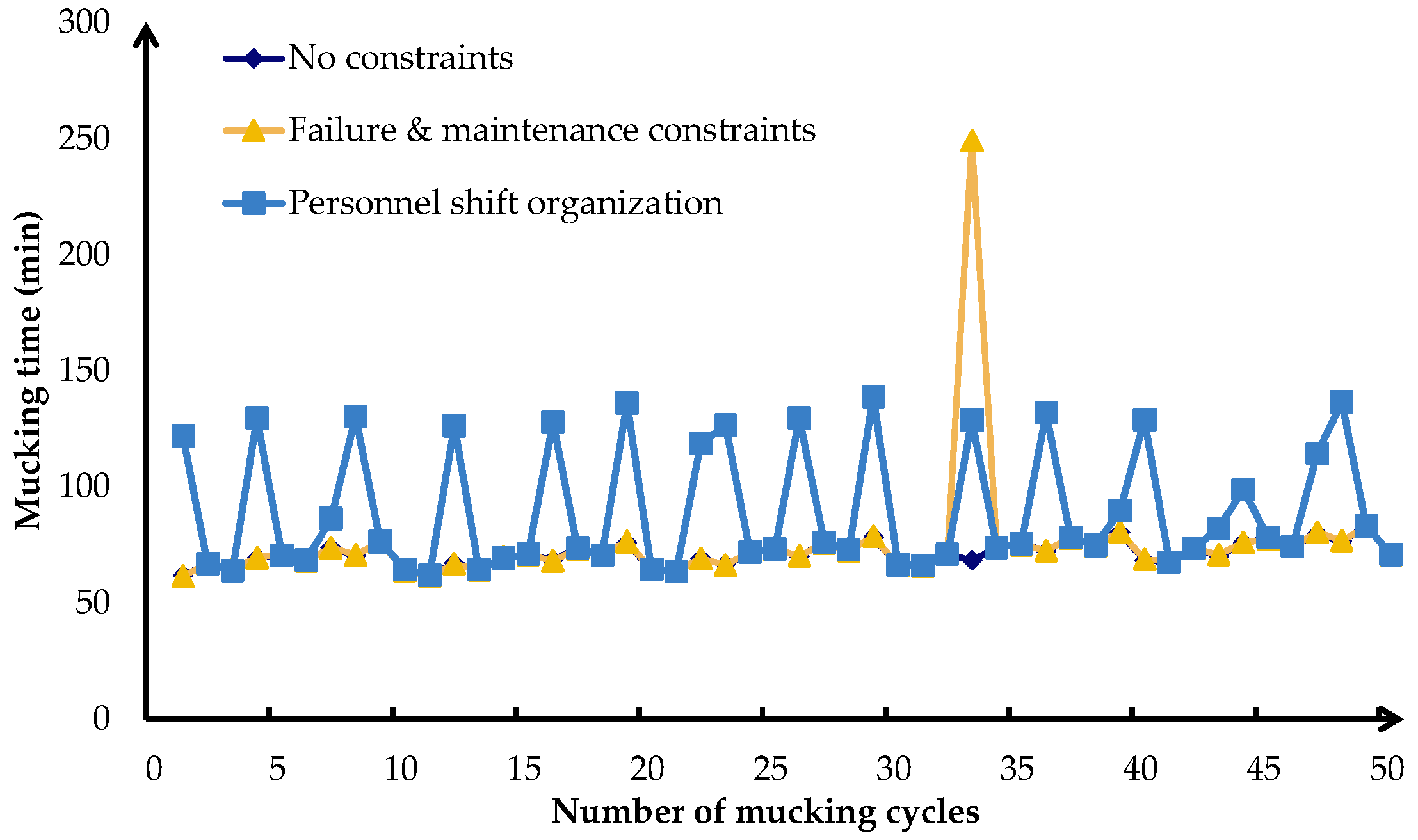
Within the constraint-oriented modeling framework, this study demonstrates how the theoretical model transitions from an idealized state toward actual production conditions by progressively introducing operational constraints. The evolution of mucking time under different scenarios is shown in Figure 14 and Figure 15.
First, in the ideal case without any operational constraints, mucking time is mainly governed by the dynamic increase in haul distance as the working face advances. The mucking time shows a gradually increasing pattern with clearly identifiable periodicity, and the curve takes on a regular shape. However, this still differs from real production behavior.
When equipment maintenance and failure constraints are introduced, the overall periodic pattern of mucking time remains recognizable. However, when key equipment fails or enters a maintenance window, the extraction time for individual cycles increases significantly, and the peak values in the corresponding periods become notably higher, reflecting the sudden disturbances to production rhythm caused by maintenance events.
After further incorporating the alternating-shift system for workers, multiple peaks emerge in the mucking time curve near shift-change times, and extraction efficiency shows staged fluctuations before and after shift transitions. By comparing the scenarios without constraints, with equipment constraints only, and with both equipment and personnel organizational constraints, the shape of the mucking time curves gradually approaches the fluctuation patterns observed in real production. This intuitively illustrates the modeling concept of “progressively adding constraints to approximate the real system.”

4.3.3. Dynamic Evolution of WIP and Ore Transfer Characteristics

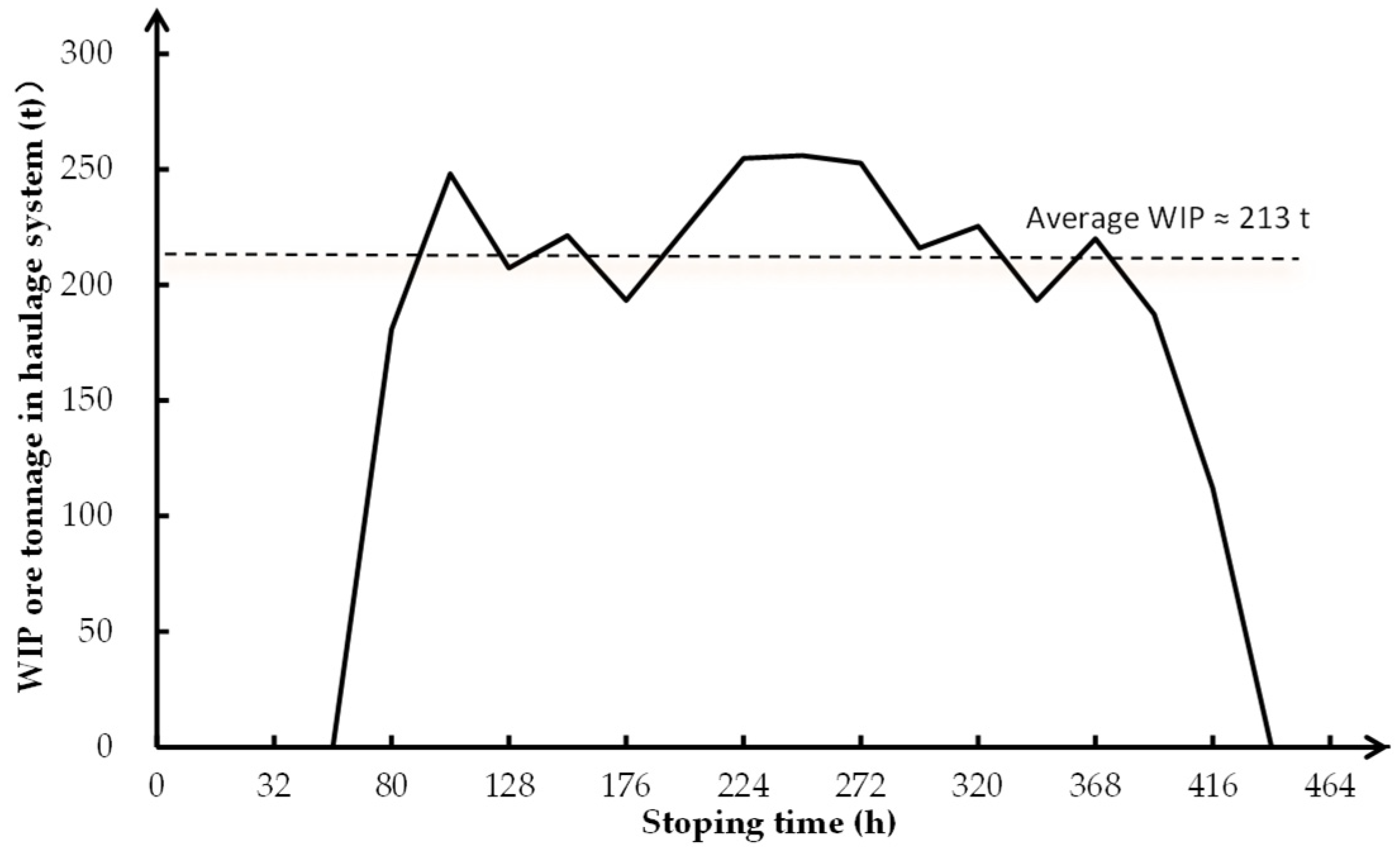
The evolution of ore tonnage in the haulage system, expressed as work-in-progress (WIP), is shown in Figure 16. To reduce the influence of single-cycle fluctuations and random disturbances, a moving-average filter is applied to the instantaneous WIP outputs from the simulation.
The results show that, during panel extraction, the WIP ore tonnage in the haulage system exhibits periodic fluctuations that correspond to the stoping cycles. For a single-level stoping stage, the WIP evolution roughly follows a staged pattern of “gradual increase–relatively stable fluctuation–gradual decrease,” reflecting how working faces are successively added and withdrawn and how this regulates the haulage load. Under the operating conditions considered in this study, the smoothed WIP level averages around 213 t, which can be used as a statistical indicator of the haulage system load under the given stoping conditions.

5. Conclusions

To address the complex operational problems in underground mining processes arising from parallel multi-stope operations, multi-process coordination, shared multi-resource allocation, and the coupled effects of multiple engineering constraints, this study proposes a novel hybrid simulation modeling method for underground mining processes under multidimensional constraints. By integrating discrete-event simulation and agent-based simulation, the proposed method establishes, within a unified framework, a multidimensional engineering constraint system composed of stope spatiotemporal constraints, process sequence constraints, and organizational resource constraints. Unlike approaches that simplify key constraints into fixed parameters or empirical rules, this study embeds factors such as stope availability, backfill waiting, centralized blasting, shift organization, and equipment status into the model as explicit mechanisms, thereby enabling the coordinated representation of process progression, resource competition, and state evolution in underground mining operations.
Using the upward horizontal layered cut-and-fill mining method at the Sanshandao Gold Mine as a case study, this work develops a process simulation model covering development and cutting, stoping cycles, haulage, and backfilling. The simulated results for operating time, production, and efficiency at four scales, namely cycle operation, individual stope, individual horizontal layer, and complete mining block, are generally consistent with field statistical data. This indicates that the proposed method can effectively characterize the operational features of underground mining systems under multidimensional constraints and demonstrates good rationality and applicability.
The results show that the production rhythm of an underground mining system is not determined solely by the capacity of a single process, but is gradually formed under the combined effects of stope spatiotemporal relationships, backfill waiting, process coordination, and organizational resource constraints. Specifically, under the drift-based organizational mode of “mining one drift while leaving the adjacent one unmined,” the overall system exhibits a staged rhythm of “stoping–backfill waiting–restoping,” while the reserve depletion rate of the panel and equipment utilization both display pronounced periodic fluctuations. As constraints such as equipment failure, maintenance, and shift organization are progressively introduced, the ore-drawing time curve gradually changes from an idealized pattern to a fluctuating form that more closely resembles actual production. This indicates that organizational constraints are manifested primarily as process disturbances, accumulated waiting times, and variations in resource utilization, whereas spatiotemporal and process-related constraints mainly determine the operational boundaries for task initiation and the sequence of process advancement. Meanwhile, the work-in-process ore inventory in the haulage stage also exhibits periodic fluctuations corresponding to the stoping cycle, and during the mining stage of a single horizontal layer, it shows a dynamic pattern of “increase–fluctuation–decrease.”
From the perspective of engineering constraints, this study reconceptualizes the underground mining process as a dynamic process in which production rhythm formation and efficiency degradation are jointly governed by the coupling effects of a multidimensional constraint system. The proposed method can provide a reusable modeling approach for efficiency evaluation, production organization analysis, constraint identification, and scheme comparison in underground mines, and can also offer process-level quantitative support for shift scheduling, equipment allocation, mining–backfilling coordination, and optimization of operation sequences.
This study still has certain limitations. The current model has not yet incorporated techno-economic factors such as cost, energy consumption, and maintenance expenditure. In addition, the analysis of coupling transmission and feedback mechanisms among multidimensional constraints remains insufficiently in-depth. Future work could further strengthen the investigation of the mechanisms underlying constraint coupling by integrating techno-economic evaluation and data calibration.

Author Contributions

Conceptualization and framework design, Q.Z. and Y.L. (Yuanhui Li); methodology, Q.Z., G.X. and Y.W.; software, Q.Z., G.X., Y.W. and Y.L. (Yong Liu); validation, Q.Z., Y.W. and Y.A.; investigation, Q.Z. and Y.W.; resources, Q.Z.; data curation, Q.Z.; writing—original draft preparation, Q.Z. and G.X.; writing—review and editing, Y.L. (Yuanhui Li) and Y.W.; visualization, Q.Z. and Y.L. (Yong Liu); supervision, Y.L. (Yuanhui Li) and Y.W.; project administration and funding acquisition, Y.L. (Yuanhui Li) and Y.W. All authors have read and agreed to the published version of the manuscript.

Funding

Supported by the National Key Research and Development Program of China (No. 2022YFC2903801).

Institutional Review Board Statement

Not applicable.

Informed Consent Statement

Not applicable.

Data Availability Statement

The raw data supporting the conclusions of this article will be made available by the authors on request.

Acknowledgments

The authors gratefully acknowledge the funders and all advisors and colleagues who supported our work.

Conflicts of Interest

Author Qingbao Zou was employed by the company Shandong Gold Mining (Laizhou) Co., Ltd. The remaining authors declare that the research was conducted in the absence of any commercial or financial relationships that could be construed as a potential conflict of interest.

References

  1. Song, Z.; Schunnesson, H.; Rinne, M.; Sturgul, J. An approach to realizing process control for underground mining operations of mobile machines. PLoS ONE 2015, 10, e0129572. [Google Scholar] [CrossRef] [Scilit]
  2. Tu, S.; Jia, M.; Wang, L.; Feng, S.; Huang, S. A Dynamic Scheduling Model for Underground Metal Mines under Equipment Failure Conditions. Sustainability 2023, 15, 7306. [Google Scholar] [CrossRef] [Scilit]
  3. Nesbitt, P.; Blake, L.R.; Lamas, P.; Goycoolea, M.; Pagnoncelli, B.K.; Newman, A.; Brickey, A. Underground Mine Scheduling under Uncertainty. Eur. J. Oper. Res. 2021, 294, 340–352. [Google Scholar] [CrossRef] [Scilit]
  4. Sofrankova, A.; Ondov, M.; Sofranko, M. Simulation-Driven Mining Logistics Towards Sustainable and Reliable Production. Appl. Sci. 2025, 15, 11722. [Google Scholar] [CrossRef] [Scilit]
  5. Mohana, V. Simprep: Underground operations preparation and production planning for short and long term. In MassMin 2024: Proceedings of the International Conference & Exhibition on Mass Mining, Kiruna, Sweden, 17–19 September 2024; Johansson, D., Schunnesson, H., Eds.; Luleå University of Technology: Luleå, Sweden, 2024; pp. 49–64. [Google Scholar] [CrossRef] [Scilit]
  6. Quan, K.; King, G.; Schrimpf, T. Discrete event simulation—A tool to support the design of complex production and logistic processes; its application in underground mine design. In Design Methods 2015: Proceedings of the International Seminar on Design Methods in Underground Mining, Perth, Australia, 17–19 November 2015; Potvin, Y., Ed.; Australian Centre for Geomechanics: Perth, Australia, 2015; pp. 443–462. [Google Scholar] [CrossRef] [Scilit]
  7. Paravarzar, S.; Pourrahimian, Y.; Askari-Nasab, H.; Emery, X. Short-Term Underground Mine Planning: A Review. Int. J. Min. Miner. Eng. 2021, 12, 1–33. [Google Scholar] [CrossRef] [Scilit]
  8. Li, N.; Feng, S.; Lei, T.; Ye, H.; Wang, Q.; Wang, L.; Jia, M. Rescheduling Plan Optimization of Underground Mine Haulage Equipment Based on Random Breakdown Simulation. Sustainability 2022, 14, 3448. [Google Scholar] [CrossRef] [Scilit]
  9. Aalian, Y.; Gamache, M.; Pesant, G. Short-Term Underground Mine Planning with Uncertain Activity Durations Using Constraint Programming. J. Sched. 2024, 27, 423–439. [Google Scholar] [CrossRef] [Scilit]
  10. Skawina, B.; Astrand, M.; Sundqvist, F.; Greberg, J.; Salama, A.; Ekbeck, P. Automatic closed-loop scheduling in underground mining using discrete event simulation. J. South. Afr. Inst. Min. Metall. 2021, 121, 277–282. [Google Scholar] [CrossRef] [Scilit]
  11. Baek, J.; Choi, Y. Simulation of Truck Haulage Operations in an Underground Mine Using Big Data from an ICT-Based Mine Safety Management System. Appl. Sci. 2019, 9, 2639. [Google Scholar] [CrossRef] [Scilit]
  12. Jung, D.; Baek, J.; Choi, Y. Stochastic Predictions of Ore Production in an Underground Limestone Mine Using Different Probability Density Functions: A Comparative Study Using Big Data from ICT System. Appl. Sci. 2021, 11, 4301. [Google Scholar] [CrossRef] [Scilit]
  13. Soto, I.; Anani, A.; Córdova, E. A Discrete Event Simulation Approach for Mine Development Planning at Codelco’s New Mine Level. J. South. Afr. Inst. Min. Metall. 2022, 122, 549–560. [Google Scholar] [CrossRef] [Scilit]
  14. Manríquez, F.; Pérez, J.; Morales, N. A Simulation–Optimization Framework for Short-Term Underground Mine Production Scheduling. Optim. Eng. 2020, 21, 939–971. [Google Scholar] [CrossRef] [Scilit]
  15. Hou, J.; Li, G.; Chen, L.; Wang, H.; Hu, N. Optimization of Truck–Loader Matching Based on a Simulation Method for Underground Mines. Sustainability 2023, 15, 216. [Google Scholar] [CrossRef] [Scilit]
  16. Augustine, P.C.; Moniri-Morad, A.; Shahsavar, M.; Sattarvand, J. Investigating the Effect of Human Factors on the Underground Mine Evacuation Process Using Agent-Based Simulation. Appl. Sci. 2024, 14, 11773. [Google Scholar] [CrossRef] [Scilit]
  17. Sun, Y.; Liu, X. Research and Application of a Multi-Agent-Based Intelligent Mine Gas State Decision-Making System. Appl. Sci. 2025, 15, 968. [Google Scholar] [CrossRef] [Scilit]
  18. Zhang, C.; Yang, X.; Zhou, R.; Guo, Z. A Path Planning Method Based on Improved A* and Fuzzy Control DWA of Underground Mine Vehicles. Appl. Sci. 2024, 14, 3103. [Google Scholar] [CrossRef] [Scilit]
  19. Witulska, J.; Stefaniak, P.; Jachnik, B.; Skoczylas, A.; Śliwiński, P.; Dudzik, M. Recognition of LHD Position and Maneuvers in Underground Mining Excavations—Identification and Parametrization of Turns. Appl. Sci. 2021, 11, 6075. [Google Scholar] [CrossRef] [Scilit]
  20. Herzog, O.; Icarte-Ahumada, G.; Arratia, D.; Lucero, C. Reinforcement Learning-Driven Negotiation in a Multi-Agent System for Truck Dispatching in Open-Pit Mining. Appl. Sci. 2026, 16, 2343. [Google Scholar] [CrossRef] [Scilit]
  21. Weiss-Cohen, M.; Coelho, V.N. Open-Pit Mining Operational Planning using Multi Agent Systems. Procedia Comput. Sci. 2021, 192, 1677–1686. [Google Scholar] [CrossRef] [Scilit]
  22. Ozdemir, B.; Kumral, M. Appraising Production Targets through Agent-Based Petri Net Simulation of Material Handling Systems in Open Pit Mines. Simul. Modell. Pract. Theory 2018, 87, 138–154. [Google Scholar] [CrossRef] [Scilit]
  23. Basilico, G. Agent-Based Systems and Dynamic Multi-Agent Scheduling for Fleet Management in Underground Mines: Towards Mining 4.0. Master’s Thesis, Polytechnique Montréal, Montréal, QC, Canada, 2020. Available online: https://publications.polymtl.ca/9153/ (accessed on 3 March 2026).
  24. Velasquez, N.; Anani, A.; Munoz-Gama, J.; Pascual, R. Towards the Application of Process Mining in the Mining Industry—An LHD Maintenance Process Optimization Case Study. Sustainability 2023, 15, 7974. [Google Scholar] [CrossRef] [Scilit]
  25. País Cerna, G.; Cornejo González, J.; Troncoso-Palacio, A.; Coronado Hernandez, J. Using Discrete Event Simulation to Muck Development Planning in Underground Mining. Procedia Comput. Sci. 2023, 220, 916–921. [Google Scholar] [CrossRef] [Scilit]
  26. Park, S.; Choi, Y. Analysis and Diagnosis of Truck Transport Routes in Underground Mines Using Transport Time Data Collected through Bluetooth Beacons and Tablet Computers. Appl. Sci. 2021, 11, 4525. [Google Scholar] [CrossRef] [Scilit]
  27. Miao, W.; Zhao, X. Traffic Congestion Scheduling for Underground Mine Ramps Based on an Improved Genetic Scheduling Algorithm. Appl. Sci. 2024, 14, 9862. [Google Scholar] [CrossRef] [Scilit]
Figure 1. Hierarchical structure and process logic diagram.
Applsci 16 04646 g001
Figure 2. Three-dimensional spatial indexing of underground stopes.
Applsci 16 04646 g002
Figure 3. Spatiotemporal constraints among adjacent stopes.
Applsci 16 04646 g003
Figure 4. Process flowchart of underground mining operations.
Applsci 16 04646 g004
Figure 5. Conceptual diagram of the operation process.
Applsci 16 04646 g005
Figure 6. Stope agent modeling.
Applsci 16 04646 g006
Figure 7. Modeling of equipment and personnel constraints.
Applsci 16 04646 g007
Figure 8. Process-flow constraints and resource competition among multiple stopes.
Applsci 16 04646 g008
Figure 9. Geographic location of the Sanshandao Gold Mine.
Applsci 16 04646 g009
Figure 10. Overall structure of the final simulation model.
Applsci 16 04646 g010
Figure 11. Time series of panel geological reserves during stoping.
Applsci 16 04646 g011
Figure 12. Time series of stoping equipment utilization.
Applsci 16 04646 g012
Figure 13. Time series of the cumulative number of stoping drifts on a given level.
Applsci 16 04646 g013
Figure 14. Evolution of mucking time without operational constraints.
Applsci 16 04646 g014
Figure 15. Evolution of mucking time under different constraint scenarios.
Applsci 16 04646 g015
Figure 16. Time series of WIP ore tonnage in the haulage system.
Applsci 16 04646 g016
Table 1. Initial input data for the horizontal cut-and-fill mining method.
StageOperationValue
Panel developmentDevelopment and slot preparation3 d
Stope extractionDrilling2.5 ± 0.5 h
Charging & blasting1.5 ± 0.5 h
Ventilation & scaling1 ± 0.2 h
Mucking4 min/cycle; 5 t/cycle
Ground support0.5 ± 0.1 h
Backfilling of the void30 ± 5 d
Ore haulageTruck shuttle haulage16 min/cycle
20 t/cycle
Mine cars to shaft61 min/cycle
100 t/cycle
Shaft hoisting14 min/cycle
50 t/cycle
Table 2. Initial input data for the ore haulage system.
Transport ModeTruck HaulageMine-Car HaulageSkip Hoisting
Haul distance1000 m3000 m1000 m
Capacity20 t6 m3 per car;
8 cars, 72 t/cycle
45 t/cycle
Average speedAcceleration 0.3 m/s2;
Constant 20 km/h
10 km/hConstant 10 m/s;
acceleration 0.5 m/s2
Loading/unloading time10 min totalVibratory feeder;
3 min/car;
24 min total
5 min per 2 cars;
10 min total
Single-cycle haulage timeRound trip 6 min;
16 min per cycle
Round trip 37 min;
61 min per cycle
Round trip 4 min;
14 min per cycle
Table 3. Personnel and equipment requirements for each operation.
Job TypePositionNumber of WorkersEquipmentQuantity
DrillingDrilling workers2Drill jumbo1
Charging & blastingCharging and blasting workers3Charging unit1
VentilationVentilation workers2Ventilation equipment (fixed)1
LoadingLHD operator and assistant2LHD1
Truck haulageHaulage truck driver1Underground haulage truck1
Mine-car haulageMine-car driver1Underground mine-car train1
Ground supportSupport worker1Rock-bolting rig1
MaintenanceMaintenance worker1
Table 4. Simulation results at different scales.
Mining UnitTime
Required (h)
Time
Converted (d)
Ore
Tonnage (t)
Equivalent
Stope-Level Mining Efficiency (t/d)
Field Statistical Value (t/d)Relative Error
Single production cycle7.10.388.0297.5285.24.31%
Single stope71.93.0880.0293.7280.44.74%
Single level2028.784.523,760.0281.1266.85.36%
Complete ore block31,511.11313.0356,400.0271.4254.26.77%
Disclaimer/Publisher’s Note: The statements, opinions and data contained in all publications are solely those of the individual author(s) and contributor(s) and not of MDPI and/or the editor(s). MDPI and/or the editor(s) disclaim responsibility for any injury to people or property resulting from any ideas, methods, instructions or products referred to in the content.