Article

Theoretical Analysis and Robustness Optimization of FxLMS-Based Active Road Noise Control Under Non-Coherent Interference


College of Automotive and Energy Engineering, Tongji University, Shanghai 201804, China
*
Author to whom correspondence should be addressed.
Appl. Sci. 2026, 16(10), 4638; https://doi.org/10.3390/app16104638
Submission received: 11 April 2026 / Revised: 2 May 2026 / Accepted: 4 May 2026 / Published: 8 May 2026
(This article belongs to the Section Acoustics and Vibrations)

Abstract

Road noise has become a dominant interior noise source in electrified vehicles, especially at low and medium speeds. In practical active road noise control (ARNC) systems, the error microphones capture not only the road noise component correlated with the reference sensors but also non-coherent disturbances such as wind noise, engine harmonics, and heating, ventilation and air conditioning (HVAC) noise. These disturbances degrade the convergence stability and steady-state attenuation of the conventional filtered-x least mean square (FxLMS) algorithm. This study analyzes FxLMS under non-coherent interference and develops two robustness optimization methods. Under the small-step-size assumption, a statistical convergence model is derived for stationary random inputs, together with the corresponding convergence region and steady-state error expressions. Based on this analysis, a multichannel cascaded controller (MCC) and a bounded variable-step-size (VSS) FxLMS algorithm are proposed. Offline simulations and dSPACE-based experiments are conducted on a single-channel HVAC duct ANC test platform and a vehicle test bench. The vehicle-bench tests use controlled tonal excitations and should be interpreted as an intermediate validation step before real-driving broadband tests. Average noise reduction (ANR) and the norm of the adaptive-filter coefficients are used to evaluate robustness. Both MCC and VSS improve attenuation and reduce coefficient fluctuations under non-coherent interference. Relative to fixed-step FxLMS, the maximum ANR improvement reaches 15.8 dB in simulation and 14.2 dB in the real-time duct experiment. Within the controlled tonal and tonal-plus-white-noise conditions tested here, VSS achieves robustness improvements close to those of MCC with much lower computational cost; therefore, it is a practical candidate for further onboard ARNC evaluation rather than a completed validation under real-driving broadband road noise.

1. Introduction

Active noise control (ANC) suppresses noise by generating an anti-phase sound field. Compared with passive treatments, ANC is more effective for low-frequency vehicle interior noise and can be integrated into existing electronic platforms with limited mass and packaging penalties [1,2]. Active road noise control (ARNC) has therefore become an important approach for improving vehicle noise, vibration, and harshness performance [3].
As vehicle electrification advances, road noise is becoming a dominant cabin noise source at low and medium speeds. In practical ARNC systems, however, the error microphones capture not only the road noise component correlated with the reference sensors but also non-coherent disturbances such as wind noise, engine harmonics, and HVAC noise [4,5]. These disturbances corrupt the FxLMS update and reduce attenuation, convergence stability, and robustness [6,7].
Existing solutions mainly follow two routes. The first route modifies the controller structure to separate or suppress the non-coherent component. For instance, Sun and Kuo [6] and Akhtar and Mitsuhashi [7] used cascaded or hybrid adaptive filters for uncorrelated narrowband disturbances, and Padhi and Chandra [8] later extended a cascading FxLMS structure into the time–frequency domain. To address complex vehicle interior noise more directly, Jia et al. [9] and Zhang et al. [10] developed hybrid feedforward-feedback control frameworks integrated with remote microphone techniques. Furthermore, recent coherence-enhancement strategies have been explored; Shen et al. [11] proposed an alternative switching hybrid ANC strategy, while Xu et al. [12] implemented selective subband adaptive filtering combined with operational transfer path analysis to improve system robustness against road noise. The second route modifies the adaptation law to improve the transient-steady-state trade-off with lower overhead. Early foundational work by Kwong and Johnston [13], as well as Mathews and Xie [14], introduced gradient-adaptive variable-step-size (VSS) mechanisms for standard LMS algorithms. Building on this, Aboulnasr and Mayyas [15] developed a robust VSS-LMS algorithm for independent measurement disturbances. To further optimize the step-size update mechanism, researchers have incorporated specific mathematical functions; for example, Qin and Ouyang [16] utilized a sigmoid function, whereas Zhao et al. [17] and Bin Saeed and Zerguine [18] proposed quotient-form VSS algorithms to refine convergence stability under complex interference. However, under non-coherent interference, error-energy-based adaptation can keep the controller at an unnecessarily large step size after the coherent component has already converged [19,20,21].
Three issues remain open. First, the convergence behavior of FxLMS under non-coherent interference still lacks a clear analytical description for ARNC design. Second, many robustness-oriented methods have a high computational cost and are validated mainly in simulation. Third, several methods were developed for relatively simple ANC configurations and are not directly suited to practical vehicle ARNC systems.
This paper addresses these issues through analysis and validation. Under the small-step-size assumption, a statistical model is derived for FxLMS with non-coherent interference, together with the corresponding convergence region and steady-state error expressions. Based on this analysis, two robustness optimization methods are developed: a multichannel cascaded controller (MCC) and a bounded variable-step-size FxLMS algorithm. Their performance is evaluated using average noise reduction and the norm of the adaptive-filter coefficients in offline simulations and dSPACE-based experiments on a duct platform and a vehicle ARNC bench.
The remainder of this paper is organized as follows. Section 2 develops the theoretical analysis of FxLMS under non-coherent interference. Section 3 presents the proposed MCC and VSS robustness optimization methods together with their computational implications and validation platforms. Section 4 reports the simulation and experimental results and discusses the main limitations. Finally, Section 5 summarizes the conclusions.

2. Theoretical Analysis of FxLMS Under Non-Coherent Interference

2.1. FxLMS-Based ARNC System and Equivalent Analytical Representation

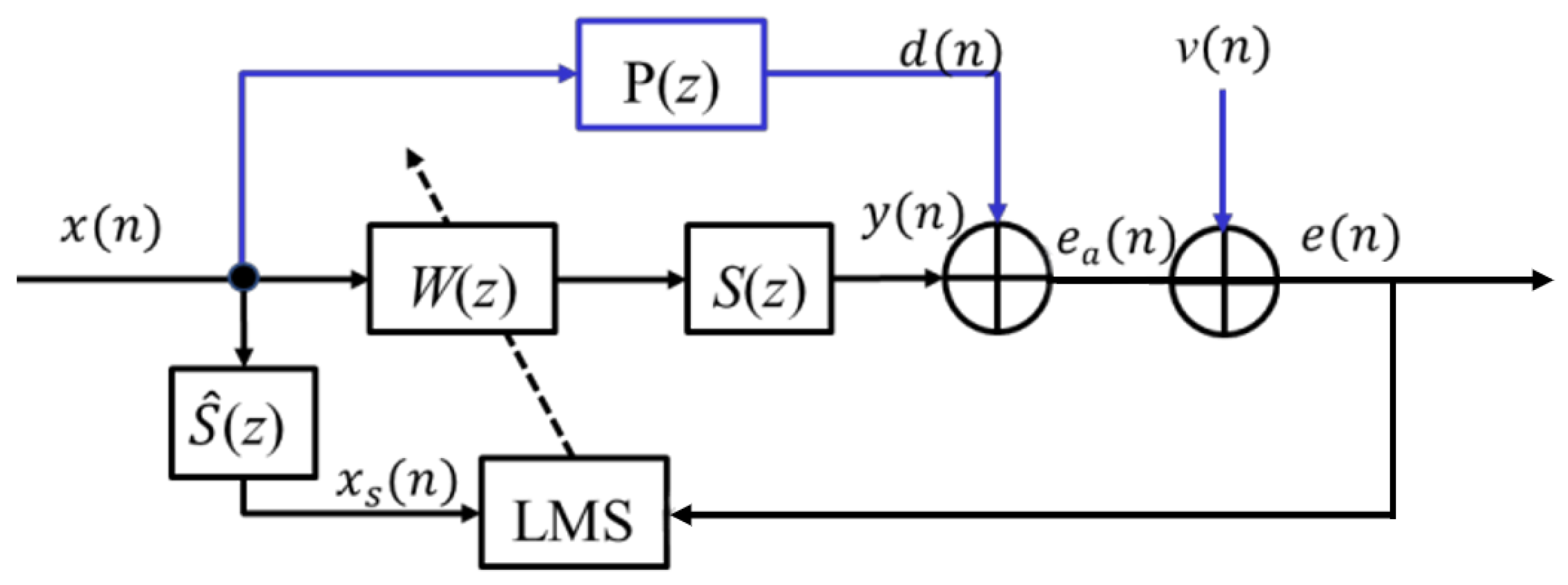
For rigorous analysis of FxLMS under non-coherent interference, two levels of system representation are defined in this study. Figure 1 shows the physical implementation of the ARNC system used in the experiments. The reference signal is denoted by x ( n ) , the primary acoustic path by P ( z ) , the secondary path by S ( z ) , and the adaptive controller by W ( z ) . In this physical-domain representation, the control signal y ( n ) propagates through the acoustic secondary path before interacting with the coherent primary disturbance d ( n ) at the error microphone. The non-coherent interference v ( n ) enters the sensing stage as an additive disturbance, so that the measured error becomes e ( n ) = e a ( n ) + v ( n ) .
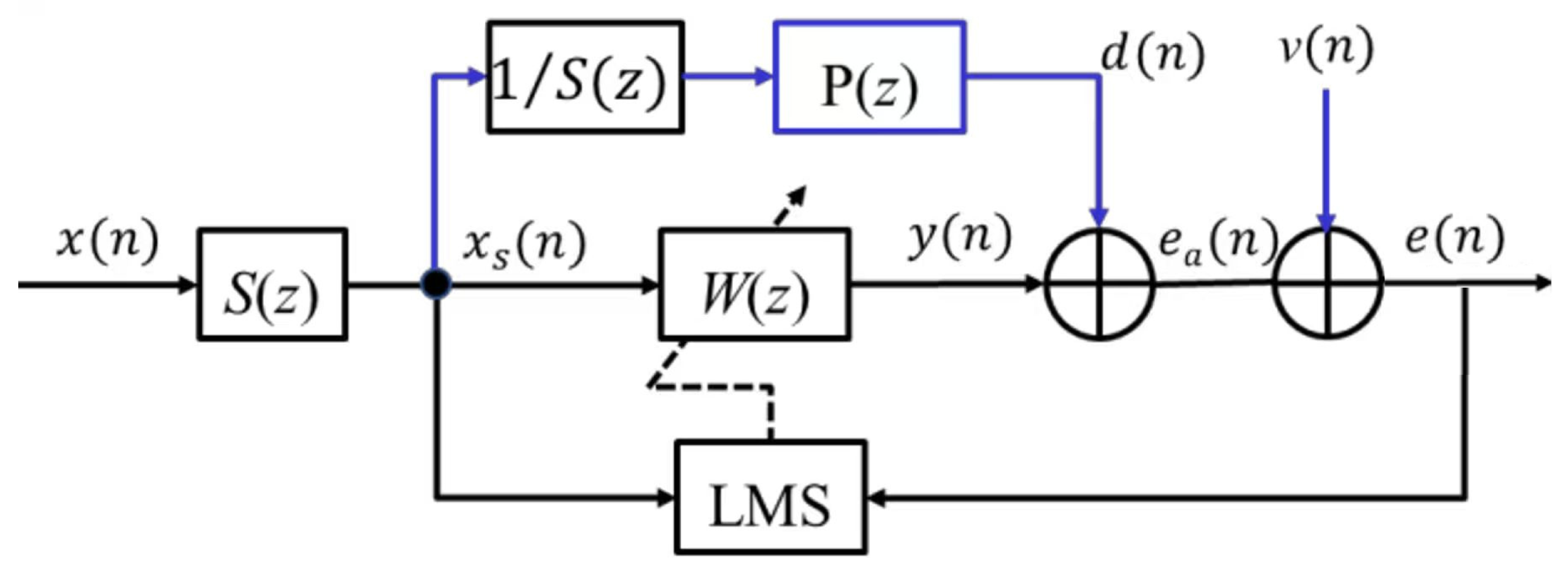
Direct derivation of the mean-square-error behavior from the physical-domain model is cumbersome because the secondary path is intrinsically coupled with both the control-signal propagation and the adaptive weight update. Figure 2 therefore introduces an equivalent mathematical model for statistical analysis. When S ( z ) is assumed to be time invariant or slowly varying over the adaptation interval, the linear operators can be rearranged according to the operator-exchange argument, and the secondary-path effect can be compensated in the analytical domain through a pseudo-inverse transformation 1 / S ( z ) [2]. This analytical transformation does not modify the physical controller. Instead, it maps the physical-domain loop into an equivalent filtered-reference form, separates the propagation delay embedded in S ( z ) from the adaptation dynamics, and allows the weight-error recursion to be written in the standard form used in Section 2.2. The inverse block in Figure 2 is therefore retained as an analytical device for derivation rather than as a physically implemented subsystem.
The filtered-reference vector is defined as
x s ( n ) = x s ( n ) , x s ( n 1 ) , , x s ( n L + 1 ) ,
where x s ( n ) = S ( z ) x ( n ) and L is the adaptive-filter order.

2.2. Statistical Convergence Modeling

To keep the derivation transparent, the analysis is first written for a single error signal. The multichannel extension used later in Section 3 follows by stacking the regressors and replacing scalar quantities with their block-matrix counterparts [22]. The reference vector is
x ( n ) = x ( n ) , x ( n 1 ) , , x ( n L + 1 ) .
In the equivalent model of Figure 2, the error signal is
e ( n ) = d ( n ) w ( n ) x s ( n ) + v ( n ) ,
where w ( n ) R L is the control filter.
The following assumptions are adopted, as is standard in stochastic FxLMS analysis [23,24,25]: (i) x ( n ) , d ( n ) , and v ( n ) are zero-mean quasi-stationary random processes over the time interval of interest; (ii) v ( n ) is statistically independent of x ( n ) ; and (iii) w ( n ) is approximately independent of x s ( n ) for sufficiently small step sizes. These assumptions do not hold exactly in every ARNC scenario, especially under broadband and rapidly time-varying operating conditions, but they provide a tractable first-order model for interpreting the observed trends.
The FxLMS weight update is
w ( n + 1 ) = w ( n ) + μ x s ( n ) e ( n ) ,
where μ > 0 is the step size. Define the filtered-reference correlation matrix and cross-correlation vector as
R s = E x s ( n ) x s ( n ) , p s d = E x s ( n ) d ( n ) .
The Wiener solution for the coherent component is w o = R s 1 p s d , and the corresponding optimal residual is
e opt ( n ) = d ( n ) w o x s ( n ) .
Introducing the weight-error vector c ( n ) = w ( n ) w o and substituting Equation (3) into Equation (4) gives
c ( n + 1 ) = I μ x s ( n ) x s ( n ) c ( n ) + μ x s ( n ) e opt ( n ) + v ( n ) .
Equation (7) makes the role of non-coherent interference explicit: v ( n ) does not change the optimal coherent solution w o , but it perturbs the gradient seen by the adaptive filter.
Taking expectations in Equation (7) yields the mean recursion
E c ( n + 1 ) = I μ R s E c ( n ) .
Thus, under the adopted assumptions, the formal mean-stability condition depends on the filtered-reference statistics rather than directly on the interference variance.

2.3. Convergence Region and Steady-State Error

Let K c ( n ) = E c ( n ) c ( n ) and define J min = E e opt 2 ( n ) . Under the same independence assumptions, the second-order recursion can be approximated as [23,24,25]
K c ( n + 1 ) I μ R s K c ( n ) I μ R s + μ 2 J min + σ v 2 R s ,
where σ v 2 = E [ v 2 ( n ) ] . Diagonalizing R s = Q Λ Q with Λ = diag ( λ 1 , , λ L ) and defining K ˜ c ( n ) = Q K c ( n ) Q gives the scalar recursion
k ˜ i ( n + 1 ) 1 μ λ i 2 k ˜ i ( n ) + μ 2 J min + σ v 2 λ i , i = 1 , , L .
From Equation (10), a sufficient mean-stability condition is
0 < μ < 2 λ max ( R s ) .
Equation (11) depends on the filtered-reference statistics. The interference variance σ v 2 does not alter this formal bound directly; instead, it enlarges the gradient-noise term in Equation (10), which reduces the practical safety margin when μ is tuned close to the limit.
At steady state, solving Equation (10) and retaining the first-order term in μ gives
J s s J min + σ v 2 + μ tr R s 2 J min + σ v 2 ,
where J s s = lim n E [ e 2 ( n ) ] . The first two terms represent the irreducible coherent residual and the direct interference floor. The third term is the excess mean-square error induced by adaptation. Equation (12) therefore clarifies the different roles of the reference statistics and the interference power: R s determines the admissible step-size region, whereas σ v 2 directly elevates the steady-state floor and amplifies the penalty of using a large μ .
Equations (11) and (12) highlight two practical bottlenecks:
  • A larger μ accelerates convergence but also magnifies the excess error term once interference is present.
  • Even after convergence on the coherent component, the achievable microphone mean-square error remains bounded below by the interference floor σ v 2 plus the adaptation-induced excess error.
These observations directly motivate the two strategies studied next. MCC attempts to reduce the effective interference variance seen by the main controller. VSS attempts to keep the late-stage step size small so that the excess mean-square-error term in Equation (12) remains limited. In both cases, the analysis should be interpreted as a quasi-stationary local model rather than as a complete description of broadband, time-varying ARNC operation.

3. Robustness Optimization Methods

Section 2 shows that non-coherent interference degrades FxLMS by contaminating the update signal and narrowing the practical step-size margin. Two complementary solutions are therefore considered. MCC improves the error signal structurally, whereas VSS improves the adaptation law with minimal additional arithmetic cost.

3.1. Multichannel Cascaded Controller

MCC estimates the component of the microphone signal correlated with the reference signals before the main FxLMS update. Because the non-coherent interference is assumed to be uncorrelated with the references, this stage acts as an error-purification process.
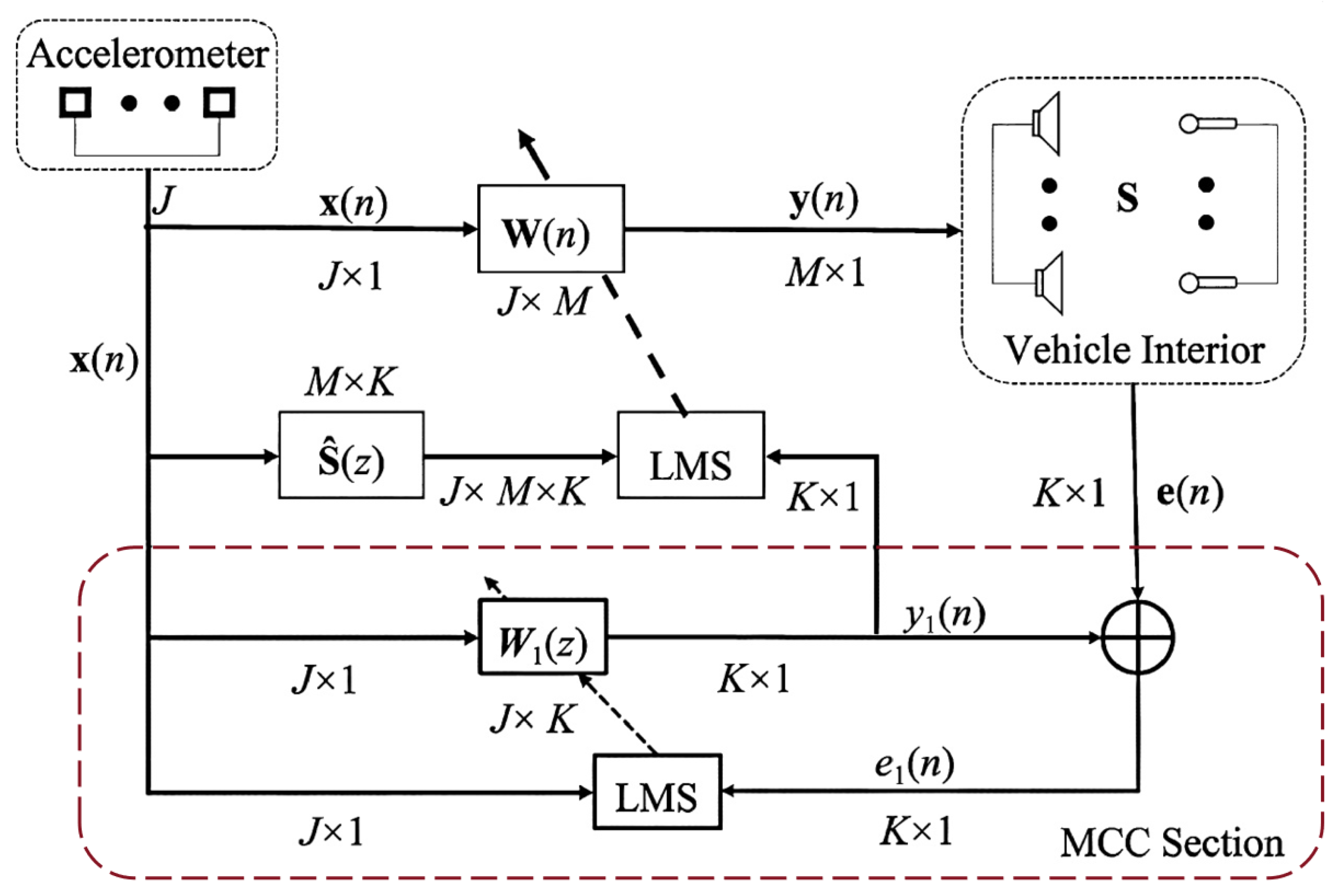
Figure 3 shows the block diagram of MCC. Assume that the system contains J reference sensors, M control loudspeakers, and K error microphones. The j-th reference vector is
x j ( n ) = x j ( n ) , x j ( n 1 ) , , x j ( n L + 1 ) .
The control output of the m-th secondary source is
y m ( n ) = j = 1 J w j m ( n ) x j ( n ) ,
where w j m ( n ) R L is the control filter associated with reference channel j and actuator m.
Let x j m k ( n ) denote the reference vector x j ( n ) filtered by the estimated secondary path from actuator m to microphone k. The main multichannel FxLMS update is then
w j m ( n + 1 ) = w j m ( n ) + μ k = 1 K x j m k ( n ) d ^ k ( n ) ,
where d ^ k ( n ) is the pseudo-error generated by the first stage.
The first stage estimates the reference-correlated part of the microphone signal:
d ^ k ( n ) = j = 1 J g j k ( n ) x j , 1 ( n ) ,
where g j k ( n ) R L 1 is the auxiliary projection filter, x j , 1 ( n ) R L 1 is the truncated reference vector used by the first stage, and L 1 is the auxiliary filter order. The corresponding LMS update is
g j k ( n + 1 ) = g j k ( n ) + μ 1 x j , 1 ( n ) e k ( n ) d ^ k ( n ) .
The key point is that Equation (16) is a reference-space projection. Under the independence assumption,
E x j , 1 ( n ) v k ( n ) = 0 ,
the Wiener solution of the first stage extracts only the component of e k ( n ) correlated with the available references. The second-stage controller therefore operates on d ^ k ( n ) instead of the raw error e k ( n ) , which reduces the effective interference variance seen by the main FxLMS update.
The convergence of Equations (15) and (17) is coupled. In this work, μ and μ 1 are selected according to the same filtered-reference stability logic discussed in Section 2, and the first stage is allowed to adapt at least as fast as the second stage. A full global proof for the coupled multichannel case is beyond the scope of this paper.

3.2. Variable Step-Size Algorithm

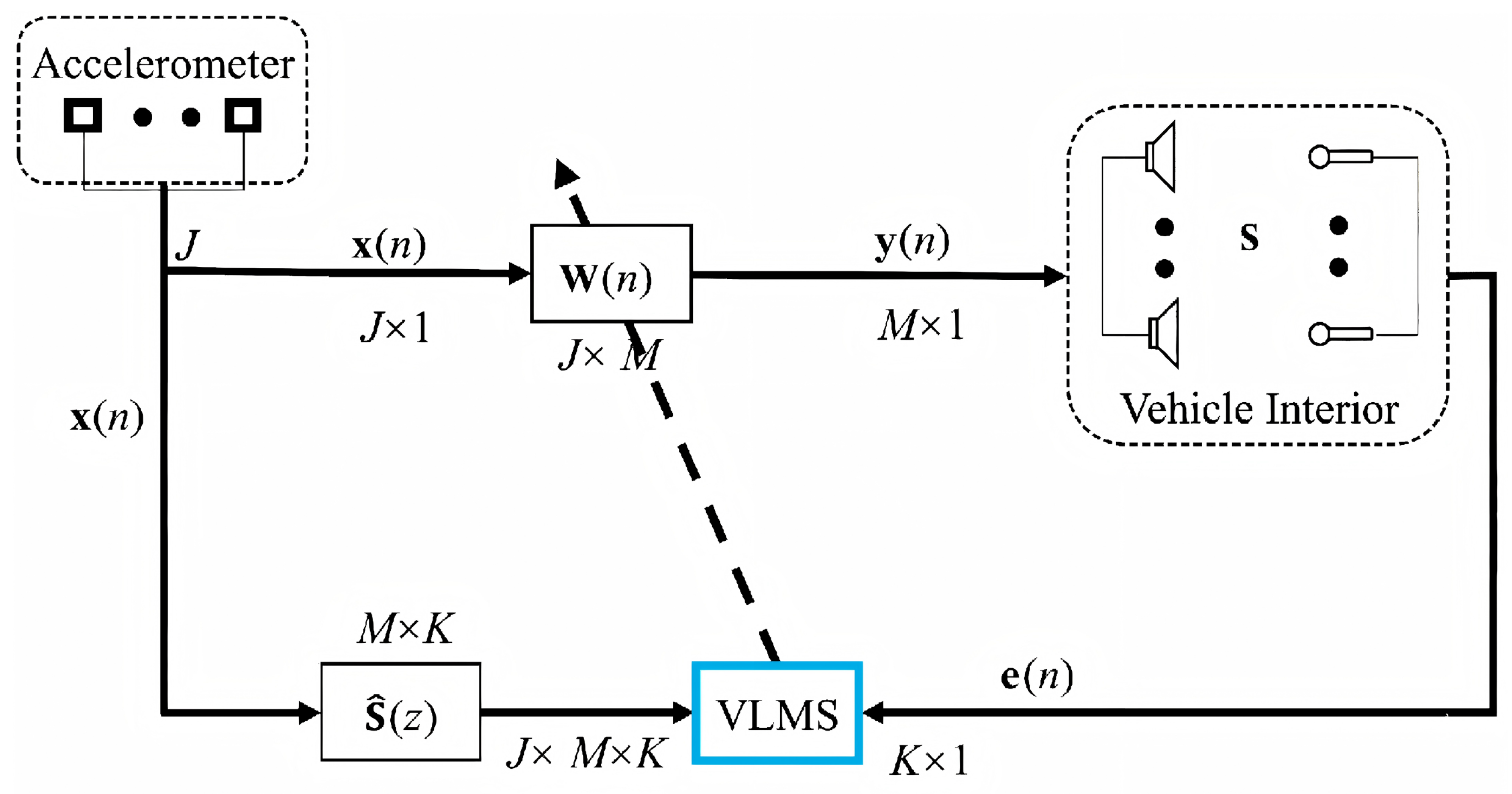
Compared with MCC, the VSS strategy retains the original FxLMS architecture and modifies only the adaptation law. The objective is to use a large step size during early convergence and a small step size in the steady state. The corresponding block diagram is shown in Figure 4.
The step-size law is defined as
μ ( n ) = μ min + ( μ max μ min ) β n 1 exp γ e ¯ 2 ( n ) ,
where 0 < β < 1 controls the time-decaying envelope, γ > 0 scales the sensitivity to the error energy, and
e ¯ 2 ( n ) = 1 K k = 1 K e k 2 ( n )
is the average instantaneous error energy over the K microphones. Equation (19) is always non-negative and satisfies μ ( n ) [ μ min , μ max ] . In the single-channel case, Equation (20) reduces to e ¯ 2 ( n ) = e 2 ( n ) .
The adaptive update becomes
w ( n + 1 ) = w ( n ) + μ ( n ) x ( n ) e ( n ) ,
and its multichannel extension is
w j m ( n + 1 ) = w j m ( n ) + μ ( n ) k = 1 K x j m k ( n ) e k ( n ) .
The distinctive feature of Equation (19) is the explicit time envelope β n . Early in the adaptation, the envelope is close to unity and the controller can approach μ max for rapid convergence. As n increases, the admissible step-size range shrinks automatically, so persistent or intermittent interference cannot keep the controller near the upper bound. The rule therefore reduces the effective steady-state step size and limits the excess mean-square error term in Equation (12) without changing the FxLMS structure. This study does not claim that the proposed schedule is universally superior to other VSS-FxLMS variants; rather, it uses a bounded low-complexity rule to test whether reducing the late-stage step size improves robustness under non-coherent interference.

3.3. Computational Complexity and Validation Platforms

3.3.1. Computational Complexity and Engineering Feasibility

Computational complexity is critical for automotive embedded controllers. The standard multichannel FxLMS algorithm is therefore used as the baseline for comparing the floating-point cost of MCC and VSS. The resulting complexity expressions are summarized in Table 1.
In Table 1, J, M, and K denote the numbers of reference sensors, control loudspeakers, and error microphones, respectively; L is the control-filter order; L s is the secondary-path model order; and L 1 is the order of the auxiliary projection filter in MCC. The nonlinear scalar operations in Equation (19) are evaluated once per iteration and are therefore treated as low-order overhead relative to the multichannel finite-impulse-response updates.
Table 1 shows a clear engineering difference. MCC improves robustness by adding an auxiliary adaptive-filter bank, and its arithmetic cost grows with the number of channels and the auxiliary filter order. VSS retains the FxLMS structure and adds only a low-order scalar step-size update. For a representative ARNC parameter set with 12 references, 4 loudspeakers, 4 microphones, a 256-tap control filter, a 128-tap auxiliary filter, and a 512-tap secondary-path model, the overall floating-point increase is about 36.5% for MCC and about 2% for VSS. VSS therefore provides a better robustness–complexity trade-off for embedded ARNC platforms.

3.3.2. Validation Platforms and Operating Conditions

The proposed algorithms are validated through offline simulations and real-time experiments on two platforms: a single-channel duct ANC system and a vehicle ARNC bench. The control band considered in this work is limited to low-frequency ARNC content between 50 and 500 Hz; hence, a sampling frequency of 2048 Hz provides a 1024 Hz Nyquist frequency and sufficient margin for the 55–120 Hz controlled excitations and secondary-path identification. A host computer transmits the controller and path-modeling programs to the dSPACE unit, which provides the required ADC and DAC interfaces. All loudspeakers are Hivi C3000 units with a nominal operating range of 50 Hz to 20 kHz.
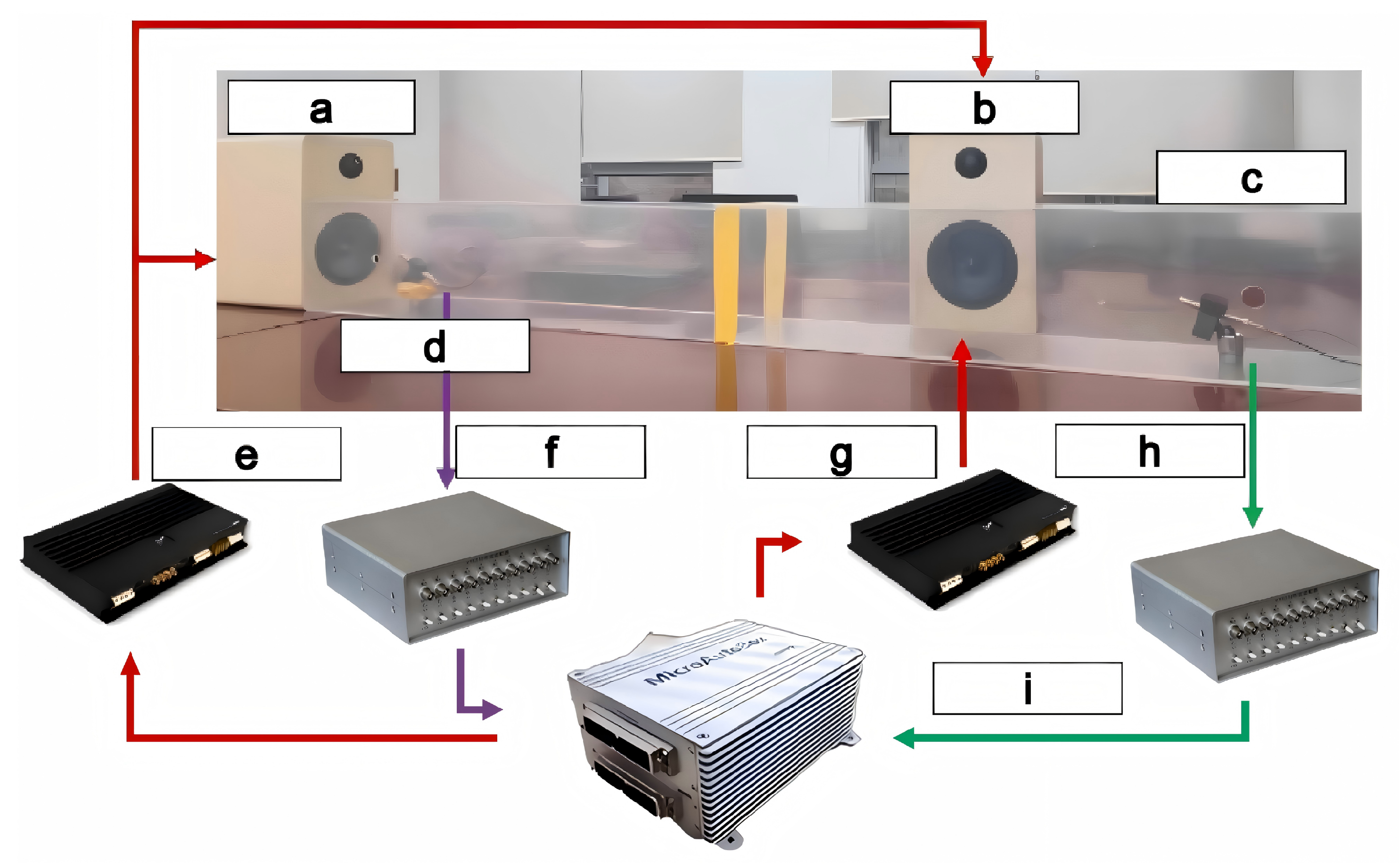
First, a single-channel duct ANC platform with non-coherent interference was built, as shown in Figure 5. The left loudspeaker emits the primary noise signal, and the right loudspeaker generates the secondary control sound and the injected interference. The objective is to reduce the sound pressure at the right microphone. The experiments were conducted in a quiet laboratory. Two cases, consistent with the simulations, are summarized in Table 2.
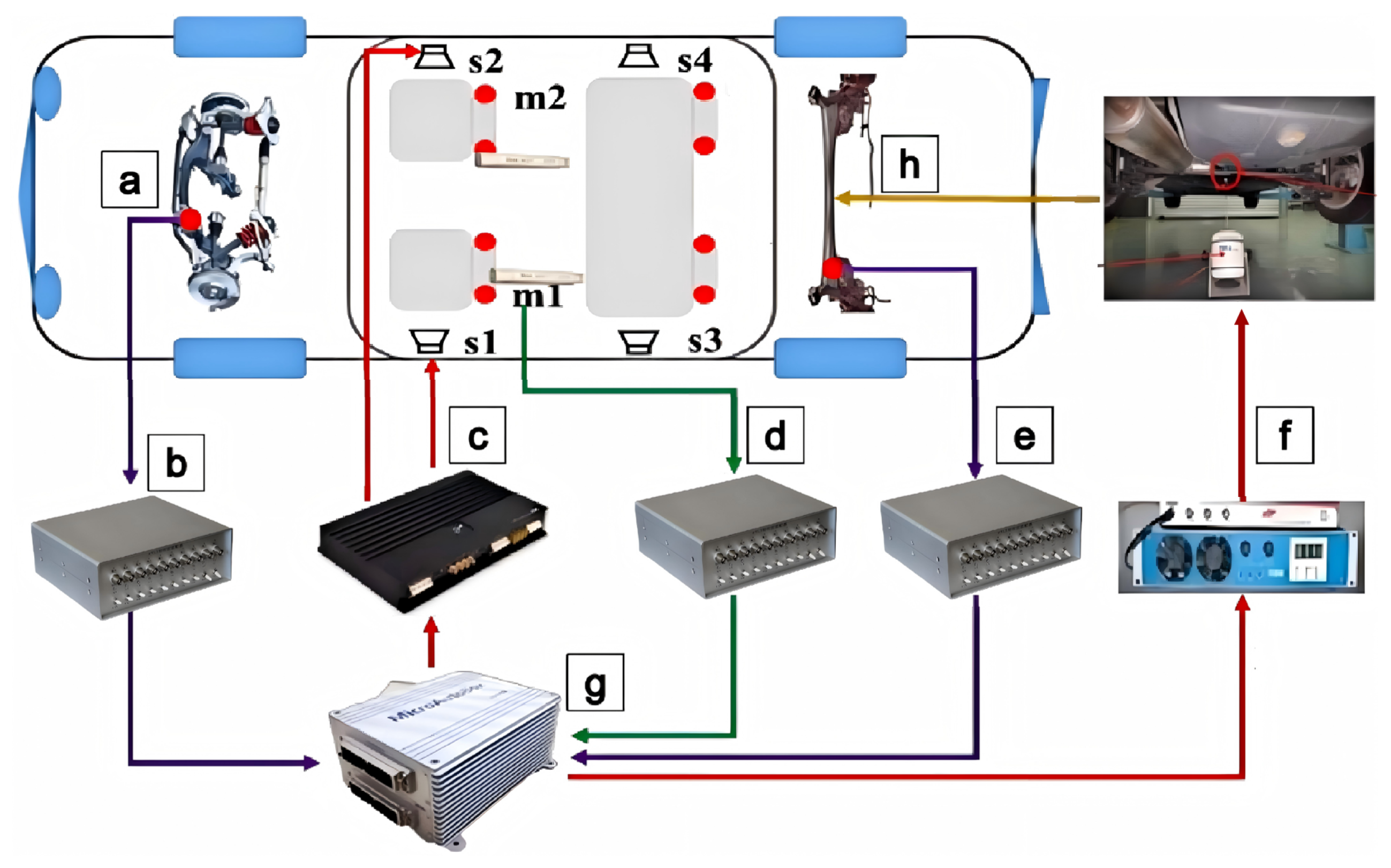
Subsequently, a vehicle ARNC bench with injected non-coherent interference was established, as shown in Figure 6. The dSPACE system controls a shaker mounted at the center of the torsion beam to emulate road-induced excitation. The secondary-path transfer functions used by FxLMS, MCC, and VSS were identified offline from the actuator-to-microphone responses. The sampling frequency is 2048 Hz.
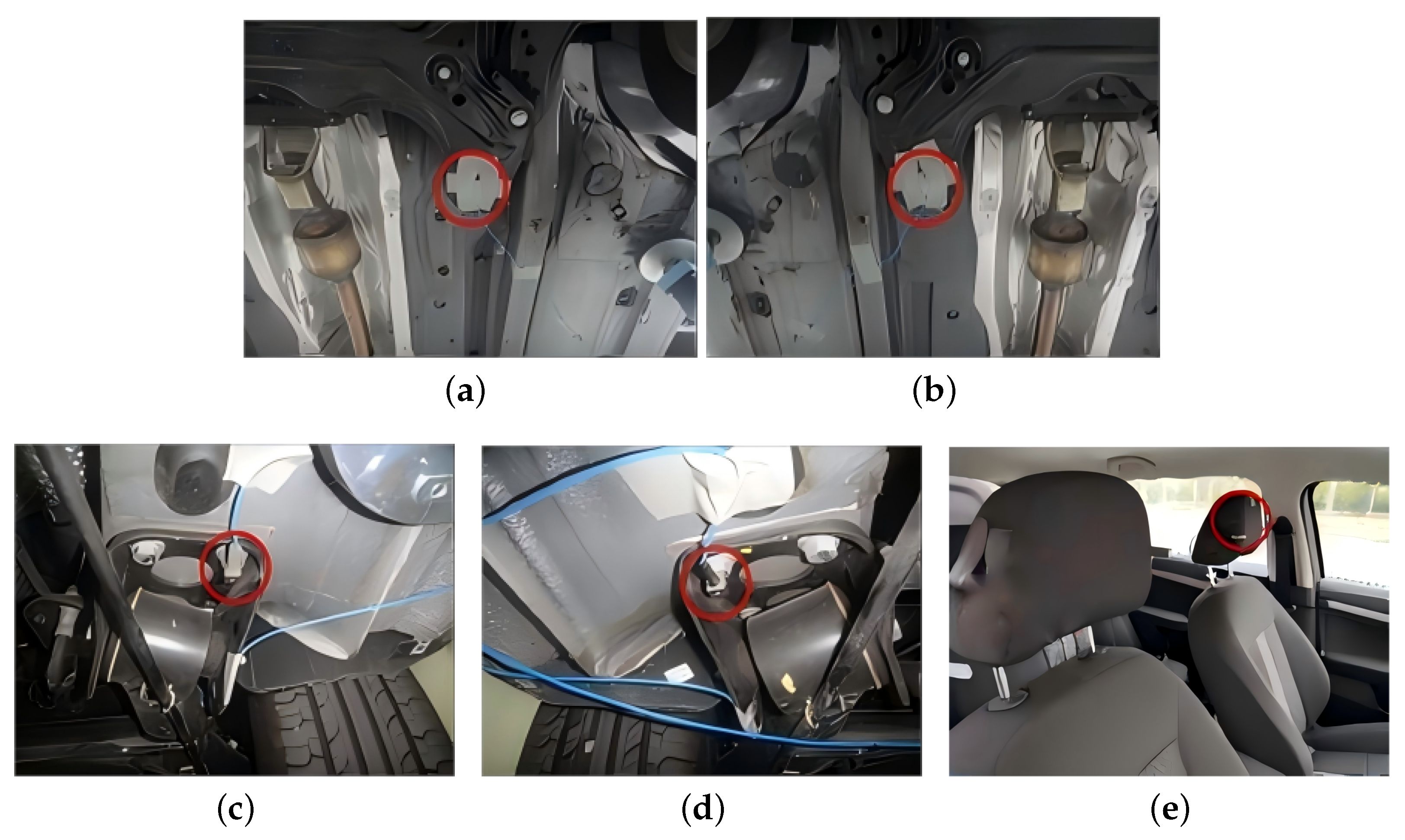
The placement of the accelerometers is illustrated in Figure 7. Two accelerometers are mounted at the connection points between the left and right subframes and the vehicle body to acquire two vertical acceleration signals. Two additional accelerometers are positioned at the attachment points of the left and right torsion beams to the vehicle body to collect four acceleration signals in both the longitudinal and vertical directions.
During the vehicle-bench tests, two occupants were present in the cabin, including the driver. The windows, air conditioning, and infotainment system were turned off to maintain a relatively quiet background. The shaker excitation was a 90 Hz tonal input and the injected interference was a 120 Hz tone radiated by the right-front loudspeaker. These tonal conditions were chosen as controlled proxy excitations near prominent low-frequency cabin modes in order to isolate the interference mechanism. They are not claimed to represent the full broadband and non-stationary spectrum of real road noise.

4. Results and Discussion

This section evaluates the proposed MCC and VSS algorithms under non-coherent interference, with offline simulations on both platforms and dSPACE-based real-time experiments for the duct platform and the VSS vehicle-bench implementation. Average noise reduction and the norm of the adaptive-filter coefficients are used to assess attenuation performance and robustness.

4.1. Simulation Verification

A Simulink model of a multichannel feedforward ARNC system is established for the offline study. Simulations use data from the HVAC setup and the vehicle ARNC bench. The measured actuator-to-microphone transfer functions are used as the secondary-path estimates. The simulations are intended to isolate the interference mechanism under quasi-stationary conditions.
The common controller settings are summarized in Table 3. The VSS-specific coefficients are reported as bounds and tuning criteria because the raw error-energy scale differs between the duct and vehicle platforms.
For both simulation and experiment, the signed residual-to-uncontrolled ratio plotted in the figures is defined as
η ( n ) = 10 log 10 k = 1 K e k 2 ( n ) k = 1 K e 0 , k 2 ( n ) ,
where e 0 , k ( n ) denotes the uncontrolled microphone signal and e k ( n ) denotes the residual signal after control. More negative values of η ( n ) indicate better attenuation. The average noise reduction (ANR) reported in the text and tables is the absolute mean attenuation,
ANR = 1 N n = 1 N η ( n ) ,
which reduces to the usual single-channel definition when K = 1 .
The convergence metric is the aggregate Euclidean norm of the control filters,
w ( n ) 2 = j = 1 J m = 1 M w j m ( n ) 2 2 1 / 2 .
Smaller fluctuations of w ( n ) 2 after convergence indicate better robustness.

4.1.1. Simulation Verification on the HVAC ANC System

The offline duct simulation aims to reduce the noise signal at the error microphone. The primary noise is generated by the left loudspeaker, and the non-coherent interference is generated by the right loudspeaker. Both signals are measured at a sampling frequency of 2048 Hz. Two operating conditions are listed in Table 2.
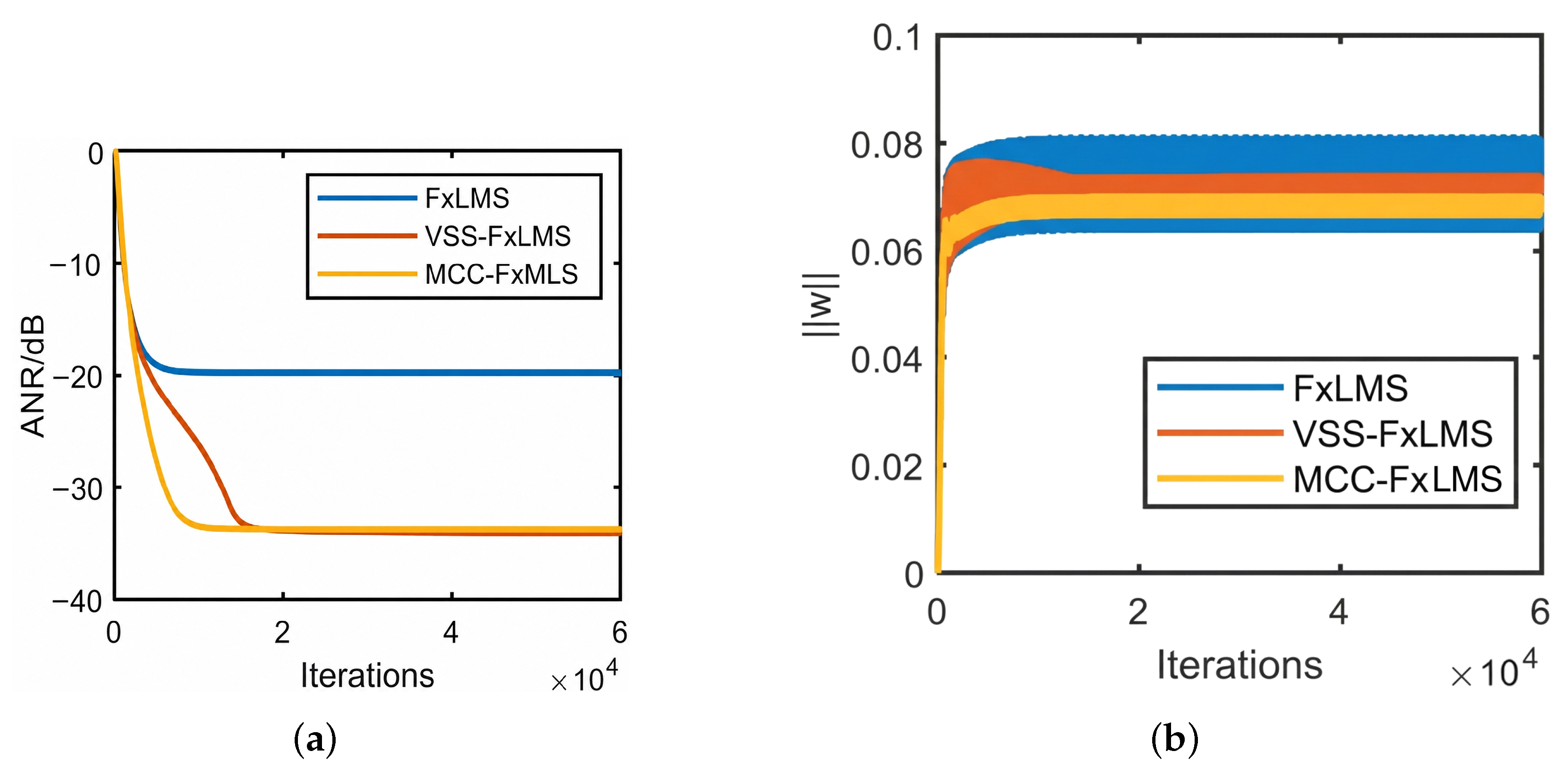
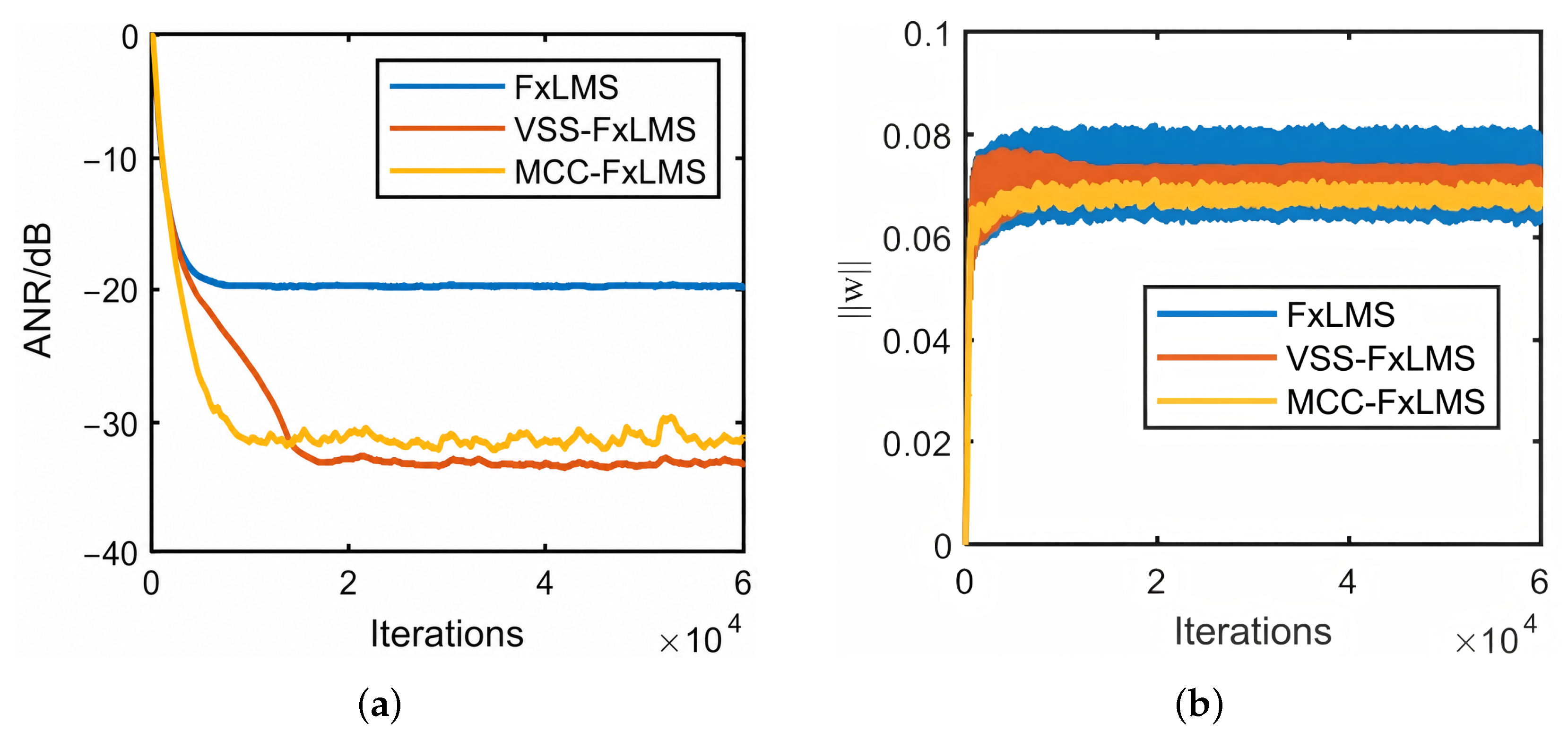
For Case 1, Figure 8a shows that MCC and fixed-step FxLMS converge rapidly, whereas VSS reaches the same attenuation level after a slightly longer transient. The ANR values are 35.4 dB for MCC, 35.5 dB for VSS, and 19.7 dB for FxLMS. Thus, both proposed methods improve ANR by about 15.8 dB relative to FxLMS in this tonal case.
Figure 8b shows that fixed-step FxLMS produces the largest steady-state weight fluctuations, whereas MCC and VSS remain noticeably smoother. This agrees with the analysis in Section 2.
For Case 2, where white noise is added to the tonal interference, both MCC and VSS show lower attenuation than in Case 1, but they still outperform FxLMS. The ANR values are 28.5 dB for MCC, 28.6 dB for VSS, and 16.7 dB for FxLMS, corresponding to an improvement of about 11.9 dB over the baseline. Figure 9b shows larger weight fluctuations for all algorithms than in Case 1. Even so, MCC and VSS remain more stable than FxLMS.

4.1.2. Simulation Verification on the Vehicle ARNC Bench

To further verify the algorithms, a simplified vehicle-bench scenario based on Figure 6 is used. The shaker excitation is a 90 Hz tone, and the injected non-coherent interference is a 120 Hz tone. MATLAB/Simulink software (The MathWorks, Inc., Natick, MA, USA; website: https://www.mathworks.com/products/simulink.html; accessed on 2 May 2026) models are constructed for FxLMS, MCC, and VSS using six acceleration references, one secondary acoustic output, and one error microphone.
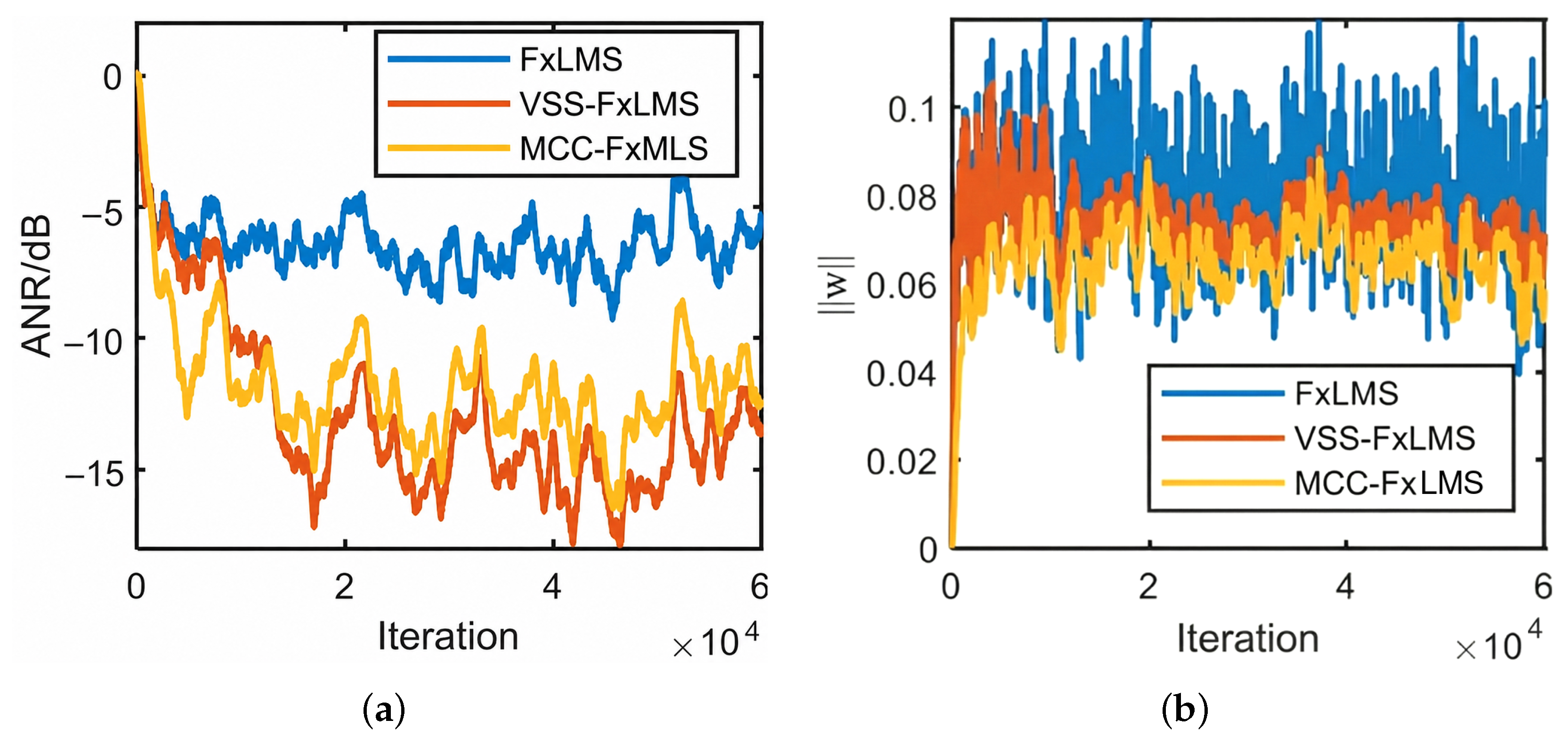
Figure 10a shows ANRs of 7.2 dB for MCC, 7.1 dB for VSS, and 4.6 dB for FxLMS. The gain over the baseline is therefore about 2.5 dB.
Figure 10b again shows the largest steady-state fluctuations for FxLMS, while MCC and VSS remain more stable. The same trend observed in the duct simulations is preserved.
Table 4 shows two consistent trends. First, both MCC and VSS outperform fixed-step FxLMS in attenuation and steady-state robustness. Second, VSS remains close to MCC while requiring much less additional structure. The real-time vehicle-bench experiment in Section 4.2 therefore focuses on VSS as the lower-complexity implementation candidate, while the MCC–VSS comparison on the vehicle platform remains simulation based.

4.2. Experimental Verification

The simulations in Section 4.1 establish the main trends under controlled conditions. This section verifies whether the same robustness advantages remain visible in real-time implementation.

4.2.1. Experimental Verification on the HVAC ANC System

A single-channel HVAC ANC platform with non-coherent interference is implemented on the dSPACE controller. The instrumentation is shown in Figure 5. The experimental cases are kept consistent with the offline study.
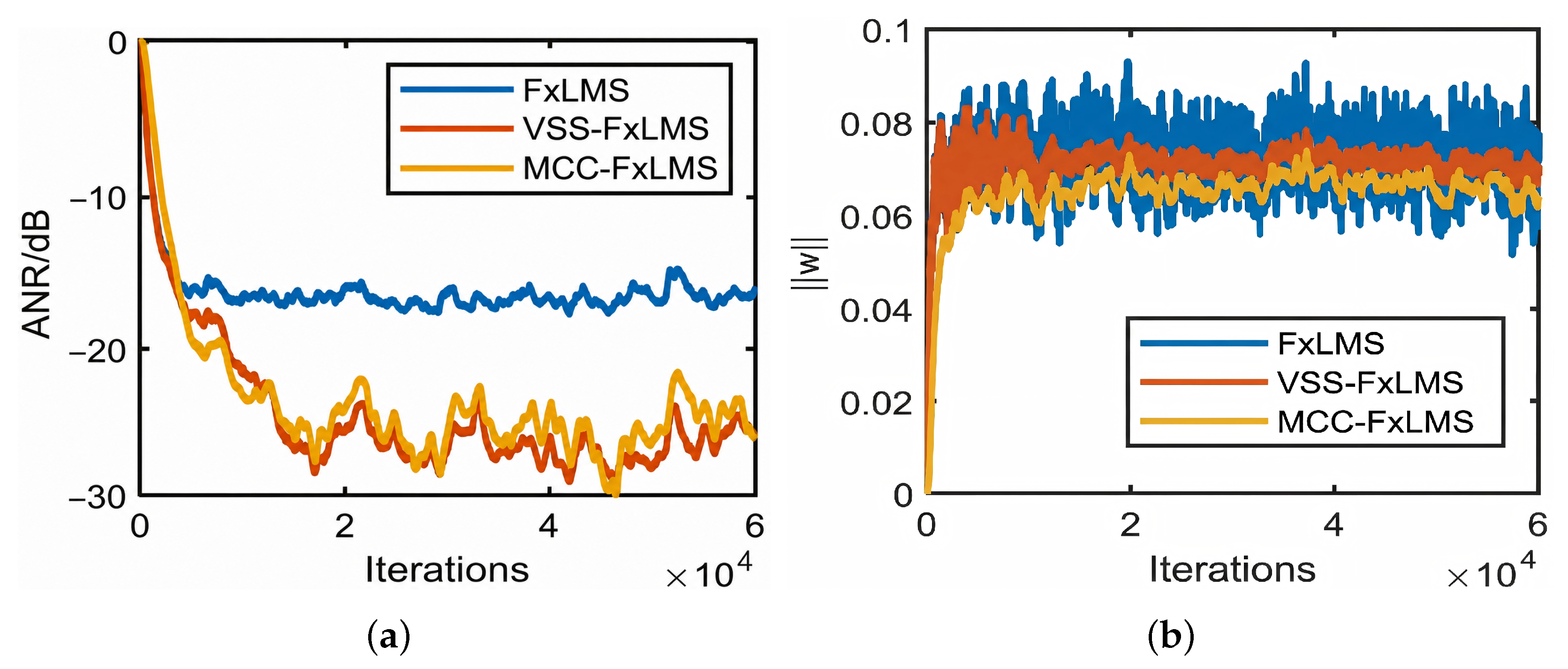
For Case 1, Figure 11a shows ANRs of 32.2 dB for MCC, 33.5 dB for VSS, and 19.3 dB for FxLMS. The HVAC duct experiment reproduces the main simulation trend. Both proposed methods outperform FxLMS, and the ANR improvement reaches 14.2 dB. VSS remains very close to MCC despite its lower implementation overhead.
Figure 11b shows the strongest steady-state weight fluctuations for FxLMS, while MCC and VSS remain markedly smoother.
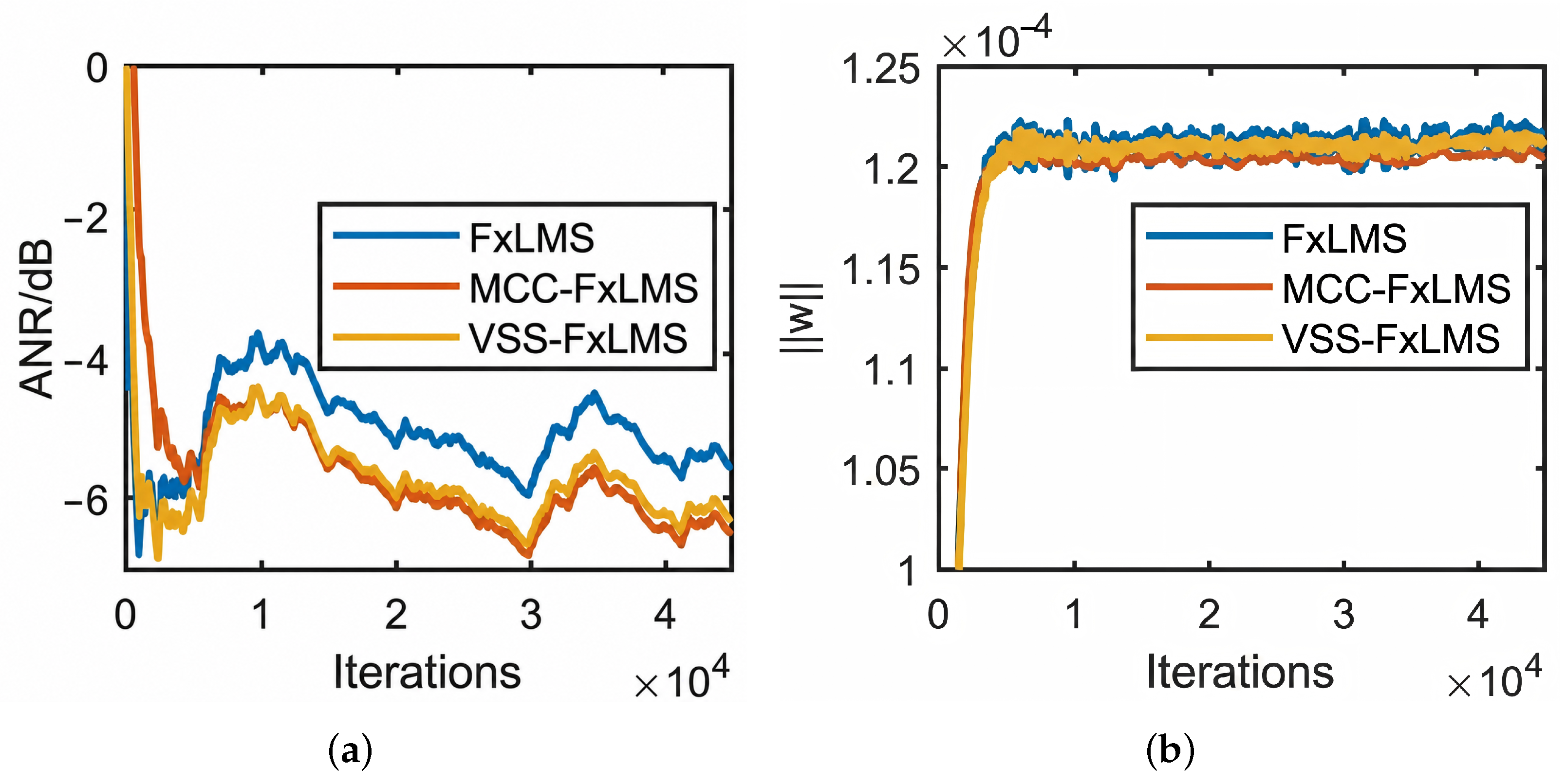
For Case 2, where white noise is added to the interference, all three algorithms show lower attenuation than in Case 1, but the relative ordering remains unchanged. The measured ANRs are 14.5 dB for MCC, 16.2 dB for VSS, and 8.1 dB for FxLMS. Figure 12b again shows larger weight fluctuations for all controllers, but MCC and VSS remain more stable than FxLMS. This is consistent with the simulation results.
Under the present duct conditions, VSS is slightly better than MCC while remaining structurally simpler. This result indicates a better performance–complexity trade-off for the current implementation.

4.2.2. Experimental Verification on the Vehicle ARNC Bench

A vehicle-bench experiment with injected non-coherent interference was then performed using the setup in Figure 6. The sensor and actuator locations matched the simulation setup, and the sampling frequency was 2048 Hz.
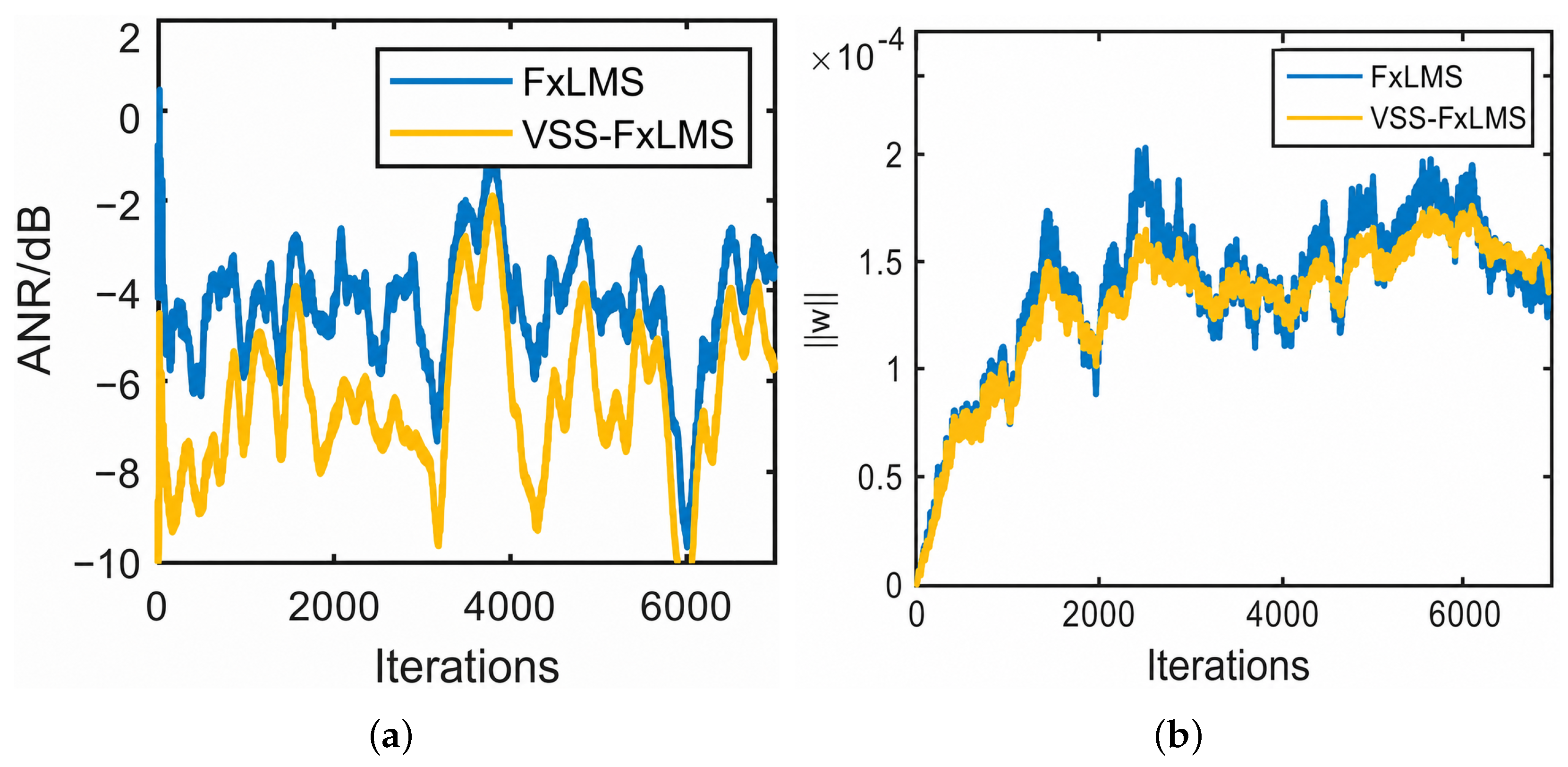
As shown in Figure 13a, VSS achieves an ANR of 7.1 dB, compared with 4.8 dB for FxLMS. The net gain is therefore 2.3 dB on the current vehicle ARNC bench.
Figure 13b shows that VSS also reduces steady-state weight fluctuations relative to FxLMS. MCC is not included in Figure 13 because the real-time vehicle-bench experiments were completed only for the lower-complexity VSS implementation after the simulation study showed similar trends for MCC and VSS. Therefore, the vehicle-bench result should be read as real-time validation of VSS only; the comparability of MCC and VSS on the vehicle platform is supported by simulation rather than by a matched vehicle real-time experiment.
Table 5 shows that the same qualitative pattern observed in simulation is preserved in real time. Under the current duct and vehicle-bench conditions, VSS consistently outperforms fixed-step FxLMS and remains close to MCC in the HVAC duct experiments while using a simpler implementation.
In summary, the experimental results align with the theoretical analysis presented in Section 2. When the interference complexity increases—as seen in the mixed tonal-plus-white-noise case—the attenuation performance decreases while steady-state weight fluctuations rise. Both proposed methods effectively mitigate these effects: MCC enhances robustness by purifying the error signal through reference-space projection, while VSS achieves comparable stability by adaptively constraining the steady-state step size. The present results should be interpreted within the controlled validation scope: the duct and vehicle-bench tests use tonal or tonal-plus-white-noise inputs, whereas real electric-vehicle road noise is broadband, speed dependent, and affected by road surface, tire, suspension, cabin loading, secondary-path variation, actuator limits, and reference-sensor coherence. Accordingly, the results demonstrate robustness against injected non-coherent interference under controlled conditions and support further onboard evaluation, but they do not by themselves constitute full real-driving validation.

5. Conclusions

This paper investigates the degradation of FxLMS-based ARNC systems under non-coherent interference and develops corresponding robustness optimization methods. The main conclusions are as follows:
  • Under the small-step-size assumption, an equivalent analytical framework is established for FxLMS with non-coherent interference. The derived convergence region and steady-state error expressions show that filtered-reference statistics mainly determine the formal stability bound, whereas interference power mainly raises the steady-state error floor.
  • Two robustness optimization methods are developed. MCC improves robustness by extracting the reference-correlated component of the microphone signal before the main update. VSS improves robustness by reducing the late-stage step size while preserving rapid initial convergence.
  • The computational analysis shows a clear engineering difference between the two methods. For representative ARNC parameters, the additional floating-point cost is much higher for MCC, whereas the added cost of VSS is only about 2% relative to the baseline FxLMS controller.
  • Offline simulations and duct-platform real-time experiments confirm that both MCC and VSS reduce coefficient fluctuations and improve ANR under controlled non-coherent interference. The vehicle-bench real-time experiment further verifies the lower-complexity VSS implementation, with a 2.3 dB gain over fixed-step FxLMS under controlled tonal excitation. Considering the simulation-level comparability of MCC and VSS, the duct experimental results, and the much lower computational cost of VSS, VSS is the more practical candidate for subsequent onboard ARNC evaluation.
Despite these improvements, this study is primarily validated under quasi-stationary tonal and white-noise conditions using a simplified vehicle bench, so real-driving tests remain a necessary next step. Future research will focus on evaluating these algorithms against broadband road noise and non-stationary speed-varying conditions, alongside broader benchmarking against representative VSS-FxLMS variants.

Author Contributions

Conceptualization, S.L. and L.Z.; Methodology, S.L., L.Z. and D.M.; Software, S.L. and Z.Z.; Validation, S.L., D.M., Z.Z. and X.P.; Formal analysis, S.L. and Z.Z.; Investigation, S.L., D.M. and X.P.; Resources, L.Z. and X.P.; Data curation, S.L. and D.M.; Writing—original draft, S.L.; Writing—review & editing, S.L., Z.Z. and X.P.; Visualization, Z.Z.; Supervision, L.Z.; Project administration, L.Z.; Funding acquisition, L.Z. All authors have read and agreed to the published version of the manuscript.

Funding

This work was supported by the National Natural Science Foundation of China (Grant No. 52472415).

Institutional Review Board Statement

Not applicable.

Informed Consent Statement

Not applicable.

Data Availability Statement

The raw data supporting the conclusions of this article will be made available by the authors on request.

Conflicts of Interest

The authors declare no conflicts of interest.

Abbreviations

ADCAnalog-to-Digital Converter
DACDigital-to-Analog Converter
ANCactive noise control
ANRaverage noise reduction
ARNCactive road noise control
FxLMSfiltered-x least mean square
HVACheating, ventilation and air conditioning
LMSLeast Mean Square
MCCmultichannel cascaded controller
VSSvariable step size

References

  1. Tan, W.; Zhang, C.; Cao, W.; Cui, X. Tire/road noise mechanism and noise reduction pavement. Highw. Automot. Appl. 2008, 4, 85–87. [Google Scholar]
  2. Kuo, S.M.; Morgan, D.R. Active Noise Control Systems: Algorithms and DSP Implementations; John Wiley & Sons: Hoboken, NJ, USA, 1996. [Google Scholar]
  3. Elliott, S.J. A Review of Active Noise and Vibration Control in Road Vehicles; ISVR Technical Memorandum 981; University of Southampton, Institute of Sound and Vibration Research: Southampton, UK, 2008. [Google Scholar]
  4. Editorial Department of China Journal of Highway and Transport. Review on China’s Automotive Engineering Research Progress: 2017. China J. Highw. Transp. 2017, 30, 1–197. [Google Scholar]
  5. George, N.V.; Panda, G. Advances in active noise control: A survey, with emphasis on recent nonlinear techniques. Signal Process. 2013, 93, 363–377. [Google Scholar] [CrossRef]
  6. Sun, X.; Kuo, S. Active narrowband noise control systems using cascading adaptive filters. IEEE Trans. Audio Speech Lang. Process. 2007, 15, 586–592. [Google Scholar] [CrossRef]
  7. Akhtar, M.T.; Mitsuhashi, W. Improving performance of hybrid active noise control systems for uncorrelated narrowband disturbances. IEEE Trans. Audio Speech Lang. Process. 2011, 19, 2058–2066. [Google Scholar] [CrossRef]
  8. Padhi, T.; Chandra, M. Cascading time-frequency domain filtered-x LMS algorithm for active control of uncorrelated disturbances. Appl. Acoust. 2019, 149, 192–197. [Google Scholar] [CrossRef]
  9. Jia, Z.; Zheng, X.; Zhou, Q.; Hao, Z.; Qiu, Y. A hybrid active noise control system for the attenuation of road noise inside a vehicle cabin. Sensors 2020, 20, 7190. [Google Scholar] [CrossRef]
  10. Zhang, Z.; Wu, M.; Yin, L.; Gong, C.; Wang, J.; Zhou, S.; Yang, J. Robust feedback controller combined with the remote microphone method for broadband active noise control in headrest. Appl. Acoust. 2022, 195, 108815. [Google Scholar] [CrossRef]
  11. Shen, X.; Gan, W.S.; Shi, D. Alternative switching hybrid ANC. Appl. Acoust. 2021, 173, 107712. [Google Scholar] [CrossRef]
  12. Xu, Z.; Wan, B.; Jia, Z.; Li, R.; Liu, X.; Qiu, Y. A study on active road noise control based on operational transfer path analysis and selective subband adaptive filtering. Appl. Acoust. 2024, 222, 110041. [Google Scholar]
  13. Kwong, R.H.; Johnston, E.W. A variable step size LMS algorithm. IEEE Trans. Signal Process. 1992, 40, 1633–1642. [Google Scholar] [CrossRef]
  14. Mathews, V.J.; Xie, Z. A stochastic gradient adaptive filter with gradient adaptive step size. IEEE Trans. Signal Process. 2002, 41, 2075–2087. [Google Scholar] [CrossRef]
  15. Aboulnasr, T.; Mayyas, K. A Robust Variable Step-Size LMS-Type Algorithm: Analysis and Simulations. IEEE Trans. Signal Process. 1997, 45, 631–639. [Google Scholar] [CrossRef]
  16. Qin, J.; Ouyang, J. A Variable Step-Size LMS Adaptive Filtering Algorithm Based on Sigmoid Function. J. Data Acquis. Process. 1997, 12, 171–174. [Google Scholar]
  17. Zhao, S.; Man, Z.; Khoo, S.; Wu, H.R. Variable Step-Size LMS Algorithm with a Quotient Form. Signal Process. 2009, 89, 67–76. [Google Scholar] [CrossRef]
  18. Bin Saeed, M.O.; Zerguine, A. A Variable Step-Size Diffusion LMS Algorithm with a Quotient Form. EURASIP J. Adv. Signal Process. 2020, 2020, 12. [Google Scholar] [CrossRef]
  19. Akhtar, M.T.; Abe, M.; Kawamata, M. A new variable step size LMS algorithm-based method for improved online secondary path modeling in active noise control systems. IEEE Trans. Audio Speech Lang. Process. 2006, 14, 720–726. [Google Scholar] [CrossRef]
  20. Chang, D.C.; Chu, F.T. Feedforward active noise control with a new variable tap-length and step-size filtered-X LMS algorithm. IEEE/ACM Trans. Audio Speech Lang. Process. 2014, 22, 542–555. [Google Scholar] [CrossRef]
  21. Lian, S.; Li, T.; Zhao, S.; Shi, W.; Burnett, I.S.; Qiu, X. A coherence-based robust frequency-dependent variable step size method for active road noise control. J. Acoust. Soc. Am. 2025, 157, 11–23. [Google Scholar] [CrossRef]
  22. Gong, C.; Wu, M.; Guo, J.; Chen, J.; Zhang, Z.; Cao, Y.; Yang, J. Statistical analysis of multichannel FxLMS algorithm for narrowband active noise control. Signal Process. 2022, 200, 108646. [Google Scholar] [CrossRef]
  23. Bjarnason, E. Analysis of the filtered-x LMS algorithm. IEEE Trans. Speech Audio Process. 1995, 3, 504–514. [Google Scholar] [CrossRef]
  24. Yang, F.; Wu, M.; Yang, J. Stochastic analysis of the filtered-x LMS algorithm for active noise control. IEEE/ACM Trans. Audio Speech Lang. Process. 2020, 28, 2252–2262. [Google Scholar] [CrossRef]
  25. Ma, Y.; Xiao, Y.; Ma, L.; Khorasani, K. Statistical analysis of narrowband active noise control using a simplified variable step-size FxLMS algorithm. Signal Process. 2021, 183, 108012. [Google Scholar] [CrossRef]
Figure 1. Physical FxLMS implementation under non-coherent interference.
Applsci 16 04638 g001
Figure 2. Equivalent analytical model for convergence analysis with pseudo-inverse compensation of the secondary path; the blue branch represents the analytical pseudo-inverse/primary-path transformation used only for the convergence derivation.
Applsci 16 04638 g002
Figure 3. Block diagram of the MCC algorithm. The dashed rounded rectangle marks the auxiliary MCC projection stage.
Applsci 16 04638 g003
Figure 4. Block diagram of the variable step-size algorithm.
Applsci 16 04638 g004
Figure 5. HVAC ANC setup: (a) primary loudspeaker; (b) secondary loudspeaker; (c) error microphone; (d) reference microphone; (e) power amplifier; (f) signal conditioner; (g) power amplifier; (h) signal conditioner; and (i) dSPACE controller.
Applsci 16 04638 g005
Figure 6. Vehicle ARNC bench setup: (a) accelerometer; (b) signal conditioner; (c) power amplifier; (d) signal conditioner; (e) signal conditioner; (f) power amplifier; (g) dSPACE controller; (h) accelerometer; (s1) secondary loudspeaker; (s2) interference loudspeaker; and (m1) error microphone. The labels (s3) and (s4) denote additional loudspeaker locations, (m2) denotes an additional microphone location, and the colored arrows indicate signal-flow connections among the sensors, conditioners, dSPACE controller, amplifiers, shaker, and loudspeakers.
Applsci 16 04638 g006
Figure 7. Sensor locations: (a) left subframe-to-body attachment point; (b) right subframe-to-body attachment point; (c) left torsion beam-to-body attachment point; (d) right torsion beam-to-body attachment point; and (e) microphone location.
Applsci 16 04638 g007
Figure 8. Simulation results for the duct ANC system under Case 1: (a) ANR; (b) control-filter norm, w 2 .
Applsci 16 04638 g008
Figure 9. Simulation results for the duct ANC system under Case 2: (a) ANR; (b) control-filter norm, w 2 .
Applsci 16 04638 g009
Figure 10. Simulation results for the vehicle ARNC bench: (a) ANR; (b) control-filter norm, w 2 .
Applsci 16 04638 g010
Figure 11. Experimental results for the HVAC ANC system under Case 1: (a) ANR; (b) control-filter norm, w 2 .
Applsci 16 04638 g011
Figure 12. Experimental results for the duct ANC system under Case 2: (a) ANR; (b) control-filter norm, w 2 .
Applsci 16 04638 g012
Figure 13. Experimental results for the vehicle ARNC bench: (a) ANR; (b) control-filter norm, w 2 .
Applsci 16 04638 g013
Table 1. Computational complexity of the three algorithms.
AlgorithmFloating-Point MultiplicationsFloating-Point Additions
FxLMS J M ( K L + K L s + 2 L ) J M [ K ( L + L s 1 ) + 2 L 1 ]
MCC J M ( K L + K L s + 2 L ) + J M ( K L 1 + 2 L 1 ) J M [ K ( L + L s 1 ) + 2 L 1 ] + ( J M K + J M + 1 ) L 1
VSS J M ( K L + K L s + 2 L ) + J ( L + 1 ) J M [ K ( L + L s 1 ) + 2 L 1 ] + J ( L 1 )
Table 2. Duct operating conditions.
CasePrimary NoiseNon-Coherent Interference
1Sinusoidal signals (55 Hz, 75 Hz, and 95 Hz)Sinusoidal signals (65 Hz, 85 Hz, and 105 Hz)
2Sinusoidal signals (55 Hz, 75 Hz, and 95 Hz)Sinusoidal signals (65 Hz, 85 Hz, and 105 Hz) + white noise
Table 3. Simulation and VSS tuning settings.
AlgorithmParameterValue
FxLMSStep size μ 0.0001
Filter order L256
MCCStep size μ 0.0001
Projection step size μ 1 0.0002
Auxiliary filter order L 1 128
VSSUpper bound μ max 0.0001
Lower bound μ min 1.0 × 10 7
Time envelope β 0.9999 0.99995
Error-energy scale γ Selected so that the initial factor 1 exp ( γ e ¯ 2 ( 0 ) ) exceeds 0.95
Table 4. Simulation summary.
ScenarioCaseAlgorithmANR (dB) w 2 Fluctuation
Duct simulationCase 1FxLMS19.7Large fluctuations
MCC35.4Small fluctuations
VSS35.5Small fluctuations
Case 2FxLMS16.7Large fluctuations
MCC28.5Small fluctuations
VSS28.6Small fluctuations
Vehicle-bench simulationFxLMS4.6Large fluctuations
MCC7.2Small fluctuations
VSS7.1Small fluctuations
Table 5. Experimental summary.
ScenarioCaseAlgorithmANR (dB) w 2 Fluctuation
Duct experimentCase 1FxLMS19.3Large fluctuations
MCC32.2Small fluctuations
VSS33.5Small fluctuations
Case 2FxLMS8.1Large fluctuations
MCC14.5Small fluctuations
VSS16.2Small fluctuations
Vehicle-bench experimentFxLMS4.8Large fluctuations
VSS7.1Small fluctuations
Disclaimer/Publisher’s Note: The statements, opinions and data contained in all publications are solely those of the individual author(s) and contributor(s) and not of MDPI and/or the editor(s). MDPI and/or the editor(s) disclaim responsibility for any injury to people or property resulting from any ideas, methods, instructions or products referred to in the content.