Personal vs. Non-Personal Data Privacy in 6G Networks: Mechanisms, Compliance, and Architectural Patterns


Abstract
1. Introduction
- Zero-trust O-RAN access control via TrustORAN: Smart-contract-based onboarding and least-privilege tokens for verifiable RAN control [5].
- Lightweight decentralized AIoT orchestration using SCOPE: energy-aware analytics for constrained devices with auditable orchestration metadata [6].
- Privacy-preserving inter-slice communication: Zero-knowledge proofs (ZKPs) for minimal-disclosure verification across administrative domains [10].
- Quantum-secure blockchain with STARK-like attestations: Post-quantum auditability without raw data leakage [9].
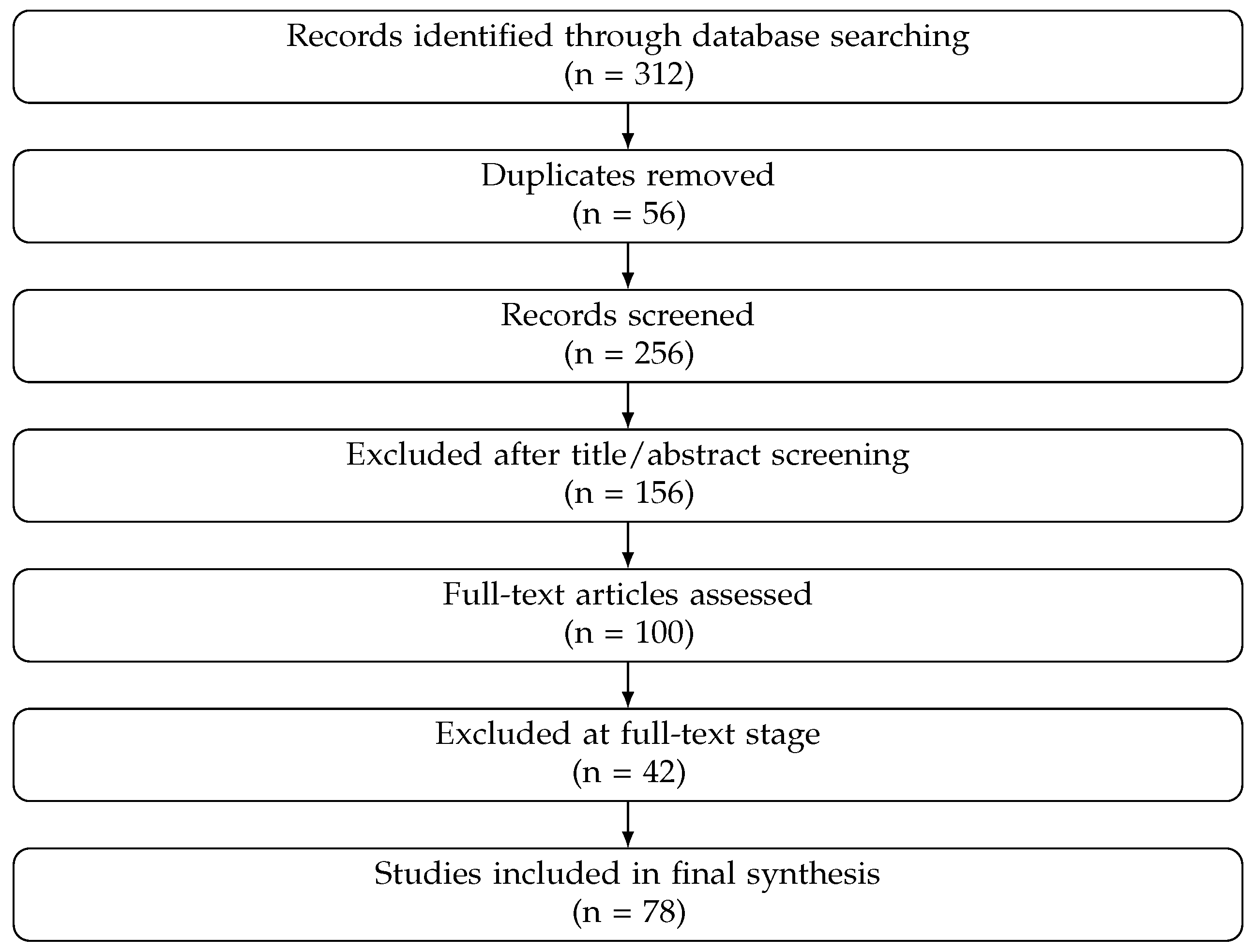
- Systematic synthesis: We provide a PRISMA-based analysis of 78 peer-reviewed studies, ensuring methodological consistency and reproducibility across diverse 6G privacy research directions.
- Cross-layer taxonomy: We develop a unified taxonomy that explicitly distinguishes between personal and non-personal data, linking privacy-enhancing technologies (PETs) to compliance requirements across Core/SBA, RAN, Edge/MEC, and NTN layers.
- Threat-mitigation mapping: We present a structured mapping between multi-layer threat models and corresponding privacy-preserving mechanisms, enabling clearer alignment between attack surfaces and deployed PETs.
- Cross-layer integration insight: We analyze the complementary roles of physical-layer security (PLS) and higher-layer techniques (DP and FL), highlighting their trade-offs and the need for hybrid privacy-preserving architectures.
- Forward-looking roadmap: We identify key research gaps and outline future directions, including hybrid PET pipelines, AI-driven privacy orchestration, and post-quantum compliance mechanisms.
- RQ1: What are the dominant privacy-enhancing mechanisms (cryptographic, differential privacy, federated learning, LLM offloading, anonymization, physical-layer security, etc.) applicable to personal and non-personal data in 6G networks?
- RQ2: How do regulatory and compliance frameworks (GDPR, PDPL, 3GPP SA3, ISO/IEC standards) influence privacy enforcement and accountability across 6G architectural layers?
- RQ3: What are the open research gaps, challenges, and future directions for achieving scalable, compliant, and privacy-preserving 6G architectures?
2. Study Selection and Methodology
2.1. Search Strategy and Sources
- (“6G” OR “beyond-5G”) AND (privacy OR “personal data” OR “non-personal data”).
- (“federated learning (FL)” OR FL OR “split learning”) AND (“differential privacy (DP)” OR DP).
- (blockchain OR “distributed ledger technology (DLT)” OR DLT) AND (audit* OR compliance OR accountability).
- (“edge computing” OR “multi-access edge computing (MEC)”) AND (“large language model (LLM)” OR LLM OR prompt* OR offload*).
- (“zero-knowledge proof (ZKP)” OR ZKP) AND (audit* OR attest* OR compliance).
- (“Internet of Things (IoT)” OR IoT OR “vehicular”) AND (authentication OR authorization OR access control).
- (“physical layer security (PLS)” OR PLS OR “wiretap channel”) AND (“6G” OR “beyond-5G”).
- (“low signal-to-noise ratio (SNR)” OR “imperfect channel state information (CSI)” OR “channel estimation”) AND (“secrecy” OR “physical layer security”).
- (“extremely large multiple-input multiple-output (XL-MIMO)” OR “massive MIMO” OR “beamforming” OR “artificial noise”) AND (“privacy” OR “secrecy”).
- (“reconfigurable intelligent surface (RIS)” OR RIS OR “terahertz (THz)” OR THz) AND (“security” OR “eavesdropping” OR “physical layer security” OR privacy).
- (“over-the-air federated learning (OTA-FL)” OR OTA-FL) AND (“privacy” OR “differential privacy” OR “physical layer”).
- (“non-terrestrial network (NTN)” OR NTN OR “satellite”) AND (“security” OR “physical layer security”).
- (“semantic communication” OR “semantic-aware communication”) AND (privacy OR security OR data protection).
- (“space-air-ground integration” OR “satellite Internet” OR “space-ground network”) AND (privacy OR security OR compliance).
- (“low-altitude network” OR “UAV network” OR “drone communication” OR “aerial network”) AND (privacy OR authentication OR security).
- (“AI agent” OR “autonomous agent” OR “intelligent agent”) AND (privacy OR compliance OR data protection).
2.2. Eligibility Criteria
2.3. Screening Workflow and Study Yield
3. Background and Contextual Framework
3.1. 6G Vision and Architectural Evolution
3.2. Data Landscapes in Next-Generation Networks
4. Taxonomy of Privacy-Enhancing Edge/MEC Mechanisms for 6G
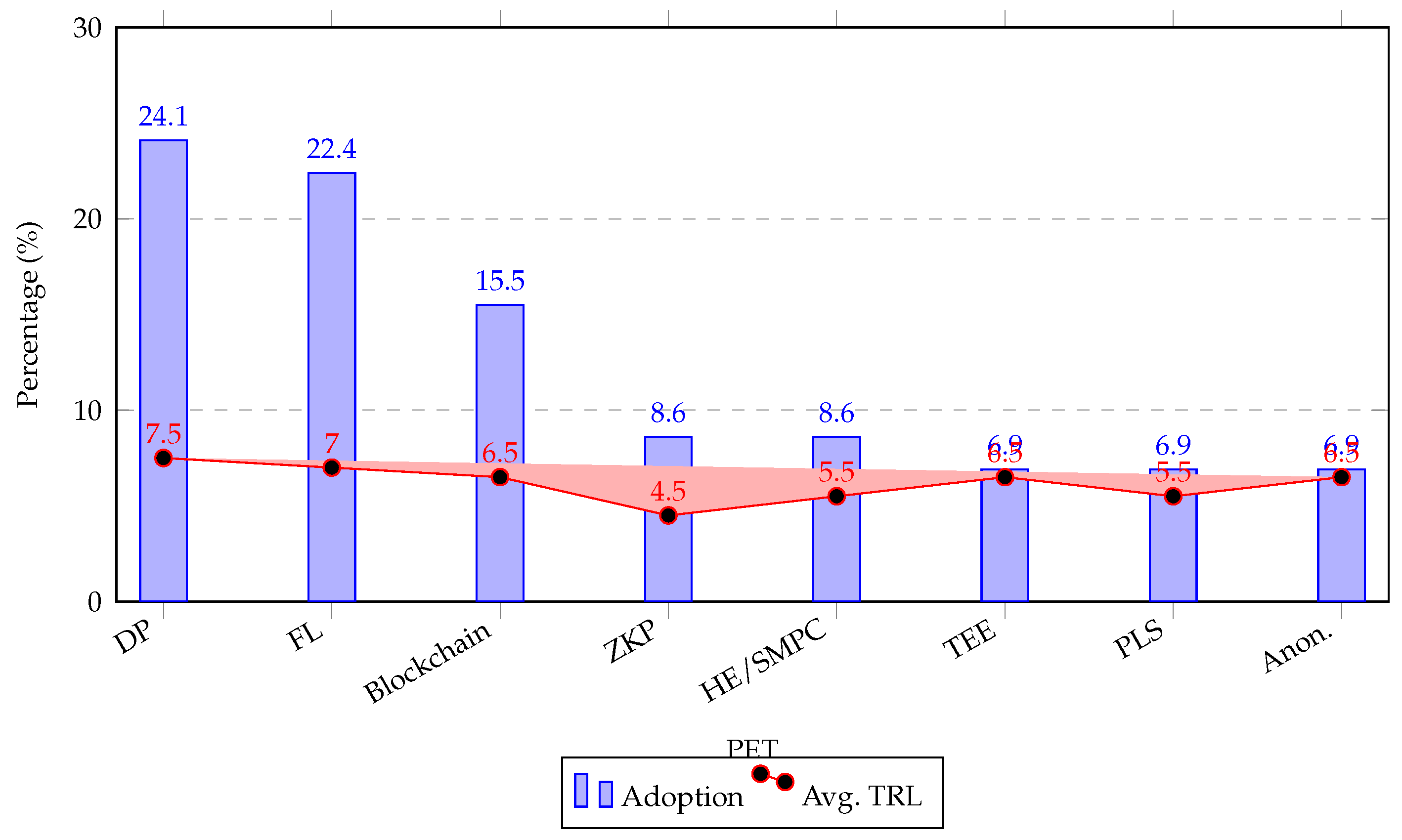
4.1. Quantitative Analysis of PET Adoption (2019–2025)
4.2. Cryptographic Approaches (HE/FHE, SMPC, TEEs)
- FHE for low-rate analytics apply CKKS/BFV for privacy-preserving KPIs with batched operations when update frequency is modest; offload heavy bootstrapping to Core/SBA data centers [61].
- Hybrid SMPC+DP for FL use SMPC for secure aggregation of model updates and add calibrated global DP noise server-side to bound leakage while preserving convergence [64].
4.3. Differential Privacy (Global, Local, and Hybrid Models)
4.4. Federated and Split Learning
4.5. Physical-Layer Security in 6G: Cross-Layer Design and Realistic Constraints
- Operational Use Cases and Threat-Mitigation Mapping.
- Refined Cross-Layer Threat–Solution Mapping.
- PLS Under Low-SNR and Imperfect CSI Conditions.
- Impact of low SNR on privacy-preserving techniques.
- Effectiveness of PETs under low-SNR constraints.
5. Threat Models and Attack Taxonomy
5.1. Cross-Layer Threat-Mitigation Mapping
5.2. Passive Attacks: Eavesdropping and Traffic Analysis
- Timing/entropy drift in beacons reveals mobility or slice-selection patterns.
- RIS phase traces leak device presence and coarse location [92].
5.3. Active Attacks: Poisoning and Model Inversion
- Secure aggregation + clipping;
- Differential privacy (DP);
- Zero-knowledge proofs (ZKPs).
5.4. Side-Channel and Physical-Layer Exposures
5.5. Re-Identification and Linkage Attacks
5.6. Cross-Domain and Cross-Border Threats
5.7. Technical Challenges and Future Development Trends
- Cross-layer privacy coordination: Existing solutions often operate in isolation (e.g., DP, FL, or PLS), while real-world 6G systems require integrated, cross-layer protection strategies.
- Scalability under heterogeneous environments: Privacy-preserving techniques must operate across highly dynamic environments, including Edge/MEC, NTN, and IoT networks, where latency and resource constraints vary significantly.
- Robustness against adaptive attacks: Emerging threats such as adaptive poisoning, inference attacks on LLMs, and CSI-based tracking require more resilient and adaptive defense mechanisms.
- Privacy–utility trade-offs: Techniques such as differential privacy and encryption introduce performance overhead and utility degradation, which remain challenging in real-time 6G applications.
- Compliance fragmentation: Differences in regulatory frameworks across regions complicate the enforcement of consistent privacy policies in cross-domain and cross-border scenarios.
- Hybrid privacy-preserving pipelines: The combination of DP, FL, cryptographic proofs, and PLS to provide layered protection.
- AI-driven privacy orchestration: Intelligent controllers and autonomous agents for dynamic privacy enforcement and resource allocation.
- Post-quantum and verifiable privacy: Integration of ZKP-based auditability and quantum-resistant cryptographic primitives.
- Privacy-aware semantic communication: Emerging paradigms where communication focuses on meaning rather than raw data, reducing exposure of sensitive information.
- Cross-domain compliance automation: Blockchain and policy-driven orchestration for automated, verifiable compliance across heterogeneous 6G environments.
Takeaway for RQ3
- Transition to Comparative Analysis.
6. Comparative Analysis of Privacy-Preserving Techniques
6.1. Advantages and Limitations
6.2. Interpretive Synthesis
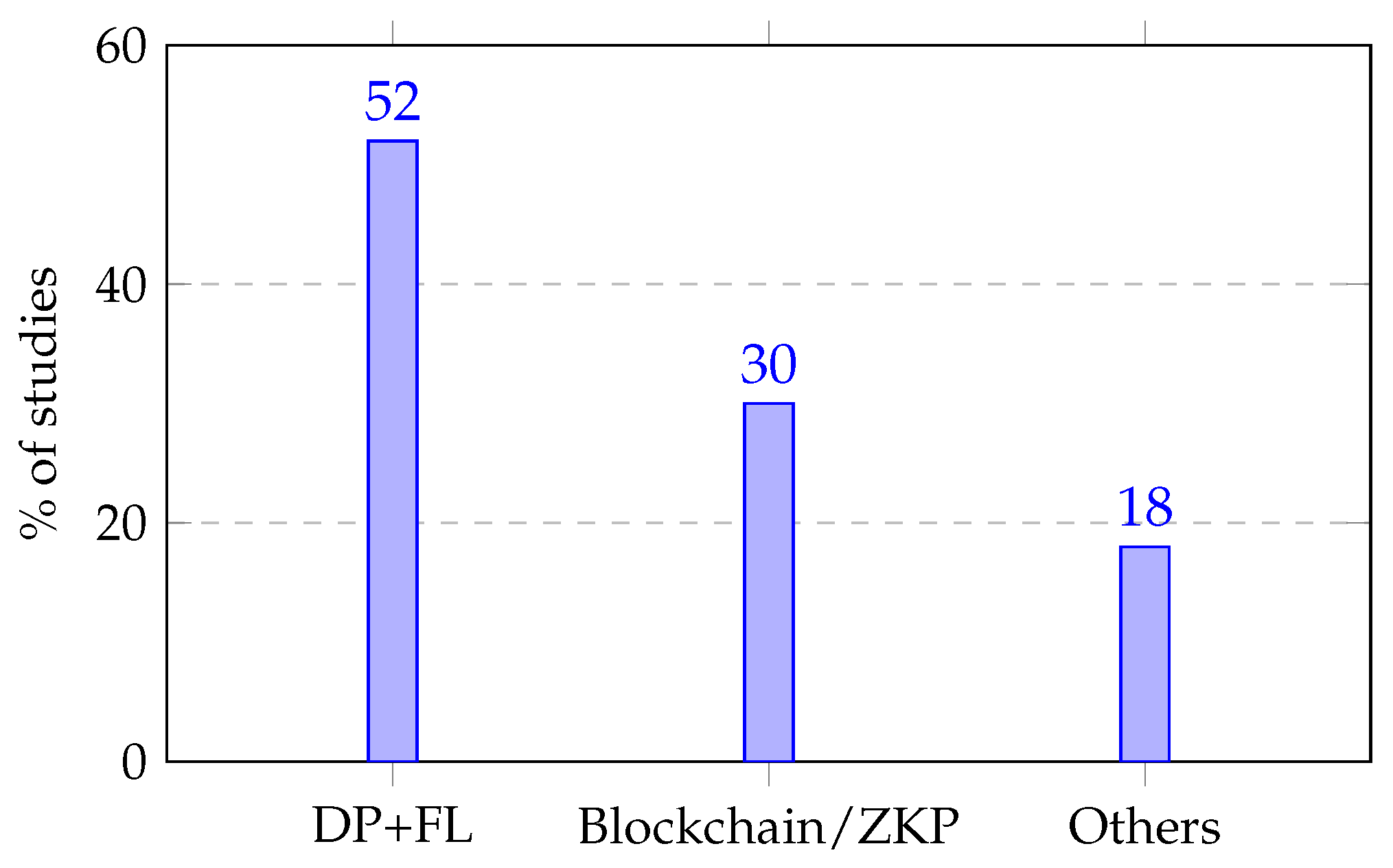
- Dominance of hybrid PETs: DP and FL appear jointly in more than half of the reviewed deployments (52%), often integrated with ZKPs or ledgers for compliance proofing.
- Scalability–compliance trade-off: Blockchain and HE/SMPC solutions provide strong confidentiality but struggle under real-time 6G latency bounds; TEEs and DP perform better in time-critical slices.
- Compliance maturity gap: Only 27% of studies explicitly couple PETs with regulatory artefacts (GDPR, PDPL, or BCR manifests), showing the need for compliance-aware orchestration frameworks in future research.
7. Readiness, Deployment, and Data Governance Context
7.1. Evaluation Rubric (Table 13)
7.2. TRL Summary and Quantitative Insights (Table 14 and Table 15)
- Integrated Insights.
- Limitations of Evidence.
8. Challenges and Future Trends
9. Conclusions and Future Work
- Hybrid PET orchestration that combines DP, FL, ZKP, and physical-layer security (PLS) within compliance-aware controllers to enable cross-layer privacy protection.
- Strengthening physical-layer security (PLS) integration with AI-driven and learning-based frameworks (e.g., federated learning and LLM offloading), particularly under realistic 6G constraints such as low-SNR conditions, near-field propagation, and imperfect channel state information (CSI).
- Post-quantum auditability mechanisms for NTN and satellite links, integrating ZKP-based verification and quantum-resistant cryptographic primitives.
- AI-driven compliance automation capable of dynamically adjusting privacy budgets, enforcement policies, and audit artefacts across heterogeneous 6G environments.
Author Contributions
Funding
Data Availability Statement
Conflicts of Interest
References
- Nguyen, V.L.; Lin, P.C.; Cheng, B.C.; Hwang, R.H.; Lin, Y.D. Security and privacy for 6G: A survey on prospective technologies and challenges. IEEE Commun. Surv. Tutor. 2021, 23, 2384–2428. [Google Scholar] [CrossRef]
- Ylianttila, M.; Kantola, R.; Gurtov, A.; Mucchi, L.; Oppermann, I.; Yan, Z.; Nguyen, T.H.; Liu, F.; Hewa, T.; Liyanage, M.; et al. 6G white paper: Research challenges for trust, security and privacy. arXiv 2020, arXiv:2004.11665. [Google Scholar] [CrossRef]
- Sandeepa, C.; Siniarski, B.; Kourtellis, N.; Wang, S.; Liyanage, M. A survey on privacy of personal and non-personal data in B5G/6G networks. ACM Comput. Surv. 2024, 56, 1–37. [Google Scholar] [CrossRef]
- Christopoulou, M.; Santorinaios, D.; Gardikis, G.; Katsarou, V.; Angelogianni, A.; Fotos, N.; Giannetsos, T.; Taleghani, E.S.; Alonso-López, J.A.; Villalba, L.J.G.; et al. An Architecture for Privacy-first Security in 6G. In Proceedings of the 2024 IEEE Future Networks World Forum (FNWF); IEEE: San Francisco, CA, USA, 2024; pp. 731–735. [Google Scholar]
- Alonso-Lupez, J.A.; Hernández, L.A.M.; Arteaga, S.P.; Orozco, A.L.S.; Villalba, L.J.G.; Pastor, A.; García, D.L. Level of trust and privacy management in 6g intent-based networks for vertical scenarios. In Proceedings of the 2022 1st International Conference on 6G Networking (6GNet); IEEE: San Francisco, CA, USA, 2022; pp. 1–4. [Google Scholar]
- Putra, G.D.; Dedeoglu, V.; Kanhere, S.S.; Jurdak, R. Privacy-Preserving Trust Management for Blockchain-based Resource Sharing in 6G-IoT. In Proceedings of the 2023 IEEE International Conference on Blockchain and Cryptocurrency (ICBC); IEEE: San Francisco, CA, USA, 2023; pp. 1–9. [Google Scholar]
- Vuppula, R.; Pradhan, H.S. Blockchain-oriented location privacy preserving for cooperative spectrum sensing in 6G wireless networks. IET Blockchain 2023, 3, 74–97. [Google Scholar] [CrossRef]
- Abou El Houda, Z.; Moudoud, H.; Khoukhi, L. Blockchain meets O-RAN: A decentralized zero-trust framework for secure and resilient O-RAN in 6G and beyond. In Proceedings of the IEEE INFOCOM 2024-IEEE Conference on Computer Communications Workshops (INFOCOM WKSHPS); IEEE: San Francisco, CA, USA, 2024; pp. 1–6. [Google Scholar]
- Singamaneni, K.K.; Kumar, B.A.; Raenu, A.; Kolandaisamy, L.; Dommeti, V.S.; Katragadda, S. An Efficient Quantum Block chain Framework with Edge Computing for Privacy-Preserving 6G Networks. IEEE Access 2025, 13, 135722–135740. [Google Scholar] [CrossRef]
- Kunz, A.; Asensio-Garriga, R.; Rodriguez, J.G.; Bernabé, J.B.; Gomez, A.S.; Baskaran, S.B.M.; Paul, S. Privacy-preserving Attribute Based Credentials for 6G networks. In Proceedings of the 2024 IEEE Future Networks World Forum (FNWF); IEEE: San Francisco, CA, USA, 2024; pp. 927–932. [Google Scholar]
- Badidi, I.; Khiyaoui, N.E.; Riany, A.; Elallid, B.B.; Abouaomar, A. Privacy-Preserving Offloading for Large Language Models in 6G Vehicular Networks. arXiv 2025, arXiv:2509.05320. [Google Scholar]
- Vu, M.; Nguyen, T.; Thai, M.T. Analysis of privacy leakage in federated large language models. In Proceedings of the International Conference on Artificial Intelligence and Statistics; PMLR: Vienna, Austria, 2024; pp. 1423–1431. [Google Scholar]
- Pan, Y.; Su, Z.; Wang, Y.; Guo, S.; Liu, H.; Li, R.; Wu, Y. Cloud-edge collaborative large model services: Challenges and solutions. IEEE Netw. 2024, 39, 182–191. [Google Scholar] [CrossRef]
- Lin, Z.; Qu, G.; Chen, Q.; Chen, X.; Chen, Z.; Huang, K. Pushing large language models to the 6g edge: Vision, challenges, and opportunities. IEEE Commun. Mag. 2025, 63, 52–59. [Google Scholar] [CrossRef]
- Porambage, P.; Gür, G.; Osorio, D.P.M.; Liyanage, M.; Gurtov, A.; Ylianttila, M. The roadmap to 6G security and privacy. IEEE Open J. Commun. Soc. 2021, 2, 1094–1122. [Google Scholar] [CrossRef]
- Kato, N.; Fadlullah, Z.M.; Mao, B.; Tang, F.; Akashi, O. The deep learning vision for heterogeneous network traffic control: Proposal, challenges, and future perspective. IEEE Netw. 2020, 34, 146–153. [Google Scholar] [CrossRef]
- Nguyen, T.; Tran, N.; Loven, L.; Partala, J.; Kechadi, M.T.; Pirttikangas, S. Privacy-aware blockchain innovation for 6G: Challenges and opportunities. In 2020 2nd 6G Wireless Summit (6G SUMMIT); IEEE: San Francisco, CA, USA, 2020; pp. 1–5. [Google Scholar]
- Shen, X.S.; Huang, C.; Liu, D.; Xue, L.; Zhuang, W.; Sun, R.; Ying, B. Data management for future wireless networks: Architecture, privacy preservation, and regulation. IEEE Netw. 2021, 35, 8–15. [Google Scholar] [CrossRef]
- Wang, M.; Zhu, T.; Zhang, T.; Zhang, J.; Yu, S.; Zhou, W. Security and privacy in 6G networks: New areas and new challenges. Digit. Commun. Netw. 2020, 6, 281–291. [Google Scholar] [CrossRef]
- Kumar, A.; Sharma, S.; Kumar, M.H.; Singh, G. RIS-Assisted Terahertz Communications for 6G Networks: A Comprehensive Overview. IEEE Access 2025, 13, 96337–96364. [Google Scholar] [CrossRef]
- Shalannanda, W. Using Zero-Knowledge Proof in Privacy-Preserving Networks. In Proceedings of the 2023 17th International Conference on Telecommunication Systems, Services, and Applications (TSSA); IEEE: San Francisco, CA, USA, 2023; pp. 1–6. [Google Scholar]
- Zhang, K.; Tsai, P.W.; Tian, J.; Zhao, W.; Cai, X.; Gao, L.; Chen, J. Towards Privacy in Decentralized IoT: A Blockchain-Based Dual Response DP Mechanism. Big Data Min. Anal. 2024, 7, 699–717. [Google Scholar] [CrossRef]
- Kashif, M.; Kalkan, K. Differential privacy preserving based framework using blockchain for internet-of-things. Peer-to-Peer Netw. Appl. 2025, 18, 33. [Google Scholar] [CrossRef]
- Drampalou, S.F.; Uzunidis, D.; Vetsos, A.; Miridakis, N.I.; Karkazis, P. A User-Centric perspective of 6G networks: A Survey. IEEE Access 2024, 12, 190255–190294. [Google Scholar] [CrossRef]
- Gkonis, P.K.; Nomikos, N.; Trakadas, P.; Sarakis, L.; Xylouris, G.; Masip-Bruin, X.; Martrat, J. Leveraging network data analytics function and machine learning for data collection, resource optimization, security and privacy in 6G networks. IEEE Access 2024, 12, 21320–21336. [Google Scholar] [CrossRef]
- Zaman Chowdhury, M.; Shahjalal, M.; Ahmed, S.; Jang, Y.M. 6G wireless communication systems: Applications, requirements, technologies, challenges, and research directions. arXiv 2019, arXiv:1909.11315. [Google Scholar] [CrossRef]
- Tariq, F.; Khandaker, M.R.; Wong, K.K.; Imran, M.A.; Bennis, M.; Debbah, M. A speculative study on 6G. IEEE Wirel. Commun. 2020, 27, 118–125. [Google Scholar] [CrossRef]
- Dang, S.; Amin, O.; Shihada, B.; Alouini, M.S. What should 6G be? Nat. Electron. 2020, 3, 20–29. [Google Scholar] [CrossRef]
- Giordani, M.; Polese, M.; Mezzavilla, M.; Rangan, S.; Zorzi, M. Toward 6G networks: Use cases and technologies. IEEE Commun. Mag. 2020, 58, 55–61. [Google Scholar] [CrossRef]
- Letaief, K.B.; Chen, W.; Shi, Y.; Zhang, J.; Zhang, Y.J.A. The roadmap to 6G: AI empowered wireless networks. IEEE Commun. Mag. 2019, 57, 84–90. [Google Scholar] [CrossRef]
- Fachrurrozi, N.R.; Ramli, K.; Anwar, K. Challenges on Security and Privacy in IMT-2030 (6G) Networks. In Proceedings of the 2024 IEEE International Conference on Communication, Networks and Satellite (COMNETSAT); IEEE: San Francisco, CA, USA, 2024; pp. 691–698. [Google Scholar]
- Sun, Y.; Liu, J.; Wang, J.; Cao, Y.; Kato, N. When machine learning meets privacy in 6G: A survey. IEEE Commun. Surv. Tutor. 2020, 22, 2694–2724. [Google Scholar] [CrossRef]
- Saeed, M.M.; Saeed, R.A.; Hasan, M.K.; Ali, E.S.; Mazha, T.; Shahzad, T.; Khan, S.; Hamam, H. A comprehensive survey on 6G-security: Physical connection and service layers. Discov. Internet Things 2025, 5, 28. [Google Scholar] [CrossRef]
- Rajesh, K.; Vetrivelan, P. Comprehensive analysis on 5G and 6G wireless network security and privacy. Telecommun. Syst. 2025, 88, 52. [Google Scholar] [CrossRef]
- Baskar, N.; Selvaprabhu, P.; Unnikrishnan, V.M.; Chandra Babu, V.K.; Kumaravelu, V.B.; Rajamani, V.; Chinnadurai, S.; Sarker, M.A.L. Security and Privacy Issues in RIS-Based Wireless Communication Systems. In Reconfigurable Intelligent Surfaces for 6G and Beyond Wireless Networks; Wiley Online Library: New York, NY, USA, 2025; pp. 377–404. [Google Scholar]
- Ahmed, M.; Soofi, A.A.; Raza, S.; Li, Y.; Khan, F.; Khan, W.U.; Asif, M.; Han, Z. A Comprehensive Survey on RIS-Enhanced Physical Layer Security in UAV-Assisted Networks. IEEE Internet Things J. 2025, 12, 32538–32562. [Google Scholar] [CrossRef]
- Minh La, T.; Tri Nguyen, H.; Nguyen Phan, K. Examining Physical Layer Security for RIS-Aided Wireless Communication Systems. In Reconfigurable Intelligent Surfaces for 6G and Beyond Wireless Networks; Wiley Online Library: New York, NY, USA, 2025; pp. 499–523. [Google Scholar]
- Cai, L.; Wang, J.; Zhang, R.; Zhang, Y.; Jiang, T.; Niyato, D.; Wang, X.; Jamalipour, A.; Shen, X. Secure physical layer communications for low-altitude economy networking: A survey. arXiv 2025, arXiv:2504.09153. [Google Scholar] [CrossRef]
- Liu, Z.; Wan, L.; Ma, Y.; Guo, J.; Guo, S.; Ma, J.; Ma, J. Establishing Trustworthy and Privacy-Preserving SAGIVNs in 6G: Architectures, Requirements, and Solutions. IEEE Netw. 2024, 38, 141–147. [Google Scholar] [CrossRef]
- Jin, Y.; Wang, T.; Yang, Q.; Shi, L.; Zhang, S. Zero-Knowledge Federated Learning: A New Trustworthy and Privacy-Preserving Distributed Learning Paradigm. arXiv 2025, arXiv:2503.15550. [Google Scholar]
- Commey, D.; Appiah, B.; Klogo, G.S.; Crosby, G.V. ZKP-FedEval: Verifiable and Privacy-Preserving Federated Evaluation using Zero-Knowledge Proofs. arXiv 2025, arXiv:2507.11649. [Google Scholar]
- Abasi, A.K.; Aloqaily, M.; Guizani, M. 6g mmwave security advancements through federated learning and differential privacy. IEEE Trans. Netw. Serv. Manag. 2025, 22, 1911–1928. [Google Scholar] [CrossRef]
- Chaccour, C.; Soorki, M.N.; Saad, W.; Bennis, M.; Popovski, P.; Debbah, M. Seven defining features of terahertz (THz) wireless systems: A fellowship of communication and sensing. IEEE Commun. Surv. Tutor. 2022, 24, 967–993. [Google Scholar] [CrossRef]
- Ghourab, E.M.; Azab, M.; Gračanin, D.; Alhussein, O.; Al-Qutayri, M.; Muhaidat, S. Extended reality-aware wireless communication networks: A systematic literature review. IEEE Open J. Commun. Soc. 2025, 6, 7567–7588. [Google Scholar] [CrossRef]
- Cevallos-Salas, D.; Estrada-Jiménez, J.; Guamán, D.S. Heuristic Techniques for Assessing Internet Privacy: A Comprehensive Review and Analysis. Technologies 2025, 13, 377. [Google Scholar] [CrossRef]
- Paolone, G.; Paesani, R.; Pilotti, F.; Camplone, J.; Piazza, A.; Di Felice, P. Smart Lighting Systems: State-of-the-Art in the Adoption of the EdgeML Computing Paradigm. Future Internet 2025, 17, 90. [Google Scholar] [CrossRef]
- Moro-Visconti, R. The Impact of Emerging Technologies on Patent Valuation. In Patent Valuation: Economic, Financial, and Market Approaches; Springer: Berlin/Heidelberg, Germany, 2025; pp. 561–602. [Google Scholar]
- Yang, M.; Qu, Y.; Ranbaduge, T.; Thapa, C.; Sultan, N.; Ding, M.; Suzuki, H.; Ni, W.; Abuadbba, S.; Smith, D.; et al. From 5g to 6g: A survey on security, privacy, and standardization pathways. arXiv 2024, arXiv:2410.21986. [Google Scholar] [CrossRef]
- Xenos, E.; Dang, S.; Armour, S.; Austin, A.; Beach, M.A. Robust and Ubiquitous Connectivity Enabled by Unified Integrated and Secure NTN; University of Bristol: Bristol, UK, 2025; preprint. [Google Scholar] [CrossRef]
- Papageorgiou, A.; Bobev, T. MOZAIK D5.2 Legal Toolkit; Technical Report; CiTiP KU Leuven: Leuven, Belgium, 2025. [Google Scholar]
- Petrosino, A. Integration of Terrestrial and Non-Terrestrial Technologies in IoT Networks. Master’s Thesis, Politecnico di Bari, Bari, Italy, 2024. Available online: https://hdl.handle.net/20.500.14242/64881 (accessed on 3 April 2026).
- Carminati, B.; Ferrari, E. Trusted Privacy Manager: A System for Privacy Enforcement. In Proceedings of the 21st International Conference on Data Engineering Workshops (ICDEW’05); IEEE: San Francisco, CA, USA, 2005; p. 1195. [Google Scholar]
- Lyimo, M.; Mgawe, B.; Leo, J.; Dida, M.; Michael, K. Adaptive Antenna for Maritime LoRaWAN: A Systematic Review on Performance, Energy Efficiency, and Environmental Resilience. Sensors 2025, 25, 6110. [Google Scholar] [CrossRef] [PubMed]
- Kalejaiye, A.N.; Shallom, K.; Chukwuani, E.N. Implementing federated learning with privacy-preserving encryption to secure patient-derived imaging and sequencing data from cyber intrusions. Int. J. Sci. Res. Arch. 2025, 16, 1126–1145. [Google Scholar] [CrossRef]
- Haripriya, R.; Khare, N.; Pandey, M.; Patel, S.; Choudhary, J.; Singh, D.P.; Solanki, S.; Sharma, D. FWFA: Fairness-Weighted Federated Aggregation for Privacy-Aware Decision Intelligence. IEEE Access 2025, 13, 120417–120436. [Google Scholar] [CrossRef]
- Islam, N.; Zulkernine, M. Privacy-preserving machine learning in internet of vehicle applications: Fundamentals, recent advances, and future direction. arXiv 2025, arXiv:2503.01089. [Google Scholar] [CrossRef]
- Li, Y.; Khan, F.; Ahmed, M.; Soofi, A.A.; Khan, W.U.; Sheemar, C.K.; Asif, M.; Han, Z. RIS-based Physical Layer Security for Integrated Sensing and Communication: A Comprehensive Survey. IEEE Internet Things J. 2025, 12, 32444–32468. [Google Scholar] [CrossRef]
- Delgado-von Eitzen, C.; Fernández Iglesias, M.J.; Anido Rifón, L.E. A GDPR-Compliant Blockchain Architecture for the Verification of Educational Credentials: Design, Implementation, and Evaluation. SSRN, 2025; preprint. Available online: https://ssrn.com/abstract=5366209 (accessed on 3 April 2026).
- Abdullahi, A.D.; Bahrami, E.; Dargahi, T.; Al-Khalidi, M.; Hammoudeh, M. Interplay between Security, Privacy and Trust in 6G-enabled Intelligent Transportation Systems. arXiv 2025, arXiv:2510.02487. [Google Scholar] [CrossRef]
- Rehan, M.W.; Rehan, M.M. Survey, taxonomy, and emerging paradigms of societal digital twins for public health preparedness. npj Digit. Med. 2025, 8, 520. [Google Scholar] [CrossRef] [PubMed]
- Rezazadeh, F.; Kahvazadeh, S.; Mosahebfard, M. Towards quantum-enabled 6G slicing. arXiv 2022, arXiv:2212.11755. [Google Scholar] [CrossRef]
- Zhou, Z.; Chen, X.; Li, E.; Zeng, L.; Luo, K.; Zhang, J. Edge intelligence: Paving the last mile of artificial intelligence with edge computing. Proc. IEEE 2019, 107, 1738–1762. [Google Scholar] [CrossRef]
- Masouros, D.; Soudris, D.; Gardikis, G.; Katsarou, V.; Christopoulou, M.; Xilouris, G.; Ramón, H.; Pastor, A.; Scaglione, F.; Petrollini, C.; et al. Towards privacy-first security enablers for 6G networks: The PRIVATEER approach. In Proceedings of the International Conference on Embedded Computer Systems; Springer: Berlin/Heidelberg, Germany, 2023; pp. 379–391. [Google Scholar]
- Liu, Y.; Yuan, X.; Xiong, Z.; Kang, J.; Wang, X.; Niyato, D. Federated learning for 6G communications: Challenges, methods, and future directions. China Commun. 2020, 17, 105–118. [Google Scholar] [CrossRef]
- Du, M.; Yang, P.; Liu, Y.; He, X.; Chen, M. Dp-fed6g: An adaptive differential privacy-empowered federated learning framework for 6G networks. Digit. Commun. Netw. 2025, 11, 1994–2002. [Google Scholar] [CrossRef]
- Lin, J.C.W.; Srivastava, G.; Zhang, Y.; Djenouri, Y.; Aloqaily, M. Privacy-preserving multiobjective sanitization model in 6G IoT environments. IEEE Internet Things J. 2020, 8, 5340–5349. [Google Scholar] [CrossRef]
- Hafi, H.; Brik, B.; Frangoudis, P.A.; Ksentini, A.; Bagaa, M. Split federated learning for 6G enabled-networks: Requirements, challenges, and future directions. IEEE Access 2024, 12, 9890–9930. [Google Scholar] [CrossRef]
- Tan, A.Z.; Yu, H.; Cui, L.; Yang, Q. Towards personalized federated learning. IEEE Trans. Neural Netw. Learn. Syst. 2022, 34, 9587–9603. [Google Scholar] [CrossRef]
- Mucchi, L.; Jayousi, S.; Caputo, S.; Panayirci, E.; Shahabuddin, S.; Bechtold, J.; Morales, I.; Stoica, R.A.; Abreu, G.; Haas, H. Physical-Layer Security in 6G Networks. IEEE Open J. Commun. Soc. 2021, 2, 1901–1914. [Google Scholar] [CrossRef]
- Youn, J.; Son, W.; Jung, B. Physical-Layer Security Improvement with Reconfigurable Intelligent Surfaces for 6G Wireless Communication Systems. Sensors 2021, 21, 1439. [Google Scholar] [CrossRef]
- Roth, S.; Sezgin, A. EMF-Constrained Artificial Noise for Secrecy Rates with Stochastic Eavesdropper Channels. IEEE Wirel. Commun. Lett. 2023, 13, 2407–2411. [Google Scholar] [CrossRef]
- Liu, S.; Gao, T.; Liu, Y.; Lu, X. Physical-Layer Public Key Encryption Through Massive MIMO. In Proceedings of the ACM Asia Conference on Computer and Communications Security, Singapore, 1–5 July 2024. [Google Scholar] [CrossRef]
- Guo, M.; Lin, Z.; Ma, R.; An, K.; Li, D.; Al-Dhahir, N.; Wang, J. Inspiring Physical Layer Security with RIS: Principles, Applications, and Challenges. IEEE Open J. Commun. Soc. 2024, 5, 2903–2925. [Google Scholar] [CrossRef]
- Khalid, W.; Rehman, M.A.U.; Van Chien, T.; Kaleem, Z.; Lee, H.; Yu, H. Reconfigurable intelligent surface for physical layer security in 6G-IoT: Designs, issues, and advances. IEEE Internet Things J. 2023, 11, 3599–3613. [Google Scholar] [CrossRef]
- Chiti, F.; Degl’Innocenti, A.; Pierucci, L. Secure Networking with Software-Defined Reconfigurable Intelligent Surfaces. Sensors 2023, 23, 2726. [Google Scholar] [CrossRef]
- Katsanos, K.D.; Alexandropoulos, G.C. Spatial Secrecy Spectral Efficiency Optimization Enabled by Reconfigurable Intelligent Surfaces. In Proceedings of the European Signal Processing Conference, Helsinki, Finland, 4–8 September 2023. [Google Scholar] [CrossRef]
- Zhang, J.; Du, H.; Sun, Q.; Ai, B.; Ng, D.W.K. Physical Layer Security Enhancement with Reconfigurable Intelligent Surface-Aided Networks. IEEE Trans. Inf. Forensics Secur. 2020, 16, 3480–3495. [Google Scholar] [CrossRef]
- Li, D.; Ma, W. Enhancing NR Physical-Layer Key Generation via Beamwidth Adaptations. In Proceedings of the 7th International Conference on Information Communication and Signal Processing (ICICSP), Zhoushan, China, 21–23 September 2024. [Google Scholar] [CrossRef]
- Kumar, R.; Arnon, S. Review of Physical Layer Security in Integrated Satellite–Terrestrial Networks. Electronics 2024, 13, 4414. [Google Scholar] [CrossRef]
- Radojkovic, I.; Anastasov, J.; Milic, D.; Ivanis, P.; Djordjevic, G.T. Secrecy Analysis of LEO Satellite-to-Ground Station Communication System Influenced by Gamma-Shadowed Ricean Fading. Electronics 2025, 14, 293. [Google Scholar] [CrossRef]
- An, J.; Kang, B.; Ouyang, Q.; Pan, J.; Ye, N. Covert Communications Meet 6G NTN: A Comprehensive Enabler for Safety-Critical IoT. IEEE Netw. 2024, 38, 17–24. [Google Scholar] [CrossRef]
- Ben Yahia, O.; Erdogan, E.; Karabulut-Kurt, G.; Altunbas, I.; Yanikomeroglu, H. Physical Layer Security Framework for Optical Non-Terrestrial Networks. In Proceedings of the International Conference on Telecommunications, Alexandria, Egypt, 13–15 July 2021. [Google Scholar] [CrossRef]
- Yan, N.; Wang, K.; Zhi, K.; Pan, C.; Chai, K.K.; Poor, H.V. Secure and Private Over-the-Air Federated Learning: Biased and Unbiased Aggregation Design. IEEE Trans. Wirel. Commun. 2025, 24, 5901–5916. [Google Scholar] [CrossRef]
- Xue, X.; Hasan, M.K.; Yu, S.; Kandel, L.N.; Song, M. Over-the-Air Federated Learning with Enhanced Privacy. In Proceedings of the IEEE International Conference on Communications, Rome, Italy, 28 May–1 June 2023. [Google Scholar] [CrossRef]
- Li, H.; Li, M.; Lin, Y.; Li, T.; Li, R.; Fan, X. Physical Layer Secure Transmission of AI Models in UAV-Enabled Edge AIoT. Electronics 2025, 14, 3450. [Google Scholar] [CrossRef]
- Miao, R.; Song, Z.; Li, Y.; Li, X.; Liu, L.; Shao, G.; Wang, B. RIS-Aided Physical Layer Security with Imperfect CSI: A Robust Model-Driven Deep Learning Approach. Entropy 2026, 28, 457. [Google Scholar] [CrossRef] [PubMed]
- Wang, H.; Yan, T.; Zhou, N.; Li, X.; Wen, F.; Du, W. Enhanced polar-domain channel estimation for near-field XL-MIMO in low-SNR scenarios. IEEE Trans. Veh. Technol. 2025, 74, 19407–19419. [Google Scholar] [CrossRef]
- Mao, J.; Yin, T.; Yener, A.; Liu, M. Leveraging the Physical Layer for Differential Privacy in Over-the-Air Federated Learning. In Proceedings of the IEEE International Conference on Communications, Denver, CO, USA, 9–13 June 2024. [Google Scholar] [CrossRef]
- Seif, M.; Tandon, R.; Li, M. Wireless Federated Learning with Local Differential Privacy. arXiv 2020. [Google Scholar] [CrossRef]
- Zhang, H.; Yang, C.; Dai, B. When Wireless Hierarchical Federated Learning Meets Physical Layer Security: A Finite Blocklength Approach. arXiv 2022. [Google Scholar] [CrossRef]
- Gonzalez, P.; Alhamed, F.; Shakespear-Miles, H.; Barzegar, S.; Paolucci, F.; Sgambelluri, A.; Olmos, J.V.; Ruiz, M.; Velasco, L. Near-real-time 6G service operation enabled by distributed intelligence and in-band telemetry. J. Opt. Commun. Netw. 2025, 17, A247–A258. [Google Scholar] [CrossRef]
- Bazzi, A.; Chafii, M. Low dynamic range for ris-aided bistatic integrated sensing and communication. IEEE J. Sel. Areas Commun. 2025, 43, 912–927. [Google Scholar] [CrossRef]
- Rasheed, I.; Mostafa, H. Federated learning-based anomaly detection for zero-day attack prevention in 6G network slices. Comput. Netw. 2025, 268, 111376. [Google Scholar] [CrossRef]
- Chen, C.; Liao, T.; Deng, X.; Wu, Z.; Huang, S.; Zheng, Z. Advances in Robust Federated Learning: A Survey with Heterogeneity Considerations. IEEE Trans. Big Data 2025, 11, 1548–1567. [Google Scholar] [CrossRef]
- Larrucea, X.; Moffie, M.; Asaf, S.; Santamaria, I. Towards a GDPR compliant way to secure European cross border Healthcare Industry 4.0. Comput. Stand. Interfaces 2020, 69, 103408. [Google Scholar] [CrossRef]
- S, V.; Manoharan, R.; Ramachandran, S.; Rajasekar, V. Blockchain Based Privacy Preserving Framework for Emerging 6G Wireless Communications. IEEE Trans. Ind. Inform. 2022, 18, 4868–4874. [Google Scholar] [CrossRef]
- Bariah, L.; Mohjazi, L.; Abumarshoud, H.; Selim, B.; Muhaidat, S.; Tatipamula, M.; Imran, M.A.; Haas, H. RIS-Assisted Space-Air-Ground Integrated Networks: New Horizons for Flexible Access and Connectivity. IEEE Netw. 2023, 37, 118–125. [Google Scholar] [CrossRef]
- Han, D.; Liu, Y.; Cao, R.; Gao, H.; Lu, Y. A lightweight blockchain architecture with smart collaborative and progressive evolution for privacy-preserving 6G IoT. IEEE Wirel. Commun. 2024, 31, 148–154. [Google Scholar] [CrossRef]


| Inclusion Criteria | Exclusion Criteria |
|---|---|
| Peer-reviewed journal or conference articles | Non-peer-reviewed sources (white papers, blogs, editorials) |
| Published between 2019 and 2025 | Articles published before 2019 |
| Written in English | Non-English publications |
| Focus on privacy, compliance, or data governance in 6G/B5G | General networking studies without privacy aspects |
| Covers technical, regulatory, or architectural perspectives | Duplicates or irrelevant domains (e.g., 4G-only, industrial reports) |
| Layer | Concrete Hook and Rationale |
|---|---|
| Core/SBA layer | Policy engine performs ZKP checks before cross-slice transfers; logs link decisions to purpose and retention [19]. |
| RAN/O-RAN | Smart-contract onboarding (TrustORAN); per-use tokens and auditable updates reduce lateral movement [5]. |
| Edge/MEC layer | Scheduler manages energy–privacy trade-offs; FL updates notarized without gradient disclosure; LLM offloading protected by DP/ZKP [6,7]. |
| NTN layer/Gateways | Satellite audit channels maintain verifiable compliance across borders without exposing telemetry [51]. |
| Edge/MEC Mechanism | Privacy Strength | Utility Impact | Latency Impact | Energy/Cost |
|---|---|---|---|---|
| Differential Privacy (global/hybrid) | High (configurable ) | Medium (noise) | Low-Medium | Low |
| Federated Learning + Secure Agg. | Medium–High (no raw data) | Low–Medium | Medium (rounds) | Medium |
| ZK Proofs (audit w/o reveal) | High (verifiable) | None on utility | Medium–High (prove/verify) | Medium–High |
| HE/FHE (encrypted compute) | Very High | None on utility | High (compute) | High |
| SMPC (distributed trust) | High | None on utility | Medium (comm.) | Medium |
| TEEs (fast-path enclaves) | Medium (side-channel caveats) | None on utility | Low | Low–Medium |
| PLS/RIS (PHY safeguards) | Medium (contextual) | Low | Low | Low |
| Anonymization (k/ℓ/t) | Low–Medium (linkage risk) | Low | Low | Low |
| PET (Edge/MEC-Relevant) | No. | (% of Studies) |
|---|---|---|
| Differential privacy (DP) | 22 | 27.8 |
| Federated/split learning (FL) | 19 | 24.1 |
| Blockchain auditing/DLT | 16 | 20.3 |
| Zero-knowledge proofs (ZKPs) | 8 | 10.1 |
| Homomorphic encryption (HE)/SMPC | 6 | 7.6 |
| Trusted execution environments (TEEs) | 3 | 3.8 |
| Physical-layer security (PLS/RIS) | 3 | 3.8 |
| Anonymization/pseudonymization | 2 | 2.5 |
| Threat | Context and Mitigation |
|---|---|
| CSI-based tracking | XL-MIMO; mitigated via CSI obfuscation and randomized beamforming |
| Beamforming leakage | mmWave/THz; mitigated via artificial noise and secure beamforming |
| Spatial correlation attacks | RIS systems; mitigated via randomized phase control |
| Eavesdropping | THz channels; mitigated via secrecy beamforming and power control |
| Near-field leakage | XL-MIMO; mitigated via robust channel estimation |
| PLS Technique | Layer | Threat Mitigated | Strength | Limitation |
|---|---|---|---|---|
| Beamforming | RAN | Eavesdropping | High spatial selectivity | Requires accurate CSI |
| Artificial Noise | RAN/Edge | Interception | helps improve secrecy under interference | Power–utility trade-off |
| RIS-assisted Security | RAN/NTN | Signal leakage | Adaptive environment control | Deployment complexity |
| Massive/XL-MIMO | RAN | Channel leakage | High secrecy capacity | Hardware and energy cost |
| Secrecy Key Generation (SKG) | Cross-layer | Key leakage | No key exchange required | Sensitive to low SNR |
| OTA-FL with PLS | Edge/MEC | Model leakage | Efficient + privacy-preserving aggregation | Noise–accuracy trade-off |
| NTN Secrecy Models (SOP-based) | NTN | Long-range interception | Suitable for satellite links | Performance varies with channel conditions |
| Threat Type | Layer | Example | PET (Mitigation) | Limitation |
|---|---|---|---|---|
| Passive | RAN/PHY | CSI-based user tracking | PLS (beamforming, artificial noise), DP (aggregation) | Depends on accurate CSI; reduced effectiveness in low SNR |
| Passive | RAN/PHY | Beamforming side-channel leakage | Secure beamforming, RIS | Hardware complexity; deployment cost |
| Active | Edge/MEC | Model inversion/membership inference | DP, secure aggregation (SMPC), TEEs | Utility degradation; communication overhead |
| AI-driven | Edge/MEC | LLM prompt leakage | DP, FL, TEEs, ZKPs | Trade-off between accuracy and privacy |
| Cross-domain | Core/SBA | Cross-slice data leakage | ZKP, blockchain auditing | Latency overhead; scalability challenges |
| Cross-border | NTN | Regulatory inconsistency across jurisdictions | Blockchain auditing, compliance orchestration | Legal complexity; interoperability issues |
| Re-identification | Multi-layer | Linkage attacks on non-personal data | DP, anonymization, hybrid PETs | Residual re-identification risk |
| Threat Category | Attack Type | Mitigation Mechanism | Key Achievement |
|---|---|---|---|
| Data Privacy Threats | Inference and linkage attacks | Differential privacy (DP), anonymization | Reduces re-identification risk with controlled utility loss |
| Model-related Threats | Model inversion, membership inference | Federated learning (FL), secure aggregation, DP | Prevents raw data leakage while preserving model performance |
| Communication-level Threats | Eavesdropping, traffic analysis | Physical-layer security (PLS), beamforming, artificial noise | improves confidentiality with low latency overhead |
| Cross-domain Threats | Data sharing across domains/slices | Zero-knowledge proofs (ZKPs), blockchain auditing | Enables verifiable compliance without exposing sensitive data |
| Edge/AI Threats | LLM leakage, prompt inference | Trusted execution environments (TEEs), DP | Protects model–data interaction in edge environments |
| Network-level Threats | Unauthorized access, identity spoofing | Authentication, access control, blockchain identity | Ensures secure access and accountability |
| Threat Class | Leakage/Attack Vector | Mitigation Hooks (Artefacts) |
|---|---|---|
| Passive (eavesdrop/traffic analysis) | Beacon entropy, RIS traces | Pilot randomization, RIS agility, DP exports + spend logs |
| Active (poisoning/inversion) | Gradient updates, backdoor triggers | Secure agg. + clipping, DP audits, ZK norm attestations |
| Side-channel/PHY | Enclave leakage, RIS sensing | Enclave hardening, codebook rotation, assurance events |
| Re-identification | Linkage with auxiliary datasets | Adaptive anonymization, DP + immutable ledgers |
| Cross-domain/border | Multi-hop NTN layer flows, jurisdiction gaps | SCC/BCR manifests, blockchain logs, satellite-hardened audits |
| Technique | Advantages | Limitations | Application Case (Refs.) |
|---|---|---|---|
| Differential Privacy (DP) | Formal guarantees; scalable and auditable | Utility loss due to noise; budget exhaustion | Edge/MEC telemetry anonymization [23,65] |
| Federated/Split Learning (FL) | Keeps data local; collaborative training | Vulnerable to poisoning/inference; comm. overhead | Vehicular/IoT intrusion detection [67,94] |
| Homomorphic Encryption/SMPC | Encrypted computation; distributed trust | High cost; latency for real-time | IoT data aggregation [96] |
| Trusted Execution Environments (TEEs) | Hardware isolation; fast DP integration | Side-channel risks; scaling issues | MEC analytics with enclaves [39] |
| Zero-Knowledge Proofs (ZKPs) | Verifiable compliance without data exposure | High proof overhead; immature standards | Cross-domain FL verification [10] |
| Anonymization/Pseudonymization | Lightweight; low overhead | Re-identification risk | Vehicular trace anonymization [31] |
| Physical-Layer Security (PLS)/RIS | Channel-based secrecy; PHY entropy | Context-limited; deployment cost | RIS-assisted THz secrecy [20,97] |
| Blockchain Audit Trails | Immutable logs; compliance traceability | Latency; limited scalability | Cross-border auditing [7,58] |
| Study | Focus | Compliance | Cross-Layer | Quant. |
|---|---|---|---|---|
| Shen et al. [18] | AI-native privacy models | Partial | No | Limited |
| Zhou et al. [19] | Satellite-enabled 6G privacy | No | Partial | No |
| Kumar et al. [20] | RIS/THz PLS | No | No | Limited |
| Chen et al. [21] | ZKP verification | Yes | Partial | No |
| Zhang et al. [22] | Blockchain orchestration | Yes | Partial | Limited |
| Kashif et al. [23] | Differential privacy | Yes | No | Limited |
| This study | Unified PET + compliance + data types | Yes | Yes | Yes |
| Data Class | Operational Definition | PETs | Governance Rules |
|---|---|---|---|
| Personal Data | Identifiable user information (e.g., IDs, biometrics, health data) | DP, FL, SMPC, TEE | High sensitivity; audit trails and retention timers required; GDPR/PDPL-aligned. |
| Quasi-Personal Data | Aggregated/contextual data enabling indirect re-identification (e.g., mobility traces, Edge telemetry) | Hybrid DP, blockchain audit, ZKP | Escalate to personal if linkage or inversion is detected; continuous risk assessment required. |
| Non-Personal Data | Operational or synthetic telemetry without identifiable features | Anonymization, PLS, minimal DP | Remains non-personal unless correlation emerges; exports logged for auditability. |
| TRL | Operational Description | Evidence Examples |
|---|---|---|
| 4–5 | Lab/PoC in controlled testbeds; limited scale; non-real-time | Prototype code, microbenchmarks, synthetic data, single-domain demos. |
| 6 | Pilot integration at Core/SBA, RAN, or Edge/MEC; limited interoperability | Field trials, pre-standard APIs, measured latency/energy, small multi-domain demos. |
| 7 | System prototype in operational environment; repeatable results | Repeated trials, orchestration integration, preliminary compliance artefacts. |
| 8 | Mature deployment with operational playbooks and vendor support | Production configs, SLA metrics, audits, cross-vendor integrations. |
| PET Family | TRL | Deployment Layer | Evidence and Notes |
|---|---|---|---|
| Differential privacy (DP) | 7–8 | Edge/MEC, Core | Telemetry aggregation with DP ledgers; stable orchestration [7,8]. |
| Federated/split learning (FL) | 6–7 | Edge/MEC, IoT | Secure aggregation, clipping, local DP; mitigations via audits [8,67]. |
| Blockchain auditing/distributed ledger technology (DLT) | 6–7 | Core, Inter-domain | Immutable audit logs and SCC/BCR manifests; control-plane usage [58,98]. |
| Zero-knowledge proofs (ZKPs) | 4–5 | Core compliance | Proofs for DP budgets; limited real-time use [10]. |
| Homomorphic encryption/SMPC | 5–6 | Core (batch) | HE for KPIs; SMPC aggregation; high latency [61]. |
| Trusted execution environments (TEEs) | 6–7 | Edge/MEC | Enclave-based DP and keying; requires hardening [8,63]. |
| Physical-layer security (PLS/RIS) | 5–6 | RAN | Codebook rotation and RIS agility validated in testbeds [43]. |
| Anonymization/ | |||
| pseudonymization | 6–7 | Core exports | Data release pipelines with re-identification monitoring. |
| Technique | TRL | Latency | Scale | Compliance | Deployments |
|---|---|---|---|---|---|
| Differential privacy (DP) | 7.5 | Low-Mod. | High | DP ledger, audits | [7,8,67] |
| Federated/split learning (FL) | 7.0 | Moderate | High | Secure agg., audit cards | [8,67] |
| Trusted execution environments (TEEs) | 6.5 | Low | Medium | Attestations, key logs | [39,63] |
| Blockchain/DLT | 6.5 | Moderate | Medium | Immutable logs, SCC/BCR | [98] |
| Homomorphic encryption/SMPC | 5.5 | High | Low | Encrypted KPIs, proofs | [61,64] |
| Zero-knowledge proofs (ZKPs) | 4.5 | High | Low | Compliance proofs | [5,10] |
| Physical-layer security (PLS/RIS) | 5.5 | Low | Medium | Assurance events | [20] |
| Anonymization/ | |||||
| pseudonymization | 6.5 | Very low | High | Risk monitor | [31] |
Disclaimer/Publisher’s Note: The statements, opinions and data contained in all publications are solely those of the individual author(s) and contributor(s) and not of MDPI and/or the editor(s). MDPI and/or the editor(s) disclaim responsibility for any injury to people or property resulting from any ideas, methods, instructions or products referred to in the content. |
© 2026 by the authors. Licensee MDPI, Basel, Switzerland. This article is an open access article distributed under the terms and conditions of the Creative Commons Attribution (CC BY) license.
Share and Cite
Almarwani, M.; Almarwani, R. Personal vs. Non-Personal Data Privacy in 6G Networks: Mechanisms, Compliance, and Architectural Patterns. Appl. Sci. 2026, 16, 4604. https://doi.org/10.3390/app16104604
Almarwani M, Almarwani R. Personal vs. Non-Personal Data Privacy in 6G Networks: Mechanisms, Compliance, and Architectural Patterns. Applied Sciences. 2026; 16(10):4604. https://doi.org/10.3390/app16104604
Chicago/Turabian StyleAlmarwani, Maryam, and Reem Almarwani. 2026. "Personal vs. Non-Personal Data Privacy in 6G Networks: Mechanisms, Compliance, and Architectural Patterns" Applied Sciences 16, no. 10: 4604. https://doi.org/10.3390/app16104604
APA StyleAlmarwani, M., & Almarwani, R. (2026). Personal vs. Non-Personal Data Privacy in 6G Networks: Mechanisms, Compliance, and Architectural Patterns. Applied Sciences, 16(10), 4604. https://doi.org/10.3390/app16104604