Article

Ultrasound Training in the Digital Age: Insights from a Multidimensional Needs Assessment

1
Rudolf Frey Learning Clinic, University Medical Centre of the Johannes Gutenberg University Mainz, 55131 Mainz, Germany
2
Department of Medicine I and Center for Immunotherapy, University Medical Centre of the Johannes Gutenberg University Mainz, 55131 Mainz, Germany
3
Department of Obstetrics, University Hospital Cologne, 50937 Cologne, Germany
4
Clinic for Trauma and Reconstructive Surgery, University Clinic Heidelberg, 69118 Heidelberg, Germany
5
Department of Otorhinolaryngology, Head and Neck Surgery, University Hospital Regensburg, 93053 Regensburg, Germany
6
BIKUS—Brandenburg Institute for Clinical Ultrasound, Brandenburg Medical School Theodor Fontane (MHB), 16816 Neuruppin, Germany
7
Department of Diagnostic and Interventional Radiology, Mainz University Hospital, 55131 Mainz, Germany
8
Department for Otorhinolaryngology and Head- and Neck-Surgery, Saarland University Medical Center, 66424 Homburg, Germany
9
Department of Radiation Oncology and Radiotherapy, University Medical Center of the Johannes Gutenberg University Mainz, 55131 Mainz, Germany
*
Authors to whom correspondence should be addressed.
Appl. Sci. 2026, 16(1), 71; https://doi.org/10.3390/app16010071 (registering DOI)
Submission received: 14 November 2025 / Revised: 6 December 2025 / Accepted: 19 December 2025 / Published: 20 December 2025

Abstract

Background: Digitalisation is transforming medical education, but its integration into ultrasound training remains limited. This study evaluates the needs of students and physicians regarding digitally supported ultrasound education. Materials and Methods: A multi-year cross-sectional study (2017–2022) employed two standardised questionnaires. The first assessed the perceived relevance of ultrasound in medical education, the desirability of compulsory teaching, and the integration of digital media and case-based learning. The second explored user-centred requirements for e-learning formats, including functionality, multimedia design, usability, interactivity, and financing, as well as current use of digital devices and reference materials. Data were collected using dichotomous and 7-point Likert scales (1 = high need/strong agreement, 7 = low need/weak agreement). Results: A total of 3479 responses were analysed (2821 students; 658 physicians). Both groups showed strong support for integrating ultrasound into curricula (1.3 ± 0.7) and mandatory education (1.4 ± 0.9), with students expressing significantly greater support (p < 0.001). There was broad agreement on the integration and development of digital media (1.7 ± 1.0), as well as the use of case studies (1.4 ± 0.8), with no significant differences between groups (p > 0.05). Case-based learning as a stand-alone format was less favoured (3.4 ± 1.9). In the user-centred needs analysis, both groups rated features like search functions (1.4 ± 0.8), usability (1.5 ± 0.9), and learning objective checks (2.7 ± 1.6) as important. High-quality media (1.5 ± 0.9) and pathology explanations (1.6 ± 1.1) were also highly valued. Students primarily relied on digital platforms, while physicians used a more varied mix of digital platforms, guidelines, and textbooks. Conclusions: The study highlights the need for more extensive, digitally supported ultrasound training, with a focus on functionality and usability. Standardisation through structured certification processes should be considered for future implementation.

1. Introduction

Medical imaging is essential for modern clinical diagnostics, and among its modalities, ultrasonography has become a cornerstone tool. Its advantages—real-time visualisation, absence of ionising radiation, and direct bedside applicability—have led to its widespread use in emergency, inpatient, and outpatient care worldwide [1,2]. Evidence demonstrates that point-of-care ultrasound (POCUS) enhances diagnostic accuracy, accelerates decision-making, and improves patient outcomes [3]. Given its clinical significance, ultrasound is often referred to as the “stethoscope of the 21st century,” underlining its growing role as an indispensable diagnostic aid for modern physicians [4].
Consequently, there is a broad consensus on the importance of early and structured ultrasound training. Many medical schools have integrated ultrasound into preclinical and clinical curricula, and residency programmes increasingly include formal ultrasound education [4,5,6]. International societies have issued recommendations supporting systematic ultrasound teaching [7,8]. Yet, despite this consensus, educational practice remains highly variable, ranging from comprehensive longitudinal curricula to isolated electives or ad hoc bedside teaching [6]. This heterogeneity is especially pertinent when considering the opportunities and challenges of digitalisation in ultrasound education.
Medical education is undergoing a profound digital transformation, with increasing use of e-learning platforms, virtual simulation, and blended-learning models. Reviews consistently show that learners value usability, accessibility, and high-quality multimedia resources in digital education, and systematic evidence further indicates that mobile applications can significantly enhance knowledge and skills acquisition [9,10,11].
Ultrasound education, however, has progressed more slowly in adopting these innovations [12]. While digital innovations such as e-learning modules [13,14], online case repositories, mobile applications [15], tele-ultrasound [16], and even augmented or virtual reality simulators [17] are increasingly available, their integration into ultrasound curricula remains inconsistent and often limited to pilot projects or elective offerings. Consequently, the full potential of digitalisation to expand access, standardise training, and address resource constraints in ultrasound education remains largely unrealised [12].
Previous studies have explored various digital approaches to ultrasound education, including e-learning modules, video-based instruction, simulation-based training, and blended formats, demonstrating that digital tools can support conceptual and interpretive skills while complementing hands-on practice [17,18,19]. Digital simulation tools have further expanded these possibilities. Software such as Matrix Laboratory (MATLAB) enables the modelling of ultrasound physics, including wave propagation and image formation, as realised in the Medical Ultrasound Simulation Toolbox and the widely used Field II Ultrasound Simulation Program. These tools illustrate how digital simulation can enhance theoretical understanding and complement hands-on ultrasound training [20,21].
E-learning, defined as the use of digital media and the internet to deliver educational content and improve knowledge and performance [22], has become a central component of this digital shift. In ultrasound education, e-learning platforms can deliver core knowledge (e.g., knobology, anatomy, and image interpretation) through interactive modules that allow learners to learn at their own pace, thereby preserving supervised teaching for hands-on practice [18,23]. Recent studies show that students who complete pre-course e-learning perform as well, or better than, those taught exclusively through traditional formats [13,14,23]. Furthermore, students and residents generally express high satisfaction with online components, citing benefits such as flexibility, the ability to revisit materials, and the pedagogical value of multimedia content [14]. The COVID-19 pandemic further accelerated the adoption of e-learning and virtual teaching platforms in ultrasound education, underscoring their feasibility and advantages [16,24,25].
Crucially, successful, sustained implementation depends not only on technological feasibility but also on user acceptance. The Unified Theory of Acceptance and Use of Technology (UTAUT) provides a framework for understanding how performance expectancy, effort expectancy, and social influence shape technology adoption, and has been shown to apply in both higher education and medical contexts [26]. These factors are particularly relevant when integrating digital tools into ultrasound training [27]. Alongside institutional curricula, students increasingly supplement their learning with third-party digital resources which they regard as more efficient and user-friendly, despite their limited curricular integration [28]. At the same time, some learners remain cautious about extensive digital transitions, with previous studies highlighting concerns about usability, technical barriers, and reduced opportunities for direct interaction or hands-on instruction [29,30]. Recognising these reservations is important for understanding the diverse expectations surrounding digital ultrasound education.
To date, no longitudinal, large-scale analysis of learner perspectives on the digitalisation of ultrasound education has been available. There is therefore a clear need to better understand the attitudes, preferences, and priorities of both students and physicians regarding digitally supported ultrasound teaching. To address this gap, we conducted a multi-year needs assessment examining (i) perceived need for and attitudes towards digitalisation in ultrasound education, (ii) user expectations for future e-learning tools, (iii) differences between students and physicians, and (iv) the stability of these perspectives over the five-year study period. Together, these insights provide an evidence base to guide the development of scalable and effective digitally supported ultrasound curricula.

2. Materials and Methods

2.1. Study Design and Participants

This prospective descriptive study was carried out between 2017 and 2023 within the context of ultrasound training courses for students and physicians. Data were collected in Germany during certified DEGUM ultrasound courses and extracurricular student ultrasound courses at the University Medical Centre Mainz. Two questionnaires were employed to assess needs on both structural and user-centred levels [27,31,32,33]. The aim was to systematically determine the demand for digitalisation in ultrasound education and to identify user-specific expectations to inform future implementations.
Participants were volunteers from university-affiliated and certified ultrasound courses. Inclusion required at least one fully completed questionnaire. The primary endpoints were the “need for and attitudes towards digitalisation in ultrasound training” (Questionnaire 1) and the “criteria for ultrasound e-learning tools” (Questionnaire 2). Secondary endpoints included general perceptions of ultrasound education and case-based learning (Questionnaire 1), as well as current patterns of digital device use and teaching media (Questionnaire 2).

2.2. Questionnaire Development

Given the evolving landscape of ultrasound instruction and increasing digital integration in medical education, Questionnaire 1 (items listed in Table 1) was designed as a structural needs analysis. Based on previous surveys, it assessed perspectives on ultrasound training, the perceived role of digital tools, and the use of case-based teaching methods.
Questionnaire 2 (see Table 1), informed by the DO-ID instructional design model and the IzELA e-learning evaluation framework [27,32,33], served as a user-centred functional analysis. It examined digital device use and elicited requirements for future e-learning formats, including preferred design features, multimedia elements, interactivity, usability, application contexts, and funding models.
Both instruments were administered during ultrasound training sessions: Questionnaire 1 from 2017 to 2023 and Questionnaire 2 from 2021 to 2022. Responses were recorded using a 7-point Likert scale (1 = strongly agree, 7 = strongly disagree) [34], alongside dichotomous questions [35].

2.3. Data Collection and Analysis

Data collection was carried out using the survey and test tool SoSci-Survey (Version 3.4.19), along with written questionnaires and practice exam sheets. All data were stored in Microsoft Excel (Version 16.0). Statistical analyses were performed in RStudio (RStudio Team [2020]. RStudio: Integrated Development for R. RStudio, PBC, http://www.rstudio.com, last accessed on 20 May 2025) with R 4.0.3 (R: A Language and Environment for Statistical Computing, R Foundation for Statistical Computing, http://www.R-project.org; last accessed on 20 May 2025). Where applicable, main scale scores were calculated as the mean of the corresponding subscale scores, and internal consistency was assessed using Cronbach’s alpha. Binary and categorical baseline variables are given as absolute numbers and percentages. Continuous variables are presented as median with interquartile range (IQR) or as mean with standard deviation (SD). Group comparisons for categorical variables were performed using chi-squared tests, while continuous variables were compared using T-tests or Mann–Whitney U tests, depending on distribution. Exploratory sensitivity analyses were conducted to assess the temporal stability of the results by comparing item scores across survey years and across combined year-by-group categories (students vs. physicians). Depending on distribution, comparisons were performed using one-way ANOVA or Kruskal–Wallis tests. p-values < 0.05 were considered statistically significant.

3. Results

3.1. Structural Needs Analysis (Questionnaire 1)

3.1.1. Group Characterisation

A total of N = 2987 datasets (n = 2576 students and n = 411 physicians) were included in the analysis from 2017 to 2022. Supplementary Table S1 provides an overview of the data structure. No physician datasets were available for 2017 and 2020.

3.1.2. Results of the Structural Needs Analysis

Figure 1, Table 2, and Supplement Table S2 summarise the findings of the needs analysis for 2017–2022. Strong overall support was expressed for the use of “ultrasound in medical education” (1.3 ± 0.8). Both students (1.2 ± 0.6) and physicians (1.9 ± 1.3) strongly agreed, with students showing significantly higher support (p < 0.001). A similar result was found for the “integration of ultrasound in mandatory courses” (overall: 1.4 ± 0.8), which was positively endorsed by both students (1.3 ± 0.8) and physicians (p < 0.01).
Both groups reported active “current use of digital teaching media in clinical practice/education” (students: 2.1 ± 1.3 vs. physicians: 2.5 ± 1.6; p < 0.001), with students showing significantly higher usage. Both the “integration of digital teaching media in ultrasound education” (overall: 1.7 ± 1.0) and the “further development of digital teaching media in ultrasound education” (overall: 1.7 ± 1.1) received strong agreement, without significant group differences (p > 0.1). The “integration of case-based learning” was highly valued by both groups (≥1.4), with no significant differences (p = 0.51). In contrast, “pure case-based learning” received much lower support (students: 3.7 ± 2.0 vs. physicians: 3.0 ± 1.7; p < 0.001).
Sensitivity analyses across survey years revealed significant year effects for several items, including “ultrasound in medical studies,” “integration of ultrasound in compulsory teaching,” and the “use and development of digital teaching media” (all p < 0.001). Other items, such as “perceived knowledge gain” and the “scope of case-based learning”, showed no significant variation over time (p > 0.05). Despite these fluctuations, mean values remained within a consistently high-agreement range across all years.

3.2. User-Centred Needs Analysis (Questionnaire 2)

3.2.1. Group Characterisation

In the user-centred needs analysis (2021–2022), a total of 492 responses were analysed (245 students, 247 physicians).

3.2.2. Results of the User-Centred Needs Analysis

The analysis of current device usage (Figure 1 and Supplementary Table S3) showed that smartphones were the most commonly used devices in both groups. No significant differences were found between students and physicians in the use of Android (p = 0.16) or iOS smartphones (p = 0.07). However, students were significantly more likely to use iPads (35.9% vs. 24.3%; p = 0.007) and Windows tablets (6.1% vs. 1.6%; p = 0.02). No significant differences were observed in the use of Windows laptops (37.1% vs. 33.2%; p = 0.41) or MacBooks (22.9% vs. 19.8%; p = 0.48), although both groups used their respective first choice systems significantly more often (p < 0.01).
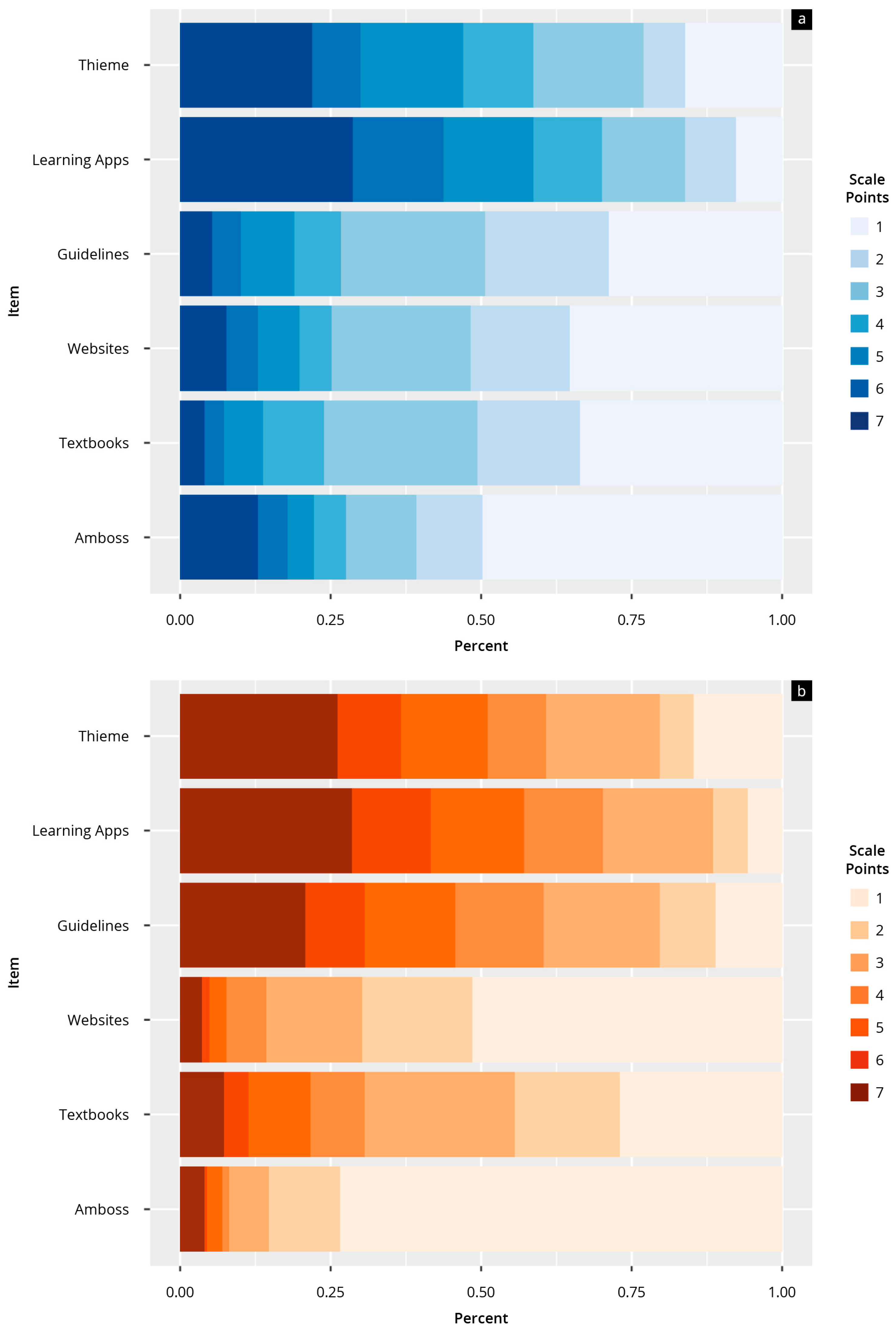
The use of reference materials (Figure 2 and Supplementary Table S4) revealed more pronounced differences between the groups. Students used AMBOSS significantly more frequently than physicians (mean: 1.7 ± 1.4 vs. 2.7 ± 2.2; p < 0.001). Websites were also consulted more frequently by students (mean: 2.1 ± 1.5 vs. 2.8 ± 1.0; p < 0.001). On the other hand, physicians made significantly more use of guidelines (mean: 2.8 ± 1.8 vs. 4.3 ± 2.0; p < 0.001). Books showed a tendency towards higher usage among physicians (mean: 2.7 ± 1.6 vs. 3.0 ± 1.8; p = 0.03). No significant differences were observed between the groups for the use of the Thieme online library or learning apps (p = 0.26).
Students tended to report using the AMBOSS platform most frequently (mean: 1.7), followed by general websites (mean: 2.1). Physicians, in contrast, used a balanced mix of reference books (mean: 2.7), AMBOSS (mean: 2.7), and guidelines (mean: 2.8).
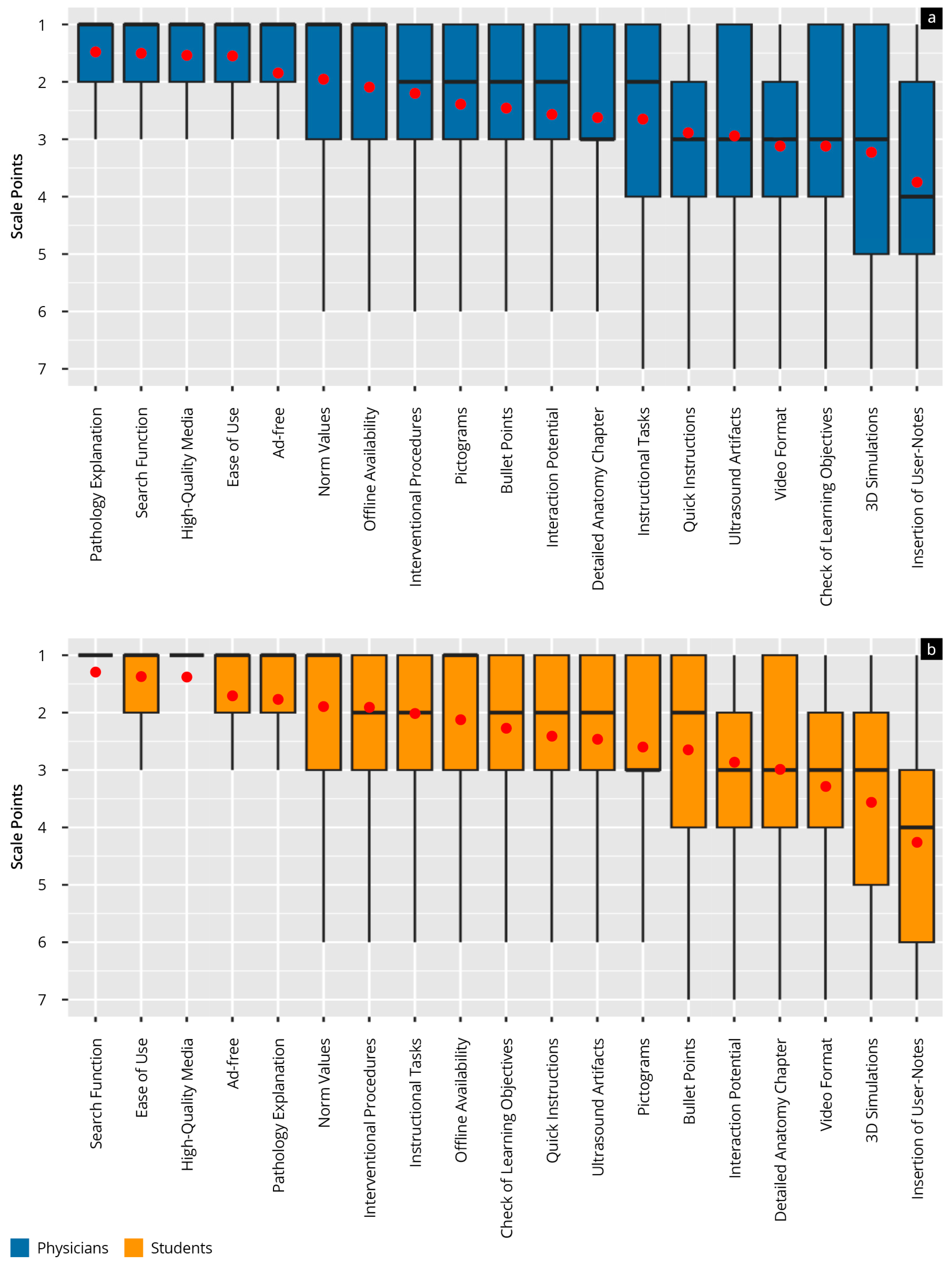
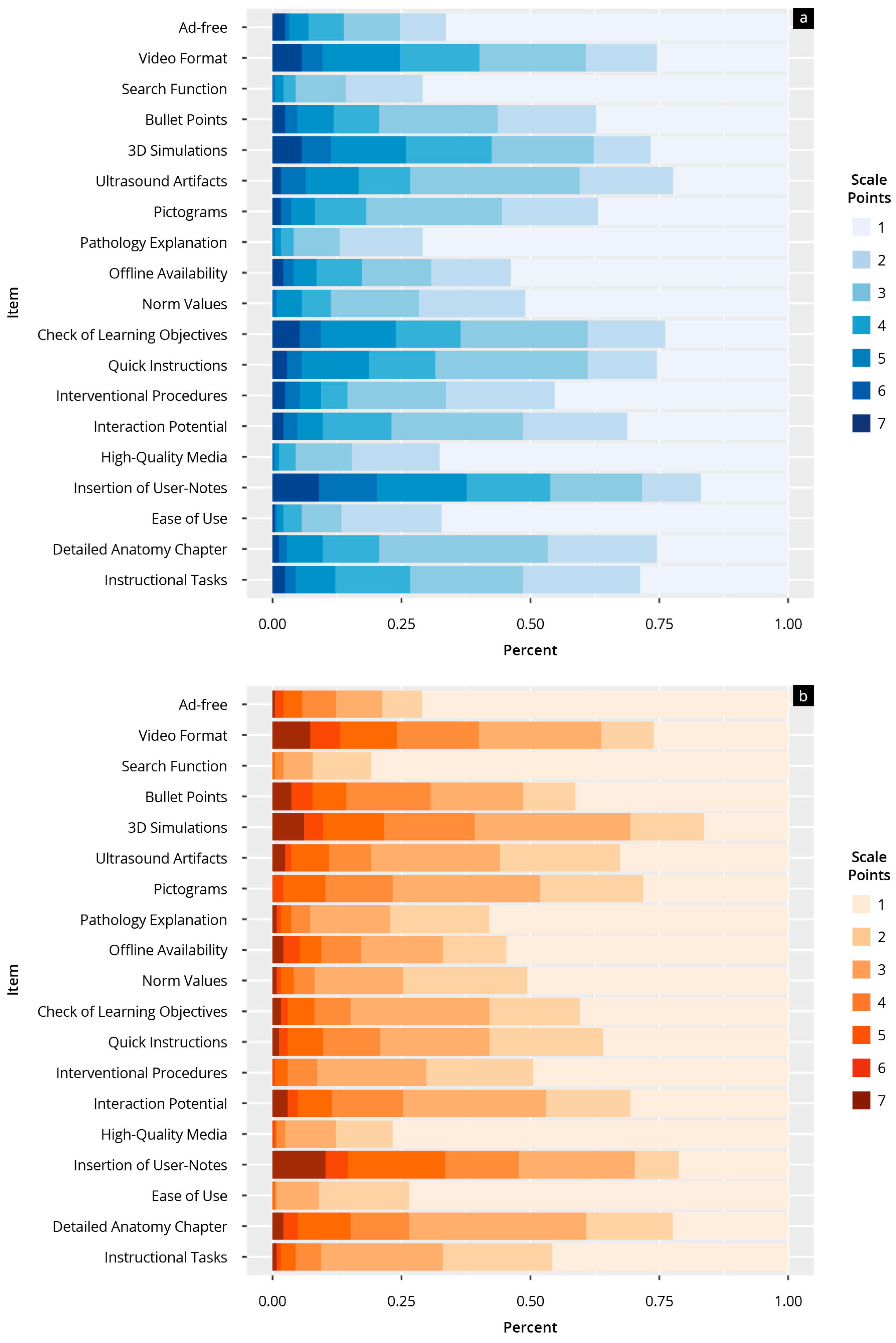
Regarding format and features (see Table 3, Figure 3 and Figure 4), both groups identified the search function as a key requirement (mean: 1.4), with students placing significantly more importance on this feature than physicians (1.3 vs. 1.5; p = 0.005). The ability to add notes, by contrast, was deemed less important (mean: 3.7). Both groups rated normative values (mean: 1.9) as relevant, with no significant differences (p = 0.60).
In the area of multimedia design, the demand for high-quality media was emphasised (mean: 1.47), with students rating this slightly higher (1.4 vs. 1.5; p = 0.06). Video formats (mean: 3.2) and 3D simulations (mean: 3.3) were considered much less important, while bullet points (mean: 2.6) and pictograms (mean: 2.5) attracted moderate interest, with no significant group differences.
Regarding content structuring, several focal points were identified. Pathology explanations were rated as particularly important by both groups (mean: 1.6), with students showing a significantly higher demand (1.8 vs. 1.48; p = 0.001). Intervention procedures (mean: 2.1) and instructional tasks (mean: 2.4) were also of high interest, particularly among students (p = 0.02 and p < 0.001, respectively). Physicians, however, rated a detailed anatomy chapter (mean: 2.6 vs. 2.9; p = 0.05) and a chapter on acoustic artefacts (mean: 2.9 vs. 2.5; p = 0.002) as more important. Learning assessments were generally given moderate importance (mean: 2.71), though students significantly emphasised their inclusion (2.3 vs. 3.1; p < 0.001).
The need for interactivity was rated moderately overall (mean 2.6), with no significant differences between groups (p = 0.47).
In terms of usability, ease of use was a central criterion (mean 1.5), with students again assigning it a significantly higher priority (1.4 vs. 1.6; p = 0.02). A short user guide was also considered relevant (mean 2.7), with a stronger preference among students (2.4 vs. 2.9; p < 0.001).
For the context of use, both groups similarly emphasised the need for offline availability (mean 2.1; p = 0.81). Regarding funding, both groups agreed on the importance of ad-free platforms (mean 1.8), with no significant differences (p = 0.26).

4. Discussion

4.1. Relevance and Key Findings

Ultrasound has become indispensable in modern clinical practice, yet training remains heterogeneous and resource intensive. Digitalisation offers a unique opportunity to address these challenges by providing scalable, standardised, and flexible teaching formats [12]. By shifting theoretical content to digital platforms and reserving in-person sessions for hands-on practice, digital tools can enhance efficiency and improve comparability across institutions.
Our multi-year needs assessment shows persistently high acceptance of integrating ultrasound into medical education, particularly via digital formats, among both students and physicians. This aligns with prior reviews of digital medical education and ultrasound teaching, and with controlled and randomised studies reporting at least comparable learning outcomes and high acceptance for e-learning [10,11,12,36,37]. Notably, the results show that this is not a short-lived trend, but rather a sustained demand across different learner groups. Digital formats are now seen as essential components of ultrasound education rather than optional supplements.

4.2. Digital Ultrasound Education: A Long-Term Demand

Both students and physicians consistently endorsed integrating ultrasound education into standard curricula and rated digital formats as helpful for mastering theoretical content. While our data do not establish a formal time trend, the pattern indicates sustained high acceptance, aligning with prior reviews and controlled studies that demonstrate comparable effectiveness and strong acceptance of e-learning in clinical education [6,38]. This underscores the need for structured and consistent digital ultrasound education.
Beyond the overall acceptance of digital formats, one specific finding of our study requires further contextualisation: the comparatively low favourability of pure case-based learning. This finding may reflect the well-described limitations of case-based formats when applied in isolation, especially in procedural fields such as ultrasound. Prior work has shown that although case-based learning effectively promotes diagnostic reasoning, learners frequently perceive it as insufficient for acquiring psychomotor and image-acquisition skills, which require guided hands-on practice [39]. Against this backdrop, hybrid models that combine digital case modules with structured in-person scanning sessions represent a promising alternative. Such blended formats leverage the strengths of case-based reasoning while ensuring the practical skill development that learners consider essential for ultrasound training [40]. In this sense, the observed “long-term demand” reflects the ongoing institutionalisation of digitally supported ultrasound teaching within blended curricula [18].
The exploratory sensitivity analyses across survey years revealed some variation in individual item ratings; however, these fluctuations did not alter the overarching pattern of strong agreement regarding the relevance of ultrasound education and the value of digital learning media. Year-to-year differences may reflect contextual factors, such as curricular developments or broader shifts in digital teaching during the study period, but the consistently high mean ratings across all years indicate that the identified needs were stable over time. This suggests that the overall conclusions of the needs assessment are robust despite temporal variation.
Although the study period overlapped with the COVID-19 pandemic, which temporarily accelerated the adoption of digital teaching formats, the consistently high support for digitalisation across all survey years indicates that the demand for digital ultrasound education exceeds pandemic-related influences and likely reflects a persistent structural gap in the integration of digital formats.
The consistently high agreement regarding the integration of ultrasound training into undergraduate and postgraduate education further supports this approach and underlines the relevance of structured teaching concepts. These findings are also broadly aligned with international ultrasound education standards. The European Federation of Societies for Ultrasound in Medicine and Biology (EFSUMB) emphasises structured, modular curricula and recommends blended learning approaches in which digital preparation complements supervised hands-on training [8]. Although our study focused on attitudes toward digital teaching rather than practical skills, the strong and stable support for digital resources in our cohort aligns with these principles and highlights the potential role of digital tools as preparatory or complementary elements within comprehensive ultrasound curricula.

4.3. Offline Accessibility: A Critical Feature

One crucial feature highlighted by both student and physician groups is the demand for offline availability of digital learning resources. Previous systematic reviews have shown that offline digital education can be effective in medical training and may serve as an essential complement in contexts with limited internet access [41]. Given the heterogeneity of devices (Android/iOS/Windows), a web-first approach with robust offline caching (downloadable modules, prefetching of slides/videos) can minimise platform-specific development while maintaining accessibility. This balances technical feasibility with user needs, recognising that intermittent connectivity remains common in many training environments. In short, offline capability should be treated as a core requirement, not an optional add-on [41].

4.4. Different Use of Learning Resources: Age and Experience Matter

Students reported more frequent use of digital platforms, consistent with their focus on building foundational knowledge [28], whereas physicians relied more heavily on textbooks and clinical guidelines to support decision-making in daily practice [42].
These patterns align with the Unified Theory of Acceptance and Use of Technology (UTAUT), where effort expectancy (usability, interactivity) tends to be more salient for students and performance expectancy (clinical applicability) for physicians [26]. Recognising these emphases helps tailor content depth and examples without altering the core platform design.

4.5. Mobile Devices and Their Role in Learning

Although smartphones are nearly universal, respondents primarily used them for quick look-ups and micro-learning, reserving laptops/desktops for sustained, in-depth study—consistent with higher-education evidence [43,44,45]. Meta-analytic data nevertheless indicate that well-designed mobile apps can improve knowledge and skills in medical education [15]. Accordingly, ultrasound e-learning should be optimised for laptop/desktop use (deep study), complemented by a responsive mobile experience for rapid search and concise media [45].

4.6. Minimal Differences in Needs Between Groups

Despite differing contexts of use, the core requirements converged across cohorts: powerful search, intuitive usability, clear organisation, and high-quality multimedia were consistently top-ranked, in line with reviews of digital medical education [9]. These findings support the development of universal, well-designed platforms that serve heterogeneous learner groups while offering optional adaptivity (such as pretests or selectable difficulty levels) to accommodate subgroup preferences [15,46]. The comparatively low ratings for video-based and 3D elements may reflect limited prior exposure and the perceived cognitive load associated with complex multimedia formats. Previous work suggests that when engaging with digital materials, learners tend to prioritise clarity, structure, and direct applicability over more elaborate visualisations [47,48].

4.7. Emerging Technologies and Future Perspectives

Beyond traditional e-learning formats, emerging technologies such as tele-ultrasound, augmented and virtual reality, and simulator-based training hold promise for further advancing digital ultrasound education [38]. These tools may enhance interactivity, facilitate remote mentorship, and improve skill transfer. However, their integration requires rigorous evaluation, cost–benefit analyses, and alignment with established didactic principles.
To ensure that such innovations remain sustainable and responsive to evolving learner needs, future development may also benefit from applying structured frameworks such as ADDIE [49]. Its iterative cycle—analysis, design, development, implementation, and evaluation—provides a systematic approach for integrating technical requirements (including offline accessibility and cross-platform compatibility) with continuous user feedback and outcome assessment.

4.8. Sustainability and Resource Considerations

The implementation of digital tools is not only a question of pedagogical design but also of sustainable financing and maintenance [50]. Institutions differ widely in licences and technical infrastructure, which can exacerbate inequalities in access. Moreover, infrastructure constraints and variable faculty capability frequently hinder effective adoption; even high-quality materials require regular updates and platform maintenance to remain current. Addressing these challenges will require investment in IT resources, connectivity, and dedicated instructional support, including protected time for faculty development.
Finally, digital ultrasound learning lacks uniform quality benchmarks and certification pathways. To align learning milestones with quality assurance, the field requires society-led core objectives, standardised digital modules, and objective assessments embedded in certification frameworks—an approach implicitly endorsed by our users when emphasising organisation, transparency, and reliable evaluation [50].

4.9. Strengths and Limitations

A major strength of this study is the large sample size, comprising almost 3000 participants from both students and physician cohorts over several years. Another strength lies in its multidimensional approach: by combining a structural needs analysis with a user-centred assessment, the study captures both systemic and individual perspectives. Furthermore, the development of the questionnaires was guided by established theoretical frameworks such as UTAUT, enhancing the validity of the findings.
Nevertheless, several limitations must be acknowledged. Selection bias is possible, as digitally inclined participants may have been more likely to respond, and pandemic-related digital fatigue may have influenced attitudes toward certain formats. The study’s regional scope—all participants were recruited from German-speaking university and clinical training environments—may limit generalisability to other educational systems, languages, and health-care infrastructures, particularly in low-resource settings where access, curricular structure, and resources differ. Data are based on self-reported preferences and needs rather than objective measurements of learning success or competency acquisition. Additionally, detailed information on specialty, clinical experience, and age was insufficient to allow meaningful subgroup analyses, preventing exploration of potential differences between specialties or experience levels.
The study period was limited to 2017–2023, as surveys were administered only during this timeframe; data collection ended in 2023 due to curricular restructuring and the transition to updated digital learning formats. Finally, the study focused on perceived demand rather than on the actual effectiveness, cost-effectiveness, scalability, or institutional feasibility of digital learning tools. These aspects are crucial for practical integration into curricula and for informing policy decisions at the faculty and national levels. Future research should prospectively collect demographic and specialty data, evaluate learning outcomes, and explore economic and implementation considerations to support sustainable and standardised digital ultrasound education across diverse health-care systems.

4.10. Future Perspectives

To improve the transferability of our findings to diverse contexts, several adaptable strategies should be considered. These include designing low-bandwidth, offline-capable e-learning modules for regions with limited internet access; using platform-independent and cost-neutral formats to reduce barriers in low-resource settings; and structuring content modularly to facilitate translation and cultural adaptation for non-German-speaking regions. Aligning digital materials with international ultrasound education frameworks may further support their applicability across different educational systems. Future studies should incorporate follow-up surveys after the implementation of digital ultrasound tools to assess sustained use, satisfaction, and real-world engagement. Such longitudinal data would help to bridge the gap between stated preferences and actual user behaviour, providing a more comprehensive understanding of long-term acceptance and usability.
Beyond survey-based needs assessments, future work could integrate advances in explainable learning analytics, such as knowledge-tracing models grounded in cognitive learning theory, to model individual learning trajectories and adapt digital ultrasound training accordingly [51]. Concurrently, rapid developments in robotic ultrasound path planning and dynamic contact-force regulation illustrates how automation may reshape ultrasound practice and underscore the importance of robust foundational training in image interpretation and probe handling [52].

5. Conclusions

In conclusion, this study highlights the growing demand for digital ultrasound training and its clear implications for curriculum development in medical education. The integration of digital resources emerges as a critical factor in facilitating learning across diverse medical contexts. While students and physicians differ in their preferred educational tools, their core requirements—functionality, usability, and high-quality content—are largely shared. The challenge for developers and educators is to design flexible, scalable, and accessible digital learning tools that meet these needs and support widespread adoption of ultrasound education across the medical community. In future, the establishment of standardised approaches to digital ultrasound education will be essential to ensure that digital ultrasound resources are both effective and universally available.

Supplementary Materials

The following supporting information can be downloaded at: https://www.mdpi.com/article/10.3390/app16010071/s1, Table S1: Overview of included datasets for the years 2017–2022; Table S2: Evaluation results from the needs analysis (2017–2022) using a Likert scale (1 = strong agreement, 7 = no agreement); Table S3: Devices used by both groups; Table S4: Overview of the use of reference materials.

Author Contributions

Conceptualization, J.M.W., S.K. and L.W.; methodology J.M.W. and S.K.; software, J.M.W. and S.K.; validation, F.R. and H.B.; formal analysis, J.M.W., S.K. and L.M. investigation, J.M.W. and L.W.; resources, H.B. and J.W.M.; data curation, J.M.W., S.K., A.M.W. and L.W.; writing—original draft preparation, J.M.W., F.R. and L.W.; writing—review and editing, J.M.W., F.R., T.V., S.K., A.M.W., J.W.M., H.B., J.K., M.R., D.M., L.M., L.P. and L.W.; visualisation J.M.W. and S.K.; supervision J.M.W. and J.W.M. project administration, J.M.W., S.K. and L.W.; All authors have read and agreed to the published version of the manuscript.

Funding

This research received no external funding.

Institutional Review Board Statement

After consultation with the local ethics committee of the State medical association of Rhineland-Palatinate (“Ethik-Kommission der Landesärztekammer Rheinland-Pfalz”, Mainz, Germany) the need for approval for this study was waived and an ethics approval was not necessary. All procedures performed in studies involving human participants were in accordance with the ethical standards of the institutional and national research committee and with the 1964 Helsinki declaration and its later amendments or comparable ethical standards.

Data Availability Statement

The data presented in this study are available on request from the corresponding author. The data are not publicly available because of institutional and national data policy restrictions imposed by the ethics committee since the data contain information that could potentially identify study participants. Data are available upon request (contact via weimer@uni mainz.de) for researchers who meet the criteria for access to confidential data (please provide the manuscript title with your inquiry).

Acknowledgments

This study includes parts of the doctoral thesis of one of the authors (S.K.). We thank all participating students and lecturers for supporting our study. We would like to also thank Celine. Christe for her help in revising the figures. We would like to express our gratitude to Kay Stankov for his contributions to this publication. His dedicated efforts in consulting, supervising, and meticulously reviewing all statistical aspects have been instrumental in ensuring the rigour and accuracy of our research findings.

Conflicts of Interest

The authors declare no conflicts of interest.

References

  1. Dietrich, C.F.; Bolondi, L.; Duck, F.; Evans, D.H.; Ewertsen, C.; Fraser, A.G.; Gilja, O.H.; Jenssen, C.; Merz, E.; Nolsoe, C.; et al. History of Ultrasound in Medicine from its birth to date (2022), on occasion of the 50 Years Anniversary of EFSUMB. A publication of the European Federation of Societies for Ultrasound In Medicine and Biology (EFSUMB), designed to record the historical development of medical ultrasound. Med. Ultrason. 2022, 24, 434–450. [Google Scholar] [CrossRef] [PubMed]
  2. Ginsburg, A.S.; Liddy, Z.; Khazaneh, P.T.; May, S.; Pervaiz, F. A survey of barriers and facilitators to ultrasound use in low- and middle-income countries. Sci. Rep. 2023, 13, 3322. [Google Scholar] [CrossRef]
  3. Torres-Macho, J.; Aro, T.; Bruckner, I.; Cogliati, C.; Gilja, O.H.; Gurghean, A.; Karlafti, E.; Krsek, M.; Monhart, Z.; Müller-Marbach, A.; et al. Point-of-care ultrasound in internal medicine: A position paper by the ultrasound working group of the European federation of internal medicine. Eur. J. Intern. Med. 2020, 73, 67–71. [Google Scholar] [CrossRef]
  4. Fodor, D.; Badea, R.; Poanta, L.; Dumitrascu, D.L.; Buzoianu, A.D.; Mircea, P.-A. The use of ultrasonography in learning clinical examination—A pilot study involving third year medical students. Med. Ultrason. 2012, 14, 177–181. [Google Scholar] [CrossRef]
  5. Bahner, D.P.; Goldman, E.; Way, D.; Royall, N.A.; Liu, Y.T. The State of Ultrasound Education in U.S. Medical Schools: Results of a National Survey. Acad. Med. 2014, 89, 1681–1686. [Google Scholar] [CrossRef] [PubMed]
  6. Neubauer, R.; Bauer, C.J.; Dietrich, C.F.; Strizek, B.; Schäfer, V.S.; Recker, F. Evidence-based Ultrasound Education?—A Systematic Literature Review of Undergraduate Ultrasound Training Studies. Ultrasound Int. Open 2024, 10, a22750702. [Google Scholar] [CrossRef]
  7. Hoppmann, R.A.; Mladenovic, J.; Melniker, L.; Badea, R.; Blaivas, M.; Montorfano, M.; Abuhamad, A.; Noble, V.; Hussain, A.; Prosen, G.; et al. International consensus conference recommendations on ultrasound education for undergraduate medical students. Ultrasound J. 2022, 14, 31. [Google Scholar] [CrossRef]
  8. Cantisani, V.; Dietrich, C.; Badea, R.; Dudea, S.; Prosch, H.; Cerezo, E.; Nuernberg, D.; Serra, A.; Sidhu, P.; Radzina, M.; et al. EFSUMB Statement on Medical Student Education in Ultrasound [long version]. Ultrasound Int. Open 2016, 2, E2–E7. [Google Scholar] [CrossRef]
  9. Ogundiya, O.; Rahman, T.J.; Valnarov-Boulter, I.; Young, T.M. Looking Back on Digital Medical Education Over the Last 25 Years and Looking to the Future: Narrative Review. J. Med. Internet Res. 2024, 26, e60312. [Google Scholar] [CrossRef]
  10. Yeung, A.W.K.; Parvanov, E.D.; Hribersek, M.; Eibensteiner, F.; Klager, E.; Kletecka-Pulker, M.; Rössler, B.; Schebesta, K.; Willschke, H.; Atanasov, A.G.; et al. Digital Teaching in Medical Education: Scientific Literature Landscape Review. JMIR Med. Educ. 2022, 8, e32747. [Google Scholar] [CrossRef] [PubMed]
  11. McGee, R.G.; Wark, S.; Mwangi, F.; Drovandi, A.; Alele, F.; Malau-Aduli, B.S.; The, A.C. Digital learning of clinical skills and its impact on medical students’ academic performance: A systematic review. BMC Med. Educ. 2024, 24, 1477. [Google Scholar] [CrossRef]
  12. Blank, V.; Strobel, D.; Karlas, T. Digital Training Formats in Ultrasound Diagnostics for physicians: What options are available and how can they be successfully integrated into current DEGUM certified course concepts? Ultraschall Med. 2022, 43, 428–434. [Google Scholar] [CrossRef]
  13. Weimer, J.M.; Recker, F.; Horn, L.; Kuenzel, J.; Dirks, K.; Ille, C.; Buggenhagen, H.; Börner, N.; Weimer, A.M.; Vieth, T.; et al. Insights Into Modern Undergraduate Ultrasound Education: Prospective Comparison of Digital and Analog Teaching Resources in a Flipped Classroom Concept—The DIvAN Study. Ultrasound Int. Open 2024, 10, a23899410. [Google Scholar] [CrossRef] [PubMed]
  14. Lien, W.C.; Lin, P.; Chang, C.H.; Wu, M.C.; Wu, C.Y. The effect of e-learning on point-of-care ultrasound education in novices. Med. Educ. Online 2023, 28, 2152522. [Google Scholar] [CrossRef] [PubMed]
  15. Chandran, V.P.; Balakrishnan, A.; Rashid, M.; Pai Kulyadi, G.; Khan, S.; Devi, E.S.; Nair, S.; Thunga, G. Mobile applications in medical education: A systematic review and meta-analysis. PLoS ONE 2022, 17, e0265927. [Google Scholar] [CrossRef] [PubMed]
  16. Höhne, E.; Recker, F.; Schmok, E.; Brossart, P.; Raupach, T.; Schäfer, V.S. Conception and Feasibility of a Digital Tele-Guided Abdomen, Thorax, and Thyroid Gland Ultrasound Course for Medical Students (TELUS study). Ultraschall Med. 2021, 44, 194–202. [Google Scholar] [CrossRef]
  17. Weimer, J.M.; Sprengart, F.M.; Vieth, T.; Göbel, S.; Dionysopoulou, A.; Krüger, R.; Beer, J.; Weimer, A.M.; Buggenhagen, H.; Kloeckner, R.; et al. Simulator training in focus assessed transthoracic echocardiography (FATE) for undergraduate medical students: Results from the FateSim randomized controlled trial. BMC Med. Educ. 2025, 25, 21. [Google Scholar] [CrossRef]
  18. Ruppert, J.; Krüger, R.; Göbel, S.; Wolfhard, S.; Lorenz, L.-A.; Weimer, A.M.; Kloeckner, R.; Waezsada, E.; Buggenhagen, H.; Weinmann-Menke, J.; et al. The effectiveness of e-learning in focused cardiac ultrasound training: A prospective controlled study. BMC Med. Educ. 2025, 25, 806. [Google Scholar] [CrossRef]
  19. Altersberger, M.; Pavelka, P.; Sachs, A.; Weber, M.; Wagner-Menghin, M.; Prosch, H. Student Perceptions of Instructional Ultrasound Videos as Preparation for a Practical Assessment. Ultrasound Int. Open 2019, 5, E81–E88. [Google Scholar] [CrossRef]
  20. Jensen, J. FIELD: A program for simulating ultrasound systems. Med. Biol. Eng. Comput. 1996, 34, 351–352. [Google Scholar]
  21. Garcia, D. Make the most of MUST, an open-source Matlab UltraSound Toolbox. In Proceedings of the 2021 IEEE International Ultrasonics Symposium (IUS), Xi’an, China, 11–16 September 2021. [Google Scholar]
  22. Ruiz, J.G.; Mintzer, M.J.; Leipzig, R.M. The impact of E-learning in medical education. Acad. Med. 2006, 81, 207–212. [Google Scholar] [CrossRef]
  23. Weimer, J.; Recker, F.; Krüger, R.; Müller, L.; Buggenhagen, H.; Kurz, S.; Weimer, A.; Lorenz, L.-A.; Kloeckner, R.; Ruppert, J.; et al. The Effectiveness of Digital vs. Analogue Teaching Resources in a Flipped Classroom for Undergraduate Focus Cardiac Ultrasound Training: A Prospective, Randomised, Controlled Single-Centre Study. Educ. Sci. 2025, 15, 810. [Google Scholar] [CrossRef]
  24. Hautz, S.C.; Hoffmann, M.; Exadaktylos, A.K.; Hautz, W.E.; Sauter, T.C. Digital competencies in medical education in Switzerland: An overview of the current situation. GMS J. Med. Educ. 2020, 37, Doc62. [Google Scholar] [CrossRef]
  25. Herbert, A.; Russell, F.M.; Zahn, G.; Zakeri, B.; Motzkus, C.; Wallach, P.M.; Ferre, R.M. Point-of-Care Ultrasound Education During a Pandemic: From Webinar to Progressive Dinner-Style Bedside Learning. Cureus 2022, 14, e25141. [Google Scholar] [CrossRef] [PubMed]
  26. Xue, L.; Rashid, A.M.; Ouyang, S. The Unified Theory of Acceptance and Use of Technology (UTAUT) in Higher Education: A Systematic Review. SAGE Open 2024, 14, 21582440241229570. [Google Scholar] [CrossRef]
  27. Niegemann, H.M.; Niegemann, L. IzELA: Ein Instructional Design basiertes Evaluationstool für Lern-Apps. In Digitalisierung und Bildung; Ladel, S., Knopf, J., Weinberger, A., Eds.; Springer Fachmedien Wiesbaden: Wiesbaden, Germany, 2018; pp. 159–175. [Google Scholar]
  28. Lawrence, E.C.N.; Dine, C.J.; Kogan, J.R. Preclerkship Medical Students’ Use of Third-Party Learning Resources. JAMA Netw. Open 2023, 6, e2345971. [Google Scholar] [CrossRef] [PubMed]
  29. O’Doherty, D.; Dromey, M.; Lougheed, J.; Hannigan, A.; Last, J.; McGrath, D. Barriers and solutions to online learning in medical education—An integrative review. BMC Med. Educ. 2018, 18, 130. [Google Scholar] [CrossRef]
  30. Regmi, K.; Jones, L. A systematic review of the factors—Enablers and barriers—Affecting e-learning in health sciences education. BMC Med. Educ. 2020, 20, 91. [Google Scholar] [CrossRef] [PubMed]
  31. Müller, E.; Goebel, S.; Couné, B. Bedarfsanalyse—Palliative Care Basics; Universität Freiburg, Wissenschaftliche Weiterbildung: Freiburg, Germany, 2014. [Google Scholar]
  32. Maguire, M.C.; Bevan, N. User Requirements Analysis A Review of Supporting Methods. In IFIP—The International Federation for Information Processing; Springer: Boston, MA, USA, 2003. [Google Scholar]
  33. Lemke, C.; Kirchner, K.; Brenner, B. Es ist Vorlesung und Keiner Geht Hin: Nutzerzentrierte Bedürfnisanalyse für Eine Digitale Lehr-und Lernplattform; Gesellschaft für Informatik: Hamburg, Germany, 2017. [Google Scholar]
  34. Likert, R.A. A technique for developing suppression tests. Educ. Psychol. Meas. 1952, 12, 313–315. [Google Scholar] [CrossRef]
  35. Rivera-Garrido, N.; Ramos-Sosa, M.P.; Accerenzi, M.; Brañas-Garza, P. Continuous and binary sets of responses differ in the field. Sci. Rep. 2022, 12, 14376. [Google Scholar] [CrossRef]
  36. Weimer, A.M.; Berthold, R.; Schamberger, C.; Vieth, T.; Balser, G.; Berthold, S.; Stein, S.; Müller, L.; Merkel, D.; Recker, F.; et al. Digital Transformation in Musculoskeletal Ultrasound: Acceptability of Blended Learning. Diagnostics 2023, 13, 3272. [Google Scholar] [CrossRef]
  37. Nourkami-Tutdibi, N.; Hofer, M.; Zemlin, M.; Abdul-Khaliq, H.; Tutdibi, E. TEACHING MUST GO ON: Flexibility and advantages of peer assisted learning during the COVID-19 pandemic for undergraduate medical ultrasound education—Perspective from the “sonoBYstudents” ultrasound group. GMS J. Med. Educ. 2021, 38, Doc5. [Google Scholar] [CrossRef]
  38. Daum, N.; Blaivas, M.; Goudie, A.; Hoffmann, B.; Jenssen, C.; Neubauer, R.; Recker, F.; Moga, T.V.; Zervides, C.; Dietrich, C.F. Student ultrasound education, current view and controversies. Role of Artificial Intelligence, Virtual Reality and telemedicine. Ultrasound J. 2024, 16, 44. [Google Scholar] [CrossRef]
  39. Cook, D.A.; Artino, A.R., Jr. Motivation to learn: An overview of contemporary theories. Med. Educ. 2016, 50, 997–1014. [Google Scholar] [CrossRef] [PubMed]
  40. Mahnken, A.H.; Baumann, M.; Meister, M.; Schmitt, V.; Fischer, M.R. Blended learning in radiology: Is self-determined learning really more effective? Eur. J. Radiol. 2011, 78, 384–387. [Google Scholar] [CrossRef]
  41. Kyaw, B.M.; Posadzki, P.; Dunleavy, G.; Semwal, M.; Divakar, U.; Hervatis, V.; Tudor Car, L. Offline Digital Education for Medical Students: Systematic Review and Meta-Analysis by the Digital Health Education Collaboration. J. Med. Internet Res. 2019, 21, e13165. [Google Scholar] [CrossRef]
  42. Aakre, C.A.; Pencille, L.J.; Sorensen, K.J.; Shellum, J.L.; Del Fiol, G.; Maggio, L.A.; Prokop, L.J.; Cook, D.A. Electronic Knowledge Resources and Point-of-Care Learning: A Scoping Review. Acad. Med. 2018, 93, S60–S67. [Google Scholar] [CrossRef]
  43. Bauer, S.; Salter, A.; Bennett, L.; Seilhamer, R.; Chen, B. Changing Mobile Learning Practices: A Multiyear Study 2012–2016. Educ. Rev. 2018. Available online: https://er.educause.edu/articles/2018/4/changing-mobile-learning-practices-a-multiyear-study-2012-2016 (accessed on 6 December 2025).
  44. Robert, J. EDUCAUSE QuickPoll Results: Flexibility and Equity for Student Success. Educ. Rev. 2021. Available online: https://www.proquest.com/openview/766f329b2c76b4be35493cb091292c4c/1?pq-origsite=gscholar&cbl=7213897# (accessed on 6 December 2025).
  45. Crompton, H.; Burke, D. The use of mobile learning in higher education: A systematic review. Comput. Educ. 2018, 123, 53–64. [Google Scholar] [CrossRef]
  46. Designentscheidungen: Das DO-ID-Modell. In Kompendium multimediales Lernen; Niegemann, H.M., Ed.; Springer: Berlin/Heidelberg, Germany, 2008; pp. 83–88. [Google Scholar]
  47. Bui, I.; Bhattacharya, A.; Wong, S.H.; Singh, H.R.; Agarwal, A. Role of Three-Dimensional Visualization Modalities in Medical Education. Front. Pediatr. 2021, 9, 760363. [Google Scholar] [CrossRef] [PubMed]
  48. Mayer, R. Multimedia Learning; Cambridge University Press: Cambridge, UK, 2020. [Google Scholar]
  49. Allen, W.C. Overview and Evolution of the ADDIE Training System. Adv. Dev. Human Resour. 2006, 8, 430–441. [Google Scholar] [CrossRef]
  50. Nilsson, P.M.; Todsen, T.; Subhi, Y.; Graumann, O.; Nolsøe, C.P.; Tolsgaard, M.G. Cost-Effectiveness of Mobile App-Guided Training in Extended Focused Assessment with Sonography for Trauma (eFAST): A Randomized Trial. Ultraschall Med. 2017, 38, 642–647. [Google Scholar] [CrossRef] [PubMed]
  51. Huang, C.; Huang, Q.; Huang, X.; Wang, H.; Li, M.; Lin, K.-J.; Chang, Y. XKT: Toward Explainable Knowledge Tracing Model With Cognitive Learning Theories for Questions of Multiple Knowledge Concepts. IEEE Trans. Knowl. Data Eng. 2024, 36, 7308–7325. [Google Scholar] [CrossRef]
  52. Zhang, L.; Yang, D.; Niu, B.; Yang, H.; Huang, Q.; Jiang, L.; Liu, H. Smooth Path Planning and Dynamic Contact Force Regulation for Robotic Ultrasound Scanning. IEEE Robot. Autom. Lett. 2025, 10, 10570–10577. [Google Scholar] [CrossRef]
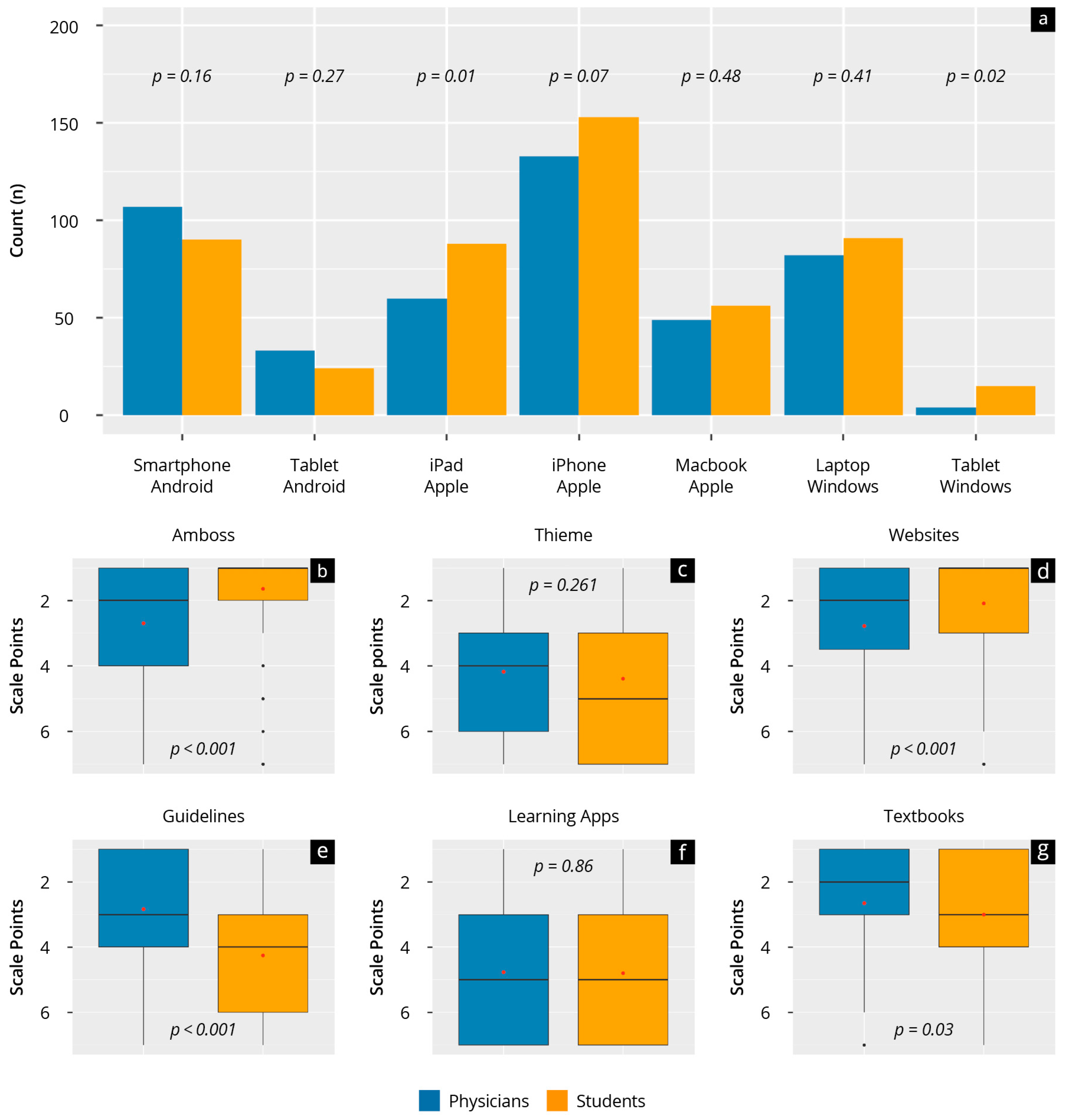
Figure 1. Use of devices and reference materials by physicians and students. (a) Comparison of currently used devices; (bg) comparison of the use of reference materials. Red dots represent the mean value.
Applsci 16 00071 g001
Figure 2. Bar plot visualisation of the current use of reference materials for physicians (a) and students (b). A score of 1 indicates high agreement/need.
Applsci 16 00071 g002
Figure 3. Boxplot visualisation of the user-centred needs analysis for digital teaching media, shown separately for physicians (a) and students (b). Ratings are based on a 7-point Likert scale, where 1 indicates strong agreement and higher perceived need. Red dots represent mean values.
Applsci 16 00071 g003
Figure 4. Stacked bar plot visualisation of the user-centred requirements analysis for digital teaching media, shown separately for physicians (a) and students (b). Bars represent the distribution of responses across the 7-point Likert scale, where 1 indicates strong agreement and higher perceived relevance. Higher proportions of lower scale values correspond to stronger user preference for the respective feature.
Applsci 16 00071 g004
Table 1. Items from Questionnaire 1 (Structural Needs Analysis) and Questionnaire 2 (Evaluation Form for User-Centred Requirements Analysis/Needs Assessment). (1 = strongly agree, 7 = strongly disagree).
Main ItemSubitemScale Levels
Questionnaire 1
AttitudeUltrasound in Medical StudiesLikert format 1–7
Ultrasound in Compulsory Teaching
DigitalisationIntegration of Digital Learning Media in Ultrasound Teaching
Development of Digital Learning Media
Current Use of Digital Learning Media in Clinical Practice
Case Studies/
Case-Based Learning
Integration of Case Studies in Ultrasound TeachingLikert format 1–7
Pure Case-Based Learning
Questionnaire 2
Format und FeaturesSearch FunctionLikert format 1–7
Insertion of User Notes
Norm Values
Multimedia DesignHigh-Quality MediaLikert format 1–7
Bullet Points
Video Format
3D Simulations
Pictograms
Content StructuringDetailed Anatomy ChapterLikert format 1–7
Interventional Procedures
Ultrasound Artefacts chapter
Pathology Explanation
Learning Objective Checks
Instructional Tasks
InteractivityInteraction PotentialLikert format 1–7
UsabilityEase of UseLikert format 1–7
Quick Instructions
Context of UseOffline Availability
FinancingAd-Free
Use of Digital DevicesAndroid SmartphoneDichotomous (“Yes”; “No”)
Apple iPhone
Android Tablet
Windows Tablet
Apple iPad
Windows Laptop
Apple MacBook
Use of Educational MediaAMBOSSDichotomous (“Yes”; “No”)
Thieme
Websites
Guidelines
Learning Apps
Textbooks
Baseline CharacteristicsStudent or Physician
Table 2. Evaluation results from the needs analysis (2017–2022) using a Likert scale (1 = strong agreement, 7 = no agreement).
ItemWhole GroupStudentsPhysiciansp-Value
nMean ± SDMediannMean ± SDMedianNMean ± SDMedian
Ultrasound in Medical Studies29871.28 (0.76)125761.18 (0.58)14111.89 (1.31)1<0.001
Ultrasound in Compulsory Teaching28201.37 (0.85)125741.31 (0.76)12461.93 (1.36)1<0.001
Current Use of Digital Learning Media in Clinical Practice25382.07 (1.30)221401.99 (1.21)23982.50 (1.60)2<0.001
Integration of Digital Learning Media in Ultrasound Teaching25641.65 (1.00)121531.65 (1.02)14111.66 (0.91)10.152
Development of Digital Learning Media25051.70 (1.07)121551.72 (1.09)13501.59 (0.95)10.120
Integration of Case Studies in Ultrasound Teaching9541.43 (0.83)15741.45 (0.84)13801.41 (0.82)10.514
Pure Case-Based Learning5683.43 (1.90)33543.66 (1.98)42143.05 (1.71)3<0.001
Table 3. Mean ratings of user-centred requirements for e-learning in ultrasound education. All items were assessed using a 7-point Likert scale, where 1 = strongly agree and 7 = strongly disagree.
Whole GroupPhysiciansStudentsp-Value
MeanSDMedianMeanSDMedianMeanSDMedian
Format and FeaturesSearch Function1.400.8211.500.9311.290.6910.005
Insertion of User-Notes3.651.8943.751.8843.551.8930.236
Norm Values1.921.2011.951.2211.891.1810.594
Multimedia DesignHigh-Quality Media1.470.8711.540.9211.390.8210.062
Bullet Points2.551.6422.461.5422.641.7420.237
Video Format3.191.8133.151.7833.221.8430.684
3D Simulations3.251.7333.211.8233.301.6430.576
Pictograms2.491.3922.391.4222.591.3430.111
Content
Structuring
Detailed Anatomy Chapter2.751.4232.621.3532.871.4730.054
Interventional Procedures2.061.3222.201.5021.921.1020.021
Ultrasound Artefacts2.681.5032.891.5132.481.4720.002
Pathology Explanation1.631.0511.480.9011.781.1710.001
Check of Learning Objectives2.711.6333.121.7432.291.402<0.001
Instructional Tasks2.351.4122.661.5122.041.222<0.001
InteractivityInteraction Potential2.621.5032.571.4822.671.5330.467
UsabilityEase of Use1.460.8511.550.9911.370.6910.017
Quick Instructions2.681.5332.941.5932.411.432<0.001
Context of UseOffline Availability2.111.5312.091.5012.121.5510.809
FinancingAd-free1.781.3711.851.4511.711.2910.259
Disclaimer/Publisher’s Note: The statements, opinions and data contained in all publications are solely those of the individual author(s) and contributor(s) and not of MDPI and/or the editor(s). MDPI and/or the editor(s) disclaim responsibility for any injury to people or property resulting from any ideas, methods, instructions or products referred to in the content.