High-Intensity vs. High-Power Laser Therapy: Biophysical Implications of a Semantic Ambiguity and the Distinct Role of Photoacoustic Effects



Abstract
1. Introduction
1.1. Fundamentals of Laser Emission and Dosimetric Quantities
- Average power : Time-averaged emission of the device.
- Peak power : The instantaneous power during a single pulse, given by
- -
- is the pulse-on time (the interval during which the laser emits);
- -
- is the pulse-off time (the interval between two consecutive pulses);
- -
- is the duration of one full cycle.
1.2. Biological Mechanisms of Laser-Tissue Interaction
1.2.1. Photochemical Interactions: Mitochondrial Activation and Cellular Biostimulation
1.2.2. Photothermal Interaction: Heat-Induced Modulation of Tissue Physiology
1.2.3. Photoacoustic Interactions: Mechanical Stimulation and Regenerative Signaling
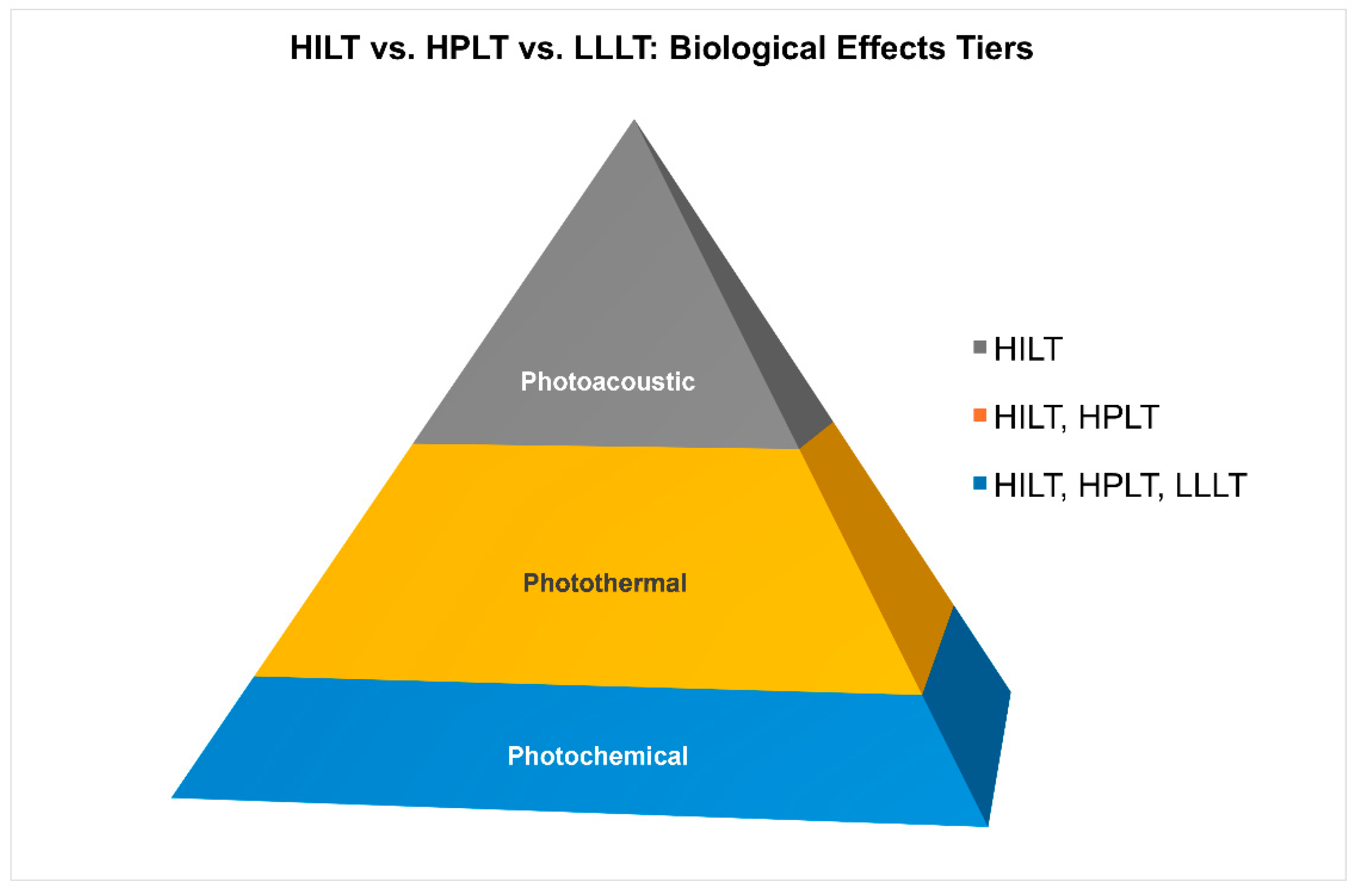
1.2.4. Mechanistic Overlap and Therapeutic Implications
- -
- Single-effect systems (LLLT): Predominantly photochemical;
- -
- Dual-effect systems (HPLT): Photochemical + photothermal;
- -
- Triple-effect systems (HILT): Photochemical + photothermal + photoacoustic.
1.3. Semantic Ambiguity of the Term HILT
1.4. Toward a Mechanism-Based Redefinition of HILT
2. Materials and Methods
3. Results
- Table 3A: Peak power of HPLT (duty cycle 25–75%) vs. HILT (duty cycle 0.1–0.5%), with the same spot diameter (0.5 cm).
- Table 3B: Corresponding peak intensity (W/cm2) values calculated from peak power using the same emitting area as in 3A.
- Table 3C: Peak intensity comparison reflecting typical operating conditions, in which HPLT systems use larger spot sizes (1.5 cm) to limit radiant exposure, whereas HILT systems commonly use 0.5 cm.
4. Discussion
- -
- Photochemical LLLT → Mitochondrial activation and redox modulation via low-power continuous or long-pulse emission.
- -
- Photothermal HPLT → Heat-induced vasodilation, collagen remodeling, and analgesia via high average power.
- -
- Photoacoustic HILT → Mechano-transductive stimulation via short, high-peak-power pulses generating acoustic pressure waves.
5. Conclusions
- 1.
- Photochemical effects → mitochondrial and metabolic stimulation (LLLT);
- 2.
- Photothermal effects → temperature-mediated modulation (HPLT and HILT);
- 3.
- Photoacoustic effects → regeneration via acoustic pressure wave-induced mechano-transduction (HILT).
Author Contributions
Funding
Institutional Review Board Statement
Informed Consent Statement
Data Availability Statement
Acknowledgments
Conflicts of Interest
List of Abbreviations
| MAPK | Mitogen-Activated Protein Kinase |
| ERK | Extracellular Signal–Regulated Kinase |
| PI3K | Phosphoinositide 3-Kinase |
| mTOR | mechanistic Target of Rapamycin |
| JNK | c-Jun N-terminal Kinase |
| TRPV | Transient Receptor Potential Vanilloid |
| HSP | Heat Shock Protein |
| TMJ | Temporomandibular Joint |
| RCT | Randomized Controlled Trial |
References
- Mester, E.; Szende, B.; Gärtner, P. The effect of laser beams on the growth of hair in mice. Radiobiol. Radiother. 1968, 9, 621–626. [Google Scholar]
- McGuff, P.E.; Deterling, R.A.; Gottlieb, L.S. Tumoricidal effect of laser energy on experimental and human malignant tumors. N. Engl. J. Med. 1965, 273, 490–492. [Google Scholar] [CrossRef] [PubMed]
- Mester, A.; Mester, A. The History of Photobiomodulation: Endre Mester (1903–1984). Photomed. Laser Surg. 2017, 35, 393–394. [Google Scholar] [CrossRef] [PubMed]
- Karu, T. Photobiology of low-power laser effects. Health Phys. 1989, 56, 691–704. [Google Scholar] [CrossRef]
- Chow, R.T.; Johnson, M.I.; Lopes-Martins, R.A.; Bjordal, J.M. Efficacy of low-level laser therapy in the management of neck pain: A systematic review and meta-analysis of randomised placebo or active-treatment controlled trials. Lancet 2009, 374, 1897–1908. [Google Scholar] [CrossRef]
- Hopkins, J.T.; McLoda, T.A.; Seegmiller, J.G.; Baxter, G.D. Low-Level Laser Therapy Facilitates Superficial Wound Healing in Humans: A Triple-Blind, Sham-Controlled Study. J. Athl. Train. 2004, 39, 223–229. [Google Scholar]
- Tunér, J.; Hode, L. The Laser Therapy Handbook; Prima Books: Grängesberg, Sweden, 2004. [Google Scholar]
- Mårdh, A.; Lund, I. High power laser for treatment of Achilles tendinosis—A single blind randomized placebo controlled clinical study. J. Lasers Med. Sci. 2016, 7, 92–98. [Google Scholar] [CrossRef]
- Fortuna, D.; Masotti, L. The HILT domain by the pulse intensity fluence (PIF) formula. Energy Health 2010, 5, 12–19. [Google Scholar]
- Ohsugi, Y.; Niimi, H.; Shimohira, T.; Hatasa, M.; Katagiri, S.; Aoki, A.; Iwata, T. In Vitro Cytological Responses against Laser Photobiomodulation for Periodontal Regeneration. Int. J. Mol. Sci. 2020, 21, 9002. [Google Scholar] [CrossRef]
- Sleep, S.; Hryciw, D.H.; Walsh, L.J.; Ranjit, E.; Tomy, N.; Arany, P.R.; George, R. Effects of Multiple Near-Infrared LEDs (700, 850, and 980 nm) CW-PBM on Mitochondrial Respiration and Gene Expression in MG63 Osteoblasts. J. Biophotonics 2025, 18, e70015. [Google Scholar] [CrossRef]
- Hosseinpour, S.; Walsh, L.J. Laser-assisted nucleic acid delivery: A systematic review. J. Biophotonics 2021, 14, e202000295. [Google Scholar] [CrossRef] [PubMed]
- Orchardson, R.; Peacock, J.M.; Whitters, C.J. Effect of pulsed Nd:YAG laser radiation on action potential conduction in isolated mammalian spinal nerves. Lasers Surg. Med. 1997, 21, 142–148. [Google Scholar] [CrossRef]
- Zhang, Z.; Zhang, Z.; Liu, P.; Xue, X.; Zhang, C.; Peng, L.; Shen, W.; Yang, S.; Wang, F. The Role of Photobiomodulation to Modulate Ion Channels in the Nervous System: A Systematic Review. Cell. Mol. Neurobiol. 2024, 44, 79. [Google Scholar] [CrossRef] [PubMed]
- Cronshaw, M.; Parker, S.; Grootveld, M.; Lynch, E. Photothermal Effects of High-Energy Photobiomodulation Therapies: An In Vitro Investigation. Biomedicines 2023, 11, 1634. [Google Scholar] [CrossRef]
- Alayat, M.S.; Battecha, K.H.; Elsodany, A.M.; Ali, M.I. Pulsed Nd:YAG laser combined with progressive pressure release in cervical myofascial pain syndrome: A randomized control trial. J. Phys. Ther. Sci. 2020, 32, 422–427. [Google Scholar] [CrossRef]
- Lee, S.; Son, B.; Park, G.; Kim, H.; Kang, H.; Jeon, J.; Youn, H.; Youn, B. Immunogenic Effect of Hyperthermia on Enhancing Radiotherapeutic Efficacy. Int. J. Mol. Sci. 2018, 19, 2795. [Google Scholar] [CrossRef]
- Tarantino, C.; Rossi, G.; Flamini, G.; Fortuna, D. Cytoproliferative activity of the HILT: In Vitro survey. Lasers Med. Sci. 2002, 17, A22. [Google Scholar]
- Monici, M.; Cialdai, F.; Fusi, F.; Romano, G.; Pratesi, R. Effects of pulsed Nd:YAG laser at molecular and cellular level—A study on the basis of Hilterapia®. Energy Health 2009, 3, 26–33. [Google Scholar]
- Cialdai, F.; Monici, M. Relationship between cellular and systemic effects of pulsed Nd:YAG laser. Energy Health 2010, 5, 4–9. [Google Scholar]
- Bosco, C. Adaptive response of human skeletal muscle to simulated hypergravity condition. Acta Physiol. Scand. 1985, 124, 507–513. [Google Scholar] [CrossRef]
- Cheng, G.; Yu, B.; Song, C.; Zablotskii, V.; Zhang, X. Bioeffects of Microgravity and Hypergravity on Animals. Chin. J. Electr. Eng. 2023, 9, 29–46. [Google Scholar] [CrossRef]
- De Cesari, C.; Barravecchia, I.; Pyankova, O.V.; Vezza, M.; Germani, M.M.; Scebba, F.; Van Loon, J.J.; Angeloni, D. Hypergravity Activates a Pro-Angiogenic Homeostatic Response by Human Capillary Endothelial Cells. Int. J. Mol. Sci. 2020, 21, 2354. [Google Scholar] [CrossRef] [PubMed]
- Genchi, G.G.; Cialdai, F.; Monici, M.; Mazzolai, B.; Mattoli, V.; Ciofani, G. Hypergravity stimulation enhances PC12 neuron-like cell differentiation. BioMed Res. Int. 2015, 2015, 748121. [Google Scholar] [CrossRef] [PubMed]
- Fortuna, D.; Rossi, G.; Bilotta, T.W.; Zati, A.; Gazzotti, V.; Venturini, A.; Pinna, S.; Serra, C.; Masotti, L. High Intensity Laser Therapy in experimentally induced chronic degenerative tenosynovitis in heavyline chicken broiler. Proc. SPIE 2002, 4903, 85–91. [Google Scholar]
- Fortuna, D.; Rossi, G.; Bilotta, T.W.; Zati, A.; Cardillo, I.; Venturini, A.; Pinna, S.; Serra, C.; Masotti, L. Nd:YAG laser in experimentally induced chronic degenerative osteoarthritis in heavyline chicken broiler—Pilot study. Proc. SPIE 2002, 4903, 77–84. [Google Scholar]
- Fortuna, D.; Rossi, G.; Paolini, C.; Magi, A.; Losani, F.; Fallaci, S.; Pacini, F.; Porciani, C.; Sandler, A.; Torre, R.D.; et al. Nd:YAG pulsed wave laser as support therapy in teno-desmopathies of athlete horses: Clinical and experimental trial. In Proceedings of the Laser Florence 2001: A Window on the Laser Medicine World, Florence, Italy, 7–11 September 2001; Volume 4903, pp. 105–118. [Google Scholar]
- Zati, A.; Desando, G.; Cavallo, C.; Buda, R.; Giannini, S.; Fortuna, D.; Facchini, A.; Grigolo, B. Treatment of human cartilage defects by means of Nd:YAG Laser Therapy. J. Biol. Regul. Homeost. Agents 2012, 26, 701–711. [Google Scholar]
- Bucala, R.; Spiegel, L.A.; Chesney, J.; Hogan, M.; Cerami, A. Circulating fibrocytes define a new leukocyte subpopulation that mediates tissue repair. Mol. Med. 1994, 1, 71–81. [Google Scholar] [CrossRef]
- Andersson-Sjöland, A.; Nihlberg, K.; Eriksson, L.; Bjermer, L.; Westergren-Thorsson, G. Fibrocytes and the tissue niche in lung repair. Respir. Res. 2011, 12, 76. [Google Scholar] [CrossRef]
- Margheri, F. Sviluppo di Trasduttori Acusto-Ottici Miniaturizzati per Diagnostica Clinica e Controlli Non Distruttivi. Ph.D. Thesis, Università degli Studi di Firenze, Florence, Italy, 2000. [Google Scholar]
- Salomatina, E.; Jiang, B.; Novak, J.; Yaroslavsky, A.N. Optical properties of normal and cancerous human skin in the visible and near-infrared spectral range. J. Biomed. Opt. 2006, 11, 064026. [Google Scholar] [CrossRef]
- Zati, A.; Fortuna, D.; Valent, A.; Filippi, M.V.; Bilotta, T.W. High Intensity Laser Therapy (HILT) versus TENS and NSAIDs in low back pain: Clinical study. Proc. SPIE 2004, 5610, 277–283. [Google Scholar]
- Ezzati, K.; Laakso, E.L.; Saberi, A.; Chabok, S.Y.; Nasiri, E.; Eghbali, B.B. Dose-dependent effects of LLLT vs. HILT in carpal tunnel syndrome. Eur. J. Phys. Rehabil. Med. 2020, 56, 733–740. [Google Scholar]
- Ezzati, K.; Esmaili, K.; Reihanian, Z.; Hasannejad, A.; Soleymanha, M.; Keshavarz, S.; Laakso, E.-L.; Chabok, S.Y. HILT vs. LLLT in knee osteoarthritis: Single-blinded RCT. J. Lasers Med. Sci. 2024, 15, e66. [Google Scholar] [CrossRef]
- Siriratna, P.; Ratanasutiranont, C.; Manissorn, T.; Santiniyom, N.; Chira-Adisai, W. Short-term efficacy of HILT in knee osteoarthritis: Single-blind RCT. Pain Res. Manag. 2022, 2022, 1319165. [Google Scholar] [CrossRef] [PubMed]
- Zielińska, P.; Soroko, M.; Godlewska, M.; Śniegucka, K.; Dudek, K.; Howell, K. Photothermal effects of HILT on superficial digital flexor tendon in racehorses. Animals 2022, 12, 1253. [Google Scholar] [CrossRef] [PubMed]
- Gocewska, M.; Nikolikj-Dimitrova, E.; Gjerakaroska-Savevska, C. High-intensity laser in chronic low back pain: Randomized trial. Open Access Maced. J. Med. Sci. 2019, 7, 949–954. [Google Scholar] [CrossRef]
- Kim, G.J.; Choi, J.; Lee, S.; Jeon, C.; Lee, K. Effects of HILT on pain and function in knee osteoarthritis. J. Phys. Ther. Sci. 2016, 28, 3197–3199. [Google Scholar] [CrossRef] [PubMed]
- Zare Bidoki, M.; Vafaeei Nasab, M.R.; Khatibi Aghda, A. HILT vs. extracorporeal shock wave therapy in plantar fasciitis: Double-blind randomized clinical trial. Iran J. Med. Sci. 2024, 49, 147–155. [Google Scholar] [CrossRef]
- Xie, Y.; Diao, Y.; Wu, D.; Liao, M.; Liao, L. Immediate effects of HILT in nonspecific neck pain: Double-blind RCT. Front. Med. 2025, 12, 1550047. [Google Scholar] [CrossRef]
- Abdelbasset, W.K.; Nambi, G.; Elsayed, S.H.; Soliman, G.S.; Alessi, A.A.; Alsalem, I.N.; Alwadai, S.M. Pulsed HILT vs. pulsed electromagnetic field in chronic nonspecific low back pain. Photobiomodulation Photomed. Laser Surg. 2021, 39, 362–368. [Google Scholar] [CrossRef]
- Abo Elyazed, T.I.; Al-Azab, I.M.; Abd El-Hakim, A.A.E.; Elkady, S.M.; Afifi, R.M.M.; Obaya, H.E. HILT vs. shockwave therapy in osteoporotic long-term hemiparetic patients: Randomized controlled trial. J. Orthop. Surg. Res. 2023, 18, 653. [Google Scholar] [CrossRef]
- Alayat, M.S.; Mohamed, A.A.; Helal, O.F.; Khaled, O.A. HILT for chronic neck pain: Randomized double-blind placebo-controlled trial. Lasers Med. Sci. 2016, 31, 687–694. [Google Scholar] [CrossRef] [PubMed]
- Dundar, U.; Turkmen, U.; Toktas, H.; Solak, O.; Ulasli, A.M. HILT in myofascial pain syndrome of the trapezius: Double-blind placebo-controlled study. Lasers Med. Sci. 2015, 30, 325–332. [Google Scholar] [CrossRef] [PubMed]
- Dundar, U.; Turkmen, U.; Toktas, H.; Ulasli, A.M.; Solak, O. HILT and splinting in lateral epicondylitis: Prospective RCT. Lasers Med. Sci. 2015, 30, 1097–1107. [Google Scholar] [CrossRef]
- Ebid, A.A.; El-Sodany, A.M. Long-term pulsed HILT in post-mastectomy pain: Double-blind randomized study. Lasers Med. Sci. 2015, 30, 1747–1755. [Google Scholar] [CrossRef] [PubMed]
- Ebid, A.A.; Ibrahim, A.R.; Omar, M.T.; El Baky, A.M.A. Long-term pulsed HILT in post-burn pruritus: Double-blind randomized study. Lasers Med. Sci. 2017, 32, 693–701. [Google Scholar] [CrossRef]
- Ekici, Ö.; Dündar, Ü.; Büyükbosna, M. HILT in myogenic temporomandibular disorder: Double-blind placebo-controlled study. J. Stomatol. Oral Maxillofac. Surg. 2022, 123, e90–e96. [Google Scholar] [CrossRef]
- Ekici, B.; Ordahan, B. HILT in knee osteoarthritis: Randomized study. Lasers Med. Sci. 2023, 38, 218. [Google Scholar] [CrossRef]
- El-Shamy, S.M.; Abdelaal, A.A.M. Pulsed HILT in children with haemophilic arthropathy. Disabil. Rehabil. 2018, 40, 462–468. [Google Scholar] [CrossRef]
- Fiore, P.; Panza, F.; Cassatella, G.; Russo, A.; Frisardi, V.; Solfrizzi, V.; Ranieri, M.; Di Teo, L.; Santamato, A. HILT vs. ultrasound in low back pain: Randomized trial. Eur. J. Phys. Rehabil. Med. 2011, 47, 367–373. [Google Scholar]
- Hamed, S.M.; Ahmed, Y.F.; Ghuiba, K.; Ibrahim, K.S.; Hassan, E.J. High- vs. low-intensity laser in lateral epicondylitis: Randomized trial. Eur. Chem. Bull. 2023, 12, 593–604. [Google Scholar]
- İnce, S.; Eyvaz, N.; Dündar, Ü.; Toktaş, H.; Yeşil, H.; Eroğlu, S.; Adar, S. HILT in cervical radiculopathy: 12-week randomized, placebo-controlled trial. Am. J. Phys. Med. Rehabil. 2024, 103, 3–12. [Google Scholar] [CrossRef] [PubMed]
- Kheshie, A.R.; Alayat, M.S.; Ali, M.M. High-intensity vs. low-level laser therapy in knee osteoarthritis: Randomized controlled trial. Lasers Med. Sci. 2014, 29, 1371–1376. [Google Scholar] [CrossRef] [PubMed]
- Pekyavas, N.O.; Baltaci, G. Short-term effects of HILT, manual therapy, and Kinesio taping in subacromial impingement syndrome. Lasers Med. Sci. 2016, 31, 1133–1141. [Google Scholar] [CrossRef] [PubMed]
- Saleh, M.S.; Shahien, M.; Mortada, H.; Elaraby, A.; Hammad, Y.S.; Hamed, M.; Elshennawy, S. High-intensity vs. low-level laser in musculoskeletal disorders. Lasers Med. Sci. 2024, 39, 179. [Google Scholar] [CrossRef]
- Salli, A.; Akkurt, E.; Izki, A.A.; Şen, Z.; Yilmaz, H. HILT vs. epicondylitis bandage in lateral epicondylitis. Arch. Rheumatol. 2016, 31, 234–238. [Google Scholar] [CrossRef]
- Santamato, A.; Solfrizzi, V.; Panza, F.; Tondi, G.; Frisardi, V.; Leggin, B.G.; Ranieri, M.; Fiore, P. HILT vs. ultrasound in subacromial impingement: Randomized clinical trial. Phys. Ther. 2009, 89, 643–652. [Google Scholar] [CrossRef]
- Thabet, A.A.E.; Elsodany, A.M.; Battecha, K.H.; Alshehri, M.A.; Refaat, B. HILT vs. pulsed electromagnetic field in primary dysmenorrhea. J. Phys. Ther. Sci. 2017, 29, 1742–1748. [Google Scholar] [CrossRef]
- Thabet, A.A.E.; Mahran, H.G.; Ebid, A.A.; Alshehri, M.A. Pulsed HILT on delayed Caesarean section healing in diabetic women. J. Phys. Ther. Sci. 2018, 30, 570–575. [Google Scholar] [CrossRef]
- Venosa, M.; Romanini, E.; Padua, R.; Cerciello, S. HILT vs. ultrasound+TENS in cervical spondylosis: RCT. Lasers Med. Sci. 2019, 34, 947–953. [Google Scholar] [CrossRef]
- Viliani, T.; Carabba, C.; Mangone, G.; Pasquetti, P. High-intensity pulsed Nd:YAG laser in painful knee osteoarthritis: The biostimulating protocol. Energy Health 2012, 9, 18–22. [Google Scholar]
- Yesil, H.; Dundar, U.; Toktas, H.; Eyvaz, N.; Yeşil, M. HILT in painful calcaneal spur: Double-blind placebo-controlled study. Lasers Med. Sci. 2020, 35, 841–852. [Google Scholar] [CrossRef]
- Yılmaz, M.; Eroglu, S.; Dundar, U.; Toktaş, H. HILT in subacromial impingement: 3-month double-blinded randomized placebo-controlled trial. Lasers Med. Sci. 2022, 37, 241–250. [Google Scholar] [CrossRef] [PubMed]
- Alayat, M.S.M.; Abdel-Kafy, E.M.; Elsoudany, A.M.; Helal, O.F.; Alshehri, M.A. HILT in males with osteopenia/osteoporosis: Randomized placebo-controlled trial. J. Phys. Ther. Sci. 2017, 29, 1675–1679. [Google Scholar] [CrossRef] [PubMed]
- Ozlu, O.; Atilgan, E. HILT in patellofemoral pain syndrome: Single-blind RCT. Lasers Med. Sci. 2024, 39, 103. [Google Scholar] [CrossRef] [PubMed]
- Abdelbasset, W.K.; Nambi, G.; Alsubaie, S.F.; Abodonya, A.M.; Saleh, A.K.; Ataalla, N.N.; Ibrahim, A.A.; Tantawy, S.A.; Kamel, D.M.; Verma, A.; et al. A randomized comparative study between high-intensity and low-level laser therapy in chronic nonspecific low back pain. Evid. Based Complement. Altern. Med. 2020, 2020, 1350281. [Google Scholar] [CrossRef]
- Abdelhakiem, N.M.; Mustafa Saleh, M.S.; Shabana, M.M.A.; Abd El Wahaab, H.A.; Saleh, H.M. Effectiveness of a high-intensity laser for improving hemiplegic shoulder dysfunction: Randomized controlled trial. Sci. Rep. 2024, 14, 7346. [Google Scholar] [CrossRef]
- Akaltun, M.S.; Altindag, O.; Turan, N.; Gursoy, S.; Gur, A. HILT in knee osteoarthritis: Double-blind randomized study. Clin. Rheumatol. 2021, 40, 1989–1995. [Google Scholar] [CrossRef]
- Akkurt, E.; Kucuksen, S.; Yılmaz, H.; Parlak, S.; Sallı, A.; Karaca, G. Long-term effects of HILT in lateral epicondylitis patients. Lasers Med. Sci. 2016, 31, 249–253. [Google Scholar] [CrossRef]
- Angelova, A.; Ilieva, E.M. Effectiveness of HILT for pain reduction in knee osteoarthritis. Pain Res. Manag. 2016, 2016, 9163618. [Google Scholar] [CrossRef]
- Atan, T.; Bahar-Ozdemir, Y. HILT in adhesive capsulitis: Sham-controlled randomized trial. Lasers Med. Sci. 2021, 36, 207–217. [Google Scholar] [CrossRef]
- Bayburt, K.A.; Diker, N.; Aydin, M.S.; Dolanmaz, D. HILT vs. PBM on sciatic nerve regeneration (animal). Lasers Med. Sci. 2025, 40, 81. [Google Scholar] [CrossRef]
- Chen, L.; Liu, D.; Zou, L.; Huang, J.; Chen, J.; Zou, Y.; Lai, J.; Chen, J.; Li, H.; Liu, G. HILT for lumbar disc protrusion: Randomized trial. J. Back Musculoskelet. Rehabil. 2018, 31, 191–196. [Google Scholar] [CrossRef]
- Haładaj, R.; Pingot, M.; Topol, M. Saunders traction device plus HILT for cervical spondylosis: Randomized trial. Med. Sci. Monit. 2017, 23, 335–342. [Google Scholar] [CrossRef]
- Karakuzu Güngör, Z. ESWT vs. HILT for calcaneal spur: Clinical outcomes. J. Orthop. Surg. Res. 2025, 20, 393. [Google Scholar] [CrossRef]
- Kaydok, E.; Ordahan, B.; Solum, S.; Karahan, A.Y. High- vs. low-intensity laser in lateral epicondylitis: Double-blind RCT. Arch. Rheumatol. 2019, 35, 60–67. [Google Scholar] [CrossRef] [PubMed]
- Kolu, E.; Buyukavci, R.; Akturk, S.; Eren, F.; Ersoy, Y. HILT vs. TENS+ultrasound in chronic lumbar radiculopathy: Single-blind RCT. Pak. J. Med. Sci. 2018, 34, 530–535. [Google Scholar] [PubMed]
- Kulchitskaya, D.B.; Konchugova, T.V.; Fedorova, N.E. High- vs. low-intensity laser on microcirculation in knee arthritis. J. Phys. Conf. Ser. 2017, 826, 012015. [Google Scholar] [CrossRef]
- Lu, Q.; Yin, Z.; Shen, X.; Li, J.; Su, P.; Feng, M.; Xu, X.; Li, W.; He, C.; Shen, Y. HILT in chronic refractory wounds: Randomised controlled trial. BMJ Open 2021, 11, e045866. [Google Scholar] [CrossRef]
- Naruseviciute, D.; Kubilius, R. HILT vs. LLLT in plantar fasciitis: Participant-blind RCT. Clin. Rehabil. 2020, 34, 1072–1082. [Google Scholar] [CrossRef]
- Ordahan, B.; Karahan, A.Y.; Kaydok, E. HILT vs. LLLT in plantar fasciitis: Randomized clinical trial. Lasers Med. Sci. 2018, 33, 1363–1369. [Google Scholar] [CrossRef]
- Ordahan, B.; Yigit, F.; Mülkoglu, C. LLLT vs. HILT in adhesive capsulitis: Randomized clinical trial. Saudi J. Med. Med. Sci. 2023, 11, 201–207. [Google Scholar] [CrossRef]
- Rahimi, M.S.; Jafari-Nozad, A.M.; Jazebi, F. HILT + quadriceps biofeedback vs. exercise in knee OA: RCT. Anesth. Pain Med. 2024, 14, e143642. [Google Scholar] [CrossRef] [PubMed]
- Sudiyono, N.; Handoyo, R. High- vs. low-level laser in moderate carpal tunnel syndrome. J. Med. Sci. 2020, 52, 335–342. [Google Scholar]
- Tache-Codreanu, D.L.; Trăistaru, M.R. Effectiveness of HILT in lumbar disc herniation. Life 2024, 14, 1302. [Google Scholar] [CrossRef]
- Yilmaz, M.; Tarakci, D.; Tarakci, E. HILT vs. ultrasound+TENS for cervical pain due to disc herniation: Randomized trial. Complement. Ther. Med. 2020, 49, 102295. [Google Scholar] [CrossRef]
- Nazari, A.; Moezy, A.; Nejati, P.; Mazaherinezhad, A. HILT vs. conventional physiotherapy and exercise in knee osteoarthritis: 12-week RCT. Lasers Med. Sci. 2019, 34, 505–516. [Google Scholar] [CrossRef]
- Boyraz, I.; Yildiz, A.; Koc, B.; Sarman, H. Comparison of HILT and ultrasound in lumbar discopathy. BioMed Res. Int. 2015, 2015, 304328. [Google Scholar] [CrossRef]
- Taheri, P.; Maghroori, R.; Aghaei, M. Effectiveness of High-intensity Laser Therapy for Pain and Function in Knee Osteoarthritis: A Randomized Controlled Trial. Middle East J. Rehabil. Health Stud. 2023, 11, e134330. [Google Scholar] [CrossRef]
- Tkocz, P.; Matusz, T.; Kosowski, Ł.; Walewicz, K.; Argier, Ł.; Kuszewski, M.; Hagner-Derengowska, M.; Ptaszkowski, K.; Dymarek, R.; Taradaj, J. HILT for painful calcaneal spur with plantar fasciitis: Randomised-controlled clinical study. J. Clin. Med. 2021, 10, 4891. [Google Scholar] [CrossRef]
- Casale, R.; Damiani, C.; Maestri, R.; Wells, C.D. 830–1064 nm HILT vs. TENS in carpal tunnel syndrome: Randomized controlled study. Eur. J. Phys. Rehabil. Med. 2013, 49, 205–211. [Google Scholar]
- Boulnois, J.-L. Photophysical Processes in Recent Medical Laser Developments: A Review. Lasers Med Sci. 1986, 1, 47–66. [Google Scholar] [CrossRef]
- Niemz, M.H. Laser–Tissue Interactions: Fundamentals and Applications, 3rd ed.; Springer: Berlin/Heidelberg, Germany, 2007; ISBN 978-3-540-72191-8. [Google Scholar]


| Mechanism | Trigger | Primary Effect | Depth [cm] | Mean Power [W] | Typical Device Parameters | Clinical Use |
|---|---|---|---|---|---|---|
| Photochemical | Photon absorption (COX) | ATP ↑, ROS/NO modulation | 0.3–0.8 | 0.5 | High-duty-cycle (DC: 10–100%), low avg. power (0.5 W), very low peak power (1 W), | LLLT, chronic wounds, neuropathies |
| Photothermal | Heat conversion | Perfusion ↑, collagen remodeling | <1.5 | <10 | High-duty-cycle (DC: 10–100%), high avg. power (<10 W), low peak power (<50 W), | Pain relief, muscle relaxation |
| Photoacoustic | Acoustic wave (kW pulse) | Mechano-transduction, ECM remodeling | <3 | <10 | Low-duty-cycle (DC: 0.01–1%), high avg. power (<10 W), very high peak power (1–2 kW), | HILT, TMJ, bone/cartilage regeneration |
| Duty Cycle (%) | ||||||
|---|---|---|---|---|---|---|
| Ref. | Author | Source | Wavelength [nm] | Min | Max | Primary Mechanism (C/T/A) |
| [34] | Ezzati et al., 2020 | GaAs | 808 | ND | ND | C/T |
| [35] | Ezzati et al., 2024 | GaAs | 808 | ND | ND | C/T |
| [36] | Siriratna P. et al., 2022 | GaAs | 808/905 | 50 | 50 | C/T |
| [37] | Zielińska P. et al., 2022 | InGaAs/AlGaAs | 808/980 | ND | ND | C/T |
| [38] | Gocewska et al., 2019 | GaAs | 940 | ND | ND | C/T |
| [39] | Kim GJ et al., 2016 | GaAs | 980 | CW | ND | C/T |
| [40] | Zare Bidoki M. et al., 2024 | GaAs | 980 | ND | ND | C/T |
| [41] | Xie, Y. et al., 2025 | GaAs | 980/810 | ND | ND | C/T |
| [42] | Abdelbasset et al., 2021 | Nd:YAG | 1064 | 0.05 | 0.6 | C/T/A |
| [43] | Abo Elyazed et al., 2023 | Nd:YAG | 1064 | 0.05 | 0.6 | C/T/A |
| [44] | Alayat et al. 2016 | Nd:YAG | 1064 | 0.05 | 0.6 | C/T/A |
| [45] | Dundar et al., 2015 | Nd:YAG | 1064 | 0.05 | 0.6 | C/T/A |
| [46] | Dundar et al., 2015 | Nd:YAG | 1064 | 0.05 | 0.6 | C/T/A |
| [47] | Ebid et al., 2015 | Nd:YAG | 1064 | 0.05 | 0.6 | C/T/A |
| [48] | Ebid et al., 2017 | Nd:YAG | 1064 | 0.05 | 0.6 | C/T/A |
| [49] | Ekici et al., 2022 | Nd:YAG | 1064 | 0.05 | 0.6 | C/T/A |
| [50] | Ekici et al., 2023 | Nd:YAG | 1064 | 0.05 | 0.6 | C/T/A |
| [51] | El-Shamy et al., 2018 | Nd:YAG | 1064 | 0.05 | 0.6 | C/T/A |
| [52] | Fiore et al., 2011 | Nd:YAG | 1064 | 0.05 | 0.6 | C/T/A |
| [53] | Hamed et al., 2023 | Nd:YAG | 1064 | 0.05 | 0.6 | C/T/A |
| [54] | Ince S. et al., 2024 | Nd:YAG | 1064 | 0.05 | 0.6 | C/T/A |
| [55] | Kheshie et al., 2014 | Nd:YAG | 1064 | 0.05 | 0.6 | C/T/A |
| [56] | Pekyavas et al., 2016 | Nd:YAG | 1064 | 0.05 | 0.6 | C/T/A |
| [57] | Saleh et al., 2024 | Nd:YAG | 1064 | 0.05 | 0.6 | C/T/A |
| [58] | Salli et al. 2016 | GaAs | 1064 | 0.05 | 0.6 | C/T/A |
| [59] | Santamato et al., 2009 | Nd:YAG | 1064 | 0.05 | 0.6 | C/T/A |
| [60] | Thabet et al., 2017 | Nd:YAG | 1064 | 0.05 | 0.6 | C/T/A |
| [61] | Thabet et al., 2018 | Nd:YAG | 1064 | 0.05 | 0.6 | C/T/A |
| [62] | Venosa et al., 2019 | Nd:YAG | 1064 | 0.05 | 0.6 | C/T/A |
| [63] | Viliani T et al., 2012 | Nd:YAG | 1064 | 0.05 | 0.6 | C/T/A |
| [64] | Yesil et al., 2020 | Nd:YAG | 1064 | 0.05 | 0.6 | C/T/A |
| [65] | Yilmaz at al., 2022 | Nd:YAG | 1064 | 0.05 | 0.6 | C/T/A |
| [66] | Alayat et al., 2017 | Nd:YAG | 1064 | 0.05 | 0.6 | C/T/A |
| [67] | Ozge Ozlu et al., 2024 | Nd:YAG | 1064 | 0.05 | 0.6 | C/T/A |
| [68] | Abdelbasset et al., 2020 | GaAs | 1064 | CW | 25 ± 20 | C/T |
| [69] | Abdelhakiem NM et al., 2024 | GaAs | 1064 | CW | 25 ± 20 | C/T |
| [70] | Akaltun et al., 2021 | GaAs | 1064 | CW | 25 ± 20 | C/T |
| [71] | Akkurt et al., 2016 | GaAs | 1064 | CW | 25 ± 20 | C/T |
| [72] | Angelova et al., 2016 | GaAs | 1064 | CW | 25 ± 20 | C/T |
| [73] | Atan et al., 2021 | GaAs | 1064 | CW | 25 ± 20 | C/T |
| [74] | Bayburt et al., 2025 | GaAs | 1064 | CW | 25 ± 20 | C/T |
| [75] | Chen et al., 2018 | GaAs | 1064 | CW | 25 ± 20 | C/T |
| [76] | Haładaj et al., 2017 | GaAs | 1064 | CW | 25 ± 20 | C/T |
| [77] | Karakuzu Güngör Z, 2025 | GaAs | 1064 | CW | 25 ± 20 | C/T |
| [78] | Kaydok et al., 2019 | GaAs | 1064 | CW | 25 ± 20 | C/T |
| [79] | Kolu et al., 2018 | GaAs | 1064 | CW | 25 ± 20 | C/T |
| [80] | Kulchitskaya et al., 2017 | GaAs | 1064 | CW | 25 ± 20 | C/T |
| [81] | Lu Q et al., 2021 | GaAs | 1064 | CW | 25 ± 20 | C/T |
| [82] | Naruseviciute et al., 2020 | GaAs | 1064 | CW | 25 ± 20 | C/T |
| [83] | Ordahan et al., 2018 | GaAs | 1064 | CW | 25 ± 20 | C/T |
| [84] | Ordahan et al., 2023 | GaAs | 1064 | CW | 25 ± 20 | C/T |
| [85] | Rahimi et al., 2024 | GaAs | 1064 | CW | 25 ± 20 | C/T |
| [86] | Sudiyono & Handoyo, 2020 | GaAs | 1064 | CW | 25 ± 20 | C/T |
| [87] | Tache-Codreanu et al., 2024 | GaAs | 1064 | CW | 25 ± 20 | C/T |
| [88] | Yilmaz at al., 2020 | GaAs | 1064 | CW | 25 ± 20 | C/T |
| [89] | Nazari et al., 2019 | GaAs | 1064 | Pulsed | 70 | C/T |
| [90] | Boyraz I. et al., 2015 | GaAs | 1064 | ND | ND | C/T |
| [91] | Taheri P. et al., 2023 | GaAs | 1064 | ND | ND | C/T |
| [92] | Tkocz P et al., 2021 | GaAs | 1064 | ND | 90 | C/T |
| [93] | Casale R. et al., 2013 | Nd:YAG/Diode | 1064/830 | ND | ND | C/T |
| A: HPLT vs. HILT: Peak Power [W] | ||||||
| Avg. Power [W] | Duty Cycle [%] | |||||
| HPLT | HILT | |||||
| 25% | 50% | 75% | 0.1% | 0.3% | 0.50% | |
| 3 | 12 | 6 | 4 | 3000 | 1000 | 600 |
| 5 | 20 | 10 | 7 | 5000 | 1667 | 1000 |
| 10 | 40 | 20 | 13 | 10,000 | 3333 | 2000 |
| B: HPLT vs. HILT: Peak Intensity [W/cm2] @ same spot size | ||||||
| Avg. Power [W] | Duty Cycle [%] | |||||
| HPLT | HILT | |||||
| 25% | 50% | 75% | 0.1% | 0.3% | 0.50% | |
| 3 | 61 | 31 | 20 | 15,279 | 5093 | 3056 |
| 5 | 102 | 51 | 34 | 25,465 | 8488 | 5093 |
| 10 | 204 | 102 | 68 | 50,930 | 16,977 | 10,186 |
| Spot Size f [cm] | 0.5 | 0.5 | 0.5 | 0.5 | 0.5 | 0.5 |
| Spot Area [cm2] | 0.1963 | 0.1963 | 0.1963 | 0.1963 | 0.1963 | 0.1963 |
| C: HPLT vs. HILT Peak Intensity [W/cm2] @ different spot size | ||||||
| Avg. Power [W] | Duty Cycle [%] | |||||
| HPLT | HILT | |||||
| 25% | 50% | 75% | 0.1% | 0.3% | 0.50% | |
| 3 | 7 | 3 | 2 | 15,279 | 5093 | 3056 |
| 5 | 11 | 6 | 4 | 25,465 | 8488 | 5093 |
| 10 | 23 | 11 | 8 | 50,930 | 16,977 | 10,186 |
| Spot Size f [cm] | 1.5 | 1.5 | 1.5 | 0.5 | 0.5 | 0.5 |
| Spot Area [cm2] | 1.7671 | 1.7671 | 1.7671 | 0.1963 | 0.1963 | 0.1963 |
| A: HPLT vs. HILT: Peak Power [W] | |||
| Avg. Power [W] | Cohen-r Test | ||
| 25% vs. 0.1% | 50% vs. 0.3% | 75% vs. 0.50% | |
| 3 | 0.70 | 0.70 | 0.70 |
| 5 | 0.70 | 0.70 | 0.70 |
| 10 | 0.70 | 0.70 | 0.70 |
| B: HPLT vs. HILT: Peak Intensity [W/cm2] @same spot size | |||
| Avg. Power [W] | Cohen-r Test | ||
| 25% vs. 0.1% | 50% vs. 0.3% | 75% vs. 0.50% | |
| 3 | 0.70 | 0.70 | 0.70 |
| 5 | 0.70 | 0.70 | 0.70 |
| 10 | 0.70 | 0.70 | 0.70 |
| C: HPLT vs. HILT Peak Intensity [W/cm2] @ different spot size | |||
| Avg. Power [W] | Cohen-r Test | ||
| 25% vs. 0.1% | 50% vs. 0.3% | 75% vs. 0.50% | |
| 3 | 0.71 | 0.71 | 0.71 |
| 5 | 0.71 | 0.71 | 0.71 |
| 10 | 0.71 | 0.71 | 0.71 |
Disclaimer/Publisher’s Note: The statements, opinions and data contained in all publications are solely those of the individual author(s) and contributor(s) and not of MDPI and/or the editor(s). MDPI and/or the editor(s) disclaim responsibility for any injury to people or property resulting from any ideas, methods, instructions or products referred to in the content. |
© 2025 by the authors. Licensee MDPI, Basel, Switzerland. This article is an open access article distributed under the terms and conditions of the Creative Commons Attribution (CC BY) license.
Share and Cite
Fortuna, D.; Margheri, F.; Parker, S.; Rossi, F. High-Intensity vs. High-Power Laser Therapy: Biophysical Implications of a Semantic Ambiguity and the Distinct Role of Photoacoustic Effects. Appl. Sci. 2026, 16, 67. https://doi.org/10.3390/app16010067
Fortuna D, Margheri F, Parker S, Rossi F. High-Intensity vs. High-Power Laser Therapy: Biophysical Implications of a Semantic Ambiguity and the Distinct Role of Photoacoustic Effects. Applied Sciences. 2026; 16(1):67. https://doi.org/10.3390/app16010067
Chicago/Turabian StyleFortuna, Damiano, Fabrizio Margheri, Scott Parker, and Francesca Rossi. 2026. "High-Intensity vs. High-Power Laser Therapy: Biophysical Implications of a Semantic Ambiguity and the Distinct Role of Photoacoustic Effects" Applied Sciences 16, no. 1: 67. https://doi.org/10.3390/app16010067
APA StyleFortuna, D., Margheri, F., Parker, S., & Rossi, F. (2026). High-Intensity vs. High-Power Laser Therapy: Biophysical Implications of a Semantic Ambiguity and the Distinct Role of Photoacoustic Effects. Applied Sciences, 16(1), 67. https://doi.org/10.3390/app16010067