Review

Mechanisms and Integrated Pathways for Tropical Low-Carbon Healthy Building Envelopes: From Multi-Scale Coupling to Intelligent Optimization


1
Sanya Science and Education Innovation Parkof, Wuhan University of Technology, Sanya 572000, China
2
School of Civil Engineering and Architecture, Wuhan University of Technology, Wuhan 430070, China
*
Author to whom correspondence should be addressed.
Appl. Sci. 2026, 16(1), 548; https://doi.org/10.3390/app16010548
Submission received: 3 November 2025 / Revised: 4 December 2025 / Accepted: 15 December 2025 / Published: 5 January 2026
(This article belongs to the Special Issue AI-Assisted Building Design and Environment Control)

Abstract

Tropical buildings face the coupled effects of four-high environmental factors, which accelerate thermal–humidity degradation, increase operational energy demands, and diminish building health attributes. This paper systematically integrates global research advancements to establish a theoretical framework for Tropical Low-Carbon Healthy Building Enclosures (TLHBEs) by linking materials, structures, and buildings across scales. It identifies three key scientific questions: (1) Establishing a multi-scale parametric design model that couples materials, structures, and architecture. (2) Elucidating experimental and simulated multi-scale equivalent relationships under the coupled effects of temperature, humidity, radiation, and salinity. (3) Design multi-objective optimization strategies balancing energy efficiency, comfort, indoor air quality, and carbon emissions. Based on this, a technical implementation pathway is proposed, integrating multi-scale unified parametric design, multi-physics testing and simulation, machine learning, and intelligent optimization technologies. This aims to achieve multi-scale parametric design, data–model fusion, interpretable decision-making, and robust performance prediction under tropical climatic conditions, providing a systematic technical solution to address the key scientific questions. This framework not only provides scientific guidance and engineering references for designing, retrofitting, and evaluating low-carbon healthy buildings in tropical regions but also aligns with China’s dual carbon goals and healthy building development strategies.

1. Introduction

1.1. National Strategy

China’s construction industry is undergoing a transition from a high-energy-consumption model to a low-carbon, high-quality development paradigm. This transition is guided by the dual carbon strategy of peaking carbon emissions and achieving carbon neutrality [1]. The 14th Five-Year Plan for Building Energy Efficiency and Green Building Development explicitly states that by 2025, green buildings should account for over 70% of new construction, while the energy consumption per unit of public buildings should decrease by more than 10% [2]. A critical step in achieving these goals is to comprehensively enhance the thermal performance and durability of building envelopes while promoting the application and iteration of energy-efficient, low-carbon materials [3]. Concurrently, the Healthy China Initiative incorporates “healthy buildings” into the national strategic framework [4], emphasizing the promotion of users’ physical, psychological, and social well-being through the optimization of multidimensional environmental factors such as thermal, humidity, acoustics, lighting conditions, and indoor air quality (IAQ) [5]. Complementary green building and healthy building evaluation standards are systematizing, quantifying, and enforcing metrics such as energy efficiency, material environmental performance, thermal–humidity comfort, and acoustics–lighting quality. It is evident that these standards are in alignment with the policy priority of “integrated low-carbon and health development” [6].
In this macro context, building envelopes emerge as the core physical medium that must be addressed in order to achieve the dual carbon goals and Healthy China requirements [7,8]. The materials, construction, and joint designs of these envelopes directly determine a building’s heat gain/loss pathways, thermal–humidity coupling behavior, and indoor environmental quality. These factors serve as the primary variable for achieving energy reduction and enhanced health comfort. The present paper addresses national strategic needs by focusing on the synergy of three objectives: low-carbon energy efficiency, health and comfort, and long-term durability [9]. The integration of the target system with technical pathways, and multi-scale coordination of materials, construction and architecture to engineering implementation, is achieved [10]. In addition, as governments at all levels intensify policy initiatives in green building and clean energy, the primary focus for research and industry collaboration is now the reduction in carbon emissions across the building lifecycle while enhancing health performance. The academic community is undergoing a transition from the paradigm of single-factor energy conservation to a more comprehensive approach that emphasizes lifecycle-wide low-carbon + healthy environment optimization [11]. The present paper aligns with this trend, integrating multi-scale modeling, data-driven methods, and intelligent optimization techniques to explore low-carbon, healthy building envelope systems tailored for tropical four-high climates.

1.2. Stipulated Requirements

As the sole tropical province in China, Hainan experiences a distinctive four-high climate, characterized by elevated temperatures, humidity, intense solar radiation, and high salinity. The aforementioned extreme boundary conditions subject building envelope components to multiple coupled stresses, including temperature, humidity, irradiation, and salt corrosion, thereby accelerating thermal and durability degradation [12]. The absorption of moisture by insulation layers has been shown to increase thermal conductivity, thereby reducing the efficiency of the insulation [13]. The application of high-reflectivity coatings to exterior surfaces has been demonstrated to accelerate the aging process when subjected to combined UV and salt spray exposure. The intensification of thermal bridging, in response to salt spray corrosion at metal joints and connections, has been demonstrated to increase building operational energy consumption whilst concomitantly reducing indoor thermal comfort and IAQ standards [14]. Concurrently, Hainan is accelerating its development as an international tourism and consumption hub and a clean-energy island, setting phased targets for the building sector: achieving carbon peak by 2030 and striving for near-zero carbon emissions by 2040. The low-carbon transition poses considerable challenges in the building sector, which is responsible for a substantial proportion of energy consumption and carbon emissions [15].
To address these challenges, this paper proposes a synergistic technical solution centered on building envelope systems—specifically green materials, optimized construction, and intelligent control. Essentially, the material discussed in this paper introduces a series of functional materials characterized by high solar reflectivity and high thermal emissivity. Beyond these properties, the material also exhibits radiative cooling, low thermal conductivity, and the ability to absorb and regulate moisture [16]. At the structural level, multi-objective optimization of thermal and moisture transfer pathways was achieved through techniques such as multi-layer stacking, cavity ventilation, and thermal bridge reduction [17]. At the level of building operation, the combination of parametric design and intelligent optimization facilitates energy efficiency management and performance feedback throughout the design–construction–operation lifecycle [18]. Concurrently, the construction industry in Hainan is undergoing a rapid transition from conventional, extensive practices to a comprehensive integration of “digitalization-intelligentization-industrialization,” thereby creating an urgent demand for integrated, replicable systemic solutions [19]. The present paper proposes a novel approach to integrated innovation, which is driven by “green materials, parametric design, and intelligent optimization.” This approach is intended to facilitate the coordinated implementation of standardized design, modular construction, and intelligent operation. This initiative is poised to bolster Hainan’s efforts to enhance its low-carbon profile and facilitate a transformative shift in its industrial landscape, particularly within the context of tropical regions.

1.3. Research Positioning

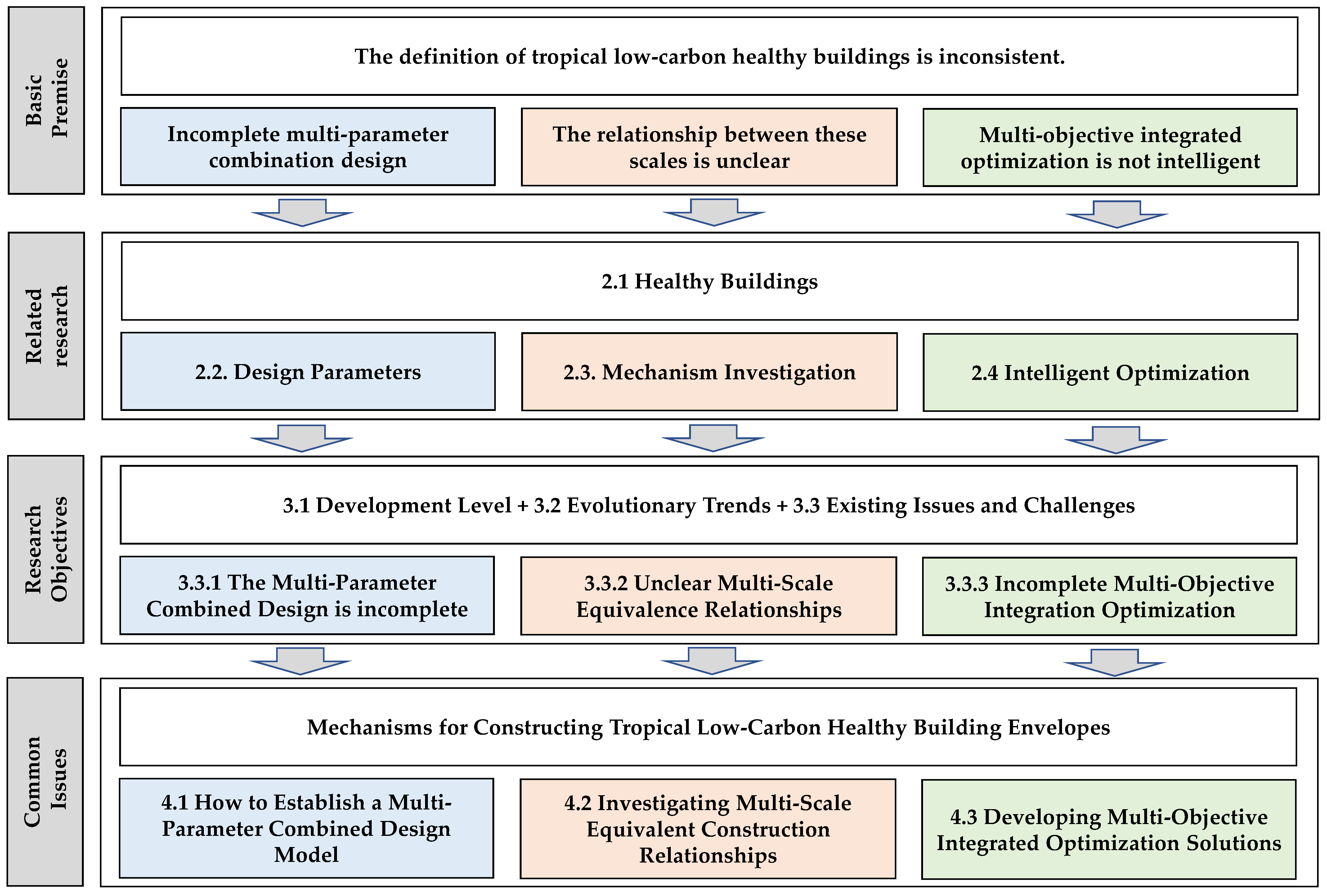
China’s “Healthy Building Evaluation Standard” (T/ASC 02—2021) defines a healthy building as one that provides healthier environments, facilities, and services while meeting functional requirements. Its purpose is to promote occupants’ physical and mental well-being and social welfare, thereby enhancing overall health levels. Taking tropical Hainan as a representative application scenario, this paper elucidates the critical role of building envelopes in tropical low-carbon healthy buildings. The proposed framework constitutes a comprehensive optimization research paradigm addressing multi-level complexity, particularly focusing on the interrelationship between materials, structures, and buildings as illustrated in Figure 1 [20].
This paper aims to establish a theoretical framework for analyzing key challenges and technical pathways in the design of thermal envelope systems for tropical low-carbon healthy buildings. The research emphasizes the coupled mechanisms governing the evolution of low-carbon healthy performance at the material and construction levels of building envelopes under high-temperature, high-humidity, high-radiation, and high-wind climate conditions [21]. Key performance metrics will be obtained through scaled experiments and field observations. Multi-scale numerical simulations will establish calibratable and extrapolatable dynamic models [22]. Building upon this foundation, machine-learning models and multi-objective intelligent optimization algorithms will be integrated to enable rapid prediction and trade-off analysis of objectives, including energy consumption, thermal comfort, indoor air quality, and glare [23].

1.4. Expected Contribution

The primary contributions of this study include first establishing a comprehensive theoretical paradigm based on MSB that unifies material properties, structural pathways, and architectural scale responses, providing a systematic foundation for analyzing the performance of low-carbon, healthy building envelopes under the four-high environmental conditions of tropical regions; second, proposing a framework for collaborative validation through multi-physics experiments and numerical simulations, constructing a verifiable cross-scale evidence chain that enables quantitative equivalent mapping and prediction of cross-scale scenario performance. Finally, the research developed an interpretable intelligent optimization framework that replaces the coupling of models and evolutionary algorithms, generating multi-objective decision templates that balance energy consumption, comfort, indoor air quality, and carbon emissions. Collectively, these achievements establish a methodological and technical framework spanning from mechanism understanding to optimization-driven design, providing theoretical methods and a technical system to support systematic research on low-carbon, healthy building envelopes in tropical regions.

1.5. Chapter Organization

The remainder of this paper is organized as follows: Section 2 systematically reviews research progress on low-carbon and healthy buildings. Section 3 assesses development levels and challenges within tropical contexts, identifying pain points and emerging trends. Section 4 proposes and elaborates on three key scientific questions. Section 5 outlines critical technologies and a stepwise technical roadmap, emphasizing the reproducible data–model-optimization workflow. Section 6 presents implementation strategies. Section 7 provides concise cross-scale discussions. Section 8 concludes the paper and outlines future directions.

2. Related Research

The literature review was based on two international core databases, Web of Science Core Collection and Scopus. The China National Knowledge Infrastructure (CNKI) was a supplementary source for major research findings in the fields of “low-carbon buildings, healthy buildings, building envelopes, construction mechanisms, and optimization methods”. The search timeframe was set from 2015 to 2024. The included literature types encompassed peer-reviewed journal articles, review papers, and selected industry standards and technical reports. The search terms employed in this study included “tropical low-carbon building,” “healthy building,” “building envelope,” “thermal-moisture mechanism,” and “optimization method,” which were combined using Boolean logic to construct the search queries. The literature screening process was divided into four stages: initial screening, deduplication, title/abstract screening, and full-text screening. The initial screening process yielded 479 documents, which were subsequently reduced to 107 after deduplication and relevance screening. Inclusion criteria: relevance, rigor, quality. Exclusion criteria: mismatched subjects, lack of foundation, duplicates.

2.1. Healthy Buildings

The concept of healthy buildings is broad, encompassing indicators such as thermal–humidity, acoustics, lighting and IAQ. In addition to the physical environment, psychological and behavioral factors are also considered. A clear conceptual framework and standardized metrics are prerequisites for material/construction-level discussions. Addressing ‘what to evaluate and how to evaluate’ is vital for ensuring the comparability and reusability of material selection and construction integration.
Elnagar et al. (2024) [6] propose a novel healthy building framework and definition. This comprehensive methodology was developed through an extensive review of the relevant literature and was validated across 12 building cases in major European climate zones. The framework under consideration comprises five dimensions and 24 indicators/sub-indicators. The validation process demonstrates project evaluation capability based on distinct indicators within each dimension. Wang (2017) [24] compares health performance requirements across domestic and international standards, advocating for the development of universally applicable healthy building evaluation criteria that are tailored to national contexts. The study introduces the primary technical content of T/ASC 02—2016, entitled “Healthy Building Evaluation Standard.” Liu (2023) [25] explained how the “General Rules for Healthy Building Product Evaluation” were developed and what they cover. This includes the terms used, the principles, what is needed for evaluation, and the most important technical indicators for the products.
Yue (2024) [26] compared six representative building assessment standards and distilled 18 elements across four dimensions of biophilic design: direct and indirect nature experiences, spatial and place experiences, and activities within natural environments. Based on this, a biophilic building design framework comprising 10 indicator categories was constructed. Wang (2023) [27] expounds on China’s endeavors in establishing a comprehensive building standard system, encompassing various facets such as system design, technological innovation, promotional models, and international collaboration. This study offers invaluable insights and serves as a valuable reference point for the promotion of standards in Belt and Road countries. Liu (2023) [28] presents the “Healthy Building DNA” framework, which aims to elucidate the characteristics, triggering factors, guidelines, and actions of healthy buildings. The framework also proposes directions for the development of healthy buildings, including whole-lifecycle thinking, standard system improvement, regulation and awareness enhancement, and multidisciplinary integration. The conceptual definition of healthy buildings varies between countries, influenced by a combination of climate and national conditions. However, a consensus exists at the architectural level that, beyond fulfilling basic functions, places an emphasis on enhancing performance in energy conservation and carbon reduction, indoor air quality (IAQ), and thermal, acoustic, and visual comfort.
Furthermore, Zhu (2018) [29] undertook a comprehensive review of the existing literature on the subject, synthesizing the healthy elements based on four representative domestic and international evaluation standards. This was followed by an update to the indicator database within the T/ASC 02—2016 framework. D’Amico (2020) [30] proposed the integration of workflows for the control of volatile organic compounds (VOCs) emission and indoor concentration within building information modeling (BIM) processes. The study demonstrated the efficient coupling of numerical models and BIM during the design phase. Liu (2021) [31] proposed a classification system comprising four core categories, 14 primary factors and 80 fundamental elements for healthy building acoustic environments. The classification system emphasizes the direct and indirect impacts of external architectural and societal characteristics on internal acoustic properties and soundscape perception. Fan (2020) [32] furnished a comprehensive overview of China’s indoor VOC control pathways and achievements, outlining future-oriented technologies and evaluation tasks. Othman (2020)’s [33] seminal study proposes a taxonomy of healthy workplaces, distinguishing between the concepts of “healthy environments” and “healthy practices”. The former is characterized by immediate benefits, while the latter is associated with long-term outcomes. Healthy building products aim to improve health and well-being by setting parametric requirements for materials, components and equipment. This study aims to promote synergy between materials, structures and buildings to conserve energy, reduce carbon emissions, improve indoor air quality (IAQ) and enhance acoustic, visual and thermal comfort.

2.2. Design Parameters

2.2.1. Material Level

Tian (2024) [34] conducted a study on the energy-saving effects of radiative cooling materials under different roof thermal resistances and material thermal resistances. The study utilized a comprehensive conduction–convection–radiation model to analyze the effects. The findings indicated that the effect was most pronounced on low-thermal-resistance roofs. Additionally, it was observed that increasing roof thermal resistance led to a diminution of this advantage. The study concluded that infrared-transparent insulating radiative cooling foam materials have the potential to substantially reduce convective and radiative losses. Chen (2024) [35] conducted a multi-parameter joint optimization of thermal insulation coatings (TICs); the results indicate that the solar absorption rate range and regional thermal resistance jointly determine the energy savings rate for cooling, heating, and total energy consumption (e.g., differing thresholds between Shanghai and Guangzhou). Liu (2024) [36] developed an aerogel cooler which has been shown to exhibit an integrated design with low solar absorption (96% reflectance) and high ATW emissivity (97%), as well as high insulation. The device has been demonstrated to provide 9.15 °C sub-ambient cooling during the day, whilst also exhibiting properties that include anti-aging, self-cleaning, and pressure-resistant characteristics. The results of the annual simulations indicate that there is an average energy saving of 13.87 kWh/m2. It is evident that exterior materials (radiative cooling, spectral control, wall insulation) play a critical role in this regard by reducing the effective heat that enters interiors through external surfaces. In tropical four-high environments, there is a need to balance durability requirements such as weather resistance, salt spray resistance and self-cleaning.
Huang (2020) [37] conducted a study to determine the optimal aerogel thickness and the energy-saving effects thereof. The study concluded that a thickness of approximately 3.7 mm is the minimum required to achieve the desired outcomes. When applied to hollow shale brick walls, it has been shown to reduce annual cooling/heating loads by 7.5%/18.2%, respectively, with greater sensitivity to greenhouse gas emission reductions as thickness increases. Gervásio (2025) [38] proposes the use of ultra-low-carbon steel envelope systems and sandwich panels, enhancing thermal insulation and sustainability through the use of renewable, bio-based materials such as wood fiber. Amani (2020) [39] compared 12 thicknesses and multi-layer configurations via multi-objective optimization, identifying several Pareto solutions that significantly reduce energy consumption, though their environmental impacts vary considerably. In general, the core materials under consideration prioritize a balanced integration of indoor acoustic, visual, and thermal comfort. This necessitates the implementation of optimization strategies that weigh trade-offs between energy consumption, comfort, and environmental impact [40]. Furthermore, the inner-layer materials have the capacity to fulfil additional functions, such as the improvement in IAQ (for example, through the adsorption and controlled release of humidity and pollutants). This enables synergistic performance across the inner–middle–outer layers in tropical environments.
In their study, Sakthieswaran (2020) [41] explored the potential of invasive species fibers in the preparation of eco-friendly plaster materials, with the aim of enhancing their flexural strength and toughness. Similarly, Ruvira (2024) [42] conducted a comparative analysis of wallpapers with different substrates and coatings, introducing an aluminum foil interlayer that significantly improved radon resistance. In addition, Li (2023) [43] proposed a gypsum-based moisture-regulating material containing activated sepiolite powder, which was able to achieve a maximum equilibrium moisture content of 0.225 g/g at relative humidity (RH) = 97.4%, thereby effectively suppressing indoor humidity fluctuations. Consequently, the materials employed in the construction of the inner layers have the capacity to engender favorable conditions in terms of acoustics, optics, temperature, and air quality, extending beyond their structural and decorative applications. However, in multi-layer assemblies, the performance is influenced by heat/moisture transfer and thermal bridging effects, which necessitate a close integration of material selection with the structural layers.

2.2.2. Structural Level

Arumugam (2022) [44] conducted a comparative analysis of combined strategies involving natural ventilation, passive cooling methods and insulation, considering variations in nighttime temperatures. The study concluded that for regions experiencing average nighttime temperatures above 27 °C, the implementation of integrated insulation is recommended. Conversely, for regions with average nighttime temperatures below 27 °C, the adoption of integrated phase change material (PCM) is deemed more appropriate. During summer months, it is recommended that nighttime pre-cooling is facilitated by air conditioning, thereby ensuring the maintenance of daytime comfort through the utilization of natural ventilation. Taveres-Cachat (2021) [45] proposed a systems perspective for Advanced Building Envelopes, emphasizing integrated systems to deliver flexible, efficient energy management and healthy, comfortable indoor environments. Pungercar (2021) [46] demonstrated that the integration of prefabricated components, along with a system of integrated ventilation and a novel thermal envelope solution, resulted in a 23% reduction in heating energy consumption when compared with the original design for retrofitted German single-family homes. This approach was found to enhance both temperature and humidity levels. Wang (2021) [47] examined the issue of sound insulation in lightweight walls, observing that the implementation of expanding panels, increased stud spacing, cavity filling, the addition of layers and mass, and the avoidance of rigid connections all serve to enhance sound insulation in double-leaf structures. Baghoolizadeh (2024) [48] demonstrated that the combination of EnergyPlus with NSGA-II can enhance thermal comfort by 38–62% while concurrently achieving a substantial reduction in heating and cooling loads. Liu (2025) [49] incorporated an integrated inorganic hydrated salt PCM into the structure. The coated stable CPCM achieved a melting enthalpy of 224.43 J/g (94.8% of DHPD), reducing peak indoor temperatures by 8.71 °C in model experiments. Song (2022) [50] proposed the SMRT-air temperature deviation method to evaluate solar radiation impacts, recommending prioritizing control of solar heat gain through east-/west-facing windows in cold regions and significantly reducing discomfort levels when solar heat gain coefficient (SHGC) ≈ 0.3. Wang (2024) [51] presented an Support Vector Regression–Non-Dominated Sorting Genetic Algorithm II (SVR-NSGA-II) framework, demonstrating the significant effects of envelope parameters on energy consumption and thermal comfort. Baghoolizadeh (2023) [52] incorporated 39 design factors into optimization, revealing considerable potential for reducing CO2 concentration/pollution and enhancing thermal comfort.
Reviews show that using a combination of passive cooling, advanced building design and intelligent optimization can improve building performance. This can reduce energy consumption and carbon emissions, while maintaining a comfortable environment. This integrated, multi-parameter approach provides a theoretical and practical foundation for the design of next-generation building envelopes that are low-carbon, healthy, and adaptive under diverse climatic conditions.

2.2.3. Building Level

Run (2025) [53] evaluated the Fanger model through transient/steady-state questionnaires and comparative assessments, finding that the subjects reached thermal steady state in under 10 min. Discrepancies between thermal sensation and predicted mean vote (PMV) may stem from assumed parameters, thus highlighting the importance of model parameter settings for comfort prediction. In the study, Yuan (2019) [54] examined human adaptability under varying humidity levels in a controlled climate chamber. It was demonstrated that residents of regions with high humidity levels exhibited greater adaptability to variations in humidity, manifesting in heightened thermal responses when the relative humidity (RH) exceeded 70%. Khosravi (2024) [55] proposed an integration of visual comfort into the model predictive control (MPC) framework. This integration resulted in an increase in energy consumption of between 2.2% and 7.2%, whilst maintaining constraints on thermal and lighting comfort. This study, therefore, demonstrates the trade-offs that occur when multiple objectives are coupled together. Dai (2023) [56], based on 20 scenarios of field measurements and simulations, indicated that higher enclosure quality is associated with increased comfort hours. Furthermore, the optimal orientations of different BET building shapes were found to vary, with T oriented towards east, I/L towards north, and C/O towards south. It is evident that a combination of factors, including building orientation, Window-to-Wall Ratio (WWR), form, and shading/ventilation, when synergized with Heating, Ventilation, and Air Conditioning (HVAC) control, contributes to enhanced IAQ and thermal comfort.
While the material–structure–building three-dimensional deconstruction of healthy buildings emphasizes different aspects, their shared goal is to achieve healthy environments through multi-scale coordination. It is evident that reliance on a single dimension is inadequate for meeting the full spectrum of functional requirements. This underscores the necessity for an integrated design approach.

2.3. Mechanism Investigation

2.3.1. Numerical Simulation

Arumugam (2022) [57] employed DesignBuilder to compare the effects of PCM/insulation layers at different installation locations. The study concluded that exterior wall integration outperformed interior wall integration in achieving comfortable indoor temperatures. Yuan (2022) [58] utilized computational fluid dynamics (CFD) to investigate the impact of distinct exterior walls on the outdoor thermal environment. The findings demonstrated that highly reflective (HR) walls exhibited superior efficacy in reducing air temperature (Ta), wet-bulb globe temperature (WBGT), and standard effective temperature (SET*). Kim (2021) [59] proposed a heating strategy for a large factory that was based on a combination of CFD and BES analysis. The strategy was found to improve thermal comfort by 79%. Wang (2024) [60] conducted a simulation of setpoint adjustments across multi-climate cities. It is evident that Harbin, Beijing, and Shanghai have the potential to enhance the number of comfortable days while minimizing their energy impact. In contrast, Guangzhou and Kunming exhibited distinct energy–comfort trade-offs. Lachir (2024) [61] utilized EnergyPlus to assess orientation, WWR, envelope, and shading, thereby demonstrating the scenario-dependent effectiveness of diverse strategies. Su (2025) [62] conducted an analysis of the synergy between opaque radiative cooling material (RCM) enclosures and surrounding buildings using Radiance + EnergyPlus. The study indicated that disregarding surrounding buildings (SBs) results in a significant overestimation of exterior wall cumulative radiation and spatial daylight autonomy (sDA), underestimation of spatial glare autonomy (sGA), and overestimation of air conditioning energy consumption. Alyami (2024) [63] conducted an evaluation of the impact of insulation material type, thickness and location on energy consumption in Riyadh, with the optimal thickness being determined based on life-cycle cost (LCC). Almufarrej (2023) [64] conducted a study to quantify the effects of orientation, compactness, and WWR on energy consumption and HVAC capacity in Kuwait. Hao (2024) [65] employed TRNSYS to investigate the impact of WWR (0–100%) on thermal environments, observing elevated temperatures on intermediate floors. Zhang (2022) [66] conducted multi-objective iterations in Rhino/Grasshopper + Octopus, achieving 7.48–7.76% cooling energy savings, an increase of 0.44–2.07% for useful daylight illuminance (UDI), and 25.67–27.43% PMV reduction. Baghoolizadeh (2023) [67] optimized the process using EnergyPlus-JEPLUS and multivariate shading control, achieving 40–50% annual total energy savings while simultaneously increasing visual/thermal comfort by 70–100%/10–40%. Furthermore, Ouakarrouch (2019) [68] utilized CFD to assess the impact of highly reflective materials on Ta/WBGT/SET, thereby demonstrating the microclimate effects of spectral-type envelope strategies. A comprehensive overview of the extant literature is presented in Table 1.

2.3.2. Experimental Analysis

Horsle (2019) [69] employed wall-penetrating microwave imaging to detect internal moisture content in materials. This provides a basis for maintenance and restoration, while potentially enhancing the value of microbial data. Tardy (2025) [70] combined exterior surface temperatures with meteorological data to estimate building envelope characteristics within 24 h using multivariate minimization, validating the feasibility of identifying material properties and thickness through field investigations. Rahman (2019) [71] evaluated a range of reflective and evaporative coatings under conditions involving cyclic temperature, humidity and irradiation. The application of white non-uniform thermal insulation coating (SR4) resulted in a reduction in the exterior surface temperature by 7.9 °C. In contrast, the WSS-particle-containing coating (L) led to a decrease in the interior surface temperature of 5.8 °C. The superiority of the latter can be attributed to its capacity for nocturnal moisture absorption and diurnal latent heat release. Colinart (2019) [72] conducted a two-year monitoring study of retrofitted prefabricated ventilated curtain walls. It is evident that the assessment of winter field thermal resistance was conducted in a reliable manner, thereby resulting in the determination of values that exceeded the designated design parameters. The application of external insulation did not result in the occurrence of significant moisture-related damage, with only minor instances of mold growth observed in proximity to hygroscopic materials. Alegría-Sala (2024) [73] evaluated thermal comfort using 41 measurement datasets and Latin Hypercube Sampling (LHS) sensitivity analysis. Models incorporating a reduced number of variables have a tendency to overestimate comfort. When the mean radiant temperature (MRT) accuracy is set to ±2 °C, results remain within the bounds of uncertainty; however, further refinement to ±0.2 °C reveals biases. Rosti (2025) [74] proposed a low-cost, long-term monitoring system. Comparisons with laboratory-grade sensors demonstrated high-precision recording of air/surface temperature and humidity without field calibration, yielding key metrics like U-values and g-values. Shi (2022) [75] proposed the removing of the heat-storage effect and heat-flow meter method (RHS-HFM), validating the feasibility of eliminating thermal inertia under four conditions. The model demonstrated a 6% discrepancy from the temperature-controlled box method (TCB-HFM) and an approximate 7% deviation from the design values, thus overcoming the limitations imposed by seasonality. A summary of the representative literature is shown in Table 2.

2.3.3. Simulation–Experiment

Li (2024) [76] developed aerogel-reinforced microsphere insulation boards (HGBs) and insulation boards, measured their thermal conductivity under different temperature and humidity conditions, and simulated summer cooling loads for buildings of different heights and thermal zones using these boards, expanded polystyrene (EPS) and foamed cement (FC) as insulation layers. The study found that this new material is especially good for places that are hot and wet. It is interesting that smaller buildings with a limited number of storeys are sensitive to thermal conductivity. In places where summers are hot and winters are warm, it is very important to think about the relative humidity (RH) outside when working out how much cooling is needed. In the study undertaken by D’Amico (2021) [77], a combined box-based mass balance and CFD approach was utilized for the purpose of evaluating indoor VOC concentrations. The discussion within the study encompassed the coupled relationship between material emissivity limits, indoor guidance values and ventilation. Saadatjoo (2023) [78] validated fundamental factors for semi-outdoor spaces using CFD + wind tunnel testing: increasing porous surface area and terrace width significantly reduces air mean age and improves ventilation performance. In the study conducted by Hawila (2019) [79], a multifaceted approach encompassing numerical simulation, experimental design, and optimization was employed to quantify interactions and enhance thermal comfort in glazed enclosures. Guo (2024) [80] conducted a comprehensive evaluation of the potential of green envelopes (roof greening/green walls) utilizing a multifaceted approach encompassing field testing, energy consumption simulation and optimization. Roof greening has been demonstrated to reduce maximum temperatures by 34.3 °C and to conserve 12.5% of summer daily energy. Green walls have been shown to reduce exterior surface temperatures by 3.4/5.1 °C, respectively. Mostafa (2024) [81] conducted an experimental and simulation evaluation of lightweight geopolymer concrete (LWGC) with aluminum powder (AP) and ferrosilicon waste powder (FWP), which resulted in a 14.5% reduction in exterior wall/roof insulation energy consumption and a 9.2% reduction in total energy consumption. Overall, the integration of simulation and experimentation provides a unified pathway for cross-scale mechanism identification, parameter inversion and model calibration. However, multi-scale system coupling between materials, structures and buildings requires further enhancement.
The more health objectives there are, and the wider the simulation and experimentation, the more complex the integration. It is essential to define the main objectives and establish a unified framework for achieving organic integration of the two approaches with regard to methodology, workflow, and goal orientation.

2.4. Intelligent Optimization

The main idea here is that we need to find the best ways to balance different goals. This section puts together different sets of information, systems that have a specific goal in mind, models that act as substitutes, and clever computer programs from other studies. It does this to create one set of rules that can be used to decide on the best way to use energy, how comfortable a building is, the air quality, and how much carbon is produced [82]. From an optimization perspective, four questions must be addressed: Which design parameters must be given the greatest importance? Which objectives should be prioritized? The provenance of the data is of crucial importance; therefore, it is necessary to ascertain whether the data originates from a field or a simulation. The employment of surrogate models and intelligent algorithms is a subject that merits further consideration [21]. The principal conclusions are summarized in Table 3. Extant research has demonstrated the establishment of a consolidated framework of “data acquisition—surrogate modeling—evolutionary optimization”, thereby amassing invaluable experience in the domain of efficient surrogate modeling and multi-objective algorithms [83]. However, the adaptability of models and algorithms to engineering constraints exhibits object dependency, in that input/output parameters, surrogate model types and optimizer hyperparameters must be tailored to specific scenarios and objectives. The optimization layer provides answers to the question of which trade-offs should be made and to what extent. This unification process integrates various scenarios, variables and objectives, culminating in the generation of interpretable solution sets [84]. A summary of the representative literature is shown in Table 3.

3. Development Status, Trends, and Existing Challenges

Research on low-carbon healthy building envelopes for tropical climates characterized by high temperature, high humidity, high solar radiation, and high wind speeds has achieved phased progress in material functionalization, structural integration, and building-level parametric design [17]. Nevertheless, extant research continues to encounter challenges, including incomplete methodological chains, insufficient cross-scale evidence, and the weak generalization of optimization decisions, in comparison to the systematic and interpretable approaches that are a prerequisite for engineering practice [90]. This present section delineates contemporary development levels and evolutionary trends, focusing in particular on three critical gaps to define future research directions [91].

3.1. Development Level

Recent developments have begun to reveal multi-scale design capabilities. Material-level advancements in spectral regulation include high reflectivity/emissivity and radiative cooling. Significant advancements in thermal insulation include aerogels and sandwich panels. Research is also being conducted into moisture-absorbing and regulating materials. Heat and moisture transfer pathways are being reconfigured at the structural level. Strategies include multi-layer stacking, cavity ventilation, phase change thermal storage and thermal bridge reduction. The layout of buildings has established a pathway of responses, prioritizing passive strategies [38].
Advancing through experimentation and simulation involves numerical modeling, which explores parameters and identifies sensitivity, while testing measures boundary conditions and degradation trajectories. Some studies have attempted to validate simulation and measurement through parameter inversion and alignment metrics [92].
Acceleration of penetration is achieved through data-driven and multi-objective optimization. The utilization of surrogate models and evolutionary algorithms is proposed as a means to optimize energy consumption, comfort, IAQ, and carbon emissions in a synergistic manner. This approach gradually forms Pareto solution sets and scenario-based decision templates [51].
Low-carbon health evaluations are systematical. A set of core metrics (e.g., thermal/acoustic comfort, IAQ, energy consumption/carbon emissions) is being finalized. This provides a unified benchmark for integrated design and validation [15].
Research shows an inventory of elements spanning materials, structures, buildings, computation, measurement and optimization. Preliminary capabilities for multi-objective trade-offs and backfilling have been identified, laying the foundation for tropical engineering.

3.2. Evolutionary Trends

Integrating low-carbon and health objectives: Synergistic optimization of energy–carbon metrics with thermal comfort, daylighting, acoustics, and indoor air quality to achieve explicit characterization of conflicts and synergies within a unified Pareto set [83].
Integration of physics-based simulation and experimentation: Research is shifting from single methodologies to integrated approaches, linking material aging with thermal–humidity behavior of building envelopes through cross-scale calibration. Field data is used for dynamic parameter refinement, while regional adaptive parameter windows enhance model transferability [92].
Explainable intelligent optimization: Proxy models, evolutionary search, and feature importance analysis trace optimization outcomes to interpretable physical drivers, enhancing engineering feasibility [21].
Modular standardized implementation: Parametric template libraries and modular envelope components enable design reuse and rapid industrial deployment [38].
Lifecycle and Regional Adaptive Governance: Incorporates tropical degradation factors—salt spray, high humidity, fungal evolution, surface aging—into lifecycle simulations, maintaining long-term stability through maintenance–performance feedback loops [15].
Collectively, this field evolves toward a systems paradigm characterized by extensively integrated metric systems, physics-evidence-based fusion mechanisms, interpretable optimization logic, and modular implementation pathways.

3.3. Existing Issues and Challenges

3.3.1. The Multi-Parameter Combined Design Is Incomplete

Research has thus far concentrated on pairwise couplings or local optimization, with little attention paid to integrating material properties, construction levels and spatial geometry/boundaries in a continuous design chain [10]. Multi-objective criteria cannot be equally weighted and compared within a single model; unified parameter ontologies and value domains are absent across variable hierarchies, limiting comparability and reusability; design phases struggle to produce directly implementable parametric templates and construction guidelines [90].
Requirements and Countermeasures: It is very important to develop a special design model that can be used by many people together. This model should be used in tropical climates. The aim is to bring objectives, constraints and variables together in one evaluation framework, with the goal of creating a toolchain that works from start to finish. This includes material libraries, construction libraries, and building parameter libraries. The main aim is to create design maps that can be understood, and to sort solutions based on how much energy they save, how comfortable they are, and other balanced criteria.

3.3.2. Unclear Multi-Scale Equivalence Relationships

It is evident that there is an absence of quantification with regard to the transmission chain from the material scale through construction layer pathways to building-scale responses [46]. The absence of a harmonized quantitative framework between calculation and measurement—in conjunction with incongruent temporal and spatial scales—serves to obfuscate the predominant pathways and boundary effects [92].
Requirements and Countermeasures: It is very important to develop a closed-loop system. To do this, we need to combine experimental simulation methods. It is very important that the suggested system includes the following: parameter inversion, anchor point consistency metrics, error bounds and confidence intervals, and robust extrapolation. It is very important to find out what the main mechanisms and limits are for multi-field coupling under high-intensity environmental conditions. It is also very important to make sure that reusable cross-scale equivalence relationships are consolidated.

3.3.3. Incomplete Multi-Objective Integration Optimization

Existing optimization processes frequently function in isolation, exhibiting a lack of integrated workflows and reproducible design [15]. It is evident that models and algorithms demonstrate strong object dependency and insufficient generalization. Moreover, there is a conspicuous absence of explicit representation of engineering constraints, including constructability, cost and maintenance, as well as operational maintainability [93].
Requirements and Countermeasures: The proposal integrates interpretable surrogate models, evolutionary algorithms, and unified data dictionaries, sample partitioning, and alignment, alongside unified performance metrics. These should include energy/carbon emission error, comfort compliance rate, IAQ attainment rate and durability indicators. It is imperative to achieve synergistic multi-objective optimal decisions for energy consumption, IAQ, and thermal–humidity–light–acoustics performance. The realization of this objective can be achieved through multi-scenario robust optimization and the internalization of engineering constraints.

4. Key Scientific Issues

Tropical conditions require low-carbon buildings to meet strict energy and comfort targets. However, contemporary practices frequently compartmentalize materials, structures, and architecture, leading to an absence of cohesive design principles during the preliminary stages. Consequently, this section proposes the following three key scientific questions [94], based on a review of the current research.

4.1. How to Establish a Multi-Parameter Combined Design Model

The main scientific challenge is to create a design model that includes several parameters for healthy environments in tropical low-carbon building envelopes. This model is based on the integration of materials, structures and architecture, as well as the design of parameters and theoretical derivation. It is very important that this model can link three types of variables: material properties, construction parameters and architectural parameters. The model needs to achieve mapping with objective functions, including but not limited to energy consumption, air quality and comfort. The limits of material and structural parameters were found through small-scale experiments, and then the building’s energy use was predicted using computer simulations. The model can show how different variables interact in a predictable way, which is useful for understanding how equipment performs in humid tropical conditions. This creates a database and predictive model that uses a number of different parameters, which makes it possible to design the envelope early on and make smart decisions.

4.2. Investigating Multi-Scale Equivalent Construction Relationships

The most important scientific challenge is to combine scaled experiments with computer simulations. This is to explore how materials, structures and buildings are constructed in healthy environments for tropical low-carbon architecture. This research combines experiments that look at how different materials and structures affect how well buildings perform in terms of heat and indoor environments, as well as computer simulations. The experimental dataset includes information about the material’s thermal properties, surface temperature and humidity, and how the light is reflected over time. EnergyPlus simulations are used to model how energy is used and how people feel in a building. This creates a chain of data from experiments and simulations. The main scientific challenge is to find ways to measure things at different levels and to study how materials and buildings interact in a positive way. The research will identify the most important pathways through a process called parameter sensitivity analysis. This analysis will show how the properties of tiny particles affect how well a building performs. This will provide a scientific way to improve the design of buildings.

4.3. Developing Multi-Objective Integrated Optimization Solutions

The main scientific challenge is to use a combination of learning models and smart optimization tools to create designs that consider more than one goal, like energy use, air quality, people’s comfort, and how things look. The problem we are discussing is how to use machine learning and intelligent optimization methods to achieve several goals at the same time. These goals are to minimize building energy consumption, improve air quality, make sure people are comfortable and improve thermal–humid comfort and visual comfort. The generation of 2000 samples via LHS enabled the training of a Bayes-Kernel-CatBoost ensemble model to predict high-dimensional inputs and multi-objective outputs. We used SHAP to work out the most important design parameters and interaction terms. Then, the NSGA-II algorithm was used to solve the Pareto frontier, which created three different solution sets: energy-saving priority, comfort priority, and balanced solutions. The main scientific challenges that must be addressed include checking that different optimization algorithms work well together, investigating how well proxy models can be used to make generalizations, and analyzing how easy it is to use the results. The findings will be used to create standard decision templates. The aim of this is to provide scientific ways to optimize low-carbon building design in tropical regions.

5. Key Technologies and Technical Approach

5.1. Key Technologies

This study focuses on the construction mechanism of thermal envelope systems for tropical low-carbon healthy buildings, establishing a technical framework centered on “multi-scale integration, multi-objective optimization, intelligent algorithms, and the fusion of experimental and simulation data.” This framework integrates key technologies—including green low-carbon materials, parametric modeling, machine learning, and intelligent optimization—along the material–structure–building integration pathway. It achieves unified prediction and optimization across multiple scales, from microscopic material properties to macroscopic building performance [95]. Specifically, the study employs the following core technologies.

5.1.1. Literature Review and Standard Integration

Objective: Systematically organize domestic and international standards and research advancements in green and healthy buildings to establish consistent definitions for indicators, variables, and boundaries.
Methods and Tools [96]: The following tasks are to be carried out in order to achieve the desired result: firstly, an analysis of existing evaluation systems for healthy, green, and low-carbon buildings must be conducted, with a view to extracting core metrics; secondly, it is essential to establish parameter ontologies and value domains, as well as define scenario sets; and thirdly, a comparison and synthesis of said systems must be conducted, with the aim of deriving key metrics relating to thermal/humidity/light/acoustic/IAQ, energy consumption and carbon emissions.
Output: Develop integrated indicator and parameter dictionaries to provide a unified benchmark for subsequent multi-scale modeling and optimization.

5.1.2. Multi-Scale Numerical Simulation

Objective: Develop multi-scale parametric models spanning materials–envelope–building to enable sensitivity analysis of high-dimensional variables and performance prediction.
Methods and Tools [97,98]: Material/Structural Scale Establish coupled thermal–moisture models for porous media, incorporating spectral selectivity, radiative heat transfer, adsorption/desorption, and aging degradation. Use CFD to characterize cavity ventilation, thermal bridging effects, and node heat transfer. Building Scale (BES/Energy Simulation): Develop a parametric model integrating building geometry, orientation, WWR, shading, ventilation, and setpoints using EnergyPlus, outputting KPIs including annual/seasonal energy consumption, thermal comfort, visual comfort, and IAQ. Batch Calculation and Sensitivity Analysis: Employ Latin Hypercube Sampling (LHS) or Sobol methods for DOE to generate high-dimensional sample libraries; conduct global/local sensitivity analysis to identify dominant parameters and interaction terms.
Output: Multi-scale simulation datasets serving as training and constraint foundations for surrogate modeling and optimization.

5.1.3. Test–Simulation Integration

Objective: Establish anchor parameters through scaled-down testing and in situ measurements to achieve bidirectional calibration.
Methods and Tools [99]: Use multi-physics coupled wind tunnels and environmental chambers to apply loads like temperature and humidity, UV irradiation, salt spray and wind pressure. Construct scaled components, wall sections and envelope system specimens. Sensing and KPIs: Things like temperature and humidity, air movement, heat flux, U-value, SHGC, how much light gets through, CO2 levels, and mold indicators, among others. Making sure the model is correct and working the maths. We should use multi-objective minimization and Bayesian inversion to correct material/structural constitutive models and boundary conditions, based on the available experimental data.
Output: The same parameter families are lined up, and the limits of error are explained, which makes it clearer what the main pathways and equivalent relationships are across the scales of material structure.

5.1.4. Machine-Learning Modeling

Objective: Develop high-accuracy, interpretable building performance surrogate models using simulation–experiment coupled data.
Methods and Tools [100]: Data governance, unified feature engineering, sample partitioning, outlier and missing value handling; retention of scenario labels. Model Architecture: Compare regressors, then fuse into a Bay-KAN-CatBoost ensemble model—Bayesian optimization for hyperparameter tuning, KAN (Kolmogorov–Arnold Network) for fitting strong nonlinear mappings, CatBoost for handling categorical/ordinal features and small-sample robustness; employ stacking/weighting to form the final proxy. Interpretability and Uncertainty: Analyzes feature contributions and interaction effects using SHAP; constructs confidence intervals/order-preserving intervals to quantify prediction uncertainty.
Output: Unified proxy models and interpretability frameworks for rapid evaluation of multi-objectives including energy consumption, IAQ, thermal/humidity/light/acoustic comfort.

5.1.5. Optimization Algorithms

Objective: Obtain Pareto-optimal envelope solution sets under engineering constraints, generating three decision templates: energy-priority, comfort-priority, and comprehensive-balance.
Methods and Tools [101]: Following a comprehensive evaluation of the available alternatives, it was determined that NSGA-II would be the primary algorithm. This decision was based on a multifaceted analysis that encompassed convergence speed, solution set diversity, implementation maturity, and engineering interpretability. The maintenance of diversity is achieved through the implementation of crowding distance, while the enhancement of stability is facilitated by the strategic manipulation of adaptive crossover/mutation probabilities and elite retention. Objectives and Constraints: Key objectives include annual total energy consumption/cooling load, thermal discomfort hours, IAQ attainment rate, carbon emissions/cost, etc. Constraints encompass WWR/SHGC value windows, structural and durability limitations. Incorporates scenario robustness, Monte Carlo perturbations, and cross-validation on the Pareto frontier. Outputs confidence frontiers and tiered solutions.
Output: Interpretable Pareto solution sets and three categories of optimization schemes—energy-saving, comfort-focused, and balanced—along with design parameter ranges and key implementation points.

5.2. Technical Approach

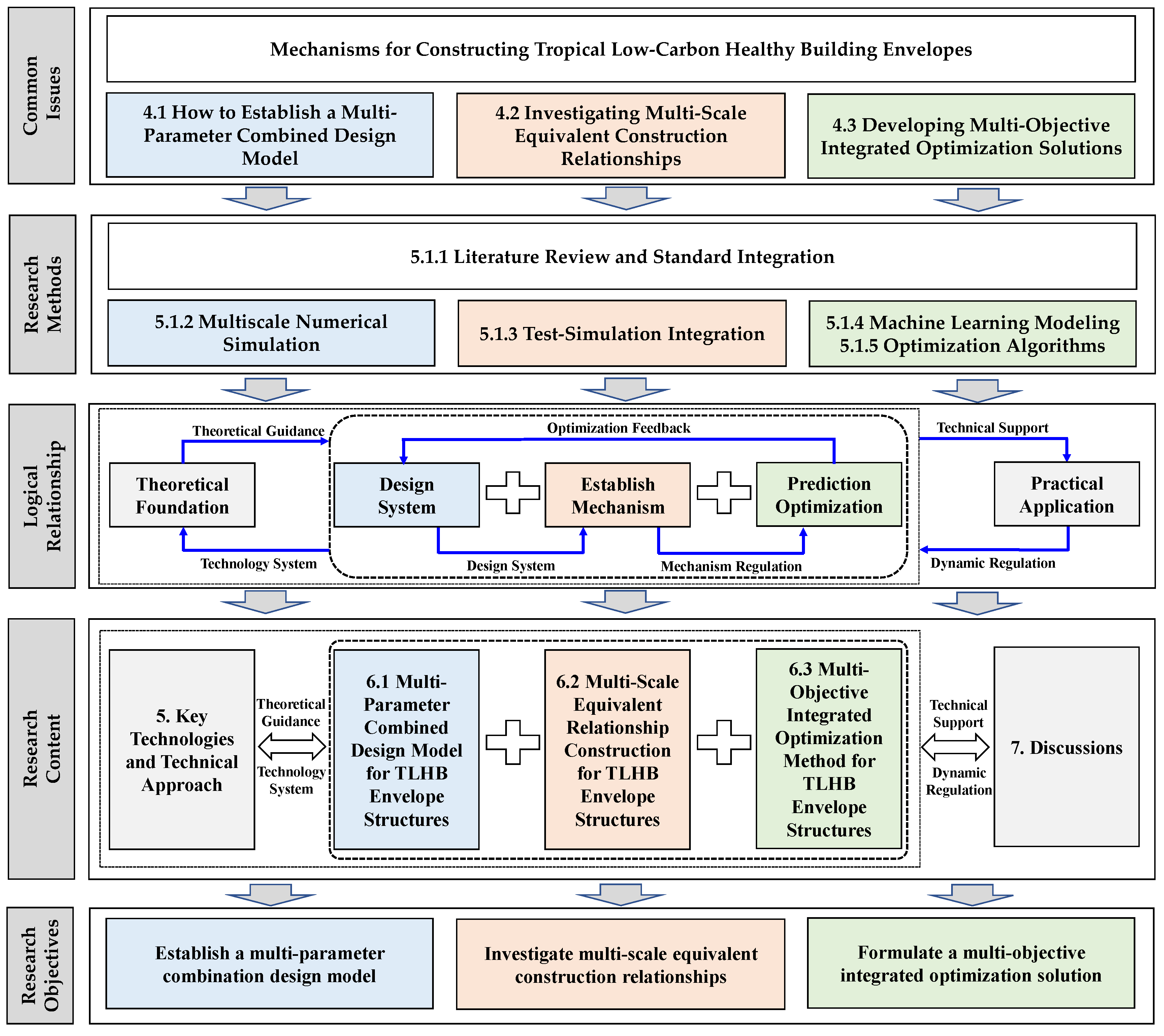
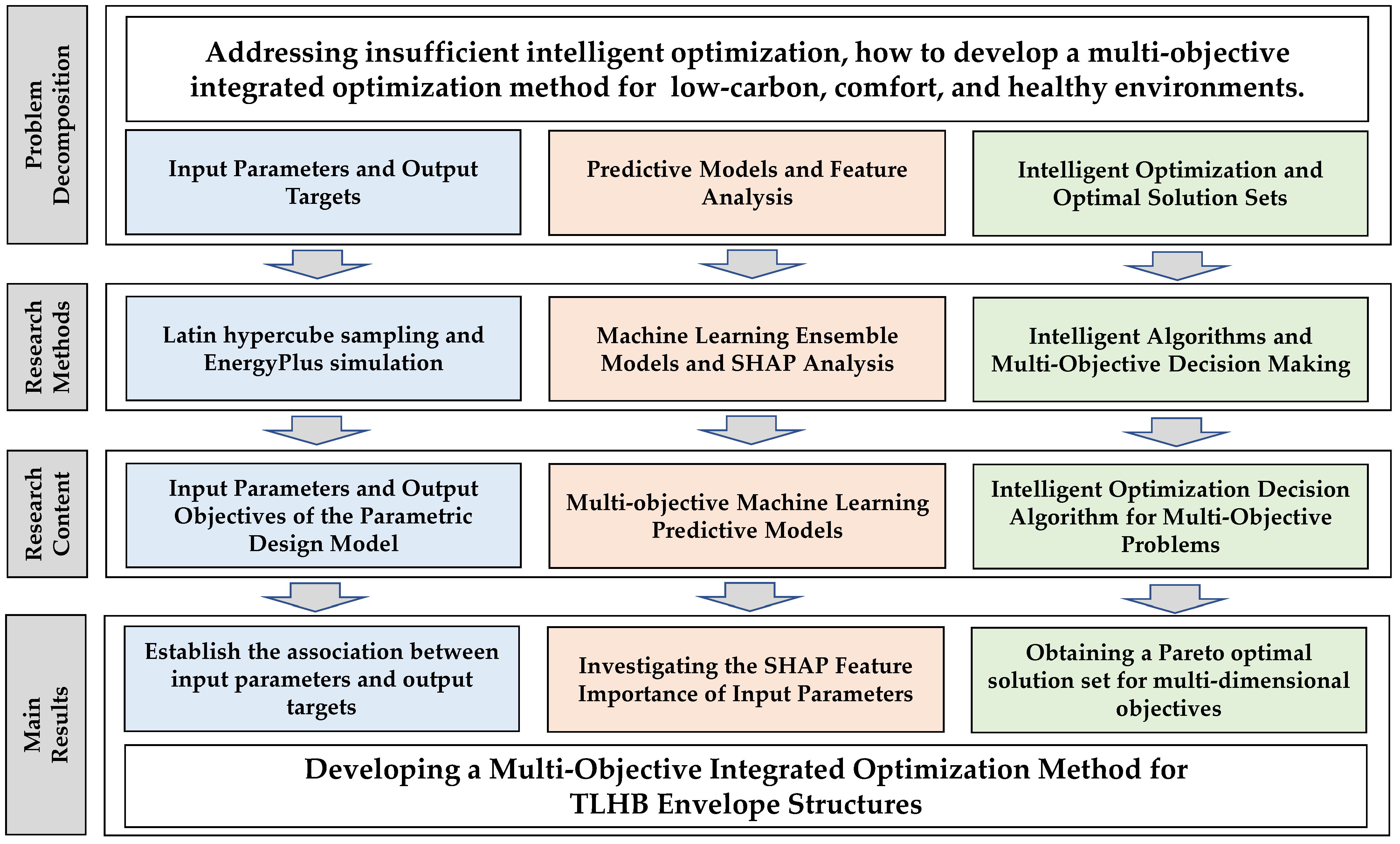
The study dealt with three big scientific problems by coming up with a technical approach (Figure 2) that followed a logical closed-loop. Literature reviews defined parameter systems to overcome incomplete design variables. Experiments and computer simulations provided information about different sizes to create models for designing things. Studies that combined experiments and computer simulations showed how materials, structures and buildings interact, creating a model for a healthy environment construction mechanism. Machine-learning surrogate models and intelligent optimization algorithms were introduced to achieve multi-objective integrated optimization of building envelope solutions. Each phase is connected to the others, and the data and models support each other. The results of this process help to improve the model assumptions, creating a closed-loop pathway from data collection to finding the best solution.

6. Implementation Plan

6.1. Multi-Parameter Combined Design Model for TLHB Envelope Structures

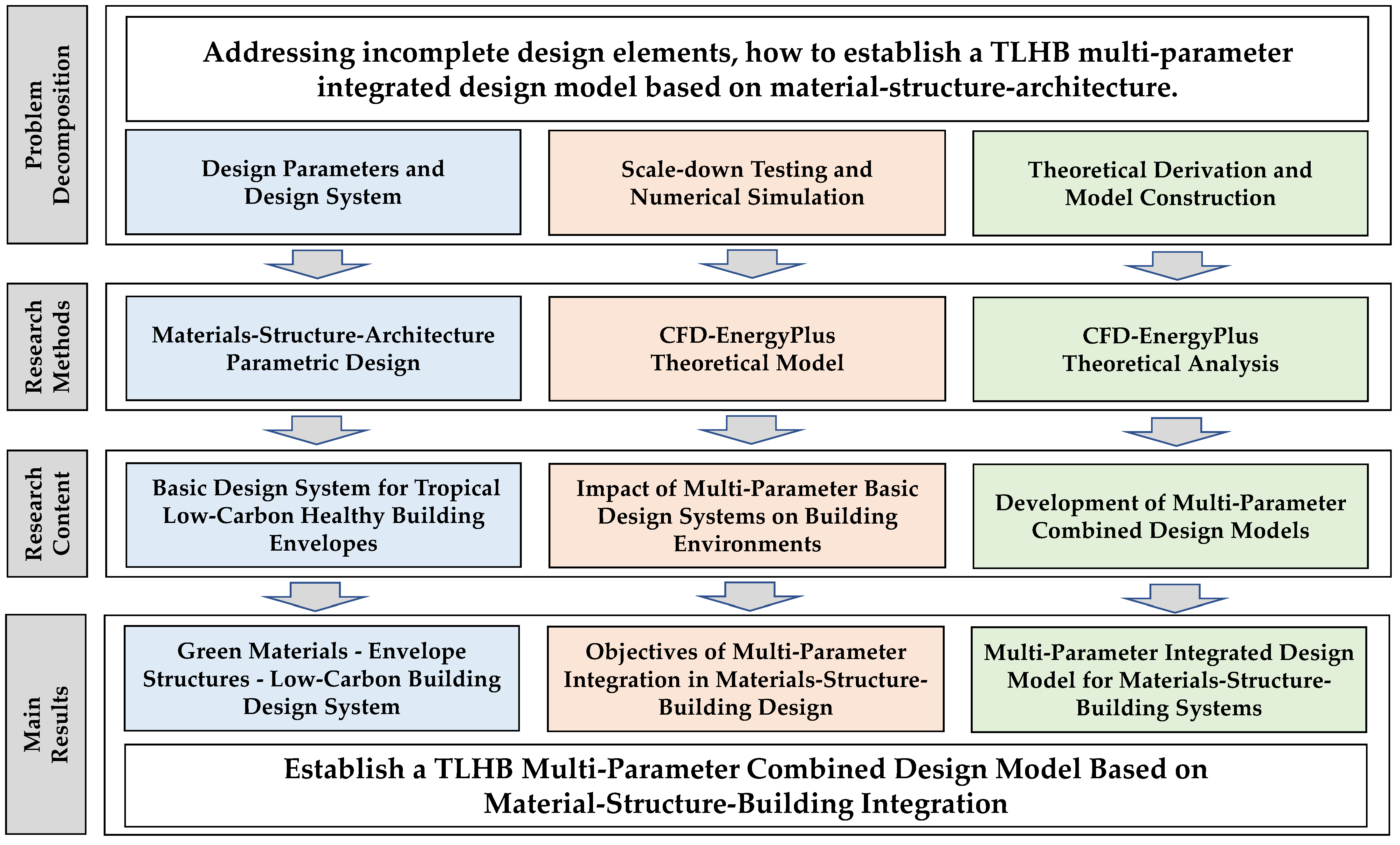
Research Objective: Establish a multi-parameter combination design model for healthy environments in tropical low-carbon building envelopes, addressing incomplete design elements. The implementation of this research element is shown in Figure 3.
Research Content: First, based on tropical low-carbon building requirements, establish correspondences between three categories of design variables (material properties, structural parameters, building parameters) and three output objectives (operational energy consumption, air quality, acoustic/visual/thermal comfort) to create a multi-scale design system integrating green materials, building envelopes, and low-carbon buildings. Second, from the perspective of green material–envelope performance design, investigate the impact of green materials on envelope performance; from the envelope-low-carbon building healthy environment perspective, explore the influence of the envelope on the low-carbon building environment. Based on this, summarize the effects of the multi-parameter combination of green material–envelope–low-carbon building on the building environment. Finally, based on performance boundary theory derived from scaled-down envelope experiments, we construct a green material–envelope performance design model. Based on health environment model simulation theory, we develop an envelope-low-carbon building health environment model. On this foundation, we establish a multi-parameter combination design model for green material–envelope–low-carbon buildings.

6.2. Multi-Scale Equivalent Relationship Construction for TLHB Envelope Structures

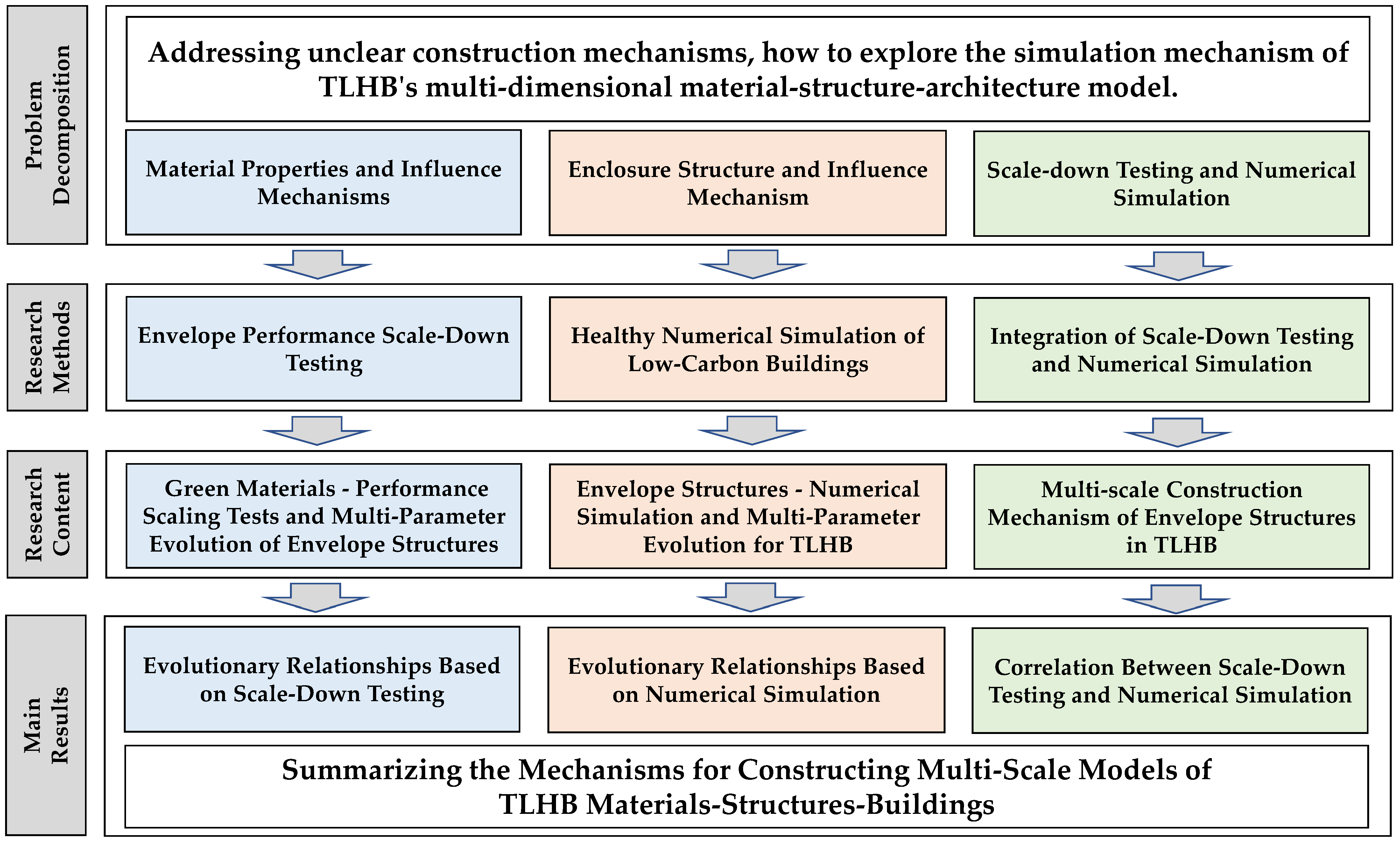
Research Objective: To investigate the multi-scale mechanisms linking materials, structures, and architecture in creating healthy environments for tropical low-carbon buildings, addressing the unclear underlying mechanisms. The implementation of this research element is shown in Figure 4.
Research Content: First, employing scaled-down experimental methods based on the green material–envelope performance design model, conduct experimental analysis of high-performance inorganic thermal insulation materials and the impact of green material variations on building wall performance within the envelope. This investigates the evolutionary relationship between green materials and the building envelope, revealing the mechanism by which material properties influence envelope performance. Second, through numerical simulation of the envelope-low-carbon building health environment model, we simulate and analyze the building performance of envelope structures using different material combinations, identical material combinations, and two green material combinations. This explores the evolutionary relationship between the envelope and low-carbon buildings, revealing the mechanism by which the envelope influences the health of low-carbon buildings. Finally, based on the quantitative characterization of the material–structure–building healthy environment design model, establish a quantitative linkage between scaled experiments and numerical simulations of material–structure–building. On this foundation, summarize the evolutionary relationships between green materials and building envelopes, and between building envelopes and low-carbon buildings, thereby extracting the multi-scale construction mechanism for healthy environments in materials–structures–buildings.

6.3. Multi-Objective Integrated Optimization Method for Healthy Environments in Tropical Low-Carbon Building Envelopes

Research Objective: Addressing limitations in intelligent optimization, develop a multi-objective optimization design scheme for building energy consumption, air quality, thermal and humidity comfort, and visual comfort. The implementation of this research element is shown in Figure 5.
Research Content: First, construct an input dataset comprising three categories of design variables (material properties, structural parameters, building parameters) and define three output objectives (energy consumption, air quality, acoustic/visual/thermal comfort). Employ the Latin Hypercube Sampling (LHS) method to generate 2000 simulated datasets, supporting subsequent predictive analysis and intelligent optimization research. Second, propose the Bay-KAN-CatBoost ensemble learning model as a multi-objective surrogate model and compare its performance against eight conventional prediction models. Integrate SHAP analysis with the ensemble model to identify key design parameters influencing building health performance. Finally, building upon the ensemble learning model, the NSGA-II algorithm is employed to solve for non-dominated solution sets. Three optimization schemes are proposed: energy-saving priority, PMV priority, and balanced (comprehensively considering energy consumption reduction, air quality improvement, and controllable acoustic, thermal, and visual comfort).

7. Discussions

7.1. Quantifiable Implementation of People-Centered Design

The concept of people-centered design should be operationalized and expressed as a quantifiable target system. It is recommended that key objectives be established, including thermal comfort, indoor humidity, air quality, acoustic and daylighting quality, as well as energy consumption and carbon emissions per unit area. It is imperative that clear thresholds be established for high-temperature and high-humidity scenarios. The optimal range for main control bands is set at indoor temperatures of 24–28 °C, with relative humidity levels of 40–60%, and CO2 concentrations not exceeding 1000 ppm. The collection of data at 5 min intervals, with subsequent hourly aggregation, is recommended. It is imperative that three priority schemes—health-first, balanced, and energy-saving—are established, with the influence sequence and recommended ranges for window-to-wall ratios, shading, thermal transmittance coefficients, ventilation organization, and exterior surface coatings specified. Furthermore, contingency plans for high temperatures and humidity should be formulated, outlining activation triggers, personnel responsibilities, and review report templates. In order to ensure a compliance rate of no less than 95%, a dual-channel system of resident feedback and on-site verification must be implemented. This system will trigger re-optimization and re-verification procedures when necessary [102,103,104].

7.2. The Establishment of a Paradigm and Evidence Loop Is of Paramount Importance

In order to achieve a unified representation of multi-parameter, multi-scale, and multi-objective data, it is necessary to establish a verifiable evidence chain. The development of three distinct databases is to be undertaken, with the objective of constructing a comprehensive compendium of construction materials, structural elements, and buildings. The necessity for standardization of nomenclature, units, sampling methods, and version numbers is paramount in order to ensure the integrity and cohesion of the project. Each entry is required to include the following: the source, the timestamp, the measurement range, the calibration certificate number, and the uncertainty. The utilization of empirical measurements is imperative for the calibration of simulations, whilst simulations, in turn, must be employed to validate the designs of tests. It is imperative that a transparent list of minimum usable datasets and benchmark cases is published, accompanied by error upper bounds and confidence level calculation processes. Concurrently, the definition of test design procedures and recording formats must be undertaken, in addition to the specification of labeling conventions and data quality thresholds. Furthermore, impact analyses for meteorological fluctuations, operational variations, and material aging must be conducted. It is vital to clearly define the ranges, failure boundaries and limitations. Finally, ensure the transferability and implementability of parameter windows and templates through three-tiered validation, incorporating reproducible experiments, independent verification and cross-regional retesting. It is imperative to specify the update frequencies and designate the responsible parties [105,106].

7.3. The Progressive Implementation Across the Full Lifecycle Is of Paramount Importance

In instances where standards are incomplete, a phased approach is recommended. The initial phase of the project entails the collection of operational baseline data and the establishment of a lightweight digital model. The model under discussion should encompass outdoor meteorology, segmented energy consumption, critical point temperature/humidity, CO2 concentration, illuminance, and occupancy periods. Concurrently, the monthly calibration and reconciliation process should be performed in order to generate baseline reports. The second phase of the project will entail the integration of total lifecycle costs, carbon emissions, and durability degradation into a unified target system. It is imperative that annual rolling optimization and periodic reviews are conducted in alignment with maintenance schedules and material replacement cycles. Phase Three: The release of parameter templates and retrofit packages, accompanied by the delineation of acceptance criteria, handover documentation, and training checklists, is imperative. The establishment of a closed-loop system is imperative, encompassing the integration of design, construction, commissioning, operations, and retrofits, in conjunction with an in-service backfill mechanism. Should energy consumption or comfort levels deviate beyond the set thresholds, trigger diagnostics, re-measurement, and re-optimization, providing task lists, timelines, and responsibility assignments [107,108].

8. Conclusions

This study focuses on the construction mechanisms and integrated pathways for low-carbon, healthy building envelopes under tropical high-temperature, high-humidity, high-radiation, and high-salt-fog conditions. It systematically reviews the current research status, scientific challenges, key technologies, and engineering pathways across three levels—materials, structures, and architecture—and draws the following core conclusions:
(1)
It systematically reveals the coupled characteristics of thermal–humidity, solar radiation, and durability under the combined effects of high temperature, high humidity, intense solar radiation, and salt spray corrosion in tropical regions. This clarifies the regional specificity of building envelopes in terms of health performance, energy consumption response, and low-carbon requirements, establishing the necessity for a three-tiered system research approach encompassing materials, structures, and architecture.
(2)
The systematic review indicates that material, construction, and building parameters exhibit multidimensional nonlinear effects on energy consumption, thermal comfort, indoor air quality (IAQ), and durability. While substantial existing research has accumulated significant findings, inconsistencies persist in variable systems, indicator frameworks, and methodological chains. This provides a knowledge foundation for subsequent mechanism modeling and integrated optimization, while clarifying specific research directions.
(3)
Research progress indicates that multi-scale experimentation, simulation, and data-driven approaches are gradually converging. However, the cross-scale evidence chain remains incomplete, and the universality of performance prediction is insufficient. Therefore, the trend toward integrated systems research on materials, construction, and architecture will be a key direction for future TLHBE development in tropical regions.
(4)
Three major scientific challenges are explicitly identified: constructing multi-parameter combinatorial design models, recognizing multi-scale equivalence relationships, and establishing multi-objective integrated optimization mechanisms. Corresponding justifications are provided, offering cross-scale and cross-method theoretical support for addressing systemic challenges in low-carbon healthy building envelope design in tropical regions.
(5)
The paper establishes a key technological framework encompassing multi-scale modeling, test–simulation integration, structured governance of surrogate models, and multi-objective evolutionary optimization. This achieves a seamless technological chain linking material thermal–humidity–spectral properties, structural thermo-humidity transport mechanisms, and building performance responses.
(6)
Three implementation frameworks for TLHBE were established: a multi-parameter combinatorial design model, a multi-scale equivalence relationship construction pathway, and a multi-objective integrated optimization scheme. Through techniques such as LHS database construction, Bay-KAN-CatBoost surrogate modeling, and NSGA-II evolutionary algorithms, the envelope’s performance prediction and parameter optimization gained interpretability, transferability, and engineering reusability.
(7)
A human-centered evaluation system, verifiable evidence chain, and phased implementation mechanism across the entire life cycle were proposed. Emphasis was placed on achieving quantifiable, verifiable, and operational low-carbon healthy building envelopes in tropical contexts. This requires simultaneous advancement across three dimensions—indicator systems, evidence systems, and engineering systems—to establish a closed-loop design, construction, and operation chain.
Despite establishing a cross-scale, cross-method TLHBE integrated framework, this study has the following limitations: lack of regional field data restricts comprehensive validation of the coupled thermal–humidity–salinity–radiation model; reusable standards for parameter equivalence across different construction systems remain undeveloped; proxy models and optimization algorithms still rely heavily on simulated data, requiring enhanced field-data-driven capabilities. Engineering constraints remain insufficiently integrated throughout the model.
Future research should prioritize establishing regionalized open databases covering material spectral degradation, thermohygric aging, salt spray corrosion, and operational performance data; developing interpretable multi-scale coupling models to achieve unified mapping of material, structural, and building parameters; establishing a digital twin-based operational calibration mechanism to refine the closed-loop design and operation/maintenance cycle; and integrating full-lifecycle carbon emissions into multi-objective optimization to develop a TLHBE design decision-making system oriented toward carbon neutrality.

Author Contributions

Conceptualization, Q.W., C.T. and K.Z.; Methodology, C.T. and K.Z.; Software, C.T. and K.Z.; Validation, C.T. and K.Z.; Formal analysis, C.T. and K.Z.; Investigation, C.T. and K.Z.; Re-sources, C.T. and K.Z.; Data curation, C.T. and K.Z.; Writing—original draft, Q.W., C.T. and K.Z.; Writing—review & editing, Q.W., C.T. and K.Z.; Visualization, Q.W., C.T. and K.Z.; Supervision, Q.W. and K.Z.; Project administration, Q.W. and K.Z.; Funding acquisition, Q.W. and K.Z. All authors have read and agreed to the published version of the manuscript.

Funding

The research was supported by the Project of Sanya Yazhou Bay Science and Technology City, Grant No: SKJC-JYRC-2025-49, the Wuhan University of Technology Postdoctoral Independent Innovation Fund, Grant No: 104972025RSCbs0163, the Hainan Provincial Science and Technology Special Envoy Project, Grant No: KJTP202563, the Wuhan University of Technology Sanya Science and Education Innovation Park Independent In-novation Project, Grant No: 2025ZCX012, the Hainan Provincial Key R&D Program Project, grant number ZDYF2025SHFZ060-03.

Data Availability Statement

Not applicable.

Conflicts of Interest

The authors declare no conflicts of interest.

References

  1. Hainan Provincial Department of Housing and Urban Rural Development. Notice on Issuing the Three Year Action Plan for the Development and Improvement of Prefabricated Buildings (Green Buildings) in Hainan Province (2023–2025). 2023. Available online: https://zjt.hainan.gov.cn/szjt/0404/202311/ee84db1de1e844bba234994c958c9579.shtml?ddtab=true (accessed on 7 October 2023).
  2. The Central People’s Government of the People’s Republic of China. Notice of the Ministry of Housing and Urban Rural Development on Issuing the 14th Five Year Plan for Building Energy Conservation and Green Building Development. 2022. Available online: https://www.gov.cn/zhengce/zhengceku/2022-03/12/content_5678698.htm (accessed on 5 April 2023).
  3. Wang, G.; Fang, J.; Yan, C.; Huang, D.; Hu, K.; Zhou, K. Advancements in smart building envelopes: A comprehensive review. Energy Build. 2024, 312, 114190. [Google Scholar] [CrossRef]
  4. Ministry of Housing and Urban Rural Development of the People’s Republic of China. Hainan Building Prefabricated Buildings Suitable for Tropical Island Characteristics. 2023. Available online: https://www.mohurd.gov.cn/xinwen/dfxx/art/2023/art_305_775564.html (accessed on 7 October 2024).
  5. Song, A.; Kim, Y.; Hwang, S.; Shin, M.; Lee, S. A comprehensive review of thermal transmittance assessments of building envelopes. Buildings 2024, 14, 3304. [Google Scholar] [CrossRef]
  6. Elnagar, E.; Düvier, C.; Batra, Z.; Christoffersen, J.; Mandin, C.; Schweiker, M.; Wargocki, P. Creating a comprehensive framework for design, construction and management of healthy buildings. Energy Build. 2024, 324, 114883. [Google Scholar] [CrossRef]
  7. Notice of the Central People’s Government of the People’s Republic of China. Ministry of Science and Technology and Nine Other Departments on Issuing the Implementation Plan for Science and Technology to Support Carbon Peaking and Carbon Neutrality (2022–2030). 2022. Available online: https://www.gov.cn/zhengce/zhengceku/2022-08/18/content_5705865.htm (accessed on 5 April 2023).
  8. General Office of the People’s Government of Hainan Province. Implementation Opinions of the General Office of the People’s Government of Hainan Province on Accelerating the Establishment and Improvement of a Green, Low-Carbon, and Circular Economic System. 2023. Available online: https://www.hainan.gov.cn/hainan/szfbgtwj/202112/d49a32787a1b466b8c34d3b699bd65ae.shtml (accessed on 7 October 2023).
  9. Bianchi, I.; Volpe, S.; Fiorito, F.; Forcellese, A.; Sangiorgio, V. Life cycle assessment of building envelopes manufactured through different 3D printing technologies. J. Clean. Prod. 2024, 440, 140905. [Google Scholar] [CrossRef]
  10. Lin, B.; Wang, Y.; Liu, J.; Yu, J. Green building research from design to operation in the past 20 years: A perspective. Front. Struct. Civ. Eng. 2020, 14, 1049–1055. [Google Scholar] [CrossRef]
  11. Benaddi, F.Z.; Boukhattem, L.; Tabares-Velasco, P.C. Multi-objective optimization of building envelope components based on economic, environmental, and thermal comfort criteria. Energy Build. 2024, 305, 113909. [Google Scholar] [CrossRef]
  12. Chai, J.; Fan, J. Solar and thermal radiation-modulation materials for building applications. Adv. Energy Mater. 2022, 13, 1. [Google Scholar] [CrossRef]
  13. Wang, X.; Huang, C.; Wang, X.; Luo, Y.; Wang, X. Multiscale simulation study on radiation aging of EPDM and preparation of radiation-resistant materials. Compos. Sci. Technol. 2024, 252, 110595. [Google Scholar] [CrossRef]
  14. Fortin, R.; Mandal, J.; Raman, A.P.; Craig, S. Passive radiative cooling to sub-ambient temperatures inside naturally ventilated buildings. Cell Rep. Phys. Sci. 2023, 4, 101570. [Google Scholar] [CrossRef]
  15. Lozinsky, C.H.; Casquero-Modrego, N.; Walker, I.S. The health and indoor environmental quality impacts of residential building envelope retrofits: A literature review. Build. Environ. 2025, 270, 112568. [Google Scholar] [CrossRef]
  16. Delač, B.; Pavković, B.; Lenić, K.; Mađerić, D. Integrated optimization of the building envelope and the HVAC system in nZEB refurbishment. Appl. Therm. Eng. 2022, 211, 118442. [Google Scholar] [CrossRef]
  17. Behúnová, A.; Knapčíková, L.; Behún, M.; Mandičák, T.; Mésároš, P. Intelligent designing and increasing the variability of healthy residential buildings by customizing recycled polyvinyl butyral. Sustainability 2021, 13, 9073. [Google Scholar] [CrossRef]
  18. Latif, H.M.; Essah, E.A.; Donyavi, S. Creating a link between healthy homes and architectural elements: A qualitative study of modern residential buildings. Int. J. Build. Pathol. Adapt. 2022, 42, 637–652. [Google Scholar] [CrossRef]
  19. Babaharra, O.; Choukairy, K.; Faraji, H. Microencapsulation of phase change materials in a building roof. AlP Conf. Proc. 2023, 2761, 060007. [Google Scholar] [CrossRef]
  20. Tan, J.; Maleki, P.; An, L.; Luigi, M.D.; Villa, U.; Zhou, C.; Ren, S.; Faghihi, D. A predictive multiphase model of silica aerogels for building envelope insulations. Comput. Mech. 2022, 69, 1457–1479. [Google Scholar] [CrossRef]
  21. He, L.; Wang, W. Design optimization of public building envelope based on multi-objective quantum genetic algorithm. J. Build. Eng. 2024, 91, 109714. [Google Scholar] [CrossRef]
  22. Yao, S.; Li, M.; Yuan, J.; Huo, Q.; Zhao, S.; Wu, Y. Optimization design of layout dimension for residential buildings weighing up daylighting, thermal comfort, and indoor air quality with a low-carbon decision-making. J. Build. Eng. 2024, 98, 111328. [Google Scholar] [CrossRef]
  23. Yuan, J.; Yin, H.; Yuan, D.; Yang, Y.; Xu, S. On daytime radiative cooling using spectrally selective metamaterial based building envelopes. Energy 2022, 242, 122779. [Google Scholar] [CrossRef]
  24. Wang, Q.; Meng, C.; Li, G. Development Needs and Outlook for Healthy Buildings. Heat. Vent. Air Cond. 2017, 47, 33–36. [Google Scholar] [CrossRef]
  25. Liu, M.; Meng, C.; Li, Z.; Li, J. Interpretation of T/CECS 10195-2022 “General Principles for Evaluation of Health Building Products”. Build. Sci. 2023, 39, 279–285. [Google Scholar] [CrossRef]
  26. Yue, M.; Zhang, J.; Bai, Y. Research on optimizing healthy building evaluation standards based on biophilic design. Build. Sci. 2024, 40, 88–96. [Google Scholar] [CrossRef]
  27. Wang, Q.; Meng, C.; Gai, Y.; Zhao, N. Current status and outlook of China’s healthy building standards system. Stand. Eng. Constr. 2023, 9, 68–72. [Google Scholar] [CrossRef]
  28. Liu, H.; Xu, X.; Tam, V.W.Y.; Mao, P. What is the “DNA” of healthy buildings? A critical review and future directions. Renew. Sustain. Energy Rev. 2023, 183, 113460. [Google Scholar] [CrossRef]
  29. Zhu, C.; Li, G.; Li, H.; Wang, Q.; Xie, L.; Meng, C. Establishment of a health element indicator database based on healthy building standards. Constr. Technol. 2018, 49, 407–411. [Google Scholar]
  30. D’Amico, A. Bim for healthy buildings: An integrated approach of architectural design based on IAQ prediction. Sustainability 2020, 12, 10417. [Google Scholar] [CrossRef]
  31. Liu, X.; Zhu, P.; Lu, X.; Tao, W.; Han, X.; Liu, H. Study on factors influencing the acoustic environment in healthy buildings. Archit. Details 2021, 19, 682–685. [Google Scholar]
  32. Fan, N.; Liu, C.; Huang, Y.; Li, J. Research progress and considerations on voc pollution control in healthy buildings in China. Sci. Bull. 2020, 65, 263–273. [Google Scholar] [CrossRef]
  33. Othman, M.K.F.; Rais, S.L.A.; Azir, K.M.A.K. Exploring determinants of healthy workplace elements in the office building. Conf. Ser. Earth Environ. Sci. 2020, 498, 012084. [Google Scholar] [CrossRef]
  34. Tian, L.; Li, Z.; Zhao, X. Effect of thermal resistance and infrared transparency on radiative cooling efficiency. Energy Build. 2024, 323, 114801. [Google Scholar] [CrossRef]
  35. Chen, X.; Xu, B.; Fei, Y.; Pei, G. Combination optimization, importance order of parameters and aging consequence prediction for thermal insulation coating with radiation characteristics. Energy 2024, 290, 129981. [Google Scholar] [CrossRef]
  36. Liu, Y.; Bu, X.; Liu, R.; Feng, M.; Zhang, Z.; He, M.; Huang, J.; Zhou, Y. Construction of robust silica-hybridized cellulose aerogels integrating passive radiative cooling and thermal insulation for year-round building energy saving. Chem. Eng. J. 2024, 481, 148780. [Google Scholar] [CrossRef]
  37. Huang, H.; Zhou, Y.; Huang, R.; Wu, H.; Sun, Y.; Huang, G.; Xu, T. Optimum insulation thicknesses and energy conservation of building thermal insulation materials in Chinese zone of humid subtropical climate. Sustain. Cities Soc. 2020, 52, 101840. [Google Scholar] [CrossRef]
  38. Gervásio, H.; Silva, L.S.d.; Eizaguirre-Iribar, A.; Olano-Azkune, X.; Lange, J.; Pradhan, E.M.; Renaux, T.; Gelders, T.; Huet, V.; Izabel, D.; et al. Experimental characterization of the mechanical and functional performance of innovative ultra-low carbon sandwich panels and envelope systems for buildings. Thin-Walled Struct. 2025, 210, 112999. [Google Scholar] [CrossRef]
  39. Amani, N.; Kiaee, E. Developing a two-criteria framework to rank thermal insulation materials in nearly zero energy buildings using multi-objective optimization approach. J. Clean. Prod. 2020, 276, 122592. [Google Scholar] [CrossRef]
  40. Kort, J.M.A.d.; Gauvin, F.; Loomans, M.G.L.C.; Brouwers, H.J.H. Emission rates of bio-based building materials, a method description for qualifying and quantifying VOC emissions. Sci. Total Environ. 2023, 905, 167158. [Google Scholar] [CrossRef] [PubMed]
  41. Sakthieswaran, N.; Sophia, M. Prosopis juliflora fibre reinforced green building plaster materials-An eco-friendly weed control technique by effective utilization. Environ. Technol. Innov. 2020, 20, 101158. [Google Scholar] [CrossRef]
  42. Ruvira, B.; García-Fayos, B.; García-Gimeno, B.; Arnal, J.M.; Verdú, G. Study of the use of wallpaper to mitigate radon exhalation from building materials in indoor spaces. Radiat. Phys. Chem. 2024, 223, 111916. [Google Scholar] [CrossRef]
  43. Li, X.; Ran, M. Gypsum-based humidity-control material: Preparation, performance and its impact on building energy consumption. Materials 2023, 16, 5211. [Google Scholar] [CrossRef]
  44. Arumugam, P.; Vellaichamy, P.; Ramalingam, V.; Arun Prakash, S.; Vincent, A.A.R. A pathway towards healthy and naturally ventilated indoor built environment through phase change material and insulation techniques for office buildings in India. Proc. Inst. Mech. Eng. Part A J. Power Energy 2022, 236, 555–574. [Google Scholar] [CrossRef]
  45. Taveres-Cachat, E.; Favoino, F.; Loonen, R.; Goia, F. Ten questions concerning co-simulation for performance prediction of advanced building envelopes. Build. Environ. 2021, 191, 107570. [Google Scholar] [CrossRef]
  46. Pungercar, V.; Zhan, Q.; Xiao, Y.; Musso, F.; Dinkel, A.; Pflug, T. A new retrofitting strategy for the improvement of indoor environment quality and energy efficiency in residential buildings in temperate climate using prefabricated elements. Energy Build. 2021, 241, 110951. [Google Scholar] [CrossRef]
  47. Wang, J. Experimental study on sound insulation performance of light-weight wall with double leaf structure in green building. Tech. Acoust. 2021, 40, 657–662. [Google Scholar] [CrossRef]
  48. Baghoolizadeh, M.; Hamooleh, M.B.; Alizadeh, A.A.; Torabi, A.; Jasim, D.J.; Rostamzadeh-Renan, M.; Rostamzadeh-Renani, R. Occupant’s thermal comfort augmentation and thermal load reduction in a typical residential building using genetic algorithm. Case Stud. Therm. Eng. 2024, 59, 104491. [Google Scholar] [CrossRef]
  49. Liu, B.; Yang, Y.; Huang, D.; Liang, R.; Jiang, X.; Zhang, L.; Chen, Y.; Sun, G.; Sheng, X. An innovative MXene modified melamine foam shape-stabilized hydrated salt-based composite PCM for indoor thermal comfort and energy saving in buildings. Constr. Build. Mater. 2025, 466, 140289. [Google Scholar] [CrossRef]
  50. Song, B.; Bai, L.; Yang, L. Analysis of the long-term effects of solar radiation on the indoor thermal comfort in office buildings. Energy 2022, 247, 123499. [Google Scholar] [CrossRef]
  51. Wang, A.; Xiao, Y.; Liu, C.; Zhao, Y.; Sun, S. Multi-objective optimization of building energy consumption and thermal comfort based on SVR-NSGA-II. Case Stud. Therm. Eng. 2024, 63, 105368. [Google Scholar] [CrossRef]
  52. Baghoolizadeh, M.; Rostamzadeh-Renani, M.; Hakimazari, M.; Rostamzadeh-Renani, R. Improving CO2 concentration, CO2 pollutant and occupants’ thermal comfort in a residential building using genetic algorithm optimization. Energy Build. 2023, 291, 113109. [Google Scholar] [CrossRef]
  53. Run, K.; Cévaër, F.; Dubé, J.-F. Influence of transient conditions on thermal comfort evaluations: Field study in university buildings. Case Stud. Therm. Eng. 2025, 66, 105737. [Google Scholar] [CrossRef]
  54. Yuan, M.; Kong, D.; Liu, H.; Wu, Y.; Li, B.; Wei, S.; Yuan, M. Effects of indoor humidity on building occupants’ thermal comfort and evidence in terms of climate adaptation. Build. Environ. 2019, 155, 298–307. [Google Scholar] [CrossRef]
  55. Khosravi, M.; Huber, B.; Decoussemaeker, A.; Heer, P.; Smith, R.S. Model Predictive Control in buildings with thermal and visual comfort constraints. Energy Build. 2024, 306, 113831. [Google Scholar] [CrossRef]
  56. Dai, J.; Wang, J.; Bart, D.; Gao, W. The impact of building enclosure type and building orientation on indoor thermal comfort—A case study of Kashgar in China. Case Stud. Therm. Eng. 2023, 49, 103291. [Google Scholar] [CrossRef]
  57. Arumugam, P.; Ramalingam, V.; Vellaichamy, P. Optimal positioning of phase change material and insulation through numerical investigations to reduce cooling loads in office buildings. J. Energy Storage 2022, 52, 104946. [Google Scholar] [CrossRef]
  58. Yuan, J.; Masuko, S.; Shimazaki, Y.; Yamanaka, T.; Kobayashi, T. Evaluation of outdoor thermal comfort under different building external-wall-surface with different reflective directional properties using CFD analysis and model experiment. Build. Environ. 2022, 207, 108478. [Google Scholar] [CrossRef]
  59. Kim, D.; Lim, H.; Moon, J.; Park, J.; Rhee, G. Heating Performances of a Large-Scale Factory Evaluated through Thermal Comfort and Building Energy Consumption. Energies 2021, 14, 5617. [Google Scholar] [CrossRef]
  60. Wang, Z.; Gadi, M. Optimal HVAC setpoints for energy efficiency and thermal comfort in Chinese residential buildings. J. Build. Eng. 2024, 96, 110286. [Google Scholar] [CrossRef]
  61. Lachir, A.; Noufid, A. Assessment of building design strategies to enhance energy efficiency and thermal comfort: Case study in Morocco’s climate zones. J. Build. Phys. 2024, 48, 197–221. [Google Scholar] [CrossRef]
  62. Su, X.; Luo, Y.; Zhang, L. The synthetical effects of passive radiative cooling building envelopes and surrounding buildings on building daylighting and energy performance: A case study in Miami. Sustain. Cities Soc. 2025, 121, 106190. [Google Scholar] [CrossRef]
  63. Alyami, M. The impact of the composition and location of thermal insulation in the building envelope on energy consumption in low-rise residential buildings in hot climate regions. Arab. J. Sci. Eng. 2024, 49, 5305–5351. [Google Scholar] [CrossRef]
  64. Almufarrej, A.M.; Erfani, T. Climate, buildings’ envelope design and energy patterns: Improving energy performance of new buildings in Kuwait. Eng. Constr. Archit. Manag. 2023, 30, 172–188. [Google Scholar] [CrossRef]
  65. Hao, W.; Sohn, D. Research on thermal comfort and energy efficiency in office buildings with high window-to-wall ratios: A case study in Qingdao. Int. J. Low-Carbon Technol. 2024, 19, 2309–2327. [Google Scholar] [CrossRef]
  66. Zhang, J.; Ji, L. Optimization and prediction of energy consumption, daylighting, and thermal comfort of buildings in tropical areas. Macau Inst. Syst. Eng. Sch. Bus. 2022, 2022, 3178269. [Google Scholar] [CrossRef]
  67. Baghoolizadeh, M.; Rostamzadeh-Renani, M.; Rostamzadeh-Renani, R.; Toghraie, D. Multi-objective optimization of Venetian blinds in office buildings to reduce electricity consumption and improve visual and thermal comfort by NSGA-II. Energy Build. 2023, 278, 112639. [Google Scholar] [CrossRef]
  68. Ouakarrouch, M.; Azhary, K.E.; Laaroussi, N.; Garoum, M.; Feiz, A. Three-dimensional numerical simulation of conduction, natural convection, and radiation through alveolar building walls. Case Stud. Constr. Mater. 2019, 11, e00249. [Google Scholar] [CrossRef]
  69. Horsle, A.; Thaler, D.S. Microwave detection and quantification of water hidden in and on building materials: Implications for healthy buildings and microbiome studies. BMC Infect. Dis. 2019, 19, 67. [Google Scholar] [CrossRef] [PubMed]
  70. Tardy, F. Methodology for estimating building thermal resistance and heat capacity values in-situ using exterior measurements and meteorological data. J. Build. Eng. 2025, 101, 111768. [Google Scholar] [CrossRef]
  71. Rahman, T.; Nagano, K.; Togawa, J. Study on building surface and indoor temperature reducing effect of the natural meso-porous material to moderate the indoor thermal environment. Energy Build. 2019, 191, 59–71. [Google Scholar] [CrossRef]
  72. Colinart, T.; Bendouma, M.; Glouannec, P. Building renovation with prefabricated ventilated façade element: A case study. Energy Build. 2019, 186, 221–229. [Google Scholar] [CrossRef]
  73. Alegría-Sala, A.; Lopez, D.M.; Casals, L.C.; Fonollosa, J.; Macarulla, M. The dilemma of variables assumptions in thermal comfort calculations for educational buildings: To simplify or not? J. Build. Eng. 2024, 84, 108404. [Google Scholar] [CrossRef]
  74. Rosti, B.; Jankovic, A.; Goia, F.; Mathisen, H.M.; Cao, G. Design and performance analysis of a low-cost monitoring system for advanced building envelopes. Build. Environ. 2025, 269, 112344. [Google Scholar] [CrossRef]
  75. Shi, X.; Gong, G.; Peng, P.; Liu, Y. Investigation of a new kind of in-situ measurement method of thermal resistance of building envelope. Energy Build. 2022, 258, 111803. [Google Scholar] [CrossRef]
  76. Li, Z.; Yang, W.; Zhang, G.; Ren, W.; Shi, Z. Impact of thermal conductivity of aerogel-enhanced insulation materials on building energy efficiency in environments with different temperatures and humidity levels. Therm. Sci. Eng. Prog. 2024, 50, 102540. [Google Scholar] [CrossRef]
  77. D’Amico, A.; Pini, A.; Zazzini, S.; D’Alessandro, D.; Leuzzi, G.; Currà, E. Modelling VOC emissions from building materials for healthy building design. Sustainability 2021, 13, 184. [Google Scholar] [CrossRef]
  78. Saadatjoo, P.; Badamchizadeh, P.; Mahdavinejad, M. Towards the new generation of courtyard buildings as a healthy living concept for post-pandemic era. Sustain. Cities Soc. 2023, 97, 104726. [Google Scholar] [CrossRef]
  79. Hawila, A.; Merabtine, A.; Troussier, N.; Bennacer, R. Combined use of dynamic building simulation and metamodeling to optimize glass facades for thermal comfort. Build. Environ. 2019, 157, 47–63. [Google Scholar] [CrossRef]
  80. Guo, R.; Min, Y.; Gao, Y.; Chen, X.; Shi, H.; Liu, C.; Zhuang, C. Unlocking energy and economic benefits of integrated green envelopes in office building retrofits. Build. Environ. 2024, 261, 111747. [Google Scholar] [CrossRef]
  81. Mostafa, S.A.; Agwa, I.S.; Elboshy, B.; Zeyad, A.M.; Hassan, A.M.S. The effect of lightweight geopolymer concrete containing air agent on building envelope performance and internal thermal comfort. Case Stud. Constr. Mater. 2024, 20, e03365. [Google Scholar] [CrossRef]
  82. Lin, Y.; Wang, J.; Yang, W.; Chan, M.; Hu, X. A case study of multi-objective design optimization of a healthy building in Shanghai, China. J. Build. Eng. 2024, 96, 110581. [Google Scholar] [CrossRef]
  83. Zhao, T.; Zhuang, Z.; Chang, T.; Grunewald, J.; Yu, Y. Performance-oriented design of thermal-activated building envelope based on multi-objective optimization: Method and application. Energy Build. 2025, 328, 115198. [Google Scholar] [CrossRef]
  84. Bian, Y.; Fu, X.; Gupta, R.K.; Shi, Y. Ventilation and temperature control for energy-efficient and healthy buildings: A differentiable PDE approach. Appl. Energy 2024, 372, 123477. [Google Scholar] [CrossRef]
  85. Liu, Y.; Yang, H.; Liu, C.; Guan, Y.; Cheng, T. Surrogate-based approach of predicting and optimising building performance by integrating daylighting, thermal comfort, and costs—A case study of community care homes. J. Build. Eng. 2025, 99, 111534. [Google Scholar] [CrossRef]
  86. Chen, Z.; Cui, Y.; Zheng, H.; Ning, Q. Optimization and prediction of energy consumption, light and thermal comfort in teaching building atriums using NSGA-II and machine learning. J. Build. Eng. 2024, 86, 108687. [Google Scholar] [CrossRef]
  87. Wu, C.; Pan, H.; Luo, Z.; Liu, C.; Huang, H. Multi-objective optimization of residential building energy consumption, daylighting, and thermal comfort based on BO-XGBoost-NSGA-II. Build. Environ. 2024, 254, 111386. [Google Scholar] [CrossRef]
  88. Kang, Y.; Zhang, D.; Cui, Y.; Xu, W.; Lu, S.; Wu, J.; Hu, Y. Integrated passive design method optimized for carbon emissions, economics, and thermal comfort of zero-carbon buildings. Energy 2024, 295, 131048. [Google Scholar] [CrossRef]
  89. Zheng, C.; Xu, W.; Wang, L.; Cao, X.; Li, M.; Zhang, A. Multi-objective optimization of energy, thermal and visual comfort for dormitory buildings in the cold climate of China. Indoor Built Environ. 2023, 33, 250–268. [Google Scholar] [CrossRef]
  90. Obonyo, E.; Mutunga, J. A global building network research for advancing healthy and affordable housing. Cities Health 2021, 5, 166–169. [Google Scholar] [CrossRef]
  91. Laouni, I.; Mazouz, S. Towards a sustainable building material in hot arid environments: Compressed and stabilized earth brick (CSEB) prototype. Int. J. Sustain. Dev. Plan. Encourag. Unified Approach Achieve Sustain. 2021, 16, 1195–1208. [Google Scholar] [CrossRef]
  92. Ibrahim, A.J.; Zangana, D.D.; Liu, S.; Samuelson, H.; Yang, L. Impacts of climate change on energy-saving sensitivity of residential building envelope design parameters in three hot-dry cities. J. Build. Eng. 2025, 99, 111481. [Google Scholar] [CrossRef]
  93. Ghaderian, M.; Veysi, F. Multi-objective optimization of energy efficiency and thermal comfort in an existing office building using NSGA-II with fitness approximation: A case study Engineering. J. Build. Eng. 2021, 41, 102440. [Google Scholar] [CrossRef]
  94. Hu, M.; Zhang, K.; Nguyen, Q.; Tasdizen, T. The effects of passive design on indoor thermal comfort and energy savings for residential buildings in hot climates: A systematic review. Urban. Clim. 2023, 49, 101466. [Google Scholar] [CrossRef]
  95. Wang, Y.; Hu, L.; Hou, L.; Cai, W.; Wang, L.; He, Y. Study on energy consumption, thermal comfort and economy of passive buildings based on multi-objective optimization algorithm for existing passive buildings. J. Clean. Prod. 2023, 425, 138760. [Google Scholar] [CrossRef]
  96. Cuevas, K.; Strzałkowski, J.; Kim, J.-S.; Ehm, C.; Glotz, T.; Chougan, M.; Ghaffar, S.H.; Stephan, D.; Sikora, P. Towards development of sustainable lightweight 3D printed wall building envelopes–Experimental and numerical studies. Case Stud. Constr. Mater. 2023, 18, e01945. [Google Scholar] [CrossRef]
  97. Hussein, A.A.; Alizadeh, A.A.; Baghoolizadeh, M.; Yan, G.; Alkhalifah, T. Multi-objective optimization of office building envelopes properties and Venetian blinds using NSGA-II to save energy consumption and enhance thermal and visual comfort. Case Stud. Therm. Eng. 2024, 64, 105484. [Google Scholar] [CrossRef]
  98. Alimohamadi, R.; Jahangir, M.H. Multi-Objective optimization of energy consumption pattern in order to provide thermal comfort and reduce costs in a residential building. Energy Convers. Manag. 2024, 305, 118214. [Google Scholar] [CrossRef]
  99. Chen, R.; Tsay, Y.-S.; Ni, S. An integrated framework for multi-objective optimization of building performance: Carbon emissions, thermal comfort, and global cost. J. Clean. Prod. 2022, 359, 131978. [Google Scholar] [CrossRef]
  100. Yu, L.; Xu, Z.; Zhang, T.; Guan, X.; Yue, D. Energy-efficient personalized thermal comfort control in office buildings based on multi-agent deep reinforcement learning. Build. Environ. 2022, 223, 109458. [Google Scholar] [CrossRef]
  101. Martínez-Comesaña, M.; Eguía-Oller, P.; Martínez-Torres, J.; Febrero-Garrido, L.; Granada-Álvarez, E. Optimisation of thermal comfort and indoor air quality estimations applied to in-use buildings combining NSGA-III and XGBoost. Sustain. Cities Soc. 2022, 80, 103723. [Google Scholar] [CrossRef]
  102. Jia, L.-R.; Han, J.; Chen, X.; Li, Q.-Y.; Lee, C.-C.; Fung, Y.-H. Interaction between thermal comfort, indoor air quality and ventilation energy consumption of educational buildings: A comprehensive review. Buildings 2021, 11, 591. [Google Scholar] [CrossRef]
  103. Shahinmoghadam, M.; Natephra, W.; Motamedi, A. BIM- and IoT-based virtual reality tool for real-time thermal comfort assessment in building enclosures. Build. Environ. 2021, 199, 107905. [Google Scholar] [CrossRef]
  104. Chen, R.; Tsay, Y.-S. Carbon emission and thermal comfort prediction model for an office building considering the contribution rate of design parameters. Energy Rep. 2022, 8, 8093–8107. [Google Scholar] [CrossRef]
  105. Nowak-Michta, A.; Kwiecień, A.; Michta, J. A roadmap for the certification of polyurethane flexible connectors used as envelope products in the next generation of healthy, nearly zero-energy buildings. Materials 2024, 17, 5503. [Google Scholar] [CrossRef] [PubMed]
  106. Blázquez, T.; Suarez, R.; Ferrari, S.; Sendra, J.J. Improving winter thermal comfort in Mediterranean buildings upgrading the envelope: An adaptive assessment based on a real survey. Energy Build. 2023, 278, 1–18. [Google Scholar] [CrossRef]
  107. Hosamo, H.H.; Tingstveit, M.S.; Nielsen, H.K.; Svennevig, P.R.; Svidt, K. Multiobjective optimization of building energy consumption and thermal comfort based on integrated BIM framework with machine learning-NSGA II. Energy Build. 2022, 277, 112479. [Google Scholar] [CrossRef]
  108. Shen, Z.; Howard, D.; Hun, D.; Mumme, S.; Shrestha, S. Coupling thermal energy storage with a thermally anisotropic building envelope for building demand-side management across various US climate conditions. Energy Build. 2025, 328, 115204. [Google Scholar] [CrossRef]
Figure 1. Research positioning and its fundamental logic.
Applsci 16 00548 g001
Figure 2. Technical approach and its implementation framework.
Applsci 16 00548 g002
Figure 3. Research protocol 1.
Applsci 16 00548 g003
Figure 4. Research protocol 2.
Applsci 16 00548 g004
Figure 5. Research protocol 3.
Applsci 16 00548 g005
Table 1. Primary methods, themes, and objects of numerical simulation.
ReferencesSimulation MethodSimulation SubjectSimulation Objective
Arumugam et al. (2022) [57]DesignBuilder
(EnergyPlus Interface Tools)
Building envelope with PCM and
insulation integrated at different
locations
Comfortable indoor temperature
Ouakarrouch et al. (2019) [68]CFDHigh-reflectance materialsTa, WBGT, and SET*
Yuan et al. (2022) [58]CFD and Building
Energy Simulation
Non-uniformity of thermal comfort during heatingThermal comfort distribution and energy flows
Wang et al. (2024) [60]DesignBuilderSetpoints for heating, cooling, and ventilationEnergy efficiency and indoor
thermal comfort
Lachir et al. (2024) [61]EnergyPlusBuilding orientation, window-to-wall ratio, envelope, and window shadingEnergy consumption simulation
Su et al. (2025) [62]Radiance and
EnergyPlus
RCM, building orientation, and neighborhood layoutDaylighting and energy
performance
Alyami (2024) [63]DesignBuilderType, thickness, and location of
insulation materials
Reduction in energy demand, CO2 emissions, and cost savings
Almufarrej et al. (2023) [64]EnergyPlusEnvelope design variables
(orientation, compactness, and WWR)
Building energy consumption
Hao et al. (2024) [65]TRNSYSWindow-to-wall ratio (0–100%)Building thermal environment
Zhang et al. (2022) [66]Rhino3D and
Grasshopper plugins
Green building designCooling energy use, daylighting, and thermal comfort
Baghoolizadeh et al. (2023) [67]EnergyPlus–JEPLUSBuilding specifications and smart roller shadesEnergy use, thermal and visual comfort
Table 2. Primary methods, themes, and subjects of experimental analysis.
ReferencesExperimental MethodExperimental SubjectExperimental Objective
Horsle et al. (2019) [69]Transmissive and reflective
through-wall imaging
The building has PCM and
insulation in different places
Comfortable indoor
temperature
Tardy (2025) [70]External temperature measurements and meteorological dataThermal resistance and heat
capacity of building envelope
Thermal resistance and heat capacity of the envelope
Rahman et al. (2019) [71]Cyclic experiments of temperature, relative humidity, and solar radiation variationsEight reflective coatings with
different colors and properties
Regulation of indoor
thermal environment
Colinart et al. (2019) [72]Monitoring of temperature, relative humidity, and CO2 concentrationRetrofit of prefabricated
ventilated façade components
Thermal resistance, mold growth, hygrothermal
comfort
Alegría-Sala et al. (2024) [73]Sensitivity analysis and measured dataPMV and adaptive modelsThermal comfort
Rosti et al. (2025) [74]Long-term monitoring of air
temperature, humidity, and surface temperature
Building envelopeThermophysical behavior of envelope systems
Shi et al. (2022) [75]Elimination of heat-storage effects and heat-flow meter methodWall thermal resistanceElimination of thermal inertia effects
Table 3. Model, algorithm, parameters, and objective statistics.
ReferencesModelAlgorithmDesign ParametersOptimization Objectives
Lin et al. (2024) [82]BP neural
network
NSGA-IIWWR, solar radiation
absorptance, and filters
Energy use, indoor air quality, and visual comfort
Liu (2025) [85]Surrogate modelNSGA-IIDepth and number of
window-shading louvers
Daylighting and thermal
comfort
Chen (2024) [86]LightGBM (LGBM)NSGA-IIwindow-to-wall ratio;
skylight-to-roof ratio
Energy saving, daylighting, and thermal comfort
Benaddi et al. (2024) [11]Particle Swarm
Optimization (PSO)
Wall and roof assemblies,
window glazing type, WWR, and window shading
Lifecycle cost, lifecycle CO2, and thermal discomfort hours
Wu (2024) [87]BO-XGBoostNSGA-IIEnvelope design parametersEnergy use, thermal comfort, and daylight
Wang et al. (2024) [51]SVRNSGA-IIExterior wall U-value, roof U-value, exterior wall U-value, SHGC, and WWRs for south/north/east/westEnergy use and indoor thermal comfort
Kang (2024) [88]PSO-SVMNSGA-IIIOrientation, exterior wall U-value, window U-value, floor U-value, roof U-value,
infiltration rate, WWR
Carbon emissions (CEs),
economic performance, and thermal comfort
Yao et al. (2024) [22]BP neural
network
NSGA-IIBuilding form, opaque
envelope, operable windows, shading, and other factors
Cooling energy, daylighting, and thermal comfort
Yao et al. (2024) [22]BP neural
network
NSGA-IILayout dimensions, WWR,
orientation, envelope, and
operable window area ratio
Useful daylight illuminance (UDI), predicted percentage
dissatisfied (PPD), and indoor CO2 concentration
Zheng (2023) [89]the Strength Pareto Evolutionary
Algorithm and the Hypervolume
Estimation
algorithm
Orientation, geometry, WWR, glazing U-value and SHGC, shading type, operable windowsEnergy use, thermal comfort, and visual comfort
Disclaimer/Publisher’s Note: The statements, opinions and data contained in all publications are solely those of the individual author(s) and contributor(s) and not of MDPI and/or the editor(s). MDPI and/or the editor(s) disclaim responsibility for any injury to people or property resulting from any ideas, methods, instructions or products referred to in the content.