


Abstract
To overcome the limitation of the Paris law in capturing stress-ratio (R) effects, a modification of the Goodman model is introduced to account for the nonlinear variation of the fatigue limit with mean stress in this study. Based on the modified formulation, an equivalent crack driving force model incorporating R-effects is subsequently derived for fatigue-crack growth (FCG). The model unifies the stress-intensity factor ranges at different values of R into an equivalent value at R = 0 without introducing fitting parameters other than the Paris constants, relying solely on basic material properties (fatigue limit and tensile strength). This feature facilitates practical application and avoids extensive experimental calibration. Validation using FCG test results of Q345qD steel and 23 datasets show that the model outperforms classical models, achieving a goodness of fit up to 0.98 and demonstrating strong robustness and practical value for FCG prediction and residual-life assessment in engineering structures.
1. Introduction
In fatigue life assessment of engineering structures, particularly in the residual-life evaluation of large-scale components such as bridges, damage-tolerant design places primary emphasis on the fatigue-crack growth (FCG) stage [1]. This approach acknowledges the presence of initial defects and ensures structural safety by monitoring their stable propagation [2]. Paris law [3], while recognized for its simplicity and universality in FCG prediction, nevertheless exhibits practical limitations. It considers only the stress-intensity factor range (SIF range or ΔK) as the driving force, neglecting stress ratio (R) effects that are significant under complex service loads [4,5]. Moreover, Paris parameters (C and m) associated with material properties must be recalibrated for each change in R. Under otherwise identical experimental conditions, FCG rate curves corresponding to different R values are approximately parallel in the Paris regime. This indicates that variations in R primarily affect the Paris coefficient C, while the exponent m remains nearly unchanged [6]. As a result, the Paris parameters must be recalibrated using experimental data for each R, a procedure that is experimentally intensive and highly data dependent [7]. Therefore, developing an equivalent driving-force model capable of unifying FCG behavior across various R values is of great importance for accurate residual life prediction of engineering structures. And accordingly, many scholars have optimized and improved Paris’ law and proposed some typical models. (The related classical models are listed in Appendix A Table A1).
The R-dependence of FCG has long been associated with crack closure (CC) effects. Early studies on cyclic crack resistance demonstrated that variations in R modify the effective crack driving force through changes in CC behavior, thereby influencing FCG characteristics [8]. Elber proposed an effective SIF range (ΔKeff) after discovering CC phenomenon, and ΔKeff = U·ΔK is widely employed to incorporate crack closure and R-effect [9]. Subsequently, either stress ratio (R) or maximum SIF (Kmax) is typically included as a secondary driving parameter in empirical Paris law [10,11], and Huang [12] proposed a unified formulation for two-parameter driving force models, as given in Equation (1).
where C and m are Paris parameters dependent on material properties and R, while β and β1 are also material constants, with β1 = 1.2β. Furthermore, experimental data obtained at R = 0 have been used by some models to predict FCG rates at various non-zero stress ratios. An equivalent driving force model was proposed by linking ΔKR (stress-intensity factor range at any R) to ΔK0 (stress-intensity factor range at R = 0) [13]. And Paris parameter CR was also related to C0, due to the fact that Paris parameter m is always considered as a constant and C varies with R [6,14,15]. Although those models consider R-effects well, the inclusion of material-dependent fitting parameters constrains their general applicability and demands a large amount of test data for parameter identification [16].
In addition, several modified models have refined the Paris law by incorporating material parameters such as fracture toughness (KIC) and threshold stress intensity (ΔKth). The NASGRO model [17], derived from CC theory, can describe the entire FCG process. However, although these models account for the influence of material performance, they still rely on empirically fitted influence factors to quantify material effects, values of which must be determined through extensive experimental calibration. In our previous study [18], based on the Goodman model (mean-stress correction model) an analytical FCG rate predicted model was proposed, which relates ΔKR to ΔK0 and material properties (tensile strength σu and fatigue limit σ−1) without any other fitting parameter. However, the applicability of this model is limited under high or negative R, primarily because CC effects and the sensitivity of fatigue limit to mean-stress exhibit nonlinear characteristics in these ranges, which contradicts the fundamental assumptions of linear models [19,20].
A brief overview of three representative mean-stress correction models commonly used in fatigue analysis is presented below. The first category includes linear models, such as Goodman [21] and Morrow [21], as presented in Equations (2) and (3). These models rely solely on material constants, offering simplicity in application, but they often fail to capture the nonlinear sensitivity to mean stress.
where σaR and σmR are stress amplitude and mean stress at R, respectively, σ−1 is the fatigue limit, σu is the tensile strength, and is the fatigue strength coefficient; all of them are material constants.
The second category consists of nonlinear models, such as SWT [22] and Walker [22], which typically incorporate stress ratios (R) or empirical parameters reflecting material-dependent sensitivity to mean stress to consider the influence of mean stress on fatigue limits. These approaches always exhibit higher accuracy when compared to linear models.
where σmax is the maximum stress and γ is the mean-stress sensitivity factor related to material properties.
The third category, known as the segmented model, represents an approach that divides the mean-stress–fatigue-strength relationship into distinct regions. Based on the mean-stress sensitivity factor Mσ, introduced by Schütz, the German FKM Guideline [23] provides a segmented model. The expression of the model is shown in Equation (6):
where Mσ = aM10−3σu + bM, and aM and bM are constants depending on materials.
In summary, although many extensions of the Paris law and nonlinear mean-stress correction models can describe R-effects or mean-stress sensitivity, most introduce additional material-dependent fitting parameters and therefore require extensive fatigue testing for calibration. This limits their general applicability and increases the cost of fatigue evaluation [16]. To address this issue, in this study a nonlinear R-dependent function is introduced to modify the linear assumption of the Goodman model, enabling accurate representation of nonlinear mean-stress sensitivity. Building on the improved Goodman relation, an equivalent driving force model for R-dependent FCG is further formulated. The proposed models rely solely on basic material properties, without introducing empirical fitting parameters, thereby preserving simplicity in application and reducing the need for costly experimental calibration.
2. Mechanism-Guided Semi-Analytical Model for R-Effect at −1 ≤ R < 1
2.1. Nonlinear Mean-Stress Correction Models
Based on the definitions of mean stress σmR and stress amplitude σaR, Equations (7) and (8) can be obtained as
By performing simple mathematical transformations on Equations (7) and (8), R can be re-written as
Equation (9) indicates that R serves as an indicator of mean stress. Accordingly, a reasonable modification to the Goodman model can be achieved by incorporating the function φ(R), as follows:
The ratio of Equation (8) to (7) can be expressed as
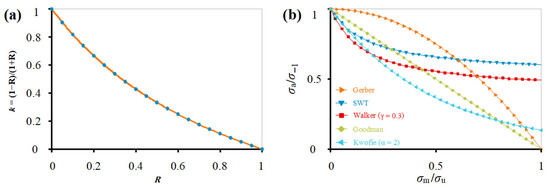
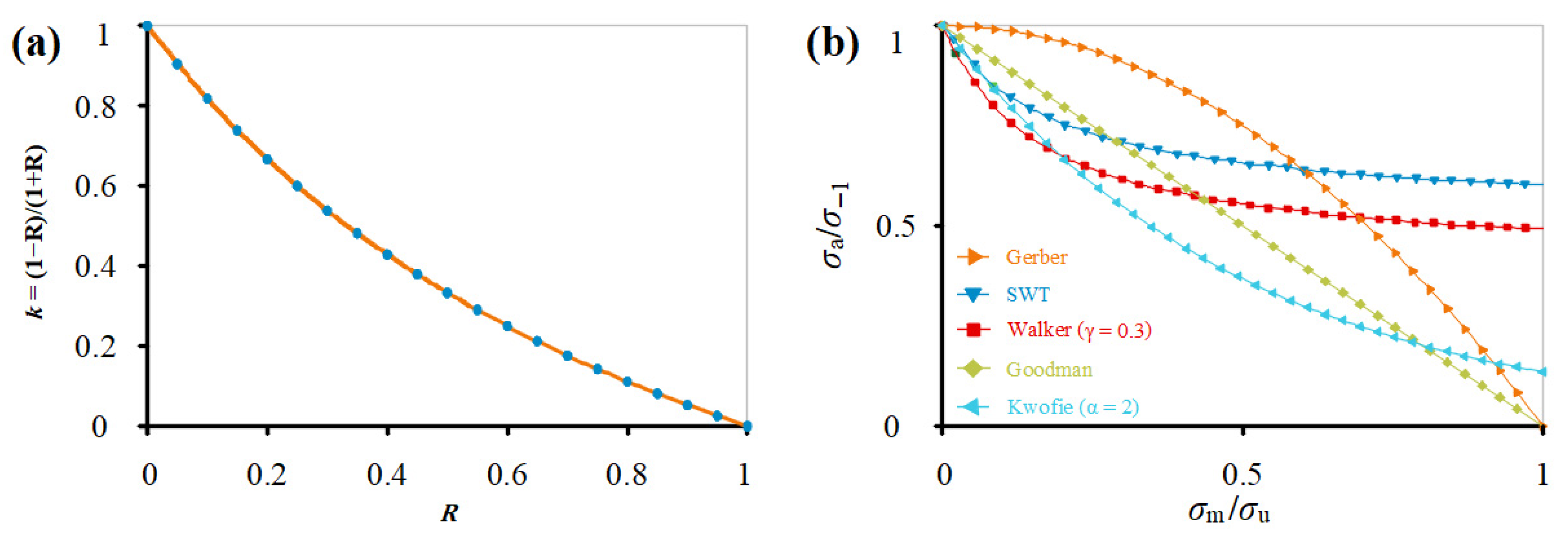
Equation (11b) can be expressed in the form of y = kx, where y represents the stress amplitude (σaR), x denotes the mean stress (σmR), and k = (1 − R)/(1 + R) defines the slope describing the variation of stress amplitude with mean stress. Figure 1a shows the variation in slope k with R, while Figure 1b presents the fatigue limit diagrams of several classical mean-stress correction models [22].
Figure 1.
Nonlinear sensitivity of fatigue limit to mean stress: (a) Equation (11), (b) classical models [22]. The dots represent discrete calculated results, while the solid line indicates the continuous variation trend.
It can be clearly seen from this that the fatigue limit decreases with increasing mean stress; however, its sensitivity is clearly nonlinear and diminishes at higher stress ratios. For non-propagating cracks, this behavior can be largely attributed to CC, as changes in mean stress modify the degree of crack opening and thus the effective crack tip driving force. At high R the crack remains mostly open and the closure effect becomes weak, whereas at low R crack closure is significant and strongly suppressed by tensile mean stress, leading to enhanced sensitivity. The above analysis provides the physical basis for the nonlinear modification of the Goodman model and is intended solely to support the modeling rationale.
In high-cycle fatigue analysis, the Goodman model is commonly regarded as a linear mean-stress correction approach based on the maximum tensile-stress failure criterion [24]. When considering nonlinear failure trends, the impact of maximum stress on fatigue life should be nonlinearly amplified. Hence:
Performing a Taylor expansion on Equation (12) yields
According to Equation (13), R2 emerges as the primary second-order term contributing to the reduction in fatigue life. Additionally, the SWT model (Equation (4)) implicitly incorporates the R2 term. Hence, it is reasonable to adopt φ(R) = α + ηR2 as the correction function.
To ensure consistency with the original Goodman model at R = 0, it is required that φ(0) = 1. When R = 1, the loading condition degenerates into static tension (σmax = σmin), which is no longer a cyclic loading case. In this situation, CC disappears completely, and the rate of change of the fatigue limit with respect to mean stress approaches zero, i.e., φ(1) = 0. By combining these two physical boundary conditions, the φ(R) = 1 − R2 is obtained for 1 > R ≥ 0. (Here, the R approaches 1 asymptotically, but cannot be taken as exactly 1, since R = 1 corresponds to static tension.) This function accurately characterizes the decreasing trend of sensitivity with increasing R. Therefore, when 0 ≤ R < 1, the modified Goodman model can be expressed as
To obtain a normalized and unified expression, substituting Equation (9) into Equation (14) yields
Equation (15) can be re-written as
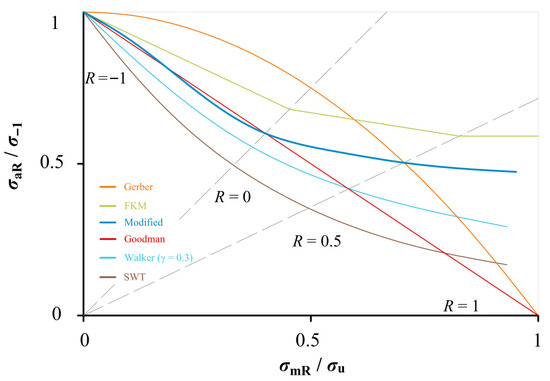
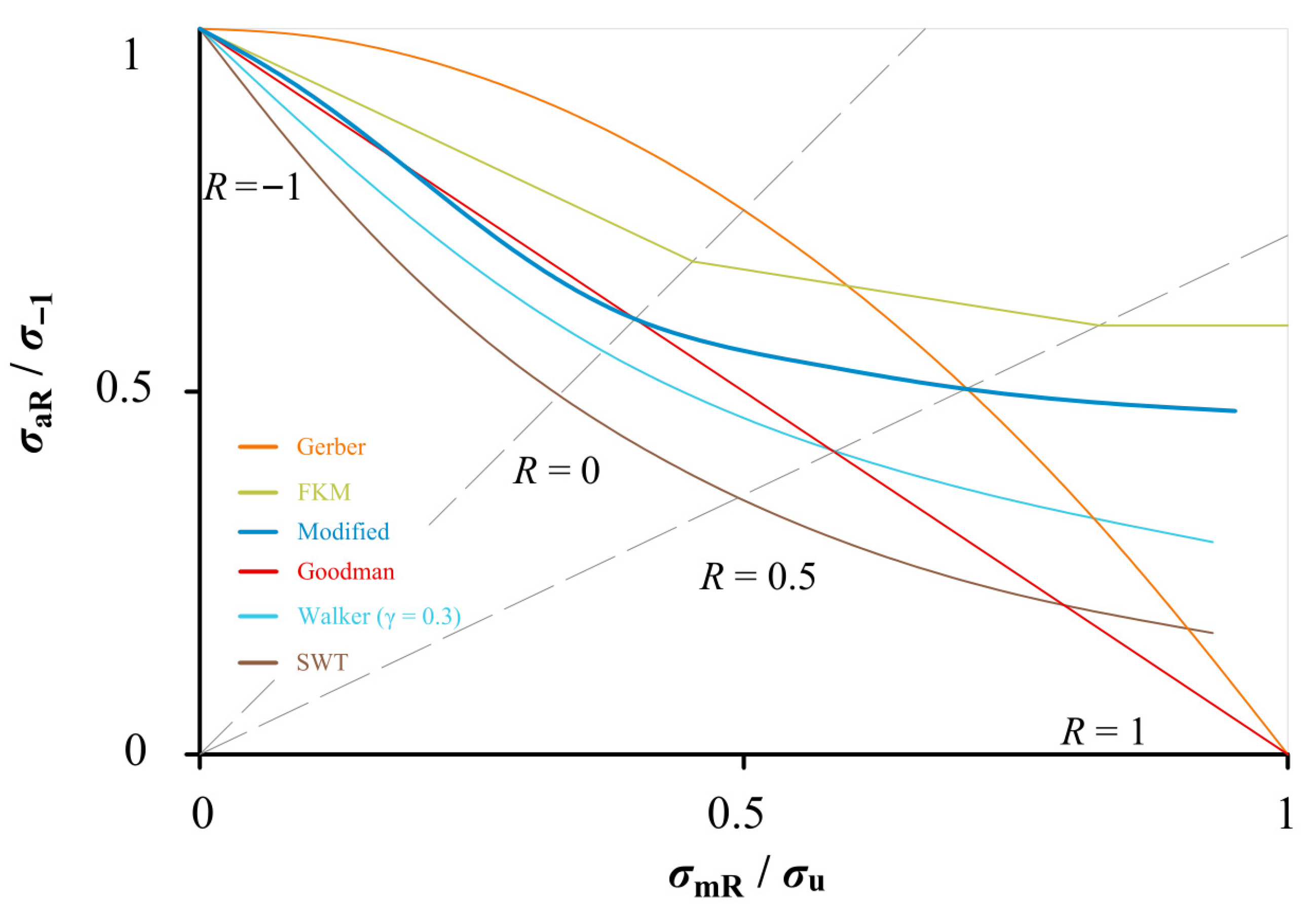
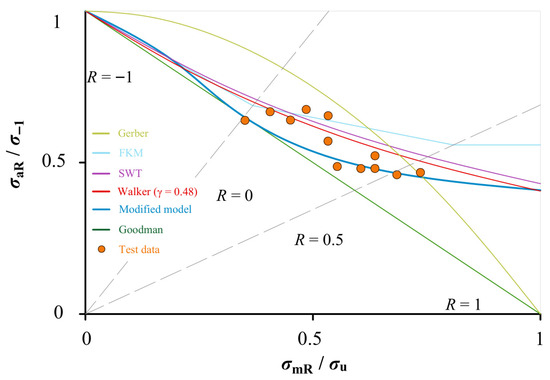
where Y = σaR/σ−1 and X = σmR/σu are normalized stress amplitude and mean stress, respectively, and K = σ−1/σu is the strength ratio of material. By programming in MATLAB 2016 to solve the implicit function of Equation (16), the Haigh diagram (σaR/σ−1 − σmR/σu curve) of the modified model can be obtained as shown in Figure 2, which demonstrates that the material’s sensitivity to mean stress gradually decreases with increasing R, particularly for R ≥ 0.5. This trend is consistent with the results of prior theoretical analysis.
Figure 2.
The Haigh diagram based on various mean-stress correction models.
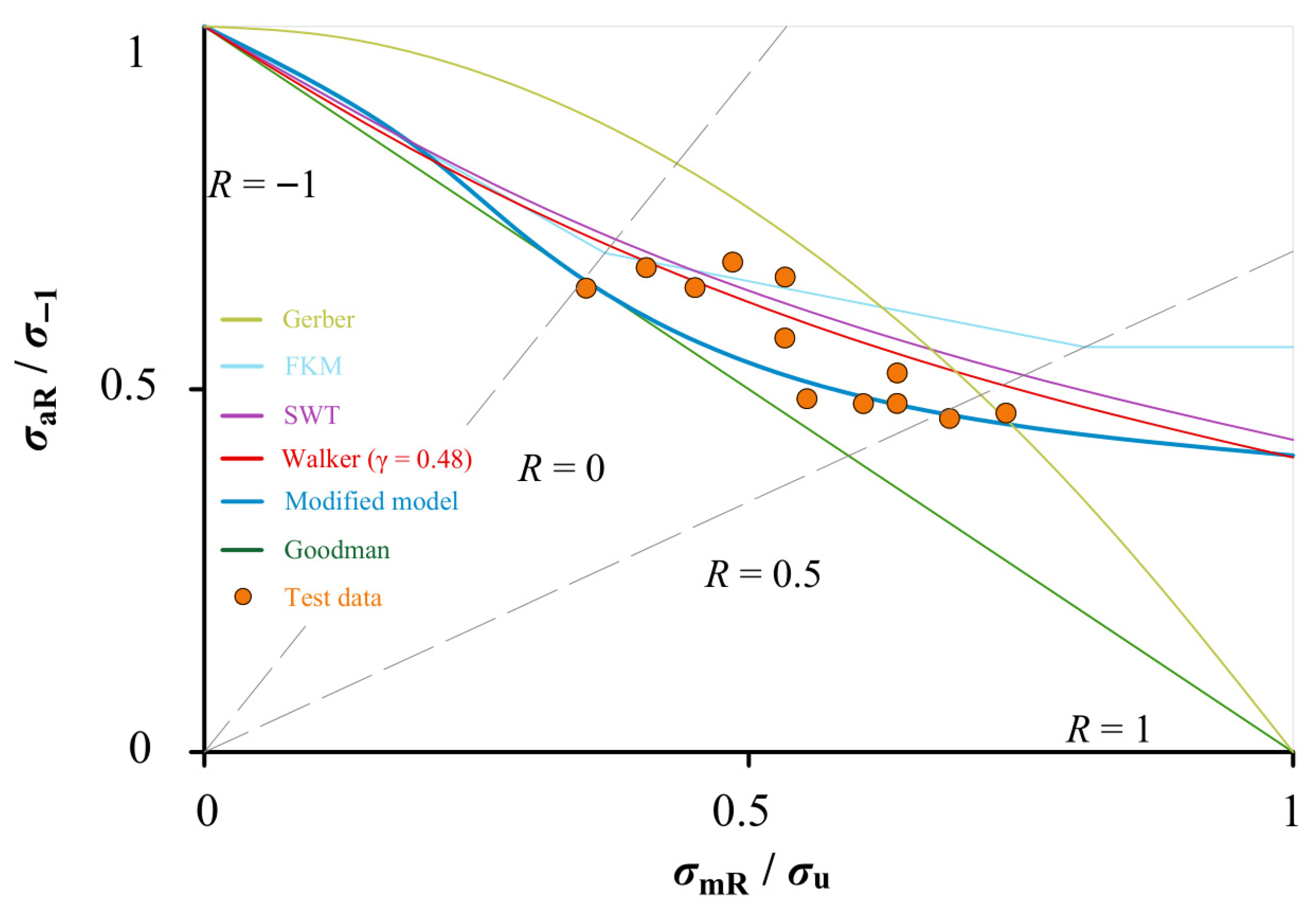
In this study, experimental data of Al-alloy 2014-T6 reported in authoritative journals were selected as the basis for model validation [23,25]. This data set provides a complete Haigh diagram, enabling effective evaluation of mean-stress correction models and offering a reliable benchmark for comparison with classical models. As shown in Figure 3, the curve predicted by Equation (14) demonstrates good consistency with experimental data, particularly for R ≥ 0.5. And compared to other models, Equation (14) is solely related to material properties (σ−1 and σu) without including any other fitting parameters, thereby enhancing its practical applicability.
Figure 3.
σaR/σ−1 − σmR/σu plot for Al-alloy 2014-T6 based on the various mean-stress models.
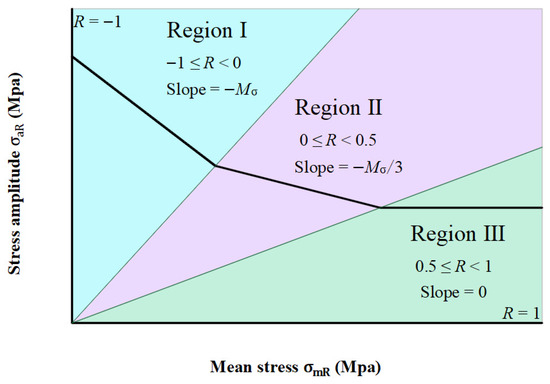
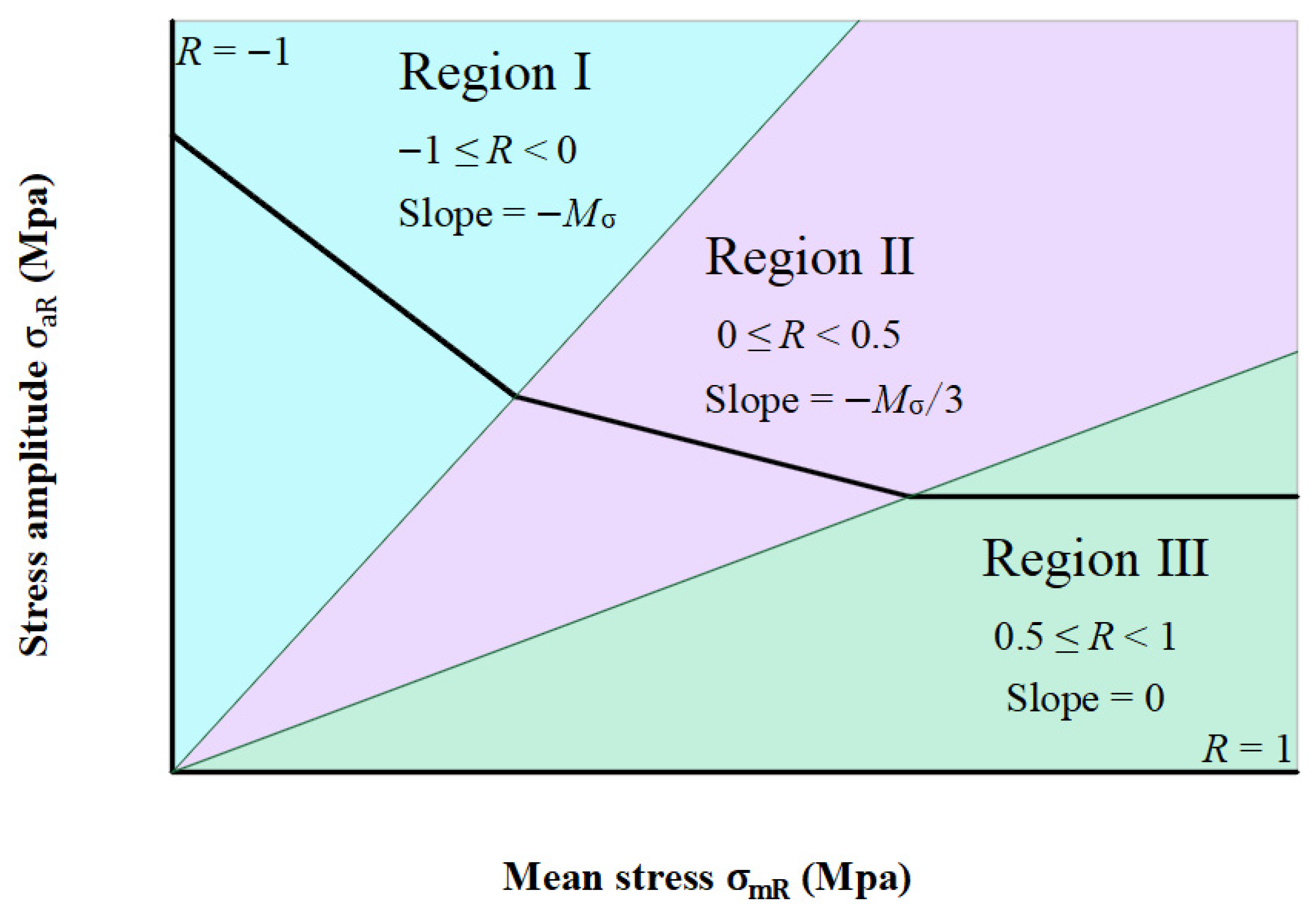
For −1 ≤ R < 0, in this regime, the minimum stress is often negative, and the CC effect becomes more pronounced, thereby enhancing the material’s sensitivity to mean stress. This conclusion is also supported by the German FKM guideline [23]. As shown in Figure 4, the FKM Haigh plot exhibits a slope in the range of −1 ≤ R < 0 that is approximately three times steeper than that observed for 0 ≤ R < 0.5, reflecting a markedly higher sensitivity of fatigue strength to mean stress under negative R. To capture this enhanced physical reality, φ(R) = 3(1 − R2) can be used to modify the Goodman model at −1 ≤ R < 0. This conclusion will be further validated in Section 3 using a crack growth rate model that incorporates the R-effect and is derived based on the current findings.
Figure 4.
The mean-stress sensitivity factor in the Haigh diagram corresponding to FKM guidelines [23].
2.2. Derivation of the Equivalent Driving Force Model
Based on the modified nonlinear mean-stress correction formulation, an equivalent crack driving force model accounting for stress ratio effects is developed as follows:
Firstly, the modified Goodman model, Equation (14), can be re-written as follows, at 0 ≤ R < 1:
Substituting R = 0 into Equation (11), Equation (18) will be obtained as follows:
where σa0 and σm0 are stress amplitude and mean stress at R = 0, respectively.
According to Equations (11) and (18), the following relation can be obtained:
Substituting Equation (17) into Equation (19), the following equation will be obtained:
Substituting Equation (19) into Equation (20), σaR will be linked to σa0.
When R = 0, , substituting it into Equation (17), σa0 will be written as follows:
By substituting Equation (22) into Equation (21) and simplifying, Equation (23) can be obtained:
Similarly, when −1 ≤ R < 0, the relationship between σaR and σa0 can be written as
Therefore, when −1 ≤ R < 1, the relationship between σaR and σa0 can be expressed as follows:
For standard specimens such as CT and MT types, the relationship between stress and stress intensity can be expressed as follows [26]:
where ΔKR is stress-intensity factor range (ΔKR = Kmax − Kmin), Y is geometry factor, ΔσR is stress range (ΔσR = σmax − σmin), and a is crack length.
According to ΔσR = 2σaR, and substituting Equation (23c) into Equation (24), Equation (25) can be obtained as follows:
Equation (25) can be used to equate the SIF range at any −1 ≤ R < 1 (ΔKR) to that at R = 0 (ΔK0). This means Equation (25) could concentrate the (ΔK, da/dN) data point at any −1 ≤ R < 1 into a narrow band around the da/dN − ΔK curve at R = 0.
The expression for the widely used Paris model is as follows:
where C and m are Paris parameters and depend on material properties and R.
To consider R-effects, Equation (26) can be re-written as
where CR and mR are Pairs parameters at −1 ≤ R < 1, and CR and mR are Pairs parameters at R = 0. It is commonly assumed that mR is constant and does not vary with R [6,12,13], i.e., mR = m0, but CR depends on R.
After accounting for R-effects, the FCG rate curves obtained at different R values are normalized such that the crack growth rate is identical under the equivalent stress-intensity factor, and the following relation is obtained: (da/dN)R = (da/dN)0. Accordingly, based on Equations (27a) and (27b), Paris parameter C values corresponding to different R values satisfy the following relationship: C0 = CR·[f(R)]mR. Substituting this relationship into the Paris law leads directly to Equation (28).
Steps for predicting fatigue-crack growth rate curves using Equation (28):
- (1)
- The reference Paris parameters C0 and m0 are determined by fitting the test FCG rate data obtained at R = 0.
- (2)
- Based on the approximately parallel nature of the FCG rate curves at different values of R, the Paris exponent is assumed to be R-independent, i.e., mR = m0.
- (3)
- The function f(R) is evaluated using σu, and σ−1, and the Paris coefficient CR corresponding to different R values is calculated by the relationship C0 = CR·[f(R)]mR.
- (4)
- With the parameters CR and mR determined, the FCG rate curves at arbitrary R values (−1 ≤ R < 1) can be directly predicted.
Using Equation (28) with parameters R, C0, m0, σu, and σ−1, the FCG rate can be predicted for various stress ratios (−1 ≤ R < 1) without introducing any fitting parameters. The proposed mechanism-guided semi-analytical model retains the fundamental advantages of the Goodman relation, namely its ease of application and low testing cost, while addressing the limitations of the linear assumption. It therefore achieves a practical balance between predictive accuracy and computational or experimental cost.
3. Model Validation Based on Experimental Data
3.1. Validation of the Model with FCG Test on Q345qD Steel
3.1.1. Experimental Methodology
To validate the proposed mechanism-guided semi-analytical model (Equations (25) and (28)), the FCG tests were conducted on Q345qD steel, a structural steel widely used in bridge main girders due to its high strength, good weldability, stable toughness, and excellent performance under cyclic loading. All experimental specimens were machined from Q345qD steel plates with a thickness of 10 mm. The chemical composition of the material is summarized in Table 1.
Table 1.
The typical chemical composition of Q345qD steel (in weight percent, wt.%).
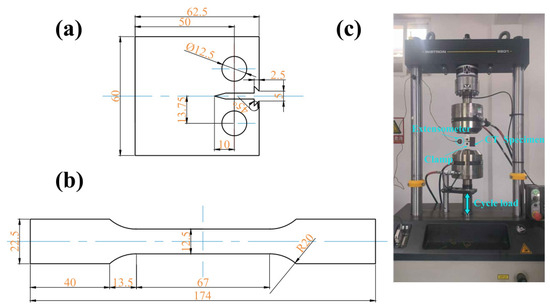
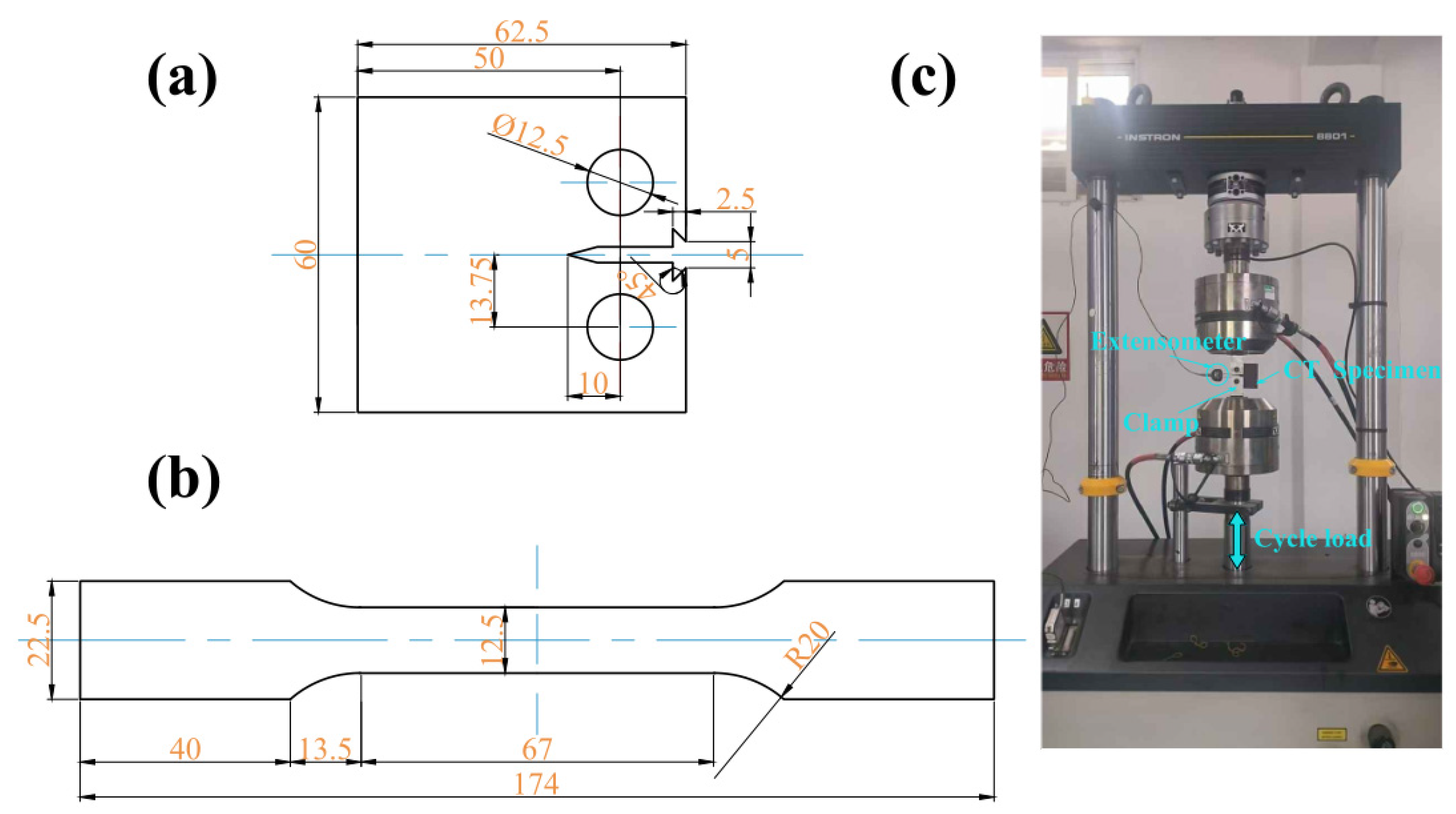
All compact tension (CT) specimens (Figure 5a) used for FCG tests were machined by electrical discharge wire cutting. During specimen preparation, the crack growth direction was aligned with the rolling direction of the Q345qD steel plate. Fatigue tests were conducted at room temperature using an Instron 8801 servo-hydraulic fatigue testing system (Figure 5c) under sinusoidal loading at a frequency of 10 Hz, based on the ASTM E647 standard [27]. Furthermore, the test specimen, clamp, and extensometer are all indicated in Figure 5c.
Figure 5.
Details of fatigue test specimen (unit: mm): (a) compact tensile specimens (CT), (b) uniaxial tensile specimens, and (c) FCG testing apparatus.
To obtain FCG rate curves corresponding to different R values, tests were performed at stress ratios of R = 0.05, 0.1, 0.3, 0.5, and 0.7, while maintaining a constant load range of ΔP = 8 kN. Prior to the FCG tests, fatigue pre-cracks were introduced into the CT specimens using the incremental K-method. Cyclic loading was applied at a frequency of 10 Hz until the crack propagated stably to a length of approximately 2 mm.
During the FCG tests, crack length was measured using a clip-on extensometer, and the crack length-cycle number (a-N) data were recorded. Following the procedures specified in ASTM E647 [27], ΔK and da/dN were calculated from the measured data by Equations (29) and (30):
where W is the specimen width, B is the specimen thickness, and α = a/W.
Uniaxial tensile tests were also conducted using an Instron 8801 testing machine. In accordance with the ASTM E8/E8M-13a standard [28], dog-bone-shaped specimens (Figure 5b) were used to evaluate the mechanical properties of the material.
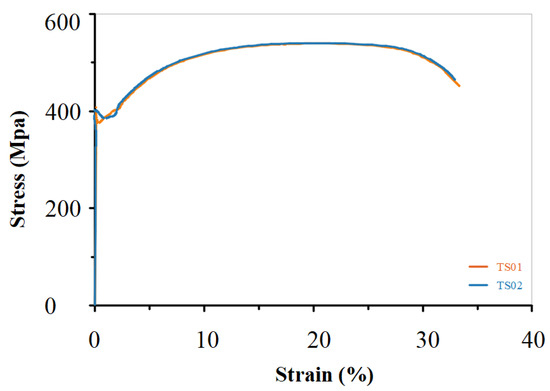
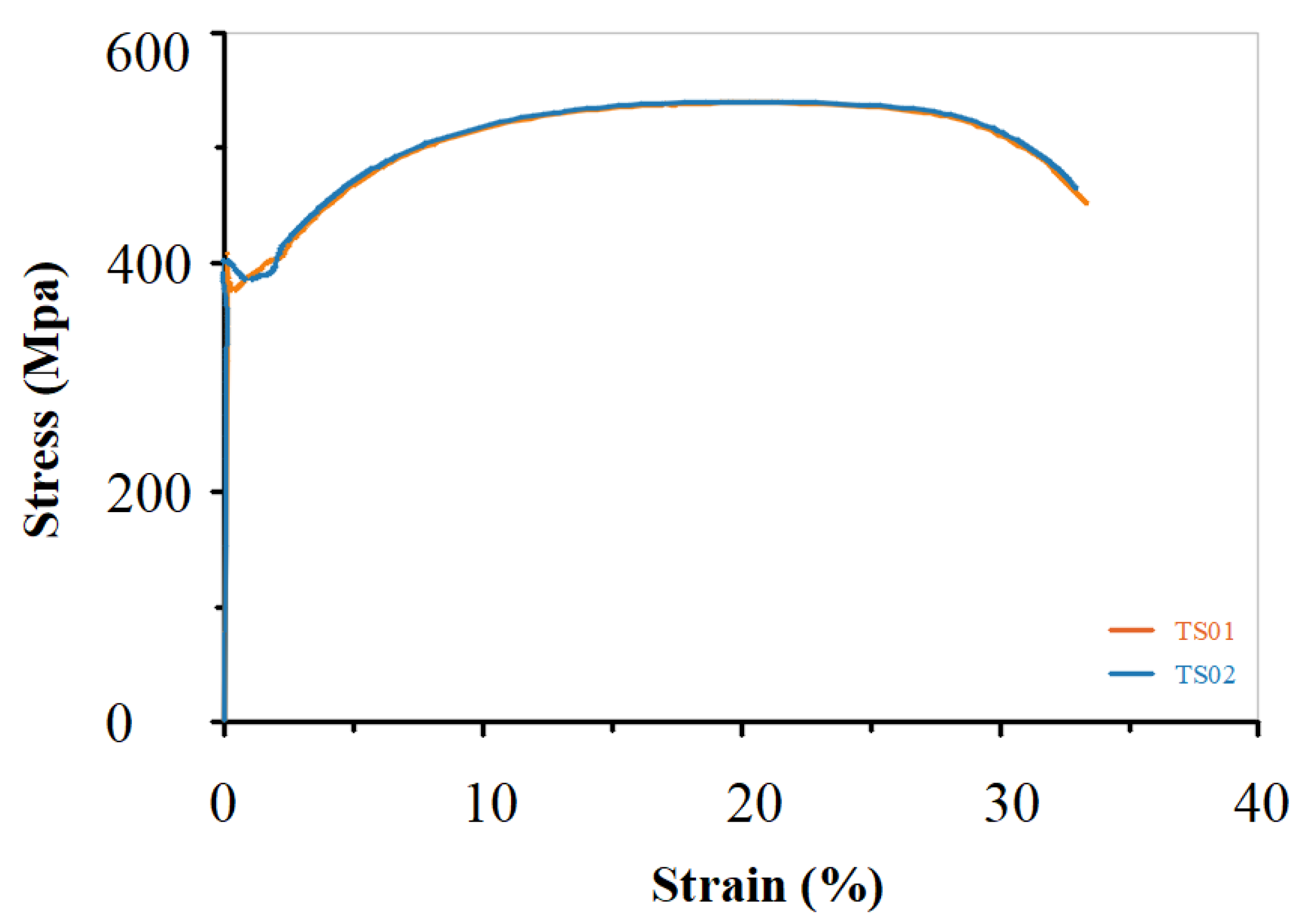
An extensometer with a gauge length of 50 mm was employed; therefore, the central 50 mm section of the specimen was selected as the initial gauge length. During testing, the specimens were clamped using wedge grips and carefully aligned in the vertical direction to minimize bending effects. The tests were performed under displacement control at a constant crosshead speed of 0.5 mm/min. Based on the measured data, the corresponding engineering stress–strain curves were obtained.
3.1.2. Results and Verification
Figure 6 shows the uniaxial tensile stress–strain curves of the Q345qD specimens. A distinct yield plateau can be clearly observed from the curves, indicating typical elastic-plastic deformation behavior of Q345qD steel. To verify the reproducibility of the tensile behavior, two geometrically identical specimens were tested, where TS 01 and TS 02 denote the uniaxial tensile test results of tensile specimen 1 and tensile specimen 2, respectively. From the measured stress–strain curves, the yield strength and ultimate tensile strength were determined to be σy = 380 MPa and σu = 540 MPa, respectively. According to the relevant fatigue standards [29], the fatigue limit of the unnotched base material at 2 × 10⁶ cycles is 160 MPa.
Figure 6.
Tensile stress–strain curve of Q345qD steel.
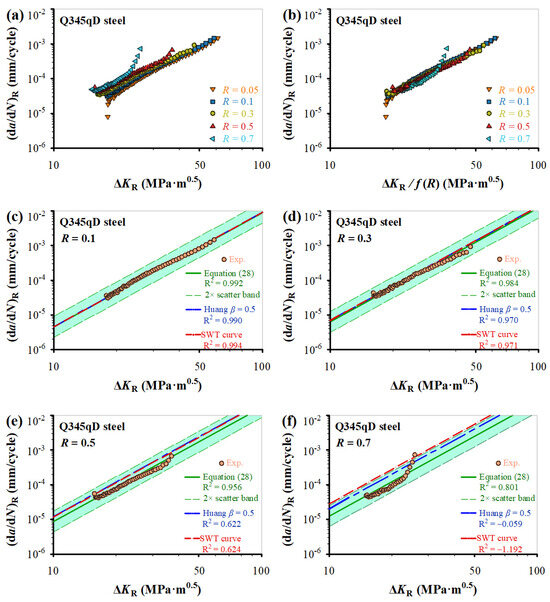
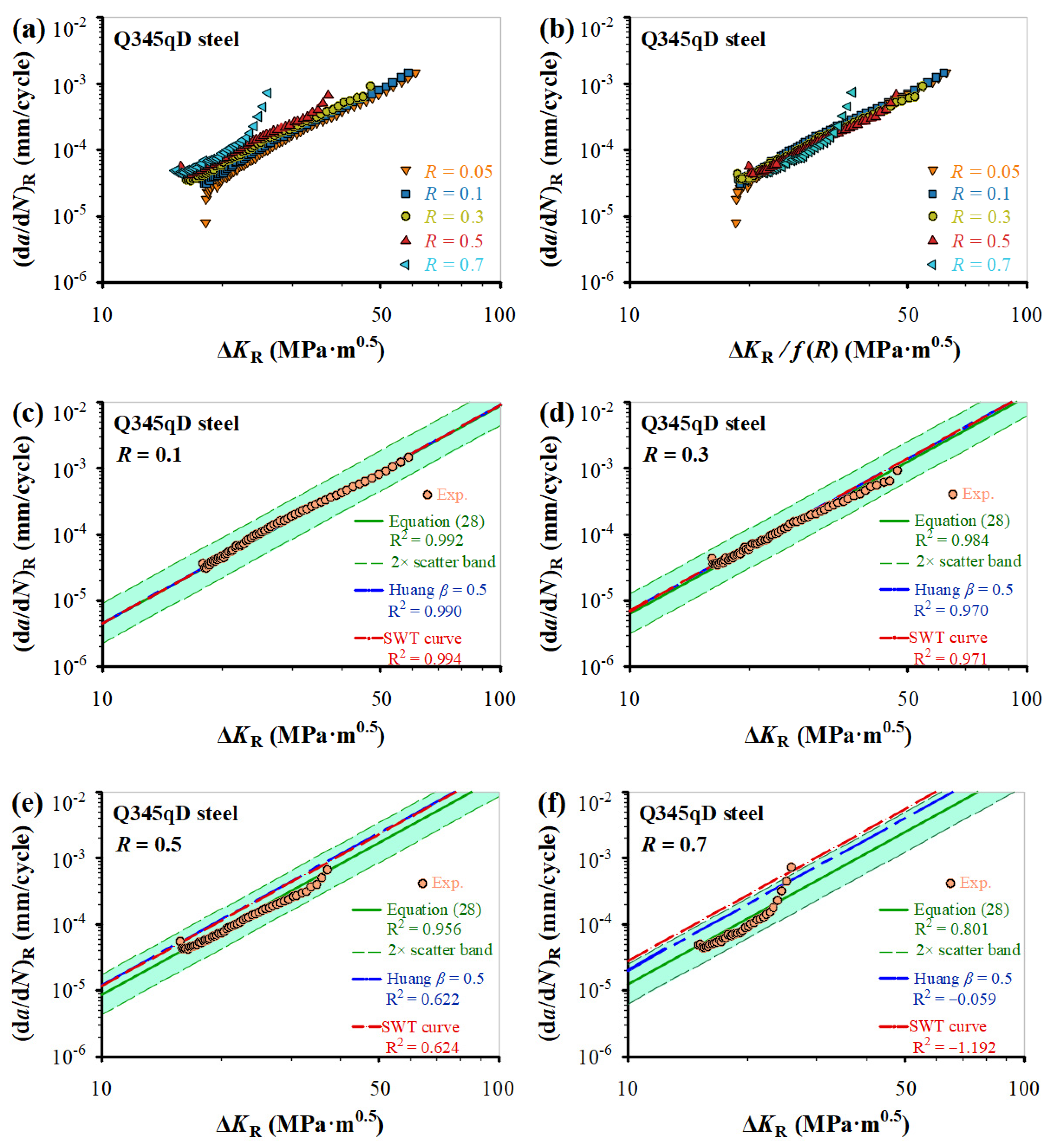
To validate the accuracy and reliability of the proposed model, FCG rates for Q345qD steel were predicted using Equation (28) and systematically compared with results obtained from commonly employed models, including the mean-stress correction SWT model [22] and the two-parameter driving force model proposed by Huang [12]. (β = 0.7 or β = 0.5. β is determined by material properties, and for different materials the values of β have been provided in the corresponding figures). The FCG results obtained from CT specimens under various values of R are presented in Figure 7a. By applying Equation (25), the da/dN − ΔK curves for various values of R collapse into a narrow band around the R = 0 reference curve (Figure 7b), demonstrating the effectiveness of the proposed normalization.
Figure 7.
Prediction of the (da/dN)R-ΔKR curve for Q345qD steel at R = 0.1, 0.3, 0.5 and 0.7 using Equation (28): (a) the experimental data for the (da/dN)R-ΔKR relationship, (b) the normalized (da/dN)R-ΔKR/f(R) relation, and (c–f) comparison between the predicted (da/dN)R-ΔKR curves and the experimental data at R = 0.1, 0.3, 0.5 and 0.7, respectively [12,22].
Figure 7c–f compare the FCG rate curves predicted by Equation (28) with the experimental results for R = 0.1, 0.3, 0.5, and 0.7, respectively. The predictions show excellent agreement with the measurements across all R levels, as nearly all experimental data points fall within the 2× scatter band of the predicted curves. In contrast, a comparison of Figure 7c,d with Figure 7e,f shows that the SWT and Huang models perform reasonably well at low R but exhibit increasingly significant deviations at higher R levels (R > 0.5), highlighting the superior robustness of the proposed model under high mean-stress conditions.
To quantify the predictive accuracy of Equation (28), the goodness of fit (R2) [30] was calculated and summarized in Table 2. As shown in Figure 7, the SWT, Huang, and the proposed model exhibit comparable accuracy at low stress ratios (R = 0.1 and 0.3). However, at higher stress ratios (R = 0.5 and 0.7), the proposed model demonstrates substantially improved performance. Specifically, the goodness of fit reaches 0.956 at R = 0.5 and 0.801 at R = 0.7, significantly exceeding the accuracy of both the SWT and Huang models.
Table 2.
Required material property parameters used in this study.
3.2. Verification of the Model Using FCG Data in the Literature
To further demonstrate the general applicability of the proposed mechanism-guided semi-analytical model across various metallic materials, FCG data for seven materials (two aluminums, four steels, and one titanium) reported in the literature and covering a wide R range (−1 ≤ R < 1) are incorporated for evaluation. The material properties required for model application are listed in Table 2. Notably, the material properties listed in Table 2 were obtained from the corresponding references or standard material property databases, and their measurements strictly followed ASTM or ISO testing standards.
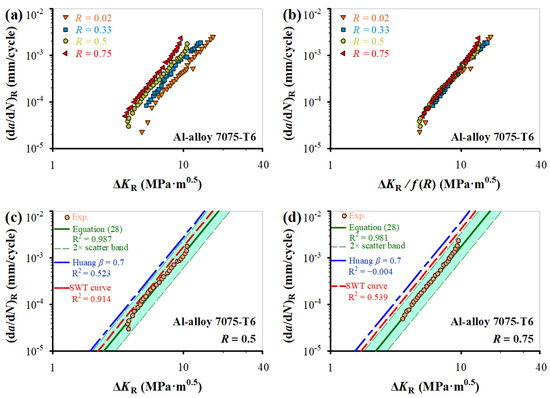
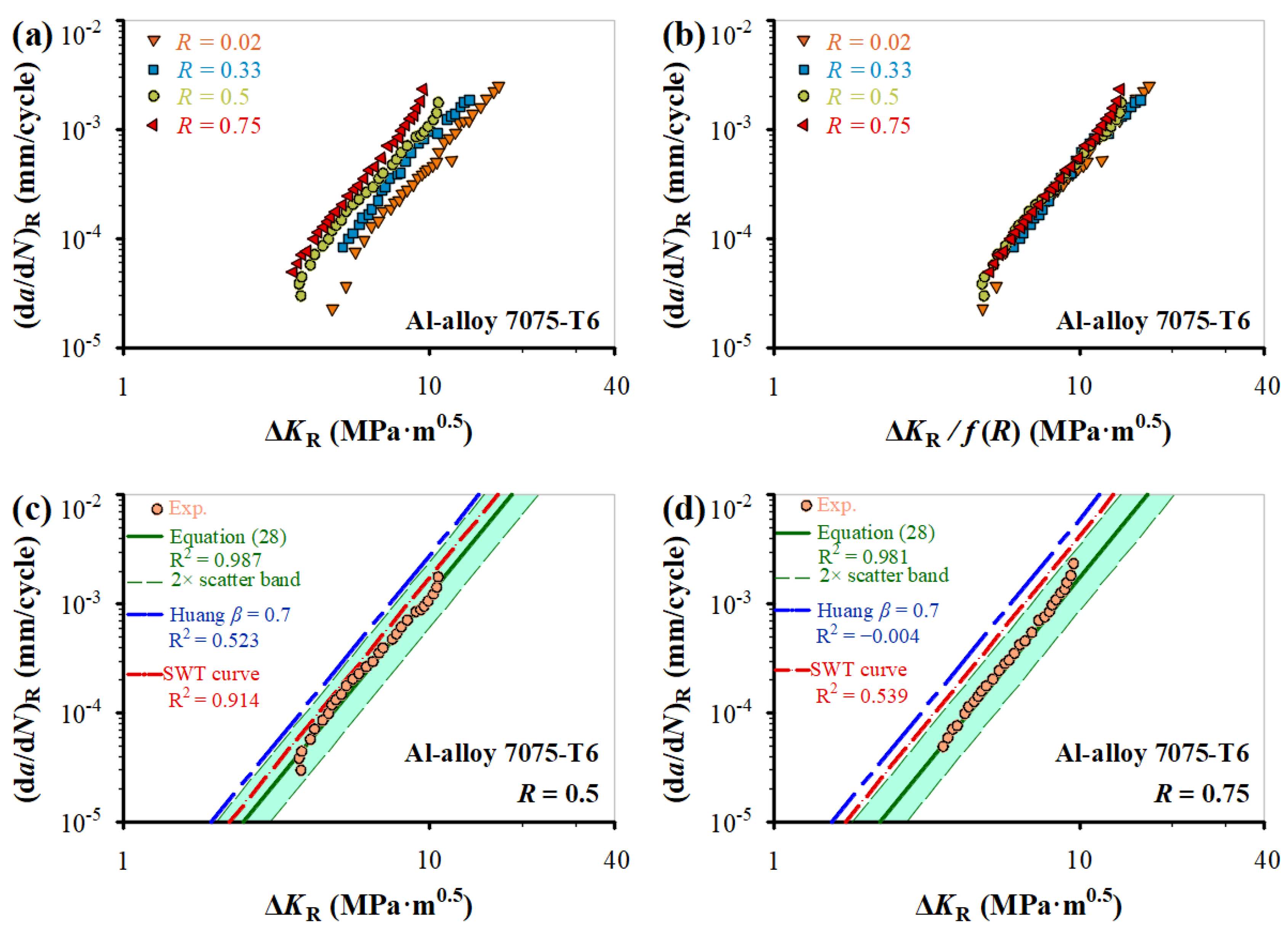
Figure 8 shows the complete predicted results for Al-alloy 7075-T6 [31]. The comparison between Figure 8a,b shows that by using Equation (25) all data points corresponding to R = 0.02, 0.33, 0.5, and 0.75 could be concentrated on a narrow band near the FCG curve at R = 0. This indicates that the newly developed equivalent driving force model, Equation (25), is valid for capturing R-effect within the range −1 ≤ R < 1.
Figure 8.
Prediction of the (da/dN)R-ΔKR curve for Al-alloy 7075-T6 at R = 0.5 and R = 0.75 using Equation (28): (a) the experimental data for the (da/dN)R-ΔKR relationship [31], (b) the normalized (da/dN)R-ΔKR/f(R) relation, and (c,d) comparison between the predicted (da/dN)R-ΔKR curves and the experimental data at R = 0.5 and R = 0.75, respectively [12,22].
Figure 8c,d present the comparison between the experimental data and the predicted FCG rate curves at R = 0.5 and 0.75, respectively. As shown, the SWT model performs well for 0 ≤ R ≤ 0.5, but shows reduced accuracy for higher R values. In contrast, the newly developed Equation (28) fits the data well for R ≥ 0.7, with most points within the 2× scatter band. Compared with the SWT model, the R2 increase from 0.914 to 0.987 and from 0.534 to 0.981 at R = 0.5 and 0.75, respectively, indicating the newly proposed model, significantly improves prediction accuracy, especially for high stress ratios (e.g., R ≥ 0.7).
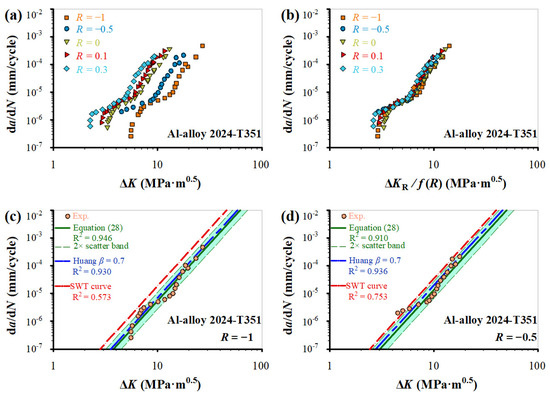
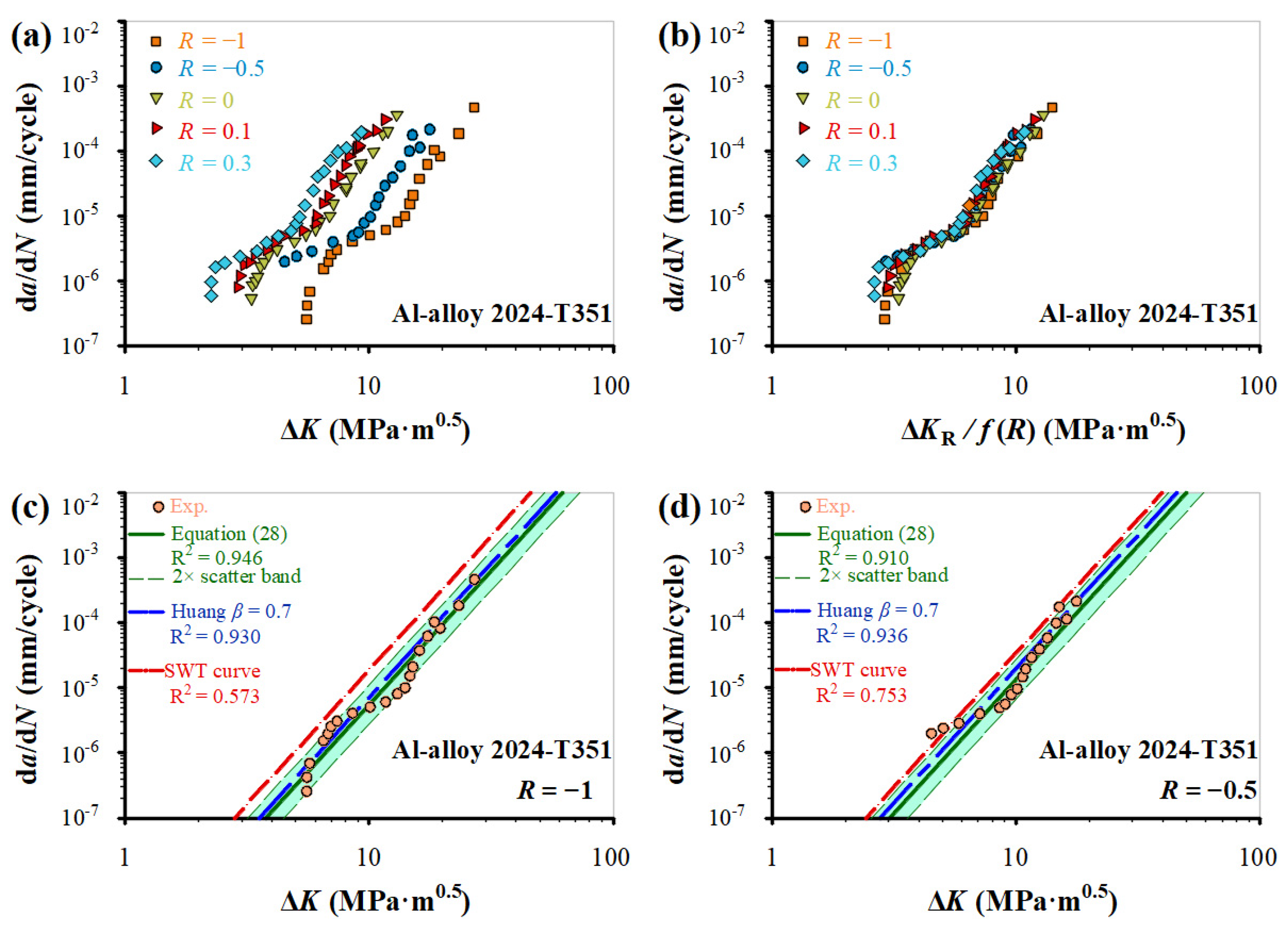
Figure 9 shows the prediction results for Al-alloy 2024-T351 [33]. The FCG rate data at different values of R is also concentrated into a narrow band around the curve at R = 0, as shown in Figure 9b. Figure 9c,d further demonstrate that the newly developed Equation (28) predicts the FCG rate accurately, with the 2× scatter band encompassing most of the test data. Notably, the comparison between Figure 8 and Figure 9 indicates that the SWT model considers R-effect well for 0 ≤ R ≤ 0.5, but becomes inaccurate for R < 0. In contrast, the Huang (β = 0.7) model performs well for R < 0, but fails to provide accurate predictions for R > 0.5, especially for R ≥ 0.7.
Figure 9.
Prediction of the (da/dN)R-ΔKR curve for Al-alloy 2024-T351 at R = −1 and R = −0.5 using Equation (28): (a) the experimental data of the (da/dN)R-ΔKR relationship [33], (b) the normalized (da/dN)R-ΔKR/f(R) relation, and (c,d) comparison between the predicted (da/dN)R-ΔKR curves and the experimental data at R = −1 and R = −0.5, respectively [12,22].
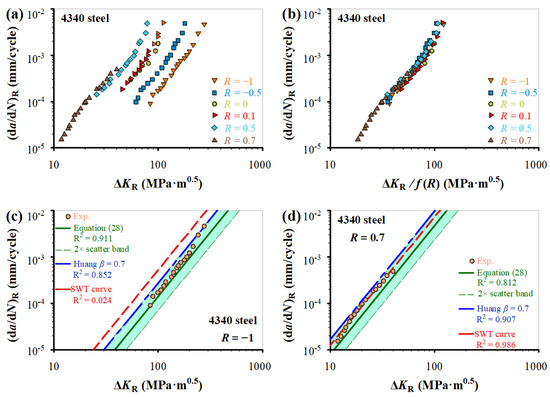
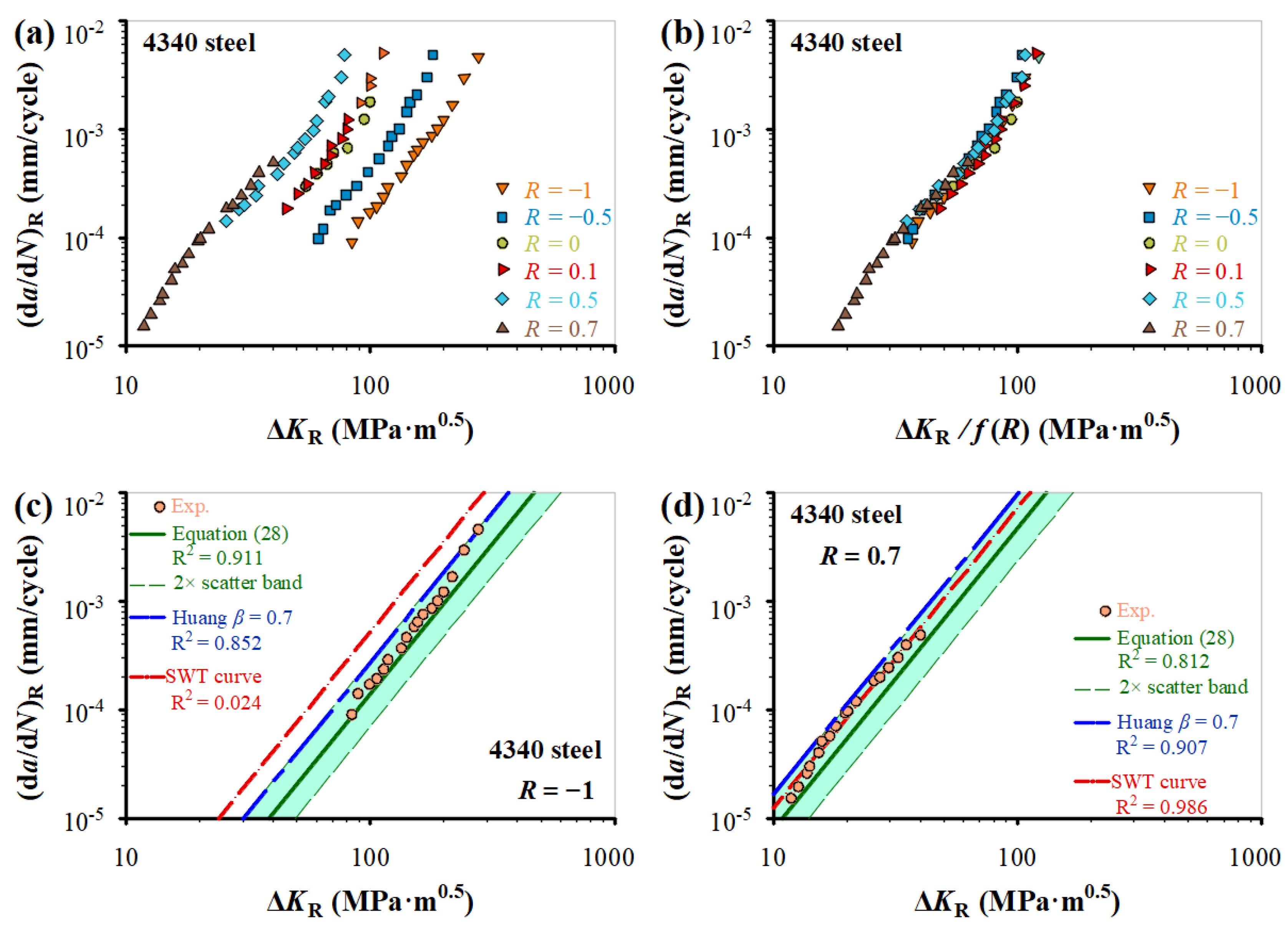
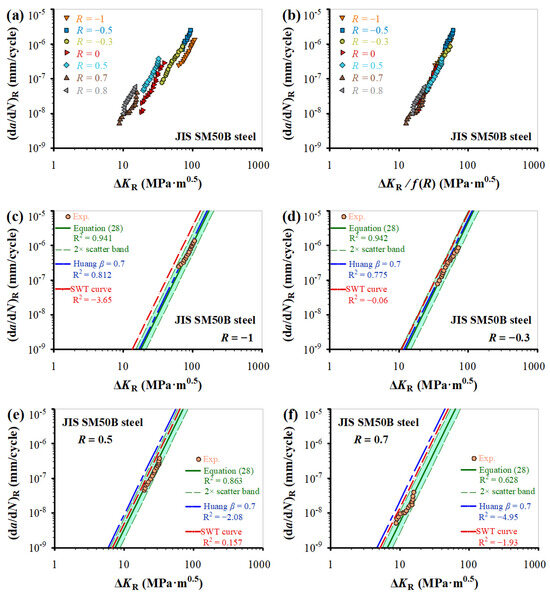
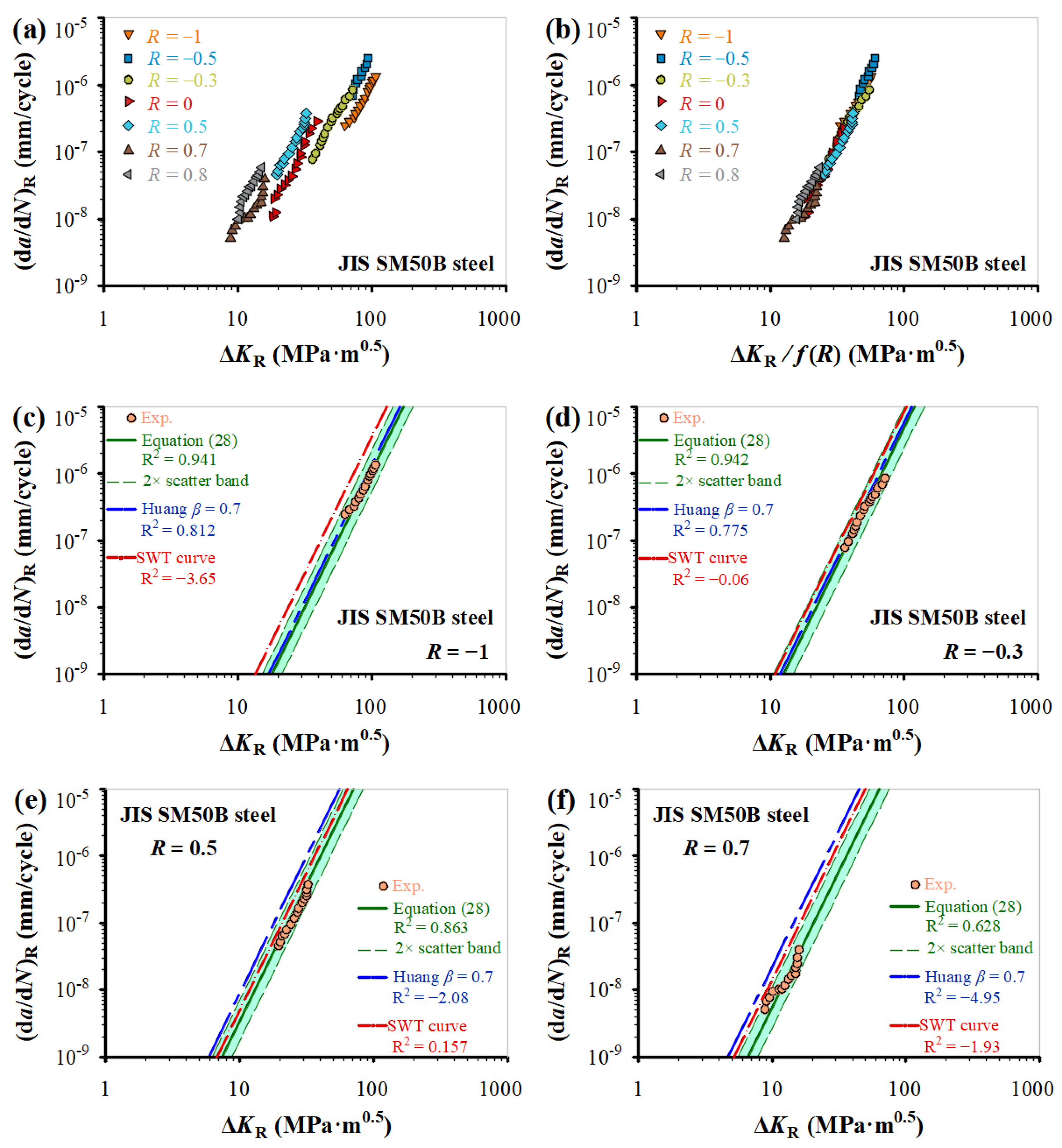
Similar results are observed for 4340 [34] and JIS SM50B steel [36], as shown in Figure 10b and Figure 11b, where almost all test data points are concentrated near the da/dN − ΔK curve, at R = 0. This indicates Equation (25) can accurately consider R-effect for −1 ≤ R < 1.
Figure 10.
Prediction of the (da/dN)R-ΔKR curve for 4340 steel at R = −1 and R = 0.7 using Equation (28): (a) the experimental data of the (da/dN)R-ΔKR relationship [34], (b) the normalized (da/dN)R-ΔKR/f(R) relation, and (c,d) comparison between the predicted (da/dN)R-ΔKR curves and the experimental data at R = −1 and R = 0.7, respectively [12,22].
Figure 11.
Prediction of the (da/dN)R-ΔKR curve for JIS SM50B steel at R = −1, −0.3, 0.5, and 0.7 using Equation (28): (a) the experimental data of (da/dN)R-ΔKR relationship [36], (b) the normalized (da/dN)R-ΔKR/f(R) relation, and (c–f) comparison between the predicted (da/dN)R-ΔKR curves and the experimental data at R = −1, −0.3, 0.5, and 0.7, respectively [12,22].
In addition, Figure 10c and Figure 11c,d show that the Huang model outperforms the SWT model for R < 0, with the maximum R2 reaching 0.812 at R = −1. Notably, the Equation (28) performs even better than the Huang model. At R = −1, the R2 values increases from 0.812 to 0.941 for JIS SM50B and from 0.852 to 0.911 for 4340 steel.
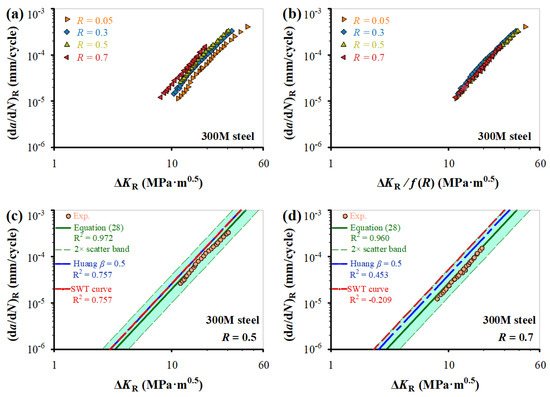
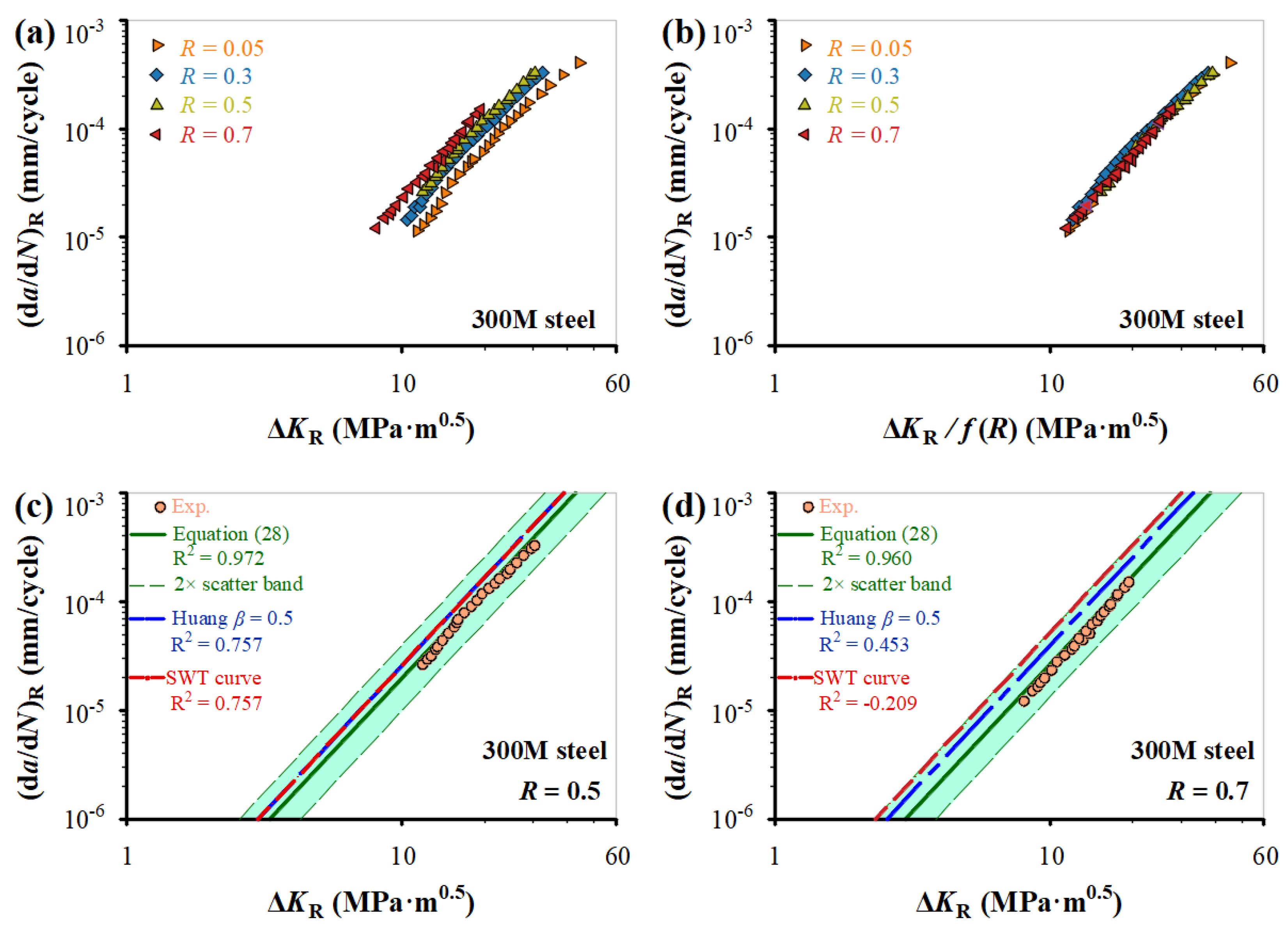
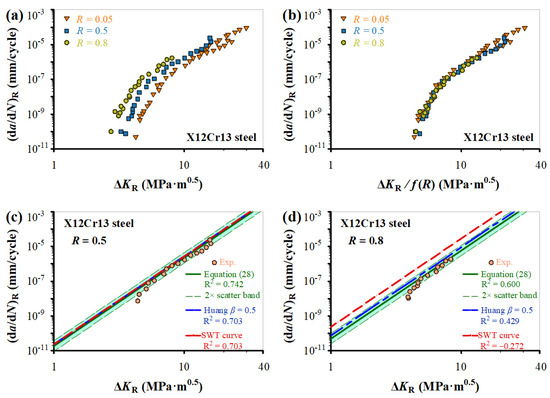
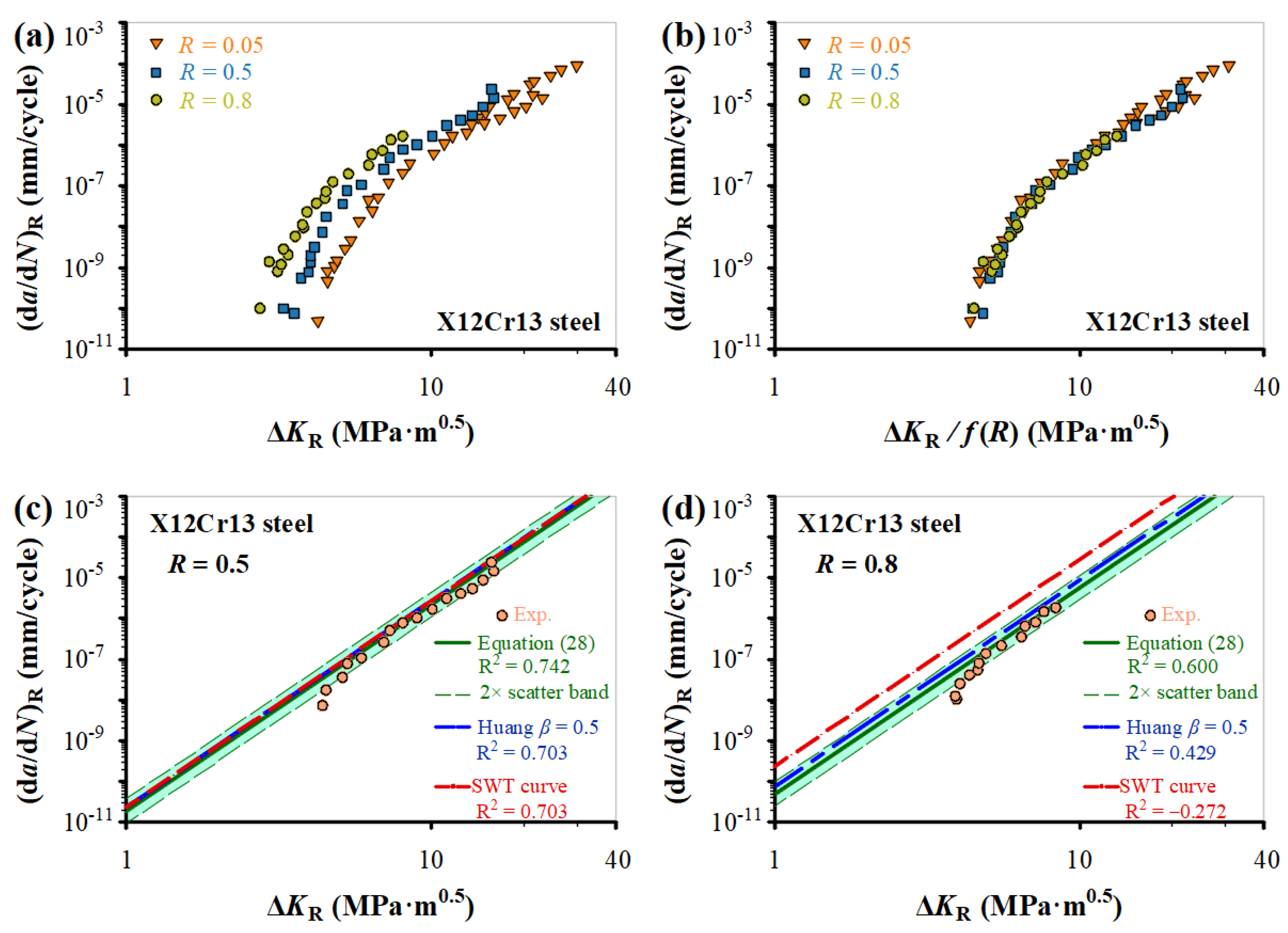
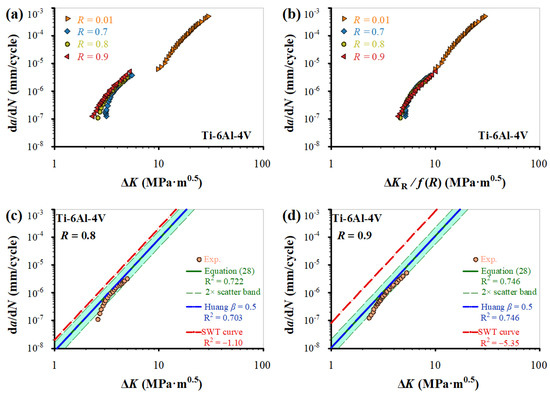
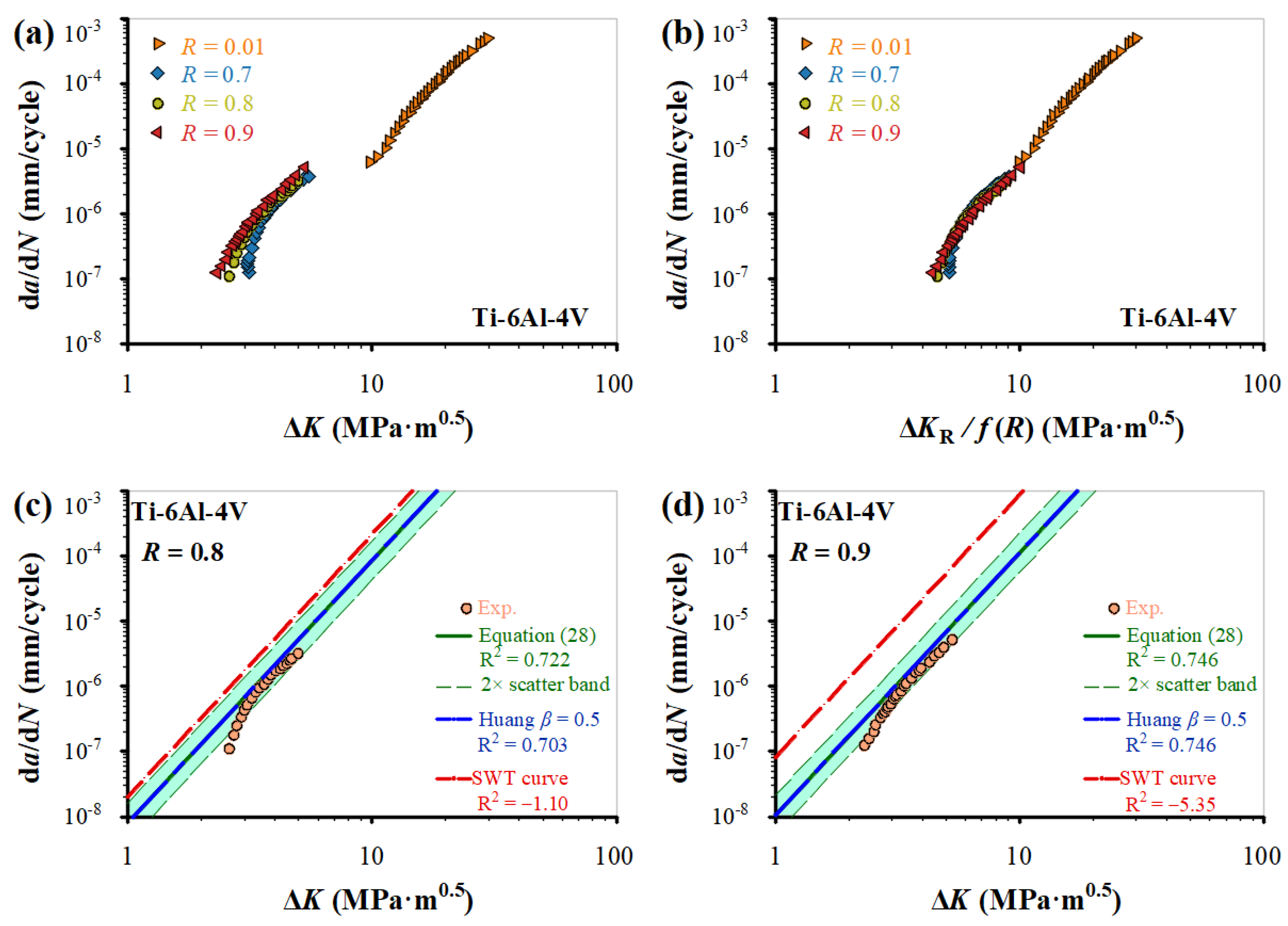
To validate the applicability of the developed model at high stress ratios (R ≥ 0.7), the FCG rate is predicted for JIS SM50B, 300M [37], X12Cr13 [38], and Ti-6Al-4V [39] alloys, and compares with test data. As shown in Figure 11, Figure 12, Figure 13 and Figure 14, most test data points are well concentrated in a narrow band near R = 0, demonstrating the validation of Equation (25).
Figure 12.
Prediction of the (da/dN)R-ΔKR curve for 300M steel at R = 0.5 and R = 0.7 using Equation (28): (a) the experimental data of the (da/dN)R-ΔKR relationship [37], (b) the normalized (da/dN)R-ΔKR/f(R) relation, and (c,d) comparison between the predicted (da/dN)R-ΔKR curves and the experimental data at R = 0.5 and R = 0.7, respectively [12,22].
Figure 13.
Prediction of the (da/dN)R-ΔKR curve for X12Cr13 steel at R = 0.5 and R = 0.8 using Equation (28): (a) the experimental data of the (da/dN)R-ΔKR relationship [38], (b) the normalized (da/dN)R-ΔKR/f(R) relation, and (c,d) comparison between the predicted (da/dN)R-ΔKR curves and the experimental data at R = 0.5 and R = 0.8, respectively [12,22].
Figure 14.
Prediction of the (da/dN)R-ΔKR curve for Ti-6Al-4V at R = 0.8 and R = 0.9 using Equation (28): (a) the experimental data of the (da/dN)R-ΔKR relationship [39], (b) the normalized (da/dN)R-ΔKR/f(R) relation, and (c,d) comparison between the predicted (da/dN)R-ΔKR curves and the experimental data at R = 0.8 and R = 0.9, respectively [12,22].
Furthermore, the comparison of the FCG rate curves predicted by the SWT model, Huang model, and Equation (28) indicates that the SWT model performs well for most materials within 0 ≤ R ≤ 0.5 but loses accuracy at higher R values, especially for R ≥ 0.7. For certain materials, the Huang (β = 0.5) model offers improved performance over the SWT model in this high-R regime. However, as shown by comparing Figure 14 with Figure 12 and Figure 13, although the Huang model (β = 0.5) captures the R-effect reasonably well for Ti-6Al-4V at high R values, it fails to deliver adequate accuracy for the other alloys. The newly developed Equation (28) predicts FCG rate more accurately over −1 ≤ R < 1, with R2 improving from 0.453 to 0.960 for 300M steel and from 0.429 to 0.600 for X12Cr13 steel.
Table 3 presents the detailed results, including the cyclic crack-resistance parameters. The units of these parameters are explained below. The stress ratio R, the Paris exponent m, and the coefficient of determination R2 are dimensionless. The Paris coefficient C carries physical units, which depend on the units adopted for da/dN and ΔK. In the present work, da/dN is expressed in “mm/cycle” and ΔK in “MPa·m0.5”, and the corresponding units of follow accordingly, with [C] = mm/cycle⋅(MPa⋅m0.5)−m. For most materials used in this paper, nearly all test data fall within the 2× scatter band, and the R2 values are significantly higher than those obtained from the SWT and the Huang models. Consequently, the proposed mechanism-guided semi-analytical Equation (28) and its derivations are validated as accurate and reliable for predicting the FCG rate within −1 ≤ R <1.
Table 3.
A detailed analysis of the validation results for Equation (28).
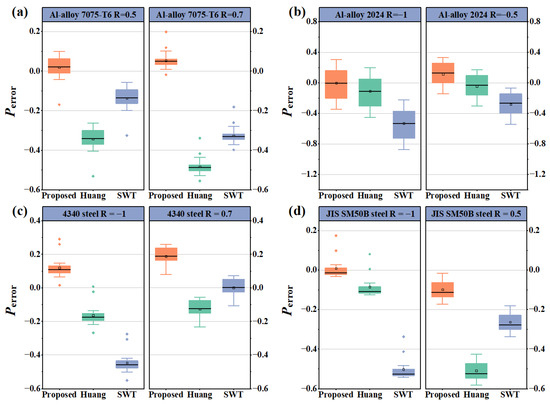
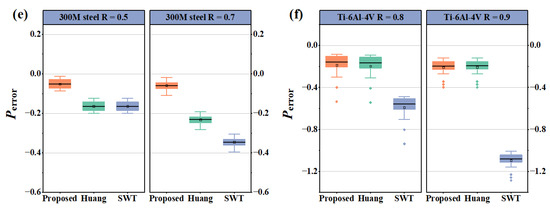
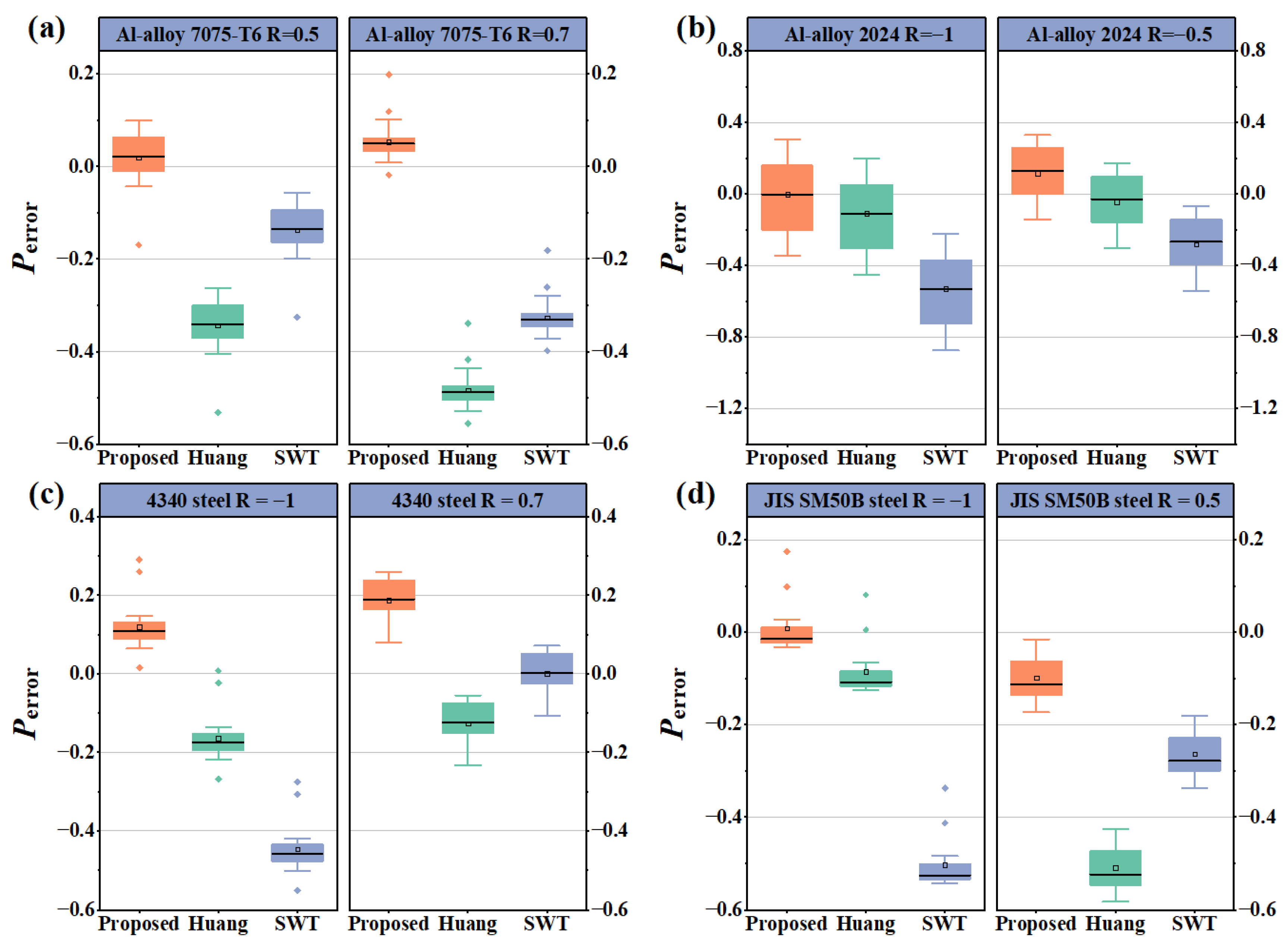
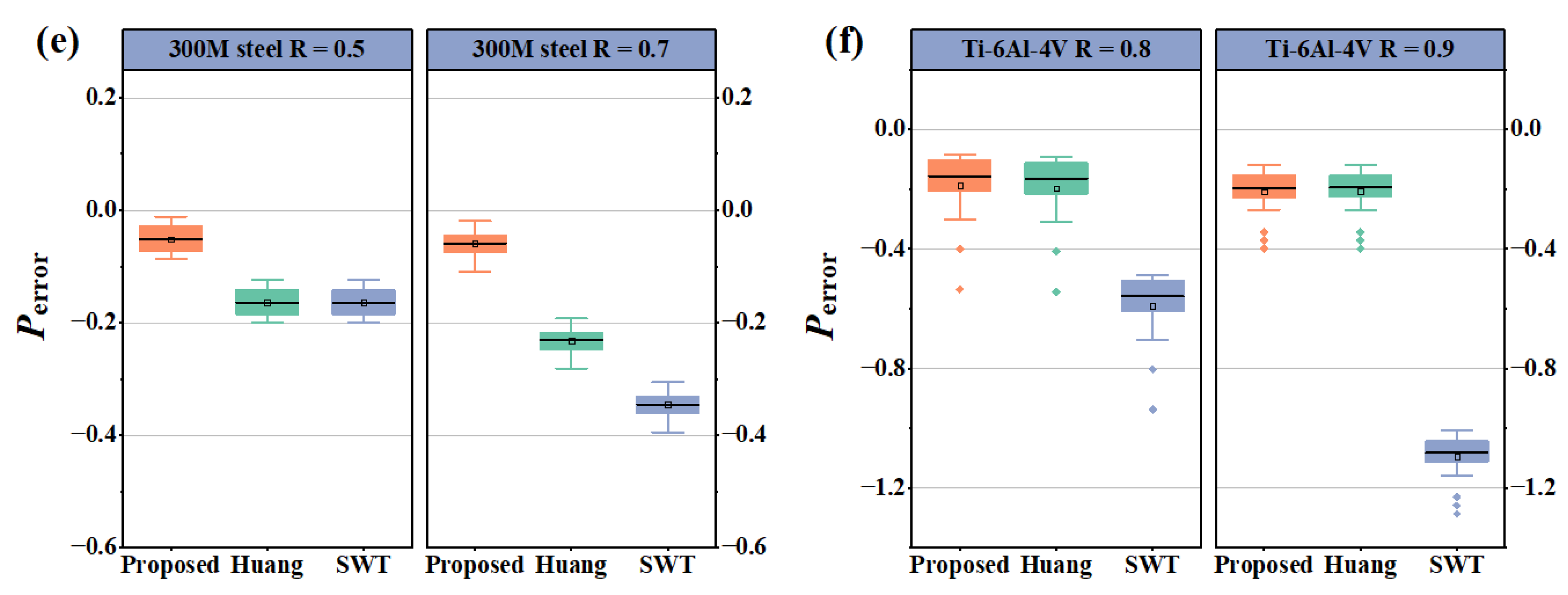
To systematically evaluate the predictive performance of the models, an error index [40], Perror = lg[(da/dN)exp/(da/dN)prediction], is also introduced as an evaluation metric, and corresponding boxplots are plotted (Figure 15) to comprehensively compare the proposed model with the Huang and SWT models under various material and stress ratios.
Figure 15.
Boxplots comparing the prediction errors of different models under various material and stress ratios (The orange, green, and blue colors represent the proposed model, the Huang model, and the SWT model, respectively). (a) Al-alloy 7075-T6, (b) Al-alloy 2024-T351, (c) 4340 steel, (d) JIS SM50B steel, (e) 300M steel, and (f) Ti-6Al-4V.
The comparison results indicate that the proposed mechanism-guided semi-analytical model exhibits the most compact error boxes and the median values closest to zero, demonstrating its superior prediction accuracy and stability. Specifically, the Huang model generally shows negative errors, suggesting a systematic underestimation, while the SWT model displays particularly large deviations in the negative R region. The results indicated that by incorporating the nonlinear sensitivity of the material fatigue limit to mean stress, the proposed model effectively compensates for the limitations of the traditional linear Goodman model over a wide range of R, thereby exhibiting superior adaptability and robustness across various material and loading conditions.
4. Discussion
In fatigue regimes governed by non-propagating cracks, the nonlinear response of the fatigue limit to mean stress and the R-effect on FCG, although representing macroscopic fatigue resistance and microscopic damage evolution, respectively, share a common underlying physical origin, which is the dominant role of crack closure. From the perspective of fatigue limit, its nonlinear sensitivity is governed by the degree of CC: at low R, pronounced closure means that an increase in tensile mean stress markedly suppresses closure, sharply enlarging the effective stress range (Δσeff) and making fatigue strength highly sensitive to mean stress; at high R, as the crack remains predominantly open and closure vanishes, the influence of mean stress on the effective load diminishes, leading to a significant reduction in sensitivity. And from the perspective of FCG, the closure effect governs R-dependence by modulating the ΔKeff. At a given nominal ΔK, pronounced closure at low R reduces ΔKeff well below the nominal value; as the R increases, closure weakens, ΔKeff approaches ΔK, and the growth rate accelerates. This crack-closure-based load effectiveness mechanism elucidates the intrinsic connection between macroscopic fatigue behavior and microscopic FCG, and further establishes a solid theoretical foundation for physics-based fatigue prediction models, as highlighted in early studies on cyclic crack resistance [8].
The proposed FCG rate prediction model provides a unified framework for characterizing FCG under varying levels of R. By normalizing ΔKR and CR to their reference state at R = 0, the model ensures consistent representation of FCG behavior across complex loading conditions. Validation using FCG test results of Q345qD steel and 23 datasets from various materials demonstrates strong predictive accuracy, with goodness-of-fit R2 values up to 0.98, confirming the reliability of the formulation. A key advantage of the model is that it depends only on basic material properties (σu and σ−1) and baseline parameters at R = 0 (C0 and m0), eliminating the need for additional empirical constants. It retains the simplicity and low experimental cost of the Goodman relation while introducing a nonlinear modification that more accurately captures the influence of mean stress. The model provides a physically sound and practical alternative to complex physics-based approaches that require cyclic stress–strain data or detailed crack-closure measurements, achieving an effective balance between accuracy and simplicity.
This study, confined to Mode I constant-amplitude loading, does not include effects such as load frequency, mode mixites, or surface roughness, and the proposed equivalent driving-force model also presents several inherent limitations to be refined in future work. On one hand, the derivation is based on a key assumption that FCG rate curves at different R values remain approximately parallel, i.e., that the Paris exponent m is insensitive to R. When m varies significantly with R or exhibits strong nonlinearity, the predictive accuracy of the model may be reduced. On the other hand, this study is based on the Paris and Goodman models, and follows the principles of damage-tolerance design. It focuses on the stable propagation stage of detectable long cracks in large-scale structures such as bridges, aiming to develop practical methods for residual life prediction in engineering applications. But it does not account for crack initiation behavior. Since the initiation stage remains an essential part of the total fatigue life, future research will focus on integrating energy-based or unified approaches, to further elucidate the physical mechanisms of crack propagation. By incorporating the threshold parameter ΔKth, a comprehensive predictive framework capable of describing the entire process from crack initiation to propagation will be developed.
5. Conclusions
In this study, the stress-intensity factor ranges and the Paris parameter within −1 ≤ R < 1 are transformed into equivalent reference values at R = 0. Based on this equivalence, a FCG rate prediction model for different R values is established using only material properties, C0 and m0, without introducing any additional fitting parameters. The main conclusions are summarized as follows:
- (1)
- The linear Goodman model is modified to account for the nonlinear sensitivity of the fatigue limit to mean stress. For R ≥ 0, particularly at high stress ratios (R ≥ 0.5), the fatigue limit becomes weakly sensitive to further increases in mean stress, and the correction function φ(R) = 1 − R2 is adopted to describe this behavior. In contrast, for R < 0, the fatigue limit exhibits a much stronger sensitivity to mean stress, with a more rapid reduction as mean stress increases. Accordingly, following the FKM guideline, the correction function φ(R) = 3(1 − R2) is employed to account for this enhanced sensitivity.
- (2)
- The modified nonlinear mean-stress correction model is used to derive an equivalent driving force model for FCG. The model transforms the SIF range at any R (ΔKR) into the reference state (ΔK0) at R = 0, without additional fitting parameters, relying only on basic material properties such as fatigue limit and tensile strength. Its simplicity and reliance on intrinsic parameters render it both accurate and practical for engineering applications.
- (3)
- Validation using FCG test results of Q345qD steel and 23 datasets from seven representative alloys demonstrates that the predicted FCG curves by Equation (28) are in good agreement with experimental data and maintain high prediction accuracy at −1 ≤ R <1. Compared with classical models, the proposed model consistently exhibits superior predictive performance, achieving a goodness of fit of up to 0.98. These results confirm its effectiveness and practicality as a reliable tool for FCG analysis and residual life assessment in engineering structures.
Author Contributions
Conceptualization, P.W.; methodology, P.W. and X.Y.; validation, P.W.; formal analysis, C.Z., X.Y. and Z.D.; investigation, P.W. and C.Z.; data curation, P.W.; writing—original draft, P.W.; writing—review and editing, P.W. and C.Z.; supervision, Z.D.; project administration, Z.D.; funding acquisition, Z.D. All authors have read and agreed to the published version of the manuscript.
Funding
This work was supported by the National Natural Science Foundation of China (52375141) and Science and Technology Project of Guangdong Province Traffic Group (JT2021YB15).
Institutional Review Board Statement
Not applicable.
Informed Consent Statement
Not applicable.
Data Availability Statement
The experimental data generated in this study are available from the corresponding author upon reasonable request. Data extracted from previously published literature are publicly available in the cited references.
Acknowledgments
The authors thank Yi Li for assistance with the preliminary discussions of this research and for providing project support during the study.
Conflicts of Interest
The authors declare no conflicts of interest.
Abbreviations and Nomenclature
The following abbreviations are used in this manuscript:
| Abbreviations | |
| a | Crack length |
| C, m | Paris parameters |
| C0, m0 | Paris parameters at R = 0 |
| CR, mR | Paris parameters at any stress ratio R |
| da/dN | Fatigue-crack growth rate |
| (da/dN)R | Fatigue-crack growth rate at any stress ratio |
| f(R) | Correction function for stress-intensity factor range |
| Kmax | Maximum stress-intensity factor |
| Kmin | Minimum stress-intensity factor |
| KIC | Fracture toughness |
| R | Stress ratio |
| Y | Geometry factor |
| ΔK | Stress-intensity factor range |
| ΔK0 | Stress-intensity factor range at R = 0 |
| ΔKeff | Effective stress-intensity factor range |
| ΔKR | Stress-intensity factor range at any stress ratio R |
| ΔKth | Threshold stress-intensity factor range |
| ΔK+ | Positive range of stress-intensity factor |
| ΔσR | Stress range |
| σa | Stress amplitude |
| σa0 | Stress amplitude at R = 0 |
| σaR | Stress amplitude at any stress ratio R |
| σf′ | Fatigue strength coefficient |
| σm | Mean stress |
| σm0 | Mean stress at R = 0 |
| σmR | Mean stress at any stress ratio R |
| σmax | Maximum stress |
| σmin | Minimum stress |
| σu | Tensile strength |
| σy | Yield strength |
| σ−1 | Fatigue limit |
| Nomenclature | |
| CC | Crack closure |
| FCG | Fatigue-crack growth |
| SIF | Stress-intensity factor |
Appendix A
Table A1.
The classic models consider stress ratio effects.
References
- Mourad, A.H.I.; Sajith, S.; Shitole, S.; Almomani, A.; Khan, S.H.; Elsheikh, A.; Alzo’UBi, A.K. Fatigue life and crack growth prediction of metallic structures: A review. Structures 2025, 76, 109031. [Google Scholar] [CrossRef] [Scilit]
- Gairola, S.; Jayaganthan, R.; Singh, R.K.; Kumar, N.; Ajay, J. An investigation on damage tolerant design parameters of additively manufactured Al 2024: Fatigue crack growth rate and fracture toughness. Mater. Today Commun. 2024, 38, 108480. [Google Scholar] [CrossRef] [Scilit]
- Paris, P.; Erdogan, F. A Critical Analysis of Crack Propagation Laws. J. Basic. Eng. 1963, 85, 528–533. [Google Scholar] [CrossRef] [Scilit]
- Lao, W.; Xu, Y.L.; Ye, Y.; Cui, C.; Zhang, Q. Digital twin-based probabilistic prediction of microcrack initiation and propagation in the weld zone of orthotropic steel deck. Int. J. Fatigue 2024, 186, 108407. [Google Scholar] [CrossRef] [Scilit]
- Tamboura, S.; Laribi, M.A.; Fitoussi, J.; Shirinbayan, M.; Bi, R.T.; Tcharkhtchi, A.; Ben Dali, H. Damage and fatigue life prediction of short fiber reinforced composites submitted to variable temperature loading: Application to Sheet Molding Compound composites. Int. J. Fatigue 2020, 138, 105676. [Google Scholar] [CrossRef] [Scilit]
- Li, H.F.; Yang, S.P.; Zhang, P.; Liu, Y.; Wang, B.; Zhang, Z. Material-independent stress ratio effect on the fatigue crack growth behavior. Eng. Fract. Mech. 2022, 259, 108116. [Google Scholar] [CrossRef] [Scilit]
- Laribi, M.A.; Tamboura, S.; Fitoussi, J.; Shirinbayan, M.; Bi, R.; Tcharkhtchi, A.; Ben Dali, H. Microstructure dependent fatigue life prediction for short fibers reinforced composites: Application to sheet molding compounds. Int. J. Fatigue 2020, 138, 105731. [Google Scholar] [CrossRef] [Scilit]
- Romaniv, O.N.; Nikiforchin, G.N.; Andrusiv, B.N. Effect of crack closure and evaluation of the cyclic crack resistance of constructional alloys. Sov. Mater. Sci. 1983, 19, 212–225. [Google Scholar] [CrossRef] [Scilit]
- Elber, W. The significance of fatigue crack closure. In Damage Tolerance in Aircraft Structures; ASTM STP 486; ASTM: Lutherville-Timonium, MD, USA, 1971; pp. 230–242. [Google Scholar]
- Kujawski, D. A new (ΔK+ Kmax)0.5 driving force parameter for crack growth in aluminum alloys. Int. J. Fatigue 2001, 23, 733–740. [Google Scholar] [CrossRef] [Scilit]
- Kujawski, D. A fatigue crack driving force parameter with load ratio effects. Int. J. Fatigue 2001, 23, 239–246. [Google Scholar] [CrossRef] [Scilit]
- Huang, X.; Moan, T. Improved modeling of the effect of R-ratio on crack growth rate. Int. J. Fatigue 2007, 29, 591–602. [Google Scholar] [CrossRef] [Scilit]
- Kwofie, S.; Rahbar, N. An equivalent driving force model for crack growth prediction under different stress ratios. Int. J. Fatigue 2011, 33, 1199–1204. [Google Scholar] [CrossRef] [Scilit]
- Zhan, W.; Lu, N.; Zhang, C. A new approximate model for the R-ratio effect on fatigue crack growth rate. Eng. Fract. Mech. 2014, 119, 85–96. [Google Scholar] [CrossRef] [Scilit]
- Dávila, C.G. From S-N to the Paris law with a new mixed-mode cohesive fatigue model for delamination in composites. Theor. Appl. Fract. Mech. 2020, 106, 102499. [Google Scholar] [CrossRef] [Scilit]
- Yang, S.; Zhang, C. Notch size influence on fatigue limit of steels pertinent to grain size. Int. J. Fatigue 2022, 156, 106642. [Google Scholar] [CrossRef] [Scilit]
- Mettu, S.R.; Shivakumar, V.; Beek, J.M.; Yeh, F.; Williams, L.C.; Forman, R.G.; McMahon, J.J.; Newman, J.C., Jr. NASGRO 3.0: A software for analyzing aging aircraft. In The Second Joint NASA/FAA/DoD Conference on Aging Aircraft; Langley Research Center: Williamsburg, VA, USA, 1999. Available online: https://ntrs.nasa.gov/ (accessed on 2 January 2026).
- Zhang, C.; Wu, P.; Mu, S.; Dong, Y. Stress ratio influence on Paris parameter and fatigue driving force pertinent to material properties. Int. J. Fatigue 2024, 185, 108368. [Google Scholar] [CrossRef] [Scilit]
- Ince, A. A generalized mean stress correction model based on distortional strain energy. Int. J. Fatigue 2017, 104, 273–282. [Google Scholar] [CrossRef] [Scilit]
- Liu, Y.; Paggi, M.; Gong, B.; Deng, C. A unified mean stress correction model for fatigue thresholds prediction of metals. Eng. Fract. Mech. 2020, 223, 106787. [Google Scholar] [CrossRef] [Scilit]
- Gao, F.; Xie, L.; Liu, T.; Song, B.; Pang, S.; Wang, X. An equivalent strain energy density model for fatigue life prediction under large compressive mean stress. Int. J. Fatigue 2023, 177, 107899. [Google Scholar] [CrossRef] [Scilit]
- Niesłony, A.; Böhm, M. Mean stress effect correction using constant stress ratio S–N curves. Int. J. Fatigue 2013, 52, 49–56. [Google Scholar] [CrossRef] [Scilit]
- Burger, R.; Lee, Y.L. Assessment of the mean-stress sensitivity factor method in stress-life fatigue predictions. J. Test. Eval. 2013, 41, 200–206. [Google Scholar] [CrossRef] [Scilit]
- Dowling, N.E.; Kampe, S.L.; Kral, M.V. Mechanical Behavior of Materials: Engineering Methods for Deformation, Fracture, and Fatigue; Pearson Education (US): Upper Saddle River, NJ, USA, 2007. [Google Scholar]
- Dowling, N.E.; Calhoun, C.A.; Arcari, A. Mean stress effects in stress-life fatigue and the Walker equation. Fatigue Fract. Eng. Mater. Struct. 2009, 32, 163–179. [Google Scholar] [CrossRef] [Scilit]
- Qi, J.; Deng, C.; Liu, Y.; Gong, B.; Wang, D. A short and long crack growth model with mean stress correction based on cyclic resistance curve. Theor. Appl. Fract. Mech. 2023, 124, 103785. [Google Scholar] [CrossRef] [Scilit]
- ASTM E647-15; Standard Test Method for Measurement of Fatigue Crack Growth Rates. ASTM International: West Conshohocken, PA, USA, 2015.
- ASTM E8/E8M-13a; Standard Test Methods for Tension Testing of Metallic Materials. ASTM International: West Conshohocken, PA, USA, 2013.
- GB 50017-2017; Standard for Design of Steel Structures. Ministry of Housing and Urban-Rural Development of the People’s Republic of China: Beijing, China; China Planning Press: Beijing, China, 2017.
- Ke, L.; Li, Y.; Li, C.; Feng, Z.; Zhu, F.; Liang, L.; Mei, S. Experimental and probabilistic study of fatigue crack growth behavior of steel Q345qC under different stress ratios. Constr. Build. Mater. 2023, 393, 131986. [Google Scholar] [CrossRef] [Scilit]
- Zhang, W.; Bao, Z.; Jiang, S.; He, J. An artificial neural network-based algorithm for evaluation of fatigue crack propagation considering nonlinear damage accumulation. Materials 2016, 9, 483. [Google Scholar] [CrossRef] [Scilit] [PubMed]
- Aluminum Association. Aluminum Standards and Data; Aluminum Association: Washington, DC, USA, 2009. [Google Scholar]
- Pang, C.M.; Ho, J.H.S.J. Crack growth and closure behavior of short fatigue cracks. Eng. Fract. Mech. 1994, 47, 327–343. [Google Scholar] [CrossRef] [Scilit]
- Noroozi, A.H.; Glinka, G.; Lambert, S. A two parameter driving force for fatigue crack growth analysis. Int. J. Fatigue 2005, 27, 1277–1296. [Google Scholar] [CrossRef] [Scilit]
- François, D.; Pineau, A.; Zaoui, A. Mechanical Behavior of Materials; Kluwer Academic Publishers: Dordrecht, The Netherlands, 1998. [Google Scholar]
- Tanaka, T.; Jono, M.; Komai, K.; Tanaka, T.; Jono, M.; Komai, K. Current Research on Fatigue Cracks (Current Japanese Materials Research, Vol. 1). J. Press. Vessel Technol. 1988, 110, 464–465. [Google Scholar] [CrossRef] [Scilit]
- Chang, T.; Guo, W. Effects of strain hardening and stress state on fatigue crack closure. Int. J. Fatigue 1999, 21, 881–888. [Google Scholar] [CrossRef] [Scilit]
- Stanzl-Tschegg, S.; SchöNbauer, B. Near-threshold fatigue crack propagation and internal cracks in steel. Procedia Eng. 2010, 2, 1547–1555. [Google Scholar] [CrossRef] [Scilit]
- Ding, J.; Hall, R.; Byrne, J. Effects of stress ratio and temperature on fatigue growth in a Ti–6Al–4V alloy. Int. J. Fatigue 2005, 27, 1551–1558. [Google Scholar] [CrossRef] [Scilit]
- Yang, X.; Wu, P.; Dong, Z. Notch fatigue life prediction in metals: A critical distance model with microstructure and geometry effects. Theor. Appl. Fract. Mech. 2026, 141, 105213. [Google Scholar] [CrossRef] [Scilit]
- Noroozi, A.H.; Glinka, G.; Lambert, S. Prediction of fatigue crack growth under constant amplitude loading and a single overload based on elasto-plastic crack tip stresses and strains. Eng. Fract. Mech. 2008, 75, 188–206. [Google Scholar] [CrossRef] [Scilit]
- Li, Y.; Wang, H.; Gong, D. The interrelation of the parameters in the Paris equation of fatigue crack growth. Eng. Fract. Mech. 2012, 96, 500–509. [Google Scholar] [CrossRef] [Scilit]
- Zhou, S.; Yang, B.; Xiao, S.; Yang, G.; Zhu, T. Crack Growth Rate Model Derived from Domain Knowledge-Guided Symbolic Regression. Chin. J. Mech. Eng. 2023, 36, 40. [Google Scholar] [CrossRef] [Scilit]

Disclaimer/Publisher’s Note: The statements, opinions and data contained in all publications are solely those of the individual author(s) and contributor(s) and not of MDPI and/or the editor(s). MDPI and/or the editor(s) disclaim responsibility for any injury to people or property resulting from any ideas, methods, instructions or products referred to in the content. |
© 2026 by the authors. Licensee MDPI, Basel, Switzerland. This article is an open access article distributed under the terms and conditions of the Creative Commons Attribution (CC BY) license.