System Value Assessment and Heterogeneous Cost Allocation of Long-Duration Energy Storage Systems: A Public Asset Perspective

Abstract
1. Introduction
1.1. Motivation
1.2. Literature Review
1.3. Contributions
2. Materials and Methods
2.1. Public-Asset-Oriented Cost Allocation for Long-Duration Energy Storage
2.2. Long-Duration Energy Storage System Value Quantification Model
2.2.1. Value Quantification Model
Objective Function
Investment Constraints for Infrastructure Deployment
System Operation Constraints
2.2.2. Solution Algorithm
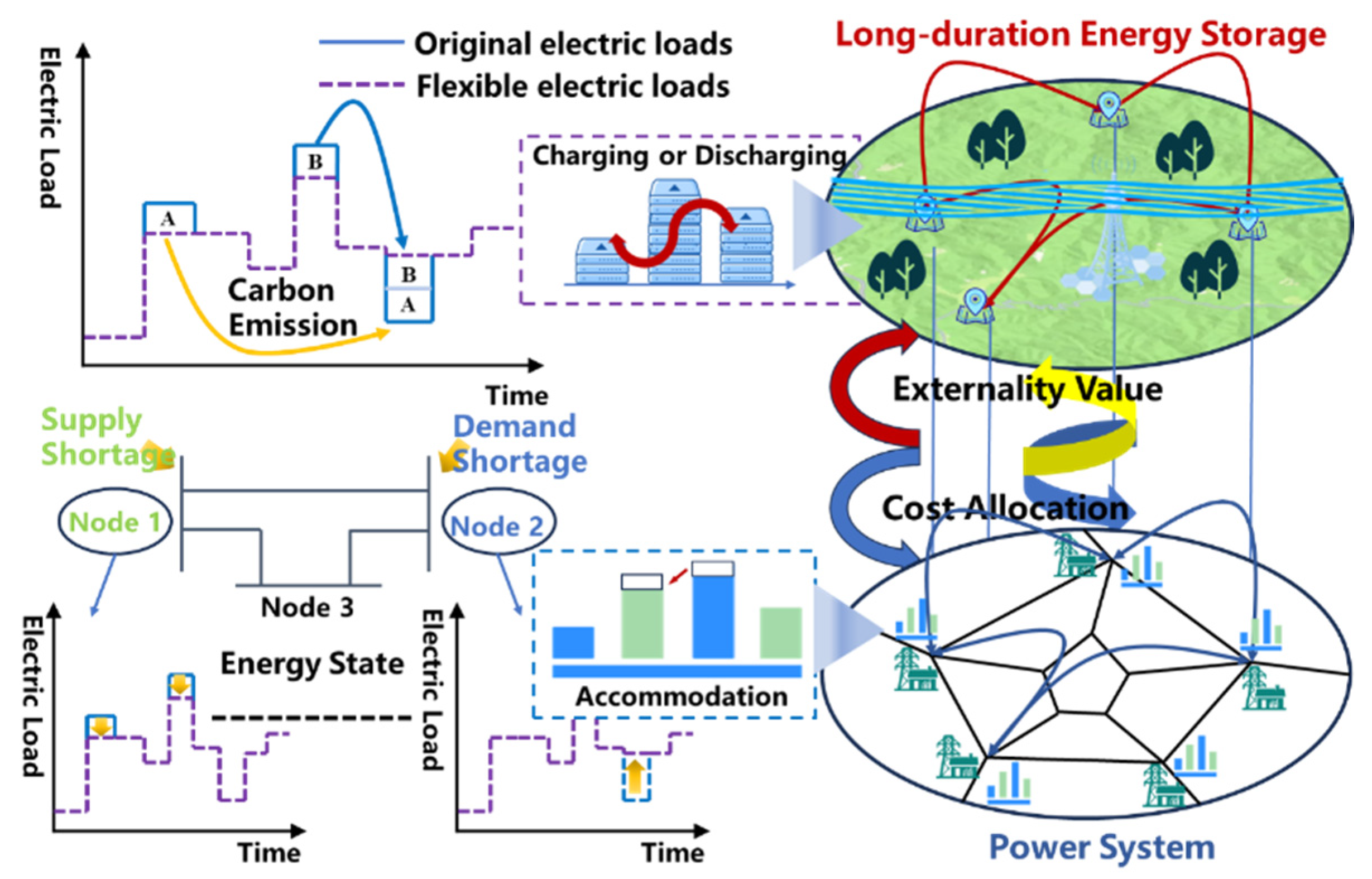
2.3. A Cost Allocation Mechanism for LDES Considering System-Level Externality Value
3. Results and Discussions
3.1. Effect of LDESs in the Power System Operation
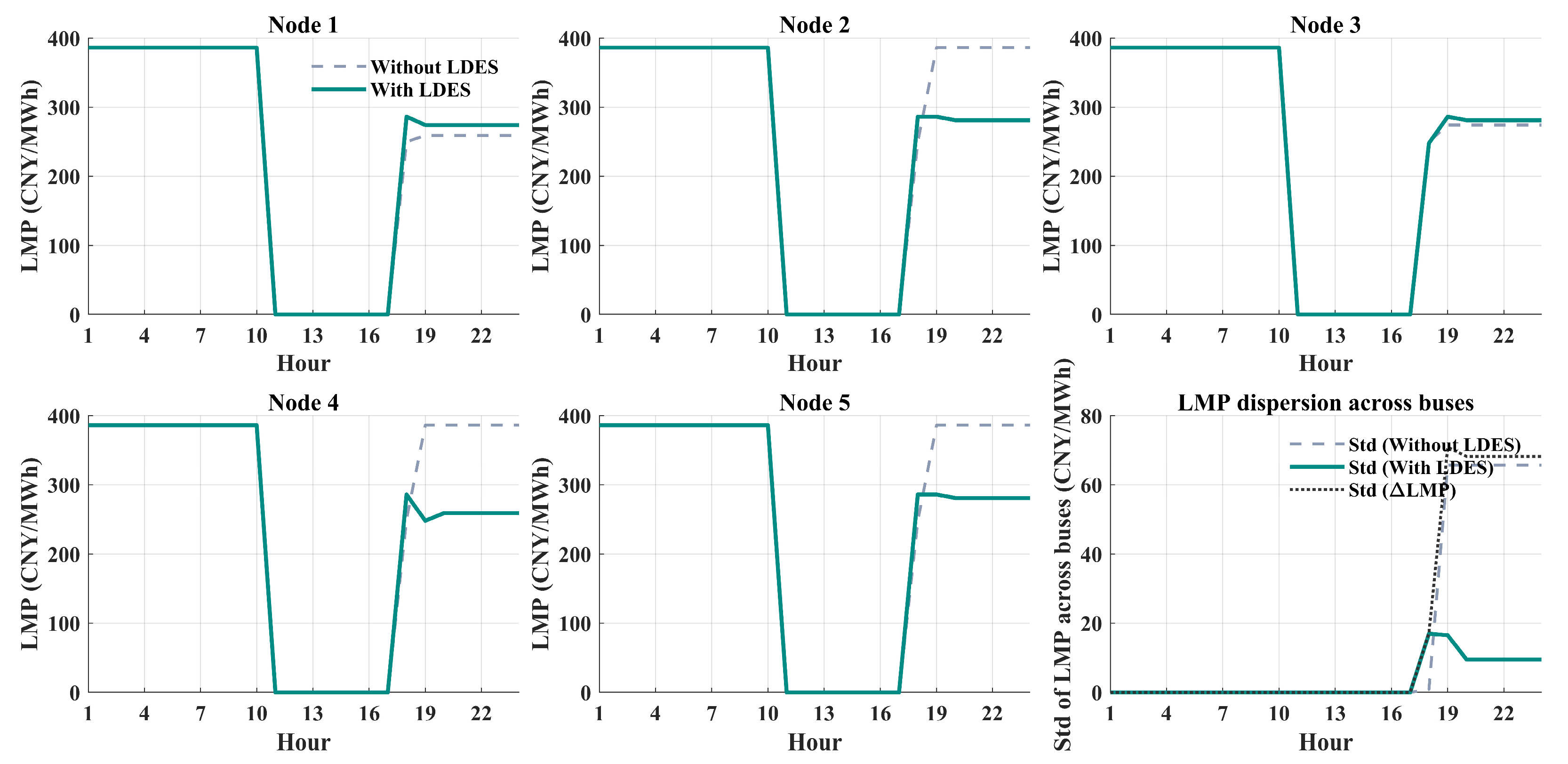
3.1.1. System-Level Benefits of LDESs in Power System Operation
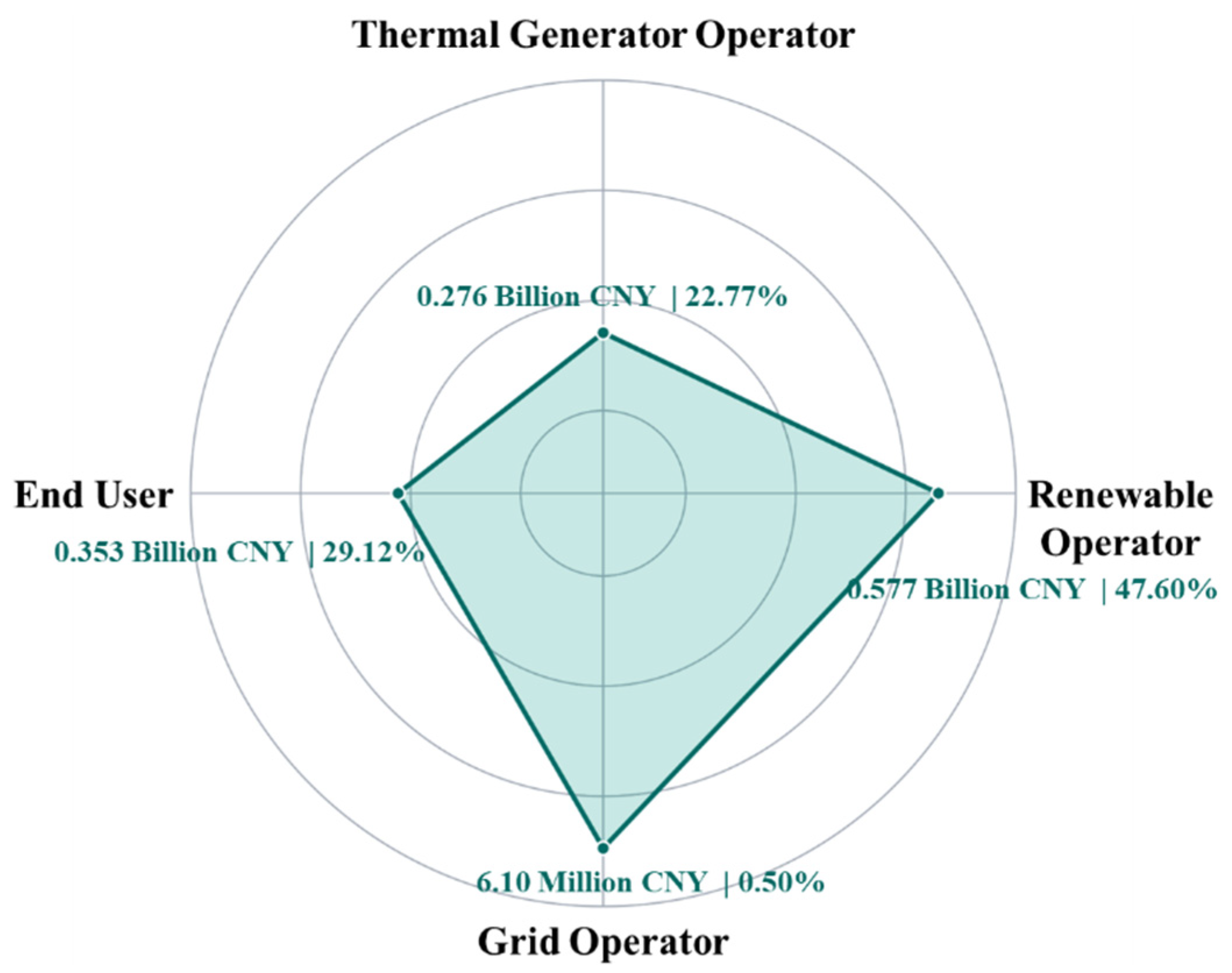
3.1.2. Results for Cost Allocation
3.2. Sensitivity Analysis on Storage Capacity Scaling
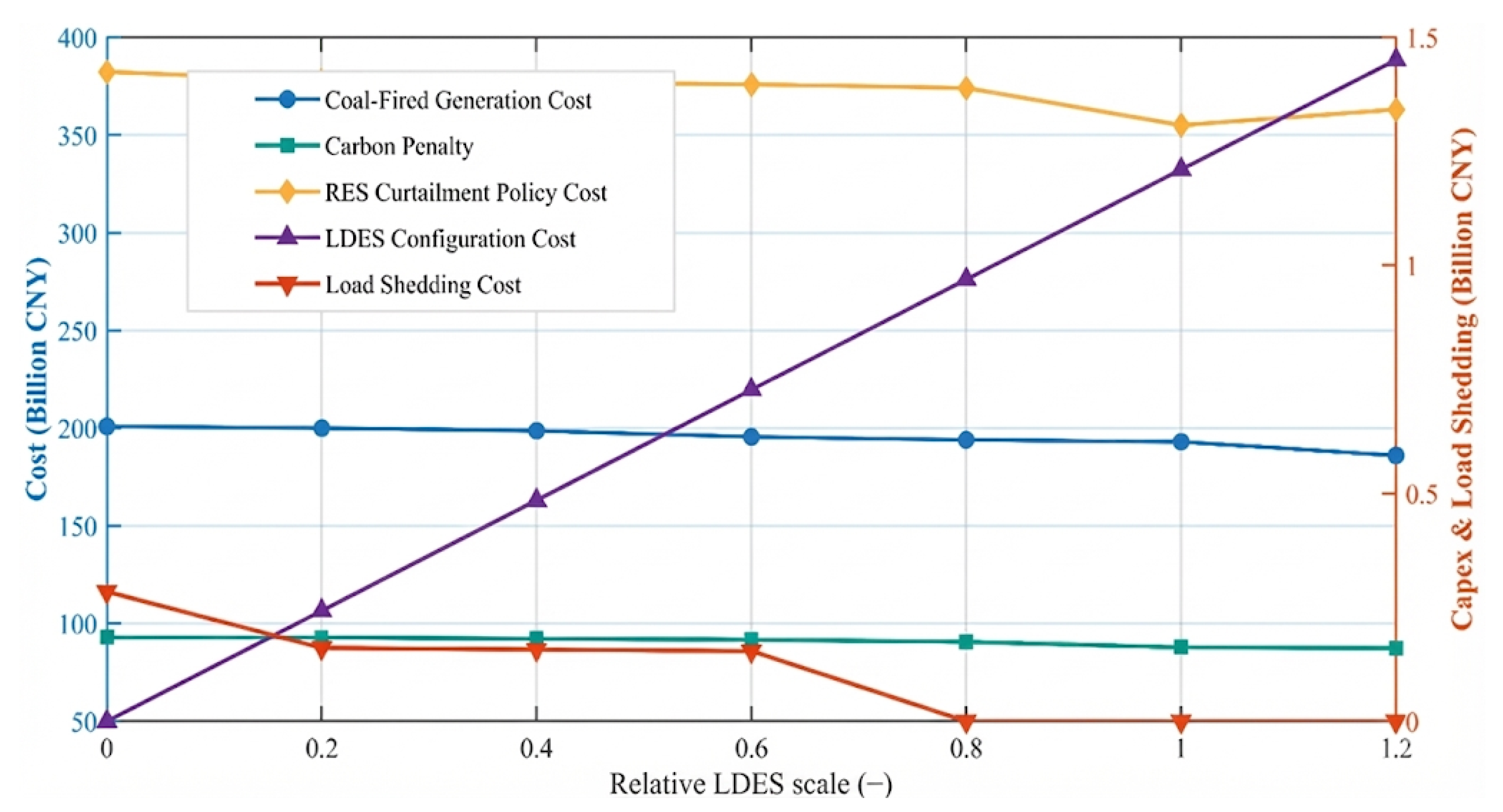
3.2.1. System Externality Under Varying Storage Capacity
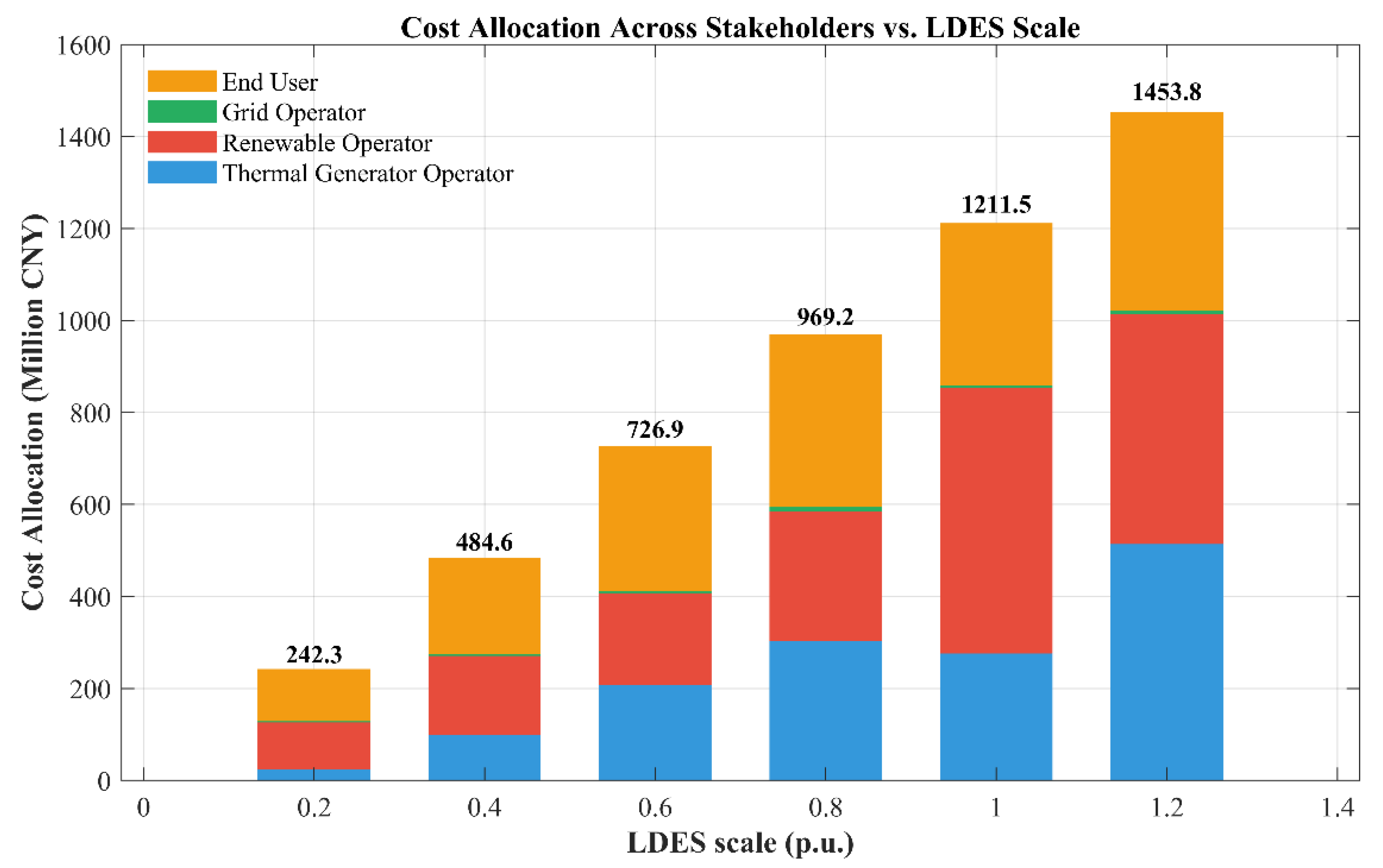
3.2.2. Impact on Cost Allocation Results
3.3. Storage Cost Redistribution Based on User Benefit Differentiation
3.3.1. Locational Differentiation of User Benefits from LDESs
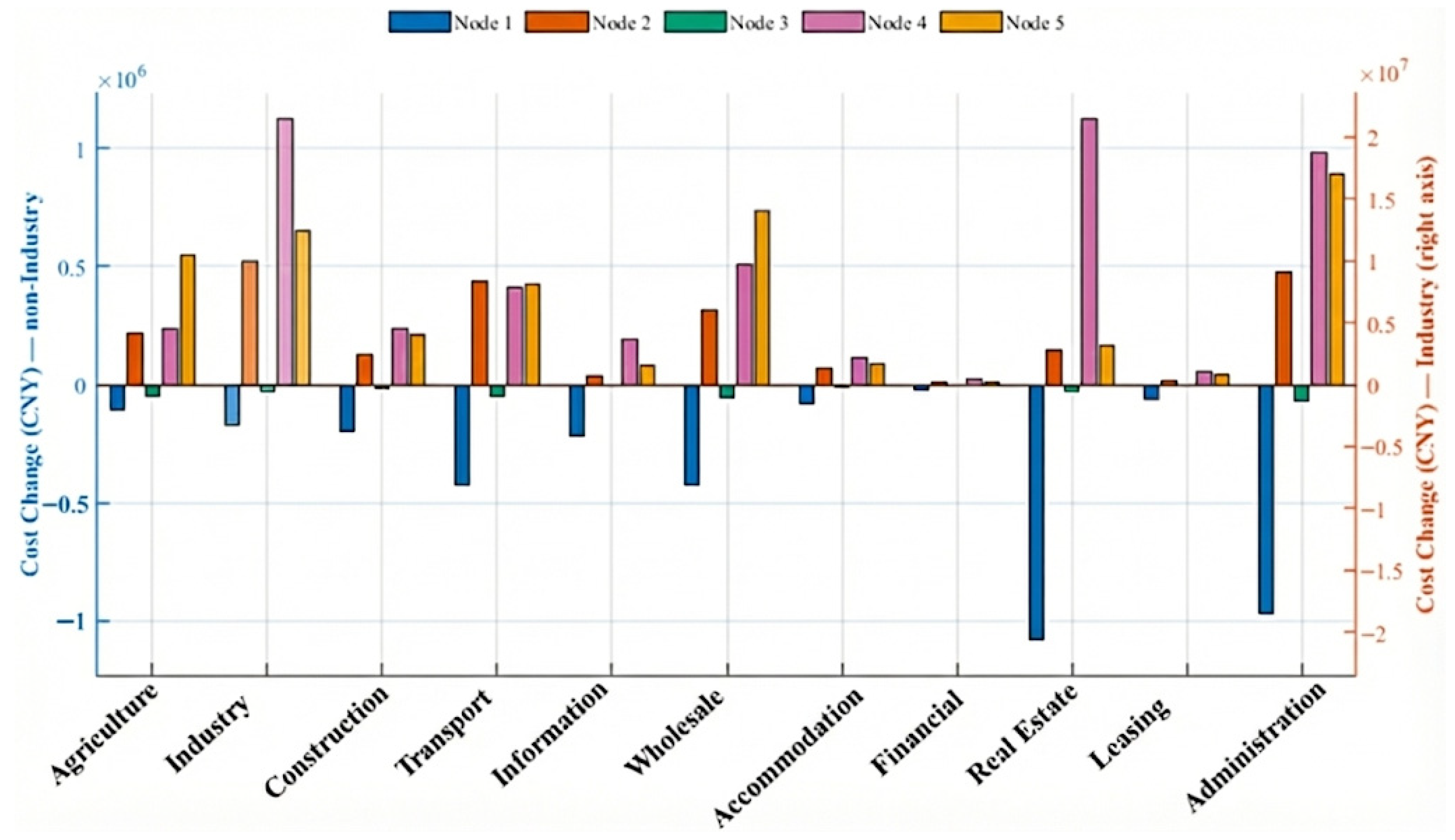
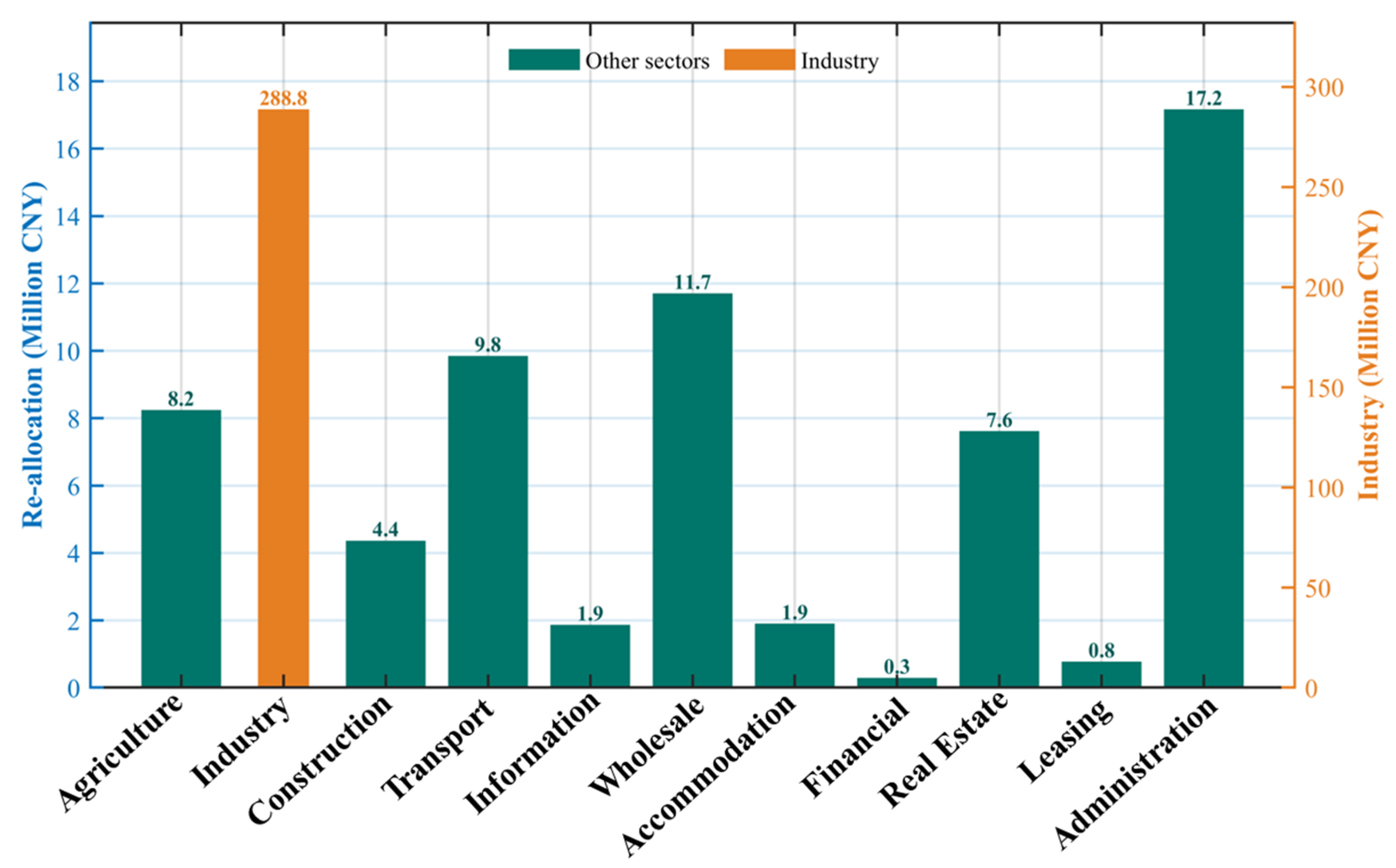
3.3.2. Industrial Differentiation of User Benefits from LDESs
4. Conclusions
5. Limitations and Future Work
Author Contributions
Funding
Institutional Review Board Statement
Informed Consent Statement
Data Availability Statement
Conflicts of Interest
Nomenclature
| A. Sets | |
| Set of the time slots | |
| Set of the thermal generation | |
| Set of the renewable generation | |
| Set of the energy storages | |
| Set of transmission lines | |
| Set of electric loads | |
| B. Parameters | |
| Equipment lifetime | |
| Unit investment costs | |
| Interruptible workloads originally scheduled | |
| Maximum allowable execution delay | |
| Probability of representative days | |
| Cost coefficient | |
| Power demand of electric loads | |
| Upper/lower limits of voltage angle | |
| Reactance of transmission line | |
| Large relax constant | |
| Upper/lower limits of thermal generation | |
| Minimum up/down time requirement | |
| Ramp up/down limits of thermal generation | |
| Charging/discharging efficiency | |
| Installed capacity of renewable generation | |
| Upper/lower limits of forecast error | |
| Time-based uncertainty budget | |
| C. Variable | |
| Investment status of storage units | |
| Output of thermal generation | |
| Carbon emission | |
| Uncertain output of renewable generation | |
| Realized output of renewable generation | |
| Amount of load shedding | |
| Power flow on transmission line | |
| Charging power of the LDESs | |
| Discharging power of the LDESs | |
| Voltage angle | |
| On/off status of thermal units | |
| Number of consecutive time steps | |
| Charging/discharging status of LDESs | |
| Stored energy level of LDESs | |
| Uncertain output of renewable unit | |
| D. Abbreviation | |
| LDES | Long-duration energy storage |
| LCOS | Levelized cost of storage |
| SABO | Subtraction-average-based optimization |
| SoC | Status of charging |
| C&CG | Column-and-Constraint generation algorithm |
| KKT | Karush–Kuhn–Tucker conditions |
Appendix A. Improved C&CG Algorithm
| Algorithm A1: Improved C&CG Algorithm | |
| Initialization: | |
| 1 | |
| 2 | Set lower bound LB = 0 |
| 3 | |
| 4 | Define convergence criterion , |
| Main Loop: | |
| 1 | do |
| 2 | k = k + 1 |
| 3 | of the master problem |
| 4 | then |
| 5 | |
| 6 | |
| 7 | End if |
| 8 | Solve second-stage recourse sub problem: |
| 9 | For do |
| 10 | Introduce auxiliary variables, transform subproblem (A3) to a single-layer max problem |
| 11 | Solve dual of subproblem (A8) |
| 12 | and worst scenario |
| 13 | |
| 14 | End for |
| 15 | then |
| 16 | Terminate algorithm |
| 17 | else |
| 18 | Generate C&CG constraint and add to master problem |
| 19 | For each scenario r and time t do |
| 20 | Generate C&CG constraint form worst scenario and add to master problem |
| 21 | End for |
| 22 | End if |
| 23 | End while |
References
- Staadecker, M.; Szinai, J.; Sánchez-Pérez, P.A.; Kurtz, S.; Hidalgo-Gonzalez, P. The value of long-duration energy storage under various grid conditions in a zero-emissions future. Nat. Commun. 2024, 15, 9501. [Google Scholar] [CrossRef]
- Chen, L.; Wang, C.; Wu, Z. Reinforcement learning-based time of use pricing design toward distributed energy integration in low carbon power system. IEEE Trans. Netw. Sci. Eng. 2025, 12, 997–1010. [Google Scholar] [CrossRef]
- Liu, T.; Yang, Z.; Duan, Y. Short-and long-duration cooperative energy storage system: Optimizing sizing and comparing rule-based strategies. Energy 2023, 281, 128273. [Google Scholar] [CrossRef]
- Chen, Z.; Wu, Z.; Wei, L.; Yang, L.; Yuan, B.; Zhou, M. Understanding the synergy of energy storage and renewables in decarbonization via random forest-based explainable AI. Appl. Energy 2025, 390, 125891. [Google Scholar] [CrossRef]
- Twitchell, J.; DeSomber, K.; Bhatnagar, D. Defining long duration energy storage. J. Energy Storage 2023, 60, 105787. [Google Scholar] [CrossRef]
- Vecchi, A.; Sciacovelli, A. Long-duration thermo-mechanical energy storage–present and future techno-economic competitiveness. Appl. Energy 2023, 334, 120628. [Google Scholar] [CrossRef]
- Zhang, W.; Xu, C. Capacity configuration optimization of photovoltaic-battery-electrolysis hybrid system for hydrogen generation considering dynamic efficiency and cost learning. Energy Convers. Econ. 2024, 5, 78–92. [Google Scholar] [CrossRef]
- Wu, C.; Hong, H.; Tseng, C.L.; Wen, F.; Wu, Q.; Shahnia, F. Economic dispatch of CAES in an integrated energy system with cooling, heating, and electricity supplies. Energy Convers. Econ. 2023, 4, 61–72. [Google Scholar] [CrossRef]
- Cole, W.; Denholm, P.; Carag, V.; Frazier, W. The peaking potential of long-duration energy storage in the United States power system. J. Energy Storage 2023, 62, 106932. [Google Scholar] [CrossRef]
- Liu, T.; Li, J.; Yang, Z.; Duan, Y. Evaluation of the short-and long-duration energy storage requirements in solar-wind hybrid systems. Energy Convers. Manag. 2024, 314, 118635. [Google Scholar] [CrossRef]
- Yang, G.; Yang, D.; Liu, B.; Zhang, H. The role of short-and long-duration energy storage in reducing the cost of firm photovoltaic generation. Appl. Energy 2024, 374, 123914. [Google Scholar] [CrossRef]
- De León, C.M.; Ríos, C.; Molina, P.; Brey, J.J. Levelized Cost of Storage (LCOS) for a hydrogen system. Int. J. Hydrogen Energy 2024, 52, 1274–1284. [Google Scholar] [CrossRef]
- Xu, X.; Qiu, Z.; Zhang, T.; Gao, H. Distributed source-load-storage cooperative low-carbon scheduling strategy considering vehicle-to-grid aggregators. J. Mod. Power Syst. Clean Energy 2024, 12, 440–453. [Google Scholar] [CrossRef]
- Mohammadian, M.; Baker, K.; Crozier, C. Spatial arbitrage through bidirectional electric vehicle charging with delivery fleets. Appl. Energy 2025, 381, 125036. [Google Scholar] [CrossRef]
- Li, J.; Zhao, J.; Chen, Y.; Mao, L.; Qu, K.; Li, F. Optimal sizing for a wind-photovoltaic-hydrogen hybrid system considering levelized cost of storage and source-load interaction. Int. J. Hydrogen Energy 2023, 48, 4129–4142. [Google Scholar] [CrossRef]
- Alghumayjan, S.; Han, J.; Zheng, N.; Yi, M.; Xu, B. Energy storage arbitrage in two-settlement markets: A transformer-based approach. Electr. Power Syst. Res. 2024, 235, 110755. [Google Scholar] [CrossRef]
- Almadhor, A.; Basem, A.; Dara, R.N.; Shaban, M.; Ghandour, R.; Al Barakeh, Z.; Abduvalieva, D.; Alkhalaf, S.; Bayhan, Z.; Ali, H.E. Integrated solar energy-energy storage system for an electricity-freshwater multigeneration configuration: Exergo-economic assessment with multi-objective particle swarm optimization. J. Energy Storage 2025, 122, 116750. [Google Scholar] [CrossRef]
- Laimon, M. Renewable energy curtailment: A problem or an opportunity? Results Eng. 2025, 26, 104925. [Google Scholar] [CrossRef]
- Ren, J.; Tian, W.; Gao, G.; Yao, P.; Xin, C.; Cui, W. Day-ahead scheduling model for high-penetration renewable energy power system considering energy storage for auxiliary peak shaving and frequency regulation. IEEE Access 2025, 13, 50480–50492. [Google Scholar] [CrossRef]
- Levin, T.; Bistline, J.; Sioshansi, R.; Cole, W.J.; Kwon, J.; Burger, S.P.; Crabtree, G.W.; Jenkins, J.D.; O’Neil, R.; Korpås, M.; et al. Energy storage solutions to decarbonize electricity through enhanced capacity expansion modelling. Nat. Energy 2023, 8, 1199–1208. [Google Scholar] [CrossRef]
- Ali, A.; Shah, A.; Keerio, M.U.; Mugheri, N.H.; Abbas, G.; Touti, E.; Hatatah, M.; Yousef, A.; Bouzguenda, M. Multi-objective security constrained unit commitment via hybrid evolutionary algorithms. IEEE Access 2024, 12, 6698–6718. [Google Scholar] [CrossRef]
- Deng, L.; Zhang, X.; Yang, T.; Sun, H.; Fu, Y.; Guo, Q.; Oren, S.S. Energy management of price-maker community energy storage by stochastic dynamic programming. CSEE J. Power Energy Syst. 2024, 10, 492–503. [Google Scholar] [CrossRef]
- Alahmed, S.A.; Tong, L. Dynamic Net Metering for Energy Communities. IEEE Trans. Energy Mark. Policy Regul. 2024, 2, 289–300. [Google Scholar] [CrossRef]
- Qi, N.; Xu, B. Locational energy storage bid bounds for facilitating social welfare convergence. IEEE Trans. Energy Mark. Policy Regul. 2025, 3, 486–497. [Google Scholar] [CrossRef]
- Chen, X.; Wang, Y.; Wu, Z.; Zhou, M.; Yuan, B. Capacity expansion model for multi-temporal energy storage in renewable energy base considering various transmission utilization rates. J. Energy Storage 2024, 98, 113145. [Google Scholar] [CrossRef]
- Psarros, G.N.; Dratsas, P.A.; Chinaris, P.P.; Papathanassiou, S.A. Assessing the implications of RES technology mix on curtailments, storage requirements and system economics. Appl. Energy 2025, 381, 125159. [Google Scholar] [CrossRef]
- Pereira, B.P.; Rodilla, P.; Mastropietro, P. Efficient cost allocation in capacity remuneration mechanisms: Applying cost causation to resource adequacy. Int. J. Electr. Power Energy Syst. 2025, 173, 111441. [Google Scholar] [CrossRef]
- Matamala, C.; Badesa, L.; Moreno, R.; Strbac, G. Cost Allocation for Inertia and Frequency Response Ancillary Services. IEEE Trans. Energy Mark. Policy Regul. 2024, 2, 328–338. [Google Scholar] [CrossRef]
- Yang, Y.; Gao, H.; Xiang, Y.; Guo, M.; Wang, J.; Liu, J. Coordinated Generation Scheduling Considering Peak Regulation Cost Allocation and Compensation Distribution in Power Systems. J. Mod. Power Syst. Clean Energy 2024, 13, 1921–1932. [Google Scholar] [CrossRef]
- Li, X.; Du, Y.; Tan, Z.; Xing, D.; Tan, C. Optimal dispatch and cost allocation model for combined peak shaving of source-load-storage under high percentage penetration of renewable energy. Renew. Energy 2025, 225, 123845. [Google Scholar] [CrossRef]
- Teng, F.; Gao, Y.; Wang, J.; Zhang, W.; Wu, M.; Zhuo, K. Innovative Cost Allocation and Energy Management in Off-Grid Microgrids via Stackelberg Game. IEEE Trans. Autom. Sci. Eng. 2025, 22, 21387–21399. [Google Scholar] [CrossRef]
- Huang, C.; Ge, Z.; Wang, L.; Zhang, D.; Long, H.; Luo, X. Multi-Agent Deep Reinforcement Learning-Based Cooperative Optimal Operation for Building Integrated Energy Systems With Nash–Harsanyi Bargaining Game-Driven Cost Allocation. IEEE Trans. Consum. Electron. 2025, 71, 4759–4770. [Google Scholar] [CrossRef]
- Zhang, Z.; Zhou, M.; Wu, Z.; Liu, S.; Guo, Z.; Li, G. A Frequency Security Constrained Scheduling Approach Considering Wind Farm Providing Frequency Support and Reserve. IEEE Trans. Sustain. Energy 2022, 13, 1086–1100. [Google Scholar] [CrossRef]
- Chen, X.; Lv, J.; McElroy, M.B.; Han, X.; Nielsen, C.P.; Wen, J. Power System Capacity Expansion Under Higher Penetration of Renewables Considering Flexibility Constraints and Low Carbon Policies. IEEE Trans. Power Syst. 2018, 33, 6240–6253. [Google Scholar] [CrossRef]



| Reference | Method | Core Idea | Strengths | Limitations |
|---|---|---|---|---|
| [27] | Adequacy-based allocation | Marginal reliability impact | Clear causation | Not multi-stakeholder externality recovery |
| [28,29] | Improved Shapley value | Marginal contribution | Axiomatic, intuitive | Coalition valuation burden; service-focused |
| [30] | Core-oriented allocation | Min–max dissatisfaction | Coalition stability | Requires full coalition costs; less transparent |
| [31] | Stackelberg leader–follower | Leader–follower incentives | Models hierarchy | Not an ex-post cost-recovery rule |
| [32] | Nash–Harsanyi bargaining | Weighted bargaining | Negotiable, flexible | Mostly local/operational scope |
| Proposed method | Asymmetric Nash bargaining | Baseline; externality value | Benefit-consistent; individually rational | Needs benefit attribution; weights calibration |
| Area | Thermal Generation (MW) | Renewable Generation (MW) | Hydro Generation (MW) | Load Participation Factor |
|---|---|---|---|---|
| D1 | 148,500 | 58,800 | 18,000 | 0.34 |
| D2 | 20,500 | 68,700 | 12,000 | 0.16 |
| D3 | 48,600 | 96,120 | 31,000 | 0.14 |
| D4 | 7000 | 31,200 | 6000 | 0.22 |
| D5 | 26,000 | 31,200 | 0 | 0.15 |
| Parameter | Value | Unit |
|---|---|---|
| , | 0.08/0.01 | / |
| , | 0.65 | / |
| 12 | / | |
| 150,000 | CNY/MW | |
| 400 | CNY/t | |
| 600 | CNY/MW | |
| 6000 | CNY/MWh |
| Operation Costs | With LDESs | Without LDESs | Variety/% |
|---|---|---|---|
| LDES investment cost/109 yuan | 1.21 | 0 | / |
| Thermal generation cost/1011 yuan | 1.93 | 2.01 | −3.92 |
| Carbon penalty/1010 yuan | 8.78 | 9.30 | −5.59 |
| Renewable policy cost/1011 yuan | 3.55 | 3.82 | −7.07 |
| Load shedding cost/108 yuan | 0 | 2.84 | / |
Disclaimer/Publisher’s Note: The statements, opinions and data contained in all publications are solely those of the individual author(s) and contributor(s) and not of MDPI and/or the editor(s). MDPI and/or the editor(s) disclaim responsibility for any injury to people or property resulting from any ideas, methods, instructions or products referred to in the content. |
© 2026 by the authors. Licensee MDPI, Basel, Switzerland. This article is an open access article distributed under the terms and conditions of the Creative Commons Attribution (CC BY) license.
Share and Cite
Wang, H.; Han, Y.; Li, Z.; Li, J.; Han, R. System Value Assessment and Heterogeneous Cost Allocation of Long-Duration Energy Storage Systems: A Public Asset Perspective. Appl. Sci. 2026, 16, 489. https://doi.org/10.3390/app16010489
Wang H, Han Y, Li Z, Li J, Han R. System Value Assessment and Heterogeneous Cost Allocation of Long-Duration Energy Storage Systems: A Public Asset Perspective. Applied Sciences. 2026; 16(1):489. https://doi.org/10.3390/app16010489
Chicago/Turabian StyleWang, Hao, Yue Han, Zhongchun Li, Jingyu Li, and Ruyue Han. 2026. "System Value Assessment and Heterogeneous Cost Allocation of Long-Duration Energy Storage Systems: A Public Asset Perspective" Applied Sciences 16, no. 1: 489. https://doi.org/10.3390/app16010489
APA StyleWang, H., Han, Y., Li, Z., Li, J., & Han, R. (2026). System Value Assessment and Heterogeneous Cost Allocation of Long-Duration Energy Storage Systems: A Public Asset Perspective. Applied Sciences, 16(1), 489. https://doi.org/10.3390/app16010489