Article

Evolution Law and Control on Deviatoric Stress in Surrounding Rock of Internal Hole-Making and Pressure Relief in Two Sides of Deep Coal Roadway: A Case Study


School of Energy and Mining Engineering, China University of Mining & Technology-Beijing, Beijing 100083, China
*
Author to whom correspondence should be addressed.
Appl. Sci. 2026, 16(1), 469; https://doi.org/10.3390/app16010469 (registering DOI)
Submission received: 28 November 2025 / Revised: 29 December 2025 / Accepted: 30 December 2025 / Published: 1 January 2026
(This article belongs to the Section Earth Sciences)

Abstract

Conventional drilling pressure relief technology destroys the rock integrity of the roadway-surrounding rock and support system in the anchorage area of surrounding rock at the same time as roadway pressure relief. To overcome the incompatibility between roadway pressure relief and structural support, an integrated control strategy combining anchorage reinforcement with pressure release was established. The distribution characteristics of the deviatoric stress field under different internal borehole parameters were investigated through numerical simulations, and the influence degree of each parameter is discussed. We constructed a similar model to verify the reasonable key parameters of pressure relief and evaluate the pressure relief effect. The conclusions drawn are as follows. (1) The sensitivity ranking of factors affecting pressure relief in the surrounding rock was determined as internal hole-making position > internal hole-making length > internal hole-making spacing. At an internal hole-making depth of 10 m, the peak deviatoric stress migrated to deeper regions, accompanied by a notable reduction in its distribution range. Hence, the stress within the roadway-surrounding rock was effectively released. (2) The internal deviatoric stress peak (si) and its corresponding location were identified according to the internal borehole-creation position. As the internal hole-making length increased, the positional transfer effect became notably stronger. Appropriately extending the internal hole-making length can thus create a compensatory buffer zone that accommodates the volumetric expansion deformation of the roadway sides. (3) By appropriately determining the position and length of the internal boreholes, reducing the spacing between them can substantially release high deviatoric stress. When the spacing was ≤4 m, the rock surrounding the borehole exhibited a low-deviatoric-stress state, suggesting that the deviatoric stress between adjacent internal holes was largely dissipated without elevating the stress level in the shallow surrounding rock. (4) A comparable simulation approach confirmed the feasibility of implementing internal hole-making and pressure relief measures on both sides of a deep coal roadway. Field engineering applications further demonstrated that the proposed “anchorage + pressure relief” cooperative control system can effectively restrain the continuous large deformation of the surrounding rock along the sidewalls in soft and fractured deep chambers. These findings offer an effective strategy for controlling large-scale deformation and failure of surrounding rock in similar deep roadways and provide valuable engineering insights.

1. Introduction

Deep coal-rock formations possess mechanical characteristics and exhibit responses that lead to significant ground pressure phenomena in surrounding roadway rock. These phenomena include substantial deformation magnitudes, high convergence rates, prolonged periods of ongoing deformation, and frequent failure of support systems. Such conditions necessitate repeated expansion and refurbishment of deep roadways throughout their service life [1,2,3,4,5,6,7,8,9]. Consequently, researchers are actively seeking advancements in controlling deep roadway-surrounding rock, concentrating on critical areas such as characterizing ground pressure behaviors and identifying their root causes [10,11], understanding the patterns of large deformation and associated roadway maintenance needs [12,13], investigating the mechanisms behind roof and rib instability [14,15], and developing improved theories and technologies for surrounding rock control [16,17,18,19].
Within the array of comprehensive control strategies for deep roadway-surrounding rock, pressure relief has emerged as a crucial technical approach for achieving stable, long-term control. Current methodologies encompass techniques like spatio-temporal avoidance of high-stress concentrations [20], pre-fracturing key overlying strata in stopes [21], excavating dedicated pressure relief roadways [22], employing drilling for stress reduction [23,24,25,26,27], and utilizing deep-hole pre-splitting blasting [28], all of which have seen successful application in various deep roadway settings. The fundamental principle behind pressure relief and roadway protection involves either releasing or redistributing concentrated stresses, thereby enhancing roadway stability by optimizing the stress environment. The deviatoric stress index, which integrally considers the interplay between the three principal stresses [29,30,31], offers a more scientific and rational means to evaluate the relationship between pressure relief parameters and their effectiveness compared to analyzing individual stress components or principal stresses [32,33,34,35,36]. Although numerous studies have investigated deviatoric stress distribution and control around roadways, yielding valuable insights, this index has seldom been incorporated into the analysis of pressure relief control strategies. Furthermore, prior research on drilling-based pressure relief exhibits certain shortcomings: (1) It often fails to differentiate between the shallow, plasticized, and crushed surrounding rock (which is in a low-stress state and requires strengthening, not relief) and the deeper rock mass, leading to the application of uniform, dense, large-diameter drilling across both zones. (2) Intensive large-diameter drilling inadvertently reduces the strength of the shallow rock mass during stress transfer. Consequently, it compromises the support structure’s integrity, failing to balance active reinforcement with targeted pressure relief.
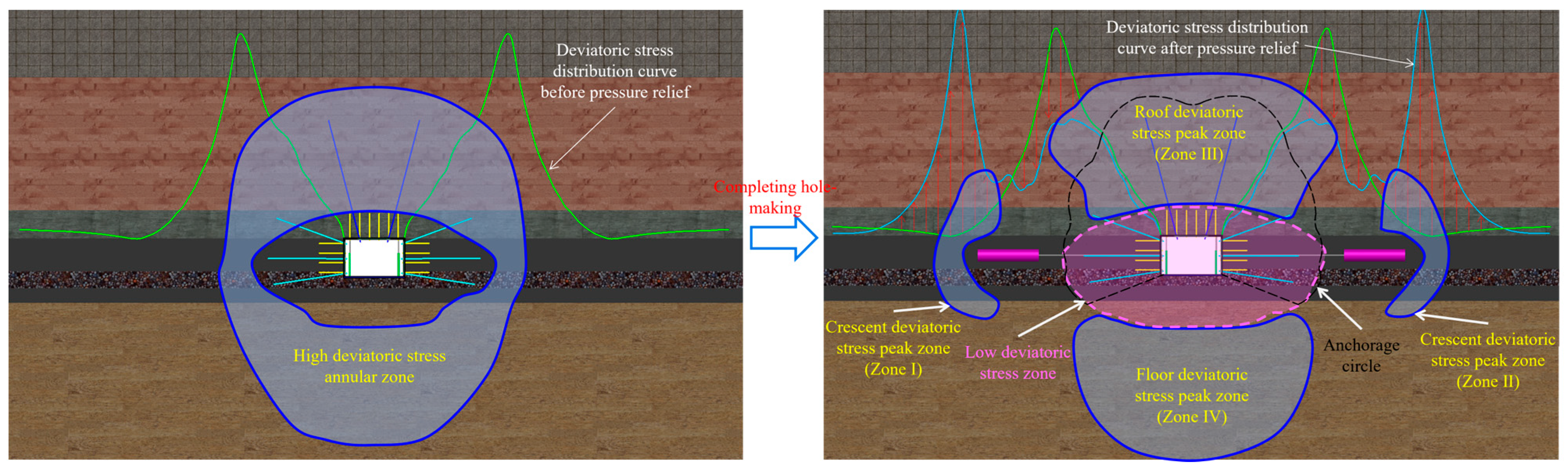
Despite employing robust integrated control measures, such as high-strength bolt-cable systems and grouting reinforcement, difficulties continue. For example, within liquid supply chambers in mining area 12 of the Dongpang coal mine, structural support damage and persistent large-scale deformation of the adjacent rock represent ongoing major problems. To tackle these enduring challenges, the current research presents an innovative “anchorage + pressure relief” synergistic control methodology, setting it apart from standard pressure relief techniques. This methodology utilizes a two-phase approach: initially, strengthening the near-field surrounding rock using bolt-cable-grouting anchoring to enhance its structural integrity; subsequently, creating large-diameter relief boreholes precisely within the deviatoric stress concentration zone located past the deep anchor boundary. Illustrated conceptually in Figure 1, this updated strategy promotes the shift of the deviatoric stress concentration within the roadway sides toward the end point of the internal boreholes, critically, without compromising the stability of the anchored structure in the shallow rock mass. Utilizing deviatoric stress as the key analytical measure, numerical modeling was undertaken to evaluate the influence of different pressure relief configurations on stress reduction effectiveness, assisting in pinpointing the most favorable setup for internal boring. Ultimately, the practicability of this novel “anchorage + pressure relief” synergistic control methodology was confirmed via both physical analogue simulations and field engineering deployment.

2. Study Area and Geological Conditions

2.1. Engineering Geological Overview

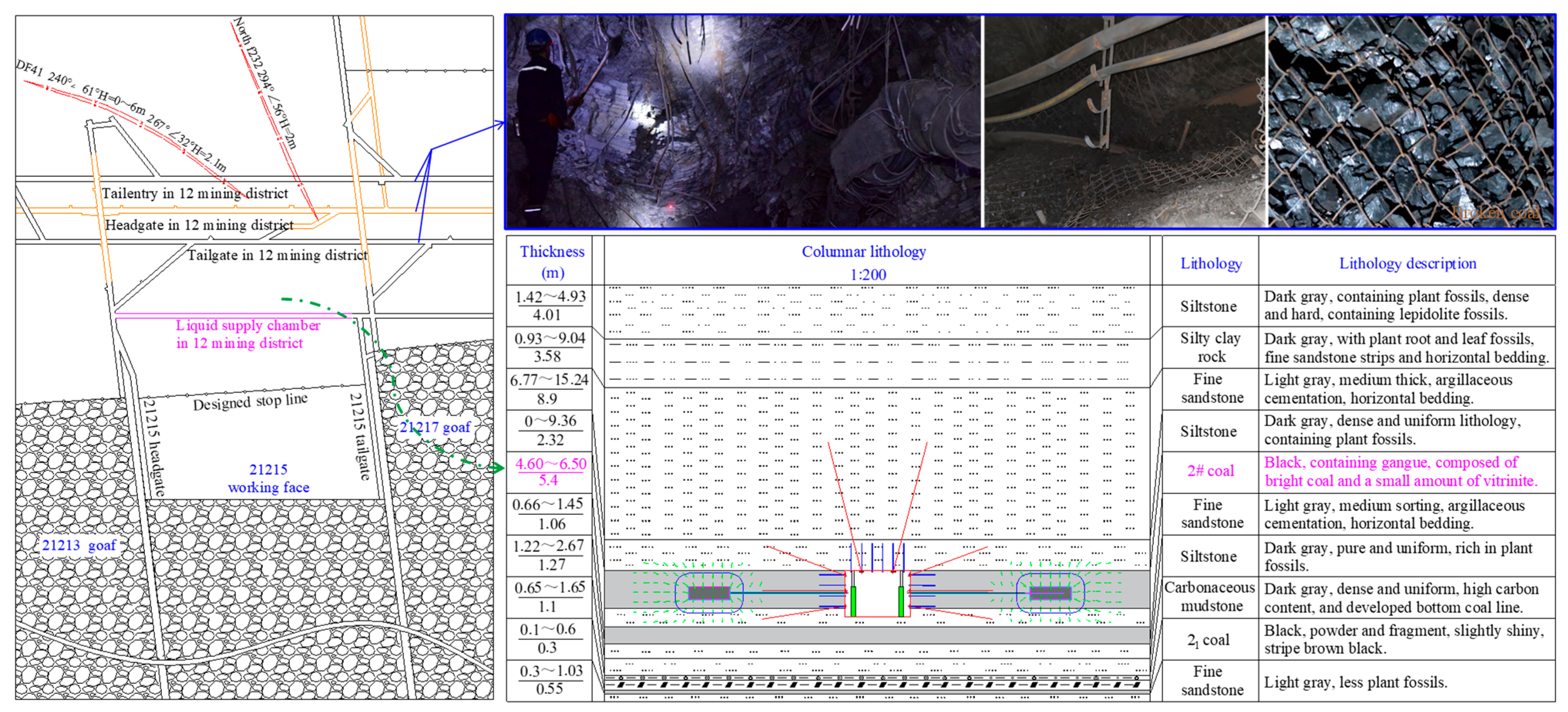
The pump station in Mining Area 12 of Dongpang Coal Mine is located between the mining area of the No. 21215 working face and the three main roadways. The pump station size is 5 m × 3 m, and it belongs to a large-section chamber, with a buried depth, average thickness, and average dip angle of approximately 660 m, 5.4 m, and 5°, respectively. Joints and fissures in the coal near this chamber were clearly developed. Before mining the No. 21215 working face, the mining disturbance of adjacent working faces affects the three main roadways in the 12 mining districts. The separation distance between the stopping line of the No. 21215 working face and the three main roadways is greater than 150 m. As a result, large deformations and failures in the main roadways occur frequently. The geology and site deformation of the liquid supply chamber in Mining District 12 of the Dongpang coal mine are shown in Figure 2.

2.2. Characteristics of Pressure Behavior of Surrounding Rock in Test Chamber

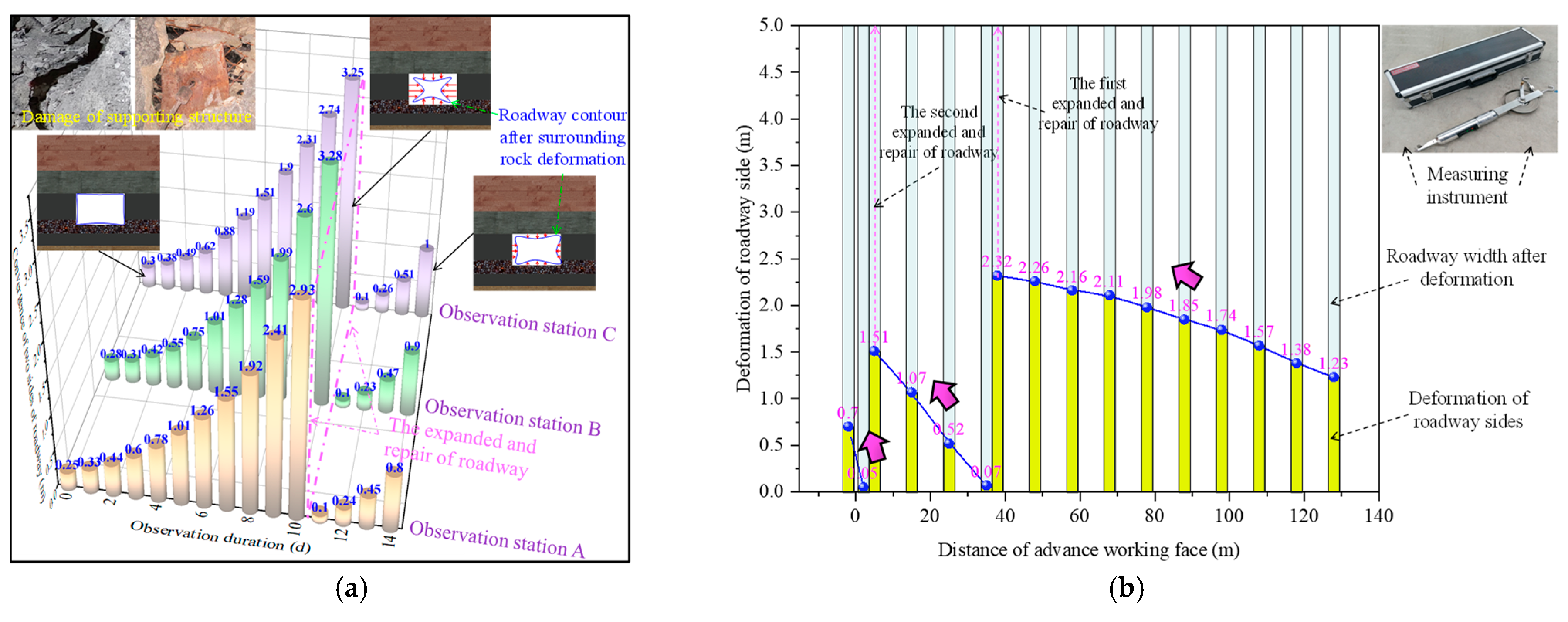
During the service period of the liquid supply chamber, due to the mining influence of multiple working faces, the integrity of the surrounding rock is seriously damaged, and the surrounding rock continues to undergo large deformation. Therefore, before the mining of the No. 21215 working face, the chamber should be renovated every half year (see Figure 3a) to maintain the basic operation of the chamber. The observation results of the surrounding rock displacement value of the haulage roadway during the mining process of the No. 21215 working face are shown in Figure 3b. During the mining process of the working face, the displacement of the two sides of the roadway reaches 1000 mm. Therefore, considering the severe dynamic pressure disturbance of the No. 21215 working face, the surrounding rock pressure is severe in the advanced roadway, and the influence range of the surrounding rock caused by the disturbance is far greater than 130 m.
Based on the preceding analysis, as the No. 21215 working face approaches the predetermined stop line, the chamber experiences intense dynamic loading from the mining front, resulting in large-scale deformation and failure.

2.3. Problems in the Test Chamber After Adopting the Strengthening Support and Grouting Modification Technology

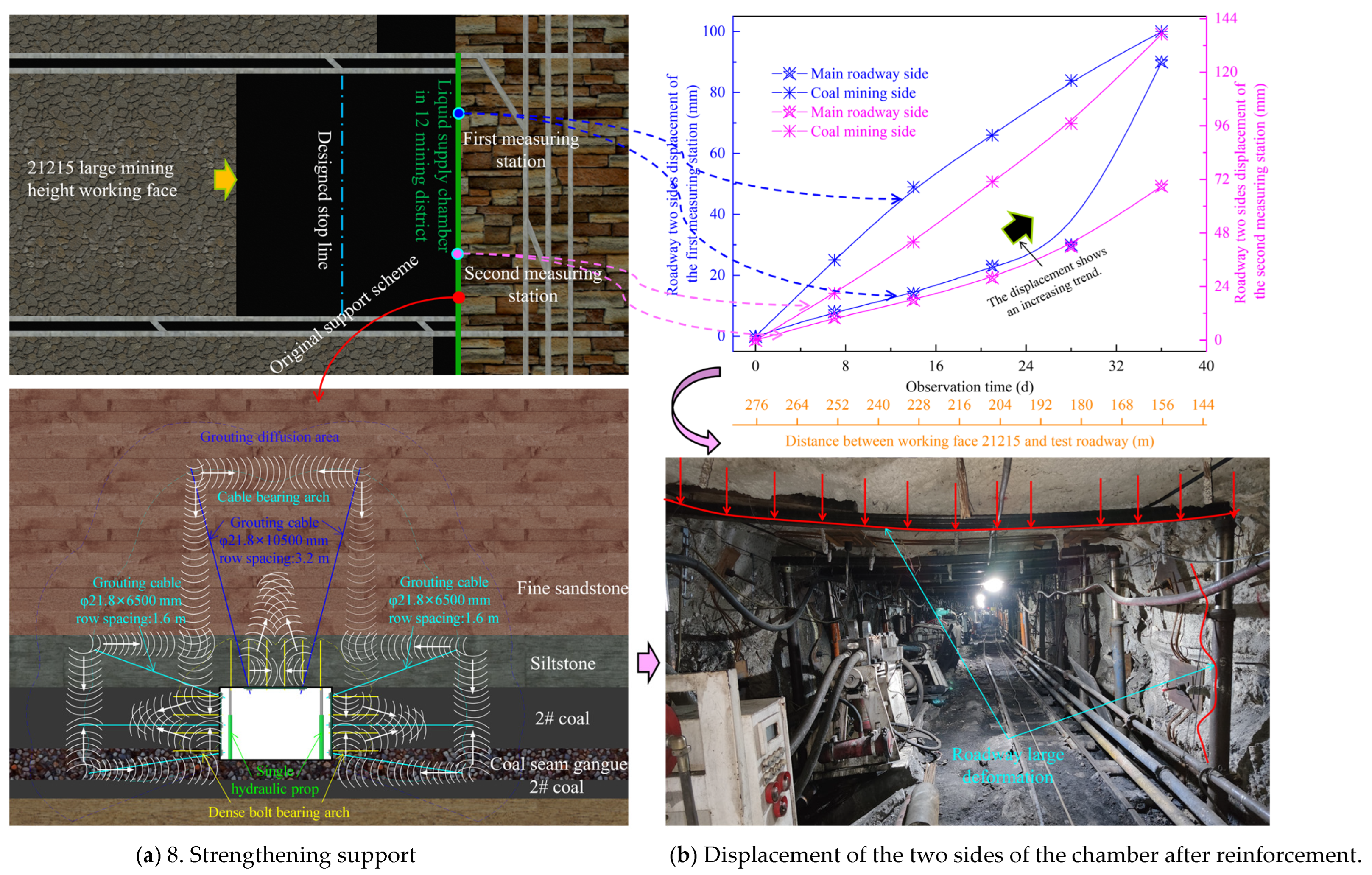
Considering that the surrounding rock of the test chamber needs regular expansion and renovation owing to the continuous large deformation, a combined controlling technology, such as strengthening support-grouting modification, was adopted at the site, as shown in Figure 4a. Figure 4b illustrates the measured displacement and deformation characteristics of the surrounding rocks on both sides of the chamber following the field implementation of the above-mentioned combined control technology.
As shown in Figure 4b, the surrounding rocks on both sides of the chamber exhibit continuous deformation even after the application of conventional reinforcement and modification techniques. This suggests that when the No. 21215 working face advances to the designed stop line, the chamber is inevitably subjected to strong dynamic pressure from the coal face, resulting in extensive damage. Under such circumstances, it becomes difficult to control the severe deformation of the experimental roadway merely by improving the surrounding rock properties or increasing the support strength. Therefore, in the 12th mining district, effective control measures must be implemented to counteract the large deformation of the surrounding rocks on both sides of the chamber, improve their stress condition, and ensure the chamber’s long-term stability during the mining process of subsequent working faces.

3. Methodology: Numerical Simulation Setup

3.1. Numerical Solution Model

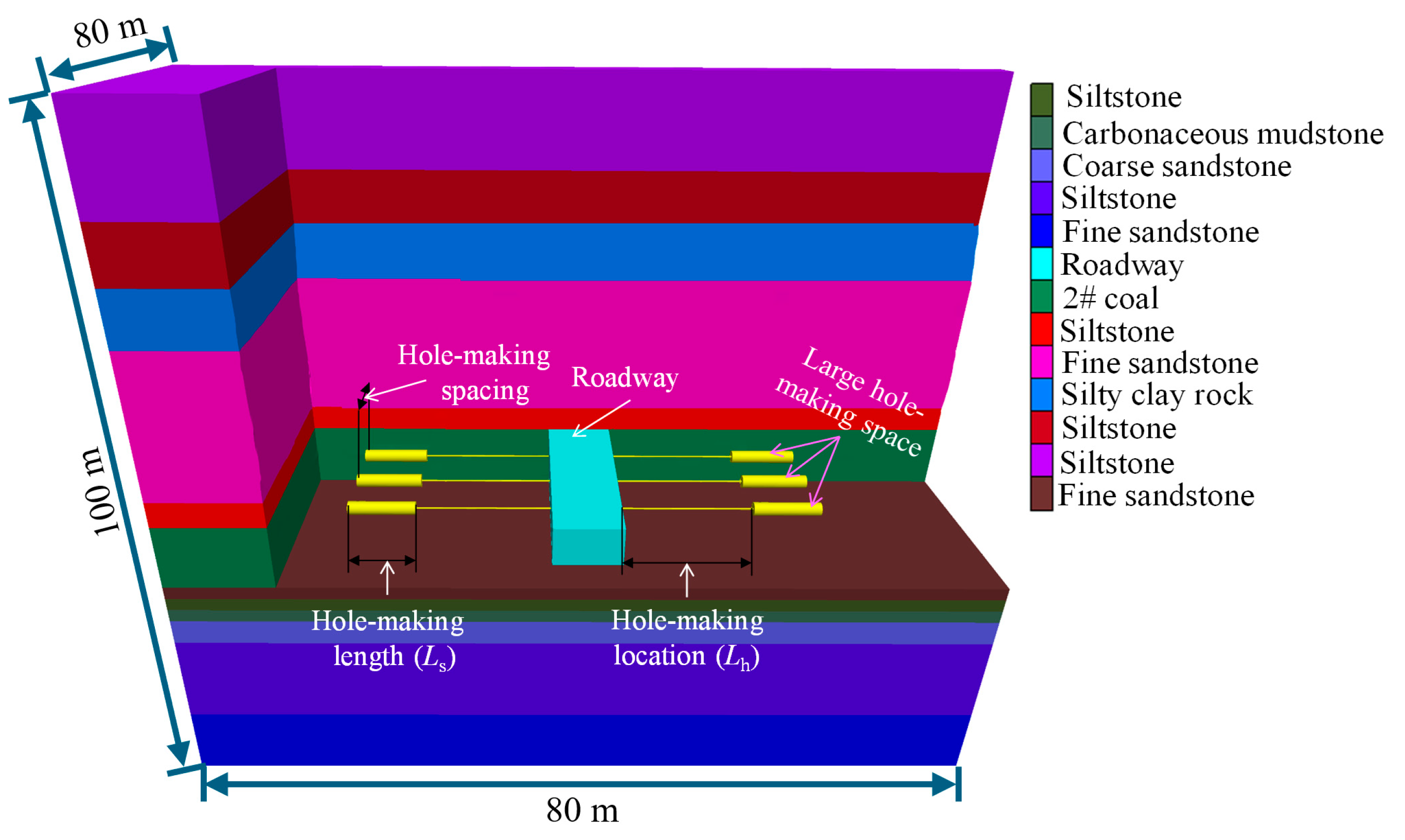
As shown in Figure 5, the FLAC3D numerical solution model of the liquid supply chamber in mining district 12 of the Dongpang Coal Mine is constructed to systematically study the dynamic action law of different internal hole-making parameters (position, length, and spacing) on the stress reduction and transfer of deep roadways. This model evaluates how internal hole-making parameters (position, length, and spacing) affect pressure relief and deviatoric stress distribution. The results provide a theoretical basis for optimizing on-site parameters. The extension, axial and vertical directions of the pressure relief hole are the x-, y-, and z-axis, respectively.
In the numerical simulations, the Mohr–Coulomb constitutive model was adopted to describe the mechanical behavior of the surrounding rock. The mechanical parameters of each stratum were determined based on laboratory tests conducted on representative core samples obtained from the site and were further calibrated using in situ geological conditions, field-monitoring results, and relevant previous studies in Dongpang Coal Mine, as summarized in Table 1. This ensures that the numerical model realistically reflects the mechanical behavior of the deep surrounding rock.

3.2. Deviatoric Stress Is Used as the Basis for Pressure Relief Effect Evaluation

In engineering analysis, stress tensor can represent stress state, which can be decomposed into stress sphere tensor and stress deviation tensor. Three orthogonality principal stresses are set as σ k (k = 1, 2, 3). When σ 1 σ 2 σ 3 , the stress tensor decomposition equation is expressed by Equation (1)
σ 1 0 0 0 σ 2 0 0 0 σ 3 = σ m 0 0 0 σ m 0 0 0 σ m + s 1 0 0 0 s 2 0 0 0 s 3
where σ m is calculated as Equation (2)
σ m = 1 3 σ 1 + σ 2 + σ 3
where s 1 is the maximum principal deviatoric stress, which directly reflects the shear response of surrounding rock during plastic deformation or yield, and is very suitable for plastic deformation analysis. The greater the value of the maximum principal deviatoric stress, the higher the risk of plastic deformation of rock. Therefore, s 1 is selected to analyze the stability of the roadway, and its expression is
s 1 = σ 1 1 3 σ 1 + σ 2 + σ 3
As seen from the above equations, the deviatoric stress is related to all three principal stresses, scientifically revealing the relationship between the stress reduction effect of deep roadway internal hole-making parameters and the bearing capacity of the anchored surrounding rock.
Considering these factors, the deviatoric stress reduction effect of different internal hole-making parameters was numerically simulated to confirm the optimal internal hole-making parameters.

3.3. Evaluation Index of Pressure Relief Effect and Classification of Pressure Relief Degree

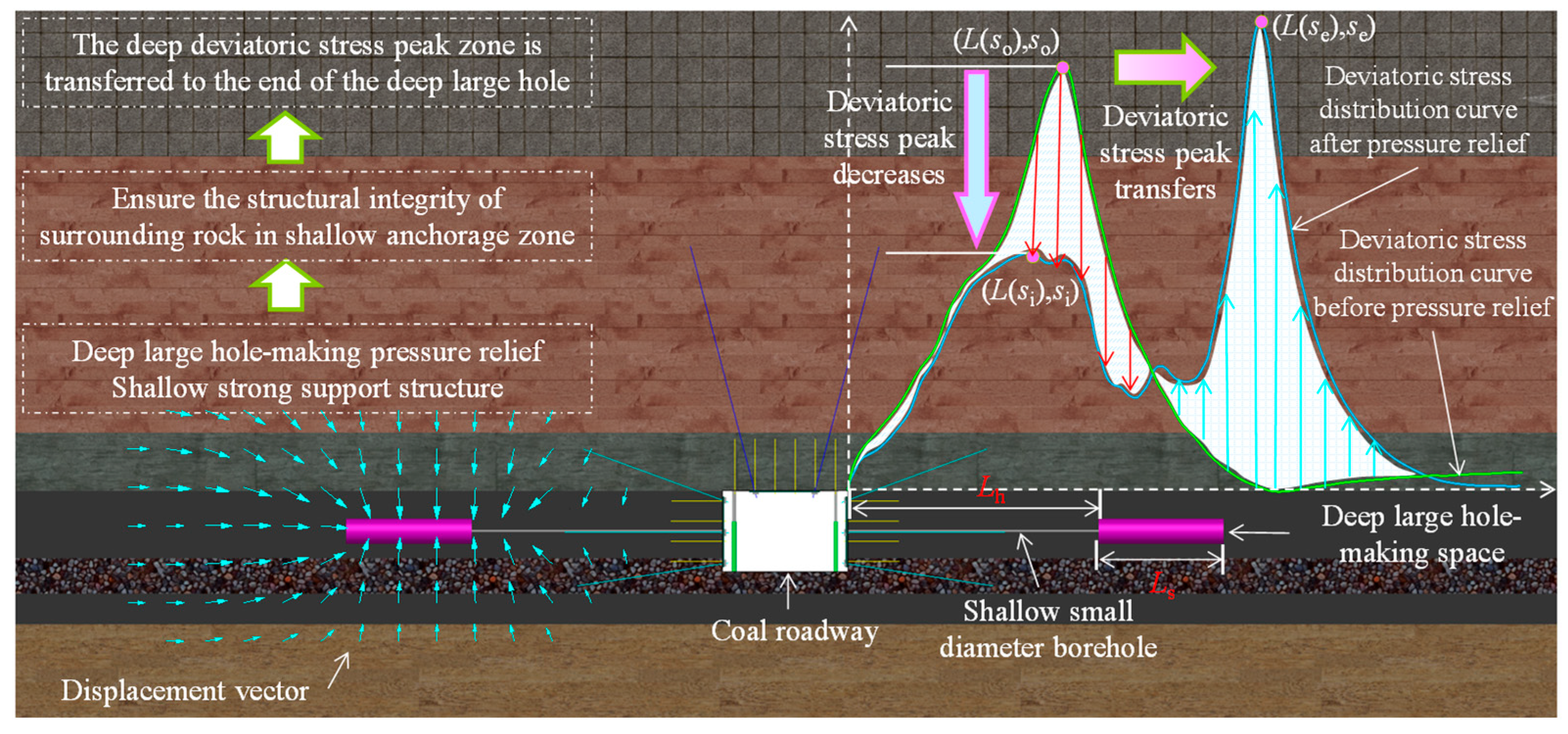
The internal hole-making and pressure relief technology transfers the high deviatoric stress zone on the two sides of the coal roadway to a deeper depth, and ensures that the near-field surrounding rock of a large-deformation roadway is in a low-stress area. After the internal hole-making construction is completed, the typical deviatoric stress adjustment curve is shown in Figure 6.
The direct evaluation index of the deviatoric stress reduction effect is as follows:
LhL(so): distance between internal hole-making and original peak positions of deviatoric stress.
Si/so: ratio of peak of internal deviatoric stress to peak of original deviatoric stress.
L(si)–L(so): distance between peak positions of internal deviatoric stress and original deviatoric stress.
Se/so: ratio of peak of external deviatoric stress to peak of original deviatoric stress.
L(se)–L(so): distance between peak positions of external deviatoric stress and original deviatoric stress.
∇(se): growth gradient of the peak of external deviatoric stress.
∇[L(se)–L(so)]: the transfer amplitude of the peak position of the external deviatoric stress.
This research assessed the transfer behavior of high deviatoric stress around roadways by examining how the aforementioned evaluation index changes under various internal hole-making parameters.

3.4. Determination of Key Parameters of Internal Hole-Making

3.4.1. Determination of Internal Hole-Making Position (Depth)

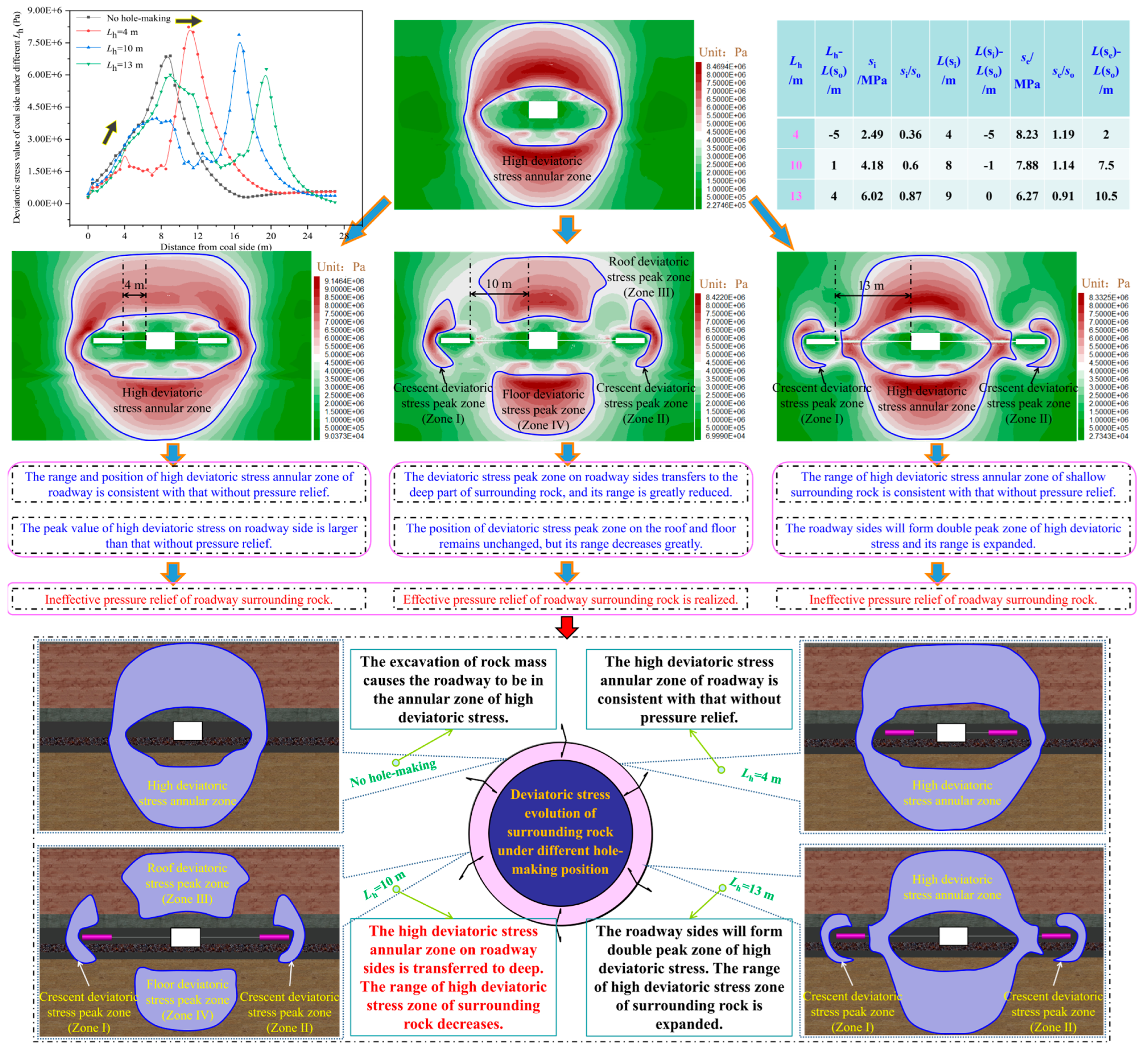
The spatial distribution features of the deviatoric stress of the adjacent rock mass of the chamber when internal hole-making depth changes after the excavation of the chamber are shown in Figure 7.
After the excavation of the roadway, before the operation of internal hole-making, the four directions of the chamber surrounding the rock formed a highly concentrated peak deviatoric stress region, and the maximum deviatoric stress value was greater than 8 MPa. After the procedure of hole-making, the deviatoric stress was redistributed with the surrounding rock continuously adjusting as the internal hole-making depth varied. Deviatoric stress distribution features under varying internal hole-making depths display the following patterns.
(1) Different internal hole-making depths lead to a continuous variation in deviatoric stress distribution on the coal rib of the roadway. After the procedure of hole-making, the deviatoric stress in this region exhibits an asymmetric bimodal distribution. As the internal hole-making depth increases, the internal deviatoric stress peak (near the roadway) progressively grows and tends toward the initial deviatoric stress peak; meanwhile, its position constantly approaches the initial deviatoric stress peak position. The peak deviatoric stress at depth gradually decreased, with its position consistently far from the location of the initial deviatoric stress peak.
(2) With an internal hole-making depth of 4 m, the peak deviatoric stress at depth was 8.23 MPa, with its position just 2 m away from the initial deviatoric stress peak. The range and location of the high deviatoric stress annular zone of the roadway were largely in line with the results from non-pressure relief scenarios. The high peak deviatoric stress was higher than that of non-pressure relief scenarios. The high deviatoric stress peak zone exhibited inefficient position transfer, leading to inadequate pressure relief in the adjacent rock mass of the roadway.
(3) With an internal hole-making depth of 10 m, the peak zone of deviatoric stress shifted to deeper parts of the rock, with its extent significantly shrinking. The location of the deviatoric stress peak zone on the roof and floor remained almost unchanged, but its range decreased significantly. The internal deviatoric stress peak reached 4.18 MPa and that of external deviatoric stress reached 7.87 MPa at the internal hole-making depth of 10 m. The distance between the external and initial deviatoric stress peaks was 7.5 m. This indicates an effective shift of the high-stress zone to the deep rock mass, thereby preserving the strength of the superficial roadway sides. Effective stress relief was accomplished in the roadway’s surrounding rock.
(4) With an internal hole-making depth of 13 m, the range of the high deviatoric stress annular zone in the shallow rock mass was consistent with that without pressure relief. High-deviatoric-stress double-peak zones with a further expanded scope have formed on both the roadway’s sides, which could easily cause secondary failure of the roadway-side rock mass. The peak value of the internal deviatoric stress was 6.02 MPa at the internal hole-making depth of 13 m, only 0.86 MPa lower than the initial value. The locus of the peak value of the internal deviatoric stress was consistent with the original peak value location of the deviatoric stress. The deviatoric stress state in the shallow zone of the rock mass returns to a level close to the initial deviatoric stress distribution, at which point the rock mass stress relief effect is suboptimal.

3.4.2. Determination of Internal Hole-Making Length

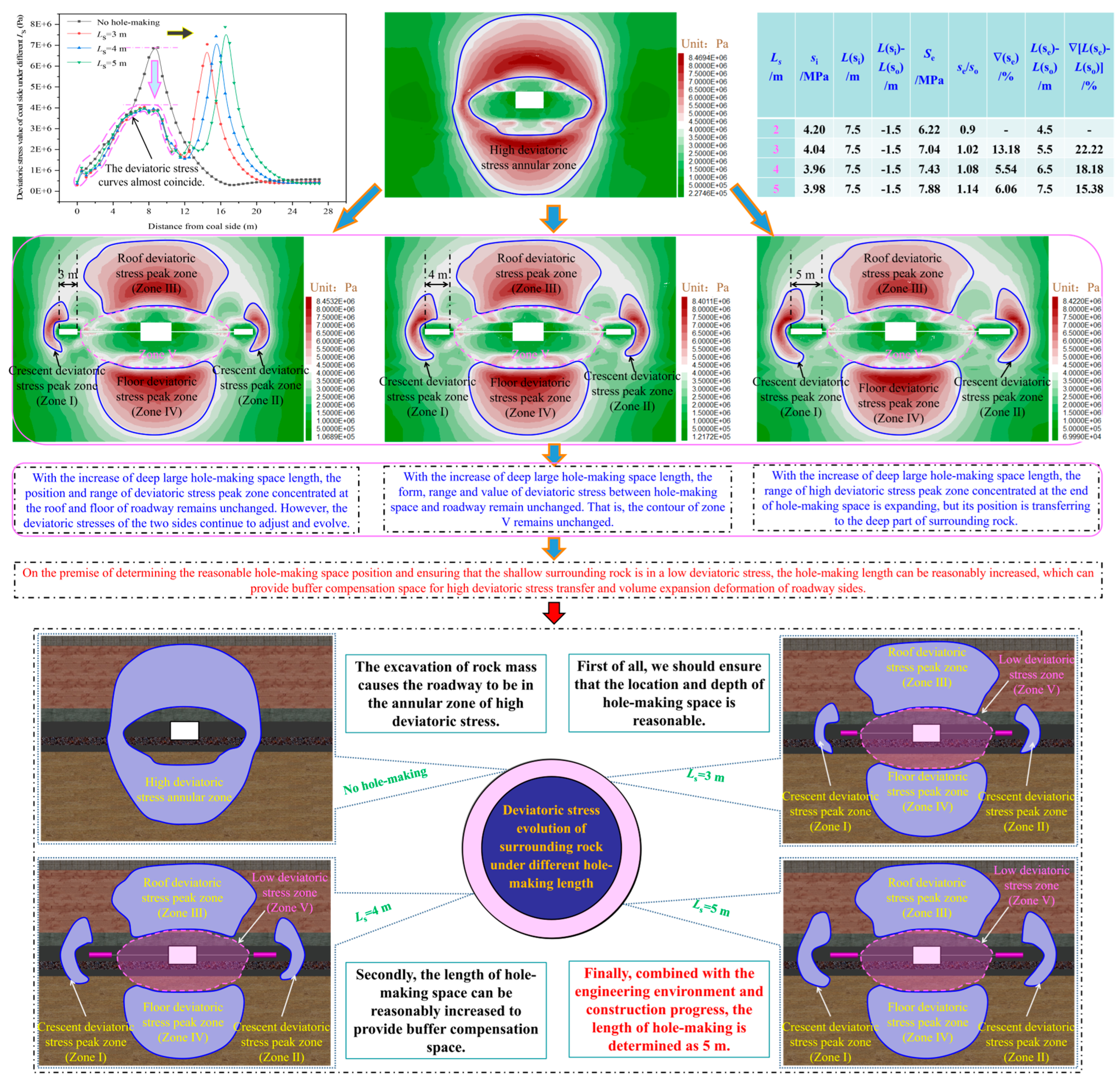
The spatial distribution features of the deviatoric stress in the rock mass around the chamber when internal hole-making length changes after the excavation of the chamber are shown in Figure 8.
With increasing internal hole-making length, the deviatoric stress state on both sides of the cavity space continuously changes. Deviatoric stress distribution features under varying internal hole-making lengths display the following patterns:
(1) As the internal hole-making length increased, the deviatoric stress morphology and value between internal hole-making and chamber spaces were unchanged, i.e., the low-deviatoric-stress zone (Zone V) remained unchanged. With increasing internal hole-making length, the range of the crescent-shaped peak-deviatoric-stress zone (Zone I) around the end of the cavity space slightly expands, and the peak deviatoric stress increases marginally, yet its transfer effect to deep rock strata remains favorable.
(2) Changes in the internal hole-making length did not alter the distribution pattern of shallow deviatoric stress; instead, they only modified the peak magnitude and positional state of deep deviatoric stress, as well as the size of the weak structural buffer zone (Zone II).
(3) The maximum values of the external deviatoric stress at lengths of 3, 4, and 5 m were 7.04, 7.43, and 7.88 MPa, respectively. As the internal borehole length increased, the growth rate of the deep deviatoric stress peak changed a little: 3 m to 4 m (5.53%) and 4 m to 5 m (5.92%).
(4) As the internal borehole length increased, the peak position of deep deviatoric stress continuously shifted toward the deep rock mass. In comparison with the peak value location of the deviatoric stress when no internal pressure relief was performed, those of the external deviatoric stress at the internal hole-making lengths of 3, 4, and 5 m were transferred to the deep rock mass by 5.5, 6.5, and 7.5 m. Compared with the change in amplitude of the peak value of external deviatoric stress, the shift magnitude of the external deviatoric stress peak location was larger: 3 m to 4 m (18.18%), 4 m to 5 m (15.38%).
From the above results, the analysis indicates that a change in the internal hole-making length showed no variation in response to the deviatoric stress within the location of the internal hole-making, but only changes the highest value and location of the external deviatoric stress. As the internal hole-making length increased, the growth gradient of the peak value of the external deviatoric stress was not large, but the transfer effect of its position increased significantly. Under the condition of ensuring the appropriate position of the internal hole-making, the internal hole-making length ought to be appropriately adjusted based on field conditions to provide buffer compensatory space for the high deviatoric stress transfer and volume expansion deformation of the roadway sides.

3.4.3. Determination of Internal Hole-Making Spacing

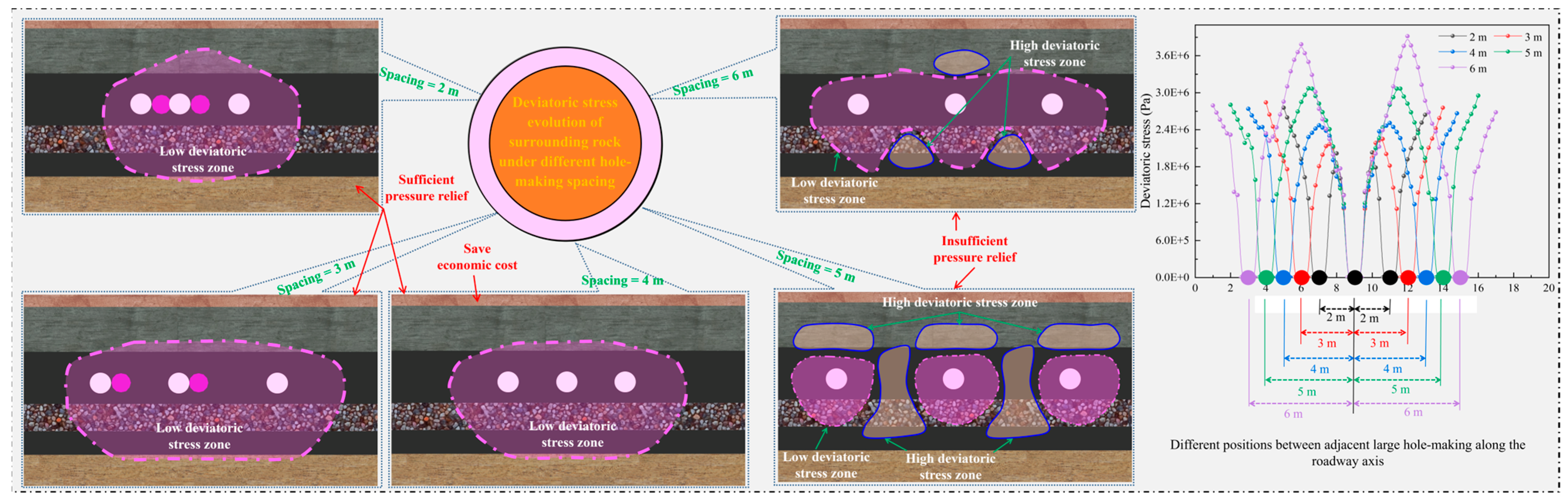
The stress distribution curves and nephograms after excavating the chamber under varying spacing of internal hole-making are shown in Figure 9.
An appropriate internal hole-making position can achieve the transfer of the initial high deviatoric stress peak in the adjacent rock mass to the deep rock mass, with small changes in the stress condition of the shallow rock mass. An appropriate decrease in the internal hole-making spacing can increase the spatial extent of the weak-structured buffer zone and enhance its capacity to accommodate deformation and attenuate dynamic stress waves. Under the same conditions of internal hole-making positions and lengths, the smaller the internal hole-making spacing, the better the stress relief effect in high-deviatoric-stress zones.
According to the analysis in Figure 9, the peak value position of the deviatoric stress between the two holes along the axial direction of the chamber was always in the middle position under different internal hole-making spacings. As the internal hole-making spacing increased, the deviatoric stress peak gradually increased, and the morphology and range of deviatoric stress between the holes were also significantly adjusted. As the internal hole-making spacing reaches 5–6 m, the high-deviatoric-stress zone transfers to the periphery of the internal hole-making zone. Localized maximum deviatoric stress regions exist in the rock mass between internal hole-making locations. Under such conditions, the stress relief effect in these regions is relatively poor.
When the internal hole-making spacing was 2–4 m, the rock between the internal hole-making locations was in a low-deviatoric-stress state, as the rock mass exhibited pronounced plastic failure. With the internal hole-making spacing at 2, 3, or 4 m, the maximum deviatoric stress value of the rock mass in the adjacent internal hole-making space is only 2.01, 2.13, and 2.55 MPa, respectively, indicating that the stress condition of the shallow rock mass remains largely unaffected, and the deviatoric stress between neighboring internal hole-making spaces has been significantly released. Nevertheless, balancing construction progress and economic efficiency, it is not advisable for the internal hole-making spacing to be excessively small.
Based on the evolution of peak deviatoric stress zones and pressure relief responses, the sensitivity of the surrounding rock to hole-making parameters is ranked as follows: position > length > spacing. Drawing on the engineering geological settings of the test chamber-adjacent rock mass and taking into account the impact of the high-pressure water jet from the water knife, it is suggested that the appropriate internal hole-making depth Lh is 10 m, the internal hole-making length Ls is 5 m, and the internal hole-making spacing is 4 m in the area with severe dynamic pressure. Under this internal hole-making parameter, the spatial distribution features of deviatoric stress before and after internal hole-making in coal roadway-surrounding rock are shown in Figure 10.

4. Physical Similarity Simulation

In order to verify the reliability of the cavitation parameters obtained by numerical simulation and systematically evaluate the pressure relief effect, a physical similarity simulation experiment was carried out for the parameters of the internal cavitation pressure relief hole.

4.1. Similar Simulation Test Process and Parameter Design

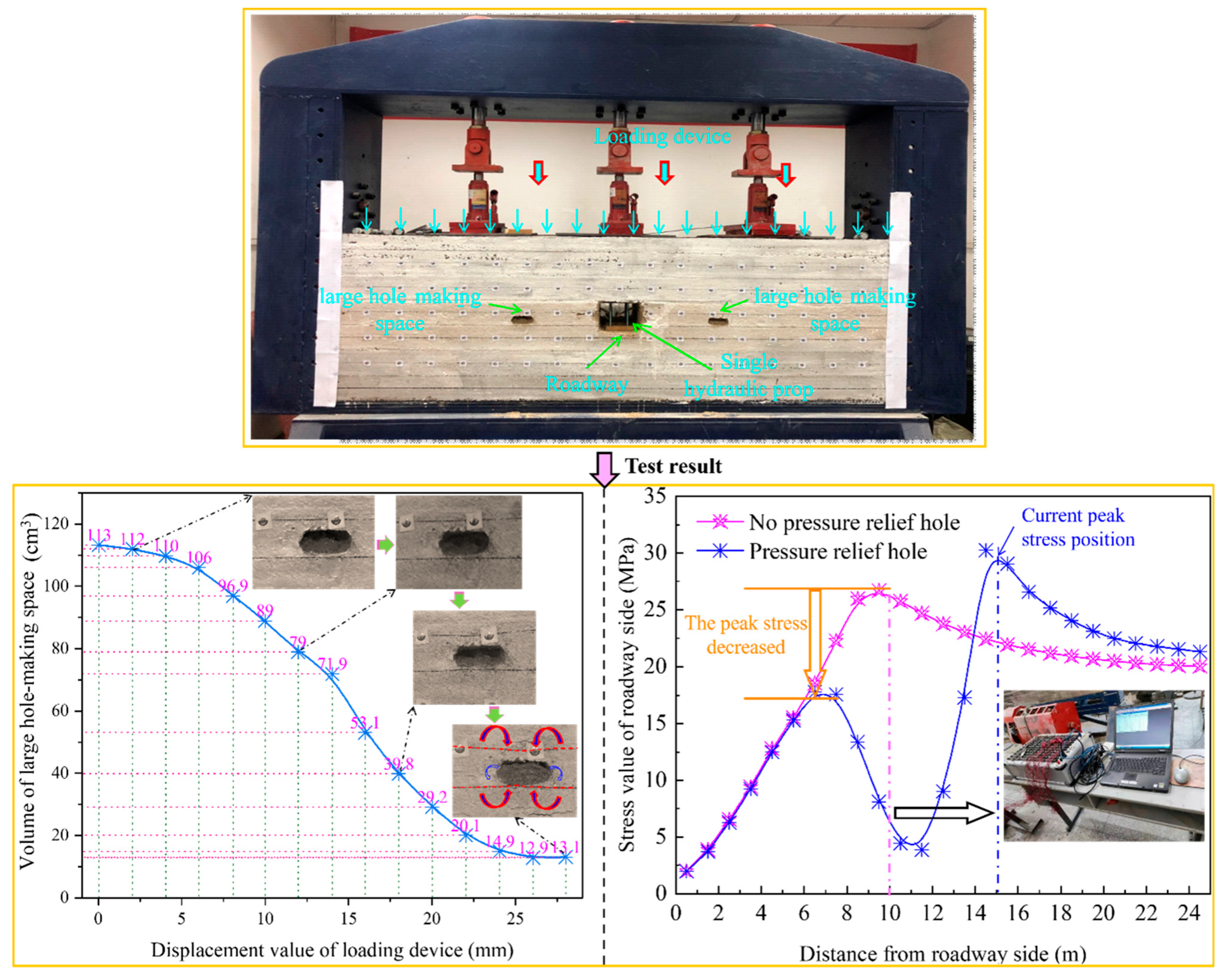
The test model was designed with a geometric similarity ratio, denoted as αL = 100:1; the unit weight was selected as αγ = 1.5:1. The geometric parameter ratio of the similar model was ασ = αL·αγ = 150. The specific stratification and material ratio of each rock layer are shown in Table 2. The process of a similar simulation test is as follows: laying model → excavating roadway (15 cm × 9 cm) → excavating internal hole-making space (7 cm long × 4 cm wide × 4 cm high, volume of approximately 112 cm3) → starting roof loading →analysis of pressure relief effect and function of the pressure relief hole space on the surrounding rock of the roadway.
The similar models and test results are shown in Figure 11.

4.2. Similarity Simulation Test Results and Analysis

The experimental results are shown in Figure 11. Following the application of the roof load, the deep coal mass was progressively extruded outward, leading to the continuous filling and consequent reduction in volume of the pressure relief holes. When the roof subsided by 25 mm, the remaining volume in the relief hole was approximately 290 mm3, representing a volumetric strain of 88.4% compared to the initial cavity. Notably, the roadway section itself remained intact without damage.
Prior to pressure relief, the peak stress in the deep sections reached approximately 27 MPa. Following the implementation of stress-relief measures, the stress in the shallow surrounding rock within a certain range (σ m) returned to a level near the in situ stress, with its peak value decreasing significantly by approximately 33%. Compared with the peak stress of the original rock, the peak stress of the deep coal body is only increased by 13%. Crucially, the stress concentration zone migrated to a greater depth, while the stress within the shallow anchorage-bearing structure was maintained without degradation. The analysis results show that the stress state of the surrounding rock can be effectively optimized by placing pressure relief holes beyond the deep anchorage zone on both sides of the roadway, ensuring the sectional integrity and stability of the roadway. It validates the rationality and effectiveness of the preceding numerical simulation.
Although direct quantitative comparison is not appropriate at the numerical level, both approaches consistently indicate that the peak stress is significantly reduced and migrates toward deeper rock mass after the implementation of pressure relief measures. Numerical simulations reveal the internal stress redistribution process, while similarity experiments reflect the macroscopic deformation characteristics of the cavity and the support response. The consistency in overall evolutionary trends between the two methods provides mutual validation of the pressure relief effectiveness.

5. Field Application and Discussion

5.1. Engineering Application

(1) Strong support technology
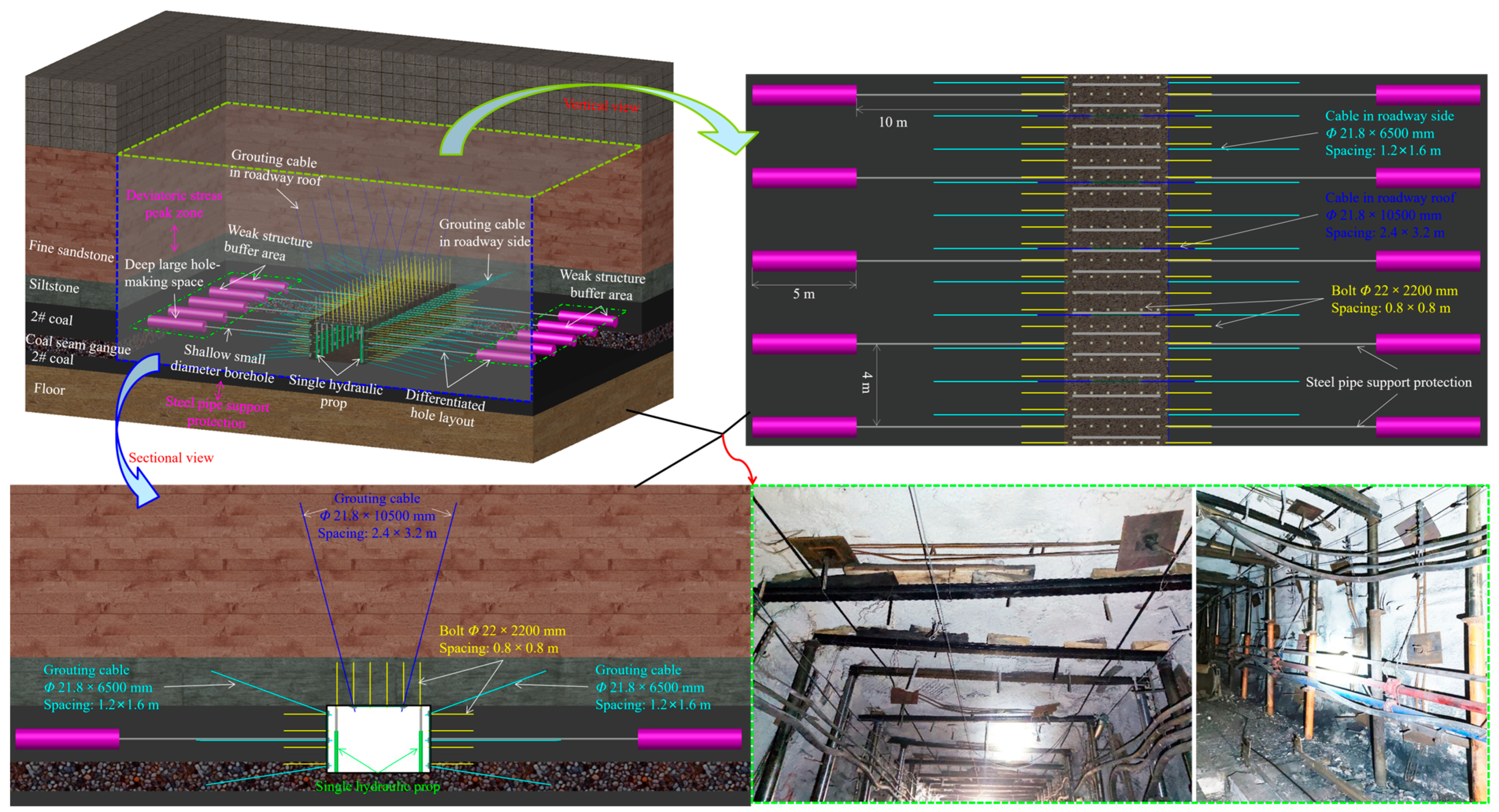
The roof is supported by φ21.8 × 10,500 mm grouting cable with a double-stranded steel ladder beam. The φ21.8 × 6500 mm grouting cable is matched with a double-stranded steel ladder beam to support the two sides. In addition, two single columns and π-shaped steel beams are used for enhanced support.
(2) Internal pressure relief method and technology parameters
In order to ensure a good pressure relief effect, the position of the internal hole-making should be as close as possible to the middle of the roadway side. Therefore, the hole is arranged at the middle of the roadway side 0.2 m downward and internal Lh is 10 m, with a radius of 0.5 m and length Ls of 5 m. The geological steel pipe is extended from the roadway side to the internal hole with a radius of 66.5 mm, which can effectively curb the damage to the shallow anchoring coal body in the roadway side during the hole-forming process. The technical scheme is shown in Figure 12.
(3) Trend analysis of surrounding rock deformation
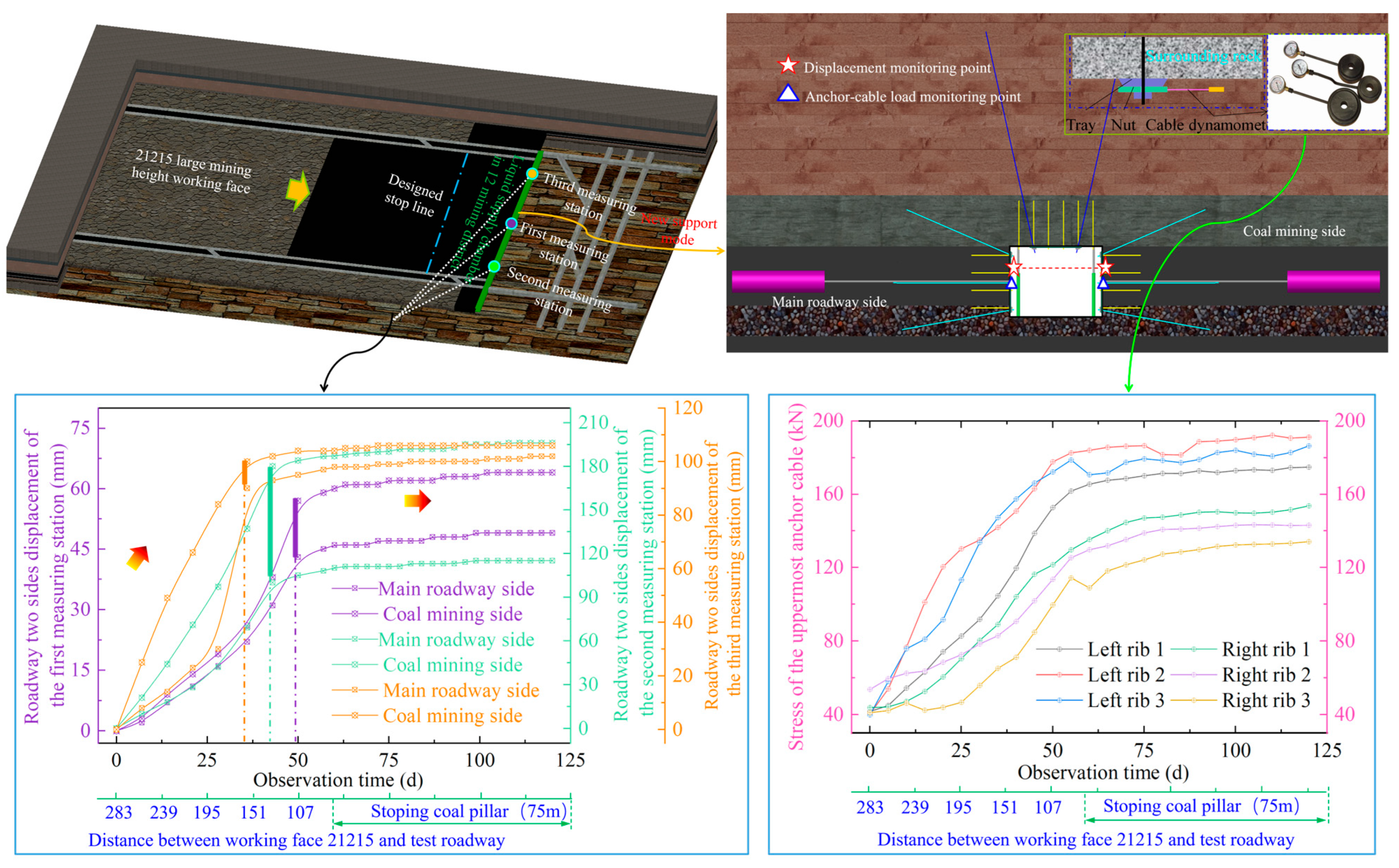
To ensure the reliability of the field-monitoring results, a field-monitoring system was implemented in the experimental roadway. Three monitoring stations were installed along the roadway axis at intervals of 50 m, covering the pressure relief implementation zone. At each monitoring station, measurement points were symmetrically arranged on both roadway ribs. Roadway deformation was continuously monitored using convergence meters, while anchor–cable forces were measured using plate-type anchor–cable load cells, enabling simultaneous characterization of surrounding rock deformation and support response. The monitoring accuracy met engineering requirements, with a deformation measurement accuracy of approximately ±1 mm and an anchor–cable force measurement accuracy within ±2%.
The results of the surrounding rock displacement during the pressure relief process of the internal hole are shown in Figure 13.
Analyze the deformation value of the two sides in the whole process of pressure relief in the chamber. When the shallow surrounding rock is strengthened, it will still have a certain growth. The reason for this phenomenon is the influence of mine pressure caused by the mining of the No. 21215 working face. In addition, when the hole is not made and the pressure is not released, the chamber space is significantly deformed and reduced. When the No. 21215 working face is close to stopping mining, the deformation rate of the surrounding rock at the pressure relief is no longer increasing. Therefore, the implementation of the internal hole can effectively control the deformation of the surrounding rock.
The change in anchor cable stress in Figure 13 is analyzed, and the main reason for the rapid growth of anchor cable stress at each position in the initial stage is that it is affected by the mine pressure behavior of the No. 21215 working face. When the internal hole is completed, the stress growth rate is obviously decreased. The stress is optimized and the stability is enhanced after the internal pressure relief is adopted based on the shallow surrounding rock anchorage. And the force of each anchor cable is less than 200 kN, which is in a stable anchoring state.
Thus, the “anchorage + pressure relief” cooperative control technology has better control of roadway deformation and better protection of the integrity of supporting components such as anchor cables.

5.2. Discussion and Limitations

5.2.1. Validation of Cooperative Control Mechanism

The field-monitoring outcomes presented in Section 5.1 show high consistency with the findings from the numerical simulations (Section 3) and physical similarity experiments (Section 4). Unlike conventional drilling pressure relief, which often compromises the integrity of the shallow surrounding rock, the proposed “internal hole-making” successfully shifts the deviatoric stress peak to the deeper rock mass. This transfer mechanism is empirically validated by the on-site anchor cable stress monitoring (Figure 13), which stabilized below 200 kN. The data indicates that the “anchorage + pressure relief” cooperative control effectively maintains the shallow surrounding rock in a low-stress environment, allowing the bolt–cable–grouting support system to function continuously without failure. This overcomes the incompatibility between roadway pressure relief and structural support often encountered in deep mining.

5.2.2. Limitations

Despite the successful engineering application, two main limitations of this study should be noted: (1) Scale Effects: The physical similarity simulation was conducted based on a geometric ratio of 1:100. While this scale effectively captures macroscopic deformation trends, it simplifies the micro-fracture propagation characteristics of the coal mass compared to in situ conditions. (2) Geological Variability: The numerical and physical models assumed idealized and homogeneous rock strata. However, the actual deep roadway environment involves complex heterogeneity, such as developed joints and fissures. Future research will incorporate stochastic geological models to further evaluate the robustness of internal hole-making parameters under variable geological conditions.

6. Conclusions

(1) Investigation into the distribution, propagation, and temporal changes of deviatoric stress influenced by different internal boring parameters, in conjunction with the resultant pressure relief effectiveness, established a distinct order of influence for these parameters on the deep roadway-surrounding rock’s pressure relief outcome: hole location has the primary impact, succeeded by hole length, with hole spacing exhibiting the least influence. To illustrate, setting the internal boring depth at 10 m caused the peak deviatoric stress area in the roadway sides to shift deeper into the surrounding rock mass, concurrently experiencing a notable decrease in its spatial coverage. While the positioning of the peak deviatoric stress areas in the roof and floor did not change, their spatial coverage also decreased considerably.
(2) The magnitude (si) and positioning of the internal peak deviatoric stress were chiefly governed by the internal boring location. Altering the internal boring length did not affect the pattern or value of the deviatoric stress within the rock immediate to the boring position. With an extension of the internal boring length, the growth gradient of the external peak deviatoric stress (se) remained slight; nonetheless, the efficacy in relocating this peak zone further into the rock mass improved significantly. This implies that a well-considered extension of the boring length can be advantageous, offering a buffer region to manage the stress redistribution and the volumetric expansion deformation occurring at the roadway sides.
(3) Based on an integrated analysis of numerical simulations, similarity experiments, and field application, this study determines the optimal parameter range for internal pressure relief hole-making. The results indicate that the pressure relief holes should be arranged approximately 10 m beyond the anchorage zone, with a hole length of about 5 m and a spacing not exceeding 4 m. This parameter range effectively coordinates deep stress transfer and shallow anchorage stability, providing practical and operable engineering guidance for pressure relief design in deep, soft, and fractured coal roadways.
(4) The feasibility of implementing internal hole-making for pressure relief in the ribs of a deep coal roadway was corroborated using a comparable simulation methodology. Furthermore, field observations encompassing the deformation of the surrounding rock in the roadway ribs and the stress experienced by support cables revealed that the synergistic control strategy combining anchorage support with pressure relief (‘anchorage + pressure relief’) effectively mitigates the progressive large-scale deformation within the surrounding rock mass of the ribs in deep chambers excavated through soft, fractured coal strata.

Author Contributions

Conceptualization, H.G.; Methodology, H.G.; Software, H.G., Y.R. and F.H.; Validation, H.G.; Formal analysis, Y.R.; Writing—original draft, H.G.; Writing—review & editing, H.G. and F.H.; Project administration, S.X.; Funding acquisition, S.X. All authors have read and agreed to the published version of the manuscript.

Funding

This work was supported by the National Natural Science Foundation of China (No. 52004286), the Fundamental Research Funds for the Central Universities (Ph.D. Top Innovative Talents Fund of CUMTB) (No. BBJ2025005).

Data Availability Statement

The original contributions presented in the study are included in the article, further inquiries can be directed to the corresponding authors.

Conflicts of Interest

The authors declare no conflict of interest.

References

  1. Jiang, B.Y.; Wang, L.G.; Lu, Y.L.; Gu, S.T.; Sun, X.K. Failure mechanism analysis and support design for deep composite soft rock roadway: A case study of the Yangcheng coal mine in China. Shock. Vib. 2015, 2015, 452479. [Google Scholar] [CrossRef]
  2. Zhang, S.; Wang, X.F.; Fan, G.W.; Zhang, D.S.; Cui, J.B. Pillar size optimization design of isolated island panel gob-side entry driving in deep inclined coal seam-case study of Pingmei No. 6 coal seam. J. Geophys. Eng. 2018, 15, 816–828. [Google Scholar] [CrossRef]
  3. Xie, Z.Z.; Zhang, N.; Yuan, Y.X.; Xu, G.; Wei, Q. Study on safety control of composite roof in deep roadway based on energy balance theory. Sustainability 2019, 11, 3688. [Google Scholar] [CrossRef]
  4. Zhang, J.F.; Jiang, F.X.; Yang, J.B.; Bai, W.S.; Zhang, L. Rockburst mechanism in soft coal seam within deep coal mines. Int. J. Min. Sci. Technol. 2017, 27, 551–556. [Google Scholar] [CrossRef]
  5. Li, S.C.; Wang, Q.; Wang, H.T.; Jiang, B.; Wang, D.C.; Zhang, B.; Li, Y.; Ruan, G.Q. Model test study on surrounding rock deformation and failure mechanisms of deep roadways with thick top coal. Tunn. Undergr. Space Technol. 2015, 47, 52–63. [Google Scholar] [CrossRef]
  6. Hu, Y.B.; Li, W.P.; Wang, Q.Q.; Liu, S.L.; Wang, Z.K. Study on failure depth of coal seam floor in deep mining. Environ. Earth Sci. 2019, 78, 697. [Google Scholar] [CrossRef]
  7. Jing, H.W.; Wu, J.Y.; Yin, Q.; Wang, K. Deformation and failure characteristics of anchorage structure of surrounding rock in deep roadway. Int. J. Min. Sci. Technol. 2020, 30, 593–604. [Google Scholar] [CrossRef]
  8. Xie, Z.Z.; Zhang, N.; Feng, X.W.; Liang, D.X.; Wei, Q.; Weng, M.Y. Investigation on the evolution and control of surrounding rock fracture under different supporting conditions in deep roadway during excavation period. Int. J. Rock Mech. Min. Sci. 2019, 123, 104122. [Google Scholar] [CrossRef]
  9. Zhang, Z.X.; Xu, Y.; Kulatilake, P.; Huang, X. Physical model test and numerical analysis on the behavior of stratified rock masses during underground excavation. Int. J. Rock Mech. Min. Sci. 2012, 49, 134–147. [Google Scholar] [CrossRef]
  10. Cai, M.F. Key theories and technologies for surrounding rock stability and ground control in deep mining. J. Min. Strata Control Eng. 2020, 2, 5–13. [Google Scholar]
  11. Wang, W.J.; Yuan, C.; Yu, W.J.; Wu, H.; Peng, W.Q.; Peng, G.; Liu, X.S.; Dong, E.Y. Stability control method of surrounding rock in deep roadway with large deformation. J. China Coal Soc. 2016, 41, 2921–2931. [Google Scholar]
  12. Bai, Q.S.; Tu, S.H.; Wang, F.T.; Zhang, C. Field and numerical investigations of gateroad system failure induced by hard roofs in a longwall top coal caving face. Int. J. Coal Geol. 2017, 173, 176–199. [Google Scholar] [CrossRef]
  13. Xie, S.R.; Pan, H.; Chen, D.D.; Zeng, J.C.; Song, H.Z.; Cheng, Q.; Xiao, H.B.; Yan, Z.Q.; Li, Y.H. Stability analysis of integral load-bearing structure of surrounding rock of gob-side entry retention with flexible concrete formwork. Tunn. Undergr. Space Technol. 2020, 103, 103492. [Google Scholar] [CrossRef]
  14. Yu, W.J.; Li, K. Deformation mechanism and control technology of surrounding rock in the deep-buried large-span chamber. Geofluids 2020, 2020, 8881319. [Google Scholar] [CrossRef]
  15. Zhang, Z.Z.; Deng, M.; Bai, J.B.; Yan, S.; Yu, X.Y. Stability control of gob-side entry retained under the gob with close distance coal seams. Int. J. Min. Sci. Technol. 2021, 31, 321–332. [Google Scholar] [CrossRef]
  16. Guo, D.M.; Kang, X.C.; Lu, Z.Y.; Chen, Q.Y.; Zhang, W.; Zhao, Z.F.; Cao, Y.P. Flexural floor heave mechanism and floor corner piles control technology in soft rock roadway. J. Min. Sci. Technol. 2021, 6, 536–547. [Google Scholar]
  17. Li, W.T.; Wang, Q.; Li, S.C.; Wang, D.C.; Huang, F.C.; Zuo, J.Z.; Zhang, S.G.; Wang, H.T. Deformation and failure mechanism analysis and control of deep roadway with intercalated coal seam in roof. J. China Coal Soc. 2014, 39, 47–56. [Google Scholar]
  18. Wang, Q.; Pan, R.; Li, S.C.; He, M.C.; Ren, Y.X.; Wang, L.; Ding, G.L.; Sun, H.B.; Jiang, B. Gob side entry failure mechanism and control of bolt-grouting in three soft coal seam. J. China Coal Soc. 2016, 41, 1111–1119. [Google Scholar]
  19. Chen, D.D.; Jia, Q.B.; Zhang, Z.F.; Xie, S.R.; Wang, Y.Y.; Wang, Z.Q.; Li, Z.J.; Tian, C.Y.; Xie, F.X. Study on the Failure Mechanism and a New Monitoring Method of Borehole Stress Gauge Monitoring Coal Seam Mining Stress. Rock Mech. Rock Eng. 2025. [Google Scholar] [CrossRef]
  20. Wang, J.; Liu, P.; Liu, S.; Ma, L.; Liu, Y.P.; Chen, X. Study on collaborative pressure relief control technology for surrounding rock stability of dynamic pressure roadway in coal mine. J. Min. Sci. Technol. 2021, 6, 323–332. [Google Scholar]
  21. Zhou, L.S.; Huang, Y.B.; Shao, Z.H.; Ma, F.L.; Zhang, P.; Wang, Y. Research on surrounding rock rheological effect and control method of large section chamber group in deep well. Geotech. Geol. Eng. 2021, 39, 5041–5061. [Google Scholar] [CrossRef]
  22. Yu, W.J.; Li, K.; Liu, Z.; An, B.F.; Wang, P.; Wu, H. Mechanical characteristics and deformation control of surrounding rock in weakly cemented siltstone. Environ. Earth Sci. 2021, 80, 337. [Google Scholar] [CrossRef]
  23. Xie, S.R.; Wang, E.; Chen, D.D.; Sun, Y.H.; Cheng, Q.; Ji, C.W.; Yan, Z.Q.; Xiao, H.B. Failure analysis and control mechanism of gob-side entry retention with a 1.7-m flexible-formwork concrete wall: A case study. Eng. Fail. Anal. 2020, 117, 104816. [Google Scholar] [CrossRef]
  24. Batugin, A.; Wang, Z.Q.; Su, Z.H.; Sidikovna, S.S. Combined support mechanism of rock bolts and anchor cables for adjacent roadways in the external staggered split-level panel layout. Int. J. Coal Sci. Technol. 2021, 8, 659–673. [Google Scholar] [CrossRef]
  25. Chen, J.H.; Zhao, H.B.; He, F.L.; Zhang, J.W.; Tao, K.M. Studying the performance of fully encapsulated rock bolts with modified structural elements. Int. J. Coal Sci. Technol. 2021, 8, 64–76. [Google Scholar] [CrossRef]
  26. Xie, S.R.; Wang, E.; Chen, D.D.; Jiang, Z.S.; Li, H.; Liu, R.P. Collaborative control technology of external anchor-internal unloading of surrounding rock in deep large-section coal roadway under strong mining influence. J. China Coal Soc. 2022, 47, 1946–1957. [Google Scholar]
  27. Sun, Y.J.; Zuo, J.P.; Karakus, M.; Liu, L.; Zhou, H.W.; Yu, M.L. A new theoretical method to predict strata movement and surface subsidence due to inclined coal seam mining. Rock Mech. Rock Eng. 2021, 54, 2723–2740. [Google Scholar] [CrossRef]
  28. He, M.C.; Chen, S.Y.; Guo, Z.B.; Yang, J.; Gao, Y.B. Control of surrounding rock structure for gob-side entry retaining by cutting roof to release pressure and its engineering application. J. China Univ. Min. Technol. 2017, 46, 959–969. [Google Scholar]
  29. Qi, H.G. Research and practice on integrated pressure releasing technology in deep coal mine rock roadway under high stress. J. Min. Saf. Eng. 2016, 33, 1023–1029. [Google Scholar]
  30. Wang, M.; Wang, X.Y.; Xiao, T.Q. Borehole destressing mechanism and determination method of its key parameters in deep roadway. J. China Coal Soc. 2017, 42, 1138–1145. [Google Scholar]
  31. Zuo, J.P.; Shi, Y.; Liu, D.J.; Sun, Y.J.; Chen, Y. The equivalent ellipse model and simulation analysis of destressing by cutting groove in deep soft rock roadway. J. China Univ. Min. Technol. 2019, 48, 1–11. [Google Scholar]
  32. Zhang, S.C.; Li, Y.Y.; Shen, B.T.; Sun, X.Z.; Gao, L.Q. Effective evaluation of pressure relief drilling for reducing rock bursts and its application in underground coal mines. Int. J. Rock Mech. Min. Sci. 2019, 114, 7–16. [Google Scholar] [CrossRef]
  33. Li, Y.P.; Sun, D.Q.; Zhao, S.K.; Liang, K.H.; Cui, K.; Wang, H.H. Investigation of pressure relief borehole effects using in situ testing based on distributed optical fibre sensing technology. Adv. Civ. Eng. 2021, 2021, 8847500. [Google Scholar] [CrossRef]
  34. Konicek, P.; Soucek, K.; Stas, L.; Singh, R. Long-Hole Destress Blasting for Rockburst Control during Deep Underground Coal Mining. Int. J. Rock Mech. Min. Sci. 2013, 61, 141–153. [Google Scholar] [CrossRef]
  35. Chen, T.; Vennes, I.; Mitri, H.S. A Novel V-Cut Method for Explosive-Free Breakage of Biaxially Loaded Rock Using Soundless Chemical Demolition Agents. J. Rock Mech. Geotech. Eng. 2024, 16, 4866–4877. [Google Scholar] [CrossRef]
  36. Konicek, P.; Chen, T.; Mitri, H.S. Numerical Modeling of Destress Blasting for Strata Separation. J. Rock Mech. Geotech. Eng. 2023, 15, 2238–2249. [Google Scholar] [CrossRef]
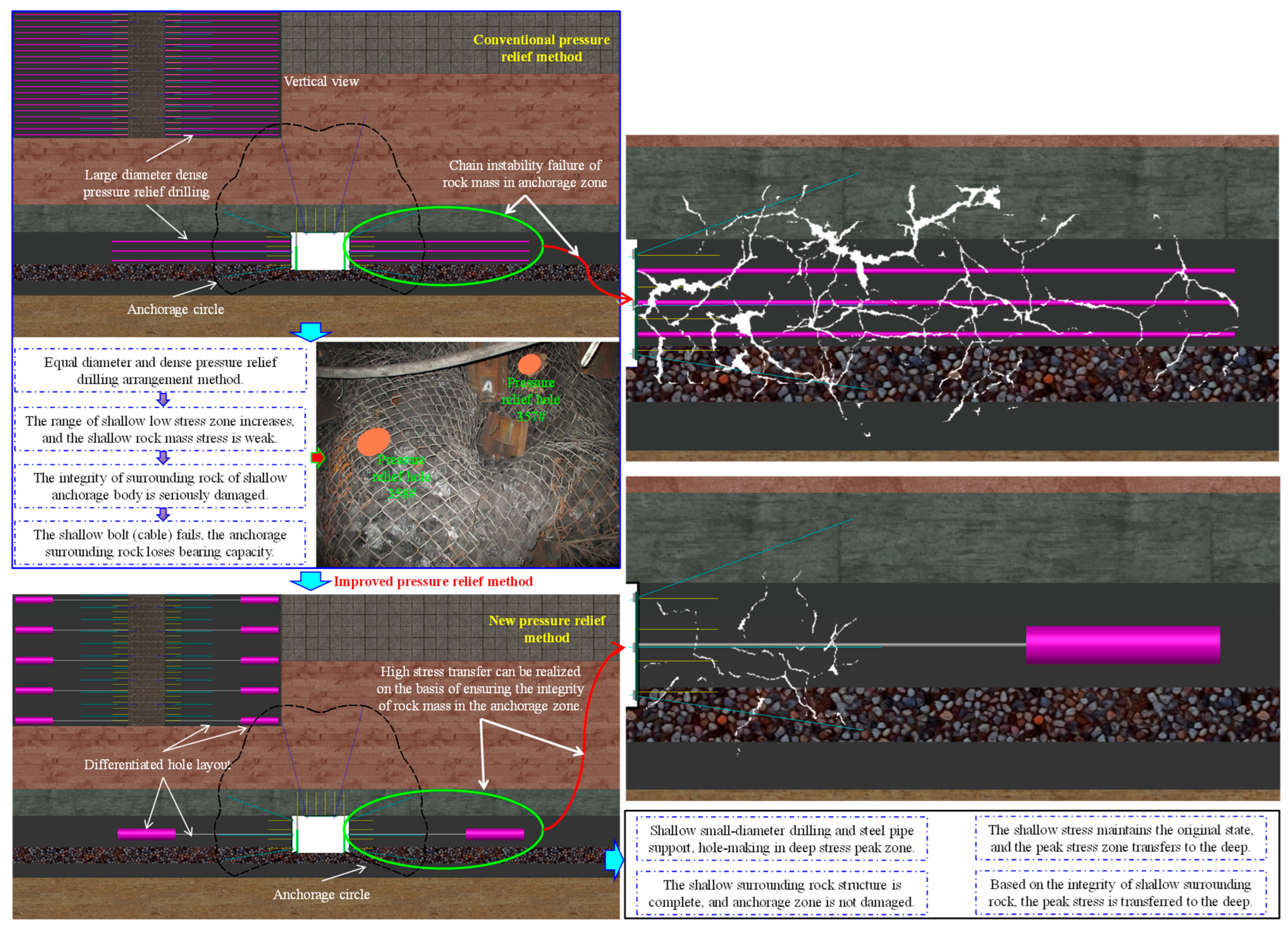
Figure 1. Comparison of advantages and disadvantages between traditional borehole pressure relief technology and new hole-making pressure relief technology.
Applsci 16 00469 g001
Figure 2. Diagram of the roadway layout and failure.
Applsci 16 00469 g002
Figure 3. Monitoring of roadway deformation near the No. 21215 coal face: (a) Without working face disturbance. (b) Advance section of No. 21215 working face.
Applsci 16 00469 g003
Figure 4. Schematic diagram of chamber reinforced support.
Applsci 16 00469 g004
Figure 5. Numerical calculation model.
Applsci 16 00469 g005
Figure 6. Typical deviatoric stress adjustment curve.
Applsci 16 00469 g006
Figure 7. Distribution patterns of deviatoric stress in chamber-adjacent rock mass under varying internal hole-making methods.
Applsci 16 00469 g007
Figure 8. Distribution patterns of deviatoric stress under varying internal hole-making methods with varying lengths.
Applsci 16 00469 g008
Figure 9. Stress distribution curves and nephograms at different spacing.
Applsci 16 00469 g009
Figure 10. Distribution patterns of deviatoric stress before and after internal hole-making in coal roadway-surrounding rock.
Applsci 16 00469 g010
Figure 11. Similarity model and test results.
Applsci 16 00469 g011
Figure 12. Roadway comprehensive control technology scheme.
Applsci 16 00469 g012
Figure 13. Deformation curve of surrounding rock of two sides and on-site control effect of chamber.
Applsci 16 00469 g013
Table 1. Actual physical and mechanical properties of each stratum.
Rock StratumD/kg·m−3K/GPaG/GPa φ m C m /MPa σ tm /MPa
Silty sand claystone22396.335.2273.01.9
Fine sandstone26107.035.4353.32.4
Siltstone25967.066.2332.91.9
2# coal seam14202.51.6200.90.3
Carbonaceous mudstone21907.66.2303.02.1
Coarse sandstone26469.47.2343.32.6
K: bulk modulus; G: shear modulus; C m : cohesion; σ tm : tensile strength; φ m : friction angle; D: density.
Table 2. Material ratio of similar simulation test models.
No.Lithology
(Sand:Lime:Gypsum)
Thickness
(cm)
Sand
(kg)
Lime
(kg)
Gypsum
(kg)
Water
(kg)
1Gritstone (8:0.5:0.5)1.586.960.430.430.78
2Fine sandstone (7:0.5:0.5)0.552.380.170.170.27
321#coal (8:0.7:0.3)0.31.320.120.050.15
4Carbonaceous mudstone (8:0.5:0.5)1.14.400.280.280.50
5Siltstone (7:0.5:0.5)1.275.500.390.390.63
6Fine sandstone (7:0.5:0.5)1.064.600.330.330.53
72#coal (8:0.7:0.3)1.8023.782.080.892.67
8Siltstone (7:0.5:0.5)2.3210.060.720.721.15
9Fine sandstone (7:0.5:0.5)1.8748.643.483.485.55
Disclaimer/Publisher’s Note: The statements, opinions and data contained in all publications are solely those of the individual author(s) and contributor(s) and not of MDPI and/or the editor(s). MDPI and/or the editor(s) disclaim responsibility for any injury to people or property resulting from any ideas, methods, instructions or products referred to in the content.