1. Introduction
At the beginning, we start by presenting some information about thermodiffusion in solid bodies. At first, it is worth emphasizing that the phenomenon of thermodiffusion has been investigated from a practical point of view (cf. [
1,
2,
3]). Such investigations started in the XIX century in France and England.
The process of thermodiffusion takes place in some materials which are used in mechanical engineering (cf. [
4,
5,
6,
7,
8,
9,
10,
11]).
From a theoretical point of view, the system of thermodiffusion has been investigated by many researchers (cf. [
12,
13,
14,
15,
16,
17,
18,
19,
20,
21,
22,
23,
24,
25,
26,
27,
28,
29,
30]).
We would like to mention some of them.
In their series of papers, cf. [
16,
18] Nowacki presented the theorem of virtual work, fundamental energy theorem, theorem reciprocity of works, generalized Maxwell reciprocity relations, and the Somigliana- and Maysel-type theorems.
In the paper [
18], Nowacki studied dynamic problems in elastic solids.
In all the mentioned papers, Nowacki used classical methods like integral representation in the class of continuous functions and used Helmoholtz’s theorem to assess the decomposition of the displacement field. He did not construct the matrix of a fundamental solution for the system of thermodiffusion in solid bodies and did not prove the time decay of the solution.
In the papers [
25,
26], Gawinecki et al. proved a theorem about the existence, uniqueness, and regularity of the solution to an initial boundary value problem for a nonlinear coupled parabolic system appearing in thermodiffusion in a solid body and for a nonlinear coupled hyperbolic–parabolic system of thermodiffusion in a solid body.
In paper [
27], he proved the theorem of the global existence of a solution to the initial-value problem for a nonlinear hyperbolic–parabolic system describing the process of thermodiffusion in a one-dimensional solid body.
Gawinecki et al. [
14] constructed the fundamental matrix for the system of the equation of thermodiffusion in a solid body using the Hillbert–Levy method.
In our paper, we proved the
,
and
time decay for the solution of the Cauchy problem for the system of thermodiffusion in a solid body as described by Equation (
1).
We established the existence of the solution of the initial-value problem for Equation (
1) in suitably chosen Sobolev spaces. We proved the polynomial decay of the solution and the well-posedness of the solution. This was achieved for the first time in our study.
We presented the physical and mechanical interpretation of the obtained solution.
The method which we used in our paper permitted us to obtain the solution to our problem in a much-desired form in order to carry out the technical analysis of the obtained solution. Our paper consists of nine sections in addition to the introduction.
In
Section 2, we present the basic notation. In
Section 3, we introduce the auxiliary problem and solve it by using the matrix of fundamental solutions.
Section 4 is devoted to the proof of the behaviour of the solution with respect to time in the
and
spaces.
In
Section 5, we describe the behaviour of the solution with respect to time in the norm of
space. Finally, in
Section 6, we prove the polynomial decay of the solution in the
spaces. In
Section 7, some concluding remarks are presented.
Finally, in another section, the mechanical engineering applications of the obtained solution are presented. At the end of
Section 9, we present a summary of the obtained results and we describe some applications for future research work.
2. Basic Notation and Formulae
We use the following notation
—is the spatial gradient,
—is the time-spatial gradient of the function
and
,
—denotes the space of
p-integrable functions with the
norm,
—is the space of essentially bounded measurable functions on
, with the essup norm.
denotes the Sobolev space with the norm
(cf. [
31,
32,
33])
with the norm
,
.
Instead of , we write .
3. Auxiliary Problem
Below, we formulate the initial-value problem for the system of linear thermodiffusion in solid body, and present the main theorem.
We consider, in this paper, the following thermodiffusion system
where
,
q, and
m represent the density of the exterior force, of the heat generation, and of the diffusing mass, respectively, together with
In Equation (
1),
is the displacement of the body.
is the temperature distribution
is the chemical potential.
The constants that appear in the system satisfy the following relations
Additionally, the constants
,
satisfy the inequality of the form
The asterisk denotes transpositions.
Remark 1. In the theory of thermal stresses, the influence of the terms appearing in Equation (1), and Equation (1) is assumed to be very small and, in practice, negligible, so without loss of generality, we assume that . While we are discussing the volume change we have introduced and we have proved that the volume change per unit volume is equal to
so, the field
is called the dilatation, where
denotes the trace of strain tensor
.
So, this expression is called the coefficient to voluminal expansion, and for materials which are used in civil and air force aviation, it is very small. See below for examples.
For constructional steel, the coefficient of voluminal expansion is as follows
For the glass
E, the coefficient of voluminal expansion is as follows
For carbon fiber, the coefficient of voluminal expansions is as follows
For epoxy resin, the coefficient of voluminal expansion is as follows
It is worth emphasizing that for another materials, such as metals, ceramics, polymer, resins, fiberglass, aramid fibers, metal fibers, carbon fibers, oxide ceramic fibers, and non-oxide ceramic fibers, the coefficient of voluminal exponential is of the order
[
34,
35].
Some of the abovementioned materials are also used to construct the elements of civil planes and military planes.
Baed on the above, it follows that the coefficient of thermal expansion is of the order , so it is very small, and can be negligible.
Equation (
1) can be written in the form
where
is the matrix with elements
of the form
where
is the unit matrix of order
.
By
, we will denote the Kronecker’s symbol of the form
Using the method of the theory of distribution and potential theory, we can represent the solution to the problem (
1), (
2) as follows:
where
and
represent the matrix of fundamental solutions of Equation (
1) i.e., constructed in [
15] in the following form:
where
c,
,
,
a, and
b are positive constants and the function
appearing in (
9) is given by the following formulae:
where
denotes the Dirac distribution (cf. [
36])
and (cf. [
36])
Remark 2. It is worth emphasizing that the matrix of the fundamental solution for the system (1) is represented in the explicit form (cf. [5]) and is expressed by elementary functions and combinations thereupon, including rational functions, error functions, complementary error functions, Dirac distribution, and Heaviside functions. Remark 3. These representations allow us to investigate these solutions in much greater depth. So we state the following:
Now, we come to the interpretation of the following relations (coming from the Heaviside function
,
, appearing in the Formula (
9)
Therefore, we describe the appearance of the medium cone wave and describe the domain of disturbance and its fronts by the following formulae
And the second Heaviside function
describes the cone wave and describes its domain of disturbance and its fronts by the following formulae
The terms
, where
is given by (
10), is represented by the expressions which have in their structure the terms
and a combination describing the influence of the field of temperature and diffusion on the propagation of waves in the thermodiffusion medium.
The interpretation of these terms and their influence on the solution to the problem can be described in
Section 7.
Also, the matrix of fundamental solutions includes all singularities describing the model of thermodiffusion in solid bodies and also contains information about the model and is consistent with physical intuition.
Now, we will formulate the main theorem.
Theorem 1 (Long-time behaviour)
. Let us assume that initial conditions , , , are functions which vanish at infinity. Additionally, we assume that , , ,and then the solution to the problem (1)–(2) represented by Formula (7) fulfils the relationwhere c is a constant and is not dependent on , , , and t. 4. Behaviour of the Solution of the Initial-Value Problem for Linear Thermodiffusion in Thermal Stresses Theory with Respect to Time in the Norm of the Spaces
Below, we will prove the theorem of the behaviour of the solution given by Formula (
7) with respect to time in the norm of the spaces
and
Theorem 2 (
time behaviour)
. Let us assume that initial conditions , , , are functions which vanish at infinity. Additionally, we assume then the solution to the problem (1)–(2) given by Formula (7) fulfils the relations for , where C is a constant greater than zero. Proof. We prove (
16). In order to do this, we write the solution
represented by (
7) as follows
, where
Taking the derivative of (
18) towards
t and
(for
), we obtain
;
;
,
.
We can write (
19)–(
20) in vector form as follows
where
and
is a matrix of order 18 with the terms
and
(cf. (
19)–(
20)).
From (
19)–(
20), we notice that in order to obtain the relations, (
16) is sufficient to prove the following inequalities
for
and any function
fulfilling the assumptions of Theorem 2.
Using
cf. (
11), we have
Changing the variables
in the integrals above, we obtain
The integrals in the brackets
are estimated by applying the properties of the function
. After performing strong calculations, we get
Now, we would like to describe how the contribution coming from the diffusion terms in brackets influences the solution to
.
In order to do this, we should estimate the following convolutions:
So, firstly, we should calculate the derivatives of the function
given by formulae
where
with respect to
, and
. After some calculations, we obtain
where
,
and
and
where
Next, applying the asymptotic expansion of the functions
and erfc
(cf. [
36]) for these two cases, after some strong calculations, we get the following estimates
Finally, we estimate the convolution of the last term appearing in the Formulae (
26) with the function
.
For simplicity, we denote this as follows:
Now, we calculate the convolution
Taking into account (
35), we obtain
The estimation for the following convolutions
can be obtained in a similar way to the convolution given by Formulae (
36).
Finally, based on (
28), (
33), (
34), (
37) and (
38), we have
□
5. The Behaviour of the Solution with Respect to Time in -Norm
We derive the behaviour with respect to time solution for the initial-value problem (
1)–(
2) in
-norm.
More precisely, we formulate the following theorem.
Theorem 3 (
-time behaviour)
. Let us assume that the initial-value data , , , and are functions which vanish at infinity. Additionally, we assumeThen, the solution to the problem (1)–(2) given by Formula (7) fulfils the relations where c is constantly greater than zero and . Proof. Firstly, using the method of Yu, Y. Egorov (cf. [
37]), K.O. Fridrichs (cf. [
38]) and S. Kawashima (cf. [
39]) we can reformulate our initial-value problem (
1)–(
2) into a first-order evolution problem for the hyperbolic–parabolic system.
In the end, using the proper theorem from (cf. [
39]), we obtain the estimate (
41).
□
6. The Time Decay Estimate
Now, we prove the main theorem presented in
Section 3.
Proof. In order to do this, we will act in the following way. We define the operator
using formula
for any function
satisfying the assumptions of the main theorem, Theorem 1, and Theorem 3, where
is defined by (
19) and (
20).
From Theorem 1 and 2, it follows that operator
defined by (
42) maps as follows
Applying the interpolation theorem, we obtain
We have
where
is given by the formula
Hence, we obtain
Applying the above consideration to our case, we get
where
defines
.
Thus, we prove the main theorem.
□
7. Concluding Remarks
In this section, we investigate the solution given in Formula (
7) and the elements of the matrix of the fundamental solution to the system of Equation (
1).
We will describe this investigation, taking into account the mathematical aspects, physical aspects, and technical aspects of the solution to the initial-value problem of the thermodiffusion in solid bodies.
Before we start the discussion, from a mathematical perspective, it is worth emphasizing that we obtain the matrix of fundamental solutions in a closed, explicit form which is sufficient for investigating its elements from mathematical, physical, and technical points of view.
In order to do this, we start with the representation of the matrix of the fundamental solution expressed by Formula (
9) in a more convenient form for analysis.
Speaking more precisely, we see that from Equation (
9), we have
where
and
represent wave and diffusion parts of
, defined by
At the beginning, we notice that in spite of the waves described up till now, from the expression for
, we notice the presence of two new wave terms of the form (cf. [
18])
which describe the cone wave with the domain disturbance
and its fronts using the following formula
.
In order to make our discussion clear, we see that from Equation (
9) we can obtain Formulas (
52) and (
53).
Analysing the wave part , we can conclude how the singularities are propagated in the thermodiffusion medium.
Mathematically, the waves propagated in thermodiffusion in medium are described by Dirac distribution , and Heavside functions and by the terms .
Now, we are coming to the physical aspects of our problem and the matrix of the fundamental solution for Equation (
1). From the formulae describing the waves which propagated in the thermodiffusion solid we conclude that, in these media, the following exist:
On the other hand, the diffusion part falls instantaneously at any distance from the heat and diffusion source.
It should also be added that diffusion part quantitatively influences the displacement vector of the body in the thermodiffusion processes in solids.
With respect to quality, all the singularities of our model are included in the main part of Equation (
1).
Remark 4. Additionally, we should draw attention to some very important facts which relate to the mathematical, physical, and technical aspects of the solution to our problem as well.
Let denote the jump in a function across the front .
Then, it follows from Equation (
31) that
So, from Formula (
54), we deduce that the solution to our problem has a jump discontinuity along the cone:
– cone surface.
From the technical point of view of the solution to our problem, Formula (
54) describes the cracks observed in some elements in the airplane (cf.
Section 8).
Regarding the physical and technical applications of the obtained results, as an example, we consider the thermodiffusion and diffusion of the hydrogen into steel more deeply.
This influence is discussed in the next section.
8. Applications in Mechanical Engineering
For the construction of the plane, particularly for some of the elements, some of the following materials were used:
High-alloy steel.
Copper.
Aluminium 2000 Senis.
Titanium.
Borosilicate glass (type E).
Polyethylene and fiberglass—Glass S, aramid fiber, carbon fibers, and a combination of these.
For the materials mentioned, the coefficient of voluminal expansion is also very small (of the order
), so the process of thermodiffusion in such materials is described by Equation (
1).
Remark 5. From the above analysis of the properties of all the materials used in the construction of airplanes, aircraft, fighter planes, bomber planes, jet planes, chassis, linear tranducers, turbo-prep, and seaplanes, it follows that all these materials can characterize the voluminal expansion of the order (cf. [34,35]). From a practical point of view, and particularly based on the experiments conducted, it follows that penetration of the particle of a liquid, gas, or solid body into the considered body may produce (create) deformation, swelling, twitching, and cracking (blow-up) and contraction.
For example, under high pressure, hydrogen can penetrate steel and generate the deformation of steel elements.
It was also observed that the thin plate which hydrogen penetrated deflected the damage.
It is worth emphasizing that the influence of the heating of the body is loaded with consequences in the process of diffusion.
From the practical experiments we know the ways in which the distribution of humidity will change in the porous medium following a change in the field of the temperature.
In order to accelerate the separation of gas from metal, heat was applied to the body. Processes like carboning or uncarboning of steel and nitrification began when the specified temperature was reached.
These relations between the field of the displacement of the elastic body, the field of the temperature and diffusion are described in the equation of thermodiffusion in a solid body cf. (1).
As an example, we take into account the process of thermodiffusion and diffusion of hydrogen in steel.
This penetration intensity at higher temperature is the result of the chemical reaction of cementite with hydrogen.
This is referred to as hydrogen disease. We understand that this term refers to hydrogen cracking during the synthesis of ammonia.
The process of diffusion of the hydrogen results in the production of methane; the blowhole with this gas in the steel elements leads to the parting fracture and leads to the hydrogen cracking.
In view of these processes, the steel material changed its properties.
These properties depended on the temperature and time and diffusion.
The process of diffusion of the water steam at higher temperatures is very dangerous. This process can generate the corrosion of many kinds of steel.
Heating the steel at a higher temperature in an atmosphere containing ammonia led to the creation of surface nitrogen.
Heating of the nitrogen steel in the hydrogen atmosphere removed the nitrogen by increasing the amount of ammonia present.
The presence of steel sulphide led to cracking of the steel in response to the increasing temperature. At a lower temperature, a similar effect generated the hydrogen and cracking, causing the precipitation of the hydrogen particles in the micropores.
Another “disease” of the steel elements is “hydrosulphuric disease”—defined as the “cracking” of the steel under the influence of humidity-sulphurated hydrogen.
The influence of the gradient of the temperature and the thermal stresses on the diffusion of hydrogen in the solid body was investigated by Lewandowski (cf. [
9]) and other authors (cf. [
8,
10]).
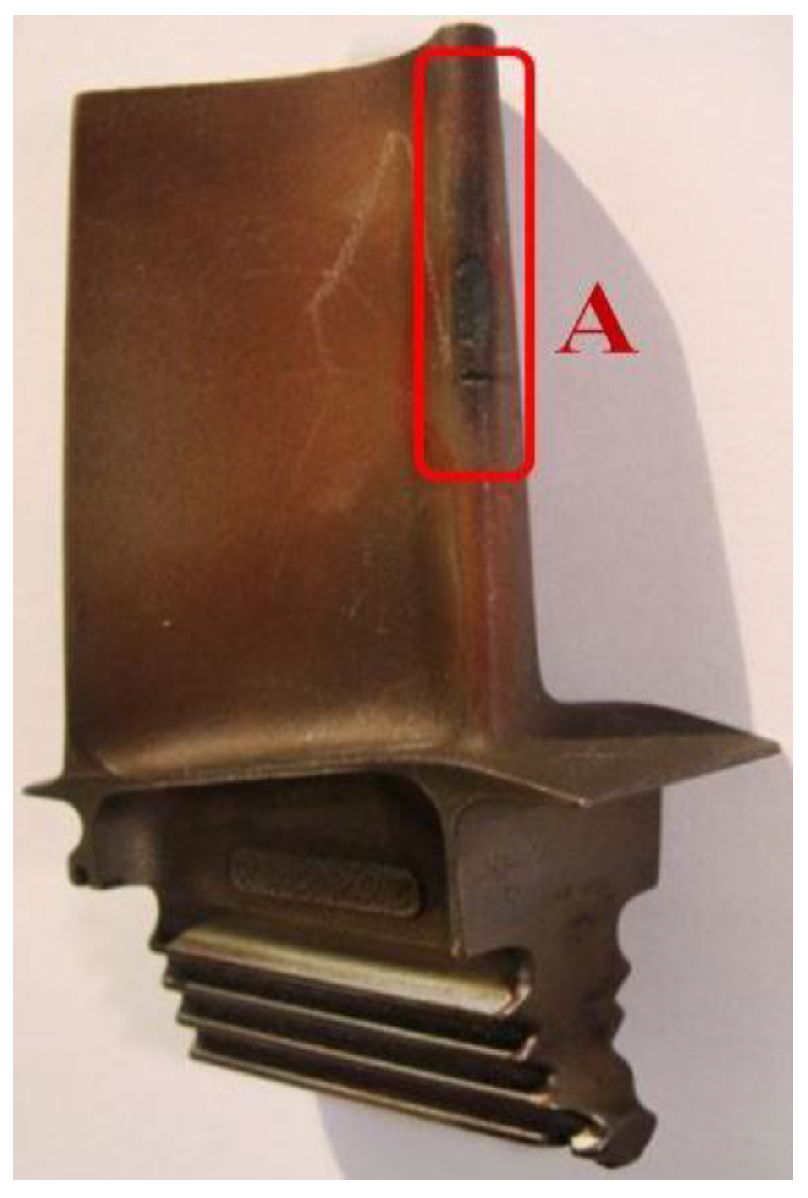
The crack damage influenced by the gas corrosion in the rotor is presented in
Figure 1.
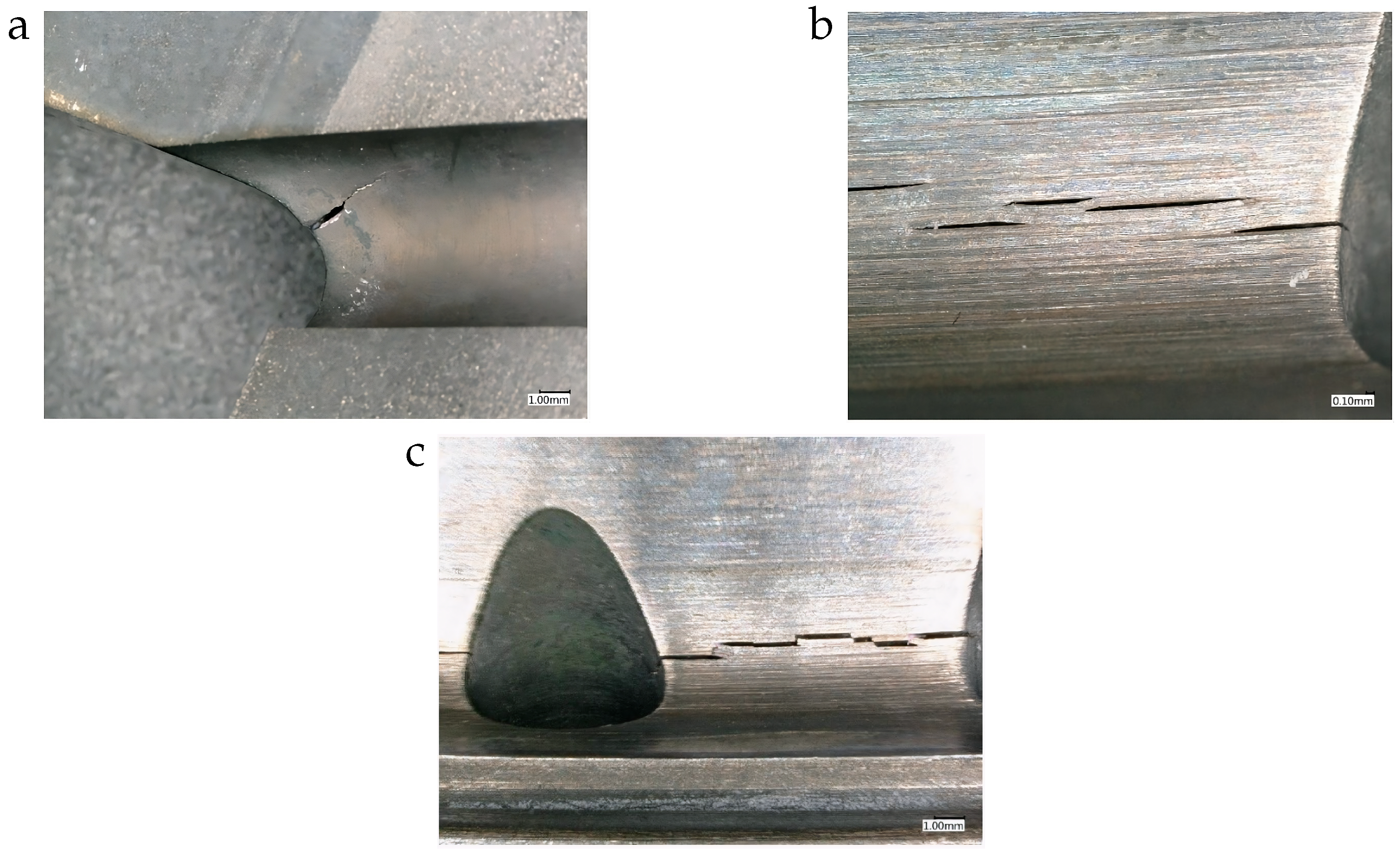
The “crack” in the disc of the engine is described in
Figure 2.
From mathematical and physical analysis of the solution of the initial-value problem to the system of equations describing thermodiffusion in solid bodies, it follows that the formula
describes the jump discontinuity along the cone surface:
.
This phenomenon is characterized by the cracking of materials used in aviation (cf. consideration is presented above).
The main causes of damage are gaseous corrosion at the leading edge, cracks at the leading and trailing edges, and thermo-mechanical damage, as shown in
Figure 1 (cf. [
6,
7]).
Figure 2 shows the damaging effect of a high-temperature gaseous environment, which increases materials’ fragility (cf. [
6,
7]). The developed mathematical model and the conducted analysis highlighted in
Figure 1 fit well into the process of creating algorithms for monitoring the technical condition of machine part components.
In summary, we can deduce that the results described above have substantial implications for engineering applications, mostly in the design of high-performance aerospace applications, where controlling thermal diffusion and state operation is critical.
9. Summary
First of all, we would like to emphasize that we chose a competent model of thermodiffusion in solid bodies which, in the range of changing physical parameters specified above, resulted in a practically exact solution and gave us sufficient technical approximations.
We addressed the problem presented in our paper, which is devoted to the initial-value problem, and determined that equations describing the phenomenon of thermodiffusion in solid bodies can be resolved in suitably chosen spaces. Additionally, we proved the polynomial decay of the solution in the norm.
taking into account that solution and matrix of fundamental solution to this system of equation we describe various type of wave that propagate in a thermodiffusion medium.
We describe the influence of the diffusion part of the solution on the displacement field of the thermodiffusion body.
We proved that the solution to our problem has special properties—including the jump of the solution at some planes—which technically is responsible for cracking some kinds of materials
We showed that the problem presented possesses the solution in suitably chosen spaces, and additionally we proved the polynomial decay of the solution in the and norms.
These facts are very important for understanding the long-term behaviour of materials under thermal and diffusion stress.
We can apply the findings from this study to develop algorithms to monitor the technical condition of machine parts and for designing materials. This is very important in mechanical engineering. Additionally, it is worth emphasizing that the results obtained in this paper can be used to prove the global existence of the solution to the nonlinear system of Equations associated with linear system (1). The method and approach presented in our paper can be extended to other boundary conditions for Equation (
1), like the Dirichlet boundary for the displacement vector body
, the temperature
and chemical potential
, Neumann boundary conditions for
,
,
and their combinations.
Also, it will be possible to extend the method presented in our paper to other models of thermodiffusion—for example, to micropolar thermodiffusion.
Roughly speaking, the model presented in our paper can be applied to describe the process of thermodiffusion in the materials which have applications in the construction of gun barrels, turbines, and some materials used in military and defence technology.
Author Contributions
Conceptualization, J.G., S.K. and M.C.; methodology, J.G., A.K., Ł.K., K.W. and C.-E.M.; software, J.G., S.K., A.K., Ł.K., K.W., C.-E.M. and M.C.; validation, J.G., Ł.K., K.W., C.-E.M. and M.C.; formal analysis, J.G., S.K. and M.C.; investigation, J.G. and S.K.; resources, J.G., A.K., K.W. and Ł.K.; writing—original draft preparation, J.G., Ł.K., K.W., C.-E.M. and M.C.; writing—review and editing, J.G., S.K., A.K., K.W. and Ł.K.; visualization, J.G., S.K., A.K., K.W. and Ł.K.; supervision, J.G. and S.K.; project administration, J.G., S.K., K.W. and Ł.K.; funding acquisition, J.G. and S.K. All authors have read and agreed to the published version of the manuscript.
Funding
The research was funded by the Military University of Technology, Warsaw, Poland, as part of the project UGB 731/2025, UGB531-000038-W200-22.
Institutional Review Board Statement
Not applicable.
Informed Consent Statement
Not applicable.
Data Availability Statement
The original contributions presented in the study are included in the article. Further inquiries can be directed to the corresponding author.
Conflicts of Interest
The authors declare no conflicts of interest.
References
- Deville, H.S.C. Comptes rendus. Proc. Fr. Acad. Sci. 1864, 59, 102. [Google Scholar]
- Deville, H.S.C.; Troost, L. Comptes rendus. Proc. Fr. Acad. Sci. 1863, 57, 965. [Google Scholar]
- Graham, T., XVIII. On the absorption and dialytic separation of gases by colloid septa. Phil. Trans. Roy. Soc. 1866, 156, 3991. [Google Scholar]
- Faizal, M.; Chuah, L.S.; Lee, C.; A. Hameed, J.L.; Shankar, M. Review of hydrogen fuel for internal combustion engines. J. Mech. Eng. Res. Dev. 2019, 42, 35–46. [Google Scholar]
- Fallahmohammadi, E.; Bolzoni, F.; Fumagalli, G.; G. Re, G.B.; Lazzari, L. Hydrogen diffusion into three metallurgical microstructures of a C–Mn X65 and low alloy F22 sour service steel pipelines. Int. J. Hydrogen Energy 2014, 39, 13300–13313. [Google Scholar] [CrossRef]
- Jóźwiak, S.; Kozakiewicz, A.; Kachel, S.; Zasada, D. Material Origins of the Accelerated Operational Wear of RD-33 Engine Blades. Materials 2021, 14, 336. [Google Scholar] [CrossRef]
- Jóźwiak, S.; Kozakiewicz, A.; Kachel, S.; Zasada, D. Operational and Material Causes of High-Pressure Turbine Disc Damage in the RD-33 Engine. Materials 2023, 16, 5939. [Google Scholar] [CrossRef]
- Kumar, N. Hydrogen use in internal combustion engine. Int. J. Adv. Cult. Technol. 2015, 3, 87–99. [Google Scholar] [CrossRef]
- Lewandowski, J. Influence of the gradient of the temperature and thermal stresses into diffusion of hydrogen in solid body. In Prace IPPT; Polish Academy of Sciences: Warsaw, Poland, 1972. (In Polish) [Google Scholar]
- Lublińska, K.; Paradowski, K.; Zagórski, A.; Kurzydłowski, K. The microstructural aspects of the degradation of the low-alloyed steal and steal sheat plating in the hydrogen technology. Zesz. Nauk. Politech. Rzesz. Bud. Żynieria Środowiska 2006, 40, 311–320. (In Polish) [Google Scholar]
- Łukaszewicz, J.; Łapiński, Z. Hydrogenation of samples of technological materials. Phil. Trans. Roy. Soc. 2007, 36, 127–141. (In Polish) [Google Scholar]
- Adda, Y.; Philibert, J. La Diffusion Dans Les Solides. Tome I, Tome II; Institut National des Sciences et Techniques Nucléaires (INSTN) & Presses Universitaires de France (PUF): Paris, France, 1966. [Google Scholar]
- Crank, J. The Mathematics of Diffusion; Oxford University Press: Oxford, UK, 1979. [Google Scholar]
- Gawinecki, J. On the potential in thermodiffusion in solid body. In Proceedings of the International Conference on Potential Theory, Amersfoort, The Netherlands, 18–24 August 1991; Kluwer Academic Publisher: Dordrecht, The Netherlands, 1994; pp. 221–234. [Google Scholar]
- Gawinecki, J.; Wagner, P. On the fundamental matrix of the system describing linear thermodiffusion in the theory of thermal stresses. Bull. Polish Acad. Sci. Tech. Sci. 1991, 39, 1–7. [Google Scholar]
- Nowacki, W. Dynamical problems of thermodiffusion in solid. I. Bull. Polish Acad. Tech. 1974, 22, 55–64. [Google Scholar]
- Nowacki, W. Termodyfuzja w ciele stałym. Mech. Teor. Stos. 1975, 13, 143–158. (In Polish) [Google Scholar]
- Nowacki, W.; Olesiak, Z.S. Thermodiffusion in Solid Body; PWN: Warsaw, Poland, 1991. (In Polish) [Google Scholar]
- Fichera, G. Uniqueness, existence and estimate of the solution in the dynamical problems of thermodiffusion in an elastic solid. Arch. Mech. 1974, 26, 903–920. [Google Scholar]
- Nowacki, W. Dynamic prolems of diffusion in solid. Eng. Fract. Mech. 1976, 8, 261–266. [Google Scholar] [CrossRef]
- Herrera, N.; Billok, F. Dual variational principles for diffusion equation. Quart. Appl. Math. 1976, 33, 85–102. [Google Scholar] [CrossRef][Green Version]
- Naerlovič-Veljkovič, N. Thermodiffusion in elastic, magnetically saturated, current conclucting media. I—Constitutive equations. Theor. Appl. Mech. 1976, 2, 91–100. [Google Scholar]
- Naerlovič-Veljkovič, N. Thermodiffusion in elastic, magnetically saturated, current conducting media. II—Field equation. Theor. Appl. Mech. 1977, 3, 85–92. [Google Scholar]
- Shvets, R.W.; Dasyuk, Y.M. On variational theorems in deformed solid bodies. Theor. Appl. Mech. 1977, 22, 102–108. [Google Scholar]
- Gawinecki, J.; Kacprzyk, P.; Bar-Yaseph, P. Initial-boundary value problem for some coupled nonlinear coupled nonlinear parabolic system of partial differential equations appearing in thermodiffusion in solid body. Z. Anal. Anwendungen 2000, 19, 121–137. [Google Scholar] [CrossRef]
- Gawinecki, J. Initial-boundary value problem in nonlinear hyperbolic thermoelasticity. Some applications in continuum mechanics. Diss. Math. 2002, 407, 1–51. [Google Scholar] [CrossRef]
- Gawinecki, J.; Szymaniec, A. Global solution of the Cauchy problem in nonlinear thermoelastic diffusion in solid body. Proc. Appl. Math. Mech. 2002, 1, 446–447. [Google Scholar] [CrossRef]
- Podstrigač, Y.S.; Pavlina, V.S. General relationskips of the problem of the thermodynamics of solid solutions. Ukr. Fiz. Zh 1961, 6, 655–663. (In Ukrainian) [Google Scholar]
- Podstrigač, Y.S.; Pavlina, V.S. Fundamental equations of plane thermodiffusion problem. Prik. Mat. Tekhn. Fiz 1965, 1, 169–171. (In Ukrainian) [Google Scholar]
- Kubik, J. The reciprocity theorem in coupled problems of viscoelastic thermodiffusion. Act. Mech. 1984, 50, 285–291. [Google Scholar] [CrossRef]
- Adams, R.A. Sobolev Spaces; Academic Press: New York, NY, USA, 1975. [Google Scholar]
- Horváth, J. Topological Vector Spaces and Distributions; Addison-Wesley: Reading, MA, USA, 1966; Volume I. [Google Scholar]
- Sobolev, S.L. Applications of Functional Analysis in Mathematical Physics; 3th Nauka: Moscow, Russia, 1988. (In Russian) [Google Scholar]
- Ashly, M.F.; Jones, D.R.H. Engineering Materials 2, An Introduction to Microstructure and Processing; Elsevier Ltd.: Oxford, UK, 2013. [Google Scholar]
- Dobrzański, L.A. Niemateriałowe Materiały Inżynierskie; Wydawnictwo Politechniki Śla̧skiej: Gliwice, Poland, 2008. (In Polish) [Google Scholar]
- Gradshteyn, I.S.; Ryzhik, I.M. Table of Integrals Summ, Ryadov i Proizvedenii; Nauka: Moskva, Russia, 1971. [Google Scholar]
- Egorov, Y.V. Linear Differential Equations of Principal Type; Nauka: Moscow, Russia, 1984. (In Russian) [Google Scholar]
- Friedrichs, K.O. Symmetric Hyperbolic Linear Differential Equations. Comm. Pure Appl. Math. 1954, 7, 345–392. [Google Scholar] [CrossRef]
- Kawashima, S. Systems of Hyperbolic-Parabolic Composite Type with Applications to the Equations of Magnetohydrodynamics; Kyoto University: Kyoto, Japan, 1983. [Google Scholar]
| Disclaimer/Publisher’s Note: The statements, opinions and data contained in all publications are solely those of the individual author(s) and contributor(s) and not of MDPI and/or the editor(s). MDPI and/or the editor(s) disclaim responsibility for any injury to people or property resulting from any ideas, methods, instructions or products referred to in the content. |





 ,
,