Design Strategies for Welding-Based Additive Manufacturing: A Review of Topology and Lattice Optimisation Approaches




Abstract
1. Introduction
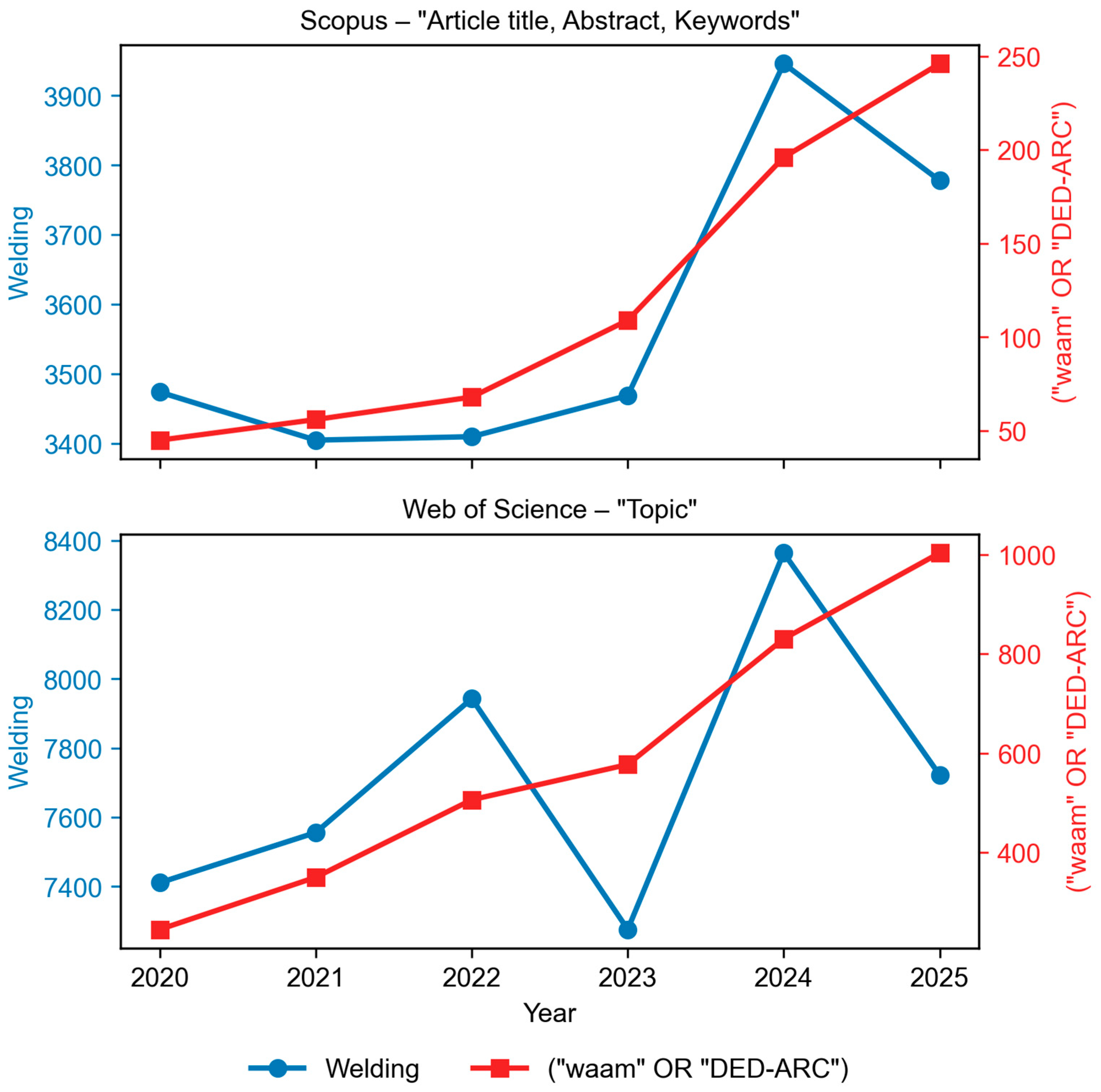
Metal Additive Manufacturing
2. Fundamentals of Topology Optimisation
2.1. Conceptual Foundations
2.2. Computational Approaches
2.3. Design Interpretation and Manufacturability
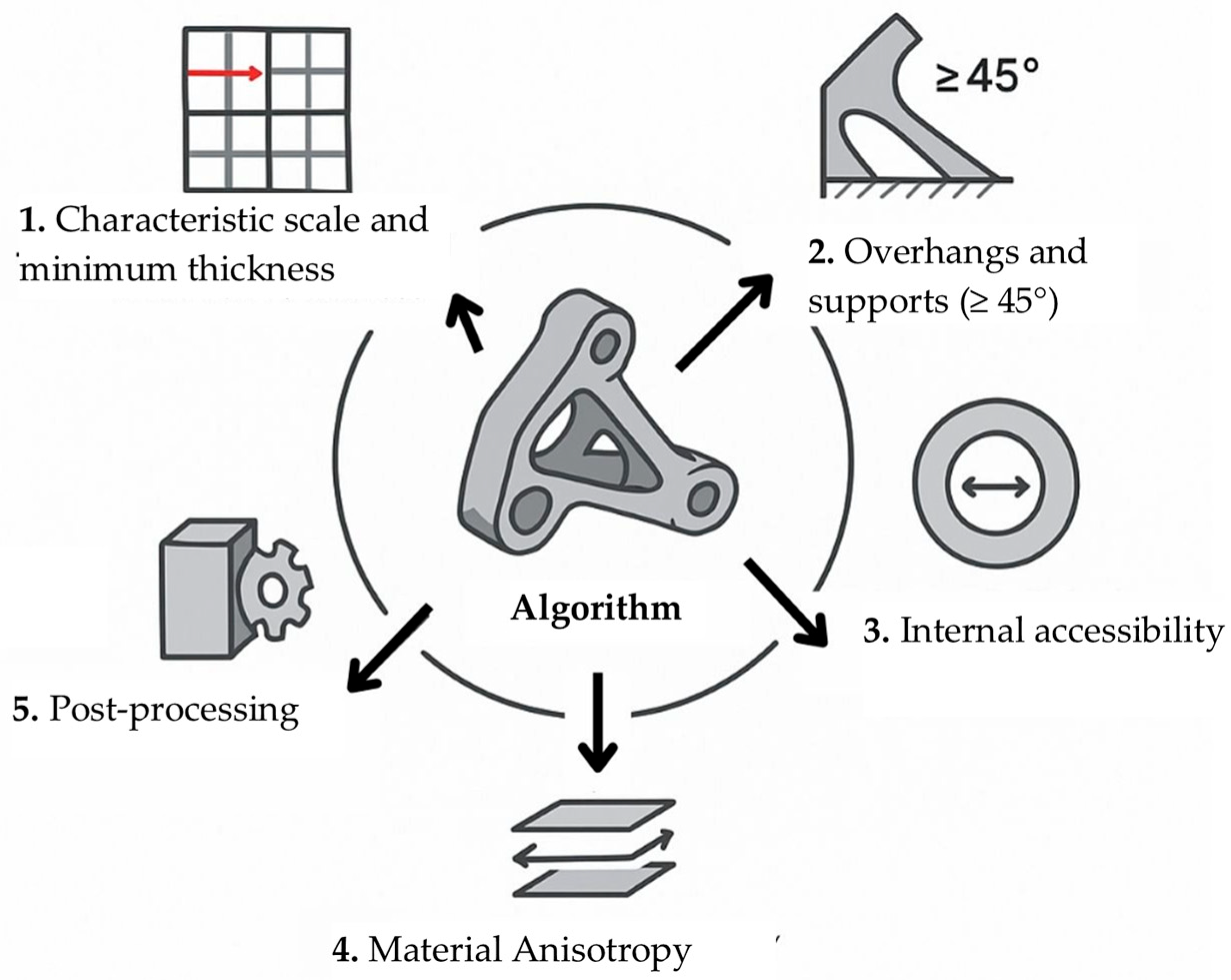
- Characteristic scale and minimum thickness. Ensure that minimum wall thickness, strut diameter, and feature radii exceed the process-specific printable limit. In welding-based AM/DED, this limit is largely governed by bead width/height, melt pool stability, and achievable dimensional control; thin members may also be prone to local overheating, distortion, or collapse during multi-pass deposition.
- Overhangs and supports. Identify surfaces with critical inclinations and redesign them to be self-supporting where possible. For powder bed processes, this is typically governed by overhang angles and support removal, whereas for WAAM/DED it is additionally constrained by bead wetting behaviour, gravity-driven sagging, and the need for continuous, stable deposition paths (often favouring gradual slopes and fillets rather than sharp unsupported overhangs).
- Internal accessibility. Guarantee access for powder evacuation (PBF) and, more generally, for inspection, finishing, and machining. In addition to avoiding trapped powder, internal channels or cavities should be designed to allow tool access for post-processing, as well as sensor/inspection access when qualification is required.
- Material anisotropy. Account for direction-dependent properties arising from layerwise deposition, thermal gradients, and solidification texture. This requires selecting build orientation and deposition trajectories consistent with principal load paths, and considering how thermal history and inter-layer bonding may influence strength and especially fatigue performance.
- Post-processing. Anticipate post-processing from the design stage by reserving machining allowances on datum and functional surfaces, defining support removal/finishing strategies, and planning heat treatments (e.g., stress relief) where needed. For welding-based AM, post-processing is often essential to achieve tolerances and to mitigate residual stresses and surface roughness.
2.4. Lattice Structures
- Kelvin and Octet, which are cubic in nature and have a closed structure, exhibiting mainly elastic behaviour and high compressive strength [44].
- Gyroid and other TPMS, based on minimally triply periodic surfaces, characterised by their continuity without intersections and their excellent ability to distribute stresses and facilitate thermal flow [45].
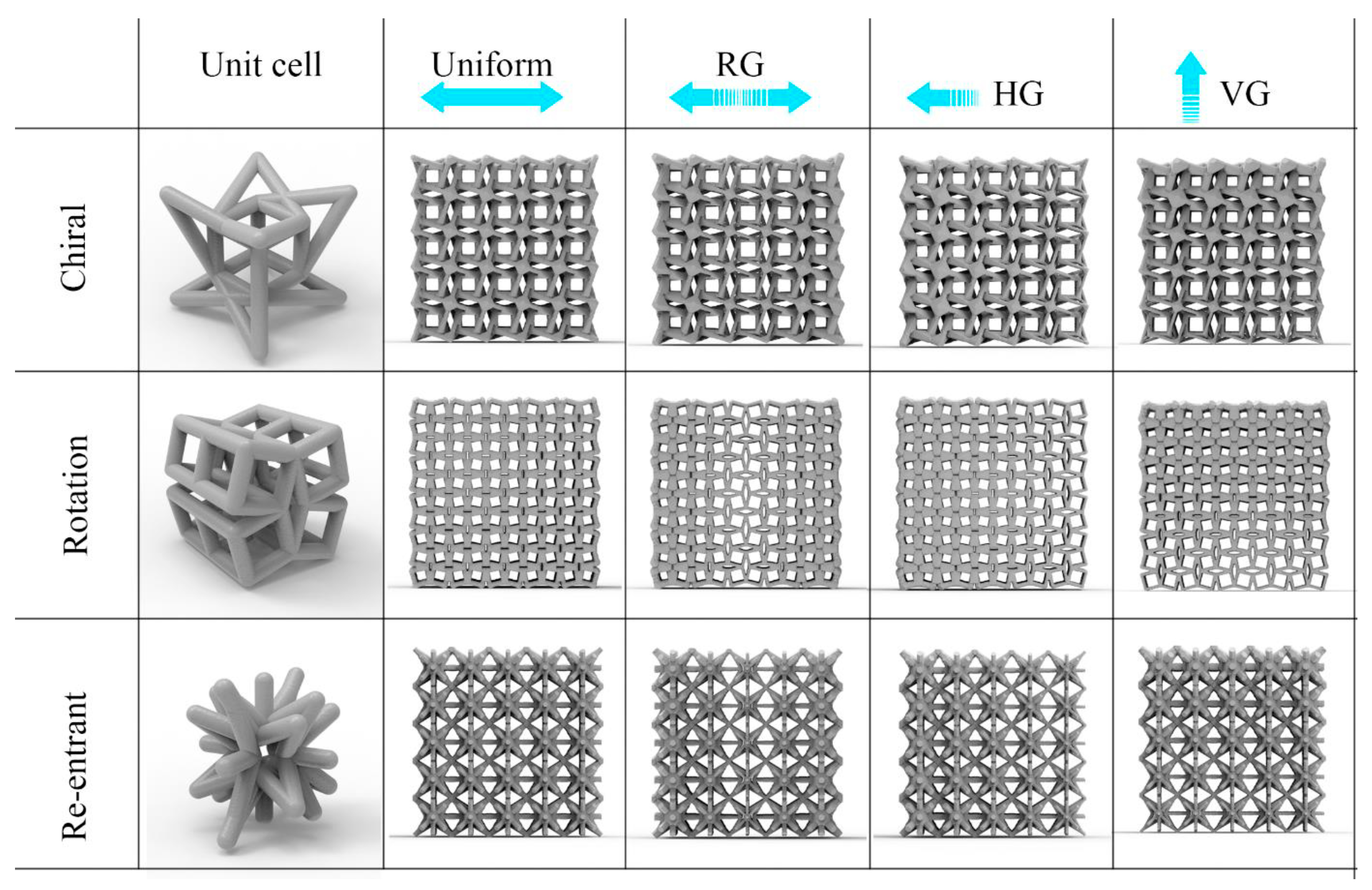
- Chiral and re-entrant, which exhibit auxetic behaviour with a negative Poisson’s ratio, giving them remarkable energy absorption and elastic recovery capabilities after impact [46].
2.5. Functionally Graded Lattices
- Uniform, with a constant density distribution;
- Radial Gradient (RG), with variation from the centre to the periphery;
- Horizontal Gradient (HG) and Vertical Gradient (VG), which modify the dimensions or thickness of the struts along a given axis.
2.6. DED-Specific Constraints for TO and Lattice/Graded Lattice Designs
3. Modelling and Simulation Tools
- Parametric CAD/CAE environments, such as SolidWorks, Autodesk Fusion 360, Topology, or Rhinoceros + Grasshopper, which allow lattices to be generated by controlling geometric parameters (cell size, angle, strut radius, density, etc.) using custom algorithms or scripts [56].
- Mechanical and thermal simulation using FEA, through software such as Abaqus, ANSYS, or COMSOL Multiphysics, aimed at predicting structural response under real loads, deformations, or heat flows [57].
- Topological and generative optimisation, integrating evolutionary or artificial intelligence algorithms that define the optimal distribution of material based on criteria of stiffness, weight, or energy dissipation, extending the principles of DfAM to the field of lattice design [40].
4. Integration into Additive Manufacturing Workflows
4.1. Principles of DfAM
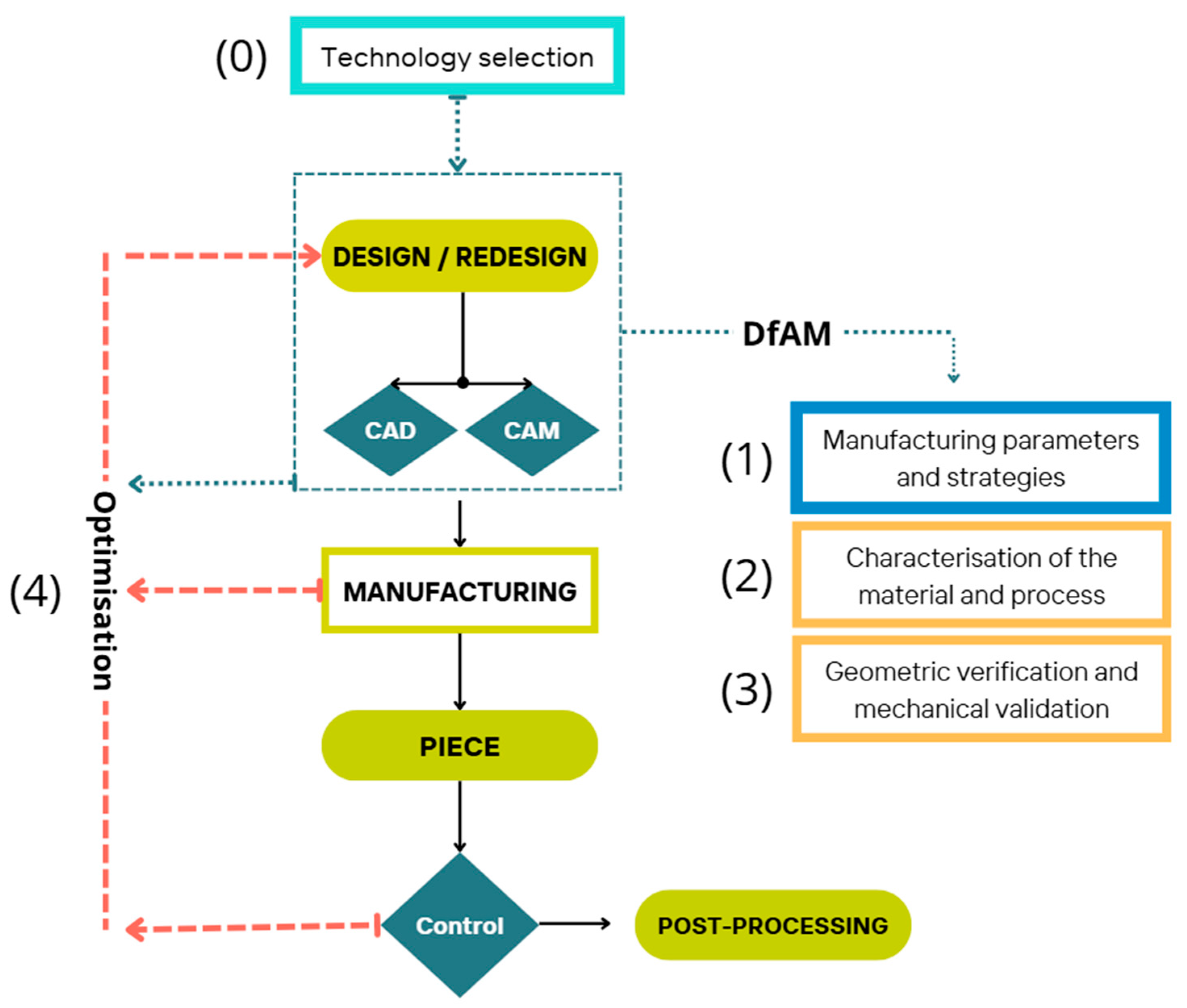
4.2. Workflow Integration
4.3. Technology Selection
4.4. Design/Redesign and Application of DfAM
4.5. Characterisation and Verification
4.6. Post-Processing and Validation
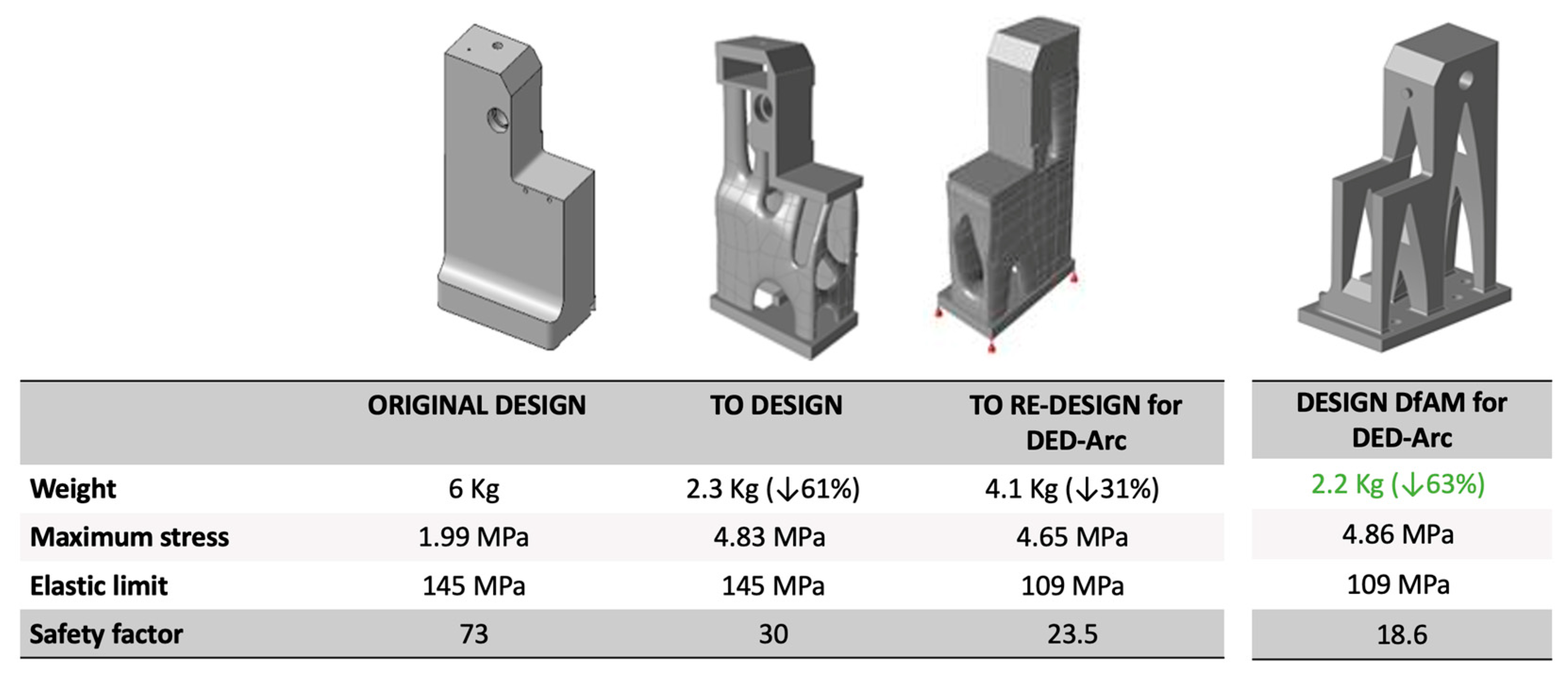
5. Application Case: Topology Optimisation and DfAM for DED-Arc
- Topology Optimisation (TO Design): initial mass reduction achieved by redistributing material according to principal stress paths, leading to a 61% weight reduction compared to the baseline model.
- Redesign for DED-Arc: geometric adjustment to ensure printability and thermal stability, including the adaptation of overhang angles and minimum bead thickness to the constraints of the DED process.
- DfAM Design for DED-Arc: final morphological reinterpretation incorporating self-supporting features, minimised support volume, and controlled thermal gradients, achieving a total mass reduction of 63% relative to the original design, while maintaining mechanical performance within safe limits validated through FEA simulation.
6. Conclusions
Author Contributions
Funding
Institutional Review Board Statement
Informed Consent Statement
Data Availability Statement
Conflicts of Interest
References
- Donald, C. Salvador Advancements in Welding Techniques: A Comprehensive Review. Int. J. Adv. Res. Sci. Commun. Technol. 2023, 3, 1013–1018. [Google Scholar] [CrossRef] [Scilit]
- Jin, J.; Geng, S.; Shu, L.; Jiang, P.; Shao, X.; Han, C.; Ren, L.; Li, Y.; Yang, L.; Wang, X. High-Strength and Crack-Free Welding of 2024 Aluminium Alloy via Zr-Core-Al-Shell Wire. Nat. Commun. 2024, 15, 1748. [Google Scholar] [CrossRef] [Scilit]
- Milčić, M.; Klobčar, D.; Milčić, D.; Zdravković, N.; Đurić, A.; Vuherer, T. Comparison between Mechanical Properties and Joint Performance of AA 2024-T351 Aluminum Alloy Welded by Friction Stir Welding, Metal Inert Gas and Tungsten Inert Gas Processes. Materials 2024, 17, 3336. [Google Scholar] [CrossRef] [Scilit]
- Treutler, K.; Wesling, V. The Current State of Research of Wire Arc Additive Manufacturing (WAAM): A Review. Appl. Sci. 2021, 11, 8619. [Google Scholar] [CrossRef] [Scilit]
- Ramos, A.; Angel, V.G.; Siqueiros, M.; Sahagun, T.; Gonzalez, L.; Ballesteros, R. Reviewing Additive Manufacturing Techniques: Material Trends and Weight Optimization Possibilities Through Innovative Printing Patterns. Materials 2025, 18, 1377. [Google Scholar] [CrossRef] [Scilit]
- Galán, J.; Felip Miralles, F. (Eds.) Ecodiseño y Nuevas Tecnologías: Avances, Propuestas e Innovaciones Para la Sostenibilida; Plural; Tirant Humanidades: Valencia, Spain, 2025; ISBN 978-84-1081-011-2. [Google Scholar]
- Bernal-Plaza, J.; De-Jesús-Méndez, C.; Vidal-Pérez, H.; Troncoso-Palacio, A. Transformando la Manufactura Global. Ventajas y Retos de la Impresión 3D Frente a Métodos Tradicionales. Bol. Innov. Logist. Oper. 2025, 7, 23–35. [Google Scholar] [CrossRef] [Scilit]
- Sachdeva, A.; Agrawal, R.; Chaudhary, C.; Siddhpuria, D.; Kashyap, D.; Timung, S. Sustainability of 3D printing in industry 4.0. In 3D Printing Technology for Water Treatment Applications; Elsevier: Amsterdam, The Netherlands, 2023; pp. 229–251. ISBN 978-0-323-99861-1. [Google Scholar]
- Dalpadulo, E.; Pollon, M.; Vergnano, A.; Leali, F. Design for Additive Manufacturing of Lattice Structures for Functional Integration of Thermal Management and Shock Absorption. JMMP 2025, 9, 24. [Google Scholar] [CrossRef] [Scilit]
- Gawande, K.R.; Sur, A.; Tondre, S.M.; Raja, N.N.; Kale, G.; Razoumny, Y. Advances and Challenges in Micro-Lattice Structures: Properties, Applications, and Future Directions. AIMS Mater. Sci. 2025, 12, 649–685. [Google Scholar] [CrossRef] [Scilit]
- Polo, S.; García-Domínguez, A.; Rubio, E.M.; Claver, J. Lattice Structures in Additive Manufacturing for Biomedical Applications: A Systematic Review. Polymers 2025, 17, 2285. [Google Scholar] [CrossRef] [Scilit]
- Yang, J.; Liu, H.; Cai, G.; Jin, H. Additive Manufacturing and Influencing Factors of Lattice Structures: A Review. Materials 2025, 18, 1397. [Google Scholar] [CrossRef] [Scilit]
- Yan, J.; Sui, Q.; Fan, Z.; Duan, Z. Multi-Material and Multiscale Topology Design Optimization of Thermoelastic Lattice Structures. Comput. Model. Eng. Sci. 2022, 130, 967–986. [Google Scholar] [CrossRef] [Scilit]
- Celik, H.K.; Elham, A.; Erbil, M.A.; Rennie, A.E.W.; Akinci, I. A Decade of Design for Additive Manufacturing Research: A Bibliometric Analysis (2014–2024). Rapid Prototyp. J. 2025, 31, 1735–1755. [Google Scholar] [CrossRef] [Scilit]
- Agrawal, K.; Bhat, A.R. Advances in 3D Printing with Eco-Friendly Materials: A Sustainable Approach to Manufacturing. RSC Sustain. 2025, 3, 2582–2604. [Google Scholar] [CrossRef] [Scilit]
- Aljabali, B.A.; Parupelli, S.K.; Desai, S. Generalized Design for Additive Manufacturing (DfAM) Expert System Using Compliance and Design Rules. Machines 2025, 13, 29. [Google Scholar] [CrossRef] [Scilit]
- Peron, M.; Saporiti, N.; Shoeibi, M.; Holmström, J.; Salmi, M. Additive Manufacturing in the Medical Sector: From an Empirical Investigation of Challenges and Opportunities Toward the Design of an Ecosystem Model. Int. J. Oper. Prod. Manag. 2025, 45, 387–415. [Google Scholar] [CrossRef] [Scilit]
- Gebre, N.M.; Gallo, P.; Rossi, S. Design for Sustainability by Additive Manufacturing: A Study of PLA-Based Door Handle Redesign. Sustainability 2025, 17, 4969. [Google Scholar] [CrossRef] [Scilit]
- Marefat, F.; De Pauw, J.; Kapil, A.; Chernovol, N.; Van Rymenant, P.; Sharma, A. Design Strategies for Bi-Metallic Additive Manufacturing in the Context of Wire and Arc Directed Energy Deposition. Mater. Des. 2022, 215, 110496. [Google Scholar] [CrossRef] [Scilit]
- Wu, F.; Flint, T.; Kindermann, R.M.; Roy, M.J.; Yang, L.; Robertson, S.; Zhou, Z.; Smith, M.; Shanthraj, P.; English, P.; et al. Evolution and Formation of Dissimilar Metal Interfaces in Fusion Welding. Acta Mater. 2023, 258, 119232. [Google Scholar] [CrossRef] [Scilit]
- Liu, L.; Zhuang, Z.; Liu, F.; Zhu, M. Additive Manufacturing of Steel–Bronze Bimetal by Shaped Metal Deposition: Interface Characteristics and Tensile Properties. Int. J. Adv. Manuf. Technol. 2013, 69, 2131–2137. [Google Scholar] [CrossRef] [Scilit]
- Ye, Z.; Xu, P.; Du, H.; Shi, Y.; Zhuo, L. Application of Finite Element Analysis in Laser Additive Manufacturing: A Review. J. Laser Appl. 2025, 37, 021204. [Google Scholar] [CrossRef] [Scilit]
- Riffel, K.C.; Bawa, R.; Chan, J.; Adhami, R.; Gofman, D.; Ramirez, A.J. Artificial Intelligence and Statistical Mapping Applied to Additive Manufacturing Toolpath Optimization in Wire-Arc DED. Integr. Mater. Manuf. Innov. 2025, 14, 425–441. [Google Scholar] [CrossRef] [Scilit]
- Shen, W.; Zhang, P.; Li, W.; Qin, H. Additive Manufacturing for Functional Design: A Review of Capabilities, Strategies and Applications. Rapid Prototyp. J. 2025, 1–27. [Google Scholar] [CrossRef] [Scilit]
- Rozvany, G.I.N. Aims, Scope, Methods, History and Unified Terminology of Computer-Aided Topology Optimization in Structural Mechanics. Struct. Multidisc. Optim. 2001, 21, 90–108. [Google Scholar] [CrossRef] [Scilit]
- Baqershahi, M.H.; Ayas, C.; Ghafoori, E. Topology Optimisation for Large-Scale Wire-Arc Directed Energy Deposition Considering Environmental Impact and Cost. Autom. Constr. 2025, 177, 106313. [Google Scholar] [CrossRef] [Scilit]
- Laghi, V.; Savino, E.; Gasparini, G. Reduction of the Environmental Impact of Complex-Shaped Steel Joints Through Topology Optimization and Large-Scale Metal 3D Printing. Results Eng. 2025, 27, 105610. [Google Scholar] [CrossRef] [Scilit]
- Sell, S.; Villani, K.; Stautner, M. Reducing Delivery Times by Utilising On-Site Wire Arc Additive Manufacturing with Digital-Twin Methods. Computers 2025, 14, 221. [Google Scholar] [CrossRef] [Scilit]
- Frangedaki, E.; Sardone, L.; Marano, G.C.; Lagaros, N.D. Optimisation-Driven Design in the Architectural, Engineering and Construction Industry. Proc. Inst. Civ. Eng.—Struct. Build. 2023, 176, 998–1009. [Google Scholar] [CrossRef] [Scilit]
- Mitropoulou, C.C.; Fourkiotis, Y.; Lagaros, N.D.; Karlaftis, M.G. Evolution Strategies-Based Metaheuristics in Structural Design Optimization. In Metaheuristic Applications in Structures and Infrastructures; Elsevier: Amsterdam, The Netherlands, 2013; pp. 79–102. ISBN 978-0-12-398364-0. [Google Scholar]
- Kandemir, V.; Dogan, O.; Yaman, U. Topology Optimization of 2.5D Parts Using the SIMP Method with a Variable Thickness Approach. Procedia Manuf. 2018, 17, 29–36. [Google Scholar] [CrossRef] [Scilit]
- Chen, L.; Zhang, H.; Wang, W.; Zhang, Q. Topology Optimization Based on SA-BESO. Appl. Sci. 2023, 13, 4566. [Google Scholar] [CrossRef] [Scilit]
- Zhao, F. A Nodal Variable ESO (BESO) Method for Structural Topology Optimization. Finite Elem. Anal. Des. 2014, 86, 34–40. [Google Scholar] [CrossRef] [Scilit]
- Wang, M.Y.; Wang, X.; Guo, D. A Level set Method for Structural Topology Optimization. Comput. Methods Appl. Mech. Eng. 2003, 192, 227–246. [Google Scholar] [CrossRef] [Scilit]
- Hu, X.; Li, Z.; Bao, R.; Chen, W.; Wang, H. An Adaptive Method of Moving Asymptotes for Topology Optimization Based on the Trust Region. Comput. Methods Appl. Mech. Eng. 2022, 393, 114202. [Google Scholar] [CrossRef] [Scilit]
- Cao, L.; Dolovich, A.T.; Chen, A.; Zhang, C.W. Topology Optimization of Efficient and Strong Hybrid Compliant Mechanisms Using a Mixed Mesh of Beams and Flexure Hinges with Strength Control. Mech. Mach. Theory 2018, 121, 213–227. [Google Scholar] [CrossRef] [Scilit]
- Patel, N.M.; Tillotson, D.; Renaud, J.E.; Tovar, A.; Izui, K. Comparative Study of Topology Optimization Techniques. AIAA J. 2008, 46, 1963–1975. [Google Scholar] [CrossRef] [Scilit]
- Garcia-Lopez, N.P.; Sanchez-Silva, M.; Medaglia, A.L.; Chateauneuf, A. A Hybrid Topology Optimization Methodology Combining Simulated Annealing and SIMP. Comput. Struct. 2011, 89, 1512–1522. [Google Scholar] [CrossRef] [Scilit]
- Reddy K., S.N.; Maranan, V.; Simpson, T.W.; Palmer, T.; Dickman, C.J. Application of Topology Optimization and Design for Additive Manufacturing Guidelines on an Automotive Component. In Proceedings of the Volume 2A: 42nd Design Automation Conference, Charlotte, NC, USA, 21–24 August 2016; p. V02AT03A030. [Google Scholar]
- Uralde, V.; Veiga, F.; Suarez, A.; Lopez, A.; Goenaga, I.; Ballesteros, T. Novel Sensorized Additive Manufacturing-Based Enlighted Tooling Concepts for Aeronautical Parts. Sci. Rep. 2024, 14, 17692. [Google Scholar] [CrossRef] [Scilit]
- Fraternali, F.; Daraio, C.; Rimoli, J. Editorial: Multiscale Lattices and Composite Materials: Optimal Design, Modeling and Characterization. Front. Mater. 2019, 6, 199. [Google Scholar] [CrossRef] [Scilit]
- Imediegwu, C.; Murphy, R.; Hewson, R.; Santer, M. Multiscale Structural Optimization Towards Three-Dimensional Printable Structures. Struct. Multidisc. Optim. 2019, 60, 513–525. [Google Scholar] [CrossRef] [Scilit]
- Viet, N.V.; Karathanasopoulos, N.; Zaki, W. Mechanical Attributes and Wave Propagation Characteristics of TPMS Lattice Structures. Mech. Mater. 2022, 172, 104363. [Google Scholar] [CrossRef] [Scilit]
- Zheng, G.; Zhang, L.; Wang, E.; Yao, R.; Luo, Q.; Li, Q.; Sun, G. Investigation into Multiaxial Mechanical Behaviors of Kelvin and Octet-B Polymeric Closed-Cell Foams. Thin-Walled Struct. 2022, 177, 109405. [Google Scholar] [CrossRef] [Scilit]
- Tang, W.; Zou, C.; Zhou, H.; Zhang, L.; Zeng, Y.; Sun, L.; Zhao, Y.; Yan, M.; Fu, J.; Hu, J.; et al. A Novel Convective Heat Transfer Enhancement Method Based on Precise Control of Gyroid-Type TPMS Lattice Structure. Appl. Therm. Eng. 2023, 230, 120797. [Google Scholar] [CrossRef] [Scilit]
- Zahra, T. Behaviour of 3D Printed Re-Entrant Chiral Auxetic (RCA) Geometries Under In-Plane and Out-Of-Plane Loadings. Smart Mater. Struct. 2021, 30, 115011. [Google Scholar] [CrossRef] [Scilit]
- Veloso, F.; Gomes-Fonseca, J.; Morais, P.; Correia-Pinto, J.; Pinho, A.C.M.; Vilaça, J.L. Overview of Methods and Software for the Design of Functionally Graded Lattice Structures. Adv. Eng. Mater. 2022, 24, 2200483. [Google Scholar] [CrossRef] [Scilit]
- Top, N.; Şahin, İ.; Gökçe, H. The Mechanical Properties of Functionally Graded Lattice Structures Derived Using Computer-Aided Design for Additive Manufacturing. Appl. Sci. 2023, 13, 11667. [Google Scholar] [CrossRef] [Scilit]
- Schneider, J.; Ebert, M.; Tipireddy, R.; Krishnamurthy, V.R.; Akleman, E.; Kumar, S. Concurrent Geometrico-Topological Tuning of Nanoengineered Auxetic Lattices Fabricated by Material Extrusion for Enhancing Multifunctionality: Multiscale Experiments, Finite Element Modeling and Data-Driven Prediction. Addit. Manuf. 2024, 88, 104213. [Google Scholar] [CrossRef] [Scilit]
- Zhumabekova, A.; Perveen, A.; Talamona, D. Effect of the Lattice Structures on Mechanical Characterisation of Additively Manufactured Ti-6Al-4V for Biomedical Application. Adv. Mater. Process. Technol. 2025, 11, 1285–1302. [Google Scholar] [CrossRef] [Scilit]
- Rodrigues, T.A.; Duarte, V.; Miranda, R.M.; Santos, T.G.; Oliveira, J.P. Current Status and Perspectives on Wire and Arc Additive Manufacturing (WAAM). Materials 2019, 12, 1121. [Google Scholar] [CrossRef] [Scilit]
- Ding, J.; Colegrove, P.; Mehnen, J.; Ganguly, S.; Sequeira Almeida, P.M.; Wang, F.; Williams, S. Thermo-Mechanical Analysis of Wire and Arc Additive Layer Manufacturing Process on Large Multi-Layer Parts. Comput. Mater. Sci. 2011, 50, 3315–3322. [Google Scholar] [CrossRef] [Scilit]
- Huang, H.; Ma, N.; Chen, J.; Feng, Z.; Murakawa, H. Toward Large-Scale Simulation of Residual Stress and Distortion in Wire and Arc Additive Manufacturing. Addit. Manuf. 2020, 34, 101248. [Google Scholar] [CrossRef] [Scilit]
- Yu, Z.; Pan, Z.; Ding, D.; Rong, Z.; Li, H.; Wu, B. Strut Formation Control and Processing Time Optimization for Wire Arc Additive Manufacturing of Lattice Structures. J. Manuf. Process. 2022, 79, 962–974. [Google Scholar] [CrossRef] [Scilit]
- Costello, S.C.A.; Cunningham, C.R.; Xu, F.; Shokrani, A.; Dhokia, V.; Newman, S.T. The State-of-the-Art of Wire Arc Directed Energy Deposition (WA-DED) as an Additive Manufacturing Process for Large Metallic Component Manufacture. Int. J. Comput. Integr. Manuf. 2023, 36, 469–510. [Google Scholar] [CrossRef] [Scilit]
- Banga, H.K.; Kumar, R.; Channi, H.K.; Kaur, S. Parametric Design and Stress Analysis of 3D Printed Prosthetic Finger. In Innovative Processes and Materials in Additive Manufacturing; Elsevier: Amsterdam, The Netherlands, 2023; pp. 57–80. ISBN 978-0-323-86011-6. [Google Scholar]
- Oladipo, B.; Matos, H.; Krishnan, N.M.A.; Das, S. Integrating Experiments, Finite Element Analysis, and Interpretable Machine Learning to Evaluate the Auxetic Response of 3D Printed Re-Entrant Metamaterials. J. Mater. Res. Technol. 2023, 25, 1612–1625. [Google Scholar] [CrossRef] [Scilit]
- Dinovitzer, M.; Chen, X.; Laliberte, J.; Huang, X.; Frei, H. Effect of Wire and Arc Additive Manufacturing (WAAM) Process Parameters on Bead Geometry and Microstructure. Addit. Manuf. 2019, 26, 138–146. [Google Scholar] [CrossRef] [Scilit]
- Veiga, F.; Arizmendi, M.; Suarez, A.; Bilbao, J.; Uralde, V. Different Path Strategies for Directed Energy Deposition of Crossing Intersections from Stainless Steel SS316L-Si. J. Manuf. Process. 2022, 84, 953–964. [Google Scholar] [CrossRef] [Scilit]
- Liu, Y.; Xie, D.; Liu, Y.; Tian, Z.; Shangguan, S.; Liao, J.; Hua, Z. The Influence of PBF-LB/M Part Forming Angle and Support Structure Parameters on the Distortion of Oral Stent. Materials 2025, 18, 4588. [Google Scholar] [CrossRef] [Scilit]
- Müller, J.; Hensel, J. WAAM of Structural Components—Building Strategies for Varying Wall Thicknesses. Weld World 2023, 67, 833–844. [Google Scholar] [CrossRef] [Scilit]
- Park, K.-M.; Min, K.-S.; Roh, Y.-S. Design Optimization of Lattice Structures under Compression: Study of Unit Cell Types and Cell Arrangements. Materials 2021, 15, 97. [Google Scholar] [CrossRef] [Scilit]
- Uralde, V.; Veiga, F.; Suarez, A.; Aldalur, E.; Ballesteros, T. Symmetry Analysis in Wire Arc Direct Energy Deposition for Overlapping and Oscillatory Strategies in Mild Steel. Symmetry 2023, 15, 1231. [Google Scholar] [CrossRef] [Scilit]
- Uralde, V.; Veiga, F.; Suárez, A.; Ballesteros, T. Method for Selecting the Optimal Technology in Metal Additive Manufacturing Using an Analytical Hierarchical Process 2024; Mendeley Data: Amsterdam, The Netherlands, 2024. [Google Scholar] [CrossRef]
- Dimopoulos, A.; Chryssinas, G.; Mavroforaki, D.; Gan, T.-H.; Chatzakos, P. An Interactive Web-Based Platform for Support Generation and Optimisation for Metal Laser Powder Bed Fusion. Materials 2024, 17, 1639. [Google Scholar] [CrossRef] [Scilit]
- Zhao, X.F.; Panzer, H.; Zapata, A.; Riegger, F.; Baehr, S.; Zaeh, M.F. Deposition Sequence Optimization for Minimizing Substrate Plate Distortion Using the Simplified WAAM Simulation. J. Manuf. Syst. 2025, 81, 103–116. [Google Scholar] [CrossRef] [Scilit]
- Sommer, K.; Sammler, F.; Heiler, R.; Pfennig, A. Investigation of Distribution of Mechanical Properties inside of Wire Arc Additive Manufacturing Parts. Defect Diffus. Forum 2025, 443, 65–70. [Google Scholar] [CrossRef] [Scilit]
- Ejeh, C.J.; Barsoum, I.; Abou-Ali, A.M.; Abu Al-Rub, R.K. Combining Multiple Lattice-Topology Functional Grading Strategies for Enhancing the Dynamic Compressive Behavior of TPMS-Based Metamaterials. J. Mater. Res. Technol. 2023, 27, 6076–6093. [Google Scholar] [CrossRef] [Scilit]
- Wilson, T.T.; Mativenga, P.T.; Marnewick, A.L. Sustainability of 3D Printing in Infrastructure Development. Procedia CIRP 2023, 120, 195–200. [Google Scholar] [CrossRef] [Scilit]
- Uralde, V.; Suárez, A.; Veiga, F.; Villanueva, P.; Ballesteros, T. Advancements and Methodologies in Directed Energy Deposition (DED-Arc) Manufacturing: Design Strategies, Material Hybridization, Process Optimization and Artificial Intelligence. In Additive Manufacturing—Present and Sustainable Future, Materials and Applications; IntechOpen: London, UK, 2024. [Google Scholar]
- Arana, M.; Ukar, E.; Rodriguez, I.; Iturrioz, A.; Alvarez, P. Strategies to Reduce Porosity in Al-Mg WAAM Parts and Their Impact on Mechanical Properties. Metals 2021, 11, 524. [Google Scholar] [CrossRef] [Scilit]
- Cambon, C.; Bendaoud, I.; Rouquette, S.; Soulié, F. A WAAM Benchmark: From Process Parameters to Thermal Effects on Weld Pool Shape, Microstructure and Residual Stresses. Mater. Today Commun. 2022, 33, 104235. [Google Scholar] [CrossRef] [Scilit]
- Spreafico, C.; Kokare, S.; Godina, R. Prospective Life Cycle Assessment of Future Wire Arc Additive Manufacturing Deposition Process for Large-Scale Steel Parts. Environ. Impact Assess. Rev. 2026, 116, 108111. [Google Scholar] [CrossRef] [Scilit]
- Segovia-Guerrero, L.; Baladés, N.; Gallardo-Galán, J.J.; Gil-Mena, A.J.; Sales, D.L. Additive vs. Subtractive Manufacturing: A Comparative Life Cycle and Cost Analyses of Steel Mill Spare Parts. J. Manuf. Mater. Process. 2025, 9, 138. [Google Scholar] [CrossRef] [Scilit]
- Fernández-Zabalza, A.; Rodríguez-Díaz, Á.; Veiga, F.; Suárez, A.; Uralde, V.; Ballesteros, T.; Alfaro, J.R. AI-Driven Predictive Modeling of Homogeneous Bead Geometry for WAAM Processes. Int. J. Adv. Manuf. Technol. 2025, 1–12. [Google Scholar] [CrossRef] [Scilit]
- Zhu, Z.; Ng, D.W.H.; Park, H.S.; McAlpine, M.C. 3D-Printed Multifunctional Materials Enabled by Artificial-Intelligence-Assisted Fabrication Technologies. Nat. Rev. Mater. 2020, 6, 27–47. [Google Scholar] [CrossRef] [Scilit]




| Method | Characteristic |
|---|---|
| SIMP (Solid Isotropic Material with Penalisation) | Interpolates the stiffness of each element as , penalising intermediate solutions. Uses filters and projections to control the size of structural elements [31]. |
| ESO/BESO (Evolutionary Structural Optimisation) | Removes or reincorporates material based on deformation energy. Generates sharp boundaries, but is highly dependent on removal parameters [32,33]. |
| Level-Set | Represents the boundary using an implicit function . Allows precise geometric control and smooth curvatures, although it requires additional techniques to create or remove holes [34]. |
| MMA (Method of Moving Asymptotes) | A robust optimisation method for multiple non-linear constraints, widely used in combination with SIMP [35] |
| Technology | Process Principle | Key Design Constraints (DfAM) | Design Opportunities (DfAM) | Typical Impact on Design and Validation |
|---|---|---|---|---|
| PBF (LPBF/EB-PBF) | Selective melting of powder layers with a laser/e-beam. | Min. wall/strut thickness; overhang limits and supports; residual stress/warpage; build size constraints; powder removal for internal channels/lattices. | Very high geometric complexity; fine lattices/TPMS; internal channels; high-resolution TO outcomes. | High dimensional accuracy but support removal and post-processing often required; properties can be anisotropic; fatigue sensitive to surface/defects → finishing and inspection critical. |
| DED (Laser-DED/WAAM/EB-DED) | Directed energy creates a melt pool while powder/wire is fed; material is deposited track-by-track. | Lower geometric resolution (bead/track size sets min. features); surface roughness; path planning/access constraints; heat accumulation and multi-pass thermal cycling → residual stress/distortion; tight tolerances require machining allowances. | Large parts and high deposition rates; local reinforcement; repairs and remanufacturing; multi-material/graded transitions; hybrid AM–machining routes. | Near-net-shape builds with significant post-machining; thermo–mechanical history strongly affects microstructure/properties → monitoring + process control important for repeatability and qualification. |
| Binder Jetting | Binder selectively printed into powder bed; followed by curing and sintering/infiltration. | Shrinkage/distortion during sintering; green strength limits; final density/mechanical properties depend on sintering/infiltration; tolerances driven by post-processing. | No supports; high throughput; complex geometries; potential multi-material (by powder/binder strategy) and low-cost prototyping. | Dimensional change must be compensated in design; mechanical performance depends on densification route; parts often require infiltration/heat treatment and final machining for precision. |
Disclaimer/Publisher’s Note: The statements, opinions and data contained in all publications are solely those of the individual author(s) and contributor(s) and not of MDPI and/or the editor(s). MDPI and/or the editor(s) disclaim responsibility for any injury to people or property resulting from any ideas, methods, instructions or products referred to in the content. |
© 2025 by the authors. Licensee MDPI, Basel, Switzerland. This article is an open access article distributed under the terms and conditions of the Creative Commons Attribution (CC BY) license.
Share and Cite
Cervera, A.; Uralde, V.; Sustacha, J.M.; Veiga, F. Design Strategies for Welding-Based Additive Manufacturing: A Review of Topology and Lattice Optimisation Approaches. Appl. Sci. 2026, 16, 417. https://doi.org/10.3390/app16010417
Cervera A, Uralde V, Sustacha JM, Veiga F. Design Strategies for Welding-Based Additive Manufacturing: A Review of Topology and Lattice Optimisation Approaches. Applied Sciences. 2026; 16(1):417. https://doi.org/10.3390/app16010417
Chicago/Turabian StyleCervera, Ainara, Virginia Uralde, Juan Manuel Sustacha, and Fernando Veiga. 2026. "Design Strategies for Welding-Based Additive Manufacturing: A Review of Topology and Lattice Optimisation Approaches" Applied Sciences 16, no. 1: 417. https://doi.org/10.3390/app16010417
APA StyleCervera, A., Uralde, V., Sustacha, J. M., & Veiga, F. (2026). Design Strategies for Welding-Based Additive Manufacturing: A Review of Topology and Lattice Optimisation Approaches. Applied Sciences, 16(1), 417. https://doi.org/10.3390/app16010417