Article

Polarization Effect in Contactless X-Band Detection of Bars in Reinforced Concrete Structures

by
Adriana Brancaccio
* and
Simone Palladino
Engineering Department, University of Campania “L. Vanvitelli”, Via Roma, 29, 81031 Aversa, Italy
*
Author to whom correspondence should be addressed.
Appl. Sci. 2026, 16(1), 412; https://doi.org/10.3390/app16010412
Submission received: 20 November 2025 / Revised: 9 December 2025 / Accepted: 29 December 2025 / Published: 30 December 2025

Abstract

This study investigates the influence of electromagnetic field polarization in the non-destructive testing of reinforced concrete structures through both theoretical analysis and experimental validation. Theoretical models predict that the orientation of reinforcement bars relative to the incident electric field significantly affects the scattered signal, influencing their detectability. Laboratory experiments on realistic reinforced concrete specimens presenting both vertical bars and horizontal brackets confirm these predictions, demonstrating that polarization can be exploited to enhance measurement accuracy. These findings provide useful insights into the development of microwave-based diagnostic techniques for structural assessment.

1. Introduction

Reinforced concrete is a fundamental component of modern construction, serving as the structural backbone for residential, commercial, and industrial buildings. Ensuring the integrity and longevity of these structures is paramount, necessitating the development and implementation of effective monitoring techniques. Among these, Non-Destructive Testing (NDT) methods have gained widespread recognition for their ability to assess material conditions without causing structural damage. Comprehensive studies, such as those presented by Maldague [1] and Hellier [2], provide extensive theoretical and practical frameworks for various NDT methodologies, including thermal and ultrasonic techniques, which are widely applied in structural health monitoring. A particularly noteworthy application of non-destructive techniques is the use of optical fiber sensors for distributed monitoring of structural components. This approach is especially advantageous in cases where monitoring is hindered by the dimensions of the structure or the inaccessibility of critical areas. In this context, Di Gennaro et al. [3] used a composite optical fiber sensor for in situ testing in an ancient masonry structure, demonstrating its efficacy in heritage conservation. Recent developments in dual-polarization and microwave-based sensing have further expanded the range of diagnostic tools available for reinforced concrete assessment. In particular, Liu et al. [4] demonstrated how polarimetric Ground Penetrating Radar (GPR) can enhance the detection of early-stage corrosion in steel reinforcement, while Dinh et al. [5] showed that dual-polarization measurements enable high-resolution 3D imaging of embedded features in concrete structures. At higher frequencies, Franceschelli et al. [6] confirmed the feasibility of non-contact microwave techniques, extending into the X-band, for monitoring concrete compressive strength, highlighting the trade-off between reduced penetration and improved sensitivity to small-scale features. Together, these approaches underline the growing role of advanced electromagnetic sensing in preventive maintenance and long-term structural health monitoring, complementing both traditional NDT methods and computational modeling strategies. In parallel to empirical NDT methods, computational modeling has been extensively developed to predict possible structural failures, including crack propagation, damage evolution, and material degradation [7,8,9,10]. Belytschko and Black [11] introduced the Extended Finite Element Method, which enables accurate numerical representation of cracks without requiring predefined crack paths. In addition, Kaveh and Farahmand [12] presented advances in structural optimization algorithms, demonstrating their effectiveness in assessing the progression of damage in reinforced concrete systems. Numerical techniques such as Finite Element Analysis and inverse problem-solving approaches facilitate the identification of critical failure mechanisms without necessitating invasive procedures. Zona and Minutolo [13] demonstrated the capability of numerical methods to capture complex collapse mechanisms using a dislocation-based approach. These computational techniques play a crucial role in preventive maintenance and long-term structural health monitoring, allowing engineers to optimize both design and rehabilitation strategies. Among various NDT techniques, GPR has emerged as a particularly effective tool for subsurface analysis, offering the ability to detect voids, reinforcement bars, and defects within concrete structures. Daniels [14] provides a fundamental understanding of GPR technology, detailing the physics governing electromagnetic wave propagation in dielectric materials. Roudsari et al. [15] demonstrated how robotic and handheld GPR systems provide consistent visualization of reinforced concrete beams, where variations in the reflected frequency amplitude within the robotic GPR graph allow the prediction of defect locations. McCann and Forde [16] reviewed emerging trends in NDT methods, including advancements in contactless GPR technologies, which enhance detection precision and efficiency. Furthermore, advances in inverse scattering techniques have also contributed significantly to structural assessment. Masoodi and Taromideh [17] addressed an inverse scattering problem within a multi-monostatic, multi-frequency configuration in the near zone, offering improved imaging and defect detection capabilities. Additionally, Luomei et al. [18] proposed a geometric approach for determining stationary phase points in radar imaging, effectively eliminating extraneous roots and enhancing imaging accuracy. Bellomo et al. [19] incorporated reconstructed antenna patterns into inversion algorithms by employing a multipolar expansion of both the incident field and the Green’s function equation at the transmission and reception stages. A quasi-quadratic inverse scattering model, initially introduced by Brancaccio [20] and later validated using simulated data [21], demonstrated its potential under controlled conditions. Several techniques exploiting the incident and scattered field polarization have been proposed in the literature. Among the others, see [22,23], where the simultaneous collection of HH and VV polarized data are exploited in order to recover the reinforcing bars’ diameter and the concrete cover depth. Both papers consider a typical GPR in-contact configuration at frequencies below 2 GHz.
In this study, we analyze the polarization effect in the case of contactless measurements in the X-band with the aim of demonstrating that even in this challenging setup the measurements are sensitive to the presence and orientation of the reinforcing bars. The difficulty caused by measurements taken at some stand-off distance from the structure under investigation is that part of the impinging electromagnetic wave is reflected at the boundary between air and concrete. This has two negative effects: first, part of the field radiated by the antenna does not reach the inner part of the structure, which ultimately carries on information about the presence/location/size of the bars; second, the reflected field at the interface could mask the scattered field, so impairing the dynamic. In addition, high frequencies above few GHz are rarely used in GPR applications because it is commonly believed that they do not propagate inside lossy dielectrics, such as the concrete. However, we already shown in [21] that such frequencies are suitable for the application at hand. The advantage of increasing the frequency is the improved attainable resolution.
This paper is organized as follows: in Section 2.1 the theory of the scattering from a conducting cylinder is recalled, and suitable expressions for the scattered power are derived; Section 2.2 is devoted to the numerical analysis under the two polarizations for typical values of the involved parameters; in Section 2.3 the experimental setup and the laboratory samples designed to closely replicate real-world reinforced concrete pillars are described; results and discussion are reported in Section 3; Conclusions in Section 4 and Appendix A follow.

2. Materials and Methods

2.1. Theoretical Framework

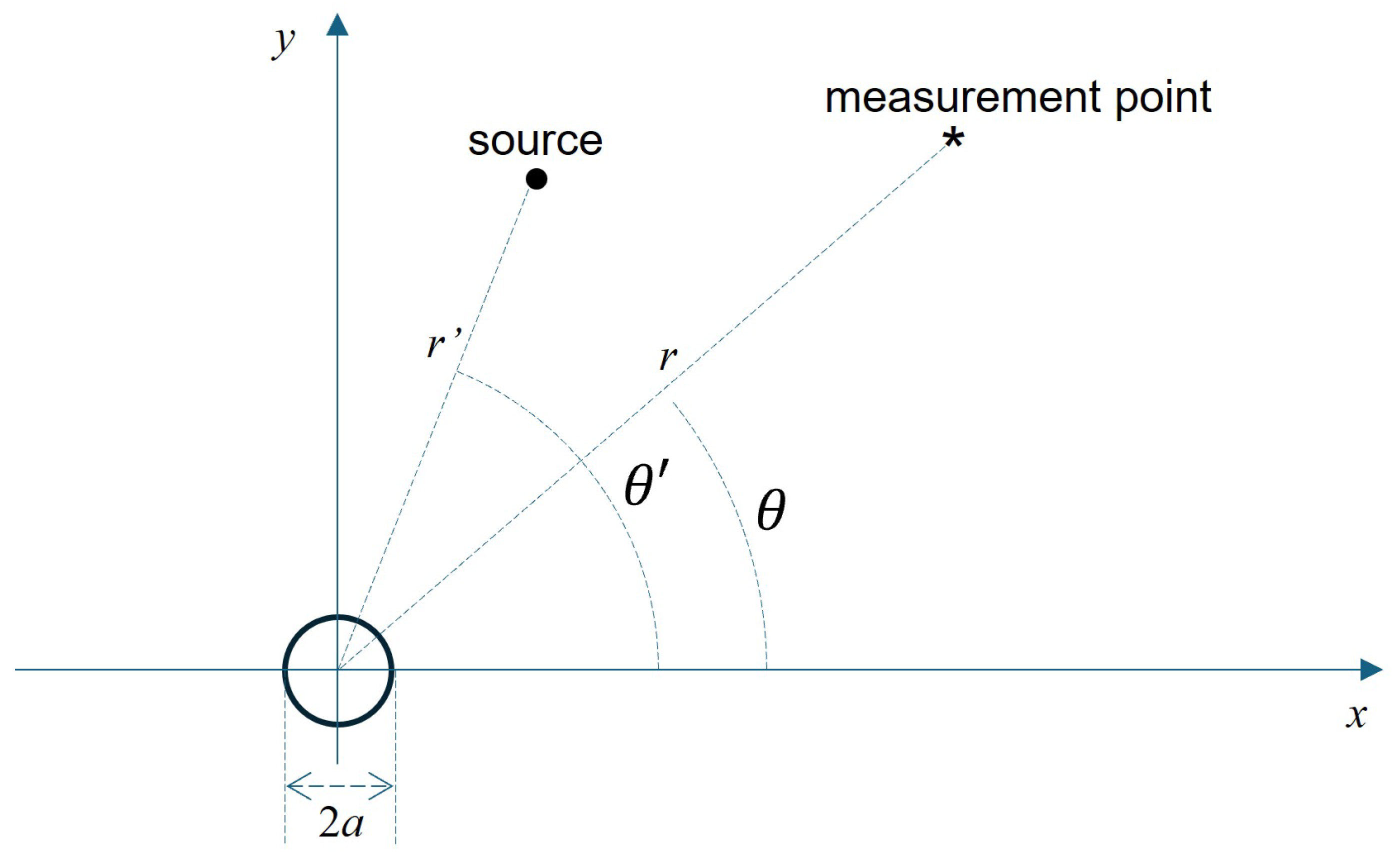
Scattering by a perfect electric conducting (pec) cylinder strictly depends on the ratio between the cylinder diameter and the wavelength. Also, it depends on the incident field polarization. In particular, thin cylinders illuminated by a wave whose electric field is perpendicular to the cylinder’s axis provide a scattered field much weaker with respect to the one scattered under parallel polarization. In order to illustrate this statement, consider one pec cylinder of radius a embedded in a homogeneous medium and illuminated by a filamentary source. The relevant 2D geometry is depicted in Figure 1, where the reference system is also indicated. Scattering from the cylinder can be calculated by exploiting the Fourier-Bessel series expansion and the homogeneous boundary condition for the tangential component of the electric field on the pec cylinder’s surface [24]. First, we consider as source a z directed filamentary electric current I located in ( r , θ ) . In this case, the impinging electric field is polarized along the z-axis of the reference system (TE polarization), and the scattered electric field can be expressed as follows:
E s = ζ k I 4 n = + a n H n ( 2 ) ( k r ) H n ( 2 ) ( k r ) e j n ( θ θ )
where
a n = J n ( k a ) H n ( 2 ) ( k a )
and J n ( · ) represents the Bessel function of order n, H n ( 2 ) ( · ) is the Hankel function of second kind of order n, k = 2 π f ϵ μ is the wavenumber, being f the working frequency, ε and μ are the electric permittivity and magnetic permeability, respectively, and ζ = μ / ε is the wave impedance. A similar expression holds for the scattered magnetic field when the source is a filamentary magnetic current K located in ( r , θ ) , implying that the impinging magnetic field is z-polarized (TM polarization)
H s = k K ζ 4 n = + b n H n ( 2 ) ( k r ) H n ( 2 ) ( k r ) e j n ( θ θ )
where the coefficients b n are expressed as
b n = J n ( k a ) H n ( 2 ) ( k a )
and the prime denotes the derivative with respect to the argument.
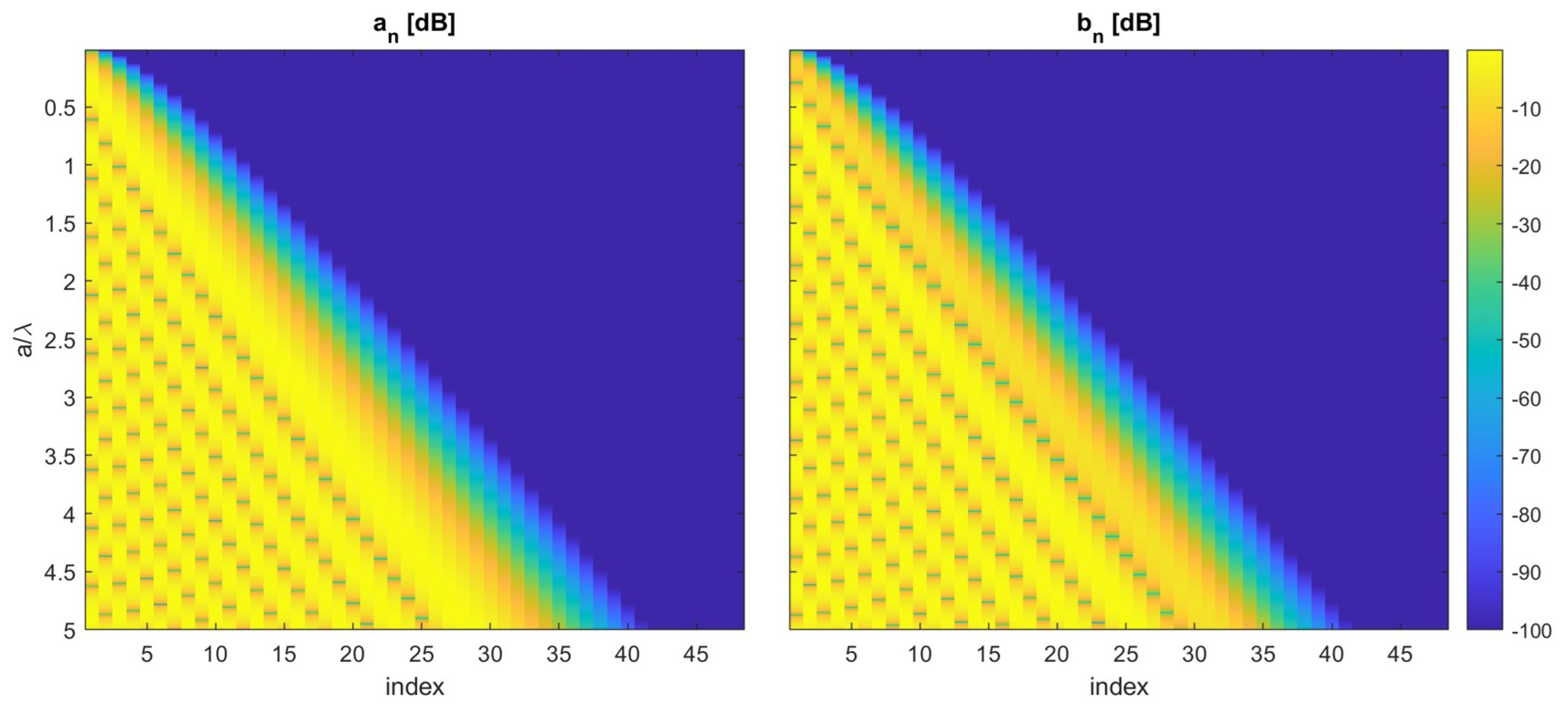
It is well known that the coefficients a n and b n decay exponentially after an index slightly higher than the value of the argument k a . This behavior is shown in Figure 2, where the coefficients are plotted versus the ratio between the cylinder’s radius a and the wavelength λ (i.e., versus k a / 2 π ).
So, the series in Equations (1) and (3) can be truncated to a finite number of terms depending on the cylinder’s dimension.
Here, we investigate the effect of the incident field polarization on the scattered power under the same incident power density. In other words, we want to find an expression for the backscattering cross section of the cylinder. To this end, a relationship between the electric source I and the magnetic source K should be established. By resorting to duality arguments [25], it can be shown that the electric and magnetic filamentary currents radiate the same active power density if K = ζ I . In the following equations we provide suitable expressions for the ratio between the scattered power density and the incident power, for the two different polarizations (see Appendix A for the details):
P T E = I m a g { n a n H n ( 2 ) ( k r ) H n ( 2 ) ( k r ) exp j n ( θ θ ) n a n H n ( 2 ) ( k r ) H n ( 2 ) ( k r ) exp j n ( θ θ ) * }
P T M = I m a g { n b n H n ( 2 ) ( k r ) H n ( 2 ) ( k r ) exp j n ( θ θ ) n b n H n ( 2 ) ( k r ) H n ( 2 ) ( k r ) exp j n ( θ θ ) * }
where I m a g is the imaginary part and the asterisk denotes conjugate. The behavior of P T E and P T M depends on the coefficients a n ( k a ) and b n ( k a ) mentioned above, so it is evident that the main role in determining the amount of scattered power is played by the radius of the cylinder.
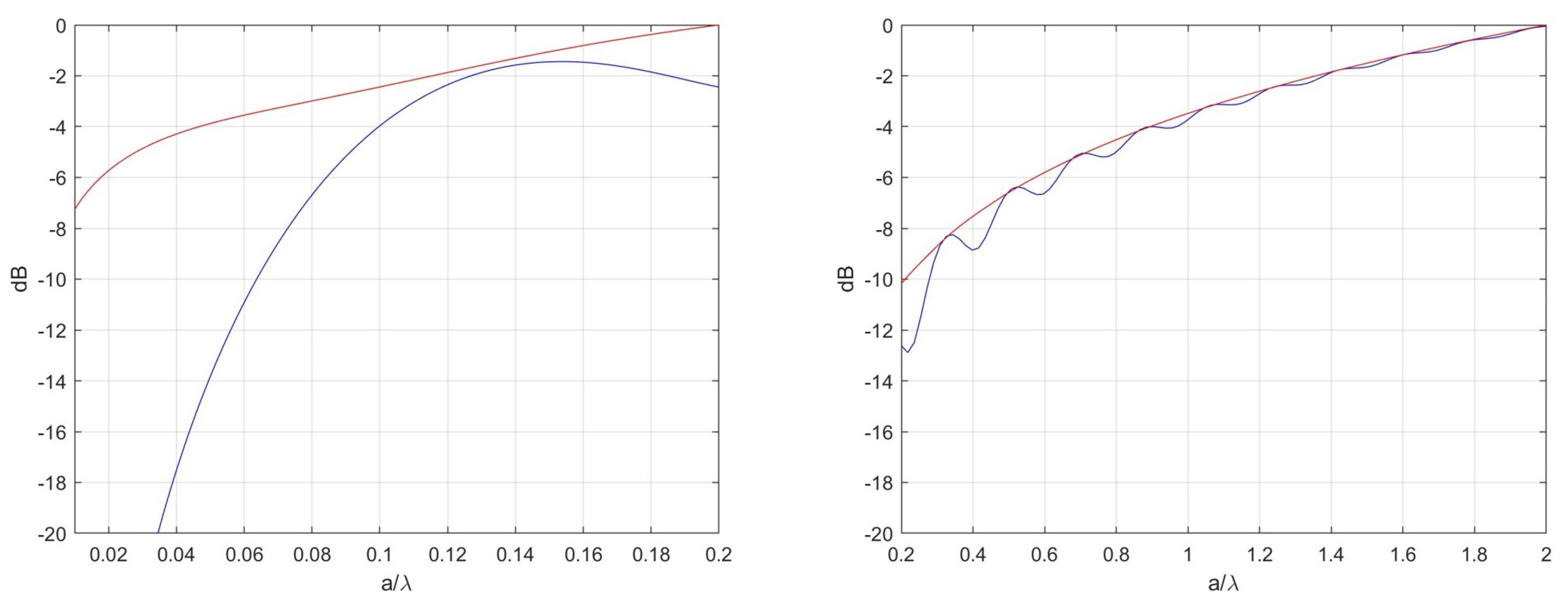
In Figure 3, the backscattered (i.e., for θ = θ ) power densities, calculated at a fixed distance and normalized to the maximum value, are shown as functions of the cylinder’s radius normalized to the wavelength. It can be appreciated that when the radius is small with respect to the wavelength, the backscattered power under the horizontal polarization is far lower than that backscattered in the vertical case. As the radius increases, this difference tends to decrease, but horizontal polarization shows oscillations, whereas the vertical polarization behavior is monotonic.

2.2. Numerical Analysis

In order to apply the above considerations to the detection of bars in concrete by X-band contactless measurements, the analysis in the working frequency band [ 8.2 12.4 ] GHz is required. We consider steel bars embedded in concrete, whose relative dielectric permittivity ε r affects the wavelength according to the rule λ = λ 0 / ε r ) , being λ 0 the wavelength in free space. Typical bar radius values usually stand between 6 mm and 9 mm, and concrete relative permittivity values reported in the literature show a fairly wide range of variation between 4 and 9 or even more [14]. For the sake of simplicity, in the following analysis we do not consider concrete conductivity σ . The interval of values assumed by the normalized radius a / λ in the X-band is reported in Table 1. The radius remains below the minimum wavelength, but the bars are not thin enough to actually provide significant differences in the backscattered power for the two polarization modes. This fact can be appreciated by the plot on the right in Figure 3, where the range of variation on the abscissa includes the values in Table 1.
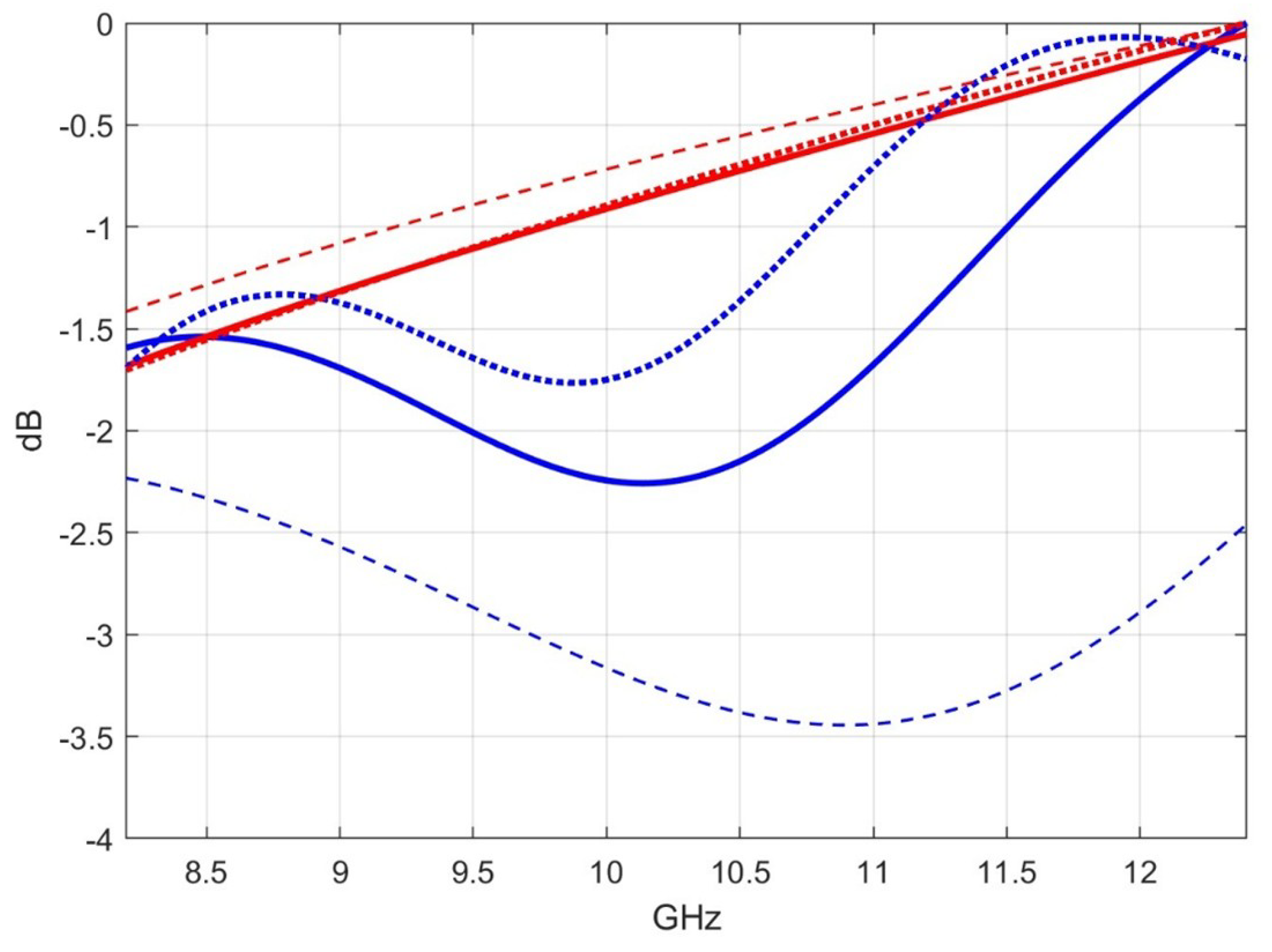
To clearly connect the theoretical analysis to the following experimental results, in Figure 4 the backscattered power theoretical behavior in the X-band for bars of radius 6 mm is shown. In particular, the power was computed in the hypotheses that the medium surrounding the bars has relative permittivity equal either to 4 or to 9, i.e., in the cases reported in Table 1. Also, the curve calculated in air (relative permittivity equal to 1) is added for comparison. As can be appreciated, the TM polarization in almost all the band remains lower than the TE one. However, the difference is only a few decibels.
In order to evaluate if it is still possible, in the X-band, to exploit polarization diversity to filter out contributions from the horizontal brackets, it is worth making experiments on reinforced concrete-like structures.

2.3. Experimental Setup

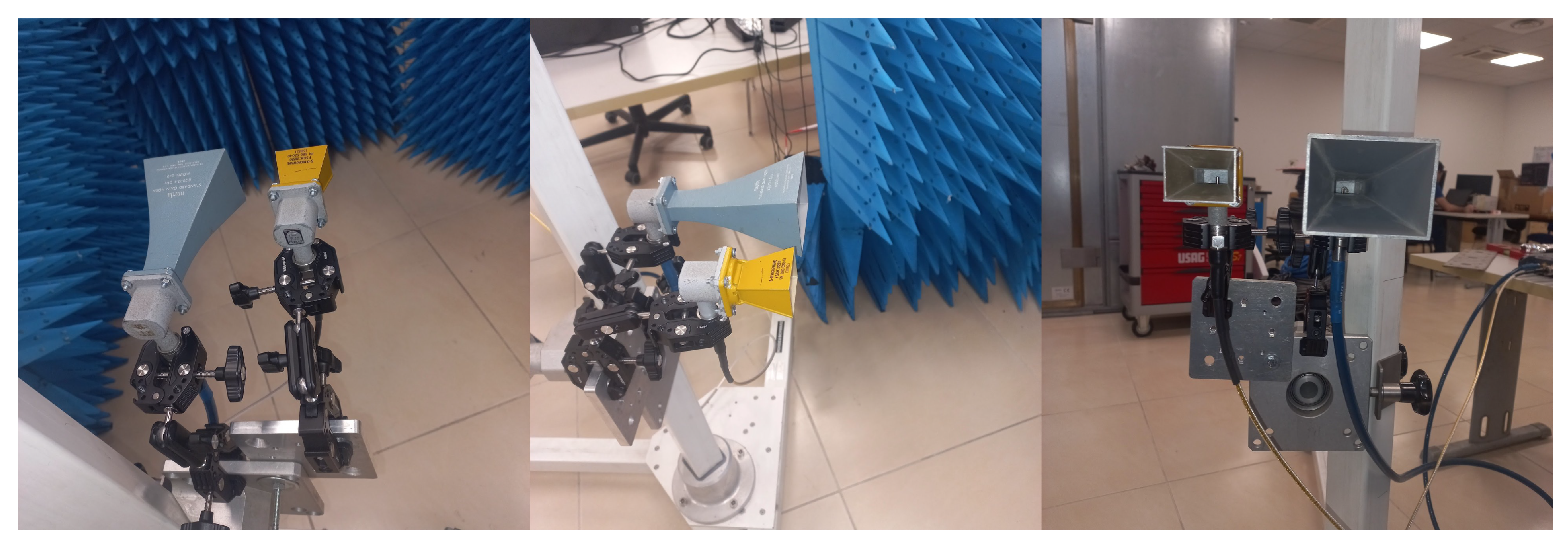
The experimental tests were conducted in a controlled semi-anechoic environment lined with panels, ensuring a reflection coefficient at a normal incidence of 40 dB at 8 GHz. The measurement setup comprised two horn antennas operating in the X-band (8.2–12.4 GHz), one designated as the transmitter and the other as the receiver, both positioned at a defined distance from the target (that is, the sample under investigation). The transmitting antenna, the blue one in the photo in Figure 5 has a gradual flare. Its length is 120 mm and its aperture is 73 mm (width) times 54 mm (height). The receiving antenna, identified by the yellow color in the figure, instead has a pyramidal flare, its length is 43 mm, and its aperture is 40 mm (width) times 29 mm (heigth). In Table 2, the maximum directivity and the beamwidth at −3 dB in the azimuthal and elevation planes, calculated by using the MATLAB Antenna Toolbox (ⓒ 1994–2025 The MathWorks, Inc., Natick, MA, USA), are shown at three different frequencies in the X band.
The antennas were connected through 50 Ω coaxial cables to a Vector Network Analyzer (VNA), model “KEYSIGHT P9373A, 300 kHz–14 GHz” (©Keysight Technologies, Santa Rosa, CA, USA). The VNA was configured to measure the scattering parameters of a two-port device under test, across a predefined set of equally spaced frequencies within the desired range. In this setup, the transmitting antenna was connected to port 1 and the receiving antenna to port 2 of the VNA. Standard SOLT calibration in the terminal section of coaxial cables was performed using the calibration kit model 85519A 4-in-1, open, short, load and through, DC to 18 GHz, Type-N(f), 50 Ω . Measurements of the scattering parameters S 11 and S 21 were recorded. The parameter S 11 represents the monostatic configuration, where a single antenna acts simultaneously as transmitter and receiver, and quantifies the signal received at port 1 of the VNA, normalized by the signal transmitted from the same port. However, S 11 is rarely used in laboratory measurements because mismatches in the single antenna measurement chain tend to mask the useful signal. In contrast, S 21 measures the signal received by the antenna connected to port 2 when the antenna at port 1 transmits. Both S 11 and S 21 were measured at N = 1601 equally spaced frequencies f n [ 8.2 12.4 ] GHz.

2.4. Target Description and Measurements

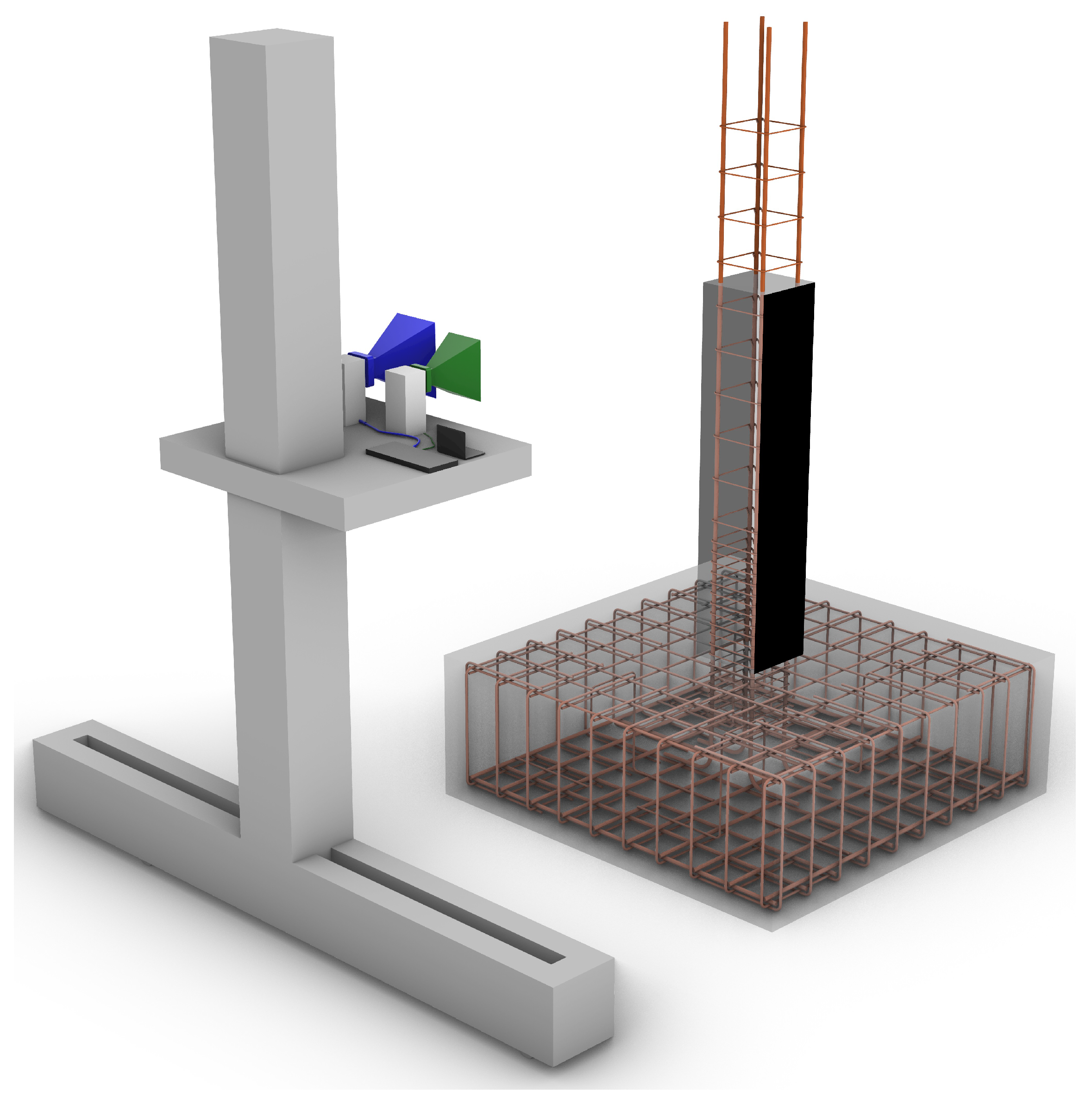
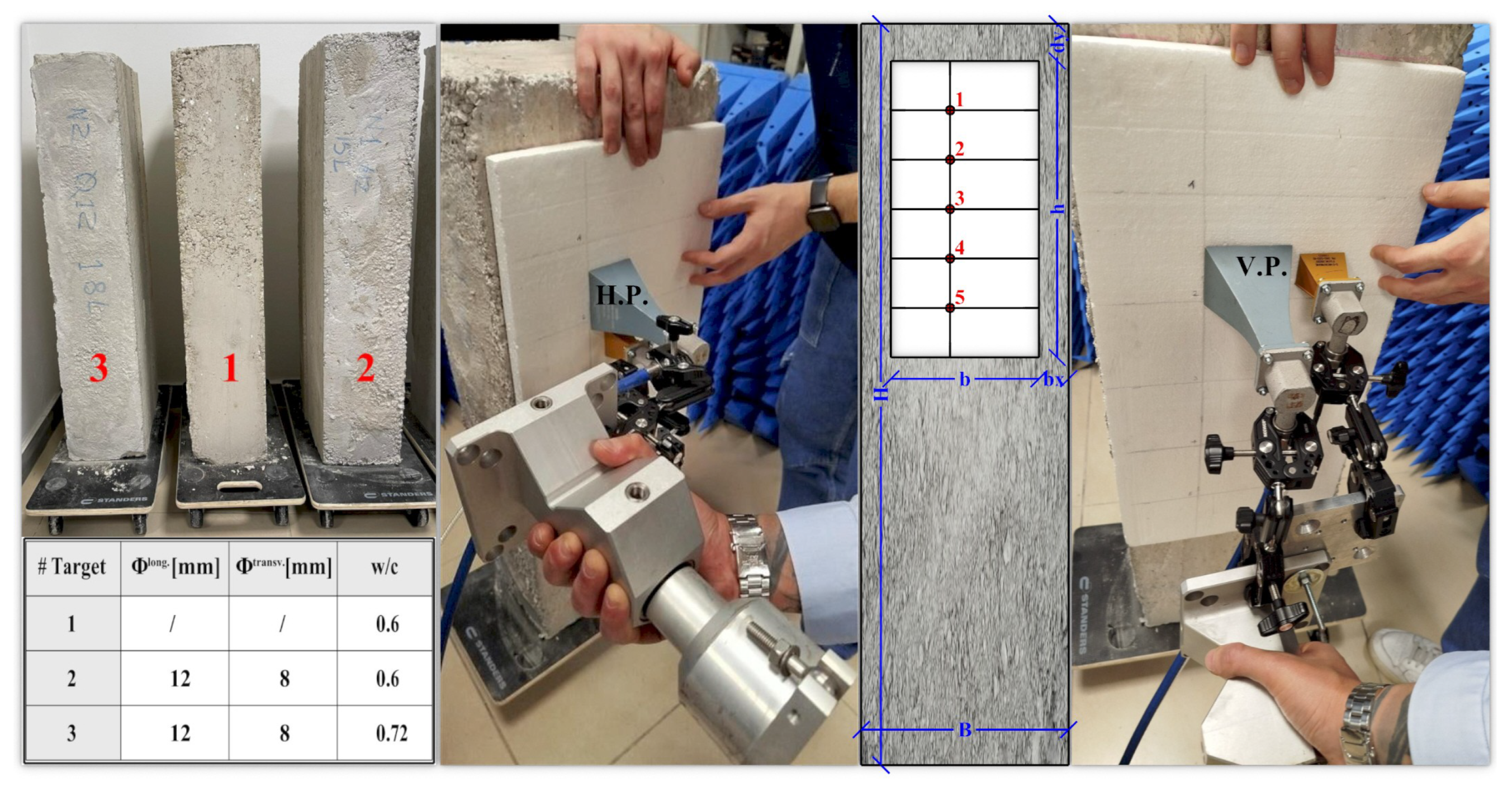
Three rectangular pillars with nominal dimensions of 30 cm (width), 20 cm (depth), and 100 cm (height) were fabricated for this study. The concrete used is an Rck 25/30. All measurements were performed after a curing period of 28 days, which corresponds to the standard curing time required for concrete to reach its characteristic compressive strength. The specimens were stored under controlled laboratory conditions (temperature and humidity) during the entire curing process. Two of these pillars were reinforced with six longitudinal steel bars, each 12 mm in diameter, and transverse brackets with a nominal diameter of 8 mm, while the third pillar remained unreinforced. Figure 6 shows a sketch of the reinforced pillar and the orientation of the bars and brackets, within the measurement configuration. The two reinforced pillars were constructed with different ratios of water-cement: one using 15 L of water each 25 kg of cement, providing the ratio 0.6 ; the other using 18 L of water each 25 kg of cement, providing the ratio of 0.72 . The water-cement ratio of the unreinforced pillar is 0.6 . This variation in concrete composition was introduced to evaluate the system’s capability to detect such common differences under real-world conditions. The details of the sample targets are summarized in the Table in Figure 7.
In Figure 7, the measurement configuration is illustrated: the two antennas are positioned in front of the target at a fixed distance from it and from each other. The antennas’ apertures are aligned as shown in the figure and can rotate, allowing emission and reception in vertical or horizontal polarization.
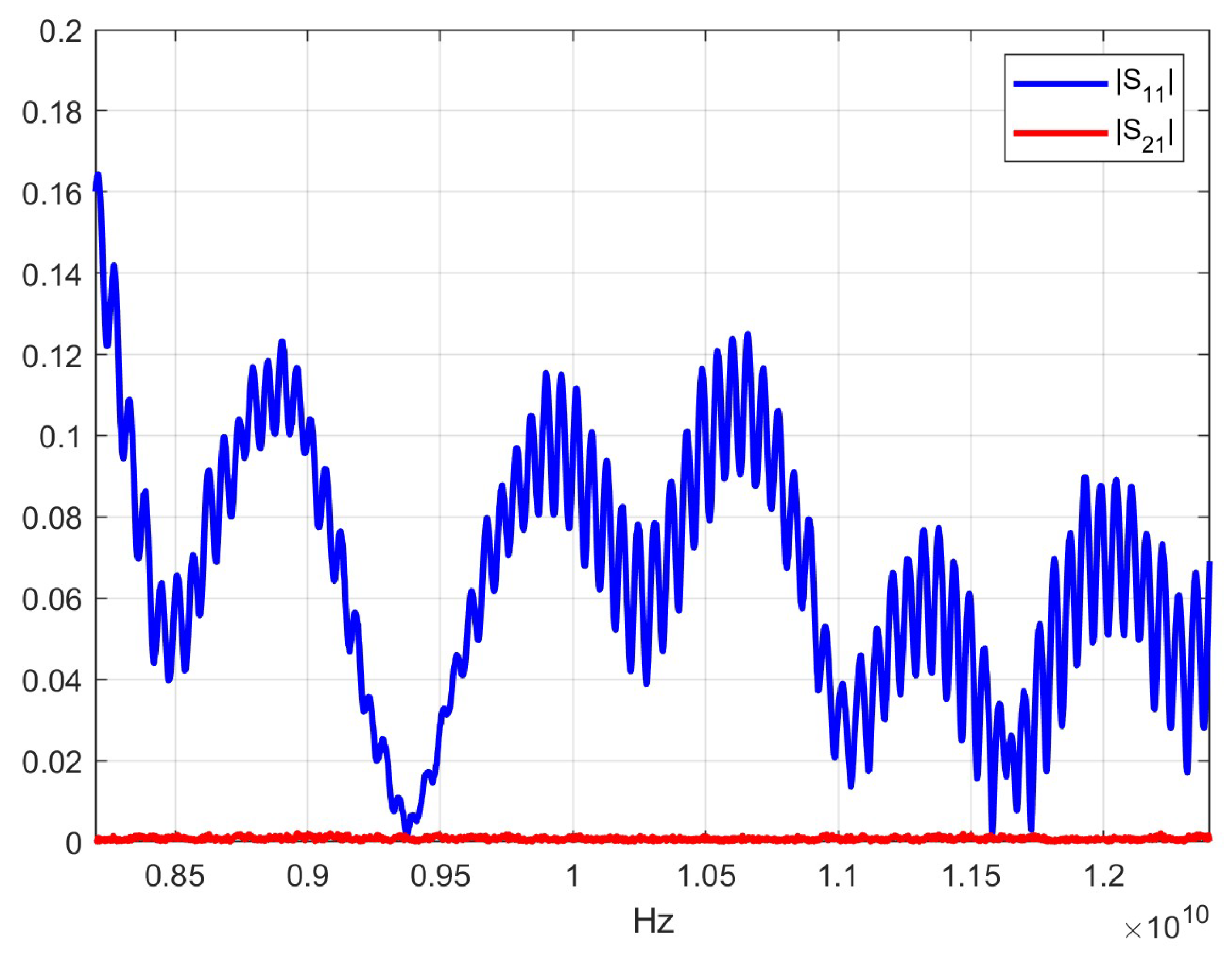
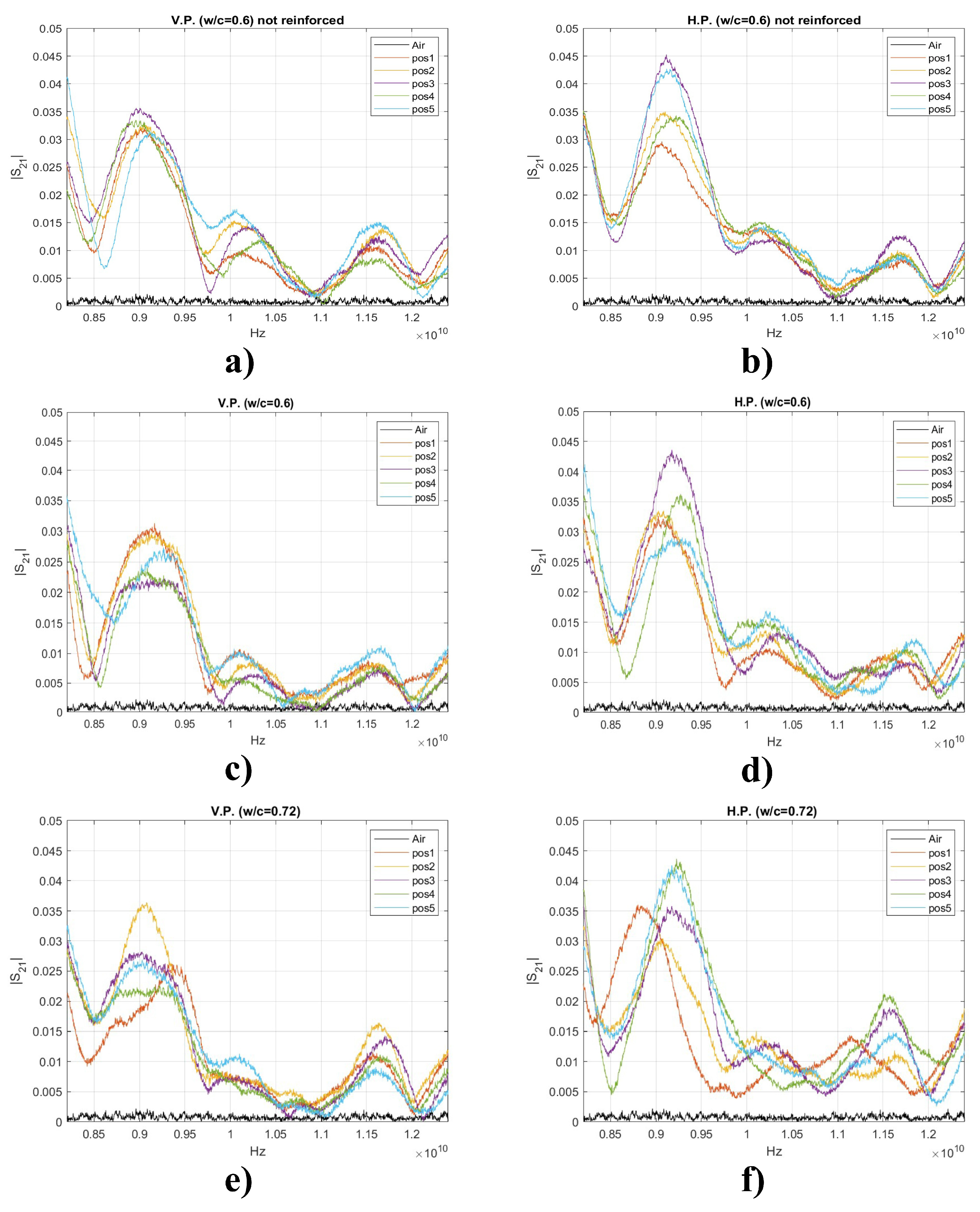
First, measurements were acquired in the absence of the target in order to establish a reference in the air. The antennas relative position is fixed and is the same successively used for the measurements on the pillars. Ideally, in the absence of any target, the received signal should be zero for both S 11 and S 21 . The recorded S 11 parameter reflects the antenna mismatch, whereas the measured S 21 parameter allows for the evaluation of the mutual coupling between the antennas. It can be appreciated by the results shown in Figure 8 that the antenna mismatch is relatively high and can impair the possibility to investigate the target by exploiting the parameter S 11 . On the contrary, mutual coupling is very low.

3. Results and Discussion

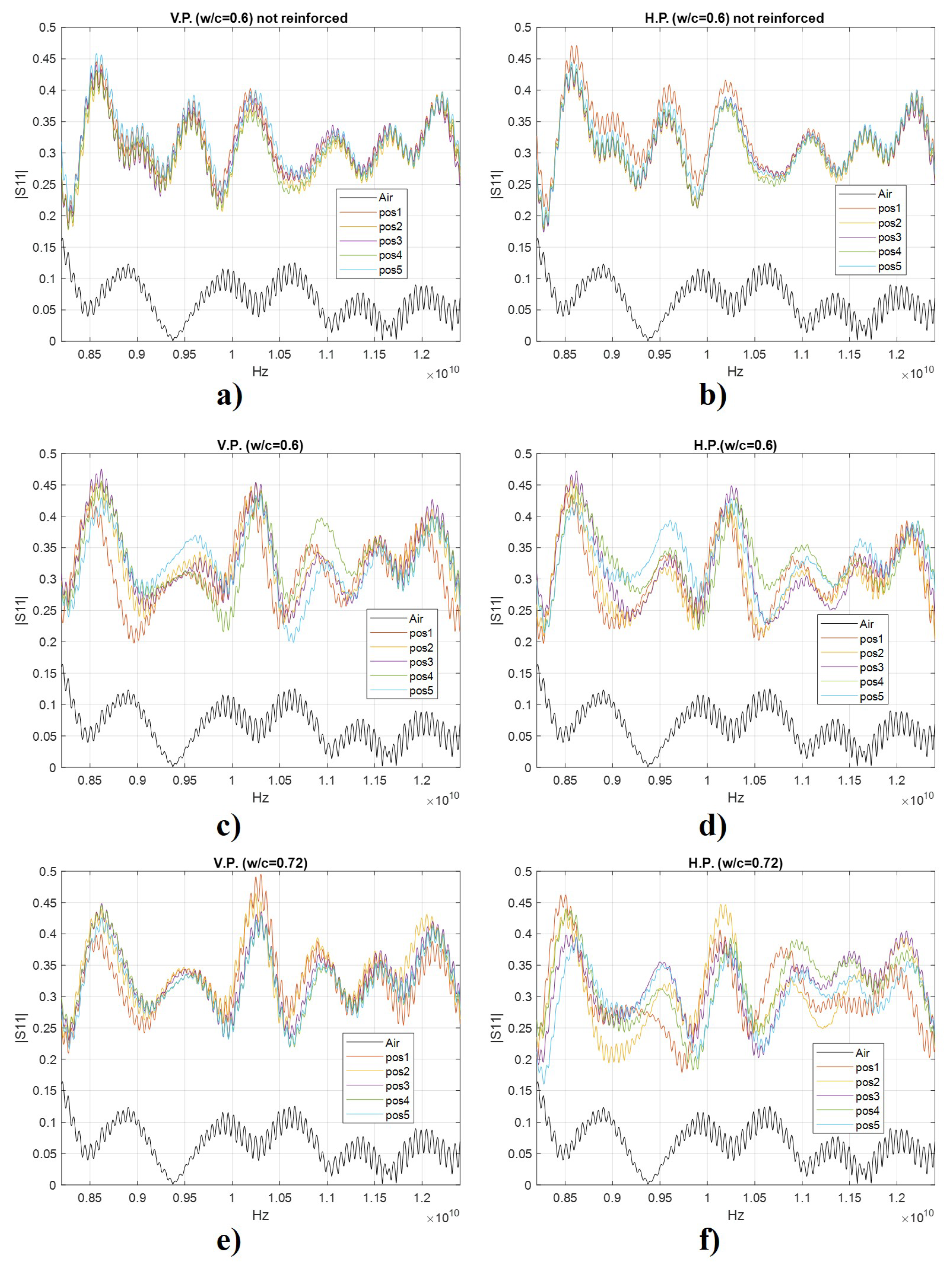
Here, we show some experimental measurement results. Let us clarify that the aim is to provide a qualitative behavior of the scattering under the two polarizations with respect to the presence of the vertical bars and the horizontal brackets. We underline that the number and kind of measurements shown in the following are not sufficient to perform bars detection or any else reinforced concrete diagnostics. However, this is not our goal. Here, we want to experimentally test whether vertical polarization is indeed “less sensitive” to the presence of horizontal bars than horizontal polarization. If so, using vertical polarization would help to eliminate unwanted contributions when detecting and locating vertical bars. We make this check using different realistic pillars as targets. The pillars were realized using a standard construction procedure. Therefore, their sizes differ slightly from the nominal one and, furthermore, the position of the reinforcements in the different pillars may be different and is not known (nor visible from the outside) This implies that measurements taken at the same position on different targets are not necessarily equal and cannot be compared. The following measurements are taken along a vertical line, so the only variation in the scattering scenario is the distance from the upper and lower borders of the pillar and the relative horizontal braces’ position with respect to the antennas. If the vertical polarization were completely insensitive to the horizontal braces, the corresponding S 11 and S 21 should not vary with the position. On the contrary, the same parameters in the horizontal polarization should show significative variations. So, we investigate, separately for each pillar, how the parameters S 11 and S 21 vary with the measurement position. The introduction of the indicator D ( p ) , defined below, aims at providing a quantitative evaluation of such a variability with the position.
Measurements were carried out with the antennas placed in front of the target, at a distance of 2 cm from its wid est side, in 5 different positions, arranged vertically. To keep the distance from the target fixed and to provide repeatability of positioning, a marked sheet of polystyrene was used (see the pictures in Figure 7).
In Figure 9 and Figure 10 the moduli of the measured S 11 and S 21 are shown, respectively, for the five different positions and the two polarizations. The difference between measurements taken at different positions on the same pillar with the same polarization assesses the sensitivity to the inner composition of the target (that is, the presence of bars and brackets) and implies the penetrability of concrete even at the relatively high frequencies of the X-band. Furthermore, different responses of the two pillars seem to assess the sensitivity to the composition of the concrete (the pillars present different cement-water ratio). This aspect deserves further investigation, outside the scope of the present work.
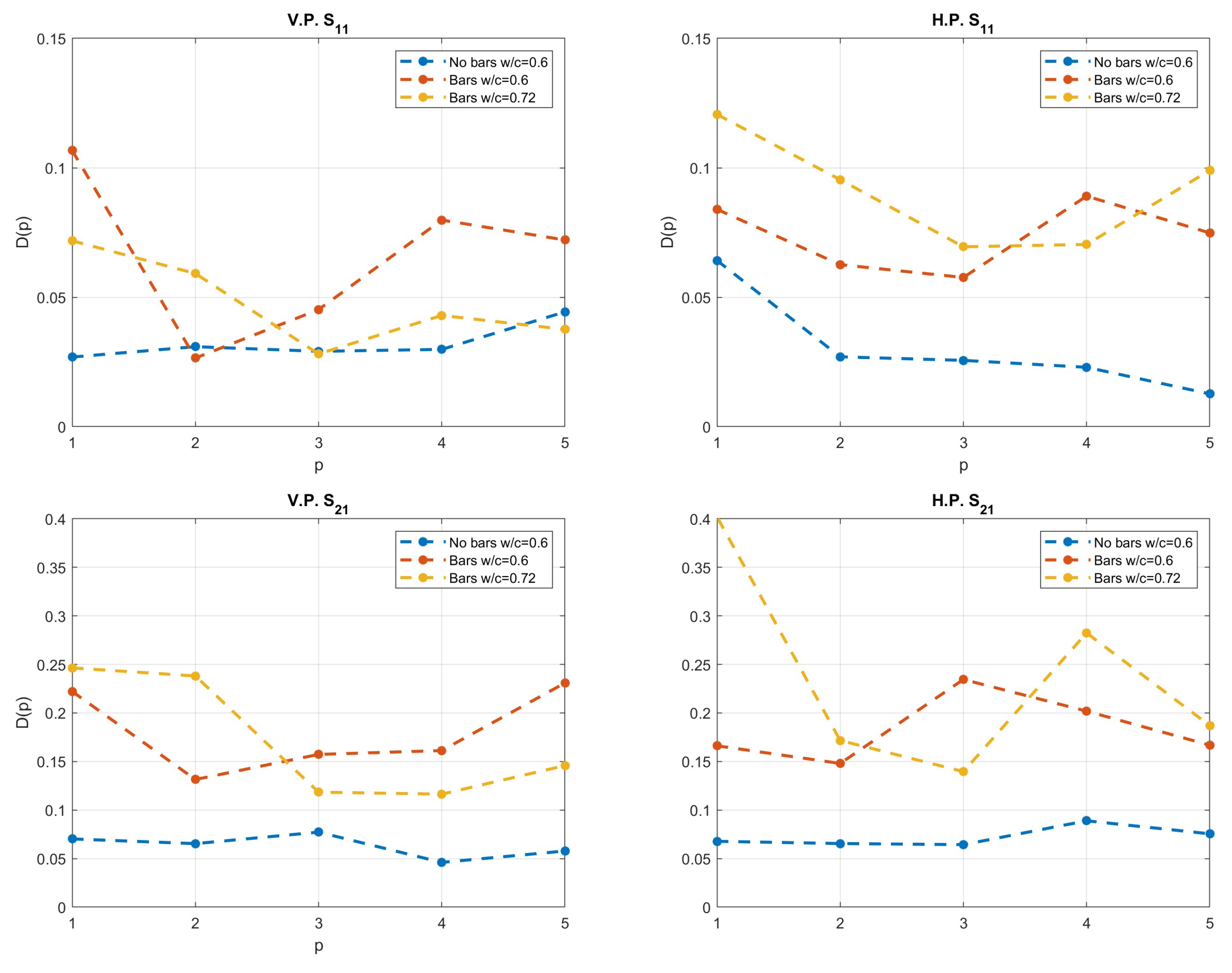
To provide a synthetic index that highlights the position dependence, we introduce an average frequency trace:
M ( f ) = 1 5 p = 1 5 | S i 1 ( f , p ) |
where i = 1 , 2 and p indicates the position. Then, the normalized Euclidean distance of each frequency measurement from the average is evaluated as follows:
D ( p ) = n = 1 N | S i 1 ( f n , p ) | M ( f n ) 2 n M 2 ( f n ) .
In Figure 11, D ( p ) , calculated from the measured parameters S 11 and S 21 , is shown for the three pillars and the two polarizations. First, of all, it can be appreciated that in all the cases measurements on the unreinforced pillar show a lower dependence on position and polarization, with respect to those taken on the reinforced pillars. This behavior confirms the penetration of the field inside the concrete in the frequency band considered. Note that the scales in Figure 11 for S 11 and S 21 are different: S 11 measured on the reinforced pillars shows lower sensitivity to both position and polarization than S 21 . This confirms that it is not convenient to rely on S 11 data for detection purposes. Regarding S 21 , the parameter D ( p ) calculated for the vertical polarization shows lower values with respect to the horizontal polarization. This confirms that exploiting polarization in non-destructive testing of elongated reinforced concrete structures could be advantageous.

4. Conclusions

This study has examined the role of field polarization in the microwave-based non-destructive testing of reinforced concrete structures. Theoretical models suggest that reinforcement bars aligned parallel to the incident electric field contribute more significantly to the scattered signal than those positioned orthogonally. This finding can aid in refining measurement techniques, either by filtering unwanted reflections or improving the identification of reinforcement orientation.
Experimental results obtained from laboratory tests on reinforced concrete pillar models have confirmed these theoretical predictions. Despite the conventional view that X-band frequencies offer limited penetration in concrete, our results demonstrate their feasibility for structural assessment, expanding the potential applications of high-frequency electromagnetic waves in non-destructive evaluation.
Although the findings provide valuable information, they remain qualitative. Achieving precise bar localization and characterization requires refined data acquisition methods, including a dense measurement grid and advanced signal processing. We underline once more that the experimental data presented in the paper are not sufficient to perform extraction of number and position of bars. This task requires the formulation of an inverse problem and, above all, the collection of a complete set of data, taken on extended measurement lines possibly deployed all around the target. One of the difficulties of contactless measurements is maintaining prefixed antennas positions. However, inversion algorithms based on the truncated singular values decomposition can easily deal even with data not uniformly deployed and at different distances from the target, provided that the positions are known. To this end, differential GPS or optical based sensors can help in providing the actual antennas’ position. Also, a self-positioning strategy based on the same collected scattered field data are under consideration. To address this, efforts are underway to integrate an automated antenna positioning system to support future on-site applications and enable the validation of inversion algorithms.

Author Contributions

Conceptualization, A.B.; methodology, A.B. and S.P.; software, A.B. and S.P.; validation, A.B.; formal analysis, A.B. and S.P.; investigation, A.B.; resources, A.B. and S.P.; data curation, S.P.; writing—original draft preparation, A.B. and S.P.; writing—review and editing, A.B. and S.P.; visualization, S.P.; supervision, A.B.; project administration, A.B.; funding acquisition, A.B. All authors have read and agreed to the published version of the manuscript.

Funding

This work was supported by the European Union NextGenerationEU, call PRIN 2022, project ARACNE–A RAdar system for Contactless surveys of reiNforced concrEte (grant n. 202225CSP2).

Institutional Review Board Statement

Not applicable.

Informed Consent Statement

Not applicable.

Data Availability Statement

The original contributions presented in this study are included in the article. Further inquiries can be directed to the corresponding author.

Acknowledgments

The authors thanks Roberto Langella for his helpful suggestions in implementing the measurement system.

Conflicts of Interest

The authors declare no conflicts of interest.

Abbreviations

The following abbreviations are used in this manuscript:
NDTNon-Destructive Testing
GPRGround Penetrating Radar
VNAVector Network Analyzer

Appendix A

The scattered power density is calculated as the real part of the radial component of the Poynting vector associated with the scattered electric and magnetic fields:
P = 1 2 R e a l { E × H * · i ^ r } = 1 2 R e a l { E t H t * }
where vectors are indicated in bold, E t and H t represent the components transverse to the radial direction of the electric and magnetic field taken in the counterclockwise direction, respectively, and the asterisk denotes conjugate.

Appendix A.1. TE Case

In this case, the scattered electric field E s is z -directed, and the relevant transverse component of the scattered magnetic field is θ -directed and can be calculated from the first Maxwell equation (curl of the electric field) as:
H θ = j ω μ E s r
The related power density is:
P T E = 1 2 R e a l { E s H θ * }
where the opposite of the θ -directed magnetic field component must be used in order to respect the counterclockwise rule. Using Equation (1) it results:
H θ = j E 0 ω μ n = + k a n H n ( 2 ) ( k r ) H n ( 2 ) ( k r ) e j n ( θ θ )
where the prime stands for derivative with respect to the argument and, for brevity, we introduced E 0 = ζ k I 4 . Finally, the expression in Equation (5) is derived as follows:
P T E = 1 2 R e a l E 0 n = + a n H n ( 2 ) ( k r ) H n ( 2 ) ( k r ) e j n ( θ θ ) · j E 0 * ω μ n = + k a n * H n * ( 2 ) ( k r ) H n * ( 2 ) ( k r ) e j n ( θ θ ) = k | E 0 | 2 2 ω μ R e a l j n = + a n H n ( 2 ) ( k r ) H n ( 2 ) ( k r ) e j n ( θ θ ) · n = + a n * H n * ( 2 ) ( k r ) H n * ( 2 ) ( k r ) e j n ( θ θ ) = ζ 32 | k I | 2 I m a g n = + a n H n ( 2 ) ( k r ) H n ( 2 ) ( k r ) e j n ( θ θ ) · n = + a n * H n * ( 2 ) ( k r ) H n * ( 2 ) ( k r ) e j n ( θ θ )

Appendix A.2. TM Case

In this case, the scattered magnetic field H s is z -directed, and the relevant transverse θ -directed component of the scattered electric field can be calculated from the second Maxwell equation (curl of the magnetic field in a spatial region free of induced currents) as:
E θ = j ω ϵ H s r
The related power density, with respect to the counterclockwise rule, is:
P T M = 1 2 R e a l { E θ H s * } = 1 2 R e a l { H s E θ * }
Using Equation (3) it results:
E θ = j H 0 ω ϵ n = + k b n H n ( 2 ) ( k r ) H n ( 2 ) ( k r ) e j n ( θ θ )
where H 0 = k K ζ 4 . Finally, the expression in Equation (6) is derived as follows:
P T M = 1 2 R e a l H 0 n = + b n H n ( 2 ) ( k r ) H n ( 2 ) ( k r ) e j n ( θ θ ) · j H 0 * ω ϵ n = + k b n * H n * ( 2 ) ( k r ) H n * ( 2 ) ( k r ) e j n ( θ θ ) = k | H 0 | 2 2 ω ϵ R e a l j n = + b n H n ( 2 ) ( k r ) H n ( 2 ) ( k r ) e j n ( θ θ ) · n = + b n * H n * ( 2 ) ( k r ) H n * ( 2 ) ( k r ) e j n ( θ θ ) = | k K | 2 32 ζ I m a g n = + b n H n ( 2 ) ( k r ) H n ( 2 ) ( k r ) e j n ( θ θ ) · n = + b n * H n * ( 2 ) ( k r ) H n * ( 2 ) ( k r ) e j n ( θ θ )
It is straightforward to see that under the condition that the incident power densities are equal, i.e., when K = ζ I , then | k K | 2 32 ζ = ζ 32 | k I | 2 and Equations (5) and (6) are simply derived by the expressions above by normalizing to this common factor.

References

  1. Maldague, X.P. Theory and Practice of Infrared Technology for Nondestructive Testing; John Wiley & Sons: New York, NY, USA, 2001. [Google Scholar]
  2. Hellier, C. Handbook of Nondestructive Evaluation; McGraw-Hill: New York, NY, USA, 2012. [Google Scholar]
  3. Di Gennaro, L.; de Cristofaro, M.; Loreto, G.; Minutolo, V.; Olivares, L.; Zona, R.; Frunzio, G. In-situ load testing of an ancient masonry structure using fibre optics. Structures 2024, 70, 107567. [Google Scholar] [CrossRef]
  4. Liu, H.; Zhong, J.; Ding, F.; Meng, X.; Liu, C.; Cui, J. Detection of early-stage rebar corrosion using a polarimetric ground penetrating radar system. Constr. Build. Mater. 2022, 317, 125768. [Google Scholar] [CrossRef]
  5. Dinh, K.; Gucunski, N.; Tran, K.; Novo, A.; Nguyen, T. Full-resolution 3D imaging for concrete structures with dual-polarization GPR. Autom. Constr. 2021, 125, 103652. [Google Scholar] [CrossRef]
  6. Franceschelli, L.; Iaccheri, E.; Franzoni, E.; Berardinelli, A.; Ragni, L.; Mazzotti, C.; Tartagni, M. Non-intrusive microwave technique for direct detection of concrete compressive strength monitoring by multivariate modeling. Measurement 2023, 206, 112332. [Google Scholar] [CrossRef]
  7. Palladino, S.; Fraldi, M.; Minutolo, V.; Esposito, L. Steering cracks via auxetic zebra-composites. Eng. Fract. Mech. 2025, 327, 111486. [Google Scholar] [CrossRef]
  8. Yan, W.; Ren, Z.; Fan, X.; Yan, Z.; Shen, L. Multi-scale pore model construction and damage behavior analysis of SiCf/SiC composite tubes. Mater. Charact. 2024, 214, 114083. [Google Scholar] [CrossRef]
  9. Li, Y.; Si, Y.; Zhang, K.; Zhu, Y. Investigation of interface mechanics and crack propagation in warm-mixed rubber asphalt mixture under salt-freeze-thaw conditions. Constr. Build. Mater. 2025, 458, 139750. [Google Scholar] [CrossRef]
  10. Meng, X.; Wen, W.-B.; Feng, F.; Liao, J.; Zhang, S.; Li, L.; Huang, F. Mechanical properties and damage characteristics of modified polyurethane concrete under uniaxial and cyclic compression. Constr. Build. Mater. 2025, 458, 139633. [Google Scholar] [CrossRef]
  11. Belytschko, T.; Black, T. Elastic crack growth in finite elements with minimal remeshing. Int. J. Numer. Methods Eng. 1999, 45, 601–620. [Google Scholar] [CrossRef]
  12. Kaveh, A.; Khayatazad, M. A new meta-heuristic method: Ray Optimization. Comput. Struct. 2012, 112–113, 283–294. [Google Scholar] [CrossRef]
  13. Zona, R.; Minutolo, V. A dislocation-based finite element method for plastic collapse assessment in solid mechanics. Arch. Appl. Mech. 2024, 94, 1531–1552. [Google Scholar] [CrossRef]
  14. Daniels, D.J. Ground Penetrating Radar, 2nd ed.; The Institution of Electrical Engineers: London, UK, 2004. [Google Scholar]
  15. Roudsari, S.S.; Okore-Hanson, T.; Hamoush, S.A.; Yi, S.; Shalbaftabar, A. Robotic destructive and nondestructive testing of concrete structures. Structures 2024, 70, 107564. [Google Scholar] [CrossRef]
  16. McCann, D.M.; Forde, M.C. Review of NDT methods in the assessment of concrete and masonry structures. NDT E Int. 2001, 34, 71–84. [Google Scholar] [CrossRef]
  17. Masoodi, M.; Taromideh, H. Optimal and uniform sensor arrangement in near-field imaging. J. Comput. Appl. Math. 2025, 454, 116188. [Google Scholar] [CrossRef]
  18. Luomei, Y.; Yin, T.; Tan, K.; Chen, X. Geometric approach for determining stationary phase points in radar imaging. Inverse Probl. 2024, 40, 045002. [Google Scholar] [CrossRef]
  19. Bellomo, L.; Pioch, S.; Saillard, M.; Belkebir, K. An improved antenna calibration methodology for microwave diffraction tomography in limited-aspect configurations. IEEE Trans. Antennas Propag. 2014, 62, 2450–2462. [Google Scholar] [CrossRef]
  20. Brancaccio, A. A quasi-quadratic inverse scattering approach to detect and localize metallic bars within a dielectric. Appl. Sci. 2022, 12, 9217. [Google Scholar] [CrossRef]
  21. Brancaccio, A.; Palladino, S. Contactless X-band detection of steel bars in cement: A preliminary numerical and experimental analysis. Remote Sens. 2024, 16, 2037. [Google Scholar] [CrossRef]
  22. Sun, H.-H.; Cheng, W.; Fan, Z. Diameter estimation of cylindrical metal bar using wideband dual-polarized ground-penetrating radar. IEEE Trans. Instrum. Meas. 2023, 72, 8000714. [Google Scholar] [CrossRef]
  23. Liu, H.; Zhang, B.; Yan, L.; Meng, X.; Zhou, J.; Cui, J.; Spencer, B.F. Rebar characterization using dual-polarization GPR. NDT E Int. 2025, 154, 103391. [Google Scholar] [CrossRef]
  24. Harrington, R.F. Time-Harmonic Electromagnetic Fields; IEEE Press: Piscataway, NJ, USA; John Wiley & Sons, Inc.: New York, NY, USA, 2001. [Google Scholar]
  25. Balanis, C.A. Antenna Theory: Analysis and Design, 2nd ed.; John Wiley & Sons, Inc.: New York, NY, USA, 1997. [Google Scholar]
Figure 1. Circular cylinder illuminated by a filamentary source: geometry and reference system. Asterisk denotes the measurement point.
Applsci 16 00412 g001
Figure 2. Normalized modulus of a n (left) and b n (right) at variance of the index and of the normalized cylinder’s radius. Values below −100 dB are cut.
Applsci 16 00412 g002
Figure 3. Normalized backscattered power density P T E (red) P T M (blue): a < 0.2 λ (left); 0.2 λ < a < 2 λ (right).
Applsci 16 00412 g003
Figure 4. Normalized backscattered power density P T E (red) P T M (blue) in the X-band for a = 6 mm: ϵ r = 4 (solid line); ϵ r = 9 (pointed line); ϵ r = 1 (thin dashed line).
Applsci 16 00412 g004
Figure 5. Side and front views of the transmitting and receiving horns.
Applsci 16 00412 g005
Figure 6. Sketch of a reinforced pillar and measurement configuration.
Applsci 16 00412 g006
Figure 7. From the left to the right: photo of the three realized concrete pillars with their identification number(upper) and table showing the pillars characteristics (bottom); antennas in horizontal polarization (H.P.); sketch of the measurement positions; antennas in vertical polarization (V.P.). B = 30 cm, H = 100 cm, b = 20 cm, h = 40 cm, d x = 4 cm, d y = 5 cm.
Applsci 16 00412 g007
Figure 8. Modulus of S 11 and S 21 measured in absence of the target.
Applsci 16 00412 g008
Figure 9. Measured modulus of S 11 on the three pillars under test at the five different positions: (a,b) unreinforced; (c,d) w/c = 0.6; (e,f) w/c = 0.72. Vertical polarization on the left column, horizontal on the right. Measured modulus of S 11 in air is shown in black line for comparison.
Applsci 16 00412 g009
Figure 10. Measured modulus of S 21 on the three pillars under test at the five different positions: (a,b) un-reinforced; (c,d) w/c = 0.6; (e,f) w/c = 0.72. Vertical polarization on the left column, horizontal on the right. Measured modulus of S 21 in air is shown in black line for comparison.
Applsci 16 00412 g010
Figure 11. D ( p ) calculated from S 11 (top) and S 21 (bottom) measured on the three different pillars for the two polarizations.
Applsci 16 00412 g011
Table 1. Normalized cylinder’s radius in the X-band for some typical values of radius and permittivity.
a [mm] ε r a / λ (Min–Max)
640.328–0.496
740.383–0.579
840.437–0.661
690.492–0.744
790.574–0.868
890.656–0.992
Table 2. Directivity and beamwidth at −3 dB of the antennas at the minimum, central and maximum frequency.
HornFrequency [GHz] D max [dBi]Beamwidth (Az/El) [deg]
transmitting8.214.4433/37
transmitting10.015.8525/29
transmitting12.417.0921/26
receiving8.29.2854/66
receiving10.010.6847/60
receiving12.412.6137/51
Disclaimer/Publisher’s Note: The statements, opinions and data contained in all publications are solely those of the individual author(s) and contributor(s) and not of MDPI and/or the editor(s). MDPI and/or the editor(s) disclaim responsibility for any injury to people or property resulting from any ideas, methods, instructions or products referred to in the content.