Article

TemporalAE-Net: A Self-Attention Framework for Temporal Acoustic Emission-Based Classification of Crack Types in Concrete

1
Hunan Provincial Water Transportation Construction & Investment Group Co. Ltd., Changsha 410029, China
2
School of Civil Engineering, Changsha University of Science and Technology, Changsha 410114, China
3
State Key Laboratory of Bridge Safety and Resilience, Hunan University, Changsha 410082, China
*
Author to whom correspondence should be addressed.
Appl. Sci. 2026, 16(1), 400; https://doi.org/10.3390/app16010400 (registering DOI)
Submission received: 4 December 2025 / Revised: 27 December 2025 / Accepted: 29 December 2025 / Published: 30 December 2025

Featured Application

TemporalAE-Net provides real-time identification of tensile and shear cracks in concrete structures using acoustic emission signals, enabling early warning and improving structural safety.

Abstract

Crack type classification in concrete structures is essential for assessing structural integrity, yet traditional visual inspections and RA–AF parameter-based Acoustic Emission (AE) methods suffer from subjectivity and limited ability to capture temporal signal dependencies. This study proposes TemporalAE-Net, a self-attention-based machine learning framework designed to classify tensile and shear cracks while explicitly incorporating the temporal evolution of AE signals. AE data were collected from axial tension tests, shear-failure tests, and four-point bending tests on reinforced concrete beams, and a sliding-window reconstruction method was used to transform sequential AE signals into two-dimensional temporal matrices. TemporalAE-Net integrates one-dimensional convolution for local feature extraction and multi-head self-attention for global temporal correlation learning, followed by multilayer perceptron classification. The proposed model achieved an accuracy of 99.72%, outperforming both its ablated variants without convolutional or attention modules and conventional time-series architectures. Generalization tests on 12 unseen specimens yielded 100% correct classifications, and predictions for reinforced concrete beams closely matched established crack-evolution patterns, with shear cracks detected approximately 15 s prior to visual observation. These results demonstrate that TemporalAE-Net effectively captures temporal dependencies in AE signals. Moreover, it provides accurate and efficient tensile–shear crack identification, making it suitable for real-time structural health monitoring applications.

1. Introduction

Cracks are a ubiquitous phenomenon in concrete structures and are often used as a key indicator for assessing concrete quality [1,2]. In current civil engineering practice, periodic visual inspections are commonly used to identify and categorize cracks; however, such inspections are inherently subjective and restricted to accessible surface regions [3,4]. Although various sensor-based methods exist for detecting cracks—whether direct or indirect, contact or non-contact—they generally cannot provide detailed information regarding crack type (e.g., tensile or shear), which is crucial for predicting failure modes and evaluating structural stability.
Acoustic Emission (AE) technology has gained increasing attention for its ability to monitor the real-time condition of materials by detecting transient elastic waves generated by internal stress or deformation [5]. Compared with other non-destructive testing methods, AE offers two major advantages: (1) the signals originate from the material’s intrinsic responses rather than external excitation, and (2) AE captures dynamic processes such as motion and strain evolution, which are difficult to observe using most other techniques [6]. Consequently, AE has been widely applied for crack localization [7,8], damage quantification [9,10], and crack mechanism identification [11,12].
For crack type classification using AE signals, the commonly applied standard is JCMS-III B5706 (2003) [13], which primarily relies on average frequency (AF) and Rise time/Amplitude ratio (RA) to distinguish between tensile and shear cracks. However, no unified consensus exists regarding the optimal AF–RA thresholds. Ohno and Ohtsu demonstrated that effective crack identification can be achieved when the RA/AF ratio is within 1–200 [14], whereas Aldahdooh et al. suggested 1:80 as a suitable boundary for RC beams [15]. Such variability highlights the limitations of parameter-based methods. Specifically, the reported RA–AF thresholds differ by more than a factor of two across studies, and their optimal values are highly sensitive to specimen geometry, loading conditions, and material heterogeneity. This lack of robustness limits the transferability and reliability of RA–AF-based crack classification in practical applications. As a result, recent studies have explored machine-learning approaches for crack classification [15,16,17]. Mandal et al. reported that RA–AF methods are inadequate for heterogeneous materials like concrete and suggested that machine learning can provide more reliable crack identification [16]. Similarly, Ju et al. emphasized that RA–AF boundaries vary considerably among specimens and developed a semi-empirical machine-learning method to address this issue [17].
In the pursuit of more accurate crack type classification, machine learning—particularly self-attention mechanisms—offers promising potential [18,19]. As the core building block of Transformer architectures, self-attention has recently been adopted in structural health monitoring (SHM) research, including Vision Transformer-based approaches for crack detection [20,21]. Self-attention enables the model to assign importance weights to different positions in a sequence, allowing it to capture global dependencies beyond the limits of local-only feature extraction [22]. This capability represents a significant improvement over traditional machine-learning methods, which often treat AE signals as isolated instances and overlook temporal relationships. However, crack propagation is inherently time-dependent [23,24], and existing machine-learning studies have yet to fully incorporate temporal dependencies into AE-based crack classification.
To address this gap, this study proposes a self-attention-based framework—TemporalAE-Net—designed to classify crack types in AE signals while explicitly modeling temporal information. The framework integrates four key components: temporal reconstruction, one-dimensional convolution, self-attention mechanisms, and multilayer perceptrons. AE signals within each time window are reorganized into a two-dimensional temporal matrix as input. The 1D convolution extracts local waveform features without disrupting temporal order, while the self-attention module captures global temporal correlations. Finally, a multilayer perceptron produces the classification outputs. To validate the performance and generalization capability of the proposed model, tensile and shear tests on small specimens were conducted to generate training data, and four-point bending tests on reinforced concrete (RC) beams were employed for further verification.

2. Experimental Program and AE Data Preparation

2.1. Experimental Setup and Data Acquisition

To train TemporalAE-Net, two different types of experiments, namely axial tension tests on dog-bone-shaped specimens and shear failure tests on Z-shaped specimens, are performed. The dog-bone-shaped specimen has been extensively adopted for uniaxial tensile testing of concrete, as its geometry ensures uniform stress distribution within the gauge section and facilitates controlled crack initiation under tension [25,26]. Z-shaped specimens are widely employed in shear testing to generate a well-defined pure-shear stress field and capture the evolution of shear cracking [27,28,29]. The experimental designs were utilized to separately acquire AE signal samples for tensile and shear cracks. Detailed information regarding the instruments and equipment used is listed in Table 1.
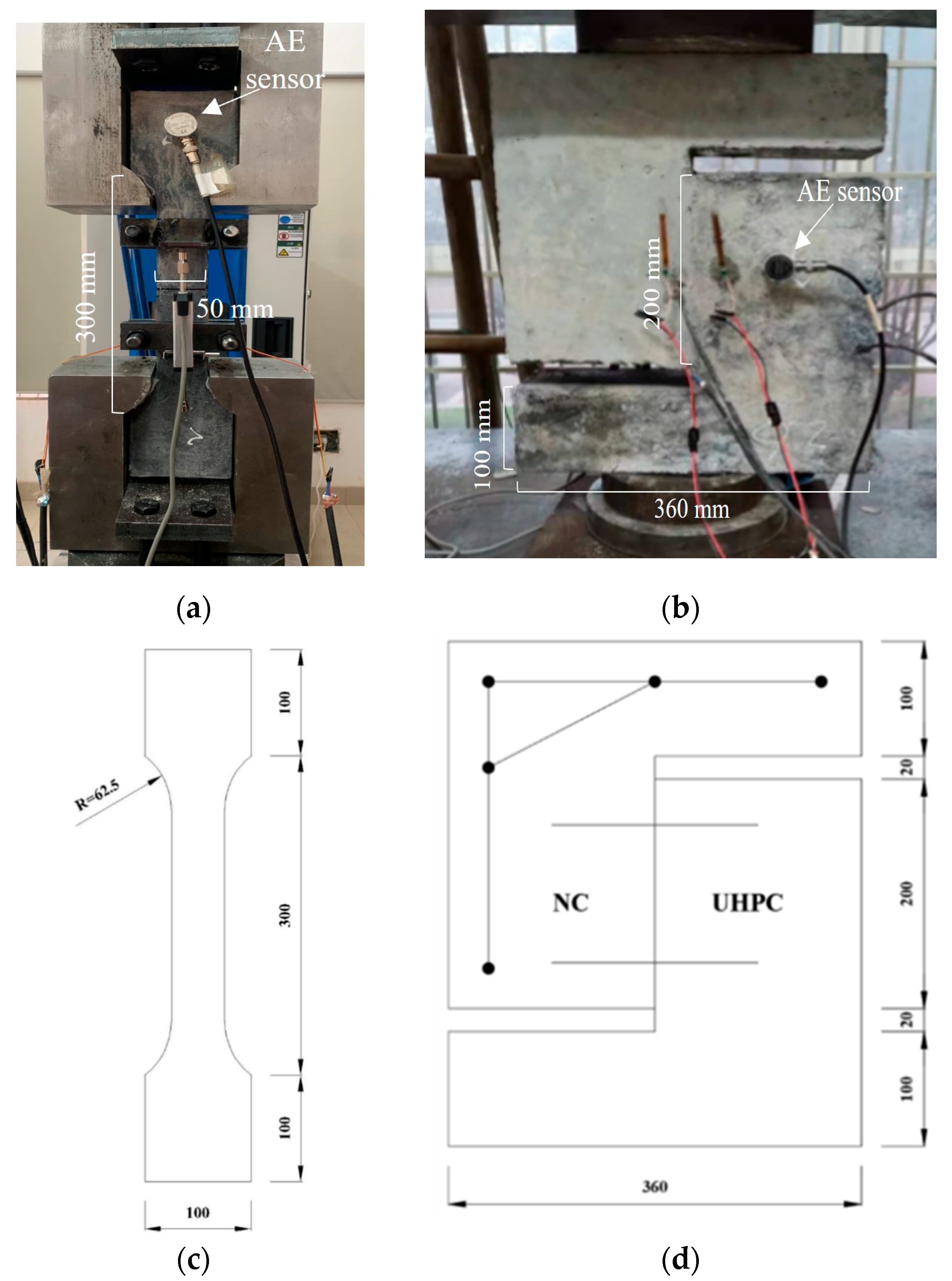
To accurately capture the AE signals of tensile cracks, specially designed dog-bone-shaped specimens made from Ultra-High-Performance Concrete (UHPC) were employed. The utilization of this material serves to prevent premature brittle failure of the specimens, thereby ensuring the acquisition of sufficient AE signals. Details of the specimens and their dimensions are elaborated as indicated in the relevant Figure 1a,c. To finely control the generation rate of AE signals, the axial tension tests were conducted under displacement control mode, with a set tensile rate of 0.1 mm/min.
For the acquisition of signals corresponding to shear cracks, a “Z-shaped” specimen made of a combination of normal concrete (NC) and UHPC was designed. This configuration was intentionally selected to simulate realistic strengthening scenarios, where UHPC is commonly applied as a shear-strengthening layer or overlay for existing RC structures. Therefore, the composite shear specimens better represent practical UHPC–concrete interaction under shear-dominated failure modes. The shape and dimensions of this design are depicted as shown in the relevant Figure 1b,d. The experimental procedure also adopted a displacement control mode and was set at a loading rate of 0.5 mm/min. The datasets obtained from two types of experiments are presented in Table 2.

2.2. Data Preprocessing and Temporal Reconstruction

To account for the temporal correlations between AE signals, we implemented a unique data preprocessing strategy that assembles these signals into a two-dimensional matrix to serve as the input for network training. Specifically, we defined a “sliding window” along the time axis that encompasses 100 AE signals and used it to generate a two-dimensional matrix. The window then shifts incrementally at predetermined intervals to produce two-dimensional reassembled samples. Each of these reassembled samples thus encapsulates all the AE signals within the window, enabling TemporalAE-Net to capture temporal information.
Due to the inherent imbalance between the tensile and shear crack datasets—where the number of shear-related AE signals is substantially smaller than that of tensile signals—a smaller window interval was adopted for shear samples during temporal reconstruction. Specifically, the window interval was set to 60 for tensile samples and 20 for shear samples, thereby increasing the number of reconstructed shear samples while maintaining temporal continuity. Table 2 summarizes the dataset composition before and after preprocessing.
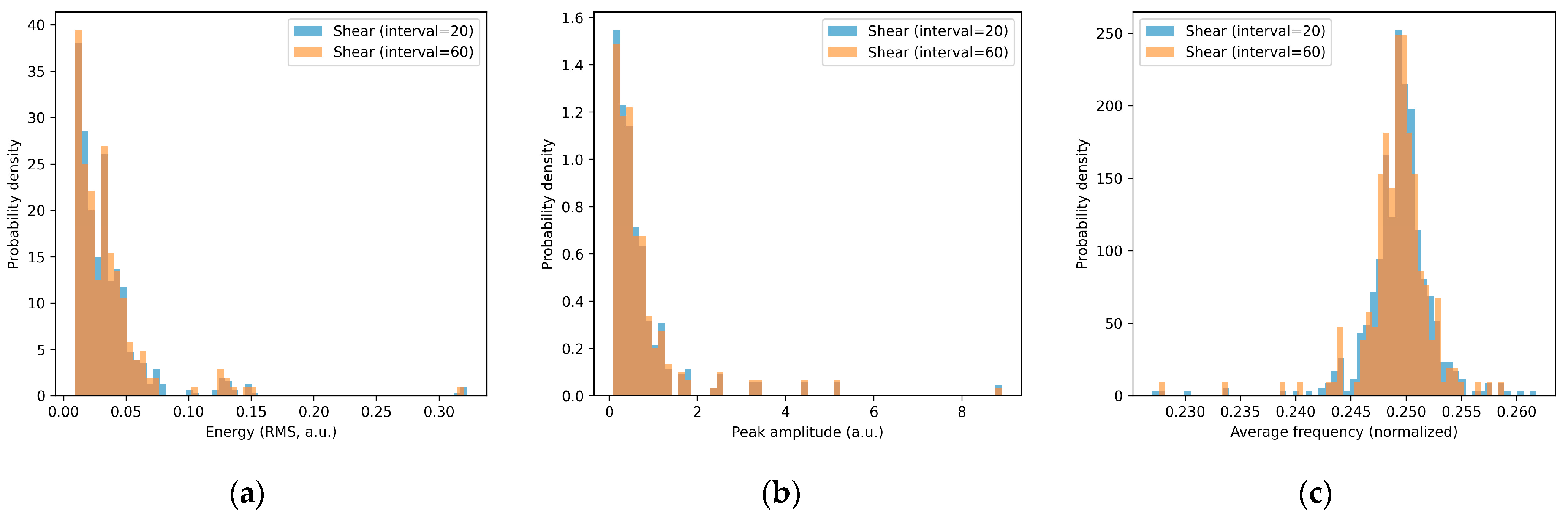
To verify that the use of different window intervals does not introduce reconstruction-induced statistical bias or artificial artifacts, additional control experiments were conducted within the same crack category. Specifically, the shear dataset was reconstructed using two different window intervals (20 and 60), and key AE features—including signal energy (RMS), peak amplitude, and average frequency—were extracted from the reconstructed samples. Distribution-level comparisons were then performed using the two-sample Kolmogorov–Smirnov (KS) test.
As illustrated in Figure 2a–c, the reconstructed shear samples obtained with different window intervals exhibit highly overlapping feature distributions. The corresponding KS statistics remain extremely small (Energy: D = 0.0299, Peak amplitude: D = 0.02499, Average frequency: D = 0.0464), with non-significant p-values (p > 0.05) in all cases. These results confirm that reducing the window interval for shear samples increases the number of training samples without altering the intrinsic statistical characteristics of AE signals, thereby avoiding reconstruction-induced artifacts or artificial inflation of classification performance.
Therefore, the adopted temporal reconstruction strategy effectively mitigates dataset imbalance while preserving the physical integrity of AE features, ensuring that the classification performance of TemporalAE-Net is driven by genuine crack-related characteristics rather than reconstruction-induced statistical artifacts.

2.3. Generalization Capability Validation

Generalization capability measures the predictive accuracy of the model when dealing with unfamiliar data. To comprehensively assess the generalization performance of TemporalAE-Net, we conducted validations from two distinct perspectives: small-scale specimens and four-point loading tests on RC beams. It’s worth noting that the small-scale specimen data used for this validation set were generated under the same experimental settings as described in Section 2.1; however, they were not used for model training or within-training testing. Table 3 provides a detailed listing of the 12 specimens used for generalization capability validation.
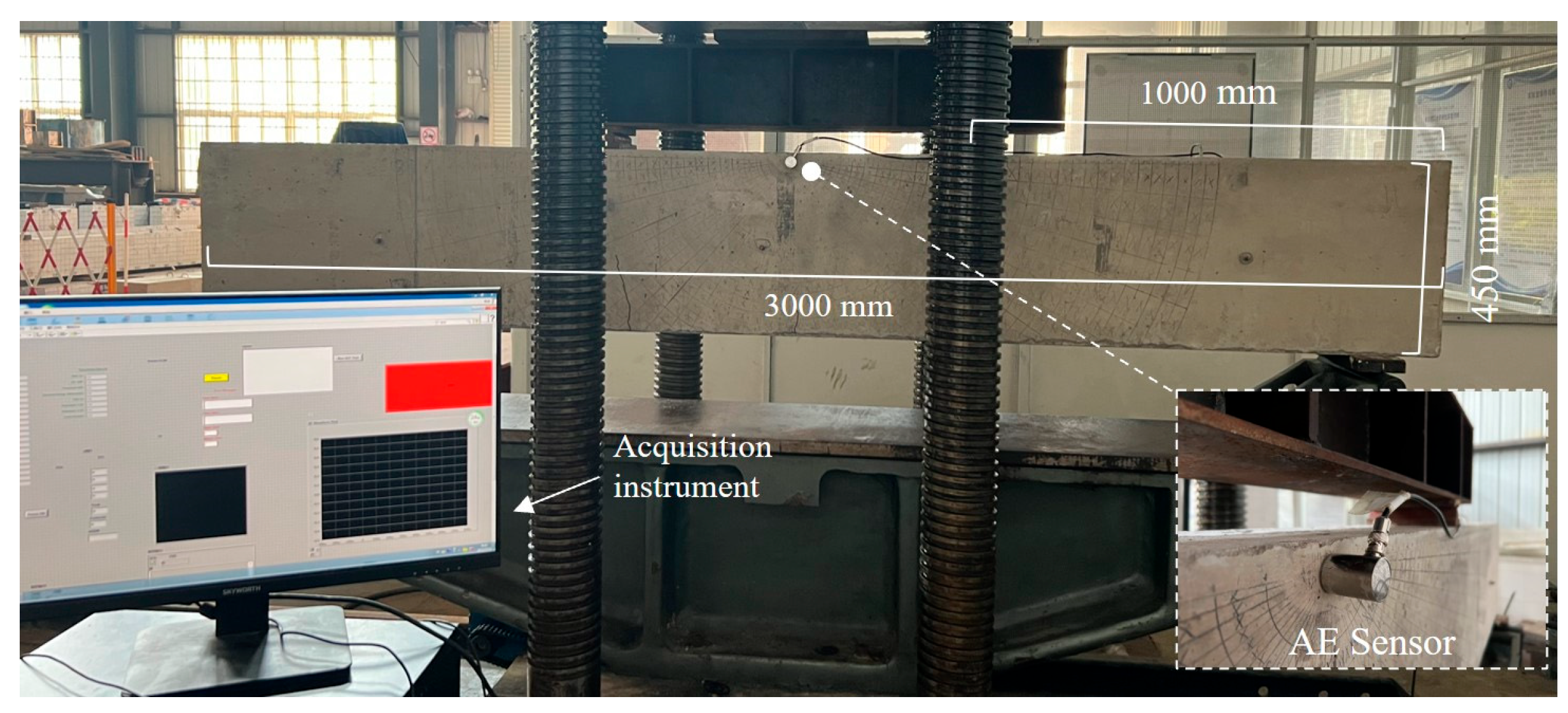
As shown in Figure 3, the shape and loading method of the RC rectangular beams conform to the standard four-point loading test for RC rectangular beams. The dimensions of the RC rectangular beam were 3000 mm × 450 mm × 200 mm. The main structural components consisted of C30 concrete and HRB400 longitudinal reinforcement. The diameters of the top tensile reinforcement and bottom tensile reinforcement were 20 mm and 22 mm, respectively. The tests are performed using a microcomputer-controlled electro-hydraulic columnar pressure testing machine, with a loading rate of 1 mm/min. AE sensors were placed at the mid-span location of the RC rectangular beams. For the four-point loading tests on the rectangular beams, particular attention is paid to the variations in flexural-shear crack characteristics under different loading phases, a point explicitly elucidated in previous research [30]. Given that these crack characteristics have a significant impact on the overall structural performance of the RC rectangular beams, they introduce additional complexities for the verification of generalization capabilities.

3. Architecture and Methodology of TemporalAE-Net

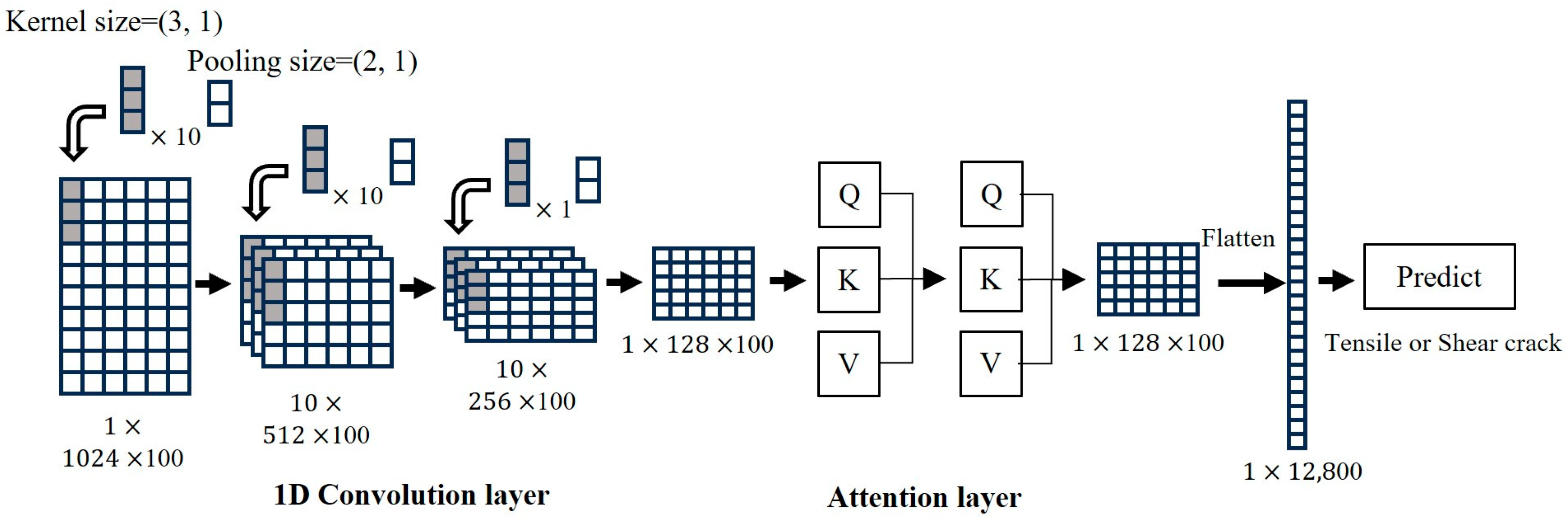
TemporalAE-Net employs one-dimensional convolutional layers and attention mechanisms to achieve classification of crack patterns. The architecture of TemporalAE-Net is elaborately depicted in Figure 4. TemporalAE-Net takes preprocessed samples as described in Section 2.2 as its input and produces outputs for a binary classification task, distinguishing between tensile cracks and shear cracks.
To improve reproducibility, a systematic hyperparameter exploration was conducted prior to final model selection. Key architectural parameters, including convolution kernel size, number of convolution filters, and the number of attention heads, were evaluated over discrete candidate sets, as summarized in Table 4. A grid-based search strategy was adopted, and configurations were compared based on validation accuracy and training stability. The final hyperparameters were selected as a balanced trade-off between classification performance, model complexity, and computational efficiency.

3.1. One-Dimensional Convolution

To preserve the temporal continuity of the AE signals while extracting discriminative features for crack type classification, TemporalAE-Net employs one-dimensional (1D) convolutional operations at the initial stage of the network. A convolution kernel of size 3 × 1 with 10 filters was selected based on parameter tuning and preliminary experiments, ensuring an effective balance between feature extraction ability and computational efficiency.
Given an input temporal matrix X T × L , where T denotes the number of AE signals within a temporal window and L is the signal length (1024 points), the 1D convolution operation applies a learnable kernel W 3 × 1 across each row. For an input segment x i : i + k 1 , the convolutional output is computed as
z i = R e L U ( j = 0 k 1 W j x i + j + b ) ,
where k = 3 is the kernel size, b is the learnable bias term. To introduce non-linearity and improve representation capability, the Rectified Linear Unit (ReLU) activation is applied:
R e L U ( x ) = m a x ( 0 , x ) .
The convolution is performed with a stride of 1, allowing the kernel to slide across the temporal matrix and capture local temporal patterns that may correspond to critical AE waveform characteristics. The resulting feature maps encode short-term dependencies while preserving the global temporal ordering.
To further reduce computational cost and mitigate overfitting, a max-pooling operation with a window size of 2 × 1 and a stride of 1 is incorporated after the convolution layer. Max-pooling compresses the feature maps by retaining only the most prominent response within each local neighborhood:
p i = max z i , z i + 1 ,
thereby emphasizing salient local features while suppressing noise and redundant information.
Through this combination of 1D convolution and max-pooling, the network efficiently extracts localized temporal features essential for distinguishing between tensile and shear cracks.

3.2. Attention Mechanism

The attention mechanism represents a key component of TemporalAE-Net, enabling the extraction of global dependencies across the temporal dimension of AE signals. While one-dimensional convolution primarily captures local features within short temporal neighborhoods, self-attention allows the network to adaptively assign different weights to different positions in the input sequence. This capability is particularly advantageous for AE-based crack type classification, as tensile–shear transition behaviors and waveform characteristics often exhibit long-range correlations across time.
To enhance feature representation capability, a Multi-Head Self-Attention structure is adopted. TemporalAE-Net employs two stacked self-attention layers, each configured with 10 attention heads (num_heads = 10) and a key dimension of 100 (key_dim = 100), based on empirical tuning to optimize performance. For an input sequence X, the multi-head attention operation is defined as:
MultiHead ( Q , K , V ) = Concat ( head 1 , head 2 , , head h ) W O ,
where each attention head is computed as:
head i = Attention ( Q W Q ( i ) , K W K ( i ) , V W V ( i ) ) .
The scaled dot-product attention mechanism is expressed as:
Attention ( Q , K , V ) = softmax ( Q K d k ) V ,
where Q, K, and V denote the query, key, and value matrices, W Q ( i ) , W K ( i ) , W V ( i ) are learnable projection matrices for head i, W O is the output projection matrix, and d k the key dimension used for normalization.
Through this mechanism, the network learns to emphasize temporally important AE signals—such as those containing high-energy events or precursors of shear behavior—while suppressing irrelevant or noisy segments. This ability to model long-range temporal interactions significantly enhances the accuracy and robustness of crack type classification.

3.3. Model Training and Evaluation

Following the temporal reconstruction process, the dataset was randomly divided into a training set (80%) and a test set (20%) to enable supervised learning and unbiased performance assessment. The model parameters were optimized using the Adam algorithm, while the cross-entropy loss function was adopted as the objective function for updating the network weights during training.
To reduce the risk of overfitting and enhance model generalization, an early-stopping strategy was applied. Training was terminated when the validation loss failed to decrease for three consecutive epochs, preventing unnecessary weight updates and ensuring that the model does not overadapt to the training data. Once early stopping was triggered, the best-performing model was preserved and subsequently evaluated using the independent test set.
Model performance was comprehensively assessed using multiple standard classification metrics, including accuracy, recall, precision, F1-score, and the area under the ROC curve (ROC-AUC). These metrics provide complementary insights into the model’s predictive capability, robustness to data imbalance, and sensitivity to shear crack identification—an aspect of particular importance for structural safety. Additionally, training time was recorded to evaluate the computational efficiency and practical applicability of the model. A summary of these evaluation metrics is presented in Table 5.
To further analyze the contribution of individual network components, two ablation models were developed:
  • TemporalAE-Net-no1DC, in which the one-dimensional convolutional layer was removed and the input was fed directly into the attention module;
  • TemporalAE-Net-noATT, in which the attention mechanism was omitted entirely.
These ablation studies enable a systematic examination of the respective roles of convolutional feature extraction and attention-based global correlation learning, providing deeper insight into their contributions to overall model performance.

4. Results and Discussion

4.1. TemporalAE-Net Performance

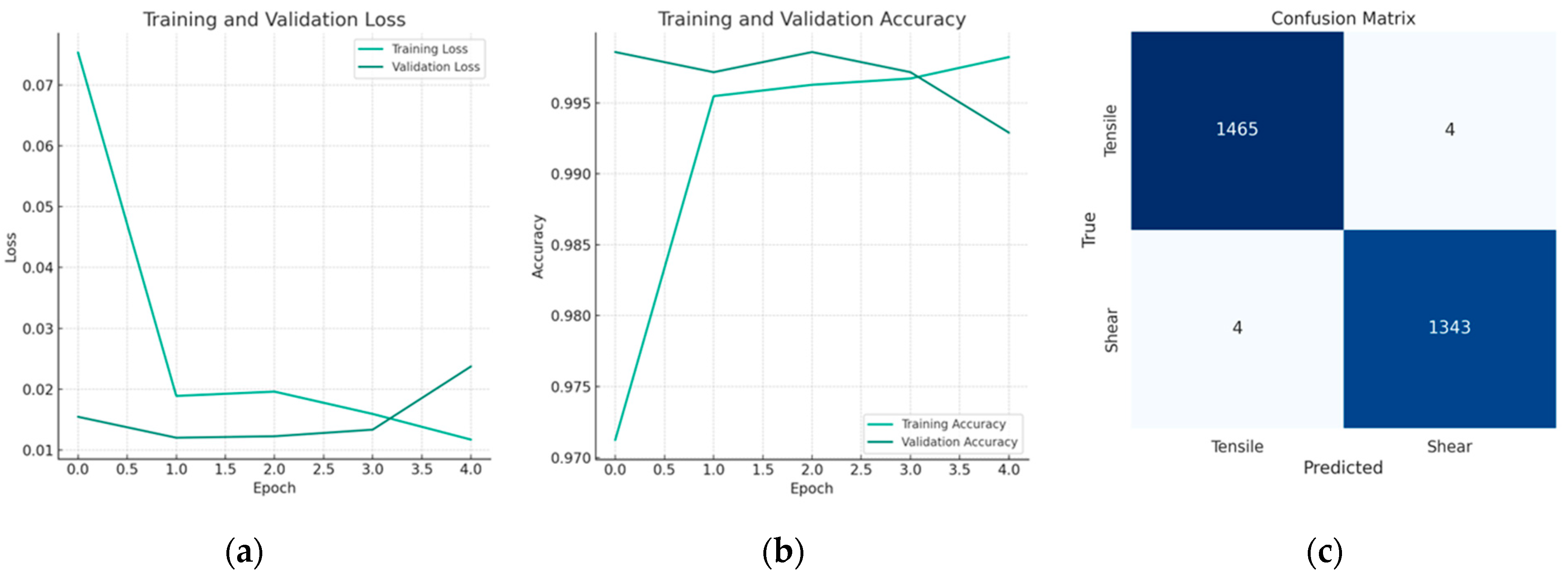
To comprehensively evaluate the performance of the model, various performance metrics were employed, as shown in Table 6. The model’s accuracy, recall, precision, and F1 score are all nearing 100%, indicating exemplary performance in this task. As demonstrated in Figure 5a,b, the model exhibits excellent performance in terms of both loss and accuracy during the training and validation phases. Notably, both the training loss and validation loss exhibit a decreasing trend, while training accuracy and validation accuracy show an increasing trajectory. It is worth noting that the validation accuracy exceeds 0.97 within the first training epoch, indicating rapid convergence of the proposed model. Therefore, the early-stopping criterion with a patience of three epochs is considered sufficient to prevent overfitting while avoiding unnecessary training iterations.
Figure 5c presents the confusion matrix, revealing nearly flawless performance across two categories, namely, tensile and shear. Specifically, the model misclassified only eight instances. Given the exceedingly low number of misclassified instances, these errors are more likely attributable to data noise or outliers rather than systematic model deficiencies.

4.2. Sensitivity Analysis of Window Size Selection

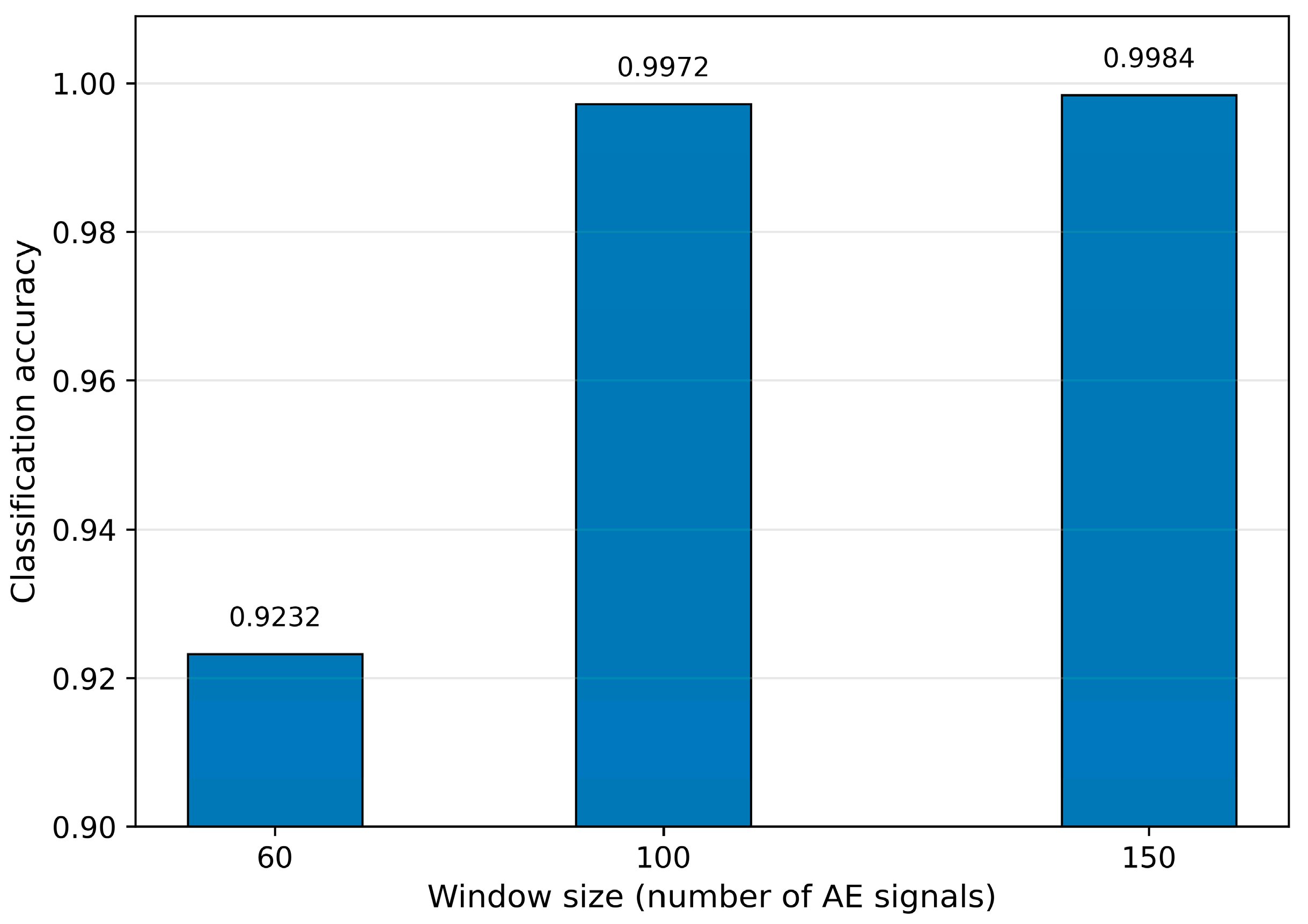
To further investigate the influence of window size on temporal information capture and classification performance, a sensitivity analysis was conducted by evaluating three representative window sizes: 60, 100, and 150 AE signals. As shown in Figure 6, the classification accuracy increases significantly when the window size is enlarged from 60 to 100, improving from 0.9232 to 0.9972. This indicates that a window size of 60 is insufficient to fully capture the temporal evolution of AE activities associated with crack propagation.
Further increasing the window size from 100 to 150 yields only a marginal accuracy improvement (from 0.9972 to 0.9984). However, this slight gain is accompanied by a substantial increase in GPU memory consumption. This behavior is primarily attributed to the self-attention mechanism employed in TemporalAE-Net, whose memory complexity scales quadratically with the sequence length due to the construction of attention score matrices. As a result, excessively large window sizes significantly increase computational cost without providing commensurate performance benefits.
Considering both classification accuracy and computational efficiency, a window size of 100 AE signals was selected as an optimal trade-off. This configuration provides sufficient temporal context for reliable crack type discrimination while maintaining feasible memory requirements for practical deployment.

4.3. Advantages of TemporalAE-Net

4.3.1. Performance Advantages

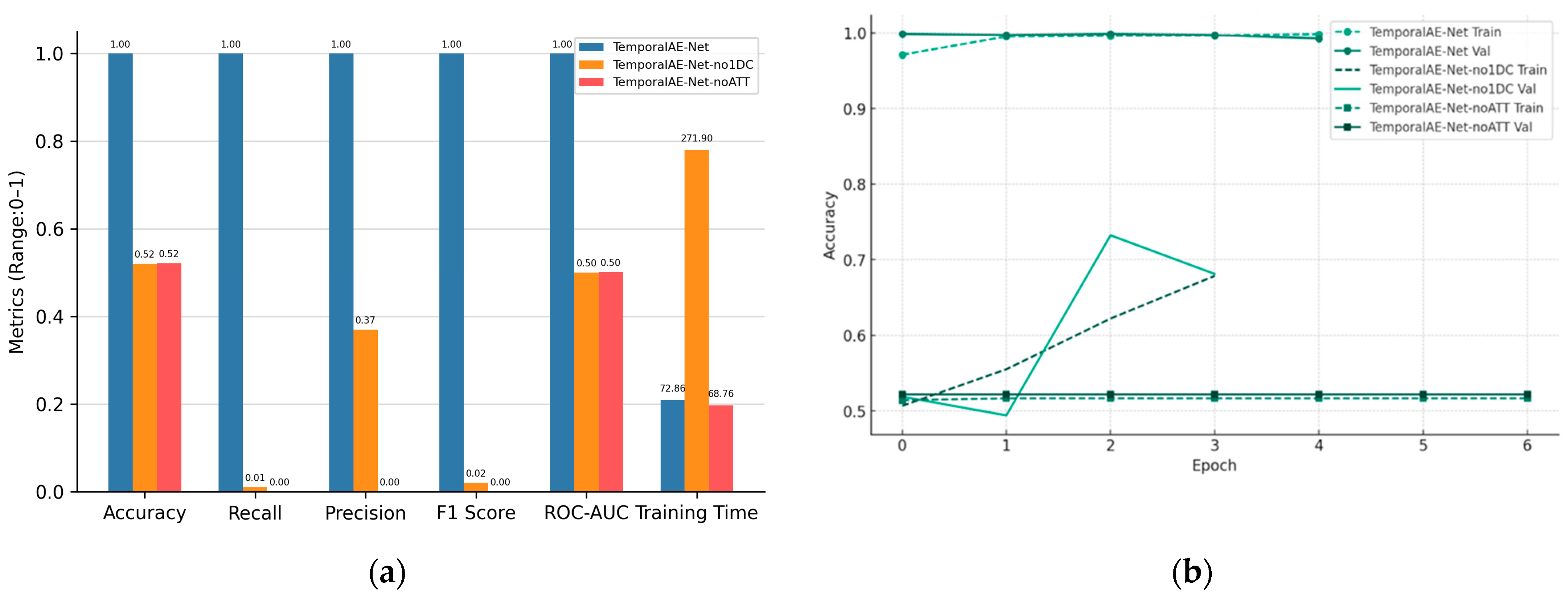
Although Section 4.1 has demonstrated the strong performance of TemporalAE-Net, the ablation results further highlight the importance of its core components. As shown in Figure 7a, the two variant models—TemporalAE-Net-no1DC and TemporalAE-Net-noATT—exhibit substantial declines across all evaluation metrics, including accuracy, recall, precision, F1 score, and ROC-AUC. Their ROC-AUC values in particular approach near-random classification, underscoring the critical roles of both the one-dimensional convolution layer and the attention mechanism in effective crack type discrimination.
Figure 7b further compares the training behavior of the three models. TemporalAE-Net shows a stable and steadily increasing accuracy trend for both training and validation sets, with no evidence of overfitting or underfitting. In contrast, the two ablation variants display unstable or stagnant accuracy curves, with TemporalAE-Net-no1DC requiring significantly longer training time. These observations confirm that the full model not only achieves superior predictive performance but also maintains better training stability and computational efficiency.

4.3.2. Comparison with Baseline Machine Learning Models

To further evaluate the effectiveness of the proposed TemporalAE-Net, its performance was compared with several representative baseline models commonly used for time-series and AE signal classification, including a purely convolutional network (1D-CNN), a Long Short-Term Memory network (LSTM), and a Gated Recurrent Unit network (GRU). All baseline models were trained and evaluated using the same dataset split and preprocessing strategy to ensure a fair comparison.
The Baseline 1D-CNN adopts a hierarchical convolutional architecture consisting of three one-dimensional convolutional layers with increasing channel numbers (32, 64, and 128) and decreasing kernel sizes (7, 5, and 3). Each convolutional layer is followed by max-pooling for temporal downsampling, and a global average pooling layer is applied before the fully connected layers.
The LSTM and GRU baseline models are designed to capture sequential dependencies through recurrent units. However, directly processing the full temporal length (1024 time steps) would result in excessive computational cost and memory consumption. Therefore, both models employ an initial convolutional layer with 32 filters and a kernel size of 5, followed by max-pooling with a factor of 4, reducing the effective sequence length from 1024 to 256. A single recurrent layer with 64 hidden units is then applied, followed by a fully connected layer with dropout for classification.
Table 7 summarizes the quantitative comparison results, including validation accuracy, number of trainable parameters, and inference speed. Compared with the baseline models, TemporalAE-Net achieves the highest classification accuracy (0.9972) while maintaining a moderate model size. Although the 1D-CNN baseline exhibits faster inference speed due to its simpler structure, its classification accuracy is noticeably lower, indicating limited capability in capturing global temporal relationships. The LSTM and GRU models show inferior performance in both accuracy and efficiency, suggesting that recurrent architectures alone are less effective for modeling the complex temporal evolution patterns present in AE signals.
Overall, these results demonstrate that the proposed TemporalAE-Net provides a better balance between accuracy, model complexity, and inference efficiency, benefiting from the combination of convolution-based local feature extraction and self-attention-based global temporal modeling.

4.3.3. Interpretability Analysis of TemporalAE-Net

Although deep neural networks are often criticized for their “black-box” nature, the design of TemporalAE-Net incorporates components—such as one-dimensional convolution and self-attention—that enable a certain degree of interpretability. Understanding how these modules process AE signals is essential for building trust in the model, especially in critical engineering applications like structural health monitoring.
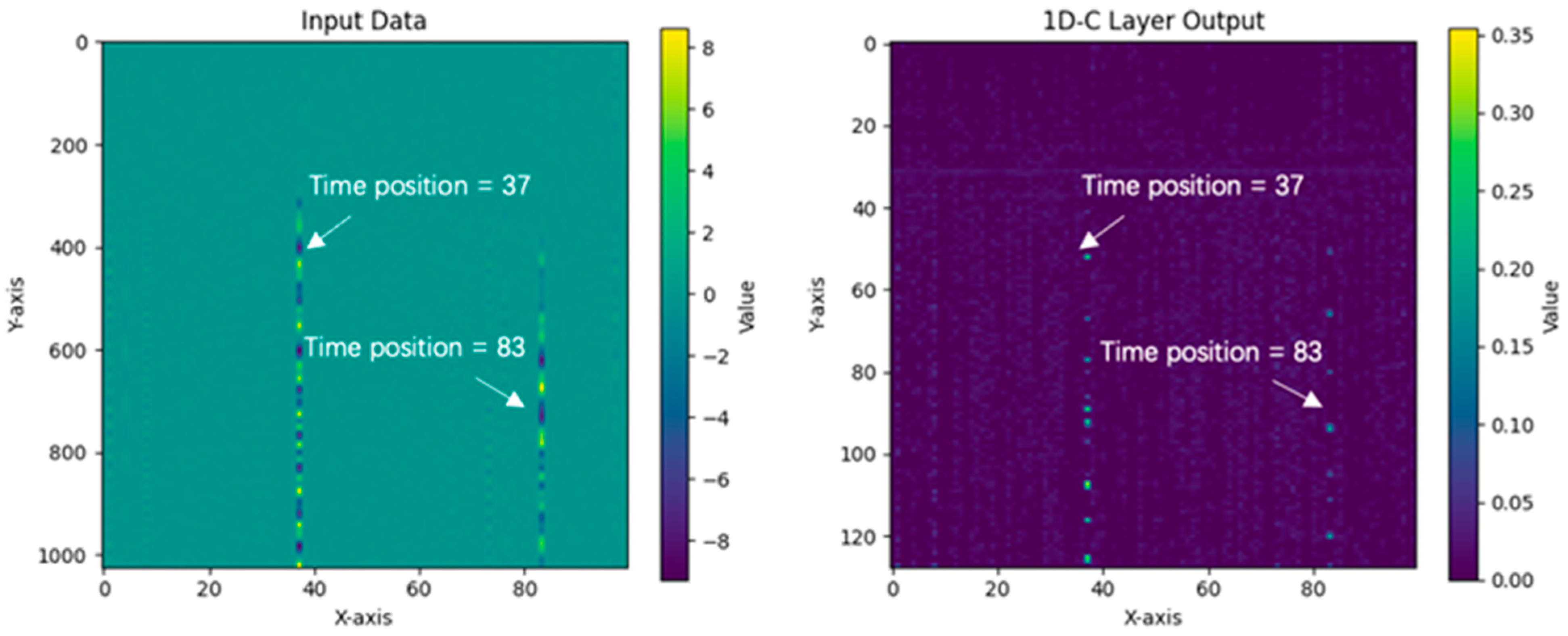
Figure 8 presents a comparison between the input temporal matrix and the output of the 1D convolutional layer for a representative sample. The convolution operation compresses local waveform segments while retaining the global temporal order. Notably, salient temporal features—such as peaks or abrupt changes in signal amplitude—remain aligned in time after convolution (e.g., at time positions 37 and 83). This demonstrates that the 1D convolution not only extracts meaningful local patterns but also preserves the temporal structure necessary for interpreting the evolution of AE events. Such preservation is critical, as the initiation and propagation of cracks are inherently time-dependent phenomena.
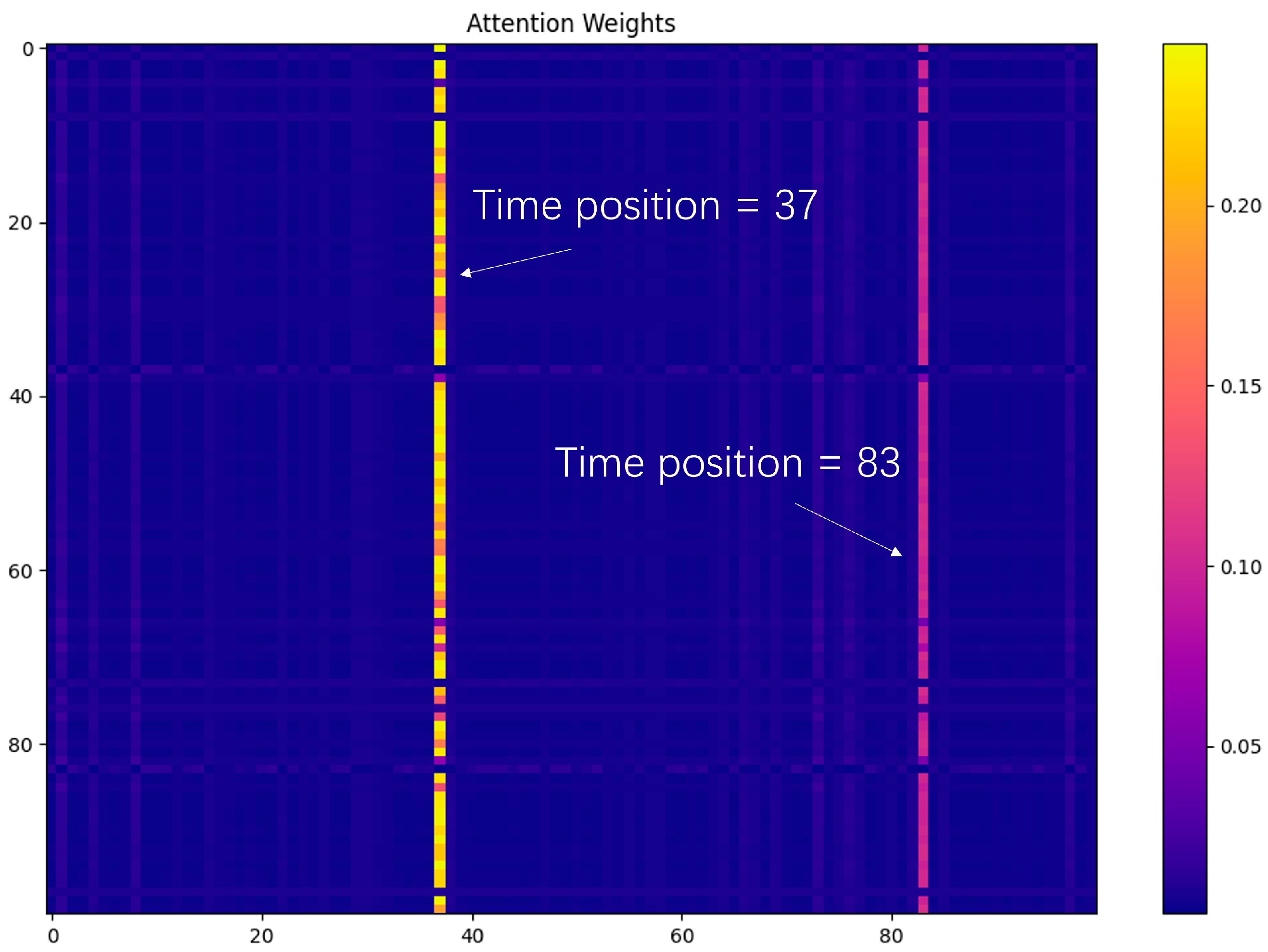
Complementing the convolutional analysis, Figure 9 visualizes the attention-weight matrix generated by the multi-head self-attention mechanism for the same input sample. The heatmap reveals that the attention module assigns significantly higher weights to specific time positions—again, notably around positions 37 and 83—indicating that the model actively focuses on these high-information regions. This behavior aligns with human expert intuition, as analysts typically concentrate on strong-amplitude or energy-dense AE events when differentiating between tensile and shear crack activities.
Together, Figure 8 and Figure 9 reveal that TemporalAE-Net possesses an interpretable internal decision process:
  • The convolution layer amplifies salient waveform characteristics while preserving their temporal alignment.
  • The attention mechanism further identifies and prioritizes key AE signals, effectively suppressing noise and irrelevant information.
These observations demonstrate that TemporalAE-Net not only achieves high classification accuracy but also learns meaningful temporal patterns consistent with physical cracking behaviors. This interpretability strengthens the model’s reliability and suitability for real-time structural health monitoring tasks.
Nevertheless, the current interpretation is primarily qualitative, and the correspondence between attention weights and specific physical damage mechanisms has not yet been quantitatively established. Future work will focus on systematically linking attention responses to detailed AE source mechanisms—such as aggregate bridging, frictional sliding, or fiber pull-out—through combined experimental observations and physics-informed analysis, thereby further enhancing the interpretability and generalizability of the proposed framework.

4.4. Generalization Capability

Generalization capability is a critical indicator of a model’s robustness, reflecting its performance on previously unseen data. To thoroughly evaluate the generalization ability of TemporalAE-Net, two levels of validation were conducted: (1) small-scale specimens not involved in training and (2) four-point bending tests on reinforced concrete (RC) beams exhibiting mixed crack modes.

4.4.1. Validation Using Small-Scale Specimens

Table 8 summarizes the classification results for the 12 small-scale specimens described in Section 2.3. All specimens used in this validation were excluded from model training and testing and were obtained from independent experimental runs under the same loading configurations. TemporalAE-Net achieved a 100% classification accuracy on these unseen specimens, indicating strong generalization capability within the investigated experimental conditions. All small-scale specimens were obtained from independent tests conducted under the same experimental protocol ensuring specimen-level independence. In addition, A 95% Wilson CI was computed at the sample level; the lower bound remained above 99.9%.
These results confirm that the model achieves a strong balance between model complexity and generalization performance, avoiding both overfitting and underfitting tendencies. Nevertheless, it should be noted that the reported 100% classification accuracy on the small-scale specimens is obtained from a limited number of experimental tests conducted under controlled laboratory conditions. Although these specimens were not used during model training, they were prepared following similar procedures and loading configurations, which may introduce potential correlations. In addition, the finite sample size implies that the observed accuracy is subject to statistical uncertainty. To address this, confidence intervals were estimated for the classification results, and future work will focus on validating the proposed framework using larger and more diverse datasets obtained from different batches, material compositions, and loading conditions.

4.4.2. Validation Using RC Beam Tests

To further evaluate model robustness under more complex structural behavior, TemporalAE-Net was tested on AE data obtained from four-point bending tests on RC rectangular beams. Due to the coexistence of tensile and shear cracks during beam failure, this dataset provides a more challenging validation scenario.
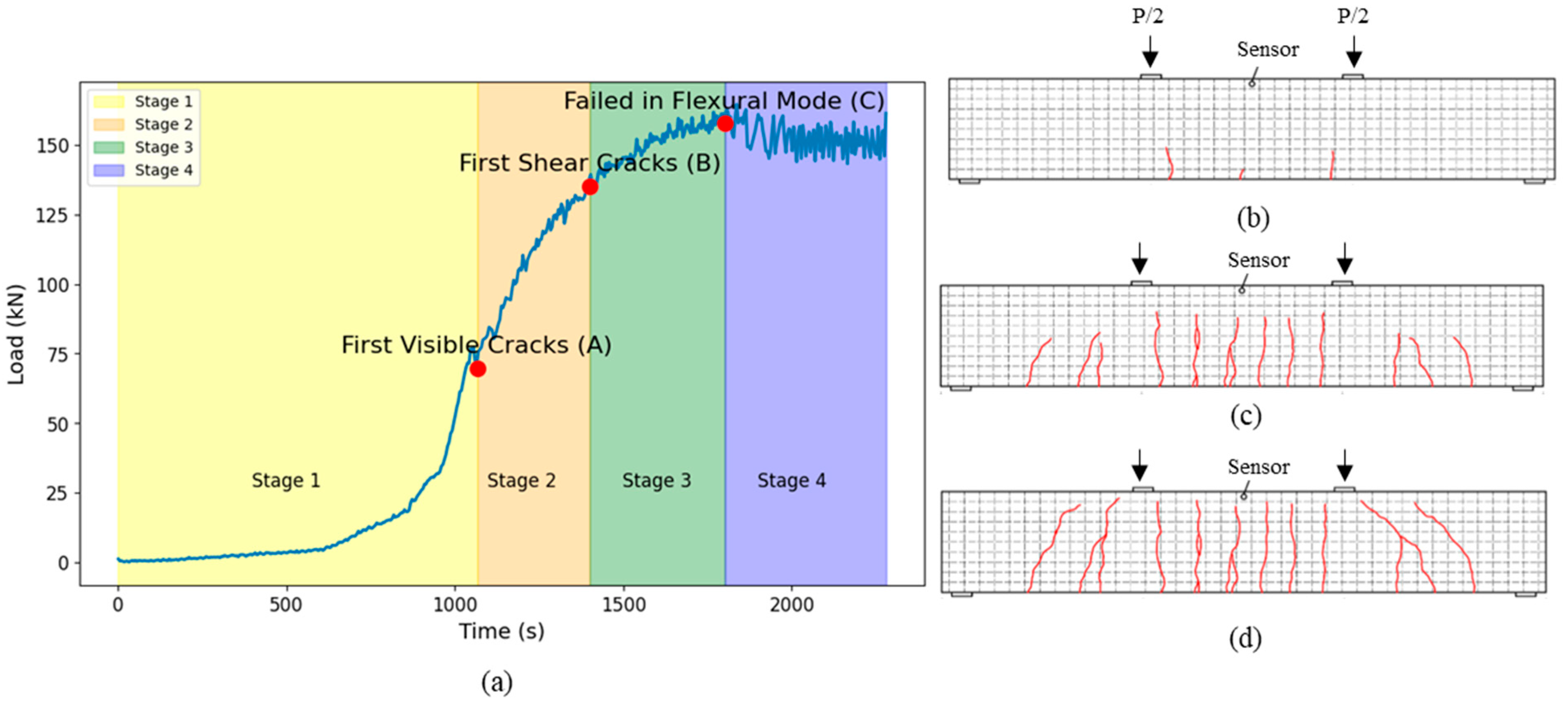
Figure 10a shows the load–time response of the tested RC beam, highlighting key cracking stages:
  • Stage 1: Micro-crack formation
  • Stage 2: Appearance of first visible crack (Point A, 1065 s)
  • Stage 3: Emergence of distributed tensile and shear cracks (Point B, 1400 s)
  • Stage 4: Localized damage and final failure (Point C, 1800 s)
Figure 10b–d further illustrate the crack propagation patterns corresponding to these stages.
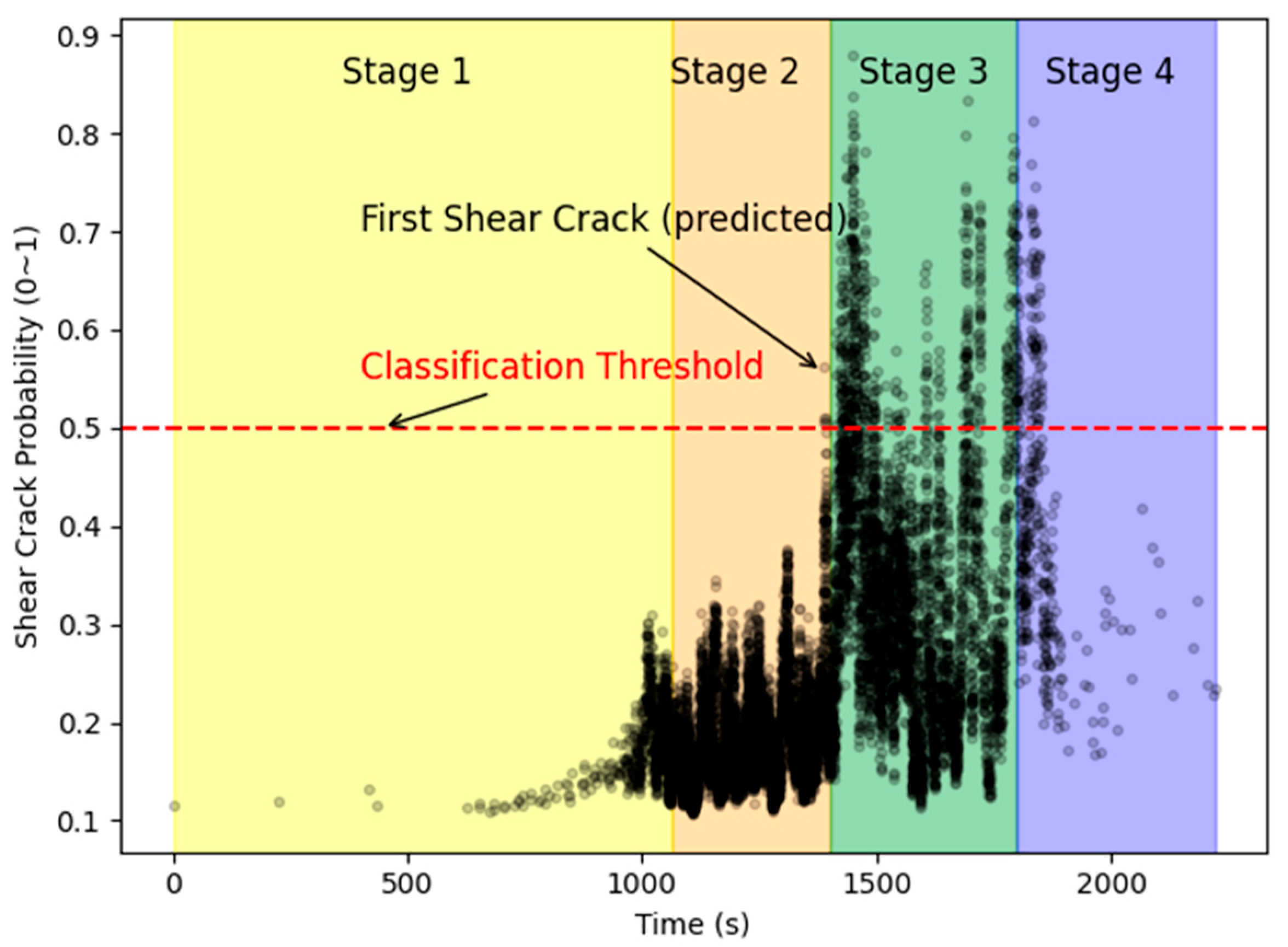
Figure 11 depicts the predicted shear-crack probability over time. A classification threshold of 0.5 was used: values above 0.5 indicate shear cracks, while lower values indicate tensile cracks. The threshold value of 0.5 was selected as the default decision threshold for sigmoid outputs. This choice provides an intuitive and consistent criterion for binary crack type classification and is commonly adopted in probabilistic classification tasks. Additional threshold sensitivity analyses (e.g., precision–recall trade-offs) may further refine decision boundaries for specific engineering applications and will be explored in future work.
The model outputs reveal the following:
  • Stage 1: All AE signals are classified as tensile, consistent with the pure flexural behavior observed experimentally.
  • Stage 2: TemporalAE-Net predicts the first shear crack at 1385 s, which is approximately 15 s earlier than visual detection (at 1400 s). This early detection is likely due to the model capturing subtle precursors of shear behavior that are difficult to observe manually.
  • Stages 3 & 4: Increasing crack complexity results in a mixed pattern of tensile and shear predictions, consistent with the expected mechanical behavior of RC beams approaching failure.
Table 9 compares the predicted tensile–shear proportions at different stages with the experimental findings of Aldahdooh et al. [30,31]. The close agreement between predictions and established results demonstrates the physical consistency and reliability of the model.
The model’s predictions closely match documented crack evolution trends, reinforcing that TemporalAE-Net effectively captures both the onset and progression of tensile and shear cracking under realistic structural loading conditions.
Although the present study focuses on four-point bending tests of rectangular RC beams, the proposed TemporalAE-Net framework is not inherently restricted to this loading configuration. Since the model relies on temporal patterns of AE signals rather than geometric crack features, it has the potential to be extended to other loading regimes, such as cyclic fatigue or impact loading, where crack initiation and evolution are also accompanied by characteristic AE sequences. In such scenarios, the self-attention mechanism may be particularly beneficial for identifying critical AE events within highly non-stationary signal streams.
Furthermore, the framework is expected to be applicable to different concrete types, including fiber-reinforced or ultra-high-performance concrete, although material heterogeneity may alter AE signal characteristics. In these cases, retraining or fine-tuning with material-specific data would be required to ensure reliable performance. It should be noted that the current validation is limited to a specific loading mode and specimen geometry, and future studies will focus on expanding the dataset to encompass a wider range of structural configurations and loading conditions.

4.5. Potential Deployment and Integration with SHM Systems

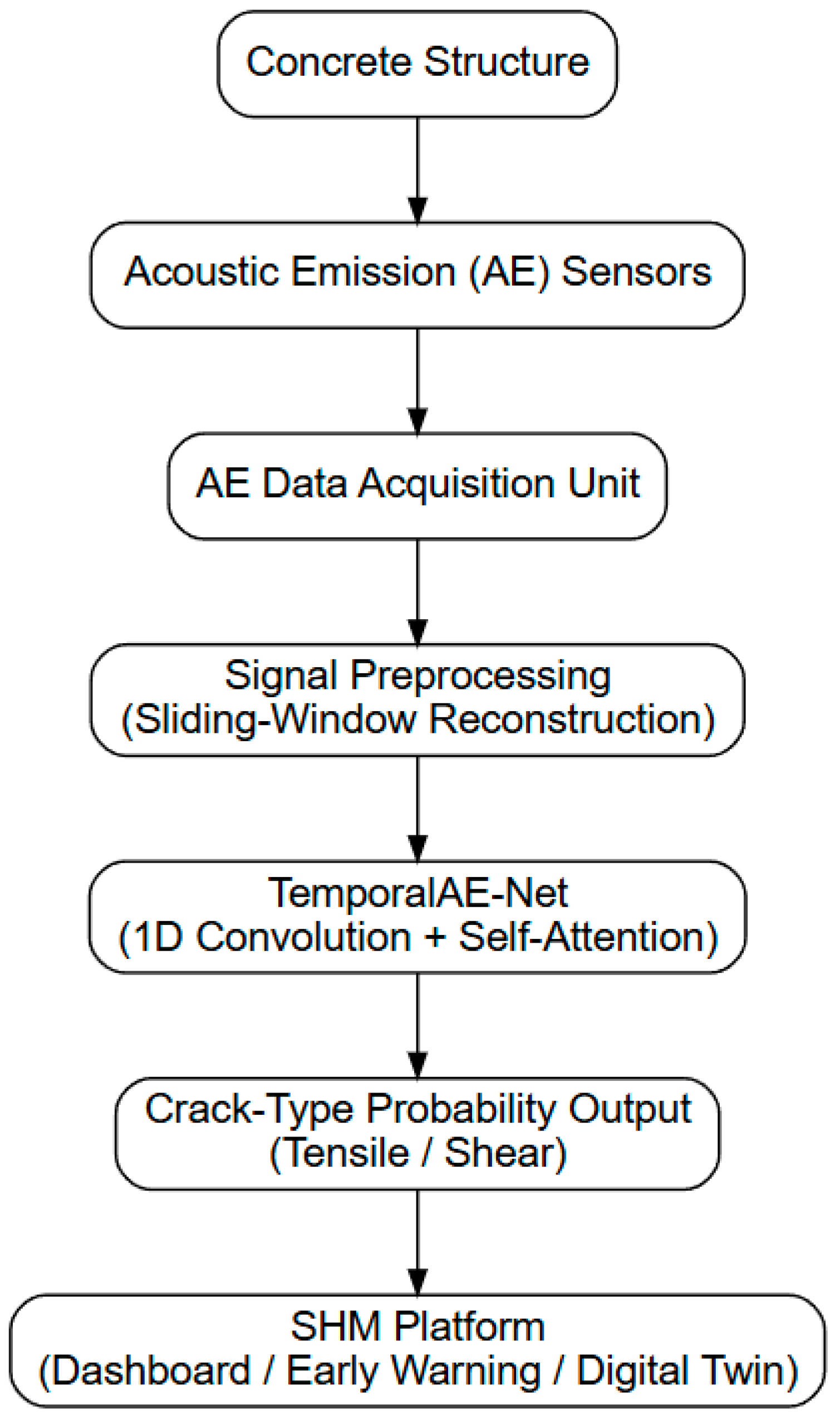
Although the present study primarily focuses on model development and experimental validation, the proposed TemporalAE-Net framework is designed with potential practical application in mind and can be integrated into existing structural health monitoring (SHM) systems. A conceptual deployment workflow is illustrated in Figure 12 to demonstrate how the proposed method could be incorporated into an AE-based SHM framework. In such a scenario, AE sensors installed on concrete structures continuously acquire raw waveform data, which are processed by standard AE acquisition units to generate time-series signals. These signals are subsequently reconstructed into temporal matrices using a sliding-window strategy and fed into the trained TemporalAE-Net model for real-time crack type classification.
From a computational perspective, TemporalAE-Net exhibits moderate model complexity and high inference efficiency, indicating that near-real-time processing could be achieved on commonly available hardware, such as industrial PCs or edge-computing devices equipped with GPUs or high-performance CPUs. Depending on system configuration and computational resources, crack type identification may therefore be performed either locally at the monitoring site (edge inference) or remotely via cloud-based SHM platforms.
With respect to system integration, the proposed framework is intended to operate as a modular analytical component within existing SHM architectures. As illustrated in Figure 12, the model outputs—namely, probabilistic predictions of tensile and shear cracking—can be transmitted to a central monitoring interface or digital twin system. Such outputs have the potential to support condition assessment, early warning, and decision-making by providing mechanism-oriented information, thereby complementing conventional threshold-based AE parameters.
Despite this potential for integration, several challenges should be considered for real-world SHM applications, including variations in sensor layouts, environmental noise, material heterogeneity, and structural configurations, which may lead to discrepancies between laboratory and field AE data. These challenges could be mitigated through site-specific calibration, model fine-tuning using limited field data, or transfer learning strategies to improve adaptability across different monitoring scenarios.

5. Conclusions

This study proposed TemporalAE-Net, a novel machine-learning framework incorporating temporal reconstruction, one-dimensional convolution, and multi-head self-attention mechanisms for classifying tensile and shear cracks from Acoustic Emission (AE) signals. Based on comprehensive experimental validation—including small-scale specimens and full-scale RC beam tests—the following conclusions can be drawn:
  • TemporalAE-Net achieves highly accurate crack type classification through effective temporal feature learning. By combining temporal reconstruction, 1D convolution, and self-attention, the model captures both local waveform features and long-range temporal dependencies. It reaches 0.9972 accuracy, 0.9970 precision/recall, and an ROC-AUC of 0.997, misclassifying only eight samples, while visualization confirms that it focuses on physically meaningful temporal positions.
  • The model demonstrates strong generalization capability across specimen types and loading scales. TemporalAE-Net correctly classified 100% of over 180,000 unseen AE signals from small specimens. In RC beam tests, its predictions aligned with documented crack evolution and even identified shear cracks ~15 s earlier than visual observation.
  • TemporalAE-Net provides high computational efficiency suitable for real-time monitoring. The model processes approximately 800 AE samples per second, classifying 33,207 samples in 41.47 s, enabling real-time application. Ablation studies show that removing convolution or attention components leads to severe performance degradation, confirming their necessity for reliable and efficient crack classification.
Nevertheless, this study still has certain limitations. First, the experimental dataset primarily involves a limited range of concrete materials (UHPC for tensile specimens and composite concrete for shear specimens), which may influence the direct transferability of the proposed model to other concrete types or material configurations. Future work will therefore focus on extending the validation to a broader range of materials, such as normal-strength concrete, fiber-reinforced concrete, and strengthened composite systems, to further assess the robustness and transferability of the proposed framework.

Author Contributions

Conceptualization, D.Z. and S.W.; methodology, D.Z. and S.W.; software, D.Z. and S.W.; validation, D.Z. and S.W.; formal analysis, D.Z. and S.W.; investigation, X.K. and B.W.; resources, X.K. and B.W.; data curation, X.K. and B.W.; writing—original draft preparation, D.Z.; writing—review and editing, S.W.; visualization, D.Z.; supervision, D.Y. and W.W.; project administration, D.Y. and W.W.; funding acquisition, D.Y. and W.W. All authors have read and agreed to the published version of the manuscript.

Funding

This research was funded by National Natural Science Foundation of China, grant number 52278304 and 52278141.

Institutional Review Board Statement

Not applicable.

Informed Consent Statement

Not applicable.

Data Availability Statement

All data, models, or code that support the findings of this study are available from the corresponding author upon reasonable request.

Conflicts of Interest

Authors Ding Zhou, Xiongcai Kang, Bo Wang were employed by the company Hunan Provincial Water Transportation Construction & Investment Group Co. Ltd. The remaining authors declare that the research was conducted in the absence of any commercial or financial relationships that could be construed as a potential conflict of interest.

Abbreviations

The following abbreviations are used in this manuscript:
AEAcoustic Emission
AFAverage Frequency
RARise time to Amplitude ratio
RCReinforced Concrete
UHPCUltra-High-Performance Concrete
1DCOne-Dimensional Convolution
MLPMultilayer Perceptron
ReLURectified Linear Unit
ROC-AUCReceiver Operating Characteristic–Area Under the Curve
TemporalAE-NetProposed Temporal Acoustic-Emission Network
TemporalAE-Net-no1DCTemporalAE-Net without One-Dimensional Convolution
TemporalAE-Net-noATTTemporalAE-Net without Attention Mechanism

References

  1. Su, C.; Wang, W. Concrete cracks detection using convolutional neural network based on transfer learning. Math. Probl. Eng. 2020, 2020, 7240129. [Google Scholar] [CrossRef]
  2. Russo, N.; Gastaldi, M.; Marras, P.; Schiavi, L.; Strini, A.; Lollini, F. Effects of load-induced micro-cracks on chloride penetration resistance in different types of concrete. Mater. Struct. 2020, 53, 143. [Google Scholar] [CrossRef]
  3. Kim, H.; Lee, J.; Ahn, E.; Cho, S.; Shin, M.; Sim, S.-H. Concrete crack identification using a UAV incorporating hybrid image processing. Sensors 2017, 17, 2052. [Google Scholar] [CrossRef]
  4. Islam, M.M.M.; Kim, J.M. Vision-based autonomous crack detection of concrete structures using a fully convolutional encoder–decoder network. Sensors 2019, 19, 4251. [Google Scholar] [CrossRef]
  5. Mpalaskas, A.C.; Matikas, T.E.; Aggelis, D.G.; Alver, N. Acoustic emission for evaluating the reinforcement effectiveness in steel fiber reinforced concrete. Appl. Sci. 2021, 11, 3850. [Google Scholar] [CrossRef]
  6. Scruby, C.B. An introduction to acoustic emission. J. Phys. E Sci. Instrum. 1987, 20, 946. [Google Scholar] [CrossRef]
  7. Pullin, R.; Eaton, M.J.; Hensman, J.J.; Holford, K.M.; Worden, K.; Evans, S. Validation of acoustic emission (AE) crack detection in aerospace grade steel using digital image correlation. Appl. Mech. Mater. 2010, 24, 221–226. [Google Scholar] [CrossRef]
  8. Wang, S.; Wang, W.; Yan, D.; Liu, X.; Deng, Y.; Huo, Y.; Hua, X. Noise-robust acoustic emission source localization in reinforced concrete structures using a novel deep learning framework with skip connections. Mech. Syst. Signal Process. 2025, 240, 113387. [Google Scholar] [CrossRef]
  9. Du, F.; Pan, S.; Li, D. Damage evaluation and failure mechanism analysis of steel tube confined reinforced-concrete columns by acoustic emission technology. Lat. Am. J. Solids Struct. 2018, 15, e136. [Google Scholar] [CrossRef]
  10. Li, G.; Zhang, L.; Zhao, F.; Tang, J. Acoustic emission characteristics and damage mechanisms investigation of basalt fiber concrete with recycled aggregate. Materials 2020, 13, 4009. [Google Scholar] [CrossRef]
  11. ElBatanouny, M.K.; Larosche, A.; Mazzoleni, P.; Ziehl, P.H.; Matta, F.; Zappa, E. Identification of cracking mechanisms in scaled FRP reinforced concrete beams using acoustic emission. Exp. Mech. 2014, 54, 69–82. [Google Scholar] [CrossRef]
  12. Saliba, J.; Loukili, A.; Grondin, F.; Regoin, J.P. Identification of damage mechanisms in concrete under high level creep by the acoustic emission technique. Mater. Struct. 2014, 47, 1041–1053. [Google Scholar] [CrossRef]
  13. JCMS-III B5706; Monitoring Method for Active Cracks in Concrete by Acoustic Emission. Federation of Construction Materials Industries: Tokyo, Japan, 2003.
  14. Ohno, K.; Ohtsu, M. Crack classification in concrete based on acoustic emission. Constr. Build. Mater. 2010, 24, 2339–2346. [Google Scholar] [CrossRef]
  15. Aldahdooh, M.A.A.; Bunnori, N.M. Crack classification in reinforced concrete beams with varying thicknesses by mean of acoustic emission signal features. Constr. Build. Mater. 2013, 45, 282–288. [Google Scholar] [CrossRef]
  16. Mandal, D.D.; Bentahar, M.; El Mahi, A.; Brouste, A.; El Guerjouma, R.; Montresor, S.; Cartiaux, F.-B. Acoustic emission monitoring of progressive damage of reinforced concrete T-beams under four-point bending. Materials 2022, 15, 3486. [Google Scholar] [CrossRef]
  17. Ju, S.; Li, D.; Jia, J. Machine-learning-based methods for crack classification using acoustic emission technique. Mech. Syst. Signal Process. 2022, 178, 109253. [Google Scholar] [CrossRef]
  18. Shamsabadi, E.A.; Xu, C.; Rao, A.S.; Nguyen, T.; Ngo, T.; Dias-da-Costa, D. Vision transformer-based autonomous crack detection on asphalt and concrete surfaces. Autom. Constr. 2022, 140, 104316. [Google Scholar] [CrossRef]
  19. Xiao, S.; Shang, K.; Lin, K.; Wu, Q.; Gu, H.; Zhang, Z. Pavement crack detection with hybrid-window attentive vision transformers. Int. J. Appl. Earth Obs. Geoinf 2023, 116, 103172. [Google Scholar] [CrossRef]
  20. Khan, S.; Jan, A.; Seo, S. Structural crack detection using deep learning: An in-depth review. Korean J. Remote Sens. 2023, 39, 371–393. [Google Scholar]
  21. Kumar, P.; Purohit, G.; Tanwar, P.K.; Kota, S.R. Feasibility analysis of convolution neural network models for classification of concrete cracks in Smart City structures. Multimed. Tools Appl. 2023, 82, 38249–38274. [Google Scholar] [CrossRef]
  22. Vaswani, A.; Shazeer, N.; Parmar, N.; Uszkoreit, J.; Jones, L.; Gomez, A.N.; Kaiser, Ł.; Polosukhin, I. Attention is all you need. Adv. Neural Inf. Process. Syst. 2017, 30, 1–9. [Google Scholar]
  23. Dekker, R.; van der Meer, F.; Maljaars, J.; Sluys, L. A cohesive XFEM model for simulating fatigue crack growth under mixed-mode loading and overloading. Int. J. Numer. Methods Eng. 2019, 118, 561–577. [Google Scholar] [CrossRef]
  24. Chan, K.S. Time-dependent crack growth thresholds of Ni-base superalloys. Metall. Mater. Trans. A 2014, 45, 3454–3466. [Google Scholar] [CrossRef]
  25. Yang, J.; Chen, B.C.; Shen, X.J.; Shen, Y. The optimized design of dog-bones for tensile test of ultra-high performance concrete. Eng. Mech. 2018, 35, 37–46. [Google Scholar]
  26. Akcay, B. Experimental investigation on uniaxial tensile strength of hybrid fibre concrete. Compos. Part B Eng. 2012, 43, 766–778. [Google Scholar] [CrossRef]
  27. Mattock, A.H.; Hawkins, N.M. Shear transfer in reinforced concrete—Recent research. PCI J. 1972, 17, 55–75. [Google Scholar] [CrossRef]
  28. French, R.; Maher, E.; Smith, M.; Stone, M.; Kim, J.; Krauthammer, T. Direct shear behavior in concrete materials. Int. J. Impact Eng. 2017, 108, 89–100. [Google Scholar] [CrossRef]
  29. Jang, H.O.; Lee, H.S.; Cho, K.; Kim, J. Experimental study on shear performance of plain construction joints integrated with ultra-high performance concrete (UHPC). Constr. Build. Mater. 2017, 152, 16–23. [Google Scholar] [CrossRef]
  30. Aldahdooh, M.A.A.; Bunnori, N.M.; Johari, M.A.M. Damage assessment of reinforced concrete beams at different flexural damage levels using acoustic emission technique. Malays. Constr. Res. J. 2012, 2, 79–90. [Google Scholar]
  31. Aldahdooh, M.A.A.; Bunnori, N.M.; Johari, M.A.M. Damage evaluation of reinforced concrete beams with varying thickness using the acoustic emission technique. Constr. Build. Mater. 2013, 44, 812–821. [Google Scholar] [CrossRef]
Figure 1. Test setups for AE signal acquisition: (a) axial tension test on dog-bone-shaped UHPC specimens for tensile crack generation; (b) displacement-controlled shear test on Z-shaped composite concrete specimens for shear crack generation; (c) geometric dimensions of the dog-bone-shaped UHPC tensile specimen; (d) geometric dimensions of the Z-shaped composite concrete shear specimen (NC–UHPC). All dimensions are in millimeters (mm).
Applsci 16 00400 g001
Figure 2. Post-reconstruction distribution comparison of shear AE samples reconstructed using different window intervals: (a) signal energy (RMS), (b) peak amplitude, and (c) average frequency.
Applsci 16 00400 g002
Figure 3. Experimental setup of the four-point bending test on the RC beam, including beam geometry, loading configuration, data acquisition instrument, and AE sensor placement.
Applsci 16 00400 g003
Figure 4. Architecture of the TemporalAE-Net model, including one-dimensional convolution, multi-head self-attention layers, and the final multilayer perceptron classifier, where Q, K, and V denote the query, key, and value matrices, respectively.
Applsci 16 00400 g004
Figure 5. Performance of TemporalAE-Net: (a) training and validation loss curves; (b) training and validation accuracy curves; (c) confusion matrix for tensile and shear crack classification.
Applsci 16 00400 g005
Figure 6. Effect of window size (60, 100, 150) on classification accuracy.
Applsci 16 00400 g006
Figure 7. Comparison between TemporalAE-Net and its variant models: (a) performance metrics and training time across three models; (b) training and validation accuracy curves for TemporalAE-Net, TemporalAE-Net-no1DC, and TemporalAE-Net-noATT.
Applsci 16 00400 g007
Figure 8. Comparison between the input AE temporal matrix and the output of the 1D convolutional layer, showing preservation of key temporal positions (e.g., 37 and 83) and enhanced local feature extraction.
Applsci 16 00400 g008
Figure 9. Attention-weight heatmap produced by the self-attention mechanism, highlighting the model’s focus on high-information AE signal positions (e.g., 37 and 83) while suppressing noise.
Applsci 16 00400 g009
Figure 10. (a) Load–time curve of the RC beam showing key cracking stages; (b) cracks at first visible crack stage; (c) cracks during distributed tensile–shear stage; (d) cracks during localized failure stage.
Applsci 16 00400 g010
Figure 11. Predicted shear-crack probability during RC beam loading, showing early detection of shear behavior and the transition to mixed crack modes in later stages.
Applsci 16 00400 g011
Figure 12. Conceptual workflow illustrating the potential integration of TemporalAE-Net into an AE-based structural health monitoring (SHM) system.
Applsci 16 00400 g012
Table 1. Data acquisition equipment.
ItemSpecification
EquipmentPhysical Acoustics
Acquisition CardPCI-8
SensorR6I
Acquisition Threshold45 dB
Pre-Amplifier Gain40 dB
Waveform length (samples)1024
Pre-trigger Time256 μs
Coupling Agent502 adhesives
Table 2. Dataset description.
ItemTensileShear
Sample TypeTensileShear
Number of Specimens3511
Pre-processed AE Signal Count440,402136,787
Pre-processed Sample Shape1024 × 11024 × 1
Window Size100100
Window Interval6020
Post-processed Sample Shape1024 × 1001024 × 100
Post-processed Sample Count72876791
Table 3. Small Specimen Dataset for Generalization Performance Validation.
SpecimenCrack TypeSample Count
1Shear1045
2Shear33,207
3Shear2509
4Tensile27,733
5Tensile11,022
6Tensile21,101
7Tensile18,300
8Tensile16,579
9Tensile19,159
10Tensile2849
11Tensile27,581
12Tensile13,116
Table 4. Hyperparameter search space and final selection for TemporalAE-Net.
HyperparameterCandidate ValuesSelected Value
Convolution kernel size3, 5, 73
Number of convolution filters3, 5, 10, 1510
Number of attention heads3, 5, 10, 1510
Table 5. Performance Metrics and Their Descriptions.
Performance MetricDescriptionApplication or Impact
AccuracyMeasures the overall proportion of correctly classified samples.High accuracy indicates reliable overall performance in AE crack classification.
RecallMeasures the proportion of actual positive cases correctly identified.High recall is essential for detecting shear cracks, which pose greater structural risks if missed.
PrecisionMeasures how many predicted positive cases are truly positive.High precision reduces false alarms, improving practical applicability in monitoring systems.
F1 ScoreHarmonic mean of precision and recall.Provides a balanced evaluation when dealing with class imbalance.
ROC-AUCArea under the Receiver Operating Characteristic curve.Indicates model robustness under varying classification thresholds, especially useful for imbalanced datasets.
Training TimeTotal time required for model training.Reflects computational efficiency and feasibility for real-world deployment.
Table 6. Performance Evaluation of TemporalAE-Net.
Performance MetricAccuracyRecallPrecisionF1 ScoreROC-AUC
Value0.99720.99700.99700.99700.9972
Table 7. Performance comparison between TemporalAE-Net and baseline models.
ModelValidation AccuracyNumber of ParametersInference Speed (Samples/s)
TemporalAE-Net0.9972142,342801
Baseline 1D-CNN0.948665,761925
Baseline LSTM0.937345,089849
Baseline GRU0.919639,073810
Table 8. Classification Results on Small Specimens.
SpecimenActual TypeSample CountPredicted ShearPredicted TensilePrediction Time (s)
1Shear10451045010.45
2Shear33,20733,207041.47
3Shear25092509011.67
4Tensile27,733027,73343.31
5Tensile11,022011,02223.56
6Tensile21,101021,10135.30
7Tensile18,300018,30031.70
8Tensile16,579016,57928.76
9Tensile19,159019,15933.71
10Tensile2849028494.03
11Tensile27,581027,58143.64
12Tensile13,116013,11625.08
Table 9. Comparison of Crack Type Proportions with Previous Research.
StageTensile (%) (Model)Shear (%) (Model)Tensile (%) (Ref.)Shear (%) (Ref.)
1100.000.00100.000.00
299.900.10100.000.00
385.2414.7687.9612.04
474.7225.2882.9017.10
Disclaimer/Publisher’s Note: The statements, opinions and data contained in all publications are solely those of the individual author(s) and contributor(s) and not of MDPI and/or the editor(s). MDPI and/or the editor(s) disclaim responsibility for any injury to people or property resulting from any ideas, methods, instructions or products referred to in the content.